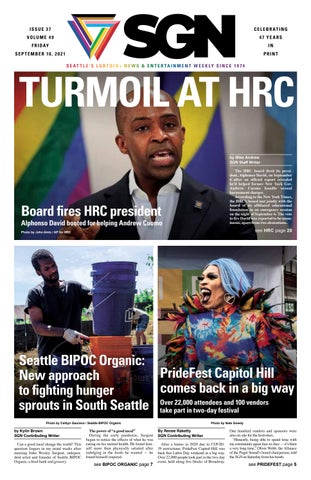
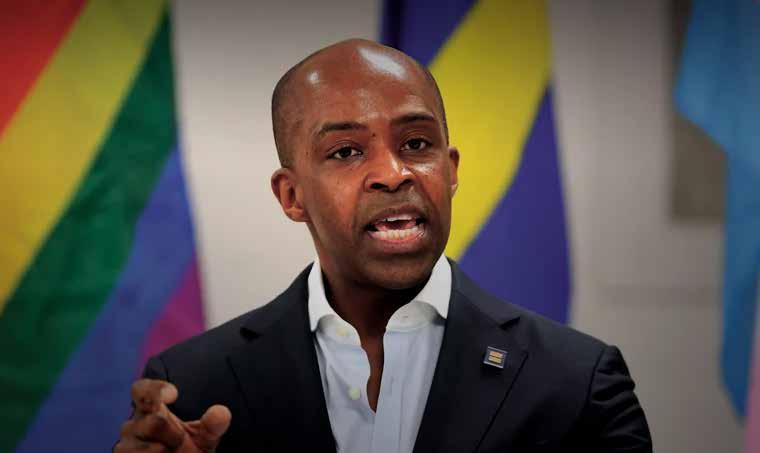
TURMOIL AT HRC
by Mike Andrew SGN Staff Writer
Over
By Renee Raketty
SGN Contributing Writer
by Kylin Brown
SGN Contributing Writer
Photo by Nate Gowdy
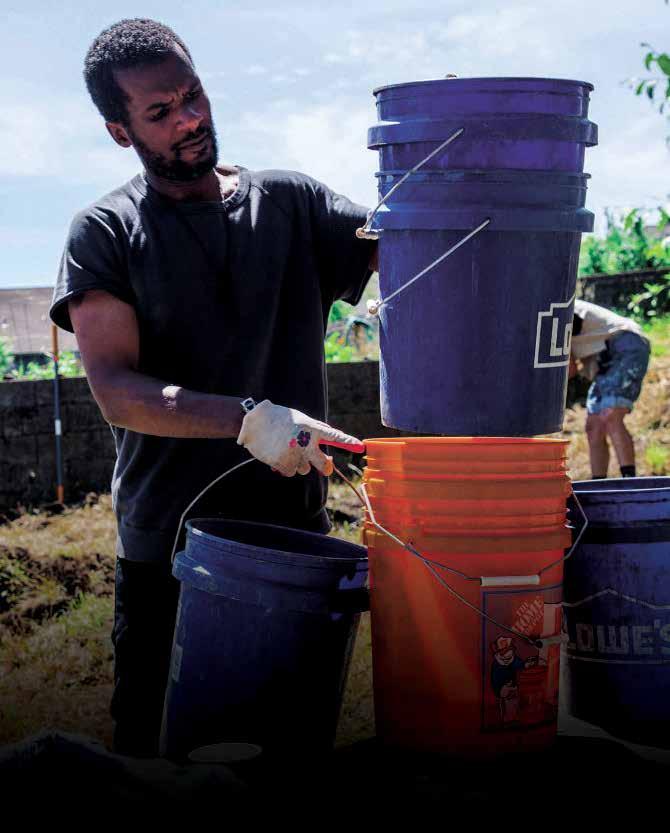
Photo by Caitlyn Gaurano / Seattle BIPOC Organic
Photo by John Amis / AP for HRC




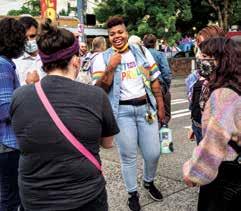

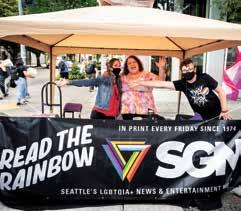
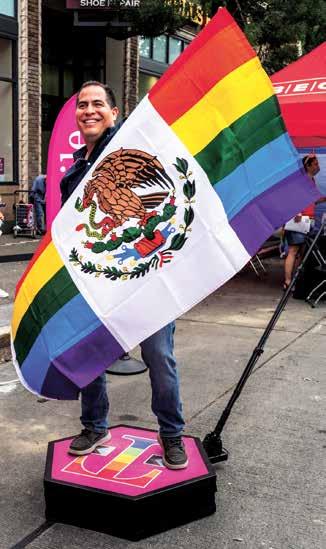
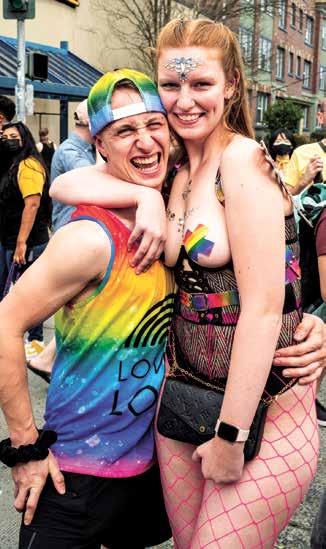
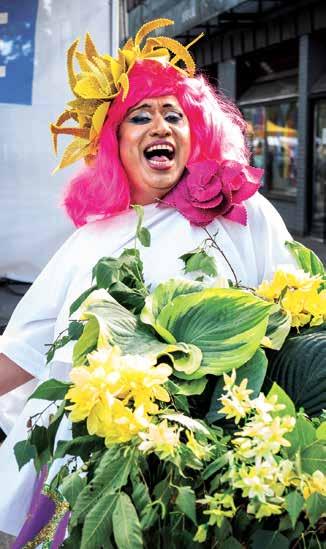
Photos by Nate Gowdy
Local News
WA schools reopen for in-person learning
How will they handle COVID-19 safety and prevention?
by Hannah Saunders SGN Contributing Writer
When COVID-19 reached Washington in the spring of last year, Gov. Inslee had no choice but to cancel in-person learning for the remainder of that school year. While he was attempting to lead the state out of the pandemic in the quickest and most sciencebased way possible, K-12 students were negatively affected.
However resilient they may be, schoolchildren the pandemic has taken a toll on them. They could no longer see their friends or classmates, they had to adapt to learning full-time via a screen (if they were lucky enough to have access to a laptop or computer at home, that is), and they lost the opportunity to engage in sports and activity groups. LGBTQ+ students in particular lost inclusive and gender-affirming spaces from the get-go
The well-being of children living through the pandemic has been an area of high priority for the Centers for Disease Control and Prevention (CDC) and Washington state’s Department of Health (DOH) since the start. For the past year and a half, officials have been taking every precautionary measure — including virtual learning — in order to protect students from contracting and spreading the virus.
Things are looking up for this new 2021–22 school year, though, which has only just begun.
In May of 2021 — near the end of the previous school year — Pfizer’s coronavirus vaccine was authorized in adolescents as young as 12 years old. This move by the Food and Drug Administration (FDA) was a major stepping stone in allowing students to resume in-person learning. However, students younger than 12 years old are unable to receive the most effective form of protection against the virus, which is why the DOH has come up with a game plan (more specifically, requirements and courses of action) relating to COVID-19 safety and prevention in schools.
A quick look at the facts
Vaccines save lives. Those who choose to become fully vaccinated against the coronavirus are significantly less likely to develop severe COVID-19-related health outcomes, such as hospitalization and death. Over 90% of all new cases, hospitalizations, and deaths in the state over the past several months occurred in those who were not fully vaccinated.
As of September 1, 2021, the DOH reported that 41.5% of 12–15-year-olds in the state are fully vaccinated while 48.7% of 16–17-year-olds are fully vaccinated.
The Pfizer BioNTech vaccine is still only available for those ages 12 and above, and although the pharmaceutical company has been conducting clinical trials in those ages 6 months to 11 years, Pfizer doesn’t expect a vaccine to become available for younger age groups (5 to 11 years old) until at least this winter.
Moderna’s vaccine is currently available for those ages 18 and above, and clinical trials in younger age groups remain ongoing. The Johnson & Johnson vaccine is still only available for those ages 18 and above.
School Safety 101
First and foremost, all schools must be able to provide full-time in-person learning for all students who are interested and must follow the DOH’s COVID safety measures.
One thing the DOH emphasizes in its back-to-school requirements is that all school staff, students, and visitors must wear face masks indoors — the second most important tool when it comes to stopping the spread of the virus — regardless of their vaccination status. It is important to note that vaccinations are not required to participate in in-person learning; however,
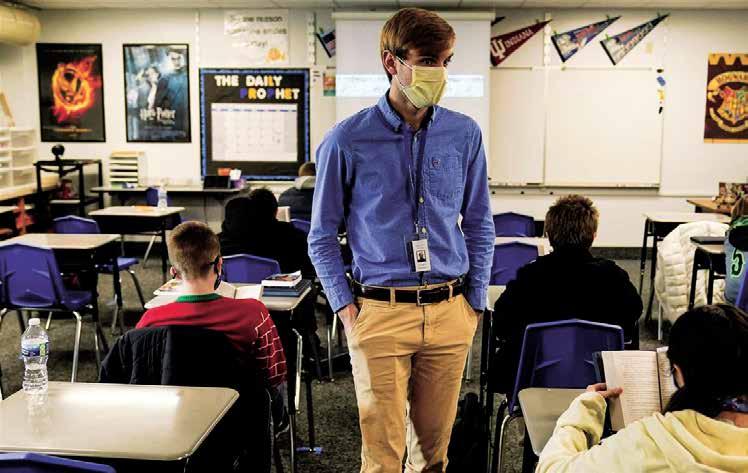
schools must promote vaccines for unvaccinated students who are eligible.
Going into the year, schools will begin verifying the vaccination status of their staff members and students. Vaccination verification includes the CDC-issued vaccination card containing the recipient’s personal information and documentation of the vaccination from a healthcare provider. Students and staff should also stay home if feeling unwell.
Masks
Again, if you take a single step into the building, you are required to wear a face mask, even if you’re fully vaccinated. The mask requirement extends to public transportation, such as school buses. Masks are not required if the individual is under 2 years of age or has a medical condition that prevents them from wearing one. Furthermore, 2–4-year-olds must be supervised when wearing face masks.
Cloth and surgical masks are recommended by the DOH for all school attendees. Teachers who are verified to be fully vaccinated may remove their masks indoors when no children are present or expected to be present, however.
Luckily, COVID transmission outdoors remains low, so both fully vaccinated and unvaccinated people are allowed to remove their masks outside; however, the wearing of masks outdoors should still be encouraged. It is strongly advised that unvaccinated people wear masks outdoors when in tightly crowded areas.
Physical distancing and ventilation
Students are required to maintain at least three feet of physical distance (or as much as possible) from others in classrooms. Teachers and students must also work to limit interactions when in large groups. Teachers are encouraged to open windows when class is in session and to spend more time learning outdoors.
Handwashing
The job of a teacher doesn’t start and stop with the textbook. Particularly when it comes to younger age groups, teachers tend to take on a sort of parenting role, which includes educating youngsters on when and how to adequately wash their hands. Teachers should reinforce handwashing for 20 seconds with soap after students use the restroom, come in from outdoor playtime,
before preparing or eating food, and after petting animals. If handwashing is not possible, hand sanitizer should be used as an alternative — just not in poorly ventilated spaces. Students and staff are also encouraged to practice basic coughing and sneezing etiquette, such as covering up and immediately handwashing after.
Cleaning
Frequently touched surfaces don’t need to be cleaned after each use, but they need to be disinfected after all the students leave for the day or if someone in the room is ill.
Sports
Masks are required by all trainers, coaches, and athletic staff when in K-12 indoor facilities, regardless of vaccination status. Masks are not required for any outdoor sports, but they are recommended when near others, such as in the dugout or on the sidelines. Athletes engaging in lowto-moderate-contact indoor sports, regardless of vaccination status, are not required to wear a mask when actively competing. Masks are not required for fully vaccinated athletes actively competing in high-contact indoor sports, such as basketball and wrestling, and they are not required for unvaccinated athletes who participate in screening testing.
Screening testing is required for unvaccinated athletes to participate in high-contact indoor sports. Screening testing must take place twice per week, with the first test taking place within 24 hours of a competition and the second 3–4 days following (or prior to) a competition. Unvaccinated athletes participating in low-to-moderatecontact indoor sports are not required to undergo screening tests, although it is recommended. Positive test results will lead to elimination and removal from the competition and will be reported to the local health jurisdiction.
Performing arts
Three-layer medical face masks are required for students and staff in performing arts classes and activities. Masks are required for everyone in music class when singing, and teachers should provide students with medical masks to replace their cloth ones. During speech and debate, singing, band, and theatre, students are required to wear masks while performing; students
who play woodwind and brass instruments are allowed to remove their masks while performing but must pull them up immediately after. The DOH also advises reducing the use of shared equipment as much as possible for these activities.
Reporting COVID-19 cases and outbreaks
If a person develops COVID-19 symptoms while at school, they must immediately be isolated and sent home with a referral for diagnostic testing. If a person visited the school while contagious (48 hours before symptom onset or 48 hours prior to a positive test result), close contacts must be identified and isolated if needed.
Close contacts are those who were within six feet of the COVID-positive person for at least 15 consecutive minutes during the contagious period. Close contacts exclude students who kept a three-foot distance from the COVID-positive person when both were wearing masks; this does not apply to teachers or staff.
If an outbreak occurs, the school’s COVID-19 coordinator must immediately inform the school and local health jurisdiction while obtaining information on those who may be close contacts. An outbreak is defined as follows:
• Two or more COVID cases among students or staff
• Cases with a symptomatic onset or positive test result within 14 days of each other
• Epidemiologically linked cases
• Cases not sharing a household
• Cases not identified as close contacts of each other in another setting
Testing/quarantining
If a test result is positive, that person may return to school once symptoms have improved, 24 hours after a fever resolves without the use of fever-reducing medication, and 10 days since the symptoms began or since a positive test result. This applies to unvaccinated and fully vaccinated people. Close contacts who are fully vaccinated and asymptomatic aren’t required to quarantine but should get tested. However, if symptoms develop, they should quarantine. Close contacts should quarantine for at least 10 days but can cease the quarantine at day 7 if they develop no symptoms and receive a negative test result.
Photo by Michael Conroy / AP

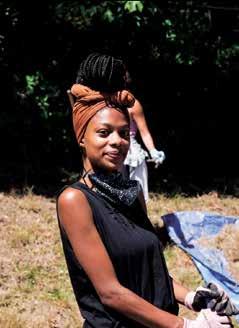

“When you’re full and you’re happy, that’s when you can find the energy and the power to come up with solutions for your own life,” said Sargent.
This realization spurred thoughts of those without secure access to healthy foods. “Feeding people should be a number one priority in communities. We can’t actually change the world without feeding people,” he said.
Hunger and food sovereignty
in Seattle
World hunger has only been exacerbated during the pandemic. Surveys by the University of Washington and Washington State University King County have demonstrated an increase locally in food insecurity and reliance on aid since the beginning of the pandemic. Thirty-six percent of households in the county have experienced food insecurity in the last 18 months, and of these, most were people of color.
Such circumstances can be devastating to those who already live on the periphery. In the LGBTQ community, a wide array of health disparities already exist. Statistics regarding food insecurity and reliance on
“Feeding people should be a number one priority in communities. We can’t actually change the world without feeding people.”
government aid programs have remained higher than those for the heterosexual population over recent decades, according to a National Health and Nutrition Examination Survey. (Before this, the data left uncollected would probably suggest the same.)
Sargent’s idea of launching a BIPOC organic food-distribution project sprang into reality within weeks of his first pitch. He called the momentum “organic” in itself.
Planning led to outreach, and outreach led to hands on deck. By June 2020, Sargent had developed a network of friends, community members, and farmers to begin operating community-level food redistribution as the Seattle BIPOC Organic food bank.
Shortly thereafter, an open plot of land in the Rainier Vista p-patch was offered to the nonprofit, and dozens of volunteers and mentors joined Sargent in cultivating the land. The food bank would then begin producing its own organics, right in the heart of South Seattle.
“What we are doing here now is a quali-
tative approach to food sovereignty,” said Sargent.
By utilizing mentorship, Sargent and his initial assembly of volunteers shared their knowledge to create a sustainable, organic, urban farm. The garden’s current yield is bursting with leafy greens and the sprouts of root vegetables, due to this mixed-method approach of Afro and Indigenous techniques.
A new model for food banks
Food banks exist to fight one of the world’s greatest long-standing problems: hunger. Nutritional needs, however, are often unaccounted for in this fight.
According to a January 2021 study from the University of Connecticut’s Rudd Center for Food Policy and Obesity, health disparities are exacerbated by “unhealthy food environments.” For example, obesity is most prevalent in food-insecure communities reliant on aid. Food banks are falling short in providing people in need with truly healthful foods.
According to Sargent, Seattle BIPOC Organic was never a traditional food bank. While most operate on a “hub-and-spoke” model, acting primarily as mass storage facilities for salvaged nonperishables, Sargent offers a fresh approach based in community.
According to his model, food banks should be able to offer inspiring and uplifting foods, by and for the community. Because of this, he is unafraid to continue asking for help in the development of Seattle BIPOC Organic, which has recently acquired a new 18-acre plot of farmland just beyond city limits.
With this new land, the organization aims to open a pay-what-you-can co-op, likely in South Seattle. To do this, they will need more volunteers and money. According to Sargent, a balance of energy in a Black and Indigenous space is crucial, but those of other backgrounds who wish to advance the mission of the food bank are welcome to invest their time or money in the land.
Those who are interested in volunteering or donating can contact John Wesley Sargent on Instagram @36jewels or via email at 33gigs@gmail.com.
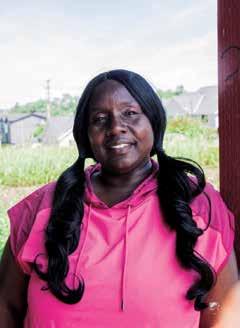
Photos by Caitlyn Gaurano / Seattle BIPOC Organic
Local News
Appeals court blocks Seattle Charter Amendment 29
Measure might have required city to sweep homeless encampments
by Mike Andrew SGN Staff Writer
The Washington State Court of Appeals ruled that Seattle Charter Amendment 29 (CA29) should not appear on the November ballot. CA29 — the so-called “Compassion Seattle” initiative — would have changed City policy towards homeless encampments.
The September 3 ruling upheld a previous decision by a King County Superior Court.
Compassion Seattle is a coalition of real estate developers, business people, and local business-friendly politicians assembled to promote the change in policy.
Homeless advocates charged that CA29 would obligate the City to keep public spaces clear of encampments without providing reasonable alternatives for homeless residents.
A group of activist organizations, including the Transit Riders Union, Real Change, Seattle/King County Coalition on Homelessness, the ACLU, and Be:Seattle, sued to keep the measure off the ballot.
King County Superior Court Judge Catherine Shaffer agreed with their lawsuit, ruling that CA29 would change the city charter in illegal ways that supersede state, regional, and municipal laws. Judge Shaffer found that the initiative was legally “problematic.” She agreed with the plaintiffs that the measure didn’t fit within the state’s legal guidelines for setting homelessness policy and took away legal powers given to the Seattle City Council.
After initially saying they wouldn’t appeal, Compassion Seattle leaders asked the Washington Court of Appeals to allow Seattle residents to vote on the initiative while its legality was decided.
The Court of Appeals tossed their petition without comment.
Knoll Lowney, lawyer for the coalition that sued to get the measure off the ballot, said Compassion Seattle could appeal further in the future, but they likely won’t, because they know it’s “illegal.”
“They could try, but it’s really throwing good money after bad at some point. Because they’re not going to succeed in an appeal,” Lowney said. “They would be better off actually devoting their million dollars toward housing the homeless.”
Compassion Seattle confirmed in a statement that it would not pursue the case further. The campaign is “deeply disappointed” in the ruling, they said, adding that decisive action on homelessness can only be obtained by changing leadership at City Hall.
“Our work has elevated this issue — undoubtedly the most consequential one facing Seattleites — to the forefront of this election for both candidates and voters,” the statement said.
“We cannot afford further inaction and the City’s continued failed approach to this emergency. Seattle voters. You have the power to make a difference this November in who you elect as mayor, as city attorney, and to the City Council.”

Arts & Entertainment Seattle Queer Film Festival returns virtually and in-person next month
by Daniel Lindsley SGN Contributing Writer
Three Dollar Bill Cinema Managing Director Billy Ray Brewton has announced that the annual Seattle Queer Film Festival (SQFF) will be returning to both online and in-person screenings for its 26th year, with ten days of workshops, panel discussions, filmmaker Q&As, and film screenings, October 14–24.
“Our goal,” Brewton said, “is to create a supportive and inclusive environment for all members of our community.”
The in-person participating venues include the SIFF Egyptian, the Museum of Pop Culture, and Ark Lodge Cinemas (in Columbia City).
Brewton’s statement made it clear that pandemic safety is a top priority. In-person attendees will require proof of vaccination, and masks will be mandatory. Yet accessibility is still as important as ever. Brewton added that every in-person film screening and panel discussion would be available online as well, with some additional online-only panels.
The screenings announced so far include Potato Dreams of America, the festival’s opening film by Seattle’s own Wes Hurley; Fanny: The Right to Rock, a true story about “one of the most important (and, sadly, forgotten) all-women rock bands in music history”; and Being BeBe: The BeBe Zahara Benet Documentary, which recounts Benet’s journey from a challenging childhood in Cameroon to winning season 1 of RuPaul’s Drag Race
The only panel discussion confirmed when Brewton spoke with the SGN was
the ever-popular presentation “How to Be an Effective Ally.” The rest of the panels, Brewton said, would be “solidified in the next week or so.”
Three Dollar Bill Cinema has been run-
ning SQFF for over two and a half decades, and has added other events throughout the year, such as the Trans film festival Translations and the short-film workshop Real Queer Youth.
Early-bird tickets for SQFF this year are on sale now, at $99 for virtual passes and $150 for hybrid passes. Go to threedollarbillcinema.org/seattle-queerfilm-festival for more information.
Potato Dreams of America – Photo courtesy of Dark Star Pictures
Photo by Ted S. Warren / AP
Women triumph in San Francisco Opera’s Tosca Theater

by Sharon Cumberland SGN Contributing Writer
TOSCA
GIACOMO PUCCINI
SAN FRANCISCO OPERA
WAR MEMORIAL OPERA HOUSE,
SAN FRANCISCO
AUGUST 29, 2021
The big news about San Francisco Opera’s production of Tosca is not that the singing is marvelous (it is) or that the opera house has been refurbished and the seats are much more comfortable (it’s great!). It isn’t that the cast is young, formidable, and pitch-perfect (which they are) or that the costumes and set design succeed in transporting the audience to Rome in 1800 as Italy struggles to resist Napoleon’s invasion. All these things are true, and they made for an unforgettable night at the opera.
The really big news about this production of Tosca is Eun Sun Kim, the SFO’s new music director — one of only a handful of female conductors in the world in charge of an orchestra. Go to Wikipedia and type in “women conductors” and you’ll get a list of maestros who have been invited to conduct an opera here and an opera there, but no one who’s running the show.
Seattle Opera’s own Christina Scheppelmann is a world-class arts administrator who makes sure great conductors come our way, and it’s hard as heck to get her job — she’s only one of two female arts administrators to run a major opera company worldwide (the other is Francesca Zambello, of Washington National Opera and Glimmerglass Opera).
But Scheppelmann and Zambello are not conductors — a job that’s even harder to get. I don’t know what combination of vision and zeitgeist brought Kim to the music directorship in San Francisco, but it’s clear her that her scintillating talent qualifies her for any podium in the world. Kim is young (just 40 years old) and
slight of build, with a long ponytail and arms that alternately slice the air like sabers and paint the air like Berthe Morisot (a female impressionist — another neglected group of women artists). Kim’s job at the podium is to inspire the orchestra to create a clear, dynamic, and compelling account of a complex score, and to direct the singers onstage who are both supported by the musicians in the pit and partners with them in the larger sound creation that is the opera itself.
Fortunately for the singers, the orchestra pit in the War Memorial Opera House is much higher than normal, so that the singers can look straight ahead to see the conductor rather than having to peer down or look at monitors.
On August 29, as the lights went down and Kim entered and took her place at the podium, the audience gave her a huge ovation, which she acknowledged gracefully before taking command of the evening, bringing the orchestra and the audience to deadly silence before giving the downbeat. At the first formidable notes of the “Scarpia” theme that opens Tosca, the audience knew it was going to be a great evening.
Scarpia is the chief of police in 1800 Rome and the evil force in the story, feared by men and women alike. By using his theme to open the opera — only three chords: Bb, Ab, E — Puccini rejected the tradition of an expansive overture that focuses the audience’s attention while establishing a range of ideas that preview the story. Instead, he hurls the audience into the heart of the matter with three forceful chords that begin with the deep growl of a horn. It’s as if a devil rose from beneath the orchestra pit and uttered a moan so profound that it rattles the chandeliers. Instantly we know that “something evil this way comes.”
In the hands of a lesser conductor, this sequence of notes goes by so quickly that it barely registers before the agitated music that raises the curtain on a busy deacon and a political escapee who’s seeking refuge in the church. In the hands of Eun Sun Kim, those
opening notes — going from a loud bleat to a threatening pianissimo in a flash — sent a chill down the audience’s collective spine.
As the curtain goes up, we find ourselves in the church of Sant’ Andrea delle Valle, with its pews, candles, and icons. Cavaradossi, the young painter (sung with great charm by tenor Michael Fabiano) is in love with Floria Tosca, the diva sung by soprano Ailyn Perez. Cavaradossi has received a commission to paint an image of Mary Magdelene for the church and models it after a young aristocratic woman with blue eyes he sees praying there. This catapults Tosca, who has dark eyes, into a frenzy of jealousy. How he handles her feelings is critical to their love story and whether they can survive Scarpia’s plot to condemn Cavaradossi for assisting the political prisoner and then to take Tosca for his sex object.
Director Shawna Lacey, along with stage designer Robert Innes Hopkins, brought the set to life, along with gorgeous costumes for the diva that were inspired by the period portrait paintings of Élisabeth Vigée Le Brun — a welcome departure from the traditionally lavish costumes modeled after Maria Callas’ iconic look from the 1950s.
In most versions of Tosca, we never see the “unknown beauty” who inspires the painting, but this is where the SFO’s production, led by women, is more thoughtful about the plight of women in a male-dominated culture. First, we see the lovely young lady with blue eyes praying in the church, and then we see her mingle in the crowd that comes to mass. But quite unexpectedly, we see her again in at the opening of Act 2, sitting disheveled and distressed in Scarpia’s office in the Castel Sant’ Angelo. Clearly the powerful and brutal Scarpia saw her portrait when he came to the church for mass, and ordered her to see him later in his office. We can see her shame and fear as the act begins, and then we see Scarpia’s henchmen drag her to the door and throw her out of his office.
This shocking little pantomime, worked seamlessly into the act, is a directorial interpolation, but it brings a strong dose of clarity to Tosca’s dilemma. In Act 2 she has to try to save Cavadossi’s life by agreeing to have sex with Scarpia, who promises to let the two of them go afterward. But the plight of the woman with blue eyes foreshadows the fact that Tosca will fail in the face of Scarpia’s ruthlessness.
Alfred Walker, as Scarpia, was a refreshing change from the classic interpretation of a man in a baroque white wig, whose cold dignity strikes terror into everyone who crosses his path. This Scarpia is younger, a person of color, and a man who is feared and rejected at the same time. Walker’s powerful voice matched the calculated menace of the character and brought an intimidating coldness to the role.
As the lovers, Fabbiano and Perez made a beautiful couple. This Tosca is younger than the somewhat daunting and controlling woman traditionally presented in this role, and her jealousy is clearly a matter for lovers’ quarrels that are quickly made up. This slightly less diva-like behavior makes it all the more plausible that she will despair and become desperate when confronted with Scarpia’s cold-hearted evil. Perez has a lovely and powerful voice, and she is an excellent actor. I’ve never seen a Tosca look so frightened of Scarpia, instead of acting haughty and scornful. By abandoning the conventional interpretation and embracing the idea that vulnerable women are frightened, no matter how famous they may be, we are haunted by the modern ghosts of Harvey Weinstein and Jeffrey Epstein. As opera houses around the country and the world begin to open their doors again, many opera lovers are eagerly coming back to their beloved auditoriums. Though the chance to see San Francisco Opera’s Tosca is past, Mozart’s hilarious Cosi fan tutte and Beethoven’s majestic Fidelio are coming right up for remote viewing at the end of the month, so check out the website: sfopera.com.
San Francisco Opera production of Tosca – Photo by Cory Weaver
Film
Delightful, wholesome Everybody’s Talking About Jamie worth singing about
by Sara Michelle Fetters SGN Staff Writer
EVERYBODY’S TALKING ABOUT JAMIE
Theaters / Amazon
Prime
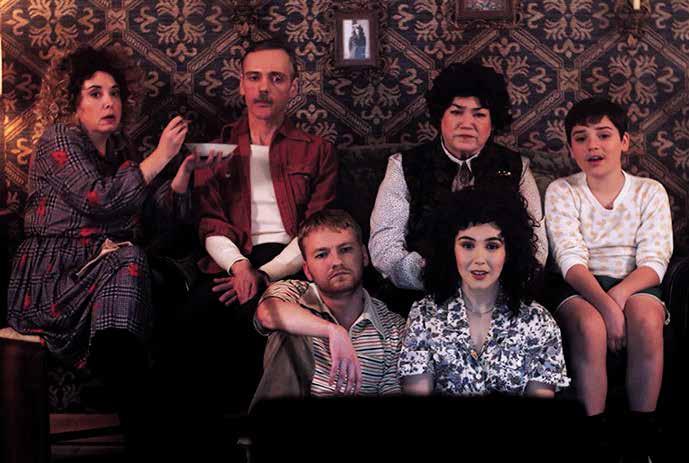
Everybody’s Talking About Jamie is inspired by the 2011 documentary Jamie: Drag Queen at Sixteen and adapted from the popular 2017 London musical. It reunites the stage production’s original creators: director Jonathan Butterell, writer and lyricist Tom MacRae, and composer Dan Gillespie Sells, and features newcomer Max Harwood in the lead role of 16-yearold Sheffield teenager and wannabe drag queen Jamie New.
It’s also pretty dang delightful.
When sitting down to watch this, I honestly didn’t know what to expect. I knew precious little of the true story the filmmakers had based their hit musical on. Additionally, the over-the-top, cartoonishly flamboyant trailer made my skin crawl and had me questioning if I should even take a look at it in the first place.
But this is why I attempt to give every motion picture a fair shake, with as few preconceptions as possible. Not only is Everybody’s Talking About Jamie entertaining, it’s so wholesomely kind that it couldn’t help but make me feel terrific in ways I didn’t know I needed until after it had concluded. It’s that good, and given the pleasure the finished product brought me, I’m incredibly thankful I took the time to give it a chance.
After unexpectedly receiving a pair of expensive red high heels from his mother Margaret (Sarah Lancashire) for his birthday, Jamie New is on cloud nine. He’d been obsessively saving up to buy the footwear on his own for months, and even though Margaret doesn’t understand her boy’s fascination with the shoes, seeing the look of bliss wash over her son’s face as he nimbly struts around the yard is all that matters.
Jamie feels invincible now that he has the heels. Though out at school, he’s still been content to stay somewhat in the shadows and not make many waves. Not anymore. Revealing to his best friend and confidant Pritti (Lauren Patel) that he aspires to become a famous drag queen, Jamie doubles down, stating that he’s thinking of attending the school prom in a dress, an act of defiance so brazen it’s certain to cause something of an uproar.
It would have been easy for Butterell, MacRae, and Sells to craft a “jukebox musical” when they first started outlining this project. They could have utilized any number of pop favorites from the past four decades, many of which would have fit this tale splendidly.
But that would have been the case in less creative hands, and this trio had no interest in going that route. Instead, they’ve composed a bevy of toe-tapping original songs for Jamie and the rest of the cast to enthusiastically belt out as events progress. Even better, all of them are character and plot driven, and like the best musicals, they give the narrative additional complexity that might not have existed otherwise.
This also allows them to plant moments of exquisitely subtle seriousness in unexpected places. Case in point: Jamie needs a mentor in his quest to attain drag success. He finds that in the form of Sheffield shopkeeper Hugo Battersby, otherwise known as the formerly famous — or in some circles infamous — Loco Channelle (Richard E. Grant).
There’s an excellent montage during this first interaction between the pair, where forty years of British LGBTQ history is showcased in the span of four or five minutes via a VHS home movie. It’s a marvelous moment. Not only is the song
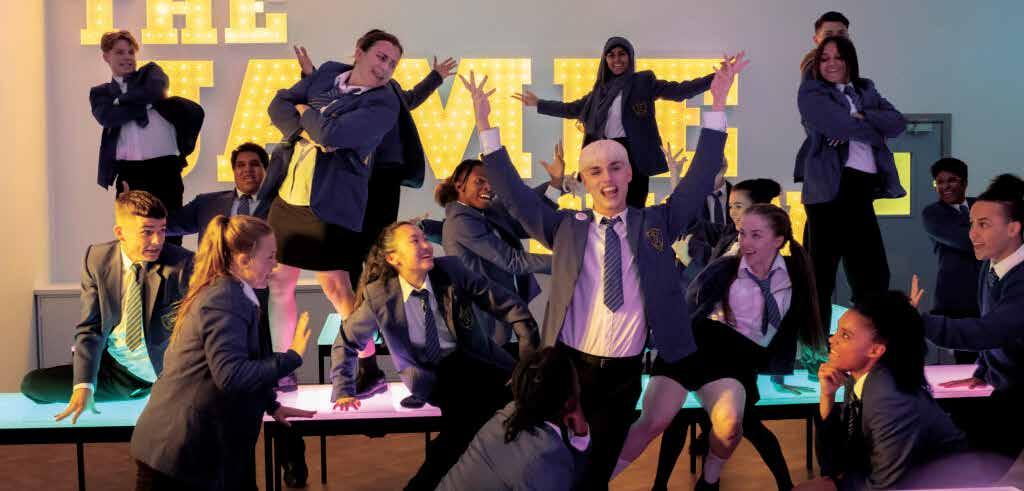
“This Is Me” heartbreakingly sublime, the video footage of Loco, her partner, and her friends during their younger years is nothing short of perfect. It is a story beat that helps Jamie look beyond his own desires and see in a new light the historical significance of the path he’s determined to walk upon, past, present, and future all colliding in one single breathtaking sequence. Some other elements work better than others. While I applaud that Butterell and company don’t attempt to sugarcoat or put a saccharinely sweet bow on the relationship between Jamie and his estranged father
Finding joy
Wayne (Ralph Ineson), I still can’t say I had much of an emotional investment in what was happening between the two of them. This doesn’t matter near as much as I would have anticipated. Harwood makes an immediate, lasting impression; the youngster delivers a strong, surprisingly nuanced performance that’s easy to love. Lancashire and Patel are equally wonderful, while veteran Sharon Horgan does a superb job of making the most out of her role as the school’s prickly career advisor, Miss Hedge. As for Grant, he steals the show, and even though he’s only in a handful of
scenes, outside of Jamie, his Hugo/Loco is easily the film’s most memorable character.
I adored Everybody’s Talking About Jamie. Its innate jubilant goodness won me over. While the musical numbers are impressively shot and staged — props to cinematographer Christopher Ross (Black Sea) and editor Mark Everson (Paddington 2) on that front — and as great as Harwood and especially Grant’s performances are, it is that overwhelming spirit of kindness and acceptance that filled my heart with joy. I’ll be singing this film’s praises for some time to come.
Everybody’s Talking About Jamie director Jonathan Butterell on bringing the West End musical sensation to the big screen
by Sara Michelle Fetters SGN Staff Writer
Inspired by the true story outlined in the 2011 documentary Jamie: Drag Queen at 16, the musical sensation Everybody’s Talking About Jamie has made the leap from London’s West End stage to the big screen with energetically wholesome aplomb. Overflowing in empathetic kindness, this shockingly great motion picture took me by complete surprise. I enjoyed almost every second of it, and from its toe-tapping first number to its tearfully sublime show-stopping climax, director Jonathan Butterell’s adaptation euphorically hits all the right notes.
The story follows 16-year-old Jamie New (newcomer Max Harwood). After being given a present of an expensive pair of red high heels for his birthday by his loving, if often perplexed, mother Margaret (Sarah Lancashire), the flamboyantly gay youngster reveals to his best friend and confidant Pritti Pasha (Lauren Patel) that he wants to be a drag queen. What’s more, he also wants to attend the prom in a dress.
With the dual support of Margaret and Pritti, Jamie seeks guidance from aging drag legend Hugo Battersby, aka Loco Chanelle (Richard E. Grant). He also hopes to earn the affection of his father, Wayne (Ralph Ineson), whom he seldom sees, as his parents divorced when he was a youngster. Through it all, Jamie learns what it means to take charge of your life and stand up for what you believe in without destroying or selfishly belittling others in the process.
I sat down with Butterell over Zoom to chat about his new film. The following are some edited transcripts from our lengthy conversation:
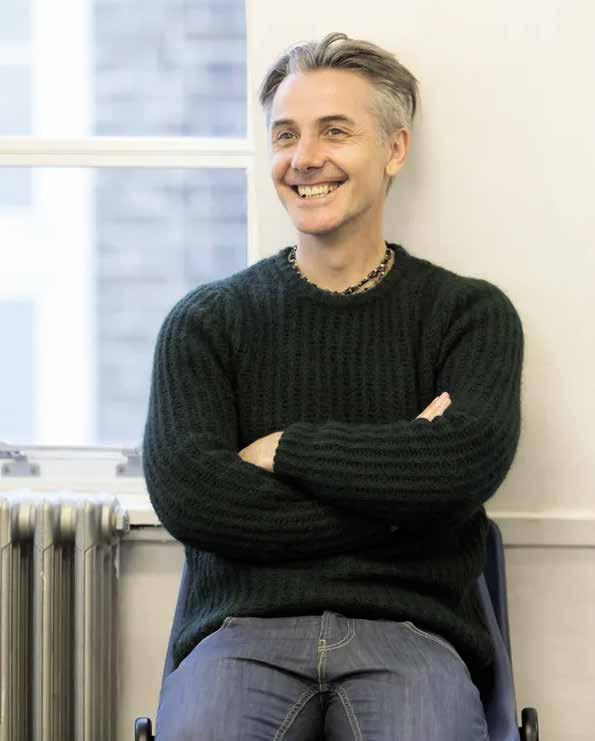
Jonathan Butterell – Photo courtesy of Broadway World
Everybody's Talking About Jamie – Photo courtesy of Amazon Studios
Sara Michelle Fetters: What is it about this story and its kind of crazy wholesomeness that attracted you and made you want to go from the musical production into crafting a feature-length film?
Jonathan Butterell: This story started with me seeing the documentary Jamie: Drag Queen at 16. I saw this young kid get off a bus, a 16-year-old boy, get off a bus in a working-class community, a community I knew and which was very similar to the community I grew up in myself, and say directly to camera, “My name’s Jamie. I want to be a drag queen.” Then the camera pans down to him wearing this fabulous pair of heels.
I was hooked. I watched his mom support and love him and hold him. I watched the community around [Jamie] make a safe space in which he could be himself. I knew I needed to tell this story. I could feel it.
You said “wholesomeness,” and I like that word. I can go even further than that. This story is about finding the center of this particular someone’s joy. I find putting your joy out to be an act of defiance in some ways. It’s going, “This is who I am. This is where I find my joy. I need a place in which to express it.”
But joy shouldn’t be an act of defiance. It should be a very natural act that we all have, and I found Jamie to have such courage in doing this. It was inspirational, and I wanted this story to be out in the world. Particularly now. With all that we’ve been through with regards to all being locked away from any sense of community, but also because we’ve lived in an entrenched world for such a long time, I just wanted the world to celebrate each and everybody’s individual joy.
SMF: This might be what makes the film so remarkable. It’s just so kind. We don’t see a lot of that right now, especially with everything that we’ve been through. It almost feels revolutionary watching this story in the context of a musical. What do you think?
JB: Yes. That was the intent from day one between Dan Gillespie Sells, Tom McCray, and myself. I grew up a long time ago in an Irish Catholic working-class community. Contrary to all belief, I experienced kindness around me. I know that’s unusual. I know not everybody experiences that. But I knew the power of this, and I knew it was revolutionary.
It’s such an easy word: kindness. It’s such a simple thing. It’s a very simple act to find that kindness in your heart. I like “kindness” better than the word “love” in many ways, because “love” is such a complicated word. It means so many things to so many people. But a simple act of kindness? We understand it in a very clean way.
I’m enjoying your response to it being kind of revolutionary, because that was the intent. We never wanted to flagwave, because if we’re flag-waving, that entrenches us in some ways. I never want Jamie to be a victim.
I wanted this not to be a coming-out
story for the simple fact that there’s been a million coming-out stories, some of which have been beautifully done, but this wasn’t that because Jamie’s authentic and fully himself right from the beginning.
For any 16-year-old, the major struggle is, “Who am I?” and “Where’s my place in the world?” That’s normal. I wanted that for Jamie. He can’t represent his whole community, because our community is so diverse. He can only be one voice of a million diverse voices within that community. But in this one voice, I also wanted him to say, “I can represent everyone.”
Look, straight white men get to do this in stories often. They get to represent the “everyperson” or the “everyman.” I wanted Jamie, effeminate queer hero, to be able to go, “I can speak for us all. I can speak for the young and the old and the black and the white and the queer and whatever gender you identify as. I can represent everybody in that respect.” Because we all know what it is to step out into the world and try to find our joy. That’s part of being human.
SMF: I think the two primary relationships in the film are one of the keys to what you’re talking about. That’s the relationship between Jamie and his mother Margaret, and then the one between Jamie and Pritti. Those relationships are far more complex than I think they initially appear. There’s a lot going on. You guys pack a multitude of emotional nuances into those journeys.
Was there any trepidation that you were almost making these relationships too multifaceted? I hate to ask, because I don’t think that’s necessarily possible, but when you’re dealing with audiences, it is unfortunately something that has to be considered.
JB: I’m going to be diplomatic. Sometimes you have to fight to maintain what I would just call complex reality. We’re all a mess. We’re just a mess. Being a mother is a mess of a thing. Being a dad is a mess of a thing. It’s all complicated.
I can’t imagine what it must be like for a mother who doesn’t fully get it. Margaret’s trying to learn along the way. She gives him the shoes, not knowing what they mean. She gives him a pair of shoes to walk in that may end up making a very rocky path for him, but she still gives them to him because, even though he may stumble in these shoes, he’s going to have to stumble in order to learn.
She’s also saying, “I’ve got to let him be even if everything in my body’s wanting to protect him and stop him from falling.” Those are two contradictory emotions. But Jamie needs to be free. Even if being free means he’s going to get hurt. That’s rough for a parent.
I think the same with Pritti. Pritti does not understand Jamie. Never mind her cultural background — her personality is just different. But again, she tries. All she puts forward is her love of Jamie. She’s there for him. She says to herself, “I’m his friend, even if that means pulling him up to say you’re going too far in this one moment in time.” She’s a true friend in that way.
SMF: When you’re translating a true story into a cohesive, audience-friendly story for a West End musical, how do you balance all of those varying aspects of Jamie’s tale?
JB: I suppose the answer to the question is the music. What a musical does is it brings another version of storytelling into the equation. I wanted to make sure that the music was pop. I wanted it to be stuff people listen to on their radios. Pop can be
highly, highly sophisticated, and it felt right for this production. I didn’t want it to feel oversophisticated of for audiences to feel like they just didn’t get it.
Then, because it’s Jamie and he’s 16, that pop world allowed his imagination to fly. It allowed my imagination to fly. Particularly with this film, I could go all over the place. I could take Jamie into the pop video land. I could take him into this most fabulous club with 500 amazing creatures or down this great fashion catwalk. I could transform his canteen at school into an amazing ballroom, because his imagination flies to that place.
Balancing fact and fiction, we created Jamie New as opposed to Jamie Campbell specifically for that reason. We wanted to allow Jamie Campbell the freedom to distance himself from our story if he wanted to. He could say, “That’s not me. That’s Jamie New.” He didn’t feel the need to do this, but we felt it was important to give him that option.
I remember when they saw it for the first time, the theater piece, Margaret tapped me on the shoulder and said, “How did you know? How did you know we’ve had those conversations in those kitchens? You weren’t there.”
We just used our imaginations. We all have moms. We’ve all been in that place, Dan, Tom, and I. We have similar backgrounds. We used our own stories and our own imaginations. There’s something universal in Jamie and Margaret’s story. It’s universal.
SMF: Talk to me about Max Harwood. When did you know he was Jamie? What was that like seeing him come alive as you were shooting the film?
JB: Finding Jamie was a big task. You’re trying to find a young person who can play 16 and unashamedly tap into their effeminacy. It was important to me to have an effeminate hero, because I feel like you never see that. They’re always the sidekick. The fun person. Or worse, the person who gets beat up and is left in the corner. Having someone who was comfortable and at ease with regard to their feminine side, who could sing, dance and had the full range of acting emotions, that’s tough to find.
We put out an ask on social media for anybody across the whole of Britain to audition. Max sent in a little one-minute video of himself in his bedroom in which he spoke candidly about his life and his love of Drag Race. He loved playing around with makeup. He felt he really understood this story. He used to dress up as his sister when he was little and get her to play Kenickie to his Rizzo.
I just thought he was charming. I thought Max had a glint and a charm and a slight magic from that video, so we asked him in. He was one of about five young men who auditioned. They were all good, but
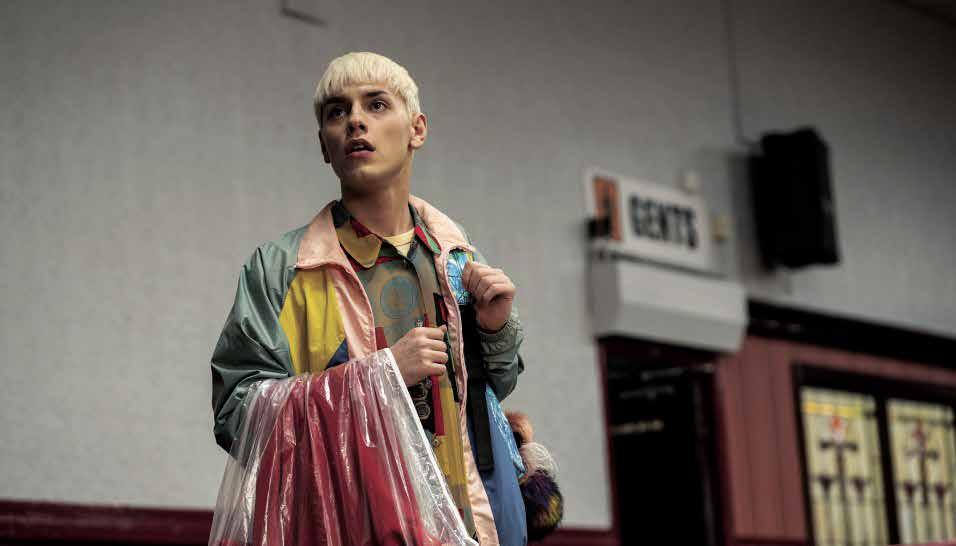
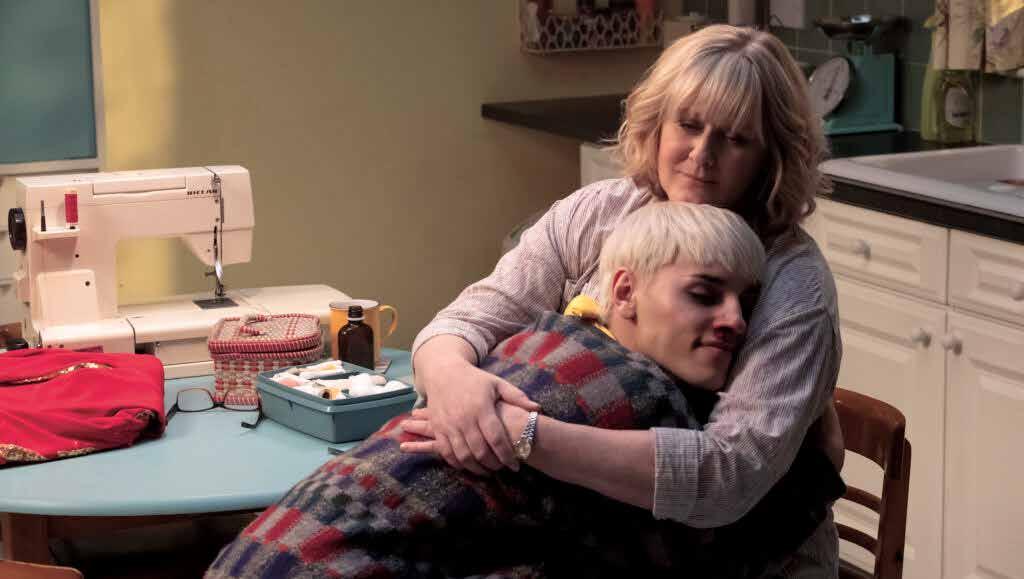
Max Harwood in Everybody's Talking About Jamie – Photo courtesy of Amazon Studios
Max Harwood and Sarah Lancashire in Everybody's Talking About Jamie – Photo