LG BT Q+
20 HI 21 ST CELEB R AT I N G SE ORY 4 7E PYAE APRRS G O I NE 17 JE CT
ISSUE 41 VOLUME 49 F R I D AY OCTOBER 8, 2021
S E AT T L E ’ S L G B T Q I A + N E W S & E N T E R TA I N M E N T W E E K LY S I N C E 19 74
IMPASSIONED SPEECHES, COUNTER-PROTESTORS, AND POLITICALLY POINTED MAKE-OUT SESSIONS A WEEKEND OF WOMEN'S RIGHTS RALLIES by Lindsey Anderson SGN Contributing Writer Day 1: Tough women, tender moments On Saturday, October 2, hundreds of people gathered in front of Seattle’s Westlake Center to protest recent attacks on women’s reproductive rights. Outrage sparked across the country after Texas passed the “heartbeat bill,” making it illegal for people in the state of Texas to receive an abortion after six weeks into their pregnancy. Although the law applies only to Texans, people across the country see it as an overt attack on women’s rights everywhere and fear it could lead to federal challenges against Roe v. Wade. Photo by Lindsey Anderson
see RALLY page 4
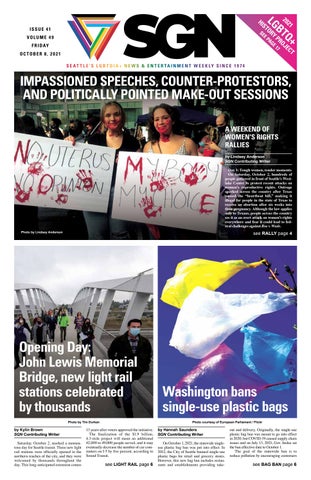
Opening Day: John Lewis Memorial Bridge, new light rail stations celebrated by thousands Photo by Tim Durkan
by Kylin Brown SGN Contributing Writer Saturday, October 2, marked a momentous day for Seattle transit. Three new light rail stations were officially opened in the northern reaches of the city, and they were welcomed by thousands throughout the day. This long-anticipated extension comes
Washington bans single-use plastic bags Photo courtesy of European Parliament / Flickr
13 years after voters approved the initiative. The finalization of the $1.9 billion, 4.3-mile project will mean an additional 42,000 to 49,000 people served, and it may eventually decrease the number of car commuters on I-5 by five percent, according to Sound Transit.
see LIGHT RAIL page 6
by Hannah Saunders SGN Contributing Writer On October 1, 2021, the statewide singleuse plastic bag ban was put into effect. In 2012, the City of Seattle banned single-use plastic bags for retail and grocery stores. However, this new bag ban includes restaurants and establishments providing take-
out and delivery. Originally, the single-use plastic bag ban was meant to go into effect in 2020, but COVID-19 caused supply chain issues and on July 13, 2021, Gov. Inslee set the ban effective date to October 1. The goal of the statewide ban is to reduce pollution by encouraging customers
see BAG BAN page 6
GREEN CARDS • VISAS • ASYLUM • CITIZENSHIP 1836 Westlake Ave N, Suite 302 Seattle, WA 98109
(206) 724-1940 olivielaw.com
THIS AD SPACE HAS BEEN GENEROUSLY DONATED BY KRISTIN COSTELLO IN MEMORY OF SGN PUBLISHER GEORGE BAKAN
2
SGN
OCTOBER 8, 2021
C E L E B R AT I N G 4 7 Y E A R S!
In this Issue
LOCAL NEWS 4 A&E • FILM • BOOKS 8 LGBTQ+ HISTORY PROJECT 16 OP-ED 18 TRAVEL 19 NATIONAL/INTERNATIONAL NEWS 20 VISIT US ONLINE SGN.ORG
OCTOBER 8, 2021
SGN
3
Local News
RALLY
continued from cover Before an audience in pink hats, the gathering in Downtown Seattle started with a performance by Filthy FemCorps, which bills itself as Seattle’s “all-women and Nonbinary brass band.” The event boasted a strong line-up of speakers, starting with Christine Reeves, former state representative and founder of the Political Equity Project. Reeves shared an emotional story with the crowd detailing the three times she had sought an abortion, reminding those in attendance that anyone from any walk of life could need an abortion. “Now I am a mom and a better mom because I was able to make that choice. What I choose to let grow inside my body is my choice,” Reeves said before giving a call to action to do away with crisis pregnancy clinics in Washington state. Next, Alexis Turla, the chief of staff to City Council Member Tammy Morales, took to the stage. Turla told the audience about her family history and her origins in the South, and she shared an appreciation for the state of Washington “where Roe is on the books.” But she also warned that “the fight is not over. They hate you whether you want an abortion or are trying to have a family. Enough! Enough about regulating our bodies!” She prompted cheers from the crowd when she continued with a sneak peek into the future state congressional session, “In this next session, we will be bringing a bill to make sure that insurance covers fertility. We need this for everyone. No matter if you’re in a same-sex relationship, a Nonbinary relationship, or a hetero relationship, you should have the right to decide when you want to have a family.” The event continued as speakers called on voters to repeal the Hyde Amendment and Title 42, help create systems that help undocumented women have equal access to healthcare, and help fund Planned Parenthood. The rally concluded with a speech from Nikkita Oliver, candidate for City Council position 9. They first brought up the issue of Native and Black sovereignty, reminding the crowd, “This fight for bodily autonomy and reproductive justice is not new to us. I think it is important when we talk about intersectionality when we talk about reproductive justice that we really honor the historical harm and trauma experienced by Black and Native people on Turtle Island at the hands of a white settler colonial government that is putting its patriarchal, racist, and classist policies at its inception.” They called on those in attendance to reflect on how far we have to go in healing the historical and present-day harm of a government that desires to control other people’s bodies.
4
SGN
Photos by Lindsey Anderson
OCTOBER 8, 2021
C E L E B R AT I N G 4 7 Y E A R S!
The weekend’s double feature of women’s reproductive justice rallies showed that many in Seattle feel strongly about the abortion debate in Texas.
Photos by Lindsey Anderson
Oliver surprised the audience by sharing a personal story that they had not yet talked about publicly: “I believe that abortion is a public health approach to public safety, and here’s why.” They went on to describe a time when they were in an abusive relationship with a man seventeen years older than them. “Like many people socialized as women, I thought that I had to be his caretaker. And I was afraid to ask for help, both from the Christian organization I worked with as well as to call the police because I know what happens when we call 911 on Black people. There were no services and no supports to me when I needed them.” As their relationship became more volatile, their partner made coercive threats, attempting to permanently trap them in the relationship. “He threatened to get me pregnant so that I couldn’t leave. So I went to Planned Parenthood, and I got an IUD put in without telling him. I am really thankful that I had access to medical care to do that. It was lifesaving. Because, while it
VISIT US ONLINE SGN.ORG
may take many years for a domestic violence survivor to leave a space, the last thing we want is for them to have to be forever attached to someone who abused them, through a child.” They explained how access to abortion is vital for people in domestic violence situations, and that it can mean the difference between life or death. The speakers left a thrill in the air, energizing the crowd and encouraging more folks to come forward and share stories of their own. The atmosphere was full of love, support, and determination, mirroring 600 other reproductive justice rallies happening across the country. Day 2: Pro-lifers bite back On Sunday, October 3, a crowd gathered again to support women’s reproductive rights and protest the new Texas laws. This crowd, huddled together in front of St. James Cathedral, had a much different aura. Picketing in front of the church, people held handmade signs and engaged in chants of “Keep
your rosaries off our ovaries!” Unlike Saturday’s rally, Sunday’s brought in a fleet of counter-protesters. An all-male group of pro-life advocates held up signs depicting chicken-wing-looking fetuses with phrases like “Mommy don’t murder me” and “Ask me why you’re going to hell.” The counter-protesters brought a microphone and passed it around in a circle while condemning everything from abortion to same-sex marriage. At one point, two women approached a counter-protester slandering the LGBTQ+ community and they began making out with each other. He covered his eyes, but when he tried to run away, one of the women flashed her chest at him. Horrified, the man ran to hide and began screaming incomprehensible words into his microphone. As the march began, a white car pulled into the street in front of the church. Organizers warned protesters to step away from the street, indicating that the driver had already attempted to initiate violence earlier in the event. A man got out and pushed his way into the crowd before organizers could follow him. The march began around 2:30 p.m. with protesters and counter-protesters walking through the streets toward the Federal Courthouse. A fleet of vehicles drove alongside the marchers, protecting them from counter-protesters who have a history of running cars into crowds at such events. Halfway through the march, the man who had emerged from his vehicle earlier now attempted to start a physical altercation with protesters. Four volunteers quickly surrounded him and escorted him off the premises. The fleet of protesters arrived at the Federal Courthouse building at 4 p.m., taking to the steps for individual speakers and chants. However, counter-protesters quickly overtook them, chanting on their bullhorns, “Repeal the 19th!” March organizers were eventually able to remove the counter-protesters from the steps of the building, and speakers were able to share their stories and echo the sen-
OCTOBER 8, 2021
timents from the day before. The slander and slurs from the pro-life group did not deter the women’s rights advocates, but many left with hoarse voices after hours of screaming to be heard over all the hate. The weekend’s double feature of women’s reproductive justice rallies showed that many in Seattle feel strongly about the abortion debate in Texas. Saturday’s event was a reminder to many that there are still battles to be fought and that abortion is healthcare for a myriad of reasons. Sunday’s march was a wake-up call, casting a light on the men who use their voices to oppose progress and women’s rights. The weekend gave a face to both sides of the argument, leaving many determined to take action now. To get more involved with the fight for reproductive justice, you can visit https:// www. plannedparenthoodaction. org/ issues/act to donate money or become an active member. If you or someone you know is in need of affordable sexual healthcare, you can visit Planned Parenthood at any of these locations: 2001 E Madison Seattle, WA 98122 5020 Roosevelt Way NE Seattle, WA 98105 9942 8th Avenue SW Seattle, WA 98106 1200 N. Northgate Way Seattle, WA 98133 14730 NE 8th St. Bellevue, WA 98007 723 NE Riddell Road, Suite A Bremerton, WA 98310 19505 76th Ave W. 200 Lynnwood, WA 98036 1105 S 348th Street #B103 Federal Way, WA 98003 1515 Martin Luther King Jr. Way Tacoma, WA 98405 1509 32nd St. Everett, WA 98201
SGN
5
Local News
BAG BAN
continued from cover to bring their own bags (which they should frequently clean) and increase consistency across statewide policies. Washingtonians use about 2 billion single-use plastic bags annually, which have chemicals that become toxic once released into the environment. Plastic pollution also threatens marine life, which can become entangled in or damaged by the waste. New bag protocols The single-use plastic bag ban applies to all retail, grocery, and convenience stores; restaurants and establishments offering takeout or delivery food; temporary stores and vendors; and any event where food is sold and distributed. The kinds of bags allowed include paper bags made from at least 40% post-consumer recycled content (the post-consumer recycled content must be labelled) and plastic bags made from at least 20% post-consumer recycled content with a plastic film thickness of at least 2.25 millimeters. The reusable plastic bags must include the post-consumer recycled content and be labeled “reusable.” Beginning on July 1, 2022, reusable plastic bags must be made from at least 40% postconsumer recycled content. In 2026 the thickness of each bag will increase to 4 millimeters to support durability. Establishments that provide bags will be required to charge an 8-cent fee to cover part of the cost of providing the bags. The charges must be shown as taxable on the sales receipt — if businesses charge more
Photo by Stelios Misinas / Reuters
than 8 cents per bag, the 8 cents must be shown as taxable and the remainder must be listed on another line on the receipt. Small paper bags under 882 cubic inches are not subject to a fee. Noncompliance Any individual can submit an observation report of a business that is not in compliance with the new single-use plastic bag ban via a reporting form found on the Washington Department of Ecology’s website. The department will use the information provided to make sure establishments understand the new law. Repeated noncompliance may result in a $250 fine.
The deadline for using up all single-use plastic bag inventory was in June 2021; however, businesses may continue to use the remainder of the inventory, though they may receive noncompliance complaints and may be asked to display purchase receipts that show that the bags were purchased before October 1, 2021. Exemptions Certain exemptions to the single-use bag ban include: • Produce • Frozen food • Meat/fish • Flowers/potted plants
• Prepared food/bakery goods • Prescription drugs • Newspaper bags • Mailing pouches/sealed Envelopes • Dry cleaning bags/door hanger bags • Bags sold in packages of multiple bags (food storage, garbage, pet waste) • SNAP, FAP, WIC and TANF programs • Food banks For more information, visit https:// ecology.wa.gov/Waste-Toxics/Reducingre c y c l i n g - w a s t e / Wa s t e - re d u c t i o n programs/Plastics/Plastic-bag-ban
tion, which lies along 12th Ave NE between NE 65th & 67th. Seated firmly between Green Lake and Roosevelt High, this station brings passengers easy access to the heart of several northern Seattle communities, renowned outdoor scenery, and recreational opportunities. In the University District, the day brimmed with activity. From 10 am to 8 pm, the University District Partnership hosted the U District Station Opening Festival and $3 Food Walk, seeing hundreds of visitors by midday. The Food Walk featured over forty restaurants surrounding the new station, each one offering signature bites for $3. Food Walk guests were encouraged by organizers to make 5 purchases at participating eateries for a chance to win roundtrip airfare and a stay at a Graduate Hotel. Performances by local musicians and cultural groups took place throughout the day on the Xfinity Main Stage, set up right on The Ave between NE 42nd and 43rd.
Photo by Tim Durkan
Northgate Northgate Station saw the first festive crowds of the day with its inaugural train at 4:51 a.m. About 150 people gathered at the southbound platform to experience the train’s first departure. In addition to the new station, the John Lewis Memorial Bridge was officially opened Oct. 2, an event preceded by a ribbon-cutting ceremony on Oct. 1. Stretching across I-5, the 1,900-foot pedestrian and bike bridge was erected with the aim of connecting people divided by the interstate, and it provides a direct route from North Seattle College to the light rail station. “The John Lewis Memorial Bridge improves access to communities, services,
and opportunities on the east and west sides of I-5 in Northgate and Licton Springs, helping knit together a historically divided area,” reads the project website. Community priorities that guided construction of the bridge emphasized accessibility for all and preservation of the local environment. All entrances to the bridge adhere to ADA standards, and for the 93 trees that had to be removed for the project, 464 were planted in the affected wetlands habitat nearby. Representatives of SDOT and Sound Transit, Mayor Jenny Durkan, and several other area decision-makers attended the opening ceremony in a show of support for the bridge, which honors the late statesman and civil rights icon John Lewis. Though he was a representative for the state of Georgia, Lewis’s mark on civil rights progress spans the nation. Councilmember Debora Juarez proposed
6
OCTOBER 8, 2021
LIGHT RAIL
continued from cover
SGN
the name, calling Lewis “a true bridgebuilder who could work across the aisle to achieve progress.” With a dearth of public facilities in Seattle that recognize Black, Indigenous, and POC heroes — especially in the city’s north end — the bridge’s name serves the city in its wish to acknowledge the BIPOC people of the US and the region. Throughout the day, more festivities followed at the new Roosevelt and University District Stations. Roosevelt & U District “After a dozen or so years of organizing, planning, liaising and looking down a big hole, it’s time to celebrate,” wrote the Roosevelt Neighborhood Association in their announcement. Live music, food trucks, and dancing took place until 4:00 pm outside of the sta-
A long time coming While Sound Transit needed 25 years of campaigns, taxes and labor to achieve this extensions, Seattleites have been especially ready for accessible transit connections in the wake of 2020’s city-wide closures and uncertainty. For the communities of north Seattle newly served, this access will provide an essential opportunity to commute to and from the city center and beyond. By the end of the day Saturday, thousands of passengers had explored the finished route, and there were certainly celebrations for all who turned out. Councilmember Juarez sees the light rail as a beacon of community. “When you look at a building, when you look at a bridge, when you look at a station, what do those three things have in common? They say, ‘Come here, this is where all the good stuff is.’ It brings people together,” she said. With these new stops, a trip from the T-Mobile Park (Stadium Station) to the Kraken HQ (Northgate Station) could take just 20 minutes. Depending on the destination distance, the light rail costs between $2.25 and $3.50 per trip, with options for day-long tickets or ORCA Card monthly rates. Low-income individuals can apply for savings through ORCA Lift.
C E L E B R AT I N G 4 7 Y E A R S!
VISIT US ONLINE SGN.ORG
OCTOBER 8, 2021
SGN
7
Film
Goofily absurd Venom sequel an unhinged comedic tour de force by Sara Michelle Fetters SGN Staff Writer VENOM: LET THERE BE CARNAGE Theaters I did not enjoy 2018’s Venom. That does not mean I didn’t see value in Tom Hardy’s energetically messy performance as investigative reporter Eddie Brock or in his equally overcaffeinated, himbo turn as the human’s alien symbiote alter ego, Venom. While director Ruben Fleischer’s film was a visually incoherent disaster, giving Hardy free rein to do seemingly whatever the heck he wanted was a stroke of genius. For the convolutedly absurd Venom: Let There Be Carnage, I get the feeling Hardy (who is also credited with co-writing the story for this sequel), new director Andy Serkis (Breathe) and screenwriter Kelly Marcel (Cruella) decided to give Hardy free rein. They lean hard into the purposefully dorky bromance between Brock and Venom, their muscularly homoerotic spats displaying an agreeably anarchic oomph that’s like some loopy cross between Monty Python and the Marx Brothers souped-up on six or seven Red Bulls. It’s dumb. It’s loud. It barely makes a lick of sense. But unlike its predecessor, this second cinematic outing for the popular Marvel antihero is also a heck of a lot of fun. Hardy bounces across the screen like a sweaty, unshaven bunny rabbit jonesing for his next hit of carrot juice (or, in this case, a basketful of chocolate or the head of a random bad guy). Unlike Fleischer, Serkis knows how to utilize an overabundance of CGI and motion capture in a visually appealing way. Thanks in large part to the director — no stranger to similar special effects technology acting in the 2005 King Kong remake and the Lord of the Rings and Planet of the Apes trilogies — and to Oscar-winning cinematographer Robert Richardson (The Hateful Eight), there is a noticeable cohesion to the images, and considering how frenetic the action can get, that’s no small thing. Seriously, though, this film is an illogical hoot. I’m not sure Hardy and Marcel are even trying from a story standpoint. The core action elements are a hodgepodge of thinly constructed ideas coupled with half-baked character development. The plot boils down to some sort of mélange of having had a bad childhood, missing your beloved sweetheart and having homicidal daddy issues. Other than that, it’s hard to tell, or, for that matter care, about anything that is going on and how that will affect the relationship between Brock and Venom. Considering the baddies are played by an enthusiastically outrageous Woody Harrelson and a terrifyingly overly sincere Naomie Harris, I’m not altogether certain any of that matters. Harrelson, introduced at the end of the first film as bloodthirsty serial killer Cletus Kasady, is having what appears to be an absolute blast strutting around in this sequel. While I won’t go into the specifics behind his transformation into redsymbiote Carnage, the actor knows the job he’s been hired to do and excels at exceeding expectations whenever possible. Harris might be even better. I’m not at all familiar with the comic-book version her character, screeching banshee of a mutant Frances “Shriek” Barrison. While her screen time limited, the actress makes the most of every second. In fact, had Serkis wanted to, it’s likely he could have constructed a bloodcurdling horror film for Harris instead of planting her inside this comedic superhero Odd Couple knock-off. Just a brief, off-kilter glance from her is bone-chilling, and Shriek’s gleefully girlish giggles after being rescued from an asy-
8
SGN
Tom Hardy in Venom: Let There Be Carnage – Photo courtesy of Columbia Pictures
lum by Kasady/Carnage are even more so. But this is Hardy’s show and he knows it. Whether dropping the mic at a neon-lit LGBTQ Halloween rave as Venom or having a heartfelt conversation with a pair of chickens as Brock, the actor does whatever it takes to generate a laugh. He’s Jack Lemmon and Walter Matthau — or Peter Falk and Alan Arkin — all rolled into one, his jovial back-and-forth verbal gymnastics a thrillingly goofy highwire act that’s simply out of this world. There’s nothing more to add. Forget about the plot. Don’t shed too big a tear that Michelle Williams is once again sadly
It’s dumb. It’s loud. It barely makes a lick of sense. But unlike its predecessor, this second cinematic outing for the popular Marvel antihero is also a heck of a lot of fun. wasted as Brock’s ex-girlfriend, Anne Weying. I’m not sure it’s even worth getting all that upset that the action, while better than the last film, still isn’t especially noteworthy. No, strangely, none of that matters
because Venom: Let There Be Carnage somehow ends up being a comedic tour de force and one of 2021’s most shockingly entertaining motion pictures. Can’t say I saw that coming. Not at all.
Tom Hardy and Stephen Graham in Venom: Let There Be Carnage – Photo courtesy of Columbia Pictures
OCTOBER 8, 2021
C E L E B R AT I N G 4 7 Y E A R S!
Thrilling No Time to Die brings Craig’s 007 tenure to satisfying conclusion by Sara Michelle Fetters SGN Staff Writer NO TIME TO DIE Theaters No Time to Die is an outstanding end to Daniel Craig’s James Bond era. After the lackluster disappointment of 2015’s Spectre, director Cary Joji Fukunaga (Beasts of No Nation) delivers a thrilling spectacle that’s far more emotionally fulfilling than I had anticipated. A few minor nitpicks notwithstanding, I loved this one. No Bond actor has ever exited the role quite the same way Craig does here. The fifth and final entry in the actor’s reign as author Ian Fleming’s iconic British spy, No Time to Die is an action-heavy swan song that brings this version of 007 full circle. Back in 2006’s Casino Royale, his Bond was introduced as a talented newbie with definite skills yet still a lot to learn; now he’s the grizzled veteran ready to call it a day yet still determined to lay it all on the line for Queen and country. Sean Connery didn’t get this type of finale, leaving on his own terms before coming back to Bond for two one-off stories, probably at the inducement of mountains of cash. George Lazenby was in only one Bond film, 1969’s On Her Majesty’s Secret Service, but as it’s widely considered one of the franchise’s best outings, I feel his stint as 007 should be considered in a positive light. Roger Moore started to show his age, and while I enjoy both 1983’s Octopussy and 1985’s A View to a Kill, it’s hard to disagree with those who felt that the actor had overstayed his welcome. Timothy Dalton only got two turns as the character, 1987’s The Living Daylights and 1989’s License to Kill, and while he was closer in tone to Fleming’s literary iteration of Bond, it’s clear his cutthroat take wasn’t what audiences wanted after over a decade of Moore’s suavely comedic incarnation. As for Pierce Brosnan, while 2002’s Die Another Day is widely thought to be one of the lesser Bond films, it was still a massive, worldwide box office hit. I think the decision to move on from him had more to do with the success of The Bourne Identity than it did anything else. Brosnan never got the opportunity for one last ride as 007, mainly because producers Barbara Broccoli and Michael G. Wilson determined they could make more money by switching to a more serious and less elegantly exaggerated tone, thus opening the door for Craig.
Daniel Craig in No Time to Die – Photo courtesy of MGM
I can’t say Broccoli and Wilson were wrong in their assessment. Craig’s 007 adventures, while wavering in quality, have proven to be hugely popular with audiences around the globe. The additional time between installments has also allowed the actor to age with Bond and not against him – as happened with Moore – each new film letting him show more wear and tear as the years take their toll on the secret agent. Craig’s Bond earned all of his scars, and it’s no wonder that at the outset of No Time to Die, he is ready to turn in his license to kill and drive off in his Aston Martin into the Jamaican sunset. But just as Bond thinks he is out, leave it to old friend Felix Leiter (Jeffrey Wright) to pull him back in. The CIA agent needs his help: Spectre has kidnapped Russian genetic scientist Valdo Obruchev (David Dencik) who had been previously working for the British, and the rumor is that his latest breakthrough could be a lethal boon for the powerful terrorist organization. He’s currently being stashed in Cuba, and Leiter has orders to get him out, alive if possible, dead if necessary, to ensure his discovery isn’t unleashed on an unsuspecting world.
The fifth and final entry in the actor’s reign as author Ian Fleming’s iconic British spy, No Time to Die is an action-heavy swan song that brings this version of 007 full circle. Things aren’t that simple. Turns out the British want the scientist back, and M (Ralph Fiennes) has dispatched his newest 007 (Lashana Lynch) to retrieve him. One thing leads to another and Bond is back in London inside MI6 headquarters. He’s reunited with Madeleine Swann (Léa Seydoux) and must come face-to-face once again with the nowimprisoned Ernst Stavro Blofeld (Christoph Waltz). His relationship with those two indirectly ties Bond to a new threat, the mysterious Lyutsifer Safin (Rami Malek), who has his hands on a viral weapon that, once unleashed, could kill billions. I think the most astonishing thing about No Time to Die is that, unlike in Spectre, Craig and Seydoux have actual chemistry. Fukunaga generates serious heat between
Daniel Craig and Ana de Armas in No Time to Die – Photo courtesy of MGM
VISIT US ONLINE SGN.ORG
OCTOBER 8, 2021
them, and both actors are fully invested in Bond and Swann’s tragically complex relationship, while last time around it was like they were appearing in completely different motion pictures. When the pair are forced to separate during the explosive pre-credits sequence, I could feel a lump form in my throat. Unexpectedly reuniting five years later moments before they interrogate Blofeld about the missing Obruchev, a palpable chill passes between them. Finally, when the climax kicks into gear and they both discover they have something personal that’s worth fighting for, there is passion in their embrace and authentic shivers are born from their joining forces once again. And who is Safin? Why are Bond and Swann so important to him? Those are questions better left unanswered on my part. While Safin is not a topflight 007 villain, and even though I think Malek underplays his role a bit too much for my liking, there is still something about this killer’s coldblooded solemnity I found chilling. I should mention Ana de Armas. She pops in briefly during the Cuba sequence as Paloma, a young CIA agent sent by Leiter to assist Bond in rescuing that Russian scientist. The actress comes exceedingly close to stealing the film right out from underneath the main character. Paloma is a burst of unforeseen adrenaline, a manic jolt of pixie dust who makes such a dynamic impression before suddenly disappearing with an angelic smile it’s impossible not to miss de Armas once events move back to London and she’s no longer a part of the story. Fukunaga makes it all work. The action sequences have volatile urgency, the dramatic moments are effectively heartfelt, and the characters – both returning and new – are worth getting to know. Callbacks to the entire series feel organic, not forced. The emotional wallop of a finale is wellearned, and not since the aforementioned On Her Majesty’s Secret Service have tears shed during a James Bond flick felt so entirely genuine and undeniably warranted. But this is Craig’s show, and his last shot as 007 hits the bullseye. No Time to Die was well worth the wait. I’m excited to see it again.
SGN
9
Books
Seattle writer H.E. Edgmon talks about bewitching gender identities by Lindsey Anderson SGN Contributing Writer I recently sat down with Seattle writer and Trans man H.E. Edgmond, author of the fantasy novel The Witch King (Inkyard Press 2021), to talk about how he uses the genre of fantasy world to reflect on this world. In The Witch King, Edgmond asks a fundamental question: What if a witch were Trans? The whole novel emerges from that question, telling the story of Wyatt, a Trans man born a witch in a world where witches remain second-class citizens. Through the story in another world, Edgmond confronts issues in this one: inequality, racism, class divisions, and of course the ways gender identity and sexuality impact structures of society. Edgmond uses Wyatt’s identity as a witch to explore ways in which the cisgender, heterosexual world stigmatizes Trans identities. In the novel’s foreword, he writes, “Wyatt’s struggles as a witch mirror many of the struggles Queer people, especially Trans people, face in the real world. He deals with losing those who are supposed to love him and the guilt of that loss. He’s treated like a pariah by a regime that does not want to understand him. And he feels as if his future is not his own, being forced to play a role he knows he doesn’t belong in.” In The Witch King, Wyatt learns what it means to be a witch. His magical abilities make him an outcast from the rest of his kingdom. While there are no “TERFS” in the novel — Trans exclusionary feminists who dispute the existence and reality of Trans people — there are cisgender witches who don’t fully accept the Trans witch Wyatt, and so the fantasy novel reflects Trans people’s realworld struggles against transphobia.
Seattle writer and Trans man H.E. Edgmond, author of the fantasy novel The Witch King, talks about how he uses the genre of fantasy world to reflect on this world.
The writing process For Edgmond, writing The Witch King was a way to connect to some of his own experiences as a Trans man and to bring joy and fantasy into his everyday world. His concept for the story came from a longtime love of fanfiction. “I grew up on fanfiction. I love fanfiction, mainly because it was the one place where I saw Queer characters that reflected my friend group and myself because we didn’t see a lot of that in traditional publishing at the time.” One of his favorite parts of fanfic was the predictability that comes with the wellworn tropes. “You know what to expect. One of my favorite tropes to play with was the arranged marriage trope. One day I was like wouldn’t it be interesting to do this with the ‘bride’ ending up being a Trans guy, and it just spiraled from there.” Once he conceptualized his idea, Edgmond set a goal for himself. By the end of 2019, he would have a finished novel. “I started writing New Year’s Day of 2019. I finished in three months, then I revised for another couple of months. I got agented fairly quickly, in July of 2019, and then it had sold at the beginning of 2020.” Before he could sit down and write the story, he first had to plot it all out. “I have to have a strong idea of the entire story from start to finish before I can sit down and write. For me, it has to be fully fleshed out before I can start putting words to paper. I will spend weeks or months plotting a story.” Through the plotting process came his two main characters, Wyatt and Emyr. Next came worldbuilding. “I wanted to find out how to create the world around them and make it as complicated as possible,” Edgmond laughed. Fans are often curious about why he decided to create a fictional world centered around both witches and fae. “I have been asked a few times, how did you combine fae and witches, we don’t normally see that in one story. The answer, I thought they were both cool and wanted to write about them.”
Creating authentic LGBTQIA+ characters When it came to writing his protagonist, Wyatt, Edgmond had specific goals in mind. He didn’t want to create a “perfect” person. Instead he wanted to show that Trans people, like anyone else, can be complicated, bitter, and sometimes unlikeable, and that does not take away any of the value or importance of their stories. “I wanted the opportunity to write about a character, specifically a young Trans character, who had experienced a great deal of trauma and was allowed to be angry. He was allowed to have the agency to just be mad and fight for himself in a way that maybe came across as selfish. I feel like in a lot of Trans led stories, we fall into the pitfall of Trans characters have to be perfect, understanding, and meek. And they have to teach us something. He doesn’t teach us anything. He’s just a mad teenage boy who wants the best for himself.” Wyatt became a way for him to process his own experiences on paper. “There is a lot of rage and trauma that Wyatt is holding onto, [experiences] that I know I, in particular, and a lot of people in the Queer and Trans community are told to be ashamed of.” Edgmond says that as he continues his career in writing, he will always aim to center Queer and especially Trans voices in his work. For him, this also means sticking with the fantasy genre. “My brain wants to turn everything into a magical metaphor,” he laughed. Aside from the magical metaphors he so brilliantly creates, he is also determined to stick with Queer fantasy books because the genre allows writers to break away from the demand to write with straight audiences in mind. “So often Queer characters have been forced into only being in contemporary stories because in contemporary stories you can make it into ‘issue’ books. Teach us about coming out. Teach us about
10
OCTOBER 8, 2021
SGN
Image courtesy of Inkyard Press
H.E. Edgmon – Photo by Anna Willenbrock
being gay. Teach us about being Trans. It’s harder to do that in fantasy.” A reader-centric writer Edgmond listens to readers. For LGBTQ readers in particular, he says, “there is a huge desire for books, fantasy books, and epic adventures, that are just about Queer characters that don’t have to be about a character being Queer. That’s part of it for me. Fulfilling something I always wanted to read, but there was just a lack of it. The other part — I don’t want to write stories about homophobia or transphobia, but [stories] that deal with the ways Queer characters are marginalized. The way that I can do that is through magical metaphors. The way that magic can take the place of that in the society.” Unlike so many books out there, The Witch King was written specifically for Trans people. “The book is written for a Trans audience primarily. It is also written for Trans people who don’t even know that they are Trans, who have never been given anything that reflects their experiences and the ways they see themselves. I hope there is at least one kid out there who can read this book and go ‘oh, this is what I’ve been feeling. This describes my experiences. I just hope it gives them the language they will need to talk about themselves.” The novel intentionally showcases a wide cast of LGBTQIA+ characters so that many readers can find experiences in common with the characters. With so few books centering on the experiences of Trans people, Edgmond wanted to make sure readers know each individual has different experiences, and just because theirs may not match Wyatt’s does not mean it is any less
valid. “My experiences as a Trans person can and will vary wildly from another Trans person’s experiences.” The best way to show young people the diversity of Trans experiences is to include more representation in media. He says, “What kids need more than anything is a wide variety of stories to choose from, in the same way, we have always seen a wide variety of stories to choose from about cis/ het characters.” One element of Trans identity Edgmond wanted to showcase in the novel was Wyatt’s relationship with his body. “I know that for many people there is a big debate surrounding dysphoria and how transness is directly related to how much a Trans character hates their body,” he says, “Wyatt does not hate his body. Wyatt experiences social dysphoria, but he does not experience dysphoria in his body.” This small detail made a huge difference to some readers. One reader reached out to share that they were grateful to read about a Trans man who liked his body, and most importantly, didn’t use magic to change it into a cis body. Wyatt’s adventures continue in Edgmond’s highly anticipated sequel, The Fae Keeper, which is expected to release on May 31, 2022. “The Fae Keeper picks up right at the end of The Witch King, which, no spoilers, ends on a pretty dramatic note, and it does not slow down once the entire time. It is a book filled with many, many twists and turns and is just personally the work I am most proud of. I am so excited to share it with people.” Readers can expect more magical metaphors about fascist governments, more Queer romance, and more reclamation of the experience of witches.
C E L E B R AT I N G 4 7 Y E A R S!
VISIT US ONLINE SGN.ORG
OCTOBER 8, 2021
SGN
11
12
SGN
OCTOBER 8, 2021
C E L E B R AT I N G 4 7 Y E A R S!
VISIT US ONLINE SGN.ORG
OCTOBER 8, 2021
SGN
13
WE’RE HIRING!
SGN SALES ASSOCIATE SGN (Seattle Gay News) is seeking a highly motivated experienced Sales Associate to sell advertising for our independently owned LGBTQIA+ newspaper. SGN is well established as the third oldest LGBTQIA+ publication in the nation. It is a well known resource and has a rich history throughout the community. The SGN is looking to expand and thrive in the Seattle area and beyond. This position will require a knowledge base of the product and how it benefits the advertisers. Candidates must have the confidence to seek and identify prospective customers, generate new leads, prepare sales agreements and the ability to close the sale. Qualifications: • 2-5 years experience in Seattle area sales interfacing with decision makers via phone, email and in person • Strong organizational, verbal and interpersonal skills • Candidate will possess a flexible, independent schedule • Self motivation is a necessity
14
SGN
Compensation and Benefits: • Compensation begins with an hourly training at $18/hour. Following training, the candidate is compensated based on a generous sales commission. This position provides versatility. The Sales Associate can set their own hours; merging home based work with outside sales calls. COVID-19 precautions • Remote interview process • Personal protective equipment required (masks) • Social distancing guidelines in place • Virtual meetings To apply please email your resume to ajcraginsgn@yahoo.com or mail to: SGN 3019 Duportail St. #106 Richland, WA 99352
OCTOBER 8, 2021
BI-WEEKLY! FIND US WHEREVER YOU LISTEN TO PODCASTS! C E L E B R AT I N G 4 7 Y E A R S!
Books
He Said. She said. Nobody wins. by Terri Schlichenmeyer Special to the SGN BELIEVING: OUR THIRTY-YEAR JOURNEY TO END GENDER VIOLENCE by Anita Hill © 2021 Viking $30.00 / $40.00 Canada 352 pages The grab was savage. You yelped because you weren’t expecting it. Because it shouldn’t have happened. It was rough enough to leave marks on your skin, little round marks like fingertips; for sure, it left marks on your self-confidence but complain, and it’ll all be denied. You know the truth, though, and when you read Believing by legal scholar and educator Anita Hill, you’ll know someone else does, too. Twenty-five percent of American women today experience intimate partner violence, and thirty-three percent say they’ve endured harassment at work. The rate is higher for women of color, and highest of all in the LGBTQ community. Similar statistics were available in 1991 when Anita Hill testified before Congress about the harassment she said she’d experienced from then–Supreme Court nominee Clarence Thomas, testimony that later contributed to Hill’s becoming one of the country’s lead-
Anita Hill in 1991 – Photo by Greg Gibson / AP
Image courtesy of Viking
ers in the fight against sexual harassment and gender violence. Before the Thomas hearing, Hill says, courts routinely dismissed most complaints about lewd comments, unwelcome advances, and unwanted touch from harassers. Some judges couldn’t “understand”
why a woman might be frightened by intimidation from a man; others believed the complaints to be overwrought. Such things were said to be “not that bad,” says Hill, words she likens to a knife. Millennials and GenZers are believed to be intolerant of harassment and inequality, but Hill says they may still be affected by entrenched attitudes that haven’t been completely erased. She had hoped that #MeToo would change things, but while the movement helped to open a major conversation about the issues, the frequency of sexual harassment and gender violence has not lessened. As proof, she points to misogyny from the last administration and the Kavanaugh confirmation hearing, as well as gun violence (often caused by bullying) and ongoing problems with harassment,
homophobia, and gender inequality in many schools, from elementary school all the way through college. We can do better but, as Hill indicates, we have a long way to go. It’s hard to nail down one single fix for issues of gender violence from the pages of Believing. Dive in, dig around, surface for air, and dive in again — truth is, the entire book is one long roadmap, with dozens of possible patches. And yet, you may ask yourself whether the measures that author Anita Hill quietly suggests are enough. The takeaways from the stories she shares are that gender violence and sexual harassment can be like a long game of Whack-a-Mole: once an incident is dealt with, another will pop up somewhere else, relentlessly, endlessly. Using the Thomas hearings as scaffolding here, she seems to show that while politics absolutely plays a part in harassment and gender violence in the United States, the harassment can be found everywhere, not just in politics, and it costs us more than just psychologically. Discouraging? Yes, and even Hill admits that such information can be triggering if you’ve been a victim, so read Believing with caution, and with room for some deep breathing. It’s powerful, deep, and raw, but it’s also highly informative. If you want to know where we’re heading on this subject, this is the book to grab.
Gay memoir details the life and times of Omar Sharif, Jr.
Image courtesy of Counterpoint
by Terri Schlichenmeyer Special to the SGN A TALE OF TWO OMARS Omar Sharif Jr. © 2021 Counterpoint Press $26.00 / higher in Canada 224 pages
Omar Sharif, Jr. – Photo by Thomas Synnamon
VISIT US ONLINE SGN.ORG
As the grandson of internationally famous Hollywood star Omar Sharif, this memoir’s author may have seemed destined to live in his grandfather’s shadow, and the book’s title hints at just that: “two Omars.” Not that Omar Sharif Jr. would have minded; he was particularly close to his grandfather Omar. In this memoir, he recalls watching his grandfather hold court at glittering dinner parties, laughing and telling stories. Many years later, their bond still held; Sharif Jr. was one of the few allowed to help his grandfather as Alzheimer’s took hold at the end of the great actor’s life. Born into a family that had ties on several continents, a family well off enough that he never wanted for anything, Omar Sharif Jr.
OCTOBER 8, 2021
had a complex background. On the Jewish and Canadian maternal side of the family, the Holocaust left its mark; his mother’s parents barely escaped the concentration camps. On the Lebanese, Syrian, and Egyptian paternal side of the family, in addition to the more famous Omar, Sharif Jr.’s grandmother was also a beloved actor with roots in Egypt. But this memoir is not just a story about what it was like to grow up with a famous actor for a grandfather, or what it was like to grow up in a multicultural family. It’s the story of a Gay man who kept his true sexuality hidden until well into adulthood. In the memoir, Sharif Jr. says that when he was young, he thought other children must sense what was different about him. It was a part of himself that he feared revealing to his father. It helped him land a dream job that ultimately became a nightmare. The title of this book — A Tale of Two Omars — is a bit of a misnomer. Judging by what author Omar Sharif Jr. writes here, there are several Omars, at least: an activist; a globe-trotter; a son and grandson; a writer—as well as the famous grandfather, whose life was impactful but who has a surprisingly small footprint in this book. Which is not to say that readers will like all the Omars gathered here. Indeed, parts of this book may seem as though you’ve read them before: bullied as a child, fear of coming out, the college revelation, the mismatched first love. Those ubiquitous bits are here, but they pale in comparison to Sharif’s ultra-urbane life and the hair-raising, terrifying account of getting and getting out of what seemed like the ultimate job with a wealthy sheikh, a job that slowly grew dangerous. That story-within-a-story is so edgy, so heart-stopping, that you’ll throw away the thriller you bought last week. Then there’s the part about his life-threatening activism, a tale that starts and ends this book... And so beware of the unevenness of this memoir, but understand that the tedium doesn’t linger. Skim past the duller parts of A Tale of Two Omars and the rest is remarkable.
SGN
15
LGBTQ+ History Project Pro baseball player Glenn Burke refused to live a lie
Glenn Burke’s 1979 Topp’s trading card – Photo by Jason Villemez
You could say that Glenn Burke, the first Major League Baseball player to come out, is having a good season. In March, bestselling author Andrew Maraniss published a thoughtful biography called Singled Out: The True Story of Glenn Burke. And on June 11, 2021, the Oakland A’s renamed their annual LGBTQ appreciation event the Glenn Burke Pride Night. Unfortunately, Burke isn’t here to enjoy the acclaim. He died from complications of AIDS on May 30, 1995, when he was 42. He played four seasons of professional baseball between 1976 and 1979, hitting .237 and stealing 35 bases before homophobia ended his career. “Prejudice drove me out of baseball sooner than I should have,” Burke told Jennifer Frey of the New York Times in 1994. “But I wasn’t changing. And no one can say I didn’t make it. I played in the World Series. I’m in the book, and they can’t take that away from me. Not ever.” Burke seemed destined for the pros. At Berkeley High School in California, he was good on the baseball diamond and even better on the basketball court. According to his childhood friend Vince Trahan, “Glenn did moves in 1970 that Michael Jordan did in 1991.” In 1970, Burke’s team went undefeated, and he was named Northern California’s Player of the Year. Considering Burke’s early success in basketball, family and friends were surprised when he signed with the Los Angeles Dodgers rather than aim for the NBA. But in the early 1970s, baseball was still the national pastime. Between 1972 and 1976, Burke worked his way up through the minor leagues. In 1973, he batted .309 and stole 42 bases, more than any other player in the Florida State League. Burke’s teammates were impressed. “In baseball language, eight is outstanding,” said Larry Corrigan in the 2010 documentary Out: The Glenn Burke Story. “That’s as high as you can go. And Glenn had an eight arm; he had eight raw power, and he was an eight runner.” In 1976, Burke played a few games for the Dodgers at the beginning and end of the season. His athleticism was apparent, but he needed to work on his bat. Still, Junior Gilliam, the team’s hitting coach, saw unlimited potential in the phenom. “Once we get him cooled down a little bit, frankly, we think he’s going to be another Willie Mays,” he said. If Burke was having trouble with the curve, he was struggling even more in his per-
sonal life. Until the age of 22, he was a “sexual blank,” as Michael J. Smith put it in The Double Life of a Gay Dodger, the 1982 article where Burke came out. Then he reconnected with a former high school teacher. “The minute he spoke, I knew,” Burke recalled. “I know it sounds a little crazy. Here I was, 22, no sexual experience, nothing. Yet I felt something I’d never felt before, something deep.” Burke knew instantly that he was gay. He also worried that it would hurt his career. When the Dodgers called Burke up for the 1977 season, there was no time to fret. The squad, packed with great players like Steve Garvey and Reggie Smith, had high expectations. With so many talented veterans, the rookie’s playing time was limited, but his team spirit enlivened the locker room. Burke is even credited with inventing the high five. In the final regular season game, Dusty Baker walloped a pitch out of the park, making him the fourth Dodger that year to hit 30 home runs, a first in MLB history. Waiting on deck, an exuberant Burke raised his hand high in the air. The burly outfielder reacted instinctively. “His hand was up in the air, and he was arching way back,” Baker said. “So I reached up and hit his hand. It seemed like the thing to do.” Although the Dodgers eventually lost that year’s World Series to the New York Yankees, it was a solid rookie season for Burke. By the following year, however, Burke’s personal life had become an issue. During spring training, some Latino players began calling him “maricon.” And the general manager, Al Campanis, purportedly offered Burke $75,000 to get married. According to Burke’s sister, Joyce, it was hinted that if her brother married, his sexuality wouldn’t become public knowledge. “And he told them, no,” she said. “He wasn’t going to live that type of lie.” Less than two months into the season, Burke was traded to the Oakland Athletics. It should have been a triumphant homecoming for the Bay Area native. Unfortunately, the A’s were an abysmal club. Management was terrible and many of the players had no right to be in the major leagues. Burke considered quitting and only returned the following year because Billy Martin was named manager. If Burke thought he was going to get a fresh start, he was sorely mistaken. Claudell Washington, a former teammate, remembers everyone trotting out to center field at the beginning of spring training so that Martin could introduce the veterans: “And then he got to Glenn. He said, ‘Oh, by the way, this is Glenn Burke. And he’s a faggot.’” Quickly banished to a minor league club in Ogden, Utah, Burke had had enough. He quietly retired and returned to the Castro.
16
OCTOBER 8, 2021
by Ray Simon Special to the SGN
SGN
Former Major League Baseball player Glenn Burke in a Castro District restaurant in San Francisco in 1993 – Photo by Mark Hundley / AP
Glenn Burke was the first MLB player to come out as gay to teammates and team owners during his professional career and the first to publicly acknowledge it, stating, “They can't ever say now that a Gay man can't play in the majors, because I'm a Gay man and I made it.” There, he lived openly as a gay man, played on multiple softball teams, and enjoyed the nightlife. To some, Burke was a local hero. As Jack McGowan, sports editor for The San Francisco Sentinel, the local gay newspaper, put it, “It was not so much that he was masculine, but that he was superbly athletic, and we were proud because he showed the world that we could be gay and be gifted athletes.” But Burke had difficulty adjusting to life after pro sports. He partied too hard and had trouble earning a living. After being hit by a speeding car in 1987, he couldn’t even play softball. Soon, he turned to petty crime and panhandling. Whatever money he scrounged up went entirely to crack. Family and friends were unsurprised when he was diagnosed HIV positive. Burke’s final years were difficult. When he could no longer survive on the street, he moved in with his older sister, Lutha Davis. Wracked by pain and ravaged from the dis-
ease, he wore a winter parka over his skeletal frame year-round to ward off chills. He died on May 30, 1995. Burke once said, “It’s harder to be a gay in sports than anywhere else, except maybe president.” Much has changed since his death. Although homophobia still exists, LGBTQ people have gained more rights and acceptance than Burke could have possibly imagined. Undoubtedly, he’d be rooting for Carl Nassib, the first NFL player to come out as gay while still playing. Billy Bean, who is only the second MLB player ever to come out, probably summed up Burke’s legacy better than anyone. After meeting almost 60 members of Burke’s extended family, the current MLB vice president and special assistant to the commissioner posted a video to YouTube. “It was easy to see the impact you made on every one of them, which had nothing to do with your baseball talent, and everything to do with the kind of person you were,” he said.
C E L E B R AT I N G 4 7 Y E A R S!
Pandemic pivot: museum launches major digital exhibit for LGBT History Month
The tablet version of the “In Plain Sight” virtual exhibit – Photo courtesy of South Florida Gay News
by J.W. Arnold Special to the SGN After months of research, the Stonewall National Museum and Archives in Fort Lauderdale, Florida recently launched a major digital exhibit just in time for LGBT History Month in October. Visitors to the Stonewall, one of the largest LGBT lending libraries and collections in the country, dropped by nearly two thirds because of the pandemic. Like other museums and cultural institutions across the country, the Stonewall has been struggling to resume operations. During this trying time, administrators and board members searched for ways to fulfill their missions in a future in which capacity restrictions, social distancing, mask mandates, and heightened sanitation procedures would be the norm. Institutions explored creative ways to “pivot” during the pandemic, moving lectures and performances outdoors, reinventing activities and exhibits and, most commonly, leveraging technology and the global reach of the internet. Stonewall, a nearly 50-year-old museum, had already begun an ambitious undertaking to digitize its collection of more than
28,000 volumes and six million pages of historical documents, but director Hunter O’Hanian knew there was much more work to be done during this critical moment. The SNMA team of researchers, programmers, and designers went to work creating “In Plain Sight,” a digital LGBT timeline.
“In Plain Sight” highlights pivotal LGBT figures and achievements with more than 800 entries across ten categories: AIDS/HIV, arts, business, film/TV, literature, memorials, milestones, music, Bringing LGBT history to the people sports, and theater/dance. “In Plain Sight” highlights pivotal LGBT
figures and achievements with more than 800 entries across ten categories: AIDS/HIV, arts, business, film/TV, literature, memorials, milestones, music, sports, and theater/dance. Far more than an interactive display, “In Plain Sight” is an engaging curriculum that provides in-depth education and opportunities to interact with existing material from the archival collection available at the museum. “For years, a static LGBT timeline showcased on a wall became one of the museum’s most popular areas. We wanted to expand its reach to online audiences at a time when visits to cultural institutions are restricted due to the coronavirus (COVID19) pandemic, while making it timelier and more inclusive regarding gender and race,” explained O’Hanian. That timeline in the gallery stopped with
1999, and O’Hanian pointed out that scholars have recognized that LGBT milestones have actually increased exponentially in the decades since, citing major wins in the Supreme Court legalizing marriage equality and workplace protections, high profile celebrities and professional athletes coming out, and advances in transgender visibility. Reaching audiences of all ages “In Plain Sight” is already a valuable learning resource for students around the world who can pull these stories up in their classrooms or even their phones. “For centuries, there was a tremendous stigma associated with being gay… Over the past few decades, student and proponents of gay studies and gay rights have
The mobile version of the “In Plain Sight” virtual exhibit – Photo courtesy of Stonewall National Museum and Archives
VISIT US ONLINE SGN.ORG
OCTOBER 8, 2021
looked at LGBT history to understand where the bias comes from and how people have worked to overcome that stigma. This work is done to improve the people today and future generations,” O’Hanian said. Beyond young people, the exhibit is also available to others who may be coming out in their 30s, 40s or later, he emphasized. And understanding LGBT history is also key to anyone concerned with racism, sexism, ageism, or any form of systemic discrimination in society. Funding for the project was provided by the Florida Humanities Council. “It is important to anyone who cares about breaking down barriers and creating an inclusive society,” O’Hanian said. Reaching out about coming out “In Plain Sight” is not the only innovative program to arise from the museum’s COVID-19 pivot. More than 31,000 visitors have attended a series of lectures and curated talks from leading historians, authors, and thought leaders via Zoom since the initial shutdown. More than three dozen of those conversations are archived on the SNMA website, and future speakers include John Catania and Charles Ignacio, producers of the groundbreaking PBS magazine series In the Life; colorful storyteller and podcaster Mike Balaban (BAMMER and Me); Leslie Cohen, author of The Audacity of a Kiss; and Adam Zmith, author of Deep Sniff: A History of Poppers and Queer Futures. Even as patrons and school groups slowly return to the museum, digital outreach will continue. A grant from the Mellon Foundation has expedited efforts to complete the digitization project, and O’Hanian anticipates constant updates to “In Plain Sight” and the continuation of the streaming lecture series. “It’s become sort of cliché, but that’s one of the silver linings of the pandemic,” he concluded. To visit “In Plain Sight,” watch the curated talks or explore the SNMA archives, go to https://Stonewall-Museum.org/.
SGN
17
Op-Ed
Twelve Black creatives honored with MacArthur Fellowship grants
(Clockwise from top) Hanif Abdurraqib, Reginald Dwayne Betts, Jordan Casteel, Dr. Ibrahim Cissé, Dr. Nicole Fleetwood, Dr. Ibram X. Kendi, Daniel Lind-Ramos, Desmond Meade, Dr. Safiya Noble, Dr. Jacqueline Stewart, Dr. Keeanga-Yamahtta Taylor, and Jawole Willa Jo Zollar – Photos courtesy of John D. and Catherine T. MacArthur Foundation
by Janice Athill SGN Contributing Writer This year, in a dazzling tribute to Black excellence, the MacArthur Foundation has honored 12 amazing Black creatives with the foundation’s generous and prestigious Fellowship grants, out of 25 awardees overall. This is a record number of simultaneous Black winners for the MacArthur Fellowship since its inception in 1981. Of the 1,014 Fellows honored from 1981 to 2018, whites have accounted for roughly eight of every ten, or 80.4%. Blacks have accounted for 12.5%, Asians 5.9%, and Native Americans 1.2%. What is the MacArthur Fellowship? The MacArthur Fellowship is a grant of $625,000, paid in quarterly installments over five years. This no-strings-attached stipend, popularly known as “the genius award,” is given to individuals in the arts and sciences who show exceptional talent and creativity; the grant is considered an investment in their potential. The money is intended to give the winners the flexibility to pursue their own artistic, intellectual, and professional work with no limits on age or field of interest. How are Fellows chosen? This program only accepts nominees who are chosen by designated nominators from a broad range of fields and areas of interest. The nominees are required to meet only three criteria to be selected as Fellows: exceptional creativity, promise for important future advances based on a track record of significant accomplishments, and potential for the fellowship to facilitate subsequent creative work. Nominations are then evaluated by a separate selection committee; each individual is considered based on the selection criteria and typically 20 to 30 Fellows are selected each year.
18
SGN
This year’s Black MacArthur Fellows This year’s 12 Black MacArthur Fellows all exhibit extraordinary talent, creativity, and a level of genius typical for the recipients of this prestigious award. Hanif Abdurraqib is a music critic, essayist, and poet from Columbus, OH. He uses the lens of popular music to analyze the broader culture that produces and consumes it. Some of his notable works are They Can’t Kill Us Until They Kill Us (2017), Go Ahead in the Rain: Notes to A Tribe Called Quest (2019), and A Little Devil in America: Notes in Praise of Black Performance (2021). Reginald Dwayne Betts is a poet and lawyer from New Haven, CT, who fights for and encourages the rights and humanity of people who are or have been incarcerated. His works include the poetry collection Felon (2019), which he reworked in a collaborative project with the visual artist Titus Kaphar; the resulting art installation was called Redaction (2019). Betts also recently launched the nonprofit Freedom Reads to give incarcerated people access to the power of literature. Jordan Casteel is a painter from New York who paints her Harlem street surroundings, including the people she meets on the subway, in her classrooms, and in the spaces closest to her. Ibrahim Cissé is a biological physicist from Freiburg, Germany, who is developing single-molecule super-resolution microscopic imaging and applying it to the investigation of subcellular processes in live cells. Nicole Fleetwood is an art historian and curator from New York. She explores how the art of incarcerated people is essential to community understanding of contemporary art, the carceral state, and the humanity it contains. Ibram X. Kendi is an American historian and writer from Boston. He uses his in-depth understanding of racist ideology to present a framework for building a more equitable society. His works include The Black Campus Movement: Black Students and the
OCTOBER 8, 2021
The MacArthur Foundation has honored 12 amazing Black creatives with its generous and prestigious Fellowship grants, out of 25 awardees overall. This is a record number of simultaneous Black winners for the MacArthur Fellowship since its inception in 1981. Racial Reconstitution of Higher Education, 1965–1972 (2012), Stamped from the Beginning (2016), and How to Be an Antiracist (2019). Daniel Lind-Ramos is a sculptor and painter from Loíza, PR, who transforms everyday objects into sculptural collections that personify the social history, religious rituals, and environments of his Afro– Puerto Rican community. Desmond Meade is a civil rights activist from Orlando, FL, working to change disenfranchisement laws and other barriers preventing formerly incarcerated citizens from fully participating in civic life. He is also executive director of the Florida Rights Restoration Coalition. Safiya Noble is an internet studies and digital media scholar with the UCLA departments of Gender Studies and African American Studies. Her book Algorithms of Oppression: How Search Engines Reinforce Racism (2018) shows how search engines are not a source of unbiased information, and can actually further racist and sexist stereotypes. Jacqueline Stewart is a film scholar, archivist, and curator from Los Angeles who is shedding light on the contributions that overlooked Black filmmakers and communities of spectators have made to the development of cinema. Migrating to the Movies: Cinema and Black Urban Modernity (2005) is her landmark study, and she also co-edited L.A. Rebellion: Creating a New Black Cinema (2015). She is chief artistic and program-
ming officer at the Academy Museum of Motion Pictures. Keeanga-Yamahtta Taylor is a historian and writer from Princeton, NJ, where she is currently a professor in the Department of African American Studies at Princeton University. She makes influential critiques of the political and economic forces underlying racial inequality in her books From #BlackLivesMatter to Black Liberation (2016) and Race for Profit: How Banks and the Real Estate Industry Undermined Black Home Ownership (2019). Jawole Willa Jo Zollar is a prolific choreographer and dance entrepreneur from Tallahassee, FL, with a style of dance-making and artistic leadership that links dance to cultural identity, civic engagement, community organizing, and imperatives of social justice. Zollar’s choreographic works include Shelter (1989), Batty Moves (1995), Visible (2011), Walking with ‘Trane (2015) and SCAT! (2018). Zollar is also the founder and visioning partner of the performance ensemble Urban Bush Women. When one considers the trials and tribulations Blacks have experienced globally, it is encouraging and empowering to see this display of appreciation for Black excellence. This honoring of a diverse group of creatives means just as much to the onlookers— including other Black artists and scientists who see affirmation that their own talent can be recognized one day—as it does to the people being honored.
C E L E B R AT I N G 4 7 Y E A R S!
Travel
Take a grisly gaycation in the United States’ most haunted city by Joey Amato Special to the SGN Taking a trip to Savannah is like taking a journey back in time. Even the airport is designed with architectural elements in mind that make it clear to guests that they are in for a unique experience. Savannah is a city of squares. Designed in the 1700s, the city contains 22 squares, most of which are named in honor of a person or historical event, and many contain monuments, memorials or statues in the center. One can spend an entire day strolling around the city squares, admiring the stunning landscape and foliage. I would highly recommend spending your first day in Savannah on foot rather than jumping on a packed trolley filled with tourists. You’ll get a better lay of the land if you discover the city on your own at first. There are many walking tours which operate during the day as well as at night which can provide you with a boat load of historical data and in some cases, you can learn about Savannah’s haunted past. Savannah has been called the most haunted city in the country for good reason. The city has been the site of war, disease, fire, murder, and slavery. According to one source, a French ship called Grietely arrived in Savannah in 1854 to pick up 71 escaped slaves. The ship sank while exiting the Savannah Harbor and many sailors say they feel a force pulling them off course and hear voices speaking in French and Bantu even today.
Whether you are looking for great food, culture, history, paranormal activity, or a little bit of everything, Savannah is a great destination to explore. There are dozens of stories like this so if you are looking to go on a ghost hunt during your stay, join a Haunted Savannah Walking Tour from 6th Sense World – a womanowned business that prides itself as being Savannah’s original ghost tour company. The nighttime tour visits multiple haunted areas of the city including the famed Mercer House. Wake up bright and early the next morning and catch a glimpse of the sunrise along the riverfront in the Plant Riverside district, home to numerous restaurants, boutiques, and art galleries. One block south on East Bay Street lies B. Matthew’s Eatery, a twostory restaurant which serves up some of the best brunches in the city. Since I was planning on walking a lot during my stay, I ordered the Fried Green Tomato & Crab Cake Benny, a delicious fried green tomato coupled with a blue crab cake, poached egg, mixed greens, and goat cheese served over a homemade buttermilk biscuit and topped with mornay sauce. Calories don’t count when you’re on vacation! If you feel like you need a bit more exercise than walking, the fitness center at the Perry Lane Hotel is probably one of the largest and nicest hotel gyms I’ve ever seen. After your workout, head up to the rooftop for a stunning view of the city. The hotel consists of two buildings, the north building houses the rooftop bar and pool, while the south tower has a rooftop event space. Grab some complimentary champagne from the hotel lobby and head to the top floor for the most amazing views of Savannah.
VISIT US ONLINE SGN.ORG
Before heading out on your next adventure, swing by The Emporium Kitchen & Wine Market located on the ground floor of the north tower and order the Crispy Brussels Sprouts with chili bacon jam…you’ll thank me later. There really is a surprise around every corner in Savannah and one such surprise is a wonderful boutique called Frieze. Bailey, the store dog, greets customers when they walk in and is quite possibly the most well-behaved dog ever. The store contains a variety of exotic treasures from around the world hand-selected by the owner, which are perfect for your home or a gift for that special person. History buffs will enjoy the American Prohibition Museum which sits just outside of Ellis Square. The 6,000 square foot building contains 13 different galleries, four vintage cars and a functioning speakeasy. The 18th amendment to our Constitution was passed in 1919, prohibiting the sale, transportation, and consumption of alcohol, so of course people tried to find a way around this law, leading to the rise of organized crime, as gangsters began to form well-organized and profitable bootlegging operations. The museum shines a spotlight on this era paying tribute to the good, the bad and the ugly. Art enthusiasts should swing by the SCAD Museum of Art, a contemporary art museum featuring the works of internationally renowned and emerging artists. The museum serves as a source of inspira-
tion for the students of the Savannah College of Art & Design, which has grown to encompass multiple locations throughout the city and an enrollment of almost 15,000 students, many of which travel here from other countries to attend the institution. With a student population that large, the city boasts a decent LGBTQ community despite the number of nightlife options. Club One, the city’s only official gay club offers daily entertainment ranging from Drag Bingo on Monday evening to karaoke and full drag performances in their showroom every Friday and Saturday night. The club was home to worldrenowned transgender performer The Lady Chablis, who was known as the ‘Grand Empress’ of the club. Chablis was a superstar in her own right, playing herself in the Clint Eastwood-directed movie adaptation of Midnight in the Garden of Good and Evil, starring Kevin Spacey and John Cusack. Although Chablis passed away in 2016, Club One honors the icon every week with performances the bear her name. Whether you are looking for great food, culture, history, paranormal activity, or a little bit of everything, Savannah is a great destination to explore. For more information, visit https://www. visitsavannah.com/. To book your Savannah gaycation, visit https://www.orbitz. com/pride/. Enjoy the Journey!
OCTOBER 8, 2021
(From top) Savannah skyline, Mercer House, Plant Riverside District – Photos courtesy of Joey Amato
SGN
19
National & International News
National news highlights
Oregon seeks justice for Barry Washington Jr.
by Daniel Lindsley SGN Contributing Writer
Photo by John Rudoff / AP
United States: Schools and students clash over Pride flags on campus NBC reported October 3 on the “new education culture war” centered on the use of Pride flags in schools, which some districts say are too political to be displayed by educators. One school in Oregon has banned Pride flags altogether, while another in Missouri ordered one of its teachers to remove the Pride flag from his classroom. Students in Jacksonville, Florida, have been accused of harassing their school’s Gay Straight Alliance. Supporters of the Pride flag maintain that it is a symbol of safety and acceptance, not politics.
Photo by phil thep / Unsplash
Boston: Supreme Court will hear case for flying Christian flag over City Hall LGBTQ Nation reported on October 1 that the Supreme Court could force Boston City Hall to fly what one group calls a “Christian flag,” for parity with the Pride, Transgender, and Juneteenth flags. A group called Liberty Counsel, designated by the Southern Poverty Law Center as a hate group, sued the city in 2017 over the affair, claiming the city was censoring them because they were Christian and not because it was against city policy to fly a religious flag. Despite lower courts’ rejection of the case, the Supreme Court has agreed to hear it. Critics of the court’s willingness to hear the case, like Americans United for the Separation of Church and State, say it threatens the country’s religious diversity and goes against the Constitution.
20
SGN
Ian Cranston (l) and Barry Washington, Jr. (r) – Photos courtesy of Deschutes County Sheriff's Office / Lawanda Roberson
by Lindsey Anderson SGN Contributing Writer
In a state with a history and culture of In the early hours of the morning on excluding Black people, many wonder September 19, Barry Washington Jr., an unarmed, 22-year-old Black man, was what will count as “evidence” that the murder shot dead in front of the Capitol nightclub in Bend, Oregon. Ian Cranston, a 27-year- of Washington was racially motivated. old white man, killed Washington after he reportedly complimented Cranston’s girlfriend inside the club. Cranston was arrested at the scene but posted bail hours later. On September 30, nearly a week and a half after the initial arrest, police arrested Cranston again at his home. He was indicted with six charges for the murder of Washington, with no bail available. Allie Butler, Cranston’s girlfriend, provided video evidence of the shooting to the Central Oregon Daily News. With her permission, the Daily News published the video to the internet, sparking even more outrage among Bend citizens, who accused her of using her white privilege to insight a lynch mob. “You are not a victim,” activist and cofounder of the Central Oregon Diversity project, Kerstin Arias, tweeted concerning Butler’s response to the murder. “You laughed and found pleasure in the killing of a Black man you harassed, antagonized, and called N***** as your BF shot and killed that young man.” Cranston’s attorney argues that the shooting was an act of self-defense, pointing to the video as evidence that a physical altercation had broken out between the two men. However, the video shows only mild shoving before the sound of the fatal gunshot. The fact that Washington was unarmed leaves even more holes in Cranston’s story. “He followed him outside, walked up to him and shot him in the stomach, walked across the street, and watched him bleed out,” says Washington’s aunt Valencia Roberson. Citizens of Bend are now calling on investigators to consider the possibility that the shooting was racially motivated. In a statement to the public, District Attorney John Hummel addressed concerns that the murder was a hate crime, saying, “Our country has a disgraceful history of denigrating, prosecuting and lynching Black men for talking to white women. Over
OCTOBER 8, 2021
the last week, literally hundreds of people called and emailed me to remind me of this history. There is a reckoning with race that needs to happen in Central Oregon, and it needs to happen now.” Despite these statements, Hummel informed the SGN that no formal charges regarding a racially motivated attack have been made against Cranston at this time. “The hate crime aspect of the case is still an open investigation. We do not have evidence at the time to suspect that the crime was due in part to Mr. Washington’s race, but we are still investigating that,” he said on Monday, October 4. When asked whether Butler will face charges for instigation, Hummel responded, “No, there is no evidence that she has committed a crime. A lot of people in the community have expressed concern about things she did. They don’t like her attitude, but it is not a crime to have a bad attitude.” Cranston’s attorney remains adamant that race had nothing to do with the attack and has publicly blamed Hummel for “distorting facts” about the case. “When this case goes to trial, it will provide another example of why in this country cases are decided based on the evidence presented in court, not press conferences by politicians,” attorney Kevin Sali said in a written statement. Despite the comments made by Sali, Hummel’s statement was less about “distorting facts” and more about bringing them to light. Often residents of the Pacific Northwest fail to acknowledge their racist history and the privilege that has come along with it. Whether or not Cranston had direct intent to kill Washington based on his race, the socialization and culture of the Pacific Northwest led to an unconscious racial bias that continues to motivate hate crimes against Black people. Oregon has a history of unfair laws established by the courts to oppress Black
Americans and prevent them from taking up space in the state. “Lash Laws” passed in 1844 legally declared that any Black citizens living in Oregon Country should be whipped twice a year until they decided to leave the state. When Oregon became a state in 1859, it was the only one with a racial exclusion law written into its constitution, barring Black people from taking up legal residency. In a state with a history and culture of excluding Black people, many wonder what will count as “evidence” that the murder of Washington was racially motivated. Is a history of Black men facing lynch mobs and brutal murders after interacting with white women not enough to indicate that this is already a familiar story? The ruling of the case, and any sufficient evidence brought forward, will answer the question. Are racially charged murders only the acts of avowed, hateful extremists, or should dangerous implicit biases held by white moderates can be taken just as seriously? As for now, police are continuing their investigation, and Cranston remains in jail without bail. “Ian Cranston is in custody for murder among other charges, right now he is being held without bail. At some point in the future, there might be a bail hearing held.” Hummel told SGN. Friends and family are still mourning the loss of Washington, who his aunt described as “a very kind-hearted, big Teddy Bear kind of guy.” A memorial has been set up outside the nightclub where friends, family, and heartbroken community members have paid respects to the man described as a “beautiful soul” taken far too early. Though brokenhearted, the people who once formed Washington’s support system continue to call on the community of Bend to obtain justice for him. “We are not going to stop until there is justice for Barry Washington. Period.” said friend Ryan Brown.
C E L E B R AT I N G 4 7 Y E A R S!
Worse than anyone thought: 330,000 International cases of child abuse by French priests news highlights
by Daniel Lindsley SGN Contributing Writer
Photo by Yohei Fukai / AP
Francois Devaux, Francois Devaux, founder of victim association La Parole Libérée (The Liberated Word), speaks during the publishing of a report by an independant commission into sexual abuse by church officials. – Photo by Thomas Coex / AFP
by Mike Andrew SGN Staff Writer
Over the course of 70 years, not only was A new report says that, over the past 70 the abuse committed by priests and others years, some 330,000 French children were sexually abused by at least 3,000 Roman in authority in the church, but Catholic authorities Catholic priests and an unknown number of covered up the crimes in a “systemic manner” others involved in the church. Not only was the abuse committed by and for decades. priests and others in authority in the church, but Catholic authorities covered up the crimes in a “systemic manner” and for decades, according to the president of the commission that issued the report, Jean-Marc Sauvé. The commission worked for two and a half years, listening to victims and witnesses and studying church, court, police, and news archives starting from the 1950s. The independent commission urged the church to take strong action, denouncing its “faults” and “silence.” It also called on the Catholic Church to help compensate the victims, notably in cases that are too old to prosecute via French courts. “We consider the church has a debt towards victims,” Sauvé said. Francois Devaux, head of the victims’ group La Parole Libérée (The Liberated
Word), said it was “a turning point in our history.” He denounced the coverups that permitted “mass crimes for decades.” “But even worse, there was a betrayal: betrayal of trust, betrayal of morality, betrayal of children, betrayal of innocence,” he added. Olivier Savignac, the head of victims’ association Parler et Revivre (Speak Out and Live Again), contributed to the investigation. He told the Associated Press that the high ratio of victims per abuser was particularly “terrifying for French society, for the Catholic Church.” Savignac denounced the church for treating reported cases as individual anomalies instead of as a collective horror. He
Olivier Savignac, right, one of the victims, greets an attendee during the publishing of a report by an independant commission into sexual abuse by church officials. – Photo by Thomas Coex / AFP
VISIT US ONLINE SGN.ORG
described being abused at age 13 by the director of a Catholic vacation camp in the south of France; the director was accused of also assaulting several other boys. “I perceived this priest as someone who was good, a caring person who would not harm me,” Savignac said. “But it was when I found myself on that bed half-naked and he was touching me that I realized something was wrong... It’s like gangrene inside the victim’s body and the victim’s psyche.” Pope Francis expressed “shame” when he commented on the findings. “There is, unfortunately, a considerable number. I would like to express to the victims my sadness and pain for the trauma that they suffered,” Francis said. “It is also my shame, our shame, my shame, for the incapacity of the church for too long to put them at the center of its concerns.” The report was released October 5, and the pope responded to it during his regular audience at the Vatican on October 6. The 2,500-page document was issued as the Catholic Church in France, as in other countries, sought to face up to secret crimes. Victims welcomed the report as long overdue, and the head of the French bishops’ conference asked for their forgiveness. The report said the tally of 330,000 victims includes an estimated 216,000 people abused by priests and other clerics, and the rest by church figures such as scout leaders or camp counselors. The estimates are based on a broader research by France’s National Institute of Health and Medical Research into sexual abuse of children in the country. The study’s authors estimate 80% of the church’s victims were boys, while the study of broader sexual abuse found that 75% of the child victims of all abusers were girls.
OCTOBER 8, 2021
Japan: Hopes for same-sex marriage rest with potential prime minister Reuters reported September 28 on Japanese LGBTQ groups’ hopes that the country’s upcoming prime minister race may lead to the legalization of same-sex marriage. Their hopes ride on the election of Taro Kono, who has openly supported same-sex marriage, and is considered the ruling party’s leading contender in the race. Activists say that even the discussion of LGBTQ issues in a PM race shows progress, but also that broader political change is another matter. Reuters added that support for same-sex marriage is polling at 65%, and that hundreds of counties in Japan have already legalized it by issuing certificates that acknowledge same-sex couples.
Tessa Ganserer – Photo by Andreas Gebert / Reuters
Nyke Slawik – Photo courtesy of European Greens
Berlin: Two transgender Greens win seats in parliament Reuters reported on September 27 that two transgender women, Tessa Ganserer and Nyke Slawik, have won seats in German parliament. Both candidates are members of the Greens, a center-left party with a focus on mitigating climate change and increasing sustainability. Ganserer plans to implement easier ways to change one’s name and gender marker on identity documents, and an easier legislative process for Lesbian mothers to adopt children. Slawik supports tougher anti-discrimination laws, especially in regard to homophobia and transphobia.
SGN
21
22
SGN
OCTOBER 8, 2021
C E L E B R AT I N G 4 7 Y E A R S!
VISIT US ONLINE SGN.ORG
OCTOBER 8, 2021
SGN
23