ISSUE 4 0
C E L E B R AT I N G
VOLUME 50
48 YEARS
F R I D AY
IN
O C T O B E R 7, 2 0 2 2
SE
S E AT T L E ’ S L G B T Q I A + N E W S & E N T E R TA I N M E N T W E E K LY S I N C E 19 74
PRINT E PAG E 1 4
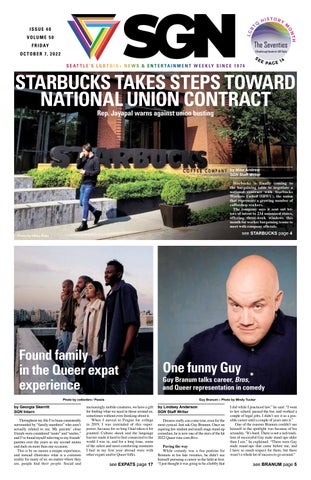
STARBUCKS TAKES STEPS TOWARD NATIONAL UNION CONTRACT Rep. Jayapal warns against union busting
by Mike Andrew SGN Staff Writer Starbucks is finally coming to the bargaining table to negotiate a national contract with Starbucks Workers United (SBWU), the union that represents a growing number of coffeeshop workers. The company says it sent out letters of intent to 234 unionized stores, offering three-week windows this month for worker bargaining teams to meet with company officials.
see STARBUCKS page 4
Photo by Hilary Russ
Found family in the Queer expat experience
One funny Guy
Guy Branum talks career, Bros, and Queer representation in comedy
Photo by cottonbro / Pexels
by Georgia Skerritt SGN Intern Throughout my life I’ve been consistently surrounded by “family members” who aren’t actually related to me. My parents’ close friends were considered “aunts” and “uncles,” and I’ve found myself referring to my friends’ parents over the years as my second moms and dads on more than one occasion. This is by no means a unique experience, and instead illustrates what is a common reality for many of us: no matter where they are, people find their people. Social and
Guy Branum – Photo by Mindy Tucker
increasingly mobile creatures, we have a gift for finding what we need in those around us, sometimes without even thinking about it. When I moved to Prague for college in 2019, I was reminded of this superpower, because for so long I had taken it for granted. Culture shock and the language barrier made it hard to feel connected to the world I was in, and for a long time, some of the safest and most comforting moments I had in my first year abroad were with other expats and/or Queer folks.
see EXPATS page 17
by Lindsey Anderson SGN Staff Writer Dreams really can come true, even for the most cynical. Just ask Guy Branum. Once an aspiring law student and small-stage stand-up comedian, he is now one of the stars of the hit 2022 Queer rom-com Bros. Paving the way While comedy was a fun pastime for Branum in his late twenties, he didn’t see himself pursuing a career in the field at first. “I just thought it was going to be a hobby that
I did while I practiced law,” he said. “I went to law school, passed the bar, and worked a couple of legal jobs. I didn’t see it as a possible career until a couple of years into it.” One of the reasons Branum couldn’t see himself in the spotlight was because of his sexuality. “It’s hard. There is not a rich tradition of successful Gay male stand-ups older than I am,” he explained. “There were Gay male stand-ups that came before me, and I have so much respect for them, but there wasn’t a whole lot of success to go around.”
see BRANUM page 5
2
SGN
O C T O B E R 7, 2 0 2 2
C E L E B R AT I N G 4 8 Y E A R S!
ORIGINALLY SEATTLE GAY NEWS FOUNDED 1974 MEMBER 509 10th Ave E Seattle, WA 98102 (206) 324-4297 info@sgn.org sgn.org
SUPPORT INDEPENDENT JOURNALISM
DONATE TO SGN TODAY!
Publisher Angela Cragin Managing Editor / Acting Editor-in-Chief A.V. Eichenbaum Copy Editor SGN Staff • Richard Isaac Advertising Maggie Bloodstone, Advertising Manager National Advertising Rep. Rivendell Media (212) 242-6863 Staff Writers Lindsey Anderson • Mike Andrew Sara Michelle Fetters • Daniel Lindsley Contributing Writers Alice Bloch • Maggie Bloodstone Sharon Cumberland • Carter Hemion Benny Loy • Isabel Mata Paige McGlauflin • Gaysha Starr
SHOW YOUR PRIDE! seattlegaynews.redbubble.com
Merch Store!
Social Media Manager SGN Staff Photographers Nate Gowdy • SGN Staff Production Mike Pham SGN is published by Angela Cragin. © 2022. All Rights Reserved. Reprints by permission. Publication of names, photographs, or likeness of any person, organization, event or business in this publication cannot be taken as any indication of the sexual orientation of the person, organization, event or business. Opinions expressed in bylined articles, columns, and letters are those of the authors only and do not necessarily reflect the views of the staff or management of this paper. SGN welcomes unsolicited material, including letters to the editor, but reserves the right to edit or reject material. All rights revert to authors upon publication. We assume no liability for loss or damage of materials, solicited or not. We invite feedback, please write. And please play safe. It is our policy that no money shall be refunded if you choose to cancel your ad. Credit will be given for the balance owed. No exceptions.
In Loving Memory Of George Bakan
Scott Roger Alpert Cookie Andrews-Hunt James Arnold Ken Campbell Steve Foiles Shaun Knittel James Leland Moore Don Paulson Randy Peters Lee Richeson Shaun Shelton Jim Tully
Follow SGN
VISIT US ONLINE SGN.ORG
In this Issue
LOCAL NEWS 4 A&E • FILM 5 BOOKS 12 LGBTQ HISTORY 14 TRAVEL 17 NATIONAL / INTERNATIONAL NEWS 18 O C T O B E R 7, 2 0 2 2
SGN
3
Local News
Starbucks employees who support unionization protest ahead of Investor Day, in Seattle on September 12, 2022 – Photo by Hilary Russ / Reuters
STARBUCKS continued from cover
To date, only three Starbucks stores have begun contract negotiations, and no store is close to settling on a contract. “We look forward to these negotiations and hopefully setting dates and securing locations for contract bargaining,” Starbucks said in a statement. SBWU has accused the company of stalling negotiations in hopes that union members would become discouraged and look for new jobs, allowing Starbucks to replace them with new employees who are not union supporters. According to the union, a national bargaining committee of about 50 workers is now meeting weekly to map out strategies for the contract negotiations. They have already unveiled a set of proposals addressing health and safety issues and nondiscrimination in the workplace. “We’ve been planning for months,” Jasmine Leli, a bargaining committee member from Buffalo told Bloomberg News. “We want to make sure everyone feels seen and heard.” Buffalo is the site of the first unionized Starbucks in the country. Union organizers say they still have to contend with delaying tactics by the employer, and constant harassment and intimidation of union activists, including firings. Meanwhile, 30 members of Congress — including Seattle’s own Rep. Pramila Jayapal — issued a public letter to Starbucks CEO Howard Schultz demanding a fair bargaining process and an end to Starbucks’ union-busting tactics. “We have a concern about reports that pay increases and benefits are only being offered to non-unionized stores,” the lawmakers wrote. “If accurate, such disparate treatment could set an alarming precedent that, in our opinion, is not consistent with US labor laws, including the National Labor Relations Act.” Rep. Ro Khanna (D-Calif.), who organized the congressional letter, expressed
hope that Starbucks will alter its current aggressively anti-union policy, and live up to its progressive image. “If [Starbucks] ends up being supportive of unionization, they could set a model for the food and drink industry in America,” Khanna told MarketWatch. “Then they
4
O C T O B E R 7, 2 0 2 2
SGN
Starbucks workers react during a news conference to a decision by the National Labor Relations Board to postpone a scheduled union vote count in Buffalo, NY on February 23, 2022 – Photo by Brendan McDermid / Reuters
could rightly say they’re being progressive.” The current wave of union organizing at Starbucks began in December 2021 with a store in Buffalo, New York. According to The Stand, an online publication of the Washington State Labor Council, to date 247 Starbucks stores in
35 states have won union elections, including 16 in Washington state. Dozens more Starbucks stores have filed for a union and are awaiting NLRB-supervised elections, including three more in Washington. SBWU has lost elections in only 54 stores.
C E L E B R AT I N G 4 8 Y E A R S!
Arts & Entertainment
BRANUM
continued from cover Twenty years ago, when he started his career in comedy, audiences were much less friendly to LGBTQ+ performers. “Straight cis guys aren’t used to having to listen to women or people from the LGBTQ+ community. They are used to us being the butt of jokes, not the people whose perspectives are informing the jokes,” he said. Branum started his career in San Francisco, the most LGBTQ+-friendly city in the United States. Once he began performing outside the Bay Area, he began to notice most audiences were less accepting of Queer comedians. “San Francisco is a town that really [has] a rich Queer performance community. I didn’t notice that until I got to Los Angeles,” he said. “Stand-up is such an unstructured discipline, and so many of the opportunities come through the worship of more established comics. If there aren’t more established comics like you, there’s no one to take you on the road, there’s no one to say, ‘Hey, do you want to open for me?’ So that was rough, but it also meant I had to forge my [own] path.” Branum became a pioneer for LGBTQ+ comedians, forging a path not only for himself but for many who would come after him. He developed his sharp sense of humor, which he describes as “angry and yelling.” “I figured out pretty quickly how to make audiences push past that and be able to have a good time with me, but being able to make the industry understand that there was a place for me and a role for me was hard,” he said. “So much of the time I’ve had to do the work to prove myself five or six times where, say, a lot of straight cis guys have been able to do the work once and be trusted that they can do the work again.” He put in the extra work and honed his sets in small San Francisco venues he knew would be accepting of his identity. “The first time I ever did stand-up was at the Café du Nord, a little coffeehouse in San Francisco. There was a place called the Marsh, also in San Francisco. The Improv Comedy Club was the first comedy club I performed at. It was mostly things in San Francisco. One of my first times landing sets was Russian River, a Gay resort in the North Bay,” he said. While he performs on much bigger stages now, like Seattle’s the Here-After, Branum still has a soft spot for his first stage and says it is still one of his all-time favorite venues. “The Café du Nord… is a little speakeasy that’s underground. I remember the first time I performed there it felt so cool. I was so impressed by it.”
From screens to backyards Most of his performances today are on screen, either in movies like Bros and No Strings Attached or on his talk show, Talk Show the Game Show , but he always enjoys spontaneous pop-up shows. “I also like the weird, strange situations where I’ve been expected to do stand-up. There’s a really rich culture of backyard shows in Los Angeles now. It’s so much fun to show up to some random backyard where people have strung up lights and put up folding chairs and have it be a wonderful comedy situation full of a great audience,” he said. In the twenty years since Branum first took the stage in San Francisco, his style has grown beyond anger and yelling. “It has evolved. It used to be angrier and yelling-er. Now I understand how to be quiet and not always be on the attack.” Years of experience and good mentors have given Branum more confidence to be himself on stage. “When you’re first starting, you’re scared that something could go awry. Now, I’ve had things go awry enough that I understand how to get out of it. I don’t necessarily feel the same need to assert dominance over the audience in the same way.”
Working with his heroes As a writer, Branum has rubbed elbows with his idols, who have challenged him to expand on his skills. “I learned so much from working for Mindy Kaling,” he gushed. “She’s so good at what she does. She holds the people around her to such a high standard that I always enjoyed working with her. I also treasure so much that she is somebody who is still in my life. “Also, Joan Rivers was someone I worshiped when I was a child, and the fact that I got to spend a year or so working for her meant so much. And seeing someone who, in her eighties, was still as sharp and capable as she was impressive.” Branum also admires many LGBTQ+ comedians who helped encourage public acceptance of queerness and opened doors for more performers like him. “I look up to Wanda Sykes [and] Scott Thompson from Kids in the Hall so much,” he said. Branum was once just a fan of Sykes; now he works closely with her. Sykes even produced his talk show. Today, Branum’s favorite comedians are people he gets to work with. “I love Margaret Cho. I am so proud of her as a Bay Area comedian. People who are my colleagues but have been doing this a lot longer than I have, like Laurie Kilmartin and Jackie Kashian. They are the two stand-up comedians I respect the most, probably. They
Guy Branum – Photo by Mindy Tucker
are amazing craftspersons with a perspective and spirit that infuses all of their jokes. They have so much experience that their jokes are battle tested and strong in a way that isn’t always true in Los Angeles.” Branum talks Bros One of his favorite comedians to work with is Billy Eichner, who hand-picked Branum for a role in the nearly all-Queer film Bros. “He is the best writing boss I have ever had. He does the best job of making you feel loved for the jokes that he rejects,” Branum said.
see BRANUM page 6
Guy Branam in Bros – Photo courtesy of Universal Pictures
VISIT US ONLINE SGN.ORG
“I had worked for him on Billy on the Street, and he asked me to read at the table read. I didn’t even audition. They just gave it to me. He also asked me to be a co-producer and write jokes on the set.” With so many talented comedians working on the set, funny lines tended to flow. “I improvised some lines,” he said. “I don’t know if any of them made it into the movie. One of them did. It’s a Judd Apatow movie, everyone felt a lot of freedom to improvise.” Despite the improvisational freedom provided by producer Judd Apatow, Branum admitted that coming up with jokes on the spot is not his forte. “Well, I’m a television writer most of the time, and I’m used to sticking to the script, so I’m not used to being as loose and ready for it like some gifted improvisers, like Jim Rash.” He did, however, put his personality into his character in Bros. “One time, Nick, the director, was kind of making fun of me and was like, ‘Hey, this time do it as Henry, not as Guy, as Henry,’ emphasizing the fact that there isn’t a huge amount of difference between Henry as a character and Guy as a character. Good stand-up comics understand how to find themselves in a character.” Working with so many members of the LGBTQ+ community made the environment on the set of Bros especially welcoming for Branum. “It was lovely. It was nice to feel supported and like we didn’t have to be the sole representative of [the LGBTQ] community and to let everybody else know that their perspectives and sensibilities were understood and there was space for that.” Branum said he felt welcomed by the allies that worked on the set as well. “The straight guys who helped get this movie made, Judd Apatow, Nick Stoller, and our producer Josh Church, did such a great job of listening to everyone and being respectful that they were telling a story that wasn’t their story.”
O C T O B E R 7, 2 0 2 2
SGN
5
Arts & Entertainment
Queer Space Nine: A frontier rediscovered by Daniel Lindsley SGN Staff Writer The revival or rediscovery of an old show is nothing new, but with a few exceptions, such events tend toward non-speculative sitcoms — the likes of Parks and Rec, Friends, and Seinfeld. Few of these shows see a grand amount of rediscovery as Queer media, though, fan theories aside. The Star Trek series Deep Space Nine (DS9) is an exception on both fronts. It’s a science fiction show that, despite first airing in 1993, has seen a resurgence in popularity almost 20 years later, for Queer themes both veiled and overt. It’s easy to point to the pandemic as a culprit for why DS9 was on Netflix from 2011 until July 1 this year, when it moved to Paramount Plus with all the other Trek media. In July of 2020, Google searches for the term “DS9” spiked to beyond 2011 levels. Perhaps the ubiquity of Netflix made the show an easy quarantine binge-watch both for Trekkies who hadn’t yet given the series a chance, and for newcomers whose curiosity might have been piqued by memes about the show on Tumblr and other platforms. There were other factors at play, though. In 2018, three years before the first COVID-19 case in the US, DS9 showrunners Ira Steven Behr and Michael Piller released a crowdfunded documentary on the series, bringing the cast back together for interviews and retrospectives. And nine years before that, the broader franchise was introduced to younger audiences by way of a reboot film directed by J.J. Abrams, beginning what some trekkies call the “J.J.-verse.” These factors only explain how the show might have been rediscovered, though, not why it is newly appreciated. Media critic and LGBTQ YouTuber JesseGender said in a Zoom interview that its setting and characters — in other words, its very core — appeal to common Queer experiences. “I don’t think it’s necessarily overt, like, ‘Yeah, Deep Space 9 is the Gayest Trek!’” they said of the show’s Queer themes. “But you see it more in the resonance of those characters — and a lot of those storylines — with LGBTQ people, repeatedly coming up.”
Photo courtesy of CBS
JesseGender’s favorite Star Trek character, they said, is Jadzia Dax. Jadzia is one of the Trill, a species of humanoid aliens, some of whom are implanted with a wormlike symbiont that carries and bestows the memories and personalities of all its previous hosts. Some fans refer to her as the “Trill slug Transgender lady,” as JesseGender put it, because some of her symbiont’s previous hosts were men. “There are a lot of characters — specifically the main character, Sisko — who know [Jadzia] from her past lives, and he even calls her ‘old man’ as a term of endearment,” JesseGender said. “Even though she’s not explicitly Trans, the allegory really works for that.” Old friends of Jadzia are often quick to adjust to the change when they meet her, too. No big deal is made when she corrects them on her name, for instance. Most characters accept it and move on, and that’s another part of the show’s appeal: “DS9 definitely has a level of ‘just go with it’ that we Queers are really into,” said Grace Moore, co-host of the long-running Star Trek fan podcast Women at Warp. That relaxed quality is significant, because Jadzia is far from the only “weird” character.
Even when compared to previous Star Trek properties, the cast of DS9 stands out. Among others it has Odo, a shapeshifting blob man, as chief of security; Quark, a capitalist gremlin, running a bar; Kira Nerys, a former anti-occupation terrorist; Elim Garak, a humble, lizard-like tailor who is likely pansexual and most certainly not a spy; and chief medical officer Julian Bashir, who is “weird” for reasons that would spoil the story to mention. “We love that,” Moore said of the Queer community, “and we love getting to see other people who are weirdos and have their found family, and the people who respect them for their weirdness.” Like so many earlier examples of television with Queer themes (especially those written by straight men), DS9 is far from perfect. Both JesseGender and Moore pointed to specific episodes that are heavily transphobic, or otherwise problematic. Star Trek in general has been rightly credited for “trailblazing” social issues in television, but it also has a history of trying and failing to tackle such topics without offending the minority groups affected by them. Where the series has succeeded in that effort, it has often done so despite the
franchise’s top brass, at least where Queer issues are concerned. Executive producer Rick Berman shot down any introduction of explicitly LGBTQ characters, and although writers and actors “snuck in” what analogies and implied representation they could, Moore said, the lack of clarity was a kind of erasure on its own. “There’s a very special kind of fly in the ointment when you’re talking about representation by way of sci-fi, and by way of it being an analogy,” Moore argued. “And that is that it’s specifically done so that they can say, ‘Well it isn’t exactly this thing. Wink.’ But you will always be just completely drowning in the people who are like, ‘No, the sexism and homophobia is all over.’ Well, can we see that explicitly portrayed?” We can be thankful, then, that today’s Star Trek series have broken that trend. The animated Lower Decks has Ensign Beckett Mariner, who is Bi. The live-action Discovery has same-sex couples, and characters who are openly Gay, Trans, or Nonbinary, all portrayed by openly LGBTQ actors. Still, JesseGender argued that the new Treks aren’t as subversive as past ones were in their own time: “Star Trek has always been ‘woke,’ but because people today are very reactive to everything coming out, they’ll say, ‘New Star Trek is woke, old Star Trek wasn’t!’ Or they’ll argue it was much more ‘subtle about it,’ or they did it better.” “I love Star Trek today,” they continued, “but it is kind of milquetoast in comparison to a lot of Star Trek of the past in terms of its political theming... And I think reducing Star Trek to that conversation of woke versus anti-woke removes the nuanced conversation that we need to have around shows like this, where we can talk about how wonderful it was, and yet also [how] there were problems based on the perspective of people who wrote it.” For more from JesseGender about Queer fandom and other LGBTQ topics, visit www.youtube.com/c/lostrekkie. You can listen to Women at Warp anywhere you listen to podcasts, and learn more about Grace Moore and its other co-hosts at www.womenatwarp.com.
BRANUM
continued from page 5 The movie set also felt special to Branum, because it was one of his first times back to work since the start of the pandemic. “For most of us, it was our first time being around that many people after a year and a half of lockdown. It was really exciting. You see those moments where the whole cast is dancing at the museum scene at the end, and it was really fun to have moments like that in a group in a way that hadn’t been possible for a long time.” Bros is in theaters now. The movie has been praised by fans and critics alike, and already has a 90% rating on Rotten Tomatoes. Branum says he hopes viewers leave the theater with “that lovely feeling after you’ve laughed hard for two hours. I just want people to enjoy the movie. It’s so fun, so funny. I’m just really proud of it.” He also hopes fans feel “an abiding and irrepressible sexual attraction to me. I hope everyone, man, woman, Nonbinary, is just sort of saying, ‘Dammit, I gotta get things going with that Guy Branum.’ But only adults.” A more open place for LGBTQ+ comedy Branum’s career has spanned decades, and because of the work he and many other LGBTQ+ comedians put in, the world is a much more open place for Queer comedians. However, he recognizes that despite his work, Queer comedians still face more hurdles than their cis and straight counterparts. “It is easier now. It doesn’t mean it is easy
now; it means they understand a path for you to get to the middle. But they still don’t understand a path for you to be [at the top],” he said. “You know, they didn’t understand a path for a Black woman to be the biggest name in comedy until very recently. Tiffany Haddish changed the way people see things.
6
O C T O B E R 7, 2 0 2 2
SGN
Guy Branam in Bros – Photo courtesy of Universal Pictures
Bowen Yang is changing the way people see things. It’s going to take more work, but at least now not everybody is having to invent the whole thing from the beginning.” Despite the added struggle LGBTQ+ comedians may face in the industry, Branum advises those with a passion for the art
to keep going. “Do the thing you love. The more love you can put into the work you do, the more rewarding it will be,” he said.
C E L E B R AT I N G 4 8 Y E A R S!
Film
Deliciously vile Hellraiser does Barker’s source material proud by Sara Michelle Fetters SGN Staff Writer HELLRAISER Hulu It’s just a box. An intricate, ornate, golden puzzle box, initially no bigger than a Rubik’s cube, and by all accounts equally harmless. But looks can be deceiving. In this case, they can also be positively damning. Of course, as fans of author Clive Barker already know, this is no ordinary box. It summons literal demons, warped humanoid beasts nicknamed “Cenobites,” who feed on the pain and suffering of all of those who mess with the box. They are led by a lethally lithe mistress known as the Hell Priest (Jamie Clayton), a disciple of the Leviathan who enjoys toying with potential victims, eager to capture fresh souls and see what kind of pleasures are to be found in the evisceration of the flesh. Hellraiser, Barker’s 1987 adaptation of his novella The Hellbound Heart, and its superior sequel, Hellbound: Hellraiser II, first introduced the Cenobites, the Hell Priest (aka Pinhead), and The Box; spawned a massive cult following; and resulted in nine additional sequels, the majority of which went straight to video. While all of those follow-ups contained a handful of clever ideas — notably the third and fourth entries in the series — none of them are honestly very good, and it is only the strength of Barker’s concept and source material (not to mention Doug Bradley’s eight chilling portrayals of Pinhead) that kept viewers coming back for more, hopeful that the macabre magic of the first two would return. It’s only taken 34 years, but director David Bruckner and writers Ben Collins, Luke Piotrowski, and David S. Goyer have done the impossible — and that’s make this series not just relevant but exceptional. This is a phenomenal continuation of Barker’s story, one that pays deft homage to both the source material and the original two films while also expanding the mythology in emotionally complex and dramatically unsettling ways. It is a magnificent motion picture, one that goes to some dark and
Jamie Clayton in Hellraiser – Photo courtesy of Hulu
heady places yet also knows how to have a bit of sadomasochistic fun along the way. The film does lack a central villain, choosing instead to focus more on the cadre of characters tricked into playing with The Box, while in the same breath it keeps the murderous puppet master pulling their strings behind the curtain for over half of the twohour running time. Problem is, the identity of this villain isn’t difficult to figure out. While I am sure this is by design, it is still a minor letdown when Bruckner and company lay all their cards on the table and finally reveal who is playing the game and who is just fodder to be brutally sacrificed to the Leviathan. Riley McKendry (Odessa A’zion) is recovering addict who lives with her brother Matt (Brandon Flynn), his partner Colin (Adam Faison), and their roommate Nora (Aoife Hinds) in their downtown apartment.
The latter two are frequently asked to play peacemakers between the two siblings, since Riley and Matt are seemingly at one another’s throats on a nightly basis. This is all set-up for the mayhem to follow, so Bruckner spends the necessary time to introduce the core characters who will have to solve the riddle of The Box and try to survive face-to-face encounters with the Hell Priest and the army of Cenobites. Riley and her boyfriend Trevor (Drew Starkey) have ended up with the item after robbing an empty warehouse owned by an eccentric, and recently deceased, millionaire. They had no idea the forces they would unleash. The Hell Priest takes a specific interest in the young woman: primarily her internalized trauma, anxiety, and emotional pain as it pertains to her complicated relationship with Matt.
Brandon Flynn in Hellraiser – Photo courtesy of Hulu
VISIT US ONLINE SGN.ORG
O C T O B E R 7, 2 0 2 2
The core of this new Hellraiser is built on this foundation of internalized trauma. Riley’s battles with addiction have not gone smoothly, and it isn’t a shock to say she’s made several bad decisions as she tries to overcome a litany of mistakes. Yet the connection between sister and brother, even at its most tenuous, always remained strong. Now Matt is missing, and Riley does not know what to do other than to keep digging into The Box’s history, no matter what the cost, never realizing this is exactly what the Hell Priest and the Cenobites want, as it will bring more souls into their flesh-ripping chains of carnage and butchery. Bruckner, Collins, and Piotrowski last worked together on last year’s superb supernatural chiller The Night House, and their take on Hellraiser proves to be a winning companion piece to that unnerving triumph. But where that was a more psychological examination of guilt, paranoia, and grief, here the filmmakers get to unleash Barker’s demonic creations and physically manifest all of those emotions in excruciatingly devilish detail. And it’s magnificent. The whole thing is one giant roller-coaster ride, with Clayton’s chillingly mischievous incarnation of the Hell Priest at the controls, deciding how fast the viewer should take each turn or how steep the incline should be before sending everyone down into a full-throttle corkscrew of uncontrollable terror. It’s a delicious manifestation of power, a sinister otherworldly seduction that’s nothing less than glorious. But Bruckner never loses sight of the human story at the heart of things. Riley is dealing with a lot, and it will be her decisions, her dreams, and her wishes that will ultimately determine whether the Cenobites will continue to rip apart the flesh of their victims and send more souls to the Leviathan to devour. She has to be the one to determine where the line between forgiveness for past sins begins and taking responsibility for one’s mistakes ends. For all its fantastical elements, all of them born out of Barker’s fiendishly depraved imagination and brought to vibrant, ghoulishly horrific life by Bruckner and his talented team, this new Hellraiser understands that suffering isn’t a black-or-white emotion. It resides in the gray areas of the human psychological condition, and is as vital for healing and survival as friendship, companionship, or even love. The Hell Priest and The Box are avatars for this never-ending struggle, and the battle between salvation and destruction has seldom been this deliciously vile.
SGN
7
Film
Walter Hill’s Dead for a Dollar is a quick-draw jolt of western pulp fiction
Rachel Brosnahan, Christoph Waltz, and Warren Burke in Dead for a Dollar – Photo courtesy of Quiver
by Sara Michelle Fetters SGN Staff Writer DEAD FOR A DOLLAR Theaters / PVOD There is nothing flashy about Walter Hill’s latest western, Dead for a Dollar, which is dedicated to Budd Boetticher for a reason. Much like that legendary filmmaker’s classics made with star Randolph Scott — most notably Buchanan Rides Alone, Ride Lonesome, and Decision at Sundown — this is an angry drama about hard men making tough choices, all the while looking down the barrel of a gun they know someday will hit its target. Those expecting something akin to past Hill classics like The Long Riders, Southern Comfort, or Extreme Prejudice will likely be somewhat disappointed. For all the gunfire and bloodshed, this story is more about verbal confrontations and moralistic dilemmas than wild displays of action or sequences of bloody violence. Hill spends time getting to know the inner workings of his characters, letting the audience get a feel for who they are through brief nuggets of dialogue that say precious little but frequently reveal a whole heck of a lot. I’ve always loved it when Hill gets introspective. From his early days helming down-and-dirty barn burners like Hard Times and The Driver to his frequently overlooked 1990s run of Trespass, Geronimo: An American Legend, and the criminally underrated Wild Bill with Jeff Bridges and Ellen Barkin, his solid genre craftsmanship and insistence on digging into the thornier recesses of the human condition have always excited me. Hill refuses to paint in black and white: his heroes are often as ugly as his villains, and I think this is why almost all of his motion pictures — even misfires like Brewster’s Millions, Supernova, and The Assignment — are fascinating to watch, precisely because of their ambitious flaws and not in spite of them. Dead for a Dollar follows renowned bounty hunter Max Borlund (Christoph Waltz). With the blessing of the United States cavalry, he has been hired by wealthy Santa Fe businessman Mr. Kidd (Hamish Linklater) to rescue his kidnapped wife Rachel (Rachel Brosnahan) from buffalo soldier Elijah Jones (Brandon Scott). They
are currently holed up in Mexico, waiting for a $10,000 ransom, which Jones is expecting his best friend and fellow soldier Sgt. Alonzo Poe (Warren Burke) to be bringing. What Borlund was not told was that Rachel was not kidnapped. Instead, she was fleeing
8
O C T O B E R 7, 2 0 2 2
SGN
Willem Dafoe in Dead for a Dollar – Photo courtesy of Quiver
an abusive marriage. Jones helped her get away from her vindictive husband, and the two of them are planning on fleeing to Cuba once they get their hands on the ransom. But Borlund has a job to do, no matter how distasteful it may be, and with Poe’s assistance,
he is determined to see things through to the end, even if the outcome may not be the one the manipulative Mr. Kidd was hoping for. Into this mix are also thrown recently paroled horse thief, cardsharp, and notorious quick-draw artist Joe Cribbens (Willem Dafoe) and Mexican land baron and all-around bad guy Tiberio (Benjamin Bratt). The former holds a grudge against Borlund for arresting him five years prior, while the latter sees a business opportunity when the bounty hunter brings his prisoners to a small town he has squarely under his thumb. Everyone expectedly comes together in a shoot-em-up climax, in which a small group must fend off a large force. Bullets fly willy-nilly and bodies end up riddled with holes and lying facedown in the middle of the street. Hill takes his time getting to the action, only sporadically punctuating the narrative with brief flashes of violence, if only to remind the audience how dangerous this world truly is. Instead, he allows Rachel to reveal herself bit by bit and lets Borlund’s code of ethics materialize as more of the truth comes to light. There’s also an unanticipated complexity to Jones and Poe’s relationship; their friendship remains strong, even if the betrayal that has brought them together during this sordid journey stings like the dickens. Aesthetically this is the most restrained Hill has been in ages. Cinematographer Lloyd Ahern (Bullet to the Head) channels the old masters who worked for the likes of John Ford, Howard Hawks, and the aforementioned Boetticher. He eschews anything too ostentatious, allowing his camera to capture the widescreen vistas and sprawling dusty streets with slow pans left and right. It is not until Tiberio arrives in town with his band of cutthroats that the visual language subtly and dynamically changes, at which point Ahern, Hill, and editor Phil Norden (The Assignment) aggressively switch visual gears to match the cruelly lethal bloodshed unleashed during the climax. It is quite possible this may be the final film Hill, now 80, directs. While I hope that isn’t the case, if it is, Dead for a Dollar is a strong, suitable capper to a long and illustrious career. It’s a throwback western made with precision, passion, and care. For fans of the genre, this is an essential quick-draw jolt of B-grade pulp fiction worth unholstering.
C E L E B R AT I N G 4 8 Y E A R S!
Inventively cruel Smile is nothing to grin about
Sosie Bacon and Jack Sochet in Smile – Photo courtesy of Paramount Pictures
by Sara Michelle Fetters SGN Staff Writer SMILE Theaters When I came out of writer-director Parker Finn’s well-made, dementedly limber supernatural shocker Smile, I was asked what I thought. I said it was fine. Finn has talent. There are several strong ideas and some even better moments of unrelenting chaos and dread. He’s cast his film beautifully, and star Sosie Bacon carries things with hypnotically unsettling aplomb. But the further I got from Finn’s featurelength debut, the more the darn thing infuriated me. Not because its influences, ranging from A Nightmare on Elm Street to Ringu
(or its strong Hollywood remake The Ring) to It Follows, are all fairly obvious. Not because I found the majority of the narrative relatively unsurprising. That didn’t bother me at all, mainly because Finn’s skills behind the camera are undeniable, and he does a nice job of making the material he’s exploring feel new, even if in reality it is anything but. No, my anger was born from how his story treated its primary character, hospital psychiatric emergency clinician Dr. Rose Cotter (Bacon), whose trauma is the crux of the entire plot. This is a woman who suffered unimaginable psychological damage as a child, and as much as she’s tried to get over it by helping others deal with similar sorts of indescribable pain, her actual life as presented here is a continual dirge of hardship, belittlement, and misery that only
becomes worse once a soul-sucking demon latches on to her. Smile is trauma porn. It deals with Dr. Cotter with such unrelenting cruelty that I’m honestly not sure what the point of it is or what Finn is trying to say. If he’s just crafting a gruesome little demonic creature feature, then why make it so maliciously bludgeoning? If he’s trying to dig deeper, to make some grand statement about mental illness or the lingering effects of childhood trauma, why be so exploitive in how this madness is depicted and viewed? There’s no feeling to any of it, no attempt to treat the whirlwind of emotional nuances Dr. Cotter is dealing with as anything more than elements for a well-constructed jump scare or bleakly nihilistic terror. The plot concerns a mysterious force that
Sosie Bacon in Smile – Photo courtesy of Paramount Pictures
VISIT US ONLINE SGN.ORG
O C T O B E R 7, 2 0 2 2
vindictively torments its prey for roughly a week before possessing them fully. Once it does so, this invisible entity forces the person to commit suicide right in front of someone else, as brutally and as bloodily as possible, all with a giant malevolent smile plastered on the victim’s face. The demon then transfers itself onto the person who stood there watching, creating a continual cycle of inexplicable violence seemingly without end. The similarities to Ringu and It Follows are rather obvious, but Finn does a nice job of crafting a believable mythology for his baddie that doesn’t feel too indebted to either of those horror classics. In Dr. Cotter, he has a smart, intuitive heroine who believably finds ways to put pieces of the puzzle together, even as she feels like she’s mentally falling apart, all while trying to fight off an attacker no one believes exists and might just actually be a figment of her fracturing imagination. But dang does the film seem to despise its main character, even as it presents her as the smartest person in the room. All of the primary people in her life are jerks, with almost no redeemable qualities. Almost all of her attempts to reach out for help are derided or ridiculed, even before she can lay out the particulars of the situation. The flashbacks to her mother’s suicide and a reveal involving her part in what happened as a 10-year-old child are delivered heartlessly. Finn has talent. His visual compositions are top-notch. Even at almost two hours in length, his film never feels padded or plodding. The director knows just when and how to unleash the sensational creature and makeup effects supervised by Oscarwinner Tom Woodruff Jr. (Death Becomes Her, Alien 3) and his talented team. Best of all, Finn gives Bacon freedom to shape Dr. Cotter’s psychological descent with frenetic, internalized agency in a boldly disheveled performance that’s frequently invigorating. Which makes how the character continually gets treated all the more upsetting. Look, I’m obviously not trying to say all final girls need a happy ending. That’s far from the truth. But they do need to be treated with respect. I do think they deserve some form of decency, and I can’t say I felt that was the case here. For all its strengths, Smile does Dr. Cotter dirty. Worse, it made me feel culpable in her abuse. I didn’t like that. Not one single bit. In fact, I unreservedly hated it.
SGN
9
10
SGN
O C T O B E R 7, 2 0 2 2
C E L E B R AT I N G 4 8 Y E A R S!
VISIT US ONLINE SGN.ORG
O C T O B E R 7, 2 0 2 2
SGN
11
Books
History buffs will love Gender Pioneers by Terri Schlichenmeyer Special to the SGN GENDER PIONEERS: A CELEBRATION OF TRANSGENDER, NON-BINARY AND INTERSEX ICONS PHILIPPA PUNCHARD, foreword by Christine Burns MBE © 2022 Jessica Kingsley Publishers $22.95 118 pages In 1912, French audiences were thrilled by the talent of a trapeze artist known as Barbette. The lovely Barbette gracefully flew over the heads of Parisians, who followed those performances avidly. By 1919, Babette added to the end of the performance the revelation that “she” was really Vander Clyde Broadway, a male performer. We might think that being Transgender is “new” and just “a Western thing,” but author Philippa Punchard has reason to
Image courtesy of Jessica Kingsley
disagree: history is dotted with men passing as women, and women living as men. As Christine Burns says in the foreword, “Trans people are not a new thing.”
Some seemed to do it as a means to an end: Ellen and William Craft wore clothing of the opposite sex in order to escape slavery in 1848. Betty Cooper may have worn men’s clothing for the same reason in 1771. Neither case, says Punchard, indicates “classical” Trans behavior, but we’ll never know for sure. Biawacheeitchish, who grew up to be powerful and wealthy, with four wives, was kidnapped as a young girl and encouraged by their Native American adoptive father to engage in male activities, perhaps because he’d lost two sons; in another time and place, Biawacheeitchish would’ve been called a “female husband.” Dora Richter, the first woman to receive vaginoplasty, was killed by “a Nazi mob.” Dr. James Barry, a highly renowned surgeon, used “built-up shoes and... padding to appear more masculine...” James Allen and Billy Tipton were both married to women before death revealed that they were female. And Mary Read was a girl,
until their mother lost her only son... In her foreword, Burns says that there are “two awkward challenges” when we talk about Trans people in history: were they Intersex, rather than Trans; and were they people — mostly women — who presented as the opposite gender to gain benefit? The questions demand more study, and Gender Pioneers offers a launching point. Open this book anywhere and you’ll see that the theme here is serious, but Punchard also lends a bit of breeze. There’s no certain order to what you’ll read, and while the entries reach back to ancient times, they mostly focus more on the past three hundred years or so. Each of the articles is short and to the point, and the soft illustrations invite browsing. For those who want a quick read, this works. Be sure to keep going through both appendices of this book, where you’ll find a wealth of further information and dates to remember. Historians and readers of Trans history will find Gender Pioneers just right.
To Break a Covenant is a horror reader’s gold mine by Lindsey Anderson SGN Staff Writer For readers looking for a genuinely thrilling read, new author Alison Ames’ debut novel, To Break a Covenant, should be at the top of the list. Packed with mystery, chilling imagery, and coming-of-age drama, the novel follows four friends who set out to unravel the dark secrets of their ghost town’s haunted mine. Long in the making While Ames is new to the publishing world, the story behind To Break a Covenant has been stewing in her brain for over a decade. “This particular book I started writing in 2011 and now it’s here,” she said. While it may seem like 11 years is a long time to work on one novel, Ames clarifies that it wasn’t until a few years later that she got serious about writing her debut book. “I wasn’t firmly writing it and trying to get it done. It was more like, ‘Okay, I’m feeling the vibe today.’ Then in 2015, I started being like, ‘If I’m going to do this as an actual thing and think about publication, I have to do it and finish it and have a plan for it,’ so that was when I tried locking it down. In 2017 I signed with my agent, and then we got the deal in November of 2019. Then it came out last year.” While it took her a while to turn To Break a Covenant into the novel she wanted it to be, Ames assures fans that her next book won’t take as long to hit the shelves. Her sophomore novel, It Looks Like Us, was just released in September. She’s hoping to release a book per year from now on. Fans have also asked Ames about whether or not To Break a Covenant will get a sequel. “There have been some conversations about making a sequel or something in the same universe,” she admitted. However, she feels the ending of the novel wraps the story up. “It doesn’t necessarily leave itself open to any kind of a sequel, so doing any… bonus content or sequels will require some creative moving sideways.” Despite the difficult maneuvers it will take, she plans to release exclusive bonus content for the paperback edition of the novel, which will be released in 2023.
Alison Ames – Photo courtesy of the author
Based on true events Although extending the plot will be difficult for Ames, continuing the spooky vibes of the novel won’t be a problem. When plotting out her early drafts for To Break a Covenant, Ames said she took inspiration from the real-life town behind the popular Silent Hill franchise. “I keep doing this based on vibes. I was
just like, ‘Silent Hill, the vibe.’ I found out it was based on a real place. If you’ve seen the movies or played the games, you’re just in this gray, like ash is raining down upon you, and it’s just a very haunted and very oppressive feeling. I was like, ‘I love this vibe. I would love to do something with this vibe. How do I work this into something that does not just vibe?’ So I… got down into this Centralia rabbit hole, and I was just like, ‘Okay, okay, haunted mine, here we go,’ and everything sort of grew around that, basically. “Centralia is a coal mining town in Pennsylvania. Once the mine caught on fire, it
12
O C T O B E R 7, 2 0 2 2
SGN
was abandoned. This book is based on a town that’s exactly like this one,” she added. After the Centralia mine fire, the tenants of the town were forced to move. “It is so fascinating to me. They were like, ‘You’re sinking into the earth. The ground is not supporting your house anymore and the air is toxic, and it’s going to give you all kinds of diseases and kill you,’ and they were like, ‘I don’t wanna move away,’ and the government had to physically remove them. The town is based on this industry, and the industry has collapsed. What does that make the rest of them, and how do they find an identity?”
Taking inspiration from history, Ames decided to write a different fate for the townspeople. “In the case of Centralia, everyone moved away and dispersed into other places. I was like, ‘What if instead, they took everything and they just sort of moved it just far enough away and then did everything the same?’ They don’t have the mine anymore, but they have this new industry, which is ghost tours based on the mine. So, instead of being [a] mining town, they’re [a] haunted mining town, and that’s their new identity and how they rebuild themselves around that.”
C E L E B R AT I N G 4 8 Y E A R S!
Writing a Gay novel While the bulk of the novel has undergone multiple changes throughout her long writing and rewriting process, two things have remained the same throughout the drafts: the book is still based on the real town of Centralia, and the main characters are still Gay. “That was important to me,” Ames said. She was originally inspired by the works of Megan Abbott and Judy Bloom when she created the characters Clem and Nina. “There’s a very distinct tradition of allconsuming teen girl friendships and the idea that you’re just the only person that each other cares about and that you don’t need anyone else and you’re together all the time,” she said. “I think that a lot of times it doesn’t turn out to be Gay, but for a lot of us, that is a place where loving another girl shows up before you realize what that means. Just ‘I want to be her. I want to be with her. I want to be around her. I want to know what she thinks about stuff’ — all that is a precursor to me.” From the beginning, Ames knew she wanted to take the trope of teen-girl best friends and make it Queer. “It was really important to me to be like, they are obsessed with each other in this bestfriend teen-girl way that all teen girls can have with each other, but then the additional layer of, also they’re into each other romantically, so how do you tip them over that line to get one or both of them to say it? To be able to cross that line is very scary and hard, especially when everything feels so huge as a teenager, and… even if it doesn’t seem like it’s that big of a change, it does change that relationship. Hopefully in a good way, but the fear of the sort of drawing that line and verbally stepping over it is a fear I have had. I wanted to… let them do it and have it go well.” The book’s biggest controversy While writing any kind of LGBTQ+ romance can attract backlash, critics and readers alike have supported her characters. The only backlash To Break a Covenant has garnered is over the book’s ending. “I like the ending, because I did it the way I did it,” Ames said. “It’s been polarizing for a lot of people. A lot of people are like, ‘This is the worst thing that’s ever happened to me, and I hate this ending and I hate you,’ and I’m like, ‘Okay.’ And then there are other people who like it and are okay with it.” While the book has seen many changes over the years, the ending has stayed relatively the same. “The ending was always what it was. There’s a lot of me being winky and cute and being like, ‘Here are some things that I love referenced in this book.’ I had to put all my Easter eggs in.” Inspired by author Shirley Jackson, Ames always knew she was going to wrap up the mystery by the end of the novel, but she leaves some elements up for interpretation. “You have to answer your questions at the end of the book about what you think happened, and so I always knew it was going to be that type of a thing, where I answered the question, but I want you to also answer it. We can see if we have the same answer.” What’s next for Alison Ames? Ames is quickly carving a niche for herself, and she brings similar mystery horror vibes to her next novel, It Looks Like Us, as well. “The general Alison Ames trademark, according to most of my friends is, ‘What if we were underground and it was fucked up?’ No matter where we’re going, you can expect at some point it will be underground.” Her latest novel, which does end up underground, is set in Antarctica, and also includes LGBTQ+ protagonists. “There’s representation in it, but there isn’t any plot romance. The main character is Asexual, which gets touched on briefly, and then one of the other main characters is Gay. But again, that’s only touched on briefly, because there isn’t time. It moves very quickly, so there isn’t a lot of time to explore a lot of individual identities.” While this book also follows the horror/ mystery style of To Break a Covenant, it differs in a few ways. “It’s gorier than this one, and it’s less ghosty and more monstery. And apparently, there’s more swearing,” she said.
VISIT US ONLINE SGN.ORG
Image courtesy of the author
The rough language has gotten Ames flagged by international presses. “They’re doing an Australian edition, which is very exciting, but they came back to us and they were like, ‘Can you cut the swearing down by, like, half?’ and I was like, ‘Intensitywise? Like they’re saying the F-word and you want them to say the S-word? Or just numbers-wise?’ and they sent me a manuscript and they were like, ‘You can delete this one and this one and this one,’ and I was like, ‘As I’m looking at it, it does seem like a lot.’ I’m a little bit worried about that one when parents get ahold of it, but hopefully, people will like it,” she said with a laugh. Walking the line regarding representation Encouraged by the reception of her first novel, Ames says she plans on continuing to put LGBTQ+ characters at the forefront of her mysteries, but she also acknowledges that writing Queer characters can be difficult, as they are often scrutinized by readers and critics in ways straight characters are not. “It would be the same if you were reading a straight YA book with two people spending a lot of time together, having emotional close-
Encouraged by the reception of her first novel, Ames says she plans on continuing to put LGBTQ+ characters at the forefront of her mysteries. ness. The odds that they will get together… are pretty good. But then when it’s a Gay relationship, or any kind of non-straight relationship, it becomes much more of ‘Oh, they’re representing something, they’re doing something with it,’ and it’s like, no, they’re just teens discovering their emotions in the middle of an otherwise heightened emotional situation. And in this case, the teens are girls who like each other as girls.’ She hopes the romantic elements of the novel don’t overshadow the other parts of it. “Ideally you want everything to just be a part of the character. Like, she’s not just ‘the Gay one,’ this is just a facet of her personality. But I also don’t want to downplay it. She is Gay, and she must be Gay, it’s important to me that she’s Gay, but it’s not the only thing about her. [It’s] walking the line that these are things that you know about the charac-
O C T O B E R 7, 2 0 2 2
ters — and you must know them — but it’s not the focus of the book to the exclusion of everything else,” she explained. Whether readers are looking for a supernatural thriller, a coming-of-age story of friendship, or an LGBTQ+ romance, Ames hopes the book leaves them with a sense of inner strength. “I hope they take away that you do have the power to fight evil where you see it, no matter how small you are and how young you are and how huge the evil seems. “I also hope that they take away that evil is real, monsters are real, your friends are the most important thing, and the relationships you choose and cultivate and draw strength from will be there for you even in the presence of evil. Even if the evil seems to be triumphant, you still have each other.”
SGN
13
LGBTQ History
Memory Book details the history of 1970s-era LGBTQ attorneys in the US by Eric Burkett Special to the SGN Stephen Lachs remembers the 1970s as being a particularly wonderful era in the history of the LGBTQ liberation movement. Lachs, 83, was the first out LGBT person appointed to a judgeship in the United States. Tapped by then-Gov. Jerry Brown, the Los Angeles County Superior Court commissioner was appointed in 1979 to sit as a judge. Commissioners, Lachs explained, did essentially the same work as judges, but, unlike judges who were appointed or elected to the bench, they had to be agreed upon by both parties in the case. “Gov. Brown had received a lot of support from the Gay and Lesbian community,” said Lachs in a recent phone interview with the Bay Area Reporter. “During those first two terms he served, he sought the nomination for president [in 1976 and 1980], and the Gay and Lesbian community was very supportive and helped him.” But there had also been grumbling that, despite having served a full term already, Brown hadn’t appointed anyone from the Gay and Lesbian community to anything. “A lot of people in the community were upset with that,” said Lachs. So, after looking for the right person, Brown decided upon the Superior Court commissioner from LA. With four and half years of experience at the court already, and well established within the community not only socially but politically, Lachs got the nod. It was a huge deal, and was reported around the world, said Lachs, who still keeps a clipping from a Greek newspaper covering the event. Wikipedia suggests he might have been the very first openly Gay judge serving anywhere in the world. “A breakthrough decade” But, despite the historic appointment, Lachs was only one of hundreds of attorneys and, later, judges around the United States at the time who were fighting for change. The 1970s saw an explosion of political organization by nascent Gay and Lesbian groups, and the legal profession was very much at the center of much of that. That period, to many of those who braved a society hostile to their kind, was “really a remarkable time,” as Lachs described it. “You were doing exciting things, meaningful things, and, I don’t know, it just seemed like a wonderful, wonderful period.” That era has been memorialized in Memory Book, biographies of the people — men and women, Gay, Lesbian, Bisexual, and Trans — who fought for change in the 1970s. The book is part of a larger project titled “Birds of a Feather,” commemorating the 50th anniversary of the first forum on Gay rights by the American Bar Association, in 1972. “The seventies saw the formation of the first gay law students’ associations,” writes Memory Book editor Thomas F. Coleman in the introduction. “The first few were formed in 1972, with others following as the decade progressed. The first forum on gay rights occurred in 1972 at an annual meeting of the American Bar Association, with positive position statements and committees on gay rights happening within the ABA in the next few years. Being an openly gay or lesbian law student or lawyer was not yet common at the ABA, but it was no longer a rarity.” Nor was it easy. Coleman’s book, which he said he spent almost a year researching and compiling, details the achievements and struggles of hundreds of individuals from all over the country although, notably, many of those celebrated are from Northern California, where, he pointed out, there exists much more documentation of their
work, thanks to the archives of the Bay Area Reporter, which was founded in 1971. Coleman, a Gay man, undertook the project, he said, when he realized that the 50th anniversaries of a number of events — the formation of the first Gay law association and the ABA’s forum on Gay rights — was coming up. “I thought, 50th anniversaries only come once,” said Coleman, 74. ”There needs to be something to commemorate the 50th anniversary.” The bigger question, of course, was who was going to do it? “I’ve got the memory, the interest, the ability,” he said. And then he decided to broaden the project’s scope beyond 1972 to encompass the whole decade. It was, he said, “a breakthrough decade.” Many present-day lawyers, as well as the public and the LGBTQ community, take for granted many of the rights we have now, he said, and many of those rights were advanced in the 1970s.
14
O C T O B E R 7, 2 0 2 2
SGN
Image courtesy of the publisher
“I think it’s important our history is documented,” Coleman said. “Especially to a large extent… people who… were participants, but also… the story of people who weren’t grabbing the headlines, but whose actions really contributed to advancing the moment during what I call ‘the breakthrough decade.’” Pioneers Many of those who didn’t grab the headlines were working in places like Minnesota. Steven Block, who was a founder of the groundbreaking Bay Area Lawyers for Individual Freedom in San Francisco in 1980, eventually moved to Minnesota, where he died from AIDS-related complications in 1984, just shy of his 34th birthday. However, during his short career, he represented clients for Gay Rights Advocates and did pro bono work for the American Civil Liberties Union. “As a person and as a professor, Steven made a lasting impression on his colleagues
and students,” wrote Coleman in Block’s biography. The University of Minnesota Law School annually awards the Steven M. Block Award for the “most outstanding paper or article by a graduating student in the area of civil rights and/or civil liberties.” In Florida, in 1974, attorney Robert Eimers was summoned shortly after passing the state bar “for a special hearing by the Florida Board of Bar Examiners, where he was asked if he was a homosexual. Robert answered affirmatively,” his biography states. Such a procedure was unusual, Coleman noted in the bio, but Eimers explained that “someone had written to the Florida bar as an act of revenge, because Robert would not perjure himself in a lawsuit.” The US Supreme Court weighed in, ruling that “an applicant’s admission of having a homosexual orientation, in and of itself, would not preclude admission to the bar,” according to the biography. “However, the court said that it was not ruling on what would happen if the applicant admitted to
C E L E B R AT I N G 4 8 Y E A R S!
engaging in criminal sexual acts. Homosexual conduct between consenting adults in private was criminal in Florida. During the two years he was waiting for a decision in Florida, Robert was practicing law in Philadelphia.” The ruling proved a relief to LGBTQ law students in other parts of the country where the matter was still unsettled. Eimers died in 1999 in Florida. Katharine English, a Bisexual woman who was excommunicated from the Church of Jesus Christ of Latter-Day Saints at age 18, attended Lewis & Clark College’s Northwestern School of Law in Portland. She graduated in 1978. English “started her own law firm with her lover, Janet Metcalf, a well-respected lawyer who had clerked for the Oregon Supreme Court and the state Court of Appeals,” states her biography. “English and Metcalf are both distinguished lawyers who might have had their pick of work at downtown Portland’s large corporate law firms. Instead they opened their own office in a modest, five-story brick building in an older district near the Willamette River. Because of their legal skill and dedication to equal rights for lesbians and gay men seeking child custody, English & Metcalf was a success from the beginning.” English told Coleman “that being a lesbian was partly responsible for the development of her interest in the law. She is the mother of two boys, and her own child custody dispute prompted her involvement in gay rights and family law.” Thomas Horn, the publisher of the B.A.R. from 2004 to 2013, also has a chapter. A lawyer himself, Horn spent much of his practice in the 1970s representing Gay clients. “He defended men who were being separated from the military due to their sexual orientation,” Coleman wrote. “He also engaged in criminal defense, representing men who had been arrested for lewd conduct by undercover vice officers.” “I represented a lot of gay service people, back in the day when they were still busting men for having indiscretions in the park, or entrapping people in public restrooms,” Horn told the B.A.R. Horn did much more than that, however, both in his native New Mexico, where — still closeted — he advocated for Gay rights and sexual civil liberties as legal director of that state’s ACLU. In that capacity, he challenged New Mexico’s sodomy law and, while the court declined to address the matter, because, it determined, Horn’s client lacked standing to raise the issue, the dissent written in that case “was later cited favorably in judicial opinions in other states,” noted Coleman. Horn, who moved to San Francisco in 1976, would eventually go on to become active in local politics, working with the likes of slain Gay Supervisor Harvey Milk, and was eventually one of the founders of BALIF. He also served as the attorney for the B.A.R. for many years. AIDS, too, raised even more work to be done, Horn, 76, said. “We learned early on we had to take care of ourselves,” he said. “Because the government wasn’t going to look out after us.” Horn looks back on that era, though, with a great deal of pride. “We were at the forefront of the gay movement,” he said. “The legal community came to the forefront of the gay liberation movement very early on.” As Coleman was working on Memory Book, he said he realized that it needed one more element: everyone he was writing about from that era was white. As he researched, he said he was unable to find people of color who were doing similar work at the time. He asked a present-day law student, Maria Reyes Olmedo, to write a chapter. (Olmedo was unavailable for comment for this story.) The result is in the postscript: “The Emergence of Nonbinary, Transgender, and Students of Color as LGBT Activists.” Celebratory events Memory Book is just one of several events and projects to commemorate the 50th anniversary of the year the American Bar Association held its first forum on Gay rights at an annual conference, in addition
VISIT US ONLINE SGN.ORG
A page from the Memory Book shows some of the firsts in LGBTQ legal history – Image courtesy of the publisher
to the formation of the nation’s first Gay legal organization, the Gay Legal Caucus of the Gay Activists Alliance, an association of New York lawyers, law students, and legal workers; and the founding of Lambda Legal Defense and Education Fund. For more information about the observation, go to https://lgbtlegalhistory.com. On October 11, which is National Coming Out Day, a webinar produced by Spectrum Institute and hosted by the Williams Institute, an LGBTQ think tank at UCLA School of Law, will discuss the emergence of Gay law student organizations in the 1970s. Several trailblazers from that era will make video presentations and be present for the Q&A session. A law student will make a presentation on how and when out Transgender, Nonbinary, and law students of color eventually emerged as advocates for LGBTQ rights. Those who attend the webinar will receive a complimentary PDF copy of Memory Book. To register for the free webinar, which starts at noon Pacific time, go to: https://ucla.zoom.us/webinar/register/ WN_b7ySU9CDROWodAggTBGJvg. In addition, numerous videos of interviews with some of the living trailblazers will be released on YouTube and through social media during LGBTQ History Month, beginning October 12. For more about those videos, go to: https://lgbtlegalhistory.com/videos.html. Eric Burkett is an assistant editor at the Bay Area Reporter. Reprinted with permission through the SGN’s partnership with the National LGBT Media Association.
Attorney and former Bay Area Reporter publisher Thomas Horn represented many LGBTQ clients in the 1970s – Photo courtesy of Thomas E. Horn
O C T O B E R 7, 2 0 2 2
SGN
15
LGBTQ History
Archives for all, y’all!
Queer History South 2022 conference in Dallas by Leo Cusimano, Dallas Voice Special to the SGN The contributions of LGBTQ people to the betterment of the world cannot be underestimated, and the world is a better place when LGBTQ people are allowed to flourish. From government and warfare to engineering and science to the humanities and the arts, LGBTQ people have been at the forefront. History books should be filled with stories of LGBTQ people exhibiting courage, intelligence, bravery, and kindness. But our history has been hidden from us… intentionally! With so much external energy focused on erasing us, we must work even harder to secure our place in history. Any marginalized community must take responsibility to record its own story. For that reason, Dallas will host Queer History South 2022, a 13-state regional conference focused on LGBTQ history. Archiving is activism! Queer History South was created by Dr. Maigen Sullivan and Josh Burford in Birmingham, Ala., to share best practices in historical archiving techniques and to network with other researchers. Their first QHS conference was produced in 2019 and attracted historians from all over the country. The inaugural conference was so successful and created so much good will among the attendees, it became apparent they would have to repeat it. Dallas won the bid to host the 2022 conference. The North Texas Planning Committee settled on a theme: “Archives for ALL, Y’all!” More than 300 scholars, university librarians, museum curators, K-12 educators, authors, graduate students, and community volunteers/enthusiasts will convene on Sept. 30. The focus is the southern region of the US. One-third of American citizens who identify as LGBTQ live in the 13 states referred to as the South. Many of the legal advancements in LGBTQ equality have originated in the South. This is an important story to tell. Although the focus is on the South, the conference will host attendees from all over the US. The Dallas Way is one of four leading sponsors of this LGBT history conference, along with the Invisible Histories Project, Dallas College, and the University of North Texas. The Friday morning keynote speaker will be Moises “Moe” V. Vela, Jr., the first openly Gay senior White House advisor. He was named one of the Top 100 Hispanics in America by Hispanic Business magazine and is the co-creator and co-star of the streaming-TV series Unicorn Hunters. Vela is also the author of the best-selling book Little Secret, Big Dreams: Pink and Brown in the White House, an autobiography detailing his upbringing in a Hispanic Catholic home in Texas, his coming-out story, and his journey to the White House. The Saturday morning keynote speaker will be Mandy Carter, the co-founder of Southerners on New Ground, the National Black Justice Coalition, and Equality North Carolina. The collection of Mandy Carter papers from 1970 through 2013 is held at Duke University Libraries. On Saturday evening, the Dallas Holocaust and Human Rights Museum will host a reception, opening all its exhibits to conference guests, as well as [offering] a rarely seen peek into its deepest archive vaults. The Sunday morning keynote panel will discuss the historical legal case of Baker v. Wade, the first constitutional challenge for LGBTQ equality filed in Texas. Learning our history leads us to respect and appreciate our LGBTQ elders. Our current LGBTQ seniors represent the Stonewall generation. They are the AIDS generation. They fought and died to give us every privilege and equality we enjoy today. …We learn we have much to thank
them for, and we raise them up. To advocate for those who first advocated for us is our greatest honor. Studying history can provide a road map for creating success in the future. There is no need to reinvent the wheel, if smart people have succeeded with a plan in the past. Sure, we may need to tweak their former plan, but we do not need to start from scratch. Our current COVID pandemic was greatly shortened by using the knowledge we gained
16
O C T O B E R 7, 2 0 2 2
SGN
Photo courtesy of Maigen Sullivan / Image courtesy of Queer History South
from the AIDS epidemic. If marriage equality disappears, we will need to know what brought us to marriage equality, in order to restore it once again. Fortunately for us, there are many authors and researchers, librarians and curators, educators and graduate students who are diving deeply into LGBTQ history. Many of those will gather in Dallas Sept. 30–Oct. 2 to share current research and to network with like-minded history enthusiasts.
Leo Cusimano is owner and publisher of Dallas Voice. Note: This event occurred Sept. 30 through Oct. 2, but the article was first published beforehand in News Is Out, an LGBTQ media collaborative. Reprinted with permission through the SGN’s partnership with the National LGBT Media Association.
C E L E B R AT I N G 4 8 Y E A R S!
Travel
Photo courtesy of cottonbro / Pexels
EXPATS
continued from cover This brings me to a term that many people have come across at some point: found family. Anyone familiar with the chaos and inconsistencies of life knows that some of the best support out there comes from patchwork communities. This especially rings true at the intersection of queerness and living abroad, where finding support in new faces feels twice as important. Living in Scotland When Becca Salenjus (she/her) moved to Scotland from Seattle three years ago, she found her community “completely accidentally,” she recalled. “All my American friends that I made in my first year of college [there] just ended up being Queer.” Having identified as Bisexual since her junior year of high school, Salenjus was the first of her college friends to be out. In an interview over the weekend, she told me that the second year of college — which happened during early COVID lockdowns — allowed her friends to do some selfexploration, which she was there for. “Everything was closed, so we spent a lot of time at their house, and it was really nice to explore that together and just check in,” she said. Becca is now in her final year at the University of St. Andrews, a small seaside town about an hour north of Edinburgh. Because of its size, she explained, there aren’t many exclusively Queer public spaces in St. Andrews simply because there aren’t that
VISIT US ONLINE SGN.ORG
many public spaces in general. “I also think because it’s a really small town and everyone knows everyone, being Queer in itself makes you part of a community, because everyone knows,” she said, describing the prominent involvement of the town’s social network. “Ya know, your details are just kind of on blast.” While St. Andrews, which is primarily made up of students, families, and retirees, is generally open-minded, Salenjus also mentioned that there are moments when she hasn’t felt the most secure there. “There have definitely been times where I’m kinda wary of public displays of affection. You hear the stories… homophobic slurs getting painted on walls and stuff like that,” she explained. “These things happen, ya know? Nothing’s ever happened to me, but it’s always on my mind.” While there have been moments of uncertainty, Salenjus concluded our conversation on a beautifully bittersweet note about her experiences abroad, saying, “Just moving to another country was really good for me, because I got out of my high school relationship and moved to Scotland and got to just be a completely different person.” She also expanded on a similarity between her Queer journey and her life as an expat: “I feel like there’s some parallel of just… feeling like I didn’t quite fit in and having it take a lot of time.” A fresh perspective in Prague In another interview, I was able to talk with Hazel Nye (she/her), a Portland resident who moved to Prague for college two
Anyone familiar with the chaos and inconsistencies of life knows that some of the best support out there comes from patchwork communities. This especially rings true at the intersection of queerness and living abroad, where finding support in new faces feels twice as important. years ago and identifies as a Lesbian. Hazel came to terms with her identity in high school, where she was surrounded by a rather Queer social circle. As she recalled, “All of my close friends there were Queer, so I just started to question my own identity and ask, like, ‘Maybe I’m Gay?’” In a story similar to Salenjus’s, Hazel touched on the subtle power of Queer community for an one’s self-exploration, or, as she put it, “being exposed to people like me and just realizing stuff about myself through them.” Regarding her sense of safety and inclusion in the Czech city, Nye mentioned her social circle at her college, in which she is the only LGBTQ+ person: “There have been moments where people will make comments… There’s things that they might not think about in their home countries, but here I pick up on them.” Although that this issue isn’t specific to Prague, I can confirm that there are certainly more moments like this than we experience in more uniformly liberal West Coast cities. Hazel also has a (mostly Queer) friend group outside of her school, and she men-
O C T O B E R 7, 2 0 2 2
tioned in our conversation that she tends to relax more around them, saying, “I feel more comfortable and at ease with my friends who are Queer.” Regarding the social dynamics in mostly straight and mostly Gay groups, subtle expectations, varying norms, conversations, etc., she added, “Filtering yourself, even if it’s really small… it takes a toll.” Having compared each of our experiences in Prague, we bonded at the end over the common experience of finding family, reminiscing on how pleasant and easy it can be to find your kind of people even after moving halfway across the world. “I don’t know how exactly it happens, but it’s just a vibe that you get,” Nye concluded, summing the feeling up quite well. The Queer expat experience is unique and diverse, encompassing millions of people across the world. While it covers a broad demographic, one of the overarching themes has become clear: this is a group defined by tenacity and resilience and who live constantly reminded of the universal power of LGBTQ+ love and found family.
SGN
17
National & International News
Latest Herschel Walker scandal too much for Christian Homocon son denounces dad by Mike Andrew SGN Staff Writer Christian Walker — son of Senate candidate and ex-football star Herschel Walker — denounced his father in a rage-filled Twitter storm on October 4, only hours after The Daily Beast broke a story on a new scandal surrounding the Republican candidate. According to The Daily Beast, daddy Walker — who campaigns as a die-hard pro-life Christian — urged a former girlfriend to get an abortion, paid for the procedure, and asked her to remain silent about the situation. The woman, who was not identified by name in the story, reportedly has receipts, including a copy of Walker’s check and a get-well card he sent her. Christian Walker has made a career out of being a loathsome right-wing social media influencer and supported his father’s campaign until the latest charges against him broke. Christian, who is Gay, also rejects “Gay identity,” calling himself instead “a conservative Christian who likes men.” Nevertheless, the new Walker scandal seems to be too much for Christian to bear. Less than 24 hours after the story broke, he posted a series of tweets blasting his father. “I don’t care about someone who has a bad past and takes accountability. But how DARE YOU LIE and act as though you’re some ‘moral, Christian, upright man,’” Christian wrote. “You’ve lived a life of DESTROYING other peoples lives. How dare you.”
by Daniel Lindsley SGN Staff Writer
Protestors in Rome – Photo by Alessandra Tarantino / AP
by Daniel Lindsley SGN Staff Writer
Italians march against fascist victories Following conservative victories in parliamentary elections, Italians in Rome, Milan, and beyond marched for the right to abortion access on Wednesday last week to let the farright candidate Giorgia Meloni and her Brothers of Italy party know that the public wouldn’t put up with any changes to the laws guaranteeing that aspect of bodily autonomy. Many of the protestors pointed to the erosion of abortion rights in the United States as an indicator of a global trend. They also expressed fears of Meloni’s party launching “a triad of ‘God, homeland, and family’” policies, a phrase used in her political manifestos. Protestor Donatella Marcelli said that Meloni “continues to say that she doesn’t want to touch Law 194,” which guarantees abortion access, “but that she wants to guarantee a woman’s right not to abort. I don’t believe what she says about choice.” The parliamentary elections have dethroned many politicians who helped usher in civil rights reforms related to divorces and abortions, as well as some who were pushing for legalizing same-sex marriage.
“None of their business,” says Oklahoma mom Oklahoma eighth grader James Runnels’s mother nearly held him out of his beloved sport of football over what she is calling government overreach and “none of their business,” referring to the state’s new “Save Women’s Sports Act,” which requires a “biological sex affidavit” from student athletes. J.D. Runnels, James’s father, said he managed to convince the middle schooler’s mother to let their son play. He also said he’d personally learned more about gender identities when he taught and coached at Moore West Middle School. “It’s such a different conversation than it was 20 years ago, 30 years ago,” he said. “Those were things that we didn’t deal with.” “I went into it [that] ‘boys are boys, girls are girls,’” he went on. “‘This is this, that is that, and this is how it is.’ It’s not like that... It’s a very, very layered issue.” State Rep. Mauree Turner, who became the first openly Nonbinary state lawmaker in 2020, described the law as dangerous. “These laws don’t just damage once they are signed by the governor; they do damage when they are written, when the public knows that there is someone who is in a place of power that is coming for them, and not in a good way,” they said. “The policy becomes law and tells our children, tells the future of Oklahoma, how we feel about them.”
Pakistani Trans people cold on new hotline An adviser to Prime Minister Shahbaz Sharif, Salman Sufi, tweeted on Friday last week that Pakistan has launched a hotline for Trans people in order to protect them from discrimination and harassment. But while the hotline is a nice gesture, it is closely connected to top police officers, and the Pakistani police are a big part of the problem already. “We are glad that this so-called hotline has been set up for us,” said Almas Bobby, a spokesperson for Trans people in Pakistan. “How can we call on this hotline when our phones are snatched? When we are arrested like a robber from wedding parties where we have to perform and earn? Who harasses us the most? Yes, indeed, the police. And we will have to call the police to seek justice.” Meanwhile, the government has been trying to pass an amendment in its Trans rights bill, which would let Trans people choose their gender identity in previously issued government documents, educational certificates, and identity cards. The amendment’s biggest critics are fundamentalist clerics.
Herschel Walker (l) and son Christian – Photo courtesy of Christian Walker / Twitter
“Every family member of Herschel Walker asked him not to run for office, because we all knew (some of) his past. Every single one. He decided to give us the middle finger and air out all of his dirty laundry in public, while simultaneously lying about it,” he added. Walker denied the allegations in a Fox News interview. “I can tell you right now: I never asked anyone to get an abortion. I never paid for an abortion,” he told Sean Hannity. Asked about the check, he said, “Well, I send money to a lot of people. I give money to people all the time, because I’m always
helping people, because I believe in being generous.” Earlier reporting by The Daily Beast revealed that Walker had three other children he had not publicly acknowledged as a candidate. He later confirmed he had four children. Christian is the son of Walker and his former wife Cindy DeAngelis Grossman. Grossman accused Walker of numerous instances of physical and mental abuse, including holding a pistol to her head and threatening to blow her brains out. Christian has not previously commented on these charges, but his latest tweets seem to confirm them.
National news highlights
18
International news highlights
SGN
Oklahoma State Rep. Mauree Turner – Photo by Sue Ogrocki / AP
Loud GOP frontrunner clams up, crosses fingers The God-toting, far-right conservative Andy Ogles was loud and proud during the nine-way primary race for Tennessee’s 5th Congressional District. He vowed to “get back to honoring God and country, and declared, “Liberals, we’re coming for you.” But he’s been quiet ever since, and his Democratic opponent, state Sen. Heidi Campbell, has been calling him out for it. Campbell posted a video of Ogles at a June GOP candidate forum, in which he said that the “next thing we have to do is go after Gay marriage” with a states’ rights approach. She has also accused him of refusing invitations to debates.
O C T O B E R 7, 2 0 2 2
“Voters deserve a public debate from candidates who run for Congress,” Campbell wrote in a statement. “Families deserve to hear why he wants to defund public schools, ban abortion nationwide, and increase prescription drug costs on seniors. I guess if I had to defend his ugly record, I’d be hiding, too.” Kent Syler, a political science professor at Middle Tennessee State University, described Ogles’s strategy as fairly standard for Tennessee Republicans: “Don’t let anyone get your right in the Republican primary; win that, and that’s all that matters.” He went on, “What Ogles is doing is basically trying to run out the clock on the election without making a mistake.”
C E L E B R AT I N G 4 8 Y E A R S!
VISIT US ONLINE SGN.ORG
O C T O B E R 7, 2 0 2 2
SGN
19