CONNECTION, EQUALITY, AND DIGNITY, PAST, PRESENT, AND FUTURE
by Kali Herbst Minino SGN Intern
When Naomi Price-Lazarus
A letter from the SGN ’s new publisher
by Mike Schultz SGN Publisher
When I learned the SGN was looking to transition ownership in recent months, I recalled my heady days of living in Seattle in the mid-’80s: living on Capitol Hill, working in a bank downtown by day, hanging with newfound friends and taking in the club atmosphere of Neighbours and The Brass Rail at night. For me, in my twenties at the time, life was exciting and full of adventure as I was finding my Seattle tribe, my chosen family.
by Sara Michelle Fetters SGN Staff Writer
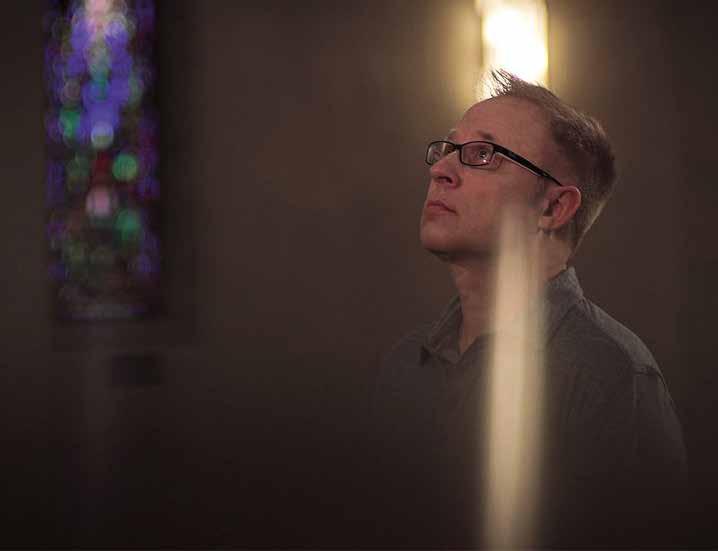
The 28th annual Seattle Queer Film Festival (SQFF) kicks off Oct. 12 at the SIFF Egyptian with a gala screening of Andrew Haigh’s universally acclaimed drama All of Us Strangers and closes Oct. 22 at the Broadway Performance Hall with a raucous party of comedy shorts overflowing in Queer joy.
“I’m feeling very excited,” stated Three Dollar Bill Cinema Artistic Director Kathleen Mullen emphatically. “I am super happy with the lineup this year. It’s a stellar lineup. Shorts, docs, features, events: there’s so much great stuff. I’m excited for audiences to get a look at it all.”
All of Us Strangers – Photo courtesy of Searchlight Pictures
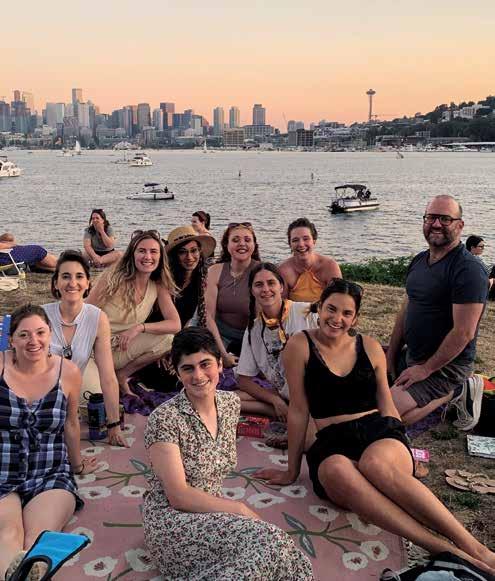
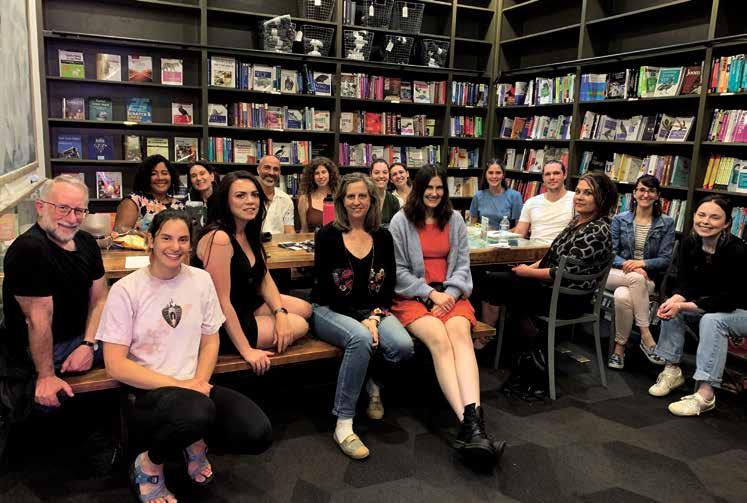
Seattle Sexuality Professionals first ever meet-up at Gasworks park in August 2022 – Photo courtesy of Naomi Price-Lazarus
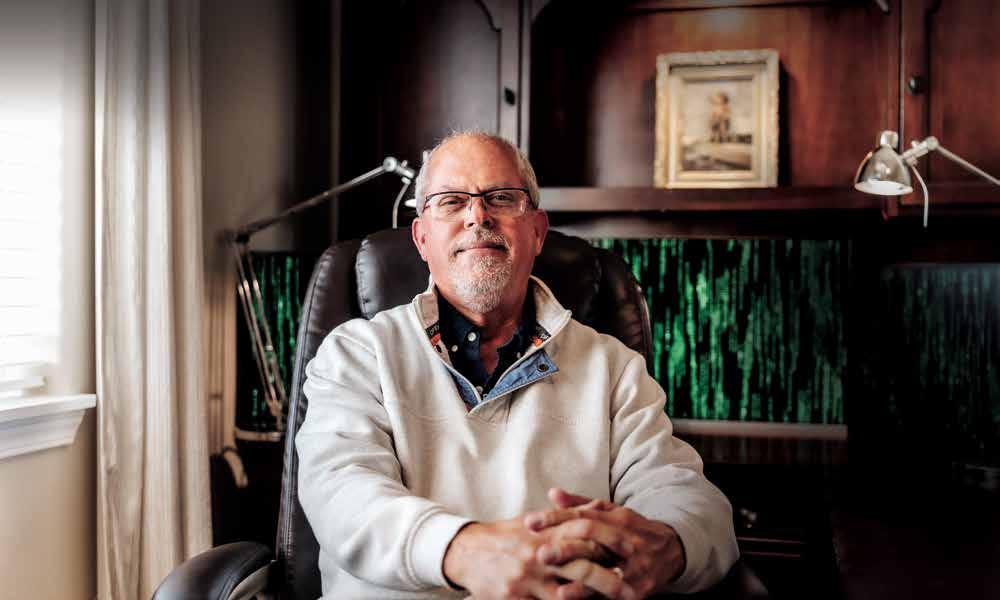
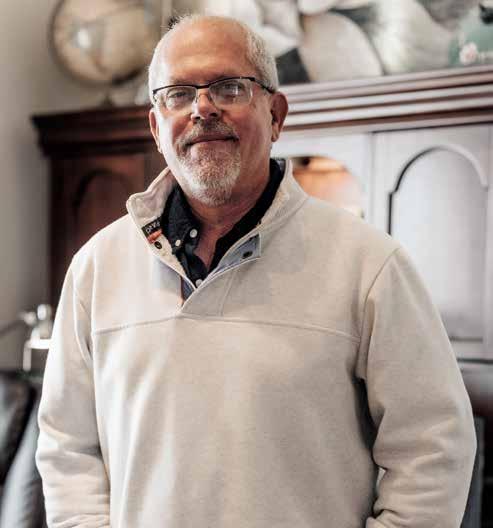
Mike Schultz – Photo by Matt Cyphert
Seattle News
FTC files lawsuit against Amazon in Seattle
by Lindsey Anderson SGN Staff Writer
On Tuesday, September 26, the Federal Trade Commission and 17 states filed a lawsuit against Amazon in Seattle. They allege the company has violated US antitrust laws. The lawsuit is the largest challenge the federal government has made against Amazon.
The purpose of the FTC is to protect US consumers and market competition. It was established in 1914 to prevent unfair business practices and was signed into law by President Woodrow Wilson. Since then, Congress has passed additional acts granting the commission more authority to police anticompetitive practices.
Jeff Bezos: monopoly man
The plaintiffs’ 172-page lawsuit includes allegations that Amazon’s retail supremacy is a monopoly, because the company uses unfair chain-link strategies to maintain its power over competitors, in that it functions as both a retailer and a manufacturer and unfairly prioritizes the products it manufactures over others. The lawsuit includes evidence that Amazon prevents businesses from selling their products at lower prices elsewhere, degrades the quality of non-Amazon-brand items, and overcharges sellers.
It also claims that Amazon’s exclusionary practices stifle the growth of other online retailers, buying out or sabotaging any small businesses that show the potential to become a rival in the future.
The plaintiffs hope a federal court will mandate a permanent injunction, stopping Amazon from controlling the online retail market. They are not requesting a breakup of the company.
Representatives of Amazon claim the case is unlawful and have threatened that a rul-
PAPAYA
continued from cover
“In a space where I as a sex educator don’t have to explain what I do, don’t have to provide any context for the need, or [can] hear people just start sharing their own experiences of their own sex ed,” PriceLazarus said, “we can share this common ground where can talk about ways to collaborate with and support each other.”
Making connections
She wasn’t the only one feeling disconnected from the professional community. Claire Appelmans, a sexuality educator, has been attending the meetings since it started. She moved to Seattle in 2020, and says it was hard to know who was teaching sex ed, or who had specific expertise. Developing a relationship between other practices and hers has proven difficult.
“A lot of the sexuality education that is happening right now is really separated. Educators are isolated, on their own,” Appelmans said. “The challenge that I would love to try to help resolve is solidifying relationships between all these entities.”
Rev. Justin Almeida, a chaplain at the Swedish Cherry Hill hospital, says the group is the only one of its kind they know. New faces are what keep Almeida, who has attended since the meetup first started, coming back.
“It’s about the networking, it’s about the different people and different perspectives. Some of it is just the collegiality, meeting other people who are working in human health and services,” Almeida said. “Especially now… post-pandemic. There’s a sense of ‘we’re in this together.’”
Few in the field
There’s a mix of reasons for the disconnection Price-Lazarus and Appelmans felt. First, the field is still up-and-coming, Price-Lazarus said.
ing in favor of the FTC will result in slower shipping times and higher prices. In an official statement from the company, David Zapolsky, senior vice president of global public policy, wrote, “We respect the role the FTC has historically played in protecting consumers and promoting competition. Unfortunately, it appears the current FTC is radically departing from that approach, filing a misguided lawsuit against Amazon that would, if successful, force Amazon to engage in practices that harm consumers and the many businesses that sell in our store.”
Zapolsky defended Amazon as a champion of small businesses and an innovative company that pushes competitors to work harder and strive for better delivery systems.
Sellers’ remorse
Despite the company’s claims, the suit alleges that Amazon forces sellers to buy advertising to remain relevant in the company’s search algorithms, sets minimum prices for their products sold on Amazon, and keeps them from listing products at lower prices elsewhere that might compete with those found on Amazon. Those who attempt to use other platforms to sell their goods, particularly at lower prices than Amazon will allow, are also punished by the site.
The company also allegedly pressures sellers to pay for “Prime” status to have their products prioritized in search results. Those who do not agree to pay the extra fee have their products listed lower in search results, and see added delivery fees and delivery time compared to Amazonfulfilled products. The result is that sellers only retain only 50% of their profits, as the company takes the rest through hidden fees and forced advertisement.
You named our secret algorithm after the Loch Ness Monster?!
The suit also mentions an algorithm called “Project Nessie,” which Amazon has kept top secret; the company has only said that it is an “algorithmic tool” and a “pricing system.” All details of the mystery algorithm were redacted in the public complaint. An excerpt reads, “Amazon has also [redacted] through a [redacted] operation called ‘Project Nessie.’ [Redacted] Amazon’s Project Nessie has already extracted over [redacted] from American households.”
According to the Wall Street Journal, the secret algorithm helps determine how far Amazon can raise prices and remain competitive with other sellers. Nessie would monitor prices on other online retail sites, such as Target, when Amazon raised its prices. If other companies refused to raise
prices to compete with Amazon, the system would automatically lower Amazon’s to remain competitive. The FTC alleges that this secret algorithm helped illegally maintain market dominance.
“Amazon is a monopolist, and it is exploiting its monopolies in ways that leave shoppers and sellers paying more for worse service,” FTC Chair Lina Khan said following the filing. “In a competitive world, a monopoly hiking prices and degrading service would create an opening for rivals and potential rivals to grow and compete,” she continued. “But Amazon’s unlawful monopolistic strategy has closed off that possibility, and the public is paying dearly as a result.”
A trial date has not been set. The FTC expects it will take several years before a verdict is reached.
When the event first started, it garnered a lot of attention from students at Antioch University, who were taking classes online at the time.
“They hadn’t really gotten to meet each other in person, and wanted to get to know people who’ve been doing the work a little bit longer,” Price-Lazarus said. “There’s not as many role models out there, because there’s just not as many people in this field.”
In the process of starting the group, Price-Lazarus also found that people who are new to the field didn’t know others
because they were in private practices.
“Especially with the way that a lot of us in these fields end up running our own businesses and … feeling pretty isolated in our homes and sending emails all day, making online content, or whatever that might look like, it’s nice to meet up in person,” she said.
Resources and fun
The group has created a spreadsheet with a list of resources, including other local groups, community organizations, books, online articles, and podcasts.
“These are collected and collated by the people who attend, and I found some really great resources just by networking,” Almeida said. “The hope is that this group can not only connect professionals but be a source of information for people to find health and healing.”
Appelmans says the group is fun to be a part of, as well.
“It’s not boring. Some of the meetups that I’ve been to in the small business world or in the education world, they don’t feel as human.”
Photo by Paul Sancya / AP
The most recent meetup at Ada's bookstore on Capitol Hill – Photo courtesy of Naomi Price-Lazarus
Seattle’s Haunted Soiree a thrilling adult trick-or-treat experience
by Lindsey Anderson SGN Staff Writer
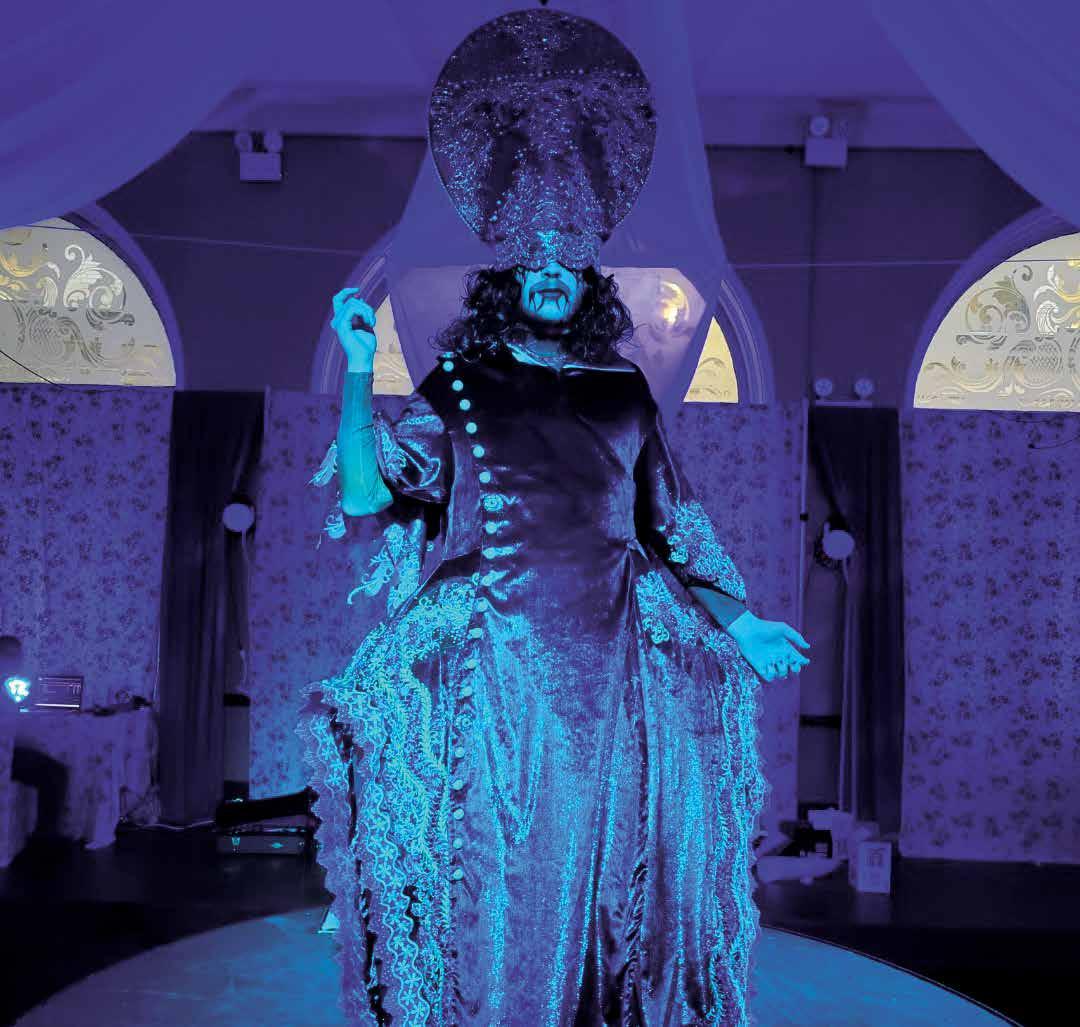
There’s no better interactive Halloween event in Seattle than Haunted Soiree: A Macabre Cocktail Party. The immersive theatrical production is charming, campy, and creepy as hell.
Before arriving, attendees should know that the venue is actually haunted. The Daughters of the American Revolution Chapter House on Capitol Hill is said to be occupied by the ghost of an unknown woman. Visitors have reported hearing the sounds of disembodied voices and music.
It’s not hard to believe the 200-yearold mansion is haunted — it’s now full of ghosts in eerie makeup.
That’s because this year’s story is “The Volkov Possession,” according to which the mansion was once the location of a psychiatric facility. Each performer represents a different patient who was once plagued by sightings of creatures while living there — until one night, when all the patients and staff mysteriously died. Russian ghosts lead participants to exhibits where they can learn more about the story.
For scaredy-cats (like myself), a selection of five different craft cocktails can provide some courage. Small bars are to be found on the top two floors of the mansion, each providing a unique fall-themed drink. Upon arriving, guests get a “tarot card,” which bartenders will punch throughout the night as drinks are ordered. Gold and silver tickets provide five drinks, while a bronze ticket includes four.
Attendees are provided with files and then ushered into the rooms of the patients to search for clues about what led to their demise. (I’d suggest beginning the experience before starting in on the drink card, if you want to fully understand the files.) Shrieks abound as creatures pop out from hiding places in each room.
The most terrifying part of the experience is that couples are split up and sent on their way alone. I admit I only made it through one room before I nearly peed myself.
Guests also get a clue to help them figure out what happened at the Volkov Practice. The hint may lead participants to the basement, where they can engage in interactive storytelling, with actors explaining the legend behind the creatures from the upstairs rooms. Attendees will also learn more about the nefarious intentions of Dr. Volkov, and may even get a chance to meet him in person as he walks around during the soiree.
Patrons are encouraged to explore the
The immersive theatrical production is charming, campy, and creepy as hell.
building’s three levels as part of the interactive experience; each has a different set of entertainment. The main floor includes the most tame. One room has demons singing
upbeat pop songs. Another has one of the story’s characters performing magic tricks; this room also features a stunning pole dance routine.
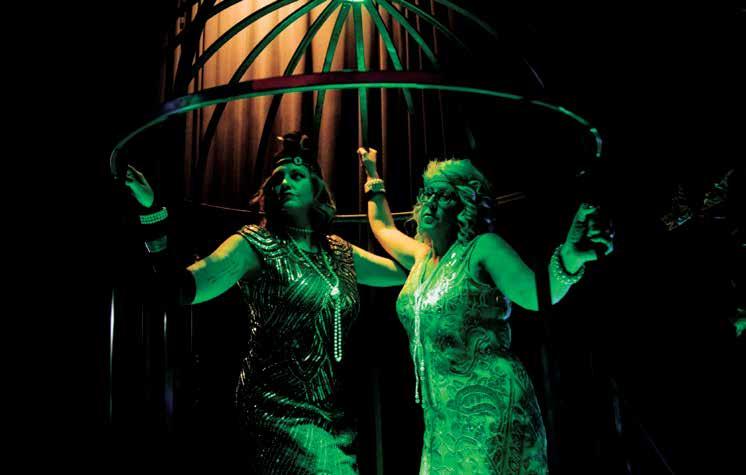
Photos courtesy of Meyer2Meyer
Characters are just as free-roaming as the guests. They often strike up a conversation about the mystery at hand. The experience feels akin to participating in a real-life video game.
Starting at the top is the best way to figure out what is happening in the mansion, although it is the creepiest floor. Even just lingering there will send chills down the spine. Every ten minutes, dancers perform a ritual on the front stage. The first involves the sacrifice of a bear. While beautiful and reminiscent of a dance Sia might choreograph, it is horrifying.
Those who stick around up there long enough may just be able to catch the second ritual, which was the most disturbing thing I have ever witnessed (and I live in Capitol Hill). The liturgy — because allusions to Christianity make everything feel a bit freakier — involves the spirits of the deceased donning baby masks, then graphically mutilating and murdering one of the story’s characters. This scene is not for the faint of heart.
Both rituals are very effective in creeping one out. Just hearing the ceremonial music echo through the streets of Capitol Hill that night was enough to bring back images of the horrifying sight.
Despite the frightening tricks, this Halloween experience is the perfect treat for any spook enthusiast. The experience is scary without becoming hacky, and the actors are excellent improvisers, willing to put up with the horrible jokes of nervous participants. A golden ticket even allows guests to participate in “adult trick-or-treating,” which was genuinely so much fun. Come for the craft cocktails and stay to figure out what the hell happened to Dr. Volkov (and then please explain it to me).
Haunted Soiree is running until October 31. Tickets range from $70 to $98 and must be purchased beforehand at https:// hauntedsoiree.com/seattle.
Seattle News
Trailblazing at Seward Park
by Lindsey Anderson SGN Staff Writer
In between pelting rainstorms, my dog Benji and I found a patch of sunshine and decided to head down to Seward Park to check out some of the trails.
Sticking to the path
Upon arriving, I questioned whether exploring the park’s heavily manicured lawns would count as a “hike.” A local Parks and Recreation employee reassured me that if I stuck to the main cement path I would still encounter some nature. They directed me to a winding wooden staircase leading toward the woods, and we began our ascent on “Broken Tree Trail.”
While foliage and tree coverage provided the same visuals you may get on a more remote hiking trail, the echoes of construction spoiled any chance of serenity for the first half of our walk. The loud beeping and crashing sounds made Benji uneasy, though I was more alarmed by the sight of a mysterious white sap oozing from nearby trees and multiple warning signs about poison oak.
Despite the city noises, the park provided natural scenery, including giant trees with leaves the size of my head. The trail took us to a grassy field with a playground before jutting off. At this point, we decided to hop on the “Clark’s Prairie Trail,” which appeared to head further into the woods.
A hidden gem
We maneuvered deeper into a grove of trees, and the construction faded into the autumn sounds of birds preparing for winter. Once again, the trail jutted off. The main path turned to pavement. Off to the side a game trail led into the woods. Though the Parks employee had suggested staying on the paved trail, I was looking for an adventure. My chest rose and fell faster now with the thrill of a bad idea, and I ducked into the overgrown trees.
The visual music of nature’s fall concerto — brilliant greenery on the edge of turning color — lulled me into a trance. Through breaks in the gorgeous trees we could glimpse Lake Washington. We took the overgrown trail slowly. A worry built that we might get lost, encounter a snake, or brush up against poison ivy, but I pushed through. Before long we discovered bright red vines climbing up ancient trees. The thrill of “what-if” only made the path more beautiful, as though it
were an elusive gift offered only to the brave and reckless.
Our hidden path did not last long; like most serene moments, it was ours only briefly. The path spat us out at another paved trail, this one labeled “North Beach Trail.” Though less secluded it did lead us to some wildlife encounters, mainly with ducks, massive spiders, and a few off-leash children (which were by far the most terrifying).
Exploring the lake
North Beach Trail took us along the shores of Lake Washington, where Benji was delighted to find buoyant sticks to fetch. Though fall was upon us and the lake was far too cold for me to step into, my dog loved the chance to prance around at the edge of the still waters. I, too, was impressed by the variety of swimming spots and will add Seward Park to my summer 2024 bucket list.
Continuing along the lake, we passed a rocky beach, park benches, and even a small fishing dock. While occasional walkers, bikers, and joggers passed us on the path, the area maintained a quiet stillness. Seward Park is full of beautiful spaces for reflection
The thrill of “what-if” only made the path more beautiful, as though it were an elusive gift offered only to the brave and reckless.
and contemplation. Mile markers remind patrons how far they have come (assuming they have strictly stuck to the path).
The final marker came in at just under 2.5 miles, making this an easy hike for beginners and those with moderate experience.
Two other flat, paved paths in Seward Park, the Sqebeqsed Trail (1.2 miles) and the Perimeter Loop Trail (2.4 miles), are said to be excellent options for wheelchair users who want to commune with nature.
The end of the lakeside trail brought us to a marsh. Lily pads dotted the water’s edge, and ducks gathered to feast on the aquatic plants and algae. Though we were near-
ing the construction site again, the quiet remained until we rounded the bend. Hiking the hidden path at Seward Park, I remembered what makes nature so thrilling. There’s an addicting rush of emotions when something scares you but you pursue it anyway. The most beautiful route Benji and I took was overgrown, but perhaps its beauty came from knowing not many decide to take it. There is so much more to explore in Seward Park that I already have plans to return, but in the back of my mind, I wonder about that hidden path. Will it still seem as beautiful now that I know where it leads?
Photos by Lindsey Anderson
National news highlights
Josh Kruger, Gay Philadelphia journalist, shot dead outside home
Philadelphia journalist and activist Josh Kruger, a Gay man, was shot to death early Monday at his home in the city.
Police were called to Kruger’s neighborhood about 1:30 a.m., the Philadelphia Inquirer and other outlets reported. He had seven gunshot wounds in his chest and abdomen and had collapsed on the sidewalk outside his home. Police believe Kruger was shot in his home and went outside to seek help.
He was taken to Penn Presbyterian Medical Center, where he died about 2:15 a.m. He was 39.
Kruger had written for numerous news sources, including the Inquirer, the Philadelphia Citizen, Philadelphia Weekly, Philadelphia City Paper, The Advocate, and Plus (a sibling publication of The Advocate). Many of his articles dealt with LGBTQ+ issues and his experiences of homelessness and living with HIV.
Kruger won several awards for his work, including for commentary from the Society of Professional Journalists in 2014 and 2015 and the Edith Hughes Emerging Journalist Award from the Pennsylvania NewsMedia Association in 2015.
Kruger’s death has ushered a flood of mourning and support from the Philadelphia community, including from US Sen. John Fetterman, who, in a post on X (Twitter), called Kruger’s death “a devastating loss,” and District Attorney Larry Krasner, who praised Kruger for having “lifted up the most vulnerable and stigmatized people in our communities — particularly unhoused people living with addiction.”
“We are shocked and saddened by Josh’s death,” said a statement from Philadelphia Mayor Jim Kenney.
“Josh cared deeply about our city and its residents, which was evident both in his public service and in his writing,” the mayor continued. “His intelligence, creativity, passion, and wit shone bright in everything that he did — and his light was dimmed much too soon. We were exceed-
ingly fortunate to call him a colleague, and our prayers are with everyone who knew and loved him.”
Police have not identified a suspect and have not indicated any signs of forced entry. In recent postings to social media, Kruger detailed fraught interactions with a former partner who had gained entry to his home with a copy of his keys, a rock being thrown through his window, and a stranger who had entered his house, looking for his former partner, and threatened him.
Kruger’s friends remember him as a resilient person who was always open
about his struggles with addiction, homelessness, and poverty, and whose faith helped him through tough times.
Nebraska Governor signs emergency regulations banning Trans healthcare
On Sunday, October 1, the Nebraska State Department announced new emergency regulations for Transgender healthcare for minors. Persons under 18 must now wait a mandatory seven days before starting puberty blockers or hormone replacement therapy and attend at least 40 hours of “clinically neutral” with a “gen-
der-identity focused” therapist before they can obtain medication. The new law also bans all transition-related surgeries for youth under 19.
Nebraska Governor Jim Pillen signed the emergency regulations on Sunday but said the state Department of Health and Human Services will now be taking comments before they propose a final version of the law by the end of October. At the signing ceremony, Pillen described gender-affirming treatment as “Lucifer at its finest.” A public hearing for the legislation is set for November 28.
Josh Kruger – Photo by Jessica Griffin / The Philadelphia Inquirer / AP
Nebraska Gov. Jim Pillen – Courtesy photo
International News
International news highlights
by Teddy MacQuarrie SGN Contributing Writer
Three injured in attack on Queer march in Beirut
A march passing through central Beirut on Saturday was stopped by members of the far-right Christian group Soldiers of God.
According to the Canberra Times, the men chanted slogans against “any kind and form of homosexuality in the streets of Beirut” and sparked clashes at the march. The social justice organization Legal Agenda explained on X (Twitter) that the group had thrown stones at Queer activists and journalists.
“The assailants were able to reach Riad Al-Solh Square and attacked the journalists and activists present there,” the organization said. “They also attacked the military vehicles of the security forces that were trying to remove them, forcing the security forces to use tear gas to disperse them.”
Legal Agenda added that the Queer march had to become a “sit-in” due to the ongoing “aggression.”
The attack is the most recent of a rising number of Queer hate incidents in Lebanon, following an attack at a Queer bar by the Soldiers of God in August, which left several victims “unsure they would make it out alive.”
The country has seen a violent crackdown aginst the Queer community in recent months, in part due to increased anti-Queer hostility from politicians, religious extremists, and fringe groups.
According to Equaldex, Lebanon ranks 32 out of 100 on its Queer rights index, with no access to same-sex marriage and no legal protection from discrimination.
According to the equality index, 85% of people in Lebanon answered “no” to the question “Should society accept homosexuality?”
Swiss writer sentenced to prison for calling journalist “fat Lesbian”
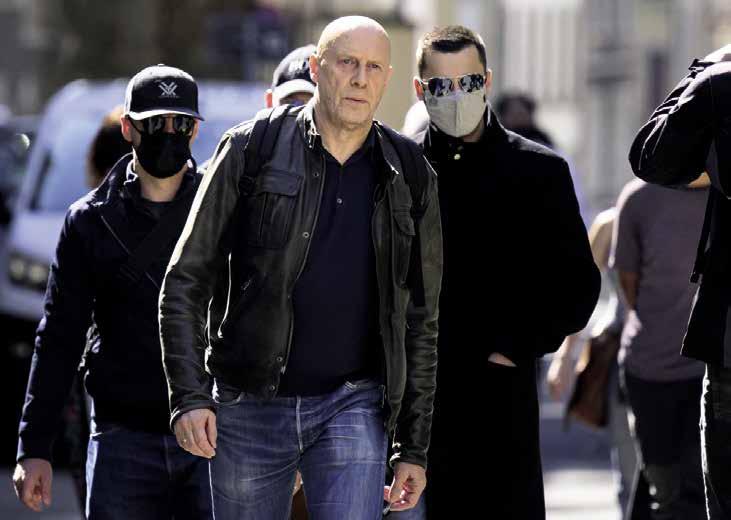
On Monday, October 2, Swiss polemicist
Alain Soral was sentenced to 60 days in jail for defamation, discrimination, and incitement to hatred for calling a journalist a “fat Lesbian” in a Facebook video he posted two years ago. Soral is also facing over 1,000 francs in fines. He was previously convicted
and sentenced to jail in France for denying the holocaust.
Swiss LGBTQ+ groups are celebrating his sentencing as a victory for progress. His lawyer plans to appeal the case to the Swiss federal court and, if necessary, to the European Court of Human Rights.
In 2020, Swiss voters approved a measure to make it illegal to discriminate
against people based on sexual orientation. While the country does grant freedom of speech and press, the judge ruled that Soral’s speech violated their anti-discrimination laws. There are currently only 6,300 people actively serving prison sentences in Switzerland. To compare there are roughly 1.2 million people currently in U.S. prisons.
Queer marchers in Beirut, 2020 – Photo by Hassan Ammar / AP Alain Soral – Photo by Laurent Gillieron / Keystone via AP
But dark clouds of uncertainty were gathering. The AIDS epidemic arrived, and with it, loss and grief on a scale that was decimating and horrific.
The SGN was truly the lighthouse in the storm, keeping our community connected and informed, and honoring the loss of life while broader society shunned the victims. In those defining years of standing proud and tall in the face of society’s steeped homophobia, the SGN truly cemented its place as our legacy publication.
From that experience, I became keenly aware of the value of staying connected as a community through a medium we trusted, one that understood, informed, and uplifted our nuanced humanness. To me, preserving the SGN ’s 49-year legacy as a continuing entity is paramount to that end.
My focus for the SGN in the short-term is shoring up its sustainability. So we’re shifting from weekly to biweekly (every other Friday) print issues, with continued additional quarterly special print issues.
However, in recent weeks, the physical distribution points for our print issues have expanded beyond our core Puget Sound region. We now encompass Ocean Shores to the west, Spokane to the east, and Bellingham to the north.
Moreover, the content mix in the print issues is shifting to focus more on our
local and regional Queer communities. And we’re exploring, strengthening, and expanding the SGN ’s digital presence, community engagement, and news information delivery through its website and robust social media offerings, including Facebook, X (formerly Twitter), Instagram, and the Radio SGN podcasts.
I am grateful to George Bakan for his relentless activism while weathering decades of storms to keep the SGN afloat. I am grateful to his daughter, Angela Cragin, who inherited the paper in 2020 following her father’s death. She kept the ship from capsizing in a tsunami of personal grief and turmoil. She delivered the SGN to its new captain intact, and with an eye to its future.
My hat is off to the talented and creative crew at the SGN, who diligently, and with uncompromising commitment to our community, make the magic happen every week. Their growing, younger generational insights are the future of SGN
And I am thankful to my husband, Steven, for his gentle insistence over the last 17 years that I pursue my passion as he centers me in a place of love and gratitude.
In stepping into the pilothouse of the SGN, I do so with stewardship in mind and humility. But I also open this new chapter with an innate and tenacious enthusiasm to further our causes of visibility, equality, and dignity. I am insistent that we deserve nothing less than taking our equal place at the table of humanity.
The tale of a wannabe stoner
(Or, how I came out to my mother)
by Cameron Martinez SGN Contributing Writer
With National Coming Out Day just around the corner, I thought it would be a good time to share one of my coming out stories.
I’d like to preface this by saying that I don’t condone the usage of marijuana by people under the legal age. Like everyone, I made dumb mistakes as a teenager, and all I can do is laugh about it now, so I hope you enjoy the tale of my stupidity.
During high school, I was obsessed with marijuana culture. I would watch Seth Rogen movies, listen to Kid Cudi, and become excited when the clock struck 4:20. All I wanted was to get my hands on that sweet devil’s lettuce, but alas, I never could. That was, not until a cloudy autumn day during my junior year of high school. I got it from a friend of a friend while at Pike Place Market.
I was 16 years old, driving my mom’s car through downtown Seattle with weed. I was ecstatic.
Having that bag of ganja stuffed into a Bug Juice bottle felt like the coolest thing ever. I was shaking with excitement as
I glanced at it every few seconds on my drive home. Honestly, I’m surprised I made it back in one piece.
I didn’t know if it was indica, sativa, or even oregano. At that point in my life, it was all the same to me.
I arrived home and inspected the Mary Jane with awe. Its skunky smell filled my bedroom as I bragged to my friends that I had finally obtained the silly green stuff. Then it dawned on me.
How the hell would I smoke it? I was still too young to walk in and buy a pipe. This led me to the internet (never a good sentence to hear, especially from a 16-yearold). I landed on a wikiHow page detailing how to make a pipe with a soda can.
It was perfect. I could drink a San Pellegrino limonata and turn it into my own personal pipe. Best part of it all? It was free.
I went through at least two cans before I was finally able to make a suitable pipe. With a stomach full of soda and eyes full of wonder, I was ready to start smoking.
I grabbed my mom’s candle lighter and found a nice spot to sit in my backyard. I sat wedged in the corner of the fence so I had a full view of the yard.
It was the moment of truth. I took my first puff and was overwhelmed by the burning sensation in the back of my throat.
Moments passed.
I felt nothing. I took another hit and then put on a YouTube video that was supposed to make me feel high. “That should do the trick, right?” I thought.
Nothing was happening. “Am I doing it right?” I wondered.
I continued to smoke until the bud was just a few black specks on my can. The specks blew away in the wind.
Feeling defeated, I stood up to go back inside. That’s when I saw it.
Right beside the hot tub was a purple jaguar staring me dead in the eyes. It pounced, and I ran inside.
My heart felt like it was beating out of my chest. I tried to comprehend what was happening. My brain was an echo chamber of panic and anxiety. My mind shifted from the thought of the purple jaguar to the very real reality of me alone and absolutely baked like a cake.
Fear seated itself in my body as I wrapped myself in blankets. Thoughts played over and over as if my brain was a skipping record.
I needed help. I picked up my phone and attempted to unlock it. My fingers looked disturbingly long and crooked as I fumbled out a text to my friend.
She informed me that getting high will amplify all emotions to the absolute max. It was not a comforting thought in the slightest.
She told me I needed to call my mom. This horrified me. She was at work, and I felt like everyone in her office was going to be disappointed in me. I didn’t know most of the people she worked with, but their opinions of me mattered just as much as hers did at that moment.
I called her and began to profusely apologize. She spoke softly and began to comfort me. She asked if I had anything else to say, so I replied:.
“I’m Gay.”
She said she knew, but this was my first time telling her verbally.
When she got home she was more proud of me for coming out than mad at me for smoking weed, so I didn’t get in trouble. I swore to never smoke weed again. We all know that didn’t happen.
Cameron in Weed, CA, 2016 – Courtesy photo
Cameron with their girlfriend, Pride 2022 – Courtesy photo
Mike Schultz – Photo by Matt Cyphert
Arts & Entertainment
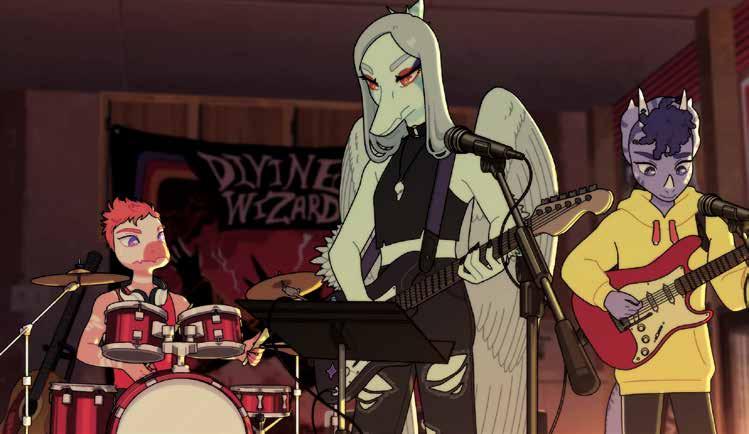
Visual novel Goodbye Volcano High tells a deeply human story with dinosaurs
by Daniel Lindsley SGN Staff Writer
High school coming-of-age dramas and apocalypse narratives are rarely combined, but the thought-provoking and bittersweet visual novel Goodbye Volcano High does just that. It follows Fang, a broody, Nonbinary pterosaur, as they navigate their senior year and prepare for their Battle of the Bands audition. All the while, a disaster looms in the distance; did I mention all the characters are dinosaurs?
The game isn’t profoundly revolutionary at its core. It has many of the trappings typical to its genre. The player is prompted with branching dialogue options at regular intervals in the story, each of which can affect Fang’s relationships with other characters.
Some of these choices are timed, pressuring a quick decision in the heat of the moment. Others have an extra button prompt, like mashing “A” to stare down a teacher trying to confiscate Fang’s phone. These options usually have a “wobbly” border, implying that Fang has to put in some extra effort, which shows a lot about Fang’s innermost struggles.
After all, they’re a Trans teen with high aspirations in the arts and born to immigrant parents who don’t “get it” yet. When the story begins, their mother still uses their deadname and considers music a hobby instead of a viable career.
At this point, readers unfamiliar with anthropomorphic art might gawk at the idea of dinosaurs being immigrants, let alone having heavy Arabic accents. If there are immigrants, does that mean there are dinosaur nations? Dinosaur wars? How is it that a triceratops could be friends with a dromaeosaur?
My advice is, don’t get too hung up on it. For the most part, the characters are functionally human, with modern technology like cell phones, cars, cable news, and fridges full of human-style food. Their body configuration is more or less primate, too.
Yet ignoring the symbolism of dinosaurs would mean missing something key. It might be telling, for example, that Fang has especially prominent feathers while other ptero-
saurs, Fang’s brother Naser included, do not.
Attentive players might also notice that one of Naser’s wings is atrophied and both are scarred, implying that among pterosaurs, they might be considered disabled. This is never explained outright, however. And isn’t it poignant that a coming-of-age story would also depict a looming apocalypse when the real world is evermore in climate chaos? Like the dinosaurs, is humanity an inextricable part of an ending era? And what could that mean for younger generations?
I could go on, but interpretations flourish around anthropomorphic media. Anyway, Volcano High spends no time building scaffolding around why dinosaurs exist in a human-like society.
Instead, it has complete confidence in a vibrant Cretaceous aesthetic taken as it is. That choice sets the game apart from its
visual novel peers. It puts it in line with other anthropomorphic media — though in the latter case, it is markedly less concerned with the sensory experience of having dino features. Ultimately, the game is more interested in the experience of being young and trying to figure oneself out in relation to parents, peers, and, most notably, music.
One of the earliest choices a player makes is between different lines in a song Fang is writing. That choice leads to a tutorial on “playing” the song, essentially a rhythm minigame using a wide range of visual cues.
Players not accustomed to this sort of thing might find themselves overwhelmed at first, but once they get the hang of it, they might also find that they’re engaged with the music on a deeper level than if they were to watch and listen. The game repeats this trick throughout the story, with
an original, bittersweet soundtrack of ambient pop-punk by Montreal-based composer Dabu and musician Common Holly. As for the rest of the game’s sound, the characters are fully voiced (unless they are texting each other). Fang is voiced by Nonbinary actor Lachlan Watson, who players might recognize from the Chilling Adventures of Sabrina. Ozioma Akagha, who voiced Alyx Vance in the virtual reality hit Half-Life: Alyx (2020), plays Fang’s triceratops friend Trish. An array of other experienced regulars voice the rest.
Goodbye Volcano High is available now for PC, Playstation 4, and Playstation 5. Since its release in August it has won the Tribeca Games Award at the 2023 Tribeca Festival, and was featured in the “Games & Immersive Experience” selection.
Images courtesy of KO_OP
Film Queerness and horror: A celebration of James Whale
by Ian Crowley SGN Contributing Writer
It is officially October, meaning spooky season is in full swing and it’s about time to start discussing horror cinema loudly. I watch scary movies year-round and consider the start of spooky season to be the day after the Fourth of July, but to some people these frightening matters are best left solely to one month of the year.
When I think of it, though, most of my fellow Queer friends also have a strong love for Halloween and horror movies in general. This might at first seem like a coincidence, but it makes a lot of sense why we feel connected to the genre, as, from its inception, it has been inextricably linked to our community. This link is highlighted by the influences of camp (often the underlying subtext) on horror, as well as the by the people working in front of and behind the camera and their own queerness.
So, for the month of October, I will be discussing the horror film genre, and how our community was central to its history, including some of the rich LGBTQ+ history of various eras of cinema. This week, we’ll examine people and productions of the Golden Age of Hollywood, which ran from 1931 to 1954.
James Whale
James Whale (1889–1957) was one of the notable directors of that era. Frankenstein, The Old Dark House, The Invisible Man, and Bride of Frankenstein are his most popular works. Whale is noted for his pioneering of various tropes of the genre, including monster protagonists and scary old-house movies.
Whale was also notable for being out as a Gay man in the 1920s and 1930s, something that was almost unheard of in those days. This has led many to reexamine his works through this lens, and the results are illuminating.
As Hollywood as we know it was just beginning to form, and cinema was considered low art, this allowed marginalized people to sometimes fill vacuums of power within the industry. Major studio films directed by Queer people are still not easy to make, so the fact that some of the highest-grossing, culture-defining films were made by an out Gay man (which was well known) is amazing.
The movies and monsters he made Frankenstein instantly became one of the most recognized images of the horror genre, due to the success of Whale’s 1931 film. It, as well as the original 1818 novel, written by Mary Shelley, has been read by many as containing subtext relevant to Queer people, namely the trope of the revocation of love by one’s parent. The monster is seen as sympathetic when rejected by his own father, and the feelings portrayed evoke this in viewers. (I would also be remiss to exclude the readings made by some to connect the plight of the monster to the Queer body, which is alienated and demonized.)
In The Old Dark House, Whale explores further themes, this time critiquing heteronormativity and the restrictions it imposes on people in society. He highlights the queerness of the characters (not regarding sexual orientation, but rather a queering of expectations and social standards) through their nonconformity to the rigid boundaries of society.
Several characters are coded as Queer, and Whale even used actors who themselves
were Gay, Lesbian, or Bisexual, including Charles Laughton, who was Bisexual. In the film, a character refers to Laughton’s character as “ever so gay,” which is believed to be the first cinematic use of the word “Gay” to describe homosexuality, as it is assumed Whale was referring to his colleague’s sexuality with that line.
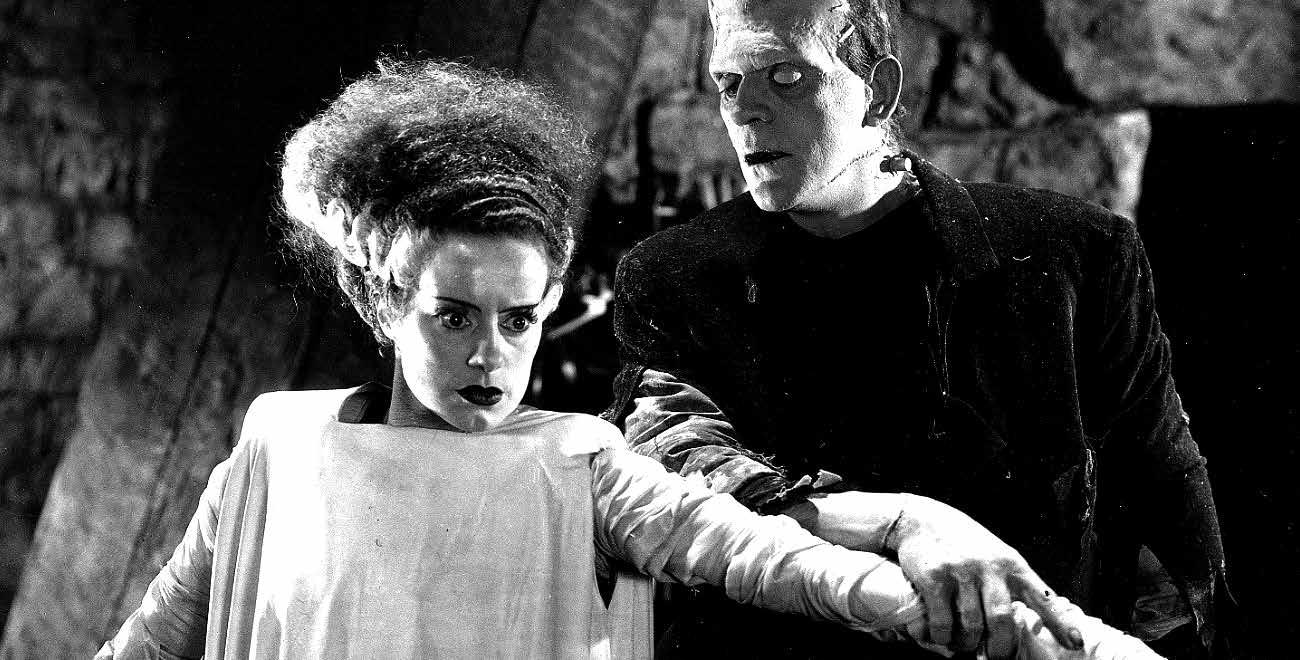
The readings of the subtext of Whale’s films do not slow down regarding The Bride of Frankenstein, whose title role was played by Elsa Lancaster. In contrast with the monster’s slow, quiet, calm demeanor, her performance is intense, kinetic, manic. This is often considered one of the first and most influential examples of camp in cinema, with everyone else being portrayed as relatively straight (pun intended) compared to her over-the-top movements, screams, and facial expressions. This relationship to camp is essential in horror’s connection to LGBTQ+ culture.
Additionally, the subtext of the film is also read as rejecting heteronormativity, since the bride rejects the monster. Whale knew exactly what he was doing (and how it
would be perceived) by creating a narrative in which a woman — “made” for a man — rejects his pursuit.
Whale’s contributions to cinema, let alone Queer cinema, are monumental. Separated entirely from the readings of his work, the very fact he was an openly Gay man in a prominent position, making art, is inspiring. Especially in a world where our voices are often intentionally silenced. It is clear when examining these works that his life influenced the films, affecting their text, subtext, production, and overall impact. From the actors he used, to the types of stories he chose, to the film technique and aesthetics he employed, James Whale forever impacted the legacy of LGBTQ+ cinema.
Stay tuned
Next issue, we will examine a different era of horror cinema, in hopes of discussing more of the history of the productions, the people, and the stories that define the genre and the community.
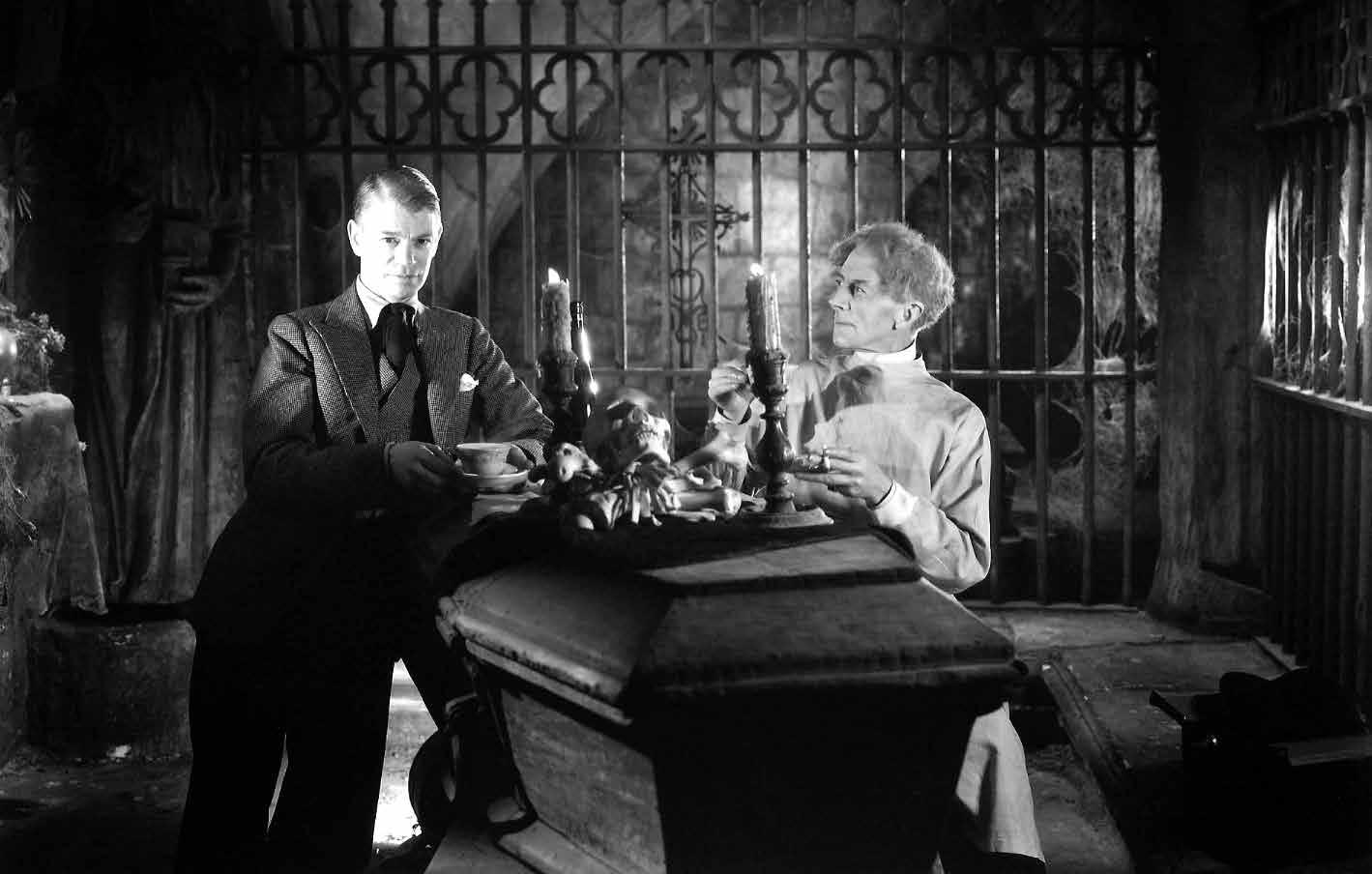
James Whale (l) on the set of The Bride of Frankenstein (1935) – Photo courtesy of Universal Pictures
The Bride of Frankenstein (1935) – Photo courtesy of Universal Pictures
Along with the SIFF Egyptian and the Broadway Performance Hall, this year’s SQFF will include screenings and events at the Northwest Film Forum, the Ark Lodge Cinemas, Century Ballroom, the W Seattle, Pony, Lottie’s, Mose Auto, Poco, and the Wildrose. “
We have really good relationships with our venues,” said Mullen. “With Translations [the Transgender Film Festival held in May], we were in Columbia City this year and had many sold-out screenings, so I think it’s super exciting we’re able to take [SQFF] there this year, too.
“But SIFF Egyptian, Northwest Film Forum, and the Broadway Performance Hall, we’ve been working with them all for many years. It’s good to be back utilizing these great venues with a full lineup this year.”
Documentary centerpiece
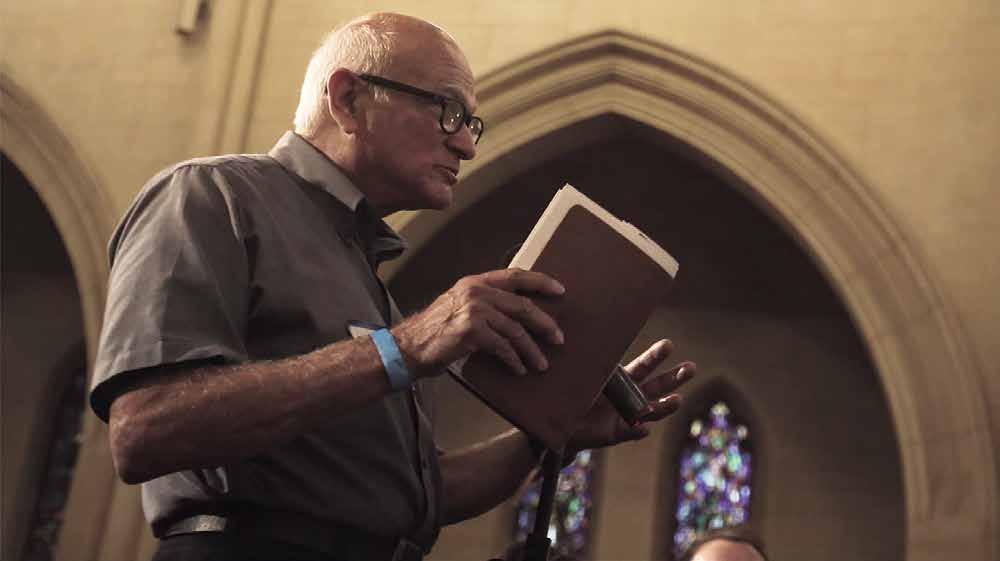
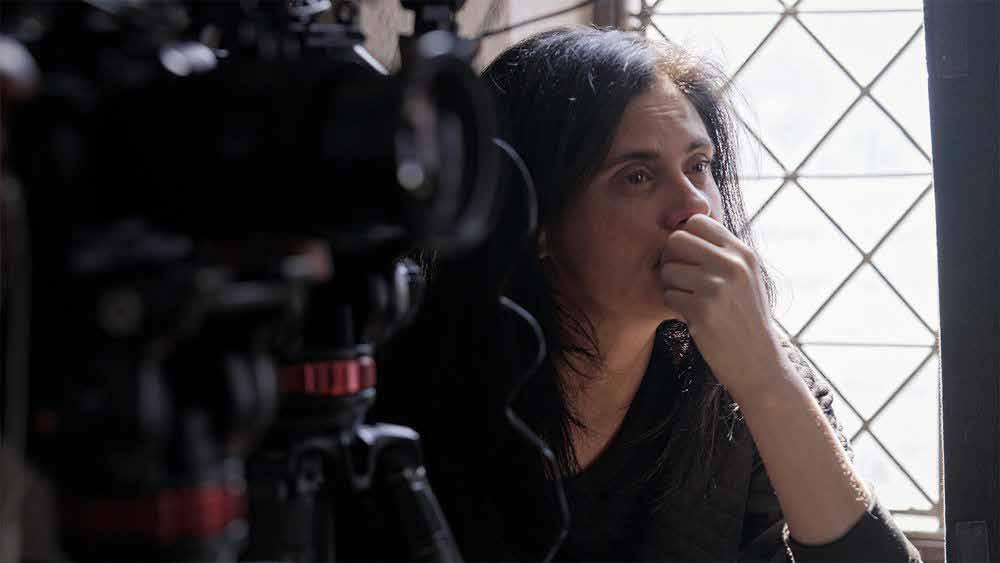
It’s exciting for the filmmakers, too. “I can’t wait to get back to Seattle,” said Sharon “Rocky” Roggio, the director of this year’s documentary centerpiece, the highly praised 1946: The Mistranslation That Shifted Culture. Roggio’s film is part mystery, part familial drama, and part treatise on faith and religion. It focuses on how two Greek words and their retranslation by a select committee of theological scholars have shaped right-wing interpretations of the Bible for almost eight decades. The story is juxtaposed with that of the filmmaker’s complex relationship with her dogmatic father, Salvatore Roggio, a devout pastor who refuses to accept homosexuality as anything other than a sin.
“I think we’ve been exposed to too much misinformation and disinformation,” said Roggio. “This is poisoning our minds, separating us, and causing division. We’re not able to see one another, because we’re automatically opponents.
“With 1946, we wanted to separate ourselves from that and bring people back to a civil conversation. We’re not listening to one another — and we have to be able to listen to one another. And at the end of the day, maybe we’re not going to agree. But if your beliefs impede on my personal basic human rights, that’s an issue. So we have
to start seeing and listening to one another.
“But how? You can still believe in whatever version of the Bible you want to believe in, but it has to stay out of public policy. We didn’t get into a lot of that in the film, but those are the goals as far as having conversations that don’t divide us, that don’t immediately turn off, or vilify the other side or make it an us-versus-them kind of thing.
“We’re never going to get anywhere otherwise, because it’s our loved ones who are our oppressors. It’s our family members, and we love them too. We need to break the chains of political and propagating media that is all around us.”
Inspiring voices
For Mullen, bringing confident and inspiring voices like Roggio’s to Seattle theaters is what SQFF is all about.
“I see a huge growth in the various kinds of stories that are being told,” she said with an enthusiastic smile. “Some people are making romantic comedies and hilarious films, like Cora Bora or Jess Plus None. Other people are making films like 1946 that are real issueoriented. Or films about two Black poets and writers going to Mars [Going to Mars: The Nikki Giovanni Project] and ones about the origins of Black power, AIDS activism, Afroand Indigenous futurisms, and marriage equality [Jewelle: A Just Vision].
“Just the various kinds of work is extraordinary. It is really astounding. They’re all very different and unique, [looking] at what Queer people want to voice and how they voice it.
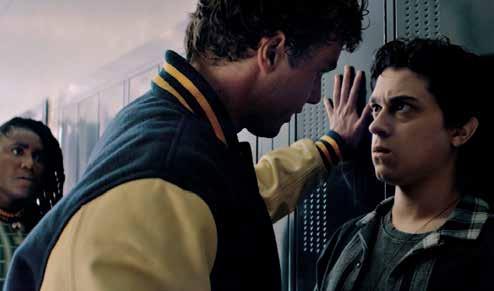
“For example, we have a whole genre section. We have a Friday the 13th double bill, with Departing Seniors, about a young MexicanAmerican teenager — it’s kind of a thrillerslasher movie and it’s great — and Scream, Queen, our annual horror shorts block.
“So it is exciting to me that not all of the films are the same, that they’re all from different kinds of voices … different stories. Some are political and some are funny and some are heartbreaking. Some are about love. They all have a place.”
1946: The Mistranslation That Shifted Culture – Courtesy photo
Jess Plus One – Courtesy photo
Departing Seniors – Courtesy photo
Going to Mars: The Nikki Giovanni Project – Courtesy photo
SLASHR featured in Scream, Queen program – Courtesy photo
Festivals like SQFF are essential, not just for celebrating and promoting the arts but also as a hallmark of a thriving community.
“Not only are they important for films like [1946 ], they’re important to amplify Queer stories, period. We need more representation of our community in cinema, in art, in all forms of media.”
Amplifying Queer stories
Roggio concurs, and it’s why she feels that festivals like SQFF are essential, not just for celebrating and promoting the arts but also as a hallmark of a thriving community.
“Not only are they important for films like this, they’re important to amplify Queer stories, period,” proclaimed the filmmaker forcefully. “We need more representation of our community in cinema, in art, in all forms of media.
“As we learned through my story [1946 ], when I was five years old in the 1980s, I saw two women who were Queer-identifying
Lesbians, which was what they would’ve said in that program. … They were holding hands, and I identified with them. That was a pivotal moment for me.
“Remembering my little five-year-old self and seeing myself on the screen? We need more of this. I’m just so encouraged by festivals like Seattle … and other Queer film festivals that do amplify our stories. I hope that people come out and support them.”
Roggio also added, “From our film, one of the other key throughlines is relationship. Relationships matter. They’re important. [Go] to the Queer film festivals.
[Meet] a Queer person. Be in a relationship. Make new friends. Experience new stories. Listen to diverse voices and hear what they have to say. That is how you change culture.”
Northwest element
With so much of the last third of 1946 taking place in and around the Pacific Northwest, notably Vancouver, BC, and then right here in Seattle, the director is eager to get back to the city and celebrate.
“We have some pretty big backers from Seattle,” said a beaming Roggio, “so I imagine we’re going to have not only a
crowd that’s excited to see it in their hometown but also people who’ve been wanting to see the film for a long time. I mean, Mary Lambert’s from Seattle, and she’s responsible for the music. Hopefully, those Seattle seats will be filled.”
As for what she wants audiences to take away from her film? After thinking for a moment, Roggio quietly responded, “The biggest takeaway for an audience would be to take a step back from wherever they came from and ask the question, ‘Could we have these things wrong? If we do have things wrong, then what do we do next? Is that okay?’
“I hope that the answer is yes, because that’s okay. The thing to do is to continue on the journey of asking questions, seeking more answers, and pulling back the veil without fearfulness of what else could be wrong. How do we recognize where information comes from, how it’s dispersed to us, and … what’s correct and what’s incorrect, so we can better our culture overall? Those are important questions.
“I think that there’s too much that is easily spoon-fed to us, and I think we’re all slowly realizing it. Don’t be afraid of the journey; embrace it, and then move forward.”
Working hard to support Queer voices Mullen echoes those statements, not just about the festival but about all of Three Dollar Bill Cinema’s projects and programs throughout the calendar year.
“Three Dollar Bill Cinema is a really important organization in Seattle,” she said with pride. “The Seattle Queer Film Festival, Translations, our outdoor cinema, and our Reel Queer Youth series — can you imagine a city without those things? Without our organization?
“We do a lot to support Queer voices and Queer stories. We work really, really hard. Because we believe in resistance, we believe in community. Because we believe in community, we believe in Queer joy. Come celebrate that Queer joy with us, not just at the Seattle Queer Film Festival, but year-round, too.”
The Seattle Queer Film Festival runs October 12 thru October 22 at venues throughout Seattle. It also features a virtual festival for residents of Washington, Oregon, Idaho, and Alaska from October 22 through October 29 (not all in-person titles will screen virtually, and vice versa). For a full calendar, tickets, and additional information, head to https:// threedollarbillcinema.org/sqff2023.
Salvatore Roggio in 1946: The Mistranslation That Shifted Culture – Courtesy photo
Filmmaker Sharon Roggio on the set of 1946: The Mistranslation That Shifted Culture – Courtesy photo
Ambitious The Exorcist: Believer fails to resurrect the demonic terror of Friedkin’s 1973 classic
by Sara Michelle Fetters SGN Staff Writer
THE EXORCIST: BELIEVER Theaters
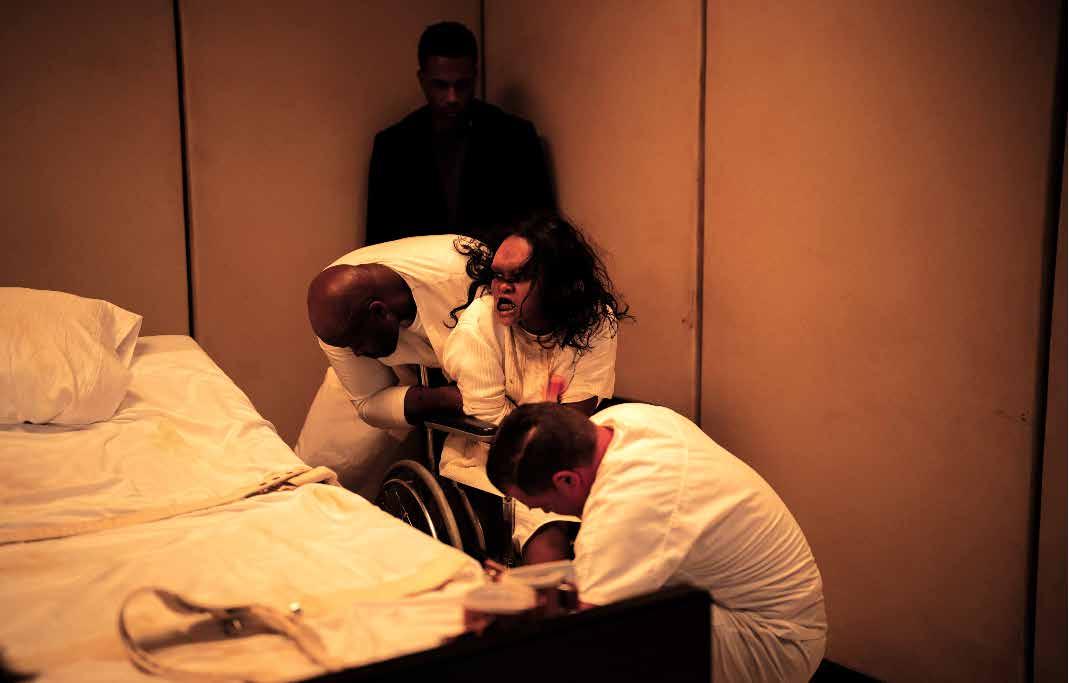
Much like David Gordon Green’s recent Halloween trilogy, the filmmaker’s attempt to resurrect The Exorcist franchise with The Exorcist: Believer is wildly ambitious. It is also pretty much guaranteed to be equally polarizing. While Green and his primary creative team (Scott Teems, Danny McBride, and Peter Sattler) take some massive swings, they also have difficulty meshing them into something cohesive. Their themes are a mixed bag of profound and maudlin, and by the climax, I was sadly more disappointed than anything else.
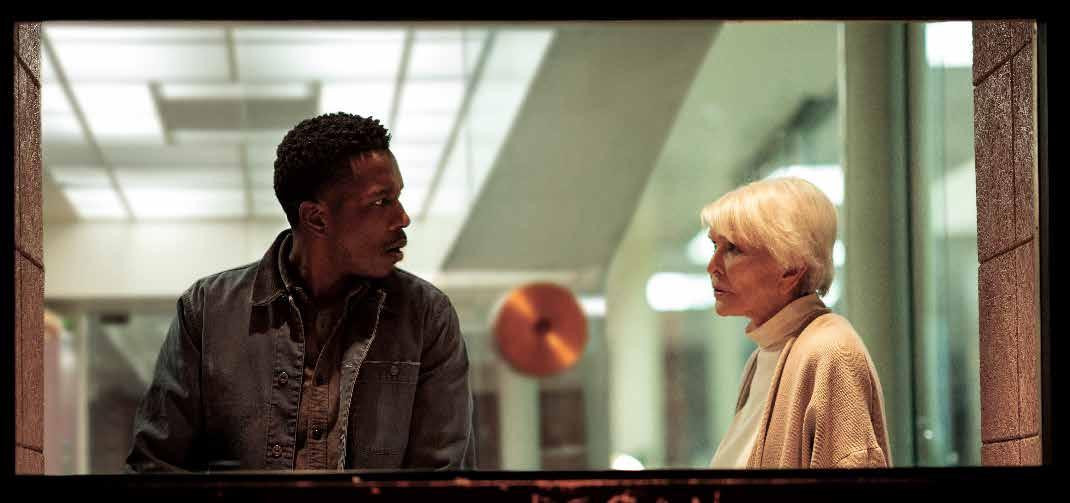
One of the more interesting aspects of this sequel is its “it takes a village” approach to novelist William Peter Blatty’s source material and director William Friedkin’s classic 1973 adaptation. The main character in this new story, Victor Fielding (Leslie Odom Jr.), is an overprotective single father and something of a reclusive loner when it comes to making lasting friendships. But to free his 13-year-old daughter Angela (Lidya Jewett) and her best friend Katherine (Olivia O’Neill) from the grips of demonic possession, he’ll have to assemble an entire team of disparate individuals to work as one committed unit if either girl has even the faintest hope to survive.
I love this approach. This allows Green to bring together Katherine’s fundamentalist Baptist parents Miranda (Jennifer Nettles) and Tony (Norbert Leo Butz), their church leader Pastor Revans (Raphael Sbarge), failed novitiate and current hospital nurse Ann (Ann Dowd), Victor’s workout buddy and neighbor Stuart (Danny McCarthy), Catholic exorcist Father Maddox (E.J. Bonilla), and root doctor and African spiritualist Doctor Beehibe (Okwui Okpokwasili) to defeat this evil.
It’s somewhat similar to what the director did with the tandem of Halloween Kills and Halloween Ends. Green attempted to show how a community could destroy itself from within when evil took root and disharmony was allowed to rule. He followed that up by showing how it could bring itself back to some semblance of normalcy once people put their differences aside and worked together for a common cause.
If that was too subtle for some members of
the audience to grasp, that is certainly not the case in this instance. There is nothing subtle about what Green is trying to say or anything inelegant about where he takes things. Victor’s best shot to defeat this evil is only possible if different religions and individual points of view can be set aside to achieve a common goal. The director is didactically calling modern society out for its inability to communicate or — heaven forbid! — compromise, and as inelegant as this message is, it’s still one audiences need to hear.
But I still feel like The Exorcist: Believer mucks it up. In an attempt to generate thrills, chills, shocks, and scares, this thematic throughline somehow gets lost in all the mayhem and mucus. The final moments of the exorcism go off the rails (and not in a good way), and while I appreciate that Green follows through with delivering a semitragic finale, that does not make it either earned or satisfying.
What I can say is that the first half or so of this sequel is borderline terrific. How Green sets up Victor and Angela’s relation-
ship, the lovely way he hints at her obsession about finding some means to commune with her late mother (who died in childbirth after barely surviving a catastrophic earthquake), the gradually enveloping terror that’s assaulting all three parents after their daughters go missing in the woods for three days and how that only amplifies after they return and the possession starts to take hold — almost all of this works beautifully. Additionally, Odom is outstanding. He brings an interior complexity to his performance that’s frequently shattering. As much as Green wants this to be an ensemble affair, make no mistake: this is Victor’s story. Odom is mesmerizing, and the way his character evolves from moment to moment is chilling. He also shares superb chemistry with an equally solid Jewett, and this allows their father-daughter bond to become emotionally exhausting in all the right ways. Honestly, as nice as it is to see Ellen Burstyn, it’s when her character Chris MacNeil is introduced into the proceedings that things start to lose focus and slowly go off
the rails. I don’t want to say too much, but the film’s trailers are blatantly misdirecting potential ticket buyers as to just how much the actor is actually involved in all of this demonic nonsense. Burstyn is great — no surprise there — but MacNeil is barely noteworthy, and it almost seems as if Green and company wrote the character into their scenario because they thought the legendary Oscar winner was going to decline their offer to resurrect her iconic character.
For sure, I do applaud Green’s continued insistence on doing something unexpected with these treasured horror properties. Unfortunately, with The Exorcist: Believer, I just don’t think he was as successful here as he was with Halloween. The messaging is too muddled. The themes don’t mesh.
Like John Boorman (Exorcist II: The Heretic) and Paul Schrader (Dominion: Prequel to the Exorcist) before him, while Green’s aspirations are commendable, they still frustratingly fail to deliver. If anything, the true horror is just how unsatisfactory all of this ends up proving to be.
The Exorcist: Believer – Photos courtesy of Universal Pictures
John Kramer ups his game in surprisingly good Saw X
by Sara Michelle Fetters
SGN Staff Writer
SAW X
Theaters
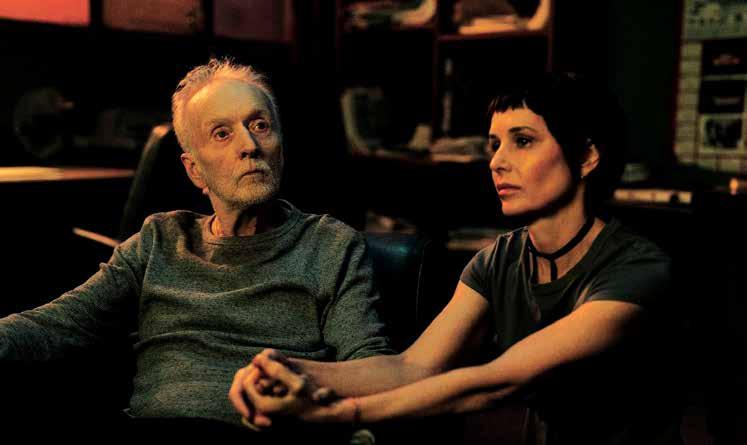
Saw X is the best film in the series since the original hit screens back in October of 2004 and birthed the term “torture porn.” This is the first entry in the franchise that I can say I enjoyed without reservation since that one. This prequel/sequel hybrid is a surprisingly ambitious chapter in the ongoing story of John Kramer and his acolytes, with returning director Kevin Greutert (Saw VI and Saw 3D) and writers Josh Stolberg and Pete Goldfinger — who dropped the ball with Jigsaw and Spiral — all deserving kudos for what they’ve accomplished.
The filmmakers have returned the series to its roots. Taking place between the events of the first film and Saw II, the narrative is far more self-contained and isn’t concerned with trying to be bigger or more outlandish than the pictures that preceded it. Most importantly, this is the first time John Kramer — once again deliciously portrayed by Tobin Bell, who’s never been better — has had a character arc that makes sense. This gives an added insight into the whys behind his repugnant machinations no other Saw has ever explored in such subtly candid detail, and I’d be lying if I said I saw that coming.
For the uninitiated, this former architect and inventor also goes by the bloodcurdling nickname “Jigsaw.” After the death of his wife, he decided to play a series of lethal games with those he felt needed to have their misdeeds judged. Live or die — that was entirely up to them, just as long as they were willing to compete in the time allotted and didn’t mind ending up in the hospital with broken bones, severed limbs, or gruesome puncture wounds if they were lucky enough to win.
But Kramer is dying from a rare form of brain cancer, and Saw X picks things up as he realizes he’s exhausted his treatment options. Yet salvation potentially comes in the visage of Dr. Cecilia Pederson (Synnøve Macody Lund). She claims that a radical new therapy combining an unapproved drug cocktail and experimental surgery could save his life. Not knowing Kramer’s alter ego, she and her crack surgical staff offer to help him. After all, $250,000 is nothing if it means another three or four decades of life.
It goes without saying, but trying to con John Kramer is a very, very, very bad idea. Dr. Pederson and the rest of her team are about to experience a nightmare like no other, as each person who had a hand in giving Kramer false hope is soon going to be stuck in one of his infamous traps, fighting for their lives. Limbs will be severed. Brains will be carved into with a sharpened scalpel. Blood — oceans and oceans of blood — will flow.
While we’ve seen much of that before in the previous installments, never has the focus shifted entirely to Kramer and, even better, his blossoming relationship with his star pupil: Amanda Young (Shawnee Smith). When she arrives to assist her mentor in his task to teach these grifters their live-or-die lessons, that’s when the film soars to life. There is a fascinating depth to their bond that the series has never taken the time to explore. Kramer and Young become actual human beings with authentic dimensionality, and while what they’re doing remains inexcusably abhorrent, it’s still impossible not to root for their success. The other thing that Greutert, Stolberg,
and Goldfinger do — and this is key — is that they treat the audience with respect and do not trivialize their collective intelligence. The filmmakers know that everyone is in on the joke. They understand that, for all the misdirects, for every clever red herring, few people sitting in the theater won’t know exactly what is going on and where everything will end up.
Because of this, Greutert and company actually let us be a part of the action. It is as if the viewer is another of Kramer’s pupils, and they leave it up to us to decide if we want to put our morals aside and follow his lead, or instead walk away and hold him as accountable for his actions as he does those he places in one of his traps. This ups the ante in unforeseen ways, and that’s kind of great.
This is still a Saw effort, of course, which means those traps are incredibly nasty, and there are certainly moments where this entry pushes the envelope of its R rating right to its breaking point. But unlike so many of the other films in this franchise, the bloodletting isn’t particularly noxious. Sensationalistic, yes, but never in a way that doesn’t suit what is happening. It honestly feels rather
warranted most of the time, and as much as I squirmed in my seat, I never felt like the gore and viscera were excessive.
It should be noted that both Bell and Smith are significantly older than they were at the end of Saw III, and the filmmakers don’t utilize any digital de-aging trickery to hide that. Some will consider this to be a problem. I did not, as both performances are so good, so suitably in sync with one another, that after about five minutes, I pretty much stopped noticing entirely. Look, Saw X isn’t reinventing the horror wheel. I would think that those interested in the film would know what they are getting into before they purchase a ticket. But while there are no mind-blowing revelations, there’s still plenty of fun to be had by all — assuming you’re into this sort of thing. Which I am. I don’t remember the last time I felt any Saw sequel lived up to its potential (have any of them?), but this one does so with shocking ease. Kramer’s return may be bad news to his victims, but for the rest of us? Playing his new game is a heck of a lot more fun than it has any right to be.
Saw X – Photos courtesy of Lionsgate
V/H/S85 a blast of gore, laughs, fright, and mayhem
by Sara Michelle Fetters SGN Staff Writer
V/H/S85
Shudder
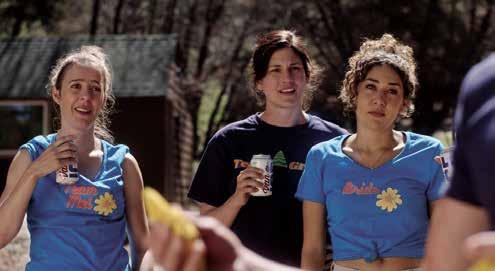
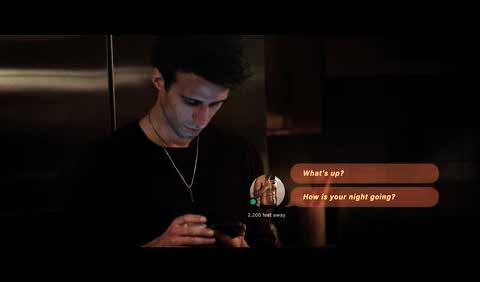
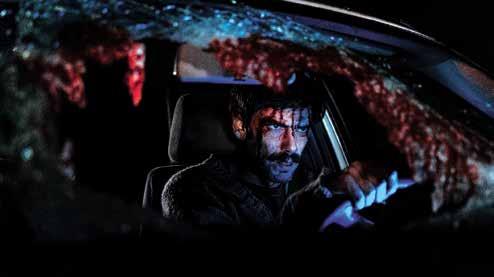
A shape-shifting child vexes a group of scientists, one of whom minimizes the potential danger. Seven friends retreat for a weekend of camping and disregard signs to stay out of the water. A performance artist attempts to communicate with the new “digital gods” of virtual reality in front of a small (if fascinated) audience. The crew of a popular daily newscast find their building crumbling around them when a massive earthquake hits Mexico City. A close-knit family reunites to celebrate the coming-of-age of one of their own when the teenager completes a traditional test of cunning, planning, and marksmanship — and shoots a home movie of herself doing it.
This sixth chapter in the found-footage horror anthology series, V/H/S85 may be the most consistently entertaining entry yet. I’d still rank V/H/S2 and V/H/S94 ahead of it, but that’s because a couple of their stories are so colossally awesome that the lesser ones hardly matter. But this time out? There’s not a dog in the bunch. The sextet of creepy, lo-fi tales of carnage, wonderment, and woe is a heck of a lot of gross-out fun.
There is no “wraparound” story this time out. Instead, what we have here is a “mixtape” of tales, only two of which are connected. What is likely the foundational item on the tape is director David Bruckner (Hellraiser, The Night House) and writer Evan Dickson’s “Total Copy,” a made-for-TV documentary chronicling a disastrous tragedy involving a group of scientists who make a remarkable discovery. Flashes of this short are sprinkled throughout the film, with the other five entries
recorded on top of it, meaning only extended residual outtakes are left.
But then there are the two interconnected efforts of writer-director Mike P. Nelson (Wrong Turn, The Domestics): the campingweekend-gone-horrifically-wrong slasher “No Wake” and the repellently funny, happy-family-of-cult-sadists curio “Ambrosia.” While they’re taped over the top of Bruckner’s piece, V/H/S85 basically begins and ends with them, so in many ways they also could be considered the foundation this sequel is built upon.
The other three pieces are “God of Death” by Gigi Saul Guerrero (Satanic Hispanics), “TKNOGD” by Natasha Kermani (Lucky), and the surrealistic, time-bending bit of dismembering insanity that is “Dreamkill,”
director Scott Derrickson’s latest collaboration with co-writer C. Robert Cargill (Sinister, The Black Phone). While none of these are incredible, each is still quite good, all offering up several surprising twists and turns before violently exploding during their blood-splattering climaxes.
Guerrero’s piece reminded me a bit of Gareth Huw Evans and Timo Tjahjanto’s electrifying “Safe Haven” from V/H/S2 The filmmaker starts her story with a terrifying real-life event: the 1985 Mexico City earthquake. A television news broadcast is interrupted by the tragedy, and several first responders, one of the show’s producers, and a determined cameraman struggle to survive as their building disintegrates around them.
But it’s what they find in the long-lost
catacombs beneath the rubble where the true terror lies. An ancient demonic secret that’s been waiting to be resurrected since the fall of Tenochtitlan is ready to rip the heart out of anyone unlucky enough to find themselves at its sacrificial doors, and that’s exactly where this group ends up. It’s a fight for survival that goes far beyond a natural disaster, and Guerrero ratchets up the intensity to an almost unendurable level.
Derrickson and Cargill aren’t firing on all cylinders with “Dreamkill,” but it’s still clear they’re letting out an exuberant scream with their nasty bit of analog precognition. This one is also a family affair, with Derrickson’s sons Dashiell and Atticus playing pivotal roles in the production. The former is one of the film’s co-leads, playing a goth teenager with fantastical psychic abilities that are giving him literal nightmares; the latter composed the segment’s memorable score, giving events a Fulci-meets-Carpenter vibe that’s wonderful.
Still, it’s Nelson’s sections I enjoyed the most. While I knew “No Wake” had to resolve itself somehow, I was impressed with how the director weaved it into the fibers of “Ambrosia” so seamlessly. Both play just fine apart as standalone efforts, but together they’re borderline magical, the goofy creative simplicity of how they’re intertwined nothing short of marvelous.
V/H/S85 is an absolute blast of gore, laughs, fright, and mayhem. I have no idea if producers Brad Miska, Josh Goldbloom, and Radio Silence (filmmakers Matt Bettinelli-Olpin, Tyler Gillett, and Chad Villella) intend on keeping the V/H/S series going, but as long as they keep attracting a diverse group of talented filmmakers to strut their horror stuff with such gleefully imaginative abandon, I almost hope it goes on forever.
Repugnantly extraordinary Argentinian horror masterwork When Evil Lurks
by Sara Michelle Fetters SGN Staff Writer
WHEN EVIL LURKS
Theaters / Shudder (Oct. 27)
After making something of a cult name for himself with 2017’s Terrified, Argentinian filmmaker Demián Rugna returns with When Evil Lurks, easily his most ambitious and polished effort to date. It’s one of the most viciously cruel and deeply unsettling motion pictures I’ve seen in all of 2023. It chilled me right to the bone in the first 20 minutes and then continued to dig deeper and deeper into the marrow from there.
It’s difficult to shake up the possession subgenre in a post-The Exorcist world (which makes it ironic that Rugna’s film is opening in limited release the same weekend The Exorcist: Believer goes wide), and I won’t say that the talented writer-director makes much of an attempt to do so. Instead, he just leaves out most of the backstory entirely. Rugna presents his characters, establishes the dire nature of their situation, lets them make a handful of truly idiotic mistakes, and then asks us to wait patiently to see if they and their remaining loved ones will survive.
Somehow this works. Part of it is because actors Ezequiel Rodríguez and Demián Salomón, portraying brothers Pedro and Jimi Yazurlo, are so gosh darn compelling. Another aspect is that this isolated, smalltown world Rugna has crafted feels instantly authentic. Finally, it’s the care the filmmaker takes to present this crazy, intentionally uncontrollable scenario. Rugna treats his audience with respect, giving them the freedom to put many of the puzzle pieces together for themselves without too much expository nonsense muddying the water.
The idea is that, just outside of town in rural Argentina, ranch hands Pedro and Jimi discover a mutilated corpse that then leads them to a squatting Indigenous family they’ve allowed to live on the land for some time. The problem? One of them is possessed by a demon, and the dismembered body was the remains of a special type of exorcist who was on their way to “dispose” of the infected individual.
This is only the setup for the carnage to come, however, as Pedro and Jimi are convinced by a third party to help move the diseased corpse off of the ranch so it will become someone else’s problem. But this doesn’t work. As the horrific evil aching to be born sends out psychic impulses — bending animals, children, and even a few adults to its will — the brothers make a futile attempt to run away from the problem before it can kill them, their elderly mother, or Pedro’s children (or his ex-wife, for that matter).
For a while, all of this is slightly reminiscent of Lucio Fulci’s City of the Living Dead, in which society slowly spirals out of control as a supernatural plague descends upon a town, leading to increasingly disquieting acts of violence and bloodletting. But things quickly move into territory that’s similar to Narciso Ibáñez Serrador’s Who Can Kill a Child? or Tom Shankland’s The Children, in that many of the youngsters Pedro and Jimi run across are on the verge of becoming psychotically lost to the growing evil that’s reaching out its hypnotic tendrils to control them.
There’s also a wise and world-weary specialist who gets thrown into the mix (if one needed more similarities to The Exorcist), her affection for Jimi forcing her to take action even when she’d rather not get involved.
Rugna doesn’t shy away from taking things to the extreme. This is a bleak road trip, and even if Pedro and Jimi felt they were
doing the right thing early on, they’re still going to be forced to pay for their actions in the worst ways imaginable. No one is spared. Absolutely no one at all. Children are bitten into pieces. Loving — if terrified — couples hack themselves up with an axe because they feel as if they have to. Husbands run down their own wives when the hands gripping the steering wheel are no longer their own.
The filmmaker has created a harsh world, but also a believable one. It is a place where religion has begun to rot away into insignificance. A land where those who are supposed to be in power (like the police) are knowingly impotent to do anything about what is happening. An environment where ancient beliefs in the supernatural dos and don’ts are an everyday way of life passed down from one generation to the next.
Events do get a little fragmented and frantic during the last act. Pedro and Jimi split up for a large portion of the climax, and only one of them actually has anything to do, while the other ends up nothing more than a wideeyed observer to all the disgusting butchery that’s destroying everything around them. Also, while I do love that Rugna doesn’t try to explain his demonic mythology down to the last detail, some of it is still a little too vague for its own good, and this ultimately diluted my emotional connection to the material, especially right at the end.
But When Evil Lurks got under my skin. I felt dirty after watching it, almost as if my entire body was coated in metaphorical dirt, phlegm, and blood, and the hair of those consumed by this detestable malevolence was unnervingly stuck in my own throat. Rugna has manufactured a one-of-a-kind descent into madness that’s repugnantly extraordinary. I may never watch the film again, but that does not make me any less impressed.
When Evil Lurks – Photo courtesy of IFC Films
V/H/S85 – Photo courtesy of Shudder
Laura Steven explores the power of anger in Soulless Girls
by Lindsey Anderson SGN Staff Writer
Laura Steven fell in love with literature at a young age. “I was always that ‘Matilda’ kid who spent her weekends at the library, checking out the maximum number of books and finishing them all by Tuesday,” she said. Her early love of literature fueled the writing of her thrillers, comedies, and contemporary and fantasy novels — though her latest is something completely new.
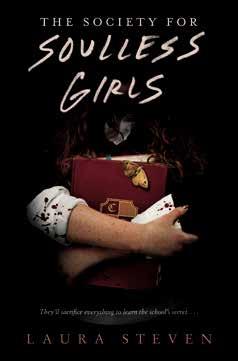
Steven’s The Society for Soulless Girls is a dark Sapphic horror novel with feminist undertones. The book follows Lottie, a college freshman, and her angsty roommate, Alice, as they attempt to solve a mystery on their campus. Spooky twists arise as the pair follows the clues (and their hearts) in this modern adaptation of Jekyll and Hyde
A real-life Jekyll and Hyde
If the characters in the novel feel like they could be real people, it’s because, in a way, they are. Each represents a part of Steven. “The two main characters are my own Jekyll and Hyde,” she said. “Lottie, the sunshiny Elle Woods hockey player, is how I present to the outside world. But Alice is how I often feel inside — angry, alienated, and self-loathing.”
Steven started writing the book in 2020 as the pandemic began. She wanted to explore a dark academic setting and originally pitched the story as “a straight-up murder mystery reimagining of Jekyll and Hyde.” As the world changed around her, she found writing the book a cathartic way to process hard feelings.
“I wrote it during a particularly difficult time in my life — I’d just become a mother in the middle of a pandemic — and channeled those feelings of isolation and bitterness into the work,” Steven said. The book allowed Steven to embrace her inner turmoil and let some of the darkness she had been holding back boil to the surface.
Embracing anger
Steven hopes the book can help other angsty young Queer people. “It’s such a rich, raw emotional minefield. You’ve come of age … but now what? How are you going to show up in the world? What are you going to make of your life?”
The main answer Steven wants readers to find in her novel is that it’s okay for women and Queer people to embrace anger. “You’re not broken for feeling angry — it’s knowing what to do with that anger that makes or breaks us,” she said. “For young women and other marginalized communities, anger is often the most important polit-
“Truthfully, I write the world the way I see and experience it, and as a Bisexual woman, I’ve surrounded myself with a glorious Queer community. It would feel strange to me not to represent that on the page.”
ical tool we have. When we use that righteous fury to organize and drive for change, magic can happen.”
While writing helped Steven learn more about the power of anger, she also warns readers to wield it responsibly. “Anger is not carte blanche to treat others poorly,” she said. “That’s the journey Alice goes on in this book. When is it okay to lash out? And when should we bite our tongue or find other outlets for our rage?”
Anger is common for Queer people like
Alice who face backlash for simply trying to live. While both anger and Queerness are part of the story of The Society for Soulless Girls, Steven doesn’t think the sexuality of her characters changes the plot. “The story could certainly exist without the romance, sure, but would that be any fun at all?” she asked.
Writing Queer books Soulless Girls is the eighth novel Steven has published. She’s noticed readers and
critics tend to treat literature differently when it centers on LGBTQ+ protagonists. “I was never asked why I wrote a straight protagonist,” she said. “Truthfully, I write the world the way I see and experience it, and as a Bisexual woman, I’ve surrounded myself with a glorious Queer community. It would feel strange to me not to represent that on the page.” Writing Queer characters is more fun for her and opens up opportunities for more romantic possibilities.
Steven plans to continue writing LGBTQ+ novels. “My next novel is a supernatural love story spanning one thousand years, which transcends time and fate and gender,” she said. “Two reincarnated souls keep falling in love throughout history, while also having to kill each other before their 18th birthdays for reasons they cannot remember. Of course, as they spawn into different existences, their genders and bodies change constantly, but what doesn’t change is the love in their heart. Writing it was a powerful, life-affirming exploration of Queerness — and what it means to fall in love with a person, not a gender.”
Each new story Steven writes is far different from the last one. With eight published novels under her belt at only 32 years old, she says she isn’t planning on slowing down anytime soon.
As much as I love a good Happily Ever After (HEA, for the romance buffs), I’m a sucker for a soft breakup (an SBU?). The hallmarks are the same: personal growth, care for the other person, dramatic declarations at some transportation hub. Why can’t we have stories that celebrate good relationships rather than long ones? As anyone with boomer parents can tell you, relationship longevity is a terrible indicator of quality.
Odd Girl Out, written by “Queen of the Lesbians” Ann Bannon, is a top-shelf soft breakup. It initially closely parallels Vin Packer’s Lesbian pulp fiction novel Spring Fire: Both follow the relationship of a senior-and-freshman pair of “roommate” sorority sisters. Both feature a lusty brunette and a vestal blonde. Both hit classic 1950s highlights — getting Cokes, drinking and driving, engaging in casual domestic violence, and, inexplicably, hanging out at Walgreens.
Thankfully, though, the relationships here are more emotionally nuanced and hinge less on the “trauma as identity” trope (although they don’t escape it entirely). Beth is stuck in a love triangle, split between emotional fulfillment with her boyfriend Charlie and hot sex with her roommate Laura. Wet-behind-the-ears Laura loves Beth with the devotion bordering on obsession of a baby Queer. Even though Beth knows she’s in love with Charlie and not Laura, she can’t break it off because Laura “would be sad,” so better to string her along, right? In a similarly dick move, Laura tries to control Beth’s movements and manipulate Charlie out of Beth’s life.
While Beth is an asshole, I was sympathetic to her struggle to define her identity in an era when the DSM-I labeled homosexuality a “sociopathic personality disturbance.” She’s only been attracted to two people so far, Charlie and Laura, and she is forced to generalize from her feelings toward them to some permanent sense of how her attraction will always function in terms of their respective genders. She likes Laura’s devotion to her but assumes their relationship will follow this dynamic in the future and never be equal. Charlie is a good match for her, and because he’s the first one, she assumes she’ll only ever be able to have this sort of equal relationship with men.
Ultimately, Beth chooses Charlie and Laura leaves to find Queer community in Greenwich. The heartbreak here is not in the inevitable breakup, but in the divide between two people who can exist in the Queer community and still fail to understand each other. Both assume the other’s feelings and Queer identity are identical to their own. Solidly Gay Laura assumes Beth is too weak to live authentically, and Bisexual Beth assumes Laura is too childish to commit to “real love,” that is, with a man.
There are unfortunate tropes. Bisexuals are seen as open season for the nearest interested party to lay claim to. Both Laura and Charlie manipulate Beth and accuse her of making decisions out of spinelessness and “needing a man.” Queer people’s queerness is also expected to have a “root” in some family trauma (again, this was before psychologist Evelyn Hooker argued that homosexuality was not a mental illness, so the DSM-I was still heavily influential). Beth’s parents are dead and Laura’s parents are (gasp) divorced.
Where this novel differs dramatically from previous Lesbian pulp (and many modern romcoms) is that the two love interests
Happily Ever After vs. Soft Breakup–The hallmarks are the same: personal growth, care for the other person, dramatic declarations at some transportation hub. Why can’t we have stories that celebrate good relationships rather than long ones?
have friends — real friends who, while tragically straight, are very #ally. The Queers’ internalized homophobia is as likely to be called out by straight allies as by other Queers. Emmy, Beth’s best friend, sees Beth and Laura together and is supportive. When Beth thinks that women experimenting with
other women is just that, Emmy calls her out on it. Emmy also calls out Beth’s treatment of Laura, saying it’s not a kindness to be dishonest. Straight man Charlie also shows his progressive chops with one-liners like “Men. Goddamn them all.” He gives Beth genuinely good advice and tells her “not wanting
to hurt Laura” is not a basis for a relationship. He’s so, so close to being an actually decent human but, in the twilight hour, comes out swinging when he tells Beth, “You need a man.”
The final chapter is worth reading for its beautiful, fabulist breakup. If my first Queer relationship had ended like this maybe I wouldn’t have spent the next five years in straight denial. Laura comes into her own in this moment. She claims her identity and firmly tells Beth it’s not a phase. Beth finally listens. They actually, genuinely communicate. Laura says to Beth, “It’s not a question of forgiving. I’m grateful.” Beth tells Laura, “You’re not the only one who’s grateful.” Laura finally understands their relationship and sees her love for Beth not as an excuse to try to control her, but as an occasion for selfunderstanding and growth. Beth tells Laura that she loves her “not as Laura would have wanted her to, but sincerely, honestly, the best love she could offer.” Not an HEA, but an SBU where both sides feel loved and valued? I’ll take it.