Celebrating 41 Years! Issue 40 Volume 42
FRIDAY October 3, 2014 FREE!
25¢ in bookstores & newsstands
Seattle Gay News SEATTLE’S LGBT NEWS & ENTERTAINMENT WEEKLY
Waiting for SCOTUS: Why no news may be good news
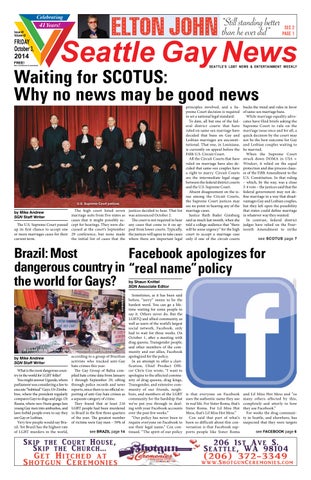
U.S. Supreme Court justices
The high court listed seven marriage suits from five states as cases that it might possibly acThe U.S. Supreme Court passed cept for hearings. They were disup its first chance to accept one cussed at the court’s September or more marriages cases for their 29 conference, but none made current term. the initial list of cases that the by Mike Andrew SGN Staff Writer
justices decided to hear. That list was announced October 2. The court is not required to hear any cases that come to it on appeal from lower courts. Typically, the justices will agree to take cases where there are important legal
principles involved, and a Supreme Court decision is required to set a national legal standard. To date, all but one of the federal district courts that have ruled on same-sex marriage have decided that bans on Gay and Lesbian marriages are unconstitutional. That one, in Louisiana, is currently on appeal before the Fifth U.S. Circuit Court. All the Circuit Courts that have ruled on marriage have also decided that same-sex couples have a right to marry. Circuit Courts are the intermediate legal stage between the federal district courts and the U.S. Supreme Court. Absent disagreement on the issue among the Circuit Courts, the Supreme Court justices may see no point in hearing any of the marriage cases. Justice Ruth Bader Ginsburg said as much last month, when she told a college audience that “there will be some urgency” for the high court to accept a marriage case only if one of the circuit courts
bucks the trend and rules in favor of same-sex marriage bans. While marriage equality advocates have filed briefs asking the Supreme Court to rule on the marriage issue once and for all, a quick decision by the court may not be the best outcome for Gay and Lesbian couples waiting to be married. When the Supreme Court struck down DOMA in USA v. Windsor, it relied on the equal protection and due process clauses of the Fifth Amendment to the U.S. Constitution. In that ruling – which, by the way, was a close 5-4 vote – the justices said that the federal government may not define marriage in a way that disadvantages Gay and Lesbian couples, but they left open the possibility that states could define marriage in whatever way they wanted. In contrast, federal district judges have relied on the Fourteenth Amendment to strike see SCOTUS page 7
by Shaun Knittel SGN Associate Editor
Grupo Dignidade
A protest led by the Gay rights organization Grupo Dignidade
by Mike Andrew SGN Staff Writer What is the most dangerous country in the world for LGBT folks? You might answer Uganda, where parliament was considering a law to execute “habitual” Gays. Or Zimbabwe, where the president regularly compares Gays to dogs and pigs. Or Russia, where neo-Nazis gangs lure young Gay men into ambushes, and laws forbid people even to say they are Gay or Lesbian. Very few people would say Brazil. Yet Brazil has the highest rate of LGBT murders in the world,
according to a group of Brazilian activists who tracked anti-Gay hate crimes this year. The Gay Group of Bahia compiled hate crime data from January 1 through September 29, sifting through police records and news reports, since there is no official reporting of anti-Gay hate crimes as a separate category of crime. They found that at least 216 LGBT people had been murdered in Brazil in the first three quarters of the year. The greatest number of victims were Gay men – 59% of see Brazil page 14
Sometimes, as it has been said before, “sorry” seems to be the hardest word. You can go a lifetime waiting for some people to say it. Others never do. But the LGBTQ and allied community, as well as users of the world’s largest social network, Facebook, only had to wait for three weeks. On October 1, after a meeting with drag queens, Transgender people, and other members of the community and our allies, Facebook apologized for the policy. In an attempt to offer a clarification, Chief Product Officer Chris Cox wrote, “I want to apologize to the affected community of drag queens, drag kings, Transgender, and extensive community of our friends, neighbors, and members of the LGBT community for the hardship that we’ve put you through in dealing with your Facebook accounts over the past few weeks.” “Our policy has never been to require everyone on Facebook to use their legal name,” Cox continued. “The spirit of our policy
is that everyone on Facebook uses the authentic name they use in real life. For Sister Roma, that’s Sister Roma. For Lil Miss Hot Mess, that’s Lil Miss Hot Mess.” Cox said that part of what’s been so difficult about this conversation is that Facebook supports people like Sister Roma
Brazil: Most Facebook apologizes for dangerous country in “real name” policy the world for Gays?
and Lil Miss Hot Mess and “so many others affected by this, completely and utterly in how they use Facebook.” For weeks the drag community in Seattle, and elsewhere, has suspected that they were targets see Facebook page 6
2 Seattle Gay News
October 3, 2014
Celebrating 41 Years!
Visit us online www.sgn.org
October 3, 2014
Seattle Gay News 3
Telling Tales: For LGBT History Month by Jesse Monteagudo SGN Contributing Writer When I came out 40 years ago, I learned much of what it is to be Gay from older Gay men, Hispanic and Anglo, who I met in Miami’s thenflourishing Gay bars. (There were more Gay bars in Miami in 1974 than there are in 2014.) Some of those men told me tales about being Gay in the 1940s, 1950s and 1960s; in the United States, in Cuba, or in other Latin American countries. From them I learned how difficult it was to be Gay back then; how far we have come since then; and how far we still had to go. As the son of heterosexual parents, I did not learn about my community’s history from my parents; nor from my teachers or my straight peers. Thus my education as a Gay man came from Gay sources, from books written by Gay people and from the stories told to me by other Gay men. Forty years later, I still remember the lessons that I learned from those men, especially those who are no longer with us. Now that I am an elder Gay myself I want to continue that tradition and teach younger generations about our past, either in person or through my writing. I find this tradition to be especially relevant in this month of October, otherwise known as Lesbian, Gay, Bisexual and Transgender (LGBT) History Month. LGBT History Month began in 1994 when Rodney Wilson, a high school teacher in Missouri, decided to do something about the lack of Queer voices in history textbooks. He organized other educators and community leaders for the purpose of educating students and the general public about our history; the history that many of us learned from older LGBT people when we first came out. After much discussion, October was named “Lesbian & Gay History Month: A Celebration of Lesbian, Gay, Bisexual and Transgender History.” LGHM, modeled after Black History Month in February and Women’s History Month in March, was designed to “promote the teaching of LesBiGay [and
Trans] history in secondary and post-secondary academic settings, as well as within the LesBiGay [and Trans] community and mainstream society.” October was chosen because it is full of LGBT history: the dates of the first (1979) and the second (1987) Marches on Washington for Lesbian and Gay Rights are in October, as is National Coming Out Day (October 11) and Halloween (October 31). Furthermore, October falls in the middle of the academic calendar, which allows educational institutions to participate, unlike the month of June (LGBT Pride Month). To many people, including the fine folk from Equality Forum, LGBT history is basically a roster of “great LGBT people in history.” This was used by apologists for decades to justify sexual or gender variance: In other words, it is not so bad to be a Gay man if Michelangelo was one. But Michelangelo’s sexual orientation, which is still debated, does not do away with homophobia any more than the fact that Albert Einstein was a Jew did away with antiSemitism or the fact that Louis Armstrong was African-American did away with racism. For every Susan B. Anthony or Bayard Rustin there were thousands of women or men who struggled anonymously against a hostile society and religious, legal and scientific systems that branded them sinners, criminals or mentally ill. The fact that many of them survived such a regimen to create loving households, supportive social groups and flourishing communities says a lot about their survival skills. We are here today because of them. There are many books written about Walt Whitman and Radclyffe Hall. What about the anonymous Lesbians, Gay men, Bisexuals and Transgender people who lived their lives the best they could? Since 1990, our histories have gone beyond great Queers in history to study the lives and times of our more ordinary ancestors. They include books of popular or scholarly history, film or video
documentaries, and programs and exhibits by community institutions like Fort Lauderdale’s Stonewall National Museum and Archives. While we can learn much from books, videos or museum exhibits, they only supplement the knowledge that we learn from personal contact with those who walked ahead of us. Therefore, the next time older LGBT persons want to tell you their story, please listen. Their stories are quaint, funny, tender, touching and sad, and they all have something to teach us. And when the time comes, do not hesitate to tell your own story to those who come after you, so they too can learn. That is what LGBT History Month is all about. SOME HISTORIES. Since I came upon a newly-printed copy of Jonathan Ned Katz’s Gay American History (1976), I have been an avid reader and collector of LGBT histories. The following is a list of histories I have read and enjoyed. I recommend them. 1. Bérubé, Allan; Coming Out Under Fire, Free Press, 1990. 2. Bronski, Michael; A Queer History of the United States, Beacon, 2011. 3. Carter, David; Stonewall, St. Martin’s Press, 2004. 4. Chauncey, George; Gay New York, Basic Books, 1994. 5. Faderman, Lillian; Odd Girls & Twilight Lovers, Columbia, 1991. 6. Faderman, Lillian & Stuart Timmons; Gay L.A., Basic Books, 2006. 7. Grahn, Judy; Another Mother Tongue, Beacon, 1984. 8. Kaiser, Charles; The Gay Metropolis, Houghton Mifflin, 1997. 9. Loughery, John; The Other Side of Silence, Holt, 1998. 10. Sears, James T.; Rebels, Rubyfruit and Rhinestones, Rutgers, 2001. 11. White, C. Todd; Pre-Gay L.A., University of Illinois Press, 2009.
IN MEMORIAM – JAMES C. FARR 4 Seattle Gay News
James C. Farr, a long-time Seattle resident (since the 1940s) and a member of Seattle’s LGBT community, passed away on September 5. A memorial gathering for his family and friends will be held on Saturday, October 4, from 1pm-6pm, at 1017 20th Ave. S.
October 3, 2014
Celebrating 41 Years!
SGN EXCLUSIVE INTERVIEW: Damon Shadid candidate for Seattle Municipal Court Position 7 When Damon Shadid explains why he wants to be a Municipal Court Judge, his thoughts turn to his Lebanese grandmother. “She entered the United States without documents,” Shadid explains, “and made her way to Oklahoma City,” where Shadid was born. She selected Oklahoma City, he adds, because other immigrants from her village in Lebanon had settled there. “But what if she got into trouble?” he asks. “Who would see that she got help?” “Ninety-nine percent of all court cases go to Municipal Court,” Shadid continues. “It’s most people’s only experience of court. Maybe their only experience of government. It’s essential that people know why the court is there and how it can help them.” Shadid is an immigration and criminal defense attorney, with 15 years experience in private practice. Prior to that, he was a public defender with up to 650 clients a year. It was an experience that taught him “how to deal with difficult people at a stressful time in their lives,” a skill he thinks he can apply to a job as a judge. Asked what other qualities would make a good judge, Shadid answers quickly, “Three things – you have to be engaged with the community you’re elected to serve; you have to be collaborative, you have to be more than just a courtroom judge, because you have to work with your colleagues on court administration; and hard work. That’s the most important piece. “A good judge spends time outside the courtroom,” Shadid adds. Shadid, for example, is heavily engaged in the Race and Social Justice Roundtable, and worked as a volunteer on
the R-74 campaign for marriage equality. “I’ve been very much involved in LGBTQ issues,” he says, “and as a judge I want to provide leadership in this area. “For Transgender individuals, there’s been progress, but the jail system is still a major problem. So I think a judge could explore alternatives to confinement. You can be culturally sensitive while still following the law. “Also, the court has Transgender employees, and part of a judge’s role is to administer court employees. “On domestic violence issues,” Shadid continues, “yes, it’s true that LGBTQ individuals – and immigrants, too – may be afraid to call the police. That’s another reason for judges to be engaged with the community, because the courts are part of the criminal justice system. People need to know the system can help them.” The U.S. Justice Department found that the Seattle Police Department (SPD) has engaged in a pattern of excessive and unconstitutional use of force. Asked if that might influence his outlook toward defendants who appear before him, Shadid declined to comment on SPD, but added, “I’ve met Chief O’Toole, and I have faith she’s addressing a lot of the problems and moving Seattle toward a community policing model. “As a Municipal Court Judge, it would be my duty to follow the law. However, if problems are identified, I would work with the communities involved to formulate solutions. “You know, I came from Oklahoma. In Oklahoma, it’s all about individualism. In Seattle, it’s all about community. I hope we never lose that willingness to put ourselves in other people’s shoes and try to understand each other.” Shadid’s own family symbolizes the diversity he values in Seattle. He is married to
Ellen M Banner / The Seattle Times
by Mike Andrew SGN Staff Writer
Damon Shadid
Dr. Dini Pineda, of Dominican and Puerto Rican descent. They have one son “and another child on the way,” Shadid smiles. “My son is half Latino and half Arab, and we’re raising him bilingual in English and Spanish,” he adds. “We live in the 98118 Zip Code – the most diverse in the city.” This is Shadid’s first run for an elected office and he relishes the experience. “I love it!” he tells SGN. “I’ve never felt so connected to Seattle’s communities as I do now. It invigorates me! “The biggest thing that’s impressed me is how much people want to know about the court, the level of engagement and curiosity. “I tell people I’m running for Municipal Court, and they ask ‘What is that? What can a judge do to affect change?’ They’re very receptive to the idea that judges should be engaged in the community.”
That idea is at the core of Shadid’s judicial philosophy. “Every individual is important,” Shadid elaborates. “Everyone has a story to tell. “As an immigration attorney I represent clients who very often do not know how the legal system works. I’m always surprised how brave some of them can be, especially the refugees, the asylum-seekers.” Shadid had been endorsed by a number of prominent LGBT individuals including Sally Clark, Kris Hermanns, Joe McDermott, Dave Upthegrove, and Brady Walkinshaw. His campaign chairs include El Centro de la Raza Director Estela Ortega, Northwest Immigrant Rights Project Director Jorge Baron, NAACP President Gerald Hankerson, Rita Zawaideh of the Arab American Community Coalition, and Amy Muth of the Washington Association of Criminal Defense Lawyers.
Social Outreach Seattle 2nd Annual Gala by Shaun Knittel SGN Associate Editor On Wednesday, October 2, Social Outreach Seattle (SOSea), held our Second Annual Gala & Community Awards event at Central Cinema. I can’t tell you how much the outpouring of support from everyone that was in attendance means to us. While the evening does have a fundraising component, the real meaning of the event is to recognize some of the people in the LGBTQ and Allied community that are doing a great job by providing services and support to others. In addition, we took the opportunity to showcase our projects and programs that we will complete in the coming months. Roughly 120 people attended the event, which lasted a little over two hours. The gala was hosted by the amazing Isaac Scott with performances by a dance group under the direction of Grant Cabebe that included Bianca Kapeliela, Alyssa Oyadamari, Makia Williams, and Cameron Boyd, vocal performances by SOSea founding member Chase Silva, Kitty Kitty Bang Bang, SOSea founding member Jack Mozie, and a newcomer to SOSea and front man for the band Eric Blu & The Soul Revue, Eric Martin. In addition, SOSea awarded the following volunteers and community members: Elected Official of the Year, Seattle Mayor Ed Murray; Excellence in Leadership, Allena Gabosch (Center for Sex Positive Culture); Social Justice in Media, David Ham (KIRO 7) and Alison Morrow (KING 5); Grassroots Activism/Service, Krystal Boyd and John Drop (WA Hero Initiative); Community Partner of the Year, Ryan Muller (AMDEF); Community Organization of the Year, Official Pride ASIA; Entertainer of the Year, Kitty Kitty Bang Bang and Rayo de Sol Aguirre Joel (La Gorda) (Entre
Hermanos); Race and Social Justice Award, Isis Asare (Sistah Sinema); Outstanding Volunteer Awards went to Christine Heib, Brooke Walker and Michael Garcia. SOSea also awarded SPD Captain Dick Reed with an award for his many years of service to the LGBTQ community and for running the LGBTQ Advisory Committee meetings for SPD.
From the Heart Each year we know that there are families and individuals that go without during the holiday season. This year, SOSea joins others in helping to donate food, toys, household goods and other items to families and people in need in Seattle. Please go to the official FROM THE HEART Facebook page for updates on when and where or how you can donate to the program: https://www.facebook. com/events/266097920181048/. Rainbow Street Sign Project We have launched the Capitol Hill Rainbow Street Sign Project to promote visibility of the robust LGBTQ community on Capitol Hill. The community’s services, bars, community organizations and more are located on the Hill; Capitol Hill is the cultural center for Seattle’s LGBTQ and Allied communities. The street signs we would like to have changed to rainbow colored are on Broadway, from Madison to Roy, E. Pike from Plymouth Pillars Park to 15th Ave. and E. Pine St. from Melrose Ave. to 15th Ave. Social Outreach Seattle seeks to designate Capitol Hill as the Cultural Center for Seattle’s LGBTQ Community. SOSea is working with the City of Seattle Department that handles designations. It is important that the City of Seattle do this because the LGBTQ community in Seattle is large and yet our visibility
Visit us online www.sgn.org
is not; even in our own neighborhood. Social Outreach Seattle (SOSea) began to develop this program after we heard about the Street Name Sign Replacement Program. The City of Seattle is replacing aging Street Name signs across the city through the voterapproved Bridging the Gap Levy. Throughout the nine-year levy Seattle will replace around 1,700 signs each year. Signs are being updated to a larger and more reflective style to meet the federal standard. The City replaced signs at arterial intersections first, and then moved to the non-arterial intersections. All Street Name signs in the city will be replaced by 2015. We are working to identify the signs that have been replaced for the streets and avenues that would be changed for the Capitol Hill Rainbow Street Sign Project. If they have not yet been replaced, then we will need to identify the cost to have a street sign with rainbow decals put in place. If the signs have been replaced, we would need to know the cost for replacing them again with the rainbow decal signs. Or we can just add the rainbow decal to already existing new signs. Once this project really gets going, we will hold a vote of the public, where people can choose between three designs for the one they’d like to see used. The one that gets the top vote will be the design that is installed.
The location is ideal because Cal Anderson, Washington State’s first elected openly Gay official, passed away from complications due to AIDS. The cost of the Cal Anderson Rainbow Pride Flag and HIV/AIDS Memorial is around $10,000. The Flagpole is ultimately a separate project from the HIV/AIDS Memorial. Initially, a plaque in honor of those who’ve lost their lives to HIV/AIDS will be mounted to the flagpole temporarily. The first priority would be to get the flagpole mounted, the solar light fixture attached and then, finally the flag. The plaque is ordered separately. Social Outreach Seattle would look to City of Seattle Neighborhoods or Parks grants to help offset the cost of the project. In addition, whatever balance is left, would be raised through private and corporate donations. Social Outreach Seattle has reached out to work with a local artist, who is a renowned artist that immigrated to Seattle from Guatemala to come up with the design for the monument. The design is a beautiful tribute that consists of the HIV/AIDS ribbon, with the two ribbon ends starting out as benches. SOSea set a $10,000 goal for the weekend. If you would like to contribute to the work that SOSea does, such as the Rainbow Street Sign Project or the LGBTQ Rainbow Flag and HIV/AIDS Memorial for Cal Anderson park, go to www.SocialOutreachSeattle.com and click on the DONATE tab and follow the prompts. If you or your business, club or organization would like to become involved with these projects please email SOSea at SocialOutreachSeattle@gmail.com.
Cal Anderson Rainbow Pride Flag and HIV/AIDS Memorial We are also working on the Cal Anderson Rainbow Pride Flag and HIV/AIDS Memorial to promote visibility of the LGBTQ Community, foster the feeling of Pride throughout the year, and act as the base for an HIV/AIDS Memorial to remember all those lost to the epidemic and to stand in solidarity with those Shaun Knittel is founder and president of who are infected and looking for a cure. Social Outreach Seattle
October 3, 2014
Seattle Gay News 5
The 2014 Miss U.T.O.P.I.A. Pageant “Under the Sea” will be held on Saturday, October 4 by Shaun Knittel SGN Associate Editor The United Territories of Pacific Islanders Alliance (U.T.O.P.I.A.) Seattle will present the 5th annual Miss U.T.O.P.I.A. Seattle beauty pageant on Saturday, October 4. The Miss U.T.O.P.I.A. pageant is one of Seattle’s most anticipated pageants of the year. “The 5th Annual Miss U.T.O.P.I.A. Seattle beauty pageant returns for a night of lovely ladies all vying for the coveted crown and title of Miss U.T.O.P.I.A. Seattle 2014-15,” pageant officials said to supporters in an invite to buy tickets. “Join some of the most talented artists along with the current Miss U.T.O.P.I.A. Seattle, Atasha Manila, as she presents this year’s theme ‘Under the Sea’.” Atasha Manila has been one of the most visible titleholders throughout the pageant’s history. Also a member of Official Pride ASIA, Atasha could be seen almost weekly at R Place (619 E. Pine St.) or Neighbours Nightclub (1509 Broadway) and even headlining her own show at Inay’s Asian Pacific Cuisine (2503 Beacon Ave. S.). Atasha Manila’s philanthropy is something to praise as she has helped raise thousands of dollars for
the LGBTQ and allied communities and often times would attend events wearing her Miss U.T.O.P.I.A. crown and sash. According to officials, the pageant will feature contestants competing in extravagant Island Fantasy Swim Wear, an exciting Talent Showcase, glamorous Evening Gowns, and Island Goddess Couture Wear. The pageant will also include “show-stopping performances from TIFA I MOANA from Oakland, California and Miss Flowers Association from American Samoa. This is a show not to be missed!” The pageant doors open at 6 p.m. and the show starts at 8 p.m. It is open seating on a first-come, first-serve basis and there is no food allowed inside the theater at any time. Tickets purchased online are $20 and tickets purchased at the box office at Highline Performing Arts Center (401 South 152nd Street, Burien, WA 98148) are $25. Advance tickets are available at http://www. brownpapertickets.com/event/840736. In the past, the pageants have sold out, so advance tickets are recommended. This event is for ages 18 and older. “Join your hosts for the night, Ms. Donato Fatuesi and Mr. Simon George as they sail you off to feel the magic of the Pacific Ocean.”
Chris Cox
of hate from someone reporting their profiles, specifically, as users that were not operating their pages as a real person. In other words, in order to have a “profile” on Facebook, you are supposed to be a “real” person. The issue is, for many stage people, their stage name is very much a real person. And for the people who would like to stay in contact with people they love or friends or coworkers, but not be found by stalkers, bullies and the like, their chosen names are also their online identity as a real person. However, as it turns out, the drag queens were right all along. They had been targeted.
Cox noted that the issue around the site’s “real name” policy arose after a single user reported hundreds of accounts as fraudulent. He says the company didn’t notice that the accounts being reported as fake overwhelmingly belonged to drag queens and other LGBT people. Instead, they thought the profiles were created by users who were attempting to harass, impersonate, bully, or spam other users – which are legitimate grounds for an account’s suspension. “In the two weeks since the real-name policy issues surfaced, we’ve had the chance to hear from many of you in these communities and understand the policy more clearly as you experience it,” continued Cox. “We’ve also come to under-
6 Seattle Gay News
October 3, 2014
continued from cover
stand how painful this has been. We owe you a better service and a better experience using Facebook, and we’re going to fix the way this policy gets handled so everyone affected here can go back to using Facebook as you were.” This is a great victory for a majority of our community that is celebrated in bars and nightclubs or applauded onstage, but often asked to not be so visible during legislative debates or at political rallies – even though both politics and legislation impact their lives, too. The key to this victory was action. Instead of just carp about it online, the queens mobilized, set up meeting, and created a petition on Change.org to get the policy changed. On Wednesday, the change they had asked for
will take place, according to Cox. That policy originally stated that “the name you use should be your real name as it would be listed on your credit card, driver’s license or student ID.” In addition, it prohibited “words, phrases or nicknames in place of a middle name” as well as “offensive or suggestive words of any kind.” It does, however, remain unclear exactly how Facebook’s naming policy has changed. Still, Cox’s statement makes it clear the company intends to enforce it differently, acknowledging that “there’s lots of room for improvement in the reporting and enforcement mechanisms, tools for understanding who’s real and who’s not, and the customer service for anyone who’s affected. These have not worked flawlessly and we need to fix that.” “With this input, we’re already underway building better tools for authenticating the Sister Romas of the world while not opening up Facebook to bad actors” concluded Cox. “And we’re taking measures to provide much more deliberate customer service to those accounts that get flagged so that we can manage these in a less abrupt and more thoughtful way. To everyone affected by this, thank you for working through this with us and helping us to improve the safety and authenticity of the Facebook experience for everyone.” It is important to note that public pressure from all communities – not just LGBT people – helped to secure this win. Last week it was widely reported that a new social networking site, Ello (https://ello.co/beta-public-profiles), the invite-only non-Facebook site, had started to see a huge influx of LGBT people that were abandoning Facebook over the issues of privacy, identity, and more. It would be safe to assume that Facebook was motivated to change its policy as it watched hundreds of thousands of users leave its network. Now the question is – will they return?
Celebrating 41 Years!
Jim McDermott signs on to letter demanding protection for LGBT immigrants by Mike Andrew SGN Staff Writer Seattle area Congressman Jim McDermott has signed on to a letter to President Obama urging him to include protections for LGBT immigrants in future executive orders on immigration reform. Obama had promised to issue executive orders on immigration by the end of this summer, but later said he would postpone action until after the November elections. McDermott joined forty-three other members of Congress in signing the letter, including veteran members John Conyers (D-MI), Alcee Hastings (D-FL), Barbara Lee (D-CA), Charlie Rangel (D-NY), and Jerrold Nadler (D-NY). The effort was organized by U.S. Reps.
Jared Polis (D-CO), David Cicilline (D-RI) – both openly Gay – Raul Grijalva (D-AZ), and Zoe Lofgren (D-CA). “We cannot truly fix our broken immigration system if Congress will not send a comprehensive reform bill to your desk,” the Representatives wrote, in a slap at the Congressional Republicans who have blocked immigration reform proposals. “By exercising your power to implement administrative policies that take into account the uniquely dangerous and difficult circumstances facing LGBT immigrants, you have the ability to protect thousands of individuals immediately,” the letter went on. “[I]t is imperative that you use the tools at your disposal to ensure that families stay together, that immigrants are not put in harm’s way, and that LGBT people are
not subjected, at the hands of the American government, to the dangers from which they have fled.” According to the Congress members, there are 267,000 LGBT immigrants now in the U.S., “many of whom came to this country to escape threats and extreme violence.” LGBT immigrants may be separated from their partners and may also face violence in detention, they added. The Representatives also noted that existing polices make “at-risk LGBT immigrants much less likely to qualify for protection.” They asked the President to defer action on deportations for LGBT immigrants in the same way that he did for the so-called DREAMers, undocumented immigrants who came to the U.S. as children and grew up in this country.
Jim McDermott
Gender Identity and Sexual Orientation Discrimination in the Workplace: A Practical Guide gets published www.bna.com
Christine Duffy
SCOTUS
continued from cover
The National Lesbian, Gay, Bisexual and Transgender (LGBT) Bar Association announced Thursday that a groundbreaking new book by Christine Duffy, a senior staff attorney with the Pro Bono Partnership, will be published in the next two weeks by Bloomberg BNA. “Employment law is the next frontier for the LGBT equality movement,” said D’Arcy Kemnitz, executive director of the LGBT Bar. “It should be illegal to fire LGBT individuals based on their sexual orientation or gender identity. This comprehensive book will be an invaluable resource for practitioners across the country as we continue to fight for full equality for our community. We would like to congratulate Christine as the “swing vote” on the court, is known to favor a states-rights approach to federal power, and therefore he might well vote to uphold the ability of states to define marriage however they want. After all, he said as much in his Windsor opinion. That means that if the high court does set a national legal standard on marriage, it might not be a standard that favors the rights of Gay and Lesbian couples in states where legislators or voters have opposed same-sex marriage. One other consideration may be in the mix as well. The overwhelming majority of federal judges who have ruled on marriage have said that bans on same-sex marriage are unconstitutional. For the Supreme Court to step in and overrule them would lead to huge demoralization on the federal bench. At the same time, it could lead to a public outcry against the court because a majority of Americans now support marriage equality. Chief Justice Roberts is known to take the politics of court decisions very seriously, and to try to craft decisions on controversial cases in a way that mitigates damage to the judiciary’s reputation. He
Visit us online www.sgn.org
and Bloomberg BNA on a job well done.” Gender Identity and Sexual Orientation Discrimination in the Workplace: A Practical Guide is the first book to comprehensively address workplace law and human resource practice relating to gender identity, sexual orientation and gender expression. The treatise provides a detailed survey of state and federal employment laws for LGBT employees and discusses a variety of best practices for human resources professionals and analyzes milestone cases that will impact employment law for years to come. The LGBT Bar has been advocating for LGBT individuals and bringing together the brightest minds in the legal community since its inception. Given LGBT Bar members’ vast knowledge, the organization was proud to assist Christine in compiling practitioners who contributed
their expertise to the book. With over 30 affiliate organizations and members across the country, the LGBT Bar was able to pull together employment law attorneys from traditionally underrepresented states to ensure that a variety of perspectives were shared. As LGBT employment law continues to evolve, it is vital that attorneys and human resource professionals understand the complexities inherent in issues such as defense litigation tactics, solutions to implementing new policies and the intersection of gender and sexual orientation with culture and the workplace. Gender Identity and Sexual Orientation Discrimination in the Workplace: A Practical Guide is available for preorder online. All proceeds will be donated to Gay & Lesbian Advocates & Defenders.
found a way to uphold the Affordable Care Act, for example, while still rejecting the Obama administration’s legal arguments in favor of it. Under the circumstances, Roberts may be in no great rush to take a marriage case
that could fracture the federal courts and risk casting the Supreme Court as a bunch of bigots in the eyes of the public. The court’s next conference is on October 10, after which they will announce a further list of cases that they will hear this term. www.britannica.com
down state bans on same-sex marriage, and to date they have been upheld by the Circuit Courts. The problem, then, is how the Supreme Court will apply the Fourteenth Amendment. Liberal legal scholars usually maintain that the Fourteenth Amendment “federalizes” the Bill of Rights. In other words, it says that the states may not restrict rights that the federal government may not restrict. In the case of marriage, their argument would go, if the federal government may not define marriage in a way that disadvantages Gay and Lesbian couples, then neither may the states. On the other hand, the Supreme Court’s conservative justices are known to take a much more restrictive view of the Fourteenth Amendment, and they are not likely to apply it to a marriage case. They may say that the rights of state legislators or of voters to define marriage trump the rights of samesex couples to marry. Justice Kennedy, who wrote the pro-Gay decision in Windsor and is usually described
by Shaun Knittel SGN Associate Editor
The Supreme Court of the United States
October 3, 2014
Seattle Gay News 7
Revisiting Annual Reminders, nearly 50 years later An interview with John James
On July 4, 1965, John James traveled to Philadelphia to march among a group of Gay and Lesbian demonstrators calling for liberty for LGBT people. Nearly 50 years later, James is again surrounded by LGBT people in the City of Brotherly Love – this time in a very changed world. Earlier this year, James, 73, moved into the John C. Anderson Apartments, an LGBT-friendly senior-living facility in the heart of Philadelphia – more specifically in the “Gayborhood” section. The building, just one of a few affordable LGBT seniorliving complexes, is the largest publicly funded LGBT building project in the nation’s history. The complex is home to a vast cross-section of the LGBT elder community – businesspeople, artists, activists, researchers, social workers and everyone in between – who lived through, and at times led, the birth and growth of the modern LGBT-rights movement. That movement is largely thought to have begun at the Stonewall Inn in New York City in 1969. But, four years earlier, a different sort of protest calling for LGBT freedom germinated on the steps of Philadelphia’s Independence Hall – fittingly, the birthplace of American freedom. The 1965 Annual Reminder march was conceived of by Craig Rodwell and organized by such pioneering activists as Frank Kameny, based in D.C., as well as the Phillybased Barbara Gittings and Kay Lahusen. The demonstration was set for Independence Day to call attention to the notion that Gays and Lesbians were being deprived the basic rights guaranteed to them in our nation’s founding documents. At the time of the march, James was a 24-year-old working as a computer programmer at the National Institutes for Health. He had moved back to D.C., where he grew up, in 1963, after earning his undergraduate degree from Harvard University.
courtesy of Philadelphia Gay News
by Jen Colletta Philadelphia Gay News Special to the SGN
John James
als. His father told him he’d kill him if the FBI found out about [his being Gay], so we always used the name Warren,” James said. “So he and Kameny and some others came up with the idea for the demonstration.” As plans began circulating for the Independence Hall picket, James said he decided to join up despite not being a strong backer of demonstrations. “It was kind of the thing to do; I went along and did it because that was the thing to do right then,” James said, noting it was the first public demonstration in which he participated. And, since the demonstration was in a different city, fears over being outed were lessened. At the time, James was only out to a small circle of family and friends. Demonstration participants were asked to consent to having their photo taken, and he declined. “It was more of a commitment for the local people, because they could be recognized, whereas those of us from Washington wouldn’t. But we were asked by photographers working with the demonstration if we wanted to be photographed, and I said no because I liked my job.”
James’ father was a federal anti-trust attorney and James followed in his footsteps in seeking federal employment after abandoning his plan to pursue medicine. “I was always interested in science and went to college intending to do pre-med, but I decided it wasn’t for me,” he said. “I had a summer job at Sloan Kettering and just wasn’t impressed with what I saw there, At the time, the federal government largely with all the bureaucracy. So I figured I operated under a policy of terminating “known needed to make a living and got into com- homosexuals.” puters; in those early days, there was no “They would fire anyone who was known to possibility of home computers, but over the be Gay. I didn’t want to lose my job,” James said. years things changed totally.” The federal policy also prevented James, who worked at NIH until 1967, from pursuJames said he began coming to terms with ing other federal positions – which he said his sexuality in his early 20s and, upon re- ended up being fortunate. turning to D.C., joined the fledgling Matta“I never considered applying for a security chine Society, a “homophile” group whose clearance because they would’ve found out, Washington chapter was the brainchild of and that would have complicated things. Kameny and Jack Nichols. But, I didn’t want to do military work anyAt group meetings, James said he was way,” he laughed, “so not having a security more of an observer, while Kameny and clearance was one way to make sure I stayed Nichols ran the show. away from that.” “Jack went on to be a well-known Gay writer but, at the time, he used a pseudonym, In advance of the demonstration, organizWarren. His father was an FBI agent, and ers ensured that participants would both Hoover had a real thing about homosexu- dress and act professionally.
8 Seattle Gay News
October 3, 2014
“We all wore suits and ties. That was Kameny, that was his philosophy,” James said. About 40 people participated in the inaugural picket and marched for about an hourand-a-half behind a police barricade, holding such signs as “Homosexuals should be judged as individuals” and “Homosexual civil rights.” James said there was “some degree of fear” about the public reaction to the demonstration, but they were met with no real pushback. “People took it in stride. I didn’t notice any expressions of either hostility or support,” he said. “It turned out peaceful, we weren’t attacked by people in the streets or anything. Things could have happened, but they didn’t.” While James stayed out of photos, it turned out he may have been captured – in part – in a photo of Gittings that ran on the front page of the Philadelphia Inquirer. “I suspect my leg is showing in the picture. But I’m not sure,” James said. James only participated in that first event, but picketers returned each year for the next four years; the final Annual Reminder demonstration took place just days after the Stonewall Inn riots of 1969. While the 1965 demonstration is now credited as being one of the first public LGBT-rights demonstrations, the weight of the event wasn’t as apparent at that time, especially since his activism focus was a bit different than that of the organizers’. “It was kind of just matter of fact, I did this thing. I knew there was a symbolic importance at the time, but it wasn’t necessarily the kind of movement I would have done myself if I hadn’t been asked, but yet again I wasn’t an organization person anyway. So I went along with how Frank and Warren wanted to do it,” James said. “My philosophy was a little different; Kameny’s was to pick one issue and do just that issue, where my idea was to mix all the issues – antiwar, Gay rights, civil rights, whatever you had the opportunity to do.” James had the opportunity to put that philosophy into practice years later.
After leaving federal employment, James said he went out to the West Coast to have the customary “Haight-Ashbury experience” and, as the HIV/AIDS epidemic flourished in the 1980s, went on to found AIDS Treatment News. In the beginning of the epidemic, the publication explored alternative medicine and experimental treatments and went on to publish more than 400 editions. “When treatments were becoming available, no one wanted to cover it. So we were talking to patients, doctors, scientists. That was my main project,” he said, noting that he found his true passion lay in that type of behind-the-scenes activism, rather that the public nature of actions like the Annual Reminders. “I was never much into demonstrations, so I think that, by far, my most important activism was AIDS Treatment News. That was my contribution. I like to work on long-term projects that don’t have a particular day where they culminate. I realize with demonstrations that they work to build up relationships, which is really important. And get publicity. Demonstrations help to get issues talked about that should be talked about, but that way just wasn’t my thing.” After years of operating on the West Coast, living in San Francisco became unaffordable, and James packed up ATN and headed back east, deciding to settle in Philadelphia, where he had a number of colleagues and friends. ATN now operates as an independent project housed at Philadelphia FIGHT. James returned to a city that, like most of society, views LGBT people in a wholly different light than in 1965. Illustrative of that is the City’s plans for a large-scale celebration next year to mark the 50th anniversary of the start of the Annual Reminders pickets. “We never would have thought of any official recognition like that. That would have been inconceivable,” James said. “We were just happy to be more tolerated. We weren’t looking for anything out of the government besides just letting us live how we wanted to live and leaving us alone.”
Celebrating 41 Years!
Visit us online www.sgn.org
October 3, 2014
Seattle Gay News 9
MoSS Alley MotorS, Inc. SpecialiStS in VolVo, Honda, toyota and Subaru
932 12th ave. Seattle, Wa 98122 (206).325--.3992 www.mossalley.com Seattle’s most progressive auto shop!
10
Seattle Gay News
October 3, 2014
Celebrating 41 Years!
Visit us online www.sgn.org
October 3, 2014
Seattle Gay News 11
12
Seattle Gay News
October 3, 2014
Celebrating 41 Years!
This is one way to become a Big Wheel in Seattle by Sugie SGN Contributing Writer Last month, on September 14, 2014, my Midwestern boyfriend and I had the great fortune to take a ride on the Seattle Great Wheel, one of the largest Ferris wheels in North America. It is tucked cozily on Pier 57 on 1301 Alaskan Way, standing majestically at 175 loving feet tall. It opened on June 29, 2012 with much pomp and circumstances! Seattle stands proud as the third city in North America to offer such a ride. Have you ever wondered how the Ferris wheel ride came about? A dreamy gentleman by the name of George Washington Gail Ferris, Jr. gave his name to the ride in 1893 at the World’s Columbian Exposition in Chicago. Now, here is the “You Are There” part of this up and down article I write! My boyfriend and I smelled the sweet salt air as we stood in line that sunny day on Pier 57. We had longed to go on the Seattle Wheel, and at last we were going to bring that fantasy to reality. We paid our $13.00 plus tax each, and noticed that the ride cost children from 4 years to 11
years $8.50 plus tax. We sidled into our climate-controlled gondola and gazed at the 41 gondolas ahead of us. Then, someone threw a magic lever and we began to climb to a height of 175 feet above the tiny ground! “Look!” I caroled, as I gazed out the plate glass of our gondola, “Don’t those people look like ants?” The green plate glass water rippled below us, as my boyfriend gave a smile as big as J.P. Patches, as we both cried, “Wheee!” The whole ride was 12 minutes long, and it brought out the child in me and my boyfriend as we crowed, “Let’s rock this and see what happens!” There is somewhat of an element of danger, we both found out, as we were swinging fro and to over Elliot Bay. When the ride came to a rocking chair end, we both dizzily stepped out on the terra firma of Pier 57, and we got our pictures taken in front of a picture of that great Seattle Wheel. The Seattle Wheel is open from Sunday to Thursday from 10:00 a.m. to 11:00 p.m. and on Friday and Saturday from 10:00 a.m. – midnight. So, if you want to see the world in a different way, go take a ride on the Seattle Wheel. I guarantee it will put a new slant on your sea chanty dreams.
Legal Services MARTIN SJOLIE Over 20 Years Experience
Last Will, Power of Attorney & Health Care Directive (Living Will)
$500.00/Person or $750.00/Couple for complete, personalized services.
(206) 841–1373 www.sjolielaw.com
Auto accidents, DUI, Small business needs.
Visit us online www.sgn.org
October 3, 2014
Seattle Gay News 13
Taglit-Birthright Israel offers FREE 10-day trips to Israel for young LGBTQ adults, 18-26
NEW YORK – Taglit-Birthright Israel, the organization responsible for sending over 400,000 young Jewish adults on a FREE 10-day trip to Israel to learn more
about their heritage, has opened its improved application portal for its 2014-2015 winter season. This year’s registration includes five buses with an LGBTQ itinerary.
For more information and to register, visit www.BirthrightIsrael.com. Taglit-Birthright Israel has been running LGBTQ trips since 2008. Participants have the opportunity to see Israel through an LGBTQ lens as they travel with LGBTQ-identified Israeli soldiers and explore the classic sites and attractions. The program includes visits to the Jerusalem Open House to meet with the Gay community of Jerusalem, discussions of religion and sexual identity and orientation, and a visit to the Gay Center in Tel Aviv. Participants also enjoy the LGBTQ nightlife and hotspots. The new registration process will provide an improved user-friendly experience, allowing applicants to select the exact date of their national, niche, campus or community trip and plan according to their schedules. “We are thrilled to kick off the winter season with this new registration process,” said Taglit-Birthright Israel CEO Gidi Mark. “All of our participants are either in school or work full-time. With a more precise scheduling process, registrants can plan around their school or work vacations. Now, they can even choose the same trip as their friends.” The non-profit group is currently celebrating its 14th anniversary year. TaglitBirthright Israel has become a “rite of pas-
BRAZIL
about anti-Gay crime in Brazil. According to the National Secretariat of Human Rights, there were 337 cases of antiGay incidents from January to April this year, the equivalent of more than two per day. São Paulo had the most, with 97 cases, or 28% of the total, followed by Mines, with 31, or 9%. Last December, Gustavo Bernardes, coordinator for LGBT rights for Brazilian President Dilma Rousseff, admitted that 44% of the world’s anti-LGBT violence takes place in Brazil. While Brazil does have hate crime laws on
the books, crimes against LGBT residents are reportedly treated only as ordinary assaults. “Nowadays [an anti-Gay attack] is treated as a normal assault crime, while a hate crime has greater penalties,” LGBT activist Carlos Tufvesson said. LGBT activists say they want new laws that treat homophobia as a serious crime, in the same way that Brazilian law treats racism. Charlemagne Fonseca, president of the Brazilian Association of Lesbians, Gays, Bisexuals, Transvestites and Transsexuals, called on the government to produce offi-
continued from cover the total. “Transvestites” accounted for 35% of the victims, although it is not clear if that term includes Transgender people. Lesbians accounted for 4% of the victims. The region of Brazil with the most cases was the Northeast, with 43% of the total. The city with more cases per capita was Cuiabá, with 0.03 homicides per 1,000 inhabitants. The group’s research confirms what many other sources having been saying
sage” for Jewish adults between the ages of 18 to 26. The trip aims to strengthen each participant’s Jewish identity; to build an understanding, friendship and lasting bond with the land and people of Israel; and to reinforce the solidarity of the Jewish people worldwide. Taglit-Birthright Israel has sent Jewish young adults to Israel from 66 countries, from all 50 U.S. states, including students from nearly 1,000 North American college campuses. Attendees are immersed in an active educational experience that includes visits to Jewish historical sites, history museums, Holocaust remembrance sites, the Western Wall, arts and culture programs as well as, touring, hiking, discussions, social events, camel and jeep rides in the desert and more. The trip focuses on three main areas: the narratives of the Jewish people, contemporary Israel, and the formative values of Judaism. Taglit-Birthright Israel is a partnership between the Government of Israel, private philanthropists and Jewish communities around the world including the Jewish Federations of North America, the Jewish Agency for Israel and Keren Hayesod. For additional questions on registration for winter trips, please call the Taglit-Birthright Israel Hotline at 1-888-994-7723.
cial data on crimes against LGBT Brazilians. That project would be facilitated by criminalizing homophobia, she added. “The LGBT debate and the fight against homophobia can not be moral and religious matters, it has to be a political issue,” Fonseca said. LGBT protections have become an issue in the upcoming Brazilian presidential election, with two leading candidates, Rousseff and Marina Silva, supporting more protections for LGBT Brazilians, and a fringe candidate, Levy Fidelix, launching into an antiGay rant in a televised debate.
Courtesy of Steinreich Communications
First Belgrade Pride since 2010 7,000 Serbian riot police protect marchers
14
October 3, 2014
Seattle Gay News
from extreme right-wing organizations. In 2010, combat broke out between antiGay thugs and Serbian riot police, and after that, officials refused to issue permits for subsequent Pride Parades until this year. Patriarch Irinej, the head of the Serbian Orthodox Church, denounced the Pride Parade as a “great wickedness and abominable vice.”
The Patriarch also accused the country’s LGBT community of provoking God to punish Serbia by causing widespread spring floods. Irinej is also allied with ultra-nationalist, anti-EU forces within Serbia, and is at odds with the pro-EU Serbian government. He has said publicly that Serbia needs a king or an emperor to replace the democratic government. Marko Drobnjakovic / AP Photo
One thousand marchers attended Belgrade’s first Pride Parade since the debacle of the 2010 parade in which 147 Serbian police and more than 20 civilians were injured. This year Pride marchers were outnumbered by the 7,000 Serbian riot police who were deployed to protect the parade. After the march, the Serbian capital was put on lockdown and special forces troops and tanks took up positions in the middle of the city. Belgrade city center was virtually deserted on September 28 as Pride marchers passed through, the Associated Press reported. While there were isolated clashes between public security forces and right-wing counter-demonstrators, no one was reported injured. Serbian authorities had refused to permit Pride celebrations since 2010 because of the rioting that broke out then, with ultranationalist gangs attacking marchers as the Pride Parade was coming to an end and people were dispersing.
Serbian officials allowed a parade this year and provided extensive security under reported pressure from the European Union, which Serbia wishes to join. EU diplomats joined this year’s parade. Belgrade Mayor Sinisa Mali also joined the parade, marching with the foreign diplomats. It was an opportunity to show that Belgrade is a world capital where “all citizens are equal,” he told AP. “This is a very positive and strong message,” the head of the EU mission in Serbia, Michael Davenport, told marchers. “It is also a strong message to those using hate language.” In 2001, an attempted Pride Parade was broken up by an anti-Gay mob even before all the marchers had gathered in a square in the center of Belgrade. Only ordinary traffic police were on hand, and they were not equipped to protect the marchers. While 30 anti-Gay rioters were arrested, they were later released without charges. Another attempt at a Pride celebration was not made until 2009. In that year, Serbian officials moved the site of the event from the center of Belgrade to an outlying area, under threats
by Mike Andrew SGN Staff Writer
Belgrade Pride 2014
Celebrating 41 Years!
Liberian doctor treats Ebola with HIV drug A doctor in Tubmanburg, Liberia, has successfully treated patients infected with the Ebola virus using an anti-HIV drug. Dr. Gobee Logan said he prescribed the drug lamivudine to 15 Ebola patients and 13 of them survived. That works out to a 13% mortality rate, compared with the 70% mortality rate for the Ebola epidemic sweeping West Africa. The 13 patients who survived the deadly Ebola virus received the drug in the first five days or so of their illness. The two patients who died received it between days five and eight. “I’m sure that when [patients] present early, this medicine can help,” Logan said. “I’ve proven it right in my center.” Unlike HIV, Ebola proceeds very rapidly, with patients experiencing symptoms within eight to ten days after infection, and death coming within seven to 16 days after the first symptoms. Logan’s patients, however, said they had experienced a full recovery. “My stomach was hurting; I was feeling weak; I was vomiting,” patient Elizabeth Kundu told CNN. “They gave me medicine,
and I’m feeling fine. We take it, and we can eat – we’re feeling fine in our bodies.” Logan told CNN he is aware that lamivudine can cause liver damage and other side effects, but he thought it was worth the risk since Ebola is so deadly. Logan said he got the idea to try lamivudine when he read in scientific journals that HIV and Ebola replicate in similar ways inside patients’ bodies. At first, he said, he tried a drug called acyclovir, which is often given to HIV patients to treat infections that occur with their weakened immune systems. But it didn’t seem to be effective. Then he tried lamivudine on a health care worker who’d become ill, and within a day or two he showed signs of improvement and survived. Logan added that researchers would need to conduct a scientific study to prove the effectiveness of lamivudine in treating Ebola, but he dismissed skepticism about his use of the drug without prior scientific research. Dr. Gobee Logan “Our people are dying and you’re talking Dr. Anthony Fauci, director of the National some merit. Lamivudine is a nucleocide anabout studies?” he said. “It’s a matter of doInstitute of Allergy and Infectious Diseases alog, and other drugs in this class are being ing all that I can do as a doctor to save some says that theoretically, Logan’s approach has studied as potential treatments for Ebola. people’s lives.” courtesy of
by Mike Andrew SGN Staff Writer
Archbishop caught with 100,000 child porn files PAP / ORLANDO BARRIA
Józef Wesołowski
Visit us online www.sgn.org
A former Roman Catholic Archbishop and diplomat now under arrest in the Vatican had more than 100,000 child porn files saved on his office computer, according to an Italian newspaper. Il Corriere della Serra reported that Jozef Wesolowski’s computer was seized and analyzed by Vatican detectives preparing to prosecute him on several counts of child abuse. According to the report, the Archbishop’s porn collection included some 160 videos showing teenage boys performing sexual acts on each other and on adults, and more than 86,000 pornographic photos. The collection was reportedly “meticulously archived in several category-based folders.” Investigators said that at least another 45,000 pictures were deleted, while a second stash of material was found on a laptop Wesolowski used during his trips abroad. Wesolowski was a protégé of the late John Paul II, and was the Vatican’s envoy to Cen-
tral Asia from 2002 to 2008 and to the Dominican Republic from 2008 to 2012. He resigned his diplomatic post and fled the Dominican Republic amid charges that he had hired underage boys for sex. Wesolowski later turned up in the Vatican, which refused to extradite him to face charges in the Dominican Republic because there is no provision for extradition in Vatican law. However, the child abuse charges were also investigated by Vatican officials, and Wesolowski was suspended from priestly duties in May 2013. On June 23, the Vatican announced that Wesolowski had been “laicized,” or removed from the priesthood. On September 23 he was arrested by Vatican officials, and is being held on criminal charges of molesting boys. Wesolowski is confined in a small apartment in the basement of the Collegio dei Penitenzieri, a convent located in the building housing the Vatican criminal court and military police, just a short walk from the apartments of Pope Francis in St. Martha’s Palace. His criminal trial is scheduled to begin in January 2015.
October 3, 2014
Seattle Gay News 15
by Mike Andrew SGN Staff Writer
Half of HIV-positive Gay and Bi Americans don’t get regular treatment, CDC says Young men and men of color at greatest risk
by Mike Andrew SGN Staff Writer Half of the HIV-positive Gay and Bi men in the United States are not getting antiretroviral drugs or ongoing care, the CDC (Centers for Disease Control and Prevention) said in a new report. The report, published in the September 26 edition of the CDC journal Morbidity and Mortality Weekly Report, is based on 2010 data from more than 40,000 Gay and Bi men in the U.S.
According to CDC research, 77.5% of the men did initially get medical care for their HIV infections within three months of their diagnosis. However, only 51% continued getting care on an ongoing basis. While HIV can be managed for most patients with a standard drug regimen, the CDC found that less than half of men diagnosed as HIV-positive were prescribed the necessary drugs, and only 42% achieved “viral suppression” – defined as an undetectable level of the HIV virus in their blood.
Younger men and men of color are at highest risk of not getting the HIV-related treatment they need, said CDC lead researcher Sonia Singh. While 84% of men in the 45 to 54 age bracket got access to medical care immediately after their diagnosis, that proportion dropped to 71% for men aged 13 to 24. A similar “age gap” was seen in statistics relating to ongoing retention in HIV medical care, the CDC study found. The gap widened when CDC researchers looked at medication use. While nearly 68% of HIV-positive men aged 55 or older were on antiretrovirals, that number fell to just 30.5% for those aged 18 to 24, the study found. Men of color were more likely to miss out on needed care compared to white patients, the CDC added. While about 83% of white Gay or Bi men with HIV got linked to care soon after their diagnosis, the rate for African Americans fell to about 72%. All of these numbers fall short of targets set by the CDC’s National HIV/AIDS Strategy, which aims to have 80% of HIV-positive Gay and Bi men engaged in ongoing medical care by 2015. CDC researchers said many factors could explain why HIV-positive men did not get ongoing medical care for their condition. “Lack of health insurance, stigma and discrimination might influence whether [Gay and Bisexual men] access medical care,” they wrote in their report. The findings from the new report “highlight the need for continued expansion of prevention, care and treatment efforts,” par-
ticularly for younger Gay and Bi men and men of color, the study said. The CDC also noted that greater efforts need to be made to bring young men in for testing. The CDC team noted that, “in 2011, the National HIV Behavioral Surveillance System in 20 cities found that only 49% of [Gay and Bi men] aged 18-24 years who tested positive were aware of their HIV infection.” Young African American or Latino men are at much higher risk of not knowing their HIV status, the CDC added. According to experts, early detection is crucial to getting newly diagnosed patients into care that can manage the virus, and curb the spread of HIV. “Persons who are aware of their HIVpositive status are less likely to engage in risky behaviors that increase the probability of transmitting HIV to sex partners,” Singh’s team noted. Knowing your infection status can also help people “enter into care and treatment earlier, further improving health outcomes,” they added.
Health and Personal Services
www.sgn.org
16
Seattle Gay News
October 3, 2014
Celebrating 41 Years!
Religion & Spirituality www.sgn.org
HOME & SPECIALIZED SERVICES
Gary D. TorGerson Co. Expert Painting and Repairs Rot Repair: siding, doors, windows, porches and decks. Lead-Safe Certified
See photographs of our work at www.TorgersonCompany.com Email: info@torgersoncompany.com Contractor Registration #: GARYDTC134CJ Phone: 206-781-0999
Visit us online www.sgn.org
October 3, 2014
Seattle Gay News 17
18
Seattle Gay News
October 3, 2014
Celebrating 41 Years!
Visit us online www.sgn.org
October 3, 2014
Seattle Gay News 19