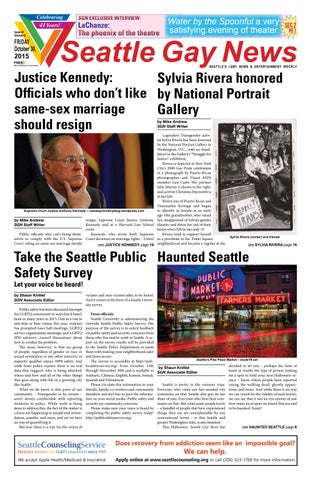
Celebrating 41 Years! Issue 44 Volume 43
FRIDAY October 30, 2015 FREE!
25¢ in bookstores & newsstands
Water by the Spoonful a very SEC 2 satisfying evening of theater PG 1
Seattle Gay News SEATTLE’S LGBT NEWS & ENTERTAINMENT WEEKLY
Justice Kennedy: Sylvia Rivera honored Officials who don’t like by National Portrait same-sex marriage Gallery should resign by Mike Andrew SGN Staff Writer
Supreme Court Justice Anthony Kennedy – newwayministryblog.wordpress.com
by Mike Andrew SGN Staff Writer
resign, Supreme Court Justice Anthony Kennedy said at a Harvard Law School event. Kennedy, who wrote both Supreme Public officials who can’t bring themselves to comply with the U.S. Supreme Court decisions on marriage rights – United Court ruling on same-sex marriage should see justice kennedy page 19
Legendary Transgender activist Sylvia Rivera has been honored by the National Portrait Gallery in Washington, D.C., with an installation in the Gallery’s “Struggle for Justice” exhibition. Rivera is depicted at New York City’s 2000 Gay Pride celebration in a photograph by Puerto Rican photographer and Visual AIDS member Luis Carle. Her partner Julia Murray is shown to her right, and activist Christina Hayworth is to her left. Rivera was of Puerto Rican and Venezuelan heritage and began to identify as female at an early age. Her grandmother, who raised her, disapproved of Sylvia’s gender identity and threw her out of their home when Sylvia was only 10. Rivera tried to support herself as a prostitute in the Times Square neighborhood and became a regular at the
Sylvia Rivera (center) and friends
see sylvia rivera page 19
Take the Seattle Public Haunted Seattle Safety Survey Let your voice be heard! by Shaun Knittel SGN Associate Editor Public safety has been discussed amongst the LGBTQ community in ways that it hasn’t been in many years in 2015. Due to a rise in anti-bias or hate crimes this year, violence has prompted town hall meetings, LGBTQ service organization meetings, and LGBTQ SPD advisory council discussions about how to combat the problem. The issue, however, is that no group of people, regardless of gender or race or sexual orientation or any other minority or majority qualifier enjoys 100% safety. And aside from police reports there is no real data that suggests who is being attacked, where and how and all of the other things that goes along with life in a growing city like Seattle. What we do know is that parts of our community – Transgender to be certain – aren’t always comfortable with reporting incidents to police. While work is being done to address this, the fact of the matter is crimes are happening to people and intimidation, assaults, and more, and yet we have no way of quantifying it. But now there is a way for the voices of
victims and non-victims alike to be heard. And it comes in the form of a Seattle University survey. From officials: Seattle University is administering the citywide Seattle Public Safety Survey. The purpose of the survey is to solicit feedback on public safety and security concerns from those who live and/or work in Seattle. A report on the survey results will be provided to the Seattle Police Department to assist them with making your neighborhood safer and more secure. The survey is accessible at http://publicsafetysurvey.org/ from October 15th through November 30th and is available in Amharic, Chinese, English, Korean, Somali, Spanish and Vietnamese. Please circulate this information to your friends, family, co-workers and community members and feel free to post the information on your social media. Public safety and security are community concerns. Please make sure your voice is heard by completing the public safety survey today! http://publicsafetysurvey.org/
Seattle’s Pike Place Market – mode19.net
by Shaun Knittel SGN Associate Editor Seattle is pretty in the summer time. Everyone who visits our fair-minded city comments on that. Seattle also gets its fair share of rain. Everyone who lives here comments on that. But what some people know – a handful of people that have experienced things they say are unexplainable by any conventional terms – is that Seattle and greater Washington state, is also haunted. This Halloween, Seattle Gay News has
decided to let you – perhaps the faint of heart or maybe the type of person looking for a spot to hold your next Halloween séance – know where people have reported seeing the walking dead, ghostly apparitions, and more. And while there is no way we can vouch for the validity of such stories, we can say that it was an eye-opener at just how many local spots we found that are said to be haunted. Enjoy!
see haunted seattle page 6
2 Seattle Gay News
October 30, 2015
Celebrating 41 Years!
Visit us online www.sgn.org
October 30, 2015
Seattle Gay News 3
Don’t offend this Halloween:
Dress for Halloween success, not cultural reappropriation/racism by Shaun Knittel SGN Associate Editor This weekend is Halloween; a time in which families come together and paint their children into gobblins, ghouls and characters from the latest movie or television show that’s all the rage with the youth. It’s also a time when moronic adults forget tact and show up dressed as non-American Indians dressed as Native Chiefs. While Seattle Gay News is not in the business of telling people how to live, we do however, want to offer some sage advice for anyone looking to enter a costume contest at one of the many bars and nightclubs around town this weekend, Gay frat bro or sorority Lesbian looking to dazzle at the university Halloween party, or any ol’ LGBTQ person going tricking or treating this holiday.
amples of Halloween costumes you want to stay far, far away from. Other examples would be an Ebola virus victim or ISIS soldiers and suicide bombers. If your goal is to make people laugh this Halloween then go as a clown – because nothing about any of what SGN just listed is funny or appropriate to draw laughter from. • Not your race, not a costume: This one can be tricky and we know that some readers might disagree so here it goes… Our best efforts at explaining this so-called touchy subject without offending the masses. Cowboys come in all colors. So do police officers, fire fighters, soldiers, doctors, clowns, ghosts, etc. American Indians, Arabian Sheiks, Mexicans and MexicanAmericans, and others that follow the same
“Walmart’s webpage for the item suggests that the nose is “perfect for an Arab Sheik,” perpetuating racist tropes that have long been used to demonize, otherize and alienate Arab communities throughout history,” the group said in a statement. The company has also removed a child’s costume titled “Little Amigo.” Available for $12.99 the outfit includes a fringed serape with sombrero and was modeled by a young child sporting a big black mustache.
• Caitlyn Jenner Halloween costumes: Yes, we are LGBTQ and yes, we should be able to take power in whatever form we want to when it comes to our movement. But dressing up to poke fun at an actual Transgender person (Chaz Bono, Caitlyn Jenner, etc.) is just plain offensive and let’s face it – has nothing to do with power recovered and everything to do with bullying. Gay men have, • Stay away for years, dressed from blackface: in drag for HalJust don’t do loween. NOT it. Although it THE SAME shouldn’t have to THING. Drag is be explained at either celebrity this point why it female impersonis deeply offenHave a safe and happy Halloween from the staff at SGN – happyhalloween9.com ation (not the same sive, there is always someone who, like clockwork, will show ethnic, racial and cultural lines do not come as bullying) or a character in which a perup to a party thinking they have really hit in any other form than what they are. So if son in drag develops and lives out while the nail on the head with such a costume. you are not Mexican, don’t wear a sombrero masquerading in the clothing and look or So here it goes again: Blackface is offensive and a serape and call yourself one (because “drag” of said character they have created. because it represents a time when white just by wearing such garb does not make And while some of these names or characAmericans would put dark paint on their you any more or less “Mexican” than you ters might include real life people, places or things they certainly are not meant for any faces and act out incredibly racist and offen- already are/are not). one group or person in particular. sive stereotypes about African Americans. The point of Halloween can and will be The symbolism of blackface is incendiary, America’s biggest retailer, Wal-Mart, has insensitive and racist. This is a fact. So don’t removed some of the costumes available via creative and be retold over the years. Some do it. its website after complaints that images of see it as the best holiday of the year or cer• Avoid any costume inspired by real- Arabs and Hispanics were offensive. The tainly the one that is most fun for kids, and life tragic events: A Boston Marathon company’s “Sheik Fagan” costume included in the last few decades, fun for adults, too. bomb victim, a mass shooting victim or a headdress and fake large, hooked nose. But everyone can agree that Halloween is any of the shooters or an unarmed black The American-Arab Anti-Discrimination not – or should not – be about racism, culteen murdered by a police officer or George Committee had called on the retailer to re- tural reappropriation, and bullying. Have fun SGN readers! Zimmerman to name a few, are all great ex- move the costume from its site.
4 Seattle Gay News
October 30, 2015
Celebrating 41 Years!
Dick Leitsch was a Gay pioneer Dear Editor, I thoroughly enjoyed and appreciated the article about Dick Leitsch by Perry Brass in the October 16th edition of the Seattle Gay News. Mainly because I often drove into Manhattan from my home in
Bergen County, New Jersey to attend Mattachine Society meetings during the 1960s. Consequently, I remember Dick Leitsch very well. He was very handsome, well-dressed, just as in the large photograph in the story (as most of us were on the East Coast in those days) and he was a very excellent speaker. Although he may have been a Southern gentleman, I don’t recall him hav-
ing a particularly Southern accent. And I can certainly recognize a Southern accent as I “came out” in beautiful Atlanta, Georgia in 1960. But that’s another story. (Smile) It’s hard to believe how much time has passed, since we are both contemporaries, he being 80 years old and I being 81 years old. Thankfully, we both survived, as many of our generation didn’t survive, the Gay plague of AIDS.
You couldn’t have chosen a better story to run during LGBT History Month than featuring Dick Leitsch, as he was definitely a Gay pioneer. Thanks again and keep up the good work! John Mark
Día de los Muertos / “Day of the Dead” celebration at El Centro de la Raza by Estela Ortega Executive Director El Centro de la Raza This year we will honor and be in solidarity with the Black Lives Matter movement and the people who have lost their lives as a result of the legacy of racism against People of Color in the United States. Join us for El Centro de la Raza’s opening day Día de los Muertos / “Day of the Dead” celebration, on Monday, November 2nd from 5:30-8:30 p.m. FREE admission, traditional dinner and children’s activities offered. A special program will be presented on the morning of Monday, November 2nd at 10:30 a.m. where we will honor Santos Rodriguez, a young victim of racism, whom our children’s park is named after. On July 24, 1973, Santos and his brother were placed in the back of a police car and questioned about a burglary. The cop informed Santos that there was one bullet in his gun, spinning the cartridge and then pointing the gun at Santos’ head. After pleading his innocence, the cop pulled the trigger for the
second time and killed Santos’ immediately. We have connected with Roberto Corona from Southern Methodist University and he will be in attendance along with Bessie Rodriguez, Santos Rodriguez’ mother. Other program participants include: Seattle’s Civic Poet, Claudia Castro Luna, and Superintendent of Parks, Jesus Aguirre. Dallas Morning News reached out to us in awe of the fact that a park in Seattle
was named after Santos, and yet there is nothing memorializing him in Dallas. We have named the park after him in defiance of the society that caused his death, and in confidence that we will win in our efforts to do away with racism. We use his name not in mourning but to commemorate the day when we create a society that is truly democratic, that assures equal rights and a dignified, fulfilling life for all peoples.
The building of a better community is what is at the heart of this Día de los Muertos event. Día de los Muertos is a traditional Mexican celebration that commemorates and remembers loved ones that have died and honors them by setting up ofrendas or altars. 11 years ago El Centro de la Raza made a decision to expand to diverse communities of color and social justice issues with the objective to build multi-racial unity and honor those that are no longer with us. Ofrendas will be featured by: 206 Zulu, Black Out Summer Jam, Mothers for Police Accountability, First AME Church, EPIC, Black Prisoners’ Caucus, From Hiroshima to Hope, Fulgencio Lazo, Garfield Black Student Union, Movimiento Afro Latino Seattle, Peace for the Streets by Kids from the Streets, Richard Hugo House, Urunga Music, and many more! Courtesy of El Centro de la Raza
Kshama Sawant teams up with small businesses in rent control plan by Mike Andrew SGN Staff Writer Socialist City Council member Kshama Sawant demonstrated her ability to build coalitions with a package of new initiatives aimed at helping small businesses. Her proposals would set controls on commercial rents, improve late night transit service in neighborhood business districts and provide retirement account options for small business employees. The package was announced at an October 27 press event featuring none other than Dave Meinert, once a vocal critic of Sawant’s successful $15 per hour minimum wage plan. He had been meeting with Sawant since they clashed on the mayor’s minimum wage task force, Meinert said, and had discussed how the displacement of small businesses by rent increases is similar to the displacement of residents. “We all love Seattle’s quirky unique culture, but we need to support our small businesses if we’re serious about preserving the character and soul of our city,” Meinert said
in a statement. “We especially need to move on these policy ideas to support women- and minority-owned businesses,” he added. Meinert owns the Comet, Lost Lake and Ernest Loves Agnes, and is also the promoter for the annual Capitol Hill Block Party. Sawant called for City policies that would benefit small local businesses rather than big real estate developers. “There’s a lot of small business rhetoric from corporate politicians, but little actual policymaking that helps our city’s small businesses. Commercial rent control, for example, is a policy that will directly benefit small businesses,” Sawant said. “City Hall needs to stop conferring sweetheart deals on big developers and corporations, and begin serving the interests of small businesses and working people.” While rent regulation of residential property has been pre-empted by the State of Washington, commercial rents remain under the jurisdiction of the City of Seattle, Sawant said, so there is no need to wait for the state legislature to act on her proposals. Joining Sawant and Meinert were a di-
Visit us online www.sgn.org
Kshama Sawant – www.occupy.com
verse group of small businesspeople: Sonja Ponath, who described herself as a “small landlord”; Wyking Garrett, the promoter of Africatown Seattle; Mike Rodriguez from Restaurant Opportunities Center United; Paula Lucas, owner of Le Frock clothing store; and Nate Omdal, a jazz musician and representative of Fair Trade Music Seattle. “Policies such as commercial rent con-
trol and a city-sponsored portable retirement system benefit both small businesses and their workers,” Rodriguez said. “We cannot lift living standards of restaurant workers by focusing on labor policy alone. When small businesses have a steady predictable profit and easier paths to provide benefits to their workers, both parties win.”
October 30, 2015
Seattle Gay News 5
haunted seattle continued from cover
Kells Irish Restaurant & Pub Kells is widely considered the most famously haunted spot in town. Featured on more than one ghost hunting television show, Kells is located in the basement of the old Butterworth Building – which used to be the city’s first mortuary. The building is believed to have been the source of corruption and other dirty dealings in the early days of the City. Kells owners and staff say they’ve experienced (to name a few) moving objects, strange feelings like they are being watched, and even the brief appearance of ghosts, like a young girl who tries to lure other children to come play with her. Location: 1916 Post Alley, Seattle, WA (Pike Place Market) Spooked in Seattle Ghost Tour Since 2004, Spooked in Seattle Tours have been telling what they claim are “real” stories of haunted Seattle by “taking you inside and presenting evidence collected on actual paranormal investigations!” From the Spooked in Seattle Ghost Tour website www.SpookedinSeattle.com: Join real ghost hunters for an evening of spirited tales within Seattle’s unique neighborhoods, as they take you on a guided tour of some of the cities most haunted sites, including our very own section of Seattle’s famous underground. These 90-minute tours include information about ghosts and offer some of the evidence collected during investigations. Each tour explores the past of some of the oldest buildings in Seattle and will, perhaps, give you the opportunity to encounter some residents whose earthly forms may have departed, but whose spirits, of course, never left. Spooked in Seattle Tours offers walking tours, pub tours, trolley tours, and public ghost hunts, 7 days a week. Admission prices range from $12- $30, depending on which tour or ghost hunt is booked. Private Group Tours are available for 10 or more. Deposit required. All walking tours must be booked at least 2 hours in advance and are subject to availability. There must be a minimum number of four (4) reservations for any walking tour or pub tour to take place. If the required minimum is not met, tours may be canceled and rescheduled, or a full refund given. Minimum requirements differ for Trolley, Private and Specialty tours and Public Ghost Hunts. For more information contact Spooked in Seattle Ghost Tours at (425) 954-7701, or by email at Information@SpookedInSeattle.com and Reservations@SpookedInSeattle.com. The Georgetown Morgue The Georgetown Morgue of Seattle is a facility for tragic stories of death. The morgue has a history of thousands of funeral preparations, cremations, and the processing of animal carcasses. The morgue holds what is considered to be the most horrifying unsolved crime in Seattle history. Nine of their staff were forced into the crematorium chamber. There were no surviving witnesses, nor were suspects ever identified. This year the landlord has allowed the producers of what is known as “Seattle’s Best Haunted House” to open up the portion of the morgue the public has not seen in decades – the area containing the body lockers.
6 Seattle Gay News
From the website www.SeattleHaunts. com: Upon delving deeper into the bowels of the Georgetown Morgue earlier this year, we unearthed a terrifying secret buried far beneath the blood splattered floorboards. Come take a tour and see what our Janitor’s Rigger and Mortis have been hiding all these years. Wander below at your own
Location: 85 Pike St, Seattle, WA Grand Army of the Republic Cemetery In 1895, the Grand Army of the Republic (GAR) established the GAR Cemetery in Seattle (along with several others in the region). It lies on Capitol Hill, adjacent to Lakeview Cemetery. After several decades of maintenance by the GAR, the upkeep of
The Cadillac Hotel – flickr.com
risk to see if you can escape the body strewn sewers and private janitorial quarters of the KUBE 93 Haunted House. The good news is the Haunted House tours are so popular they continue into November for one-week. For more information, including ticket prices and a lengthy FAQ, visit the website or email info@seattlehaunts.com or call (206)762-2067. Location: 5000 E. Marginal Way S., Seattle, WA
the cemetery fell to the City of Seattle. Decades then ran together as the cemetery fell into disrepair due to ambiguity concerning the land deed. According to local ghost hunters, it was during this period that the cemetery became particularly active. With more than 500 gravesites at the 110-yearold graveyard, rumor has it that at night you can hear the bloodied cries and the shouts of Civil War soldiers as they march to battle. Location: 1200 E. Howe St., Seattle, WA
Pike Place Market That’s right – these days a person can’t even go shopping without running into a ghost in Seattle! But according to the number of “witnessed or reported ghost sightings” Pike Place Market is one of the most haunted places in Seattle. As history would show, before the market was built the land was home to the Suquamish and Duwamish tribes for
West Seattle High School Over the years West Seattle High School teachers have heard all the excuses: “The dog ate my homework,” “I left the assignment answers at home,” etc. And now, if local ghost lore is true, they may have even heard, “The ghost stole my homework.” In 1924, former student Rose Higginbotham hung herself at West Seattle High. She is said to haunt the school grounds to this
The balconies at The Moore Theatre – cinematreasures.org
several thousand years. It wasn’t until the mid-19th century that the Treaty of Point Elliot was signed, forcing all natives off of the land. Years later, the market was built over the top of an old Indian burial ground (NEVER a good idea!) and according to hundreds – not a handful, but literally hundreds – of eyewitness accounts, inexplicable things have been occurring at the Market ever since. Allegedly, apparitions have been seen on a steady basis in the Lower Market for decades now.
October 30, 2015
day. Also, running next to the school is an old park that has deep connections with West Seattle High. Legend has it that on particularly foggy days, or at sunrise and sunset, Higginbotham along with several other students of the era, can be seen and heard in the park. Location: 3000 California Ave. SW, Seattle, WA
The Cadillac Hotel Built at the height of the Gold Rush in 1889, the Cadillac Hotel has been through its share of rough times. The hotel was built right after the Great Fire (which leveled most of the neighborhood). The Cadillac Hotel played a temporary home for Seattle’s early loggers, miners, and disorderly young men that frequently had “female visitors of ill repute.” In 1970 the hotel was declared not up to code when an arson at another hotel forced city officials to pass new laws about fire safety. At the time the upper half of the building was simply shuttered. It was during that time when the top floors were closed that passersby reported seeing apparitions in the windows. The three-story Victorian brick building was then further damaged in the 2001 earthquake, which prompted Historic Seattle to move in to save the building. It has since been retrofitted and remodeled and turned into the Klondike Gold Rush Museum. Some believe that the remodel may have chased away any ghosts who were previously tethered to the building. However, more than one staff member of the museum has reported ghostly sightings since the museum opened its doors for business. Location: 319 2nd Ave, Seattle, WA The Moore Theatre Staffers at one of Seattle’s most wellknown live music venues claim to have seen flickering lights, apparitions and moving objects. The oldest operating theater in Seattle, the Moore’s upper balconies of its auditorium are certainly haunted by unpleasant memories. For a time, it was segregated. For decades, attendees of color were only permitted to sit in the steep, crowded nosebleed seats. And although there weren’t any deaths or anything of the like associated with said balconies, the energy that such situations create is said to manifest itself into some of the so-called hauntings the theater staff say occurs present day. A visit from SyFy’s “Ghost Hunters” team made the Moore’s rumored haunting famous nationwide a few years ago. Location: 932 2nd Ave, Seattle, WA The Sorrento Hotel The 1909 hotel on First Hill is rumored to be haunted by one famous neighborhood figure who, hotel staff say, still wanders the halls. Alice B. Toklas, a marijuana activist and one-time Seattleite, at one point lived on the same block at the Sorrento while attending the University of Washington. Now, as legend has it, visitors and hotel employees swear she still wanders the fourth floor (though it’s unclear whether or not she actually ever stayed in the hotel.) Still, the Sorrento’s Facebook page calls Toklas “a friendly ghost.” And, in her honor, every year on Halloween a special dinner menu at their restaurant, The Hunt Club, is served. Location: 900 Madison St., Seattle, WA Did we miss something? We’re almost certain we did with the number of local places we found during our research for this story! Write a letter to the editor and tell us about your experience with a ghostly sighting or paranormal activity in and around Seattle and we’ll print it in next week’s edition of Seattle Gay News. Have a safe and happy Halloween!
Celebrating 41 Years!
SEAMEC announces endorsements
SEAMEC, the Seattle Metropolitan Elections Committee for Gays, Lesbian, Bisexuals & Transgender individuals, announced its general election endorsements on October 15. Incumbent King County assessor Lloyd Hara was endorsed for reelection because of his long record of support for the LGBT community. Veteran King County Council member Larry Gossett, who is running unopposed, was also endorsed. Gossett, a veteran of the Black Liberation Movement in his youth, has always earned SEAMEC’s highest ratings and endorsements. County Council member Joe McDermott, one of two openly Gay Council members, was also endorsed. In Seattle City Council races, SEAMEC has endorsed Michael Maddux, Sandy Brown, and Lorena Gonzales. Maddux, running in District 4, is openly Gay and has been an activist in Washington Stonewall Democrats. Brown, in District 5, is a Methodist minister who has defied his church to marry Gay and Lesbian couples. In 2012, he was a leader in organizing the faith community to support Referendum 74 for marriage equality. Gonzales, running for the at-large District 9 seat, was formerly legal counsel for Mayor Ed Murray. SEAMEC’s ratings for the general election are shown below. Numerical ratings indicate our evaluation of the candidates on the whole range of LGBT issues. A 5 rating means the candidate has shown leadership on our issues; 4 means the candidate exceeds expectations; 3 means
they meet expectations; 2 means they need improvement; 1 means the candidate resists LGBT rights or interests; 0 means they are actively hostile to our community. Where SEAMEC could not interview a candidate and found insufficient information to rate them based on our own research, we assign a ?. In the case of perennial candidate Goodspaceguy, running this time for Port Commissioner, we have assigned him an X, meaning we decline to rate him. (i) stands for incumbent. STATE LEGISLATIVE DISTRICT 30 • Carol Gregory (i) 3 • Teri Hickel ? KING COUNTY ASSESSOR • Lloyd Hara (i) 5, ENDORSED • John Wilson 3 KING COUNTY DIRECTOR OF ELECTIONS • Zack Hudgins 4 • Julie Wise ? KING COUNTY COUNCIL DISTRICT 2 • Larry Gossett (i) 5, ENDORSED KING COUNTY COUNCIL DISTRICT 4 • Jeanne Kohl-Welles 4 • Rufe Orr ? KING COUNTY COUNCIL DISTRICT 6 • Claudia Balducci 3 • Jane Hague (i) 3
KING COUNTY COUNCIL DISTRICT 8 • Joe McDermott (i) 5, ENDORSED PORT OF SEATTLE POSITION 2 • Courtney Gregoire (i) 3 • Goodspaceguy X PORT OF SEATTLE POSITION 5 • Fred Felleman 2 • Marion Yoshino 2 SEATTLE CITY COUNCIL DISTRICT 1 • Lisa Herbold 4 • Shannon Braddock 3 SEATTLE CITY COUNCIL DISTRICT 2 • Bruce Harrell (i) 4 • Tammy Morales 3 SEATTLE CITY COUNCIL DISTRICT 3 • Kshama Sawant (i) 4 • Pamela Banks 3 SEATTLE CITY COUNCIL DISTRICT 4 • Michael Maddux 5, ENDORSED • Rob Johnson 3 SEATTLE CITY COUNCIL DISTRICT 5 • Sandy Brown 5, ENDORSED • Debora Juarez 3
SEATTLE CITY COUNCIL DISTRICT 6 • Mike O’Brien (i) 2 • Catherine Weatbrook 2
SEATTLE CITY COUNCIL DISTRICT 7 • Sally Bagshaw (i) 3 • Deborah Zech-Artis ? SEATTLE CITY COUNCIL DISTRICT 8 • Tim Burgess (i) 3 • Jon Grant 3 SEATTLE CITY COUNCIL DISTRICT 9 • Lorena Gonzales 3, ENDORSED • Bill Bradburd 2 SEATTLE SCHOOL BOARD DISTRICT 1 No ratings SEATTLE SCHOOL BOARD DISTRICT 2 No ratings SEATTLE SCHOOL BOARD DISTRICT 3 • Lauren McGuire 3 • Jill Geary 2 SEATTLE SCHOOL BOARD DISTRICT 6 • Leslie Harris 3 • Marty McLaren (i) 3
Be sure to vote by Nov. 3
City seeks steering committee members for Youth Participatory Budgeting Project Seattle Department of Neighborhoods is seeking individuals interested in serving on the steering committee of the new Seattle Participatory Budgeting Project (PB). PB is a democratic process through which Seattle youth ages 13-19 decide how to spend part of the City’s budget. In the Mayor’s 2016 Proposed Budget, $500,000 has been set aside for PB in its inaugural year. “We are empowering our young people to help create the services and resources that speak to their concerns,” said Mayor Ed Murray. “This is your chance to address unmet needs, create a brighter future and support a more equitable community for all our youth.” Along with representatives from the Seattle Youth Commission and the City Neighborhood Council, the steering committee will include youth leaders and representatives from Seattle organizations working with youth that are involved in civic engagement, empowerment and organizing, good government, research, planning and policy, community organizing, community education, grant making, social justice giving, or urban infrastructure. This is a volunteer board that will serve from November 2015 to July 2016.
“The Participatory Budgeting steering committee is a great opportunity for young people to directly shape how city money is spent, and learn how the city works – from the inside,” said Councilmember Nick Licata. The City will be hosting an informational webinar on Tuesday, November
Visit us online www.sgn.org
3, from 11:00 a.m. to 12:00 p.m. for interested individuals to learn more about the participatory budgeting process and the role of the steering committee and to hear from the City of Boston that implemented its own participatory budgeting process in 2014. To access the webinar on November 3, go to attendee.gototraining.
com/r/5399245676588420610. Visit seattle.gov/neighborhoods/youthparticipatory-budgeting to learn more about the steering committee and to apply. The deadline for applications is Friday, November 13 at 5 p.m. For questions, contact Rahwa Habte at 206-615-2008 or Rahwa. habte@seattle.gov.
October 30, 2015
Seattle Gay News 7
Homophobe Paul Ryan elected Speaker of the House by Mike Andrew SGN Staff Writer
Newly elected House Speaker Paul Ryan (R-Wisc.) has one of the most anti-Gay voting records in Congress – so bad, in fact, that HRC has consistently given him a 0 rating in his nine terms in Congress. According to the ACLU, Ryan has held “almost uniformly harmful views on five key civil liberties issues, including a humane immigration policy, LGBT equality, reproductive rights, torture and indefinite detention, and fair voting access.” Ryan has always had a reputation as a hard worker, and he certainly worked long and hard to earn his reputation as one of Congress’s most anti-Gay members. In 1999, during his first term, Ryan voted to bar same-sex couples from adopting children in the District of Columbia, over which Congress has administrative oversight. In 2003, Ryan voted for the Marriage Protection Act, which would have barred federal courts from considering the constitutionality of DOMA and possibly overturning it. Ryan twice voted in support of the failed Federal Marriage Amendment to make dis-
Newly elected House Speaker Paul Ryan – Photo by Andrew Harnik / AP
crimination against same-sex couples part of the U.S. Constitution – once in 2004 and again in 2006. Ryan also voted no on the Matthew Shepard and James Byrd Jr. Hate Crimes Prevention Act in 2009. And in 2011, Ryan voted against repealing Don’t Ask, Don’t Tell. In the one case where Ryan is on record supporting LGBT rights – his vote for the Employment Non-Discrimination Act (ENDA) in 2007 – his position was ambiguous.
In the complex maneuvering before the final up-or-down vote on the bill, Ryan voted for a Republican-sponsored “motion to recommit” – in other words, to kill ENDA for the session by sending it back to committee without a vote. Only after that motion was defeated did he switch to supporting the bill. The 2007 version of ENDA, which passed the House but was not taken up in the Senate, included protections only for sexual orientation. He declined to say whether he would support the updated ver-
sion that included protections for Transgender workers until 2013, when he said he was studying the Trans issue but would probably support the bill if it came up for a vote. Of course by 2013 Republicans controlled the House, and their leadership prevented any pro-LGBT bills from coming up for votes. As the ACLU pointed out in its statement, LGBT folks are not Ryan’s only target. For example, Ryan voted against the Lilly Ledbetter Fair Pay Act of 2009, which made it easier for women who are victims of paycheck discrimination to sue their employers. As speaker, Ryan would not vote on legislation or sponsor it, but he will set the agenda for each congressional session and work with committee chairs to decide which bills get hearings and ultimately come up for votes. Ryan will also be third in line for the presidency, after Vice President Joe Biden.
Clinton on a roll after strong debate, hearing performances by Mike Andrew SGN Staff Writer Democratic presidential hopeful Hillary Clinton has been on a roll since her strong debate performance on October 13, and she picked up even more momentum after staring down Republican congressmen in new hearings on Benghazi. According to a new Monmouth University poll in Iowa released October 27, Clinton now enjoys a 41-point lead over her main challenger, Sen. Bernie Sanders of Vermont. Sixty-five percent of likely Iowa Democratic caucus-goers said they favored Clinton, while only 24% supported Sanders. Previous polls had Clinton ahead, but just barely. The RealClearPolitics average of national polls shows Clinton with a sevenpoint lead over Sanders in Iowa. The October 27 poll was the first Monmouth survey since the Benghazi hearing, where Clinton maintained her dignity during 11 hours of apparently pointless grilling by her Republican antagonists, and also the first since Vice President Joe Biden announced he would not be a candidate for the nomination. Candidates Lincoln Chaffee and Jim Webb have also withdrawn from the field, leaving only Martin O’Malley to compete with Clinton and Sanders. O’Malley drew only 7% support in the Monmouth poll. “We now have a two-person race, but one of those competitors has just pulled
8 Seattle Gay News
very far ahead,” said Monmouth pollster Patrick Murray. Clinton leads Sanders in every demographic: men, women, very liberal Democrats, somewhat liberal Democrats, and self-described moderate voters. Her biggest lead is among women, with a 73-16% advantage over Sanders. Both candidates have strong favorability ratings, with Clinton coming in at 88% positive and 8% negative. Seventy-seven percent saying they view Sanders positively, against 11% who view him negatively. Clinton’s support is also firmer than Sanders’. About half of Clinton’s supporters say they’ve made up their minds and are sticking with her, while only 27% of Sanders’ supporters say the same thing about him. Forty percent of likely Democratic caucus-goers said they’ve settled on their final decision and are unlikely to change their minds. Thirty-seven percent said they’re close to settled, but are still open to changing their minds. Clinton is also rolling up key labor union endorsements. On October 26, AFSCME, the largest union of government employees in the country, endorsed her after a meeting of its executive board. “The next president will make decisions that could make or break the ability of working people across America to sustain their families. That’s why we spent the last six months engaged in the most member-focused, in-depth, and transparent endorsement process AFSCME has ever
October 30, 2015
Hillary Clinton – www.nationofchange.org
undertaken,” said AFSCME President Lee Saunders. “Members want a candidate who will make it easier instead of harder to join together in strong unions and stand together for wages and benefits that can sustain our families,” he said. “What we also heard was AFSCME members want the candidate who will be the most effective champion for working families, and who will be able to deliver a victory in this critically important election. AFSCME members believe that candidate is Hillary Clinton.” Saunders said that polling showed about half of his 1.6 million members favored Clinton over Sanders.
Clinton had previously been endorsed by the American Federation of Teachers and the Painters and Allied Trades unions. While these national endorsements do not mean that union locals are compelled to endorse Clinton, they do come with organization and money, which will help Clinton build momentum for what could be a long primary season. The Sanders campaign brushed off the endorsement. “Bernie is proud to have the grassroots support of tens of thousands of working families in AFSCME and other unions,” Sanders’ spokesman Michael Briggs said.
Celebrating 41 Years!
NAACP endorses Houston LGBT rights ordinance by Mike Andrew SGN Staff Writer The NAACP has endorsed Houston’s LGBT rights ordinance. The law is threatened by an initiative campaign to overturn it, which will be decided by a vote on November 3. The Yes side – to keep the measure on the books – has a small lead in polls, with many voters still saying they are undecided. The NAACP endorsement is a significant boost to the Yes side, with about 25% of Houston’s residents being African-American. The Equal Rights Ordinance, passed in May 2014, is the signature legislative achievement of Houston’s popular Lesbian mayor, Annise Parker. The law extends civil
rights protections in employment, housing, and public accommodations to the city’s LGBT community. “The vote in Houston will carry national significance,” said HRC Legal Director Sarah Warbelow. Houston, with 2.2 million residents, is more populous than 15 states, she added. Several national LGBT rights groups
have sent staff to Houston to support the ordinance. If it is defeated, Houston will be the only one of the country’s 10 largest cities to lack laws explicitly protecting LGBT residents. Mayor Parker, who was elected in 2009 and is now completing her third and final term, expressed exasperation with distortions propagated by the No side.
“The fact there is so much misinformation and not just misinformation, just outand-out ludicrous lies, is very frustrating,” Parker told reporters. “I’m worried about the image of Houston around the world as a tolerant, welcoming place if this goes down.” Other American cities will be watching Houston on November 3, said James Douglas, the president of Houston’s NAACP chapter. “All those cities that are smaller than us are looking to us because they want to be like us,” Douglas said. :And we want to give them a perfect example of what a major, diverse city ought to look like.”
Setting the record straight on DOMA Neither Bernie nor Hillary were as good as they say they were by Mike Andrew SGN Staff Writer It’s time to set the record straight (yes, pun intended) on DOMA. Democratic presidential hopefuls Bernie Sanders and Hillary Clinton have made DOMA – and who is to blame for it – a campaign issue, but neither of them has the history exactly right. DOMA was passed by huge majorities in both houses of Congress in 1996, as a response to a Hawaiian court ruling that the state could not deny equal protection – and therefore marriage licenses – to same-sex couples. While marriage equality did not become a reality in Hawaii till 2013, congressional Republicans in 1996 wanted to pass a preemptive bill to forbid the federal government from recognizing same-sex marriages in Hawaii or any other state. According to Clinton, her husband, then the president, signed DOMA under duress, only to avoid a constitutional amendment to ban same-sex marriage. Bill Clinton’s signing of the bill was a “defensive action,” Hillary told Rachel Maddow, designed to prevent an even worse bill from being passed. In fact, such an amendment was not on the table, according to Gay activist Michelangelo Signorile. Signorile quotes from a 2011 interview of Freedom to Marry CEO Evan Wolfson by journalist Chris Geidner: “That’s complete nonsense,” Wolfson told Geidner. “There was no conversation about something ‘worse’ until eight years later. There was no talk of a constitutional amendment, and no one even thought it was possible – and, of course, it turned out it wasn’t really possible to happen... “That was never an argument made in the ‘90s.” Following Clinton on the Rachel Maddow Show, her rival for the Democratic presidential nomination, Bernie Sanders, called her on her rewriting of history but
Hillary Clinton and Bernie Sanders – Hillary photo ( Wire Image), Bernie photo ( Reuters) via mmc-news.com
also concealed some of his own baggage on the issue. True, Sanders, then a Congressman, was one of the small minority who stood up to immense political pressure to vote against DOMA. Only 65 out of 435 Congressmen voted no. “I have had, in many years in politics, had to make tough votes,” Sanders told Maddow. “The times then were very, very different…We had a lot of homophobia going on, you know, right-wing Republican leadership clearly trying to push this antigay legislation. And it bothered me to hear Secretary Clinton say, well, you know, DOMA was really about to prevent something even worse.
Visit us online www.sgn.org
That just wasn’t true.” While Sanders certainly did make a tough but correct vote on DOMA, he was not the heroic champion of equality that his recent remarks suggest. In fact, Sanders opposed DOMA on states’ rights grounds, saying that the federal government shouldn’t intrude in areas like marriage laws that historically were the prerogative of the states. Ironically, this argument – which at the time was relatively progressive – was later used by attorney for states seeking to prevent a Supreme Court decision legalizing same-sex marriage. Later, after his home state of Vermont introduced civil unions, Sanders said he
supported equal rights for same-sex couples but did not think the state was ready for marriage equality. “The state was torn in a way that I had never seen the state torn,” Sanders told Maddow about the period after civil unions passed in 2000. “My view was, give us a little bit of time.” Sanders, however, later cosponsored bills to repeal DOMA. Clinton was late to the party, not endorsing marriage equality until shortly before the Supreme Court’s Windsor decision striking down DOMA in 2013.
October 30, 2015
Seattle Gay News 9
10 Seattle Gay News
October 30, 2015
Celebrating 41 Years!
MoSS Alley MotorS, Inc. SpecialiStS in VolVo, Honda, toyota and Subaru
932 12th ave. Seattle, Wa 98122 (206).325--.3992 www.mossalley.com Seattle’s most progressive auto shop!
Visit us online www.sgn.org
October 30, 2015
Seattle Gay News 11
12 Seattle Gay News
October 30, 2015
Celebrating 41 Years!
Visit us online www.sgn.org
October 30, 2015
Seattle Gay News 13
14 Seattle Gay News
October 30, 2015
Celebrating 41 Years!
Visit us online www.sgn.org
October 30, 2015
Seattle Gay News 15
Henry Gerber: Ahead of his time
Henry Gerber – Photo courtesy of Windy City Times
by St. Sukie de la Croix Windy City Times Special to the SGN On May 15, 1871, the German Criminal Code was revised to include Paragraph 175, a law making sexual acts between males illegal. The first challenge to the law came in 1897 when Dr. Magnus Hirschfeld founded the gay organization Wissenschaftlich-humanitäres Komitee (Scientific-Humanitarian Committee). Its first action was to draft a petition against Paragraph 175 with 6,000 signatures of prominent people in the arts, politics and the medical profession; it failed to have any effect. One American inspired by the work of Hirschfeld was Henry Gerber, who in 1924 was granted an official charter by the state of Illinois for the Society for Human Rights, the first gay-rights organization in the United States, which he ran from his home on Crilly Court in Chicago. Gerber was born Josef Henry Dittmar on June 29, 1892, in Passau, Bavaria, Germany. On October 27, 1913, Gerber (still called Dittmar at the time) arrived at New York’s Ellis Island on the SS George Washington and then traveled west to Chicago, where he worked briefly for Montgomery Ward’s mail-order house. His first known address in the United States was 507 Stone St., Joliet, Illinois, from where he enlisted in the Army on January 26, 1914. In his military documents, he described himself as 5-foot-7 and one-half, 180 pounds, with blue eyes and brown hair. He changed his name to Gerber afterward – though he was still using the name Joseph Henry Dittmar on his June 5, 1917, draft registration card, which described him as 5-foot-8, slender, with blue eyes and blond hair. On it, he mentioned prior military service but now claimed exemption on grounds of consci-
16 Seattle Gay News
entious objection to war. On April 6, 1917, the United States declared war on Germany, and the newspapers became filled with lurid tales of German spies. As a result, the United States opened internment camps; 50,000 unnaturalized aliens of German birth were now “alien enemies,” and 8,000 were detained using presidential arrest warrants. Gerber was “offered internment,” which he accepted, as it guaranteed three meals a day. After the war, he re-enlisted in the Army on October 2, 1919, at Jefferson Barracks, near
Lemay, Missouri, a training and recruitment center for soldiers being sent to fight in Europe, or, in Gerber’s case, to join a regiment of the American Forces in Germany, where he was part of a company engaged in publishing the daily AMAROC News for troops. It was while serving in Koblenz that Gerber found Hirschfeld’s Scientific-Humanitarian Committee. He wrote later: “In Coblenz on the Rhine, I had subscribed to German homophile magazines and made several trips to Berlin, which was then not occupied by American forces. I had always bitterly felt the injustice with which my own American society accused the homosexual of ‘immoral acts.’ “What could be done about it, I thought. Unlike Germany, where the homosexual was partially organized and where sex legislation was uniform for the whole country, the United States was in a condition of chaos and misunderstanding concerning its sex laws, and no one was trying to unravel the tangle and bring relief to the abused.” Gerber returned to Chicago, took up residence at 1710 N. Crilly Ct. and began work for the Post Office Department. In the spring of 1924, he formed the Society for Human Rights (SHR) with a handful of friends. Gerber’s strategy was to network and gain support from other “sex reform” leaders, including Margaret Sanger, the American birth-control advocate, but nobody seemed interested. Undeterred, he decided to go it alone. Through a lawyer, SHR applied for and received a charter from the state of Illinois on December 10, 1924. It is thought the group never had more than 10 members. Gerber elected himself secretary; president was the Rev. John T. Graves, “a preacher who preached brotherly love to small groups of Negroes”; vice president was Al Meininger, an “indigent laundry queen”; and treasurer was Ralph Ellsworth Booher, whose job with a railroad was threatened when his homosexuality became known. Throughout the rest of his life, Gerber lamented that SHR failed to attract “men of good reputation.” In Germany, the homophile movement included enlightened politicians, doctors and scientists, as well as those in the arts, but in the United States nobody was willing to stick a
neck out for homosexuals. Gerber produced two issues of the SHR newsletter Friendship and Freedom, of which no known copies exist, although in Paris Gay 1925 (1981), a French book cowritten by Gilles Barbedette and Michel Carassou, is reprinted a review of Friendship and Freedom, written by Clarens and published in the magazine L’amitié in 1925. (See this author’s Chicago Whispers: A History of LGBT Chicago Before Stonewall for translation.) The SHR was short-lived. In July 1925, the group was raided and the headline in the Chicago Examiner read “Strange Sex Cult Exposed.” Even though the case was thrown out of court, Gerber was suspended from the post office. After the demise of SHR, Gerber became despondent about homosexuals. He later wrote, “I have absolutely no confidence in the Dorian crowd, mostly a bunch of selfish, uncultured, ignorant egoists who have nothing for the ideal side of life.” Gerber re-enlisted in the Army, serving another 17 years; in 1945, he retired with an honorable discharge and a $100-a-month pension. As late as 1942, his primary World War II draft registration was still under the name Joseph H. Dittmar, though the records also contain a cross-reference for the name Henry Gerber; by then, “Gerber” appears to have been how he was known to the military. Gerber spent his twilight years in the U.S. Soldiers’ and Airmen’s Home in Washington, D.C., where he died from pneumonia on December 31, 1972, age 80. Gerber was posthumously inducted into the Chicago Gay and Lesbian Hall of Fame in 1992 and the Henry Gerber House, located at 1710 N. Crilly Ct., was designated a Chicago Landmark on June 1, 2001. The above article is an abbreviated version of the chapter “Henry Gerber and the German Sex Reformers” in St. Sukie de la Croix’s book Chicago Whispers: A History of LGBT Chicago Before Stonewall, published in 2012 by the University of Wisconsin Press.
St. Sukie de la Croix at Gerber’s gravesite – Photo by Gregg Shapiro
October 30, 2015
Celebrating 41 Years!
Transgender Forward by San Diego LGBT Weekly Special to the SGN As the gay and lesbian community celebrates marriage equality across the United States, the transgender members of the LGBT community continue to work diligently to place their civil rights front and center, as we move into the next chapter of LGBT equality. To many, it seems as if the transgender movement has come from nowhere in the last decade, but the reality is that transgender Americans have been fighting for civil rights along with the lesbian, gay and bisexual members of our community for decades. Here are a few key highlights of transgender people within the tableau of American LGBT civil-rights history: c. 1800: “Woman Chief ” Barcheeampe A leader of the Crow nation, the “woman chief ” was known for her war exploits and had several wives. 1871: We’Wha Two-Spirit Zuni Native American who was born male but lived as a woman. An accomplished weaver and potter, in 1886 the 6-foot Zuni maiden met President Cleveland, who was unaware that she was TwoSpirit. 1952: Christine Jorgensen A trailblazer who was the first person in America to receive sexual-reassignment surgery, Jorgensen, a former GI, became a household name and put the issue of gender identity in the American conscience.
Minneapolis becomes the first city to pass an antidiscrimination law protecting transgender people. That’s right, Minneapolis, in 1975. 1977: Renée Richards The next transgender icon who pierced the American consciousness. Richards was an eye doctor who became a professional tennis player and challenged a ban that prevented her from playing in the U.S. Open as a woman. The New York Supreme Court overruled the ban, making Richards the catalyst for a landmark decision concerning transgender rights. 1986: FTM newsletter Lou Sullivan published the FTM newsletter, which was later transformed by Jamison Green into FTM International, the world’s largest information and networking group for female-to-male transgender people and transsexual men. Sullivan is credited with bringing female-to-male transgenderism to the forefront. 1991: Rift with Michigan Womyn’s Music Festival Nancy Burkholder was removed from the Michigan Womyn’s Music Festival when she was discovered to be transgender. The removal led to an annual protest by the transgender community, which continued through this year, when the festival ceased. 1993: Brandon Teena Teena, a transgender man, was murdered in Nebraska. The story of his journey
San Francisco were created to advance transgender civil rights using the legal system. 2003: National Center for Transgender Equality established Activist Mara Keisling, with the support of other transgender activists, founded the organization dedicated to advancing the civil rights of transgender people. Expansion of San Diego anti-bias law The San Diego City Council added gender identity to the city’s antidiscrimination ordinance, the Human Dignity Ordinance, with a unanimous 7-0 vote. 2006: California’s Gwen Araujo Justice for Victims Act AB 1160 passed into law to prohibit the use of so-called “panic strategies” in criminal defenses. The legislation was named in the memory of a transgender teenager from Newark, Calif., who was attacked and killed in 2002. The law proved ineffective when tested during the murder trial for Larry King’s killer. First transgender person elected to statewide office Kim Coco Iwamoto was elected to statewide office in Hawaii as a member of the Board of Education. 2008: First transgender mayor in America Stu Rasmussen became the first openly transgender mayor in America in Silverton,
1957: Billy Tipton jazz album released Renowned jazz musician lived his life as a man and “married” several women. He was discovered to be biologically female upon his death. 1965: Dewey’s Coffee Shop Protest One hundred and fifty “nonconforming” people protested Dewey’s Coffee Shop in Philadelphia because it refused service to young people who were dressing in clothing that did not conform to their gender. The protest led to an end of the discriminatory policy. 1966: Transsexual Phenomenon published Dr. Harry Benjamin published a seminal work that described the medical transition for transgender people. Benjamin helped Jorgensen in her transition and acknowledged her in the preface of the book: “Without Christine Jorgensen and the unsought publicity of her ‘conversion,’ this book could hardly have been conceived.” 1969: Stonewall Riots The legendary seminal event of the LGBT civil-rights movement included members of the transgender community. The LGBT community resisted police abuse on the night after Judy Garland’s funeral, which many cite for the frayed nerves. 1970: Street Transvestite Action Revolutionaries (STAR) Started by transgender legends Sylvia Rivera and Marsha Johnson, STAR was an advocacy group for transgender people. Both Rivera and Johnson were rioters at the Stonewall Inn and helped usher in the tepid acknowledgment of transgender Americans as part of the gay civil-rights movement. 1975: Minneapolis passes transgender legislation
New passport policy The U.S. State Department announced a new policy eliminating the requirement for surgery to update gender markers on passports. 2011: First NCAA trans athlete Kye Allums became the first openly transgender athlete to play in the National Collegiate Athletic Associate. California’s Gender Nondiscrimination Act AB 887 passed into law, expanding the state’s nondiscrimination laws to protect transgender people by including discrimination based on “gender identity and expression” as a type of “gender” discrimination. New veterans policy Veterans Health Administration (VHA) established a policy of respectful delivery of health care to transgender and intersex veterans. 2012: Matrix film director transitions Lana Wachowski came out as transgender while promoting her movie Cloud Atlas. She is most noted for the Matrix trilogy created with her brother. 2013: Official debut of “gender dysphoria” The American Psychiatric Association debuted the term to describe those who deem themselves transgender. 2014: Laverne Cox covers Time The “Orange is the New Black” star made headlines as the first transgender person to be featured on the cover of Time magazine. Women’s colleges open doors Mills College and Mount Holyoke allowed transgender women to enroll at their female-only institutions.
and death was later chronicled in the Oscarwinning film Boys Don’t Cry. 1995: GenderPac formed Transgender activist RiKi Wilchins formed the first advocacy group dedicated to gender identity and expression. The organization ushered in the period in which the national transgender movement took hold. 1999: First Transgender Day of Remembrance The first Transgender Day of Remembrance honored those who have died due to anti-transgender violence. The commemoration was a direct result of the murder of Rita Hester in Massachusetts. Transgender Pride flag created Monica Helms created the transgender flag, saying, “The stripes at the top and bottom are light blue, the traditional color for baby boys. The stripes next to them are pink, the traditional color for baby girls. The stripe in the middle is white, for those who are intersex, transitioning or consider themselves having a neutral or undefined gender. The pattern is such that no matter which way you fly it, it is always correct, signifying us finding correctness in our lives.” 2002: Transgender legal-aid organizations established The Sylvia Rivera Law Project in New York and the Transgender Law Center in
Visit us online www.sgn.org
Ore. Rasmussen previously had served as the mayor prior to coming out as transgender. He prefers male pronouns but dresses as a woman. 2009: Chaz Bono transition Child of celebrities Sonny and Cher, Chastity Bono, transitioned to become a man. He chronicled his transition in a documentary, then went on to become a contestant on “Dancing with the Stars,” as well as a transgender activist and spokesperson. 2010: First transgender presidential appointees President Obama appointed the first two transgender people in history. Amanda Simpson was appointed as senior technical adviser in the Commerce Department’s Bureau of Industry and Security, and Dylan Orr was appointed as special assistant to the Department of Labor Assistant Secretary. [EDITOR’S NOTE: On May 29, 2015 Seattle Mayor Ed Murray named Dylan Orr as director of Seattle’s Office of Labor Standards (OLS), which oversees implementation of the city’s historic minimum wage law.]
Gender identity protected in federal employment The Department of Labor issued a rule banning discrimination based on gender identity in federal employment. Surgery covered by Medicare The Obama administration lifted a decades-old ban on using Medicare coverage for gender-reassignment surgery. 2015: Caitlyn Jenner debuts The former Olympic athlete and reality star came out as transgender, going on to be featured on the cover of Vanity Fair. First trans national anthem singer Breanna Sinclairé became the first transgender person to sing the national anthem at a professional sporting event at the Oakland Coliseum before the As game with the San Diego Padres. Pennsylvania gets transgender physician general Pennsylvania made U.S. history with the appointment and confirmation of Dr. Rachel Levine as the nation’s first openly transgender state physician general.
First transgender judge in America Victoria Kolakowski became the first openly transgender judge in America, elected by the voters of Alameda County, Calif., in the Bay Area.
White House appointment President Barack Obama appointed transgender attorney Shannon Price Minter to the President’s Commission on White House Fellowships. Minter was the lead attorney arguing before the California Supreme Court to overturn Proposition 8.
October 30, 2015
Seattle Gay News 17
University of North Carolina at Charlotte archive documents Charlotte LGBTQ history
(l-r) Joshua Burford, Blair Burdette, Gene Sloan and Sue Henry were on hand at the Sept. 17 archive naming ceremony for the King-Henry-Brockington Community Archive Charlotte [North Carolina} – Photo courtesy of QNotes staff
by Jeff Taylor QNotes staff Archivist and University of North Carolina at Charlotte (UNCC) Prof. Joshua Burford stresses that the LGBTQ archive he spearheaded is not a complete history. It is growing, and a complete history of anything is, of course, an impossible task. Yet the King-Henry-Brockington Community Archive of Charlotte comes close, with its array of LGBT publications, fliers, historical documents and memorabilia. Housed in the Special Collections of the J. Murrey Atkins Library, the collection is one of the largest in the Southeastern United States and spans decades. “We have the second or third largest collection in the Southeast,” Burford said. “Emory’s LGBT holdings are probably a bit larger than ours, only because they have been collecting for a lot longer than we have. And Duke probably has a tad bit more stuff than we do, of physical material, but we’re highly competitive at this point.” How it began The conversation for the archive began in early 2013. Burford previously worked to help create an LGBT archive at the University of Alabama in Tuscaloosa. It was a smaller endeavor to the Charlotte archive, as it was focused almost exclusively on the university’s LGBT student organization. It whet his appetite to try something on a larger scale when he moved to Charlotte to take a teaching position at UNCC. He began collaborating right away. “It was myself and O’Neal Atkinson – he’s at Time Out Youth now – and then Jess McDonald, who is a friend of ours, who was working for Campus Pride at the time,” Burford remembered. “The three of us got together, I think initially thinking we might collect materials and house them in the [LGBT] Community Center. And then shortly after that, we had a conversation with the archivist at UNCC, who said, ‘If you guys want to lead up the effort to build
18 Seattle Gay News
the collection, then UNC Charlotte Special Collections will house it, preserve it and then make it available to the public.’” They received their first donation in the summer of 2013, and the items have continued to come in ever since, with no sign of stopping. “I don’t think we have any end game,” Burford said. What the collection contains The collection is already impressive. “The hardest part,” Burford said, “is the research. Like, whose history do you want to get, and is it possible to get it? I spent the first, probably, four or five months just researching what I could find.” Once you track down the history, he said, the next hardest part is getting people to trust you, “that you’re going to preserve their stuff, and that it’s going to be available and useful.” Fortunately, it was obvious within minutes of meeting Burford that his intentions are pure and his work ethic is laudable. Before long, despite his newcomer status, he had gained the community’s trust. The collection bares that out. “We definitely know that we have [archives of] the largest queer publication in the Southeast [QNotes], that’s for sure,” Burford said. QNotes donated its nearly 30-year archive, plus several issues of Charlotte Free Press (1975-79) and other miscellaneous Charlotte publications in April. The collection also includes the complete history from nonprofit organizations such as Time Out Youth, a support group for LGBT young adults formed in Charlotte in 1991. While these records are essential for understanding a city’s LGBT history, the smaller holdings are likely to draw a lot of attention as well. “I think the stuff that’s really interesting, from an archival point of view, is the small things that we weren’t planning on,” Burford noted. “Like, we have a trans newsletter that is potentially the first one of its kind that we got from [local activist and naming
October 30, 2015
honoree] Sue Henry. That early trans history is really hard to find. So getting that is a really big deal.” Burford also mentioned the “scads of ephemera,” including an AIDS quilt and items from the 1993 March on Washington for Lesbian, Gay and Bi Equal Rights and Liberation. Much of the archive’s materials come from the private collection of another naming honoree, activist Donaldson King, who Burford said “chronicled his life in a way that is a dream for an archivist. He kept literally everything.” In addition to serving as QNotes’ first editor, King worked for years at The Charlotte Observer and was active in fighting against the entrapment of gay men by law enforcement. “It really is the scope of the things that we have that is so outstanding to me,” Burford said. “We’re looking at a recorded history of things you can read from the middle ’60s to the present. So it really is robust, and it really is an LGBT and Q history.” “You know, we could always have more,” he continued. “There could always be more trans history, there could always be more history for folks of color. But we are aware of that in the process, so we are actively pursuing it. We are not just, sort of, waiting for it to come into our laps. We’re really in the process of working hard to make sure the collection represents as much of the community as it can.” The publicity is helping to ensure that it is indeed a growing and complete history. “Folks that were really active in Charlotte in the ’80s and ’90s who have left [the area] are finding out about the collection, so now we’re starting to get a lot more stuff from out of state, which is great,” Burford said. “The process has sped up, which means we’re going to be able to make the collection more available to the public in a quicker way.” Naming the archive Burford says naming the archive was no small task.
In addition to the aforementioned King and Henry, the archive is named for Blake Brockington, a 2014 graduate of East Mecklenburg High School, who worked for transgender rights and gained national attention when he was named homecoming king at his high school as an openly transgender student. “It was one of the toughest decisions I’ve ever made,” Burford said. “It took me a year to decide what to name it. The idea of naming a collection with a scope as big as this one, that represents so many different identities – [from] sexual identities, to gender identities, [to] race and ethnicity – it was always going to be difficult to give it a name. “It was never going to be just one person,” he continued. “We knew we wanted to name it after Don King, because he was so influential in getting the modern community in Charlotte on its feet, organized and moving. I mean, the man had his hand in just about everything. So that was a nobrainer. But the other names in the collection were a bit tougher. “So when we settled on the name, each of the three people that we chose had a huge impact on the community in very different ways. And all three of them represent different identities: gay, lesbian, trans. They represent different ethnicities, and it was intergenerational. So after a lot of soul searching, after a lot of conversations and a lot of questions, the three of them really rose to the top as the people that I wanted to honor in the name of the collection.” The reaction to the naming, and to the archive in general, has been overwhelmingly positive, Burford said. “The reaction to the naming has been great. People are really excited about who we chose. “The collection in general, I don’t even know that I could encapsulate how well it’s been received,” he said. “I probably get weekly phone calls and emails from people who have either heard about it recently or have been watching it grow all along who are just thrilled that we’re collecting it. “And then by extension, the word about what we’re doing is starting to make its way around archival circles around the South,” Burford continued. “So other people in other places are calling to see how they can replicate what we’re doing here in other parts of the Southeast.” Burford says he is working with North Carolina State University to get them started on collecting their LGBT campus history for the first time. Growing the mission A group of archivists in the Southeast are coming together to create a new endeavor, of which Burford is a key part. “A group of us in North Carolina are working on a new project to organize a queer history collection regionally,” he said. “The project is called ‘OutSouth,’ and we’re in the process right now of building teams of archivists, oral historians and historians all over the Southeast, in all different Southern states, and we’re going to be working to pull together the existing collections. And we’re going to have a first-of-its-kind meeting of Southern queer historians, archivists and oral historians next summer in Charlotte.” It is exciting news for anyone interested in knowing more about what it means, and what it has meant, to be LGBT in the South.
Celebrating 41 Years!
justice kennedy continued from cover
States v. Windsor and Obergefell v. Hodges – made the remarks in response to a question from a student. Does an official have the “authority to act according to her own judgment” if she has doubts about the high court’s ruling, the student asked.
Sylvia Rivera continued from cover
Stonewall Inn, a mafia-run hangout for drag queens and Trans people – especially African-Americans and Puerto Ricans. Rivera was part of the Stonewall Rebellion in June 1969 and was also involved with the Young Lords, a group of Puerto Rican revolutionary nationalists in the mold of the Black Panther Party. In the wake of Stonewall, Rivera became a founding member of the Gay Liberation Front and Street Transvestite Action Revolutionaries (STAR). Within the emerging LGBT movement, Rivera fought for recognition of the Trans and drag communities and became disillusioned with mainstream
Kennedy answered by acknowledging that officials may confront “difficult moral questions” when they are asked to “enforce a law that they believe is morally corrupt.” Noting that very few judges resigned from their positions in Nazi German government, Kennedy said it would be preferable to resign rather than enforce repugnant laws. “Great respect, it seems to me, has to be
given to people who resign rather than do something they view as morally wrong, in order to make a point,” Kennedy told the Harvard audience. But, he added, “the rule of law is that, as a public official in performing your legal duties, you are bound to enforce the law.” In other words, as long as officials remain in office, they are obligated to comply with the law, even if they find it morally
objectionable. They can be excused from complying with laws they object to only by resigning. Kennedy did not mention Kentucky county clerk Kim Davis by name, but the original question from the student obviously referred to her case.
groups like HRC when they appeared to abandon the Trans community to win legal protections for Gays and Lesbians alone. Never one to lobby officials – Gay or straight – discreetly, Rivera was banned from the New York City Gay and Lesbian Community Center for several years because on one cold winter night she aggressively demanded that the center open its doors to homeless youth. Rivera was treated as an outcast by mainstream LGBT groups for most of the 1970s and ’80s, and she happily reciprocated their scorn. “When things started getting more mainstream, it was like, ‘We don’t need you no more,’ ” she told Z Magazine. But, she
added, “Hell hath no fury like a drag queen scorned.” Shortly before her death, she recommitted herself to activism, saying, “I’m tired of sitting on the back of the bumper. It’s not even the back of the bus anymore – it’s the back of the bumper. The bitch on wheels is back.” Rivera had struggled for many years with substance abuse and died of liver cancer in 2002. Throughout her adult life, Rivera referred to herself with female pronouns, but she also expressed a nonbinary sense of her gender identity, calling herself a “gay man,” a “gay girl,” a “transvestite,” and a “drag queen,” terms that some would now find
mutually exclusive. She was partnered with Julia Murray but also resisted the designation “Lesbian.” “People now want to call me a lesbian because I’m with Julia, and I say, ‘No. I’m just me. I’m not a lesbian,’ ” she wrote in her essay “Queens in Exile, The Forgotten Ones.” “I’m tired of being labeled. I don’t even like the label transgender. I’m tired of living with labels. I just want to be who I am. I am Sylvia Rivera. Ray Rivera left home at the age of 10 to become Sylvia. And that’s who I am.”
Divorcées yes, Gays no, Vatican synod says by Mike Andrew SGN Staff Writer The Vatican’s Synod on the Family closed on October 24 with tepid support for allowing divorced Catholics to return to communion, but no support at all for Gay Catholics. “Divorcées yes, Gays no,” the conservative Italian newspaper Il Giornale said in its headline. The result was deeply disappointing to Catholics who hoped the synod would update church teaching on families and relationships. The failure of liberal and conservative bishops to resolve their differences was also disappointing to many participants in the meeting of Catholic bishops. Even before the synod concluded, Catholic Church officials on both sides began spinning the results. Rumors – quickly denied by papal spokesmen – were floated that Pope Francis has a brain tumor. Liberal churchmen accused their conservative antagonists of concocting the story to suggest the Pope’s judgment is impaired. Thirteen conservative bishops, including American Cardinals Timothy Dolan of New York and Daniel DiNardo of Hous-
ton, sent Francis a secret letter complaining about his prior statements in favor of a more open church. Liberal officials promptly leaked the letter to the press. Reports began to surface of harsh language being used in the synod’s confidential sessions. One bishop reportedly said the gathering had a “whiff of Satan.” Another said that the “twin beasts of the Apocalypse” were Islamic terrorism and Western liberal culture. Cardinal Baselios Cleemis Catholicos, chair of the Catholic Bishops’ Conference of India, issued a post-synod statement deploring Western countries’ attempts to secure LGBT rights in the Third World. “According to the teaching of the Church, marriage is between a man and a woman, and the Synod categorically declared that the Church accepts only such relations as marriage,” he said. “It is unacceptable that certain countries and international organizations set preconditions such as acceptance of gay marriage for allocating aid to the poor nations of the world.” Conservative church officials also went after Fr. Thomas Roscia, English-language spokesperson for the Vatican Press Office, accusing him of “promoting a gay narrative.”
The Vatican’s Synod on the Family – brandonvogt.com
When Roscia suggested that the church was moving toward a policy of “embracing people where they are,” African cardinal Wilfrid Napier shot back on his Twitter feed. “Meet people where they are sounds nice,” Napier tweeted, “but is that what Jesus did? Didn’t he rather call them away from where they were?” The final report of the gathering of Cath-
olic bishops did little more than “achieve consensus through ambiguity,” Fr. Thomas Reese wrote in the liberal National Catholic Reporter. Marianne Duddy-Burke, executive director of the Catholic LGBT group DignityUSA, said the document was “deeply disappointing,” and blocked “civil and moral equality for our community.”
Remember to vote by November 3
✓
Visit us online www.sgn.org
October 30, 2015
Seattle Gay News 19
Legal Services MARTIN SJOLIE
www.sgn.org
Over 20 Years Experience
Last Will, Power of Attorney & Health Care Directive (Living Will)
$500.00/Person or $750.00/Couple for complete, personalized services.
(206) 841–1373 www.sjolielaw.com
Auto accidents, DUI, Small business needs.
www.sgn.org
20 Seattle Gay News
October 30, 2015
Celebrating 41 Years!
religion & spirituality
HOME & SPECIALIZED SERVICES
Gary D. TorGerson Co. Expert Painting and Repairs Rot Repair: siding, doors, windows, porches and decks. Lead-Safe Certified
See photographs of our work at www.TorgersonCompany.com Email: info@torgersoncompany.com Contractor Registration #: GARYDTC134CJ Phone: 206-781-0999
Health and Personal Services
www.sgn.org
Visit us online www.sgn.org
October 30, 2015
Seattle Gay News 21
22 Seattle Gay News
October 30, 2015
Celebrating 41 Years!
Visit us online www.sgn.org
October 30, 2015
Seattle Gay News 23
24 Seattle Gay News
October 30, 2015
Celebrating 41 Years!