LG BT Q+
20 HI 21 ST CELEB R AT I N G SE ORY 4 7E PYAE APRRS G O I NE 19 JE CT
ISSUE 4 4 VOLUME 49 F R I D AY OCTOBER 29, 2021
S E AT T L E ’ S L G B T Q I A + N E W S & E N T E R TA I N M E N T W E E K LY S I N C E 19 74
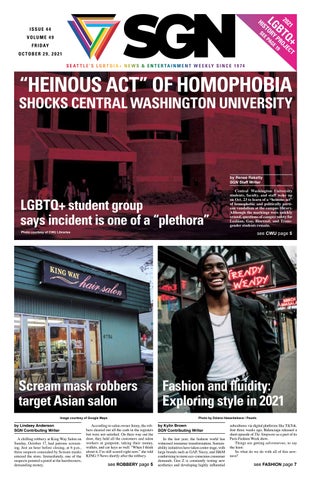
“HEINOUS ACT” OF HOMOPHOBIA
SHOCKS CENTRAL WASHINGTON UNIVERSITY
by Renee Raketty SGN Staff Writer
LGBTQ+ student group says incident is one of a “plethora”
Central Washington University students, faculty, and staff woke up on Oct. 23 to learn of a “heinous act” of homophobic and politically partisan vandalism at the campus library. Although the markings were quickly erased, questions of campus safety for Lesbian, Gay, Bisexual, and Transgender students remain.
Photo courtesy of CWU Libraries
see CWU page 5
Scream mask robbers target Asian salon Image courtesy of Google Maps
by Lindsey Anderson SGN Contributing Writer A chilling robbery at King Way Salon on Sunday, October 17, had patrons screaming. Just an hour before closing, at 6 p.m., three suspects concealed by Scream masks entered the store. Immediately, one of the suspects pointed a pistol at the hairdressers, demanding money.
Fashion and fluidity: Exploring style in 2021 Photo by Dziana Hasanbekava / Pexels
According to salon owner Jenny, the robbers cleared out all the cash in the registers but were not satisfied. On their way out the door, they held all the customers and salon workers at gunpoint, taking their money, wallets, and car keys as well. “When I think about it, I’m still scared right now,” she told KING-5 News shortly after the robbery.
see ROBBERY page 5
by Kylin Brown SGN Contributing Writer In the last year, the fashion world has witnessed immense transformation. Sustainability initiatives have taken center stage, with large brands such as GAP, Yeezy, and H&M conforming to more eco-conscious consumer demands. Gen Z is constantly testing new aesthetics and developing highly influential
subcultures via digital platforms like TikTok. Just three weeks ago, Balenciaga released a short episode of The Simpsons as a part of its Paris Fashion Week show. Things are getting adventurous, to say the least. So what do we do with all of this newness?
see FASHION page 7
GREEN CARDS • VISAS • ASYLUM • CITIZENSHIP 1836 Westlake Ave N, Suite 302 Seattle, WA 98109
(206) 724-1940 olivielaw.com
THIS AD SPACE HAS BEEN GENEROUSLY DONATED BY KRISTIN COSTELLO IN MEMORY OF SGN PUBLISHER GEORGE BAKAN
2
SGN
OCTOBER 29, 2021
C E L E B R AT I N G 4 7 Y E A R S!
In this Issue
LOCAL NEWS 4 A&E • FILM • BOOKS 7 OP-ED 17 LGBTQ+ HISTORY PROJECT 19 NATIONAL NEWS 21 INTERNATIONAL NEWS 21
VISIT US ONLINE SGN.ORG
OCTOBER 29, 2021
SGN
3
Obituary
Remembering Rick Herbert Otto Pribbernow By Michael Dunlop & Bob Van Burkleo Special to the SGN Pastor Rick Herbert Otto Pribbernow passed away suddenly in August, with his partner Bob Van Burkleo by his side. Rick was raised by his parents, Hap and Zelma, in California, starting a lifetime of service to anyone that he found in need. For the last 28 years he served as the chaplain and director of the ELCA Lutheran NW Washington Synod’s Open Door Ministries. The ODM was established in the early 1990s to “bring the compassion of Christ and his Church to persons affected by HIV/AIDS; reach out to those who have felt excluded and condemned by church and society because of their sexual orientation; and encourage and support the Church and its members as they address the issues of human sexuality and biblical interpretation.” Over his decades-long tenure, these purposes evolved to include others in need, whether it was illness, imprisonment, housing insecurity, or financial crisis. Rick established relationships with other supportive organizations and helped in their common mission of service, including all members of the LGBTQ+ community, their loved ones, and allies, through end-of-life support, weddings, commitment ceremonies, and memorial services. He helped many Lutheran churches to become inclusive and accepting of all. Rick also reached out to other religious denominations, since ODM’s purpose was
to spread the message of God’s love to all people of any sexual orientation, no matter what particular place that might lead them. Though most will recognize him from the ODM participation in the annual Pride parade, his greatest passion was finding and reaching those who had been rejected for their sexuality by their faith communities and felt spiritually adrift. He assured them that God’s love was inclusive, regardless of what others might have told them. When out in the community, he was always there as “Pastor Rick,” with his ever-present sweater vest, looking for those who needed to hear that God loved them, always had, and always will. Even during the pandemic, he found those who wanted to talk about faith, going in the winter cold with a warm blanket and warm heart as often as needed. There will be a church memorial service for him on Sunday, November 7, at 2 pm Pacific, which will be accessible via Zoom at www.SVLCcommunity.org/PastorRick. There will also be a community celebration of his life at C.C. Attles, Saturday, November 13, with the pre-celebration starting at 3 p.m .and the celebration at 4 p.m. (details at https://fb.me/e/1buo9DxjU.) The Sisters of Perpetual Indulgence of the Abby of St. Joan will canonize Pastor Rick at this time. In lieu of flowers, it is asked that a donation be made to the national organization Reconciling Works: reconcilingworks.org/ donate.
Local News
Pastor Rick at the 2014 Pride Parade – Photo courtesy of Lakeridge Lutheran Church
Seattle Public Library reopens all branches by Nick Rapp SGN Contributing Writer As Seattle begins its transition from beautiful fall colors to gloomy ninehour days, you may be wondering how to occupy your time indoors during the next few months. What better way to celebrate the return to gray skies than to curl up by a window and moodily read a book? Luckily, the Seattle Public Library system is working hard to gradually bring back the multitude of services it offered pre-pandemic. For months, COVID-19 relegated most library operations to online holds and curbside pickups. Now, the SPL is following its “Road to Reopening” schedule with modified access to all branches. Let this serve as a guide for navigating the return to your local one. Can you go inside? Yes. Though library doors are open, though, not all in-person services are available. Community members still do not have access to meeting rooms or study rooms. Additionally, certain floors may yet be closed to the public. If you cannot access a specific floor, you may still be able to get assistance retrieving what you need. For example, the Central Library branch has only opened floors 1, 3, and 5, but library staff members can access requested materials on all other floors.
are the Central Library (open for returns 10 a.m. to 6 p.m. and inside during library hours) and the Wallingford Branch (where the book return is closed; it is only available inside during library hours). What is available for checkout? As of a 2020 statistical summary, the SPL is home to over 1.7 million books and nearly 700,000 CDs, DVDs, and audiobooks. Seattle community members can check out up to 50 items at a time. If you’re worried about the book that you checked out last year and just haven’t had the energy to return, don’t fret. The SPL has stopped charging daily late fees; you will not be charged for returning overdue materials — no matter how late they are. If a desired item is not available at your home branch, you can request a hold for pickup; it will be delivered to the branch of your choice. The SPL also has global access to thousands of other libraries. Through the interlibrary-loan system, you can retrieve almost any book or audiobook you could think of. In addition to its large physical collection, the SPL is home to over six million e-books and audiobooks, along with more than two million pieces of streaming and downloadable media.
Are there limited hours? While all branches are open in person, they do not all have the same hours of operation for browsing the collections, using public computers, and restroom access. Opening and closing times, along with days of operation, vary by branch. For a detailed list of hours, check the SPL’s website (www. spl.org) under “Hours & Locations.” Book returns are available 24/7 at almost all branches, however. The only exceptions
Will reopening lead to any new library services? Though pandemic adjustments led to an uncertain future for libraries nationwide, the SPL is slated for exciting growth through 2022. Interim Chief Librarian Tom Fay outlined some exciting updates regarding the Library’s future in a statement on the SPL’s website. “In 2021, budget reductions were made citywide, including $5.8 million from the Library’s budget, due to COVID-19 impacts on City revenues. The proposed 2022 budget fully restores the $5.8 mil-
4
OCTOBER 29, 2021
SGN
Photo by Nick Rapp
lion reduction, using $5.1 million from the City’s General Fund and $700,000 of accumulated salary savings in 2021.” If passed, the budget would allow the Library to add more hours and implement additional improvements to accessibility and programming. Fay mentioned new virtual programs and 24/7 hold-pickup lockers as exciting changes in the future. The SPL is also
offering the public a chance to weigh in on posited changes during the next year. If you want a stake in programming, adjusted hours, and future library services, you can take the Library Levy Priority Survey on the SPL’s website. For survey access, visit www.spl.org/about-us/the-organization/ budget-and-operations/library-levy/2021library-levy-priority-survey.
C E L E B R AT I N G 4 7 Y E A R S!
CWU
continued from cover “ It is important to state, unequivocally, that the propagation of hate will not be tolerated at our university,” wrote CWU President Jim Wohlpart in a campus-wide email. “Central Washington University has zero tolerance for any act of hate or aggression against any member of our LGBTQIA+ community or any other member of our community. “We are an inclusive and accepting university that is strongly committed to creating a safe and welcoming environment for all of our students. We will not tolerate any types of actions that reduce the humanity of others, make them feel unwelcome, or decrease their sense of safety and belonging.” Wohlpart added that anyone with information about the vandalism should call 509-963-2111 or email cwu.president@ cwu.edu, saying that confidentiality is assured. Meanwhile, campus police are investigating the incident. The markings have since been removed by facility staff. Equality through Queers and Allies (EQuAl), a student-run organization dedicated to providing a “safe space for all” at CWU, issued a statement on its Facebook page, which read that the library incident was just one of a “plethora of experiences” that “many of our members and members of the LGBTQ+ community as a whole” have confronted. “On the CWU campus alone, our community witnessed our flag, which serves as our symbol of pride, peace, and unity, being mutilated during a time when we nationally celebrate our communal strength-only four months ago,” the Facebook post read. “It is these acts of hatred which constantly remind us that we must also reflect on our
grief, grief for the children who are teased so terribly that they retract from school, grief for the individuals who are shunned from what they thought was supposed to be their home, and grief for the individuals who conclude that taking their own life is less painful than experiencing yet another incident of hatred. And we are all too familiar with something seemingly so trivial as pen markings in a library pushing one of our people to that decision.” The post continued: “So many of us have exceeded a point of inquisition accustomed to, ‘when will it stop?’ and have arrived at a point where we now ask, ‘when will it happen again?’ For that reason, [EQuAl] consolidates with our members and all members of the LGBTQ+ community to remind those who are weak in hope and those who fight against us that LOVE WILL ALWAYS CONQUER HATE.” EQuAl is part of the Equity & Services Council (ESC) at CWU. The student organization did not respond to a message from the SGN on Facebook. The SGN also reached out to the ESC but did not receive a reply by press time. CWU has scheduled a Diversity, Equity & Inclusivity Town Hall on Nov. 4 in the Wellington Event Center to “discuss current and upcoming initiatives the [Diversity and Inclusivity] office is leading and promoting to address issues on campus.” A third town hall will be held virtually online some time before the end of fall quarter, according to a campus announcement. A short two-question survey from DEI is also available to students until the town hall. Tickets to the town halls are encouraged; they are available at cwuwildcattickets.universitytickets.com. Washington state Senate Bill 5227 was signed into law by Gov. Jay Inslee on May 12. The legislation requires diversity, equity,
Image courtesy of CWU EQuAl
inclusion, and antiracism training and assessments at institutions of higher education. Sen. Marko Liias (D-Everett), who is openly Gay, was one of 12 state senators who sponsored the legislation. It is unclear, however, how the legislation might benefit students, faculty, and staff safety at CWU. “It was disheartening to see this instance of hate on Central’s campus,” Senator Liias said
in an email statement. “College environments should be places where students feel like they belong and can thrive, and a core part of achieving that is making sure that Faculty and staff are able to build supportive environments. Sen. Randall's SB 5227, which we passed this session, will help provide faculty and staff with more resources to reach these goals and support students.”
ROBBERY
continued from cover The three suspects fled in a vehicle, and despite several surveillance cameras capturing the terrifying event, they are still at large. We reached out to the Seattle Police Department for a statement about the incident, but they refused to comment. King Way Salon has since upgraded its security system and locks, but even that is not enough to calm the fears of both workers and customers. For many, surviving such a terrifying ordeal would warrant taking some time off to process and maybe get connected with a therapist. But for Jenny, time off is not an option. “I have to work no matter what. I have four daughters. I have to take care of them.” Workers at the salon hope press coverage of the incident can help police identify the suspects and bring them into custody. But they also fear they may lose possible customers over safety concerns. While clients may have their worries, a repeat incident is unlikely. Jenny has been in business for over twenty years and has never experienced an incident like this. While the
Photo courtesy of King Way Salon
encounter was frightening, all the hairdressers in the salon kept their composure and continued calmly working with their clients. It was their composure under immense pressure that may have saved lives that day.
Investigators are currently looking into the robbery as a possible hate crime, with links to another armed robbery from March. This incident, also targeting an Asianowned salon, occurred at South Bay Mas-
For more information, or to get involved in Stop AAPI Hate, visit https://stopaapihate. org. To support Jenny and King Way Salon, contribute to the GoFundMe at www. gofundme.com/f/help-king-way-hair-salonrecover-from-robbery.
Image courtesy of King5
VISIT US ONLINE SGN.ORG
sage and Spa in Renton and left one man injured after being shot in the leg. The suspects from the South Bay Massage and Spa robbery were never found. Police believe that they may have struck again. The possibility that these crimes were racially motivated is still being investigated. With a 76% increase in anti-Asian hate crimes since 2020, hate seems like a likely motivator. With right-wing conspirators and even the former president blaming the coronavirus pandemic on Asian people, specifically the Chinese, hate crimes against Asians have skyrocketed to an all-time high. Concerns regarding anti-Asian hate crimes began to surface after the March 16 Atlanta Spa shooting, which left six Asian women and two others dead. While the King Way and South Bay salons were lucky to have no fatalities, the sentiment behind the crimes may be no different than in Atlanta. Citizens are now calling on the SPD to investigate the possibility that these crimes are related, and motivated by hate, to protect more people from undergoing the same terrifying experience.
OCTOBER 29, 2021
SGN
5
Local News
COVID-19 vaccine booster updates, flu shots, and more by Hannah Saunders SGN Contributing Writer On October 22, the Department of Health released updates for COVID-19 vaccine booster shots. Booster doses are available for all three vaccination types for certain people. The DOH continues to follow recommendations from the Food and Drug Administration (FDA) and the Centers for Disease Control and Prevention (CDC). In September, Pfizer booster doses began being administered in Washington; since then, over 345,000 doses (combined boosters and third doses) have been administered. Moderna and Pfizer booster doses are available at least six months after the initial twodose vaccination series. Additional Johnson & Johnson doses are recommended at least two months after the single-dose series for those 18 years and above. “A booster dose will further protect fully vaccinated individuals by increasing the vaccine’s effectiveness in their bodies, which otherwise may wane over time,” said Secretary of Health Umair A. Shah, MD, MPH. Who can get a booster? Those who are 65 years or older are eligible in addition to those who are: • 18 to 64 years old who live in a longterm care facility • 18 to 64 years old who have underlying health conditions (e.g., HIV, Down syndrome, cancer, diabetes, depression, pregnancy) • 18 to 64 years old who are at an increased risk of social inequities (e.g., the LGBTQ+, disabled, Latinx, American Indian/Alaskan Native, Black/African American, and Asian American communities; agricultural workers; people with limited English proficiency) • 18 to 64 years old who live or work in high-risk settings (e.g., first responders, postal service workers, grocery store workers, public transit workers, corrections workers) The FDA and CDC announced that mixing and matching different types of boosters is safe and effective: Pfizer recipients can receive a Johnson & Johnson or Moderna booster; Johnson & Johnson recipients can receive a Pfizer or Moderna booster; Moderna recipients can receive a Pfizer or Johnson & Johnson booster. According to the DOH, plenty of vaccines remain available across the state for people looking to become fully vaccinated or for those looking to receive their boosters. To find a vaccination site near you, visit https:// vaccinelocator.doh.wa.gov. (Don’t forget to schedule your flu shot, too. See below.)
Dr. Lilian Abbo, center, simultaneously receives a flu vaccine and a Pfizer COVID-19 booster shot – Photo by Lynne Sladky / AP
the Pfizer vaccine. The FDA panel voted 17 to 1 in favor of Pfizer’s vaccine data, which shows 90.7% effectiveness in preventing COVID infections for this age group. If an emergency-use authorization is issued, younger children will be able to receive a dose (one-third of the adult dose) and would be able to receive a second dose a minimum of 21 days following the first dose. According to the American Academy of Pediatrics, since the start of the pandemic, about 6.3 million children have tested positive for COVID-19; in the past week, there were about 118,000 new child COVID cases across the country. Currently, child COVID-19 cases represent approximately 25.1% of weekly reported cases. In Washington, as of Oct. 21, there are 141,361 cumulative COVID cases in those aged 0–19 years old, which represents about 20.1% of total cases in the state.
High hospital occupancy to continue through the fall COVID-19 data shows how case numbers, hospital admissions, and hospital occupancies have declined, yet the levels remain high. Across the state, hospitals continue to operate at full capacity, which is not expected to change throughout the fall. The prevalence of COVID-19 in Washington has declined since September, and the best current estimate is that 1 in every 244 people has an active COVID infection. As of Oct. 25, community transmission in King County remains high, with daily averages of 390 cases, 13 hospitalizations, and 3 deaths. Flu shots The DOH recommends that people who are scheduling vaccinations and booster doses also schedule their flu shots. Both influenza and COVID vaccines can be given
at the same time, and the flu can easily overwhelm hospitals that are already at capacity. The flu is expected to be more common this year as a result of more reopenings, in comparison to last year. Those who are six months and older are eligible to receive a flu shot, which is covered by most insurance plans. Those who are 18 years of age and under may receive the flu shot at zero cost because they are at greater risk of serious flu-related health outcomes. Young children, those who are pregnant, those who are 65 years and older, and those with underlying health conditions are at particularly high risk for flu-related complications. The flu is highly contagious, causes moderate to severe illness, and sometimes leads to hospitalization and death — even in young people with no underlying health conditions.
What to expect from the booster The Pfizer and Johnson & Johnson boosters are full doses, while the Moderna boosters are a half dose. Expect mild to moderate symptoms — similar to those of the second dose — for the booster. Common symptoms include redness and pain at the injection site, and tiredness. State agency vaccination data The vaccination deadline for state workers was Oct. 18. As of Oct. 25, the Office of Financial Management (OFM) relayed that over 94% of state employees are in compliance with the vaccine mandate. Approximately 91% of employees have verified that they are fully vaccinated, while 3.2% of employees have received religious or disability accommodations. Available data from the OFM shows that approximately 2.9% of state employees (1,785) have left their occupations or were terminated. About 3.1% of remaining state employees are pending action, which means they are either in the process of being vaccinated or have a pending retirement, accommodation, or separation. FDA briefing During an FDA briefing on Oct. 26, a panel of independent advisors recommended that children ages 5 to 11 can safely receive
6
SGN
King County COVID data as of Oct. 25 – Image courtesy Seattle and King County Public Health
OCTOBER 29, 2021
C E L E B R AT I N G 4 7 Y E A R S!
Arts & Entertainment
Photo by Wendy Wei / Pexels
Photo by Alex Sever / Pexels
Photo by Salomon Byuma / Pexels
FASHION
continued from cover As daring new style concepts begin to hit the streets and upcycling becomes standard in garment production technology, 2021 fashion begs us all to reimagine our closets and try new things along with the familiar. And what better setting than a stormy Seattle fall? Themes of metamorphosis We are in the midst of a collective shift, largely considered the consequence of changing lifestyles during the pandemic. New hobbies and work from home emerged hand in hand with the unrest and upheaval of last year. Trend forecasts indicate an exit from the pandemic, and with it, the potential for positive change. This has been the catalyst for the emergence of an ultra-adaptable fashion industry. For both the high-end designer and the everyday Seattle shopper, this means creative doorways are open wider than before when it comes to conceiving the “outfit of the day.” Designer Raf Simons said, “There is a feeling we all have about wanting to be in the world again. We are in the mood for fashion. We are in the mood for sharing with other people.”
VISIT US ONLINE SGN.ORG
Photo by Christian Luis / Pexels
2021 fashion begs us all to reimagine our closets and try new things along with the familiar. And what better setting than a stormy Seattle fall? Sharing yourself Sharing ourselves with other people, that is. Fashion has always been a form of personal expression, and now that previously inflexible boundaries are bending, a fluid state of fashion is expanding the norm. In application, sharing is also receiving, so do your research. Identify someone in your life — influencer or friend — whose fashion sense you admire, and find which aspects of their style pique your interest. Is it the tight pants, the big shoes combo, or the loosely unbuttoned way they wear their shirt? Detach the outfit from the person and look at it like a Tumblr collage. Every outfit is but a mixture of textures, colors, and shapes. Look deep into your closet for a similar vibe, and if you don’t see anything to work with, turn it upside down. Any tank top can be a mini-skirt, according to one bold (and now-viral) TikTok idea by @kalechng. Along those lines, large scarves and small blankets have been tried as shirts and full ensembles. Take A$AP Rocky’s
Met Gala quilt, for example: not only does it meet at the intersection of preexisting trends such as primary-color mixing and the shape-shifting puffer coat style, but it is also a handmade, upcycled piece that showcases the endless possibilities of fabric. Microtrends Whether or not you’ve already indulged in experimentation after seeing someone on TikTok in extreme platform loafers or you’re just beginning to conceptualize your personal style, there are no faux pas in today’s fashion climate. A diverse set of subcultures has arrived on the internet this year, and communities are forming around them. While some refer to these as “microtrends,” the truth is that the mainstream is proving too narrow, and we are fluid beings. Some subcultures are more daring or extreme than others. From Bridgerton fangirls sharing in pastoral “cottagecore” dreams (think “Love Story” by Taylor
OCTOBER 29, 2021
Swift) to the return of the emo-scene kid, there is truly a place for all. One subculture dominating the web and even influencing the runways right now is Goth style. Publications report that today’s social disruption and digital escapism have led Goth style to inspire even celebrity fashion, from Marc Jacobs to Travis Barker. Black might be the new black, once again. A simple pair of combat boots or a plaid piece with edgy jewelry could surely do the trick. Already visible in the streets of Seattle have been corsets, patterned tights, and leather jackets, and how you wear them is up to you. Fashion experts are not surprised by the trend’s growth, perhaps an indicator of collective grieving. W Magazine’s Kristen Bateman recently reported that “for many, experimenting with an extreme sense of style is a form of escapism.” While we’ve all been social distancing, more isolated, and online, subcultures have almost seemed to spring into mainstream trends, and boldness is in the air. This year has proven that style can be more than a tool for self-expression. It has brought people together virtually over the past year and continues to be a creative outlet for many. Be bold and wear big shoes!
SGN
7
8
SGN
OCTOBER 29, 2021
C E L E B R AT I N G 4 7 Y E A R S!
Film
Emotionally mechanical Soho is a psychedelic trip through the looking glass
Anya Taylor-Joy and Matt Smith in Last Night in Soho – Photo courtesy of Focus Features
by Sara Michelle Fetters SGN Staff Writer LAST NIGHT IN SOHO Theaters The trippy Last Night in Soho from Edgar Wright (Shaun of the Dead) is a pastiche of classic psychedelic terror and grimy, sexually charged thriller ideas gleefully culled from Hammer horror films, Hitchcock staples, Mario Bava and Dario Argento favorites, 1960s pop music and fashions, and so many additional influences that it’s impossible to list them all. His latest is a candy-colored whodunit of perception and identity, one that cleverly slips through the looking glass and back again with energetic ease. Unfortunately, it’s also more of a technical marvel than an emotionally involving one. Characters are rarely allowed the freedom to breathe, most coming across more as plastic figurines to be swiftly moved across a phantasmagoric chessboard than live as
human beings worth caring about. It is only by the sheer charismatic strength of Thomasin McKenzie, Anya Taylor-Joy, and the late, great Dianna Rigg that this film registered with me at all, and without the presence of these three talented ladies, I’m not sure there’d be much worth talking about. Eloise (McKenzie) is a fashion student from Cornwall who has come to London ready to see her dreams become a reality. Obsessed with the 1960s and overflowing with talent, her designs have an inspired retro flair that makes her immediately popular with her instructors, while also drawing the ire of some of her fellow students. Unhappy in the dorms, Eloise takes an upstairs room in Soho, rented to her by the stern Ms. Collins (Rigg), and quickly makes the place her own. She is also a bit of an amateur psychic, possessed of an ability to see images of the past staring back at her from almost any reflective surface. It’s at this point where the intricately convoluted screenplay by Wright and co-
writer Krysty Wilson-Cairns (1917) kicks into high gear. When things are going well, Eloise typically sees images of her deceased mother smiling back at her. Today, Eloise is having visions of Sandie (Taylor-Joy), a gorgeous young woman about her age who came to London in the 1960s with aspirations to become a star. Did she, though? Was her apparent romance with promoter and manager Jack (Matt Smith) the idyllic first step to achieving her dreams? Or did something more ominous take place, like a descent into madness, abuse, and despair, all of which concluded in a bloody scene of torture and murder right in the very apartment Eloise calls home? Past and present zip back and forth, as Wright juxtaposes current events with past terrors to tell a tale of self-determination overcoming patriarchal oppressions and inherently sexist hierarchies that were left to fester and grow in the foundation underneath Soho for over half a century. Eloise must solve the mystery of Sandie and Jack’s
Thomasin Mackenzie in Last Night in Soho – Photo courtesy of Focus Features
VISIT US ONLINE SGN.ORG
OCTOBER 29, 2021
violently cantankerous relationship without going insane herself, and she goes about it with a plucky determination that would make Nancy Drew, Jessica Fletcher, and even Miss Marple proud. As a visual exercise, Last Night in Soho is marvelous. The neon-lit cinematography by Chung-hoon Chung (Oldboy) is reminiscent of Ridley Scott’s neo-noir output of the 1980s, most notably Someone to Watch Over Me and Black Rain, while production designer Marcus Rowland (Rocketman) melds past a present with mesmeric precision. The excellent score by Steven Price (Gravity) beautifully intermingles with a strong soundtrack made up primarily of ’60s pop sensations. Best of all are the incredible costumes by Odile DicksMireaux (Brooklyn); her designs mesh time periods together into a glorious mélange of color and movement that’s sublime. It’s the storytelling that I have a problem with. Everything feels too mechanical, too orchestrated. Wright seems so excited to be pulling from — and paying homage to — so many varied influences that precious little actually feels real. It’s like watching immaculately coifed mannequins sprint to and fro, and while they look magnificent, that does not mean I cared about much that was happening or the solutions hiding within this time-traveling puzzle box. What Wright does have working for him are the performances of his three primary stars, McKenzie, Taylor-Joy, and Rigg. They all give themselves over to the material, and watching how they manage to work in such hypnotic tandem — even though one of the trio’s characters is distanced from the other two by almost six decades — is glorious. Rigg is particularly spellbinding, and even though her appearances are brief, the way her Ms. Collins transforms into a potently fascinating focal point is wondrous to behold. Last Night in Soho is too well acted and far too technically imaginative to dismiss what Wright has done here. But for right now, this murderous time machine connecting the swinging sixties with the world of today is too emotionally aloof for me to be able to happily dance to its retro rhythms. The beat just felt a little off, and I can’t say I think that’s going to change if I were to give this one a second chance to win me over.
SGN
9
Film
Night Teeth is a playful, entertaining bloodsucker
Jorge Lendeborg Jr. and Lucy Fry in Night Teeth – Photo courtesy of Netflix
by Sara Michelle Fetters SGN Staff Writer NIGHT TEETH Netflix Night Teeth is Collateral with fangs by way of Stephenie Meyer, and surprisingly enough, I don’t mean any of that as a negative. As slight as this one-night-driving-vampires-around-LA thriller written by Brent Dillon and directed by Adam Randall might be, when taken on its own cartoonishly minimalistic terms, this bit of bloodsucking nonsense is actually quite charming. In need of some quick cash, Benny (Jorge Lendeborg Jr.) convinces his older brother Jay (Raúl Castillo) to let him take his overnight shift as a chauffeur. After picking up a pair of gorgeous Beverly Hills socialites, Zoe (Lucy Fry) and Blair (Debby Ryan), the college student embarks on what he believes will be an evening to remember. Benny’s right about that, but not in the way he thinks. Zoe and Blair are vampires working for the power-hungry Victor (Alfie Allen). The duo aren’t hitting a quintet of overnight parties; instead, they’re engaged in a carefully constructed plan of murderous mayhem designed to change the undead pecking order in Los Angeles forever. Benny unintentionally finds himself smack-dab in the middle of a war he never even knew existed, and before the night is over, his decisions will likely end up determining the outcome. Dillon’s script doesn’t venture too far beyond the unexpected, and while Randall’s handling of the material is suitably playful, I can’t say his direction is particularly innovative. The filmmakers appear to be content to keep things inside the box, and, if anything, the majority of my nitpicks have to do with how frustratingly perfunctory so much of the storytelling proves to be. Another issue is how key members of the supporting cast are utilized. But that’s an expectation problem on my part, almost entirely based on my having foolishly gotten caught up in the marketing in ways I’m usually able to avoid. Still, Megan Fox and
10
SGN
Sydney Sweeney are barely in this thing, showing up for all of one scene as a pair of sexy, uber-powerful vampires who by all appearance have spent centuries happily entangled in one another’s arms. It’s a waste of two extremely interesting characters, and their appearance happens so early that I honestly spent the rest of the film wondering if they were going to return. As dire as all of that sounds, I still enjoyed Night Teeth. Allen is malevolently frisky as Victor, while Lendeborg and Ryan have strong chemistry that only grows as the picture progresses. I also liked the way Dillon and Randall so deftly set forth the rules of their story’s mythology, and with so many moving parts and competing play-
ers in Benny, Zoe, and Blair’s overnight LA road trip, the fact that it’s very easy to keep track of who is who and what it is they want is no small thing. Best of all is Fry. She turns in a deliciously devilish performance as Zoe. Her vampire has seen it all, and she’s all for shaking up the status quo for Victor. But she’s also intimately connected to the younger Blair, and Fry does a splendid job showcasing her character’s fracturing emotions as she watches her fellow vampire grow oddly close and more sentimentally attached to Benny the closer the trio get to their final destination. It’s a beguiling balancing act, one oozing in menace, yet also a performance that showcases a subtly cap-
tivating humanity, all of which makes Zoe a fascinating bloodsucker whose innate villainy and unexpected heroism assertively walk hand in hand. I’d have preferred a surprise or two, and the only reason the climax worked as well as it did for me was in large part due to how fond I’d grown of Benny and Blair. I justifiably loathed Victor, so much so that I eagerly anticipated seeing how a stake would be driven through the heart of his plans for Los Angeles’ vampiric underworld. Night Teeth might not bare sharp choppers, but they are still pointed enough to draw a little blood, and in this case that’s more than enough to entertain.
Sydney Sweeney, Megan Fox, and Alfie Allen in Night Teeth – Photo courtesy of Netflix
OCTOBER 29, 2021
C E L E B R AT I N G 4 7 Y E A R S!
VISIT US ONLINE SGN.ORG
OCTOBER 29, 2021
SGN
11
12
SGN
OCTOBER 29, 2021
C E L E B R AT I N G 4 7 Y E A R S!
VISIT US ONLINE SGN.ORG
OCTOBER 29, 2021
SGN
13
14
SGN
OCTOBER 29, 2021
C E L E B R AT I N G 4 7 Y E A R S!
Books
Gould's The Dead and the Dark a paralyzing tale of terror in the PNW by Lindsey Anderson SGN Contributing Writer What is Halloween without a good scare? For author and horror fan Courtney Gould, it’s nothing. After reading her debut novel, The Dead and the Dark, for our SGN Halloween book club, I decided to sit down with Gould and discuss what inspired her to write such a chilling novel. The Dead and the Dark tells the story of Snakebite, Oregon, from the dual perspective of Logan and Ashley, two very different girls working together to uncover the dark and haunting mysteries that are terrorizing their small town. The Pacific Northwest and its influence The idea for the book first came to Gould when she was visiting eastern Oregon. “I remember as we were driving through, we saw how few and far between the towns were… and how completely isolated it was,” she said. “I’m from Salem, Oregon, and a lot of people who live in [the western part of the state] never go out to eastern Oregon because it’s so remote. I was just out there and getting this vibe of all these communities that are so isolated and so cut off, and I wanted to use them as a setting. “I felt like there was such a specific atmosphere: little towns that have a specific culture, feel very loyal to each other, and are very skeptical of people coming through, because they feel there’s no reason for people to be out there unless they live there.” After visiting eastern Oregon, she knew her book had to be set somewhere in the Pacific Northwest. “I truly think the Pacific Northwest is the most beautiful place in the country. It is so gorgeous, and you have access to so many places. …I think the other fun thing about the PNW is that it’s empty. There’s a lot of very isolated places here as well.” For Gould, the setting was a way to explore some of the dichotomies of the region. “We always think about Seattle and Portland as very progressive cities, but a lot of the smaller towns in Oregon and Washington are still very conservative. They can be hostile places for queer youth to grow up, and having that sort of dichotomy in my home territory has informed a lot of what I do.” Growing up in western Washington and Oregon, she saw the ways communities and levels of tolerance shift the further east you travel. “I always thought, you know, growing up in Salem and then moving to Tacoma, that they were more progressive cities. But I had family in bordering small towns, and you can feel that shift when you go from one town to another. You can feel that now this is a place where you have to meet a certain expectation, and you have to be a certain way, and you can’t push outside of that, because everybody knows everything about everyone. Even if you’re in one of the most progressive states in the country, you can’t get outside of that need to please your community.” The haunting realities of small-town homophobia With the backdrop of an isolated community also comes the inevitable experiences of homophobia. Unlike many LGBTQ+ authors, Gould decided not to shy away from these experiences. “I put a content warning at the beginning of the book that there are a lot of depictions of homophobia. That’s something I was happy my publisher allowed me to [do]. It is something that I think people need to be prepared for. This book was about what it’s like to be a queer person growing up in rural America, returning to
VISIT US ONLINE SGN.ORG
Image courtesy of Wednesday Books
your hometown [there], and trying to fit in. It was very much about who’s allowed to call some places home and who isn’t. Even if they’ve grown up there, even if they lived there their whole life, they’re not allowed to call some places home, because they don’t fit in there, they don’t fit the mold.” She acknowledges that for many, reading is a form of escapism. Experiencing real terrors, like homophobia, in a horror novel might not be for everyone. “There are some people who don’t want to read books with those depictions of homophobia, and that’s valid. But I don’t think I would have been able to explore the themes of grief and loneliness without talking about how that was sort of inherent with being a queer person growing up in a small town.” Beyond ghosts and horror Grief and loneliness play themes in the novel and breathe life into the ghosts haunting the pages. “Ghosts have always been intriguing to me because I feel like they’re almost always a metaphor for something else,” Gould said. “I wanted to explore this idea of grief, anger, and loneliness through the lens of a paranormal investigation. To solve the mystery of why people are seeing ghosts in Snakebite, they have to sort of unravel what would cause the ghosts, what it represents, and what is making it so they can’t leave. “That’s the thing I wanted to dig into. I didn’t want it to be a simple monster-hunting or problem-solving book. I wanted to get to the core of what made this town generate something that’s killing, what made this town generate these ghosts, what is it they want?” From the beginning, Gould knew she wanted to write a horror story. “I love horror so much. I think that …you can put so much human emotion into horror. There’s fear, but to make the fear striking, there also has to be an element of love and levity and joy. There’s an opportunity to give your characters so much depth, because horror comes from what your human characters are most afraid of. They want what they’re too afraid to go for. Plus I just really love scaring people.” She plans on sticking with the genre for all of her future projects, including her newest novel, Echo Sunset, which will be coming out in 2022. “It is another speculative YA thriller with a lesbian main character, and it also takes place in the desert,” she laughed. While there seem to be many similarities between The Dead and the Dark and Echo Sunset, the latter will explore different themes and reach new depths of emo-
Courtney Gould – Photo courtesy of the author
tion. “It’s a lot more introspective. Where The Dead and the Dark is an exploration of homophobia and small-town bigotry, Echo Sunset is an exploration of grief and family and the ways that we… think that we have a lot of time, and then when we’re out of time, it’s too late to do anything about it.” LGBTQ representation Aside from horror, another theme Gould plans on sticking with for all of her future projects is LGBTQ+ representation. “I definitely will [continue to center LGBTQ+ characters]. I don’t know if I’ll continue to put homophobia front and center, because that is taxing, and I don’t want that to be something that my work is always associated with. I don’t think that is the extent of the queer experience.” “As a lesbian,” she added, “I always write lesbian protagonists, and the romances in my books are always female/female. Straight people are side characters only.” Writing LGBTQ+ characters is a way for her to center experiences often cast aside or overlooked in YA fiction. “I remember when I was growing up, I had nothing in terms of queer representation,” Gould said. “I didn’t have any characters that were like me. It’s not like that made it so I didn’t know who I was, but it did make it so I didn’t feel like there were a lot of options for me. I didn’t know what my life would look like. “The only lesbians I saw anywhere just had a tragic love story that didn’t go anywhere. It just felt a little bit hopeless, and I know that a lot of other people in the queer community feel the same way. There wasn’t a blueprint for how to go forward. There wasn’t an idea of what our love stories or even our lifestyles could look like, and it makes it difficult when you’re trying to navigate the world, and you don’t know what to look for. “Growing up, my friends who were straight had all of these different boyfriends and things like that, and it just felt like there was such a clear map of what love looked like for them, and I just never felt like I had the same thing.”
OCTOBER 29, 2021
Influences Despite growing up with a lack of LGBTQ+ representation in the media, Gould still finds that her work is influenced by the movies, TV shows, and books that she loves to consume. When coming up with the main characters, she decided to borrow traits from one of her favorite TV shows. “Logan and Ashley, the protagonists of the book, were kind of inspired by Betty and Veronica from Riverdale. So was their dynamic, sort of insider/outsider, the new person in town who is shaking things up versus the person who’s lived there her whole life and feels like an integral part of the community. I wanted a romance that [went from] enemies to lovers, like two completely different worlds’ vibes, where they have to work together because they each have half of what you need to solve the mystery. “I am a big fan of Riverdale, unfortunately. I love it so much. So I wanted to take this pairing and go deeper with it and do something I wished I had seen in the show. From there, I sort of got my inspiration.” Her favorite actors also inspired some of the physical descriptions of the characters. “I recently, as in a year ago, watched The Wilds on Amazon Prime, and Mia Healey would play Ashley. She was so good in that show. I loved her. I would have her play Ashley. I got the essence of Ashley from her performance,” she laughed. Other characters inspired by real-world actors are Ashley’s mom, who Gould says would be played by Reese Witherspoon in her ideal film adaptation, because “she has that PTA vibe,” and Logan’s dad Brandon would be played by Michiel Huisman from The Haunting of Hill House. The Dead and the Dark pulls all the best elements from classic horror stories: suspense, emotion, and powerful metaphors. The novel sucks readers in from page one, possessing them to continue until you have all the answers. Readers beware! Once you pick the book up, you won’t be able to put it down. Gould has created a horror classic that will continue to twist and turn in my nightmares.
SGN
15
Books
“Joy is harder to write than tragedy” A conversation with author Olivia Waite
Olivia Waite – Photo by Made Media
by Daniel Lindsley SGN Contributing Writer In the middle of September, the Seattle Public Library hosted “Conversation Hearts,” a panel on Bisexual romance fiction. It brought six Queer authors together for a discussion of the craft, marketing woes, and readership of the genre. Hosting that panel was Olivia Waite, the romance fiction columnist for the New York Times Book Review and an award-winning author of Queer historical and speculative romance fiction. The panel was fascinating (and can be found on YouTube, for those interested), but there was clearly more to talk about. The SPL generously put Olivia Waite in touch with me. Anyone with experience in a college-level literature or creative writing program is likely familiar with the pressure to write in a literary fashion, with purple prose and the elevation of suffering as the most nuanced and deep emotion. Romance fiction, however, has developed separately from broader literary tradition. Whether because of the genre’s differing goals, or due to popular and critical disdain, romance authors have had room to “write with clarity and vividness,” Waite said, “privileg[ing] storytelling over prose, in a way that literary fiction doesn’t allow.” The romance genre also champions joy, as opposed to suffering. “Joy is much harder to write than tragedy,” Waite argued. “We all sympathetically vibe with [tragedy], and we’re expected to participate in it... We pretend that happy endings are this big, dull, clichéd thing, but they’re actually so very specific.”
“Each romance novel,” Waite went on, “is an argument for a specific vision of happiness.” But that specificity is hard to recognize without reading the genre widely. Like any genre, romance has tropes, some going back centuries or more. It’s through those that each romance story, whether intentionally or not, is in a “multigeneration conversation” with the others. “Because we know where [the characters] will end up,” Waite explained, “you have to play with how they get there.” Of course, the traditions of romance fiction can still be pedantic and restricting if
16
OCTOBER 29, 2021
SGN
Images courtesy of Avon Impulse
followed to the letter. Waite found that her writing took a “huge leap forward” when she let her prose become more purple, and she could write about, say, embroidery for as long and lovingly as she wanted. That suited her creative process far better anyway, as a research-heavy writer who is “like a magpie with ideas” and has to “beat them off with a stick.” Waite’s romance novels weren’t always Queer, however. She says she came into bisexuality “quite late in life,” although she had dwelled in Queer circles as an ally.
After that revelation, noticing a lack of good sapphic historical romance, she asked publishers to let her know when they found any. Eventually, she got tired of waiting and wrote some herself. Her first Queer historical romance novel was accepted when just halfway finished. So far, her novels featuring Queer heroines have all been women, but she says that one day she’ll write some male-female Queer “just to shake things up.”
C E L E B R AT I N G 4 7 Y E A R S!
Op-Ed
Ahmaud Arbery’s murder: A travesty in the making? by Janice Athill SGN Contributing Writer The media has a history of painting a dangerous and violent picture of Black men, but for the majority of our nation’s history, this wasn’t the case. During slavery, the depiction of Black people, Black men particularly, was of a yielding, obedient character, childlike, blissfully ignorant, and content with their place in society. Enslaved people were rarely depicted as powerful or brutes for fear it would become a self-fulfilling prophecy. This gentle image of Blackness ended after the Civil War when the 13th, 14th, and 15th Amendments to the Constitution gave newly freed Blacks social, economic, and political rights. As Blacks built communities and schools and elected Black US senators, the growth in their power challenged white supremacy, and poor whites saw Blacks as competition in the labor force. This birthed the Jim Crow era, and thus the shift from Black people being seen as docile servants to being seen as brutes, thugs, and a threat to the way of life white people had become accustomed to. Since then, our country has acquired a nasty taste for criminalizing Black victims and using irrelevant information from their pasts to influence trials meant to bring the perpetrators to justice. Rather than focus on the crimes being charged, white legal teams and media prefer to smear the victims’ names, finding any negative light they can use to influence the view of the public and the decision of jurors. This tragic phenomenon has major media platforms highlighting a Black murder victim’s worst mistake while humanizing white terrorists and mass shooters. Black victims have had the clothes worn at the time of their murder scrutinized, school suspensions dug up, and convictions as far as 35 years before their own murder make headlines, as if to justify the crimes against them. However, Dylann Roof, a neo-Nazi white supremacist convicted of fatally shooting
Photo by Octavio Jones / Reuters
nine Black churchgoers in South Carolina, was labeled a quiet loner who “drifted offtrack.” On October 18, jury selection began in the case against Gregory McMichael, Travis McMichael, and William “Roddie’’ Bryan. These three men face nine criminal charges for the murder of Ahmaud Arbery, including felony murder and false imprisonment. Arbery was a 25-year-old Black man out on an evening jog when Gregory and his son Travis armed themselves to hunt him down while William recorded it.
Our country has acquired a nasty taste for criminalizing Black victims and using irrelevant information from their pasts to influence trials meant to bring the perpetrators to justice. In an attempt to justify their actions, the McMichaels’ legal team made a motion to enter Arbery’s criminal record as part of
Lee Merritt, a lawyer representing the Arbery family, poses for a photo by a mural in the likeness of Ahmaud Arbery in Dallas – Photo by Tony Gutierrez / AP
VISIT US ONLINE SGN.ORG
OCTOBER 29, 2021
their defense. While Judge Walmsley denied their motion and emphasized that Arbery is not the one on trial, a Glynn County Courthouse error has allowed the public (including 62,000 potential jurors) access to information that has been deemed inadmissible. This includes access to all motions filed in the case. This breach could disqualify potential jury members, resulting in a mistrial. However, they would have to admit to having accessed the information, meaning it’s possible the information could still influence the verdict. Gregory McMichael is a former police officer and retired investigator for the district attorney’s office. He lost his power of arrest in 2006 after years of failing to complete basic law enforcement training, including required courses on the use of force and firearms. Moreover, evidence is surfacing showing that the McMichaels’ actions could have been premeditated. There is documentation of a Black man running through the same neighborhood on a regular basis that may have been Arbery, and there are emergency calls from neighbors reporting a Black man in the neighborhood as well as a call from Travis McMichael about a Black man “acting” like he was armed. These three men decided that an innocent Black man in their neighborhood was a problem. They chased him down and murdered him in cold blood. The death of Ahmaud Arbery is already a tragedy, but if his murderers are able to use unrelated events from his past to escape justice, if they are allowed to defame another innocent man and convince a jury he deserved what he got, that would be a travesty.
SGN
17
Op-Ed
Lorena Gonzalez: Seattle's stronger choice for the LGBTQ community by Debbie Carlsen Special to the SGN Are you still undecided on the mayoral race? Haven’t voted yet? At first glance González and Harrell seem very similar: they are both attorneys, they both served on the City Council (Lorena is currently its president), and they both have deep roots in Seattle’s BIPOC communities. But the similarities end there. Lorena has been a longtime ally to the LGBTQIA+ community. Lorena has been working alongside local LGBTQIA+-led organizations for years, supporting issues that matter most to our community. She has worked Ingersoll Gender Center to advance Trans economic empowerment and Gender Justice League around Trans homelessness, helping to secure funds for a temporary Trans-inclusive shelter for people experiencing domestic violence. Lorena has worked with Trans and nonbinary communities to address hate crimes and helped to pass the city’s gender-neutral restroom ordinance. Working with LGBTQ Allyship, she supported the inclusion of LGBTQIA+ funding for renter- and workers-rights education from the Department of Construction and Inspection and the Office of Labor Standards, as well as the inclusion of LGBTQIA+ communities in housing policies. As one of her first acts in office Lorena worked with Equal Rights Washington to pass a conversion therapy ban. Lorena has supported Entre Hermanos in making sure Trans and LGBTQIA+ people are included in immigrant rights funding and policies. In addition, Lorena worked with GenPride and the LGBTQIA+ Senior Advisory Committee to secure funds for LGBTQIA+-affirming senior housing. But being a mayor puts you in a different role than a city council member. A mayor runs the city, appoints department directors, and sets the budget, which determines the direction of policy and implementation of polices. To get things done, it is helpful to know how to work with your council member colleagues, something that is lacking now. I want someone in the mayoral position who will work hard, stay connected to marginalized communities (like the LGBTQIA+ community), and who can work well in coalitions and with diverse stakeholders. Lorena has a proven track record on all these counts. Lorena understands that LGBTQIA+ communities have been left out of the overall equation in the city for way too long. Not only does she have a strong track record as an ally working alongside LGBTQIA+ nonprofits, leaders, and advocates, she will use an LGBTQIA+ equity lens to guide her decisions in appointing department directors and crafting the city budget. See Lorena’s responses in the Seattle Pride Voter’s Guide: she received the highest marks, higher than her opponent. Lorena will champion our inclusion at an institutional level. With Lorena’s LGBTQIA+ equity approach, she is committed to prioritize Trans and LGBTQIA+ organizations with funding around COVID relief, food security, and rental assistance, as well as economic recovery funds. Lorena knows that access to LGBTQIA+inclusive mental health is important to our communities, especially during COVID, and is committed to funding mental health services that include the needs of BIPOC Trans and Queer communities. Understanding the unique issues LGBTQIA+ communities need from the legal system, whether around preventing an eviction, gender-marker changes, HIV, housing access, immigration, workers’
18
SGN
rights issues, or criminal justice (and so much more), is important to our success in bettering our lives. Lorena is committed in ensuring that attorneys and legal staff receive the proper training to best provide our community with safe and culturally competent services. Her understanding and dedication to including the most impacted voices at the table is why I trust and support her. Lastly, I admire her conviction and ability to stand up for what she believes in. Lorena has her ears to the ground around community-led solutions to safety and to addressing houselessness in Seattle. She is willing to advocate for evidence-based solutions that will redirect budgetary funds and advocate for fair taxation in our city. Her ability to work well in stakeholder coalitions and with our current city council (most of the council has endorsed her), will bring a unity to the city of Seattle that we haven’t experienced in years. Join me in voting for Lorena for mayor!
I want someone in the mayoral position who will work hard, stay connected to marginalized communities (like the LGBTQIA+ community), and who can work well in coalitions and with diverse stakeholders. Lorena has a proven track record on all these counts. Debbie Carlsen is an LGBTQ+ advocate and co-founder and former executive director of LGBTQ Allyship. As part of her tenure at LGBTQ Allyship, she cofounded the LGBTQ+ South King County Taskforce and the 2020 Queer the Census Washington coalition. She has also worked in the labor and LGBTQ+ movement for 17 years and has been leading workshops on LGBTQ+ workers’ rights for the last six years. In the early 2000s, she helped
start the Seattle Queerly Classed discussion series, which lasted for five years. Carlsen was part of a broad coalition of leaders encouraging the Seattle Department of Labor Standards, created in 2015, to include the experiences of LGBTQ+ employees. She was a committee member of the Child and Youth Advisory Board (Best Start for Kids), the Seattle Ethics and Elections Committee, and the Seattle Housing Levy Oversight Committee.
Photos courtesy of Lorena for Seattle
OCTOBER 29, 2021
C E L E B R AT I N G 4 7 Y E A R S!
LGBTQ+ History Project
Angela Davis: Still changing the things she cannot accept By Victoria A. Brownworth Special to the SGN “You have to act as if it were possible to radically transform the world. And you have to do it all the time.” So said Angela Davis, 78, America’s most famous living revolutionary. She was born in Birmingham, Alabama, one of the most incendiary of the racist, Jim Crow Southern cities, in a neighborhood called Dynamite Hill for the attacks on Black people by their white neighbors. She would rise to become an international beacon of antiracist and feminist radicalism over the decades, expanding her vision to include LGBTQ civil rights, Palestinian rights, and her life’s work against America’s carceral system. A radical political activist and theorist, Davis gained fame in the 1960s and 1970s as a leader in the Black civil rights, Black power, and Black and feminist liberation movements. Pivoting off the “Serenity” prayer, Davis’s most famous quote is the one threaded through all her activism: “I am no longer accepting the things I cannot change. I am changing the things I cannot accept.” Davis continues to do that work now, 60 years after enrolling at Brandeis University as one of only three Black students. After graduating, she studied with Frankfurt School philosopher Herbert Marcuse in Berlin. In a 2007 television interview, Davis said, “Herbert Marcuse taught me that it was possible to be an academic, an activist, a scholar, and a revolutionary.” A lifelong communist, Davis was the Communist Party’s 1980 and 1984 candidate for vice president. She subsequently split from the party and in recent years supported Barack Obama, Hillary Clinton, and Joe Biden for president, noting that it was essential to vote against the Republican Party leadership and oust them from the White House. In 2019 Davis was inducted into the National Women’s Hall of Fame, and in 2020, she was listed as the 1971 “Woman of the Year” in Time magazine’s “100 Women of the Year” edition, which covered the century that began with women’s suffrage in 1920. Davis was also included in Time’s 100 Most Influential People of 2020. Fired, arrested, and tried Davis was and is all those things. In 1969, while a professor in the philosophy department at UCLA, and already a worldrenowned activist, Davis was fired for being a communist and for her “inflammatory language.” Her firing was both urged and lauded by then Gov. Ronald Reagan, despite national support for her. UCLA’s Board of Regents was censured by the American Association of University Professors for firing Davis. She was also a member of the Los Angeles chapter of the Black Panthers at that time and identified as a radical feminist. The following year, Davis was listed among the FBI’s Ten Most Wanted, the first Black woman to be on the FBI’s fugitives list, personally chosen by J. Edgar Hoover. The listing and subsequent search for her came after guns Davis had purchased were used in an August 1970 shooting at the Marin County courthouse in California related to the Soledad Brothers, whom she supported as political prisoners. The search for Davis was massive, but it took several months to track her down, eventually resulting in her arrest in New York City. When Davis was apprehended, President Nixon congratulated the FBI on its “capture of the dangerous terrorist Angela Davis.” But Davis was no terrorist. After a 16-month prison stay before the trial, an all-white jury deliberated for only 13 hours before finding her not guilty on June 4, 1972. Davis’s arrest and imprisonment were focal points for other activists and heightened her political profile and activism. Black
VISIT US ONLINE SGN.ORG
Angela Davis – Photo by Choupas Cyrille
A radical political activist and theorist, Davis gained fame in the 1960s and 1970s as a leader in the Black civil rights, Black power, and Black and feminist liberation movements.
FBI Wanted poster for Angela Davis – Photo courtesy of Collection of the Smithsonian National Museum of African American History and Culture
writers formed a committee called the Black People in Defense of Angela Davis which grew to hundreds of chapters in nearly 70 countries. John Lennon and Yoko Ono wrote a song, “Angela,” in support of her. Davis’s incarceration — much of which was in solitary confinement — was a pivot for her own work on prison abolition, a central focus of her political activism over decades. But Davis’s work was also informed by her feminism and her studies in Germany and working with activists there. She also visited Eastern Bloc countries in the 1970s and studied in East Germany. On prisons and the carceral system On prisons, Davis’s writing is succinct, as she links a series of social issues to America’s carceral system, which fosters racism and in which LGBTQ people are
disproportionately imprisoned. She argues, “Prisons do not disappear social problems, they disappear human beings. Homelessness, unemployment, drug addiction, mental illness, and illiteracy are only a few of the problems that disappear from public view when the human beings contending with them are relegated to cages.” A co-founder of Critical Resistance, an organization dedicated to abolishing the prison system, Davis has also written extensively about abolition and prisoners’ rights. In her 2003 book Are Prisons Obsolete? Davis argues for “decarceration” and “for the transformation of the society as a whole.” In that book, Davis writes, “The most difficult and urgent challenge today is that of creatively exploring new terrains of justice, where the prison no longer serves as our major anchor.” It is a revolutionary concept. Davis has adapted her argument to describe “the abolitionist imagination” and “the mentality needed to see beyond how law enforcement works versus how it is currently.” In a 2020 interview, New York Times reporter Nelson George wrote of Davis, “Before the world knew what intersectionality was, the scholar, writer, and activist was living it, arguing not just for Black liberation but for the rights of women and queer and transgender people as well.” In her interview with George, Davis talked about the protests in the summer of 2020 and made another causal link between police violence — which also spurred Gay and Trans people at Stonewall: “The abolitionist imagination delinks us from that which is. It allows us to imagine other ways of addressing issues of safety and security. Most of us have assumed in the past that when it comes to public safety, the police are the ones who are in charge. When it comes to issues of harm in the community, prisons are the answer. But what if we imagined different modes of addressing harm, different modes of addressing security and safety?”
OCTOBER 29, 2021
Coming out Davis came out as a Lesbian in 1997 in an interview with Out magazine. Her life partner is fellow professor and scholar Gina Dent, with whom she has collaborated on several projects. Over the decades since coming out, Davis has worked with and supported LGBTQ activists and activism. She frequently references the perils of “heteropatriarchy” and lauds the work of the Queer and Lesbian women who founded Black Lives Matter in 2013. In a 2004 in an interview on C-SPAN, Davis spoke about the Black civil rights movement and parallels to the LGBTQ civil rights movement. She said that the Black movement “created a terrain” for both second-wave feminism and the LGBTQ rights movement. Archivist Lisbet Tellefsen, a longtime friend of Davis’s working on a project highlighting the activist’s life, asked her if she preferred to be labeled as Queer or Lesbian. “She’s like, ‘I don’t mind it.’ I’d prefer antiracist, anti-capitalist,” Tellefsen said in an interview with KQED. While Davis demurs from speaking directly about her own experience as a Lesbian, she is often in concert with Dent in interviews and lectures. And other Black Lesbian and Queer women are determined that Davis be recognized as Gay, as several pieces during Pride 2020 proclaimed. One of these had the in-your-face title “Angela Davis Is a Dyke and Don’t You Forget It,” arguing that there is an investment in degaying Davis for the hetero-patriarchy Davis herself calls out. Writing In Freedom Is a Constant Struggle (Haymarket Books, 2015), Davis gives a template for activism and recording our own stories. She writes, “Our histories never unfold in isolation. We cannot truly tell what we consider to be our own histories without knowing the other stories. And often we discover that those other stories are actually our own stories.” In collaboration with her partner Gina Dent, Erica R. Meiners, and Beth E. Ritchie, Davis has written Abolition. Feminism. Now, which comes out in January 2022 from Haymarket Books.
SGN
19
LGBTQ+ History Project Snapshots showcase life in Queer San Francisco in the ’70s by John Ferrannini Special to the SGN The California Historical Society is in the process of digitizing two collections of photographs and negatives from the wild and heady early days of LGBTQ liberation in San Francisco. The snapshots were discovered in boxes in the society’s archives, according to Al Bersch, a Trans man who is a digital archivist with the society, which is based in the city’s South of Market neighborhood. “Over the years, people at CHS in different departments would collect things on their own and bring them to the vaults,” Bersch said. “For some of those older collections, there wasn’t adequate staff to process them at the time, so there’s this backlog. These two collections have been identified more recently as high priority.” Bersch said that if the society has more donations, it will be able to get the photos online more quickly. The society is currently focusing on digitizing a large project about the California Flower Market, also in San Francisco, in the early 20th century. “My ethics don’t say, ‘We won’t process this without funding,’ but we are looking for support,” Bersch said, adding that the Flower Market project has to be done first. Steven S. Norris collection The society knows the origin of the first collection because it was discovered with a typewritten letter to then-Historical Society Library Director Bruce Johnson from Douglas Haller, curator of photographs, dated March 11, 1986. Haller wrote that he “squired a group of materials from a garage sale on Masonic [Street] in the Haight neighborhood which appear to have belonged to one Steven S. Norris.” Norris worked for Walter Jebe’s camera shop in the Excelsior neighborhood, according to the letter, before opening up his own store. “The materials range in date from Nov. 1978 to 1983 but they bulk in 1979,” the letter states. “They are mainly important for their documentation of San Francisco’s gay community and for recent shots of San Francisco which the library collections lack. Major topics include: San Francisco’s gay community: home life, leather community South of Market and Castro Street, gay parades, Leonard Matlovich race for supervisor and portraits, Closet Ball 1979, The Balcony Restaurant and Bar on Market Street near Castro, Milk-Moscone assassination by Dan White, Women’s Building before renovation. Sacramento gay community: ‘Gay Day’ 1979.” As the Bay Area Reporter noted in a recent article, Matlovich became an overnight media sensation when a photo of him in uniform appeared on the cover of Time magazine in September 1975 underneath the headline “I Am a Homosexual” at a time when most LGBT people feared to come out of the closet. A technical sergeant, Matlovich served in the Air Force during the Vietnam War. The onetime resident of San Francisco’s LGBTQ Castro neighborhood — a plaque is affixed to the building at Castro and 18th Streets where he lived in the late 1970s and early 1980s — ran unsuccessfully for San Francisco supervisor in 1979. He died due to AIDS in 1988 one month shy of his 45th birthday and is buried in Congressional Cemetery in Washington, DC. The Closet Ball was a charity event that ran for about a dozen years beginning in the early 1970s and featured men wearing incredible drag. Norris’ fate is unknown. “We believe Steven Norris himself took these,” Frances Kaplan, the society’s director of library and collections told the B.A.R. “We don’t know how they made it to the garage sale. It’s like Antiques Roadshow.”
20
SGN
Halloween on Castro Street, San Francisco, 1970s. – Photo courtesy of Bill Pope collection; California Historical Society
The California Historical Society is in the process of digitizing two collections of photographs and negatives from the wild and heady early days of LGBTQ liberation in San Francisco.
rage at a controversial 1986 Frontline episode about AIDS. Pope’s video became part of the permanent collections of the Smithsonian Institution and the California Historical Society, among others, noted the obit. The society doesn’t know how the Pope materials came into its possession. Thus, it is concerned about potential copyright issues because of the lack of documentation, like there was for the Norris collection. The two rolls of film show LGBTQ businesses, activists, and artists participating in the Christopher Street West parade — a predecessor to today’s San Francisco Pride parade — on June 25, 1972, which was held on the third anniversary of the 1969 Stonewall riots in New York City that kicked off the modern LGBTQ rights movement in the United States. Pope’s negatives and prints also show Halloween festivities, the early Polk Gulch and Castro neighborhood Queer scenes, and anti-Vietnam War protests. The society is touting the Joe Altman collection, available online at https://digitallibrary.californiahistoricalsociety.org/ object/altman, as an example of what the Norris and Pope collections will look like when their digitalization is complete. The Altman collection contains 77 black-and-white prints of the Pride parades (called the San Francisco Gay Freedom Day Parade in 1979 and 1980, and subsequently the San Francisco International Lesbian and Gay Freedom Day Parade) from 1979 to 1985. In the pictures, one can see contingents from what was then called the Harvey Milk Gay Democratic Club (now the Harvey Milk LGBTQ Democratic Club), the San Francisco Gay Freedom Day Marching and Twirling Corps (the city’s official band now known as the San Francisco Lesbian/Gay Freedom Band), the Golden Gate Business Association, Dykes on Bikes, Congregation Sha’ar Zahav synagogue, and numerous shuttered — yet storied — bathhouses and bars, such as the Boot Rack, The Watergar-
The collection comprises about 50 blackand-white prints, 25 envelopes of negatives, an envelope of color transparencies, and a smattering of color prints and Polaroids. Norris also took a photo for the B.A.R. in its August 2, 1979, issue, which can be viewed at https://bit.ly/3zCFkTm. Also discovered with the photos, some of which show leathermen in full regalia giving each other “the look” inside long-gone bars,
Death Penalty, proclaiming “Dan White Gets Special Treatment” and advertising an 8 p.m. protest at City Hall. Of course, that protest on the night of May 21, 1979, became known as the White Night riots, following the lenient sentencing of White, who was convicted of the 1978 killings of Gay supervisor Harvey Milk and San Francisco Mayor George Moscone.
Bay Area Reporter publisher Bob Ross, left, was San Francisco Emperor in 1978 and rode in the San Francisco Pride parade with Empress Ginger. Photo courtesy of Joe Altman collection; California Historical Society
Leonard Matlovich was seated on a Lambda American flag in the June 1979 San Francisco Pride parade. – Photo courtesy of Joe Altman collection; California Historical Society
The Gay Latino Alliance marched in the June 1979 San Francisco Pride parade. – Photo courtesy of Joe Altman collection; California Historical Society
presumably South of Market, were “ephemeral items related to the gay community.” These items, along with others, have already made their way into the society’s digital collections, and can be viewed online at https://digitallibrary.californiahistoricalsociety.org/object/soc-mov-eph-gay. Among the ephemera available to view online are an envelope for contributing to the 1979 National March on Washington for Lesbian and Gay Rights, campaign materials against the 1978 Briggs initiative (which would have banned LGBTQ people and their supporters from teaching in public schools in California), a flyer for an allages Lesbian picnic potluck at Golden Gate Park on Saturday, June 25, 1977, and a flyer from Lesbians and Gay Men Against the
Bill Pope & Joe Altman collections The Bill Pope collection consists of three black-and-white prints, two films, and six rolls of negatives. Pope is also a mystery to the society, Bersch said. “There was an event he did — a screening of an autobiographical film called Portrait of a Native Son — in 1985,” Bersch said. Pope died May 15, 1986, according to an obituary in the B.A.R. (https://archive. org/details/BAR_19860703/page/n13/ mode/2up?q=%22Bill+Pope%22). It noted that his film provided “a rare and needed reflection upon the awakening gay movement in San Francisco since the early 1970s” and that numerous PBS stations aired it in response to the LGBTQ community’s out-
den in San Jose, Bulldog Baths, Club Baths, the I-Beam, and the Trocadero Transfer south of Market. Altman was born in 1945 in New York and moved to San Francisco in the late 1960s. He died April 4, 1991, in Santa Rosa. “The Joe Altman collection came to us in a more straightforward way,” Bersch said. “We have a deed of gift, and it’s very clear. “It’s very interesting — three gay photographers in the Bay Area in the 1970s and 1980s,” Bersch added. “I’m very excited to have them all up.”
OCTOBER 29, 2021
John Ferrannini is an assistant editor at the Bay Area Reporter.
C E L E B R AT I N G 4 7 Y E A R S!
National & International News
Texas legislature may ban books about race and sexuality
Teachers association protests by Mike Andrew SGN Staff Writer A powerful Texas state legislator has launched an “investigation” into public school library books dealing with sexuality and race. State Rep. Matt Krause, chair of the House Committee on General Investigating, notified the Texas Education Agency that he is “initiating an inquiry into Texas school district content,” according to an October 25 letter obtained by the Texas Tribune. Krause’s letter provides a 16-page list of some 850 book titles, and asks local school districts if they have these books, how many copies they have, and how much money they spent on the books. Many of the books on this list appear to be about or by LGBTQ people. Others were about race or the history of race relations in the US. Krause said he was targeting books that “make students feel discomfort.” Among the books Krause listed are the 1967 Pulitzer Prize-winning novel The Confessions of Nat Turner by William Styron, Between the World and Me by Ta-Nehisi Coates, Hood Feminism: Notes from the Women that a Movement Forgot
by Daniel Lindsley SGN Contributing Writer
Texas State Rep. Matt Krause – Photo by Rodolfo Gonzalez / AP
by Mikki Kendall, and Isabel Wilkerson’s Caste: The Origins of Our Discontents. Also included are LGBT Families by Leanne K. Currie-McGhee, The Letter Q: Queer Writers’ Notes to their Younger Selves edited by Sarah Moon, and Michael J. Basso’s The Underground Guide to Teenage Sexuality: An Essential Handbook for Today’s Teens and Parents. In a statement, Texas State Teachers Association President Ovidia Molina called the request a “political overreach into the classroom.” “Nothing in state law,” the teachers’ statement continued, “gives a legislator the
authority to conduct this type of witch hunt. “This is an obvious attack on diversity and an attempt to score political points at the expense of our children’s education. What will Rep. Krause propose next? Burning books he and a handful of parents find objectionable?” Krause is a graduate of Jerry Falwell– founded Liberty University and worked as a lawyer for the anti-LGBTQ hate group Liberty Counsel. He recently announced that he will challenge ultra-right-wing incumbent Ken Paxton for Texas attorney general. Krause declined to comment on his inquiry.
Texas legislator explores nullification of marriage equality By Mike Andrew SGN Staff Writer A Texas state legislator has asked Texas Attorney General Ken Paxton to rule that citizens of the state may nullify marriage equality. According to a report in Jezebel, Texas state Rep. James White wrote to Paxton asking for his opinion on a legal gambit to evade the US Supreme Court decision in Obergefell v. Hodges legalizing marriage equality. Paxton, a long-time enemy of LGBTQ rights, has apparently not responded to White’s letter. White notes that the high court decision contradicts existing Texas state law that still bars same-sex marriage. A federal court ruling trumps state law, White admits, and the state of Texas is now bound to issue marriage licenses to same-sex couples. But, White asks, must private citizens also recognize same-sex marriages? In other words, could Texas business owners simply ignore federal law and refuse to accommodate same-sex couples?
Texas State Rep. James White – Photo by Eric Gay / AP
“The fact that a federal district court has enjoined state officials from enforcing the Texas marriage laws in no way affects the existence or validity of those laws with regard to private parties, who are not even bound by the Fourteenth Amendment — let alone the Supreme Court’s purported interpretations of it,” White wrote in his letter to Paxton.
International news highlights by Daniel Lindsley SGN Contributing Writer
Chris McCarthy – Photo courtesy of Viacom / CBS
VISIT US ONLINE SGN.ORG
National news highlights
Should Paxton agree with White’s argument, that would open the door for private citizens to nullify federal laws protecting LGBTQ people simply by refusing to obey them. In essence, White uses the same argument as lawyer Jonathan Mitchell, the architect of Texas’ stringent anti-choice law. That law rewards private citizens for hunting down and suing abortion providers and women seeking their assistance. The idea behind the law being that only government agencies are barred from restricting abortion — or same-sex marriage — but private citizens can take any action they like, based on their own religious or moral convictions. The anti-choice law is already headed to the US Supreme Court to test its constitutionality. Mitchell himself has argued in a similar case from Mississippi that both Obergefell and Lawrence v. Texas, which invalidated anti-Gay sodomy laws in 2003, were incorrectly decided by the high court.
Budapest: MTV will hold EMAs in support of the LGBT community Reuters reported on October 19 that MTV says it will not be delaying or moving its European Music Awards ceremony in Budapest, and will be using the event as a way to show solidarity with the LGBT community amid Hungary’s recent string of anti-LGBT laws. Hungary banned the “display and promotion of homosexuality” in June. MTV Entertainment Worldwide President and Chief Executive Chris McCarthy said of the decision, “I have to be honest with you, as a gay man, my personal emotions got the better of me.... My kneejerk reaction was that we should move the event to another country.” McCarthy says he later consulted with LGBTQ advocates, which changed his mind.
OCTOBER 29, 2021
Photo by Jay Janner / AP
Texas: Gov. Abbott signs ban on Transgender girls in sports Reuters reported on October 25 that Texas Gov. Greg Abbott signed a bill on Monday banning Transgender girls from girls’ sports in public schools. The bill’s supporters say it’s meant to protect fairness, citing an “inherent physical advantage” of Transgender athletes playing on girls’ teams. Critics call the measures hateful and discriminatory, and point to a lack of evidence so far that Transgender girls have a competitive advantage. Meanwhile, Reuters notes, enforcement of Idaho’s similar law has been blocked by a federal court, but a total of 35 state bills to exclude Transgender youth have been introduced this year. Washington, DC: House Democrats want Gay marriage on the table at embassies NBC News reported on October 25 that 61 Democrats in the House of Representatives are calling on the Biden administration to lift the State Department’s ban on US embassies discussing or advocating for Gay marriage. This comes after a State Department insider, Scott Busby, revealed that the department’s official policy is to not “advocate for or against samesex marriage overseas.” The letter to the administration said, “We... ask the Department to provide the opportunity to US personnel to defend our values and the dignity of our LGBTQI families at appropriate moments when the power of our example might make a meaningful difference.”
London: Pride advisors, organizers resign and call for big reform The BBC reported on October 25 that a group of former organizers for Pride in London have called for the current board to be dissolved and replaced, amid allegations of racism and bullying in the organization. This comes after all members of the community advisory board for Pride in London resigned in March because of a “hostile environment” for racial minorities. A spokesperson for Pride in London responded, “We on a journey, like many organizations, and whilst we have made some sizable modifications after some consultations with our team, including a leadership team made up of 50% minority and ethnic individuals, we will not stop building visibility, unity, and equality in everything we do.”
SGN
21
22
SGN
OCTOBER 29, 2021
C E L E B R AT I N G 4 7 Y E A R S!
WE’RE HIRING!
SGN SALES ASSOCIATE SGN (Seattle Gay News) is seeking a highly motivated experienced Sales Associate to sell advertising for our independently owned LGBTQIA+ newspaper. SGN is well established as the third oldest LGBTQIA+ publication in the nation. It is a well known resource and has a rich history throughout the community.
BI-WEEKLY! FIND US WHEREVER YOU LISTEN TO PODCASTS! VISIT US ONLINE SGN.ORG
The SGN is looking to expand and thrive in the Seattle area and beyond. This position will require a knowledge base of the product and how it benefits the advertisers. Candidates must have the confidence to seek and identify prospective customers, generate new leads, prepare sales agreements and the ability to close the sale. Qualifications: • 2-5 years experience in Seattle area sales interfacing with decision makers via phone, email and in person • Strong organizational, verbal and interpersonal skills • Candidate will possess a flexible, independent schedule • Self motivation is a necessity
OCTOBER 29, 2021
Compensation and Benefits: • Compensation begins with an hourly training at $18/hour. Following training, the candidate is compensated based on a generous sales commission. This position provides versatility. The Sales Associate can set their own hours; merging home based work with outside sales calls. COVID-19 precautions • Remote interview process • Personal protective equipment required (masks) • Social distancing guidelines in place • Virtual meetings To apply please email your resume to ajcraginsgn@yahoo.com or mail to: SGN 3019 Duportail St. #106 Richland, WA 99352
SGN
23