
BITES BACK AGAINST BOOK BANS
for the district.
BOOK BAN page 4
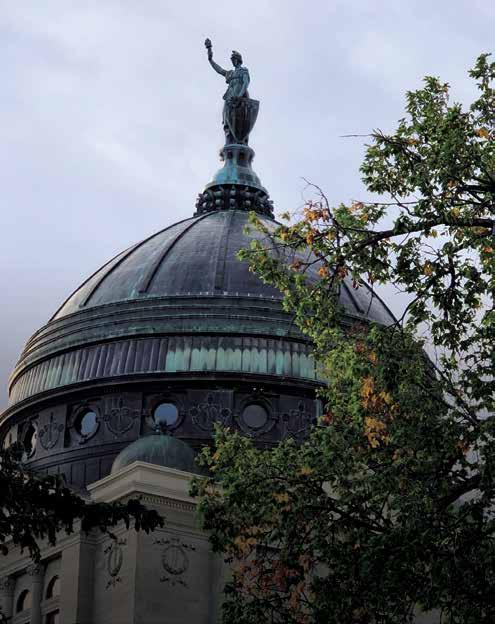
Montana Republicans set to deny medical procedures to Transgender patients
So-called “medical conscience” bill would also jeopardize reproductive care Queer country rock icon Brandi Carlile thanks Seattle in
by Mike Andrew SGN Staff Writer
The Montana state House of Representatives has passed a bill that would allow medical providers to deny specific procedures to Transgender patients and to patients seeking reproductive care.
Sponsors of HB 303 claim that it is a measure for “preservation and protection for medical conscience.” In fact, the bill would allow medical practitioners, health care facilities, and insurers to deny what the bill calls “lifestyle and elective procedures.”
by Daniel Lindsley SGN Staff Writer
Ozzy
and
CARLILE page 5
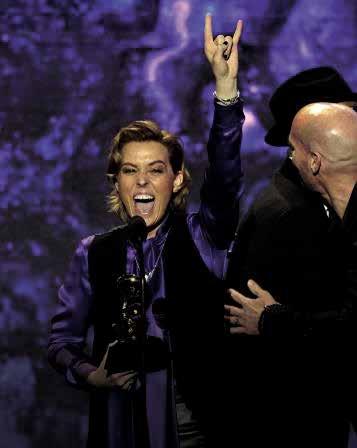
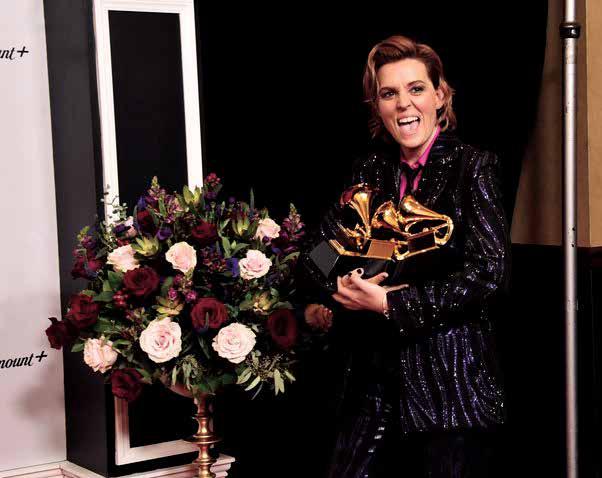
Ravensdale-born singer-songwriter Brandi Carlile has won this year’s Grammy Award for Best Rock Song for “Broken Horses,” from her seventh studio album, In These Silent Days. Competing for the award were
Osbourne’s “Patient Number 9,” the Red Hot Chili Peppers’ “Black Summer,” Turnstile’s “Blackout”,
the War on Drugs’ “Harmonia’s Dream.”
“Oh my god, this is amazing!” she said on stage after accepting her golden gramophone.
Photo courtesy of Montana State Legislature
Photo by Chris Pizzello / AP
Photo by Rick Bowmer / AP
by Lindsey Anderson SGN Staff Writer
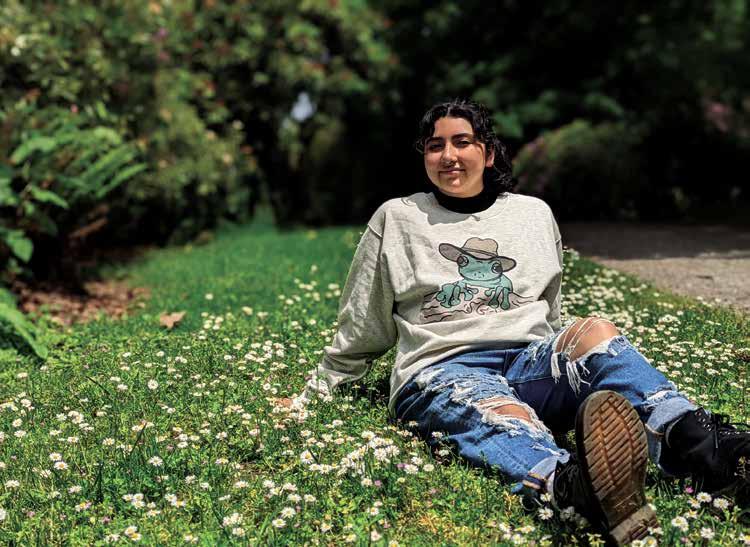
The Riverview School District is characterized by students, educators, and alumni as a “caring” and “tightknit” community. “Despite not living in the district, I feel like a member of the Riverview community,” gushed teacher Dan Armstrong in a recent promotional video








Local News
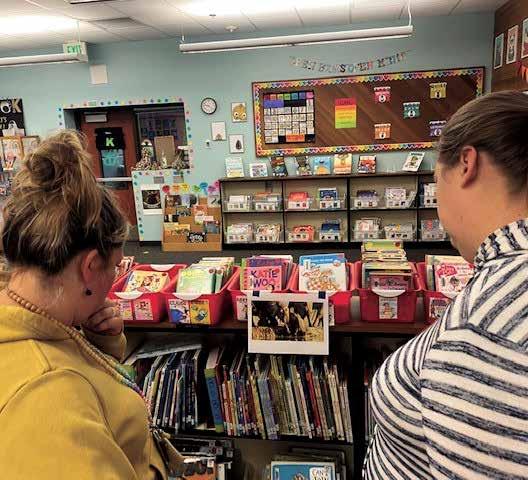
hearing about the challenges to the books, she started a petition on change.org that has now amassed over 1,700 signatures.
discussion of removing LGBTQ+ books from libraries may make Queer students feel isolated.
“Where I did my student teaching was in a really big district in San Diego. I never got the feeling I was part of that. I didn’t see those kids, in a way, as my kids, and I do [feel] that here. If I could sum up Riverview in one word, it would be ‘community.’”
The familial feelings of openness and acceptance ring out even from alumni, like current Microsoft video producer Devon Young. “There’s a feeling you get when you’re around family, that you can talk about anything, you can go after anything, and you know they’ll have your back. That feeling is what I get in this area,” Young said of the school district.
Fighting back
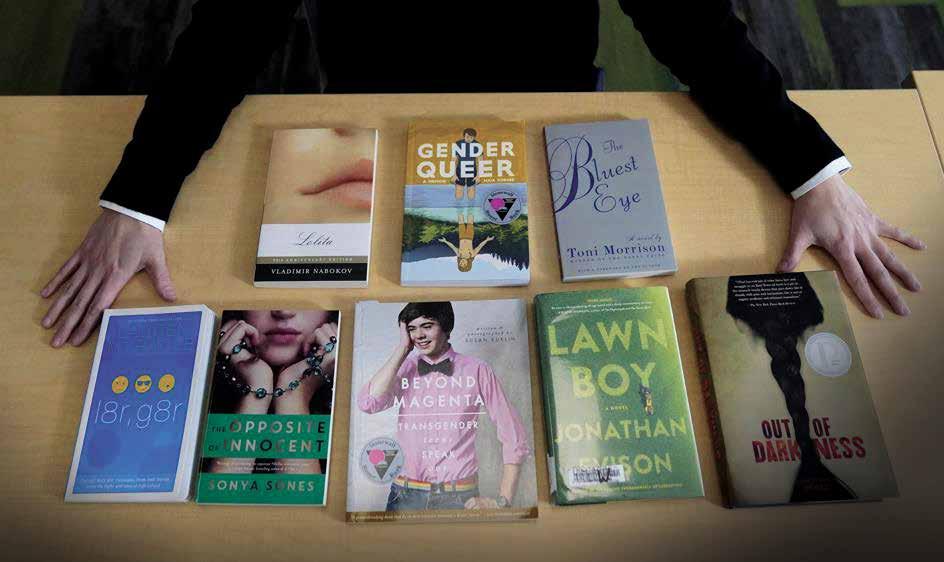
Despite this, not everyone in the district harbors the same feelings. This month, 53 residents of King County signed a petition requesting the removal of 14 “obscene” books from Riverview School District libraries. All of the books challenged include LGBTQIA+ characters.
Now, parents and educators are fighting the petition with one of their own. “Diverse children’s literature demonstrates that everyone has a story to share and that representation matters,” wrote Duvall parent and educator Stephanie Ransom. After
“All children deserve to see themselves in the pages of a book,” Ransom said. “Books that represent a variety of people and cultures help us understand the wider world around us. Reading diverse books reaffirms the value of all members of our community and promotes inclusivity.”
In response to the claims that LGBTQ+ books are “dangerous,” Ransom said that they are simply false. “Research shows that when minority students see representations of themselves in books, it is validating and academically engaging. It is equally important for children to learn about the experiences of other people to promote empathy and inclusivity.”
Riverview parent Sara Morris said she supports Ransom’s petition. “I firmly believe in inclusive books for all kids and all ages. Every kid deserves to feel represented in the library.”
Concerned citizens can sign the petition at https://www.change.org/p/supportfor-diversity-in-our-library-collections/c or reach out to the administration at Riverview School District.
Do book challenges speak to bigger problems?
Ransom’s petition has gained overwhelming support from concerned teachers and those parents who fear that even the
Despite this, some community members believe the most recent attempt to ban LGBTQ+ books and materials points to a bigger issue facing the district.
“I left Riverview because of the prevalent homophobia and racism,” said Marie Wood. “The rate of suicide at Riverview is higher than all surrounding districts. Villifying LGBTQ characters and erasure of LGBTQ representation in books through school library censorship is part of a larger systemic issue in this district.”
However, the official decision on removing the book is yet to be made. “The Riverview School District did receive a request to review library materials. The request is currently being reviewed by the district’s library material committee. A recommendation will be rendered within 60 days of the request,” Board Chair Lori Oviatt told the SGN
National movement to ban LGBTQ+ books
Riverview isn’t the only school district facing this challenge. Since the beginning of 2022, schools across the US have seen an increase in book challenges. Most of these center on LGBTQ+ and BIPOC topics. The trend can be linked to increasingly harmful rhetoric pushed by right-wing politicians who oppose “critical race theory” in school
and have pushed for policies akin to Florida’s “Don’t Say Gay” law.
Other Washington school districts that have faced book challenges include Kent, Central Kitsap, and Walla Walla. Some of the most popular titles being banned include All Boys Aren’t Blue, Jack of Hearts (And Other Parts), If I Was Your Girl, and Julian Is a Mermaid. These often explore the intersections of race, gender, and sexuality in a way that is age-appropriate and affirming to young LGBTQ+ people who may be discovering aspects of their identities.
While many book bans appear to come from concerned parents, school districts are now being warned to look out for watchdog groups like Moms for Liberty. This nonprofit organization made up of parents, grandparents, and community members is dedicated to “fighting for the survival of America by unifying, educating, and empowering parents to defend their parental rights at all levels of government.”
The national organization was started by two former school board members who felt that modern policies were “shortsighted” and harming their children. The group has become known for lobbying school boards and getting members elected who will represent their conservative beliefs.
In King County, the board is headed by Ann Streit. The SGN reached out to Streit but she did not respond.
Photo courtesy of Riverview School District
Arts & Entertainment

CARLILE
continued from cover
“I’ll never be the same. My mom’s out there. Theresa Carlile, Mom — I gotta thank you for telling me to stop singing so angry, ’cuz I obviously ignored that, like I ignored everything you told me to do.”
She paused to let the audience laugh, and said, “But I cut my hair, and I learned how to scream, and I just won a Grammy for a
rock ’n’ roll song that I wrote with all my heart.”
Carlile also thanked her wife and her daughters. Band members Phil and Tim Hanseroth chimed in with gratitude for their own family and friends.
The same song also won the Americana trio an award for Best Rock Performance.
“Oh, I cannot tell you how much this means to us,” Carlile said. “ We were born and raised in Seattle, and when I met these guys 22 years ago, we decided to get in a
van and be a band together. And I met them, and they were covered in Ramones tattoos; they had never even played an acoustic guitar. And then this happened.”
She thanked Seattle for her success, saying that everybody there “made us want to strive for this incredible accolade.”
Carlile’s wife, Catherine, and their two daughters, 4 and 8 years old, introduced the star’s performance of “Broken Horses” at the ceremony this year.
“Millions of viewers watching tonight
fell in love with the next performer four years ago when she took the Grammys stage for the first time and delivered one of the most iconic performances in Grammy history,” Catherine said. “I was lucky enough to marry her more than a decade ago, so I was way ahead of you.
“It means the world to me to stand here tonight with our beautiful daughters by my side and introduce, in our humble opinion, one of the greatest, most authentic artists and human beings on the planet.”
Background
This wasn’t the first time Carlile had a prominent presence at a Grammys show. She has received nine awards — including Best Country Song in 2021 and Best Americana Album in 2016 — along with 25 nominations so far.
Carlile’s career began in Seattle in 2004, when she and the Hanseroth brothers started performing in music clubs and recording songs at home. Since her breakthrough album The Story in 2007, she has been a consistent staple of the folk, country rock, and Americana genres, often topping the charts.
She has rubbed shoulders with the likes of the Avete Brothers, Shooter Jennings, the surviving members of Soundgarden, and more recently Joni Mitchell, with whom she performed last year at the Newport Folk Festival.
She and Elton John, one of her early inspirations, have been friends and collaborators for years; she performed at his farewell concert alongside Dua Lipa and Kiki Dee. As part of a long history of activism, Carlile hosted the 30th annual Elton John AIDS Foundation’s Academy Awards viewing party in March last year.
Carlile has been out as a Lesbian since 2002, when she told the Los Angeles Times that “I hope that somewhere in Small Town, USA, a 15-year-old kid looks to me as a role model the way I looked at the Indigo Girls and Elton John as role models. And I hope they also recognize that the reason why I don’t have a lot of formality around it, the reason why I don’t have to wear it on my sleeve and make a spectacle of it, is because there were people before me who paved the way, so I wouldn’t have to.”
Photo by Sonja Flemming / CBS
Photo courtesy of The Recording Academy
& Entertainment
Glorious ghosts thrill audiences in Pacific
Northwest
Ballet’s Giselle
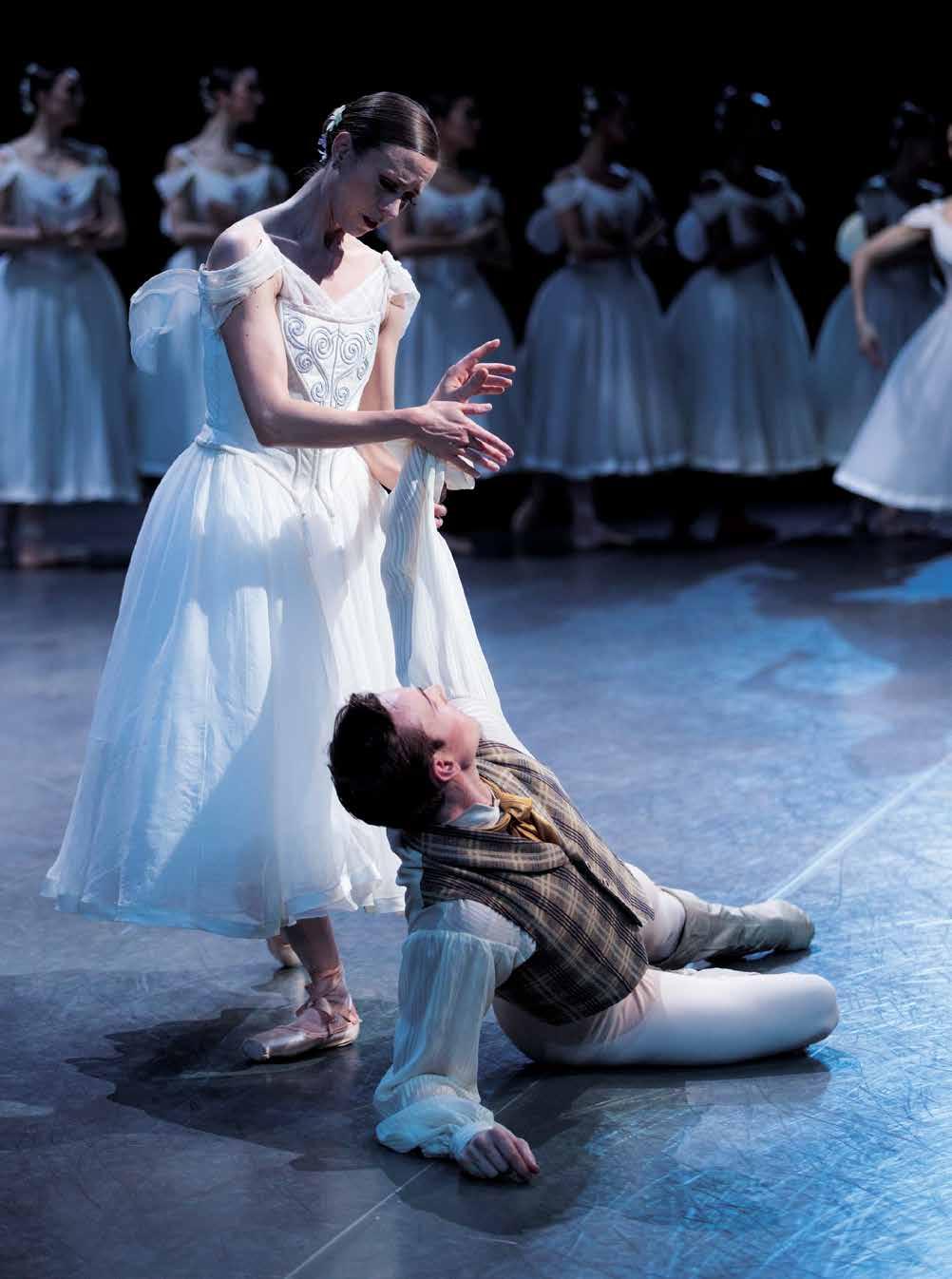
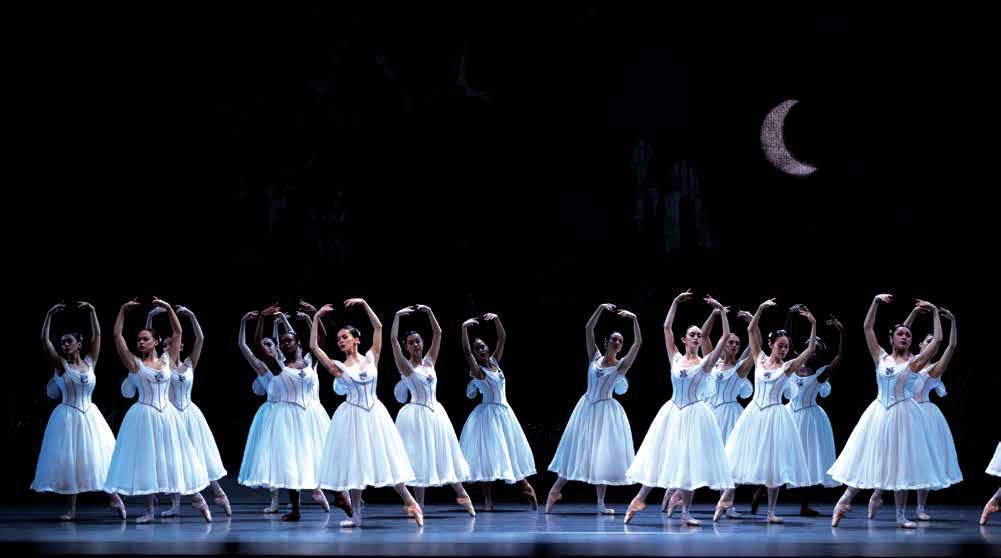
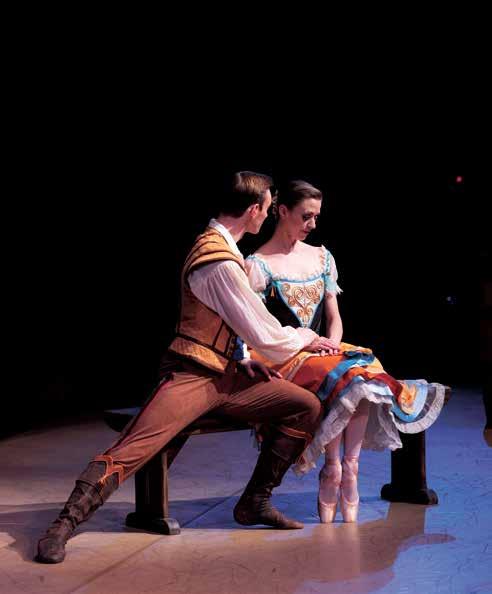
Pacific Northwest Ballet principal dancers Lesley Rausch and James Kirby Rogers with company dancers in Peter Boal’s staging of Giselle – Photo by Angela Sterling
by Sharon Cumberland
Special to the SGN
PACIFIC NORTHWEST BALLET
GISELLE
McCaw Hall
February 3, 2023
Pacific Northwest Ballet’s 50th anniversary season is now presenting the ghostly love story Giselle — a work so charmingly creepy and fabulously performed that you can hardly believe such a wide range of delights are packed into a single evening of dance.
Giselle is an oft-told tale of a humble girl seduced and abandoned by an aristocrat. But instead of dying in the end — like Madame Butterfly or Violetta in La Traviata — Giselle dies in Act 1 and becomes a ghost in Act 2, joining the ghosts of other young women who died before their wedding day.
On Friday, the demanding roles of Giselle (the village girl) and Albert (the amorous duke) were danced with tremendous passion by Leslie Rauch and James Kirby Roberts. But since Giselle is one of the great classical works featuring the strength, grace, and precision of the corps de ballet, PNB’s dancers were the collective stars of the show, and their performance on opening night was thrilling and unforgettable. In the first act, the corps de ballet perform a delightful waltz: 12 couples dancing like an army of lovers whose cheerful skipping steps infuse the story with joy and foreshadow the tragedy to come. In the second act, the 16 wilis — phantoms of brides who died before their wedding day — enter the stage in arabesque pose, each one hopping on a single foot, forming a ghostly cloud that caused the audience to burst into applause. As the story progresses, the wilis use the sin-
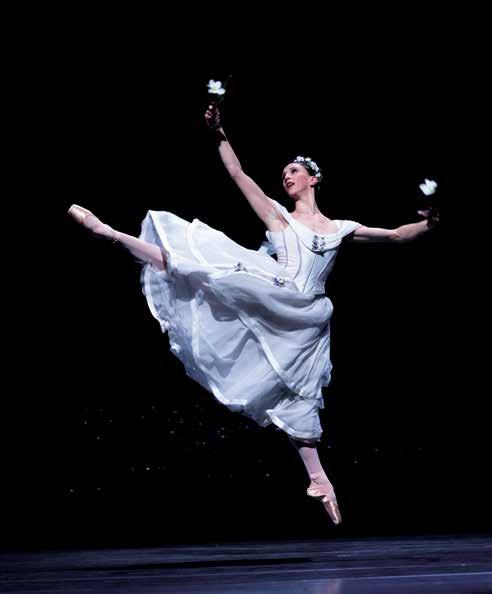
uous, fluid movement of their arms to weave spells that cause men who enter the forest to dance until they die. Giselle manages to save Albert, her repentant lover, from the Myrtha, Queen of the Wilis (danced with relentless precision by Elle Macy).
This romantic ballet was created by Jean Corralli and Jules Perrot in 1841, adapted by the famed Marius Petipa in 1884, and first presented in this version by PNB’s own Peter Boal in 2014. The music has been equally transformed from the original score by Adolphe Adam by adapters including Bergmüller, Drigo, and Minkus. Yet the music — wonderfully performed by the PNB orchestra and conductor Emil de Cou — seems to be as seamless as if it came from the mind of a single composer.
Another pleasant surprise on Friday night was the lobby window display in McCaw Hall, now sporting life-sized photographs
of every member of the dance company in spectacular, airborne poses. A fascinated a stream of patrons, myself included, walked slowly from one amazing photo after the other, studying how these powerful, elegant artists move their bodies.
The evening’s program also contained fascinating new information that included drawings that explain classical ballet mime gestures, and program notes featuring the characters, costumes, and history of the story of Giselle, with photographs of each character in costume. These enrichments, together with preshow presentations and postshow conversations, add up to an informed and enthusiastic audience.
This was a wonderful way to begin the celebration year of PNB’s 50th anniversary! Give yourself a valentine and see Giselle, performed at McCaw Hall through February 12, 2023.
Pacific Northwest Ballet principal dancers James Kirby Rogers and Lesley Rausch, in Peter Boal’s staging of Giselle – Photo by Angela Sterling
Pacific Northwest Ballet principal dancer Elle Macy as Myrtha, Queen of the Wilis, in Peter Boal’s staging of Giselle – Photo by Angela Sterling
Pacific Northwest Ballet company dancers as the ghostly Wilis, in Peter Boal’s staging of Giselle – Photo by Angela Sterling
Arts & Entertainment
Wevers’ magnificent seven thrill with three new dances
by Sharon Cumberland Special to the SGN
WHIM W’HIM SEATTLE CONTEMPORARY DANCE
NEW CREATIONS 23
Cornish Playhouse
January 20, 2023
Seven is a magic number for Olivier Wevers. His Whim W’Him Seattle Contemporary Dance Company, founded in 2009, has always consisted of seven dancers — no more, no less. The individuals have changed from season to season, but the company always engages seven immensely gifted dancers to present new works to their delighted and faithful audiences.
But why have seven dancers, instead of six, or ten? Why not add or subtract dancers depending on the project? The stability of Whim W’Him over its first 14 years suggests that the size of the troupe is one of the elements that make the company viable. (Whim W’Him has just purchased the former All Saints Church on Queen Anne Hill as its company home and future dance school, a wonderful achievement that demonstrates Wevers’ financial savvy and the loyal support he’s earned for his company over the years.)
On the other hand, there must be artistic reasons for the asymmetry of an oddnumbered, manageably sized troupe. Having seven dancers to work with challenges choreographers to think about that extra, seventh person. Are they the odd person out? Could that extra dancer be the straw that tips the balance of a group into a mob, or that pixilates a sun into a constellation?
If you have seven people, they can scatter into seven different directions or clot into an amoeba, a river, a chorus line.
Over the years, Wevers has offered 40 choreographers — including himself — the opportunity to work out ideas using the magic number of seven dancers. That’s enough people to make a big impact, but not so many as to be overwhelming to

newer choreographers, who are beginning to develop ideas that use more dancers than themselves and their two best friends.
Wevers is, of course, the top choreographer among the 40, having made (by my count) 32 new works for the company. He started Whim W’Him to give himself the opportunity to develop his love of dance making, as well as to give other choreogra-
phers a chance to add to their repertoires.
He’s brought a rich variety to Seattle to create works for his magnificent seven — from the well known, like Annabelle Lopez Ochoa and Penny Saunders, to up-and-coming talents who win the privilege of creating a new work by submitting videos for the annual “Choreographer’s Shindig.”
Over the years, a unique body of work
has been developed for Whim W’Him that demonstrates how seven dancers can inspire a range of work, from the moody to the quirky to the fabulous and grand. Three intriguing new works for the company repertoire were premiered at Cornish Playhouse last week.
A Lavender Touch
Choreography: Olivier Wevers
Music: Jacque Morali, Henry Percell, Safvk
The opening work of the evening combined Purcell’s famous lament from the English opera Dido and Aeneus with the recorded voice of Harvey Milk — the first Gay person to be elected to the San Francisco Board of Supervisors and one of the first homosexuals to be elected to public office in the United States. He was assassinated in 1978 for his courageous advocacy of Gay rights.
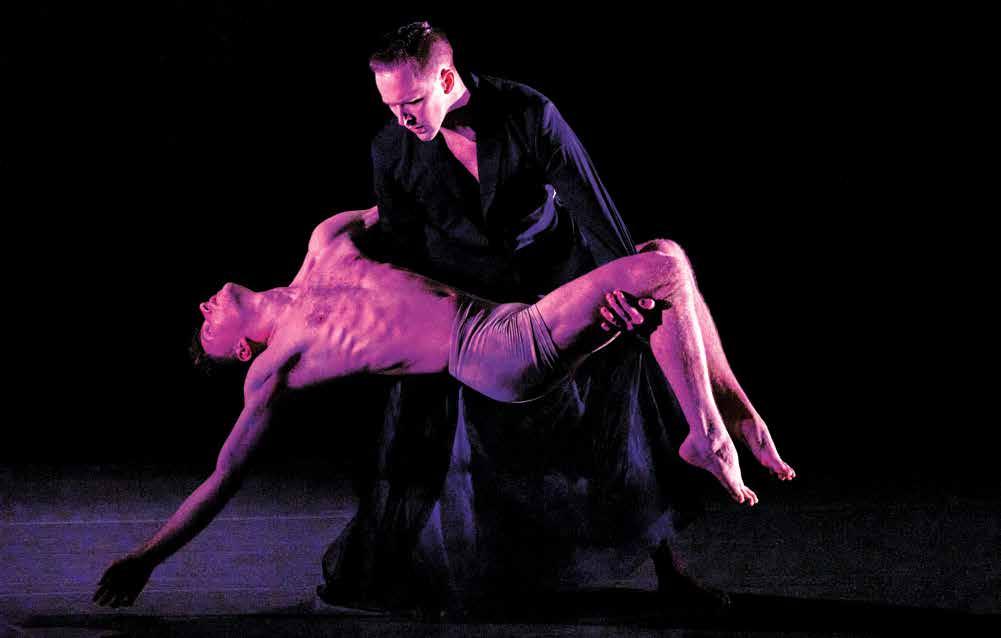
Of the many striking elements in this narrative dance, there were three that stood out for me: a male dancer in a long tulle skirt — a kind of spirit of compassion or suffering — who haunted each sequence of the dance, following the trials of Gay people as they were ridiculed, beaten up, and victimized; a nightclub scene where men and women danced under a disco ball to a tune very much like “YMCA” — a joyous moment ruined by police and persecution, illustrated by a group somersault that turns into a single figure pulling the inert group like a heavy chain (in my notes I wrote “AIDS?”); and the most compelling of all, a finale in which the focal character is persecuted and killed, but then embraced by the spirit — and then in one tantalizing moment takes on the pose of Michelangelo’s Pietà Wevers’ heartbreaking dance conjures up — for those of us old enough to remember these events in real time — a terrible, irrational period of violent persecution, when Gay men and women stopped apologizing for being Gay. As Harvey Milk said, “Society belongs to all people in society. Equality is what America is all about.”
A Lavender Touch – Photo by Allina Yang
Olivier Wevers (in gold socks) with company members in rehearsal – Photo by Allina Yang
primetime
Choreography, music, costumes: Mike Esperanza
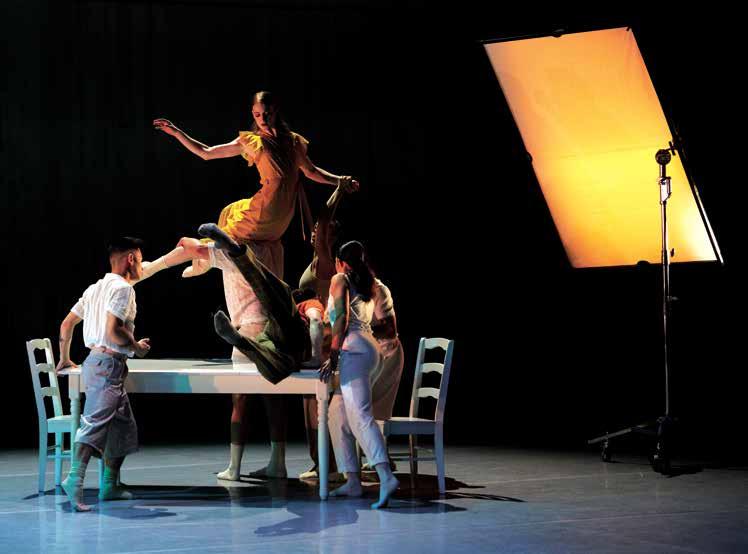
I’m old enough to recognize the references to the fight for Gay justice in the 1970s, but too old to recognize the TV shows that frame Esperanza’s dance about primetime television. The set looks like a family home populated by two camps: the couple who really live in the house, and shadow people dressed in white who imitate the couple as if they were filming a TV show based on the real people.
No matter: I didn’t need the references to enjoy the dance. The two worlds were clearly established, compelling the viewer to consider the difference between the “real” world of the young couple and the imitative, robotic world of the film crew/shadow people — which was taking place in a theater full of real people in the audience and real people on stage pretending to be either real or ghostly. This world of nesting dolls has a lot to say about the intersections between reality and the fantasies of reality. It was unsettling, especially since the couple in the dance weren’t the happiest people in town.
Esperanza’s real/unreal world was a clever narrative dance and a tour de force from the mind of a multitalented choreographic world-builder.
Yemaya’s Embrace Choreography: Annabelle Lopez Ochoa Original composition: Jimmy Garver
The last dance of the evening was by a company favorite, Annabelle Lopez Ochoa, who has made eight dances for Whim W’Him. This one surely must be the most striking of all.
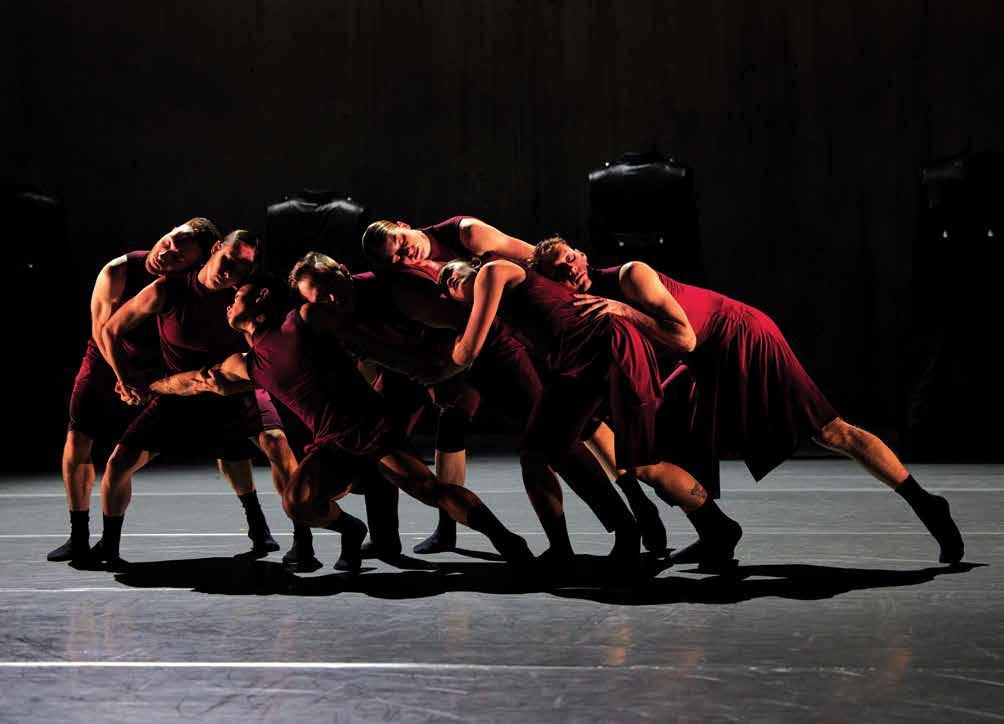
In it, Lopez Ochoa uses seven large metal forms that look like body-length military vests. At first they’re lined up along the back of the stage, unnoticed, while the seven dancers roll back and forth along the ground like so many logs buffeted by waves in the ocean. The perfectly coordinated back-and-forth rolling conveys a powerful image of the sea — a kind of freedom in conformity.
At key moments, some of the dancers sneak onto the coat form, sticking a head out the armhole, an arm out the neckhole. When the dancers are in these contraptions they can only move with tiny steps — a metaphor for the tortuous constraints imposed on citizens of totalitarian states.
Yemayá is the goddess of the ocean in the Santería religion and sacred to practitioners of that faith in Cuba and Mexico, where, in the case of the former, a totalitarian government is surrounded by the beauty and freedom of the sea. The rigidity of the metal jackets contrasts with the freedom and lightness of the dancers as they represent the free-flowing sea. Through a series of undulating sequences, contrasted with the sheer weirdness of the looming jackets, the viewer becomes aware of the mournful loss of freedom in totalitarian countries that remember happier times.
The flow of immigrants around the world, fleeing from domination by those who impose the personal and political restraints that the jackets imply, is beautifully represented in this dance. I found the gestures and coordination of the dancers in Lopez Ochoa’s choreography to be the most beautiful of the evening. I didn’t have to know exactly which country was being represented by the rigidity of the metal forms, since Lopez Ochoa so clearly exposed the consequences of such restraints, paid for with isolation, starvation, and displacement.
All in all, it was a wonderful — and wonderfully thought-provoking — evening of dance, soundscapes, and imagery. To think that so much can be accomplished on stage by only seven dancers is one of the wonders of Whim W’Him that makes this company so successful and so unique.
Yemaya's Embrace – Photo by Allina Yang
primetime – Photo by Allina Yang


Arts & Entertainment
Hogwarts Legacy comes under fire for Trans NPC

by A.V. Eichenbaum
SGN Editor-in-Chief
Noted transphobe J.K. Rowling returned to the spotlight ahead of the launch of Hogwarts Legacy, a videogame set in Harry Potter universe, when developers of the game introduced a Trans NPC named Sirona Ryan. Sirona is the first Trans character introduced to the Wizarding World.
The fictional bartender and owner of the Three Broomsticks has come under scrutiny for a number of reasons, not the least of which is her name.
Though she is named for the Celtic goddess of healing, many online have called attention to the fact that the word “Sir,” a traditionally male honorific, is present in the beginning of the word “Sirona,” and that Rowling is infamously meticulous about the sometimes problematic names she gives her characters. The once-beloved children’s author has gone on record explaining the in-depth thought process behind the names of characters like Mundungus Fletcher and Severus Snape, among others, but named her only Asian character Cho Chang.
Some even drew parallels to Rowling’s other pen name, Robert Galbraith, which, despite the author’s denial, is often speculated to be a nod to anti-LGBTQ+ therapist Robert Galbraith Heath, who touted shock therapy and conversion practices to “cure” Gay men.
Other criticisms of the character stemmed from the way she is portrayed in-game. Denizens of TransTok judged Sirona’s design, saying she looks “bricky,” a derogatory slang term used to describe Trans women who appear “too masculine” or who “aren’t passing,” while residents of Queer Twitter said it sounded as though she was voiced by a cis male actor. Sirona is reportedly voiced by Trans actress Rebecca Root, but Root has not stepped forward to confirm despite being listed in the game’s credits.
In a statement to gaming news website IGN, a representative of game developer Avalanche Software said that Sirona Ryan was included because they “felt that it was very important to create a game that is representative of the rich and diverse world of Harry Potter as well as the groups of people who play games, which includes the LGBTQIA+ community.”
Video of gameplay introducing the character is available on YouTube. In the game footage, the player is seen entering the Three Broomsticks and talking to Sirona, who is cleaning glasses behind the bar. It is revealed that Sirona is friends with a goblin
the player is looking for and that many of Sirona’s old classmates didn’t recognize her at first when she took proprietorship of the pub. “It took them a second to realize I was actually a witch, not a wizard,” she tells the player. She appears to play an incredibly minor role in the overall plot of the game.
On the subject of gameplay, Hogwarts Legacy noticeably doesn’t ask players to choose a gender during character creation. Instead, players are asked to choose between two voice options and whether they wish to sleep in the Wizards’ or Witches’ dorms. This appears to be in keeping with Avalanche’s promise of inclusivity.
Hogwarts Legacy was officially released on February 10 and had nearly 500,000 playing it pre-release, despite continued online rallying against Rowling’s harmful views. Rowling was largely uninvolved with the development of Hogwarts Legacy, but according to Forbes she will be receiving royalties for the game’s sales.
Currently, the 57-year-old author’s net worth is $1 billion.
It is predicted by the SGN that Millennials will continue to judge one another upon meeting based on their Hogwarts houses alone.
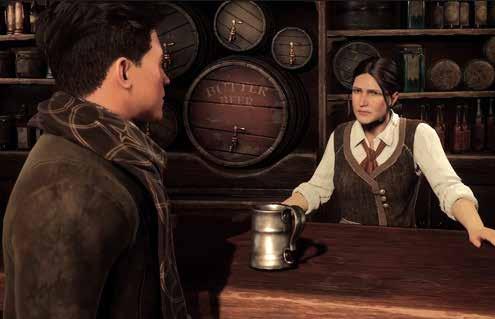
Sirona Ryan from Hogwart's Legacy – Image courtesy of Warner Bros. Games
Hogwart's Legacy – Image courtesy of Warner Bros. Games
Emotionally shattering Huesera leaves a lasting mark

by Sara Michelle Fetters SGN Staff Writer
HUESERA: THE BONE WOMAN
Theaters / PVOD (Feb. 17)
Mexican import Huesera: The Bone Woman is not for the faint of heart. Filmmaker Michelle Garza Cervera’s raw, emotionally blistering feature-length debut is a sojourn into longing, familial pressure, impending motherhood, and sexuality that attacks its subject matter with a gracefully pugnacious urgency some will undoubtedly find shocking. The story ponders hard questions, few of which have easy answers, with Cervera taking the audience on a wild ride into the unknown with such confident authority that her film can’t help but leave a lasting mark.
Valeria (newcomer Natalia Solián) is going to be a mother. She and her husband Raúl (Alfonso Dosal) are ecstatically making
plans for their baby’s arrival. But Valeria’s immediate family isn’t nearly supportive as they claim, most believing the young woman isn’t mature or mentally stable enough to be a mother. Only her secretive grandmother Isabel (Mercedes Hernández) is willing to embrace and stand up for Valeria without hesitation, and it is her protective embrace that will be needed the most as days turn to months and the baby’s birth approaches.
While this is all standard melodramatic stuff, Cervera isn’t content to leave things there. Not only does Valeria have a complicated past involving close childhood friend Octavia (Mayra Batalla) that could throw a massive wedge between her and Raúl, but there is also something else amiss with this pregnancy. There is an ominous force stalking Valeria, some sort of shape-shifting, human-figured vapor showing her terrible sights of pain, suffering, and shattered bone, and its presence
is slowly driving the pregnant woman mad. No surprise, but the central question is whether or not this entity is a product of Valeria’s imagination. The changes to her body, the way pregnancy and motherhood have taken her life in an unexpected direction, and how her family reacts when she claims there is something wrong are only a few of the character-driven avenues Cervera is interested in wandering down as she deftly weaves a sinister web.
But when you throw in the two subplots involving Isabel and Octavia, events immediately go in a variety of unexpected, yet equally haunting and bracingly intimate, directions. The impending birth has released both a seemingly demonic force hungry for blood as well as long-buried desires Valeria has tried — and failed — to destroy by marrying Raúl and entering into a life of feminine diffidence she thought would bring her happiness.
For reasons best left unrevealed here, Isabel is close to a tight-knit cabal of witches, and they may be the only ones who can help Valeria fight off the monstrosity hungering for her unborn child’s soul. But there is danger in letting them use their magic; their cure could leave scars that are as psychologically crippling as they are physically destructive.
As for Octavia, she is the catalyst that inadvertently helps the supernatural elements manifest. Her presence also gives Valeria the permission she needs to find the strength to fight back. These two women have a painful past, one that is delicately showcased in a series of brief flashbacks that Cervera eloquently sprinkles in at crucial moments. Lust, longing, love — all are explored as Valeria and Octavia rekindle their friendship in the shadow of this bondcrunching madness, and whether or not this is a good thing is a key mystery in need of being solved.
There is a meticulousness to the presentation that is frequently astonishing.
Cinematographer Nur Rubio Sherwell does a splendid job of utilizing every corner of the frame. Much like Rosemary’s Baby, Don’t Look Now, or The Shining, it is often what is creeping around on the other side of a cracked door, lurking underneath the darkened recesses of a handmade crib, or standing barely outside the glare of a flickering streetlamp that provokes the most breathless anxiety.
I do wish I had felt more of a connection between Valeria and Raúl when they were together. While some of this is undeniably on purpose, I still couldn’t shake the feeling that Cervera intended their relationship and marriage to have more weight and meaning than I was frustratedly finding. I also didn’t like how nasty Valeria’s closest family members were to her (outside Isabel, of course). Their not-so-hidden disdain hit me as somewhat forced and insincere.
None of which matters, thankfully. Solián is outstanding in her debut, and the emotional physicality of her performance left me breathless. As for the finished film, the last third held me spellbound. Cervera held my nerves in the palm of her hand, and I couldn’t wait to discover Valeria’s fate as she searched for deeper truths and found reasons to keep fighting. Huesera: The Bone Woman is something special.
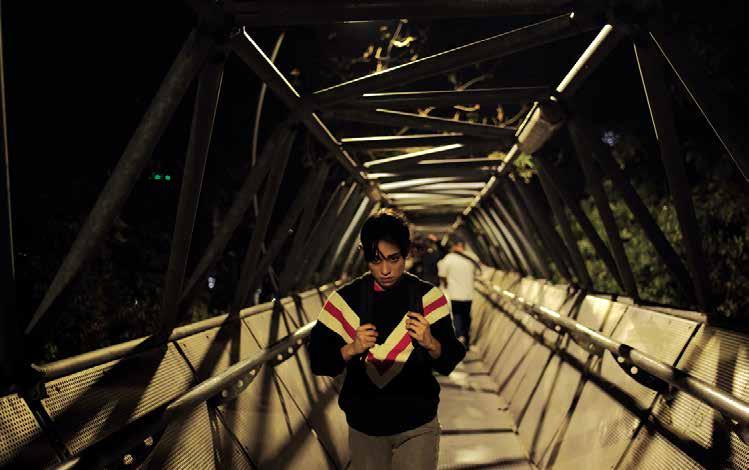
Natalia Solián in Huesera: The Bone Woman – Photo courtesy of XYZ Films
Natalia Solián in Huesera: The Bone Woman – Photo courtesy of XYZ Films
Books
Choose to read Choosing Family
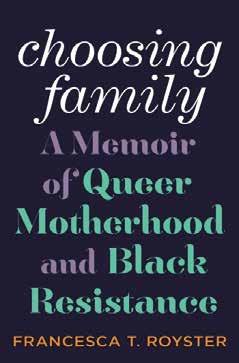
by Terri Schlichenmeyer Special
to the SGN
CHOOSING FAMILY: A MEMOIR OF QUEER MOTHERHOOD AND BLACK RESISTANCE
FRANCESCA T. ROYSTER
© 2023 Abrams Press
$26.00
264 pages
The whole idea hit her like a slap.
Francesca Royster had never particularly wanted to be a mother. She’d dated boys in school, decided that she liked women better, and eventually came out to her family. No, motherhood wasn’t on her radar — and yet, when she saw a sleepy toddler wrapped in her mother’s arms at an airport, Royster had the sudden need to tuck that little head beneath her chin.
She never discussed it with her partner, Annie. The urge “receded to the edges of my thoughts,” she says, and they traveled instead, hit middle age together, cared for
siblings’ kids, and joked about “breeders.”
She loved the life they’d built as Queer women with community, what Royster calls “Queer time.” Would she lose that, if there were a baby involved?
She and Annie split, took time to think about the future, but came together nightly to talk and plan. Royster spoke to “the mothers” — ancestors and goddesses from other cultures — and she thought of the kids near her hometown of Chicago who needed families.
Her female forebears had raised children, their own and others’, in situations that were fluid. Surely, two Queer women could, too.
And so she and Annie applied to adopt, and after a nail-biting wait and a near-loss, they brought home their daughter, Cece, who became a fierce, smart, loving little girl who’s cherished by the family that her mothers have assembled.
“I... know that there might come a day when Cece won’t feel as comfortable with this motley group that is our chosen family,” Royster writes. But “...by living our
lives as truly as we can... we can change the world that she inherits.”
Not that it will affect your enjoyment at all, but the subtitle of Choosing Family is a bit confusing. This book is more about “Queer motherhood” than it is about “Black resistance,” and that’s okay. The best, most meditative, most meaningfully worded parts of Royster’s story are in becoming a mother to her child, and in tales of her own mother and other steely female ancestors who left their prints on her.
Anchored by the turning of the word “family” upside down and reclaiming it from white hetero-normalcy, then, readers are led — indeed, treated — to what Royster and her partner created B.C. (before child) and afterward. Theirs is a made family that includes blood relatives, absent relatives, and relatives-because-we-say-so.
That’s icing on a work-in-progress cake for readers who are considering doing the same thing, formal or otherwise. Choosing Family is also for those who’ve done this work, created the family they want, and it’s all good.
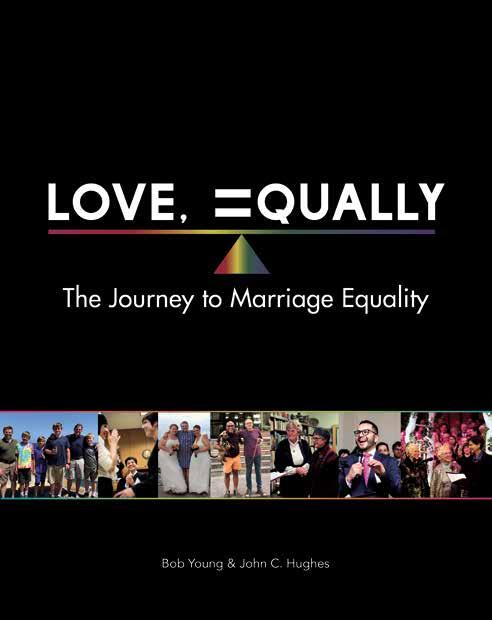
Love, Equally remembers the fight for marriage equality in Washington state
by Lindsey Anderson SGN Staff Writer
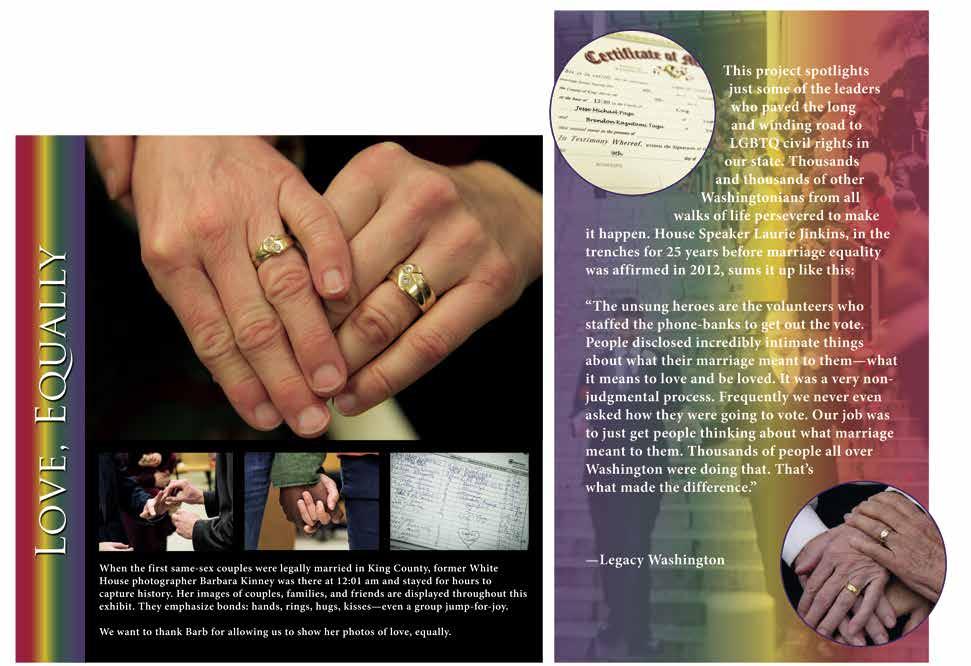
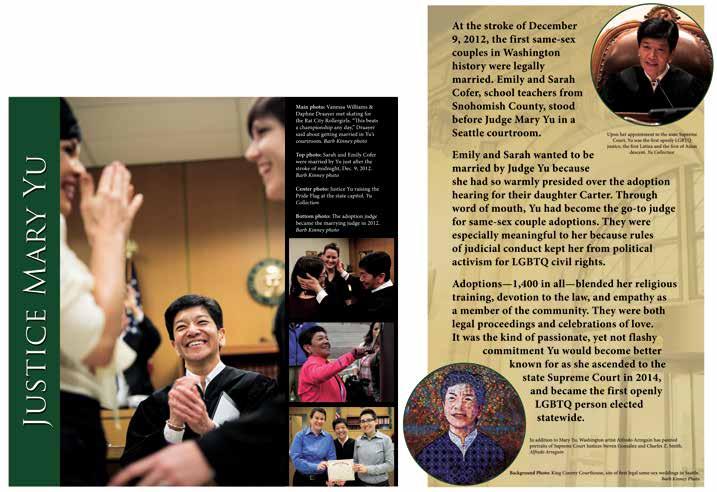
History is made every day. Nowhere is there a better reminder than the upcoming Legacy Washington book, Love, Equally. While history buffs often focus on milestones in the LGBTQ+ civil rights movement, like the Stonewall riots and “Don’t Ask, Don’t Tell,” Legacy Washington is putting the spotlight on modern history with its upcoming exhibit and book centered around the legalization of same-sex marriage in Washington state.
Using real stories
Relying on the oral history of advocates, policymakers, and LGBTQ+ people living through the decades-long struggle for marriage equality, Love, Equally shines a light on the critical milestones that helped Washington pass groundbreaking legislation years before the rest of the country. The book focuses on profiles of activists and politicians who, for the most part, are still alive today.
“Going along with the oral history aspect, we’re only interviewing people still alive,” said Aaron Peplowski, Washington historian and fact checker for Love, Equally. “So except for Cal Anderson, our profile panels are made from oral history interviews... It’s all about the tenth anniversary of marriage equality.”
Focusing on love
Love, Equally will be officially released on February 14, to coincide with the grand opening of the new marriage equality exhibit in Olympia. The book explores some of the exhibit’s themes in more depth.
“…Why we call [the book] Love, Equally, is [because] early attempts to get Gay civil rights in front of people as acceptable focused on privacy and just the Golden Rule: do unto others as you would have done to you,” Peplowski explained.
“[Later efforts] shifted it toward focusing on love. Everybody has a right to love, and everybody has a right to show that love through marriage.
“Attitudes can change. …[This] should be an inspiration to folks who are trying to get change done in any realm.”
The fight continues Legacy Washington picked the topic of LGBTQ civil rights at a time when a record amount of anti-LGBTQ legislation has been proposed in state legislatures across
the US. Just this year, Washington legislators introduced House Bill 1214, which if passed, would prevent children from receiving gender-affirming care.
“[This project is] going to resonate a lot with LGBTQ civil rights leaders now, because of the current environment and having to deal with bathroom bills and different things like the ‘Don’t Say Gay’ bill. …This journey shows that if you stick to it, [though] it can take a while, it’s possible,” Peplowski said.
Connecting past and present
Love, Equally is not the first history project Legacy Washington has taken on. It fol-
lows an established tradition of exploring state history through the voices of prominent citizens. “We have this neat idea to connect that old history with the things we do now,” Peplowski explained. “Our main function of the program is to do oral history. We interviewed a bunch of people we consider ahead of the curve now and gave them a counterpart in history.”
The last exhibit Legacy Washington released was about women’s suffrage in Washington. Like same-sex marriage, the state gave women the vote years before it happened on the federal level. Drawing comparisons between historical events
from over a hundred years ago and the modern passage of marriage equality allows readers to understand how Washington state has been ahead of the curve in progressive policymaking.
Including oral histories from the people entrenched in the movement also allows readers to understand just how recent the fight for LGBTQ equality is.
“We want to attach a present state of mind to what people were thinking when they went through it. To go to the source, the primary source in oral history, you can say, ‘This is what that person was thinking, to the best of their memory, at that time.’ You get to collaborate and bring together all these voices. You get to not only have those oral histories if people want to see those directly, but then you see what the narrative is,” Peplowski said.
The Washington experience in a national context
Another unique aspect of Legacy Washington’s history book is how the idea to write about LGBTQ civil rights came about.
“What we wanted to do was talk to some of the people involved in it and have them guide us to other people to talk to, who were involved with getting legislation… and… civil rights bills passed,” Peplowski said.
“Then obviously, domestic partnership and [those] at the forefront of those issues.
“It’s cool to hear directly from them instead of the sources in the index of a book. Going back deeper and deeper to get into the sources, you can talk to people living in it. It’s an exciting part of all the projects we do.”
Although it’s been less than a decade since the Supreme Court ruled on marriage equality, several books have already explored the significance behind the decision. However, what sets Love, Equally apart is that the book is primarily about the state of Washington.
“We wanted to focus on specifically the Washington experience. We are a Washington program. We have specific legislation that we can point to, whether it was the … bill passed by the [state] legislature in 2012 and [signed] by then Gov. Gregoire or Referendum 74, which is what the people voted on,” Peplowski said.
“…[The book] does point to things that were earlier on, because those too reflect the experience of the people we interviewed, going back to Stonewall and ‘Don’t Ask, Don’t Tell’ in the military: all specific
Image courtesy of Legacy Washington
Image courtesy of Abrams
things that were points along the way for a collective movement. But we wanted to focus on how we got, in Washington, people the ability to have same-sex marriages.”
Even though Love, Equally has a more local emphasis, the researchers still had to examine national trends to understand the shift in ideology that took place over just a few decades.
“…You could tell that there was a national movement toward accepting LGBTQ lifestyles, which, you know, [is reflected] in pop culture. A lot of people referenced Ellen. When she first came out, it was this whole thing. Then her show got canceled a year later, but not too long after, you had Will and Grace, which specifically had a Gay character — multiple Gay characters — from the start. So, you knew attitudes were changing.”
Historians also pored over other books that had already documented the shifts in popular culture to understand what was going through the minds of Washingtonians.
“…Public opinion [has shifted] on whether or not same-sex marriage should be legal,” Peplowski explained. “Not too long ago, it was wildly in the ‘no’ column, and now it’s ‘yes,’ as we saw in the passing of the Respect for Marriage Act in Congress… It has shifted to many constituents expecting their legislators to vote [yes] on it.”
Just the facts
Writing a nonfiction book is no small task.
Unlike most novels, Love, Equally required a team of authors, editors, researchers, and fact-checkers to ensure that all the stories
in the final project were true and accurate. Peplowski was one of many team members tasked with fact-checking.
“My primary job was to back up the research done by our two authors, one of which, Bob Young, who recently retired, was the one who started setting this up. It was in late 2021, and that took over his 40-hour-a-week job,” Peplowski said.
Once the project got underway, it soon became the main effort of all involved.
“In September, [Young] did several interviews with each of his subjects,” Peplowski said. “The other writer, John Hughes, the current chief historian of the secretary of state, took a couple of months to finish a different work… — the autobiography of former Gov. Dan Evans. Then he shifted about
February of this year. That became his fulltime research. I created the layout with the text [and] pictures, and did some editing, and helped them with all the research. That was my complete job from the time my boss, the chief historian, started. So we were working solidly from about February of [last] year until the book wrapped.”
Despite the book primarily employing oral history interviews, a majority of the work was ensuring that the stories were reliable.
“…You have to fact-check and index, which is the most boring part,” Peplowski said.
Available electronically and in perpetuity
For those hoping to view the exhibit or read the book, both will be available for free virtually. The book Love, Equally will be available to purchase as well.
“Luckily, the book will be available [electronically], but also there will be a virtual exhibit, Peplowski said. “All of our exhibits have been made available on the website. That’s kind of the beauty of the state public funds that pay for the historians to do their jobs.
“Eventually, the book will be free, not only through libraries but also in PDF form on the website. We will have chunked out the profiles to correspond with each of the exhibit panels.
“So the virtual exhibit, the book, and the physical exhibit will launch on February 14. If people are far, far away and can’t make it, we’ve got you covered. That will be available in perpetuity...
“After that, all our exhibits are made available to travel to other museums, focusing on Washington museums and other institutions like archives and libraries as well.”
All of Legacy Washington’s publications can be found at sos.wa.gov/legacy, including previous exhibits and books. While the book will be free in PDF form, the organization asks for those able to do so to make a small donation to help cover some of their costs.
“The printing costs of our book and the outreach are covered by our 501(c)(3) foundation. While our salaries are covered, we still need an extra little boost to get things out there,” Peplowski said.
Images courtesy of Legacy Washington
Travel Pride journey: Jacksonville, Florida




by Joey Amato Special to the SGN
The last time I visited Jacksonville, I was probably in my early-mid 20s and living in Orlando. It was a very long time ago. I was eager to visit again, as I know that much has changed in the city since the early 2000s. If you are ever planning on visiting, I would highly recommend renting a car, especially if you want to get a good idea of all the city has to offer. Jacksonville is the largest city in the country by land mass, and many of its popular attractions are spread out.
I decided to stay downtown for this trip, since much of my itinerary was within a few miles of city center. The Residence Inn Downtown Jacksonville is a beautiful property within walking distance of some of the city’s attractions and great restaurants, and a block from one of its popular LGBTQ nightlife spots, Incahoots. The bar offers some incredible drink specials, so be sure to check its social media accounts before you go, in order to capitalize on those. It is also the place to catch a fabulous drag show.
On a budget I wanted to make the focus of this trip about budget travel. Many times, people tend to not visit certain destinations — or travel at all — because they think they aren’t affordable. Before setting out on my Jacksonville adventure, I did some research and discovered some restaurants and attractions that are not only affordable but also some of the most highly recommended in the city. Breakfast is the most important meal of
the day, and the Residence Inn offers a complimentary one for guests, but if you are in the mood to try out a local breakfast spot, head to Cool Moose Café. I met my friend there, and we both had a delicious meal for around $10. Everything was made from scratch, and the service was wonderful.
Next, head over to the Cummer Museum of Art and Gardens, which offers free admission on the first Saturday of each month. I visit so many art museums that sometimes they can become routine, but this one happened to have two very cool exhibitions during my visit. The first was “The Age of Armor,” an incredible collection of dozens of pieces of armor dating back hundreds of years. Most were of European descent, but there were a few from other civilizations.
The other exhibition was a display of movie posters from Norman Studios. Jacksonville was a filmmaking hot spot prior to Hollywood, with 26 movie companies calling it home during the silent movie era. In the earliest years, Black actors and actresses were only cast as extras in films, which mostly catered to white audiences. Richard Norman purchased the Eagles Studio complex and went on to create one of the top production companies, featuring predominantly Black cast members. Unfortunately, Norman was forced to close his studio during the Great Depression, but his legacy can be seen in this wonderful exhibition at the museum. The Norman Studio building itself is the last known silent film studio still standing in Jacksonville, and efforts are underway to make it into a museum.
For a quick lunch, head over to Arepa Please, just a few blocks from the museum. Try its signature pabellón arepa, which contains shredded beef, sweet plantains, queso blanco, and black beans. It was delicious and filling but didn’t break the bank. I always like to visit art galleries when I travel. On the way to Jacksonville Beach is Gallery 725, one of the best in the city. It was showcasing the works of late animator Ron Campbell, including artworks based on the Beatles Yellow Submarine and their Saturday morning TV cartoon series, as well as Scooby Doo, The Smurfs, The Rugrats, The Jetsons, and The Flintstones
The gallery also features works from internationally renowned pop artists Peter Max and Roy Lichtenstein, among others.
Nature, shopping, dining
Jacksonville’s beaches are beautiful and not as crowded as South Florida’s, so I would recommend spending the morning or afternoon exploring, including Atlantic Beach and Neptune Beach. You’ll find a ton of wonderful seafood restaurants in the area as well.
The highlight of my trip was a visit to Catty Shack Wildlife Sanctuary, which provides a safe, loving, and forever home to endangered big cats. The sanctuary’s mission is to educate the public about their plight in the wild and in captivity. It’s home to a variety of big cats, but the majority of the residents are tigers. While most of them have their own space, the siblings share an enclosure. It’s undergoing a large expansion which will include some additional large enclosures to give the cats more room to roam and play.
I was most intrigued by the black leopard. I don’t think I’ve ever seen one before. Khala Hala, born at Catty Shack Ranch on June 16, 2004, was happily positioned on her perch and made eye contact with every visitor who passed by her enclosure.
If you are in the mood to do some shopping, head to St. Johns Town Center, a beautiful outdoor venue featuring a variety of retailers ranging from Tiffany & Co. and Louis Vuitton to Pottery Barn and Restoration Hardware.
There are many dining options available there, including a great Mediterranean fastcausal chain called Cava, but if you are looking for a local option, head back downtown and try S & R Dim Sum, which is located not too far from Memorial Park. I ordered the shrimp dim sum as well as the sweet and sour chicken, and both were wonderful. I especially liked the chicken dish, as it was only lightly breaded and sautéed rather than deepfried like in other Chinese restaurants.
For one last cocktail in Jacksonville, head to Park Place Lounge, just a short fiveminute drive from downtown. It boasts an extensive happy hour — from noon until 7 p.m. — and you can mingle with the locals on the outdoor patio.
If you are looking to escape the harsh winter but avoid the crowds of other beach cities, then Jacksonville is a great option. It provides a variety of indoor and outdoor activities for every budget. River City Pride will take place in November, so there more than enough time to make your Jacksonville Pride plans.
Enjoy the journey!
Photos by Joey Amato
National News
Christian baker loses appeal in Trans cake case
by Mike Andrew SGN Staff Writer
Christian baker Jack Phillips of Masterpiece Cakeshop has lost his appeal in a court case sparked by his refusal to make a cake celebrating a customer’s newly proclaimed Trans identity.
A three-judge panel of the Colorado Court of Appeals affirmed a prior trial court decision that Phillips violated the Colorado Anti-discrimination Act by turning away a Transgender customer on account of her gender identity.
Phillips had claimed that his First Amendment rights to free speech and free exercise of religion would have been violated if he’d been forced to make a cake celebrating Trans identity, since his religion disapproved of gender transition.
The appeals court rejected that assertion, telling Phillips that the cake — a simple sheet cake in pink and blue Trans colors with the customer’s chosen name on it — “expressed no message” that would violate Phillips’ rights.
“[N]ot all conduct constitutes speech,” the court added.
The original complaint was lodged against Phillips and Masterpiece Cakeshop by Autumn Scardina, a Trans woman, after Phillips refused to make a cake for her.
“Scardina testified she requested a custom pink and blue cake with no message or other design elements. The trial court found that Debra [a Masterpiece Cakeshop employee] agreed to make that cake but then retracted the commitment once Scardina told her what the cake was for,” the court noted in its opinion.
The Alliance Defending Freedom (ADF), which is representing Phillips, denounced the appeals court’s decision and vowed to appeal it, saying it was part of a campaign
National news highlights
by Daniel Lindsley SGN Staff Writer
Crowds support Trans kids in Charleston hearing
In an appeal to the same ostensibly “pro-life” stance of Republican lawmakers in West Virginia, crowds of parents, doctors, and pro-Trans advocates gathered in Charleston on Thursday last week to entreat their representatives to save the lives of Trans children by voting against a bill that would ban gender-affirming care for minors.
“You all like to use rhetoric about not killing children as a justification for passing legislation, as you did this summer,” said United Methodist pastor Rev. Jenny Williams, referring to the state’s vote to ban abortion last year. “You will kill children if you pass this. If you oppose the killing of children like you say you do, I would hope that you apply your principles consistently.”
Paula Lepp, a parent of a Trans child and a Christian herself, invoked the teachings of Jesus, saying, “The bottom line is this: I would rather have a live daughter than a dead son, and this bill puts that at risk.”
Meanwhile Braden Roten, one of the two constituents to show up in support of the bill, dismissed the crowds as a loud minority and threatened, “If you don’t vote on this bill, we will vote you out.”

of harassment against the Christian baker. This case is not Phillips’ first run-in with the Colorado Anti-discrimination Act. In 2017, he was involved in a similar case when he refused to make a cake for a samesex wedding. The ADF appealed that case all the way to the US Supreme Court.
In its ruling in that case, the high court dodged the question of whether Phillips has a constitutional right to discriminate against LGBTQ customers and ruled on a much narrower ground — reversing Phillips’ conviction on the grounds that the Colorado Civil Rights Commission had showed anti-reli-
gious bias in its questioning of Phillips. A much more right-wing Supreme Court may now get a chance to issue a definitive ruling on how far the religious views of business owners are protected against the rights of customers to fair and equal service.

Cricket Hall speaks at the state Capitol in Charleston,
Women’s Health Center Communications Director Kaylen Barker, who is Queer, told the legislature to “leave us alone. Find something useful to do with your time, like fix the damn roads.”
Missouri one-ups Florida with “disrespectful bill”
Missouri has joined Florida, Kansas, and North Carolina on the growing list of states targeting discussions of sexual orientation and gender identity in public schools. Introduced by Republican state Sen. Mike Moon, Missouri’s new proposal would go even farther than Florida, allow-
ing only mental health care providers to cover LGBTQ topics — and even then, only with parents’ permission.
“The bill follows the lead of Florida’s ‘Don’t Say Gay’ bill but does so with broader impact and implications than any bill being considered in the nation,” said Executive Director Katy Erker-Lynch of Promo during a committee hearing.
The bill “systematically and very specifically erases LGBTQ identity and presence from classrooms,” she went on. “The fact that the bill was dignified by being given a Senate committee [hearing] should be appalling to any person paying atten-
tion and a wake-up call to those who are not.”
Democratic state Sen. Greg Razer, who serves with Moon on the same Senate education committee, called the measure the “most disrespectful bill” he has seen since taking office, one reason being that it would keep teachers in his district from telling students he’s Missouri’s only openly Gay state senator.
“What is so offensive about me that it can’t be talked about in schools?” Razer asked Moon.
Jack Phillips in 2017 – Photo by Aaron P. Bernstein / Reuters
WV – Photo by Leah Willingham / AP
National/International News
MONTANA
continued from cover
Among those procedures are physician aid in dying, prescribing marijuana or opioids, abortion procedures, and gender-affirming medical care for Transgender people.
The bill passed on February 6, on a more or less party-line vote, 65 to 34. One Democrat joined the Republicans supporting the measure, and four Republicans joined the opposition. The bill now must pass once more in the House, and then it goes to the Republican-controlled Senate.
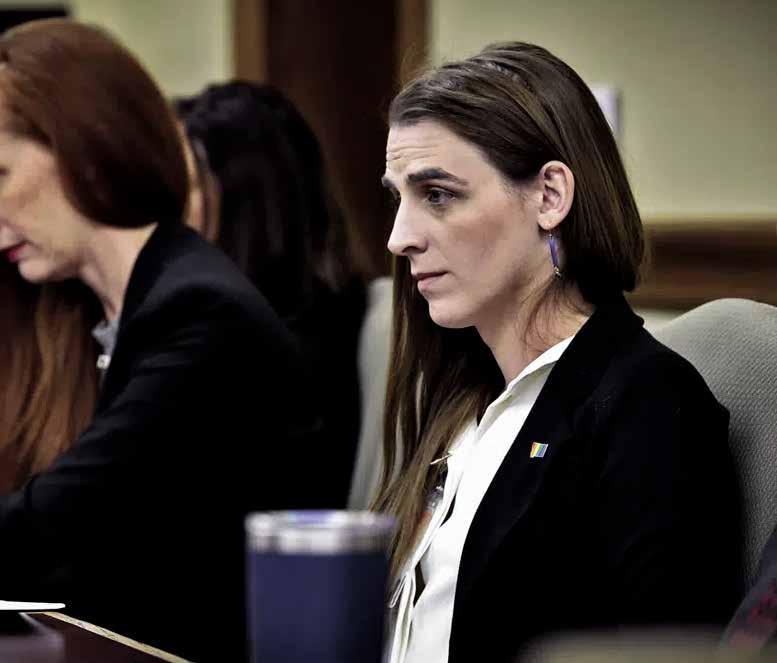
Rep. Zooey Zephyr, a Democrat from Missoula, told fellow lawmakers the bill would mean Transgender people like herself could be turned away from medical services they need.
“What is actually going to happen is it will be a denial based on diagnosis. Something like, I am diagnosed with gender dysphoria,” Zephyr said. “And the thing is, that is inherently discriminatory, because you cannot pass my diagnosis from who I am. To deny me based on my diagnosis of gender dysphoria is to deny me based on my being a Trans woman.”
Other Democrats urged their colleagues to consider the unintended consequences of the bill. Rep. Laura Smith said she feared the measure would rob parents of their rights to seek care for their children. She related a story she’d heard from parents of a child with medical challenges, who might have been unable to get care for their child if HB 303 had been in place.
“This is just one of many examples that I receive where medical teams have tried to deny parents’ rights to choose procedures for their children,” Smith said. “If the bill passes, it will take away parental rights, and your constituents’ parental rights, to make these life-and-death procedural and medical decisions for our own children.”
Republicans said that the bill does not
International news highlights
by Daniel Lindsley SGN Staff Writer
India Supreme Court gears up for Gay marriage hearing
With same-sex marriage being approved in lower courts, four Gay couples in India have filed a petition to India’s Supreme Court that calls for legalization of same-sex marriage across the country. The petitions will be heard in March.
One such couple, Utkarsh Saxena and Ananya Kotia, got together in college in 2008, when homosexuality hadn’t gained any of the acceptance that it sees today.
“We were actually quite scared about the consequences,” said Saxena, who is a public policy scholar at the University of Oxford. “We were very fragile and vulnerable, a young couple figuring out ourselves, and didn’t want, you know, something as drastic as this to break us in some sense.”
The pair did come out to their friends and family once public perception had improved, and most of them were accepting.
Most expansions of LGBTQ rights in India have happened with the Supreme Court’s intervention, like legal recognition of a “third gender” in 2014, and making sexual orientation an essential attribute of a citizen’s privacy three years later.
actually provide for refusing medical care to a patient; it only allows providers to refuse to perform certain procedures.
“To be clear, this bill would not give the right to refuse to serve a person. It would only apply to the narrow circumstances
where a nurse or physician cannot conscientiously perform a specific procedure,” sponsor Rep. Amy Regier said.

“Our relationship has been, in a social sense, undefined for so long that we would like it to now be embraced in the same way as any other couples’ relationship,” Saxena said.
Prime Minister Narendra Modi’s government has resisted the idea of same-sex marriages, however, having filed its own court statement saying that they would cause “complete havoc with the delicate balance of personal laws in the country.”
Activists urge Japan to keep old promises LGBTQ rights groups in Japan are calling for Prime Minister Fumio Kishida’s government to enact anti-discrimination laws before the G-7 summit in June this year.
“Discriminatory remarks made by the prime minister’s aide made it clear to the rest of the world that Japan is a country that does not care about the rights of sexual minorities,” said Marriage for All lawyer Takako Uesugi.
The aide in question, Masayoshi Arai, was fired after telling reporters that citizens would flee the country if same-sex marriage was legalized.
“We must say Japan is not fit to lead the G-7 summit if we leave the situation unaddressed,” Uesugi said, since Japan is the only member of the Group of Seven nations that doesn’t have a law protecting sexual minorities.
Kishida’s response to questions in Parliament about same-sex marriage has been beyond disappointing, according to critics.
He called it “an issue that must be examined extremely carefully... because the issue may change the concept of family and values as well as society.”
Activists have also pointed to the communique Japan signed at the G-7 Elmau summit, which calls for “full, equal, and meaningful participation of women and girls in all their diversity, as well as LGBTIQ+ persons in politics, economics, education, and all other spheres of society.”
“Kishida’s lack of effort to establish legal protection is tantamount to promoting discrimination,” said activist Soshi Matsuoka, whose recent online petition for anti-discrimination laws racked up over 40,000 signatures in just a few days.
Yuichi Kamiya, Executive Director of the Japan Alliance for LGBT Legislation – Photo by Eugene Hoshiko / AP
Zooey Zephyr (r) – Thom Bridge / Independent Record via AP

Episode 48: Adra Boo
Ash & Lindsey go over the candidates for Seattle's District 3 city council seat, talk local protests, and Lindsey shares some exciting news. Special guest Adra Boo talks about Zoom, being the Grand Encourager, the magic of Action Bronson, breaking the Seattle Freeze, and so much more!
NEW EPISODES WEEKLY! FIND RADIO SGN WHEREVER YOU LISTEN TO PODCASTS!