Celebrating 41 Years! Issue 43 Volume 43
FRIDAY October 23, 2015 FREE!
25¢ in bookstores & newsstands
Madonna
SEC 2 PG 1
Seattle Gay News
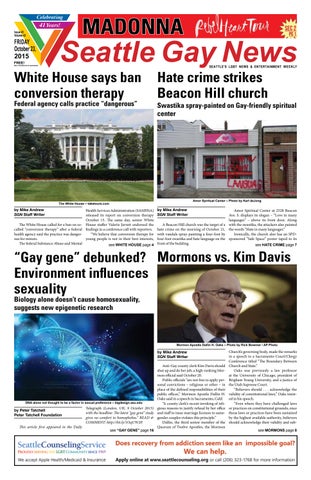
White House says ban conversion therapy Federal agency calls practice “dangerous”
SEATTLE’S LGBT NEWS & ENTERTAINMENT WEEKLY
Hate crime strikes Beacon Hill church
Swastika spray-painted on Gay-friendly spiritual center
Amor Spiritual Center – Photo by Karl deJong
The White House – taketours.com
by Mike Andrew SGN Staff Writer
Health Services Administration (SAMHSA) released its report on conversion therapy October 15. The same day, senior White The White House called for a ban on so- House staffer Valerie Jarrett endorsed the called “conversion therapy” after a federal findings in a conference call with reporters. “We believe that conversion therapy for health agency said the practice was dangeryoung people is not in their best interests, ous for minors. The federal Substance Abuse and Mental see white house page 4
by Mike Andrew SGN Staff Writer A Beacon Hill church was the target of a hate crime on the morning of October 21, with vandals spray-painting a four-foot by four-foot swastika and hate language on the front of the building.
Amor Spiritual Center at 2528 Beacon Ave. S. displays its slogan – “Love in many languages” – above its front door. Along with the swastika, the attackers also painted the words “Hate in many languages.” Ironically, the church also has an SPDsponsored “Safe Space” poster taped to its see hate crime page 7
“Gay gene” debunked? Mormons vs. Kim Davis Environment influences sexuality Biology alone doesn’t cause homosexuality, suggests new epigenetic research
Mormon Apostle Dallin H. Oaks – Photo by Rick Bowmer / AP Photo
by Mike Andrew SGN Staff Writer Anti-Gay county clerk Kim Davis should shut up and do her job, a high-ranking Mormon official said October 20. Public officials “are not free to apply personal convictions – religious or other – in place of the defined responsibilities of their public offices,” Mormon Apostle Dallin H. Oaks said in a speech in Sacramento, Calif. DNA alone not thought to be a factor in sexual preference – bigdesign.asu.edu “A county clerk’s recent invoking of reliTelegraph (London, UK; 9 October 2015) gious reasons to justify refusal by her office by Peter Tatchell with the headline: The latest “gay gene” study and staff to issue marriage licenses to samePeter Tatchell Foundation gives no comfort to homophobes.” READ & gender couples violates this principle.” Dallin, the third senior member of the COMMENT: http://bit.ly/1OqUW2P. This article first appeared in the Daily Quorum of Twelve Apostles, the Mormon see “gay Gene” page 16
Church’s governing body, made the remarks in a speech to a Sacramento Court/Clergy Conference titled “The Boundary Between Church and State.” Oaks was previously a law professor at the University of Chicago, president of Brigham Young University, and a justice of the Utah Supreme Court. “Believers should . . . acknowledge the validity of constitutional laws,” Oaks insisted in his speech. “Even where they have challenged laws or practices on constitutional grounds, once those laws or practices have been sustained by the highest available authority, believers should acknowledge their validity and subsee mormons page 8
2 Seattle Gay News
October 23, 2015
Celebrating 41 Years!
Visit us online www.sgn.org
October 23, 2015
Seattle Gay News 3
VOTE “YES” ON PROPOSITION 1, THE LET’S MOVE SEATTLE LEVY On your ballot this fall, Seattle voters have an opportunity to create a less congested, safer and more modern transportation system by voting “yes” on Seattle Proposition 1. Proposition 1, the Let’s Move Seattle levy, is a bold and much-needed investment in transit, safety and fixing what we have. Transportation is critical for access to jobs and opportunity in our growing city. It’s also the second highest cost after housing in a family budget. The Let’s Move Seattle levy is designed to improve our transportation system in three strategic ways: First, relieving congestion – People are tired of waiting. We all know the experience of sitting in a car or bus stuck in traffic. The Let’s Move Seattle Levy prioritizes improving transit connections and enhancing the speed and reliability of our existing transit systems. As Seattle grows – we’re projected to add another 120,000 residents in the next two decades – those sorts of important
white house continued from cover
and the facts and evidence support that. We would support, and have supported, making it illegal for young people,” she said. “We do strongly believe that young people should be valued for what they are, no matter what they look like, where they’re from, the gender with which they identify, or who they love,” Jarrett added. “It’s not our job to tell parents how to raise children, but it is our responsibility to show parents the best scientific evidence in order for them to make the best possible decisions.” Jarrett is a close friend and political associate of President Obama, and her endorsement of the study should be interpret-
4 Seattle Gay News
October 23, 2015
changes cannot wait. The levy funds seven new RapidRide+ transit corridors to connect all of our Seattle neighborhoods with fast, reliable, and efficient transit service. It also makes investments in light rail access by providing levy dollars for a new Graham Street Station, the Accessible Mt. Baker project, and a pedestrian bridge over I-5 at the future Northgate Station. Second, this levy focuses on safety – The levy makes targeted investments to improve transportation safety across the city, and will help us reach our goal of zero traffic deaths and serious injuries by 2030. It funds corridor safety projects in high-crash areas and Safe Routes to Schools projects each year, prioritized by those schools in low-income neighborhoods. And thanks to new low-cost sidewalk construction, the levy will fund 250 blocks of new sidewalk in neighborhoods where there are not currently any. Third, Let’s Move Seattle prioritizes
taking care of what we have. Seattle faces a growing list of needed transportation work. The Let’s Move Seattle levy will help us to address our maintenance responsibilities by investing in 16 of our most seismically vulnerable bridges. It funds repairing sidewalks and repaving our busiest streets, including up to 180 miles of Seattle’s arterials, addressing 35 percent of Seattle’s busiest streets, as well as repaving 65 targeted locations across the city annually. Let’s Move Seattle replaces the expiring Bridging the Gap levy. It does expand on the expiring levy, because our transportation needs are so great, but the typical Seattle homeowner will only pay about $12 more a month over what they are currently paying for the Bridging the Gap levy. We are endorsing a “yes” vote on Seattle Proposition 1 on your ballot and encourage you to support these much-needed investments in more transit options, safety for our kids and better streets for all. Vote “yes” on Prop. 1.
ed as a reflection of the president’s views. SAMHSA found that same-sex attraction is “a part of the normal spectrum of human diversity and [does] not constitute a mental disorder.” Conversion therapies “are coercive, can be harmful and should not be part of behavioral health treatment.” “Directing the child or adolescent to conform to any particular gender expression or identity, or directing parents and guardians to place pressure on the child or adolescent to conform to specific gender expression and or identity, is inappropriate and reinforces harmful gender stereotypes,” the study concluded. In May, Rep. Ted Lieu, D-Calif., introduced the Therapeutic Fraud Prevention Act, which would classify conversion ther-
apy as a fraudulent practice illegal under the Federal Trade Commission Act. The bill would also ban all advertising that claims the practice can successfully change a person’s sexual orientation or gender identity. The Republican-controlled Congress is not likely to pass the measure, however. Four states and the District of Columbia have already passed laws banning conversion therapy for minors, and 21 other states have introduced similar legislation, according to the SAMHSA report. A Washington bill, introduced by State Sen. Marko Liias, passed the state House in April but was blocked by Republicans in the Senate. Republicans said they were fine with banning electroshock and ice bath therapy but believed that “talk therapy” was constitutionally protected free speech.
Celebrating 41 Years!
SEAMEC announces endorsements
SEAMEC, the Seattle Metropolitan Elections Committee for Gays, Lesbian, Bisexuals & Transgender individuals, announced its general election endorsements on October 15. Incumbent King County assessor Lloyd Hara was endorsed for reelection because of his long record of support for the LGBT community. Veteran King County Council member Larry Gossett, who is running unopposed, was also endorsed. Gossett, a veteran of the Black Liberation Movement in his youth, has always earned SEAMEC’s highest ratings and endorsements. County Council member Joe McDermott, one of two openly Gay Council members, was also endorsed. In Seattle City Council races, SEAMEC has endorsed Michael Maddux, Sandy Brown, and Lorena Gonzales. Maddux, running in District 4, is openly Gay and has been an activist in Washington Stonewall Democrats. Brown, in District 5, is a Methodist minister who has defied his church to marry Gay and Lesbian couples. In 2012, he was a leader in organizing the faith community to support Referendum 74 for marriage equality. Gonzales, running for the at-large District 9 seat, was formerly legal counsel for Mayor Ed Murray. SEAMEC’s ratings for the general election are shown below. Numerical ratings indicate our evaluation of the candidates on the whole range of LGBT issues. A 5 rating means the candidate has shown leadership on our issues; 4 means the candidate exceeds expectations; 3 means
they meet expectations; 2 means they need improvement; 1 means the candidate resists LGBT rights or interests; 0 means they are actively hostile to our community. Where SEAMEC could not interview a candidate and found insufficient information to rate them based on our own research, we assign a ?. In the case of perennial candidate Goodspaceguy, running this time for Port Commissioner, we have assigned him an X, meaning we decline to rate him. (i) stands for incumbent. STATE LEGISLATIVE DISTRICT 30 • Carol Gregory (i) 3 • Teri Hickel ? KING COUNTY ASSESSOR • Lloyd Hara (i) 5, ENDORSED • John Wilson 3 KING COUNTY DIRECTOR OF ELECTIONS • Zack Hudgins 4 • Julie Wise ? KING COUNTY COUNCIL DISTRICT 2 • Larry Gossett (i) 5, ENDORSED KING COUNTY COUNCIL DISTRICT 4 • Jeanne Kohl-Welles 4 • Rufe Orr ? KING COUNTY COUNCIL DISTRICT 6 • Claudia Balducci 3 • Jane Hague (i) 3
KING COUNTY COUNCIL DISTRICT 8 • Joe McDermott (i) 5, ENDORSED PORT OF SEATTLE POSITION 2 • Courtney Gregoire (i) 3 • Goodspaceguy X PORT OF SEATTLE POSITION 5 • Fred Felleman 2 • Marion Yoshino 2 SEATTLE CITY COUNCIL DISTRICT 1 • Lisa Herbold 4 • Shannon Braddock 3 SEATTLE CITY COUNCIL DISTRICT 2 • Bruce Harrell (i) 4 • Tammy Morales 3 SEATTLE CITY COUNCIL DISTRICT 3 • Kshama Sawant (i) 4 • Pamela Banks 3 SEATTLE CITY COUNCIL DISTRICT 4 • Michael Maddux 5, ENDORSED • Rob Johnson 3 SEATTLE CITY COUNCIL DISTRICT 5 • Sandy Brown 5, ENDORSED • Debora Juarez 3
SEATTLE CITY COUNCIL DISTRICT 6 • Mike O’Brien (i) 2 • Catherine Weatbrook 2 SEATTLE CITY COUNCIL DISTRICT 7 • Sally Bagshaw (i) 3 • Deborah Zech-Artis ? SEATTLE CITY COUNCIL DISTRICT 8 • Tim Burgess (i) 3 • Jon Grant 3
SEATTLE CITY COUNCIL DISTRICT 9 • Lorena Gonzales 3, ENDORSED • Bill Bradburd 2 SEATTLE SCHOOL BOARD DISTRICT 1 No ratings SEATTLE SCHOOL BOARD DISTRICT 2 No ratings SEATTLE SCHOOL BOARD DISTRICT 3 • Lauren McGuire 3 • Jill Geary 2 SEATTLE SCHOOL BOARD DISTRICT 6 • Leslie Harris 3 • Marty McLaren (i) 3
Last minute money enters District 3 City Council race Pro-business PAC takes on Sawant by Mike Andrew SGN Staff Writer With less than two weeks to go till Election Day, a newly formed pro-business PAC is gearing up to throw new money into the race against incumbent City Council member Kshama Sawant. Called “Neighbors for Banks” – that’s Sawant’s challenger, Pamela Banks – the PAC was formed by investment broker Bob Ratcliffe and Republican political operative Tom Perry. The PAC has already raised more than $10,000, from contributors associated with downtown investment firms and real estate companies. It has not yet reported any expenditures. Ratcliffe, who donated $2,500 to the PAC, is managing director of Creek Capital Management and was a member of the RNC (Republican National Committee). In 2008 he was one of the top fundraisers for presidential candidate John McCain. Perry is treasurer for Republican Chris Vance’s campaign to unseat Democratic Senator Patty Murray in 2016. Banks has distanced herself from the PAC, and called for an end to independent expenditures in the District 3 race. “I call on Kshama Sawant to join me in repudiating all Independent Expenditure committees, including those assisting her
SEEC Committee Registration Statement – capitolhillseattle.com
re-election,” she said in a statement. However, Banks has benefited the most from independent expenditure campaigns. In addition to Neighbors for Banks, Banks has the backing of the Washington Restaurant Association Hospitality PAC, the Rental Housing Association PAC, the Seattle Police Officers Guild PAC, and the Consumer Fireworks Safety Association
Visit us online www.sgn.org
PAC. Incumbent Kshama Sawant is supported by the 46 Electrical Workers PAC. PACs are not subject to the $700 donation limit for individual donors. Independent expenditure PACs like Neighbors for Banks may support candidates, but they may not coordinate their activities with the candidates’ campaigns.
October 23, 2015
Among individual donors, Sawant has the lead in the District 3 race, with nearly $400,000 raised from 3,049 donors. Banks has raised $340,000 from 1,201 donors – far fewer than her opponent, but giving more than twice as much money per donor. “This is, on the one hand, a race about one district in Seattle,” City Council member Mike O’Brien said in a statement endorsing Sawant. “But this is also a bit of a litmus test. Will a relatively progressive establishment drive our policy or will a group of folks pushing for significant change in the way we do business? “There’s a theme getting pushed about whether [Sawant] is an effective, appropriate leader for the council. Having worked with her on a regular basis, I know she’s a very effective leader whose fresh perspective makes the council stronger.” City Council member Nick Licata, who is not running for reelection, has also endorsed Sawant. The other six Council members have sided with Banks. (In the interests of full disclosure, I have contributed to the Sawant campaign.)
Seattle Gay News 5
Seattle’s TomboyX prove they are winners at National Gay & Lesbian Chamber of Commerce Biz Pitch Competition
From Left to Right: Tonia Woodbury, Wells Fargo; John Lake, WellsFargo; Fran Dunaway, co-founder, TomboyX; Justin Nelson co-founder and president, NGLCC; Chance Mitchell, co-founder and CEO, NGLCC; Shereen Shermak, angel investor and judge; Naomi Gonzalez, co-founder, TomboyX; Re Perez, contest sponsor; Richard Quest, CNN anchor and judge – Courtesy of The National Gay & Lesbian Chamber of Commerce
WASHINGTON, D.C. – At one time, calling a woman a tomboy might have been an insult, but an LGBT-certified business embraced it and ended up taking home the top prize in the National Gay & Lesbian Chamber of Commerce’s Biz Pitch Competition. TomboyX, a Seattle-based start-up clothing company, creates underwear, tshirts and other items that help self-proclaimed tomboys express who they are. The fashion line appeals to all women who have never been comfortable in traditional feminine clothes and didn’t want to dress like men. The two-year-old company won a check for $10,000 against two other start-ups in a shark tank-like contest. TomboyX also will receive a $20,000 brand-positioning package from BRANDING FOR THE PEOPLE. The competition took place at NGLCC’s 2015 International Business & Leadership Conference last summer. The judges were: CNN’s Richard Quest; NGLCC co-founder and CEO Chance Mitchell; and globally-renowned venture capital and business advisor Shereen Shermak.
“We thank NGLCC for giving us this boost that will really accelerate our growth plans, as well as supporting our upcoming road tour. Even before we won, we felt like winners because of the new business contacts we met at the NGLCC conference. The
6 Seattle Gay News
October 23, 2015
majority of our investors are women, and we are a woman and lesbian owned and operated business. NGLCC is exactly what our underwear is for our customers – a perfect fit,” says Fran Dunaway, CEO and founder. The NGLCC conference is the larg-
est LGBT business development event in the world and brought together more than 800 LGBT and allied entrepreneurs, business owners, corporate representatives and LGBT chamber leaders from across the country and around the globe. Attendees took part in three days of symposia, panel discussions, development seminars, and special events designed to generate business opportunities and build strong relationships with corporate champions and one another. The National Gay & Lesbian Chamber of Commerce is the business voice of the LGBT community and is the largest global not-forprofit advocacy organization specifically dedicated to expanding economic opportunities and advancements for LGBT people. NGLCC is the exclusive certification body for LGBT owned businesses. Courtesy of National Gay & Lesbian Chamber of Commerce
Mika Erica – Courtesy of TomboyX
Celebrating 41 Years!
hate crime continued from cover
door. Police say they are investigating the incident as a bias crime. Neighbors, friends and allies will hold a support rally at the Center on Sunday, October 25, at noon. Amor Spiritual Center is “an open and affirming community,” according to minister Allen Mosley, who is Gay. “I prefer to call this a ‘love center,’ ” Mosley explained, “because ‘church’ implies a Christian place. We’re a very mixed community. We have Christians, Catholics, Buddhists, agnostics, everybody. On Sunday we talk about how to love each other, how to create more love in our community.” According to neighbor Karl deJong, Mosley is well known and well liked in the
community. “He’s a great guy,” deJong told SGN, “very active in the community and always helping people.” “It was a huge surprise to us,” Mosley said of the hate crime. “We feed the homeless, we pick up litter in the neighborhood. This week we’re going to be a host center for the showing of Oprah’s Belief series,” a seven-part documentary on the origins of religious faith. “We’re very untraditional, but we’ve had no push-back from the community. Not at all. People say ‘thank you, thank you.’ “But you know, this is not just happening to us,” Mosley added. “These crimes happen all over the city.” Mosley came to Amor Center by a roundabout route. “When I was 16, my parents found out I was Gay,” he says. “That was years ago, and
it was in Georgia, so I was invited to live elsewhere.” By 19 he had become a youth minister, but he was never satisfied with the teaching of any particular faith tradition. “I just believe it’s impossible for all love to be contained in just one place,” he explains. “You know, some people are always arguing about religion. I don’t have time for all that.” Mosley lived in Seattle in 1999, then moved to California. “I was working for a Fortune 500 company at the time,” he explains, “and I went where they needed me. Then I got cancer. I lived through that, but it made me wake up. I realized money is not all there is.” In 2006 Mosley moved back to Seattle and in 2008 met his husband. They were one of the first 100 couples to get their marriage license in 2012, after Referendum 74
took effect. “December 11 is our anniversary,” he says, “and that’s the day we wanted to be married. We hoped Washington would make it legal by December 11, and it happened!” Mosley says he is not bitter about the attack on his church, and he will continue to reach out to all his neighbors. “I feel a real call to love,” he tells SGN, “and you have to realize – as a Caucasian man – well, sometimes we don’t see the things that happen to other communities. There have been five shootings this year, just in this neighborhood. “We just have to get over this racial, ethnic, sexual division!”
Bernie Sanders snubs profiteering pharma CEO Campaign donation will go to health clinic by Mike Andrew SGN Staff Writer Democratic presidential hopeful Bernie Sanders will transfer a $2,700 campaign donation to a District of Columbia health clinic because the donor is pharmaceutical CEO Martin Shkreli. Shkreli is the drug company executive who acquired rights to Daraprim, a medication used by some HIV/AIDS patients, and then jacked up the price from $13.50 to $750 per pill. The drug CEO tweeted support for Sanders during the October 13 Democratic presidential debate and then sent his campaign the maximum allowable individual donation, $2,700. Sanders, however, is a long-time advocate of lowering prescription drug prices and had already called for a federal investigation of Shkreli’s drug company.
“Mr. Shkreli is holding hostage the patients who rely on this lifesaving medication, as well as the hospitals that administer it, by charging unconscionable prices for a drug on which he has a monopoly – just because he can,” Sanders wrote in a joint letter with Rep. Elijah Cummings. Under the circumstances, Sanders’ campaign said, they didn’t want Shkreli’s money and would give it to the Whitman-Walker clinic in Washington, D.C. “We are not keeping the money from this poster boy for drug company greed,” Sanders spokesman Michael Briggs said. Shkreli, meanwhile, tweeted that he was “so angry at Bernie Sanders” that he “could punch a wall!” He genuinely supports many of Sanders’ positions, Shkreli said, and he’d hoped that the donation would buy him face time with the candidate so he could explain why his 5,500% increase in the price of Daraprim
Bernie Sanders – Photo by Jacquelyn Martin /AP Photo
was justified. “I find it bizarre that he won’t engage me, because he’s been willing to use my name,” Shkreli told CNN. “He singled me out, but
dozens of drug companies have done what I’ve done.”
Utah settles lawsuit with Lesbian couple OKs birth certificate with names of both as parents
Kami (l) and Angie Roe – Photo by Rick Bowmer / AP Photo
by Mike Andrew SGN Staff Writer
The state of Utah has agreed to settle a lawsuit brought by a Lesbian couple seeking
to have both their names listed as the parents of their child. In documents filed October 16, the ACLU of Utah and the Utah attorney general’s office acknowledged that the couple
Visit us online www.sgn.org
– identified only as Kami and Angie Roe – have received a birth certificate including Angie as a parent of their daughter Lucy. The joint stipulation could also apply to other same-sex couples in Utah. The District Court ordered that “if Defendants continue to enforce [Utah laws dealing with assisted reproduction], with respect to male spouses of women who give birth through assisted reproduction with donor sperm, they must also apply the statute equally to female spouses of women who give birth through assisted reproduction with donor sperm.” The couple married after Utah’s ban on same-sex marriage was overturned. Kami is the birth mother, but Angie said she went through exactly the same steps a man would if his wife used assisted reproductive services – a sperm donor, for example – including filling out the same paperwork. The couple sued the state of Utah after the state health department refused to list
Angie as a parent of their child. At a hearing in July, U.S. District Court Judge Dee Benson cited the Supreme Court’s ruling on same-sex marriage and said it appeared that Utah was discriminating against the Roe family. At that time, the judge issued a preliminary injunction preventing Utah from discriminating against Lesbian couples when it comes to birth certificates. The October 16 settlement makes the judge’s injunction permanent. As a part of the settlement, the Utah attorney general’s office said the state has agreed to pay the ACLU $24,302 in legal fees. A similar lawsuit is pending in Florida, where the National Center for Lesbian Rights (NCLR) filed a motion on October 16 seeking the immediate listing of both parents on the birth certificates of children of same-sex couples.
October 23, 2015
Seattle Gay News 7
mormons
continued from cover mit to them.” Oaks went on to call for an end to “culture wars.” “First, parties with different views on the relationship between church and state should advocate and act with civility,” he said. “We all lose when an atmosphere of an-
ger or hostility or contention prevails. We all lose when we cannot debate public policies without resorting to boycotts, firings and intimidation of our adversaries… “On the big issues that divide adversaries on these issues, both sides should seek a balance, not a total victory. For example, religionists should not seek a veto over all nondiscrimination laws that offend their religion, and the proponents of nondiscrimination should not seek a veto over all
assertions of religious freedom… “We may have our cultural differences, but we shouldn’t be having ‘culture wars.’ ” While the Mormon Church has opposed same-sex marriage and allied with Catholic and evangelical protestant churches to fight it, Mormon leaders also have endorsed antidiscrimination legislation protecting LGBT people, which their former allies did not. Highlighting the split between the Mor-
mons and their Protestant allies, the Rev. Gregory Johnson, chairman of the evangelical group Standing Together, publicly disagreed with Oaks. “Conscientious objection and religious exemptions are part of our country’s heritage,” Johnson said. “When fighting in wars or endorsing or participating in a marriage you think does not honor God’s design for marriage, such people have to be accommodated.”
The next big court case?
Gay man sues federal agencies for discrimination by Mike Andrew SGN Staff Writer The Gay man whose discrimination complaint prompted a landmark Equal Employment Opportunity Commission (EEOC) ruling in July has now taken the next step and filed a federal lawsuit against two U.S. government agencies. David Baldwin charges that he was harassed and passed over for promotion at Miami Tower Aviation Administration because of his sexual orientation. He is suing the Federal Aviation Administration – his immediate employer – and the U.S. Department of Transportation. Baldwin says his supervisor regularly made disparaging remarks about his sexual orientation. For example, when Baldwin said that his partner prepared his packed lunch for him each day, the supervisor said the “comment was inappropriate” and told him to “get out of the radar room with that kind of talk.” Baldwin also charges that less qualified straight people were promoted ahead of him. When he took his complaint to the EEOC, the agency found in his favor, ruling that Lesbian, Gay, and Bisexual employees were protected under Title VII of the Civil
Rights Act of 1964. The existing protection against sex discrimination also protects sexual orientation, the EEOC said. However, a narrow reading of the EEOC ruling would make it apply only to other federal employees, like Baldwin was when he filed the original complaint. By filing a federal lawsuit, Baldwin may get a federal court ruling that applies to all LGB employees. Absent any federal legislation that protects sexual orientation – and given that a Republican-controlled Congress is not likely to pass such legislation – a federal court ruling may be the best opportunity LGBT employees have to get nationwide civil rights protections. Baldwin’s lawyer, Lowell Kuvin, told Buzzfeed that the outcome of the case could have far-reaching consequences for LGB Americans. “Mr. Baldwin’s case has the ability to affect more people than the [Supreme] Court’s Obergefell [marriage] case because there are more gay men and women who have jobs than same-sex couples who want to get married. “While the decision by the EEOC in Baldwin v. Foxx was a giant step forward for extinguishing sexual orientation discrimination by allowing federal employees to pursue sexual orientation claim under the
Miami - Dade Airport – Miami - Dade Aviation Dept.
Civil Rights Act of 1964 and Title VII, it was just a small step forward for non-government employees. “The next logical step for Mr. Baldwin, who would like to see the protection of Title VII extended to non-government employees alleging sexual orientation discrimination, was to bring the issue to the federal courts.” “I never wanted any special consideration,” Baldwin told Gay Star News. “I simply wanted the same rights and consid-
erations, and to be covered under existing laws, the same as everyone else. Nothing more, nothing less. It just seems so fundamental and basic, and its time has finally come.” According to EEOC rules, Baldwin had 90 days after its July 16 ruling to decide whether to accept it or to file a federal lawsuit. He filed his suit on October 13. His name was redacted from the EEOC decision, but he revealed his identity in an interview with the Washington Blade.
NCLR and HRC release draft law against conversion therapy by Mike Andrew SGN Staff Writer Only days after the Obama administration announced its support for outlawing so-called conversion therapy, two LGBT rights groups have issued draft legislation to ban the practice. The National Center for Lesbian Rights (NCLR) and the Human Rights Campaign (HRC) released what they call “sample legislation” on October 20. The draft measure is based on best practices in the jurisdictions that have already banned conversion therapy, laws introduced but not yet passed in 20 states, the federal Therapeutic Fraud Prevention Act introduced by California Rep. Ted Lieu, and the experience of legal experts working on the issue. “This sample legislation is the culmination of two decades working to end conversion therapy, three years helping states take legislative steps to protect youth from these ineffective and harmful practices, and a truly exceptional coalition of legal experts from across the country,” NCLR staff attorney Samantha Ames said in a statement. “What has emerged from this extraordinary process is a bill that is both true to
8 Seattle Gay News
our shared values and legally airtight. Moving forward, we could not be more excited to work with state legislators and equality groups equipped with this powerful tool to end conversion therapy once and for all.” “This important sample legislation comes at a critical time in our fight to protect our nation’s LGBTQ youth from the
October 23, 2015
dangerous practice of conversion therapy,” added HRC Legal Director Sarah Warbelow. “A junk pseudoscience that amounts to nothing more than child abuse, this socalled therapy has been denounced by every mainstream medical and mental health association. We look forward to partnering
with state legislators and key stakeholders in working to pass these vitally important measures to stop this horrific practice once and for all.” Five jurisdictions – California; New Jersey; Washington, D.C.; Oregon; and Illinois – now protect LGBT minors from conversion therapy, and legislators from several other states plan introduction of similar legislation in the 2016 legislative session. A bill banning conversion therapy passed the Washington state House this year but was blocked by Republicans in the Senate. Last year, NCLR launched its #BornPerfect campaign to stop conversion therapy across the country by passing laws, filing lawsuits, and raising awareness about the serious harms caused by attempts to change a young person’s sexual orientation or gender identity. On October 15, the Substance Abuse and Mental Health Services Administration, an agency within the U.S. Department of Health and Human Services, issued a report calling for an end to conversion therapy and urging family acceptance of LGBTQ children. The findings were strongly endorsed by the White House.
Celebrating 41 Years!
Tenderloin’s LGBT story survives by Seth Hemmelgarn Bay Area Reporter Special to the SGN
San Francisco’s Tenderloin neighborhood has a colorful history and was once the center of gay life in San Francisco. Grittier than the Castro, which in the late 1970s overtook “The Loin,” as it’s sometimes called, as the city’s gay hub, the neighborhood just blocks away from City Hall also has a well-worn reputation for drug dealing, robbery and other crimes. It’s home to some of the city’s poorest residents, many of whom are living with HIV and stay in the district’s single-room occupancy hotels. The neighborhood is bounded by the historic Beaux-Arts City Hall on one side and Union Square’s upscale hotels and shops on the other. Most of the gay bars, theaters and bookstores that once filled the Tenderloin are gone, but a handful have survived, and many LGBTs still express fondness for the area. One business that’s held on since the 1970s is the Tea Room Theatre, 145 Eddy St. The tiny lobby has pictures of movies with titles like “Cum Smack 2,” and a sign warns, “J/O [jacking off] only is allowed in the theater.” Inside the small, dark auditorium on a recent Friday afternoon, it would have been impossible to see without the light from the porn being projected onto the screen. In a couple of seats at the front, one man on either side of the aisle was giving head to his seatmate, disobeying the sign in the lobby. During an interview in which he spent the first several minutes standing behind the metal gate that separates his office from the lobby, Steve Angeles, 50, praised the Tenderloin, the neighborhood he calls home. The area is “very friendly,” he said, and it’s “the real San Francisco.” Angeles, who’s worked at the theater for five years, said, “I really don’t know” why the business has survived, but it’s “probably” because it’s a short walk from two BART transit stations. Plus, “we show all the brand new movies every week, and we are friendly,” he said. Business appears to be brisk. Customers include men from out of town and regulars from the neighborhood. “When they retire, they have nothing to do, just relax,” Angeles said of patrons. “People feel at home here.” At 35, Marc Woodworth is likely one of the Tea Room’s younger fans. Woodworth, who lives in Europe but is in San Francisco six months at a time, comes to the theater once or twice a month. There’s “no other place to go” in San Francisco, he said. Angeles, who doesn’t identify with a specific orientation but said, “They call me Mama Steve,” said the current lease is up in 2015. “Hopefully,” he said, the building’s owners will give the theater “another few years.” About a block from the Tea Room, soul music played inside Aunt Charlie’s Lounge, 133 Turk St., as Louie Lopez, 74, and Paul Lee, 73, stood outside. The gay men listed the bars that used to be nearby, like the Blue and Gold and the Landmark, and the people they used to see there. “There was always something going on,” said Lopez, who lives in the neighborhood and started coming to Aunt Charlie’s almost 30 years ago when it was still Queen Mary’s Pub. Lee said the neighborhood “was like a candy store” when he first came in 1976. “It
Lee Lopez – Courtesy of Philadelphia Gay News
was so much fun.” However, he noted, “There was a lot of prejudice against people from the Tenderloin,” and there still is. “If you just tell someone you used to hang out here, they say, ‘But you don’t go there anymore, do you?’” Lee said. Inside Aunt Charlie’s, the narrow walkway between the bar and some tables and benches frequently doubles as a runway for drag performers as they lip-sync to songs and collect tips. Joe Mattheisen, 65, a gay Tenderloin resident, has worked at the bar for about 16 years. Mattheisen said one reason the business has outlived many others is that it’s not “the sole source of income” for its owner, unlike other establishments. Over the years, the bar has also added drag shows and DJs.
much change in the neighborhood since then. Elizondo, a transgender woman who lives in another neighborhood now, recalled the area being packed with “queens” and “hustlers.” People made money by “selling drugs and selling themselves,” she said, and the district was “very dangerous.” (Elizondo said she didn’t deal drugs but she did work as a prostitute.) Someone could get “thrown in jail for obstructing the sidewalk” and people would get “beat, murdered or raped” by “tricks or people that just didn’t like gay people,” she said. Elizondo remembered a woman named Rhonda who died after “one of her tricks cut her breast out.” She didn’t know Rhonda’s last name.
“When you came to San Francisco, you came to San Francisco to start a new life,” she Queens and said. “You weren’t hustlers nosey. Most peoThe block ple wanted to forwhere Aunt get the past.” Charlie’s sits was E l i recently named zondo also reVicki Mar Lane, called Compton’s after Vicki MarCafeteria. The lane, a transgen24-hour cafe at der woman who the corner of performed there Monet – Courtesy of Philadelphia Gay News Turk and Taylor for years before she died in 2011 at the age of 76 of AIDS-related streets was the site of an August 1966 riot where transgender patrons stood up against complications. Felicia Elizondo, 68, a close friend of police, who had been called to quell a disMarlane’s, first visited the Tenderloin in turbance. The exact date of the riot has been the early 1960s, and said she hasn’t noticed lost to history.
Visit us online www.sgn.org
October 23, 2015
A ceremony in June 2006 featured the unveiling of a commemorative sidewalk plaque at the former Compton’s location, which was timed with the 40th anniversary of the riots, which predated by three years the more famous Stonewall Inn rebellion in New York City. The Compton riot is widely viewed as the beginning of the LGBT-rights movement in San Francisco, but Elizondo said that at the time, it didn’t have a noticeable impact. “Everything went back to the same old way,” she said. Almost 50 years later, though, some things have changed. In the lobby of the Tenderloin police station, about a block away from the Compton’s site, a sign assures visitors that the space is an “LGBT safe zone.” Captain Jason Cherniss, 44, who’s straight and heads the station, wasn’t familiar with the details of the Compton’s riot, but he expressed support for the LGBT community and enthusiastically spoke of how, when he was in college, he examined the Castro’s evolution as a gay mecca. The San Francisco native’s biggest public-safety concern in the Tenderloin is drug dealing. Anyone who’s walked through the neighborhood probably has stories of being approached by dealers, and the station’s newsletter regularly lists incidents for sales of cocaine, heroin and other drugs. As for what to do about it, Cherniss said, “We’re not going to be able to arrest our way out” of the problem, but he keeps officers “visible” and encourages property owners not to leave locations “blighted.” In his September newsletter, Cherniss featured gay Tenderloin resident Aja Monet, 44, as the Citizen of the Month. Among other activities, Monet, who is HIV-negative, sits on the HIV Prevention Planning Council, an advisory group to the city’s health department that sets priorities for HIV prevention. He’s also hoping to have an LGBT Pride event in the Tenderloin next year. Monet, who came to San Francisco in 1988, said that he used to smoke crack and worked as a prostitute “off and on.” Now, he’s been off drugs for five years, and he works on graffiti removal and other issues in the area. The neighborhood hasn’t been as impacted by development as the Market Street corridor just a few blocks away, but he thinks more development is coming to the Tenderloin. “They’re running out of places to build,” he said. Monet didn’t show any interest in leaving the district, and he said he feels “very safe” there. “I think somebody called me a motherfucking faggot” a few months ago, but “that was someone that didn’t know me,” he said. “People in the neighborhood ... they don’t talk like that.” Seth Hemmelgarn is an assistant editor at the Bay Area Reporter. He can be reached at s.hemmelgarn@ebar.com.
Seattle Gay News 9
10 Seattle Gay News
October 23, 2015
Celebrating 41 Years!
Visit us online www.sgn.org
October 23, 2015
Seattle Gay News 11
12 Seattle Gay News
October 23, 2015
Celebrating 41 Years!
Visit us online www.sgn.org
October 23, 2015
Seattle Gay News 13
14 Seattle Gay News
October 23, 2015
Celebrating 41 Years!
Visit us online www.sgn.org
October 23, 2015
Seattle Gay News 15
A taste of her own medicine: Westboro Baptist Church pickets Kim Davis by Mike Andrew SGN Staff Writer Anti-Gay county clerk Kim Davis got a taste of her own medicine October 19, when her office was picketed by the even more anti-Gay Westboro Baptist Church. Gathered on the lawn of the Rowan County, Ky., courthouse, members of the cult-like church carried their trademark signs reading “ ‘Christians’ caused fag marriage,” “Divorce + marriage = adultery,” “Divorce remarriage & same-sex ‘marriage’ are all sin,” and “God hates fag enablers.” Their issue with Davis is her own record of multiple marriages, which – even though they have all been opposite-sex ones – the Westboro crew deems to be adulterous. “That man that Kim Davis is living with, and calling her husband, IS NOT! Her husband is Dwain Wallace, who she married when she was 18-years-old [sic],” reads a press release from Westboro. “It does not matter how many years you pile on! It was adultery at the beginning, adultery in the middle and it is indeed adultery today! “As these words are typed, the nation
“gay gene” continued from cover
This is an extended version of Peter Tatchell’s Daily Telegraph article: Vladimir Putin, Robert Mugabe, Pope Francis and other anti-gay world leaders may well rejoice at new scientific research that points to homosexuality as being significantly influenced by pre- and post-birth environmental factors. They’ll no doubt see it as refuting claims that people are born gay and that same-sex attraction is immutable. They may be tempted to conclude that if homosexuality is not fully biologically determined, this research can be exploited to eradicate it. But they’d be wrong. The degree and nature of these environmental influences is, as yet, unknown. They are likely to be multiple and complex. So any bid to abuse the new research and manipulate the environment to eliminate same-sex desire is unlikely to work. The study by Dr. Tuck C. Ngun and his team at the University of California found that an algorithm using epigenetic information from a mere nine regions of the human genome can predict the sexual orientation of males with up to 70 percent accuracy. This suggests that environmental factors that switch genes on and off and affect how cells read genes may have a significant influence on human sexuality, both heterosexual and homosexual. These environmental influences have not been identified but they may include hormones, chemical exposure, stress, diet, exercise, childhood interactions, peer pressure and social values. Nor is it clear whether these factors only have an impact pre-birth and in early childhood or whether they may also affect adults in later life. The degree of environmental influence
16 Seattle Gay News
faces relentless, never-seen fires in the west and hurricane force never-seen flooding and storms in the east. AND, God sends the shooter again and again. God has HIS weapons in HIS armory, so Kim Davis needs to HUSH and OBEY the law that she helped bring about.” Another statement from the church accuses Davis of “enabling” same-sex marriage, apparently by divorcing and remarrying herself. “If Kim Davis received mercy from God and grace, as she claims, she would, with all due haste put her sin away,” the Westboro statement says. “She would mourn for her sins, and in a show of great mercy, she would be busy apologizing to the fags for enabling them, and she would, with all diligence, give those perverts a marriage license. Kim Davis has decided that her adultery is less sin, than the sin of the sodomites.” In addition to the picket line and the press statements, Westboro also unleashed a torrent of tweets aimed at Davis. “Kim Davis should be ashamed for suffering sin on fags, by publicly justifying her
unrepentant serial adultery,” one said. “Christianity is not a smorgasbord religion – you don’t pick what you like & leave the rest,” another added. Another tweet read, “Lord willing, we will visit Kim Davis on Monday with some friendly, Christianly advice/wisdom.” The Westboro Baptist Church, founded by Fred Phelps in 1955, began its public picketing in 1991 with a protest at Gage
Park in Topeka, Kan., which the church said was a local cruising venue. Phelps and company became notorious for picketing the funerals of Gay people – including Matthew Shepard – and U.S. military personnel. Phelps was expelled from the church he founded shortly before his death in 2014, in what was apparently a family feud.
is still unclear. We already have plenty of previous research that points to likely significant biological drivers of sexual orientation. This includes “gay gene” studies that have identified the Xq28 marker on the X chromosome as possibly associated with homosexuality; plus evidence of differences in the amygdala, hypothalamus and symmetry of the brains of gay and straight men. Other research, which also indicates a genetic component to sexual orientation, has found that among identical twins where one brother is gay, the likelihood of the other brother also being gay is much greater than the incidence of homosexuality in the general population (20-50% in identical twins, as opposed to 2-10% among the wider male population). But the fact that there is not a 100% concordance of gayness among identical twins suggests that factors other than genes play a role. Research has further revealed differences between gay and non-gay men in physical attributes thought to be triggered by hormonal influences in the womb. These include differences in physique, brain structure, finger lengths, penis size (gay men tend to be better endowed than straight men), and the age of puberty (on average gay men mature earlier than heterosexual men). Other studies also found physiological variations between lesbian and straight women. Hormonal influences are generally accepted as significant but their degree of influences is not yet known. While all these studies have been disputed to varying degrees by fellow scientists – as no doubt will Dr Ngun’s research – the preponderance of scientific evidence nevertheless does point to biological factors as probably being prime (but not exclusive and total) influences on sexual orientation. If sexual attraction is, indeed, significantly fixed prior to birth or soon afterwards, whether by biological or environmental factors or a combination of both, it
means that anti-gay regimes are persecuting lesbian and gay people for a sexual orientation that many or all of them have not chosen and cannot change. As well as being unethical, it is also means that attempts to suppress homosexuality won’t succeed because a certain percentage of every population is always likely to be predisposed from birth or early childhood to same-sex attraction. There are, of course, still loose ends to Dr. Ngun’s research and to all similar scientific studies. None of them identify a single cause of sexual orientation and none can explain everyone’s sexuality. This is because it seems that something as complex and varied as sexual orientation doesn’t have a sole determinant. It is likely to be multicausal, including to some degree (even if minor) cultural factors, such as social mores and expectations. No one sits down one day and decides to be gay – or straight. Most lesbians and gays say they felt “different” from a very young age, long before they had any awareness of sexual desire. While this suggests that our sexuality is formed unconsciously by early childhood at the latest – and is therefore not a choice – it does not necessarily mean we are all born with a totally pre-fixed sexual orientation. Moreover, Dr. Ngun’s study claims to be able to predict the sexual orientation of males with “up to 70 percent accuracy.” I get skeptical when I read “up to.” Even at a maximum of 70%, it still leaves 30% unpredictable. Contrary to the way many people may interpret this study, biological and environmental influences, which I accept, are not the same as causes. They may predispose a person to one sexuality rather than another. But that’s all. Predisposition and determination are two different things. There is a major problem with any theories that posit the biological or environ-
mental programming of sexual orientation from pre-birth or in the years after birth. If heterosexuality and homosexuality are determined and fixed by early childhood – and therefore mutually exclusive and unchangeable – how do we explain bisexuality or people who, suddenly in mid-life, switch from heterosexuality to homosexuality (or vice versa)? We can’t. The Kinsey researchers famously reported the case of a happily married young woman who, ten years into her marriage, unexpectedly fell in love with a female friend. Divorcing her husband, she set up house with this woman. Many years later, despite a fulfilling on-going lesbian relationship, she had an equally satisfying affair with a man. Examples of sexual flexibility, like that of this woman, don’t square with theories of rigid erotic predestination. They tend to support the thesis that environmental factors may affect sexual orientation. If gayness was only explainable in biological terms we would expect it to appear in the same proportions, and in similar forms, in all cultures and all epochs. As the anthropologists Clellan Ford and Frank Beach demonstrated in Patterns Of Sexual Behaviour (1965), far from being crossculturally uniform and stable, both the incidence and specific expressions of same-sex desire vary vastly between different societies. This variation gives credibility to the role of environmental factors suggested by Dr. Ngun’s research. Since a homosexual orientation seems likely to have a complex and diverse range of biological, environmental and cultural influences, homophobic bids to eliminate it look set to fail. Bravo!
October 23, 2015
Westboro Baptist Church pickets Rowan County Clerk Kim Davis – Photo by Mike Wynn, The (Louisville, KY) Courier - Journal
Peter Tatchell is the Director of the Peter Tatchell Foundation. www.PeterTatchellFoundation.org Courtesy of the Peter Tatchell Foundation
Celebrating 41 Years!
PRIDE Institute paved way for LGBT substanceabuse treatment by Jason Parsley South Florida Gay News Special to the SGN When the PRIDE Institute in Minnesota opened up in 1986 it was a novel idea – a substance-abuse treatment center catering to the gay and lesbian community. But within three months of opening, every bed was filled, proving there was a need. “Back then we dealt with a lot of homophobia – internal and external,” said co-founder Ellen Ratner of PRIDE. “I think what made a difference is that we dealt with internalized homophobia.” The idea for PRIDE started with an LGBT specialty track at a treatment center in New Hampshire run by Lawrence E. Bienemann. “In the last year we started to do specialized treatment and we were successful initially with Ellen’s patients,” he said. “Our gay and lesbian track was the first in the nation.” And that track inspired Bienemann to lay the groundwork for a fullfledged treatment center for gays and lesbians, which would become the first in the world. “Specialized treatment just made sense,” he said. “We also had specialized treatment facilities for PTSD and a track for cocaine abuse.” Bienemann approached a group of investors and quickly raised almost $1 million. He hired Ratner to put the program together. “PRIDE was an example of people working together. We became well-known very quickly,” Bienemann said. “It was bad enough to be an addict, but to be gay or lesbian on top of that, that was two strikes against you.” Founding board member Mel Pohl agreed. “The shame that’s associated with addiction is magnified by sexual identification,” he said. “Because of the shame of being gay or lesbian, compounded with the disease of addiction, it really impacts people’s ability to get well.” Pohl said he was excited to join an elite group of professionals Ratner had recruited to advise the new facility and serve on the board. “It was a fairly prestigious group of gay and lesbian activists and addiction specialists,” he said. “To have an opportunity to work with a high-level clinical staff committed to this mission was really inspiring.” Pohl would later serve as the chief of clinical services for PRIDE for three years. Minneapolis was chosen because the corporation that started PRIDE owned several other facilities in and around the city. There were talks of later moving the institute to a more gay-centric location such as New York City, San Francisco or Washington, D.C. but those plans never panned out, Pohl said. Pohl admitted the founders didn’t have a blueprint for success and adapted as they went along. “At PRIDE we normalized being gay,” he said. “And that was the key issue, to have a
normalization of being gay. Addiction is a disease where you feel uniquely better or uniquely worse. To sit in a group and not be able to come out safely almost destined that person to fail.” Ultimately, Pohl said, it came down to safety. “The biggest impact of PRIDE in the community for those who had an addiction is that now they had somewhere they could be safe,” he said. But something else that separated PRIDE from other treatment centers was its approach to HIV. “The other thing we had to address was HIV,” Bienemann said. “Normally a treatment center, at that time, wouldn’t treat that or deal with it. But we did.” And that was one of the reasons Pohl wanted to join PRIDE. On top of being gay and being an addict, “the stigma of having HIV added another factor to the mix,” he said. “To have a safe
is a place where LGBT people will receive trauma-informed care and find a staff that is experienced in dealing with the LGBT community. This is a place where people can say, ‘I’m finally in the majority for the first time in my life, and I don’t have to explain myself.’” It’s been decades since Ratner has had any involvement with PRIDE as well. She left the corporation in 1990 and is now working as a journalist. She attributes the early success of PRIDE to the fact that they dealt with all of the major issues gays and lesbians faced, such as the internal and external homophobia mentioned above. “The ways gays and lesbians met back then were known as the three Bs — bars, baths and bushes,” Ratner said, explaining that gays and lesbians faced a lot of difficulties just being themselves. “We speculated at the time that there was a [direct correlation] between being out to your family and
Firepit at PRIDE institute in Minnesota – Courtesy of Philadelphia Gay News
place for people who were HIV-positive was really intriguing.” Ratner is especially proud of the work she did at PRIDE in those first few years. She believes the facility really made a difference in a lot of people’s lives. “We did outpatient surveys and found that we had a higher success rate than other places,” Ratner said. “Our patients did better.” Twenty-eight years later, PRIDE is still going strong despite the advances of gay rights and mainstream acceptance of the LGBT community. Pohl isn’t surprised at its longevity. “The complexion has changed perhaps because of HIV and marriage, and participation in mainstream culture,” he said. “But there is still a lot of shame involved in sexual identity.” Pohl said that even in today’s society, being gay-friendly is largely dependent on the staff. “You have to rely on the integrity of a staff,” he said. “Homophobia is alive and well in our society.” Molly Gilbert, the current director of business development at PRIDE, added: “There are a lot of places that are LGBTfriendly, or have an LGBT wing. But here
Visit us online www.sgn.org
sobriety.” So family became a core component of their program. “We also had a family program that sometimes included their partners or straight families. They would really learn to give support to their family member,” she said. “Who would have thought a gay person’s lover or family would come? That was just radical back then.” But Ratner wanted to not only help her patients become comfortable with their own sexuality – she wanted them to feel comfortable in the “straight” world as well. “We used to take patients to straight and gay AA meetings so they could be comfortable at both,” she said. Ratner, herself openly gay back then, had also been a gay-rights activist for years. PRIDE was founded under the nowdefunct Addiction Recovery Corporation (ARC) where Bienemann was president. He recruited the 35-year-old Ratner to put together a manual for the family program, and then to do research and service training. In order to fulfill that responsibility, she put together a team of professionals in the substance abuse field from all over the nation, including Pohl. “I had already been working in the gay
October 23, 2015
and lesbian community in addictions,” she said. Bienemann told the Boston Globe in a 1987 article “any inpatient drug and alcohol treatment center has a difficult time meeting all patients’ needs. In the chemical-dependence field, there is general insensitivity to issues specific to the lesbian and gay population. At ARC, it’s only recently that we have begun to train staff to guard against homophobia.” Bienemann also said he wanted to address the statistics that were showing onethird of gays and lesbians were chemically dependent. “That’s three times the national average,” Bienemann said in 1987. “Given those statistics, there’s a real need for a separate treatment center.” And the current statistics aren’t much better now than they were then. Studies are scarce in the area of LGBT substance abuse, but, according to one report from the Substance Abuse and Mental Health Services Administration, 2030 percent of the LGBT community abuses substances, while only 9 percent of the general population does. The Centers for Disease Control and Prevention also states that LGBT individuals are more likely to use alcohol and drugs; have higher rates of substance abuse; are less likely to abstain from alcohol and drug use; and are more likely to continue heavy drinking into later life. In the early years of PRIDE, alcohol was the most prevalent drug of choice followed by cocaine, Ratner said. Today it’s crystal meth, said Todd Connaughty, the current director of clinical services. Over the years, the treatment center has changed hands several times. Today it’s owned by Universal Health Services, a company that owns hospitals and behavioral-care centers around the country. They also own other PRIDE Institutes, but those facilities only share the same name and owner, but are in no other way connected to PRIDE in Minnesota, said Gilbert. Looking back at those years, Ratner does have a couple of regrets. “I wish we had done more research. And published that paper that was done and ready to go. The world should have known what we learned there. One of the things we found was that if you drank two or more drinks, you would not have safer sex. Back then, that was a life and death issue. There was no cocktail; when you got AIDS you were dead.” For more information, visit www.prideinstitute.com. Jason Parsley is the associate publisher of the South Florida Gay News. He lives in Boynton Beach, Fla., with his fiancé.
Seattle Gay News 17
Seattle Justice: The Rise and Fall of the Police Payoff System at the Seattle Public Library Oct. 27 Author and former Prosecutor Christopher T. Bayley will discuss his successful fight during the 1970s to end corruption in Seattle law enforcement and politics from 7 p.m. to 8:30 p.m. Tuesday, Oct. 27 at the Central Library, 1000 Fourth Ave., Level 1, Microsoft Auditorium. Library events are free and open to the public. Registration is not required. Parking is available in the Central Library garage for
$6 after 5 p.m. Many view Seattle as a progressive and high-tech city, but Seattle’s history includes a hundred years of vice and official corruption. City officials once turned a blind eye to illegal gambling, unlicensed bars and prostitution, in exchange for which police officers demanded “operating fees” in the form of cash payments from establishment owners. Gay bars in Seattle were forced to make
pay-offs during that time. The money trail that started on the streets ended high up in the Seattle Police Department and affected top levels of both city and county government. Seattle Justice is the story of Bayley’s underdog fight to defeat the incumbent Prosecutor, reform the Prosecutor’s office, and investigate and prosecute officials for the payoff system. The new Justice Model es-
tablished by Bayley demonstrated that an aggressive but non-political prosecutor can restore public confidence in the justice system and rebuild law enforcement morale. This program is presented in partnership with Elliott Bay Book Company. Books will be available for purchase and signing at the reading. For more information, call the Library at 206-386-4636 or Ask a Librarian.
LGBT people file employment discrimination complaints as often as people of color, women, new study shows Four to five complaints are filed each year for every 10,000 LGBT people, people of color and women in the workforce LOS ANGELES – LGBT people use sexual orientation and gender identity employment non-discrimination laws as frequently as people of color and women use race and sex non-discrimination laws, according to a new analysis of complaints filed with state enforcement agencies conducted by Christy Mallory, senior counsel, and Brad Sears, executive director, at the Williams Institute at UCLA School of Law. The filing rates are similar for all types of discrimination studied. Across the 14 states that provided complaint data, on average, approximately four to five employment discrimination complaints are filed annually for each 10,000 women, people of color and LGBT people in the workforce, the researchers found. The findings refute
the argument that discrimination against LGBT people does not occur often enough to establish a need for protective laws. “Because the LGBT population is relatively small, however, the raw number of sexual orientation and gender identity complaints filed is low,” Mallory said. “Therefore, passing non-discrimination laws that protect LGBT workers would not overwhelm state enforcement agencies and courts with complaints.” The study, titled “Evidence of Employment Discrimination Based on Sexual Orientation and Gender Identity: An Analysis of Complaints Filed with State Enforcement Agencies,” examined complaints filed based on sexual orientation or gender identity, race, and sex and adjusted them by the
18 Seattle Gay News
October 23, 2015
number of people in the workforce most likely to experience each type of discrimination – LGBT people, people of color and women. Key findings from the report include: • Nationally, on average, 4.6 complaints of sexual orientation and gender identity discrimination are filed for every 10,000 LGBT workers each year. • Race discrimination complaints are filed at a similar, but slightly higher, rate of 4.9 complaints for every 10,000 workers of color annually. • Sex discrimination complaints are filed at a similar but slightly lower rate at 3.7 complaints for every 10,000 female workers annually.
Data on discrimination complaints were requested from the 22 states that have statelevel laws prohibiting employment discrimination based on sexual orientation and gender identity. Fourteen states responded to the request, including California, Colorado, Connecticut, Hawaii, Illinois, Maryland, Minnesota, New Hampshire, New York, Oregon, Rhode Island, Washington, Wisconsin and the District of Columbia. The study’s findings are consistent with those of two prior studies that applied the same methodology to older data. Courtesy of the Williams Institute
Celebrating 41 Years!
AHF commends SCRUFF mobile dating app for free STD testing ads LOS ANGELES – Following the explosion of international media attention on a provocative Los Angeles billboard campaign launched in September by AIDS Healthcare Foundation (AHF) to draw attention to the risk of mobile dating app users contracting STDs like gonorrhea and chlamydia, the organization applauded SCRUFF, one of the largest location-based dating apps for Gay men, for its statements in support of incorporating STD prevention and treatment messaging into its popular platform. During an October 2nd Huffington Post Live webchat featuring Whitney Engeran-Cordova, Senior Director, Public Health Division for AIDS Healthcare Foundation, SCRUFF Founding Partner and Chief Product Officer Jason Marchant said, “We at SCRUFF feel that we definitely have a social responsibility to do what we can to make our users informed not only of potential risks but also of the resources that are available to them, be it for testing, prevention, treatment or support – be it for HIV or any other STIs.” SCRUFF, which claims more than 7 million LGBT users worldwide, offers free, geotargeted in-app advertising for non-
profit organizations to reach the LGBT community through its BenevolAds program, accessed at ads.scruff.com. “I would invite AHF to sign up for BenovolAds, and if they want to create ads that focus on informing people about the resources that are available to them, we’re happy to run their ads for free,” offered Marchant during the webchat. “When other popular mobile dating apps were firing off legal notices or moving to shut down our STD prevention messaging in a knee-jerk reaction to our billboards, SCRUFF is to be commended for taking the more prudent approach by acknowledging the importance of encouraging STD prevention and awareness to their millions of users,” said Whitney Engeran-Cordova, Senior Director, Public Health Division for AIDS Healthcare Foundation. “We are pleased that conversations have begun to discuss how dating apps can be constructive partners in helping educate and connect their users to sexual health screening. Regular testing makes hooking up safer, and, hopefully more enjoyable. There is no shame in knowing your status. Nor should there be any trepidation or shame in asking
Visit us online www.sgn.org
someone their status.” As a catalyst for the billboard campaign (which drives viewers to www.FreeSTDCheck.org), AHF looked to one study by the Rhode Island Department of Health, which in May reported that cases of syphilis, gonorrhea and HIV rose sharply between 2013 and 2014 and said that high-risk behaviors such as “using social media to arrange casual and often anonymous sexual encounters, having sex without a condom, having multiple sex partners, and having sex while under the influence of drugs or alcohol” have become more common in recent years. According to a study by Beymer et al. (2014), Gay men who are meeting on location-based dating apps are at greater risk for gonorrhea and chlamydia than those who meet in-person or on the Internet. In addition, a lengthy September 2015 Vanity Fair article entitled “Tinder and the Dawn of the ‘Dating Apocalypse’” explored the role mobile dating apps are increasingly playing in encouraging casual sex among young adults. [Visit www.FreeSTDCheck. org for a link to the Vanity Fair article.] AHF will soon be expanding the billboard campaign to other cities in the U.S.
AHF’s Wellness Centers provide free testing for sexually transmitted diseases, including chlamydia, gonorrhea, syphilis, and HIV. To find the nearest location for STD screening and treatment, visit www. FreeSTDCheck.org [ E D I T O R’ S NOTE: AHF’s recently opened Seattle Wellness Center is located at 1016 E. Pike St., Seattle, WA 98122. According to their website, they are open Tuesdays, Fridays and Saturdays, 11 a.m.-7 p.m. Walk-ins only. Their phone number is (206) 302-2040.]
October 23, 2015
Seattle Gay News 19
AIDS Healthcare Foundation (AHF), the largest global AIDS organization, currently provides medical care and/or services to over 488,000 individuals in 36 countries worldwide in the U.S., Africa, Latin America/Caribbean, the Asia/Pacific Region and Eastern Europe. To learn more about AHF, please visit our website: www.aidshealth.org, find us on Facebook: www.facebook.com/ aidshealth and follow us on Twitter: @aidshealthcare and Instagram: @aidshealthcare Courtesy of AIDS Healthcare Foundation
Legal Services MARTIN SJOLIE
www.sgn.org
Over 20 Years Experience
Last Will, Power of Attorney & Health Care Directive (Living Will)
$500.00/Person or $750.00/Couple for complete, personalized services.
(206) 841–1373 www.sjolielaw.com
Auto accidents, DUI, Small business needs.
www.sgn.org
20 Seattle Gay News
October 23, 2015
Celebrating 41 Years!
religion & spirituality
HOME & SPECIALIZED SERVICES
Gary D. TorGerson Co. Expert Painting and Repairs Rot Repair: siding, doors, windows, porches and decks. Lead-Safe Certified
See photographs of our work at www.TorgersonCompany.com Email: info@torgersoncompany.com Contractor Registration #: GARYDTC134CJ Phone: 206-781-0999
Health and Personal Services
www.sgn.org
Visit us online www.sgn.org
October 23, 2015
Seattle Gay News 21
22 Seattle Gay News
October 23, 2015
Celebrating 41 Years!
Visit us online www.sgn.org
October 23, 2015
Seattle Gay News 23
24 Seattle Gay News
October 23, 2015
Celebrating 41 Years!