LG BT Q+
20 HI 21 ST CELEB R AT I N G SE ORY 4 7E PYAE APRRS G O I NE 19 JE CT
ISSUE 4 3 VOLUME 49 F R I D AY OCTOBER 2 2, 2021
S E AT T L E ’ S L G B T Q I A + N E W S & E N T E R TA I N M E N T W E E K LY S I N C E 19 74
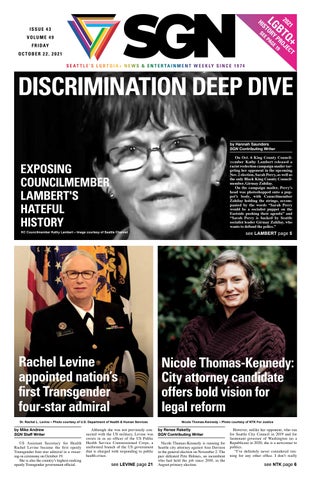
DISCRIMINATION DEEP DIVE by Hannah Saunders SGN Contributing Writer On Oct. 6 King County Councilmember Kathy Lambert released a racist reelection campaign mailer targeting her opponent in the upcoming Nov. 2 election, Sarah Perry, as well as the only Black King County Councilmember, Girmay Zahilay. On the campaign mailer, Perry’s head was photoshopped onto a puppet’s body, with Councilmember Zahilay holding the strings, accompanied by the words “Sarah Perry would be a socialist puppet on the Eastside pushing their agenda” and “Sarah Perry is backed by Seattle socialist leader Girmay Zahilay, who wants to defund the police.”
EXPOSING COUNCILMEMBER LAMBERT'S HATEFUL HISTORY KC Councilmember Kathy Lambert – Image courtesy of Seattle Channel
Rachel Levine appointed nation’s first Transgender four-star admiral Dr. Rachel L. Levine – Photo courtesy of U.S. Department of Health & Human Services
by Mike Andrew SGN Staff Writer US Assistant Secretary for Health Rachel Levine became the first openly Transgender four-star admiral in a swearing-in ceremony on October 19. She is also the country’s highest-ranking openly Transgender government official.
Although she was not previously connected with the US military, Levine was sworn in as an officer of the US Public Health Service Commissioned Corps, a uniformed branch of the US government that is charged with responding to public health crises.
see LEVINE page 21
see LAMBERT page 5
Nicole Thomas-Kennedy: City attorney candidate offers bold vision for legal reform Nicole Thomas-Kennedy – Photo courtesy of NTK For Justice
by Renee Raketty SGN Contributing Writer Nicole Thomas-Kennedy is running for Seattle city attorney against Ann Davison in the general election on November 2. The pair defeated Pete Holmes, an incumbent who had held the job since 2010, in the August primary election.
However, unlike her opponent, who ran for Seattle City Council in 2019 and for lieutenant governor of Washington (as a Republican) in 2020, she is a newcomer to politics. “I’ve definitely never considered running for any other office. I don’t really
see NTK page 6
GREEN CARDS • VISAS • ASYLUM • CITIZENSHIP 1836 Westlake Ave N, Suite 302 Seattle, WA 98109
(206) 724-1940 olivielaw.com
THIS AD SPACE HAS BEEN GENEROUSLY DONATED BY KRISTIN COSTELLO IN MEMORY OF SGN PUBLISHER GEORGE BAKAN
2
SGN
OCTOBER 2 2, 2021
C E L E B R AT I N G 4 7 Y E A R S!
In this Issue
LOCAL NEWS 4 A&E • FILM • BOOKS 8 OP-ED 18 LGBTQ+ HISTORY PROJECT 19 NATIONAL NEWS 21 INTERNATIONAL NEWS 21
VISIT US ONLINE SGN.ORG
OCTOBER 2 2, 2021
SGN
3
Local News
Let the ghoul times roll: Your guide to a spooky, safe Halloween 2021 by Kylin Brown SGN Contributing Writer Moonlit parties and the freedom of costumes make Halloween a favorite holiday in the LGBTQ+ community, whether you’re out or not. No matter how festive you feel amidst COVID-19 on this beloved nighttime occasion, there are options to get in the spirit of All Hallows’ Eve. (And no, not by dressing up as the coronavirus this time, please.) Costumes: alone, together On Halloween, costumes themselves are a source of cheer — or fright, to some people’s delight. In the company of your partner(s), immediate household, or the internet, one of the safest ways to get spooky is dressing up to stay in. And why not, if there’s already an excuse? If you haven’t decided your costume yet, we’ve got you covered with some on-trend ideas. If you’re too independent to be Buttercup with two Powerpuff besties, pull out your fishnet and leather, because you deserve attention. Some “main character” energy could be your ticket, perhaps by emulating Jon Snow of Game of Thrones or Catwoman, who is also already masked. In fact, the entire DC franchise might pique your interest, with its irreverent villains and Superman’s recent coming out as bisexual. We’ve also been blessed with a Cruella movie in the last year, a costume bound to be popular so long as those furs are faux. May I add that even a pre-gendered costume can be free of binary shackles? Gender-bending on Halloween predates the modern holiday’s traditions, as do LGBTQ identities. Lastly, blood-thirsty singles, don’t forget your chance to express your admiration for healthcare workers this year with the classic nurse minidress. Just make sure you’re vaccinated, so you don’t get fired! At this point in the pandemic, you might also feel the urge to match or coordinate your costume with literally anyone. Couples costumes that made their first mark in 2020 included iconic duos like Gay Frog and Toad, Scooby Doo’s Velma and Daphne, or Paris Hilton and Nicole Richie. This year, Teen Titans’ BeastBoy and Raven cosplayers went viral in late August, Timothée Chalamet was announced as Wonka, and Brett Rockman became the first Gay man on the cover of Playboy. If that isn’t out of the box enough for just yourself or you and someone else, consider
4
SGN
Photo courtesy of Queerks
planning something grander, householdwide or with close friends Take your best shot at group costumes from movies and music, such as The Breakfast Club, Black Panther’s leading ladies, the Spice Girls, or Ghostbusters. Alternatively, simple ensembles like jacko-lantern heads, ghosts, or black cats are plain ideas ready for your unique spin on them, and can be scaled from a solo act to large groups. Tried and true: Do the Monster Mash in a mask Unlike last year, Seattle’s nightlife scene is open this Halloween for the brave drag fanatics with any dollar bills left in their pockets, vaccine doses in their arms, and masks aface. While staying at home is the safest option, if you do plan to go out, Washing-
OCTOBER 2 2, 2021
ton’s Department of Health released a statement earlier this month providing guidelines for your safety. “This holiday, along with most of our holidays, will look and feel a bit different,” said Deputy Secretary of Health for COVID-19 Lacy Fehrenbach. “The good news is that with some changes, we can find meaningful and fun ways to celebrate while still working to reduce COVID-19 transmission in our state.” The page includes trick-or-treating guidelines as well [https://www.doh.wa.gov/Portals/1/Documents/1600/coronavirus/HalloweenTips.pdf]. According to King County’s latest mandate, all bars and restaurants will be required to ask their patrons for proof of vaccination or negative PCR test within 72 hours as of October 25. To meet these requirements, those going
out should make sure to bring valid documents as well as their ID. Once arriving at a venue, patrons should make sure to keep a well-fitting mask above the nose and mouth, avoid venues with poor ventilation, and avoid hosting or attending gatherings while experiencing symptoms. If you’re going out: LGBTQ+ events “Beautyboiz Go Boo, Seven Deadly Sins” 7th annual Halloween Costume Dance Party at Supernova, October 31, from 9 p.m. to 2 a.m. “Seattle Gaymers Annual Halloween Party,” October 31, 8 p.m. to 2 a.m. Features a costume contest with money prizes. “The Atomic Bombshells…Put a Spell on You!” Burlesque in the West Hall of the Oddfellows Building, October 31, 5 p.m. and 8 p.m. shows.
C E L E B R AT I N G 4 7 Y E A R S!
Photo courtesy of Citizens to Re-Elect Kathy Lambert
LAMBERT
been on the council since 2002, and she is a Republican. Prior to serving on the King County Council, Lambert was a state representative from the 45th District for seven years.
members of the King County Council quickly spoke out and denounced it as racist. It did not take long before Lambert’s endorsers, such as the Seattle Times, the Seattle Mariners, and the Washington Association of Realtors revoked their endorsements. The Mariners, who donated $500 to Lambert’s campaign, now plan to donate $1,000 to Perry’s. Lambert went live on KING-5 with Councilmember Zahilay and explained that the reelection campaign mailer could not be racist because “I do a lot of work in Africa, so if I had something against him [Zahilay] because of his color, I wouldn’t be doing the work I do in Africa.” On Oct. 12 the Metropolitan King County Council — including Lambert — voted to strip her of all internal and external committee assignments and to reassign the vacancies. As a result, Lambert was removed as chair of the Community Health and Housing Services committee. The vacancies were then assigned to the Law and Justice committee, which Councilmember Zahilay chairs.
covered in bruises and black eyes. Lambert thought staying with her partner would protect her stepchildren from their father, but the violence continued to spiral, and she eventually found a way out. Lambert’s history of domestic violence would make one think she supports and uplifts fellow survivors, yet her words and actions say otherwise. Former Republican state Sen. Joe Fain — who represented the 47th District from 2011 to 2019 — was accused of rape in 2018 by a woman named Candace Faber, who spoke out about an incident that took place in 2007: Faber and Fain went out drinking and dancing on the night Faber graduated with a master’s degree from Georgetown University. At the end of the night, Fain drunkenly demanded that Faber walk back to his hotel room, where he raped her. In an audio interview with KUOW, Lambert stated that investigators should look into how many rape allegations Faber had made. “I tell my daughters, you don’t go to a hotel room with a man who’s been drinking. You don’t do that,” said Lambert in the interview. “So, I think it’s a two-way street, where we need to both sides be responsible for our behaviors. She did say in one thing that they were kissing very intently beforehand, so you know maybe our investigation needs to be both ways.” Lambert’s outspoken victim-blaming led to Fain himself texting the Seattle Times to clear things up. “I strongly disagree with the connotation of Councilmember Lambert’s previous comments and have told her as much. While I absolutely did not do what has been alleged, I believe that those who come forward should be listened to and treated with respect, including Ms. Faber.” Since the rape allegations, which Fain has denied, there has been no formal criminal investigation. After he lost the election
“I think that time has caught up with her. She’s living in the past. She reflects the thinking Also pictured in the mailer are Seattle City Councilmember Kshama Sawant and and prejudices that have prevailed for 20 years… Vice President Kamala Harris — both Victim blaming women of color — in addition to Vermont Lambert is a survivor of domestic vio- I think the community has evolved and changed, Sen. Bernie Sanders, a white Jewish male. lence. She met her first husband when she Shortly after the mailer went viral, was 18 years old and was then frequently and she has not.” – TOM RASMUSSEN continued from cover
Background Kathy Lambert was born in Redmond and graduated from the University of Washington with a BA in elementary and business education. Lambert is a former teacher and wrote a biography for young adults called Martin Luther King Jr., which was published in 1992. In 2005 King County was officially named after the civil rights activist. In a newsletter Lambert sent to her district, she wrote, “We are the only country in the state that has had its name changed under state law. I wish there had been more discussion of this matter in King County prior to the State Legislature changing our county’s name.” Lambert currently serves as a King County Councilmember for District 3, the largest of the nine districts. It includes Duvall, Fall City, North Bend, and Snoqualmie. Lambert has
VISIT US ONLINE SGN.ORG
that year, the state Senate suspended plans for an independent investigation. “This is the tip of the 20-year iceberg” Tom Rasmussen is a retired member of the Seattle City Council who served from 2004 until 2015. Rasmussen mentioned how Lambert has a 20-year track record that shows what she truly stands for. “I think that time has caught up with her. She’s living in the past. She reflects the thinking and prejudices that have prevailed for 20 years… I think the community has evolved and changed, and she has not,” said Rasmussen. Rasmussen described Lambert’s recent campaign mailer as a lack of awareness of the harm it causes. He thought her initial reactions were not apologetic, until she realized there were consequences to her actions. “We know that politicians do have inconsistent records,” said Rasmussen, who mentioned that politicians change and evolve as they become more aware of issues. “It’s her votes that matter, and she has rarely ever voted for legislation prohibiting discrimination based upon sexual orientation,” said Rasmussen. On March 27, 2006, an ordinance was brought to the King County Council, amending the county’s definition of sexual orientation to include protection for those whose gender identities differ from their assigned sex at birth. Kathy Lambert voted no, but the ordinance passed by a vote of 5-4. Ordinance 16204, passed on July 14, 2008, proposed amending Section 840 of King County’s Charter, which prohibited discrimination based on disability, sex, sexual orientation, gender identity, race, religion, color, and national origin. Eight councilmembers voted yes, but Councilmember Lambert was excused. Rasmus-
OCTOBER 2 2, 2021
sen mentioned that an excusal from a vote means that a councilmember was not present, sometimes because they do not want to vote on a difficult issue. Ordinance 19047 was introduced to the Metropolitan King County Council in November of 2019. Its purpose was to establish a King County human and civil rights commission to advise the King County Executive and Council, as well to raise community awareness about equity and social justice in the county. Two members of the council voted no , including Lambert, but the ordinance passed 6-2 that December. At the end of 2020, Kathy Lambert voted against two measures that were passed by the council: to make Juneteenth and Indigenous People’s Day paid holidays. Her reasoning was that she thought the council should spend money on other things. “Well, I would say I support African people all over the world, and I have many people in my community that are African Americans, and they are my friends, and we work together,” said Lambert regarding her vote. On Oct. 15, according to an email from Perry’s campaign, a political action committee called “the Concerned Taxpayers of Washington State” hired Stampede America, “a Florida-based GOP consultant and canvassing shop” to spread misinformation about Perry’s campaign in the final weeks leading up to the election. According to the email, Stampede America has previously been involved with voter intimidation tactics and its board includes Trump’s former foreign policy advisor, Carter Page, who was investigated by the FBI for his contacts with Russia. If reelected, said Rasmussen, Lambert may be indebted to such conservative groups. “I’m encouraging everyone who votes in her district to vote for her opponent,” Rasmussen said, because “she votes on legislation that affects all of us.”
SGN
5
NTK
Local News
continued from cover think of myself as a politician, so, I like the specificity of what the city attorney does,” explained Thomas-Kennedy. “I was a public defender and... I saw what the city attorney was doing for misdemeanors in the city, and I thought it was disturbing and that I could do a much better job on that.” Thomas-Kennedy spent four years in public defense before opening her own law firm, NTK Law LLC, which specializes in low-cost or pro bono criminal and eviction defense. She earned her Juris Doctor degree from Seattle University in 2016. She had previously attended the University of Washington, where she earned a bachelor’s degree in anthropology in 2012. “I am an attorney and that’s what I like to do,” she said. A study in contrasts Unlike past years, the race for city attorney has been extremely competitive, and the platforms for the two candidates could not be more divergent. Davison, a practicing attorney and arbitrator, along with her supporters, have painted Thomas-Kennedy as too extreme for the post. Davison’s campaign website features a list of prominent endorsements from establishment candidates and politicians, including every living governor of Washington state and two former Supreme Court justices, seeking to drive that message into the minds of voters. However, Thomas-Kennedy is proud of being an outsider who would use her office to shake things up but says her campaign positions would ultimately deliver results and save the city money, something her campaign called “pragmatic and evidencebased solutions.” “We really need some commonsense solutions because... we can’t prosecute our way out of poverty. We cannot jail our way into mental health. We can’t punish our way out of addiction. So, we need to take some really commonsense steps toward solving those problems. That’s what I’d like to do,” Thomas-Kennedy said. The Thomas-Kennedy campaign is supported by Seattle’s Democratic district organizations and many local politicians, such as former Mayor Mike McGinn and Seattle City Councilmembers Tammy Morales and Teresa Mosqueda. In a Tweet on October 7, Thomas-Kennedy challenged critics who say she is “inexperienced,” noting that she is the “only” Seattle city attorney candidate with experience in the municipal courts: “I have had over 200 cases in Seattle Municipal Court alone. My opponent? 0 “I have done over 400 criminal cases in three different courts. My opponent? 0 “I have litigated over 200 civil cases. My opponent? 6 “I have done a dozen jury trials and won every single one. My opponent? No wins because 0 trials.” Davison previously worked for the Seattle SuperSonics from 1996 to 2001 and was a law clerk in the Marion County district attorney’s office in Salem, Oregon, before she began practicing law in Seattle in 2005. Currently, she is an attorney at Functional Legal Solutions PLLC, focusing on sports, business, employment, contracts, intellectual property, and other general civil areas.
Thomas-Kennedy has since sought to put those sentiments into context, noting that police tactics — including projectile weapons, chemical irritants, and explosive devices — clouded her judgement at the time. A federal judge has criticized the SPD for its use of these tactics against peaceful protesters in several instances. In a tweet on July 28, 2021, she explained that her “moral imperative” tweet “was made at the height of last year’s uprising when ppl [sic] were more concerned about broken windows than the continued murder and abuse of human beings.” She also noted in recent public comments to the media that she was not a seasoned politician when she wrote those tweets.
Donors Thomas-Kennedy has alleged on Twitter during multiple posts between Oct. 7 and 12 that her opponent is funded by conservative special interests and wealthy Republicans. The SGN spoke with Fernando Medina Corey, a software engineer by trade, on October 11 about his analysis of the campaign donations to each of the two candidates. He examined a subset of donors and their contributions to candidates and political action committees. He concluded that Thomas-Kennedy’s top donors mostly held occupations in software, teaching, law, and medicine. Davison on the other hand, according to Medina Corey, had a donor list that “reads like a roster of conservative politics: people in real estate, investors, CEOs or management who donated in federal elections to Republican politicians.” Although he no longer qualifies to vote in Seattle because he has moved out of the city, he concluded that “Davison’s affiliation with the Republican party — along with her megadonors’ support for it — disqualifies her” for the city attorney post in Seattle, which has long been dominated by Democratic Party politics. He also pointed to at least two instances where Davison’s donors had given to candidates who opposed marriage equality for same-sex couples and held transphobic political positions. He said if he had to choose, he would vote for Thomas-Kennedy. “After researching policy positions and donors of both candidates, I would absolutely be voting for Thomas-Kennedy,” said Medina Corey. The SGN interviewed Thomas-Kennedy on September 24 about her positions on a variety of issues she would be likely to face if elected city attorney.
Controversial tweets Thomas-Kennedy’s past tweets criticizing the actions of the Seattle Police Department and appearing to praise property destruction during the protests for racial justice have emerged as an issue in the city attorney race. On July 11, 2020, she stated: “I’m way left but [at the moment] can only tweet about my rabid hatred of the police. I currently read like a single-issue law enforcement abolition anarchist.” She followed that with a tweet on July 25, 2020, in which she thanked the “heroes that set the Children’s Jail on fire.” On August 25, 2020, she wrote: “Property destruction is a moral imperative.”
Scope of the office Thomas-Kennedy pointed out that the City of Seattle only prosecutes misdemeanors, the lowest-level crimes. “Even though some misdemeanors have scary names like assault, it is the lowest. It’s not that it doesn’t matter, but it is the least serious assault that we’re talking about. “Most of the crimes that are in the city attorney’s office are what they call ‘civility crimes’ — things like trespassing. There’s a lot of low-level and petty theft,” she said. “Ultimately, I would like to live in a city and a world where we don’t have to have this system of... lots of policing and prosecution for petty crime, things of that nature. We don’t live there right now. So, while I think that there are some prosecutions that we don’t need to be pursuing, there’s just much, much, much better ways that are more efficient, cheaper, and will be more [of a] deterrent than prosecuting.” She pointed to some instances such as “repeat DUIs or domestic violence, where... prosecution has to remain an option until we can build a system that is effectively preventing those things and systems of accountability of dealing with those things” are in place. “That is the goal of the office is to... not keep spending all this money prosecuting petty crimes that we could deal with in a much easier way. I would like to stop doing that pretty... immediately. …I mean sleeping [under] an awning, jaywalking, stealing
6
OCTOBER 2 2, 2021
SGN
from Goodwill — things like that — there’s just no point in spending the money on that. We could do it better, but... there are some things that will just have to remain for now. Ideally, I would like to prevent most of [that] stuff so we don’t have to be dealing with things this way.” Bias crimes Thomas-Kennedy pointed out that bias crimes in Seattle are considered felonies and, therefore, are outside the purview of the city attorney. The King County prosecutor handles all felonies. However, she does believe that the more that is done to “build community” and “lessen desperation in our communities,” the more that violent crime rates will decline overall. “There’s been lots of studies or there’s been polls in other cities like Boston and Baltimore where they stopped pursuing a lot of low-level crimes. What they saw was an overall drop in crime, even the more serious violent crime,” said Thomas-Kennedy. “I think the idea of community building and building up other supports and services would drop crime overall.” War on drugs While Thomas-Kennedy acknowledged that Seattle is seeing a substance abuse crisis, she stated that it was a “healthcare issue” that required a new “health-based’’ and “community-based” approach. “I think the problem with the war on drugs is it’s not addressing the problem. You know, we’re funneling billions of dollars into police and prisons over the war on drugs, but addiction is a medical issue. It’s a healthcare issue,” she said. “The war on drugs has been going on for most of the time that I’ve been alive. I think... it’s not worked... We have more people addicted now to drugs than we did when the war on drugs started. We’ve spent all this money… [L]ocking people up and punishing people for it is not working. “We really need to look toward other models, which is like a health-based model, a community-based model, where we foster a connection and healing and help people work through trauma. “This is a medical problem that we need money and resources to deal with. Instead, we’ve been spending billions on cops and prisons, and it hasn’t worked. Ending the war on drugs is not about ignoring our problems. It’s about facing what they actually are and what is actually going to work.” Mental Health Court When asked about Seattle’s Mental Health Court, a voluntary program where defendants can seek deferred prosecution for crime stemming from any type of mental illness, Thomas-Kennedy said she believes the program is not “effective” and delivering its intended results. “Very few people actually get through Mental Health Court. I think that if we’re going to do diversionary programs where... someone’s trying to get help and is volunteering to get help, I don’t think we need to have a judge and a bunch of lawyers there to oversee that,” she said. “Again, it’s a healthcare problem, and we’re spending all this money on lawyers. Lawyers are not qualified for these problems, and it would be so much less expensive to have a diversionary program that’s a pre-prosecution program. When people are voluntary and they want to engage with these services, we don’t have to hold the charge over their head to get them to do that. We can provide those services. We can hook people up with those services without spending millions and millions on courts and lawyers for that.” Domestic violence Thomas-Kennedy says she intends to use her office to help victims of domestic violence, but since the “maximum sentence is less than a year,” the office needs to focus on the “healing of survivors” and what they “actually want.”
“This is one of the most important questions, I think, because, first, there’s a lot of domestic violence that’s not reported... For a lot of reasons, people don’t feel comfortable going to the police or that’s not an option for them,” she said. “Some of the behaviors that are in a pattern of abuse or control for domestic violence aren’t necessarily illegal. There’s a whole pattern of isolation and... not getting access to money or things like that that have... formed this whole wheel of control around… domestic violence. What we’re seeing is a lot of people that just don’t have access to any sort of system that can help them. I think that’s especially evident when we’re talking about people where their financial circumstances aren’t super easy to begin with. It’s really hard for people to leave those situations when they don’t have anywhere to go, when they... can’t support themselves or their children for all kinds of reasons. “So, I think if we’re gonna really look at being able to assist as many people as possible... The criminal legal system, especially in the misdemeanor system, is not always the best system to deal with those things, because we’re really talking about one incident as opposed to the whole cycle of abuse. “While there are times when prosecution might be… the only option or the best option — it needs to remain an option for now — we need to be taking into account what [victims] have been saying for years that they want, which is access to resources… housing, transportation, [and] childcare. “The maximum sentence is less than a year. What are we doing to ensure survivors’ safety after that? I think that’s what where we really need to be focusing the resources of the office on...when we’re talking about domestic violence and wanting to actually be of assistance in generating safety and healing for survivors. We need to be talking about what they actually want. By and large, most of them don’t want more incarceration.” Defunding the police Thomas-Kennedy says “defunding the police” is a “short slogan” for reinvesting in community and public safety programs — a framework she hopes to establish in the city attorney’s office. She does not favor expanding the police budget but admits that she wouldn’t have oversight over that. “I think that there are some things that I’m not going to prosecute. I’m not going to prosecute consensual sex work at all. So, we have a vice squad that spends untold thousands of dollars on sting operations. If there’s not going to be an outcome for them, we don’t need to spend that money anymore. You know?… There are things like that,” she said. “So, that’s what I’m going to be looking to do… I mean, there [in] the criminal division... a few million dollars there... can be reinvested into the community to build up community safety and support programs.” Police accountability Thomas-Kennedy supports the view of the Seattle Community Police Commission that the most critical police disciplinary reforms have yet to be implemented, and while “there are certain people that have more agency in that situation,” she plans to do as “much as I possibly can.” “I think the most important thing that’s coming up is there’s going to be contract negotiations. The new police contract is going to be negotiated next year. I think when we’re talking about the things that the Community Police Commission is asking for, they’ve been asking for those things for years. Those were things that were bargained away during the last negotiations, and they need to be... in the contract,” she said. “I think that we are in a different place as a city today than we were four years ago. I think it’s extremely important having someone that’s going to be serious about negotiating that contract and not going to give into everything that’s been desired, because that’s kind of what happened last time. There was a really big giveaway on a
C E L E B R AT I N G 4 7 Y E A R S!
whole lot of things... and the Community Police Commission has been very vocal about what... didn’t get in there — as was Judge Robart. “I take those things very seriously. I think that measures that don’t expand the budget — the budget has already expanded so much — and that can be very effective are the most important things to be focusing on. I 100% support efforts toward holding police accountable as we build up systems so we don’t need them so much anymore.” Green New Deal Thomas-Kennedy praised Holmes’s defense of “progressive taxation” and noted that her opponent’s campaign has failed to focus on “any sort of civil litigation.” She states she would defend environmental policies passed by the Seattle City Council and “go after” fossil fuel companies who have “knowingly created this climate crisis.” “The other thing is the city attorney directs all of the litigation for the city, whether defense or proactive,” she said. “We all [go] through the heat dome and the wildfires every summer now. [There are] already pieces of infrastructure that taxpayers are paying for just so we can survive. It shouldn’t be taxpayers that are paying for those things. It should be the companies that knowingly caused the damage. Those are lawsuits that generally take a long time. In the meantime, we do need taxation to pay for those things, but we [also] need to be holding those companies accountable and making them pay for the things that we need to survive the climate crisis.” Wage theft Thomas-Kennedy has worked as a server and bartender in the past and says that wage theft was “extremely common in the service industry” and “just sort of assumed... it really is...a part of... what happens there. She hopes to use her office to go after “really egregious companies” that commit wage theft. “I think that people can really get help with those things [from] the Office of Labor Standards and [Department of Labor and Industry]. They do a great job, but those departments aren’t as robust as they used to be. “I think that there’s a lot of people that don’t understand that what happened to them is wage theft, like in the service industry,” she said. “I’ve talked to a lot, especially in the construction industry, like general contractors that consistently work with subcontractors that don’t pay their employees but they keep subcontracting with them because it’s cheaper. “There is a lot of proposed legislation and things around wage stuff that I would love to be able to help with. I also would love to help, because wage theft does hurt the city as a whole. Wage theft is usually committed against the lowest wage workers… When people are missing critical funds, it becomes a strain on already strained social services. Sometimes people become unsheltered. Then, there’s an... erosion of the tax base. So, it really does hurt the city as a whole. “I think there’s huge potential for the city to litigate against companies that can make a huge amount off wage theft. Provide better access for legal counsel for smaller individuals that experienced that. Then, also to propose or defend any legislation that the city council can put forward that would curb that practice as much as humanly possible.” Eviction crisis Thomas-Kennedy says she has a background in eviction defense and has gone up against corporate landlords. She says she also has had her own share of “nightmare landlords” as a renter herself. Therefore, she plans to use the city attorney’s office to provide relief where possible. “Some of the resources of the city attorney’s office needs to go to fund programs like the Housing Justice Project that provide legal counsel — it’s a clinic where you can go in and you talk to an attorney within a couple of days or maybe the same day. I worked for the Housing Justice Project and what I found a lot of the time was that I could just call a landlord and say: ‘Hey, my name’s Nicole Thomas-Kennedy. I’m with the Housing Justice Project.’ Landlords were like, ‘Okay, fine.’
VISIT US ONLINE SGN.ORG
Nicole Thomas-Kennedy – Photo courtesy of NTK For Justice
Thomas-Kennedy said voters should consider her for city attorney because she has the “experience to right the ship” in terms of the criminal system. “I also think that what people really want in Seattle is a more equitable city. When we have policies and processes and litigation that focus on helping the most vulnerable, that’s how we’re going to get ourselves out of the crisis that we’re in.” “So, I think that’s a really cost-effective way of doing things and that the Housing Justice Project is already up and running. We could just be funding them more. “There is the issue too [of] so many corporate management companies in Seattle now and corporate landlords where these huge companies have bought up a lot of the housing stock… There is like this aggregate of things: like refusing to give deposits back, like consistently illegally evicting tenants or... overcharging them for things... That is something that hurts the city as a whole. The city attorney can undertake litigation against big landlords that are constantly hurting our city by causing this sort of instability.” Homelessness In addition to supporting mutual aid efforts and removing legal obstacles those groups face, Thomas-Kennedy argues that jailing the homeless for petty crimes and overly burdensome court requirements on low-income individuals should come to an end. “I had a lot of clients as a public defender that became homeless because they could not pay bail. There’s just no excuse for that in my opinion,” she said. “We’re seeing a huge poverty crisis, a crisis of people being unsheltered. Part of that is not focusing on the people who are most vulnerable [but] turning to focus on what we can do for people to become self-reliant, to be able to support themselves, to be able to address their own problems and to get the help that they need to flourish in their lives. I think that’s the thing that’s going to really push us forward as a city and be the city that we really want. ...I think sometimes it’s what people think is already happening, but it’s not.” “I think the other thing that the city attorney can do is [to] really work with the City
Council to repeal exclusionary zoning laws that prevent us from building affordable housing. This really needs to be attacked from a lot of different sides. “I think the sweeps [of homeless encampments] are really damaging, and I’ve talked to a lot of different community groups and I’ve done mutual aid myself. I’ve been to some of the sweeps. I think there’s an idea that sweeps are happening and people are just refusing services. That’s not really the case. A lot of times people aren’t receiving offers for anything. Then, a lot of their things are just being thrown away. They kind of have to start over getting basic survival supplies. That’s damaging and expensive, and it’s already costing the city in litigation as well. There have been successful lawsuits over the sweeps. “I think what we need to be doing is really focusing on what transitory housing can we build, whether that’s tiny house villages [or] legalized encampments that are serviced by the city. Those are options until we can get people into permanent housing, because I really think this idea of just shuffling people… can’t do right now… I think we need to get serious about the problem. “The idea that we can jail our way out of it or sweep our way out of it is absurd. Even if we put every houseless person in jail right now, we do not have enough jail beds. We would need five or six times the jail capacity that we have right now. It’s just simply an impossibility. So we really need to be attacking the roots of the problem, which are moving people into places where they can be until we can get them into permanent affordable housing.” Abolition Thomas-Kennedy says the daily grind of being a public defender led her to become an abolitionist, seeking to abolish laws and
OCTOBER 2 2, 2021
practices that she deems unjust. “I thought I was prepared for what I was going to see... especially when I went to Seattle Municipal Court. It was such an eyeopening experience, because it was just so much more tragic than I thought,” she said. “I really did not think that people in Seattle were being prosecuted for stealing flipflops from Goodwill or a deodorant from Target, but that’s what I was seeing. This is progressive Seattle, and we are prosecuting someone for flip-flops?… Even if someone can pay bail, the process is the punishment, coming back over and over and over again to court or being put on probation. “It was just a lot of things that I saw in that court that were really horrifying. I saw a single mother come to court one time with her child, and she was required to get a drug and alcohol evaluation. This was her third court appearance. She finally had it done. She couldn’t get it done before, because she couldn’t afford it. She finally had it done, and the judge was angry because that hadn’t been done earlier and took her into custody... in front of her child — for doing the thing that she was supposed to do. It was just so cruel and unnecessary, and it was sadly not uncommon. “I support any reform that doesn’t expand the system. Any sort of accountability we can get in there is better than what we have right now but... the system is rooted in racism. It is rooted in white supremacy and slavery. We are never going to make enough reforms to move it away from that — it’s part of the foundation — which is why we need to move toward something else instead of constantly trying to tweak the system. We’ve been working on these sorts of reforms for a century, and we’re still in a place and a city, a liberal city, where Black and Brown people are prosecuted 5–6 times more than white people.” Thomas-Kennedy said voters should consider her for city attorney because she has the “experience to right the ship” in terms of the criminal system. “I think that’s one of the best reasons to vote for me. It would be that experience that I have,” she said. “I also think that what people really want in Seattle is a more equitable city. When we have policies and processes and litigation that focus on helping the most vulnerable, that’s how we’re going to get ourselves out of the crisis that we’re in.” Malcontent News will air a video version of this interview online. Learn more at www.MalcontentNews.com.
SGN
7
Arts & Entertainment
My nightmarish escape from Georgetown Morgue by Lindsey Anderson SGN Contributing Writer Are you looking for a night of fright? Do you think you have what it takes to survive a classic horror movie? Well, then head on down to Georgetown Morgue, Seattle’s most infamous and terrifying haunted house experience. I decided to check out the spooky scene this weekend with some of my ghoul friends. We expected to see the usual — some fake blood, maybe a jump-scare or two — but what we didn’t expect was to be transported into a world built on our innermost nightmares! The Georgetown Morgue experience began way before we entered the haunted house. The line for the attraction stretched down the block. Actors dressed as clowns, zombies, and grotesque cleaver-wielding men made their way along the line, sneaking up on unassuming couples and teenagers engrossed in their phones. The screams reverberated off the warehouses that lined the otherwise vacant area. For just $9, anyone could upgrade their tickets to VIP status and bypass the line. Some may have thought this would save them from the terrifying actors prowling the grounds, but the real horror show was waiting inside the glowing red doors. An ominous “good luck” from a man dressed in an old-timey conductor’s uniform was the last phrase I heard before stepping inside. Immediately, the environment changed. Fog and smoke filled the floor, and I was unable to see my shoes. An eerie melody played somewhere in the background, but it was hard to hear over the blood rushing to my ears. My friends and I clung to each other, hoping to stick together despite whatever cursed encounters may lie ahead. Not long into the maze, the jump-scares started. We’d make it around a corner, unsure if the slouched figure before us was alive and waiting to get us or victim of some other creature. As soon as we passed the body and relief started to wash over us, a scream would come up from behind, eliciting a rush of adrenaline. Behind us, monstrous encounters constantly barraged poor Zoe. Her grip on my hand tightened, yanking the rest of us to a halt whenever something sprang to life. She pulled us into the nightmare that was stalking her from behind, forcing us all to experience it with her. We walked through classic rooms of blood and gore. At one point, I ran right into a large body hanging from the ceiling. I could feel the sick rise from my squeamish tummy, but a determination to make it out alive and stay with my friends kept pushing me forward. What sets Georgetown Morgue apart from other haunted-house attractions is how the maze can transport you to all the locations your deepest fears reside. At first, we were in a house, then a meat locker, then a bunker. What truly terrified me, though, was when we entered a carnival funhouse. The lights began to strobe. We found ourselves stuck in a hall of mirrors, reminiscent of the movie Us. The bright fluorescent lights went out, and we could see nothing ahead. We walked forward nonetheless, at which point the lights suddenly flashed on, only to reveal a person standing before us! I shrieked at the sight of such a ghastly image — a tiny monster with messy blonde hair in front of their face, coated in a cold sweat. After a moment, I realized I was staring at my reflection in a mirror! I began to laugh with relief. The relief was short-lived, however. Slowly, a bloody clown emerged from the shadows behind my figure in the mirror. We ran again, desperately trying to escape his clutches, only to find ourselves surrounded, yet again, by mirrors. It was a dead end. Izabel tried to lead us
8
SGN
We expected to see the usual — some fake blood, maybe a jump-scare or two — but what we didn’t expect was to be transported into a world built on our innermost nightmares! back the way we came but only dragged us into another corner. The clown descended upon us, his red face twisted into a demented smile. “Go that way,” he whispered. Why we listened to Pennywise, I will never know. But his
direction helped us to escape the mirrors. We took a moment to breathe once we had made it out of the not-so-fun house. We were now standing in what looked to be the Black Lagoon. Green swamp water ran under our feet, and the fog thickened. Even the air
Photos by Lindsey Anderson
OCTOBER 2 2, 2021
had a swampy smell to it. Holding hands, we trudged forward through swampland so thick I couldn’t see my waist below me. We had been transported into an outdoor scene somehow — the only logical explanation seemed to be magic. I wondered if we had sold our souls to the devil upon entrance? $9 would be a fair price for mine. As thoughts swirled in my head about bargaining for my soul back, a swamp monster slowly crept up on our small party. She screamed at us, and we took off in a sprint, hoping to find a way out. The maze took a sharp turn, and my friends rounded the corner. I tried to follow but found I was stuck. My sweater had snagged on a limb. I tried to scream louder, but fear clenched my throat shut, strangling any noise that tried to escape. The swamp women came closer, and I fell to the floor, closing my eyes and bracing myself for death. This was it. I was so close to the end, but here was where I would die. “Come on!” Izabel yelled, tugging harder at my arm. “Go on without me!” I yelled dramatically. She rolled her eyes and came back. Just as the swamp witch was reaching for my limp body, Izabel unsnagged my sweater and pulled me up to my feet. She dragged my jelly arms around the corner and through the final door. The sweet night air cooled our faces. I looked up to see the full moon shining above our heads. We had made it out. All three of us began to laugh. Nothing seemed scary once we were out in the open. Adrenaline still coursed through my veins, but I felt a sense of accomplishment. We had survived. We went to Georgetown Morgue expecting a good scare, but what we got was so much more. The attention to detail, the commitment of the actors, and the chill in the air (which I can credit only to Satan himself) took us to another world. For twenty minutes, I was in a land of nightmares, reliant only on my friends to get us out. Georgetown Morgue is more than just a haunted house; it’s a horror experience. No Halloween would be complete without the adventure, bonding, and endless screams that happen inside those insidious red doors. Georgetown Morgue is open every day until Halloween, from noon to midnight. Tickets can be purchased online at seattlehaunts.com and upgraded at any time.
C E L E B R AT I N G 4 7 Y E A R S!
Seattle Opera’s La Bohème had us at “welcome”
Keri Alkema as Mimi and Michael Chioldi as Marcello in Seattle Opera’s La Bohème – Photo by Philip Newton
by Alice Bloch Special to the SGN LA BOHÈME by Giacomo Puccini, libretto by Giuseppe Giacosa and Luigi Illica McCaw Hall Opening weekend, October 16–17 (on stage through October 30) If there was ever an audience eager for a live opera performance, it was the one for opening weekend of La Bohème at Seattle Opera. The production could have been terrible, and it almost wouldn’t have mattered. People applauded and cheered wildly when General Director Christina Scheppelmann came out before the performance and said — for the first time in nearly 20 months — “Welcome to Seattle Opera at McCaw Hall.” There was another huge ovation when she said, “We are here because of science.” And another when she reminded us that we will never again take live music for granted. And when conductor Joseph Colaneri took his place and waved to the audience, cheers
erupted along with the customary applause. Fortunately, the production was not terrible, and in many ways it was heroic. Until very recently, it wasn’t clear that a live indoor performance would be possible at all, and then it wasn’t clear how many people would be permitted to attend. When public health guidelines were updated about a month ago, Seattle Opera decided to go ahead with a live performance and a full house — with everyone in the audience required to present proof of vaccination and to wear masks in the building at all times. In addition, the singers wore masks in rehearsal, and some of them hadn’t seen each other’s unmasked faces until opening night. The children’s chorus was eliminated, and both orchestra and chorus were about half the usual size. Stage Director David Gately had to work fast to assemble a production, so he opted to use sets and costumes already in Seattle Opera’s possession. The result is a production with a nostalgic feeling, quite appropriate for an opera saturated with nostalgia. Seattle Opera was smart to begin this
season with La Bohème, because it is such a beloved opera, guaranteed to sell tickets at a time when all arts companies are struggling, and because, as dramaturg Jonathan Dean points out in his program notes, “the success of the show is not contingent upon superstars.” No matter the cast, Puccini’s gorgeous music wins over the audience. The music simply makes us feel exactly what Puccini wanted us to feel at every moment. Even if you’ve seen La Bohème dozens of times, I defy you to keep your heart from swelling along with the music when Mimì sings in Act I of her love for springtime or to keep your eyes from tearing up in Act IV when the orchestra tells you that she is about to die. On Saturday night, soprano Karen Vuong as the seamstress Mimì and tenor Yosep Kang as the poet Rodolfo seemed to have opening-night jitters at first, with some vocal shakiness and difficulty projecting over the orchestra, but those disappeared after intermission. Mezzo-soprano Ginger Costa-Jackson and baritone John Moore, already favorites in Seattle, brought dra-
Ginger Costa-Jackson as Musetta and John Moore as Marcello in Seattle Opera’s La Bohème – Photo by Sunny Martini
VISIT US ONLINE SGN.ORG
OCTOBER 2 2, 2021
matic and vocal fireworks to the volatile couple Musetta and Marcello. As Rodolfo and Marcello’s buddies and roommates Colline and Schaunard, bass Ashraf Sewailam and baritone Eugene Villanueva did a fine job; Sewailam’s rendition of the “coat aria” (in which Colline decides to pawn his overcoat to buy medicine for Mimì) was lovely and affecting. On the whole, I felt that the Sunday matinee performance was more assured and successful. Keri Alkema as Mimì and Kang Wang as Rodolfo sang beautifully, with plenty of power when needed and an impressive ability to float soft notes over the orchestra. Wang’s singing was absolutely terrific; I hope to hear a lot more of this tenor in the future. Michael Chioldi as Marcello and Brandie Sutton as Musetta were vocally exciting and dramatically convincing. Theo Hoffman and Federico De Michelis gave excellent performances as Colline and Schaunard. In both casts, baritone Barry Johnson made the most of the comic characters Benoît and Alcindoro. The orchestra was reduced in size, but its sound was not. Bravo to Maestro Colaneri and the Seattle Symphony musicians for giving Puccini’s score the richness it deserves. Special praise is due timpanist James Benoit, flutist Demarre McGill, clarinetists Emil Khudyev and Laura DeLuca, trumpeter Alexander White, and harpist Valerie Muzzolini. My Sunday matinee companion remarked that this was the clearest production of La Bohème she’d ever seen. Gately’s directorial skill was everywhere evident, but particularly in Act II, the challenging, fast-paced crowd scene at Café Momus. Even when there was a great deal of action on the stage, the main characters stood out, and the audience knew exactly what was going on at all times. In Act IV, the antics of the four young men were exceptionally charming, until a harsh chord and a timpani roll abruptly changed the mood and began the scene in which Mimì dies. (In an opening-night post-performance Q&A, Gately called that chord “the guillotine.”) Lighting designer Chad R. Jung gave fresh life to the wonderful old drop sets originally purchased by Seattle Opera in 1965 for the company’s premiere of La Bohème. The late Martin Pakledinaz designed the stunning costumes for a 1991 production. It was good to see them again, and it was great to see and hear this opera again. For more information and to order tickets, go to seattleopera.org.
SGN
9
Arts & Entertainment
“Zen and the Art of an Android Beatdown” packs an emotional punch by Daniel Lindsley SGN Contributing Writer “Zen and the Art of an Android Beatdown” is an audio drama by Gin Hammond, adapted from Tochi Onyebuchi’s short story of the same name. It’s told mostly from the perspectives of androids, whose bodies are manufactured but whose memories are borrowed. It deals with themes of mental illness, suicide, selfharm, and neurodivergent minds with an intensity carried by the experienced voices of Mandy Rose Nichols, Tim Gouran, Annette Toutonghi, Arlando Smith, Jesse Calixto, and Mia Morris. There are two central characters. One is Cecile (Nichols), an android passing as human (whom she calls “redbloods”) who works repairing other androids who have been damaged or destroyed, including some that have destroyed themselves. The other is Boxer (Tim Gouran), an android
Image courtesy of Book-It Repertory Theatre
who ends up one of Cecile’s patients after a nasty fight. Their scenes are interspersed with those of other androids as they each “self-destruct.”
“Zen” was the first audio play I knowingly experienced. It’s a bit like an audiobook or podcast, with narration and dialogue, but the similarities end there. It stands apart
for its theatrical intent and use of audio, as a medium, to a fuller extent. A soundscape supports the words, creating a strong sense of place even as the setting changes — and with five androids used over 40 minutes, the perspective changes a lot. These changes can be abrupt, but they’re never jarring, at least not in a way that harms the work. Where an audiobook often embraces punctuation as something that should be felt, “Zen” uses changes in the soundscape, and changes in the voice actors, to shift perspectives on a dime from one character to another, even mid-sentence. It makes for one of the most deft forms of third-person-omniscient perspective I’ve experienced, such that it nears what could be called first-person-omniscient. Tickets for “Zen” are available on the Book-It Repertory Theater’s website (book-it. org) for $20, or $30 for a class pass.
MoPOP’s “Contact High” exhibit explores hip-hop through decades of photography by Hannah Saunders SGN Contributing Writer Hip-hop: it isn’t just a music genre — it’s always been more than that. It’s a cultural revolution that continues to galvanize art scenes, dance, politics, fashion, and culture throughout the globe. The hip-hop movement goes back to the 1970s in New York City, when economic and social demographics experienced a startling change. With that came an increase in poverty, crime, and gang violence. Black neighborhoods were hit the hardest, and Black youth yearned for forms of self-expression. Hip-hop music reflected the day-to-day experiences of youth living through these harsh conditions. Block parties were where some of the earliest forms of the genre were developed, and photographers were on the scene to document it all. These photographs — which created instant icons — cannot be separated from what the music relays: individuality and self-expression, political rhetoric and empowerment. MoPOP’s “Contact High: A Visual History of Hip-Hop” exhibit explores the evolution of this music, from the time when no one knew how long it would stick around, until the present day. The exhibit is based on curator Vikki Tobak’s book Contact High: A Visual History of Hip-Hop, and Fab 5 Freddy contributed to it by taking on the role of creative director. The album that got me heavily involved in the hip-hop genre was The Roots’ Undun. My older brother sent me a few songs in college, and I became instantly hooked. I wasn’t new to this kind of music, but this album hit me differently. It tells the story of a fictional Philadelphian, Redford Stephens, who becomes entangled in the drug trade and meets an inevitable but early downfall. “This is poetry,” I thought to myself as I found my head and body grooving along with the lyrics and heavy drumbeats. One of the first things I saw when I entered the exhibit was the Undun album cover: a black-and-white photo of three kids, in which one is doing a backflip on top of tattered mattresses, with a crumbling building in the back. That photo was taken from a series by Jamel Shabazz in Brooklyn in 1982 called “Flying High.” Shabazz was known for his
street portraits. It took him three frames to capture “Flying High” with his Canon AE-1 camera, which are all displayed in the “Contact High” exhibit. Like Undun, the photograph highlights the undissolving strength and beauty of inner-city youth who grew up under some of the harshest circumstances. The most striking thing about this exhibit are the contact sheets, which are prints from rolls of used film. Many displayed are placed alongside some of the most iconic images of hip-hop artists. They allow one to look into the creative processes that took place between the sub-
10
OCTOBER 2 2, 2021
SGN
Installation view – Photo by Hannah Saunders
jects and the photographers. The increase in digital photography and social media has made these contact sheets rare these days. A large black-and-white portrait of the young Aaliyah, taken in Manhattan in 2001 by Eric Johnson,, is displayed on one of the walls of the exhibit, with blown-up images of the contact sheets from the photo shoot behind her. Aaliyah became a star in her teens and was one of the first women to sing smooth and honeylike R&B vocals on top of hip-hop beats. Aaliyah marked the contact sheets herself, circling pictures she liked and crossing out those she didn’t with
a big X. (At the young age of 22, the star died in a plane crash.) The MoPOP exhibit also includes one of the most recognized photographs in hip-hop history: Biggie Smalls’ “King of New York” photo, taken by Barron Claiborne for a Rap Pages photo shoot. Biggie changed the genre forever with his deep voice, which exuded flowing wordplays and immaculate storytelling. Alongside that photo are contact sheets, which show Biggie smiling — something that was not common for the artist. In addition to the contact sheets, there is an original copy of Biggie on the cover of Rap Pages. Three days after the photo shoot, he was killed in a driveby shooting in Los Angeles. “I’m proud of the image. There are so many images of Black people, rappers or not, that you don’t see in American culture,” said Claiborne. “You rarely see them as regal. When you see something different, you embrace it. The fact that he died made the symbolism stronger. He had to die for that image to have that symbolism. The king sacrificed. But Biggie has the crown.” Another wall of “Contact High” features blown up portraits of more recent hiphop artists. Tyler the Creator — a rapper who has implied in his lyrics that he is Gay, after years of homophobic songwriting — was pictured in a snapback, sticking his teeth out. A portrait of Kid Cudi wearing reading glasses and a beanie with his arms crossed is also on display, as is photograph of Queer icon Nicki Minaj dressed in tights and a bra serving food in a diner. Not only does the exhibit include iconic photographs of male and female hiphop legends and over 75 unedited contact sheets, but it also includes artifacts such as the Dapper Dan jacket that was made for Rakim and MF DOOM’s legendary mask. Also featured are early rap-battle flyers, Tupac Shakur manuscripts, Flavor magazines, and costumes from The Notorious B.I.G. and Sha-Rock. MoPOP’s “Contact High: A Visual History of Hip-Hop” exhibit, which opened on Oct. 16, will leave you speechless. Starting on Oct. 25 the museum will require all attendees over the age of 12 to show proof of vaccination or a negative PCR COVID-19 test dated within 72 hours of the visit. To buy your tickets, visit www. mopop.org/visit/museum-tickets.
C E L E B R AT I N G 4 7 Y E A R S!
VISIT US ONLINE SGN.ORG
OCTOBER 2 2, 2021
SGN
11
12
SGN
OCTOBER 2 2, 2021
C E L E B R AT I N G 4 7 Y E A R S!
VISIT US ONLINE SGN.ORG
OCTOBER 2 2, 2021
SGN
13
Film
Ron’s Gone Wrong frustratingly doesn’t compute
There are plenty of reasons why Ron’s Gone Wrong should be perfect for this precise moment. It deals with issues relating to social media addiction, an overreliance on technology, and the loss of physical communication skills since everyone is living so much of their daily lives online. This is especially true when it comes to kids, many of whom have a more personal and heartfelt connection to their cellphone than they do to fellow humans their own age. This is what directors Sarah Smith and Jean-Philippe Vine, along with co-director Octavio E. Rodriguez, appear to have set their well-intentioned hearts on exploring. But the script by Smith and Peter Baynham, who were also behind the positively delightful Arthur Christmas, is maddeningly unfocused, and its central themes are frustratingly unclear. Its points are seldom made with any certainty; everything builds to a strange conclusion that comes perilously close to being the literal definition of “mixed messaging.” Nonsuch Middle School student Barney Pudowski (voiced by Jack Dylan Grazer) doesn’t have any friends. He’s a loner, hesitant to go outside at recess and determined to do whatever he can to fly under the radar and not be made fun of. Even so, he’d still like to fit in, even if only for a moment. It’s Barney’s birthday, and all he wants is a B*bot, a revolutionary robotic, mechanized “friend” that’s become all the rage and may allow him to get closer to his classmates. But his kindly, novelty-toy-inventor father Graham (Ed Helms) doesn’t have a lot of disposable income. As for his kooky but loving grandmother Donka (Olivia Colman), she doesn’t know the first thing about technology, and refuses to understand how a robot thingamajig could ever substitute for the type of human friends Barney had back in elementary school. In a twist straight out of Child’s Play, Graham and Donka are able to secure a B*bot from a back-alley street vendor, not realizing it’s damaged. Initially Barney is overjoyed, but since his new cybernetic
companion has almost zero pre-installed memory, it becomes clear the boy is going to have teach his toy how to be his friend, instead of it knowing all that information fresh out of the box. This leads him to nickname the B*bot “Ron” (Zach Galifianakis), and a flurry of whacky shenanigans ensue. Those are just the basics. There’s also a powerful tech conglomerate that created the B*bots that wants Ron back — to study and destroy it, as the company is worried Ron will threaten its profit margins. Then there is the actual inventor of the machine, who hopes to study its code so as to discover how the B*bot could become a real friend to Barney and not a programmed imitation. There’s also stuff involving all the kids at Nonsuch Middle School. They’ve split themselves into cliques based almost entirely on who their B*bots think they should and should not like, governed by their owner’s likes and dislikes, matching them on compatibility theorems they’ve been programmed to be beholden to . The kids are now obsessed with living their lives online, their success and popularity being decided by how many “likes” they can rack up or how many followers they have — and practically nothing else. As a pure tale of friendship between Barney and Ron, there are some winning elements. There is a lovely moment where the human cog in this duo realizes how selfish he’s been. He frees Ron to be his own entity, unrestricted from having to follow any rigid protocols determined by Barney’s needs, wants, or desires. It instantly strengthens their bond, allowing their relationship to evolve in ways that are genuinely heartfelt. But there is a lot more going on, and unfortunately the film never gets a solid handle on all it’s trying to explore or say. As much as I liked Graham and Donka — and both Helms and Colman voice the pair magnificently — they’re so peripheral that I never grew as connected to them as I did to Barney and Ron. They don’t get enough to do, and are too inconsequentially fleshed out to matter nearly as much as I imagine they were supposed to. As for the other children, many of them are going through some deep, hard-hitting stuff, especially in regard to loneliness and feeling disassociated from their classmates.
14
OCTOBER 2 2, 2021
by Sara Michelle Fetters SGN Staff Writer RON’S GONE WRONG Theaters
SGN
Ron’s Gone Wrong deals with issues relating to social media addiction, an overreliance on technology, and the loss of physical communication skills since everyone is living so much of their daily lives online. This is especially true when it comes to kids, many of whom have a more personal and heartfelt connection to their cellphone than they do to fellow humans their own age.
Ron's Gone Wrong – Photo courtesy of 20th Century Studios
Yet most of them never come alive. Their social anxiety or hidden emotional terrors have no resonance. The sentiments fueling their arcs feel engineered, not real, making the catharsis of the ending fall disappointingly flat. I’d be remiss if I didn’t mention The Mitchells vs. the Machines, in which high schooler Katie Mitchell and her precocious little brother Aaron stand up to an all-powerful tech company’s AI creation (coincidentally voiced by Colman) and in the process become heroes. It already explored many of these same issues, and did so with
an imaginative wit and an intelligent grace that took me by surprise. That’s still the best animated film I’ve seen so far this year. No such luck with Ron’s Gone Wrong. Even though its heart is in the right place, and although there’s an admittedly sublime vocal performance by Galifianakis, the storytelling is just too muddled to be effective. The climactic moral to this wacky tale of friendship in an age of omnipresent digital connectivity tries to play things down the middle, and in the process slaps itself in the face right when it’s also trying to pat itself on the back. Color me unimpressed.
C E L E B R AT I N G 4 7 Y E A R S!
Emotionally barren Dune one half of a technically stunning sci-fi spectacle
Timothée Chalamet in Dune – Photo courtesy of Warner Bros.
by Sara Michelle Fetters SGN Staff Writer DUNE Theaters / HBO Max At the very least, Denis Villeneuve’s ambitiously immersive adaptation of author Frank Herbert’s Dune is upfront that it is only presenting roughly half of the story. The title card proudly — some would say defiantly — reads “Dune Part One,” and even though there is no guarantee there will be a second half, that doesn’t appear to have dissuaded the Oscar-nominated (Arrival) director from playing coy about his intentions. I have no idea if Warner Bros. will ultimately feel compelled to foot the bill for a sequel. In this new age of theatrical and streaming hybrid releases born in large part courtesy of a global pandemic, it’s impossible to know what the benchmark for success will be where it comes to a massive studio blockbuster release such as this. Suffice it to say, whether or not there will ever be a Dune Part Two, your guess is as good as mine. But back to this half of the story. Villeneuve and his fellow screenwriters Jon Spaihts (Prometheus) and Eric Roth (Forrest Gump) have attempted to streamline and flesh out Herbert’s prose as best they can. Yet as accessible as their script may be, there isn’t much of an emotional heartbeat thundering in this gigantic visual spectacle’s chest. With precious few exceptions, these were not characters I cared about, making whether they heroically persevered or met a tragically bitter end inconsequential as far as the bigger picture was concerned. There’s far too much plot to try and spell it all out in a simple synopsis. Keeping things basic, thousands of years in the future, Duke Leto Atreides (Oscar Isaac) is ordered by the emperor to take over the rulership of the desert planet Arrakis and “Spice” mining operations from the ruthless Baron Vladimir Harkonnen (Stellan Skarsgård). Young Paul Atreides (Timothée Chalamet), son of Duke Leto and his lovely concubine Lady Jessica (Rebecca Ferguson), has been literally dreaming about Arrakis and its indigenous population, the Fremen. Not to travel too far into the weeds, Duke Leto is betrayed, the baron returns to rule Arrakis, Paul’s dreams may not be fictional, and the Fremen are more than willing to take up arms against the Harkonnens, who have attempted — and mostly
VISIT US ONLINE SGN.ORG
failed — to eradicate them for generations. There’s much more to it, of course, including secrets held close to the vest by Lady Jessica concerning her son, but going into them all would take more words than a single review will allow. Just know that something is happening every second of the film’s 155-minute running time, and to Villeneuve’s credit, he keeps a solid handle on all of it. I never felt lost or overburdened by the convoluted coming and goings of all the various characters, and even if they’re only around for a scene or two, it’s still fairly easy to know who is who and what side of the conflict they are going to be fighting on. In the same breath, there’s so much work being done to ensure that all of this nonsense makes consistent sense that it’s pity that precious few of the story’s inhabitants are worth the effort of getting to know. Chalamet tries to make Paul interesting, but there’s only so much he can do during this half of Herbert’s tale. Paul is only on the cusp of coming into his own and discovering the strength to embrace his destiny. As such, he’s more symbol than person, his inner struggles falling flat in ways that grow increasingly tiresome as events build to their inevitable cliffhanger conclusion. Other characters portrayed by the likes of Josh Brolin, Jason Momoa, Stephen McKinley Henderson, Javier Bardem, Charlotte Rampling, David Dastmalchian, Zendaya, Sharon Duncan-Brewster, Dave Bautista, and Chen Chang come and go, some more important or more interesting than others, but all weighing heavily on the outcome. Only Momoa — who is sensational, and delivers possibly my favorite performance in the film — and Rampling make a memorable imprint. They both leap off the screen, and it’s almost a pity they do not get a great deal more screen time. There is one human element that Villeneuve gets perfect, and that’s the relationship between Duke Leto and Lady Jessica. Isaac and Ferguson are sublime. The pair disappear into one another’s arms so completely, so effortlessly that the heartbreak generated when they are forced apart is entirely genuine. The actors craft multidimensional portraits of sacrifice, courage, valor, and togetherness that are close to remarkable. Ferguson is particularly luminous in ways that defy easy description. As to the technical merits of this production, those are beyond reproach. From Hans Zimmer’s (The Dark Knight) score
Denis Villeneuve’s ambitiously immersive adaptation of author Frank Herbert’s Dune starring Timothée Chalamet, Rebecca Ferguson, Oscar Isaac, Josh Brolin, Jason Mmoa, Zendaya, and Charlotte Rampling.
Rebecca Ferguson and Oscar Isaac in Dune – Photo courtesy of Warner Bros.
to Patrice Vermette’s (Sicario) production design, from Jacqueline West’s (The Revenant) costumes to Greig Fraser’s (Zero Dark Thirty) cinematography, this is one of the more exquisitely realized science-fiction epics I’ve seen in ages. Herbert’s world comes alive in ways that boggle the mind and the senses, as Villeneuve showcases one eye-popping delight after another with supremely confident bravado. As messy and as unfocused as it may be, I admit I admire the wildly cavalier swings of David Lynch’s 1984 version of Herbert’s source material. There’s something magically madcap about it that will always garner the film a comfortable place in my heart. Does it work? No, not really, but it has a gonzo attitude I responded to as an impressionable kid and am still partial to now. Not that I’m comparing Lynch’s attempt to bring the book to the screen with Villeneuve’s. They’re very different creatures,
OCTOBER 2 2, 2021
and it’s clear that Warner Bros. has given Villeneuve far more freedom to realize his vision than Universal ever gave Lynch almost four decades ago. But I do bring up my feelings for that previous feature because, at least in that instance, I was (and still am) able to analyze a finished feature. That’s simply not the case here. Will my opinion on this incarnation of Dune change if Villeneuve is granted the budget to make the second chapter? That’s very possible, as all the building blocks are in place to see Paul’s journey come to a satisfying end. But I can only judge what exists now, not what might at some unknown point in the (hopefully) near future. This Dune, for all its technical virtuosity, is stranded in an emotionally barren desert, and for all that is extraordinary about this production, that’s one sundrenched obstacle I’m not so certain I have the willingness to try and overcome.
SGN
15
Books
A global guide for the gutsy gastronome by Terri Schlichenmeyer Special to the SGN GASTRO OBSCURA: A FOOD ADVENTURER’S GUIDE CECILY WONG AND DYLAN THURAS © 2021 Workman Publishing $40.00 / $50.00 Canada 440 pages You had a sandwich for lunch again today. If you had to estimate, you’ve eaten thousands of those things over the last five years. Chicken sandwiches. Sandwiches with lunch meat. Sandwiches with a burger. Vegetarian sandwiches. Grilled cheese sandwiches, yeah, you could be in a rut. So tomorrow, why not try something different? Read Gastro Obscura by Cecily Wong and Dylan Thuras, and see what else is on the menu. Let’s face it: whether it’s authentic Thai food or locally sourced fish, Mom’s secret gravy recipe or Grandma’s pies, half the appeal of travel is on a table somewhere, and why not? Worst case-scenario: you don’t like it, but you tried. Best-case scenario: the best meal ever. So why not start with something easy: on your next journey, try bovril, a “beloved” beef product that’s sold as a paste in England. Go to Italy and stand in line for the
Image courtesy of Workman
chance to sample “what may be the rarest pasta in the world.” Have a bowl of “sumo wrestler stew,” knowing that no wrestlers were harmed in its creation. These foods would taste great when accompanied by bread baked in sand or lava in Libya or the Solomon Islands, respectively, and perhaps some mustard pickles from Canada. If you’re thirsty, how about a Irn-Bru
Cecily Wong – Photo by Heather Hawksford
Dylan Thuras – Photo by Timothy Shivers
from Scotland, a kind of soda with “0.002% ammonium ferric citrate.” A mlíko, or “fluffy beer” from the Czech Republic, might taste good, and “Naked Boy Tea” doesn’t seem so bad when you know that it’s not from a real boy. And then there’s dessert, maybe ice cream presented as spaghetti, a dish Germans love; or blood candy from Russia, made of cow’s blood. Never mind: how about a stick of gum that proudly tastes like soap? But wait — you’re traveling, remember? Yes, and while you’re out, you might take in a “cow’s head barbecue” in Texas, a food tour of the Jim Crow South, lunch in Mumbai, chile school, or a Hollywood studio. Bon appétit! Crack open Gastro Obscura and you’ll notice a most curious thing: much of what you’ll read about will make your mouth water. Yes, there’s plenty to make you say “eeeeeuuuww” and curl your lip here,
but give Wong and Thuras a paragraph to change your mind. What they’ve dished up in this book are the kinds of foodstuffs that hosts in other countries would prepare for fancy company. Some of the dishes are ancient, passed down from generations of cooks; others are new versions of old meals similar to some you might already enjoy. You’ll find treats for kids here, once-in-a-lifetime bucketlisters for discerning palates, and easy-tolearn comfort foods for young adults — and if you don’t believe that, there are some recipes you can try. Reading this book is like taking your stomach on a vacation, and no foodie should be without it. If you’re looking for an unusual something for the gourmand, Gastro Obscura is what’s for lunch.
If only this parent’s memoir of raising a nonbinary child were more so by Terri Schlichenmeyer Special to the SGN RAISING OLLIE: HOW MY NONBINARY ART-NERD KID CHANGED (NEARLY) EVERYTHING I KNOW TOM RADEMACHER © 2021 University of Minnesota Press $18.95 200 pages Fill-in-the-blanks. That’s what you get when you have a baby: unknowns. Its birthdate is often a guess; its length and weight are surprises. Will it have your eyes, long fingers, Dad’s smile, Grandma’s nose? And sometimes it’s not boy, not girl but, as in the new memoir Raising Ollie by Tom Rademacher, neither, thank you. When his daughter, Olive, was an infant, Tom Rademacher says he “struggled in those early months... to enjoy much of parenting...” There were vast amounts to learn, but little “Ollie” was a patient teacher. As a toddler, Ollie was particularly talented in language and arts, attributes their teacher-father and therapist-mother encouraged. Early on, they were super observant, wise, and curious about just everything; when they were in second grade, suspicions that they were an intelligent kid were confirmed by the label “advanced learner.” But school was a trial, even for a ubersmart seven-year-old. Ollie suffered from anxiety. They hated crowds and making friends and unwanted attention; they had the wit, open-mindedness, and understanding of an adult sometimes, but with little-kid coping skills. Normally a vora-
cious lover of learning, they began to dread each school morning, and they seemed tearfully fearful of some classes and teachers. Obviously, a change in schools was needed. Ollie did their own research. Shortly after starting third grade, Olive — who prefers “daughter” and uses genderneutral pronouns — begun loudly, confidently, assertively identifying as a nonbinary kid. Around the same time, Rademacher, a 2014 Minnesota Teacher of the Year, had been unemployed due to budget cuts but was working on how to offer the best support for his students, just as he wanted for his child...
16
OCTOBER 2 2, 2021
SGN
Image courtesy of University of Minnesota Press
Tom Rademacher – Photo by Sara Rubinstein
Raising Ollie is absolutely delightful. It’s also less than half about actually raising Ollie. It’s filled with funny stories that will make you laugh. It’s a peek inside today’s classroom, with a teacher who offers relatable lessons to a notoriously tough audience of teens. Rademacher starts this memoir with a teasing warning to readers that stories are important in his family. He fulfills his promises to tell tales about his life, his parents, racism (and his efforts to eliminate it in the schools where he works), and the stellar students he’s had. His stories make you want to be seated at his table at a conference. There are sometimes-hilarious tales of a
Midwestern growing-up, idyllic and happy and nostalgic, followed by a typical, angsty, identity-searching teenage-hood. And yes, he tells stories about his smart, funny, talented child who is an “art nerd” and loves cosplay and wore girly dresses until about age seven — but just not enough. Sigh. Teachers will adore this book. There are laughs all over the place for just about every reader who can appreciate a little self-deprecation. But if you’re looking for a parenting book about rearing a nonbinary child, Raising Ollie may leave you blank.
C E L E B R AT I N G 4 7 Y E A R S!
Aiden Thomas talks Cemetery Boys, Día de los Muertos, and Latinx culture by Lindsey Anderson SGN Contributing Writer What if you could summon spirits using magic? What if one of those spirits was super cute? That was the question bestselling author Aiden Thomas started with when penning his first book, Cemetery Boys. The novel is a celebration of identity, family, and love, centering around Yadriel, a Trans boy looking for acceptance from his traditional Latinx family. Thomas and I sat down to talk about the book, his writing process, and all things Halloween. Origins Thomas told me he got his original idea for the book from a Tumblr post a few years ago. “I was on my phone on Tumblr — when that was still a cool app to use — and I saw a prompt, and it was just one sentence, and it said, ‘What would you do if you summon a ghost and could not get rid of it?’ …I read that as “What if I summoned a ghost and couldn’t get rid of him, and what if he was really cute?” Once he knew he wanted to write a ghost story, the rest of the work came fast. The idea of the book taking place around Día de los Muertos seemed obvious. “It is my favorite holiday in the entire universe, and I thought it would create a lot of fun moments to flex on how beautiful my culture is,” Thomas said. Thomas wrote the entire first draft in just six weeks, then began the editing process. Despite working so hard to get the book finished and ready for publication in such a short time, the initial release date for Cemetery Boys was pushed back three months due to the pandemic. “I busted my butt to get this book out, only for the global pandemic to push it back, so that was ironic,” Thomas laughed. Latinx culture Writing Cemetery Boys was a labor of love for him, he said. It was the first book he wrote centering on an LGBTQ+ character and his first to focus on a Latinx family and its traditions. Día de los Muertos is a traditional Mexican holiday during which families come together to celebrate and remember loved ones who have passed, typically with beautiful candles, artwork, and altars. “What I think is fun about Día de los Muertos is how my culture understands death,” Thomas said. “In Western society, people see death as a dark, sad, and a dreary thing. For us, it’s not seen as the end... We have comfort knowing every year that for those two days, we get to celebrate, remember, and welcome the spirits of our loved ones back to the living. “For me, it was fun to show that difference and put out the idea that death isn’t something we should necessarily be afraid of. Just because someone dies doesn’t mean we lose them.” Aside from the holiday, Latinx culture in general is a theme in Cemetery Boys. For Thomas, this was very intentional, as many LGBTQ+ stories in the media today center on the experiences of white people. For people of color, especially Trans people of color, experiences with gender and sexuality can look very different. “All cultures have their relationships to gender and gender expression, and what that looks like,” said Thomas. For him and many other Latinx people, cultural ideas about gender sometimes clash with modern expressions. “That’s what’s especially difficult in Latinx culture, that it is very traditional,
VISIT US ONLINE SGN.ORG
Aiden Thomas – Photo courtesy of the author Images courtesy of Macmillan 2020
and we are rooted in these beliefs. Gender roles are typically a huge thing in traditional Latinx communities. When you try to press against that, people say you are trying to overthrow this tradition that we have.” Traditional gender roles can be a difficult backdrop for anyone to grow up against, but for Trans people, it is especially challenging. “For Trans folks within the Latinx community, what’s especially difficult is you are dealing with a gendered language. There are all these landmines for you to step on where you get misgendered, and I think that’s a hard thing for Trans Latinx kids to experience.” Representation matters Sometimes Latinx LGBTQ people feel like an outsider in both communities as they struggle with balancing a love for their cultural identity and their gender identity. Despite experiencing struggles with rigid gender roles and heavily binary language, Thomas sees hope for future generations. “We do this because it is the way it has always been, without asking why. I think what’s becoming more and more prevalent in younger generations, especially queer ones: asking why.” In his novel, Thomas gives readers a look into types of families that aren’t always seen. “I felt like when I was reading stories about Queer teens, and especially Trans teens, the families either completely rejected them and kicked them out of the house, or they became these perfect allies.
“For me, what was important was to show a Latinx family that doesn’t hate Yadriel or his identity; they just don’t understand him. It’s that unknown that has mostly to do with being educated, to have that much more complex family dynamic instead of a cut-and-dried experience.” As a result, Thomas gives readers a refreshing new perspective on what family acceptance and understanding can look like. This can provide hope to teens who may be closeted, or not fully accepted, that those in their world can come around to better understanding. The future, writing advice, and Halloween When it comes to his future projects, Thomas plans on continuing to write stories about LGBTQ+ people. “I think it’s important, because there are so many LGBTQ+ folks that exist, especially young adults, and we’ve learned that representation can be life-changing. Our Queer youth right now have it rough. We’ve just gone through a hellish five years, especially.” The only problem he sees with LGBTQ+ literature today is that there is not enough of it. “For me, it’s important to have books and lots of books, lots of different kinds of books for Queer teens. I just want there to be a whole plethora so Queer teens can read a Queer ghost story, or a Queer sci-fi novel, or a horror book.” The best way to solve this problem is to encourage more LGBTQ+ people to get into writing. The best advice he has for aspiring young writers is twofold. First, “to
OCTOBER 2 2, 2021
be a successful writer, you have to finish your first draft. It’s the hardest part of writing, getting something you can then turn into something better, but you can’t revise unless you have that first draft.” Second, “what’s important is to find yourself a group of writers or readers to be your people. Finding your little Queer community of writers not only betters your craft but can [be a support for] each other through the low lows that can happen [in] publishing,” he added. Through writing and community, people can find spaces to express themselves more freely and openly. This is also one of the appeals of Halloween. “I think what’s so cool about Halloween is you can be exactly who you want to be without being weird. It carves out a pseudo-safe space where you can dress how you want to dress without putting yourself at risk of being out, if you’re not ready to share that with everybody. You can crossdress, and it’s okay, because it’s Halloween, and anybody can be what they want to be.” Cemetery Boys encapsulates that freeing feeling of Halloween, where anyone can be who they want to be. It shows us that with time and understanding, those who love us will always continue to do so. It shows that with love, nothing is binding: not gender roles, expectations, or even death. Cemetery Boys is available now wherever you purchase your books. Aiden Thomas’s next novel, Lost in the Never Wood, is also out now.
SGN
17
Books
Respect your elders... or else! by Terri Schlichenmeyer Special to the SGN AN ELDERLY LADY MUST NOT BE CROSSED HELENE TURSTEN Translated by Marlaine Delargy © 2021 Soho Press $14.99 / $18.99 Canada 261 pages Memories flood your brain at the oddest times. They’re spontaneous and unbidden, random and fleeting. You may be tinkering in the kitchen, and thoughts of a childhood friend pop into your head. Raking leaves, and Grandpa’s car enters your mind. Reading a book like the new novel An Elderly Lady Must Not Be Crossed by Helene Tursten, and you remember the people you’ve killed. At almost 89 years old, Maud figured it was time to have the trip she’d always dreamed of taking: a tour of South Africa, a safari, shopping, fine dining, the works. Of course, she’d been to South Africa before, but not with these kinds of luxurious accommodations.
Op-Ed
Image courtesy of Soho Press
Not with this kind of reason to avoid the police. They were still trying to figure out how
William Frazzén died in Maud’s “gentleman’s room” some months ago. Obviously, he was trying to steal Maud’s silver, but how did he gain entry and why was the room suddenly empty? The answers were easy: Maud invited him in and killed him because he was a “snake,” and the room was empty because she needed money for her trip. But they’d never know that. The police, Maud’s neighbors, everyone in Gothenburg thought that Maud was a sweet, slightly addled little old lady, confused over Frazzén’s demise. That made Maud chuckle. Sweet? Right. As she settled in to the plush first-class seat on her flight, her mind drifted off... First, there were neighbor boys that teased Maud’s older sister, Charlotte, who “wasn’t entirely well.” They didn’t die for their cruelty, but Maud made sure they were gone for good. The teacher who tried to reclaim her job died by icicle; that took some real work on Maud’s part. There was Frazzén, dead from greed and a fireplace iron. Charlotte, well, clumsy Charlotte fell down the stairs. And technically, the neighbor’s good-for-nothing son killed himself; Maud had only baked those allergen-laced cookies...
“It was all necessary,” she thought to herself. “Certain problems have only one solution. That’s just the way it is.” Though it’s not quite as hilarious as the first in this so-far two-part series, An Elderly Lady Must Not Be Crossed still has plenty of humor between its small covers. Also, plenty of cold-blooded murder, just as you’d expect in a fine mystery. The thing is, it’s murder done out in the open, often with witnesses, but Tursten’s main character is crafty. With Rube Goldberg-esque contraptions and contrivances, there’s a different method to Maud’s madness every time — and she’s deliciously, curmudgeonly gleeful about literally getting away with murder. Even better, inside the body of Tursten’s senior citizen, there’s a true and talented actress with steely nerves, a delightfully twisted mind, and absolutely zero patience for fools, making this dark novel clever and very, very fun to read. You don’t have to have the first Tursten novel to enjoy this one, but you’ll want it when you’re finished. If you’re looking for something sharply sinister, An Elderly Lady Must Not Be Crossed must be remembered.
The “doll test” shows why society desperately needs Target’s newest collaboration with multicultural doll company Orijin Bees by Janice Athill SGN Contributing Writer Studies show that the toys we play with as children and how we’re permitted to play with them affect us developmentally and psychologically. For a multitude of reasons, it is important for children to play with different types of toys without gender or racial restraints; this will lead them to higher levels of achievement in developmental skills. Being open-minded when it comes to children and play can be difficult, depending on how you were raised. Many find it inappropriate for boys to play with dolls and for girls to play with toy trucks, for example. However, both genders benefit from being free to explore and play with any of these toys. Toys should be thought of as developmentally appropriate rather than gender specific. Toys, like dolls and kitchens, can lead boys and girls to use their imaginations while developing their social, emotional, and linguistic skills. They help them learn to interact and handle real-life situations with other children, experiences that they will carry into adulthood. Besides variety, another important characteristic for toys to have, in consideration of healthy development, is representation. While your first reaction may be personal representation — and while this is important to self-image — the cultural representation of others is equally important for children, so they develop a healthy view of the world and the different people around them. On October 5, Target, along with Orijin Bees, a multicultural toy company, launched the Baby Bee Doll Collection on its website. Orijin showcases not only a diverse range of beautiful Black and Brown skin tones but also a variety of curly hair patterns. Orijin Bees (actually, O.R.I.J.I.N. B.E.E.S) stands for “Our Representation Is Just Inclusion Normalized, Beautifully Empowering Every Soul.” It was founded
by Melissa Orijin after her seven-yearold, Esi, struggled with her confidence as a result of being the only Black girl in her class. She created this brand with the goal of instilling self-love during pretend play, helping young girls build the confidence to know their worth and, ultimately, become leaders of the future — something our community desperately needs. Cultural representation in the toy industry has historically been disproportionate; this applies to dolls especially. The vast disparity between white dolls and those
18
OCTOBER 2 2, 2021
SGN
Photo courtesy of Orijin Bees
of all other races was once so great that it helped desegregate public schools in 1954. As the Supreme Court justices deliberated overturning the “separate-but-equal” doctrine, they had to consider a case made with Black and white baby dolls. Mamie and Kenneth Clark had used the dolls as part of a groundbreaking psychological experiment they had performed to help heal children with racial biases. The “doll test” showed more than just a preference for dolls with white skin over dolls with brown skin; it helped the country
understand the persistent effects of segregation on the Black children it affected most. The results displayed the devastating effects of life in a society that was intolerant of African Americans. The test itself was simple and direct. Because Black dolls were not yet manufactured, the Clarks had to paint a white doll brown. They presented them to children of different races and asked them to answer a few simple questions: Which would you like to play with? Which doll was good or bad? Which doll looked most like them? Two-thirds of the children (some as young as three) picked white dolls for “good” characteristics, while some of the children were noticeably upset at having to say that the Black doll looked like them. This year, a Texas A&M assistant professor, Dr. Sturdivant, re-created the doll test to see if anything had changed. Her experiment consisted of 13 students, four dolls, and salon props, as well as Black, Latina, and white dolls simply placed within the classroom. The result was just as devastating as those 60 years ago. Black dolls were stepped on, cooked in pots, and disregarded for their Afro, curly hair. These results show that the work to undo racial biases and anti-blackness among children still needs to be done. Dr. Sturdivant stresses that the ways to keep moving forward with children and society is as simple as talking about it. “We do have data to support that adult silence about race fosters feelings of anti-blackness in, not just black children, but all children,” she said. “Children are always learning, always.” This is why Target’s collaboration with Orijin Bees is a groundbreaking development in itself. As stated in a recent National Black Guide article, “This new deal with Target represents a milestone achievement for the brand, which continues to grow its toy line to empower girls like Esi to find self-love and pride in their identity by ensuring representation in their toy boxes.”
C E L E B R AT I N G 4 7 Y E A R S!
LGBTQ+ History Project
Staten Island museum throws open Austen’s closet door “She photographed regular people,” Hernandez said. “And she was brave and strong, carrying 50 pounds of equipment, getting in a boat, and going around. I’m sure people were cruel, but she just kept on and, I think, started to pave the path for inclusion and equality.” Hernandez said the board is committed to that equitable storytelling. “It’s a big deal,” she said. “I feel the board is maturing in that way. We have some younger people on the board now.” Hernandez added that the board make-up — there are 13 members — has changed, as it is now more diverse; Hernandez herself is of Puerto Rican, Italian, and German descent, she said. It’s coming up with strategies foro fundraising and how to engage people in a safe way during the COVID-19 pandemic.
by Cynthia Laird Special to the SGN It’s been a long time coming, but officials at the Alice Austen House on New York’s Staten Island have thrown open the closet door, now fully embracing the Lesbian pioneer and photographer who lived in the house with her longtime partner, Gertrude Tate. Since the Bay Area Reporter’s initial story on the small museum along New York Harbor near the VerrazzanoNarrows Bridge in 2016 (www.ebar.com/ news///246667), the Alice Austen House, also known as Clear Comfort, has been designated a National LGBT Historic Site and was awarded a $250,000 grant from the National Endowment for the Humanities. Both of those occurred in 2017 and began the process to more fully depict Austen’s life as a Lesbian. Historians used the NEH grant to reinterpret her story to more fully include Tate. The museum grounds also include a rainbow flag, which joins the US, New York City, and other flags on the front lawn flagpole, and it hosted several events for Pride month in June. Right now, Alice Austen House is open for visitors by appointment only. And, like other museums in New York City, people need to be vaccinated, except children under 12. Although it was open during the pandemic, the museum’s interior has been completely redone, noted Victoria Munro, 45, who became executive director in December 2017. “The big challenge when I started [was] we were at the beginning of the journey,” Munro told the Bay Area Reporter during a recent Zoom call. “We were fully accepting of the new interpretation, but no work had been done, so I had to spearhead that project.” That meant immediately raising $150,000 in matching funds, she explained. “It wasn’t enough to get the [historic] designation and be applauded for it,” Munro said. “The purpose of a museum is to provide access. There were only 20 photos on display before the renovation. Now, there are 150 photos, and the text is an accessible size.” Munro, a Lesbian originally from New Zealand, has a history in curation as an artist and trained educator. She wrote all of the text for the new permanent installation. The rooms in the house that are open to the public have been painted white, which brightens up the interior considerably. And many items have been removed. “The dining room was full of furniture — none of which was Alice’s,” Munro said. Austen, who was born March 17, 1866, was one of America’s earliest and most prolific female photographers. And while she lived a life of privilege until her later years, she took many photographs of working-
Gertrude Tate, second from left wearing white shirt and bow tie, and Alice Austen, third from left, seated, wearing white shirt and bow tie, enjoyed a trip to the Catskills in 1899. Austen made the photo album for Tate – Photo courtesy Collection, Alice Austen House
Austen, who was born March 17, 1866, was one of America's earliest and most prolific female photographers. And while she lived a life of privilege until her later years, she took many photographs of working-class people as well as women. class people as well as women. She likely did not call herself a Lesbian, Munro and other historians have said, but the LGBTQ community has long celebrated her. “The big question, as it relates to LGBTQ History Month, is why don’t more people know about Alice Austen?” Munro asked. “Daily, it’s part of my work — Alice coming out of the closet.” Munro said that there was some fear about “calling Alice a lesbian, and there was some resentment at the board level.” “I said that it adds a lot of understanding to her work,” Munro recalled. “A lot of her photographs were taken through a queer lens. She didn’t mean them for public consumption, but we’re lucky to have them.” Some of the photos are of Victorian women’s social lives outside of formal studio portraits, Munro explained. “Alice was making portraits of strong women with bold gazes. She has a specific style that runs through her work,” said Munro. Munro said that there are myths that surround Austen.
“Alice Austen had clear ambitions to be a professional photographer, and many people claim that because she made no money, she wasn’t professional,” Munro said. “Not true. She did make money.” Board changes Deborah Hernandez, an ally who is vice president of the museum’s executive board, lives on Staten Island and has long known of the Alice Austen House. “I was always curious about the house,” she told the B.A.R. in a recent phone interview. “I knew a little about Alice, a photographer documenting immigrants and their stories.” Hernandez, 57, teaches at the Fashion Institute in New York City and specializes in textiles. She became a museum board member in 2018 at the urging of another board member who took a class of hers. She praised Munro’s tenure and what she’s accomplished. “I’ve seen it evolve, with better storytelling and [information on] her relationship with Gertrude,” Hernandez said of the museum.
Future plans Munro and Hernandez both said that future plans involve more people getting to know about Austen. That’s not always easy on Staten Island, the most conservative of New York City’s five boroughs. Already, Munro said, school students have visited the museum (pre-pandemic), where Austen is referred to as a Lesbian. “The kids have no issue,” she said. “It’s the teachers that give you a look sometimes.” The Alice Austen House’s budget is $500,000, Munro said. It employs three full-time staff and seven part-time workers. “The ceiling’s pretty low for our pay, and it’s hard to get money for operations,” she noted. Her salary is $77,000. But the museum recently got a $49,000 planning grant (over two years) from the Institute of Museum and Library Services. Munro said that education is the key to changing people’s minds, no matter why people come to the museum. “We’re involved in ways to interpret the outdoors now,” she added. “Queer ecologies and how landscape and plantings better reflect who Alice was.” “If you come to Alice Austen House and to a water ecology project, it’s queer because we’re a nationally designated site — the house and the park. Munro also said a plan of hers is to create an LGBTQ youth advisory board. “Students could potentially work at Alice Austen House or intern,” she said. Sad end to Austen’s life Austen’s life ended sadly, as the B.A.R. recounted in the 2016 article. Austen mostly lived off her inheritance and money from some photographs she sold. She and Tate opened a tea room on the lawn of the house, but it never generated enough income. From there, Austen mortgaged and remortgaged Clear Comfort. “Austen’s wealth was lost in the stock market crash of 1929, and she and Tate were finally evicted from their beloved home in 1945,” the museum’s website states. “Tate and Austen were separated by family rejection of their relationship and poverty. Austen was moved to the Staten Island Farm Colony, where Tate would visit her weekly. In 1951, Austen’s photographs were rediscovered by historian Oliver Jensen, and money was raised by the publication of her photographs to place Austen in private nursing home care. “On June 9, 1952 Austen passed away. The final wishes of Austen and Tate to be buried together were denied by their families.” Austen was 86 when she died. Tate passed away in 1962 at the age of 91. For more about the Alice Austen House, visit aliceausten.org.
The Alice Austen House is located on Staten Island and boasts a lovely front lawn area – Photo by Cynthia Laird
VISIT US ONLINE SGN.ORG
One of Alice Austen's cameras is now on display at the Alice Austen House – Photo by Cynthia Laird
OCTOBER 2 2, 2021
Cynthia Laird is news editor of the Bay Area Reporter.
SGN
19
LGBTQ+ History Project Tee A. Corinne, photographer of Lesbian sexuality by Victoria A. Brownworth Special to the SGN Over her decades as a Lesbian photographer and artist, Tee Corinne said, “I’m one of the most obscure famous artists.” Famous? Yes. Obscure? Certainly not within artistic circles nor within the Queer art world, where she began doing groundbreaking work in the 1960s. According to Completely Queer: The Gay and Lesbian Encyclopedia, “Tee Corinne is one of the most visible and accessible lesbian artists in the world.” In an interview with photographer Barbara Kyne in 2000 about why she chose photography, Corinne said, “I wanted to do something where content and politics could be satisfied. Fine art has problems with accessibility. I was a Southerner active in the civil rights movement in the South. Printmaking was one way I could integrate art with politics. Photography is another.” Known best for her erotic Lesbian photographs and her photographic portraits, Corinne was also an artist, writer, poet, essayist, sex educator, and art historian. She spent the last 25 years of her life living in the Oregon woods, but she was also an urbane and urban-focused creative. Of her move to Oregon, where she lived in various women’s land communities before settling in her own place outside Medford, Corinne wrote, “Slowly, in Oregon, I reconnected with the deep levels of creativity that run in me and began producing work which pleased me.” That work was wildly innovative and, like that of her Gay male contemporary, Robert Mapplethorpe, provocatively erotic. Lesbian erotic iconography had been viewed through the male gaze as an element of heterosexual pornography for centuries. Corinne situated it firmly within the female — and Lesbian — gaze. She was succinct in what she was striving for in her work: “I’m interested in loving, beautiful, sexy images. I also want the images to be a turn-on, create an adrenaline high, a rush of desire so intense that the act of looking is sexual.” In his book Pictures and Passions: A History of Homosexuality in the Visual Arts, James M. Saslow writes, “Tee Corinne broke ground for lesbian photography as both historical document and erotic fantasy: her celebrations of women’s passion in non-male terms layer frank sexual acts with elaborate symbolism. [She has made a] conscious effort to expand the narrow canon of traditional female beauty.” In the article “Beyond the Static Image: Tee Corinne’s Roles as a Pioneering Lesbian Artist and Art Historian,” Stefanie Snider writes that “Corinne’s work manages to fulfill feminist ideals while also working outside of the norms set up in both the lesbian and mainstream realms of art and art history.” Writing in Uncommon Heroes, Paula Neves notes that Corinne’s “graphic depictions of women of all shapes, sizes, beauties, and physical abilities have departed from both fashionable standards of sexual correctness and from the Playboy mentality.” Neves’ assessment is accurate. Corinne photographed herself and other women nude more often than not, and those depictions fall well outside the patriarchal standards of what female bodies are supposed to look like and the role they should play. She didn’t just shatter the male-gaze stereotypes of lesbians, she shattered and redefined the Lesbian standard of photographs by daring to depict butch lesbians naked, disabled lesbians as sexual, and sexual acts between women as almost otherworldly in their sensuality. Corinne’s work was so far outside heterosexual norms that it was frequently the subject of censorship. In 1998, her Cunt Coloring Book was used by the Traditional
20
SGN
Tee Corinne – Photo via Tee A. Corinne papers, Coll 263, University of Oregon Libraries Special Collections and University Archives
Tee Corinne broke ground for lesbian photography as both historical document and erotic fantasy: her celebrations of women’s passion in non-male terms layer frank sexual acts with elaborate symbolism. Values Coalition as an example of pornography in a presentation to the Senate. It was also cited as exemplifying the personal peccadillos of James Hormel, a Gay San Francisco philanthropist who had been nominated by then-President Bill Clinton for the ambassadorship to Luxembourg. Corinne’s book was, at that time, part of the Gay and Lesbian Center of the San Francisco Public Library that Hormel had helped fund and which is now named for him. Moonforce Media created the Tee A. Corinne Prize for Lesbian Media Artists in 2006 to annually honor Corinne as an artist with bold vision and a fierce dedication to encouraging and preserving Lesbian art. The award is an unrestricted grant of up to $1,000 annually. The prize is dedicated to artists working in photography, film, video, digital media, new media, or any fusions of these forms and in any genre, including documentary, narrative, experimental, or any other styles or combination of genres. The award furthers Corinne’s wish that individual Lesbian artists be financially supported to work independently and without censorship. What defined her as both an artist and person was her boundless curiosity. She was relentlessly interested in everything, and her excitement at uncovering something new — like a tidbit of art world gossip from this century or another — was accompanied by an entre-nous telling of the story that was, due to Corinne’s excitement at the discovery, as intriguing for the listener as it was for her. That burning interest kept her vision expansive until her untimely death from bile duct and liver cancer in 2006 at 62. Corinne’s work is archived at the University of Oregon Libraries’ Special Collections and University Archives, where it is available for research. The collection includes “correspondence, literary manuscripts, artwork, photographs, artifacts, and other documents that reflect Corinne’s life and work.”
Background Born in St. Petersburg, Florida in 1943, Corinne began carrying a camera at eight and writing about her artistic vision in high school, filling notepads with drawings and other images. She studied art and painting at Newcomb College in New Orleans, then earned
a BA in printmaking and painting, with minors in English and history, from University of South Florida in 1965. Corinne was awarded a master’s of fine arts in drawing and painting from Pratt Institute in 1968, after which she began teaching college art courses. She moved to San Francisco in 1972, and worked briefly in the sex education field, which propelled her into other artistic work. It was in this period that she came out as a Lesbian after a brief marriage to a man. She and photographer Honey Lee Cottrell were partnered for several years, and it was during this relationship that her art turned highly erotic, featuring scenes of Lesbian lovemaking. She also started drawing female genitalia and collected those drawings, selfpublishing them in Cunt Coloring Book in 1975. When the Lesbian publishing company Naiad Press was formed in 1973, Corinne created the first 50 covers. Her work expanded into art history and art criticism. She wrote about art for a variety of publications and, from 1987, was the art books columnist for Feminist Bookstore News. She was a co-facilitator of the Feminist Photography Ovulars (1979–81) and a cofounder of The Blatant Image, A Magazine of Feminist Photography (1981–83). A co-founder and past co-chair of the Gay & Lesbian Caucus, an affiliated society of the College Art Association, she also cofounded the Women’s Caucus for Art Lesbian & Bisexual Caucus. This work was an integral part of her oeuvre as an artist, and throughout her life, Corinne researched to uncover the work of Lesbian and other women artists. Her final work was “Scars, Stoma, Ostomy Bag, Portacath: Picturing Cancer in Our Lives.” The subject was her partner Beverly Brown’s body during the last year of Brown’s life, when she was dying of cancer. Corinne said, “The images we see, as a culture, help define and expand our dreams, our perceptions of what is possible. Pictures of who we are help us visualize who we can be.”
Intimacies by Tee Corinne – Image courtesy of Last Gasp
OCTOBER 2 2, 2021
C E L E B R AT I N G 4 7 Y E A R S!
National & International News
LEVINE
National news highlights
continued from cover The corps has been assigned to help administer COVID vaccines, for example, and also to respond in cases of natural disasters like hurricanes. Levine is also the corps’ first female four-star admiral. A four-star rank is normally the country’s highest uniformed rank, and is equivalent to the rank of officers serving on the Joint Chiefs of Staff. Before being appointed to the Biden administration, Levine was Pennsylvania state health secretary. In an interview, Levine said that her new position as an admiral was “not just symbolic,” and that she would now have a leading role in shaping the public health corps’ priorities. “I’m doing this because of my dedication to service… [and] with the utmost respect and honor for the uniform that I will be wearing,” Levine said, adding she would begin wearing the corps’ blue uniform immediately. Administration officials stressed the significance of Levine’s elevation to admiral, praising President Biden’s commitment to diversity and noting that the ceremony will occur during LGBTQ History Month. “Admiral Levine’s historic appointment as the first openly transgender four-star
by Daniel Lindsley SGN Contributing Writer
Dr. Rachel Levine is sworn in by Surgeon General Vivek Murthy – Photo courtesy of Reuters
officer is a giant step forward toward equality as a nation,” HHS Secretary Xavier Becerra said in a statement. Levine has been targeted by right-wing advocacy groups and politicians, who charged that her appointment was a political gesture by Biden. At Levine’s confirmation hearing to serve as assistant secretary for health, Sen. Rand Paul (R-KY) tried to draw a connection between genital mutilation and tran-
sition-related care, which prompted stern rebukes from Democratic senators. “I am not worried,” Levine said about the backlash from the right. “I’m such a strong proponent of diversity, equity, and inclusion… and we have a president that is such a strong advocate of diversity, equity, and inclusion as well.” The public health corps traces its history back to 1798, but the service was formally established by Congress in 1889.
World loves us again
US approval ratings rebound under Biden, new poll says by Mike Andrew SGN Staff Writer According to a new Gallup poll, US approval ratings in other countries have rebounded from all-time lows during the Trump administration. A sample of people in 46 countries shows approval of the US standing at 49%, comparable to where it was at the start of the Obama administration, and far higher than the 30% approval rating at the end of Trump’s presidency. On the downside, the 36% disapproval is higher than it was under Obama. Nevertheless, it compares well with Trump’s record-high 44% disapproval. The Philippines is the country whose population is most favorable to the US under Biden, and the one with the greatest swing in opinion from the Trump years. A whopping 71% of Filipinos now think well of the US, with only 23% having an unfavorable opinion. Portugal shows the greatest swing in opinion, with 64% now thinking well of the US. This represents a 52-point swing in opinion over the Trump-era rating. Russia and Serbia showed the greatest dislike for the US, with only 13% of Russians and 16% of Serbs having a good opinion of the US. China, a rival of the US for economic and political dominance, was not polled for
Official White House Photo by Adam Schultz
this survey. Gallup warned that global approval ratings for the US may change as it completes its 2021 fieldwork in more countries. The fallout from the chaotic US withdrawal from Afghanistan has yet to be surveyed, the pollsters said. However, according to Gallup, substantial gains in popularity across so many countries halfway through 2021 make it unlikely that the final rating for Biden’s first year in office could retreat to Trump’s levels. Missed opportunities to engage with the rest of the world during all four Trump years — particularly during the pandemic — overshadowed any potential goodwill that resulted
from Trump brokering a deal between Israel and some of its Arab neighbors. In contrast, on his first day in office Biden, rejoined the Paris climate accord and halted Trump’s decision to leave the World Health Organization. And in his first foreign policy speech as president, Biden vowed to repair US alliances through diplomacy. These words and actions likely reassured many longtime US allies and the international community at large, Gallup said, and may have contributed to the surge in approval ratings across most of the 46 countries and territories surveyed through the first half of 2021.
International news highlights by Daniel Lindsley SGN Contributing Writer
King Willem-Alexander & Princess Catharina-Amalia – Photo by Patrick van Katwijk / WireImage
VISIT US ONLINE SGN.ORG
Netherlands: Gay Dutch royalty can marry and keep the crown Reuters reported on October 12 that the Netherlands, the first country to legalize Gay marriage, has made it legal for the Dutch crown princess to marry someone of any gender without losing her right to the crown. The decision came from the Dutch prime minister after several books were published arguing that Dutch law excluded samesex marriage as a possibility for Dutch royalty. Reuters noted that royal marriages require the approval of the Dutch parliament, and that several heirs have canceled weddings when Parliament didn’t approve.
OCTOBER 2 2, 2021
Kelly Easter – Photo by Stacie Huckeba
Nashville: Lesbian sues DHS for funding discriminatory adoption agencies NBC News reported on October 16 that Kelly Easter of Nashville, Tenn., is suing the Department of Health and Human Services after a federally funded adoption agency rejected her application to adopt refugee children. The agency, called Bethany Christian Services, had otherwise ended its policy against allowing LGBTQ people to adopt, except its Nashville office was funded by the US Conference of Catholic Bishops, which prohibits LGBTQ couples from applying. Easter, who is Christian herself, is suing the HHS, claiming that the department is violating her First and Fifth Amendment rights “by sanctioning and enabling discrimination and favoring certain religious beliefs.” US: Famous Gay couple celebrates birth of twins NBC News reported October 18 on NSYNC singer Lance Bass’s experiences so far with fatherhood, after Bass and his husband Michael Turkin had twins via a surrogate last week. Bass has posted pictures of his daughter and his son, with captions expressing his enthusiasm for the rigors of fatherhood. Bass and Turkin told People magazine that the road leading up to parenthood wasn’t easy, involving many egg donors, surrogates, failed IVF treatments, and a miscarriage. “I think it’s just amazing that science has gotten this far where we can make the healthiest human beings ever,” Bass said. “And I hope in our lifetime, we’ll be able to see the whole world be able to do this.”
Japan: Biggest opposition party emphasizes LGBTQ rights Reuters reported October 13 on the Constitutional Democratic Party of Japan’s recently unveiled campaign platform, which sets it apart from the ruling conservative party by supporting same-sex marriage, LGBTQ equality laws, and different surnames for couples. CDPJ leader Yukio Edano said the party would emphasize “legal steps toward diversity.” Airo Hino, a political science professor at Waseda University in Tokyo, said the CDPJ has otherwise had trouble differentiating itself from the ruling party.
SGN
21
22
SGN
OCTOBER 2 2, 2021
C E L E B R AT I N G 4 7 Y E A R S!
VISIT US ONLINE SGN.ORG
OCTOBER 2 2, 2021
SGN
23