ISSUE 42
C E L E B R AT I N G
VOLUME 50
48 YEARS
F R I D AY
IN
O C T O B E R 2 1, 2 0 2 2
SE
S E AT T L E ’ S L G B T Q I A + N E W S & E N T E R TA I N M E N T W E E K LY S I N C E 19 74
PRINT E PAG E 4
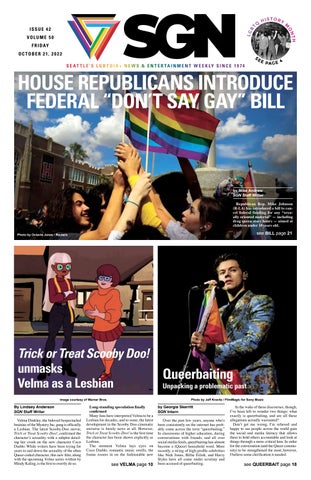
HOUSE REPUBLICANS INTRODUCE FEDERAL “DON’T SAY GAY” BILL
by Mike Andrew SGN Staff Writer Republican Rep. Mike Johnson (R-LA) has introduced a bill to cancel federal funding for any “sexually oriented material” — including drag queen story hours — aimed at children under 10 years old.
see BILL page 21
Photo by Octavio Jones / Reuters
Trick or Treat Scooby Doo! unmasks Velma as a Lesbian Image courtesy of Warner Bros.
By Lindsey Anderson SGN Staff Writer Velma Dinkley, the beloved bespectacled brainiac of the Mystery Inc. gang is officially a Lesbian. The latest Scooby-Doo movie, Trick or Treat Scooby-Doo!, confirmed the character’s sexuality with a subplot detailing her crush on the new character Coco Diablo. While writers have been trying for years to nail down the sexuality of the often Queer-coded character, this new film, along with the upcoming Velma series written by Mindy Kaling, is the first to overtly do so.
Queerbaiting
Unpacking a problematic past Photo by Jeff Kravitz / FilmMagic for Sony Music
Long-standing speculation finally confirmed Many fans have interpreted Velma to be a Lesbian for decades, and to some, the latest development in the Scooby Doo cinematic universe is barely news at all. However, Trick or Treat Scooby-Doo! is the first time the character has been shown explicitly as Lesbian. The moment Velma lays eyes on Coco Diablo, romantic music swells, the frame zooms in on the fashionable new
see VELMA page 10
by Georgia Skerritt SGN Intern Over the past few years, anyone who’s been consistently on the internet has probably come across the term “queerbaiting.” In classrooms of higher education, during conversations with friends, and all over social media feeds, queerbaiting has almost become a (Queer) household word. More recently, a string of high-profile celebrities like Nick Jonas, Billie Eilish, and Harry Styles have all come under scrutiny and been accused of queerbaiting.
In the wake of these discourses, though, I’ve been left to wonder two things: what exactly is queerbaiting, and are all these allegations actually warranted? Don’t get me wrong, I’m relieved and happy to see people across the world gain the social and media literacy that allows them to hold others accountable and look at things through a more critical lens. In order for the conversation (and the Queer community) to be strengthened the most, however, I believe some clarification is needed.
see QUEERBAIT page 18
2
SGN
O C T O B E R 2 1, 2 0 2 2
C E L E B R AT I N G 4 8 Y E A R S!
ORIGINALLY SEATTLE GAY NEWS FOUNDED 1974 MEMBER 509 10th Ave E Seattle, WA 98102 (206) 324-4297 info@sgn.org sgn.org
SUPPORT INDEPENDENT JOURNALISM
DONATE TO SGN TODAY!
Publisher Angela Cragin Managing Editor / Acting Editor-in-Chief A.V. Eichenbaum Copy Editor SGN Staff • Richard Isaac Advertising Maggie Bloodstone, Advertising Manager National Advertising Rep. Rivendell Media (212) 242-6863 Staff Writers Lindsey Anderson • Mike Andrew Sara Michelle Fetters • Daniel Lindsley Contributing Writers Alice Bloch • Maggie Bloodstone Sharon Cumberland • Carter Hemion Benny Loy • Isabel Mata Paige McGlauflin • Gaysha Starr
SHOW YOUR PRIDE! seattlegaynews.redbubble.com
Merch Store!
Social Media Manager SGN Staff Photographers Nate Gowdy • SGN Staff Production Mike Pham SGN is published by Angela Cragin. © 2022. All Rights Reserved. Reprints by permission. Publication of names, photographs, or likeness of any person, organization, event or business in this publication cannot be taken as any indication of the sexual orientation of the person, organization, event or business. Opinions expressed in bylined articles, columns, and letters are those of the authors only and do not necessarily reflect the views of the staff or management of this paper. SGN welcomes unsolicited material, including letters to the editor, but reserves the right to edit or reject material. All rights revert to authors upon publication. We assume no liability for loss or damage of materials, solicited or not. We invite feedback, please write. And please play safe. It is our policy that no money shall be refunded if you choose to cancel your ad. Credit will be given for the balance owed. No exceptions.
In Loving Memory Of George Bakan
Scott Roger Alpert Cookie Andrews-Hunt James Arnold Ken Campbell Steve Foiles Shaun Knittel James Leland Moore Don Paulson Randy Peters Lee Richeson Shaun Shelton Jim Tully
Follow SGN
VISIT US ONLINE SGN.ORG
In this Issue
LGBTQ HISTORY 4 A&E • FILM 10 BOOKS 15 OP-ED 18 NATIONAL NEWS 21 INTERNATIONAL NEWS 22 O C T O B E R 2 1, 2 0 2 2
SGN
3
LGBTQ History
Putting an end to the myths of Stonewall
Gay Liberation Front members Jerry Hoose (left), Mark Segal (right), and Sylvia Rivera (background, holding a bag) at a GLF demonstration against New York University – Photo by Diana Davies collection, New York Public Library
by Mark Segal Special to the SGN For years, people have debated what actually happened that night in June 1969 when Stonewall was raided and a new, more militant struggle for equality was born. As a result, and due to the insistence of some that they know all aspects of what had actually happened, an incredible void opened up, where people could invent, imagine, or distort Stonewall and our history for their own objectives. The myths of Stonewall are endless, but they’re easily dispelled when you look at the material proof and plain logic. Here are some rebuttals. 1. Judy Garland’s death and funeral did not cause Stonewall. The myth of Judy Garland’s death being the impetus for Stonewall is the most belittling to those of us who participated. It’s stereotypical and self-loathing, and with this article, we add new information that finally ends this silly tale. One clue is where the idea originated: from a conservative, straight columnist at the Village Voice named Howard Smith, who actually was a friend of the police captain who led the raid. Simple logic says it’s just not so. People of my age — late teens and early twenties at the time — were not dancing to Judy Garland in the Stonewall. We wanted to dance our asses off when we were in Stonewall, and that you didn’t do to Garland’s music. We were dancing to Diana Ross, the Beatles, and Barbara Streisand. My best memory is dancing to the Fifth Dimension song “Let the Sunshine In” from the musical Hair. Judy Garland was of an older generation. But the final nail in the Judy Garland myth are articles about the funeral at Campbell’s Funeral home. If you look at the photos and reports in the New York Times, as well as other newspaper reports, you’ll note that the subjects in the photos, as well as the majority of quotes, are from housewives. When you look more closely for the very few men in the photos, they’re in suits and ties. We all know that is not the kind of
4
SGN
person who fought at Stonewall. Men who wore suits and ties ran from the police for fear of losing their good-paying jobs, or their families finding out about them. It’s time to bury the Judy Garland myth for good. The myth makes Stonewall sound like the only riot in US history making its participants fight for a silly cause. The truth is that we were fighting the hate and oppression of the police that night. We were not empowered by a dead singer. Let’s put that coffin into the ground already. 2. Nobody knows exactly how many people were at Stonewall. I was recently filming a BBC television show in front of the Stonewall bar when a tour group came by. The guide stated, “There were 105 people in the bar that night.” But nobody can possibly know how many people were there. Some people paid for entry, and some were regulars that were let in without the door charge. But that number does give an idea of the average size of the crowd inside.
Then, as we all know, once people were let outside, those with any standing in society ran for the hills as soon as they could. Those of us who remained — street kids, drag queens (later to be called Trans), people of color, and the verging radical gay youth of the day — gathered around the door in a semicircle. There were hundreds of passersby and even more who craned their necks from a distance. So anyone who was within a few blocks could say they were at Stonewall that night. But actually participating is another matter. Anyone who says they know how many people were there must not have actually been there, since it occurred in various areas of Christopher Street and around Christopher Street and went on for hours. You don’t take a roll call in the middle of a riot. Those people who tossed stones or cans of soda, or those wrote on the streets and walls “Tomorrow Night Stonewall” as I did, all went on to be a part of the Gay Liberation Front (GLF) which arose from the ashes of Stonewall. Some GLF members were there
during the first night. Other GLF members stood and spoke from the doors of the closed Stonewall the second night. More GLF members began leafleting the following nights. Since the riot created the urgency for change, the Gay Liberation Front picked up that mantle and ran with it. Stonewall and GLF are synonymous. So who can we say was there? Well, anyone who had family in the area or a decent job ran for the subway or a cab as soon as they were let out of the bar. Who was left? Drag queens, stereotypical men and women, street kids like me who were homeless or living at the YMCA, and young activists like Marty Robinson. When asked who was there at Stonewall my answer is: Who was there the following night and the night after that? Who carried out that change through that first turbulent year? We have pictures and written accounts. This is no myth. There are facts in plain sight.
see STONEWALL page 7
The Stonewall Inn – Photo by Jason Villemez
O C T O B E R 2 1, 2 0 2 2
C E L E B R AT I N G 4 8 Y E A R S!
VISIT US ONLINE SGN.ORG
O C T O B E R 2 1, 2 0 2 2
SGN
5
6
SGN
O C T O B E R 2 1, 2 0 2 2
C E L E B R AT I N G 4 8 Y E A R S!
LGBTQ History STONEWALL continued from page 4
3. Stonewall lasted several days, and then an entire year. There have been numerous suggestions about how long Stonewall lasted. At one museum I was speaking at — during the opening of its Stonewall Rising exhibit — there was a sign that stated one number. Then, someone else wrote about the exhibit and put another number. When I’m asked that question, I say confidently that Stonewall went on for 365 days, from the first night until the first Pride one year later. That spirit of June 1969 carried on with the changes that Gay liberation brought from it. We were self-identifying for the first time in history. We were out, loud, and proud rather than in the closet. We took back our streets from the police. We organized legal and medical alerts. We had social and political meetings. All of that threatened the police, since much of it was illegal for “homosexuals,” but we did it in plain sight and even advertised it. We dared the police to stop us. One last thing: we were diverse and inclusive. 4. There was no brick. It is often stated that my fellow GLF member, Sylvia Rivera, threw the first brick. Although it’s flashy and bombastic, that myth actually does not give her her rightful place in history.
Both Sylvia and her GLF sister Marsha P. Johnson have spoken about where they were during Stonewall, and people today have either ignored their words or distorted them. But what cannot be disputed is that Sylvia and Marsha did something much more important than throwing an imaginary brick: they created the world’s first Trans organization, Street Transvestite Action Revolutionaries. STAR gave visibility and pride to the Trans community for the first time in history. STAR was not one night but an entire movement. Sylvia is more of a historical figure for co-creating that first Trans organization than for being just one of a crowd at Stonewall. That cannot be disputed! And if you’re still hung up on the brick idea, the New York Times did a video dispelling it in 2019 (https://www.nytimes.com/2019/05/31/us/ first-brick-at-stonewall-lgbtq.html). 5. Craig Rodwell and Ellen Broidy created that first Gay Pride. Here is an answer that is well documented and known by each of us who lived this history. The two people who actually came up with the idea of Pride were Craig Rodwell and Ellen Broidy. They were having dinner in Craig’s apartment with their partners at the time, and they began writing a resolution that would be read at the Eastern Regional Conference of Homophile Organizations meeting in Philadelphia. That resolution created the Christopher Street Gay Liberation committee, which went on to organize that first Pride one year after Stonewall.
The July 3, 1969 cover of The Village Voice – Courtesy photo
It is often reported that the “mother” of Gay Pride is Brenda Howard. That is absolutely false. There are numerous members of the Gay Liberation Front or the Christopher Street Gay Liberation committee
who are alive today. We know, because we were there when it took shape, who created Pride. If anyone is going to be deemed “mother of Pride,” it’s Ellen Broidy. Brenda Howard was a member of the GLF, but she was not in any way associated with the formation of that first Pride, other than to march in it. She may have someone editing Wikipedia on her behalf, but that doesn’t make that falsehood any less false. 6. The most accurate history of Stonewall is a collective one. There are many views of Stonewall, but the majority of its participants went on to form the GLF. They, we, are the spirit of Stonewall. Each GLF member who was there relies on their personal memories, and those memories collectively weave a fuller picture. Numerous books on the subject have been written. There are two books that stand out, the first being Donn Teal’s The Gay Militants in 1971. The other is David Carter’s Stonewall published in 2010. While Carter’s version has some flaws, it comes closer to any version before or after. He wrote at a time when our community was beginning to realize the importance of Stonewall historically, and at a time that many different viewpoints took hold. He literally had to duck to keep out of the way of warring parties on the subject, which can be seen in other books. David Carter continued to research the issue and had a passion to find the missing points and bring facts forward until his death in 2020. Others (who were not at Stonewall, mind you) unfortunately write with their bias at the forefront. Many of us who were there continue to pass on lost information or leads. We feel that our personal battle that night has been used to reinforce people’s own misconceptions and political objectives. It wasn’t that single night that changed and built our community. It was from the ashes of that night that the Gay Liberation Front created self-identity, community, and pride. Change doesn’t happen overnight. In this case the seeds of equality took 365 days to take root, that first magical year of Gay liberation. Mark Segal is an award-winning journalist, author, and Stonewall pioneer. More information on his 50-plus years of continuous activism can be found at marksegalstonewall.com.
The first LGBT Demonstration one month after Stonewall went from Washington Square to Stonewall, July 27, 1969 – Photo by Fred W. McDarrah featured in Gay Pride: Photographs from Stonewall to Today
VISIT US ONLINE SGN.ORG
O C T O B E R 2 1, 2 0 2 2
This article was originally published in the Philadelphia Gay News. Reprinted with permission through the SGN’s partnership with the National LGBT Media Association.
SGN
7
LGBTQ History
Dave Kopay’s journey before and after shocking the sports world in 1975 by Ray Simon Special to the SGN When the NFL’s 2022 season began, just one player, Carl Nassib, identified openly as Gay. An outside linebacker for the Tampa Bay Buccaneers, Nassib came out in a video posted to his Instagram account in June 2021, making him the first active NFL player to do so. “I just want to take a quick moment to say that I’m Gay,” Nassib said. “I’ve been meaning to do this for a while now, but I finally feel comfortable enough to get it off my chest.” It was an historic moment. What’s remarkable is that it took almost five decades for it to happen. Because in 1975, David Kopay, a running back who’d played on five teams before retiring, announced in an interview in the Washington Star that he was Gay, making him the first former player in the NFL — or any of America’s four major sports — to come out. Kopay played professional football from 1964 to 1972, often on special teams. He earned his place on each roster through a combination of gritty determination and physical courage. An unnamed teammate from the old Washington Redskins summed Kopay up nicely for the Washington Daily News: “He enjoys hitting people. He’s got a mean streak, and he knows something about these teams.” By December 1975, however, Kopay was 33 and had been retired for two years. He’d had several false starts in business and no luck finding a coaching job. That’s when he saw reporter Lynn Rosellini’s article in the Washington Star titled “Homosexuals in Sports: Why Gay Athletes Have Everything to Lose.” Rosellini’s article drew a firestorm of criticism. Many complained that she’d given too much weight to anonymous sources. Reading between the lines, Kopay recognized some of the players Rosellini spoke to. More importantly, he knew that he could make a difference by talking to her on the record. Kopay’s motivation for speaking out was twofold. His attempts to get a coaching job had been stymied, he felt, by leaguewide homophobia. “Because of my homosexuality, I can’t get a job as a coach,” he explained in his memoir. Kopay had also struggled to come to terms with his romantic and physical attraction to other men. He knew how much better his life could have been if he’d had positive role models. As he put it, “If some of us don’t take on the oppressive labels and publicly prove them wrong, we’ll stay trapped by the stereotypes for the rest of our lives.” After that initial interview with Rossellini, Kopay wasn’t done. In 1977, he and author Perry Deane Young, who was also Gay, published The David Kopay Story: An Extraordinary Self-Revelation. The book is both a thoughtful meditation on masculinity, sexuality, and sports, and a candid tell-all.
The March, 1977 cover of Philadelphia Gay News – Courtesy photo
Background Kopay was the second of four children born to devoutly Catholic parentsin a working-class household . Their marriage was unhappy; he recalls frequent arguments that sometimes turned physical. During that time, sports offered him an outlet. But with high school not far off, and wracked by guilt over his burgeoning sexuality, he made the curious decision to enter a junior seminary. His motivation seemed to be twofold: on the one hand, he imag-
ined it as an opportunity to “be good,” and, on the other, it offered an escape from an unhappy home. However, with the desire to return to team sports on his mind, he left the seminary after only 18 months. Kopay became a standout athlete at Notre Dame High School in Sherman Oaks, California, garnering several scholarships. In 1961, he transferred to the University of Washington where, in addition to playing football, he joined the fraternity Theta Chi. After a promising start to his college sports career, Kopay faltered on the gridiron.
8
O C T O B E R 2 1, 2 0 2 2
SGN
It was partly confusion over his sexuality. He was smitten by a fraternity brother whom he calls “Ted Robinson” in his book. The two hung out, got drunk, and double-dated girls. But after dropping off their dates, the two young men would fool around. “Beneath Ted’s horseplay and all our silliness, of course, there were deeper feelings,” Kopay wrote. “Ted was somebody who seemed to respond to me with a special warmth, and that was something I had never known in a friend. It felt good just being with him.” Kopay pulled himself together for his
senior year, leading the Huskies to the Rose Bowl in 1964. He was named an All-American and got an offer to try out for the San Francisco 49ers. In the NFL In his book, Kopay’s account of his time in the NFL is curious. On the one hand, he describes a relentless focus on football. And, on the other, he was increasingly anxious about his sexuality. The more he acknowledged his attraction to other men, the more he worried about losing his job. The worry wasn’t unfounded.
C E L E B R AT I N G 4 8 Y E A R S!
A March 1977 feature on Dave Kopay in Philadelphia Gay News – Courtesy photo
As Tom Dowling wrote in his book Coach: A Season with Lombardi, the NFL was hardly accepting of Gay men. “Love beads and long hair are considered depraved by the average football coach,” Dowling noted, “and homosexuality a crime of almost unspeakable dimensions.” Kopay doesn’t spare himself. He acknowledges mistakes, like getting entangled with a quack psychiatrist and marrying a woman even though he knew he was Gay. Perhaps the most difficult story Kopay relates is his encounter with a teammate, whom he calls “Bill Stiles,” an All-Pro tight end who was also Gay. (Bill was later revealed to be Jerry Smith, who died from AIDS in 1986.) The two men became close and eventually spent an evening together. But Kopay was so ignorant of the mechanics of Gay sex that Bill left in frustration and treated him frostily afterward. Kopay was devastated. “Now I thought I had found a real relationship. I was ready to be lovers for life. I worshiped the man. He rejected me cold,” Kopay wrote. Living openly Slowly but surely, Kopay began to live openly as a Gay man. His coming out, however, alienated his family. His mother and brother Tony were particularly upset. According to Kopay, after telling his mother, she said, “I created you, and I can destroy you.” Despite that, the book ends on a hopeful note. “It’s a new life for me now — without football, living openly as a homosexual. But I’m facing it with the strength of an honest man. And that’s got to be a good beginning,” Kopay wrote. The NFL might not have wanted to talk about its Gay athletes, but plenty of others did. Kopay’s book spent ten weeks on the New York Times best-seller list. He was a guest on The Phil Donahue Show, The Tomorrow Show with Tom Snyder, NBC’s Today Show, and The David Susskind Show. He even appeared on the cover of Mandate magazine in May 1977. In an interview with the Philadelphia Gay News shortly after the book’s release, Kopay said he drew inspiration from Air Force Sergeant Leonard Matlovich and writer Merle Miller, who also had very
VISIT US ONLINE SGN.ORG
public coming out experiences. “I was very affected by Time’s piece on Leonard Matlovich,” Kopay said. “Now, here’s a man willing to speak up and take a stand. He definitely had a positive influence on me.”
After a cross-country book tour, Kopay moved to San Francisco, where he’d begun his NFL career in 1964. Although he’d played three seasons with the 49ers, he’d been deeply conflicted about his sexuality then.
“For four years I lived within minutes of the great gay capital of San Francisco and never had a real homosexual experience,” Kopay noted in his book. Kopay’s experience of San Francisco was much different this time. He was befriended by Harvey Milk, the openly Gay city supervisor, and Randy Shilts, the Gay journalist who wrote And the Band Played On. He was even roommates with the novelist Armistead Maupin, the author of Tales of the City. “I loved walking into bars with Dave,” Maupin later recalled in a GQ feature on Kopay, “because you could watch every head turn. He was a major babe and a hero to every gay person.” Eventually, the brouhaha surrounding Kopay’s book subsided. And when no coaching job materialized, he joined his uncle’s business, Linoleum City, a Hollywood flooring company. Kopay stayed with the family business until retiring. It may not have been the football career he originally wanted, but it enabled him to give back to the LGBT community. In September 2008, Kopay pledged $1 million to the University of Washington’s Q Center, which supports LGBTQ students and faculty. As he told a reporter for the UW alumni magazine, “I wanted to do something meaningful, to leave something behind that would benefit people whose experiences and feelings I shared and can understand.” When asked about what he would feel watching Carl Nassib play in the NFL as an openly Gay man, Kopay told Outsports in September 2021, “It will be emotional, hugely emotional. There’s a few of us that paved the way, and it makes me incredibly happy.” Ray Simon is a writer, editor, and Bi+ man. His day job is working as an editor at Games World of Puzzles magazine. When time permits, he writes about LGBTQ issues for the Philadelphia Gay News and about local arts and culture for Artblog. He’s also an avid fan of crosswords.
The 2001 edition of The David Kopay Story – Photo courtesy of Advocate Books
O C T O B E R 2 1, 2 0 2 2
This article was originally published in the Philadelphia Gay News. Reprinted with permission through the SGN’s partnership with The National LGBT Media Association.
SGN
9
Arts & Entertainment
Image courtesy of Warner Bros.
VELMA
continued from cover character, and a diagram points out all the reasons Velma likes her, including her glasses, turtleneck, and love of animals. Velma’s glasses fog up, and she lets out an exasperated “jinkies.” As if the classic cartoon crush scene was not enough to convince fans that Velma is down bad for a woman, she later admits her feelings to Daphne, saying, “I’m crushing big time, Daphne! What do I do? What do I say?” As mentioned, many others have tried to depict the character as Queer on-screen. The television series Mystery Incorporated, which aired on the Cartoon Network from 2010 to 2013, hinted at Velma’s sexuality but never overtly confirmed her attraction to women. While she developed a close relationship in the second season with another female character, Marcie, it was never determined that the two were an item. In this interpretation of Scooby Doo, the writers also decided to put Velma and Shaggy in a romantic relationship, distancing the idea that the character might be a Lesbian. In 2020, Tony Cervone, one of the series’ developers, posted a picture of Velma in front of the Pride flag on Instagram. He confirmed that he had always intended for her to be a Lesbian but was forced to remain ambiguous due to regulations regarding children’s media. “I’ve said this before, but Velma in ‘Mystery Incorporated’ is not bi. She’s gay,” Cervone said. He continued to justify the Velma and Shaggy plotline, though, writing, “We always planned on Velma acting a little off and out of character when she was dating Shaggy, because that relationship was wrong for her, and she had unspoken difficulty with the why. There are hints about the why in that episode with the mermaid, and if you follow the entire Marcie arc, it seems as clear as we could make it 10 years ago. I don’t think Marcie and Velma had time to act on their feelings during the main timeline, but post reset, they are a couple. You can not like it, but this was our intention.” Despite the intentions of some of the showrunners, the only relationships Velma had in the series were with men, leaving any Queer Velma shippers to rely solely on interpretation.
10
SGN
She would have come out if it weren’t for meddling parents! Mystery Incorporated wasn’t the first time creators tried to make Velma Gay. In the 2002 live-action adaptation Scooby Doo, writers again tried to make the character Queer. Initial scripts for the movie had a much more mature audience in mind, and the film even earned an R rating from the Motion Picture Association of America upon its first screening. Following harsh responses from critics and parents, the creators of the movie trimmed down some of the more “offensive” material, until the film fit nicely under a PG-13 rating. Once again, parents complained about some of the content of the film, and a final cut was made, this time getting rid of language, cleavage, sexual situations — and even a kiss between Velma and Daphne! James Gunn, who wrote the screenplay for both Scooby-Doo and the sequel Scooby-Doo: Monsters Unleashed, confirmed that in his original adaptation of the movie, Velma was Gay. “In 2001, Velma was explicitly gay in my initial script. But the studio just kept watering it down and watering it down, becoming ambiguous (the version shot), then nothing (the released version) and, finally, having a boyfriend (the sequel).” Sarah Michelle Geller, who played Daphne in both films, also confirmed the kiss, saying in an interview, “It wasn’t just, like, for fun. Initially, in the soul-swapping scene, Velma and Daphne couldn’t seem to get their souls back together in the woods. And so the way they found was to kiss, and the souls went back into proper alignment.” Jinkies! What is Queer-coding? Velma is not the first character LGBTQ+ fans have felt drawn to, and there’s a reason for this. Often, when writers hoped to create a Queer character but were censored by parents and studios, like Gunn in 2002, they had to rely on unspoken hints that their characters were Gay. Only in recent years have cartoons been able to explicitly show LGBTQ+ partnership and affection on-screen. Often, cartoons used Queer-coding to subtly mock and villainize LGBTQ+ people on-screen. One of the biggest culprits of this is Disney, which, throughout the last several decades, has depicted villains as flamboyant and gender-nonconforming. Characters like Jafar, Scar, and Hades were drawn with
O C T O B E R 2 1, 2 0 2 2
a dark emphasis on their eyes, to mirror makeup, and spoke with “Gay male speech,” a dialect known for a higher pitch, dramatic enunciation, and sometimes lisps. Queer-coding does not always come from writers. Human nature seeks out reflections of ourselves. This is one of the reasons compelling and relatable storytelling is so vital. For members of the LGBTQ+ community who never saw themselves represented in the media, Queer-coding became a way to relate to characters on a deeper level. Many Queer people therefore claimed iconic characters, like Velma, who they related to as members of the community. Many of the same fans who watched The Lion King and saw Timon and Pumbaa as Gay dads raising their adopted son, or saw Frozen and claimed Elsa to be the queen of ice and Asexuals, also interpreted the bookish and nerdy Velma as a Lesbian. And to be fair, Velma did fit the aesthetic. In older cartoons, none of the Scooby Doo gang is shown to be romantically involved with each other, as romance was inappropriate for a children’s cartoon in the 1960s. Fred and Daphne’s relationship developed later on, but Velma remained unattached. Her intelligence, independence, and rejection of femininity in comparison to the highly feminized Daphne made her the perfect candidate for Lesbians to claim. That, and she was played by Hayley Kiyoko in Scooby-Doo’s The Mystery Begins. Interpreted or explicit representation? Many modern cartoons have tried to lay claim as arbitrators of LGBTQ+ progress with their depictions of same-sex relationships on-screen, and while certainly older cartoons like Scooby Doo! Mystery Incorporated helped lay the groundwork for modern representation, subtle implications of a character’s queerness do not have the same effect. Explicit representation is not only vital for LGBTQ+ viewers to see themselves in the media they consume, but it is also important for heterosexual audiences. A 2017 study out of Yale University found that people can empathize with those they view as protagonists in media. When straight viewers see LGBT+ people depicted on television, they are more likely to treat them with kindness in real life. Furthermore, explicit representation is especially important for sapphic depictions of Queer identity. Whereas same-sex male relationships can be inferred by emotional
intimacy and actions like hugging and hand-holding, these same behaviors can often be viewed as platonic among women. Because platonic intimacy is much more common among women in Western cultures, those in same-sex relationships are often delegitimized or sexualized by the heterosexual and male gaze. In 2014, Nickelodeon’s Legend of Korra wrapped up its final season. Critics and LGBTQ+ advocates hailed the series as a groundbreaking success for depicting the main character, Korra, as Bisexual. However, the series only ever implied a romantic relationship between Korra and her female “love interest,” with a brief, twosecond clip of the two holding hands in the last scene of the last episode. Despite the show censoring Queer romance and affection, Korra was shown kissing male love interests on-screen multiple times. Like Velma in earlier adaptations of Scooby Doo, this was effective in possibly paving a way for better things to come but also contributed to the idea that Queer romance is more explicit and should be censored in ways that heterosexual romance is not subject to. In 2019, the Netflix series She-Ra and the Princesses of Power opened the doors for explicit representation in children’s media. Writer and showrunner N.D. Stevenson set out not just to imply a side character was Queer but to create a haven for LGBTQ+ fans to see themselves celebrated on-screen. He fought to convince Netflix executives to allow a Queer romantic arc for his two female leads. And in 2020, he made it happen, with a historic on-screen kiss between them. Fellow animators have followed in Stevenson’s footsteps. Recently, Disney’s The Owl House aired an episode with an onscreen kiss between confirmed girlfriends Luz and Amity. A 2020 Adventure Time special not only showed on-screen affection between Princess Bubblegum and Marceline the Vampire Queen but depicted the two living together. Velma can officially be out and proud in 2022 thanks to the brave Queer writers and animators who put their jobs on the line to fight for explicit representation in media. While some may have always seen Velma as a Queer-coded character, the recent confirmation of her identity speaks volumes to Queer and sapphic viewers who are finally able to see themselves in Mystery Inc.
C E L E B R AT I N G 4 8 Y E A R S!
Film
Argento’s Dark Glasses is a satisfyingly nasty return to form
Ilenia Pastorelli in Dark Glasses – Photo courtesy of Vision
by Sara Michelle Fetters SGN Staff Writer DARK GLASSES Theaters / Shudder A serial killer is hunting prostitutes in Rome. The latest target is seductive, highpriced escort Diana (Ilenia Pastorelli). A chase through the midnight streets results in an epic car crash, and while Diana survives, her injuries leave the young woman blind. The accident also makes adolescent immigrant Chin (Xinyu Zhang) an orphan, as both his parents are killed in all the automotive carnage.
Dark Glasses is legendary writer-director Dario Argento’s best film in almost two decades — which honestly isn’t saying all the much considering that his last few efforts include the likes of Dracula 3-D, Mother of Tears, and The Card Player. While unsurprisingly not rising to the classic heights of Tenebrae, Deep Red, or Suspiria, this is still a fast-paced, suitably gruesome giallo that gets the job done. Even if it does play a bit like an “Argento Greatest Hits” compilation album, I still enjoyed the heck out of it, and I’d happily watch the film again. It’s a given that Diana and Chin are going to end up together. It is equally obvious that the killer will not be satisfied with
only maiming his chosen victim and will come looking for her as soon the opportunity presents itself. There will be a cadre of charismatic — if still moderately clueless — police detectives on the case, and a variety of increasingly dangerous events will force Diana and Chin into a corner from which “flight” becomes impossible and “fight” is the only option. The director’s talented daughter Asia Argento is on hand as a caring and patient instructor who helps newly blind adults navigate their new reality, and I’m happy to say that she shares instant chemistry with Pastorelli from the first second they appear together. There’s also a wonderful canine
Ilenia Pastorelli and Asia Argento in Dark Glasses – Photo courtesy of Vision
VISIT US ONLINE SGN.ORG
O C T O B E R 2 1, 2 0 2 2
performance that’s a bit different than how Argento typically showcases guide dogs (think the poor blind piano player in Suspiria), and it’s refreshing to see a heroic “good boy” given the star treatment by the director for once. This is definitely a mood piece, as almost everything that happens throughout the quickly paced 86 minutes is relatively preordained. I had the killer pegged early on. But I also think Argento knew that was going to be the case, so at roughly the midway point, he just stops trying to conceal the psychopath’s identity. There are also elements of the director’s famed “Animal Trilogy” (The Bird with the Crystal Plumage, The Cat o’ Nine Tails, and Four Flies on Grey Velvet) littered throughout, almost as if the filmmaker was paying homage to himself instead of blatantly repeating what he did during his heyday. But the thriller is gorgeously shot by cinematographer Matteo Cocco, crisply edited by Flora Volpelière (Les Misérables), and scored within an inch of its life by composer Arnaud Rebotini (BPM (Beats Per Minute)). Pastorelli and Zhang are surprisingly wonderful together, and I really liked how their friendship matured and evolved as things went along. But it is Argento’s handling of the picture’s key set pieces that positively stood out to me the most. The director recaptures some of that nightmarish-dreamscape, stream-ofconsciousness insanity that has always been the hallmark of his best works. The assault by the killer on his first unfortunate victim immediately propelled me to the edge of my seat, and the ethereally chilling car chase between this madman and Diana even more so. Best of all is a moonlit chase through a secluded forest and marsh that truly annihilated me, a mad rush to apparent freedom through a seemingly empty field that was thrillingly suspenseful. There is plenty of gore and even more blood, as it’s not like Argento was ever going to skimp on either. But none of it feels gratuitous, as almost all of the nasty stuff quite nicely fits the moment in which it is delivered. Dark Glasses is a satisfying return to form for the director, and this nifty little retro Giallo slasher is a tasty October treat worth savoring.
SGN
11
At Chateau Ste. Michelle our wines are a force for gatherings and conversations— to serve the well-being of our consumers, our communities, and our land. We are a proud ally and supporter of all our employees and customers within the LGBTQIA+ community and aim to create an inclusive environment where everyone is welcome. CSM 198786 © 2022 Chateau Ste. Michelle, Woodinville, WA
12
SGN
O C T O B E R 2 1, 2 0 2 2
C E L E B R AT I N G 4 8 Y E A R S!
VISIT US ONLINE SGN.ORG
O C T O B E R 2 1, 2 0 2 2
SGN
13
Film
Imaginative School for Good and Evil is a mixed bag of magic tricks
Sofia Wylie and Sophia Anne Caruso in The School for Good and Evil – Photo courtesy of Netflix
by Sara Michelle Fetters SGN Staff Writer THE SCHOOL FOR GOOD AND EVIL Theaters / Netflix Sophie (Sophia Anne Caruso) and Agatha (Sofia Wylie) have been best friends for most of their lives. The two teenagers — considered misfits and outsiders by the townsfolk of Gavaldon — both dream of better lives where they are not bullied, shamed, or made to feel inconsequential. Sophie fantasizes about becoming a beautiful princess — or at least someone who dresses them — while Agatha just wants people to leave her alone, stop calling her a witch, and not-so-sardonically threaten to burn her at the stake. What happens next is what has made author Soman Chainani’s seven-book The School for Good and Evil series so popular. Sophie and Agatha are magically transported to the learning institution of the title. The problem? The beauteous damsel-in-distress-wannabe Sophie gets dropped off on the “evil” campus, while her perpetually frowny-faced, frequently disheveled bestie lands among the fresh-faced, clean-scrubbed students who reside on the “good” side of the institute. Comparisons to similar tales set at a wizarding school notwithstanding, the scenario Chainani has dreamt up is still pretty dang clever. It posits that all the classic stories of good versus evil are born inside the hallowed walls of this castle of higher learning. The children of everyone from Captain Hook to Robin Hood to King Arthur to the Evil Queen of Snow White fame are all enrolled, each learning who their arch nemesis is going to be, so they can help author the fictional narratives of never-ending, happily-ever-after tomorrows still to come. Sophie and Agatha are known as “readers,” humans from the outside world that the wise School Master (Laurence Fishburne) and the all-knowing, sentient quill the Storian (voiced by Cate Blanchett) believe have what it takes to become vital members of the student body. But what no one knows is how big a part they’ll play in everyone’s futures — not just the students and teachers at the school but every soul on earth as well. They’ve been chosen by an unspeakably powerful force to change the balance
14
SGN
between good and evil forever, and if either succumbs to temptation, they will unleash an armageddon too hellish to be believed. Bridesmaids, Spy, and A Simple Favor filmmaker Paul Feig is at the helm of all this supernatural craziness, co-writing the film’s screenplay with two-time Academy Award nominee David Magee (Finding Neverland, Life of Pi). They pack in a ton of plot into 147 minutes (as tightly wound a as I’ve ever seen), and Feig keeps his foot pressed firmly down on the accelerator from the first scene to the last. That isn’t necessarily a plus. There’s so much exposition being dumped by the School Master, the Storian, or the two headmistresses — Professor Dovey (Kerry Washington) at Good, Lady Lesso (Charlize Theron) at Evil — that a viewer could be forgiven if they imagined they missed something important (because they probably have). It’s all a little dizzying: there were moments where I wanted Feig to press pause and let the characters share a quiet cup of tea or eat a savory crumpet, so I could catch my breath. The modernized touches also annoyed me. I think I’m at the point where throwing current slang and needle-dropping familiar pop and rock hits into a feature-length fantasy needs to take a hiatus. Feig does
this sort of thing better than most, and in Caruso and Wylie he has two massively talented youngsters who can appealingly pull the dialogue off. But it is still tiresome, and by the time I got to a full-on battle royale set to Britney Spears’s “Toxic,” I could feel my eyes roll so far to the back of my head, I was positive they were about to burst out the other side. But the film is visually eye-popping, as Feig mixes practical effects, physical sets, and CG images with creatively ambitious confidence. If any big-budget Netflix production deserves to be seen on the biggest screen possible, it is this one. Production designer Andy Nicholson (Gravity), costume designer Renee Ehrlich Kalfus (Hidden Figures), and cinematographer John Schwartzman (Seabiscuit) are all at the top of their games, while effects supervisor Erik Nordby (Passengers) and his gifted team craft colorfully ingenious visuals that continually impress. Best of all are the aforementioned Caruso and Wylie. Whether on screen together or sharing it with one of their recognizable costars, both actors deliver powerful, threedimensional performances overflowing with authentic, sometimes painful emotional nuances. If Netflix moves forward with more adaptations of Chainani’s source
material, I’d be curious to see what else this duo could bring to the table. On the negative side of the ledger, the teenage supporting players — especially those in the Evil dormitories — barely register, while fascinating subplots concerning what happens to students who receive three failing grades and where the various professors originally came from are never satisfyingly explored. Worst of all, Feig wastes Michelle Yeoh, Patti LuPone, and Rachel Bloom in stunt-casting throwaway roles. While I’m sure that’s because the director hopes they’ll get utilized more in potential future chapters, for this standalone entry, that’s still nothing less than unforgivable. This makes The School for Good and Evil a mixed bag of magic tricks. This adaptation does cast a spell, and there is power in seeing a universe populated by such a diverse group of characters who are not reduced to stereotype or culturally insensitive tropes, which was often the case in that world conceived by a certain wizarding author (she who shall not be named). But I’m not sure that’s enough. Feig’s film is nowhere near as fully realized or as creatively satisfying as I kept hoping it was going to be, making The School for Good and Evil a mixed bag of magic tricks.
Michelle Yeoh, Charlize Theron, and Kerry Washington in The School for Good and Evil – Photo courtesy of Netflix
O C T O B E R 2 1, 2 0 2 2
C E L E B R AT I N G 4 8 Y E A R S!
Books
Steamy scenes can't save Mistakes Were Made by Terri Schlichenmeyer Special to the SGN MISTAKES WERE MADE MERYL WILSNER c.2022, St. Martin’s Press $16.99 346 pages
Image courtesy of St. Martin’s Press
The bar wasn’t one she usually frequented, but it was as far from the dorm as Cassie Klein could possibly get. It was Family Weekend at the college she’d be graduating from soon, but the whole “family” thing was ridiculous. No, the bar was a better place to be, and she was preparing to get drunk. Until she started watching the older woman who was watching her. She bought the woman a drink, and one thing led to another, which led to the back seat of the woman’s car, the exchange of first names, and a semipublic one-night stand that Cassie was sure she’d never forget.
Erin Bennett had hoped being at Family Weekend might heal the broken bond she had with her daughter, Parker. She knew Parker was still angry that Erin had filed for divorce, and Erin wished she could explain things, but she wasn’t exactly sure herself why the divorce was important. She was mulling this over when Parker arrived at breakfast with one of her closest friends in tow — a friend that Erin had never officially met, but that she knew very well. Intimately, in fact. It was the woman she’d had sex with the night before. Clearly, this was awkward, and Parker could never find out what had happened. While the obvious thing to do was to put the brakes on, that was impossible — especially after Parker wouldn’t take “no” for an answer when she invited Cassie to her mother’s house for Christmas break. Being in the same home together was hard enough, but being in the same room, and in pajamas? How could anyone resist that?
There are really two basic ways to perceive Mistakes Were Made by Meryl Wilsner. It’s either an overly long, mostly barebones story that contains some explicit bedroom scenes... or it’s soft erotica with a tissue-thin story between steamy trysts. Could it be better? Well, that, too, will depend on what you want in a novel. Wilsner’s bedroom (kitchen, back seat, living room) scenes are hotter than a baked potato straight from the oven. They’re steam-your-glasses hot, and there are enough of them to seize your interest and handcuff it to a bedpost — if that is, indeed, your interest. If you come to this novel for a romance-y tale, though, and you could be bored, because, while girl-meets-girl is all over this book, it’s frustratingly slow getting to it. And so, know what you want before you pick up Mistakes Were Made. If erotica is your thing, stay for the heat. If you want a good story, though, it’ll leave you cold.
Ryan La Sala explores the horror of the gender binary by Lindsey Anderson SGN Staff Writer The greatest horror stories come from a place of deep fear, a personal dissection of some of the most frightening elements of life masked by the metaphysical. Often, what makes horror so enticing is the way the genre unpacks very real emotions and fears. For author Ryan La Sala, though, writing a horror novel goes deeper than just examining basic human fears. When they set out to write their latest novel, The Honeys, La Sala knew they wanted to create a fresh take on the horror genre, and craft a novel that was entirely Queer. A truly Queer horror story “All of my books fit into this idea where I am trying to revise the anthology of Queer characters and write stories that only Queer characters can tell,” La Sala said. “Mars [the main character] was always going to be super Queer in their design and also in their intentions and the way they problem-solve. The Honeys couldn’t happen to a straight character. A straight character or a straight hero would not have survived, and that’s why it’s Mars’ story to tell.” The Honeys takes a deep dive into the ways gender identity and performance affect how people view themselves and others. Throughout the novel, La Sala examines the perceived dichotomies of gender both through their gender-fluid protagonist, Mars, and the overtly feminine mean girls, “The Honeys.” Writing a horror novel that tackles the nuances of gender in such an overt way was revolutionary to the genre. For La Sala, the challenge was particularly complex, as they had to balance truth-telling and fiction. “When people look at the job of a writer, they think fiction is the task of lying, telling an untruth of things” they said. “But I think it’s the reverse. Even if you’re writing fantasy, even if you’re writing horror that no one has ever dealt with before, and creatures that don’t belong to this world, [you] have to be underpinned by honesty. You’re telling a larger truth that is perhaps too ephemeral or too delicate to put into the bracing terms of reality.” The truth was the most important thing for La Sala to keep in mind when writing a Queer novel. Unlike some LGBTQ+ authors, they wanted to create not just a Queer protagonist but a story that is innately Queer, and could not be told through the perspective of a cis-het character. “Mars is dealing with something that no one in our world has ever dealt with,” La Sala said, “but he’s doing it in his way and he’s going about it in a manner that makes
VISIT US ONLINE SGN.ORG
Ryan La Sala – Photo by Lauren Takakjian
sense to a Queer person. His problem-solving, for instance, has a lot to do with the fact that, as a gender-fluid person who uses all sorts of pronouns in the book, he has studied from afar the way that that behavior is often gendered and the way that behavior and gender are performed in a really specific way.” Not only is Mars’ gender identity normal-
ized, but it is also seen as a tool, or superpower, that allows them to be the hero of their story. “That’s why Mars, out of all the people in this novel,” La Sala added, “is the only one to think that the Honeys — the girls who the book is named after — might be hiding something behind this façade of frivolity and girlishness. Society in gen-
O C T O B E R 2 1, 2 0 2 2
eral has this sort of pathological dismissal of the way that girls behave and are friends with one another, and that’s why the Honeys… get away with what they’re doing. But it takes someone like Mars, someone who is Queer, to look at their behavior and know it for the camouflage that it is.”
see LA SALA page 16
SGN
15
Books
LA SALA
continued from page 15 “What happens to us in dreams?” The idea for The Honeys was always sitting in the back of La Sala’s mind, but before they were ready to write this novel, they knew they had other stories to tell. From a young age, La Sala knew they wanted to write Queer stories. “I started my first novel out of spite, which I know is an unflattering way to describe an artistic process,” they joked. “As a teenager, I was reading what was meant for me: other YA titles like Twilight and The Hunger Games. I couldn’t find Queer people in those books, and I kept asking myself, ‘What happens to us in dreams, in fantasy, in the future?’ so I started writing my book to answer that question.” Their first book, Reverie, brings queerness to the sci-fi genre, following a mindbending simulation plot. “[Reverie] became the Gayest form of self-insert fan fiction you could think of. For years, I played in that world, until I decided I wanted to try and get it published and let other people in.” Once La Sala decided to seek publication, they encountered some of the harsh realities that face LGBTQ+ authors. “I worked on it for a long time,” they said. “People told me to start other projects, to start trying to sell something that wasn’t as flamboyant. But I was pretty dedicated to my mission of writing something as Queer as my own life, and I’m glad [I did], because it ended up being a remarkable success, especially considering that a lot of people didn’t think it was going to sell anywhere.” In demand By the time they were ready to write The Honeys, La Sala had created a name in the publishing world. They no longer had to fight and claw just for someone to give their novel a chance. “The Honeys was the complete opposite of Reverie. Reverie was rejected even though I had the whole book written. People looked at the entirety of it and said, ‘No, this isn’t good enough.’ By the time I was up to The Honeys, I had only written about 4,000 words… before it got picked up by a publisher.” Not only did The Honeys get picked up quickly, but publishers were fighting over who would get the rights to the story. “It was highly [in demand], and it ended up inciting a thirteen-in print auction in publishing, which was a complete reversal of [the] situation with my first book where … I had to fight tooth and nail to show that there was a demand for Queer characters in fantasy. “So, The Honeys was remarkably different, and the process of writing it was different too, because instead of having all the time in the world to perfect it, I only had about a month or so to write it.” Due to the high demand for the book, La Sala had to put their life on hold to finish it in time for publication. “I was so busy with my full-time job at the time, and all the other books I had put out, that I ended up having to quit my job to spend my time writing the book… I had to be a lot faster and a lot more organized.” While the work they put in with their earlier novels helped The Honeys fly, La Sala is not apt to take all the credit for their success. “I attribute [the book’s success] both to the hard work I put into my first two books, [and] also the work that a lot of creators have put in before me and while I was on the rise to bring attention to the fact that Queer characters deserve to be in their own stories, and deserve to have their own experiences outside of the traumatic process of coming out. “So, I am very aware that The Honeys’ success is the articulated point of a blade that has been welded over, at this point, centuries, by many Queer people giving their energy to the cause and making sure we get to be seen.”
Image courtesy of PUSH
ences they had gone through. “Mars and I share a lot, including grief, being gender fluid, and also going to summer camps. But Mars as a character is a form of poetic justice for the person I wish I was when I was having those experiences. Mars deals with a lot more harsh horrors than I do, and did.” While Mars may have started as a version of La Sala, they realized that the character would need to speak to a wider audience. In the final drafts of the novel, Mars became the person La Sala wishes they were, and a character they are sure many readers will need to see. “At the end of the day, Mars is also a much stronger person than I am and I was,” said La Sala. “Mars is that way because Mars has, now, the attention of thousands and thousands of young readers, so Mars has to be a much more durable and articulate person than I… got to be, and I got to learn a lot about myself writing that character.” While their idea for The Honeys mulled in the back of their head for years, it took La Sala’s own experiences with tragedy to understand just how they wanted to write the story. “The book has a lot to do with grief and dimensions, and things that we can’t see that are still there, things that are gone but we still feel near us,” they said. “That’s a lot, because, like the main character Mars, I have also dealt with losing a sibling in a very sudden manner. “When I set out to write The Honeys, it was largely in part because I wanted to take my skill set to this mythological metaphor and use it as a form of therapy to talk to myself about the grief that I hadn’t processed when my sister passed away suddenly. “It was in 2018, it was right when Reverie was getting picked up. I remember I was at my sister’s memorial service when I got the news I was going to be a published author. It was a totally weird thing… my dreams were coming true, but it was also during the worst time in my life. “I’ve had [The Honeys] in my head since well before my sister passed away, but it took that experience for the book to make sense and to give me the urgency to write it.” When working on healing through their grief, La Sala found solace in nature. “I’ve always been very inspired by all the small, minified dramas that happen all around us in nature. Bees, specifically, are very fascinating insects to me. All cultures… have mythologies around bees, but one specific thing between cultures that have very little contact with each other is that bees are… seen as a mystical emissary between worlds and the afterlife.” This connection between bees, grief, and spirituality led La Sala to explore more of the ideas that would eventually become The Honeys.
Writing through grief The story and the character of Mars were loosely inspired by La Sala and the experi-
Why write horror? La Sala hopes that readers leave The Honeys with a different perspective on the world.
16
O C T O B E R 2 1, 2 0 2 2
SGN
Photo by Shams Ahmed
“I can’t always anticipate who is going to read my book and who will find themselves taking it on, but I hope that ultimately the book finds its way into the hands of whoever needs it most. Those hands could be Queer, those hands could be questioning, and those hands could be grieving, depending on where those people are. And it could be all three.” La Sala also hopes their novel inspires readers to look deeper at the ways society has taught people to internalize gender. “I hope people walk away with a renewed skepticism on gender and the performance of gender,” they said. “Gender is this construct that everyone performs every single day. I would consider my book a success if you start to examine your behaviors and start to question the compulsory nature of those performances. That’s sort of why I wrote Mars as a gender-fluid character, but also the Honeys themselves are so sweetly defined as feminine despite the wickedness of their ways. “I included a lot in the book, because I wanted it to make sense to all kinds of people going through different things, and I wanted it to make a little bit more sense the more people read it. I hope people walk away with a new sense of what it means to be a Queer teenager, but I also hope that people walk away with some of the glory that I try to include around the natural world.” For La Sala, writing horror is about more than just scaring readers, although unlocking new fears is always a good bonus. “A big part of why I write horror is because I want to shake people up into new shapes, and maybe teach them something about the fears that propel them,” they said. “Ultimately I’m here to entertain, so if you take nothing else from the book, my goal is that you walk away scared of bees.” A look ahead The Honeys is La Sala’s debut in the hor-
ror genre, but they don’t see themselves leaving anytime soon. “To be honest, I think I’ve always been on my way to telling darker stories. I love writing about my fears; it’s the way that I know how to deal with my fear. I take it out of my head and pin its wings wide, like you might a butterfly, and just study it that way. The Honeys is an examination of a lot of the things that scare me, and I think I’ll be in horror for a long time because a lot of things still scare me. “Fans can count on seeing more spookiness and more thrills, although, at least for the next book, we’re leaving the bees behind, and I’m focusing on a whole host of other creatures that scare me, including humans,” they said with a laugh. La Sala’s next novel is still pretty top secret, but they can disclose that it will take place in New York City. “As far as I know, and as far as I’m intending, it’s a horror novel. A supernatural thriller, I think, would probably be the more accurate term for it.” They anticipate finishing up their novel this fall between fun, spooky activities. “I’m looking forward to finishing my next book and turning it in, so I can finally start talking about it with readers. I am looking forward to potentially continuing Mars’ story and the Honeys, which is something I have thought a lot about since the book came out, but haven’t put any words on paper.” “I’m looking forward to the traditions of autumn,” they added. Some La Sala autumn traditions include apple picking, carving pumpkins, and spending time with friends in a woodsy cabin. “It is something we do every year, and inspired the Honeys and their hut in the woods,” they said. For anyone looking for a truly spooky Queer read that will leave you with lingering questions about the dissection of gender dichotomies and binaries, The Honeys is a perfect addition to any Halloween reading list.
C E L E B R AT I N G 4 8 Y E A R S!
Speech and fire are key in local author’s second novel by Daniel Lindsley SGN Staff Writer John Whittier Treat’s latest novel, First Consonants, has arrived at a good time. A haze of wildfire smoke has hung over Seattle for what seems like forever, and if past years are any indication, the coming winter will likely be another recordbreaker in snowfall. While First Consonants is primarily about stutterers, it’s also about the environment. “One of my teachers was an environmental writer, and she had a big influence on me,” Treat recalled. “She said, ‘You don’t have to make every book you write about climate change, but the environment should be there somewhere.’ So I took that to heart.” Treat is currently an emeritus professor at Yale, specializing in Japanese literature, but he “retired from full-time work nine years ago, and I’ve been doing creative writing since then — almost entirely short stories and novels.” Northwest settings All of his works of fiction, he said, are about the Pacific Northwest. “I’m not a Seattle native, but I’ve been here 39 years,” Treat said while introducing himself over Zoom. His debut novel, The Rise and Fall of the Yellow House, was published in 2015. It follows two Gay men in 1983, during the AIDS epidemic, as they take refuge in the heart of Seattle. First Consonants is set in Seattle as well, at least in part. It starts in the suburbs of a fictional district based on Issaquah, where the main character, Brian, grows up in an environment where his stuttering is a constant source of alienation. He eventually ends up in Alaska, in the vast Tongass National Forest. “I wanted to write about, one, how the world treats a stutterer,” Treat said, “but also how a stutterer sees the world. So the book is made up of those two stories.” An early passage of the book shows Brian acting out, in response to a teacher chiding him for his condition. This “acting out,” Treat said, is an important part of the narrative. As the story goes on, Brian “does some really terrible things as an adult,” Treat said. “And it’s all rooted in his frustrations about communicating fluently with the world.” But Brian is far from the only stutterer in the book. Treat shows a keen interest in the intersections between cultures and identities, like that of Eastern Washington preppers and Gay men, or stutterers and a number of other life experiences. First Consonants also has a Gay stutterer, who struggles with internalized homophobia. “I was very interested in the relationship between homosexuality and this speech disorder,” Treat said of the character. “You know, everybody knows about lisping. David Sedaris has a hilarious bit about going to a speech therapist when he was in school, you know, to cure his lisp. But anyway, a lot of Gay men — I don’t know about Gay women — stutter.” Treat asked that not too many details of First Consonants’ plot be revealed, but he did want to leave readers with this: “When you’re writing about the environment, you have a choice. You can write about water, which is rising or disappearing, or you can write about fire.... First Consonants is about fire.” A fresh point of view As for his process, Treat isn’t a monotasker. “I don’t know if I have attentiondeficit disorder, but I definitely have a short attention span,” he said. “So I work on several things at once, because I can’t do one thing all day long. “But what happens is... they finish at the same time. You don’t read anything by me for years, and then suddenly six things come out.” It’s fitting, then, that Treat already has another book well on its way, called The Sixth City of Refuge. “It’s about two guys from LA, who for various reasons need to check out of the fast lane,” he said, “and they move to this town in Eastern Washington. Their troubles follow them, but they get involved with the local survivalists’ underground.”
VISIT US ONLINE SGN.ORG
John Whittier Treat – Photo courtesy of the author
Image courtesy of Jaded Ibis Press
Aside from Treat being a stutterer himself, there were two books in particular that inspired him to write First Consonants: Sorry by Australian author Gail Jones, which features a woman who stutters, and Mouthquake by Canadian author Daniel Alan Cox. Beyond those two examples, Treat said, “stutterers don’t generally get a good deal in literature. Stutterers are generally evil, or they’re spies, they’re terrorists — it’s always a marker of something deeper in a person. It can be a moral fault, or it can be political.” “Originally, I wanted to write a story about a stutterer who saves the world,” he added. “And a little of that lingers in the book, but finally, to be realistic, I couldn’t have him literally save the world. But I wanted to tell the story of a stutterer from a point of view that has very seldom, if ever, been explored.” You can learn more about John Whittier Treat, and where to find his works, at https://www.johnwhittiertreat.com. Image courtesy of Jaded Ibis Press
O C T O B E R 2 1, 2 0 2 2
SGN
17
Op-Ed
Photo by Guglielmo Mangiapane / Reuters
QUEERBAIT continued from cover
What is queerbaiting, exactly? In an interview with USA Today, Melvin Williams, professor of communication and media studies at Pace University, summed up the concept: “Queerbaiting is a strategy used by content creators and media producers to attract queer audiences — via homoeroticism, suggestive marketing and storylines, and other symbolisms — and to insinuate queer identities and relationships between media characters and viewers.” What is important to the definition and understanding of queerbaiting is the intentionality behind it. Is a celebrity simply exploring their gender expression by wearing a skirt to an event? Or is a corporation branding its products with Queer flags during Pride month to increase sales? (This kind of queerbaiting is similar to “rainbow washing,” a term used to describe companies utilizing rainbow aesthetics to attract Queer consumers.) To clarify: this is usually no accident. Queerbaiting and rainbow washing often happen because marketing teams know the importance of the Queer consumer. As of 2019, the global LGBTQA+ population had a collective purchasing power of approximately $3.7 trillion (referred to as “pink money”). This represents an important aspect of queerbaiting: it’s often done for profit. Most public figures and large corporations are smart; they know that appealing to the Queer community is a financially smart move. What we ought to be asking them is what else they are doing for us. How else are they helping? When someone (a person or brand) appears to be embracing queerness without doing any of the extra work to support and uplift the community, they might queerbaiting.
I mention this trope because it demonstrates the tandem use of Queer representation and heteronormativity to maximize profit. This is often the basis of queerbaiting: when people and organizations understand that there is a lack of representation and use that scarcity for their own benefit while neglecting other ways of supporting the Queer community. Ambiguities and the importance of media literacy We live in a world so digitally saturated that a new term, “chronically online,” has emerged to describe those who are on the internet so often that their sense of reality is warped from a lack of real-world experience. It’s easy tell ourselves, “Oh, but that would never apply to me.” Realistically, though, this probably applies to most of us to varying degrees. We are all online every day; in many ways, day-to-day life demands that we be. It is more important than ever, then, that we hold ourselves accountable for this aspect of our lives, especially when it comes to forming our opinions on cultural phenomena, social issues, and people. Having any involvement or presence online means that we are being constantly per-
The Bury Your Gays trope In her article “Bury Your Gays: History, Usage, and Context,” Haley Hulan lays out the problematic “Bury Your Gays” trope that’s been observed in media (specific literature) since the 19th century. This trope originally asserted that narrative works with Queer relationships have to kill off one of the lovers, often soon after the relationship is established. Closely related to queerbaiting, Bury Your Gays began as a tactic to grant some representation to LGBTQA+ authors and stories while still ensuring that a book would sell. Because explicitly Queer stories didn’t get consistent engagement from audiences, the Bury Your Gays trope arose as a marketing technique.
18
SGN
ceived, and this is especially true for celebrities — their details sometime seem like part of the public domain. We need to remember, though, that they aren’t. We need to remember that these are people with personal lives entitled to as much privacy as anyone else. They do not owe it to anyone to disclose their inner worlds, to publicly declare their identities, and label themselves in any way that they don’t want. With this in mind, the speed and ease with which we can often accuse public figures of queerbaiting raises a red flag. When we jump too quickly to allegations of queerbaiting, we are weakening the community in two ways. First, each time we mention queerbaiting without truly investigating the rest of a situation (like how a celebrity spends their money, their history of interacting with Queer people, and if they use their platform for advocacy), we are weakening the issue and taking away its power, which only makes it harder to hold queerbaiters accountable when it really does happen. My second point is a bit more ambiguous and slippery a slope, but it still ought to be said. When we demand that celebrities who want to explore their self-expression
choose between publicly labeling themselves and facing social backlash, we are upholding a narrative that queerness is only valid when it’s public. This is harmful. Self-exploration and expression is a personal journey, and within the Queer community, it can often be painful and isolating (at least at first) — why would we want to reaffirm those struggles for anyone? This is by no means a suggestion that we reject the notion of queerbaiting entirely or absolve celebrities of social responsibility. Rather, it is an encouragement to check our assumptions and review the details surrounding these dramas as they pop up on our feeds, news searches, and for-youpages. Yes, our role as media consumers means we need to hold public figures accountable for their behavior and demand that they use their status to advocate for positive change. On the other hand, they are still people, and we ought to remember that they don’t owe us any explanation about their personal lives. The key to both Queer acceptance and healthy accountability for public figures is a more critical media consumer. Considering the scope of the internet today, we hold immense power in choosing which narratives are told there and where they end up.
Harry Styles and Emma Corrin in My Policeman – Photo courtesy of Prime Video
O C T O B E R 2 1, 2 0 2 2
C E L E B R AT I N G 4 8 Y E A R S!
Time management for the neurodivergent
by Isabel Mata SGN Contributing Writer Ask Izzy is a biweekly advice column about relationships, mental health, and sexuality. Written by Isabel Mata — a Seattle-based lifestyle writer, podcast host, and mental health advocate — Ask Izzy offers tangible expert advice so all readers can have stronger relationships, better sex, and healthier mindsets. Looking for some more guidance? Submit your question at info@sgn.org with the subject line: Ask Izzy Submission.
Dear Izzy, I am neurodivergent and get overwhelmed super easily. Even doing chores around the house becomes unbearable with everything I have going on in my life. But being overwhelmed makes me end up procrastinating, distracting myself, and not getting anything done. Also, when I start one task, it’s hard for me to compartmentalize and work on other things at the same time. Which is awful when there are multiple deadlines for different things happening all at once! Advice? (People have told me to take things one step at a time, but I can’t help looking at things from an all-or-nothing perspective!) — Overwhelmed in Everett Dear Overwhelmed, When I graduated college and started my first full-time job, I had a really hard time managing all the things on my plate, both in the office and at home. Everything seemed daunting to me, even small things like answering emails, putting away the laundry, and picking up after myself. So much so that eventually, I would get emotionally paralyzed by the mountain of tasks and hide in my bed until it was time to face reality. When I finally hyped myself up enough to start on my list, I realized that some of the tasks only took a few minutes to complete! This, though, sent me into a shame spiral for not being able to do such simple things. As neurodivergent people, the way our brain works differs from the rest of the population as it relates to our executive functioning skills and our distinct perception of time. Because I was tired of never accomplishing anything and feeling stressed out over simple tasks, I asked my therapist for help. She explained to me a concept called autistic inertia, or for people with ADHD, task paralysis, which is described as difficulty in starting and stopping an activity or changing from one task to another. According to @theausticlife on Instagram, “[autistic inertia] often feels like we are frozen or in perpetual motion and can’t make ourselves act as we intend to, whether to stop or start moving.” Sounds familiar, right? But fear not, there are a few things you can do to work with your brain, not against it. 1. Start with a time audit You’ve probably heard it a million times, but having a routine really is key to reducing the cognitive load that comes with processing to-do lists and change. But before you can establish a routine that works for you, you must increase your time awareness. This means writing down how long you think a task takes, then actually timing yourself the next time you do the task to see how long it actually takes. Creating a chart like this can help you with this task.
VISIT US ONLINE SGN.ORG
Photo by Shvets Production / Pexels
2. Make a daily activity time log It can be hard to make changes to how you manage time if you are not sure where all your time goes. To answer this question, pick a weekday and track everything you do that day from when you wake up in the morning until you go to bed that night. If you are a college student, it would look something like this, in part: 8:00-9:00 Woke up and got ready for the day (shower, got dressed, brushed teeth) 9:00-10:00 Ate breakfast, walked the dog, packed bag for school 10:00-11:00 Took the bus to campus and finished homework 11:00-noon Class Noon-1:00 Lunch 3. Create small routines that work for you Once you have a solid list of all your daily tasks and how long they take, you can start to create a routines. Try creating routines for different parts of your day, like getting ready for work, cooking dinner, cleaning up around the house, getting ready for bed, etc., and practicing them for at least two weeks. You’ll find that over time, you spend less energy worrying about these tasks because they become like second nature.
It also helps if you add some fun into your routine with music, games, or any other special interests. I find it especially helpful to write down my different routines and place them where I can see them every single day. My leave-thehouse routine is by the front door, my bedtime routine is on my bathroom mirror, etc.
For example: Kitchen • Put away clean dishes • Load and start the dishwasher • Wipe down the counters • Clean the sink • Unload the dishwasher • Sweep the floor (always do this last!)
4. For big projects, break them down into smaller tasks and write them down When my apartment gets especially dirty and I can’t go another day without doing a “big clean,” I feel really overwhelmed and don’t know where to start. Therefore, breaking down big projects into smaller tasks can be helpful. But before you can do that, you must recognize that the “all or nothing” perspective that you speak of is a cognitive distortion. Recognizing that can help you move forward. For example, if your goal is to clean the entire house (super daunting, scary, ahhh!) and you are stuck on the big picture, it helps to create smaller, more attainable goals based on each room. Before you start, write down the task list for each room so that you can check things off when you complete them. It will feel good and help you stay on task!
Recap If you have ADHD, autism, or any other kind of neurological disorder that makes maintaining focus, completing tasks, and managing time frustrating, give yourself some compassion and grace when you are feeling overwhelmed and stuck. Forcing yourself to push through won’t help you in the long run. What will is structure and routine. The tips above are just a starting point. If you are looking for a more long-term solution, I recommend reaching out to a mental health professional with experience in cognitive-behavioral therapy. You can do this!
O C T O B E R 2 1, 2 0 2 2
References: • Bettino, K. (2021, May 24). “9 Tips for Creating a Routine for Adults with ADHD.” Psych Central. Retrieved October 17, 2022, from https://psychcentral.com/adhd/9-tipsfor-creating-a-routine-for-adults-with-adhd. • Flood, C. (January 6, 2022). “5 Steps to Overcome Autistic Inertia and Achieve Your Dreams (Even If You’re Not Autistic).” Medium. Retrieved October 17, 2022, from https://chelseyflood.medium.com/5-stepsto-overcome-autistic-inertia-and-achieveyour-dreams-even-if-youre-not-autistic5d19d33aeb32. • “Neurodivergent people and time perception.” Tiimo. Retrieved October 17, 2022, from https://www.tiimoapp.com/blog/ neurodivergent-people-and-time-perception.
SGN
19
October reflections on lake swimming
Photo by Jack Hilovsky
This morning I joined my friend Grady and several other pals for a dawn swim in Lake Washington. We met at Madison Beach a bit after 7 a.m., the sun still asleep behind the Cascade Mountains but soon to rise. This wasn’t some impulsive act on our part. We’ve been open-water swimming for over 20 years. Typically, we begin in mid to late June, once the water hits the 66-degree mark, though some brave souls in the group start in April or May, depending on the weather and lake temperature. For me, Labor Day signals the approaching end of my outdoor swims. The days grow shorter, and the sun sits lower on the horizon in the late afternoon, casting shadows on the water. Maybe that’s one reason why I enjoy morning swims. If we’re lucky and manage to avoid the June gloom/marine fog, the sun emerges from behind the mountains when we’re halfway to the Seattle Tennis Club, our destination before heading back to Madison Beach. On those clear days, my
front crawl is interrupted by brief glimpses of Mt. Rainier in the distance as I lift my head out of the water to spot my southern trajectory. After all these years, the majestic view of that mountain rising from the lake in which I’m floating continues to be a breathtaking one. Thus far, despite the smoke, it’s been a warmer, sunnier October, and a longer swim season than last year. Still, I find it necessary at this late date to wear a wetsuit. I’ve acquired a little tummy thanks to the pandemic, but not nearly enough of an extra layer to protect against hypothermia. I’m amazed that several swim friends can hop into the lake with no more than a Speedo or some thin-layered bathing suit and sprint the 1-1/2 miles round-trip without a shiver. I note that, unlike their wetsuited comrades, they stop for a briefer break at the halfway point before racing back to shore and doing a quick change into warm clothes. This time in the water is almost a sacred pastime for me. It is humbling being enveloped by the lake, being overshadowed by a distant mountain, and feeling the warmth of the sun or the chaotic flip of waves rush-
20
O C T O B E R 2 1, 2 0 2 2
by Jack Hilovsky SGN Contributing Writer
SGN
ing over as you reach into the depths of a watery unknown. I’m so small compared to the natural world. In August, our swim group lost a friend who was a co-founder of our LGBTQ+ team and likewise enjoyed the thrill of swimming in the open water. One afternoon he suffered a heart event that caused him to lose consciousness and later led to asphyxiation. Too late, several paddleboarders pulled him out of Lake Washington and attempted to revive him, to no avail, until the fire department arrived. One month later, we celebrated Rick’s life on the shores where he and the rest of us experienced so much solace and inspiration. I spoke of how we could always find our friend’s spirit here, where so many of us discovered a joy and peace, in friendship and on our own solo paths, across the waves, through the wind, under the sun, and yes, sometimes in the fog. I was reminded of how song can capture the beauty of nature and our experience of it, while viewing a Sunday morning tribute to singer-songwriter John Denver, who died after losing control and crashing his
experimental aircraft into Monterrey Bay 25 years ago this month. As a kid, Denver’s popular hits “Country Roads, Take Me Home,” “Sunshine on My Shoulder,” and “Rocky Mountain High” transported me to a place I’d never been before. I grew up in Cleveland, Ohio, and his music became a backdrop to the yearning I had to experience the beauty and adventure of the West. The past month, as I’ve swum in Lake Washington these gorgeous mornings, I reflect on how enriched my life has been thanks to my love of the water and the call to adventure and beauty that Denver’s songs epitomized. I think of Rick and how we’ll miss him, but also how he died doing something he loved. May we all be so lucky. Jack Hilovsky is an author, actor, and blogger who has made his home in Seattle since 1986. His first book, RJ, Farrah and Me: A Young Man’s Gay Odyssey from the Inside Out, was published in June 2022. It can be found at Madison Books, Nook & Cranny, and University Bookstore, among other local booksellers.
C E L E B R AT I N G 4 8 Y E A R S!
National News
Rep. Mike Johnson, R-La. – Photo by Patrick Semansky / AP
BILL
continued from cover The bill was introduced October 18, with 32 cosponsors, all Republicans. Titled the “Stop the Sexualization of Children Act,” the measure claims that state and federal agencies have promoted and hosted “sexually oriented events” for children and their families. The events are described as drag queen story hours and burlesque shows. The legislation explicitly states that taxpayer dollars will no longer fund programs, events, or literature that expose children
younger than 10 to “nude adults,” stripping,” or “lascivious dancing.” Johnson said in an October 18 statement that his bill is necessary to stop a “misguided crusade” led by Democrats to expose the nation’s children to “sexual imagery and radical gender ideology.” “This commonsense bill is straightforward,” Johnson said. “No federal tax dollars should go to any federal, state, or local government agencies, or private organizations that intentionally expose children under 10 years of age to sexually explicit material.” Johnson’s bill defines “sexually oriented material” as depictions, descriptions, or
simulations of sexual acts, human genitals, or “any topic involving gender identity, gender dysphoria, transgenderism, sexual orientation, or related subjects.” Since no one has promoted events involving sex acts or depiction of genitalia, the measure is obviously aimed at discussions or positive images of sexual orientation and gender identity. LGBTQ advocates immediately drew comparisons to a new Florida education law barring public school educators from engaging in classroom instruction related to sexual orientation and gender identity, known as the “Don’t Say Gay” law to its critics.
Like the Florida law, Johnson’s bill would allow parents to sue public and private entities that use federal dollars on “sexually oriented” materials or programs for children — in other words, those that depict LGBTQ people in a positive light. This provision runs counter to normal US legal practice, which requires plaintiffs in a civil suit to demonstrate “standing” to sue, usually some evidence that they, personally, have been harmed by the individual or entity they are suing. Any organization that violates the measure more than once within a five-year period would lose access to federal funds for three years.
National news highlights by Daniel Lindsley SGN Staff Writer Pride digs in heels at Orthodox school At least for the time being, the Orthodox Jewish institution Yeshiva University will have to officially recognize the YU Pride Alliance, its LGBTQ club, after the Supreme Court reinstated a court order that the university do so. The conservative Chief Justice John Roberts and Justice Brett Kavanaugh joined three liberal justices to form a 5-4 majority in the decision. The remaining dissenters, in a statement written by Justice Samuel Alito, argued that the Constitution “prohibits a State from enforcing its own preferred interpretation of Holy Scripture. Yet that is exactly what New York has done in this case, and it is disappointing that a majority of this Court refuses to provide relief.”
VISIT US ONLINE SGN.ORG
José López Duvont – Photo courtesy of Mr. Gay World
Yeshiva has filed an appeal, saying that recognizing the Pride Alliance “would violate its sincere religious beliefs.” The club pointed out that Yeshiva already has a Gay Pride club at its law school. Boricua beats competition Last Saturday, Puerto Rico’s own José López Duvont became the first Latino, and the first American competitor, to win the
international Mr. Gay World pageant. The model and actor represented the United States territory in South Africa over the weekend of October 15. López Duvont didn’t just win for looking good, although he certainly did; his awards for Best National Costume, Best Swimwear, and Most Photogenic attest to that. He also won the Social Media Impact award, partly by presenting a “social
impact project” meant to address body dysmorphia in LGBTQ communities by promoting a healthy lifestyle. The Puerto Rican nonprofit MGPR, Inc. has been sending delegates to the contest since 2020, and had gotten close enough to taste victory twice, with Mickey Rivera entering the top five one year, and Joshuan Aponte getting second place the next.
O C T O B E R 2 1, 2 0 2 2
SGN
21
National/International News
Michigan bill to prosecute Trans-affirming parents for child abuse by Mike Andrew SGN Staff Writer A bill introduced in the Michigan state legislature would allow the state to prosecute Transgender-affirming parents and doctors for child abuse. The penalties could be up to life in prison. HB 6454 would amend the state penal code to make it a case of felony child abuse when someone “knowingly or intentionally consents to, obtains, or assists with a gender transition procedure for a child.” The bill includes any hormones or puberty blockers in its definition of “gender-transition procedure.” Puberty blockers are reversible medications that delay the onset of puberty so that Trans youth can have more time to explore their gender identities before the permanent effects of puberty occur. While such treatments have been shown to decrease lifelong suicide risk for Trans people who want them, and to improve overall physical and mental health, Michigan Republicans claim that people should not be allowed to transition until they are old enough to have sex. “People are abusing these children,” Republican Rep. Beau LaFave, one of the lawmakers who introduced the bill, told The Hill. “The idea that we would be making potentially life-altering changes to 11-, 12-, 13-, 14-, 15-year-old kids, when it is illegal for them to have sex, is insane. I mean, they’re not responsible enough to smoke a cigarette until they’re 21.” “Gender-affirming care is medically necessary and life-saving care for Transgender youth,” Equality Michigan Executive Director Erin Knott replied. “Medical decisions belong to Trans youth, their parents, and their doctors.” If the bill passes, Michigan will become the second state to make gender-affirming care a felony. A similar Alabama law went into effect in May, although a judge has blocked part of it from taking effect. Republicans in many states are pushing legislation that would bar youth from receiving gender-affirming care, even though mul-
International news highlights by Daniel Lindsley SGN Staff Writer NHS draft calls for “safeguarding protocols” on Trans meds With a copy in hand of new guidelines from the UK’s National Health Service, Reuters reported on October 14 that the policies would alert local authorities when youth obtain puberty blockers or hormone therapies on the private market. Current policies have been criticized by practitioners for pushing medication too quickly, and by families who claimed to suffer from a system overloaded by demand. After waiting years for genderaffirming care, some young people have sought medications through unregulated online pharmacies. The NHS declined to comment on the guidelines’ contents, although it said previously that it would soon share them with the public, and open them to feedback and revision.
22
SGN
MI State Rep. Beau LaFave (R-Iron Mountain) – Photo courtesy of Michigan House Republicans
tiple studies show that Transgender youth experience high rates of self-harm, and that access to gender-affirming healthcare often leads to significant improvements in their mental health and quality of life. In August, anti-LGBTQ Rep. Marjorie
Taylor Greene (R-Ga.) introduced a bill at the federal level that would make providing gender-affirming care for Transgender minors a class C felony, ban federal funds — including Medicaid funds — from being used for such care for Transgender people,
ban medical schools from teaching about such care, stop health care plans under the Affordable Care Act from funding such care, and ban anyone found to have performed gender-affirming care from immigrating to the US.
NHS England medical director Dr. Stephen Powis did have this to say earlier in the week: “No one should be purchasing illegal, unknown, and potentially lifethreatening drugs online.” Gendered Intelligence spokesperson Cleo Madeleine said that her charity, a Trans advocacy group, wouldn’t comment on the draft’s contents either. “It’s crucial that the new services focus on... actually facilitating access to treatment and support rather than leaving young people and their families in limbo,” she told Reuters. Six figures awarded to Pride org in London Also in the UK, LGBTQ representatives of London’s City Hall have awarded Pride in London £625,000 (over $700,000) to fund the next five years of Pride celebrations in the capital. Community-led organizations applied for the grant in August. Pride in London has plenty of experience running Pride, with over 150 of its volunteers participating each year. It has announced an anti-racism plan for future events, which will include the main Pride parade, fun in Trafalgar Square, and awards for community achievements. London Mayor Sadiq Khan said of the development, “London is a beacon of inclusiveness around the world, and that is in part due to the powerful impact that the Pride march of solidarity and celebration has had on our society over the last five decades.”
O C T O B E R 2 1, 2 0 2 2
The 2022 London Pride parade – Photo by James Manning / PA via AP
Pride in London’s executive director, Christopher Joell-Deshields, said, “Our dedicated team of volunteers look forward to engaging with LGBT+ communities to build better, ensuring that our platform
amplifies national and global LGBT+ issues, celebrates our communities’ successes and empowers LGBT+ individuals through our values of visibility, unity, and equality.”
C E L E B R AT I N G 4 8 Y E A R S!
VISIT US ONLINE SGN.ORG
O C T O B E R 2 1, 2 0 2 2
SGN
23