LG BT Q+
20 HI 21 ST O C ESL E B R AT I N G EE RY 4 7 PYAE APRRS GE O I N 17 JEC T
ISSUE 4 0 VOLUME 49 F R I D AY O C T O B E R 1, 2 0 2 1
S E AT T L E ’ S L G B T Q I A + N E W S & E N T E R TA I N M E N T W E E K LY S I N C E 19 74
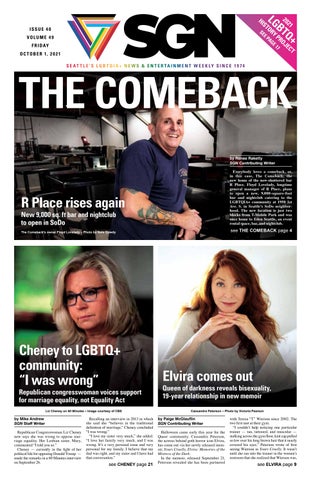
THE COMEBACK by Renee Raketty SGN Contributing Writer
New 9,000 sq. ft bar and nightclub to open in SoDo
Everybody loves a comeback, or, in this case, The Comeback, the new home of the now-shuttered bar R Place. Floyd Lovelady, longtime general manager of R Place, plans to open a new, 9,000-square-foot bar and nightclub catering to the LGBTQIA+ community at 1950 1st Ave. S. in Seattle’s SoDo neighborhood. The new location is just two blocks from T-Mobile Park and was once home to Eden Seattle, an event rental space, bar, and nightclub.
The Comeback's owner Floyd Lovelady – Photo by Nate Gowdy
see THE COMEBACK page 4
R Place rises again
Cheney to LGBTQ+ community: “I was wrong”
Republican congresswoman voices support for marriage equality, not Equality Act Liz Cheney on 60 Minutes – Image courtesy of CBS
by Mike Andrew SGN Staff Writer Republican Congresswoman Liz Cheney now says she was wrong to oppose marriage equality. Her Lesbian sister, Mary, commented “I told you so.” Cheney — currently in the fight of her political life for opposing Donald Trump — made the remarks in a 60 Minutes interview on September 26.
Recalling an interview in 2013 in which she said she “believes in the traditional definition of marriage,” Cheney concluded “I was wrong.” “I love my sister very much,” she added. “I love her family very much, and I was wrong. It’s a very personal issue and very personal for my family. I believe that my dad was right, and my sister and I have had that conversation.”
see CHENEY page 21
Elvira comes out
Queen of darkness reveals bisexuality, 19-year relationship in new memoir Cassandra Peterson – Photo by Victoria Pearson
by Paige McGlauflin SGN Contributing Writer Halloween came early this year for the Queer community. Cassandra Peterson, the actress behind goth horror icon Elvira, has come out via her newly released memoir, Yours Cruelly, Elvira: Memories of the Mistress of the Dark. In the memoir, released September 21, Peterson revealed she has been partnered
with Teresa “T” Wierson since 2002. The two first met at their gym. “I couldn’t help noticing one particular trainer — tan, tattooed, and muscular — stalking across the gym floor, knit cap pulled so low over his long brown hair that it nearly covered his eyes,” Peterson wrote of first seeing Wierson in Yours Cruelly. It wasn’t until she ran into the trainer in the women’s restroom that she realized that Wierson was,
see ELVIRA page 9
WE’RE HIRING!
SGN SALES ASSOCIATE SGN (Seattle Gay News) is seeking a highly motivated experienced Sales Associate to sell advertising for our independently owned LGBTQIA+ newspaper. SGN is well established as the third oldest LGBTQIA+ publication in the nation. It is a well known resource and has a rich history throughout the community. The SGN is looking to expand and thrive in the Seattle area and beyond. This position will require a knowledge base of the product and how it benefits the advertisers. Candidates must have the confidence to seek and identify prospective customers, generate new leads, prepare sales agreements and the ability to close the sale. Qualifications: • 2-5 years experience in Seattle area sales interfacing with decision makers via phone, email and in person • Strong organizational, verbal and interpersonal skills • Candidate will possess a flexible, independent schedule • Self motivation is a necessity
Compensation and Benefits: • Compensation begins with an hourly training at $18/hour. Following training, the candidate is compensated based on a generous sales commission. This position provides versatility. The Sales Associate can set their own hours; merging home based work with outside sales calls. COVID-19 precautions • Remote interview process • Personal protective equipment required (masks) • Social distancing guidelines in place • Virtual meetings To apply please email your resume to ajcraginsgn@yahoo.com or mail to: SGN 3019 Duportail St. #106 Richland, WA 99352
GREEN CARDS • VISAS • ASYLUM • CITIZENSHIP 1836 Westlake Ave N, Suite 302 Seattle, WA 98109
(206) 724-1940 olivielaw.com
THIS AD SPACE HAS BEEN GENEROUSLY DONATED BY KRISTIN COSTELLO IN MEMORY OF SGN PUBLISHER GEORGE BAKAN
2
SGN
O C T O B E R 1, 2 0 2 1
C E L E B R AT I N G 4 7 Y E A R S!
In this Issue
LOCAL NEWS 4 A&E • FILM • BOOKS 9 LGBTQ+ HISTORY PROJECT 17 OP-ED 20 NATIONAL NEWS 21 INTERNATIONAL NEWS 21
VISIT US ONLINE SGN.ORG
O C T O B E R 1, 2 0 2 1
SGN
3
Local News
THE COMEBACK continued from cover
“The building was a shell. We took the soul of R Place and are plugging it into this new space,” Lovelady told the SGN this week during a tour of the space. “We bought everything from inside R Place to give people that familiarity, and of course we’re bringing back the shows and the music and the dynamic performers that put R Place and Seattle on the map, as far as a destination LGBTQIA establishment.” R Place owners Steve Timmons and Richard Elander announced last February that the popular Capitol Hill bar had lost its lease and that they were seeking to reopen at a new location. A statement on the bar’s Facebook page noted that “R Place has been a staple in the Gay community for over 35 years” and that it was their “intention to reopen” once Gov. Jay Inslee lifted his stay-at-home order early in the pandemic. However, plans changed after the owner of the building passed away and his estate declined to renew the bar’s lease. In the end, Timmons and Elander decided to move on and hand over the legacy to Lovelady and former R Place patron John Fish, who are now co-managing partners on the project. They formed The Comeback Seattle LLC and took over R Place’s social media accounts. Lovelady managed R Place for 20 years and previously worked at the Revolver in West Hollywood for three years before coming to Seattle. Fish told the SGN that he “grew up” at R Place in his 20s and “was excited... to be able to help bring back a space and community that we all love.” He has a background in business management and operations and will be doing most of the behind the scenes work. “I cannot wait to tell the community all the things we have in store for them. This really has been at the core of what we want to do from the beginning. It was one of my first conversations with John to make sure we were aligned and that we are going to give back to the community in as many ways as we can,” said Lovelady. “This is going to be from providing good wages to our staff, doing volunteer work, and making charitable donations, et cetera. The community needs as many safe spaces and
4
SGN
Photos by Nate Gowdy
O C T O B E R 1, 2 0 2 1
C E L E B R AT I N G 4 7 Y E A R S!
Lovelady consulting with his architect, Ace Houston – Photo by Nate Gowdy
places to be yourself as we can get, and we only succeed when we are working to help everyone succeed.” Lovelady added that as much as he wishes R Place could stay on Capitol Hill, a variety of factors led him to look elsewhere; finding a suitable space at a reasonable cost was the biggest one. Seattle noise ordinances and new apartment buildings going up all over the Hill were also considerations. “SoDo not only welcomed us, the SoDo Business Improvement Association reached out to us and invited us to come check out this location,” Lovelady said. “After searching all over this city, we just felt SoDo would be the best fit. It’s so central. It’s the hub of Seattle, made to have easy access to hold large events. You can get there by the light rail, from the tunnel, by water taxi or ferry. “Plus, being in the industrial district next to warehouses and shipping containers would allow us to be as loud as we wanted, which became an issue at R Place with all the new apartment buildings going up. I used to have to go outside with a decibel reader to monitor our sound level. It wasn’t just the music. It was the screams from the crowds. “We felt strongly that SoDo was a great nightlife spot for Seattle. Being able to find
a space that is versatile enough for many different kinds of events was key, and in a location that has plenty of parking as long as it’s not during game days, which usually end well before 10 p.m.” The space is ADA-accessible, with all the public areas on the same floor. A large open space featuring an impressive stage and long bar is among the most obvious amenities. The new space also features an assortment of equally impressive private areas that include a large prep kitchen with a new walk-in fridge and an office overlooking everything. “The bar is designed to have a few different modular ways to be able to have a great experience no matter the day or time,” said Lovelady. “We will for sure have plenty of TVs to watch the games or pregame before you head to the stadiums. There is an amazing stage that we will be utilizing for drag shows and many other entertainment options.” The Comeback will also feature a number of familiar faces from R Place. Among them is Brett Lee, returning as head security host. He previously held the position of assistant security manager for several years, and Lovelady says Lee has “a half a decade of management experience in fastpaced environments.”
“This project is important to me because it represents the continuation of local Capitol Hill history in spirit as well as a new chapter for what part or parts of Seattle have created their own safe spaces for LGBTQ Seattleites.” “We are thankful to have a lot of the prior staff from R Place returning to bring that familiar feel we all love,” Lovelady said. “We will be announcing them all over the next few weeks on our social media pages, so make sure to give us a like/follow at The Comeback Seattle.” Ace Houston of House Cosmopolitan is the architect principally responsible for the design of The Comeback. Houston, who studied architectural design at the University of Texas and considers himself a part of the LGBTQIA+ community, also spoke with the SGN this week. “I hope the site becomes a destination for the LGBTQ community to gather — those from all slices of life under the umbrella — and celebrate ourselves and
our community in many different ways,” he said. “This project is important to me because it represents the continuation of local Capitol Hill history in spirit as well as a new chapter for what part or parts of Seattle have created their own safe spaces for LGBTQ Seattleites. “It’s been great to work with an excellent team that wants to do right by our community. It’s only the start of this project and so I am looking forward to the days ahead of opening.” According to Lovelady, who received a small business loan to finance The Comeback, they plan to open in December 2021 — assuming the permits and liquor licenses are approved promptly. He also announced a crowdfunding program, which features generous incentives to ensure “a sense of ownership” among Seattle’s LGBTQIA+ community. The Indiegogo funding page invites donors to be a “part of making this new LGBTQIA bar come to fruition” and that the “crowdfunding [go] to help cover the renovation costs of the new building, and create this new, amazing space.” The perks include an opening weekend general admission ticket for $25 and The Comeback “Gold Pass” for $1,000. “This is a true comeback story,” said Lovelady. “This has been a dream of mine for a long time. We’re the guys who grew up in this community. We’re the Davids in a world full of Goliaths. “This pandemic took so much away. Took away homes and apartments. Shuttered the doors of hundreds of businesses in this city… This is our home. We’re here to help rebuild our community. To help give people a place to get away from all the anxiety and stress in this world. To help in the comeback of this city that we love.” For more information or to donate go to https://www.thecomebackseattle.com
Photo by Nate Gowdy
VISIT US ONLINE SGN.ORG
O C T O B E R 1, 2 0 2 1
SGN
5
Local News
Eviction moratoriums extend throughout Washington also prohibited. Tenants are still legally required to pay rent if feasible and landlords are encouraged to offer flexible payment plans. If a Seattle resident receives an eviction notice, they should contact the Renting in Seattle hotline at (206) 684-5700. Nonprofit organizations and small business commercial tenants—which include independently owned facilities, facilities with 50 employees or less, state nonprofit organizations and 501(c)3 non-profit organizations—are also protected against evictions and late payment fees. The Utility Discount Program’s Self Certification Pilot Program will be extended through October 31, 2021; it offers eligible Seattle residents an approximately 60% discount on Seattle City Light bills and an approximately 50% discount on Seattle Public Utilities. Furthermore, temporary parking zones for hospital and human services staff will be extended through January 15, 2022.
by Hannah Saunders SGN Contributing Writer On September 24, 2021, Gov. Jay Inslee announced that due to the ongoing state of emergency in Washington, he will be extending the eviction moratorium bridge proclamation until October 31, 2021, at 11:59 p.m. The eviction moratorium for the state was originally set to expire on September 30, 2021, even though the majority of rental assistance funding has yet to be distributed. Days prior, on September 21, 2021, Seattle Mayor Jenny Durkan announced that she would be extending eviction moratoriums for both residential and commercial evictions until January 15, 2022. This is the sixth time during the pandemic that Durkan has extended the eviction moratorium since March 14, 2020. “Given the ongoing COVID-19 public health emergency, the Emergency Order, dated March 16, 2020, imposing a moratorium on residential evictions is hereby extended through January 15, 2022, at which point the Emergency Moratorium on Residential Evictions will sunset and Ordinance 126075, which provides a defense against evictions due to hardships from COVID-19 for six months, goes into effect,” stated the Executive Order 2021-07 extension. The eviction moratorium on small businesses and non-profit commercial tenants is also extended through January 15, 2022. In addition, shutoff policies and utility relief flexible payment policies will be extended until January 15, 2022—Seattle City Light and Seattle Public Utilities will not resume disconnections for nonpayment and will continue to offer flexible payment plans. “We led the way as the first major US
Photo by Michael Dwyer / AP
city to be impacted by COVID-19. Every step of this pandemic, our residents and community listen to science and public health officials, which is why we have the lowest cases, hospitalizations, and deaths of every major city. Seattle continues to show the nation how to protect small businesses and residents by establishing and continuing one of the first in the nation moratoriums on evictions to keep families safe. Our early actions have and continue to keep people safe and housed,” said Durkan. So far, the City of Seattle has distributed over $15 million to tenants and landlords— since June—as the first allocation of the American Rescue Plan rent relief. Community-based organizations that focus on rental assistance for BIPOC communities
have already been promised the remaining $6 million of the first allocation. In August, $28 million of federal funding was authorized, and the city has been distributing these funds through nonprofit organizations such as United Way King County, which helps combat homelessness and poverty. What exactly the extension of the executive order does The eviction moratorium extension will prohibit landlords from issuing termination notices and eviction actions with the court system, unless the tenant poses an immediate threat to the health and safety of the community. Late fees, interest and additional charges regarding late rental payments are
Where Washingtonians stand with rental payments The US Census Bureau released its Household Pulse Survey, which gathers data on how different households and communities have been impacted by the coronavirus pandemic. Survey data is released biweekly, and Week 37 (from September 1, 2021, to September 13, 2021) data follows: • 798 Washingtonian households who identify as Gay or Lesbian are behind on rent. • 15,854 Washingtonian households who identify as Bisexual are behind on rent. • 122,554 Washingtonian households who identify as straight are behind on rent. • 1,702 Washingtonian households who identify as something else are behind on rent.
Standoff on Capitol Hill ends in arrest Onlookers allege planted evidence by Lindsey Anderson SGN Contributing Writer At 1 PM on Saturday, September 25, in Seattle’s Central District, a fleet of police cars rushed to block off a portion of East Union Street after a reported disturbance. Neighbors watched as officers set up cones around a black SUV parked in the intersection of 15th Avenue and East Union. The driver, an unidentified Black woman with purple hair, was seen walking between her vehicle and at least six police SUVs while holding up a small paper sign that read “Black Love Matters.” As more neighbors came out to watch the scene, police raised their guns at the woman. Her chants were unintelligible to bystanders, but as two police officers in full SWAT gear pointed their weapons, the woman lowered her sign to raise her hands in the air. An officer blocking off 15th Avenue to the north of the intersection warned people to stay on the sidewalk. When questioned, he refused to explain what police were doing at the scene. The woman continued to attempt a conversation with officers for the next half hour. From the street, witnesses could see that the woman appeared to be under extreme stress due to the aggression of the officers. Her voice began to sound shaky, and the strain of holding her arms over her head seemed to be causing her fatigue as sweat started to soak her shirt. By 1:45 PM, she was surrounded by seven officers, with more standing at a distance blocking off a section of East Union Street. The officers lowered their weapons but continued to address the woman in aggressive tones. At one point, her pleas could be heard above the noise of sirens as she asked if the officers’ aggression was because of her race.
In response, the officers laughed with each other and rolled their eyes. She received no verbal answer. The officer blocking 15th Avenue walked back toward the searched SUV. Every door of the car was wide open, including the tailgate. Officers had already searched it. The officer approaching the SUV took a moment to look in the back seat. He emerged a second later, holding out a gun. Onlookers said he seemed to flash it to them as if presenting it. At this time, police scanners reported that “a weapon had been found” in her possession.
6
O C T O B E R 1, 2 0 2 1
SGN
Photo by Lindsey Anderson
“You may want to leave the premises,” one of the officers said as the woman walked north on 15th Avenue. “We have found a weapon on her. She seems volatile and might shoot. You should leave just to be safe.” At this time, the woman in question still had her hands raised above her head and three guns were pointed at her. At 1:50 PM, she allowed officers to cuff her. She calmly placed her hands behind her back; seven officers rushed her, surrounding her as they tightened the cuffs. An officer pushed her into the back of one of the police SUVs. Within minutes, the scene was cleared.
Once the woman was gone, officers allowed a civilian on the scene to enter her car and drive it away. Witnesses remained until the street was clear. However, the situation was anything but clear. “I saw two cops walk up to the already searched car and then pick up a gun and act as if they had found it within the car although the car had already been searched,” witness to the scene, Ranjan Pradeep, told me. “It clearly looked like they had planted evidence in the car. Another cop later came up to us and told us she was dangerous and that she had a gun. At this point, 12 cops were surrounding her, and she had her hands up. Based on what I saw, the gun belonged to the cops.” Another onlooker, Brian Adams, questioned how the authorities resolved the scene: “If they had found weapons in that car, wouldn’t it be impounded?” No report has been issued by the Seattle Police Department regarding Saturday’s event, even though the incident required multiple police cars at the scene. Officers have also declined when asked for comment. With so many eyewitnesses filming the scene, officers took the woman away without physical violence. However, it is not known how the encounter could have gone had cameras not been filming the police. The strange nature of the encounter has left the public with questions about the woman’s arrest. With no released statement about why police arrested her, speculation remains that she was a victim of police racial profiling. Because several witnesses say they saw an officer plant a weapon in her car, community members are now calling for the SPD to be held accountable.
C E L E B R AT I N G 4 7 Y E A R S!
DOH: Pfizer booster available for eligible recipients Underlying medical conditions If an individual has any of the medical conditions listed below, they are eligible to receive a booster dose of the Pfizer vaccine. It is important to speak with a healthcare provider to determine any benefits or risks of the booster. • Cancer • Chronic kidney disease • Chronic Lung Diseases (COPD, moderate to severe asthma, cystic fibrosis, pulmonary hypertension) • Dementia • Type 1 or Type 2 diabetes • Down syndrome • HIV • Liver disease • Heart conditions (heart failure, hypertension, coronary artery disease) • Overweight/obesity • Pregnant • Sickle cell disease • Smoking (currently or formerly) • Solid organ transplant and blood stem cell transplant • Stroke and cerebrovascular disease • Substance use disorder (alcohol, opioid, cocaine)
by Hannah Saunders SGN Contributing Writer On September 24, 2021, the Washington Department of Health announced that certain Washingtonians are now eligible to receive a coronavirus vaccine booster shot. This announcement came the same day that the Centers for Disease Control and Prevention made their COVID booster announcement. The booster shot for those who are eligible is only for the Pfizer-BioNTech vaccine. At this time, medical experts do not recommend switching vaccine brands. “As COVID-19 continues to evolve, booster doses will further protect vaccinated people who are at high risk and those whose protection has decreased over time,” said Secretary of Health Umair A. Shah, M.D., M.P.H. According to the CDC, studies show that, after a full vaccination, the protection levels decrease over time and become less effective against the highly transmissible delta variant of the coronavirus. Data from a smaller clinical trial found that the Pfizer booster dose boosted immune response in those who were fully vaccinated six months prior. The increased immune response assists with improving protection against the delta variant; experts have seen reduced protection against mild and moderate illness in certain populations. Booster doses may be recommended for additional populations in the future, although experts are evaluating how well they work in different populations. As of yet, there are no recommendations for individuals who received a Moderna or Johnson & Johnson vaccine, but the CDC and the Food and Drug Administration will be evaluating data in coming weeks. Who is eligible? • Those who are 65 years of age or older • Those 18 years and above who are living in a long-term care setting • 50-to-64-year-olds who have underlying medical conditions or are at an
VISIT US ONLINE SGN.ORG
Photo by Ronen Zvulun / Reuters
increased risk of social inequities • 18-to-49-year-olds with underlying medical conditions • 18-to 64-years-olds who are at greater risk of exposure or transmission in institutional or occupational settings Social inequities People at an increased risk of social inequities include members racial and ethnic minority groups and people living with disabilities. According to the CDC, studies show that members of racial and ethnic minority groups frequently develop chronic medical conditions (and are likely to have more than one) and die at younger ages.
Those living with disabilities are more likely to have a chronic health condition, face barriers in the healthcare system and live in congregate care settings. Institutional or occupational settings Institutional and occupational settings where there is a higher risk of transmission include healthcare settings, correctional facilities, schools and homeless shelters. Also considered at higher risk are first responders (police, firefighters), USPS workers, food and agriculture workers, manufacturing workers, grocery store workers and public transit workers.
O C T O B E R 1, 2 0 2 1
Things to consider The side effects of the booster dose are similar to those of the two-shot primary series, with fatigue and pain at injection site being most commonly reported. If you are eligible and do not wish to receive a booster dose, you will still be considered fully vaccinated. If you do find yourself eligible and want to receive your booster, bring your vaccination card to your next vaccine appointment. You will want to keep this card for future reference, so it’s recommended to take a picture of it on your phone to have as a backup copy. If you didn’t receive your vaccination card, contact the vaccination site where you got your first dose from. To schedule your vaccine, whether it’s your booster or your first dose, visit https:// vaccinelocator.doh.wa.gov/.
SGN
7
Local News
Music’s in Our Blood campaign responds to lack of blood donors
Images courtesy of KEXP
On September 21, 2021, Bloodworks Northwest tweeted that in the course of one week it had lost 40 percent of its inventory due to last-minute appointment cancellations. Blood supply was at one of its lowest levels in recent history. The nonprofit organization, which provides blood to 95 percent of hospitals in the Pacific Northwest, first noticed the downward trend this past summer. Donations have risen somewhat, but many more are needed to make up for the shortfall. “Right now we’re 92-ish percent of where we need to be collecting, and for August and September is when things have become very critical, where our blood inventory levels have been critical every single day for several months,” relayed Vicki Finson, the executive vice president of Bloodworks Northwest. The summertime supply drop-off was not surprising, particularly with what’s been happening with the coronavirus pandemic. With lockdowns over and venues reopening, people spent their summer wanting to get out, whether outdoors or out of town. “I think it’s harder because there was so much pent-up desire to travel, to get away, to be outdoors doing things that we really saw donations fall off,” said Finson. During the past two months, Bloodworks Northwest has seen a drastic increase in individuals not showing up for their scheduled appointments, in addition to same-day appointment cancellations (which take away from other donors who could have filled those slots). When COVID-19 hit in March 2020, Bloodworks Northwest shifted from accepting walk-ins to scheduled appointments only, in order to ensure adequate social distancing and safety measures. “What we found is that it is a better experience for our donors because they can predict how long they’ll be there and it keeps everyone safe,” said Finson who mentioned that the organization has no plans to alter their appointment only policy, with the downside being individuals need-
ing to actually show up for appointments. Hospitals are currently being overrun by COVID-19 patients (who usually don’t have much need for transfusions), which has forced medical professionals to put off nonemergent surgeries for the time being— similar to what happened during last winter’s surge. After last year’s winter surge, blood demand was at an all-time high—5 to 10 percent over normal—from January to May due to the backlog of patients who had had to put their surgeries on hold. “What I anticipate will happen is a few months from now, when this surge is over, and let’s hope it’s over, we’re going to see the same thing we saw last year,” said Finson. She went on to explain that “in a few months from now when less COVID-19 patients are taking hospital beds, we’re going to see a stark increase in the need for blood donors.” With the current blood supply shortage, blood donation organizations can assist each other when possible, said Finson, but, she added, “We need to make it about ourselves because we can’t depend on it to come from someplace else.” For someone who wants to donate but may be hesitant, Finson says, “Think about it. It’s going to be a great feeling for you. It’s going to give you such joy to know that you literally saved someone’s life and without you that person could’ve died.” “Bloodworks staff are awesome, so you will have a great experience. They will explain everything, they will treat you well. Yes, there is a needle involved, but it doesn’t last for long, and they’re really good about it,” said Finson. “Besides treating you well, we’ll feed you well too. There’s some nice chocolate chip cookies at the end.” At the beginning of September, Bloodworks Northwest launched a new campaign called “Music’s In Our Blood,” scheduled to run until December 2021. Partnering with such organizations as KEXP, Sub Pop Records and Starbucks, Bloodworks hopes to use music’s ability to foster connection in order to spread awareness about the need for blood donations. Because the blood supply has hit one of its lowest levels in recent
8
O C T O B E R 1, 2 0 2 1
by Hannah Saunders SGN Contributing Writer
SGN
history, the campaign’s goal is to reach 10,000 new donors by the end of the year. “By harnessing the power of music, we harness the power of community. Donating blood is one of the easiest acts we can do to save a life in our community,” stated Megan Jasper, CEO of Sub Pop Records. The “Music’s In Our Blood” campaign shares the voices of musicians, artists and DJs who have impactful stories about how blood donations have affected their lives. Cheryl Walters, who works at KEXP as the midday show host and live performances manager, opened up about her breast cancer battle and her need for a transfusion. After she finished cancer treatment, she began donating blood regularly to make sure that anyone who may need it would not have to worry about whether enough would be available. One way that Bloodworks Northwest is promoting this campaign is with its Fly Away Music Weekends. The organization is giving away four music weekend passes to four randomly chosen individuals who donate blood between September 1 and October 31, 2021. Donors will be automatically entered to win a 3-day weekend pass to watch headliner artists perform at an iconic location in either Los Angeles, Nashville, New York or Miami. The prize includes airfare, a hotel and an event ticket for 2. Quick facts about donating blood • There is no man-made or lab-made substitute for blood. • It takes 1,000 blood donors per day to maintain a healthy blood supply. Read that again. • Only 38% of the population is eligible to donate due to age, health and other key factors. And out of those who are eligible to donate, only 10% actually do. • Whole blood donations are most common and can be done every 56 days or up to six times per year. They have a shelf life of 42 days. • Plasma donations are needed daily and have a shelf life of 5 to 7 days. Plasma commonly goes towards cancer patients, trauma patients and those who have received a bone marrow transplant.
• You can donate immediately after receiving a dose of ANY of the COVID-19 vaccines. • For whole blood donations, you must be at least 18 years of age and weigh at least 110 pounds. • 16- and 17-year-olds can donate with a signed permission slip from a parent or guardian. Questions and concerns you may have about donating What if I turn out to be ineligible? When you arrive at Bloodworks, you’ll be asked some questions and your blood will be tested for iron content. If you’re ineligible, there might be a deferral period until you can donate for hospital use, but you always have the option to donate your blood right then and there for research! Does it hurt? Nope! As Bloodworks Northwest puts it: “There’s a reason no one writes songs about donating blood. Love hurts; giving blood does not.” But… I’m scared of needles! There is a needle involved, and it’s a sizeable one, BUT it takes 2 seconds to slide it under your skin and you will feel nothing more than a slight pinch. I follow a vegan/vegetarian diet. As long as you’re ingesting enough iron, you should be fine to donate. I like to use cannabis. Can I still donate blood? You bet! Just make sure that you have not smoked or ingested cannabis for 24 hours before your donation appointment. I just don’t have enough time. Life can get busy. Thankfully, Bloodworks Northwest is open every day of the week. Maybe take a break from your Saturday tennis match against your friend this week and hit up the donation center instead (you can still bring your friend!). If you’re interested in learning more about Bloodworks Northwest and its ongoing campaign, visit https://www.bloodworksnw.org/music/.
C E L E B R AT I N G 4 7 Y E A R S!
Arts & Entertainment
Elvira – Photo courtesy of Shudder
ELVIRA
While Elvira quickly became a horror in fact, not a man. The two soon became friends. sex symbol of the Following Peterson’s separation from then-husband Mark Pierson and Wierson’s ‘80s and ‘90s, attracting separation from her long-time partner, the two grew closer as friends, even moving in many straight male with each other at one point. All changed one night when Peterson made an unex- fans in the process, pected first move after seeing a movie the unashamedly together. “I told her goodnight and suddenly felt unconforming compelled to kiss her — on the mouth. As shocked as she was, I think I was even character also gained more surprised,” Peterson wrote in Yours Cruelly. “What the hell was I doing? I’d a cult following as never been interested in women as anything other than friends. I felt so confused. a Gay icon. continued from cover
Image courtesy of Hatchette Books
VISIT US ONLINE SGN.ORG
This just wasn’t me! I was stunned that I’d been friends with her for so many years and never noticed our chemistry.” The character Elvira originated in 1981 with KHJ-TV’s Movie Macabre, a television program showcasing (and lampooning) B-movie horror films. Elvira, the show’s “hostess with the mostest,” quickly skyrocketed in popularity with her witty and flirty commentary on each episode’s feature film. In subsequent years, Elvira went on to have two feature films of her own, a video game series, two more reboots of Movie Macabre, and countless cameos to boot. While Elvira quickly became a horror sex symbol of the ‘80s and ‘90s, attracting many straight male fans in the process, the unashamedly unconforming character also gained a cult following as a Gay icon. Peterson has long been proud of Elvira’s status amongst the Queer community and drag queens. “Growing up I learned everything I knew from drag queens,” Peterson told Queerty in 2013. One of her first entertainment gigs was as a go-go dancer in a Colorado Springs Gay bar. “And now I am influencing them.” Why wait until now to come out? Peterson was worried that revealing her relation-
O C T O B E R 1, 2 0 2 1
ship with Wierson would negatively impact her career. “Elvira is a big horndog. She’s always after guys, guys are chasing her, and I am the owner of a brand. And I felt I had to protect that brand,” Peterson said in a September 23 interview with Yahoo! Entertainment. “When I was married to a man for 25 years, I did not tell anybody I was married and I tried my best to keep that a secret... because I think it would turn off a lot of male fans, you know? So, I just kept my relationships private as I could, just to keep the character intact.” She also clarified that she hasn’t necessarily put any labels on her sexuality. “People call it ‘coming out,’ and I guess in a way it is,” Peterson told Yahoo! Entertainment. “I haven’t ever been gay… I fell in love with somebody who I met, who I really loved, and she was a woman.” Luckily for Peterson, netizens across the LGBTQ+ spectrum cheered the revelation and welcomed her with open arms. Yours Cruelly is available now and can be found at local bookstores or via bookshop.org. Her 1988 film, Elvira: Mistress of the Dark, is currently available on Hulu.
SGN
9
Arts & Entertainment
PNB returns to McCaw Hall with daring, delightful Singularly Cerrudo by Sharon Cumberland SGN Contributing Writer PACIFIC NORTHWEST BALLET SINGULARLY CERRUDO Choreography by Alejandro Cerrudo McCaw Hall September 25, 2021 Until just the other night, the last time I was in an actual theater seeing a live arts performance was on February 21, 2020, when the Brazilian Dance company Grupo Corpo performed at UW’s Meany Center for Performing Arts. On that evening I did what we all do when we have a night out to attend a concert, opera, poetry reading, or play — I met friends, had dinner in a restaurant, mingled in the lobby, and sat shoulder-to-shoulder with several hundred other arts lovers. I never suspected that within two weeks the arts world would be compelled to close its doors; that restaurants would be reduced to passing take-out through a window; that we would no longer see our friends face to face. For almost a year and a half of COVID-19 lockdown, we endured social isolation unlike anything most of us have ever experienced. At the same time, our beloved Seattle arts organizations were struggling to rescue long-planned programs and to maintain company staff and audience loyalty. Ingenious uses of YouTube and Zoom figured largely in those efforts, and I really enjoyed seeing programs at home on my tablet. But no matter how clever and intimate the adaptations were, I still wanted to see people in the flesh who were acting, dancing, singing, and playing instruments right in front of my eyes. So it was a tremendous joy to be in a theater again just last week — especially the beautiful McCaw Hall. Just driving to Seattle Center, strolling into the lobby under Sara Sze’s fabulous chandelier sculpture, and seeing the box office open and the ushers at the base of the grand staircase were enough to make me feel like myself again. I loved seeing, once more, the rainbow walls, the dance sculptures, and Michael Spafford’s mural Thirteen Ways of Looking at a Blackbird — but I was truly home when I entered the auditorium and saw the fabulous red velvet curtain with its starry spangles. I could have jumped over the orchestra pit and hugged that curtain. Yet the greatest joy was seeing the curtain rise on Alejandro Cerrudo’s wonderful dance program, which began with Silent Ghost followed by One Thousand Pieces (the dance that was supposed to go on stage in March 2020, but was postponed because of the pandemic). The show ended with the delightful Little mortal jump. Though each of these dances has premiered separately at PNB, this is the first time audiences will see Cerrudo’s works together in one program— a concentrated view that shows us why Artistic Director Peter Boal selected him as PNB’s resident choreographer. It demonstrates how well the PNB company dancers have embodied his distinctive dance style. Cerrudo is what some call a “soft sock” choreographer—a term that may become the replacement for “modern dance” choreographer since bare or sock feet versus ballet toe shoes is no longer the distinguishing difference between modern dance and classical ballet. As more and more ballet companies embrace choreography that does not require dancing en pointe, the old distinctions make little sense. It requires as much skill, training, balance, and strength to do Cerrudo’s dances as to do Balanchine’s or Petipa’s. This was an evening of dance that made you forget that the arched foot was ever a requirement of awe-inspiring ballet.
10
SGN
Pacific Northwest Ballet corps de ballet dancers Christopher D’Ariano and Leah Terada in an excerpt from Alejandro Cerrudo’s One Thousand Pieces – Photo by Angela Sterling
Silent Ghost (2015) Music: Dustin Hamman, King Creosote & Jon Hopkins, Olafur Amalds, Nils Frahm I first saw this dance in 2018 as part of the annual Director’s Choice program, an evening of work by emerging choreographers and those whose work may not be familiar to Seattle audiences. This is what I wrote then — as true now as it was in 2018: “Alejandro Cerrudo’s Silent Ghost is for ten dancers in various configurations. I have no idea what the title means — it could have been called Dance X and still have been as moving to watch. Cerrudo’s Little mortal jump was the hit of PNB’s Director’s Choice in 2016, so it was a real joy to see this wonderful dance-maker return. “Cerrudo has developed many of his signature moves, especially the semaphore movements of the arms in which the dancers perform the simultaneous complexities together against a blank backdrop — almost like shadow figures. In Silent Ghost we see bird-like forms appear and disintegrate to compelling, sinuous music. In the opening sequence, as men take shapes that freeze and melt away, we see two dancers bent at the waist, arms outstretched, undulating from the hips to the finger-tips as if they were wands of kelp in a gentle stream. The inventions are too numerous and flowing to even remember, much less describe, but the unforgettable duet that ends the dance is so seamless, surprising, and elegant in its lifts, carries, and partnering that you can see what love is. That sounds corny, I know — but it’s the truth. My dance buddy turned to me at the end and said, ‘It gives me a reason to live to next Thursday.’ I imagine that if he were to see Cerrudo’s work every Thursday, he might live forever — or at least die happy.” One Thousand Pieces (2012) Music: Philip Glass When the pandemic canceled PNB’s 2020 season, Peter Boal allowed ticket holders to see the final dress rehearsal of One Thousand Pieces online. Since it was a dress rehearsal, I couldn’t publish a review of it (it would have been unfair while they were still practicing), but I was thrilled then, and I’m thrilled now by its return.
O C T O B E R 1, 2 0 2 1
Here’s what I wrote a year and a half ago: “Cerrudo’s style is very distinctive, uniquely inventive, and increasingly complex and moving. Little mortal jump was great, but believe me when I tell you that as soon as we’re all out of lockdown, you should celebrate by going to see One Thousand Pieces. The music by Philip Glass, the intricacy and power of the choreography, the intense commitment of the dancers, and the exquisite musicianship of the PNB orchestra all combine to make a work that will live forever. And to think that Cerrudo is creating an entirely new work for PNB — and for us — next year.” So this past week, when I could finally join subscribers in the socially-distanced audience at McCaw Hall and see the live premier of One Thousand Pieces, I can report on what was so astonishing. The dancers perform on a field of water with a shower of mist behind them. It sounds dangerous, and they perform as many daring lifts, swings, and balances while splashing and sliding on water as in dances on dry ground. But Philip Glass’s music is slow and mesmerizing, allowing the dance to be equally slow and mesmerizing. Like the rest of Cerrudo’s style, the dance is very low to the ground, lifts are distinctively anchored against the floor, and the glory is sculptural rather than daring. Cerrudo reports that he was inspired by Marc Chagall’s America Windows at the Art Institute of Chicago, and you can see the relationship between the water, the slow movement, and the crystalline effect of the poses. This is a dance that lifts the veil for me — I can see another world beyond this world. Mark Morris is the only other contemporary choreographer who does that for me. Little mortal jump (2012) Music: Various Artists, including Philip Glass, Max Richter, and Tom Waits This terrific dance was originally premiered by PNB on March 18, 2016, along with Justin Peck’s Year of the Rabbit. Peck’s work was so greatly anticipated that it had an entire documentary made about its creation. Yet, as you can see from the review I wrote then, Cerrudo was the clear favorite of the evening:
“Of three marvelous dances in the evening’s program [the third was Paul Gibson’s Rush], this was my and the audience’s favorite, prompting McCaw Hall to erupt into shouts of amazement and delight at the end. Little mortal jump is funny, mysterious, and startling. For some undisclosed reason, the men are dressed like 1930s newsboys, in knickerbockers and suspenders, while the women are in more contemporary, cool-looking jumpsuits and skirts. The stage contains four huge black boxes that dancers stand on, disappear into, and ultimately send spinning across the stage in a finale that defies logic but strikes at that place in your chest where the thrills vibrate. “In the opening section a single male dancer comes out and performs a tour de force of body language and dance acrobatics that concludes with — well, I’d better not tell you (no spoilers), but it caused a collective gasp and a wave of laughter from the orchestra to the top tier. The sections that follow — duets interspersed with sequences for all ten dancers — display a style of movement that uses every part of the body independently, as though the head and arms were inexplicably independent of the torso, and the skeleton inside is a flowing liquid rather than a solid. This may sound weird, but it isn’t. It actually does what great dance always does — it gives us a new understanding of what the human body can do. One aspect of Cerrudo’s choreography that I loved is his use of simultaneous movement in groups — all ten dancers moving together in a kind of semaphore communication that bypasses the left brain and goes straight to the heart. Little mortal dance is the first work I’ve seen by Cerrudo and my antennae are out now — I want to see everything he’s ever made.” Thanks to Peter Boal’s great choice of a resident choreographer, and thanks to the wonderful dancers in the PNB company, Seattle dance lovers will probably get my wish. You can return to McCaw Hall for this program if you’re a subscriber; otherwise, buy tickets for streaming performances October 7 – 11. Access is available for purchase until October 11 at 7 p.m. Go to pnb.org/season/singularly-cerrudo/
C E L E B R AT I N G 4 7 Y E A R S!
Film
1,001 great films (part 8)
Science, philosophy and the enduring gender-nonconforming creative lunacy of Real Genius by Sara Michelle Fetters SGN Staff Writer There’s a line in Martha Coolidge’s 1985 college comedy Real Genius that’s always stuck with me. Chris Knight (Val Kilmer) is trying to convince his 15-year-old science prodigy roommate Mitch Taylor (Gabriel Jarret) to not drop out. He tells him the story of the strange man living underneath their closet, former student Lazlo Hollyfeld (Jon Gries), and what it was that led him to crack and become a reclusive hermit. “He thought the answers were the answers for everything,” says Knight. “All science, no philosophy.” It’s a throwaway line, but its meaning is equally clear and is vitally important to the events that transpire throughout the film. You can’t live your life only one way. A person needs to embrace all facets of their personality. The good. The bad. All the crazy indescribable stuff residing in between. I was three years younger than Mitch when I first saw this one, and even though I was nowhere near as brilliant as this teenage whiz kid, I found I could relate to him and his intellectual journey in ways that flabbergasted me. His befuddlement trying to navigate through this strange new world. Uncertain who he is or how he fits in. Awkward around others, especially those he’s attracted to. Uncomfortable in his own body, almost as if his arms, legs and torso weren’t related to one another. I don’t think Coolidge or writers Neal Israel, Pat Proft and PJ Torokvei were trying to make some sort of Trans allegory; this was 1985, after all. But for me, that’s exactly what Real Genius turned out to be. Unlike so many other teenage comedies of the era, this one celebrates gender nonconformity and racial diversity. It seldom utilizes for easy laughs the type of rampant homophobia or unintentional racism so many similar popular films of the period have sadly become known for (i.e. Revenge of the Nerds, Sixteen Candles, etc.). Instead, Coolidge presents an androgynous hero who must balance all the competing facets of his personality and embrace his internalized contradictions. Mitch learns to be proud of his differences and not be ashamed of them. He gains the
Gabriel Jarret as Mitch and Val Kilmer as Chris in Real Genius – Photo courtesy of TriStar Pictures
confidence that comes from being his true self and showing that to the world. This is all still pretty heteronormative. There’s an entire sequence where Chris stages an impromptu indoor beach party for his science geek dormmates, and he’s invited students from the local beauty school to join them. There are plenty of leering glances, scantily clad coeds and purposefully juvenile gags about sex. Even Mitch’s eventual love interest, the beguilingly quirky Jordan Cochran (a sublime Michelle Meyrink), has to loudly proclaim, “I’m not gay!” at one point, even if she is the most asexually androgynous lead female character this side of Joyce Hyser in Just One of the Guys (coincidentally also from 1985 and directed by a woman, Lisa Gottlieb). But this film is frequently far more perceptively clever than I think Coolidge and company get credit for. Real Genius champions intelligence. It loves people who are different. It is accepting of “otherness” in ways that are continually a surprise. Sure, the plot at some point becomes all about
The Princess Bride (Rob Reiner) (1987) Princess Mononoke (Hayao Miyazaki) (1997) Prizzi’s Honor (John Huston) (1985) Psycho (Alfred Hitchcock) (1960) The Public Enemy (William A. Wellman) (1931) Pulp Fiction (Quentin Tarantino) (1994) Punch-Drunk Love (Paul Thomas Anderson) (2002) Purple Noon (René Clément) (1960) Q (Larry Cohen) (1982) The Quatermass Xperiment (Val Guest) (1955) Quest for Fire (Jean-Jacques Annaud) (1981) Quiz Show (Robert Redford) (1994) Raging Bull (Martin Scorsese) (1980) Raiders of the Lost Ark (Steven Spielberg) (1981) Raise the Red Lantern (Zhang Yimou) (1991) A Raisin in the Sun (Daniel Petrie) (1961) Raising Arizona (Joel Coen, Ethan Coen) (1987) Ran (Akira Kurosawa) (1985) Rashomon (Akira Kurosawa) (1950) Raw Deal (Anthony Mann) (1948) Real Genius (Martha Coolidge) (1985) Real Women Have Curves (Patricia Cardoso) (2002) Re-Animator (Stuart Gordon) (1985) Rear Window (Alfred Hitchcock) (1954) Rebecca (Alfred Hitchcock) (1940) Red River (Howard Hawks) (1948) The Red Shoes (Michael Powell, Emeric Pressburger) (1948) Repo Man (Alex Cox) (1984) Repulsion (Roman Polanski) (1965) The Return of Martin Guerre (Daniel Vigne) (1982) Revenge (Coralie Fargeat) (2017) Ride Lonesome (Budd Boetticher) (1959) Ride the High Country (Sam Peckinpah) (1962)
VISIT US ONLINE SGN.ORG
stopping the United States military from placing a powerful laser in orbit for nefarious purposes, but it wouldn’t be a 1980s teen comedy if something inventively deranged like that weren’t going on. It’s no wonder why my gender-questioning 12-year-old self fell instantly in love with this one. As Chris, Kilmer has rarely been more charismatically sexy, and both Mitch and Jordan are two sides of a very Transfriendly coin. Coolidge crafted one of the more progressively insightful comedies I’ve ever seen, and the fact it’s held up so beautifully over three-plus decades is a testament to its exhilarating creative lunacy. Real Genius knows the science, but it also embraces the philosophy. How great is that? We’ve only got 200 films left on the list after this month’s reveal, but I think this will be the one entry in this series where several titles might come as a major shock to a lot of readers. The great thing is, films like Q, The Quatermass Xperiment, Revenge, Ruthless People, Scream, The Skin I Live In and Slumber Party Massa-
Rififi (Jules Dassin) (1955) The Right Stuff (Philip Kaufman) (1983) Rio Bravo (Howard Hawks) (1959) Risky Business (Paul Brickman) (1983) A River Runs Through It (Robert Redford) (1992) RoboCop (Paul Verhoeven) (1987) The Rock (Michael Bay) (1996) Rocky (John G. Avildsen) (1976) Roma (Alfonso Cuarón) (2018) Roman Holiday (William Wyler) (1953) Romancing the Stone (Robert Zemeckis) (1984) A Room with a View (James Ivory) (1985) Rosemary’s Baby (Roman Polanski) (1968) Rosetta (Jean-Pierre Dardenne, Luc Dardenne) (1999) Round Midnight (Bertrand Tavernier) (1986) The Royal Tenenbaums (Wes Anderson) (2001) The Rules of the Game (Jean Renoir) (1939) Run Silent, Run Deep (Robert Wise) (1958) Running on Empty (Sidney Lumet) (1988) Rushmore (Wes Anderson) (1998) Russian Ark (Aleksandr Sokurov) (2002) Ruthless People (Jim Abrahams, David Zucker, Jerry Zucker) (1986) Saboteur (Alfred Hitchcock) (1942) Safe (Todd Haynes) (1995) Safety Last! (Fred Neymeyer, Sam Taylor) (1923) Salomé (Alla Nazimova) (1922) Sansho the Baliff (Kenji Mizoguchi) (1954) Say Anything… (Cameron Crowe) (1989) Scarecrow (Jerry Schatzberg) (1973) The Scarlet Empress (Josef von Sternberg) (1934) Scenes from a Marriage (Ingmar Bergman) (1974) The Scent of Green Papaya (Tran Anh Hung) (1993) Schindler’s List (Steven Spielberg) (1993)
cre II — yes, Slumber Party Massacre II; it deserves to be here, trust me — need to be revealed in October. As far as Halloween viewing is concerned, each one isn’t just appropriate, they’re downright essential. The oldest title this month is a masterful curiosity from 1922, writer, producer, actress and director Alla Nazimova’s superb Salomé. Based on the play by Oscar Wilde, this is a wildly queer drama overflowing in visual ingenuity. Once feared lost, this bizarre, audaciously resourceful classic has a Blu-ray release from the folks at Kino Lorber that’s positively gorgeous. The newest is Alfonso Cuarón’s Academy Award-winning Roma from 2018. This meditative marvel only gets better with each viewing, and its lyrically astute clarity is beyond reproach. In celebration of Real Genius, there’s only one question I can ask this month: What’s your favorite film featuring popcorn as a pivotal plot device? More worthy candidates that fit this bill than you might initially surmise.
Scream (Wes Craven) (1996) The Searchers (John Ford) (1956) The Secret Garden (Fred M. Wilcox) (1949) The Secret of NIMH (Don Bluth) (1982) Secrets & Lies (Mike Leigh) (1996) Sense and Sensibility (Ang Lee) (1995) A Separation (Asghar Farhadi) (2011) Sergeant York (Howard Hawks) (1941) A Serious Man (Joel Coen, Ethan Coen) (2009) Seven Beauties (Lina Wertmüller) (1975) Seven Samurai (Akira Kurosawa) (1954) The Seventh Seal (Ingmar Bergman) (1957) sex, lies and videotape (Steven Soderbergh) (1989) Shadow of a Doubt (Alfred Hitchcock) (1943) Shall We Dance (Mark Sandrich) (1937) Shampoo (Hal Ashby) (1975) Shane (George Stevens) (1953) Shanghai Express (Josef von Sternberg) (1932) She Wore a Yellow Ribbon (John Ford) (1949) Sherlock, Jr. (Buster Keaton) (1924) The Shining (Stanley Kubrick) (1980) Shoah (Claude Lanzmann) (1985) Shoot the Moon (Alan Parker) (1982) The Shop Around the Corner (Ernst Lubitsch) (1940) Short Cuts (Robert Altman) (1993) Short Term 12 (Destin Daniel Cretton) (2013) A Shot in the Dark (Blake Edwards) (1964) The Silence of the Lambs (Jonathan Demme) (1991) Silverado (Lawrence Kasdan) (1985) Singin’ in the Rain (Stanley Donen, Gene Kelly) (1952) The Skin I Live In (Pedro Almodóvar) (2011) Sleeping Beauty (Clyde Geronimi) (1959) Slumber Party Massacre II (Deborah Brock) (1987) Smiles of a Summer Night (Ingmar Bergman) (1955)
O C T O B E R 1, 2 0 2 1
SGN
11
12
SGN
O C T O B E R 1, 2 0 2 1
C E L E B R AT I N G 4 7 Y E A R S!
VISIT US ONLINE SGN.ORG
O C T O B E R 1, 2 0 2 1
SGN
13
Film
Emotionally well-intentioned Evan Hansen a risibly heinous misfire by Sara Michelle Fetters SGN Staff Writer DEAR EVAN HANSEN Theaters I have zero wish to spend much time on Dear Evan Hansen. This adaptation of the Tony-winning Broadway musical wasn’t for me. I couldn’t get past the core plot device or the film’s callous, almost heartless disdain for the teenage suicide that puts all the subsequent craziness into motion. This choice left a bad taste in my mouth, and because of that enjoying this one became something of a monumental impossibility. This does not mean I’m ready to dismiss the production entirely. It does have its plusses. As bewildering as their placement in the narrative sometimes is, the songs by La La Land Oscar-winners Benj Pasek and Justin Paul aren’t without merit, and a couple of them are undeniably effective at generating a heartfelt emotional response. Additionally, both scene-stealing youngster Kaitlyn Dever and veteran superstar talent Julianne Moore give authentically lived-in performances bordering on extraordinary, both women deserving of a hearty round of applause even if the material, to my mind, is unworthy of their superlative efforts. It’s all for naught. Not because the film devolves into a schlocky or saccharine mess; Stephen Chbosky (The Perks of Being a Wallflower) is a far-too-talented filmmaker for that, no matter how melodramatically unsubtle the material. But I found myself unable to accept the lie events are built upon. Teenagers say and do a lot of stupid things—lord knows if my past were put under a microscope my embarrassment would be profound—but what Evan Hansen (Ben Platt) does to the Murphy
Colton Ryan and Ben Platt in Dear Evan Hansen – Photo courtesy of Universal Pictures
family is a risibly heinous bridge too far. And what is that? Evan Hansen, a socially awkward and deeply depressed high school senior, initially through no fault of his own, ends up faking a friendship with recently deceased classmate Connor Murphy (Colton Ryan) after a bizarre misunderstanding leads the boy’s mother Cynthia (Amy Adams) to believe they were bosom buddies. Evan conceals this ruse from his own mom Heidi (Moore) even as the lie plants roots that make him one of the most popular kids in school, as well as a social media sensation. As engineered by writer Steven Levenson, the way this subterfuge begins happens innocently enough: unhappy Conner stole a letter Evan had written to himself as an assignment from his therapist, and Conner’s parents assume it is their son’s suicide note.
As the family is in so much obvious pain, I can somewhat understand the reasons Evan wouldn’t initially tell them the truth. It’s what happens next that’s the problem. I never felt like the film cared about Conner. He was a plot device, a depressed symbol for all the issues of teenage alienation, parental neglect, and mental illness the filmmakers wanted to explore. There is never any actual sympathy for him, just for what he did and how it makes everyone else in this story feel. Conner is a faceless mannequin, even at the end when lessons are supposedly learned and life continues on, and I found that inexcusable. Then there is what Evan does once his lie blossoms into something beyond his control. His romancing of Conner’s sister Zoe (Dever). The way he manipulates senior class president Alana Beck (Amandla Sten-
berg) even when she’s not-so-subtly attempting to stage-manage him. How he insinuates himself into the Murphy family as an almost adoptive son. It all borders on sociopathic. Yet everything is designed to make Evan wholly sympathetic, almost free from being judged in any way whatsoever for his actions. He gets the viral moment. He gets forgiven. He gets to profit from his celebrity. He even gets far too close to the girl of his dreams, making for one of the more insidiously discomfiting romances this side of a low-budget 1970s exploitation horror movie. I found it all grotesque, and no matter how sincere the performances or how confidently assured the direction, the unrepentant ugliness of it all did me in. Can’t say it helps that I didn’t find Platt to be very good as Evan. Not because he’s too old for the part — his age never bothered me — but because his stagey theatricality didn’t mesh with the more grounded and realistically genuine performances delivered by his costars. It’s as if he were still playing the role on Broadway, while Moore, Devers, Stenberg and the rest of the cast understand they’re in a major motion picture. There’s a difference, and Platt does not seem to recognize that. But mostly my distaste for Dear Evan Hansen boils down to my helplessness as it pertained to its central conceit. There’s plenty Levenson wants to say, and I think it’s clear Chbosky is equally passionate about making sure the writer’s words are heard. It’s the way they go about stating them that I found to be so disagreeably problematic, and no matter how catchy the tune or how hummable the music, this is one song I steadfastly refuse to sing along with.
Magnificently acted Tammy Faye rarely digs underneath the eye makeup by Sara Michelle Fetters SGN Staff Writer THE EYES OF TAMMY FAYE Theatres A big part of me wants to give The Eyes of Tammy Faye a hard time for being too nice. But, thanks to superior performances from Jessica Chastain, Andrew Garfield, Vincent D’Onofrio and a scene-stealing Cherry Jones, there is never a dull moment in director Michael Showalter’s (The Big Sick) confidently heartwarming, if frustratingly tame, biopic. Unlike the superb 2000 documentary it’s based on, this film rarely attempts to take televangelists Jim (Garfield) and Tammy Faye Baker (Chastain) to task for their part in the spectacular rise and fall of their Praise the Lord (PTL) ministries in the 1980s. While Showalter and screenwriter Abe Sylvia don’t excuse the pair’s misuse of the money raised from their roughly 20 million parishioners, the filmmakers don’t go to great lengths to hold the Bakers accountable, either. It’s all pretty conventional. Things kick off with a standard meet-cute between Jim and Tammy Faye while both are in college. From there, events progress to their subsequent marriage and rapid rise to fame as the leaders of the PTL television network. After that, it’s a skip and a jump to the financial improprieties that would lead to their downfall and give Jerry Falwell (D’Onofrio) all the leverage he needed to steal the pair’s empire right out from underneath them.
Showalter doesn’t seem too interested in digging into all this convoluted craziness. If anything, he and Sylvia reserve their most serious condemnations for Falwell and the craven—some might even say diabolical—hypocrisy of his dealings with Jim and Tammy Faye. But even those criticisms, most of them saved until the film’s final 20 minutes, aren’t particularly scathing, and moviegoers who are only glancingly familiar with the PTL story are likely to come away without having learned anything they
14
O C T O B E R 1, 2 0 2 1
SGN
Jessica Chastain in The Eyes of Tammy Faye – Photo courtesy of Searchlight
didn’t already know. Where the filmmakers do succeed is in examining the relationship between Tammy Faye and her mother Rachel Grover (Jones). Serious heat fuels every scene Chastain and Jones share. The electricity passing between them is palpable, and I loved how authentic they make this cantankerous, yet still loving, mother-daughter bond. Granted, I can’t say this is altogether shocking considering every performance is nothing less than magnificent. I can talk
all day about the superficial observational nature of the screenplay, but as far as each actor is concerned, there’s nothing to complain about. This is a richly talented ensemble, and every member puts forth their best effort. It’s thrilling to watch them work off one another with such vivacity, Showalter giving his entire cast the freedom and the room to make each character their own in ways that are continually mesmerizing. But I couldn’t escape the hope that the director and his creative team would dig down underneath the caked-on eye makeup. There’s plenty to be said about how Jim and Tammy Faye’s insane truth-isstranger-than-fiction history relates to the growth of rightwing fundamentalist nonsense throughout the latter decades of the 20th century before exploding into violent insurrectionist lunacy and science-denying psychosis over the past few years. This makes The Eyes of Tammy Faye something of a vexing conundrum. Judging the film on what it is and not on what I wanted it to be, I must admit I was never bored by Showalter’s drama. There was always something going on that drew my attention, and, solely on the strength of Chastain’s magnetic commitment to bringing Tammy Faye back to life, I was always curious to see what was going to happen next. Is that enough to warrant a recommendation? I honestly don’t know, and I can’t say any amount of intense prayer on the subject is going to bring me closer to enlightenment on an answer anytime soon.
C E L E B R AT I N G 4 7 Y E A R S!
Books
Setting the literary world on fire: A talk with Isabel Sterling by Lindsey Anderson SGN Contributing Writer For this week’s book club, I picked up a copy of These Witches Don’t Burn and prepared to enter one of the most frightening worlds imaginable—that of a teenage girl. The story centers around Hannah, a 17-year-old “Elemental Witch” living in Salem, Massachusetts. As if being a teen witch in the town known for its infamous witch trials weren’t hard enough, the story begins with Hannah heartbroken after breaking up with her girlfriend. Worse yet, she fears they may both be in danger from a mysterious “Blood Witch.” After reading the book, I sat down with author Isabel Sterling to ask questions about her debut novel. While These Witches Don’t Burn was her first published work, it certainly has not been her last. Since publishing her first novel in 2019, Sterling has released a sequel and prequel completing the series and is currently preparing for her next book, The Coldest Touch, to release in December. Why write YA fiction? A question burning in my mind was why write a story about teenagers? “I feel like I never ‘graduated’ to reading adult books,” Sterling laughed. Aside from a love for the genre that pulled her into an obsession with books as a kid, Sterling has another connection to young adult literature: “I work right now with a lot of youth and teens, and I think it’s such a vibrant age of life and I just love writing for that age group.” Sterling works as a coordinator for her local LGBTQ center in Oregon. She’s seen firsthand what an impact Queer literature can have on young people. “Working at the LGBTQ center in my community and being around the Queer teens and seeing that even when they have supportive parents and even when they live in an area that has an LGBTQ center that they can come to, they still go through a lot.” She organized a book drive focused on works with LGBTQ representation, hoping to provide more resources for the teens. “To see teens come in and be really shy and then say ‘Hey, do you like to read, what kind of stuff do you like to read?’ and they’ll be like ‘Oh romance, oh sci-fi,’ or whatever and then be able to say, ‘Here are books like that, and every main character is like you,’ and just to see their eyes light up. It is so important for them to see themselves in every kind of story.” Taking note of the importance of Queer representation, Sterling has set out to make sure her books contain accurate and happy portrayals of LGBTQ youth. “I always intend to write to Queer teens. I’m creating a space for them where they can come into this book and feel seen and heard. I am also very intentional about trying to find a balance of acknowledging the realities of the parts of their lives that are hard, but overall keeping the worlds in my book [accurate].” She likes to create worlds teens will recognize, but she chooses to omit the worst parts of bigotry: “Say that our world right now is a 6 out of 10 in levels of acceptance, I try to keep my book worlds at like an 8, just bump it up a little bit without erasing the challenges that they have.” She keeps Queer readers at the forefront of her mind when creating her stories but also notes that her novels can be important to straight readers and allies alike. “I don’t think there’s anything about the books being so inherently Queer that pushes away straight readers either. I think they might miss some of the inside jokes, but I think it’s still a very human story. I write to create a little pocket of happiness for my Queer readers, but I don’t write to keep anybody out either.”
VISIT US ONLINE SGN.ORG
Isabel Sterling – Photo courtesy of the author
A writer’s journey Sterling has always had a passion for creating. As a child she often stayed home from school sick, creating vivid stories on an old computer. “I would be home alone, and I would type this, like, kind of fan fiction, kind of like weird underground bunker fan fiction story, and I did that for like a year whenever I was home sick, then I forgot all about it, for like a decade.” After finishing school and finding a job as a campus resident director, she found herself looking for a creative outlet. “I was just not doing anything creative. It was Halloween, and I was driving to my Grandma’s to take my little cousins trick-or-treating, and I was like, ‘It would be fun to write a book,’ Then I found out about NaNoWriMo, and I just never stopped.” Taking part in the National Novel Writing Month, she created several rough drafts of stories. Writing began as a creative hobby and a journey of self-expression for Sterling. Eventually, she began the draft of what would become These Witches Don’t Burn. “I am a relatively fast writer, so the first draft was a couple of months, then I took about a full six or seven months off, where I just didn’t do any writing. I was mostly focused on just dating and falling in love.” Revisiting the novel nearly a year later, she began revising. Within only a few months, she had found an agent. These Witches Don’t Burn underwent a grueling revision process before it finally came to be the novel it is today. “I initially thought it would be cool if it was a trilogy. I had it in my head that book one was going to be Hannah’s point of view, book two was going to be, spoiler free, the Blood Witch’s point of view, and then book three was going to be a Caster Witch’s point of view, just so you could see all the different types of magic and stuff. Then when my publishers bought it they only wanted two books because trilogies have kind of fallen out of fashion.” Restructuring to just two books led Sterling to rewrite the sequel, This Coven Won’t Break, four times before she was satisfied with the story. “I didn’t know what to write for the story, but it ended up being such a better sort of overall story than I had even imagined initially.” Sterling admitted she was worried about how her publishers might handle Queer novels. “There was a lot of discussions back when my book was first coming out, back in 2017/2018 of, you know, ‘Queer girl
books don’t sell,’ and ‘because everybody thinks that publishers don’t market it.’ I have been very happy with how the book has been promoted by my publisher, and they’ve been so great about promoting my new book coming out in December, and I don’t think they’ve held any of that against me. I haven’t had any pushback about going too far with any of my books.” A coming-out story For Sterling, her first novel was more than just a creative outlet; it was also a way for her to start to understand herself more. “Hannah was always a Lesbian in the book, but at the time, I thought I was straight, so I was like, ‘Who am I, this straight person, writing a Lesbian character?’ At the time, there had already been some of the conversations coming up around ‘own voices,’ and I was like, ‘Okay, I probably shouldn’t.’ I was having a lot of mixed feelings about it.” However, when she tried to rewrite Hannah’s character as straight, Sterling felt devastated. “I was like, ‘Hmm, that’s a little weird that I’m devastated about making this character straight?’ By the time I finished the first draft, I had my own little like Queer awakening. I was like ‘Oh, this is why I keep writing Queer characters, I’m Queer.’ And then I sort of had to pause the book. I was like, ‘I think I’m done writing. I think I was only ever writing because I needed to come out to myself.’ I had been stuck on the revision and just decided not to do it. Then I met my now-wife, and we started dating. I went back to the book having lived my life as an out Queer person. I had completely changed how I revised it, and it became the book it is now.” Her wife ended up inspiring a character for the book. Sterling says with a laugh that she would never write herself into the book — “I would be way too boring to be one of my characters” — but she admits that the character of Morgan took some loose inspiration from her wife. “I do borrow interests and things like that. Like Morgan, she shares a lot of little facts with my spouse, like they’re both from Minnesota, and have red hair, and did ballet in high school, so I will steal some of that stuff to help me round out a character, but no, I think if I was in one of my books, I would be hiding at home. I wouldn’t be out solving mysteries because I’m a scaredy-pants.”
What to expect in the future Now that she understands what drew her to writing Queer characters, Sterling says she has no intention of stopping. “[My books] are all just getting more and more Queer, and my life is going that direction also.” After releasing the sequel to These Witches Don’t Burn and the prequel, titled This Spell Can’t Last, she has decided to step away from Hannah’s story and focus on a new set of characters. Her new novel, The Coldest Touch, focuses on the character of Elise, a girl with a cursed power. “I started with just the idea of like, how awful would it be to have this ability? Whenever Elise touches somebody, she sees exactly how they are going to die, and she experiences the pain of their death. I was thinking, ‘What a horrific power. What would that be like?’ and my brain was spinning. How much more horrible would it be if you see it and you don’t prevent it?” That’s where the novel starts, and it only gets more supernatural from there! “When I was trying to think of who to pair up against Elise, she would need somebody that she could touch and not have that experience, and I was like, obviously, it has to be a vampire.” Fans of These Witches Don’t Burn will surely be delighted by the style and magic of The Coldest Touch, but they can also expect to find something new from the author. “First of all, it is a dual point of view, so instead of being in one character’s head, we’re in two, which was a very fun challenge,” says Sterling. “I think it is a bigger paranormal world we’re going to see. There are also more relationship dynamics.” In her new book, she tackles aspects of Queer identity not addressed in her last novels. “In These Witches Don’t Burn, all of the characters that we run into for the most part are already out. Like the opening scene is of Hannah summarizing her very undramatic coming out experience, and one of the biggest differences in the Coldest Touch is Claire, the vampire, she knows that she is a Lesbian, and she does not doubt that, but the main character Elise, who is the death oracle, she shares a little bit more of my personal experience, feeling very supportive of the community, having dated guys, and just being completely oblivious to the fact that she is Bisexual, which she discovers throughout the book. I think that is going to be new in terms of representation.”
see STERLING page 16
O C T O B E R 1, 2 0 2 1
SGN
15
Books
STERLING
continued from page 15 She hopes to continue writing paranormal Queer stories, “I don’t know if I’ll be allowed to, but my dream is to go through and tackle all of the different paranormal creatures of my childhood that I loved. Right now, I’m working on something with ghosty kind of stuff. Who knows where that will turn out because it’s just in a first draft. But I also have a couple of ideas for a werewolf book. I would love to just do them all.” When it comes to witches, Sterling says she sees a link to Queer experiences. “I think with the LGBTQ community, at least with the folks I know, a lot of the community I work with are into paganism and they find a lot of solace with the whole ethos of the witch and sort of being an outcast in terms of society but also having this strong internal power. I think that speaks a lot to the LGBTQ community.” Her novels These Witches Don’t Burn and This Coven Won’t Break are available now, wherever you get your books.
Images courtesy of Razorbill
A look (and a wave) back to Miss America’s history by Terri Schlichenmeyer Special to the SGN THERE SHE WAS: THE SECRET HISTORY OF MISS AMERICA AMY ARGETSINGER © 2021 One Signal Publishers / Atria $28.00 / $37.00 Canada 384 pages You’ve been doing it since you were a year old. But now you have to relearn how to wave. No more hand-flapping or finger-wiggling, no more exuberant, overhead arm-thrust like a cowpoke on a mechanical bull; you have to learn to wave in a ladylike manner when you become a beauty queen. But, as Amy Argetsinger shows in There She Was, a lively history of the Miss America pageant, how to wave is only the start of what a beauty queen had to learn. For Miss America contestants, everything started to change in 1968, the year feminist protestors threw their bras into a “Freedom Trash Can” in Atlantic City, site of the pageant. (The bras weren’t burned, as popular culture claims, but the women who tossed them away were burning with passion.) These women were the same ones
Image courtesy of One Signal / Atria
who’d marched against the war and for civil rights, and now they were demonstrating against what had become an American institution: the Miss America pageant. It was the first time in its history that the
pageant would be “so brazenly challenged,” Argetsinger notes, but it wouldn’t be the last; fans and detractors alike demanded that the organization keep up with changing American society and culture, and this affected everything, right down to hairstyles, makeup and talents. Young Miss America contestants also became outspoken about their beliefs and their politics. Changes in American society opened the door for a Lesbian Miss America, a deaf Miss America, a Miss America who was born without a left forearm, and the pageant’s first Indigenous and Asian-American winners. Even the after-reign period of Miss America changed, with former winners choosing careers rather than retreating to the kitchen. This gave Phyllis George (Miss America 1971) the opportunity for a television career, one that almost ended with what we now call sexual harassment. Terry Meeuwsen (Miss America 1973), also unafraid of the public eye, used controversy to further her career. Amid all these changes, the reins on the press were also loosened, and now journalists were eager to find a crack in the usual Miss America armor. That was the downfall of the first Black Miss America, Vanessa Williams. Williams, argues Argetsinger, was one of the most talented winners in the pageant’s
history, but with just nine weeks left to reign, she was forced to resign in disgrace over an incident designed to humiliate her. Thirty-one years later, changes were ripe for a triumphant, wildly successful Williams to return to the fold as a judge for the pageant. Despite the book’s subtitle, there are no secrets in There She Was. That’s okay because there are still jaw-dropping surprises, and not one of them is snarky or gossipy. Argetsinger isn’t muckraking here, although she does write about pageant scandals and about how they were dealt with by young women who were blazing trails without realizing they were doing so. This chapter in women’s history is impossible to ignore, and Argetsinger’s thorough reporting on past winners makes it even better. She spends time with a host of former Miss Americas, catching up so we know where our hometown “girls” are now and what they’ve done with their lives — and the competitors of the last 50 years have done a lot. In the end, while it might agitate you some, There She Was is also quite the feelgood book. If you’re a feminist, a fan or a former wanna-be, find this book; don’t wave it away.
Quirky Kathy Benjamin puts the “fun in funeral” by Terri Schlichenmeyer Special to the SGN IT’S YOUR FUNERAL! PLAN THE CELEBRATION OF A LIFETIME – BEFORE IT’S TOO LATE KATHY BENJAMIN © 2021 Quirk Books $16.99 / $22.99 Canada 176 pages How do you say goodbye? How can you let go, knowing that it’s the last time, the last moment, knowing that the laughs you shared, the meals, the trips are over? How do you take your leave and leave behind nothing but good memories? You read It’s Your Funeral! by Kathy Benjamin, that’s how, and you go with a nudge, a wink and some awesome tunes. You’ll never get out of this world alive. Kathy Benjamin thinks we all need to remember that. She’s going to die, you’re going to die, everyone in the past who ever drew a breath has died, full stop. So, because you have no choice in this matter,
you might as well make your final farewell as personal as possible. Most people who’ve gone before you have
16
O C T O B E R 1, 2 0 2 1
SGN
Image courtesy of Quirk Books
had ground burials, but today’s decedents have choices, says Benjamin. Ground burials are not the most earth-friendly actions you can take and, most surprisingly, neither is cremation—although if you decide on cremation, there “creative” things that can be done with your dead self. Otherwise, you might choose a natural burial, or composting. You could become food for trees and plants, or you could be made into “sludge.” Burial at sea might be an option, or go out with a bang, become bling, or be “buried” in space. If you’re really science-minded, you could be plastinated, or you could donate your body to a medical facility or a “body farm.” Check local laws before going wild. As for your funeral, Benjamin touches upon the various religious services you can have, and she gives ideas for unique venues. Imagine your funeral at your favorite bar, or at a bowling alley. Give out goodie bags, ask friends to sign your casket and choose funeral tunes that mean something to you in life. Write your own obituary and be sure to give your digital passwords to your loved ones. Then leave a legacy: a bench with
your name on it or a brick at a stadium. You might be gone, but you won’t be forgotten. By now, you already know that It’s Your Funeral! isn’t your usual funeral planner. Nope, this book is made for the person who cha-cha’d through life, catching every adventure, looking for the next party and never leaving until last call is announced. Though the subject is normally quite morbid, author Kathy Benjamin puts the fun in funerals by making readers chuckle, in a shoulder-nudging way that lets us know it’s okay if we don’t necessarily want mourners crying beside our crypts. In addition to helping with the tiniest details of our personalized send-offs, Benjamin writes about other funereal topics you may have wondered about: grave-robbing, DIY coffins, jazz funerals, what items lie in celebrity graves and how to ask a famous singer to perform at your send-off. That makes this something you can read even when you’re not planning on going anywhere soon. If you’re dying for a unique book, grab It’s Your Funeral and say hello!
C E L E B R AT I N G 4 7 Y E A R S!
LGBTQ+ History Project
Until legal ruling, Disneyland banned same-sex dancers by Matthew S. Bajko Special to SGN Deemed the “Happiest Place on Earth,” Disneyland sadly didn’t live up to that billing for same-sex couples during its first three decades. Two years after Walt Disney opened the family-oriented amusement park in Anaheim, California, in 1955, Disneyland management banned same-sex couples from dancing together at the park’s weekend “date night” events. The date nights, featuring dancing under the stars, were intended to lure local Orange County couples, especially teenagers, to the park on weekends. But Disneyland management adopted a strict policy about who was allowed to show off their dance moves. The rule made clear that “couples only are allowed on the dance floor (male/female),” but an allowance was made so that “small children may dance as non-couples if floor space permits.” The park’s security officers strictly enforced the homophobic policy, quickly breaking up any couple that deviated from it. This was the case when a young lesbian showed up at the park in 1980 and was told she couldn’t dance with other girls. Her roommate at the time was Andrew Exler, who had grown up less than two miles from Disneyland and often attended the theme park, even at times skipping school to spend the day among its fantasythemed “lands.” A young gay activist who had already tangled with his local school district over its censorious policies pertaining to students who wanted to provide public comment during school board meetings, the 19-year-old Exler sprang into action. He wrote and called Disneyland executives to raise objections about the dancing restrictions. Disappointed in the response he received, Exler enlisted 17-year-old Shawn Elliott, another gay teen he had befriended at their local LGBTQ community center, to help him protest the policy during date night on Saturday, September 13, 1980. None of the local reporters Exler contacted to give them a heads-up agreed to document their dance floor rebellion, telling him they doubted park employees would do anything so harsh as kick them out of the park. Undaunted, and clad in a dragonadorned light blue kimono he had bought at a Judy’s department store “Gear for Guys” section — “We called it Gear for Gays,” he later recalled — Exler arrived at the park that evening with Elliott and headed to the Tomorrowland Terrace in the space-themed land of the park to join the dancing. “I probably sticked out like a sore thumb. Shawn was in more normal stuff clothing,” recalled Exler, 60, who legally changed his name to Crusader in 1995, in a phone interview with the Bay Area Reporter (BAR). The pair of platonic friends were soon grooving to disco tunes along with the other dancing couples. The two young men didn’t touch each other while dancing or embrace for a slow dance, as Crusader noted in a guest opinion piece published in the October 17, 1991, issue of the BAR that marked the 11th anniversary of the couple’s ejection from the park. “Our crime was disco dancing,” he wrote. “We didn’t touch, we didn’t kiss, we didn’t bump and grind. We simply danced to the sounds of some horrible disco band.” Nonetheless, it didn’t take long for park security officers to approach them and demand they leave the dance floor or find girls to dance with them. Security officer William Acker would later recall that he told the teenagers their dancing together “was of a controversial nature at that point, and I believe specifically I said something to the effect of alternate lifestyle that wasn’t in keeping with the traditional aspects of the company, of what Disneyland represents.” Crusader remembers one security officer tried to break up the two teens by standing between them.
VISIT US ONLINE SGN.ORG
Crusader, who then went by his birth name Andrew Exler, sits in front of a whale at Disneyland in a photo that he sent to his parents. – Photo by Stephen Stewart
A history of homophobia at the ”Happiest Place on Earth”: For two men on the dancefloor in 1980, their crime was disco dancing – together. “I danced around him. I just moved and danced around and got to the other side of Shawn,” said Crusader, who was living in Fullerton at the time and working as an administrative assistant at Cedar Sinai Hospital in Los Angeles. By then five security officers had surrounded Crusader and Elliot on the dance floor. One grabbed Crusader on his left side, another grabbed him on his right. “They brought me to a complete stop,” he said. “They escorted me and told Shawn to follow your partner.” After a brief exchange near the dance floor, during which security personnel explained the park’s ban on same-sex couples dancing, the two friends were led to the front entrance to Disneyland. They held hands as they walked down the park’s Main Street. “People must be thinking, ‘What the fuck did they do?’ In the security office they interviewed us to get our names, addresses, ages,” said Crusader. “Then they said you can stay tonight in the park as long as you don’t dance together. We said nothing doing, we don’t agree to that.” While they were told they had to leave and couldn’t return that night, Crusader remembers being informed they would be welcomed back any other time. The next
day he granted an exclusive interview to a Los Angeles Times reporter, and the story was featured in the Monday edition. Lawsuit filed Crusader’s and Elliot’s protest gave rise to a flurry of local press coverage, and the two teens sued Disneyland, claiming its same-sex-dance ban violated their rights under California’s Unruh Civil Rights Act. The nondiscrimination code applies to businesses serving the public, and at that time it expressly prohibited discrimination in public accommodation based upon sex, race, color, religion, ancestry, national origin, disability, and medical condition. (The code has since expanded its protected classes.) As detailed in their lawsuit filed September 22, 1980, with the Orange County Superior Court, the two friends stated that they “desire to return to Disneyland and to consensually dance with other males on the dance floor but are prevented from doing so by Disneyland’s enforcement of its nosame-sex-dancing policy.” Taking the case was attorney Ronald Talmo, a straight ally a few years out of law school with a solo practice who had worked with Crusader on a free speech lawsuit against the local school district. Speaking to the BAR, Talmo said he took on the case
O C T O B E R 1, 2 0 2 1
because he was confident they had a compelling legal argument. “It was blatant,” said Talmo of the discriminatory policy Disneyland was enforcing. “The idea was even though you are a place of public accommodation and think you can exclude whoever you want, you can’t.” No one thought Talmo and his clients had a chance in court. Other gay people told Crusader he was “too flamboyant” and shouldn’t be taking on Disneyland. “The Disneyland case, the gay community didn’t give two shits about,” he said, as it received little coverage in the gay press at the time. Fellow lawyers told Talmo they didn’t think he could win, and a lesbian attorney with the American Civil Liberties Union’s Los Angeles office tried to persuade him to drop the case for fear it would set back the fight for gay rights. “Other lawyers told me I was nuts to take it,” said Talmo. Taking on a giant Reflecting its clout both as a behemoth in the entertainment industry and the largest private employer in Orange County, Disneyland had never lost a legal battle in court. Until then, the lawsuits filed against it largely had to do with people claiming they had been injured in the park. “I was told Disneyland usually was sued 50 times a year since it had opened in 1955. Although it settled a case here and there, which is rare, it never lost one,” said Talmo. “Until ours.”
see DISNEYLAND page 19
SGN
17
LGBTQ+ History Project Dutch gay man defied the Nazis and saved thousands
Portrait of Willem Arondeus – Photo courtesy of United States Holocaust Memorial Museum / Marco Entrop
by Victoria Ebner Special to SGN In the final days before his execution in July 1943 at the hands of the Nazis, Willem Arondeus asked his lawyer for one last request: to spread a message after he was gone. “Let it be known,” he said, “homosexuals are not cowards.” A battle cry of defiance and a bold assertion of his strength, these were the words Arondeus had lived his life by. He was openly gay man and a tireless member of the Dutch resistance against the Nazi occupation of the Netherlands, and he willingly sacrificed his life for a mission that protected saved the lives of thousands of Jews.
just because he was poor but also because he refused to hide his sexuality. “Willem, as an exception, lived as openly as he could,” Klaus Mueller, the European representative for the United States Holocaust Memorial Museum, said in July during a virtual event, “Pride Month: Defying Nazi Persecution.” “In his diaries… he wrote about being kicked out of apartments because he was gay, there was no protection.”
A budding artist struggling to survive From an early age, Arondeus was no stranger to defiance. Born in 1894 as the youngest of six siblings in Naarden, Amsterdam, Arondeus constantly fought with his parents about his sexuality. Often deemed the birthplace of LGBT rights, Amsterdam decriminalized homosexuality in 1811, but restrictive rules still barred homosexuality in the early 20th century. In 1911, the ruling political parties in the Netherlands raised the age of consent for homosexual activity to 21 — even though the age of consent for heterosexual activity remained at a more permissive 16. Although the first gay bar in the Netherlands would open its doors soon afterward, these restrictive age rulings, along with laws against public indecency, were used to unfairly target gay men. But these laws did not intimidate Arondeus. He refused to suppress his identity as a gay man, and he left home at age 17, severing ties with his family. Living on his own, he struggled financially, picking up work where he could find it, but he also pursued his passion for writing and painting for the next three decades. He would go on to complete a mural for the Rotterdam Town Hall in 1923, and, later, write a biography of Dutch painter Matthijs Maris, published in 1938. During this time he met his partner, Jan Tijssen, whom he lived with for seven years. Arondeus quickly learned, though, that persistent discrimination against LGBT citizens made life difficult in the Netherlands. Heo struggled to find housing, not
A call to activism While Arondeus had many artistic talents, today he is much more recognized for his courageous acts of rebellion as a member of the Dutch resistance during World War II. He joined the resistance in 1940, and it was there that he truly made his mark. “When you read [his] diary you see an insecure artist, even doubting his own success... he always felt like an outsider,” said Mueller. “But when he joined the resistance, he found his own voice — you see a man who is determined, who knows the risks, but doesn’t feel like an outsider anymore.” Though Arondeus was focused on defending the safety of the Dutch Jews, he and other LGBT citizens also saw the imminent threat of the Nazis to their community. Upon their occupation of the Netherlands at the start of the 1940s, the Germans brought with them Paragraph 175 — a law first introduced by Hitler in Germany in an effort to cleanse the country of homosexual activity. The ruling, which began by expelling any gay and lesbian organizations in Germany, was revised to make homosexual activity between men punishable by imprisonment. Even the slightest evidence could land them behind bars, and Paragraph 175 saw over 100,000 German men arrested for homosexual activity and 50,000 imprisoned. Imprisonment was not the only danger. Over the course of the Nazi era, between 5,000 and 15,000 gay men were sent to concentration camps. Marked as homosexual by pink triangle badges, these men were brutally abused, and many underwent experimental medical treatments allegedly aimed at “curing” their sexuality. Aware of this dire threat, Arondeus sprang into action right at the start of the Nazi occupation. Along with publishing anti-Nazi information, he and other
18
O C T O B E R 1, 2 0 2 1
SGN
Willem Arondeus on the island of Urk – Photo courtesy of United States Holocaust Memorial Museum / Toni Boumans
Arondeus was an openly gay man and a tireless member of the Dutch resistance against the Nazi occupation of the Netherlands, and he willingly sacrificed his life for a mission that protected saved the lives of thousands of Jews. members of the resistance created roughly 70,000 false identification cards for Dutch Jews, preventing them from being tracked down by the Nazis. Yet over time, the Nazis began to catch onto the forged documents, which could be double checked at the Amsterdam registry building. Intensifying their tactics, Arondeus and the rest of his unit constructed their riskiest plan yet: they would blow up the registry building — along with the hundreds of thousands of documents inside. Frieda Belinfante, an openly gay woman who fought alongside Arondeus in the resistance and participated in the bombing plan, said that while they both knew their lives were at risk if they were caught, they also knew they had to carry out this mission. “He said, ‘Do you think we’ll see the end of this war?’ and I said ‘I don’t think so,’ and he said ‘I don’t think so either,’” Belinfante remarked during the panel, recalling a conversation the two had had before carrying out their plan. “And then he said ‘Do you mind?’ and I said ‘No I don’t,’ and he said, ‘I don’t either.’” On March 27, 1943, Arondeus led a group of resistance fighters into the registry building. Disguised as Dutch police, they drugged the guards, and blew up the building, and destroyed about 800,000 identity cards. Yet, just several days later, on April 1, an anonymous source denounced Arondeus and he was arrested. Though he attempted to take full responsibility for the attack and refused to give up the names of his team, his notebook was discovered, revealing the identity of many others in the resistance. Some were able to flee the country, but exactly three months later, Arondeus and 12 others — including two other gay men — were lined up before a firing squad and executed.
A legacy overshadowed Though the bombing of the Amsterdam registry building was widely regarded after the Holocaust as a lifesaving moment in history, education about the heroic event erased Arondeus’s leadership because he was gay. So, while his family did receive a posthumous medal of honor for Arondeus’s sacrifices, the homophobia that persisted throughout the 1950s and 1960s prevented LGBT war heroes like Arondeus from getting the recognition they deserved. This went against Arondeus’s final message to his lawyer; he had wanted the world to know about LGBT participation in the mission. It was only in 1984 that Arondeus was awarded the Resistance Memorial Cross, and in 1986 that he was posthumously granted the honorific Righteous Among the Nations— an honor given by the state of Israel to non-Jews who protected the rights of Jews during the Holocaust. And in 1990, he finally got his wish to be recognized not only as a hero, but as a member of the LGBT community. His sexuality was revealed in a TV program, and the Dutch public finally learned the true extent of his bravery, forever cementing his memory a hero of the LGBT community. “He was a great hero, who was most willing to give his life for the cause,” Belinfante said. To learn more about Willem Arondeus, visit the United States Holocaust Memorial Museum’s website about Arondeus, encyclopedia. ushmm. org/content/en/ id-card/willem-arondeus, and its Pride month presentation, https://www.youtube. com/watch?v=RuqRHGP_upo
C E L E B R AT I N G 4 7 Y E A R S!
DISNEYLAND continued from page 17
Initially, it looked like Disneyland would score another legal victory. The state courts declined Talmo’s request for an immediate injunction against the park’s dancing policy, and the case was then sent back to the local superior court to be heard on its merits. A lucky break then came for Talmo and his clients when the scheduling judge in Orange County deliberately assigned the case to Judge James R. Ross, who had practiced law in Los Angeles County. Years later, Talmo would learn about the scheduling subterfuge. “The master calendar judge knows what the case is about. He says, ‘You know I had to decide who to give this case to. The courtrooms open I wasn’t going to send you to because I thought you should win, and I didn’t think you were going to get a fair trial anywhere,’” recalled Talmo. With an “out of county” judge not from Orange County assigned to the case, Talmo expected that Ross would be the sole person to hear the lawsuit and decide on their injunction request to end the same-sex dancing ban. Their lawsuit initially had sought $10,000 in statutory damages for the plaintiffs, but Talmo had decided not to seek any money from the company for his clients, which negated the need for a jury. Yet the lawyers from the firm Disneyland hired to defend it — Hill, Farrer & Burrill — surprised Talmo and Ross during their first meeting about the lawsuit by pulling out a 28-page brief arguing to have an advisory jury weigh in on the case. The jurors would proffer a decision that Ross could then accept, or he could reject it and issue his own ruling. “The judge says, and I remember this really clearly, ‘Let’s impanel a jury, this should be fun.’ That’s how we ended up with a jury,” recalled Talmo. At first Talmo had his doubts about seating an impartial jury. During juror selection, one man who looked to be over 6 feet tall with tattoos covering both his arms told the judge the case offended him as a Roman Catholic. “I turn to Andrew [Crusader] and say, ‘We are in trouble, buddy,’” recalled Talmo, even though the man was dismissed. Disneyland’s legal team argued that the same-sex dancing prohibition didn’t discriminate on the basis of the teens’ sex or “sexual preference.” Rather, they argued, it is “a regulation of specific conduct that is rationally related to the services performed and the facilities provided at Disneyland.” In effect, the lawyers argued that the policy was merely an “innocuous deportment regulation” that meant “no one has the right to dance at Disneyland except upon those terms Disneyland permits.” Richard Nunis, then Disneyland’s president, had helped formulate the rule in 1957 and testified during the trial that the regulation wasn’t adopted to preclude homosexuals from dancing with each other. Such a possibility wasn’t even discussed at the time, he claimed, and their focus was how to keep the dance floor from being overcrowded. Nunis explained to the jury that the real concern had to do with pairs of women overtaking the dance floor. Back then, he said, it was common for two women to dance together in public if they had no men to dance with them. Stunning decision The jury wasn’t swayed by Disneyland’s reasoning and advised the judge to decide in favor of the plaintiffs, which Ross readily agreed to in May 1984. His decision so stunned Talmo that the young attorney began to sob as it sunk in that he had scored a legal victory against Disneyland. “I started bawling, not tearing up, I am bawling and sitting down. One of the jurors walks over to the witness stand, grabs the box of tissues, and puts it in front of me,” said Talmo. “I never felt pressure from the people telling me to drop it. I didn’t think it had got to me, as I always brushed it aside. Apparently, I hadn’t brushed anything aside. It was just overwhelming, that Disneyland case.” Disneyland did file an appeal of the ruling. Its lawyers in their August 9, 1985, brief before the state’s 4th Appellate Dis-
VISIT US ONLINE SGN.ORG
An editorial cartoon poked fun at Disneyland's ban on same-sex dancing – Illustration byTom Johnson
No one thought they had a chance in court. Other gay people told Crusader he was “too flamboyant” and shouldn’t be taking on Disneyland. The story received little coverage in the gay press at the time. “The gay community didn’t give two shits.” trict court referred to various marriage rights cases such as Perez v. Sharp and Loving v. Virginia in making their point that “in California, by statute, people of the same sex do not have the right to marry.” Nor, by extension, did they have the right to dance together at a theme park, according to Disneyland’s lawyers. “Homosexuals, as a class, are not barred from dancing. They are simply required to dance in the traditional manner, with partners of the opposite sex, as are heterosexuals and bisexuals,” the lawyers argued, stressing that the park’s rule applied to every dancing duo at Disneyland. “The rule prevents any same gender couple from gaining access to the dance floor, regardless of the sexual preference of the two individuals.” Coincidentally, it was another case Talmo had filed on behalf of a man upset at being denied the discounts that nightclubs, bars, and car washes offered women on so-called “ladies nights” that torpedoed Disneyland’s appeal. Three days before they were to argue in that case, the California Supreme Court issued a unanimous decision in Koire v. Metro Car Wash that the businesses were in violation of the Unruh Act. “The impact of that decision is a business’s reason for doing the discrimination does not matter,” explained Talmo. Thus, Disneyland no longer had a legal defense for why its same-sex dance ban should be allowed to remain. Its lead attorney called up Talmo to congratulate him on the win in the other case and offered a settlement agreement in Exler v. Disneyland. The company paid Talmo $25,000 to cover most of his legal fees in the case, dismissed its appeal, and allowed the trial judge’s ruling to stand. Although it only applied to Crusader and Elliott, the ruling did have a wider impact, contended Talmo. Groundwork for future cases The company could never again use the same defense in court if it was sued again over its same-sex-dancing ban, Talmo noted, and other businesses were put on notice that they could be held legally liable for their own homophobic policies. In terms of the legal fight for LGBTQ rights, Talmo sees the case as helping to lay the groundwork for rulings in future cases.
“Other than a large corporate American business tried to defend family values in the way they saw the definition of family and they lost, I think it was one of just many small steps that happened accumulatively in California and nationwide,” said Talmo, 70, who is considering retiring from the law next year. “It fits in with the small steps that were made redefining or making a deeper analysis, really, of what is family, what are relationships.” According to a story in the L.A. Times, Disneyland relaxed its dancing policy in 1985. Al Flores, a spokesman for the company, had told the paper that because the park’s Videopolis dance club venue was popular with teenagers, “we see a lot of situations where two girls come together and want to dance and ask to. We have always said no, but we changed our minds.” Yet, in 1988, three gay UCLA students sued Disneyland after they said security personnel stopped them from slow dancing at Videopolis. This time Lambda Legal Defense and Education Fund, the LGBTQ legal advocacy nonprofit, represented the plaintiffs in court. According to an OC Weekly story, the suit was dropped after Disneyland pledged it would no longer discriminate on the basis of sexual orientation. The newspaper reported that Crusader returned to Disneyland in 1989 with a group of eight male couples who danced the night away without incident. Hits and misses Since then, Disneyland and its parent company have become strong advocates of the LGBTQ community, financially donating to LGBTQ causes and nonprofits. The company unofficially welcomes LGBTQ attendees of annual Gay Days events at its parks in Anaheim and outside Orlando, Florida, and a few years ago Disneyland Paris become the first of its theme parks to officially sponsor a Gay Days event. George Kalogridis, a gay man who was president of both Disneyland and Walt Disney World between 2009 and 2019, was recently honored with his own window on a Main Street building at the Magic Kingdom theme park in Florida, one of the company’s highest honors for its employees. Yet Disney and its divisions still have a ways to go in fully representing LGBTQ people on-
O C T O B E R 1, 2 0 2 1
screen. While the company has touted the inclusion of out characters in several of its movies and animated programming, often they are easy to miss unless the viewer is clued in. In this summer’s release The Jungle Cruise, for example, the words “gay” and “homosexual” are never uttered in reference to the movie’s gay character, not even during a coming-out scene. And Disney continues to face claims of anti-gay bias in court. In June, Joel Hopkins, the vice president of production finance at ABC Signature, alleged in a discrimination lawsuit against the Disney company that the television channel’s CFO, Jim Hedges, ruined his chances for advancement because of his, Hopkins’s, sexual orientation. As for LGBTQ legal rights in the years since Exler v. Disneyland, the California Supreme Court has consistently ruled that the state’s Unruh Act applies to LGBTQ people. State lawmakers codified such rulings in law with their passage of the Civil Rights Act of 2005. Written by gay thenAssemblyman John Laird, now a state Senator (D-Santa Cruz), Assembly Bill 1400 added sexual orientation, gender, and marital status to the Unruh Act. Former governor Arnold Schwarzenegger signed the act into law that September, and it went into effect January 1, 2006. Papers lost Talmo lost most of his papers related to the Disneyland case when he joined a law firm around the time of the verdict. Today, he wishes he had a transcript of the trial documenting the moments of levity and hilarity in the courtroom. “It kills Andrew [Crusader] and I that neither of us have it anymore,” he said. “The court reporter died, so we couldn’t get it from her.” Crusader, who also waged a successful legal fight so men could attend shows of the male Chippendales dancers, told the BAR he lost many of his clippings and documents from the trial when his storage unit was broken into. Elliott, who mostly eschewed the media spotlight during the trial and thereafter, died several years ago, Crusader said. Now living in Menifee, California (Riverside County), with his parents after being evicted from his apartment in Palm Springs in 2008, Crusader is a proofreader of court transcripts and depositions for court recorders. He helped promote the very first Gay Days at Disneyland, which premiered on Saturday, October 10, 1998. “To my memory, that was the last time I went to Disneyland,” said Crusader. Matthew S. Bajko is an assistant editor at the Bay Area Reporter.
SGN
19
Op-Ed
"I shouldn't have to beg"
Petito search finds missing white woman syndrome at forefront of conversation by Janice Athill SGN Contributing Writer The 2004 Unity: Journalists of Color conference saw the debut of the term “missing white woman syndrome.” It was first used by journalist and author Gwen Ifill to describe the extensive and obsessive media coverage of white, upper-middle-class women and girls who have gone missing. Ifill coined the term based on social scientist’s reports showing that the disappearances of upper-middle-class white women are given media coverage compared to cases of missing men, women, or children of color. Her examination of this phenomenon and her choice of terminology have shed light on the important intersections of race, gender, and hierarchy in relation to media coverage. Like many things created by Black women, the term may have once been entirely new to white people. However, since the recent disappearance of 22-year-old Gabby Petito, the concept of “missing white woman syndrome” has been making headlines and trending on Twitter. While we’re all grateful for the efforts made to bring justice to Petito and her family, the problem is that the resources and coverage devoted to cases like Petito’s are not also given to cases with BIPOC victims of all ages and genders. For instance, Wyoming (the state Petito went missing in) published a Missing and Murdered Indigenous People Task Force report that states 21% of missing Indigenous people remain missing for 30 days or longer, while only 11% of white people remain missing for that long. Petito’s body was found in eight days. The insulting part of this situation is that although Indigenous people account for less than 3% of the population in Wyoming, they have accounted for 21% of the state’s murder victims in the last 20 years. Only 30% of these victims made the news, compared to 51% of white victims. The intensity of the media coverage in Petito’s case led to the discovery of her remains. Had the media not reported so diligently, the two YouTubers who tipped off authorities might not have noticed her van in their personal video footage. Black people comprise only 13% of the US population, yet 40% of missing persons in the US are people of color. Although BIPOC people make up the majority of missing persons, they rarely get aggressive
Jelani Day – Photo courtesy of the family
Although BIPOC people make up the majority of missing persons, they rarely get aggressive media attention due to racism in classification of the reports.
Jelani’s mother, Carmen Bolden Day – Image courtesy of The Week
20
SGN
O C T O B E R 1, 2 0 2 1
media attention due to racism in classification of the reports. Most minority children are classified as runaways instead of missing, so they never get the amber alert that could help find them. The problem is so extensive that people like California journalist and activist Erika Marie Rivers have shouldered the burden of seeking justice for missing BIPOC people. In 2018, Rivers launched the website Our Black Girls to focus on the untold stories of the nation’s Black girls and women who go missing or are found dead. A one-woman show she produces all on her own, after her day job. Missing white woman syndrome perpetuates systematic racism and throws it in our faces. Twitter is rightfully abuzz with anger at the fact that if Gabby Petito had been a person of color, we wouldn’t have known she existed. Jelani Day, a Black grad student at the University of Illinois, was reported missing on August 24. This aspiring doctor disappeared around the same time as Petito, but his case received little to no media coverage. It took 11 days to find his body, and another 20 to identify it. All in all, Day’s family waited a month after his disappearance to find out his fate. “I shouldn’t have to beg,” Day’s mother exclaimed on Good Morning America. “I shouldn’t have to plead; I shouldn’t have to feel that there is a racial disparity. I shouldn’t have to feel anything like that. I want these people that have these resources to realize this could happen to them.” It’s heartbreaking to realize the immediate attention and amount of dedication given to one classification of people in our country and the complete disregard for another. The strength and resilience associated with the minorities in our country was not only forced on them but is also used against them in their times of need.
C E L E B R AT I N G 4 7 Y E A R S!
National & Int’l News
National news highlights by Daniel Lindsley SGN Contributing Writer
Photo by Mary Altaffer / AP
Mary Cheney (r) with wife Heather Poe – Photo by J. Scott Applewhite / AP
CHENEY
continued from cover Their father, former Vice President Dick Cheney, was one of the few Republicans to support marriage equality at a time when the GOP was using it as a wedge issue to garner votes in conservative areas of the country – a tactic it still uses. Mary Cheney, now married to her partner Heather Poe, expressed support for Liz’s new — if belated — position.
“We could certainly use a lot more leaders like Liz Cheney right now. And as her sister — I have one more thing that I just have to say: I told you so.”
— MARY CHENEY
“I love my sister very much and am so proud of her,” Mary said.
Liz Cheney with 60 Minutes correspondent Lesley Stahl – Photo courtesy of CBS
International news highlights by Daniel Lindsley SGN Contributing Writer
Photo by Peter Schneider / AP
VISIT US ONLINE SGN.ORG
“It took a ton of courage to admit that she was wrong back in 2013 when she opposed marriage equality. That is something few politicians would ever do. I have nothing but respect and admiration for the strength of character she continues to show on a daily basis. “We could certainly use a lot more leaders like Liz Cheney right now. And as her sister — I have one more thing that I just have to say: I told you so.” Liz Cheney’s enlightenment on marriage equality apparently does not extend to other crucial areas of LGBTQ life. In February, she joined other Republican Congress members to vote against the Equality Act. That measure, which the House passed on a party-line vote, would amend US civil rights laws to protect LGBTQ Americans in the areas of employment, housing, credit, and other circumstances. Rep. Cheney made herself persona non grata in her party when she voted to impeach then-president Trump, and publicly dismissed his claims of fraud in the 2020 election. She was subsequently removed from her Republican Party leadership position in the House and faces a Trump-backed primary opponent next year. Switzerland: Same-sex marriage wins big in referendum LGBTQ Nation reported September 26 on Switzerland’s recent referendum that showed just over 64 percent of voters are in favor of marriage equality, with a majority in each Swiss canton, or state. The referendum was called only because anti-LGBT groups gathered enough signatures to force one. The anti-LGBT groups were riled up because, in December 2020, the upper house in the Swiss legislature had passed, in a vote of 22-15, a bill legalizing same-sex marriage and allowing Lesbian couples to access sperm banks. Prior to the September referendum, polling underestimated pro-LGBT support in Switzerland.
O C T O B E R 1, 2 0 2 1
United States: Police departments continue to adopt LGBT sensitivity training NBC reported on September 25 that many police departments across the United States are mandating LGBTQ sensitivity training for officers. Some departments have done so voluntarily, while others have been forced by lawsuits. NBC writer Finbarr Toesland described at length the larger context of the development, starting with 2020’s violence against pro-LGBT protesters in New York at the hands of the NYPD. Toesland then delved further into the history of the relationship between the LGBT community and the police, which has been “long strained,” and he expressed both optimism and skepticism about the training programs. Christy Mallory, legal director at the UCLA School of Law’s Williams Institute, called the programs a “positive step forward.” Jason Rosenburg and Marti Gould Cummings, two of the protestors attacked by the NYPD in 2020, said a much more radical transformation of policing was needed. Utah: School district defends banning Pride flags from schools LGBTQ Nation reported September 25 on a Utah school district that banned Pride flags from its schools for being too “politically charged.” The Davis School District justified the ban with a state mandate on keeping classrooms “politically neutral,” and the district alleged that any flag other than the American flag would be in violation of that mandate. Yet the Utah Board of Education, even if it allows its districts to make their own decisions, has said in a statement that the rainbow flag isn’t specifically defined in code as a political symbol. Nation writer Juwan J. Holmes noted that Salt Lake City schools, in contrast, have allowed Pride flags, among many others. Poland: Anti-LGBT province caves under EU pressure Reuters reported on September 22 that Swietokrzyskie, one of the Polish provinces that had previously declared itself “LGBT free,” has backed down from a motion opposing “LGBT ideology” after the European Union threatened to cut funding to the region. Five of the nearly 100 other provinces of the country that have made similar antiLGBT declarations are facing similar pressures, with the European Commission saying the regions’ extra COVID19 and cohesion funds could be put on hold if the anti-LGBT declarations are not abandoned. Poland’s government has responded by saying it would protect Polish customs and traditions, and it would oppose “all manifestations of discrimination.”
SGN
21
22
SGN
O C T O B E R 1, 2 0 2 1
C E L E B R AT I N G 4 7 Y E A R S!
VISIT US ONLINE SGN.ORG
O C T O B E R 1, 2 0 2 1
SGN
23