LG BT Q+
20 HI 21 ST CELEB R AT I N G SE ORY 4 7E PYAE APRRS G O I NE 18 JE CT
ISSUE 42 VOLUME 49 F R I D AY OC T OBER 15 , 2 0 2 1
S E AT T L E ’ S L G B T Q I A + N E W S & E N T E R TA I N M E N T W E E K LY S I N C E 19 74
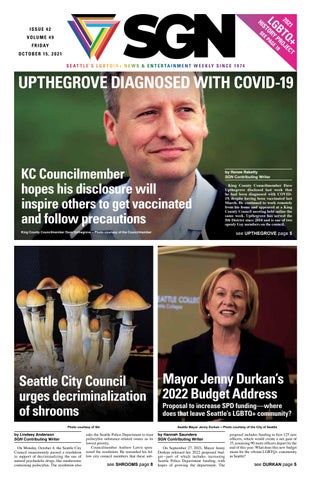
UPTHEGROVE DIAGNOSED WITH COVID-19
KC Councilmember hopes his disclosure will inspire others to get vaccinated and follow precautions King County Councilmember Dave Upthegrove – Photo courtesy of the Councilmember
by Renee Raketty SGN Contributing Writer King County Councilmember Dave Upthegrove disclosed last week that he had been diagnosed with COVID19, despite having been vaccinated last March. He continued to work remotely from his home and appeared at a King County Council meeting held online the same week. Upthegrove has served the 5th District since 2014 and is one of two openly Gay members on the council.
see UPTHEGROVE page 5
Mayor Jenny Durkan’s 2022 Budget Address
Seattle City Council urges decriminalization of shrooms
Proposal to increase SPD funding—where does that leave Seattle’s LGBTQ+ community?
Photo courtesy of Ski
Seattle Mayor Jenny Durkan – Photo courtesy of the City of Seattle
by Lindsey Anderson SGN Contributing Writer On Monday, October 4, the Seattle City Council unanimously passed a resolution in support of decriminalizing the use of natural psychedelic drugs, like mushrooms containing psilocybin. The resolution also
asks the Seattle Police Department to treat psilocybin substance-related issues as its lowest priority. Councilmember Andrew Lewis sponsored the resolution. He reminded his fellow city council members that these sub-
see SHROOMS page 8
by Hannah Saunders SGN Contributing Writer On September 27, 2021, Mayor Jenny Durkan released her 2022 proposed budget—part of which includes increasing Seattle Police Department funding, with hopes of growing the department. The
proposal includes funding to hire 125 new officers, which would create a net gain of 35, assuming 90 more officers depart by the end of this year. What does this new budget mean for the vibrant LGBTQ+ community in Seattle?
see DURKAN page 5
GREEN CARDS • VISAS • ASYLUM • CITIZENSHIP 1836 Westlake Ave N, Suite 302 Seattle, WA 98109
(206) 724-1940 olivielaw.com
THIS AD SPACE HAS BEEN GENEROUSLY DONATED BY KRISTIN COSTELLO IN MEMORY OF SGN PUBLISHER GEORGE BAKAN
2
SGN
OC T OBER 15 , 2 0 2 1
C E L E B R AT I N G 4 7 Y E A R S!
Obituary
Remembering Suzanne J. Thomas by Dave Horn Special to the SGN Beloved civil rights activist, attorney, and pillar of the LGBTQ community Suzanne J. Thomas died September 18 after a brief stay in a Seattle hospital. She was 59, and her unexpected death shocked and saddened many in the community. Born in 1962 and raised in the Shorewood neighborhood of South King County, Thomas graduated from Evergreen High School, the University of Washington, and the highly respected University of Michigan Law School before embarking upon her legal career in 1987. As a young associate at Graham & Dunn, an old corporate law firm in downtown Seattle, Thomas volunteered to be a cooperating attorney for the ACLU. It was not long before she began making history. In 1992, Bellingham high school student Dallas Malloy wanted to train for the Olympics but was told she could not participate in Golden Gloves boxing because she was a girl. Thomas wrote a letter to the governing organization objecting to its discrimination against Malloy.
see THOMAS page 4
Suzanne J. Thomas (r) – Photo courtesy of Dave Horn
In this Issue
LOCAL NEWS 4 A&E • FILM • BOOKS 9 OP-ED 17 LGBTQ+ HISTORY PROJECT 18 NATIONAL NEWS 21 INTERNATIONAL NEWS 21
VISIT US ONLINE SGN.ORG
OC T OBER 15 , 2 0 2 1
SGN
3
Local News
90% of state workers are vaccinated ahead of the mandate’s Oct. 18 deadline service workers, are required to be fully vaccinated by Oct. 18. Students who are training in healthcare settings and firefighters with EMT or paramedic certifications are required to become fully vaccinated. If volunteers are too young to receive a vaccine, they must become fully vaccinated as soon as they are eligible. Directors, secretaries, and executive officers of state agencies must become fully vaccinated by Oct. 18. Those appointed to serve on a board, commission, or a similar body, such as executive cabinet agencies and small cabinet agencies, fall under this proclamation. Executive cabinet agencies include the Department of Agriculture and the Department of Ecology, while small cabinet agencies include the LGBTQ Commission and the Commission on Hispanic Affairs.
by Hannah Saunders SGN Contributing Writer October 4 was the last day for state workers to receive their second dose of a COVID-19 vaccine in order to continue working in their positions. Under Gov. Inslee’s Proclamation 21-14.1, issued on Aug. 20, all state employees, contractors, and volunteers are required to be fully vaccinated by Oct. 18, unless they obtain a religious or disability exemption and accommodation. The vaccination status of state employees must also be verified. Inslee declared a state of emergency on Feb. 29, 2020, which gave him the power to prohibit any activity that threatens to preserve life and health of Washingtonians. Inslee’s justification for the new order is that not all COVID safety prevention measures — such as masking, social distancing, and frequent hand washing — prevent outbreaks. Vaccination remains the strongest tool for preventing COVID-19. “Violators of this order may be subject to criminal penalties pursuant to RCW 43.06.220(5). Further, if people fail to comply with the required facial coverings, social distancing, and other protective measures while engaging in this phased reopening, I may be forced to reinstate the prohibitions established in earlier proclamations,” read the document.
Photo by Bryan Woolston / Reuters
Who does the order apply to? The proclamation includes healthcare workers, K-12 employees, and all other state employees, such as ferry workers and the Washington State Patrol. Those who hold a Washington Department of Health (DOH) certificate, license, or registration and are actively practicing or providing services fall under the proclamation. Those permitted by law to provide healthcare services (without
DOH credentials) and are actively providing services also fall under this order. Proclamation 21-14.1 applies to telehealth service providers, even if they conduct no in-person services. Patients are also allowed to ask their providers if they are fully vaccinated. Those who work on-site in any healthcare setting, such as contractors, volunteers, administrative staff, and cleaning
THOMAS
continued from page 3 In an interview years later, Thomas said the organization wrote back suggesting that Thomas, being a female attorney, might not understand the rules of boxing. “Game on,” Thomas declared. She went to the media, appearing on national television alongside Malloy. Malloy sued, and Thomas persuaded a federal judge in Seattle to order Golden Gloves to let Malloy box. On October 31, 1993, Malloy became the first female amateur boxer in the United States. Before Malloy’s first match, Thomas herself entered the ring and proudly introduced Malloy and her opponent to the crowd. That same year, Lon Mabon, infamous for his anti-Gay ballot measures in Oregon, filed an initiative in Washington that would have barred Gay and Lesbian people from teaching in the public schools. Thomas was part of a team of attorneys who successfully fought the measure in court on behalf of newly formed Hands Off Washington. Thomas said later that a number of the attorneys on Hands Off’s team, including her, were either outed or forced to come out during the litigation. Hands Off Washington was led by future Speaker of the House Laurie Jinkins, the late Jan Bianchi, Charlie Brydon, and SGN publisher George Bakan, among others. With Thomas’s help, Hands Off ran its own statewide initiative in 1997 to bar discrimination based on sexual orientation. After a spirited campaign, the initiative was defeated by voters. In 1995, a King County Bar Association task force recommended rule changes to make it unethical for a lawyer in Washington to discriminate based on sexual orientation. Thomas volunteered to help draft the proposed rules and was instrumental in persuading state bar leaders to support them. The rules were eventually adopted by the state supreme court in 2000. Meanwhile, Thomas was elected president of Washington Women Lawyers, reportedly the first out Lesbian to hold that position. Not long after, in 1999, Thomas joined the board of directors of Lambda Legal, the largest and oldest national orga-
nization litigating against LGBTQ discrimination, serving until 2001. By then, Thomas had worked for two corporate law firms and opened her own solo law office. She practiced alone until 2006, then joined Preston Gates & Ellis, later known as K&L Gates, where nowSenator Jamie Pedersen was a partner. In 2007, Thomas took on the North American Gay Amateur Athletic Alliance, which was holding the national Gay softball championships in Seattle. The NAGAAA claimed to allow non-LGBTQ players, but rules limited their play in tournaments. When opposing players complained that one of the top two teams sported too many non-gay players, Thomas stepped in. She alleged that NAGAAA officials had interrogated players about their sex lives, then disqualified the team for having too many bisexuals. Thomas sued to enforce Washington’s brand new Anderson-Murray civil rights law against NAGAAA. Her lawsuit brought national attention to discrimination against bisexuals and resulted in a favorable settlement. The disqualified team
4
OC T OBER 15 , 2 0 2 1
SGN
Suzanne J. Thomas (r) with U.S. President Joe Biden – Photo courtesy of Dave Horn
received its trophy and medals. Thomas continued to support the community through her work and through regular, generous donations to organizations such as Lambda Legal. In 2019, Thomas landed a position as vice president and global employment counsel for F5 Networks. During her career, Thomas lived in West Seattle, Wallingford, and Queen Anne. After months of working remotely because of COVID, however, Thomas moved to her dream home outside of Langley on Whidbey Island, where she hoped to retire. She would enjoy her new home for only a few months. Thomas’s family and close friends were devastated by her passing. As news of Thomas’s unexpected death trickled out, those who knew her expressed shock, admiration, and love on social media and in private calls and messages. Kevin Jennings, CEO of Lambda Legal, called Thomas “a big personality” who was “full of life and love for her community.” Sen. Pedersen, who worked closely with Thomas for years, said she was “a fierce
Types of healthcare settings Healthcare settings include hospitals; urgent care; long-term care facilities; inpatient rehab and behavioral health; mobile clinics, including ground and air ambulances; dental clinics; massage therapy offices; pharmacies (not including retail areas); outpatient facilities, including physician offices and behavioral health offices; chiropractic offices; midwifery practices; hospice care centers; and blood collection facilities.
see MANDATE page 6 and zealous advocate for her clients and for the whole LGBTQ community.” Pedersen praised Thomas’s “vast experience,” her “great heart,” and her “sense of purpose and determination.” Friends, acquaintances, and people who barely knew Thomas told stories of her acts of unexpected kindness. Close friend Rob Roche, a fellow attorney, admired Thomas’s legal skill and determination but knew her better as a “loving, supportive and funny friend” who had “an infectious laugh.” “If she thought you needed a hug, she’d give you a hug,” said Roche. Friend JJ McKay recalled Thomas bringing food to the new neighbors next door. Another woman remembered that when her spouse died, Thomas, who barely knew her, was the one who stepped in, explained to her the legal process that would ensue, and guided her through the ordeal. Friends said Thomas remained devoted to her 90-year-old mother, often visiting and taking her shopping and on other outings. Thomas also bragged endlessly about her nephews. She threw lively parties, joined her close circle of friends for funfilled dinners, and greeted old friends with unwavering gusto. The words “force of nature” have been frequently used to describe her. When President Bill Clinton unexpectedly appeared at the Human Rights Campaign’s annual dinner in Seattle in 2000, Thomas leapt from her seat, rushed to the front of the room, and, grabbing the president’s hand and pumping it, exclaimed, “How are you doing, Mr. President!” She greeted everyone that way. Suzanne J. Thomas is survived by her mother, Carol Thomas of Seattle; sisters Mary Bannister (Dave) of Normandy Park, Margo Lindberg (Alan) of Issaquah, and C.J. Thomas of Clinton; brother Rich Thomas of Renton; and two nieces, two nephews, and one grand nephew. Thomas was preceded in death by her father, Carnot H. Thomas, Jr. of Seattle. County officials confirmed that Thomas died of natural causes at Virginia Mason Medical Center, but relatives have not yet been informed of the precise cause. The family expects to hold a memorial service in the coming months.
C E L E B R AT I N G 4 7 Y E A R S!
UPTHEGROVE continued from cover
“It is like a really horrible case of the flu. I have chest and sinus congestion, sore throat, headache, fever, muscle ache, and extreme fatigue,” he told the SGN during an online interview. “The first night the fever and muscle aches were so bad I didn’t sleep at all. I am mostly staying in bed but am completely exhausted. “The King County Council is working remotely, so contracting COVID won’t impact my work at the council, except to the extent that being sick in bed means I am clearing nonessential items from my calendar so I can rest and get well.” A representative of King County Executive Dow Constantine said, “All of us wish him the best and hope for a speedy recovery.” “I think everyone is thankful he was vaccinated and know how important it is for everyone to get one of the vaccines,” said Chase Gallagher, Constantine’s interim director of communications. King County Council Vice Chair Joe McDermott, who was the first openly Gay councilmember and represents the 8th District, says he has been following Upthegrove’s condition. “I’ve been in touch with Dave to wish him a speedy recovery and would remind everyone of the value of getting vaccinated,” he told the SGN this week. Upthegrove says he is unsure where he may have picked up the virus but admits he “attended a few public events, but mostly outdoors, masked, and socially distanced.” He said he disclosed his COVID-19 status “in order to encourage other people to get vaccinated.” Upthegrove previously served as the first openly Gay state representative from outside the City of Seattle when he was appointed to the Washington state legislature in 2001. He went on to serve five terms until he was elected to the King County Council in 2013. Currently, he is running for reelection against Shukri Olow, a former refugee and community organizer, in a district that includes the cities of Burien, Des Moines, Kent, Normandy Park, Renton, SeaTac, and Tukwila. The pair recently faced off via Zoom during a candidate forum organized by the Washington Coalition for Police Accountability.
DURKAN
continued from cover The proposed budget According to the proposed budget document, the SPD was found to be following the 2012 court-ordered reforms. “In May of 2020, the City and SPD asked the court to terminate the sustainment period, stating SPD had fully demonstrated a culture of continuous improvement and innovation by meeting all of the court’s requirements. Following the murders of George Floyd and Breonna Taylor by police officers, and the ensuing civil rights reckoning demanding a new model of community safety, the City and SPD asked to withdraw the termination order and committed to a community-led process of re-envisioning public safety,” the budget document states. The proposed budget for SPD was based on findings from the Community Safety Work Group and the SPD Functional Analysis Interdepartmental Team, which engaged in community outreach and found that some people were interested in a greater patrol presence in addition to developing stronger relationships between the officers and the neighborhoods they serve. The response to feedback from the community includes increasing the Community Service Officer Unit. CSOs are civilians who assist residents and businesses relating to noncriminal calls; they engage with the community and support programs for atrisk youth. The department also wants to initiate a new Specialized Triage Response within the Seattle Fire Department’s Mobile Integrated Health (MIH) program; $2 million is to be put toward this program. The MIH would respond directly to noncriminal and nonmedical 911 dispatch calls and would not include a sworn police officer.
VISIT US ONLINE SGN.ORG
KC Councilmember Dave Upthegrove received his first vaccination the week of April 30, 2021. – Photo courtesy of the Councilmember
Upthegrove credits getting vaccinated as one reason he has not experienced a worse outcome. “Had I not been vaccinated, this could have been life threatening.” “The biggest impact is not being able to be out knocking on doors meeting voters,” said Upthegrove. “Even once my symptoms go away and I feel better, I will still need to quarantine until the 22nd. Also, being sick in bed means I am not able to do much at all relating to the campaign. “The candidate forum was difficult, because I was so tired and felt so miserable, and it required being out of bed and answering questions for an audience for two hours.” State Senator Jamie Pedersen (D-43), who once served with Upthegrove in the legislature, joined more than 420 people responding to his post on his private Facebook page announcing his COVID-19 diagnosis. He told the SGN this week he was “glad [Upthegrove] was vaccinated” and it “sounds like it could have been much worse.”
Upthegrove says he’s been “flooded with well-wishes” and is grateful for the public’s support. “The outpouring of kindness and love from so many people is appreciated,” he said. His husband, Chad Harper, has tested negative for the virus.
The Regional Peacekeepers Collective is another area of focus, which connects at at-risk youth (in this case, victims or perpetrators of gun violence) to referral programs from Harborview Medical Center, the King County prosecuting attorney’s office, and community-based organizations. Since the start of 2020, SPD has experienced a net loss of over 193 officers. According to the document, even with a high decrease in tasks, “patrol staffing would only be brought back up to minimum levels necessary for maintaining adequate response times.” To address this need, the budget includes $1 million in hiring and retention incentives for officers. If the city council approves this budget, the number of officers will be raised to 1,230 by the end of 2022, although the 2021 budget included 1,343 officers—a number that was not reached. The budget also includes growing the Office of Police Accountability—which operates under the Office of Inspector General for Public Safety and investigates police misconduct—by hiring a video content creator who will analyze audio and video content specific to OPA cases. The 2022 budget allows for $161,701 toward the additional OPA investigator position.
BIPOC and LGBTQ+ community members, and individuals even distributed food, picked up garbage, and created chalk-street art. Part of the CHOP/CHAZ organizer’s list of demands included defunding and abolishing the Seattle Police Department. On September 30, 2020, the ACLU— one of the nation’s largest civil rights and civil liberties organizations—filed for a second motion of contempt (alongside Korematsu Center and Perkins Coie) against the City of Seattle for using weapons on protestors as a crowd control method. The organization claimed that, during the summer of 2020, the SPD violated a preliminary junction that prohibits the use of chemical weapons against protestors. The motion included documented incidents such as advancing on protestors without any warning or provocation, in addition to using pepper spray and tear gas on members of the community. On October 21, 2020, the Seattle LGBTQ+ Commission released a statement to the mayor and city council, calling for the immediate resignation of Mayor Jenny Durkan for “failing to uphold and protect the human rights of the people in Seattle.” The statement asserted that the worst police violence in Seattle occurred within CHOP/CHAZ. “Given the long history of reproductive violence against the LGBTQ+ and Black populations, that this happened repeatedly in the traditionally LGBTQ+ neighborhood of Seattle at a series of protests for Black lives is particularly egregious,” reads the Commission’s statement, referring to the fact that tear gas has effects on reproductive health, particularly for people with uteruses. Since the release of the commission’s statement a year ago, Jenny Durkan has neither resigned nor defunded the Seattle Police Department.
Policing in Seattle During the summer of 2020, the SPD abandoned the East Precinct following one week of clashes with Seattle Black Lives Matter protestors over the death of George Floyd and police brutality. Protestors set up a safe and police-free zone in the Capitol Hill neighborhood, commonly known as CHOP, short for Capitol Hill Organized Protest, or CHAZ, the Capitol Hill Autonomous Zone. The Black Lives Matter protests turned violent when SPD threw tear gas, flash bang grenades, and sprayed mace at crowds. The CHOP/CHAZ zone welcomed marginalized
The virus, vaccines, and breakthrough cases The first COVID deaths in the nation occured in King County. Upthegrove and his colleagues on the Ccouncil have been working with Public Health – Seattle & King County and local health departments to mount a defense against the virus. “The King County Council has been unanimous in following the science and supporting our public health professionals,” said Upthegrove. “My last year and a half
OC T OBER 15 , 2 0 2 1
has been spent helping oversee the public health response, as well as supporting the community through the pandemic.” According to data from Public Health – Seattle & King County, people who were not fully vaccinated were eight times more likely to test positive for COVID-19, 46 times more likely to be hospitalized, and 78 times more likely to have died of COVID19 related illness over the last 30 days. Gabriel Spitzer, a communications specialist at Public Health, recommends that the “most important step people can take to avoid catching and spreading COVID-19 is to get vaccinated.” He said that those who have completed their vaccine series should take “additional precautions,” including wearing masks in public spaces, especially indoors and in crowded outdoor settings. Anyone with symptoms of COVID-19, he added, should also get tested as soon as possible and isolate themselves while they await the results. “A ‘layered’ approach, combining vaccination with other prevention measures, is the best way to stay safe from COVID-19,” explained Spitzer. “The COVID-19 vaccines are highly effective, but no vaccine is 100% protective. When we have more vaccine breakthrough cases, that does not mean the vaccines are falling short: it just reflects that a higher percentage of the population is already vaccinated. “Most vaccine breakthrough cases are not serious. What is important to know is how much the vaccine reduces a person’s risk of coming down with a severe infection, and there, the signal is clear: vaccines dramatically reduce your risk of being hospitalized or dying from COVID-19.” Upthegrove credits getting vaccinated as one reason he has not experienced a worse outcome. “Public health experts all report that being vaccinated reduces my risk of complications as well as reduces the severity and duration of my symptoms,” he said. “It also reduced my chances of contracting the virus. But this is an important reminder that just because you are vaccinated doesn’t mean you are completely immune. “It is important to still follow other public health guidelines like masks and social distancing. Had I not been vaccinated, this could have been life threatening.” Effects of policing on the LGBTQ+ community The United States has an extensive history of mistreatment of the LGBTQ+ population, with the most infamous police brutality incident occurring in 1969 at the Stonewall Inn. American police departments have a reputation for profiling, entrapping, discriminating against, and harassing the LGBTQ+ community; LGBTQ+ POC, LGBTQ+ youth, and Transgender individuals are most impacted by law enforcement violence. The Anti-Violence Project, an organization that empowers the LGBTQ+ community to end forms of violence, released statistics regarding policing and its effects on the LGBTQ+ community. According to the organization, those who are Transgender are almost four times as likely to experience police violence in comparison to those who are cisgender. In comparison to cisgender victims of crime, Transgender victims are seven times more likely to experience physical violence while interacting with police officers. Transgender POC are six times more likely to experience physical violence from police officers compared to those who are white and cisgender. These police practices of profiling, discriminating against, and harassing the LGBTQ+ community—especially the LGBTQ+ BIPOC community—weaken community trust while reducing the number of crimes reported, which may contribute to a lack of support and resources for the victims. What are your thoughts on the 2022 proposed budget? Do you think a stronger SPD presence will be more beneficial or harmful to the LGBTQ+ and BIPOC communities in the city?
SGN
5
Local News
All Together Now: Seattle Pride’s cheerful fall event brings rainbows to Volunteer Park IRL, never mind the weather by Kylin Brown SGN Contributing Writer Despite a cold, near-constant drizzle, Seattle Pride organizers successfully brought the community together for in-person festivities on Saturday, Oct. 9. Following its two-day virtual Pride month event, “Resilience,” the group offered a hopeful disposition for the fall. In September, they announced “All Together Now” and its stellar four-hour line-up, almost exactly two weeks after Labor Day weekend presented a countywide COVID scare. Luckily, Seattle Pride understood the assignment. Utilizing wide-open spaces at Volunteer Park and organizing an on-site vaccination clinic with UW Medicine, the masked, distanced, outdoor party offered an opportune moment for safe celebrations. From 3 p.m. to 7 p.m., people toured the dozens of vendor pop-ups along the edges of the lawn; they were consistently offered hand sanitizer and masks, along with other relevant merchandise. Visitors were encouraged to enter free raffles and spin wheels for larger prizes as well. Vendors ranged from PCC, which was handing out free organic bananas and coffee coupons, to T-Mobile, which brought a 360-degree video booth experience. Food trucks lined the event entrance, including Dumpling Tzar, Monster Dogs, Full Tilt Ice Cream, and Mobile Mayan. Hot dog in hand, many guests zipped directly into the beer and alcohol garden, where proof of vaccination was required. Elysian Brewing, Mike’s Hard Lemonade Seltzer, Ruben’s Brews, Jack Daniel’s Tennessee Fire, and Tito’s Handmade Vodka made a pleasant mark on the scene for those who imbibed. Beyond the material enjoyments offered at the event, Seattle-based DJ and producer Chong the Nomad headlined, along with DJ dark_wiley, Cassandra Lewis, BeautyBoiz, CarLarans, and others. KEXP’s on-air host Marco Collins and drag queen Betty Wetter emceed the free concert. Trained ASL
MANDATE
continued from page 4 Who doesn’t it apply to? The proclamation does not apply to healthcare providers who are not currently practicing or providing services; veterinarian healthcare settings; animal control agencies; research facilities where no healthcare is provided; nonprofit humane societies; licensed foster homes that don’t primarily involve healthcare services, such as the Department of Children, Youth & Families; certain athletic trainers; and those who provide only personal care services. Those who work fully remotely in the field of healthcare field and information technology, for example, are not required to become fully vaccinated. If there is some in-person work, however, the proclamation applies. The proclamation does not apply to tribal healthcare settings unless a Washington licensed provider is working in a tribal healthcare setting.
“All Together Now” at Volunteer Park, Saturday October 9, 2021 – Photo by Kylin Brown
interpreters brought further accessibility to the performances. In the meantime, Jack Daniel’s Tennessee Fire sponsored Drag Queen Bingo, hosted by Aleksa Manila, with proceeds benefiting Seattle Pride. The games were enjoyed by all, even while 92.5’s free green rain ponchos began to punctuate the crowd. Song, reflection, laughter, and even some tears filled the crisp air as visitors reminisced on their pride. A three-walled white tent from Seattle Pride and radio station C89.5 heard it all: inside, a recording studio was made available for guests to participate in sharing coming out stories in recognition of National Coming Out Day, October 11th. Opportunities to share and engage with these testimonials are ongoing at C895.org/Pride.
“These powerful, personal stories can inspire and create safe space for others in our community to live authentically,” reads the statement. The project aims to generate empathy in others, cultivate new advocates, and inspire those who have not yet done so to come out. Seattle Pride Executive Director Krystal Marx added, “Sharing your coming out story is incredibly important for our community, regardless of whether that experience was painful or humorous or something else altogether. We want our community to participate in sharing their coming out stories, because it allows other folks in our community to live authentically, creating a safer space for us all.” Lastly, Vote with Pride made a return at
a booth of its own, where educational voting materials and campaign signs and stickers were available. The initiative has recently released a Seattle Pride Voter’s Guide on its website as well (at www.seattlepride. org/web/app/templates/assets/image/2021Seattle-Pride-Voters-Guide-INFO.pdf). Sponsors of Seattle Pride’s event included Alaska Airlines, T-Mobile, Facebook, Starbucks, KIRO 7, The Stranger, radio partners C89.5 FM, KNKX, and MOViN 92.5, and several other corporate backers.
• Documentation of the COVID-19 vaccine from a healthcare provider (electronic health records are sufficient) • A State Immunization Information System record • A Washington certificate of vaccination from MyIRmobile.com • Any equivalent documents, if vaccinated outside of the United States Personal attestation is not an acceptable form of verification, and frequent COVID19 testing is not an alternative to becoming fully vaccinated. Furthermore, if a worker submits a CDC vaccination card that is later found to be fraudulent, the operator of the facility must immediately stop them from working. Lawful authorities — such as law enforcement, local health jurisdictions, the DOH, the Department of Labor & Industries, and the Department of Social and Health Services — may request proof of vaccinations.
cere, and accommodations must be made for those exemptions are approved.
their jobs if accommodations are unable to be put in place.
Provisions In early October, Gov. Inslee made provisions to the proclamation for all state workers in order to provide more time for employees to become fully vaccinated while also keeping their jobs. The provisions state that if a disability or religious exemption request is denied and an accommodation is not possible, the employee may use annual leave and leave without pay for up to 45 days in order to become fully vaccinated. Additionally, if a state worker started the vaccination process late and is not fully vaccinated by Oct. 18, they can use unpaid leave for up to 30 days in order to become fully vaccinated. The employee maintains the right to return to their position (or an empty position in the same job class) once they become fully vaccinated and if the position has not been filled. These new provisions expire on Nov. 17. If an employee is not fully vaccinated by Oct. 18, operators must prohibit them from working at facilities, although they may rehire the employee once they become fully vaccinated. Those who refuse to get vaccinated and opt for no accommodations may receive a gross misdemeanor subject to law enforcement jurisdiction; this may result in civil enforcement action. Those who seek disability or religious exemptions may lose
The current figures The State Human Resources division of the Office of Financial Management (OFM) has been collecting data regarding how many state employees have completed the vaccination verification and how many requested and received exemptions; state agencies began reporting this data to the OFM in September. As of Oct. 7: • 89.53% of state employees have received a vaccination verification (this percentage does not include approved exemptions or accommodations) • The adjusted headcount that incorporates approved exemptions and accommodations is 91.87%. For those seeking religious exemption as of Oct. 7: • There have been 4,849 total requests. • There are 42 pending requests. • 404 requests have been closed or withdrawn. • 4,219 requests have been approved. • 184 requests have been denied. For those seeking disability exemptions, as of Oct. 7: • There have been 1,228 total requests. • There are 75 pending requests. • 258 requests have been closed or withdrawn. • 866 requests have been approved. • 29 requests have been denied.
Proof of vaccination It is the responsibility of the facility operator to verify the vaccination status of every employee, contractor, and volunteer. They do not need to obtain a copy of an employee’s vaccination card, but they need to verify and track the vaccination status of everyone. Proof of vaccination includes: • A CDC COVID-19 Vaccination Record Card (or a picture of the card)
Disability or religious exemptions Individuals may opt out of the vaccination mandate if they receive a disability or religious exemption. To receive a disability exemption, people must obtain appropriate documentation from a healthcare provider with a professional statement. To receive a religious exemption, people must provide a handwritten statement explaining how the vaccination order conflicts with their religious observance, practice, and beliefs. Religious belief exemptions must be sin-
6
OC T OBER 15 , 2 0 2 1
SGN
Visit SeattlePride.org to learn more about its Coming Out Stories campaign and future programs.
C E L E B R AT I N G 4 7 Y E A R S!
VISIT US ONLINE SGN.ORG
OC T OBER 15 , 2 0 2 1
SGN
7
Local News
Veterinary clinics are experiencing staffing shortages, but not necessarily for the reasons you’d think of COVID-19, but it limited the efficiency and productivity numbers of staff — which are measured in patients seen per hour. In addition to curbside pickup, staff members were split into rotating teams, and more time was spent disinfecting exam rooms and sanitizing surfaces. The loss of staff members due to COVID-19-related illness also helped create strain in the industry. Staff would call out sick, have to quarantine, or stay at home for personal reasons, such as tending to children due to the loss of in-person learning. There have also been reports of staff burnout due to the increased demand for services. The average turnover rate for veterinarians is twice as high as for physicians in medical practice. Vet technicians also have one of the highest turnover rates out of all healthcare positions.
by Hannah Saunders SGN Contributing Writer On September 15, the Journal of the American Veterinary Medical Association (JAVMA) released information regarding the continuing veterinary staffing shortages that have been occurring throughout the nation. For pets and their parents, this means they cannot get appointments as easily as before, but what does this mean for veterinary clinics and staff as a whole? According to JAVMA, veterinary workers are experiencing high stress and feelings of being both overworked and overwhelmed. A good portion of veterinary hospitals are operating with fewer staff members and greater turnover rates. Emergency vet clinics have been hit the hardest, due to a constant flow of patients for urgent and nonurgent visits, which also contributes to longer wait times. The “pandemic pet” boom When COVID-19 hit the United States, endless lockdown and stay-at-home orders were issued by state officials, in addition to physical distancing recommendations. With more people seeking companionship during that time of isolation, reports of skyrocketing pet adoptions swept the media. Animal shelters are the main source of pet adoptions. The second most common source is receiving a pet from a relative or friend; breeding and taking in stray animals was third. 24PetWatch and Best Friends Animal Society released data regarding the rates of pet adoptions at animal shelters. According to their data, the number of pet adoptions from animal shelters in 2020 was the lowest in the past five years. Approximately 2.3 million animal shelter adoptions occurred in 2020 (46% were dogs and 54% were cats), while in 2019, approximately 2.8 million pets were adopted from shelters (49.5% were dogs and 50.5% were cats). If everyone was looking for a companion during COVID, why did the rates drop? During the pandemic, animal shelters
SHROOMS
continued from cover
Photo courtesy of Banfield Pet Hospital
experienced 32% fewer dog intakes and 23% fewer cat intakes, which may be attributed to fewer people giving away pets and fewer stray animals getting picked up. In addition, when COVID-19 first hit, many veterinary facilities were accepting urgent pet visits only, creating a tremendous backlog of patients. More time spent at home with pets allowed owners to see and respond to health issues at more rapidly and think more critically about their pet’s overall health. Pet owners also received stimulus payments that were used as disposable income on their furry friends. The switch from in-person visits to virtual appointments due to COVID-19 also made for fewer prospective pet adopters. As a result, the percentage of available pets at shelters rose, yet the actual number of adoptions declined.
Appointments can be hard to come by According to VetSuccess — an analytics company that reviewed national data on over 4,000 vet facilities — the average number of appointments booked increased by 4.5% from 2019 to 2020. In comparison to January through June of 2020, appointments rose by 6.5% during that same timeframe in 2021. The majority of revenue growth has come from existing patients: pet parents have invested in a greater number of vet products and services (and a higher quality of products and services), while the average price of the products and services has increased.
room addiction. They are not known to destroy people’s lives or be the cause of an overdose. I think it is important to remove them from the schedule 1 classification.”
the substance offers for medical treatment of depression, anxiety, and PTSD. “These non-addictive natural substances have real potential in clinical and therapeutic settings to make a significant difference in people’s lives,” Councilmember Lewis said in support of the resolution. He cited several studies circulating through the scientific community that point to the potential health benefits of mushrooms. “Well-rounded mental health requires a variety of positive influences in a person’s life, and the usage of mushrooms should be a safe and available option,” said Ski. While experiences may vary — and he suggests talking with a doctor or mental health provider before considering mushrooms to treat any mental illness — he also notes that the substance can be beneficial for improving mental health. “Personally, for me, and for many people I have known, an experience on mushrooms can help with clarity. There is testimony after testimony of a person being relieved from stress, resolving personal issues, and experiencing joy after a mushroom trip. And also, just simply enjoying life by dipping into a 4- to 8-hour psychedelic mushroom experience can improve the quality and mental health of someone’s life.”
stances, such as mushrooms, have been sacred to different cultures and spiritual practices for centuries, but are criminalized like any other schedule 1 drug. However, under current enforcement practices, the police already do not detain or arrest persons solely for possession of entheogens (psychedelic drugs). While all council members agreed to pass the resolution, councilmember Kshama Swant voiced disapproval, out of concern that it doesn’t go far enough. She was disappointed the city council did not seek to pass an ordinance, which would decriminalize entheogenic substances, instead of just urging the SPD to alter its guidelines. While the ordinance does not decriminalize the substances, it sets a precedent for allowing consumption and cultivation to occur legally within Seattle city limits. This is good news for local mushroom growers. “Ski” has been growing mushrooms in Seattle for the last seven years. He sees the resolution as a sign that views are shifting when it comes to public understanding of mushrooms. He hopes this gradual shift will help people differentiate between substances like mushrooms and more harmful drugs, such as LSD. “Mushrooms are classified as a schedule 1 drug according to the federal government, which puts it alongside a whole slew of drugs that are extremely dangerous and highly addictive,” said Ski. “You simply do not hear of someone struggling with mush-
Health benefits of mushrooms Another major factor that led the city council to consider the decriminalization of mushrooms is the possibilities that
8
OC T OBER 15 , 2 0 2 1
SGN
A natural substance One of the reasons the city council agreed to the new resolution was because mushrooms are a natural substance. Unlike manufactured psychedelics, which are excluded from the resolution, mushrooms are not created in a lab and have not been shown to lead users to form harmful and addictive attachments. “Mushrooms are a natural and organic growing substance from planet Earth. It is not the creation of human beings, nor is it something that is altered in some way by human hands,” said Ski. Because they are naturally occurring substances, mushrooms tend to be harder to criminalize and regulate. This was also one of the reasons Washington State passed Initiative 502, legalizing adult consumption of marijuana, in 2012. After the Supreme Court of Washington State ruled earlier this year that it is unconstitutional to criminalize possession of controlled substances, buzz began to circulate that the state may seek to decriminalize the possession of mushrooms. The Seattle resolution is one step closer to that goal in that it asks the Office of Intergovernmental Relations to add the decriminalization of entheogens to its 2022 agenda.
COVID-19 safety and prevention assisted with creating barriers Animal healthcare facilities switched to curbside pickup to help reduce the spread
A far-out future Though city councilmembers have expressed their hope that psilocybin can become a state-regulated and legal substance soon, Ski is more skeptical. “I think more places will get on board, but there will always be pockets of resistance,” he says. “I think psychedelics are illegal because of what was seen during the 1960s’ cul-
How will the veterinary staffing issue be tackled? For burnout, JAVMA recommends paying employees appropriately based on their qualifications and the tasks they are doing. Employers are recommended to increase engagement with employees, building teams, and improving leadership skills. The simplest solution to staffing shortages might be to hire more veterinarians. However, the question remains: will the increase in demand be permanent? Veterinary facilities remain on backlog due to the pandemic, so the answer remains uncertain. JAVMA encourages facilities to use resources efficiently. Space needs to be freed up for vet technicians and advanced veterinarians so they can focus on tasks like diagnosing, prescribing medications, and performing surgeries rather than answering phones and scheduling appointments. It is also recommended that offices utilize technology as much as possible for things like purchasing, accounting, and even telehealth services.
tural revolution, where, as a result of LSD, the mind opened into areas we probably wished we could have kept closed. Psychedelic mushrooms were instantly lumped into the same category, probably out of fear. I don’t think they should be in the same category, because the dosage can be more easily moderated.” Because future state legalization or even decriminalization is still up in the air, growers are unable to fully prepare for what it would mean for their businesses. For example, in the wake of marijuana legalization, small growers and sellers were put out of business due to high taxes and commercial stores moving in. For Ski, growing mushrooms is less of a business and more of a passion. His end goal isn’t to make money but to connect with nature and his community. “Some people grow bonsai; I grow mushrooms. I use them occasionally and like giving them away as a gift.” Because his end goal is never about profit, he isn’t too worried about legalization negatively affecting his practice. Instead, he sees it as a positive. “I think the main thing is that I no longer have to live in fear of getting busted for growing them, and now I can openly explore what the future could be. Now I can start having a conversation about what is next.” While full-on legalization may be years down the road, the city council has taken the first step by passing this resolution. Now Seattleites can access natural psychedelic substances without fear of arrest, mental health practitioners can now recommend these substances, and state lawmakers can start to reassess why mushrooms are categorized as a schedule 1 drug.
C E L E B R AT I N G 4 7 Y E A R S!
Arts & Entertainment
Dropping in on Queer Geek! Seattle, a nonprofit for fun, charity, and connection by Daniel Lindsley SGN Contributing Writer When I stepped out of the rain into Phoenix Comics and Games last weekend, I found two long tables strewn with game boards and pieces and chaired by welcoming people. They were from Queer Geek! Seattle, a local nonprofit all about celebrating geek culture and the Queer people therein. They’ve been running for nine years, and it showed: in the back of the room, on other tables, board game boxes were piled high beside the duffel bags used to carry them. A group of seven invited me to either watch or play a game of Captain Sonar, which they described as “team-based Battleship.” I chose to watch at first, so I could settle down from a long trip by public transit. But soon, another table offered an open spot in A War of Whispers, a territory-control game in which players are spymasters rather than kings or generals. I was in. Learning the names of three people, rather than seven, was less daunting. And it seemed more my speed anyway. The rules of Whispers were explained so succinctly that I felt, after just a few minutes, like I’d already played the game once. I had the same feeling while playing another game after that. As I, “the spymaster,” schemed and plotted in Whispers, I learned about the games, the people playing, and Seattle itself. There was a healthy mix of veteran board gamers and people new to the scene, and the same
Gamers gather around a table at Phoenix Comics & Games for Queer Geek! Seattle's monthly Board Game Meet-up – Photo by Robert Roth / Jetspace Studio
goes for long-time Seattleites and recent transplants. It was a good time. It was also clearly an indispensable resource for Queer people seeking connections. The meetup focused on board games, but inevitably, other interests came up too: the movies from the Marvel Cinematic Universe, the video game series Borderlands, tabletop role-playing games like Dungeons & Dragons and Vampire: The Masquerade — these topics were enthused about, and they were also discussed on an intellectual
level, delving into theories of game design and socio-emotional health in gaming. According to Queer Geek! founder Eric Starker, providing this resource hasn’t been easy during the pandemic. He said people hadn’t been excited for the virtual replacements of meetups, but with masks and vaccination cards, the group is now comfortable meeting monthly again. In past years, following the annual gaming convention PAX West, Queer Geek! has run the Pink Party, an LGBTQ+ after-party
with gaming, dancing, and cosplay. Celebrities like Jennifer Hale and Kristian Nairn have attended. This year and last, the party was canceled for safety reasons. With safety being a priority, Queer Geek! requires proof of vaccination and masks at its events, which include an upcoming charity gaming marathon for ExtraLife, on November 6-7 at Phoenix Comics. The group will play games nonstop, in shifts, for donations to Children’s Miracle Network Hospitals. Starker described the event as fairly casual, welcoming people to drop in as they like. Queer Geek! has consistently raised over $3,000 per marathon. Queer Geek! started on Facebook in 2012, when Starker wanted “more things for Queer people to do around common interests,” at a time when there “wasn’t enough out there.” He says he didn’t expect the group to get as big as it did, but after it gained traction, he and a few friends ran with it. The Queer Geek! Seattle group on Facebook now has over 2,800 members. Starker co-directs Queer Geek! with Robert Roth, who designs its graphics and acts as producer for the Pink Party, and Tifa Robles, the diversity and inclusion program manager at Xbox and founder of the Lady Planeswalkers Society. At the end of the night, as I stood in Phoenix Comics and chatted while we mustered for a Thai food dinner, I thought about all the Queer geeks of the city emerging from pandemic isolation to seek more of their kin. I knew they would do well to start here.
Violent Halloween Kills brings vengeance home to Haddonfield by Sara Michelle Fetters SGN Staff Writer HALLOWEEN KILLS Theaters / Peacock Halloween night. Haddonfield. Laurie Strode (Jamie Lee Curtis), her daughter Karen (Judy Greer), and granddaughter Allyson (Andi Matichak) have killed Michael Myers. They have left him to burn in the inferno Laurie had designed for the masked killer should he ever return to finish what he started 40 years prior. Rushing to the hospital, the trio is content in the knowledge that the nightmare that has haunted their family for three generations has finally been put to rest. Or has it? Michael Myers is not so easily killed. After escaping Laurie’s trap, his night of carnage will continue. Spurred on by Tommy Doyle (Anthony Michael Hall), all of Haddonfield is up in arms. Their collective bloodlust has been unleashed, and with the Strode women hopefully leading them, the citizenry will end Michael’s reign of terror for good, no matter what the cost. First things first: Halloween Kills is half a movie. Halloween Ends is set to hit theaters next October, and while it’s not like this series has ever been known for tidy endings — almost all of them have some sort of clever cliffhanger — the conclusion to this sequel to 2018’s critical and box office hit is purposefully ambiguous. There’s a lot left up in the air by the time the credits appear and refrains of John Carpenter’s unsettlingly classic theme fills the auditorium. I think it’s best viewers know this going in. With that out of the way, director David Gordon Green and fellow screenwriter Scott Teems and Danny McBride do a fine job of continuing the story from the previous film. They’ve crafted a seriously
VISIT US ONLINE SGN.ORG
Jamie Lee Curtis and Judy Greer in Halloween Kills – Photo courtesy of Universal Pictures
deranged slasher that more than lives up to the “kills” in the title. The volume of grisly butchery is extreme, and Michael takes out all of his silent rage on anyone and everyone foolish enough to get in his way. I like that Green, Teems, and McBride keep centering things on the Strodes and how this legacy of violent trauma has shaped and affected their lives. This time out, a lot of the emotional heavy lifting falls to Karen and Allyson. Both mother and daughter are trying to comprehend what they’ve just lived through. They are also forced to try and deal with a mixture of anger and grief that’s threatening to overwhelm them as they wait for word on Laurie’s health while sitting in the hospital, surrounded by dumbstruck cops. But this isn’t the only story going on. The other main subplot involves Tommy,
as he riles up all of Haddonfield to pick up arms. He is joined by fellow survivors Lindsey Wallace and former Smith’s Grove Sanitarium nurse Marion Chambers — played by Halloween 1978 returnees Kyle Richards and Nancy Stephens — and the three of them inadvertently transform an entire town into a pack of wild animals. Cycles of violence. Eye for an eye. Pain begetting pain. It seems pretty clear that these are the themes Green and his creative team are eager to explore this time out. Michael remains the unstoppable bogeyman. Now, however, it is the mob mentality — and all the evil that it can unleash — that maybe becomes an even greater threat to everyone’s safety. I like these attempts at added depth, and I give Green props for wanting to expand the story in such a creative way (and one that
OC T OBER 15 , 2 0 2 1
allows him to bring back other members of the original Halloween cast, most notably Charles Cyphers as former sheriff Leigh Brackett). It’s very reminiscent of the original Frankenstein, so much so that, while there aren’t any lit torches, a pitchfork does get into the action at a crucial point. But there are issues, not the least of which is that non-ending ending. By the nature of her injuries sustained in the last film, Laurie is sidelined for the majority of the action, and while Curtis still has a few lovely moments, that her character is not nearly as involved this time is a minor problem. Laurie is still the beating heart of the franchise, so having her be on the mend so that far less interesting individuals can take her place for long stretches of the narrative is undeniably frustrating. Then there is Michael. He’s still a beast and as terrifying as ever. But he’s approaching superhuman territory in this installment, and whether intentional or not, there are some heavy Cult of Thorn vibes going on. Fans of Halloween: The Curse of Michael Myers will know what I’m talking about. For everyone else, there’s a vaguely supernatural element at play that slightly decreases the scare quotient. While I’m sure that’s not the direction Green is going in, there are still hints that Michael is transforming into something demonic, and I can’t say I find the thought of that particularly interesting. Not that I still didn’t enjoy myself. Halloween Kills knows how to jolt an audience into fits of giggly yelps of fright, and watching this iconic villain do his thing with such calmly calculated ferocity is oftentimes bone-chilling. I can’t wait to see how Green wraps things up next year, and here’s my hope that Laurie Strode’s final showdown with Michael Myers will be worth the wait.
SGN
9
Film
2021 Seattle Queer Film Festival preview
An interview with new Three Dollar Bill Cinema managing director Billy Ray Brewton by Sara Michelle Fetters SGN Staff Writer The 26th annual Seattle Queer Film Festival (SQFF) kicked off on Thursday, October 14 with a gala opening night screening of local filmmaker Wes Hurley’s autobiographical drama Potato Dreams of America at the SIFF Egyptian Cinema on Capitol Hill. It will close ten days later with the documentary Fanny: The Right to Rock. In between, the festival will offer up a giant smorgasbord of LGBTQ programming — features, shorts, parties, and live events, both in the theatre and virtual — certain to electrify viewers of all types. This is the first SQFF for new Three Dollar Bill Cinema managing director Billy Ray Brewton. Freshly in Seattle from Los Angeles, along with returning festival director Kathleen Mullen, Brewton was excited to jump with both feet into programming this year’s festival. He was also equally eager to chart a new course into the future for the valued Seattle nonprofit organization. I sat down with Brewton over Zoom to chat about this year’s SQFF, Three Dollar Bill Cinema’s future, and the complexities of running an in-person film festival in the middle of a pandemic. Here are the edited transcripts from our wide-ranging conversation:
Tyler Bocock and Dan Lauria in Potato Dreams of America – Photo courtesy of SIFF
Sara Michelle Fetters: How are things going with you? Are you getting excited? Opening night is just around the corner. Billy Ray Brewton: Very excited. Very busy. [laughs] That comes with the territory. SMF: How do you feel like you’re fitting in? This being your first go-round in this position as Three Dollar Bill’s managing director, what’s it been like getting the festival ready, especially now that you’re going to a hybrid model with intheatre and streaming options? BRB: I’ve run several film festivals before. Large festivals. Small festivals. I’m certainly no stranger to what goes into this. Frankly, SQFF is not the largest festival that I’ve run before. I feel like I’ve had pretty good training coming into this. It is the first time that I’ve had to deal with a hybrid model. The exciting thing about that is that you’re getting to offer the program to so many more people than you would otherwise, because, usually, we’re pretty restricted and only able to offer our films to folks in Seattle. But now we’ve got Idaho and Alaska and Washington and Oregon. You’re getting to expose a lot more people to what you’re offering. The downside: it’s like putting on two entirely different festivals! You’re really just doubling your workload to a large degree. [laughs] SMF: How does that work when you’re programming something like this? Do you know going in what can be a hybrid film, what can be streaming, and what has to be theatre-only? Or is that sort of something you figure out as you go along? BRB: It sort of is one of those things you figure out as you go along. You figure out the films that you’re most passionate about and the ones that you want. Then you have to fight to be able to show them in theatres and virtually. Some distributors don’t care. They’re like, yes, screen virtually, screen whatever. Some really are committed to a theatricalonly experience. You really do have to sort of push and negotiate. And our festival director, Kathleen Mullen, has had not a difficult but definitely a challenging time making sure that we can offer all of our films virtually as well as in person. Luckily — with the exception of one film, I believe — everything we have is available both virtually and in person. SMF: And that one film is? BRB: It’s a film called We Need to Do
Something. It’s a horror film from IFC Midnight. IFC is very committed to the theatrical experience, especially when something is already on VOD. So they didn’t want the film to be able to be streamed, since it’s already available to be streamed, which makes total sense. I certainly don’t begrudge them for that. SMF: I love that you mention Kathleen. She’s a beloved figure here in Seattle and has done a great job with this festival over the years, especially with how many challenges she’s had the past few seasons. What was your working relationship like, and how did you two get along as you were going through programming this festival? BRB: Kathleen and I get along famously. We have very similar sort of tastes in programming. We have very similar ideas of how festivals should be run. …I think having her involved with the organization is a necessity, because she is so much of the lifeblood of the organization. With her help, I’ve certainly been able to try to get us on a more consistent basis in terms of the way we’re approaching things. She’s been invaluable. If I’m being honest, Kathleen is the through line for the entire organization, for all of Three Dollar Bill Cinema. She’s that bridge between the past and the present. I honestly couldn’t have done my job without having Kathleen. She is such a vital source of information. She’s done it all. I think she’s had about every different role in this organization that you can have. I don’t think it’s any secret out there on the street that Three Dollar Bill Cinema has had its fair share of challenges the last few years. There’s been a lot of turnover, a lot of changes in leadership. We’ve finally gotten to a place where it feels like we’re on a level of consistency, especially in the way we’re focusing on the community and trying to get the films out there. SMF: We can’t chat about returning to in-theatre screenings without talking about COVID. This year’s festival technically ends the day before Washington’s statewide vaccine mandate for indoor venues goes into effect. Yet you are requiring proof of vaccination. While I personally applaud what you’re doing, why make this decision?
10
OC T OBER 15 , 2 0 2 1
SGN
Billy Ray Brewton – Photo courtesy of Three Dollar Bill Cinema
BRB: For me, this was a no-brainer. I’ve been taking the pandemic as seriously as possible since day one, even when I was living in Los Angeles. I experienced the ups and downs of the pandemic firsthand. Los Angeles was an interesting case study in what to do and what not to do in a pandemic. When I moved to Seattle, I was still in that mentality I had from living in LA. I was still treating it very seriously. I do think the pandemic is a very real thing. It’s still very much here. Luckily, [more and more] folks are getting vaccinated. But obviously we’re going to require proof of vaccination. And also obviously, we’re going to require people to be masked. We’re going to be doing limited seating at the venue. We will not be seating at full capacity, and that includes all of our screenings and our parties. We’ll have hand sanitizer. We’re doing absolutely as much as we can to make sure folks stay safe because that’s our primary obligation, to make sure our audiences and our staff and our volunteers are as safe as possible. If you’re not treating that with the seriousness it deserves, you’re going to end up with a COVID superspreader, and that is certainly not going to be happening on our watch. SMF: That’s very good to hear. One of your themes, if not the primary one, this year is drag and gender-bending. Why this year? Why now? BRB: A lot of that is predicated on the films that are submitted to us. Every year you get a good sense early on about what… themes filmmakers are focusing on. It changes every year. This year it was definitely drag, genderbending, and… playing with gender identity. That was sort of just how things evolved naturally for us. We noticed that we had so many films that were focusing on drag queens and drag kings, but also… gender-bending in a narrative context. When we were thinking about what we [wanted] the through line for the festival to be, that sort of seemed like the natural choice for this year. Now next year, like I said, it will be totally different... You never know what you’re going to get. Some years… you get really quality lesbian docs and features. And of course, we still have those as well. Those types of films just weren’t as on the forefront as this year. SMF: Then there is your opening night film, Potato Dreams of America. What was the thought behind having that be the opening night feature this year? BRB: It was a couple of things. I think, first and foremost, [that] the filmmaker, Wes Hurley, is local. Wes has a relationship with the festival. I had the good fortune of seeing this at the SXSW Film Festival, and that was before I even took the job here in Seattle. It’s terrific. I think as soon as Kathleen saw the film, everything sort of clicked [into place]. You want your opening night film to be fun, and you want it to be something that an audience
is going to enjoy. But you want it to also be a film that is going to draw in an audience. Wes’s films are very popular in Seattle. He’s a popular fixture in the film community, and it seemed like a great way to… give the audience and the community what they wanted, but also make sure that we’ve got a film that’s going to do well for the festival and is going to put butts in seats. Potato Dreams [checked] all those boxes for us. It also gave us the ability to bring in some talent from the film. We’ve got Lady Rizo, who is a Grammy Award–winning artist, an incredible performer. She’s going to be here for opening night, performing with her quartet at the… party, so that’s going to be a blast. We’ll have a lot of other people from the film as well. It’s their first in-person screening in Seattle. It will be like an in-person premiere for them, and that’s the way we’re trying to treat it. We’re trying to give the film as much of that pop as we can. We want the cast and crew to feel as fulfilled by screening it with us as we are by getting to screen it for the festival. SMF: We’ve already talked about some of the limitations due to COVID. At the same time, how cool is it to have these intheatre moments like opening night back? To have these limited-capacity parties? To have these live events that we’ve been so starved for for, what, almost two years? BRB: It’s fantastic from our standpoint. Live screenings really are the heart and soul of any festival. It’s nice to see so many festivals adopting the virtual-only or the hybrid model, but I’m one of those people who… I just don’t ever see a situation in which folks are not going to want that intheatre experience. For us, that’s what’s gotten everyone so supercharged and excited about this year: the ability to have those in-person screenings and share films outside of a virtual setting. I think that was something that we all frankly took for granted for a long period of time: just how much it meant to be able to go into a theatre, to sit down with a group of strangers, and just sort of communally experience something together. Now that we’re getting that back, I go to theatres in town all the time. Now that that’s coming back, it adds a sense of normalcy. Obviously, we’re still in the thick of the pandemic. It’s not back to normal, yet. Who knows when, or if it’s ever going to be back to the way it was pre-pandemic. We just don’t know. But at least this [is] a symbol of normalcy in a very abnormal time. SMF: You mentioned your experience working on so many different festivals and coming up here from LA. Why come to Seattle? What was it about Three Dollar Bill Cinema that spoke to you? BRB: Like a lot of people, about halfway through the pandemic, I decided that I was going to make my exodus from LA. A lot of people did that. I had narrowed it down to Austin, Seattle, or Denver. Those were three cities I’d been to before, that I loved. I was, like, it’s basically going to be whichever one pops first, if it’s a job that I think I’m appropriate for. I’ve programmed a lot of different queer film festivals before. I founded a queer film festival. I’ve never actually been in a position to run one in the way that Three Dollar Bill Cinema needed someone to run an organization. That was exciting. Three Dollar Bill had gone through some financial hardships to the point where [it] almost ended up closing down. They were able, thanks to the board of directors, to build back up into a position where it wasn’t as scary, and they needed someone to get the organization back on track and start planning for two years, five years, ten years down the road.
see SQFF page 15
C E L E B R AT I N G 4 7 Y E A R S!
VISIT US ONLINE SGN.ORG
OC T OBER 15 , 2 0 2 1
SGN
11
12
SGN
OC T OBER 15 , 2 0 2 1
C E L E B R AT I N G 4 7 Y E A R S!
VISIT US ONLINE SGN.ORG
OC T OBER 15 , 2 0 2 1
SGN
13
14
SGN
OC T OBER 15 , 2 0 2 1
C E L E B R AT I N G 4 7 Y E A R S!
SQFF
Film
continued from page 10 This is certainly no offense to anyone who’s ever run the organization before. I’ve met a lot of them, and they’re amazing people. But I do feel like the organization, from the research I did before I took the job, … had been very much a reactive organization and not a proactive one. I felt like that was something I could help them with, moving forward. So the idea of getting to move to Seattle, which is a city I love, to take on this sort of challenge, that’s what propelled me to take the job. So far, it’s been exactly what I signed up for. I’m having a lot fun. SMF: As managing director then, what is your vision for Three Dollar Bill Cinema after the festival? What excites you about the potential for other things that Three Dollar Bill can be doing in the community? BRB: You use the word community, and I think that’s paramount. It’s weird that this organization’s been around now for 26 years and there are still so many people who have never heard of Three Dollar Bill and have never heard of the Seattle Queer Film Festival. That is astonishing to me for an organization that has been around as long as SQFF and Three Dollar Bill have. We change that, I think, by reaching deep into the community. It’s finding those sorts of underrepresented groups and demographics that are not used to seeing themselves represented on screen. I think we have to do a better job of finding them and saying that this festival isn’t just for gays and lesbians. We have to say that it is for everybody. Everybody has a place here. I think that’s really evident if you look at our programming for the last several years. SQFF is, frankly, one of the most diverse queer film festivals in the country. That includes places like Frameline and Outfest. Kathleen has done an amazing job of diversifying our program, of being several steps ahead of where the curve is. That also extends to Translations, our transgender film festival. I think it is reaching into the community in ways that haven’t been reached before. But I want Three Dollar Bill to have a [year-round] presence. I want us to build up programming like Reel Queer Youth, which is a program that I’m really excited about. It
Fanny: The Right to Rock – Photo by Linda Wolf
is something we do in August with young filmmakers and film enthusiasts from all over the country. It’s a weeklong workshop with different filmmakers, and that’s something I am excited about building up. I think what is missing right now is an educational component, one where we’re not just focused on the films that are out right now but encouraging and uplifting the queer filmmakers that are trying to get started, the young [people] looking for advice and folks to help them as they get underway. SMF: If someone can only go to four films or events at this year’s festival, what would you send them to? BRB: Well, obviously I’m going to send them to Potato Dreams of America, because I think that’s a lovely film and a lovely opening night attraction. I would definitely send them to Fanny: The Right to Rock, which is our closing night film, a documentary about the rock group Fanny. It’s incredible. I can’t say enough about it. I would also send folks to Hetero, which is a local web series by some Seattle kids. We’re screening it at MoPOP on the second Saturday [Oct. 23]. We’re going to have some of the folks from the show there. It’s really well done, and it’s great to support our local talent. I would also probably suggest that folks check out — this is kind of a cheat — our virtual events. We have a virtual drag show... We’re also doing some awesome [live] film-related podcasts. I would encourage folks to check those out, because I know they are going to be a lot of fun.
Books
SMF: I was going to ask, how the heck did you get the Colangelos, BJ, and Harmony to do an episode of “This Ends at Prom” for the festival? That’s fantastic. BRB: I’ve known Harmony for a while. Harmony and I were friends in, LA, and she’s been a guest on my podcast and on an event that I run called Scripts Gone Wild. BJ I know as well. We’re all sort of in the horror sphere together. As soon as I was planning the festival this year, I was like, well, I’m definitely going to get BJ and Harmony to do “This Ends at Prom.” They’re actually going to be discussing Hetero, which fits into their podcast theme. It’s going to be amazing. SMF: Love it. That’s great… SQFF is a celebration for the LGBTQ community, but it is also an event that brings in everyone in the Pacific Northwest. Do you feel any pressure to keep this festival growing, blossoming, and accepting of everyone who attends? BRB: Very much so. I think that’s our job. Not only should we reach out to all members of the LGBTQIA community, but we’re also a festival where we have a lot of cis and hetero attendees as well. We don’t program for them, but we’re certainly grateful that they’re coming to see films, and we encourage [that]. I’m open to anybody who wants to broaden their minds [and] come check out what have to offer. I think what’s exciting about this year [is] we have a reach we haven’t had before in terms of how many people we’re able to get across to. But we also still have that inperson component as well. I would love to see virtual and in-person
become something that happens going forward, that a hybrid festival [be] the model going forward. Yes, it’s more work, but I think the rewards… from this model are deep and meaningful. We can’t offer [all of our programs] to folks in Idaho. It’s just not possible. But SQFF and Translations are ones where we can. I would love to be able to offer our programming to everyone in the country. Unfortunately, the distributors disagree. We have to work with what we’ve got. But there is pressure to make sure that we are reaching the maximum [number in] the community as we can, and doing it in a way that feels meaningful and doesn’t feel like we’re just checking boxes off of a list. That is something I always hate: when you’re going to a festival and you feel like, oh, they’re playing that because they have to meet their quota. I want this program — and I fully believe that we’ve achieved this — to feel like we are programming for everybody. SMF: At the end of the day, what do you hope audiences, whether they’re at inperson screenings or watching it at home, take away from this year’s festival? What do you want them talking about? BRB: I would love them talking about Three Dollar Bill Cinema and SQFF, about how they experienced something new. That could be on a very minute scale. It could be a single film that they saw that maybe changed their perspective on something. One that opened their mind to something they hadn’t thought about before. I would like them to see Three Dollar Bill Cinema as an organization for everybody. I feel like that has been this organization’s failure in the past, that is had not adequately offered this to people and put audiences in a position to understand and realize that. I’m hoping that this year folks can check out all the amazing films and events… both in person and virtually. That they can say, “This festival is for me.” I would love everybody to walk away from the festival feeling this year’s event has been for them. If we’ve done that, I think regardless of how many people attend, then this year’s Seattle Queer Film Festival will have been a rousing success. Information about SQFF’s films and events, as well as tickets and passes, can be found at https://threedollarbillcinema.org/ sqff. The festival runs October 14–24.
So how’s the new job? Know what to look for — even if it’s another new job by Terri Schlichenmeyer Special to the SGN THE BURNOUT EPIDEMIC: THE RISE OF CHRONIC STRESS AND HOW WE CAN FIX IT JENNIFER MOSS c.2021, Harvard Business Review $30.00 / higher in Canada 271 pages Any other day, that nearly inconsequential little annoyance at work might not bother you. This time, it did, though, and that was it. You had no more cares to give, and you were done. But in the new book The Burnout Epidemic by Jennifer Moss, you can learn how to avoid the same situation next time. Overworked and underpaid: it’s part of an old joke, but these days, it’s not so funny. When employees are stressed by extra work, less support, and higher expectations, with fewer tools, it affects them and the bottom line. Moss says that, worldwide,
VISIT US ONLINE SGN.ORG
Image courtesy of Harvard Business Review
almost $1 trillion in productivity is lost each year to job burnout, and 120,000 people die from the physical effects of it. You know the signs. You know how you feel when you’re on the verge of burning out, and you know that “self-care,” meditation, and yoga have their limits. So what can you do to stop job burnout in today’s weird work world? To start, Moss lays out the six causes of and solutions to burnout. • Even when the most productive employees believe their workload is consistently too heavy, they begin to feel a sense of “hopelessness”. To counter burnout then, sincerely acknowledge their efforts and empower them to step away from work as needed. • Let employees “craft their roles” in the company, which helps to avoid “perceived lack of control.” • Know that an inexpensive, cursory reward is worse than any “lack of reward or recognition.” • Discourage poor relationships between
OC T OBER 15 , 2 0 2 1
co-workers, even when the workplace is virtual. • Eliminate any “lack of fairness,” and reward only people who genuinely deserve it. • Be sure that there’s no “values mismatch” when hiring new employees. Bosses need to learn how to measure burnout, so they know when the business is in trouble. Moss indulges in a bit of circle-talk, restating points in several different ways. Still, mindful supervisors will find new ways of perceiving old problems here, but don’t expect many placating words of wisdom to share with antsy owners or investors who just want results. On that note, as for employees, this book might be validation for what ails you at work and (fair warning for management!) may be used as a road map for a better-fitting job. The Burnout Epidemic also touches upon issues specifically borne by teachers, medical personnel, and front-line workers. Because stress at work affects many occupations.
SGN
15
Books
Horses, magic, music, and a girl who gets the other girl Author Audrey Coulthurst discusses writing Queer YA stories by Lindsey Anderson SGN Contributing Writer For our book club this week, I sat down with Portland-based author Audrey Coulthurst to talk about their debut novel Of Fire and Stars. Part murder mystery, part queer romance, part fantasy adventure, Of Fire and Stars has a little bit of everything. In keeping with our Halloween theme, it’s about Denna, a princess forced to hide her witch powers from the rest of the world while trying to ascend to the throne of a new kingdom. The book itself is thrilling from cover to cover, but the story behind the story is just as intriguing. Coming out as a writer The idea for the novel first came to Coulthurst around 2009 when they jotted down a rough draft during their annual participation in National Novel Writing Month (NaNoWriMo). (Coulthurst uses both female and nonbinary pronouns.) Despite completing a whole draft in just 30 days, they tucked the book away in a drawer, hoping to forget about it. “I was never really someone who considers myself a writer,” they said, “but I used to do NaNaWrMo every year, write a book, then… throw it in a drawer, and then never think about it again. Eventually, I realized that’s a weird habit for someone who isn’t a writer: to write a book every year and think that’s a thing other people do.” As hard as they tried, they could not forget the manuscript, however. “The idea for Of Fire and Stars kept nagging at me, because it was the book that the teenage me needed and wanted. I always wanted a book that had all my favorite things in it: horses, magic, music, and a girl who gets the other girl. I always wished for that on some sort of level — and probably would have figured myself out much sooner if I had had a book like that when I was a teenager.” Coming out as a writer was a process. “This was a journey,” Coulthurst said. “When I was young, like in elementary school, I always wanted to be a writer. I always wrote these crazy stories about my cats doing absurd stuff, and it would always make everybody laugh. I think that up through middle school, I thought of that as something I wanted to do — but I went through a lot of phases of wanting to be a lot of different things.” Eventually, they found themselves falling victim to “imposter syndrome,” brought on by a lifelong struggle with perfectionism. “At some point, I just started telling myself I wasn’t good enough. I can’t point to a certain thing that triggered that. I guess just my self-criticism and perfectionism. I was self-rejected. “One of the worst things you can do is self-reject before you can allow anyone else to reject you. It’s a safety mechanism, but it’s not very healthy, and it’s bad for creativity.” Ultimately, they faced the novel with a sense of introspection. “The idea kept nagging at me and nagging at me,” they said, “and I was like, gosh, there’s probably someone out there who needs this book now as much as I needed it then. That was what kind of drove me to start revising it.” After a few years of serious revision and hardcore research, they were able to sign with a publishing agency. In November of 2016, Of Fire and Stars was officially released. Thorough research and thoroughbreds One aspect of the book fans love is the deep plausibility Coulthurst creates in the fantasy kingdom. The subtle details they spent hours researching make readers feel as though that world could be a real place. “I am a crazy research lady for sure,”
16
SGN
Image courtesy of Balzer + Bray
they laughed. “It’s amazing the kind of random things you end up researching. My Google search history is terrifying. I am sure the FBI is watching me. “The great thing about being a fantasy writer is you can solve [things] with magic and make some things up, but I’m like ‘No, I want it to be plausible’… So I get pretty hung up on that kind of stuff. I’d say 10% of the research I do ends up in the book. But it’s my favorite part of the process, and I think having that depth of knowledge [underlies] what you write. Readers can feel that.” For Of Fire and Stars, they did a lot of research on wounds — burn wounds in particular — as well as geographical weather patterns. “I was like, what would the weather look like in this sort of kingdom, assuming the mountains are here and the coast is here. I’m telling you, I’m a crazy person when it comes to research, and it’s because I love it so much. I feel like it adds a layer of realism to what I’m writing.” One thing they didn’t have to research was horses. Although kingdom in the novel centers around horsemanship, Coulthurst had to do very little outside research on the topic. They grew up riding horses and have been working with trained animals for the last 20 years. Despite horses being a theme of the novel, their editors were wary of depicting images of horses on any promotional material for the book. “They didn’t even want to put a horse on the cover of Of Fire and Stars,” Coulthurst said, “because they’re like, it might make it seem too middlegrade — because horse-girl books are so middle-grade — and I was like, now that’s just insulting. “There are plenty of us adult horse girls around,” they chuckled. Not only is Coulthurst a thorough researcher, but they are also a detailed planner when it comes to their novels. “I almost always know what the mood of the novel is when I’m gonna write,” they explained. When writing Of Fire and Stars they knew exactly what kind of emotional climax they wanted to write, as well as what type of character Mare, the reluctant princess, was going to be. Thoroughness can have its downsides, however. “I am unfortunately to this day an overwriter. In the first draft, I cut probably 50,000 words from that book. I write way too much, and then I need to cut back.” Overwriting has allowed them to explore some rich metaphors that otherwise may not have made it into the latter drafts of their work. “One of the things that people brought up a lot was how… Denna has to hide her magic feels a lot, like a metaphor for how she’s also hiding her sexuality.” Through metaphors and fantasy, they can
OC T OBER 15 , 2 0 2 1
Audrey Coulthurst – Photo courtesy of the author
explore challenges Queer youth face with empathy and tactfulness. Writing young-adult coming-of-age stories allows Coulthurst to connect with LGBTQ+ kids who may be struggling to understand that they are valid. It also helps to heal their inner child, who grew up in a world where LGBTQ people were seen differently than they are today. “I think that it’s important to acknowledge that the world I grew up in — even in a relatively liberal city with a relatively liberal family — is very different from the world that kids are growing up in now. I think in the little liberal pockets of the world we are tempted to say, ‘Things are better now than they were.’ And it’s like, no, not really… I think that visibility is helpful, but it doesn’t mean that people aren’t still dealing with very hard realities in certain parts of the country and certain communities. It can be tough.” Lasting impacts Words can have a powerful way of changing the world, and nobody understands this better than Coulthurst. After releasing their first book, Coulthurst went to an event at the Pasadena Library, where they learned that Of Fire and Stars was one of the most stolen books there. Instead of getting upset, they responded with empathy. “I was like, well, that’s flattering, because the kids that are stealing it are the kids who can’t get it otherwise, who aren’t able to buy that, who aren’t able to ask their parents for it, and who probably need it the most.” Knowing how important their books have become to LGBTQ+ readers, Coulthurst is determined to make sure all kinds of representation are in their books. “I always wanted to write novels about queer women. I always will write novels about queer women. Those are the stories I am interested in telling.” For them, this means including a plethora of Bisexual characters. In Of Fire and Stars, the protagonist Mare is openly Bisexual. In their second book, Inkmistress, the main character Asra is also Bisexual. However, Coulthurst received heavy criticism from some members of the LGBTQ+ community after giving her a cis male love interest. “I also have very little tolerance for
biphobia in the queer community,” they said. They hope the book can remind readers that a Bi character in an opposite-sex relationship is still just as Queer as in a same-sex relationship. Biphobia isn’t the only criticism they have received for some of their books. Shortly after Of Fire and Stars was released, Coulthurst heard about including their book in OwlCrate, a book-delivery service. Coulthurst agreed to include it but soon began to wonder what sort of reaction it might receive. “Statistically, a lot of the people who are going to get this book are not going to be queer people. Are there going to be a lot of people who are mad about it?” They were worried. Eventually, they got an email from a reader. “She [said], ‘I got your book in my OwlCrate, and I was pissed about it.’ And I was like, ‘Oh crap, this was the email I feared.’” The reader thought being Gay was wrong and evil and told Coulthurst, “I was so mad about your book, and I decided to hate-read it.” But after reading the book, she felt compelled to reach out. She felt horrible and realized how mistaken she’d been. “And I was like, holy crap, she had completely changed her mind. [So it makes] you think about what a book can do for somebody. What’s the difference now if a queer person confesses to [the letter writer]? And her reaction, what it would have been before she read the book versus after? It really can be the difference between an ally who saves somebody’s life or somebody who’s gonna make someone feel terrible for who they are. We have to give the cis/het readers some credit too, because reading these stories can make a difference.” Coulthurst continues to write Queer stories, the kind they wish they had when they were a kid. Since deciding to come out as a writer, they have been able to impact the lives of countless strangers, helping to make the world a more open-minded and magical place. Audrey Coulthurst’s books are Of Fire and Stars, The Ice and Shadows, Inkmistress, and Starworld. Find out more at audreycoulthurst.com.
C E L E B R AT I N G 4 7 Y E A R S!
Op-Ed POETRY = LIFE
The love that dares not speak its name whispers in verse by Sharon Cumberland SGN Contributing Writer LOVE SPEAKS ITS NAME: GAY AND LESBIAN LOVE POEMS J.D. MCCLATCHY, ed. Everyman’s Library Pocket Poets, 2001
Image courtesy of Everyman's Library
What did people do, in the distant or not-so-distant past, in cultures where homosexuality was outlawed? How did lovers find each other? How did they express their feelings, flirt, court, end up together? What did togetherness mean in places and times where their kind of love was against the law? Poetry, for centuries, has been an essential tool for expressing both love and desire, especially for “the love that dared not speak its name.” In the anthology Love Speaks Its Name, J.D. McClatchy has assembled a collection of poems “written by men and women whose desires for love, over the
centuries, have been condemned and persecuted.” Poetry, he says, is the perfect tool to disguise love that reveals itself only to those who know “how and where to look.” The art of metaphor conceals and reveals at the same time, saying what is by describing what is not. Richard Barnfield (1774–1627), in his sonnet “Here, Hold This Glove,” expresses his longing by asking the “sweet boy” he desires to hold his glove, because “If thou from glove do’est take away the g, / then glove is love, and so I send it thee.” An ordinary glove becomes the secret messenger of desire. Likewise Amy Levy (1861–1889), an early feminist who asserted her rights in poetry as well as protest, uses simple rhyming quatrains to evoke a hidden love expressed by glances across the table at a dinner party. Since “All the world is blind,” the lovers can look at each other openly, enjoying their love as well as the pleasure of bamboozling the unsuspecting guests. Muriel Rukeyser (1913–1980) in “Looking at Each Other” develops this ides of the glance — the look of love — in a poem that probes the many dimensions of a gaze that expresses the entire act that, to borrow Walt Whitman’s expression, “contains multitudes.” Love Speaks Its Name is an anthology that contains multitudes — a great place to start if you’re looking for love poems from the distant and recent past that resonate with the ambiguities of today’s barriers and freedoms to love. Sharon Cumberland is professor emerita of English and creative writing at Seattle University.
“Sonnet” by Richard Barnfield Here, hold this glove (this milk-white cheveril glove) Not quaintly over-wrought with curious knots, Not deckt with golden spangs, nor silver spots, Yet wholesome for thy hand as thou shalt prove. Ah no; (sweet boy) place this glove neer thy heart, Weare it, and lodge it still within thy brest, So shalt thou make me (most unhappy), blest. So shalt thou rid my paine, and ease my smart: How can that be (perhaps) thou wilt reply. A glove is for the hand not for the heart, Nor can it well be prov’d by common art, Nor reasons rule. To this, thus answers I: If thou from glove do’st take away the g, Then glove is love: and so I send it thee. “At a Dinner Party” by Amy Levy With fruit and flowers the board is decked, The wine and laughter flow; I’ll not complain—could one expect So dull a world to know? You look across the fruit and flowers, My glance your glances find.— It is our secret, only ours, Since all the world is blind.
“Looking at Each Other” by Muriel Rukeyser Yes, we were looking at each other Yes, we knew each other very well Yes, we had made love with each other many times Yes, we had heard music together Yes, we had gone to the sea together Yes, we had cooked and eaten together Yes, we had laughed often day and night Yes, we fought violence and knew violence Yes, we hated the inner and outer oppression Yes, that day we were looking at each other Yes, we saw the sunlight pouring down Yes, the corner of the table was between us Yes, our eyes saw each other’s eyes Yes, our mouths saw each other’s mouths Yes, our breasts saw each other’s breasts Yes, our bodies entire saw each other Yes, it was a new beginning in each Yes, it threw waves across our lives Yes, the pulses were becoming very strong Yes, the beating became very delicate Yes, the calling the arousal Yes, the arriving the coming Yes, there it was for both entire Yes, we were looking at each other
Dave Chappelle swears off jokes about LGBTQ people amid competing complaints of “punching down” by Janice Athill SGN Contributing Writer A lot has been said about comedian Dave Chappelle over the years. There have been many false allegations brought against him by members of the LGBTQ community, including but not limited to him being homophobic and “punching down” (a term he hates) on them. Despite his being vocal about his acceptance of the LGBTQ community’s right to a safe and happy life and the preservation of their humanity, regurgitated reports of his work “punching down” on the LGBTQ community flood the internet every time he releases new material. In light of his most recent comedy special on Netflix, The Closer, there have been new attacks on his character and attempts to “cancel” him and his career. However, each has been just as generic and misleading as the ones that started it all about 16 years ago, back before he was as conscious of the LGBTQ movement as he is now. They reek of the ignorance and self-centered point of view only someone who has never watched any of his recent work could spew, or someone watching with the intent to misunderstand him. Now, let’s be clear. By the applause Chappelle received when he said he wants to address the LGBTQ community correctly during The Closer, we know that it is not everyone who has the determination to find an issue with him where there isn’t one. That being said, things have reached a boiling point. If you can turn to your Gay friend, mention Chappelle’s name, and have them admit “I never watch him because he doesn’t support the LGBTQ community,” then it becomes clear that too many people are no longer making informed decisions. These uninformed people are unknowingly perpetuating discrepancies that he
VISIT US ONLINE SGN.ORG
Dave Chappelle in The Closer – Photo courtesy of Netflix
points out in his specials and zeroes in on during The Closer. For instance, he mentions rapper DaBaby, who recently made some outrageous statements about AIDS and LGBTQ people — who then effectively rose against him to “cancel” his career. In November of 2018, DaBaby shot and killed a man in the parking lot of a North Carolina Walmart, and as Chappelle mentions, “nothing bad happened to his career.” He goes on to explain how bothered he is by this discrepancy: that you can kill a Black man in this country and continue to prosper, but you better not hurt a Gay person’s feelings. Jaclyn Moore, a Trans co-showrunner of Dear White People, attacked Chappelle and Netflix on social media for The Closer’s “blatantly and dangerously transphobic content.” She also has said, “I don’t know in what world trans women control the universe, because from where I’m sitting, Dave Chappelle has all the specials, all the money, all the things. I just want my friends to not get killed.” And while Moore and many others may turn their noses up at Chappelle’s request for white members of the LGBTQ community to stop “punching down” on his people, the fact of the matter is that the heart of all his specials is making the same requests she is making but for his friends and his
family, his people — Black people. Now, while people who agree with Moore might want to believe Chappelle hates Gay and Transgender people, he makes it perfectly clear that is not the case. “What it really is is I am jealous of gay people,” he says on stage. In a previous special he has stated that the LGBTQ movement shouldn’t be talked about in front of Black people, because of the tremendous progress it has made in a remarkably shorter period of time. “Look how well that movement is going!” he exclaims, and as uncomfortable as it might be to talk about, he isn’t wrong. In his Age of Spin special, he mentioned knowing Black men in Brooklyn who wear high heels just to feel safe. This refers to how crimes against members of the LGBTQ community are almost immediately labeled, tried, and sentenced as hate crimes. Yet the Black community fights tooth and nail for the “hate crime” label that would bring the victim justice; worse still, the assailants are rarely ever prosecuted. He also asked why was it easier for Caitlyn Jenner to change her sex than it was for Cassius Clay to change his name, calling it a clear highlight of this country’s racism. Is Chappelle saying that the LGBTQ community doesn’t deserve what they’ve gained? No. Not at all. But what he is asking is: where is the mutual empathy? Jokes have been being made at the expense of the Black community for hundreds of years, and they continue today. Do jokes shoot and kill Black people on a regular basis? No. Racist cops and members of society do. Likewise, jokes don’t cause violence against the members of the LGBTQ community. Homophobes do. A homophobe who hurts you was going to do so regardless if they had heard such a joke or not. Chappelle came into The Closer guns
OC T OBER 15 , 2 0 2 1
blazing, brutally honest, and throwing caution to the wind with a goal in mind. He asked questions like “Can a gay person be racist?” and stated that “Gay people are minorities until they need to be white again,” backing these up with real-life accounts. For example, a white Gay man attempted to set him up to lose his temper on camera while at dinner with his family, then called the cops when confronted about it — an act that could be viewed as wishing death on him. Anyone who is truly listening can see that Chappelle’s problem has never been specifically with Gay or Transgender people but has always been with white people. Toward the end of The Closer, he tells an equally heartwarming and heartbreaking story of Daphne Dorman, a Trans woman Chappelle refers to as one of the coolest people he has ever met. He tells us how he developed a friendship with this aspiring comedian and even gave her the opportunity to open for him after noticing her at many of his shows. After the release of one his specials, Twitter tried to drag him for being homophobic, for which Daphne came to his defense. Her own community then proceeded to drag her on Twitter for days, and shortly after, she killed herself. Not only did Chappelle reach out to her family but he also set up a trust fund for her daughter. Her family has even shared their support for him and calls him an ally. In an attempt at mutual empathy, and with hopes of reining in the cancel culture running rampant, Chappelle reminds his audience that taking someone’s livelihood is akin to killing them. Not only does he mention this being his last special for a while but he also says, “LGBTQ, this is it. I’m done. I’m not telling another joke about you until we are both sure we are laughing together. All that I ask is that you please, stop punching down on my people.”
SGN
17
LGBTQ+ History Project Pauli Murray, architect of history by Victoria A. Brownworth Special to the SGN Some say Pauli Murray is the most important American activist you’ve never heard of. An iconoclastic, socialist-leaning, gender-fluid feminist and Black civil rights activist, Murray broke barriers in every aspect of her life. And the barriers she broke, the paths she created single-handedly and single-mindedly, quite literally changed history. Pauli Murray is, in many respects, the one-name answer to why we need LGBTQ History Month. Her quest to find herself as someone who variously identified as a woman, a man, and neither, ran parallel to her quest for racial and gender parity in American society and the law. (The SGN is using female pronouns in keeping with Murray’s own writings, but Murray was a transmasculine and gender-nonconforming Lesbian.) When Murray died at 74 in 1985, she was an ordained Episcopal priest. But she was also an attorney; a much-published poet, essayist, and memoirist; and a legal scholar who had fundamentally altered civil rights law. She had created new feminist theory and lived a Lesbian life for decades. Murray’s was a life of firsts: the first Black woman law school graduate at Howard University, the first Black person to earn a JSD (doctor of the science of law) degree from Yale Law School, the first Black woman ordained an Episcopal priest. Her legal writings were the predicate for Thurgood Marshall’s segregation-shattering 1954 US Supreme Court case, Brown v. Topeka Board of Education. And her name was also listed as co-author on the brief argued by Ruth Bader Ginsburg in 1971 in Reed v. Reed. Years later, Ginsburg said, “We knew when we wrote that brief that we were standing on her shoulders.” Murray’s 746-page book, States’ Laws on Race and Color, written in 1948, was a definitive work used for decades by jurists and civil rights activists. Marshall called Murray’s book “the bible for civil rights lawyers.” Ginsburg worked with Murray when they were on the board of the ACLU. She described Murray as “independent, intelligent, poetic, feisty, determined, confident in her counsel.” Murray’s associations were disparate as they were intriguing. She was a lifelong friend and confidant (but not lover) of Eleanor Roosevelt, who she met while working at a conservation camp. She was a friend of James Baldwin, with whom she shared space at the MacDowell writer’s colony the first year Black writers were admitted. Murray also co-founded the National Organization for Women with Betty Friedan.
Pauli Murray seated in her study – Photo courtesy of Schlesinger Library, Harvard Radcliffe Institute
An iconoclastic, socialist-leaning, gender-fluid feminist and Black civil rights activist, Murray broke barriers in every aspect of her life. And the barriers she broke, the paths she created single-handedly and single-mindedly, quite literally changed history.
Background Born in 1910 in Baltimore as Anna Pauline Murray, she was orphaned early in life. Her mother died of a cerebral hemorrhage when she was only three, and her father was soon committed to a local asylum, where he was beaten to death by a white guard when Murray was 12. “The most significant fact of my childhood was that I was an orphan,” Murray said. Raised in the Deep South by her maternal grandparents and the maternal aunt Pauline for whom she was named, Murray aspired to go to college and set her sights on Columbia. At 16 she moved to New York City, where she lived with another aunt and began her battle for equity in a dramatically unequal America. But that aunt and her family lived in a white neighborhood and were passing as white. Murray’s presence as a Black teen in the home was a source of conflict with the neighbors, so soon she was on her own. Her life was, in many respects, defined by who she wasn’t: not white, not male, not wealthy. She was easily pulled into a fight
against injustices. In 1940, while traveling with then-girlfriend Adelene McBean, in Petersburg, Virginia, the couple refused to take broken seats at the back of the bus — 15 years before Rosa Parks’ historic refusal. Murray and McBean were arrested and charged. Yet Murray was already deeply invested in civil rights actions. She had applied to Columbia and was told they did not admit women. She tried to fight it but attended Hunter College instead. After her graduation, she applied to the PhD program in sociology at the University of North Carolina, Chapel Hill, but was informed that the school did not accept Negro students. In this landscape of gender and racial segregation, Murray forged ahead, attempting to fight the segregation at UNC (which in 2021 denied tenure to Black scholar and MacArthur fellow Nikole Hannah-Jones, who authored the controversial Pulitzer Prize–winning “1619 Project”). The NAACP declined to take her case; records suggest that Murray’s Lesbian sexual orientation posed a conflict for the organization. It was while attending Howard University’s law school as the only female student that Murray authored her defining treatise on “Jane Crow.” In 1944 she graduated first in her class but was denied the Julius Rosenwald Fellowship for post-graduate work at Harvard University, despite a letter of support from sitting President Franklin D. Roosevelt. Murray’s response was characteristic. “I would gladly change my sex to meet your requirements,” she wrote, “but since the way to such change has not been revealed to me, I have no recourse but to appeal to you to change your minds. Are you to tell me that one is as difficult as the other?”
18
OC T OBER 15 , 2 0 2 1
SGN
She would later write, “When my brothers try to draw a circle to exclude me, I shall draw a larger circle to include them. Where they speak out for the privileges of a puny group, I shall shout for the rights of all mankind.” Murray went on to earn a master of law degree from Berkeley in 1945, writing her thesis on employment rights. Lesbianism and gender identity This conflict over the rules of gender and race was fundamental to her life’s work. But concomitant with that was her personal conflict over her lesbianism and her gender identity. Both caused her such emotional turmoil that she was frequently hospitalized for mental breakdowns. (It was while being committed to Bellevue Hospital in New York that she met McBean.) Murray had gone to doctors to attempt to discover whether she had hidden male organs and was devastated to find she did not. At various times in her early life, Murray identified as a man, and she dressed in androgynous clothing throughout most of her life. As the Pauli Murray Center details, “Murray actively used the phrase ‘he/she personality’ during the early years of their life. Later, in journals, essays, letters, and autobiographical works, Pauli employed ‘she/her/hers’ pronouns.” Had she lived in a more accepting and tolerant time, she might have transitioned or she might have accepted her lesbianism. In examining Murray’s life, biographers have used different pronouns and made different projections. What is true — perhaps heartbreakingly so — is that Murray never felt comfortable with her gender identity or sexual orientation, even as she wrote continually about how it framed her/their life.
Murray wrote that she was attracted to “extremely feminine and heterosexual women,” and her decades-long relationship with Irene “Renee” Barlow was the most sustaining of her life. Yet that partnership was also a source of conflict for her. She destroyed most of their correspondence and wrote of their relationship in third-person narrative in her memoirs. In Song in a Weary Throat: Memoir of an American Pilgrimage, Murray wrote, “In January 1973, Murray lost Barlow to cancer. By September, she had resigned from Brandeis University [where she taught] and entered the General Theological Seminary. The year after she earned her Master of Divinity degree, she became the first African-American woman to be ordained an Episcopal priest.” One could write pages on Pauli Murray and still barely scratch the surface of her remarkable life. Her complexity as a scholar, writer, and activist is infinitely compelling. The complicated nature of her personal struggles has deep resonance now, highlighting the perils of discrimination against women, people of color, and LGBTQ people. Perhaps this quote of Murray’s is in the end the most significant: “If anyone should ask a Negro woman in America what has been her greatest achievement, her honest answer would be, ‘I survived!’” Read more about Murray at the Pauli Murray Center archive at www. paulimurraycenter.com/. Victoria A. Brownworth is a Pulitzer Prize–nominated, award-winning journalist whose work has appeared in the New York Times, the Los Angeles Times, the Philadelphia Inquirer, the Baltimore Sun, DAME, The Advocate, the Bay Area Reporter, and Curve, among other publications. She was among the OUT 100 and is the author and editor of more than 20 books, including the Lambda Award–winning Coming Out of Cancer: Writings from the Lesbian Cancer Epidemic and Ordinary Mayhem: A Novel, and the award-winning From Where They Sit: Black Writers Write Black Youth and Too Queer: Essays from a Radical Life.
C E L E B R AT I N G 4 7 Y E A R S!
Reclaiming 41: An activist’s fight to reclaim a notorious slur used against Queer Mexicans by Christiana Lilly Special to the SGN Until recently, Alberto B. Mendoza hated the number 41. He cringed if his dinner bill or hotel room number contained it, and with the countdown to his 41st birthday, he was dreading the year to come. His hatred of the number started when he was a kid. Growing up on the San DiegoTijuana border, he was excited when some friends nicknamed him 41. That is, until his father told him what it meant. “When he heard them, he called me into the garage and said, ‘Why did they call you that? They’re calling you a faggot, are you a faggot?’” Mendoza remembers. “I just remember wanting to disappear and crawl into a hole.” Mendoza, who is Gay, was not ready to be outed. He came out when he was 19, and for decades more he hated the number 41. During that time, he achieved much, including serving as the executive director of the National Association of Hispanic Journalists; he is now the managing editor of JSK Journalism Fellowships at Stanford University. When he was set to turn 41, he told a friend over dinner how much he was dreading the milestone. That’s when he learned the story of how the slur came to be. The dance of the 41 The origin story of “41” as an anti-Gay slur goes back to 1901 in Mexico, when a secret society of Gay men would meet to indulge in drinking, dancing, sex, and other merriment. It was during these gatherings that they could be themselves — talk how they wanted, dress how they wanted, and be openly affectionate with their friends and lovers. The group hosted an annual ball, with half dressing in women’s clothing while the others dressed in tuxedos. It was during the group’s ball in 1901 that police raided the party and arrested 42 men. However, the record mysteriously changed from 42 arrests to just 41. There is no concrete proof, but it’s long been believed that one of the men at the party was Ignacio de la Torre y Mier, the closeted son-in-law of Mexican President Porfirio Díaz. To avoid a political uproar and save face, the story goes that Díaz had his son-in-law taken out of jail and his arrest hidden. The remaining 41 men were not so lucky, and newspapers referred to them as the “41 maricones” (the Spanish equivalent of “faggot”). Those wearing dresses were forced to sweep the streets, unprotected from an angry homophobic public, and many of the men were sent to work camps in the Yucatán to support Mexican solders fighting the Mayans. Homosexuality and men dressing in women’s clothing were not illegal, but the government felt it had to make a statement against the men’s immorality. 41 in popular culture According to a report on the 41, “They were wearing elegant ladies’ dresses, wigs, false breasts, earrings, [and] embroidered slippers, and their faces were painted with highlighted eyes and rosy cheeks… We refrain from giving our readers further details because they are exceedingly disgusting.” After the crackdown on the 41, the number was used as a slur against Gay people. It became such an unlucky and unwanted number that throughout parts of Mexico, they have skipped the number for hotel rooms, houses, building floors, and even battalions. The number 41 (and sometimes 42) was seen as a sort of scarlet letter to be avoided, hence the reaction by Mendoza’s father when his classmates called him that. “It all made me shiver and took me to a negative place,” Mendoza said. But with the rise of the equality movement around the world, the story of the 41 has come to light and seen from a different perspective.
VISIT US ONLINE SGN.ORG
Alberto B. Mendoza, the founder of Honor 41 – Photo courtesy of Alberto B. Mendoza
Growing up on the San Diego-Tijuana border, Mendoza was excited when some friends nicknamed him 41. That is, until his father told him what it meant.
Newspaper clipping from 1901 about “Los 41 Maricones.” An illustration of the controversy by artist José Guadalupe Posada
In November 2020, the Mexican film El baile de los 41 was released to much acclaim, then picked up by Netflix, premiering in May 2021. It stars Alfonso Hererra as Ignacio and Emiliano Zurita as his fictional lover, Evaristo Rivas. Since many details have been shuttered away or destroyed since the 1901 incident, the film takes creative liberties in retelling the tale of the Dance of the 41 while still memorializing a dark time in Mexican history. Reclaiming 41 Once Mendoza understood where the number came from, it became not a slur but an homage to the 41 men who were assaulted for their sexuality. He decided that for his 41st birthday he would not hide but instead uplift the number with a new organization: Honor 41, an annual recognition of 41 LGBTQ+ Latinos.
“I felt that I wanted to do something to really celebrate how far we’ve come by reclaiming the number and taking its power away, its negative power,” Mendoza said. In the spring of 2013, Mendoza announced the first class of Honor 41, a range of role models from across the country in terms of gender identity, sexuality, and age. The youngest member of Honor 41 was just 12 years old; the oldest was 82. The former is Zoey Luna, a Transgender girl featured in the documentary Raising Zoey and who recently played a Trans girl in 2020’s The Craft: Legacy. Starting with hundreds of names, Mendoza and his board of past honorees will whittle down the list to choose people who are deserving of being in that year’s class. They take into consideration important pressing news for the year; some people are set aside to be considered for another year. “On a daily basis I look through different media outlets and I share articles that are at the [intersection] of gay Latino, social justice, [and] health and share those stories on social media,” Mendoza said. “I am truly trying to make sure it’s a balanced list.” When the honorees are chosen, Honor 41 creates a video for each person to tell their story. Many have similar themes of being bullied, abused and misunderstood, but somehow each one has found a way to surround themselves with supporters and loving themselves. For Mendoza, what has struck him the most is younger LGBT people coming out at younger ages and having more supportive experiences from their
OC T OBER 15 , 2 0 2 1
friends and family than he and others did. From 2016 to 2019, he took time off from the project to deal with the loss of two close family members. For the class of 2021, which will be released in November, Mendoza is also going to be including LGBT people who have passed away, to remember their legacy. “It isn’t just about 41,” Mendoza said. “It’s really about how we’re connected as LGBTQ Latinos. At the core of our challenge is still [a culture that is mostly] homophobic, a religion that is homophobic, and family that can be homophobic. “I think we’re all much more empowered when we can take things that are negative and finally reclaim them.” To learn more about the Honor 41 project or to nominate an LGTBQ+ Latino who has made a difference, visit honor41. org. Christiana Lilly is a freelance journalist who covers a plethora of topics impacting the LGBT community, including health, religion, law, and activism. Her reporting has been recognized by the Society of Professional Journalists Florida chapter, Florida Magazine Association, and Florida Press Club, including stories on human trafficking, teen suicide, conversion therapy, and youth homelessness. Lilly grew up in Asia as the daughter of a foreign service officer, and now calls Pompano Beach home with her husband and rescue dog.
SGN
19
LGBTQ+ History Project In the ’40s and ’50s, instant photography gave LGBT people a “Safe/Haven”
Hot House, 1958. Cherry Grove Archives Collection, Gift of Harold Seeley Institute
by Christiana Lilly Special to the SGN Two men dressed in drag for a tea party; two women cuddled up at the beach. Today these might be benign photographs, but in the early 1950s, they were memories shuttered away from public view. Until now. These two photographs and a slew of others were a part of the New York Historical Society’s exhibit “Safe/Haven,” showcasing photographs of LGBT people in Cherry Grove, New York, a popular vacation getaway for the community in the mid-century. “They maybe had a sense of ‘this stayed here’ — it wasn’t going out into the world where it might be used against you as evidence that you were gay,” said Brian Clark, co-curator of “Safe/Haven” alongside Parker Sargent and Susan Kravitz. The project is in collaboration with the Cherry Grove Archives Collection, on whose board Clark has been for more than a decade. The exhibit first went on display at the Stonewall National Museum & Archives in Fort Lauderdale, but it was cut short due to the pandemic. The team has collected photographs of the LGBT experience in the community over the years. Some were donated by family members who inherited photographs, and others were salvaged from the sidewalk before they were picked up by waste collection. The board also received a large collection from a gentleman who died but spent decades collecting materials, as well as four photo albums from Earl McDonald, who performed on Broadway from the 1920s through the ’40s. So far, they have digitized roughly 16,000 photographs. “Every time I would go through and get another donation, we would just be so impacted by the joy, the fun, and the community that existed,” Clark said.
photo memory without having to drop off film to be developed by a third party. “Dropping off undeveloped film at the pharmacy in the 1950s would have literally meant risking everything. It would have been incredibly difficult — and daring,” said Julio Capo, an associate professor at Florida International University’s Department of History as well as a board member at the Stonewall National Museum & Archives.
on double dates for a fun night out to pass as straight couples, Capo said. And in photos, it wasn’t uncommon for people to wear masks to hide their identity. While Polaroids and photo booths were easy and private ways to capture memories, there were also LGBT-friendly camera shops. Take Harvey Milk’s Castro Camera, which not only served as a place to develop film but also became a meeting place for
Young Man Posing for Polaroid, 1959. Cherry Grove Archives Collection, Gift of Don Steeple
Showcasing a hidden world The idea behind “Safe/Haven” was to showcase a world that was only able to be immortalized in photos after the advent of instant photography, such as Polaroids and photo booths. It was only then that LGBT people were free to be themselves and have a lasting
During the post–World War II era, when people were being shipped to large port cities to report for duty, they met other LGBT people, and many experienced the culture for the first time, Capo explained. To hide their sexuality, Gay couples would often pair up with Lesbian couples
20
OC T OBER 15 , 2 0 2 1
SGN
Patricia Fitzgerald and Kay Guinness, Cherry Grove Beach, September 1952. Cherry Grove Archives Collection, Gift of Gay Nathan and Julie Paradise
activists. There were also Gay-owned and operated companies that were safe places to print materials for protests. “We don’t think of something like developing your own photograph as being overtly political, but goodness, it really, really was,” Capo said. “It was an act
of defiance and an act of bravery. It was incredibly political and significant to shaping the very lives we’re able to live today.” Cherry Grove, located on Fire Island, was a popular vacation spot for LGBT people. There, they were free to be openly affectionate, attend costume parties and theater productions, and rub elbows with the likes of Truman Capote, Patricia Highsmith, and other creatives. “Safe/Haven” chronicles the atmosphere of these lively parties, as well as intimate moments between couples. “The media portrayed gays and lesbians as living terrible, disparaging lives,” Clark said. “This is an example of how, even under the risk of being found out and the need for safety and secrecy, people were able to, here in Cherry Grove, have a community.” This was also a time of segregation: as restrictive as it was for LGBT people to be out, for people of color, targeted for both their sexuality and race, it was even more difficult. In this exhibit, which consists of mostly white people, privilege — being able to vacation in Cherry Grove — is a part of the conversation. For both Clark and Capo, looking to the past helps them understand the lives we live today — recognizing the sacrifices of the predecessors who fought for equality, for something as simple as taking a photo next to their partner. “We kept seeing all the play, just really playing, intimacy, community, and I thought ‘Oh my God, that’s so powerful,’” Clark said. “There was certainly sadness with depression and discrimination, but there was also resilience and there was also connection and there was also joy.” Christiana Lilly is a freelance journalist who covers a plethora of topics impacting the LGBT community, including health, religion, law, and activism. Her reporting has been recognized by the Society of Professional Journalists Florida chapter, Florida Magazine Association, and Florida Press Club, including stories on human trafficking, teen suicide, conversion therapy, and youth homelessness. Lilly grew up in Asia as the daughter of a foreign service officer, and now calls Pompano Beach home with her husband and rescue dog.
C E L E B R AT I N G 4 7 Y E A R S!
National & International News
French government to Catholic priests: International news Report all cases of child abuse, even if you hear about it in confession highlights by Mike Andrew SGN Staff Writer France’s Interior Ministry — the agency charged with law enforcement — has ordered Catholic priests to report all child sex abuse allegations to the police, even if they learn about the incidents in confession. The order comes a week after an independent study documented at least 330,000 cases of child sex abuse involving priests or other church officials extending over 70 years. While Pope Francis expressed “shame” on learning of the report, the head of the French conference of bishops, Eric de Moulins-Beaufort, said that the tradition of secrecy surrounding confessions was “above the laws of the Republic.” “The secrecy of confession is a requirement and will remain a requirement — in a way, it is above the laws of the Republic,” Moulins-Beaufort told FranceInfo in an interview. “It creates a free space for speaking before God.” French Interior Minister Gerald Derminin then summoned Moulins-Beaufort for a long meeting on October 12. Accord-
Photo by Ezequiel Becerra / AFP
ing to the Guardian newspaper, Dermnain insisted that professional secrecy — including that of the Catholic confessional — did not apply to disclosures of potentially criminal cases of sexual violence against children, which priests were required to report to the police and justice system. Immediately after the meeting, Darmanin was applauded by members of the
French parliament in the National Assembly when he reported the results of his meeting with the bishop. “I told him what I say to all religions: there is no law that is superior to the laws of the National Assembly and the Senate,” Darmanin told the body. “The French Republic respects all religions from the moment they respect the Republic and the laws of the Republic.” Following the meeting, Moulins-Beaufort issued a statement asking for forgiveness for his comments to FranceInfo. The Bishops Conference of France said in a statement that the scale of the abuse detailed in the report meant the church should review its practices, and that work was needed “to reconcile the nature of confession with the need to protect children.” President Emmanuel Macron said he had asked the interior minister to hold the meeting with the Catholic bishop in order to “make sure that things are clear,” a government spokesperson said. “Nothing takes precedence over the laws of the Republic in our country,” the spokesperson, Gabriel Attal, said.
Just when we thought it was over… Most Republican voters still back Trump by Mike Andrew SGN Staff Writer Donald Trump remains Republicans’ first choice for president — in spite of his 2020 electoral loss and mounting scandals surrounding his term in office. This is the finding of a new Politico/ Morning Consult poll released October 13. The poll was conducted between October 8 and 11, sampling 1,999 registered voters, with a margin of error of 2 percentage points. Overall, 67% of self-identified Republican voters say Trump should run for the presidency again. Only 29% said he should not run. By way of comparison, 59% of all voters say Trump should not run again. Forty-seven percent of Republicans said they would vote for Trump if he did run, far and away more than any potential GOP competitor.
Photo by Brian Snyder / Reuters
Eighty-two percent of Republicans view Trump favorably, while only 17% see him unfavorably. That means that some GOP voters would prefer a new candidate even though they have a good opinion of Trump.
National news highlights by Daniel Lindsley SGN Contributing Writer Missouri: Students walk out in protest after bullying victim suspended LGTBQ Nation reported October 5 on a student walkout at the Lee Summit High School in Missouri. Over a hundred students left the school’s campus in support of Danny Lillis, a Gay student who had suffered bullying for his sexual orientation. The administrators, students said, hadn’t been doing any-
VISIT US ONLINE SGN.ORG
Image courtesy of Fox2
thing about the problem. When the bullying became physical, Lillis and his friend Davies defended themselves, and were suspended along with their assailants. The administration failed to inform Davies’s mother of the incident. Since the walkout, the district has stated that it is “committed to supporting... students to address their concerns with fairness, dignity, and respect.”
by Daniel Lindsley SGN Contributing Writer
Photo courtesy of @TomDaley /Instagram
UK: Olympian announces mission to push anti-Gay countries out of games NBC reported October 8 on British diver Tom Daley’s “mission” to ban from the Olympics all countries with a death penalty for homosexualty. Daley spoke of his intent while accepting the Sport Award at the 2021 Attitude Awards. “I think it’s really important to try and create change,” Daley said, “rather than just highlighting or shining a light on these things.” NBC writer Matt Lavietes noted that there are 11 countries where homosexuality is punishable by death, and 60 others where homosexuality is otherwise criminalized. Many of them participated in the Tokyo Olympics.
Of those who want a new candidate, opinion is divided over who that should be. Early sentiments are split between former Vice President Mike Pence (26%) and Florida Gov. Ron DeSantis (20%). The poll also tested the strength of Arkansas Sen. Tom Cotton, Missouri Sen. Josh Hawley, Maryland Gov. Larry Hogan, South Dakota Gov. Kristi Noem, former Secretary of State Mike Pompeo, Florida Sen. Rick Scott, and South Carolina Sen. Tim Scott. None got the backing of more than 1% of Republican voters. In a match-up pitting Trump against potential GOP primary opponents, Trump was the pick of 47% of Republicans, with Pence and DeSantis tied at 12% each. Donald Trump, Jr., was the surprise fourth place finisher at 6%. Marco Rubio, Mitt Romney, Nikki Haley, and Ted Cruz tied at 3% each, and Trump critic Liz Cheney trailed the field at 2%.
Istanbul: Pride marchers acquitted for lawful gathering Reuters reported on October 8 that a Turkish court has acquitted all 19 of the students who were charged with “refusing to disperse” and arrested during a Pride march in 2019. Reuters noted that, after the attempted military coup in 2016, local governments were given the authority to ban public gatherings. Such powers have since been rescinded, but even with homosexuality being legal in Turkey, “being lesbian, gay, or bisexual is often equated with a lack of morality,” and the country ranks second to last in Europe on LGBT rights and protections.
Washington, DC: Senators want national health guidelines for Trans, nonbinary youth NBC reported on October 7 that senators are asking Dr. Rachel Levine, assistant secretary to the Department of Health and Human Services, to establish national guidelines for the mental health of Transgender and nonbinary youth. The letter was sent in light of a 2021 Trevor Project survey that found that more than half of Trans and nonbinary youths had seriously considered suicide last year. Previous surveys and other metrics paint a picture just as grim. The senator leading the effort, Chris Murphy (D-Conn.) said it was important for the Biden administration to send a signal “that we don’t just expect there to be a lack of discrimination. We expect there to be a culture of empathy and understanding and appropriate treatment for LGBT youth who are entering health care settings.”
Seoul: Dismissed Trans soldier reinstated posthumously by court Reuters reported on October 7 that a Korean court has ordered the country’s military to posthumously annul the dismissal of the late Staff Sergeant Byun Hui-su, who was declared “unfit” for duty after undergoing gender reassignment surgery and requesting a transfer to the military’s women’s corps. Byun took her own life in March, before the court case for her reinstatement had been resolved. The Korean military said it is evaluating whether to appeal the ruling. Korean human rights groups welcome the ruling, but say it didn’t come soon enough.
OC T OBER 15 , 2 0 2 1
SGN
21
22
SGN
OC T OBER 15 , 2 0 2 1
C E L E B R AT I N G 4 7 Y E A R S!
VISIT US ONLINE SGN.ORG
OC T OBER 15 , 2 0 2 1
SGN
23