ISSUE 41
C E L E B R AT I N G
VOLUME 50
48 YEARS
F R I D AY
IN
OC T OBER 14 , 2 0 2 2
SE
S E AT T L E ’ S L G B T Q I A + N E W S & E N T E R TA I N M E N T W E E K LY S I N C E 19 74
PRINT E PAG E 1 7
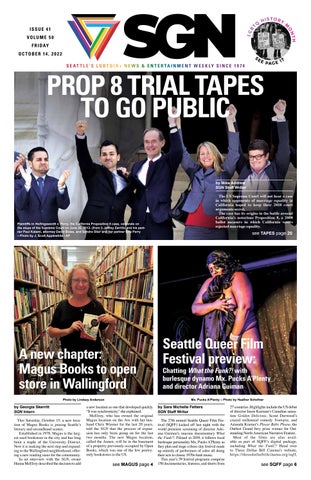
PROP 8 TRIAL TAPES TO GO PUBLIC by Mike Andrew SGN Staff Writer The US Supreme Court will not hear a case in which opponents of marriage equality in California hoped to keep their 2010 court arguments secret. The case has its origins in the battle around California’s notorious Proposition 8, a 2008 ballot measure in which California voters rejected marriage equality.
Plaintiffs in Hollingsworth v. Perry, the California Proposition 8 case, celebrate on the steps of the Supreme Court on June 26, 2013. (from l) Jeffrey Zarrillo and his partner Paul Katami, attorney David Boies, and Sandra Stier and her partner Kris Perry – Photo by J. Scott Applewhite / AP
A new chapter: Magus Books to open store in Wallingford Photo by Lindsey Anderson
by Georgia Skerritt SGN Intern This Saturday, October 15, a new location of Magus Books is joining Seattle’s literary and secondhand scenes. Established in 1978, Magus is the largest used bookstore in the city and has long been a staple of the University District. Now it is making the next step and expanding to the Wallingford neighborhood, offering a new reading oasis for the community. In an interview with the SGN, owner Hanna McElroy described the decision to add
see TAPES page 20
Seattle Queer Film Festival preview:
Chatting What the Funk?! with burlesque dynamo Mx. Pucks A’Plenty and director Adriana Guiman Mx. Pucks A’Plenty – Photo by Heather Schofner
a new location as one that developed quickly. “It was synchronicity,” she explained. McElroy, who has owned the original Magus location on the Ave with her husband Chris Wiemer for the last 20 years, told the SGN that the process of expansion has only been going on for the last two months. The new Magus location, called the Annex, will be in the basement of a property previously occupied by Open Books, which was one of the few poetryonly bookstores in the US.
see MAGUS page 4
by Sara Michelle Fetters SGN Staff Writer The 27th annual Seattle Queer Film Festival (SQFF) kicked off last night with the world premiere screening of director Adriana Guiman’s raucous documentary What the Funk?!. Filmed in 2019, it follows local burlesque personality Mx. Pucks A’Plenty as they plan and stage a three-day festival made up entirely of performers of color all doing their acts to classic 1970s funk music. This year’s 59 festival programs comprise 150 documentaries, features, and shorts from
27 countries. Highlights include the US debut of director Jason Karman’s Canadian sensation Golden Delicious, Scout Durwood’s crazed millennial comedy Youtopia, and Amanda Kramer’s Please Baby Please, the Outfest Grand Jury prize winner for Outstanding North American Narrative Feature. Most of the films are also available as part of SQFF’s digital package, including What the Funk?! Head over to Three Dollar Bill Cinema’s website, https://threedollarbillcinema.org/sqff,
see SQFF page 6
2
SGN
OC T OBER 14 , 2 0 2 2
C E L E B R AT I N G 4 8 Y E A R S!
ORIGINALLY SEATTLE GAY NEWS FOUNDED 1974 MEMBER 509 10th Ave E Seattle, WA 98102 (206) 324-4297 info@sgn.org sgn.org
SUPPORT INDEPENDENT JOURNALISM
DONATE TO SGN TODAY!
Publisher Angela Cragin Managing Editor / Acting Editor-in-Chief A.V. Eichenbaum Copy Editor SGN Staff • Richard Isaac Advertising Maggie Bloodstone, Advertising Manager National Advertising Rep. Rivendell Media (212) 242-6863 Staff Writers Lindsey Anderson • Mike Andrew Sara Michelle Fetters • Daniel Lindsley Contributing Writers Alice Bloch • Maggie Bloodstone Sharon Cumberland • Carter Hemion Benny Loy • Isabel Mata Paige McGlauflin • Gaysha Starr
SHOW YOUR PRIDE! seattlegaynews.redbubble.com
Merch Store!
Social Media Manager SGN Staff Photographers Nate Gowdy • SGN Staff Production Mike Pham SGN is published by Angela Cragin. © 2022. All Rights Reserved. Reprints by permission. Publication of names, photographs, or likeness of any person, organization, event or business in this publication cannot be taken as any indication of the sexual orientation of the person, organization, event or business. Opinions expressed in bylined articles, columns, and letters are those of the authors only and do not necessarily reflect the views of the staff or management of this paper. SGN welcomes unsolicited material, including letters to the editor, but reserves the right to edit or reject material. All rights revert to authors upon publication. We assume no liability for loss or damage of materials, solicited or not. We invite feedback, please write. And please play safe. It is our policy that no money shall be refunded if you choose to cancel your ad. Credit will be given for the balance owed. No exceptions.
In Loving Memory Of George Bakan
Scott Roger Alpert Cookie Andrews-Hunt James Arnold Ken Campbell Steve Foiles Shaun Knittel James Leland Moore Don Paulson Randy Peters Lee Richeson Shaun Shelton Jim Tully
Follow SGN
VISIT US ONLINE SGN.ORG
In this Issue
LOCAL NEWS 4 A&E • FILM • BOOKS 5 TRAVEL 16 LGBTQ HISTORY 17 NATIONAL NEWS 20 INTERNATIONAL NEWS 21 OC T OBER 14 , 2 0 2 2
SGN
3
Local News
Image courtesy of Magus Books
New possibilities in Wallingford While the Annex will enhance Magus’s connection to the Seattle community, it won’t function at the exact same level as the original location, McElroy explained. “This is a much smaller footprint than the store in the U District — that store will still sort of be the engine of it all.” Beyond the size difference, McElroy also explained that she anticipates engaging with a new demographic in Wallingford. “The community has a different demographic than the U District, so I think that we’ll still see some
of our same customers, but I think we’ll gain a lot of new customers too,” she said. She expects a more family-oriented customer base than they currently see on the Ave. While she and the rest of the Magus team look forward to the Annex opening, McElroy also explained that it’s an openended venture with several different possibilities. Depending on foot traffic and sales, the team might need to add a few members. In addition, she’s also excited to see how the new space and scope of the business will allow for further genre exploration and collection. “The other Magus has been there for so long, and it’s really its own sort of entity,” she said. “To do something from scratch like this is different than what we’ve done before.” The Annex will allow Magus to explore more collections and specific niches that weren’t possible with the previous space limitations. Having two locations will undoubtedly open up a lot of possibilities for the store. “We just don’t have enough room on the shelves in the U District for all these great books,” McElroy explained. “This store will also provide us with extra
4
OC T OBER 14 , 2 0 2 2
MAGUS
continued from cover The couple were familiar with the owners of Open Books, having previously bought surplus stock from them, and had decided to explore the new business venture with a few partners when the location went up for sale. “It was really just… kismet [for] the bookstore owners and us… so it just made sense,” McElroy explained.
SGN
space for these collections, so it will very much be a moving inventory.” Spooky season at Magus While the bookstore doesn’t typically throw events or parties, the Magus team still loves to find small ways to celebrate upcoming holidays like Halloween, Christmas, and New Year’s. Windows at the University District location are currently dressed up for Halloween, and readers can easily get suggestions on relevant titles if they want an extra nudge in the spooky direction. “We try to remind people to read their Edgar Allan Poe at Halloween or maybe pull out Dickens at Christmas,” McElroy said. “We try to pull books for different holidays or events.” Excitement for the future The Magus team looks forward to joining the Wallingford neighborhood and setting down more roots. “The one thing I want to make sure people know is that, even though this store is going to be smaller, we are still going to have
really different inventory at both stores, and we hope that customers will shop at both places,” McElroy concluded. “They will find things at the Annex that they won’t find at our other store and vice versa.” The Annex will also be open to requests from customers and will be able to move titles from the U District to the new location the next day for those who might not be able to visit both stores in person. While the new Annex will certainly take some time to settle into its space, the transition marks a new beginning for both the business and Seattle. Whether you are looking to offload some old books or browse the shelves for something new, Magus is the place to go. The Magus Annex will open to the public this Saturday from 11 a.m. to 7 p.m. at 2414 N. 45th St. in Wallingford. For more information about buying or selling with Magus Books, visit the website (https:// www.magusbooksseattle.com) or find it on Instagram.
C E L E B R AT I N G 4 8 Y E A R S!
Film
Tasveer South Asian Film Festival: Unapologetically South Asian
Photos courtesy of TSAFF
by Benny Loy SGN Contributing Writer At the launch party on Oct. 7 for the Tasveer South Asian Film Festival (TSAFF), the largest South Asian film festival in North America, Indo-Afro-Cuban music filled the room as the band Anjuman created the background for conversations among attendees, mostly dressed in beautiful multicolored saris and other traditional South Asian clothing. The most common question overheard is, “What are you here for?” Actors, writers, directors, and others were all seeking to find out what part each person was playing in supporting TSAFF. Tasveer is a South Asian social justice/arts nonprofit organization whose mission is to “inspire social change through thought-provoking South Asian films, literature, and storytelling.” It specializes in uplifting South Asian voices through events like TSAFF, whose 17th run is this year. As guests enjoyed delicious samosas and more Desi food by Lari Adda, some stepped away to take red-carpet photos in front of a Tasveer backdrop. When the music faded, attendees were called to sit down for a presentation. The speakers on stage boasted
VISIT US ONLINE SGN.ORG
“24 features and 79 short films spanning 17 countries and 15 languages, including 12 world premieres and 24 US premieres.” They also shared this year’s theme, “Unapologetically South Asian.” Several trailers were shown, one for the opening night gala film, Four Samosas, about a wannabe rapper and friends who devise a diamond heist in hopes of stopping a wedding. Another was for the centerpiece film, Goldfish, in which a daughter contends with the challenge of reconnecting with her mother, who is in the early stages of dementia. The most exciting trailer was for the documentary All That Breathes, the Tasveer Emerald Showcase. The first film to win the Sundance Grand Jury Prize and the Cannes Documentary Prize, it’s a story of two brothers in New Delhi committed to protecting a bird called a black kite. Later the new Tasveer programming director, queer cctivist Lucy Jane Mukerjee, came on stage to introduce the LGBTQIA+ Spotlight, ten shorts that feature various stories, including falling for someone in a lower caste and the discrimination that faces the Gay/Trans and Muslim communities. Several online panels on topics like “Decolonizing Sexuality” and “Protecting
Trans Perspectives” will also be presented. Mukerjee is a Queer Indian with citizenship in the UK and US. Her expertise is in “the intersection between activism and the arts,” and her work amplifies the voices of South Asians and the Queer community. During her speech, it was clear that she’s significantly devoted to this cause. “It was a joy to work with the passionate programming team to review a record number of festival submissions. It’s my hope that this 17th edition of TSAFF becomes a magnet that connects our communities with a celebration of excellence in South Asian storytelling,” she said. It was also heartwarming to hear that Tasveer designed its 2022 mascot as an homage to nonbinary identities. As stated on the website, “To mark the 20th anniversary of Tasveer, we were inspired to look back at the organization’s legacy of social justice and LGBTQIA+ storytelling, and also look beyond the gender binary to celebrate the rich history of nonbinary identity in South Asian countries.” Later in the evening, a special guest was announced. Director Kashif Pasta strode onto the stage and spoke about his excitement for TSAFF. “Film festivals are not
OC T OBER 14 , 2 0 2 2
about a laptop connected to a projector playing a movie; it’s about the people,” he said. He followed his speech by showing his short, Desi Standard Time Travel. It was a fantastic piece that was both emotional and hilarious. In the film, a new dad is grieving the loss of his father and the words that had never been said between them. With the help of a life insurance policy that conveniently provides time travel, the protagonist finds his chance to speak to his father in the past. This will be the first in-person TSAFF since the beginning of the pandemic. Having learned from the recent past of social distancing, the festival will be a hybrid, offering both in-person and virtual showings. No matter your schedule, you can experience these brilliant pieces live or online. Find out what it means to be unapologetically South Asian. The festival will begin on November 3 with its opening night gala and will be followed by ten days of in-person programming. The virtual programming will run November 7–20. Passes can be purchased now at https://tasveerfestival. org. Or subscribe to the virtual showings at https://watch.tasveer.tv.
SGN
5
Film
What the Funk?! – Photo by Heather Schofner
Sara Michelle Fetters: Adriana, what was the genesis for this project? When did you get involved with Pucks? Adriana Guiman: I came pretty late in the process. Pucks was actually looking for someone to document the festival, and I was recommended by a common friend. I really enjoyed the idea, and we explored multiple storylines that went beyond the festival. That was my approach, but I think Pucks has a better way to describe how things came about. Mx. Pucks A’Plenty: Part of it was recognizing that we were making history. It’s something that we recognized pretty early on, but I just looked around and was like, we need to document this. I was really thinking for educational purposes. We have burlesque schools and academies, and folks wanting to learn as much as they can about burlesque all over the world. It was like, what an excellent opportunity to create a little behind-the-scenes for our festival! And it could end up in all of these burlesque schools and collections and libraries all over the world. But I made this decision pretty late in the game. It was less than three weeks out. Maybe four weeks out. SMF: Holy cow! I didn’t realize that. Pucks: Right? I feel really fortunate and blessed. In the Seattle burlesque community, everybody wears multiple hats and has different jobs. They come from different worlds and different backgrounds. Our mutual friend, who goes by the burlesque name Vixen Valentine, is really involved in film and in acting here in Seattle. They connected me with Adriana. It was the best choice. I honestly can’t imagine working with anyone else on this project.
SMF: Adriana, what were the challenges of making sure that you could document as much as possible and get things to feel intimate and authentic, yet also let the performers just have their space to be who they are? How do you keep from intruding? AG: Where should I begin? [laughs] The challenges were first in terms of storyline and how to capture all the stories that were involved in this project. To try to get multiple perspectives in such a short time. We did some filming before the festival, trying to capture as much as possible. There is a sequence before the festival at a dinner where multiple performers were invited, and they were… talking about why they are doing this and why [this festival] is important to them. This type of small sequence, these small moments, I think, bring very much to the story, because it’s not just the show — just what someone would see if they attend the show — but it’s behind the scenes. You can hear or listen to these stories and motivations and learn the reason why they were there on the stage. From a technical perspective, the challenge during each show was to be a fly on the wall and not to intrude. To use as little space as possible while filming in very lowlight conditions and dealing with a lot of sounds. Music, crowd noise, all of that. These were the main challenges. But, above all of that, there was the lack of financing and finding the time to gather a proper crew. I don’t know. In a way, this [lack of financing and time] proved to be interesting, because I don’t know if having more people in the green room [would] have been more intrusive than it would have been beneficial. The small crew and limited time gave us extra intimacy with the performers. SMF: From a technical filmmaking perspective, it is impressive, because I have been in the Queer Bar space and the Columbia City Theatre multiple times, and those are not big spaces. For you to be able to film as intimately as you do and yet still keep a sense of perspective and not have the audience become intrusive or stumble over the performers is rather remarkable.
6
OC T OBER 14 , 2 0 2 2
SQFF
continued from cover for a full calendar, and venue, ticketing, and pass information. I sat down with Pucks and Guiman to chat about their labor of love and what it means to both of them to have their film make its premiere at SQFF. It’s a wideranging conversation that touches on a number of hot-button topics. Here are the edited transcripts from our interview:
SGN
AG: Thank you. It was a team effort, because all the performers, Pucks, everyone who was involved in the project, they knew what we were doing. They just welcomed me and the camera into their family. That was amazing. SMF: Pucks, you strike me as somebody that doesn’t like to hear the word “no.” Pucks: I don’t like it. I don’t like the word “no.” I don’t like being told what I can and can’t do. I don’t like people limiting my dreams, my drives, my determination. I don’t like it. What I do is acts of oppressed pettiness. When someone tells me “no” or “that can’t be done” or “no one like you has ever done anything like that before,” I just smile and nod and I go about my business. I do what I’m going to do anyway. Part of it is giving people informed consent. If something is going to directly affect someone’s day-to-day world, I’m going to let them know that the thing I’m going to do is going to do that. But for the most part, what I’m doing is building my own table. So people telling me, “No, you can’t build your own table; you have to take scraps from this other table,” or “we already have a table; we would love for you to come serve at our table, not necessarily sit at our table,” that doesn’t work for me. That needs to change. What the Funk?! as a festival really started as an act. It was an act of oppressed pettiness: someone saying, “Funk music from the ’70s isn’t really classic music. You can’t do a classic burlesque act to that,” and me looking at them and smiling and being like, okay, I hear what you’re saying. I don’t respect what you’re saying, and I’m going to go do my own thing, and not only am I going to go do my own thing, I’m going to elevate Black and Brown bodies and voices as well. SMF: And create a three-day festival that sells out all three nights. Pucks: Absolutely, and continues to do it. SMF: But when you try to distance yourself from what you’ve accomplished, what is that like for you? Can you take that step back and just watch as an observer? Pucks: I can’t, and I don’t think that a lot of folks in marginalized bodies have that luxury to do that, because it’s always the
next project, the next thing. How do we use this existing project to get our message out there further? How do we put more money in the pockets of marginalized performers? How do I get more sponsors so I can keep doing this work and doing this work well? Our festival gets bigger every year, and so it’s inspiring to sit back and watch. I look at 2019, at our very first run of this festival, and I was still pretty green to producing a festival. This was my first one. When I look at some of the things that I was doing and saying at that time, it’s looking into the beginnings of the stronger producer than I am now. I am seeing the little seeds that were planted of me trying to learn how to do that dance, to take control, and to be a leader. And them seeing that play out before the pandemic? That’s the other thing. We didn’t know, in 2019. We did not know when this was being filmed, when we were putting it on, that we were not going to be able to do this again, to get everyone all together again like this, for a very long while. We didn’t know that burlesque as we knew it was going to change. That the world as we knew it was going to change. There is this interesting energy when you watch the film of like, “Oh! This is prepandemic!” The energy is very bright and hopeful in the film, and we just didn’t know. It’s pretty fascinating to watch with those eyes. I’m able to watch it with those eyes. SMF: There’s a striking moment in the film where you’re talking about venues, and that the gentrification of Seattle is taking away performance opportunities. It’s so weird to watch that moment now, because what that comment meant in 2019 has changed significantly in 2022. Pucks: It’s painful. This is the work that we do. Our relationship with these venues is very symbiotic. We need them and they need us. I think back to March 12 or March 13 of 2020 and when we’re like, “This is really happening.” Seeing the emails come through from the venues that we work with being like, “Hey guys, we’re canceling the shows for the rest of March, we’ll be back in April,” only for that to become, “Guys, we’re canceling the shows in April. We’ll be back in May.” It just kept going.
C E L E B R AT I N G 4 8 Y E A R S!
Columbia City Theatre shut down completely during the pandemic, and that was our home theater for 2019. That was a crushing blow. It was really difficult as a community, as a burlesque community, to see that space shuttered. They just couldn’t operate. But as we come back from the pandemic, it’s beautiful that Columbia City Theatre is now owned by a Black man. That’s magical. Columbia City Theatre was the only place in the ’70s where you could watch blaxploitation film. There is this huge history there, so it’s beautiful to see that place come back. But we’ve lost a lot of spaces. We’ve lost a lot of performers, not to death, but because their heart isn’t in it anymore. Their life has changed so dramatically. Performers of color were definitely hit harder in the pandemic, and so trying to get those folks to come back and bring this art form back, it’s hard. Seattle continues to change, and Seattle is built around its art. To see almost so little regard for this art right now, and not see any serious action taken to preserve some of these spaces, it’s heartbreaking. I’m literally sitting in my car in front of Century Ballroom right now and looking at how dramatically different Capitol Hill is. It’s wild. So it is sad. And it is difficult. So it’s inter-
esting to watch that film and talk about losing spaces to gentrification, because the pandemic just accelerated all of that. At that point, with gentrification and with rents skyrocketing, who knew it would get so much worse so quickly? Now it’s over the top. SMF: At the same time, there is this euphoria of this low-budget, local, independent film about something that is passionate and important to you, so vital to you, opening one of the largest LGBTQ film festivals in the country. That has to feel pretty dang special, right? Pucks: It’s really emotional. When I start to think of it, I get really overwhelmed. I’ve cried a lot about it, mostly because… I don’t see myself in the work that I do the way that other people see it. The empowerment that you see that comes with burlesque is really doing this shadow work of, “How much do you love yourself” and “How much do you despise yourself” kind of thing. It’s finding that balance and dealing with those issues. So, it’s wild to think about that this my reality. I produced this film, and that’s not something that would’ve been on my bingo card ten years ago. It’s crazy! AG: I’m going to add to that not only did you produce the film but you as a producer
made it possible for the film to premiere to Seattle Queer Film Festival audiences. That’s amazing. That’s a true accomplishment as a film producer. Pucks: I don’t really think about it as this achievement that I did on my own. It’s all these wonderful people that are in our sphere, that are in our lives, that believed in this film and believed in this festival. For me, it’s like, how do we take this momentum and get more people to see what we’re doing and want to give us money so we can keep getting bigger and more amazing? How can we make sure that these performers get paid for what they do? These amazing, beautiful, smart, witty creatives — they’re so freaking funny and smart and sharp! I love them all. Yes, burlesque is sexy, but these folks are so smart about the work that they’re creating. How do we get more money into their pockets? Burlesque minimum wage across the country is somewhere between $30 and $50 an act. That’s nothing. These costumes cost ten times that. We want to make sure that they can keep creating this art and entertaining us. That’s vital. SMF: Adriana, Pucks is so smart. She has this creative and inspiring energy
What the Funk?! – Photos by Heather Schofner
VISIT US ONLINE SGN.ORG
OC T OBER 14 , 2 0 2 2
that can fill up a room. But you also have to make sure that you get all of the voices into the film. How hard was that do to? AG: It wasn’t easy. The first cut was more than two hours. It was definitely complicated, to get that balance. But it was easy because Pucks has such great message to share, and then the entire community comes together to amplify this message. It was amazing to see this. It’s a family, and they do have, in the end, one voice. They fight for the same thing. One of the other reasons why I got involved in this project? This one. Burlesque is family. SMF: What is it going to be like when you get to see the film in front of a packed audience and you know that they are watching it for the very first time? What are you imagining this moment is going to be like? AG: I’m not sure. I would rather not think too much about it. [laughs] I know I will totally enjoy the moment, and I will totally enjoy hearing how the audience reacts. The boohoos and the laughter. But in the end, I think this a film that needs to be seen. SMF: Pucks, just a couple of final questions to wrap things up. First, what are you more nervous or excited about, actually showing the film, or getting some of your performers back together to introduce and perform before and after the film? And second, what do you hope the audience is talking about once the curtain closes and the film has come to an end? Pucks: Honestly, it’s seeing the film with everyone. That energy. Being in the room. My performers are freaking lit. They’re so good. They know what they’re doing. I trust these humans to do what they need to do. I feel blessed that I get to work with these amazing freaking performers. The audience? I want them to be talking about how they’re going to come to every single burlesque production that is ever, ever happening in Seattle. I want folks to be like, how do we get involved? How do we get money into these people’s pockets so they can keep doing this work? But I also want people to leave understanding, damn, racism really is everywhere. It is everywhere. The access that people of color have to spaces that they can thrive in are very limited, very limited. I want them to want to come see Pucks and their productions. I want them to feel a need to put more money in the pockets of these incredible performers. That would be wonderful. We still have so much work to do to create these inclusive environments for marginalized people to thrive in. Hopefully, a film like this can start conversations.
SGN
7
Film
Nonsensically ultraviolent Terrifier 2 clowns around with punishing, blood-soaked madness
David Howard Thornton in Terrifier 2 – Photo courtesy of Cinedigm
by Sara Michelle Fetters SGN Staff Writer TERRIFIER 2 Theaters Art the Clown (David Howard Thornton) has been reborn. It’s been a year since his last killing spree spun Miles County on its head, and with a pint-sized, supernatural sidekick (Georgia MacPhail) urging him on, this new bloodbath will make the demonic joker’s previous shenanigans looks positively G-rated in comparison. This time Art has his sights set on high school senior Sienna (Lauren LaVera) and her younger brother Jonathan (Elliott Fullam). There is some sort of psychic connection between the teenager and the clown, whose mysterious visions of hellish carnage fuel her nightmares and bleed into reality with fiery fury. Jonathan believes their late comic-book artist father dreamt about the bond Art has with his daughter, and, right before his tragic death, drew clues of how Sienna might be able to defeat this monster. Terrifier 2 makes no sense. I’m pretty sure that’s on purpose, since writer-director Damien Leone’s mad, grotesquely epic sequel to his strangely popular 2016 cult favorite is a gargantuan WTF stunner that’s one gross-out sequence after another, with only the tiniest fragments of plot holding it together. It’s 138 minutes of blood-soaked insanity, so distastefully excessive that even my horror-loving heart had trouble enduring it start to finish. Leone’s second journey with Art the Clown hits the ground running, assuming viewers already know the score, and therefore spends zero energy explaining anything. But this makes the film something of a stream-of-consciousness nightmare made up of a series of nonsensical, demonic vignettes instead of a cohesive narrative. It’s one scene of playfully abhorrent depravity after another, each sequence of unhinged ultraviolence more repugnantly punishing than the last. At such an epic length, it all becomes somewhat desensitizing. People’s skulls get cleaved open, eyes get gauged out, arms get torn from their sockets, and happy singing minstrels get set ablaze. Some get blud-
8
SGN
geoned by homemade clubs decked out in rusty nails and other sharpened implements, while others have the skin ripped from their body and a mixture of bleach and salt exuberantly rubbed into their wounds. Barely alive skeletons cry out for their mothers, all while Art looks on happily, as if he’s pulled off the greatest gag in clown comedy history. Interspersed in all of this mayhem is a story of a young sister and brother grieving for a lost parent while still trying to figure out the mess their lives have become, hoping they aren’t making things too miserable for their harried, if loving, mother. They have visions of Art and his pipsqueak henchman, including an outlandish dream sequence with its own theme song and smiling, happy victims eager to be dismem-
bered by the clown. Jonathan even has an encounter with a disemboweled rodent — your guess as to what that has to do with anything is as good as mine. That’s the thing about Terrifier 2: it refuses to do a single coherent thing. There’s the vaguest of ideas that Sienna and Jonathan’s dad knew what was coming, as well as something to do with a mystical sword, but Leone doesn’t spend much effort spelling out those or other narrative elements with any clarity. This means that the absurd, over-thetop climax is a bewildering hodgepodge of exploitive vulgarities, augmented by sudden bursts of heroic zaniness right out of Heavy Metal or a 1980s glam-rock music video. Making heads or tails out of any of it? That’s impossible.
I should note that Leone is in complete control. Nothing happens that he does not intend, and as unwieldy as they are, the pieces of the film bizarrely still fit together nicely. Leone constructs wonders of bloodcurdling calamity the likes of which I’ve never seen before; the makeup effects, as utterly disgusting as they may be, are impressively eye-popping. And Art the Clown is a memorably malevolent creature of carnage, played with a jovial wink and disquieting smile by Thornton, and it’s easy to see why fans have grown so fond of the slasher villain. As remarkable as all that may be, Terrifier 2 is exhausting. Leone’s sequel wore me out, it’s objectionably devious nastiness too extreme, even for me.
Lauren LaVera and David Howard Thornton in Terrifier 2 – Photo courtesy of Cinedigm
OC T OBER 14 , 2 0 2 2
C E L E B R AT I N G 4 8 Y E A R S!
Evil takes a beating as Halloween Ends
Jamie Lee Curtis and James Jude Courtney in Halloween Ends – Photo courtesy of Universal Pictures
by Sara Michelle Fetters SGN Staff Writer HALLOWEEN ENDS Theaters It’s been four years since Michael Meyers (James Jude Courtney) returned to Haddonfield and engaged in full-scale slaughter, his final victim before disappearing into the cover of night having been Laurie Strode’s (Jamie Lee Curtis) own daughter, Karen. With Michael assumed to be dead, Laurie and her granddaughter Allyson (Andi Matichak) have moved on, the former attempting to write her memoirs while the latter works as a nurse at the local hospital. They have put the “boogeyman” behind them, and hope the citizens of Haddonfield will someday do the same.
Director David Gordon Green and the film’s screenwriters do almost all they can to subvert audience expectations for Halloween Ends for pretty much 85% of this sequel’s almost two-hour running time. While it is a given that Laurie and Michael will face off against one another for a purportedly final time, their climactic showdown is not the focal point. Instead, the filmmakers have concocted a strange, loopily contrived treatise on violence and the corrosive power of evil that helps birth unstoppable killers like Michael Meyers into existence. It’s an ambitious enterprise, one that takes some of the more intriguing ideas from Halloween 4: The Return of Michael Meyers and Rob Zombie’s Halloween II and attempts to flesh them out into feature length. This is an exploration of how constant dehumanization, condemnation, and blame without even an
ounce of forgiveness can twist even the purest soul into something unimaginable. This final chapter in Green’s trilogy — still a direct continuation of the story told in John Carpenter’s original Halloween — is all about how monsters are created, and such will likely throw viewers for a loop. The new face at the center of this madness belongs to Corey Cunningham (Rohan Campbell), a sad, lonely young man with a good heart who was accused of the murder of a child one year to the day since Michael’s last killing spree, and almost no one Haddonfield will let him forget it. He ends up in a relationship with Allyson. Bringing them together is the pair’s gruesome histories, each finding comfort in the other’s embrace. But where Allyson is close to finally moving on, Corey is inching closer and closer to the edge of a cliff of eternal damnation.
Andi Matichak and Rohan Campbell in Halloween Ends – Photo courtesy of Universal Pictures
VISIT US ONLINE SGN.ORG
OC T OBER 14 , 2 0 2 2
In this way, Green’s slasher has more in common with Carpenter’s superb 1983 adaptation of Stephen King’s Christine than it does with the auteur’s 1978 classic. The central question is whether or not Corey will succumb to the ghoulish pressures to become the unrelenting murderer so many in Haddonfield already believe him to be, a transformation that’s only accelerated when he comes face-to-face with the true evil lurking in the sewers underneath the town. Does it all work? Not entirely. You can feel the war between Green’s creative selves. His Prince Avalanche and George Washington side is eager to craft a moody character piece, while his 2018 Halloween and Pineapple Express half is eager to cut loose and have nonsensical, deliciously R-rated fun. This creates a noticeable tonal imbalance that takes some time to get used to, especially considering that Corey and Allyson are the primary characters and Laurie is more of a supportive presence. Until she isn’t, and that’s when all proverbial hell breaks loose. The climax of Halloween Ends is pure, unabashed, blood-soaked nonsense, culminating in that full-throttle showdown that’s been 44 years in the making and promised in the sequel’s title. Laurie and Michael get down to it, and while each isn’t exactly in their prime, they still land a plethora of haymakers, leaving the eventual outcome somewhat up in the air. I appreciate Green’s ambition. I love that he’s trying to shake things up and go in an unforeseen direction with the material. Most importantly, I feel like he stages a last act that’s next to sublime, delivering a landslide of bloodletting that’s magnificently staged, suitably suspenseful, and gorily satisfying. He brings substance and weight to Laurie and Michael’s final encounter, ending things on such a melodramatically loopy scene of euphoric dismemberment that I came close to rising from my seat to emphatically applaud. Yet Halloween Ends is a strange one, and I may not know what I truly think about this last chapter in Green’s trilogy until I can sit down and watch the three entries in sequence. I get what he and his team are going for, but the way this is so haphazardly assembled and structured leaves something to be desired. But when the goods are required, the film more than delivers. Laurie vs. Michael was well worth the wait, and isn’t that what truly matters?
SGN
9
Books
Quit: Annie Duke tells you when to walk away by Terri Schlichenmeyer Special to the SGN QUIT: THE POWER OF KNOWING WHEN TO WALK AWAY ANNIE DUKE © 2022 Penguin Portfolio $27.00 336 pages
Image courtesy of Penguin Portfolio
Quitters never win, quit the process and you’re quitting the result, nobody said it would be easy, blah blah blah. We’ve all heard those sayings before, but, says author Annie Duke in Quit: The Power of Knowing When to Walk Away, believe it or not, a premature ending can be the best thing that could happen. Sometimes... but not always. It truly depends. Knowing when to quit, she says, is an important life skill, but it’s not as glamorous as stick-to-it-iveness. People tend to remember those who persevere, no matter the outcome, but they don’t generally
remember those who get off the merry-goround before the music stops. If she was going to teach someone to make better decisions, she says, “quitting is the primary skill” she’d pick. “Trying something and having the ability to quit is vital to how we all live our lives.” So how do you know when it’s time to stop the foolishness? Learn to reframe your decisions to determine whether it’s better to stay or go; if it’s a close call, the latter’s probably the better option. Remember that public opinion isn’t always right. Quit when you’re ahead if the future looks bleak, and be aware of a nasty phenomenon called “loss aversion.” Also watch for “sunk cost,” which can cause you to continue, because you think things just have to get better eventually. They won’t. Set a list of “kill criteria” before embarking on a project. Don’t be too optimistic. And remember that there’ll always be times when the choice to quit is yours, and times when “the world makes the choice for you.”
In the last almost-three years, you’ve probably asked yourself a dozen times why. You don’t need a subject, sometimes “why” is the entire question — and “quit” is the answer. It’s not an easy one, though. Duke breaks the dilemma down in four sections that help readers learn how to make the right decision, and that empower them to take a possibly unpopular action. These are hefty sections, too, with meaty words for you and for your too-loud, often-wrong inner naysayer. The lessons imparted are ones we all need to understand fully, but they’re not the only things you’ll find in this book. Duke bolsters her advice with pertinent anecdotes that are entertaining, even if you’re not in need of a coin to flip any time soon. Read this book for that amusement or, if you need to know how to do the right thing at what looks like the wrong time, read it for instruction. Either way, Quit is good, full stop.
Emily Danforth breaks into horror by Linsey Anderson SGN Staff Writer Over the last decade, LGBTQ+ readers have rejoiced as new authors have emerged from the shadows and enriched the genre of Queer literature with fresh ideas, perspectives, and experiences. For the first time, there’s now a plethora of options when it comes to LGBTQ+ representation across genres. But of course, none of this progress would have been possible if it weren’t for writers who laid the groundwork for the modern LGBTQ+ literary canon — writers like Emily Danforth. From the woman who brought you The Miseducation of Cameron Post In 2012, Danforth published her first novel, The Miseducation of Cameron Post, which soon became a commercial success. Post follows the life and experiences of a 12-year-old Montana girl discovering her sexuality. The novel got people talking and received mostly positive reviews. Considered a revolutionary work at the time, the novel was even banned from a small-town school district in Delaware. In 2018 it was adapted into a film starring Chloë Grace Moretz, which earned the Grand Jury Prize at the Sundance Film Festival. The novel and film have been credited by many as important representations of conversion therapy, ones that show the nuances of pain and trauma while also including experiences of Queer joy. In the decade since her first novel came out, Danforth had been pretty silent, at least as far as publishing schedules go. Then, eight years after her debut novel, she reappeared, this time with a very different story. A new story to tell Plain Bad Heroines, Danforth’s sophomore novel, released in 2020, shifts gears. The gothic fantasy follows the story of two teen girls, Flo and Clara, obsessed with a mysterious author and her scandalous memoir. Despite making a name for herself in the contemporary genre, Danforth said writing a fantasy novel was something she had always wanted to do. “I’m a fan, I love it. I think maybe readers who read Cam Post won’t expect that. We writers are multifaceted about that.” Danforth’s latest novel came from Her love of horror media. “I’ve been a fan of horror novels and horror films. Plain Bad Heroines is both. It’s a celebration of horror films and maybe even an indictment,”
she joked. “A lot of us, as writers, write the books we want to read, and that was the case with me.” Danforth drew from some of her favorite authors when crafting Plain Bad Heroines. “I love gothic literature and have since [my] early reading days. Certainly some of the classic gothic novels — from Frankenstein to American Gothic works by people like Shirley Jackson to the brilliant Sarah Waters — [inspired me]… It certainly is a novel by someone who is a fan of horror novels, and there is a kind of celebration and love of the genre there that is on display
10
OC T OBER 14 , 2 0 2 2
SGN
Photo by Chris Mongeau
in the book, a real examination of the horror landscape.” She first got the idea for her novel after exploring the idea of “Queering gothic novels.” “Part of it was wanting to get to play in the space of a gothic novel, but Plain Bad Heroines is a very meta book,” she said. Another inspirational tug Danforth felt came from the author Mary McClane, whom her characters hold a powerful fascination with. “I got to celebrate Mary McClane, a fairly unknown Bisexual writer and memoirist,” Danforth explained. “The
Story of Mary McClane, which she wanted to be published as I Await the Devil’s Coming, received a lot of scorn and sent her on her way as a celebrity author of her day. She died not too many years later. I can’t recommend the story enough if you want a Queer time capsule from that period. It’s explicitly sapphic. “Throughout the portrayal, she called it My Portrayal, she’s beseeching the devil to come and rescue her from her boring teenage life in Butte Montana. The devil encompasses this fantasy night figure. He’s an embodiment of a bunch of different things.”
C E L E B R AT I N G 4 8 Y E A R S!
Image courtesy of William Morrow
Good novels take time To tell the story right, Danforth needed time to research Mary McClane and to work out the details of her plot. “I am a slow novelist, and Plain Bad Heroines is a long book and fairly intricately plotted, so that was part of the gap,” Danforth explained, referring to the time since Cameron Post. “Also, it took me a while to figure out the shape I wanted my second novel to take, and there were several false starts along the way.” “It feels like there are more voices in the room after you’ve written a novel, big or small,” she added. “I’m somebody who wants to write something different. I didn’t want to write Cam Post Two. I wanted to make sure that I knew what I wanted that second novel to be, and I’m glad I had the time to do it. I think Plain Bad Heroines needed that much time.” Writing a second novel, especially after having so much success early on, can be difficult for anyone, but for Danforth, it was especially tricky, as she was taking her writing style into a whole new genre. “I think the sophomore slump can be real. When you publish your first novel, nobody knows who you are. Certainly, there are some expectations from readers after you’ve written the first novel, and I had different expectations for myself as a writer,” she said. While some authors stick to strict schedules and processes when crafting their work, Danforth said her process is just as alive and evolving as her novels seem to be. “It depends on where I am in the novel. …A book like Plain Bad Heroines has a dual timeline: half is historical and half is contemporary. There was more outline and planning, and in some cases research, than I had done with Cam Post.” Her process shifted a lot between her novels. While writing Plain Bad Heroines, Danforth realized that the things that worked when writing Post would only make things harder on her new book. “It was a different writing process for sure, just figuring out the world of the novel and the beats it would hit. Because there were two time periods, I was able to move more fluidly throughout the book and not write it in such a linear way.” Now, she’s working on another novel and says her process is still evolving. “I’m working on a suspense thriller now. It is probably my most heavily plotted novel yet, and I know there are some spaces I need to hit. It is also the slimmest novel I’ve written. I don’t have one process; it changes per novel. I can tell you: I do not write every day, but when I am deep in the composition part, fingers on the keyboard, I will sometimes write eight or ten hours a day. I can only maintain that three or four weeks at a time with that sustained attention to composition.”
Price of Salad and the Ripley novels, and I wanted to write my own suspenseful, hopefully page-turning thriller. I’ve wanted to do that for a long time, and it’s been really fun. It will be a different novel than the two I’ve done before, but you can count on the fact that it will be very sapphic and feature a wide cast of LGBTQ characters.” There is also a chance fans of Plain Bad Heroines could see some of their favorite characters on screen soon. “Plain Bad Heroines was optioned before I finished writing it,” Danforth said. “Once the book was out, I partnered with the Big Bald Head Productions and AMC Studios and created a pitch, and attached a fantastic director. I have taken it out to some studios. It’s a pitch for a television series, not as a film.” If Plain Bad Heroines is picked up as a series, Danforth said she hopes to be more involved with the writing process than she was with the movie adaptation of Cameron Post.
What can fans see from Danforth next? Fans of Danforth’s writing can expect to see more horror-inspired works, and sooner than later. “Well, I don’t think it will take me eight years [to release my next book],” Danforth said, laughing. “I have a bigger start on this one, but I will never be a booka-year author, but I don’t think it will be an eight-year gap.” As mentioned above, her next novel is a thriller, inspired by some of her all-time favorite reads. “I have been a fan of The
Danforth’s take on LGBTQ+ representation Danforth also said her future productions will “always” center LGBTQ+ characters. “I’ve known that I was a Queer person from a very young age. I’ve been out and proud about being Queer since the end of high school and the beginning of college — which was the ’90s for me — and I will not write books without LGBTQ characters. Those are the people I know best, and that’s the world I inhabit. All my books will be Queer.”
VISIT US ONLINE SGN.ORG
Photo by Chris Mongeau
“I will not write books without LGBTQ characters. Those are the people I know best, and that’s the world I inhabit. All my books will be Queer.” With this being the 2020s, and LGBTQ+ literature taking on a new form, Danforth hopes the focus of this novel is less about the sexualities of the characters, and more about the adventure they go on. “I hope that readers have a rollicking and fun reading experience, that they immerse themselves in the world, and that it becomes one of those novels that swallows you up and you feel like you’re living with the characters and you lose time turning pages,” she said. “I love when novels do that for me, but all the better, when [they] feature Queer characters. I hope [readers] forget the clock on the wall and are sucked into the story, and… get a little bit scared in the process.” Plain Bad Heroines is a “gateway” to the horror genre and hopefully won’t leave readers sleeping with the lights on. “I promise: it’s approachable horror,” Danforth reassured me, “but there may be a moment or two of being creeped out. That’s all part of the fun.” Horror recs from a horror writer For Danforth, autumn is packed full of fun Halloween activities she is looking forward to. “It has been several years, for
OC T OBER 14 , 2 0 2 2
various [reasons], since I carved a jack-olantern, which seems like such a dweeby thing, but I love it,” she gushed. “I love the smell of the pumpkin and roasting seeds, and I am going to do it this year.” As an avid horror fan, she also has a wide list of movie recommendations. “There are several movies I rewatch starting this time of year. We just moved, my wife and I, to a little cottage on the water in Massachusetts. I haven’t rewatched Jaws in a while, but I’ll probably watch The Haunting. It’s also been a while since I read Michael McDowell’s novel The Elementals, and that is, by far, my favorite horror novel. It’s southern gothic and so unsettling, and the characters are so sharply drawn. That’s at the top of my list.” Other must-sees for Danforth include the 1960s The Haunting, Shirley Jackson’s The Haunting of Hill House, and the ’90s Scream trilogy. For readers looking for a spooky scare, fantasy gothic aesthetic, and page-turning mystery, Plain Bad Heroines is a must-read this October and a great way to get into the Halloween spirit.
SGN
11
At Chateau Ste. Michelle our wines are a force for gatherings and conversations— to serve the well-being of our consumers, our communities, and our land. We are a proud ally and supporter of all our employees and customers within the LGBTQIA+ community and aim to create an inclusive environment where everyone is welcome. CSM 198786 © 2022 Chateau Ste. Michelle, Woodinville, WA
Episode 35: Guy Branum It's the spooky season! Topics this week include witch rom-coms, Halloween Town, Hocus Pocus, the rise of fascism in Italy, and a woman going around in Seattle attacking dogs. Our special guest this week is comedian & actor Guy Branum! Check out his stuff at www.guybranum.com
BI-WEEKLY! FIND US WHEREVER YOU LISTEN TO PODCASTS! 12
SGN
OC T OBER 14 , 2 0 2 2
C E L E B R AT I N G 4 8 Y E A R S!
VISIT US ONLINE SGN.ORG
OC T OBER 14 , 2 0 2 2
SGN
13
14
SGN
OC T OBER 14 , 2 0 2 2
C E L E B R AT I N G 4 8 Y E A R S!
Books
Patricia Grayhall debuts med school memoir
Image courtesy of She Writes Press
by Daniel Lindsley SGN Staff Writer In time for LGBTQ History Month, Patricia Grayhall released her debut memoir, Making the Rounds: Defying Norms in Love and Medicine, on Monday last week, bestowing to the world an intimate and brutally honest look into her struggles as a woman and a Lesbian attending college in Arizona and medical school in Utah in the 1960s. Already the book has received a starred Kirkus review, a rare and prized accolade in the industry. In the months to come, Grayhall will be presenting at events from coast to coast, starting with an in-person reading on October 14, at 12 noon at the Barnes & Noble at Bellevue’s Crossroads Shopping Center. A month later, on November 10, at 7 p.m. EST, she will hold a virtual live reading and Q&A in New York, at the Bureau of General Services—Queer Division. One of her dear friends from college, who goes by David in the book, will be in attendance. Then, in Corte Madera, California, on November 15, Grayhall and other authors published by She Writes Press will gather for “The Thrill of Life’s Next Chapter,” a “playful, lively hour of storytelling” featuring three other women who have thrived in spite of the obstacles in their pasts. The date for Grayhall’s book signing in San Francisco has yet to be determined. “This has been an interesting experience, because I’ve never had to market a book,” said Grayhall over Zoom, speaking about these events and other interviews. The bulk of her writing experience has been articles for medical journals, written over the course of a lengthy career in the field; unlike memoir and fiction, academic papers rarely demand a tour. “I’m a 72-year-old-woman, and I have to read these passages from my, you know, hyper-hormonal 25-year-old self,” she said, laughing. “It’s so weird.” But consistent journaling and letter writing, the latter of which she called a “lost art,” may have primed her for the more extensive project of Making the Rounds. She lived the majority of her life before email was popular, toward the end of the reign of the typewriter. “My grandfather, even though he was a very educated man, left the education of my mother to my grandmother, who for various reasons — you know, she had an addiction — was constantly pulling my mother out of school,” Grayhall recalled. “And I don’t know if she even finished high school, and yet she had this amazing ability to write.” “Somehow, she imparted that to me,” Grayhall added, “because I’ve always been able to write, even when I’ve been doing scientific, medical stuff.”
VISIT US ONLINE SGN.ORG
Grayhall’s pen name combines the maiden names of her grandmothers, “to honor them,” she said. “I had two grandmothers who were extraordinarily intelligent, but whose ambitions were thwarted by the fact that they were born in the late 1800s and were women.” Of course, a memoir can be hard to write from raw memory alone. Grayhall kept her journals and letters, and they were the spark that lit the fire. “I had this box in my closet, and it was full of letters and journals from the late 1960s and early 1970s,” she recalled, “when I was coming out as a Lesbian, a woman training to be a doctor. “I took them out, and all these memories came flooding back, and I thought, you know, ‘This is history.’ And as Lesbians, we have been subjected to multiple systems of oppression, and yet we thrive. We have developed new ways of relating to each other, we challenge oppressive paradigms, and yet we continue to thrive despite no support from mainstream society.” “I realized that my personal narrative — you know, although it’s unique and everything — it revealed universal truths that are especially relevant now, with what’s going on,” she added, likely referring to the surge in anti-abortion and anti-LGBTQ laws in Republican-led states. As for future works, Grayhall and her partner will be releasing a collaborative, more “realistic” Lesbian romance novel, featuring two older women rather than the usual young, athletic protagonists. It was recently picked up by Wild Rose Press. To learn more about Patricia Grayhall and Making the Rounds, and sign up for her upcoming events, visit https://www. patriciagrayhall.com.
Photos courtesy of the author
OC T OBER 14 , 2 0 2 2
SGN
15
Travel
Light up your life with a visit to Champaign-Urbana by Bill Malcolm Special to the SGN Just 2-3 hours by train from Chicago and perfect for a weekend visit, the twin cities of Champaign and Urbana, Illinois, will surprise you. The former is home to the University of Illinois and consists of Campustown (near the school) and downtown. Getting there Amtrak has 3-4 trains a day from Chicago, which can take as little as two hours. The campus area is very walkable, so you won’t need a car once here. Hop on the #50 Bus from the Amtrak Station to your hotel. Where to stay and eat You can stay at the hotel at the Student Union, but the TownePlace Suites (605 S. Sixth Street) in Campustown cannot be beat. Your extended-stay room includes a ready-to-use kitchen. But you won’t use it, as the hotel is surrounded by every international cuisine you might want (as the university has so many international students): sushi, Korean, Japanese, Mediterranean, Mexican, natural foods, Italian, Thai, Zambian, Cambodian, Caribbean, farm-totable, Creole, vegan, etc. There must be 30 restaurants and fast-casual outlets within two blocks . I’ve never seen so many bubble tea joints! Try Paris Super for great crepes. Brewlab Coffee has your morning brew. Jipbap has great Korean food. Oozu is the place for ramen. Pho Noodle Station has great Vietnamese food. Poke Lab has the best poke. What to do A walk around the University of Illinois campus is a must. Don’t miss the Arboretum. The Illini Union Art Gallery has a new show, “Illini Past and Present,” featuring alumni art work. Other ideas: Krannert Art Museum: Fine art comes to life in this campus museum through engaging events and exhibits putting a spotlight on issues that impact our daily lives. Current and upcoming exhibits include: “Black on Black on Black on Black” (through December 10); “Fake News & Lying Pictures: Political Prints in the Dutch Republic” (through December 17); and “Well-Designed Beauty: Trade, Technology, and Decorative Arts” (November 15– May 13). (kam.illinois.edu) Krannert Center for the Performing Arts: The Krannert Center is a hub of creative activity for all with over 400 performances throughout the year: symphony, opera, folk music, ballet, modern dance, theatre, and national bands all under one roof. (krannertcenter.com) Allerton Park & Retreat Center: Get away for a few hours or a few days at this European-inspired estate in nearby Monticello. Fourteen miles of hiking trails and 14 formal gardens await you along the Sangamon River. During the winter months, walk the gardens for “Holiday GLOW,” featuring a one-mile lighted walk with new art. From the university website: “Robert Allerton was born to one of the preeminent families of Gilded Age Chicago. He embarked on a career as an artist, living and studying in Berlin and Paris before settling in downstate Illinois… From the 1920s until… 1986, Robert and John referred to each other as father and son. They even made it legally official, with Robert’s adoption of John in 1960, a few years before the elder man’s death. But their relationship was not confined to those traditional bounds. It was, in fact, visibly queer at a time when the perception and reception of homosexuality in American society were undergoing a transformation. All of this is explored in the book An Open Secret: The Family Story of Robert and John Gregg Allerton.” (allerton.illinois.edu)
LGBTQ+ events Check out https://www.unitingpride. org/event-calendar for events in the area. Quality is an LGBTQ+-friendly bar, and there are events throughout the year.
16
OC T OBER 14 , 2 0 2 2
SGN
Photos courtesy of Visit Champaign County
For futher information VisitChampaignCounty.org has tips about over a hundred experiences in the greater Champaign County area.
Bill Malcolm is North America’s only syndicated LGBTQ+ value travel columnist. His column runs in publications in Seattle, DC, LA, Toronto, Dallas, Florida, Atlanta, and Chicago.
C E L E B R AT I N G 4 8 Y E A R S!
LGBTQ History
San Francisco Public Library digitizes its LGBTQ archives, including its Harvey Milk holdings by Matthew S. Bajko Special to the SGN A black-and-white photograph shows two small children standing outside in a San Francisco plaza draped in protest signs. One sign reads, “We’re Proud, Not Stigmatized.” The other declares, “We Love Our Gay Parents.” In the background of the photograph, taken June 3, 1977, can be seen Harvey Milk, the Gay civil rights leader. He would go on to become the first LGBTQ person elected to public office in both the city of San Francisco and the state of California that November. The image was taken by photographer Cathy Cade, a longtime Lesbian activist, and it is titled “Rally for Jeanne Jullion.” According to a note about the photo, Jullion was a Lesbian mother ensnared at the time in a custody battle for her kids. She can be seen on the right side of the photo wearing glasses and a two-piece pantsuit, talking to a woman whose back is facing Cade’s lens. Jullion is also shown in a smaller picture with her two sons, superimposed on the bottom right of Cade’s photo. It is part of the online Hormel LGBTQIA Center Collection, maintained by the San Francisco Public Library, which consists of digitized photographs, manuscripts, documents, and other primary source materials from the James C. Hormel LGBTQIA Center, housed at the city’s main library in the Civic Center district. Access despite bans elsewhere The site went live last December and allowed the library’s Digi Center to aggregate LGBTQ historical photos that had previously been published in other sections of the library’s main website so they are easier for researchers, students, and others seeking out LGBTQ material to find. “I think it is a great way to share the archive with the world,” said Dee Dee Kramer, a Lesbian who is the manager of the Digi Center, in her first press interview about the digitization effort. “People think of libraries as having books you check out. But we also have archives — like photos, government records, or people’s personal stuff — that is unpublished or unique and doesn’t exist in other places. Being able to share that online I think is really special.” New LGBTQ archival items have since been uploaded to the library’s online repository, including a section titled “Preserving LGBTQ Historical Highlights” that went live in June, during Pride Month. It was funded by a $7,020 grant the library received in 2019 from the California State Library and includes a wealth of material related to Milk. One highlight is an audio recording of one of the three “Political Will” tapes Milk made in case he was assassinated, which tragically ended up occurring the morning of November 27, 1978, when disgruntled former supervisor Dan White shot him dead and then-mayor George Moscone inside San Francisco City Hall. There are also a number of Milk’s writings, such as his “Milk Forum” column that ran in the B.A.R., and an edited copy of his famous “You’ve Got to Have Hope” speech he gave June 24, 1977. Throughout the 11 pages are handwritten edits made to a typed copy of Milk’s speech, including to the final, and most famous, line: “You got to give them hope.” Crossed out is the word “I” and a verb that is unable to be discerned in front of the word “you,” while the word “must” that initially had been typed with an underline is crossed out and replaced with “got to.” “Harvey’s will and speeches are in such incredible demand,” noted Kramer.
VISIT US ONLINE SGN.ORG
The "Rally for Jeanne Jullion" took place in San Francisco on June 3, 1977 to draw attention to Jullion, a lesbian mom who was involved in a child custody dispute – Photo by Cathy Cade Photographs (GLC 41), LGBTQIA Center, San Francisco Public Library
Dee Dee Kramer is the manager of the San Francisco Public Library’s Digi Center – Photo by Noah Berger
“School students from across the country want to look at the speeches.” Now they can do so without having to physically travel to San Francisco, she added. They also now have digital access to LGBTQ material at a time when public libraries and school districts across the country are banning LGBTQ books and curricula at the urging of right-wing leaders and conservative parents. “We live in a time where we can make them available to anyone with a browser and an internet connection. It is just huge,” said Kramer, who formerly had served as program manager for the James C. Hormel LGBTQIA Center. “I think for Queer people, too, it really has changed the game in being able to find context for yourself and other people.” Effort delayed by pandemic The effort to digitize the library’s various LGBTQ historical holdings was delayed by the COVID pandemic, as in March 2020, the city shuttered its public libraries and reassigned staff members to assist in dealing with the health crisis. Kramer worked as a contact tracer, calling people who were potentially exposed to the coronavirus, for instance, and helped distribute food to those in need. When she returned to her library duties in July 2021, she took over as the Digi Center manager and found the LGBTQ digitization effort on her to-do list. The center oversees DigitalSF, the website for the library’s digital collections, and has wanted to increase its digitized holdings accessible to the public for years. Kramer and her colleagues first set about
on a plan to make it easier for people to find the digital material the library had already posted online. They also worked on how to display the material and what navigation tools to include for them. They have also been creating a better catalog for the materials already digitized and adding them to the correct collections on the DigitalSF website. For instance, in time, more of Cade’s photos in the library’s holdings should be added to the lone one of the Jullion rally currently found on the webpage for the “Cathy Cade Photographs Collection.” The same is true for the “Chloe Atkins Photographs Collection,” which as of now also has just one photo in it. But a finding aid for the Hormel Center’s holdings of Atkins’ decades-long career photographing the Bay Area’s Lesbian scene indicates there are countless more of the photographer’s works that could be added to the digital archive. A treasure trove The library’s digital records for the pioneering Gay rights activist Harry Hay are far more extensive. The webpage for the “Harry Hay Papers” has 50 items, including a 1935 black-and-white portrait of a dashing Hay with his right arm in salute. There is also a trove of photos from negatives taken during San Francisco police investigations, from 1945 through 1969, into bookstores, sex-oriented businesses, theaters, and art shows that featured Gay and other LGBTQ+ content. Another collection features a scrapbook from the 1950s detailing the arrest and trial of Grace Miller and Joyce van de Veer, the owners of several bars frequented by Gays and Lesbians. One project Kramer said the Digi Center is working on is scanning books of mug shots taken by the police of suspects arrested decades ago on sodomy charges and other sex-related crimes. The historical material provides a unique look into that era, she noted. “It makes for useful research and a whole different kind of lens to look through,” said Kramer. The Digi Center also wants to digitize the photos in the library’s Tenderloin Times
OC T OBER 14 , 2 0 2 2
Photograph Archive, which also relates to LGBTQ history. The publication’s coverage of the city’s Tenderloin district and its many LGBTQ residents includes photos of early AIDS protests and other LGBTQ demonstrations and events. “When you sort of queer the archives, it is not just going to be the Hormel Center where these materials arise,” noted Kramer. There are currently two-dozen different LGBTQ digital collections on the library’s website, with more to be added in the coming months. During LGBTQ History Month in October, Kramer hopes to add two collections featuring the works of photographers Robert Giard and Rick Gerharter, two Gay men who helped to document the LGBTQ community on both coasts. Giard, who died in 2002, documented the theater scene in New York City, while Gerharter for decades has taken photos for the B.A.R. of the Bay Area LGBTQ community. While the digital archives do not replace the need to protect the physical materials housed at the library’s Hormel Center and San Francisco History Center, Kramer said, they do play an important role in the preservation and distribution of the archival holdings. “Digitizing is not preserving,” she noted. “But if you have a tape that is 30 years old, the sound quality is going to degrade. So digitizing it is one way to migrate it to a format that people will continue to have access to it. This way it is still playable and listenable.” Having grown up in North Carolina in the 1970s and 1980s, Kramer said she wishes she had access to such LGBTQ material. It can be empowering for people who otherwise feel invisible, she noted. “When you are able to go on a site and see these things, it changes lives,” said Kramer. “When people go online and find something they recognize or see themselves in, it is a really big deal.” Matthew S. Bajko is an assistant editor at the Bay Area Reporter. This article was originally published in the Bay Area Reporter. Reprinted with permission through the SGN’s partnership with the National LGBT Media Association.
SGN
17
LGBTQ History
Urvashi Vaid: A voice for liberation and justice by Victoria A. Brownworth Special to the SGN When Urvashi Vaid died at 63 in May 2022 after a valiant fight with breast cancer, thousands of LGBTQ people who had been touched by her decades of activism mourned her passing. Over a half-century of activism that began when she was only 11, Vaid worked on a breadth of issues, including LGBTQ civil rights, women’s and prisoners’ rights, and immigration and health care justice. Vaid’s activist voice was unique and unequivocal. She insisted decades ago that the fight for LGBTQ rights must not be dismissed or demeaned by the language of straight politicians or the religious right. At the March on Washington for Lesbian, Gay, and Bi Equal Rights and Liberation in April 1993, she said, “The Gay rights movement is not a party. It is not a lifestyle. It is not a hair style. It is not a fad or a fringe or a sickness. It is not about sin or salvation. The Gay rights movement is an integral part of the American promise of freedom.” In a tribute to Vaid in The New Yorker magazine, Masha Gessen wrote that Vaid “was, almost certainly, the most prolific LGBTQ organizer in history.” That is a fair and fitting assertion about the Lesbian activist who for a decade led the National Gay and Lesbian Task Force (now the National LGBTQ Task Force) through one of the most tumultuous periods in Queer history, the AIDS crisis, first as media director and then as executive director. A constant presence Vaid was a constant presence on the national political stage at a time when overt LGBTQ activism had yet to become mainstreamed. In 1990 she was thrown out of an address being given on the AIDS crisis by President George H. W. Bush when she held up a sign that said, “Talk Is Cheap, AIDS Funding Is Not.” After Bush died in 2018, Vaid told NPR’s All Things Considered, “The fact is that we were doing our best and hardest work in our community to build social services, to fight discrimination. People were being rejected at hospitals. People were being turned away from mortuaries. We were dealing with that while dealing with loss. So I think what could have been done was done because of the activism. And more could have been done had the White House not been, frankly, bad on issues affecting LGBT people, because they had bias.” The impact Vaid had in those roles at NGLTF, as a voice continually challenging the anti-LGBT policies and positions of the Reagan and Bush presidencies, cannot be overstated. Thousands of Gay men were sick and dying in America, and Vaid was the warrior fighting those administrations to save lives. During ACT UP’s first national action, “Seize Control of the FDA,” Vaid devised a plan to pair local reporters with protesters from each media market. At the action, protesters were given signs with the cities they came from, and ACT UP announced them to reporters. “And that made the difference between the protests getting page five in the Arizona paper, or the Dallas Morning News, and being on the front page, because there was a local person there,” Michelangelo Signorile told the ACT UP Oral History Project. Toward that activism and other goals, Vaid co-founded the annual Creating Change conference and symposium with Sue Hyde, which Hyde still directs for the Task Force. “Urvashi Vaid was a leader, a warrior, and a force to be reckoned with,” National LGBTQ Task Force’s executive director, Kierra Johnson, said in a press release. “She was also a beloved colleague, friend, partner, and someone we all looked up to — a brilliant, outspoken, and deeply com-
18
SGN
Photo by Rex Wockner
mitted activist who wanted full justice and equality for all people.” Johnson called Vaid “one of the most influential progressive activists of our time.” Liberation, not tolerance Vaid left NGLTF in 1992 to write her pathbreaking book, Virtual Equality: The Mainstreaming of Gay and Lesbian Liberation, which won the Stonewall Book Award in 1996. She returned to the Task Force in 1997 as director of its Policy Institute think-tank.
OC T OBER 14 , 2 0 2 2
Virtual Equality was an integral step in Vaid’s activism and personal philosophy of change. The book explicates her signature thesis, that it is liberation, not tolerance from the dominant cis-het culture, that queer and trans people must strive for as a community. The 1990s had seen a strong move toward assimilationist politics and policies within the (then) Gay and Lesbian movement, which was focused largely on the fights for marriage equality and uncloseted military service, issues that addressed only limited areas of LGBTQ life. Vaid argued that while the mainstreaming of Lesbian
and Gay issues was an important aspect of activism, it must not limit or subvert the quest for liberation: the right of all LGBTQ people to feel safe in their own sexual orientation and gender identities rather than being forced, like Black civil rights activist Bayard Rustin, to closet themselves in the mainstream arena, so as not to challenge the status quo. Vaid wrote, “By aspiring to join the mainstream, rather than figuring out all the ways we need to change it, we risk losing our gay and lesbian souls in order to gain the world.”
C E L E B R AT I N G 4 8 Y E A R S!
Urvashi Vaid and Kate Clinton – Photo by Rex Wockner
Social justice Vaid was always working for social justice. Born in New Delhi, India in 1958, she moved to the US with her parents and two sisters when she was 8 and was an antiwar protestor by 11, attending the Moratorium on the Vietnam War. While earning her undergraduate degree in political science and English literature at Vassar College, Vaid engaged in political and social justice actions, including working to get the college to divest from thenapartheid South Africa. In 1983, as a law student at Northeastern University School of Law in Boston, Vaid founded the Boston Lesbian/Gay Political Alliance, worked off-campus at the weekly newspaper Gay Community News, and pushed to have the university add sexual identity to its nondiscrimination policy. After college, Vaid was a staff attorney at the National Prisons Project of the American Civil Liberties Union (ACLU) for three years before going to the NGLTF. At the ACLU, Vaid started the agency’s work on HIV/AIDS
in prisons. During that time, she helped organize a demonstration at the Supreme Court following the Bowers v. Hardwick decision, which allowed sodomy laws to stand. In an interview with Curve magazine in 2013 when she published her book Irresistible Revolution: Confronting Race, Class, and the Assumptions of LGBT Politics, Vaid spoke candidly about her long years of activism and her concerns that some gains in LGBTQ civil rights would lead to complacency. She said, “One of the worries that underlies my book is a movement that demobilizes because it finally wins marriage equality.” She also declared at the time that she was on a new mission: to make sure that LGBTQ people broaden the movement and be more inclusive with regard to race, class, and gender. Vaid told Curve, “What can I say? I write in the book about how many times I have been the only woman of color in the room — or even the only woman… I wanted to make explicit [in the book] the limits of the LGBT
movement and the assumptions that we operate the movement under — that everyone is white, everyone is middle-class.” Emphasis on inclusion That was what Vaid devoted her life to: inclusion. She founded LPAC, the first Lesbian superPAC, in July 2012. As of the 2020 election, LPAC had invested millions of dollars in candidates committed to legislation promoting social justice. Vaid also spent a decade working in global philanthropic organizations. As executive director of the Arcus Foundation from 2005 to 2010, she focused the grant-making foundation on issues related to sexual orientation, gender identity, and race. She also served on the board of the Gill Foundation and Ford Foundation and was the director of the Engaging Tradition Project at the Center for Gender and Sexuality Law at Columbia Law School from 2011 to 2015. Vaid also helped create the ongoing National LGBTQ women’s community survey.
In addition to founding LPAC, Vaid founded the Vaid Group LLC, which works with social justice innovators, movements, and organizations to address structural inequalities based on sexual orientation, gender identity, race, gender, and economic status. Recognition Vaid’s work did not go unnoticed, She was The Advocate’s Woman of the Year in 1991 and one of Time’s 50 key leaders under 40 in 1994, and she appeared on Out magazine’s list of the 50 most influential men and women in America in 2009. Vaid and her partner since 1998, comedian Kate Clinton, often appeared as a glam couple at Queer events and awards ceremonies. As Vaid’s friend, MSNBC anchor Rachel Maddow, told the New York Times after Vaid’s death, “She put the gay rights movement in a progressive context that no one else can lay claim to. She really had a singular impact as an individual. She changed the [AIDS, gay rights, and civil rights movements] in ways directly attributable to her.” Vaid wrote in Virtual Equality what now stands as a fitting epitaph to her life and work: “We call for the end of bigotry as we know it. The end of racism as we know it. The end of child abuse in the family as we know it. The end of sexism as we know it. The end of homophobia as we know it. We stand for freedom as we have yet to know it. And we will not be denied.” Victoria A. Brownworth is a Pulitzer Prize–nominated, award-winning journalist whose work has appeared in the New York Times, the Los Angeles Times, the Philadelphia Inquirer, the Baltimore Sun, DAME, The Advocate, and Curve, among other publications. She is the Bay Area Reporter’s television columnist. She was among the OUT 100 and is the author and editor of more than 20 books, including the Lambda Award–winning Coming Out of Cancer: Writings from the Lesbian Cancer Epidemic, Ordinary Mayhem: A Novel, and Too Queer: Essays from a Radical Life.
Jim Schwartz and Urvashi Vaid at the 1988 “Speakout! Lesbian and Gay Rights” forum at WCAU in Philadelphia – Photo by Tommi Avicolli Mecca
VISIT US ONLINE SGN.ORG
OC T OBER 14 , 2 0 2 2
This article was originally published in the Philadelphia Gay News. Reprinted with permission through the SGN’s partnership with the National LGBT Media Association.
SGN
19
National News
National news highlights by Daniel Lindsley SGN Staff Writer
Sen. Ben Sasse – Photo by Alex Brandon / AP
Republican senator grilled by students Senator Ben Sasse’s visit to University of Florida did not go unchallenged on Monday, October 10, as protestors and others grilled the Nebraska politician on his antiLGBTQ stances, and on his qualifications to run a school of over 50,000 students. Sasse stands as the only finalist for the school’s presidency. “Sasse does not really believe in equality on the basis of sexual orientation,” said student Nathan Knorst. “So how can he adequately represent the student body and faculty and UF’s core values, which are diversity, equity, and inclusion?” Sasse’s résumé for the role includes a presidency at the much smaller Midland University in Fremont, Nebraska, which has around 1,600 students. When asked whether he opposed same-sex marriage, he sidestepped, saying that the Supreme Court had ruled in favor of it and that his goal was to create a “place of respect and inclusion for all Gators.” He also said that his political positions as a senator were meant to represent the views of Nebraskans, and that “it’s a completely different job to have the job of president of UF,” according to the Sun. He would resign from the US Senate to take the position. 1-in-7 US voters will be LGBTQ+ by 2040, says HRC report Queer voters are set to increase considerably over the next two decades, says a report recently published by the Human Rights Campaign Thursday, October 13. According to the report, nearly 18 percent of eligible voters will identify as LGBTQ+ by 2040. In several red states – including Texas and Arizona – the proportion of LGBTQ+ voters is expected to as much as double by 2040, surpassing the national average and potentially pushing the vote toward Democrats in those states. With 27 percent of Gen Z identifying as members of the LGBTQ+ community, the national average of eligible Queer voters has already increased from 10.8 percent in 2020 to 11.3 percent in 2022. HRC Interim President Joni Madison said the role Queer voters play will grow to “fundamentally reshape the electoral landscape.”
20
SGN
Vaughn Walker – Photo by Beck Diefenbach / Reuters
TAPES
continued from cover In 2008 the California Supreme Court ruled that the state’s residents had a right to marry a person of their choice regardless of sex. A coalition of right-wing groups then filed a ballot measure to overturn the court’s decision. That measure, Prop 8, was passed by voters after a vicious and well-financed Queerbaiting campaign. Two Gay couples then sued, charging the new law with violating their rights. The state government declined to defend the anti-equality law in court, but the Prop 8 campaign coalition hired attorneys and went to court in the state’s place. Because of public interest in the outcome, the judge overseeing the case, Vaughn
Walker, said he would livestream the trial to outside venues to accommodate observers. Defenders of Prop 8 objected, and the US Supreme Court intervened to prevent public showings of the trial. Nevertheless, Judge Walker videotaped the trial for his own reference. The tapes became part of the trial record but have remained under seal to this day. Walker found in favor of the Gay couples, ruling that Proposition 8 was unconstitutional and barring the state from enforcing it. Prop 8 supporters then appealed his ruling, and eventually — in 2013 — the US Supreme Court allowed Walker’s ruling to take effect, legalizing same-sex marriage in California. Walker retired in 2011. His trial tapes became subjects of complicated litigation, with a court preventing Walker from using them in his post-retirement public appearances. An appeals court ruled that the tapes
could be unsealed — and therefore could be made public — in 2020. The defenders of Prop 8 argued that the video should remain sealed, however, saying that they feared for their safety if their identities were made public. A court later concluded that there was no evidence that anyone involved in the case “fears retaliation or harassment if the recordings are released.” The judge also said no one believed at the time of the trial that Walker’s commitment to personal use of the recordings meant that the trial recordings would remain under seal forever.” The trial judge’s ruling was upheld by a federal appeals court, leading the Prop 8 supporters to appeal to the US Supreme Court. The high court’s decision not to hear the appeal means that the tapes of the original trial will eventually become public.
SCOTUS will not hear “fetal personhood” case by Mike Andrew SGN Staff Writer The US Supreme Court has declined to hear an appeal alleging that fetuses have personhood rights under the Constitution. The case involved two Rhode Island women, Nichole Leigh Rowley and “Jane Doe,” who sued on behalf of their fetuses, and the anti-choice organization Catholics for Life, which joined their lawsuit. The women alleged that Rhode Island’s Reproductive Privacy Act violated their fetuses’ 14th Amendment due process rights by permitting the fetuses to be aborted — even though neither woman had any intention of having an abortion. The Reproductive Privacy Act was passed in 2019 to bring Rhode Island state law into compliance with the US Supreme Court’s 1973 Roe v. Wade decision. The women filed their suit soon after the law was enacted. A state superior court and ultimately the state supreme court ruled against them, however, prompting their appeal to the US Supreme Court on constitutional grounds. The state courts relied in their rulings on the right-to-privacy reasoning enshrined in Roe. In its October 11 announcement declining to hear the appeal, the high court did not reveal the justices’ reasoning for turning down the case.
OC T OBER 14 , 2 0 2 2
Photo by Tom Brenner / Reuters
In his opinion striking down the Roe precedent, Justice Samuel Alito was careful to note that the Supreme Court was not taking a position on the question “if and when prenatal life is entitled to any of the rights enjoyed after birth.” Some Republican-controlled state legislatures are currently pursuing fetal personhood laws, which would grant fetuses the same constitutional protections enjoyed by already-born persons. Georgia, for example has enacted a law that would grant fetuses a variety of legal
rights starting at six weeks after conception. Under such laws, termination of a pregnancy could be considered murder, and state officials could be required to bring charges against both the doctors involved and the mother of the fetus. More than a dozen states have enforced near-total abortion bans since the Supreme Court’s June ruling in Dobbs v. Jackson Women’s Health Organization, which reversed Roe. Most do not include language that grants legal rights to the fetus, however.
C E L E B R AT I N G 4 8 Y E A R S!
International News
The Iranian feminist revolution
Photo by Murad Sezer / Reuters
by Lindsey Anderson SGN Staff Writer In Iran, revolution is in the air, and the sparks of hope are being ignited by women. Over the last month, Iranians have taken to the streets, demanding worldwide attention as they protest their harsh theocraticoligarchical government. Solidarity protests have even made their way to Seattle, with demonstrators showing their support on September 30 in Westlake Center. However, many are still unsure of just what is going on in Iran and how to support the women leading the cause. Here’s some background. What happened to Mahsa Amini? On September 16, Mahsa Amini, a 22-year-old Kurdish-Iranian woman originally from Saqqes, in a Kurdish area in northwest Iran, died after sustaining mysterious injuries during her detention by Iran’s “morality police.”
The morality police are employed by the Iranian government to enforce the country’s strict dress code and often stop women who are not dressed according to the modesty standards that have been in place in the country since 1981. Since the Islamic Revolution, women have been required to cover their hair in public in Iran. Failure to do so can result in detention. On the day Amini was arrested, September 13, she was covering her hair with a headscarf. Accounts from her family and onlookers confirm that she was clothed in a long, loose black robe and a black hijab over her head. Despite her attire, the morality police stopped her at a subway station in Tehran and took her to a detention center in an unmarked van with two other women. Her brother followed and waited outside the center for Amini to be released. As he waited, a commotion erupted inside the center. He reported to journalists later on that within minutes, an ambulance arrived and his sister was carried out. Reports from inside the center confirm that Amini had collapsed.
The ambulance took Amini to a local hospital, where her family later found her in a coma. Three days later she died. Her family posted a photo of her before her death, and the image went viral. Iranians everywhere empathized with Amini. New York Times reporter Farnaz Fassihi related to Amini as well, saying, “I’m Iranian American. I’ve lived in Iran. I’ve traveled in Iran, and even I have been taken to that detention center because I was showing too much hair and I was told it was too short. I had to pledge that I would never violate the hijab law ever again to be released.” Soon after her death, Iranians sought answers. Amini’s family believes she was beaten by the police in the van on her way to the detention center. The other women in the van claim to have seen Amini assaulted by police and said she appeared to have sustained a major head injury. However, Iranian government officials deny any claims of abuse. They allege that Amini must have had an underlying heart condition and collapsed in the facility due to a
Women-led protests Following Amini’s death, protests erupted across Iran. In 85 cities, women turned out to demonstrate by burning their hijabs and whipping their hair in the faces of the Iranian police. The movement is historic, as it is the first time that protests have been entirely led, organized, and populated by women. Amini’s death may have been the spark that lit the fire, but decades of mistreatment and resentment have built up a stockpile of kindling. Despite the mandatory hijab laws and morality police, women are the backbone of Iranian society. They work nearly all the same jobs men do, serve in politics, participate in elections, and make up more than half of all college students. However, the rights that Iranian women can enjoy are due to the hard work and activism of Iranian feminists of the ’80s and ’90s who protested for equality. Now, the women of Iran want to choose whether or not they wear their hijabs, and they want the abolition of the morality police. “From the beginning of the hijab laws, women have been protesting and challenging the law. Constantly testing the limits one hair strand at a time,” Fassihi said. Activism has come at a steep cost for many women. The government classifies activists as people working against the state. Many have paid the price with jail time and exile. Amini is now the face of the movement, but the protests are about so much more than just her death and quickly escalated beyond the original fight against state-mandated dress codes. “To me, this is a women’s revolution against a gender apartheid regime,” Iranian refugee, journalist, and activist Masih Alinejad told CNN about the movement. The protesters are fighting against the mistreatment of all women at the hands of the morality police. They are fighting against the detainment and execution of LGBTQ+ people. They are fighting the theocracy of Iran, which has created an air of desperation.
see WOMEN page 22
Photo by Maya Alleruzzo / AP
VISIT US ONLINE SGN.ORG
heart attack. To prove their allegations, the morality police released a video of a woman they claim to be Amini grabbing her head and collapsing in the facility. The footage then cuts to medics taking the woman away. “Nobody believes this story, they think the footage is fake,” Fassihi said to The Daily.
OC T OBER 14 , 2 0 2 2
SGN
21
International News
International news highlights by Daniel Lindsley SGN Staff Writer
Photo by Murad Sezer / Reuters
March in Montenegro – Photo by Risto Bozovic / AP
Montenegro marches despite church grumblings Despite the opposition and influence of the Serbian Orthodox Church, hundreds gathered in the Balkan country of Montenegro last Saturday for an LGBTQ Pride march. It was dubbed “No more buts,” demanding more efforts to combat hate speech and harassment. “We have gathered here for the tenth time to show we are human, [that we are] live beings made of flesh and blood, wishes, and dreams, but rejected and ignored, discriminated and trampled upon because of love,” said Stasa Bastrica, an activist. Montenegro has made big strides in LGBTQ rights recently, partly in an effort to secure European Union membership, but it remains a conservative and male-dominated society. The first few Pride marches in the country, held around ten years ago, were met with violence. The Serbian Orthodox Church in Montenegro held prayers in protest of the event, as it did during the panEuropean pride event that took place there last month.
Mexico, Mexico approves same-sex marriage The legislature of Mexico’s most populous state, the State of Mexico, has finally joined 28 other states in the country to recognize same-sex marriages and same-sex commonlaw marriages. The country is now only three states away from legalizing Gay marriage everywhere. “Today, by becoming the 29th state to approve equal marriage,” said state legislator Paola Jiménez, “we will be reducing inequality, and letting the country know that in the State of Mexico, we do not leave anybody behind.” President Andrés Manuel López Obrador, whose home state of Tabasco is one of the three holdouts, has shown little interest in supporting such laws. But along with Brazil and Argentina, Mexico is one of the top three countries in Latin America in the number of same-sex marriages.
22
SGN
WOMEN
continued from page 21 Some protesters are demanding more than reform. They want the whole system toppled, starting with the Supreme Leader Ali Khamenei. “This is not just about women’s rights or reform; it’s a population that says the status quo is not working. The only way forward is to topple the whole system,” Fassihi explained. “The compulsory hijab is not just a small piece of cloth for Iranians. It’s like the Berlin Wall. I keep saying that: If women can successfully tear this wall down, the Islamic Republic won’t exist.” LGBTQ+ people in Iran LGBTQ+ people don’t live in Iran. At least, that’s what the government wants people to believe. Homosexuality is a crime punishable by death. Two LGBTQ+ Iranian women are currently paying the price as they await the death penalty. Zahra Sedighi-Hamadani and Elham Choubdar have been sentenced to death on charges of “corruption on earth,” according to Amnesty.org. Legal documents state that the two were targeted due to their “real or perceived sexual orientation and/or gender identity and their social media activities in support of LGBTI communities.” On September 6, they were also charged with human trafficking. Sedigi-Hamadani was first detained by the Iraqi government in October of 2021 after a BBC documentary was released in which she spoke out about abuses facing LGBTQ+ people in Iran. After being released from an Iraqi prison, Sedigi-Hamadani attempted to flee to Turkey to avoid persecution by the Iranian government. “If I make it, I will continue to look after LGBTQ people. I will be standing behind them and raising my voice. If I don’t make it, I will have given my life for this cause,” she said in a video for the Iranian Lesbian and Transgender Network in December. Unfortunately, she was detained before making it to Turkey and has been held in solitary confinement, awaiting the death penalty, ever since. Economic dire straits Under Khamenei, Iranians have watched the economy collapse. Despite living in one of the richest regions of the world, the country is in a shambles, and this is a direct result of economic sanctions placed on Iran by the US government. After the 9/11 attack, Pres. Bush believed Iran had a stockpile of uranium that could
OC T OBER 14 , 2 0 2 2
be used to make nuclear weapons and was not being transparent enough. He urged Iran to negotiate, but Khamenei would not budge. In response, Bush placed stiff economic sanctions on Iran, which effectively depleted its economy. In 2015, the United States under Pres. Obama finally removed the sanctions after reaching an agreement with Iran. The country’s economy was finally able to start recovering, but this did not last long. Just two years later, in 2017, Pres. Trump backed out of the deal and imposed the stiffest sanctions Iran had ever seen. This decimated its already unhealthy economy, tanked the national currency, and left Iranians to deal with major inflation. Today, the average family in Iran cannot afford meat. Dairy products, like eggs, have become luxury items. People cannot even afford to flee the country. They are trapped in growing poverty and desperation. “They feel like they have nothing to lose. They are willing to take risks to get the world to hear them,” Fassihi said. Elections don’t mean anything to Iranians anymore, either. The Iranian state vets all candidates before the election, so anyone the people could rally behind is often disqualified before they get a chance to garner votes. The women of Iran are now taking on a role as revolutionary leaders. Like many 21st-century movements, there is no singular leader. This can make the revolution harder to target, but also harder to organize. However, the movement only seems to be growing, as more and more women are taking to the streets and chanting “death to dictators!” Violence, prison, censorship Iranian police are not going easy on protesters. Anti-riot police and militia have been seen opening fire on crowds of protesters. Videos of armed policemen beating and harassing female protesters have circulated on the web. “From the beginning, the level of the crackdown was so brutal. They opened …on teenagers, school leaders, university students. They opened fire on unarmed people,” Alinejad said. Reports out of Iran now show that over 180 protesters have been killed by police. Of course, many believe this number to be far lower than reality. Each day, more reports are coming from families of young women who left to protest, saying that their daughters and sisters have not returned home. Even those who protest privately, from the safety of their computer screens, are seeing serious outcomes. The writer who first broke the story of Amini’s death is now being held in prison in solitary confinement. The country is also cutting internet access to prevent video footage from going
viral. “The Iranian regime cut off the internet in some cities to prevent the rest of the world from getting to know about the crackdown, to get to learn about the number of people killed,” Alinejad said. Call for solidarity While Iranian women are taking to the internet to spread awareness of the violence they are facing and protesting for their human rights, they also want to be clear that this fight is their own. They are calling for foreign solidarity, but not interference. “Many people in the streets are now risking their lives and want an end to the regime. They aren’t asking for the US government to go there and save them at all. They’re brave enough to do it themselves. But they’re asking the US government not to save the Iranian regime,” Alienjad said. “You cannot call yourself a feminist in the West, in America, and not take action on one of the most important feminist revolutions, in Iran. By saying that, I don’t mean that I want the feminists to just appear on TV and cut their hair to show their solidarity. I want, especially the female politicians, to cut their ties… and instead take to the streets to show their solidarity with the women of Iran. When the Women’s March happened here in America, like every single feminist around the world showed solidarity.” Many female politicians are showing solidarity by speaking out about the protests in Iran. “Solidarity with the courageous women and allies in Iran protesting for their freedom,” wrote Rep. Alexandria OcasioCortez on Twitter. “Mahsa Amini was senselessly murdered by the same patriarchal and autocratic forces repressing women the world over. The right to choose belongs to us all, from hijabs to reproductive care.” US Sen. Patty Murray also spoke out about the issue, writing, “I stand with women all across Iran protesting the death of #MahsaAmini and the ongoing human rights abuses at the hands of the Iranian government and their so-called ‘morality police.’” Regardless of harsh pushback, Iranian women are showing no signs of quitting. “Even if they crush the protests, they’re unable to kill it,” Fassihi said. “Women are seeing unity in a way they’ve never seen before. People coming together from different ages, people are leaving their front doors open for protesters to run in and take shelter. Mothers and grandmothers are making food and emergency kits for the protesters. It will be hard for the Republic to reverse this. The young women who are leading say what’s happening right now can’t be undone. Iran will not go back to the way it was.”
C E L E B R AT I N G 4 8 Y E A R S!
VISIT US ONLINE SGN.ORG
OC T OBER 14 , 2 0 2 2
SGN
23