Every year, the GSBA Scholarship Fund and Pride Foundation award scholarships to lesbian, gay, bisexual, transgender, queer, and allied students of any age from Alaska, Idaho, Montana, Oregon, and Washington. Students pursuing any kind of postsecondary education – including community college, public or private colleges and universities, trade schools, apprenticeships, and certificate programs – are eligible! 60+ scholarships. One application. Apply online at theGSBA.org/apply or pridefoundation.org
Applications are due January 11, 2019 at 4:00pm AKST | 5:00 pm PST | 6:00pm MST
SCHOLARSHIP APPLICATION WORKSHOPS
To assist students applying for these scholarships, we will hold Scholarship Application Workshops throughout the Northwest and online in the fall. See the Pride Foundation website – pridefoundation.org – for specific times and locations.
ANNIVERSARY
continued from cover
people and lift up how we are all made in the image of God. It is our hope, here at the foundation, that more faith communities will affirm the lives of LGBTQ people and be a place where they feel welcome.”
The Tyler Clementi Foundation’s mission is to end online and offline bullying in schools, workplaces, and faith communities. Founded in 2011 by the Clementi family in memory of Tyler – a son, brother, and friend – the foundation’s flagship bullying-prevention and education program is #Day1. Other programs
HELP SPREAD THE WORD
If you don’t plan to apply for the GSBA Scholarship Fund or Pride Foundation scholarships, you can help spread the word about these opportunities! Forward this email, share the news on social media, or download and print this flyer for your school, business, community space, or notice board – http://files.constantcontact. com/1d5d7bd9001/00677e20-8d1b-4f9bac40-6f765022b853.pdf
We look forward to receiving applications and to another year of partnering with our communities to support tomorrow’s leaders!
About the GSBA Scholarship Fund
The GSBA Scholarship Fund awards scholarships to LGBTQ and allied students who exhibit leadership potential, demonstrate strong academic abilities, and are actively involved in school and community organizations. The fund is a program of the Greater Seattle Business Association.
Mission
To invest in the education of a diverse group of lesbian, gay, bisexual, transgender, queer and allied students who have the capacity and vision to be the next generation of leaders working to create a better world for all.
Vision
Diverse leaders who have the vision, compassion and capability to solve global issues and secure human rights for all.
Learn more at http://thegsba.org/scholarship-home/about-us
About Pride Foundation
Pride Foundation is a regional community foundation serving the Northwest region of Alaska, Idaho, Montana, Oregon, and Washington.
Mission
Pride Foundation inspires giving to expand opportunities and advance full equality for LGBTQ people across the Northwest.
Vision
We envision a world in which all LGBTQ youth, adults, and families enjoy the freedom to live safely, openly, and genuinely.
Learn more at https://www.pridefoundation.org/about/mission-vision-values/
Courtesy of the GSBA Scholarship Fund
SHEPARD
continued from cover
include the Upstander Pledge, Upstander Speaker Series, Tyler’s Suite, Workplace Training, and True Faith Doesn’t Bully, a public education campaign that fights religious bullying. The Tyler Clementi Higher Education Anti-Harassment Act, reintroduced in Congress in 2016, would require colleges and universities receiving federal funding to prohibit harassment based on actual or perceived race, color, national origin, sex, disability, sexual orientation, gender identity, or religion.
Courtesy of the Tyler Clementi Foundation
A longtime supporter of the full inclusion of lesbian, gay, bisexual, and transgender people in the life of the church, the Cathedral considers LGBTQ equality one of the great civil rights issue of the church in the 21st century. The Cathedral hosted its first same-sex wedding in 2010, and welcomed its first transgender preacher, the Rev. Cameron Partridge, to the Canterbury Pulpit in 2014.
“Matthew Shepard’s death is an enduring tragedy affecting all people and should serve as an ongoing call to the nation to reject anti-LGBTQ bigotry and instead embrace each of our neighbors for who they are,” said the Very Rev. Randolph Marshall Hollerith, dean of Washington National Cathedral. “In the years since Matthew’s death, the Shepard family has shown extraordinary courage and grace in keeping his spirit and memory alive, and the Cathedral is honored and humbled to serve as his final resting place.”
Shepard will be one of approximately 200 people to have been interred in the Cathedral over the last century. Others interred at the Cathedral include President Woodrow Wilson; Bishop Thomas Claggett, the first Episcopal bishop ordained on American soil; Helen Keller and her teacher Anne Sullivan; and US Navy Admiral George Dewey.
WHAT: Service of Thanksgiving and Remembrance for Matthew Shepard
WHEN: Friday, October 26, beginning at 10am EDT
WHERE: Washington National Cathedral, 3101 Wisconsin Ave. NW, Washington, D.C. 20016
Washington National Cathedral is dedicated to serve as a house of prayer for all people and a spiritual home for the nation. It seeks to be a catalyst for spiritual harmony in our nation, reconciliation among faiths, and compassion in the world.
Courtesy of Washington National Cathedral
Matthew Shepard – Photo by Gina van Hoof
Photo courtesy of Washington National Cathedral
Lambda Legal brings together 27 national, state, and local LGBT organizations to oppose anti-LGBT Circuit Court nominees Eric Murphy & Chad Readler
WASHINGTON, DC (October 9, 2018) – Lambda Legal brought together 27 national, state, and local LGBT civil rights organizations to urge the Senate Judiciary Committee to oppose the confirmations of Eric Murphy and Chad Readler to the 6th Circuit Court of Appeals.
In a letter delivered to the Senate Judiciary Committee’s Chairman Chuck Grassley and Ranking Member Dianne Feinstein, the 27 organizations wrote in opposition to these nominees to defend the interests of the approximately one million LGBT people living in the states within the 6th Circuit’s jurisdiction (Kentucky, Michigan, Ohio, and Tennessee). The letter warns that both Mr. Murphy and Mr. Readler have demonstrated a long-standing hostility toward the equal dignity and civil rights of LGBT people, and cannot be trusted to administer fair and impartial justice.
Sharon McGowan, Lambda Legal Chief Strategy Officer and Legal Director, issued the following statement: “Senate Judiciary Committee Chairman Chuck Grassley has once again insisted on noticing a hearing for another pair of aspiring circuit court judges, despite the objection of home-state Sen. Sherrod Brown of Ohio, who has refused to return a ‘blue slip’ for either of these dangerous nominees. Rather than opting for individuals who could have easily garnered bipartisan support, Senate Republicans are continuing to endorse and enable the divisive tactics of this White House.
“As a result, just days after the conclusion of the deeply flawed confirmation process for Brett Kavanaugh to the Supreme Court, we are called again to raise our voices in defense of the federal judiciary against the threat posed by Trump nominees.
“Eric Murphy, as solicitor general of Ohio, defended the State of Ohio’s ban on marriage equality in Obergefell v. Hodges before the US Supreme Court. In addition, his long record of undermining voting rights, including his championing of an Ohio voter suppression scheme, should concern anyone who cares about civil rights and the health of our democracy.
“Chad Readler has proven to be at the
forefront of almost every anti–civil rights initiative that has emerged out of the Trump administration, including co-signing an amicus brief in support of allowing a Colorado baker to discriminate against a same-sex couple in Masterpiece Cakeshop v. Colorado Civil Rights Commission, defending the Trump-Pence administration’s discriminatory ban on military service by transgender people, and spearheading the Department of Justice intervention in Zarda v. Altitude Express in order to argue that the federal ban on sex discrimination in employment in the Civil Rights Act of 1964 does not protect workers from sexual orientation discrimination. Mr. Readler also spearheaded efforts
than the 30 signatures required to bypass the committee process and force a full Senate vote.
to eliminate the Affordable Care Act’s protections for people with preexisting conditions by using his authority to force the DOJ to intervene in support of a legal challenge to those protections, apparently over the objections of at least three career DOJ attorneys. If successful, the lawsuit would strip health care protections from more than 50 million people. [Go to https:// medium.com/lambdalegal/the-three-mentrump-is-using-to-strip-health-care-from52-million-people-529fc20f4d39] to read more.
“We urge the Senate Judiciary Committee to reject these nominations to the 6th Circuit Court of Appeals, as their confirmation would cause grave harm to LGBT
people, as well as to all members of communities who rely on the federal judiciary of the United States to administer fair and impartial justice.”
Lambda Legal is a national organization committed to achieving full recognition of the civil rights of lesbians, gay men, bisexuals, transgender people, and everyone living with HIV through impact litigation, education, and public policy work.
Courtesy of Lambda Legal
Sen. Tammy Baldwin (D-Wisc.), sought to overturn a Trump administration rule finalized in August that allows Americans to buy cheap health insurance that excludes coverage for preexisting conditions.
“Preexisting conditions” are medical problems that are known to buyers of insurance at the time they purchase policies. For example, a plan that denies coverage for preexisting conditions could refuse to pay for Truvada for HIV-positive people, even when the medication keeps them healthy and asymptomatic.
The Baldwin-sponsored resolution was brought to the floor after obtaining far more
“These plans are cheap for a reason,” Baldwin said in a floor speech before the vote. “They do not have to provide essential health benefits like hospitalization, prescription drugs, and maternity care.”
Baldwin pointed to one plan sold in her state that she said does not cover hospital care on a Friday or Saturday.
“So, it will just be your bad luck if you happen to get sick and need health care on the weekend,” she said.
Baldwin also said that requiring coverage of preexisting conditions is personal for her. When she was nine years old, she said, she was very sick and had to be hospitalized for three months.
“I eventually recovered,” she explained. “But when it came to health insurance, it was like I had some sort of scarlet letter. My grandparents, who raised me, couldn’t find a policy at any price that would cover me…All because I was a child who had been branded with those words: ‘preexisting condition.’ ”
Sen. Collins joined with Democrats in supporting the resolution, which was opposed by the other 50 Republicans. To succeed, Democrats would have needed to lure the votes of at least two Republican senators in a chamber, where the GOP has a 51-to-49 majority.
Republicans say that consumers should be allowed to buy cheap insurance plans that may be less comprehensive than the plans than mandated by the Affordable
Care Act (ACA), President Barack Obama’s signature 2010 health-care law.
Health insurance experts say that allowing the sales of very cheap, but limited, insurance plans would drive up the price of comprehensive plans, ultimately making it impossible for people with preexisting conditions to afford health insurance.
On October 9, Trump issued the first veto threat of his presidential term, threatening to veto the Democratic measure if it reached his desk.
By forcing a vote on “junk” plans, however, Democrats hoped to put a spotlight on a key issue they expect to cut their way in the November midterm elections, where control of both the House and the Senate are in play.
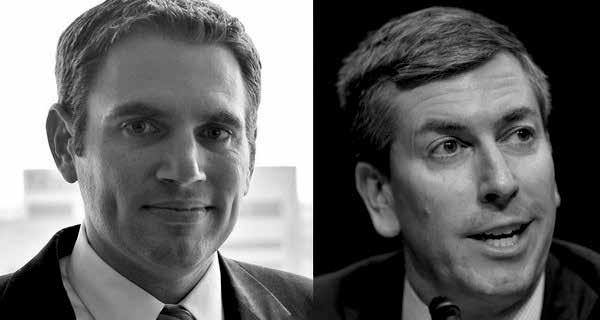
Eric Murphy (left) and Chad Readler – Photo courtesy of Ohio Attorney General’s Office / AP
Transgender student barred from shelter in locker rooms during school safety drill
by Mike Andrew SGN Staff Writer
A Transgender student in Virginia was left to sit alone in the gym bleachers during a school safety drill because teachers were uncertain which locker room to send her to.
According to a local LGBT organization, Equality Stafford, the incident occurred at a Stafford, Virginia, middle school during a drill that was supposed to prepare students and staff for an activeshooter situation.
Students in PE classes were supposed to have been evacuated to the locker rooms, but the teachers in charge left the Trans girl student sitting in what would have been an exposed location while they debated which locker room was appropriate for her.
“The student was forced to watch the adults charged with her care debate the safest place (for the other students) to have her shelter,” Equality Stafford wrote on its Facebook page. “During this debate, she was instructed to sit in the gym with a teacher until the drill was complete, away from her peers and identified as different.”
“After some additional debate, she was made to sit in the locker room hallway, by the door, away from her peers,” the post continued. “This happened because the child, in addition to being a model student, also happens to be transgender.”
Concerned parents, friends, and neighbors said they would attend an October 9 school board meeting to protest the girl’s treatment by school officials.
School district spokesperson Sherrie Johnson said the district would review its safety protocols in light of the incident.
“Stafford County Public Schools [SCPS] does not comment on individual student incidents to avoid divulging confidential information,” Johnson said.
“However, the new superintendent has requested a review of all protocols and procedures to ensure that all children are
treated with dignity and respect. We take such matters very seriously and they will be addressed. The welfare of all students is of the utmost importance for SCPS.”
When asked by reporters if the girl should have been allowed into the girls’ locker room because she identifies as a girl, Johnson would only reiterate that all the policies, practices, and safety procedures are under review. Stafford is about 40 miles south of Washington, DC, near the Quantico Marine Corps base.
SPLC releases LGBTQ school resources, new “Queer America” podcast
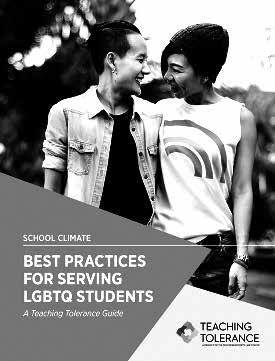
MONTGOMERY, Ala. – [On October 10,] the Southern Poverty Law Center’s (SPLC) Teaching Tolerance program released new LGBTQ resources, including a wide-ranging school resource guide and a new “Queer America” podcast, which aim to bring increased visibility of and support to LGBTQ educators and students during LGBTQ History Month and beyond. The resources were released ahead of National Coming Out Day (Thursday, October 11).
The comprehensive “Best Practices for Serving LGBTQ Students” guide seeks to help school leaders and classroom teachers ensure that all students feel safe, seen, and capable of success; to ensure that the curriculum is as complete and representative as possible; to ensure that the school climate fosters open and respectful dialogue among all students and staff; and to prepare youth to engage and thrive in our diverse democracy.
Additionally, the newly released “Queer America” podcast, produced in partnership with University of Wisconsin Press, explores the history of sexual identity and gender identity in the United States with hosts Leila Rupp and John D’Emilio. The SPLC is also commemorating the 20-year anniversary of Matthew Shepard’s death
with a new feature story called “The Book of Matthew” that can be integrated into classroom lesson plans.
“Teaching Tolerance is committed to helping every school and every teacher create civil and inclusive communities where children are respected, valued, and
welcome participants – and that includes LGBTQ students,” said Maureen Costello, director of the SPLC’s Teaching Tolerance.
“Too many kids continue to be bullied and ostracized for who they are. Having structure and resources in a classroom that affirms their identity and offers support will help us move toward a world where LGBTQ students feel safe and seen.”
Teaching Tolerance is a program of the SPLC that helps teachers and schools educate children and youth to be active
participants in a diverse democracy. The program emphasizes social justice and anti-bias through free resources to educators – teachers, administrators, counselors and other practitioners – who work with children from kindergarten through high school. The Teaching Tolerance community includes more than 500,000 educators who read the magazine, screen films, visit the site, and use the program’s curriculum.
Courtesy of the SPLC
Cover by Cierra Brinson
Image courtesy of “Queer America” podcast
Photo by Pat Canova / Getty Images
AHF hits new milestone: One million lives in care!
LOS ANGELES (October 4, 2018) – The AIDS Healthcare Foundation (AHF), the largest global AIDS organization, which celebrated its 30th anniversary in 2017 and now operates in 41 countries, is honored to announce that it has surpassed a remarkable milestone in its history: as of the start of this month, the AHF is now providing HIV/AIDS medical care and/or services to more than one million patients – 1,004,228 patients worldwide as of last week – in the US, Europe, Africa, Latin America, the Caribbean, and Asia. And the AHF’s Africa Bureau, one of the AHF’s five global bureaus, leads the way, with over 500,000 HIV/AIDS patients in care in the 13 African nations that the AHF serves.
“Over one million lives in the AHF’s care [is] the most momentous achievement in the 31-year history of the AIDS Healthcare Foundation and an achievement proudly shared by many, many dedicated staff, board members, partner organizations, volunteers, family, friends, and patients,” said Michael Weinstein, the AHF’s president. “Just three short years ago, we marked 500,000 patients in care. To now reach over twice that number, one million lives, is simply incredible. I congratulate and thank all who helped us reach this remarkable milestone today but remind people there is still much more work to be done. As we carry on, I am confident that the leadership of the AHF’s domestic and global programs has the capability and the will to take us onward and upward, to bring more and more people into the lifeboat of care and treatment over the next five years.”
“502,452! – the AHF Africa Bureau crossed the half-a-million patient mark in late September, two years early – in our goal as part of the ‘20x20’ campaign, and I could not feel prouder of each and every one who has helped us reach this milestone and, far more significantly, helped save so many thousands and thousands of lives,” said Penninah
Iutung Amor, MD, Africa Bureau Chief for the AHF, on the continent where more than half of AHF patients are located. “As experts in the delivery of HIV/AIDS medical care and an influential advocate, we celebrate this achievement today and also vow to continue to be at the forefront of efforts to control AIDS globally.”
In November 2013, the AHF kicked off “20x20,” a collective global advocacy campaign to try to get 20 million people living with HIV or AIDS worldwide in care and on treatment by the year 2020. At the time, the AHF made a commitment to getting one million of those 20 million on treatment by 2020 – a historic benchmark passed this month – and a commitment achieved two years earlier than 2020.
Previous AHF Treatment Benchmarks
• 500,000 lives in care under the AHF, a mark celebrated on November 13, 2015
• 250,000 lives in care, a mark celebrated on November 27, 2013
• 100,000 lives in care, a mark celebrated on April 15, 2009
The AHF celebrated the earlier milestone of 250,000 patients in care in November 2013. In the two short intervening years until the announcement of 500,000 patients in November 2015, the AHF doubled the number of patients it reached. Prior to that, the AHF marked 100,000 patients in care worldwide on April 8, 2009, a time when the AHF operated in just 21 countries and with only 65 global treatment clinics total worldwide. Today, the AHF provides medical care and services in over 545 global treatment clinics in 40 other countries outside the US.
“Truly heartfelt congratulations to all of the AHF staff, board members, volunteers, partners, and our patients for contributing your best to help the AHF meet this incredible milestone,” said Cynthia Davis, MPH, Assistant Professor and Program Director, Charles R. Drew University of Medicine and Science and Chair of the AHF’s Board of Directors. “On behalf of the AHF Board of Directors, we thank you and will celebrate this achievement with you as we lead in to the observation of World AIDS Day – this year marking its 30th year – later this year.”
“The one million lives under AHF’s care actually translates to many millions and many generations, if we consider the impact on the families who would have otherwise lost earning, productive individuals, parents losing children or children becoming orphans,” said Dr. V. Sam Prasad, Coun-
try Program Director for AHF India Cares.
“This milestone also marks the epitome of championing humanity and guarantees life and dignity to those in need regardless of their ability to pay. However, India still has a long way to go in bridging the gap between the ‘estimated’ and the ‘ever-reached’ to end AIDS by 2030. With a rekindled spirit and a rejuvenated mind, I vow that AHF India Cares will continue to Innovate Interventions to Impact and Complement India’s National response, doing our best and our part until the war on HIV is won.”
AHF to roll out ‘1,000,000 Lives in Care’ billboard campaign in the US and to some global sites
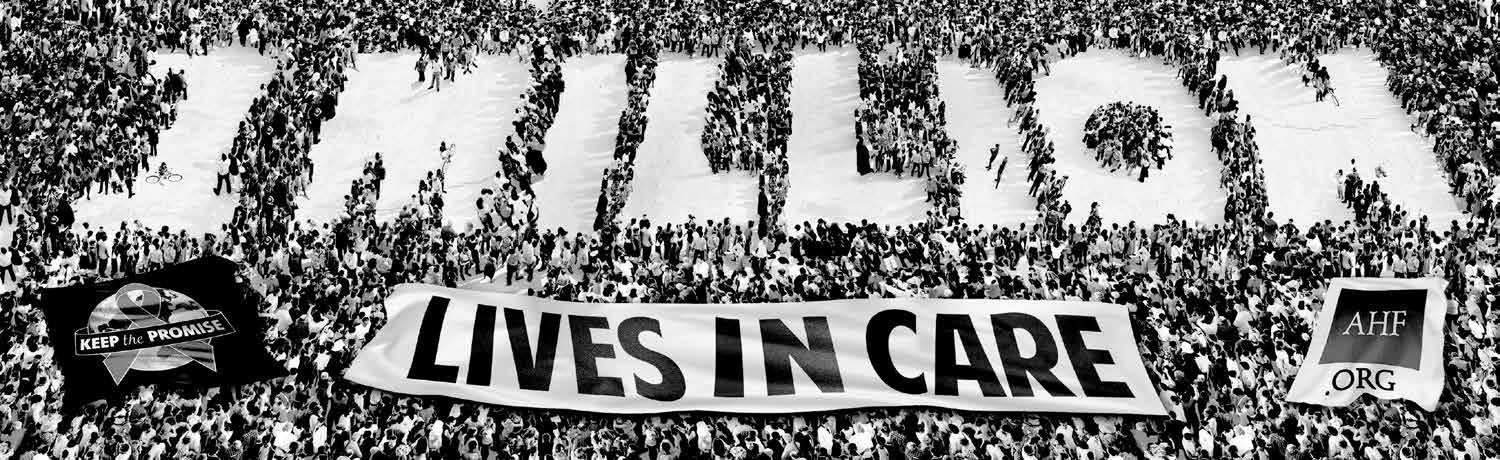
To mark its one-million-patient milestone, the AHF will roll out a celebratory new ‘1,000,000 Lives in Care’ billboard campaign later this month starting in Los Angeles and later in South Florida. The campaign will also be shared with some global countries and sites. The inspiring artwork, created by Jason Farmer, senior director of AHF Worldwide, features an image of white numbers making up ‘1,000,000’ on a backdrop of a crowd of thousands and thousands of people giving the billboard an artistic pointillist effect – one that underscores and heightens the concept of one million lives now under the AHF’s care.
In addition, the AHF produced a short video commemorating the one-millionpatient milestone. To view, click here: https:// www.dropbox.com/s/7k26nkdn02r4tgp/ AHF_1_Million_Lives_In_Care_1080p. mp4?dl=0
AHF’s early history
The AHF began operations in 1987 as the AIDS Hospice Foundation by a group of activists in response to the urgent need to provide hospice services to patients dying of AIDS on the streets of Los Angeles. By July 1990, the organization had changed its name to the AIDS Healthcare Foundation, as the need for ongoing medical care for HIV/AIDS patients grew. When the advent of lifesaving antiretroviral medications ushered in a treatment revolution in 1996, the AHF began supplying these medications to patients for free without guarantee of reimbursement and at great financial risk. In 2002, at the invitation of local South African activists, the AHF opened its first free HIV/AIDS clinic outside the US in this hard-hit country. In 2004, the AHF declared its pledge to reach 100,000 people worldwide with its services, and by 2009, the AHF reached that major milestone.
Today, in addition to its clinics and treatment centers, the AHF also operates a chain of 48 AHF pharmacy outlets in 12 states and runs managed care and disease management programs for people with AIDS or HIV in Florida and California under the AHF’s Positive Healthcare umbrella. Through the AHF’s Public Health Division, the AHF operates one of the largest community-based free HIV testing programs in the US (186,223 free tests in the US in 2017). In addition, over four million free HIV tests were done globally by the AHF in 2017 (4,233,744 tests). The AHF also operates 21 wellness centers in nine states (and seven additional wellness centers in four other countries) and also operates two AHF dental clinics in South Florida and Southern California. The AHF Research Division has 23 years of experience with antiretroviral (ARV) studies.
AHF countries
• THE AMERICAS – 11 countries: Argentina, Brazil, Bolivia, Chile, Dominican Republic, Guatemala, Haiti, Jamaica, Mexico, and Peru (as well as the United States).
• AFRICA – 13 countries: Ethiopia, Kenya, Lesotho, Malawi, Mozambique, Nigeria, Rwanda, Sierra Leone, South Africa, Eswatini (Swaziland), Uganda, Zambia, and Zimbabwe.
• ASIA – 9 countries: Cambodia, China, India, Indonesia, Myanmar, Nepal, Philippines, Thailand, and Vietnam.
• EUROPE – 8 countries: Estonia, Greece, Lithuania, Netherlands, Portugal, Russia, Ukraine, and the United Kingdom. In addition, the AHF operates 63 free HIV/AIDS healthcare centers in 15 states (California, Florida, Georgia, Illinois, Indiana, Louisiana, Maryland, Mississippi, Nevada, New York, Ohio, Pennsylvania, South Carolina, Texas, and Washington [state]) and the District of Columbia and the US territory of Puerto Rico.
The AIDS Healthcare Foundation (AHF), the largest global AIDS organization, currently provides medical care and/ or services to over 1,004,228 individuals in 41 countries worldwide in the US, Africa, Latin America/Caribbean, the Asia/Pacific Region, and Eastern Europe. To learn more about the AHF, please visit www.aidshealth. org or www.facebook.com/aidshealth, and follow us on Twitter @aidshealthcare.
Courtesy of the AHF
Image courtesy of AHF
Buy union-made candy this Halloween
The MEI is the only nationwide rating system of LGBTQ inclusion in municipal law, policy, and services.
The 2018 MEI evolved dramatically this year, instituting new benchmarks: ensuring equal access to single-user facilities in public spaces, as well as protecting LGBTQ youth from bullying in city services and from dangerous so-called “conversion therapy.” Additionally, this year the MEI deducted points for laws that that include provisions licensing discrimination against the LGBTQ community.
But even with these more stringent MEI requirements, cities and municipalities are meeting and exceeding our standards with innovative measures to protect LGBTQ people. A record 78 cities earned perfect scores for advancing LGBTQ-inclusive laws and policies – up from 68 in 2017 and 11 in 2012, the first year of the MEI. And in the current political reality, welcoming cities like these are more important than ever.
“From San Antonio, Texas, to Brookings, South Dakota, this year’s MEI again proves that there are no barriers to municipal LGBTQ equality for a city with dedicated, pro-equality elected officials,” said HRC President Chad Griffin. “Forward-looking leaders across the US are stepping up, protecting their youth from so-called ‘conversion therapy,’ increasing anti-bullying protections, ensuring that transgender city employees have access to inclusive health care benefits, and protecting LGBTQ people from discrimination in all areas of life. As we approach one of the most critical elections of our lifetimes, it is incumbent on all of us to make sure that we help elect more leaders across the nation who share this uncompromising commitment to equality for all.”
“In this political moment, as we face unprecedented challenges to fairness, justice, and democracy at the federal level, we look to local leadership in advancing equality for the
Special to the SGN
Halloween might be scary, but what’s really terrifying is the thought of a country without unions.
No 40-hour week. No weekends. No vacations. No family leave. No paid sick days. No minimum wage. No health and safety rules. And – especially frightening for people of color, women, and LGBT folks – no nondiscrimination rules.
The Halloween, give a treat to the union workers who stand up for all our rights. Buy union-made candy.
Here is a list, courtesy of the AFL-CIO Union Label and Service Trades Department, of union-made Halloween candy and treats:
HERSHEY PRODUCTS – Hershey Kisses, Hershey Syrups, Hershey Milk Chocolate Bar, Hershey Milk Chocolate with Almond Bars, Hershey Special Dark Bars, Hershey Nuggets, Rolo, Hershey Kissables, Kit Kat Bars, Carmello Bar, Cadbury Fruit & Nut Bar, Cadbury Roast Almond Bar, Cadbury Royal Dark Bar, Cadbury Dairy Milk Bar, Jolly Ranchers, Hershey Symphony Bar with Toffee.
PEARSON’S CANDY CO. – Salted Nut Roll, Nut Goodie, Mint Patties, Bun Bars.
AMERICAN LICORICE – Black & Red Vines, Strawberry Ropes.
ANABELLES CANDY COMPANY –
Rocky Road-Smores Look, Big Hunk, AbbaZaba – Peanut Butter/Raspberry, U-No.
SCONZA CANDIES – Jaw Breakers, Chocolate Covered Cherries, Chocolate Boston Baked Beans, Jordan Almonds, Yogurt Raisins, Chocolate/Yogurt Fruit & Raisins, Lemoncello Almonds.
JELLY BELLY’S CANDY COMPANY – Candy Corn, Fall Festival Mix, Sour Gummi Pumpkins, Mellocreme Pumpkins, Jelly Belly Disney Villains bags, Harry Potter Bertie Bott’s, Every Flavour Beans, Halloween Jelly Belly, Disney Mickey and Minnie Jelly Beans, Hello Kitty Halloween Deluxe Mix, Harry Potter Jelly Slugs, Jelly Belly BeanBoozled, Gummi Rats, Gummi Tarantulas.
Pride at Work is an LGBTQ labor organization affiliated with the AFL-CIO.
LGBTQ community,” said Rebecca Isaacs, executive director of the Equality Federation Institute. “The Equality Federation is committed to our partnership with the HRC on the Municipal Equality Index because it sets a bar that most localities want to reach.”
Since the MEI’s debut in 2012, the number of cities earning perfect scores has increased more than sevenfold, and today at least 25 million people live in cities that have more comprehensive, transgender-inclusive nondiscrimination laws than their state.
Progress on transgender equality has been particularly noteworthy in cities across the US this year, continuing a positive trend that the MEI has tracked – and encouraged – since 2012. Transgenderinclusive health care benefits are offered to employees of 147 municipalities this year – up from 111 in 2017, 66 in 2015, and just five in 2012. The MEI’s “Issue Brief on Transgender-Inclusive Health Benefits” is available [at https://assets2.hrc.org/files/ assets/resources/MEI-2014-TransInclusiveHealthBenefits.pdf].
Other key findings from the 2018 Municipal Equality Index include the following:
• 103 cities from states without compre-
hensive nondiscrimination laws protecting LGBTQ people scored above the overall nationwide average of 58 points. These cities averaged 83-point scores; 34 scored a perfect 100.
• Cities continue to excel even in the absence of inclusive state laws: 46 “allstar” cities in states lacking comprehensive nondiscrimination laws scored above 85 points, up from 41 last year, 37 in 2016, and just two in 2012.
• The national city score average increased from 57 to 58 points. Seventyeight cities scored 100 points; 25 percent scored over 83 points; 50 percent scored over 58 points; 25 percent scored less than 36; and 15 cities scored zero points.
• Cities are protecting LGBTQ youth. Seventeen MEI-rated cities enacted local protections against the harmful and discredited practice of so-called “conversion therapy.”
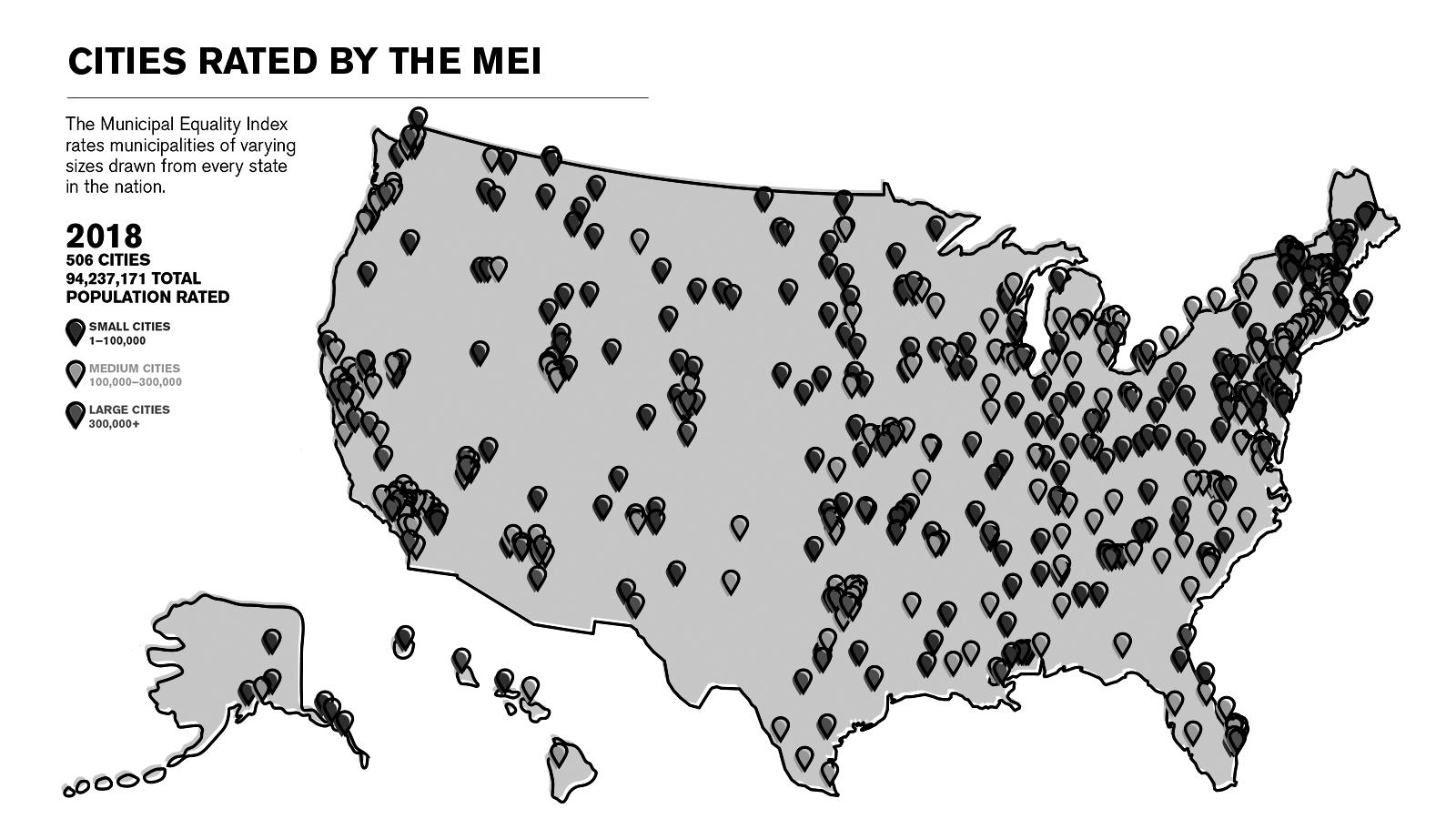
The MEI rated 506 cities, including the 50 state capitals, the 200 largest cities in the United States, the five largest cities or municipalities in each state, the cities home to the state’s two largest public universities, 75 municipalities that have high proportions of same-sex couples, and 98 cities
selected by the HRC and Equality Federation state group members and supporters. It assesses each city on 49 criteria, covering citywide nondiscrimination protections, policies for municipal employees, city services, law enforcement, and city leadership’s relationship with the LGBTQ community. This year’s report also includes two new issue briefs for policymakers: “Addressing the Unique Needs of LGBTQ Older People” and “Working Toward a Fully Inclusive Municipal Workplace.” The full report, including detailed scorecards for every city, as well as a searchable database, is available online at www.hrc.org/mei.
The Human Rights Campaign Foundation is the educational arm of America’s largest civil rights organization working to achieve equality for lesbian, gay, bisexual, transgender, and queer people. The HRC envisions a world where LGBTQ people are embraced as full members of society at home, at work, and in every community.