Celebrating 41 Years! Issue 41 Volume 42
FRIDAY October 10, 2014 FREE!
25¢ in bookstores & newsstands
Seattle Gay News SEATTLE’S LGBT NEWS & ENTERTAINMENT WEEKLY
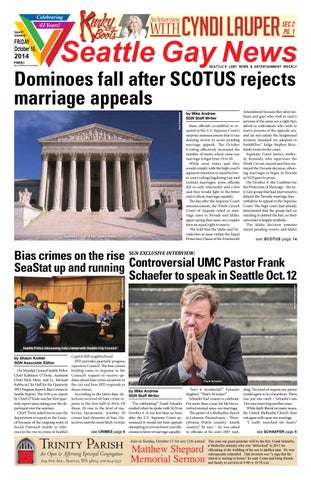
Dominoes fall after SCOTUS rejects marriage appeals wikimedia.org
Supreme Court of the United States (SCOTUS)
by Mike Andrew SGN Staff Writer State officials scrambled to respond to the U.S. Supreme Court’s surprise announcement that it was denying review in seven pending marriage appeals. The October 6 ruling effectively increased the number of states where same-sex marriage is legal from 19 to 30. While most states said they would comply with the high court’s apparent intention to stand by lower court rulings legalizing Gay and Lesbian marriages, some officials did so only reluctantly and a few said they would fight to the bitter end to block marriage equality. The day after the Supreme Court announcement, the Ninth Circuit Court of Appeals ruled in marriage cases in Nevada and Idaho, again saying that same-sex couples have an equal right to marry. “We hold that the Idaho and Nevada laws at issue violate the Equal Protection Clause of the Fourteenth
Amendment because they deny lesbians and gays who wish to marry persons of the same sex a right they afford to individuals who wish to marry persons of the opposite sex, and do not satisfy the heightened scrutiny standard we adopted in SmithKline,” Judge Stephen Reinhardt wrote for the court. Supreme Court Justice Anthony Kennedy, who supervises the Ninth Circuit, stayed and then unstayed the Nevada decision, allowing marriages to begin in Nevada as SGN goes to press. On October 9, the Coalition for the Protection of Marriage – the anti-Gay group that had intervened to defend the Nevada marriage ban – withdrew its appeal to the Supreme Court. The high court had already determined that the group had no standing to defend the ban, so their surrender is largely symbolic. The Idaho decision remains stayed pending review, and Idaho see SCOTUS page 14
franklynschaefer.com
KUOW Photo / John Ryan
Bias crimes on the rise SGN EXCLUSIVE INTERVIEW: SeaStat up and running Controversial UMC Pastor Frank Schaefer to speak in Seattle Oct. 12
Seattle Police discussing hate crimes with Seattle City Council
by Shaun Knittel SGN Associate Editor On Monday I joined Seattle Police Chief Kathleen O’Toole, Assistant Chief Nick Metz, and Lt. Michael Kebba at City Hall for the Quarterly SPD Progress Report; Bias Crimes in Seattle Report. The 9:30 a.m. report by Chief O’Toole was her first quarterly report since taking over the department over the summer. Chief ‘Toole asked me to join the department to report to the Council because of the ongoing work of Social Outreach Seattle in reference to the rise in crime in Seattle’s
Capitol Hill neighborhood. SPD provides quarterly progress reports to Council. The bias crimes briefing came in response to the Council’s request to receive updates about bias crime incidents in the city and how SPD responds to those crimes. According to the latest data, detectives received 60 hate crime reports in the first half of 2014. Of those, 20 rose to the level of malicious harassment. Another 30 crimes had elements of bias. Detectives said the most likely victims
Frank Schaefer
by Mike Andrew SGN Staff Writer
“I’m celebrating!” Frank Schaefer exulted when he spoke with SGN on October 6. It was less than an hour after the U.S. Supreme Court announced it would not hear appeals attempting to reverse lower court desee Crimes page 5 cisions in favor of marriage equality.
“Isn’t it wonderful?” Schaefer laughed. “That’s 30 states!” Schaefer had reason to celebrate. For more than a year, his life has revolved around same-sex marriage. The pastor of a Methodist church in Lebanon, Pennsylvania – “Pennsylvania Dutch country, Amish country,” he says – he was asked to officiate at his son’s 2007 wed-
ding. The kind of request any pastor would agree to in a heartbeat. There was just one catch – Schaefer’s son Tim was marrying another man. While fairly liberal on many issues, his United Methodist Church does not agree with same-sex marriage. “I really searched my heart,” see Schaefer page 5
2 Seattle Gay News
October 10, 2014
Celebrating 41 Years!
Visit us online www.sgn.org
October 10, 2014
Seattle Gay News 3
Damon Shadid will make an excellent judge damonshadid.com/
Good morning, As a concerned Seattle resident and dedicated community activist, I would urge the voters to cast their vote for Damon Shadid for Seattle Municipal Court Judge. Damon Shadid is one of the most honorable people I know. Judicial races are way down at the end of the ballot, and it’s hard to get information about the candidates. However, Seattle voters have an easy choice in this race. Damon Shadid is someone who has spent his entire legal career working to make “justice for all” a reality for everyone. He devotes both his professional and personal time to helping disadvantaged communities, especially Seattle’s growing immigrant populations, become responsibly integrated into this great city. I am an immigrant, and Damon Shadid stood by me as my advocate throughout the roughest times of my immigration process. He never gave up, and was determined to help me continue my life in the U.S. Damon Shadid believes that judges should remain involved in their community and be engaged in Seattle’s ongoing conversation about public safety and the perception of bias in the criminal justice system. I know Damon Shadid to have the highest integrity, and he will serve Seattle with honor. Sincerely, Majd Baniodeh
Damon Shadid
LGBT Catholics send message to Church leaders meeting with Pope Francis: We’re praying for you SAN FRANCISCO – The Human Rights Campaign (HRC), the nation’s largest Lesbian, Gay, Bisexual and Transgender (LGBT) civil rights organization, today kicks off a seven-city public prayer sojourn to send a message of inclusion and acceptance to bishops meeting with Pope Francis in Rome. The effort, “Pray, Listen, Discern – Raising the Voices of LGBT Catholics,” begins with a vigil and praying of the rosary at St. Mary’s Cathedral in San Francisco and will travel over two weeks to cities where U.S. bishops have targeted LGBT Catholics with particularly heartless comments. It coincides with the Vatican’s “Extraordinary Synod on the Family,” a gathering of 150 Catholic leaders in Rome to consider family issues and challenges facing the church. “As we gather here in San Francisco, we pray that our U.S. representative in Rome, Archbishop Joseph Kurtz, listens to our voices and sees the value of recognizing and including all families in the Catholic
fold,” said Lisbeth Meléndez Rivera, director of HRC’s Latino/a and Catholic Initiatives. “On behalf of all of those who have been excluded from the church – from the LGBT faithful and divorced families, to those who have been fired for simply being who they are – we offer them Holy Mary’s wisdom and God’s clarity.” Rosary and prayer vigils organized by HRC and local leaders will also be held October 9 in St. Paul; October 13 in Springfield, IL; October 14 in Chicago; October 15 in Cincinnati; October 17 in Philadelphia; and October 19 in Baltimore. More information about bishops in those cities, and their harsh comments about the LGBT faithful, can be found in the HRC Foundation document, “The Best of the Worst: Catholic Bishops Across the Country.” The Rome Synod is expected to address issues of profound importance to LGBT Catholics who are experiencing increasing acceptance among church laity. That movement toward inclusion and moderation,
also reflected in Pope Francis’s messages, is not, however, expected to be carried to Pope Francis by U.S. clergy. “The church laity is not misguided; it is not unknowing of the word and mandate of God,” said Meléndez Rivera. “On the contrary, we continue to listen to God and, just like his son, we also aim to create an inclusive church that can serve us all.” “We urge the bishops to climb down from their towers and hear our voices raised in prayer,” she said. In addition to addressing questions about the family, the Synod in Rome will consider issues of fertility, surrogate birth, and contraception. Though the Synod will not result in recognition of marriage equality or the ordination of women, participants have the opportunity to take steps toward greater inclusion – including extending the baptismal sacrament to children of LGBT Catholic families. “What is most important is the opportunity to create precedent for change,” said Meléndez Rivera. More information on the synod can be found in this HRC Foundation publication, “The Vatican’s Extraordinary Synod: Catholic Church at a Critical Juncture.” The Human Rights Campaign is America’s largest civil rights organization working to achieve Lesbian, Gay, Bisexual and Transgender equality. By inspiring and engaging all Americans, HRC strives to end discrimination against LGBT citizens and realize a nation that achieves fundamental fairness and equality for all. www.hrc.org Courtesy of the Human Rights Campaign
4 Seattle Gay News
October 10, 2014
Celebrating 41 Years!
Schaefer
continued from cover Schaefer says. “When I agreed, I was aware of other cases. I expected to be fired. I expected a call from the District Supervisor,” a church officer. “I didn’t try to keep the wedding a secret,” he added, “but I didn’t make a big announcement. I wanted to – every parent wants to. But it was in Massachusetts, 300 miles away from my church. “It was my first same-sex marriage,” he recalls. “The first I attended and, of course, the first I performed. I’ve been to many since, and there’s something about the applause – you know after the minister pronounces the marriage, there’s always applause – there’s something about the applause at a same-sex wedding. It’s louder, stronger. Because it’s a victory, an accomplishment.” Finally called to account by his Bishop, Schaefer was tried by a church court and defrocked in 2013. The verdict was reversed in June this year, and Schaefer is now serving as a pastor in Isla Vista, California, far from his Pennsylvania Dutch roots. The church lawyer who brought the original charges against him has appealed, and Schaefer will face another church hearing on October 22. “They will be representatives from the global church,” Schaefer says of the appeals court that will hear his case. “From Africa. From Latin America. They are more conservative than most Methodists in America. “In America I don’t get the sense that I’m in the minority,” he explains. “Even in the Deep South. Even in Texas! I get the sense we’re split 50/50” on the issue of same-sex marriage. “I love being a pastor,” he continues. “It’s my calling. If I get defrocked again there’s a possibility I could stay in the church. I could pursue ordination again. Or I’ve had
continued from cover www.seattle.gov
Assistant Police Chief Nick Metz
come from the LGBT community. “The anti-Gay and Lesbian category represents the most frequent bias crime in our city,” said Lt. Michael Kebba, adding that it accounts for 35 percent of all incidents. Our community has been targeted since the first day of 2014 when Musab Masmari, a man who told an FBI informant he wanted to “exterminate homosexuals,” attempted to burn down Neighbours Nightclub in a New Year’s Eve arson. Then, in June, our community suffered a double homicide in Leschi. The summer was bad; nothing but ongoing assaults and robberies in the East Precinct. Three weeks ago officers began increasing patrols on Capitol Hill. The report was heard by all of the Councilmembers; however, Councilmember Bruce Harrell, chair of the Council’s Pub-
lic Safety, Civil Rights and Technology Committee, hosted the Monday morning Council Briefings meeting. Seattle police said one challenge to solving hate crimes is that victims have been too intoxicated to offer information to track a suspect and lead to an arrest. Social Outreach Seattle has done awareness campaigns on Capitol Hill to encourage people to walk in groups. Still, nearly every night this summer, someone was attacked – walking alone after the sun goes down on the Hill. It is simply not safe to walk alone on Capitol Hill at night. In a recent incident over the weekend at R Place, police said a man who tried to enter the club, but was refused service, called for all Gay people to be killed. “He made some threats, made some gestures that he had a gun, stated that he was going to shoot people from the Gay community,” Assistant Chief Nick Metz told City Councilmembers during the briefing on bias crime investigations. According to Chief O’Toole, burglaries are down citywide and robberies in the South Precinct, too; and she mentioned that enforcement is not all about data but “perception as well.” She said that perception can be wrong and cited downtown as an example falling outside normal crime rates, yet people say they think crime is on the rise. O’Toole also said the department has been aggressively training officers this year in ways to de-escalate confrontations with citizens, a reference to reforms required under a 2012 consent decree with the U.S. Justice
Visit us online www.sgn.org
JOSHUA TRUJILLO / SEATTLEPI.COM
Crimes
offers from other denominations…I have to think about whether my conscience allows me to pursue that. “I’m just taking it one day at a time. I’ll see where my heart will direct me.” Asked if he saw the Supreme Court decision as a kind of vindication, Schaefer replies, “No, I don’t feel that way. I’m not a vindictive person. The whole experience has been positive for me, speaking about the church and putting pressure on the church to change. “The Supreme Court decision is momentous for the United Methodist Church. The more states that allow marriage, the more pressure will be on the church. “Now if they defrock me, it will be very, very discouraging for progressives in the church. If it goes the other way, it will be the same for the conservatives. I hope and pray the decision signals that change is on the way.” Asked what motivated him to put his ministry and so much of his time and energy on the line for equality, Schaefer was quick to reply. “It all goes back to Tim coming out,” he explained. Since then, he has learned that three of his four children are Gay. “That’s what’s changing America. All of a sudden you know someone who’s Gay. And you always loved that person. “The most important point that the church hierarchy is not getting is that we’re harming these people. We’re telling people that if you’re Gay or Lesbian, you can’t be married in the church, you can’t be Christian. “My son even considered suicide. Horrible! It amounts to spiritual abuse!” Schaefer has written a book about his struggle with his church leaders, Defrocked: How a Father’s Act of Love Shook the United Methodist Church. He will be appearing in Seattle on Sunday, October 12, to preach the annual Matthew Shepard Memorial Sermon at Trinity Episcopal Church, 609 8th Avenue in Seattle.
Police Chief Kathleen O’Toole
Department to curtail excessive force and biased policing. “Setting the bar high in terms of misconduct and restorative discipline” is an element of one of the most robust police-accountability systems in the country. In addition, the department is developing a computer-driven business-intelligence system to analyze the performance of officers and SPD expects to seek bids by January 1. O’Toole has been out morning, noon and night meeting people in the community to gauge what they want from the department. Between June 23, when O’Toole was
sworn in as chief, and September 25, she has appeared at more than 50 community meetings and events, according to materials provided to the council. As for the bias crime issue, Metz told the council the department wants officers to err “on the side of caution” by including bias as a potential element in documenting crimes. “These kinds of incidents should never be treated as minor,” said Lt. Michael Kebba. O’Toole is leading by example when it comes to overall policing philosophy. “I don’t even refer to it as a police force. It’s a police service,” she said.
October 10, 2014
Seattle Gay News 5
Tenderloin’s LGBT story survives San Francisco’s Tenderloin neighborhood has a colorful history and was once the center of gay life in San Francisco. Grittier than the Castro, which in the late 1970s overtook “The Loin,” as it’s sometimes called, as the city’s gay hub, the neighborhood just blocks away from City Hall also has a well-worn reputation for drug dealing, robbery and other crimes. It’s home to some of the city’s poorest residents, many of whom are living with HIV and stay in the district’s single-room occupancy hotels. The neighborhood is bounded by the historic Beaux-Arts City Hall on one side and Union Square’s upscale hotels and shops on the other. Most of the gay bars, theaters and bookstores that once filled the Tenderloin are gone, but a handful have survived, and many LGBTs still express fondness for the area. One business that’s held on since the 1970s is the Tea Room Theatre, 145 Eddy St. The tiny lobby has pictures of movies with titles like Cum Smack 2, and a sign warns, “J/O [jacking off] only is allowed in the theater.” Inside the small, dark auditorium on a recent Friday afternoon, it would have been impossible to see without the light from the porn being projected onto the screen. In a couple of seats at the front, one man on either side of the aisle was giving head to his seatmate, disobeying the sign in the lobby. During an interview in which he spent the first several minutes standing behind the metal gate that separates his office from the lobby, Steve Angeles, 50, praised the Tenderloin, the neighborhood he calls home. The area is “very friendly,” he said, and it’s “the real San Francisco.” Angeles, who’s worked at the theater for five years, said, “I really don’t know” why the business has survived, but it’s “probably” because it’s a short walk from two BART transit stations. Plus, “we show all the brand new movies every week, and we are friendly,” he said. Business appears to be brisk. Customers include men from out of town and regulars from the neighborhood. “When they retire, they have nothing to do, just relax,” Angeles said of patrons. “Peo-
ple feel at home here.” At 35, Marc Woodworth is likely one of the Tea Room’s younger fans. Woodworth, who lives in Europe but is in San Francisco six months at a time, comes to the theater once or twice a month. There’s “no other place to go” in San Francisco, he said. Angeles, who doesn’t identify with a specific orientation, but said, “They call me Mama Steve,” said the current lease is up in 2015. “Hopefully,” he said, the building’s owners will give the theater “another few years.” About a block from the Tea Room, soul music played inside Aunt Charlie’s Lounge, 133 Turk St., as Louie Lopez, 74, and Paul Lee, 73, stood outside. The gay men listed the bars that used to be nearby, like the Blue and Gold and the Landmark, and the people they used to see there. “There was always something going on,” said Lopez, who lives in the neighborhood and started coming to Aunt Charlie’s almost 30 years ago when it was still Queen Mary’s Pub. Lee said the neighborhood “was like a candy store” when he first came in 1976. “It was so much fun.” However, he noted, “There was a lot of prejudice against people from the Tenderloin,” and there still is. “If you just tell someone you used to hang out here, they say, ‘But you don’t go there anymore, do you?’” Lee said. Inside Aunt Charlie’s, the narrow walkway between the bar and some tables and benches frequently doubles as a runway for drag performers as they lip-sync to songs and collect tips. Joe Mattheisen, 65, a gay Tenderloin resident, has worked at the bar for about 16 years. Mattheisen said one reason the business has outlived many others is that it’s not “the sole source of income” for its owner, unlike other establishments. Over the years, the bar has also added drag shows and DJs. Queens and hustlers The block where Aunt Charlie’s sits was recently named Vicki Mar Lane, after Vicki Marlane, a transgender woman who performed there for years before she died in 2011 at the age of 76 of AIDS-related complications. Felicia Elizondo, 68, a close friend of Seth Hemmelgarn
Aja Monet has lived in the Tenderloin for several years
6 Seattle Gay News
October 10, 2014
Seth Hemmelgarn
by Seth Hemmelgarn Bay Area Reporter Special to the SGN
Paul Lee (left) and Louie Lopez stand outside Aunt Charlie’s Lounge, one of the last gay bars in the Tenderloin
Marlane’s, first visited the Tenderloin in the early 1960s, and said she hasn’t noticed much change in the neighborhood since then. Elizondo, a transgender woman who lives in another neighborhood now, recalled the area being packed with “queens” and “hustlers.” People made money by “selling drugs and selling themselves,” she said, and the district was “very dangerous.” (Elizondo said she didn’t deal drugs but she did work as a prostitute.) Someone could get “thrown in jail for obstructing the sidewalk” and people would get “beat, murdered or raped” by “tricks or people that just didn’t like gay people,” she said. Elizondo remembered a woman named Rhonda who died after “one of her tricks cut her breast out.” She didn’t know Rhonda’s last name. “When you came to San Francisco, you came to San Francisco to start a new life,” she said. “You weren’t nosey. Most people wanted to forget the past.” Elizondo also recalled Compton’s Cafeteria. The 24-hour cafe at the corner of Turk and Taylor streets was the site of an August 1966 riot where transgender patrons stood up against police, who had been called to quell a disturbance. The exact date of the riot has been lost to history. A ceremony in June 2006 featured the unveiling of a commemorative sidewalk plaque at the former Compton’s location, which was timed with the 40th anniversary of the riots, which predated by three years the more famous Stonewall Inn rebellion in New York City. The Compton riot is widely viewed as the beginning of the LGBT-rights movement in San Francisco, but Elizondo said that at the time, it didn’t have a noticeable impact. “Everything went back to the same old way,” she said. Almost 50 years later, though, some things have changed. In the lobby of the Tenderloin police station, about a block away from the Compton’s site, a sign assures visitors that the space is an “LGBT safe zone.” Captain Jason Cherniss, 44, who’s
straight and heads the station, wasn’t familiar with the details of the Compton’s riot, but he expressed support for the LGBT community and enthusiastically spoke of how, when he was in college, he examined the Castro’s evolution as a gay mecca. The San Francisco native’s biggest public-safety concern in the Tenderloin is drug dealing. Anyone who’s walked through the neighborhood probably has stories of being approached by dealers, and the station’s newsletter regularly lists incidents for sales of cocaine, heroin and other drugs. As for what to do about it, Cherniss said, “We’re not going to be able to arrest our way out” of the problem, but he keeps officers “visible” and encourages property owners not to leave locations “blighted.” In his September newsletter, Cherniss featured gay Tenderloin resident Aja Monet, 44, as the Citizen of the Month. Among other activities, Monet, who is HIV-negative, sits on the HIV Prevention Planning Council, an advisory group to the city’s health department that sets priorities for HIV prevention. He’s also hoping to have an LGBT Pride event in the Tenderloin next year. Monet, who came to San Francisco in 1988, said that he used to smoke crack and worked as a prostitute “off and on.” Now, he’s been off drugs for five years, and he works on graffiti removal and other issues in the area. The neighborhood hasn’t been as impacted by development as the Market Street corridor just a few blocks away, but he thinks more development is coming to the Tenderloin. “They’re running out of places to build,” he said. Monet didn’t show any interest in leaving the district, and he said he feels “very safe” there. “I think somebody called me a motherfucking faggot” a few months ago, but “that was someone that didn’t know me,” he said. “People in the neighborhood ... they don’t talk like that.” Seth Hemmelgarn is an assistant editor at the Bay Area Reporter. He can be reached at s.hemmelgarn@ebar.com.
Celebrating 41 Years!
PRIDE Institute paved way for LGBT substanceabuse treatment courtesy of The Philadelphia Gay News
The PRIDE Institute
by Jason Parsley South Florida Gay News Special to the SGN
Visit us online www.sgn.org
and external homophobia mentioned above. “The ways gays and lesbians met back then were known as the three Bs – bars, baths and bushes,” Ratner said, explaining that gays and lesbians faced a lot of difficulties just being themselves. “We speculated at the time that there was a [direct correlation] between being out to your family and sobriety.” So family became a core component of their program. “We also had a family program that sometimes included their partners or straight families. They would really learn to give support to their family member,” she said. “Who would have thought a gay person’s lover or family would come? That was just radical back then.” But Ratner wanted to not only help her patients become comfortable with their own sexuality – she wanted them to feel comfortable in the “straight” world as well. “We used to take patients to straight and gay AA meetings so they could be comfortable at both,” she said. Ratner, herself openly gay back then, had also been a gay-rights activist for years. PRIDE was founded under the nowdefunct Addiction Recovery Corporation where Bienemann was president. He recruited the 35-year-old Ratner to put together a manual for the family program, and then to do research and service training. In order to fulfill that responsibility, she put together a team of professionals in the substance abuse field from all over the nation, including Pohl. “I had already been working in the gay and lesbian community in addictions,” she said. Bienemann told the Boston Globe in a 1987 article “any inpatient drug and alcohol treatment center has a difficult time meeting all patients’ needs. In the chemical-dependence field, there is general insensitivity to issues specific to the lesbian and gay population. At
Jason Parsley is the associate publisher of the South Florida Gay News. He lives in Boynton Beach, Fla., with his fiancé. [EDITOR’S NOTE: Seattle Counseling Service for Sexual Minorities an outpatient clinic established in 1969 and still going strong and Seattle’s Stonewall Recovery Service outpatient clinic which closed down a number of years ago were Seattle’s response to these problems.] courtesy of The Philadelphia Gay News
When the PRIDE Institute in Minnesota opened up in 1986 it was a novel idea – a substance-abuse treatment center catering to the gay and lesbian community. But within three months of opening, every bed was filled, proving there was a need. “Back then we dealt with a lot of homophobia – internal and external,” said co-founder Ellen Ratner of PRIDE. “I think what made a difference is that we dealt with internalized homophobia.” The idea for PRIDE started with an LGBT specialty track at a treatment center in New Hampshire run by Lawrence E. Bienemann. “In the last year we started to do specialized treatment and we were successful initially with Ellen’s patients,” he said. “Our gay and lesbian track was the first in the nation.” And that track inspired Bienemann to lay the groundwork for a full-fledged treatment center for gays and lesbians, which would become the first in the world. “Specialized treatment just made sense,” he said. “We also had specialized treatment facilities for PTSD and a track for cocaine abuse.” Bienemann approached a group of investors and quickly raised almost $1 million. He hired Ratner to put the program together. “PRIDE was an example of people working together. We became well-known very quickly,” Bienemann said. “It was bad enough to be an addict, but to be gay or lesbian on top of that, that was two strikes against you.” Founding board member Mel Pohl agreed. “The shame that’s associated with addiction is magnified by sexual identification,” he said. “Because of the shame of being gay or lesbian, compounded with the disease of addiction, it really impacts people’s ability to get well.” Pohl said he was excited to join an elite group of professionals Ratner had recruited to advise the new facility and serve on the board. “It was a fairly prestigious group of gay and lesbian activists and addiction specialists,” he said. “To have an opportunity to work with a high-level clinical staff committed to this mission was really inspiring.” Pohl would later serve as the chief of clinical services for PRIDE for three years. Minneapolis was chosen because the corporation that started PRIDE owned several other facilities in and around the city. There were talks of later moving the institute to a more gay-centric location such as New York City, San Francisco or Washington, D.C. but those plans never panned out, Pohl said. Pohl admitted the founders didn’t have a blueprint for success and adapted as they went along.
“At PRIDE we normalized being gay,” he said. “And that was the key issue, to have a normalization of being gay. Addiction is a disease where you feel uniquely better or uniquely worse. To sit in a group and not be able to come out safely almost destined that person to fail.” Ultimately, Pohl said, it came down to safety. “The biggest impact of PRIDE in the community for those who had an addiction is that now they had somewhere they could be safe,” he said. But something else that separated PRIDE from other treatment centers was its approach to HIV. “The other thing we had to address was HIV,” Bienemann said. “Normally a treatment center, at that time, wouldn’t treat that or deal with it. But we did.” And that was one of the reasons Pohl wanted to join PRIDE. On top of being gay and being an addict, “the stigma of having HIV added another factor to the mix,” he said. “To have a safe place for people who were HIV-positive was really intriguing.” Ratner is especially proud of the work she did at PRIDE in those first few years. She believes the facility really made a difference in a lot of people’s lives. “We did outpatient surveys and found that we had a higher success rate than other places,” Ratner said. “Our patients did better.” Twenty-eight years later, PRIDE is still going strong despite the advances of gay rights and mainstream acceptance of the LGBT community. Pohl isn’t surprised at its longevity. “The complexion has changed perhaps because of HIV and marriage, and participation in mainstream culture,” he said. “But there is still a lot of shame involved in sexual identity.” Pohl said that even in today’s society, being gay-friendly is largely dependent on the staff. “You have to rely on the integrity of a staff,” he said. “Homophobia is alive and well in our society.” Molly Gilbert, the current director of business development at PRIDE, added: “There are a lot of places that are LGBT-friendly, or have an LGBT wing. But here is a place where LGBT people will receive traumainformed care and find a staff that is experienced in dealing with the LGBT community. This is a place where people can say, ‘I’m finally in the majority for the first time in my life, and I don’t have to explain myself.’” It’s been decades since Ratner has had any involvement with PRIDE as well. She left the corporation in 1990 and is now working as a journalist. She attributes the early success of PRIDE to the fact that they dealt with all of the major issues gays and lesbians faced, such as the internal
ARC, it’s only recently that we have begun to train staff to guard against homophobia.” Bienemann also said he wanted to address the statistics that were showing one-third of gays and lesbians were chemically dependent. “That’s three times the national average,” Bienemann said in 1987. “Given those statistics, there’s a real need for a separate treatment center.” And the current statistics aren’t much better now than they were then. Studies are scarce in the area of LGBT substance abuse, but according to one report from the Substance Abuse and Mental Health Services Administration, 20-30 percent of the LGBT community abuses substances, while only 9 percent of the general population does. The Centers for Disease Control and Prevention also states that LGBT individuals are more likely to use alcohol and drugs; have higher rates of substance abuse; are less likely to abstain from alcohol and drug use; and are more likely to continue heavy drinking into later life. In the early years of PRIDE, alcohol was the most prevalent drug of choice followed by cocaine, Ratner said. Today it’s crystal meth, said Todd Connaughty, the current director of clinical services. Over the years, the treatment center has changed hands several times. Today it’s owned by Universal Health Services, a company that owns hospitals and behavioralcare centers around the country. They also own other PRIDE Institutes, but those facilities only share the same name and owner, but are in no other way connected to PRIDE in Minnesota, said Gilbert. Looking back at those years, Ratner does have a couple of regrets. “I wish we had done more research. And published that paper that was done and ready to go. The world should have known what we learned there. One of the things we found was that if you drank two or more drinks, you would not have safer sex. Back then, that was a life and death issue. There was no cocktail; when you got AIDS you were dead.” For more information, visit www.prideinstitute.com.
Outdoor therapy session at The PRIDE Institute
October 10, 2014
Seattle Gay News 7
Michelle Obama campaigns for Maine’s Gay gubernatorial candidate Michelle Obama appeared at the University of Maine October 4 at a campaign rally for openly Gay Mike Michaud, Democratic Party candidate for Governor of Maine. “This race will be so close,” she said, referring to polls showing Michaud barely ahead of the unpopular Republican incumbent, Paul LePage. First Lady Obama encouraged the audience to volunteer for the campaign to increase voter turnout. “The stakes could not be higher,” she said. Without naming LePage, she said that if Republicans win, “we will see more folks interfering in women’s private decisions about our health care.” “Barack won [in 2008 and 2012] because of record numbers of women and minorities and young people who showed up to vote,” she added. “When the midterms came along, too many of our people just tuned out,” she said. “That’s what folks are counting on, on the other side this year.” The First Lady got an enthusiastic response from the crowd of 1,500 people. She was preceded by Michaud, Planned Parenthood Action Fund President Cecile Richards, whose PAC has endorsed Michaud, and State Senator Emily Cain, a candidate for the congressional seat now held by Michaud. A poll conducted by the Portland Press Herald between September 18 and 25 showed that Michaud was slightly ahead in a three-way race, with 40% of the vote. LePage had 38% and independent candidate Eliot Cutler had 12%. While her husband’s approval ratings are slipping fast, Michelle Obama remains one of the most popular Democrats. About twothirds of the public have consistently supported her since Barak Obama took office,
Gabe Souza
by Mike Andrew SGN Staff Writer
Michelle Obama endorses Mike Michaud
according to Pew Research polls. Michaud, a Congressman since 2003, certainly can use her help. He has proven to be a flawed candidate, mainly because of his doubts about reproductive choice. While he voted against cutting off federal funds for abortion services in 2013 and 2014, he voted the other way earlier in his career and he has been unable to articulate why he changed his mind. Michaud has also failed to spark much interest among Gay donors, in spite of being
openly Gay. Nevertheless, his campaign has drawn support from many high-profile Democrats. Former President Bill Clinton and Vice President Joe Biden appeared with Michaud last month. LePage has been the beneficiary of two campaign swings by New Jersey Governor Chris Christie. Elected in the Republican sweep of 2010, LePage has antagonized just about every progressive constituency in his state with off the cuff remarks that have ranged from the
bigoted to the obscene. Last year he was forced to apologize for telling a Republican Party fundraiser that “President Obama hates white people.” LePage has also reportedly met eight times with representatives of the so-called “sovereign citizen movement,” a right-wing group that refuses to recognize the authority of the federal government. LePage opposes same-sex marriage and promised to veto any Transgender rights bill that came to his desk.
Sir Elton John and David Furnish to be honored at the 18th Annual HRC National Dinner President Bill Clinton will deliver the keynote address John and his longtime partner David Furnish have led the organization’s grant making initiatives, awarding funds to innovative programs in over 50 countries around the world, raising more than $300 million to support the effort. One of the most visible couples of the LGBT community in the world, they are changing hearts and minds by living openly and honestly. Elton John and David Furnish will be honored with HRC’s National Equality Award. As previously announced, President Bill Clinton will deliver the evening’s keynote address – his second appearance at an HRC gala after attending the organization’s very first National Dinner in 1997. Other program participants will be announced soon. The National Dinner, which is already sold out and expected to draw over 3,000 guests, will be held at the Walter E. Washington Convention Center with receptions starting at 5:00 p.m. More information is available at www.hrcnationaldinner.org
8 Seattle Gay News
October 10, 2014
The Human Rights Campaign is Ameri- discrimination against LGBT citizens and ca’s largest civil rights organization work- realize a nation that achieves fundamental ing to achieve Lesbian, Gay, Bisexual and fairness and equality for all. Transgender equality. By inspiring and engaging all Americans, HRC strives to end Courtesy of the Human Rights Campaign Haydn West / AP
WASHINGTON – The Human Rights Campaign (HRC), the nation’s largest Lesbian, Gay, Bisexual, and Transgender (LGBT) civil rights organization, announced last week that Sir Elton John and his partner David Furnish will be honored at the organization’s 18th Annual National Dinner on Saturday, October 25, 2014, in Washington, DC. “We are truly excited to honor such influential international AIDS activists and philanthropists at this year’s national dinner,” said HRC President Chad Griffin. “As we celebrate the progress we’ve made over the last year while focusing on what we have yet to accomplish, their life’s work inspires us as we keep moving forward for equality.” In addition to being one of the most highly acclaimed and successful performing artists of all time, Elton John is also the founder of the Elton John AIDS Foundation, a global nonprofit organization working tirelessly to combat stigma, prevent infections, provide treatment and services, and motivate governments to end AIDS.
Elton John (r) with his partner David Furnish
Celebrating 41 Years!
Visit us online www.sgn.org
October 10, 2014
Seattle Gay News 9
MoSS Alley MotorS, Inc. SpecialiStS in VolVo, Honda, toyota and Subaru
932 12th ave. Seattle, Wa 98122 (206).325--.3992 www.mossalley.com Seattle’s most progressive auto shop!
10
Seattle Gay News
October 10, 2014
Celebrating 41 Years!
Visit us online www.sgn.org
October 10, 2014
Seattle Gay News 11
12
Seattle Gay News
October 10, 2014
Celebrating 41 Years!
Legal Services MARTIN SJOLIE Over 20 Years Experience
Last Will, Power of Attorney & Health Care Directive (Living Will)
$500.00/Person or $750.00/Couple for complete, personalized services.
(206) 841–1373 www.sjolielaw.com
Auto accidents, DUI, Small business needs.
Visit us online www.sgn.org
October 10, 2014
Seattle Gay News 13
ap
Supreme Court Justice Anthony Kennedy
Scotus
continued from cover governor Butch Otter has vowed to continue to fight equality. Kennedy did not explain his stay, but observers think he is concerned about preserving what is called “regular order” – in other words, the court’s usual process of holding up decisions to see if they are going to be appealed. In the Ninth Circuit’s territory, samesex marriage was already legal in Washington, Oregon, and California. Marriages are beginning in Nevada and will likely begin soon in Idaho. Lawsuits challenging marriage bans in Arizona and Montana are pending.
In the Tenth Circuit’s jurisdiction, marriage was already legal in New Mexico. The Supreme Court’s decision not to act on the pending appeals leaves standing the decision striking down Utah’s ban on same-sex marriage, and Utah officials immediately announced that they would comply with the court’s ruling. “We are a nation of laws and we here in Utah, we’ll uphold the law,” Utah Governor Gary Herbert said. Utah Attorney general Sean Reyes said he had issued instructions to the Salt Lake County Clerk to begin issuing marriage licenses to same-sex couples. Oklahoma is also directly affected by the Supreme Court’s decision, and county clerks are reportedly waiting for the state’s Attorney General to tell them to start issuing
same-sex marriage licenses. In Colorado, the State Supreme Court removed the last legal obstacles to marriage equality by ordering county clerks to issue licenses to Gay and Lesbian couples. In Wyoming, the National Center for Lesbian Rights (NCLR) filed a federal lawsuit asking for the state’s immediate compliance with the Tenth Circuit’s ruling in favor of marriage equality. In Kansas, the ACLU petitioned a federal judge to immediately strike down that state’s marriage ban, but Kansas Governor Sam Brownback said he would continue to defend state law. “I swore an oath to support the Constitution of the State of Kansas,” Brownback said. “An overwhelming majority of Kansas vot-
ers amended the Constitution to include a definition of marriage as one man and one woman. Activist judges should not overrule the people of Kansas.” In the Seventh Circuit, Gay and Lesbian marriages are already legal in Illinois, and Wisconsin and Indiana are directly affected by the Supreme Court decision. County clerks in Wisconsin began issuing licenses soon after the high court announced its decision. In the Fourth Circuit, Virginia was the only state affected by the Supreme Court decision, and marriages have already begun there. West Virginia also announced that it would drop the defense of its marriage ban and begin to issue same-sex marriage licenses. On the other hand, officials in South Carolina said they would continue to fight Gay and Lesbian marriage. North Carolina officials have been laying low, but the state ACLU said it would ask for an immediate court order allowing same-sex marriages to begin there. The Eighth Circuit did not have a case at the Supreme Court. Same-sex marriage is already legal in Iowa and Minnesota, and Missouri’s Attorney General said the state would not appeal a recent court decision ordering the state to recognize out-of-state same-sex marriages. The Eleventh Circuit also had no case pending before the Supreme Court, but the Florida ACLU asked a federal judge to lift his stay on same-sex marriage and order immediate compliance with his previous decision that same-sex couples may marry. Gay and Lesbian marriages are already legal in all the states under the jurisdiction of the First, Second, and Third Circuit Courts – essentially the entire Northeast of the country. The Fifth and Sixth Circuits have yet to rule on marriage suits and are not affected by the Supreme Court decision.
Montenegro Pride rescheduled for end of October Getty
by Mike Andrew SGN Staff Writer Organizers of Montenegro Pride announced that they will hold the event “no later than November 1,” but would not release more information due to “security reasons.” The event had originally been scheduled for the traditional end of June date, but organizers postponed it after discussions with Montenegrin police. Montenegro, the smallest of the constituent republics of the former Yugoslavia, had its first Pride celebration last October. About 100 people marched in the nation’s capital, Podgorica, but they were vastly outnumbered by 500 counter-demonstrators who threw rocks and bottles at them. The counter-demonstrators were finally dispersed by tear gas fired by riot police. Sixty marchers were injured in the melee. This year, the Montenegrin Interior Ministry declined to issue permits for the march until it had worked out the logistics of securing the parade route. Queer Montenegro, the group organizing the march, said they expected government authorities to participate in this year’s parade as a show of support. March organizers issued a statement critical of the government’s response to last year’s attacks.
“The clear message of this year’s Pride implies that the perpetrators of such acts must be appropriately sanctioned and that the responsible institutions need to do their job more conscientiously,” they said. Montenegro decriminalized Gay sex in 1977, but there was no further progress for
14
October 10, 2014
Seattle Gay News
Montenegro Pride 2013
LGBT rights until 2010 when the country’s parliament passed an anti-discrimination law protecting both sexual orientation and gender identity. Same-sex marriage is banned by the constitution. The Montenegrin government wishes to join the EU, and consequently must observe
European human rights standards, but a recent poll showed that 70% of the people think LGBT people are mentally ill. The country is also under the jurisdiction of the anti-Gay Serbian Orthodox Church, with more than 72% of the population identifying as Orthodox.
Celebrating 41 Years!
Catalunya passes landmark hate crimes bill ALBERT GARCIA
The Catalan legislature on Thursday passed anti-homophobia laws
by Mike Andrew SGN Staff Writer The autonomous Spanish region of Catalunya has passed a sweeping new hate crimes bill. Described by the state-run Catalan News Agency (ACN) as the “world’s most pioneering law against homophobia,” the measure includes fines for homophobic behavior at the work place, and what are being called “positive anti-discrimination measures,” including making those accused of homophobia prove their innocence.
“This positive discrimination measure is already in place for other offenses, such as domestic violence against women, in instances when it is very difficult to prove,” the ACN said. The new law will punish those who attack LGBT people in Catalunya with fines of up to €14,000 ($17,700). The law was passed on October 2 with the backing of 80% of the Catalan parliament. “I feel furious when someone appears to deny or play down the discrimination that we gays have suffered or run the risk of suffering,” said Catalan Social-
ist Miquel Iceta, one of the first Catalan politicians to come out as Gay. “They speak derisively of a gay lobby. But look at this room! This is not a group of people working undercover to achieve illegitimate goals. This is a group working to defend the rights of everyone!” In Spain’s northeast corner, Catalunya is distinguished from other regions of Spain by a distinct language and customs, and it is internally self-governing. Catalan nationalists had planned to hold a referendum on independence from Spain until blocked by a recent Spanish court order.
On the new hate crimes bill, the only party in the Catalan parliament to vote No was the conservative Spanish nationalist People’s Party (PP), which runs the Spanish Government. The centre-right Catalan nationalist Convergence and Union party (CiU), which runs the Catalan regional government, split its votes. All the leftist parties voted Yes. Predictably, the Catholic Church opposed the new law. On October 3, the day after it passed, the Catholic bishops of Catalonia charged that the new hate crimes law could violate the presumption of innocence and “complicate the liberty of communication in the teachings of Catholic morals.” In spite of being a nominally Catholic country, Spain has been remarkably progressive on LGBT rights. Gay sex was decriminalized in 1979, four years after the death of the fascist military dictator General Francisco Franco. Same-sex marriage was legalized in 2005 under the former Socialist government of José Luis Rodríguez Zapatero. Anti-discrimination laws are in place, including provisions that allow Transgender people to alter their legal documents. However, like other European countries, Spain is seeing a spike in anti-Gay attacks. Only a fraction of them are reported to the authorities, according to LGBT rights groups. According to a Spanish government study on hate crimes, reportedly the first of its kind, out of the 1,172 hate crimes recorded in 2013, a majority (452) were based on the victim’s sexual orientation, followed by race (381), and disabilities (290). While most Spaniards continue to identify as Catholic, the church lost credibility because of its close identification with the Franco regime, and an astonishing 25% of the people identify as atheists or say they have no religion.
Grindr endangers Queen’s security, Palace fears Queen Elizabeth II’s security may be compromised by her palace staff ’s hookups, royal officials have warned. According to British newspapers, a “huge” number of royal staffers bring people they meet on hookup apps like Grindr and Tinder back to royal palaces for overnight stays. Police are said to be “deeply concerned” that none of the Grindr guests are vetted by security agencies. The Queen employs over 800 live-in staff. They have always been allowed to have overnight visitors, but the number of guests has reportedly skyrocketed since the introduction of popular hookup apps. None are allowed in Buckingham Palace, the Queen’s principal London residence, but they may stay in other royal palaces like Kensington, St. James’s, and the Royal Mews, where members of the royal family live and the Queen often makes appearances. “Historically this has always been a problem, even when I was in charge way before the introduction of these so-called dating apps,” Chief Superintendent Dai Davies,
the former head of royal protection, told the Mail newspaper. “If members of staff lived in certain quarters such as the Royal Mews and Kensington Palace, which have both single sex and married quarters, they were, and I presume still are, permitted to bring back unvetted guests. “Often these guests were total strangers. It makes a complete mockery of the security structure, unfortunately.” An unnamed source told the Mail that some of the guests complain when they are questioned by the Queen’s security detail. “There are real and serious security concerns at Buckingham Palace about members of staff use of dating apps such as Tinder,” the source said. “The palace police are particularly unhappy about the number of guests of servants staying overnight, especially when they may have only just met on Tinder. “It is a security nightmare, especially in the current climate. The guests are allowed to stay at St. James’s Palace, but some have complained that when they leave they get asked ‘a million questions’ by officers. Police say they are only doing their job.”
Visit us online www.sgn.org
Getty Images
by Mike Andrew SGN Staff Writer
Queen Elizabeth II
October 10, 2014
Seattle Gay News 15
Task Force changes name, logo, slogan
The National Gay and Lesbian Task Force (NGLTF) announced on October 8 that it was changing its name, logo, and slogan. The organization will now be known as the National LGBTQ Task Force, still “The Task Force” for short. The new logo and the slogan “Be You” are displayed on its website. The group, which bills itself as “the nation’s oldest LGBTQ advocacy organization,” said in a statement that it was also “upping its game to deliver full LGBTQ freedom, justice and equality.” The new and more inclusive name, and the “Be You” tagline reflect a new orienta-
tion for the Task Force, its Executive Director Rea Carey said. “We are seeing a real palpable hunger in LGBTQ people’s hearts not just to be out, but to bring their entire selves to every aspect of their lives: to ‘Be You’ without fear, without persecution, without discrimination,” Carey said. “And there is a deep desire for more change, to look beyond marriage equality, with millions of us still facing formidable barriers in every aspect of our lives: at school, in housing, employment, in health care, in our faith congregations, in retirement and in basic human rights. “Now more than ever we have the power
The Task Force has been a policy powerhouse, with an $8.5 million annual budget and offices in five cities nationwide. The group was one of the first to push to repeal sodomy laws. It also has sought greater protections for LGBT people in the workplace; expanding HIV/AIDS care and research funding; and more recently, was among a handful of national organizations working with the Obama administration to implement a series of executive actions protecting the partners of Gay and Lesbian federal workers. The Task Force’s origins go far back in movement history, to the immediate aftermath of the Stonewall rebellion. The National Gay Task Force, as it was originally called, was founded in 1973, by members of the Gay Activists Alliance (GAA), which itself came about as a 1969 split off from the Gay Liberation Front (GLF), organized less than a month after Stonewall. Stonewall heroine Sylvia Rivera was one of the GAA’s founding members. botzerconsulting.com
by Mike Andrew SGN Staff Writer
to define the future we want – a world where every LGBTQ person can be themselves without any barriers. We have worked hard for decades to create this momentum. Let’s seize this opportunity, let’s be ourselves fully, and let’s make a future together that’s worthy of our struggle,” stressed Carey. “This is a great time for the Task Force!” Seattle activist Marsha Botzer told SGN. “It’s very satisfying for me to see this.” A former Co-Chair of the Task Force and current Board member, Botzer was in on the discussions leading up to the changes. The Task Force Board “thought long and hard” before going forward, she said, but ultimately decided they had to “create a face of the Task Force that shows what we really do.” “There’s a lot going on,” Botzer said. “The Creating Change Conference we sponsor every year really allowed us to watch how the movement has developed. We came to the conclusion that aggressive representation is needed for the movement to go forward.” The Task Force “will stay connected with the research and policy work” it has done in the past, Botzer said – its groundbreaking study of the Trans community, Injustice at Every Turn, for example – “but there’s a lot more to be done.” The Task Force’s Rea Carey told the Washington Post that the group would now focus on post-marriage realities. “We have a vision of things beyond legal equality,” Carey said. “For example, we have a federal hate crimes law and many states have hate crimes laws that are inclusive of LGBTQ people. But to be able to be truly free would be to walk down the street, holding hands with your partner and not fearing that you’ll be hit over the head with a bottle. Winning marriage doesn’t erase the fact that people will still face violence because of their sexual preference or gender identity.”
Marsha Botzer
Health and Personal Services
www.sgn.org
16
Seattle Gay News
October 10, 2014
Celebrating 41 Years!
Religion & Spirituality www.sgn.org
HOME & SPECIALIZED SERVICES
Gary D. TorGerson Co. Expert Painting and Repairs Rot Repair: siding, doors, windows, porches and decks. Lead-Safe Certified
See photographs of our work at www.TorgersonCompany.com Email: info@torgersoncompany.com Contractor Registration #: GARYDTC134CJ Phone: 206-781-0999
Visit us online www.sgn.org
October 10, 2014
Seattle Gay News 17
18
Seattle Gay News
October 10, 2014
Celebrating 41 Years!
Visit us online www.sgn.org
October 10, 2014
Seattle Gay News 19