ISSUE 45
C E L E B R AT I N G
VOLUME 49
47 YEARS
F R I D AY
IN
NOVEMBER 5, 2021
PRINT S E AT T L E ’ S L G B T Q I A + N E W S & E N T E R TA I N M E N T W E E K LY S I N C E 19 74
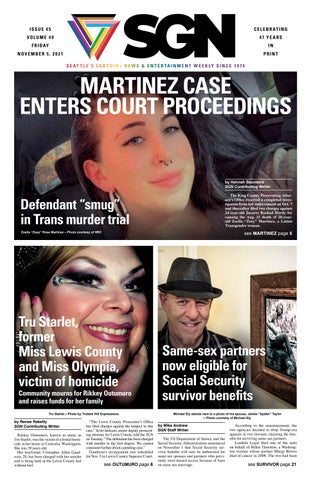
MARTINEZ CASE ENTERS COURT PROCEEDINGS
by Hannah Saunders SGN Contributing Writer The King County Prosecuting Attorney’s Office received a completed investigation from law enforcement on Oct. 7 and thereafter filed two charges against 24-year-old Jacaree Rashad Hardy for causing the Aug. 31 death of 20-yearold Zoella “Zoey” Martinez, a Latina Transgender woman.
Defendant “smug” in Trans murder trial Zoella “Zoey” Rose Martinez – Photo courtesy of HRC
see MARTINEZ page 5
Tru Starlet, former Miss Lewis County and Miss Olympia, victim of homicide
Community mourns for Rikkey Outumuro and raises funds for her family Tru Starlet – Photo by Trubble Hill Expressions
by Renee Raketty SGN Contributing Writer Rikkey Outumuro, known to many as Tru Starlet, was the victim of a brutal homicide in her home in Centralia, Washington. She was 39 years old. Her boyfriend, Cristopher Allen Gaudreau, 28, has been charged with her murder and is being held at the Lewis County Jail without bail.
“The Lewis County Prosecutor’s Office has filed charges against the suspect in this case,” Scott Jackson, senior deputy prosecuting attorney for Lewis County, told the SGN on Tuesday. “The defendant has been charged with murder in the first degree. We cannot comment further about a pending case.” Gaudreau’s arraignment was scheduled for Nov. 5 in Lewis County Superior Court.
see OUTUMURO page 6
Same-sex partners now eligible for Social Security survivor benefits Michael Ely stands next to a photo of his spouse, James “Spider” Taylor – Photo courtesy of Michael Ely
by Mike Andrew SGN Staff Writer The US Department of Justice and the Social Security Administration announced on November 1 that Social Security survivor benefits will now be authorized for same-sex spouses and partners who previously were denied access because of bans on same-sex marriage.
According to the announcement, the two agencies decided to drop Trump-era appeals in two lawsuits claiming the benefits for surviving same-sex partners. Lambda Legal filed one of the suits on behalf of Helen Thornton, a Washington woman whose partner Marge Brown died of cancer in 2006. The two had been
see SURVIVOR page 21
GREEN CARDS • VISAS • ASYLUM • CITIZENSHIP 1836 Westlake Ave N, Suite 302 Seattle, WA 98109
2
SGN
NOVEMBER 5, 2021
(206) 724-1940 olivielaw.com
C E L E B R AT I N G 4 7 Y E A R S!
In this Issue LOCAL NEWS 4 A&E • FILM • BOOKS 14 OP-ED 20 NATIONAL NEWS 21 INTERNATIONAL NEWS 21 VISIT US ONLINE SGN.ORG
NOVEMBER 5, 2021
SGN
3
Obituary
George Bakan Remembrance Announcement Memorial to be held for late SGN Editor and activist
Please join us for a memorial service for George Bakan on Saturday, November 13 at 2:00 p.m. at All Pilgrims Christian Church on Broadway, Seattle WA. We will commemorate George’s 37-year history with Seattle Gay News with entertaining stories, photos, and music. Be mindful that space is limited, and WA State Covid-19 mandates will apply.
Following the service, in order to honor the loss of George and other loved ones in the community, we welcome you to join us for a procession down the sidewalks of Broadway to the AIDS Memorial Pathway (AMP). If you have a loved one to honor, please bring a sign displaying their name and/or picture to carry as we walk.
George through the years – Photos courtesy of Angela Cragin and GSBA
Remembering Marshall Nelson Moody Brown April 14, 1948 - October 6, 2021
Photos courtesy of the Brown family
The world has lost a kind and selfless man. Marshall Brown (lovingly referred to by his family as “Brownie”) was born and raised in San Francisco and was a long-term resident of Seattle, where he passed away due to complications of amyotrophic lateral sclerosis (ALS). He was 73 years old. A 1966 George Washington High School graduate, Marshall studied journalism at Western Washington University, in Bellingham. He joined the US Air Force in March 1971, and was stationed at Incirlik
Air Base, in Adana, Turkey; and RheinMain Air Base, in Frankfurt-am-Main, Germany, where he prepared aircraft loads for departure and arrival. After separating from the Air Force in 1975, Brownie and his long-term partner, Frank, departed on a months-long trip around the world, before settling in Seattle. Marshall was a dedicated family man. He was a beloved son, brother, cousin, and uncle, and a trusted friend. He enjoyed organized bicycling races and rides, baseball, and football. He was a dyed-in-the-
4
NOVEMBER 5, 2021
SGN
wool Seattle Seahawks and Mariners fan (except when Seattle was playing San Francisco!). He also cherished his 34-year relationship with Alcoholics Anonymous (AA) and working with other Friends of Bill W. Brownie leaves behind his sister Marsha Singh, nephew Ajay Singh, niece Asha Thompson, brother Peter Brown, sisterin-law Cathleen Brown, nephew James Brown, brother Garry Brown, sister-in-law Susan Brown, nieces Diana Summers and Christina Robichaux, cousins Marion and
Charles Yadon, and numerous grandnieces and grandnephews. Marshall was preceded in death by his father, James Marshall Brown, and by his mother, Mary Moody Brown. Brownie, this isn’t “goodbye,” it’s just “so long.” May you rest in peace. In lieu of gifts, please consider donating to Peer Seattle, 1520 Bellevue Ave. #100, Seattle WA, 98122; (206) 322-2437; peerseattle.org.
C E L E B R AT I N G 4 7 Y E A R S!
Local News
MARTINEZ
continued from cover The arraignment took place on Oct. 21, during which prosecutors charged the defendant with murder in the second degree, attempt to assault in the second degree, and unlawful possession of a firearm in the first degree. The defendant’s previous King County convictions, for robbery and burglary, were also raised. Emotions ran high during the court hearing. Hardy’s family was in attendance; a younger male who was with the family (his relationship to them has not been determined) suggested obtaining a new lawyer for the trial that will start on Dec. 9. He even said, “How do they know that he even did it?” Hardy pled not guilty, and his bail was set at $5 million. Hardy’s next court appearance is scheduled for Nov. 11. Oliver Webb, chairperson of the nonprofit Diversity Alliance of Puget Sound (DAPS), which serves Transgender, nonbinary, genderfluid, gender-nonconforming, agender, intersex, Two Spirit, and questioning people in Washington state, has been in contact with the Martinez family to support and assist them through the tragedy of what happened to their daughter. Webb was among those who attended the arraignment. “Hardy was smug and joked around with his family and friends through the glass,” Webb said. “It is clear that he nor they care about the life he took. I sat behind half a dozen people who couldn’t care less about Zoey Martinez, then an hour later I held her grieving family. I am not surprised by his behavior, nor those who came to support him, but it’s still hard to witness. As this trial moves forward, it’s clear this behavior will likely continue, and I am sickened for this family and community.” Hardy’s hearing lasted approximately ten minutes. When it ended, Webb said, “Her family isn’t even here!” At that point, Martinez’s family was not in the court room but rather another room, where they were able to listen. Immediately after Webb’s remark, a middle-aged male shouted, “He’s got a family!” and began walking over to Webb, at which point another member of Hardy’s party blocked the man. (Presumably the man who shouted was Hardy’s father, who may have misunderstood Webb’s remark, although this has not been confirmed.) The incident Zoella Martinez was gunned down in Seattle on the night of Aug. 31. Martinez believed that Hardy owed her $1,000, which he allegedly stole from her during a fraud incident months prior. Martinez and Hardy met in a Maple Valley parking lot. Martinez told her friend, who law enforcement refers to as “AC,” that she was afraid to meet Hardy alone. Martinez texted AC a screenshot of Hardy’s Facebook profile in addition to the meeting location, and asked her to be in the area during the time of the meeting out of safety concerns. That night AC arrived late. Martinez texted her, saying that Hardy was six minutes away, at which point AC was eight minutes away. When AC arrived with her boyfriend, she saw her friend sitting in the passenger seat of a white or light-colored car, but the car sped off, driving upwards of 100 mph. AC attempted to follow, but she lost the car at an intersection. At 10:51 p.m., AC filed a missing-person’s report with the King County Sheriff’s Office. A surveillance camera of the parking lot picked up footage of what happened that night. While Martinez was sitting in the light-colored car for about two minutes, the camera picked up five flashes of light that are consistent with a muzzle flash of a handgun being fired inside the vehicle. Twenty-three seconds later, AC arrived at the parking lot. During the early hours of Sept. 1, the Seattle Police Department was notified of a woman lying on the ground in an alley in Greenwood. Detectives spoke with several
VISIT US ONLINE SGN.ORG
Zoella “Zoey” Rose Martinez Martinez – Photo courtesy of Diversity Alliance of Puget Sound / Sarita Martinez
“I am not surprised by his behavior, nor those who came to support him, but it’s still hard to witness. As this trial moves forward, it’s clear this behavior will likely continue, and I am sickened for this family and community.” — OLIVER WEBB (DAPS)
Hardy – Photo courtesy of the City of Seattle
witnesses. One said they walked down the alley right before midnight and there was no body there, but others said they saw a female lying on the ground at about 1 a.m. and ignored her because they thought she was passed out from intoxication.
Martinez was found dead with an emptied purse. The light-colored car was found on Sept. 1, parked at the house where Hardy lived with his father, with blood on the passenger seat, fired cartridge cases, and a fired bullet. Law enforcement officials were able to match the light-colored car, a Lexus, to Hardy. Hardy was on the run for over a month before he was located by US marshalls on Oct. 6 at an apartment in Renton. He ignored calls to come out; he was found hiding under a bed. The King County Prosecuting Attorney’s Office asked the judge to set bail for $5 million due to the danger he posed to the public and the likelihood of him not appearing for court. Not much is known about the defendant
NOVEMBER 5, 2021
other than he has a history of both juvenile and adult felony convictions. His juvenile felony convictions include: • Robbery in the second degree (twice in 2013) • Residential burglary (2013) • Attempted residential burglary (twice in 2013) • Possession of a stolen vehicle (2014) • His adult felony convictions include: • Forgery (three times in 2017) • Unlawful possession of a firearm in the second degree (2018) According to the HRC, 2020 was the deadliest year on record for violence against Trans people, with 37 people reported killed in the US as of November 2020. Twenty-five of those deaths were Black or Latinx Trans women.
SGN
5
Local News
Seattle Election Rundown Seattle voters reject Progressive stronghold by Kylin Brown SGN Contributing Writer Bruce Harrell is Seattle’s mayor In the race for mayor, Bruce Harrell, former city council president won 65% of the vote over current council president Lorena González, with three-fourths of the ballot counted as of Thursday evening. He will be Seattle’s first Asian American, biracial mayor as well at its second Black mayor. Harrell is a Seattle nx===ative, having grown up in the Central District. KUOW reported Thursday that anecdotal themes among voters at Bruce Harrell’s Election Night event who were in their 50s, 60s, and 70s were safety, homelessness, and cleaning up our streets. Contrastingly, people in their 20s and 30s spoke of more progressive ideals, focusing on equity and advocacy for marginalized communities. At press time, Harrell has yet to respond to the SGN’s latest inquiries as to what his campaign victory will mean to the LGBTQ+ community. For more information on Mayor Harrell and his campaign, check out his interview on the Radio SGN podcast or visit his website www.bruceharrellforseattlesfuture. com A tale of two cities When given the choice between progressive and mainstream liberal candidates, Seattle settled on the latter. With key issues at stake such as the worsening homelessness
epidemic, skyrocketing housing costs, and the future of policing, votes unexpectedly turned moderate. This year’s election was projected to have a strong voter turnout among young people, but as of Election Night, older and wealthier voters made waves instead. In several races, voters were given two very different candidates to choose from, and they chose from within their comfort zone. Sara Nelson, co-founder of Fremont Brewing, defeated attorney and activist Nikkita Oliver for City Council Position Number 9. Oliver feels that their campaign shifted perceptions and opened new possibilities for future campaigning in Seattle, according to a tweet Wednesday. “We raised [money], door knocked and had a strong field program. We also did mutual aid, built policy [with] impacted communities that we will continue to push, and earned previously unattainable endorsements.” Ann Davison, a party-switcher gone nonpartisan for the role of City Attorney, is poised to win against self-proclaimed abolitionist Nicole Thomas-Kennedy. As of Wednesday, Davison has won 85,543 votes, and Thomas-Kennedy only 61,430. “It appears that Thomas-Kennedy’s promise not to prosecute misdemeanor crimes and the inflammatory statements she made about police galvanized Seattle’s centrist democrats enough to potentially hand Davison the win,” reports Seattle PI. Bruce Harrell on election night – Photo courtesy of Bruce for Seattle
OUTUMURO continued from cover
Memories Outumuro had been crowned the firstever Miss Gay Lewis County in 2008 and was once the reigning Miss Gay Olympia, according to her friend Jadys Diamond. “She was one of the most recognized members of the Olympia LGBTQIA community,” she explained. “I am heartbroken and crushed to find out that she was brutally murdered.” Diamond and Outumuro performed together many times in Olympia over the last 13 years at Jakes on 4th, The Urban Onion, and the Eagles Club of Olympia. Outumuro also performed as Tru Starlet during the Capitol City Pride’s virtual event in June. “Rikkey always loved to be glamorous and to make people smile,” Diamond said. “She really loved to sing karaoke and spend time with her friends in Olympia. “I want people to remember her as the glamorous woman she was, who brought joy to all of those who were around her.” Diamond offered up several memorable moments, but her fondest memory of Outumuro was during the Olympia Downtown Association’s Christmas Parade a few years ago, during which they sang Christmas songs and handed out candy canes to children while walking with Capital City Pride. “She was a loving drag sister to us queens from Olympia,” Diamond said. Anna Schlecht, Outumuro’s “adopted gay aunt” said she met her when she was an eight-year-old “budding drag queen,” because she was pals with the daughter of her girlfriend at the time. “For fun, the kids would run over to the food co-op free box to play ‘dress-up drag queen’ and put on shows in the neighborhood,” recalled Schlecht. “I was deeply moved when Rikkey’s mom approached us and said, ‘Thank you for befriending Rikkey. She needs strong, gay role models that love her.’ That’s when Rikkey adopted me as her lesbian aunt. Later, we worked together when she performed in the Olympia Pride events. This past summer, she was the one who called me in the middle of the night to say that Lisa,
6
SGN
Outumuro in a parade as Miss Gay Lewis County – Photo courtesy of Rikkey Outumuro / Facebook
an old girlfriend, had died.” “Rikkey had a big heart and a giant smile. She leaves a huge hole in the heart of our community,” added Schlecht. Kelly Kaanaana was a friend of Outumuro since sixth grade. She was the hostess of her dating-game show in high school. She also was her hair stylist as an adult. She told the SGN on Wednesday that Outumuro “made Centralia a better place for those who didn’t fit the cookie-cutter norm.” “She was a trailblazer and so well loved,” said Kaanaana. “Before her, people were afraid to come out as gay, trans, or the like. There’s many, many more people whose life she touched as well.”
NOVEMBER 5, 2021
“I want people to remember her as the glamorous woman she was, who brought joy to all of those who were around her.” Gina Smivaer, a cousin of Outumuro, said she was in shock that Outumuro’s life was cut short before her time. She added that the pair had exchanged direct messages on October 15 and were discussing Halloween treats she was making and described Outumuro as “very creative and crafty,” with a “fun loving personality.”
“I am in utter shock and disbelief,” said Smivaer. “I am just so emotionally sick about all of this. I still can’t believe it is true, even though I know it is. My heart is broken and my soul just aches for her mom.”
C E L E B R AT I N G 4 7 Y E A R S!
Photos courtesy of Cristopher Gaudreau / Facebook
There have been five Transgender or nonbinary deaths in the Pacific Northwest alone. “Constant attacks from our government and communities allow for sanctioned hate crimes against us and result in loss of life.” — OLIVER WEBB (DAPS)
VISIT US ONLINE SGN.ORG
The suspect According to a court filing in Lewis County Superior Court, Outumuro’s mother, Hope Schumacher, called 9-1-1 to report that Gaudreau had come to her residence with their six-year-old child and told her that her daughter was dead and had “blood coming from her mouth.” Centralia Police responded to Outumuro’s home in the 800 block of S. Gold St. at 8:20 a.m. on October 31. They found Outumuro laying on the couch with her hands in a defensive position, with both arms covering her face. The Lewis County Coroner’s office determined she was shot five times in the chest, with one bullet traveling up her neck and exiting through her head. It is believed she died late at night on Saturday, Oct. 30, or early Sunday, Oct. 31. Gaudreau’s Facebook page was full of images of guns and pictures of himself holding weapons. One image he posted stated he was “pro-Trump, pro-military, pro-police, pro-gun, and pro-God. He wrote: “DON’T FORGET PRO FREEDOM.” “She asked me to friend [Gaudreau] on [Facebook], but that was a few years ago,” said Smivaer. “We did, but [over] the last several months, I was turned off by some of his posts and — although we remained [Facebook] friends — I quit following [Gaudreau]. Police recovered a 9mm carbine rifle, a semi-automatic assault-style shotgun, and a .22 revolver. He also owned a 9mm Zigana pistol that police believed was the murder weapon. He told police he had “misplaced” the gun after changing his pants that morning. It was later located in a tool chest in the back bedroom. Igman 9mm Full-metal-jacket bullets were found in the home. Gaudreau had admitted to purchasing them online. They matched the bullets recovered in and around Outumuro’s body. The affidavit of probable cause states that Gaudreau’s 9mm Zigana had been seized by police after he was arrested on August 15, 2021, for unlawfully discharging the weapon. However, the case against him was dismissed, and the gun was returned to him three days before the murder. Outumuro’s relatives stated that he would “put his hand on his hip like a gunslinger” and that was how he “would deal with someone that was doing something wrong or that he didn’t like.” They also said that Gaudreau’s son, who the couple was raising together, had previously stated that “daddy was going to shoot mommy in the head” but that Outumuro would “cover” for him. “[I] can’t believe Rikkey was with [Gaudreau], but she loved the little boy so much,” said Smivaer. “[She] has been his mom for almost seven years. He will be seven in January.” Gaudreau told police that the couple had gone out to the Limit Bar and Grill and the Hub Tavern to drink. He said that despite
NOVEMBER 5, 2021
only having two drinks, he blacked out at the Hub Tavern and could not remember anything after 11:30 p.m. on Oct. 30. A neighbor, David Anderson, later reported to police that he had contact with the couple at about midnight, after he observed Gaudreau’s car pulling into the driveway. He added that Gaudreau fired more than one shot at him as he approached, because he thought he was “a homeless person.” Anderson stated both of them were “extremely intoxicated” and that Outumuro was being verbally “provoking.” According to Gaudreau, he woke up on his living room floor because their son was playing video games. He found that Outumuro was deceased and found bullet casings on the floor. He said he put the bullet casings on the table near her, which police described as “lined up.” He found he had wet his pants and changed them. He said he told their son his mom was dead and took him to Schumacher’s residence nearby. Police stated they did “not observe any emotions coming from him” as he recounted what happened. Other deaths Outumuro is at least the second Transgender or nonbinary person to die by violent means in Washington state this year and the 45th this year across the United States, according to the Diversity Alliance of Puget Sound (DAPS). Zoella “Zoey” Rose Martinez, a 20-yearold woman from Maple Valley, Wash., was the 38th such person to die in the US. She had also been shot five times, and her body was found in a Seattle alleyway. Both were Latina, although Schlecht said Outumuro didn’t like “labels.” There have been five Transgender or nonbinary deaths in the Pacific Northwest alone. The others are: Ollie Taylor of Oregon, 17, #28; Jessi Hart of Oregon, 42, #43; and Jo Acker of Idaho, 26, #44. “Constant attacks from our government and communities allow for sanctioned hate crimes against us and result in loss of life. We are now at 45 lost, but we know that number is much higher because it doesn’t include suicides, US territories, or all those who are buried under their deadnames or never found at all,” said DAPS Board Chair Oliver Webb. “This year, our list is different for the Pacific Northwest. we have five names on that list... To have so many from our region and from our state is unheard of and terrifying. What is thought to be one of the safest parts of the country now makes up 11.11% of those lost this year.” Capitol City Pride is collecting funds to aid Outumuro’s family with the funeral expenses and to support her son. Just over $3,000 had been raised toward the $5,000 goal, as of Wednesday afternoon. To donate, visit the Capitol City Pride Facebook page or www.facebook.com/ donate/2961499287433080.
SGN
7
Local News
Seattle Public Library celebrates Día de los Muertos ment of the at-home program. Born in Mexico City, Sandys has a lifelong history with the holiday. Now a wellknown Seattle artist and teacher, Sandys has facilitated the SPL’s Día de los Muertos programming for over 15 years. At the Beacon Hill branch, an interactive community bulletin board is also on display in the children’s area. Visitors can participate by writing on a paper flower the names of loved ones who have passed away or a favorite activity or memory shared with them, then adhere it to the board. The Seattle Public Library invites those celebrating to also share their Día de los Muertos artwork on social media using the hashtags #SPLDayoftheDead and #SPLDiadelosMuertos and tagging @ splbuzz on Twitter or @SeattlePublicLibrary on Instagram.
by Kylin Brown SGN Contributing Writer Through November 10, the Seattle Public Library is offering programming to celebrate and explore the history of Día de los Muertos, known in English as “Day of the Dead.” Originating from the ancient Aztec, Toltec, and other Nahua peoples, the Day of the Dead is now celebrated throughout Latin America and around the world. Today, the several-thousand-year-old holiday remains a time to remember and honor the dead. Traditional celebrations are highly social, centered around the gathering of communities or families in order to create altars for their deceased loved ones, called ofrendas. These are made to welcome spirits back to the realm of the living. As such, they are lovingly garnished with handmade arts and crafts, food and water, candles, and family photos. In an effort to help distanced communities celebrate the holiday this year, Seattle Public Library branches have tweaked their usual programming, emphasizing accessibility in South Seattle. Visitors to the South Park Branch (8604 8th Ave. S.) can find “take-and-make” calaverita (sugar skull) art kits available
Photo courtesy of SPL
for pick-up while supplies last. Local artist Amaranta Sandys has also developed a tutorial video for those who wish to participate in making them. It will be accessible for all generations and offered bilingually in English and Spanish.
“Follow along, learn, and create as she shares the history of Día de los Muertos celebrations and festivities around Mexico and the rest of the world, while she shows us how to make a decorative, mixed-media calaverita,” said the SPL in its announce-
You can find more information on current Library services on the SPL’s “Road to Reopening” webpage for more information, or in last week’s edition of the SGN. Contact the Library’s Ask Us service by phone at 206-386-4636 or by email or chat at www.spl.org/Ask.
National League of Cities recognizes Kenmore’s first openly Bisexual councilmember by Hannah Saunders SGN Contributing Writer Kenmore City Councilmember Corina Pfeil has received member spotlight recognition by the National League of Cities (NLC) for the month of October due to her service on the LGBTQ+LO Committee and the Federal Policy Committee on Human Development. The NLC is an organization comprising city, town, and village leaders who focus on improving the quality of life for current and former constituents. “This is serious work we perform,” Pfeil said, “focusing on diversity, equity, inclusion, and intersectionality, [and] supporting our American cities, towns, and villages in meaningfully addressing issues of discrimination on the basis of sexual orientation, [including] the disproportionate impact of the pandemic… felt and experienced by our LGBTQ+ community.” Pfeil, an openly Bisexual, 30-year Kenmore resident who was elected to serve on its City Council in 2019, brings the work she does at the NLC back to her city. During her first year serving on the City Council, she became a member of the Association of Washington Cities, which she described as a path to working with the NLC. Members who serve on the Federal Policy Committee on Human Development focus on developing policies and advocating for issues such as those that affect people with disabilities, employment and workforce development, immigration reform, and public healthcare, among others. “Everything we do in development is the glue that holds the society together,” Pfeil said. “You name it — it’s jam-packed. It’s everything our society relies upon to hold us up and [get] us through.” Pfeil mentioned that the Federal Policy Committee on Human Development responds to issues at the federal level in the state Senate and the House of Representatives, to ensure that there is future funding for things such as infrastructure. “We’re fighting for our local municipalities to ensure that the funding will be there
to pull us through hard times, or the funding will be there for the programs we rely upon,” Pfeil said. The LGBTQ+LO Committee, established in 1993, is made up of people who identify as part of the LGBTQ+ community, or those who are allies. Its goals are to share ideas on best practices in order to develop policy and leadership experience. The LGBTQ+LO Committee meets several times per year; the executive board — which Pfeil recently applied to and is wait-
8
NOVEMBER 5, 2021
SGN
Photo courtesy of Campaign to Elect, Corina Pfeil for Kenmore
ing to hear back from — meets monthly. “We acknowledge that parts of the US have more advancement in policy, like the state of Washington or New York, but there are areas that don’t,” Pfeil said. “There are municipalities in North Carolina or Georgia that have different values and policy positions, and it’s hard. That impacts everything from the ability to get a house, rental conditions, or a rental unit to live in independently safely, to being out and open in your community.”
Pfeil brought up how some areas in the United States still use a “green book,” which lists places that are LGBTQ+ inclusive. A few examples of green book lists include LGBTQ+-friendly hotels, shops, and restaurants. “We look forward to the positive side of things, helping our local municipalities work through those issues,” Pfeil said. “Not many municipalities actually have a solid policy on nondiscrimination. And Kenmore is one that will be adopting an ordinance in the future.” Pfeil described how she fought hard to move the issue of diversity, equity, and inclusion on the Kenmore City Council’s list of priorities since she began serving. “It took six months of pointing [to] issues that occurred in our community,” Pfeil said. “We’re almost a year into developing the framework after adopting a resolution and other formed policy and position statements, so I’m real proud of that work, and I’m really proud of our council for leaning into this.” A major focus of Pfeil’s is to minimize and close all opportunity gaps, whether related to the LGBTQ+ community, seniors, disabled communities, or others. Her background as humanitarian and a behavioral science social-services specialist allows her to find comfort in the work she does with the NLC, and she’s currently attending night school in order to obtain her public health degree. “For [the] LGBTQ+LO work that we are doing, there’s not a whole lot of LGBTQ leaders or even Two Spirit leaders who are out and open and involved in politics. And so if you are a member of the community and you’re part of this committee, board, or even an ally, it’s important to show others in our community that you can live life out loud,” Pfeil said. “You can have a place in leadership and be successful and be welcomed into that space, and the work we do together creates better opportunities for… future generations... That inspires our youth and makes things better for our seniors, and it’s beautiful, lovely work.”
C E L E B R AT I N G 4 7 Y E A R S!
New school year, same fight for equality What’s happening at Seattle Pacific University by Josephine Baird SGN Contributing Writer According to its website, Seattle Pacific University is a “nationally ranked” university, having received recognition from Forbes (2018) as one of “America’s top colleges” and Colleges of Distinction (2018) as “a national college of distinction.” This year, SPU made yet another list — as one of the “absolute worst, most unsafe campuses for LGBTQ youth,” according to Campus Pride. While this title might be new, SPU has a history of discrimination. The fight for equality has been long for its students, faculty, and alumni. For example, after a frustrating year of demonstrations, protests, and lawsuits, SPU has made no changes to its statement on human sexuality that “sexual experience is intended between a man and a woman.” It is because of this statement and a general mindset, that adjunct nursing professor Jeaux Rinedahl filed a lawsuit against SPU for sexual orientation discrimination last January. Rindehal claims he was denied a full-time position because he is Gay, despite his qualifications. It is because of this history of discrimination that SPU student leaders have committed to bringing about positive change during the new school year. Public forum In accordance with these efforts, on Monday the student government, the Associated Students of SPU, hosted a public forum to “mark the beginning of a joint effort to bring positive change to campus this year.” The event was titled a “conversation” in which a moderated panel, comprising President Pete Menjares and members of ASSPU’s core leadership, answered questions submitted by students, staff, and alumni. The turnout was decent, despite the classic Seattle rain. The event started with an impassioned prayer to God by Chloe Guillot, an ASSPU representative, what she described as a lament. Guillot said, “We mourn the harm done to the LGBTQ+ community in your name. Our souls cry out for the ways we have fashioned your words into weapons, piercing the hearts of those who simply wish to love and be loved.” In her prayer, Guillot referenced the students’ continued fight for equality, mentioning how 10 years ago, Queer students were denied a safe space to gather; four
years ago, students protested to no avail in Tiffany Loop; and a year ago, a professor was cast out of the community because of his sexuality, proving that this issue is one with a deep history on campus. She ended the prayer on a hopeful note, that all listening would come into this conversation “with open hearts and open minds.” After the prayer, student leaders read testimonies from students, staff, and alumni, stories of anger, disappointment, frustration, and hope. Afterward, they read and answered questions with President Menjares. While the audience seemed to enjoy listening to the answers from student leaders, Menjares’ answers were highly anticipated. After years of what student Raegan Figgins describes as “talking to a wall,” having a conversation — no matter how general it was — was a step in the right direction. The first question was, “What do you hope/envision for SPU? First by this spring and then in four years from now?” In response, student leader Reena Sidhu said, “I hope that gay and queer faculty and staff get hired and are able to be out. Queer staff do not affect our education, but homophobic staff and faculty do.” This answer was followed by a round of applause. President Menjares also shared his vision for the school by saying, “Whether it’s in
SPU has a history of discrimination. The fight for equality has been long for its students, faculty, and alumni. the spring or in another year, or four years, I hope SPU will be a more unified and inclusive community.” Then he proceeded to mention his “unique role” in which he interacts with donors, some as old as 93. Menjares cited his experience in public higher education, claiming to be an “expert in areas of race, ethnicity, intercultural, and low-income education,” but expressing his desire to be honest in that he’s “not an expert in LGBTQ+ issues.” He shared that he “doesn’t even know what pronouns mean” at two different points during the forum, but that he is willing to learn. He said, “I’ve been asking for colleagues both here and outside of this institution to refer me to experts, to refer me to resources,” but that he’s concluded that “maybe the most important thing that I can do is listen.” Even if the event seemed to be a step in the right direction, it left students and their leaders wanting more. One PhD student,
Kiana Clay, said, “I am hopeful because the president did show up. However, I don’t really think that words mean anything if they’re not backed up with action.” ASSP President Laur Lugos said she believes that the next steps need to be toward material change. “I don’t think we can theorize how we can be respecting queer people on campus; I think it’s time to change policies regarding allowing queer people into our campus spaces,” she said. Lugos said she believes that the mission will be most successful if they receive support from the greater Seattle community. She added, “We need witnesses for what exactly is going on here; we want to hold our university accountable for actually creating environments of inclusion.” To learn more about the student-led fight for LGBTQ+ visibility and equality on SPU’s campus, follow spualum_lgbtq on Instagram.
(l) Interim SPU President Pete Menjares (far right) at the public forum, (top, r) Attendees hold signs during the event. – Photos by Josephine Baird
VISIT US ONLINE SGN.ORG
NOVEMBER 5, 2021
SGN
9
Local News
POCAAN celebrates Black Pride once again
Photos by Lindsey Anderson
by Lindsey Anderson SGN Contributing Writer After 18 months of Zoom meetings and distanced communication, Seattle’s People of Color Against AIDS Network (POCAAN) finally held its first in-person Black Pride event since the start of the pandemic. On Friday, October 29, POCAAN’s board members met at Rotie Cellars in SoDo to celebrate the first night of the highly anticipated event. “I’m very excited about this weekend. It’s an opportunity for Black and Brown LGBTQIA+ community members to get together, uplift, and celebrate, something we have not been able to do since COVID started. And we miss supporting each other,” said Chris Porter, a member of POCAAN and attendee. “We’re just so privileged to be able to do Black Pride once again,” said Steven Sawyer, POCAAN’s executive director and cofounder of Pacific Northwest Black Pride. “Last year, we were unable to hold the event at all. For marginalized communities, that gathering and connection [is so important].” This year the activities were paired down and COVID compliant, “but they’re geared to center Black and Brown folks and to talk about their experiences,” said Sawyer. “In the morning, there will be a host of events talking about COVID-19, par-
10
SGN
ticularly in the Black and Gay community, sexual health, and issues plaguing Seattle, especially about equity and empowerment. Everything is free and hybrid this year. We are also having a Kiki Ball, free HIV testing, and pop-up COVID-19 testing.” The weekend was made possible by generous sponsors, including Rotie Winery, which donated the space for Friday’s venue and a portion of profits made from its Pride wine to POCAAN. The AIDS Healthcare Foundation was also a sponsor, and provided free HIV testing all weekend. After the kickoff dinner and wine tasting, Rotie also sponsored a sip-and-paint event, where participants got to dine on delicious wine and craft unique masterpieces. Workshops The festivities were in full swing by Saturday morning, with the first two-hour workshop by JoJo DeRodrigo, a somatic sex and intimacy coach, “Relationships and Agreements: The Language of Pleasure.” Using sexological bodywork, breathwork, movement, and coaching, DeRodrigo challenged participants to practice using their voices, with requests for clear communication in relationships. Following that , Me’jour Mook, Bryanna A. Jenkins, and Derek Baugh hosted a Black Trans symposium, which challenged people to ask, “What can we do to create an inclusive community?” Speaking from
NOVEMBER 5, 2021
their own experiences, panel members conversed about the importance of Black Trans visibility and the disparities that the intersectional community faces. Civil rights attorney Bryanna A. Jenkins provided crucial details, shifting perspectives and challenging patterns of thought. In the afternoon was a talk by Dr. Stephaun E. Wallace on “COVID-19 in the African American Community” and its disproportional impact. Dr. Wallace presented staggering facts about the pandemic and how it has been ravaging Black communities. He also discussed the lack of equal access to quality healthcare, treatment, and resources during this time. Following that talk, the Rt. Rev. Edward Donalson III gave a seminar on Queer spirituality titled “Thinking Healthy Spiritually: Healthy Queer Spirituality.” Rev. Donalson dissected myths surrounding spirituality and called on listeners to participate in healthy spirituality that critiques all systems of power and domination that oppress and marginalize anybody. He used affirmations to uplift listeners and remind them that worth is never diminished by identities. The final seminar of the day was provided by Kink 4 The Culture and moderated by Phareaux Onyx. It included several panel members from Seattle’s kink and leather community. The panel shared stories about the Black kinksters and leather legends of Seattle, and fun, personal stories
from their own kink experiences. The panelists had a bit of something for everyone, with tips on toys, language, and etiquette for newcomers and fun stories and questions for experienced kinksters. The weekend was a great success. POCAAN was able to bring people together for two days of fun, festivities, and learning. On top of all the sexy seminars, the event was also able to provide crucial testing and information to members of Seattle’s LGBTQ community. This weekend’s events also celebrated some of the dedicated people who have worked tirelessly to combat AIDS/HIV in Seattle, provided educational opportunities, and helped test and educate LGBTQ community members. Most importantly, it provided a space for Black and Brown LGBTQ+ folks to gather and celebrate everything that makes their communities so vibrant. Since 1987 POCAAN has worked to combat HIV/AIDS in some of Seattle’s most marginalized communities while also advocating to help people struggling with other factors that contribute to STDs, such as substance abuse, incarceration, homelessness, racism, sexism, and homophobia. Today, its mission is to provide “comprehensive, multicultural awareness and prevention messages aimed at addressing health disparities experienced in marginalized communities.”
C E L E B R AT I N G 4 7 Y E A R S!
VISIT US ONLINE SGN.ORG
NOVEMBER 5, 2021
SGN
11
THIS AD SPACE HAS BEEN GENEROUSLY DONATED BY KRISTIN COSTELLO IN MEMORY OF SGN PUBLISHER GEORGE BAKAN 12
SGN
NOVEMBER 5, 2021
C E L E B R AT I N G 4 7 Y E A R S!
VISIT US ONLINE SGN.ORG
NOVEMBER 5, 2021
SGN
13
Film
1,001 great films (part 9)
Bambi, The Thin Red Line, and the enduring power of parental love
Bambi – Photo courtesy of Disney
by Sara Michelle Fetters SGN Staff Writer
I did not expect this series to become so personal. I did not anticipate writing so much about my journey to discovering and accepting who I am as a Transgender woman, or how intimately tied to my love of cinema those realizations were going to be.
When I came out to my parents, I did so in a letter. It was four pages, and I wrote long, ponderous circles about how sad I was to be “doing this to them” and that I’d understand if they “hated me” for keeping my truth from them for so long. It was full of worry, not to mention a great deal of pain. But it also overflowed in hope and was a plea for understanding. I desperately wanted their acceptance, and I spoke of all the many adventures we had gone on together and the experiences we had shared, including the cinematic ones. This includes my earliest memory of going to the theater. It was with my mother, and the movie was Bambi. There was a brief time when I was three years old where it was just the two of us living in a cramped apartment in Olympia. I don’t recollect a lot about those days — how could I? — but vivid snippets stick with me. Sharing ice cream with Mom on a waterfront dock. Afternoons at my great-grandmother’s house, trying to climb up on the piano bench to bang on the keys. My soonto-be new father — and happily the only dad I’ve ever known — driving up to our place in his blue Chevy Nova, revving the engine while he waited for Mom to come outside. Most of all, I recall going to the movies. According to Mom, there was a time Olympia’s Capitol Theater played familyfriendly fare every weekend. As money was tight, this was a cheap outing for the two of us, and as I typically sat there mesmerized and didn’t make a lot of noise, it was also a great way for us to bond without getting on anyone’s nerves. (The one exception? I really loved Gus, a 1976 Disney comedy about a field goal–kicking mule. I am told I giggled like mad during that one.) I can’t say I recollect a lot about that first viewing of Disney’s 1942 animated classic. But I do remember the “Little April Shower” sequence. That song! Those visuals! Bambi curled up next to his mother as the rain fell. I can feel myself comfortably snuggling into my own mother’s arms even as I type these words. It’s all burned into me, and for both of us, this film, that song, and the scene it was used in are symbols of our unbreakable bond.
Why talk about Bambi now, here in the penultimate entry in a ten-part series that began way back in March, and not in that first piece, where the film made its appearance on the list? Good question. Honestly? It has taken this long for me to work up to being able to talk about my relationship with my parents in any detail. Especially my mom. I did not expect this series to become so personal. I did not anticipate writing so much about my journey to discovering and accepting who I am as a Transgender woman, or how intimately tied to my love of cinema those realizations were going to be. Suffice it to say, doing a deep dive into my autobiography was not the original intent. Back to that letter. The response from my parents filled my heart with so much joy, even thinking about it now brings on a few tears. My mom spoke of our time together in Olympia, how she wished she could have been as selflessly protective as Bambi’s mother and been able to shelter me from the plip, plip, plop of life’s April showers. She was sad I was unable to reveal all of this to her sooner. She was equally happy I was doing so now. My dad is fairly conservative. He comes from a military background that’s coupled with a small-town upbringing where gender equality wasn’t a thing, men needed to be men, and women should be perfectly fine with that. While Mom and I would wander off to see animated films, he would take me to anything war related. First Blood. Das Boot. A reissue of Apocalypse Now. Platoon. Heck, even Top Gun and Navy Seals. These were our movies to see together, and a great many of the titles he introduced me to made this list. We went to see Terrence Malick’s The Thin Red Line not too long after I’d come
14
NOVEMBER 5, 2021
SGN
The Thin Red Line – Photo courtesy of Twentieth Century Fox
out. I hadn’t begun transitioning in earnest at that point, but the truth was out there, and even though the response from my parents was accepting and positive, this was the first time we’d done anything just the two of us after they’d received my letter. Malick’s adaptation of author James Jones’ WWII novel isn’t exactly straightforward. It features several overlapping narratives, wistful visual forays into the natural world, and an overabundance of poetic voiceover from seemingly every member of its massive, star-studded cast. The film is an examination of faith, camaraderie, companionship, and humanity’s relationship with nature, all of it put to the ultimate test during the chaotic and senselessly destructive crucible of warfare. I’d already watched the film by the time we’d gone to see it, and I honestly had no idea how my dad would react. I was blown away and thought it was easily the best picture I’d seen that year. Malick’s take on Jones’ source material is extraordinary, and the conversations between Sean Penn’s 1st Sgt. Welsh and Jim Caviezel’s Pvt. Witt about their opposing world views hit me right in the gut. After we left the theater, my dad was noticeably choked up and doing his best to conceal it. When we got in the car, he sat there in silence for a few seconds, not even attempting to turn the key. Finally, after what felt like an eternity, he turned my way and looked directly into my eyes. “I’m proud of you,” he said. “I need you to know that.” That was it. Just a simple statement. He turned the key and we drove home, mostly in silence. But that stolen moment where it was just the two of us meant more to me than I think he’ll ever know. Even with all of our differences — like so many families
right now, most of them sadly political — the fact he continually lives up to those four simple words means the world to me. I’m lucky. I know so many others who have not had this response from their parents. Even if we don’t always see eye to eye, and even if they’ve not always been able to understand all I’m going through, the fact they were so instantly willing to put their preconceived notions of gender aside and accept me for me is obviously no small thing. My dad is proud of me. He needed me to know it. In my time of worry, when depression and despair could have potentially destroyed everything I’d been working toward, hearing him say that right when I needed to know it the most is a moment I will treasure and hold close to my heart for the rest of my life. Granted, I still don’t know if he liked The Thin Red Line. I guess I should probably ask him. I do know my mom still adores Bambi. As do I. The last time we watched it together, one of my nieces was in the living room with us. When we both started quietly giggle-crying during “Little April Shower,” she got all worried something was wrong. We assured her that was far from the case. If anything, things were perfect, made even more so because my niece was there to share the moment with us. She told us to stop being weird, and a hearty love-filled laugh was had by all. The oldest film on the list this month is director F.W. Murnau’s Academy Award– winning Sunrise: A Song of Two Humans from 1927. This expressionistic masterpiece is as visually and emotionally stunning today as it was when it was released nearly a century ago. It’s magnificent. Speaking of visually stunning, the most recent title for November is another Academy Award winner, the imaginative superhero spectacular Spider-Man: Into the Spider-Verse. I am consistently amazed by this animated stunner. Directors Bob Persichetti, Peter Ramsey, and Rodney Rothman deliver a comic book thrill ride that’s as unique as it is innovative. What is the first film you remember seeing at a theater? Does it still hold value for you today? I hope it does.
C E L E B R AT I N G 4 7 Y E A R S!
The Snake Pit (Anatole Litvak) (1948) Snow White and the Seven Dwarfs (multiple directors) (1937) Solaris (Andrei Tarkovsky) (1972) Some Like It Hot (Billy Wilder) (1959) Something Wild (Jonathan Demme) (1986) Somewhere (Sofia Coppola) (2010) The Son (Jean-Pierre Dardenne, Luc Dardenne) (2002) Sorcerer (William Friedkin) (1977) Sounder (Martin Ritt) (1972) Speed (Jan de Bont) (1994) Speedy (Ted Wilde) (1928) Spider-Man: Into the Spider-Verse (Bob Persichetti, Peter Ramsey, Rodney Rothman) (2018) Spider-Man 2 (Sam Raimi) (2004) Spirited Away (Hayao Miyazaki) (2001) Spring, Summer, Fall, Winter…and Spring (Kim Ki-duk) (2003) Stage Door (Gregory La Cava) (1937) Stagecoach (John Ford) (1939) Stalag 17 (Billy Wilder) (1953) Stalker (Andrei Tarkovsky) (1979) Stand and Deliver (Ramón Menéndez) (1988) Star Trek II: The Wrath of Khan (Nicholas Meyer) (1982) Star Wars (George Lucas) (1977) Starman (John Carpenter) (1984) Starship Troopers (Paul Verhoeven) (1997) Still Walking (Hirokazu Koreeda) (2008) The Sting (George Roy Hill) (1973) Stop Making Sense (Jonathan Demme) (1984) The Story of the Last Chrysanthemum (Kenji Mizoguchi) (1939) The Straight Story (David Lynch) (1999) Strange Days (Kathryn Bigelow) (1995) Strangers on a Train (Alfred Hitchcock) (1951) A Streetcar Named Desire (Elia Kazan) (1951) Streetwise (Martin Bell) (1984) The Sugarland Express (Steven Spielberg) (1974) Sullivan’s Travels (Preston Sturges) (1941) Sunrise: A Song of Two Humans (F.W. Murnau) (1927) Sunset Boulevard (Billy Wilder) (1950) Superman (Richard Donner) (1978) Suspiria (Dario Argento) (1977) The Sweet Hereafter (Atom Egoyan) (1997) Sweet Smell of Success (Alexander Mackendrick) (1957) Sweet Sweetback’s Badassss Song (Melvin Van Peebles) (1971)
Some Like it Hot – Photo courtesy of MGM
Sweetie (Jane Campion) (1989) Swept Away (Lina Wertmüller) (1974) Swing Time (George Stevens) (1936) Take Shelter (Jeff Nichols) (2011) The Taking of Pelham One Two Three (Joseph Sargent) (1974) The Talented Mr. Ripley (Anthony Minghella) (1999) Talk to Her (Pedro Almodóvar) (2002) The Tall Blond Man with One Black Shoe (Yves Robert) (1972) Tampopo (Jûzô Itami) (1985) Tangerine (Sean Baker) (2015) Taste of Cherry (Abbas Kiarostami) (1997) Taxi Driver (Martin Scorsese) (1976) Tender Mercies (Bruce Beresford) (1983) Tenebre (Dario Argento) (1982) The Terminator (James Cameron) (1984) Terms of Endearment (James L. Brooks) (1983) Tess (Roman Polanski) (1979) The Testament of Dr. Mabuse (Fritz Lang) (1933) The Texas Chain Saw Massacre (Tobe Hooper) (1974) That Man from Rio (Philippe de Broca) (1964)
That Obscure Object of Desire (Luis Buñuel) (1977) Their Finest (Lone Scherfig) (2016) Thelma & Louise (Ridley Scott) (1991) Them! (Gordon Douglas) (1954) There Will Be Blood (Paul Thomas Anderson) (2007) They Drive by Night (Raoul Walsh) (1940) The Thief of Bagdad (Ludwig Berger, Michael Powell, Tim Whelan) (1940) The Thin Blue Line (Errol Morris) (1988) The Thin Man (W.S. Van Dyke) (1934) The Thin Red Line (Terrence Malick) (1998) The Thing (John Carpenter) (1982) The Third Man (Carol Reed) (1949) This Is Spinal Tap (Rob Reiner) (1984) Three Colors: Red (Krzysztof Kieslowski) (1994) Throne of Blood (Akira Kurosawa) (1957) Through a Glass Darkly (Ingmar Bergman) (1961) Thunderbolt and Lightfoot (Michael Cimino) (1974) Tie Me Up! Tie Me Down! (Pedro Almodóvar) (1989)
The Times of Harvey Milk (Rob Epstein) (1984) The Tin Drum (Volker Schlöndorff) (1979) Titanic (James Cameron) (1997) Titus (Julie Taymor) (1999) To Be or Not to Be (Ernst Lubitsch) (1942) To Catch a Thief (Alfred Hitchcock) (1955) To Die For (Gus Van Sant) (1995) To Have and Have Not (Howard Hawks) (1944) To Kill a Mockingbird (Robert Mulligan) (1962) Tokyo Drifter (Seijun Suzuki) (1966) Tokyo Olympiad (Kon Ichikawa) (1965) Tokyo Story (Yasujirô Ozu) (1953) The Tomb of Ligeia (Roger Corman) (1964) Tootsie (Sydney Pollack) (1982) Top Hat (Mark Sandrich) (1935) Torment (L’Enfer) (Claude Chabrol) (1994) Touch of Evil (Orson Welles) (1958) Toy Story 3 (Lee Unkrich) (2010) Trading Places (John Landis) (1983) Traffic (Steven Soderbergh) (2000)
The Talented Mr. Ripley – Photo courtesy of Paramount Pictures
VISIT US ONLINE SGN.ORG
NOVEMBER 5, 2021
SGN
15
Film
Delectably bleak Antlers satiates the hunger for intelligent horror
Graham Greene and Keri Russell in Antlers – Photo courtesy of Fox Searchlight
by Sara Michelle Fetters SGN Staff Writer ANTLERS Theaters
Keri Russell, Jesse Plemons, and newcomer Jeremy T. Thomas star in director/co-writer Scott Cooper’s supernatural horror film, Antlers.
After the death of her abusive father, Julia Meadows (Keri Russell) has returned to her childhood home in a small Oregon mining town. She teaches at the local middle school and lives with her younger brother Paul (Jesse Plemons) while looking for a place of her own. He’s the new sheriff, having recently taken over the position when longtime resident Warren Stokes (Graham Greene) retired. A student in one of Julia’s classes, Lucas Weaver (Jeremy T. Thomas), has caught her attention. She believes the bright youngster is being abused by his father Frank (Scott Haze), a former mine worker who resorted to cooking and selling drugs after the local mine went out of business. Julia is also worried about Lucas’ younger brother Aidan (Sawyer Jones), who hasn’t been seen for a couple of weeks. After Hostiles, Out of the Furnace, and Crazy Heart, a person could be tricked into believing that Antlers director and co-writer Scott Cooper has crafted another drama about isolated and lonely people forced to deal with a landscape changing too fast for them to keep up with. That simple scenario sounds like the film is going to be a melodrama about the methamphetamine crisis and the way small-town America is crumbling as old, out-of-date fossil-fuel industries are closing their doors and leaving residents to sink further into poverty. That’s not to say that isn’t on Cooper’s mind. He and his co-writers Henry Chaisson and Nick Antosca — on whose short story “The Quiet Boy” this film is based — cer-
tainly lay out many of those themes, with references to climate change and the usurpation of land from Indigenous peoples as well. But there’s also something more supernatural at play, a creature based in Native American folklore and born from a never-ending hunger to consume more and more and MORE and can never be quenched. Yes, for those familiar with one of the best episodes of Supernatural or who have watched Wendigo (arguably Larry Fessenden’s most petrifying thriller), a wendigo is on the loose, and for reasons entirely his
16
NOVEMBER 5, 2021
SGN
Jeremy T. Thomas and Keri Russell in Antlers – Photo courtesy of Fox Searchlight
own, Lucas has been attempting to protect it. It is the link between the boy and his family that Julia and Paul must try and unearth; in doing so, they can save the town from falling prey to the creature’s insatiable hunger for human flesh. None of this is for the faint of heart. Cooper doesn’t pull a single punch, and this may be his bleakest storytelling endeavor yet. This is a cold, calculatedly nihilistic descent into madness and despair, and even the faintest glints of hope only flicker in and out, much like a determined candle
amid a driving rainstorm. I wish the aspects pertaining to the Native American origins of the wendigo were explored in more detail. It almost feels like the only reason Greene is around is to give insight into what is happening and why to the Caucasian protagonists. Considering how deftly Cooper explored Native American heritage in Hostiles, this is understandably a bit frustrating. But Russell and Plemons are terrific, and newcomer Thomas delivers an emotionally jittery, complexly internalized performance that only gets better as things go along. There’s also an incredible mixture of practical and digital-effects work that join together seamlessly, all of it building to a spectacular reveal of the wendigo itself that had my jaw hitting the floor. Even if not all of the themes and ideas the filmmakers are attempting to explore come into an entirely clear focus, the characters consistently remain authentic. Their battles to conquer their fears, followed by subsequent attempts to vanquish the wendigo, are thrilling because these people matter. I felt connected to them, and their combined fate in the face of such voracious, unsentimental hunger had additional value in large part because of this. It is the authenticity of this emotional core that makes Antlers special. As technically marvelous as much of Cooper’s latest is, it is the constantly evolving relationship between Julia, Paul, and eventually Lucas that gives this supernatural creature-feature a spellbinding resonance I was undeniably drawn to. This film proves to be a visceral nightmare in which fantasy and reality collide and become one, while Cooper satiates my appetite for intelligently haunting terror with delectable aplomb.
C E L E B R AT I N G 4 7 Y E A R S!
Ambitious Eternals aims for the stars
Richard Madden and Gemma Chan in Eternals – Photo courtesy of Marvel
by Sara Michelle Fetters SGN Staff Writer ETERNALS Theaters Over time, Eternals may become my favorite entry in the Marvel Cinematic Universe. Not best, mind you — it’s too scrappily chaotic for that to happen. But unlike so many of the other films that make up the bulk of this interconnected comic book series, this one is built on a foundation of big ideas and creative imagination. It is weird yet personal, unwieldy yet emotionally focused, making this ambitious sci-fi fantasy an invigorating time-bending travelogue I couldn’t take my eyes off of. Academy Award–winning Nomadland director Chloé Zhao is a strange choice to take the reins of a Marvel opus, and it seems clear to me that there had to be at least some bickering between the filmmaker and the studio as to what the finished product was going to look like. Zhao’s down-to-earth, quietly humanistic approach is immediately at odds with the typical candy-colored bombast of most MCU ventures. Because of that, not all of the visual and narrative elements comfortably fit together. No matter. Zhao, working with co-writers Patrick Burleigh, Ryan Firpo, and Kaz Firpo, has taken comic impresario Jack Kirby’s certifiably peculiar source material and put her own indelible stamp upon it. Much of the richly minimalistic cinematography by Ben Davis (Captain Marvel) is reminiscent of the director’s past endeavors, like The Rider. The use of natural light and practical sets — not to mention actual outdoor locations — is notable. This allows the various characters inhabiting the tale to be authentic, even with their intergalactic origins and godly superpowers. More exciting are the themes Zhao explores. Issues pertaining to mortality, divinity, faith, family, friendship, gender, and love are all plumbed. The biggest of these is a conundrum of epic proportions that potentially affects entire galaxies, not just the planet Earth or its human population. Questions of life and death lead directly to the birth of new worlds and fresh civilizations, destruction and creation walking apocalyptically hand in hand. There is a lot of plot, and Zhao is unable to make cohesive sense out of all of it. The
VISIT US ONLINE SGN.ORG
An all-star cast features in Chloe Zhao’s debut entry into the Marvel Cinematic Universe.
Angelina Jolie in Eternals – Photo courtesy of Marvel
short version is that, 7,000 years ago, a group of otherworldly beings, the Eternals, was sent to Earth by the powerful Celestial Arishem (voiced by David Kay) to assist the newborn human population in their growth as a species. They are also there to fight against Deviants, powerful creatures that devour all they encounter. After completing this protective task, and once humanity has reached a point at which it can continue to independently evolve as a species, the Eternals are to sit on the sidelines and observe until Arishem calls them back home. They are led by the maternally wise Ajak (Salma Hayek), who has the power to heal. After that, there are warriors Ikaris (Richard Madden), Kingo (Kumail Nanjiani), Gilgamesh (Don Lee), and Thena (Angelina Jolie), each with their own unique ability to combat Deviants. There are also the sorceress Sersi (Gemma Chan), who can transmute inanimate matter, the pint-sized illusionist Sprite (Lia McHugh), speedster Makkari (Lauren Ridloff), mind-controlling telepath Druig (Barry Keoghan), and master craftsman Phastos (Brian Tyree Henry), whose inventions will inspire humanity to new technological
heights over the coming centuries. While jumping back and forth through history, the crux of the plot takes place right after the events of Avengers: Endgame. While Tony Stark’s sacrifice brought back everyone Thanos had originally snapped out of existence, it also inadvertently brought about an apocalyptic event known as “The Emergence.” In seven days the Earth will be destroyed for new planets to be created; the Eternals must decide if they will allow this to happen or if they will instead disobey Arishem’s nonintervention edict and protect this species they have grown to love. Most of this revolves around Sersi, and Chan is up to the challenge of placing this massive epic upon her shoulders. After having done such a splendid job of seductively stealing so much of Crazy Rich Asians, she bursts forth as a major star here. Chan’s emotional convolutions are palpable, and I thoroughly enjoyed watching her physically and internally wrestle with the ramifications of her character’s decisions. As for the rest of the ensemble, Lee, Jolie, Nanjiani, and Henry are the chief standouts, each putting an indelible stamp
NOVEMBER 5, 2021
on the proceedings. The rest are also quite good in their respective roles; they just don’t always get the opportunity to shine the same way their costars do. Madden might be the only one I slightly question, but that has more to do with the way Ikaris is so frustratingly written than anything else. But the actor does what he can, and it should be noted that his fiery chemistry with Chan burns right through the screen. My core issues are the moments when Zhao has to bow to MCU convention. While the visual effects are as solid as ever, because of the realistic, lived-in shooting style, the sudden bursts of computer-generated augmentation can’t help but stand out. Rich, lifelike colors give way to a digitized video game aesthetic that’s jarring, and I cannot say I found any of it appealing. Then there are the actual superheroics. It does not help that many of this team’s powers resemble those utilized by the X-Men, making comparisons between this group of Eternals and the students at Professor Xavier’s School for Gifted Youngsters almost unavoidable. With rare exception, their battles against the Deviants aren’t very memorable, and save for a climactic clash featuring Thena and a particularly crafty adversary, my excitement level during these moments never ascended all that high. Like almost all entries in the MCU, there’s too much time spent on foreshadowing and not nearly enough on closing out this specific story as its own thing. The last few minutes emit serious Guardians of the Galaxy vibes, and as much as I enjoy both of those two James Gunn–directed adventures, this is still a tonal shift I did not jibe with. But I like these characters. I responded to their existential quandaries. I loved the sometimes ugly and unpleasant ways they were all forced to work out their differences. They felt like a real family, their collective messiness making each one of them all the more genuine. It is through their internal disagreements that hard, unbreakable truth can be found, and that is the core dynamic that kept me wanting to see what was going to happen next, no matter what else may have been going on. Eternals shoots for the stars, and if the finished feature isn’t quite out of this world, it’s still close enough to getting there that my interest in seeing where many of these characters go next is exceedingly high. I say give this one a look.
SGN
17
Books
Break your bad-book curse with Sweet and Bitter Magic by Lindsey Anderson SGN Contributing Writer For our next edition of the fall book club, I read Adrienne Tooley’s bewitching debut novel Sweet and Bitter Magic. The story follows Tamsin, a young witch with a dark curse — never to feel love in any capacity — and Wren, a powerless “source” looking for a way to save her ailing father. The two strike a bargain after an evil witch takes over the land. Filled with adventure, romance, and great banter, this novel had me on the edge of my seat. Adrienne Tooley talks writing I also took the time to sit down with Tooley and discuss the book. She described her writing process for Sweet and Bitter Magic in one word: stressful. “It was the first time that I’ve written a full book on a deadline,” she said, “so that was a new interesting experience, to be at the mercy of creative muse but also having hard deadlines. But it was a learning experience in many ways.” The book was also her first time working with a dual point of view. “The dual POV was a challenge. It was a fun process, but also hard.” From start to finish, the book took three years to complete, undergoing a rigorous review process. “I had about six months to fully complete it and turn it in for my first deadline. Then we did a couple of rounds of developmental edits, so big-picture things, character motivations, etc. Then we moved on to line edits, which is where you polish your prose and make sure all the sentences are fluid and consistent. Then you go into copy edits. You make sure all your commas and grammar are correct, and then you go into past pages and make sure that the layout is good and there are no last-minute typos. Then you go into another round of past pages. It’s a long process.” Falling in love with writing Despite the grueling process, Tooley has fallen in love with writing. She was always a prolific writer who knew she wanted to go into the field but never thought she could. “I was so afraid of never being able to succeed at it that I put it off for a long time.” She put off writing until she finally completed a novel in 2016, just for fun. Once she had overcome that hurdle, writing more became a little easier. “From there, I was like, ‘I did this once, I can do it again.’ It turned into a feverish experience of trying to make up for all the time that I was too afraid to try.” Her creativity stems from a yearning to see something she never had as a kid. “I didn’t have a lot of sapphic [young adult literature] growing up. I actually can’t think of anything I had as a teenager. And I always think, if I had that more readily available, would my coming out process have been different? Would my exploration of my sexuality have been a different experience? And I guess I’m just hoping that maybe this could help someone feel a little bit less alone in ways that I never got to feel like a teen.” The appeal of fantasy Initially, Tooley didn’t think fantasy was the genre she would want to explore, but after finishing her second book, she sees the appeal of world-building. “I enjoy writing fantasy, because I think there is such freedom there. People always think that when you’re writing fantasy, you have to do all this world-building, but when you’re writing contemporary, you still have to do world-building. You just can’t necessarily break the rules or recast it as an ideal space, and I think with fantasy you get this blank slate.” The creativity and imagination of the fantasy genre allow writers like Tooley to create worlds where oppressive ideas like homophobia never existed in the first place.
18
SGN
Image courtesy of Margaret K. McElderry Books
“I do feel like there is a freedom in writing fantasy and a way of getting to imagine what life could be like without all of the preconceived judgments that we do have to face in day-to-day life.” For teens in particular, Tooley believes there is a lot of pressure to “figure yourself out” and fit into the narrative that most media push on us. “I just think it’s important to add to the narrative a little bit and share options,” she said. “Like if you’re queer, you can still be the star of a fantasy novel, your love can still have a place on the page. Even if the quest has nothing to do with your queerness, you can be queer and go on a quest.” Even though Sweet and Bitter Magic is a Queer book, she wanted Tamsin and Wren’s challenges to be rooted in something other than their identities. “I wanted to make [homophobia] a nonissue. I think it’s so important to have representation in coming-out novels, but that isn’t what I wanted the focus of this book to be. By writing a fantasy love story, I feel like I was able to craft for myself a world where it’s only natural that they would fall in love and that their relationship and their love isn’t the hurdle in this book.” Even though queerness is not the central struggle of the book, Tooley did want to make sure that it was salient. “First and foremost, I wanted to write a sapphic love story. That was super important to me.” As the love story progressed, she began to add more depth to her characters. She wanted to explore their relationship with each other, while also examining their relationship to the world around them. “It started as a love story, and then it became about looking at the ideas of power and who’s allowed to have power, who’s treated differently because they have it or because they don’t, and what it means when your power is out in the open versus hidden inside. It gave me a lot to play with in terms of power dynamics in family and… in love and relationships and the world even, with earth and magic and balance. That’s where it came from. But at the heart of it, it was always going to be a love story.” Metaphors Metaphors take on a new depth in Sweet and Bitter Magic, with witch powers functioning as stand-ins for social, economic, and racial privilege, as well as curses representing real-life dark forces. “Tamsin’s curse was a way for me to explore and work out some of my mental health struggles,” Tooley said. While Tamsin’s curse, to live in the absence of love, functions as a powerful metaphor for struggles with mental illness, Tooley also wanted to be clear that the novel does not intend to demonize anyone
NOVEMBER 5, 2021
Adrienne Tooley – Photo by Sylvie Rosokoff
on the asexual spectrum. “I wanted to be very sensitive,” Tooley said. “I can appreciate the concern that may have come from the community because I can understand that from a quick pitch, it may sound a bit villainizing [of something that absolutely shouldn’t be villainized]. That was not my intention, but a completely valid feeling for anyone in that community to have. “I hope it was clear in the text that it was not about the inability to feel love romantically. It was truly the act of joy that comes from loving anything, whether it’s a hobby or a sunset or favorite food or color. It was less about feeling love and what that means in terms of relationships, and more about that sense of joy that comes from having love for something.” Her desires for the book were always to draw people in with a story about inclusion and representation. “At the heart of it, this is a book about love. It is a queer romance, but I don’t think there is anything about this book that is meant to alienate. I think it is meant to kind of draw people in.” What’s next? While Sweet and Bitter Magic is a stand-alone, for now, Tooley has hopes of releasing a sequel, or even just a short story, someday. For now, however, she is working on other projects. “My second book is slated for an April release next year. It is another sapphic fantasy, a brand-new world, another standalone story, but it still has a fun, little, grumpy sunshine dynamic in it. This one is about a musician who has spent her entire life training to inherit her father’s title as the most renowned lutenist in her country. But on the day of her audition, she loses to a girl who has never played the lute before. So she goes on the road with her to try and
prove that she is illegally using magic in her music. It’s really fun. “This is a book so close to my heart. I have always wanted to write a book that has to do with music, and getting to do it in a fantasy setting was so fun. I love this book, and I can’t wait to share it. It’s called Sophie and the Bones Song, and it will be out in April 2022.” Despite her first two books being sapphic fantasy YA novels, Tooley says she would love to explore other genres. “In the future, I have some ideas that branch out into some adjacent genres, maybe some horror or speculative-type things. I have some ideas stewing in the back of my brain. There is room to grow in the future.” She says she will continue to create Queer sapphic stories throughout her career and believes this is one of the driving forces behind her interest in fantasy and horror. “I think that there’s always that correlation of mistrust of what the general population doesn’t understand. I think we see that a lot. I think that’s why strong women and Queer women sometimes get the title of ‘witch.’ The idea of being able to exist without the need for men in relationships can be incredibly threatening.” Perhaps this is the appeal many LGBTQ+ people feel to Halloween, horror, and witchcraft. For Tooley and so many others, a world of magic, fantasy, and monsters still appeals. In this imagined world, real-life dangers and issues like homophobia can disappear for a little while. For readers, especially teens and young adults, Tooley’s books bring a sense of safety. They provide people with stories they can see themselves in, validation for feelings too often demonized, and hope that someday we can find our place in this world as well.
C E L E B R AT I N G 4 7 Y E A R S!
Stand up, screw up, do better — repeat as necessary by Terri Schlichenmeyer Special to the SGN ALLIES: REAL TALK ABOUT SHOWING UP, SCREWING UP, AND TRYING AGAIN EDITED BY SHAKIRAH BOURNE & DANA ALISON LEVY © 2021 Dorling Kindersley Ltd. $16.99 / $21.99 Canada 240 pages School has started and some kids — kids of color, Queer kids, different kids — are struggling. You want to help, but you don’t know how to even begin. So now what? The first thing to know about being an ally is in the first chapter of Allies: you will screw up sometimes. It’s not fun, it’s not comfortable, and you can’t just dump your guilt back on whomever you’re trying to support. Instead, learn from it, and get used to it. But wait. Can’t you help? “It’s complicated,” says Dana Alison Levy, the first author in this collection of true stories.
Image courtesy of Dorling Kindersley
You can loudly be an ally, but when it’s not your time to speak, then hush. Allies remember that pronouns are important things (see above: you’ll screw up), and when someone reveals their preferred name, an ally makes sure it’s used. Allies know that the letters “LGBTQIA” don’t stop at “G.” When they see someone with a disability, they don’t rush in and act like superheroes. They ask first if they can help, and they never see a disabled person as a “tool” to get extra privileges. Likewise, they don’t finish sentences for a stutterer, and it should go without saying that allies are never bullies. Nope, they reach for understanding, and if they don’t understand, they can be schooled. Being an ally doesn’t stop at sexuality or disability, though. You can be an ally for women by standing up to misogyny. You can stand up by seeing color and acknowledging it. You can stand up and admit that there are things you’ll never experience. And sometimes, being an ally is knowing when it’s time to walk away... When it comes to being a better friend
to those who need one, you always want to do what’s right — but sometimes, right is wrong and arrrrgh! It seems like maybe you need something of an ally to be an ally, and this book can help. With straight talk but a light touch, Allies helps young readers dispense with the awkwardness of not knowing how to act, through reassuring stories meant to show that merely just showing up is a great start. The chapters aren’t long — some are told with artwork — and they’re as diverse as the writers themselves. They’re not preachy, either: each is told by an appreciative person who’s received muchneeded support and others whose eyes were opened, giving readers the upbeat, forwardlooking, I-can-do-this feeling they might get in the eager moments before a march or a rally. That makes Allies a great first step for any progressive-thinking 12-to-18-year-old who needs a good launching point. Find this book, read it, and share it with your friends.
Arts & Entertainment
Queer/Bar’s “Seasons” offers excitement and variety in coming months by Nick Rapp SGN Contributing Writer The room glowed purple as drag icon Detox strutted about in a chic black corset, lip-synching to “Closer” by Nine Inch Nails. Her voluminous black wig and fishnet bodysuit fit right in among a bar full of festive Seattleites at Queer/Bar’s Halloween show this past Saturday, Oct. 30. Those who donned costumes had the chance to participate in a best-dressed contest, judged by none other than reality television personality Ms. Juicy Baby of Little Women: Atlanta. She stood in her leather Catwoman suit, cheering on costumed patrons as they lined up one by one, attempting to give their most impressive runway performances. It became clear who was going to win when a participant sauntered to the front of the line in an equally stunning Catwoman suit, wowing the audience and Ms. Juicy herself. Detox and Ms. Juicy Baby headlined this Halloween edition of Queer/Bar’s “Seasons,” a series of drag events featuring bigname performers from all over the US. The series is halfway through, but the remaining shows will feature guest performances by LaLa Ri, Laganja Estranja, Olivia Luxx, Kim Chi, and Jake DuPree. Some shows are sold out, but the remaining tickets are available at Queer/Bar’s website (www.thequeerbar.com). Limited tickets may be available at the door. Queer/Bar announced “Seasons” to bring in an exciting lineup after over a year and a half of uncertainty and bar closures. When asked about planning the upcoming performances, marketing manager Tanner McLaughlin stated, “We’re grateful we can serve our community again in a safe space and continue to provide a platform for queer arts on a local, national, and international level. Showcasing a diverse range of talent is extremely important to us, and we aim to reflect that in our upcoming shows and beyond.” And Queer/Bar does just that. Most of the visiting performers’ claim to mainstream fame is RuPaul’s Drag Race, the reality TV
VISIT US ONLINE SGN.ORG
Stacey Starstruck – Photo by Nick Rapp
show in which contestants compete to be crowned “America’s next drag superstar.” The series has garnered a massive fan base since its start in 2009 and is often how younger people are exposed to drag as an art form. Although it is wildly entertaining, arguments abound over Drag Race’s impact on what it means to support and engage with Queer art and drag. Drag Race superfans can often forget that the celebrity queens on their TV screens are part of a rich Queer history and culture that stems from deep community pride. This is where Queer/Bar’s event planning has stepped in and created something special. While the “Seasons” guest stars do shine, their performances are accompanied
by those of local Seattle artists, who are also given a chance to show the audience their unique styles. Attendees intent on seeing their favorite queen from TV thus also support their own community’s performers, who make up the majority of the “Seasons” lineups. In this way, Queer/Bar’s lineups embrace the magic of community. In the case of last Saturday, the local performers before Detox and Ms. Juicy Baby were Kristie Champagne, CaraMel Flava, Stacey Starstruck, Kitty Glitter, Mila Skyy, and Kennedy Colby, the stars of Queer/Bar’s weekly weekend drag show, Mx. In addition “Seasons,” the bar offers a wide variety of shows throughout the week. It recently began hosting “What’s the T?,”
NOVEMBER 5, 2021
described on the website as “the ultimate trans dance experience. A bimonthly dance party by the trans community, hosted for the trans community and allies.” Other recurring events include “Queeraoke,” “Werk Wednesday,” and RuPaul’s Drag Race UK viewing parties, to name a few. McLaughlin also stated that patrons should “stay tuned for our new showcase series” in January 2022. Midway through a successful run of “Seasons,” it seems that Queer/Bar has not merely recovered from COVID-19 uncertainty — it is flourishing. Queer/Bar’s full list of events can be found at www.thequeerbar.com.
SGN
19
Op-Ed
Cocoa: A taste of slavery
Photo by eliasfalla / Pixabay
by Janice Athill SGN Contributing Writer
When we think of slavery, many of us picture someone bought or sold with the intent of subjecting them to hard, free, or cheap labor. While it may be difficult to envision someone who willingly goes each day to fulfill a task as a slave, in places like Ghana and Côte d’Ivoire, it’s a tragic reality.
“It doesn’t make sense to ask an Ivorian what cocoa means to him! It means everything! It’s his first source of income! My education was funded by cocoa! Our houses are built with cocoa! The foundation of our roads, our schools, our hospitals is cocoa! Our government runs on cocoa! All our policy focuses on sustaining cocoa!” So said N’Zi Kanga Rémi, the governor of the rural department of Adzopé to The Guardian in February 2019. When we think of slavery, many of us picture someone bought or sold with the intent of subjecting them to hard, free, or cheap labor. While it may be difficult to envision someone who willingly goes each day to fulfill a task as a slave, in places like Ghana and Côte d’Ivoire, it’s a tragic reality. The $100 billion chocolate industry allows over five million cocoa farmers from these countries to live in a state of poverty that rewards most of their hard work with as little income as $200 a year. These West Africans are responsible for 60–70% of the global cocoa production, which comes to around four million tons. Yet they live below the poverty line, making less than one dollar a day. The farmers in these top-producing countries have their hard work exploited at the bottom of a complex supply chain that allows buyers, traders, shipping and processing companies, manufacturers, retailers, and consumers to benefit while they have little to no access to clean water, healthcare, sanitation, electricity, or education. A business with a billion consumers should be able to provide living wages for all members of the supply chain, but instead, the major companies that make the most hoard the profits. This results in children being trafficked to work on West
African cocoa farms, typically by their own family, whose farms would not survive without them. Desperate for a higher income and unable to control the price of the beans they sell, many farmers attempt to grow more cocoa by destroying protected rainforests. Of the 244 protected areas in the Côte d’Ivoire (also known as the Ivory Coast), 200 of them are gone, and 13 of the 23 protected chimpanzee habitats have lost their entire primate populations. There are marked boundaries that say “protected area,” but there is nothing left. Small trees have been chopped down and large, ancient trees burned to provide space and much needed sunlight for cocoa plantations. The primary issue is the entire economics of the chocolate industry, which thrives on keeping its farmers poor. It’s easy to villainize the people responsible for destroying their own rainforest, but if you give a poor farmer the choice between protecting the rainforest or feeding their family, then they don’t really have a choice at all. Being one farmer in a sea of five million, when there are no price or labor regulations, means that the majority of the time,
20
NOVEMBER 5, 2021
SGN
they are forced to take what they can get for the cocoa they have worked so hard to produce. Sometimes that leaves them being paid nothing at all, such as after the massive price drop in 2015 from too much product and not enough demand. Prices for cocoa beans dropped as much as 40% in 2016 and 2017 and never really recovered — but traders made approximately $4.7 billion in profit from being able to purchase cheaper beans. However, when Côte d’Ivoire and Ghana tried to negotiate a new price for cocoa beans in 2019, $2,600 per ton, the cocoa industry refused. Exploitation up and down the ladder The exploitation of these farmers and their children travels up the distribution ladder. Farmers sell their bags of cocoa beans to pisteurs, people able to afford trucks, who load and sell as many bags as they can but are at risk of hijackings that sometimes end in their murders. The coops pisteurs sell to clean and repack the beans, and load them on to the boats to send overseas — but they are also subject to the price exporters are willing to pay and aren’t paid until a deal is struck.
If the chocolate industry were a pyramid scheme, the farmers would be at the bottom and the traders would be at the top. They provide the least amount of labor in the process of making chocolate but reap the highest profits. The biggest traders — Barry Callebaut, Olam, ECOM, Sucden, and Cargill — sell finished versions of chocolate: liquor, cocoa butter, cocoa powder. It was recently discovered by Mighty Earth and Stand.Earth that these companies sell under different business names to hide the size of their monopolies or keep the value of their trade a secret. As far back as 2001, these companies signed the Harkin-Engle Protocol, in which they agreed to stop using child labor by 2005. However, they have given themselves endless time extensions, now promising a 70% reduction in child labor by 2025. While some conditions have improved over time, most have gotten worse. NORC (the National Opinion Research Center) at the University of Chicago and funded by the US Department of Labor conducted a study in 2020 that showed that 1.56 million child laborers were working in cocoa-growing areas of Côte d’Ivoire and Ghana during the 2018–19 growing season. These companies’ failure to take this issue seriously has resulted in International Rights Advocates filing a federal classaction lawsuit on February 12, 2021. They represent eight Malian men who were trafficked as children and forced to harvest cocoa in Cote d’Ivoire. Nestlé, Cargill, Mars, Mondelēz, Hershey, Barry Callebaut, and Olam stand accused of serious child slavery crimes. The result of this case could be the defining moment in making a difference in the human rights issue that is the business of chocolate.
C E L E B R AT I N G 4 7 Y E A R S!
National & International News
SCOTUS turns down appeal against Trans rights by Mike Andrew SGN Staff Writer The US Supreme Court has declined to hear an appeal in a California case involving Transgender individuals’ rights to access medical care. The justices’ decision leaves in place an Appeals Court ruling against a Catholic hospital that refused to perform a hysterectomy on a Transgender man. Evan Minton, the plaintiff in the original case, wished to have Mercy San Juan Medical Center in Sacramento perform the surgery. The hospital turned him away on the grounds that a hysterectomy constituted “elective sterilization” and therefore violated the hospital’s ethical and religious obligations. Minton had the procedure done at another local hospital three days later, and then sued Mercy San Juan under a California law that bars discrimination on the basis of gender identity. The trial court ruled in favor of the hospital, saying that a three-day delay in the
Mercy San Juan Medical Center – Photo courtesy of Diginity Health
surgery did not constitute denial of “full and equal” access to health care. A California State Appeals Court reversed the decision, however, and allowed Minton to ask for damages from the Catholic hospital. The Supreme Court’s decision not to hear the hospital’s appeal leaves that ruling in place. As usual, the high court did not explain
its reasoning in turning down a hearing. Justices Clarence Thomas, Samuel Alito, and Neil Gorsuch dissented, noting that they would have heard the case. Gorsuch wrote the majority opinion in the 2020 case Bostock v. Clayton County that established civil rights protections for LGBTQ employees. In Bostock, the high court ruled that the ban on discrimination based on “sex” in Title VII of the US Civil Rights Act includes sexual orientation and gender identity. Since that decision, the court has declined to relitigate LGBTQ rights issues. In June it declined to hear an appeal from a Virginia school district that wanted to reinstate its policy that students use restrooms corresponding to the sex assigned them at birth, rather than their gender identities. Transgender student Gavin Grimm had fought in courts for six years to overturn the district’s policy and had hoped the court would pass on hearing the appeal, allowing previous court decisions to stand.
SURVIVOR
continued from cover together for 27 years, but Washington did not recognize domestic partnerships until 2007 and same-sex marriages until 2012. Thornton sued, saying she was unfairly denied Social Security benefits she would otherwise have been entitled to had she and her partner not been Lesbians. In the second suit, Michael Ely could not marry his partner of 43 years, James “Spider” Taylor, because Arizona excluded same-sex couples from marriage until October 2014. Ely and Taylor married as quickly as they could, in November 2014, but Taylor died of cancer seven months later, short of the nine-month qualifying period for Social Security survivor benefits. “We commend the Biden administration for respecting the constitutional rights of same-sex couples and choosing the right side of history. No one should continue to pay the price for past discrimination. Today’s development ensures that the door stays open for seniors who were wrongly locked out from critical benefits because of discriminatory laws,” said Lambda Legal Counsel Peter Renn. “This a historic development with immense implications: survivor’s benefits are now equally available to everyone, including potentially thousands of samesex partners who could not marry their loved ones and may have thought it was futile to apply.” “It’s already made a huge difference in just being able to pay my bills and not have to worry so much about about money,”
Helen Thornton, left, and Marge Brown – Photo courtesy of Helen Thornton
Thornton told NBC News. She added that she and Brown had a son together, and Thornton took time off from work as a result. Brown made more money than she did, and as a result was eligible for more in Social Security. Marriage equality came “too late” for many same-sex couples, Thornton explained, making it crucial to fix the problem with survivor’s benefits. “I hope everyone who has been harmed by this problem, but never dared to apply
for benefits, understands that this development is a game-changer,” she said in a statement. “The pathway is now finally open to everyone.” Ely expressed similar thoughts. “One of Spider’s final hopes was that I would be able to access these benefits,” he said. “I can finally breathe a sigh of relief that these benefits are now finally secure, not only for me but for everyone else who found themselves in the same boat.”
National news highlights by Daniel Lindsley SGN Contributing Writer
Kal Penn – Photo by Danny Moloshok / Reuters
VISIT US ONLINE SGN.ORG
NOVEMBER 5, 2021
International news highlights by Daniel Lindsley SGN Contributing Writer
Actvists outside the Italian senate – Photo by Riccardo de Luca / AP
Italy: Senate blocks bill on anti-LGBT hate crime Reuters reported on October 27 that the Italian Senate has blocked debate on a bill that would make violence against women and LGBT+ people a hate crime. The bill had been approved by the lower house and was pushed forward by the country’s center-left Democratic Party (PD). Reuters described the bill as a contentious subject in Italy that involved the Vatican, which claimed the bill might restrict religious freedoms. PD leaders have called the bill effectively dead. Italy’s LGBT advocacy groups say that such a bill is urgently needed, and that homophobic and transphobic attacks are tried on lesser charges than racial hate crimes in the country. United Kingdom: First Afghan LGBT refugees On October 1 the BBC brought forward the voices of LGBT refugees arriving in the UK from Afghanistan, after US-led troops had withdrawn. One anonymous refugee said he felt “free” after fleeing from Taliban-controlled Kabul to three other countries en route to the UK. He described the LGBT community of Kabul as “underground” even before the Taliban occupation. The LGBT advocacy groups Stonewall and Rainbow Road have both intervened to save 29 people so far, with more sure to come. “I am a bit nervous about my future,” the man said, “but man, I feel safe and free! This is amazing.”
US: Kal Penn comes out Today reported on October 31 that actor and former White House staff member Kal Penn has come out with his engagement to Josh, his partner of 11 years. Penn discusses his relationship in his upcoming book You Can’t Be Serious, but he made the news public in advance in an interview with People. Penn described his family’s reaction to his coming out as supportive: “When you’ve already told your Indian parents and the South Asian community that you intend to be an actor for a living, really any conversations that come after that are super easy. They’re just like, ‘Yeah, okay.’”
SGN
21
22
SGN
NOVEMBER 5, 2021
C E L E B R AT I N G 4 7 Y E A R S!
Episode 11: Halloween Spooktacular 2021 A very special Halloween episode with a very special mystery guest! We discuss King County Councilmember Kathy Lambert's history, vampires, and more!
Episode 10: Tom Rasmussen Tom Rasmussen, Seattle's first openly Gay city council member, is our guest this week. The conversation ranges from LGBTQ+ history to politics to the Seattle Freeze and beyond! Truly honored to have had him on the show. Other topics covered in this episode include the Women's Rights marches that happened in early October, schools banning Pride flags, and Washington's new plastic bag ban.
BI-WEEKLY! FIND US WHEREVER YOU LISTEN TO PODCASTS! VISIT US ONLINE SGN.ORG
NOVEMBER 5, 2021
SGN
23