ISSUE 47
C E L E B R AT I N G
VOLUME 49
47 YEARS
F R I D AY
IN
NOV EMBER 19, 2 0 2 1
Holiday Special S E AT T L E ’ S L G B T Q I A + N E W S & E N T E R TA I N M E N T W E E K LY S I N C E 19 74
SPOTLIGHT ON CHARITY
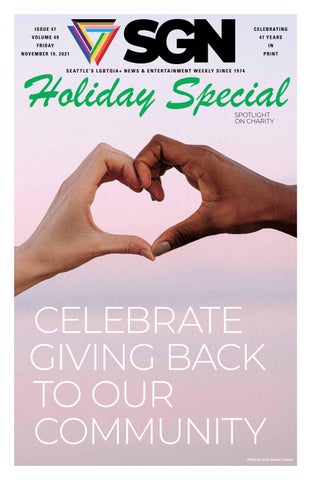
CELEBRATE GIVING BACK TO OUR COMMUNITY Photo by Anna Shvets / Pexels
2
SGN
NOV EMBER 19, 2 0 2 1
C E L E B R AT I N G 4 7 Y E A R S!
VISIT US ONLINE SGN.ORG
NOV EMBER 19, 2 0 2 1
SGN
3
4
SGN
NOV EMBER 19, 2 0 2 1
C E L E B R AT I N G 4 7 Y E A R S!
VISIT US ONLINE SGN.ORG
NOV EMBER 19, 2 0 2 1
SGN
5
Holiday Special
The Ally League makes an impact this Christmas
Photo courtesy of The Ally League
Photo courtesy of The Ally League
by Janice Athill SGN Contributing Writer With Christmas on the horizon, many of us are making gift lists and checking budgets. When pondering stocking stuffers or thoughtful, useful gifts for close friends, neighbors, or that teacher you adore, consider the Ally League. This wonderful website features products from Black-owned businesses that also meet every need you can imagine, be it edible treats like cookies, candies, snacks, beverages, or barbecue sauces, or self-care items like candles, body butter, lip balm, or nail polish. Even niche items such as custom
apparel, comic books, or self-love books can be found at this gift giver’s paradise. Founded during the pandemic by activist and biotechnologist Kesha Rodgers and fellow biotechnologist and entrepreneur Sara So, the Ally League has a mission to combat racism by helping allies move from empathy to action. The two friends gave birth to this place that brings together products from Black entrepreneurs and presents them to allies who might not know about them. Their goal? To make an impact on the community by supporting and amplifying Black-owned businesses. They believe that having allies include more Black-owned businesses in their buying behaviors can
help stimulate the economies of our communities. These two women have created a purpose-driven organization and have made sure that the Ally League stands by their values. They believe that everyday actions add up to bigger changes over time and have dedicated themselves to pinpointing shifts we can all make in our behaviors that move us away from racist systems. Despite their primary focus being racism toward Black people, they also recognize that any non-white person can feel its impact. Because of this, whenever they can, the Ally League uses Black and minorityowned companies for their vendor needs.
Photo courtesy of The Ally League
VISIT US ONLINE SGN.ORG
NOV EMBER 19, 2 0 2 1
They work to make authentic connections across races and believe this will ease the path to a world free of racism. They place an emphasis on communication as a tool for lasting change and share content to help educate and amplify voices, with the goal of bringing the conversations to new places. They have prioritized local action and understand that creating lasting change starts with the impact we can make in our communities. Support The Ally League So, if you need affordable items for stocking stuffers or prepacked gift sets, the Ally League has you covered. Single items range from $2 drinks to a $150 in-person serenade-a-gram (virtual options are available), with a wide range of gifts and prices in between. The $6 handcrafted napkins are eye-catching, and the $25 “Brilliant or BS” trivia game seems like a great addition to any game night. But one of the best options the site carries is its Black Boxes! These preselected boxes start at $25 for the Puget Sound Snack Edition, which includes a 4 oz. pack of spicy candied pecans from the Brown Pecan in Tacoma, a 12 oz. can of sparkling flavored water from Hunniwater in Edmonds, and a 2 oz. pack of crispy plantain chips from Miss Marjorie’s in Seattle. While there are $50 and $75 Black Box options as well, the Bold Black Box and Big Black Box (both $100) offer 7–13 items, perfect as a gift for one person or a set of gifts for a number of people. Don’t like the particular item selections? Build your own Black Box with a minimum of four products for no additional cost than the items you choose to add. The company will provide the box and packing, and wrap it with a bow to create your perfect custom gift. So, this year, while going down your Christmas list, focus on the importance of being an ally and contributing to our community in a meaningful and impactful way. But, in the words of Kesha and Sara, remember, allies aren’t saviors. They just use their privilege to help those without it, even if it disadvantages them as a result.
SGN
7
Holiday Special
Northwest Harvest Feed hungry Washingtonians this holidays season — and beyond 8
SGN
NOV EMBER 19, 2 0 2 1
C EPhoto L E Bcourtesy R AT I NofGNorthwest 4 7 Y E Harvest A R S!
Photo courtesy of the Seattle Mariners
by Paige McGlauflin SGN Contributing Writer For Northwest Harvest, a Washington state nonprofit dedicated to hunger relief through food assistance and advocacy, the holiday season is one of the busiest times of the year. “We see increased usage of food banks at holiday time regardless of a pandemic or not — that’s been a trend. And of course, more attention tends to be paid to places like food banks and other services for folks at holiday times,” Laura Hamilton, chief advancement officer with Northwest Harvest, told the SGN. Food insecurity in Washington remains at high levels, with 27% of the state’s residents experiencing it compared to 10% before the COVID-19 pandemic, according to a study from the University of Washington and Washington State University published this July. “We’re still finding that for households earning less than $35,000 a year, food insecurity is actually continuing to go up significantly,” Hamilton said. Households with children, as well as BIPOC, transgender, or nonbinary people, have reached the highest levels of food insecurity during this pandemic. Though
VISIT US ONLINE SGN.ORG
some hope can be found in the expanding vaccine rollout and improving job markets, factors such as eviction moratoriums reaching their end have left some to contemplate what assistance may be needed in this time of flux. For those looking to take action, Northwest Harvest offers several ways to get involved with hunger relief. Here are three that interested Seattleites can help combat food insecurity: 1. Organize a fundraiser, or donate money or food. “We’re grateful to be able to receive financial contributions from people having a holiday party or doing an online crowdfunding campaign with their friends. We’re able to [give] people the tools to do that,” Hamilton said. Due to the pandemic, Northwest Harvest has temporarily suspended its donation drive program; however, a virtual “FUNDraiser” can be organized instead. Using the organization’s website, an individual or organization-wide virtual fundraiser can be set up in a matter of clicks, with promotion over social media and email encouraged. For those interested in donating food outright, Northwest Harvest asks donors to select shelf-stable foods that are low in sodium, sugar, and saturated fats. A list
with examples of items to consider can be found under the “Ways to Give” menu on the website, along with a list of public drop sites accepting non-perishable food donations year-round. 2. Sign up for advocacy. Much of the work Northwest Harvest does focuses on advocacy and generating change through legislation. One recent push, for example, was for Washingtonians to join the campaign to establish food as a basic human right in the state. Recently, Maine was the first state to pass such a measure, after voters approved Question 3 in the Nov. 2 general election. “One of the biggest things… to us right now is improving equity in our food system. We have an advocacy team who [are] consistently working on ensuring that SNAP benefits, for example, are at appropriate levels and… that kids have access to universal free meals in schools,” said Hamilton. For those needing help with their first steps into food security advocacy, Northwest Harvest offers multiple resources on its website. Under the “Get Involved” menu, there’s a suite of tools, including a legislation agenda, a search tool one can use to identify legislators by ZIP code, and an option to sign up for advocacy alerts, which are prompts to call or email elected
NOV EMBER 19, 2 0 2 1
officials and advocate for a particular campaign Northwest Harvest is working on. 3. Add volunteering with a food pantry to your New Year’s resolutions. The holidays are a popular time to sign up and volunteer with local nonprofits. Northwest Harvest has volunteer opportunities available at its SODO Community Market here in Seattle, and with regional distribution centers across the state. But with social distancing guidelines still in place, most volunteer shifts with Northwest Harvest are currently booked, Hamilton said. However, people can still apply to volunteer at any time, and availability often opens up following the holiday season. “Everyone’s thinking about volunteering at the holidays, and then the middle of winter is when people tend to forget about it,” said Hamilton. Those interested can apply to volunteer as an individual or group on Northwest Harvest’s website, under the ‘Get Involved’ menu. “It can be that the holiday season is the time that sparks your thoughts about it,” Hamilton said. “And then what [is] your plan for the long term?” For access to all resources listed above and more, please visit Northwest Harvest’s website at www.northwestharvest.org.
SGN
9
Holiday Special
That’s Amore & Dining Out for Life Giving back, including $1,500 for Lifelong 10
SGN
NOV EMBER 19, 2 0 2 1
C E L E BPhoto R ATcourtesy I N G 4of7Guy Y EDevillier A R S!
Photo courtesy of Guy Devillier
by Kylin Brown SGN Contributing Writer Keeping the spirit of giving alive during the pandemic has proven difficult, but for Guy Devillier and David Hoefer, current co-owners of That’s Amore Italian Café, this challenge has also paved the way for innovative new approaches to give back. Their latest motto spins community hardship around to reflect on a small privilege: “We get to carry others.” Twenty years after meeting on the street at Seattle Pride, the couple — who said they never planned to be restaurant owners — have brought That’s Amore back to life from the verge of being shut down, and fortified its
status as a Mt. Baker neighborhood treasure. When the previous owner, Paul McMillion, passed on the business, Devillier and Hoefer were already established community members who dedicated countless hours to the people around them. Now, in their time of need, that same community raised over $43,000 to help keep the restaurant’s doors open. It is no surprise then that, even while receiving government funds to get That’s Amore through the pandemic, the duo never lost focus of who they serve. “We thought, we’re getting all this, we have got to give back to the people that support us also. We have a great neighborhood community that has supported us through everything we’ve gone through,” said Hoefer.
Dining Out for Life, more than one night a year Dining Out for Life is an annual fundraiser that partners local restaurants with HIV service organizations in order to benefit both. This year, DOFL was September 30, with over 50 Seattle restaurants participating to fundraise for Lifelong. That’s why That’s Amore, still seating diners at a limited capacity, thought that perhaps one night wouldn’t be enough for such an impactful campaign. In their typical above-and-beyond fashion, Devillier and Hoefer devised a head-start for their restaurant’s 2021 participation. That’s Amore partnered with Cigna, which promised to match each donation,
Photo courtesy of Guy Devillier
VISIT US ONLINE SGN.ORG
NOV EMBER 19, 2 0 2 1
and thus began a weeklong Dining Out for Life. Twenty percent of sales each night went directly to Lifelong, and customers were asked to privately match the 20% gratuity on their bill on top of that, so that in total up to 40% of each night’s sales might go directly to Lifelong. By the end of the week, the limited-capacity restaurant had $750 for Dine Out for Life, which was then matched by Cigna (for a total of $1500), and customers finished their meals knowing that their 20% donations were being doubled. Though Devillier and Hoefer don’t know the total of the additional private donations, they can confidently say their work paid off, with a total of at least three times their original pledge of $500. Role models for giving, all year round This isn’t the first time the couple decided to facilitate charity work at That’s Amore. On Juneteenth, for example, they launched a social media campaign for their customers to support the Northwest African American Museum’s Unity Fund. They raised hundreds of dollars in one night, with some patrons making additional private donations. “What these trying times have taught us is that people still want to be part of a big give, even if its just a few dollars,” Devillier said. “People are just looking for that little space, so we thought we’d create a space for people to do more than they originally thought they could.” During the lockdown, they also offered free meals to anyone in need who approached them, and helped to feed frontline medical workers with Feed the Fearless and We Got This Seattle. “It means everything to us that we get to provide such a special place where moments like this are possible,” said Hoefer. That’s Amore is located at 1425 31st Ave. S, just south of Mt. Baker’s scenic viewpoint. The owners would be thrilled to host you or place a to-go order — and they are currently plotting their next “big give” as the holidays approach.
SGN
11
12
SGN
NOV EMBER 19, 2 0 2 1
C E L E B R AT I N G 4 7 Y E A R S!
VISIT US ONLINE SGN.ORG
NOV EMBER 19, 2 0 2 1
SGN
13
Holiday Special
Give the gift of life with
POCAAN
14
SGN
NOV EMBER 19, 2 0 2 1
Photo courtesy of POCAAN C E L E B R AT I N G 4 7 Y E A R S!
Photo courtesy of POCAAN
by Lindsey Anderson SGN Contributing Writer The year was 1987. Dirty Dancing hit the theaters, Michael Jackson topped the charts, Baby Jessica fell down a well, and 4,135 people died of the HIV/AIDS virus. This was also the year the People of Color Against AIDS Network (POCAAN), founded as a response to the lack of information and resources in King County, first opened its doors in Seattle. With its work rooted in HIV prevention, POCAAN started a journey fueled by love, extending its hand to those most affected by the epidemic: LGBTQIA+ people, impoverished people, and people of color. For the last 29 years, POCAAN has served some of King County’s most vulnerable communities, providing healthcare and disease testing. A year into its existence, it launched the “Famous Last Words” campaign, a dark wake-up call for many who did not understand the dangers of unprotected sex. Karen Hartfield, one of POCAAN’s founding board members, spoke about the success of the first ad campaign. “We had TV PSAs, we had billboards all over the place… One of our earliest campaigns’ tagline was ‘AIDS is a white man’s disease — famous last words.’” Expanding its outreach The next step in its community education and outreach was to provide informa-
VISIT US ONLINE SGN.ORG
tion about safe sex to Seattle’s homeless population. In 1989 POCAAN received renewed grant money, allowing it to connect with homeless youth, who were predominantly LGBTQ+, and conduct more research on the ways HIV was spreading throughout King County. The organization soon realized that HIV was not strictly a “Gay disease” and that people in heterosexual relationships who did not identify as LGBTQ+ were still contracting it. Social research found that this spike was coming from “men who were living in heterosexual relationships and marriages but were having sex with other men on the side.” POCAAN then again expanded its outreach to other communities. “There were women in the sex industry, and then the other population was homeless or street youth,” Hartfield said. “They were at risk because they were maybe trading sex for a place to stay or maybe looking for affection from an adult because they had been kicked out of their homes and that sort of thing. “Also, we focused on Gay men who used methamphetamine, which continues to be the highest-risk population for HIV, even now, and that was a population that was much more underground and harder to reach. Then we also focused on Gay men who identified as Gay but also continued to have risky behavior.” After that, POCAAN realized it needed to focus on racially marginalized communities often excluded from LGBTQ+ cir-
cles, which tended to be very white. While white Queer people were starting to understand the dangers of the disease, Seattle’s Black, Latinx, and Indigenous communities were seeing HIV spikes. “I was mostly working with the African American community at the time, and there was no perception that it could impact the community at all,” Hartfield said. “In the eyes of the community, it was a Gay problem. Especially then, a lot of African American Gay men weren’t out to their families, so it was like, this is a white problem, too. Overcoming all of those problems was challenging.” Overcoming stigma Ads such as “Girlfriends Talking” helped normalize homosexuality in racially marginalized communities and spread awareness that HIV was not a strictly Gay or white disease. Still, POCAAN continued to face the challenge of the overlapping stigma that came with being Gay and HIV positive in the early ’90s. As Robert Wood, another early member of POCAAN’s team remembers, “It was hard for people to be openly Gay and accepted within their community. If we could get minority communities more accepting of homosexuality, it would do a lot to decrease the transmission of HIV in those populations. That’s a need that continues. The stigma of homosexuality is more damaging than the stigma of HIV.”
NOV EMBER 19, 2 0 2 1
Addressing related issues Originally an organization meant to serve Seattle’s HIV-positive community, the brilliant people behind POCAAN soon realized that HIV has significant correlations to related issues, such as substance abuse, incarceration, homelessness, sexually transmitted diseases, racism, sexism, and homophobia. Today, the organization works to combat all of these issues, and its programs are geared toward education, outreach, HIV prevention and awareness, criminal justice, and health advocacy POCAAN’s strength lies in its ability to provide services that are culturally competent to diverse populations. This is possible because of nearly all-BIPOC leadership boards and program directors. Today, its work includes a mobile HIV testing station, which provides 99.8% accuracy within 60 seconds; the Trans Economic Project, which seeks to empower and assess the needs of the Black Trans community; and the Best Start for Kids Youth and Family Homeless Prevention Initiative, which addresses the disproportionate number of LGBTQ+ youth facing homelessness, among many more. If you’re looking to support an organization with a rich history in Seattle and a drive to help all marginalized communities in King County, consider donating to POCAAN this holiday season. Find POCAAN online at www.pocaan. org.
SGN
15
Holiday Special
Santa Claws is Coming to Town Help cats find their forever home with Friends of the Animals 16
SGN
NOV EMBER 19, 2 0 2 1
Photo theEAnimals C E L courtesy E B R ATofI Friends N G 4 7of Y A R S!
Both still available for adoption! – Photo courtesy of Friends of the Animals
by Lindsey Anderson SGN Contributing Writer Love in its simplest and purest form can always be found in the heart of an animal. They provide us with comfort, entertainment, and unwavering loyalty. Yet too often, loving animals face unimaginable suffering at the hands of humans. In the United States, 73 million cats are unowned, either wandering the streets or spending their time behind bars in animal shelters. Due to a lack of space, many cats that enter shelters never make it out. Each year approximately 1.5 million animals are euthanized in shelters due to overcrowding. Of this, 860,000 are cats.
In Seattle, a dedicated group of volunteers were heartbroken over these statistics and decided to do something about it. In 1997 Friends of the Animals, dedicated to serving some of the most neglected creatures in our community, was launched with a mission to reduce the number of cats that spend their days in King County animal shelters. Since then, they have successfully placed 6,000 cats and kittens in loving homes. Helping cats (and their owners) in need Friends of the Animals knows that one of the leading contributors to the high euthanasia rate is overpopulation. When
pet owners fail to spay and neuter their animals, they risk producing unwanted puppies and kittens, which fill up shelters. Baby animals tend to find homes quickly, but the result is fewer available homes for older pets, who are already more likely to face euthanasia. Unspayed and unneutered cats lead to an even bigger problem: a feral population. While a domestic house cat has a typical life span of 16 years, a feral cat’s is just half that at most. Even so, one unspayed feral cat can still lead to over a hundred offspring. Friends of the Animals conducts humane trap-neuter-return (TNR) procedures to help feral cats. The organization will catch the animals, perform the pro-
Still available for adoption! – Photo courtesy of Friends of the Animals
VISIT US ONLINE SGN.ORG
NOV EMBER 19, 2 0 2 1
cedure, and — for those that are unable to integrate into domesticity — release them back to where they were found. Younger cats and kittens able to adapt and socialize are placed in foster homes where they can learn to become house cats and eventually find their forever families. Friends of the Animals does more than just spay/neuter and adopt out cats. It also provides affordable care for cat owners facing homelessness and has also begun transporting cats to Washington from kill shelters in California. Education, volunteer opportunities, adoption Education is an important aspect of Friends of the Animals as well. That’s why it provides information to the community regarding the rights of animals; resources for those with a limited income; volunteer opportunities to rescue, care for, and foster pets; the importance of spay/neuter clinics; and the steps all pet owners should take before welcoming a new member into the family. Community support is essential to the organization, which is entirely volunteerrun. Volunteer work can range from staffing a weekend event to cleaning out cages or even bringing home kittens to socialize before they are ready to be adopted out. Friends of the Animals pays for all the expenses related to fostering their cats, including food and vet bills. For those interested in adopting, the fee Friends of the Animals charges covers all vaccines and the cost of a spay or neuter procedure, all of which are done before the animals are available to be taken home. As of right now, Friends of the Animals is also running a special in which seniors (those 50 and older) can adopt any senior cat (age five and older) for just $25, which defrays much of the cost the organization has to pay out of pocket for these animals’ healthcare needs. If you are interested in bringing home a new friend for the holidays or looking into opportunities to volunteer or foster, Friends of the Animals is always in need of more animal lovers to help. Contact Friends of the Animals at (206) 719-4864 or info@fafseattle.org.
SGN
17
Holiday Special
Seattle-based anti-bullying nonprofit
Free2Luv empowers at-risk youth 18
SGN
NOV EMBER 19, 2 0 2 1
C E L E B Photo R AT courtesy I N G 4 7of Free2Luv Y E A R S!
Photo courtesy of Free2Luv
by Hannah Saunders SGN Contributing Writer Free2Luv is a Seattle-based nonprofit organization founded in 2011 that uses the arts to empower and uplift youth struggling with bullying, intolerance, identity issues, emotional distress, self-loathing, and selfharm, while instilling hope and letting them know that they are not alone. It uses music, art, film, dance, storytelling, and social media to initiate conversations and raise awareness about the impact bullying has on students. “We utilize the arts to empower youth to take up a badge of courage and break down social and emotional barriers,” Free2Luv states on its website. “Art is a universal language that enables us to be more insightful about the world we live in,” Free2Luv says in a blog post. “It allows us to heal and to see truth in our-
selves that we may not have understood before. Evidence-based research shows that artistic expression can be exceptionally healing, as it gives youth the opportunity to adopt new healthy coping skills that lead to a higher sense of self-worth.” According to Free2Luv, one in three children report that they have been bullied at school, while 30% admit to bullying others. The number of youths experiencing mental health disorders has more than doubled in the past ten years, and only 20% of those affected are receiving assistance. Suicide is the leading cause of death for those 10–24 years old. Gay, Lesbian, and Bisexual youth are four times more likely to attempt suicide compared to their straight peers, while Transgender youth are about 12 times more likely, according to the organization. Fighting isolation
and increasing self-love Advocacy and story sharing is a large focus of Free2Luv. It mentors peer-to-peer interactions with youth in 34 states and 23 countries. Youth mentors share their stories while encouraging kindness in order to create change. Part of Free2Luv’s story-sharing system consists of YouTube videos in which victims of bullying can share their experiences. It also has an online blog that reaches hundreds of thousands of readers across the globe, according to the nonprofit. Blog topics include bullying, empowerment, LGBTQ mental health, suicide prevention, and news and events. A few examples of blog posts include “5 Things You Should Do When You See Someone Being Bullied” and “Benefits of Drawing & Doodle Sketching with No Rules.” Free2Luv believes that the common struggles that lead to youth experiencing
Photo courtesy of Free2Luv
VISIT US ONLINE SGN.ORG
NOV EMBER 19, 2 0 2 1
emotional and mental distress are low selfesteem and a lack of self-love. As a result, the organization also strives to let youth know that they are not alone in their experiences. It sends empowerment packages to youth in crisis to provide them with safe spaces and tools, in addition to creating platforms for story sharing. It has an arts and music program that has impacted over 35,000 students who are underresourced. The program is brought to schools, community centers, and festivals across the country. Free2Luv has sent out over 20,000 “We Care” packages to youth who are struggling with bullying, self-harm, and identity issues. They include personalized messages letting the youth know they are not alone, as well as creative expression journals. The nonprofit is able to fund these care packages through its shop and donations. Some products on offer include expression books, activity books, T-shirts, beaded or rubber bracelets, fake tattoos, and pendant necklaces. The activity and expression books assist youth who are experiencing anxiety and a fear of the unknown. Donations help those experiencing confusion, rejection, and isolation. According to the oraganization, a $25 monthly donation allows youth access to the arts program, which fosters a safe space for the youth to increase their creativity, gain confidence, and develop healthy coping mechanisms. A $50 monthly donation provides children with a signature empowerment package that includes inspirational products, personal messages letting them know they are not alone, and a creative expression activity book. As Free2Luv puts it, “No gift is too small.” Another way to support these initiatives is through Amazon Smile. A free Chrome extension called “Smilematic” automatically provides 0.5% of one’s Amazon purchases to Free2Luv. Furthermore, Free2Luv has launched a global campaign called “Million Sign Mission” so people can take a stand against bullying. The organization encourages you to print out its “FRIENDS DON’T LET FRIENDS BULLY” sign (which also comes in rainbow print), take a picture with it, and post it to social media with the hashtag #stopbullying. To learn more and give back to youth who are experiencing bullying visit https:// free2luv.org.
SGN
19
- SERVING SEATTLE SINCE 1976 VEGETARIAN HOME COOKING, WITH VEGAN & GLUTEN FREE OPTIONS BREAKFAST, LUNCH & DINNER LOCAL BEER & CIDER ON DRAFT + COCKTAILS HOMEMADE DESSERTS WITH NO REFINED SUGARS
6404 9th Ave NE JUST A FEW BLOCKS FROM ROOSEVELT LIGHT RAIL STATION
20
SGN
NOV EMBER 19, 2 0 2 1
C E L E B R AT I N G 4 7 Y E A R S!
HAPPY HOUR
Outdoor Seating Dog Friendly Lots of Free Parking
4-6pm Wed to Fri 11am-6pm Sat & Sun
ELEVATED COMFORT FOOD Voted Best Fried Chicken in WA State 2020 by Insider/Yelp Known for Awesome Fried Chicken & Cornbread Waffles, SpiSeattle Wings, The Gangster Gumbo, and The Champagne Margarita
4354 LEARY WAY NW » FRE-BAL, SEATTLE » (206) 659-4754 » STHOOLIGANS.COM
VISIT US ONLINE SGN.ORG
NOV EMBER 19, 2 0 2 1
SGN
21
Christmas Tree Sale November 21 - December 19 While supplies last Mon - Fri 3pm - 7pm | Sat - Sun 10am - 6pm Closed Thanksgiving Fresh trees from a small locally- owned Latino business
El Centro de la Raza Beacon Hill - North Lot 2524 16th Ave S Seattle, WA 98144
All are Welcome. We Don’t Just Say It. We Live it. St. Patrick’s Church is a welcoming, evolving Catholic Church located at the north end of Capitol Hill, 2702 Broadway E. We embrace all people as children of God and would like to invite LGBTQ community members to worship with us. As a parish, we have a strong emphasis on social justice and inclusion. This includes outreach to a women’s shelter, a supportive relationship with a faith community in El Salvador, weekly sign language interpreted Mass for the deaf and deaf-blind community, and welcoming developmentally disabled adults from the L’arche community. Our choir and dance troupe are an integral part of our expression.
2702 Broadway E. Seattle, WA 98102 · www.stpatrickseattle.org
This notice was paid by the St. Patrick LGBTQ+ Engagement and Accompaniment Circle of Parishioners, and several other Parishioners, who invite LGBTQ returning Catholics and others to join us in person or online. For more information about St. Patrick’s LGBTQ Circle of Parishioners contact John Dunn – dunn570@aol.com
22
SGN
NOV EMBER 19, 2 0 2 1
C E L E B R AT I N G 4 7 Y E A R S!
Happy Holidays!
VISIT US ONLINE SGN.ORG
NOV EMBER 19, 2 0 2 1
SGN
23
HUNGER
EQUITY
It Takes More Than Food to End Hunger
COMMUNITY
SOCIAL JUSTICE
ADVOCACY
FOOD JUSTICE
SYSTEMIC INEQUALITIES
MOVEMENT BUILDING FOOD INSECURITY
At Northwest Harvest, we know that hunger and poverty are issues that cannot be solved simply by giving people food. Through advocacy, activism, and determination, we address the systemic inequalities that keep many Washingtonians from accessing the nourishment they and their families need to thrive.
Join the movement for food justice in Washington! Give to Northwest Harvest today.
northwestharvest.org | @nwharvest