ISSUE 47
C E L E B R AT I N G
VOLUME 49
47 YEARS
F R I D AY
IN
NOV EMBER 19, 2 0 2 1
PRINT S E AT T L E ’ S L G B T Q I A + N E W S & E N T E R TA I N M E N T W E E K LY S I N C E 19 74
THE NEW ADVENTURES OF OLD MILO Hawker of religious paraphernalia
by Mike Andrew SGN Staff Writer Former homocon celebrity Milo Yiannopoulos has a new career: hawking statutes of the Virgin Mary. Yiannopoulos, one-time Breitbart commentator and star of his own traveling lecture circuit, now appears on a YouTube shopping channel run by the Catholic extremist organization Church Militant.
see MILO page 21
Photo by Julio Cortez / AP
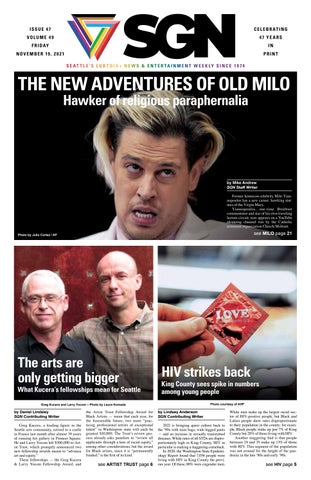
The arts are only getting bigger
What Kucera’s fellowships mean for Seattle
HIV strikes back
King County sees spike in numbers among young people Photo courtesy of AHF
Greg Kucera and Larry Yocom – Photo by Laura Komada
by Daniel Lindsley SGN Contributing Writer Greg Kucera, a leading figure in the Seattle arts community, retired to a castle in France last month after almost 39 years of running his gallery in Pioneer Square. He and Larry Yocom left $500,000 to Artist Trust, which promptly announced two new fellowship awards meant to “advance art and equity.” These fellowships — the Greg Kucera & Larry Yocom Fellowship Award, and
the Artist Trust Fellowship Award for Black Artists — mean that each year, for the foreseeable future, two more “practicing professional artists of exceptional talent” in Washington state will each be granted $10,000. The Trust’s review process already asks panelists to “review all applicants through a lens of racial equity,” among other considerations, but the award for Black artists, since it is “permanently funded,” is the first of its kind.
see ARTIST TRUST page 6
by Lindsey Anderson SGN Contributing Writer 2021 is bringing queer culture back to the ’90s with mini bags, wide-legged pants — and an increase in sexually transmitted diseases. While rates of all STDs are disproportionately high in King County, HIV in particular is making a staggering comeback. In 2020, the Washington State Epidemiology Report found that 7,056 people were living with HIV in King County the previous year. Of these, 86% were cisgender men.
White men make up the largest racial sector of HIV-positive people, but Black and Latinx people show rates disproportionate to their population in the county: for example, Black people make up just 7% of King County but 20% of those living with HIV. Another staggering find is that people between 24 and 35 make up 13% of those with HIV. This segment of the population was not around for the height of the pandemic in the late ’80s and early ’90s.
see HIV page 5
GREEN CARDS • VISAS • ASYLUM • CITIZENSHIP 1836 Westlake Ave N, Suite 302 Seattle, WA 98109
2
SGN
NOV EMBER 19, 2 0 2 1
(206) 724-1940 olivielaw.com
C E L E B R AT I N G 4 7 Y E A R S!
ORIGINALLY SEATTLE GAY NEWS FOUNDED 1974 MEMBER
509 10th Ave E Seattle, WA 98102 (206) 324-4297 sgnpaper@gmail.com sgn.org
2021
Deadlines Calendar | Tuesday at 6pm Display Ads Space Reservation | Monday at 5pm Ad Copy (non-camera ready) | Tuesday at 5pm Ad Copy (camera-ready) | Wednesday at 5pm Letters to the Editor | Tuesday at 5pm Obituaries | Call the SGN office All others | Tuesday at 5pm
Publisher Angela Cragin Managing Editor A.V. Eichenbaum Copy Editor SGN Staff • Richard Isaac Advertising Maggie Bloodstone, Advertising Manager National Advertising Rep. Rivendell Media (212) 242-6863 Staff Writers Mike Andrew • Sara Michelle Fetters Contributing Writers
Remembering George Bakan
Lindsey Anderson • Janice Athill Josephine Baird • Alice Bloch Maggie Bloodstone Kylin Brown • Sharon Cumberland Carter Hemion • Daniel Lindsley Paige McGlauflin • Tim Peter Jessica Price • Renee Raketty • Nick Rapp Hannah Saunders • Gaysha Starr Sarah Toce • Ed Walsh Social Media Manager SGN Staff Cartoonist Ken Campbell Photographers Nate Gowdy • Renee Raketty Production Mike Pham SGN is published by Angela Cragin. © 2021. All Rights Reserved. Reprints by permission. Publication of names, photographs, or likeness of any person, organization, event or business in this publication cannot be taken as any indication of the sexual orientation of the person, organization, event or business. Opinions expressed in bylined articles, columns, and letters are those of the authors only and do not necessarily reflect the views of the staff or management of this paper. SGN welcomes unsolicited material, including letters to the editor, but reserves the right to edit or reject material. All rights revert to authors upon publication. We assume no liability for loss or damage of materials, solicited or not. We invite feedback, please write. And please play safe. It is our policy that no money shall be refunded if you choose to cancel your ad. Credit will be given for the balance owed. No exceptions.
In Loving Memory Of George Bakan
Scott Roger Alpert Cookie Andrews-Hunt James Arnold Steve Foiles Shaun Knittel James Leland Moore Don Paulson Randy Peters Lee Richeson Shaun Shelton Jim Tully
Follow SGN
VISIT US ONLINE SGN.ORG
The community came together in person and online to celebrate the life of Seattle LGBTQ+ activist and former SGN Publisher George Bakan, on Saturday, November 13 at All Pilgrims Church on Capitol Hill in Seattle. Full video of the ceremony can be streamed at https://www.facebook.com/seattlegaynews/videos. – Photo by Kylin Brown
In this Issue
LOCAL NEWS 4 A&E • FILM 6 BOOKS 14 OP-ED 20 NATIONAL NEWS 21 INTERNATIONAL NEWS 21 NOV EMBER 19, 2 0 2 1
SGN
3
Local News
Nonprofit hosts protest outside of insulin manufacturer Novo Nordisk
Photo by Hannah Saunders
by Hannah Saunders SGN Contributing Writer T1International’s Washington Insulin4All chapter hosted an affordable-insulin protest outside of the manufacturer Novo Nordisk in South Lake Union on World Diabetes Day, November 14. T1International is a nonprofit organization that started the #Insulin4All movement to remove access barriers to insulin for diabetics. The Washington chapter was started in 2019 by type 1 diabetic Kevin Wren. Since then, Washington’s Insulin4All chapter has been protesting outside of Novo Nordisk in South Lake Union on every World Diabetes Day, which this year marks its 100th anniversary and falls on insulin codiscoverer Frederick Banting’s birthday. In July of 1921, Banting and his colleagues successfully isolated insulin; by January of the following year, it was first injected into a diabetic patient. Knowing how many lives it could save, Banting sold the patent to the University of Toronto for $1 so that it could be mass-produced and distributed. In the process, pharmaceutical company Eli Lilly and Co. was given rights. “Insulin does not belong to me; it belongs to the world,” Banting said. Price hikes One hundred years after the discovery of insulin, diabetics are still dying. Over the past thirty years, the three insulin manufacturers — Novo Nordisk, Eli Lilly, and Sanofi — have raised the price of insulin over 1200%, making it unaffordable and inaccessible to diabetics across the coun-
4
SGN
try. No other country in this world pays as much for this lifesaving hormone as the United States does. Currently a vial costs $6 to produce. In 1999 Humalog (made by Eli Lilly) was priced at $21 per vial, but in 2019, it was raised to $322 per vial, even though the formula has not changed at all. On average, diabetics use between two and four vials per month. Without insulin, type 1 diabetics like Wren can die within 48 to 72 hours. For all types of diabetics who rely on insulin, rationing and not taking it because it’s unaffordable leads to complications such as blindness, nerve damage, and kidney failure, among others. For diabetics, going without insulin is not an option — patients must pay the price, or they will die. “As one of the three insulin manufacturers, [Novo Nordisk reaps] billion of dollars from the sale of insulin alone,” Wren said. “Just in Q3 of 2021, they made $574 million from the sale of insulin. The US accounted for 25% of sales, yet we make up only 7% of the global diabetes population.” At the protest “We have lost too many diabetics to pharma greed!” shouted one protestor through a megaphone, followed by a chant honor the diabetic lives that were lost to insulin rationing: “Jeremy Warren Crawford. In memory! Kayla Breanne Davis. In memory! Micah David Fisher. In memory! Jada Renee Louis. In memory! Jesse James Lutgen. In memory! Jesimya SchererRadcliff. In memory! Andrew Michael Ramey. In memory! Allen Martin Rivas. In memory! Joshua Andrew Wilkerson. In memory! Antavia Lee Worsham. In mem-
NOV EMBER 19, 2 0 2 1
ory! Alec Raeshawn Smith. In memory! No more diabetics lost to high insulin prices!” About a dozen protestors of all ages were in attendance, including two children and an advocacy dog. Some were wearing blue — a color that represents those with diabetes — while others were seen wearing #Insulin4All facemasks. In the pouring rain, the protestors stood outside chanting and waving to passing cars for an hour while holding signs that said “Insulin4All” and “Access to insulin is a human right.” Travis Perkins, an ironworker, came to the protest with his type 1 diabetic wife, who held a sign saying, “Medicine is 4 people, not 4 profit”; his son, who brought a sign that read “You r worth it”; and his own bright red and yellow sign, which said, “This ironworker wants #Insulin4All.” Perkins came to the protest dressed in his ironworker gear, which included a bright orange vest and a hardhat. His son, who was also wearing orange, led a few chants through the megaphone such as, “Insulin for people! Insulin for all!” If there was anyone keeping the crowd’s momentum going, it was this kid. “My wife is a type 1 diabetic, so I know the struggles that go along with getting insulin and just having good blood sugar levels,” said Perkins. Perkins and his family also attended the protest last year; his son mentioned that he wants to come every year. His wife was also involved in an insulin protest outside of Eli Lilly headquarters in Indianapolis. What does Perkins hope for the future of diabetes? “Just raise awareness,” he said. “I educate people at work about it. You know, there’s a bunch of stigmas about diabetes —
like they didn’t take care of themselves, so now that’s why they have it.… It’s just not true at all.” Lots of cars were lined up at the intersection outside Novo Nordisk, and if drivers weren’t simply looking on, they were enthusiastically honking their horns. What appeared to be a bright red EMS SUV with its sirens flashing drove by and honked repeatedly at the protestors. Drivers rolled their windows down to smile, wave, and flash thumbs-up signals. A young adult in a tie-dye sweatshirt drove by honking and cheering in his car. Protesting and advocating “We’ve all had that story of rationing,” Wren said. “I mean, I’m sure you’ve seen it — where they switch your prescription and you’re at the counter and it’s all of a sudden a thousand dollars. What are we supposed to do?” Wren has been a type 1 diabetic for 20 years; his grandmother, father, and now brother have also been diagnosed with diabetes. “In 2009, I aged off my parents’ insurance, and the cost of my insulin was like, well beyond my rent, so I ended up rationing, and that has led to some complications, and I could’ve easily died,” Wren said. “That’s why I’m out [protesting] right now.” Wren advocates for the diabetes community, with hopes of free insulin someday, as well as access to diabetes supplies. A primary focus of his is to assist the uninsured and underinsured so that they can have access to insulin without being forced to pay the full list price. “Me personally, I help crowdsource insulin for people,” Wren said. “I’ll usually get
C E L E B R AT I N G 4 7 Y E A R S!
Photos by Hannah Saunders
messages on Facebook [about] somebody rationing or something like that, and then have to connect them with somebody who has a little extra insulin.” Going to extremes Diabetics across the United States rely on each other for survival. When they are unable to access or afford not only insulin but also medical supplies, they frequently turn to the diabetes online community, where extra insulin or supplies can be passed on for the sole purpose of keeping each other alive. It’s not legal, strictly speaking, although many diabetics justify it since that Big Pharma price gouging that results in the death of diabetics is legal (somehow). Moreover, diabetics across the country have resorted to traveling to Canada and Mexico in order to obtain insulin for a fraction of its cost in the United States. For
HIV
continued from cover So, what is causing this spike in HIV among young people, particularly young people of color? For one, it is a lack of testing. The CDC recommends that men who are sexually active and not in a long-term, monogamous, and HIV-free relationship get tested every year, but data reveal that this is not happening. Twenty-six percent of new HIV/AIDS diagnoses are “late,” meaning that the person affected has been living with the disease for a year. Sexually active but unknown carriers are the leading cause of HIV spread. A factor many fear may contribute to this spike in HIV is the winding down of the pandemic. Now that people have received their vaccinations and are beginning life again as it once was, they forget there are still other diseases to be feared. As a result, more cases of unprotected sex are happening. While forms of birth control can protect against unwanted pregnancies, they do not necessarily protect against all forms of STDs. In King County, rates of chlamydia have skyrocketed past HIV, with 8,290 cases in 2020. Gonorrhea cases are also on the rise, with 4,277 people having reported an infection. (While the 2021 numbers have yet to be released, doctors are already warning they will be much higher than last year’s.) These diseases are highly treatable, but the risk of contracting sexually transmitted infections (STIs) in the first place is reduced with protection (condoms).
VISIT US ONLINE SGN.ORG
most, a round-trip to Canada and the cost of insulin there is far less expensive than simply purchasing it in the US. Diabetics don’t have a choice: they are either forced to pay high prices, which can run up to thousands of dollars for a month’s supply, go to these extremes, or die. Legislative efforts Washington’s Insulin4All chapter has been making waves with the state legislature when it comes to the insulin crisis that is sweeping the nation. Prior to the 2020 legislative session, Wren met with Rep. Nicole Macri to introduce insulin copay caps (which only apply to those with health insurance). In March of 2020, House Bill 2662, which reduces the total cost of insulin to $100 per 30-day supply, was passed into law. Rep. Macri was one of the sponsors on the bill, and it went into effect on Jan. 1, 2021. Prevention Not only are STDs like chlamydia and gonorrhea preventable, but there are additional measures available for those who are sexually active and at an increased risk of HIV. King County recommends all men who have sex with men to use PrEP (preexposure prophylaxis) as a preventive measure to protect against the possible contraction of HIV. While the county’s goal was for 50% of these men to start using PrEP, only 47% have reported doing so. King County has attempted to make PrEP accessible to anyone who wants it. Public Health – Seattle & King County now runs a program at the Sexual Health Clinic that offers PrEP to people receiving STD-infected partner services, partners with community-based PrEP programs, and provides online resources. However, the numbers don’t lie. People don’t want to take PrEP. One of the issues with promoting this preventive drug is the stigma that HIV/ AIDS carries. For some, coming out is not a safe or plausible option. Taking PrEP, especially for teens and young adults who still live at home, risks possible outings, as the drug is not commonly used or advertised for straight people. The risk of HIV seems safer than the risk of a parent or guardian finding the medicine in the bathroom. Other factors Another issue facing members of the LGBTQ+ community is that those at high risk often don’t see themselves as high risk. Human nature is to assume that we are like the rest of the crowd, and when stories circulate about the dangers and risks of
“We successfully lobbied for them to include a person with diabetes to serve on the cost-control board created by the law — a first of its kind,” Wren said. This year, the chapter has been lobbying to lower the copay cap limit to (hopefully) $0. The chapter has also been trying to get technology and supplies covered and include a Kevin’s Law provision. Kevin’s Law was created after Ohio native Kevin Houdeshell died in 2014 from rationing his insulin. During the holiday season, Kevin needed a new insulin prescription, but he couldn’t get in contact with his doctor. He attempted to get it at the pharmacy but was turned away without a prescription. He began rationing his insulin in hopes of contacting his doctor in a few days, but he died alone in his apartment. Following his death, his family advocated for emergency prescriptions refill legislation across the United States and
since, over 17 states have passed such laws in honor of Kevin. As for the future of insulin and diabetes supply access in the state of Washington? “Last year, California passed a bill allowing them to manufacture and distribute generics and biosimilar insulin. We lobbied our elected [officials] to follow their lead to address drug affordability,” Wren said. “While insulin was our focus, we also know that drugs are unaffordable for so many, and the market lacks competition. SB 5203 was introduced, and through our testimony, they amended the law to specifically name insulin. It passed, and now we might see a Washington-branded insulin.”
COVID-19, which affects straight people just as much as LGBTQ+ people, we tend to ignore the other epidemic that has been ongoing for most of our lives now. We make justifications for ourselves and tend to believe we are smart enough, safe enough, and resourceful enough to avoid HIV. Often people associate the disease with drug use and will assume that if they are not partaking, their risk is low. This is not true. Furthermore, there is a lack of education. For many, serious education on HIV doesn’t come until after they have tested positive. Conversations around STD risk are difficult to have. Often parents and administrators shy away from such topics, fearing they may promote sexuality in their teens. These conversations can also take on a “slut-shaming” tone when not approached with tact.
tions. People often fear judgment, which prevents them from getting help. With marketing taking on an “us” vs. “them” mentality, people disassociate themselves from those at risk. Another way to understand people’s hesitation to take PrEP is to look at the breakdown of targeted advertisements. With commercials and in print ads often showing men in same-sex relationships and Black men, those in both communities can feel as though they are unfairly made the face of HIV. After all, the disease does not discriminate. People of all races and sexualities are susceptible to HIV and should be taking precautions to protect themselves. But even if the disease does not discriminate, the medical industry still does. BIPOC and LGBTQ+ people are less likely to receive preventive care when they ask for it and often receive lower-quality care. There are important steps to be taken by the medical industry, King County’s public education system, and individuals to combat the increasing spread of HIV. While people cannot change such large industries overnight, we can usher in social change that will aid in the fight against HIV. This means destigmatizing conversations around sex and sexual health, using protection and preventive medications, and getting tested every year. By taking these steps, we can save lives and stop the AIDS epidemic from rising again.
Strategies Professionals at the AIDS Health Foundation disagree on what must happen to combat the high STI numbers in Seattle. The CDC reports that one in five Americans are living with an STI, but doctors from the AHF estimate that the numbers here in Seattle are closer to 40%. “Where we are as a society in terms of sexual health is dire,” said AHF worker Howard Russell. While some say tactful conversations are the answer, others think that the high rates, which are continuing to rise, should sound the alarms and speak for themselves. Despite the different strategies, most can agree that the first step to decreasing high STI rates in King County is to create more safe spaces for sex-positive conversa-
NOV EMBER 19, 2 0 2 1
To learn more or get involved, visit www. t1international.com/usa.
If you need STI testing, the AHF is open Monday-Friday at 1016 E. Pike St. #100. A wellness center for those with STIs is set to open in January.
SGN
5
Arts & Entertainment
Artist Trust donors Greg Kucera and Larry Yocom at their first gallery in 1986, the year Artist Trust was founded. – Photo by Mike Seidl.
With the arts being so big in Seattle already, and seeing as Washington is a big place, two more artists being funded each year may seem insignificant to some — just a drop in the bucket, especially for those not involved with the scene. But those close to the Greg Kucera Gallery and the Trust don’t see it that way. As Seattle artist Anthony White said to Artist Trust about the development, “As a Black, Queer artist who has benefited from the direct support and generosity of both
Artist Trust and Greg Kucera and Larry Yocom, I see this generous gift as a reflection of their dedication to artists in this region.” White is a prolific, award-winning visual artist who works primarily in colorful PLA (a type of polyester). His pieces are often busy, and filled with symbols from pop culture and modern life. “This form of long-term support for artists of all backgrounds, but especially Black artists in Washington state, is encouraging and motivating,” White added. “There is no doubt in my mind that their donation will positively impact the community and region as a whole.” Another Seattle artist, Margie Livings-
6
NOV EMBER 19, 2 0 2 1
ARTIST TRUST continued from cover
SGN
ton, called the fellowships a “gift for the artists of the future.” Livingston, who has also been featured in the Greg Kucera Gallery, works in many media. Her pieces are broadly experimental. The statements of these artists aside, $20,000 a year adds up. In just five years, that funds another $100,000 of art in Washington. More art attracts arts people from all over the world, to either visit or move in. And as it turns out, the Seattle city government is tuned in to a lot of the same ideas as Artist Trust, with a 2019 report from the Office of Arts and Culture highlighting racial disparities in creative fields (which, by its judgment, do include soft-
ware development and computer programming). Seattle job growth in arts, design, entertainment, and media as a whole has outpaced software, programming, web development, and related fields. The report also estimates that for every job in a creative field, three other local jobs are created. These two fellowships are momentous on their own and as part of a larger trend. The arts are big in Seattle, but they’re only getting bigger. If the people in charge of this money fulfill their promises, and we hold them to their words, they will be more diverse, too.
C E L E B R AT I N G 4 7 Y E A R S!
Film
Horrific Feast is a tastily abhorrent supernatural dinner party
The Feast – Photo courtesy of IFC Midnight
by Sara Michelle Fetters SGN Staff Writer THE FEAST Theaters / PVOD With The Feast , director Lee Haven Jones and writer Roger Williams deliver a horrifyingly unsettling dinner party born from Welsh folklore. A supernatural commentary on humanity’s relationship with the plants and creatures of the Earth — and the gruesome repercussions when Nature rises up to deal with those who have wronged her — this film is a slow-burn descent into brutal vengeance and silent dread that quickly got under my skin. Glenda (Nia Roberts) is frantically getting ready for a big night. Spending some time away from the hustle and bustle of the city, she and the rest of the family — her memberof-Parliament husband Gwyn (Julian Lewis Jones) and two sons Guto (Steffan Cennydd) and Gweirydd (Sion Alun Davies) — have escaped to their expensive home in the Welsh countryside for a working vacation. They are preparing a lavish dinner for their farmer neighbors, hoping to convince them to allow mining on their land, most notably a secluded section of pristine wilderness that cuts through both of their properties.
VISIT US ONLINE SGN.ORG
Cadi (Annes Elwy) is the hired help for the evening. She arrives late and not in a car, walking up the driveway in a disheveled state. Glenda is the only family member to make note of the young woman’s appearance, mainly because she realizes Cadi will have to clean herself up before she can start working. Later on, Cadi observes the family while helping prepare for their party, almost as if she is judging them, for what reason no one but she knows. It’s not a spoiler to say that Cadi is not who she appears to be. What she is, however, I will not reveal. Just know that this woman will analyze every person at Glenda’s table, right down to their last molecule. She will study them, inside and out. None can escape her eye, and in the end, her decisions about their respective fates will be final, with no chance for reprieve or appeal. Jones and Williams have constructed a mesmerizing thriller, one that plays out like some ethereally chilling combination of Corin Hardy’s 2015 creepy Irish fairy tale The Hallow and Luis Buñuel’s immortal 1972 Academy Award–winning classic The Discreet Charm of the Bourgeoisie. With delicate sleight of hand, the filmmaker examines issues relating to classism, climate change, wealth inequality, sexism, and so much more with deliciously malevo-
lent precision. Jones also does not skimp on the blood and gore, making the resulting mixture of social commentary and ghoulish mystical terror beautifully upsetting on a primal level. The core of the story is the blossoming relationship between Cadi and Glenda. While I think it’s safe to say that there are attendees who are beyond salvation, a few could potentially live to see a new dawn. This is particularly true of Glenda. Cadi feels connected to her employer. She sings a song from the woman’s childhood. She finds an old tablecloth that belonged to her mother. It is as if Cadi is trying to remind Glenda of who she was before power and greed took root inside her soul. She is trying to allude to the balance that must exist between humanity and nature if both are to survive, trying to reconnect the woman with her cultural heritage that she once held so dear. Cadi tries to get her to see all of this and more, the only question being whether or not Glenda is going to realize what is happening before it is too late. Both Elwy and Roberts shine, each actor giving a multifaceted performance, even though the former utters precious few lines of dialogue while the latter apparently can’t stop talking even if her life depended
NOV EMBER 19, 2 0 2 1
on it. They play off one another beautifully, showcasing a subtle back-and-forth that evolves into something even more hypnotically disquieting as each course is served to and consumed by the evening’s attendees. While there are sudden jolts of violence and mysterious spurts of gore throughout, Jones keeps the pace measured and waits until the explosive final act before filling the screen with explicit explosions of mayhem. This does force the viewer to pay attention and try to keep track of which character is doing what at any given time. Doing so makes the climactic violence even more effectively harrowing, the last moments overflowing in a disturbingly hushed eloquence that left me sitting in stunned silence when it was over. Ghosts are real. Demons live in the hollow places of the earth. Vengeance is ready to take human form and restore balance to the natural world. These are some of the elements that appear to be at play in The Feast, and it is only by the process of elimination that the rules of this lethal game Glenda and her family are unknowingly playing can be understood. Make no mistake, as dinner parties go, this is as tastily abhorrent as any I’ve ever been to.
SGN
7
Film
An “unapologetically Welsh” experience Interview with director Lee Haven Jones and actor Annes Elwy of the environmentalist horror film The Feast by Sara Michelle Fetters SGN Staff Writer One lonely night in the middle of a secluded patch of the Welsh countryside, a wealthy family is having a dinner party for the farmer neighbors to discuss a potential business opportunity. Matriarch Glenda (Nia Roberts) has pulled out all the stops, insisting that her two adult sons — one a doctor training for a triathlon (Steffan Cennydd), the other a disaffected loner struggling with addiction issues (Sion Alun Davies) — be on their best behavior, while her politician husband (Julian Lewis Jones) has shot a wild rabbit he hopes will be served as part of the meal. Assisting them for the evening is Cadi (Annes Elwy), a lovely cook and housemaid who has been recommended to Glenda by one of her friends. But Cadi arrives seemingly by foot and is dirty from her trek up to the house. Nevertheless, after cleaning her up, Glenda puts the young woman to work immediately, and neither she nor the rest of the family questions why she would arrive for a job in such a disheveled state. A chilling tale born from Welsh folklore, the disquieting horror yarn The Feast is a slow-burn descent into madness that also happens to be an observational social satire that packs a pretty mean wallop. It is a tasty treat of terror that has a great deal to say about the world, and humanity’s self-destructive place in it, by the time things reach their peacefully apocalyptic conclusion. I sat down with director Lee Haven Jones and actress Annes Elwy to chat about their twisted little sojourn into the unknown. The following are edited transcripts of what they had to say: Sara Michelle Fetters: Lee, what was it about this story that got you interested in making the film? Lee Haven Jones: I kind of always wanted to make a feature, and I always wanted to make a Welsh-language feature. I also wanted to… share the heritage and culture of Wales with the world. It seemed to me that this was a great opportunity to do that. It’s sort of an amalgam of different
Lee Haven Jones – Photo courtesy of Notre Cinéma
kinds of folkloric Welsh tales, but also it has a very… contemporary edge. It has a message that, it seems to me, is global. It does… try to talk about that sort of environmental catastrophe that’s staring us in the face. So it seemed to have everything going for it, really. SMF: Annes, what was it that for you that attracted you initially to Cadi? Annes Elwy: It was instantly [apparent] that this was a script like something I’d never read before. Cadi’s a part that doesn’t speak very much, and yet she has all this influence over everybody. Obviously, as an actress, that’s quite appealing. But like Lee said, it’s a really Welsh pro-
Annes Elwy – Photo by Warren Orchard
8
SGN
NOV EMBER 19, 2 0 2 1
duction, and the script is unapologetically Welsh. That’s really rare. It’s fully Welsh. There’s no English, and also… Welsh folklore is such a big theme. So it’s a combination of all the things I’m really passionate about, and the script was really cool and exciting. This is one of those things I know I could have gone to watch and been absolutely gutted that I wasn’t part of. I’m just really lucky that I was. [laughs] SMF: I was trying to describe this film to some friends and talk to them about how much I loved it. I ended up describing it as this crazy combination The Hallow and The Discreet Charm of the Bourgeoisie. I wonder, what were the conver-
sations between you two like when you were discussing not just the film but the character and how you wanted Cadi portrayed? AE: How many human traits does she have? How many social cues does she pick up on? All of those things.... I think we disagreed slightly in the beginning of how much she would be able to imitate different characters. Whether she knows how to be humorous. Those sort of things. But very quickly we fell into the right swing of things, I think. LHJ: Yeah. I’d forgotten about our slightly different interpretation. The touchstone for me, with regards to Cadi, was Scarlett Johansson’s character in Under the Skin. Like Annes said, the questions surrounding her are about how much does she give away? I’m slightly obsessed as a director with the power of suggestion and with ambiguity. I think my… constant default notes were to embrace the ambiguity of a sequence or of a scene or of a situation. The other thing I’m obsessed with is reception theory, and how audiences bring their own baggage to bear and… project their own thoughts and feelings onto drama. I was keen to… allow the space for that to happen. I think it was Jacques Derrida who said, “Meaning is a function of context.” So, yeah, by putting all of these images together, then the audience sort of fills in the gaps. SMF: And that’s kind of the great thing about the film. We know as an audience something is up. Someone that is supposed to be there to help out for this dinner doesn’t just necessarily appear right on the lawn as if out of thin air. So we know something’s up. But there is such a slow burn to it. It’s putting pieces together: how does she fit in with this family and what are her intentions? I feel like for you, Annes, there is such an observational curiosity to Cadi. It’s as if she’s trying to figure out herself what she’s going to do throughout the film. Deciding what this family deserves. Am I reading too much into that? AE: I think it’s not wrong. Definitely. I think Cadi’s a very caring person. Obviously, she does these evil things, but maybe for the greater good. And you see that in
C E L E B R AT I N G 4 7 Y E A R S!
The Feast – Photo courtesy of IFC Midnight
when she saves Gweirydd’s life, too. She is a mixture of all these different emotions. She is predominantly Nature, but the human element comes maybe second. LHJ: What you’re saying about the slowburn nature of it, and the fact that we do seed a lot of the story visually very early on — but it’s only with the benefit of hindsight that you realize what’s happened — this does demand a lot from an audience. For example, when Cadi presents initially, when we see her at the bottom of the driveway and Guto is chopping wood… we see that her hair is sort of wet. It’s only… an hour later, I think, that we realize, ah! That’s why her hair was wet! But we never refer to the hair being wet. It’s just a visual cue, and I think the film is full of those. If people like it the first time around, then I’d like to think that they could go back and get even more from it on a second and third viewing as well. I think all those clues are there, sort of buried, or seeded, quite clearly. SMF: I guess that’s also why I compared it in some ways to a Buñuel film. The family, I mean: it’s like they notice, but they also don’t care. LHJ: I’m delighted that you’ve referenced that film, because that was very definitely… in the ether. I think you’re right. It’s also a lot of things. It’s a contemporary morality tale. It’s about the importance of being true to yourself and your people. It’s also a stark warning against the consequences of greed and avarice. It’s also about the environmental crisis. And, yeah, it’s also a film about class injustice. There’s a lot in there. It’s there to be unpacked. SMF: I think the core of unpacking all of that is the relationship between Glenda and Cadi. As I watched it — and I watched it again for a second time, just so that I could feel more comfortable about this observation — I feel like Cadi is giving Glenda every opportunity to
VISIT US ONLINE SGN.ORG
redeem herself and her family. At least most of her family. I don’t think her family can be entirely redeemed. But I feel like Cadi is giving Glenda this opportunity, which we almost don’t realize she’s getting until their dinner guest says, “Your mother taught you better than this,” or something like that. Was this something that you were playing on in that relationship between the two characters? AE: I think Cadi does. She gives Glenda all the tools to remind her of her heritage. I think that is Cadi’s role, to remind people of the importance of their heritage and the world that we’ve inherited. The culture that they’ve inherited. She shows them how easily you can slip into turning your back on things for money. I think you’re right. The case with Glenda is not lost. Cadi gives reminders, like putting the things out for the dinner, like her mother’s tablecloth. Little things. I think Glenda feels it, so I think you’re right to pick up on those things. LHJ: I think you’re absolutely right as well. Cadi’s not just a force for evil. I keep on thinking about nature, and nature is indiscriminate. It’s both benign and malignant. I think that’s Cadi in this story. I think she’s trying to teach them. The key moment for me is the end moment, which I think Annes plays beautifully: that complexity, after Cadi’s committed these heinous crimes against this family. She looks at the camera and is relieved that she’s done that. We realize the true cost of her actions, and also the family’s actions. Some people say to me that Cadi is this sort of malignant force. I think she’s far more complex than that. SMF: Nature is about balance, right? And this movie is about how we as humans, or at least a portion of humanity, has taken nature and put it out of whack, and Cadi is there to restore what she feels is that balance.
LHJ: Correct. AE: I think it’s interesting, after the year we’ve had, where all our human influence on the world was paused, we saw how nature just came back so quickly. Unfortunately, we’ve also seen that we’ve gone straight back, and all those good things have started to slip away already. But we have been reminded that nature can come back. If we just alter our behavior, we can save things. LHJ: You’re right, Annes. I think it’s fitting that the film is coming out this week in the aftermath of COP 26, where we’ve discussed… the environment and the future of the planet. I used to joke with my other half about the character. They used to say that Cadi is almost a… Greta Thunberg– type figure. I mean, she really is. She’s there as… our conscience. She’s there to provoke our conscience and to make sure that we do the right thing. SMF: Annes, after having watched you in The Toll and in 2017’s Little Women, I’m curious how much fun was it to play a character like this, that is so different from those more vocal and demonstrative women? AE: It was probably my favorite role so far. She’s so different from anything that I would usually get to play. The freedom that not speaking gives you is a real gift, and probably one that I won’t receive again. I loved it. SMF: Lee, I have to ask you, I know that the film has done well at festivals, but now that it’s going to be out there, both in theaters and on VOD, what do you hope viewers are talking about and discussing after they get a look? LHJ: I’m slightly terrified. [laughs] The takeaway, I think, is it has to be the environmental message. I’d love them to think it’s a brilliant film, but ultimately, I think as a film, it’s doing more than that. It’s a contemporary morality tale. It’s about being true to yourself. It’s a warning against ram-
NOV EMBER 19, 2 0 2 1
pant consumerism. But it’s also satisfying from a horror perspective. Let’s not forget that. It does deliver, I think, on its psychological terror and, for fans of the genre, I think that should keep them happy. Fingers crossed. SMF: Well, from a strictly horror perspective, as a child I almost cut my toe off with an axe chopping wood. LHJ: No! SMF: So you absolutely traumatized me at one point. I had childhood fears all racing back. It was exhilarating and awesome. And terrifying. So thank you for that. LHJ: Ha! Well that’s good. That’s nice to hear. When we are talking about the film, often I… revert to the loftier kind of messages and all the rest of it. But actually I just want people to enjoy themselves. That might sound superficial, but I don’t mean superficial. No. Not at all. I just like that the movie delivers scares and a modicum of terror. SMF: For you, Annes, what’s your takeaway? What has this experience meant for you, and what are you going to take from the film? AE: We had the best time making this film. We all really cared about what we were making, and we’d all gotten involved for the right reasons. We were very passionate about telling a story that had the ecomessages that we cared about, and that we were also giving a platform to the Welsh language. This will probably be the first time most people see anything in Welsh. Welsh is a minority language, and it quite often gets belittled and dismissed. It’s exciting for us that some people now will see it and value it and just enjoy a film in Welsh. I also think that really helps the horror element. People will feel that it’s unfamiliar to them. It unsettles people from the get-go. I think we’re just all really excited to see what happens to a film that has meant a lot to all of us.
SGN
9
Film
Intimate Passing an emotionally shattering affair
Passing – Photo courtesy of Netflix
I’m not sure that Passing, set in 1929, could feel any more of the moment if writer-director Rebecca Hall had gone out of her way to make it so. Adapted from author Nella Larsen’s classic novel written almost a century ago, this film is a profound, devastatingly precise examination of race, gender, self-acceptance, and sexual longing that grabbed my heart in its vicelike grip and then refused to let go. It is nothing short of masterful. Was it chance? Or fate? Either way, former childhood best friends Irene (Tessa Thompson) and Clare (Ruth Negga) have been reunited. Both women can “pass” as white, but Irene lives in Harlem and has married Brian Redfield (Andre Holland), while Clare is the wife of the wealthy and openly — almost proudly — racist John Bellew (Alexander Skarsgård). Irene isn’t sure what to make of this. She is fascinated and appalled by Clare’s decisions. Yet, is she also envious of her
old friend? It’s hard to tell, especially as Clare appears somewhat covetous of Irene and the life she is living. The simplicity of their high school days are long gone, and the unfathomable complexity of who they are now as young women, happy wives, and supposedly contented mothers is nothing more than an ephemeral façade neither can make heads or tails out of. Hall’s feature-length debut is an extraordinary bit of storytelling that only grows in spellbinding consequence as events move toward their shatteringly honest conclusion. Watching how Clare slowly and subtly insinuates herself inside Irene’s home, I was stunned to realize things were never going how I suspected they would. Each woman has very personal reasons for going through life as they have, and both balance truth with lies in a manner such that it becomes increasingly difficult to differentiate between the two as their reconstituted friendship begins to blossom into its former fruitful glory. I did have some early reservations. Hall’s choice to have cinematographer Edu Grau (The Way Back) shoot in black-andwhite at first feels like a pretentious trick. But I couldn’t have been more wrong about
10
NOV EMBER 19, 2 0 2 1
by Sara Michelle Fetters SGN Staff Writer PASSING Theaters / Netflix
SGN
that. There are multiple layers to the visual stylings, ones that substantially augment the emotional components as Irene and Clare’s relationship evolves. There’s more happening between the shadows than initially meets the eye, and Hall magnificently utilizes these shades of gray in a variety of captivating ways. What is slightly unexpected is how ineffective Skarsgård is. For whatever reason, I didn’t buy him as John. His coldly calculated racist villainy never felt entirely genuine. It was almost as if the actor couldn’t bring himself to venture into those dark, dangerous interiors that could allow his character to take insidious residence underneath the viewer’s skin. It can’t help but strike me as a missed opportunity. But the film doesn’t rise or fall on his performance. Instead, it is beholden to Negga and Thompson, and both rise to the occasion. The former has the showier role, but that does not make what she is doing any less monumental. Negga discovers unexplored recesses inside of Clare that are heartbreaking in their stark, unvarnished magnitude. She’s spectacular, maybe even better than she was in 2016’s Loving — which is saying something, because
that performance earned her an Academy Award nomination for Best Actress. Believe it or not, Thompson is even better. She’s been stellar for quite some time now, including in films as different from one another as Creed, Annihilation, Dear White People, Sylvie’s Love, and even Thor: Ragnarok. But Thompson is flatout mesmerizing as Irene. From her subtle physicality to her hushed vocal inflections, to the way she carries herself from one end of the frame to the other while wearing immaculately crafted costumes by Marci Rodgers (BlacKkKlansman), there’s nothing the actor does that didn’t floor me. This is one of the year’s best performances. Having never read Larsen’s novel (which I now fully intend to do), it does not surprise me to learn that Hall has stripped things down to their basic components, centering the story on Irene and Clare and excising almost everything else. That feels right. Their relationship is the core element that kept me glued to my seat. Passing lives in the brief looks that one woman wistfully gives to the other, and the hidden message behind each of these momentary glances is guaranteed to linger in my memory for a long time to come.
C E L E B R AT I N G 4 7 Y E A R S!
Nostalgia drenched Ghostbusters: Afterlife makes more good calls than bad
Ghostbusters Afterlife – Photo courtesy of Columbia Pictures
by Sara Michelle Fetters SGN Staff Writer GHOSTBUSTERS: AFTERLIFE Theaters Much Like Star Wars: The Rise of Skywalker, Jason Reitman’s Ghostbusters: Afterlife does feel like a studio-mandated change of direction to appease a vocal minority of cantankerously whiny manbabies who felt that a previous installment in one of their favorite franchises dared to ruin their collective childhoods. Unlike that disastrous last chapter in the Skywalker saga, this one is made with just enough love, care, and attention to detail that it still manages to entertain for most of its running time. This does not mean I approve of everything Reitman and his co-writer Gil Kenan (Monster House) have done here. A direct sequel to 1989’s Ghostbusters II, much of this film still comes across like a semicynical nostalgia play. The pair borrow liberally from the original 1984 hit, so much so I’m honestly surprised Dan Aykroyd and the late Harold Ramis don’t get full screenwriting credit and not just a “based on” card. Almost every scene has some sort of callback or clever Easter egg, while
VISIT US ONLINE SGN.ORG
the main villain and their mystical canine cohorts won’t surprise anyone even passingly familiar with the first film. Still, Reitman gamely steps into his father Ivan Reitman’s shoes and does his best to take the franchise in an amusing direction. While a long way from Tully, Juno, or Young Adult, the filmmaker shows a flair for big-budget tentpole theatrics. Better, he still knows how to ground his characters in the real world, making them far more intriguing than I anticipated. Reitman and Kenan mature the purposefully silly mythology dreamt up by Aykroyd and Ramis almost four decades ago considerably, giving this new story noticeable emotional heft. And, while ghosts do get busted, some tears get shed along the way as well. After being evicted from her New York apartment and in the same breath learning of the death of her estranged father, single mother Callie (Carrie Coon) uproots her children Trevor (Finn Wolfhard) and Phoebe (Mckenna Grace) and moves them all to Summerville, Oklahoma. Her dad left them his dilapidated farmhouse smack-dab in the middle of nowhere, and with few other options available, taking up residence there seems like a good idea. Callie’s dad was no eccentric dirt farmer, though. He was Egon Spengler, a
bona fide Ghostbuster, and he had moved to Summerville for a reason, a mystery that scientific prodigy Phoebe is on the verge of figuring out. With the help of new friend Podcast (Logan Kim), laid-back summer school teacher and erstwhile seismologist Mr. Grooberson (Paul Rudd), her brother Trevor, and the town sheriff’s daughter Lucky (Celeste O’Connor), she’s going to fit the pieces of this apocalyptic, supernatural puzzle together no matter what the consequences. Even with all the allusions to the previous films, the first half of this sequel is quite wonderful. Grace is outstanding, and Wolfhard, O’Connor, and Kim all lend solid support. Coon also has several strong moments, and while I do wish Reitman and Kenan’s script made better use of her character, the actress still makes a memorably lasting impression. As amusing as all of this is, I equally felt like the director sometimes forgot he was making a comedy. Taking things into Stranger Things–meets–The Goonies territory, Reitman eschews the anything-goes, improvisation-rich aesthetic Bill Murray, Ernie Hudson, Aykroyd, and Ramis brought to their ghostbusting endeavors. This means that the silly stuff, especially when it’s of the more risqué variety, tends
NOV EMBER 19, 2 0 2 1
to fall flat. This is particularly egregious during the climactic third act, when past and future collide, the worlds of Ghostbusters and Ghostbusters: Afterlife uncomfortably intermingling in a manner I found disappointingly forced. Reitman’s affinity for the property does ring true, however, and I’d be lying if I didn’t admit to breaking out in a wide grin on multiple occasions: when Phoebe engaged in a polite game of chess with an otherworldly visitor; when Trevor took a repaired Ecto-1 out to an empty cornfield for an energetic spin; when brother and sister, with an eager assist from Podcast, chased down a metal-eating Muncher through the streets of Summerville; and when Mr. Grooberson went all goofily weak in the knees at the sight of a working Ghostbusters’ trap. I wish the villain wasn’t a retread. The final-act reveals do not work very well. A spectral resurrection, while tastefully handled, is still awkwardly ghoulish. But Grace is a revelation, and the emotions at the heart of this tale are touchingly genuine. Ghostbusters: Afterlife makes more good calls than bad, and for some viewers, when there’s something strange going on in the neighborhood, giving this legacy sequel a look might be the way to go.
SGN
11
THIS AD SPACE HAS BEEN GENEROUSLY DONATED BY KRISTIN COSTELLO IN MEMORY OF SGN PUBLISHER GEORGE BAKAN 12
SGN
NOV EMBER 19, 2 0 2 1
C E L E B R AT I N G 4 7 Y E A R S!
VISIT US ONLINE SGN.ORG
NOV EMBER 19, 2 0 2 1
SGN
13
Books
A reader’s gift guide 2021: Books of all stripes
Photo by cottonbro / Pexels
by Terri Schlichenmeyer Special to the SGN You knew that you were going to have to finish your holiday shopping soon but it snuck up on you, didn’t it? And even if you’re close to being done, there are always those three or five people who are impossible to buy for, right? Remember this, though: books are easy to wrap and easy to give, and they last a while, too. So why not head to the bookstore with your Christmas List and look for these gifts? LGBTQ NONFICTION If there’s about to be a new addition to your family, Queer Stepfamilies: The Path to Social and Legal Recognition by Katie L. Acosta would be a good thing. In it, the author follows 40 LGBTQ families to understand the joys, pitfalls, and legalities of forming a new union together. It can’t replace a lawyer, but it’s a good overview. For the parent who wants to ensure that their child grows up with a lack of bias, Raising LGBTQ Allies by Chris Tompkins is a great gift. It’s filled with methods to stop bullying in its tracks, to be proactive in having That Conversation, and how to be sure that the next generation you’re responsible for becomes responsible in turn. Wrap it up with The Healing Otherness Handbook by Stacee L. Reicherzer, PhD, which helps readers to deal with bullying by finding confidence and empowerment. If there’s someone on your gift list who’s determined to get “fit” in the coming year, then give The Secret to Superhuman Strength by Alison Bechdel this holiday. Told in graphic-novel format (comics, basically), it’s the story of searching for self-improvement and finding it in a surprising place. So why not give a little nostalgia this year with A Night at the Sweet Gum Head by Martin Padgett? It’s the tale of disco, drag, and drugs in the 1970s (of course!)
14
SGN
in Atlanta, with appearances by activists, politics, and people who were there at that fabulous time. Add to that After Francesco by Brian Malloy, a novel set a little later, in the mid1980s, in New York City and Minneapolis at the beginning of the AIDS crisis. The LGBTQ activist on your gift list will want to read The Case for Gay Reparations by Omar G. Encarnacion. It’s a book about acknowledgment, obligation on the part of cis citizens, and fixing the pain that homophobia and violence has caused. Add Trans Medicine: The Emergence and Practice of Treating Gender by Stef M. Shuster, a look at Trans history that may also make the recipient growl. LGBTQ FICTION Young readers who have recently transitioned will enjoy reading Both Sides Now by Peyton Thomas. It’s a novel about a high school boy with gigantic dreams and the means to accomplish them all. Can he overcome the barriers that life gives him? It’s debatable... Pair it with Can’t Take That Away by Steven Salvatore, about two nonbinary students and the troubles they face as they fall in love. The thriller fan on your list will be overjoyed with Yes, Daddy by Jonathan ParksRamage. It’s the story of a young man with dying dreams of fame and fortune, who schemes to meet an older, more accomplished man with the hopes of sparking his failing career. But the older man isn’t who the younger thinks he is, and that’s not good. Wrap it up with Lies with Man by Michael Nava, a book about a lawyer who agrees to be counsel for a group of activists. Good so far, right? Until one of them is accused of being involved in a deadly bombing... For the fan of Southern fiction, you can’t go wrong with The Tender Grave by Sheri Reynolds. It’s the tale of two sisters, one homophobic, the other Lesbian, and how they learn to forgive and reconnect.
NOV EMBER 19, 2 0 2 1
Image courtesy of publisher
C E L E B R AT I N G 4 7 Y E A R S!
Image courtesy of publisher
GENERAL NONFICTION No doubt, there’s someone on your gift list who’s concerned about climate change. And so the book to give is Hurricane Lizards and Plastic Squid by Thor Hanson, a natural historian. Here, Hanson reveals how climate change is driving evolution. And what will happen to us? Pair it with A (Very) Short History of Life on Earth by Henry Gee, a small book that looks at the Big Picture, where we came from, and where we might go... For the reader who’s new to America, or for someone welcoming a new immigrant to these shores, look for A Beginner’s Guide to America by Roya Hakakian. Nearly 40 years ago, Hakakian came to live in America from Iran, and she noticed a few (ha!) differences that she writes about here. This book is a bit humorous, a bit tongue-incheek, and a lot helpful for new Americans and for Americans who were born here, so that we might see ourselves as others do.
Wrap it up with How Iceland Changed the World by Egill Bjarnason, about a small island with a big world footprint. The singer or orator on your list will devour This Is the Voice by John Colapinto. It’s a scientific look at the human voice, how it differs, and how our ability to speak and verbally communicate as complex as we can has made us the dominant creatures we are. Add to that The Invention of Miracles by Katie Booth, the true story of Alexander Graham Bell’s work with deaf people (including his wife). If there’s a new cook on your list (or someone’s about to strike out on their own), Burnt Toast and Other Disasters by Cal Peternell will be the perfect thing this holiday. It’s filled with recipes that are relatively easy, with lots of chance to impress and hacks to take care of those inevitable kitchen uh-ohs. And speaking of disasters, if your giftee is also concerned about health matters and
Image courtesy of publisher
the environment, give Toxin Nation by Marie D. Jones, a book about manmade disasters and how it affects our food, air, water, and health. Got an adventurer on your gift list? Then you can’t go wrong with True Raiders by Brad Ricca. It’s the story of the 1909 expedition to find the Arc of the Covenant, one that few know and that’s largely undiscussed. Someone will be overjoyed to see Latitude by Nicholas Crane in the same gift box. It’s the true story of a ten-year expedition that started in 1735, in which a dozen men journey to determine the shape of the planet. If you’ve got someone on your gift list who’s very interested in current and world events, then The Raging 2020s by Alec Ross might be the perfect gift. It’s a book that peers into our (possible) future in business, geographical issues, politics, and more. Pair it up with Broke in America: Seeing, Understanding, and Ending U.S. Poverty by Joanne Samuel Goldblum and Colleen
Shaddox. It looks into the future and offers ideas for hope. The person who’s concerned with racial justice will be glad you gave State of Emergency: How We Win in the Country We Built by Tamika D. Mallory. It’s an overall look at continuing racism in America, including what’s happened in the past year or so; it’s a demand to think and a call to action for everyone. Pair it with Better, Not Bitter by Yusef Salaam, a memoir as well as a call for racial justice. For the person who worries about gun violence in America today, The Second: Race and Guns in a Fatally Unequal America by Carol Anderson might be a good gift. In it, she reveals the real reason gun violence exists. Beware: it’s very controversial. If it seems like the last two years have fractured families, you’re right. That’s why Brothers, Sisters, Strangers: Sibling
see BOOKS page 16
Bisexuality: Trial and error on the road to happiness by Terri Schlichenmeyer Special to the SGN GREEDY: NOTES FROM A BISEXUAL WHO WANTS TOO MUCH JEN WINSTON © 2021 Atria $18.00 / $25.00 Canada 336 pages Back in the “aughts,” when Jen Winston was rocking her AIM handle and pretending to be boy-crazy, she had no word for liking boys and girls — though she knew she did. Had she questioned anyone, she would have been told that it was a phase, an experiment, or a matter of confusion — but she never asked. She instinctively knew that doing the “gay stuff” was hard. As she grew up and learned the word for what she felt, the idea of being with a woman became more appealing, but not quite comfortable. Yes, Winston quietly told herself, she was bisexual, but bisexual-
VISIT US ONLINE SGN.ORG
Photo courtesy of Atria
ity “never felt queer enough.” Besides, dating straight men was like the equivalent of “comfort food,” though it never worked and was really not much fun. Various roommates through the years participated in her search for love, though, by crowdsourcing answers to questions posed by online dates. They also looked the other way as Winston learned that selfpleasure could be ugly, and she didn’t want to be “U-G-L-Y.” She tried threesomes, but they were loaded with potential rejection. She tried chatrooms, but they were scary. She learned that “we” is a painful word when you’re not part of it. Bisexuality comes with a lot of frustrating myths, and bisexual people, says Winston, are sometimes not included in the LGBTQ+ community. Bi people aren’t especially promiscuous — they’re not trying to steal your partner from you — and they’re not all just white or female. What they are is well aware that dating sucks, fairy tales are hard to believe in, and that there are lots of different ways to be gay...
NOV EMBER 19, 2 0 2 1
You want it all: you want hearts-andromance but you also want down-and-dirty. You want to be heard, but you don’t want to talk about it. You want to be enough but not so much that it’s weird. And you want it with laughs, though that’s not the main thing about Winston’s book Greedy. While its cover indicates lightheartedness and Winston seems perfectly happy to tell funny, tongue-in-cheek tales about herself, Greedy sports a serious vein that almost feels like a shout. Winston writes of universal experiences — rejection, falling in love, vulnerability, and wanting so much to be adored — and she makes light of them in a way that clearly isn’t meant to be all that humorous. We can chuckle, yes, but she also lets us pretend that we don’t care about those hurts — even though, like Winston, we all know that we do. Be aware that there are chapters here that are very graphic and are very much not appropriate for just anyone. If Winston’s journey is your journey, too, though, Greedy is something to share.
SGN
15
Books
Image courtesy of publisher
BOOKS
continued from page 15 Estrangement and the Road to Reconciliation by Fern Schumer Chapman might be a great gift. Wrap it up for someone or for yourself. TV fans of that iconic Sunday night show will love getting Ticking Clock: Behind the Scenes at 60 Minutes by Ira Rosen, producer of the show. Fans and followers will love the behind-the-scenes peeks. The person who hopes to conquer fear in the new year will appreciate a gift of Professional Troublemaker: The Fear-Fighter Manual by Luvvie Ajayi Jones. Jones is a blogger and public speaker, and she knows how to take fear out of the equation. See how three words can make all the difference, and how to make good trouble. The reader who loves a good scare will enjoy The Vampire Almanac: The Complete History by J. Gordon Melton, PhD. Pretty much everything you’d ever want to know about the undead is in here. Dare to accompany it with A Very Nervous Person’s Guide to Horror Movies by Mathias Clasen, a book that picks apart those scary flicks and why we should (or shouldn’t) watch them. For the reader who dreams of life in the past or wishes to know the future, Time Travel: The Science and Science Fiction by Nick Redfern is a book to give this year. Filled with short entries and packed with information, ideas, and possibilities from literature, philosophical thought, eyewitness accounts, and science, this book may make someone wish they had a ticket now... Much has been said about Black women and their hair, but your giftee will love My Beautiful Black Hair by St. Clair DetrickJules. This book is full of pictures of Black women and the styles they’re rocking, accompanied by their stories. It’s a great gift for stylists, Black women who love
16
SGN
their hair, and their daughters who must learn to. If you’ve got someone on your list who wants to make the world a better place, then look for An Abolitionist’s Handbook: 12 Steps to Changing Yourself and the World by Patrisse Cullors. Part memoir, part instruction, this book will help show how good can be done, not just in big ways but in everyday life. Wrap it up with Say Their Names: How Black Live Came to Matter in America by Curtis Bunn, Michael H. Cottman, Patrice Gaines, Nick Charles, and Keith Harriston. GENERAL FICTION Is there a better book to give your BFF than How to Kill Your Best Friend by Lexie Elliott? I think not. This is a book about three friends who’ve been inseparable since college. Sadly, one of them, a strong swimmer, drowns under mysterious circumstances. Is there a murderer in their rapidly shrinking friends circle? Fans of thrillers will absolutely want Bullet Train by Kotaro Isaka, the story of five assassins who find out that their respective assignments have a little too much in common for comfort. Give this book for a gift, along with two movie tickets, since it’s about to become a motion picture. The person on your gift list who loves mythology will be very excited to see Daughters of Sparta by Claire Heywood beneath the tree. This is a story of two princesses of Sparta, of whom little is expected but birthing an heir and looking beautiful. But when patriarchal society becomes too overbearing, the princesses must decide what to do. Far from your normal “princess” tale, this one has shades of feminism in ancient times. The giftee who loves romantic happily-ever-afters may enjoy an “anti-HEA” with Rock Paper Scissors by Alice Feeney, the story of a couple that’s struggling with their marriage. It’s nobody’s fault: he has an
NOV EMBER 19, 2 0 2 1
Image courtesy of publisher
affliction and can’t recognize faces; she’s tired of being ignored. When they win a vacation, it’s a chance to make things better. Or not. The Poe fan on your gift list will love Poe for Your Problems by Catherine BaabMiguira. Edgar Allen Poe as therapist? Who knew? Add The Dictionary of Obscure Sorrows by John Koenig to the gift box. It’s a book about words and feelings and how obscure language might help make things a little clearer. Readers who particularly like storIEs with sugar will love All the Lonely People by Mike Gayle. It’s a tale of a lonely man who lives far from his family — far enough away that he feels confident in embellishing his life to his daughter. That’s fine, until she says she’s coming to visit and he must make fantasy match reality. Wrap it up with The Phone Booth at the Edge of the World” by Laura Imai Messina. It’s a beautiful story of loss, hope, and how we keep memories alive when someone’s gone. Readers who love underdog tales will be so happy with Everyone in This Room Will Someday Be Dead by Emily Austin. It’s the story of Gilda, an atheist Lesbian who lands a job as the receptionist at a Catholic church by mistake. When a friend of the former receptionist tries to contact the deceased former secretary, Gilda impersonates the woman. Problem is, Gilda’s acting suspicious... Pair it up with The Mad Woman’s Ball by Victoria Mars, a novel set in France in 1885. The Salpêtriére asylum is full of “insane” women who may or may not really be insane. But then one patient, hospitalized because she claims to speak to the dead, hatches a plan to escape. Historical novel fans will want to see Island Queen by Vanessa Riley beneath the tree this year, for sure. Based on a true story, it’s about Dorothy Kirwan Thomas,
who had been a slave. Once freed, she ultimately became one of the most powerful, most wealthy, and most influential women in the West Indies in the early 1800s. The folk music lover who just happens to also enjoy novels will love The Ballad of Laurel Springs by Janet Beard. The story starts with ten-year-old Grace, who learns something shocking about her family’s past, and the event became a song. She’s not the only one, though: songs and lyrics tell the rest of the tale, through generations of Tennessee folk music. Include a promise of summer music festivals to come. MYSTERIES The whodunit fan on your list will be happy to see A Slow Fire Burning by Paula Hawkins beneath the tree. It’s the tale of a nasty murder on a London houseboat, and the three women who had big, big reasons to want to see the victim dead. For the reader who genuinely loves timeperiod mysteries, look for Dead Dead Girls: A Harlem Renaisance Mystery by Nekesa Afia. It’s Harlem, 1926 and young Black women are showing up dead all over the area. This is too close for comfort for Louise Lloyd, and so when she’s given an ultimatum — go to jail for a past transgression or help solve these murders — well, the choice is clear, isn’t it? This is the first book in a planned series, and the recipient will be looking for the rest after New Years’ Eve. Or make it an even better gift by adding Public Enemy #1 by Kiki Swinson, a novel about a new detective and a police department filled with corruption. If you’ve got someone on your list who likes westerns and mysteries, why not marry the two by giving Dark Sky by C.J. Box. It’s another in the Joe Pickett series (but it can be read alone). It’s the story of a wealthy man, poaching, and murder, and it could send your giftee scrambling for the rest of the Pickett books. Does someone you know love mysteries?
C E L E B R AT I N G 4 7 Y E A R S!
Image courtesy of publisher
The answer lies inside Mystery: A Seduction, A Strategy, A Solution by Jonah Lehrer. This book ties advertising to assassination, major league football to murder, and Shakespeare to slayings, to show how our curiosity and the urge to solve is tickled by a mystery. For readers who require a lot of grit in their novels, look for The Song His Mother Sings by Teresa Collins, the story of a mother whose son is caught up in the drug trade. Trouble is, he thinks it’s fine, and he blames her for filling his head with lies. Great for urban fiction fans, this is a quick read. TRUE CRIME AND POLICE STORIES The true-crime lover on your gift list will absolutely want Rogue’s Gallery: The Birth of Modern Policing and Organized Crime in Gilded Age New York by John Oller. The title says it all; wrap it up with a couple mysteries for the best gift ever. For the social activist on your list, or for anyone who wants to know more about the death penalty, look at Let the Lord Sort Them: The Rise and Fall of the Death Penalty by Maurice Chammah. Specifically looking at Death Row in Texas prisons, this book examines penal punishment and how it affects the condemned and those who know them. A true-crime lover knows that nothing is better than a great book as a gift, so give Death on Ocean Boulevard: Inside the Coronado Mansion Case by Caitlin Rother. Rebecca Azhau’s death was ruled a suicide. Rother shows that that might not be the case... Someone will also be very happy with American Serial Killers: The Epidemic Years 1950-2000 by Peter Vronsky. It’s an anthology of crime that will chill your favorite true-crime aficianado and leave them begging for more Add to that Serial Killers: The Minds, Methods, and Mayhem of History’s Most
VISIT US ONLINE SGN.ORG
Notorious Murders by Richard Estep, for the best gift for a true crime fan ever. FOR THE SPORTS LOVER The fisher on your list will love opening The Unreasonable Virtue of Fly Fishing by Mark Kurlansky this year. The thing to know is that this isn’t a how-to; it’s more of a how-to-love the art of casting and catching, from coast to coast and around the world. No doubt there’s someone on your list who plays favorites when it comes to sports. That’s why you’ll want to give Talking to GOATs by Jim Gray. It’s a book full of interviews with sports’ Greatest of All Time competitors. Surely, there’s more argument in this book, just as there’s more to know about superstar professionals. Want to make a home run this holiday? Then add 42 Today: Jackie Robinson and His Legacy, edited by Michael G. Long. It’s a collection of essays on the impact Robinson left on folks today, and memories that others have of the great man. For the woman on your list who has a love-hate relationship with sports, wrap up Sidelined: Sports, Culture, and Being a Woman in America by Julie DiCaro. It examines pro sports’ thorny issues of sexism and exploitation, and the toxicity that women sometimes face when competing. Not for the faint of heart, for sure. If there’s a young player on your list, here’s a book for their parents: The Brain on Youth Sports by Julie M. Stamm, PhD. Help them lay to rest the myths and be armed with the facts on brain injuries in kids’ sports. HISTORY The reader who can’t have enough World War II history will relish reading Into the Forest by Rebecca Frankel. It’s the true story of a family that escaped the Nazis by hiding in a nearby wooded area where they were able to stay safe for two years. Decades later, long after their liberation in
Image courtesy of publisher
1944, another miracle happened and so did love. Add tissues: it’s that kind of book. For the person who races through books faster than fast, give The Matter of Black Lives: Writing from The New Yorker, edited by Jelani Cobb and David Remnick. It’s a thick anthology filled with essays from decades ago but that are still relevant, thoughts that need reconsideration, and historical tales that modern eyes need to see. Wrap it up with Black Nerd Problems by William Evans & Omar Holmon, a book that’s perfect for geeks, nerds, con-lovers, and gamers of any race. History lovers will love Travels with George by Nathaniel Philbrick, a book that chronicles the author’s trip across America to see how our country has changed, including the way we see George though modern eyes. MEMOIR AND BIOGRAPHY For the fan of police procedurals and courtroom drama, Redeeming Justice by Jarrett Adams is a no-brainer gift. When he was just a teenager, an all-white jury convicted Adams of a crime he didn’t commit and sent him to prison. Ten long years later, he was exonerated and released but not without help and a long fight to prove his innocence. He’s now an attorney. This is a must-read tale. Add to that The Prison Guard’s Daughter: My Journey Through the Ashes of Attica by Deanne Quinn Miller, whose father was murdered in the 1971 Attica Prison uprising. The reader who’s also a fan of World War II stories will want Eva and Eve by Julie Metz. It’s the story of Metz’s cosmopolitan, ultra-urbane mother and the side that Metz didn’t know about: when Eve was a child, she lived in Nazi-occupied Vienna. Add a bookmark, though your giftee won’t need it. Hollywood biography lovers will truly enjoy Elizabeth and Monty: The Untold Story of Their Intimate Friendship by
NOV EMBER 19, 2 0 2 1
Charles Casillo. It’s the story of a deep friendship, but that’s not all; it’s also a dual biography of two of Hollywood’s most beloved stars. The teacher in your life will love reading Matchsticks by Fred Engh. In 1961, Engh was a husband and father living in Maryland when he was inspired by an interview he saw that made him want to become a physical education teacher. And so this white man enrolled in Maryland State College, which was then an all-Black, segregated school. Bonus: this book is also a great read for sports fans. For the skater on your list, give The Most Fun Thing by Kyle Beachy. The author is a skateboarder who writes about how he first learned the sport, what it’s like to be a middle-aged sk8r, and other fun things about life and skateboarding. It’s like a biography on wheels. If you know a family that loves to travel, wrap up We Came, We Saw, We Left by Charles Wheelan. Long before the pandemic, the Wheelan family decided to take an extended trip to “recharge and reflect” and see the world. Picture it: nine months and six continents with three teenagers. Add an atlas — because you know what could be next... Fans of the late Anthony Bourdain will absolutely love Bourdain: The Definitive Oral Biography by Laurie Woolever, who was Bourdain’s co-author on many books. This is a collection of memories from those who loved him, like a love letter to those who followed him fiercely. For the woman who finds herself alone this holiday, But You Seemed So Happy: A Marriage, in Pieces and Bits by Kimberly Harrington is a book about the end of a marriage, but also about the beginning of a marriage, things between those two points, and how it’s possible to find something good again.
see BOOKS page 18
SGN
17
Books
Image courtesy of publisher
BOOKS
continued from page 17 Readers who love historical biographies will devour Cleopatra: The Queen Who Challenged Rome and Conquered Eternity by Alberto Angela. It’s a sweeping story, and your giftee will love getting it, no de-Nile. What do you give to the person who longs for a time gone by? How about The Farm on Badger Creek: Memories of a Midwest Girlhood by Peggy Prilaman Marxen? It’s set in Wisconsin in the middle of the last century, so your reader will find tales of life on the farm, one-room schoolhouses, chickens in the coop, and Grandma in the kitchen. It’s got warmth, and it’s perfect for the nostalgic one on your list. BUSINESS For the businessperson who wants to spend this winter making that business grow, give The Power of Trust: How Companies Build It, Lose It, Regain It by Sandra J. Sucher & Shalene Gupta. Highly researched, this book explains why trust may be the most important advantage you have in your business, what you need to do to maintain your clients’ trust, and what to do if you lose it. If you’ve got someone on your gift list who struggles at work for whatever reason, then Anxiety at Work by Adrian Gostick & Chester Elton with Anthony Gostick will show you care about what they’re going through. This book offers eight strategies to overcome the Sunday Night Dreads, the lack of self-confidence, and the building of new relationships at work. Pair it with The Rejection That Changed My Life by Jessica Bacal, a book of essays from powerful, sometimes famous people about the “no” that led them to a career’s worth of “yesses.” No doubt there’s a budding leader on your gift list, so give them Make It, Don’t Fake It by Sabrina Horn. It’s a book that will help
18
SGN
your entrepreneur to strive for authenticity in business and, by extension, in life. Then let that authenticity lead to impact by giving Impact Players: How to Take the Lead, Play Bigger, and Multiply Your Impact by Liz Wiseman. Business is a hard game these days, but Rogue Waves by Jonathan Brill will help ensure that the storm doesn’t last forever. This looks at the future, helping businesspeople to get there intact, make money, and survive. Add to it Flux: 8 Superpowers for Thriving in Constant Change by April Rinne, which whill help your businessperson stay resilient. Pair that with Reset: A Leader’s Guide to Work in an Age of Upheaval by Johnny C. Taylor, Jr., about leading in times like ours. And for the person on your gift list who desires to be The Best this coming year, give Your Pocket Guide to Corporate America: A Roadmap to Achievement by John Dortch. In this book are 14 “rules” to live and do business by, and all of them are easier than you’d think to incorporate into day-to-day life. Watch what happens! PETS AND ANIMALS If there’s someone on your list who loves animals, wildlife, and working to save them, then The Wild World Handbook: Creatures by Andrea Debbink, illustrated by Asia Orlando, is a great gift. This isn’t just about animals or conservation efforts; it also includes easy-to-do projects to help creatures in the wild, mini-biographies of people who fought for conservation and preservation, and short chapters on animals and why we should care about them. This book is perfect for readers 12 to 17, but an adult who wants something light might likewise enjoy it. Pair it with Wild Life! by Re:wild and Syd Robinson, which is about weird and unique animals around the world, and what conservation efforts are doing to keep them there. Bonus: PICTURES!
NOV EMBER 19, 2 0 2 1
Image courtesy of publisher
The dog lover on your list will really like The Forever Dog by Rodney Habib & Dr. Karen Shaw Becker with Kristin Loberg. It’s filled with ideas and science that’ll help that puppy parent keep their fur-kid around a whole lot longer. PARENTING Beware of this as a gift: Why Is My Child in Charge? by Claire Lerner, which will help end frustration and power struggles between bratty kids and upset parents. It’s helpful, kind, and clear-headed. Just be careful, give it to the parent who expressly wants a book like this. The parent or caregiver who was home with the family last Christmas might be fresh out of ideas about now, so consider The Ultimate At-Home Activity Guide by Mike Lowery. It’s chock-full of more than a hundred activities for little kids, big kids, and grown-up kids, and some of them are quiet lesson-teachers. Bonus: give it to your favorite baby-sitter, too! HEALTH AND WELLNESS For the past months, it seems like we’ve heard a lot from doctors and nurses. So why not give a book by a psychiatrist? In Committed: Dispatches from a Psychiatrist in Training, author Adam Stern, MD, writes about what it’s like to be accepted for a prestigious program in which he and his colleagues learn to help patients on a psychiatric ward. Add Being You: A New Science of Consciousness by Anil Seth, a book to help you tap into an inner self and get to know you. Give this one carefully: Everything I Have Is Yours: A Marriage by Eleanor Henderson, about boy-meets-girl and blossoming love, two children, and a happilyalmost-ever-after, until chronic illness steps in. It’s a hard book to absorb, but for the right giftee, it may be the best thing. Also look for The Problem of Alzheimer’s by Jason Karlawish, a sort of history of the “crisis” and where science is taking its treatment.
If someone you know is determined to live life to the fullest this coming year, then Heartwood: The Art of Living with the End in Mind by Barbara Becker may be what you need to wrap. Yes, it’s the story of death, but it’s also about the way that grief can lead to growth. Consider adding Crossing the River: Seven Stories That Saved My Life by Carol Smith, a book about loss and healing; or Little Matches: A Memoir of Grief and Light by Maryanne O’Hara, the story of a mother’s loss and a daughter’s gift. Here’s a book that any reader can identify with: Until Proven Safe: The History and Future of Quarantine by Geoff Manaugh and Nicola Twilley. Learn what quarantine meant almost 400 years ago during the Black Death, what it means in a world with COVID-19, what we can expect during the next pandemic, and how this all meshes with the entire idea of freedom. What to give to the person who loves the world of scent? Easy: Revelations in Air: A Guidebook to Smell, by Jude Stewart. Yes, it’s about things that smell good (and bad), but it’s also informative, with lessons on how to practice to gain a discerning nose. Add a scented candle or a bottle of perfume, of course. FOR PICTURE BOOK FANS (AGES 2-7) The child who’s a budding ecologist will want to see All of Us by Kathryn Erskine, pictures by Alexandra Boiger, which shows small kids that we live on a big ol’ world and we can take care of it together. Add on The Universe and You by Suzanne Slade, illustrated by Stephanie Fizer Coleman, a book that’ll make your little stargazer very, very happy. Small children who are ready for big ideas will love Begin with a Bee by Liza Ketchum, Jacqueline Briggs Martin and Phyllis Root, illustrated by Claudie McGehee. It’s the story of bees, and why we should help them.
C E L E B R AT I N G 4 7 Y E A R S!
Image courtesy of publisher
Also look for Except Antarctica! by Todd Sturgell, a very cute book about creatures on our southernmost continent; or Where’s My Cow? by Susan Blackaby, illustrated by Scott Brundage, a book about friendships. For the kid who needs a dose of selfappreciation, you can’t go wrong with Beautifully Me by Nabela Noor, illustrated by Nabi H. Ali. It’s about an adorable Bangaladeshi-American girl who’s bullied. At first, it hurts her feelings, but she learns how to deal with kids who tease. Sometimes, it’s hard to learn to make friends, so A Friend Like You by Frank Murphy and Charnaie Gordon, illustrated by Kayla Harren is perfect to give your little one this Christmas. It’s about getting along and being open to making pals with kids who don’t look like you. Wrap it up with Meesha Makes Friends by Tom Percival, about a girl who literally makes friends, or Sharing a Smile by Nicki Kramar, with illustrations by Ashley Evans, about making friends when you’re both masked. The child who’s new to this country, or the kid with a new classmate who’s new, will love The Color Collector by Nicholas Solis, illustrated by Renia Metallinou, the story of a small immigrant, the colors she sees around her, and the ones she misses from her former home. Consider adding If Dominican Were a Color by Sili Recio, illustrated by Brianna McCarthy, for a great and wonderfully colorful gift. If you want pure silliness for your picture-book fan, then look for Monday by Lucy Branam, illustrated by Kevin M. Barry. Monday is the worst, right? Who needs it? Find out in this hilarious book, then pair it with A CAPE! by Marty Kelly for the best kind of Christmas fun. Quieter kids who love to create will love paging through Nerdycorn by Andrew Root, illustrated by Erin Kraan. It’s the super-colorful tale of Fern, who is not your usual unicorn; she prefers being in her lab-
VISIT US ONLINE SGN.ORG
oratory, coding software, and creating with her chemistry set. The other unicorns make fun of her but when Unicorn Tragedy happens, who do you think saves the day? Rock and Vole by Jennifer Sattler is about a little vole who loves her routine, and what happens when change arrives. FOR YOUNG READERS (AGES 6-9) The very young reader who shows an interest in history will love I Am Anne Frank by Brad Meltzer, illustrated by Christopher Eliopoulos. Based on Frank’s famous diaries, it’s a great entry to this subject and perfect for this age group. Kids who drift more toward nonfiction books will love Jungle Animals: A Spotter’s Guide by Jane Wilsher. This book has the look of an encyclopedia, but it reads much easier and offers a ton of information for curious youngsters. For the kid who loves to travel, you can’t go wrong with Little Kid, Big City! New York by Beth Beckman, illustrated by Holly Maher. It’s about all the fun things a kid can do in The Big Apple. Then there’s Keeping the City Going by Brian Floca, about transportation and movement in a big metropolis. Bonus: This will be a treat for your truck/van/taxi/vehicle lover, too. FOR PRETEEN READERS (AGES 7-12) The young jokester on your list will love The Boy Who Made Everyone Laugh by Helen Rutter. It’s the story of Billy Plimpton, who wants to be a comedian someday. Great idea, except for one little problem: Billy stutters. Kids who love history will enjoy Your Legacy: A Bold Reclaiming of Our Enslaved History by Schele Williams, a beaufitul, colorful book that honors Black History year ‘round. Your young social justice activist will love seeing Racial Justice in America: Top-
Image courtesy of publisher
ics for Change by hedreich Nichols, Leigh Ann Erickson, and Kelisa Wing beneath the tree. It explains racial issues of today, and gives kids things to think about. Add Marching for Change: Movements Across America by Joyce Markovics, a book about some of the important marches that have been held in America over the past 60 years. Also look for Across the Tracks byAlverne Ball and Stacey Robinson, a graphic novel that looks at the Tulsa Race Massacre in a way that’s very accessable for young readers. Here’s a gift for the kid who dreams of being someone influential: Kid Innovators: True Tales of Childhood From Inventors and Trailblazers by Robin Steveenson, illustrated by Allison Steinfeld. It’s full of tales of young kids just like your giftee... who grew up to make a big difference. Add a different kind of science book: Who Gives a Poop? by Heather L. Montgomery, illustrated by Iris Gottlieg, which is a fun book that shows kids how waste isn’t just icky. If there’s a young person who loves art or who’s a museum fanatic, then The Ultimate Art Museum by Ferren Gipson is what you’ll want to give this year. It’s like having a permanent pass to visit paintings, sculptures, antiquities, and more. Bonus: your adult art fan will love it, too. For the kid who’s fascinated by biographies, give Signs of Survival by Renee Hartman with Joshua M. Greene. It’s the true story of two sisters during the Holocaust. Wrap it up with I Survived the Nazi Invasion, 1944 by Lauren Tarshis, artwork by Alvaro Sarraseca, a book written in graphic-novel format, for a doubly great gift. Those who love a good biography might enjoy Dr. Fauci by Kate Messner, illustrated by Alexandra Bye, told in a wonderful kid-friendly form, and a quick tale of vaccines.
NOV EMBER 19, 2 0 2 1
Add to that Jump at the Sun by Alicia D. Williams, illustrated by Jacqueline Alcantara, a picture biography of Zora Neale Hurston. And speaking of history, another book young historians will want this holiday is The Who Was? History of the World, Deluxe Edition by Paula K. Manzanero. It’s full of quick-to-read but highly informative chapters on all sorts of historical figures you want your youngster to know. FOR YOUNG ADULTS (12 AND UP) Check first to be sure your giftee hasn’t already read this one: The Desolations of Devil’s Acre: the Sixth Novel of Miss Peregrine’s Peculiar Children by Ransom Riggs. Ask, because this very popular series has many very rabid fans who may not have been able to wait to find out what happens next. For the reader of romance with a twist, give You & Me at the End of the World by Brianna Bourne. It’s a story of Armageddon, stuck with a boy who thinks he’s all that (or a girl who’s a bit of a nerd, depending on your point of view). Can they figure out what happened, and why they’re alone on the planet together? Young readers who love history will want When I Grow Up by Ken Krimstein. Written in graphic novel format, this book is a compilation of six stories of Jewish teenagers and their lives on the edge of World War II. And now for the housekeeping: Keep in mind that, with the supply chain issues and all, publication dates may change and move. Books get canceled or they might be short-stocked, so be patient. If you have any questions, if you’re desperate for ideas, or if you need a good substitute, ask your favorite bookseller. Seriously, booksellers have special powers and they’ll know exactly what you need Trust the pros. Season’s readings!
SGN
19
Op-Ed
Netflix brings real Black cowboys out of history’s shadows
Jonathan Majors in The Harder They Fall – Photo courtesy of Netflix / Nat Love from his privately published autobiography (1907)
1854. He learned to break horses on his plantation and headed west after the Homestead Act, which allowed freed slaves to claim land. He hung with Billy the Kid, learned to herd steer, and says he won contests in roping, bridling, saddling, and shooting. He is one of as many as five people claiming to be the real “Deadwood Dick.” The movie’s biggest controversy comes from its depiction of Stagecoach Mary, played by Zazie Beetz, a petite, lightskinned Black woman. In fact, Mary Fields was a large, dark-skinned woman who carried a rifle and revolver and intimidated those who thought to rob her with her height and demeanor. Mary was freed after the Civil War and spent some time in Ohio working in a convent, but her tendency to drink, smoke, shoot, and wear men’s clothing displeased the bishop. It did, however, give her the rough reputation that gained her a contract from the postal service as an independent contractor who delivered mail. She was the first Black woman in this role, and it suited her perfectly. Bass Reeves (the first Black deputy US marshall west of the Mississippi), James Beckwourth (a skilled fighter and explorer), Bill Pickett (a rodeo showman who introduced bulldogging), Rufus Buck, and Cherokee Bill (both dangerous outlaws who terrorized the West) were all real people as well. Controversy aside, The Harder They Fall presents these characters in a way rarely seen on screen, each one unapologetically Black and a force to be reckoned with. While this isn’t the first movie to depict Black cowboys, it is the first of its kind. Without a single use of the N-word, this Western with a predominantly Black cast and a storyline not rooted in slavery, shows that Black people have always been active and more present throughout history than we’ve been led to believe. Although The Harder They Fall is a work of fiction, it highlights real people, sparks curiosity, and brings their untold stories out of the dark.
by Janice Athill SGN Contributing Writer Old West movies and popular stories would have us believe that Black cowboys were a rare commodity, but a little digging shows that the specific way American history unraveled contributed to a high number of Black cowboys that go unmentioned. In the 1500s the growth of cattle farming in Texas (colonized by Spain) contributed considerably to the development of the cowboy lifestyle. Despite Mexico being against slavery in the 1800s, white American settlers brought their slaves with them; as the number of settlers and cattle ranches grew, so did the number of slaves. By 1860, 30% of Texas’s population were slaves, who were depended on to maintain the land and cattle when the ranchers headed east to fight in the Civil War. This resulted in a large number of skilled Black cowhands, who were, when freed at the end of the war, hired by ranchers who had become desperate for help. Historians estimate that one in four cowboys were Black. Netflix’s recent release of The Harder They Fall, a Western starring Black cowboys, has been met with both criticism and praise. Some critics choose to focus on casting errors they attribute to colorism — which does tend to be a huge problem in the film industry. But others aren’t allowing one flaw to distract from the bigger picture. The film’s creators have made it clear that the events depicted in this movie are fictional, but the majority of the main characters are based on real people: real-life Black cowboys who are rarely mentioned and intentionally left out of popular American history discussions. The energetic story follows Nat Love (played by Jonathan Majors) as he chases down revenge and fights for love with his crew of outlaws. He battles hatred, and comes face to face with the worst parts of himself and his history. Love wrote in his real-life autobiography that he was born enslaved in Tennessee, in
20
SGN
Cover to Nat Love's autobiography, published in 1907
NOV EMBER 19, 2 0 2 1
C E L E B R AT I N G 4 7 Y E A R S!
National & International News
Holy grifters
Roman Catholic archdiocese settles on fake hurricane aid claims
International news highlights by Daniel Lindsley SGN Contributing Writer
Julia Selman Ayetey, lawyer for 21 people who were accused of promoting an LGBTQ agenda – Photo by Francis Kokoroko / Reuters
Archdiocese of New Orleans – Photo courtesy of KTBS Channel 3
by Mike Andrew SGN Staff Writer The Roman Catholic Archdiocese of New Orleans has agreed to pay more than $1 million as part of a settlement over allegations of falsified Hurricane Katrina aid claims. The settlement came in response to a lawsuit filed last year accusing the archdiocese of fraudulently applying for Federal Emergency Management Agency (FEMA) money to repair facilities allegedly damaged by Hurricane Katrina. AECOM, a consulting firm specializing in environmental cleanup services, was also named in the lawsuit.
MILO
continued from cover At Breitbart, Yiannopoulos made a reputation for himself as an out Gay spokesperson for a number of far-right causes, including opposition to same-sex marriage. According to Buzzfeed, while on staff at Breitbart (2014–17), Yiannopoulos secretly worked with white nationalists to craft his storylines. Breitbart dropped him in 2017 after Yiannopoulos began defending pedophilia. He was banned from Twitter in 2016 and Facebook in 2019.
The archdiocese was charged with violating the federal False Claims Act by signing falsified damage descriptions and repair estimates — not once but over a period of six years, from 2007 to 2013. “Funds fraudulently obtained from FEMA deprive deserving recipients and communities truly in need,” said Inspector General Dr. Joseph V. Cuffari for Department of Homeland Security Office of Inspector General (DHS OIG). The allegations against the archdiocese were originally brought under the whistleblower provisions of the False Claims Act by Robert Romero, an AECOM project specialist, who discovered the falsified documents.
The False Claims Act permits private parties to file suit on behalf of the United States for false claims and to share in any recovery. The law also allows the federal government to intervene in such an action, as it did in this case, in part against AECOM, the Archdiocese of New Orleans, and other disaster relief applicants in June 2020. This is only the most recent financial blow to the New Orleans archdiocese. In May last year, it filed for Chapter 11 bankruptcy in the wake of multiple lawsuits arising from no fewer than 81 charges of sex abuse by clergy in its jurisdiction.
In 2017 he married a man in Hawaii, but at the same time proclaimed that same-sex attraction is a sin. In 2019, he was grand marshal for a straight-pride parade in Boston, and in March this year, Yiannopoulos proclaimed he was “ex-gay.” The Church Militant is a self-proclaimed Roman Catholic “ministry” that is so extreme that even the conservative US Catholic bishops want nothing to do with them. Operating as a 501(c)(3) organization out of Michigan, it was formerly called Real Catholic TV. It changed its name in 2012 after the Archdiocese of Detroit barred it from using the term “Catholic” to promote its activities.
In 2016, its founder, Michael Voris, revealed that for much of his thirties, he “lived a life of live-in relationships with homosexual men.” In other words, like Yiannopoulos, he’s another so-called “exgay.” The organization is militantly antiLGBT. In 2020, it accused the Catholic archbishop of Washington, DC, Wilton Gregory, of being Gay, and referred to him as “the African Queen.” Gregory is Black. The Virgin Mary statuette Yiannopoulos is offering is a foot tall, cast in polyresin, and available in bronze or silver tone.
National news highlights by Daniel Lindsley SGN Contributing Writer
Protestors at a rally in support of the Netflix Trans employee walkout in LA, October 20, 2021 – Photo by Mario Anzuoni / Reuters
VISIT US ONLINE SGN.ORG
Washington, DC: Chapelle alma mater holds off on tribute Reuters reported on November 12 that the Duke Ellington School of the Arts in Northwest DC says it will delay renaming its theater after alumnus Dave Chappelle, in light of the controversy around the comedian’s recent Netflix comedy special. Chapelle’s The Closer has been criticized for what some argue is ridicule of Transgender people. Supporters have viewed the routine as a criticism of cancel culture. A representative of Netflix acknowledged Chapelle’s provocative language, but said the service didn’t believe it amounted to violence. The Duke Ellington School emphasized Chapelle’s importance as a “thought leader” and generous donor.
NOV EMBER 19, 2 0 2 1
Ghana: Another anti-LGBT bill in parliament Reuters reported November 12 on the anti-LGBT bill being debated in Ghana’s parliament. The bill would criminalize funding and promoting LGBT organizations, as well as being Gay, Bisexual, or Transgender. This would build upon the country’s law against Gay sex, which carries a sentence of up to three years in prison but hasn’t been enforced for years. Supporters have said, despite a lack of national polls on the subject, that the bill reflects the will of most Ghanaians. Opponents, like lawyer Akoto Ampaw, have said that it’s “totalitarian” and “unconstitutional.” In his opening statement to Parliament, Ampaw said, “The very provisions of the bill stoke hate, bigotry, and violence against a small and vulnerable minority community.” China: Trans clinic opens while censorship continues NBC News reported on November 11 that China is “breaking from its usual practices” by launching its first medical clinic for treating Trans adolescents and children. State-sponsored media outlet The Global Times called the clinic a “bridge” between Transgender children and their families and doctors. NBC noted that the clinic’s launch is concurrent with the Chinese government’s efforts to silence LGBT voices. Last week, a prominent LGBT advocacy group in the country announced it would cease activity, and in August, Shanghai Pride said it would not hold any future LGBTQ celebrations.
South Carolina: Governor wants ban on Queer memoir, other books NBC News reported on November 12 that South Carolina Gov. Henry McMaster called for Maia Kobabe’s Gender Queer: A Memoir to be banned from the state’s public schools, after it had allegedly been found in a school library in Fort Mill. The awardwinning book is being targeted for its illustrations of LGBTQ sexual experiences, which McMaster calls it “obscene and pornographic.” “We’re going to remove things that cause harm to our children or put obstacles in their path as they grow up,” McMaster told reporters on WIS-TV. NBC noted that McMaster’s actions are only the latest in a string of other states’ efforts to limit access to race-related and LGBTQ content in schools.
SGN
21
22
SGN
NOV EMBER 19, 2 0 2 1
C E L E B R AT I N G 4 7 Y E A R S!
BI-WEEKLY! FIND US WHEREVER YOU LISTEN TO PODCASTS!
VISIT US ONLINE SGN.ORG
NOV EMBER 19, 2 0 2 1
SGN
23