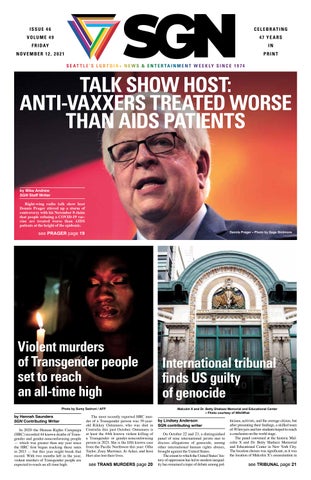
ISSUE 4 6
C E L E B R AT I N G
VOLUME 49
47 YEARS
F R I D AY
IN
NOV EMBER 12 , 2 0 21
PRINT S E AT T L E ’ S L G B T Q I A + N E W S & E N T E R TA I N M E N T W E E K LY S I N C E 19 74
TALK SHOW HOST: ANTI-VAXXERS TREATED WORSE THAN AIDS PATIENTS
by Mike Andrew SGN Staff Writer Right-wing radio talk show host Dennis Prager stirred up a storm of controversy with his November 8 claim that people refusing a COVID-19 vaccine are treated worse than AIDS patients at the height of the epidemic. Dennis Prager – Photo by Gage Skidmore
see PRAGER page 19
Violent murders of Transgender people set to reach an all-time high Photo by Sumy Sadruni / AFP
by Hannah Saunders SGN Contributing Writer In 2020 the Human Rights Campaign (HRC) recorded 44 known deaths of Transgender and gender-nonconforming people — which was greater than any year since the HRC first began tracking these rates in 2013 — but this year might break that record. With two months left in the year, violent murders of Transgender people are expected to reach an all-time high.
The most recently reported HRC murder of a Transgender person was 39-yearold Rikkey Outumuro, who was shot in Centralia this past October. Outumuro is at least the 44th known violent killing of a Transgender or gender-nonconforming person in 2021. She is the fifth known case from the Pacific Northwest this year: Ollie Taylor, Zoey Martinez, Jo Acker, and Jessi Hart also lost their lives.
see TRANS MURDERS page 20
International tribunal finds US guilty of genocide Malcolm X and Dr. Betty Shabazz Memorial and Educational Center – Photo courtesy of WikiWhat
by Lindsey Anderson SGN contributing writer On October 22 and 23, a distinguished panel of nine international jurists met to discuss allegations of genocide, among other international human rights abuses, brought against the United States. The extent to which the United States’ history of oppression has led to modern inequality has remained a topic of debate among pol-
iticians, activists, and the average citizen, but after presenting their findings, a skilled team of 30 lawyers and law students hoped to reach a conclusion on the world stage. The panel convened at the historic Malcolm X and Dr. Betty Shabazz Memorial and Educational Center in New York City. The location chosen was significant, as it was the location of Malcolm X’s assassination in
see TRIBUNAL page 21
GREEN CARDS • VISAS • ASYLUM • CITIZENSHIP 1836 Westlake Ave N, Suite 302 Seattle, WA 98109
2
SGN
NOV EMBER 12 , 2 0 21
(206) 724-1940 olivielaw.com
C E L E B R AT I N G 4 7 Y E A R S!
ORIGINALLY SEATTLE GAY NEWS FOUNDED 1974 MEMBER
509 10th Ave E Seattle, WA 98102 (206) 324-4297 sgnpaper@gmail.com sgn.org
2021
Deadlines Calendar | Tuesday at 6pm Display Ads Space Reservation | Monday at 5pm Ad Copy (non-camera ready) | Tuesday at 5pm Ad Copy (camera-ready) | Wednesday at 5pm Letters to the Editor | Tuesday at 5pm Obituaries | Call the SGN office All others | Tuesday at 5pm
Publisher Angela Cragin Managing Editor A.V. Eichenbaum Copy Editor SGN Staff • Richard Isaac Advertising Maggie Bloodstone, Advertising Manager National Advertising Rep. Rivendell Media (212) 242-6863 Staff Writers Mike Andrew • Sara Michelle Fetters Contributing Writers Lindsey Anderson • Janice Athill Josephine Baird • Alice Bloch Maggie Bloodstone Kylin Brown • Sharon Cumberland Carter Hemion • Daniel Lindsley Paige McGlauflin • Tim Peter Jessica Price • Renee Raketty • Nick Rapp Hannah Saunders • Gaysha Starr Sarah Toce • Ed Walsh
2021 Gay Seattle Pageant
Social Media Manager SGN Staff Cartoonist Ken Campbell Photographers Nate Gowdy • Renee Raketty Production Mike Pham SGN is published by Angela Cragin. © 2021. All Rights Reserved. Reprints by permission. Publication of names, photographs, or likeness of any person, organization, event or business in this publication cannot be taken as any indication of the sexual orientation of the person, organization, event or business. Opinions expressed in bylined articles, columns, and letters are those of the authors only and do not necessarily reflect the views of the staff or management of this paper. SGN welcomes unsolicited material, including letters to the editor, but reserves the right to edit or reject material. All rights revert to authors upon publication. We assume no liability for loss or damage of materials, solicited or not. We invite feedback, please write. And please play safe. It is our policy that no money shall be refunded if you choose to cancel your ad. Credit will be given for the balance owed. No exceptions.
In Loving Memory Of George Bakan
Scott Roger Alpert Cookie Andrews-Hunt James Arnold Steve Foiles Shaun Knittel James Leland Moore Don Paulson Randy Peters Lee Richeson Shaun Shelton Jim Tully
Follow SGN
VISIT US ONLINE SGN.ORG
The Imperial Sovereign Court of Seattle hosted the 2021 Gay Seattle Pageant on Saturday, Nov. 6th, at Renaissance Seattle Hotel. MX Gay Seattle 1, Daddy Issues; Ms. Gay Seattle 16, Catty Wompus; Mr. Gay Seattle 44, Dean the Vampire; and Miss Gay Seattle 56, Skyy Martini Ice, stepped down after a spectacular two years of service to community. Crowned as the current Gay Seattles were Miss Texas 1988 as MX Gay Seattle 2; Skarlet Dior Black as Ms. Gay Seattle 16, and Cookie Couture as Miss Gay Seattle 57. The SGN wishes them each the best during their reign!
In this Issue
LOCAL NEWS 4 A&E • FILM • BOOKS 6 TRAVEL 16 OP-ED 17 NATIONAL NEWS 18 INTERNATIONAL NEWS 21 NOV EMBER 12 , 2 0 21
SGN
3
Local News
Queer-owned business spotlight: Epic Antique
Photo courtesy of Epic Antique
by Nick Rapp SGN Contributing Writer “Overstimulating” does not come close to describing the feeling of walking through the doors of Epic Antique, a gigantic vintage warehouse in the outskirts of SoDo. And that is meant as high praise. The warehouse ceilings are lined with an abundance of hanging light fixtures, and all the walls are covered in art, mirrors, signs, and all sorts of decorative items. It feels as if you were granted access to a treasure vault housing relics that vastly differ yet belong together. At 22,000 square feet, Epic Antique is regularly home to over 50 vendors, each showcased in different nooks of the store. One could easily spend upwards of an hour combing through the items displayed in a single vendor’s space. There is a vague order to the layout (e.g., a corner of wicker baskets, walls of mirrors, rows of jewelry, etc.), though half of the fun is aimlessly browsing and stumbling upon items that are too unique to seek out. Curators Mathew Culbert and Tom Gorz opened Epic Antique in 2018. Culbert and Gorz — both longtime antique collectors
4
SGN
— focus their curation on mid-century modern furniture, vintage jewelry, and decorative art. Combined with the vendor collections, the pieces on display in the warehouse cater to all tastes. Campy animal furniture sits adjacent to vintage denim pieces and ornate French mirrors. There is something for everyone in the space. As if the expansive collections were not enough, Epic Antique hosts frequent events. Flea markets that feature local vendors and food trucks take place the second Saturday of every month. Dealers set up shop in large plots of the parking lot, lining the entrance all the way up the loading dock that leads to the store’s front doors. Along with the monthly flea markets, Gorz is excited for Epic Antique’s upcoming art sale, starting on Nov. 15 and lasting through the month. “Epic Antique was started because everything was closing and we felt the need for personal experiences,” said Gorz. “I can’t stress enough how it’s a place to wander and see so many small businesses in one place.” He “used to visit all the flea markets in California regularly and about 20 years ago decided to sell full-time — before online and social media sales. Malls were where
NOV EMBER 12 , 2 0 21
we [curators] met the people that would enjoy items curated for them.” Focus on vendors In the age of online shopping paired with lingering pandemic resistance regarding returning to public spaces, Epic Antique offers a refreshing and personal return to shopping local. It bridges the gap between social media and in-person connection seamlessly, combining the intrigue and detail of online advertising with an intimate shopping experience. Most of Epic Antique’s communications and advertising take place on its Facebook and Instagram accounts. The store posts photos featuring vendors and their collections, along with specific pieces that are newly acquired or dropping in price. The business establishes an ethos of community care by giving unique attention to the vendors as individual curators. The store’s social media posts often highlight their aesthetic tastes, along with their personal histories in antiquing and art collection. When reading the unique vendor features online, you can feel the excitement that Gorz and Culbert share in getting to know community members and giving
them a space to display what they love. Gorz’s commitment to Seattle antique curators doesn’t end with Epic Antique. In August, he acquired Pacific Galleries Antique Mall, saving it from its slated closure at the end of the month. Gorz reopened the store as Lander Street Vintage in October and claims the business purchase was “so last minute” that they “won’t have a building sign for some time.” Lander Street Vintage features “new music” and a “new atmosphere,” along with “many similar businesses” from Pacific Galleries and “many new ones,” said Gorz. He plans on doing events there as well, but for now the store’s focus is on the holiday season. If you are looking for some vintage inspiration in the meantime, Gorz states that Epic Antique “encourages people to follow great businesses [on Instagram] like @vintagety, @_an_edited_life, @ nothingsnewvintage, @treasurequeeny, @ inthecomfortof_, @vintageinseattle, and so many more.” “It’s a family here,” he added. Epic Antique is at 3701 Seventh Ave. S. and online on Facebook and Instagram (@ epicantique).
C E L E B R AT I N G 4 7 Y E A R S!
Photos courtesy of Epic Antique
VISIT US ONLINE SGN.ORG
NOV EMBER 12 , 2 0 21
SGN
5
Film
Visually sleek Dead & Beautiful has bite
by Sara Michelle Fetters SGN Staff Writer DEAD & BEAUTIFUL Shudder There’s a lot to love about writer-director David Verbeek’s sleek metaphorical vampire thriller Dead & Beautiful. Shot in dreamily desolate, neon-colored hues by Jasper Wolf and crisply edited by Axel Skovdal Roelof, the film crafts a viscerally kinetic atmosphere right out of the gate. Add in Monica Petit’s seductive modern costumes and Rutger Reinders’s energetically combustible electronic score and from a technical standpoint, there’s precious little to nitpick. It’s the storytelling where I have issues. I just didn’t feel that all of the themes Verbeek and his talented cast were attempting to explore came through with enough clarity to register. Whether that’s enough to derail a recommendation, I’m not entirely sure. Ultra-rich twentysomethings Lulu (Aviis Zhong), Alexander (Yen Tsao), Mason (Gijs Blom), Anastasia (Anna Marchenko), and Bin-Ray (Philip Juan) are wasting away their days and night in Taipei, constantly searching for something to do that will bust through their collective malaise. Each week, a member of this quintet offers up a surprise for the other four, and it is currently Anastasia’s turn to wow her friends. But their overnight camping trip to meet with a mysterious shaman goes spectacularly wrong when the friends awaken to find they’re suddenly sporting fangs and wonder if they also have a newfound hankering for human blood. Retreating back to civilization to hole up in a swanky new skyscraper owned by Alexander’s family, the group must answer a critical question if they ever hope to return to their former lives: Are they vampires? I love Verbeek’s premise, and it allows him to bring up a bevy of fascinating themes, including economic inequality,
gentrification, social media addiction, and the erasure of indigenous people from their ancestral lands. Unfortunately, only some of that is explored in any detail, and even in those cases, a lot of that is vague at best, obnoxiously contradictory at worst. It’s almost as if Verbeek has settled on saying something akin to “rich kids are people, too” — and that’s it. For the life of me, I have trouble believing that is the core point he wanted to make. But the mood of this film is sublime. There’s a terrifically eerie bit that’s tinged with a welcome dollop of goofy irreverence, in which the gang attempts to drink blood for the first time. There’s another nice part
6
NOV EMBER 12 , 2 0 21
SGN
Dead & Beautiful – Photos courtesy of Shudder
where Bin-Ray is enthusiastically certain he mind-controlled a convenience store clerk, while an extended sequence involving Alex and a kidnapped sex worker is played straight and oozes disquieting tension. Then there is Zhong. Lulu is the most mysterious member of the group, and the only one for whom Verbeek holds back key information regarding her background. This allows Zhong a lot of freedom to do several subtly multifaceted things with her character, such as underplaying certain scenes, especially early on, only to allow herself to go bigger and broader during the latter acts. She finds an emotional underpinning to Lulu’s plight that rings
with a haunting authenticity no one else can match, and if Verbeek had spent even more time on this character and less on the others, that would have been fine with me. Even with my list of reservations, I still felt obliged to watch Dead & Beautiful twice. Something about it is haunting, a mystically uncertain ambiance that’s reminiscent of David Fincher’s The Game. Couple that with the marvelous visuals and Zhong’s strong performance, and I’m willing to cut Verbeek’s film a bit more slack than I otherwise might have. This thriller has bite, and in this instance that’s enough to warrant a look.
C E L E B R AT I N G 4 7 Y E A R S!
Generation undead
Chatting with writer-director David Verbeek about what-if vampire thriller Dead & Beautiful by Sara Michelle Fetters SGN Staff Writer David Verbeek’s stylish what-if vampire thriller Dead & Beautiful offers up a number of intriguing ideas. It is a visually spellbinding drama that kept my attention start to finish. The plot revolves around bored, ultrarich twentysomethings Lulu (Aviis Zhong), Alexander (Yen Tsao), Mason (Gijs Blom), Anastasia (Anna Marchenko), and Bin-Ray (Philip Juan), all of whom are shuffling through their days and nights in Taipei. Each week, one member of the group offers up a surprise for the other four. This week’s challenge? An overnight camping trip to meet with a mysterious shaman. Things go spectacularly wrong when the five awaken during the night to discover they’ve all grown fangs and have a newfound thirst for human blood. Are they now vampires? I sat down over Zoom to chat with Verbeek about his latest film. Our wide-ranging conversation touched on quite a lot, including a few items that do tread awfully close to spoiler territory. Please keep that in mind before reading. Here are the edited transcripts of our conversation: Sara Michelle Fetters: I imagine you had plenty of influences that inspired you to craft this scenario. What was it primarily that led you down this road to these characters and this rather tricky little story that you’ve created? David Verbeek: I think I was inspired by all the vampire films and series I’ve seen in the last few decades. That, plus my experience of living in Asia and already shooting some films here. I wanted to do something with vampires that was new and that I’d not seen before. I was thinking, what would I do? What would be new now to an audience? What also would be meaningful? With the whole discussion internationally about how wealth is the 99% versus the 1%, and the whole thing about how the entire global political debate has become so hot on this topic, that seemed like a good starting point. I wanted to do something about extremely rich people, especially the second-generation rich. You see it in China, where I was living 10 years ago, when I had the original idea. There was this new generation of kids of new millionaires and billionaires, and these kids are kind of lost. They were doing all kinds of extreme things to entertain each other and themselves… and that kind of
Dead & Beautiful director David Verbeek – Photo courtesy of Photo courtesy of Henneman Agency
triggered my imagination. What if we make a film where this very current generation is literally turning into vampires? It was really only because of the censorship in China that I had to turn it into a fake vampire film, which only made the idea more interesting. My initial idea wasn’t allowed, because you can’t make an actual ghost story or vampire film in China, so I changed it around and that made it more interesting, I think, so sometimes censorship actually helps you to come up with an even better idea. SMF: It’s interesting that you went
right there, because I wasn’t quite sure if we should avoid the spoiler talk or not, as far as to the nature of their bloodthirstiness. As you watch the film, there is this sort of general sense that something very peculiar — other than them just turning into vampires — is going on. What is the balancing act like for you as the writer and for your actors as you all try to walk along this “are they/aren’t they vampires” tightrope? DV: The cast and the focus on the psychology of the individual characters was key in doing that. Each of the characters
see VERBEEK page 8
Dead & Beautiful – Photos courtesy of Shudder
VISIT US ONLINE SGN.ORG
reacts to their vampire states — or their presumed vampire state — in a slightly different way, and that’s precisely what makes it interesting. Everyone kind of takes from the pop culture that we know from the vampire genre. They take what is convenient for them. There is also peer pressure. Like, okay, we’re going to do something. We’re vampires. We’re going to go for this. This kind of takes things to where none of them individually would be willing to go. They decide to go out and to really drink blood. Alexander takes things even further. At some point, it’s beyond the point of no return. Because I made the choice early on not to actually go into the supernatural, I had to go and to find all the psychological devices that would entertain and that would make an interesting story about how all these characters deal with the situation. SMF: As the children of the super-rich, it’s as if these characters grew up in sort of a pop culture mélange, because they had nothing else to attach themselves to. DV: It’s really challenging for them to find a satisfying identity, because it’s like, I was already born into this wealth, I am the son or the daughter of powerful so-and-so, so now what do I have to do to prove to the world who I am individually? For some of them, being a vampire might help, because it’s something mystical and mysterious. There’s something super powerful about them now. All those things are what the film plays with. But the film also plays with how they are, not just who they are. They are growing up in an experience economy where it’s no longer about material wealth. It doesn’t matter if you have the sports car, because you already have it. You’re used to it. What it becomes about is how to experience something that excites them all the time. Getting that next high. How do you have an experience that excites you when you’ve already done
NOV EMBER 12 , 2 0 21
SGN
7
Film
VERBEEK
continued from page 7 everything? When you have already traveled everywhere? You have to go more and more extreme to find things that excite you. That is a tragedy that I wanted to explore. SMF: It’s almost as if they’re playing David Fincher’s The Game every week, only this time things get taken to an even more extreme level. DV: Yes! Exactly! Actually, David Fincher’s The Game was a very important movie leading up to this. But I felt that I had to go further than The Game, because The Game already exists. At the point where we find out that they’re not really vampires, that’s the point where I felt The Game left off. There’s a game within a game, if you will. SMF: Talk to me about Lulu. She is such a fascinating character. I don’t want to give too much away, but it’s a truly complex characterization, and I think it’s interesting that her background appears to be different that that of her friends. DV: For her character, I would say it was the golden rule of “less is more.” You don’t know much about her. For everyone I give their family fortune value, their estimated value, and for her it just says “unknown.” Why? Because, maybe it’s in flux? Maybe there’s something changing? We don’t know, and I didn’t want anyone to know. I wanted people to have lots of interpretations of why she does what she does. I didn’t want to spell it out. With her family background, Lulu is triggered somehow to do something. She wants to talk about how rich they all are and how that exploit other communities. But you can also question her actions psychologically. Perhaps she initiates what she does because she wants to find out what her friends are made of, what they’re capable of, and, even beyond that, she wants to find out how she herself feels about certain things. I think what her character shows very well is the loneliness and isolation that the position of extreme wealth brought her to. (At first there were also more scenes with her mother, but for pacing reasons, they
aren’t in the film.) People that are in this kind of position, they usually hang out with groups that are similar, just like celebrities usually date and marry other celebrities, because they can relate to each other, because they have the same limitations in life. With Lulu, I think she provides insight on how difficult things become when you’re in these closed circles. SMF: It’s a strong ensemble, but Aviis Zhong is sneakily extraordinary as Lulu. Were there ever moments you were surprised by the performances you were getting? DV: Yes. Definitely. Mostly there were some moments when we were filming when I was like, wow, this is really good. But where it really hit me most is the first time we saw the film in the theater. We shot the
whole thing with anamorphic lenses, and the emotions on the faces — even when they’re saying nothing, and how hard those things hit, especially at the end of the film — really impressed me, especially that first time with an audience. Aviis is a very subtle actress. She’s not into big expressions. But there’s a lot behind the mask, It’s there. I’m really proud of my actors. SMF: What do you want people to take away from the film? What do you hope they’re talking about after it’s over? DV: I think we covered some of it. I do think that it is meaningful to show something from the ultra-rich, because we live in such a capitalist society in so many countries, and a lot of people aspire to become wealthier and wealthier. To show this ulti-
mate depiction of wealth and then to realistically, psychologically show that it doesn’t make life easier, and how it is actually kind of connected to the Dracula genre, that’s pretty cool. It’s about isolation and loneliness. Even if you’re from a super wealthy group of friends, that does not make it any easier to just say, “Hey. I like you, and I have feelings for you.” You could say this story is very much about the inability to simply just be upfront and honest. I think that’s something to think about. I love how that kind of becomes more meaningful as things go on. I do hope that the film will make people consider and think about these things. I like films that, as soon as they’re over, I’m not still done with them. I like when there is something more to keep figuring out.
Dead & Beautiful – Photos courtesy of Shudder
8
SGN
NOV EMBER 12 , 2 0 21
C E L E B R AT I N G 4 7 Y E A R S!
Branagh’s Belfast: A joyous, life-affirming miracle
by Sara Michelle Fetters SGN Staff Writer BELFAST Theaters Few films in 2021 have left me as effortlessly charmed as Kenneth Branagh’s Belfast. A spellbinding, semiautobiographical drama seen through the eyes of a child, this is a handsomely life-affirming tale overflowing in intimate insights and told with a delicate hand. It captivated me body and soul, and rarely have I left the theater in such a state of content euphoria as I did after watching Branagh’s latest. Buddy (Jude Hill) lives in a small, close-knit Belfast neighborhood with his older brother Will (Lewis McAskie) and his beloved Ma (Caitriona Balfe) and Pa (Jamie Dornan). Pa isn’t around much, as he works in London, trying to make enough money to keep the family afloat while also attempting to pay off their large tax debt. But Buddy’s grandparents (Judi Dench, Ciarán Hinds) live nearby, and he’s happy to spend time with them whenever possible. Set in 1969, Branagh’s look back at his childhood lands right around the start of the conflict in Northern Ireland (otherwise known as “the Troubles”), which lasted roughly three decades. The film opens with a quick, brutal clash between Protestants and Catholics, and while Buddy’s home is left relatively unscathed, his Catholic neighbors aren’t as lucky. Quickly walls go up, soldiers are patrolling the streets, and residents who yesterday sang and danced together are now giving one another a wary side-eye. Reminiscent of John Boorman’s 1987 classic Hope & Glory, Branagh’s film gives children center stage while in the middle of unimaginable chaos and sudden spurts of violence. Buddy is the one taking all of this in: the wonders, the horrors, the sad, vicious truths, the moments of camaraderie and selflessness. Most of all, Buddy watches his parents as they attempt to navigate through these strange, discombobulat-
VISIT US ONLINE SGN.ORG
Belfast – Photos courtesy of Focus Features
ing times, both doing what they think best to keep their family safely together. This does mean Branagh isn’t interested in making any profound statements other than ones that are distinctly comforting. While there are weighty topics at play, he doesn’t spend a ton of time dissecting them in hard-hitting detail. A case could be made that he perhaps even plays all of this a bit too safe, and as such robs his drama of any additional unease or tension it may have had if he had decided to dig a little deeper. Not that I was bothered by this. By keeping things focused on Buddy’s responses,
this story of family becomes something refreshingly soothing. It allows little throwaway moments to speak volumes. It revels in the gentle quiet of sitting happily on a couch between two grandparents. It celebrates the nonsensical verbal bonds between parent and child. It sees hope in horror and, when tragedy does strike, it does so in a way that allows for the grief for what is lost to deftly intermingle with the indefinable promise a new dawn brings. It helps that the entire ensemble is superb. Newcomer Hill gives one of the year’s best child performances, his expressive eyes
NOV EMBER 12 , 2 0 21
showcasing a bottomless pit of emotional breadth that’s divine. The youngster is the focal point, and he always appears to be up to the challenge. I was astonished at how completely he disappeared inside the director’s nine-year-old alter ego. The adults are equally outstanding. Not that this is altogether shocking when it comes to veterans like Dench and Hinds. That they instantaneously vanish into the naturalistic rhythms of Buddy’s grandparents isn’t exactly a surprise. But both still make these characters come to life in a multitude of exhilarating ways that the beauteous ease in which they intertwine into one another’s arms extraordinary. Then there are Dornan and Balfe. They are spellbinding. I couldn’t take my eyes off either of them. The relationship between their characters has a lived-in grace that’s outstanding. Each actor waltzes around the other with such nimble complexity that it’s as if Buddy’s parents have leapt out of the screen and three-dimensionally materialized into the real world. Branagh allows every moment to transpire almost as if out of thin air. He balances all of the outside influences competing for Buddy’s attention skillfully, exhibiting the same sort of confident touch he brought to his masterful Shakespeare trifecta of Henry V, Much Ado About Nothing, and Hamlet. The director allows the elegantly minimalistic black-and-white camerawork of Haris Zambarloukos (Cinderella) to almost become a character in the film in its own right, giving the infrequent sudden bursts of color an even greater impact. When it was over, all I wanted to do was dance along with Ma and Pa and celebrate all of their family’s achievements, mourn their tragic losses, and dream of all the vast, unclaimed potential still sitting out there for them to strive for and achieve in the future. Branagh pulls from his past to tell a story that’s as vibrant and alive as any moment we’re living through right this second. Belfast filled my heart with joy, and there’s nothing better than that.
SGN
9
Film
A Queer Cambodian drama for the patient viewer by Daniel Lindsley SGN Contributing Writer COALESCE Plex Directed by Jessé Miceli, Coalesce is a Cambodian indie drama about three young Queer people living through a time of rapid change. Its medium is slices of modern Phnom Penh life, filmed with a combination of steady and free camerawork that blends the qualities of cinematic and authentic. This film is a slow burn, lingering long on views of city streets, the countryside, and day-to-day Cambodian life. That, combined with themes of isolation, intergenerational tension, exploitation of Cambodian youth by white foreigners (who have money, for the most part), and tacit homophobia, makes it no “light watch.” It seems to ask viewers for a long, careful look at each shot and each situation, occasionally rewarding them with visual quirks that would go unnoticed by one watching too passively. For example, Songsa, the youngest of the three protagonists, is riding in the back of a tuk-tuk. His father, who is driving, asks him if he’s okay. Watching the blur of the rural terrain outside, Songsa doesn’t answer. Cut to a view of his father from the back seat. The man’s bald head is unmoving, faceless from the back; he keeps driving and doesn’t so much as glance back to check. One might easily miss Songsa’s face reflected in the tiny, circular rear-view mirror beyond his father’s head — a visual metaphor for
Coalesce – Photos courtesy of Ariztical Entertainment
the father’s traditional views, perhaps, and a sign that they diminish his son. Another of the film’s strengths lies in the feeling of isolation around each of the three characters going about their separate lives, without it being crushing or total. The three “break out” in different ways, small or significant, on the colorful fringes of the city’s urban nightlife — although those fringes seem to come with their own perils.
Two of the characters’ Queerness goes largely unspoken, much less seen. Their families all seem traditional in structure, which puts their privacy at a premium. All these tensions have a payoff by the end, when the three finally come together by chance after all their ordeals. None of their dialogue is audible, but as they stand on their own, far from the camera in a wideangle shot of a rural landscape, the mean-
ing of the film’s title is revealed, as a bond between them apparently coalesces. Both in this scene and in general, the film withholds much, relying on scenery and minute body language during its long moments of silence. For those with the patience and curiosity for that, I recommend Coalesce. Its digital release is scheduled for December 14 this year.
Bombastic Red Notice is a calamitous waste of time by Sara Michelle Fetters SGN Staff Writer RED NOTICE Theaters (Nov. 5) / Netflix (Nov. 12) FBI profiler John Hartley (Dwayne Johnson) has assisted Interpol agent Inspector Urvashi Das (Ritu Arya) in apprehending the world’s second-most successful art thief Nolan Booth (Ryan Reynolds) right after he managed to lift one of three priceless golden eggs once owned by Cleopatra. In doing so, he is framed by the world’s number one art thief (Gal Gadot), known only by the alias “The Bishop,” as a thief himself, so Inspector Das is forced to toss Hartley into a maximum-security Russian prison right next to Booth. That’s the setup for Red Notice, a globetrotting heist adventure-thriller written and directed by Rawson Marshall Thurber (Skyscraper, Dodgeball: A True Underdog Story). Hartley and Booth join forces, escape from prison, and attempt to stop Bishop from laying her hands on the two remaining eggs, with Inspector Das hot on their trail the entire time. During their travels, they steal from murderous arms dealer Sotto Voce (Chris Diamantopoulos) and journey to South America to investigate a Nazi bunker cleverly hidden in the depths of an impenetrable jungle. Sounds like fun, right? Wrong. Other than a few clever bits — and in large part due to the gigantic charismatic aura effortlessly exuded by Johnson and a couple of bursts of clever invention from Reynolds — this is about as calamitous a big-budget action spectacular as any I’ve watched in ages. The whole thing feels as if it were assembled in a board room: Insert quip here. Add a meticulously choreographed set piece there. Connect one dot to the second dot to the third dot to… well… you get the idea. The movie comes across as a bombastic, paint-by-numbers, Indiana Jones-meetsTrue Lies-meets-Dirty Rotten Scoundrels retread, and what should be a breezily
enchanting old-school throwback instead comes on like a roundhouse to the face and a swift kick to the gut. Everything is mechanical; nothing feels organic or genuine. I only kept watching because I refused to believe the end result could be as terrible as the opening act. Everyone involved was far too talented for that to be the case. The good news? Red Notice does get a bit better as it goes along. The actual heist at the Sotto Voce estate is moderately amusing, while a sudden third-act transformation into a bromance version of Romancing
10
NOV EMBER 12 , 2 0 21
SGN
Red Notice – Photo courtesy of Netflix
the Stone did bring on a passing chuckle. Most of all, as tiresome as his deadpan, self-effacing comedic schtick can be, Reynolds tosses in a few winning moments of goofy inspiration I did not see coming, and to say he gives the film’s best performance is something of a moderate surprise. Not that it matters. The more massive actions sequences are smothered in a digitally augmented veneer that makes them look muddy and like a video game cutscene from an Uncharted installment. Arya is frustratingly underutilized, and her
character hopelessly underwritten. Gadot attempts to smile her way through the proceedings yet is given so little to do that she makes almost no impression whatsoever. Don’t even ask me about a groan-worthy scene involving a hair tie, seconds before a big fight. I could keep going, but I’m not sure what the point would be. I gave Red Notice my full attention, and all it gave me back was a headache. As far as I’m concerned, that says it all.
C E L E B R AT I N G 4 7 Y E A R S!
VISIT US ONLINE SGN.ORG
NOV EMBER 12 , 2 0 21
SGN
11
12
SGN
NOV EMBER 12 , 2 0 21
C E L E B R AT I N G 4 7 Y E A R S!
VISIT US ONLINE SGN.ORG
NOV EMBER 12 , 2 0 21
SGN
13
Books
Fall Book Club recap: The haunting reality of the Queer experience
Photos by Lindsey Anderson
Monsters Many of the books we read dove into the topic of monsters, and at the heart of all the monstrosity sat queerness. Our first installation, Carmilla, explored the legend of the vampire but also showcased how cis/het people treat the Queer community due to
their otherness. The book probed the ways heteronormative society fears the possibility that queerness could be contagious and is quick to demonize and eliminate what they do not wish to understand. Another book, The Witch King, also looked into the world of monsters, but from a new perspective. This time we traveled to a magical world where fascism and monsters coexist. Author H.E. Edgmon asked us, “How can a corrupt system create monsters out of everyday people?” Through magical metaphors, the novel challenged readers to question whether reform or radical restructuring is the answer when facing a terrifyingly flawed system of government. The Dead and the Dark examined monsters created out of hate. The Dark was a monster bred from the homophobia and
14
NOV EMBER 12 , 2 0 21
by Lindsey Anderson SGN Contributing Writer The Fall Book Club is wrapping up after autumn, full of magical, monstrous, and memorable stories. What began as a fun project about facing fears and celebrating all the spookiness fall has to offer soon evolved into an exploration of fright and monstrosity itself. Spoilers ahead, so readers, beware!
SGN
hatred in the town of Snakebite but found its life source in a man whose heart had withered after living at the receiving end of said hatred. The book explored how harboring hatred for any reason can sometimes come to destroy ourselves, our communities, and those we hold closest to us. Witches Metaphors flowed through the pages like magic this fall. Each book included magic secrets in some form or another, from witchy powers to the ability to interact with the dead. How characters coexisted with their magic became a set of metaphors for the ways different people exist with their queerness. In These Witches Don’t Burn, selfassured witch Hannah was confident both
in her powers and her identity as a Lesbian. She felt comfortable talking about both identities with those closest to her but had to remain careful in her community due to the way the “regs” might react to her powers. Like many LGBTQ+ people, Hannah felt accepted for who she was in her circle but still had to maintain caution with the rest of the world. Hannah also has to navigate a scene where she explains her magical secret to her best friend, a straight and nonmagical girl. Hannah’s fears about how her friend may react mirror coming out experiences for many members of the Queer community. In The Witch King, Trans witch Wyatt continually makes one bad decision after the next once his long-lost fiancé whisks
C E L E B R AT I N G 4 7 Y E A R S!
him back to their magical kingdom. Wyatt’s magic and gender identity were not topics of conversation in his childhood; his parents shielded him from learning about his abilities and only taught him to become a version of himself they could understand. Once he escaped to the human world, Wyatt learned about Trans identities and tried to leave his magical past behind. Like many LGBTQ+ experiences, Wyatt felt suffocated by his community and couldn’t grow into himself until he found his way out. Once he is brought back, like so many Queer people returning to their childhood homes, he relives the trauma that led him to run as far away as possible. Despite being the hero of the story, Wyatt is still a teenage boy. He makes bad decisions and fails to understand his magic, showing that Queer identities do not necessarily make one mature and that there is always a depth to our identities waiting to be explored. Of Fire and Stars introduced us to Dennaleia, a witch princess forced to hide her powers from a world that fears magic. As Denna tries to become the perfect diplomat and soon-to-be wife and queen, she finds her powers harder and harder to repress, just like her sexuality. Like many LGBTQ+ folks, Denna lives in a world where the rich and influential fear people like her. She is subjected to meetings where those who share her very identity are slandered, blamed, and even punished for a part of themselves they cannot choose. Denna tries for most of the book to hide and suppress both her magic and her attraction to her fiancé’s sister, Mare, only to realize that hiding will mean a lifetime of misery. Once she embraces her secrets, she finds powers greater than anything she had ever imagined. In Sweet and Bitter Magic, Wren also possesses powers she must hide from those closest to her. Becoming a caretaker for her father and hearing the fear and disgust the village people hold for magical beings, Wren feels as if she has no choice but to hide. The internal struggle of loving her father while hiding a part of herself leaves Wren feeling isolated, like many closeted Queer people struggling to tell their closest friends and family about themselves. While each book takes magic on a bit differently, they all explore the very Queer experience of hiding identity from our friends, families, and ourselves.
Death Some of the books we read also explored the idea of death. In Cemetery Boys, Aiden Thomas brings to life the Latinx holiday of Día de los Muertos, a celebration of the dead, and describes a world in which they can return once a year. For Yadriel, this holiday means revisiting his mom, one of the only people who understood and accepted him for who he was: a Trans boy. Because of this Latinx tradition, Yadriel and his family do not see death as a tragic end but simply a part of life. There is still a sadness tied to it, but not fear. For Yadriel, this becomes symbolic of his experience as a Trans person. Death reflects a change and a chance for something new. Yadriel can fall in love with a dead boy because he knows what it is like to be dead, for people to look at him and not see what is really in front of them. Yadriel and Julian both struggle with what death means to them, symbolically and literally. They both worry about how their legacies are understood by their families, and how their souls exist in a plane absent from their bodies. The Dead and the Dark also explores death, albeit in a darker sense. Throughout the book, Ashley realizes that sometimes the things she loves the most, the things that seem the most alive to her, are not alive at all. The first account of this comes from her experiences with her ex-boyfriend Tristan. From the start of the book, Tristan is dead, but Ashley refuses to believe it, having never found his body. She holds onto the good memories and buries the guilt, refusing to look without her rose-colored glasses. Ashley then experiences death in the town of Snakebite itself. From the beginning of the book, she sees her small hometown as perfection. With little experience of the wider world to know otherwise, she thinks she is happy where she is. She can overlook the hatred of the townspeople as long as it is not aimed at her. However, as soon as she starts to care about someone her neighbors cannot accept, she realizes that the town may have always been dead and rotting. The final time we see Ashley’s relationship with death regards Logan. Ashley starts to see dead people as soon as she comes to town, and with her help, she eventually discovers why. Ashley is ini-
tially drawn to Logan because she is one of the few people willing to listen to Ashley’s concerns about Tristan’s ghost. Ashley’s final revelation about Logan — that she has been dead the whole time — reflects her sexual awakening. She realizes nothing is as it seems, death may not be the end, and that our lives can continue, and vastly improve, even after the death of everything we thought we had. Authors What made the fall book club even more special was the chance I got each week to sit down with these spectacular authors. Each one I met had unique styles and experiences when it came to writing. Some, like Isabel Sterling and Audrey Coulthurst, always had a passion for writing but let a fear of failure keep them from pursuing it. Despite that, these brave writers were able to give the world something it desperately needed: more Queer books. Each author I talked to emphasized the need for more LGBTQ+ stories. Often, these writers reflected on the lack of diverse books they had available growing up. H.E. Edgmon hoped to see more Trans books in particular, because “there is no right way to be Trans.” He emphasized that each member of the LGBTQ+ community has their own stories and experiences, and the more books we can see on the shelves, the more young people will feel validated in those experiences. Each author also informed me of their commitment to craft more Queer and Trans stories. They hope to continue to create fantasy worlds LGBTQ+ youth can feel a sense of belonging in. For some, like Adrienne Tooley and Audrey Coulthurst, this means making worlds where homophobia and gender norms don’t exist. For others, like Isabel Sterling and Courtney Gould, a created world still means a realistic one. They focus on validating experiences readers may have had with homophobia while also ensuring that they can get happy endings and triumphs in their books’ pages. Meeting these authors and getting to read their stories was incredible. I learned so much about the magic of the LGBTQ+ community, the freedom and pain of symbolic death, the spirit of found families, and the courage that it takes to stand up to the mob and say, “I am a monster.”
Here’s the list of books from our Fall Book Club: Carmilla by Joseph Shridan Le Fanu These Witches Don’t Burn by Isabel Sterling The Witch King by H.E. Edgmon Of Fire and Stars by Audrey Coulthurst Cemetery Boys by Aiden Thomas The Dead and the Dark by Courtney Gould Sweet and Bitter Magic by Adrienne Tooley For readers who are interested in following along with our Winter Book Club, visit us on Instagram @sgn_books and let us know what you think! We love hearing from you. Oliver the cat can’t wait to meet you!
Not-so-dumb animal council ponders the fate of humanity THE COUNCIL OF ANIMALS NICK MCDONNELL © 2021 Henry Holt $25.99 / $34.99 Canada 208 pages The abandoned yacht was perhaps not the best place to call a meeting, but that’s where everyone was told to gather. The dog arrived first, followed by the horse and the bear. The cat arrived just before the crow, and the baboon called them all to order. Nobody denied the argument the crow put forth: Humans caused The Calamity, which destroyed nearly everything, including the humans — all but maybe a dozen or so. And now the animals needed to decide if they should eat the humans that are left. Aye or nay? Now, you might be surprised that there wasn’t more confusion at the meeting. Making a point, the baboon threw a stick for dog to fetch. The horse talked nonstop about sugar cubes. When the representative for the mice arrived, the cat pounced. It was chaotic, but remember that animals were always able to communicate among themselves by speaking grak, and so their behavior, however shaky this time, was natural. Almost immediately, the dog and the bear said “no” to killing the humans. Horse said she loved her jockey but her vote was still “yes,” probably because the baboon found some sugar inside the abandoned yacht. The cat said “no,” the crow said “kill,” and when the mythical creature arrived with its “yes” vote, it appeared that the decision was made.
VISIT US ONLINE SGN.ORG
Image courtesy of Henry Holt
But before the proceedings could move any further, the dog, the bear, and the cat escaped to forestall the deaths of the humans. They needed time to think, and the cat’s cave was the perfect place to do it... Though this novel is a little hard to describe, let’s try: if Lord of the Flies and Animal Farm hatched a clutch of large reptile eggs underground beneath a theme park, the result would be The Council of
Nick McDonnell – Photo by Roopa Goginen
Animals by Nick McDonell. That’s not to say that this book is weird. It’s just not like anything you’d expect in one about animals taking over, and aspects of it — sea dragons and giant lizards, or maybe the blatant, comic-like anthropomorphism that snags the story toward the end — feel jarring enough to almost ruin things sometimes. And yet, because McDonnell’s story is narrated by a “histo-
NOV EMBER 12 , 2 0 21
rian” who’s looking back at what happened decades afte The Calamity, there are laughs here and a quasi-parable that some readers might appreciate. Some, but not all, because, well, okay, this book is a little more than a little different — and you’ll need extra suspension of disbelief with it. If you can manage that and you like allegories, The Council of Animals might be for you.
SGN
15
Travel
Pride Journey: Kalamazoo, Michigan
Henderson Castle (l) and Air Zoo (r) – Photos courtesy of Joey Amato
Yes, Kalamazoo is a real place! I personally never questioned its realness; however, I did see a ton of souvenirs with that slogan so I guess that may be a question on some of your minds. Kalamazoo is located in southwest Michigan, not too far from Grand Rapids and Saugatuck, two destinations I reported on a few years ago. Kalamazoo is one of those cities that you may not know a lot about, which is actually really exciting for me. I love to travel to those type of destinations, so I have absolutely zero expectations going into the trip. I really didn’t know what to expect. This may make some people nervous, but I love going on new adventures. My guest Devin and I drove to the city from Indianapolis. We were running a bit early, so we decided to swing by the Lillian Anderson Arboretum for a quick hike and to see the beautiful fall foliage. The 140acre property is a private facility, owned by Kalamazoo College and can easily be passed if you aren’t paying attention, but once you enter the property, guests are drawn in by its natural beauty. We were lucky enough to have visited at the perfect time of year to get those Instagram-friendly photos of the beautiful fall colors. The goal of this trip was a fall getaway, so Devin and I wanted to indulge in all the fall activities humanly possible in two days. We stopped by Kalamazoo Candle Company located in the heart of downtown. Here you can either purchase the perfect fall-themed candle, or if you are
brave enough, you can make your own. The homemade candles, which are very affordable, take about an hour to make. While you wait for your candle to settle, you can visit the dozens of quaint boutiques along Kalamazoo Mall – it’s a street, not an indoor mall. My candle was exactly what I was hoping it would be. I’m not sure what I put in it and will certainly not be able to recreate the scent, but I love it. Conveniently located a block from the mall is Radisson Plaza Hotel, a modern property complete with tons of amenities including multiple dining options as well as a Starbucks. Check into the Upjohn Suite, a magnificent room consisting of a full living room, dining room, kitchen, master bedroom and two bathrooms. This suite was larger than my loft in Indy. The property offers a huge pool, fitness center and sauna and really is in the heart of downtown. Almost every activity we had planned was a quick 5-10 minute walk from the hotel. Kalamazoo loves its beer and Bell’s Brewery is one of the local favorites. Although not gay-owned, the brewery is a huge supporter of the LGBTQ community as well as the local pride events. If you visit, make sure you check out the gift shop and ask for one of their rainbow beer sweat shirts. You can either grab a quick bite at Bell’s or head back over to the Mall where you will find an Italian restaurant called Rustica. Devin began his meal with an incredible Wedge Salad while I opted for the Braised Heirloom Beet salad with currant, hazelnut, ricotta and port glacé. My salad was so large I decided not to finish it as I wanted to save room for the main entrée,
16
NOV EMBER 12 , 2 0 21
by Joey Amato Special to the SGN
SGN
Bouillabaisse, a seafood stew made with shrimp, scallops, mussels, salmon, and potatoes in a delicious saffron broth. This is one of the items I always look for on a menu when I travel and is wonderful on a cool fall evening. It’s the perfect sharable entrée and this time was no different. We had to order extra bread to soak up the broth. We didn’t mind consuming that many carbs at dinner because we were booked on the Haunted History of Kalamazoo walking tour organized by Paranormal Michigan. The nearly two-hour tour snakes you around downtown to some of the city’s most haunted locations and buildings. You don’t get to go inside the buildings unfortunately, but the knowledgeable tour guide recants stories of paranormal activity that has taken place throughout history, in some cases dating back to the 1800s. After a wonderful night’s rest back at the Radisson Plaza Hotel, head to Air Zoo, one of the most unique attractions in the MidWest. The Air Zoo is a Smithsonian-affiliated museum containing over 100 air and space artifacts. The experience begins with some of the earliest forms of flight including a Curtis Pusher from 1911. Guests journey on a chronological history of aviation, up until the modern age and space era. Some personal favorites included the Lockheed SR-71B Blackbird, McDonnell F-4E Phantom 2 and the Grumman Cougar. This is the perfect place for LGBTQ families as well. The staff and volunteers at Air Zoo have undergone extensive diversity training and are welcoming to all! After Air Zoo, head to Henderson Castle, a magnificent mansion completed in 1895
by Frank Henderson, a successful Kalamazoo businessman. The Queen Anne style house was designed by C. A. Gombert of Milwaukee, Wisconsin and constructed for $72,000, a lofty sum for the time. The castle is known as the Jewel of Kalamazoo and was voted one of the top historic inns in America. Guests can stay at the inn or visit for one of their popular murder mystery dinners. Henderson Castle also offers Sunday Brunch, Afternoon Tea and is available for private events. Before heading out on the town, grab dinner at Theo & Stacy’s, a family-owned Greek restaurant originally established in my hometown of Flushing, New York, before relocating to Kalamazoo in the 1970s. The menu contains traditional Greek favorites including Mousaka, Grape Leaves and Gyro’s but if you want to sample a bit of everything, try the Greek Combo Plate. No trip would be complete without visiting the local LGBTQ establishment. Club Vortex is technically located in Blue Dolphin restaurant, but on Saturday evenings, the restaurant converts into the hottest spot in KZOO. Devin and I arrived a bit early to get the lay of the land and meet some of the locals. The owner of the club introduced himself to us and asked us if we wanted to be the spotlight dancers of the night. The evening’s theme was wigs & heels and even though we had neither, the locals still made us feel welcome. It was an unexpected memory that made this trip so much fun. To book your Kalamazoo gaycation, visit www.Orbitz.com/Pride Enjoy the Journey!
C E L E B R AT I N G 4 7 Y E A R S!
Op-Ed
Got water?
Flint still has lead in its water. Nestlé should have done more to help.
Photo by Brittany Greeson / NRDC
by Janice Athill SGN Contributing Writer Water is the liquid that descends from the clouds as rain; forms streams, lakes, and seas; and is a major constituent of all living matter. It is a basic need but also a public resource that has been misused, mistreated, and exploited for money. The $35 billion bottled water industry barely existed 40 years ago, and now people drink twice as much bottled water as coffee and ten times as much as beer. Distributors claim they aren’t competing with tap water, just sugary sodas and juices. However, sales and surveys show that many Americans prefer bottled water to tap. Despite the many people who do have access to safe drinking water in our country, the unfortunately high numbers without have led many to form a deep-seated distrust of their home water supply. There have been documented incidents of toxic water in homes that have helped this distrust grow. In 2014, Flint, Michigan, experienced a water crisis when the city switched its drinking water supply from Detroit’s system to the Flint River. This cost-effective switch turned out to be a life-threatening disaster, as rancid, discolored water was pumped into the houses of thousands of people. For 18 months, it caused skin rashes, hair loss, sickness, and deaths. The city had failed to properly treat and test water it knew had a long history of being highly corrosive. For over a hundred years, the Flint River had been used as a disposal site. Waste from car factories, meatpacking plants, and lumber mills, as well as sewage from the city’s waste treatment plant and agriculture runoff all found their way into the river running through the heart of Flint. This is the water that officials deemed an acceptable alternative for the
VISIT US ONLINE SGN.ORG
Water is a basic need but also a public resource that has been misused, mistreated, and exploited for money.
Image courtesy of Nestle Waters NA
people of Flint to drink while a new water pipeline from Lake Huron was being built. Flint, the birthplace of General Motors, was once a thriving city, whose prosperity came to a halt in the ’80s with the rise in oil prices and the increased importation of auto parts. The city’s population of 200,000 was cut in half, as the workers that could relocate did so for better career opportunities. The majority of the 100,000 residents left in Flint are Black; about 45% live below the poverty line. In this time of crisis, Nestlé Waters prom-
ised to give away six million bottles of its Ice Mountain brand to aid Flint residents. While on the surface this appears to be charity, critics argue that Nestlé is taking a unique opportunity to exploit people in need to promote its business. Since 2005 Nestlé has pumped half a billion gallons of water out of Michigan’s wells and into bottles just a hundred miles north of Flint. Paying the same rate as the residents ($3.60 per gallon), Nestlé obtained the water it now sells for next to nothing. The water it donated to Flint
NOV EMBER 12 , 2 0 21
equals only two days’ worth of output from its packaging facility. In 2019 — five years after the crisis in Flint began — approximately $400 million in state and federal funds had been spent to secure a clean water source for residents. Filters have been distributed to all who want them, and copper pipes have been laid to many homes that needed them. But thousands of Flint residents still get their water from lead pipes. Flint’s lead levels have been consistently recorded at 5ppb (parts per billion) or more. This is below the federal-action level for lead, but it is also not a health-based number. The EPA states that there is no safe level of lead in water, so continuing to use lead pipes for thousands of Flint residents is a persistent problem. While many government officials argue that there isn’t any money for fixing water issues, the $32 billion spent on bottled water says otherwise. Nestlé Water, which owned the majority of North American bottled water brands until early this year (including Poland Spring, Deer Park, Ozarka, Ice Mountain, Zephyrhills, Arrowhead, Pure Life, and Splash) and was recently sold to One Rock Capital Partners LLC, had a monopoly on the natural spring water market, making billions of dollars in profit and paying as little as $200 per facility. Including the facility a hundred miles north of Flint. The money Flint needed to provide safe public water could have been donated by the company making a profit from the water taken from that community. However, most can’t see past the free bottles in front of them. While bottled water is convenient, it doesn’t fix the problem of unsafe public water in homes. It relocates money to a primarily unnecessary product that could be used to provide this necessary service to the people who need it.
SGN
17
National News
Opportunities for HIV vaccine arise from mRNA vaccine technology by Kylin Brown SGN Contributing Writer Antiretroviral therapy has made it possible for people with HIV to live longer and healthier lives. However, in 2021, new vaccine technologies took center stage in regard to coronavirus infections, reminding those who have been affected by HIV/ AIDS that a vaccine has yet to be developed for the human immunodeficiency virus. HIV in the US today With no known cure or prevention strategies beyond PrEP treatment, HIV infections have remained widespread in the United States year after year. The CDC stated that in 2019 approximately 36,800 people received an HIV diagnosis in the US and its dependent areas. While these numbers indicate a great deal of progress made since the epidemic of the mid-1980s — when national rates were as high as 130,000 new cases per year — progress toward a vaccine has barely inched forward in the last 40 years. HIV is also known to disproportionately affect the LGBTQ+ community and communities of color, with Black Gay and Bisexual men experiencing the majority of new cases each year, followed by Hispanic and Latino men. “Social and structural issues — such as HIV stigma, homophobia, discrimination, poverty, and limited access to high-quality health care — influence health outcomes and continue to drive inequities,” according to the Centers for Disease Control. Currently, the newest promising innovations for HIV vaccines, however exciting, are only being trialed as an aftereffect of coronavirus vaccine technologies. HIV has mutated innumerable times over the years, but now household-name companies are seeking to bring this new tech to the table in light of recent approval for the coronavirus. Emergency use authorization of mRNA vaccines Moderna and Pfizer BioNTech have launched a new era of medical technology with their mRNA coronavirus vaccines, swiftly approved for emergency use by the FDA. HIV/AIDS activists have a long history of fighting for expedited approvals like this, as seen with the accelerated FDA approval of saquinavir for HIV treatment, announced in 1995 by Dr. Anthony Fauci (déjà vu, anyone?). This response only came after years of protests and organizing against the government’s initial slow response to the crisis. While mRNA technology was approved quickly due to the new pandemic, decades of HIV/AIDS research helped to inform the process, according to Stacey Hannah, director of research engagement at AVAC. Since the emergency-use approval of mRNA vaccines last December, the FDA has gone on to fully approve both Moderna
Photo by J. Scott Applewhite / AP
and Pfizer’s vaccines. Now that the previously conceptual technology is proving effective, Moderna has taken the first steps in developing an HIV vaccine using mRNA. In collaboration with the International AIDS Vaccine Initiative (IAVI) and the Bill and Melinda Gates Foundation (BMGF), candidate “mRNA-1644” is the first mRNA HIV vaccine to be trialed in humans. Researchers are hopeful that this
new approach to development of an HIV vaccine will yield positive outcomes, especially after the recent failure of Johnson & Johnson’s HIV vaccine in human trials. Phase 1 of Moderna’s study is scheduled to be completed in the spring of 2023. In the meantime, two other vaccines remain in human trials, with similar timelines. Mosaico and PrEPVacc are two large-scale trials ongoing around the world.
December 1 is World AIDS Day, and this year’s theme in the US is “Ending the HIV Epidemic: Equitable Access, Everyone’s Voice.” While this is symbolic of hope and progress, HIV has persisted globally for the past 40 years and a vaccine is long overdue. However, new technologies like mRNA vaccines promise to offer new insights and potentially final products by 2023.
New HIV Diagnoses Among the Most-Affected Populations in the US and Dependent Areas, 2018 – Images courtesy of the CDC
18
SGN
NOV EMBER 12 , 2 0 21
C E L E B R AT I N G 4 7 Y E A R S!
Liberty University tries to gag sexual assault whistleblower
Liberty University President Jerry Falwell, Jr. – Photo by Jonathan Drake / Reuters
by Mike Andrew SGN Staff Writer Liberty University has filed papers in federal court to prevent a former officer from disclosing documents related to allegations of sexual assault at the school. Liberty University was founded as a “Christian college” by the notoriously antiLGBTQ minister Jerry Falwell. After his death in 2007, his son, Jerry Falwell, Jr. led the school until he resigned in the wake of sexual scandals in 2020. Scott Lamb, the target of Liberty University’s lawsuit, was the school’s senior vice president of communications until he was fired earlier this year. He filed suit against his former employer, charging that he’d been terminated when he expressed concern that school officials were suppress-
ing sexual assault claims among students. The school filed a request for a restraining order against Lamb on November 5, seeking to prevent him from disclosing information related to his suit against them. The university claims that Scott is still bound by the confidentiality agreement with them that he signed as a condition of his employment. The school’s motion also asks for Lamb to surrender “all documents or other information, including all privileged, confidential, and/or trade secret information” to Liberty and to disclose all the people to whom he sent documents or information. Liberty also filed a counterclaim to Lamb’s lawsuit, contending that Lamb was fired “for insubordination, expense mismanagement, and overall poor performance.” In a statement posted on Twitter on
November 7, Lamb charged that Liberty is “lying about the reason for my termination.” “Because Liberty University has neither the law nor the facts on its side, its strategy is to pound on the one who sought to reform from within — the whistleblower,” tweeted Lamb. “As I allege in my lawsuit, I spoke about abuses at Liberty during my entire duration of employment. I spoke out loudly, often, and with little regard for hanging to my job, because I spoke as one who will give an account to God.” In his statement, Lamb said that he gave over 20 hours of testimony when the Baker Tilly firm interviewed him during an independent investigation in 2021. “Before my first minute of testimony, I was given a two-page letter of ‘whistleblower protection,’ signed by interim presi-
dent Jerry Prevo, instructing me to speak honestly, forthrightly, thoroughly, and without any regard to the reputation of the school, its leadership, or its board. “And Prevo promised that there would be no retaliation for my honest testimony,” he wrote. “I indicted the former president, the Board of Trustees for negligence, and Jerry Prevo as the chairman of the trustees during the entire presidency of Jerry Falwell Jr. Baker Tilly presented their report to Jerry Prevo and the Board of Trustees on September 29. Seven days later, Jerry Prevo fired me.” As a “Christian” school, Liberty University forbids sexual contact between its students unless they are married, and especially frowns on same-sex sexual relations.
PRAGER
zation of the queer community during the AIDS crisis,” they wrote. “He knows what he’s doing and he’s deliberately lying.” Many SGN readers will remember that during the 1980s and ’90s, homophobia rose to new levels on a global scale, with hate crimes spiking during the period. Government officials following the lead of then-President Ronald Regan ignored the crisis, or worse, made fun of AIDS patients during press briefings. Reagan himself refused to even utter the word AIDS until 1985, in spite of the fact that he and Nancy were personal friends of Rock Hudson. Conservative Christians labeled AIDS “God’s punishment for homosexuality.” HIV+ patients could lose their jobs, healthcare, or homes as a result of their diagnosis. In Indiana, a 13-year-old Ryan White, who contracted HIV through a blood transfusion, was banned from attending public school. His case resulted in a lawsuit that gained national attention. Prager has a long history of attacking the LGBTQ community and people living with HIV in particular. In 2014 he claimed that “heterosexual AIDS” was a hoax — that only Gay people were at risk for the disease because of the inherently unhealthy nature of same-sex intercourse.
continued from cover
Dennis Prager – Photo courtesy of Salem National
VISIT US ONLINE SGN.ORG
Prager made the remarks during an interview with Newsmax, a fringe rightwing network. Anti-vaxxers are “the pariahs of America as I have not seen in my lifetime,” Prager said. “During the AIDS crisis, can you imagine if Gay men and intravenous drug users,” Prager continued, “who were the vast majority of the people with AIDS, had… been pariahs the way the non-vaccinated are? But it would have been inconceivable. And it should have been inconceivable.” Given that people with AIDS — or even people suspected of having the virus, or associated with people having the virus — were, in fact, subjected to stigma, isolation, and even physical assault, Prager’s comments provoked a stream of reactions. “People with AIDS weren’t just pariahs; conservatives like William F. Buckley Jr. wanted them tattooed,” activist Michael Signorile wrote on Twitter. “Everyone Prager looks up in to in conservative punditry thought they all deserved what they got — God’s wrath. That’s not an exaggeration.” Non-binary author Mx. D.E. Anderson also commented. “Prager is playing dumb when he literally was part of the stigmati-
NOV EMBER 12 , 2 0 21
SGN
19
National News
(clockwise from l) Rikkey Outumuro, Zoey Martinez, Jo Acker, Ollie Smith, and Jessi Hart – Photos courtesy of HRC
TRANS MURDERS continued from cover
The Trump administration contributed to Transgender murder rates in 2020 by fostering racism and transphobia, although much has not improved under the new Biden administration. As of October 2021, according to the HRC, 25 anti-LGBTQ laws have been enacted across the country, including 13 anti-Transgender laws in eight states (out of over 280 anti-LGBTQ bills introduced in 33 states, 130 of which were specifically anti-Transgender). The stats Interpersonal violence makes up a large portion of fatalities against Transgender and gender-nonconforming people. During 2020, about 7 in 10 Transgender or gendernonconforming people were killed by an acquaintance, friend, family member, or intimate partner. A 2015 survey found that 54% of Transgender and nonbinary respondents experienced intimate-partner violence during at least one point in their lives. Survivors of intimate-partner violence who are living with their abusers are frequently forced to leave home with few possessions. According to the HRC, 47% of Transgender people have been sexually assaulted, and one in eight Trans people have participated in sex work for income. Since 2013, 29% of known cases of fatal violence against Trans-
gender people were perpetrated by intimate partners, who may have internalized Transphobia or shame due to the way society hypersexualizes the LGBTQ+ community and stigmatizes relationships. For Transgender and LGBTQ+ people who are forced to leave their home following abuse, their options are slim. More often than not, LGBTQ+ survivors are turned away from shelters, denied access to domestic violence services, and denied protection orders due to sexual orientation or gender identity. As a result of abuse, over 50% of LGBTQ+ survivors experience homelessness. Transgender survivors are at a particularly increased risk for violence, criminalization, sexual exploitation, and trafficking. The HRC estimates that Black Transgender women are five times more likely to experience a violent killing, in comparison to the general population. Disproportionate violence occurs against Transgender women of color, particularly due to the combination of anti-Trans stigma, sexism, and racism. During 2020, the United States saw over 10,000 hate crimes that involved a firearm, which equates to over 28 firearm-related hate crimes per day. According to the HRC, three out of four confirmed murders against Transgender people involved a gun, and about eight in ten murders of Black Transgender women involved a gun. The easy access to firearms in the United States allows for greater hate crimes against people, specifically those whose are multiply marginalized.
National news highlights by Daniel Lindsley SGN Contributing Writer
Photo by Issei Kato / Reuters
20
SGN
NOV EMBER 12 , 2 0 21
In schools, 84% of Transgender youth report not feeling safe in classrooms all the time, and 40% of homeless youth identify with the LGBTQ+ community. Furthermore, the name and gender on legal IDs do not reflect 68% of Transgender people. The employment rate in the Transgender community is three times higher than that of the general population. One in three Transgender people report that a doctor or healthcare provider has refused to see them as a patient because of their actual or perceived gender identity. The causes What causes increased rates of interpersonal violence against the Transgender population? According to the HRC, it begins with dehumanization and antiTrans stigma, which includes the lack of an accepting family, a hostile political environment, and cultural marginalization and invisibility. At least three in four victims of fatal violence will be misgendered in initial police and media reports regarding their deaths, which contributes to marginalization. It also leads to underreported cases of murders of Transgender people across the nation, as well as dead-naming. Dehumanization and anti-Trans stigma lead to the denial of opportunities, such as setbacks in education, barriers to legal identification, employment discrimination, and exclusion from healthcare and social services, among others. The denial of Tennessee: ACLU, Lambda Legal sue over anti-Trans athlete bill Reuters reported November 4 on the lawsuit filed by civil rights groups against Tennessee for its laws restricting Transgender athletes’ participation in school sports. The suit was filed by Lambda Legal and the ACLU after Gov. Bill Lee signed SB 280, a bill that requires student athletes in public middle and high schools to play on teams that “match” the sex listed on their birth certificates. Supporters of the bill continue to frame it as a matter of protecting female athletes from unfair competition, but the suit was filed on behalf of a Trans boy who wants to compete on his school’s boys’ golf team. Critics of the bill say its real purpose is to “energize” social conservatives.
opportunities leads to risk factors such as domestic violence and sexual assault, poverty and homelessness, physical and mental health disparities, and engagement in sex survival work. The COVID-19 pandemic has played a critical role in the difficulties that interpersonal violence survivors face. The HRC released a report that stated that isolation and financial stressors caused by the pandemic have increased the risk of interpersonal violence — a risk that is higher for LGBTQ+ people in comparison to the general population. In particular, the Transgender community faces greater rates of hate-motivated violence, which can take the form of intimate-partner violence. Transgender Day of Remembrance Transgender Day of Remembrance falls on Nov. 20, and the Diversity Alliance of Puget Sound invites people to join it in honoring and remembering the Transgender lives that were taken from the community. There will be a memorial program at the Washington Historical Society Auditorium (1911 Pacific Ave, Tacoma), with speakers (including the family of Zoey Martinez), and a candlelight vigil in both Tacoma and Seattle from 6 to 8 p.m., which will also be livestreamed. For more information and to get involved, visit www. diversityallianceofthepugetsound.org/ events. Washington, DC: Labor Dept. may rescind Trump religious exemptions NBC reported on November 8 that the US Labor Department has announced a proposal to rescind the Trump administration’s expansion of religious exemptions as they apply to anti-discrimination laws for federal contractors. The Trump administration had justified the expansion as a way to give religious organizations full participation in federal contracting. LGBT advocacy groups said it would lead to discrimination. Exemptions will still exist if the expansion is rescinded, but they would be more narrow, about as much as they were during the Obama administration.
C E L E B R AT I N G 4 7 Y E A R S!
International News
TRIBUNAL
continued from cover 1965, which occurred during a conference in which X called on the international community to investigate crimes committed by the United States against its people. The jurists, led by Nkechi Taifa, an acclaimed and internationally recognized human rights attorney, examined evidence and testimony over two days. The proceedings examined the evidence in five categories: police killings, mass incarceration, political prisoners, environmental racism, and public health inequities. “We cannot forget that the United States was created over the bones of our Black people who were enslaved, over the bones of our Native American people who were massacred and were thrown out of the land. We cannot forget that slavery and colonialism are institutions of imperialism,” said jurist Wilma E. Reeveron as the proceedings began. The members of the panel were: Magdalene Moonsamy of South Africa, Wilma E. Reveron Collazo of Puerto Rico, Dr. Vickie Casanova-Willis of the United States, Kassahun Checole of Eritrea and the United States, Sherly Fabre of Haiti and the United States, Prof. Mireille Fanon MendesFrance of France, Dr. Alexander Hinton of the United States, Brain Moskewtah Weeden of the Mashpee Wampanoag tribe, and Binalakshimi “Bina” Nepram of Manipur/Northeast India. Police brutality The first testimony presented to the jurists concerned police brutality. The arguments showed that people of color are murdered by American police officers at alarmingly higher rates than white people. A recent commission of inquiry found that “Black people are 3.5 times more likely than white people to be killed by police when Blacks are not attacking or do not have a weapon.” A recent report released in July from the Seattle Police Department found that these numbers not only check out but are even higher here. The report states that Black people, per capita, are seven times more likely to be subjected to force by the SPD and five times more likely than white people to be stopped and questioned. Even more staggering, the report found that Indigenous people are nine times as likely to be stopped. Mass incarceration The investigation of mass incarceration found substantial evidence to back the theory that the modern prison system is fundamentally based on chattel slavery. While the 13th Amendment banned slavery in the United States, it does include a clause allowing forced and unpaid labor to continue in the prison system. Even today, private prisons are legally able to profit off of the work of their prisoners. Evidence was also presented arguing that the American prison system is inherently racist due to the sheer disproportion of people of color behind bars. Despite Black people making up 13.4% of the US population, they account for 38.1% of all US prisoners. On a global scale, the United States has the most incarcerated citizens in the world. As of 2021, two million people are behind bars in the US. The effect of mass incarceration means two million fewer voters, as felons lose that right. With one in three Black men and one in six Latinx men behind bars, this effectively takes political power away from America’s most racially marginalized communities. The outcome is a disproportionate number of Black and Brown people forced into labor they are not paid for, stripped of their right to vote, and put at a severe disadvantage when it comes to finding an income. Political prisoners Despite its status as a developed and global-north country, the United States has a shady history of imprisonment of politi-
VISIT US ONLINE SGN.ORG
International news highlights by Daniel Lindsley SGN Contributing Writer
Photo courtesy of the Bacon-Evans
Nkechi Taifa – Photo by Karpani Burns / San Francisco Bay View
cal activists. Civil rights heroes from Martin Luther King Jr. to Angela Davis served time in US jails and prisons once their voices started to resonate. In the international tribunal’s investigation, evidence of the continued imprisonment with Leonard Peltier was introduced. Born on the Turtle Island reservation, an active member of the American Indian Movement, and a resident of Seattle for a time, Peltier was imprisoned in 1977 following the murder of two FBI agents. Peltier continues to serve two life sentences but has remained adamant about his innocence, and has garnered international support from Amnesty International, Nelson Mandela, Mother Teresa, and the Dalai Lama. Witnesses testified that political prisoners, like Peltier, have been tortured, and some have even faced decades of solitary confinement, meeting any modern definition of torture. Environmental racism On the accusation against the US regarding environmental racism, evidence showed that the climate crisis has disproportionately impacted Black and Brown communities and is currently the result of decades of intentional poisoning of land, water, air, and soil. A 2018 finding from the Environmental Protection Agency found that in the United States, pollution and its sources are most often found in communities of color. Black people are exposed to 1.5 times more unhealthy particulate matter than white people. These numbers aren’t a coincidence either, as the testimony provided circumstantial evidence that communities affected by infrastructural failures, such as Flint, Mich., tend to be predominantly Black and Brown. Public health crisis The panel concluded by hearing arguments about the United States’ failure to handle the current COVID-19 public health crisis efficiently and the effects this has had on Americans of color. Evidence indicated that Black and Brown Americans do not have equal access to health care and are more likely to live in food deserts, be subjected to forced sterilization, live with exposure to chemical contamination, and develop toxic stress. The outcome of such disparities means that Black Americans have the highest
mortality rate for all cancers and an infant mortality rate twice that of white people. Medical practices have evolved from falsescience eugenics; in some parts of the country, it is still taught that people of color have different pain tolerances than white people. This leads to medical practices that do not take concerns of Black and Brown patients as seriously, often requiring them to spend more money out of pocket to receive an accurate diagnosis and treatment. Guilty On the final day of testimony, the jurists read their verdict aloud at the Church Center of the United Nations. They unanimously found the United States guilty on all charges. As Tafia explained in her closing argument, all counts fit the international definition of genocide. “The testimonies we have heard all have included substantial evidence on the erasure of histories, distortion. And cultural misappropriation contributes to and exacerbates the attempted invisibilization and denial of people’s basic humanity,” said jurist Binalakshmi Nepram. “The profound impacts of all these realities extend beyond the erasure and the attempt to exterminate Black, Brown, and Indigenous lives, hence as one witness stated, the colonization of the spirit and the mind continues still today.” In an official statement released by the tribunal, the jurists declared, “After having heard the testimony of numerous victims of Police Racism, Mass Incarceration, Environmental Racism, Public Health Inequities, and of Political Prisoners/Prisoners of War, together with the expert testimonies and graphic presentations, as well as the copious documentation submitted and admitted in the record, the Panel of Jurists find the US and its subdivisions GUILTY of all five counts. We find grounds that Acts of Genocide have been committed.” “It is our intent and our hope that this tribunal’s application of the intensified nomenclation of genocide will shock the conscience of the public to intensify actions to remedy the problem,” said Taifa as the hearings concluded. While President Biden and his administration have yet to comment on the ruling or the tribunal itself, the eyes of the world’s most powerful leaders are on the US, leaving many hopeful that meaningful change may soon be around the corner.
NOV EMBER 12 , 2 0 21
United Kingdom: Lesbian couple decries “social infertility” The BBC reported on November 8 that Lesbian couple Megan and Whitney Bacon-Evans are launching a judicial review of their NHS Clinical Commissioning Group (CCG), citing discriminatory obstacles to their fertility treatment. The influencer couple says they’d need 12 rounds of expensive, private treatments costing up to £26,000 before they could get NHS support, while heterosexual couples need to try to conceive for two years to be eligible for the same support. The BBC added that, since policy varies in different areas, one in four CCGs requires 10–12 rounds of the same treatment. Critics of such policies call it a tax on LGBT couples, and research from the UK fertility regulator seems to point in that direction.
Boyan Rasate – Photo by Stoyan Nenov / Reuters
Sofia: Candidate storms Trans event, faces 5 years Reuters reported on November 3 that far-right presidential candidate Boyan Rasate is being charged with “hooliganism and infliction of injury” after he and 10 supporters stormed the Rainbow Hub, an LGBT community center that was hosting a Trans community event at the time. According to the Hub’s leadership, Rasate and his supporters flipped tables, toppled booths, and struck one employee in the face. The attack has been condemned by the government of Bulgaria itself and the ambassadors of many other countries, while Rasate has admitted no guilt and has declined to make a statement. He’ll face five years in prison if convicted.
SGN
21
22
SGN
NOV EMBER 12 , 2 0 21
C E L E B R AT I N G 4 7 Y E A R S!
THIS AD SPACE HAS BEEN GENEROUSLY DONATED BY KRISTIN COSTELLO IN MEMORY OF SGN PUBLISHER GEORGE BAKAN
BI-WEEKLY! FIND US WHEREVER YOU LISTEN TO PODCASTS! VISIT US ONLINE SGN.ORG
NOV EMBER 12 , 2 0 21
SGN
23