ISSUE 45
C E L E B R AT I N G
VOLUME 50
48 YEARS
F R I D AY
IN
N O V E M B E R 11, 2 0 2 2
PRINT S E AT T L E ’ S L G B T Q I A + N E W S & E N T E R TA I N M E N T W E E K LY S I N C E 19 74
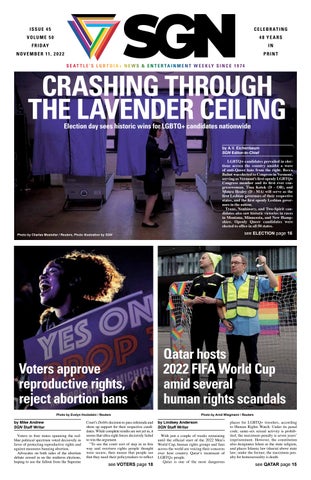
CRASHING THROUGH THE LAVENDER CEILING Election day sees historic wins for LGBTQ+ candidates nationwide
by A.V. Eichenbaum SGN Editor-in-Chief LGBTQ+ candidates prevailed in elections across the country amidst a wave of anti-Queer hate from the right. Becca Balint was elected to Congress in Vermont, serving as Vermont’s first openly LGBTQ+ Congress member and its first ever congresswoman. Tina Kotek (D - OR), and Maura Healey (D - MA) will serve as the first Lesbian governors of their respective states, and the first openly Lesbian governors in the nation. Trans, Nonbinary, and Two-Spirit candidates also saw historic victories in races in Montana, Minnesota, and New Hampshire. Openly Queer candidates were elected to office in all 50 states.
see ELECTION page 16
Photo by Charles Mostoller / Reuters, Photo illustration by SGN
Voters approve reproductive rights, reject abortion bans
Qatar hosts 2022 FIFA World Cup amid several human rights scandals
Photo by Evelyn Hockstein / Reuters
by Mike Andrew SGN Staff Writer Voters in four states spanning the redblue political spectrum voted decisively in favor of protecting reproductive rights and against measures banning abortion. Advocates on both sides of the abortion debate zeroed in on the midterm elections, hoping to use the fallout from the Supreme
Court’s Dobbs decision to pass referenda and shore up support for their respective candidates. While complete results are not yet in, it seems that ultra-right forces decisively failed to win the argument. “To see the court sort of step in in this way and overturn rights people thought were secure, then means that people see that they need their policymakers to reflect
see VOTERS page 18
Photo by Arnd Wiegmann / Reuters
by Lindsey Anderson SGN Staff Writer With just a couple of weeks remaining until the official start of the 2022 Men’s World Cup, human rights groups and fans across the world are voicing their concerns over host country Qatar’s treatment of LGBTQ+ people. Qatar is one of the most dangerous
places for LGBTQ+ travelers, according to Human Rights Watch. Under its penal code, same-sex sexual activity is prohibited; the maximum penalty is seven years’ imprisonment. However, the constitution also designates Islam as the state religion, and places Islamic law (sharia) above state law; under the former, the maximum penalty for homosexuality is death.
see QATAR page 15
2
SGN
N O V E M B E R 11, 2 0 2 2
C E L E B R AT I N G 4 8 Y E A R S!
ORIGINALLY SEATTLE GAY NEWS FOUNDED 1974 MEMBER 509 10th Ave E Seattle, WA 98102 (206) 324-4297 info@sgn.org sgn.org
SUPPORT INDEPENDENT JOURNALISM
DONATE TO SGN TODAY!
Publisher Angela Cragin Editor-in-Chief A.V. Eichenbaum Copy Editor SGN Staff • Richard Isaac Advertising Maggie Bloodstone, Advertising Manager National Advertising Rep. Rivendell Media (212) 242-6863 Staff Writers Lindsey Anderson • Mike Andrew Sara Michelle Fetters • Daniel Lindsley
SHOW YOUR PRIDE! seattlegaynews.redbubble.com
Contributing Writers Alice Bloch • Maggie Bloodstone Sharon Cumberland • Carter Hemion Jack Hilovsky • Benny Loy • Isabel Mata Gaysha Starr Social Media Team Lindsey Anderson • A.V. Eichenbaum
Merch Store!
Photographers Nate Gowdy • SGN Staff Comics Otts Bolisay Production Mike Pham SGN is published by Angela Cragin. © 2022. All Rights Reserved. Reprints by permission. Publication of names, photographs, or likeness of any person, organization, event or business in this publication cannot be taken as any indication of the sexual orientation of the person, organization, event or business. Opinions expressed in bylined articles, columns, and letters are those of the authors only and do not necessarily reflect the views of the staff or management of this paper. SGN welcomes unsolicited material, including letters to the editor, but reserves the right to edit or reject material. All rights revert to authors upon publication. We assume no liability for loss or damage of materials, solicited or not. We invite feedback, please write. And please play safe. It is our policy that no money shall be refunded if you choose to cancel your ad. Credit will be given for the balance owed. No exceptions.
In Loving Memory Of George Bakan
Scott Roger Alpert Cookie Andrews-Hunt James Arnold Ken Campbell Belial Darshan Steve Foiles Shaun Knittel James Leland Moore Don Paulson Randy Peters Lee Richeson Shaun Shelton Jim Tully
Follow SGN
VISIT US ONLINE SGN.ORG
In this Issue
LOCAL NEWS 4 FILM 7 BOOKS 12 TRAVEL 14 SPORTS 15 NATIONAL/INTERNATIONAL NEWS 16 N O V E M B E R 11, 2 0 2 2
SGN
3
Local News
Buying chocolate for strangers:
A final conversation with polyamory rights activist Erez Benari Paula not to accept it, they were not as close as Benari had wished. “The divorce was kind of ugly. It’s nothing secret, but it’s not fun stuff.” During Benari’s divorce proceedings, his ex-wife stipulated that he was not to expose their child to a polyamorous lifestyle, something Benari insisted violated the First Amendment but agreed to, because a family lawyer said the clause was “unenforceable.” A year later, he found himself back in court. “She demanded I keep it secret,” he recalled. “We went to court three times. She lost each case. She was even berated by the judge at one point, because some of the evidence she provided was doctored. So, I prevailed legally, but unfortunately, she has decided since then to go rogue and will not let me see the child. It’s been a year and a half.” The case made international headlines as a landmark suit for polyamory rights. Links to articles about the case in the Chang Rai Times and Bellevue Chronicle are available in under the “Knowledge” tab of the Hugz and Cuddlez website. Sol, according to Benari, reached out to him many times last year via phone calls and email. “It was shut down, though. I haven’t heard from them since earlier this year.” He sighed. “I guess I’m just not going to win this one.”
by A.V. Eichenbaum SGN Editor-in-Chief By the time this article goes to print, its subject will have shed this mortal coil. Erez Benari, former Microsoft engineer, journalist, co-founder of MENSA Israel, and active member of the Seattle area’s LGBTQ+ and polyamorous communities, was ill. Ongoing struggles with diabetes, metabolic syndrome, and chronic kidney disease caused him many months of pain. He chose to end his life by way of euthanasia, surrounded by his loving partners, on Sunday, November 6. Benari spoke with me on November 4. A pretty great life Erez Benari was born in Haifa, Israel. “I was a pretty normal guy. Normal family. I grew up and joined the military like everyone does. They had me working with explosives, so I like to think I’m pretty calm.” He studied chemistry, but his career quickly moved into tech, first as a printer repair and IT specialist, and eventually as a Microsoft engineer. Benari was employed at Microsoft for 19 years and was even featured in Geek Wire and Gizmodo. “I always wanted to move to America. It’s kind of the Israeli dream,” he said. In 2008, he won the Israeli green card lottery and moved to the Pacific Northwest with his now ex-wife. For years, the otherwise accomplished engineer felt he lacked that feeling of belonging. “Ultimately, I think everybody wants a community. Everybody wants to belong to something.” He added, “I’ve always been on the lookout for my own community… which is why I started MENSA Israel with Frank Luger. We did that for about four years and grew a fairly large org, and then I had to go to America. I believe it still exists under different leadership. “When I moved to America, I tried to join the Jewish community, which is pretty large and flourishing, but that didn’t quite align, because I’m not religious.” In 2016, Benari finally found what he called his “people” — the Puget Sound sexpositive community. “Not because of the sex,” he explained, “but because that community draws the highest-quality people. They are intelligent, caring, loving, gentle, enlightened, progressive, liberal — all the good things you can find in a person, and I’d never felt more held. I was a stranger in a strange land, and I’d never felt more welcome.” In the years following, Benari worked to build up and expand his found family and work for polyamory’s acceptance. He was a founding member the Polyamory Foundation, a nonprofit that gives grants to polyamory rights activists and organizations, where he served as a board member. He also founded and hosted events for Hugz and Cuddlez, the nonsexual cuddle group that garnered media attention as COVID restrictions were lifted. The weekly events are intended to promote the healing power of touch and positive attitudes toward mental health awareness. The organization holds the Guinness World Record for largest group cuddle event ever recorded. Benari expressed great pride in the community he’d helped foster, citing his polycule as a good example. “My boyfriend met his other boyfriend at one of my events.” “I don’t think, of course, that polyamory is the only way, but I think it’s a pretty good way. I think it’s important to know people have options. Relationships are a spectrum,” Benari mused. “I feel like I’ve always needed more love than one person can give and had more love to give than one person can take.” With all the love he felt, one could wonder why Benari chose to end his life with the aid of specialists. His answer? It was time.
4
SGN
Erez Benari – Courtesy photo
“My life has been pretty great. I’ve had a good 49 years. But it’s reached a point where my illness is too debilitating, and there’s a lot of pain.” Choosing to die with dignity “I am stressed out to some degree, but I’m looking forward to relief. The last few weeks, I’ve been in pain pretty much constantly,” he said. Benari’s medical issues, while not new, became overwhelming in 2021. When he learned that his kidneys were failing, he started to plan. “Knowing I have a date is a comfort. Not a good type of comfort, but I won’t have to suffer any more. I’ve had enough of that.” Washington’s Death with Dignity Act went into effect on March 5, 2009. The idea behind it is that those suffering from a terminal illness should have the right to determine when to end their lives. End of Life Washington’s slogan says it succinctly: “Your life. Your death. Your choice.” “I’m very happy to be living in a state with a progressive policy like this one,” Benari said. Washington is one of six states to pass a Death with Dignity Act since 1997, and the movement is growing. According to the website of the nonprofit Death with Dignity, seven in ten Americans support the right of people with terminal illnesses to die on their own terms. These jokes are killer Benari chose to enact his right to end his life instead of prolonging his suffering and that of those around him. In his final weeks, however, he told me he was able to find moments of levity in the darkness. Among the many hats he’s worn over the years, Benari once moonlighted as a stand-up. “I did comedy for fun, but a lot of people think of me as a comedian in nature,” he said. “I find humor in everything, and of
N O V E M B E R 11, 2 0 2 2
course in death and what’s around it, I’ve found humor everywhere.” Benari recounted a time last month when he purchased a bottle of Advil. “It comes with 40 pills in it. I thought, ‘Oh, cool. Lifetime supply.’” We shared a dry chuckle. Benari stopped briefly to take some blood pressure medication before continuing. “I told that joke to my doctor, and he said, ‘You’re killing me.’ I had to correct him. I said, ‘No, it’s actually the other way around.” He also found comfort in his polycule, he said, and their support. “My partners and I all have a similar sense of humor, sort of sarcastic, so we can laugh about that shit. It’s wild, man. I could fill a two-hour set with death stuff.” It takes a village Benari had nine partners. “One boyfriend and eight girlfriends,” he clarified. “It’s a very large polycule. All of us have at least one other partner. Sometimes four or five. “I’ve always said the key to success is not communication but a Google calendar.” “They’re all smart, progressive, people,” he said of his partners. “Each of them responded differently, depending on their personality… but I tried to do this all very gently.” Benari took a moment to reflect on how beneficial a polyamorous relationship structure had on the quality of his end-oflife care. Not only were his partners taking care of him, but their partners and friends pitched in as well. “They’ve been caring for me 24/7 since I’ve become bedridden. It’s one of the most incredible things I’ve ever seen,” he said. “It takes a village, and I have a village.” Regrets Erez Benari is survived by his child, Sol, age 12, who is nonbinary. Due to Benari’s lifestyle and the choice of his ex-wife
Legacy of love While many people find themselves searching for God at the end of their lives, Benari remained a staunch atheist. “I don’t believe in an afterlife. I do believe that my life has a lot of purpose to it. I found purpose in life rather than look toward an afterlife. That’s the reason I’ve done so many things. You only get one chance.” Knowing he was facing the void, a question surfaced: Did he feel good about his 49 years on this Earth? The answer was immediate. “Absolutely. Absolutely, absolutely. While it is somewhat tragic that I’m dying young, if I look back, it’s the opposite of unfair. I’ve had so many opportunities. I did it all. I did stuff for myself, and I did a lot of good stuff for others. I was never selfish, and I got everything that I wanted and much, much more. Jobs, girlfriends, love, toys, accessories. I had two racecars. I learned to fly airplanes. I’ve done nearly everything a man could ever hope for or imagine, both for myself and everybody else. It’s a life of accomplishment and achievement.” The next question, the final question, came naturally: What impact did he hope to have on the world after his passing? “For me, life is about love. It’s about finding and sharing and giving love. If you do it right, love multiplies and cascades… You don’t have to be a millionaire to do something, and you don’t have to spend your whole life [pursuing it]. There are so many teeny tiny things you can do to just give a little bit of joy.” Erez Benari left me with a final example of what he hoped for in the world. “When I go to the supermarket,” he said, “and I buy my groceries, at the end of the checkout line, I buy a couple of the small chocolates they have for sale there for a dollar, and then I give one to the cashier, one to the person in front of me, and one to the person behind me, and I ask them, ‘Please, have a sweet day on me.’ “It costs almost nothing, and now this person here has a chocolate…Maybe sometime later that day, or maybe he’ll think to himself at night, ‘Y’know what? The world is not such a terrible place. Maybe the next day, he’ll buy someone a chocolate and spread that joy. I choose to believe that’s what happens.”
C E L E B R AT I N G 4 8 Y E A R S!
Queer Moon Rising brings a slice of Pride to Seattle Night Market
by Georgia Skerritt SGN Intern Last Friday and Saturday, the Seattle Night Market hosted a special Queer Moon Rising event. The market, which operates over two nights on a monthly basis, has long been a cultural and social hub. The indoor venue, with 50+ stands selling local products, protects customers from unpredictable weather. On November 4 and 5, the market teamed up with Seattle Pride for an “LGBTQ+ takeover,” offering discounted vendor fees for over 20 LGBTQ+-owned stands. A representative of Seattle Pride explained that the goal of the collaboration was to create a space with more visibility for Queer business owners who might be looking to expand their customer base. The Queer Moon Rising weekend offered food, drinks, and live drag performances. With lovely music, ambient lighting, and a lively atmosphere, it was the perfect way to start November off. Here are a few of the market’s Queer vendors worth checking out: Electric Habitat Brines and Sauces Established in 2021 by wives and business partners Marisa and Miranda, Electric Habitat offers handmade, small-batch pickles and hot sauce, all of which use locally sourced ingredients and packaging. Marisa developed most of the recipes in her previous line of work as a restaurant owner. During the pandemic, the duo decided to close their business and redirect their work into what is now Electric Habitat. “[After we closed], a lot of people were begging me to bottle hot sauces and stuff like that,” Marisa told the SGN at the market on Saturday night. For more information, check out their website: https://www.electric-habitat.com. Mister Sea To anyone looking for a new print or art piece to hang up, Mister Sea is the place to look. Created by artist Carlos, it offers refreshing and unique multimedia prints in all sorts of colors and sizes. Most work is pulled from small sketches in Carlos’ personal notebook and then rearranged for larger prints. “I like to start small and then see how I can go big,” he explained. “I also get inspired by technology, so some of my pieces have imagery like that in there.” To buy prints or find out more, visit his website: https://www.misterseart.com.
VISIT US ONLINE SGN.ORG
(above) Mr. Wacko’s earrings and bracelets, (middle row, l-r) Hot sauce display at the Electric Habitat booth, Linocut prints from Mister Sea Art, (last row, l-r) Feminine candles from Ascension, Herbal soaking salts from Sonder Farmstead – Photos by Georgia Skerritt
Ascension Originally a pandemic project between friends, Ascension is best described by its business cards, which read: “elemental alchemy for bath and body.” Since they began the business in 2020, the Ascension team has used locally sourced and 100% vegan ingredients to create candles for spirituality and meditation. “We work with the elements in our spiritual practices,” creator Dee explained to the SGN. “We decided to make some candles to use during our meditations to hold a specific space or energy.” Beyond the beautiful selection of elemental candles (earth, air, water, fire, and “aether”), Ascension also offers bodyshaped candles for further spiritual connection. “We wanted to kind of represent that divine masculine and the divine feminine. Regardless of gender, we’re supposed to be balancing these energies.” Dee explained that her friend and business partner recently moved to Denver, and
will use the opportunity to expand the business. Ascension also organizes occasional workshops and retreats for those looking to learn more about spirituality and working with the elements. You can find Ascension every week at the Fremont Sunday Market. More info can also be found on their Instagram page: @ ascension_intention. Mr. Wacko If you’re planning to go out any time soon and want something new to wear, Mr.Wacko is worth checking out. Operated by designer Trixie, the Mr. Wacko brand offers handmade clothing and accessories for nightlife adventures — or, as its Instagram account describes it: “luxury one-ofa-kind clubwear.” Mr. Wacko uses textiles shipped from Los Angeles; all pieces are designed and created by Trixie. For online purchasing and more information, go to https://www.mrwacko.me.
N O V E M B E R 11, 2 0 2 2
Sonder Farmstead + Apothecary Owned and operated by creator Em Blood, Sonder Farmstead is based in Everson, WA, outside of Bellingham, and offers a wide selection of balms, lotions, body scrubs, and soaps made from organic ingredients. The apothecary side of Sonder Farmstead was created in 2020 and is now in its second holiday season. In conversation with the SGN on Saturday, Blood explained that she creates all of her products from a base of chamomile and calendula oil, which she makes herself. “I could never find any soap that didn’t have palm oil in it, so I just kind of set out on this mission to make some myself, and it just morphed into this. It’s all 100% organic and super medicinal.” Sonder Farmstead also grows organic herbs and vegetables and often operates at community events and farmers markets in Whatcom and Skagit Counties. For more information and products, visit https://www.sonderfarmstead.com.
SGN
5
Local News
Geek girls gather at very Gay con
(above) Nikki Silveira flashes her “All My Friends Are Hot” fan, (below, l-r) Suggestive supers on display at the Chibi Yeti kiosk, The Glamdalorian poses with a colorful Commander Keen, Two Jedi pose outside a panel room– Photos by Daniel Lindsley
Yet another horde of enthusiasts fell upon the Washington State Convention Center last Saturday, marking the venue’s third con this year to feature comics, television, movies, and/or games. Though dwarfed by the likes of Emerald City Comic Con and PAX West, GeekGirlCon (GGC) 2022 punched far above its weight in the category of Queer representation. Smaller cons might not have the same omnipresent buzz or sheer bulk of content, but they have a few key perks. Most attending GGC were fairly local, since a long trip from out of state is less attractive when, as a guest, there’s simply less to do, and, as a vendor or an artist, there are fewer customers. But for anyone nearby, it’s a chance to connect with like-minded geeks in the area. The speakers that ran the Queer-oriented panels were fandom veterans, artists, and content creators with informed opinions, but none were so wildly popular that they couldn’t be approached. Many were also based in the greater Seattle area, so fans could count on running into them again at other local events. For example, in the food court, I ran into local media critic Jesse Earl, known as JesseGender on YouTube. They were resting after a foray into the vendors’ hall with
Women at Warp host Grace Moore, and were there as a panelist for “Politics of Science and Sci Fi.” Author Sonora Reyes is based in Arizona, but they had a lot to say about being a Queer, Latina author of young adult fiction. Their debut novel, The Lesbiana’s Guide to Catholic School, blew up on Twitter after its launch, when conservative detractors caught wind of it. Reyes recalled getting home from their launch party, “and I checked Twitter thinking I’d find all these congratulations for my book launch, and instead it was just hundreds and hundreds of comments calling me a groomer, and a pedophile, and all that stuff, just for writing a Queer book for teenagers.” It wasn’t a fun experience, but it ended up causing a sort of reverse Streisand effect, where the negative engagement brought more positive attention too. “Because of that,” Reyes added, “a lot of people came out in support of the book... It kind of worked out to my benefit, even though it was really hard in the moment. “There was [also] someone who was like, ‘I’m gonna buy a hundred copies of this book just so I can burn them. And I was like, ‘Thank you.’” Reyes also revealed that they visualize their characters in a very Queer way, using the extensive character creation suite of the popular modern life-simulation game Sims
6
N O V E M B E R 11, 2 0 2 2
by Daniel Lindsley SGN Staff Writer
SGN
4, which only just added the option to set a character’s sexual and romantic orientations. (Before that, every character was functionally Bisexual, so 2022 marked the game’s first straight representation.) Back on the local front, Sarah Gulde of the Seattle-based Women at Warp podcast and the editor-in-chief of Star Trek Quarterly, moderated a panel of three Queer authors: Crystal Frazier, K. Tempest Bradford, and Seanan MacQuire. Under the title “Our Favorite Female Sleuths,” the four talked about Scooby Doo’s Velma Dinkley, Murder, She Wrote’s Jessica Fletcher, and others, breaking down the different subtropes of female detectives and the issues of the genre. Some Queer-oriented panels are nothing more than an affirmation of who’s Gay, and how much so (usually very), but “Female Sleuths” was far more educational. The panelists asked probing questions like, “Why are all teen detectives Gay?” And they pointed out contrasts with male detective fiction, which they described as more action-focused overall. MacQuire in particular told some fascinating true stories — one about finding a corpse, and another about pulling a lizard out of a living man’s leg — to the delight of all attending. Yet another all-Queer panel of locals talked about “Marginalized Genders in Tabletop Roleplaying Games (TTRPGs),”
featuring professional game masters Nikki Silveira and Wraith Dalziel, TTRPG writers Monroe Soto and Dana Ebert, and Wizards of the Coast narrative designer Maya Meizenzahl. Safety was the biggest entry on the docket for the discussion, since the TTRPG space has been historically dominated by white, cisgender men, many of whom seem to want to keep it that way. The panelists talked about the tools they use to create safer spaces for playing TTRPGs, and they told some cautionary tabletop horror stories along the way. The panelists also brought up one of the Queerest aspects of TTRPGs, lauding the freedom the games grant to explore different identities. Self-described “bimbarian” Silveira noted the importance, as both a player and a game master, of making sure that none at the table are the “only one” present of a given marginalized group. “I make sure that if I have a person of color [in the group], it’s not just one,” she said. “In fact, I am often the only white, cisgendered person, and I’d like to keep it that way.” The LGBTQ features of Emerald City Comic Con might be impressive, but at least by percentage, it may be that GGC this year was even Gayer. Its ethos of inclusion and social awareness shined through in every aspect, from the widely available ASL interpreters to the issue-focused panel discussions.
C E L E B R AT I N G 4 8 Y E A R S!
Film
Ambitious Black Panther sequel is a mixed bag of honest emotion and missed opportunities
Letitia Wright in Black Panther: Wakanda Forever – Photo courtesy of Marvel
by Sara Michelle Fetters SGN Staff Writer BLACK PANTHER: WAKANDA FOREVER Theaters Black Panther: Wakanda Forever was always going to be a difficult balancing act for co-writer-director Ryan Coogler. After actor Chadwick Boseman’s tragic death in August 2020 from colon cancer, it was a given that the sequel was going to have to undergo a major overhaul if it was to continue the story begun in the Academy Award–winning 2018 smash. It was equally certain it would have to find a way to honor its departed star, and do so in a way that did not feel forced or facile. On that second item, Coogler, the film’s cast, and its talented creative team succeed brilliantly. From its heart-stopping pre-credit prologue to its tearfully sincere closing images, Wakanda Forever does a stunning job of celebrating both Boseman and the character he brought to such vibrant life, Marvel superhero King T’Challa aka the Black Panther. There is nothing dishonest about these moments. Not a single second comes across
as insincere or melodramatic. The emotions fueling the scenes that directly reference T’Challa are handled with such poignant grace that I found it impossible not to be moved. In total, Coogler gives Boseman a royal sendoff. He allows the audience to grieve as one and celebrate the indelible mark the actor made upon the cultural landscape. It’s an extraordinary achievement, and one the filmmaker should be justifiably celebrated for. It is the reworking of the plot where this latest entry in Marvel’s cinematic universe falters. Not for lack of ambition, mind you. The scenario Coogler and his returning Black Panther collaborator Joe Robert Cole have concocted is nothing if not wildly ambitious. The themes at play are complicated and deep, fueled by a furious intensity born of historical atrocities and centuries of inhumane abuse that audiences will hopefully find eye-opening. But it is the balancing of these elements where Coogler comes up short. The pieces do not fit comfortably together. Certain subplots only exist to set up future Marvel projects, padding the running time while also tearing the viewer’s attention away from the central conflict between Wakanda and the hidden undersea kingdom of Talokan. The
climactic action set pieces have no urgency, and if not for the talented cast’s collective magnificence, these moments of comic book derring-do would have fallen entirely flat. I do like the scenario Coogler and Cole have constructed a heck of a lot. One year after King T’Challa’s death from natural causes, his mother, Queen Ramonda (Angela Bassett), and sister Shuri (Letitia Wright) are still dealing with their grief. Attempts to move on are thrust aside, however, when a wing-footed stranger rises out of Wakandan waters to deliver an ultimatum. He is Namor (Tenoch Huerta Mejía), and he tasks Ramonda to find the whereabouts of an American scientist who invented a device that could unintentionally discover his people’s undersea kingdom or risk open war between their civilizations. What’s fascinating about this foundation is how uncomfortably forceful the themes Coogler is attempting to explore prove to be: Oppression. Slavery. Genocide. Imperialism. The systematic destruction of indigenous civilization by white colonizers over the centuries. The pitting of ethnic populations against one another by more powerful, and again majority-white, governments in pursuit of new weapons and greater influence on the world stage. All of this and more
is given a voice. Not always a loud enough one, mind you, but a voice all the same. There is a sensational sequence in which Namor takes Shuri to his home for a visit. She’s been captured while attempting to save the life of that aforementioned scientist — who turns out to be gifted teenager Riri Williams (Dominique Thorne), aka the future Ironheart — and the Talokan king wants to convince her to join him in a battle against the surface world. Not only is this segment hauntingly beautiful from a purely visual standpoint, but the conversations between Namor and Shuri also have a dynamic heft that the MCU has typically gone out of its way to avoid. Almost all of the material focusing on returning CIA operative Everett Ross (Martin Freeman) is worthless and only serves to hint at future Marvel projects (notably 2024’s Thunderbolts with Florence Pugh, Sebastian Stan, and — I kid you not — Harrison Ford), but that stuff is annoying, not awful. But while these scenes don’t add anything meaningful to the production, it is when Wakanda and Talokan are forced to face off against one another that things start to frustratingly fall apart so egregiously. If not for a strong moment between Shuri and Namor during the heat of battle, it’s likely that none of what transpires during the climax would have worked for me at all. This is unfortunate for many reasons, not the least of which is how casually Bassett, the sequel’s heart and soul, is so casually dismissed. But the rise of a new Black Panther? Riri’s mechanical ingenuity and expertise in discovering ways to combat Namor? The battle between General Okoye (Danai Gurira) and Talokan enforcer Attuma (Alex Livinalli)? The return of Nakia (Lupita Nyong’o) to Wakanda after a six-year absence after the events of the Snap? Precious little of this worked for me, and therefore I found the impact of the final act to be borderline negligible. Coogler aims high with Black Panther: Wakanda Forever, and when the director hits his target, it’s right in the absolute center of the bull’s-eye. But the misses add up, and they become increasingly more frequent as the film inches closer to its conclusion. I find I respect Coogler’s sequel more than I actually enjoyed it, and that’s as disappointing a turn of events as any I could have imagined.
Angela Bassett in Black Panther: Wakanda Forever – Photo courtesy of Marvel
VISIT US ONLINE SGN.ORG
N O V E M B E R 11, 2 0 2 2
SGN
7
Film
The game is afoot in the energetically amusing Enola Holmes 2
Millie Bobby Brown in Enola Holmes 2 – Photo courtesy of Netflix
by Sara Michelle Fetters SGN Staff Writer ENOLA HOLMES 2 Theaters / Netflix After her success saving the life of Lord Viscount Tewksbury, Marquess of Basilweather (Louis Partridge), young upstart Enola Holmes (Millie Bobby Brown) decides to open her own detective agency. Yet, because she is a young woman, and also due to the fact her older brother is none other than the renowned Sherlock Holmes (Henry Cavill), Enola has the worst time drumming up customers, and is on the verge of closing the business. Then Bessie Chapman (Serrana Su-Ling Bliss) walks through the detective’s door. Her older sister Sarah (Hannah Dodd) has disappeared, and the child requires Enola’s help. But this mystery is far more dangerous than anticipated. It also coincidentally links up with a government banking scandal Sherlock is working on, so it will take both Holmes detectives to figure out what is going on and who is behind it all, all the while sinister Scotland Yard chief Superintendent Grail (David Thewlis) ominously tracks their every move. Every time I worried that Enola Holmes 2 would push too far into being a frenzied piece of juvenile fluff, returning director Harry Bradbeer and his divine cast — again led by the magnetic Brown — managed to right the ship with such ebullient showmanship that I couldn’t help but smile. While not quite rising to the heights of its 2020 predecessor, this gonzo sequel still manages to effortlessly entertain. I do love the melding of fact and fiction. I also quite like the ways Bradbeer and the screenwriters mischievously toy with Arthur Conan Doyle’s original characters. There is an inherent playfulness to the tone and structure of the material that could be aggravating if there were any egregious missteps or if the filmmakers did not respect their audience. Instead, the viewer’s intelligence is treated as a given, so even when things drip into cartoonish goofiness, there is an underlying truthful sincerity to the chaos that remains consistently wonderful.
8
SGN
With the Match Stick Girls’ Strike of 1888 as the background event around which the central mystery revolves, Enola jumps from one madcap escapade to the next. She goes from working in a match factory and learning about the lethal conditions the girls unknowingly spend each day toiling in, to attending a high-society ball where she is instructed on how to wordlessly flirt with a fan, to being falsely accused of murder and forced to escape from prison to prove her innocence. And that’s only the tip of the lethal iceberg. It is that last item that brings back into the fold Helena Bonham Carter as Enola’s suffragette mother Eudoria and Susan Wokoma as clandestine judo master Edith, and their all-too-brief appearance does not disappoint. The escape from the prison does go on a little long, almost as if Bradbeer doesn’t want to let these two women disappear back into the vague unknown from which they came. But it’s so nice to see all three ladies working together to
problem-solve and ultimately beat back their pursuers that I didn’t find the padding of this sequence to be too egregious, and the chemistry between Brown, Carter, and Wokoma is too infectious to ignore. The climax is also deliriously invigorating. Enola and Tewksbury are joined by Sherlock in an action-heavy showdown against the motley crew of thugs who have been hounding their every move during the search for Sarah. It’s all exceptionally orchestrated by Bradbeer and creatively edited by Adam Bosman, while the raucously euphoric score by Daniel Pemberton (Birds of Prey) does a lovely job of setting a suitably rambunctious mood. I also loved the way the primary villain is revealed, and while their identity is hardly shocking, the deliciously understandable deviousness of their actions is nothing less than sublime. Unlike the first film — even though they are close to the same length (this one is six minutes longer than its predecessor) — Enola Holmes 2 does noticeably drag,
especially during the somewhat laborious first act. There are too many flashbacks, and while Enola’s breaking of the fourth wall is once again entirely by design, I still felt like some of the instances where she speaks directly to the audience could have been discarded. There is also a childish flippancy to some of the early beats that annoyed me, but those get dialed back considerably once the game is afoot and the heroine and her brother discover they’ve been unwittingly working the same case the entire time. The good news is that watching Enola run around Victorian London solving crimes, getting into trouble with Tewksbury, and in general making a fiercely independent feminist nuisance of herself remains a great deal of fun. Even though I’m not familiar with author Nancy Springer’s series of books all of this madness is based on, it’s elementary, my dear reader, that my vote is for this story to continue into a third chapter, and to do so right away.
Henry Cavill, Millie Bobby Brown, and Louis Partridge in Enola Holmes 2 – Photo courtesy of Netflix
N O V E M B E R 11, 2 0 2 2
C E L E B R AT I N G 4 8 Y E A R S!
VISIT US ONLINE SGN.ORG
N O V E M B E R 11, 2 0 2 2
SGN
9
WEEKLY! FIND US WHEREVER YOU LISTEN TO PODCASTS! 10
SGN
N O V E M B E R 11, 2 0 2 2
C E L E B R AT I N G 4 8 Y E A R S!
VISIT US ONLINE SGN.ORG
N O V E M B E R 11, 2 0 2 2
SGN
11
Books
The Pirate’s Wife offers an ocean of adventure by Terri Schlichenmeyer Special to the SGN THE PIRATE’S WIFE: THE REMARKABLE TRUE STORY OF SARAH KIDD DAPHNE PALMER GEANACOPOULOS © 2022 Hanover Square Press $27.99 288 pages
Image courtesy of Hanover Square Press
Fourteen-year-old Sarah Bradley must’ve had an inkling that her trip across the Atlantic would end as it did. Motherless but adept at caring for her father’s home and her little brothers, she would make a fine wife for a seagoing merchant. By the time she was 17, her husband, William Cox, had set her up with a fine home and a shop in Manhattan, from which Sarah sold goods that Cox imported. Women in 18thcentury New York couldn’t own property, but Sarah was a good businesswoman, and she
and Cox became “extraordinarily wealthy.” It’s curious, therefore, that he left her relatively little when he wrote his will in 1689. Three weeks later, he was dead by drowning. After a customary period of mourning, Sarah married John Oort, a former ship captain; around this same time, she met Captain William Kidd, with whom she fostered a deep friendship. Soon, the friendship became more than that, but “divorce was not an option.” Still, Sarah and William “were such solid citizens... that an investigation into Oort’s death was not initiated” when he died suddenly in 1691. Sarah married Kidd quickly afterward. But Kidd was a merchant marine captain, and his job was at sea. When he was hired by the British crown to capture pirates at a time when Britain had a shaky hold on its colonies, “it satisfied a thrill.” He’d been “restless,” and Sarah knew it. She couldn’t ask him to stay home, and so he sailed out in late March of 1696, promising to be home in a year.
Kidd left with a full crew, including Sarah’s younger brother. He returned home a pirate. Looking for a high-seas adventure and a chance to buckle your swashes? Nope, sorry, The Pirate’’s Wife isn’t that. It’s better. Toss out all the stereotypes and legends you think you know about pirates, because this book makes short work of that mythology. Instead, author Daphne Palmer Geanacopoulos tells a love story here about a gentleman and his wife, a resourceful, wonderfully intelligent woman who could read but likely could not write. Hers is a tale with a tinge of feminism, circa 1698; there’s also an enemy that you just know was prone to sniveling, and a thoroughly fascinating history of American life in pre-Revolutionary times. Just beware, mateys: you won’t find any blood and guts, there are few high-seas hijinks — and at the risk of being a spoiler, the ending is nowhere near happy. Arrrrgh! Still, you will be, when you start this absolutely absorbing book.
Jessi Zabarsky’s Queer witchy graphic novel enchants readers by Lindsey Anderson SGN Staff Writer Good art can unlock emotions words fail to describe. At least, that’s how graphic novelist and author Jessi Zabarsky feels. For eight years, she worked to combine her writing talent with her passion for art to create the delightful and whimsical graphic novel Witchlight. Following the adventures of a witch and a peasant girl, it pulls inspiration from many of her childhood favorites, while also putting a new spin on the classic literary form. Turning artwork into a novel At first, the novel started as an experiment for Zabarsky to work on her art. “Whenever I work on any kind of comic project, I like to give myself specific challenges. Mostly because I’m bad at keeping a sketchbook or practice drawings, so I have to do it all in my actual work,” she said. “So, I realized I hadn’t been drawing a lot of human figures, and I wanted to get that down. I had been drawing a lot of animals, so I wanted to do something with actual human characters. I… had done an art test for a job that I applied to, and the main character of Witchlight was actually conceptualized in that art test, and she stuck with me.” Zabarsky did not set out to create a novel, but rather just to get to know her character better and sketch the beauty she found around her home. “I thought she was so cool-looking, and I wanted to know more about her. I kept drawing her, and I started populating the world more. I was living in a forested, rural area, and I was going for walks a lot and wanted to capture this… tree-filled environment.” Eventually, she decided to write a short story for her character. “So… this [graphic novel] was unplanned. I initially made just the first chapter, then I was planning on it being that long, 18 pages, because I had gotten into a big comic show that I like, called Decaf, for the first time, and I wanted to have something new and special. Then I realized that the story was a lot bigger and it wouldn’t fit in 18 pages, so I kept adding chapters, and before I knew it, it was 200 pages long,” she said, laughing. Once she had completed the novel, she caught the attention of a small publisher. “I definitely kind of tricked myself into making it, and then it was collected in black-and-white by Chatbooks, and they
published it and distributed it, and we had a Kickstarter,” she aid. The little black-and-white novel continued to catch the eyes of readers and publishers, and before she knew it, Zabarsky had a second publishing deal in the works. “Through [both me and the publisher] taking it around to a bunch of different
12
N O V E M B E R 11, 2 0 2 2
SGN
Jessi Zabarsky – Photo courtesy of Penguin Random House
shows…, one of the representatives from [Random House Graphic] came across it and liked it and wanted to publish it.” Even though the process of publishing Witchlight was unanticipated, she admits it wasn’t easy or quick. “Making the initial black-and-white version was probably three or four years, and then it was circulating
in that form for a while, and then in 2018, I believe, is when Random House reached out to me and sent me an offer. Then there was a process of finding a colorist, and they did their work. Then ironing out a new cover, and all of that. It was finally printed and published in 2020, so it took eight years.”
C E L E B R AT I N G 4 8 Y E A R S!
Queer fantasy Zabarsky grew up an avid reader. “It’s something I loved all the time. My mom was a big reading proponent, so I grew up with many of these library books around.” She especially connected with the fantasy genre. “It felt like the real world could have secrets in it, so reading and writing fantasy felt natural, like I’ll uncover it.” But she always felt there was a piece of her missing from the characters and stories she loved so much. As Witchlight started to gain traction, she realized she had an opportunity to share a unique story with the world, one that explored queerness in a way she hadn’t yet seen. “At that time, the explosion of Queer comics was kind of just starting. There was a little bit out there, but I wasn’t connected to a lot of it. I wanted to see the kinds of magical fantasy stories that I grew up loving, but with Queer characters in them,” she explained. Queerness, like fantasy, often follows the idea of discovering secrets society wants to keep hidden, and embracing the magic that for some is misunderstood. Through her fantasy work, Zabarsky hoped to connect with Queer readers who may also feel isolated or disconnected from mainstream fantasy books. “For me, it’s very much about self-acceptance and learning vulnerability and being able to share yourself and lean on other people,” she said. “As far as queerness, [in] pretty much all my Queer work, I wanted to feel natural and easily part of the world. It’s never something the characters question. It just exists, and it’s almost a background element.” Illustrating new worlds While writing comes naturally to Zabarsky, she is always working to improve her drawing skills. “Illustrating, drawing, is more difficult and takes way more time. Writing for me is a lot of fun. I grew up reading a lot and telling stories and doing imagination play for fun. I’ve grown up treating writing as not a big deal. It’s not intimidating for me. So [for] each of the Witchlight chapters…, I would keep a file of notes and ideas, and when it came time to write the chapter, each of them was done in a day.” Even though the illustrations take more work, she believes it’s the art that makes graphic novels so special. “I think there’s a lot of advantages to graphic novels. Just in how you can tell a story or portray an emotion or setting, with all the specificities of a place. You kind of have to be a little vaguer in an all-prose novel, because you don’t have a billion words.” She enjoys using her images to tell the story and reserves words more for dialogue. “I tend to write graphic novels that are sparse words-wise. I tend to convey things in images more, and I enjoy getting into the subtleties of a person’s changing emotion on their face or their body language or how they’re moving and really feeling the impressiveness or the beauty of the place that they’re in. I think that’s pretty particular to comics.” While the content of her stories pulls from the fantasy novels she grew up reading, she says her art is influenced by work from other cultures. “It’s influenced by anime and manga, but kind of blended with an American web-comic style, I’d say. Both of those genres were very influential for me as a teen, so it’s got a simplicity and a clean line kind of aspect to it, but also I draw a lot of softly rounded forms. One of the formative mangas for me was Ranma ½. I love her round, soft little martial arts characters, kicking and punching, and looking so cute doing it.” Next projects Fans won’t have to wait eight more years to see what Zabarsky has coming up next. “So, my second graphic novel came out earlier this year: Coming Back. It’s got similar vibes to Witchlight, a lot of softness and feelings and going on adventures and figuring yourself out. It’s a little stranger than Witchlight — definitely starting to explore just being the weird fantasy that I like.” Coming Back involves a new world, unlike the one she created for Witchlight. “There are a lot more nonhuman creatures and characters in Coming Back. There’s magic, obviously, but the magic… is body transforma-
VISIT US ONLINE SGN.ORG
Image courtesy of Penguin Random House
As Witchlight started to gain traction, she realized she had an opportunity to share a unique story with the world, one that explored queerness in a way she hadn’t yet seen. tive in a lot of instances. Almost edging into body horror sometimes. It’s not too much of a spoiler, but the main community in Coming Back is all women, and they reproduce basically by growing plants, and the plant grows the baby… Stuff like that, where it’s
very specific to my world I created.” Her next few projects are still top secret, but aside from publishing, Zabarsky releases weekly sketches on her social media platforms for fans to enjoy. “The thing that is most accessible is that I do lit-
N O V E M B E R 11, 2 0 2 2
tle four-panel journal comics every week, where I draw myself as a little rabbit, and those are posted on my Instagram and my Twitter every Tuesday night if you need a quick fix,” she said with a laugh. Although Zabarsky is still pretty tightlipped on what her next published project will look like, she can assure readers that it will be Queer. “Even though there’s been so many more wonderful Queer stories and Queer comics, I’m still wanting to get into to specific kind that I like and that I want to see out there. It’s just a really interesting thing for me to explore.”
SGN
13
Travel
Stylish Milan is worth a visit by Bill Malcolm Special to the SGN I attended the International LGBTQ+ Travel Association Conference held near Milan and thoroughly enjoyed my trip to this vibrant, stylish northern Italian city, just south of the Alps. There is lots to do in this, the country’s second largest (and wealthiest) area. The Porta Venezia district is the designated “gayborhood,” although Milan’s LGBTQ venues are actually more scattered. It features lots of cafés, restaurants, and shopping (plus Gay bars) within steps of each other, and the metro is very is very convenient, as is the tram (streetcar). The Esselunga supermarket offers food to go, so you can grab some fresh fruit and yogurt for breakfast. Where to stay I stayed at the Mercure Milano Centro Hotel (part of the Mercure brand by Accord Hotels), which made for a perfect base to explore the city, as the subway station is literally in front of the hotel. The service and rooms were great at this small lodging located on the Piazza Oberdan. My room was comfortable, after I insisted that they let me control the room temperature instead of the front desk. However, skip paying for the hotel breakfast, and enjoy one of the many nearby cafés for a morning double espresso and freshly baked roll (Like Spain, Italians don’t drink a regular cup of coffee, although the café americano comes close.) What to do • The wonderful natural history museum (Museo di Storia Nautrale) and huge city park (Giardini Pubblici Indro Montanelli) are also very close the Mercure Milano Hotel. • The Duomo cathedral and plaza are a must. • Don’t miss the Sforzesco Castle. This huge fortress is complete with a moat and features works by Michelangelo and Leonardo da Vinci. • Wander along the Navigli canal district. • Visit the new CityLife district and stroll through the contemporary art park. • The new downtown skyscraper district is also worth a visit, offering stylish buildings, including a “treehouse” high-rise. • Go shopping in the nearby Corso Buenos Aires district. Also, check out the stores at the Galleria Vittorio Emanuele. Food & drink Do you like risotto, pasta, fresh breads, eggplant Parmesan, pizza, smoked meats, or cheeses? How about wine? They all are Italian specialties. Cute restaurants abound near the Mercure hotel. And it’s just steps to the bars. Note: Like in Spain, Italians eat late. Great coffee is everywhere, including the joint next door to the Mercure. Or enjoy a cocktail on the rooftop bar of the Dome Milano (on Via Giuseppe Mazzini). Nightlife The city’s Gay life is centered around the Porta Venezia neighborhood, specifically down Via Lecco (Lecco Street). There’s even a LGBTQ-friendly gelato stand. Check out Leccomilano, the Red Café, and MONO, which was great for an apertivo, a pre-dinner semisweet alcoholic beverage. Try the aperol spritz, which consists of aperol, spumante (sparkling wine), soda, and fetta di arancia (a slice of orange), with free chips, for 9 euros. The IGLTA Conference The International Gay Lesbian Travel Association had its 38th Global Convention in Pero, drawing 550 attendees from 39 countries. A key theme was that travel is an agent of change.
14
SGN
Special thanks to Visit Milan, Sonders and Beach, Visit Ft. Lauderdale, and Quiiky Magazine for hosting events at IGLTA. Fun facts Despite all the pasta, bread, smoked meat, and cheese (not to mention the tiramisu), the Italians are a slim bunch, with only 10% being overweight. The Mediterranean diet is very healthy, and they don’t snack and graze all day, like many (overweight) Americans do. The chic Milanese are amazing. Perfect stylish haircuts, modern eyewear, and designer outfits make them the best-dressed folks in the world. I had never been to Italy and was stunned at this classy crowd. Even the barista at the coffee bar looks like she is headed to a wedding. Leave room in your suitcase for some shopping. Italian design also spills over into the architecture and autos. Getting there With the euro at par with the US dollar, Italy (like Spain) is a bargain right now. So before you book a domestic vacation, compare it with a trip to Europe. Airfares are more reasonable for travel to Europe than they are to many US cities, and the hotels are about the same (but still a bit high for this value traveler). I took EasyJet from Barcelona to Milan. It was cheap but modeled after US budget airlines (charge for everything, including a carry-on bag, onboard beverages, etc.). They made us stand in the jetway for a half hour before letting us sit down, and then announced a delay due to a crew change. But I made it. And it is reportedly better than Ryan Air, another budget carrier, as is Vueling Airlines. From Malpensa Airport, take the Malpensa Express train (13 euros) to the Carbano metro stop and transfer to the M1 subway line to get to the Mercure hotel. The subway is known as the ATM; you can get an all day-pass for 7 euros. On the way home, I took American Airlines from Milan to JFK. The lengthy flight (7.5 hours) went over the Alps as well as the Maritimes of Canada and Boston Harbor. The meal service was good (pasta or meatballs), followed by ice cream and then a pizza snack before landing. The free wine and beer was a surprise. I am growing to like American Airlines.
N O V E M B E R 11, 2 0 2 2
Photos courtesy of Bill Malcolm
For more information Pick up a copy of VIVA (http://www.vivaboy. com), which has listings of bars and restaurants throughout Italy. Don’t miss Milan’s Quiiky Magazine, or take a tour with Quiiky Travel (https://www.quiiky.com/en). Visit IGLTA’s website for all your LGBTQ+ travel resource needs. Also check out https://yesmilano.it/en for more information on Milan.
Bill Malcolm is North America’s only syndicated LGBTQ value travel columnist. His columns appear or have appeared in LGBTQI+ publications in Toronto, Seattle, LA, DC, Chicago, Dallas, Atlanta, Detroit, Charlotte, Ft. Lauderdale, and other cities.
C E L E B R AT I N G 4 8 Y E A R S!
Sports
Participants display placards as LGBTQ+ associations protest in front of FIFA World Football Museum, as Qatar is set to host the 2022 World Cup, in Zurich, Switzerland November 8, 2022 – Photo by Arnd Wiegmann / Reuters
QATAR
Upon her detention, her head was shaved, and she was forced to take a vow to never wear makeup again.
Qatar hostile to LGBTQ+ people and topics FIFA announced its decision to have Qatar host the 2022 World Cup back in 2010. Since then, the country has had a decade to update its laws and improve its treatment of LGBTQ+ visitors. While there have been few reports over the last decade of enforcement of its anti-LGBTQ+ laws, Qatar has continued to censor Queer topics. In 2018 ABC News reported that Qatar was censoring all news that mentioned LGBTQ+ rights or progress. In its report, ABC concluded that several articles pertaining to LGBTQ+ progress had been excluded from the Doha edition of the international New York Times (Doha is Qatar’s capital). As the World Cup drew closer, Qatar garnered more international criticism for its treatment of LGBTQ+ people. In 2021 athletes from around the world used their platforms to call into question the country’s laws. Openly Gay, British Olympic diver Tom Daley called for a boycott, saying, “The World Cup coming up in Qatar has extreme rules against LGBT people and about women. I think it should not be allowed for a sporting event to be hosted in a country that criminalizes basic human rights.” Australian footballer Josh Cavallo, who recently came out as Gay, has also spoken out about his concerns for athletes and fans traveling to Qatar for the World Cup. “I know, personally, if I go there, I will be protected because I’m in the public eye,” he told CNN. “But it’s not me that I’m worried about. It’s those ones that are messaging me. It’s those people that aren’t in the public eye, that are scared to even be themselves and walk the streets. To see that we’re heading to a country that’s criminalizing people like myself …it’s quite concerning.”
“Let football take center stage” Despite the very real, very violent oppression LGBTQ+ people are facing in Qatar, FIFA has issued an official statement to all athletes participating in the tournament, asking them to refrain from “politics.” In a letter to all 32 participating teams, FIFA urged players to “let football take center stage.” The letter was signed by FIFA President Gianni Infantino and Secretary General Fatma Samoura. The letter asked participants to “not allow football to be dragged into every ideological or political battle that exists.” “At FIFA, we try to respect all opinions and beliefs, without handing out moral lessons to the rest of the world. One of the great strengths of the world is indeed its very diversity, and if inclusion means anything, it means having respect for that diversity,” the letter continued. “No one people or culture or nation is ‘better’ than any other. This principle is the very foundation stone of mutual respect and nondiscrimination. And this is also one of the core values of football.” Despite the letter, eight European teams are already planning on having their captains wear heart-shaped armbands in support of an antidiscrimination campaign, in violation of FIFA’s rules. Players from Australia also participated in a viral video speaking out against Qatar’s human rights violations. Many coaches and federations are also speaking out against the country’s violation of international workers’ rights. Many migrant workers were underpaid and subjected to dangerous conditions, leading to several deaths during the building process of the new stadiums. Teams from several countries, including the United States, have backed a “compensation fund” for migrant workers’ families. Denmark’s team is also planning on sporting a black jersey in mourning for the deceased workers. International LGBTQ+ rights groups are continuing to warn soccer fans who plan on traveling to Doha to practice extreme caution.
continued from cover
“Safety guaranteed” Despite concerns for the safety of LGBTQ people traveling to the country for the World Cup, Qatar’s prime minister has
VISIT US ONLINE SGN.ORG
Photo by Nick Potts / PA Wire / DPA
given a “safety guarantee” to all fans, “no matter where they come from, whom they love, and what they believe in.” However, this guarantee does come with a caveat. Fans are warned they must respect the culture of the region. Transgressors will be punished. FIFA has encouraged Doha to keep the soccer tournament tolerant, and the country has agreed to keep the matches inclusive. Fans will be allowed to fly Pride flags in the stadium, for example, but officials are allowed to confiscate any merchandise that promotes LGBTQ+ rights as soon as fans exit the stadium, to “protect” them from locals who may be angered by such items. FIFA has also released a statement promising to promote human rights training sessions for security forces who will be working at the stadiums, and saying that the World Cup is still committed to prohibiting “discrimination of any kind on account of sexual orientation.” Persecution Despite the efforts of FIFA, some are still making it very clear that LGBTQ+ fans are not welcome. Former Qatari national player and current World Cup ambassador Khalid Salman described homosexuality as “damage to the mind” to a German reporter earlier this month. Salman said being Queer is “haram” (forbidden), and expressed concerns for
children viewing homosexual athletes on the world stage. “During the World Cup, many things will come here to the country,” he said. “Let’s talk about Gays. The most important thing is, everybody will accept that they come here, but they will have to accept our rules.” For travelers, this means avoiding public displays of affection, using Queer dating apps, and/or publicly presenting as Queer. While hostile incidents are often not reported, as Qatar does not have any protections for LGBTQ+ people, Human Rights Watch reported in October that at least seven Queer and Trans people had been detained in a secret underground prison and tortured for weeks. The victims were held in the Al Dafneh district of Doha, where they were subject to physical and sexual harrassment, including punching, kicking, and slapping. One woman reported losing consciousness. They were held without charge, and one person reported spending two months in solitary confinement. In a report made to Human Rights Watch, one of the Trans women held captive said, “I was detained for three weeks without charge, and officers repeatedly sexually harassed me. Part of the release requirements were meeting with a psychologist who ‘would make me a man again.’” Another Transgender woman reported that she was arrested for wearing makeup.
N O V E M B E R 11, 2 0 2 2
SGN
15
National News
Maura Healey – Photo by Michael Dwyer / AP
ELECTION
continued from cover These fights were won despite over $50 million spent on anti-LGBTQ+ ad campaigns in 25 states in the final days leading up to the midterms, according to the HRC. Breaking records, breaking ceilings A record number of LGBTQ+ people ran for office this year. That number, 678, is an 18% increase of Queer candidates over the record set in 2020. At press time, at least 340 of those candidates have won their elections, again beating a record – 336 – set in 2020, according to the LGBTQ Victory Fund. Following her victory, Gov. Healey, who could arguably be seen as the most iconic win of this year’s election, tweeted “To every little girl out there, we want you to know – there’s no ceiling you can’t break.” In California, Robert Garcia secured a victory in the state’s 42nd congressional district, and will be the country’s first out Gay immigrant to join Congress. Iowa elected Liz Bennett, a Queer woman who currently serves in the state’s House of Representatives, to the Iowa State Senate. Arizona elected their first out Lesbian Latina, Patricia Contreras to their state’s House of Representatives. These are only a few of the notable wins for our community rolling in at press time, and the numbers continue to rise as more votes are tallied. Where woke goes to die The 2022 midterms weren’t all wins for the LGBTQ+ community, however. Notably, several anti-LGBTQ+ incumbent governors in Florida, Alabama, Oklahoma, and Texas were reelected to their seats. “Florida is where woke goes to die,” exclaimed Florida governor Ron Desantis proudly to a cheering crowd.
16
SGN
Former Trump press secretary Sara Huckabee Sanders was elected as Governor of Arkansas, and while she will be the state’s first woman to serve as governor, she is avidly and openly against reproductive and LGBTQ+ rights. In the wake of her election, clips of comedian Michelle Wolf’s roast of Sanders at the 2018 White House Correspondents’ Dinner have been circulating on social media. “Every time Sara steps up to the podium, I get excited, because I’m not really sure what we’re going to get,” Wolf famously quipped. “Y’know? A press briefing, a bunch of lies, or divided into softball teams.” The rainbow wave This midterm election surprised analysts, many of whom suspected the US was in for a “red wave,” as has happened during Democratic presidencies of the past. However, many high-profil Republicans running on anti-LGBTQ+ platforms failed. In Pennsylvania, for example, Trump-backed candidate Dr. Oz lost his race for Senate. In light of what’s now being called a “rainbow wave” after a harsh year for LGBTQ+ rights, activists are seeing glimmers of hope. “Bigots tried their best to undermine our political power – but their hate backfired and motivated more LGBTQ people to run and win than ever before,” said LBTQ Victory Fund President and CEO Annise Parker in a press release. “Tonight’s Rainbow Wave is a clear rebuke to the increased homophobia and transphobia sweeping our communities – and proves voters want to elect qualified LGBTQ leaders. With so much at stake this election, from the future of marriage equality to abortion, LGBTQ candidates’ grit and exceptional grassroots support is paying off.”
Tina Kotek – Photo by Beth Nakamura / The Oregonian via AP
Robert Garcia – Photo courtesy of @robertgarcia / Twitter.jpg
N O V E M B E R 11, 2 0 2 2
C E L E B R AT I N G 4 8 Y E A R S!
Settlement in LGBTQ employment case National Bostock v. Clayton County set national precedent
news highlights by Daniel Lindsley SGN Staff Writer
James Roesner - Photo courtesy of LGBTQ Victory Fund
First out Trans man elected to US State legislature James Roesner became the first out Trans man to be elected to state legislature on November 8. Roesner, a Democrat, was elected to New Hampshire’s 22nd State House District in what is being called a historic victory for Trans people everywhere. The 26-year-old, who also identifies as bisexual, ran on a platform promoting healthcare as a human right, funding for a stronger public education system, reproductive justice, Trans rights, and workers’ rights. According to Out for America, there were eight Trans people serving in state legislatures prior to Tuesday’s election, but none of them were Trans men. Nationwide, there are only six out Trans men serving in elected government positions.
Democrat Munira Abdullahi – Photo by Fred Squillante, The Columbus Dispatch via AP
Gerald Bostock – Photo courtesy of ACLU
by Mike Andrew SGN Staff Writer A settlement has been reached in Bostock v. Clayton County, the employment rights lawsuit that led to a US Supreme Court ruling that LGBTQ people are protected under Title VII of the Civil Rights Act of 1964. Ed Buckley, attorney for the plaintiff, Gerald Bostock, announced on November 4 that the Clayton County Board of Commissioners approved an $825,000 settlement for his client. Bostock sued the county, his former employer, charging them with employment discrimination based on his sexual orientation. “I’m filled with joy, and words can hardly express how happy I am that this is now over,” Bostock told a press conference. “As I said from the beginning, no one should go to work fearful of losing their job because of who they are, who they love, or how they identify.” Bostock was a child welfare services coordinator working for the county court when he was fired in 2013. When his employers found out that he’d joined a Gay softball league, conditions at his job dete-
VISIT US ONLINE SGN.ORG
riorated quickly. His sexual orientation was openly discussed and demeaned by people with decision-making power at his workplace, and he was fired within months of joining the league. According to his employers, he was fired “for conduct unbecoming of a Clayton County employee.” However, Bostock sued the county in 2016, charging that he was fired because of his sexual orientation. The case eventually ended up in federal courts, where Bostock argued that the ban on discrimination on the basis of “sex,” contained in Title VII of the 1964 Civil Rights Act, also protected sexual orientation. Bostock’s argument was dismissed at the district court level and then by the 11th Circuit Court of Appeals on the grounds that existing precedents took a very narrow view of the word “sex” in federal civil rights laws — specifically excluding sexual orientation. Bostock then petitioned the Supreme Court to hear his appeal. His case was one of three similar suits decided by the Supreme Court in June 2020 in a landmark ruling that Title VII bars job discrimina-
tion based on sexual orientation or gender identity. Writing for a six-justice majority, Neil Gorsuch wrote that sexual orientation and gender identity are necessarily included in Title VII’s use of the word “sex.” “An employer who fired an individual for being homosexual or transgender fires that person for traits or actions it would not have questioned in members of a different sex. Sex plays a necessary and undisguisable role in the decision, exactly what Title VII forbids,” Gorsuch wrote. “Those who adopted the Civil Rights Act might not have anticipated their work would lead to this particular result. But the limits of the drafters’ imagination supply no reason to ignore the law’s demands. Only the written word is the law, and all persons are entitled to its benefit.” After the Supreme Court decision came down, Bostock said, he “felt some pressure off my shoulders,” but his fight wasn’t over, because his case was sent back to lower courts. After the recent settlement agreement was reached, Bostock said he had the best sleep he’s had in nine years.
N O V E M B E R 11, 2 0 2 2
Ohio GOP retains veto power Jokes about Ohio being a hellscape might remain relevant until the state’s next election, as Republicans have maintained a veto-proof majority in both chambers of the state legislature. Assuming a vote along party lines, the GOP needs 60 seats in the House and 20 in the Senate to override a gubernatorial veto, and they currently hold 64 and 25. They’ve used that power in the past to override Republican Gov. Mark DeWine, and weaken his ability to respond to public health emergencies. The 2023-24 session will likely include the state budget and more abortion restrictions. Worse still, the legislative district maps used for the election were invalidated by the state’s own Supreme Court, on grounds of unconstitutional partisan gerrymandering by the GOP-dominated Ohio Redistricting Commission. It may be a small comfort that Democrats Munira Abdullahi and Ismail Mohamed will be the state’s first Somali lawmakers in the legislature, representing Columbus-area districts in the House.
SGN
17
National/International News
International news highlights by Daniel Lindsley SGN Staff Writer
Same-sex couples at Tokyo metropolitan government – Photo by Mari Yamaguchi / AP
Small victory in big Tokyo In 2015, a single district in Tokyo became the first part of Japan to recognize same-sex partnerships. Now, seven years later, the rest of Tokyo is catching up, becoming the country’s largest municipality to issue certificates recognizing same-sex couples. Same-sex marriage isn’t allowed yet, and the certificates aren’t legally binding, but they do afford same-sex couples important benefits. They can apply for housing as a couple, access medical data, and become beneficiaries on auto and life insurance policies. “With this [certificate], there is no need to explain, and I think I will be able to talk to other people about the relationship between myself and my partner with a bit more confidence,” said activist Soyoka Yamamoto. She and her partner had been living together for over 10 years. “Our goal is to use the certificate as a springboard for achieving a society where the rights of sexual minorities are protected,” Yamamoto said at a news conference. Trans activist Fumino Sugiyama said of the development, “Until now, all the systems, rules, and services in Japan has been formed as if LGBTQ+ people are invisible in this society, and Tokyo’s system has been the same.”
A sign in support of Prop 3 in Detroit, Michigan – Photo by Evelyn Hockstein / Reuters
VOTERS
continued from cover their actual values,” Elizabeth Nash, lead state policy analyst for the Guttmacher Institute, told Axios. Without Roe v. Wade, abortion has become “part of the political discourse in a way that it just hasn’t been” in the past, Nash added. Kentucky “Kentucky voters rejected a ballot measure aimed at denying any constitutional protections for abortion, handing a victory to abortion-rights supporters who have seen access to the procedure eroded by Republican lawmakers in the deeply red state,” CBS News reported. The outcome surprised Kentucky’s Republican Party, which controls the state’s legislature. GOP lawmakers put the constitutional amendment on the ballot, hoping for voter approval of their near-total ban on abortions in the state. The victory may — at this point — be only a moral one, however. The legislature’s abortion ban remains on the books, and if it survives a lawsuit currently before the state Supreme Court, abortions will still be illegal in Kentucky.
Michigan Voters approved a constitutional amendment to create a right to “reproductive freedom,” including protecting abortion access in the state, the Associated Press reported. The amendment — which takes effect 45 days after the election — effectively bars enforcement of the state’s 1931 preRoe abortion ban, but it does not repeal it, according to Steven Liedel, legal counsel for Reproductive Freedom for All, which campaigned in favor of the amendment. In order for a law to be repealed in Michigan, the state legislature must take action, citizens could begin the initiative process to reject the law, or there could be some executive branch action, such as a notice from the state’s attorney general. The petition to add the amendment to the ballot earned the most signatures of any ballot initiative in state history. California Voters in California — which already has a law protecting abortion before viability — approved a state constitutional amendment, guaranteeing residents’ “fundamental right to choose to have an abortion,” the AP reported. The amendment protects an individual’s reproductive autonomy, stating that “[t]he state shall not deny or interfere with an indi-
vidual’s reproductive freedom in their most intimate decisions,” which includes getting an abortion and using contraceptives. Vermont Voters overwhelmingly backed adding an amendment that protects abortion access under the state’s constitution, the AP said. The amendment states that “an individual’s right to personal reproductive autonomy is central to the liberty and dignity to determine one’s own life course and shall not be denied or infringed unless justified by a compelling State interest achieved by the least restrictive means.” What now? While the US Supreme Court’s Dobbs decision removes the constitutional protections for abortion enshrined in Roe, it does not remove the federal government from the abortion debate or the rights of states to set their own abortion polices. If Republicans get control of one of both houses of Congress, they will almost certainly introduce legislation to ban abortion nationwide. In that case, the Supreme Court will equally certainly have to decide if federal law trumps state constitutional guarantees of abortion rights.
Miss Argentina marries Miss Puerto Rico Former beauty queens Fabila Valentín of Puerto Rico and Mariana Valera of Argentina announced on Instagram that they had secretly married. “After deciding to keep our relationship private,” the pair wrote, “we’re opening the doors on this special day, 28/10/22.” Valentín and Valera met in Thailand in 2020, where both were competing in the Miss Grand International competition. Since then, they’ve often posted on social media together but never mentioned marriage. Their announcement includes a video of picturesque moments in their relationship, like romantic vacation getaways with beautiful sunsets, a proposal in gold and silver balloons, and the pair dressed in white and kissing outside a courthouse in San Juan. The news was met with celebration on social media from Latin American LGBTQ communities, many of whose home countries have only just begun to make strides toward marriage equality. “Thank you for all the love! We’re very happy and joyful,” wrote Valera in response to the support. “I am sending you all back the love you are giving us.” Reproductive rights supporters chant at the Kentucky Capitol in Frankfort, Kentucky – Photo by Bruce Schreiner / AP
18
SGN
N O V E M B E R 11, 2 0 2 2
C E L E B R AT I N G 4 8 Y E A R S!
VISIT US ONLINE SGN.ORG
N O V E M B E R 11, 2 0 2 2
SGN
19