Seattle Public Library makes banned books available to young readers
by Mike Andrew SGN Staff Writer
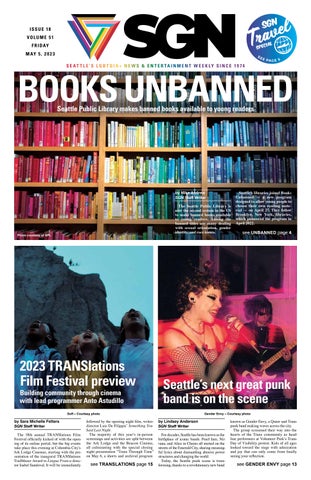
The Seattle Public Library is now the second system in the US to make banned books available to young readers. Among the banned titles are many dealing with sexual orientation, gender identity, and race issues.
2023 TRANSlations
Film Festival preview
Building community through cinema with lead programmer Anto Astudillo
by Sara Michelle Fetters SGN Staff Writer
The 18th annual TRANSlations Film Festival officially kicked of with the opening of its online portal, but the big events take place this evening at Columbia City’s Ark Lodge Cinemas, starting with the presentation of the inaugural TRANSlations Trailblazer Award to Lingua Franca director Isabel Sandoval. It will be immediately
followed by the opening night film, writerdirector Luis De Filippis’ Something You Said Last Night
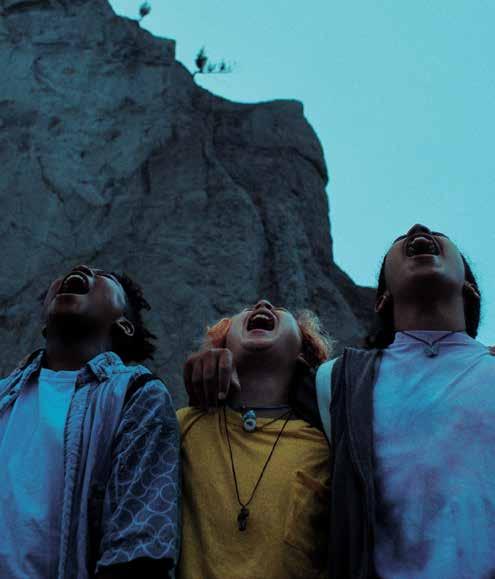
The majority of this year’s in-person screenings and activities are split between the Ark Lodge and the Beacon Cinema, all culminating with the special closing night presentation “Trans Through Time” on May 6, a shorts and archival program
see UNBANNED page 4 SEE PAGE 5
Seattle’s libraries joined Books Unbanned — a new program designed to allow young people to choose their own reading material — on April 27. They follow Brooklyn, New York, libraries, which pioneered the program in April 2022.
Seattle’s next great punk band is on the scene
by Lindsey Anderson SGN Staff Writer
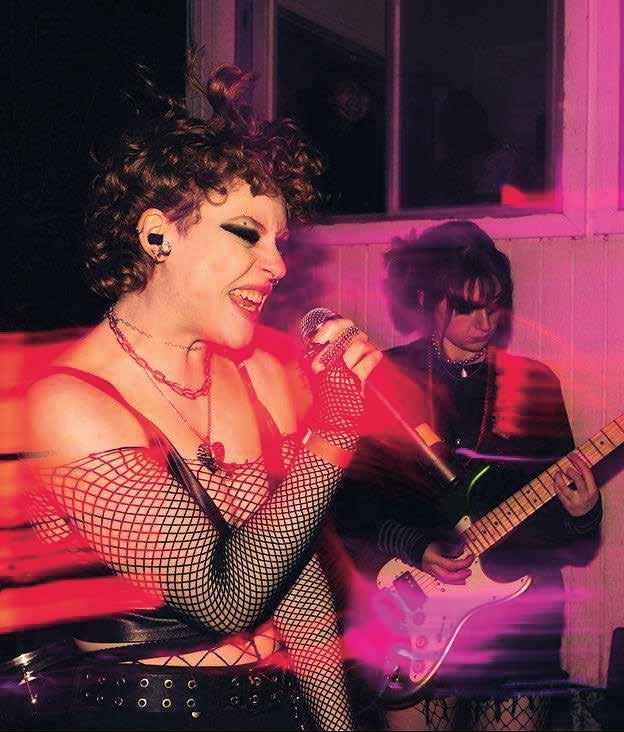
For decades, Seattle has been known as the birthplace of iconic bands. Pearl Jam, Nirvana, and Alice in Chains all started on the streets of the Emerald City, sharing meaningful lyrics about dismantling abusive power structures and changing the world.
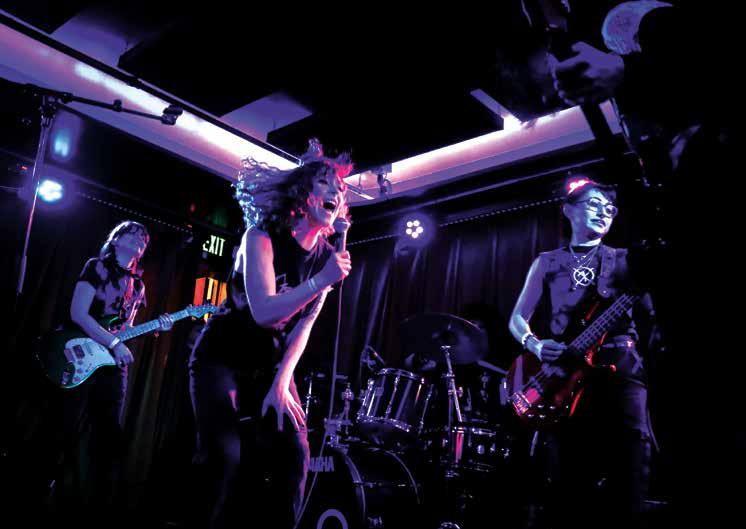
known as Gender Envy, a Queer and Trans punk band making waves across the city. The group screamed their way into the hearts of the Trans community as headline performers at Volunteer Park’s Trans Day of Visibility protest. Kids of all ages looked toward the stage with admiration and joy that can only come from finally seeing your reflection.
see GENDER ENVY page 13 see TRANSLATIONS page 15
Today, the Seattle punk scene is transforming, thanks to a revolutionary new band
Seattle’s Books Unbanned program allows young people between the ages of 13 and 26 to apply for an e-card with which they can check out e-books and audiobooks. Applications for the e-cards are taken online and don’t require the knowledge or approval of parents, teachers, or school authorities. Young readers anywhere in the country can apply for an e-card from the Seattle or the Brooklyn library systems.
With the e-card, young readers can use their laptops, tablets, phones, or Kindle to read the books they choose. They can check out up to 10 at a time and put an additional
five on hold.
Readers who want an e-card or just want to look at the titles available can go to https://spl.org/programs-and-services/ teens/books-unbanned.
Books Unbanned was inspired by the American Library Association’s Freedom to Read statement. The Brooklyn Public Library describes the program as “a response to an increasingly coordinated and effective effort to remove books tackling a wide range of topics from library shelves.”
“Many banned or challenged books are by or about Black, Indigenous, People of Color (BIPOC), or LGBTQ+ people and explore their experiences, stories, histories, and movements,” the Seattle Public Library says. “Reading these books can help you understand yourself and connect to others.”
Censorship of books for young readers became a nationwide issue in 2021, after a video of a Fairfax County, Virginia, school board meeting went viral. In it, a par-
ent demands the school board remove the graphic novel Gender Queer from the high school library.
The video became an issue in the Virginia gubernatorial election that year, with many observers attributing the victory of Republican Glenn Youngkin to his vociferous support for the parent. The video also inspired right-wing activists to pressure school boards in other states to start pulling books from library shelves.
In response, the American Library Association issued its Freedom to Read statement, and the Books Unbanned project began. According to the Brooklyn Public Library, some 6,000 young readers were participating in the program by January 2023, and had checked out 52,000 books.
Three locals elevate coffee to an art form at US Coffee Championships
by Daniel Lindsley
SGN Staff Writer
During this year’s United States Coffee Championship (USCC) nationals, three Seattleites combined three of the city’s pillars of identity: coffee, queerness, and music. Baristas Natasha Solowoniuk and Gray Kauffman honed their coffee expertise and their own creative visions, while singer, poet, and songwriter Kate Van Petten wrote custom music to go with the performances.
Readers might naturally wonder what a performance has to do with coffee. Well, in the same way a café sets itself apart from others by way of its location, seating, and decor (and other components that make up the prevailing quality known as “the vibe”), many categories of the USCC ask for prowess in technique and presentation as much as taste.
In other words, this is no Iron Chef ; it demands much more of participants than a tasty and visually appealing finished product. Things as minor as spilling coffee grounds on the counter or wearing an apron with lint on it can have the judges docking points.
“The visual presentation that you’re being judged on is actually the hardest points that you can get,” Solowoniuk said. “And that’s the area where I was most successful. The rest was kinda lower, but that’s why I had so much fun with the competition, because it’s all about ‘how creative can you get?’ And being really vulnerable and showing ‘this is my wild idea — do you get it or not?’”
Solowoniuk won fifth place in the booziest category, “Coffee in Good Spirits,” which involves creating four designer drinks using both coffee and liquor (two hot and two cold) over ten minutes, while giving what she compared to a “TED talk.”
“Besides basing it on synesthesia, I was basically telling a love story within the drinks I was creating,” she said of her presentation.
Wake up and smell the grunge music
Solowoniuk’s initial plan featured “Crimson and Clover” by Tommy James and the Shondells, “Love Will Tear Us Apart” by Joy Division, and the Raveonettes’ cover of “I Wanna Be Adored” — a mix of indie rock and post-punk that rests comfortably in Seattle’s storied and ongoing history of grunge music.
“Especially the last one that I presented, that I named ‘the Encore,’ was quite romantic,” Solowoniuk said. “You had to reach into a frame to actually grab the drink, and then it had rose petals. So it was quite an intimate sensory experience.”
She also approached the competition from the perspective of a manager of the KEXP building’s Caffe Vita. She had been mulling over the question of how music can affect taste, and for more thoughts on the matter, she called Van Petten, who only had to hear the pitch before offering to write a track for the barista’s routine.
Van Petten based the track on a few other songs Solowoniuk sent them, by Dexter and the Moon Rocks and Rainbow Kitten Surprise.
“In music we call them reference tracks,” Van Petten said. “So it’s like what you would use to set the tone or the vibe, or what the guitar tone is gonna sound like, or what kind of instrumentation there’s gonna be.”
“[Solowoniuk] opens her routine by saying, ‘I’m a barista at a radio station,’” Van Petten said. “So I [was] constantly thinking about the sensory experience of listening to music while drinking coffee, and how that can completely change how something tastes.”
The process of creating Kauffman’s track had a similar starting point, but with a theme of “stop and smell the terroir,” one grounded (puns intended) in both time and place. They tested their coffee mettle in the popular Barista Competition.
“Kate and I had talked last year about what it would be like to add almost like a soundscape, or how you could create a really focused moment in time and bring more sensory elements into the presentation,” Kauffman said.
Grunge entered Kauffman’s presentation in a more literal and earthy sense, when they used earthenware bowls of fresh soil as decoration for their performance.
Their reference tracks were mostly ambi-
ent music and sounds of the countryside, meant to “transport” an audience to the Colombian farm where certain coffee beans were grown.
Van Petten took this idea, too, and ran with it. They could have simply done some research and sampled something convincing enough. But they were already friends with the Colombian coffee producer, so with some correspondence, Van Petten was able to use sounds and voice memos sampled directly from the farm itself.
“It was an honor for me, a local musician... in this niche scene,” Van Petten said. “To tie music and coffee together — two of Seattle’s iconic institutions — was so fun.”
Breaking ground in Queer coffee Coffee and queerness may both run deep in the Pacific Northwest, but the USCC and the international World Coffee Championships (WCC) both have a lot of room to improve their diversity, equity, and inclusion.
“There’s a lot of inequity in these competitions,” Kauffman said. “It takes a lot of resources — being time, money, access to equipment, the right coffee — to be able to just get your foot in the door.”
Solowoniuk said she wouldn’t have been able to afford going to the competition without the sponsorship of Caffe Vita, and at the event itself, the demographics of the contestants were starkly lopsided.
“Out of the top finalists there were 34 of us, and only five or six were women,” Solowoniuk said.
On top of that, since its founding in 2000, the WCC has held championship events in several countries where to this day LGBTQ people face legal challenges just for being Queer.
Many more progressive countries, like Australia and the Netherlands, have been WCC hosts more recently. Greece and Taiwan are scheduled to host this year.
But that fact doesn’t undo the effects of decades of the competition being male-dominated. For some perspective, Agnieszka Rojewska of Poland became the first woman to win the World Barista Championships in 2018.
Hometown mentor
Having read all that, it may be reassuring for Queer coffee lovers to learn that there are people actively organizing change in the industry, and there are already signs of a growing Queer presence. The nonprofit Glitter Cat Barista is dedicated to making that happen.
Thanks in part to the efforts of Glitter Cat, all four of the judges for a particular USCC panel this year were Queer, and three of them were Trans. “Half of the room was crying,” Kauffman said, as one of their friends, an Atlanta-based, Nonbinary barista, spoke to the judges of living in the South:
“‘I mentioned that by sharing a drink with you, I’m sharing a part of my home,’” Kauffman read, quoting their friend. “‘I want to further extend our thread of connection to something a little more vulnerable in these final moments together to acknowledge the weight and the complexity of this.’
‘“I’m a Queer, Trans person, and the South is my home. I lived in Florida for the most of my life, and Georgia for the past three years.
“‘My identity continues to be challenged in ways that give me hope, and hope is how we move forward. So we have to work to pretend so we can all move forward together, because there’s no good point in moving forward alone.’”
Change is happening at our doorstep, too. Both Kauffman and Solowoniuk have a mentor in Samantha Spillman, the United States Barista Champion of 2019.
Van Petten described Spillman as “an incredibly kind, wonderful human” and likened her to a “backstage coffee mom.”
“That legacy of passing down the torch is so critical, or else, you know, we’ll never see more diversity,” Van Petten said.
You can keep up with K. Van Petten’s work on Bandcamp at https://kvanpetten. bandcamp.com or on their Instagram @kvanpetten. Show your support for local Queer baristas by following them on Instagram: Natasha Solowoniuk @ drinkslinginnatti and Gray Kauffman @ jgraykauffman.
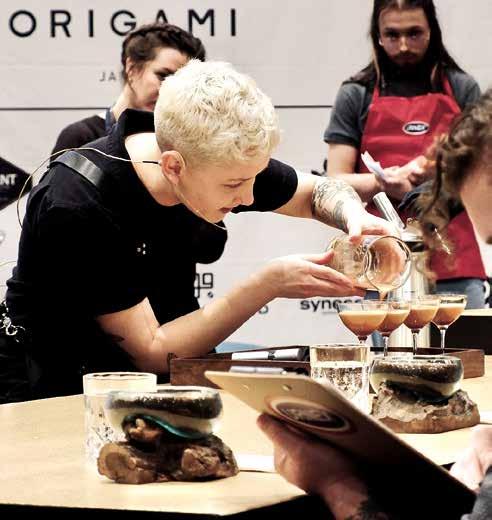
Gray Kauffman pouring drinks as judges look on – Photo courtesy of Kate Van Petten
Image courtesy of SPL
Travel Camp Queer: A camping guide
by Benny Loy SGN Contributing Writer
Washington is one of the most beautiful states, and lucky you, now it’s camping season. Warm and sunny weather is a rarity here, so why waste this opportunity to get your dose of vitamin D?
Maybe you don’t know where to start, or you haven’t camped since you were a child. So here we will go over some basics: what you’ll need to prepare, how to be safe, and how to have fun. With these tips, you can explore Washington state with more confidence.
Research
Washington has you covered with its many natural wonders. Spend time researching attractions and locations that you may be interested in. Some apps are great for finding the perfect place for you; I recommend Alltrails or my partner’s favorite, iOverlander.
The time of year and weather will be significant factors in your decision-making. For example, it’s important to know whether a location currently has a burn ban before you start packing ingredients for s’mores. An area you wish to explore might also have certain environmental protections you should know about. For instance, Olympic National Park has full protection, meaning you can’t take anything natural home. So leave that shiny pebble on the beach for the local wildlife.
Always research what passes or licenses you’ll need. I recommend investing in a Discover Pass, which gives you vehicle access to Washington state parks.
There are many flavors when it comes to being outdoors and camping. Find your niche, and don’t be afraid to dabble in things you wouldn’t normally do.
Preparation
A critical part of any adventure is being prepared. I was talking to a stranger one time about her camping experiences. She said she always wanted to go camping but didn’t know anyone who was a camper. She described how she figured out where she was going and loaded her little dog and supplies into her Toyota Prius. When I asked how that went, she said, “Not well.” She
was embarrassed to say that she had forgotten one of the most important things: water. She enjoyed her time there but said that camping may not be for her.
Not being prepared is a common problem among new campers. Here is a simple list of the basics even if still on a budget (camping can be very inexpensive once you’re past the initial start-up costs):
The necessities include a headlamp or solar-powered flashlight and a cooler filled with two bags of ice to be kept in the shade.
A helpful trick is to have a second cooler filled to the top with ice if you stay for over three days.
Pack plenty of dry goods, and always bring more water than you think you’ll need. Two gallons for two days is fair, but be prepared for spills or drinking more water than expected. Only drink water you find out there if you can purify it or know how to find safe, natural sources. That creek may look crystal clear and refreshing, but who knows what may have happened upstream or what parasites could be lurking.
Bring some firestarter and a couple of
campfire logs in case of heavy rain. I recommend wax-based firestarter cubes, because they are lightweight and waterproof.
Pack a small basic tent, a tarp, and something to tie it down.
A portable stove may seem bougie, but it is handy if you experience unexpected weather or are in an area with a burn ban.
I recommend a cast iron skillet for your cooking, and remember utensils and bowls.
Add a lighter or torch, trash bags, a map, a knife or hatchet, and toiletries to the list.
Here’s a pro tip: keep your toilet paper in a sealable bag, but if you can, use wipes.
Finally, if you can afford it, invest in a handheld GPS tracker like the Garmin GPSMAP 65r. A lot of trackers have emergency buttons to signal for help or even allow you to send text messages. This could be a lifesaver if you’re lost in the woods, get a flat, or are injured.
The journey
So, now you are ready to hit the road! We all know Seattle traffic sucks, so here is how I try to beat it.
Holiday weekends are their own circle of hell when it comes to traffic, but on an average weekend, leaving on Friday around 2 to 3 p.m. at the latest is best. If camping during the week, any time of day will work except for 7–9 a.m.
Make sure you bring snacks and drinks at the start of your trip to avoid unnecessary stops. Once you’re out of the city and on the back roads, remember not to wait until you’re almost empty before planning to refuel, because gas stations become harder to find. Also, take your time, even if you’re excited to get to your destination. The state patrol is always out; tickets aren’t a fun way to start your adventure.
Turn on an audiobook and enjoy the ride!
The setup
You will either be a campground queen or a primitive camping legend. Whatever level of difficulty you decide, be safe about it, and pick where you’re going to be with caution.
Campgrounds are great for beginner campers, but they have their pros and cons. If you decide on hard mode, make sure you bring protection and that other people know where you’re going.
Remember that nature won’t always be cute and fluffy. To quote my fiancée, “I respect nature enough to know it can hurt me.” Set up your camp with wildlife in mind by keeping your food and trash sealed and high up. Keep food out of your tent. Do not approach wildlife, and if you have a small dog, make sure they stay close to you.
If you are setting up a campfire, do it safely. It’s easy to convince yourself that you have control of the situation, but anything can happen. Do not set up the campfire near your tents or vehicles. Be mindful of where embers could go, and keep in mind that fire can travel up tree roots. Always put out your fire when you’re done watching it.
The fun
You likely won’t have a phone signal, but camping is a time for logging off. If you have a signal, consider only using your phone for geocaching and nature identification. You can use geocaching apps to find hidden caches left by others. Make sure to bring a pen to sign any logbooks to prove that you found it and a small trinket to trade with other items in the box if allowed. For nature identification, I recommend using the Seek by iNaturalist app to learn more about the plants, animals, and fungi surrounding you. My partner loves going off-roading, fishing, and hiking. Her absolute favorite, however, is reading in the quiet solitude of nature.
Experiment and find what makes camping fun most, but most importantly, research, prepare, and stay safe!
Photo by Lauren Vasatka
Photo by Lauren Vasatka
Spectacular Sydney WorldPride
LGBTQ+ event attracts visitors from around the world
by Dana Piccoli Special to the SGN
This article originally appeared in News Is Out. Reprinted through the SGN's partnership with the National LGBT Media Association.
Imagine a place where rainbow flags fly from every corner. A place where even the sharks donned their finest gay apparel. (More on that later.) Where everyone from the local dentist to the world-renowned art museum rolls out the rainbow carpet.
This was the reality of Sydney WorldPride, which offered 17 days of celebrating the LGBTQ+ community in Australia and beyond. News Is Out was one of the few US outlets invited to attend, and this reporter was dazzled and delighted at every turn.
Sydney WorldPride coincided with the city’s famed Mardi Gras. Similar to New York’s Stonewall rebellion of 1969, Mardi Gras began as a protest in 1978. In fact, the night of the first Mardi Gras commemorated Stonewall.
Much has changed in Australia since those brave “78ers,” as they are known, marched, protested, and changed the course of Australian history.
Hundreds of events occurred during the over two weeks of the WorldPride celebration, and here are the highlights of the experience.
Qantas arrives at WorldPride in style Drag queen bingo 40,000 feet in the air? A menu specially made for Sydney WorldPride? Live performances, curated queer films, and a preflight party? Qantas’ Pride Flight from Los Angeles to Sydney offered this and more.
This reporter arrived at LAX, only to be ushered into Qantas’ lounge and greeted by smiling drag queens, never-ending sparkling wine, and a rainbow carpet. Fellow travelers gathered to mingle and enjoy snacks and performances by Australian artists G-Flip, comedian Joel Creasey, and singer-actor Hugh Sheridan.
Guests eventually changed into their official Qantas Pride Flight pajamas and took to the skies for the 15-hour flight. (You’d be surprised how quickly the time passes when you are having a blast.) Australian makeup brand Mecca Max provided swag bags and in-flight makeup lessons. (Those wipes and eye cream came in handy during the long trip.)
Members of Qantas Illuminate, the LGBTQ+ employee and ally group, were on board, making sure all were well fed and taken care of on the way to Sydney. Flyers who booked a seat on the Pride Flight also scored tickets to the sold-out Live and Proud: Sydney WorldPride Opening Concert.
Flying the rainbow skies was a real treat.
Mardi Gras turns 45
Mardi Gras is Sydney’s largest annual LGBTQ+ celebration, happening in late February, much like the large Pride festivals we have in the US. While there are certainly the things you expect in a Pride parade (Dykes on Bikes, floats, organizations), Sydney’s Mardi Gras has choreographed dances and massive art pieces, like the First Nation’s Rainbow Serpent, which twirled its way through the streets of Sydney’s gayborhood.
Prime Minister Anthony Albanese attended for the first time as PM, marking the first time that someone in the country’s top leadership position has participated. Opposition leader Chris Minns joined him.
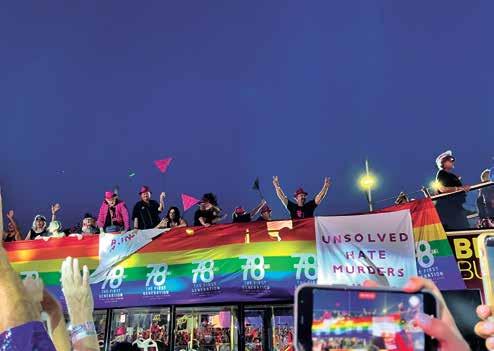
The five-hour parade featured over 12,000 marchers, including a bus with many of the 78ers, who are respected and revered for their tireless efforts to change the Australian system for LGBTQ+ people. Same-sex
marriage in Australia was finally legalized in 2017 after 22 previous bills failed.
To learn more about the history of the 78ers and efforts to make Australia a safer and more inclusive place for the LGBTQ+ community, check out the official website.
Respect
Before every event, from large-scale productions to smaller, more intimate events, respect was given to the custodians of the land the event was taking place on. Hosts, performers, and Sydney WorldPride staff all paid tribute to the Gadigal, Cammeraygal, Bidjigal, Darug, and Dharawal people. While the language may have changed slightly depending on the event and where it took place, the sentiment was always: “We pay our respects to their elders past and present. Always was, always will be Aboriginal land.”
Kylie Minogue kicks things off at the Live and Proud Concert
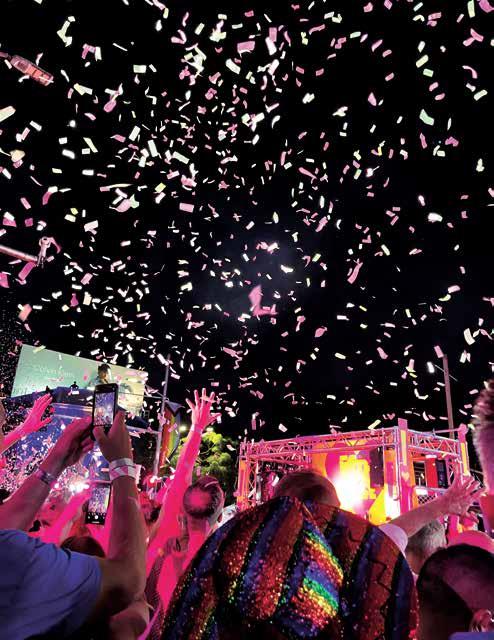
The opening night “Live and Proud” concert showcased talent from Australia and beyond, welcoming performers such as Electric Fields, Jessica Mauboy, and Australia’s highest-selling female artist of all time (and huge LGBTQ+ ally), Kylie Minogue. Hosted by international drag superstar and Brisbane-born Courtney Act and Casey Donovan, the concert attracted thousands of revelers decked out in their finest rainbow outfits and glitter for days.
The production values were top-notch and included a special drone show and fireworks. A bombastic tribute to Priscilla Queen of the Desert brought out dancers and drag queens to celebrate the beloved Australian film, which next year will celebrate 30 years since its release.
Certainly, Kylie Minogue was the big draw of the night. She first played Sydney’s
Mardi Gras back in 1994 and has long been an ally and icon in the Queer community. Minogue and her troupe of dancers performed her big hits, including “Can’t Get You Out of My Head” and “All the Lovers,” on which she was joined by sister Dannii, who is also a beloved figure in the country.
Queer content creator Matthew Schueller, one half of the duo Michael and Matt, was in attendance for the Live and Proud concert and WorldPride festivities and wasn’t sure what to expect but was quickly moved by the welcoming atmosphere of Sydney.
“From the beginning of the event, I was blown away by the sense of togetherness I experienced there,” Schueller said. “It felt like walking into an open-armed embrace. The atmosphere was electric, people were really genuinely happy to be there and support each other, and you could feel it.”
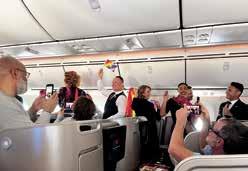
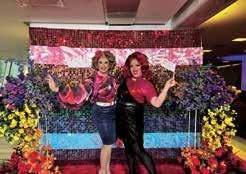
(l) Quantas Crew and entertainers show their pride, Drag performers welcomed guests to the Qantas lounge, (right) The 78ers led the first rebellion that led to slow but sure changes for LGBTQ+ people in Australia – Photo by Dana Piccoli
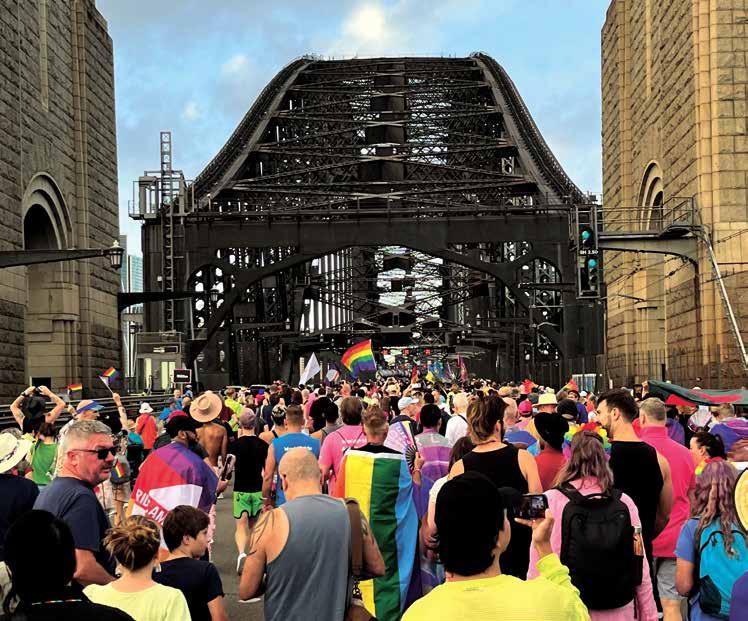
50,000 marches joined together to cross the Sydney Harbor Bridge for the last day of WorldPride – Photo by Dana Piccoli
Travel
Sydney Opera House becomes a beacon for Pride and hosts the Blak and Deadly: First National Gala concert
You’d be hard-pressed to think of a landmark that exemplifies Sydney more than the famed Opera House, celebrating its 50th anniversary this year. Its signature shells were lit up with rainbows at various points during the WorldPride celebration. Seeing such an iconic image beaming with Pride is something that will stay with me personally as a Queer woman, forever.
Hosted at the Opera House, the “Blak and Deadly: First Nations Gala” was a twohour concert featuring LGBTQIA+ Aboriginal and Torres Strait artists, plus appearances by the Sydney Symphony Orchestra and Sydney Philharmonia Choirs. Hosted by comedian Steven Oliver, the concert showcased encore performances by Electric Fields, Jessica Mauboy, and Casey Donovan. Australian opera star Deborah Cheetham Fraillon AO was joined onstage by her wife and conductor Nicolette Fraillon. The newlyweds shared a sweeping kiss onstage before performing for the first time together on such a national stage.
The Sydney Symphony Orchestra accompanied acclaimed composer and didgeridoo artist William Barton on a remarkable orchestral piece that set the tone for the evening: one of love, community, and artistry.
Opera, pop music, dance, and comedy, all performed by talented Indigenous artists on the country’s most distinguished stage truly made for a night to remember.
UltraViolet puts queer women center stage
While many events at large Pride celebrations tend to cater to mixed crowds or a primarily Gay male audience, UltraViolet created a space for Queer women and their friends to dance the night away as well.
Taking place at Sydney’s stunning Town Hall — a 130-year landmark made of Sydney sandstone and featuring the largest pipe
organ this reporter has ever seen — UltraViolet took over the entire space with three different party vibes: an outside terrace for dancing and mingling, a lower level with DJs and dance music beats, and the main floor with live performances.
Produced by Sveta Gilerman and Jess Hill, the event featured performances by Jesswar, Bec Sandridge, and Okenyo, plus aerialists and bawdy burlesque. There was even an impromptu rendition of “I’ve Had the Time of My Life,” performed much to the crowd’s delight by Sydney WorldPride CEO Kate Wickett and Kath and Kim star and activist Magda Szubanski.
The main event was by electroclash artist Peaches, known for her unapologetic lyrics and subversive performances. Peaches did not disappoint as she crowd-surfed, stripped down into a bathing suit, danced, and sang her hits to a rapturous audience.
Progress Shark
Located in front of the Australian Museum, at the busy intersection of College and Park Streets, is Progress Shark
The museum’s large statue got into the spirit and became the unofficial mascot for Sydney WorldPride. Wearing a custom Progress Flag (designed by Daniel Quasar) swimsuit, the Great White shimmered in the sun as thousands of WorldPride attendees stopped to take a picture. Artist George Buchanan created the suit, fringe and all. Progress Shark was one of 45 “Rainbow Moments” that appeared across Sydney to commemorate 45 years of Mardi Gras. Is Progess Shark here to stay? Only time will tell. (The statue was originally expected to come down in April.) Long live Progress Shark!
LGBTQ+ art on display
Sydney is a true art city. Murals appear across town, while museums (with free admission) feature the work of Australian artists and others. At the Art Gallery of New South Wales, rainbow placards appeared next to works created by LGBTQ+ creatives for the “Queer Encounters” and “Queering the Collection” exhibitions. Contemporary LGBTQ+ artists, such as Dennis Golding, whose work “Casting
greeted visitors upon entrance, were featured alongside Queer and Trans artists who have long passed.
Too often, artists were forced to hide their sexual orientation or gender identity, only to have history forget these important parts of them. Works like “The Bay” by 20th-century Lesbian Thea Proctor and “By Tranquil Waters” by Sydney Long finally get the context they deserve.
Next door at the North Building, LGBTQ+ artists are featured in the Aboriginal and Torres Strait Islander collections and “Dreamhome: stories of art and shelter.”
At Powerhouse Ultimo, the “Absolutely Queer” exhibition, which was initially curated for Syndey WorldPride, has plans to continue through the end of the year. This is a collection of costuming, multimedia works, and more, all centering on the LGBTQ+ experience. Artists and creators Nicol & Ford, Renè Rivas, and Sexy Galexy are all featured in this colorful exhibition that looks back on our history, with an eye also cast toward the future.
Powerhouse curator Anni Turnbull was part of the team putting together “Absolutely Queer” and shared her enthusiasm for having WorldPride taking place in Sydney: “It’s kind of an enormous celebration. It’s so important to recognize our Queer history, to recognize how far we’ve come in the last 38-40 years in terms of people’s rights. And I think the way it’s been done is so joyous.”
Oxford Street, the heart of Sydney’s Queer district, was covered in murals by artist Amy Blue, commissioned by the City of Sydney. The murals, which also served as a clever way to cover up construction and scaffolding, featured important people and places in Sydney’s LGBTQ+ history.
Crossing the Bridge
The Sydney Harbor Bridge is another iconic landmark and one of the major arteries through the heart of town. On the final day of WorldPride, 50,000 marchers rose early with the magpies to participate in the historic event. With participants from around the world, the march kicked off and traversed across the bridge.
A group from Dhaka, Bangladesh,
marched with a banner representing their region. “We are here to march for those who cannot march in our country,” one of them said.
This was a common refrain: recognizing our LGBTQ+ community in countries where being Gay or Transgender is illegal or oppressed.
The Rainbow Serpent made its final appearance, leading the march, followed by the 78ers and World Pride 2025 hosts, the delegation from Washington, DC.
I caught up with artist Renè Rivas, a renowned artist and designer of Mardi Gras fashions, at the end of the walk to get his thoughts about the WorldPride experience. Originally from El Salvador, Rivas came to Australia as a refugee as part of the family reunion program in the 1980s.
“For me, this is a dream come true to be able to be open to the world,” he said. “In Australia, we welcome all kind of communities, and we really embrace the diverse culture that we have.”
Rivas also had a message he wanted to share with the global community: “Don’t be afraid of who you are. That happened to me many years ago. Now my costumes are at the Powerhouse Museum, and I travel around the world being able to express myself.”
Passing the torch
All good things must come to an end, and at the closing ceremony, people gathered one last time to celebrate the LGBTQ+ community and applaud all those who worked hard to put on such a large, diverse, and meaningful event.
Before Muna, Kim Petras and Ava Max took the stage, CEO Kate Wickett, Festival Creative Director Ben Graetz, and Graham Simms (also known as the iconic Nana Miss Koori) welcomed members of the Washington DC, Capital Pride team. DC WorldPride will take place May 23–June 8, 2025, and marks 50 years of Pride in DC.
It will be hard to top Sydney WorldPride, but it’s clear that the next event is in extremely capable and enthusiastic hands. In the meantime, Sydney and New South Wales have once again established themselves as a major destination for safe, welcoming, and exciting LGBTQ+ travel.
Shadows”
This year marked the 45th anniversary of Sydney Mardi Gras – Photo by Dana Piccoli Sydney passing the torch to Washington, DC for WorldPride in 2025 – Photo by Dana Piccoli SYDNEY continued from page 6
Aerialists performed between acts at UltraViolet – Photo by Dana Piccoli
Amy Blue’s murals along Oxford Street – Photo by Dana Piccoli
Mardi Gras costumes by Renè Rivas – Photo by Zan Wimberley
Thousands of queer women and their friends gathered to see acts like Peaches and popular DJs – Photo by Dana Piccoli
Magical India has everything Queer travelers want
by Heather Cassell Special to the SGN
Reprinted through the SGN's partnership with the National LGBT Media Association.
As I’m packing my bags to return to India to visit my girlfriend’s family, I spend some time revisiting my trip there in 2019–20, right before the COVID pandemic. While sorting through interviews and photos, I am transported back to that amazing journey. (I only hope this trip will be just as wonderful!)
On Christmas Day 2019, my girlfriend and I boarded a plane for India to celebrate her parents’ 61st wedding anniversary at the turn of 2020, and for me to meet her extended family for the first time. (Late fall and winter are the best times of the year to visit. The weather is perfect: it’s warm and balmy in the south and chilly in the north. Many people travel to India for Diwali, the Hindu festival of lights, in the fall, and Holi, the festival of colors, in the spring.)
I was also going to meet with LGBTQ travel experts and activists for stories for international news articles and to learn more about the state of the LGBTQ movement in the country. In 2018, India’s Supreme Court struck down the British colonial-era antisodomy law, Section 377. The law was often used to criminalize LGBTQ people, especially Gay and Bisexual men. It was actually the second time Section 377 was struck down: the Delhi High Court first did so in 2009, but India’s Supreme Court reinstated the law in 2013.
Also, at the end of 2019, India’s parliament passed several controversial laws that impacted the Transgender community: the Transgender Persons (Protection of Rights) Bill, two national citizenship laws, and two amendments those laws. These laws largely affected all non-Hindu people living in India, but also LGBTQ people, especially Transgender people, due to not having proper government IDs for various reasons. The laws prompted some deadly protests.
It’s the perfect time for India
Planning an LGBTQ trip to India, even for the skilled traveler and journalist I have become, has its challenges. In the past — and even now — there are tour operators and hotels that said they were LGBTQfriendly but turned out only to be after the pink rupee (i.e., pink dollar), falling short on how to handle LGBTQ travelers’ needs once they are actually on the tour.
Finding India’s Queer community and
businesses, especially for Queer women, is getting easier in India’s most populous cities: New Delhi, the capital, and Mumbai, its financial center. Outside these hubs, though, finding community continues to be a challenge, because businesses aren’t publicly out for safety and financial reasons.
However, over the last 15 years, India has been opening up to Queer Western travelers. Since 2009, some LGBTQ travel companies, both Indian- and foreign-owned, have paved the way by planning legitimate LGBTQ-welcoming packaged trips.
In 2020, the International Gay and Lesbian Travel Association launched its India Task Force (now the India Initiative), of which I’m a member. The initiative is making headway into opening India to Queer travelers. In February, IGLTA hosted its first India LGBTQ travel symposium at LaLiT New Delhi, operated by Keshav Suri, a Gay man who was one of the plaintiffs in the case that repealed Section 377. He was also appointed the new chair of the India Initiative. The hotel’s nightclub, Kitty Su, hosts drag shows and Gay DJs on specific nights.
“It’s the perfect time to come” to India, because the country is opening up to LGBTQ people and offers diverse experiences, from culinary ones to wildlife, wrote Robindro “Robin” Saikhom, a Gay man who is the founder of Serene Journeys, one of the
Indian Gay-owned travel companies, in an email interview with the Bay Area Reporter
“India has virtually everything the world traveler is looking for, all set in a festive, friendly environment,” he added.
Planning and itinerary
I selected New Zealand–based Out in India to help me plan most of my trip in India. I also booked an eight-day Golden Triangle tour through Intrepid Travel, which started in New Delhi and traveled to Jaipur, known as the “Pink City,” and the Taj Mahal in Agra. Intrepid Travel launched a women-only tour.
To travel to India, Americans need a visa. I used a service, like Atlys or iVisa, but to save money, skip the additional administrative fee on top of the visa fee and get an e-visa directly from the Indian Consulate. This can take 24-48 hours.
My girlfriend and I traveled to Mumbai, Pune, and Nashik in the Indian state of Maharashtra and Kochi (also known as Cochin) in the state of Kerala. I traveled on my own to Rajpipla in the state of Gujarat, and then to New Delhi, before joining the tour.
Unforgettable adventure
Traveling through India for five weeks was one of the best journeys I’ve ever experienced. I was taken in by the busy streets, the blend of spices that waft into the air from
markets and restaurants, the juxtaposed poverty and wealth, the art and culture, the layers of history, and the friendliness and warmth of the people. I enjoyed meeting many LGTBQ Indians and learning about their fight for equal rights and their hopes for the future of their movement and country. India is truly an unforgettable adventure. My girlfriend and I found a country growing into its modern identity, a fusion of old India and the Western world, while keeping its native and colonial history. We found ourselves turning corners and eating at restaurants that made us question if we were in India at all, and then being reminded around another corner that we were very much there.
Art, culture, and history
India has a layered history from centuries of invasions, from the Mughals and the British, and people escaping persecution, such as the Parsis from Iran. Each community left its mark on the artistry, design, and architecture of ancient and present-day India. In its cities — from the palaces and country clubs of the British Raj to the temples and edifices of the Mughals — art and history were etched in stone and evident in the engineering of each building. It was breathtaking and overwhelming at times and also thought-provoking. I couldn’t have gone on my first trip without seeing the Taj Mahal in Agra. The ivory Mughal mausoleum lives up to its hype and its impressive history. Perched above the Yamuna River, it is stunning at sunset, when the marble gets that golden glow captured in thousands of photos, but nothing will ever beat seeing it in real life.
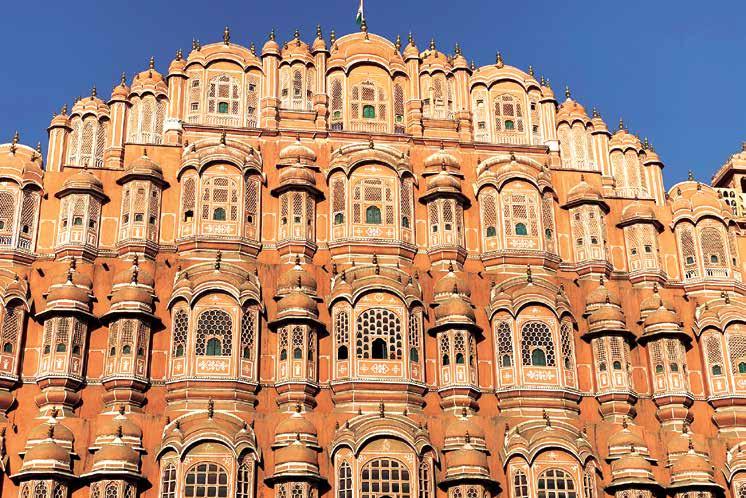
Not as impressive, but close, is the Hawa Mahal (Pink Palace) in Jaipur. It was built out of red and pink sandstone in 1799 and is an extension of the Royal City Palace, meant for women of the royal court to enjoy peering out onto city life without being seen.
There is also the mystical appearance of Jal Mahal (“Water Palace”), set atop the water, as if it is floating in the middle of Man Sagar Lake. It is believed to be a former summer palace of the royals built in 1699.
The Amber Fort, built in 1592 out of red sandstone, rests on top of a hill over the small town of Amer.
In New Delhi, I enjoyed visiting the Lotus Temple and the famous Sikh Sheeshganj Gurudwara temple, where 10,000 people are fed daily.
Queer India
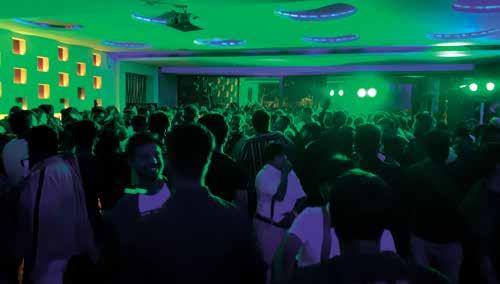
Never in her wildest dreams did my girlfriend believe she would kiss her significant other at a Queer party in her father’s hometown, she told me. Yet, on New Year’s Eve 2020, we were surrounded by more than 700 LGBTQ partygoers at a party by Mist
Photos courtesy of Heather Cassell see
Travel
LGBTQ Foundation to ring in the new year and decade at the Hyatt Pune. At the stroke of midnight in a crowded room, we clinked glasses and locked lips.
India’s LGBTQ community is vibrant, creative, and full of life. In Mumbai, I spent a fun evening at a lively Queer trivia night hosted by Gaysi Mumbai, an LGBTQ group that promotes Queer events, at the Independence Brewery Company in Andheri West.
One of the wonderful things about India is its art, culture, and literary scene. I was pleased to discover LGBTQ artists and art experts, like Kalki Subramaniam, a Transgender woman who is the founder and director of Sahodari Art Gallery, which features 45 LGBTQ artists, mostly Transgender people. The gallery is located about four hours outside of Kochi by car.
In Mumbai and New Delhi, I learned about the city’s LGBTQ art scene and history with Gay art historian Aditya Ruia, the owner of Bombay Art Gallery. Ruia also leads an LGBTQ art tour in Mumbai.
One memorable night in Mumbai, I happened to tour Colaba’s Art Deco architecture, art galleries, and boutiques with filmmaker Faraz Arif Ansari.
In New Delhi, Serene Journeys’ Saikhom leads guests past about 55 public murals on the Lodhi Art Public Art Tour.
Sambhav Dehlavi, the Gay owner and tour guide of Purani Dilliwala Iqbal, leads an LGBTQ history tour through the city, one of the most memorable of my trip. One of the sites he showed me was a tomb of a king and his male or Transgender lover, both buried side by side. There were many other sites throughout New Delhi where it is suspected that LGBTQ history took place.
India also hosts a number of LGBTQ festivals and Pride celebrations, including Queer Azaadi Mumbai (January/February), Delhi Pride (last Sunday of November), and the 18-day Transgender Koovagam festival (March/April), south of Tamil Nadu’s capital, Chennai.
There are other events, like New Delhi’s Rainbow Lit Fest (December) and film festivals, such as Mumbai’s KASHISH Mumbai International Queer Film Festival (June).
Beer and wine
Microbreweries are all the rage in India, and Pune is their birthplace there. In 2020, there were 12 craft breweries in the city and many more throughout India. My girlfriend and I were thrilled to discover some that served excellent beers with delicious bar food. We barhopped through Pune and Mumbai, stopping at Effingut Brewery, Independence Brewing Company, and Toit Brewery in Pune; and Doolally Taproom and Drifters Tap Station in Mumbai.
Nashik is the origin of India’s emerging wine industry. The area boasts more than 30 wineries. Nashik was inspired by, and has roots in, California’s wine country, but it won’t be mistaken for California’s Napa Valley or Sonoma County. Nearly a quarter century after the first grapes were planted at Sula Vineyards in 1996 and its first bottle was crafted and corked in 1999, quality Indian wine is still a work in progress.
Sula Vineyards was founded by former Bay Area resident Rajeev Samant, who transformed his family’s table grape farm in 1996 into a winery with the help of his friend and Sonoma winemaker Kerry Damskey.
During the few days that we hung out with my girlfriend’s cousins on her mother’s side of the family in Nashik, we visited York Winery. However, the best Indian wine we discovered was at a bar in Fort Kochi, produced by
Big Banyan Vineyard in Bengaluru. It gave us a glimpse of the possibility that India could one day produce California-quality wine.
Food!
We cautiously ate our way through India. We took recommendations from friends and looked for modern eateries that we would expect to see back home and places that looked clean. Some of our favorite restaurants included the following:
Mumbai
The Birdsong Cafe, a charming organic eatery tucked away on a narrow street in Bandra West
Loya at the Taj Mahal Palace hotel
Jimmy Boy, a local Parsi restaurant that Ansari introduced me to in Colaba
New Delhi
I enjoyed a variety of excellent cuisine in New Delhi. On my last night there, I ate a wonderful Italian dinner at Lesbian-owned Diva. Chef Ritu Dalmia, one of the plaintiffs in the 377 case, opened her new restaurant in Greater Kailash-2, an unofficial “gayborhood,” where rainbow flags wave freely outside many businesses.
I enjoyed another good Italian dinner at Fat Jar Cafe & Market.
LaLiT New Delhi’s Pan Asian restaurant, OKO offers the flavors of Asia and views of the city at the top of the hotel.
The Spice Market - Kitchen & Bar in the city’s Southern Park Mall served up spicy tandoori and other flavorful dishes.
Pune
We happened upon the Pan Asian restaurant Malaka Spice and enjoyed cocktails at Culture.
Kochi Kochi, in Kerala, is where I got my fill of seafood. This port on the shores of the Arabian Sea is known for its Chinese fishing nets, beaches, and backwaters traversed by boat to see the wildlife.
We enjoyed freshly caught fish grilled and poached at Fort Cochin around the corner from the Trident Hotel Cochin, where we stayed.
Where to stay
In Mumbai and New Delhi, I stayed at the LaLiT Hotel. I also stayed at the Grand Hyatt Mumbai, India’s eco-friendly Orchid Hotel, and a vacation rental in Bandra West in Mumbai.
In Pune, we stayed at the Hyatt Pune. In Jaipur, our tour group stayed at the Hotel Arya Niwas, and on our way to Agra, we stayed at Hotel Bhanwar Vilas Palace in Karauli, a town in the mountains between Jaipur and Agra.
In Nashik, we stayed at the three-star business-focused Ibis Hotel.
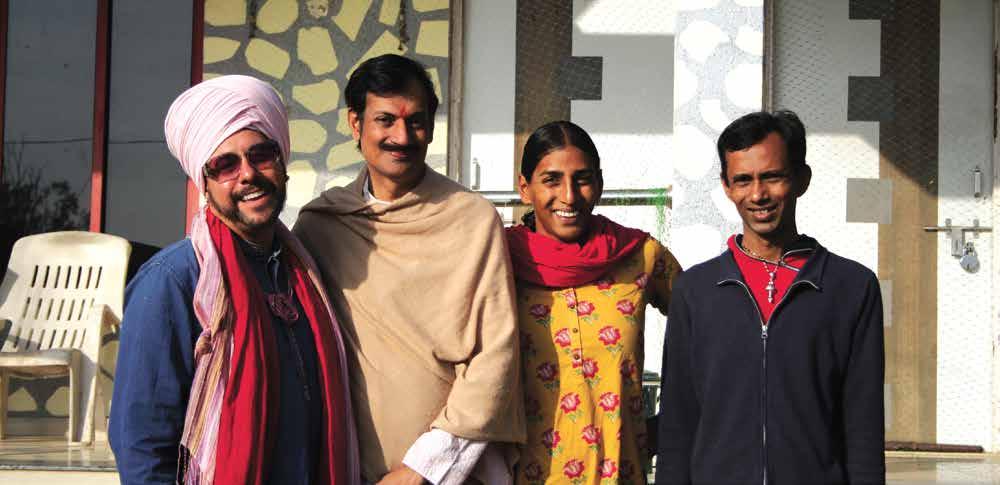
Getting off India’s beaten path, I stayed as a guest of the LGBTQ community ashram, the community center and retreat in Rajpipla owned by Gay Prince Manvendra Singh Gohil and his husband, DeAndre Richardson. The ashram is built on the banks of the Karjan River to provide services for the local LGBTQ community and serve as a retreat for Queer organizations.
Getting there, getting around
My girlfriend and I flew on United Airlines from San Francisco to Mumbai, stopping briefly in Newark. We flew Swiss Air from New Delhi through Zurich back to San Francisco for our return trip. We flew on IndiGo, an Indian domestic airline, to destinations within India.
We used Uber to hail rickshaws and cars throughout our trip.
Photos courtesy of Heather Cassell
INDIA
continued from page 9
Arts & Entertainment
Exciting Heggie and Scheer double bill
A preview of the upcoming showcase from Music of Remembrance
by Alice Bloch SGN Contributing Writer
FOR A LOOK OR A TOUCH & ANOTHER SUNRISE
Nordstrom Recital Hall at Benaroya Hall
May 21, 4 p.m.
Under the direction of founder Mina Miller, Music of Remembrance (MOR) has a long history of commissioning and performing excellent musical works that explore the consequences of intolerance. Now in its 25th season, MOR is about to present two of its most successful commissions, in
a double bill of one-act operas by the team of composer Jake Heggie and librettist Gene Scheer. One of those operas, For a Look or a Touch, is the only major musical work to date that explores the fate of Gay men in the Holocaust. It is not to be missed.
This moving opera is based on the diary Manfred Lewin wrote for his lover, Gad Beck, in 1941 Berlin, when both men were 19 years old. It consists of five songs for a baritone and chamber ensemble, with a nonsinging part for the actor playing Beck. The songs contrast the heady freedom of preNazi Berlin with the suffering of Gay men at Auschwitz, where Lewin was murdered.
Bass-baritone Ryan McKinny, who has
performed at the Seattle Opera and the Metropolitan Opera to great acclaim, will play Lewin; Curt Branom will play Beck.
The other half of the double bill, Another Sunrise, portrays one Auschwitz survivor’s struggle to describe her harrowing experiences to those who weren’t there. Soprano Caitlin Lynch plays Krystyna Zywulska, who concealed her Jewish identity and was imprisoned as a member of the Polish resistance. The poems and song lyrics she wrote at Auschwitz circulated around the camp and gave the prisoners hope. (Farewell, Auschwitz, another MOR commission by Heggie and Scheer, features Zywulska’s songs.)
In Another Sunrise, Zywulska attempts
years later to tape her answers to the questions of an unnamed professor who is collecting oral histories of Holocaust survivors. Erich Parce will stage-direct both operas, and Joseph Mechavich will conduct a chamber ensemble of superb musicians from the Seattle Symphony. Having attended a number of MOR concerts, I can promise that the performance will be top-notch.
The Seattle concert on May 21 will be the beginning of a three-city tour, followed by San Francisco on May 24 and Chicago on May 27 and 28.
For more information and to purchase tickets, visit musicofremembrance.org.
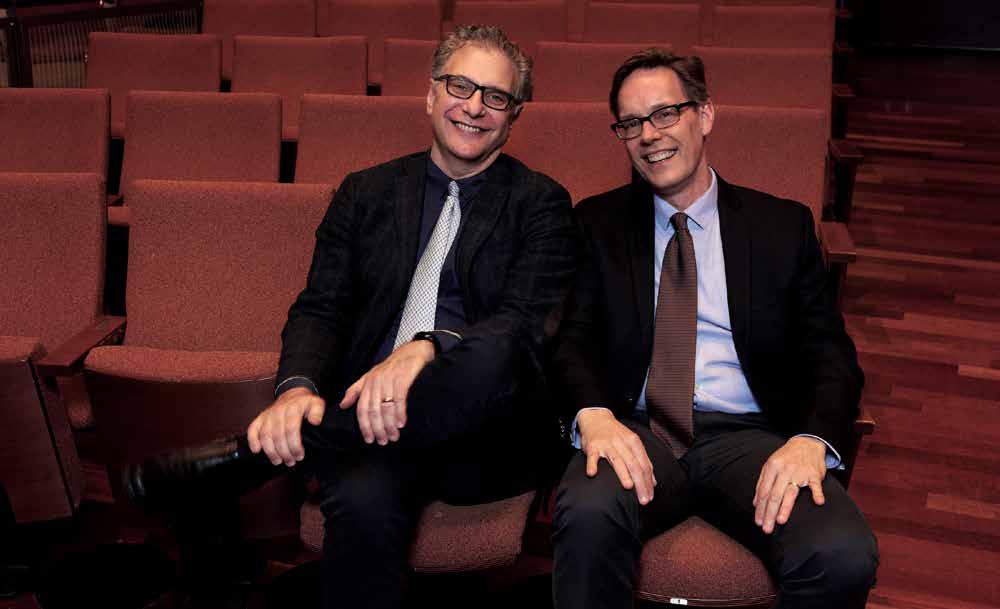
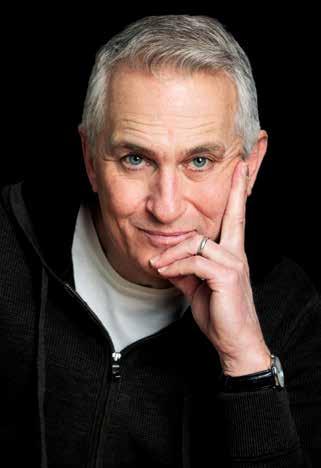
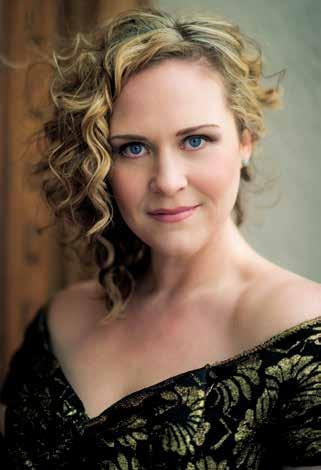
Composer Jake Heggie and Librettist Gene Scheer – Photo by Stefan Cohen
Ryan McKinny – Photo by Jiyang Chen
Curt Branom – Photo by Tanya Constantine Caitlin Lynch – Photo by Benjamin Weatherston
Gender Envy’s origin story
Every great band has a great origin story, and Gender Envy is no different. Cam, one of the group’s founding members, discovered a bass at a garage sale. “I was really into music growing up. It was my safe space,” she explained.
Her first introduction to music was in the high school marching band. “It was fun, but it was also a toxic environment, very hierarchical, and dealing with sexist band directors and everything was difficult,” she said. “High school was a depressing time, so I just got deeper into music. I always really liked punk music and political music.”
After discovering the bass in college, Cam started a band with some friends, Cass and Archie, who were both involved with music in high school. “When I first started singing, it was in musical theater. I was a theater kid back in the day. That’s why I’m so dramatic,” Cass said with a laugh.
She struggled with the harmful and competitive environment around her performance as well. “I wasn’t able to progress that much with my voice, because I was so stressed all the time that I could never really sing,” she said.
Returning to the mic to provide vocals for Gender Envy was like nothing Cass had experienced before. “Coming back to singing and doing it in an environment where it’s punk and …sounding perfect [doesn’t matter], it’s not like you’re auditioning all the time. It’s about how you can feel it and how you can sing it,” she said.
Archie had known Cass since their freshman year, and she knew he would be the perfect addition to the band. “His Instagram bio said, ‘I miss playing drums with my friends,’ and I was like him! We found it,” Cass said.
Archie started playing the drums in middle school after becoming enamored with its jazz band program. “I just fell in love with playing drums. I wanted an outlet for that,” he said.
In high school, Archie formed a band with some friends, but he admits they weren’t that good. Still, his first garage band introduced Archie to the idea of punk.
“The punk ideology [is] being unapologetic, radical, and resisting oppression,” he said. “I was interested in that. It gave me a sense of belonging to any group, and I wanted to share that.”
Punk ideology also helped inspire Archie to come up with the band’s name.
“In the back of my mind, I thought that was a sick name, because it was a popular thing to say about someone you know,” he explained. “We were going to be the Noise Complaints, which was also pretty swag, but for me, I wanted us to be very explicitly Queer,” he added.
By October 2021, they had a name, they had vocals, bass, and drums, but Gender Envy was missing one very crucial ingredient. “Ironically, we were missing the guitars, which is not how it usually goes,” Archie said. The team created a poster and advertised around their campus for Queer punk guitarists interested in making Riot Grrrl music. Two musicians responded.
Sam admits they didn’t even know who Riot Grrrl was when they responded to the poster. “I was just like, well, I guess these people are looking for a guitarist. I can do a little bit,” they said.
Sam grew up playing guitar, bass, and piano. They were confident in their skills but worried they might not fit the vibe Gender Envy was looking for. “I was anxious about that. I was like, ‘Fuck, I play guitar,’ but I was like, ‘Am I Queer enough?’ All of a sudden I’m going through my own selfdiscovery thing. Am I Queer? I don’t know, man. I don’t even know what Rrriot Gurl is!” they said.
The band provided the space for Sam to explore their identity by accepting new friends who were more than happy to teach them about Riot Grrrl.
Lily also responded to Gender Envy’s poster. Music had always been a big part of her life, so much so that she chose to go to school in Seattle. “I liked music growing up. I still do. It’s my favorite thing in
“Being Queer and being Trans and being open about it and radical about it. Being Queer and radically [self-accepting] is transgressive in and of itself, and therefore, punk.”
the whole world. My parents always played music when I was a little kid,” she said.
Lily grew up taking guitar lessons but eventually found more joy in playing the instrument in her room. “I would just sit in my room and learn full albums on guitar, mostly dumb shit like Red Hot Chili Peppers, and I would just sit in my room and wish I was in a band,” she said. “That’s also the whole reason I came to Seattle.” Originally from Texas, she wanted to move to an area with a music scene.
Cam, Cass, and Archie selected Sam and Lily based on their vibes alone. “Sam and Lily passed the vibe check. …We didn’t even hear them play,” Cam said.
A collaborative effort
Everyone in Gender Envy contributes to the writing process. “ It usually starts with a guitar riff or chord progression, and then everyone just makes stuff up based on that,” Lily said.
“Lyrically, usually Archie or I will write it,” Cass added. “‘Refrigerator Poem,’ Lily brought it in, so we’ve all had a lot of writing with the lyrics for it. When it comes to the parts of it, I think everyone writes their portions.”
All of their songs come from real experiences or feelings they’ve had. “They are all extremely lived experiences,” Archie said. “I’ve been writing a lot about boys I’ve been gay about, and how that has made me feel,” he continued.
“I got cheated on, so I wrote a song about it,” Lily added.
“I imagine myself as a tortured poet from the 18th century, and this is my journal,” Cass said of her writing inspiration.
Icons for the Trans community
While Gender Envy’s songs can vary in theme and perspective, they’ve found their audience in Seattle’s Trans community.
“The Trans Day of Visibility was the peak for me,” Archie said. “I don’t think I could top that in terms of venue and audience. I’m Trans, and it was difficult for me to be Trans. The kids were talking to us and say-
ing that we meant a lot to them, and I was thinking about how I didn’t have anyone like that. It’s crazy to be in that position, and I want to keep doing that.”
The event meant just as much to the group as it did to their fans. “After that day, we all collectively cried,” Archie said. One young fan even created art for them. It is now framed in their band room.
“I don’t think anything can top what that was, having Queer kids see themselves in us. I don’t think I could make music for any better reason. That’s exactly what I wanted out of life,” Archie added.
Older people have also connected with Gender Envy. Following their performance, an older fan shared with Cass that they hadn’t seen anything like them since they were 20.
Gender Envy is paving the way for Queer musicians in the Seattle scene, and people are starting to notice.
“A band with all Queer members is not something I’ve seen before,” Cass said. “When I was growing up, the bands were all straight dudes that you wrote fan fiction about and hoped they would sort of be Gay, and a lot of them were, but that’s beside the point, because they weren’t out.”
Rewriting punk
Not only is Gender Envy giving kids authentic Queer and Trans representation, but they’re also changing how Seattle’s scene views punk.
“I think we digress from punk a lot, just because we’re Queer,” Cass said. “The things we sing about, and the stuff we talk about, it’s not what the straight audience thinks punk is.”
“It’s not stereotypical punk rock, but it’s Queer, so it is punk rock,” Lily added.
“We don’t know what else to describe it as.”
“Punk in ideology and less in aesthetics,” Archie elaborated. “I feel like a lot of what straight guys do in a punk band is that they take all the aesthetics and what they think a punk band looks like without giving a shit about what the punk politics are, or the people or the community that they’re being a part of.”
“Punk is about resisting oppression, about being a member of a community that is loving and compassionate and gives,” he continued. “I don’t think that’s something that people think of immediately, especially when you’re not in punk.”
For Gender Envy, punk is about resisting oppression that targets LBGTQ+ and BIPOC people. “I don’t see a lot of bands in Seattle having majority-POC members or a majority-Queer members, and I think that’s what punk is and should be showing at the forefront and what we should be talking about,” Cam said. “It’s lacking a bit in the Seattle scene right now, which is why we need to provide that image.”
Gender Envy protests oppression by radically loving themselves and their community. “Us being Queer is a big part of it. We’re making music that is true to us, and part of that is self-love and self-acceptance. Being a representation of self-acceptance that is in itself radical in a society that wants you to hate yourself,” Archie said. “In some element, punk is taking a side,” Sam added. “It doesn’t necessarily need to be what the songs are about, but we showed up [at TDOV], we were playing loud music for these people and this community, and just showing up for them, that’s what it means.”
Gender Envy credits the environment cultivated in Seattle for their ability to make music that transcends oppression. “We wouldn’t be able to happen anywhere else,” Cam said. “That’s what makes it punk. Being Queer and being Trans and being open about it and radical about it. Being Queer and radically [self-accepting] is transgressive in and of itself, and therefore, punk.”
Gender Envy has become a family for its five Queer and Trans members. Together, they strive to make music that connects with the oppressed. Even without the guitar riffs, the drum beats, and the cathartic screaming, Gender Envy would still be punk.
Music has changed the lives of everyone in the band, and now, they’re changing lives in Seattle by refusing to exist quietly.
“To be a part of a band like this, you get so much freedom. You get to be yourself without having to hide other parts of that,” Cass said. “I knew how much being in this band meant to me, and then after TDOV, it blew my mind, because I didn’t realize how much seeing a band like this meant to other people. I knew I needed this, and it was insane to see that other people needed this too.”
Gender Envy will play the Concert for Choice on Friday, May 5, at the U-Heights Center (5031 University Way NE). They will also play intermission on May 9 at the Mesh Fashion Show at the Crocodile at 7 p.m.
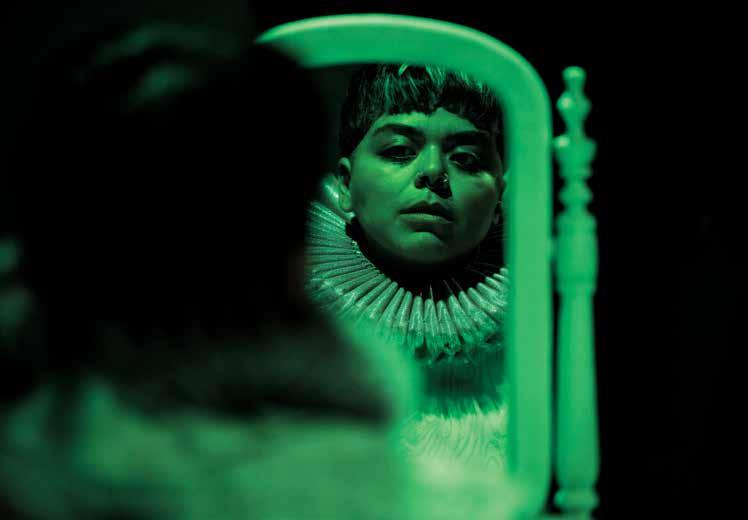
Gender Envy – Courtesy photo
Gorily riotous Sisu an action-filled dream
by Sara Michelle Fetters SGN Staff Writer
SISU Theaters
During the latter stages of WWII, a Finnish prospector (Jorma Tommila) finds a fortune in gold. On a trek to transport it across Lapland to civilization, he encounters a small battalion of German troops making their way in the opposite direction. They are led by the determined Bruno (Aksel Hennie), a grizzled veteran who thought he and his men had seen everything the war had to offer. They were wrong.
This lonely old prospector isn’t who he appears to be. He’s Aatami Korpi, a man whose myth has become the sort of tale Finns tell their children in hushed whispers to convince them to behave. Decades prior, his village was wiped out by the Russians, including his entire family. Korpi went on a one-man rampage that resulted in a body count somewhere approaching three hundred. It’s not that he’s superhuman — it’s that he refuses to die, and Bruno is going to rue the day he decided to try and take this man’s gold.
There are plenty of comparisons one could make about Sisu First Blood, of course. Westerns like Pale Rider, Valdez Is Coming, and Chato’s Land. Even with the WWII setting, John Wick is also an obvious one. Moreover, it’s not as if writer-director Jalmari Helander is going out of his way to conceal the influences that inspired his latest film, and when the result is this entertaining, there’s not a single thing wrong with that whatsoever.
After the rambunctious, plot-heavy, and dialogue-driven genre theatrics behind the director’s acclaimed Rare Exports and the goofily endearing Big Game, what I loved here is that — for all the explosions, severed limbs, slit throats, machine gun fire — this is almost a silent picture. It’s cut and shot in a fashion that would make Buster Keaton, Harold Lloyd, and King Vidor cheer, and that’s every bit as terrific as it sounds.
Tommila was born to play Korpi. Hel-
ander’s go-to actor (who made memorable impressions in both Rare Exports and Big Game) gets the starring role this time around, and he does not disappoint. Since he never utters a word, Tommila must do all the emotional heavy lifting with his physicality and facial expressions. Korpi can be monstrous. He can be heartbroken. He can show joy, resilience, terror, and fury, often in the same scene over the course of a handful of seconds. It’s a marvelous performance, one far more complicated and dexterous than the casual viewer may believe possible.
Hennie matches him as the film’s villain. There’s no such thing as a lovable Nazi, and that’s certainly the case with Bruno. Hennie chews the austere Lapland scenery with
determinedly withered aplomb. Even as the German’s eyes look like they are about to pop right out of his head as he watches Korpi do one extraordinary thing after another, his vile, uncouth anger toward the world around him never fades. The actor allows it to simmer there, right under the surface, so by the time Bruno finally lets his rage explode into the open, this animalistic fury gives the climax a glorious layer of gonzo bravado that’s sadistically sublime.
The whole thing is a slice of violent pulp fiction, and although there are echoes of John Huston’s The Treasure of the Sierra Madre, it isn’t like Helander is treating what happens to Korpi with that level of seriousness. Some of the bigger set pieces
noticeably work better than others, and a pivotal sequence right near the end, aboard an out-of-control cargo plane, is oddly underwhelming when compared to all of the action sequences that came before it. Not that this dilutes any of the fun. Watching Korpi tear a Nazi battalion limb by limb — warring against an armored tank with nothing more than a pickax and using landmines as lethal frisbees — is wonderful. Helander handles the explosively hyperreal theatrics with confidence, and it shows in every frame. While Korpi is a nightmarish demon to this film’s German antagonists, for everyone else, Sisu is blood-splattered dream action that aficionados won’t want to wake from.
Sisu filmmaker Jalmari Helander on silent heroes, emotional realism,
by Sara Michelle Fetters SGN Staff Writer
Rare Exports and Big Game filmmaker Jalmari Helander returns with the explosively entertaining Sisu, a film that almost assuredly will go down as one of 2023’s best, hard-R action extravaganzas.
It’s the story of grizzled Finnish prospector Aatami Korpi (Jorma Tommila) at the tail end of WWII. The Germans are in retreat, and he’s uncovered a cache of gold deep in the heart of Lapland. On the long trek back to civilization, Aatami unluckily encounters a Nazi battalion led by the bloodthirsty Bruno (Aksel Hennie), and all kinds of hell breaks loose.
But Aatami is not the downtrodden old man he initially appears to be, and Bruno is not above murdering civilians — and his own men — to get his hands on the prospector’s gold. It’s a battle of wits, wills, and superhuman strength, as the German commander throws all the mechanized might of his small army against a lone individual brandishing only a razor-sharp pickaxe and a singular determination to survive.
It’s rather magnificent, with Herlander unleashing a series of crazy action sequences overflowing in gruesome carnage. The film plays like an inspired combination of First Blood, The Treasure of the Sierra Madre, and Mad Max all stirred together to become a singularly tasty cin-
and
making something “f-ing cool”
ematic stew of violence and gore. I couldn’t help but love it.
I sat down with Herlander to chat about Sisu. Here are the edited transcripts of what he had to say:
from?
idea of a man finding a lot of gold in Lapland and getting in some kind of trouble. But I never figured out what the trouble would be until, many years later, I was thinking about Nazis who were destroying basically the whole of Lapland. It all clicked. I knew exactly what I was going to do.
SMF: I watched the film twice, and the second time, I watched it without sound. You utilize a lot of silent film language. I was gobsmacked by how well it played, even without all of that terrific sound design and music and dialogue from the supporting characters. Was that by design? Did you think of Sisu as a silent action film?
JH: Yes, it was there from the beginning. I’ve been saying, it’s been like a big learning experience for me when I started to write the film and not having dialogue, because it’s a totally different ballgame of writing. You have to solve the problems with pictures, not explaining them with the boring or stupid dialogue.
When I had all the homework done with the script, it actually was so easy to shoot. It felt almost like it should always be like this, because it’s so much harder to go on the set with the actors to have a big dialogue scene. Those are hard to make. But when you don’t have it, it’s so nice to shoot. I don’t know, it’s hard to explain, but it feels like it should be like that always.
Sara Michelle Fetters: What was the inspiration for Sisu? Where did the idea come
Jalmari Helander: First Blood. The idea came in two stages, in a way. First was the
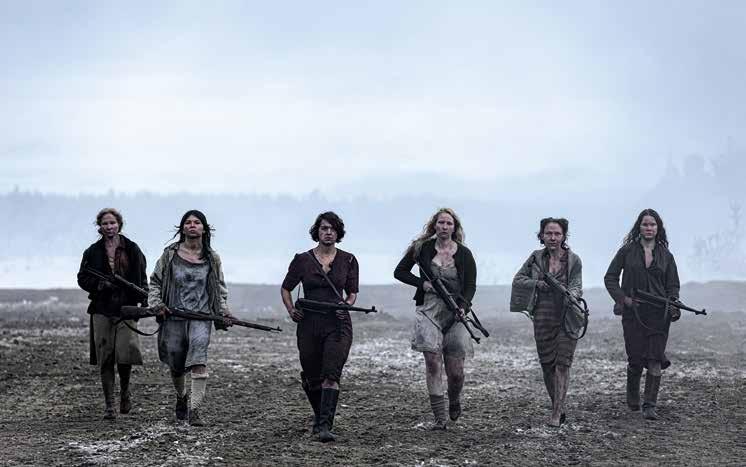
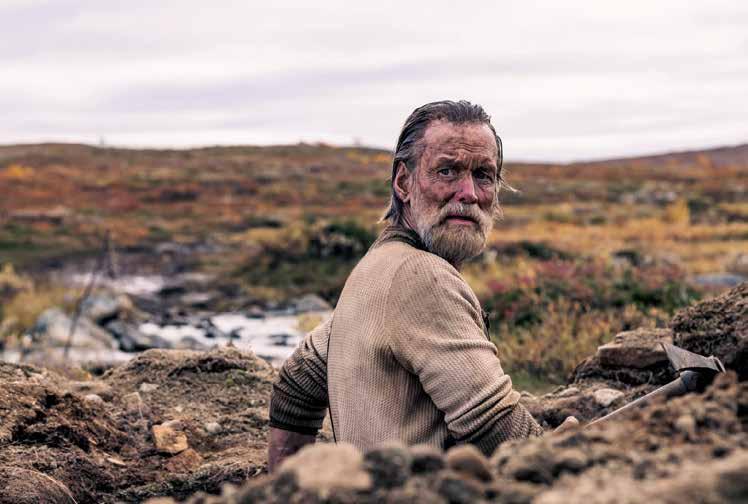
Sisu – Photo courtesy of Lionsgate
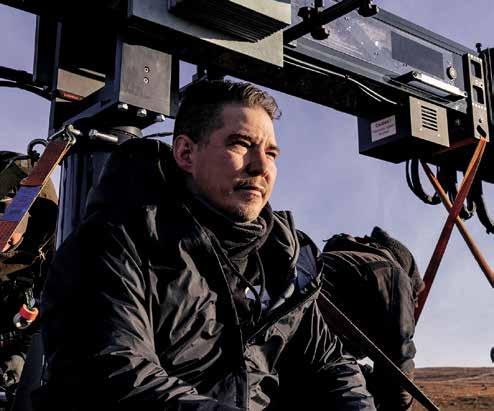
Director Jalmari Helander on the set of Sisu – Photo courtesy of Lionsgate
crafted with the assistance of the UCLA/ OUTFEST Legacy Project. The virtual portion of the festival closes a day later. I touched base with the lead programmer, filmmaker Anto Astudillo, to chat about this year’s TRANSlations festival. The following are some of the edited highlights from our free-flowing, far-too-brief conversation:
Sara Michelle Fetters: The TRANSlations Film Festival has been a big part of the Seattle film community for a long time, which is great. It’s so wonderful to see it succeed and continue to thrive. However, in some ways, 2023 feels like the most important TRANSlations Film Festival that we’ve had. Would you agree with that?
Anto Astudillo: Yes. I think it’s urgent. But I think the festival has been essential every year. I remember the words of Storm Miguel last year: “Trans films are essential.”
And it’s true. I share that opinion. I think this year it becomes more urgent, because of everything that’s happening in the country and with all these anti-Trans bills appearing in so many states around the country.
This inspired the theme for this year’s festival. “Trans Through Time” comes from me thinking about letting people know that we’ve been here for a long time and that Trans stories have been here for a long time. That this is nothing new.
We’re doing a lot of things that have to do with honoring our past in order to celebrate our present and imagine our future. One of those things is the TRANSlations Trailblazer Award, which is going to Isabel Sandoval. The festival showed her film Lingua Franca back in 2020 online and, for the first time, we’re showing it in person this year. We’re really happy about that. We’re showing it with Shangri-La, a short film that she did recently for Prada/Miu Miu. Giving this award to her has a lot of meaning for Trans filmmakers like me who have followed Isabel’s work for many years and who see her as a mentor. I look up to her in many ways, and I know a lot of filmmakers do as well. …Hopefully we’ll be giving this award every year to honor a Trans filmmaker with a history. … This is a history that Trans folks need nowadays. …That’s our history. We need to look back and be able to find our own history and be proud to share it with others.
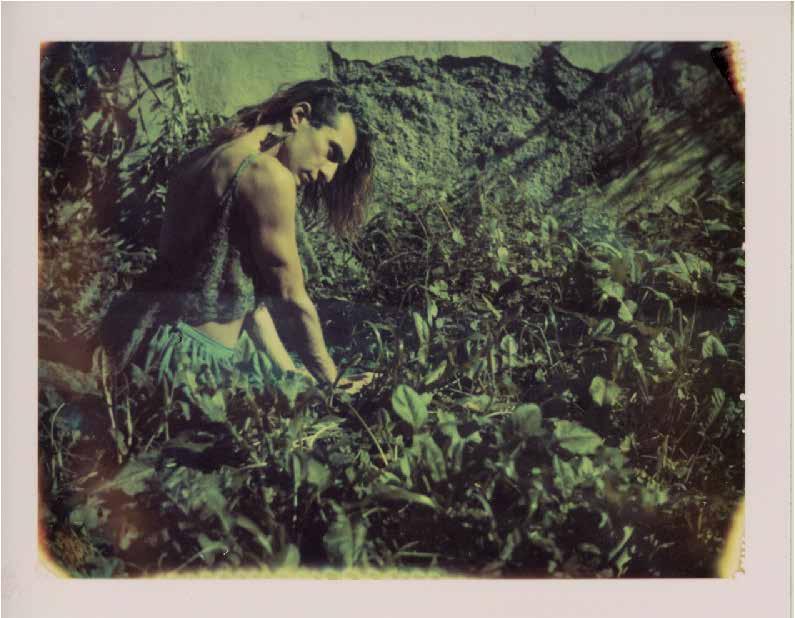
There are other films in the festival program that …deal with that history as well. Summer Within dives into the history of Trans lives in Italy, and Uncovered Girl looks into the history of Trans lives in Peru. My grandma’s family is from Peru, and I am from Chile, so I was really excited to find this piece of history and to be able to share it with others. It’s a history that’s so close to me.
SMF: The venues for the TRANSlations Film Festival have mostly been on Capitol Hill, but this time we’re at the Ark Lodge for the majority of the festival. You’re also at the Beacon Cinema. What was that move like, and how have the Ark Lodge and the Beacon embraced the festival?
AA: [Having been] a guest curator in different film festivals, I’ve had the chance to go to festivals that are in specific towns. When the time of the festival comes, it brings so many films and filmmakers to that town. I thought, what a great opportunity to do that in Seattle, to have TRANSlations in Columbia City for the first time. Maybe [it will be] the first of many years where we will come to this neighborhood and make the festival a staple there. We would love for that to happen.
I think that Ark Lodge and the Beacon Cinema know this is something that can happen. They were both open and excited to have us this year. We are thankful to be able to be in these two theaters showing different programs.
I wish we had more days, to be honest, because I wanted to show all the films in person. Some of the films unfortunately, are only going to be online. But I would love in the future for TRANSlations to have more days and be a part of the neighbor-
“‘Trans Through Time’ comes from me thinking about letting people know that we’ve been here for a long time and that Trans stories have been here for a long time. That this is nothing new.”
hood, become a festival that happens there every year. Something the local community can become excited about and proud of.
SMF: What is it like for you as a Trans filmmaker and as a programmer, in that you have these amazing positives of being able to do this event in such a supportive environment, but at the same time having to juxtapose that with everything else that’s happening in our society right now?
AA: It’s really difficult. I will start saying that because as I am working through the program as a lead programmer this year and connecting with people in the community — …the screening committee, which is a huge part of the festival, and everyone working on the festival, and all the filmmakers that I’m talking to every day — we’re all very aware of what is happening. I think it’s very difficult to wake up in the morning and see that kind of news pop up in your social media. But I think that what drives me personally is the fact that people will not stop. And by people, I mean our community. We will not stop making the art, making the work. And we need to show each other’s work. We need
to show that there are places that celebrate this work and that are uplifting these voices. I believe in festivals like TRANSlations. I go back to this idea of it being essential. Having a festival where we can come together is essential. So, yes, it is really difficult for me, but it is also inspiring to be a part of a film festival that’s a Trans film festival like TRANSlations. It’s the reason why I joined. It’s the reason why I’m here and that I work tirelessly every day.
SMF: Because of the pandemic, it has not necessarily been possible the last couple years to have as many events, panels, and forums as TRANSlations has previously offered. It seems like, this year, you and your team have prioritized bringing back panels, discussions, and forums, and they are a mixture of inperson and virtual. Was it important to you to not just have the films but to have these moments where people can get together for discussion, education, community, and debate?
AA: Absolutely. As I said, I’m a filmmaker, but I’m also part of a very active community of independent filmmakers. I was very active when I was in Boston. I was a professor and taught for many years at Emerson and the [Massachusetts College of Art and Design] film schools. When I moved to New York, I also became an active member of the independent film community.
I’m very used to not just making film or showing film programming work but also having these conversations that are extremely important, in order to understand that work and mostly to create community. For me, the key to everything is to create community. This is how we’re going to be able to create a better society. I’m a true believer in community.
When I started working at the festival, I wanted to have panels or conversations.
Some of them I call “community panels” or “community conversations,” where I want people to be a part of that conversation. One of those panels is with Daniel Sea. You might know Daniel from The L Word and also from the West Coast punk scene. They were part of the punk scene from the San Francisco Bay Area, and they are currently doing performance art and becoming really active in the community.
I wanted to invite Daniel, and when we were in conversation, as a guest artist, Daniel proposed having a conversation with the community about everything that’s happening in the US right now. Bringing up these important topics that we need to talk about and come together as a community because, maybe out of those conversations, you find real ways in which you can support each other.
For me, since we were going to do a hybrid festival with some portion of it online, some portion of it in person, I thought it was important to bring folks together at these community panels.
SMF: It goes without saying that the TRANSlations Film Festival is exceedingly popular and singularly important to the Transgender community here in the Pacific Northwest and specifically Seattle. At the same time, this festival reaches out to a broader audience than just the Transgender community. How important is it, do you think, especially right now, for everyone to be seeing these films? To be part of this conversation?
AA: Extremely important. I’m going to give you an example. As a filmmaker, I’ve shown my work in film festivals that are Queer/Trans-focused festivals. But I’ve also shown my work in festivals that are not....
Recently I showed …one of my films at the Ann Arbor Film Festival, and showing this work to people who are not a part of the community or the Trans/Queer community, it’s an eye-opener. It opens eyes to something that [the audience] were not thinking about. It can be scary. I was scared to show this work and …especially with everything that’s happening, not knowing who was going to be in the audience.
After showing the work, getting the questions …and the reception that I got right after the screening, talking to the community, people from the audience and from the film community, I was so excited that they resonated with what I was saying with my own, personal experience. Folks that are not part of the community resonated with the piece. They can take that experience of watching
...Summer Within – Courtesy photo
Anto Astudillo – Courtesy photo
TRANSLATIONS
continued from page 15
films like this and share it with others, and I think that is what is going to start happening with TRANSlations. I truly see that the festival is going to continue to grow.
This year, I wanted to reach out to a lot of people that I know from other countries, international artists, because I truly think that this festival has the potential to travel around the world and to become a reference for people who want to find the work of Trans, Nonbinary, gender-nonconforming, and Two Spirit artists. That’s what I’m looking for, and that’s what I hope for the festival.
That’s why I think it’s important to share. The more people that can see this work, the more that there is a conversation. I am so excited for people to see all these films. Every film is so different, and even though most of the films, if not all…, talk about the Trans experience in some capacity, every one speaks in such a different way. They show how complex our lives are, and I think that’s something that people who are outside of the community don’t even think about.
SMF: What do you hope audiences take away from this year’s festival? What do you want them to be talking about after the dust has settled and TRANSlations has come to an end?
AA: That’s a very complex question. First of all, I think people, our core audience, which is our community, they are going to watch these films and I believe that they are going to become energized. There’s so much strength that I think that emanates and comes from watching these films, as someone who is Trans or identifies as Trans. I think that it is empowering
HELANDER
continued from page 14
SMF: The film also feels like a love letter to Jorma. You’ve worked with him so many times, and yet this film feels like you’re honoring him and showcasing him in ways that we haven’t seen before. What did Jorma think when you presented him with this character?
JH: He was really glad about the whole idea, but his second thought probably was like, “This is a fucking lot to do. I’m over 60 years old. Am I physically in the condition to even pull this off?” [laughs]
He knew what the shooting [was] going to be like. It was not going to be easy. You’re going to be in weird places every day doing some weird things. It’s hard work. But, while you’re doing it, you need to look fucking incredible and show all your emotions and decisions and what you think with just with your face and eyes and arms. It was going to be very physical.
But I knew he could handle it.
SMF: I love that you bring up the emotion. I was taken aback by how emotional the film is. There’s this scene — and I don’t want to ruin it for people — near the end, where Aatami climbs on a truck and is faced with something incredible. There’s this glance that passes between everyone in the back of this truck, and I surprisingly found myself tearing up a little. How do you create this emotional connection to a character who doesn’t say anything and conveys everything through his physicality and his eyes?
JH: I think Jorma is that kind of actor that he makes me look like a better director than I actually am. I remember being behind the monitor when Jorma’s playing the scene where he finds the gold, and I immediately understood that now we were doing something cool. I was basically crying, because it was so emotional to see it. I have of course imagined that thing for a very long time, and when I actually saw it and how much better it was than what I was thinking, “Wow. That’s Jorma.”
SMF: Your films are very outlandish. They’re over the top. Yet there is a per-
for our community to watch this work, and I think that it will inspire folks to make films, even if they have never done it before. I think that some of these films are going to become a reference for our community.
I hope people start talking about the his-
tory of Trans cinema as well. There is this film program called “Trans Through Time.” It’s …a closing night program, and I truly want people to watch it and see throughout history how the ways we talk about our experiences have changed. How our per-
spectives have changed through time and where we are right now. It’s kind of like a ripple effect. I would love for audiences to realize how powerful these stories are and how beautiful our lives are as well.
sonal touch to all of them, and they all are about relationships. They’re all about making human connections. How do you balance all of this surrealism, this hyperrealism, and yet still manage to convey an emotional connection that’s authentic, something that people can relate to no matter where they are in the world?
JH: I honestly do not know. If we are talking about Sisu, I never fooled around with the character of Aatami. There’s nothing comical about him. Aatami is portrayed as seriously as possible. Everything he does is serious. You could even say that he’s from a different movie than what’s happening sometimes.
But at the same time, I wanted to have some fun with the accent, with the feel,
because I didn’t want this film to be like a The Revenant. Kind of a really serious, hardass film. I wanted this to have an entertaining side, a silly side. So I do think the combination is there, but that’s my way of doing it.
SMF: The other thing that you’re very good at is orchestrating the visual language of a film. You construct all of these incredible set pieces, and yet I never felt like they were overcut or that I wasn’t able to understand what was happening at any given moment. How do you and your creative team make those decisions and ensure that the film doesn’t become a discombobulated mess no matter how extreme the action gets?
JH: I like to be clear with what I’m doing. I need to know when I’m behind the moni-
tor to understand that, okay, this guy is here, these guys are over there, and that I’m going to show everything very clearly. What is the setup? Then I break it down. It’s one step at a time.
You need to first to understand what everybody wants and where they are. You can’t make it up on the day. It all has to make visual sense. It cannot be messy. It’s hard to explain, but I like to be very clear when setting things up.
SMF: One last question. What do you want audiences to take away from the film? What do you hope they’re talking about as they exit the theater?
JH: I hope they’re talking about to their friends that how fucking cool this movie was! [laughs]
Born with an Extra Rib – Courtesy photo
Jorma Tommila in Sisu – Photo courtesy of Lionsgate
Being a first-year intern at Gotham University was going to be The. Best.
Having completed the university’s gapyear program, Harleen Quinzel was practically bouncing. She’d decided on research, possibly psychology, as a career, and the first-year program included mentorship and a chance to study some of Gotham’s worst, most notorious criminal minds at Arkham Asylum: The Joker, Two-Face, King Shark, Mr. Freeze — she could be assigned to any one of them.
Sure, she’d still have to put up with classmates, like the jerk who kept asking if she
Learning from the past
A look into Trans history with Kit Heyam
by Lindsey Anderson SGN Staff Writer
When historian and scholar Kit Heyam got the chance to write a book on Trans history, they jumped at the idea. It took them just over a year to complete the nonfiction book Before We Were Trans, but they had spent years prior researching and thinking about the topic.
“It was about a year in the making but a lot longer in the thinking,” Heyam said, whose publishers approached them in 2020 with an idea for a new history book. “They came to me, because they knew I worked on Trans history already, and they wanted or expected a chronological history of how gender was and how gender is,” Heyam recalled.
They were excited to write a book, but they could never write an evolutionary history of gender: the concept itself has not evolved in a straight line. “I immediately said I wanted to write about all of these weird people who didn’t fit into any of these boxes, and can we do it thematically instead?”
Finding connections with the past
The publishers agreed to let Heyam format the text by category. They believe how history is told is very important to contemporary readers who may share ideas or identities with the people they read about. It was a connection to Trans history that helped Heyam realize they were Trans as well.
“I came to my own Queer identity through my relationship to Queer history,” they explained. “When I came out as Trans, what struck me was the narrowness of Trans history that we felt able to tell, the fact that the same few figures kept coming up again and again and again, and they were all figures who fit into this very narrow version of what it means to be Trans,” Heyam realized that the Trans stories we tell influence not only how cis people view and accept transness but how Trans people view and accept themselves. “As someone who didn’t fit into that narrow vision of what it means to be Trans — because I had not known that I was Trans since the age of three, and I didn’t conform perfectly to binary stereotypes or anything like that — that felt harmful to me, because it felt like it was harming the cultural idea of what a Trans person looked like,” they continued.
Heyam hopes to expand the narrative that Trans history tells so that Trans people understand there is not one specific or correct path toward being Transgender.
was “straight now” (nope, still Bi, today, tomorrow, next week). And she’d have to try to fit in, which was hard to do after what happened at the end of last year: some of Harleen’s friends were attacked with a fear spray that made them scream and scream, and her best friend died from it.
There was gossip, but Harleen had her research to enjoy, she loved her mentor, and she was fascinated by Talia al Ghul, who’d tried to assassinate Gotham’s mayor. Talia was a great study subject — even though Harleen wasn’t technically supposed to ever speak to her… until Talia said that she knew who made the fear spray. She also hinted that she knew the truth about Straw Man, who was rumored to haunt Arkham and who had a hand in the fear spray, so...
So then Harleen woke up in the hospital, the victim of a bad accident and amnesia. But was it an accident? And the escape of Gotham City’s worst, most violent criminals... was Harleen at fault?
Let’s say a movie theatre mushed its film
to a pulp and made a novel from the leftover cells. Or they used the mush to paint a BenDay artwork panel, but in words. That’s kinda how you could think of this book. As a part of the “DC Icons” franchise, Harley Quinn: Ravenous almost screams “graphic novel” or “comic book.”
So what’s the problem?
Nothing, as long as you know that before you pick it up, because that’s the sort of feel you’ll get from what only looks like a regular novel. Also it’s no problem if you relish a story that starts with action and peppers it with chaos before dropping readers into a land of dark monsters and crime. Or if you’ve read author Rachael Allen’s previous novel. Otherwise, you’ll be awash in humor, feminism, and superheroes, scrambling to find your footing. Be warned.
Overall, if you love a funny, crazy-paced, dark-Gotham novel with a feminist warrior, you’ll devour Harley Quinn: Ravenous. As for a bookmark...? Nah, forget about it.
Trans people have always existed
Aside from broadening the widely accepted “Trans narrative,” Heyam also hoped to debunk anti-Trans rhetoric. Relying on fearmongering, conservatives today try to argue that being Transgender is something new.
“Either this a new trend and we shouldn’t take it seriously, or this is a new threat, and we should put new laws in place to protect people from us. So they’re always leveraging the idea of this having no history,” Heyam explained. However, in studying the past, Heyam has
realized that Transgender people have, in a sense, always existed. “People have always been challenging, disrupting, and playing with gender and exposing the fact that gender does not need to be tied to a particular body,” they explained.
Heyam’s book aims to show that the history of gender transgression is as old as the history of gender itself, but also that gender is a fluid idea that is constantly changing.
“I think telling those stories helps us to dismantle those political arguments,” they
said. “It’s also for Trans people who might particularly feel alone in our contemporary lives and feel like we’re lacking a sense of community in the present. We might be able to find a sense of community in the past.” Before We Were Trans examines how various societies developed their concepts of gender and how some enforced those concepts onto others. “[Gender] was invented and can be uninvented,” Heyam said.
Kit Heyam – Courtesy photo
Image courtesy of Random House
continued from page 17
Through the text, they explore how the history of gender is intertwined with ideas of racism, patriarchy, and colonialism. They believe that understanding the connections between these ways of thinking is the first step in dismantling them.
“Understanding the harmful politics in which those inventions are rooted is also important in enabling us to be critical about them,” Heyam said. “Likewise, thinking about gender as something that doesn’t need to bear any relationship to your body. I think that is very liberating, but not something we’re taught, and certainly not something we’re taught can be the norm. I think all of those are things history can teach us.”
Gender and white supremacy
Heyam’s book also examines how gender roles connect to white supremacy. They use the example of Two Spirit people in residential schools to focus on the connection between oppressive forces.
“I write about campaigns to eradicate the Two Spirit experience. That was in many ways very effective, because it took place through the residential school systems and indoctrinated people not only to suppress their Two Spirit selves but to reject Two Spirit people around them,” they explained.
Part of exploring the global history of gender transgression is also learning how to deconstruct our Westernized understanding of queerness.
“There’s a tendency to view all of these gendered experiences through a modern Western lens, to either squash them into binary categories where they don’t fit or to misunderstand these experiences or not treat them on their cultural terms, and all of those are not conducive to teaching the full complexity of those experiences,” they said.
Trans history before Trans language
One challenge Heyam faced when writing about Trans history was determining what classifies someone as “Trans” when they may not have had the language to do so themselves.
“I think it’s not ethical or respectful to call someone a Trans person if they didn’t use that word about themselves,” Heyam said. “On the other hand, if we’re looking for Trans history, then what we’re looking for is history that shows us that gender is open to disruption, that it’s never been binary, that it’s never been centralized. All of the things that Trans [people] experience now, we can see those same things and those same kinds of experiences and evidence for those kinds of experiences in the past.”
While gender-nonconformity is as old as gender itself, the modern language we use, like “Transgender” or “Nonbinary,” is recent. None of the people in the book referred to themselves as Transgender.
To label them as such would be inaccurate, as that was not their experience. Instead, Kit takes a look at the broader history of gendernonconformity and examines how themes that are today considered to be a part of the Trans experience were also relevant then.
Despite not having the same language we use today, Heyam was surprised that many Trans people from history shared very modern ideologies about gender.
“One of my favorite people in the book is Thomas or Thomasine Hall. What surprised me about their story was to find someone declaring in a legal context, in a court of law, in 1629, ‘I am both man and woman.’ That is just incredible to me. Such a relatable sentiment so many Trans people today articulated by someone hundreds and hundreds of years ago,” they said with a smile.
The double standard set by colonization
Another surprise Heyam found in history was that many Trans people lived happy lives. “I expected to find stories of oppression, from which I’d have to tease out the evidence of agency. I expected many to be all awful, essentially. I was surprised that people’s experiences have been much more varied and creative than that,” they said.
Heyam discovered that while colonization was the root of oppression and the eradication of many Trans-accepting cultures, it also provided a space for those with white and class privileges to explore gender more than racially marginalized Trans people.
“There were plenty of places where people used colonialism as an opportunity for gender nonconformity,” Heyam said. “It suppressed some and enabled others, and that inescapable reciprocal relationship between colonialism and gender, racism and gender, was important for me to work out and tackle.”
Through piecing together Trans history, Heyam has learned many lessons that still ring true today. They believe history is an emotional process, and if learning about it makes you feel something, positive or negative, you’re doing it right.
“Whenever we do history, that’s an emotional process, and that’s not something we need to apologize for. Instead, it is productive and beautiful,” they said.
Heyam hopes readers can learn from their book that gender is always changing. They believe antiracism is essential to Trans activism, because the histories of white people are often more readily available, and narratives around LGBTQ+ history often prioritize them. We need to learn about Trans history globally, and that can only happen when we first deconstruct the colonial ideologies we hold onto.
“I’ve learned that the suppression of gender-nonconformity is always really about social control,” Heyam said. “You see that clearly in panics about gender-nonconforming dress in the 16th and 17th centuries, where people are saying women and AFAB people are wearing men’s clothes,
“Whenever we do history, that’s an emotional process, and that’s not something we need to apologize for. ”
and that means society is out of joint, the world is upside down because these people are transgressing from their proper place.
“I think what we need to be aware of now in the anti-Trans backlash is that it is not really about gender. It is about control.”
They believe now, more than ever, it is essential for the LGBTQ+ community to stand united.
“You can’t separate those identities for the vast majority of the past, and the attempts to divide us now are incredibly ahistorical. I hope the future looks like us realizing that and fighting based on our shared oppression,” they said.
Queer history, just like Queer future, belongs to us all.
Image courtesy of Seal Press
Op-Ed
trauma response and how to rebuild trust in a long-term relationship
Dear Izzy,
How do I rebuild trust after lying to my partner? I’m in a committed relationship in which I’ve been more enmeshed than ever. I didn’t realize that entwining our lives completely would make things so difficult and unhappy. We’ve combined our finances and I cut down my spending, but I still wanted to enjoy the occasional coffee or random snack while out working. I don’t ask questions about my partner’s spending, but they asked me about my accounts. I knew they’d be upset about the coffees and so I lied. It was stupid of me; they checked my accounts and were very upset. They set a boundary that if I ever lied again, then they’d break up with me. Cut to me lying again about throwing out some cigarettes (I am trying to quit), but they also smoke and we share cigs. I shouldn’t have lied; it’s a terrible habit of mine. They haven’t broken up with me yet, but it seems very likely. It may be too late to fix this.
— Former LWL (Little White Liar)
Dear Former LWL, Oof. It sounds like you are in quite the pickle. There are a few things that stand out to me about your note that I want to touch on. It sounds like you know lying is unhealthy, as it is clearly hurting the relationship. So why do you do it? I ask because I too have had a similar problem in the past. Hell, even now I still sometimes lie to avoid what I think will be an uncomfortable interaction if I tell the truth. If you find yourself lying automatically, even when you know you don’t have to, this could be a trauma response.
For example, when I was younger, I was really scared about people getting mad at me. As an adult, I realized that this is because when I was a kid, I was often punished for going against someone’s expectations. So, to protect myself, I learned to lie to avoid difficult emotions and confrontation. According to psychotherapist Lillian Rishty, LCSW, who owns NYC Therapy Group in midtown Manhattan, “Lying can be a coping mechanism for trauma for both adults and children, because trauma sufferers sometimes don’t feel safe enough to tell the truth.”
by Isabel Mata SGN Staff Writer
Ask Izzy is a biweekly advice column about relationships, mental health, and sexuality. Written by Isabel Mata — a Seattle-based lifestyle writer, podcast host, and mental health advocate — Ask Izzy offers tangible expert advice so all readers can have stronger relationships, better sex, and healthier mindsets.
I recommend being as honest as you can with your partner about where this compulsion comes from, as a start. Friends, family, and partners, in your case, “can be made to understand that it’s a coping mechanism and not coming from lack of love—people assume we wouldn’t lie to those we love” says Rishty. “Friends and family can help them find a way to experience safety in telling the truth.”
Like you said, your partner set a hard boundary about lying. If you want the relationship to work, then you need to respect that. If you are really struggling, which it seems like you are, then you can always ask your partner for help keeping you accountable. If they know that smoking is something you are trying to give up, maybe they can stop doing it around you. Or you ask them to buy their own cigarettes from now
on, so you aren’t tempted to pick one out of your bag when you feel like you need it.
Also: Before you and your partner decided to combine your finances and entire lives, really, did you sit down and have a conversation about boundaries? And what would that look like in real life? It seems to me that there are some boundaries being crossed on both sides of the relationship. You want freedom to treat yourself, and your partner wants full transparency.
When my husband and I were dating, we talked about combining our finances. When the time came to decide, we both made a list of our boundaries. For example, I wanted the flexibility to treat myself and not feel like I was being selfish. But my husband wanted us to cut back on our spending so we could save. To compromise, we came up with a budget specifically for little treats. Now I have a certain amount each
month that I can spend on myself without worrying about it adding up. This way my husband can feel good about what we are saving, and I can still treat myself when I need a pick-me-up.
Long-term partnerships depend on communication, empathy, and respect, from both sides. If you start making choices that reflect that, I have no doubt that you can rebuild trust in no time. If your partner is having a hard time forgiving you, remind them that your actions do not reflect who you are or the love you feel for them. Sometimes we simply make bad choices. It’s how you learn from them and move forward that determines the future of your relationship.