

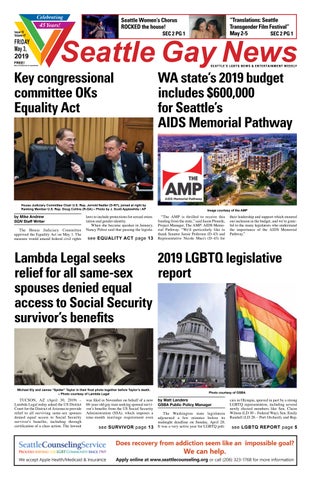
by Mike Andrew SGN Staff Writer
The House Judiciary Committee approved the Equality Act on May 1. The measure would amend federal civil rights
laws to include protections for sexual orientation and gender identity.
When she became speaker in January, Nancy Pelosi said that passing the legislasee EQUALITY ACT page 13

TUCSON, AZ (April 30, 2019) –Lambda Legal today asked the US District Court for the District of Arizona to provide relief to all surviving same-sex spouses denied equal access to Social Security survivor’s benefits, including through certification of a class action. The lawsuit was filed in November on behalf of a now 66-year-old gay man seeking spousal survivor’s benefits from the US Social Security Administration (SSA), which imposes a nine-month marriage requirement even see SURVIVOR page 13


“The AMP is thrilled to receive this funding from the state,” said Jason Plourde, Project Manager, The AMP: AIDS Memorial Pathway. “We’d particularly like to thank Senator Jamie Pedersen (D-43) and Representative Nicole Macri (D-43) for
their leadership and support which ensured our inclusion in the budget, and we’re grateful to the many legislators who understand the importance of the AIDS Memorial Pathway.”
by Matt Landers GSBA Public Policy Manager
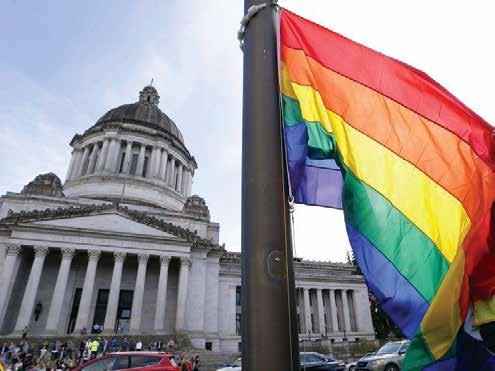
The Washington state legislature adjourned a few minutes before its midnight deadline on Sunday, April 28. It was a very active year for LGBTQ poli-
cies in Olympia, spurred in part by a strong LGBTQ representation, including several newly elected members like Sen. Claire Wilson (LD 30 – Federal Way), Sen. Emily Randall (LD 26 – Port Orchard), and Rep.
see LGBTQ REPORT page 5







by Jesse Monteagudo SGN Contributing Writer
My dictionary defines a witch as “1: one that is credited with usually malignant supernatural powers; esp: a woman practicing usu. black witchcraft often with the aid of a devil or familiar ... 2: an ugly old woman ... 3: a charming or alluring girl or woman.” As sexist and incorrect as that definition might be, it reflects popular attitudes toward witches and witchcraft. To most Americans, witches are either childstealing devil worshipers, hideous old women like the Wicked Witch of the West, or lovable enchantresses like the sisters in the television series “Charmed.”

But witches do exist, though they are nothing like the malevolent sorceresses of popular legend. Witches are followers of a centuries-old religion which traces its roots to the Celts and other pre-historic, matriarchal societies. As a Goddess-worshiping, womancentered faith, Wicca, “the Craft of the wise one” (wicce) attracts many women who reject patriarchal faiths like Judaism, Christianity or Islam. “Women want to change the internal
picture [they] have of a male god in heaven so that these women will no longer accept rule by males on earth” (Naomi Goldenberg). The Craft is also popular with “changing men” and with LGBTQ people of all genders and persuasions.
There are many definitions of witchcraft. Back in my twn days I interviewed Will, a gay male witch who lived in South Florida. Will defined the Craft as “the worship of the forces that keep the universe together – life and death.” Some witches believe in literal deities while others view them as “symbols of the forces of the universe.” Though often accused of immorality by their enemies, witches have their own code of ethics, the Witches Rede, which Will called “the single most important law” of the Craft. “Do as you will so long as it harms none.”
Will described himself as a Gardnerian witch, a follower of a sect founded in the last century by Gerald Gardner out of older traditions. Witches gather in covens, groups who convene for religious or magical or psychic purposes. Covens meet weekly (esbats) or seasonally (sabbats). The great-
est of eight seasonal sabbats, Samhain, falls on the eve of November 1 and is the precursor to Halloween. Unlike traditional, patriarchal faiths, the Craft accepts sexual and gender variance. As with other naturecentered faiths, spiritual leadership is often held by LGBTQ people. The Radical Faerie movement is, to an extent, a gay male product of Wicca and other neopagan traditions. According to Will, his adherence to the Craft is closely tied to his status as a gay man. Raised as a Presbyterian, Will “felt at home” the moment he encountered his adoptive faith. Will later became a third degree priest, the highest rank within the Gardnerian sect. Like other LGBTQ witches, Will integrated his religious beliefs with his sexual orientation, and found acceptance from other members of his coven and from the Craft in general. Even so, Will believed that, in America, it’s easier to be queer than to be a witch. Two decades later, we still have a long way to go before the Craft gains the recognition and the acceptance that it deserves, whether or not you believe in it.
Key events, sponsors and a marriage contest also announced for 45th Annual Seattle Pride Celebration
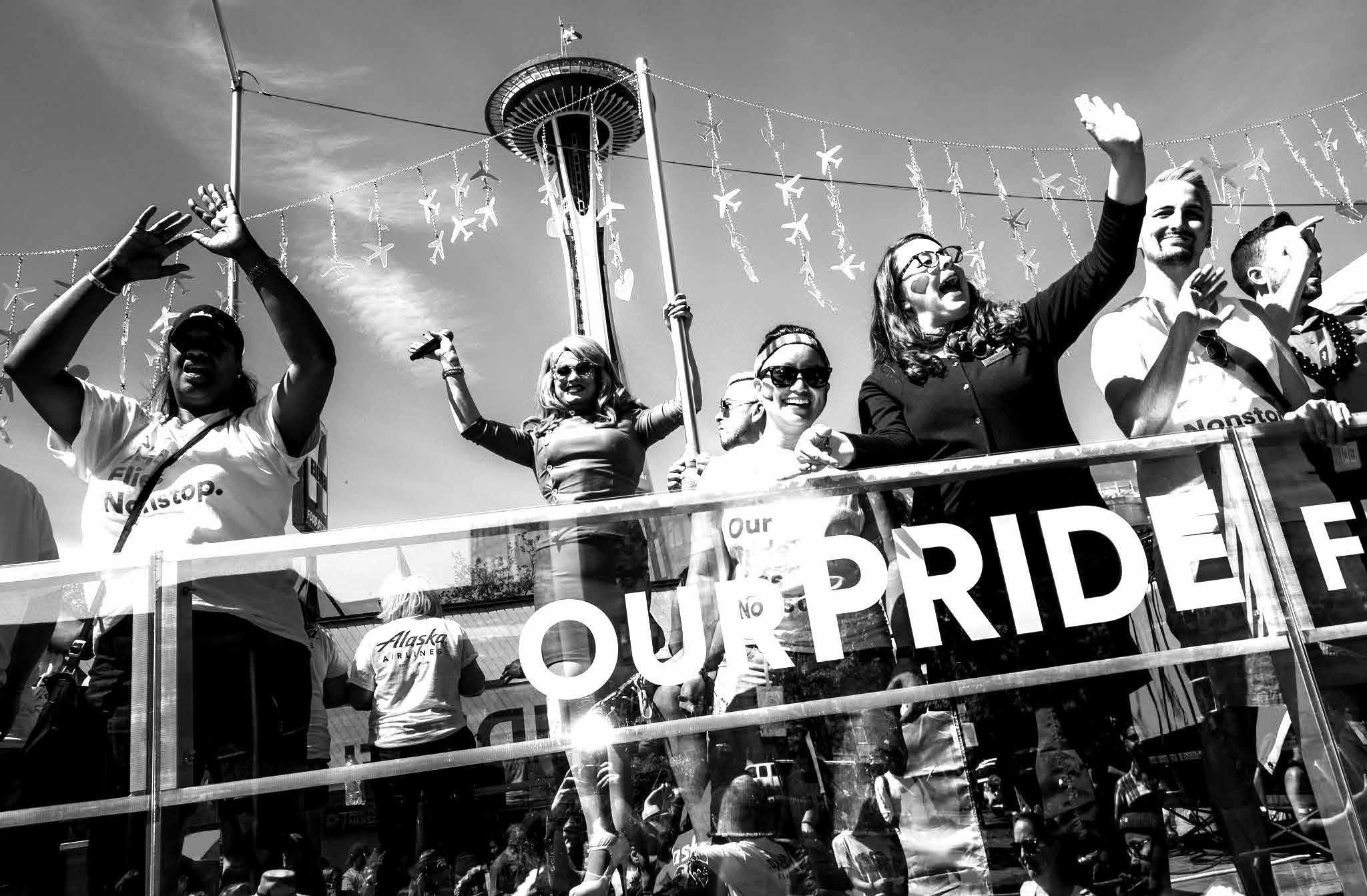
As Seattle Pride prepares to turn 45 years old this year, organizers of the country’s fourth largest LGBTQ Pride Parade will also be commemorating the 50th anniversary of the Stonewall Rebellion which became a national movement in support of diversity, inclusion and equality.
This year’s celebration kicks-off in Seattle on Saturday, June 8 (noon-7pm) with the annual Volunteer Park Pride Festival – Seattle Pride’s celebration of queer arts, music, performance and culture. The free event will feature a beer garden, live music, food trucks and a local crafts fair, as well as sponsor and community nonprofit informational booths. This year’s musical lineup will be announced next month.
The June festivities culminate with the 45th Annual Seattle Pride Parade which is expected to include more than 200 participating groups and 60,000 individuals marching in support of LGBTQ pride. The parade takes place on Sunday, June 30 (11am-3:30pm) along Fourth Avenue in downtown Seattle between Union Street and Denny Way – and the fun continues with Seattle PrideFest at Seattle Center. The parade will livestream on KIRO-TV’s website and Facebook page, in addition to a one-hour special airing on KIRO-TV at 11:35pm that evening. The parade’s grand marshals will be announced next month. For a complete list of Pride events, updated as new events are announced, visit https:// www.seattlepride.org/ or pick up a Seattle Pride Guide available in the Seattle Weekly’s former newspaper boxes on sidewalks throughout the city beginning in late May.
“This year we will be honoring our past with the 50th anniversary of Stonewall, while celebrating how far we’ve come over the past half-century thanks to those who came before us,” said Seattle Pride Board President Kevin Toovey. “As we celebrate, we’re also mindful that no matter how far we have come, the march continues in realizing

a future in which authenticity is embraced, diversity is honored, mutual respect is practiced and equal rights is achieved throughout our region, and the world.”
The Stonewall Rebellion began in the early morning hours of June 28, 1969 with a police raid of New York City’s Stonewall Inn – one of the few places in the city where gay people could freely gather as a community. The arrest of patrons (who fought back) led to a series of spontaneous and violent demonstrations in New York and across the country known as the Stonewall Riots, which grew into protests and then became a movement which eventually led to marches around the country, including the first Seattle Pride March in 1974 – which has been held in late June (National LGBTQ Pride
Month) ever since to commemorate the June 28 Stonewall rebellion.
Since then much progress has been made, including marriage equality, which Seattle Pride and Elysian Brewing will celebrate by throwing a wedding for one lucky couple at Elysian’s newly renovated Capitol Hill Pub. Couples can enter for a chance to be wed by a celebrity officiant by sharing their love story via Instagram, using #MarryUsJVN, #contest, while tagging both @SeattlePride and @ElysianBrewing. Full contest details are available at: go.seattlepride.org/marryusjvn.
Through the past 45 years, Seattle Pride has grown to be the fourth largest pride parade in the country, with attendance estimates at nearly 400,000 people, includ-
ing representation from many Seattle area companies – champions of inclusivity, diversity and equality – which sign on as Seattle Pride sponsors.
“We’re so grateful to our sponsors who make the Seattle Pride Parade and Volunteer Park Pride Festival possible,” added Toovey. “We’re pleased to announce that this year’s presenting sponsors are Alaska Airlines, Premera Blue Cross, T-Mobile and Uber.” For Seattle Pride sponsorship information and a complete list of 2019 sponsors visit https://www.seattlepride.org/ sponsors/
Courtesy of Seattle Pride
by Mike Andrew SGN Staff Writer
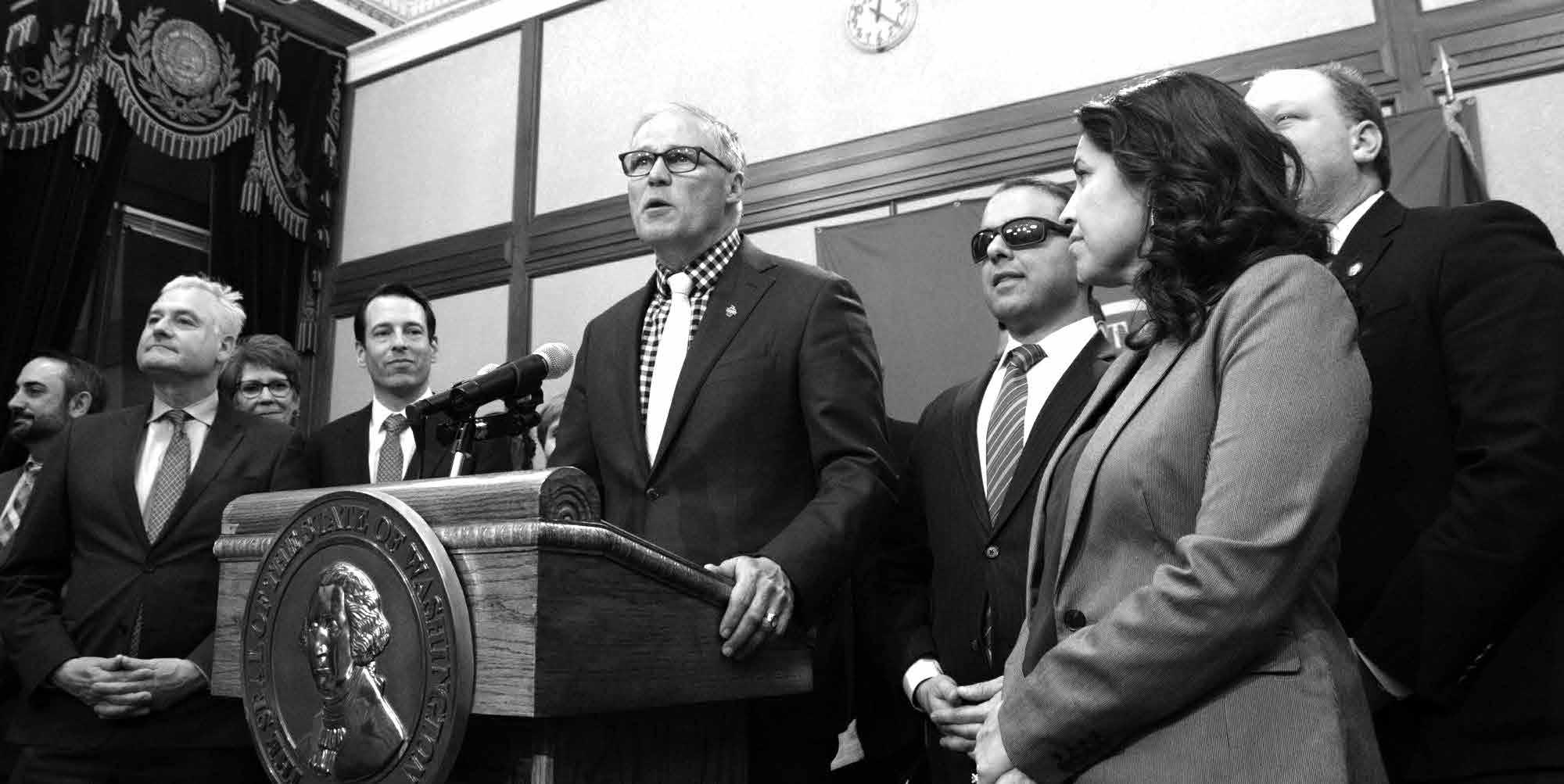
The Washington state legislature has passed I-1000, restoring affirmative action in this state. Both the Senate and House acted on April 28 – the Senate passing the measure by 26 votes to 22, and the House by 56 to 42.
The initiative repealed the 1998 measure I-200, which barred any consideration of inclusion, diversity, or equity in public education, public employment, and public contracting.
I-1000 was an “initiative to the legislature,” a peculiar feature of state law that allows state lawmakers to either pass the
Skyler Rude (LD 16 – Walla Walla). These three join the six incumbent out legislators – Reps. Doglio, Jinkins, Kilduff, and Macri and Sens. Liias and Pedersen – to form the largest contingent of LGBTQ state legislators in the United States. The newly expanded Democratic majority in both chambers ensured wide support for LGBTQ issues once they reached the floor.
Five important LGBTQ-related bills passed the legislature this year:
• HB 1732: Updating Washington’s Hate Crimes laws by renaming the crime of malicious harassment to the commission of a hate crime and explicitly including gender identity, gender expression, and sensory disability as protected classes.
• SB 5332: Modernizing Washington’s vital records laws to, among many things, better reflect the LGBTQ community, including nonbinary gender identities.
• SB 5356: Establishing a statewide LGBTQ Commission composed of 15 voting members appointed by the governor and 4 nonvoting legislative members, with a paid executive director and administrator. The commission is charged with identifying the needs of LGBTQ Washingtonians, consulting with state agencies regarding the impacts of their practices, providing resources to the public, holding public hearings to gather input from the LGBTQ community, advocating for the removal of barriers for LGBTQ people, and reviewing best practices for discrimination and sexual harassment policies and trainings. The LGBTQ community was one of the only protected classes without a statewide commission, and now this official voice in
initiative as is or send it to the next general election ballot. In this case, legislators passed it and sent it to Gov. Jay Inslee for his expected signature.
Now labeled the “Washington State Diversity, Equity, and Inclusion Act,” I-1000 puts affirmative action back into state law without the use of quotas or preferential treatment, defines the meaning of preferential treatment and its exceptions, and establishes a Governor’s Commission on Diversity, Equity, and Inclusion.
Under the new law, characteristics such as race, sex, color, ethnicity, national origin, age, sexual orientation, disability, or veteran status can be used as factors
state government will remove certain barriers to participation that have prevented our community from being included in a variety of state programs and policies. The makeup of the commission is intended to represent the broad variety of the LGBTQ community across the state.
• SB 5602: Eliminating barriers to reproductive health care for transgender people and undocumented immigrants. The bill requires [that] the Washington Healthcare Authority (HCA), managed care plans, student health plans, and other providers not discriminate based on a person’s gender identity or expression. Providers may not use automatic denials of coverage for reproductive health services based on an individual’s gender assigned at birth or gender identity. The budget includes funding for access to family planning services for undocumented immigrants for the next two years.
• SB 5689: Preventing harassment and bullying of transgender students in our schools by requiring each public school district to adopt a policy and procedure prohibiting harassment, intimidation, and bullying of any student. This policy is required to incorporate, at a minimum, the model antidiscrimination policy for transgender students. School districts are required to designate a primary contact regarding the policy with certain responsibilities.
Two citizen initiatives were passed by the legislature this session as well:
• I-940 (De-Escalate Washington): Passed by voters in November. The Legislature quickly passed amendment language agreed [to] by the stakeholders last year. I-940 increases police accountability in deadly shootings [and includes] de-escalation training, mental health training, [and] a new standard around the use of deadly force by police.
when considering a person for education or employment opportunities.
Sexual orientation, disability, and veteran or military status were not in the previous state affirmative action law but have been added to the law by I-1000.
The measure also bans preferential treatment, meaning that the enumerated characteristics cannot be the sole or deciding factor when considering a person for education or employment opportunities.
Finally, I-1000 sets up a commission that will oversee compliance with the measure and will issue an annual report on the progress of state agencies in achieving the measure’s goal of “guaranteeing every
• I-1000: Over 400,000 Washingtonians signed an initiative to the legislature to end the restrictive rules established by I-200, the 1998 initiative that led to a significant decrease in opportunities for women and minorities in employment, education, and public contracting. I-1000 opens the way to fairer treatment for minorities and women in our state, allowing affirmative action without the use of quotas. While LGBTQ people are not yet explicitly included in affirmative action programs, I-1000 is the first time that LGBTQ people have been given a seat at the table in future policymaking.
resident of Washington state equal opportunity and access to public education and public employment.”
Former Washington governors Dan Evans, Gary Locke, and Christine Gregoire served as co-chairs of the I-1000 Equality Campaign. Current governor Jay Inslee also endorsed the measure in January. I-1000 also went to the legislature with considerable support from labor and civil rights organizations, including the Washington State Labor Council, MLK Labor, the International Brotherhood of Electrical Workers, the Washington Federation of State Employees, the NAACP, and the GSBA.
There were a number of bills that did not make it through the long and multilayered legislative process this session but which we hope will get another chance in future sessions. Some of these efforts include a greater recognition of nonbinary gender in state records, establishing an LGBTQ veterans coordinator, an inclusive sex education curriculum, and important modernization of our state’s HIV/AIDS legislation.
“Almost 400,000 signatures were presented in support of I-1000.
“Those signatures represented a call, a call of the people demanding the State Legislature act on removing many of the onerous barriers that I-200 created for people of color, underserved populations, women, and veterans wanting to expand opportunities available to them.
“Last night, the legislators heeded that call, adopting I-1000 and ending the two decades of the onerous barriers that I-200 created for people of color, underserved populations, women, and veterans.
“I want to thank legislators for taking this step, as well as thanking public officials such as Governors Dan Evans, Gary
Locke and Christine Gregoire who spoke out in support of I-1000.
“But in the end, the greatest praise goes to the men and women who developed I-1000, who organized signatures drives, who went to the churches and community centers and the streets to gather the names that caused the state to act.
“These people, and their work, embody Dr. King’s statement that “The arc of the moral universe is long, but it bends toward justice.”
Courtesy of the Office of King County Councilmember Larry Gossett
Come celebrate with us!
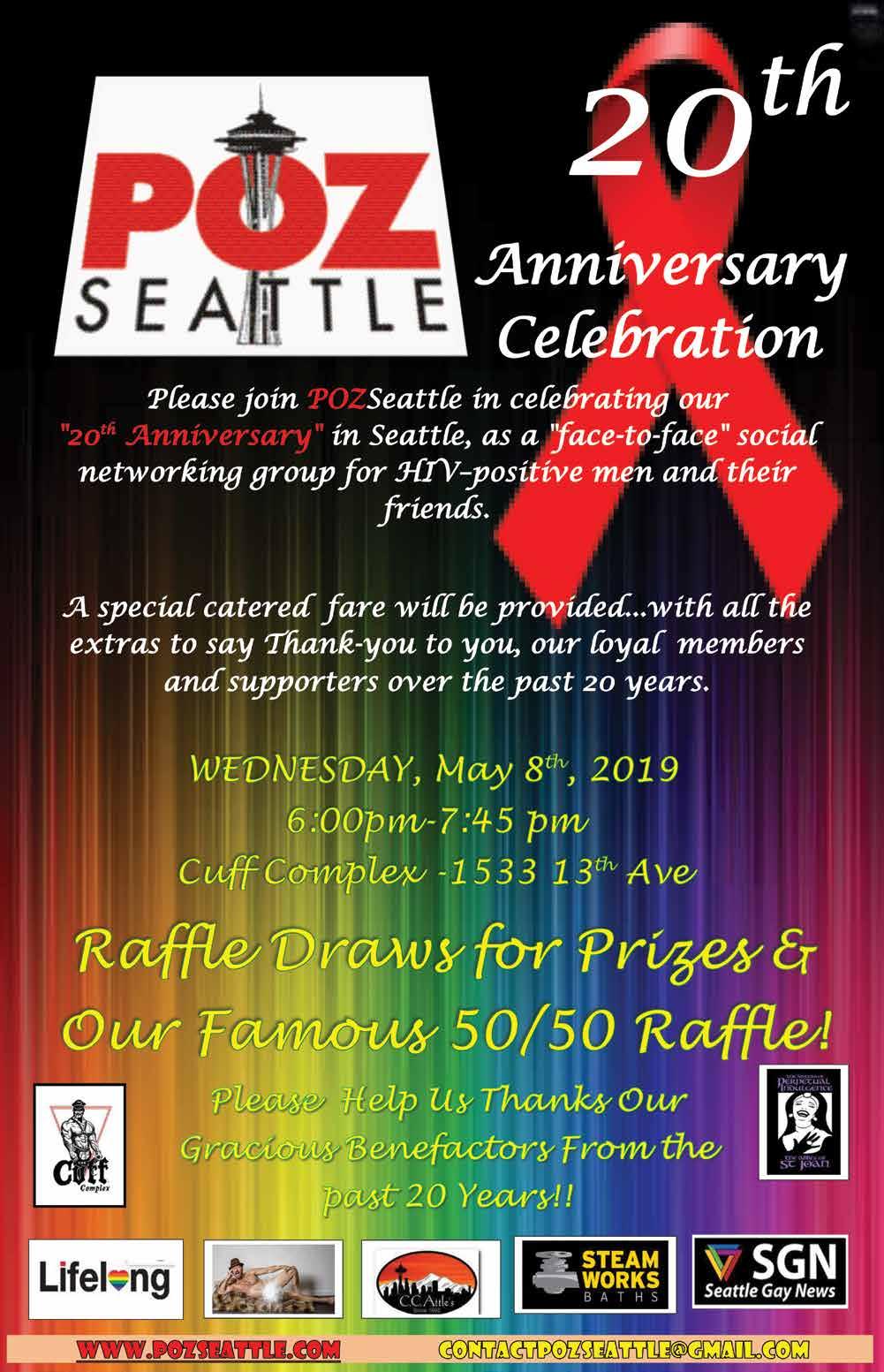
Please join POZSeattle in celebrating our 20th Anniversary in Seattle, as a “faceto-face” social networking group for HIV positive men and their friends.
The festivities will take place Wednesday, May 8th from 6-7:45pm at the Cuff Complex (13th Ave & E Pine St). Meet us in the downstairs bar and on the patio for socializing to catch-up with old friends, to make new ones, and a whole lot of fun!
POZSeattle will provide a special entrée, and encourage you to bring a side dish and/or dessert. We will be asking for a suggested donation of $5.00 to offset the cost of providing this for you, our loyal supporters for the past 20 years. No one

is ever turned away due to lack of funds.
Alcoholic beverages will be served as always, by The Cuff at regular prices. Nonalcoholic beverages also available for free from The Cuff
This event, and all others that we offer are for all HIV-Positive men and our friends, family, and support networks, (HIV-Positive or not), regardless of age, shape, size, origin, citizenship, color, sexual orientation, gender expression or identity or any other protected characteristic protected under applicable federal, state, or local laws.
Special activities for the event include raffle drawings for some fabulous prizes and our ever popular 50/50 Raffle! All of this to say “Thank-you, Seattle” for 20 wonderful years of social activities for us, by us!!
POZSeattle is a social organization run for and by Seattle-area HIV-positive guys that is committed to planning and promoting fun, social activities.
For questions or more information about this event, to plan your own social event, or to be added to our event promotions email list, or to be added to our Facebook private group, email contactpozseattle@gmail. com. or visit website http://pozseattle.com. Courtesy of POZSeattle
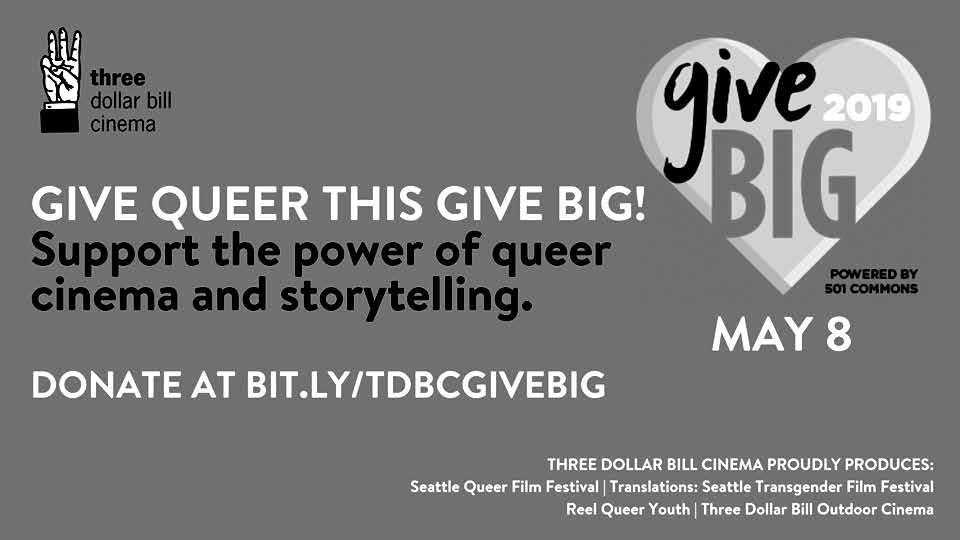
Thanks to the generosity of a group of Visionary Fund Donors, your donation to Three Dollar Bill Cinema this GiveBIG will be matched dollar-for-dollar up to $10,000!
We invite you to join us in our vision of an actively engaged community of queer and allied film-goers who value the diversity of stories that make us who we are.
Will you GiveBIG on May 8th to the Three Dollar Bill Cinema Visionary Fund?
Schedule your gift today – https:// www.givebig2019.org/SEAqueerfilm?mc_ cid=9a61aa91ef&mc_eid=f6c7a3b0b6 or donate at http://bit.ly/tdbcgivebig/
The GiveBIG Support Team is standing by to assist! You can also reach us by phone at 1-833-962-3615 or by email at givebig@501commons.org.
Three Dollar Bill Cinema provides access to films by, for, and about lesbian, gay, bisexual, transgender, and queer (LGBTQ) people and their families, and a forum for LGBTQ filmmakers to share and discuss their work with audiences. We curate themed screenings throughout the year and produce programs in partnership with other arts, cultural, and service delivery organizations in the Greater Seattle area.
Thanks to the generosity of a group of Visionary Fund Donors, your gift will be matched by our matching fund pool of $10,000!
Thank you to our Visionary Fund (Matching Fund) Donors:
Jamie & Sunny Burns, Carrie Carson & Ashley Smith, Telved Devlet & Brian Weiss, Jody Fletcher, Danny J. Hall, Ryan & Ben McCarthy, Tim Moshier, Lance Park & Scott Carnz, Kent Thoelke & Kevin Gaspari
About The Visionary Fund
We have a vision of an actively engaged community of queer and allied film-goers who value the importance of diversity in storytelling. We envision a thriving, vibrant collective of queer filmmakers who work together to build their skill-sets and talents in the film industry.
Imagine if Reel Queer Youth were able to go into schools across King County mentoring LGBTQ2+ youth in the fundamentals of filmmaking? Imagine if our education programming could be expanded even further; if we could provide film and media literacy programs year-round with a focus on empowering transgender and queer people of color filmmakers. What if we could provide the tools and forum they need in order to tell their stories? Think about the impact that could have. Think about how many new queer filmmakers would be equipped to address the issues our country currently faces.
We need the next generation of queers to have the confidence and sense of purpose to pick-up a camera and tell their story. We need more transgender filmmakers having their stories on screens across the country at transgender-focused events like Translations Film Festival, which runs this weekend. We need these stories now - as our current administration is actively working to erase the existence of the transgender and nonbinary community. But, we need your help to make our vision come to fruition.
Your investment in Three Dollar Bill Cinema’s Visionary Fund is a statement to the LGBTQ2+ community that you believe in the power of queer storytelling and that you believe our stories need to continue being told on the big screen.
Will you help us reach our $10,000 matching challenge goal? Your donation to GiveBIG on May 8th will be matched oneto-one which means $50 becomes $100, $150 becomes $300 and so forth.
Thank you for your support of queer film and representation!
Cheers, Ben McCarthy Executive Director Three Dollar Bill Cinema 206.323.4274
info@threedollarbillcinema.org
TRACTION (trans • community • action) to champion Trans visibility and connection through advocacy, collaboration, community service and summit gatherings
TRACTION (trans • community • action) is excited to join the nonprofit community in the Pacific Northwest. Recently registered as a 501(c)(3) organization in response to the urgent need to regain momentum toward social progress, TRACTION aims to empower and uplift transgender and nonbinary people and create visibility through social engagement, outreach and community service. Through collaboration with existing groups whose programs are serving marginalized and underserved populations
within the Pacific Northwest, TRACTION will provide support in the form of volunteer power, funds and publicity.
“Traction’s organizers are a committed corps of talented individuals who’ve worked together in the past to produce events for
the trans community. We’re utilizing this unique opportunity to join forces with other community leaders and organizations in pushing back against oppression toward marginalized groups,” said Shelley Shore, founding board co-chair.
In addition to community action projects, TRACTION will host one or more day-long summits each year to draw together individuals and groups within the broader gender-diverse community, create connection, provide resources and focus its efforts. Emerge!, the inaugural summit, will be held on Sept. 14, 2019, at the Centilia Cultural Center on Beacon Hill in Seattle.
For more information, or to volunteer or donate, contact info@tractionpnw.org.
To learn more about Emerge!, please visit www.facebook.com/tractionpnw.
About TRACTION
TRACTION (trans • community • action) cultivates connection and visibility for transgender and gender-nonbinary people through community service in support of marginalized communities. Contact: Shelley Shore – shelley@tractionpnw.org; http://www.Facebook.com/ tractionpnw
Courtesy of TRACTION






by Mike Andrew SGN Staff Writer
Roy Moore, former Alabama Supreme Court Justice and failed US Senate candidate, lost the first round of his lawsuit against satirist Sascha Baron Cohen, CBS, and Showtime.
Moore was asking for $95 million in damages, claiming that Cohen, his producers, and the TV network caused him “extreme emotional distress” by falsely portraying him as a pedophile.
The charges arose from an episode of Cohen’s satirical series “Who Is America?” in which he posed as an Israeli counterterrorism expert named Erran Morad and engaged Moore in a conversation about pedophilia.
Israel had invented a device which detected particular enzymes secreted by pedophiles, Cohen’s character claimed. When tested on Moore, the device “proved” he was a pedophile.
Moore was running for a US Senate seat from Alabama at the time, a race he subsequently lost to Democrat Doug Jones. Although he consented to the supposed

interview with Cohen and signed papers to that effect, Moore claims that Cohen misrepresented the nature of the interview in order to harm his reputation.
In addition to the lawsuit against Cohen and his associates, Moore has also filed a
suit against several women who accused him of sexual misconduct, alleging “there was a political conspiracy against him in the 2017 special election.”
In the Cohen suit, Federal District Judge Thomas Hogan ruled on April 29 that the
consent agreement Moore signed was valid and that the case must be transferred to New York, a stipulation that Moore agreed to in the signed contract with the defendants.
Moore’s lawyer, Larry Klayman, said in a statement that he intends to appeal the transfer to New York.
“[N]o matter where the case is ultimately heard, we are confident that Sacha Baron Cohen, Showtime, and CBS will be held legally accountable by a jury for their low-class, disgusting, and malicious defamatory acts to harm a good man and his family,” the statement said.
Moore was removed from the Alabama Supreme Court in 2003 for refusing to comply with a lawful court order to remove a Ten Commandments display from his courthouse. He was reelected to the court in 2012, but then suspended in 2016 after advising Alabama state judges to ignore the US Supreme Court decision in Obergefell, which legalized same-sex marriage.
Moore ran for the US Senate in 2016 and was defeated by Doug Jones.
WASHINGTON, DC (April 30, 2019)
– Today, the Human Rights Campaign (HRC), the nation’s largest lesbian, gay, bisexual, transgender, and queer (LGBTQ) civil rights organization, released a new video from the HRC’s Americans for the Equality Act campaign featuring Karamo Brown. In the new video, Brown shares why it’s critically important for Congress to advance the Equality Act, bipartisan legislation that would finally extend clear, comprehensive nondiscrimination protections to millions of LGBTQ people nationwide. First launched in March, the HRC ’s Americans for the Equality Act series is filmed by award-winning directors Dustin Lance Black and Paris Barclay and has so far featured Academy Award–winning actress Sally Field and her son Sam Greisman, transgender singer and songwriter Shea Diamond, actress Justina Machado, and US Olympian Adam Rippon.
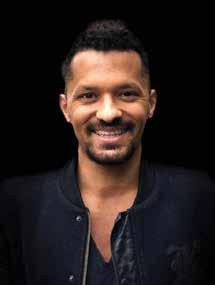
“For countless people in this country and around the world, Karamo Brown is an inspiring role model and a powerful advocate for positive change,” said HRC President Chad Griffin. “From his role on ‘Queer Eye’ to his leadership in uplifting and empowering LGBTQ youth of color, Karamo is opening hearts and minds and working with compassion to better the lives of millions. We are grateful to Karamo for joining us in the fight for full federal equality and highlighting the urgent need for Congress to pass the Equality Act.”
“So much of the progress of the LGBTQ movement has hinged on our ability to tell our stories and move people – and that’s the same spirit with which we’ve approached this compelling project,” said Emmy Award–winning director Paris Barclay when the campaign launched last month.
“Every American deserves a fair shot at a job to support themselves and their family, and the security of a roof over their head.

These are key ingredients in what we’ve long cherished as our ‘American Dream,’” said Academy Award–winning director Dustin Lance Black. “But until the Equality Act is signed into law, this dream may not be a reality for far too many Americans in many areas of our wild and wonderful country.”
Currently, 50 percent of LGBTQ Americans live in one of the 30 states without statewide legal nondiscrimination protections for LGBTQ people – leaving millions at risk of being fired, denied housing or refused service simply because of who they are or whom they love. The Equality Act would guarantee existing civil rights laws apply to LGBTQ people by providing clear, consistent nondiscrimination protections based on sexual orientation or gender identity across key areas of life, including employment, housing, credit, education, public spaces and services, federally funded programs, and jury service.
Reintroduced in Congress on March 13, the Equality Act has growing unprecedented support, including from nearly 70 percent of Americans, hundreds of members of Congress, more than 190 major businesses, and more than 350 social justice, religious, medical and child welfare organizations. Recent polling finds that a growing majority of Americans support federal nondiscrimination protections and LGBTQ equality. A recent survey by PRRI found that nearly seven in 10 Americans support laws like the Equality Act, including majorities in every single state and majorities of Republicans, independents, and Democrats alike.
Over the coming weeks, the HRC will roll out additional videos in the Americans for the Equality Act series featuring a powerhouse lineup of supportive film and television actors, influencers, musicians, and professional athletes, includ-
Kellett, Jamie Lee Curtis, Jane Lynch, Marcia Gay Harden, and Nyle DiMarco. The Americans for the Equality Act series is modeled after the HRC’s successful Americans for Marriage Equality campaign.
The Human Rights Campaign is America’s largest civil rights organizations working to achieve equality for lesbian, gay, bisexual, transgender, and queer people. The HRC envisions a world where LGBTQ people are embraced as full members of society at home, at work, and in every community.
Courtesy of the HRC
NEW YORK (May 2, 2019) – Today, the US Department of Health and Human Services (HHS) announced that it will soon issue a new final rule protecting health care providers who refuse to treat LGBT people and women seeking reproductive health care, solely on the basis of the providers’ religious or moral objections. The proposed rule also shields health care providers even if they refuse to give a referral after denying care, regardless of the consequences to the patient, and in violation of medical and ethical requirements and standards of care. The rule is scheduled to go into effect 60 days after it is published.
“This so-called Conscience Rule is
nothing more or less than a governmentsanctioned attack on LGBTQ people and on women seeking reproductive health care,” Lambda Legal interim CEO Richard Burns said. “LGBTQ people, and especially transgender people, already suffer disproportionate levels of discrimination in health care settings. This Denial of Care Rule protects that discrimination and gives it a governmental blessing. HHS should be in the business of making sure people get the health care they need, not trying to grant health care workers and institutions permission to turn people away.”
“We receive calls to our help desk about, and have represented, LGBTQ people who
have been turned away when seeking medically necessary and appropriate health care services – simply because of who they are,” Burns added. “From our case against the Southern California clinic that refused to provide a lesbian couple infertility care to the lawsuit against the New Jersey hospital that refused to let a surgeon perform a routine hysterectomy for a transgender patient to the Washington doctor who refused to provide a medical prescription to a gay man – these are the challenges LGBTQ people and everyone living with HIV already face and that the Denial of Care Rule will increase still further.”
The proposed regulations invites health
care workers, doctors, hospitals, and other health care facilities that receive federal funding to refuse to treat LGBT patients and women seeking reproductive health care.
Lambda Legal is a national organization committed to achieving full recognition of the civil rights of lesbians, gay men, bisexuals, transgender people, and everyone living with HIV through impact litigation, education, and public policy work. www. lambdalegal.org
Courtesy of Lambda Legal
WASHINGTON, DC (May 2, 2019) –The Trump administration issued a new rule that will harm the health and well-being of low-income women and LGBTQ individuals and families. Trump’s latest regulation expands current refusal laws, allowing providers and institutions involved in the delivery of health care to refuse services based on religious or moral convictions.
National Health Law Program Reproductive and Sexual Health Director Susan Berke Fogel criticized the administration for again ignoring input from patients, health care professionals and experts, heath advocates, and hospitals and health care providers. The new rule will likely result in widespread harm to the health of people all across the country, including those trying to survive in low-wage jobs that provide little to no access to health care services.
“More than 200,000 members of the public submitted comments urging the Trump administration to put patients first,” Fogel said. “Instead, the Trump administration has ignored the public, health care providers, and medical standards of care. There are already problematic federal exemptions on the books. Trump is dangerously expanding them to allow providers and institutions to deny women, LGBTQ individuals, and others medically neces-
sary care that is based in science and rigorous research. People with the least resources will be most harmed by these rules if such a broad range of providers and other entities are allowed to deny access to comprehensive quality care based on their personal religious beliefs.”
National Health Law Program Staff
Attorney Candace Gibson said, “Since his first days in office, Donald Trump has used executive powers to undermine access to health care in this country, particularly for those who are struggling to make ends meet and for those who are the most marginalized in our health care system. LGBTQ individuals, especially transgender persons, women of color, and people living with disabilities, have experienced pervasive discrimination in our health care system. It is one more example of the Trump administration privileging a narrow view of ideology over the health care needs of patients.”
For more information or comment, please contact the National Health Law Program Communications team at leaming@healthlaw.org or diantonio@ healthlaw.org.
Founded in 1969, the National Health Law Program (NHeLP) protects and

advances the health rights of low-income and underserved individuals and families.
NHeLP advocates, educates and litigates at the federal and state levels. Our lawyers and policy analysts stand up for the rights of the millions of people who struggle to access affordable, quality health care. We
are guided by the belief – a challenge – that each generation should live better than the last.
LOS ANGELES (April 28, 2019) –The US Department of Health and Human Services’ Office for Civil Rights (OCR) is expected to announce this week two sets of rules: a proposed rule that, among other things, rolls back existing federal protections prohibiting discrimination based on gender identity in health care and a final rule that strengthens the ability of health care workers to refuse to provide health services for religious or moral reasons.
“These two rules could have an immensely damaging impact on protections for vulnerable populations, including the LGBT community,” said Williams Institute Executive Director Jocelyn Samuels, the former director of the OCR who led the process of drafting the original regulations implementing Section 1557. “One rule will likely try to eliminate much-needed protection for transgender and gendernonconforming patients, while the other could expand the authority for health care workers to opt out of providing care to this and other vulnerable communities.”
First, the OCR is expected to propose a rule that removes protections against gender identity discrimination from Section 1557, the nondiscrimination provision of the Affordable Care Act, which bans sex discrimination in federally funded health care. Currently, the regulations interpreting Section 1557’s ban on sex discrimination include discrimination based on sex stereotyping and gender identity, consistent with numerous court decisions.

individuals of any federal protection from gender identity discrimination.
According to the 2015 US Transgender Survey (USTS), one-third (33 percent) of transgender people who saw a health care provider in the prior year reported having at least one negative experience related to being transgender.
One-quarter of USTS respondents experienced a problem with their insurance, such as being denied coverage for care related to gender transition or being denied coverage for routine care because they were transgender.
Second, the OCR’s forthcoming final rule is expected to expand the authorization for health care providers to refuse care based on their religious beliefs. This broad religious exemption could pose significant additional harm to the LGBT community as a whole. The existence of widespread discrimination and stigma against LGBT people in health care is well documented.
“The issuance of these rules underscores the importance of passing the Equality Act, which would provide LGBT people nationwide with explicit protections from discrimination,” said Samuels.
The proposed rule would thus signal that the OCR would refuse to enforce protections against gender identity discrimination in health care for the 1.4 million transgender adults and 150,000 transgender teens ages 13 to 17 in the US.
modations, such as health care facilities. Based on Williams Institute research, more than 780,000 transgender people – 705,000 transgender adults and 78,000 transgender youth – live in those states.
The reversal would have an even greater impact on people who live in the 28 states that lack legal protections from gender identity discrimination in public accom-
For individuals lacking state-level protections, federal law offers the only remedy if they face discrimination. But the OCR’s proposed rule will likely try to deprive these
The Williams Institute at UCLA School of Law, a think tank on sexual orientation and gender identity law and public policy, is dedicated to conducting rigorous, independent research with real-world relevance.
Courtesy of the Williams Institute
LOS ANGELES (May 2, 2019) – The US Department of Health and Human Services’ Office for Civil Rights (OCR) today released a final rule that strengthens the ability of health care workers to refuse to provide health services for religious or moral reasons.
Williams Institute Executive Director
continued from cover
tion would be one of her signature goals, and the measure went through the Judiciary Committee on a straight party-line vote, 22 to 10.
The bill is now in line for a floor vote.
The Equality Act prohibits discrimination based on sex, sexual orientation, and gender identity in areas including public accommodations and facilities, education, federal funding, employment, housing, credit, and the jury system.
Jocelyn Samuels, the former director of the OCR, said, “In the Obama administration, we were focused on expanding access to health care through the implementation of the Affordable Care Act [ACA] and the full and balanced enforcement of anti-discrimination and provider-conscience laws. By contrast, this administration is simultane-
It also defines and includes sex, sexual orientation, and gender identity among the prohibited categories of discrimination or segregation.
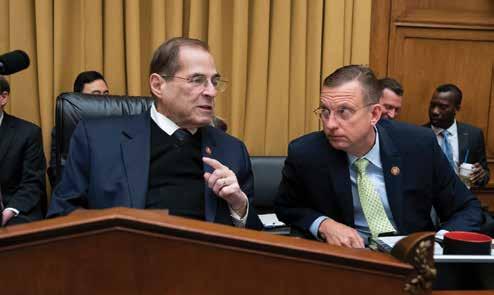
“The ability to have a job, to receive medical care, or to rent a home should not depend on who someone is or where they live. And it certainly should not depend on who they love,” Committee Chairman Jerrold Nadler (D-NY) said May 1.
The bill, introduced by Rep. David Cicilline (D-RI), has more than 230 Democratic co-sponsors, including all the Democratic House members from Washington state.
The Business Coalition for the Equality
ously trying to restrict universal access to care through attacks on the ACA and expand the authorization for denials of care by religious providers. These actions stand to undermine the health and well-being of vulnerable communities, including LGBT people.”
Act, which is made up of about 200 companies, teamed up with the HRC to push the bill through Congress.
Coalition members include Adobe Systems, Airbnb, Amazon, American Airlines, AT&T, Bank of America, Bayer, Booz Allen, Citigroup, Citrix, Coca-Cola, CVS, Ernst & Young, Facebook, Google, Hilton, JP Morgan Chase, Lyft, Marriott, T-Mobile, Uber, Verizon, Visa, and Zillow.
On the other side, the Heritage Foundation claims that the Equality Act would force employers and workers to conform to new sexual norms and force hospitals and insurers to provide and pay for therapy
The Williams Institute at UCLA School of Law, a think tank on sexual orientation and gender identity law and public policy, is dedicated to conducting rigorous, independent research with real-world relevance.
Courtesy of the Williams Institute
against any moral or medical objections. They also said it would harm families by normalizing hormonal and surgical interventions for gender-dysphoric children, lead to the erasure of women by dismantling sex-specific facilities and sports, and affect faith-based charities. Rep. Doug Collins (R-GA), the committee’s ranking member, said the bill “marginalizes almost an endless spectrum of Americans” – presumably meaning right-wing Christians – and is “legislation based in political theory, not scientific reality.”
where same-sex couples were not able to be married for nine months because of discriminatory marriage laws.
“Our clients and many others who were in loving, long-term, and committed relationships – in some cases for more than 40 years – have been denied equal access to these critical survivor’s benefits, paid for through a lifetime of work, based on circumstances wholly beyond their control,” Lambda Legal counsel Peter Renn said. “The government considers them legal strangers here, rather than widows and widowers, even if they married as soon as they were able to do so.”
Lambda Legal filed the motion for class certification in Ely v. Berryhill, the
lawsuit it filed against the SSA on behalf of Michael Ely, who married his partner of 43 years, James Taylor, immediately after Arizona’s ban on marriage for same-sex couples was struck down in 2014. Taylor died of cancer six months later. When Ely contacted the SSA to begin the process of applying for survivor benefits, he was told that he did not qualify.
“It was such a shock, to be told your relationship of 43 years means nothing,” Ely said. “I lost the love of my life. We got married as soon as we could. Even though we were together for 43 years, and even though my husband paid into Social Security with every paycheck, I’m barred from receiving the same benefits as other widowers. I know the pain I feel and can imagine the pain of others in the same situation as me.”
Among those who would face this obstacle upon reaching retirement age is James
Obergefell, the named plaintiff in Obergefell v. Hodges – the historic 2015 US Supreme Court ruling that struck down marriage bans for same-sex couples nationwide. Obergefell and his husband, John Arthur, were together in a committed relationship for more than 20 years but were able to be married for only three months, after they chartered a medically equipped plane to fly to a state that permitted them to marry, before Arthur died from ALS. Obergefell submitted a declaration in support of today’s class certification motion.
Obergefell adds: “Although marriage equality is the law of the land, people continue to suffer because of the government’s history of discrimination. John and I moved mountains to marry, a marriage we were able to enjoy for only three short months, although we were together for more than twenty years. Equality isn’t equality if the government can hold the length of
your marriage against you when that same government barred you from marriage for more than two decades in the first place.”
Read about the case, Ely v. Berryhill, at: https://www.lambdalegal.org/in-court/ cases/ely-v-berryhill.
Lambda Legal’s attorneys working on the case are Peter Renn, Tara Borelli, and Karen Loewy. They are joined by Tucson attorneys Brian Clymer and Autumn Menard.
Lambda Legal is a national organization committed to achieving full recognition of the civil rights of lesbians, gay men, bisexuals, transgender people, and everyone living with HIV through impact litigation, education, and public policy work. www. lambdalegal.org
Courtesy of Lambda Legal










Cannabis affects




It’s illegal to use cannabis while riding as a passenger.
Keep cannabis in original, unopened cannabis out of reach—like in the trunk.



It’s a crime, a bad decision, you could cause harm or a collision.

increase
Mixing alcohol and cannabis can increase the risk of crashes.




105 deadly crashes in 2016 involved a driver who tested positive for cannabis.

An increase from 91 fatal crashes in Washington state during the previous year.
When it comes to cannabis, safety is essential. Driving under the in uence is illegal—and it’s also dangerous. Cannabis can impair judgment, alertness, and reaction time. And driving while under the in uence could lead to harmful—possibly deadly—collisions. Which could mean signi cant legal penalties for you. By choosing a safer ride, you can keep yourself—and others on the road—out of harm’s way.
* Source information for statements can be found at KnowThisAboutCannabis.org/Sources For more on safe driving, visit KnowThisAboutCannabis.org