
by Mike Andrew SGN Staff Writer
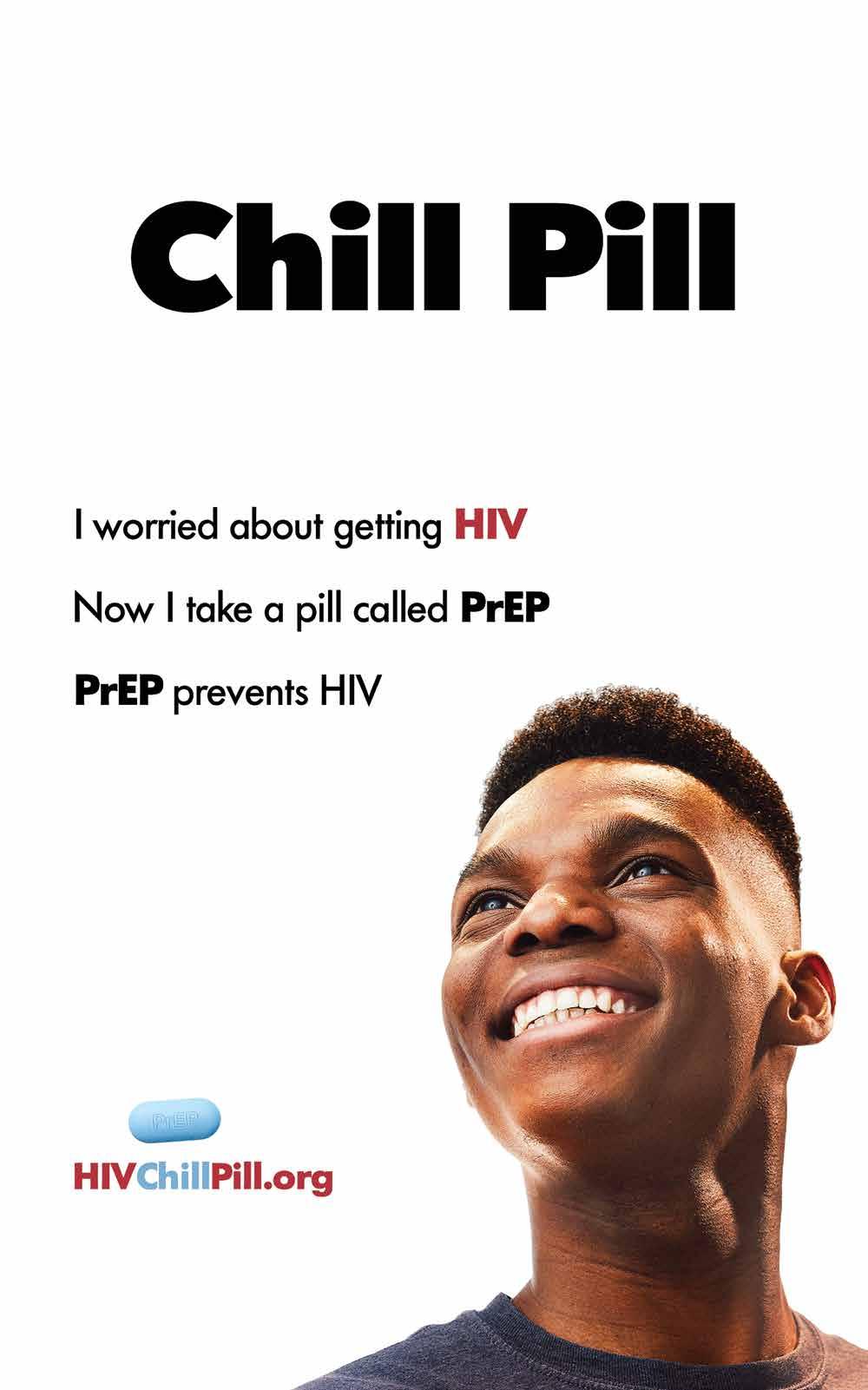
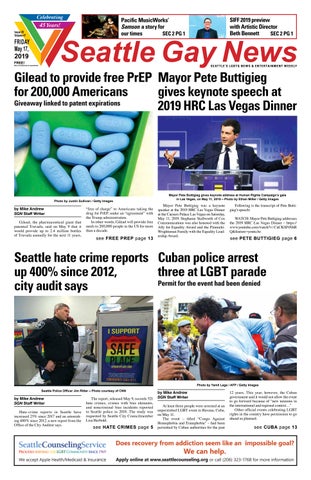
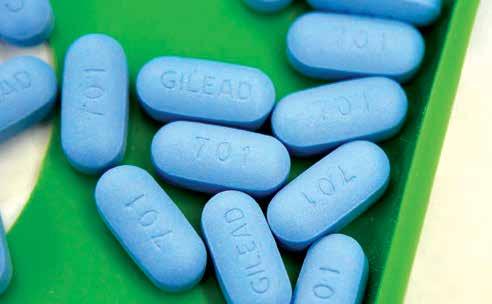
Gilead, the pharmaceutical giant that patented Truvada, said on May 9 that it would provide up to 2.4 million bottles of Truvada annually for the next 11 years,
“free of charge” to Americans taking the drug for PrEP, under an “agreement” with the Trump administration.
In other words, Gilead will provide free meds to 200,000 people in the US for more than a decade.
see FREE PREP page 13
by Mike Andrew SGN Staff Writer
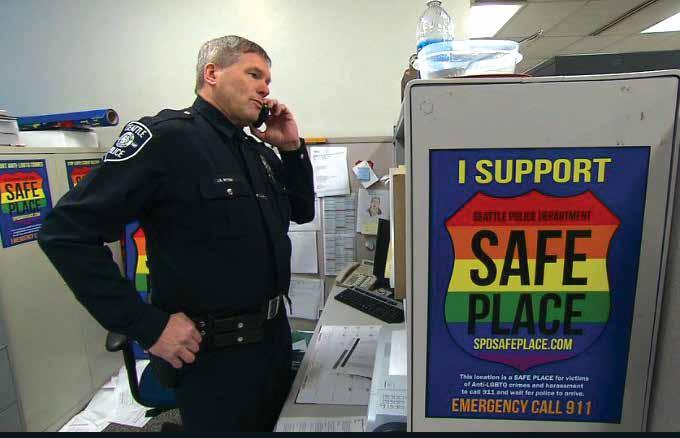
Hate-crime reports in Seattle have increased 25% since 2017 and an astonishing 400% since 2012, a new report from the Office of the City Auditor says.
The report, released May 9, records 521 hate crimes, crimes with bias elements, and noncriminal bias incidents reported to Seattle police in 2018. The study was requested by Seattle City Councilmember Lisa Herbold.
see HATE CRIMES page 5
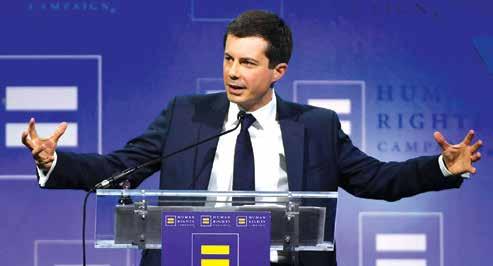
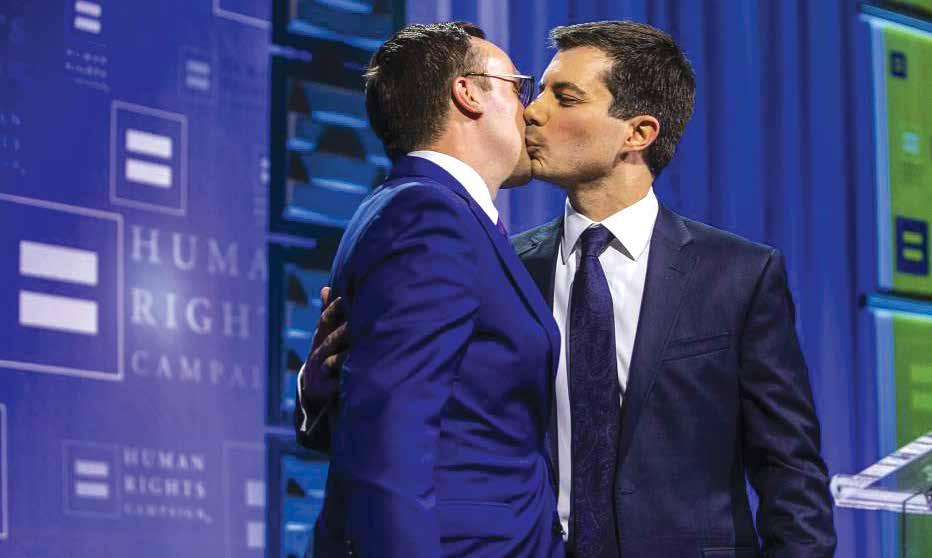
Mayor Pete Buttigieg was a keynote speaker at the 2019 HRC Las Vegas Dinner at the Caesars Palace Las Vegas on Saturday, May 11, 2019. Stephanie Stallworth of Cox Communications was also honored with the Ally for Equality Award and the PinnochiWrightsman Family with the Equality Leadership Award.
Following is the transcript of Pete Buttigieg’s speech:
WATCH: Mayor Pete Buttigieg addresses the 2019 HRC Las Vegas Dinner – https:// www.youtube.com/watch?v=CuCKSFtNhR Q&feature=youtu.be
see PETE BUTTIGIEG page 6
Permit for the event had been denied
by Mike Andrew SGN Staff Writer
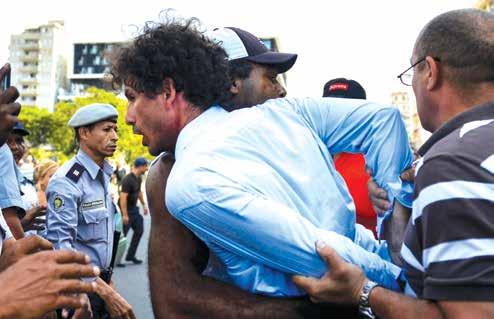
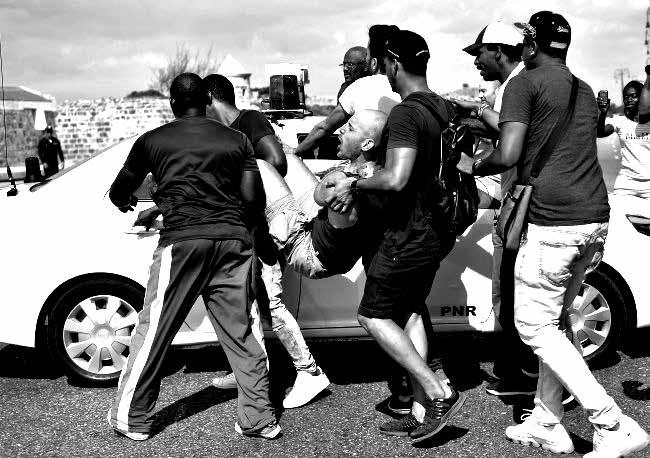
At least three people were arrested at an unpermitted LGBT event in Havana, Cuba, on May 11.
The event – titled “Congo Against Homophobia and Transphobia” – had been permitted by Cuban authorities for the past
12 years. This year, however, the Cuban government said it would not allow the event to go forward because of “new tensions in the international and regional context…” Other official events celebrating LGBT rights in the country have permission to go ahead as planned.
see CUBA page 13



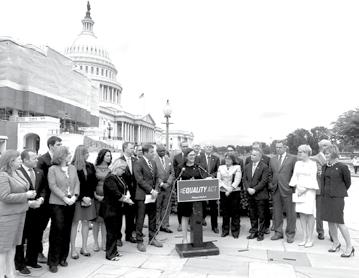
On Wednesday, May 8 the New Democrat Coalition in the U.S. House of Congress formally endorsed the Equality Act at a live press conference, and Congresswomen Suzan. DelBene spoke about the importance of passing this legislation. She represents Washington’s first congressional district, which covers parts of King, Snohomish, Skagit and Whatcom counties.
The full press conference appears on the New Democrat Coalition Facebook page. A transcript of Rep. DelBene’s prepared remarks follows this introduction.
Rep. DelBene is an original cosponsor of the Equality Act and has been a passionate supporter of the LGBTQ community since coming to Congress. She introduced a resolution in the 114th and 115th Congress that would make June 26th “LGBT Equality Day.”

She also introduced the Voices for Veterans Act, to add LGBT veterans to the membership and scope of the VA’s Advisory Committee on Minority Veterans, which advises the VA Secretary on the needs of minority veterans with respect to compensation, health care, rehabilita-
tion, outreach and other VA benefits and services.
Other efforts DelBene has joined to advance LGBTQ equality include:
• The Veteran Spouses Equal Treatment Act, which extends the full range of VA benefits to married same-sex couples residing in states that do not recognize marriage equality;
• The Equality for All Resolution, which states discrimination faced by the LGBT community is unacceptable and reaffirms Congress’s commitment to ensuring true equality for all Americans; and
• The Stop Harming Our Kids (SHOK) Resolution, which encourages states to protect minors from efforts that promise to change sexual orientation or gender identity or expression, also known as conversion therapy.
Following are Congresswoman Suzan DelBene’s remarks in support of the Eqality Act:
Thank you. I’m Congresswoman Suzan DelBene, vice chair of policy.
The Equality Act is one of the most important pieces of legislation that Congress can pass.
In more than half of the United States, LGBTQ Americans can still be fired, denied credit and evicted from their home simply based on who they are and who they love.
What’s worse, our nation is seeing a proliferation of state laws stripping protections from transgender Americans and legalizing discrimination under the guise of “religious freedom.”
Right now, only 21 states have protections against housing and employment discrimination for sexual orientation and gender identity, and only 15 states have
protections against education discrimination. We can do better.
Imagine what it must feel like to know that your entire life can be upended simply because of who you love – that you could lose your job for no good reason.
Well, it happened to someone who now lives in my state.
It started when he was a volleyball coach at a college in Virginia. They had just finished their most successful season ever –and he was fired without explanation.
And in Virginia, there is no legal recourse for fired LGBTQ employees.
So he, his husband and their sons moved to Washington state where there are protections for LGBTQ employees – and Washington state welcomes you and your family with open arms!
But not everyone has the ability to pack up and move. It’s costly and it’s hard.
But more importantly, no one should have to make that kind of decision.
We need to ensure LGBTQ Americans have the same rights in all 50 states.
As New Democrats, which is the largest caucus within the Democratic Caucus, we know that the value of someone’s work is not based on who you love, but rather how well you do your job and the opportunities you are afforded to compete in a fair environment.
Equality is good business.
So in the coming weeks, I look forward to casting my vote to pass the Equality Act. And I’d like to add that it’s time for the Senate and Mitch McConnell to do their jobs and start passing legislation that can help American families – and they can start with the Equality Act.
The Seattle Public Library, in partnership with OCA-Greater Seattle Chapter (OCA-GS) and Chinese American Citizens Alliance Seattle (CACA) will celebrate Golden Spike Day from 12:30pm to 2pm Sunday, May 19 at the Central Library, 1000 Fourth Ave., Level 1, Microsoft Auditorium, 206-386-4636. Join us for the discussion “Did Chinese Railroad Workers Make America Great,” as well as a display of photographer Corky Lee’s work.
Lee, an Asian-American photojournalist who resides in New York City, will come to Seattle after attending the Golden Spike Conference commemorating the 150th anniversary of the Transcontinental Railroad’s completion. He will speak about the contribution of Chinese railroad workers to the U.S.
Lee’s work has documented key events in Asian-American political history. His interest in photojournalism first sparked in junior high school, when he saw a Golden Spike Day photograph commemorating the 1869 completion of the Transcontinental Railroad. Lee was struck by the fact that there were no Chinese workers documented in the picture, despite the fact that thousands of them had worked and sacrificed their lives during its construction. From that moment on, Lee was devoted to making the accomplishments of Asian Pacific Americans more visible.
Library events are free and everyone is welcome. Registration is not required. Parking is available for $8 on weekends.
OCA, formerly known as the Organization of Chinese Americans, was founded in 1973. Today, OCA is a national orga-

nization dedicated to the social, political and economic well-being of Asian Pacific Americans in the United States. The OCA-GS chapter was formed in 1995 and serves the greater Seattle Chinese and Asian Pacific American community.
Established in 2011, Seattle is a chapter of the Chinese American Citizens Alliance (C.A.C.A.), one of the nation’s oldest civil rights organizations founded more than 100
years ago in San Francisco. The mission of the organization is to promote and protect civil rights, develop leadership in Chinese youth and provide community service.
The Library’s dynamic approach to building community that enriches lives includes programming that brings people, information and ideas together to respect and embrace the well-being of the people we serve. We celebrate Seattle’s many
cultures by forming strong partnerships with community organizations. For more information, call 206-3864636 or Ask Us at www.spl.org. For ADA accessibility, please contact: leap@spl.org.
Courtesy of Seattle Public Library
Explore how to get the most out of your camera while on the road, from trip preparation to going beyond simply point and shoot. The workshops will take place at two Library locations in May and June.
Have you ever come home from a vacation and wished your photographs were better? Learn how to create travel photographs that are souvenirs that capture the amazing things you saw – and felt – during the trip. Explore how to get the most out of your camera while on the road: from preparing for the trip, to how to go beyond simply recording to interpreting while away, to steps to make the most out of the photographs your bring home.
At these workshops, you’ll discuss
continued from cover
There were 125 reports of hate crimes (also called “malicious harassment”), 215 reports of crimes with bias elements, and 181 reports of noncriminal bias incidents last year.
In 2012, there were only 106 reports across all three of those categories, including 28 hate crimes. Hate crimes include assault, bodily harm, or property damage motivated by bias against the victim’s real or perceived characteristics.
But prosecutions of hate crimes are rare, however, with fewer than 40 convictions for hate crimes in Seattle from 2012 through 2017.
The Seattle Police Department refers about a third of reported hate crimes for

creative settings, learn about working with the best light and photographic themes, and discover how to design truly evocative, memorable images. The classes are appro -
prosecution, the study says. But the department lacks sufficient data to evaluate its own efforts to prevent and respond to hate crimes, according to the Office of the City Auditor. When the department decides not to refer reported hate crimes for prosecution, it doesn’t document the reasons why.
Hate crimes in Washington state law include crimes related to race, color, religion, ancestry, national origin, gender, sexual orientation, and disabilities. Seattle ordinances also cover crimes related to homelessness, marital status, political ideology, age, and parental status.
The report cautions that the number may reflect better reporting of crime than an actual increase in the numbers of crimes committed.
“A rise in reported hate crimes does not necessarily mean there are more of these crimes occurring,” the study says. “Juris-
priate for all skill levels and all types of digital cameras.
• Tuesday, May 28, 5:30pm to 7:30pm at the Delridge Branch, 5423 Delridge Way S.W., 206-733-9125.
• Sunday, June 23, 2:30pm to 5:30pm at the Central Library, 1000 Fourth Ave., Level 4, Boeing Technology Training Center Room 4, 206-386-4636.
More Information Library events are free and everyone is welcome. Registration is not required. Our job skills & digital creativity classes are made possible by support from The Seattle Public Library Foundation, and
dictions that report more hate crimes are typically seen as leaders in hate-crime response efforts, because high reporting can indicate law enforcement is prioritizing these crimes.”
In Seattle, reported assaults have increased more than hate crimes involving only harassment and threats. Crimes involving racial bias have increased more than those involving sexual orientation or religion.
Hate crimes tend to be concentrated in high-traffic, demographically diverse parts of town – Downtown and Capitol Hill, for example – and along the borders of racially diverse neighborhoods, the city auditor found.
Nearly a quarter of Seattle hate-crime cases prosecuted from 2012 through 2017 occurred on buses or at bus stops, and nearly a third occurred on the street, according to the study.
in partnership with South Seattle College. The Library’s dynamic approach to building community that enriches lives includes programming that brings people, information and ideas together to respect and embrace the well-being of the people we serve. Job resources, digital learning and digital creativity classes are some of the creative solutions the Library finds to meet the public’s changing needs and interests. For more information, call 206-386-4636 or Ask Us at www.spl.org. For ADA accommodations, please contact: leap@spl.org.
Courtesy of Seattle Public Library
Seattle Police Chief Carmen Best said in a statement that her department is an international leader in dealing with hate crimes, but she agreed that it could do more to document information about crimes. The department is already making strides, and a new police records system should help, Best added.
Herbold said she will lead a City Council committee discussion on new legislation that would allow the Seattle city attorney’s office “to more easily prosecute misdemeanor hate-crime cases.”
“It’s not enough to know that these crimes are being committed,” Herbold said, adding that “divisive rhetoric” from the Trump administration fueled growing white nationalism and domestic terrorism.
message is resonating, but I’d be lying if I didn’t admit that we’re a little bit surprised too at the speed of this trajectory we’re on. Then again this whole thing is surprising in a way.
Pete Buttigieg: Thank you! Thank you. Good evening, HRC!
[Audience: We love you, Mayor Pete]
Pete Buttigieg: Right back at you. Thank you. And thank you for the opportunity to be here. Thank you, Chad and the Human Rights Campaign, and all of your supporters, for the incredible work you’ve done to advance the cause of equality – whether advocating for those living with HIV/AIDS, or spearheading the repeal of “Don’t Ask Don’t Tell,” or fighting to make sure that love is taken seriously no matter who you are, no matter where you live.
While we’re in the spirit of gratitude, let’s also thank the staff here at the hotel who provided such a great meal for us tonight.
My name is Pete Buttigieg. Better known as “Mayor Pete.” These days best known as the husband of Chasten Glezman Buttigieg.
I know that Chasten won a lot of friends when he spoke at an HRC event in Houston just a few weeks back. I watched it online. I thought he was pretty good. Pretty amazing in fact. Now I just have the small matter of convincing him that when we agree that it’s his turn to do the laundry, “doing” the laundry actually includes folding it and putting it away. But that’s my own challenge.
This Mother’s Day Eve, I want to mention that my mother is here tonight. We’re going to be spending time with my mom and with Chasten’s mom. We are so fortunate to belong to families that have embraced and supported us
We know that families continue to struggle with acceptance in this country, and that so many people, especially young people, in the LGBTQ family sometimes need a different family – a bigger one – and that yellow “equal” sign is an emblem of belonging that is touching and even saving lives.
I’m going to have a lot to say about belonging later this evening. But first I just want to reflect on how remarkable of a spring Chasten and I are having. And what a testament it is to what can happen in this country of ours.
You know, we believe that our message is a winning one. So I’m not surprised our
If I had gone back in time twenty years ago, to find me as an awkward teenager at St. Joe High School in South Bend, Indiana, and reported to him what 2019 would look like, he would not have believed you. If you had told him that he would wake up in Las Vegas one day in May to reports that the President of the United States was apparently trying to get his attention, he would have wondered what you were talking about. Let alone if you told him that the President somehow pronounced his name right.
Let alone if you told me then that at the age of 37 I would be a veteran of the War in Afghanistan, in my eighth year as mayor of my hometown, and standing here, in Caesar’s Palace, as a top-tier contender for the presidency of the United States. And even more amazing, the look on my teenaged face if you could have told me that I’d be doing it with my husband looking on.
I am so mindful, and so thankful, that every minute of this marriage, we are enjoying a freedom that came to us because of the work of so many others, people like those in this room tonight and around the country. So I stand here not just as a politician but as a loving husband saying thank you, thank you, thank you, to this organization and the entire LGBTQ movement, for the fight to bring us that freedom.
When it comes to coming out, everyone’s got their own story. Mine is one of taking a long, long time to come out even to myself. And once I did, and started to tell friends, after being elected mayor of my hometown, it was easy to drag my feet on telling anyone else. After all, I had a demanding job, not a lot of time for a personal life, and the city was a jealous bride.
But what happened was I realized I wasn’t getting any younger. By the time I stepped away from the mayor’s office on leave to serve in Afghanistan, I was seized with the awareness that I could be killed in action, at the age of 33, a grown man and an elected official, with no idea what it was like to be in love.
Something happens to you when you write a letter and put it in an envelope and
write “just in case” on the outside of it and put it where your family can find it. It forces you to realize that you actually only get one life, you only get to be one person, and then I knew I had to be who I am. So by the time I came home, I knew what I had to do.
Now, inconveniently, all this happened in the middle of an election campaign. It was not obvious what the effect of coming out would be. Mike Pence was the Governor of Indiana. There had never even been an out elected official in executive office in our state.
So, would people of my socially conservative community embrace me and continue to judge me based on the job that I was doing for them, the turnaround in our city that was going so well? Or would they turn on me, unable to look past the fact that who I was was something they had been brought up to reject? There was only one way to find out.
So I wrote an op-ed for the newspaper, hit send, and I waited to see what would happen. And to make a very long story short, what happened… was that I got re-elected with 80 percent of the vote.
Part of why I launched this unlikely campaign – part of why I’m so optimistic about the future of this country – is that even with everything we’ve been through, I have faith in the possibility of change and growth in this country.
I know it’s a strange time to speak optimistically about American politics. Don’t get me wrong. I am conscious of what we are up against. In many respects, the situation is so serious that, even now, we may well be under reacting.
The horror show in Washington is mesmerizing. It is the nature of grotesque things that you can’t look away. So it holds our attention in a kind of trance. But we can’t get caught up in it. Faced with that show, we have to remember that in 2020 we get the chance to change the channel.
And we’re not going to do it by out-insulting Donald Trump. The truth is we’re not going to knock him flat with some killer line on a debate stage – though believe me, I’ve thought of plenty. I’d be happy to debate faith, happy to debate service. I don’t know, I’d be pretty happy to debate marriage with this president.
But the truth is, we can’t let this election
be about the President. Because if Americans see us spending all of our time talking about him, they will be left with the question: who is talking about us?
Our greatest armor is truth. And the truth is, there is no honest or constructive politics that revolves around the word “again.” We’re not going back. We can’t go back. We can’t go back. Democrats can’t take us back to 2008 or 1998 any more than conservatives can take us back to the ’50s.
Things are changing. Our country is being buffeted by extraordinary change. Tectonic change. Some of it good – as so many people in this room can attest. Some of it very, very challenging, particularly for the people in industrial communities like mine who have found not just their income but their identity disrupted.
And that’s why in 2020, our focus can’t just be about winning an election – it has got to be about winning an era.
That’s why it can’t be just about the next four years – it’s about preparing our country for a better life in 2030, in 2040, in 2054, when, God willing, I will come to be the same age as our current President.
I’m taking the long view because I have to. I come from the generation that grew up with school shootings, as the norm, the generation that produced the bulk of the troops after 9/11, the generation on the business end of climate change for the balance of our adult lives.
One that could be the first in America to come out worse off economically than our parents if we don’t do something truly different.
Let’s do something truly different.
Change is coming, ready or not. And the test of our time is whether we’ll be defeated by these changes or whether we can make them work for us.
A moment like this calls for hopeful and audacious voices. And yes, it calls for a new vocabulary and a new generation of leadership.
Now, it’s no secret that Democrats, people from my party, we are policy people. We are nuance people. We are quick to point out and put out a 14-point plan, but sometimes slow to explain the values behind that plan. Our positions on every policy question should always be clear. But it is time for us to get comfort-
able once again talking about values that motivate those positions. Values like freedom.
We’ve allowed conservatives to monopolize the language of freedom. But we know that freedom isn’t just about “freedom from” – it’s about “freedom to.” Not just freedom from regulation, but the freedom to live a life of your choosing.
And the reality is, you’re not free if, for example, your reproductive health is subject to being dictated by a male boss or a politician.
You’re not free if you’re being prevented from organizing for a fair day’s pay for a good day’s work.
And, of course, you are most certainly not free if a county clerk gets to tell you who you ought to marry because of their interpretation of their religion.
Freedom has no political party, neither does patriotism, neither does security.
We know that there’s more to security than putting up a wall from sea to shining sea. 21st century security means cyber security, election security. It means a vision of security that is ready to keep us safe in the face of violent white nationalism rearing its ugly head around the country and around the world. And caring about security requires us to treat climate disruption as the security imperative that it is.
So the way we secure our freedom, the way we safeguard our security, is through a well-kept democracy. A democracy where districts are drawn fairly, so voters actually get to choose their politicians instead of the other way around.
A democracy where – when you’re choosing the leader of your nation –maybe just maybe we’d total up all the votes and give it to the person who got the most.
And a real democracy – I must say this even though I know I’m a guest in Sheldon Adelson’s town – but a real democracy… okay so I think I’ve got some folks who agree with me on this…that real democracy means that the voice you have in our political process is gauged by the merits of what you have to say and not by the number of zeroes in your bank balance.
So when we talk about these – like freedom, security, democracy, they’re not abstractions. Anyone in my generation – anyone in this room – understands that politics isn’t theoretical. It is personal.
So many of us have a marriage that exists by the grace of a single vote on the U.S. Supreme Court. Nine men and women sat down in a room and took a vote and they brought me the most important freedom in my life.
That’s why Washington matters. Not the show. It’s not the political ups and downs, it’s not the daily drama of who looked good in a committee meeting. It’s the way a chain of events starts in one of those big white buildings and reaches into our lives, into our homes, our paychecks, our doctors’ offices, our marriages.
That’s why our country was invented in the first place, and that’s what’s at stake today.
Now, I’d like to comment on one of the buzzwords of our time, so-called “identity politics.” No one knows quite what to make of it today, and when the phrase is used, it’s usually to wave away our attention from some of the things that make our lived experiences different and the political implications of those differences.
Many of the objections come from the right, which is ironic at this time, because the current administration has mastered the practice of the most divisive form of such politics – peak white identity politics – designed to drive apart people with common interests.
It is true that each of us could see in our identity all the reasons we’re misunderstood. And then say you don’t understand me because you have not walked in my shoes – something that is true as far as it goes, but doesn’t get us very far.
Because we could also see in our identity the beginning of a new form of American solidarity. By recognizing that the one thing we have in common may be the challenge of belonging in a society that sees us for what makes us all different.
I’m not talking pretending that there are equivalencies between the different patterns of exclusion in this country. I may be part of the LGBTQ community, but being a gay man
doesn’t even tell me what it’s like to be a trans woman of color in that same community, let alone an undocumented mother of four or a disabled veteran or a displaced auto worker.
But being gay, just like every other fact about me, from where I grew up, to what I look like, means that I have a story. And if I look to that story, I can find the building blocks not only for empathy but for the impetus to action. Because he more you know about exclusion, the more you think about belonging. And we have a crisis of belonging in this country.
When you do not belong, that doesn’t just put you in a bad mood. It puts you in a different country.
When black women are dying from maternal complications at triple the rate of white women, it means that for the purposes of public health, they are living in a different country.
It means that for a Dreamer brought to this land at the age of two months, and putting herself through college, without a path to citizenship in the only place she knows, that even though she’s as American as the rest of us, she finds her life playing out on paper in a different country.
Or when a disabled person is discriminated against in employment opportunities, it is as though he is in a different country than all of us.
And yes, when an auto worker twelve years into their career is no longer sure how to provide for their family, they are not part of the country we all think of ourselves as all living in together.
That’s why we can’t seem to get on the same page. And these divisive lines of thinking have even entered into the consciousness of my party. Like when we’re told we need to choose between supporting an auto worker and supporting a trans woman of color, without stopping to think about the fact that sometimes the auto worker is a trans woman of color and she definitely needs all the support she can get.
The wall I worry about most isn’t the president’s fantasy wall on the Mexican border that’s never going to get built anyway. What I worry about are the very real walls being put up between us as we get divided and carved up. Walls going up within the working class, within communities, even within families.
And what every gay person has in common with every excluded person of any kind is knowing what it’s like to see a wall between you and the rest of the world and wonder what it’s like on the other side.
I am not just like you. No two of us are alike. But each of us has a story that can either separate us or connect us to those around us.
Yes, I am gay. And I am the son of an immigrant and an Army brat. And I am a husband. And I am a musician. And I am an Episcopalian. And I am a Democrat. But above all I am running as an American. I am here to build bridges and to tear down walls. And with your help, we can tear down the walls between fellow Americans.
Let’s tear down the walls that went up to keep black families out of white neighborhoods, with consequences for educational and health inequality as well as income.
Let’s tear down the fences between women in the economy and that level playing field everyone’s talking about.
Let’s tear down the walls around our democracy put up by politicians who came to the conclusion that their side will win if fewer people can vote.
Let’s tear down the fencing off of more and more of our economy from union organizing – because big corporations shouldn’t need a “safe space” away from workers’ rights in order to compete and thrive in American democratic capitalism.
So I am ready to use my story, my energy, my alliances, and yes, my privilege, to throw myself into tearing down those walls. Because I know what a wall can do – but most of all, because I know how it feels to peer, and then look, and then see, and then climb through a big hole in one of those walls, a hole knocked out by the activism of the kinds of people who are in this room.
The struggle for equality for the LGBTQ community, on everything from workplace discrimination to trans service members’ dignity, it doesn’t compete with the other struggles of Americans yearning to get to the other side of an ugly wall. It reinforces these struggles, and it obligates us all to do everything we can to lift one another up in the struggle.
We have to be for each other, no matter what. Which is why what I have to say to a woman who simply will not stand for the 46th male president in a row, or a voter of color who is getting tired of politicians, Republican and Democratic, making promises they can’t keep to their community and has decided their trust will be harder than ever to win this time around, that as much as I hope you will decide to be for me – if you don’t I am still absolutely committed to being for you.
Harvey Milk used to talk about the “us-es”—not just gays, but the black community, seniors, the disabled. Anyone who has been marginalized, or preyed upon, or counted out.
And the only way we’ll move forward is if all of us “us-es” rise together to meet this moment. To make our “us-es” into a bigger us without pretending we’re all the same, without needing to be all the same, in order to put it all on the line for one another.
That’s how we got this far, standing on the shoulders of giants. Whether it was Notre Dame’s Father Ted Hesburgh linking arms with Dr. King as they sang “We Shall Overcome.” Or the Filipino and MexicanAmerican farmworkers striking for dignity and decent wages [in Delano, California], influenced by Gandhi and King, supported by church groups, and unions, and students.
And then civil rights marchers and [antiwar] demonstrators whose patriotic dissent helped inspire the era that gave rise to the resistance at Stonewall that in turn helped to launch
the arrival of LGBTQ consciousness as we know it.
So, yes, we’re going to ask you to fight until states, like my home state of Indiana, finally put a hate crimes law on the books –even if you are one of the handful of Americans who has somehow not been targeted for hate or ridicule in this administration. Just like people who look like me are going to fight for a fairer criminal justice system, even if no one in our immediate family has experienced the racial inequity in that broken system.
It’s why we need everybody to be there with us in the fight for a Federal Equality Act, no matter who they are. And it’s why we’ve got to join Rev. William Barber’s Poor People’s Campaign, challenging our entire nation to lift up the poor and downtrodden. We fight for the transgender troops willing to put their lives on the line for this country for the same reason we fight for the Central American asylum seeker looking for a better life.
The struggle for freedom and fairness and a better life reaches far beyond our LGBTQ experience. But our experience arms us with empathy and it fills us with the energy to get this done.
In different ways, every American struggles to experience true freedom.
Every American needs real security.
Every American depends on a vibrant democracy.
And that’s what this campaign is about. So in a room like this I see a chance for all of us to lift each other us. To show what our country can be. And what our president can do. And I am filled even now with hope.
Running for office is an act of hope. So is volunteering, or donating, or even just voting for someone running for office.
And we have great grounds for hope. Even in my short lifetime.
Ten years ago, the first day I set foot on a Navy bae, I could not have served openly in uniform.
Five years ago, in my home state, my marriage could not have existed.
And last week – if you happened to pass by a newsstand – you could have picked up a copy of TIME Magazine with the headline, “FIRST FAMILY,” a man and his husband sitting side by side.
That didn’t just happen. It is the fruit of struggle. Political struggle. Moral struggle. Struggle by people with the courage to make change and faith in the ability in this country to be transformed into a more perfect union.
So Human Rights Campaign supporters, does that not fill you with hope?
Are you ready to take up the challenge of a generation and win the era for America’s future?
Are you ready to stand hand-in-hand with people just like you and people not at all like you to make this country a better place?
Then I’m as hopeful as I’ve ever been, and I’m convinced that we can’t lose.
Thank you, and I’ll see you on the trail.














by Colin Fields, MD Kaiser Permanente
I recently saw a tweet that read:
“My doctor asked me if I was sexually active. I said yes. Then she asked if I was on birth control. I said no. Then she proceeded to lecture me on birth control which SHE DIDN’T NEED TO DO BECAUSE I HAVE SEX WITH WOMEN.”
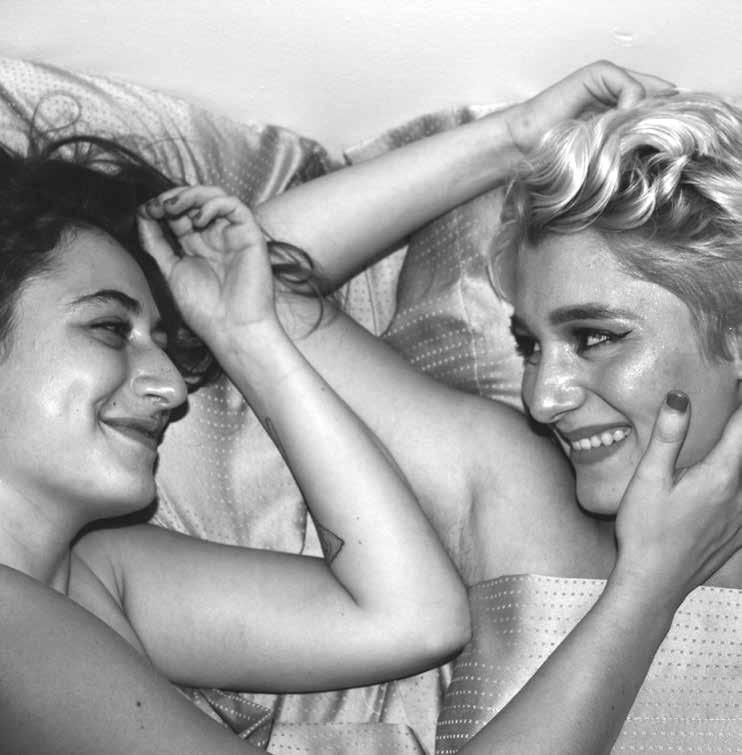
Experiences like this are all too commonplace with heterosexism pervasive in our society and in medicine. Yet the experience isn’t just frustrating – it becomes a barrier that deters lesbian and bisexual women from returning to the doctor and thus keeps them from getting the care they need.
Lesbian and bisexual women have smoking rates nearly double that of straight women and higher obesity rates. This raises concern about the possibility of higher rates of lung cancer, emphysema, diabetes, heart disease, and more. Yet we know that lesbian and bisexual women are less likely than straight women to get the healthcare they need.
For example, current guidelines recommend that all women age 21 to 65 get screened for cervical cancer. Lesbian women are 75% less likely than straight women to be up to date on cervical cancer screenings; bisexual women are 30% less likely than straight women. When a study here in Seattle dug into why this is, more than a quarter of lesbian women said they had a previous adverse experience with screening. 22% said they thought it wasn’t necessary if they weren’t sexually active with men.
In short, lesbian and bisexual women aren’t getting the life-saving cancer screenings they need because medicine isn’t welcoming and inclusive and because we’re not educating about the needed screenings in an inclusive way.
continued from cover
In a separate announcement, Gilead also confirmed that it will lift the patent on Truvada for PrEP one year early, in September 2020, allowing a generic version onto the market in the US.
However, activists are skeptical about the timing of the agreement, which came

A 2014 study of LBT students at universities in the Southwest found that the moment of disclosure of sexual orientation and the provider’s attributes were the biggest influencers on their health care experience. This makes perfect sense – is it safe to come out to my physician? How do they react when I come out? Are they competent providers for the LGBTQ community and aware of our needs?
When a patient has an experience with a care provider that is disrespectful or not responsive to their needs, they don’t come back, which can result in negative health outcomes.
Healthcare providers know we can, and must, do better for our lesbian and bisexual patients.
The medical world is working to
just a week after the US Justice Department announced a federal investigation into alleged price gouging by Gilead.
Gilead’s May 9 press release also reconfirmed the company’s plans to transition PrEP patients to a new PrEP drug, Descovy, which would maintain the company’s lucrative patent over PrEP medications for many years to come.
HIV researcher Dr. Rochelle Walensky told the New York Times that “the real cost
improve. At Kaiser Permanente we train physicians on how to ask about sexuality, how to provide a welcoming environment, and how to provide a care plan that reflects the patient’s sexual activity. As a whole, though, the medical world is slow to change.
For everyone in the LGBTQ community, we need to take the initiative to find friendly caregivers to make sure we get the care we need and we feel comfortable coming back. Not all providers who
of Truvada is about $60 a year. If you really wanted to cover everybody, you’d cut the price to everyone.
“If I put on my cynical hat, I think this is the way they make sure they grow the market for Descovy. It will promote the idea that Descovy is better — and I’m not sure that’s a dialogue we want to present.”
Descovy, introduced earlier this year, is supposed to have fewer side effects than Truvada, but it will be much more expensive.
Cuba’s National Center for Sex Education (CENESEX), led by Mariela Castro –daughter of Raúl Castro and niece of Fidel Castro – accordingly cancelled plans for the Havana event, but some activists decided to hold the parade without official approval.
Lacking official sponsorship, the event was organized mainly through social media.
According to the BBC news service, more than 100 activists turned out for the parade along Havana’s Paseo del Prado, one of the city’s main boulevards.
They soon ran into a large contingent of police and soldiers. Some marchers said they were subjected to violence after they were stopped by plainclothes security officers. At least three were arrested, the BBC said.
Cuba’s LGBT community was once identified with the country’s large sextourism industry, centered in Havana’s foreign-owned resorts and casinos. When the Castro brothers came to power at the head of a popular revolution in 1959, they seized the tourist venues but also began to arrest local LGBT people.
Fidel apologized for his government’s treatment
a
“If someone is responsible, it’s me,” he said, admitting he didn’t pay enough attention to what his government was doing to the LGBT community.
advertise as LGBTQ-friendly actually are in practice. A friendly provider should ask which gender/s you have sex with and be able to provide advice specific to different types of sexual activity. They should tell you about all the screenings you need based on your individualized risk factors. They should be fully comfortable listening to you and treating your whole self.
A May 9 tweet from President Trump bragged, “Great news today: My Administration just secured a historic donation of HIV prevention drugs from Gilead to help expand access to PrEP for the uninsured and those at risk.
“Will help us achieve our goal of ending the HIV epidemic in America!”
“At the time we were being sabotaged systematically, there were armed attacks against us, we had too many problems. Keeping one step ahead of the CIA, which was paying so many traitors, was not easy.”
Gay sex was decriminalized in 1979, and anti-discrimination provisions are now enshrined in the Cuban constitution.
After Raúl became Cuba’s president in 2008, the country has held events to mark the International Day Against Homophobia on May 17. His daughter Mariela has been an outspoken advocate for LGBT rights.
Raúl was replaced as president of Cuba by Miguel Díaz-Canel last year.
Cuban LGBT activists worry that with Raúl’s retirement, the new Cuban leadership will walk back its previous commitments to the LGBT community.
Díaz-Canel has publicly stated his support for marriage equality, but was forced to remove a legal guarantee of marriage rights from Cuba’s new constitution after large demonstrations by Cuban Catholics and evangelicals.