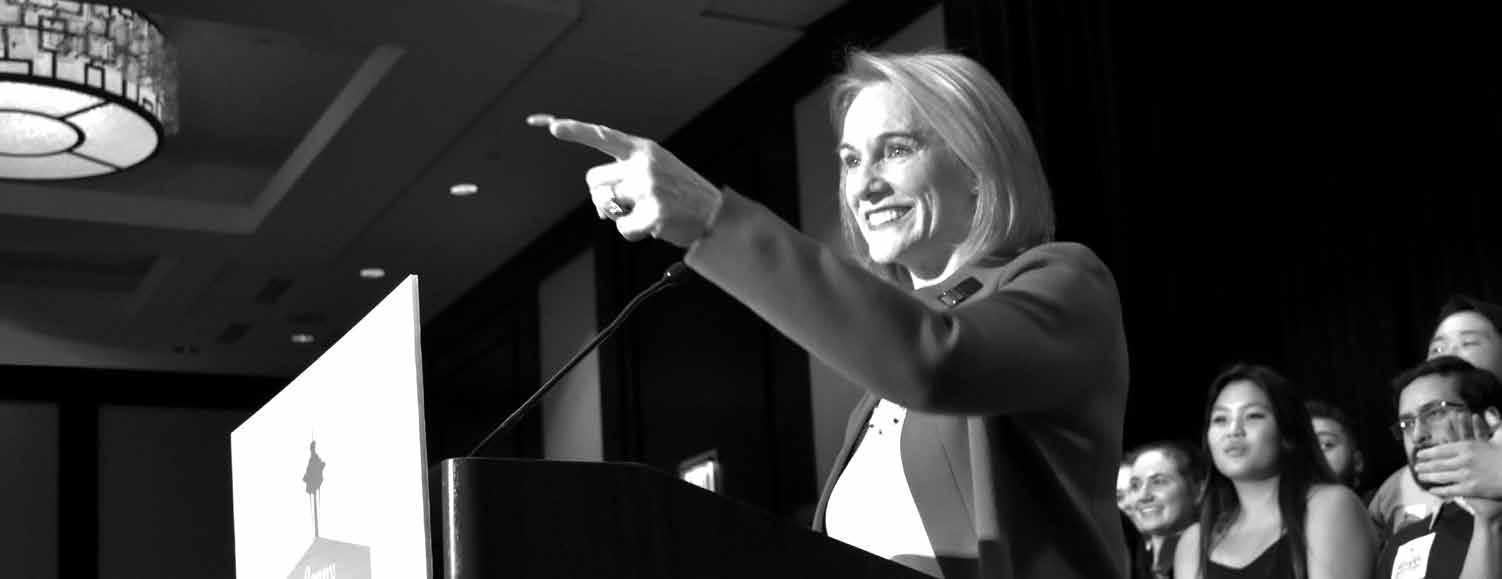
The 59-year-old partnered mom of two has lived most of her life in Seattle. Shattering the glass ceiling during the 2016 election was a professional, as well as personal, gain.
“I was touched watching Oprah on the Golden Globes,” Durkan said. “But the part that I thought was really interesting was when she said, ‘As a little girl, seeing Sidney Poitier get the award...’ showed her that a black person could be anything, and before that she didn’t know that...We’ve had a lot of success in the LGBTQ community, but the community is still under assault – particularly the transgender community. You know, when the President of the United States can simply tweet that people can’t serve in the military because of who they are and it goes almost unchallenged in Congress, we know we’ve got a long ways to go.”
She continued, “People forget that while marriage is equal – equality is there – in many states the things that go with it aren’t,” she said. “You can’t adopt. You can’t have property rights, and the like. Workplace protections exist in very few states. We have a long ways to go – and I think it’s important to have people at the forefront who stand with you and for you.”
Durkan had a message of unity to share with the millions of people marching in the streets during the Women’s March in Seattle – and throughout the nation.
“I think the march really exemplifies what we have to do,” Durkan said. “Last year’s march, to me, was the antidote to the inauguration. It was a thing that gave me up and that made me realize we could all come together. We saw every kind of person marching and it was loving and inclusive and optimistic. And I think that we’ve reached a new stage. That was the coming together and the resistance. Now we have to organize and reclaim.”
One might suggest that the U.S. political climate can be gauged through the planning and execution of gathering audiences
BAN VICTORY
continued from cover
Under the measure, if the provider violates the law, they would face sanctions ranging from fines to license revocation or suspension. Changes made in the House say the measure also applies to unlicensed counselors operating as part of a religious organization, religious denomination, or church. Washington thus becomes the tenth US state to ban the practice of trying to “cure” homosexuality by methods that, at best, are coercive, and at worst amount to psychological torture.
Connecticut, California, Nevada, New
and opportunities, such as the women’s march.
“Each of these stages is the next stage of the political movement,” Durkan concurred. “We have seen that it’s not enough just to resist. We have to have the affirmative plan and the people putting it in place.”
The resistance and affirmative action are not party exclusive either, according to Durkan.
“I think that people need to stand for what they believe in, so it’s always good to have dissent in the ranks,” she said. “But we also have to realize that we are up against very unified and strong political wins. Donald Trump was not an anomaly. I think that if we don’t stand for what’s better and come together, that we risk having him or people like him re-elected. If you look at our differences within the progressive base, they’re nothing compared to what we have to fight.”
An immediate local battle for Seattleites is the homeless issue. In her first major legislation, Durkan proposed “Building a Bridge to Housing for All,” a plan to sell an underutilized City property to address Seattle’s affordability and homelessness crisis. Her plan would leverage $11 million from the sale of an underutilized City property to create urgently needed bridge housing for those in our community experiencing homelessness and to support households on the verge of homelessness, while also reinvesting in essential City services.
“With too many families pushed out of the City and too many people living on our streets, we need to take urgent action to help those unsheltered and on the verge of homelessness. Leveraging one City property, we can provide essential services and attack our affordability crisis,” said Durkan. “There’s no quick or simple solution to solving this urgent challenge, but we can focus our efforts to rapidly deploy costeffective shelters to move people out of doorways and tents and into safer spaces.”
Durkan’s legislation is co-sponsored by four Councilmembers, including Council President Bruce Harrell (District 2, South
Jersey, the District of Columbia, Oregon, Illinois, Vermont, New York, New Mexico, and Rhode Island all have laws or regulations protecting youth from this abusive practice. A growing number of municipalities have also enacted similar protections, including cities and counties in Ohio, Pennsylvania, Washington, Florida, New York, and Arizona.
Seattle banned conversion therapy in August 2016, after Republican legislators blocked progress of the bill in the State Senate. The ban finally passed the State Senate because control of the body shifted back to Democrats last November, when Manka Dhingra won a Senate seat formerly held by a Republican.
Seattle, Georgetown), Councilmember Rob Johnson (District 4, Northeast Seattle), Councilmember Debora Juarez (District 5, North Seattle), and Councilmember Sally Bagshaw (District 7, Pioneer Square to Magnolia).
Durkan’s proposal includes investing $5.5 million in a Bridge Housing Investment Strategy (examples such as mass shelter tents, hard-sided tents, wood-frame sheds, portable modular bunkhouses or cabins, backyard cottages, and the master leasing of existing apartments). This strategy will kick off with a project to serve chronically homeless women in Seattle by the end of spring 2018.
Additional funding of $2 million would maximize housing options for those on the verge of homelessness by piloting a Seattle Rental Housing Assistance Pilot Program. A reinvestment of $2.5 million into Seattle’s communications capabilities is also on the table. An upfront Mandatory Housing Affordability payment of $2 million for affordable housing is also in the proposal.
Women in the referral network in need of immediate shelter due to domestic violence or other displacement events have long looked to Catholic Community Services (CCS) and Catholic Housing Services (CHS) programs. One example is Noel House at St. Mark’s Cathedral. The Women’s Referral Network is the method by which these women find the resources to have a clean, inviting, safe space to sleep every night. Noel House is able to accept 40 women per night. Currently, there is not a clear solution as to what will happen to these women should funding of the Women’s Referral Network be eliminated.
into a vacuum where you had moms with kids who were very under-served in the system. I think we have to do more there. We have to focus on both women who have been abused with or without kids, but also on the kids themselves. And it’s not just the smart thing to do, it’s the right thing to do. Those kids are the future of this country. If we don’t support them now, we’ll be supporting them in ways through their whole life. If you look at the difference in cost between supporting someone in shelter versus supporting them in good schooling, or supporting them in good schooling versus prison, the smart thing for society to do is to provide clean housing and good opportunity.”
There is not currently a realistic way to track the homeless population in tent cities throughout Seattle, Durkan said.
“That’s another thing that’s been very frustrating,” she said. “You come in with a lot of questions about how we’re going to decide how we help the various populations – who are victims of domestic violence? Who just lost a job and could use some re-training? We haven’t kept very good data. And there’s obviously a balance between keeping the data and privacy that we have to be aware of, but at the same time if we really want to make a difference in these people’s lives, we have to give them the resources they need. The only way to give them the resources they need is to know what those are.”
On the subject of sanctuary cities, Seattle is not backing down.
“We were looking at all options and we knew the areas in which they [the Trump administration] would focus first would be immigration and marijuana,” Durkan said. “So we had both legal and social strategies ready for that, and we think we’re both on the right legal footing and on the right moral footing. We will do what we have to do to protect the people in Seattle and protect legal businesses in Seattle.”
Courtesy of Unite Seattle Magazine
Mary’s Place really jumped
“We’re in the midst of shifting strategies,” Durkan said. “I think we have to focus resources on people to where they are to meet them in their crisis. “Far too long we’ve had this monolithic response to the homeless crisis and it’s shown that it hasn’t worked very well. I think we have to really focus on the various populations and one of those populations of women has not been well served.
There is no credible evidence that conversion therapy can change a person’s sexual orientation or gender identity or expression. On the contrary, research has shown that these practices pose devastating health risks for LGBTQ young people, such as depression, decreased self-esteem, substance abuse, homelessness, and even suicidal behavior.
Conversion therapy is condemned by every major medical and mental health organization, including the American Psychiatric Association, American Psychological Association, and American Medical Association.
The HRC looked forward to Inslee’s signature on the bill.
“Children across the Evergreen State deserve to live their lives authentically and should never be subjected to the abusive practice of so-called conversion therapy,” said HRC Senior Vice President for Policy and Political Affairs JoDee Winterhof.
“It’s time for Washington to join the growing number of states and municipalities [which] are enacting these critical protections. We thank the state legislators who voted to protect LGBTQ youth from this dangerous practice and now call on Gov. Inslee to sign this crucially important legislation.”
Seattle Mayor Jenny Durkan – Photo courtesy of MK Scott
Seattle residents petition city officials to conserve opportunities for Battery Street tunnel
SEATTLE – A growing number of Seattle residents are adding their names to a petition asking the city to conserve opportunities for new uses for the Battery Street tunnel, 2.75 acres of valuable real estate situated in the high-density neighborhood of Belltown. They oppose the slated landfill of the tunnel but support it being decommissioned as a roadway once the new SR 99 Deep Bore Tunnel opens in the fall.
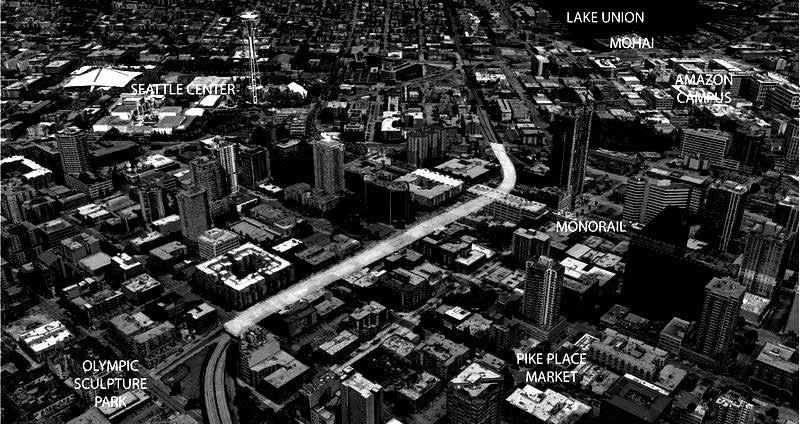
The Battery Street tunnel, built in 1952, has served the city of Seattle for over 65 years as the primary connector between the Alaskan Way Viaduct and Aurora Avenue North. The tunnel runs for seven blocks and offers 120,000 square feet (2.75 acres) that with modifications could be used for open
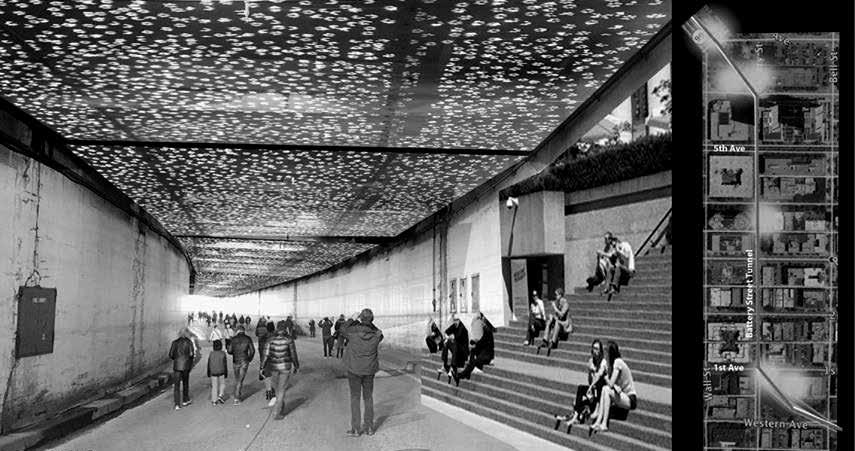
space, public recreation, stormwater collection, social service programming, bike and pedestrian transit, and revenue-generating private-public partnerships. Current property values of $1,200 to $2,000 per square foot in Seattle’s vibrant Belltown neighborhood mean the tunnel, if preserved, could be valued at over $200 million.
The petition asks city officials to pursue alternatives that allow for removal of the viaduct to proceed without delay but hold off on using a landfill to allow time for experts and the public to engage in a pragmatic visioning process that adaptively reuses this asset.
Aaron Asis, co-founder of the Recharge the Battery initiative, notes that it is a
reasonable request. “At a time of unprecedented growth and change throughout the city of Seattle, we are simply asking for the opportunity to explore alternative uses of public land and better uses of public dollars than the current plan to fill the Battery Street tunnel,” Asis said. “Our hope is that the Battery Street tunnel can become a model for infrastructural reuse around the world, and a valuable asset right here, for our city, [county], and state.”
Interested residents have until April 2 to add their voices to the petition: bit.ly/KillTheFill.
Recharge the Battery is a communitydriven initiative working to promote future opportunities for the Battery Street tunnel.
Through public engagement programs and community outreach efforts, [it is] elevating interest in exploring the past, present, and future possibilities for this underappreciated infrastructural icon.
For more information, contact Aaron Asis at (206) 406-4044 or aaron@ rechargethebattery.org.
Further information about the initiative is also available at www.rechargethebattery.org and www.rechargethebattery.org/ press-kit.
Courtesy of Recharge the Battery
A proposal submitted by Aubrey Davidson – Photo courtesy of Recharge the Battery
7 Blocks in the heart of Seattle set to disappear. – Photo courtesy of Recharge the Battery
GAY REAL ESTATE – MARCH Real estate
There are a lot of considerations to make when you are looking to buy a new home. One of the ones many people overlook in the early parts of their search is the fact that they are buying into a neighborhood.
The people, noises, sights, and activities all make up the neighborhood you plan to move into. Look into your perspective neighborhood before making a final decision on the house you want to put a bid in on. For help finding the ideal neighborhood for you and your situation, consider contacting us here at GayRealEstate.com and let us help. We can help you find the perfect real estate agent to help you find the perfect place to call home.
Kind regards, Jeff Hammerberg, President www.GayRealEstate.com
You’re Buying a Neighborhood, Not Just a Home
When you’re shopping for a new house, it’s important to remember that in some ways you’re not just buying a single property. You’re buying and moving into a street and a neighborhood. Your new home doesn’t exist in a vacuum. You have neighbors, other homes on your block, and a neighborhood overall that you’re joining. There are a few things you need to keep in mind and learn about when you’re considering moving into a new location. Here are a few of these things.
You Can’t Control Everything
One of the downsides to this concept is that most everything that goes on outside of your property is also outside of your control. For example, your street may be very busy at certain times of the day. There could also be a lot of noise on the weekends. You may find that one or even both of your neighbors are not exactly people you enjoy living next to. Unfortunately, there’s nothing you can really do about any of this. Sometimes, you don’t even know these issues are coming.
Learn the Neighborhood
Before you sign any paperwork, take the time to learn your new potential neighborhood if you can. Obviously, this might not be possible if you’re making a long distance move since you might only be in town long enough to view some properties. If you can, though, drive through the area at several times of the day and night. Try to visit during the times you’d go and get home from work. Also go by around the time you usually go to sleep to listen for loud noises. Visit on the weekends, too, to see what the street will be like.
Consider the Street
Some people don’t really think about the actual street they will be living on, but they should. One issue you might run into is a narrow street. This is especially true in some older neighborhoods. Look at where
your neighbors across the street park. Are they on the street? If so, are they directly behind your driveway? That can make it difficult to back out. Are there cars on both sides of the street nearly parallel to each other? That might make it difficult to maneuver a large vehicle in between them. These might not be deal breakers, but they are things you should be aware of.
Think About the Other Homes
Few people really think about what their new home’s property value will be like in several years. If you know you’re going to be selling the house, though, it is something to consider. Even if you’re not, you do want to think about how your new home will look on the street as a whole. Do you see houses with peeling paint and overgrown yards? If so, it’s a sign that your new neighbors don’t exactly keep their properties in great shape. On the other hand, if every house appears immaculate, you know you’re going to need to keep up your own house. You don’t want to be the one everyone else accuses of causing property values to drop.
Learn About Your Legal Rights
There’s nothing you can do about a lot of these issues. You can ask your neighbors if they wouldn’t mind parking their car away from your drive or see if those who like loud music could keep it down after a certain time at night. Other than that, you
may find yourself investing in earplugs. Your other option is to learn about the laws in your new city. Most have noise ordinances that state loud music cannot be played after a certain time. Others may allow you to report homes that are in need of repair or that have overgrown yards.
When it comes to all of these factors, don’t be afraid to rely on your real estate agent to find you the perfect home in the perfect neighborhood. Every location is different, but these experts have a feeling for neighborhoods after selling homes for so long. They can help you find a quiet place where you’re not likely to be disturbed, a neighborhood that’s great for children, or a new home on a street that welcomes diversity. If you identify as LGBTQ, you may definitely be looking for a welcoming location. An agent who is also a part of the community will be able to point you in the right direction. You can find LGBT real estate agents by using www.GayRealEstate.com, a website dedicated to LGBT real estate professionals.