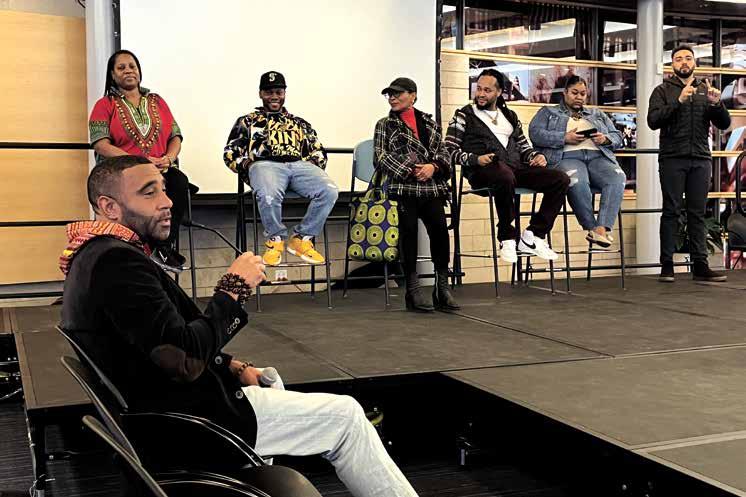
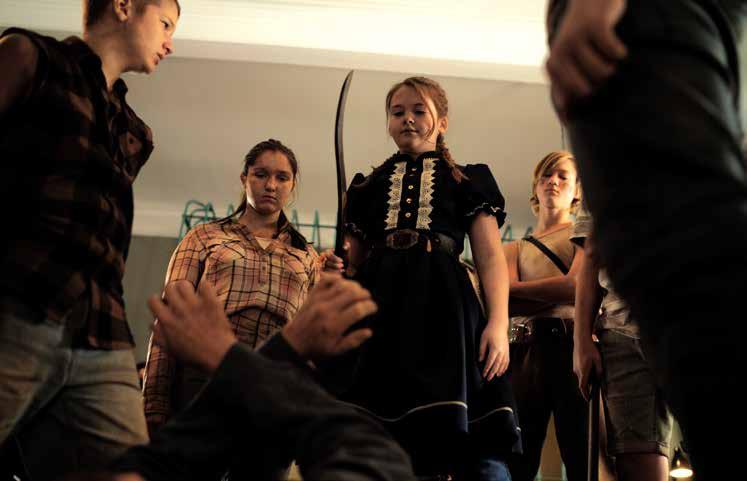
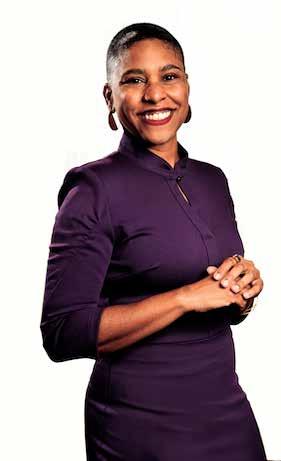
Deaunte Damper (l) moderates the LGBTQ panel with Andrew Ashiofu (r) – Photo by Daniel Lindsley
Local News
KENNEWICK
continued from cover
Micah Valentine, who drafted the proposal, said to the Tri-City Herald that he’s heard from conservative students and parents that the Pride flag is “distracting.” Valentine also said, “The solution to me is to remove controversial issues that evoke strong, strong emotion. Just remove those from the school, so everyone can feel comfortable. That’s not the most conducive environment to learn. You don’t need that. We need to have a learning environment that’s free from distraction and free from division, and it needs to be an inclusive environment for every student.”
He said last fall that he wanted to pass a conservative policy, which would be “essential” in convincing conservative voters to pass a levy, which failed twice last year, and schools have felt the resulting financial pressure. (The levy was approved last month.) Whether this policy would be a flag ban was up in the air, but Valentine said in October last year that such a ban would likely include flags of a “political” or “quasi-political” nature. This would include LGBTQIA+ Pride flags.
Carly Coburn, chair of the pro-Gay advocacy group PFLAG Benton Franklin, said this proposal was “very disheartening.” Coburn added, “I know that pretty much anytime I speak to youths or adults, when they see a Pride flag, they know they’re walking into a safe space and a place where they can be themselves.
“It’s not just a rainbow. Red stands for life, orange stands for hearing, yellow represents sunlight, green is for nature, blue represents serenity, and purple stands for spirit. Those are common areas that I think almost all groups can agree are important things.”
In November, the school board in nearby Richland sent out a survey to students about non-American and state flags in the classroom. When asked whether flags depicting political movements make them uncomfortable, 82% answered “no.” Kennewick conducted its own survey, asking students, “What types of signage do you believe are not appropriate in school
environments?” 72% voted that political expression signage was inappropriate, and 35% voted that political movement signage was inappropriate.
There was also the option to write in an answer, and 1% of students said that Pride flags were inappropriate.
In January, when the Superintendent Student Advisory Council read the proposed policy as it was written, members expressed concerns about limiting certain types of speech. They also stated that they don’t want flags expressing hate speech in classrooms, and that teachers should be free to decorate their classrooms as they want.
Proposal fails
The proposal — which was originally supposed to give clear instructions on displaying flags that are not American or
state flags — initially passed the Kennewick school board 4-1 during the first reading in December, but when voting for final approval was conducted this month, several board members flipped. The vote was 3-2 in the other direction, and the proposal failed. Board President Michael Connors and Ron Mabry changed their minds about the policy because they felt it needed more work.
Connors said, “We didn’t make it better. We made it convoluted. We made it difficult to enforce. We made it a mess. Nothing in this policy furthers our academic goals, nothing. So, to go down this road, to me, doesn’t make any sense.”
He continued, “I don’t see what we’re doing. We’re leaning towards teaching our kids to be intolerant. Going out in the world, all these kids are going to face stuff they don’t like — that’s just reality.
We have to find a way to teach tolerance and acceptance, whether you like it or not. That’s reality.”
In a compromise, the Kennewick board unanimously voted to update its American flag policy to reflect changes in Washington state law. Board policy now states that every US flag shall be “prominently installed, displayed, and maintained in all schools.”
Valentine seemed to backpedal on his original proposal, disagreeing that it would have spread intolerance, apparently referring to the successful compromise flag policy update instead. “It’s not suppressing, it’s not removing, it’s not banning. But what it does is — the language specifically props up the American flag that we all live under,” he stated last month.
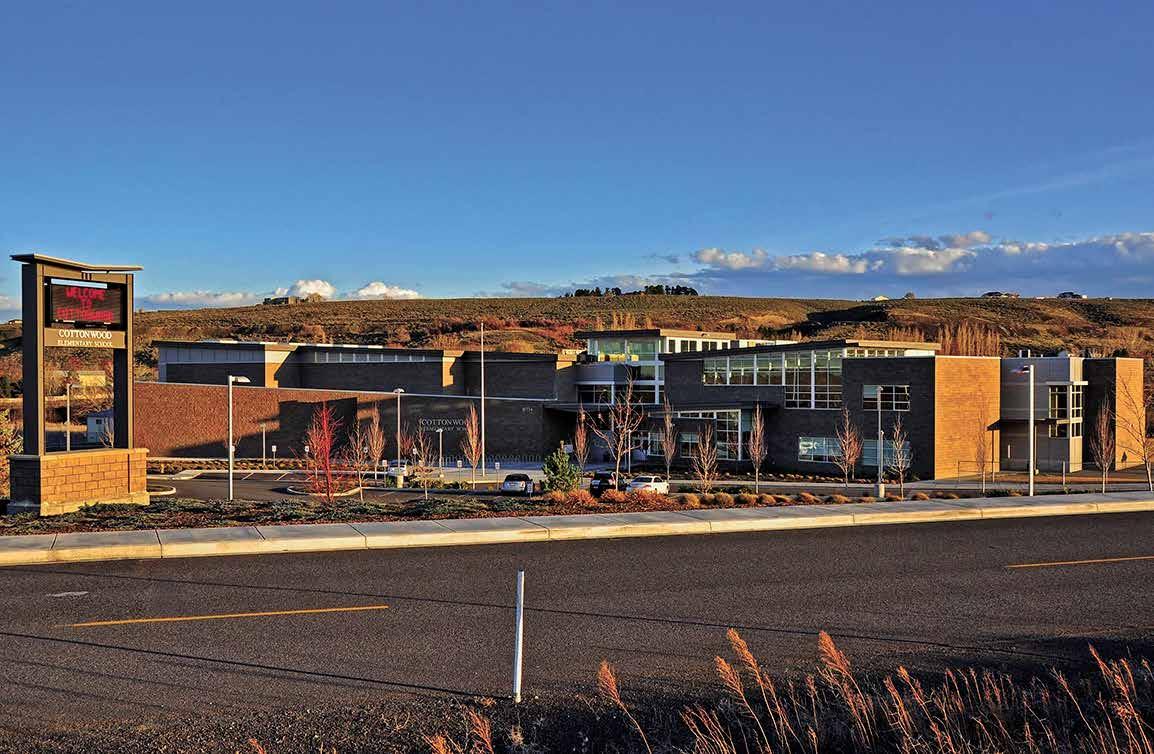
Cottonwood Elementary School in Kennewick, WA – Courtesy photo
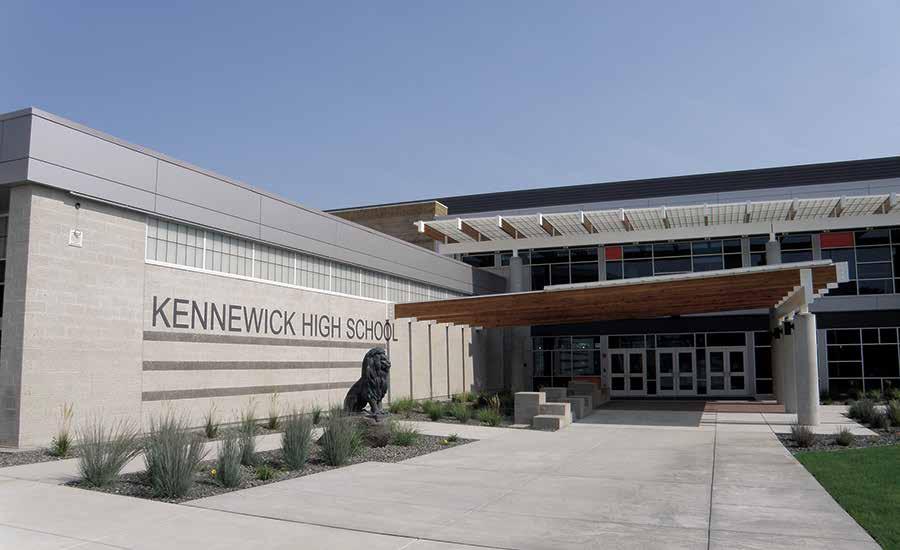
Kennewick High School in Kennewick, WA – Courtesy photo
ebrate Black History Month by recommitting to the fight for equity, opportunity, dignity, and voting rights, to which every Seattleite is due.”
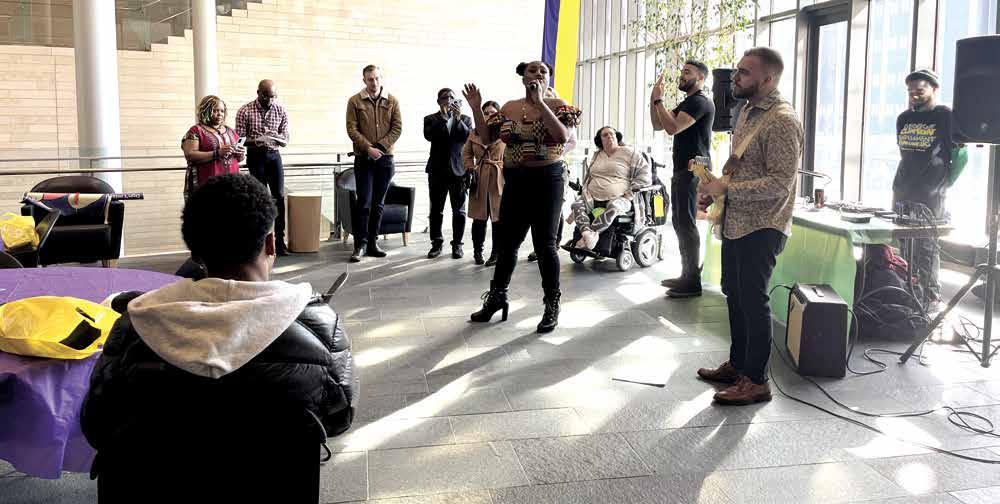
The event opened with a land and labor acknowledgement, and a beautiful rendition by local singer-songwriter Jayza Duhon of James Wheldon Johnson’s “Lift Every Voice and Sing,” known as “the Black national anthem.” Duhon was accompanied by Randy Campbell on electric guitar.
The groups present then each spoke in turn, with introductions by leaders of the Women’s, Disability, Human Rights, Immigrant and Refugee, and LGBTQ Commissions.
LGBTQ Commission co-chair Andrew Ashiofu kicked things off by reading a proclamation from the City.
“Black History Month is a reminder that Black history is Seattle history, Black culture is Seattle’s culture, and Black stories are an essential component of the story of our city,” he read.
This year’s theme was Black resistance, “which stems from a call to action by Henry Highland Garnet in an address to the National Negro Convention of 1843, in which he said, ‘No oppressed people have ever secured their liberty without resistance. What kind of resistance you had better make, you must decide by the circumstances that surround you.’”
“As a city,” Ashiofu continued, “we cel-
Part of the circumstances surrounding the event was a budget of $27 million for the Black community in the greater Seattle area. “PB” was the buzz in the air that afternoon and evening; it stands for participatory budgeting, a practice wherein citizens decide through a democratic process how to spend allocated public funding.
Researcher Shaun Glaze introduced themself as “Blackity Black, super Queer” and “very happy to be here.” And after a moment of silence for the suffering of minorities over the last few years, Glaze recounted the origins of Seattle’s participatory budgeting program.
“We as a community — so many of us — we are very familiar with grief and joy coming together,” Glaze said. “And it is with grief and joy that I come here with you, because in 2020, there were thousands, hundreds of thousands, of folks in the streets protesting, but also marshaling together, in defense of Black lives and in support of Black futures.”
Glaze spoke of the promises of reform the city council had made to the Black community in 2020, after the protests against the murder of George Floyd by police — and
“We as a community — so many of us — we are very familiar with grief and joy coming together.”
how the City said that it didn’t know how to go about that kind of change.
“And with that, a group of us got together and said, ‘Well, then, if that is the case, we will write you a roadmap,’” Glaze said. “‘And we — the few of us who came together — will not be the authors of that roadmap. Community will be the authors of that roadmap.’
“It will be Black folks, indigenous folks, it will be people you have continually, continually, continually not just divested from but … harmed with your dollars who will write this roadmap. It will be people with disabilities, it will be people experiencing homelessness, it will be people from a variety of different faiths, it will be people you have never heard from but have screamed in your face for generations who will make this roadmap.”
Through the founding and the work of the Black Brilliance Research Project, Glaze and “hundreds” of people helped write a 1,300-page document “in excruciating detail for the City, for how they can
stop investing in the things that harm us, and start to put that money instead toward the dreams, the visions, the knowledge, the expertise of our community members.”
Glaze explained that the Participatory Budgeting Project would be hiring community members “like y’all, to decide what happens next,” as well as opening spaces for the “regular-degular” people to discuss and vote on ideas for the budget.
The program “is designed to repeat year after year,” meaning its success in 2023 could spell even more funding for projects of this kind.
“But I have bad news,” Glaze said. “It only works if we work it. If y’all don’t show up to things, if you don’t tell your people, if you don’t tell your kids — ’cuz it’s kids as young as ten that get to be part of this.”
A few in the audience hollered in support.
“This only works if we work it,” Glaze repeated.
The announcements ended with jumpstarting that mindset of participation with a call-and-response chant: “I am creating… Black futures!”
Tana Yasu, co-chair of the Seattle Women’s Commission, then invited the audience to try the free food and drink made and brought in by community members, like gorgeously decorated chocolate strawberries and homemade lemonade.
Just in front of the buffet, info tables were set up for the various commissions, POCAAN, Brothers United in Leadership Development, and other organizations.
Since I Been Down, a sober film about the persecution and incarceration of Black youth in 1980s and 1990s Tacoma, played in a separate room. Panel discussions followed, with the filmmakers and members of both the Black Prisoners Caucus and the audience speaking at length about how to prepare their children for the realities of being Black in the United States.
Ashiofu took to the stage again, with three other Queer Black people, to discuss racism on dating apps, or while trying to access resources for people living with HIV/AIDS, and within the Queer community itself.
Turnout for the event was sparse until the end, however, when a crowd of supportive families and fans filled the aisles of the panel room to watch a drag show starring local Black queens and kings, including Leo Mane.
CITY HALL continued from cover
Jayza Duhon sings “Lift Every Voice and Sing” – Photo by Daniel Lindsley
Panelists discussing “Since I Been Down” – Photo by Daniel Lindsley
Arts & Entertainment
A Thousand Splendid Suns a splendid world premiere
by Alice Bloch & Sharon Cumberland
SGN Contributing Writers
A THOUSAND SPLENDID SUNS
Music by Sheila Silver Libretto by Stephen Kitsakos, based on the novel by Khaled Hosseini McCaw Hall
Opening weekend, February 25 and 26 (onstage through March 11)
How often do you get the chance to attend, right here in Seattle, the world premiere of a glorious new opera with a ravishing score, gorgeous production, and gripping drama about the plight of Afghan women? Once in a lifetime!
And how often are the composer, librettist, and famous novelist present to celebrate their brilliant collaboration? Not often.
But Seattle opera lovers — and those from around the country and the world — were on hand to witness the world premiere of A Thousand Splendid Suns, a brilliant and moving new work by composer Sheila Silver, librettist Stephen Kitsakos, and novelist Khaled Hosseini (whose book served as inspiration).
This heart-wrenching opera takes place in Herat and Kabul, Afghanistan, and tells the three-generation tale of women negotiating the restrictions on life under Taliban rule, when women were not permitted education or work outside of the home. With direction by Afghanistan’s premier female filmmaker, Roya Sadat, and a cast made up primarily of women, this new opera not only exposes the dreadful dilemma of women and girls in a misogynistic culture but also demonstrates how men are diminished by such extremes.
The story, for those unfamiliar with Hosseini’s novel, is an account of women victimized by forced marriage and lack
of independence and education. Their job is to give their husbands sons. If they fail, they are set aside for a younger wife. The main character, Mariam, is born out of wedlock and loses her mother to suicide. Instead of sending her to school, as Mariam hopes, her father arranges a forced marriage with Rasheed. When she fails to produce a son, Rasheed marries the young Laila, whose Romeo-and-Juliet story with her lover Tariq ends with her having a child that Rasheed believes to be his. How the
two wives (more like surrogate mother and daughter) form a sacrificial alliance to save Laila and Tariq’s future is the redemptive climax of A Thousand Splendid Suns Karin Mushegain sang the main character, Mariam, in a beautiful mezzo-soprano, brilliantly performing the transition from a hopeful young girl to the embittered, abused wife of Rasheed, who represents the misogynist Taliban culture. Rasheed is a thankless role, performed with brave conviction by baritone John Moore. Laila (soprano
Maureen McKay) and Tariq (tenor Rafael Moras) are the hopeful young lovers whose efforts to escape their fate are at the heart of the drama. McKay has already performed at Seattle Opera to great acclaim, while Moras is a Seattle Opera debutant; both sang and acted with skill and conviction. The singers’ arias and duets are based on specific ragas (collections of pitches used in Hindustani music), which Western listeners may not recognize but nonetheless contribute to the authenticity of the score.
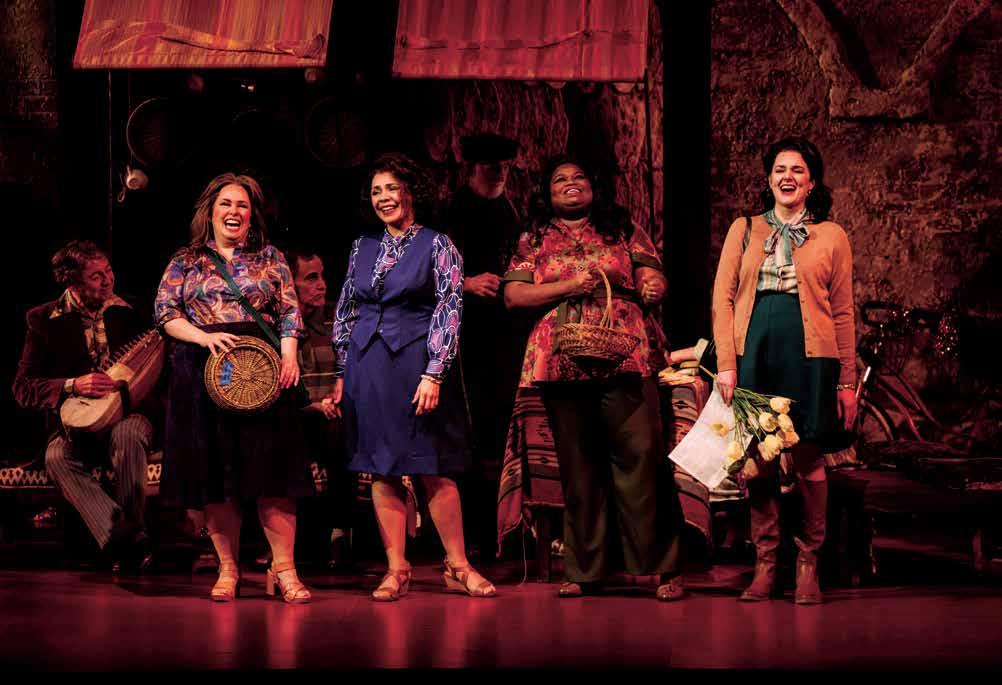
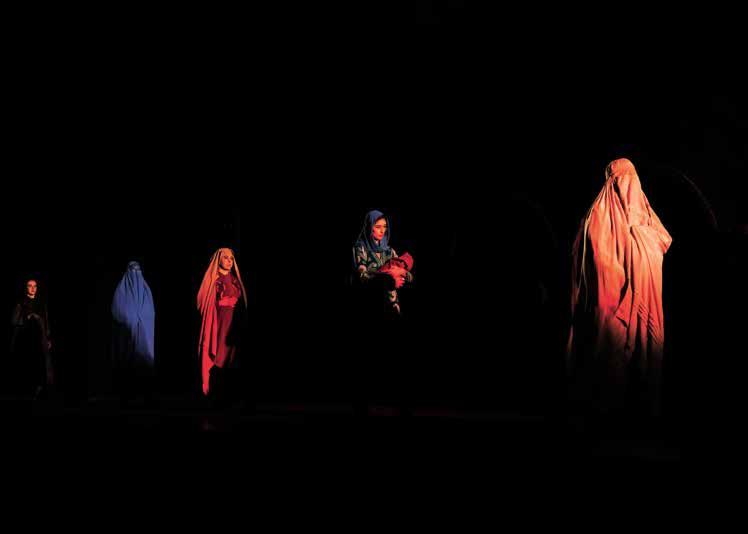
Sarah Mattox as Market Woman #3, Tess Altiveros as Market Woman #1, Ibidunni Ojikutu as Market Woman #2, and Sarah Coit as Fariba in A Thousand Splendid Suns at Seattle Opera – Photo by Antone Patterson
Maureen McKay as Laila in A Thousand Splendid Suns at Seattle Opera – Photo by Antone Patterson
Laila and Tariq’s love duet, as well as the “mother-daughter” duet between Mariam and Laila, were so moving on opening night that the audience twice interrupted the singing with applause. These lush harmonies and lovely melodies are among the highlights of the opera, providing two moments of respite from the heaviness of the rest of the drama. The ending, which we won’t reveal here, elevated this difficult story to a degree of hopefulness that allowed the audience to leave with admiration and feelings of support for Afghanistan and its beleaguered people.
Seattle-born composer Silver’s music is sumptuous and colorful, skillfully combining Western idioms with South Asian forms. The superb orchestra, composed of members
of the Seattle Symphony, was conducted by Viswa Subbaraman, whose knowledge of South Asian music and experience directing modern operas served the orchestra and singers well.
Kitsakos’ spare, poetic libretto left plenty of room for orchestral interludes. Whenever the tabla hand drum enters — with its dangerous, percussive tick-tick-tick — we feel the characters’ fear rise in our own hearts. The haunting sound of the bamboo bansuri flute creates a dreamy atmosphere of love and hopefulness. Silver’s music is tonal and melodic, but with complex rhythms and unresolved chords that create dramatic suspense. It grabs the listener and doesn’t let go. Not since Wagner has the orchestra been so central to the drama of an opera.
Likewise, Sadat’s staging transports the audience to a mud hut surrounded by minarets; then to urban homes in Kabul, using an abstract background of mountains and clouds; then to a dark bus station controlled by the Taliban; and finally to a prison in a castle. Her subtle design, aided by four stalwart stagehands who rotate set designer Misha Kachman’s revolving centerpiece, create a substantially authentic world for the drama to unfold in.
Background
How did Seattle Opera bring this wonderful new work into existence? It started in 2012, when Silver obtained permission from Hosseini to make his best-seller A Thousand
Splendid Suns into an opera. She invited her long-term collaborator Kitsakos to write the libretto, and then spent time in India studying Hindustani music (the classical music of northern India, Pakistan, and Afghanistan). She and Kitsakos then wrote and workshopped the opera with the help of cultural consultant Humaira Ghilzai, and in 2018 received a commission from Aidan Lang, then general director of Seattle Opera. When Christina Scheppelmann became general director in 2019, she engaged Subbaraman as conductor and Sadat as stage director. During the period when Hosseini published his novel and Silver and Kitsakos wrote the opera, the oppression of the female characters was seen as something from history. Women in Afghanistan had made great strides since the defeat of the Taliban. All of that changed in 2021.
On the very day when Sadat arrived in Seattle to attend the first production meeting for A Thousand Splendid Suns, the Taliban recaptured power in Afghanistan. In her program notes, Sadat writes that “in the blink of an eye,” between Kabul and Seattle, she lost her homeland. The joy she had anticipated in directing this opera was transformed into a feeling of responsibility to portray the enormous courage and resilience of the women of Afghanistan.
That feeling — and the years of work and devotion to the opera by those who created it — have certainly paid off. It is difficult to think of a way in which this opera and this production could have been improved.
We congratulate Seattle Opera for bringing this beautiful and important work into existence, and encourage readers to attend this wonderful world premiere. Many of you will have read Hosseini’s novel and are aware of the difficult, painful material it contains about the oppression of women and the damage patriarchy does to men and boys. It’s important for those of us who are living with and working on LGBTQI+ issues to be reminded of how far other cultures may be from recognizing basic human rights.
Be prepared to take time to absorb this great work and to recover. The pleasure will be worth the pain.
For more information and to order tickets, go to seattleopera.org.
A Thousand Splendid Suns at Seattle Opera – Photo by Sunny Martini
Karin Mushegain as Mariam (l), John Moore as Rasheed (center), and Maureen McKay as Laila (r) in A Thousand Splendid Suns at Seattle Opera – Photo by Sunny Martini
Action-heavy Operation Fortune an entertainingly silly con job
by Sara Michelle Fetters SGN Staff Writer
OPERATION FORTUNE: RUSE DE GUERRE
Theaters
Operation Fortune: Ruse de guerre is Guy Ritchie’s latest quip-heavy action extravaganza with star Jason Statham. It plays out like a cross between Mission: Impossible, The Man from U.N.C.L.E., and The Unbearable Weight of Massive Talent and contains an opening third that feels as if it were written by maniacally grinning 13-year-old obsessed with crassly juvenile sex jokes.
Not to mince words, but those first 30 to 40 minutes are agonizing, and the thought that every second of this almost two-hour film was going to be of a similar tone had my eyes rolling to the back of my head in annoyed frustration. But something funny happens as events progress. The puerile sexual innuendo gets toned down, the talented cast gets into a verbally harmonious rhythm, Ritchie’s visual bravado grows increasingly seductive, and Hugh Grant friskily waltzes in from the shadows and starts to pinch the gosh-darn show. By the time this ridiculous bit of espionage pulp fiction came to an end, I honestly wanted to watch more. I liked these characters, and I was curious to see what sort of trouble this team of wise-ass secret operatives could get into next. Operation Fortune is a heck of a lot more fun than it has any right to be, and based on how much I despised the first act, I’m as flabbergasted about this as anyone.
After a brazen heist at a top-secret research facility leads to a dangerous technological device being sold to the highest bidder, British secret agent Nathan Jasmine (Cary Elwes) is brought in by his government handler (Eddie Marsan) to get it back — the “how” is up to him. Jasmine turns to crack freelance operative Orson Fortune (Statham) and tasks him to put together a team to find out what was stolen, what it does, who is handling the sale, and who the nefarious individuals paying $10 billion to get their hands on it are.
It gets needlessly convoluted from there, but the basics are that charismatic billionaire arms dealer Greg Simmonds (Grant)
is the one brokering the sale, whose his favorite actor is “I do all my own stunts” megastar Danny Francesco (Josh Hartnett).
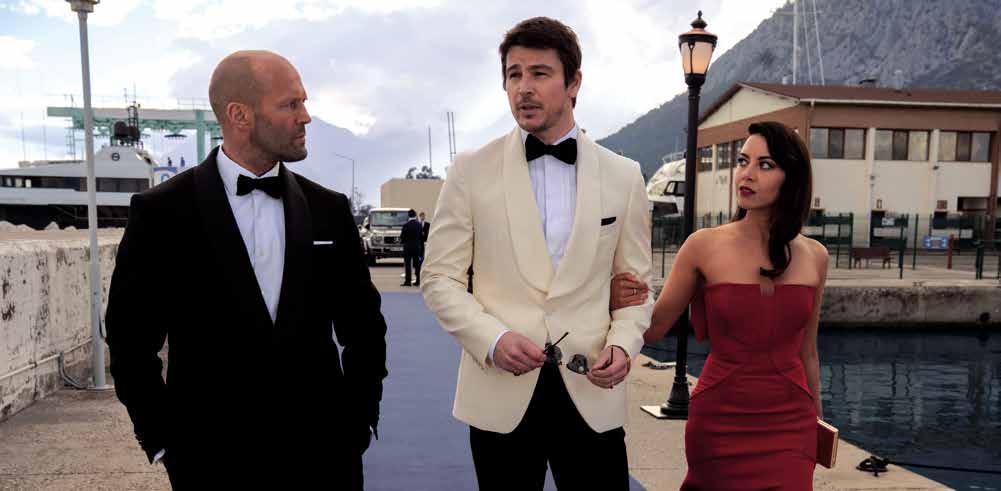
Fortune blackmails Francesco to assist his team — which includes Aubrey Plaza as tech whiz Sarah Fidel and Bugzy Malone as ace sharpshooter JJ Davies — in running an intricate con on Simmonds, and hilarity, hijinks, fisticuffs, shootouts, and highspeed car chases ensue.
Those expecting another Snatch or Lock, Stock and Two Smoking Barrels from this director-star combo will likely exit the theater somewhat disappointed. This film is nowhere near as sharp, cunning, or intelligently crafted as those two efforts were. At the same time, once things get rolling and the games between Fortune and Simmonds kick into high gear, there is a whimsically energetic playfulness that’s downright infectious.
Does what transpires make even a modicum of sense? No, not really, and it isn’t like the characters are all that well fleshed out beyond the standard genre traits each exhibits when they’re first introduced.
But once Ritchie gets tired of the groaninducing double entendres and lets his talented cast have some adult-level fun, each knows exactly what to do to make their presence mean something. All the key members of the ensemble get at least one moment in the spotlight.
His ace in the hole, however, is Grant. Much like it was with The Gentlemen (and to a lesser extent The Man from U.N.C.L.E.), the versatile actor makes the most of what is otherwise an underwritten character. Simmonds isn’t so much like a second-rate James Bond villain as he is a second-rate imitation of one from a 007
parody, like Our Man Flint, The Wrecking Crew, or Austin Powers: International Man of Mystery. But Grant knows exactly how silly this man is and has no problem cutting loose, playing him as if he were a larger-than-life, cigar-chomping cartoon. Watching him do this is positively glorious, especially during the climax, when Simmonds has a bombastic surprise waiting for the weapon’s clueless buyers.
It is unlikely Operation Fortune: Ruse de guerre will be the franchise starter all involved probably hoped for. But for those that can connect to its goofily immature wavelength (and can also sit through that exasperating opening act), there’s still plenty of enjoyment to be found. The acting is solid and the action is even better. I say give Ritchie’s latest a chance, as it may just steal your heart.
Jason Statham, Josh Hartnett, and Aubrey Plaza in Operation Fortune: Ruse de guerre – Photo courtesy of Lionsgate
Hugh Grant in Operation Fortune: Ruse de guerre – Photo courtesy of Lionsgate
Jordan and Majors trade fierce melodramatic body blows in hard-hitting Creed III
by Sara Michelle Fetters
SGN Staff Writer
CREED III
Theaters
Creed III is the ninth installment in the Rocky -verse, and the first entry not to include an appearance by creator-producer-star Sylvester Stallone. From the first moment director Ryan Coogler (Black Panther) came up with the idea for the next generation of cinematic pugilists to revolve around the late Apollo Creed’s illegitimate son Adonis (Michael B. Jordan), starting with 2015’s Creed, it was only a matter of time before Rocky Balboa could quietly saunter into the sunset. This was handled beautifully in 2018’s Creed II, so the character’s absence here feels entirely justified and authentically appropriate.
Not that anyone should then assume that producer Ryan Coogler or screenwriters
Keenan Coogler (Space Jam: A New Legacy) and Zach Baylin (King Richard ) are looking to reinvent the wheel in this latest chapter. Even without Rocky, this is still very much a “Rocky” movie: Heavyweight champion achieves all he thought he desired. Retires to spend more time with his loving wife and child. Faces unexpected turmoil and tragedy. Ends up feeling the need to get back inside the ring for one Last Big Fight. Cue up the requisite Bill Conti theme.
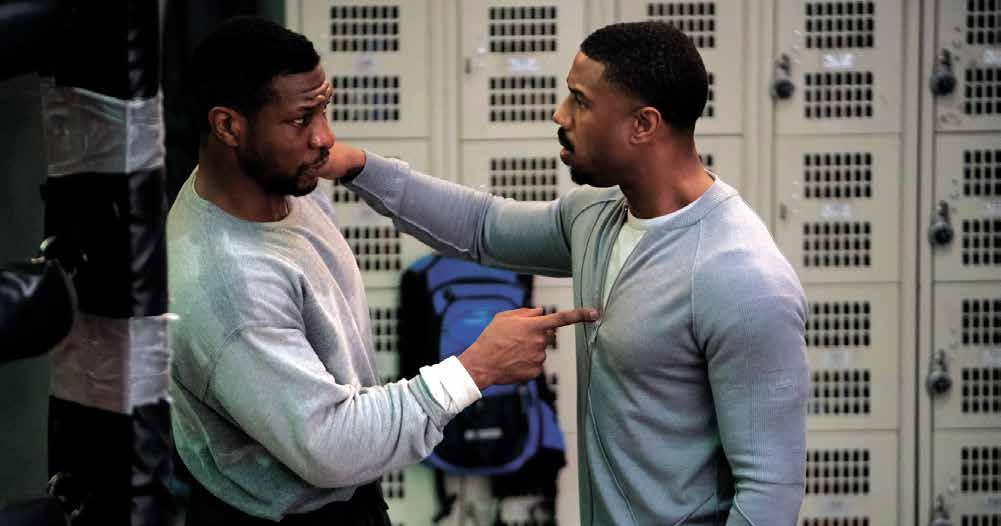
In this case, the ghost hiding in the darkened recesses of Adonis’s closet is his former childhood best friend Damian Anderson (Jonathan Majors). He was a rising boxing talent with his sights set on dominating the sport before tragedy sent him to prison for 18 long years. Now, finally a free man, Damian believes he still has what it takes to become the undisputed heavyweight champ. He seeks out Adonis, seductively playing on his former friend’s kindness and guilt to get him a title shot back, even though he’s now a
nobody who hasn’t fought anyone outside of jail in almost two decades.
It’s not a secret where this is headed. Adonis feels he is to blame for Damian’s misfortunes. Damian holds it against Adonis that he never reached out to help him while he was incarcerated, not even to say hello. Adonis disregards advice from his mother, Mary-Anne (Phylicia Rashad), and close confidant Tony “Little Duke” Burton (Wood Harris) and finds a way to get Damian the fight he was hoping for, only to discover Damian has been playing him for a sap all along.
The sequel works because these characters are so gosh darn real. Adonis’s evolution is pure. It has grace and maturity. His marriage to singer-songwriter Bianca (Tessa Thompson) is as strong as ever, an unbreakable bond that’s weathered its fair share of catastrophes. They have an adorable daughter, Amara (Mila Davis-Kent), and even though she’s deaf, that doesn’t
quell the child’s unquenchable curiosity and her energetic desire to follow in her father’s sprightly footsteps.
Creed III also connects because Majors is ferociously extraordinary. (Ever since The Last Black Man in San Francisco, I sound like a broken record whenever I mention his name.) This is a titanic portrait of anger, frustration, pain, and regret. His Damian isn’t so much the villain as the bitter pill that’s been sitting in the back of Adonis’s throat since he was a teenager. Majors dominates, prowling through each scene as if he were a sly, observationally carnivorous velociraptor craftily stalking its prey. I couldn’t take my eyes off him.
The melodrama gets laid on a bit thick, but that’s par for the course for this franchise. There are subplots involving Bianca, Mary-Anne, and Amara, not all of which are satisfactorily dealt with yet still make a reasonably strong emotional impression. There’s also some stuff concerning returnee Viktor Drago (Florian Munteanu), new boxer Felix Chavez (Jose Benavidez), and his stern mother Laura (Selenis Leyva), but their scenes only work to help set up the final conflict between Adonis and Damian. On their own, however, most of their moments are sadly forgettable.
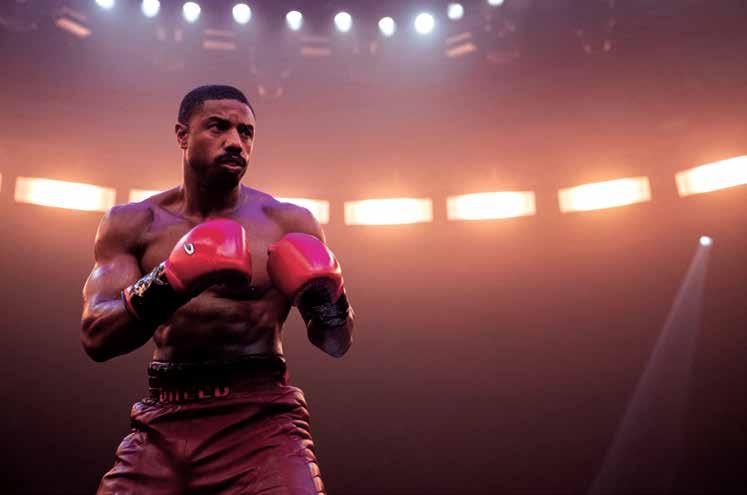
As for Jordan, taking a page out of Stallone’s playbook, the actor also steps behind the camera, to sit in the director’s chair, and as debuts go, he shows dynamic promise. He handles the picture with confidence and flair. Jordan brings a unique visual style that’s hard-hitting and magnetic, and his staging of the three main boxing bouts is stunningly unique and viscerally exhausting. He tasks cinematographer Kramer Morgenthau (Creed II ) and editors Jessica Baclesse and Tyler Nelson (The Batman) to considerably up their respective games, and their combined excellence is undeniable.
I have no idea if Jordan is interested in keeping this series going the way Stallone was for all six of his initial Rocky escapades. While I would rather he let this be his final statement on Adonis Creed, if any future installments end up as gloriously entertaining as Creed III, I’m not going to complain, especially as it pertains to Jordan’s blossoming directorial career. So, even if it isn’t a knockout, this sequel still packs a pretty mean punch, and I’ll happily climb back in the ring with Jordan again if the opportunity arises.
Jonathan Majors and Michael B. Jordan in Creed III – Photo courtesy of MGM
Michael B. Jordan in Creed III – Photo courtesy of MGM
Latest Children of the Corn scares up bumper crop of boredom
by Sara Michelle Fetters SGN Staff Writer
CHILDREN OF THE CORN
Theaters / PVOD (March 21)
Having sat on a shelf since being completed in 2020, writer-director Kurt Wimmer’s (Ultraviolet, Equilibrium) adaptation of Children of the Corn finally hits theaters this weekend. The production values are reasonably high. The two leads at the center of things, Elena Kampouris and Kate Moyer, turn in solid, emotionally authentic performances worth applauding. Wimmer stages a couple of suitably unsettling shock sequences, most notably the potential mass burial of a group of terrified adults trapped in a giant pit.
Unfortunately, none of this makes this latest attempt to tackle Stephen King’s source material worthwhile. This film makes the cardinal horror-thriller sin of being dull. Outside of the two leads, there is not one memorable character, which is truly sad, considering you have a creepy pastor portrayed by Mad Max 2: The Road Warrior and Dark City legend Bruce Spence. Even the eventual arrival of the ominous-sounding “He Who Walks” doesn’t add up to much, the being’s initial appearance falling strangely flat.
In a small Midwestern town known for its corn, after a heartbreaking tragedy that resulted in the death of ten children, the crops inexplicably begin to fail. Blaming the genetically modified seed they were paid handsomely to switch to, the community makes the collective decision to take government subsidies to plow over their fields and destroy all the corn.
This decision does not sit well with 18-year-old Boleyn Williams (Kampouris) or 12-year-old Eden Edwards (Moyer). The former’s father Robert (Callan Mulvey) was the leading voice for the farmers to take the subsidies; the latter is an innocent-faced orphan who was taken in by the piously sanctimonious Pastor Penny (Spence) after her older brother seemingly went mad and killed a handful of adults, claiming “nothing ever really dies in the corn” before doing so. Wimmer has made significant changes to King’s story, but once Boleyn and Eden decide to team up to put the entire town on trial for wanting to destroy the corn, the similarities between the film and the source material do begin to materialize.
The problem is, after two previous failed attempts to make this work (the wellknown 1984 version with Linda Hamilton and Peter Horton, and a 2009 remake that premiered on the SyFy Channel and then was immediately forgotten), I’m starting to think Children of the Corn is unfilmable. Look, when the most memorable features birthed from King’s prose are the eight DTV sequels to the ’84 film and not any of the three actual “official” adaptations, that pretty much says it all right there.
In this instance, Wimmer doesn’t make even a passing attempt to conceal that something is murderously wrong with Eden. Whereas Boleyn is a determined environmentalist who can’t wait to leave the town in the rearview mirror, her partner in holding the adults accountable likes to dress up as the Queen of Hearts from Alice in Wonderland and attempts to literally set her friends on fire when she’s playfully sentencing them to “death.” When she makes her games real and hypnotically convinces
all the rest of the children to assist, what should be a disturbingly devastating turn of events is anything but.
Not that Boleyn’s plan is a good one. It’s terrible. She’s putting the town’s adults on trial? How? In what way? What leads her to believe that all of the children are capable of pulling something like this off and, even if they were successful and got the publicity they were after for this crazy bit of adolescent lunacy, why does Boleyn think she’d be lauded in such a misguided manner? I’m all for suspension of disbelief when it comes to horror, but this is a whole other level of incomprehensibly idiotic.
By the time the supernatural elements kicked in, I’d honestly stopped worrying about almost anything that was happening. Other than Boleyn and Eden, the remaining characters — adult, teenage, prepubescent, you name it — were all so nondescript and thinly constructed that none of their actions made an impression. Random mutilated bodies of those who tried to leave town? Didn’t
care. People ominously sent into the depths of the corn one at a time to meet who knows what? Their fates meant nothing to me. It’s a testament to the strength of Kampouris’s and Moyer’s performances that the film never became a complete waste of time. They’re much better than the material frankly deserves, and the latter is especially chilling during the climactic stretch where Eden’s fanaticism takes over completely and her unhinged obsession with Boleyn becomes gleefully maniacal.
Wimmer stages a couple of effective shock sequences, and cinematographer Andrew Rowlands’ sly, seductively minimalist camerawork is surprisingly strong. The more ambitious visual effects are also relatively well realized, and the balance between the digital trickery and the practical makeup work is laudable. But as far as positives go, there’s not much more to say. The only emotional response this Children of the Corn scares up is boredom, and that’s a frustrating shame.
Kate Moyer in Children of the Corn – RLJE Films
Children of the Corn – RLJE Films
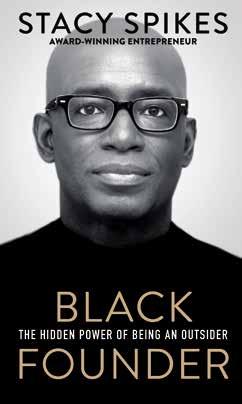
Black Founder an entertaining read despite business jargon
by Terri Schlichenmeyer Special to the SGN
BLACK FOUNDER: THE HIDDEN POWER OF BEING AN OUTSIDER
With high school graduation on the horizon, Stacy Spikes was itching to move.
His hometown of Houston had become “too small” to hold his dreams. Education was important in his family, but college held no interest for him either. Instead, he was going to Los Angeles to chase a career in music and movies.
He broke the news to his parents and, with $300 in his pocket, he drove west.
Once in California, Spikes quickly understood that he didn’t need a job; he needed several of them. Before he could get settled, though, he fell in with a bad crowd and was hospitalized to help him kick drugs and alcohol forever.
He returned to a job he had working with a two-in-one company in Encino, making
and packaging videos. The men he worked with mentored him; it was there that he learned the need to “go to extra lengths to meet [someone] in their field.”
Spikes took acting classes and absorbed as much as he could about old-time Black comedians. He built a recording studio in his home and learned to make album covers, which led him to a job at Motown, where he went into sales and learned how to make an impression.
“The Black Godfather” taught him that it was possible to talk with anyone, black or white, with honesty. And before he founded Urbanworld Film Festival and MoviePass, Motown helped him see that to succeed, “you didn’t need an army, just a small group of like-minded souls set on making a difference.”
Readers looking for a good business biography are in for a nice surprise when they read Spikes’ Black Founder. They’ll also get some entrepreneurial advice. It’s not bold-face or bulleted; you’ll have to look for it. But it’s in there.
“Transparency” is what Spikes learned early, and it’s what he applies inside this book, which is refreshing. It isn’t about a
“I felt like it had never been done”
meteoric rise; Spikes instead writes about setbacks, both personal and professional, and times of struggle. Readers can imagine the parkour-like hustle that Spikes describes as he overcame seemingly catastrophic events and still landed on both feet; such tales serve to instruct as much as the actual instruction does.
Though it may seem to flag a bit — especially for older readers, or those who are unfamiliar with the businesses Spikes founded — Black Founder is entertaining enough to read for fun, with a side dish of instruction. Whether you’re ready to act now or you’re just finding your inner entrepreneur to launch your idea, it’s a good foundation.
Also: Here’s a rags-to-riches story for you: Never Far from Home by Bruce Jackson (Atria, $28), the story of Jackson’s life. He was born in Brooklyn and first lived in public housing. At age ten, he was arrested for robbery (which he didn’t do), and he caught the attention of drug dealers. Knowing then that that wasn’t the kind of life he wanted, Jackson worked hard to overcome his background. His story is awe-inspiring.
Naomi Kanakia talks We Are Totally Normal , the art of “bro,” and navigating hard changes
by Lindsey Anderson SGN Staff Writer
Change is a natural part of life. We grow, discover things about ourselves, and constantly reintroduce ourselves to the world. Change and growth can be just as common in the creative process, especially for characters who feel just as real as we do.
Author Naomi Kanakia knows a lot about the process of change. When she first started writing her YA love story We Are Totally Normal, her protagonist, Nandon, was heterosexual, and Kanakia was still identifying as a man.
Rewriting a finished novel
“It’s a bit of a long story,” Kanakia recalled. “Originally it was a heterosexual pairing. Nandon was getting together with the girl. [But] there was this strong homoerotic subtext between Nandon and Dave.”
The original draft of the book was not what her publishers were looking for, but Kanakia was determined to sell Nandon’s story. After pondering a while, she went back to the drawing board and completely rewrote We Are Totally Normal. This time she brought the homoerotic subtext to the forefront.
“I realized it would sell better if it was a Queer book. I revised it that way,” Kanakia said.
Rewriting a finished novel is pretty typical for Kanakia, who admits she can be a bit of a perfectionist when it comes to her work. “Something about hearing comments back makes me reenvision the book, and I’ll usually rewrite completely. I’ll start over from a blank page and write a new draft, which is often completely different, and sometimes I’ll do that four or five or six times,” she said.
“In the case of We Are Totally Normal, my editor was like, ‘Oh yeah, I have a few comments,’ and then they gave me comments. I was like, ‘Great, love these comments. I need to rewrite the whole book, because it’s terrible.’ I went back and rewrote the entire book, which you don’t usually do after the book has sold.”
Kanakia finished her earliest draft of We Are Totally Normal in 2016. Back then, her inspiration for the book had been to create a YA story about people who typically don’t take up much space in the pages of the genre.
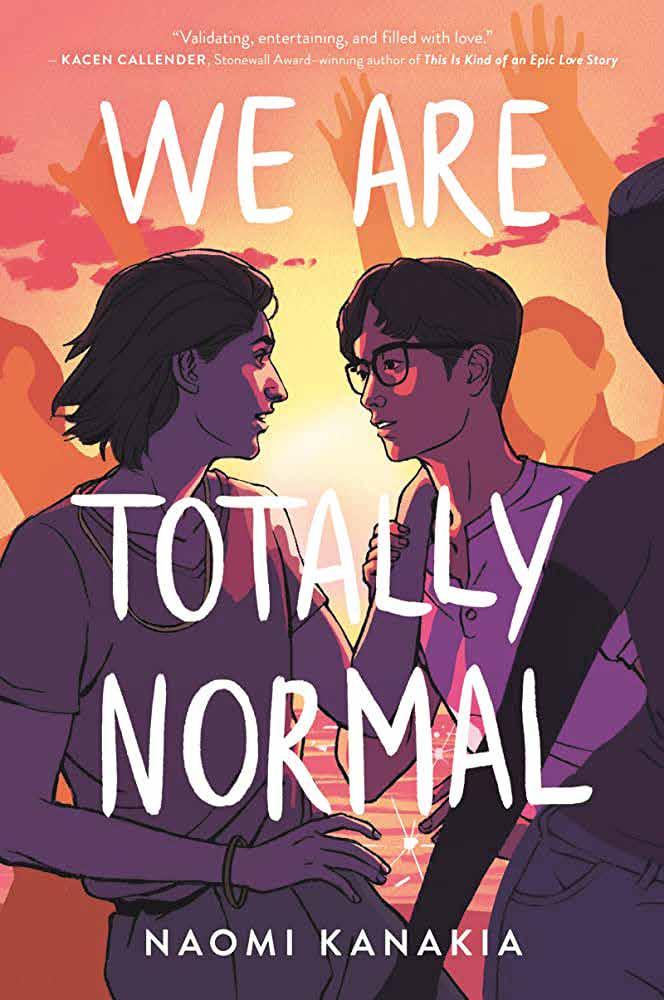
Image courtesy of Dafina
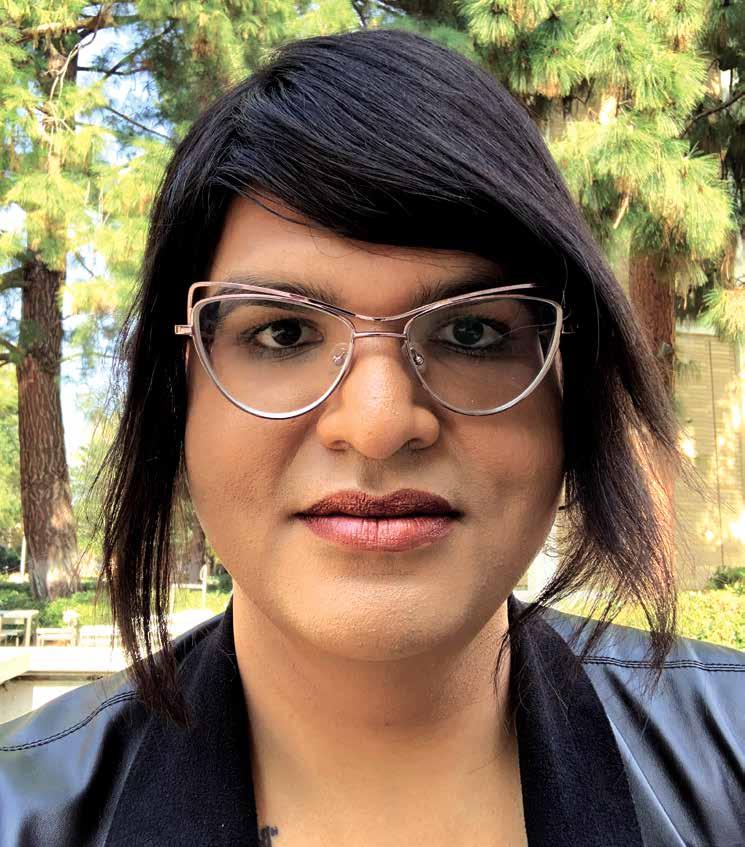
Naomi Kanakia – Courtesy photo
“YA books are always just about kids who are curious and … read lots of books and [are] nerdy,” Kanakia explained. “So for this one, I wanted to write about a guy who’s just more bro-y, more traditionally masculine. The thing about bro-y people is that there’s also that sensitivity. What makes them bros is that they have this more sensitive side. They’ll be like, ‘I love you, man,’ but it’s also camouflaged by all this overt masculinity. So that was the genesis.”
Studying the art of the “bro”
As someone who is not very “bro-y,” Kanakia had her work cut out for her. To get into the mindset of a hypermasculine teenage boy, she began to observe her surroundings.
“I went to the beach in Marin County, and the beach in California is so cold. I was there in November, and there were just these groups of teenagers, just like 30 teenagers huddled together on the sand, huddled up doing their teen things,” she said with a laugh.
“I’m 37, and people ask me, ‘How do you stay in touch with the teenagers and what they say and what they want?’ Well, for most of the country, California is like another planet, so if I say something in the book that isn’t 100% accurate, other people will be like, ‘Oh, that’s just how it is in California, that’s just how people are in California,’” she added.
Kanakia’s trick to remaining relevant in the world of teens is to avoid specifics. She won’t use real social media platforms, as the coolest ones are always changing. She also tries to avoid slang as much as possible. “The kids in YA books will only say ‘cool,’ because kids have been saying ‘cool’ for 80 years. ‘Cool’ is probably going to stay current. The F-word will probably stay current, but other stuff, that will date you, it will make you sound weird,” she explained.
The rise of Queer YA novels
Back in 2016, Kanakia didn’t think a Queer YA novel would sell.
“When I first started selling YA books, there were not that many Queer books,” she said. “In about 2015, Simon Versus the Homo Sapiens Agenda came out, and within a year or two, suddenly Queer romances were a much bigger genre. The market played a strong role.”
As Queer books began to rise in popularity, Kanakia started to reexamine both her and her character’s identities. “At some point, I just realized I had been avoiding this, because it was harder to sell. I’m Trans now, but I was a man then. I still am Bisexual, and I identified as a Gay man for a while, so that’s a part of me too.”
When she decided to change the central romance from a male/female pairing to a male/male one, Kanakia’s book started to feel more real. The story gained a whole new depth as it embraced queerness.
“Being Queer is never normal,” Kanakia reflected. “It always means something. If you have an opposite-sex crush, it just doesn’t have that added layer of meaning, it doesn’t mean something about your identity. When I decided to make We Are Totally Normal Queer, it completely changed who Nandon was, as a person.”
Once she had decided to write a Queer story, Kanakia dove all in. She decided that her Queer love story wasn’t going to be like the increasingly popular but rated-PG Queer romances cis women were writing. A sexless romance was just not going to be accurate.
“A lot of male/male YA books are written by women, and the romance is just very chaste. Two boys getting together — they’re going to have sex. I don’t know how to explain it. Nine times out of ten, there’s gonna be sex. Not having that part of it just felt very wrong to me.
“If you’re in a monogamous relationship with another guy, you’re at least going to have anal sex or try it out. There’s a lot of figuring stuff out, especially in your first relationship. It was kind of important to me to show that it’s okay to have sexual desires.”
Next steps
Now that she’s started writing Queer stories, Kanakia isn’t planning on stopping any time soon. Her next book, Just Happy to Be Here, which will hit shelves sometime in early 2024, will focus on a Trans girl attempting to go to an all-girls private high school.
“I felt like it had never been done,” she said. “Even until quite recently, the all-girls schools didn’t admit Trans women.”
The story highlights the way some institutions are fast to “accept” Trans people as diversity tokens but less willing to break down their exclusive traditions in the name of true acceptance.
Kanakia said, “[Ara, the protagonist] tries to join a secret society in the school and gets a lot of pushback from the alumni, and she starts to wonder, ‘By being at this school, am I ruining it somehow?’”
Building off of the recent politicization of Trans youth, Kanakia decided to make this book more chaste. Due to conservative lawmakers equating Transgender issues with sexuality and “sexualizing children,” she chose to not include sex in this book, so that it could focus more on gender identity and not add to the idea that gender and sexuality are the same issue.
And it also focuses on the current political climate.
“After all this anti-Trans stuff that happened with the kids earlier this year, I really felt like this was something I wanted to put
in the book. So I put a little about her wondering about the legal environment.”
Just Happy to Be Here is also her first book centering on a Trans protagonist. While the book is still Queer, writing a Trans story was vastly different from writing a Gay story for Kanakia.
“When you’re Trans and a teenager, it’s quite different from being a Gay teenager,” she said. “If you’re Gay, you’re like, ‘Hey, Mom, I’m Gay.’ There’s nothing they can do; there’s no way they can change it. But if you’re Trans, it’s like, ‘Hey I’m Trans. I need you to call up the doctor and make an appointment at the gender clinic.’ You basically can’t get any gender-affirming treatment without your parents. It’s a very complex relationship to navigate, and I wanted to put some of that in there with Ara and her parents.”
Kanakia is also working on a Trans adult novel, which she hopes will be out by the summer of 2024.
“The working title is The Default World It’s about a Trans woman in her mid-20s who goes to San Francisco on a mission to save her cousin, who she feels is being
exploited by burners who just want her money.” This novel explores not only Trans identity but also Queer community.
Writing has been a great way for Kanakia to explore her own identity as a Trans woman. The more she does so, the better she understands the Trans characters she is writing.
“I really love writing Trans characters. I just think there are a lot of nuances to explore. It offers a lot of ability to look at gender,” she said.
Writing her identities into her novels has always been important. Now, as she continues to grow and change, so do her books.
“It’s a little difficult sometimes,” Kanakia said, “because when I was writing just Gay or just Indian characters, I was like, there’s plenty of authors who are doing that, and I didn’t feel like I needed to be good. Now with Trans characters, especially Trans YA, I feel a sense of social responsibility.”
With more Queer and Trans people emboldening themselves to take up space in the real world, there is an even greater need for writers like Kanakia who are willing to accurately represent the community.
Image courtesy of HarperTeen
Op-Ed
How to survive a panic attack when it strikes
by Stan Popovich Special to the SGN
One can experience a panic attack when they least expect it, which can cause a great deal of fear and anxiety.
Many people do not know what they should do when dealing with a panic attack. Here are eight easy steps a person can follow when a panic attack strikes unexpectedly:
Take a break
A panic attack can be very uncomfortable and can affect your thinking. The best thing to do when this happens is to take a break in order to calm down. You don’t want to do anything when you’re not thinking clearly.
Take deep breaths
If experiencing a panic attack, take some deep breaths to relax, feel better, and to get rid of some of the excess fear and anxiety. There are many kinds of breathing exercises you can learn with the help of a mental health counselor.
Know that it will pass soon
Many people feel helpless when they experience a panic attack for the first time. The fact is that you will be okay and that it takes a few minutes for the anxiety to go away.
Distract yourself
Try to distract yourself from the panic you are experiencing. Get some fresh air, listen to some music, take a brisk walk, read the newspaper, or do something relaxing that will give you a fresh perspective on things.
Visualize a red stop sign
Visualize a red stop sign in you mind when you encounter a fearful or negative thought. This serves as a reminder to stop focusing on that thought and to think of something else. Then try to think of something positive to replace the negative thought.
Don’t dwell on your thoughts
A person must not dwell or focus on their thoughts during a panic attack. The more a person tries to reason out their thoughts, the longer a panic attack will last.
Read some positive affirmations
Another technique that is very helpful to help overcome your negative thoughts during a panic attack is to have a small notebook of positive statements from your favorite self-help book that make you feel good. Whenever you come across one, write it down in a small notebook that you can carry around in your pocket to read whenever you feel depressed.
Get help
It is important to talk to a qualified professional in order to get the facts of what a panic attack is and learn what you can do when one occurs. By doing so, you will help yourself in the long run, because you will become better able to deal with any panic attacks in the future.
Stan Popovich is the author of the popular managing-fear book, A Layman’s Guide to Managing Fear. For more information about the book and to get more free mental health advice, please visit https:// www.managingfear.com.
Photo by Lamar Belina / Pexels
Photo by Shvets Production / Pexels
National News
This year’s 30th anniversary event comes at a tumultuous time for the movement, as lawmakers have made a habit of targeting LGBTQ people. Bans on Pride flags and Queer-themed books, investigations into drag shows, and plans to boot Transgender troops from the military have all been proposed by politicians eager to score points with social conservatives.
In the face of these increased hostilities, Task Force Executive Director Kierra Johnson said it’s important to remember the victories.
“While it’s undeniable that we have hit hard times, with the increased number
of attacks on our communities across the nation — at the local, state and federal levels — we must acknowledge and celebrate the tremendous strides forward that we’ve made,” Johnson said.
Johnson also said that the ruthlessness and cruelty coming from the far right is a bitter realization that time is running out. A majority of Americans approve of same-sex marriage, more and more same-sex couples are having children — either through adoption or surrogacy — and three US states elected out Gay governors.
“It’s critical for us to remember our ancestors and those who came before us, who could never even dream of the support, number of allies, and the way legislation has evolved over the last 50 years,” Johnson said.
“Be you”
This is the Task Force’s 50th year of operations. Among active national LGBTQ organizations, only Lambda Legal has been around longer. In 2021, the Task Force took an equitable step forward, when Johnson became the first Black woman to lead the organization.
A Bisexual who grew up in the Deep South, Johnson understands the role selfacceptance plays in a Queer person’s coming-out process.
“Before we get to leverage our political power, we first have to see ourselves as worthy,” Johnson said. “We first have to acknowledge our own power, look at ourselves and each other, and see ourselves as a community worth fighting for.”
Hence the Task Force’s signature saying: “Be you.”
Johnson said speaking up, demanding justice, and voting for candidates who support the community through actions and not merely words are ways Queer people can leverage their power.
“We can do that by being our full self — out loud in the face of ridicule and critique. The LGBTQ community has shown over and over again that joy is an act of resistance. When we show up in our full self, loving each other, loving ourselves, [and] celebrating our community, our families, and our allies, that is power.”
Leveraging that power through events like Winter Party helps raise money for much-needed healthcare and quality-oflife needs that, in some states, are becoming increasingly unavailable. As one example, Tennessee scrapped $8.3 million in federal HIV/AIDS funding due to fearmongering over gender dysphoria by right-wing extremists.
“Extreme conservatives are literally making up stories so that people are afraid of us,” Johnson said. “We cannot buy into this notion that we are powerless.”
The journey, Johnson said, is far from over.
“We still have a lot of work to do. The reality is no civil rights struggle has been an easy one, nor has it been one and done. Our fight for civil and human rights is continuous.”
The Task Force estimates that Winter Party brings close to $4.2 million in revenue to Miami, with help from corporate partners Comcast, Hilton, Bacardi, Credo Mobile, ActBlue, and ViiV Healthcare. Since 2005, the organization has donated more than $3.3 million to communitybased organizations that support social justice causes.
Officials estimate 10,000 people will attend this year’s Winter Party, with beats by internationally recognized DJs at worldclass venues and on the sands of South Beach.
“Our events are known for keeping people on their feet,” said Johnson.
Tickets, passes, and volunteer shifts are still available. For more information, visit https://winterparty.com.
Photos courtesy of National LGBTQ Task Force PARTY
continued from cover
Kierra Johnson – Courtesy photo
National News
East Palestine derailed
Toxic train crash crisis continues
by Lindsey Anderson SGN Staff Writer
On February 3, 2023, nearly 30 freight cars derailed on the outskirts of East Palestine, Ohio. Eleven of those cars were carrying hazardous chemicals, including butyl acrylate and vinyl chloride.
Following the accident, the town of nearly 4,800 was evacuated so that the Environmental Protection Agency could assess the damage and perform a “controlled explosion” of the dangerous vinyl chloride that the derailment had caused to leak. This is because, when ignited, vinyl chloride can cause a catastrophic explosion. To prevent lives from being lost, authorities evacuated the whole town and exploded the chemicals themselves.
Despite cleanup efforts continuing to put the people of East Palestine’s health and safety first, many residents are worried about the long-term consequences of the explosion. The environmental impact of the East Palestine disaster could affect not only areas of the Midwest for the foreseeable future but the rest of the country.
Not as it seems
On February 8, residents of East Palestine returned to the area. While they were gone, about 4,600 cubic yards of contaminated soil and 1.1 million gallons of water were removed from the region. The EPA is continuing to run tests on East Palestine’s drinking water, but so far says that the town is safe to inhabit.
Despite all the released information indicating that the water is clean and the air is breathable, the citizens of East Palestine are telling a different story.
Since returning, many residents have been complaining of headaches and nausea. Some have even claimed that rainwater smells like chlorine.
Brittany Sherwood, a resident of Canton, Ohio, about 40 miles from East Palestine, is just one of many posting about the recent crisis online. Sherwood showed a thick film that formed on the top of tap water she had boiled. After boiling the water, Sherwood also reported having a “slamming headache.” She is now looking for at-home water testing kits to ensure that her drinking water is safe.
The contaminated water is also damaging ecosystems in East Palestine. The Ohio Department of Natural Resources confirmed that more than 43,000 fish have died since the train derailment, mostly due to contaminants in the water. Fish play a valuable part in most natural ecosystems as food for birds and terrestrial animals. Fish and Wildlife officials are still waiting to see how the chemical death of thousands of fish will further impact other wildlife in the area.
Are Americans looking at a future grain crisis?
Aside from the environmental impact, which scientists have yet to determine the severity of, many Americans are also concerned for the future of the country’s food supply. “We have no idea how this is going to affect us long-term. It’s going to get into our food, because most of the grains we consume are produced in that area,” explained media analyst Christopher Claflin. “This time next year, all of the grains that come up in this growing season are going to be in the cereal, the bread. They’re going to be in everything.” Claflin worries it will take decades for Americans to experience the full effects of the disaster.
The lack of transparency surrounding the railway crisis is because Norfolk Southern, the company responsible for the derailment, has been actively working to silence members of the East Palestine community. The company agreed to fund water testing in exchange
for residents’ signatures on waivers that make it impossible to sue the company. Furthermore, 30% of Norfolk Southern is owned by Blackrock and Vanguard. These are hedge fund corporations, and they own the two largest shares in the company. Blackrock and Vanguard are also the two largest stakeholders in the Warner Discovery and Disney corporations, which own major news networks, such as CNN and Fox.
A disaster waiting to happen
Experts in the railway industry are not surprised by what happened in East Palestine. If anything, they’re more surprised it didn’t happen sooner.
The industry moves large quantities of highly volatile chemicals each day. Despite the risk of derailments, explosions, and leaks, it has quietly worsened working conditions, lowered safety standards, and decreased transparency. In the last decade, trains have gotten 25% longer, started going faster, and run closer to communities. Environmental groups and those on the inside of the rail industry have begun referring to them as “bomb trains.”
To cut costs, train companies have begun
operating with longer trains and smaller crews. The Federal Railroad Administration has no limitations on how long commercial trains can be.
The East Palestine crisis is also bringing to light concerns over transparency. None of the cars that derailed were marked “hazardous,” despite 11 of them containing dangerous chemicals.
Danger to Seattle
The Midwest isn’t the only area subject to train derailments. Just last year, Seattle saw a derailment in the SoDo district. A BNSF train carrying empty shipping containers derailed and collided with a Seattle City Light power station. Luckily, none of the cars were carrying freight or toxic substances. The accident was easily cleaned up and swept under the rug.
However, the danger of a major train derailment in Seattle remains. Not only do its railways transport the same hazardous chemicals that were spilled in Ohio, but the city is also part of the transport of crude oil. Seattle is home to the fifth largest US port. Roughly 157,000 barrels of crude oil are transported through Puget Sound each day.
A spill in the sound could cause major devastation to the ecosystem.
Unlike East Palestine, Seattle sees chemical transport by means other than just the railway. The BP Olympic Pipeline is one of the region’s biggest distributors of gasoline, diesel, and jet fuel. The pipeline distributes 300,000 barrels a day along a 299-mile corridor that runs parallel to I-5.
The labor unions at Union Pacific, Seattle’s main railway, and Norfolk Southern collaborated in a nationwide railway strike last year. The rail companies presented a new deal in the fall of 2022, but union officials rejected it. However, President Biden intervened and signed a tentative agreement into law on December 2 to avoid another strike.
With more chemical transport through the city, the likelihood Seattle could see our version of the East Palestine derailment is becoming more and more likely. The consequences of a major catastrophe could be devastating, not only to the ecosystem but to future food supplies as well. The best way to prevent this in the Pacific Northwest is by investing more money in safety precautions for workers.
Freight cars of a Norfolk Southern train burn in East Palestine, Ohio, on Feb. 4, 2023 – Photo by Gene J. Puskar / AP
Transportation Secretary Pete Buttigieg (l) and Tristan Brown, deputy administrator of the Pipeline and Hazardous Materials Safety Administration, crouch down to look at part of a burned traincar on Feb. 23, 2023, in East Palestine, Ohio, at the site of a Norfolk Southern train derailment
– Photo by Allie Vugrincic / The Vindicator via AP
West Virginia House passes right-to-discriminate bill
by Mike Andrew SGN Staff Writer
West Virgina’s House of Delegates passed a bill to establish a legal right to discriminate based on religious convictions.
The February 27 vote was largely along party lines in a chamber with a Republican supermajority.
The bill stipulates that the government would not be able to “substantially burden” someone’s constitutional right to freedom of religion unless doing so “in a particular situation is essential to further a compelling governmental interest.”
In cases where the government can prove to the courts there is a “compelling interest” to restrict that right, officials must demonstrate that religious freedoms are being infringed upon in “the least restrictive means” possible.
Democrats expressed concern that the proposal could be used as a tool to discriminate against LGBTQ people and other marginalized groups. Democratic Delegate Joey Garcia also asked whether the proposed law could be used to overturn West Virginia’s vaccine requirements, which are some of the strictest in the nation.
One of the legislation’s co-sponsors, Republican Delegate Todd Kirby, said those questions would be up to the courts to decide — his bill only provides a judicial test for interpreting the law, he claimed.
Declaring himself a Christian, Kirby said the government has infringed on his freedom of religion in several areas, including vaccination requirements, but especially in school curricula.
Kirby said teachers “are being forced to push the left’s agenda, the government’s agenda, within the war on traditional families, with such things as promoting transgenderism, homosexuality in our classrooms.”
The West Virginia law is modeled after the federal Religious Freedom Restoration
National news highlights
by Daniel Lindsley SGN Staff Writer
Georgia Baptist flips Senate Republicans against gender identity ban
In a sudden upset, Georgia’s majority-Republican Senate Education and Youth Committee voted to table a measure that would have restricted discussions about gender identity in public school classrooms.
It was the words of Georgia Southern Baptist lobbyist Mike Griffin that finally convinced every conservative member of the committee, save one, to drop the law and move on.
“We have heard from many folks, including our legal partners and activists from around the state, on this issue with this bill,” Griffin said. “We believe that this bill has dramatic unintended consequences for parental rights and for children in public schools as well. Those concerns have not all been addressed.”
Peter Isbister, who leads the state chapter of TransParentUSA, said he was “relieved and surprised” by the news but wasn’t about to let down his guard.
“I don’t feel like I can really tell him what I did this morning,” Isbister said of his son, “because I don’t want to tell him that there’s a world in which people are trying to make it harder and more hostile for kids like him in school.”
Act, signed in 1993 by then President Bill Clinton, which allows federal regulations that interfere with religious beliefs to be challenged.
Eli Baumwell, advocacy director and interim executive director of the American Civil Liberties Union of West Virginia, said the 1993 federal law was designed to protect people, especially religious minorities, from laws that affected their ability to engage in personal practices of their faith. He said similar laws that have been passed by states in the years since have been applied very differently.
“Unfortunately, people have seized upon
a good idea and [turned] a shield into a sword,” said Baumwell, whose organization is opposed to the bill. “RFRAs today are promoted by organizations and ideologies and aren’t concerned about individual religious observances. They’re focused on circumventing laws that require fair and equal treatment.”
A similar bill failed in 2016 in West Virginia after lawmakers voiced concerns about how it could affect LGBTQ residents.
Then Senate Majority Leader Mitch Carmichael, a Republican, spoke in support of the Democratic-proposed amendment that would bar the legislation from being used to discriminate against LGBTQ people.
Before advancing this year’s bill to the Senate, Republican lawmakers rejected a similar Democratic amendment to the one passed in 2016, with little discussion Monday. It would have protected nondiscrimination laws or ordinances that protect LGBTQ groups and residents.
In 2016, there were 64 Republicans and 36 Democrats in the West Virginia House of Delegates. In 2023, the GOP majority has expanded to 88 seats, with only 12 Democrats in the body.
Critics confront Tennessee governor over cross-dressing yearbook photo
Tennessee Gov. Bill Lee announced on Monday that he will sign a bill banning drag in public and in front of children, making the state the first to do so among at least eight others with similar plans. Lee also said he planned to sign a bill restricting gender-affirming care for minors.
The new law specifically prohibits “adult cabaret performances” such as “topless
dancers, go-go dancers, exotic dancers, strippers, [and] male or female impersonators.” Aside from the fact that Tennessee already has obscenity laws, the latter category in particular has drawn accusations of hypocrisy after a photo from Lee’s yearbook showed him cross-dressing.
In response, Lee’s office told the Daily Beast that “lighthearted school traditions,” as pictured in the photo, should not be “conflated” with drag. A spokesperson called the comparison
“dishonest and disrespectful to Tennessee families.”
ACLU Legal Director Stella Yarborough said of Lee’s comments, “They have this blind spot, where they seem to allow themselves to do those same activities because they assign themselves an innocent intent, and then they ascribe to others a guilty intent or a sexually perverted intent, and it’s just a double standard.”
Tennessee Gov. Bill Lee – Photo by Phelan M. Ebenhack / AP
Republican West Virginia Del. Todd Kirby speaks in the House of Delegates chamber of the state Capitol in Charleston, W.Va., Feb. 27, 2023 – Photo by Perry Bennett / WV Legislative Photography via AP
National/International News
Iowa students walk out to protest anti-Trans bills
Teachers sue school district over retaliation for drag show
by Mike Andrew SGN Staff Writer
Students from 14 Iowa school districts plus Iowa State University walked out of class on March 1 to protest a series of bills before the state’s legislature that would restrict the rights of Transgender youth.
Among the measures being considered by the Iowa legislature are bills to:
• require schools to out Trans students to their parents,
• forbid the teaching of gender identity and sexual orientation to students up to sixth grade, and
• restrict gender-affirming medical care for minors.
The protest is being organized by two student groups, IowaWTF and Iowa QSA (Queer Straight Alliance). Student activists said that legislative hearings on the bills have ignored the opinions and interests of students.
“We can see that in the public hearings,” said Jemma Bullock, an Ankeny High School senior and member of both student groups. “There have been children, psychiatrists, doctors, parents, teachers who have been talking directly to them about how these bills are harming students and will cause things like bullying, depression, anxiety, etc. And they just will not listen.”
School officials said that students have a right to protest as long as they were not disruptive.
“Students have the right to engage and speak out on issues that matter to them,” said Phil Roeder, Des Moines Public Schools’ spokesperson.
International news highlights
by Daniel Lindsley SGN Staff Writer
Section on Trans people featured in new Bangladeshi textbook
On January 1 this year, Bangladesh’s National Curriculum and Textbook Board released a textbook with a section on Trans people, depicting them in respectable jobs like a beautician, a development worker, and a mayor. It also includes a short story about a child who transitions.
The book will be read by millions of students between the ages of 11 and 13, and the board hopes it will foster greater acceptance in a country where many Trans people live in poverty, and are forced to beg or turn to sex work to survive.
So far, the response to the section has been positive in some areas. “I think they are human beings just like us,” said 12-year-old Fatiah Alam, a student attending Gomail High school in Dhaka. “We came to know about them by learning from the book. We think we should help them with their progress.”
However, also in Dhaka, conservative Muslim groups protested the inclusion of Trans people at the city’s main mosque.
One leader in the Trans community, Jonak, told Reuters, “If our story catches people’s attention and they keep our suffering in mind, that will be good for us. Those who learn more about us will hopefully understand and then work towards our development in the future.”
“With that right comes responsibilities — such as not disrupting the education of students who do not participate in an event such as a walkout — but we respect and support students when it comes to sharing their voices and ideas on topics important to their lives.”
Student organizers said they saw mass support for the protests, including from straight, cisgender students who would not be directly affected by the proposed legislation.
“In past sessions, it was kind of harder to pick out clear exclusions to specific groups or clear attacks on specific groups,” said
Waverly Zhao, a high school senior and IowaWTF co-founder, “but these bills are laying it out plainly for a lot of people and a lot of students.”
While there is widespread support for the walkouts, students are nervous about pushback from school staff if they participate, because of past incidents including an after-school drag show, Bullock said.
“I think that’s one thing that I’ve been facing as a challenge here at Ankeny” when it comes to arranging the protest, she said.
The drag show is now the central event
in a lawsuit filed by several Iowa teachers against the Ankeny School District. The show was organized last spring by students as an afterschool event, but according to the Ankeny School District, it did not have official approval.
Students and the teachers who supported the show faced discipline. The teachers are now suing the school district, charging that the disciplinary measures against them amounted to discrimination and humiliation.
Japanese PM: Disallowing Gay marriage not “unjust discrimination”
Following a meeting with activists and an apology to LGBTQ people, Japanese Prime Minister Fumio Kishida is being criticized for backtracking, in light of his latest comments saying that constitutional freedom of marriage only applies to heterosexual couples.
“I don’t think disallowing same-sex couples to marry is unjust discrimination by the state,” he said when asked about it by an opposition lawmaker. This contrasted with his comments after the aforementioned meeting, when he said that he “strongly felt the need for discussion” and would consider what they had told him.
With criticism mounting, Kishida insisted that “I do not have a sense of
discrimination [on the issue]. And I have never stated I’m against it.”
Activists have continued to pressure the Japanese government to pass equal rights measures before the G-7 summit, which Japan is hosting in Hiroshima in May. Conservatives in Kishida’s governing Liberal Democratic Party are most often blamed for dragging their feet, even as surveys have shown public support for same-sex unions.
Marchers in the Tokyo Rainbow Pride in 2017 – Photo by Shizuo Kambayashi / AP