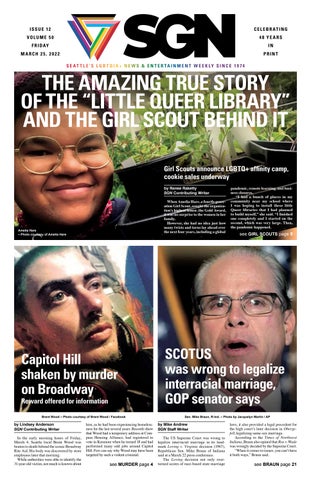
THE AMAZING TRUE STORY OF THE “LITTLE QUEER LIBRARY” AND THE GIRL SCOUT BEHIND IT
by Lindsey Anderson SGN Contributing Writer
In the early morning hours of Friday, March 4, Seattle local Brent Wood was beaten to death behind the iconic Broadway Rite Aid. His body was discovered by store employees later that morning.
While authorities were able to identify the 31-year-old victim, not much is known about
him, as he had been experiencing homelessness for the last several years. Records show that Wood had a temporary address at Compass Housing Alliance, had registered to vote in Kenmore when he turned 18 and had performed many odd jobs around Capitol Hill. Few can say why Wood may have been targeted by such a violent criminal.
When Amelia Hare, a fourth-generation Girl Scout, sought the organization’s highest honor, the Gold Award, it was no surprise to the women in her family.
However, she had no idea just how many twists and turns lay ahead over the next four years, including a global
pandemic, remote learning, and business closures.
“I had a bunch of places in my community near my school where I was hoping to install these little Queer libraries that I had planned to build myself,” she said. “I finished one completely and I started on the second, which was very large. Then, the pandemic happened.
by Mike Andrew SGN Staff Writer
The US Supreme Court was wrong to legalize interracial marriage in its landmark Loving v. Virginia decision (1967), Republican Sen. Mike Braun of Indiana said at a March 22 press conference. The Loving decision not only overturned scores of race-based state marriage
laws, it also provided a legal precedent for the high court’s later decision in Obergefell, legalizing same-sex marriage.
According to the Times of Northwest Indiana, Braun also opined that Roe v. Wade was wrongly decided by the Supreme Court.
“When it comes to issues, you can’t have it both ways,” Braun said.
Brent Wood – Photo courtesy of Brent Wood / Facebook
Sen. Mike Braun, R-Ind. – Photo by Jacquelyn Martin / AP
Amelia Hare – Photo courtesy of Amelia Hare
Local News
From scrap piles to merch aisles: Seattle ReCreative gives new life to forgotten supplies
by Nick Rapp SGN Contributing Writer
The art world comprises innumerable materials and forms. Painting, drawing, sewing, printing, writing, dyeing, quilting, knitting, and collaging are just a few mediums with their own abundance of material possibilities — and they are not without a carbon footprint.
The Greenwood art store and nonprofit Seattle ReCreative takes Bob Ross’s famous “no mistakes, only happy accidents” approach to art all the way down to the way we think about the goods we purchase and use to create. Its model is one of no waste, only potential materials.
SRC’s guiding philosophy is “creative reuse,” or “rethinking your relationship to stuff.” Its website states that “folks throw away a bunch of good stuff. If you just scrape off the label, or cover it with fancy paper, or hot-glue a few bits together, it might just be the most useful thing! We are here to assist folks in finding the treasure in the trash.”
Beyond a merely environmental ethic, creative reuse focuses on connectivity between humans, artists, the earth, and creation. The store’s mission statement ends with a bold claim: “We believe that art has the power to change human consciousness, and that our project will challenge others to think more broadly about interpersonal and global impact.”
Take a trip to browse their collection and you might just agree.
A fun mess
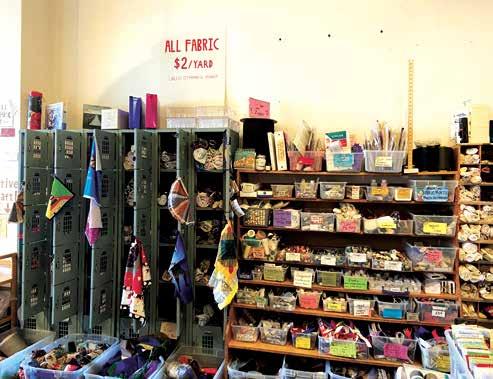
The store is a mess of bins, but a fun mess — collections of materials that range from empty pill bottles to costume jewelry. Walking the aisles leaves you no choice but
MURDER
continued from cover
A young artist failed by the system
One Seattle business owner who spoke on behalf of Wood as a person is Jamie Lutton, the owner of Twice Sold Tales. “He did work for us,” she said, recalling how Wood would clean the store’s signs.
“He was embedded with a lot of artistic drive, always making art, but he couldn’t catch a break,” Lutton added. “He often reminded me of a Dickens character.”
She remembered Wood frequently showed up at the store battered and bruised but always refusing to give details about what was happening to him. “He kept getting roughed up but couldn’t go to the police,” she said. According to Lutton, Wood had stolen a six-pack of beer at some point and was wanted for shoplifting. He was unable to show up to his court date and worried that if he were to go to the police with concerns for his physical safety, he would end up behind bars.
“And for that, he died,” she said. “Even if you’re on the run, you should be able to go to the police,” Lutton said.
According to Lutton, Wood was a kid who “fell through the cracks.” While she admits he was not one to talk about his personal life much, he did confide in her that he was Gay. As a result of his coming out, his family kicked him out. “He was Queer and didn’t get family support,” she said. “It’s a trajectory that destroys lives. He went from being an ordinary kid, a barista, to on the street.”
“He kept struggling but kept trying,” Lutton added. She watched Wood as he fought battles with addiction and bounced around from boyfriends’ couches to shelters. “His drug habit was the worst thing ever,” she said. “We treat drug addicts like they’re criminals.” Because of his situation, Wood
to reconsider the breadth of items that go into the creation of art.
A long fabric wall is organized by color, with rolls differing in size, most all selling for $2 per yard. Drawers open to reveal hundreds of stamps, or buttons, or sewing tools. Office supplies are in one corner, and loose screws and architectural materials in another. Doll parts sit next to statement necklaces. There are multiple bins of old photographs, digital prints, and film, vestiges of other lives ripe for reuse and admiration.
Filling a basket with some items that intrigue, some of necessity, and none in an overpriced multi-pack feels like the way
we’re meant to gather art supplies. Shopping at SRC connects artists with each other through the materials that were once useful to someone and regain their use to the shopper, now. There is something special about buying a single used marker and furthering its lifespan.
In addition to cultivating an eco-friendly community of artists caring for supplies, SRC works to address inequities in art. Its “Free for Teachers and BIPOC Artists” program allows public schoolteachers and BIPOC artists to sign up for a rotating selection of free supplies from the store. If the supplies on display don’t quite suit your
needs, SRC lets program members email the staff and describe materials they need for art projects.
Donations
If you have some supplies you have been meaning to clear out, donations can be set up via email as well. I asked an SRC employee how to go about donating goods and was told that the store “asks that people… give us a sort of overview of what they have. If you have a bag of yarn, just say ‘a bag of yarn,’ so we know you aren’t giving us a bunch of empty pill bottles, which we have a million of.”
SRC is generally very accepting of donations, due to the broad nature of the materials they collect and sell. When I asked about current and consistent needs, the employee was quick to state that “the top sellers tend to be yarn and fabrics. We tend to stock that a lot.” But also, “weirdly enough, we have had some requests for National Geographics. We used to have a whole thing of them; now we only have a few.”
They continued, “It’s kind of all over the place, because this is a store where, really, there’s everything — even in terms of noncrafting stuff… because it might be here, too.”
So, the next time you need a refill on staples, or some fabric paint, or scratch paper, or just need a space to browse for artistic inspiration, SRC could serve as a great starting point. The lovely, Queer-friendly space fosters a unique shopping experience with secondhand goods that are second to none in variety.
Find Seattle ReCreative at 8408 Greenwood Ave. N and online at www. seattlerecreative.org.
was unable to receive proper treatment or support in fighting his addiction, and most people used it as an excuse to further look down on him.
“He told me people would look at him and think, ‘Ick, get out, you’re not wanted.’ How can people climb up from that and the constant hatred of people?” Lutton said.
“No one kept him in mind. He was a nothing and a nobody to people.”
A target on his back
While Wood experienced invisibility from society due to his poverty, there was someone who kept him in mind. “His killer knew he was vulnerable,” Lutton said. Police have yet to identify any suspects, but Lutton is sure Wood’s murderer is someone involved in his daily harassment. She explained that in the last few encounters Wood had with her, he mentioned that his belongings had been stolen. Someone was after him.
“He wouldn’t volunteer things about his life; he was very reticent,” Lutton said.
“But I knew he was being attacked.” Lutton believes Wood’s demise was ultimately due to another person experiencing homelessness. “The worst enemy of the homeless are violent [people] who prey on them, and they stole everything he had,” she said.
The SGN reached out to management at the Broadway Rite Aid for any information on Wood’s death. They informed us that they could not speak about Wood or the current investigation and that all information about the case must come from the corporation, which refused to issue a statement.
Crimestoppers is currently issuing a $2,000 reward for anyone with information that could lead to the arrest of the person who murdered him.
Remembering Brent Wood Friends of Wood hope that he will be
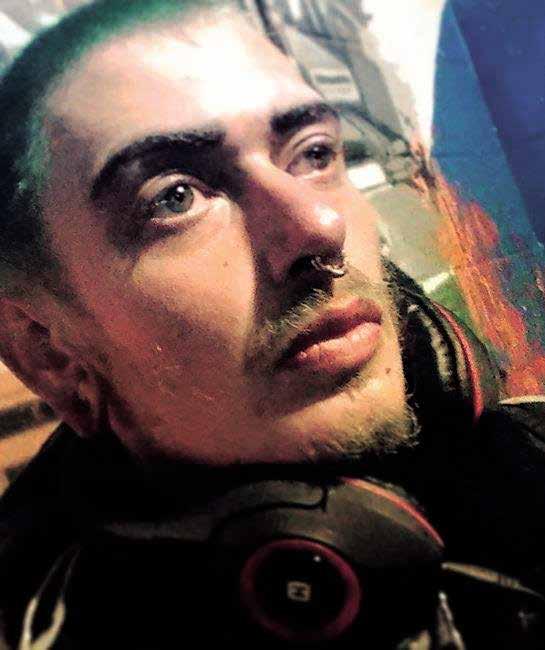
remembered as more than just a Queer kid failed by the system. “He had real style,” Lutton said. “Sometimes his outfits were wonderful.” She recalls that he always showed up at the shop spotting a different and unique look, often including wigs and painted nails.
Other sources on the Hill said Wood carried himself with “compassion and love for everyone he met.”
Twice Sold Tales remembers Brent Wood with the poem “No Man Is an Island” by John Donne, which states, “Any man’s death diminishes me, because I am involved in mankind, and therefore never send to know for whom the bell tolls; it tolls for thee.”
While few were willing to help Wood while he was alive, Lutton hopes justice can finally be on his side for once.
“I miss him terribly, and I want his killer caught,” she said. “He was a person, and his life mattered.”
Photo by Nick Rapp
Photo by Lindsey Anderson
GIRL SCOUTS
“I had to change gears in a way that I was not planning to, because all the businesses… were closed down indefinitely or were losing their building space… That left me with maybe a couple months over the summer. I decided to… do the website instead. It was a contentious decision for me, because I spent so much time on the project already... Changing my mind and… the way the project would turn out in the end was a big deal to me.”
Hare spent “a lot of time” every week just going through the books she had, making sure her recommended reading lists were just right, and downloading the images she needed. She credits her mentor and project manager, Carol Fisher, for keeping her on task.
“I have a website that I built myself that is focused on Queer literature. It’s categorized by many… different identifiers: from age to identity, like sexual identity, gender identity, and romantic identity, as well as genres that I think are pretty central,” she explained.
“It came from the idea that I was spending a lot of time in libraries looking for books that I would resonate with a bit more. My book gaydar is very strong. A lot of the time I could find them, but sometimes I just wish it was easier to pinpoint… I’m not very shy about picking out what I want, but I know a lot of people who aren’t.”
The website has helped to connect her with a lot of like-minded people, and she hopes to build a community through her connected Discord server and Instagram pages. She hopes to create a sense of connection that might even save lives.
“Some people don’t have environments at home that are affirming or safe for them. So, having a book to escape into can be really important,” Hare said. “I think, definitely, having books on hand that you can see yourself represented in and supported in are really important, especially since so many people can’t go to school and they can’t see their friends.”
Affinity camps
Hare is now 18, and just graduated from the Northwest School in Seattle’s Capitol Hill neighborhood last June. She is Black, identifies as pansexual, and uses she, they, and zie/hir pronouns.
The Girl Scouts, she said, gave her the confidence to be out and proud about her multiple identities, and she was excited to hear that the Girl Scouts of Western Washington’s LGBTQ+ affinity camp would return.
“Honestly, the Girl Scouts are so Queerpositive. It took a little while for me to notice it, but it is definitely true,” she said. “I do know a lot of Scouts who are with our organization, but who don’t necessarily align with the ‘girl’ part. It’s great because it’s always been a pretty safe space for people like that.”
Likewise, while it may have come too late for her to participate, she said that an affin-
ity family camp for Black/African American Scouts and their families sounds like “a lot of fun.”
“I have cousins who are also into Girl Scouting. I know that they probably would be super into that and just take the whole family up and have a nice time,” said Hare.
“I’m sure that if they’re Black Girl Scouts out there who want to go camping with a bunch of other Black Girl Scouts, they’re gonna come out for it, because that’s not something you see every day.”
Julie Wendell, vice president of program at the Girl Scouts of Western Washington, told the SGN that she was “thrilled” to offer the two “exclusive resident camp opportunities” this summer, one for LGBTQIA+ youth and another for Black families. “Offering affinity camp programs such as these are one way for our organization to create a safe space for people to build strength and pride based on shared characteristics,” she said.
The Girl Scouts, she said, gave her the confidence to be out and proud about her multiple identities... “Honestly, the Girl Scouts are so Queer-positive.
“Offering affinity camp programs such as these are one way for [The Girl Scouts] to create a safe space for people to build strength and pride based on shared characteristics.”
Leadership — and cookies
Hare added that being a Girl Scout has helped her to “develop some pretty superior leadership skills,” alongside a love of nature and the outdoors.”
And, since Girl Scout cookie season was underway, she was quick to add that you can’t go wrong with Thin Mints, Do-sidoes, and Tagalongs.
“My customer service definitely developed because I sold cookies. Also, social networking… and developing a clientele base,” she said. “Mostly, it taught me consistency. When you need something or when you have a commitment, you commit to it!”
Regarding the new Adventureful cookie that the Girl Scouts rolled out this year, which is a brownie-inspired cookie with caramel-flavored crème and a hint of sea salt, she provided her honest review. “I expected a little bit more chew than I was given,” said Hare. But “I would buy a box of those and have some. They seemed really yummy. Also, “if you put [Girl Scout cookies] in the freezer, they’re going to be there waiting for you when you’re ready for them in mid-summer.”
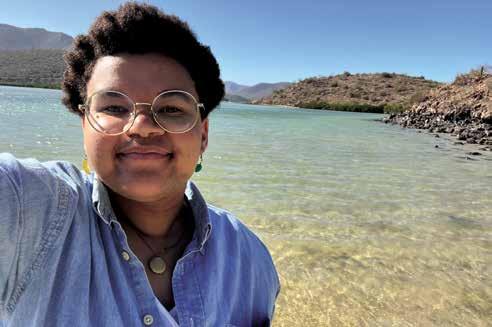
Hare said she plans to enroll in Lewis and Clark College in the fall, but has been enjoying her gap year while saving for college. In fact, she just got back from a trip to Baja California in Mexico, where she spent a couple of weeks participating in ecotourism. She swam with whale sharks, petted some gray whales, and got a good view of humpback whales breaching the sea.
“Right now, I’m just kind of enjoying not being in school for once,” she said.
To see Hare’s Gold Award project, “The Little Queer Library,” visit penguonlover512.wixsite.com/ littlequeerlibraries.
continued from cover
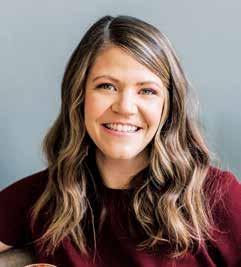
Julie Wendell, VP of Program – Photo courtesy of GSWW
Amelia plans to attend Lewis and Clark College in the fall – Photo courtesy of Amelia Hare
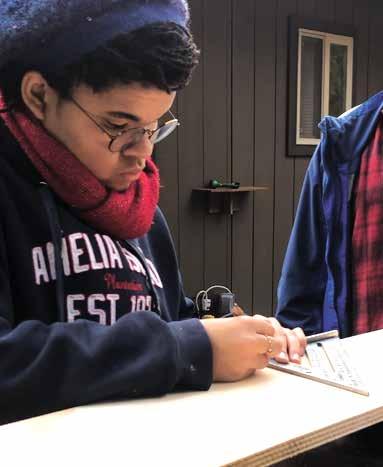
Amelia at work making “The Little Queer Library” – Photo courtesy of Amelia Hare
Nightlife
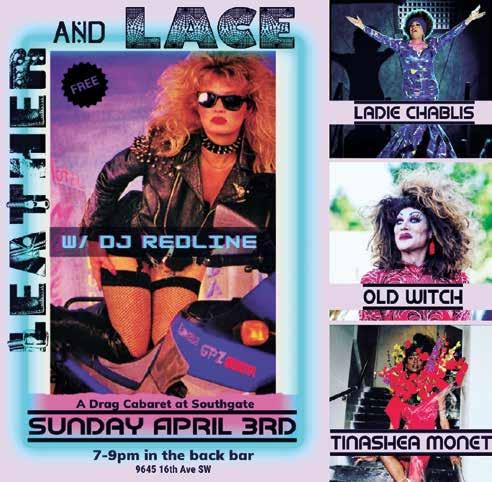
“Leather and Lace” in Rat City Drag cabaret premieres in White Center
by Daniel Lindsley SGN Contributing Writer
In the back of the former home of the Rat City Rollergirls, the bar was quiet at 6:30 p.m. Its rafters were lined with the covers of rock and punk records, and its fridge had stickers of a similar kind: Rat City Recon, Tenacious D, Soundgarden, WHORES, and the like.
A sign for White Center Pride was going up on the wall in the back, and a few patrons were waiting in the chairs in front of a small stage, which was more of a slightly raised corner of the room, usually used for karaoke or comedy. MTV played on mute, with captions, above the bar.
By 7:30 or so, the place was packed, and the noise was enough to feel it in one’s chest.
The back bar of Southgate Roller Rink was hosting its first night of “Leather and Lace,” a free drag cabaret featuring local drag queens Old Witch (@old_ witch_queen) and Tinashea Monét (@ tinasheamonet), as well as guest queens.
To the queens, the boundaries of the stage were a suggestion; they walked the aisles and worked the crowd, gathering tips as they went, even venturing behind (and on top of) the bar — all, of course, in unique, glamorous, layered outfits. They lipsynched and moved to pop tunes for most of the show, and toward the end, Old Witch brought some audience members on stage
to crack a few jokes and challenge them to a balloon-popping contest.
A few patrons reported being there for the first time, specifically for the drag show. Given the generous tips, and the smiles on most faces, it’s likely they’ll be back for the next “Leather and Lace” at the beginning of April. Others, the regulars, rolled into the bar from the rink on flashy custom skates to grab a drink and see the show.
There was no beer on tap, but there were a variety of cans and bottles to choose from, including a few local to White Center, such as the “Nazi Punks Fuck Off Pilsner” from Future Primitive Brewing. Cocktails, wine, and shots were also available. The bartender was busy nonstop well into the night. Maybe next time, with everyone more accustomed to going about unmasked (as most were that night), the energy of the place won’t quite be the same. But the Southgate Roller Rink, and perhaps White Center as a whole, has a lot to offer the Queer community in the future. Many of the bands playing in the center of the rink on Friday nights are Queer-oriented. Plus, White Center Pride has plans to return in June, and in the meantime there are monthly happy hours at the rink.
The Southgate Roller Rink is at 9646 17th Ave. SW, and online at www. southgaterollerrink.com.
St. Sapphic’s Day party sells out Supernova, no men allowed
by Kylin Brown
SGN Contributing Writer
The whimsical disco bar Supernova saw a crowd like none other for its first St. Paddy’s Day since opening last July. Thanks to Sapphic Seattle, a “women-who-lovewomen” (WLW) party squad previously profiled in the SGN, the venue was transformed Thursday night into a shamrockladen sanctuary, free from the cis-het patriarchy of the outside world.
On Instagram and TikTok, the group teased its plans for the event throughout the latter half of February. As “St. Sapphic’s Day” was slowly revealed, the group was busy at work planning its first in-person event since the rise and fall of Omicron.
New beginnings
Over mic checks and last-minute preparations at the venue, I spoke with Siobhan Fox, one of four Sapphic Seattle organizers. She spoke of the group’s unplanned yet beneficial two-month hiatus from in-person events due to the new coronavirus variant.
“The break was good for us to be able to reevaluate,” she said. “Like, how do we want this to look moving forward? How can we formalize some of our processes so we’re able to have more consistent events of higher quality?”
Meanwhile, Sapphic Seattle switched to monthly virtual events. “We created a virtual Lesbian Minecraft server, and then did virtual speed dating in February,” said Fox. “Our mission is to connect different people within the Sapphic community, so doing it virtually has been successful and comfortable for everyone as well.”
The group found time to build their network too, procuring talent for the event in collaboration with DJ Big Ugly, whose crew of GoGo dancers and Burlesque performers multiplied over the last four years since he began as a regular DJ at Wildrose. Together, the organizers secured major Queer talent for St. Sapphic’s Day, such as DJ MIXX America, DeeJay Hershe, burlesque performer Shadae Simone, aerialist Onyx Wolf, Pepper Mills, and Porcelain. Sapphic Seattle originally connected
with DJ Big Ugly to co-host an event at LoFi Seattle, where he has been hosting a monthly Queer dance party called Bump Uglies. Unfortunately, just before tickets went on sale for St. Sapphic’s Day, LoFi was hit by a car and the bar has been under reconstruction since.
Supernova was an exciting last-minute change, since the venue capacity is larger, and online tickets were selling out in seconds. “Selling out in 30 seconds, we did not expect. We are so grateful for all of the positive support we have received,” said Fox.
Creating an “alternate universe”
In addition to curating a stellar Sapphic line-up, the group somehow seemed to find an all-women security team and Supernova’s cutest femme bartenders. It felt as though an “alternate universe,” according to one attendee, whose friends nodded in agreement.
I thought I was on the Isle of Lesbos myself, in an Amazonian, San Juniperoesque dream come true. Supernova’s retrodisco immersive arts space only added to the transcendental feeling of the night.
“[Supernova] booked female staff for the night, a lot of which were WLW and specif-
ically requested to work this night,” reads a TikTok comment from the group about the event.
Sapphic Seattle organizer Eve Matson joined the conversation, though she was also on her way to help at the door. At opening time, she would show me the massive line that snaked around the corner of the large warehouse venue.
“We’ve been growing so fast. Just two parties ago we were still doing house parties. So this is an exploratory phase for us, and we’re really excited for what the future holds,” said Matson.
After selling just over 700 tickets and filling the club completely, the group was finally prepared to open the floodgates.
Women and Sapphic-identifying people came in like a soft tide, slowly flowing in single-file, but eager as can be. They were checked for vaccination status and given the option of “Friendly” or “Flirty” wristbands to indicate their intentions for the evening.
DJ MIXX America was spinning already, smiling down from Supernova’s larger-thanlife half-disco ball DJ booth at the growing crowd. As the night went on, the go-go and burlesque performers came onstage to
cheers and left with panty-line tips aplenty. Sapphic Seattle successfully delivered exactly what the attendees had hoped for: many good-luck kisses and plenty of dancing in a safe WLW environment.
Alongside organizers Varsha Nandula and Hannah Baldacci, and with the help of a few friends and volunteers, Matson and Fox have been a part of developing something typically missing in LGBTQ+ communities across the globe. With only around a dozen Lesbian bars left standing after the pandemic, spaces like these are rare.
Fox said Sapphic Seattle is happy about its growth. “We are still figuring it all out, still seeing what relationships can be built.” Whether the event is a 750-person club night or a pub mixer, the group’s goal is “making 21+ parties the most efficient and enjoyable they can be for Queer women and Sapphic people,” she told me.
Sapphic Seattle looks forward to more venues, partnerships, and participants in a wide variety of future monthly events, and is still interested in bringing their parties to cities beyond Seattle someday.
Photos by Kylin Brown
Image courtesy of Old Witch
Exile and Pride a touching search for home in a world with no real safe spaces Books
by Lindsey Anderson SGN Contributing Writer
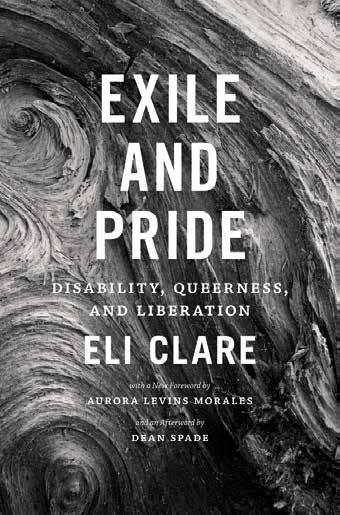
In his book Exile and Pride, Eli Clare focuses on how a sense of self is dependent on some sense of “home,” whether a physical connection to the places, land, and experiences that shaped us or a sense of comfort in one’s own body. As a Trans person with cerebral palsy, Clare explains the different forms displacement has taken in his own experiences. In doing so, he forces his readers to question how they have been complacent in exiling.
The body as home
Clare starts his novel with a disclaimer to readers, explaining himself as a Trans man. “Over the last decade in my continued process of reaching, I’ve chosen to slide across some gender line,” he says, referencing the last essay of Exile and Price, in which he ponders the notion of gender. “If I live long enough to see the world break free of the gender binary, will I find a home not as a butch dyke, a woman by default, but as some third, fourth, fifth gender?”
When the novel was first published, Clare was still identifying as a woman. Today, he notes that his Queer identity is entangled in the “dyke culture” of the ’70s and ’80s. For this reason, Clare has chosen not to rewrite his essays with his current pronouns and continues to refer to himself as a “dyke” and a “Lesbian” throughout the novel. Experiencing gender dysphoria in a time when Trans and Nonbinary people had yet to receive mainstream validation left Clare with a now widely understood notion of displacement in the body. Existing at the intersection of queerness and disability,
Clare struggled to understand if his sense of body dysphoria came from being a Lesbian, Trans, or disabled in a community where nobody else seemed to be. “I spent my childhood a tomboy not sure of my girlness, queer without a name for my queerness,” Clare writes.
The overlap of Queer and disabled identities has been studied by theorists, such as Alison Kefer, who in her 2013 book Feminist Queer Crip suggested that “sexuality and disability have always been related to one another in medical thought and social action.” Both identities are unique in that those otherized grow up in environments where those around them are often a part of the dominant society. A community outside of the home becomes vital for children experiencing differences from their families and neighbors. Yet these communities are often unavailable until the child reaches adulthood and can seek them out on their own.
For Clare, who grew up experiencing both heteronormativity and compulsive able-bodied-ness, a strong desire to “overcome” and assimilate culminated in what Clare refers to as “the super-crip.” He paints the picture of the super-crip by bringing up “inspirational” stories often shared on social media about disabled people either accomplishing great feats or participating in the mundane, only to be celebrated in masked pity by those around them.
“These stories rely upon the perception that disability and achievement contradict each other and that any disabled person who overcomes this contradiction is heroic,” he writes. “To believe that achievement contradicts disability is to pair helplessness with a disability, a pairing for which crips pay an awful price.”
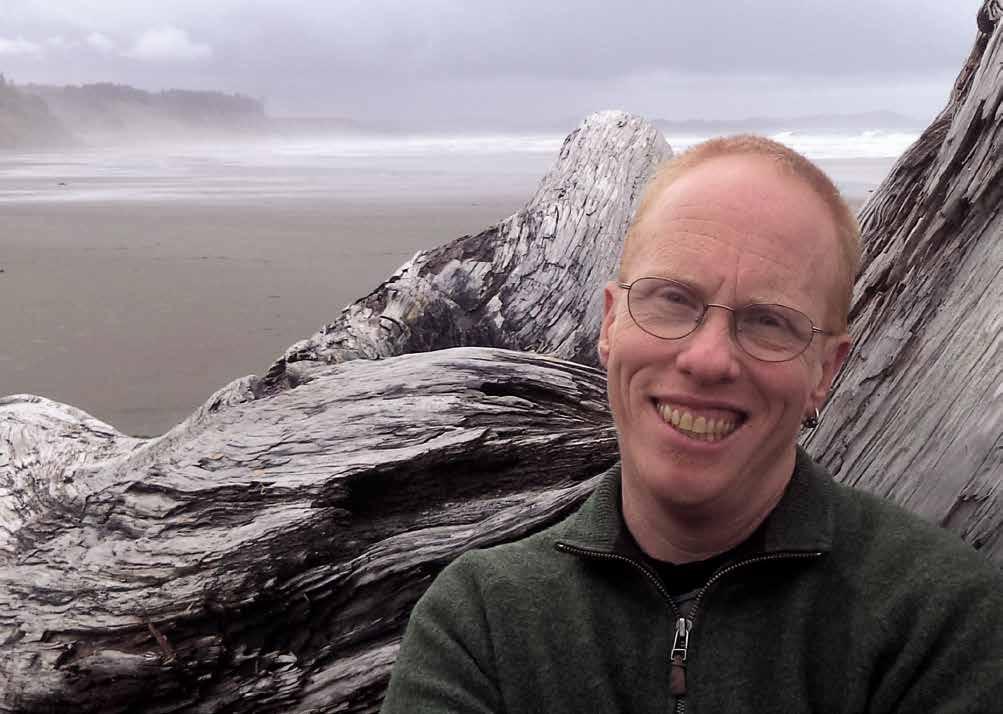
Eli Clare – Photo by Samuel Lurie
Books
Make a note to yourself to read How Do I Un-Remember This?
by Terri Schlichenmeyer Special to the SGN
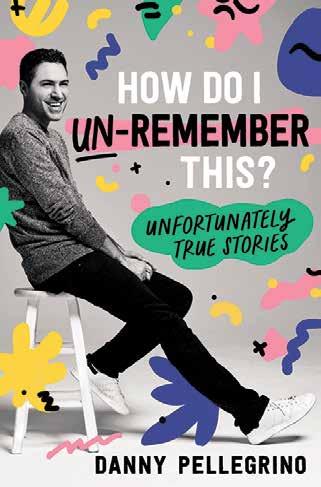
HOW DO I UN-REMEMBER THIS? UNFORTUNATELY TRUE STORIES
Memories are funny things: you can reminisce with someone about something you both saw or experienced, but you won’t remember the exact same things in the same way. So, as the host of the podcast Everything Iconic with Danny Pellegrino says, that’s when it’s perfectly okay to take a “little detour...”
Growing up in a small town in Ohio, Pellegrino was an awkward kid. He had many friends, but they couldn’t always be trusted. At sleepovers, he generally preferred the company of the host’s mother, because she could be counted on for good gossip. He liked girls sometimes, but he remembers how confusing that was, because he liked boys too. He recalls bad dates, good brothers, the process of coming out, and the fluster of being outed. Even his family could be awkward: he remembers family trips as being full of cheap motels, bad roads, and “stress wine” for his mother.
So what can you learn from this?
You’ll learn that if your parents can embarrass you, they will, and that bruises last forever — but they don’t always hurt that long. That there are days when it’s per-
ELI CLARE
continued from page 7
Finding Queer spaces
Clare tells his story, an amalgam of nostalgia and horror, as he recalls the backwoods of rural Oregon, where he grew up. Like many Pacific Northwesterners, the trees, the rain, and the unique scent of the dirt and grass fill his lungs. Yet, as Clare grew up, he realized he needed to get out of his rural hometown to escape a life of poverty and false heterosexuality. He also fled to escape constant reminders of his childhood, which was full of physical and sexual abuse.
When he finally left Port Orford, Oregon, Clare discovered himself in Queer spaces. He found immersion in liberal politics and activism, and established a community that understood and accepted him in ways his old one never would have.
However, the ache for his childhood home continued to ring. “I’ve failed mostly because I haven’t been able to bridge the chasm between my homesickness for a place thousands of miles away in the middle of logging country and the urban-created politics that have me raging at environmental destruction,” he writes.
The more Clare grew into his politics and identity as a Queer person, the more he realized he no longer fit into his hometown. Yet there were still parts of Port Orford that had shaped Clare. The yearning for trees, the pride of his lower-middle-class parents, the close-knit comradery of neighbors.
He reflects that his feeling of exile from Port Orford has everything to do with his discovery and acceptance of his sexuality (and ultimately gender identity). “My loss of home is about being queer,” Clare writes. Clare
fectly okay to say no, but that anytime is a good time to discuss “The Trolley Song.”
You’ll see why we should retire the youngwhite-cis-man trope in superhero movies. You’ll learn why it’s important to be careful of the things your cleaning lady has access to, and to be thankful if you have parents who love you. And you’ll learn that sometimes, life is simply “about getting through the journey alongside the ones you love.”
Judging a book by its cover is something we’ve been told not to do, but still. Looking at the front of this memoir hints at the humor inside — but that isn’t the only thing it contains. How Do I Un-Remember This? is warm and fuzzy too.
That might be because this book is more like a conversation than a monologue. Pellegrino includes his readers in his memories, and even when they’re not identical, they’re universal. Embarrassments during puberty, parents that make you red-faced, public humiliation, fan obsessions — been there, done that.
But then those things are put into perspective, in a way that seems like a gentle hand on your arm. Count your blessings, Pellegrino reminds readers, and look for the good and wise in what you recall. Even when — maybe especially when — those memories are full of barbs.
Have fun reading this book, but don’t be surprised if How Do I Un-Remember This? tugs on your soul, too. Indeed, some things are better forgotten. This book isn’t one of them.
describes a sense of emptiness familiar to many LGBTQ+ people not raised in accepting communities. An internal tearing begging us to choose what parts of ourselves to sever.
Rural vs. urban
Clare notes that even among Queer spaces, he feels out of place. “Queer identity, at least as I know it, is largely urban,” he writes.
There’s a reason Seattle is the only city in Washington to host an LGBTQ+ newspaper. To find acceptance and the LGBTQ+ community, those raised in rural areas must relocate, leaving everything they once found familiar gone. The result becomes a lifelong process of trying to discern whether “home” is the community you’ve fled to or the one where your severed roots still lie.
For people from tight-knit communities, adjusting to what many refer to as “the Seattle freeze” can be especially isolating.
Clare informs his readers that Queer spaces, artificial archipelagos filled with transplants from across the country, tend to become elitist. He recalls Stonewall 25, a celebration of a riot begun by workingclass Trans women, now selling tickets for hundreds of dollars. He notes the corporatization of Pride, which now resembles Coachella, with a high importance placed on social media exploitation, outfits, and whiteness.
Even urban spaces, hailed by many as “safe spaces” for LGBTQ+ people to find community, are only willing to accept Queers in palatable doses, usually white, able-bodied, male, and well-off. With the gentrification of Queer spaces, such as Seattle’s Capitol Hill, poor and workingclass members of the LGBTQ+ community continue to feel isolated. Those without
family support, the ones forced to flee rural areas in search of community, are the most likely to be left out of these spaces. The phenomenon of gentrifying Queer spaces leads to the disproportionality of LGBTQ+ homelessness, murder, and suicide.
The mass migration of LGBTQ+ people away from rural areas also leads to a crisis of mass youth abandonment, Clare points out. While the Queer or Trans kid in Seattle may not have welcoming parents, they do have access to resources, programs, mentors, and school systems that are willing to lend support. In rural areas, these children are left with nothing and nobody to advocate for them.
“Have we collectively turned our backs on the small towns in Oregon that one by one [are] passing local anti-gay ordinances?” Clare asks. While the media is now centering “Don’t Say Gay” bills, anti-LGBTQ+ legislation continued to pass in small communities, where Queer children must wait and endure until they are old enough to flee, just as those before them did.
Passive activism
Clare’s experiences of constant displacement give way to excellent observation. He can scrutinize fabricated ideals from all the communities he encounters. So as a kid from a rural logging community, he takes note of urban language around conversations of environmentalism and deforestation.
It’s an image all too familiar in Seattle. A well-off young person demonizes the poor for their participation in industries such as logging, fishing, or farming, a stance often taken by affluent liberal kids but dissected by Clare as an issue of class.
“Complicit brutes, dumb brutes. I sit at my computer and imagine you, my reader.
You have never seen a clearcut, or if you have, you were a tourist. Regardless of what you think about the timber industry, you believe loggers are butchers, maybe even murderers,” Clare writes before humanizing the industry.
He reminds his readers that the fight to be had is not against the individual working in jobs that destroy the land but in the executives who employ them, exploiting the worker and the environment. Clare calls on his readers to do more than passive activism, retweeting staggering facts about climate change, or putting a bumper sticker on a Subaru.
He reminds his readers that community is the solution to the big problems and calls out to other urban Queers like himself, who may have fled mining, railway, or logging towns like his, to not forget about the people left behind. He warns against the elitism of gentrified urban areas, where people forget about rural Queer kids, expecting them to just get out. He warns against classist complicity that looks down on those fighting in the upward scramble to make a better life for those kids, those who were unable to leave.
As Eli Clare looks back on his life and all he had to sacrifice and cut out of himself as he searched for a home, he reflects on one central question: “Is queer identity worth the loss?”
Full of heart, reflection, and masterful prose, Exile and Pride is the perfect read for the SGN ’s first spring book club book. Read with reflection in mind, and let us know what you think about it on Instagram at @sgn_books!
Image courtesy of Sourcebooks
94th Academy Awards: Predictions
Presumed Oscar frontrunners Power of the Dog , CODA , and Belfast battling it out for Best Picture supremacy
by Sara Michelle Fetters SGN Staff Writer
The 94th annual Academy Awards ceremony is this Sunday night, and for once many of the eventual winners are shockingly difficult to predict. But as close as several of the races in many of the top categories appear to be — most notably Best Picture, Best Actress, and Best Original Screenplay — that’s nothing compared to the various controversies the producers of this year’s broadcast have inadvertently managed to gin up.
First, it was announced that eight categories — Editing, Sound, Makeup and Hairstyling, Production Design, Documentary Short, Animated Short, and Live Action Short — will all be revealed in the hour before the live broadcast is set to begin at 5 p.m. Pacific, with snippets of each acceptance speech edited into the show later on. Social media understandably went nuts over this, with the hashtag
BEST PICTURE
Belfast, CODA, Don’t Look Up, Drive My Car, Dune, King Richard, Licorice Pizza, Nightmare Alley, The Power of the Dog, West Side Story Prediction: The Power of the Dog
#PresentAll23 trending ever since, while Best Actress nominee Jessica Chastain has already stated she’ll refrain from walking the Oscar red carpet so she can be seated in the auditorium to support her The Eyes of Tammy Faye hair and makeup team.
There have been a handful of disasters since, but the most notable one involves rising West Side Story star Rachel Zegler. After a fan posted about their excitement at seeing what Zegler was going to wear to the ceremony, Zegler revealed on Instagram she wasn’t even invited to attend. (She has since been invited as a presenter.)
On the same day her post went viral, the Academy announced its final set of presenters for the broadcast, a list that included non-Academy members Tony Hawk, Kelly Slater, Shaun White, and DJ Khaled. To say the reactions haven’t been kind would be an obvious understatement.
Lost in all of this is that it’s arguably the most competitive Oscar race in years.
BEST DIRECTOR
Paul Thomas Anderson (Licorice Pizza), Kenneth Branagh (Belfast), Jane Campion (The Power of the Dog), Ryûsuke Hamaguchi (Drive My Car), Steven Spielberg (West Side Story) Prediction: Campion
Best Picture is a legitimate toss-up: half of the ten nominees have a path to victory. Best Actress is a coin flip. Best Original Screenplay is a complete unknown. Best Animated Film? Best Editing? Best Cinematography? Best Original Score? While there are legitimate frontrunners in each category, it’s equally likely one or all of those will feature a jaw-dropping upset. What do we know? Best Director will go to a woman for the second time in a row and the third this century: Jane Campion. As the only two-time female nominee in this category, a win for her is as close to a certainty as there is.
Ariana DeBose is a lock for Best Supporting Actress for West Side Story — there’s zero question about that. Will Smith will likely snag Best Actor for King Richard, while Troy Kotsur should win Best Supporting Actor for his work in CODA Dune is almost certain to dominate the majority of the technical categories, and it’s hard not to believe Cruella will
BEST ACTOR
Javier Bardem (Being the Ricardos), Benedict Cumberbatch (The Power of the Dog), Andrew Garfield (tick, tick… BOOM!), Will Smith (King Richard ), Denzel Washington (The Tragedy of Macbeth) Prediction: Smith
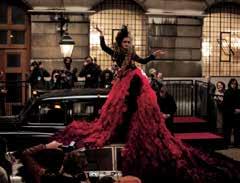
be strutting down the Best Costume Design catwalk, Oscar in hand.
As for the rest? While I’m going to make my predictions, I can’t say I trust the majority of them. Best Picture is an absolute crapshoot: while I’m leaning toward The Power of the Dog, it’s hard not to shake the feeling that CODA, King Richard, Belfast, West Side Story, or even Don’t Look Up could pull off an upset.
As for Best Actress, my heart is still firmly behind Kristin Stewart and her mesmerizing Spencer performance, but my head says this is Chastain’s Oscar to lose, though Nicole Kidman may pull off an upset for her work as Lucille Ball in Being the Ricardos
Here are my predictions for the 94th annual Academy Awards in all 23 categories. If I get more than 16 of them correct this year, I’ll be legitimately surprised.
BEST ACTRESS
Jessica Chastain (The Eyes of Tammy Faye), Oliva Colman (The Lost Daughter), Penélope Cruz (Parallel Mothers), Nicole Kidman (Being the Ricardos), Kristen Stewart (Spencer) Prediction: Chastain
The Power of the Dog
The Power of the Dog – Photo courtesy of Netflix
Jane Campion – The Power of the Dog Will Smith – King Richard
Jessica Chastain – The Eyes of Tammy Faye
BEST SUPPORTING ACTOR
Ciarán Hinds (Belfast), Troy Kotsur (CODA), Jesse Plemons (The Power of the Dog), Kodi Smit-McPhee (The Power of the Dog), J.K. Simmons (Being the Ricardos) Prediction: Kotsur
Drive My Car, Flee
BEST COSTUME DESIGN
Cruella, Cyrano, Dune, Nightmare Alley, West Side Story Prediction: Cruella
BEST ORIGINAL SONG
“Down to Joy” (Belfast), “Dos Oruguitas” (Encanto), “Somehow You Do” (Four Good Days), “Be Alive” (King Richard ), “No Time to Die” (No Time to Die) Prediction: “Dos Oruguitas” (Encanto)
Jessie Buckley (The Lost Daughter), Ariana DeBose (West Side Story), Judi Dench (Belfast), Kirsten Dunst (The Power of the Dog), Aunjanue Ellis (King Richard ) Prediction: DeBose
The Power of the Dog BEST EDITING Don’t Look Up, Dune, King Richard, The Power of the Dog, tick, tick…BOOM! Prediction: Dune BEST PRODUCTION DESIGN
Dune, Nightmare Alley, The Power of the Dog, The Tragedy of Macbeth, West Side Story Prediction: Nightmare Alley
BEST SOUND Belfast, Dune, No Time to Die, The Power of the Dog, West Side Story Prediction: Dune
BEST VISUAL EFFECTS
Dune, Free Guy, No Time to Die, ShangChi and the Legend of the Ten Rings, Spider-Man: No Way Home Prediction: Dune
BEST ANIMATED FEATURE Encanto, Flee, Luca, The Mitchells vs. the Machines, Raya and the Last Dragon Prediction: Encanto
BEST MAKEUP & HAIRSTYLING Coming 2 America, Cruella, Dune, The Eyes of Tammy Faye, House of Gucci Prediction: The Eyes of Tammy Faye
BEST DOCUMENTARY FEATURE Ascension, Attica, Flee, Summer of Soul (...Or, When the Revolution Could Not Be Televised), Writing with Fire Prediction: Flee
BEST ANIMATED SHORT Affairs of the Ant, Beast, Boxballet, Robin Robin, The Windshield Wiper Prediction: Beast
BEST ORIGINAL SCORE Don’t Look Up, Dune, Encanto, Parallel Mothers, The Power of the Dog Prediction: Encanto
BEST DOCUMENTARY SHORT
Audible, Lead Me Home, The Queen of Basketball, Three Songs for Benazir, When We Were Bullies Prediction: When We Were Bullies
LIVE ACTION SHORT Ala Kachuu - Take and Run, The Dress, The Long Goodbye, On My Mind, Please Hold Prediction: The Long Goodbye
Encanto
The Long Goodbye
Encanto
Cruella
Drive My Car
Troy Kotsur – CODA
Dune
Dune
The Power of the Dog
Ariana DeBose – West Side Story
Flee
The Eyes of Tammy Faye
Dune
Kenneth Branagh – Belfast
When We Were Bullies
Encanto
Nightmare Alley
Siân Heder – CODA
Discover Europe.
Offering year round nonstop flights from SEA-TAC International Airport to Frankfurt, Germany with easy connections to many European cities including Munich, Paris and Amsterdam and other worldwide destinations.
Condor is also a partner and member of the Alaska Airlines Mileage Program. Earn miles on every Condor and Alaska Airlines flight. Enjoy Business, Premium or Economy Class and let your next adventure begin with Condor.
More information on Condor.com
Film
X a bloody return to Ti West’s exploitive retro horror roots
by Sara Michelle Fetters SGN Staff Writer
X Theaters
Six rambunctious amateurs head to a rural Texas farm to shoot an experimental pornographic movie. They have come to the secluded home of the elderly Howard (Stephen Ure) and his reclusive wife Pearl. Howard rents the group the large boarding house near a hidden lake on the side of his property, warning them to keep quiet and stay to themselves lest they risk his wrath.
Wayne Gilroy (Martin Henderson) is the moneyman who wants to move from owning a rundown strip club to being a pioneer of what he believes will be the lucrative X-rated home video market. His female stars are his current girlfriend Maxine Minx (Mia Goth) and Bobby-Lynne Parker (Brittany Snow), both of whom are headliners at his club. The male lead is Jackson
Hole (Scott Mescudi), Bobby-Lynne’s boyfriend and a former Marine who served two tours in Vietnam. Rounding out the group is writer-director RJ Nicholls (Owen Campbell) and his sweetly innocent girlfriend Lorraine Day (Jenna Ortega), there to assist him during the shoot.
The aptly titled X marks the return of writer-director Ti West, whose last theatrical offering was 2016’s entertaining revenge western In a Valley of Violence starring Ethan Hawke and John Travolta. Returning to his retro horror roots so splendidly showcased in 2009’s The House of the Devil, West channels his inner Tobe Hooper or Wes Craven. He presents a gnarly, sexually provocative thriller that juxtaposes youthful upheaval against the inevitable ravages of old age, all of it showcased with tongue firmly in cheek and middle finger proudly unfurled.
The initial buildup is reminiscent of West’s last horror offering, 2013’s foundfootage chiller The Sacrament. Not
because his films have similar themes, but more in the way the filmmaker craftily pulls the rug out from underneath the viewer. While there is an unnerving aura that something sinister is going on, the initial focus goes out of its way to soften the idea that unimaginable doom hides in plain sight somewhere on the farm.
What do I mean? After an initial, undeniably ominous get-to-know-you meeting between Wayne and Howard, where the ground rules for what can and cannot happen on the property are enunciated, West allows his primary characters to revel in their creative freedom. He focuses on their sexual and cinematic experimentations, doing so in a manner that is humorous yet empathetic, cynical yet nonjudgmental. A questioning Lorraine becomes the unexpected focal point during this first half of the film, her burgeoning sexual liberation forcing the audience to see these characters and what they are doing in a new, unforeseen light.
Not that it comes as a surprise when
the shift happens and skulls get cracked, necks get slashed, and a good collection of the cast ends up dismembered in pools of their own blood. West takes no prisoners, refusing to bow to genre convention as to who should live and who should perish. A palpable sense of doom descends upon the proceedings like an impenetrable fog, everything leading to a goofily ghoulish climax that’s as nasty as it is satisfying.
The entire cast is aces. There’s a sublime scene where Lorraine asks Maxine, Wayne, Bobby-Lynne, and Jackson about their relationships and how they’re able to justify a commitment to one another while still engaging in sexual gymnastics on camera for the enjoyment of others. The two women immediately take charge of the conversation, owning who they are and what they stand for with confidently euphoric certainty. Snow is particularly good, her supporting performance a constant revelation that reaches its fist-pumping zenith during this pivotal sequence.
Still, as great as she and the rest of the ensemble may be, it is Goth who dominates. She plays two roles —the less said about one, the better — and is stunning in both. This may be the finest hour for the young actor, a mesmerizing talent who has previously wowed in efforts like Suspiria, A Cure for Wellness, and The Survivalist. Goth is dazzling: her dual transformations are ethereal fluctuations of poetically grotesque beauty the likes of which I’ll be thinking about for quite some time.
There are some questions left unanswered by the time a van’s engine laboriously sputters to life and tires chaotically spin in a dusty Texas driveway, not the least of which is what was going on in the dingy confines of Howard and Pearl’s basement. I’m also not entirely sure a final reveal of one character’s true identity is as cleverly amusing as it is meant to be, but as I did chuckle, I guess I shouldn’t be one to nitpick.
This is no great examination of grief. There aren’t any deep psychological themes being meticulously examined. That’s not where West’s interests lie. X rips at the jugular with exuberant joy. This is old-school exploitation horror that isn’t afraid to offend and doesn’t care if the rough edges get sanded down. Its anarchy is cause for celebration, and the ultimate outcome for all this masturbatory excess is a macabre reminder that liberation isn’t free, and that the full cost of rebellion leads to casualties on all sides of the fight.
X – Photo courtesy of A24
Mia Goth in X – Photo courtesy of A24
Unforgettables: Cinematic milestones with Sara Michelle
Victor Victoria : Blake Edwards’ 1982 gender-bending Parisian musical farce remains ahead of its time
by Sara Michelle Fetters SGN Staff Writer
It’s bizarre that Blake Edwards’ Academy Award–winning comedic musical triumph Victor Victoria would still be considered groundbreaking if it were to be released today, 40 years after it originally debuted in theaters. A stylized, star-studded remake of writer-director Reinhold Schünzel’s 1934 German classic Viktor und Viktoria, the film’s brazen attitudes toward sex and gender are as provocative now as they were back in March of 1982.
I find that statement flabbergasting. While LGBTQI+ representation in cinema has substantively progressed, it’s a bona fide surprise that four decades later, a cross-dressing comedy set in 1930s Paris (featuring Julie Andrews as a woman pretending to be a man pretending to be a woman, in an Oscarnominated performance) would remain so forward-thinking, given that it was made by the man behind the Pink Panther franchise, Breakfast at Tiffany’s, 10, and S.O.B. — all celebrated comedies with scenes so badly dated they’re unforgivably offensive.
Are there dated elements here as well? Certainly. Some of the language utilized by Chicago gangster King Marchand (James Garner) and his outspoken moll Norma Cassady (Best Supporting Actress nominee Lesley Ann Warren) wouldn’t pass muster today, and a couple of the homoerotic gags concerning his character, Marchand’s trusted bodyguard “Squash” Bernstein (former professional football player turned actor Alex Karras), and aging, selfdescribed “queen” Carole “Toddy” Todd (Best Supporting Actor nominee Robert Preston) are a little cringy.
But Edwards celebrates the Queer components of his scenario with empathetic specificity. Scenes where Marchand wrestles with his sexuality are achingly authentic yet also goofily absurd. While his epiphany that being Gay is nothing to be ashamed of is understandably short-lived — the guy he’s fallen in love with turns out to be a genetic woman, after all — that doesn’t make his struggle any less sublime.
Even better are groundbreaking scenes of genuine longing and lust between Toddy and Squash. The sight of the two burly men
in bed, while a source of genuine amusement, is not played for laughs. These men find something while entwined in one another’s arms, and Edwards holds this up as a genuine moment of affection and not some absurdity to be mocked, ridiculed, or snickered at.
Not that I understood any of that when I first saw the film at eight years old. Those facets unsurprisingly flew right over my head. What I loved were the colorful and energetic song-and-dance numbers. I loved the frantic silliness. I loved an early sequence in a diner where Andrews’ down-on-her-luck songstress Victoria Grant attempts to use a giant cockroach to score a free meal at a Parisian diner. I loved the squawky, cocksure exuberance of Warren’s vocal inflections, which made her come across like a living, threedimensional cartoon.
Most of all, I was floored by the central conceit of a woman pretending to be a man and then subsequently masquerading as a woman to entertain spellbound audiences, receiving rapturous applause after each performance. This blew my little mind.
Sure, I’d seen gender-bending material before — Looney Tunes reruns were a Saturday morning staple — but nothing like this. Here was the idea that a person could present any darn way they wanted to and receive roars of approval. And gosh darn it, did I secretly wish I could do the same and have my parents and all my friends cheer me on in a similar manner.
This was only a movie, though, not real life. I was not Julie Andrews, and as much as my parents adored the man, James Garner was not a member of our family. This was Spokane in the 1980s, not Paris of the 1930s, and no amount of wishing otherwise would send a flamboyant uncle like Toddy through our door to urge me to be myself and worry about the repercussions later.
I think some of this is why Victor Victoria continues to resonate with me all these years later. I can treasure coming to the film much too early in life, then learning to cherish and respect it more and more as I grew older and began to understand everything it was trying to say. This was a celebration of gender,
a story that went beyond ho-hum binary constructs and dared to look at the world through a lens free from condescension or bigotry. Sure, King Marchand and Victoria Grant get together in the old-fashioned way, but Toddy and Squash are allowed to express their sexual affinity for one another with equal fervor, free of judgment.
The jazz is hot in Victor Victoria, and the romance sizzles courtesy of a fire ignited by the courage to be one’s true self, no matter what the consequences. There’s a reason this entry in Edwards’ filmography has flawlessly stood the test of time, and it won’t surprise me at all if we’re still singing this film’s praises in another four decades just as passionately as we are today, here on its 40th anniversary.
Victor Victoria is available on Blu-ray and DVD from Warner Home Entertainment and to purchase digitally on multiple platforms. It is also currently streaming on HBO Max.
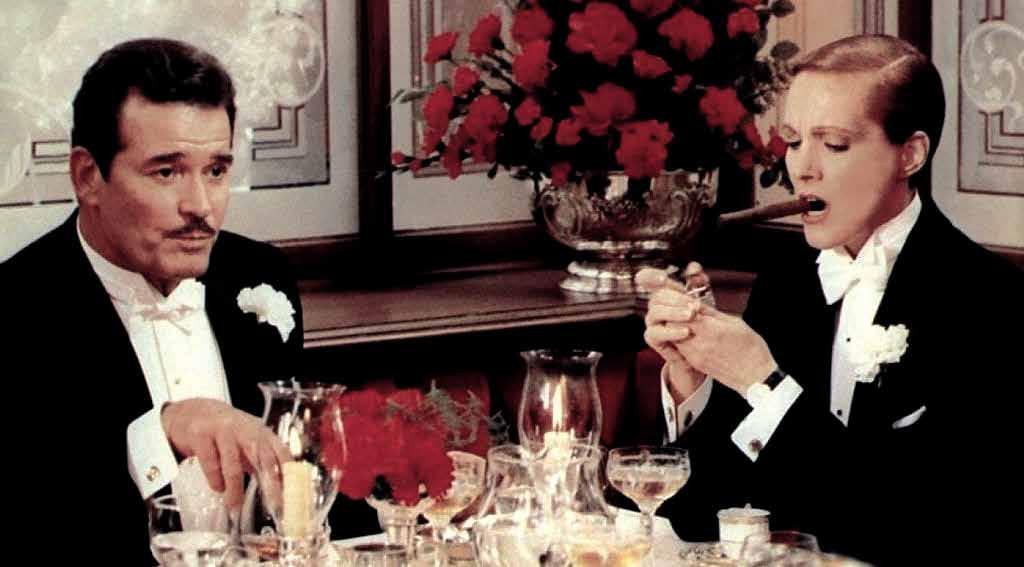
James Garner and Julie Andrews in Victor Victoria – Photo courtesy of MGM
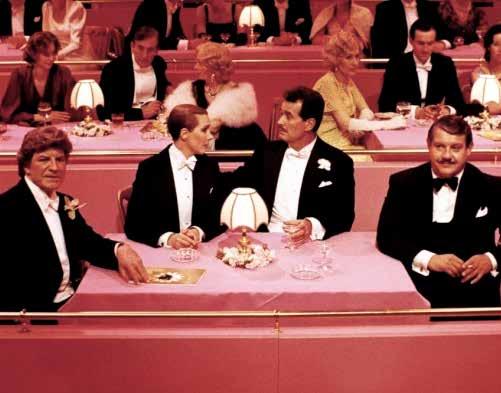
Robert Preston, Julie Andrews, James Garner, and Alex Karras and in Victor Victoria – Photo courtesy of MGM
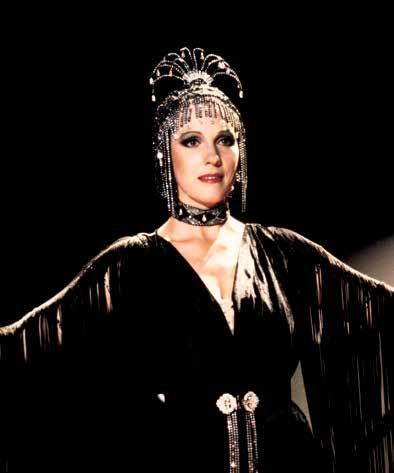
Julie Andrews in Victor Victoria – Photo courtesy of MGM
2022 Seattle Jewish Film Festival preview
A conversation with Pamela Lavitt, director of SJCC Arts + Ideas & Festivals
by Sara Michelle Fetters SGN Staff Writer
The 27th annual Seattle Jewish Film Festival (SJFF) kicked off last night with a virtual opening-night screening of the acclaimed documentary Fiddler’s Journey to the Big Screen and will do so in person Saturday with a gala screening of director Vadim Perelman’s Persian Lessons at AMC Pacific Place.
Once again a hybrid event, this year’s festival is an exciting mixture of features, documentaries, shorts, television series, filmmaker Q&As, parties, and special events.
I spent a few minutes chatting with Stroum Jewish Community Center (SJCC)’s director of Arts + Ideas & Festivals, Pamela Lavitt, about this year’s SJFF. The following are the edited transcripts of our conversation.
Sara Michelle Fetters: It’s that time of year again! I imagine you have to be pretty excited.
Pamela Lavitt: Excited and nervous. We are thrilled many folks are venturing out and back into the movie theaters to “see and be seen” in person and on the big screen. We spent a lot of time planning inviting experiences, like bringing filmmakers to Seattle and having catered food events for our in-person weekends, but we’re a bit nervous because we are out of practice.
It may be our 27th year, but it feels a bit like our first again! Relearning how to make the magic happen takes a lot of effort, coordination, curation, support, and planning, especially for a hybrid festival. We are excited to rebuild, reboot, refresh, and reengage our reemerging community.
SMF: The lineup for this year’s festival is outstanding. How long did it take you to assemble? Were there any issues going with the in-person/hybrid format?
PL: It takes about four months to curate the lineup. When you are reviewing over 300 films with a committee, and even with many of them watching over 50 films — shout-out, you’re all awesome! — it takes quite some time. But that is part of our process, and input from the screening committee is a hallmark of this festival and how the Arts + Ideas program builds community at the SJCC. With the hybrid festival model, we had to rethink what we used to do, what we can do, what we want to do, what we can deliver and through what means (theaters, virtual platforms, Zoom, etc.). It adds a considerable level of complexity to planning and gauging what’s best for the filmmaker and the audience. With virtual screenings, we can deliver films to a wider audience than ever before. But filmmakers are starting to limit how far
we share these stories based on geography and sometimes numbers of viewers. So the hybrid model offers the best of both worlds for the festivalgoer and for the film lover.
One of the things we decided to do this year was to offer greater flexibility for film viewing. All virtual films (save one) are available for two weeks: March 28 thru April 10. People have 48 hours for features and 72 hours for the TV series to watch from the time they push play.
Half of the festival programs can also be screened in person. These are more than just screenings: we have created experiences celebrating the importance of gathering together and how special that is right now. An array of culinary offerings, music, visiting filmmakers, and more are all part of our in-person screenings.
Planning this many months ago, we had no idea if folks would show up, honestly, so we tried to make the lure of not only the movie theater but the whole experience as exciting and valuable as possible. “See and be seen” is our theme this year — see yourself reflected on screen, see others, and see the community coming together. Get on the scene!
SMF: You also have a number of inperson guests this year. Were those difficult to schedule? Or were filmmakers excited to get back out there and interact with live audiences?
PL: Honestly, it has depended on the filmmaker and their geographic location. Certain filmmakers are excited to get back into the theatre with audiences, and others are not able to since, they live in Israel, Berlin, Italy, or other places.
But the virtual accessibility allows for their participation from wherever they are.
Mano Khalil, director of Neighbours, is willing to get up at 3 a.m. his time to participate in the festival! Vadim Perelman, director of our in-person opening night film Persian Lessons, happens to be in Canada, and he reached out to us wanting to attend his screening. We are thrilled he can join us. Originally, Lisa Hurwitz, director of The Automat, only wanted to screen her film in person at all festivals and attend as many as she could, but she and many other filmmakers have slowly adapted to virtual and/or the hybrid model. She has been screening at many festivals all over the country and the world, and has attended most screenings. The Seattle screening was especially important to her and to us. Lisa used to work for the Stroum Jewish Community Center and graduated from Evergreen, so her being here to present her film is a homecoming for the festival, her production, and the documentary film community. Seattle’s Hummie Mann, for example, composed the
music and will attend the screening too, and our audience has responded extremely enthusiastically. Both the in-person experience of the Sunday brunch plus the film and the film-only tickets are on standby. But there is also still an opportunity to watch this fascinating documentary virtually.
SMF: But you also have a number of Zoom Q&As as well. I feel like this allows practically every film and event to have some sort of guest component. That has to be exciting, yes?
PL: Yes, weekend Q&As are in person, virtual films are mostly midweek and those Q&As are on scheduled or prerecorded Zooms, and all recordings go to our SJCC Arts + Ideas Seattle Jewish Film Festival YouTube channel, if folks miss them.
I was particularly excited to rope in an old acquaintance of mine, Dr. Eddy Portnoy, who is working on an exhibit about Jews and cannabis, who will talk about his incredible research on the subject dating back to Biblical times and medieval Cairo, to Abby Hoffman and bloggers today like Tok’n Jew. This Zoom conversation is included with tickets to the Israeli comedy Greener Pastures, a cannabis comedy.
What makes a festival is the engagement with filmmakers and experts who provide deeper insight to the subjects and creative processes.
SMF: One of the highlights on the schedule has to be your screening of the digital restoration of the once-thoughtlost 1923 silent film The Ancient Law, with live musical accompaniment no less! Tell me more about this selection and what audiences can expect.
PL: Two years in the making! This was a rescheduled centerpiece from March 2020 and a collaboration with STG at the Paramount Theatre. The film is accompanied by a live score composed by violinist Alicia Svigals, known as a founder of the Klezmatics, and pianist Donald Sosin, renowned for silent-movie scores. They are joined by Laura DeLuca from the Seattle Symphony on clarinet. Prof. Cynthia Walk of the Sunrise Foundation for Education in the Arts, who restored the print and is a scholar on German cinema, will introduce the film and discuss its importance.
SMF: This year’s “Gay Gezunt!” is a screening of director Adam Kalderon’s award-winning sports melodrama The Swimmer. Why this film? What made it stand out?
PL: The Queer community members on our programming team really liked this film! I listen to and value our programming committee’s feedback.
Adam Kalderon is a multitalented indi-
vidual. He is a costume designer, art director, composer, and of course, director. Prior to The Swimmer, he has only made short films, and now he has this beautiful feature that is a unique adaptation of his personal story. We wanted to celebrate an emerging filmmaker, and Kalderon’s feature was the perfect opportunity to do this. The acting, cinematography, and personal story behind the film come together in a truly compelling, nuanced, and beautiful way. I think he is just at the beginning of his career — we are going to see big things from him! He is very committed to Queer filmmaking, storytelling, and creative expression.
SMF: You also have a “virtual opening night” film, the documentary Fiddler’s Journey to the Big Screen. Why should viewers want to give this Fiddler on the Roof documentary a look?
PL: Who doesn’t love an opening night, so why not have two of them!?
This is a cinema-lover’s film — besides the fact that Fiddler on the Roof is a universal story and one of the most successful Broadway shows of all time, playing around the world to audiences that see it as “their story.” This documentary is about the film adaptation, the filmmaking, and the journey this musical took to get to that screen adaptation so many of us know and love.
This sacred, beloved musical — no one thought it could be brought to the screen — was by Norman Jewison (who, by the way, isn’t Jewish) and had to “compete” with the Broadway hit, only to become a masterpiece that won three Academy Awards. That story is just as engrossing, as is the Fiddler story itself. We knew this film had to open the festival.
SMF: Any last thoughts?
PL: We love our screens, big and small, but haven’t we all missed the thrilling experience of cinema in a theater? The storytelling and the art that lifts not only the human spirit but the energy of a room and our minds, and then the conversations afterward. We’ve missed that.
Cinema, and independent cinema especially, is worth returning to. We have to work doubly hard to build hybrid experiences, so I hope audiences will join us in person on the festival weekends and virtually whenever they can.
Do what’s comfortable for you, but we’d love to see you on the scene!
The 2022 Seattle Jewish Film Festival runs both in person and virtually through April 10, 2022. For more information about tickets, virtual screening opportunities, and special events, please go to SeattleJFF.org.
The Swimmer – Photo courtesy of Strand Releasing
Our Pride can’t be
bought Seattle Pride rejects $100K Amazon parade sponsorship
by Renee Raketty SGN Contributing Writer
Seattle Out & Proud (aka Seattle Pride), organizers of the Seattle Pride parade and Seattle Pride in the Park, announced on Tuesday that it had rejected a proposal from Amazon to become the 2022 title sponsor (a level that doesn’t exist), including a package totaling approximately $100,000. The decision was made during a board vote on March 3 at its offices in Pioneer Square.
The press release claims that the organization is part of a “larger movement across the country” of LGBTQIA+ people and Pride organizations “separating from harmful corporate partners and politicians… in hopes of motivating corporate entities to eliminate harmful business practices and instead actively help the LGBTQIA+ community.”
“As one of the largest Pride events in the country, we don’t take corporate support lightly. While some people may be critical of Pride events becoming overly commercial, organizers like Seattle Pride have always felt ‘the more, the merrier’ because it wasn’t too long ago when companies and organizations weren’t willing to openly support the LGBTQIA+ community,” said Seattle Pride Executive Director Krystal Marx.
“Corporate partners are a valuable ally; however, in the age of rainbow-washing, it’s critical that we take a closer look at making sure their words and actions are aligned.”
Showing leadership
Seattle Pride is showing leadership in choosing how it evaluates its corporate partners “to ensure they are of the highest caliber...” No nonprofit — big or small — should have to align with any sponsor that doesn’t support its mission, values, or goals.
I’m tired of seeing rainbow window dressing on Amazon’s website in June and am numb to the idea of reading “Seattle Pride Parade Presented by Amazon” emblazoned everywhere (insert eye roll).
However, is Amazon among the corporations worthy of our rebuke?
“Amazon has long supported Seattle Pride, because we believe that the rights of LGBTQ+ people must be protected,” a spokesperson told the SGN this week. “We stand together with the LGBTQ+ community, were early and strong supporters of marriage equality, and are working at the US federal and state level on legislation, including supporting passage of the Equality Act. We also work hard to offer an inclusive environment for employees, and for five consecutive years we’ve received a perfect score on the Human Rights Campaign’s annual Corporate Equality Index.”
In its statement, Seattle Pride added that it did not partner with Amazon for the 2022 event because of its “financial donations to politicians who actively propose and support anti-LGBTQIA+ legislation [and] oppose pro-LGBTQIA+ and other human rights legislation.”
The statement also pointed out that the HRC’s employer grading system was not “comprehensive enough for Pride organizations to rely on” when vetting and selecting partners. For example, Amazon has a perfect HRC score “despite the aforementioned support of anti-LGBTQIA+ politicians and organizations, as well as publicly reported workers’ rights issues, including instances of employee discrimination and bullying.”
Seattle Pride says it is now “requiring all corporate partners to participate in a diversity, equity, and inclusion survey and evaluation process.”
Amazon donations
According to the research provided to the SGN by Seattle Pride, Amazon donated more than $450,000 to lawmakers who voted against the Equality Act in 2020. Furthermore, Amazon’s political action committee donated $966,500 to 193 members of Congress and their PACs (2020 cycle), with 191 of those having received an “F” grade from the Human Rights Campaign.
In Washington state, Amazon made $11,000 in donations (2020 and 2022) to legislative sponsors of 2022 antiLGBTQIA+ bills, including anti-Transgender House Bills 1556 and 1960, and critical race theory bills HB 1886 and HB 1807.
The Amazon spokesperson noted that “Amazon engages with policymakers and regulators on a wide range of issues that affect our business, customers, and employees.” However, it “does not mean we agree with any individual or political organization 100 percent of the time on every issue,” and this “includes legislation that discriminates or encourages discrimination against the LGBTQ+ community.”
Smile
program
Seattle Pride also pointed to the many anti-LGBTQIA+ organizations that raise funds from the AmazonSmile program. It cited a December 2020 article that reported that more than 40 anti-LGBTQIA+ organizations participated, including the Family Council from Little Rock, Arkansas. The conservative organization touted its antiGay marriage stance as “pro-marriage,” stating, “In 2004 we formed the Arkansas Marriage Amendment Committee and, after gathering over 200,000 petition signatures, we worked for the successful passage of a State Constitutional Amendment that
defines marriage as the union of one man and one woman.”
Seattle Pride added that Concerned Women for America, with its “transphobic stance on female sports and opposition to gender-affirming care for children,” and the National Organization for Marriage Education Fund, which was “founded in order to respond to the growing need for an organized promotion and defense of marriage in state and federal legislatures, in the courts at all levels, and in the general culture,” were both still in the program too, as is the Family Council.
A reading of Amazon’s “eligible organizations” section of the AmazonSmile “Participant Agreement” reveals a fairly liberal admittance policy for any 501(c)(3) organization. However, organizations must attest they “do not engage in, support, encourage, or promote intolerance, discrimination, or discriminatory practices based on race, sex, religion, nationality, disability, sexual orientation, or age…”
Amazon responded that simply because an organization has chosen to participate in the AmazonSmile program does not mean that Amazon endorses that organization’s views.
How does Amazon compare?
How does Amazon compare to other Pacific Northwest corporations? I reached out to Nike, Boeing, and Costco to find out what they are doing on the ground to fight anti-LGBTQIA+ legislation, particularly in Texas and Florida. In addition to their powerful lobbyists and political contributions, I wanted to know what they were doing to support their employees. I also asked what they are doing here to show their support in the form of tangible sponsorships, events, and activities.
Photo by Jordan Stead / Amazon
A spokesperson for the aerospace giant Boeing said that it is a “proud supporter of the LGBTQ+ community and is committed to ensuring that equity, diversity, and inclusion remain top priorities both at Boeing and within our communities.” In coordination with the Boeing Employees Pride Alliance (BEPA), its active and longest-running employee “resource group,” Boeing “continues to invest in initiatives, groups, and causes that promote LGBTQ+ rights and wellness,” he said. (Nike and Costco did not respond to my inquiries.)
Likewise, Boeing sponsors the Out & Equal Workplace Summit, supports the Trevor Project (a nonprofit organization that provides crisis intervention and suicide prevention services to LGBTQIA+ youth ages 13-24), and matches employee donations to LGBTQIA+ organizations. Boeing is a member of the Greater Seattle Business Association (GSBA), Washington state’s LGBTQIA+ and allied business chamber and the largest in North America. Last year, it expanded “benefits eligibility to domestic partners of US employees,” earned a perfect 100 on the HRC’s Corporate Equality Index, and has been named one of the “Best Places to Work for LGBTQ+ Equality” in 2022.
“Boeing continues to provide worldclass, industry-leading benefits to LGBTQ+ employees and their families, partnering with our employees to ensure they can live well,” the spokesperson added. “Boeing recognizes that the LGBTQ+ community spans cultures, races, ethnicities, abilities, and genders, and we are constantly looking for how best we can advance equity and create a more inclusive environment for our LGBTQ+ teammates and their allies worldwide.”
Here is where a lot of corporations run into trouble: I asked if Boeing “recognizes that employees are living under legislation that is detrimental to their health and well-being across America” and pointed to two recent examples in Texas and Florida. The governor of the Lone Star State, Greg Abbott, has directed his child welfare agency to investigate reports of children receiving gender-affirming care, and his attorney general, Ken Paxton, has authored a legal opinion that categorized such treatments as “child abuse.” In Florida, a bill on the governor’s desk (as of this writing) forbids the inclusion of sexual orientation and gender identity in schools (aka the “Don’t Say Gay” bill). Gov. Ron DeSantis has announced he will soon sign it into law.
I asked: “What obligation does Boeing have to look out for its [employees’] personal interests over [Boeing’s] financial bottom line?”
The answer: “We don’t have anything further to add.”
Amazon was very comparable, including providing gender-transition benefits, including coverage related to gender reassignment procedures for employees, spouses, domestic partners, and dependents. This includes, but is not limited to, hormone therapy, specialized and general surgical procedures, mental health resources, and fertility treatment benefits.
In 2016, Amazon partnered with its LGBTQIA+ employee group, Glamazon, to create a toolkit designed for Transgender employees navigating transition. It offered extensive information on benefits, to help its employees to take advantage of all the coverage and programs that they are entitled to. The toolkit also includes customizable templates that workers can use when coming out to their colleagues and offers guidance to help allies to speak up for others.
Amazon in Texas
All the Pacific Northwest companies I contacted are considered among the top places in the United States for LGBTQIA+ people to work. They all have inclusive policies and have been proactive in seeking to recruit and retain a diverse workforce. They are not our enemy per se, but they could and should be doing more. This is particularly true in “red states,” where the interests of the LGBTQIA+ community are used as a political football to score points among conservative voters.
Everyone loves to lob critiques at Amazon about a variety of concerns — everything from its environmental footprint to its
aggressive opposition to union organizing to its treatment of warehouse workers and delivery drivers. I’m guilty too! Amazon is a huge company and makes for an easy target. However, to get a clearer picture of what Amazon is doing on a local level, I went down a Texas rabbit hole, sifting through websites, reports, and databases. Amazon’s reach and economic activity in the state were massive. It operates 36 fulfillment and sorting centers, 25 delivery stations, and 36 Whole Foods Market locations there. It operates airplanes and solar and wind farms, and even filmed the Amazon original series Panic in Texas. According to Amazon’s publicly available reports, it created over 95,000 full- and part-time jobs in Texas, as of the fourth quarter of 2021, and over 136,000 indirect jobs.
That totals over $29 billion that Amazon has invested in Texas since 2010, including infrastructure and compensation to its employees.
What does all this have to do with antiLGBTQIA+ legislation? The voice Amazon has in Austin, the capital, is a powerful one.
According to Transparency USA, which provides a database of campaign finance data, Amazon may have spent as much as $1.3 million on lobbying efforts and donated over $305,065 to Texas candidates and PACs to date during the 2022 election season. Amazon also made a one-time contribution of $10,000 in 2021 to the LGBTQ Caucus PAC, which benefits out and proud members of the Texas House of Representatives.
More can be done
Here, Amazon has also been using its voice in ways other Pacific Northwest companies are not.
Texas Competes, whose mission is to “provide a unified voice for the Texas business community on the clear economic and business case for a Texas that offers fair treatment of LGBT people,” has a list of its supporters on its website. No Nike. No Boeing. No Costco. The only large companies on that list with headquarters here in the Pacific Northwest were Amazon, Alaska Airlines, and T-Mobile. (A quick search showed that Amazon has signed onto public letters to policymakers as early as 2017.)
As Jessica Shortall, managing director of Texas Competes, explains it, its business members can (and often do) have an immense impact on state legislation. “The vast majority of anti-LGBTQ bills — hundreds and hundreds over the past several years — have been killed behind the scenes,” she said. “It actually tends to be a more effective way, even though it doesn’t make headlines. Businesses that are active members of coalitions like ours, like Texas Competes and America Competes, can be enormous contributors to that effort.”
Pacific Northwest companies like Nike, Boeing, and Costco could be game-changers in defeating anti-LGBTQIA+ legislation, but I found little evidence that they were doing so. They cling to their policies, employee groups, and donations but do little for the families of Trans kids being investigated in Texas or the kid of LGBTQIA+ parents during show-and-tell in Florida.
“When local corporations aren’t committed to seeing the entirety of their employees — whether their blackness, queerness, disability, or other unique identities — we should all be asking ‘Why?’ and what we can do about it,” Marx told the SGN last week. “That is what we are striving to do.”
I think Seattle Pride said it best in its statement on Tuesday: “Pride cannot be bought by corporate partners; it must be earned.” Is Amazon the devil in this story? The answer is no, but indifference certainly is. Corporations have been put on notice that the LGBTQIA+ community isn’t going to stand for performative gestures anymore. Rainbow-washing your website every June won’t work. Here, Seattle Pride is saying with one voice that corporations can keep their token gestures.
To learn more about corporations profiting from the LGBTQIA+ community while actively funding our persecution, visit www.fakeallies.org. or SeattlePride. org
Nat’l & Int’l News
National news highlights
by Daniel Lindsley SGN Contributing Writer
Kentucky:
County clerk open to damages suit
Reuters reported on March 21 that a US judge has ruled that a former Rowan County Clerk Kim Davis knowingly violated the rights of samesex couples by denying them marriage licenses in 2015, meaning a jury trial for a suit by two couples seeking damages is a strong possibility.
The two couples had tried to marry after the landmark Obergefell v. Hodges Supreme Court case, and sued the same year, when Davis refused to issue marriage licenses. Davis flouted a letter from the governor and legal opinion from an attorney, both advising that she had a legal requirement to issue the licenses.
Liberty Counsel, a Christian organization representing Davis, said it will continue to argue against Davis paying damages, on grounds of religious exemptions granted by the state legislature and former Gov. Matt Bevin.
Texas:
State investigation blocked again
Reuters reported on March 21 that the Texas Third Court of Appeals will continue to block the state from investigating parents who seek genderaffirming care for their children, as part of a suit filed by the American Civil Liberties Union and Lambda Legal on behalf of a 16-year-old Trans girl, her family, and her therapist.
This broader injunction follows one limited to the family and their psychologist. Judge Amy Clark Meachum ruled that the plaintiffs suffered “deprivation of their constitutional rights, the potential loss of necessary medical care, and the stigma attached to being the subject of an unfounded child abuse investigation.”
Based on a nonbinding legal opinion issued by Texas Atty. Gen. Paxton, Meachum also held that Gov. Greg Abbott exceeded his authority. The state has since appealed Meachum’s order.
Senate questions Supreme Court nominee Ketanji Brown Jackson
by Lindsey Anderson SGN Contributing Writer
On Monday, March 21 Supreme Court nominee Ketanji Brown Jackson began her confirmation hearings in the Senate. Republicans grilled her with lectures that often veered off the topic of her qualifications and into partisan quarrels.
In his opening remarks, Texas Sen. Ted Cruz addressed recent partisanship, which has led to the Supreme Court becoming more politicized. Cruz reminded the room that in America’s early days, Supreme Court confirmations did not stir up a frenzy of political controversy.
“Bushrod Washington, when nominated to the Supreme Court in 1798, was confirmed the very next day,” Cruz informed the room. While research does confirm Cruz’s statement that Washington, the nephew of the first president, was confirmed in just a day, he was also an active slave owner.
A rosy view of the politics of the past and disdain for current, progressive stances remained a theme throughout Brown Jackson’s first two days of questioning.
Senators condemn Brown Jackson’s pro-LGBTQ+ politics
Sen. John Cornyn of Texas questioned Brown Jackson on her views on marriage equality. “Do you see that when the Supreme Court makes a dramatic announcement about the invalidity of state marriage laws, that it will inevitably set in the conflict between those who ascribe to the Supreme Court’s edict, and those who have a firmly held religious belief that marriage is between a man and a woman?” Cornyn asked, choosing to focus on partisan issues instead of Brown Jackson’s experience in the courtroom.
“Well, senator, these issues are being litigated, as you know, throughout the courts as people raise issues, and so I am limited in what I can say about them. I’m aware there are issues,” Brown Jackson began before being interrupted by Corbyn.
Pressing her, he continued: “I’m not asking you to decide a case or predict how you would decide a case in the future. I’m just asking, isn’t it apparent that when the Supreme Court decides that something that is not even in the Constitution is a fundamental right and no state can pass any law that conflicts with the Supreme Court’s edict — particularly in a state where people have strong religiously held beliefs — doesn’t that necessarily create a conflict between what people believe is their religious doctrine or faith, and what the federal government says is the law of the land?”
Keeping her composure, Brown Jackson responded, “Well, senator, that is the nature of a right. When there is a right, it means that there are limitations on regulation, even if people are regulating pursuant to their sincerely held religious beliefs.”
Senate focuses on white victimization during Brown Jackson trial
Brown Jackson’s personal beliefs were questioned again when South Carolina Sen. Lindsey Graham began asking her about her religious beliefs. “Senator, personally, my faith is very important, but as you know, there is no religious test in the Constitution under Article 6, and…” Brown Jackson responded with cordiality but was again interrupted by Graham.
The senator used the next 30 minutes to point out that Justice Amy Coney Barrett was a victim of an unfair hearing because Democrats questioned whether or not she could rule fairly due to her ties to the People of Praise church, which openly opposes LGBTQ+ rights.
Other senators, such as Tennessee’s Martha Blackburn, also brought up Barrett’s hearing. However, instead of focusing on Barrett, Blackburn turned her time toward Brown Jackson, stating her concerns with Jackson’s support of “progressive schooling.” Blackburn used anti-Trans rhetoric and dogma to explain her concern for girls’ sports, which she claims treats cis athletes “like second-class citizens” when allowing Trans girls to compete as well.
“At a time when these parental rights appear to be under assault by the radical liberal left, your public comments about — and I’m going to quote you — ‘the transformative power of progressive education’… are deeply concerning,” Blackburn said.
“You serve on the board of a school that teaches kindergarteners, five-year-old children, that they can choose their gender and teaches them about so-called white privilege. This school has hosted an organization called ‘Woke Kindergarten’ and pushes an anti-racist education program for white families. Your public endorsement of this… progressive indoctrination of our children causes great concern when it comes to how you may rule on cases involving parental rights,” she continued, ultimately denouncing Brown Jackson as an unqualified nominee as a result.
Despite the infuriating questions and statements launched at Brown Jackson, the nominee has kept her composure and continued to defend her work and activism.
So, what are Brown Jackson’s qualifications?
Ketanji Brown Jackson was described by President Biden as having “exceptional credentials, unimpeachable character, and an unwavering dedication to the rule of law.”
Her nomination to the court coincides with Biden’s campaign promise to pick a woman of color as a nominee. While some have criticized this choice as pandering to identity politics, others note that having another woman of color on the bench will bring diversity.
Brown Jackson attended public school before going to university. As the court stands now, she is one of only three others to do so, including Justice Breyer, whose seat she will be filling. Brown Jackson, like nearly all the other justices on the court, attended an Ivy League university and law school, in her case Harvard and Harvard Law.
Like many women of color, Brown Jackson has had to accrue a highly impressive résumé to be considered for a job in a white- and male-dominated position. Before her nomination, Brown Jackson worked as a Supreme Court clerk and a public defender, who represent people who cannot pay for private counsel and may lose their rights to liberty if convicted. If her nomination is approved, she will be the only sitting member on the court to have worked as a public defender, thus bringing greater professional diversity to the bench. She also worked on sentencing commissions, like Justice Breyer. As a member of the US Sentencing Commission, Brown Jackson helped to explain federal sentencing guidelines to the courts. The commission was founded by Congress in 1984 to address the inconsistency around federal sentencing. Brown Jackson also served as a district judge, and like all current members of the court (aside from Justice Kagan), she sat on the Court of Appeals. Brown Jackson has nine years of experience as a district and appeals court judge, more than all other sitting members of SCOTUS had at their time of nomination.
Fourth woman on the Supreme Court? When asked about what it would mean to her to be the fourth woman on the Supreme Court bench, Brown Jackson responded, “I think it’s extremely meaningful. One of the things that having diverse members of the court does is it provides the opportunity for role models. Since I was nominated to this position, I have received so many notes, letters, and photos from little girls around the country who tell me that they are so excited about this opportunity and that they have thought about the law in new ways because I am a woman, because I am a Black woman — all of those things have been meaningful to them.
“And we want, as a country, for everyone to believe that they can do things like sit on the Supreme Court, and so having meaningful numbers of women and people of color matters. I also think it supports public confidence in the judiciary when you have different people, because we have such a diverse society.”
Brown Jackson’s confirmation will continue throughout the week, with an official confirmation vote predicted for mid-April.
Kim Davis – Photo by Brendan McDermaid / Reuters
Judge Ketanji Brown Jackson is sworn in to testify at her U.S. Senate Judiciary Committee confirmation hearing on her nomination to the U.S. Supreme Court, on Capitol Hill in Washington, U.S., March 21, 2022. – Photo by Jonathan Ernst / Reuters
points of view, rather than homogenizing it across the country as Roe v. Wade did.”
“When you want that diversity to shine within our federal system, there are going to be rules and proceedings, they’re going to be out of sync with maybe what other states would do. It’s the beauty of the system, and that’s where the differences among points of view in our 50 states ought to express themselves.”
The Times reporter then asked him if he thought other cases had been wrongly decided as well.
“You can list a whole host of issues,” Braun said.
“When it comes down to whatever they are, I’m going to say they’re not going to all make you happy within a given state. But we’re better off having states manifest their
“This should be something where the expression of individual states are able to weigh in on these issues through their own legislation, through their own court systems. Quit trying to put the federal government in charge,” Braun added.
Pressed to name Supreme Court decisions he thought were better left to state law, Braun cited Loving v. Virginia and Griswold v. Connecticut (1965), the latter of which established a right to privacy concerning contraceptive use.
Braun’s statement was quickly condemned by the Indiana Democratic Party as “not only un-American but beneath any respectable person wishing to hold public office.”
“The United States Supreme Court has affirmed many times that marriage equal-
ity in our country extends to any committed couple regardless of sex, race, orientation, or religious affiliation, and to question that legitimacy questions the very fabric of America and its people,” said Mike Schmuhl, Indiana Democratic chairman.
“Democrats implore all Hoosiers to ask themselves if they want to be associated with someone as embarrassing as Mike Braun and a form of partisanship that endorses white nationalist views — because these are the same views that led to the insurrection against our nation on January 6, 2021. If Mike Braun wants to question the legitimacy of anything, it should be his own standing as a United States senator.”
According to the Indianapolis Star, Braun tried to walk back his remarks five hours after the presser, saying he’d “misunderstood” the reporter’s question and joined all Americans in condemning racism.
Head of Russian Orthodox Church: We must eradicate Ukraine because they have Pride parades
by Mike Andrew SGN Staff Writer
Patriarch Kirill, the head of the Russian Orthodox Church, said in a sermon this month that Russia has a right to “eradicate” Ukraine.
“If we see [Ukraine] as a threat, we have the right to use force to ensure the threat is eradicated,” the holy man said.
“We have entered into a conflict which has not only physical but also metaphysical significance. We are talking about human salvation, something much more important than politics.”
The “metaphysical” aspect of the war lies in Kirill’s rejection of so-called “Western values” — namely tolerance for LGBTQ people, sex outside of marriage, and reproductive choice.
In a March 6 sermon, ironically on a day called “Forgiveness Sunday” in the Russian Church, Kirill said the war is about “which side of God humanity will be on.” He specifically cited Gay Pride events — noting that Western governments not only allow but participate in them — and their opponents in Russian-backed eastern Ukraine.
“Pride parades are designed to demonstrate that sin is one variation of human behavior. That’s why in order to join the club of those countries, you have to have a gay Pride parade,” he said.
Kirill characterized Gay Pride parades as a “loyalty test” to Western governments, which Ukraine’s breakaway Donetsk and Luhansk People’s Republics have “fundamentally rejected.”
Unlike the Roman Catholic Church, Eastern Orthodox Churches are decentralized. Kirill, with the title Patriarch of Moscow, is head of one of many autonomous
national churches. He is considered to be close to Russian President Vladimir Putin and even closer to traditionalist thinkers in Putin’s entourage.
Kirill’s Russian nationalism has provoked a sort of civil war within the Orthodox churches. Early on in the war, other Orthodox churches condemned Kirill’s warmongering as heresy, and some Russian churches outside Russia — notably the multinational St. Nicholas parish in Amsterdam — left Kirill’s jurisdiction and affiliated with the Greek Orthodox Patriarch of Constantinople (based in Istanbul, Turkey).
Benjamin, the current patriarch of Constantinople, infuriated Kirill with his 2019
International news highlights
by Daniel Lindsley SGN Contributing Writer
Guatemala: Congress drops ban on Gay marriage
The BBC reported on March 17 that Guatemala’s congress has shelved its new law that would prohibit same-sex marriage and raise the prison sentences for women seeking abortion. Although the law was approved by a large majority in Congress, President Alejandro Giammattei threatened to veto it, saying it violated the country’s constitution and certain international agreements.
Currently, abortion is banned in Guatemala except in life-threatening cases, and it carries a sentence with jail time — which would have been tripled under the new law. It would also have banned schools from teaching that “anything other than heterosexuality is normal.”
Advocates for the law cite traditional family values. LGBTQ and women’s rights groups were outraged when it passed Congress, with activist Alma Chacón calling it a return to the Middle Ages; they welcomed Congress’s decision to put the law aside.
Ukraine sends soldiers to Eurovision 2022
decision to recognize the Ukrainian Orthodox Church as independent of Moscow. Kirill retaliated by striking Benjamin’s name from the list of Orthodox bishops he mentions in his prayers.
Kirill has been noteworthy for his antics as head of the Russian church. In 2017, for example, he sprinkled holy water on all the computers in the Kremlin — the seat of the Russian government — to ward off ransomware attacks.
He is also a long-time enemy of Russia’s embattled LGBTQ community. He was one of the first public figures in Russia to call for criminalization of same-sex relations.
LGBTQ Nation reported on March 19 that the Ukrainian rap group Kalush Orchestra intends to represent Ukraine in Eurovision 2022, despite a number of its members being part of the war effort against Russia. The band says they will regroup to record a performance of their song “Stefania” from Ukraine, rather than perform live in Italy, which is hosting the event.
LGBTQ Nation also predicted that Kalush Orchestra, if they perform, will surely win the competition, since viewers often vote based on political opinions as much as musical preferences. Meanwhile, the European Broadcasting Union has banned Russia from the event.
Eurovision is significant to the LGBTQ community, with such gender-nonconforming contestants as Conchita Wurst, Roxen, and Bilal Hassani.
MIKE BRAUN continued from cover
Guatemalan President Alejandro Giammattei – Photo courtesy of Guatemala Presidency / Handout / Reuters
Russian Orthodox Patriarch Kirill – Photo by Alexander Zemlianichenko / AP
Sen. Mike Braun – Photo by Carolyn Kaster / AP
BI-WEEKLY! FIND US WHEREVER YOU LISTEN TO PODCASTS!
You can get it from oral or anal sex.
If you notice a sore, a reddish-brown spotted rash on your hands, feet, chest, or back, skin growths, or changes to your hearing or vision, it could be syphilis.