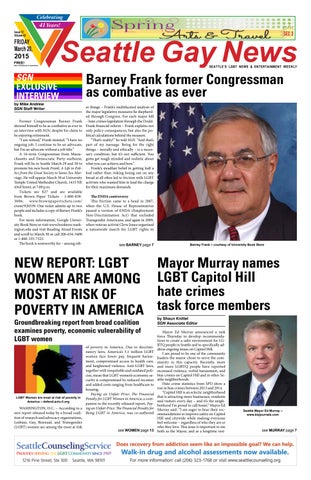
Celebrating 41 Years! Issue 12 Volume 43
FRIDAY March 20, 2015 FREE!
25¢ in bookstores & newsstands
SGN Exclusive Interview
SEC 3
Seattle Gay News
by Mike Andrew SGN Staff Writer
Former Congressman Barney Frank showed himself to be as combative as ever in an interview with SGN, despite his claim to be enjoying retirement. “I am retired,” Frank insisted. “I have no ongoing job. I continue to be an advocate, but I’m an advocate without a job title.” A 16-term Congressman from Massachusetts and Democratic Party warhorse, Frank will be in Seattle March 29 and 30 to promote his new book Frank: A Life in Politics from the Great Society to Same-Sex Marriage. He will appear March 30 at University Temple United Methodist Church, 1415 NE 43rd Street, at 7:00 p.m. Tickets are $27 and are available from Brown Paper Tickets - 1-800-8383006; www.brownpapertickets.com/ event/920339. One ticket admits up to two people and includes a copy of Barney Frank’s book. For more information, Google University Book Store or visit www.booktore.washington.edu and visit Reading Aloud Events and scroll to March 30 or call 206-634-3400 or 1-800-335-7323. The book is noteworthy for – among oth-
SEATTLE’S LGBT NEWS & ENTERTAINMENT WEEKLY
Barney Frank former Congressman as combative as ever er things – Frank’s multifaceted analysis of the major legislative measures he shepherded through Congress. For each major bill – hate crimes legislation through the DoddFrank financial reform – Frank explains not only policy consequences, but also the political calculations behind the measure. “That’s reality!” he told SGN. “And that’s part of my message. Being for the right things – morally and ethically – is a necessary condition, but it’s not sufficient. You gotta get tough minded and realistic about what you can achieve and how.” Frank’s steadfast belief in getting half a loaf rather than risking losing out on any bread at all often led to friction with LGBT activists who wanted him to lead the charge for their maximum demands. The ENDA controversy This friction came to a head in 2007, when the U.S. House of Representatives passed a version of ENDA (Employment Non-Discrimination Act) that excluded Transgender Americans, and again in 2009, when veteran activist Cleve Jones organized a nationwide march for LGBT rights in
see Barney page 7
NEW REPORT: LGBT WOMEN ARE AMONG MOST AT RISK OF POVERTY IN AMERICA Groundbreaking report from broad coalition examines poverty, economic vulnerability of LGBT women
of poverty in America. Due to discriminatory laws, America’s 5.1 million LGBT women face lower pay, frequent harassment, compromised access to health care, and heightened violence. Anti-LGBT laws, together with inequitable and outdated policies, mean that LGBT women’s economic security is compromised by reduced incomes and added costs ranging from healthcare to housing. Paying an Unfair Price: The Financial LGBT Women are most at risk of poverty in Penalty for LGBT Women in America, a comAmerica – defend.aclu-il.org panion to the recently released report, PayWASHINGTON, D.C. – According to a ing an Unfair Price: The Financial Penalty for new report released today by a broad coali- Being LGBT in America, was co-authored tion of research and advocacy organizations, Lesbian, Gay, Bisexual, and Transgender (LGBT) women are among the most at risk see women page 13
Barney Frank – courtesy of University Book Store
Mayor Murray names LGBT Capitol Hill hate crimes task force members by Shaun Knittel SGN Associate Editor Mayor Ed Murray announced a task force Thursday to develop recommendations to create a safer environment for LGBTQ people in Seattle and to specifically address ongoing issues on Capitol Hill. I am proud to be one of the community leaders the mayor chose to serve the community in this capacity. Recently, more and more LGBTQ people have reported increased violence, verbal harassment, and bias crimes on Capitol Hill and in other Seattle neighborhoods. Hate crime statistics from SPD show a rise in bias crimes between 2013 and 2014. “Capitol Hill is an eclectic neighborhood that is attracting more businesses, residents and visitors every day – and it’s the neighborhood I’m proud to call home,” Mayor Ed Murray said. “I am eager to hear their recommendations to improve safety on Capitol Hill and citywide while making everyone feel welcome – regardless of who they are or who they love. This issue is important to me both as the Mayor, and as a longtime resi-
Seattle Mayor Ed Murray – www.bizjournals.com
see murray page 7
2 Seattle Gay News
March 20, 2015
Celebrating 41 Years!
Visit us online www.sgn.org
March 20 , 2015
Seattle Gay News 3
4 Seattle Gay News
March 20, 2015
Celebrating 41 Years!
HOW DO WE TRUST? by Michael Raitt SGN Contributing Writer Have you ever taken the time to think about how you trust? Most people don’t give it a lot of thought yet “trust” is at the top of the list of traits that people talk about when they are talking about friendships and romantic relationships. It is worthwhile to give it some thought. To begin with, most people generally approach trust in one of two ways. The first group of people come into relationships already trusting the other. They generally see people as good and the idea that another is unkind, not truthful, or is out to hurt or use them doesn’t enter their minds. Trust is given. For this first group, if negative interactions happen in a relationship, they become less trusting. It is as if their trust in the other is being worn away. The second group of people is the opposite; they tend to be wary and trust in another has to be earned. These people come to relationships where they become more trusting as they can see over time that the other isn’t going to hurt them or use them. This second style of trusting is the approach where trust has to be earned. Neither of these approaches is right nor wrong. They are what they are and when you are aware of which you tend to most, you can more closely look at relationship dynamics that occur around trust. In addition to whether we give trust or trust has to be earned, we generally have criteria that we look for that makes us experience trust or not. Some people look for consistency in words and actions to feeling trusting. When these people start to experience inconsistencies they begin to question the trust in the relationship.
Visit us online www.sgn.org
Trust & Love – blog.udn.com
Other people look for the ways in which they feel connected to the other to feel trust. For example, if these people have a lot of things in common with the other and they spend a lot of time together, they feel more secure and trusting. Another group of people are actually provocative in the way in which they do trust. These are people who antagonize others into a conflict and when the other finally expresses enough frustration, the antagonist feels they can trust what the other is saying. All that I have talked about so far is about how we create trust between ourselves and others. This is the most common way in which we look at trust. You often hear it when people are saying things such as, “I don’t trust him” or “She isn’t trustworthy.” That is about the trust between two
people. Surprisingly, most people don’t think about trusting themselves. The number of people who break their own word or go against their own values is eye-opening. When I work with couples where there has been infidelity, I always ask, “How much do you trust yourself?” If you can’t trust your own commitments and actions, how can you build trust with another? Take some time to reflect upon how you do trust and whether you can actually trust yourself. Look at how your style works with the style of your spouse or friends.
March 20 , 2015
Seattle Gay News 5
Michael Raitt, MA, LMHC, is a therapist and a contributing writer to the SGN. If you would like to comment on this column, ask a question you’d like him to write about, or suggest another topic of interest, please contact him at Michael.Raitt@comcast.net.
Space Needle workers take fight to corporate offices by Mike Andrew SGN Staff Writer Chants of “What do we want? Raises! When do we want them? Now!” echoed off the Space Needle as 100 workers at the iconic landmark rallied with community supporters to demand that management negotiate a fair contract with them. Space Needle workers have been working without a contract – and without raises – for more than 1,000 days, they said. Ingersoll Gender Center founder and co-chair Marsha Botzer emceed a brief rally at the foot of the Space Needle. “I’ve loved this building since I watched it being built,” she recalled. “But now they’ve denied their workers a contract, fair wages, and basic respect.” Erik Van Rossum, now president of UNITE HERE Local 8, the union representing the Space Needle’s employees, echoed Botzer, remembering his own stint as a busser at the Space Needle 24 years ago. “When I worked here, the Space Needle stood for something good,” he said. “It stood for good wages, dignity, and respect.” In the past three years, Van Rossum added, Space Needle management has abused its workers and tarnished its image. The NLRB (National Labor Relations Board), the federal agency charged with enforcing labor laws, backed up Van Rossum. In January, the agency found Space Needle management guilty of 64 separate unfair labor practices including retaliatory firing of union supporters and intimidation of em-
ployees. Seattle City Council members Nick Licata and Kshama Sawant also spoke, as did Space Needle workers, including Veronica Chernichenko, who now supports her par-
corporate headquarters, where Washington State Labor Council President Jeff Johnson demanded to meet with CEO Ron Severt to present a petition from Space Needle workers and their allies.
Courtesy of The Stand (an online publication of the Washington State Labor Council)
ents and 10 siblings because her father is too sick to work. “It’s heartbreaking to know that the struggles I’m facing wouldn’t be such a struggle if we got the raises we deserve,” she said. “Without the dedicated staff it has, the Space Needle would not be the icon that it is today.” CEO refuses to meet with workers When the rally concluded, the group marched two blocks to the Space Needle
In-
stead, Johnson was met by Space Needle PR director Dave Mandapat, who handed out a prepared statement announcing that management was not open to “drop-in meetings” with their workers. “Courageous and inspirational Space Needle workers, members of UNITE HERE Local 8, spoke up passionately for a raise at the Space Needle corporate headquarters yesterday after a rally in front of the Needle,” Johnson said in a subsequent statement.
“The intended audience was Space Needle CEO Ron Sevart. But of course, we were told he was unavailable, and so the petitions and letters from the community were given to the Director of Public Relations Dave Mandapat. If Mr. Mandapat was listening, he heard a group of workers who have great pride in the work they do for the Needle and workers who want and deserve to be respected for their skill and commitment they bring to the job every day, despite being undervalued.” Licata letter Two years ago the Seattle City Council sent a letter to Space Needle management urging them to settle the dispute with their workers through mediation, and Council member Nick Licata has written a second letter to Severt expressing disappointment at management’s stalling tactics. “I am disappointed to see that today, even in the face of a National Labor Relations Board (NLRB) ruling in your employees’ favor, you choose to extend the dispute,” Licata said in the March 18 letter. “I believe pickets, demonstrations, and news reports that a prominent Seattle tourist attraction is fighting fair treatment of its workers…reflect poorly on the City of Seattle, and on your business… “I encourage the Space Needle to drop its appeal of the NLRB ruling and to restore my and your employees’ pride, faith and trust in the Space Needle Corporation.”
Patty Murray sponsors two pro-LGBT bills – Would equalize Social Security benefits and prevent bullying by Mike Andrew SGN Staff Writer Washington Senator Patty Murray is sponsoring two bills that will benefit LGBT Americans – one to equalize Social Security benefits, and one to combat bullying at colleges and universities. The SAME (Social Security and Marriage Equality) Act was announced on March 17, with Senator Tammy Baldwin (D-WI) – the U.S. Senate’s first out Lesbian – and Rep. Ron Kind (D-WI) working with Murray as primary sponsors of the bill. The Tyler Clementi Higher Education Anti-Harassment Act was introduced the next day. Baldwin and openly Gay Rep. Mark Pocan (D-WI) worked with Murray on this measure. SAME Act Unlike other federal agencies, which recognize same-sex marriages if they are legal where they are performed, the Social Security Administration (SSA) only recognizes same-sex marriages if they are legal in the state where the couple resides. That means that legally married Gay and Lesbian couples may still miss out on some benefits they would enjoy if they were opposite-sex couples. The SAME Act would amend Title II of the Social Security Act to: • Confer spousal benefits to any individual legally married in United States. • Eliminate the requirement that the spouse reside in a state that recognizes same-sex marriage to be eligible for Social Security benefits. • Ensure spouses legally married outside the United States are eligible for Social Security benefits. Among the benefits at stake are survivor benefits for spouses of deceased wage-
6 Seattle Gay News
earners, and enhanced retirement benefits in cases where one of the spouses earned substantially more than the other. “All legally married same-sex couples deserve equal treatment under the law, regardless of their zip code,” Murray said in a statement. “Where you live should not determine whether your family is economically secure following the death of a spouse, and it shouldn’t prevent your family from receiving the benefits you have earned. The SAME Act would help ensure equality under federal law does not end at state lines.” Currently 55 lawsuits challenging the SSA’s approach to marriage are pending in federal court, including six involving the marriage laws of Kentucky, Michigan, Ohio, and Tennessee, which will be heard by the U.S. Supreme Court on April 28. “For the last six months, all Wisconsinites have fully enjoyed the benefit of marriage equality. Unfortunately legally married same-sex couples in Wisconsin face uncertainty if moving to a state where their marriage is not recognized,” Baldwin said. “The SAME Act will provide fairness and equality for legally married same-sex couples under the Social Security Act, regardless of where they live. While I am hopeful the Supreme Court will soon remove the necessity of such measures, I am proud to join this effort to build on our nation’s founding belief that all Americans are created free and equal under the law.” The bill has received support from HRC, Social Security Works, the National LGBTQ Task Force Action Fund, Services and Advocacy for GLBT Elders (SAGE), National Committee to Preserve Social Security and Medicare, OWL-The Voice of Women 40+, the Pride Foundation, and the GSBA.
March 20, 2015
The Tyler Clementi Act The legislation is named after Tyler Clementi, a freshman at Rutgers University who threw himself off the George Washington Bridge after his roommate and another student invaded his privacy and harassed him over the Internet. LGBT students are nearly twice as likely as their peers to experience harassment and are far more likely to be harassed based on their sexual orientation or gender identity. However, there is currently no requirement that colleges and universities have policies in place that protect their students and employees from harassment that occurs via electronic communications, or harassment that is based on sexual orientation, gender identity, or religion. The Tyler Clementi Higher Education Anti-Harassment Act requires colleges and universities that receive federal aid – and almost all U.S. colleges and universities do – to take steps to prevent bullying and harassment. • It requires colleges and universities receiving federal aid to establish an anti-harassment policy prohibiting the harassment of enrolled students based on their actual or perceived race, color, national origin, sex, disability, sexual orientation, gender identity, or religion. • It also requires colleges to distribute their anti-harassment policy to all students and employees, including prospective students and employees upon request. • It recognizes “cyberbullying,” which includes harassment undertaken through electronic messaging services, commercial mobile services, and other electronic communications. • It authorizes a competitive grant program for institutions of higher education to initiate, expand, or improve programs to: (a) prevent the harassment of students; (b) provide counseling or redress services
to students who have been harassed or accused of subjecting other students to harassment; and (c) train students, faculty, or staff to prevent harassment or address harassment if it occurs. “All students deserve the chance to further their education, without the fear of harassment and bullying,” Murray said. “LGBT students are more likely to be harassed in school, yet there is no federal requirement for colleges and universities to protect their students from discrimination based on sexual orientation or gender identity. I am proud that this bill would take meaningful steps to provide schools and students with tools to prevent harassment and protect survivors. By honoring Tyler’s life with this legislation, we can work to prevent the bullying that far too many students are forced to endure.” “No student should have to live in fear of being who they are. Our schools should not be, and cannot be a place of discrimination, harassment, bullying, intimidation or violence. This legislation is an important step forward in not only preventing harassment on campus, but also making sure our students have the freedom to succeed in safe and healthy communities of learning and achievement,” Baldwin added. “Everyone deserves a fair shot at our colleges and universities across America and this legislation will help ensure people can pursue their dreams free of harassment and bullying.” The measure has received support from the HRC, the Anti-Defamation League, the National Women’s Law Center, the American Association for University Women, GLSEN, the American Foundation for Suicide Prevention, the National LGBTQ Task Force Action, and the Pride Foundation. Murray and Baldwin introduced similar legislation in 2014, but it did advance to a vote in the Senate.
Celebrating 41 Years!
murray
continued from cover
Mayor Ed Murray hopes the hate crimes task force will bring Capitol Hill’s LGBT community into view – wanderlustandlipstick.com
dent of Capitol Hill.” According to the mayor’s office, the Task Force will look at how the City of Seattle can constructively work with community members, businesses and organizations to increase safety and LGBT visibility in Capitol Hill and citywide – as well as to honor the history of the neighborhood. As the president and founder of SOSea, an organization that has worked closely with SPD officials and other community leaders to keep people safe since December 2012, I think our biggest challenge is visibility. The LGBTQ community on Capitol Hill must become more visible than we ever have been before. We are not going to just give the Hill over to crime. We are not going to just walk away and allow for people who wish to do us harm to have their way. No, Seattle’s LGBTQ neighborhood is something to cherish and to respect and nurture. If the Hill is “less Gay” it is because we made it that way by allowing for intimidation and fear to cower until danger passes. Not anymore.
barney
continued from cover
“Frank: A Life in Politics from the Great Society to Same-Sex Marriage’ by Barney Frank (FSG) – www.washingtonpost.com
Washington, DC. Frank’s book still reflects bitterness over accusations by Trans activists and their allies that Frank sold them out by cutting them out of the 2007 ENDA bill. “I’m still very offended,” Frank told SGN. “Not that they disagreed with me over political strategy. I’m very offended that they blamed Nancy Pelosi and me for doing this willfully, and not because of the reality of the political situation. “Their refusal to be realistic – the idea that you could just demand things and expect that to happen because it was right – that was not helpful. Not once did they lobby Congress members, they just demanded.” Since then, Frank added, Trans leaders “have done a much better job,” and “now
The Task Force will be made up of the following people: Louise Chernin, GSBA; Michael Wells, Capitol Hill Chamber; Marxa Marnia, LGBT Commission Co-chair; John Bailey, Amazon; Kelly Stonelake, Facebook Creative Shop; Raven E. Heavy Runner, Northwest Two-Spirit Society Acting Co-Chair; Luzviminda “Lulu” Carpenter, LGBT Commission; Kris Hermanns, Pride Foundation; Brady Walkinshaw, Legislative Representative, 43rd District; Elayne Wylie, Gender Justice League; Shelley Brothers, Wildrose; Kristen Wieliczka, Director of Civic Engagement for Seattle University Student Body; Mineth Elman McClain, Director, Public Safety, Seattle Central Community College; Josh Castle, Community Organizer; Jim Ritter, Seattle Police Department; Michael Renner, Seattle Police Department; Sina Ebinger, Seattle Police Department; Jared Brayton Bollenbacher, Social Worker; Marcos Martinez, Entre Hermanos; Jesse Gilliam, Ingersoll Gender Center; Council Staff Shannon Perez-Darby; Northwest Network of LGBT Survivors of Abuse; Monisha Harrell, Equal Rights Washington; Lauren Mathisen, Capitol Hill Community Council; Danni Askini, Gender Justice League; Rodney Jarreau Greene, Quare Arts Program; Darrell Goodwin, Dean of Students at Seattle University; Melinda Giovengo, Youthcare; Shaun Knittel, Seattle Gay News, Social Outreach Seattle Co-Chairs are Josh Castle and Monisha Harrell. “The group we have assembled has a proven track record of success,” Mayor Ed Murray said. “We have not seen a coalition like this since the marriage equality campaigns. Clearly our work was not finished when we won in November 2012. There are still people in this world who believe LGBT people should be denied the most basic human right, the right to live without fear of violence because of who you are or who you love.”
we’re in a position where – if Democrats would regain control of Congress – we’d have the votes to pass a Trans-inclusive ENDA.” While the non-Trans ENDA passed the House in 2007, it was blocked by Republicans in the Senate. In 2009, Frank introduced a Trans-inclusive ENDA, but it failed to get to the House floor for a vote. The Senate passed a Trans-inclusive ENDA in 2013, but control of the House had by then shifted to Republicans who did not bring the bill up for a vote. Disagreements on ENDA within the Democratic Congressional caucus led to clashes between Frank and his Lesbian colleague then Representative and now Senator Tammy Baldwin. That rift healed fairly quickly, Frank said, with the two working closely together to repeal DADT in 2010. The 2009 National Equality March on Washington In 2009, with President Obama newly sworn in and Democratic majorities in both houses of Congress, many activists believed that the time had come for comprehensive LGBT civil rights legislation. Cleve Jones, once a protégé of Harvey Milk, organized what he called the National Equality March on Washington to demand action. Frank, on the other hand, brushed off the effort. “The only thing they’ll put pressure on,” he said at the time, “is the grass on the National Mall.” Speaking with SGN, Frank repeated his criticism of the march. “That march accomplished zero!” he insisted. “Better off to have done mass voter registration. Their method was not very productive. “What do they think a march helps? Most Congressmen are sitting in their offices. They don’t even see the march. They don’t see the connection between some march and legislation.”
Visit us online www.sgn.org
The civil rights marches of the Sixties were in a different category, Frank continued, because African Americans for the most part had no voting rights and could not influence lawmakers by lobbying. “Martin Luther King understood politics much better than Cleve Jones ever did,” Frank stated flatly. “In the first place, it was the South. Black people had no right to vote. Once the Voting Rights Act was passed, the emphasis was on voter registration. “In Ferguson – and that’s a very complex situation, it’s not as clear cut as some people think – in Ferguson the really constructive thing has been a mass campaign for Black voter registration.” Congress Frank also showed no love for the Republican Congressional leadership, ushered in in 2010. While he believes Nancy Pelosi was one of the greatest and most effective Speakers of the House, he labeled the current House leadership as “the most rigid and extremist faction since probably the Civil War.” “The new Congress is not moving at all,” Frank complained. “The problem is it’s controlled by an extreme right-wing group that does not believe in government. They’re happy when they get an opportunity to shut the government down.” Asked if he was glad to be out of Congress under Republican leadership, Frank chuckled, “I’m actually very good at rancor.” “But I’ll be 75 in a few weeks,” he continued. “I’m tired. And you know what, it’s true what they say. Stress sucks.”
strategy. “What we [Democrats] need to do morally and politically,” Frank explained, “is concentrate on white working class men, people who feel they’ve been disregarded and left behind. “The problem is, we don’t have the resources to do it effectively. That’s why I’m advocating for two things – cutting the military budget and legalizing drugs that don’t lead you to cause harm to others. “You could save $80-$100 billion on the military budget and $40-$50 billion on drug enforcement, and use it to finance things [white working class men] need. Access to higher education. Compensation for medical expenses. Investments in infrastructure that create jobs.”
The future of the Democratic Party Frank says he thinks Republicans will hold on to the House in 2016, but that Democrats will win back control of the Senate and retain the presidency. But he is touting a major revision of Democratic Party
Cutting the military budget Frank expressed “major frustration” with the size of the U.S. military budget and the reluctance of his former Congressional colleagues to whittle it down to a reasonable size. The military should not be seen as a cure-all for international problems, he warned. “We have the best military in the world,” Frank said, “and they’re very good at doing what a military can do. That is to stop bad things from happening. But they can’t make good things happen. They can’t fix everything in the world.” Frank said he worried about the U.S. getting further involved in conflicts in the Middle East. He opposed the recent visit of Israeli Prime Minister Benjamin Netanyahu, he explained, because he believes Netanyahu wants to implicate the U.S. in a war with Iran. “I implored my colleagues to boycott Netanyahu’s speech,” he told SGN. “What he really wants, and what the people who invited him really want – they want to go to war with Iran. And that will be even bigger than the invasion of Iraq or Afghanistan.”
March 20 , 2015
Seattle Gay News 7
Hate crimes on Capitol Hill To the Editor: The rise in hate crimes against Lesbian, Gay, Bisexual, and Transgendered people on Capitol Hill sparked a forum on March 3 led by City Council member Kshama Sawant. Many incidents were reported and some ideas emerged. There is one action that the City could take that is practical, within the City’s power, is relatively inexpensive, and is hugely effective. This is Visibility. If we make the LGBTQ character and culture of Capitol Hill visibly and concretely real, we not only boost the confidence and security of the LGBTQ residents, but we also send a strong message that our people will not be displaced, submerged, or forced back into the closet here in our own neighborhood. Here are concrete examples of that visibility: 1. Erect a flagpole in Cal Anderson Park where the Rainbow flag will fly proudly 247, 365 days of the year. This suggestion was first put forth by Social Outreach Seattle. Many businesses on Capitol Hill display our flag during Pride Month and a good number of them keep the flags up all summer long. In fact, Anytime Gym on 17th still has our flag up since last year. A flag is more
than a colorful cloth. It is a claim on a piece of territory. It is a visible sign that Capitol Hill is a “home” for LGBTQ people. 2. Paint the crosswalks at Pike & Broadway and John & Broadway in rainbow colors. This is another idea that was put forward in the Seattle Gay News, and the City Transportation Department, in my understanding, has approved the concept and it was just a matter of funding. 3. Post supplemental street signs on Pike, Pine, Broadway, and 11th. These are brown and white signs that are mounted on the regular street sign poles just under the green and white street identifiers. The City posted just such signs on 19th between Madison and Union that identify that stretch as “Rev. McKinney Avenue” after the pastor of Mt. Zion Baptist Church which is located near the corner of Madison and 19th. If the City can do that for a pastor, the City can certainly do that for an entire community. For example, Pike from Boren to Madison could be sub-named Gay Street. Pine from Boren to Madison could be sub-named Lesbian Street. 11th Avenue from Madison to Pine could be sub-named Transgender Street. Broadway from Pike to John could be sub-named Bisexual Avenue. This is not window dressing. This is a clear, tangible, physical symbol that says to everybody: “LGBTQ people belong here and are welcome here.” 4. Make the Sound Transit Link Light
Rail Station at Broadway and John reflect the LGBTQ character of Capitol Hill. A few years ago, Sound Transit convened a community forum to roll out their decision for decorating the new station. Their decision was to install cut up warplanes! They claimed it would symbolize peace and Seattle’s aerospace history. We loudly protested. Capitol Hill is not about the military-industrial complex! Capitol Hill is not about Boeing! Other Light Rail stations in the Rainier Valley make an effort to reflect the racial diversity there. Why is the LGBTQ community deliberately snubbed here? We were flatly ignored. Now the station is nearing completion. Of all the dismissive insults that the City could throw at the LGBTQ community, this one is the top. Can City Hall still do something to correct this situation? 5. An LGBTQ Community Center was already tried once and it failed. I was on the founding board and a major donor to the center. It failed for many reasons but I think that the underlying reason was that it was set up with a lot of fanfare by the City and some community leaders and then ignored to run on its own. It was not organic from our LGBTQ community and it did not have a business model. In the years since then, Gay City has emerged as a viable community center which houses several of our community organizations, an LGBTQ library, and serves as a gathering place. It is
not the total answer, but it is doing valuable work. GSBA has established a storefront on Broadway as well. A number of community organizations, like GSBA and Lifelong, have floated the idea of having a space on the block when Sound Transit finishes their station at Broadway and John. Given our past experience, I don’t think the City can give us an LGBTQ center. It has to grow organically from the community and have a solid business plan if it is going to be sustainable. What the City can do is smooth out the paperwork and zoning if such a center happens to arise. 6. Rent control is a bedrock economic policy that would help prevent lower income people of all sexual orientations and gender identities from being displaced from Capitol Hill. While that may be a long way off, the Seattle Housing Authority does maintain a series of housing establishments on Capitol Hill for lower income people. Two things the City can do is 1) ensure that SHA has strongly positive policies for LGBTQ residents and that they are enforced vigorously and 2) expand the number of properties that SHA manages on Capitol Hill. It also would not hurt if all SHA facilities proudly displayed Rainbow flags during Pride month. After all, the YMCA does. Janice Van Cleve Seattle
Our answer to hate crimes; practical solutions now by Mac S. McGregor SOSea Transgender/Gender NonConforming Outreach Director I learned about the importance of selfdefense as a small child when I watched my mother be physically abused by her second husband. I know the fear first hand of what it’s like to be defenseless. I was too small to do anything. And perhaps it was in that moment that I dedicated my life to empowering others, so that they would never have to live a life of fear. I began my martial arts training when I was six years old. No one should have to feel defenseless. I have trained forty-three years in the martial arts and have a fourth degree black belt or above in seventeen of the arts. From world champion to certified law enforcement defensive tactics instructor to bodyguard for the rich and famous such as Diana Ross and Amy Grant; my knowledge is vast and I want to offer it to you. Why? There has been a rise in crime specifically against the LGBTQ Community and the areas in our city where the LGBTQ community socializes and receives important social services. This affects everybody, not just Gay people. Capitol Hill is a trendy and enticing part of our city; and attracts visitors from all parts of Washington state. We all need to care about this. And our Mayor and some city council members have talked about long-term solutions for this problem such as the need for an LGBTQ Shelter and more affordable housing. These are important long-term solutions; but we have an immediate problem and Social Outreach Seattle (SOSea) has been working on this since 2012. We are now committed to ramping up these efforts, while the longer-term solutions are in the works.
8 Seattle Gay News
How could we stand by and wait; when ramping up our efforts to empower individuals could create change right now. Each time we train and support one person, we are supporting our defending our community from bullies, haters, and thieves. We can do this; we’ve done it before! The LGBTQ Community and its Allies came together to pass the Marriage Equality Bill in 2012. We learned that coalition building and reaching out to others for help works. We can do it again. This time, let’s
soon about how to access this shuttle at our website www.SocialOutreachSeattle.com. And, of course, we all know that safety starts with each individual and training. As a board member/director, and with my years of professional knowledge, I have committed to the Founder and President of SOSea, the visionary Shaun Knittel, to create and teach a monthly training at the newly created SOSea Self Defense Academy for the citizens of Seattle. Not only that; we are doing it on a donation basis, so that
Anyone and everyone is capable of self-defense – lifehacker.com
come together to make our city safe. We are a community that takes care of one another; and we have a plan. It starts with a donated van that is now available to help transport people who are concerned about their safety in Capitol Hill. This van is dedicated to making sure that you can arrive safely within the Capitol Hill area. It is called the SOSea Safety Shuttle and more information will be coming out
March 20, 2015
this training is accessible to everyone. We are welcoming mothers, teenagers, all genders and sexual orientations, anyone who lives in fear of haters or feels vulnerable for any reason. It doesn’t matter if you are in a wheelchair or have a physical disability. Everyone is welcome; because we care about everybody’s safety. Our next class is scheduled for April 7, from 6 to 9 p.m. at Neighbour’s Nightclub
at 1509 Broadway in Capitol Hill. No preregistration is required. Just come. Not only will you learn skills to protect yourself; this class is held in a safe, supportive and fun environment. You will laugh, move, make new friends and leave feeling empowered. Statistically, criminals choose their victims by taking the path of least resistance. Let my knowledge help you. The most frustrating thing to a good self-defense teacher is that most people wait until something happens to them or someone in their inner circle until they are motivated to take a class and learn something about self-protection. So until, you can get to class, here are some simple safety tips that you can start using now. McGregor’s Tips For Not Being a Victim of Crime: We can’t always depend on law enforcement to protect us everywhere, all of the time. We have to take some responsibility as individuals and as a community for our own safety. • Pay attention to your surroundings. • Don’t walk with headphone in both ears. • As much fun as talking while you’re walking is; don’t. • Don’t walk alone. Criminals like their prey to be isolated. • Walk like you mean it; confidence counts (head up, shoulders back, brisk steps). • Your phone, wallet, laptop is not worth your life and not worth risking your life for. • Do not go off alone with anyone you and your friends don’t know.
Celebrating 41 Years!
Visit us online www.sgn.org
March 20 , 2015
Seattle Gay News 9
10
Seattle Gay News
March 20, 2015
Celebrating 41 Years!
Visit us online www.sgn.org
March 20 , 2015
Seattle Gay News 11
MoSS Alley MotorS, Inc. SpecialiStS in VolVo, Honda, toyota and Subaru
932 12th ave. Seattle, Wa 98122 (206).325--.3992 www.mossalley.com Seattle’s most progressive auto shop!
12
Seattle Gay News
March 20, 2015
Celebrating 41 Years!
women
continued from cover
by the Movement Advancement Project (MAP) and the Center for American Progress (CAP), in partnership with 9to5, A Better Balance, Center for Community Change, Center for Popular Democracy, Family Values @ Work, Forward Together, Legal Momentum, National Asian Pacific American Women’s Forum, National Association of Social Workers, National Center for Transgender Equality, National Education Association, National LGBTQ Task Force, National Partnership for Women & Families, National Women’s Law Center, Re:Gender, Transgender Law Center, and UltraViolet. The report is available online at www. lgbtmap.org/unfair-price-lgbt-women. Among its major findings: LGBT WOMEN ARE DIVERSE, RAISING CHILDREN “LGBT women face added challenges not solely because of their gender, but also because of who they are and whom they love. Discrimination and stigma, combined with the struggles faced by all women, make LGBT women and their families especially vulnerable,” said Ineke Mushovic, Executive Director of the Movement Advancement Project. “Making matters worse, the burden falls most acutely on those who can least afford it: LGBT women raising children, older LGBT women, LGBT women of color, LGBT immigrants, and those LGBT women and families who are already living near or below the poverty line.” 4.1% of U.S. adult women identify as LGBT. There are an estimated 5.1 million LGBT adult women in the United States including approximately 350,000 Transgender women. Of adults ages 18-44, 6.7% of women identify as LGBT compared to 4.5% of men. Two-thirds of LGB women identify as Bisexual. Large numbers of LGBT women are raising children. A Gallup survey found nearly half (48%) of LGBT women under 50 years of age were raising children, with higher rates of childrearing for African American, Hispanic, and Asian LGBT women compared to white LGBT women. Also, more than half of Transgender women surveyed in the National Transgender Discrimination Survey, the largest survey of Transgender people to date, were parents (52%). LGBT women are diverse. People of color are more likely to identify as LGBT than are white people. According to a 2012 Gallup survey, 4.6% of African Americans iden-
tified as LGBT, as did 4.0% of Hispanics and 4.3% of Asian Americans. The comparable figure for white respondents was 3.2%. LGBT WOMEN ARE MORE LIKELY TO LIVE IN POVERTY LGBT women are more likely to live in poverty. Almost 30% of Bisexual women and 23% of Lesbian women live in poverty compared to 21% of heterosexual women. Only 29% of LGBT women say they are thriving financially compared to 39% of non-LGBT women. Transgender women are nearly four times as likely to have year incomes of $10,000 or less compared to the general population. LGBT women of color, older LGBT women and LGBT women raising children are particularly vulnerable. African American and Latina women in same-sex couples are three and two times more likely, respectively, to be poor than white women in same-sex couples. Older women (ages 65 and above) in same-sex couples have nearly twice the poverty rate of older married opposite-sex couples. Fifteen percent of female same-sex couples raising children are in poverty, compared to 9% of married opposite-sex couples with children. LGBT WOMEN CONFRONT BURDENS FROM STIGMA AND DISCRIMINATION The economic disparities experienced by LGBT women result from the stigma, the discrimination, and the legal disadvantages they experience because they are women and because they are LGBT. Paying an Unfair Price: LGBT Women Left the Most Vulnerable spotlights how LGBT women face unique challenges in three major areas that dramatically increase economic insecurity and poverty rates: JOBS: LGBT women struggle to find and keep good jobs. LGBT women face discrimination when looking for work and while on the job. The result is lower pay and fewer opportunities to advance. Workplaces also may be unwelcoming, hostile, or even physically unsafe. Transgender women face added challenges because they often cannot obtain accurate identity documents necessary for work. HEALTH: LGBT women face challenges to good health that impact economic security. Healthcare can be more costly for LGBT women because of discriminatory laws, discrimination by providers, insurance exclusions for Transgender people, and inadequate reproductive health coverage. The result: LGBT women are at greater risk for
LGBT women are more likely to live in poverty – crustwich.tumblr.com
health problems that can affect quality of life CO-AUTHORS and threaten their ability to work, and they Founded in 2006, the Movement Adoften must pay higher costs for healthcare. vancement Project is an independent think tank that provides rigorous research, insight FAMILY RECOGNITION: Lack of sup- and analysis that help speed equality for Lesport for LGBT women and their families re- bian, Gay, Bisexual and Transgender people. sults in higher costs. In many states, LGBT Learn more at www.lgbtmap.org women still are not able to legally marry The Center for American Progress is a their partner or establish legal ties to their nonpartisan research and educational inchildren. This means LGBT women may not stitute dedicated to promoting a strong, just be able to access affordable health insurance, and free America that ensures opportunity safety net programs meant to keep families for all. We believe that Americans are bound out of poverty, and job-protected leave to together by a common commitment to these care for a sick partner. What’s more, like all values and we aspire to ensure that our nawomen in the United States, LGBT women tional policies reflect these values. We work often are forced by law to make difficult and to find progressive and pragmatic solutions costly choices that can threaten their fam- to significant domestic and international ily’s economic security. The United States, problems and develop policy proposals that for example, is the only developed country foster a government that is “of the people, by that does not offer paid parental leave. the people, and for the people.” www.americanprogress.org “Even at a time when the public is showing increased understanding and acceptance PARTNERS of LGBT people and their relationships, the 9to5 – www.9to5.org; A Better Balunique concerns and struggles of LGBT ance – www.abetterbalance.org; Center for women are largely absent in the national Community Change – www.communiconversation, said Laura E. Durso, Director tychange.org; Center for Popular DemocLGBT Progress at the Center for American racy – www.populardemocracy.org; Family Progress at CAP. “Women who are LGBT Values @ Work – www.familyvaluesatwork. have the same concerns as other women, but org; Forward Together – http://forwardthey face added challenges and worries not together.org/; Legal Momentum – www. just because of their gender, but also because legalmomentum.org/; National Asian Paof who they are and whom they love.” cific American Women’s Forum – http:// “Change is needed to improve economic napawf.org/; National Association of Social security for all women – including LGBT Workers – www.socialworkers.org; National women. Laws prohibiting discrimination Center for Transgender Equality – www. against women need to be strengthened and transequality.org; National Education Asexpanded to include LGBT people,” said sociation – www.nea.org; National LGBTQ Linda Meric, National Executive Director Task Force – http://www.thetaskforce.org/; of 9to5. “Policymakers should update pro- National Partnership for Women & Famigrams designed to support families to allow lies – http://www.nationalpartnership.org/; LGBT families to access the same protec- National Women’s Law Center – www.nwlc. tions and benefits available to others, such as org/; Re:Gender – http://regender.org/; health insurance, family leave, and childcare Transgender Law Center – http://transgenassistance.” derlawcenter.org/; UltraViolet – www.weareultraviolet.org/
Trans prisoner appeals to SCOTUS for surgery by Mike Andrew SGN Staff Writer A Transgender prisoner serving a life sentence for murder has appealed to the U.S. Supreme Court to allow her to have sex-reassignment surgery. Michelle Kosilek was convicted of killing her spouse, Cheryl McCaul, in 1990 and was sentenced to life in prison. At the time of the murder, she already identified as a woman and she has been fighting to complete her transition for 20 years while in prison. Kosilek is now 65. Lawyers for GLAD (Gay and Lesbian Advocates and Defenders) filed her Supreme Court appeal, arguing that lower federal courts were mistaken in preventing her surgery. In 2002 federal Judge Mark Wolf ruled that the Massachusetts Department of Cor-
rection did not need to provide surgery for her, but did need to offer her some transitional care. State prison officials then began to provide Kosilek with hormone treatments, electrolysis, woman’s clothing, and other gender-appropriate personal items. In 2005, Kosilek sued the Department of Correction again, arguing that sex-reassignment surgery was a medical necessity. In 2012, Wolf became the first judge in the country to order sex-reassignment surgery as a remedy for an inmate’s genderidentity disorder. Courts in other states have ordered hormone treatments, psychotherapy, and other treatments, but never surgery. Wolf agreed with Kosilek’s lawyers that the Department of Correction had violated the cruel and unusual punishment clause of the Eighth Amendment by failing to provide her with all necessary medical care. A three-judge panel of the First U.S. Circuit Court of Appeals upheld Wolf ’s ruling,
Visit us online www.sgn.org
but the state appealed, asking for an en banc hearing at the First Circuit. Prison officials said they could not guarantee Kosilek protection from possible sexual assault if she completed her transition in an all-male prison. In December last year, the First Circuit reversed Wolf ’s ruling by a 3-2 vote, denying Kosilek her surgery. GLAD attorneys argue that the appeals court overstepped its bounds and essentially re-tried the case. “Their role is to defer to the trial judge on issues of fact,” said Jennifer Levi, director of the Transgender Rights Project of GLAD. “The meaning of the Eighth Amendment is only as rich as its application, so those words that require prisons to provide adequate medical care are hollow if you have a district judge that makes the kind of careful fact findings that Judge Wolf did who is then reversed on appeal without a demonstration of the error in his facts,” Levi added.
Kosilek’s lawyers also argue that the Eighth Amendment prohibits prison officials from denying necessary medical treatment to an inmate for non-medical reasons, including security concerns. The case has not yet been put on the conference docket for Supreme Court justices to discuss whether they wish to accept the appeal. The high court usually gets more than 7,500 appeals per term, and reviews only about 75 of them.
March 20 , 2015
Seattle Gay News 13
Michelle Kosilek – www.lgbtqnation.com
“Add the four words” Love thy neighbor? For Archbishop Cordileone and the Archdiocese protest at Idaho capitol of San Francisco, not so much for LGBT people against discrimination in employment, housing, public accommodations, or credit. A bill to add sexual orientation and gender identity to the list of prohibited grounds for discrimination was voted down in an Idaho House committee in January. At that time, police arrested 23 protestors who invaded the legislaAdd the Words protesting in Idaho – photo by Adam Eschbach/IPT tive chambers and by Mike Andrew briefly shut down the state’s House and Senate. SGN Staff Writer In February, another 43 were arrested LGBT rights activists staged three dif- when LGBT activists blockaded the enferent protests March 16 at the Idaho state trance to the Idaho Senate chamber. Both chambers are controlled by Repubcapitol building in Boise. State police made 25 arrests, including licans. In 2014, Add the Words organized six six demonstrators who were arrested, released, and then re-arrested at a subsequent protests blockading the legislature and the office of Idaho Governor Butch Otter, resultprotest. The demonstrators were demanding that ing in scores of arrests. While the state government has not lawmakers add the words “sexual orientation” and “gender identity” to Idaho’s anti- moved on the issue, eleven Idaho cities have added LGBT protections to their ordinances discrimination laws. The protests were organized by Add the including Boise, Coeur d’Alene, Driggs, Words Idaho, an activist group formed by Idaho Falls, Ketchum, Lewiston, Moscow, former Idaho Senator Nicole LeFavour and Meridian, Pocatello, Sandpoint, and Victor. Twin Falls protects for sexual orientation others in 2010. While same-sex sexual activity is legal in but not gender identity. Idaho, and same-sex marriage has been legal since a federal court order in October 2014, there are still no state-wide legal protections
St. Mary’s Cathedral, San Francisco – Roi Brooks/iStock
WASHINGTON – In response to the use of water sprinklers by the Archdiocese of San Francisco to deter homeless people from seeking refuge in entrance portals of St. Mary’s Cathedral, the Human Rights Campaign issued the following statement from Lisbeth Melendez Rivera, Director of Latino/a and Catholic Initiatives for HRC Foundation’s Religion and Faith Program: “It is difficult to comprehend just how far the hierarchy of the Catholic Church in San Francisco has strayed from the basis of our faith. Compassion, working tirelessly for economic justice, and serving the marginalized are traditions that are at risk under San Francisco’s Catholic leadership. “The latest example of the archdiocese’s disregard for human dignity? It installed a timed sprinkler system at four entrances to St. Mary’s Cathedral to drench homeless people taking refuge there. In a statement issued by the archdiocese following news
reports critical of the sprinklers, church officials said the system was intended to, quite literally, flush out debris. “One can draw a line between these shameful actions toward homeless people looking for a peaceful place to rest, and efforts by the archdiocese to flush out from its midst teachers, administrators and students who do not pass the “Catholicity” litmus test being imposed at archdiocesan high schools. Are LGBT people, single mothers, divorced individuals, and those desperately seeking parenthood also debris in the eyes of the archdiocese? “It doesn’t matter how many times Archbishop Cordileone feeds the hungry if, with his aggressive tactics, he physically, psychologically and spiritually starves those seeking both physical shelter and spiritual affirmation from the church.” ... Courtesy of the Human Rights Campaign
Alabama drama
Federal judge won’t back down, orders state judge to comply with marriage orders 100 businesses pledge no discrimination
The federal judge who struck down Alabama’s same-sex marriage ban has refused to back down in the face of a state Supreme Court decision on the subject. In a March 16 ruling, U.S. District Judge Callie “Ginny” Granade said her order instructing Mobile County Probate Judge Don Davis to issue marriage licenses to Gay and Lesbian couples remains in effect. Meanwhile more than 100 Alabama businesses joined HRC’s “Equality Is Our Business Program,” pledging not to discriminate in hiring against LGBT applicants. Probate Judge Davis – whose duties include issuing marriage licenses for Mobile County – asked Judge Granade to stay her original order requiring him to issue licenses to same-sex couples, after Alabama’s State Supreme Court issued an order contravening the federal court. Granade turned him down flat. “Although the court would agree that the developments in these same-sex marriage cases has at times seemed dizzying, the court finds that Judge Davis has not shown that a stay is warranted,” she wrote in her March 16 ruling. Davis had failed to meet two key requirements for a stay, Granade decided – that he would be irreparably harmed if same-sex marriages went forward, and that he was likely to win the case in the end. “In the instant case, Judge Davis has not argued, much less shown that he is likely to succeed on the merits. This court has found that Alabama’s marriage sanctity laws
violate the Plaintiffs’ [same-sex couples] county probate judges, Davis simply closed rights under the Due Process Clause and his office rather than issue licenses to Gay Equal Protection Clause of the Fourteenth and Lesbian applicants. Granade then issued a specific order to Amendment to the United States ConstituDavis prohibiting him from enforcing the tion,” Grenade wrote. s t a t e’s “ T h i s same-sex court’s conmarriage clusion ban, and agrees with he imthe overmediately whelming re-opened consensus of the marcourts across riage lithe country cense ofthat have fice. addressed Then the constituthe Alationality of b a m a similar state Supreme laws” since Court got the U.S. into the Supreme act, ruling Court’s 2013 on March Windsor de3 that cision strikstate law ing down was still in DOMA. force, and Granade first ruled that proU.S. District Judge Callie “Ginny” Granade – www.al.com bate judges in the case should not on January 23, finding that Alabama’s ban on same-sex issue same-sex marriage licenses. After that, marriage was unconstitutional. She then Davis asked Granade to stay her original stayed that ruling from taking effect until ruling, which would have meant accepting February 9 to give the state a chance to ap- the state court’s analysis. In her latest ruling, peal. When both the Eleventh U.S. Circuit she refused. Court and the U.S. Supreme Court refused Equality is Our Business to intervene, the judge’s order took effect. While federal and state courts wrangle Many county probate judges, including Davis, did not comply, however. Like many over marriage, more than 100 Alabama
14
March 20, 2015
by Mike Andrew SGN Staff Writer
Seattle Gay News
businesses stepped up to pledge their commitment to equality. At a March 16 press conference in Birmingham, the HRC rolled out its new Equality is Our Business Program, in which state business leaders make a visible stand for fair treatment of LGBT job applicants. Ashley Jackson, state director of Human Rights Campaign Alabama, said the initiative, dubbed the Equality Is Our Business Program, is an important step forward for the state and its companies. “These over 100 small businesses have joined our Equality Is Our Business Program, and are not alone,” she said. “The Equality Is Our Business Program offers businesses the opportunity to sign a pledge, put a sticker in their windows and participate in a series of [educational courses.]” Johnathan Austin, president of the Birmingham City Council, agreed that the initiative will be a step in the right direction for the city and state. “We want everyone to be a part of the community. The LGBT community is just as important as any other community in this city, and we need to make that clear,” he said. “People want to work in this state, and they shouldn’t have to hide who they are when they go to work. God loves all people.” “We’ve been in business for 30 years and our policy has always been non-discriminatory in our hiring. I don’t think that’s anything that should be outstanding,” local bakery owner Carole Griffin said at the press conference announcing the program. “I look forward to a day when it’s not something I have to stand up and make a statement about. I think it’s a no-brainer.”
Celebrating 41 Years!
Visit us online www.sgn.org
March 20 , 2015
Seattle Gay News 15
Legal Services MARTIN SJOLIE Over 20 Years Experience
Last Will, Power of Attorney & Health Care Directive (Living Will)
$500.00/Person or $750.00/Couple for complete, personalized services.
(206) 841–1373 www.sjolielaw.com
Auto accidents, DUI, Small business needs.
16
Seattle Gay News
March 20, 2015
Celebrating 41 Years!
Religion & Spirituality www.sgn.org
HOME & SPECIALIZED SERVICES
Gary D. TorGerson Co. Expert Painting and Repairs Rot Repair: siding, doors, windows, porches and decks. Lead-Safe Certified
See photographs of our work at www.TorgersonCompany.com Email: info@torgersoncompany.com Contractor Registration #: GARYDTC134CJ Phone: 206-781-0999
Health and Personal Services
www.sgn.org
Visit us online www.sgn.org
March 20 , 2015
Seattle Gay News 17
18
Seattle Gay News
March 20, 2015
Celebrating 41 Years!
Visit us online www.sgn.org
March 20 , 2015
Seattle Gay News 19