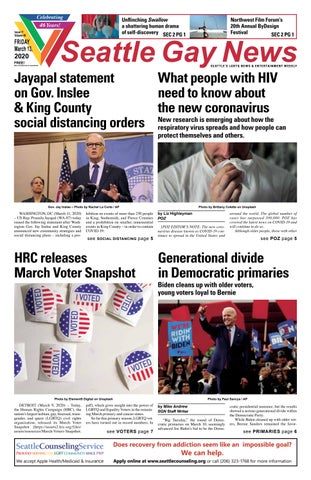
Celebrating 46 Years! Issue 11 Volume 48
FRIDAY March 13, 2020 FREE!
25¢ in bookstores & newsstands
Unflinching Swallow a shattering human drama of self-discovery SEC 2 PG 1
Northwest Film Forum’s 20th Annual ByDesign Festival SEC 2 PG 1
Seattle Gay News S E AT T L E ’ S L G B T Q N E W S & E N T E R TA I N M E N T W E E K LY
Jayapal statement What people with HIV on Gov. Inslee need to know about & King County the new coronavirus New research is emerging about how the social distancing orders respiratory virus spreads and how people can protect themselves and others.
Gov. Jay Inslee – Photo by Rachel La Corte / AP
WASHINGTON, DC (March 11, 2020) – US Rep. Pramila Jayapal (WA-07) today issued the following statement after Washington Gov. Jay Inslee and King County announced new community strategies and social distancing plans – including a pro-
hibition on events of more than 250 people in King, Snohomish, and Pierce Counties and a prohibition on smaller, nonessential events in King County – in order to contain COVID-19:
see SOCIAL DISTANCING page 5
HRC releases March Voter Snapshot
Photo by Brittany Colette on Unsplash
by Liz Highleyman POZ [POZ EDITOR’S NOTE: The new coronavirus disease known as COVID-19 continues to spread in the United States and
pdf], which gives insight into the power of LGBTQ and Equality Voters in the remaining March primary and caucus states. So far this primary season, LGBTQ voters have turned out in record numbers. In
see VOTERS page 7
see POZ page 5
Generational divide in Democratic primaries
Biden cleans up with older voters, young voters loyal to Bernie
Photo by Element5 Digital on Unsplash
DETROIT (March 9, 2020) – Today, the Human Rights Campaign (HRC), the nation’s largest lesbian, gay, bisexual, transgender, and queer (LGBTQ) civil rights organization, released its March Voter Snapshot [https://assets2.hrc.org/files/ assets/resources/March-Voters-Snapshot.
around the world. The global number of cases has surpassed 100,000. POZ has covered the latest news on COVID-19 and will continue to do so. Although older people, those with other
Photo by Paul Sancya / AP
by Mike Andrew SGN Staff Writer “Big Tuesday,” the round of Democratic primaries on March 10, seemingly advanced Joe Biden’s bid to be the Demo-
cratic presidential nominee, but the results showed a serious generational divide within the Democratic Party. While Biden cleaned up with older voters, Bernie Sanders remained the favor-
see PRIMARIES page 6
2 Seattle Gay News
March 13, 2020
Celebrating 46 Years!
Seattle Gay News F O U N D ED 1974 MEMBER
2018
1707 23rd Avenue Seattle, WA 98122 (206) 324-4297 sgn2@sgn.org sgn.org
Deadlines Classifieds | Thursday at Noon Calendar | Tuesday at 6pm Display Ads Space Reservation | Monday at 5pm Ad Copy (non-camera ready) | Tuesday at 5pm Ad Copy (camera-ready) | Wednesday at 5pm Letters to the Editor | Tuesday at 5pm Obituaries | Call the SGN office All others | Tuesday at 5pm
Editor in Chief George Bakan Copy Editor Rick McKinnon (since Dec 2013) Advertising George Bakan • Maggie Bloodstone MK Scott National Advertising Rep. Rivendell Media (212) 242-6863 Staff Writers Mike Andrew • Sara Michelle Fetters Miryam Gordon • Albert Rodriguez Contributing Writers Rev. Barbara Allen • Ron Anders Madelyn Arnold • Alice Bloch Maggie Bloodstone • Beau Burriola Sharon Cumberland • Jessica Davis Tina Gianoulis • Anthony Greer Milton W. Hamlin • Nevin Jefferson Richard Kennedy • Shaun Knittel Liz Meyer • Jason A. Miller Jesse Monteagudo David Nguyen aka Teriyaki Temple Rod Parke • Don Paulson Jerry Peerson • Tim Peter • Jessica Price Scott Rice • Leslie Robinson MK Scott • Mark Segal • Gaysha Starr Sarah Toce • Paul Torres • Janice Van Cleve Ed Walsh • James Whitely Scott Wittet • Rex Wockner Cartoonist Ken Campbell Calendar Editor Rick McKinnon Classifieds Rick McKinnon Photographers Nate Gowdy • Joseph P. Herron MK Scott • James Whitely Production Mike Pham Website Designer Barry Thorsness / Digital Team Works Seattle Gay News is published by Frogs and Ink, Inc. © 2018. Frogs and Ink, Inc. All Rights Reserved. Reprints by permission. Publication of names, photographs, or likeness of any person, organization, event or business in this publication cannot be taken as any indication of the sexual orientation of the person, organization, event or business. Opinions expressed in bylined articles, columns, and letters are those of the authors only and do not necessarily reflect the views of the staff or management of this paper. Seattle Gay News welcomes unsolicited material, including letters to the editor, but reserves the right to edit or reject material. All rights revert to authors upon publication. We assume no liability for loss or damage of materials, solicited or not. We invite feedback, please write. And please play safe. It is our policy that no money shall be refunded if you choose to cancel your ad. Credit will be given for the balance owed. No exceptions.
In Loving Memory Of Steve Foiles • Scott Roger Alpert Cookie Andrews-Hunt James Leland Moore Randy Peters • Lee Richeson Shaun Shelton • Jim Tully James Arnold
Joint statement from SEIU Healthcare 1199NW, Washington State Nurses Association and UFCW 21
On prohibition of large events during COVID-19 outbreak RENTON (March 11, 2020) – As nurses and health care workers providing essential care to patients in hospitals, clinics, and housing and shelters across Washington state, we applaud Gov. Jay Inslee and the leaders of King, Pierce, and Snohomish Counties for taking the necessary step of limiting large gatherings during this stage of the COVID-19 outbreak. Prohibiting events is a common-sense measure that will help protect our community members from the novel coronavirus. This measure will also help frontline health care workers and our health care system as a whole effectively respond to this crisis by “flattening the curve” of coronavirus patients seeking care. As health care workers on the front lines of responding to this public health emergency, we support all efforts to reduce the impact on our ability to provide care by lowering the daily number of patients coming into a system that is already stressed by the growing number of COVID-19 patients. We understand that state and local governments and public health agencies are responding proactively to the existing risks created by this new disease in an effort to minimize those risks and keep our healthcare delivery system accessible to all who may need it. In our role as caregivers, we are often called on to tell patients the truth about their health. The truth we want our community to hear is this: Social distancing, like that enforced by the measure announced today, is one of the very best ways to prevent the spread of epidemic illness. This temporary change in behavior will help protect all of us from the spread of COVID19, as well as from cold and flu illnesses common during this time of year. The most vulnerable COVID-19 patients – those age 65 or older or with underlying
Visit us online www.sgn.org
Image courtesy of WSNA
health conditions – may need intensive hospital care, and it is essential that we preserve hospital intensive and critical care beds for those most vulnerable patients. Social distancing is a public health measure that will help prevent our health system from being overwhelmed, and will make it easier for anyone with the novel coronavirus to access necessary hospital care. As nurses and health care workers, we care deeply for our patients and take pride in the roles we play on the front lines of patient care, particularly during a time of heightened concern for community health. Our continued safety during this outbreak is critical to our ability to continue to provide quality patient care. We continue to call on the CDC to proactively and effectively target the supply of respirators and use other controls to reduce the risk of infection in health care workers, knowing that our professionals are at the highest risk of infection. We will continue to work closely with health care employers and with federal and local public health agencies to ensure that all caregivers have access to the highest level of personal protective equipment available so we can continue to provide the high-quality health care our communities require.
SEIU Healthcare 1199NW is a union of nurses and health care workers with over 30,000 caregivers throughout hospitals, clinics, mental health, skilled home health, and hospice programs in Washington state and Montana. SEIU Healthcare 1199NW’s mission is to advocate for quality care and good jobs for all.
March 13, 2020
Seattle Gay News 3
The WSNA is the leading voice and advocate for nurses in Washington state, providing representation, education, and resources that allow nurses to reach their full professional potential and focus on caring for patients. The WSNA represents more than 17,000 registered nurses for collective bargaining who provide care in hospitals, clinics, schools, and community and public health settings across the state. UFCW 21 is working to build a powerful union that fights for economic, political and social justice in our workplaces and our communities. We represent over 45,000 workers in retail, grocery stores, health care, and other industries in Washington state. Courtesy of SEIU Healthcare 1199NW
Open letter about coronavirus and the LGBTQ+ communities NEW YORK (March 11, 2020) – Over 100 national and local organizations have signed on to an open letter to health and media outlining how COVID-19 may pose an increased risk to the LGBTQ+ population and laying out specific steps to minimize any disparity. “As the media and health communities are pushed into overdrive about COVID-19, we need to make sure the most vulnerable among us are not forgotten. Our smoking rates alone make us extremely vulnerable, and our access to care barriers only make a bad situation worse.” notes Dr. Scout, deputy director for the National LGBT Cancer Network, “This letter outlines simple steps to ensure no population is further stigmatized by a virus.” “As an organization dedicated to the health and well-being of LGBTQ communities, we urge LGBTQ individuals to practice measures recommended by public health experts, such as frequent handwashing, to prevent the spread of this virus,” said GLMA President Scott Nass, MD, MPA. “At the same time, like our colleagues who joined the open letter, we call on public health officials to ensure that the LGBTQ community is considered and included in the public health response to COVID-19 based on potential risk factors that exist in our community.” The letter was initiated by a coalition of six organizations: the National LGBT Cancer Network; GLMA Health Professionals Advancing LGBTQ Equality; WhitmanWalker Health; SAGE; New York Transgender Advocacy Group; and National Queer Asian Pacific Islander Alliance. The full text and additional organizational response resources can be found online (https://cancer-network.org/coronavirus2019-lgbtq-info) and is included below:
As the spread of the novel coronavirus a.k.a. COVID-19 increases, many LGBTQ+ people are understandably concerned about how this virus may affect us and our communities. The undersigned want to remind all parties handling COVID-19 surveillance, response, treatment, and media coverage that LGBTQ+ communities are among those who are particularly vulnerable to the negative health effects of this virus. Our increased vulnerability is a direct result of three factors: 1. The LGBTQ+ population uses tobacco at rates that are 50% higher than the general population . COVID-19 is a respiratory illness that has proven particularly harmful to smokers. 2. The LGBTQ+ population has higher rates of HIV and cancer, which means a greater number of us may have compromised immune systems, leaving us more vulnerable to COVID-19 infections. 3. LGBTQ+ people continue to experience discrimination, unwelcoming attitudes, and lack of understanding from providers and staff in many health care settings, and as a result, many are reluctant to seek medical care except in situations that feel urgent – and perhaps not even then. In addition, there are more than 3 million LGBTQ+ older people living in the United States. LGBTQ+ elders are already less likely than their heterosexual and cisgender peers to reach out to health and aging providers, like senior centers, meal programs, and other programs designed to ensure their health and wellness, because they fear discrimination and harassment. The devastating impact of COVID-19 on older people – the current mortality rate is at 15% for this population – makes this a huge issue for the LGBTQ+ communities as well. LGBTQ+ communities are very famil-
4 Seattle Gay News
Photo by Sharon McCutcheon on Unsplash
iar with the phenomena of stigma and epidemics. We want to urge people involved with the COVID-19 response to ensure that LGBTQ+ communities are adequately served during this outbreak. Depending on your role, appropriately serving our communities could involve any of the following actions: • Ensuring that media coverage notes the particular vulnerabilities of any person with pre-existing respiratory illnesses [or] compromised immune systems, or who uses tobacco products. While populations – like LGBTQ+ communities – can be at increased risk, it is important to note the overall state of health that contributes to any person’s increased vulnerability to contracting COVID-19. • Ensuring that health messaging includes information tailored to communities at increased risk for COVID-19, including LGBTQ+ populations. An example of such tailored messaging is including imagery of LGBTQ+ persons in any graphic ads. • Providing LGBTQ+ individuals resources to find welcoming providers, if they are experiencing symptoms like a cough or fever and need to seek medical attention. • Ensuring that funding to community health centers is distributed in a fashion that accounts for the additional burden anticipated by LGBTQ-identified health centers. • Whenever possible, ensuring that health agencies partner with community-based organizations to get messaging out through channels we trust. • Ensuring that surveillance efforts capture sexual orientation and gender identity as part of routine demographics. • Ensuring that health workers are directed to provide equal care to all regardless of their actual or perceived sexual orientation, gender identity/presentation, ability, age, national origin, immigration status, race, or ethnicity. • Ensuring that all COVID-19 responses
March 13, 2020
take into account exceptionally vulnerable members of the LGBTQ+ communities, including our elders, bi people, and black and brown trans and gender-nonconforming/nonbinary people. • Since xenophobic responses are heavily impacting the Asian-American communities, ensuring that all communications and responses related to COVID-19 attempt to counter any such xenophobic responses, avoid racial profiling, and discourage the public from doing so as well. • Ensuring that LGBTQ+ health leadership, along with all providers and health care centers, are provided with timely and accurate information to disseminate. As LGBTQ+ community and health leadership, the undersigned organizations offer to stand shoulder to shoulder with the mainstream health leadership to make sure we learn from history and do not allow any population to be disproportionately impacted or further stigmatized by a virus. Initial signers: National LGBT Cancer Network GLMA: Health Professionals Advancing LGBTQ Equality; WhitmanWalker Health Additional signers: Advocates for Youth; Advocating Opportunity; Alder Health Services; Antioch University MFA Program Athlete Ally; Atlanta Pride Committee; BiNet USA; Black Lives Matter Houston Bradbury-Sullivan LGBT Community Center California LGBTQ Health and Human Services Network; Callen-Lorde Community Health Center CARES; Center on Halsted; CenterLink: The Community of LGBT Centers; Compass LGBTQ Community Center Corktown Health Center; Counter Narrative Project CreakyJoints & Global Healthy Living Foundation; CrescentCare; Darker Sister Center; Deaf Queer Resource Center; SAGE; New York Transgender Advocacy Group National Queer Asian Pacific Islander Alliance; Desert AIDS Project Desi Queer Diaspora Equality California
Equality Federation Equality North Carolina Erie Gay News; Family Equality; Fenway Health; GALAEI; Gay City: Seattle’s LGBTQ Center; Gender Equality New York, Inc. (GENY) Gender Justice League (Washington State) Georgia Equality; GLAAD; GLBT Alliance of Santa Cruz Greater Erie Alliance for Equality Greater Palm Springs Pride Harvey Milk Foundation HetrickMartin Institute; HIV AIDS Alliance of Michigan HIV Medicine Association Horizons Foundation; Howard Brown Health; Human Rights Campaign; Independence Business Alliance Indiana Youth Group; Infectious Diseases Society of America Inside Out Youth Services; InterPride; Keystone Business Alliance; Lambda Legal; Lansing Area AIDS Network (LAAN) Lansing Association for Human Rights Legacy Community Health; LGBT Center of Greater Reading; LGBT Center of Raleigh; LGBT Elder Initiative; LGBTQ Center OC; MassEquality; Matthew Shepard Foundation Milwaukee LGBT Community Center Minority Veterans of America; National Center for Lesbian Rights National Center for Transgender Equality National Coalition for LGBT Health National Equality Action Team; National LGBTQ Task Force; Newburgh LGBTQ+ Center; No Justice No Pride; Oasis Legal Services; Oklahomans for Equality; Our Family Coalition; Out Alliance; Out And Equal; Out Boulder County; OutCenter of Southwest Michigan OutFront Kalamazoo; OutRight International; Pennsylvania Youth Congress; Persad Center, Inc.; PFund Foundation; Pizza Klatch; Positive Women’s Network; Pride Center of the Capital Region; Pride Center Of Vermont; Princess Janae Place Inc; Rainbow Community Center of Contra Costa County; Rockland County Pride Center; San Francisco AIDS Foundation; SAVE - Safeguarding American Values for Everyone; SERO Project; SF LGBT Community Center; SisTers PGH; St. James Infirmary; Still Bisexual; The LGBTQ Center Long Beach; The LOFT LGBT Community Services Center The Montrose Center; The Social Impact Center; The Source LGBT+ Center; The Trevor Project; Thomas Judd Care Center; Thundermist Health Center; Transgender Education Network of Texas (TENT); Transgender Legal Defense & Education Fund; Triangle Community Center; Trillium Health; TriVersity Center for Gender and Sexual Diversity; UNIFIEDHIV Health and Beyond; U.S. People Living with HIV Caucus; Wellness AIDS Services; William Way LGBT Community Center The National LGBT Cancer Network works to improve the lives of LGBTQ cancer survivors and those at risk by educating the LGBTQ communities about our increased cancer risks, training health care providers, and advocating for LGBTQ engagement in mainstream cancer organizations. It is home to one of eight CDCfunded national tobacco and cancer disparity networks. Learn more at cancernetwork.org. GLMA: Health Professionals Advancing LGBTQ Equality is a national organization committed to ensuring health equity for lesbian, gay, bisexual, transgender, queer (LGBTQ), and all sexual- and genderminority (SGM) individuals, and equality for LGBTQ/SGM health professionals in their work and learning environments. To achieve this mission, GLMA utilizes the scientific expertise of its diverse multidisciplinary membership to inform and drive advocacy, education, and research. To learn more, visit www.glma.org. Courtesy of Target Cue
Celebrating 46 Years!
POZ
continued from cover health conditions and people with compromised immune systems remain most at risk of severe illness from the new coronavirus, everyone should be vigilant. Click here [https://www.poz.com/slideshow/ways-to-prevent-the-spread-of-thecoronavirus-slideshow] for a slideshow on seven ways to prevent the spread of the new coronavirus and click here [https://www. poz.com/slideshow/maneras-de-prevenirla-transmisin-del-nuevo-coronavirus] for a Spanish-language version. Go to poz.com/ tag/coronavirus for our continuing coverage of COVID-19. For questions about the new coronavirus, click here [https://forums.poz. com/index.php?topic=73775] for a related thread in the POZ Forums.] A month after the new coronavirus respiratory disease known as COVID-19 came to public attention, researchers and public health officials are continuing to learn about its spread, its mortality rate and who is most likely to become seriously ill. Although much remains unknown, it’s clear that older people, those with other health conditions and people with compromised immune systems have a higher likelihood of severe illness. This includes people living with HIV, especially those with low CD4 counts. But taking some basic precautions can lower your risk and improve your well-being. COVID-19 Basics As of March 2, there were 43 confirmed or presumed positive cases of COVID-19 detected in the United States, according to the Centers for Disease Control and Prevention (CDC). In addition, there have been 48 cases among people brought back to the United States, mostly from the Diamond Princess cruise ship. The virus now appears to be spreading locally within communities. Worldwide, more than 87,000 cases have been reported, according to the World Health Organization. Most of these are in China, but 58 countries have now seen cases. The mortality rate for COVID-19 is thought to be around 2.5%, based on the numbers reported in the hardest-hit areas of China. This is substantially higher than the typical seasonal flu (around 0.1%), but much lower that the death rates of the SARS (severe acute respiratory syndrome) and MERS (Middle East respiratory syndrome) coronaviruses, at around 10% and 30%, respectively. However, the true COVID-19 mortality rate is not yet known because it is unclear how many people have contracted the new virus. If a large number of people have no or mild symptoms and never seek medical attention, the pool of infected people could be much larger and the death rate could be much lower. Receiving supportive treatment earlier in the course of the disease also lowers the risk of death. A majority of people with COVID19 have mild symptoms including fever, cough and shortness of breath. Around 20% develop more severe illness, including pneumonia and acute respiratory distress syndrome, which may require intensive care and in some cases mechanical ventilation. But not everyone who contracts the virus is at equal risk. According to a recent study by the Chinese Center for Disease Control and Prevention of more than 45,000 confirmed cases, people with coexisting conditions had higher death rates: 5.6% for cancer, 6.0% for high blood pressure, 6.3% for chronic respiratory disease, 7.3% for diabetes and 10.5% for cardiovascular disease. The greatest risk was seen among people age 80 or older, at 14.8%. Experts do not yet know how long someone can transmit the coronavirus, officially known as SARS-CoV-2, before they develop symptoms or after they recover. It is also unclear whether the virus can linger in the body and later relapse; whether it confers immunity and, if so, for how long; or what the likelihood is of becoming infected again. Researchers are hard at work to develop treatments for COVID-19 and a vaccine for SARS-CoV-2. Certain HIV medications have shown activity against the coronavirus. Clini-
cal trials of Gilead Sciences’ antiviral drug remdesivir are currently underway in China and at the University of Nebraska Medical Center in Omaha – home of the CDC’s largest biocontainment unit – where some people who contracted the virus overseas are being treated. A vaccine from Moderna Therapeutics has been sent to the National Institute of Allergy and Infectious Diseases for the first Phase I study. However, human trials are expected to last at least a year before a vaccine is ready for widespread use. What About People With HIV? Compared with the general population, people with compromised immunity are at higher risk of contracting the new coronavirus and developing more serious COVID19 illness. The HIV population is aging, and nearly half are over 50. Those with low CD4 T-cell counts, indicating advanced immune suppression, are at greatest risk. People with HIV are more likely to develop cardiovascular disease and may do so at a younger age. Certain HIV medications, especially older drugs, can cause neutropenia, or depletion of immune system white blood cells that fight infection. “When you look at who’s been most profoundly ill, it tends to be people who are older, in their 60s, 70s and 80s. As you get older, your immune system doesn’t function as well,” says Steve Pergam, MD, MPH, of the Vaccine and Infectious Disease Division at Fred Hutchinson Cancer Research Center. Among people living with HIV, “it’s all based on level of immune suppression,” Pergam told POZ. “For an HIV patient who is on stable antiretroviral therapy and has a normal CD4 count, their risk may be slightly increased. People often lump HIV patients with other immunosuppressed patients, but HIV is a different disease than it was years ago. For people who have a reconstituted immune system because of treatment, I think the risk is not going to be tremendously different.” “For cancer patients on chemotherapy, people with solid organ transplants or bone marrow transplants and those who use highdose steroids for autoimmune diseases, the risk will likely be more severe,” he continues. “They may shed the virus for longer. They may be more likely to develop pneumonia and more likely to die. We don’t know until we have more information, but many of us have concerns about that.” People with a weakened immune system may be unable to fight off the virus, or they may develop an excessive inflammatory immune response known as a cytokine storm. Paradoxically, immune suppression can sometimes mean fewer or milder early symptoms, such as fever, even as the virus and the body’s response to it ravage the lungs and other organs. “The symptoms may be more subtle, so we have to have more awareness,” Pergam says. “Oftentimes their initial symptoms may be less prominent, but the level of complex disease may be more severe.” Taking Precautions Experts recommend that everyone take common-sense precautions to prevent transmission of the new coronavirus – the same ones recommended to prevent seasonal flu: • Avoid close contact – meaning within about six feet – with people who have a cough or other respiratory symptoms. • Wash your hands with soap and water thoroughly and often for at least 20 seconds. [https://www.realhealthmag.com/ article/wash-hands-how-when] • Use alcohol-based hand sanitizer when soap and water are unavailable. • Avoid touching your eyes, nose and mouth. • * Healthy people do not need to routinely wear face masks to prevent infection, but use a mask if you are caring for someone who is ill. • Get the flu vaccine. Older people should also consider getting vaccinated against pneumonia. If you are ill: • Cough or sneeze into a tissue or your bent elbow, and immediately dispose of tissues in the trash.
Visit us online www.sgn.org
Photo courtesy of WA Dept. of Health
• Avoid close contact with others. • Stay home if you are sick. • If you think you may have been exposed to the coronavirus, contact a health care provider promptly if you develop a fever, cough or difficulty breathing. • Before you go to a clinic or hospital, call ahead so the staff can take appropriate precautions. • Wearing a face mask can stop the spread of droplets that can transmit the virus to others. Older individuals, people living with HIV and those with cardiovascular disease or other conditions may benefit from extra precautions. “I advise people to have hand sanitizer wherever they go and use it frequently in public places – I have it in my pocket all the time. Wash your hands with soap and water long enough to sing the ’Happy Birthday’ song,” Pergam advises. “I always talk with patients about the idea of social distancing. I’m not saying you can’t live your life as a normal person. But you don’t have to go out to dinner when a restaurant is super crowded – you might eat a little earlier or you might order in,” he adds. “If you’re having friends or family over, ask them if they have any symptoms. Have a hand gel dispenser at your front door and make sure everybody uses it. Make sure to tell friends and family that they should be up-to-date on their vaccines for other things.” People who need prescription medications should try to have a supply to last at least a couple weeks and preferably a few months. Shortages could happen because the ingredients for many drugs – especially generics – are produced in China. Pergam acknowledges that this can be difficult because of high drug costs and insurance restrictions. You may be able to order medications for three months at a time. Or renew your prescriptions as soon as you are able to – even if they haven’t run out yet – so you have a buffer of several days. The Food and Drug Administration is keeping track of medication shortages that
SOCIAL DISTANCING continued from cover
“Our current public health emergency requires that we work together to tackle the serious challenges before us and make difficult decisions in order to keep our families and communities safe. I applaud Gov. Inslee and King County for taking these science-based steps to help mitigate the spread of coronavirus in Washington state, especially in counties like King County that have been seriously affected. I recognize that these steps will not be easy and will have major impacts for many in our region, but it is critical that we work quickly to immediately mitigate the spread of COVID-19. Science-based social distancing will help protect our families and communities. “In Congress, my number one priority is to make sure we help working people and families who are going through tremendous hardship as a result of this crisis. Today, I joined colleagues to introduce the MEALS Act to protect low-income stu-
March 13, 2020
may result from the coronavirus epidemic. According to a recent statement, only one unspecified drug is now in short supply. HIV expert Tim Horn of NASTAD (formerly the National Alliance of State & Territorial AIDS Directors) checked on the status of brand name and generic antiretroviral drugs and found no current shortages. It’s also a good idea to have at least a two-week supply of food, water, cleaning supplies and other household necessities on hand. And don’t forget to stock up on pet food. You may be able to have goods delivered to avoid going to stores. Or ask a friend or family member without compromised immunity for help. As the COVID-19 outbreak becomes more widespread, “disruption to everyday life might be severe,” according to Nancy Messonnier, director of CDC’s National Center for Immunization and Respiratory Diseases, who advises businesses to explore remote work options and families to consider plans in case schools close. “Talk to your employer about opportunities to work from home,” Pergam advises. “And have them remind everyone you work with not to come to work sick.” Stay in communication with your health care providers, and keep up-to-date on new developments. Let them know if you have questions or concerns, especially if you have new symptoms or were recently exposed to someone who is ill. “The biggest thing to get across is, don’t panic,” Pergam says. “We’re all expecting this to be a prolonged and complicated process. The best thing people can do is focus on ways that they can protect themselves because those small things can be enough to provide an extra layer of protection for everyone. For more details, visit the U.S. and global coronavirus tracker from Johns Hopkins University and the CDC COVID-19 website [https://www.cdc.gov/coronavirus/2019ncov/index.html]. Courtesy of POZ magazine dents’ access to school meal benefits during any school closures, as well as a bill to ensure all Americans have access to coronavirus testing and related care without any out-of-pocket costs – something Gov. Inslee has already ordered in Washington state. Congress must also quickly pass legislation to guarantee paid sick days for workers, increase access to safety net supports, and ensure people can afford basic food and housing. “My office and I will also continue to share all the information we can, as soon as we can. On Monday evening, more than 4,000 people joined our telephone town hall, underscoring the level of concern people are feeling right now. We will continue to host telephone town halls and share regular updates through my e-newsletter. “I am proud to represent such a compassionate district with such excellent public health experts, frontline health workers and first responders. Let’s continue to stick together and look out for one another – we will weather this together.” Courtesy of Rep. Pramila Jayapal
Seattle Gay News 5
Washington Census Alliance grants $3M to organizations in historically undercounted communities, prepares for census in face of COVID-19 SEATTLE (March 12, 2020) – As the 2020 Census gets underway, the Washington Census Alliance (WCA) today announced it is granting an additional $1 million to encourage participation in the census by people in historically undercounted communities. By Census Day, April 1, it will have awarded grants totaling over $3 million since 2019 to more than 70 organizations of color and tribes across more than 20 counties in Washington state. Organizations can still apply for funding from the Washington Census Alliance through March 15 via surveymonkey. com/r/washingtoncensusalliancefundingapplication. “Communities of color bear the brunt of less funding and political representation as a result of an undercount, and that is exactly why they are the ones we want leading this effort,” said Kamau Chege, manager of the Washington Census Alliance. “To assuage the fear and confusion lingering around the census among historically undercounted communities, we’re putting funding where it can be most effective: in the hands of the organizations and leaders in those communities.” In this latest round of funding, Na’ah Illahee Fund, a founding member of the Washington Census Alliance, will receive $347,000 to regrant to tribes and Native-led nonprofit organizations. Another $300,000 is being deployed to 2019 WCA grantees to increase census outreach capacity, and more than $350,000 in grants will be awarded to new organizations through an open RFP application. Funding for the grants come from the Office of Financial Management’s Census Education and Outreach program, in partnership with the Seattle Foundation, Na’ah Illahee Fund, Latino Community Fund, and Washington Progress Fund. Between March 6 and 8, 250 community organizers, nonprofit leaders, and elected officials from around the state attended the WCA’s Spring Convening in Tacoma to share challenges and best practices for conducting census outreach to historically undercounted communities. Lack of translated outreach materials, distrust of government, and widely dispersed households in rural communities are just a few of the reasons that a complete census count is challenging in some communities. COVID-19 response Meanwhile, the spread of COVID-19 in Washington state introduces new challenges.
PRIMARIES
continued from cover ite among voters in the 18-29 age bracket – even in states where he was soundly defeated by Biden. According to exit polls, Sanders won 82% of young voters in Michigan to Biden’s 15%. In Missouri, Bernie took 76% of young voters, compared to Biden’s 19%. In Mississippi, where Biden won a whopping 81% of the total vote, he only carried young voters by 4%. Nevertheless, Bernie lost all three states because voters in the 18-29 cohort averaged only 12.5% of the electorate there, not nearly enough to give him the electoral victories he needed to boost his apparently flagging campaign.
6 Seattle Gay News
As in-person outreach and large public events are increasingly being canceled, WCA members are pivoting their outreach to leveraging ethnic media channels and creating social media content that resonates with their local communities. The WCA is also introducing an interactive text-messaging tool that organizations can customize and use to engage community members remotely. By texting “Census” or “Censo” to 332020, people can engage in conversation, get their questions answered, connect to resources, and opt in for regular reminders and updates about the census. As of February 2020, WCA grantees and members have recruited and trained more than 450 Trusted Messengers and engaged over 8,300 households across the state in one-on-one conversations, and these figures continue to increase every day. With this new round of funding, the WCA is on track to recruit more than 600 Trusted Messengers and engage more than 12,000 households by Census Day, April 1. “With a decade of resources and representation at stake, addressing the historic undercount of people of color is essential to an equitable future for our state,” said Aaron Robertson, managing director, Policy & Civic Engagement at the Seattle Foundation. “Seattle Foundation is proud to support the Washington Census Alliance, ensuring our outreach is done in community, by community.”
kane Tribe of Indians ; Swinomish Indian Tribal Community ; Haida Heritage Foundation ; Unkitawa ; Sauk-Suiattle Indian Tribe; Upper Skagit Indian Tribe ; Suquamish Tribe; Confederated Tribes of the Colville Reservation; Jamestown S’klallam; Port Gamble S’klallam ; Hazel Pete Institute of Chehalis Basketry; Whitney Lewis; Ndn Girl Spirit Boy Creations; Missing & Murdered Indigenous Women Washington; Allottees Association and Affiliated Tribes of the Quinault Reservation ; Tana Stobs Canoe Family ; Native Unite in Journey ; Latino Community Fund; Casa Latina; Entre Hermanos; Raiz of Planned Parenthood; Latinos En Spokane; Casa Hogar; Nuestra Casa; CAFE (Community for the Advancement of Family Education); Community to Community; OneAmerica; Para Los Niños de Highline; El Centro de la Raza; Yakama-Yakima El Censo; Friends of the Black Lens/Carl Maxey
Center; LGBTQ Allyship; The Noble Foundation; SW WA Communities United for Change; CIRCC (Coalition of Immigrants, Refugees and Communities of Color); Urban League of Metropolitan Seattle; Equal Rights Washington; Latinos Unidos of South Sound; Tri-Cities League of United Latin American Citizens; Korean Community Service Center; Congolese Integration Network; Eastside Refugee and Immigrant Coalition; Khmer Anti-Deportation Advocacy Group; Northwest Kenyan Community Association; Muslim Community and Neighborhood Association; Cair WA ; APIC-SPS (Asian Pacific Islander Coalition of South Puget Sound); APIC-YKM (Asian Pacific Islander Coalition of Yakima); APACEVotes (Asian PacificIslander America Civic Empowerment Votes) ; Wakulima; Eritrean Association in Greater Seattle; Channel A-TV; Somali Family Safety Task Force; Iraqi Community Center of Washington; PEARS (People Empowerment and Renewal Services); Ethiopian Community in Seattle The Washington Census Alliance is a statewide coalition of 60 organizations led by and working in communities of color. It advocates for the unique needs of our communities. Together, we’re launching an unprecedented relational organizing campaign to ensure that historically undercounted communities throughout Washington state are counted in the 2020 census. Courtesy of the Washington Census Alliance
YOU’RE INVITED!
Aging Ballard Lesbian Exchange
2019 Washington Census Alliance grantees Na’ah Illahee Fund; Nooksack Indian Tribe; Cowlitz Indian Tribe ; UIATF (United Indians of All Tribes Foundation); Quinault Indian Nation; American Indian Community Center ; Lummi Nation; Tlingit and Haida Washington Chapter; Yakama Nation; Spo-
ABLE meets on the fourth Thursday of every month (except Thanksgiving) at the Ballard NW Senior Center, 5429 32nd Ave. NW, Seattle. We are lesbians mostly over 60, and live all over Seattle. Our purpose is mostly social, but the “exchange” part includes willingness to help each other out when needed. We maintain a list of members willing to shop, cook food, provide transportation, and generally help on a short term basis when someone is ill or can-
not do things they normally can. Come and check us out. Join us for lunch at noon – the cost is only $4.00 if you are over 50 and the food is really good, or just come to our meeting upstairs in the Center at 12:45pm and learn about events, trips and how to get involved. There are no dues or obligations. For more information call Vonda at 206-595-3129 or send a message to rosered13@comcast.net.
For example, only about 35% of Michigan primary voters were under 45. In California and Colorado, states Sanders won on Super Tuesday, the share of those voters was about 45%. In the short term, this is good news for Biden but does not bode well for the general election in November. Young voters were a key part of the coalition that delivered the White House to Barack Obama in 2008. He won them by a record 34% over John McCain. Hillary Clinton, on the other hand, only won the youth vote by 18% in her losing campaign against Donald Trump. The other danger sign for Biden is lack of enthusiasm among his voters. Only 46% of Biden’s supporters said they were “very enthusiastic” about his candidacy. For Sanders, the number was 60%.
The enthusiasm gap may be explained by the fact that most Democratic primary voters agree with Bernie on the issues, even when they voted for Biden. According to exit polls, a wide majority of primary voters – roughly three-quarters – said that the economic system in this country is unfair. That includes about a third describing it as “very unfair.” Although young voters remained loyal to Bernie, exit polls showed that white voters, union voters, and college graduates went for Biden. Sanders won all three groups in 2016. In the March 10 primaries, Biden carried college graduates 51% to 44% for Sanders, whites 51% to 45%, and union members – almost one-third of the primary electorate – by 54% to 42%. Here in Washington state, Sanders led
by a little more than 2,000 votes on election night. In King County, however, Bernie was more than 4,000 votes ahead. Biden, on the other hand, leads in Pierce and Snohomish Counties. Because of Washington’s vote-by-mail system, the ballots counted on election night are typically the first ones mailed in. Vote percentages will almost certainly change as more ballots are counted in the coming days. (New vote counts put Biden in the lead with 35% to Sanders’ 33.6%.) According to the count on election night, Biden had won 800 convention delegates (out of the 1,991 need to win the nomination), Sanders had won 660, and other candidates had 103 delegates.
March 13, 2020
Celebrating 46 Years!
NBC exits: LGBTQ voters continue historic high turnout on Mini-Tuesday
Photo courtesy of WA Dept. of Health
WASHINGTON, DC (March 11, 2010) – This morning, NBC released new exit polling highlighting historic, high turnout for LGBTQ voters in the Democratic primary. In the states that voted last night, LGBTQ voters represented double – and in the case of Missouri, triple – their proportion of the population. This follows a similar pattern exhibited
in the states that voted on Super Tuesday (March 3), where 9% of the electorate identified as LGBTQ, double the LGBTQ adult population of 4.4% across those states. For more information LGBTQ and Equality Voters in March states, go to HRC’s March State Voter Snapshot [https:// assets2.hrc.org/files/assets/resources/ March-Voters-Snapshot.pdf].
State
LGBTQ Voters as % of Mini Tuesday Voters Missouri 12% Mississippi 8% Michigan 9% Washington 9%
VOTERS
continued from cover early states like New Hampshire, LGBTQ voters represented 7% of the electorate despite representing 4.7% of the population. On Super Tuesday, those numbers swelled even more. Across the Super Tuesday states overall, 9% of the electorate identified as LGBTQ, double the LGBTQ population of 4.4% across these states. [See https://twitter.com/HRC/status/123500776360612249 8?s=20] for a state-by-state breakdown of Super Tuesday results. “LGBTQ voters have shown up in record numbers in states across the country and cemented our status as a crucial constituency to court,” said HRC President Alphonso David. “LGBTQ people and our allies are among the most politically engaged voters in the country, and Democratic presidential candidates are taking notice. LGBTQ and Equality Voters are fired up and ready to send the Trump-Pence administration packing.” The HRC has prioritized investments and organizing in six key states (Arizona, Michigan, Nevada, Ohio, Pennsylvania, and Wisconsin) since the launch of the HRC Rising Program in 2017. Since then, the HRC has had multiple staff members on the ground in each state. In 2018, the HRC made the most significant electoral investments in our history, mobilizing these Equality Voters to victories across all
LGBTQ Adults as % of All Adults 3.8% 3.5% 4.0% 5.2%
six targeted states, winning five of six US Senate races, [winning] four of six gubernatorial races, and flipping seven US House seats in the six states alone. Nationwide, there are an estimated minimum of 11 million LGBTQ voters – and millions more allies – who will play a decisive role in the 2020 elections. Using decades of HRC polling, membership information and other proprietary data, the HRC worked with data-analytics firm Catalist to identify 57 million Equality Voters nationwide who prioritize LGBTQinclusive policies when making decisions about which candidates to support. In 2018, the HRC utilized this data to mobilize Equality Voters in key races across the country and succeeded. Equality Voters accounted for 29% of the 2018 electorate, making it one of the most substantial voting blocs in the election. Their turnout increased from 36% in the 2014 midterm elections to 56% in 2018, a dramatic increase that is expected to continue in 2020. The Human Rights Campaign is America’s largest civil rights organization working to achieve equality for lesbian, gay, bisexual, transgender, and queer people. The HRC envisions a world where LGBTQ people are embraced as full members of society at home, at work, and in every community.
Visit us online www.sgn.org
Courtesy of the HRC
March 13, 2020
Seattle Gay News 7
with DESCOVY for PrEP® DESCOVY for PrEP (pre-exposure prophylaxis) is a once-daily prescription medicine for adults and adolescents at risk of HIV. It helps lower the chances of getting HIV through sex. DESCOVY for PrEP is not for everyone: • It is not for use in people assigned female at birth who are at risk of getting HIV from vaginal sex, because its effectiveness has not been studied. • You must be HIV-negative before and while taking DESCOVY for PrEP.
DESCOVY® is the smallest pill approved for PrEP. Actual size: 13mm x 6mm
IMPORTANT FACTS ABOUT DESCOVY (des-KOH-vee) This is only a brief summary of important information about taking DESCOVY for PrEP (pre-exposure prophylaxis). This does not replace talking to your healthcare provider about your medicine. MOST IMPORTANT INFORMATION ABOUT DESCOVY FOR PrEP Before starting and while taking DESCOVY for PrEP: • You must be HIV-negative. You must get tested for HIV immediately before and at least every 3 months while taking DESCOVY. If you think you were exposed to HIV, tell your healthcare provider right away. They may want to do more tests to confirm that you are still HIV-negative. • Many HIV tests can miss HIV infection in a person who has recently become infected. Symptoms of new HIV infection include tiredness, fever, joint or muscle aches, headache, sore throat, vomiting, diarrhea, rash, night sweats, and/or enlarged lymph nodes in the neck or groin. Tell your healthcare provider if you have had a flu-like illness within the last month before starting or while taking DESCOVY. • DESCOVY does not prevent other sexually transmitted infections (STIs). Practice safer sex by using a latex or polyurethane condom to reduce the risk of getting STIs. • DESCOVY by itself is not a complete treatment for HIV-1. Do not take DESCOVY for PrEP unless you are confirmed to be HIV negative. DESCOVY may cause serious side effects, including: • Worsening of hepatitis B (HBV) infection. Your healthcare provider will test you for HBV. If you have HBV and stop taking DESCOVY, your HBV may suddenly get worse. Do not stop taking DESCOVY without first talking to your healthcare provider, as they will need to check or give you HBV medicine.
Ask a healthcare provider if DESCOVY for PrEP is right for you. To learn more, visit AboutDescovy.com.
ABOUT DESCOVY FOR PrEP DESCOVY for PrEP is a once-daily prescription medicine for adults and adolescents at risk of HIV who weigh at least 77 pounds. It helps lower the chances of getting HIV through sex. DESCOVY for PrEP is not for everyone: • It is not for use in people assigned female at birth who are at risk of getting HIV from vaginal sex, because its effectiveness has not been studied. • You must be HIV-negative before and while taking DESCOVY for PrEP. To help determine your risk of getting HIV-1, talk openly with your healthcare provider about your sexual health. Do NOT take DESCOVY for PrEP if you: • Already have HIV infection or if you do not know your HIV status. If you have HIV-1, you need more medicine than DESCOVY alone to treat HIV-1. If you have HIV-1 and take only DESCOVY, your HIV-1 may become harder to treat now and in the future.
POSSIBLE SIDE EFFECTS OF DESCOVY FOR PrEP DESCOVY can cause serious side effects, including: • Those in the “Most Important Information About DESCOVY for PrEP” section. • New or worse kidney problems, including kidney failure. Your healthcare provider should do blood and urine tests to check your kidneys before and during treatment with DESCOVY. If you develop kidney problems, your healthcare provider may tell you to stop taking DESCOVY. • Too much lactic acid in your blood (lactic acidosis), which is a serious but rare medical emergency that can lead to death. Tell your healthcare provider right away if you get these symptoms: weakness or being more tired than usual, unusual muscle pain, being short of breath or fast breathing, stomach pain with nausea and vomiting, cold or blue hands and feet, feel dizzy or lightheaded, or a fast or abnormal heartbeat. • Severe liver problems, which in rare cases can lead to death. Tell your healthcare provider right away if you get these symptoms: skin or the white part of your eyes turns yellow, dark “tea-colored” urine, light-colored stools, loss of appetite for several days or longer, nausea, or stomach-area pain.
*
,
Eligible patients may pay as little as a $0 co-pay.*
Actor portrayals
HOW TO TAKE DESCOVY FOR PrEP POSSIBLE SIDE EFFECTS OF DESCOVY FOR PrEP (cont’d) Common side effects in people taking DESCOVY for PrEP include diarrhea, nausea, headache, fatigue, and stomach pain. These are not all the possible side effects of DESCOVY. Tell your healthcare provider right away if you have any new symptoms while taking DESCOVY for PrEP. You are encouraged to report negative side effects of prescription drugs to the FDA. Visit www.FDA.gov/medwatch, or call 1-800-FDA-1088. Your healthcare provider will need to do tests to monitor your health before and during treatment with DESCOVY for PrEP.
BEFORE TAKING DESCOVY FOR PrEP Tell your healthcare provider if you: • Have or have had any kidney or liver problems, including hepatitis. • Have any other medical conditions. Tell your healthcare provider about all the medicines you take: • Keep a list that includes all prescription and over-the-counter medicines, vitamins, and herbal supplements, and show it to your healthcare provider and pharmacist. • Ask your healthcare provider or pharmacist about medicines that should not be taken with DESCOVY for PrEP.
• Take 1 tablet once a day, every day, not just when you think you have been exposed to HIV-1. • Do not miss any doses. Missing doses may increase your risk of getting HIV-1 infection. • Get tested for HIV-1 at least every 3 months. You must stay HIV-negative to keep taking DESCOVY for PrEP.
HOW TO FURTHER REDUCE YOUR RISK • Know your HIV status and the HIV status of your partners. If your partner is living with HIV, your risk of getting HIV is lower if your partner consistently takes HIV treatment every day. • Get tested for other STIs. Some STIs make it easier for HIV to infect you. • Practice safer sex by using latex or polyurethane condoms. • Talk to your healthcare provider about all the ways to help reduce HIV risk.
GET MORE INFORMATION • This is only a brief summary of important information about DESCOVY for PrEP. Talk to your healthcare provider or pharmacist to learn more. • Go to DESCOVY.com/prep or call 1-800-GILEAD-5 • If you need help paying for your medicine, visit DESCOVY.com/prep for program information.
*Advancing Access® co-pay support is available for commercially insured eligible patients only. Subject to change; for full terms and conditions, visit GileadAdvancingAccess.com.
DESCOVY FOR PrEP, the DESCOVY FOR PrEP Logo, the DESCOVY Blue Pill Design, DESCOVY, the DESCOVY Logo, STEP UP. PrEP UP., ADVANCING ACCESS, GILEAD, and the GILEAD Logo are trademarks of Gilead Sciences, Inc., or its related companies. ©2020 Gilead Sciences, Inc. All rights reserved. DVYC0244 02/20
APPLY TO LIVE AT STATION HOUSE! Station House features 110 affordable apartments co-located with the Capitol Hill Light Rail Station in the heart of the Capitol Hill neighborhood of Seattle. Apartments are available to move in no later than June 2020. Station House features a rooftop deck with community garden patches, solar panels, indoor bike storage, energy efficient lighting and appliances, and a stunning view of Mount Rainier.
The short form of interest re-opened early March for applications for the following apartment sizes, income limits, and rent ranges: Applicants can submit a short form of interest for 60% Area Median Income-eligible studios, one-bedroom, two-bedroom and three-bedroom apartments. Review the steps and eligibility info on the Station House Leasing Info page, then fill out the form via the Apply Now button. Go to: *Rent amounts are subject to change and not all inquiries will receive a call back. See Eligibility and Screening Criteria at: https://www.capitolhillhousing.org/downloads/Eligibility_Screening_Summary.pdf. There is no waitlist for this project. All vacancies will be filled on a first come, first serve basis. Fair Chance: “The landlord is prohibited from requiring disclosure, asking about, rejecting an applicant, or taking an adverse action based on any arrest record, conviction record, or criminal history, except for registry information as described in subsections 14.09.025.A.3, 14.09.025.A.4, and 14.09.025.A.5, and subject to the exclusions and legal requirements in Section 14.09.115.”
10 Seattle Gay News
March 13, 2020
www. capitolhillhousing.org
Previously, apartments were also available at the 30% and 50% Area Median Income levels; however, appointments for these have now been filled. The form will close after the first 500 short form submissions without notice. Please help us spread the word by sharing these resources with those in search of affordable housing. Flyers also available in Amharic, English, Simplified Chinese, Somali, Spanish, and Vietnamese online.
Celebrating 46 Years!
Gender Odyssey 2020 critical update SEATTLE (March 11, 2020) – It is with a very heavy heart that we feel compelled to cancel our 20th anniversary Gender Odyssey gathering in June. We have been closely monitoring the progress of the new coronavirus across the US and the governmental response to it. Because families and their children are the heart of the conference, we are especially attentive to their welfare, as well as the
health of our all our attendees – presenters, sponsors, volunteers, and staff. So, while we are hopeful that the virus will be contained soon, this morning’s declaration of a global pandemic makes it quite clear that Gender Odyssey cannot take place in June. We are making immediate efforts to contact our conference partners directly, and to work through refund policies. At the same time, our team is also assessing
whether we can migrate some of the incredible workshops lined up for conference to an online webinar format. All of this is in play as we get clarity on the full emotional and financial impact this change will have on our small nonprofit. Gender Odyssey is like a family reunion for us, as well as an important way to keep our year-round family programs going. The Gender Odyssey team is deeply
grateful for your patience and grace while we sort through next steps. We will continue to communicate with you as decisions are made. With affection, Gender Odyssey Team Courtesy of Gender Odyssey
Call to preserve medical benefits, halt evictions, prevent utility shutoffs, and provide emergency income assistance SEATTLE (March 9, 2020) – A group of leading community and labor organizations across the state – including Working Washington, the Washington Community Action Network, the MLK County Labor Council, the Transit Riders Union, and the Washington Low Income Housing Alliance – have signed on to an open letter calling on state political leaders to use their emergency powers to take four bold and necessary steps to mitigate the economic impacts of the coronavirus response: 1. Preserve medical benefits: Employers should be required to maintain the health benefits of their current employees, regardless of hours worked, and suspend the implementation of any other policy or practice that would otherwise terminate the health care benefits of anyone who currently receives such benefits. State and local government should similarly suspend any action to terminate anyone from any public plan of any kind. 2. Moratorium on evictions: In order to prevent the spread of coronavirus, we must keep people housed. Elected leaders should suspend all unlawful detainer filings during this crisis, and county sheriffs should suspend posting writs of restitution or otherwise carrying out evictions. 3. Prevent utility shut-offs: The impacts of utility shut-offs are severe in any circumstances but would be even more severe in the midst of a coronavirus-related public health emergency. For example, it is vital that people have access to hot water in order to wash their hands. All public and private utilities doing business in the state should halt all utility shut-offs during this crisis. This specifically includes companies that provide internet and cell service, as they are critically important channels to provide accessible, accurate, and timely public health information. 4. Emergency income assistance: Government should provide emergency assistance to “backfill” a substantial share of any income lost to any worker during this crisis, regardless of the specific circumstances of the income reduction, regardless of whether or not these circumstances are directly or indirectly tied to coronavirus, and regardless of classification as an employee or contractor. A new Emergency Income Assistance program could be rolled out quickly through the existing infrastructure used to pay unemployment benefits – though it would cover any reduction in work income, not just loss of employment – and could be funded through the release of surplus monies in the state budget stabilization account. Funds could be paid through simplified access to a combination of expanding partial unemployment benefits in the event of [reduction in] hours, a waiver of the “waiting week” and job search requirements currently attached to unemployment benefits, expanding paid family and medical leave benefits to cover preventive quarantine, and expanding workers’ compensation benefits to cover exposure on the job.
Photo courtesy of Working Washington
You can read the full open letter [at https://medium.com/@workingwa/preserve-healthcare-halt-evictions-preventutility-shut-offs-provide-emergencyincome-b7080357db3] making the case for these steps and detailing how they might be implemented. Excerpt: “To Governor Inslee, King County Executive Constantine, and Seattle Mayor Durkan: “We are writing to ask you to use your emergency powers to ease the looming economic impacts of the coronavirus crisis. Action is needed urgently to ease the impact of this crisis. With tens of thousands currently working from home, numerous public events canceled, tourism severely depressed, and “social distancing” encouraged, we are beginning to see dramatic reductions in demand at restaurants, coffee shops, and other businesses in the Seattle area. This has already led to large-scale
Visit us online www.sgn.org
cuts to hours for service industry workers, and it is likely not simply a short-term issue, or a localized one; telecommuting recommendations for tech workers already extend through the end of the month, and most experts anticipate the virus will likely continue its spread across the state and across the country in the weeks ahead. “These kinds of broad, sudden, and sustained reductions in workers’ income can cause severe financial strain, particularly when nearly half of people in our country enter this crisis having less than $400 saved up for an emergency. Spiraling economic insecurity could have compounding impacts on the economy: as cuts to demand lead to cuts to hours, which lead to cuts to income, which lead to more cuts to demand, which lead to further cuts to hours, and on and on. “Public health is a central responsibility of government, and must be our shared priority – but economic insecurity is itself a public health issue. Having the money you
need to support yourself and access to a safe place to live and other basic necessities are prerequisites to ensuring you can stay at home when you are sick, care for your family and community, appropriately weigh risks, and make thoughtful decisions about your health. “And while our state has what are among the nation’s strongest workers’ rights laws, we do not currently have the tools we need to ensure working people can emerge from this public health crisis without risk of losing their medical benefits, losing their incomes, losing access to basic utilities, or losing their homes.”
March 13, 2020
Seattle Gay News 11
Working Washington is the voice for workers in our state. For more information, including our press kit, visit workingWA.org. Courtesy of Working Washington
VICTORY: South Carolina court strikes outdated anti-LGBTQ curriculum law as unconstitutional
CHARLESTON, SC (March 11, 2020) – Today, the US District Court for the District of South Carolina entered a consent decree that declares South Carolina’s 1988 discriminatory anti-LGBTQ curriculum law unconstitutional and bars its enforcement. The court’s decree comes two weeks after a federal lawsuit was filed on behalf of the high school student organization Gender and Sexuality Alliance, as well as the Campaign for Southern Equality and South Carolina Equality Coalition, including their members who are public school students in South Carolina. The statute prohibited any discussion of same-sex relationships in health education in public schools except in the context of sexually transmitted diseases. The lawsuit was filed by the National Center for Lesbian Rights (NCLR) and Lambda Legal, along with private counsel Womble Bond Dickinson, Brazil & Burke, and law professor Clifford Rosky. You can read the court’s consent decree [at http://www.nclrights.org/2020-03-11dkt-20-consent-decree-and-judgment/]. “I am very excited that this discriminatory law can no longer be enforced in South Carolina, and I hope we can continue to work toward a more accepting and equal state-wide community,” said Eli Bundy, a tenth-grader who is the president of the Gender and Sexuality Alliance (GSA), an organization of high school students at a public magnet school in the Charleston County School District. “I know how frustrating it can feel to be told by a teacher that they can’t talk about who you are. I’m so grateful that no other South Carolina student will have to go through school feeling like they have been erased.” The lawsuit, Gender and Sexuality Alliance v. Spearman, alleged that SC Code § 59-32-30(A)(5), a provision of the South Carolina’s 1988 Comprehensive Health Education Act, violated the Equal Protection Clause of the 14th Amendment to the US Constitution by discriminating against
experienced verbal harassment, 34% experienced physical harassment, and 14% were physically assaulted due to their sexual orientation. [Go to http://www.nclrights.org/casesand-policy/cases-and-advocacy/genderand-sexuality-alliance-v-spearman/] to read more about the case, Gender and Sexuality Alliance v. Spearman, Case No. 20-cv-00847-DCN (D.S.C.).
Photo courtesy of Lambda Legal
students who are lesbian, gay, bisexual, transgender, and queer (LGBTQ). The statute prohibited districts from including in their health education any “discussion of alternate sexual lifestyles from heterosexual relationships including, but not limited to, homosexual relationships except in the context of instruction concerning sexually transmitted diseases.” The law singled out LGBTQ students for negative treatment and did not impose any comparable restrictions on health education about heterosexual people. Any teacher who violated the provision was subject to dismissal. The South Carolina Attorney General had recently issued an opinion that a court would likely find the law unconstitutional. In response to a motion by the parties in the case, the court agreed the discriminatory law violated the equal protection requirement of the US Constitution and barred state officials from continuing to enforce the law any longer. “In South Carolina, people across the political and ideological spectrum understand that no one should be excluded because of their LGBTQ identity. We have common ground in the shared goal of ensuring that all students are safe, respected, and supported in school,” said
Kevin Hall, office managing partner at Womble Bond Dickinson, based in Columbia, SC. “This court order means that we can put this clearly unconstitutional 32-year-old law behind us, and it marks a new day for LGBTQ students here, who can now go to school without the stigma that this law cast over them. My hat’s off to the courageous students in South Carolina who spoke out against this damaging law.” The lawsuit is the latest constitutional challenge to anti-LGBTQ curriculum laws, which still remain in a handful of states. In 2019, a lawsuit in Arizona brought by NCLR, Lambda Legal, Prof. Rosky, and private counsel led to the state legislature repealing the challenged law. In 2017, the Utah legislature repealed similar state laws following a 2016 lawsuit brought by NCLR and private counsel. Students in states with discriminatory curriculum laws report more hostile school climates. 2017 data from GLSEN’s National School Climate Survey surveying LGBTQ middle and high school students demonstrates that South Carolina schools are not safe for most LGBTQ students; nearly 90% said they regularly heard homophobic remarks, and LGBTQ students reported that in the last year, 76%
The National Center for Lesbian Rights (NCLR) is a national legal organization committed to advancing the human and civil rights of the lesbian, gay, bisexual, transgender, and queer community through litigation, public policy advocacy, and public education. Since its founding, the NCLR has maintained a longstanding commitment to racial and economic justice and the LGBTQ community’s most vulnerable. www.nclrights.org Lambda Legal is a national organization committed to achieving full recognition of the civil rights of lesbians, gay men, bisexuals, transgender people, and everyone living with HIV through impact litigation, education, and policy work. www.lambdalegal.org The Campaign for Southern Equality works for full LGBTQ equality – both legal and lived – across the South. Its work is rooted in commitments to empathy and equity. www.southernequality.org South Carolina Equality is a nonprofit organization with the mission to secure equal civil and human rights for all lesbian, gay, bisexual, and transgender South Carolinians and their families, and has a vision of a South Carolina where everyone is equal. www.scequality.org Courtesy of the NCLR
Lambda Legal to court: Don’t allow Social Security to compound the grief of surviving same-sex spouses TUCSON, AZ (March 6, 2020) – Lambda Legal today asked a federal court to end the US Social Security Administration’s refusal to provide monthly spousal survivor’s benefits to a 66-year-old gay man whose husband and partner of 43 years died six months after Arizona began allowing same-sex couples to marry. Lambda Legal also asked the court to end this categorical discrimination against all similarly situated same-sex surviving spouses who married as soon as state law allowed but were unable to meet Social Security’s ninemonth requirement, arguing that imposition of this requirement on same-sex couples who were barred from nine months of marriage is unconstitutional. “Same-sex couples, including those together for more than 40 years, rushed to marry as soon as the laws allowed. To hold them to a standard that discriminatory marriage bans made impossible to meet rubs salt in the wound of their loss,” said Lambda Legal Counsel Peter Renn. “Michael and his husband got a marriage license less than a week after Arizona ended its exclusion of same-sex couples from marriage, but the Social Security Administration [SSA] maintains that they needed to have married even earlier, at a time when that was legally impossible under state law. That is essentially doubling down on discriminatory marriage bans that have already been declared unconsti-
tutional and using them to inflict profound and ongoing harm today. Some have experienced homelessness without access to these essential benefits for which they and their loved ones already paid, through a lifetime of paycheck deductions.” “My husband was the love of my life,” Ely said. “We met in 1971, and we were inseparable for the next 43 years. Like other committed couples, we built a life together and cared for each other in sickness and in health. When Arizona’s ban on marriage by same-sex couples was struck down in 2014, we got married as soon as we could. But we were only able to be married for six months before I lost him to cancer. It was so painful to be told by Social Security that we had not been married long enough. We were together for 43 years, and my husband paid into the Social Security system with every paycheck for 40-plus years, but I’m barred from receiving the same benefits as other widowers.” Michael Ely and James “Spider” Taylor were in a committed relationship from 1971, when Ely was 18 and Taylor 20 years old. Taylor was the primary wage earner and worked as a mechanic, while Ely managed their household. Although they were barred from marrying for most of their relationship, they had a commitment ceremony in 2007. When Taylor was diagnosed with cancer, Ely cared for him until his death in May 2015.
12 Seattle Gay News
March 13, 2020
“We have long heard from surviving spouses who, like Michael, were in decades-long relationships and built lives together but were only able to marry late in life due to discriminatory marriage bans. And now, they are confronting old age or disability without the critical protections that Social Security provides,” said Karen Loewy, senior counsel and seniors strategist at Lambda Legal. “The only true remedy for the constitutional violations created by the SSA’s exclusion is to end that exclusion for all surviving same-sex spouses who were barred from meeting the requirements for benefits by unconstitutional marriage bans.” One such surviving spouse, Josh Driggs, from Phoenix, Arizona, already experienced homelessness on two separate occasions after Social Security denied him survivor’s benefits based on his relationship with his husband [for more than 40 years], Glenn Driggs, and he fell behind in his rent without the financial protection of those benefits. “While these monthly benefits may seem modest, they can make the lifechanging difference between having enough food, medication, or a roof over one’s head,” Driggs said. “For me, the denial left me out in the cold, literally. I had to leave the home that my husband and I had shared, and I became homeless twice – once on the eve of Thanksgiving, which I
spent in my van in a Wal-Mart parking lot. I don’t want anyone else in our community to have to experience that indignity simply because of who they loved.” Lambda Legal’s attorneys working on the [Ely] case are Peter Renn, Karen Loewy, and Tara Borelli. They are joined by Tucson attorneys Brian Clymer and Autumn Menard. Read about the case, Ely v. Saul, at www.lambdalegal.org/in-court/ cases/ely-v-saul. Earlier this year, a federal magistrate judge in the US District Court for the Western District of Washington sided with same-sex partners in a related class action filed by Lambda Legal, on behalf of samesex couples who were wholly barred from marriage under state law. The judge found that SSA was inflicting “substantial and continuing harm.” Read about that case, Thornton v. Saul at www.lambdalegal.org/ in-court/cases/thornton-v-saul. Lambda Legal is a national organization committed to achieving full recognition of the civil rights of lesbians, gay men, bisexuals, transgender people, and everyone living with HIV through impact litigation, education, and public policy work. Courtesy of Lambda Legal
Celebrating 46 Years!
INTERNATIONAL NEWS
Second person to be cured of HIV revealed “London Patient” is named Adam Castillejo by Mike Andrew SGN Staff Writer The second person to be cured of HIV revealed his name on March 9. Formerly identified only as “the London Patient,” Adam Castillejo said he was going public “to be a beacon of hope for people who have HIV or cancer or who have gone through a transplant.” He told the New York Times he first considered revealing his identity in November but put it off for several months to prepare himself physically and mentally. “I don’t want people to think, ‘Oh, you’ve been chosen,’” Castillejo said. “No, it just happened. I was in the right place, probably at the right time, when it happened. We’re here today – you never, never know.” Castillejo was born in Caracas, Venezuela, but has lived in London for the past 20 years. He was diagnosed as HIV-positive in 2003. In 2011 he was diagnosed with stage 4 lymphoma, which led his doctors to treat the cancer with a bone-marrow transplant. As it turned out, the donor had a genetic mutation that blocked HIV from bonding with his cells. This cleared Castillejo of the virus. It is now a year after British doctors first announced he was clear of the virus and he still remains free of HIV. Lead researcher Professor Ravindra Kumar Gupta, from the University of Cambridge, told BBC News that “this represents HIV cure with almost certainty. We have now had two and a half years with anti-retroviral-free remission.
Adam Castillejo – Photo courtesy of REDUX / EYEVINE
“Our findings show that the success of stem-cell transplantation as a cure for HIV, first reported nine years ago in the Berlin Patient, can be replicated.” The Berlin Patient, Timothy Brown, was the first person to experience successful HIV remission. He was cured of HIV infection through a combination of che-
motherapy, radiation, and genetically engineered stem cells in 2010. Gupta cautioned that the procedure by which Castillejo was cured should not be regarded as a generally applicable “cure” for HIV. “It is important to note that this curative treatment is high-risk and only used as a
last resort for patients with HIV who also have life-threatening hematological malignancies,” he said. “Therefore, this is not a treatment that would be offered widely to patients with HIV who are on successful antiretroviral treatment.”
Canadian introduction of nationwide conversion therapy ban is part of a growing global movement OTTAWA, Canada (March 9, 2020) – Today, Canadian Minister of Justice David Lametti and Minister of Diversity and Inclusion and Youth Bardish Chagger introduced legislation that would ban conversion therapy nationwide in Canada. Bill S-206, “an Act to amend the Criminal Code (conversion therapy),” would amend Canada’s criminal code to make it illegal for therapists or organizations to engage in conversion therapy. “Canada’s bill is a milestone for LGBTQ human rights and will help to bring families back together with their LGBTQ children,” said Mathew Shurka, a conversion therapy survivor and co-founder of Born Perfect. “Being subjected to conversion therapy drives many LGBTQ youth into hopelessness. A parent’s acceptance is make or break for an LGBTQ child’s future. Canada’s bill sends a powerful message that LGBTQ youth are born perfect.” Globally, three countries – Brazil, Ecuador, and Malta – have already enacted nationwide bans. In the United States, twenty states and more than 70 localities have passed laws protecting minors from conversion therapy. In addition, survivors of conversion therapy have successfully sued their former therapists under state laws that prohibit consumer fraud. “Like Canada, countries across the world are taking active steps to address the devastating harms caused by conversion therapy,” said Shannon Minter, legal director of the National Center for Lesbian Rights (NCLR). “Other countries considering similar legislation include Chile, Mexico, and Germany, and grassroots movements to expose this abusive practice are growing in South Africa and many other African countries. This is now a global movement that is emerging as one of the
Photo by Roberto Machado Noa / Getty Images
most urgent and critical issues for LGBTQ people across the world.” Last year, Outright International released a groundbreaking report showing that conversion therapy occurs across the world and documenting the severe trauma that it causes.
Visit us online www.sgn.org
Born Perfect is a survivor-led campaign created by the NCLR in 2014 to end conversion therapy by passing laws across the country to protect LGBT children and young people, fighting in courtrooms to ensure their safety, and raising awareness
about the serious harms caused by these dangerous practices. bornperfect.org/
March 13, 2020
Seattle Gay News 13
Courtesy of the NCLR
HOME SERVICES HEALTH SERVICES
RELIGIOUS SERVICES St. Patrick’s Catholic Church Welcomes LGBTQ Community Members! Join us for Sunday Service at 10:30 a.m. that is sign language interpreted or Wednesday service at 6 p.m.
2702 Broadway E. Seattle, WA 98102 · www.stpatrickseattle.org
14 Seattle Gay News
March 13, 2020
Celebrating 46 Years!
ADVERTISE WITH US! MAGGIE • 206-751-7454 GEORGE • 206-324-4297 SGN2@SGN.ORG
SGN ANNUAL PRIDE GUIDE JUNE 19 • JUNE 26 • JULY 3
RESERVE NOW FOR EARLY RATES & PREMIUM PLACEMENT!
MoSS Alley MotorS, Inc. SpecialiStS in VolVo, Honda, toyota and Subaru
932 12th ave. Seattle, Wa 98122 (206).325--.3992 www.mossalley.com Seattle’s most progressive auto shop!
Visit us online www.sgn.org
March 13, 2020
Seattle Gay News 15