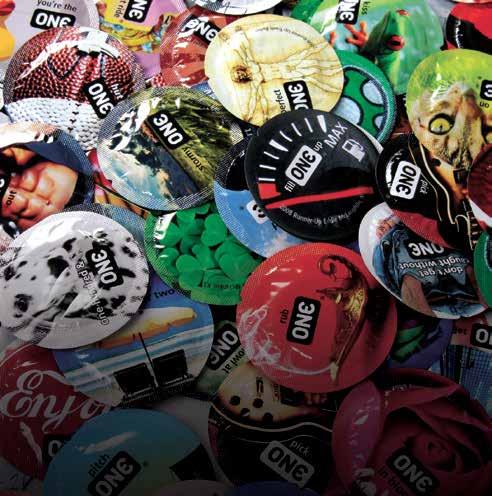
The Food and Drug Administration announced on Feb. 23 the authorization of the marketing of the first condoms specifically to reduce sexually transmitted infections during anal intercourse. The condoms will be marketed as One Condoms, which can also be used for vaginal intercourse to prevent STIs and pregnancy.
“The risk of STI transmission during anal intercourse is significantly higher than during vaginal intercourse. The FDA’s authorization of a condom that is specifically indicated, evaluated, and labeled for
anal intercourse may improve the likelihood of condom use during anal intercourse,” said Courtney Lias, PhD, director of the FDA’s Office of Gastrorenal, OB-GYN, General Hospital, and Urology Devices in the Center for Devices and Radiological Health.
“Furthermore, this authorization helps us accomplish our priority to advance health equity through the development of safe and effective products that meet the needs of diverse populations,” said Lias.
According to the FDA, anal intercourse carries the greatest sexual exposure risk of HIV transmission, which consistent and correct use of condoms can significantly lower.
by Lindsey Anderson SGN Contributing Writer
On Tuesday, March 8, Resist Fascism held its first abortion rights walkout, encouraging everyone to leave work and school at 1 p.m. to protest recent moves by states to criminalize abortion. Perhaps a hundred protesters gathered on Broadway in front of Seattle Central College to prepare for the march into downtown.
The event also attracted about ten counterprotesters, who flew into Seattle from San Francisco and Washington DC, prepared for conflict with bucket drums and bear mace. From blocks up the street, chants of “Roe v. Wade has got to go!” echoed as the few counterprotesters pounded their drums and yelled into megaphones.
by Paige McGlauflin SGN Contributing Writer
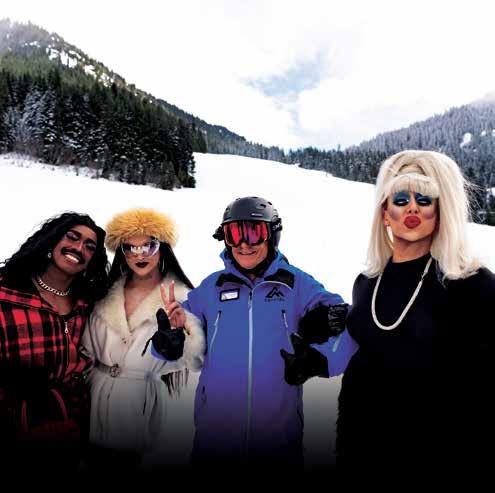
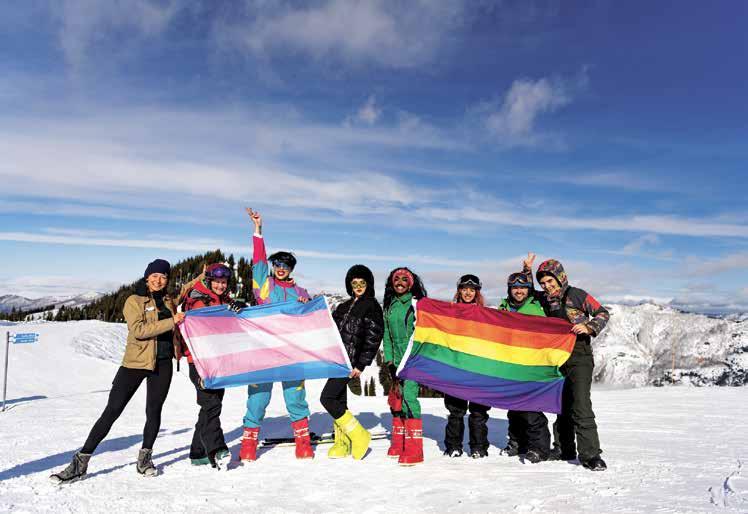
Any Seattleites out there want to ski or snowboard in the comfort of an LGBTQfriendly environment? Or maybe party with drag queens at a ski lodge? If so, consider heading up to Crystal Mountain Resort this weekend.
This weekend, the Enumclaw-based ski resort, just over two hours from Seattle, will host MTN Pride: Pride in the Pow. Attendees can expect to be treated to a mix of outdoor winter activities, including group ski and ride lessons, and indoor festivities such as mixers, parties, and drag
performances. Pride in the Pow is the perfect space for those who might hesitate due to experiences in nonwelcoming spaces.
“Already there is a big barrier of entry, and I think it can be even more intimidating for those communities that aren’t necessarily reflected in the outdoors traditionally, so making that space an inclusive, positive, fun environment and inviting everyone up is really important to us,” Emma Brice, the resort’s communications coordinator, told the SGN.
Seattle Pride is partnering with Crystal Mountain for the event. Their partnership began when Crystal Mountain reached out
Photo courtesy of ONE Condoms Photo courtesy of Crystal Mountain Resort
Photo by Lindsey Anderson
Local News
Seattleites protest against the war in Ukraine
by Lindsey Anderson SGN Contributing Writer
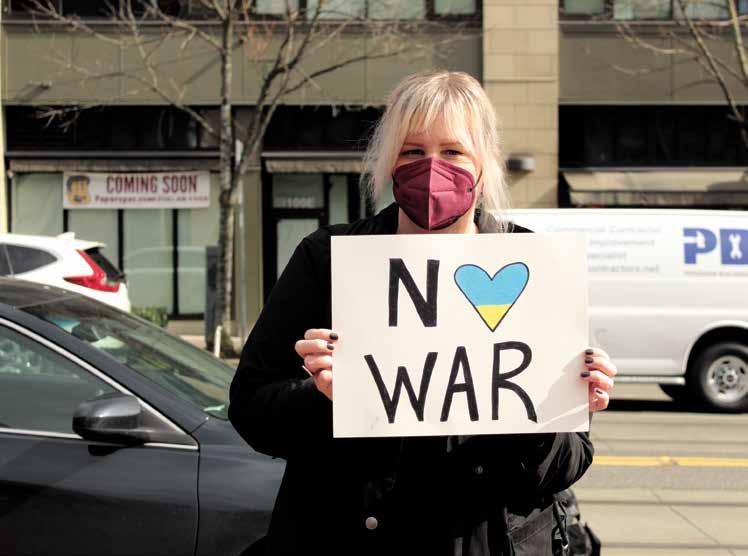
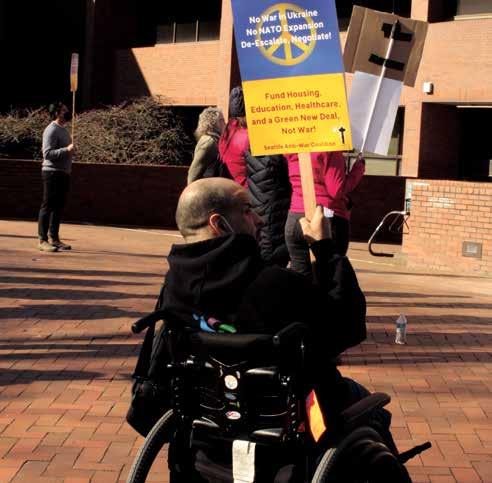
On Sunday, March 6, 2022, concerned Seattleites gathered in front of Seattle Central College to protest the war in Ukraine. Organized by the Seattle Revolutionary Socialists, peaceful protesters engaged in chants, held up signs, and proudly displayed the Ukrainian flag before marching up Broadway toward the Sunday Farmers’ Market.
The protesters came from several organizations, including Veterans for Peace, the Seattle Anti-War Coalition, and Radical Women. Despite their differing backgrounds, each speaker ignited the crowd with similar calls for a ceasefire, for the US to end sanctions on the Russian people, and for the disbanding of NATO.
Protesters call out imperialism
Misha, the event’s first speaker, called on Seattle to vocally oppose Putin, saying, “We have to stand with them, we have to condemn Putin, protest him, and stand together as a united front against his unjust invasion.”
They informed the crowd that war benefits the elite. “War is a feature of the modern capitalist era,” Misha said. “If we are to stand against Putin, I think we should stand against all capitalist and imperialist institutions.”
They went on to condemn the United States for its role in the Ukrainian invasion. “This is a humanitarian crisis caused only by Western forces clamoring for power. The people who are calling the shots, making all of these strategic military decisions, they’re not feeling any of the consequences of their decision-making. Not one. Putin will not miss a single meal, regardless of how many sanctions NATO or the US establishes or puts against Russia. The people who suffer the most in any pocket are the civilians and the poorest, with absolutely no means of escape.”
Misha noted that the crude oil industry and military-industrial complex only benefit from wars like the one in Ukraine, and that the influence they hold over our politicians leaves hope for peace bleak. They also clarified that sanctions are an act of war and do not punish the Russian oligarchy as much as they directly impact the people of Russia, who had no say in their leadership.
“There are citizens in Russia who disagree with Putin’s actions as well, who are going out to protest in their cities and their towns, and you know what happens to them? They’re arrested and detained,” Misha said. “How does the United States respond to this? Starve them, even if they didn’t elect him. So, why must we punish innocent people? The people of Russia did not even have a say in electing Putin. He was put [in] by former Russian President Boris Yeltsin, who was put [in] by the United States in the ’90s. So, at this point, we are seeing the United States reaping what it sows. We have to hold this capitalist regime responsible.”
Veterans against the war in Ukraine Misha was not the only speaker to point out the implications of sanctions on the innocent people of Russia. Dan Gilman of the Seattle Anti-War Coalition took to the stage to reiterate the suffering caused by the war.
“This war is breeding terrible suffering for the Ukrainian people and hardship for the Russian people,” said Gilman. “Hundreds of Ukrainians have been killed, millions [sic] of Russian soldiers have been killed. Countless are wounded, millions are fleeing for their lives, and if we can believe the Western press coming out of Ukraine, hundreds of hospitals have been hit. Outlawed cluster bombs are being used, the economy is being destroyed, and we are all living with the nightmarish threat of nuclear war.”
After presenting the protesters with the harsh facts of the war, Gilman offered advice on what Americans can do. “Here we are,
200,000 [sic] miles from the war zone, well, I think we can start with our own country, demanding our government stop its imperial drive to expand NATO and reach an agreement on collective security for Ukraine and Eastern Europe,” he said.
“Stop interfering in Ukrainian affairs, reject Ukrainian membership for NATO,” Gilman continued. “We can also be in solidarity with the courageous antiwar activists in Ukraine and Russia. In Russia, they are being arrested at the rate of a thousand a day. In Ukraine, resisters have bombed some of Russia’s operations.
“Last, we can keep doing what we’re doing here: getting into the streets with rallies, marches, and vigils. Let’s reach beyond the antiwar peace movement and build mass opposition to this war and US war with NATO.”
Protests against US sanctions and NATO
Su Docekal, the speaker from Radical Women and Resist Fascism, spoke of her connection to the war. “My family is from what once was Czechoslovakia, so I’m quite familiar with invasions of little countries, often by various imperial powers,” she started.
She explained that US intervention in the war will not be helpful. “Neither Russia nor the US has the interest of ordinary Ukrainians in mind. After the breakup of the Soviet Union, the US was the top dog unquestionably for a long time. But now, with the economic crisis of capitalism here and internationally, you have competing imperialism interests,” she explained. “Russia has grown into a massive capitalist and imperialist power, and China is close behind. It’s a dangerous place, as they vie with each other for spheres of influence and economic advantage.”
Docekal also warned against nationalism, which may only lead to an escalation in a time when the world is on the brink of war.
“We demand that Russia pull its troops out. On the other hand, whipping out nationalism is not the answer. Pouring out Russian vodka is ridiculous. Russia is not the enemy. It’s the Russian oligarchs, just like the rich here, that oppress neighboring countries, as well as their population, that [are]the enemy.”
She ended with an explanation for the event’s anti-NATO sentiment. “As other
speakers have said, we’ve got to stand in solidarity with Russian antiwar protesters. They’re very brave, and they’re up against a lot. A lot of well-meaning people think NATO would be a solution, but it’s not. NATO is a complete tool of the US that has built up massive bases and forces to encircle Russia and the countries in its sphere of influence. For people who wonder about this, just look at NATO’s role in bombing Yugoslavia in 1994 and again in 1999,” Docekal said, referring to Operation Noble Anvil, which led to the deaths of nearly 500 Yugoslav civilians during the summer of 1999.
Support for Russian protestors
Local politicians even took time to speak at Sunday’s event. Jason Call, who is running for Congressional District 2, took to the stage. Call reminded the crowd of the innocent people caught up in the war.
“Putin’s invasion of Ukraine is a war of aggression that has done and will continue to do untold harm to the Ukrainian people. I condemn his actions and those of all imperialists who choose violence over diplomacy and cooperation,” he said.
Despite his involvement in US politics, Call made it clear he does not agree with the actions taken by the federal government at this time. “I firmly oppose, however, any US intervention aside from humanitarian aid, which we should be supplying, because it is going to escalate us to nuclear conflict,” he said.
Call continued to question the Biden administration’s response to Russia, saying that “a no-fly zone is a precursor to armed conflict. What are you going to do? You establish a no-fly zone, Putin breaks it — are you going to shoot down Russian jets? I don’t see that as a reasonable pathway.”
Like speakers before him, Call also reminded the crowd that most Russian civilians — who will suffer the harshest consequences from sanctions and outright aggression — are not in support of the war. “In Russia, we are seeing protests of the Russian people, which shows that they do not support this war of aggression against Ukraine. For them, it’s as if the US made war on Canada, and of course, we all would, I hope, oppose that.”
He continued to explain that even Russian
soldiers deployed in Ukraine do not support the war they are fighting in. “Yesterday, a video was circulated, a press conference where three Russian soldiers said they were lied to about their military maneuvers by Putin. That they were told Ukraine was under attack by neo-Nazi factions and that they were sent there to protect Ukrainian citizens,” Call said.
“When they arrived and realized their [mission] was to be the aggressors, their response was to turn themselves in. They were captured. These Russian soldiers said that many Russian soldiers are opposing these illegal orders and refusing to fight. This is how the war will end, when the Russian people recognize the criminality of their war, and they reject their warmongering leaders.
“But what we must do now is to be here as we are doing, showing moral support for the people in Ukraine who are fighting to protect their home, and to the Russian people who are risking arrest, [and to] soldiers who are likely risking treason [charges] and potential execution.”
Call demanded an end to American intervention, including the sanctions on Russia. “What we do not need is to escalate violence, including the violence done by economic sanctions, which always hurt the poor, the working class, and the most vulnerable. I believe standing for peace is the most important thing we can do right now,” he said.
Unite to support all immigrants
The most poignant speech of the day came from another politician, Stephanie Gallardo, who is running for Congressional District 9. She started with a story from her grandfather, a city councilmember elected in Chile in 1970, the same year Salvador Allende was elected as the first socialist president in South America. After a US-sponsored coup there in 1973, all politicians with ties to Allende were taken and tortured, including Gallardo’s grandfather.
“In war, the people who suffer are our families,” Gallardo said. “In light of the ongoing occupation of Ukraine by Russian forces, I’m sharing the details of my family circumstance today, because while the actors and my family circumstances are not
Photo by Lindsey Anderson
Visually, the numbers were on the side of Seattle’s abortion rights advocates. They held up their signs and chanted and in an attempt to drown out the rhetoric blasting from the counterprotesters.
Conflict with counterprotesters
After a few minutes, it became apparent the counterprotesters were looking for a fight. The abortion rights advocates surrounded them in a tight circle, continuing their chants and trying to drown out the noise of the bucket drums. Then a counterprotester lunged forward and shoved a young person to the ground. The skirmish escalated quickly as volunteer security jumped into the middle to break up the fight.
Mace and drumsticks fell to the ground, and the protesters quickly scrambled to discard anything that might be used to escalate the situation. Organizer Margo Heights made the swift decision to guide protesters away from the chaos, leading the crowd around the corner and away from the counterdemonstration.
The counterprotesters weren’t ready to end the conflict just yet, however. They heckled the march as it moved. One young man even pulled out a can of spray paint and defaced a “Defend Roe” sign held by an older woman.
“They are coming for all of us”
Once the abortion rights rally had safely moved away, Heights addressed the crowd, expressing disappointment in Seattle’s response to the growing abortion crisis.
“Every single school did not shut down. Every single freeway did not shut down, with people flooding into the streets and standing in solidarity with the seven million women of Texas who no longer have this right, the right to control their bodies or their own lives or their futures,” Heights said.
“They are coming for all of us. They think Roe is going to fall, and then the blue states are who they’re going to target next, because they think that is where the abortions are going to be happening. Are we going to let them come for us?”
The crowd echoed energizing chants led by Heights and began to march downtown. Supporters cheered the rally on from building windows and sidewalks. Construction workers stopped volunteers to ask questions about the event and quickly became supportive, joining in on chants.
Heights explained the connection Resist Fascism has with international organizations, and the support Colombian organizers have sent to Seattle, advising citizens to take to the streets with grassroots organizations.
“We’re wearing this green bandana,
because it’s going to be a national day where everyone is wearing green,” she called out to the crowd at an intersection. “This symbolizes the struggle in Colombia.”
“One of [the Colombian] organizers sent us a solidarity message,” she added, “and they said a lot of struggle happens in the legal arena, knocking on doors in the legislative arena, and getting votes, but when it came down to it, the tipping point [there] was people in the streets, day after day. They tell us that if we do that too, we can win, and that’s what this is the beginning of.”
Supporters’ stories
Supporters took to the streets, all with different stories and reasons they felt called them to walk out for abortion rights.
“I don’t want to be out here marching, but you know, it lit my fire, man. I was, like, I gotta come out here,” said Purpelle. “I’m here to support abortion rights or pretty much women’s rights, because this is my thing here. Forced motherhood is female enslavement. I also think about women that were raped and [victims of] incest and everything else under the sun. Why would you force someone to go ahead and have that baby? It feels like we’re going back in time.”
A majority of the crowd seemed to be students walking out of universities like the UW, high schoolers attending their first protest, and even a few middle school students taking a stand.
“I’m walking out from school,” said one student, Sunny, who explained why they felt compelled to join the cause. “It’s heart-
breaking, because these are medical procedures. They’re not for fun; these people need them. Unless you have a uterus, you shouldn’t be making laws about uterus reproductive rights.”
Another student, Noel Poltronieri, said she was walking out of Lincoln High School for “so many reasons.” Armed with a sign and the support of friends, she said she was taking a stand in solidarity with Americans whose reproductive rights are now under attack. “To start, it’s just a matter of not letting men control something that should be a human right,” she said. “Fuck it. We have to resist it 100%.”
“This is about controlling women” Heights led the protesters down to Westlake, pausing for a physical demonstration in which they all lay down in the street, blocking traffic. At Heights’ call, the protesters took to their feet to “rise for abortion rights” and continue the march to Pike Place Market.
As the procession closed in on more crowded downtown streets, reactions began to change. Some on the sidelines called out slurs and disagreement with the abortion rights movement. The energy of the crowd did not waver, however. Middle fingers saluted men on the street calling out objectification, and an infectious wave of empowerment seemed to spread throughout the gathering.
Once again, the march paused, this time in front of the iconic Public Market sign. Heights addressed the crowd again. She acknowledged the youth who had left school
to protest and praised them as the future humanity needs. She then addressed the younger generation, specifically those who do not remember a time before Roe v Wade “We’re finding out a lot of people have never been taught what it was really like before Roe v. Wade, when women did not have this right, what happened, and why we say, ‘When abortion is illegal, women die.’ It is all incredibly abusive. Don’t let the antis tell you anything about the violence of abortion. That is bullshit,” she said.
Heights addressed common arguments made by pro-lifers, such as the rights of the unborn. “We’re talking about embryos, we’re talking about clumps of cells. And [when] we’re talking about when women decide late in their pregnancy to have an abortion, you can better believe there’s a really good reason for that. And we support them,” she said.
“We value their lives as whole human beings. And we’re not going to live in a society where half of that population, half of that society, half of humanity is held down and held back and treated as less than a fetus, as less than a clump of cells, as not having humanity.”
Heights finished her speech by calling on spectators and protesters alike to rise and continue the conversation about abortion, and to prevent conservative legislators from coming after liberal areas like Seattle.
“We’re not living in that world, and that’s why we’re rising today, and this needs to be the beginning of calling many more people into this, because we know that their agenda goes far beyond where they are right now,” Heights said.
“Don’t ever let them tell you this is about babies. This is about controlling women,” she added. “This is about controlling people who are pregnant and making sure that they do what they want to their bodies. This is about your body becoming the property of the state when you’re pregnant and being forced to have children against your will. Forced motherhood is a form of enslavement. It’s been normalized the way that rape has. Fuck that. They’re trying to take us back to the Dark Ages, and no one is going to stop this except for us, so let’s keep on talking, let’s keep on marching, let’s go!”
The march concluded with a hike back to Westlake, where speakers shared stories and united in solidarity for those currently impacted by antiabortion laws.
“This is not the end,” Heights reminded listeners. “We’re hitting the streets again on April 9th, so mark your calendar. This cannot be done with just a few organizers. We need hundreds of organizers around the country calling people into the streets.”
The next event is expected to be bigger, which Heights hopes can help draw the attention of legislators.
Resist Fascism will hold its next Rise Up for Abortion Rights event on April 9 and is currently looking for more volunteers to help with security, organization, and participation. See www.facebook.com/ RefuseFascismSea.
Photos by Lindsey Anderson
Local News
ANTI-WAR
continued from page 4
identical, the commonalities are obvious.”
She referenced the economic impacts of sanctions, stating, “For years leading up to 1973, the United States instituted various economic sanctions on the Chilean government, leaving everyday Chilean people like my family completely destitute.”
“As the daughter of a refugee forced to flee his homeland as a result of US intervention, I long for a land I wasn’t born on,” she continued. “I am bitter that my family was split
MTN PRIDE
continued from cover
last summer, for its MTN Pride event. As conversations progressed, Seattle Pride was drawn to the resort’s commitment to bringing inclusivity to such outdoor activities.
“It’s been really great to hear [their] messaging, that the mountains are for everyone, and to really encourage folks who maybe haven’t seen themselves as a skier or snowboarder… to think differently, and think, ‘Maybe I could be,’” Krystal Marx, Seattle Pride’s executive director, told the SGN.
The partnership also stems from Seattle Pride’s Out to Play initiative, which enhances the presence of sports and outdoor activities for the LGBTQI+ community and was influenced by feedback from community members.
For LGBTQ Seattleites who are thinking of other ways to enhance community engagement in certain activities, Seattle Pride is always looking for more ways to help groups do just that.
“We want to hear from more people in our community about what’s missing. As you think of yourself as a whole person… what are the things that you wish you saw more Queer and Trans representation [of] in our community? We want to help co-create that with people,” Marx said.
Event timeline
Pride in the Pow will kick off with a snowshoe tour at 2 p.m. on Friday, March 11. Hikers will scale just under 2,000 feet, from Crystal Mountain base to Bullion Basin, where they will be treated to warm drinks before heading back down to a dinner party.
Tickets for the snowshoe tour and dinner cost $94 and must be bought separately.
Thirty percent of the snowshoe ticket proceeds will go to QPOC Hikers, a Pacific Northwest–based group that connects Queer people of color to hiking and the out
among two continents without being asked. And that my father couldn’t say goodbye to his family in Chile before he passed away from cancer in 2020. It is the small moments, the personal moments, that imperialism can never recover for us. In war, the only winners are corporate profiteers.”
Gallardo called on the American people to consider the consequences of US involvement in foreign affairs. “The people of this country have a choice: do we fall deeper into the myth of American idealism, where our military play global police and our elected officials haphazardly direct billions of dollars into imperialist ventures
that result in death, doom, and destruction? Or do we take note of our history and move toward peace, recognizing that it is the working class that suffers the consequences and never the oligarchs?”
She finished her speech by bringing up a less talked-about topic when it comes to the treatment of Ukrainian refugees. “As Americans, we must question the blatantly racist treatment of Black- and Brown-skin refugees [which contrasts with] the rightful global outpouring of support for the Ukrainians,” she said. “100% Ukrainians deserve safety. Our biggest priority in the coming months should be resettling Ukrai-
nian refugees and providing them with governmental services to aid in their healing. But do we ever stand with Palestine? Do we ever stand with Afghanistan? Do we ever stand with Iran, Pakistan, or Somalia? In what ways are we complicit with creating a global second-class citizenry?”
“We have to ask ourselves these questions,” Gallardo said. “Moving forward, we must state loudly and clearly that if we stand with Ukrainian refugees, we stand with all refugees.”
All the speakers for the event brought energy and excitement to the crowd, who then marched and chanted along Broadway.
doors and is also guiding the tour.
On Saturday, March 12, attendees will kick off the day with a mix-and-mingle at 8:30 a.m. “There’ll be complimentary beverages and opportunities [to] meet people and get to know the community,” Brice said.
Both Saturday and Sunday will start with meet-and-ski ride groups at 9:30 a.m. The volunteer-guided groups range from beginner to expert, and lessons (for purchase) will take place from 10:00 a.m. to noon on both days.
At noon on both days, a party will begin at Crystal Mountain’s Tower 16, followed by drag performances at 1 p.m. “Hoochie Papa, Miss Monday Morning, and Rowan Ruthless will be here performing,” Brice told the SGN.
Both days will also end with an après party (which is “a little more oriented to a happy-hour style,” Brice said) and raffles starting at 4 p.m. and 3 p.m. on Saturday and Sunday, respectively.
Registration for the event is free, but tickets to ski and snowboarding lessons cost $125. Daily ski lift tickets cost $85.
Worried about having seen this too late? Latecomers may still be in luck — more event and ticket information can be found at prideinthepow.eventbrite. com, and Crystal Mountain is accepting purchases at ticket windows, depending on availability.
Photo courtesy of Crystal Mountain Resort
Photos by Lindsey Anderson
Local restaurateur a semi-finalist for James Beard Award
by Kylin Brown SGN Contributing Writer
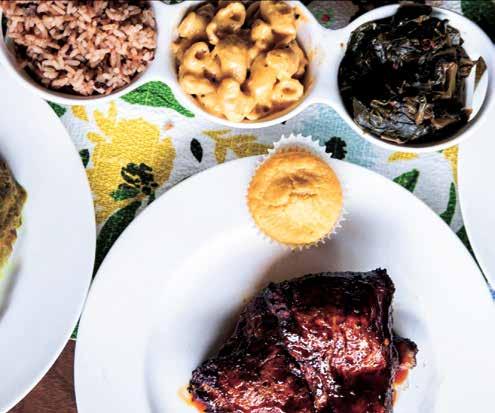
Last week, a neighborhood-famous “BBQ and soul cuisine cook” became one of 16 semifinalists for the James Beard Award for Best Chef (Northwest and Pacific). Lil Red’s Takeout and Catering, also called Lil Red Jamaican BBQ and Soul Cuisine, is known throughout Seattle as the best barbecue spot in town. Now, its owner and head chef, Erasto “Big Red” Jackson, has received personal recognition for his family-inspired fare.
Jackson says he started selling plates of home-cooked BBQ from the back of a 1991 Volvo station wagon. While word of his flavorful foods spread across King County, he and his wife, Leleith “Lil” Jackson, saved up.
Together, their cultural traditions combined with their nicknames to transform a former Rainier Avenue S. butcher shop into one-of-a-kind Lil Red’s in 2016. Fit snugly between Mount Baker and Columbia City, the unassuming spot has been a Rainier Valley staple ever since.
Lil’s Jamaican heritage brings jerk chicken, pork, and bony escovitch fish to the menu. Red’s take on the classic saltand-pepper Texas brisket, BBQ pork, and Louisiana po’ boy are regionally renowned, having appeared in multiple online neighborhood forums over the years. Jackson’s dishes demonstrate a masterful seasoning knowledge, though he says he knows his menus so well he “doesn’t even know” how
to describe what he puts in his spice mixes anymore.
For those who don’t eat meat, Jackson offers a spiced mac n’ cheese, Jamaican deep-fried plantains, rice and peas, “not your traditional” yams, salad, and garlic mashed potatoes.
“Food, going out to eat, it should be an experience,” he said.
Multiple honors
Last year, Lil Red’s was named one the nation’s top 20 Black-owned BBQ restaurants by James Beard Award–winning cer-
Arts & Entertainment
tified barbecue judge Adrian Miller in his book Black Smoke: African Americans and the United States of Barbecue. After its release, Jackson recalled, there was an influx of first-time customers, some of whom drove over an hour just to taste his oxtail.
Now, Lil Red’s is being honored for the second time in under a year. Just before the recent end of Black Restaurant Week Northwest, which Lil Red’s participated in, Jackson received word of his nomination for the James Beard Best Chef award.
“I’m still coming to grips that I’m on the list,” said Jackson. “You’re never ready when the Lord blesses you with something like this. And whether you’re a chef or not, he thinks you are. So, I’ll accept that.”
The James Beard Foundation Awards were established in 1990, just nine years after Beard himself came out as Gay in a revised memoir. The awards focus on culinary arts and aim to recognize exceptional talent and achievement, according to the website.
While being a semifinalist means that Jackson may not see the award in the end, he said he is excited to be recognized at all. He is one of seven on the list that hail from Seattle, but one of the only home cooks without classical culinary training.
The James Beard Restaurant and Chef Awards finalists will be revealed on Wednesday, March 16, and winners will be celebrated at the ceremony on Monday, June 13, 2022, at the Lyric Opera of Chicago.
Our Blue Planet to showcase local and global perspectives on water at SAM
by Nick Rapp SGN Contributing Writer
Seattle is well loved for its access to water. Green Lake, Lake Union, Lake Washington, the Skykomish River, the Sammamish River, and the Puget Sound make up a large portion of the region. We are close to temperate rainforests and alpine lakes galore, separated from the drier eastern side of the state by the Cascades. Water shapes our natural and cultural landscapes inseparably.
Though it is incredibly visible here, water (or lack thereof) also defines life in all other regions of the States and the world. It determines commerce, agriculture, livelihoods, and the general ability to sustain life.
Starting March 18, the Seattle Art Museum is showcasing an exciting new exhibit focusing on the role water has played in human existence through various artistic representations spanning scientific data, aesthetics, environmental change, cultural histories, and spirituality.
Our Blue Planet: Global Visions of Water will be as much of a contemporary experience as it is a trip across time. As SAM’s website explains, it will feature “artworks created in 618 AD… alongside contemporary works so new, they were finished in preparation for this exhibition.”
The exhibit will consist of “more than 80 paintings, sculptures, films, photographs, and textiles” from an intriguing variety of 74 artists from 17 countries and seven Native American tribes, according to SAM’s website.
Also, the advisory committee for this exhibition comprised Seattle Aquarium employees, a Superfund manager, artists, and conservation specialists. SAM obviously aspired to a nuanced perspective on water when planning Our Blue Planet
In conjunction with the exhibit, local artist Sherry Markovitz’s sculpture Sea Bear will be moved from SAM’s main gallery to Our Blue Planet
On SAM’s blog, Markovitz explained a bit of what went into constructing the polar bear head: “Emotionally, Sea Bear is circular, all the stuff on it is traceable to significant walks. Walks with my mother in Florida, walks in Port Townsend with Peter… walks alone to find the ‘root’ pieces at Discovery Park. Walking on the beach is such a drifting and wonderful activity.”
Strolling through a gallery and seeing
materials from our backyard will position the guest locally, before shifting gears and displaying art from overseas, connecting the world via water and its various meanings geographically.
Utagawa Hiroshige’s woodblock prints will be featured prominently in the exhibit, a testament to the power of Japanese representations of water via ukiyo-e -style art across time. When you think of art centering on water, The Great Wave off Kanagawa by Hokusai likely comes to mind first, as it is one of the most ubiquitous prints in art history. It has shaped how outsiders view Japan, tsunamis (though it is not supposed to represent one), and oceanic art in general.
Our Blue Planet would not be a contemporary exhibition if it didn’t also tackle the trickier histories of water. Plenty of artworks showcasing pollution and toxic waters, along with water’s fraught future, will be on display as well.
All of this is to say: water has a large place in art, locally and globally, and Our Blue Planet is a timely collection of pieces that will take a stab at localizing the viewer in myriad cultural and artistic understandings of it. It is an appealing addition to SAM’s collections and a fitting exhibit for the region.
Our Blue Planet will run from March 18 to May 30. SAM is open Wednesdays to Sundays from 10 a.m. to 5 p.m.; tickets can be purchased for specific time slots at the door or at www.seattleartmuseum.org. Masks are required.
Seattle filmmaker Wes Hurley on making Potato Dreams of America
by Sara Michelle Fetters SGN Staff Writer
Editor’s note: The following article contains one or more spoilers for the film Potato Dreams of America
Seattle filmmaker Wes Hurley makes an immediate impression. He walks into a room with his curly mop of hair hanging in his face and a crooked smile perched upon his lips, and one almost cannot help but be immediately enamored with him. As quiet as he may appear, there is something about Hurley that fills up an entire room, and once you start chatting with him, it’s almost as if you were old friends picking back up a conversation you started years ago.
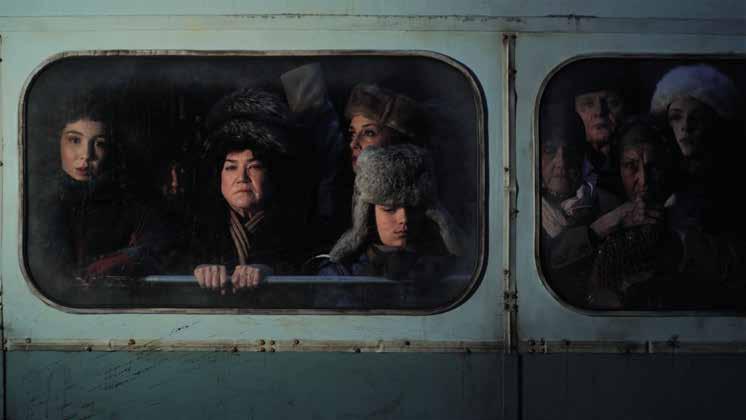
Over dual bowls of red chowder at Six Arms restaurant on Capitol Hill, we sat down to chat about the film Potato Dreams of America. A memoir of sorts, it’s largely based on Hurley and his mother’s journey from Vladivostok, Russia, to Seattle when he was a teenager. It is also a coming-out story, about when Hurley revealed he was Gay to his mother when he was 16. Both worried that his new conservative stepfather would find out and ship them back to Russia.
It’s a crazy, highly stylized picture split into two halves. The first set in Russia is a candy-colored fever dream that John Waters, Wes Anderson, and Jacques Demy would likely enthusiastically cheer; the other section here in Seattle is a more down-to-earth, authentically lived-in presentation reminiscent of the works of Cameron Crowe or Richard Linklater.
All of which plays very differently in some respects now than it did back in 2021 when the picture was screened twice locally, once during the Seattle International Film Festival in April, the other when it was the opening night attraction for the Seattle Queer Film Festival in October. In light of Russia’s invasion of Ukraine, the darkness of the first half, the threats of violence and intolerance, in many ways feel more pronounced, more menacing.
“It does play differently,” Hurley warily laughed in agreement. “Even people who were involved with the film and have had long conversations with me about growing up in Russia, they’re all now like, ‘Oh my god! You’ve been saying this about Russia for so long now. It’s all true. I really get it.’ They feel bad that they didn’t fully understand what I was trying to tell them.”
“And that’s fine,” he continued confidently. “I’m glad they see that now, and it also helps make some of the moments in the film stand out in ways they maybe didn’t before. Like, the scene at the high school with all the kids chanting all that horrible stuff. That was the point in my life where I realized Russia was going to be the next Germany. If there was ever going to be a WWIII, Russia would be the next Germany. That’s what I thought. Sadly, here we now are.
“But it’s also strange. That moment used to play like a distant memory. I remember my mom and I were like, we need to get out of here. We’re willing to go anywhere. But it was a memory, not much more. But now, it all feels fresh again. Tragically fresh.”
Mom
What feels positively fresh is the relationship Hurley shares with his mother. He wanted Potato Dreams of America to be as much her story as it is his. This was important to him, even if it took her some time to want to sit down and watch the film for herself.
“My mom refused to watch it,” said Hurley with a bemused smile. “I was editing it her house most of the time, and I would try to get her to watch individual scenes with me, and she always would say no. She wanted to watch it with an audience. She didn’t want to see the film until it was finished. She waited until she could have that experience.
“Of course, Three Dollar Bill got her to come up on stage during the festival last year. She was so shy. She told me to ask them not to do that again next time.” Hurley pauses for a moment, a twinkle in his eye. “But I know she loved it.”
The immigrant experience Hurley was also insistent that the immigrant journey to the United States be represented as clearly and as cleanly as possible. “I wanted to show in a noncerebral, almost intuitive way the culture clash and the immigrant experience,” he stated. “You’re a completely different person. You’re in a whole different world.
“My mom, who was this sharp-tongued, highly educated doctor, came here and she was suddenly a child. Her level of communication was like a child’s, and at the same time, she’s suddenly very subservient to this new man. Back in Russia, she’d kick just about anybody in the balls who tried to tell her how to live her life.”
One of the ways Hurley chose to represent all of this was by having different actors portray his mother, named Lena in the film, and himself, nicknamed Potato, in the Russian and Seattle sections. In the former, Sera Barbieri and Hersh Powers took the honors; in the latter, Marya Sea Kaminski and Tyler Bocock inhabited those roles. It’s part of the tonal shift between halves that the director did have minor reservations about, at least in regard to how the audience would respond.
“I was worried,” he admitted. “But I have my own unique take on things. If I’m not doing this in my own way or presenting things in my own style, then why am I doing it? There are so many movies about coming of age, about coming out, about the immigrant experience, and this is my contribution to all of that, and I needed to do it in my own way.
“And some people won’t get that. But some will.”
Part of the danger was in how the dialogue was presented. During the Russian section, no one speaks with an accent. In the Seattle portions, those thick Russian accents become an important plot element.
“And that’s also risky!” Hurley exclaimed. “People like the Russia cast. They get used to them, and then suddenly there are new people playing these characters.
“This change was very radical for my mom and me. Because of that, I felt it necessary to make that feel radical for the audience. It’s like the accents. Those accents aren’t as important when you’re telling the
Russian section of the story. It’s like, if you go see a Chekov play, nobody ever speaks with an accent, because that’s not what it’s about. It’s about the play.
“When you get to America, language is everything. It’s so important. It’s a barrier to so many things. But also, it’s like with my mom in the film: How many of her language slips are real? How many of them are intentional? And it’s amusing to see it play out, but it’s also an important part of the story. There are moments where my mom has to play dumb for my stepfather because he’s so intense. It’s her way of de-escalating situations.
“But I like shaking things up. I mean, I’m not interested in experimental cinema, but I do like experimental elements in cinema. I feel like cinema is one art form — especially American mainstream cinema — where people are not used to experimentation. I like challenging those perceptions.”
“I do struggle with that,” he admitted after a brief pause. “I do want my work to be accessible, and I do want to make money and be successful. But that’s not what I’m all about. I enjoy playing with audience expectations.”
The actors
This did not mean he kept the actors portraying Lena and Potato separated. The director felt it was vital to let them collaborate, especially as it pertained to Powers and Bocock.
“We shot the Russian half last,” he explained, “but we made sure Hersh got to come on the set a couple of times during the Seattle section to see Tyler work and to see some of the footage. I thought that was important. But mostly it was just talking things through with them, and I also think that Hersh and Tyler spent a lot of time just studying me. My mannerisms and everything.”
The most recognizable actor in the ensemble is former The Wonder Years star Dan Lauria. He portrays Potato’s religious, conservative stepfather John, an initially overbearing beast of a man who hides a painful, long-buried secret, ultimately coming out to mother and son as Transgender and asking the two to refer to her as Grace.
“I wanted an all-Seattle cast,” Hurley said. “But for distribution purposes, you do want to have a couple of name actors if you can. When our casting director in New York pitched Dan Lauria, I admit I initially never would have thought of him. I mean, he’s done everything, but The Wonder Years was his biggest role, and he’s such a
terrific father figure in that show.
“But I realized he was perfect. He can have that dangerous vibe, but he can also still be likable, and that was important to me. There is so much about the character that is going on in the film. It’s a lot. But there was even so much more to my stepfather that we couldn’t get into. It just would have made the story too complicated.
“So we needed an actor who could convey a variety of emotions, and it was important to me that the audience love this character, even though they’re so conservative and somewhat loathsome at the beginning. I wanted people to relate, and I needed them to really feel for Grace when she finally comes out.
“Dan brings all of that. There’s something decent about him. Even when he’s yelling and doing some of these potentially horrible things, I still felt there was something likable about him. Dan did that.”
Even so, John’s reveal and transformation into Grace happens rather suddenly, and after playing to mostly positive reactions on the festival circuit, Hurley has come to realize that some viewers find this moment rather shocking — and not necessarily in a good way. Not that he would have changed anything if he could go back and do so now.
“That abruptness wasn’t even one of the risks I considered when I was making the film,” he said. “This is how it happened in real life. I wasn’t thinking about character development or the audience’s reaction when I wrote the script. I was thinking about how this actually happened.
“People kept telling me I should add hints. Or that we should sprinkle some of John/Grace’s coming out throughout. But we had no idea! My mom and I didn’t know anything. This is how it went for us. My stepfather made such a huge effort to keep it all in, and I felt it important to be authentic to that. There were no clues for us. This is how it happened.”
Coming out
As for his mom, while the film represents his coming out to her as he remembers it, there were other aspects of their relationship he decided to keep personal. “I tortured my poor mom!” said Hurley with a laugh. “I came out to her when I was 16, and she was just as accepting in real life as she was in the film. But after that, all I could think about was being Gay. I would inundate her with all this stuff. Constantly.
see WES HURLEY page 12
Potato Dreams of America – Photo courtesy of Dark Star Pictures
Film
Pixar’s Turning Red is a miracle of storytelling genius
by Sara Michelle Fetters SGN Staff Writer
TURNING RED
Disney+
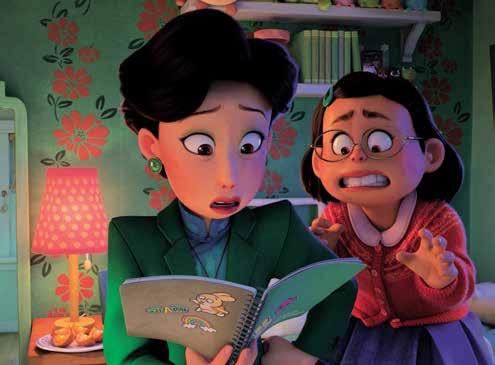
Pixar’s Turning Red is one of the studio’s best films. Considering its overall track record, this is not a statement I make lightly. But director and co-writer Domee Shi — already an Academy Award winner for her delightful 2018 animated short film Bao — has crafted something marvelous. This is a coming-of-age sensation where the supernatural and the mundane happily walk hand in hand, with each eye-popping surprise grounded in lifelike normality.
At its heart, this is a mother-daughter tale set during a time of great turmoil: a young girl going through the first pangs of puberty and a loving parent’s smothering need to help her child deal with these changes. By utilizing a fantastical element involving a sudden, initially uncontrollable transformation into a giant red panda as a starting point, Shi and her fellow writers somehow still deliver an intimate, deeply personal story of teenage discovery.
And it’s magnificent.
For 13-year-old Toronto middle schooler Meilin Lee (voiced by Rosalie Chiang) — Mei to her friends — life couldn’t be going better. She is a terrific student with a particular fondness for math, has a trio of devoted friends whom she thinks the world of, and loves to help her mom Ming (Sandra Oh) at their neighborhood’s temple, regaling tourists with tales of a mystical red panda who protected their family from ruination in generations past. She’s also somewhat shocked to discover she has a crush on the five young members of the popular boy band 4*Town, especially their hunky lead singer Robaire (Jordan Fisher).
WES HURLEY
continued from page 8
It was all I wanted to talk about. Finally, at one point, she was like, ‘Honey, I love you, but can we talk about anything else? Just for five minutes?’
“Part of me couldn’t believe it. But then I realized, this was all I had been processing. I was in this place of learning to navigate being Gay and trying to accept myself. It was all about me. My mom just needed a five-minute break.”
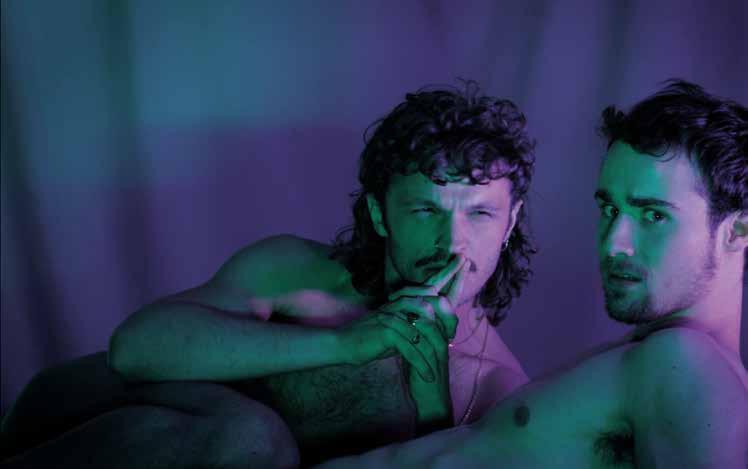
Where Hurley did decide to go for broke was during a montage of Potato’s various sexual escapades after he came out and fully started to embrace his identity as a Gay man. “It was really fun,” he beamed. “My best friend loaned us her apartment, and she didn’t know what we were going to be doing. She showed up one day and was like, she had never been happier. There were all these naked men in her apartment lined up against the wall. She loved it.
“In all seriousness, though, I’ve gotten all sorts of reactions to the scene. Some older Gay men feel like I’m perpetuating the stereotype that all Gay men are whores, but that was not the point at all. For me, I wrote the scene to show the change in my identity… in being a Gay man. I went from not wanting to acknowledge where I’m from to — once I’d become more comfortable with myself — [realizing] I could use my identity to get something. I could even get laid if I wanted to.
“As funny as that is, I think it is important to show this change. We can be so scared of change, and the point of the scene is to show this change and the positive aspects of that over time, and I just thought it would be funny to also show this through sex. I’m super sex-positive as it is, I’m as passionate about that as I am about LGBTQ rights in general, and I want a sex-positive society. So why not, right?”
Mei is changing. Her emotions are going into overdrive. She has desires and needs that appear to be going in a different direction than the path Ming has already meticulously plotted for her daughter. Her hormones are seemingly out of control. Each of these would be difficult enough to navigate all on their own, but in Shi’s story, Mei also comes face-to-face with her family’s curse — initially intended as a gift: as soon as they begin to blossom into womanhood, each girl discovers herself transforming into a giant red panda whenever her emotions spiral outside of her control. It’s a cute, cuddly, and hysterically terrifying conundrum, and it’s one Mei will discover the best way to deal with in her idiosyncratically self-confident way.
I can’t think of another major Hollywood studio motion picture primarily aimed at children that has so openly dealt with issues relating to female puberty. There’s a sublime scene where Ming goes overboard trying to “assist” her daughter in what she believes is her first monthly moment of greatest need. Sequences of Mei poofing back and forth between panda and human states of being as her emotions withstand one psychological tsunami after another are hilariously metaphorical, each dripping in intelligently imaginative inspiration.
There’s not a false beat anywhere to be found. The friendship between Mei and her gaggle of besties Miriam (Ava Morse), Abby (Hyein Park), and Priya (Maitreyi Ramakrishnan) is so empathetically pure
that watching the four girls interact with one another is nothing short of priceless. Another subplot involving one of Mei’s classmates, Tyler (Tristan Allerick Chen), is full of surprises. He’s a character who initially appears to be nothing more than a stereotypical teenage bully — but that’s far from the truth, and I loved how his arc concluded in mosh pit of exuberant acceptance overflowing in youthful giddiness.
But it is the bond between mother and daughter where Turning Red ascends from being great to the absolute peak of extraordinary. There is something magical about how they learn to deal with one another. While I don’t feel it is appropriate to speak to all of the cultural aspects of the relationship, as far as I’m concerned, the fact their ChineseCanadian identities play such a major role in the proceedings only helps to augment the universality of the pair’s connection.
The animation is unsurprisingly stunning, and while the entire vocal cast is aces, Chiang and Oh are the undeniable standouts, the latter particularly so. Ludwig Göransson (Tenet) provides a crackerjack score, and editors Nicholas C. Smith (Brave) and Steve Bloom (Coco) do a masterful job of creating momentum and a constant sense of movement without allowing the film to descend into a chaotic visual blur.
There’s so much more I want to say, so many additional aspects I want to dig into in greater detail. But doing so could lessen the impact of the storytelling magic Shi effortlessly pulls out of her creative hat. And as that’s the last thing I want to do, I guess I’m going to leave things there. Turning Red is a miracle of storytelling genius. It will be one of the best films of 2022 for me. Heck, it may turn out to be one of the best I’ve seen the remainder of this decade.
Spotlighting Seattle
What’s been true of all of the filmmaker’s work, especially his award-winning web series Capitol Hill, featuring Ben DeLaCreme, is that he’s always been determined to showcase Seattle in its best possible light. That’s especially true here.
“It was one of my goals,” said Hurley. “I look back at some of my work, and so many things in Seattle are gone now. People have always been so generous to me, and so many of [those] businesses and locations are gone now. This makes me sad, but I’m glad I was able to make this record.
“But this was the first time I would go on the set and not know everyone. I remember, our first day at Scarecrow Video, I was so used to working with two or three other people, and here were all these additional faces I didn’t know. That was really weird. And really cool. But still very strange. Made me feel like I was working on something really big, even if we were still this small independent movie.”
As for how he hopes audiences respond to Potato Dreams of America now that it is off the festival circuit, has received a limited theatrical release, and is readily avail-
able on DVD and VOD? “It’s changed over the years,” Hurley said. “You want people to like it, of course, but from there, things end up somewhat out of your control.
“But now, with current events, with the time we live in, I want people to have faith — not religious faith but hope and faith in themselves that they can make the world better. That we can make the world better. I want them to watch the film and believe that we won’t be stuck in this dark time we seem to find ourselves in right now. I want people to believe in America, but in a good way, in an aspirational way.”
Turning Red – Image courtesy of Pixar
Potato Dreams of America – Photo courtesy of Dark Star Pictures
Books
Dahlia Adler talks Queer lit, questioning, and the pop song that inspired her latest hit
by Lindsey Anderson SGN Contributing Writer
No rom-com collection is complete without a summer romance. With hope floating in on warm air, tan lines, and freedom from obligations, summertime is the perfect backdrop for the classic teen romance. So, for our last winter romance book, we’ve decided to skip the boring gray of the cold season and take a journey into the warmth with author Dahlia Adler.
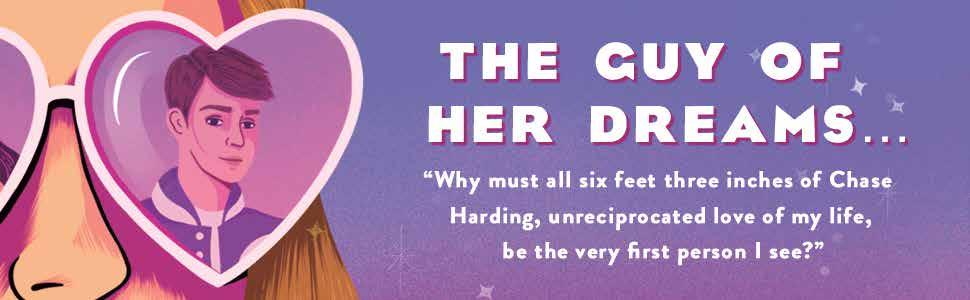
Her seventh novel, Cool for the Summer, has been praised by many as a “modern Bisexual Grease.” The story follows Lara, a high school senior, as she returns from a summer spent in the Outer Banks, ready to finish out her year as queen of the school. However, things get more complicated when Jasmine, the girl she had a summer fling with, moves to town. Even though the coolest guy in school is now head over heels for her, Lara must come to terms with what her summer and Jasmine meant to her.
Adler says the story was inspired by the idea of having two likable love interests vying for the protagonist’s heart. “I had read a YA book years back that had a current-timeline love interest and a summer love interest, and both of them were likable. There was something about that that I liked, but I just thought that it would be so much more interesting if the love interests had not both been boys. So that was the initial spark,” she said.
An ode to Demi Lovato
While fans of the book have compared the story to Grease, Adler says the hit teen movie was far from her head when she came up with the story.
“There’s a lot of people who think it’s Grease inspired, because I have described it as a ‘Bisexual Grease with better life choices,’ but that came later, because I found it helpful shorthand… but that was not the inspiration,” said Adler.
The book came from a much more contemporary, much more Queer pop culture moment. “I loved Demi Lovato and the song ‘Cool for the Summer,’ and I had wanted to, you know, figure out what plot [would work] with turning that into a book,” she said with a laugh.
Aside from inspiring the story, “Cool for the Summer” also appears in the book. “‘Cool for the Summer’ is in a relevant scene in the book, which is funny, because I’ve seen people comment when they’ve first seen news of the book, and they were like, ‘If this book isn’t Queer, I’m going to be so mad!’ And I’m like, ‘It’s going to be. I promise. It will do justice to your love of the song, and the exploration and the queerness, so don’t be preemptively mad. I’m not messing with you.’ And then people get excited that… what ‘Cool for the Summer’ is obviously about [does come through].”
Adler says the characters in the book were not inspired by anyone she knows in real life but served as alter egos for herself. “I wanted to write characters who were not like me,” she said. “I wanted to write characters who were, for lack of a better word, kind of cooler and more in the public eye at school, because I wanted that to factor into things.”
Getting in the headspace of a teen queen
Choosing to write “popular” characters was different for Adler, who admitted that young adult books often center on more introverted characters. “It’s common in YA to have the more introverted, in-her-head, kind of quieter, a little bit geekier main character, which is more like me, but it was very not what I wanted for the portrayal of characters in this book. I wanted them to be people who were sort of central to the social circle of the class.”
Despite distancing herself from her main characters in terms of personality, Adler did make a few deliberate connections with the protagonist, Lara. “[She] is an aspiring romance writer, and she describes something that happens to her in her writing process that was directly lifted from something that happened to me when I was writing
my first Queer YA novel, Under the Lights She’s Jewish, which is also from me, and so is Jasmine, the love interest, [who’s] a little more observant, or at least her mother is, which is more like me. And where they live is inspired where I come from.”
Of course, Lara’s bisexuality and subsequent questioning process are also a commonality between her and Adler. “I am [Bisexual], yes. That was a later-in-life realization, which was something that I wanted for Lara. I mean obviously, 17 is not later in life, but for Lara, it feels like a late-inlife realization, because it’s very new to her. That was something I wanted to explore, because that was my experience, and actually, [one] that was fully intertwined with writing Under the Lights. It was very fun to be able to have that intertwined with her storyline,” Adler said.
Cool for the Summer is only Adler’s second LGBTQ book, but she says she doesn’t plan to stop creating LGBTQ romances anytime soon. The way the genre has boomed in recent years has been very encouraging for Adler, who believes there is endless possibility for Queer stories in the YA genre.
“[YA] has grown so much in recent years. It would have been a very standout book just a few years ago, and this year I think it fits in nicely with four or five other books that I think were heavy on Bi representation and discussing, you know, things in Bisexual discourse and biphobia,” Adler said.
An emphasis on questioning
While the YA genre did see several wonderful Bi romance novels in recent years, Adler’s is unique. Cool for the Summer addresses conversations around internal confusion that many Queer books don’t address.
“I do think… [Cool for the Summer]’s exploration of compulsive heterosexuality [is a little more unique]. Also, there’s such an emphasis on questioning. I do think those things about it are more unique, but just having a romance between two girls, with them being Bisexual, is thankfully not as unique as it used to be, although both of them being Bi is still relatively unique in YA, as opposed to a Bi/Lesbian pairing.” Adler’s biggest hope for the book is that she portrayed bisexuality accurately and positively. “I hope it is clear… that it is not a stepping stone to lesbianism. You know, that may be people’s experience, and that’s valid, but that’s not definitionally Bisexual,” she says. She wants to make sure common myths about bisexuality do not have room to grow in Cool for the Summer. “I know people get wary of there being cheating in Bisexual books, because there’s always this huge misconception that Bisexual people cannot be faithful, that they’re always going to want both. It felt good to write a book where there are two love interest options,
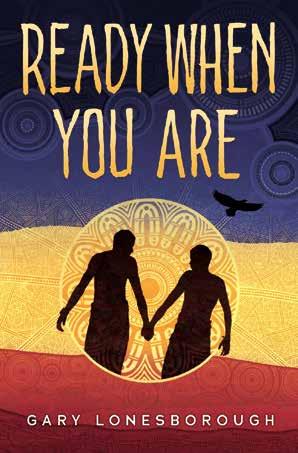
If he had to admit it, 17-year-old Jackson Barley had a love-hate relationship with Christmas. He loved its traditions, and because it was something out of the ordinary. When hanging out with your mates on the Mish is all you normally do, it’s nice to have the holidays to break up the sameold same-old. But over Christmas break, his Aunty Pam always brought his cousins around, and the house was full of little kids. Jackson loved his younger brother and his cousins, but man, could they make a racket!
This year, another thing was unusual: Aunty Pam arrived on Christmas Eve with a teenager she was caring for, a boy named Tomas, who’d just gotten out of juvie. Of course, Jackson’s mother said that Tomas could bunk in Jackson’s room. That wasn’t cool, not at first. Jackson’s mind was elsewhere: his girlfriend broke up with him for reasons he couldn’t discuss.
For most of his life, he had known that he was “different.” He tried to be like other boys, but it just didn’t work that way, and he was afraid to even think about his feelings. And now there was this outlaw kid, another Aboriginal boy like him lying on a mattress
DAHLIA ADLER
continued from page 13
and they are different genders, but I hope it’s clear that she only wants one of them, and that’s her path. It’s this battle between her head and her heart, [between] what she thought she wanted and what she knows she wants now.”
Crafting Bi characters
Writing Bisexual representation in literature can be difficult. Unlike Gay or straight romances, the author must indicate that the character has a previous history or current interest in multiple genders, which can sometimes make the main character appear hypersexual.
For some readers, just stating that the character is Bi is not enough — they want to be shown. “It’s tricky, because you could just say that they are [Bi] on the page, but some people find that unsatisfying. If that’s the representation — someone saying they are and then they proceed to have a relationship with only one other gender in the picture… you know, I get it,” Adler said. Writing Bi romances is even more difficult, because readers have high expectations for the magical love they hope to encounter on the pages. “In romance novels, you don’t want to show the main character being attracted to somebody else,” Adler said. “A common way to do it is to talk about their exes or their romantic past, but if they don’t have a romantic past, then it’s a tricky thing to do. It can be anything from talking about other people… that they have considered dating, even celebrities that they think are attractive.”
Writing good Bisexual representation has led to some less than tasteful attempts, due to the complication of trying to show romantic history while still portraying a raw and authentic romance on the page.
“It’s hard to show multigender attraction without describing that there has been or is an attraction to multiple genders. It’s… just a fact. This is why Bisexual representation is always going to get painted as a little bit more — I don’t want to say sex-crazed, but it is going to look thirstier than other orientations, because that’s just something that you’re trying to show on the page,” she said.
in Jackson’s bedroom. And oh, Tomas was beautiful.
But Jackson wasn’t Gay — or at least he wasn’t ready to be. He wanted a summer with his mates, and girls, but he wanted Tomas to kiss him, too. How could he be true to himself? And what would people think?
There are three main characters in Ready When You Are: Jackson, Tomas, and alcohol. Lots of alcohol, and teenagers who are often excessively drunk, which almost totally mars the sweetness of this novel. Put aside endless Outback parties and repetitious beach forays, though, and you might be charmed by this familiar-not-familiar boy-meets-boy tale.
In placing his novel in an Aboriginal community, author Gary Lonesborough gives American readers a unique setting and immersion in a culture where life feels more relaxed than perhaps they’re accustomed — but yet, coming-out struggles for Gay teens still exist.
This leads to a story that, scene for scene, is predictable and common in YA romance novels, an aspect the genre’s most fervent readers passionately rely on. They’ll also love Jackson, a boy in a man’s skin who acts responsibly and genuinely, but who’s not yet too self-assured about it. Life through his eyes is the best part of this book.
Though you’ll likely find this novel in the Young Adult section, it’s absolutely appropriate for grown-ups with fond memories of first love. Ready When You Are has its lows, but it might also make your heart go boom.
“If it’s important to you not to do that and to show that this is… the first person that they have been attracted to, there are ways to discuss it. I’ve read Bi-romantic Asexual books where they do a good job just talking about who they would consider dating, but not necessarily people they have, so it’s something like that.”
When it came to her attempt at portraying Bisexuality on the page, Adler wanted to clarify that Lara’s attraction to both love interests was complex. “It was really important to me for people to understand that while she could be attracted to two different people at the same time, and could be attracted to two very different things at the same time, that did not mean she felt she needed to pursue both of them. There was still one that had her heart. I hope people get that: your head and your heart can sometimes be mismatches, and what you want can change. And that’s what happened
for her, and it’s never too late to figure out that you want something different than you thought, or even that you are something different than you thought, and that’s okay.”
Inspired by Glee
Cool for the Summer has many good messages about exploring sexuality and redefining yourself as you grow. Adler hopes those who need the story will find it. She also says someday down the line, a movie version of the book would be a great way to reach Queer audiences. When she first began writing the book, Adler had a dream cast for Lara and Jasmine but admits now the actresses are much too old to play teens.
“I am never up-to-date on teenage actresses,” she said, laughing. “The way I picture Jasmine and Lara are actresses who are way too old to play them now. I see Lara as exactly Dianna Agron from Glee, and Jasmine kind of as Emmanuelle Chriqui,
who is like 40 now, but…her on Entourage, when I thought she was like in her early twenties, is how I picture Jasmine. Yeah, I don’t have anyone modern, which is terrible. Once the CW stopped having realistic TV shows like Gossip Girl, I just don’t know teen actresses anymore.”
While Adler waits for the next Dianna Agron to appear, she plans to continue writing Queer literature. Her next romance, Home Field Advantage, is expected to hit bookstores this summer. In the meantime, Cool for the Summer is out and our final entry for the SGN winter book club. Grab a copy from your local bookstore and read along with us on Instagram!
As always, the SGN Book Club can be found on Instagram at @SGN_books. Keep your eyes out for our new spring book club, which will begin this April!
Image courtesy of Scholastic PUSH
Image courtesy of Wednesday Books
Rare disease patients need the STAT Act to pass
by Carter Hemion SGN Contributing Writer
The STAT Act is a necessary piece of federal legislation to develop new and accessible treatments for rare-disease patients. The bill (in full, the Speeding Therapy Access Today Act of 2021, HR 1730 and S. 670) streamlines therapy development for small patient populations. It also builds upon the work of HIV/AIDS activists to ensure that the FDA becomes more responsive to patients’ needs.
The bill was introduced to the US House and Senate in March 2021 by Sens. Klobuchar (D-MN) and Wicker (R-MS) and Reps. Bilirakis (R-FL) and Butterfield (D-NC). The legislators also serve as cochairs of the Rare Disease Congressional Caucus.
There are over 7,000 recognized rare diseases, each occurring in fewer than one in 200,000 Americans. However, rare diseases in general are common — about one in ten Americans lives with at least one of them. These patients lack legislative support to access necessary healthcare and face unnecessary barriers to therapies.
Delays and the inaccessibility of treatments disproportionately impact already marginalized people, including the BIPOC and LGBTQIA+ communities.
What the act would do
The STAT Act would create an FDA Rare Disease Center of Excellence and a Rare Disease and Condition Drug Advisory Committee, both of which would aid in delegating resources to and better serving small patient populations. These programs would inform how the FDA makes
decisions regarding rare diseases, including how they interact with the Accelerated Approval pathway.
Today, it takes an average of 15 years to develop and approve rare disease treatments. Waiting 15 years is far too long for patients with fatal or degenerative diseases. The Accelerated Approval pathway, created in 1992 following the work of HIV/ AIDS activists, streamlines the research of certain diseases and is currently used in many rare disease therapies. The STAT Act would continue their advocacy, saving even more patients’ lives by developing and distributing treatments sooner.
The STAT Act would also create an ALTITUDE (Accelerating Lifesaving
Therapies in Treating Ultra-Rare Disease Entities) program for ultra-rare disease patients, who face additional barriers to treatment. There are often not have enough patients to qualify for treatments via the Accelerated Approval pathway. Ultra-rare diseases also pose greater obstacles to collecting clinical data due to such small patient populations. The ALTITUDE program would focus on manufacturing standards, flexible regulations, and best practices for clinical trials.
Finally, the act would put resources toward making treatments more accessible to all rare disease patients through a Rare Disease Therapy Access Program. This would inform policies regarding coverage,
High tech as it relates to opera Explore the wonders of the new age of HD
by Rod Parke Special to the SGN
It’s fashionable to bemoan what’s happened to the record industry, especially in classical music. Well, yes, things have changed, not all of it good for either the artists or the industry itself. But I want to shout out my praise of modern technology. Have you checked out what’s becoming increasingly available in terms of fabulous videos of opera and concerts?
Although I am a great fan of live performances, there are many advantages in the best productions on video, especially on Blu-ray discs. (For video nerds, a friend in the recording business tells me there are already a half-dozen operas released on 4K ultra-high-definition discs.)
True: no recordings can capture the thrill of live sound. But excellent camerawork can, among other revelations, highlight the brilliant orchestration of, say, a Mahler symphony. A camera can direct my attention to details I might miss without a closeup of, say, that horn player giving his all. The joy expressed by performers sharing their love of their music is a large part of the thrill I get as a fellow music lover. No seat in the audience can give you such intimate access as such videos. (Okay, so maybe we don’t always want to see Jessye Norman’s tonsils shaking up a sublime Strauss song!)
And how many of us can afford to pay for a seat at the opera? Or relish the hassle of getting there, paying $20 for parking, and then driving home in the rain late at night? Modern technology can democratize fine art! Given adequate audiovisual equipment, we can experience Wagner’s Ring at home for a tiny fraction of the cost and effort of attending live shows.
PBS, for example, will telecast the glorious new, all-Black opera, Fire Shut Up in
My Bones on April 1 (check your local listings). I urge you not to miss this intensely moving depiction of a molested teenage Gay boy’s struggle to become a man in a super-macho Black community. This opera first came to us, live and in HD and excellent surround sound, at local cinemas for little more than the price of a movie.
Fifteen years ago, the Metropolitan Opera saw the potential of live satellite transmission and opened access to the best of its performances to fans in more than 70 countries. As a Columbia College student, I used to pay $2 for a standing spot at the old Met in the late ’50s. Now, three thousand miles away, I’m back at the Met! What a gift! (For a schedule of these Live in HD shows, go to metopera.org. PBS telecasts these same shows about 5-6 months later.)
Another tech democratizer is, of course, streaming. Few people know that the Met
which is often a barrier to treatments. Some patients currently do not qualify for coverage because of factors like age, other health conditions, or using Medicare or Medicaid, which the STAT Act would review to remove unnecessary barriers.
Some patients have had treatments denied because they do not meet strict criteria set by clinical trials. This excludes children and older adults or people with other rare diseases or disabilities. These patients may benefit from therapies but cannot receive them solely based on coverage policies. Both private insurance and public insurance like Medicare, Medicaid, and CHIP would be brought together by the Rare Disease Therapy Access Program to promote greater access and coverage for patients.
As a rare disease patient, I strongly support the STAT Act. I was born with EhlersDanlos syndrome, a kind of connective tissue disorder that impacts my entire body. It still has no FDA-approved treatment, like about 95% of rare diseases. Untreated, it has led me to develop other rare diseases and chronic illnesses. Rare disease impacts most of my body and every part of my life. For people like me, the STAT Act could be life-changing or even life-saving, by supporting new therapies.
Community members can support raredisease patients by sharing information on social media, contacting legislators to cosponsor the bill, or signing an online community letter of support at STATact.org.
For more information, including whether your legislators co-sponsor this act and suggested phone/email scripts, see STATact.org.
has its own radio station on Sirius XM satellite radio: opera and song, 24/7 on channel 355! For less than the cost of a movie ticket, get a month of nonstop historic and live broadcasts from the Met’s stage and archives, back to the early ’30s.
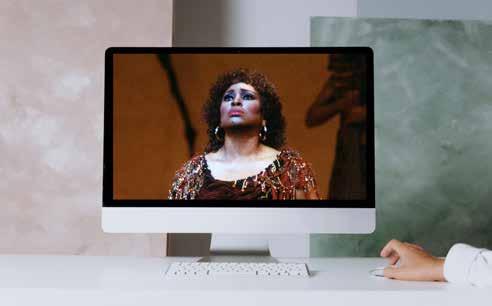
The Met also has a video platform called Met Opera on Demand. It ain’t cheap, but you get every radio and televised program from its beginnings, including a superb video of Leontyne Price’s unforgettable farewell performance as Verdi’s Aida. I get teary just thinking of the ovation, and her reaction to it, after polishing off the aria “O Patria Mia,” with a perfect pianissimo high C that went on forever, just like the ovation that wouldn’t stop.
Then there’s YouTube. Offering seemingly limitless access to complete operas, movies, and concerts — as well as instructions on how to unclog your toilet — YouTube soon
learns your interests and begins to suggest items, often hitting the bull’s eye. One of my more esoteric tastes is for baroque, mechanical-action pipe organs. YouTube took me by the hand and showed me an astounding cache of superbly recorded videos of tracker-action organs, played by an assortment of excellent organists. Last week it showed me a hilarious, silly European production of Mozart’s Don Giovanni that was nonetheless musically superb. Nothing like seeing a Eurotrash production of this opera to make you appreciate a good one! (Eurotrash is where the stage director is god and has free reign to show off his or her complete disregard for what the music says, giving us absurd settings and even sometimes changing the story.)
I have written previously in the SGN about the sonic and visual virtues of the best Blu-ray discs. They offer, for the first time, completely uncompressed audio (much better than CDs) and video (especially UHD 4K discs).
On a personal note, because of where I live, they give me even more. I live with my husband in bliss on Whidbey Island. Given ferry service that has been severely crippled by COVID-related staff shortages, we’re a rather remote from the cultural advantages of the Big City. But the flood of excellent Blu-ray opera and concert recordings that have virtually replaced the fading CD market makes our location irrelevant. Our priorities put a state-of-the-art home theater above expensive clothes, watches, cars, etc. Thus, even on a limited income, these Blu-rays and modern streaming give us unending pleasure on a 60” OLED TV and killer sound system. Whether it’s Lord of the Rings or Mahler’s 8th Symphony (with indeed over a thousand performers under conductor Gustavo Dudamel), we want for nothing… thanks to modern tech. Amen.
Leontyne Price in Aida – Photo courtesy of the Metropolitan Opera – Photo by cottonbro / Pexels
Rare Disease Week on Capitol Hill in early 2020 – Photo courtesy of EveryLife Foundation for Rare Diseases
Nat’l & Int’l News
National news highlights
by Daniel Lindsley SGN Contributing Writer
Miami:
Advocates decry DaBaby’s return to Rolling Loud
NBC News reported March 4 on HIV and LGBTQ advocates’ criticisms of Rolling Loud, after the organization invited rapper DaBaby to its Miami music festival, just months after he, during a live performance in July, made disparaging, ignorant comments about Gay people and those living with HIV/AIDS.
The rapper has released apologies since then, meeting virtually with LGBTQ advocacy groups and promising to use his platform to raise awareness. But three of the groups told NBC News that DaBaby, despite seeming receptive and apologetic during the meetings, has yet to follow up on those commitments.
Deondre B. Moore, director of US partnerships and community engagement at the Prevention Access Campaign, said, “It feels as though the meeting and taking time to meet with us was all just smoke and mirrors. None of the things that he talked about doing or following through with have come to fruition. For us, it’s kind of a slap in the face.”
Texas:
State appeals block on Trans investigation
Reuters reported on March 3 that Texas has appealed a restraining order issued by a Travis County District Court Judge Amy Clark Meachum, which temporarily blocks the state from investigating the parents of a Trans girl for providing her with gender-affirming medical treatments.
Gov. Greg Abbott has called the treatments “child abuse,” directing the state’s Department of Family and Protective Services (DFPS) to conduct investigations into similar cases.
According to the lawsuit, which was filed by the ACLU and Lambda Legal on behalf of the Trans teen’s family, the mother is an employee of the DFPS, and was placed on leave after asking how the governor’s directive would affect her family.
Judge Meachum states in her order that the family faces “imminent and ongoing deprivation of their constitutional rights, the potential loss of necessary medical care, and the stigma of being the subject of an unfounded child abuse investigation.”
Florida’s new “Don’t Say Gay” law runs into legal trouble
May violate federal civil rights laws
by Mike Andrew SGN Staff Writer
Florida’s newly passed “Don’t Say Gay” law is running into possible legal challenges. Federal Education Secretary Miguel Cardona said it might violate Title IX, the law that protects LGBTQ students from discrimination. Meanwhile, Equality Florida threatened to sue the state if the law harms LGBTQ minors.
The law, passed by the Republican-controlled legislature there and now awaiting signature by Gov. Ron DeSantis, makes it illegal to teach anything about LGBTQ people through grade 3, and restricts what can be taught after that. It also allows parents to sue local school districts if they believe schools are engaging with LGBTQ topics.
Education Secretary Cardona said on March 8 that while students need support to deal with the COVID pandemic, “leaders in Florida are prioritizing hateful bills that hurt some of the students most in need.”
“The Department of Education has made clear that all schools receiving federal funding must follow federal civil rights law, including Title IX’s protections against discrimination based on sexual orientation and gender identity,” Cardona continued.
“We stand with our LGBTQ+ students in Florida and across the country, and urge Florida leaders to make sure all their students are protected and supported.”
The Department of Education lacks the legal authority to dictate curricula to local school districts, but it does have authority to cut off federal funds to school districts that violate federal policies. The department could also sue local districts to defend federal laws like Title IX.
Almost all public schools — and many private ones — receive federal money, so the DOE’s opposition to the Florida law could be a powerful lever to prevent it from going into effect.
At the same time, Equality Florida warned DeSantis that it would be ready to sue the state of Florida if the measure harms students.
“Let us be clear,” the group said, “should its vague language be interpreted in any way that causes harm to a single child, teacher, or family, we will lead legal action against the State of Florida to challenge this bigoted legislation…
“We will not permit any school to enforce this in a way that endangers the safety of children. We stand ready to fight for Floridians in court and hold lawmakers who supported this bill accountable at the ballot box.”
While the DOE can sue Florida to uphold federal civil rights laws, activist organizations like Equality Florida and individual parents and students have standing to sue only if they can show they’ve been harmed by state law.
GLAAD also joined the fray, saying in a statement that the new law “brands Florida land of the ‘less free’ by legalizing censorship and harming LGBTQ students and families. Banning discussion of LGBTQ people in school is an effort to silence and shame, to divide and disrespect, when all students should feel safe and learn about themselves and each other.”
“To every LGBTQ child and every LGBTQ parent in Florida,” GLAAD continued, “you do belong and we know that history is on our side. Gov. DeSantis is playing political football with LGBTQ Floridians.”
Emmett Till Anti-Lynching Act passes Congress, goes to president
by Mike Andrew SGN Staff Writer
The Emmett Till Anti-Lynching Act easily passed the US Senate on March 7 and now heads to President Biden’s desk for his signature.
The bill passed the Senate — evenly divided along party lines — by unanimous consent. That means that no senator objected to it, allowing it to bypass the cloture rule that requires 60 senators to agree to bring a bill to the floor for debate.
The bill makes lynching — defined as any bias-motivated offense resulting in death or serious injury — a federal hate crime. Once the president signs it, which he is expected to do, the Department of Justice will be empowered to intervene in local investigations, to collect evidence, and to prosecute offenders in federal courts, regardless of the outcomes of any local trials.
“After more than 200 failed attempts to outlaw lynching, Congress is finally succeeding in taking a long-overdue action by passing the Emmett Till Anti-Lynching Act. Hallelujah, it’s long overdue,” Senate Democratic leader Chuck Schumer said in a floor speech.
“While this will not erase the horrific injustices to which tens of millions of African Americans have been subjected over the generations nor fully heal the terror inflicted on countless others, it is an important step forward as we continue the work on confronting our nation’s past in pursuit of a brighter and more just future,” Schumer added.
The bill amends the main criminal code of the federal government to include lynching as a hate crime, and punishes those convicted of conspiring to commit the offense to no more than 30 years’ imprisonment.
The NAACP noted on its website that lynching was used by white people to terrorize and control Black people in the United States, but particularly in the South during the 19th and 20th centuries.
“A typical lynching involved a criminal accusation, an arrest, and the assembly of a mob, followed by seizure, physical torment, and murder of the victim,” the group said, adding that it was often a public spectacle “in celebration of White supremacy.”
Emmet Till was a 14-year-old Chicago boy who was visiting family in Money, Mississippi, in the summer of 1955 when he was kidnapped, tortured, and shot by two
white men who accused him of whistling at a white woman.
His body was discovered in a nearby river several days later. His mother, Mamie TillMobley, insisted on an open-casket funeral so the more than 50,000 attendees could see the violence inflicted upon her son. A photograph of the deceased boy lying in the coffin was instrumental in galvanizing activists fighting for civil rights.
According to the NAACP, from 1882 to 1968, there were 4,743 lynchings across the United States.
While victims were historically predominantly Black men, LGBTQ people — and especially Trans people of color — have often been subjected to similar mob violence and will also be protected under the new law.
DaBaby – Photo by Lynne Sladky / AP
Photo by Wilfredo Lee / AP
Rep. Bobby Rush, D-Ill., speaks during a news conference on Feb. 26, 2020, about the Emmett Till Anti-Lynching Act on Capitol Hill – Photo by J. Scott Applewhite / AP
One Condoms are a natural rubber latex sheath covering the penis. It comes in three versions: standard, thin, and fitted. The fitted version is available in 54 sizes and includes a paper template to assist users in finding the best condom. When used during anal intercourse, One Condoms should be used with a condom compatible lubricant. For the clinical trials of One Condoms, 252 men who have sex with men and 252 men who have sex with women from the ages of 18 to 54 years participated. The
total condom failure rate was 0.68% for anal intercourse, and 1.89% for vaginal intercourse. (The failure rate is defined as the number of slippages, breakages, or both events that occurred over the total number of sexual acts performed.)
In total, the number of adverse events was 1.92%. Adverse events reported during One Condoms clinical trials included an STI or recent STI diagnosis rate of 0.64%, a lubricant- or condom-related discomfort rate of 0.85%, a partner discomfort with lubricant rate of 0.21%, and a partner urinary tract infection rate of 0.21%.
One Condoms was reviewed by the FDA through the De Novo premarket
review pathway, which is a regulatory pathway for low- to moderate-risk devices of a new type.
“This De Novo authorization will also allow subsequent devices of the same type and intended use to come to the market through the 510k pathway, which could enable the devices to get on the market faster,” said Lias.
The FDA is also establishing special controls criteria, which define the requirements related to labeling and performance testing. Once these criteria are met in combination with general controls, there will be a reasonable assurance of the condom’s safety and effectiveness, according to the FDA.
Two research studies shed light on LGBTQ adversity and mental health
by Hannah Saunders SGN Contributing Writer
Two studies released in February by Vanderbilt University and the Trevor Project highlight hardships experienced by LGBTQ youth — some of which extend into adulthood.
A Vanderbilt University Medical Center study published in the Journal of American Medical Association Psychiatry on Feb. 23 showed that 83% of LGBQ (Lesbian, Gay, Bisexual, and Queer) people reported going through adverse childhood experiences and worse mental health as adults, compared to 64% of their heterosexual peers.
“LGBTQ+ young people are facing so much hostility, from difficulty finding safe spaces at school to abusive environments at home,” said Nathaniel Tran, lead author and a doctoral student in the Department of Health Policy. “Our research highlights the need for teachers, community leaders, and family members to help promote better LGBTQ+ health.”
For the study, over 60,000 people were surveyed across eight states. Of the respondents, nearly 3,000 identified themselves as Lesbian, Gay, Bisexual, or Queer. They experienced higher rates of the eight defined adverse childhood experiences, although researchers found disparities were the greatest for sexual and emotional abuse, and household mental illness.
The adverse childhood experiences in question were as follows: physical, emotional, and sexual abuse; household mental illness; household substance misuse; household domestic violence; having an incarcerated household member; and parental divorce or separation.
Out of LGBQ survey respondents, 52% reported three or more adverse childhood experiences, compared to 26% of heterosexual adults. Researchers looked at the number of bad mental health days respondents experienced in the past month as adults, and found that LGBQ people experi-
Photo by Andres Ayrton / Pexels
enced a greater number of bad mental health days per month, regardless of their adverse childhood experiences. LGBQ people who experienced one or more adverse childhood experience reported ten bad mental health days per month, compared to five among their heterosexual peers.
“Several studies have shown us that children who experience maltreatment and other adversity often grow up to be adults with a variety of challenges, including worse physical and mental health and worse economic well-being,” said Laura Henkhaus, PhD, a postdoctoral fellow in the Department of Health Policy. “Our new research demonstrating greater burdens on LGBQ adults who’ve experienced childhood adversity suggests an immediate need for policymakers, schools, and communities to respond with protective measures and support for queer youth.”
Rates of eating disorders and suicide attempts
The Trevor Project released its 2021 National Survey on LGBTQ Youth Mental Health study on Feb. 17. It showed how young people in the LGBTQ community experience higher rates of eating disorders and suicide attempts compared to their heterosexual peers.
Out of LGBTQ youth aged 13-24, 9% have been diagnosed with an eating disorder, while an additional 29% stated they were never diagnosed with an eating disorder but suspected they had one.
Those with a history of an eating disorder were found to have about five to six times greater odds of attempting suicide, compared to those who never had an eating disorder.
Suicide risk is greater among those suspecting having an eating disorder: the odds of a suicide attempt in the past year were over twice of those who had never suspected having an eating disorder.
According to the Trevor Project, past studies found these higher rates among
by Daniel Lindsley SGN Contributing Writer
Bulgaria:
“Gay Clown Putin” invades media
Irish LGBT magazine Gay Community News reported on March 7 that Bulgarian media platforms have been hacked, with a new version of “LGBTQ+ Putin,” an image whose distribution was banned in Russia in 2016 on the grounds that it represented “an alleged nontraditional sexual orientation of the President of the Russian Federation.”
LGBTQ people to be related to experiences of bullying, discrimination, and internalized stigma based on their LGBTQ identity and its concealment.
Past studies also show that specific subgroups of the LGBTQ community, such as Transgender and Nonbinary people, may be at greater risk for eating disorders, due to body dissatisfaction as a leading common stressor.
Also in the Trevor Project study, cisgender LGBTQ boys and men reported the lowest rates of being diagnosed with or suspecting having an eating disorder. Transgender boys and men and Nonbinary youth assigned female at birth had the highest rates.
Cisgender girls and women, Transgender girls and women, and Nonbinary youth assigned male at birth had similar rates of being diagnosed with and suspecting having an eating disorder.
Native and Indigenous LGBTQ people (12%) and multiracial people (10%) reported the highest rates of being diagnosed with an eating disorder, with an additional 33% of both groups suspecting they have an eating disorder.
LGBTQ youth who are Asian Pacific Islander (5%) or Black (4%) reported the lowest rates of being diagnosed with an eating disorder, although Black LGBTQ youth reported similar rates of suspecting having an eating disorder (28%) as white LGBTQ youth (27%), even though white LGBTQ youth are diagnosed with an eating disorder at more than twice the rate of Black LGBTQ youth (9% vs. 4%).
To combat the rates of eating disorders and suicide attempts among LGBTQ youth, the Trevor Project recommends creating safe and supportive school environments, enacting antidiscrimination policies, and increasing access to gender-affirming care for Transgender and Nonbinary youth in order to reduce what’s called minority stress.
The image shows Russian President Vladimir Putin in heavy makeup, with a rainbow flag in the background. It appeared on Nova TV, Bulgarian national television, Bloomberg, and Bulgaria On Air, causing all but the latter to temporarily halt online streaming of their content. GCN called the hack an act of protest against Russia’s invasion of Ukraine, since the words “Make Love, Not War” were the major addition since the original 2013 version.
London:
Refugees must “prove” sexuality
The BBC reported on February 28 on how the United Kingdom’s latest changes to a bill concerning immigration might affect LGBTQ+ asylum seekers. The bill would require proof that asylum seekers face danger because of their sexuality.
Bahiru Sheway, an LGBT+ rights advocate who grew up in Ethiopia, where same-sex relationships are illegal and carries a penalty of up to 15 years in prison, said, “I’m gay, that’s all I know, right? But, like, there’s no blood test that you can take from me to check my sexuality. I wish there was… that would make my life easy because I [wouldn’t] even have that conversation with my parents, because my parents… deny that I’m gay, right? So how am I expected to actually convince an institution that is working against a migrant community?”
Protests against the changes to the bill broke out across the UK. Leila Zadeh of London-based charity Rainbow Migration said that if the bill passes in its current state, “many people could see their lives put in danger. And we really need to protect the very principle of refugee protection.”