The concrete and the sky matched at Hing Hay Park on Saturday: both were cold and gray. Gathered on the steps and at the red metal tables was a reserved audience; they cheered, but they also drew into themselves to stay warm against the wind.
They were cheering for the performance of Northwest Kung Fu and Fitness, whose traditional lion dancing enlivened the park with movement.
Just minutes before, Deputy Mayor Monisha Harrell had proclaimed at the mic that May 29, 2022, would be recognized as Pride ASIA Day, and lauded the positive impact of the
Asian and Pacific Islander community on the city.
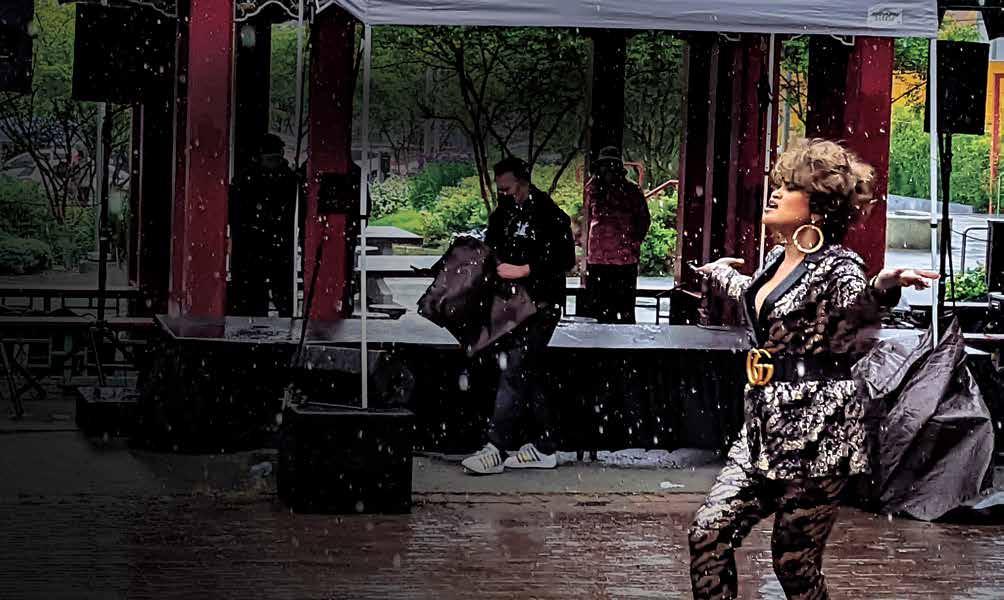
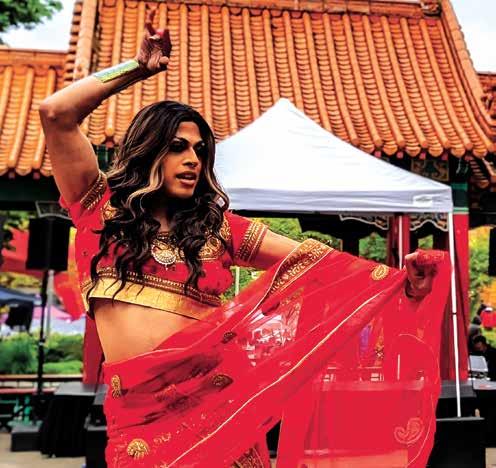
Local drag artist and prominent activist Aleksa Manila hosted the event in a bright yellow pantsuit, along with Seattle drag legend Gaysha Starr and Miss Gay Washington Dutchess Drew. They added an energy that defied the dreariness and shined spotlights on whoever went on stage.
One such person was Jӧel Barraquiel Tan, the first Queer, Asian, Pacific Islander director of the newly reopened Wing Luke Museum of the Asian Pacific American Experience. Tan started the job late last month, and his keynote address on Saturday was an invocation of the dead.
see PRIDE ASIA page 5
New union shop and walkout highlight organizing drive
by Mike Andrew SGN Staff Writer
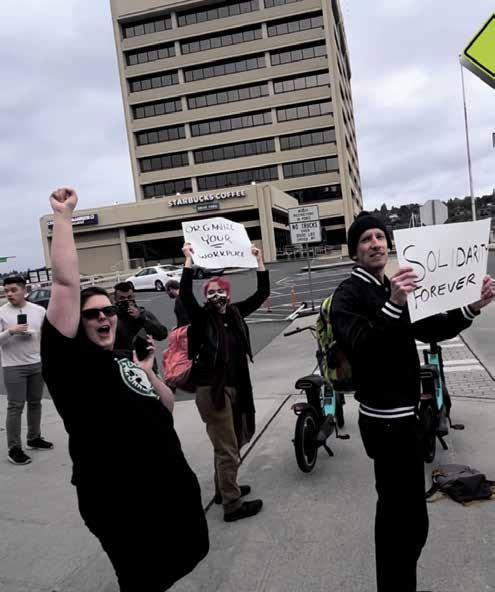
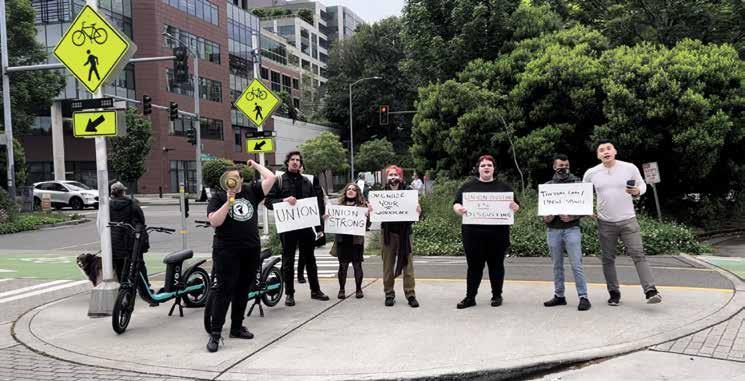
Seattle Starbucks workers scored another victory when workers at the Eastlake store voted unanimously to unionize. They join Starbucks workers at the company’s flagship Reserve Roastery on Pike Street and the Denny and Broadway store in voting to be representing by Starbucks
Workers United (SBWU). That election victory makes 100 Starbucks locations that have already voted to unionize. Some 200 more have filed with the National Labor Relations Board (NLRB) for a union election — so many, in fact, that the NLRB can’t keep up with the demand for elections.
see UNION page 4
by Lindsey Anderson SGN Contributing Writer
It’s an age-old question in Seattle: what comes first, the radical social movement or the theoretical literature? For the activists at Clara’s Bookstore in Columbia City, the answer is the movement.
Doreen McGreth runs the store while also working for the Seattle Freedom Socialist
Party. For the last three years, she has been in charge of organizing meetings, ordering literature for the store, and planning events, like the upcoming Roe v. Wade decision-day rollout, for when the Supreme Court announces its official decision.
“I was always a feminist,” McGreth said of the passion that led her to Clara’s. “I was
see CLARA’S page 7
Photo by Lindsey Anderson
Photo courtesy of SBWU
Gaysha Starr – Photo by A.V. Eichenbaum
Local News
Seattle gig workers get a raise City
Council passes Pay Up ordinance
by Mike Andrew SGN Staff Writer
The Seattle City Council passed the socalled Pay Up ordinance on May 31 in a unanimous vote.
The measure will increase the takehome pay of app-based workers like food delivery drivers by requiring companies to pay per-minute and per-mile rates to their drivers, starting form the minute the drivers accept an order.
The ordinance is designed to guarantee that gig workers receive the Seattle minimum wage — now set at $17.27 per hour — and get the standard mileage allowance set by the IRS. It goes into effect in 2023.
The bill was sponsored by Lisa Herbold and Andrew Lewis.
“We know that app-based work is one of the fastest-growing sectors in our economy, with more and more workers turning toward this type of work and not receiving the protections of basic labor standards,” Herbold said.
“The passage of this legislation today would help tens of thousands of delivery drivers make ends meet, while maintaining their flexibility.”
Herbold and Lewis also envision future legislation to regulate deactivation from apps and establish discrimination protection, restroom access, and other labor standards among gig workers.
According to Crosscut, some 40,000 people in the Seattle area work in appbased gig jobs, excluding Uber and Lyft drivers. Those drivers have been organized by the powerful Teamsters union and have
seen some of their concerns addressed in state legislation.
The Seattle ordinance is expected to benefit people who work for DoorDash, Uber Eats, Grubhub, and similar companies, providing delivery rather than rideshare services.
Workers in the industry have complained about low pay and high expenses because they use their own vehicles for delivery. Typical expenses can include monthly oil changes, yearly brake replacements, and filling their tanks every two days in an era of high gas prices.
Workers have also noted that in spite of delivery companies’ claims of flexibility, they are often penalized for turning down deliveries, typically by reducing the number of delivery offers they get in the future. Some former drivers said their accounts were even deactivated by the companies.
The new Seattle ordinance was pushed by Working Washington, a coalition of local activists and labor leaders. Gig workers don’t fit into the traditional labor organizing model because they are classified as “independent contractors” rather then wage workers, and they’re not tied to a specific workplace.
Meanwhile, Starbucks workers at the 1200 Westlake Avenue N. store staged a near-unanimous walkout on May 29. According to workers, only one supervisor and one manager were left to try to run the operation.
Workers at the Westlake Starbucks had previously shut down the store’s drive-thru window twice. They complained about reduced hours and short-staffing, in addition to maintenance issues that resulted in unsafe working conditions.
“Stand in solidarity with the Westlake DT partners who bravely walked out yesterday at 1pm in protest against hour cuts and short-staffing, with management refusing to let them cease operations. We ceased it for them!” the local SBWU tweeted on May 30.
Starbucks has responded to the union drive with heavy-handed tactics. One casualty is Lindsey Price, a 17-year veteran of Starbucks. She was fired from the Eastlake store after four years there — apparently because of her union activism.
According to Price, she was notified on April 18 that she had violated company policy and consequently her employment was under review. She was not scheduled for any future shifts, depriving her of income.
Finally, she was terminated without notice on April 29.
Starbucks then denied her unemployment claims on the pretext that she was fired for cause.
Price, who is completing her master’s degree in library and information science,
was described by co-workers as “an amazing, hard-working, and caring person.”
“She was an anchor of the Eastlake Starbucks. Customers and employees loved her and felt supported by her,” they added.
A GoFundMe has been set up to help support her while she looks for a new job.
To date, 29 unfair labor practice complaints have been filed against Starbucks, charging the company with more than 200 separate violations of federal labor laws, most of them involving intimidation or retaliation against pro-union workers.
Photo by Carlo Allegri / Reuters
Photo courtesy of SBWU
“Urvashi Vaid opened the door to the work I am doing today,” he said, speaking of the late and deeply influential LGBT activist, who passed away in late May. “Urvashi and other Queer forebears were brilliant and tough as nails. I say they were ‘antifragile.’ They were not just resilient. Antifragile is the exact opposite of fragile. It is resilience 2.0. Where resilience is about bouncing back from adversity, antifragility is when adversity and stress make you come back stronger, better, more badass.”
Tan said that antifragility is needed more than ever now, given all the myriad pressures facing the API community and the API Queer community, namely gun violence, the erosion of voting rights and right to marry, and the rise of fascism and dictatorships.
“As the new director of the Wing Luke Museum,” Tan went on, “I wander our historic halls, calling on the spirit of Uncle Wing Luke. I call on Auntie Grace Boggs.
I call on Uncle Bruce [Lee] and Uncle Bob Santos, and I ask them, ‘What can we do in this time, when our civil rights are being systematically stripped away, our children and elders are being hunted and picked off, poverty is raging, and the unhoused are long suffering while billionaires colonize states?’ Let’s summon our ancestors to protect and encourage us in this time.”
Other speakers and performances
Tan introduced two LGBTQ youth speakers. The first was born in American Samoa, representing UTOPIA Washington, and she wowed the crowd with a vogue-style dance. The second read his own slam poetry, about the liberating feeling of growing out his hair during the pandemic.
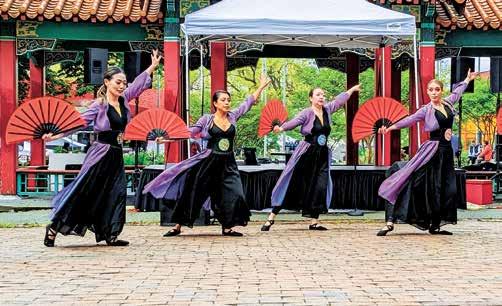
The Miyoung Margolis Dance Collective showed off their first-ever public routine, using paper fans and ornamental knives.
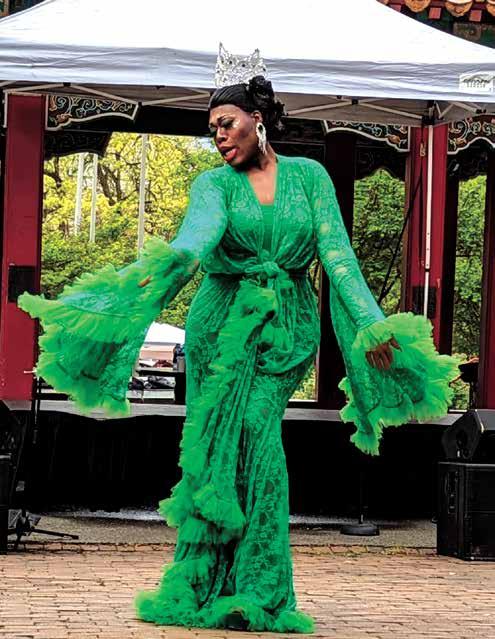
Miss Gay Washington 2022 Moltyn Decadence followed with a lip-sync performance in a flowing green outfit — no small feat with the wind picking up. Local musician and Queer immigrant Sepanta Bahri played guitar and sang lyrics taken from a
Persian poem about love, longing, and mortality.
The event continued like this for another hour, with performers and organizations taking turns at the stage. More local queens, like Kylie Mooncakes and Rylee Raw, ran their own dances and lip syncs. The YMCA and YWCA (collectively called “the Y”) promised accountability to marginalized communities and social justice, and PFLAG Seattle, GLSEN Washington State, the Filipino Community of Seattle, and several other groups gave the audience a rundown of their missions and their services.
Near the end of the hour, the rain began. The drops were heavy and infrequent at first, but the pattering turned to a roar within minutes. Still, the performers continued. Rylee Raw lip-synced her heart out again, the rain only adding to the drama of her performance. What audience was left took shelter under the trees.
As the staff prepared for the closing performance by singer-songwriter Jack Mozie, Aleksa Manila and Gaysha Starr took a break for iced tea in the Hing Hay Park building. It was the second rain at the event
in ten years, Manila said. “It almost feels like Mother Nature is saying, ‘Oh, happy ten-year anniversary!’”
It was also the first in-person Pride ASIA Fest since the pandemic began. And it felt great to be back despite the rain, Manila said, in large part because of the energy of the staff and the crowd, and because so many other community events had been taking place.
When asked about the lineup of speakers and performers, Manila explained, “On top of keeping it entertaining, we really want to keep it educational and informative — not just for people who live here or come through here but [those] even just visiting and contemplating making Seattle their home.”
“We want to keep it multifunctional,” she continued. “For us, it’s symbolic of our intersectional identities, whether it’s our LGBTQ identities or our API identities. It’s a recognition of how diverse our communities are, and when we come together, it’s such a powerful moment of seeing each other, celebrating each other, nurturing each other.”
Photos by A.V. Eichenbaum
Queer/Bar arsonist pleads guilty to hate crime
by A.V. Eichenbaum SGN Managing Editor
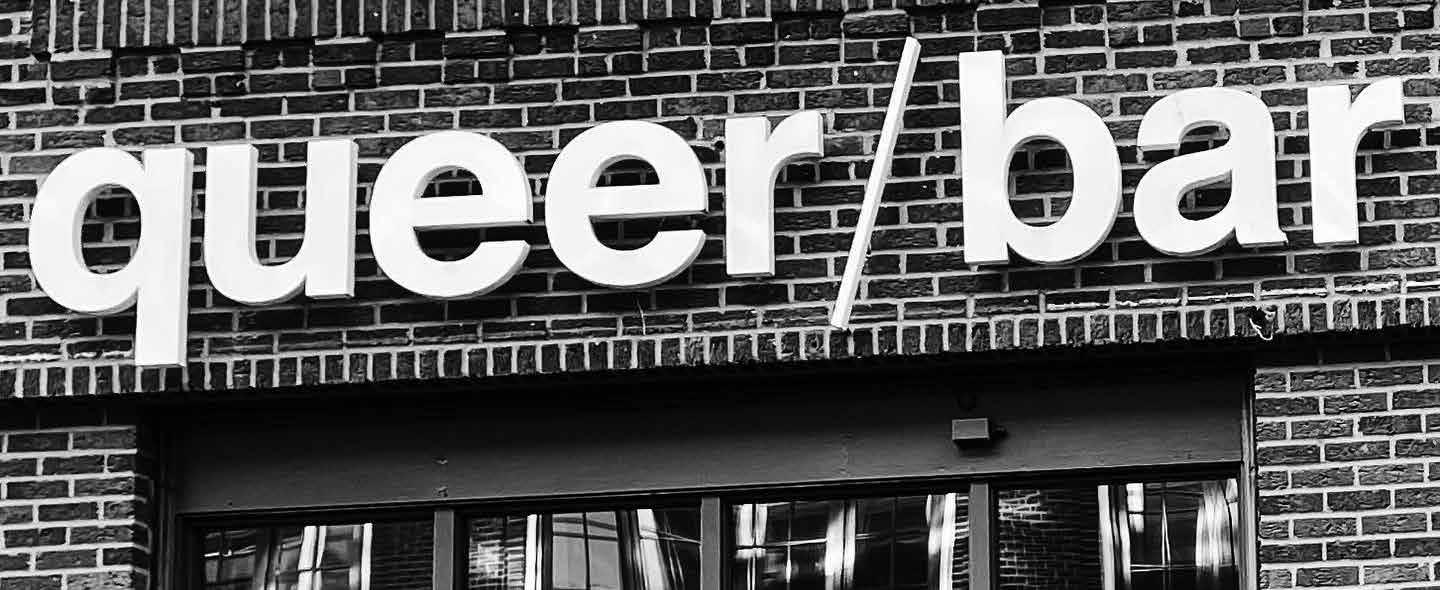
Twenty-five-year-old Kalvinn Garcia pleaded guilty to the February 2020 arson at the Capitol Hill nightclub Queer/Bar on Thursday, May 26. Garcia, a resident of Sedro Wooley, Wash., admitted to law enforcement that he set fire to the dumpster behind Queer/Bar because he was angry that the sign said “queer.”
“I think it’s wrong that we have a bunch of Queers in our society,” Garcia told the SPD, according to a US Department of Justice press release.
“The defendant targeted the patrons inside Queer/Bar, a known safe space for the LGBTQI+ community,” Assistant Attorney General Kristen Clarke of the Justice Department’s Civil Rights Division told the press. “Hate crimes have no place in our society today, and we stand ready to use our federal civil rights laws to hold per-
petrators accountable. All people deserve to feel safe and secure living in their communities, regardless of their sexual orientation or gender identity.”
Garcia’s dumpster fire only scorched the outside of Queer/Bar’s building, harming none of the approximately 50 people inside. The incident, which was investigated in 2020 by the SPD and the FBI, led to his arrest shortly after.
“We must stand up to this hate at every opportunity,” said Nick Brown, US Attor-
Arts & Entertainment
R&B reunion Fly Moon Royalty returns for Pride in the Park
by Daniel Lindsley
SGN Contributing Writer
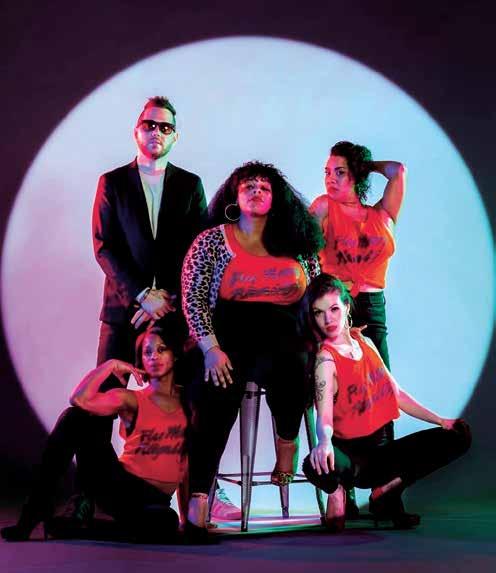
Seattle’s own Queer R&B duo Fly Moon Royalty will be headlining this year’s Pride in the Park on Saturday, June 4, reuniting years after going their separate ways. They spoke with me in a Zoom call about the event, and what they’ve been up to since their last joint music release in 2016.
Like many others, vocalist Adra Boo and producer and DJ Mike Ilvester see the event (and Pride celebrations in general) as a kind of family reunion. For them, it’s an especially apt comparison: their whole team is coming back together for the performance, including their dance troupe.
Beyond that, Ilvester said that he was excited to see Dark Smith, a Queer afropunk band. Boo said she was excited to see everybody, but Chaka Khan at the June 20 “Zoo Tunes” concert was high on her list, along with fresh artists like R&B singersongwriter Morgan Britt.
Boo was proud to mention the curation work she had been doing for PrideFest and Wildrose Pride. “Curating is in my nature,” she said. “I’m like an octopus.”
As for what they had been up to since the band broke up, Boo said, “Real life has been happening to all of us.” She did some vocal work with Hotels, a local band, and some contract work getting loans for organizations. Her main job now is at Rain City Rock Camp, a music program helping to empower marginalized people.
Ilvester, meanwhile, has been working hard on a degree in graphic design at the Seattle Central Design Academy. Although
he has been a DJ for years, graphic design was part of his job with Fly Moon Royalty, so the academy was a natural choice.
Boo referred to Fly Moon Royalty as “nostalgia guests” of Pride in the Park, given their past appearances at events like it, but their live performance has been a long time coming. “This is the thing we were supposed to be doing in 2020,” she said.
Back then, with the pandemic raging, they staged their concert in Ilvester’s front yard. He recounted how delighted the neighbors were to come outside after months of isolation to hear Boo’s singing voice.
Their set at Pride in the Park will have “random singles,” they said, with plenty from their newest record. But they will also play a song exclusive to live audiences — one that needs the energy of the crowd to work.
When asked where their ideas come from, Boo said, “These ideas are from realass real life. If you hear it in our songs, I lived it, I watched it happen to somebody, it’s a real story.”
“Sometimes it’s just talking shit,” she added.
Both Boo and Ivester said they were happy to see all the other Pride celebrations as well, like Seattle Center and Latinx Pride.
As a preemptive message to the crowd, Boo encouraged everyone to be cautious about COVID-19,but to bring all their good energy anyway: “People got to memorize these songs and bring their Hi-C fruit punches.”
ney for the Western District of Washington. The case is being prosecuted by US Attorney Rebecca Cogen and trial attorney Angie Cha of the Civil Rights Division. Garcia is awaiting sentencing in September. Currently, he faces a maximum sentence of $250,000 and 10 years in prison. As of press time, Queer/Bar’s proprietors have not been able to be reached for comment.
Photo courtesy of Queer//Bar
Image courtesy of Fly Moon Royalty
Books
CLARA’S
continued from cover
a curator of the Lesbian Resource Center, which no longer exists, and just exploring feminism a long time ago. Liberal feminism didn’t do it for me; it was a too pro-Democratic Party, and I had seen how screwed up the Democratic Party was. Then there were these elements of radical feminism [I had disagreed with], where men are the problem. I thought, ‘That doesn’t make scientific sense,’ so I found socialist feminism that way, and I found Radical Women.”
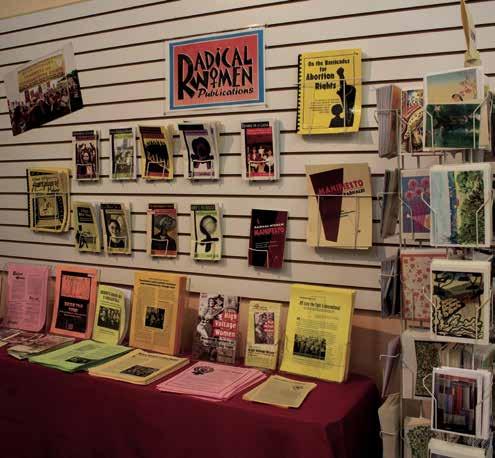
From there, McGreth founded the store. “It started just because we study a lot, and our members were always looking for unpopular leftist books, leftist literature, and you know, things that weren’t mainstream,” she said of the early days of the store. “We always had a small bookstore, but when we moved to this building, after some donations and renovations and building the bookcases, it became a home where a lot of leftists in Seattle know they can get Marxist-Leninist literature, they can get certain classics, and see different movements’ stuff.”
The store attracted more than just the Freedom Socialist Party and its activists. “The university professors know we’re here, and they come because [we have] not the most popular literature but still important [books],” McGreth said.
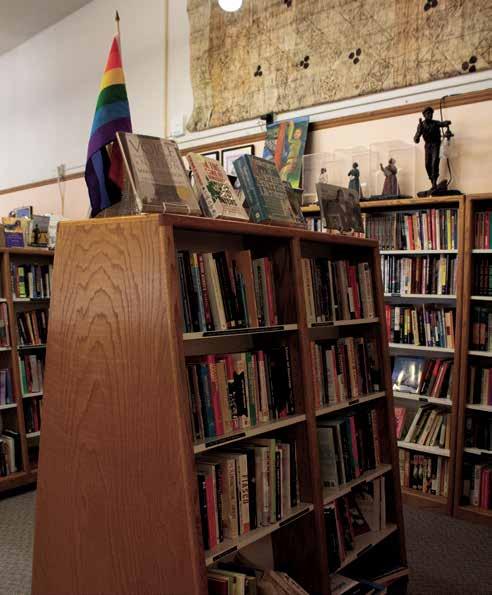
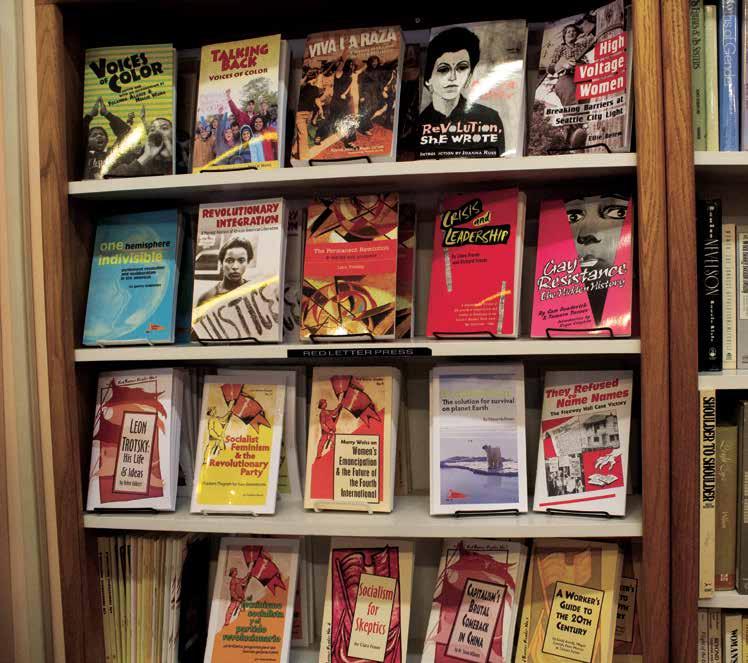
The shelves are full of every radical socialist and feminist manifesto one could hope to find. Clara’s has literature on critical race theory and anti-Blackness, LGBTQ+ history and activism, and of course, many titles on reproductive justice and feminist theory.
“The only thing we won’t carry is rightwing shit,” McGreth laughed. “Other things we don’t carry are probably because of space. Like our fiction section is very small. We have a little poetry shelf, because we think poetry is very important, but we have such limited space.”
While the store does carry LGBTQ+ titles, McGreth says the section is “lacking.” She hopes to find more titles to fill the shelves soon. “I have made lists of titles. I just need to purchase them,” she said.
Book fair coming up
Since the pandemic, Clara’s, like many small businesses in Seattle, has faced some financial struggles, which made buying new books difficult. But, with the weather warming up, the bookstore is getting ready to kick off summer, and Pride month, with a bang!
“We’re having a book sale,” McGreth announced. With the book donations the store has received over the winter, McGreth and fellow book enthusiast Austen Rioux are putting on an exciting fair.
“The book sale benefits the Freedom Socialist fund drive, which is the newspaper published out of this building. … They’re hoping to raise [$100,000] through a combination of member pledges and things like the book sale… All the proceeds will go to the production of the newspaper,” Rioux said.
“With Doreen’s help, I’ll be organizing the book sale,” he added, “and on the day of it, I’ll be all about the setup and figuring out the paths of least resistance to getting people to buy books.”
Literature and the movement
Literature is a crucial part of the radical socialist movement and is often influenced by those activists out in the streets. “Lots of times, the movement gets out in front of the literature, especially the literature that gets published that [makes] money, you know that is acceptable and mainstream,” McGreth explained.
“Movements are going to get out in front of that literature and then influence it back. But then, there was a time during the ’80s, a more conservative time, when the movements weren’t out there as much. When that happens, then literature gets out there
ahead of the movements, and I think that’s an outlet, and it’s very important. Sometimes we need that literature, especially when things go backward.”
Roe v. Wade
McGreth and all those at Clara’s Books are hoping to keep us from moving backward. Although no official decision about Roe v. Wade has been released, organizers are preparing for a day of action and using Clara’s Books as a hub for their work.
“The leaked decision makes it pretty clear that Roe v. Wade is probably going to get overturned,” McGreth said. “So, the Puget Sound Mobilization for Reproductive Justice coalition is trying to build something that is going to last beyond the day of decisive action. But on the day of the decision, we’re planning — if we learn about the decision before
noon — [to] be at the Federal Building at 5:00. If it’s the afternoon, we’ll be at the Federal Building the next day.
“We are, right now, just trying to [get everyone to come] to this day of decisive action and planning the rally and what kind of protest it’s going to be.”
Connecting through books
Clara’s Books has become a hub for those leading the movement to collaborate and discuss different theories and paths to social change. Books, McGreth says, are vital to these collaborations.
“Well, I still think printed books are important,” she said. “I know I’m older, but when I read the paper — like I know the SGN is still printed — it’s a different kind of reading than when I read on a screen. …I listen to books for enjoyment on my phone. I get a little bit out of it, but it is not the same
concentration. It is not the same. Your mind goes somewhere, and your creativity goes somewhere. When I’m on a screen and I’m listening, it’s just not as attentive, and my brain doesn’t go to those places. So to me, that’s why books are so important. I think our brains work better with… paper than digitized.”
For those at Clara’s, the heart of the store is connection. Books allow a reader to form a connection with the author.
“I think that when people come into the bookstore, they feel a connection,” Rioux said. “They’re looking to discover a book to take home, and once they understand what Freeway Hall is trying to accomplish, that’s a good way of meeting people. What was once just a watering hole for books is now like an activism hub in Columbia City. People know that, and they take it with them when they leave.”
Photos by Lindsey Anderson
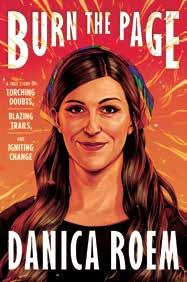
Burn the Page : Turning up the heat on homophobia in politics
by Terri Schlichenmeyer Special to the SGN
BURN THE PAGE: A TRUE STORY OF TORCHING DOUBTS, BLAZING TRAILS, AND IGNITING CHANGE
To be fair, she had good reason: she was working two jobs and they weren’t enough to pay the bills. Her car was a piece of junk. It was 2016, and her states’ Republican legislators had just filed several anti-LGBTQ bills. For a Trans woman like Roem, tears were perfectly appropriate — until someone emailed her, asking why she didn’t run for office herself.
Actually, why not?
So, in preparation, Roem hired a team to do “opposition research” to suss out any past behavior that her homophobic oppo -
nent might try to use against her.
Born in the fall of 1984, Roem was three years old when her father committed suicide in their back yard; soon after, her mother’s parents needed care and moved into the household. This, Roem admits, was stressful all around.
Even in fifth grade, Roem knew that she wasn’t a “cis-het straight kid,” but since she had no “positive representation of LGBTQ people,” she stayed closeted. By 13, though, she knew she was Trans but didn’t want anybody to know, so to help hide it, she participated in sports, fell in love with baseball and heavy metal music, and admired girls, albeit in ways different than did her male peers. Eventually, she made a community for herself.
But when she began to think about maybe having a relationship, Roem soon realized that she had some work to do. She couldn’t expect someone to see her for herself until she did it first.
“I had to commit to being who I was...” she said. “It was time to transition.”
If you ever need proof of the concept
that little things make big differences, you’ll want Burn the Page. Same goes if you want to read a memoir that bounces with energy.
Indeed, this book is a bit like taking a small kid into a toy store: they run amok, touching and examining everything. That’s not unappealing; Roem careens about, but she always lands on the heart of this book — being honest, open, and authentic — which is likewise what she encourages readers to do. Her passion for this is contagious, and she sweeps readers along with her enthusiasm in other aspects of her life, whether it’s heavy metal music, travel, or politics.
Be aware, though, that, because of her excitement over her career and her heavy emphasis on it, the latter might slam shut the eyelids of readers who are not politically minded.
However, this book is like no other political memoir, ever. It’s fun and wildly entertaining, and it aims to mean more than just one woman’s story. For readers who want a good activist tale with a smile, Burn the Page is on fire.
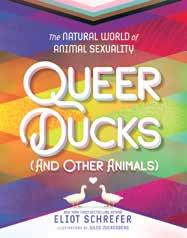
The year was 1834, and German zoologist August Kelch couldn’t quite believe what he was seeing. It wasn’t that he’d never noticed mating doodlebugs before, but the two he’d just found were both male! He chalked it up to the only thing he could think of: an act of perversion.
You can’t entirely blame him: for centuries, early theologians and scientists, lacking the proper language, noted that animals’ love lives sometimes didn’t match the boy-meets-girl ideal then ascribed to humans, so they wrongly condemned it in the only ways they knew.
The thing is, animal sexuality varies so
much that they might have overlooked other examples that could have proved the naturalness of it all. They may have seen mating animals and assumed something different than the truth. Psychologists call it “confirmation bias” — seeing what you’re looking for.
But in fact a pair of cats or dolphins, tête-à-tête, may actually both be male. A male wrasse might have changed gender for mating purposes, or one may have observed a bonobo, whose species is notoriously promiscuous. You might be watching a deer with a same-sex “dear.”
Every farmer knows that cows will mount other cows in heat. Scientists have observed mating activity among female macaques lacking nearby males. Albatrosses form pair bonds without mating, and wild geese sometimes form throuples to care for a nest.
Maybe it matters to the individual animal, and maybe it doesn’t. (Which, suggests author Eliot Schrefer, is half of an intriguing question: Why does that same behavior in humans matter to us?)
So you’ve noticed some embarrass-
ing activity at the dog park or the zoo, and you’ve waived it away by saying it’s a matter of dominance or a power play among animals. But, as you’ll ask yourself while reading Queer Ducks (and Other Animals), what if it’s not?
Another question you might pose: Is it fair to compare a dog or elephant to a human in this way, or is it anthropomorphizing? Scientists tend to hate the latter; Schrefer does both here, proving that the behavior so often condemned in Homo sapiens is perfectly natural in the animal kingdom, while also urging readers to see the ridiculousness of affirming one while lambasting the other.
The point is made, though it can get heavy-handed at times. Still, readers won’t be able to keep their thoughts from being provoked.
Also full of interviews with scientists and biologists and a nice biography of the author too, this book is informative, eyeopening, and just plain fun to read. Yep, get Queer Ducks (and Other Animals), or you’ll be a monkey’s uncle.
Image courtesy of Viking
Image courtesy of Katherine Tegan Books
Celebrating Queer joy
Director Andrew Ahn and actor-writer Joel Kim Booster go on an LGBTQ rom-com vacation to Fire Island
by Sara Michelle Fetters SGN Staff Writer
Fire Island is a big Queer road trip overflowing with laughs, tears, love, and most of all friendship. Director Andrew Ahn (Spa Night, Driveways) and actor-writer Joel Kim Booster deliver one of the year’s most delightful surprises with their energetically engaging romantic comedy. A sensation at this year’s Sundance Film Festival, this beguiling winner is a lovely little gem that only gets better as it goes along, building to a raucously charming finale that held me happily spellbound.
I caught up with Ahn and Booster to chat about their effervescent critical darling. Here are the edited transcripts of what they had to say:
Sara Michelle Fetters: Joel, who the heck decides to take Pride and Prejudice and Clueless and transform that into Fire Island?
Joel Kim Booster: Yeah, I am this idiot. [laughs]
The genesis was really simple. I went to Fire Island for the first time in 2016 with Bowen Yang. The book that I brought with me to read at the beach was Pride and Prejudice. While I was reading it, I was struck by just how relevant it felt to me in that moment on that island, surrounded by Gay people and the ways in which Gay men sort of create these artificial class systems that separate us from each other. The parallels felt really stark to me in that moment.
It started as a joke, to be honest, as a threat that I would say over drinks. I would say, “Wouldn’t it be funny if I wrote Gay
Pride and Prejudice set on Fire Island?” Slowly, over time, I would go back to Fire Island and I would bring a different Jane Austen book with me. Austen’s themes felt so relevant to me and related to what we were experiencing on that island.
SMF: Andrew, there’s some humor in in both Spa Night and Driveways, but those are not exactly comedies.
Andrew Ahn: Right.
SMF: What was it about Joel’s script that excited you? What made you the right person for the job?
AA: I received the screenplay for the feature about a year into the pandemic, and it had been a year of not getting to see my friends, not getting to go out and drink and be stupid. I saw in Joel’s script exactly what I wanted to do, and so if I couldn’t do it in life, maybe I could do it in this movie. [laughs]
For me, this was exciting. I love that it’s a film that celebrates chosen family, that it celebrates Queer Asian-American joy. There was substance to this. I don’t know if I would have done any other rom-com, but because of what this story had in its center, in its heart, I had a way into it.
I was really excited by the challenge of directing a comedy. I think it’s so much harder than directing drama. It’s nervewracking, because a joke either lands or it doesn’t. It’s a real challenge.
It’s super precise, but in the pre-production with the screenplay, in production with the actors, and then in post-production with my editor, we were trying to make sure that we found that humor and always retained that heart. I think it’s that balance that makes Fire Island feel special.
SMF: Maybe I’m completely off base, but the first time I watched it, I felt like I could feel influences of the late 1990s, early 2000s LGBTQ Queer cinema boom. There were all of these romantic comedies that came out, mostly populated by straight actors playing Queer roles. Some tended to be very facile. It was like representation was all that mattered and little else. The basic scenarios were kind of clichéd and mundane. I feel like the pair of you took those tropes and decided to say no, we’re actually going to go deeper than that.
JKB: I grew up loving Nora Ephron. I grew up loving rom-coms. That’s always been a part of my DNA as a person and as a writer, really. I worked at a video rental store and was able to find movies like Big Eden and Trick and Kissing Jessica Stein and Mambo Italiano. I loved them. I devoured them because those were all that we had at the time.
As much as Fire Island is a subversion of some of those tropes, it is an homage too. I wanted to honor some of those early Queer filmmakers who maybe didn’t have the platform that I have with this movie. I loved those movies and I wanted to honor them.
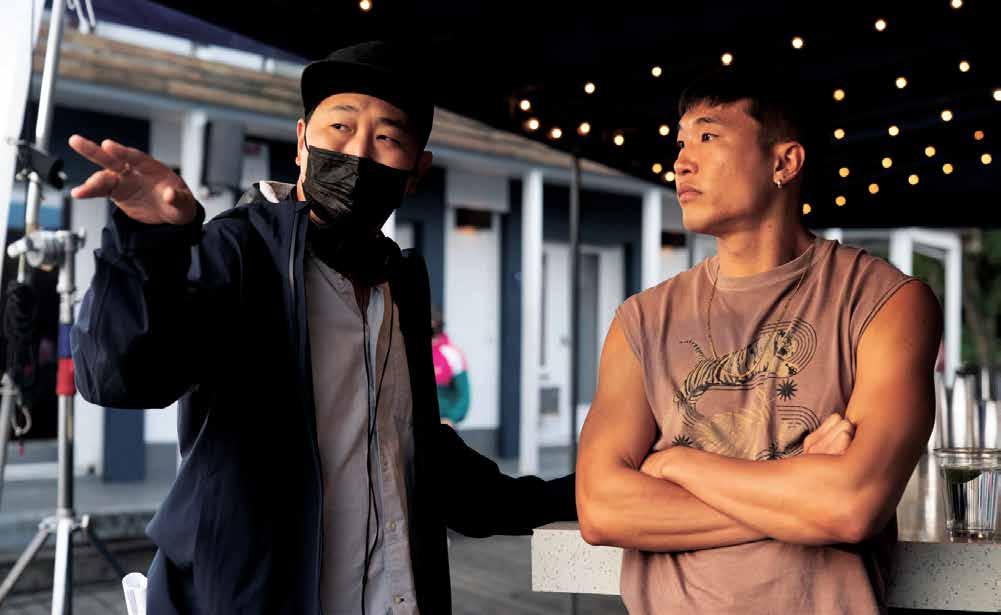
Director Andrew Ahn and writer-actor Joel Kim Booster on the set of Fire Island – Photo by Jeong Park / Searchlight Pictures
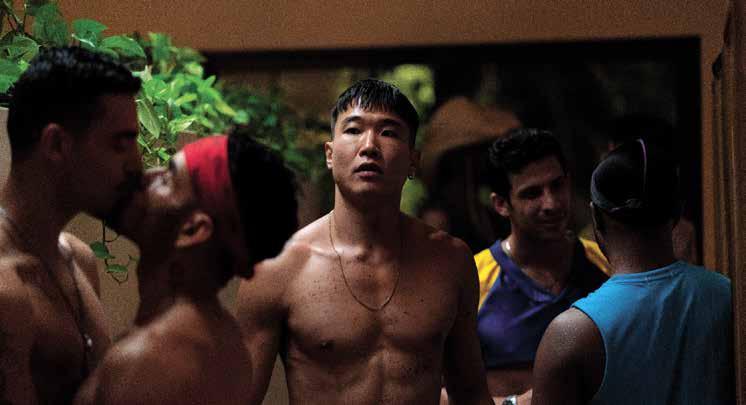
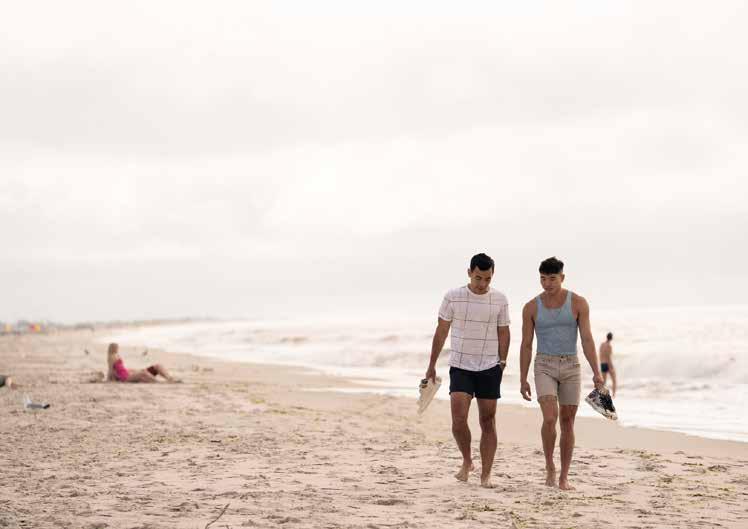
Joel Kim Booster in Fire Island – Photo courtesy of Fox Searchlight Pictures
AA: We never looked down on the genre. We always thought of the rom-com with reverence. I think we put our own spin on it and we tried different things, but it’s very cool to have done this. I took it as seriously as I would take a drama in terms of finding emotional truth. It’s not just a fun, fluffy thing. I think that a lot of people might be expecting that, but I told Joel, even before I got the job, “I want people to watch this film and say that this film had no business being this good.” We went into it with that attitude.
SMF: Now I’m going to need and go back rewrite my review. I literally use that exact line. [laughs]
AA: Don’t rewrite your review. You can use the line. [laughs]
SMF: What I love about what you both just said there, though, is that it’s clear that you took the material seriously. I think one of the big mistakes that a lot of modern romantic comedies make, whether they be Gay, straight, or whatever, it’s almost like they’re trying to Airplane them. Everyone is kind of in the background, winking at the camera. Everybody’s in on the joke.
Even with a narration, even as flamboyant as things become, you never allowed anybody to wink back at the camera. These are real characters living through these situations, not walking punchlines standing around just to be the butts of a few jokes.
AA: Absolutely. I’m a pretty sincere person, which makes being around comedians difficult at times. Joel would joke around with me and I would take him so seriously and he’d be like, “I’m joking.” I didn’t know that.
But I think that there are real stakes in this. The things that happen to these characters, what happens to Luke with Dex, these are difficult things that our commu-
nity has to deal with. The racism. The classism. There are very important and difficult themes that we’re tackling, and we never wanted to be glib.
I think that we wanted to emphasize the Queer joy of it all, but I think you can’t have the joy unless you acknowledge what we’re rising up out of. We leaned into the kind of range of experiences that these characters are going through, both good and bad.
SMF: Joel, I do have to ask, when you’re structuring this script and you’re putting it all together, when we’re talking about the racism, the classism, and the ageism, how do you structure things so that you’re not being preachy or didactic, that you’re letting these moments and the weight of what’s happening to these characters have meaning yet still are allowed to be funny?
Fire Island takes pride in its literary
by Sara Michelle Fetters SGN Staff Writer
FIRE ISLAND Hulu
For a brief moment Fire Island had me terrified. After his lovely Spa Night debut and his superb follow-up, Driveways, I was excited to see what director Andrew Ahn had up his sleeve. But the opening few minutes of this romantic comedy — inspired by Jane Austen’s Pride and Prejudice — are so frenetically in your face and risibly obnoxious that I was worried the talented filmmaker’s latest wasn’t going to be for me. Thankfully those feeling quickly vanished. Once the core dynamics of star Joel Kim Booster’s impressively intricate script begin to kick in, things take a positive turn. Ahn’s handling of the material also begins to make more sense, his direction exhibiting a playfully magnetic vibrancy that fits in nicely with the party atmosphere, while also augmenting the close-knit bonds of the group of friends vacationing together for what may be the last time.
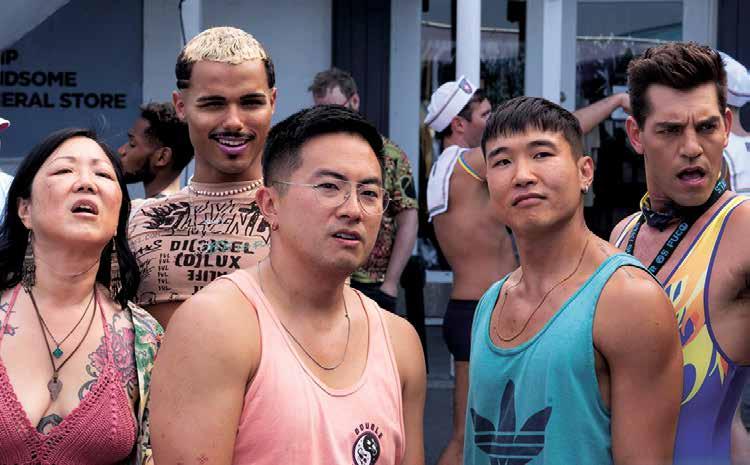
For one week each summer, Noah (Booster), Howie (Bowen Yang), Luke (Matt Rogers), Keegan (Tomás Matos), and Max (Torian Miller) head to Fire Island. They always stay at a house on Tuna Walk owned by the perpetually optimistic Erin (Margaret Cho), the whole crew carousing as if they were a giant happy family who rarely get to spend time in one another’s company. The main plot points revolve around Noah and Howie. They’re best friends, and while the former is perfectly content to remain single and have affairs with whoever strikes his fancy, the latter is starting to wonder if he’ll ever make a lasting connection with anyone at all. A young doctor named Charlie (James Scully) catches Howie’s eye, and while his handsome wingman Will (Conrad Ricamora) disapproves of this summertime fling, he himself can’t get past a growing attraction to Noah. One thing leads to another, and nothing goes entirely to plan.
Booster isn’t subtle about his scenario’s connection to Austen’s prose. The relationship between Noah and Will is basically a modern-day, gender-flipped take
JKB: I guess I’m uniquely positioned to do that, because so much of this was just ripped from the headlines of my life and my friendship with Bowen. Many of those conversations are truly remixes of conversations that I’ve had with Bowen or situations we’ve both experienced, like the moment we walk into that party and someone says, “I think you’re at the wrong house.” That happened to me.
see ISLAND page 14
romantic entanglements
on the familiar interactions between Elizabeth Bennet and Mr. Darcy. Their scenes together are well developed and even more impressively acted. Booster and Ricamora have terrific chemistry. This gives their cantankerous back-and-forth arguments an intimate authenticity that helps their growing affection for one another become all the more believable.
But the heart and soul of the film is Noah and Howie’s friendship. Ahn does a fine job of keeping the focus squarely on them. No matter how silly various elements become, even when a few subplots fall flat or aren’t developed well enough to have a major impact on the proceedings, the director
knows to keep the two men at the center. As to those secondary stories, one of the better ones involves an unauthorized sex tape. Noah and Will briefly join forces to make sure the perpetrator is held accountable for their heinous actions. Another involves the always divine Cho: Erin is forced to put her house up for sale, making this maybe the last summer this friend group will be able to afford to vacation on Fire Island together. The veteran actress also has a sensational scene with Booster roughly two-thirds of the way through, during which viewers of all backgrounds owe it to themselves to listen to and learn from the universal truths being uttered.
The rampant silliness can wear a little thin. There’s also a climactic boat chase that treads awfully close to Mamma Mia! territory — and I do not want that to be construed as some sort of compliment. But Booster and Ahn dig deeper than anticipated, and there are so many heartwarming moments that they more than make up for the scenes that fall flat. The laughs have weight, and the tears are genuine.
Fire Island has no business being as good as it is. While I don’t think Austen could have imagined her work being transformed into a Gay-friendly celebration of friendship and family, hopefully she’d applaud the finished product just as heartily as I do.
Conrad Ricamora and Joel Kim Booster in Fire Island – Photo courtesy of Fox Searchlight Pictures
(l-r) Margaret Cho, Tomas Matos, Bowen Yang, Joel Kim Booster, and Matt Rogers in Fire Island – Photo courtesy of Fox Searchlight Pictures
Delicious Bob’s Burgers is simply scrumptious
by Sara Michelle Fetters SGN Staff Writer
THE
BOB’S BURGERS
MOVIE Theaters
I have never watched an episode of Bob’s Burgers. I’ve seen snippets here and there. My sister and her kids love the show, so I’ve certainly heard firsthand how wonderful it is. I know the long-running animated program has a devoted following who will sing its praises whether you invite them to or not. But I have no idea what the fuss is all about, and, if I’m being honest, I think that’s perfectly fine.
Based on my reaction to The Bob’s Burgers Movie, though, maybe I need to rethink that last statement. There is something undeniably wholesome about this animated motion picture, the warmth, love, and positivity that it exudes filling my soul with joy even if some of the references and inside jokes were flying over my head. I had a terrific time getting to know these characters and spending a good 100 minutes or so inside their world, and I’d make a return visit with no hesitation whatsoever.
Bob Belcher (voiced by H. Jon Benjamin), his wife Linda (John Roberts), and their three children Louise (Kristen Schaal), Tina (Dan Mintz), and Gene (Eugene Mirman) live in a small apartment above their eatery, Bob’s Burgers, on a busy street just across from an amusement park, Wonder Warf. They have one week to pay back a bank loan or else their kitchen equipment will be repossessed. But when a giant sinkhole opens up in front of their diner, Bob worries they’ll never sell enough burgers in time to make the required sum.
Both their building and the Wonder Warf are owned by the wealthy but flighty Calvin Fischoeder (Kevin Kline). Bob and Linda still think they may be able to convince him to let them be late with the monthly rent to help ease their financial burdens. Problem is, when the remains of a murdered carny are discovered in the sinkhole, their landlord becomes the primary suspect. Convinced of his innocence, Louise, Tina, and Gene take it upon themselves to clear Calvin of the crime, diving deep into the carny world in an attempt to unmask the actual killer and save their family business.
ISLAND
continued from page 13
A lot of it was just about digging into and mining my own life and them handling those moments with a grounded sort of realism. In those moments, when I lived them, they didn’t feel like teaching moments, they just felt like regular, everyday experiences that I think a lot of Queer Asian men experience in places like Fire Island. I honestly went into all of this with a sense of honesty. I didn’t set out to teach anybody anything. I think if that happens, then it’s great, but it’s sort of ancillary to the original goal.
SMF: You talk about your friendship with Bowen, and it’s so clear in the film the two of you have this naturalistic rapport with one another. Where do Noah and Howie begin and Bowen and Joel end?
JKB: They’re definitely not one in the same. I think, especially for Bowen, he is a lot more confident and self-possessed than Howie is at points in the movie. Asking Bowen to go to some of those dark places was actually quite difficult. I think it shows a lot of his range as an actor that he was able to be as vulnerable and do some of those scenes.
For me, I think it was about showing the duality of my personality. But I think there’s a lot of me in both of these characters. On one hand, I’m cynical and sort of brash. On the other hand, I’m a huge cornball. I think that the duality of those two parts of myself was rendered in the
This is irreverent silliness turned up to eleven. The gags come in never-ending waves, one after the other, with a visual and verbal freneticism that’s almost overwhelming. But they do not come from a place of vitriol or anger. The film never punches down. Writer Nora Smith and fellow series creative stalwarts Loren Bouchard and Jim Dauterive make sure their humor, no matter how pointed, even when dripping in absurdity and laced with acidic gleefulness, always comes from a place of warmth and tenderness. That’s what is most shocking. The stress Bob feels over potentially losing his business is real. The anxiety Louise has over being called a “baby” by her classmates and being made fun of for wearing a bunny-ear stocking cap and longing to prove herself “brave” is genuine. The prepubescent pangs Tina is dealing with over her feelings for a boy in her class are uncomfortably and all too sincere. These are authentic stresses, and in lesser filmmaking hands, they would have come
movie in the ways in which those various romances play out. You have the big sort of romantic rom-com — some might say unrealistic — ending, and then you have the more measured, grounded ambiguity of Will and Noah’s ending.
SMF: Andrew, when you’re dealing with an ensemble of this size and you need to make sure that each character gets their moment to shine, how do you handle that? What’s the balancing act like?
AA: This is going to sound very silly, but my priority was Joel. I wanted to make sure that we really understood Noah’s point of view. More importantly, with him being the writer, I knew that my collaboration with Joel went beyond just his character. This relationship was also going to help me understand every character.
But I think we all went into this with a spirit of generosity. Everybody knew that this was a big ensemble, and sometimes you’re in a scene where you got a lot of different actors and the focus will not be on you. But it was always so much fun when we opened up takes to ad-lib and improvisation. We really got some fun reaction shots.
It was never this thing where someone was being short-shifted. I wanted to make sure that we all knew why we were there together in each and every scene. This cast understood the importance of what we were doing, and they were really inspired by Joel’s screenplay.
We also got a free trip to Fire Island out of it. We got paid to be on Fire Island. [laughs]
off as facile and intended to ridicule their intended targets. Instead, these moments build and strengthen character. They make the interactions between the Belcher family members comfortably and complicatedly genuine, and by the time they’re huddled together, contemplating their next move in a moment of unexpected peril, I never worried that something catastrophic would befall any of them as long as the clan continued to work together as a loving unit. It is all pretty ridiculous, though, and purposefully so. Calvin’s childish, superficial brother Felix (Zach Galifianakis) lives in a lavish treehouse. Amusement park carnies live together in gigantic RV caravans and play pugnaciously puerile versions of carnival games — most of them with rubber ducks. Tina has fantasies of riding horses bareback in the desert while the object of her affection does the same clad only in a T-shirt and underwear. Rich nincompoops drive bumper cars underneath the founda-
SMF: Joel, you have a scene in the film that I don’t want to go into a lot — I don’t want to spoil it — but you have a moment with Margaret Cho rather late in the film. It’s so beautifully underplayed by the both of you. But I do wonder, for you, standing there in a scene, having this really emotional moment with somebody like Margaret, what’s going through your head while you’re there on the set?
JKB: It’s completely surreal. I’ve said it many times, but Margaret changed my life. I can draw a straight line from All-American Girl to this movie. Before that show, I had no conception of what was possible for me as an Asian American Queer person in entertainment. I was a little kid, and the only Asian people I saw on screen were martial artists or, quite honestly, the butt of a joke. That was it.
To see someone in control, with agency, it was life-changing for me. It really did alter the course of my life. Then to discover her standup later in life, before I even ever had an inkling of doing standup myself — she is such a part of me and what I do.
To have Margaret there was really wonderful. A dream. And then to have her defer to me and Andrew, to ask us for notes and things, that was so bizarre. I was just like, you’re Margaret Cho. You can do whatever you want and we’ll be happy. The fact that you’re even here is just incredible.
She did not disappoint on any level. As a human being. As a performer. As a comedian. It was wonderful to have Margaret there.
SMF: Now that audiences are going
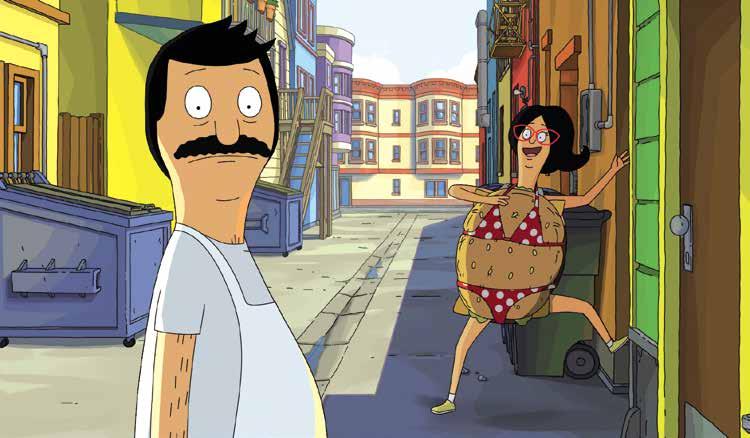
tion of their vast Wonder Warf empires. This is only the tip of the iceberg, and there’s some sort of visual or auditory lunacy (or a clever combination) during every second of the running time. There’s a spectacularly loopy musical number that seems to go on forever — yet not in an annoying or obnoxious way. An extended bit in which Bob and Linda — the latter wearing a bikini-clad giant burger costume — hit the Wonder Warf boardwalk with a haphazardly constructed food truck is goofily marvelous. For fans, I can only assume that The Bob’s Burgers Movie will be an instant favorite. But the film works splendidly whether or not viewers are intimately familiar with the Belcher family. There is a loving, nonjudgmental grace to this smorgasbord of animated nonsense that’s simply delicious, making it as scrumptious a surprise as anything I’m going to sink my teeth into for the remainder of the year.
to get a chance to see this film outside of the festival circuit, with its big Hulu premiere on June 3, what do you hope viewers take away after watching the film? What do you want them to be talking about afterward?
AA: For me, I hope that people celebrate their friendships. I think we live in a world where we have to do a lot of self-care. I think that that’s super important. I think part of self-care is community care. It’s about supporting each other and celebrating your friendships.
I hate it when someone gets into a relationship and then they abandon their friends. I hope people recognize who made us who we are, and that you should go on vacation with them! [laughs] Go on a big Gay trip, just one with hopefully not as much drama as these characters encounter, but hopefully one where you have just as much fun.
JKB: I think it’s about joy, and finding the joy in being Gay and being Queer. I had a friend who saw the movie last night say, “It just made me so happy that I was Gay.” A lot of the media aimed at our community is about our trauma. It’s about coming out. It’s about hate crimes. It’s about all the struggles of being Gay. Those stories are valid and need to be told, but I also think that there’s room for Queer joy, too. I hope people come away from this movie feeling that joy.
Fire Island is now streaming on Hulu.
The Bob's Burgers Movie – Photo courtesy of 20th Century Studios
Not if but when: Stories from an ordinary American childhood
by Lindsey Anderson SGN Contributing Writer
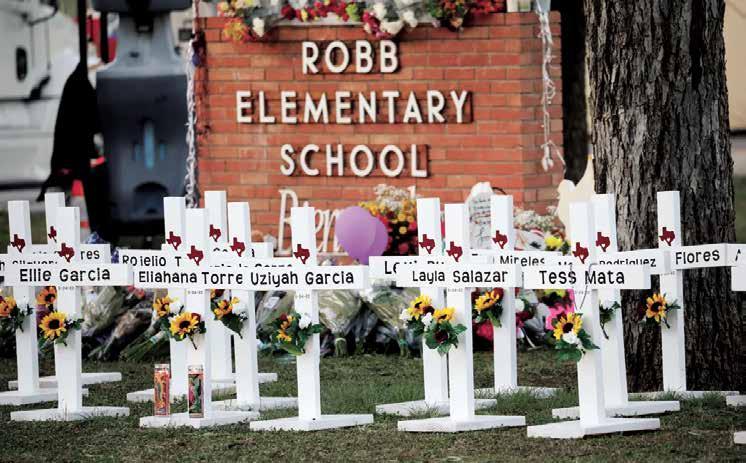
Today is Friday, May 27, and like most Americans, I have spent the last four days caught up in the news coverage of the latest mass school shooting.
I have seen invasive journalists interviewing parents as they arrived at the scene of the massacre, not yet aware that their babies were lying dead inside. I’ve shaken my head as I watch footage of police officers blocking parents from storming the school they should have stormed themselves. I’ve seen children interviewed just days after the tragedy, retelling how they smeared the blood of their friends on themselves to play dead, how they watched from behind tables as their classmates were shot.
Today is Friday, May 27, and everyone cares. Politicians are angry, and voters are calling them out for not using their power to protect the lives of the innocent. Foreigners again remind us that the United States of America is the only country in the world that has experienced more mass shootings than days in the year. We are the only country where children prepare for a school shooter with the same nonchalance they use for a fire drill or tornado warning — because they are more likely to die in a school shooting than in a fire or tornado.
Tomorrow is Saturday, May 28, and the caring will start to wane. By next week, will this news be forgotten? By the time you read this opinion, will you have forgotten the names and faces of the children who died, just like you did when it happened in Parkland and Newtown?
Who is responsible?
You shouldn’t have to be personally affected by gun violence to be outraged by it, but for some reason, the responsibility of advocacy always seems to fall on the victims. Why is that? Why do we have to see high schoolers leading walkouts and calling on politicians to write gun reform laws? Do we just expect the grieving mothers to pick up the torches and continue?
And what happens to those survivors after the world moves on? How do they view the next school shooting, as if all their advocacy, all their trauma, and all their grieving were in vain?
We all care when we see those faces. We scream out, “It shouldn’t have been them,” and some of us look in the mirror and wonder why it wasn’t us.
I grew up convinced it would be me.
Born just days after the Columbine shooting, I entered a public school system shellshocked by gun violence. In kindergarten, I learned my ABCs and how to sit quietly — away from the windows, behind the teacher’s desk, with the lights off — when the lockdown alarm started. We huddled together, safe in the knowledge that it was only a drill, as we watched our teachers count our heads and draw the blinds. We held a collective breath until the PA system announced it was “all clear.”
It could have been me
When I was ten years old — the same age as most of the victims of the Uvalde shooting — I was in the fifth-grade band. Every morning, my parents would drop me off at the high school I would one day attend so I could practice my tone-deaf musical skills under the guidance of the school district’s band teacher.
One particular day, he sent my section, the flutists, to another, smaller practice room, so he could focus on the brass instruments. I don’t recall how long we had been in this room, but the flashing lights and blare of a lockdown alarm went off, interrupting our horrible rendition of Mozart. The other little girls and I stopped playing and looked to the flute instructor for guidance. There was no voice-over of the PA announcing “this is a lockdown,” and we had no idea what the sirens indicated.
By the time you read this opinion, will you have forgotten the names and faces of the children who died, just like you did when it happened in Parkland and Newtown?
“Keep playing,” she said. “It’s probably a drill.” And so we sat, four little ten-year-old girls, spitting into one of the world’s shrillest instruments, as the lights flashed and the alarms blared.
Suddenly the door flew open. The band teacher entered the room. “This is not a drill!” he barked at us. We dropped our flutes and followed him into the band room to hide. He had already stuffed the rest of the students into the large instrument closet and locked the doors. We would not fit, and attempting to put us in that room would compromise their security. There was only one other option.
“Come with me,” the instructor ordered, pushing us into his small office. The room was all windows. He closed the blinds. Unlike the instrument closet, this room had no locks. He ordered us to get under the desk. Our flute instructor began to pray. I watched a few of the other girls do so too.
From the gap under the desk we hid behind, I could see the window. I held my breath, just waiting for the shooter to appear outside. I counted the seconds, then the minutes, waiting for the lockdown to end.
I started to wonder what it would be like to die.
I wondered how my parents would react if I was killed under that desk. I wondered what I would do if he came into the room, if I would push the snotty Madison in front of me.
As all these thoughts flashed in and out of my brain, I began to cry. Silently, I wept. The cold tears fell down my face and soaked my jeans.
I don’t know how long we were under the desk, but eventually, the all-clear message came through the PA. The band teacher let the other kids out, and we all sat quietly in the band room and waited for the buses that would take us to our respective elementary schools.
As I sat on the bus, I looked out the win-
dow. Several police cars had gathered in front of the high school, and I watched as they took a teenage boy out in handcuffs and stuffed him into the back of a squad car.
I wouldn’t learn until later that night that the boy had no real weapon with him. He said he had a gun in his backpack and threatened to shoot his English teacher before storming out of the class. She immediately called the office, which put the school on lockdown, and called the police.
Nobody was hurt that day. Not physically, anyway.
The narratives we teach
When I was in seventh grade, I again encountered the reality of school shootings. In perhaps the world’s most insensitive anti-bullying campaign, my middle school decided to enlist the help of an organization known as “Rachel’s Challenge” to emotionally manipulate all the hormone-crazed psychopaths roaming the halls of Northwood Junior High.
“Rachel’s Challenge” was formed by the friends and family of Rachel Scott, the first victim of the Columbine High School shooting in 1999. The guest speakers showed us pictures and videos of a joyful young girl and sold us on who Rachel was. She seemed like the kind of person you’d want to be friends with. Then, they hit us with the gory details of her death. We watched clips of her classmates and brother talking about the trauma of the shooting. Not a single student in the stuffy gymnasium had a dry eye by the end of the day.
The burden was put on us students to be kinder to one another, to prevent our classmates from snapping and coming to school to shoot us. There was nothing said about gun laws, security, or mental health resources. They told us to be kind to one another like Rachel wanted.
After school, we were encouraged to sign up with the Friends of Rachel (FOR) Club, in which students would mingle and eat
lunch together, to create a sense of camaraderie that the adults in our lives figured was enough to prevent a tragedy.
I internalized the messages of Rachel’s Challenge. I figured Rachel was a kind girl, a good girl. She tried to talk the gunman down. Yet she died. That must have been the problem. I decided I was going to be mean. The mean ones survive, at least. That’s what trauma teaches us: not how to love but how to survive.
The next year, I was sitting in my eighthgrade English classroom when my teacher stepped out and failed to return for the whole period. We sat around, wondering what to do. I think I just picked up whatever book I was devouring that day and finished it. She returned right as the bell rang and told us to stay put. She informed us that 20 children had died in a school shooting in Connecticut. This wasn’t a high school. The shooter wasn’t some bullied kid. This was an elementary school, these were babies, and they were killed by a sick man with a gun. That was the first time I heard the topic shift to guns. The man didn’t kill these kids with a mental illness or for vengeance. The kids died because a horrible man was able to get a gun. For the next few weeks, everything felt somber. I watched coverage of the shooting and looked at my sister, an elementary schooler, and realized she wasn’t safe. It wasn’t just high schools that had shooters. I remember staying up at night, wondering if my school would be next. There had been a high school shooting, now an elementary school one. It only made sense a middle school was next. I started making escape plans everywhere I went. In each classroom, I immediately deduced where my best hiding spot would be and how I could escape if the door was blocked. I worried about fire drills because, I figured, that could just be a tactic used by the shooter. That was the same year a man shot up a movie theater in Colorado.
If my dad took me to the movies, I insisted we sit close to the exit. I couldn’t concentrate on the film because every small movement had my eyes darting to the door, wondering if the man standing in the hallway was just waiting for the right moment to strike. I was also worried when we went to the grocery store or the pharmacy. I avoided large crowds at all times. Fear of guns consumed my mind.
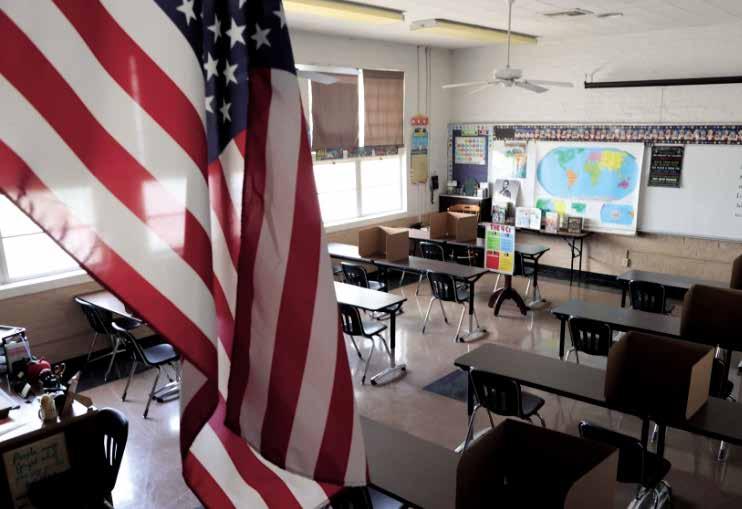
Photo by Lucy Nicholson / Reuters
continued from page 15
The reality of the modern American teenager
By the time I started high school, I had accepted that I would probably not live to see my 16th birthday. It was a big school in a town where you could buy a gun on every street corner. I just knew the odds were not in my favor. I continued to plan my escape routes in every classroom and remained wary in the crowded hallways.
When I was 15, I met a boy in a class in which I was a teacher’s assistant. He seemed nice at first, and I made the dumb mistake of befriending him. I had forgotten my strategy of being mean. Eventually, I learned that this boy was troubled. He confided in me that he was suicidal, that he felt he had nothing to live for. One day he brought in the book Mein Kampf and told me he thought Hitler had some pretty good ideas if you could look past some of his more “severe” ones.
On one of the last days of the semester, he asked me out on a date. I flatly rejected him, and I even told him I didn’t have a phone (while holding my iPhone) when he asked for my number.
I went home and cried. I told my mom I was afraid to go to school the next day. I was sure I had pushed this kid to become a shooter — this mentally unstable kid who liked Hitler and had no friends and “nothing to live for.” I was worried I would pay for it with my life. All those anxieties surfaced, all those visions of a young and bloody death flashed into my peripheral vision as I begged my mom to let me stay home from school. She did. But she also called the guidance counselor to tip them off about the boy. He was pretty pissed to have to go to the guidance counselor, but he had no guns. His family had no guns. Because his access was limited, he was deemed not a threat. And for the record, he had no plans to shoot me or anyone else at school.
But that was not the narrative I knew. I grew up with the narrative of school shootings. I grew up thinking it was somehow my responsibility to look out for the loose cannons and prevent a tragedy from happening. At 15, I didn’t think about how American the problem of school shootings are. I didn’t think to hold elected officials responsible for stricter gun laws.
Living with survivor’s guilt
The day I graduated high school was the day I realized I survived. Not “I survived” like some clichéd teen movie, but I survived, literally. I made it to a day I never thought I’d see. I was one of the lucky ones. In 2017, the same year I graduated high school and started college, it happened. Not at my school, but one in my hometown. A kid brought a gun to school and murdered a classmate. “Lucky” is what people said. They said the school was “lucky” he only got a few shots in before someone tackled him to the ground. “Lucky” only one boy died.
The victim was the son of one of my mom’s coworkers. How many degrees away are you from a school shooting victim? How many degrees away do you need to be to care once you stop seeing the faces of dead children on the news?
136 dead people
In the thirteen years since I first hid under that desk, crying and praying for my life, 136 people, most of them children, have died in school shootings. I believe the vastness of that number has desensitized many of us. They had dreams, futures, and families showing up outside, waiting for them to come home.
The Washington Post reports that 311,000 students have experienced gun violence at school since Columbine. That is to say, 311,000 students have heard the sounds of bullets hitting walls, guns firing, or even seen teachers and friends shot in front of them. Each one of those 311,000 students now has a GED in trauma.
So, turn off your TV. Forget about those ten-year-old kids. Go back to complacency. Your tears are wasted on them, so long as your actions continue to contribute to the system that will kill the next batch. And there will be a next batch.
But, beyond that, every single child that has entered the American school system in the last 23 years has experienced some leftover crumb of gun violence. The frequent school shooter drills, the questions that come after watching news coverage, the wandering eyes searching for a way out, not if but when the inevitable happens. Children have been normalizing this reality for over two decades now, and that, in itself, is trauma. Who is responsible for this? It is the question we always ask. The blame seems to shift each time it happens. Of course, the gunman is responsible. But what about the stores that sold those guns? What about the laws that enable those purchases? What about the Americans who financially support the lawmakers and super PACs that ensure that those guns can continue to be sold?
To those who still favor gun ownership
I’ve met many people who will argue until they’re blue in the face for the right to own guns. It’s more American than anything else, they’ll say, and perhaps I agree. It is American. In the same way oppression is American. If being American means our collective history is built on the blood of the innocent, then yes, guns are American. Liberals and conservatives alike will point out that the Second Amendment assures them the right to own guns. Political scientist hat aside (which always argues that the Second Amendment was written regarding muskets, not military-grade weapons, and the whole second half clarifies that the intention of these precious guns is for a “well-regulated militia,” not to overcompensate for toxic masculinity), does the Constitution say we cannot change? Can we not amend this right for the safety and protection of our children? Are guns what make our country great?
At what point do we change our laws? Australia did it after one mass shooting. Sure, this is America, and if you don’t like it, you can leave. And sure, at 23, I am fully capable of leaving. But at 10, I wasn’t. At 10, no kid is able to leave. They were slaughtered because of a system that protects its guns more than its children.
Some people will say reform is necessary, and that we need stricter gun laws. I used to believe that was a fair compromise, but I
don’t anymore. We are gambling with lives, lives that haven’t even begun yet.
We need to abolish guns. No stricter laws, no reform, no mandatory background checks. We tried that. That was bullshit. There is no place on earth where it makes sense for an average civilian to own an AR-15 or any other military-grade weapon. These guns were created specifically for war zones, and America has not been one since the Civil War. There is no reason for these weapons to be manufactured, sold, or used on American soil.
If you are a person who currently keeps one of these weapons in your home, you are a part of the problem. You don’t have to be a member of the NRA; you don’t even have to vote Republican. By owning a gun, you are supporting an industry that knowingly creates weapons that kill children.
And that’s the thing about guns. They have a purpose, just as everything else does, and that purpose is to kill. They are made and used with that intent. If you are a person who lives with a gun in your house, maybe you should ask yourself why you have it. Do you think you will “defend your property” with it? Do you think if someone breaks in in the middle of the night, you will have the time and ability to get to your gun in the safe — and then what, kill that person? Does someone stepping foot on your property unannounced deserve the ultimate punishment?
Or is it more likely that that gun is going to eventually see action when someone goes off the rails? Are you harboring the next weapon that will kill the masses?
Some say guns are used for recreation. How is firing a dangerous weapon recreation for you? Someone, please explain.
And why must you own a weapon that can mow down a classroom of children within minutes? Is a simple musket or hunting rifle not enough for you? If hurting others and ending lives is your type of recreation, might I suggest starting a new hobby? Therapy, maybe? Hell, even fishing, if you must get out there and kill things?
And why does our society feel so strongly about guns and gun ownership? We could look at the root reasons behind this phenomenon.
Guns fit into American history when you
think back on our legacy of white supremacy. They were a perfect companion to the soldiers slaughtering Native American people and taking their land. They have been used to hunt down and kill hundreds of Black and Brown people. Gun control ideas only started after Black people began taking up arms to protect themselves from the violence they had been enduring for years. There’s also a notion that guns are “manly.” Our culture of toxic masculinity and overt sexism enables men to have power over women. Is this not asserted every day with gun ownership? Men are told they must be powerful, cruel, and unfeeling. What is more powerful, cruel, and unfeeling than a gun? Gun ownership perpetuates the idea that men must be physically aggressive, providers and protectors, and assert dominance in society.
Guns are essential in systems of oppression. Plain and simple, you cannot advocate for the ownership and use of guns without advocating for the continuation of these systems of oppression. You cannot buy bullets and house a weapon in your home without contributing, symbolically and financially, to the systems that provide weapons to murderers.
Empty thoughts and empty prayers
So, turn off your TV. Forget about those ten-year-old kids. Go back to complacency. Your tears are wasted on them, so long as your actions continue to contribute to the system that will kill the next batch. And there will be a next batch.
If you aren’t questioning your contribution to the system that continues to enable such tragedies, then you are just sitting back and waiting for them to happen.
So, when your child or grandchild comes up to you after they see the news, see the faces of children that could have been their friends, and ask you if they’re next, don’t lie to them. They already know. By the time they turn five and have their first active shooter drill, they know. This is the world we have created, the world we have failed to change. The world they didn’t ask to be born into and the country they have no way of leaving.
So, when your kid looks into your eyes and asks you that question, hug them while you can, and just remember, it’s not if but when.
Photo by Marco Bello / Reuters
National & International News
by Daniel Lindsley SGN Contributing Writer
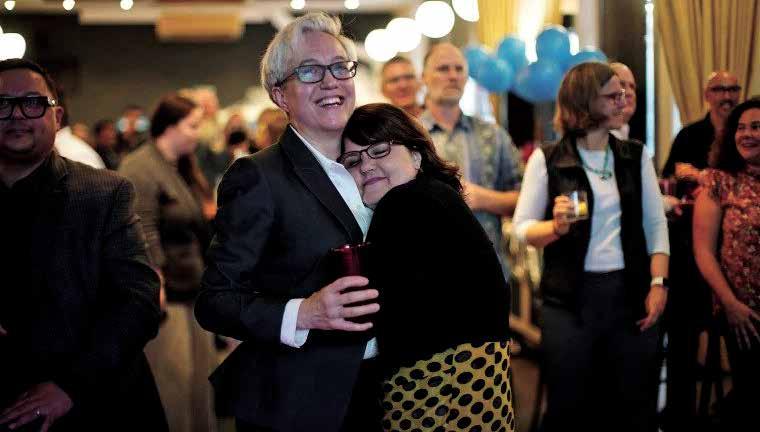
Oregon: Lesbian speaker aims for governor seat
NBC News reported on May 30 that Tina Kotek, the country’s first out Lesbian House speaker, will be running to also be the country’s first Lesbian governor. She was also Oregon’s longest-serving speaker, from 2013
National highlights International highlights
until January of 2022, when she stepped down to enter the gubernatorial race.
Kotek already has the state’s Democratic nomination for governor, so she’s off to a good start. She still has to defeat Christine Drazan, a Republican and former minority leader of the Oregon House, in November’s general election. According to NBC, Republicans are keen on Oregon as a potentially big win in a blue state. Kotek would be the fourth LGBTQ
Democrat to have headed a state government, behind New Jersey Gov. Jim McGreevey, who is Gay; Colorado Gov. Jared Polis, who is also Gay; and Oregon Gov. Kate Brown, who is Bisexual. Kotek insists that milestone isn’t her reason for running. “But I also I know that it can create inspiration for young people to be like, ‘Look, life can get better. I can do whatever I want, because look at this person or that person.’ So, it’d be an honor.”
by Daniel Lindsley
SGN Contributing Writer
Rare pox no reason to cancel Pride, WHO says Reuters reported on May 30 that Andy Seale, strategies adviser at the World
Health Organization’s department for sexually transitted infections programs, has said that an unusual spread of monkeypox does not mean people should “shun” Pride celebrations. Monkeypox is a mild illness, with flulike symptoms and skin lesions, that is
The CW makes white waif a Black billionaire NBC News reported on May 31 that the Tom Swift book series has been reimagined for TV as a Black, Gay billionaire in a new sci-fi mystery drama expanding on The CW’s Nancy Drew universe.
Tian Richards, of previous Nancy Drew fame, will be playing the eponymous Tom Swift, a charming and ingenious inventor “with unlimited resources and unimaginable wealth.” The conflict begins when Swift’s father, played by Christopher B. Duncan, goes missing on a momentous trip to Saturn. Tom will search for the truth about the incident, while a globe-spanning secret society tries to stop him.
Co-creator Noga Landau said subverting the original Tom Swift novels was a big priority, given that they were about a white, blonde, blue-eyed boy and depicted Black communities badly. “I think the inspiration for it came from the fact that I’ve just never seen a Black Gay billionaire on-screen before,” he told NBC News, “and I really wanted to see one.” Empire writer Cameron Johnson, also a co-creator, said he wanted to strike a balance between authenticity, given his own experiences as an openly Gay Black man, and universality.
Richards was a good choice for the role, given his “wit, heart, humor, and charm” during the audition. Co-creator Melinda Hsu Taylor said Richards brings “a kind of sunniness” to the character. “You can’t help but love him when you’re around him in person, but I think it comes through on the screen.”
disproportionately affecting men who have sex with men. It can be transmitted by close contact, such as skin to skin. Most people recover from it without medical intervention.
Seale said, “Most of these events — the official events — are outdoors, they’re
family friendly. We don’t see any real reason to be concerned about [an] enhanced likelihood of transmission in those contexts.”
Seale added that many of the current cases occurred in enclosed spaces, like nightclubs.
Another WHO official said it was unlikely for the monkeypox outbreak outside of Africa to lead to a pandemic. Most of the over 300 suspected and confirmed cases reported in May occurred in Europe.
Ukraine’s unicorn soldiers talk war NBC News reported May 31 on a few of Ukraine’s “Unicorn” soldiers, or the LGBTQ volunteer fighters who often sew a unicorn insignia on their epaulets, just below the national flag.
Actor, director, drama teacher, and soldier Oleksandr Zhuhan told Reuters that the practices goes back to 2014, when Russia annexed Ukraine’s Crimean Peninsula.
“Lots of people said there are no Gay people in the army,” he said. “So they [the LGBTQ community] chose the unicorn because it is like a fantastic ‘nonexistent’ creature.”
Zhuhan and his partner Antonina Romanova, both volunteer fighters, met through theater work. They lacked weapons training, but eventually, they got tired of hiding.
“I just remember that at a certain point it became obvious that we only had three options,” said Romanova, who identifies as a nonbinary person. “Either hide in a bomb shelter, run away and escape, or join the Territorial Defense. We chose the third option.”
Tina Kotek, left, embraced by her wife, Aimee Kotek Wilson – Photo by Beth Nakamura / The Oregonian via AP
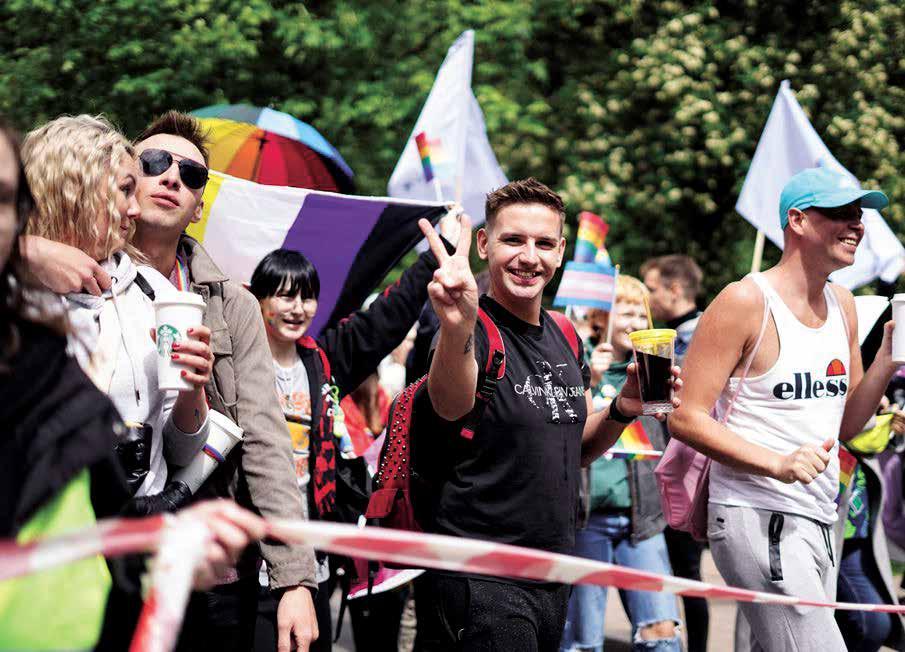
Equality March in Gdansk, Poland – Photo by David Obach / Reuters