PROUD
by Daniel Lindsley
by Lindsey Anderson SGN Staff Writer
SGN Staff Writer
by Benny Loy
SGN Contributing Writer
Photo courtesy of Michael Mattinger
Photo by Lauren Vasatka
Photo by Cameron Martinez








by Daniel Lindsley
by Lindsey Anderson SGN Staff Writer

by Cameron Martinez SGN Intern
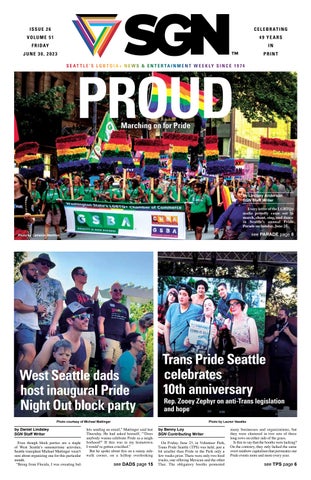
“We are ready to fight, healthcare is a human right,” exclaimed those on the Socialist Alternative float at Seattle Pride. While most floats were dedicated celebrating Queer people in companies or social groups, the newspaper/political group Socialist Alternative chose to take a different route: protest.
“We are building a movement for a Trans Bill of Rights, including free genderaffirming health care for all, Medicare for all, social housing, and rent control, and then also fighting back against the antiTrans attacks across the country,” said Joan Wright, the organizer of the Socialist Alternative contingent at the Pride parade.
“We’re marching in the parade to build the movement to put pressure on the political establishment here in Seattle that has done nothing … to help renters.”
The Socialist Alternative contingent put up posters around Seattle and ads on social media soliciting marchers who agree with its message of Trans rights and rent control. Approximately 50 people showed up; each was given a sign that laid out the values of the Trans Bill of Rights.
According to Wright, this is only the beginning of the fight, and there are plans for more marches and protests later. Walkouts protesting anti-Trans bills have also been brought to the table, since Socialist Alternative took notice of 200 Philadelphia students walking out of school in support of Trans rights in April.
“So, the Trans Bill of Rights is in response to the right-wing attacks that we’ve seen across the country,” Wright said. “The right wing has been really targeting Trans and attacking Queer youth, denying them access to gender-affirming health care. Even now they’re targeting adults’ access to gender-affirming health care in several states. [They’re] targeting Queer and Trans youth in schools …banning them from school sports, even banning …books …that have to do with Queerness. And so really, this is like a big attack that’s been gaining momentum throughout the year. And there hasn’t been a nationally coordinated organization putting up a fight back.”
Strategies for the movement
These anti-Trans policies are not popular among most working-class people, and Socialist Alternative makes a point of emphasizing that.
“Absolutely, this can be stopped,” Wright said. “There are a few extremely right-wing people that are targeting Trans youth, but the majority of people do not support these policies and bills… So we’re trying to point the way forward about …what kind of movement ...large LGBTQ organizations should have: what kind of demands [and] what kind of what kind of fighting approach they should take to stop these plans.”
In addition to the protests Socialist Alternative has been leading, its newspaper has also made a point of talking about the strategies used by ACT UP to speed research on and expand treatment for HIV/AIDS.
“In the fight to defend the rights of Trans people from an onslaught of right-wing legislation, the lessons of ACT UP are critical — that to win, we first have to get organized, and we have to take a direct, combative approach with the right wing. We have to make it impossible for them to conduct business as usual,” wrote Greyson Van Arsedale.
“We’re inviting people and asking people to come to our meetings,” Wright said. “We’re asking people to build a movement with us, [to] get involved. The only way that we win this isn’t just by [being] a cheerleader on the [sidelines]… They need to come to meetings, they need to get involved here in Seattle, and similarly across the country… It’s going to [inspire] strikes, occupations, [and] walkouts. We’re pointing to the enormous power of student walkouts, and others across the country… But ultimately, …every single person, every single oppressed person, every single working person should be joining us fighting [these] things…
“Trans rights are workers’ rights, and workers’ rights are trans rights, and …we’re all in this fight together as regular people and oppressed people.”
Socialist Alternative has two upcoming rent control events: at 9:30 a.m. on June 30 at Seattle City Hall and at 6 p.m. on July 12 at All Pilgrims Church. If you or anyone you know is interested in joining Socialist Alternative, go to https://www. socialistalternative.org/get-involved.

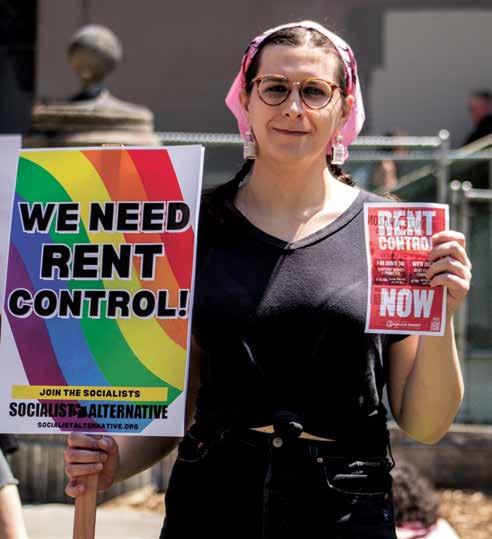

The only large corporate booth was Starbucks, which offered free drinks kittycorner from the Starbucks Workers United location. The union members found this funny when an attendee pointed it out, and joked that they ought to speak to the Starbucks baristas about the benefits of supporting workers’ rights.
Most booths were mainly small business owners selling their crafts or charitable and activist organizations promoting their work. These organizations included Lambert House, ACLU Washington, AgePride, Undead Voice, Surge Reproductive Justice, and the Washington Immigrant Solidarity Network.
TPS, now celebrating its 10th anniversary, is produced by the Gender Justice League. Founded in 2012, the organization focuses on “elevating the rights of the Trans and gender-diverse communities in Washington State and beyond.” For a decade, TPS has been “celebrating Trans joy, life, and love.”
As stated on TPS’s 2023 program site, “In a year of 450+ proposed anti-Trans bills, spaces like Trans Pride Seattle are more important than ever. TPS continues to honor and carry the torch of our Translators who created Pride as a means of cultural communion and social dissent.”
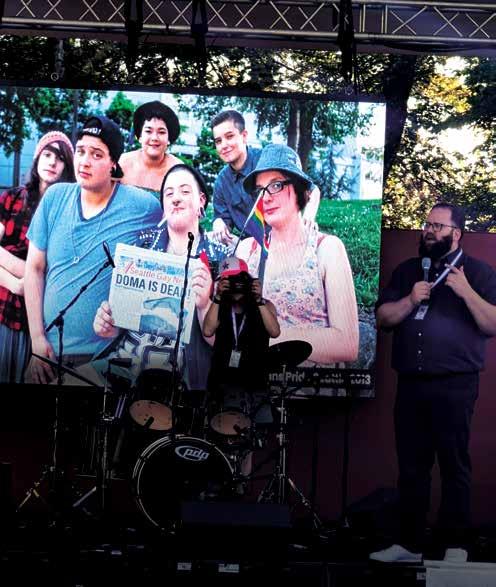
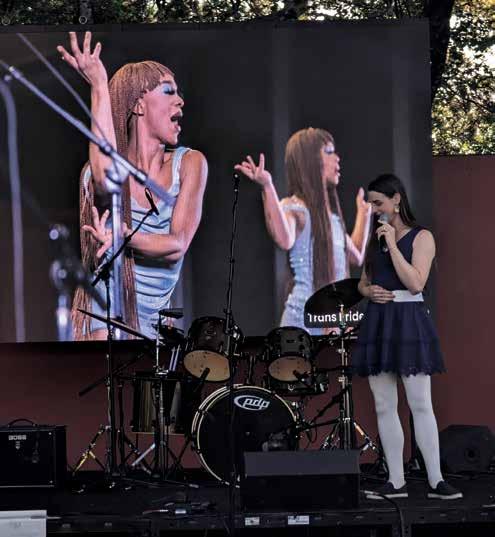
TPS succeeded in spreading Trans joy last Friday; the attendees flowing in wore all the colors of the rainbow and bright smiles. While they waved fans and perused the vendors’ wares, the stage at the park’s far end was being prepped for the show. Several rows of chairs were lined up for those who would find it difficult to sit on the grass, and large blankets were laid out for people to lounge on. As Britney Spears played over the speakers, an American Sign Language interpreter on stage signed the lyrics while bobbing to the music.
The show was hosted by the gorgeous genderqueer drag performer Aleksa Manila. She called attendees to approach the stage and stated, “We are celebrating a decade of Trans joy,” joking that her pronouns are “she and single.” She thanked Mixx America, the DJ for the event, then turning to the recent attacks on Trans Rights, saying, “An attack on one is an attack on all of us.” Manila emphasized the importance of supporting the people fighting for the community, adding, “This is why it’s important to vote for the right people.”
With that, Manila introduced the first speaker, the board president of the Gender Justice League, Sarah Moran.
Moran briefly spoke on the “unprecedented attack on the community” in the form of recent proposed legislation across the country targeting Trans people’s rights, Queer books, and drag queens.
Sen. Marko Liias (D-21) was next to take the mic. “I’m Mark Liias, state senator from south Snohomish County,” he said, “but I’m also proud to co-chair our legislative LGBTQ caucus in our Washington state legislature. We have eight openly LGBTQ legislators fighting every day for you, your families, and our community.
“We’ve had a huge year for advancing the rights of our community in the legislature this session. We passed important protections to make sure that our medical records and our digital data are safe from intrusion. To make sure that what we share online, what we share with our friends is not the subject of searches in those terrible states [proposing anti-Trans laws]. We passed laws to say medical providers here are protected from any legal action for providing gender-affirming care and reproductive care. The most controversial to the right wing, but commonsense bills we passed say we’re going to provide shelter for Trans youth when they’re homeless.”

“Why do I have hope, despite the fact that I see the litany of attacks? It’s because I see the response. I see the way those attacks have been rejected in my community.”
He continued to speak on the fight ahead but also emphasized enjoying Pride month to “recharge.”
The next speaker, Montana state Rep. Zooey Zephyr walked onto the stage and
said, “It’s good to be back here: the place I went to high school, the place I went to college, and for a long time felt like home.”
The audience cheered her as she pivoted: “I will start with the question that has been
the most common [one] I have received since my censure in the legislature. That question was ‘Are you okay?’”
Rep. Zephyr was unjustly silenced by the Montana legislature in April for standing up to a bill that would restrict genderaffirming care. Her story spread and reminded people that we still are a long way still from having a say in our society. Her answer to the question posed to her was “I feel light. I feel a joy in the work. And I feel, quite frankly, a sense of hope that I did not think possible two years ago. That can be weird to say in the face of a year where we’ve had 530 pieces of legislation targeting the Queer community.
“The first step of hope is acknowledging the reality of the attacks against us. We see these attacks for what they are. They are an attempt by the far right to paint a very narrow vision of America. One that is built on exclusion. One that is built on hate.
“Why do I have hope, despite the fact that I see the litany of attacks? It’s because I see the response. I see the way those attacks have been rejected in my community and in my group in the legislature.”
She also spoke about how the first ones to defend her were her local union and the American Indian caucus. She talked about how the young pages thanked her for what she was fighting for, how a Trans Montana citizen said that seeing Zephyr fighting had given her courage, and how a security guard assigned to her in a hotel whispered to her, “The National Guard has your back.” She even told the story of a self-described “Republican through and through’’ who said, “I want you to know: I’d sit on that bench for you every day.”
She closed her speech by saying, “Our joy is a part of that resistance. So I want to feel the joy tonight. I want to be in the community with each and every one of you tonight. I want to thank you for doing the work, here and in every room that you are a part of.”
The program also included a speech from young activist and advocate Stella Keating.
Then the festivities commenced, with performers taking the stage. The crowd danced with Penny Ly, punk band Gender Envy, Angel Bonilla from The Voice, the Stance Choir, Ganesha, Ariyah Jane, the drag troupe T4T, the House of Ada, and DJ Excessive.



by Daniel Lindsley SGN Staff Writer
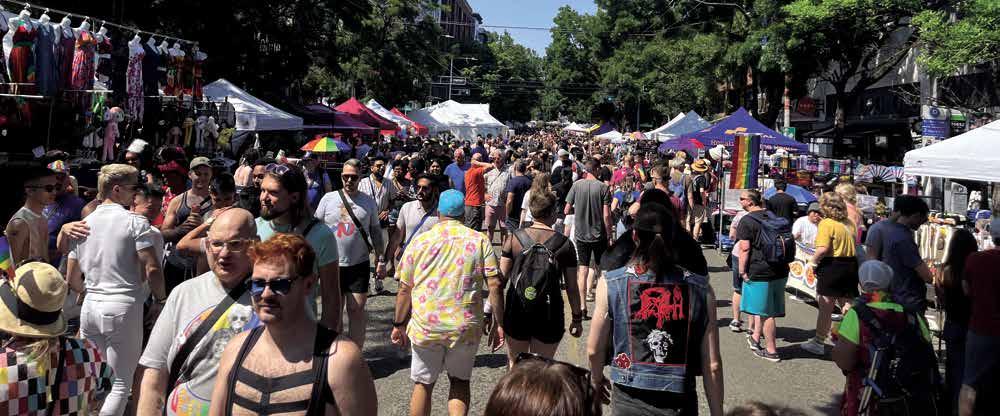
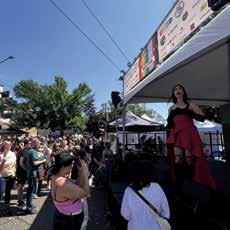
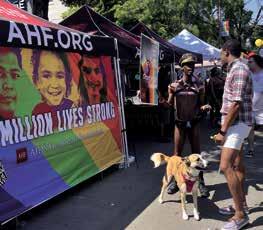
Broadway was packed on Saturday last weekend for Capitol Hill PrideFest. Despite that, it was an intimate experience, in which both young and old came together in a place rich with Queer history.
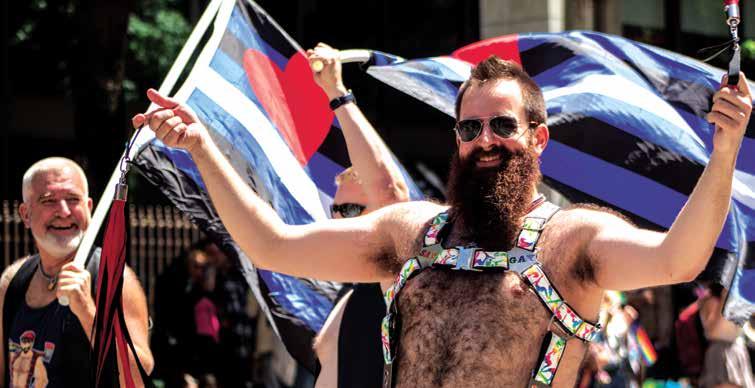
As always, the outfits were colorful and diverse. Leather straps and steel rings were only slightly more popular than fursuits this year, though many more pedestrians dusted off their shorts and T-shirts for a sunny day that lasted well into the evening hours, as summer days do at this latitude.
Local performers, such as drag queen
Kylie Mooncakes, the dance group BlackHotSunday, and DJ Solanna Solstice, kept the party moving, along with hosts Aleksa Manila and Donatella Howe.
Queer and allied vendors and organizations lined the street wherever there was room. Many of the bars and restaurants had gated-off zones where alcohol was allowed, and though business was booming, most patrons seemed well capable of holding their liquor.
Among the vendors was the SGN, of course. Many more of our readers got to meet the team this year as we handed out our stickers and our special Pride issue, and sold our booth-exclusive SGN T-shirts.
by Mike Andrew SGN Staff Writer
Hundreds of Starbucks workers and supporters from many other unions marched at Seattle’s Pride Parade on June 25.
In a labor contingent organized by Pride At Work, Starbucks Workers United (SBWU) took the lead with a banner reading “Workers Rights Are Trans and Queer Rights.” They were followed by a flatbed truck filled with dancing, chanting workers, with contingents from other unions following behind.
Many in the labor contingent wore shirts with the SBWU logo and the tagline “Be Gay and Organize.” Others carried signs supporting SBWU.
The crowd along the way responded with cheers and applause as Starbucks workers passed. SBWU members passed out union stickers, signs, and shirts along the parade route.
Workers at unionized Starbucks stores — including the signature Starbucks Roastery on Capitol Hill and the first-ever Starbucks in Pike Market — declared a three-day strike for Pride weekend. Because the strike was sanctioned by MLK Labor, King County’s central labor council, Teamsters who deliver to Starbucks stores honored the picket lines and cut off deliveries to the stores.
In contrast, the Starbucks corporate float was met with dead silence by the crowd along the parade route. According to SBWU members on the scene, most of the people in the corporate contingent abandoned their float after passing the first reviewing stand at Westlake Plaza.
“I was right by Olive Way and had no idea there were people on it,” one paradegoer tweeted about the corporate float.
“We have a theory,” SBWU tweeted after

the parade. “Starbucks is wildly performative and pretends to stick up for Queer partners while the public watches. It would be on brand for the partners to bounce the second they’ve had some limelight on the stage at 4th and Westlake…” (Starbucks calls its employees “partners.”)
SBWU members reported that people in the crowd took up the chant “Workers united will never be defeated” as the lonely corporate float rolled by.
“We understand it may have been hard to learn the Queer community doesn’t like people who don’t respect workers’ rights,” the union added.
Pride At Work, which organized the labor contingent in Sunday’s parade, along with SBWU and MLK Labor, is an LGBTQ+ organization affiliated with the AFL-CIO. The Seattle chapter has been working since 1997 to promote LGBTQ+ rights and representation in organized labor.
SBWU has had remarkable success since beginning its organizing drive in 2021. To date, some 330 stores have unionized, with more awaiting NLRB-supervised union elections. The company has responded, the union says, with a campaign of firings and intimidation against union activists. In addition, SBWU charges the management side with stalling contract negotiations.




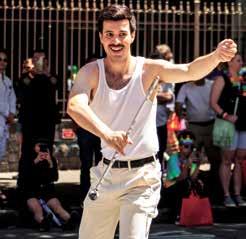
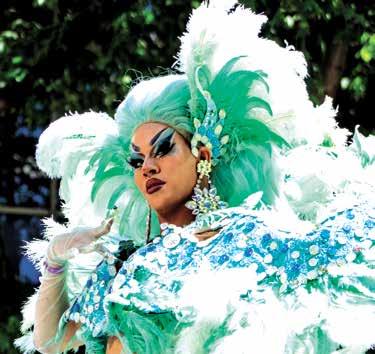


with those in their fields fighting book bans and academic restrictions across the nation.
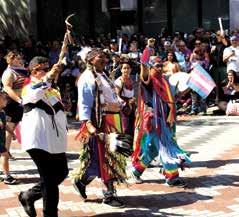
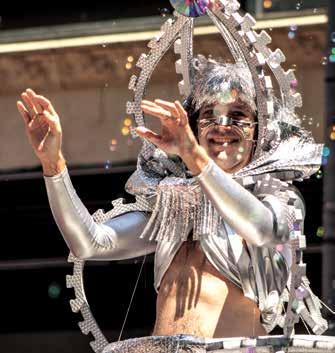
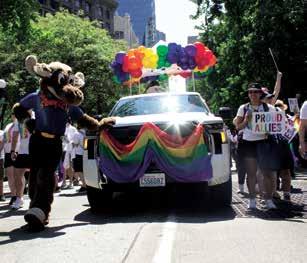
Burlesque performer Mx. Pucks A’Plenty led the procession as one of the 2023 Grand Marshals, gliding past Fourth and Pike atop a luxury vehicle. (The others were author Ijeoma Oluo and the Lavender Rights Project, a Black LGBTQ+ advocacy group.)
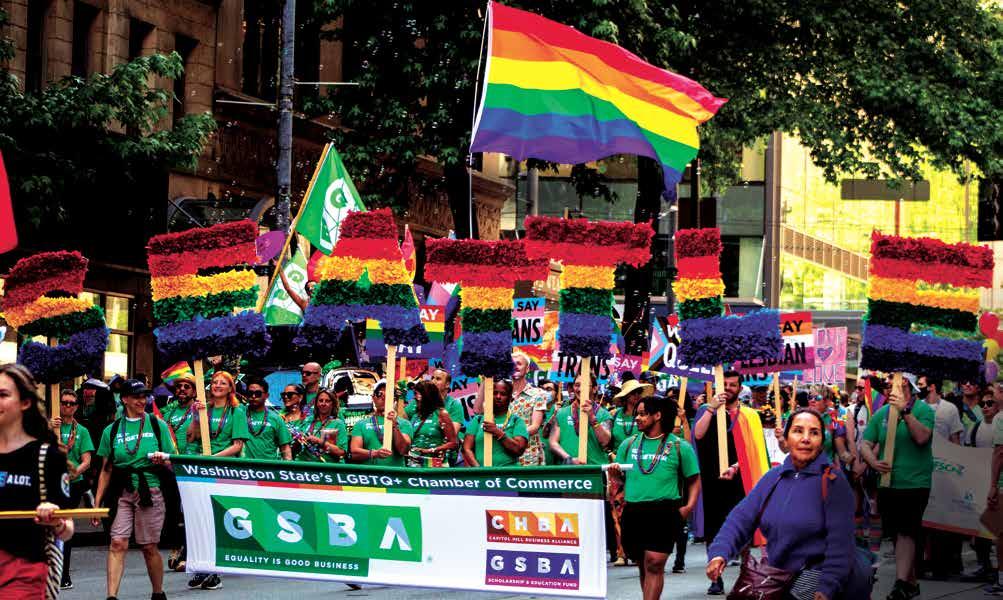
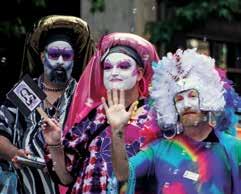
The parade lasted several hours and featured over 250 groups, companies, and organizations, including Fred Hutchinson Cancer Center, Starbucks, and Boeing, the last providing a very sassy flight attendant dance. Dozens of LGBTQ+ community activist groups and organizations also marched.
Just after Mx. Pucks ‘A Plenty came the Starbucks Workers Union, showing off signs that read “Be Gay and Organize” and “Trans Rights Are Workers Rights.” PFLAG Seattle, the largest family and ally organization in the country, showed up in force as always, along with ACLU Washington and Seattle’s LGBTQ+ Center.
Standing up for a cause
Many noted that Pride felt more political this year. Librarians and teachers were among those who marched, not only to show love and support for the Queer and Trans community but to stand in solidarity
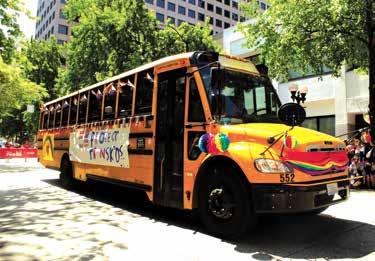
“Every child deserves love,” Seattle Pride Parade announcer Caesar Hart said as the city’s public teachers union passed by, followed by a big yellow bus bouncing with energy (and plenty of candy) for the younger attendees. “Protect Trans Kids” was written across the side of the bus in purple, white, and yellow to represent the Nonbinary flag.
Entertaining contingents
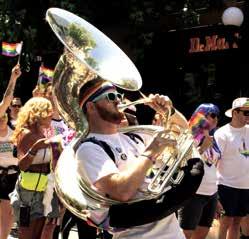
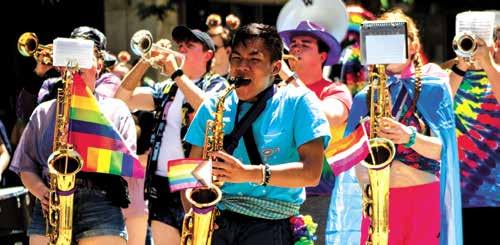
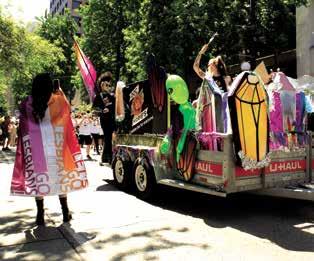
Performers brought added energy to the day’s main event. Flag twirlers, baton throwers, and skilled step-dancers thrilled crowd as they stopped to show off their moves. Brass bands representing local schools and professional sports teams played euphoric pop songs turned Pride anthems. Despite glitter on their faces and streamers hanging off their instruments, the musicians played on with perfect pitch. The most clever float at the parade may have been the homage to “the U-Haul Lesbian” by Portland’s Doc Marie’s, one of only 23 remaining Lesbian bars in the United States. Complete with “Let’s Go Lesbians” flags, mohawks, and Doc Martens, the float was the physical embodiment of the average PNW Lesbian.


continued from page 9
Many of Seattle’s professional sports teams also made appearances, along with their mascots. Buoy, the Seattle Kraken Sea-Troll, rode atop a pickup truck behind a rainbow Zamboni, much to the delight of fans on either side of the street.
Mariner Moose followed Buoy up with a little jig and a rainbow lei to represent the best baseball team in the Pacific Northwest. An entourage of musicians, volunteers, and sports fanatics followed suit, throwing merch into the crowd.
The Seattle Storm mascot Doppler rode in on top of a green and yellow Storm-themed Subaru. A group of pintsized hip-hop dancers followed him with incredible finesse.
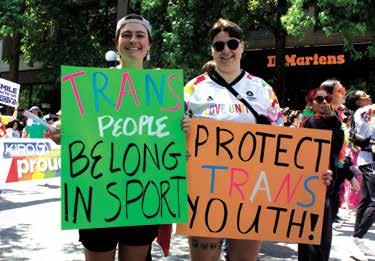
The Sea-Gals also showed up to represent the Seattle Seahawks. A joint float for the Seattle Sounders and O.L. Reign brought up the rear of the contingent. “Trans people belong in sports,” read hand-painted signs carried by soccer fans as they kicked around a giant ball.

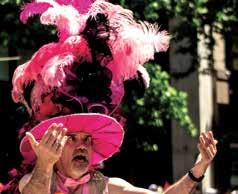
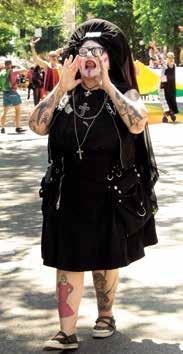
Over 300,000 people attended the Seattle Pride Parade, according to an estimate by organizers. Aside from the beautiful floats, dancers, and marchers flowing down the street, the event offered plenty of food options from food and beverage trucks and carts in Westlake Center.
One attendee, Briana, described the march as awesome. “It’s really fun to be here. I have been enjoying the parade,” she said. “It’s so cool to see everyone dressed up.”
Riley, another attendee, also noted the importance of celebrating Pride this year, especially amid so much anti-LGBTQ+ turmoil. “I’m proud to support the community,” they said. “I’m glad everyone can come out, and I’m really glad we foster a community to support this.”
The day’s festivities were a joy for all who attended, with the energy increasing throughout the day. Whether eventgoers were there to celebrate their first Pride or their 49th, it was a fun and meaningful time for all.















continued from cover
Elliott Bay, and just a few yards from a couple of pop-up canopies. The folding tables in the shade underneath were loaded with food and drink brought by neighbors and their friends, and the warm air was alive with music and conversation.
Evidently, there was little to worry about after all. He had searched out similar events in the area, and he counted over 30 others in “Shoreline, Kirkland, [and] Bellevue that are doing this exact same thing with the exact same sentiment.”
After he had finally sent that email, Mattinger’s inbox was flooded with messages of enthusiastic support. Neighbors pooled money and consolidated their mailing lists. Some even volunteered to walk door to door and hand out flyers.
“It got so overwhelming that we actually created a little planning committee,” Mattinger said. And we had a little pizza party at my house, and from there people started raising their hands, like, ‘We should have a drag performer. What about a bounce house for the kids? We gotta make it super kid friendly.’”
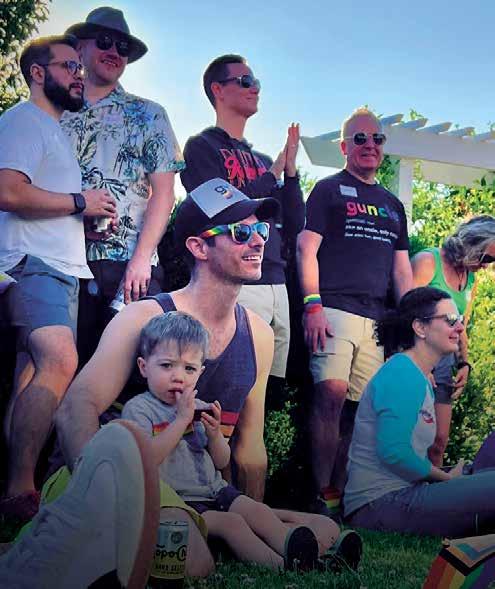
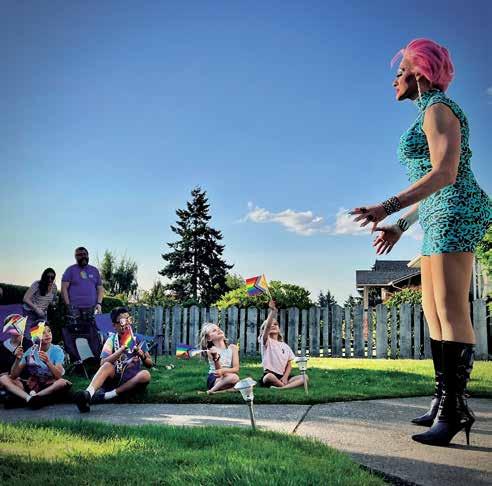
Sure enough, children with rainbow face paint and Pride flags had the whole block mostly to themselves. There was a bounce house in a front yard a few houses down, and towering on the opposite sidewalk was drag queen Dolly Madison, who spoke casually with the guests and answered questions from parents.
“One of the things that she …[talks] about [is] drag culture,” Mattinger said. Madison “kind of [demystifies] the aspect of, like, this is an illusion, this is an art form.”
Mattinger maintained that none of his straight neighbors had a problem with drag. One white-haired guest, who went by Barb and had lived in West Seattle for “way too long,” said, “I’m old enough that I saw the first disco, so anything’s good with me.”
Support from neighbors and parents
“Night Out” block parties are a regular occurrence on this particular intersection, Mattinger said. But none so far, to his knowledge, had been held to celebrate Pride.
“My husband and I, we just had kids about two years ago,” Mattinger said. “And being from a small town, I think it was super important for my husband and me to show
our kids — and kind of show ourselves — that we live in a community that is really supportive of our life, and supports Pride and what it means.”
Mattinger and his husband weren’t aware of the area’s reputation as a destination for Gay dads. Back in the day, when Capitol Hill was the gayborhood for dating, West Seattle was for settling down. By most accounts, Seattle’s gayborhood has spread out across the city now, to places like White Center, where the Lumber Yard Bar hosts “Dolly and the DJ” each Saturday.
Dolly Madison’s performance at Pride Night Out was glamorous and fun, but it was also educational for many of the straight couples attending. After a lip-synching number on a front porch, Madison’s story about acceptance and coming out was clearly meant to make an impact.
She said, “I was very, very fortunate in that when I was very young, I wanted to play the flute and my parents encouraged it. I wanted to draw and my parents
“I think it was super important for my husband and me to show our kids — and kind of show ourselves — that we live in a community that is really supportive of our life.”
encouraged it. I wanted to be in the school play. My parents showed up at every performance.
“These were things that, although they did eventually shape me, had nothing to do with how I identified, had nothing to do with who I loved, had nothing to do with any of that, other than just doing the things that I wanted to do, things that I was inspired by.
“And my parents supported me with that without question, because they knew it didn’t have to do with any of those other things. They knew they just wanted to support their kids.”
She paused to take a deep breath and compose herself before continuing.
“I remember getting choked up talking to my mom, and she said, ‘You can tell me.’ Well, I wasn’t expecting that. And I was like, ‘I have something important to tell you. I’m just really nervous.’ She said, ‘You can tell me anything, because I would die for you.’
And that made a big difference to me.”
“So, parents,” Madison said, “what you do, how you support your children — regardless of how they grow to love, who they grow up to love, who they grow up to be, or how they identify — what we do now is so important to them... They know who they are, and you don’t have to understand that, but you can still support them in whatever way you can.”
Earlier, Mattinger had reflected on how the LGBTQ community, and drag especially, is being maligned socially and legally in other states. He joined Madison on the pathway up to the steps, and with his kids at his side and teary-eyed families all around, he thanked everyone for making Pride Night Out happen.
“When Bradley and I first moved here, we saw you and DJ performing,” he said to Madison. “And to have you in our home and in our community and saying such rich words about Pride — it’s such a beautiful moment. So thank you so much.
“Our two little ones are going to grow up with two loving parents who just so happen to be Gay. And I just want them to know that at least their neighborhood supports them and supports their family.”
As for the possibility of another Pride Night Out next year, “I think we have to do it!” Mattinger said.
by Alice Bloch SGN Contributing Writer
Oregon Shakespeare Festival
Ashland, Oregon
Through October 15
Last night I dreamed about my dear friend and writing buddy Marian Michener, who died of Huntington’s disease in 2019. A lifelong fan of the Oregon Shakespeare Festival, Marian introduced me to it in 1998. (A few years and many plays later, she said, “I knew that if I could get you to Ashland once, you’d be a lifer.”) Until the disease incapacitated her, Marian reviewed OSF for the SGN, as well as writing the popular “Dyke About Town” column under the pseudonym Mercy Moosemuzzle.
Marian didn’t live to see the combination of COVID-19 and summer wildfires that has brought OSF to the brink of financial ruin. She didn’t live to see racist death threats and lack of support from longtime donors and subscribers cause Nataki Garrett, the first Black artistic director of OSF, to resign a month ago. I wish Marian were still alive, but these developments would have broken her heart.
Crisis upon crisis
“I have spent four years in crisis,” Garrett told American Theatre in an interview about her resignation. “You kind of have to get out before you burn out.”
Who can blame her? After she received death threats last year, Garrett couldn’t leave her home without a security detail. She couldn’t accompany her young daughter to school, because she didn’t want to endanger other children and their parents and teachers.
Less extreme than the death threats but also destructive were letters she received from a group of people who called themselves “the old white guard.” “They were upset because in 2021 I didn’t program Shakespeare,” Garrett said. It should be noted that in 2021, the festival was under severe public health restrictions, and a one-woman play about civil rights activist Fannie Lou Hamer was the only show that could be presented.
It should also be noted that in 2022 and 2023, Garrett programmed the same ratio of Shakespeare plays to new work as her predecessor, Bill Rauch. (Rauch is a Gay white man who mounted forward-thinking productions, hired directors and actors of color, introduced gender-bending casting,
and directed a Gay version of Oklahoma, apparently without repercussions.)
These facts lead me to infer that racism and misogyny, rather than programming choices, led to most of the criticism Garrett received during her four-year tenure.
Perhaps separate from pushback by the “old white guard,” OSF has experienced unprecedented budgetary shortfalls.
Shortly before the opening of this year’s summer season, the festival launched an emergency fund drive called “The Show Must Go On.” Actors who had been rehearsing for months were told that the whole season might be canceled. Fortunately, enough supporters stepped up to make it possible to offer four plays, plus a fifth one to open in August. (Pre-COVID, OSF ran nine plays at a time during the summer.) The season was shortened by a month, and a holiday show planned for November and December was canceled.
Like many arts organizations, OSF has had to lay off most staff members since
2020. In addition, the festival has gone through three executive directors and replaced the development director and the chief operating officer. After the opening performance of The Three Musketeers in the Allen Elizabethan Theatre, the new interim executive director, Tyler Hokama, briefly took the stage and opened his remarks by joking, “Fourteen days, and I’m still here.” Then Associate Artistic Director Evren Odcikin spoke at some length about the daunting challenges facing OSF, gave full credit to Garrett for this season, and expressed his gratitude that the festival has survived to continue to deliver great theater. His devotion to the company was particularly impressive, given that a play he was to have directed, Federico García Lorca’s Yerma, had been canceled.
In spite of all these setbacks, OSF is offering an enjoyable, varied season. In my opinion, it is still very much worth the trip from Seattle.
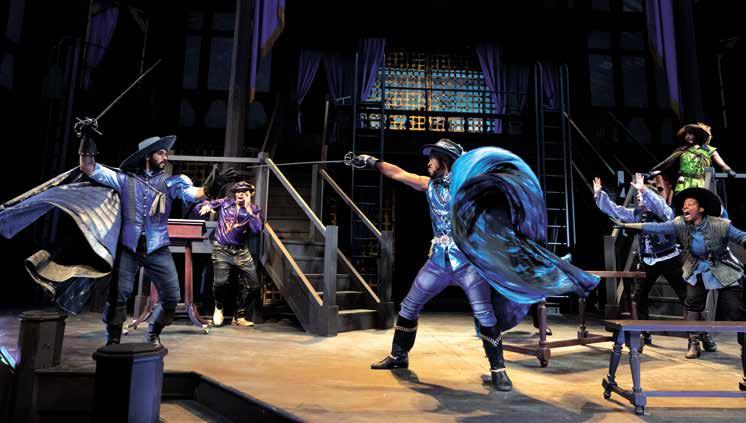
The Three Musketeers Allen Elizabethan Theatre
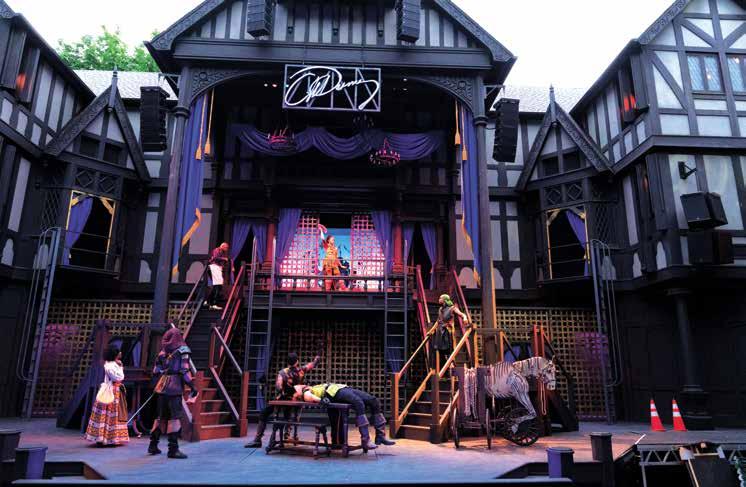
I’m not usually a fan of swashbuckling, but this delightful new play was my favorite of the four I attended. Hip-hop and rap, dancing and singing, well-choreographed swordfights, a focus on the relationship between author and characters, broad physical comedy, gorgeous costumes, and clever sets — what’s not to like?
Director Kent Gash commissioned playwright, composer, and lyricist Kirsten Childs to create this adaption of the Alexandre Dumas novel. Gash had learned that Dumas’ father, the son of a French marquis and an enslaved Haitian woman, was the first mixed-race general in the French army. Childs’ play follows the story of the Dumas novel but inserts moving scenes between Dumas and his father, and fascinating dialogue between Dumas and his characters (who want to change the plot).
The play begins with a rap by Jamyl Dobson as a self-satisfied Dumas (“Bow down! Bow down!”) and moves into some fancy hip-hop dancing choreographed by Byron Easley. Dobson also plays an imposing Cardinal Richelieu in later scenes; he is excellent in both roles.
In the opening performance, the standout actor was a novice: Malik Bilbrew, who just graduated from college and is playing his first professional role as D’Artagnan. His singing voice and acrobatic skill are both exceptional, and he seemed to be loving every minute onstage.
Omolade Wey and Eunice Woods were marvelous as the heroic Constance and the villainous Milady, respectively. Anthony Michael Martinez as the Duke of Buckingham and Andrew Montgomery Coleman as King Louis couldn’t have been more amusing. I credit costume designer Kara Harmon with much of the comedic success of the production: her costumes are not only beautiful but laughout-loud funny. Buckingham’s tight pink suit and the king’s bedroom slippers — you just have to see them.
U. Jonathan Toppo has been the OSF fight director for as many years as I’ve been going to Ashland, and he knows his stuff. The swordfights are fabulous.
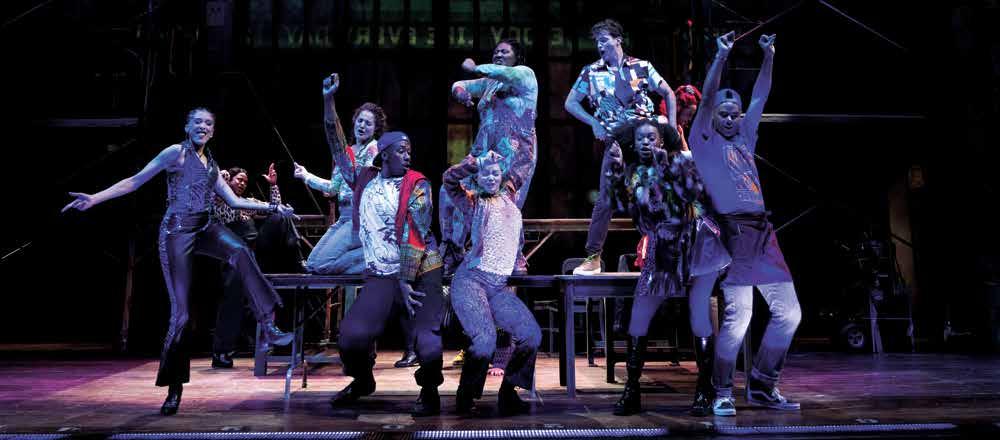
Rauch introduced musical theater into the OSF repertoire in 2009, and there’s been a musical on the schedule nearly every year since then. Jonathan Larson’s Rent was a
good choice for an audience emerging from a pandemic, because his musical (loosely based on the opera La Bohème, which was set during the 19th-century tuberculosis epidemic) takes place in the 1980s, the early days of the AIDS epidemic.

Rent is an ensemble play about a group of friends and lovers dealing with desire, illness, poverty, and heartbreak. In the words of director Tiffany Nichole Greene, “They run on stolen joy and borrowed time.” Greene has assembled a first-rate ensemble; if there’s a standout performance, it’s that of Z Infante as the generous, completely lovable drag queen Angel.
The OSF production features the lively choreography of Jon Rua, a skilled group of musicians led by Dolores Duran-Cefalu, and a versatile, effective set designed by Arnel Sancianco. Even if you know this show by heart, I think you’ll enjoy it again in this wonderful production.
Twelfth Night
Allen Elizabethan Theatre
Twelfth Night was Marian’s favorite Shakespeare play, and it’s easy to see why. Its heroine, Viola, is a feisty young woman who disguises herself as a man, attracting the amorous attention of both Duke Orsino (who is confused because he’d always thought he was heterosexual) and Orsino’s lady-love Olivia (who doesn’t realize she’s falling in love with a woman). The whole comedy is an entertaining yet profound riff on gender and identity.
Director Dawn Monique Williams has set the OSF production in the Jazz Age of the 1920s and ’30s, and the concept works beautifully. Period costumes designed by Melissa Torchia are splendid, and composer and sound designer Everett Elton Bradman provides the perfect blues and jazz melodies for Shakespeare’s lyrics. Before Armando McClain as Orsino even pronounces the first line of the play — ”If music be the food of love, play on” — Arielle Crosby as Feste the Fool (a role almost always played by a man) brings down the house with her glorious singing and stage presence.
In another inspired bit of cross-gender casting, Catherine Castellanos plays Sir Toby Belch with gusto reminiscent of Bobby Moynihan’s “Drunk Uncle” character on Saturday Night Live
Al Espinosa, whom I’ve never seen before in a comic role, is superb as the puritanical Malvolio, who gets his hilarious comeuppance from the other characters.
The only weak link is Sam Jackson in a low-energy performance as Viola. This role is the most important one in the play, so it’s a testament to the strength of the rest of the production that even a lackluster Viola doesn’t ruin the show.
Romeo and Juliet
Angus Bowmer Theatre
There is much to like about this production of one of Shakespeare’s most beloved and familiar tragedies. Director Nataki Garrett has set the play in a homeless encampment beneath the Bay Bridge in Oakland. The set designed by Nina Ball, lighting by Xavier Pierce, and projections by Rasean Davonté Johnson are spectacular, with video projections creating the realistic illusion of
headlights crossing the bridge, the moon rising, then daylight returning.
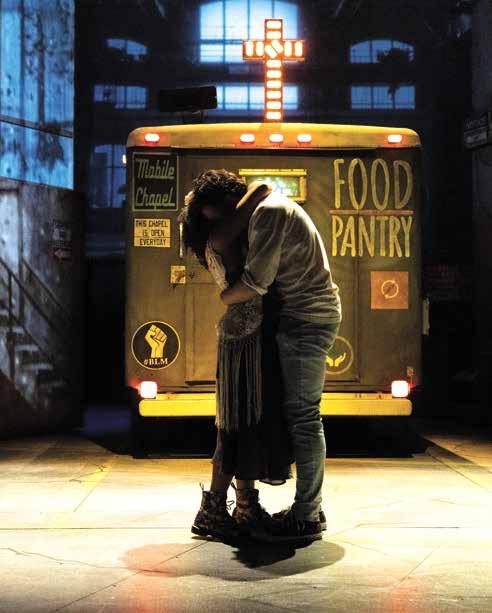
The Capulets live in a dilapidated trailer. A van backed onto the stage serves as a food pantry; when a chapel is needed, a cross rises from the roof of the van and a drape with a stained-glass pattern is drawn across the window.
Because of the current-day setting, fight director Toppo has substituted fistfights, food-throwing, and gunfire for the traditional sword fights, which works well.
In the performance I attended, three actors were magnificent: Caroline Shaffer as Nurse, Donna Simone Johnson as Mercutio, and Tyrone Wilson as Friar Lawrence. Unfortunately, some of the other actors seemed miscast or uncomfortable in their roles. Castellanos, who was so good in Twelfth Night, here muttered incoherently as Capulet. Shauna Miles stumbled around as a drug-addicted Lady Capulet.
Romeo and Juliet are teenagers, but the actors playing them must make us believe that they have enough maturity for true love and marriage. Jeremy Gallardo as Romeo did a better job of this than did Jada Alston Owens, who giggled her way through the play.
OSF costumes are nearly always a highlight of its productions. The most memorable costume in Romeo and Juliet is that of Nurse, here presented as an addled (but sometimes astute) bag lady wearing a plastic grocery bag for a hat and carrying a ragged doll, which wears a matching hat.
Even with such brilliant touches, the basic concept of the production doesn’t quite work. The Capulets and the Montagues are described in the text as wealthy power brokers, but in this production, both families are impoverished, and Capulet is trying to marry off Juliet to the wealthy Paris, who is involved in a property development scheme to evict both the Capulets and the Montagues. Audience confusion ensues.
Coming up next: Where We Belong, To Feel a Thing, and virtual offerings Madeline Sayet’s one-woman play Where We Belong, recently offered by Seattle Rep, will open on August 26 in the Thomas Theatre. Sayet, a member of the Mohegan Tribe, is a well-known Shakespeare scholar and director, and her play concerns Shakespeare’s impact on Indigenous communities.
The world premiere of To Feel a Thing: A Ritual for Emergence will play in the Allen Elizabethan Theatre September 23-24. Written by poet adrienne maree brown and composer Troy Anthony, this work features a large choir and “invites listeners to find their own liberation.”
The Quills Fest, which combines virtual reality with live performance art, will return for a third year on November 17-18. Finally, some performances of plays from this season will be available online.
For more information and to purchase tickets, visit osfashland.org.
by Lindsey Anderson
SGN Staff Writer
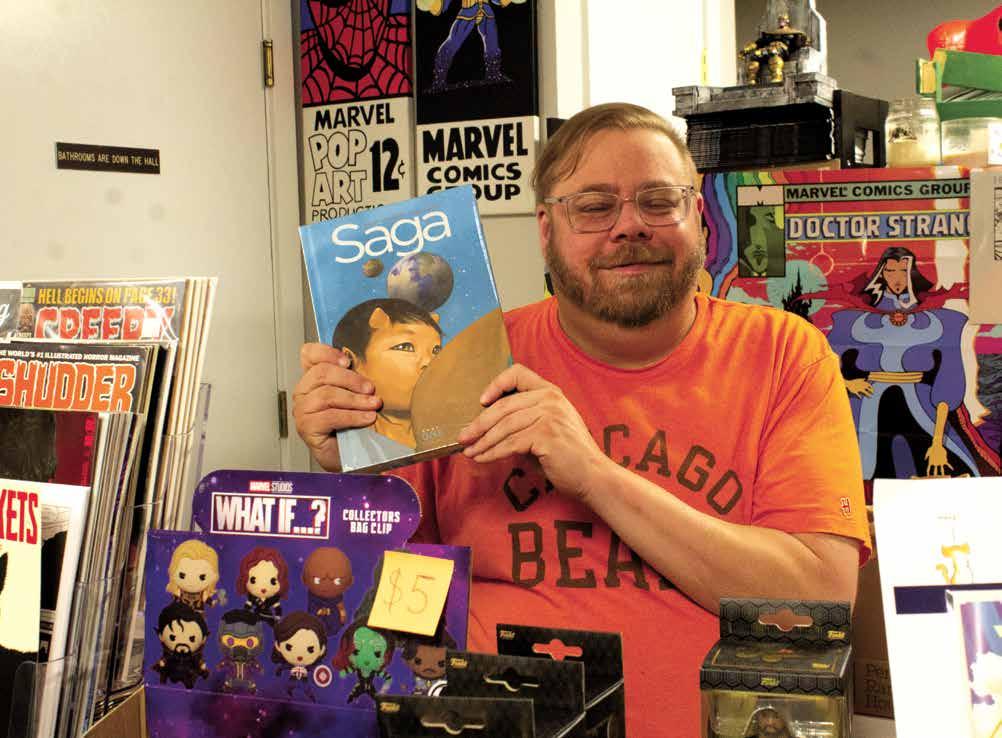
Tucked below a staircase, sheltered by greenery, sits West Seattle’s premier comic book store: Tails to Astonish. Founded in 2021 by Shaun Duff, it takes a new approach to comic book collecting. It has a little of everything, from brand-new comics to worn classics.
Duff decided to open the business following the COVID-19 pandemic. “I was, like, ‘It’s now or never,’” he recalled. “I needed to do something I love doing. I decided to go for it. I did everything I needed to do, got a business license, and we started in July 2021.”
Although he’s only been in business for about two years, Duff has been a lifelong comic connoisseur. “I’ve been collecting various things, including comic books, for most of my life,” he said. Before opening Tails to Astonish, Duff and his wife regularly visited comic book conventions, where they would take their small collection to sell. It was there he was inspired to open his store.
“I came up with the name because we have a couple of kitties at home,” Duff said. “Tales to Astonish is a common comic book name, but I thought it would be cute to do ‘tails’ to astonish and make our cats the mascots. My wife made us a sign to take to conventions.”
While patrons may not see the cats who inspired the name, Duff is always happy to return home to his two feline friends, who work remotely. He currently has two cats, 15-year-old Kitty (“She’s the older statesman,” Duff said) and the newest addition to the family, Cosmo. “We just got [him] six weeks ago,” Duff said. “He’s a tiny ball of energy.”
Hot reads of the summer
Tails to Astonish is off to a busy summer already. Not only is little Cosmo learning to be a mascot, but Duff has also been sell-

ing issues like hotcakes. “This summer, I’ve sold more Saga books than anything,” he said. “I’ve got about ten people that have it on their list.”
Saga is also one of Duff’s favorite reads.
The story follows intergalactic star-crossed lovers Alana and Marko as they flee their warring extraterrestrial races and raise
their newborn baby. “I think it’s a fantastic series,” Duff said.
While some collectors have artists or genres they feel loyal to, Duff loves to read it all. “I like everything from The Walking Dead to Saga to Spiderman to Batman
Most fans like a specific thing and come looking for that specific thing, but I dabble in everything,” he said.
Tails to Astonish reflects his interests. Though Saga is one of the best-selling books there at the moment, a new Marvel crossover event has also led to a spike in sales. “It’s called Ultimate Invasion. The first issue just came out, but it’s selling well,” Duff said.

Something for everyone
Tails to Astonish has something for everyone — including the LGBTQ+ community. “[The store is] friendly and inviting,” Duff said. “Everyone is welcome here. It doesn’t matter what creed or sexuality. I don’t give a crap what you are — as long as you love comic books and cartoons, you’re welcome here.”
Tails to Astonish is still growing, so it doesn’t have a set LGBTQ+ section, but there are Queer- and Trans-centered stories in nearly every corner. “We have LGBTQ stuff throughout the store,” Duff said. “There are tons of Gay characters in comic books. Most of them are new characters, so that’s why [people don’t always know about them],” he explained.
“Superman’s son is Bisexual, and he’s with a Gay man in the comic books. The young Flash is a Gay character. DC is really at the forefront of that,” he continued. “Marvel is a little farther behind. Most of their main characters aren’t Gay. America Chavez was in the new Dr. Strange last year, and she’s a Gay character.”
While many comics still have a long way to go, Duff says modern books are lightyears ahead of where the comic industry used to be.
“It’s been incredible. I mean, when I was growing up in the ’90s, there weren’t any [Queer comic book characters],” he said. “It was kind of a ‘don’t ask, don’t tell’ kind of thing. The first comic I can remember
including an openly Gay character was in the mid-’90s in a book called Alpha Flight. One of [its] characters, Northstar, came out as Gay. It was a big deal in the comic world, because nobody had come out as Gay. It’s night and day from then to today.”
Variety
Tails to Astonish has a variety of titles and styles. “We have an entire bookshelf back here that’s all graphic novels, hardcovers, and trade paperbacks,” Duff said.
The store even carries prose novels on occasion. “I had a Minecraft one that sold out. I had a Superman one from the ’70s that sold. I don’t typically buy newly published books that often, but I can order them,” he said.
What makes Tails to Astonish unique is it is the only place to buy comics in West Seattle. “The closest store to us is in Burien, a place called Ancient Comics, but you can’t find anything new there,” Duff said. “The closest place you can find a new comic book is at Pike Place Market, and I know how difficult it can be to drive down there each week,” he added with a laugh. “We have a pretty good collection of new books here.”
Duff selects each title the bookstore carries, but if readers can’t find what they’re looking for on the shelves, he’s more than happy to order something for them. With so many comics to choose from, he says he makes most of his buying decisions based on a “gut feeling.”

“If it’s a new property, a new book, I just have to go with my gut if it sounds interesting,” he admitted. “If I know the artist or the writer, I’ll try it out, but there’s tons I don’t order.”
Tails to Astonish also sells fun gifts and toys for anyone interested in more than just literature. “Honestly, the stickers and cards sell regularly. Toys are a little more expensive, but I do sell quite a few Star Wars
toys,” he said. Though the books are what keep people coming back in.
Saga, the top-selling series, also has LGBTQ+ characters and themes. Duff loves the series so much, he has selected it as his official pick for the SGN ’s summer book club reading list. Grab a copy from Tails to Astonish and read along with us!
by Terri Schlichenmeyer Special to the SGN
WHAT THE DEAD KNOW: LEARNING ABOUT LIFE AS A NEW YORK CITY
DEATH INVESTIGATOR
BARBARA BUTCHER
© 2023 Simon & Schuster
$28.99
288 pages
Throughout most of her teen years, Barbara Butcher says she was miserable. She suffered from depression and anxiety, the fact that she was a Lesbian was dawning, and she felt awkward. When a high school friend introduced her to the “fun” of drugs, sex, and alcohol, though, everything changed. Butcher’s life was suddenly all about getting high.
After a work supervisor saw some potential in her and urged her to attend college, Butcher landed a great job as a hospital administrator. Still, love eluded her, addictions nagged at her, depression hit, she thought about suicide, and everything fell apart. Once she hit bottom, she started attending AA, which led to a vocational and rehab course and an aptitude test that gave her two options: veterinarian or coroner. She chose the latter.
Working as an MLI (medicolegal investigator) at New York City’s Office of the Chief Medical Examiner was an exciting and interesting job. Butcher was, at first, the OCME’s only female MLI in a pool of several male ones who immediately tried to test her by showing her detailed, gruesome photographs of real accidents and murders. That didn’t scare her off, and soon she was working with people she admired, running

her own shifts, going out to investigate the worst that New Yorkers did to one another.
There were bodies in picnic coolers. There was a suicide that wanted to take someone with him in death. There were car accidents, shootings, people dead on sidewalks and abandoned hovels, and jumpers. Every one of them taught Butcher one thing.
“Dead men do tell tales. You just have to listen.”
Weak-stomached readers, you can stop right here. You’re going to want to steer clear of this book, because it’s not for you. True crime fans, though — why are you waiting?

What the Dead Know starts out with an edge-of-your-seat investigation that ends in up-the-spine chills. Even the setting is uber-creepy, described in minute, waterdripping, rats-on-the-floor detail. The opening pages give you a glimpse of what you’re in for.
And yet, author Barbara Butcher knows when to let her readers take a gasping breath, and her story quickly flips after the opening to become a biography with its
own dark feel. Don’t get too comfortable, though: you’ll have a chance to relax your shoulders, but the elevator with your adrenaline inside will continue to glide to the top floor before dropping back down again and again.
This book can be somewhat grisly in places, but certainly nothing worse than any other true-crime story or Hollywood movie. If you love that genre, then you’ll want to learn What the Dead Know.

by Sara Michelle Fetters SGN Staff Writer
RUBY GILLMAN, TEENAGE KRAKEN
Theaters
Ruby Gillman (voiced by Lana Condor) is your typical 16-year-old attending Oceanside High. She’s got a gaggle of close friends: Margot (Liza Koshy), Bliss (Ramona Young), and Trevin (Eduardo Franco). She’s an accomplished mathlete and is successfully tutoring her secret crush Connor (Jaboukie Young-White) to straight A’s. She acts like she’s above going to Junior Prom but actually longs to attend (hopefully with Connor as her date).
It’s normal, everyday stuff, but there’s one major problem: Ruby is a kraken. Her devoted mother Agatha (Toni Collette) and steadfast father Arthur (Colman Domingo) left their underwater home 15 years ago and decided to raise their family on dry land, ordering Ruby and her younger brother Sam (Blue Chapman) to never dip a single toe in the ocean if they know what’s good for them.
DreamWorks’ Ruby Gillman, Teenage Kraken plays like the first few episodes of a 1980s Saturday morning cartoon. I could almost see where each 20-minute “segment” would have ended and where the next one would have begun, the big narrative moments conveniently broken up in a neat, four-act structure complete with a beginning, middle, and an end. Characters are introduced quickly and cleanly, the obstacles are clearly outlined, and the delineation between hero and villain is plainly obvious (to the viewer, not so much to the protagonist, which is as it should be).
Needless to say, younger viewers are likely to love this film. It’s got a plucky heroine who’s easy to relate to, lots of crisp action and an overabundance of phantasmagoric colors, comedy that rarely — if ever — attempts to sail over a kid’s head and toward the adults and a tidy ending that sets up ongoing stories involving every member of the Gillman family, as well as all of Ruby’s besties (and Connor, too, of course). These are all good things.
Director Kirk DeMicco is best known
for

The Croods and Vivo, and this film fits comfortably alongside both animated features in regard to their tone, cohesion, and general comedic sensibilities. Co-director Faryn Pearl was a storyboard artist for Netflix’s She-Ra and the Princesses of Power series and worked on Trolls World Tour and The Croods: A New Age, so she also fits right in.
I’m going to go out on a limb and assume that Pam Brady’s original story had some rougher, more Shrek-like edges in its original form. She’s best known for working with Trey Parker and Matt Stone on South Park: Bigger, Larger & Uncut and Team America; World Police, and there’s obviously nothing as uncouth or as politically incorrect happening here. DeMicco and the rest of the screenwriting team play things safe. Even the stuff that could be remotely construed as inappropriate is so watered down that I imagine that easily triggered adult nincompoops won’t even notice when something a bit vulgarly juvenile takes place.
The vocal cast is excellent, Condor and Collette in particular. They have a naturalistic give-and-take that’s lovely, and the mother-daughter dynamic between them is entirely genuine. Most of the best scenes revolve around their attempts to communicate and their mutual failure to find ways to put the right words together to form a coherent sentence. Kids will connect to all of this. Parents, too.
A well-cast Jane Fonda is a delight as Ruby’s Grandmamah, the gigantic kraken ruler of the seven seas, who’s been patiently waiting for her granddaughter to come calling and (hopefully) accept her royal duty. Will Forte sounds like he’s having an unhinged blast portraying the one-legged, kraken-obsessed sea captain Gordon Lighthouse, while Sam Richardson pops up as Agatha’s eccentrically goofy brother Brill and makes the most of every precious second. Annie Murphy also makes a lasting impression as Oceanside High’s egocentric,
red-headed “new girl,” Chelsea Van Der Zee, and I’m certain any comparisons to a 1989 animated under-the-sea Disney heroine who longed to be a part of the human world are entirely coincidental (not). Look: Ruby Gillman, Teenage Kraken was not made for me. At least, not the “me” of today. If I were seven or eight years old, I’m sure this colorfully obnoxious adventure would have thrilled me senseless. DeMicco’s slight but still fun film never talks down to its intended audience. Better, it doesn’t take them for granted. The director and his creative team have put together a coming-of-age spectacle kids will almost certainly love and one that won’t cause pain to adults taking it in alongside their pintsized charges.
I can think of worse ways to spend 90 minutes. And if that family outing happens to be during a Saturday morning matinee? That just makes it all the better.

by Sara Michelle Fetters SGN Staff Writer
There are moments where, if asked, I may tell you that I think 1963’s Jason and the Argonauts is the greatest motion picture ever made. At least, I’m positive that sixyear-old me felt that way. Star Wars may have blown my little mind as a child, but it was seeing this mythological adventure that truly shattered my skull and made my eyes shoot out of their sockets.
The first time I saw director Don Chaffey and visual effects maestro Ray Harryhausen’s masterpiece was at Spokane’s Magic Lantern Theatre during its annual children’s film festival. It was the early days of summer, weeks before I’d stand in line for hours on end waiting to watch The Empire Strikes Back. I remember this so clearly because it was the first time I was allowed to see a movie without family supervision. Sure, I was with a group of adult-supervised kids, but my parents stayed home, and that made this moment inherently memorable. Sitting smack-dab in the middle of the front row, I was shocked by how murderously
violent the opening was. A victorious king suddenly going berserk and murdering the children of the monarch he had just deposed, including a heroic sister protecting her infant brother? Nasty stuff. But then comes Hera (Honor Blackman), Queen of the Gods, coldly staring down this vile human monster, proclaiming that a “one-sandaled man” would be his undoing. I was instantly hooked. It only got better from there. Jason (Todd Armstrong), that one-sandaled man fabled to avenge his family’s murder and slay the evil King Pelias (Douglas Wilmer), assembles his Argonauts by holding the first Olympic Games. He travels to Mount Olympus and has a face-to-face meeting with Zeus (Niall MacGinnis) and Hera.
The Argonauts sail the seas of the known world, encountering carnivorous harpies, rocks that send sailors to an early grave, and the gigantic Talos, a warrior made entirely of bronze, who is awakened from his statuesque slumber by a selfishly bumbling Hercules (Nigel Green).
But Chaffey and Harryhausen happily save the best bits for the final act. Jason and his ragtag crew are in search of the mystical
Golden Fleece, and they journey to the far-off kingdom of Colchis to find it. While there, they encounter the tyrannical King Aeetes (Jack Gwillim) and are betrayed by the duplicitous Acastus (Gary Raymond). Jason also saves the life of Madea (Nancy Kovack), the kingdom’s high priestess, and the pair fall hopelessly in love almost immediately.
This leads to two of the greatest fantasy moments in all of cinema history. The first is Jason’s discovery of the location of the Golden Fleece, immediately followed by his spectacular battle with the sevenheaded hydra. It’s very thrilling, filled with eye-popping acrobatics that magnificently showcase Harryhausen’s stunning stopmotion creature effects nicely.
Yet that’s nothing compared to the climactic battle not too long after. Using the teeth of the hydra, Aeetes creates a small battalion of skeletal soldiers and unleashes them on Jason and two of his men. As dated as the effects may be, the resulting fight is as spectacular today as it was 60 years ago. It’s bone-chillingly effective, the shrieks of the undead soldiers echoing throughout the theater, and while this clash between human and skeleton

has stood the test of time brilliantly, back in 1980, I was certain this was the greatest thing my young eyes had ever seen.
Granted, all these decades later, my adult eyes frequently still feel the same. The genius of what Harryhausen accomplished — not just here but throughout his deservedly celebrated career, from The Beast from 20,000 Fathoms to Clash of the Titans — was that all of his incredible creations had personality. While they never looked entirely “real,” they still felt genuine. They were all characters in their own right. They had an internal fire that lit up the screen, giving each interaction or confrontation with their human counterparts a weight and a meaning that could not have existed otherwise.
Chaffey is likely best remembered for his television work, including directing episodes of The Prisoner, The Avengers, and The Protectors. But he also handled Pete’s Dragon, The Magic of Lassie, and One Million Years B.C., not to mention several smaller productions, ranging from film noir to swashbuckler to full-blown melodrama. Yet this remains his finest hour. Chaffey keeps the pace moving, knows when to augment the most important emotional beats, and allows Harryhausen to strut his creative stuff without any unnecessary visual nonsense.
Fantasy adventures have come a long way since Harryhausen’s heyday. But filmmakers as varied as Tim Burton, Peter Jackson, Nick Park, James Cameron, Steven Spielberg, and Guillermo del Toro have mentioned on multiple occasions how much the special-effects pioneer’s work influenced them, and they are far from the only ones. The magic this stop-motion maestro could conjure was second to none, and his influence is still being felt in this CG-animated age where anything can be conjured up, actors can be digitally de-aged, and the possibilities to create bigger, ghastlier, and more dynamic monsters appear to be endless.
Yet Harryhausen remains atop the visual effects mountain, and Jason and the Argonauts is his masterpiece. The man himself felt it was his best film, and I am not about to argue with him.
Celebrating its 60th anniversary, Jason and the Argonauts is available to purchase digitally on several platforms.

by Daniel Lindsley SGN Staff Writer
Michigan ban on conversion therapy poised for approval
Since taking control of Michigan’s government at all levels earlier this year, the state’s Democrats have continued to advance LGBTQ+ rights — this time with some help from one Republican lawmaker, as on Wednesday this week, the state’s Senate approved a ban on conversion therapy for minors.
Democratic Rep. Jason Hoskins, who sponsored the bills and is the first LGBTQ+ person of color elected to the state’s legis-
lature, told the Associated Press that “banning [conversion therapy] is just one less thing that LGBTQ children will have to worry about going forward in Michigan.
Jeremy Moss, Michigan’s first openly Gay state senator, addressed critics of the bills by saying this: “Hearing a bunch of straight people in the Senate lecture me about the journey of an LGBTQ person is the exact reason we should be banning conversion therapy.”
Under the bills passed, conversion therapy is defined as any practice or treatment by a mental health professional that seeks to change an individual’s sexual orientation or gender identity. Notably,
that doesn’t include counseling for people going through a gender transition.
Now the only thing standing in the bill’s way is the approval of Democratic Gov. Gretchen Whitmer, who has called conversion therapy a “dangerous practice” in the past.
Arizona governor makes state money more LGBTQ+ friendly
With two executive orders on Tuesday this week, Arizona Gov. Katie Hobbs banned state support of conversion therapy and allowed Trans employees of the state to receive gender-affirming care under their insurance plans. The second order
reverses a ban on such coverage that was enacted in 2017.
Now the ongoing lawsuit brought by University of Arizona professor Russell Toomey can be resolved. Toomey sought coverage for a “medically necessary” gender-affirming surgery in 2019. Lawyers from the ACLU representing Toomey said they would enter a settlement with the state soon.
Earlier this month, Hobbs vetoed a bill that would have restricted Trans students’ access to public school restrooms. In May, she vetoed a bill that would have forced schools not to refer to Trans students by their preferred names and pronouns.

by Daniel Lindsley SGN Staff Writer
East Africa shows signs of following Uganda with anti-LGBTQ bills
There are signs that Kenya and other countries in East Africa could follow Uganda in passing sweeping anti-LGBTQ laws, with some regional lawmakers speaking of the LGBTQ community as a nearly existential threat to African values and sovereignty. Reuters reviewed a draft of Kenya’s Fam-
ily Protection Bill and saw many parallels with a Ugandan law that was signed by President Yoweri Museveni at the end of May.
For example, Gay sex would be punishable by a minimum of 10 years in jail, while “aggravated homosexuality” — which includes sex with a minor or disabled person, or when a terminal disease is passed on — would be punishable by death.
“It is a hateful piece of legislation that will truly make the lives of Queer Kenyans unbearable if passed,” said Annette Atieno of the National Gay and Lesbian Human Rights Commission.
Mass celebrations in Mexico City Mexico City celebrated Pride weekend this year by bringing together hundreds of same-sex couples and Trans people to celebrate the legal recognition of their marriages and of their gender identity changes.
Their slogan was “Hand in hand, we march with pride,” the city government said.
Thirty-eight-year-old Keila Espinoza said that actually getting married to her partner, after living together, was very emotional.
“I didn’t think it would happen like this,” Espinoza said. “It’s very exciting.”
Edgar Mendoza said that he had been with his partner for 10 years before finally getting married. “This is a very important document, more than a piece of paper or a symbol of marriage. It is security that I can give to my family,” he said. Same-sex marriage was legalized in Mexico City back in 2009, but the rest of the country took until last year to catch up. Trans adults have been able to change the gender identity on their birth certificates and electoral cards since a legal reform in 2014.