Seattle Gay News Pride 2019
LAYING THE GROUDWORKCLAIMING SPACE
LAYING THE GROUDWORKCLAIMING SPACE
by Ruth Pettis
for the Northwest Lesbian and Gay History Museum Project Special to the SGN
By the end of 1965 there must have been at least 30-40 people in Seattle who subscribed to the homophile newsletter One, mailed out of Los Angeles by the Mattachine Society. Because that’s how many showed up to hear a talk by Mattachine activist Hal Call, as recalled later by Nicholas Heer, a UW professor who attended. Call was testing the waters to see if a similar effort could be organized here. Afterwards, Heer and several others clustered in an impromptu session that eventually led to forming the Dorian Society, with Heer as its first president.
By then, “homophile” organizations had taken root not only in LA, but also in San Francisco, Boston, Philadelphia and, of course, New York. If you have watched any of the documentaries about the pre-Stonewall movement, you have seen footage of early Mattachine and Daughters of Bilitis activists like Frank Kameny and Barbara Gittings, picketing the federal government over its practice of terminating gay civil service employees. Along with their impeccably dressed colleagues, they were out to make a point that gay people willing to take a public stance were not at risk for blackmail, which directly negated the gov-
ernment’s rationale for firing them. It was an audacious statement for the times, when same-sex lovemaking was criminalized and insinuations of it had lasting career consequences.
Also in attendance at the Seattle talk was one of our earliest straight allies. Rev. Mineo Katagiri conducted a street ministry for the United Church of Christ. His beat was the seedy 1st Avenue corridor that linked Pioneer Square, site of most of Seattle’s gay bars, with the notorious “Penney’s Corner” uptown, haunt of young gay male hustlers. [“Penney’s Corner” refers to the SW corner of 2nd Ave & Pike St where the downtown J.C. Penney’s department store was located back then.] Full gentrification of this area was still many years off and, after dark, tourists didn’t venture in unless they had personal reasons to do so.
Rev. Katagiri was witness to the effects of marginalization. He was on a first-name basis with the down-and-out, the flophouse residents as well as those sites’ owners, the pawn shop proprietors, and the small cadre of well-intentioned helpers who practiced an improvised style of social work, trying to link up the destitute with whatever resources were available. And he lent a sincere and caring ear to the young street hustlers, and was especially disturbed by the dead-end paths into which stigmatization had trapped them.
In 2003, Katagiri described his singular
view of theology. “An insight that I’ve lived with is that the powers that be always, in time, become oppressive because they want to increase their power, and broaden their power. So the question is: how do you keep that from occurring? … The principle with which I look at the world is that change cannot be expected to come from the centers of power. Change will always have to come from those who feel the oppression, and they must organize. They must strengthen themselves. … If you don’t have organized power, you’re not going to be heard. Therefore, whether it’s the Dorian Society … or anything else, you have to have group power. … That’s why I’m always for the oppressed organizing and making their hurts known as well as their hopes.”
Katagiri’s intuition linked the efforts of the academic and white collar gays with what he had seen on the streets, knowing that if those in position to influence did not assert a voice, more youths would end up on Penney’s Corner. When Hal Call’s audience gathered after the talk, Katagiri came forward. He offered encouragement, and a place to meet – his office on Capitol Hill.
Heer elaborated, “Katagiri saw a problem because there’s no way to get in touch with gay people as a group. He said gay people have to have some sort of organization so when the city wants to pass some law they can get input as to how it would affect gay people and lesbians.”
Author Rebecca Solnit wrote in Hope in the Dark (third edition, 2016), “Hope locates itself in the premises that we don’t know what will happen, and that in the spaciousness of uncertainty is room to act. When you recognize uncertainty, you recognize that you may be able to influence the outcomes – you alone or you in concert with a few dozen or several million others.”
“Uprisings and revolutions are often considered to be spontaneous,” Solnit continues, “but it is the less visible long-term organizing and groundwork – or underground work – that often laid the foundation…. Change is rarely straightforward. Sometimes it’s as complex as chaos theory and as slow as evolution. Even things that seem to happen suddenly arise from deep roots in the past or from long-dormant seeds.”
Nicholas Heer had recently relocated from the Northeast, and had a wider perspective because of his involvement in Mattachine Society New York. Dorian Society members, he said, “were having the same problems that all gay organizations seem to have. You start off with fairly conservative people, and then they’re radicalized and then split off.”
But the Dorian Society persisted and gained membership, approximately half of them from academia, others from the local



business community, and the rest from the general gay population. One of its members, businessman Peter Wichern, posed as an out gay man on the cover of the November 1967 issue of Seattle magazine, for an article that profiled the organization.
The new visibility was welcomed by some, a deterrent to others. In 2002 Heer recalled, “You see, that was dangerous: people were coming out. Anybody who comes out is a threat to anybody else who isn’t out. Even today, that still is a problem –but it was much worse then.“
Dorian published a newsletter, the Dorian Columns. It hosted and provided speakers, organized drag events and picnics, and participated in an alternative-style immersive experience called “Urban Plunge.” Probably its most significant impact was its involvement in starting a new run-by-gays/ for-gays counseling center, the first of its kind in the nation.
Dorian had invited UW pediatrician Robert Deisher to speak on his research among homeless gay kids. Through his involvement with San Francisco’s Glide Memorial Foundation, Dr. Deisher had studied that population, and continued this work on his return to Seattle, eventually publishing his findings in an academic journal. In 1999 Deisher recollected, “When that study was published, the [Seattle] Times got a
hold of it. It wasn’t a big feature but I began to get telephone calls – one or two a day –from everybody: kids in high school, some adults, from all over the state.
“In the beginning I’d say, ‘If you want to come in I’ll talk to you.’ Most were people like you’d find today, who are interested in coming out. ... One guy was so afraid that if anybody saw him talking to me, they’d think he was gay. ... Sometimes, if they didn’t want to come [to my office] in the evening, I’d meet them someplace for coffee. After a couple of months of this, I said to [a psychiatrist colleague], ‘I don’t know what to do. I’m getting overwhelmed with all these calls’.”
The colleague sent him a brochure on the Erickson Foundation, run by a transman philanthropist named Reed Erickson, whom Deisher contacted. “I said the least I could do this with would be about $3600. In those days that was a lot more money than it is today. In ten days I had a check in the mail for $3600. I rented a house on Capitol Hill on Malden Ave. The bank owned it and they were going to tear it down anyway and the rent was only $150 a month.”
Since there was little money left for staffing, Deisher tapped his academic colleagues in the Dorian Society to be volunteer counselors. Their donated efforts kept the service running through its early existence.
Seattle Counseling Services for Sexual Minorities opened its doors in May of 1969,
one month before the Stonewall Rebellion.
“The police were very suspicious,” Deisher recalled. “I remember being there one night and the police were going around the block, constantly shining their spotlight into our windows. I don’t know what they thought was going on.” Seattle Counseling Services celebrated its 50th anniversary this spring.
This month we celebrate the Golden Anniversary of the Stonewall Rebellion, a singular event in itself. But, as the stories above suggest, there were bubbles of discontent and sightings of possibility percolating in many parts of the country. Tentative steps forward and occasional audacious leaps. Newsletters, organizing, and personal stories coalescing into a current ready to surge as soon as it found an outlet.
Stonewall was inspired by the brave and iconic social movements that preceded it, and involved both the privileged and the dispossessed, those who feared shame and those who had broken shame’s manacles.
It also gave rise to a flurry of activist organizing during the following year. As the first anniversary of the riots approached – June 28, 1970 – New York City’s new militants convened the Christopher Street Liberation Day march, from the Stonewall Inn to Central Park.
Michele Nota, a teacher and lesbian-feminist activist, was there: “We were marching to the ‘Sheep Meadow’ in Central Park,
which is a big open area and you could see what was coming from there. When you’re walking you don’t have a sense of how big this is. ... We got to the Sheep Meadow, and I could finally stop holding my breath, but then turned around and watched thousands and thousands of people still walking. Coming into the Sheep Meadow. It was like coming home. Everybody was crying. It was so incredibly moving because it wasn’t just a few people. It was thousands of people feeling just like you had accomplished the most, most courageous thing you had ever done.”
As Rebecca Solnit observes, “Every now and then, the possibilities explode. In these moments of rupture, people find themselves members of a “we” that did not until then exist, at least not as an entity with agency and identity and potency; new possibilities suddenly emerge, or that old dream of a just society re-emerges and – at least for a little while – shines.”
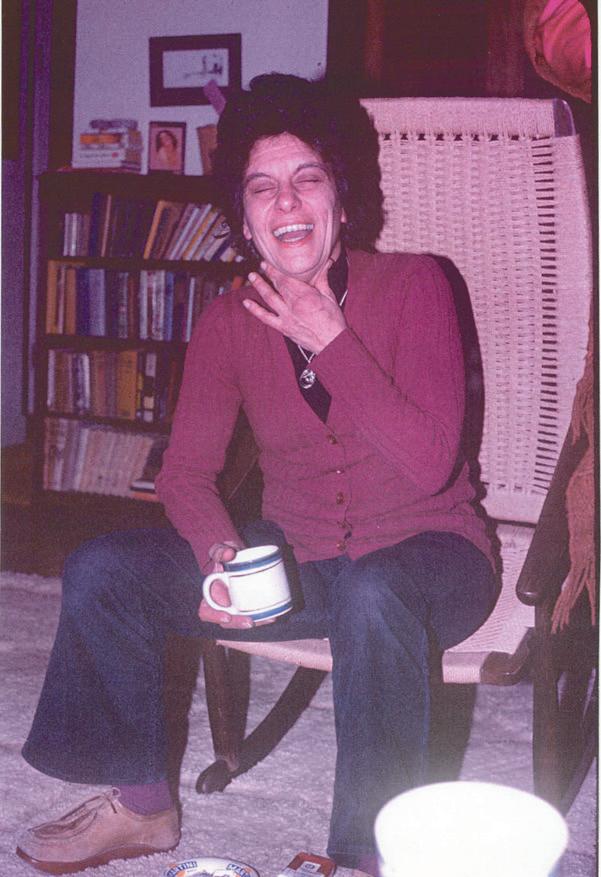
Michele Nota later moved to Seattle and became an ardent volunteer for the Lesbian Resource Center. The memory of that first gay pride march remained vivid for her until the end of her life: “It was just incredible to be part of that. It was like the spaceship everybody was waiting for. ... As you walked up to the Sheep Meadow, the people who were there were applauding. It was an afternoon of celebration ... the ultimate coming out experience.”
The personal stories cited in this article come from oral history interviews conducted by the Northwest Lesbian and Gay History Museum Project between 1995 and 2003. The History Project tapped a wide range of narrators describing bar culture, coming out, activism, careers and working conditions, and family life. As of this month over 75 of its transcripts, including those by Nicholas Heer, Dr. Robert Deisher, Rev. Mineo Katagiri, and Michele Nota, now reside in the Special Collections archive at University of Washington Libraries.
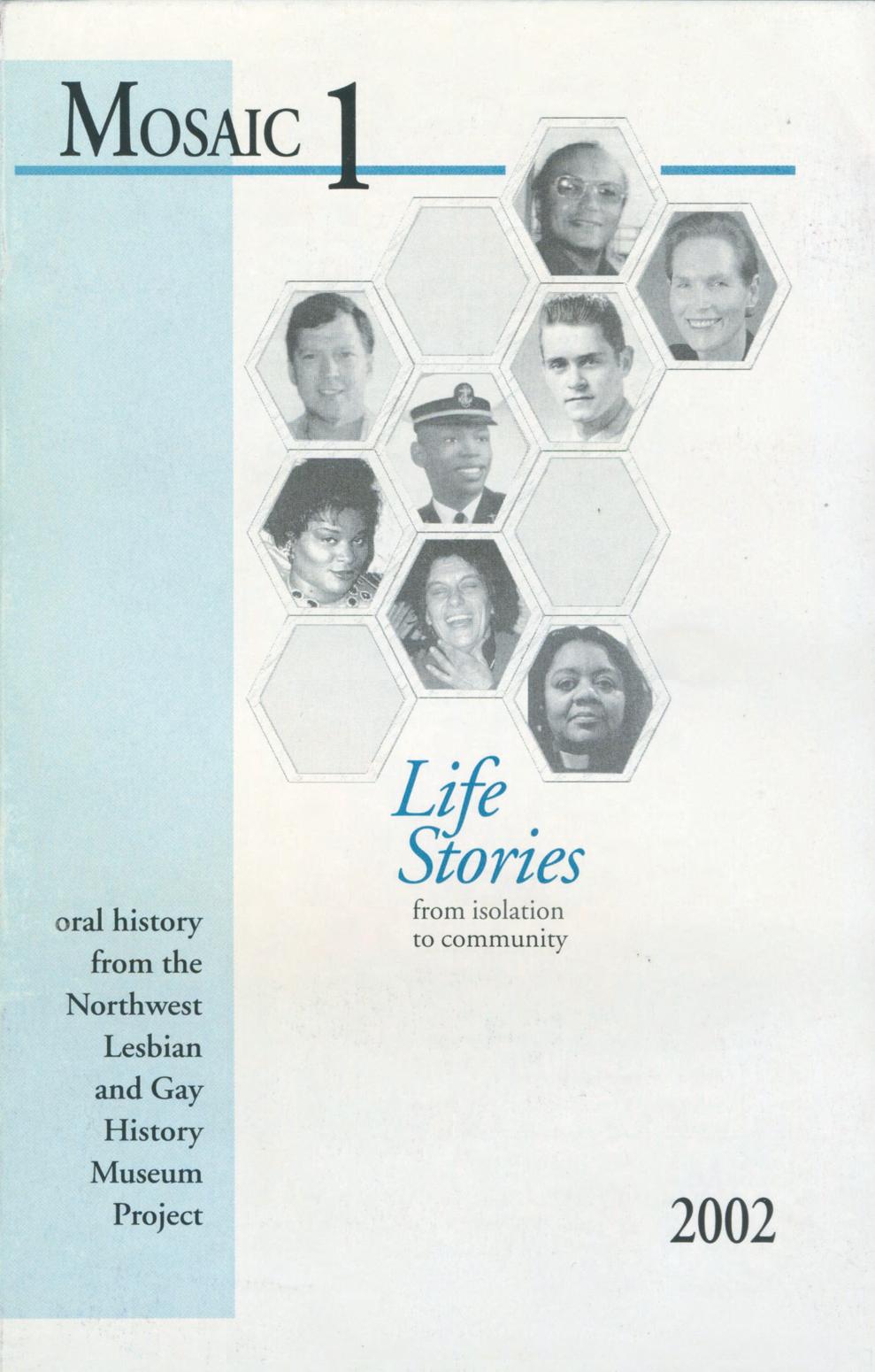
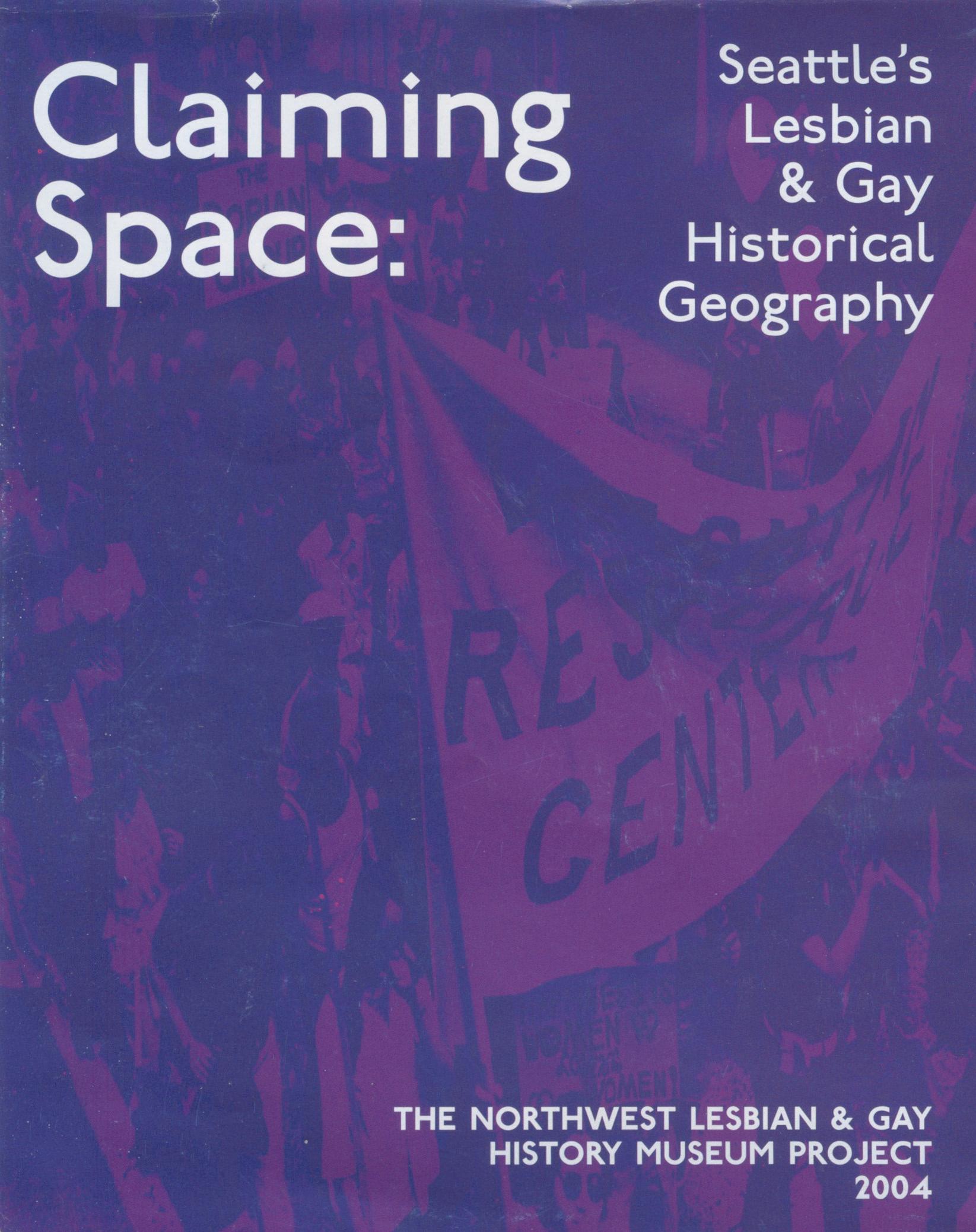
Ma ny stories also appeared in NWLGHMP’s collection Mosaic 1: Life Stories, published in 2002. In addition, Michael Brown and Larry Knopp’s research into LGBT demographics and historical shifts (as members of and in collaboration with others in NWLGHMP) are illustrated in “Claiming Space: Seattle’s Lesbian & Gay Historical Geography,” published by NWLGHMP in 2004. It is a very handy tool for a self-guided tour of local neighborhoods associated with gay life, and is reproduced in this issue of SGN. One of their graduate students, Julian Barr, has been extending their research by producing interactive “story maps” and conducting tours of Pioneer Square’s queer history for Historic Seattle and other organizations.
The history of that era is detailed in Gary Atkins’ groundbreaking book Gay Seattle: Stories of Exile and Belonging (University of Washington Press, 2003). All of these publications are available at local public and academic libraries. Mosaic 1 and “Claiming Space” can also be ordered in hard copy via the Project’s website: lgbthistorynw.org
The History Project, while less active these days, still seeks interviews with witnesses to the ever-evolving panorama of LGBTQA experience. We would especially like to hear more perspectives on lesbian-feminist activism, personal journeys of LGBT people of color as well as immigrants and others newly-arrived to this region, 1970s experiments in collective living and work-spaces, the spread of welcoming religious congregations, and the experiences of parents, friends, and allies. The History Project also offers speakers and (by prior arrangement) guided tours.



Valley Medical Center proudly offers a network of primary care clinics which serve as a medical home for care management. Urgent care clinics provide a safety net of after-hours care and walk-in consult and treatment, and specialty clinics provide convenient and comprehensive access throughout the district.
VMC’s primary care providers get to know you and your medical history, serving as personal health advocates for you and your family, and working with you to monitor and improve your health through all life’s stages.
It hurts. It itches. It’s swollen. It’s after hours. Urgent Care is a great choice when you can’t wait for an appointment with your primary care provider, or when you need medical care after hours for non-life-threatening conditions. Check out wait times and get in line to be seen at valleymed.org/wait-times
VMC offers a comprehensive network and board-certified specialists to meet all of your family’s healthcare needs. For a comprehensive list and FREE physician referral, please visit us at valleymed.org/doc or give us a call at 425.277.DOCS
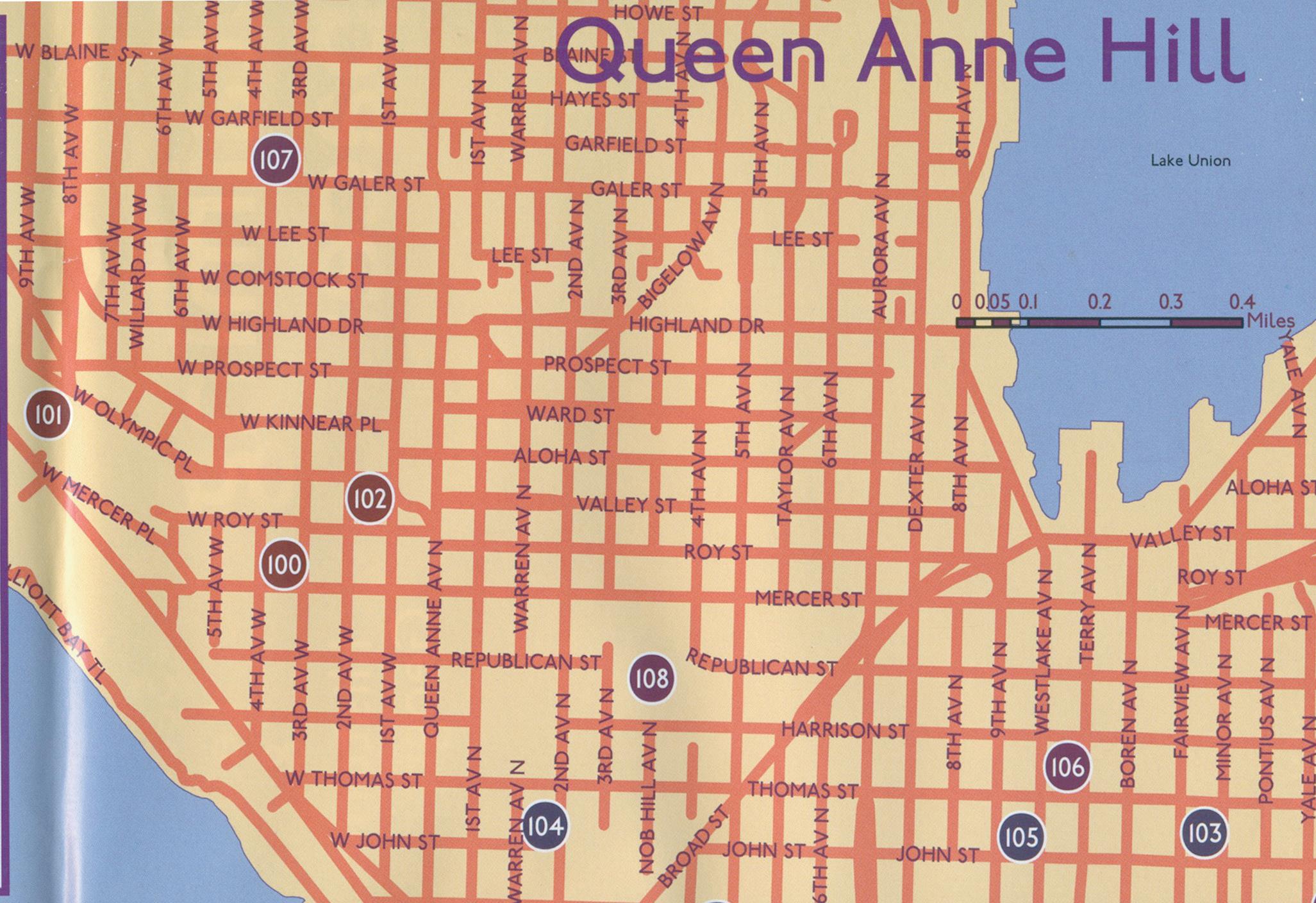
1950s
100. Kinnear hilton 314 W Mercer St (1957-1960) A group house of gay men on Queen Anne Hill.
101. Kinnear Park Queen Anne/Interbay (c1950s). Several men recall it as a cruising area at night
102. Lollie Parkins House 110 Olympic Pl (1950-1959) Another group house populated by gay men up on Queen Anne Hill.
1970s
103. Cascade Community Clinic
224 Minor Av N (1970). This health clinic was known for it's lesbian friendly health care.
104. Dignity 205 2nd Av N (1975-1980) A group for gay and lesbian Catholics. The Seattle chapter began in 1973. It met in people's homes until 1975. In 1980, it moved to St. Joseph's.
105. Foxes 233 Westlake Ave N (1978). A restaurant & full bar catering to women called Mama Dot's was also here.
1980s
106. The Depot 314 Terry Ave n (19811982) Restaurant, bar and dance floor. Was in a series of train cars.
107. Galer Palace 318 W Galer St (c.1982) Group house of gay men.
108. Names Project AIDS Memorial Quilt Seattle Center (1988) Seattle Center Arena was the last stop on the Quilt's first national tour.
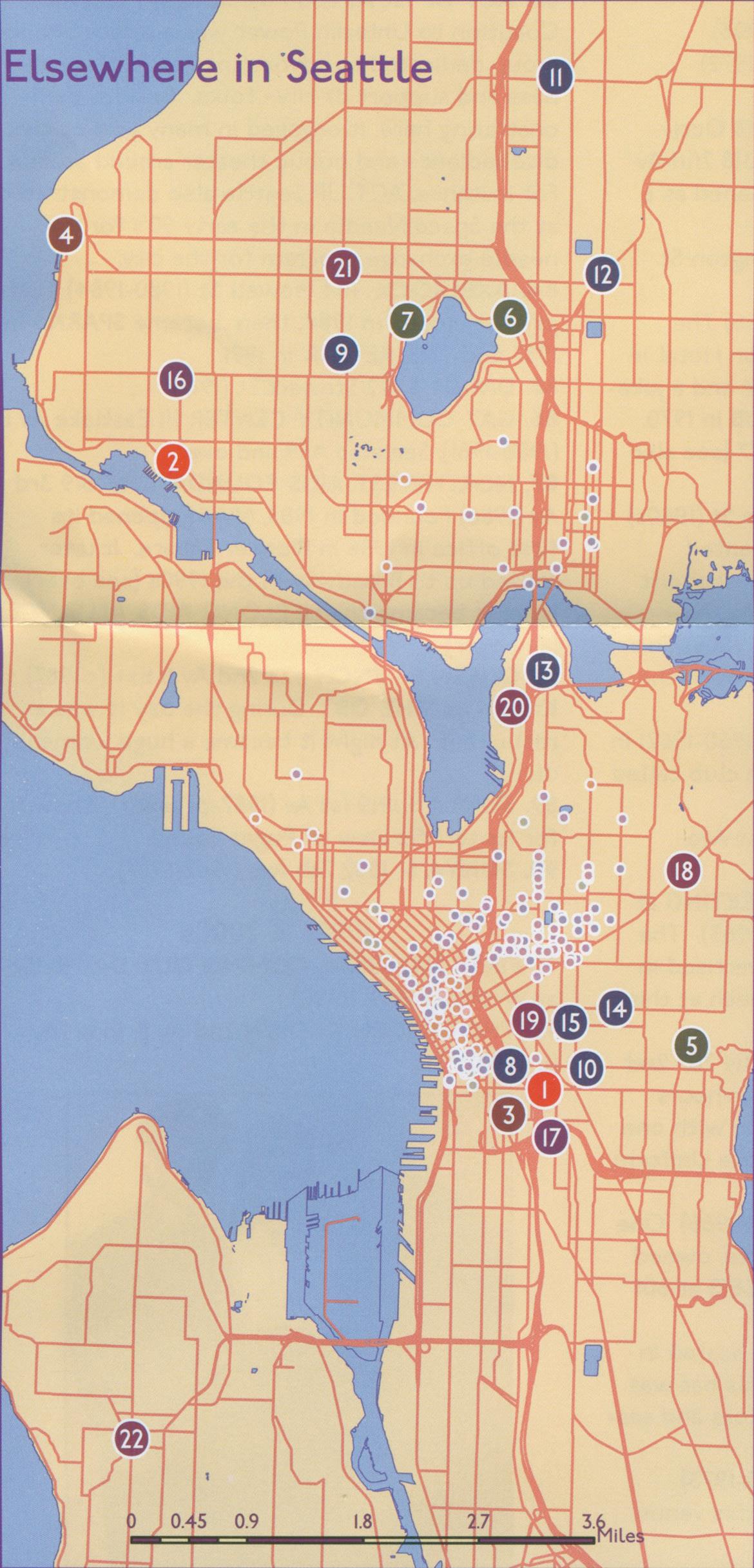
1930s & 1940s
1. Black and Tan 1200 S Jackson St (1930s & 1940s) This was a mixed race jazz Club. It was in the basement of The Entertainer's Club
2. Starlight Hotel 5300 Ballard Wy NW (1940-1960) A residential hotel largely populated by gay men in old Ballard.
1950s
3. BOTTLE CLUB 614 Maynard Av S (c.1950).
4. GOLDEN GARDEN PARK Shilshole, Northwest Seattle (c.1950s) A public space where men had sex with men.
1960s
5. ALDER HOUSE 2909 E Alder St (19571966) A gay men's group house in Leschi
6. FASHIONS BY MARK 7416 2nd Av NE (1961) " All types of dressmaking. Drag a Specialty" That was the listing from an advertisement in a 1961 Jamma Phi Program.
7. PIPS 7311 Aurora Av N (c.1960)
1970s
8. BOHEMIAN 910 S Washington St (c.1969). A bar for gay men in what is now the International District.
9. FREMONT WOMEN'S CLINIC 6817 Greenwood Av N (mid 1970s)
10. GAY COMMUNITY CENTER 105 14th Av (1977-1980) The GCC was located in the Urban League building for four years.
11. KARMA 11036.5 8th Av NE (c.1979) This Northgate gay disco did not last very long.
12. LITTLE BREAD COMPANY 8050 15th Av NE (c.1977) A cooperative bakery where many lesbians worked.
13. PFLAG 2702 Broadway Av E (1979-present) Parents and Friends of Lesbians and Gays. This beloved support and advocacy group met in St. Patrick's Church
14. RUSSIAN HALL 704 19th Av Used by several groups, including the WOMEN'S COFFEE COVEN and METROPOLITAN COMMUNITY CHURCH in the 1990s
1980s
16. Grace Gospel Chapel 2052 NW 64th St (since 1980). This gay evangelical church started in people's homes in 1971. It purchased this site in 1980.
17. People of Color Against Aids Network 1200 S Jackson St (since 1987) A multicultural AIDS prevention organization. It started as a project of the American Friends Service Committee. It is now located at 2200 Rainier.
1990s & 2000s
18. Bailey/Boushay House 2720 Madison St E (since 1992) America's first skilled-nursing facility specifically for people living with AIDS..
19. Cal Anderson House 400 Broadway Av (since 1995) An independent-unit residence for people living with AIDS. It was named after Washington State's first openly gay legislator. He died of AIDS in 1995.
20. Family Values Bar and Grill 2366 Eastlake Av E (c.1994)
21. Time Out Tavern 8118 Greenwood Av N (1994) This gay-friendly bar only had a brief existence. It quickly became a straight sports bar.
22. Guppy's 4752 California Ave SW (since c.2000). A neighborhood glbt bar in West Seattle
Sarah Yesler, founder of the Seattle Public Library system and wife of Seattle Mayor and lumber magnate Henry Yesler (for whom Yesler way is named), developed a passionate relationship with here friend Eliza Hurd. In 1860, Eliza wrote from Olympia, "Oh, Sarah I wish to say so much and I cannot say anything–I want to sleep with you again! Hey!
King County was named after William Rufus De Vane King, the 13th Vice President of the United States and constant companion of James Buchanan. Rumors of their relationship abounded in the Capitol; Andrew Jackson nicknamed King "Miss Nancy."
Phyllis Lyon and Del Martin, who in 1955 founded the nation's first lesbian rights organization, the Daughters of Bilitis, met in Seattle in the early 1950s.
In the late 1950s and early 1960s, a gay male social organization called Jamma Phi hosted two annual events: a drag ball and a summer picnic in Maple Valley. The picnics featured an unusual race: participants dashed for a pile of high-heeled shoes, found a matching pair, and raced to the finish line.
In 1969, the Dorian Society sponsored a Scarlet Masque Ball at the Exhibition Hall. Those attending the ball included Mayor Charles Royer and his wife.
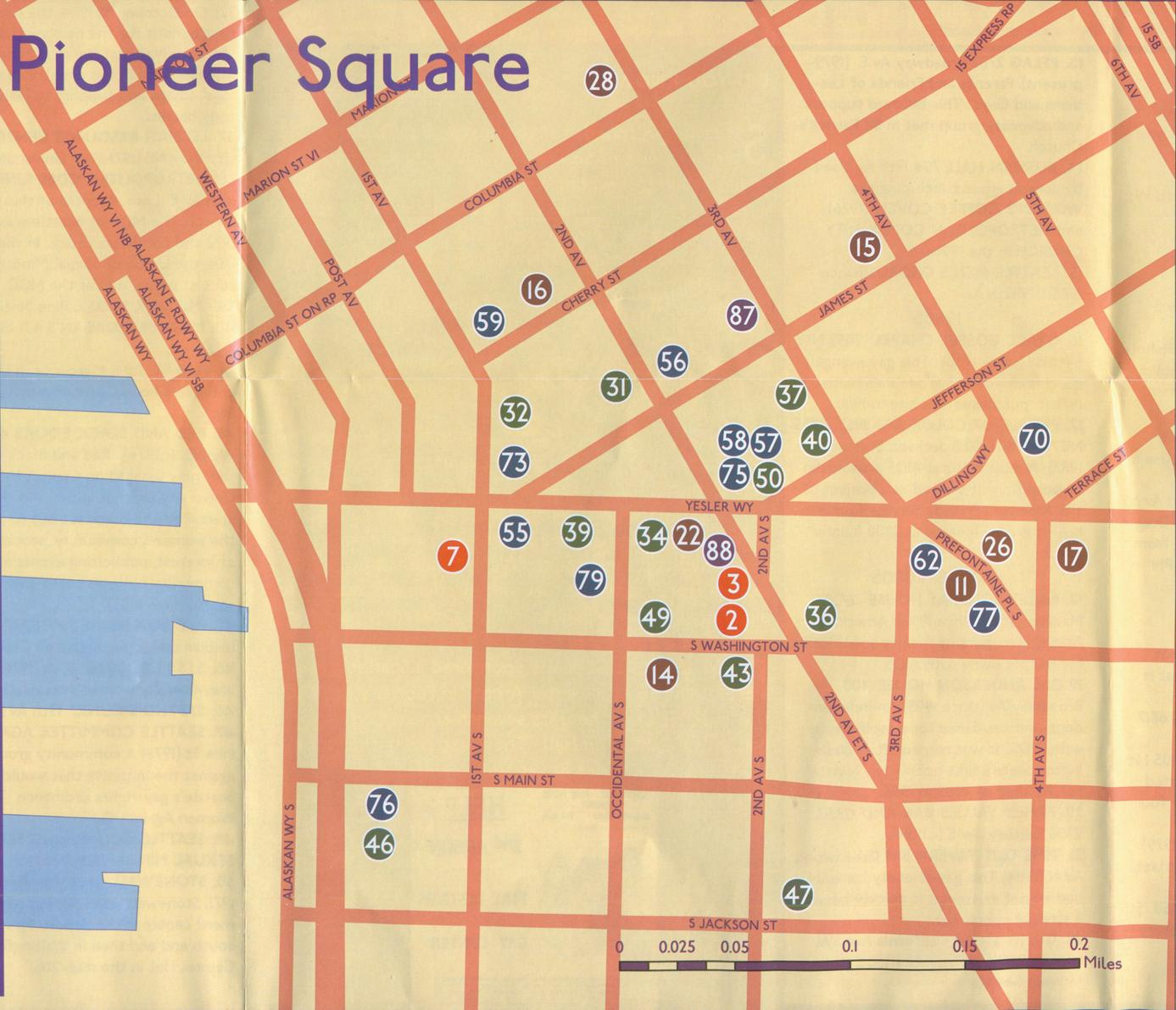
Asin other American cities, Seattle's early gay and lesbian establishments were concentrated in the "undesirable" part of town, what we now call Pioneer Square. The area was a notorious zone of vice, including gambling, prostitution, and saloons. Yesler Way gave rise to the term "Skid Row." It was also known as "The Deadline," and the area south of it called "The Mudflat" from the tidal marshes that had been filled for the expanding city. The first known gay bars appeared below the Deadline around the Mudflat by the 1930s, providing public spaces in which lesbians and gay men could gather. A system of pay-offs to the police, which ended with an FBI investigation in thae early '70s, minimized harassment of customers, ironically creating a "supportive" environment for the bars. Pioneer Square remained the center of Seattle's gay world well into the '70s. Seattle's earliest Pride Marches were held in the district, and early community organizations found space there. There were also several venues in downtown Seattle, as well as the Denny Regrade (what we now call Belltown). As the community grew in numbers and visibility, however, Seattle's gays and lesbians moved into other parts of the city.
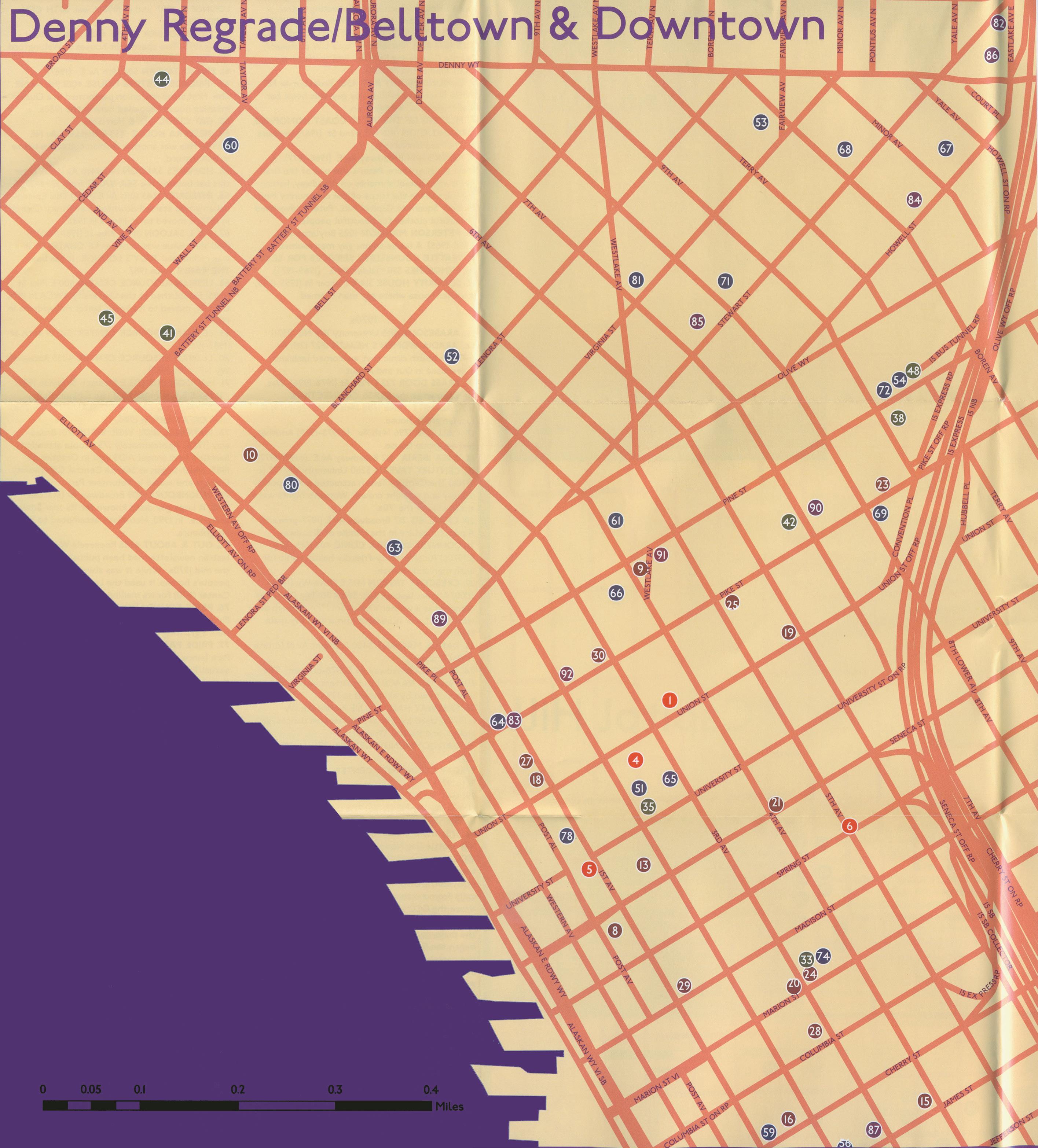
1940s AND EARLIER
1. BOLTD'S 1414 3rd av (1930-1965) A cafeteria in which male hustlers hung out.
2. THE CASINO 172 S Washington St (1930-1946) The Casino opened in the '30s as an after-hours club in the basement of the Double Header. Nicknamed "Madame Peabody's Dancing Academy for Young Ladies," it was one of the few places on the west coast where samesex dancing was allowed.
3. THE DOUBLE HEADER 407 2nd Av Ext S (1934-present). Said to be the oldest continuously operating gay bar in the country, the Double Header has served a predominantly gay clientele since World War II.
4. THE SPINNING WHEEL 1334.5 Union St (1935-1950) First opened in the mid '30s, the Spinning Wheel cabaret featured female impersonators. It was at the corner of Second and Union
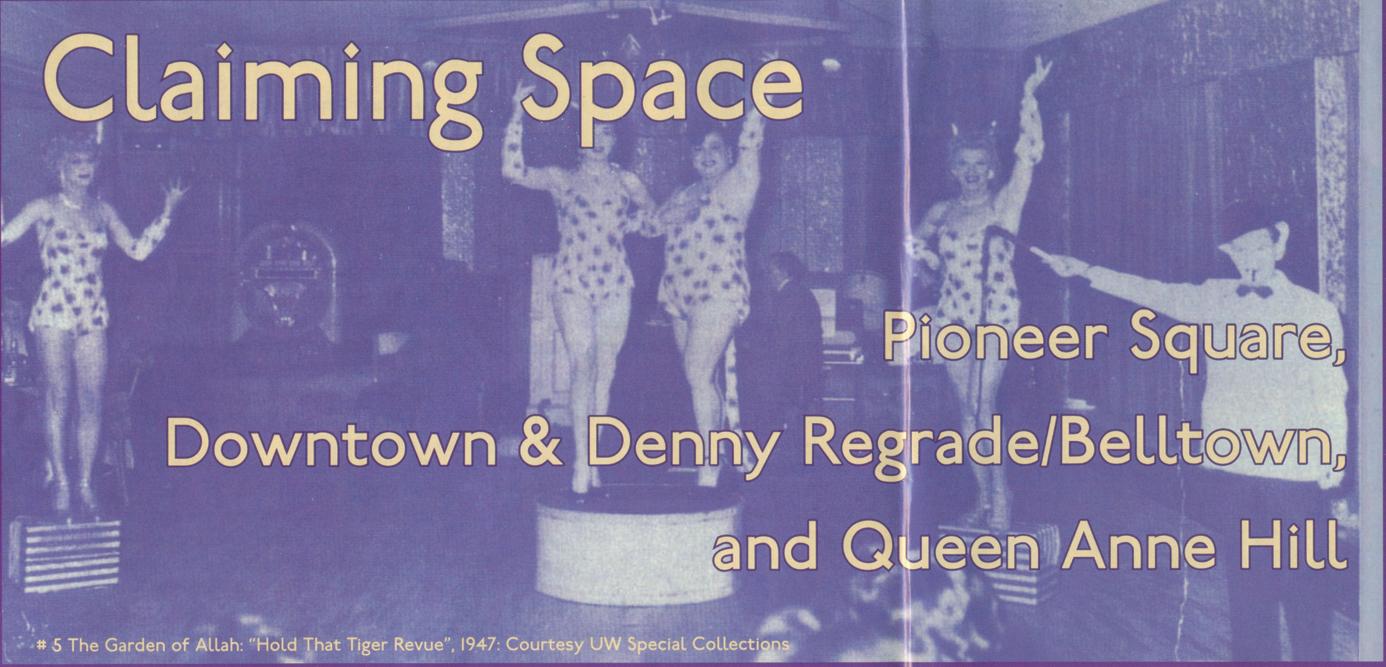
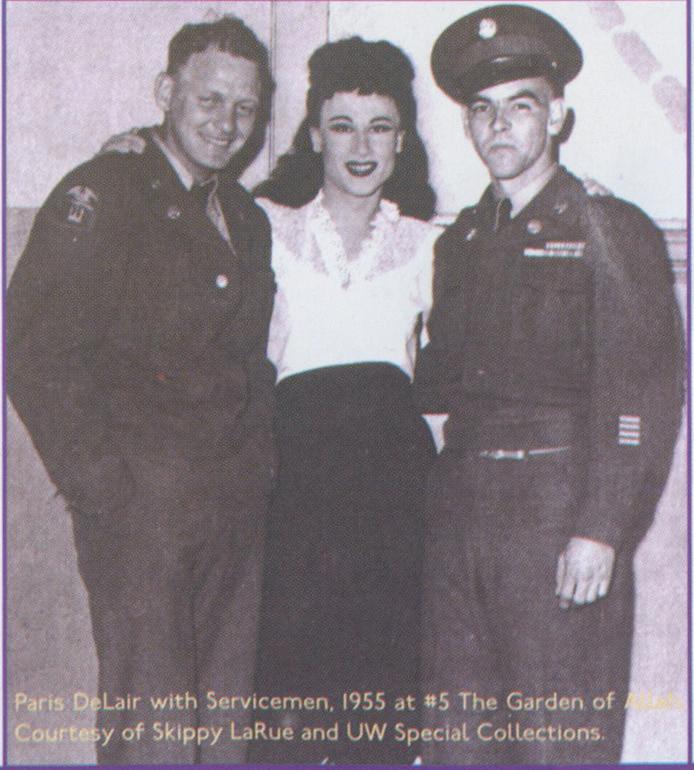
5. GARDEN OF ALLAH 1299 1st Av (1946-1956) Seattle's first gay-owned gay bar, the Garden of Allah was located in the basement of the Arlington Hotel. The Garden was frequented by men and women and featured female impersonators and vaudeville entertainment.
7. SOUTH END STEAM BATHS 115.5 1st Av S (1940s-1990s)
1950s
8. AFTER HOURS CLUB 97 Seneca St (1950s) The venue did not last long.
9. BEN PARIS 400 Pine St (1950-1981) Was known for hustlers. Towards the end of its life in 1981 it became a women's bar.
10. BLUE BUTTON COFFEE SHOP 2219 1st Av (c.1950).
11. BLUE NOTE TAVERN 103 Prefontaine Pl (1957-1960)
12. BOTTLE CLUB 614 Maynard Av S (c.1950) Bottle clubs were after-hours drinking places for folks in the know.
13. CAPTAIN'S ROOM 251 2nd Av (19571958). The Captains Room was upstairs on the second floor.
14. COLUMBUS TAVERN 167 S Washington St (c.1950).
15. DEE'S 601 4th Av (1950) Dee's was an early women's tavern
16. FOX & HOUNDS 110 Cherry St (c.1950s-1970s) A cocktail lounge for gay men. It was also used by the Dorian Group for meetings in the 1970s.
17. GRAND UNION 104 4th Av S (19551959) A women's tavern known for its tough, blue-collar atmosphere.
18. GREEN PARROT THEATER 1419 1st Av (c.1950s) Showed second-run features. A public place where men could have sex with men covertly but in public space.
19. HOTEL RICHELIEU 598 Union St (c.1950s) A hotel often used by men who had sex with men.
20. MADISON TAVERN 922 3rd Av (1955-1965) The Madison, a women's bar in the '50s and '60s, became the 922 ,
one of Seattle's first leather bars in the '70s. THE RIVERBOAT, a woman-owned lesbian bar, was located at this address in the mid-'80s. Not to be confused with the Madison Pub (see over) on Capitol Hill.
21. THE MARINE ROOM 416 Seneca St (c.1950s) In the basement of the Olympic Hotel. Nicknamed "Snake Pit," the Marine Room is mentioned in the 1950 novel Quatrefoil
22. MOCAMBO RESTAURANT 203 Yesler Wy (1951-1978) Beginning in the early 1970s, THE QUEEN CITY BUSINESS GUILD, an organization of gay bar owners and a precursor to the GREATER SEATTLE BUSINESS ASSOCIATION, met at the Mocambo. The Mocambo later played host to the UNITED EBONY COUNCIL , a black gay male organization established in 1975. It was also used by the Dorian Group for meetings.
23. PIKE ST TAVERN 824 Pike St(19551965) It later became MIKE'S in 1970. 24. RATHSKELLAR Marion & 3rd (1950s)
Under Maison Blanc. While not a gay bar per se, gay men often socialized and drank there
25. ROOSEVELT THEATER 515 Pike St (1950-1975).
26. SAPPHO'S TAVERN 116 Prefontaine Pl (1955-1970).
27. SKIPPY'S CHILI JOINT 1429 1st Av (1958-1962).
28. TAM-O-SHANTER 823 3rd Av (19491954) "A tough little tavern" for gay men.
29. WHITE HAT CLUB 1000 1st Av (1950s) Second Floor.
30. WINTER GARDEN THEATER 1513 3rd Av (1950-1979) Showed second-run features. A place where men could have sex with men.
1960s
31. 611 TAVERN 611 2nd Av (1965-2003).
32. 614 TAVERN 614 1st Av (1965-1972).
33. 922 922 3rd Av (1969-1975)
34. & 35. ATLAS STEAM BATHS 118 Occidental Av S (1964-1969). Later at 1318 2nd Av (1969-1978) 4th floor The Atlas opened as a gay bathhouse in 1964.
36. BONNIES' PLACE 210 S Washington St (1969)
37. CAPER CLUB 517.5 3rd Av (1966) The Caper Club opened in the Morrison Hotel in 1966. Patrons danced to live music and a jukebox. Later it became THE 107 CLUB in 1970. Then it became TOPS POPS in 1977. (see also #40 below).
38. CENTURIAN BOOKS 903 Pine St (1960s) This bookstore stoked "maleoriented paperbacks, greeting cards, and unusual gift items... for the discriminating few."
39. CIMBRIS 107 Occidental Av S (1960s) This cabaret featured popular drag shows in the '60s.
40. CIRQUE TAVERN 517 3rd Av (19601962) In the Morrison Hotel. Later a bottle club called 'CAPERS" (see also #37 above)
41. DAVE'S STEAM BATHS 2402 1st Av (c.1969).
42. DORIAN SOCIETY'S FIRST MEETING at the Roosevelt Hotel, 1531 7th Av (1965). The call for this first meeting was advertised in One Magazine. Hal Call gave a speech at this inaugural event.
43. GOLDEN HORSESHOE TAVERN 207 2nd Ave S (1960-c.1972). The first regular-hours bar where men could dance openly with one another. In 1977 was listed as Seattle Uniform Co.
44. THE HUB 421 Denny Way (19581966) One of the earliest lesbian bars in Seattle, owned by two women who also owned DEE'S at 601 4th Av N.
45. OVERSEAS CLUB 2505 1st Av Located in the Sailors Union of the Pacific. This bar was known to be a place to pick up sailors and seamen.
46. POOP DECK 77 S Main St (19601973) Known to have drag shows. Later this venue became SHELLY'S LEG (See #76)
47. SILVER SLIPPER TAVERN 210 S Jackson St (1969-1971). A lesbian bar that opened in 1969. In the mid-'70s the Silver Slipper moved to Prefontaine Pl. See also #77.
48. SPAGS TAVERN 924 Pine St (19691987). Spags later moved up to Capitol Hill on Pike (see over).
49. STAGE DOOR 158 S Washington St From 1962-1966 this tavern was known as the DING-A-LING . The Stage Door was a mixed gay and lesbian tavern featuring dancing in the '60s.
50. SUBMARINE ROOM 506 2nd Av (1969) Primarily a lesbian bar. Located in the basement of Smith Tower. Remembered to be "so dark your couldn't see!"
1970s
51. THE ASSOCIATION 1334 2nd Av (1970-1977) downstairs.
52. BLUE BANJO 2115 5th Av (1978)
53. BOREN ST DISCO 2015 Boren Av (1977-1985) This space later became CITY BEAT in 1987; then became TIMBERLINE from 1988-2003.
54. DISCO SEATTLE 918 Pine St (19701977)
55. DOLL HOUSE TAVERN 119 Yesler Wy (1970-1972) Was known as the CAVALIER INN in the late 1960s.
56. DON'S PLACE 610 2nd Av (1970) This venue was listed as the Alaska Tavern in 1977 and the Gorilla Room in 1980.
57. DORIAN GROUP 506 2nd Av (1975) This was a gay rights organization distinct from the earlier DORIAN SOCIETY. They rented space in the Smith Tower in the 1970s.
58. GATSBY'S 524 2nd Av (c.1972)
59. GAY COMMUNITY CENTER 102 Cherry St (1971-1977) The first Gay Community Center opened on October 15, 1971 at First & Cherry. The GCC provided meeting spaces for gay and lesbian organizations, and helped establish GAY COMMUNITY SOCIAL SERVICES, an umbrella organization for queer projects that is still around today. See also #86.
60. GIN.A.GRAPHICS 417 Vine St (c.1976) Produced lesbian art.
61. GOLDEN CROWN 1616 4th Av. (c.1972).
62. GREEK TORCH RESTAURANT 103.5 Prefontaine Pl S (1970-1976) Upstairs.
63. HANDLEBAR 2018 1st Av (1978-1980). Was also known as JOHNNY'S HANDLEBAR. Became WREX in 1981.
64. LEFT BANK BOOK COLLECTIVE 92 Pike Place (1978-2000s) Progressive bookstore that offered many titles of interest to the community.
65. LESBIANS OF COLOR CAUCUS 1331 3rd Av, Room 720. The Lesbians of Color Caucus was active in the 1970s, offering emergency housing, counseling and rap groups to the community.
66. MAD WIMMIN'S BOOKS 351 Pine St Separatist lesbian bookstore downtown.
67. MARSHALL'S OFFICE 1224 Howell St (c.1977)
68. MONASTERY 1900 Boren Av (19771983) Catered to the younger crowd, and not just gays. From 78-81 was also listed as " THE SANCTUARY "
69. MR. LARRY'S 801 Pike St (1977-1980).
70. NAME OF THE GAME 422 4th Av (1977).
71. PARK BENCH 1914 18th Av (1977-1981).
72. PINES 912 PINE ST (1978-1983). A bathhouse.
73. PRIDE PARADE from Occidental Park (1977) In 1977, the Mayor of Seattle declared an official "Gay Pride Week" for the first time. Over 2,000 people participated in that year's march to Occidental Park down 1st Ave.
74. RIVERBOAT 922 3rd Av (1978-1981) A gay venue that became a lesbian bar in 81-82.
75. SEATTLE MUNICIPAL ELECTIONS COMMITTEE 506 2nd Av (1977). Founded in 1977, SEAMEC is still active in evaluating all candidates running for public office in Seattle, King County and Washington State. It was located in the Smith Tower.
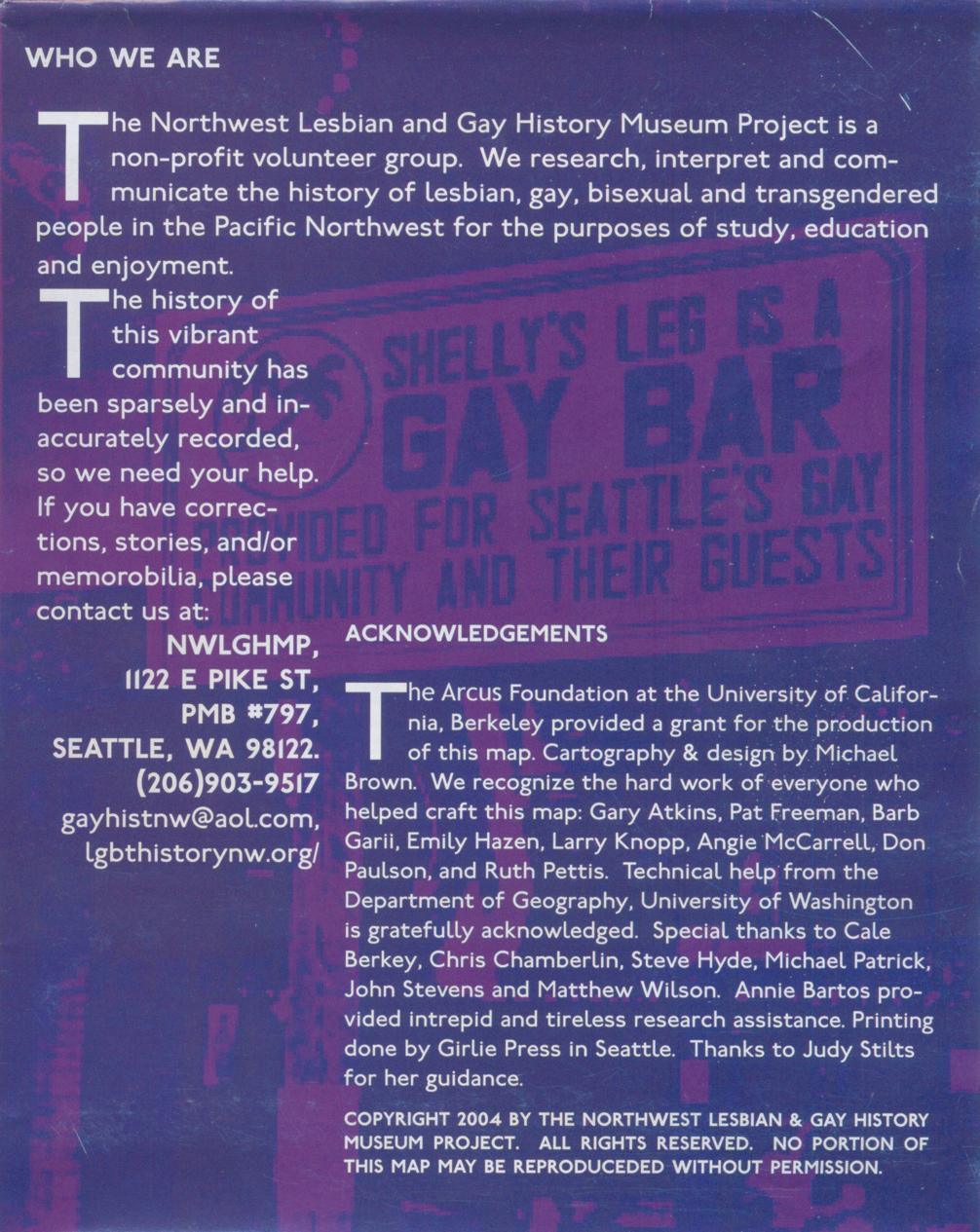
76. SHELLY'S LEG 77 S Main St (19731977) In the 60's was THE POOP DECK (#39) which had drag shows. Shelly's Leg opened "at the foot of Main" on December 14, 1973. Seattle's first disco, Shelly's Leg was famous for its large sign declaring it to be a "Gay Bar Provided for Seattle's Gay Community and Their Guests." Shelly's Leg hosted numerous benefits for gay organizations in the '70s.
77. SILVER SLIPPER TAVERN 109 Prefontaine Pl S (1971-1973) A lesbian bar that opened in 1969. In the mid-'70s the Silver Slipper moved from S Jackson St. See also #47.
78. SULTAN CINEMA 1313 1st Av (1971).
79. TROJAN SHIELD 111-117 Occidental Av S (c.1972) A gay bar.
80. TUGS BELLTOWN TAVERN 2207 1st
Av (1978-1994) Gay bar, remembered for its friendly atmosphere.
81. TWENTY-TWENTY FOUR 2024 Westlake Av (1977-1985).
82. EASTLAKE EAST 109 Eastlake Av E (1978-1981) In 1978 this venue was a cocktail and dancing bar. It was also known as the A127 CAFÉ , and A SPECIAL PLACE . In 1983 it became the OFF RAMP
1980s
83. Act up 1st Av and Pike St (1989) The AIDS Coalition to Unleash Power was a direct-action group dedicated to advocating for AIDS awareness and support of HIV+ folks. Besides demonstrating here, it engaged in many acts of civil disobedience and public theater around Seattle. For instance, Act up Seattle also demonstrated at the Space Needle in the early 90's for a needle exchange program for the city.
84. Axelrock 1114 Howell St (19801984) This gay bar closed in 1984, then became Sparks in 1987 and the Rebar in 1991.
85. Daddy's 712 Stewart St (1981)
86. Gay Community Center 111 Eastlake Av E (1980-1981). See also #59 and over.
87. Northwest AIDS Foundation 619 3rd Av (1986) Founded in 1983, NWAF opened its first office in 1986 in Pioneer Square. It later moved up to Broadway in the 1990s (see over). Later it became the Lifelong Aids Alliance (see over)
88. Queen's Bench 423 2nd Av Ext (c.1987) Know as the "QB ." During the day it was a restaurant. At night it became a huge women's disco.
89. Sonya's 1919 1st Av (1987-present). Known for it's terrific view of Puget Sound.
90. Sonya's 1532 7th Ave (1982-1987) 1990s & 2000s
91. First National Coming Out Day Rally at Westlake Park (1990).
92. The Golden Crown 2nd Av & Pine St (c.1990).
The Shift away from Pioneer Square towards Capitol Hill in the '70s was due to a combination of push and pull factors. Downtown revitalization made it more difficult for bars to exist in Pioneer Square as it became a historic district. By contrast, suburbanization of families had left Capitol Hill open for an influx of young single and gay baby boomers looking for affordable rental housing. Enjoying growing visibility in the 1970s "liberation" period, Seattle's gay and lesbian community began both to live and socialize on the Hill. With its leftist, progressive reputation, Capitol Hill (and Renton Hill along 15th Av) offered a hospitable environment for a diversity of establishments including bars, bookstores, and service organizations. And while Capitol Hill has become synonymous with the GLBT community in Seattle, it is quite clear we have always been everywhere in the city.
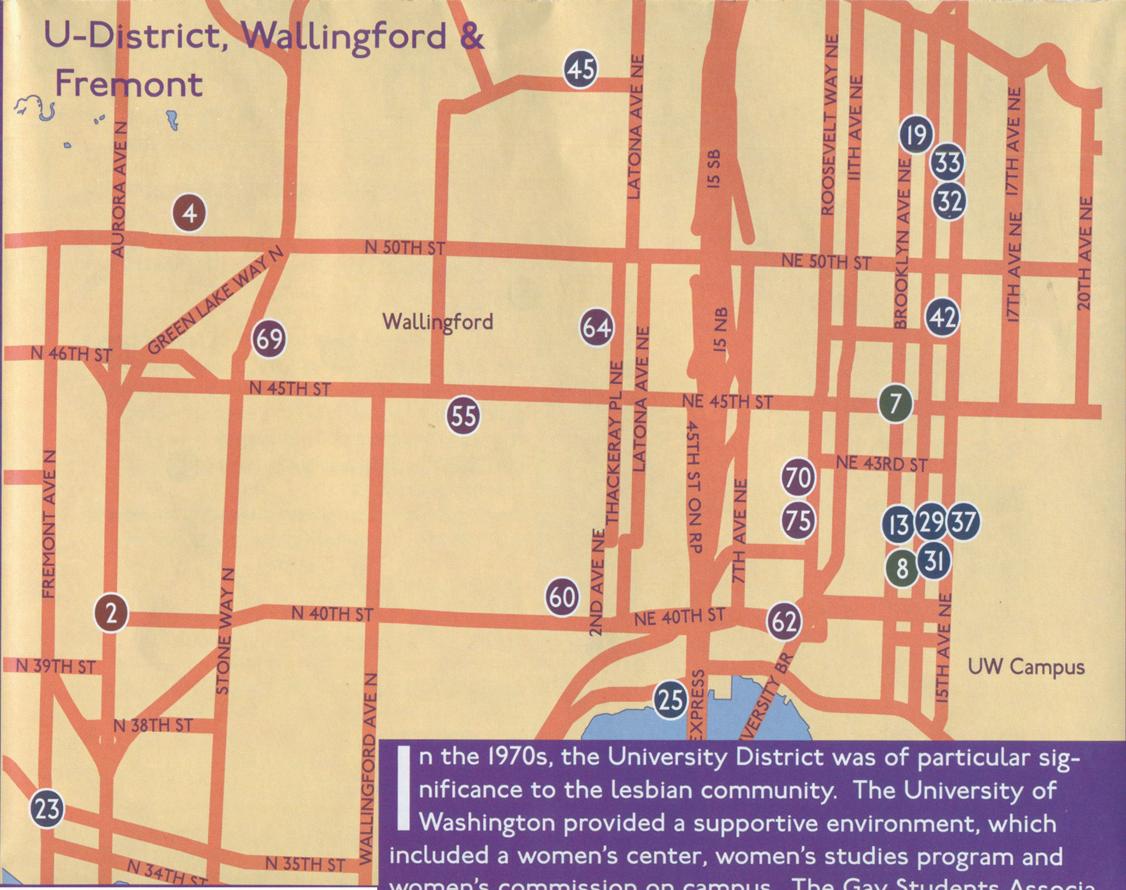
ronment, which included a women's center, women's st udies program and women's commission on campus. The Gay Students Association, a mixed gay and lesbian group, was founded at the U in 1971. This tolerant e nvironment, coupled with rising rents on Capitol Hill, encouraged the growth of lesbian feminist institutions in the U District in general.
1950s
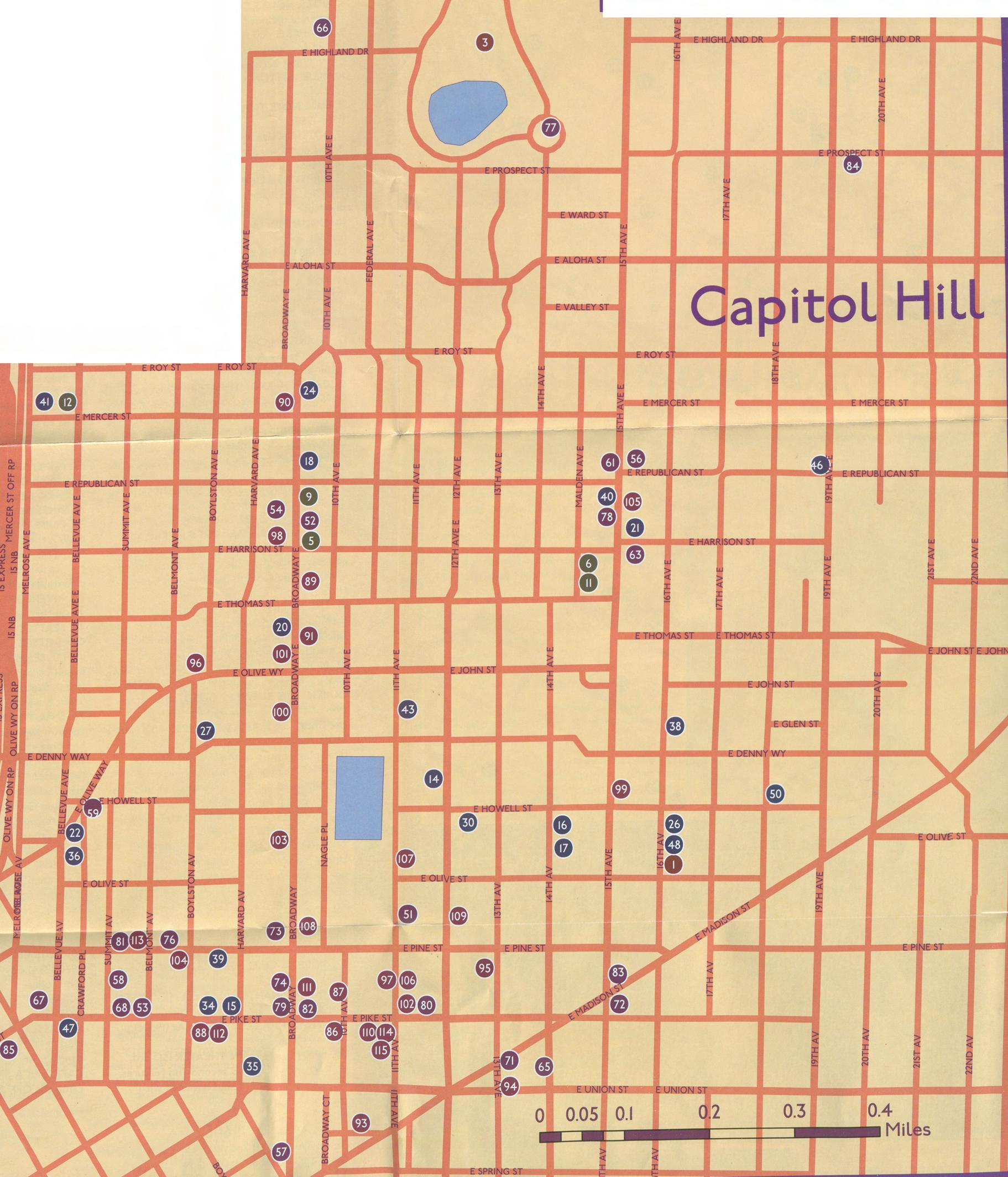
1. SKIPPY'S 1714 16th Av (1947-1959) Skippy LaRue was a beloved, central figure in Seattle's nascent gay community. He was a performer known for his blue songs. Later he referred to himself as, Seattle's oldest drag queen." Skippy had a few houses where gay men often roomed.
2. SKIPPY'S 4010 Aurora Av N (1949-1951) Another of Skippy LaRue's houses for gay men. It was known to be an after hours bottle club at night.
3. VOLUNTEER PARK North Capitol Hill (c.1950s) Even before Capitol Hill was a gay neighborhood this park was frequented at night by men who had sex with them..
4. WOODLAND PARK North Seattle (c.1950s) A well known cruising area for men who had sex with men in North Seattle.
1960s
5. DIFFERENT DRUMMER BOOKS Broadway Av E Different Drummer Books featured lesbian and gay titles.
6. DORIAN HOUSE 320 Malden Av E (1967) The Dorian Society, Seattle's first gay-rights organization, was established in 1965. They opened Dorian House, which housed meeting spaces, a crisis hotline, and the first offices of SEATTLE COUNSELING SERVICES FOR SEXUAL MINORITIES (See #79). Established by a UW professor, Seattle Counseling Services was the first agency of its kind in the country.
7. EDMUND MEANY BAR 4507 Brooklyn Av NE While it was not exclusively gay, this hotel bar was frequented by gay men.
8. MEETING OF THE WEST COAST HOMOPHILE ORGANIZATION 11401 NE 42nd St (1967). Upstairs at the Free University..
9. PETER'S 434 Broadway Av E (1966-1977) A male clothing store, Peter's was one of the first gay-owned establishments on Broadway, harkening the shift in the focus of the community from Pioneer Square to Capitol Hill. Peter's advertised "beautiful clothes for beautiful people."
10. PETERSON MANSION 1025 Boylston Av E (1958-1965) A house where gay men roomed.
11. SEATTLE COUNSELING SERVICES FOR SEXUAL MINORITIES 320 Malden Av E (19691973)
12. SORORITY HOUSE 314 E Mercer St (19551990) Another house where gay men roomed.
1970s
13. ARABESQUE 4215 University Wy NE (1971)..
14. ARADIA WOMEN'S HEALTH 1827 12th Av (1979) A health clinic that welcomed lesbians. Advertised in Out and About.
15. BRASS DOOR 722 E Pike St (1978-1996). Was also known as the BRASS CONNECTION.
16. CALAMITY JANE 1798 14th Av (c.1978-1979) A lesbian group house.
17. CALLIOPE 1796 14th Av (c.1978-1979) Another lesbian group house.
18. CASA IBERIA 512 Broadway Av E (c.19711972).
19. CENTURY TAVERN 5260 University Wy NE (c.1970s) The Century Tavern attracted a very political, gay, and straight crowd. Women's nights were a mainstay in the '70s.)
20. CHARLIE'S 1217 Broadway Av E (1977-present) A popular eatery in the middle of Broadway.
21. COUNTRY DOCTOR CLINIC 402 15th Av E (c.1970) A community-friendly health clinic for both men and women.
22. CRESCENT TAVERN 1413 E Olive Wy (1974-2000) A great lesbian pub. See #36. The Crescent operated as a women's bar from 1974 through at least 1978. Later it became primarily a gay male tavern.
23. DANCE MACHINE 3400 Fremont Av N (c. late 1970's)A disco.
24. ELITE 622 Broadway Av E (1978-present). The Elite and the NAACP headquarters in Tacoma were bombed by skinheads in 1993.
25. FREEWAY HALL 509 NE Northlake Wy (c.1970s) Used by UW gay and lesbian dances, gay groups, and Radical Women.
26. GAY COMMUNITY CENTER 1726 16th Av (c.1970).
27. GAY COMMUNITY CENTER 110 Boylston Av E (c.1977)..
29. GAY WOMEN'S RESOURCE CENTER 4224 University Wy NE (1971-1985) The GCC
moved from Pioneer Square to Capitol Hill in the early-'70s. In 1973, the Gay Community Center News (later the Seattle Gay News) was first published. The GCC also supported OUT AND ABOUT, a lesbian feminist monthly newsletter. In 1976, arson destroyed the GCC on 16th Ave. Threatening phone calls from a man nicknamed "Shotgun Charlie" drove the GCC staff out of their next location as well. In 1970, a group of women, not satisfied with the male-dominated GAY LIBERATION FRON t, began the GAY WOMEN'S ALLIANCE. In 1971, they established a Gay Women's Resource Center at the University YWCA. Later called the LESBIAN RESOURCE CENTER , the agency remained in the U District until 1985, when it moved to Capitol Hill. The LRC is the oldest existing agency of its kind in the country.
30. HOT PINK 1211 E Howell St (1978-1978) A lesbian group house named for its shockingly pink painted kitchen.
31. ID BOOKSTORE 1408 NE 42nd St (1971).
32. INNERSPACE COFFEE HOUSE 5241 University Way NE (1978-1983) See #33 below.
33. IT'S ABOUT TIME BOOKSTORE This feminist/lesbian collective bookstore's shelves included non-sexist/racist titles for children, nationwide women's periodicals, records and other items. A bulletin board advertised jobs, housing and community events. On Friday nights, the INNERSPACE COFFEE HOUSE (#32) located in the basement of It's About Time, Innerspace offered "a positive women's space to all women" and "a chance to make good friends, relax, have fun, develop your talents and get some good entertainment: music poetry, theatre, etc..." It briefly was located at 5421 University Wy NE in 1977.
34. JIM'S 706 E Pike St (1978-1980) This bar became SAPPHO'S TAVERN for women between 1981-85 & then FORT SEATTLE in 1991. It was also the first site of R Place (#104).
35. LESBIAN FEMINIST RADIO COLLECTIVE 1406 Harvard Av (c.1974) KRAB Radio Studio. From the mid-'70s until the mid-'80s, the Collective hosted music and news programs on KRAB Radio, 107.7FM.
36. LESBIAN MOTHER'S NATIONAL DEFENSE FUND 1413 E Olive Wy in CRESCENT TAVERN (#22). On October 19,1974, the Crescent hosted the first benefit for the newly-established Lesbian Mother's National Defense Fund, one of the first organizations in the country to offer resources, legal advice and support to lesbians facing custody battles.
37. LESBIAN RESOURCE CENTER 4224 University Wy NE (1971-1981) University YWCA
38. METROPOLITAN COMMUNITY CHURCH
128 16th Av E Local chapter of the glbti Christian church. The MCC of Seattle was established in 1972 and continues today. In the midto late-'70s, the Union of Sexual Minorities, a radical activist group, met at the MCC.
39. MOTHER'S 725 E Pine St (1978-1980).
40. MOTHER MORGAN'S 431 15th Ave E (19711978).
41. PUD ST 310 E Mercer St (1977-1979) Lesbian collective house. Site of much political organizing.
42. RED AND BLACK BOOKS 4736 University Wy NE (c.1974). Red and Black Books Collective, now located on Capitol Hill, began at this University District address in 1974. From the start, Red and Black set out to serve the left and the women's community, stocking publications of interest, publicizing events and maintaining a community bulletin board. Later moved to Capitol Hill (See #105).
43. RED HEN 116 11th Av E (1977-1979) Another lesbian collective house on .Capitol Hill.
45. S.I.S.T.E.R. 100 NE 56th (1970-present) A lesbian-friendly women's counseling service.
46. SAPPHO'S CLINIC 19th Av (c.1970s)
47. SEATTLE COMMITTEE AGAINST 13 407 E Pike St (1978) A community group that fought against the initiative that would have repealed Seattle's gay-rights ordinance. There was also a Women Against 13.
48. SEATTLE COUNSELING SERVICES FOR SEXUAL MINORITIES 1720 16th Av (c.1973)
50. STONEWALL 1808 18th Av (1971). Founded in 1971, Stonewall was the first gay residential treatment center in the nation. First located in the south end and then in Wallingford. It moved to Capitol Hill in the mid-'70s.
1980s
51. Alice B Theater 1634 11th Av (1983) in the New City Theater. Begun as the Gay Theatre Project, the "gay and lesbian theater for all people." Alice B gave its first perfor -
mance at New City Theater in June of 1983.
52. Bailey/Coy Books 414 Broadway Av E (started 1982)
53. Beyond the Closet Books 1501 Belmont Av E (started 1988). Seattle's first exclusively gay and lesbian bookstore.
54. Broadway Market 401 Broadway Av E (started 1980s) "It's like a big gay mall!" That was how one tourist described it.
55. Bus Stop 2103 N 45th St (1987-1991) Became Changes in 1991
56. City People's Hardware 15th & Republican (1980s-1990s) While City Peoples had stores around the city, this one was fondly remembered for its terrific lesbian cruising scene.
57. Club Broadway 1111 Broadway (c.1987)
58. Club Seattle 1520 Summit Av (since 1981) A bathhouse for men.
59. Dj's Nightlife 1501 Olive Way (1987) This space went through a series of different venues. In the 1990s it became 1501/The Club Between 1991 and 1995 this space was known as Changes Too. Then, it was the Detour in 1996, the Oz Lounge in 1997, and in 1998 it was 20th Century Foxes
60. Dyke Corner 106 NE 40th & 4006 1st NE (c.1978) Two apartment houses in Wallingford populated by lesbians.
61. Five-o Tavern 507 15th Av E (1987)
62. Friends Meeting home 4001 9th Ave NE The first same sex union performed in a Quaker meeting house happened here in the 1980s.
63. Gay Clinic 15th & Harrison
64. Hespera House 4534 Thackery Av NE (c.1981) This was another lesbian collective house in Wallingford.
65. Hombres Saloon 1413 14th Av (1981). Later this bar became the Sea Wolf from 1994-2003.
66. Integrity 1245 10th Av E (1977) This Episcopalian group started downtown at Trinity Church in 1977, it moved to St. Marks in 1983.
67. J&L Saloon 314 E Pike St (1981-1986) In 1980 this venue was listed as Le Chateau. It was nicknamed Judy's Lounge . It has been the Eagle since 1987
68. Lesbian Resource Center 500 E Pike St (1985) Established at the University YWCA in 1971, the LRC moved to its first Capitol Hill address in 1985.
69. Lesbian resource center 1325 N 46th St (1983).
70. Lesbian Resource Center 4253 Roosevelt Wy NE (1981-1983)
71. Madison Pub 1315 E Madison St (Since 1987)
72. Mike's on Madison 1501 E Madison St (1987-1994) Later became CC Slaughter's and then CC Attle's in 1994.
73. National AIDS Vigil Walk 1701 Broadway (1983). Approximately 175 people attended Seattle's first annual AIDS vigil in October of 1983, which began at Seattle Central Community College and ended in Volunteer Park.
74. Neighbours 1509 Broadway Av (started 1983) A large gay disco known for its rear alley entrance. In 1990, Neo-Nazis attempted to bomb Neighbours.
75. Out & About 4253 Roosevelt Wy NE This lesbian newsletter had been published since the mid-1970s. While it was always produced in people's homes, it used the Lesbian Resource Center (#70) for its mailing address.
76. Pride Foundation 600 E Pine St (1985) First location of the offices of the Pride Foundation, a granting agency established in 1985.
77. Pride Parade Down Broadway to Volunteer Park (since 1984). Since 1984, the Lesbian/ Gay/Bisexual/Transgender Pride Parade/ March and Freedom Rally has been held each year on Capitol Hill.
78. Ritz Café 429 15th Av E (1981-1992)
79. Seattle Counseling Services for Sexual Minorities (See also #6) 1505 Broadway Av from 1987-1993.
80. Spags Tavern 1118 E Pike St (1987-2000)
81. Storefront Press 514 E Pine St (19791984).
82. The Club 918 E Pike St. (1983)
83. Thumpers's 1500 E Madison St (since 1987)
84. Congregation Tikvah Chadashah 1919 E Prospect St (1980s) A Jewish congregation that met briefly at MCC, then at the Prospect Congregational Church for 16 years.
85. Zodiac 1117 Pike St (1981-1983) a bathhouse for men. Later it became Club Z
1990s & 2000s
86. Aro.Space 925 E Pike St (1998-2000s) A modern club frequented by queer youth and ambisexual hipsters.
87. Basic Plumbing 1505 10th Av (started 1996) Sex-on-site club for men. It has also hosted women-only events.
88. Beyond the edge Café 703 E Pike St (1996)
89. Broadway Grill 314 Broadway Av E (1990s-present) A centrally-located, popular gay eatery on Broadway.
90. CafÉ Cielo 611 Broadway Av E (1994).
91. Cafe Septieme 214 Broadway Av E(since 1998). Used to be Andy's Cafe.
93. Chicken Soup Brigade 1002 E Seneca St (1992-2001) Founded in 1983 as a project of the Northwest AIDS Foundation, the Brigade became an independent agency providing support for people with AIDS in 1991. Provided nutritional meals to folks living with AIDS and HIV. It re-merged with the NWAF in 2001 to form the Lifelong AIDS alliance at this address.
94. The Crypt 1310 E Union St (1994-2000s) Erotics store that caters to the community. Moved to 113 10th Av E in the early 2000s.
95. The Cuff Complex 1533 13th Av (since 1994)
96. Elite II 1658 E Olive Wy (c.1994)
97. Encore 1551 11th Av (1991-1997) A gay restaurant and bar.
98. Hamburger Mary's 401 Broadway Av E (1991) A gay chain restaurant with locations also in Vancouver BC, Long Beach, Scottsdale, Phoenix, Las Vegas, West Hollywood, Washington DC and Cincinnati. Later moved to Olive Way.
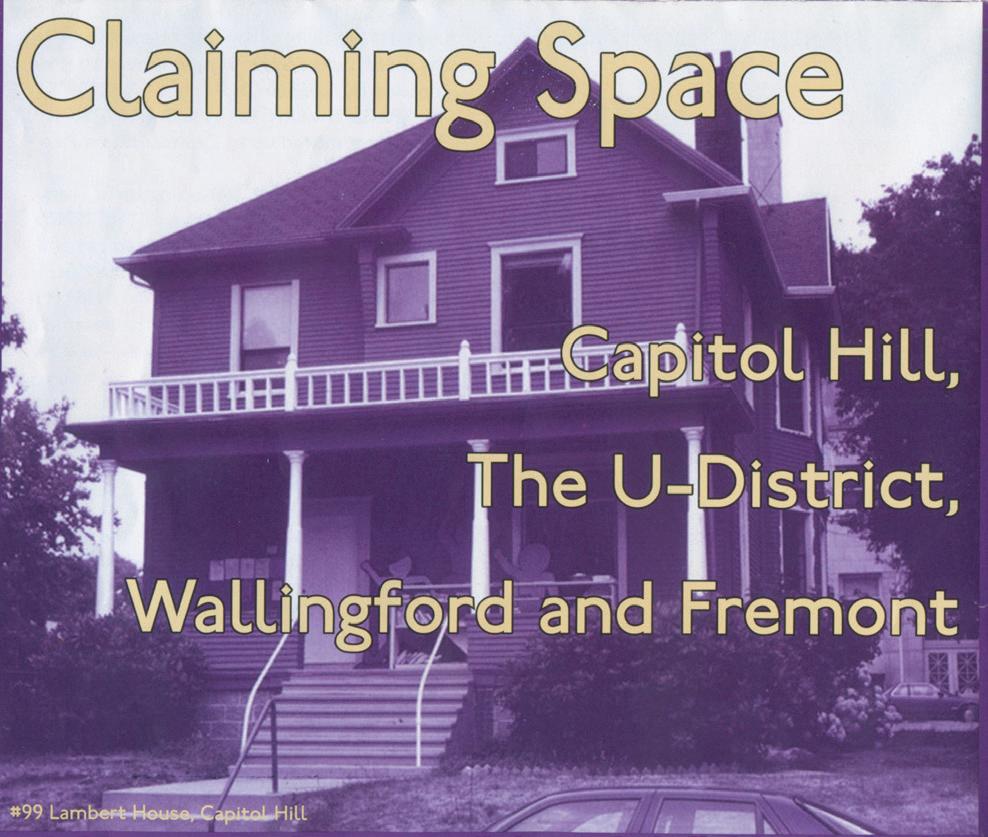
99. Lambert House 1818 15th Av (since 1991). The nation's first drop-in center for lesbian, gay, bisexual and transgender youth, it opened with a youth dance on Pride Day, June 30, 1991.
100. Northwest AIDS Foundation
127 Broadway Av E (1990s-2001) Founded in 1983, NWAF opened its first office in 1986 in Pioneer Square. Merged in 2001 with the Chicken Soup Brigade to become the Lifelong AIDS Alliance.
101. Pink Zone 211 Broadway Av E (1998-2002) An emporium of queer goods and paraphernalia. Earlier was in the Broadway Market c.1991. Later moved to 909 E Denny Way.
1 02. Playspace LTD. 1512 11th Ave (c.1996) B&D playspace.
103. Queer Nation 1701 Broadway (1995). A radical queer activist group, Queer Nation met at Seattle Central Community College in the mid-1990s.
104. R PLACE 619 E Pine St (since 1991) Large three-story bar. Used to be on E Pike (see #34)
105. Red and Black Books 432 15th Av E (1996-c.2003) Formerly this bookstore was in the U-District (see #42).
1 06. Safari Sports Bar & Grill 1518 11th Av (c.1998)
107. Seattle Gay And Lesbian Chorus 1710 11th Av The chorus began rehearsing here in 1989.
108. Sojourner Truth Unity Fellowship Church 1632 Broadway (1995-present) Holds glbt-friendly worship services in the African American tradition.
109 Sunshine Thrift Shop 1605 12th Av #25 (1996-present). The Sunshine Thrift Shop helps people living with AIDS and HIV.
110. Tatoo You 1017 E Pike St (1996-1998). On busy Saturday nights, you can see folks coming right out of Tatoo You and lining up next door to get into the Wildrose with their fresh tats!
111. The Easy 916 E Pike St (1994-1997) A women's bar
112. Toys in Babeland 711 E Pike St (1994-present) Women-owned erotica store catering to the community.
113. Tugs 518 E Pine St (1991-1994)
114. Wildrose 1021 E Pike St (since 1984) The Wildrose is said to be the oldest existing women's bar on the west coast.
115. Hot House Spa and Sauna SW Corner of Pike and 11th (c.2000) A women's sauna.


“IN AND OUT:
Being LGBTQ on Vashon Island” Vashon Heritage Museum June 7 - March 2020
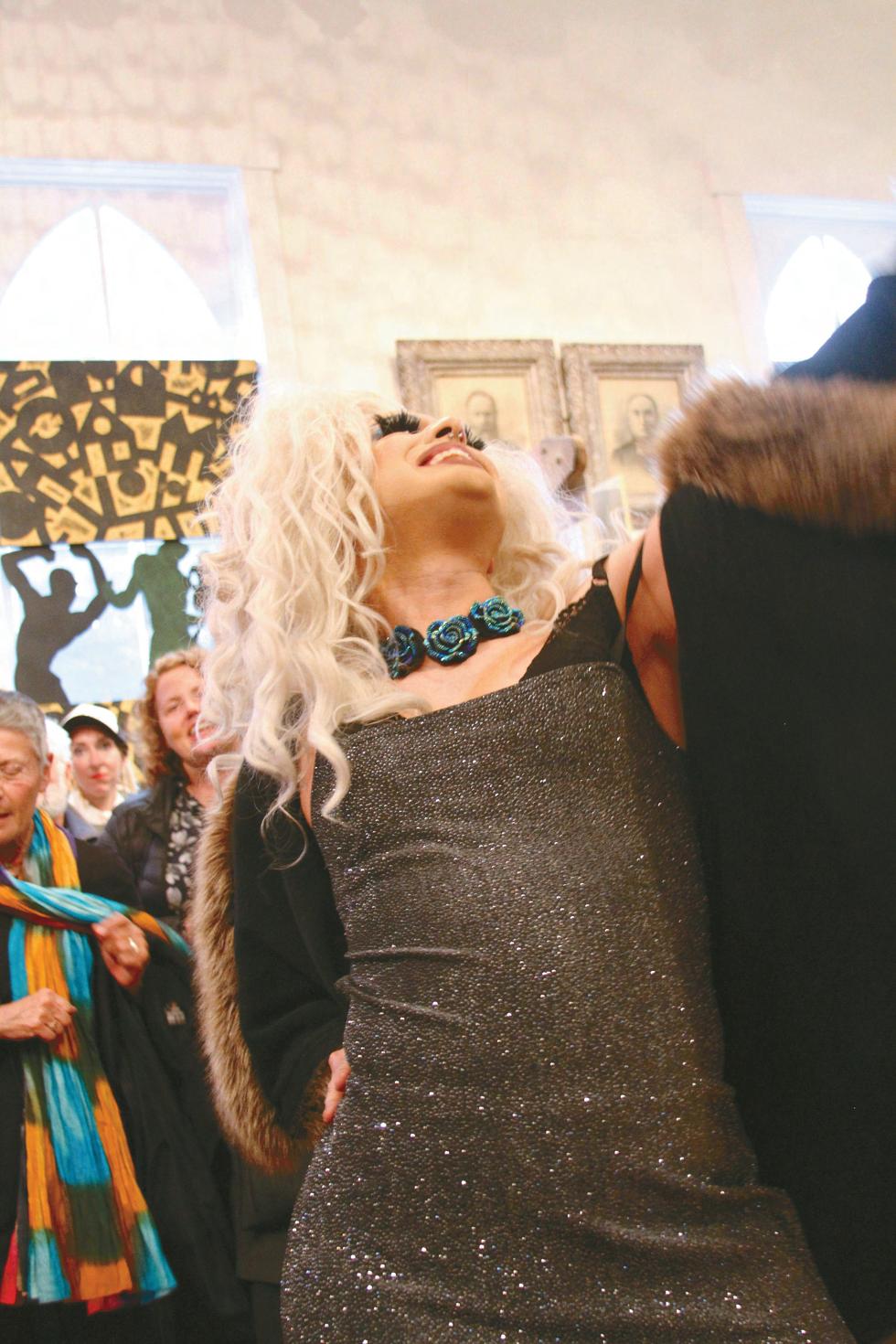
On Friday, June 7, Vashon Heritage Museum (10105 SW Bank Rd, Vashon) opened their largest special exhibit ever: “IN AND OUT: Being LGBTQ on Vashon Island.” Over 600 people attended the exhibit’s opening night celebration.
More than a year in the making, the exhibit explores the long, quiet history of LGBTQ people on Vashon Island – their challenges, contributions and visions.
To create the exhibit, co-curators Ellen Kritzman and Stephen Silha interviewed over a dozen people, spoke with old-time Islanders, issued a questionnaire asking about LGBTQ life, assembled a multi-generational advisory committee, and held a “story circle.” They researched articles and family histories, put out the word for photos and artifacts, and searched for film and videos.
Even though Vashon has the highest per capita population of LGBTQ people in Washington state (and one of the highest
in the country), there is no cohesive queer community here today.
Yet the Island hosts a rich assortment of families, individuals, artists, entrepreneurs, gardeners, chefs, organizers and public servants who consider themselves LGBTQ.
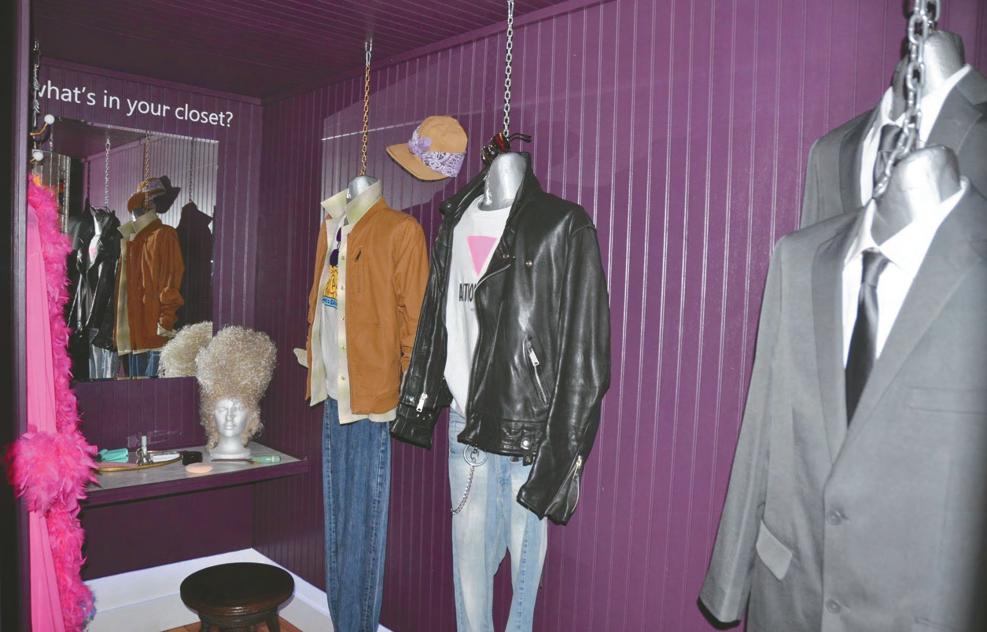
“It has been an enormous privilege to have folks be willing to be fully OUT of the closet, and open up their lives to us, and to you. We hope we have made the exhibit interesting and impactful for everyone, gay and straight and everywhere on the spectrum,” Kritzman and Silha wrote in their curators’ statement.
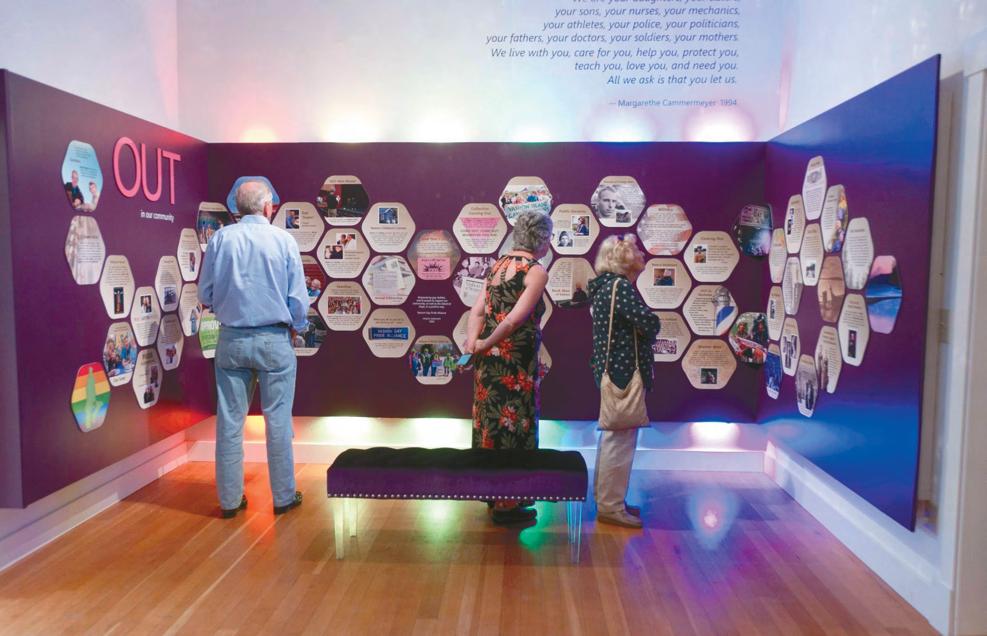
Th e exhibit includes a timeline of LGBTQ history, a honeycomb of stories about Island queer history, an AIDS memorial garden curated by Terry Welch and Peter Serko, and a display by Vashon High School’s largest student organization, the Queer Spectrum Alliance (QSA).
The exhibit runs through March, 2020. The Museum is open Wednesday through Sunday from 1pm to 4pm and on First Fridays from 6pm to 9pm in summer.
Courtesy of Vashon Heritage Museum


“When I came out in 1955 I believed Gays would never be accepted by society. The
by Stephen Silha Special to the SGN
“IN AND OUT:
Being LGBTQ on Vashon Island”
Vashon Heritage Museum
June 7 – March 2020
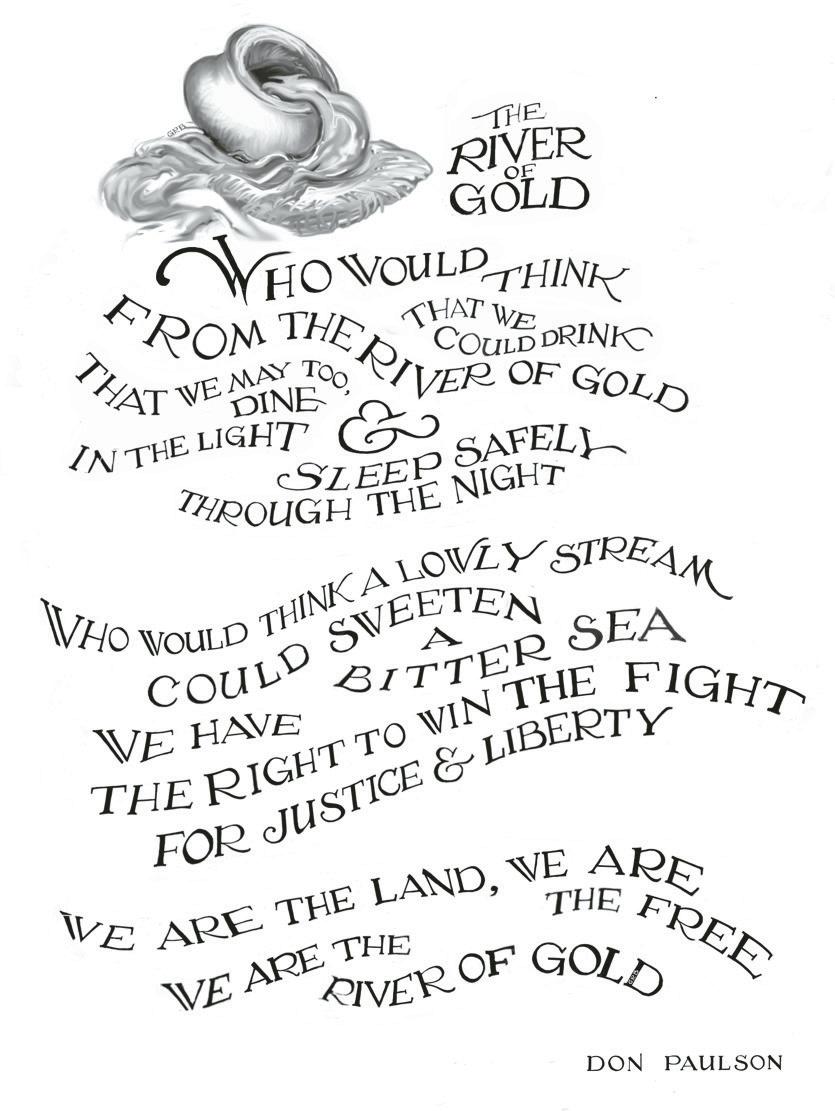
Vashon Island’s Don Paulson (19332011) poetically invites people into the new exhibit at the Vashon Heritage Museum, “IN AND OUT: Being LGBTQ on Vashon Island.” His poem “River of Gold,” calligraphed by bell artist Gordon R Barnett, was written in the early 2000’s to express his joy with queer acceptance.
Artist Don Paulson was Mr. Gay History Seattle, but he was more than that. His curiosity was insatiable, and he recorded his life and others’ in paintings, drawings, books, letters and archives now housed at the University of Washington and the Museum of History and Industry.
Paulson penned a Seattle Gay History Column for Seattle Gay News for many years, chronicling gay life mostly through interviews with people who frequented such queer locales as the Garden of Allah (1947-1957), South End Steam Baths (18921998), and the Double Header bar in Pioneer Square.
A contributor to the Northwest Lesbian & Gay History Museum Project, he interviewed iconic drag queens and helped assemble maps and resources so LGBTQ people would not forget their roots. He had his own gay feelings at 9 or 10, and devoted
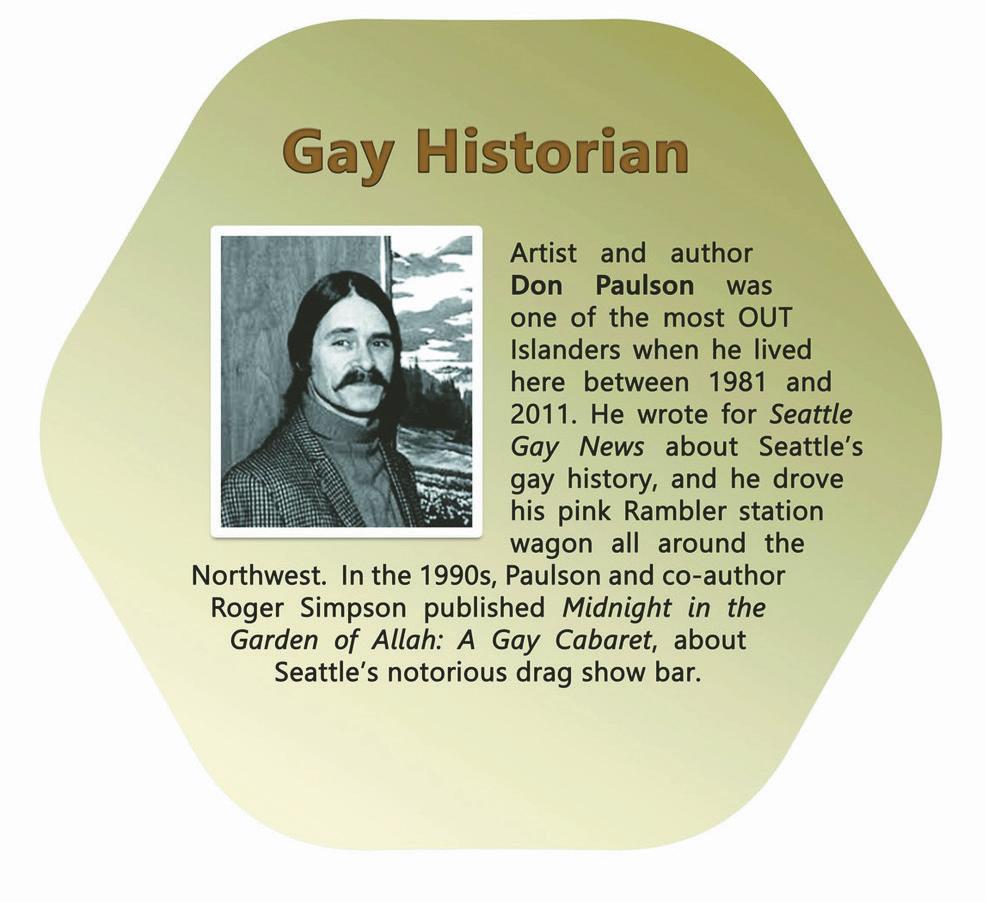
his life to social justice and equality, as a participant in such organizations as the revolutionary feminist Freedom Socialist Party and Black & White Men Together. Born in Seattle and schooled in Auburn, Don Paulson was a lifelong painter and artist. He lived in New York and hung out at
Andy Warhol’s Factory in the 1960’s, but returned to the nature, weather and imagery of the Northwest. In 1967, he organized the “Lux Sit” Light Show Co. and did 150 light shows for rock bands including the Grateful Dead, Jefferson Airplane, Pink Floyd, Chicago, Big Brother and the Hold-
ing Company, and Country Joe and the Fish. His light show equipment is now in the collection of MoPOP, the Museum of Pop Culture in Seattle.
His artwork, often depicting Northwest nature and people, is in the collections of the Seattle Art Museum, Anchorage Art Museum, Nordic Heritage Museum, City of Seattle and many corporate and private collections. An exhibit of his art is planned for January 2020 at the Snapdragon Café and Black Cat Cabaret on Vashon.
His book An Evening at the Garden of Allah: A Gay Cabaret, co-authored with Roger Simpson, was published in 1996 by Columbia University Press.
Quiet and unassuming, Paulson nonetheless made an impact on his beloved Vashon Island. He contributed oral history interviews to the collection of the Vashon Heritage Museum on “Those Damn Hippies,” who moved en masse to the previously conservative island in the 1960s and were partly responsible for the Island’s largely liberal culture today.
The Vashon Heritage Museum (10105 SW Bank Rd, Vashon) is free and open to the public Wednesday through Sunday, 1pm to 4pm and also on First Fridays from 6pm to 9pm in summer. The IN AND OUT exhibit opening gathered a crowd of over 600 people on June 7.
A website is being developed to give background on the exhibit and serve as an ongoing resource for the Island’s LGBTQ community at vashonpride.com.
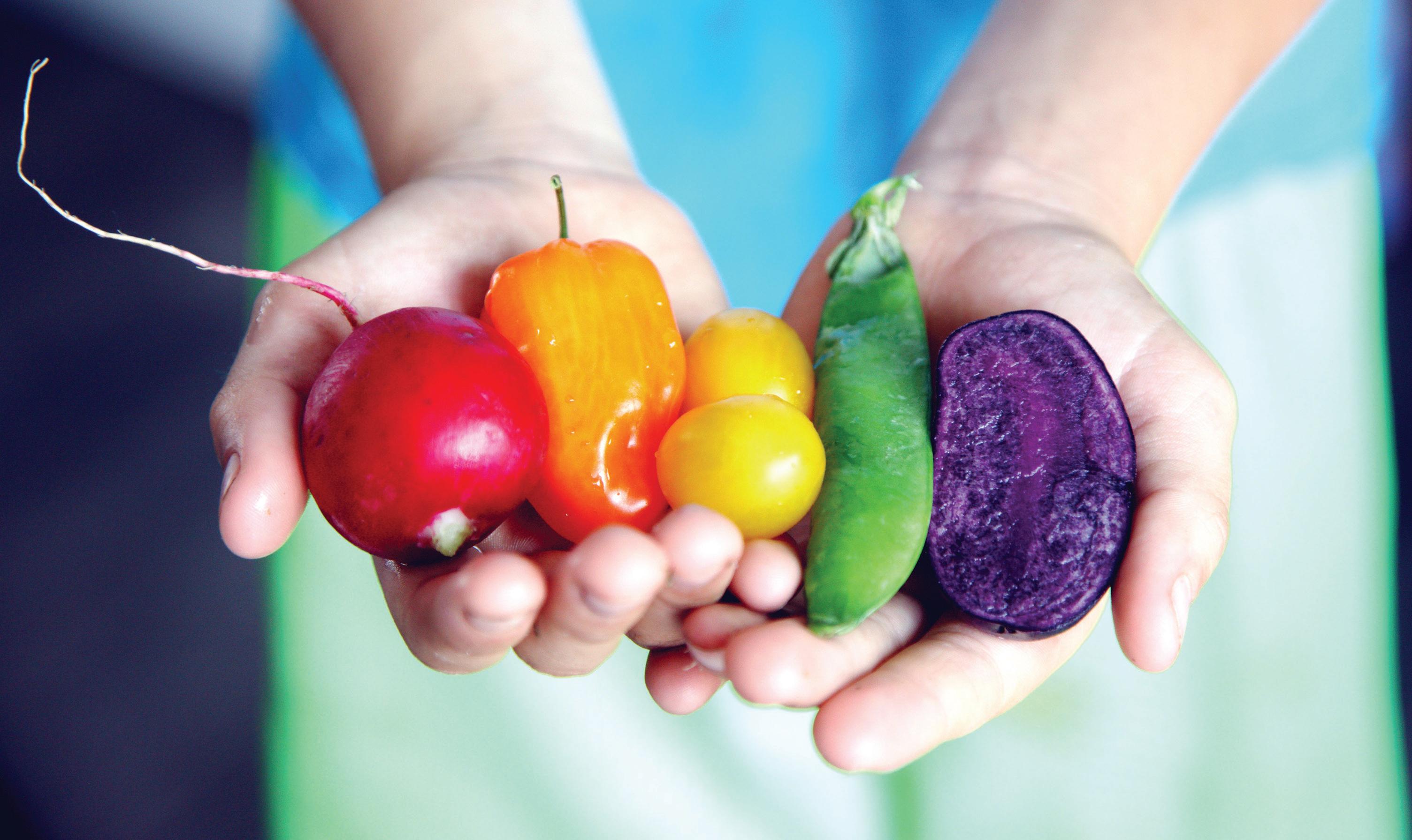
Eliminating hunger requires addressing its root causes in poverty and social disparities. Food Justice acts to remove the significant structural inequities that exist within both our food and economic systems and addresses the barriers to healthy and nutritious food disproportionately experienced by LGBTQ+ communities, people of color, women, immigrants, and other often marginalized groups.
Please join us in bringing equity to our state’s food system.