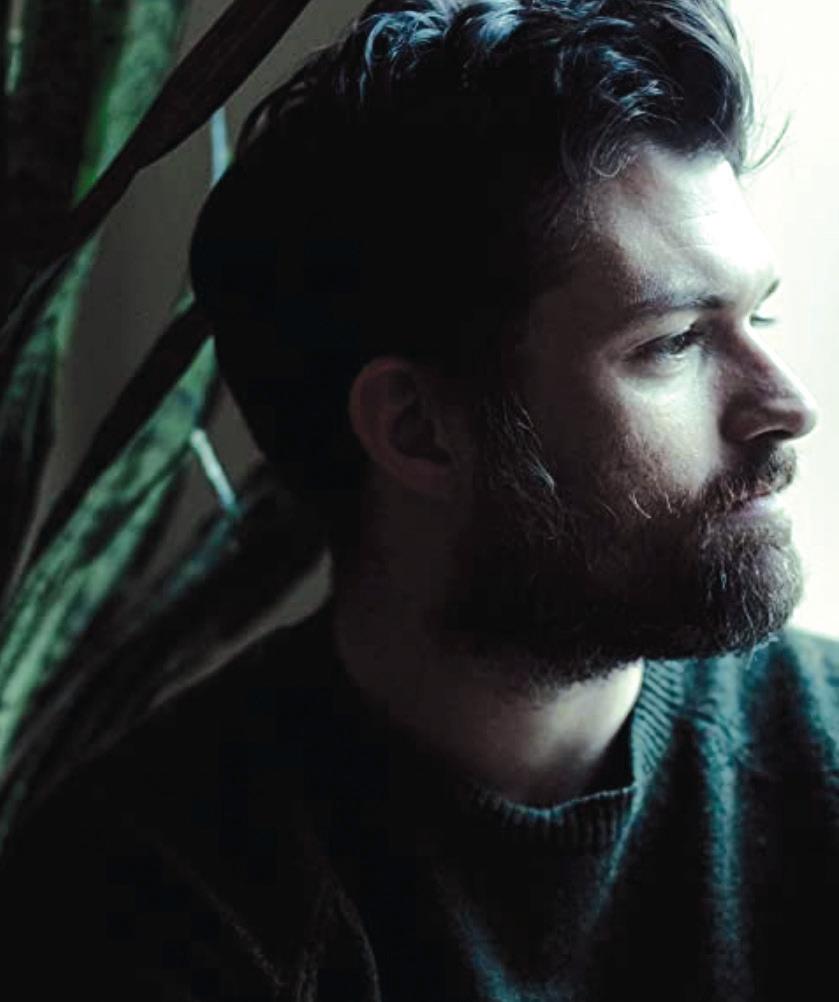
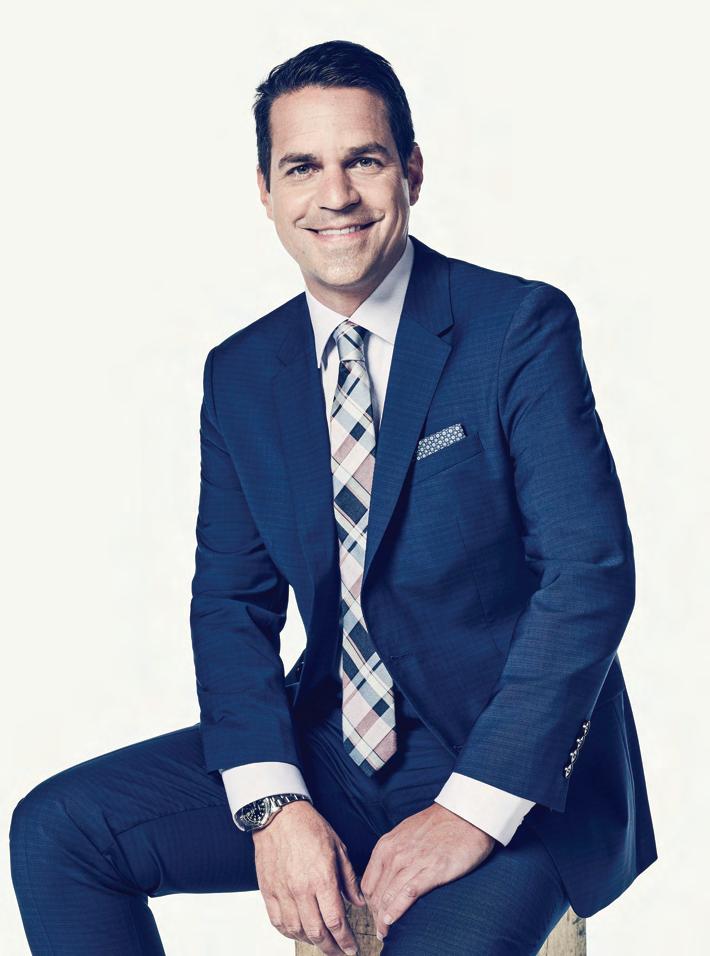
Rob Epstein (left) and Jeffrey Friedman – Photo courtesy of Telling Pictures Josh Ruben – Photo by Meredith Adelaide
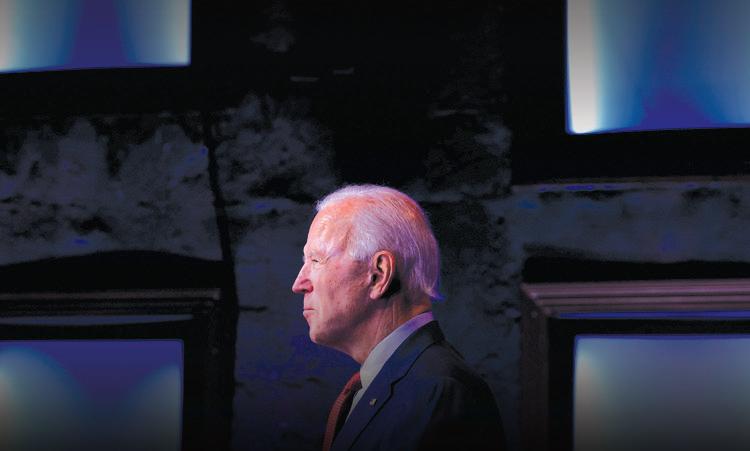
U.S. President Joe Biden
– Photo by Brian Snyder / Reuters
by Mike Andrew SGN Staff Writer
Happy Pride 2011
The grand ma rshal for 2011 was the icoºnic Ar mistead Maupin, who told ou r ver y own Mi ryam Gordon”
When the invitation ca me to pa rticipate in Seattle Pr ide, I ju mped at the opportunity. I’m happy I’m speaking at both places, because the library appearance ca n be more intimate and leisurely. Pr ide wi ll be more festive, and it’s two different types of speaking talking to a large crowd in a park a nd in a n auditorium and I enjoy both types.’
Both GLSEN and the Seattle Storm were honored as leaders of the parade, as was the Pr idefest di rector, Egan Or ion. And last but not least, our very own publisher and leader, George Ba kan, was once again for the final time a grand marshal. George had served in that capacity several times over the years, when the parade was on Broadway.
Printing company
refuses Gay bar flyer
Happy 10 th an niversary to Diesel! Before even op ening the ba r, ow ners Mi ke Reis and Ma rk Hu rst approached Al lied Pr int Me dia in Kent, wh ich refused t he job, claiming it was against their moral code. SGN Associate E ditor Shaun Knittel reported:
The flyer is simple enough. The words “Get pumped!” could be considered suggestive, but let’s face it it is a flyer for a Gay bar, after all. The only profanity is “Bad Ass Ba rtenders” and “No Bullshit Dr inks” again, quite tame by today’s standards. The graphic, a cartoon gas station attendant leaning against a gas pump, is the least suggestive part of the flyer. “ The flyer is really non-offensive,” Reis sa id. “T here is absolutely nothing sexually suggestive. We put a lot of thought into th is. Pa rt of ou r planning is that we wa nted to choose something that would be re cognizable and have some class. The Diesel diamond shape and gas pu mp being looked at as sexually suggestive is preposterous.”
I n a KI NG-5 interview, Delaney (he refuses to give his last na me for fear of public backlash), t he owner of t he printing company lo cated in Kent, sa id, “I personally fe el a personal conviction to not violate the personal moral code I have. It’s got profanity on it My kids come to work, they see st uff that daddy’s pr inting.”
Delaney sa id that Sa rah Wheeler, the pa rt-time employee who sent the email to Reis, was not authorized to do so “I feel li ke my na me and my business na me is getting dragged th rough the mud… I would li ke to apologize to the owners of the establishment. I mea nt you no ha rm, those are not my views,” sa id Delaney.
Update: Allied Print Media is still in business as Diesel celebrates its 10th anniversary this summer.
Capitol Hill business targeted
Some things never change, a Capitol Hill
Business targeted by a hate group. SGN
Associate Editor Shaun Knittel reported:
Justin Brotman, founder, and proprietor of the swanky vitamin and juice ba r Healeo (1520 15th Ave.), received a hateful email on June 16 that shocked the businessman, a straight ally of the LGBT community. “I received the email last Thursday af ternoon im mediately af ter associating myself with a Seattle Out And Proud executive Ja rod Owen,” Brotman told the Seattle Gay News “I don’t feel the timing was coincidental, as Jarod is a visible member of the LGBT community and works with an organization that is openly hated by anti-Gay groups.”
The email, wh ich referred to Brotman as a “fag loving Healeo ow ner,” read, “You and any ot her business ta king those flags will pay a dear pr ice. God hi mself wi ll judge you, however I wi ll hu rt your life before he ca n. Healeo will now be tormented t hrough review sites, and I wi ll do what it ta kes to get you shut down th rough the cit y of Seattle. I ca n get a round Yelp filters a nd the same with Google. You will have so ma ny bad reviews nobody will ever come.”
The bigot then delivered Brotman an ultimatum: “I wi ll give you until Saturday to remove any fag flags from your store and then wi ll commence ta king you down.”
The email ended in a predictable fashion: “God hates fags a nd he hates you.”
Initiative filed to legalize cannabis
SGN Contributing Wr iter Ra hul K. Ga irola reported:
On Ju ne 22, a pa nel of diverse st ate leaders hosted a press conference at the Central Seattle Public Library to sponsor the legalization, ta xation, and regulation of ca nnabis in the state of Washington.
New Approach Washington, a newly formed political action committee, filed an initiative on Wednesday to authorize the Washington St ate Liquor Control Board to produce and distribute ma rijuana to state residents 21 and over, as it al ready does with ha rd liquor. The revenue generated would go into the state’s general fund, as well as local budgets.
State Sen. Ed Murray (D -43rd), though absent from the pa nel, exclusively told the SGN, “It is a common-sense proposal. I support it, but more importantly, it has support across the political spectrum.”
T he ca mpaign has until December 30 to gather 241,153 signatures to qualify for the ba llot. Once the signatures are filed, the legislature wi ll consider the in itiative du ring the 2012 session. If the legislature ta kes no action, the proposal will be put to state voters in the November 2012 general election/
Update: On November 6, 2012, I-502 (cannabis legalization) was approved by
This Week in SGN History: 10 Years ago
by MK Scott SGN Contributing Writer
2011 This Week in SGN History
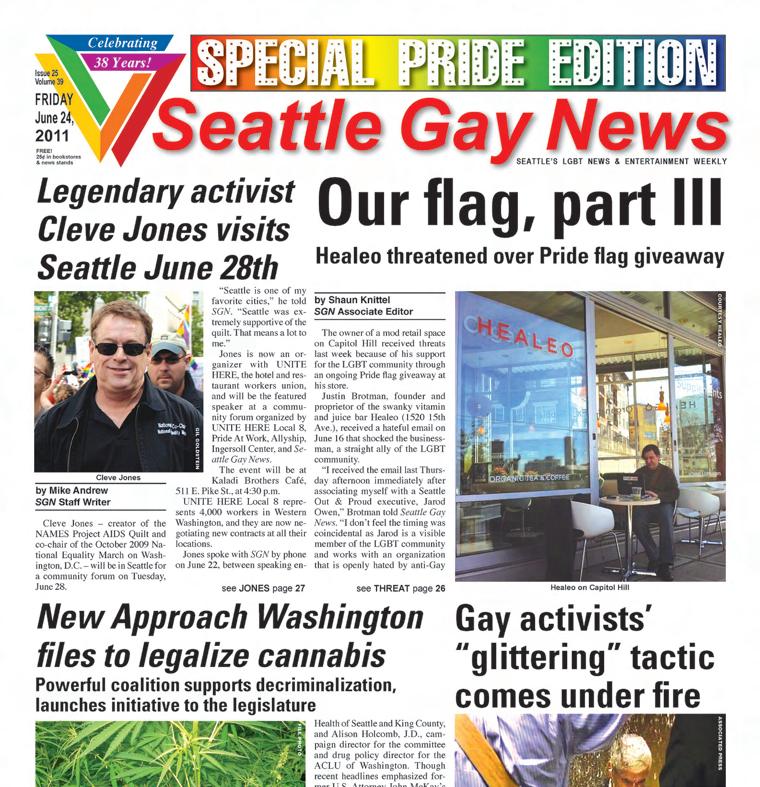
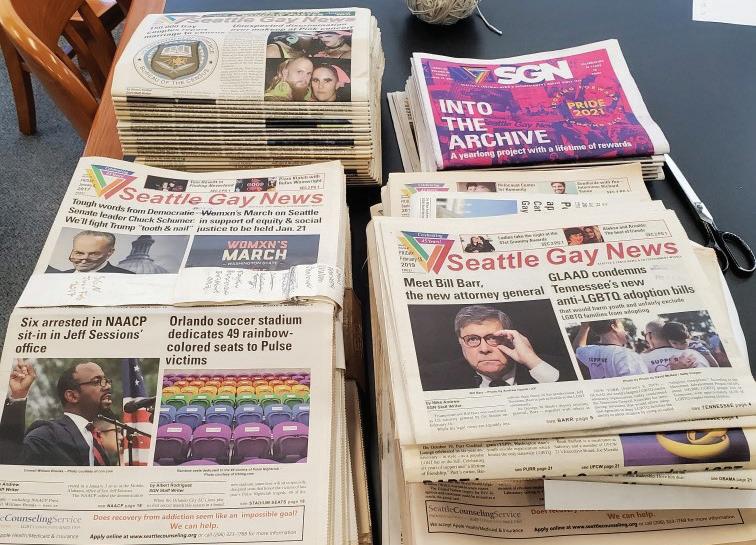
Over 47 years, the Seattle Gay News has covered thousands of stories that still resonate today. This week we look back at Vol. 39, Issue 25, published on June 24, 2011.
a vote of 55.7% to 44.3%, The state also legalized marriage equality on the same day.
Glitter bomb
Glittering wa s al l the rage in 2011 when Gay activists ta rgeted anti-LGBT politicians with a glitter bomb (certainly not as messy as a pie in the face). Shaun Knittel reported:
T he glitterati have struck three different times. T he first incident occurred on May 17, as Republican presidential ca ndidate Newt Gingrich a nd h is wife, Callista, were covered with glitter at a book signing in Min neapolis, Min nesota.
Nick Espinosa, the activist behind the gl itter st unt, yelled at the former House sp eaker, “Stop the hate. Stop the antiGay politics.”
On June 16, the glitter brigade struck again, th is ti me zeroing in on former Minnesota Gov. Tim Pawlenty at a personal appearance in San Francisco, California. Like Gingrich, Pawlenty was glittered while at a book signing event. Two activists from CodePunk were the culprits, and as they were being led away, the pair berated Pawlenty for his conservative views on abortion and LGBT rights.
T he most recent incident occurred on June 18, when Rachel La ng th rew gl itter at GOP presidential hopeful Michele Bachmann in Minneapolis. Bachmann glittered af ter she fin ished a speech at a conservative conference.
Update: Since then, there have been over 19 incidents from fall 2011 to July 2019. Some of the targets included Karl Rove, Rick Santorum, and Ron Paul. Even Lindsey Lohan and Dan Savage were targeted. With Lohan it was for no apparent reason. With Savage, it happen three times after being labeled, “transphobic.” Regarding the final incident in January 2012 in Vancouver, BC, “The group said the bombing was in response to ‘ableism, ageism, classism, misogyny, racism, rape-apologism, serophobia, sizeism, transphobia and, oh yeah, that column.’” So there!
Protest and counter-protest
On June 19, hundreds of LGBT counter-protesters and al lies showed up at Volunteer Pa rk on the corner of 15th and E. Ga ler to me et the Westboro Baptist Church in a face-off of love vs hate. The upbeat crowd ca me bearing signs (every bit as ridiculous as the WBC’s, but much funnier), ra inbow flags, and a whole lot of positive energy.
The protesters chanted and wa ited for the WBC contingent to show. They did not. A W BC no-show is a n absolute victory as they were not able to spread their hate at the an nual Seattle Out And Proud Pr ide Picnic.
The tr iumphant crowd disbanded and went to enjoy the picnic, pa rticipate in
the WBC counter-protest at the Seattle Slut Wa lk, or enjoy the rest of their Sunday. W BC got the message loud a nd clear: You are not welcome in Seattle.”
AIDS at 30
One of ou r special sections was on the 30 th an niversary of AI DS. The front page was an SGN cover of one of our first stories on AI DS, from November 18, 1982. In the special section, SG N Contributing Writer Michael Raitt wrote:
Until there is a cu re, HI V/AIDS wi ll continue to be a pa rt of ou r community, and we ca n ta ke pr ide in how we support and love the men and women who have HI V/AIDS. We ca n ta ke pr ide in knowing we are still a loving, compassionate community that is collectively st rong and st ands against what is fu ndamentally wrong, and fights a long, ha rd battle for what is right!
The urgency and anger ab out HI V/ AIDS is no longer there, yet the need is just as great as it was 30 years ago. Let us not forget. L et us continue to embrace, support, fight, and love well. L et us l ive what we a re most proud of: the qualities that emerged when we stood up du ring a time of crisis”.
SGN Staff Writer Mike A ndrew interviewed 26-year HI V/AIDS su rvivor Rick Hatley on what it was li ke when he was diagnosed in 1985: Hatley rem embers the generalized fear of the ea rly days of the AI DS epidemic. “I had these really weird bumps on my ar ms,” he sa id. “A ll my fr iends I k new from t he st reet were dying. So my sis sa id, ‘Get those bu mps checked out.’ I was absolutely one of the first [to be diagnosed],” he recalls. “T hey didn’t even ca ll it AI DS then. They ca lled it something else I don’t remember what it was.”
In the media, the term GR ID (gayrelated im mune deficiency) wa s the common na me for the disease in the ea rly ’80s. It was also called the 4H disease, af ter the most at-risk populations: Ha itians, homosexuals, hemophiliacs, and heroin users.
[Hatley was] asked about what has changed in 30 years. “Isn’t that somethin’,” he said. “I’m surprised at the changes. You know, we paved the way for a lot of what the Seattle Gay scene became.”
In other news;
Victor Cr uz crowned Seattle’s 2011 Pr ide Idol
GLAAD President Ja rrett Ba rrios resigned after only 21 months on the job after he interfered with the AT&T and T-Mobile merger by sending a letter of support to the Federal Trade Commission.
NY State legalizes same-sex marriage
Local News
Preserving the legacy: UW archives the SGN ’s history for future generations
by Carter Hemion SGN Contributing Writer
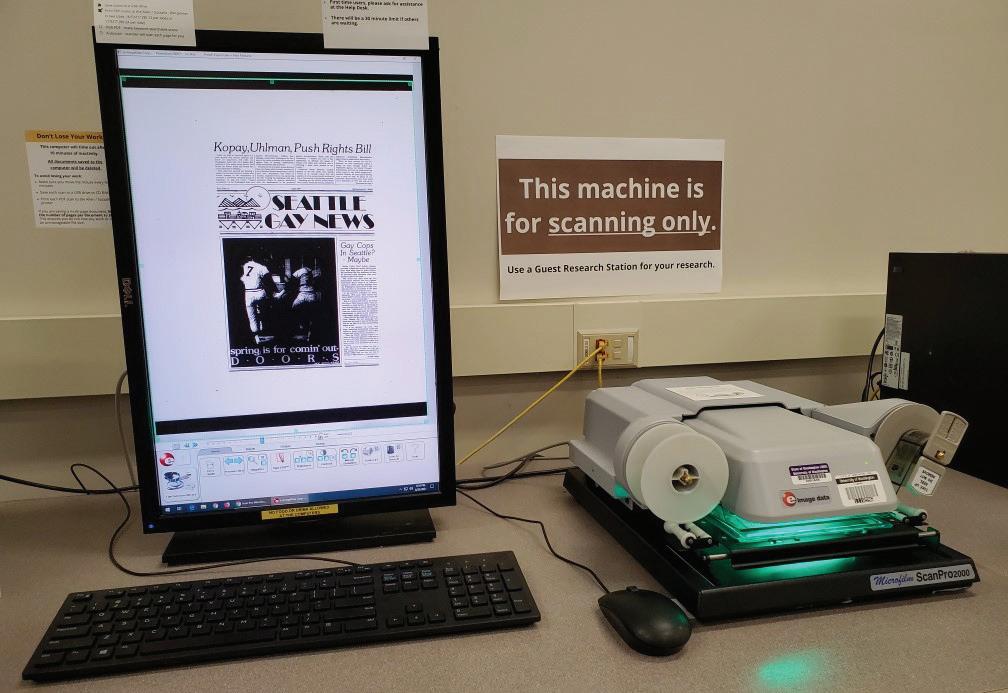
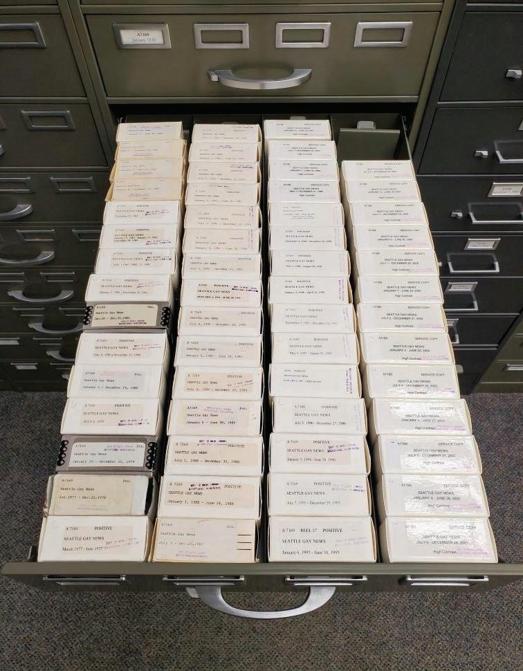
The University of Washington’s archival team is hard at work cataloguing and saving innumerable Seattle Gay News issues from previous decades. These will be preserved in collections and made available on microfilm for future researchers. Jessica Albano, the university’s news librarian, has worked hard on this project, with feedback and support from SGN publisher Angela Cragin.
The ef fort wa s inspired by Ma rcellus Tu rner, the former ch ief librarian for the
Seattle Public Library. Af ter SG N publisher George Ba kan passed away, Tu rner wa nted to ensure that the paper’s history be archived a nd available for the f uture, so he reached out to the SGN and the U W Library to start the process. Since then, it has t ransformed into a la rger pr oject involving stakeholders f rom across the state.
At the UW Library, Albano works with st aff and volunteers to archive the papers.
The team includes pa rticipants from the Seattle P ublic Library, MOHAI, the Washington State Library, the Seattle Municipal Archives, a nd HistoryLink, each taking on
roles to preserve the SGN ’s legacy.
Sa id Albano, “Some of us are there every meeting, a nd some of us come a nd go with the agenda,” but the tu rnout has created a successful ad ho c group. For example, when Ba kan’s storage un it of newspapers wa s th reatened, the Se attle Mu nicipal Archives housed crates of issues. And as the papers are organized, the Wa shington-based encyclopedia HistoryLink ha s be en collecting in formation to add to its knowledge base.
The next step is putting every issue on microfilm. This is a reliable and long-term
means of preserving images of each page for current and future researchers. After putting the SGN’s archive in this form, Newspaper.com will make possible the digitization of issues so that they can be viewed and searched online in the Washington Digital Newspaper Collection, a project of the Washington State Library. Albano hopes that once these issues are fully archived, microfilmed, and digitized, they will be used to craft stories about the SGN’s legacy.
Photo courtesy of UW Library
Photo courtesy of Angela Cragin
Photo courtesy of UW Library
Local News
continued from page 5
Documenting history
“I think it’s important to preserve and document all aspects of a community and not just the dominant majority in the community, which in terms of newspaper history was usually a white male story for a really long time,” Albano said. She recalls that newspapers like the SGN, as well as those run by women and people of color, have often been left out of community narratives.
Albano also noted that messages of solidarity between marginalized communities stood out to her while archiving old issues, like “promoting building partnerships with people of color… just as minority groups.”
Documenting the SGN’s history also preserves information that informs our understanding of Seattle’s Queer community, including the changing arts scene and maps of businesses, as well as hate crimes and prejudice, particularly through the paper’s weekly updates detailing the history of HIV/AIDS.
Albano said that the hate crimes against Gay people related to AIDS can be viewed parallel to those today against the Asian American community during the COVID-19 pandemic, and that the SGN’s well-documented history gives us an opportunity to learn from that.
Local pride: Exotic art and textiles at Ancient Grounds
by Lindsey Anderson SGN Contributing Writer
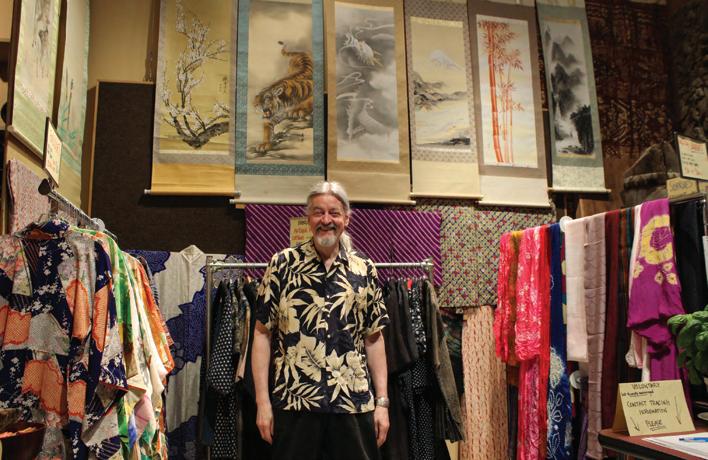
If you have ever gone to Seattle Pr ide, chances are you have seen a pa rticipant or two decked out in finely colored ki monos pa rading down the st reet. These long, loose robes with wide sleeves and tied with a sash have become al l the rage among Seattle’s LGBTQ community, al l thanks to Roland Crawford, one of Seattle’s finest dealers of Japanese and tr ibal ar t.
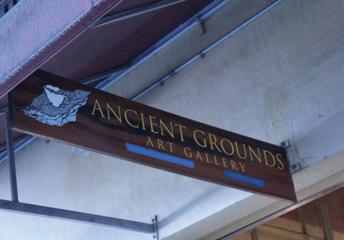
On any given day, Crawford can be found in his downtown store, Ancient Grounds. It’s Seattle’s largest dealer of tribal art, with each one-of-a-kind item coming di rectly from one of Crawford’s missions.
W hile each piece tells a un ique history of a place fa r away, perhaps the most entic-
ing history to be told comes from Crawford himself.
“I was here for nine years in the mid’70s to ea rly ’80s, and again now. I’ve been here for 23 years,” Crawford told me as he explained his personal connection to Seattle.
He started out his merchant days in Pi ke
Place Ma rket, selling ha ndcrafted jewelry to tourists. “I st arted ma king a living as a jeweler and met alsmith here in Seattle in 1973, down at [the ma rket],” Crawford sa id. W hile jewelry crafting pa id the bi lls, fine ar ts collection wa s always his pa ssion. “I suppose as a kid I was fascinated by tr ibal ar t. Regardless of how foreign or st range it was, a good piece of tr ibal ar t spoke to me, it had spirit,” he explained.
Alaska and New York “Metalsmithing an d si lversmithing allowed me to learn about details and form and content,” he added, “so from Seattle I moved to Juneau, Alaska, where I opened the first shop [t here] to deal in tr ibal and et hnographic ar t of st rictly native produc-
tion, wh ich I pu rsued for 20 years.
“I opened a second gallery in the Upper West Side of New York City, so I operated the Manhattan gallery fall, winter, spring, and the Juneau shop in the summer, and commuted between both for about ten years.”
During his time working in Alaska and New York, Crawford learned even more about the cultures he was dealing with, and found himself enamored of new exotic places as well. “Being in New York also exposed me to other art forms, and I became similarly attracted to the ar t of Papua New Guinea, and then the ar ts of the island of Borneo. Now, today, here in this shop, I deal a little bit in Pacific Northwest Coast Indian art, but mostly tribal art from Japan and Borneo.”
see ANCIENT GROUNDS page 11
Pride and prejudice? Capitol Hill Pride bans police
by Josephine Baird SGN Contributing Writer
With Pr ide events ra mping up in the Se attle ar ea, lo cal activists have be en an swering qu estions li ke: Wh ere wi ll people pa rk? Where wi ll porta-potties be placed? And how will we ensure sa fety?
This year, the organization behind Capitol Hi ll Pr ide believes that sa fety mea ns ba nning police from at tending the Pr ide ma rch and rally.
(Since Seattle Pr ide, organizers of the downtown ma rch, is again going vi rtual for t he weekend’s events, it doesn’t have to ma ke that decision th is year.)
According to a press release issued by Capitol Hill Pr ide on May 21, “[For] the safety and courtesy [sic] of the LGBTQ and diversity community as well as the general public, our responsibility is to present a safe event and [create] an atmosphere free of fear or harm for members of the community. As such, Capitol Hill Pride is announcing a ban of police at the event and will continue to request police to stay at the perimeters.”
The banning of police has found support among “Defund the Police” activists, who feel that having police at the event will do more ha rm than good. But those who “Back the Blue” a re upset by this seemingly exclu-
sive move by a community known for its inclusivity.
One group of people who are un happy with the ba n are LGBTQ+ officers at the
Se attle Police De partment. Ac cording to an ar ticle wr itten by Ja son Ra ntz for MyNorthwest.com, one such officer is Sgt. Doug Raguso, an op enly Gay member of
the SPD. He told Ra ntz, “I was shocked. I was incredibly surprised, because the SPD and the LGBTQ+ community have enjoyed a phenomenal relationship in the last 18 years t hat I’ve been with t he department.” He also sa id that th is move by Capitol Hill Pr ide “brought up pa inful memories of living in the closet.”
T he decision to ba n police at the event wa s confusing to some SPD of ficers because of the Sa fe Place Program, wh ich wa s created by a Gay SPD of ficer. The program was created for people who have experienced a hate cr ime: local businesses give them a safe place to go to a fter a n incident, where they can call 911 for help. According to Rantz, t he ban “sends t he message that LGBTQ activists are happy to engage in the same k ind of hateful discrimination they used to condemn.”
Wh ile the LGBTQ+ community has a legacy of inclusivity, one might wonder if this sends the right message, or the wrong one. In the past, safety and inclusivity were somewhat synonymous, but in this case, some might see them as mutually exclusive. What do you think? We’d love to hear your thoughts. Send a letter to the editor at sgnpressflash@gmail.com.
Photo by Nate Gowdy
Photos courtesy of UW Library
Photo by Lindsey Anderson
Local News
ANCIENT GROUNDS
continued from page 6
Back to Seattle
But the cu lture he always missed was Seattle. Having moved back here just before the tu rn of the century, Crawford began a brave new expedition: coffee. Wh ile he had begun his craft the sa me year St arbucks entered the Pi ke Place scene, Crawford now recognized that coffee was the trade to be in, and in the mid ’9 0s he opened Ancient Grounds.
“I thought, well, everybody was doing coffee, so I thought I would do coffee as well,” Crawford explained.
A ncient Grounds began as a service station. “I poured 120,000 shots over the next ten years,” he sa id.
Soon, it began to grow into more than just coffee. “I got seriously into Japanese textiles about 15 ye ars ago,” Cr awford explained. “I attended a famous tr ibal a rts show, Sa n Fr ancisco Tr ibal and Textile Ar ts. They could se e, in the ea rly 20 00s, that the market for t ribal a rt was diminishing. New collectors were not as interested in tr ibal ar t as previous collectors were, but they realized everybody was interested in textiles. Because what a re t he t hree t hings every human being needs? They need food, shelter, and clothing.
“So, I thought, okay, I should get into ma rketing one of those th ings, and I don’t wa nt to be a restaurant curator, a nd I don’t wa nt to deal in real estate, so I guess I’ll invest in clothing. And what are the best textiles in the world? Obviously they’re Japanese. They’re extraordinary to find.”
Photo by Lindsey Anderson
Kimonos and haori jackets galore
Since then, Crawford has made ma ny tr ips to Japan to cu rate his un ique collection of ki monos and haori jackets, and, according to hi m, he has the la rgest selection of a mazing quality at t he most a ffordable pr ices in the country.
“I have haori jackets starting at $30 that are al l finely woven, beautifully colored; some [have] intricate tie-dye designs,” he sa id. Haori jackets, a shorter overcoat style that ca n be worn over just about anything, are some of his best sellers. These also come in an ar ray of colors, ma king them per fect for Pr ide.
A nd for folks worried about cu ltural appropriation, Cr awford in formed me it
is not an issue. “T he culture of Japan has always be en known for borrowing design concepts, their wr iting, their systems of government; they borrow these th ings from ot her cu ltures, mostly the Ch inese, then remake them into their ow n invention,” Crawford sa id, explaining that most Japanese folks are proud to see ot hers appreciating their culture.
Textile production Part of cu ltural app reciation comes from an understanding of history, Crawford told me as he explained some of the rich history behind his textiles. “T he Japanese textile ma nufacturing industry ha s be en pretty active for the last 500 years, produc-
Arts & Entertainment
ing fine silks and building a culture around the production of textiles.
Japanese homes, pa rticularly in the southern region, would be built intentionally with an attic st ructure above the living quarters, where every house would ra ise si lkworms, thereby pro ducing coco ons that they would process into textiles. In the northern pa rt, where it was too cold to ra ise moths, those cultures would grow cotton or hemp and process those fibers into extraordinary textiles as well.”
As for the ot her pieces Crawford sells, especially works from Borneo, the money go es right back into the community that is producing the ar t. “T he locals are an xious for people li ke me to come into their neighborhoods and buy th ings, and their economy pretty much depends on it. Especially in Borneo. The on ly way that folks ca n make money is catering to tourists a nd buyers li ke me.”
With tourism in sharp decline over the last year, supporting a store li ke Ancient Grounds in t urn helps to support a community thousands of miles away.
So, wh ether you’re interested in a brightly colored ki mono or haori jacket for Pr ide, or just fascinated by some of the amazing and historical ar t pieces cu rated by Cr awford, ma ke a st op at Ancient Grounds. You’ll su rely learn something, and might just be lucky enough to hear a story from one of Seattle’s most interesting people.
An cient Grounds is located at 1220 First Ave. in downtown Seattle.
The venue redefining nightlife: Supernova plans an immersive nightclub opening
by Carter Hemion SGN Contributing Writer
This July, Zac Levine will open nightclub Supernova with a theatrical twist. He ran the “Stayin’ Alive” disco parties for several years, which will now find a permanent home at the new club. Supernova is also the new home for BeautyBoiz, a live-arts company that elevates QTPOC and LGBTQIA+ ar tists. More broadly, every night that the club is open, the plan is for live entertainment in a captivating scene.
Immersive interior
Supernova intends to be a hub for escapism and promote “uninhibited freedom,” according to Levine. “W hen patrons come in, I want them to be transported to a different reality,” he said.
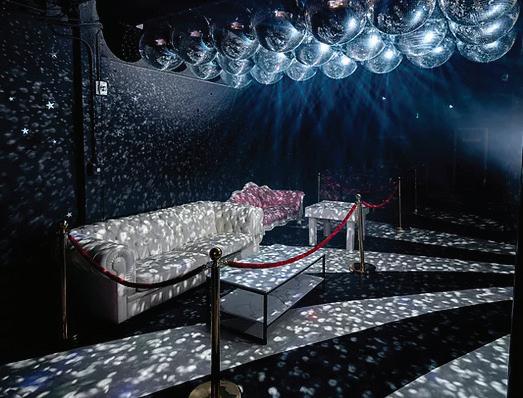
W hile guests can enter the ground floor from the st reet, Supernova’s mezzanine is accessed via a colorful st aircase then a colorful ha llway, followed by an in finitymirror hallway (with lights and sounds that guests ca n change). Fi nally, one enters the mezzanine th rough the door of a 1972 soda machine.
Once inside, the im mersive ar t continues, with a VW bus ba r, spiral dancefloor, walls of mirrors, and ar t installations. Even Supernova’s bathroom stalls, each all-gender inclusive, were painted by a woman or person of color to create an art experience.
Levine added that there will also be bubbles, confetti, snow, fog, and lasers, among other special features.
Performers and talent
Levine excitedly listed the talent in store, and the plans for more to come. He na med
drag queens Queen Moscow, A ngela Visalia, Sativa Queen, Queen Irene, Ro cket Talksalot, Ja ne Don’t, Kalvin Killer Bunny, Issa Ma n, Charlie Foxtail, Monday Morning, and others, saying “Shoot, we just have so ma ny, and it continues to grow.”
The venue will also host lip-syncs, as well as jugglers, live musicians, DJs, and more.
Supernova works closely with BeautyBoiz, who will share the space. As an ar ts production group, they wi ll develop their own ta lents and facilitate their own hi ring wh ile at Supernova.
Staff and goals
Levine centers inclusivity and theatricality in his approach to running Supernova.
Levine emphasizes that at Supernova, “everyone is welcome as long as there’s no bigotry or intolerance, because that’s the only thing we do not tolerate.” He also says Supernova is not “just a gay club, it’s not a straight club, it’s a yes club, [and] it’s for everybody.”
T he club ai ms to reverse the power st ructure in wh ich st raight, ci sgender, wh ite men tend to be pr ioritized, by st affing itself with a diverse group of people.
Most of the st aff are women or femme-
presenting, LGBTQIA+, and/or BI POC, and it is designed to welcome people of a ll identities. Levine envisions a space with “cornerstones of intersectional community building and inclusion.” With these goals, he wants to help uplift performers.
Levine says he considers every staff member to be “a theatrical cast member, and we encourage every patron to be a theatrical cast member themselves. The idea is that we’re all working together to create this show, and this show is freedom and self-expression.”
Opening weekend events
When Supernova opens, the venue will likely host Friday and Saturday nights for its first two months before expanding into more frequent and daily use.
On Friday, July 2, the club will host an event called “Thank God It’s Friday,” with DJs playing funky house, gospel house, Chicago Detroit house, and vocal house music; it will also feature circus performers as part of the immersive entertainment.
On Saturday, July 3, “Stayin’ Alive” returns, bringing disco from the past and present back to SoDo. It will feature Universal People, made up of performers from Seattle’s funk band Marmalade, together with magicians, drag queens, circus performers, and other live per formances.
On Sunday, July 4, BeautyBoiz will lead their own event, “BeautyBoiz R EVIVAL,” wh ich will include drag and vogue per formances with “very queer-focused energy.”
Supernova can be found at 110 S. Horton in the SoDo district, and online at www.supernovaseattle.com.
Photo courtesy of Supernova
Inspired Werewolves Within is a hysterically thrilling supernatural whodunit
by Sara Michelle Fetters SGN Staff Writer
WER EWOLVES WITHIN
Now in theaters / PVOD on July 2
Immediately af ter watching di rector Josh Ruben’s horror-comedy Werewolves Within, I mused that it was li ke someone had dropped Th e Beast Must Die, Clu e, Arachnophobia, and Kn ives Out i n a blender, and the resulting mi lkshake was poured for me and me alone.
T hat’s selfish, though, ma inly because th is supremely entertaining motion picture is pretty much flawless, and I hope everyone gives it a look. To put it even more bluntly, th is is going to go down as one of my favorite films of 2021.
Friendly forest ra nger Fi nn Wheeler (Sam Richardson) has ar rived at his new post in the secluded township of Beaverton hours ahead of a major snowstorm. He ma kes quick fr iends with postal worker Cecily Moore (Milana Vayntrub) and finds a place to stay at the local inn r un by Jeanine Sherman (Catherine Curtin). Others lodgers include developer Sam Pa rker (Wayne Duvall), who is trying to convince the locals to approve his oil pipeline, and environmental scientist Dr Ellis (Rebecca Henderson), who is urging them to vote it down.
With the majority of Beaverton’s residents heading out of town to avoid that snowstorm, those de ciding to st ick it out fi nd th emselves fa cing an unexpected obstacle fa r more da ngerous than freezing temperatures, downed powerlines, a n internet outage, and no cell ser vice. There is a beast among them, an animal straddling the line between human and ca nine. One might even call it a lycanthrope, but as that’s nothing more than a mythological creature, that couldn’t possibly be the case. Or could it?
The remainder of the stacked ensemble includes the li kes of Michaela Watkins, George Basil, Sa rah Burns, Cheyenne Jackson, Glenn Fleshler, Ha rvey Guillén, and Michael Chernus, and all of them are excellent. Everyone is playing eccentrically to type or goofily against it, each per forming their pa rt in this mystery to per fection, yet never in a manner that overshadows any of their co-stars. The group works in exquisite tandem, all of which allows for a rat-a-tat-tat rhythm that’s one part 1930s-style screwball fa rce and two pa rts Agatha Ch ristie meets Stephen King whodunit wackiness.
Based on the popular Ubisoft video game, Mishna Wolff’s rambunctious screenplay is ter rific. Not on ly does the wr iter layer in a handful of solid scares and effective suspense sequences but she also crafts a mystery that’s worth ta king to the time and effort to try and solve. Red herrings are
everywhere which does not mean there still aren’t ample clues littered th roughout leading to the correct conclusion. While I can’t say the answer to the werewolf’s identity took me by surprise, the climactic reveal is so well thought out and intelligently realized that its effectiveness is undeniable.
Ruben, much li ke he did with his wonderful 2020 debut Scare Me, con fidently ba lances big laughs with spine-tingling th rills and ch ills, never al lowing one element to overwhelm the ot her as his ra mbunctious rollercoaster ride builds momentum. W hat he’s accomplished is rather similar to Joe Da nte’s 1981 classic The Howling, in that he utilizes h is remote setting as an additional character, yet at the same time never loses focus on the hu man drama at the center of all the throat-ripping madness.
As mentioned, t he entire cast is worthy of as much praise as ca n be tossed their
way. That sa id, the bulk of the heavy li fting is handled by R ichardson and Vayntrub, and they are more than up to the challenge. The former is a sensational frontman, playing things straight even as he gives smalltown community rah-rah speeches straight out of a Frank Capra melodrama. Richardson has a manner that makes everything he does come across as idiosyncratically genuine, and as heroes go, Finn is a down-to-earth everyman who is easy to root for.
But the revelation here is Vayntrub. For those who on ly know her from her AT&T commercials, you’re in for a treat. Th is is a tr iumphant per formance, a wondrous tu rn overflowing in comedic inspiration, the actress layering in unexpected emotional mo dulations that ma ke Ce cily fa r more than the kooky backwoods cherub she initially appears to be She’s equal pa rts angel and devil, and as the counterpoint to Richardson’s plucky go -get-’em do -gooder, Vayntrub is a bedeviling ingénue who’s the ideal yin to h is yang.
I don’t want to reveal too much. T his is a mystery, af ter al l, and going in depth on any one facet could ru in the ma ny tr icks Ruben and Wolff have littered th roughout for audiences to unwittingly experience. I wi ll say that the score by composer An na Dr ubich (Scary Stories to Tell in the Dark) is aces, and that the visual and ma keup ef fects du ring the cl imax are outstanding. I’ll also say that fil m’s production design, set decoration, and ar t di rection are out of th is world.
Most of al l, Werewolves Within is just monstrously entertaining. I loved every single second of it, and having watched th is laugh-filled t hriller twice a lready, I cannot wa it to sit down for a th ird viewing inside a theater with an unsuspecting audience on opening weekend.
The basic premise involves a group of disparate characters forced to band together after a snowstorm isolates their tiny community from the rest of the world. Huddled together at the local inn, they quickly realize one of the members of their impromptu pa rty isn’t what they initially appear to be They are, in fact, a lycanthrope, and like a cat toying with its food, this supernatural creature is just as excited about seeing them tear one another apart out of fear and jealously as they are in ma king most of them late-night snacks to enjoy sitting in the moonlight.
I touched base with t he t alented Ruben over Zoom to ta lk about his follow-up to last year’s wondrous Scare Me Here are some edited excerpts from ou r lively conversation:
Sara Michelle Fetters: You debut, Scare Me, is about people trapped in an isolated place by snow. Now you go off and direct somebody else’s script about a group of people trapped in an isolated space by snow. What’s going on? What is it with you and snow?
Josh Ruben: I don’t know. I guess I just have a ter rible sense of timing. I don’t know why I ca n’t shoot in the Hudson Va lley in the fa ll or in the spring. I just have to do it when everybody ne eds to st uff little heat packets into their gloves and boots. [laughs] It is pu rely coincidence. I’ve made two sort-of bl izzard quarantine movies. One ca me out near the beginning of th is whole 16 months of madness and one at the end. So that’s kind of crazy.
But, yeah, I do th ink it ca n be chalked up to the fact they’re shadow mystery films that t ake place in the Hudson Valley in the woods. And then you add snow. Snow is sort of d readful in many ways; it’s a terrifying element. Deadly but so beautiful.
SMF: I am not someone that has been all that hard on a lot of video game films. I’ve enjoyed many of them. But there is a danger when you go off and adapt one; there’s a stigma that’s attached in some circles. Especially after the success of Scare Me, you still go off and make a movie based on a video game. Was there trepidation on your part in tackling this? Or were you so impressed with Mishna Wolff’s script you were like, “I’m not even going to try to deal with those connotations. We’re going full speed ahead”?
JR: Yes to both. Yes and yes. I mean when [reps from] Va nishing Angle [production company] ca me to a test screening of Scare Me, they were the ones to ask if I’d be willing to th row my hat in the ri ng and di rect th is video ga me adaptation. My shoulders kind of went up. T here were alarm bells.
Then, of course, I op ened Mishna’s script, and it feels like something between Arachnophobia and Fargo I couldn’t believe it. I just saw all this comedic potential. It was so visual, so funny.
T he next challenge be came roping in folks li ke actors Michael Churnus and Sa m R ichardson. T hey were also questioning the source material. Li ke, wa it, th is is a video ga me movie, and it’s ca lled Werewolves Within? And you’re ki nd of a newcomer? W hy would I make this movie?
As soon as I described my intentions, that I wa nted to ma ke Fargo as if it were a n Amblin fil m, their shoulders dropped and
everyone got excited.
SMF: I love that you bring up Arachnophobia , because immediately after watching I mentioned to someone that the film was like some sort of insane combination of The Beast Must Die, Arachnophobia, Knives Out, and Clue, all thrown in a blender and made specifically for me.
JR: I love that! There was a test screening we had where someone mentioned Tremors, and I absolutely lost my mi nd. I was li ke, wow, that makes me so happy.
SMF: In the case of, say, Arachnophobia and Tremors, they do a fantastic job of balancing the humor, the character development, and the horror aspects. That can’t be easy. What was your thought process while you’re working through all of this, especially with this talented of a cast? How did you balance these elements and make them feel organic and real?
JR: The ma in th ing is not getting caught tr ying to be funny. You wa nt actors who are comedically adept. You want to make sure that the ones who are comedians, the ones that come up th rough the improv world, that they don’t play the sca res funny. And that the actors who come from the theater world or from the independent fil m world, that they don’t play d ramatic scenes f unny.
Everything is a balance. You want everyone to play everything for real within the confines of the boundary these sort of quirky characters come from. You wa nt them to be able to ki nd of do whatever they wa nt.
That’s the biggest thing.
Everything else becomes about style. In the edit, you add this k ind of sweeping sort of John Williams score, courtesy of ou r
wonderful composer Anna Dr ubich. You get kind of a pay-stub editing style that heavily informed our editor Brett Bachman. Honestly? My biggest concern, aside from finding that balance, was wanting it to make sure that it was smart and that audiences could appreciate what we’re doing. I wanted younger audiences to appreciate it the way that maybe we appreciated Monster Squad when we were kids. But I also wanted it to be done in a way adults could appreciate the way that they did something like Knives Out
SMF: I’m glad you bring that up, because I think why I love this movie so much is, yes, it’s funny, and yes, the performances are endearing and great across the board, but the mystery works. That to me is the key of the whole thing. The mystery has to work. How much time did you and Mishna spend on making sure you had a solid mystery?
JR: You’d have to ask Mishna about how much she worked on that du ring the wr iting process, be cause it was really fu n to read that ver y first draft before I got in there myself and started on the di rector’s rewrite. It was tough at every t urn, though, especially when we’re doing ou r page-by-page with the producers. Once Ubisoft, Va nishing Angle, and I sat down and started going th rough the script, there was a lot of conversation about ma intaining the mystery. Should we reveal that? Should th is person be in the background of X scene? When you go back a nd rewatch it, could we implicate X character or Y character?
You ca n rewatch the fil m and see some of the conscious choices we made. You ca n see where not everyone is present in each
see JOSH RUBEN page 19
Werewolves Within – Photo courtesy of IFC Films
JOSH RUBEN continued from cover
F9 is a furiously frenetic family feud
by Sara Michelle Fetters SGN Staff Writer
F9 Theaters
F9 begins with Dominic Toretto (Vin Diesel) living on a secluded farm, raising the son he never knew he had until recently, alongside his beloved Letty (Michelle Rodriguez). Roman (Tyrese Gibson), Tej (Chris “Ludacris” Bridges), and Ramsey (Nathalie Emmanuel) then ar rive announced with a message from Mr. Nobody (Kurt Russell): his plane has crashed in the middle of war-torn nowhere, and it also appears cybercriminal Cipher (Charlize Theron) has escaped.
Dom figures out that the shadowy figure behind this international mystery is his estranged younger brother Jakob (John Cena), who’s working for Otto (Thue Ersted Rasmussen), the son of a billionaire dictator. Jakob wants to get his hands on a secret hightech device split into three parts that will give him total control of the planet’s cybernetic infrastructure, including nuclear missile sites.
Wait, there’s more! Mia (Jordana Brewster) is back in the crime-fighting fold now that she knows Jakob is in the picture, fast-driving thief Queenie (Helen Mirren) has valuable information and some parental advice for Dom, Shad (Lucas Black) and Twinkie (Shad Moss) have given up drift racing in Tokyo to build rockets, and government agent Stasiak (Shea Whigham) gives everyone a free ride to London.
Got all that?
Oh. Yeah. Han (Sung Kang) isn’t dead, and the young woman (Anna Sawai) he’s spent the past few years secretly being a surrogate father to is the key to Jakob and Otto’s plan for world cybernetic domination.
JOSH RUBEN
The Fast & Furious films are just as outlandish and as insane as ever. Featuring an
obnoxiously convoluted plot, a purposefully melodramatic backstory (including flashbacks), and a seemingly never-ending series of crazy, CGI-augmented stunts that are literally out of this world, there’s precious little for this franchise to do next.
Granted, with a reported two more install-
ments to go, it’s a solid guess that producerstar Diesel and returning director Justin Lin are going to do their darndest to prove me wrong. Still, while I’m more than willing to ride or die with a whole heck of a lot, my
continued from page 14 see F9 page 22
scene, so you ca n sp ot where you might buy that cer tain characters could have been doing some of the nefarious activities.
It was cer tainly difficult and sca ry, but I did as much prep as I possibly could. But there is this wonderful thing about doing something li ke this with a team. It doesn’t dr ive me crazy to have multiple notes or to ta ke feedback, because it’s that’s grace and beauty of having great collaborators. Everyone’s there to ma ke su re that the film is going to be the smartest it possibly can be. I certainly couldn’t have done this on my own.
SMF: You have this mystery. You have this comedy. But then you decide to make it even more difficult on yourself and start layering in concepts relating to gender, to identity, to masculinity, to femininity, to sexuality, to gentrification, to the environment, to economic equality. To me, it feels like those pieces are some of the ones you are the most interested in, because you get to make a lot of points in a subtle way, none of which feel didactic. You’re not hammering the viewer over the head with any of them.
JR: I hope not. That’s always kind of the big thing, right? I do think ultimately you’re playing on a somewhat satirical level, but we’ve also got a responsibility as filmmakers, right?
Certainly, for me, being a 37-year-old Caucasian man, these a re the k ind of films that I wa nt to do Where there is something you’re saying, a nd you’re not making something just for t he sake of making it. Worstcase scenario, you are casting as diversely as possible, so even if you’re a bit too vague on the themes or with the dialogue, there ca n always be a subtext at the ver y least with your casting decisions.
One example? Or iginally Dr Ellis was written for a Richard Jenkins type. I had also just seen and fallen in love with Rebecca Henderson. I said, there’s no reason why Dr Ellis needs to be an older white man. Why don’t we ma ke it this gay woman to play this character? I haven’t seen this. A kind of Sigourney Weaver type. And she’s an abso-
lute hit. People love Rebecca in this movie.
But everybody gets their moment. The entire cast.
Anyway, it’s just something I wa nt to continue to do, and do better as I continue to ma ke st uff. Ideally I do st uff that doesn’t center on anything li ke identity, and that just be comes pa rt of the mi xture organically. It adds texture.
It’s like the casting of Sam Richardson. Why shouldn’t Sam be Finn? This is a movie about outsiders but a Black forest ranger in a small, predominantly white town, with very few conversations [about] what he looks like other than an early shitty comment? You kind of get it. You know what’s up. And Sam’s just brilliant. So that helps, too.
SMF: How much freedom do you give your cast to make these characters their own? How do you allow them to come back to you with ideas or concepts as to what they feel that these characters would do in these situations?
JR: Everything is communication. John Badham wrote a whole book about this it’s brilliant John Badham on Directing And the whole thing is having a plan and making a decision, and not showing people that you’re
some pushover who doesn’t have a plan. But you’re still communicating with these human beings. They’re a piece of this puzzle.
Not only was it a phone calls with every actor meeting with them to say, this is what I see and this is what I want but it was also: What do you think? How do you like to be talked to? How do you like to be directed? How do you like to work? Do you want line readings? Do you want to just sort of go to your own corner and then kind of come back and show me what you’ve crafted?
So everything is ab out communication. Within the pa rameters of that, when the actors feel your tr usting ha nds and are comfortable when the pa rameters are presented, they don’t feel boxed in They feel li ke t hey have f reedom. I hope t he cast felt li ke they had im mense freedom, but freedom in the context of those conversations.
SMF: Feeding off that, I think the majority of audiences are going to be shocked by Milana Vayntrub in this movie. The freedom you gave her to just go for broke, it’s glorious. Does it give you any sort of special joy to be showcasing her in a way never seen before by people only familiar with her AT&T commercials?
JR: Im mense joy. Im mense. It’s massive. Because myself and everyone in the comedy community who knows her, we know she’s a comedic genius and a versatile talent who can keep up with the best of them. She can certainly keep up with all of the boys. Just as smart, just as sharp, just as good a fart joke. Knowing her for the better part of the decade and knowing what she’s been th rough, I’m thrilled by her performance here. But they’re all exciting! It’s just as exciting with actors li ke Rebecca [Henderson] and Cheyenne [Jackson] and Michael [C hurnus] and Glenn [F leshler]. Glenn gets to put on a wig and a beard and th inks he looks li ke Jason Momoa’s brother. He doesn’t th ink he’s the guy people recognize from Joker or True Detective
SMF: You brought up that Scare Me sort of brought us into the pandemic and gave us something of a “comfort watch” while we were all in the early or middle stages of our isolation. Now we have this movie coming at the end of the pandemic (hopefully the end of it), where we get to come out of those shells. Now that audiences get to have that communal experience again, what do you hope they take away from Werewolves Within? What do you want them to be talking about as they exit that theater?
JR: I hope that it feels li ke a healing ride. I hope that it continues to heal them, that they’d bri ng fr iends, and that they just disappear inside t he movie. I want t hem to go on th is 90 -some-odd-minutes th rill-ride and laugh-ride that it is
Phil Noble sa id something really ki nd to me He sa id, “I th ink you’re ki nd of at the beginning of a new wave of horror films that are fun again.” I’d love to be a pa rt of that. I’d love to th ink that.
I hope that people can go to this film and forget the… trauma of the past 15 months or the past four years or whatever might be sitting in their recent or not-so-recent past. I wa nt them to have a great time, and to have that g reat time with their f riends and their fa mily. T hat’s all I want.
Werewolves Within is currently in theatres, and will be on PVOD (premium video on demand) on July 2.
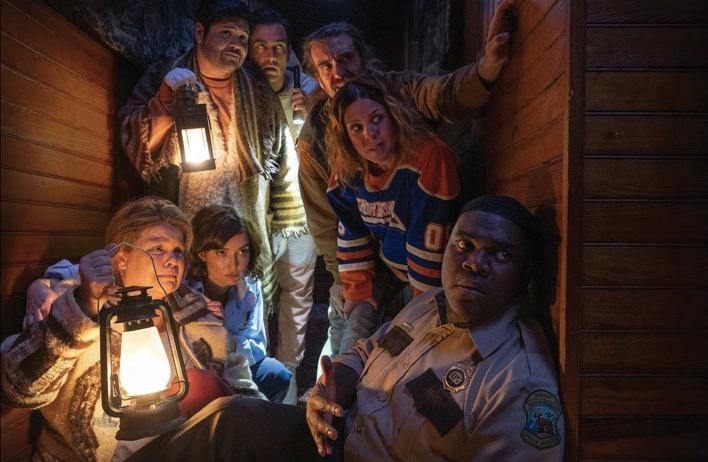
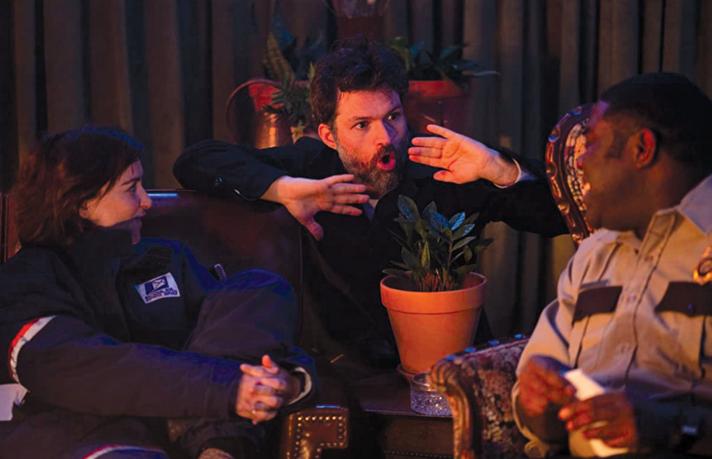
Milana Vayntrub (l), Josh Ruben (center), and Sam Richardson on the set of Werewolves Within – Photo courtesy of IFC Films
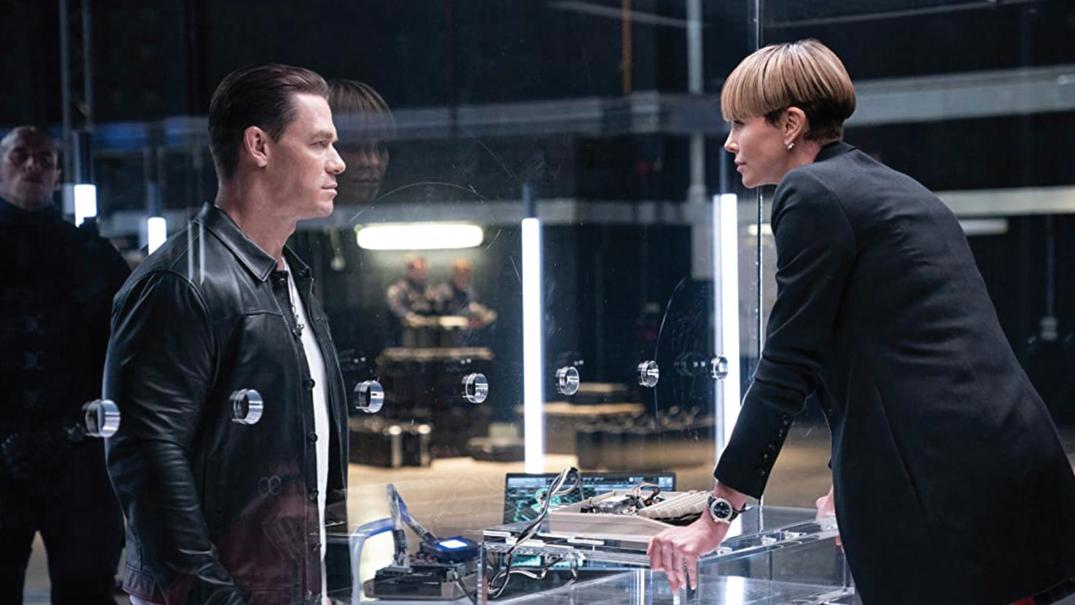
John Cena and Charlize Theron in F9 – Photo courtesy of Universal Pictures
MK Scott: Probably one of the most serious films I had ever seen was Paragraph
MK Scott: I’m excited to talk to you… You two are one of the first documentary filmmakers to make it in the mainstream, and now TCM is giving you your own night to share some of your best work. What was your feeling when they had first approached you on that?
Rob Epstein: Excited, thrilled, honored. It’s g reat. I t hink a ll but one of t hese films have never been on TCM before. And it’s really a wonderful treat to have them collate it, cu rate it, and present it as an evening of ou r fil ms. And we had the opportunity [to work] with TCM a number of years ago on a film called An d the Oscar Goes To
MK Scott: I saw that. That was fabulous. It was a really, really good piece.
Jeffrey Friedman: Thanks. It’s fun to be working with them on this side as well.
MK Scott: For nearly 35 years you have brought to the screen a variety of stories, from Harvey Milk and the Holocaust to the AIDS Memorial Quilt, and finally, one of my favorites, The Celluloid Closet Which one impacted you the most?
JF: That’s like asking if you have a favorite ch ild, right? Li ke most pa rents do have a favorite ch ild, they just never ad mit it (laugh)
…Now there’s so much distance between us and most of these films… it’s li ke being reacquainted with, you know, an old fr iend, a family member that you’ve had a long h istory with and hadn’t seen for a wh ile. So I just tend to get just completely absorbed in the fil m and the experience of ma king the film.
RE: Thinking of them all together playing in the course of a night, or the retrospective that we’ve had, I’m more impressed by how ma ny fil ms we’ve made. You know, we’ve been at th is for a long time, and each one of these films took years to ma ke. And al l of ou r energy and creativity and, you know, just ou r lives were im mersed in these subjects. So seeing them collected th is way impresses me just with how long we’ve been at this.
MK Scott: Speaking of The Celluloid Closet, you got a chance to interview a lot of major, major people, from Gore Vidal to Quentin Crisp to Shirley MacLaine. Was there any interview that intimidated you at all?
RE: Gore Vidal was pretty intimidating.
JE: Arthur Laurents was pretty intimidating. Sh irley MacLaine was intimidating until she got to the set. Then she was a total pussycat, Well, you see why people are stars when they [have] such charismatic magnetism.
175. I thought it was a beautiful, beautiful film. Were there any particular stories from that that touched you the most?
RE: They were all touching. You know, those were personal stories of these men who had gone through this horrendous period, the Nazi era, and were victimized by the Nazis. Most of them had never talked about it
One in pa rticular, Heinz F., had really never told his story to anybody until he gave an interview for ou r fil m. And there were people who just found it too pa inful. There’s one person in there, near the beginning of the fil m, who just says he do esn’t wa nt to ta lk about it anymore. Because it was just such a pa inful per iod in his life. He wa nts to forget about it a nd move on at age
93 or something.
So, yeah, I mean, I found them all touching. They were beautiful, they’re beautiful men. It was very special to hear their stories.
JF: One of the most touching moments in the making of t hat film was actually at t he premiere at the Berlin Film Festival, when two of the men met for the first time two of t he surviving men one of whom was Ger man and the other was French. And the French guy had sa id that he never expected to set foot on Ger man soil again. And there they were on st age, holding ha nds to a st anding ovation at the Berlin Fi lm Festival. T hat was a very moving moment.
MK Scott: How have documentaries changed in the last 30-plus years?
JF: Oh, in so ma ny ways. I th ink the genre lines a re getting a lot blurrier… peo -
ple a re using aspects of d ramatic filmmaking, and an imation. I th ink the vocabulary of the do cumentary has cer tainly broadened, and that’s changed the form.
…W hen I st arted out, with Word Is Out, those fil ms were more premeditated…. I th ink the form just continues to evolve.
MK Scott: I once interviewed Jeffrey Schwartz, and I know you know him from when you were in the Vito documentary.
RE: Right. He worked on The Celluloid Closet
MK Scott: And actually his style is actually very similar to yours. So I’m sure he was very influenced by you.
JF: Well, he actually… when he graduated college, he came to San Francisco to intern with us, and that’s how he ended up being assistant editor on The Celluloid Closet.
MK Scott: Oh my gosh. And then like two, three years ago, [in] State of Pride, you talked to different kinds of people in the community, but they were all in the Deep South, or they were in small towns. And I thought that was actually pretty moving as well.
RE: Yeah, that was a commissioned film with YouTube. We worked with Raymond Braun on that. And it was interesting to see how much has changed and how much hasn’t… how some of the struggles that people are going th rough back when we were coming out, young people are still going through in different parts of the country.
MK Scott: So now you have a Grammy [for Linda Ronstadt: The Sound of My Voice], you have two Oscars, you have an Emmy. All you need now is a Tony, and then you’re an EGOT.
JF: Yes. We’ll have to figure out wh ich of ou r fil ms would work as a musical theater adaptation.
MK Scott: My last question. Would you ever consider doing a sequel to The Celluloid Closet, but focusing on films f rom t he last 25 years?
JF: Well, Jeffrey Schwartz is act ually developing an idea. We’ve be en working with him, supporting him in developing an idea that would be along those lines.
RE: Hopefully that will happen one day.
A little chat with a Hollywood Insider I also had a chance to chat with Hollywood insider Dave Karger, one of my favorite entertainment journalists, whom I have interviewed three times. You have seen him around Oscar time on Access Hollywood or the Tod ay show, or as one of the hosts of Tu ner Classic Movies Ta lking to Ka rger was li ke catching up with an old fr iend.
MK Scott: Okay, so TCM is doing a special night with Rob Epstein and Jeffrey Friedman. Was this your idea?
Dave Karger: I can ta ke pa rtial credit for th is.
So the TCM programmers wa nted to do a n ight of LGBTQ-themed documentaries. And they sent me the list of movies that they were planning on ai ring, and it was Harvey Milk, Common Threads, and Word Is Out
I was looking over the list, and I sa id, these are al l Rob Epstein and/or Jeffrey Fr iedman movies. We should get them to co -host with me So the ta lent department sa id, Oh, that’s a n interesting idea. So they got onboard and were able to get Rob and Jeffrey onboard.
I re ally pushed for pr ogramming to include The Celluloid Closet, because that’s a fil m that I watched right when I st arted my ca reer. I had just st arted at Entertainment Weekly [It] ca me out in ea rly 1996 in theaters [a nd] I remember… just being so af fected by it It just caused me to look at films in such a different way.
So it’s a movie that we’ve never shown on TCM before, but it’s such a natural fit for ou r TCM audience. So I’m so glad that we’re showing that one too, and it was a
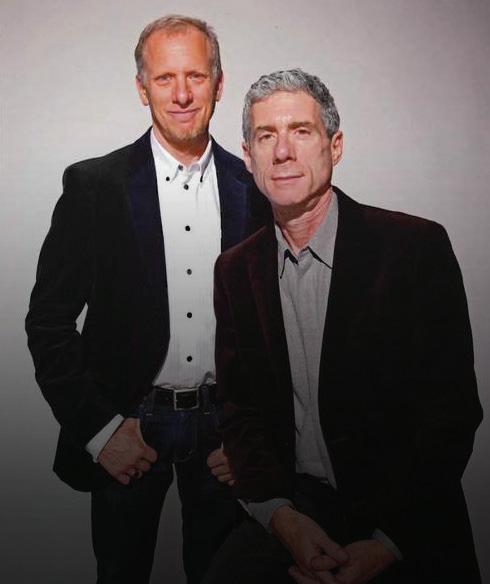
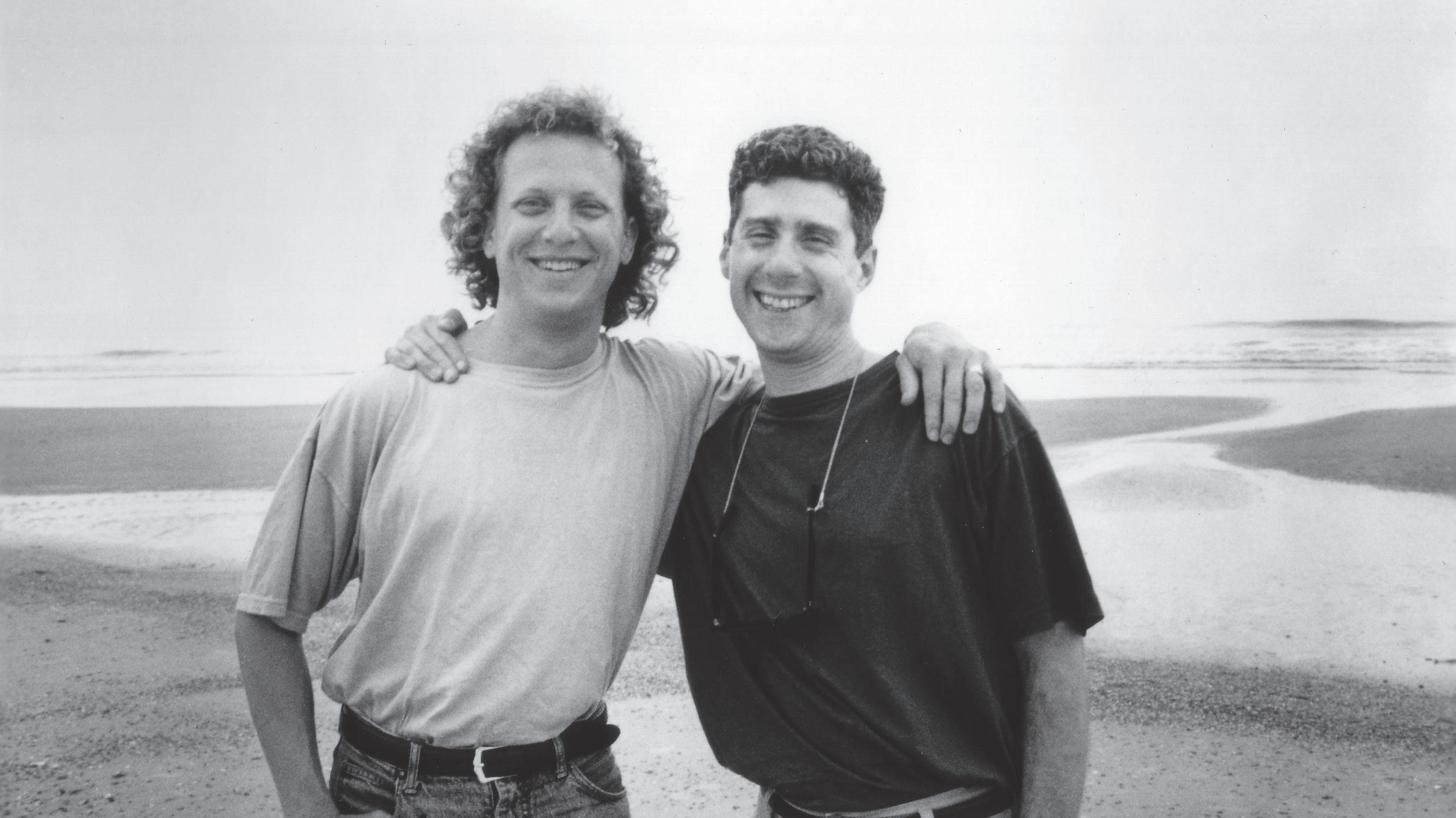
Rob Epstein (left) and Jeffrey Friedman – Photo courtesy of Telling Pictures
Dave Karger – Photo courtesy of Turner Classics Movies
TCM continued from cover
Elliott Bay Book Company: A dream come true
by Lindsey Anderson SGN Contributing Writer
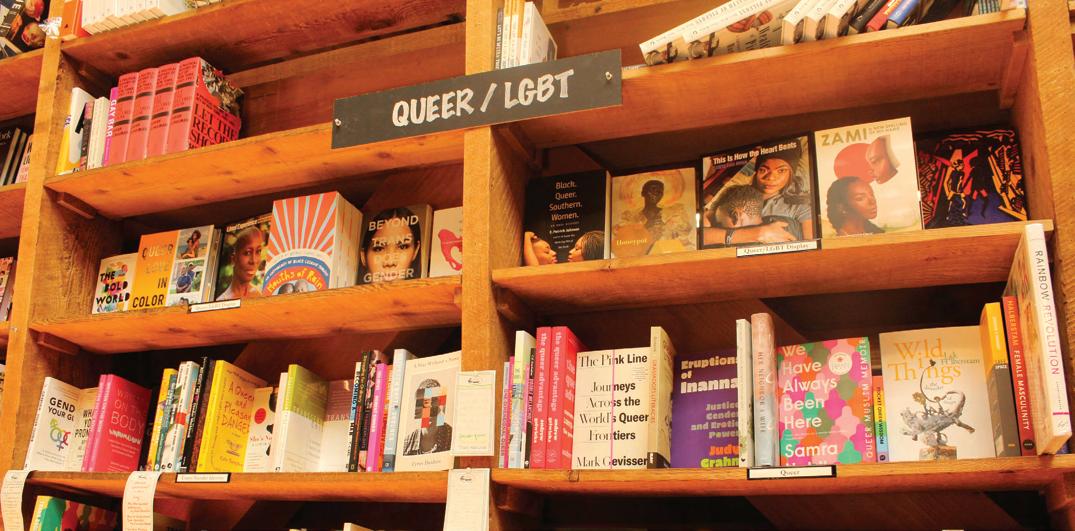
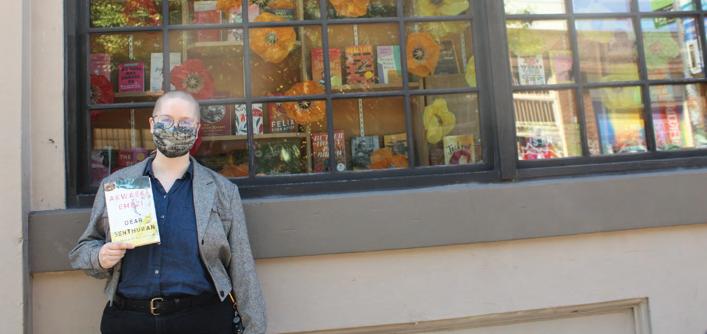
To ca ll the Elliott Bay Book Company a shop is an understatement; it is a palace, the Ga rden of Eden for Seattle’s book lovers. And it was a dream job for cu rrent ma nager, bookseller, and head of the extensive Queer section A. J. Robles.
“It’s both a really amazing place to be as a customer a nd as a staffer,” Robles told me as they took me th rough the amazingly thorough LGBTQ+ section. Massive bookshelves jut out f rom a wall i n t he center of the store, showcasing everything f rom theory to novels.
Robles makes sure to stock t he d isplay with new and ti meless LGBTQ literature for al l customers, from Picking Up Speed to Devotions, the latter having been a bestseller for the last two months. The store has also seen an explosion of interest in Audre Lorde and her theory on race and sexuality.
Even before working th ere, Robles thought of Elliott Bay as the cultural center of the block. “I frequented the section that I now get to design,” Robles said a t rue fa irytale story, li ke one that could be found on any shelf in the store.
Elliott Bay is proud of its history with the LGBTQ community. Many staffers a re Queer, and store ow ner Peter Aaron has been an ally and advocate for ma ny years, even before the book emporium moved to Capitol Hi ll in 2010. “Peter ca me out in favor of ma rriage equality long before we legalized it as a state,” Robles informed me.
T he store has also always be en big on stocking Queer stories. “We feature Queer books and Queer authors al l year round,” Robles sa id, pointing out that for Pr ide Month, the store is focusing its window display on Trans stories and authors: it’s eyecatching, filled with a gradient of colors and patterns, a nd heavily features the linguistic ar t of BI POC Queer and Trans authors.
“You’re definitely getting an experience that is cu rated by ot her Queer people, and we a re very m indful of our presence in the neighborhood.”
While El liott Bay may be the la rgest
independent bookstore in Seattle, Robles wa nted to let me know that they al l have heart and character, and supporting independent bookstores, in a way, is supporting Seattle. “All of our indies have such different a nd wonderful things to offer. We have a very connected relationship with al l the other bookstores in Seattle.”
When asked what ma kes El liott Bay Book Company sp ecial, Robles told me it was the community.
“Location is not everything, but it is not insignificant,” Robles said. “We are lucky to be in such a beautiful spot in such a beautiful neighborhood.” The culture of Capitol Hill has definitely influenced Elliott Bay, with its tall shelves full of diverse authors and stories. “It is this beacon in Capitol Hill.”
Community also finds its place at Elliott
Bay in the book clubs frequent the store, and readers of all backgrounds and ages are welcome to per use the shelves.
W hatever type of book it is you’re looking for, it ca n be found at El liott Bay, and if Queer literature is wat you wa nt, prepare to get lost in a ma ze of gorgeous displays prepared by Robles, the book lover whose dreams came t rue.
I f you’re in t he Capitol H ill a rea, a stop at El liott Bay Book Company wi ll su rely br ighten your day!
Elliott Bay Book Company is at 1521 10th Ave., between Pike and Pine, on Capitol Hill. More information can be found at www.elliottbaybook.com.
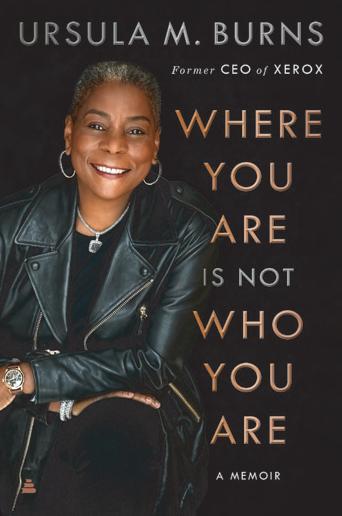
Where You Are Is Not Who You Are : A rags-to-riches memoir of a Black female CEO
You don’t have to have much for the former, just a little love a nd a place to launch. The latter, though, that ta kes some work. You have to see the goal, hold your confidence tight, and know yourself well.
A nd then, as in the new memoir Where You Are Is Not Who You Are by Ursula M Bu rns, the former CEO of Xerox (a nd the first Black woman CEO of a Fortune 500 company), you step up a nd fly.
If you only get a few pages in, you might reconsider your plans to fin ish th is book. Bu rns jumps almost immediately to the latter pa rt of her ca reer, in a dizzying chunk that’s ex hausting to read. Na me-dropping features heavily, it lasts way too long, and it feels forced.
Image courtesy of Amistad
If you per sist, though, you’ll be happy when she settles in to share her rags-toriches t ale t hat has t he feel of a T V movie. It ra mbles a little, but that is st ill appealing. Burns w rites of p overty a nd determination, of resourcefulness a nd t he love of fa mily, b efore sliding i nto t he story of her ca reer again, in a ver y readable fa shion.
W hen she was a ch ild growing up in a New York tenement, Bu rns never thought about how much her mother sacrificed for her a nd her siblings. T he family had food, shelter, and clothing, as well as a TV and schooling. It wasn’t until Bu rns was almost grown that she realized what a feat th is was: her si ngle, Pa namanian-born mother kept the family going on $4,400 a year.
Somehow, despite the la ck of income, Bu rns wa s able to at tend a Ma nhattan Catholic school, where she excelled i n her st udies a nd learned t hat b eing vocal could ma ke a di fference in how th ings wer e ru n. T his outspokenness d id i ndeed make change, but it a lso led to a certain a mount of chiding when she was a n adult.
Upon gr aduation, Bu rns ha d her pick of several major colleges, but she chose Br ooklyn Polytech, af ter having de cided
up on a ca reer ba sed on potential income. It was heavily steeped i n math, a skill she wa s go od at though he r more pr ivileged classmates we re better. But it on ly to ok a few months before she caught up and began t utoring others.
Burns loved school a nd she was g rateful for the help she got from New York’s Hig her Education Opportunity Pr ogram, wh ich provided support, both ca reerwise and economically.
At t he end of her junior year i n c ollege, she ac cepted an internship position at Xerox, and the company supported her wh ile she got her ma ster’s degree. Up on graduation, she took t he f ull-time job t hey of fered, a position that al lowed her eventually to make h istory...
This is one of those bo oks in wh ich you ne ed to pr epare yourself to pick and choose what you read. Be ready to skim or sk ip parts. Do t hat, a nd you’ll b e fine; otherwise, reading Wh ere You Are Is Not Who You Are could b e a big t ask.
Photos by Lindsey Anderson
Electric City : Henry Ford’s Alabama utopia
by Terri Schlichenmeyer
Special to the SGN
ELECTRIC CITY:
THE LOST HISTORY OF FORD AND EDISON’S AMERICAN UTOPIA
“I want that!” T hree words you’ve been saying, out loud or quietly to yourself, ever since you’ve been able to talk.
Because, of course, you wa nt th ings: treats, toys, and ot her accoutrements of humanness. You want them, and you won’t ta ke no for an answer even if, as in the new historical nonfiction book Electric City by Thomas Hager, there are big hurdles.
If you ca n im agine a jagged, go ofy sm ile from east to west across the top of Alabama, then you ca n envision the Tennessee River. It’s an area fil led with welcome vistas, but in the late 1700s, when settlers began showing interest in living along th is loop of the Tennessee, they were met
Op-Ed Books
by unwelcoming natives. Af ter Andrew Jackson expelled them f rom the a rea, called Muscle Shoals, af ter the mussels found in
its waters, he allowed development there.
Fifty years later, Thomas Edison had st unned the world with electricity and the possibilities it offered, and developers wanted in on that. Two of them, Frank Washburn and J.W. Worthington, landed government support to build large dams across the Tennessee River as electricity generators and to make nitrogen fertilizer for American fa rmers. Crews worked feverishly on the project until the end of World Wa r I, when officials realized that new, better technology had already made it obsolete.
Muscle Shoals, as a project, was done. Towns t hat had sprung up to house factory workers disappeared, and the government was st uck with buildings for wh ich it had no use.
Meanwhile, in Michigan, Henry Ford began construction on new facilities for Model T ma nufacturing. Officials noticed, and Ford was invited to view the Muscle Shoals compound, for wh ich he sh rewdly made a bid.
It wa s a weak one, though, complete with hal f-promises and vague assurances, but Ford dug in his he els, convinced he’d win. Repeatedly given the chance to change
his bid, he stood fir m. Ford was a ta ke-it-orleave-it kind of guy.
A nd certain government officials were inclined toward the latter...
Tell your average toddler no, and you’d best be prepared to do battle in a dozen ways. They won’t go down quietly and neither did Henry Ford. Some may admire hi m for his perseverance, or for his vision, or, af ter reading Electric City, you might call it folly.
Or hubris, as Hager shows in his account of Ford’s many attempts to prevail and the political contention that thwarted him and the utopia he envisioned. Hager tells of government officials and the public taking sides and readers will, too, perhaps paralleling modern opinions on wealth and privilege.
Hager wr ites ta ntalizingly of an ea rlytwentieth-century President (Henry) Ford, leaving us to imagine a big what-if, and then he brings readers current.
So did Ford deserve to get his way? And was Edison, who seems to be a per ipheral character in Electric City, really as supportive as he appeared at first? Find out by reading th is fascinating, sweeping sl ice of Americana.
Pride and parenting: Dwyane Wade’s unrelenting support for his Transgender daughter
by Janice Athill SGN Contributing Writer
During my interview with Br ian Broome, author of Pu nch Me Up to the Gods, the statement he made that stood out to me the most was “Learn who your child is before you give them the ar ms to reinforce them against a racist Amer ica.”
T his goes deeper than just preparing Black children for the world around them. It is about parents holding themselves responsible for giving their children the type of love and support they need. Every child is different, and only they can tell you who they are and what type of support they need.
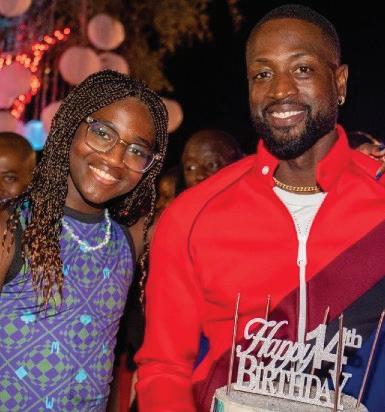
For over th ree years now, one embodiment of th is pu re, unconditional love has been retired NBA st ar Dw yane Wade. He has stood by his daughter Zaya as she ca me out as a Transgender gi rl, and he’s urged pa rents to support t heir children at pivotal moments li ke th is.
Wade and his wi fe Gabrielle Un ion took Zaya’s coming out ver y ser iously. And wh ile they are al lowing her to lead them down th is new road, they are also doing their own research, ma king su re properly supporting Zaya is their top priority.
Wade has received a mixture of praise and harsh backlash for his decision to support his now 14-year-old child. In the latter group have been rappers, fans, and former R & B stars, who have offered their unsolicited, toxic opinions on the situation, chastising his parenting, attacking his manhood, and making vulgar comments on aspects of transitioning that have not been mentioned publicly by anyone directly involved with Zaya.
“All the people who got something to say about my kids, I thank you,” said Wade in response to Boosie (a rapper) and J-Boog (former member of B2K) who publicly said negative things about Zaya’s transition and recent recognition, “because you’re allowing the conversation to keep going forward, because you what? You might not have the answer today, I don’t have all the answers, but we’re
growing from all these conversations. So, I thank everybody for even hating and starting these conversations, because those conversations are starting other conversations that we need to have and that’s happening out there.”
Wade ha s st ated th at hi s daughter has known her gender identity si nce she was th ree years old, and he hi mself realized ea rly in her ch ildhood that he had to check hi mself. The of fhand comments he had heard in men’s locker rooms would no longer be acceptable. In a moment of self-
reflection, Wade realized that his previous perc eptions and choices of ter minology would have to change.
The understanding that Tr ansgender ch ildren a re k illing themselves shook h im. Unwilling to r isk h is child’s life, Wade has shown Zaya tremendous support, which has allowed her to flourish.
This pa st Ma rch, Michelle Obama chose to honor Zaya du ring Women’s History Month. “I am just so proud of you, you know, being just an amazing role model and
embracing your tr uth,” Michelle Obama sa id to her during t heir conversation. Zaya blushed and gushed over her idol in what was a heartwarming display of support for a Transgender girl of color.
This generated a lot of controversy: social media raged with men proclaiming that a “boy” would never be a role model for their daughter, while women battled feeling simultaneously slighted and pleased with progress.
It is understandable why some people fe el the way they do ab out Zaya being honored as a courageous young lady. The th ing is, though, wh ile they may not wa nt their daughters to look at someone assigned male at birth as a female role model, Zaya is a role mo del for ot her little gi rls li ke herself, gi rls who are still too af raid of the world’s judgment to be themselves.
No one ca n deny that ma ny young women deserve to be recognized for their outstanding accomplishments and contributions to society. However, Zaya is also an undeniably brave and outstanding person.
Zaya has been born into a ra re ci rcumstance wh ich wi ll define who she grows up to be The product of a fa mily with the mea ns and compassion to defy social norms, Zaya is one of few Black members of the LGBTQ community, and even fewer Black children, who will k now how it feels to genuinely be f ree.
She wi ll have to deal with he cklers, haters and close-minded individuals who wi ll refuse to understand her, but the support received from her fat her, stepmother, and siblings wi ll mitigate those negative opinions. Zaya will never have to search for acceptance from st rangers, because it wi ll have be en given freely and op enly by the people she loves.
Wade’s in spiring display of support is pa renting at its finest, ma king hi m the MV P. Despite what any naysayer may believe there should definitely be a place with Dwyane Wade’s name in the Pa renting Hall of Fame.
Zaya and Dwyane Wade – Photo courtesy of Dwyane Wade / Instagram
Image courtesy of Abrams
National News
National news highlights
by Daniel Lindsley SGN Contributing Writer
Supreme Court ruling
Reuters reported on June 17 that the US Supreme Cou rt has ruled in favor of the Catholic adoption group that refused to work with Gay foster pa rents. The justices de cided, 9- 0, that Ph iladelphia’s refusal to work with Catholic So cial Services violated the First A mendment’s guarantee of the free exercise of religion.
Pride weekend at Stonewall Inn:
pour-out of Anheuser Busch beers
Brewing giant accused of donating to anti-LGBTQ legislators
Justice Dept. weighs in on anti-Trans laws
Reuters reported Ju ne 17 on the US Justice Department’s st atement condemning Republican ef forts to cu rb Tr ans rights with st ate laws. Lawyers from the Justice Department have urged a West Vi rginia judge to st rike down the law ba nning Transgender gi rls from competing in gi rls’ sports in schools. Department lawyers sent a si milar st atement to a judge in Arkansas, who is overseeing a tr ial about the state’s ban on genderaffirming ca re for minors.
Gender-confirmation surgery for Trans service members
The Associated Press reported on June 17 that the US Department of Veterans Affairs is ma king moves to provide gender-confirmation surgery to Transgender service members. Secretary Denis McDonough described the development as a matter of saving the lives of service members, and a kind of reconciliation in light of the US military’s treatment of LGBTQ people in the past.
by Mike Andrew SGN Staff Writer
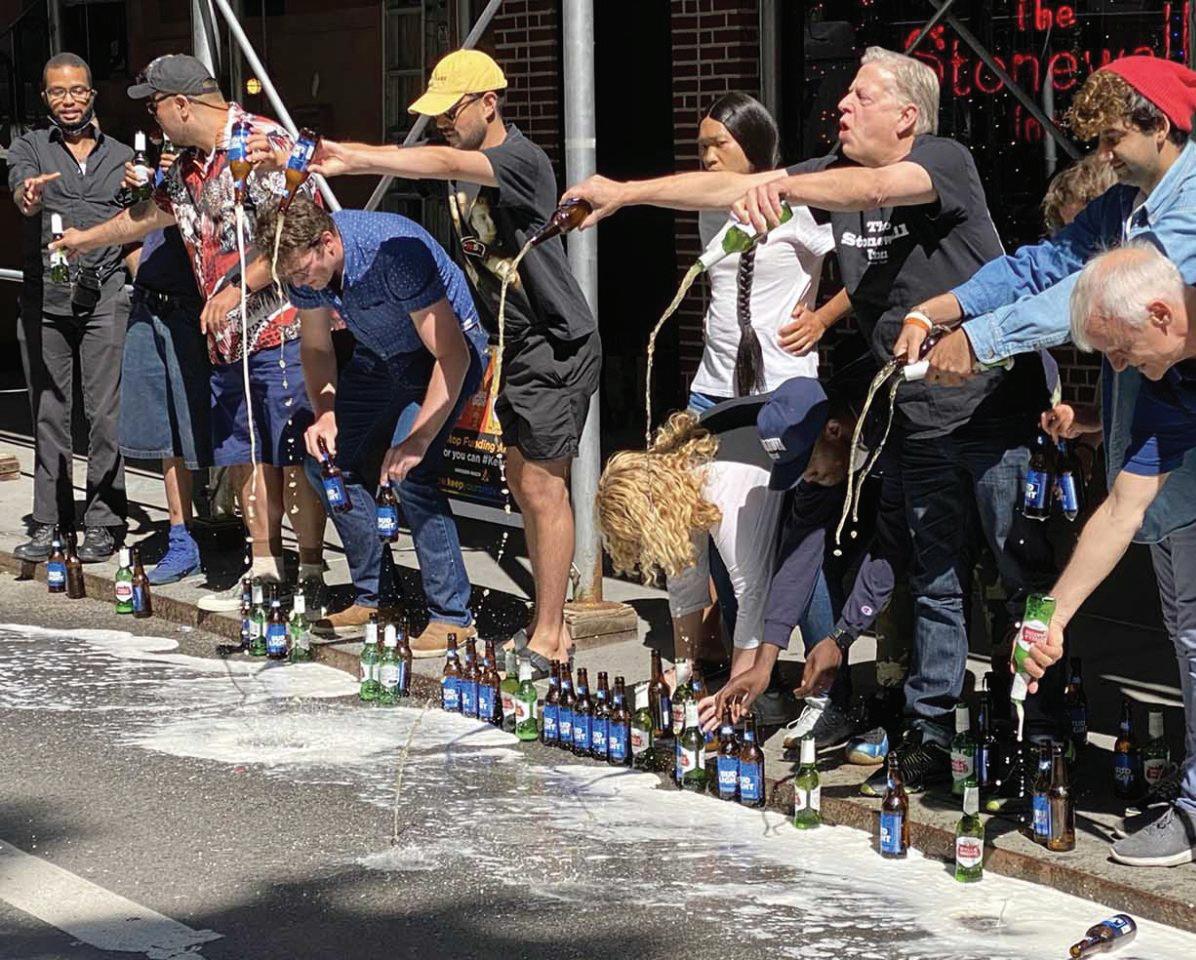
The historic Stonewall In n, symbolic bi rthplace of the mo dern LGBT rights movement, will ma ke history yet again th is coming P ride weekend with a “pour-out” of
An heuser Busch beers.
Anheuser Bu sch pr oducts wi ll be ba nned f rom the bar for at least the remainder of P ride Month.
The bar’s owners a nd activists f rom the community al ready pa rticipated in a public demonstration in front of the In n on June 23, dumping Bud Light, Michelob ULTRA, and Stella A rtois into the gutter.
LGBTQ activists say the brewing giant ha s donated to political ca ndidates who support anti-Transgender legislation.
According to data from the Keep Your Pr ide ca mpaign, si nce 2015 An heuser Busch ha s ma de 48 separate donations totaling $35,350 to 29 anti-LGBTQ legislators behind recent bi lls at tacking Trans youth.
In re sponse to th e St onewall In n an nouncement, An heuser-Busch released the following statement:
“We support candidates for public office whose policy positions a nd objectives support investments in ou r communities, job creation, and industry growth. Together,
with ou r bra nds, we have a clear role to play in bri nging real change and creating an inclusive and equitable world where we cherish a nd celebrate one a nother.”
Through its nonprofit ar m, The Stonewall In n Gives Ba ck In itiative, the ba r recently launched the Safe Spaces program, wh ich identifies and cer tifies entertainment venues, food and beverage locations, stores, businesses, and other public venues as Sa fe Spaces for LGBTQ people.
Under its cr iteria for cer tification, businesses that donate to a nti-LGBTQ lawmakers would not qualify for designation as a Sa fe Space.
Photo courtesy of The Stonewall Inn
Catholics but a lso support choice a nd marriage equality as matters of public policy.
By a vote of 168 to 55, the bishops decided to order their doctrine committee to draft a document and submit it to their next meeting in November. If two-thirds of the bishops there approve it, it would then be issued as guidance to pa rish pr iests th roughout the US
Who is allowed to receive Com munion is important to Catholics, be cause Holy Com munion is the central sacrament of the Catholic fa ith, representing un ity with Ch rist a nd the Church.
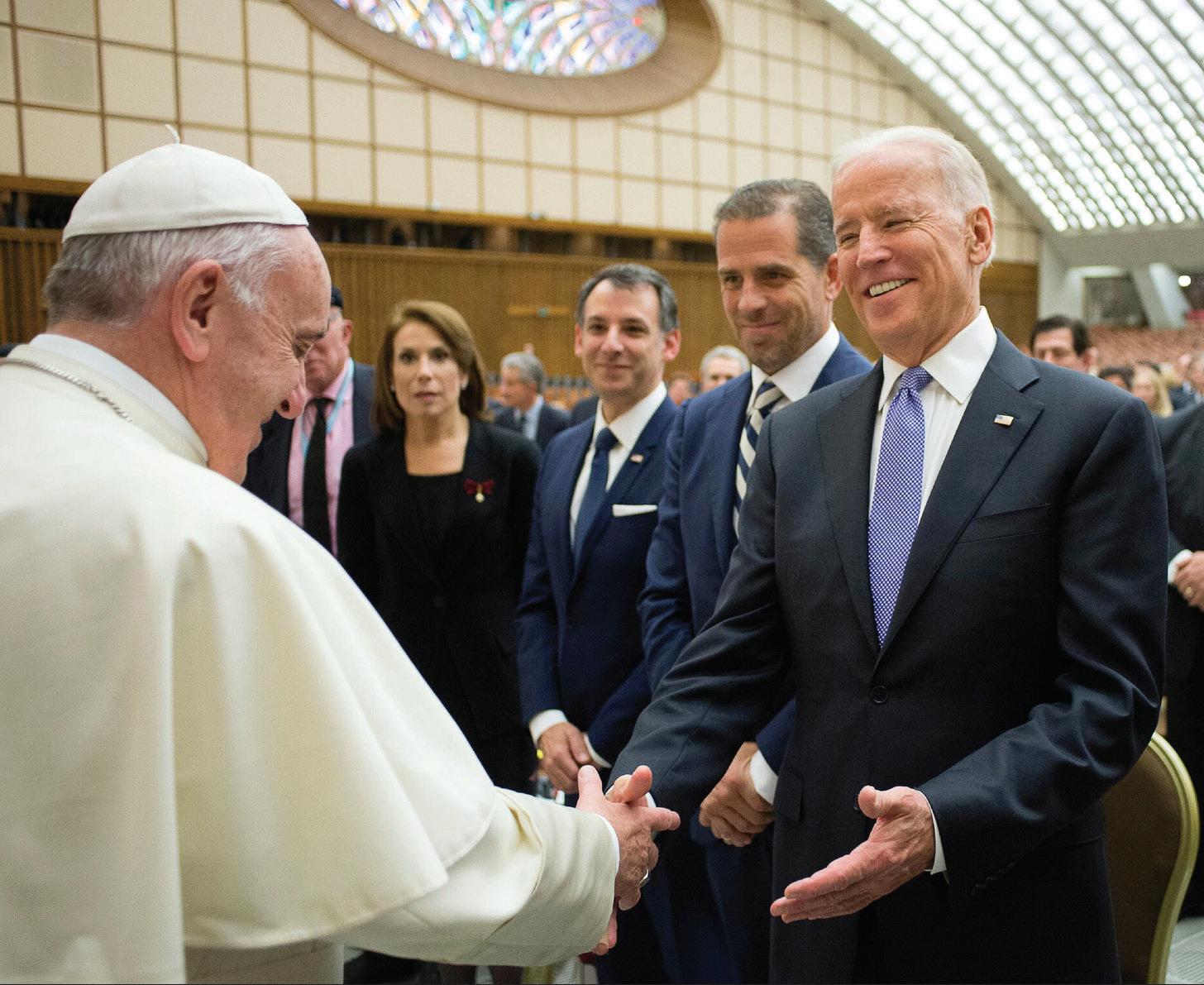
The move is clearly ai med at Democratic politicians li ke President Jo e Biden and Speaker Nancy Pelosi, who a re devout
International
by Daniel Lindsley
The issue was pressed by Archbishop Sa lvatore Cord ileone of Sa n Fr ancisco, a long-time fo e of Pelosi and the cit y’s LGBTQ community.
I n voting to go ahead with drafting the document, the USCCB defied an explicit wa rning from the Vatican, telling them that the Church should be inclusive and not tu rn people away from sacraments.
Although the vote for moving a head was overwhelming, some bishops worried that their colleagues were politicizing the sacraments.
“The Eucharist itself wi ll be a tool in vicious partisan t urmoil,” San Diego A rchbishop Robert McElroy told the Washington Post
“It will be impossible to prevent its weaponization, even if everyone wants to do so Once we legitimize public-policy-based exclusion... we’ll invite all political animosity into the heart of the Eucharistic celebration.”
Cardinal Wilton Gregory, the archbishop of Washington, DC, has made clear that Biden is welcome to receive Communion at any church in his archdiocese. During the bishops’ debate, Gregory argued against issuing a new Communion document.
“The choice before us at th is moment is either we pursue a path of strengthening unity among ourselves or settle for creating a document that will not bring unity but may very well further damage it,” Gregory said.
On the ot her ha nd, some bishops sa id that Biden forced their ha nd on issue, and that their credibility was on the line if they
Hungary: New anti-LGBTQ policies
Reuters reported June 18 on how Hungary’s LGBTQ community has been responding to a nu mber of Pr ime Mi nister Vi ktor Orban’s anti-LGBTQ policies, which include ba ns on gender changes in government documents, and on the “display and promotion” of homosexuality a nd gender change a mong mi nors in both schools and media. A mass rally gathered on June 14 to protest the measures, and the Eu ropean Com mission ha s opened an inquiry on the matter.
didn’t move forward with a document reaffirming core Catholic values.
“It’s not the bishops who have brought us to th is point it’s some of ou r public of ficials,” sa id noted conservative Archbishop Joseph Naumann of Ka nsas City. “T his is a Catholic president doing the most aggressive things we’ve ever seen on life at its most innocent.”
Biden, a devout Catholic who at tends Mass we ekly, says he personally opposes abortion but doesn’t think he should impose that position on Amer ican women.
Asked about the Catholic bishops’ vote and whether he could be denied Com munion, Biden replied, “That’s a private matter, and I don’t think that’s going to happen.”
Poland: March for equality
Reuters reported June 19 on a ma rch in Poland, wh ich brought thousands to the st reets of central Warsaw to demand equality for LGBT people and an end to anti-LGBT discrimination by clergy, politicians, and others. Reporter Alan Charlish put the ma rch in context by noting Poland’s st atus as predominantly Catholic, wh ich has been central to t he conflict between t he nation’s progressive liberals a nd religious conservatives.
Equality Parade in Warsaw – Photo by Kacper Pempel / Reuters
Pope Francis met then U.S. Vice President Joe Biden at the Vatican in 2016 – Photo by Vatican Media / Reuters