Seattle Gay News
Issue 25, Volume 42, June 20, 2014
LEADERSHIP & PRIDE Last November Seattle elected its first openly Gay mayor. Then-state Senator Ed Murray, who had recently married his longtime partner Michael Shiosaki, campaigned on a strong track record of reaching across the aisle to pass landmark legislation (such as the state’s historic marriage equality bill) and defeated Mike McGinn to become Seattle’s 53rd mayor. Murray’s supporters packed Neumos, a venue located in Seattle’s Capitol Hill neighborhood that normally showcases live music acts from around the country, and when Murray and his soon-to-be “First Gentleman” of Seattle, Shiosaki, arrived they received a cheerful and minutes-long sustained applause from a crowd that included many long-time Murray supporters. I was one of them. For Murray the moment must have been one of great appreciation and pride in a job well done. For me, his win signified much more than the election of a man that holds progressive values, asks for the best out of the people who work with him, and champions the rights of LGBTQ people. There’s nothing new about that and, although he arguably does all of those things remarkably well, the truth is that what his being elected by popular vote to run the City of Seattle for four years reflected was the fact that times have changed – and much more than just a neighborhood of drag queens, Gay college boys, and artsy-types who thought it might be a good idea to “give the Gay guy a chance.” And then I came to the realization, just as many of Murray’s supporters and, no doubt, Murray himself at some point, began to think. Could he get the job done? Would Ed Murray go down in history as just the “Gay Mayor” or would he actually bring change to Seattle politics and get this city on track to actually be the city it already claims to be and become one of the greats? All signs would point to a favorable outcome. Until his election as Mayor, Ed Murray represented Seattle’s 43rd Legislative District in the legislature since 1995, serving as the Democratic Leader in the State Senate. He was the prime sponsor of Washington state’s historic marriage equality law as well as the 2002 Safe Schools bill, which protects sexual minority youth in schools. Murray was also the prime sponsor of a landmark bill banning discrimination on the basis of sexual orientation signed into law in 2006. He got high marks for negotiating an end to gridlock on transportation reforms. Murray also sponsored landmark legislation matching Washington’s car emission standards to the highest in the nation. His honors include the 2002 Human Rights Campaign Leadership Equality Award,
AP
by Shaun Knittel SGN Associate Editor
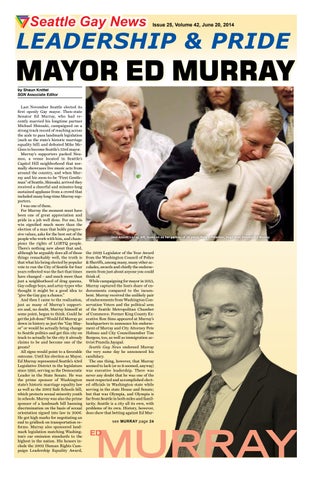
Jane Abbott Lighty, left, looks on as her partner of 35 years, Pete-e Petersen, hugs then Senator Ed Murray
the 2009 Legislator of the Year Award from the Washington Council of Police & Sheriffs, among many, many other accolades, awards and chiefly the endorsements from just about anyone you could think of. While campaigning for mayor in 2013, Murray captured the lion’s share of endorsements compared to the incumbent. Murray received the unlikely pair of endorsements from Washington Conservation Voters and the political arm of the Seattle Metropolitan Chamber of Commerce. Former King County Executive Ron Sims appeared at Murray’s headquarters to announce his endorsement of Murray and City Attorney Pete Holmes and City Councilmember Tim Burgess, too, as well as immigration activist Pramila Jayapal. Seattle Gay News endorsed Murray the very same day he announced his candidacy. The one thing, however, that Murray seemed to lack (or so it seemed, anyway) was executive leadership. There was never any doubt that he was one of the most respected and accomplished elected officials in Washington state while serving in the state House and Senate; but that was Olympia, and Olympia is far from Seattle in both miles and familiarity. Seattle is a city all its own, with problems of its own. History, however, does show that betting against Ed Mursee MURRAY page 24
MURRAY
ED
2
Seattle Gay News
June 20, 2014
Celebrating 41 Years!
Visit us online www.sgn.org
June 20, 2014
Seattle Gay News 3
Councilmember Jean Godden celebrates 40 years of Pride with remembrance office of the mayor
Mayor Ed Murray and Councilmember Jean Godden “cut the leash” at Seattle Animal Shelter
by Jean Godden Special to the SGN Every movement is made up of personal experiences and anecdotes. This year Seattle celebrates 40 years of the LGBTQ rights movement since the first Seattle Pride parade in 1974. We have come a long way, and though that distance is marked with numerous legal and legislative milestones, I believe it is also the anecdotal experiences along the way that make Seattle’s Pride history unique. When I worked in print journalism in Seattle, one of the things I liked best was that in the years that I wrote for a living, newspapers were more accepting of people for their abilities than for their lifestyles. And while we were surrounded with much destructive homophobia (those were dark times), we were fortunate enough to get to know and value LGBTQ colleagues. The newsroom camaraderie, where many apparently lacked any desire to care whether someone might be Gay, fed what could be considered a healthy agnosticism. However, as one might guess, this sometimes led to comic-tragic misunderstandings. For example, the paper had an assignment editor, one of the first women to serve in that role. She had unknowingly attracted romantic attention from one of the paper’s first African-American copy aides. Finally, one day, he asked her if she would ever
consider going to a movie with him. “Don’t think so,” she answered a bit brusquely. “Is it because I’m black?” the crestfallen aide asked. “No, it’s not,” she replied. “It’s because I’m Gay.” There were other communication failures. There was the brassy young woman intern who lusted after one of the paper’s star reporters, one of the few guys on the staff who dressed the role, looking like Cary Grant in His Girl Friday. She kept finding ways to volunteer for assignments that would bring her closer to him. She finally decided to make a bold play. She drove to his apartment building and, when he arrived home, she accosted him, fibbing that she’d had car trouble nearby and asking if he could lend a hand. It would have been a promising encounter if the reporter’s significant other, a male companion, hadn’t shown up to welcome the Cary Grant look-alike home. When I left the P-I in the 1990s and went to work at The Seattle Times, one of my first real newspaper friendships there was with a brilliant Seattle Times librarian. Tim was one of the first to use his skills with numbers to assist jour-
nalists in using data analytics to report important stories. Tim and I sat back to back in the crowded newsroom and he was invaluable, helping a newcomer in need of navigating the Times’ culture. What did it mean when the managing editor came in and said hello to some but bypassed others? Everyone needs a friend like Tim. Our friendship extended to several other Tim fans in the newsroom.
From time to time, a diverse group of us would break bread together. Tim jokingly christened us “Ladies Who Lunch.” Then came the day when Tim, who was openly Gay, gave us the tragic news: he was taking early retirement, felled by AIDS and, seemingly given only six months to live. With typical Tim panache he took a fabulous vacation and, helped by his doctors, went on an experimental drug regime that involved taking pills many times during the day. The triumphant news is that, instead of declining, Tim is still retired to this day, and still saving his small nest egg to take occasional vacations. From time to time, he summons us together for another “Ladies Who Lunch,” our fast friend is here to celebrate this era of hope. This year, when I march in the Pride Parade I will be doing so in remembrance of all of these personal experiences and in honor of Seattle’s accomplishments in equality such as 2012’s Referendum 74, but also in acknowledgment of work yet to be done. One thing to note – last month Judge Mary Yu was appointed as the first openly Gay judge to the Washington State Supreme Court, now that’s something to celebrate!
GODDEN
JEAN
4
Seattle Gay News
June 20, 2014
Celebrating 41 Years!
Photo by Nate Gowdy SGN staff
Visit us online www.sgn.org
Photo by Nate Gowdy SGN staff
June 20, 2014
Seattle Gay News 5
6
Seattle Gay News
June 20, 2014
Celebrating 41 Years!
TA
OU
n o ti IO d i l a -C n o a L C , i F r A B o b K ay, a L OR G s t n W n, er o r AT ia rk rg F b o .o t E s u O ID Le er W rk o e R d r w P a en at e sg de 0 W n ri 11 Tra w.p 1-8 6 w 2 w 620
ND
GA OR
G!
ZIN
NI
Visit us online www.sgn.org
June 20, 2014
Seattle Gay News 7
Four decades of fighting for LGBTQ equality by Seattle City Councilmember Kshama Sawant Special to the SGN This year we march in our 40th Seattle Pride Parade, continuing the decades of heroic struggle by LGBTQ people for equal rights. Like all other victories for social justice, the strides made toward LGBTQ equality have been based not on a handful of politicians, but on the courage of millions of activists. In recent years the movement has won marriage equality rights in 20 states and the District of Columbia. It has succeeded in outlawing discrimination based on sexual orientation in 21 states, including Washington, DC and Puerto Rico, and discrimination based on gender identity or expression in 17 states. These legal victories coincided with, and were largely shaped by, a dramatic shift in public opinion. The modern LGBTQ rights movement was born out of the Stonewall Rebellion in 1969 in New York City when people successfully stood up against police harassment. Stonewall happened against the backdrop of the civil rights movement and growing radicalism, and it in turn inspired the birth of a massive Gay liberation movement where hundreds of thousands of people came out of the closet and organized huge liberating marches across the country. The Gay Liberation Front founded in 1969 had explicit revolutionary socialist leanings and declared its solidarity with anti-colonial movements, the movement against the Vietnam War, and workers’ struggles. However, a backlash developed that pressured the LGBT movement to moderate its demands to fit within the traditional social order and what was acceptable to the Democratic Party and its corporate backers. Today, more conservative elements have taken over the planning of Pride events in many cities. Glen Greenwald documented this shift in an April 2013 article in The Guardian titled “Bradley Manning is Off Limits at SF Gay Pride Parade, but Corporate Sleaze is Embraced.” In the article, Greenwald discusses the role of corporate sponsors for San Francisco’s Pride events. Sponsors include AT&T, Verizon, Bank of America, Wells Fargo, Clear Channel, and Kaiser Permanente – all corporations that were either facing massive corruption charges, significantly responsible for the 2007-08 financial collapse, playing an important role in the U.S. security state, or spreading deeply conservative and homophobic views. Greenwald explains how the interlocking interests of these corporations, the military, and the Democratic Party set the agenda for San Francisco Pride, which led to the
revocation of the invitation to Chelsea Manning to be a Grand Marshal at the 2013 Pride Parade. Caitlin Carmody described the parade on Shaping San Francisco’s blog: “Everywhere I turned there was a corporate float or a well branded (read: rainbow on corporate logo) corporate employee: Wells Fargo, Google, Clear Channel, Kaiser Permanente, Bank of America, BMW, Facebook, Macy’s, Salesforce, JP Morgan Chase, Twitter… Where was the anger about the economic crisis caused by the very banks marching in the parade whose nefarious practices left many queers homeless?” The following year, intense public pressure ultimately forced the SF Pride Commit tee to back down, apologize to Manning, and invite her to be an honorary Parade Marshall this year – an important victory. Despite the recent victories like marriage equality, there is still much to be done. Particularly for working-class LGBTQ people and especially Transgender people. Recent studies belie the media stereotype of Gay people as wealthy men. In reality, Lesbian, Gay, and Bisexual adults are unemployed at a rate 40% higher than the national average (Center for American Progress); and LGBTQ youth make up over 40% of homeless youth (Huffington Post, January 2013). Socialists like myself have long supported the campaign for same-sex marriage rights, and we also see the importance of strengthening our movement by joining forces in demanding a society in which everyone has equal rights and all human needs are met. We need to demand reforms like equal hospital visitation rights for LGBTQ people, affordable housing for all, the closing of the gender pay gap, and a $15/hour minimum wage – reforms that will benefit not only LGBT people but all working people joined in a common struggle. LGBTQ people are regularly subjected to harassment and violence, even in Seattle. We’ve experienced a disturbing escalation of hate crimes in Capitol Hill. Despite our Gay-friendly reputation, Seattle had the third highest number of anti-LGBTQ hate crimes in the U.S. last year (The Seattle Times, 06/06/14). Transgender people experience especially high rates of poverty, unemployment, and hate crimes, including murder. In 29 states, it is still legal to fire someone because of their sexual orientation. And in 33 states, people
can be fired for being Transgender. And Transgender people are 28% more likely to experience physical violence, often at the hands of the police, than other Lesbian, Gay, Bisexual and Queer people (National Coalition of Anti-Violence Programs). Despite all this, the major LGBT organizations, such as the Human Rights Campaign and the National Gay and Lesbian Task Force, have focused on campaigns which do not ultimately challenge the fundamental causes of LGBTQ oppression, often failing to meet the needs of the majority of LGBTQ people who face constant economic and social injustice. These L G B T Q groups also rely on the Democratic Party and therefore limit their demands to what is deemed “achievable” by the corporate political establishment. Socialists see LGBTQ oppression and sexism as rooted in capitalism, which promotes artificial, restrictive gender roles. Capitalist society needs to promote divisions among working people in order to preserve the extreme inequality on which it is based. It systematically attempts to marginalize and oppress LGBTQ people and movements, portraying them as threats to the patriarchal nuclear family. The politics of division are used cynically by a section of the establishment – the promotion of homophobia, sexism, an-
“We’ve experienced a disturbing escalation of hate crimes in Capitol Hill. ”
ti-immigration sentiment and other prejudices serve to divert attention away from genuine anger at poverty and economic injustice. We need a different kind of politics in order to target the root causes of LGBTQ oppression. While Republican politicians openly whip up homophobia, sexism, and racism, the LGBTQ movement needs to stop relying on the Democratic Party for modest piecemeal reforms. Instead, we need to build an independent political party that will unambiguously fight in our interests. Obama and Democratic politicians have taken little initiative to fight for LGBTQ rights. Anti-discrimination policies implemented in states and by the Obama administration came only after LGBTQ activists led the charge over decades, built relentless mass pressure from below, and convinced a majority of Americans to support the basic rights of LGBTQ people. We can multiply our collective power exponentially by uniting the LGBTQ movement with unions, environmental organizations and other social movements. We also need our own independent candidates and political representatives to challenge both the Republican and Democratic Party. Our struggle is far from over, and we will not get there without building a broader movement for equal rights and social justice. We will not get there without boldly taking up the needs of those LGBTQ people still facing the greatest oppression, such as Transgender people. Finally, we will not get there until we reject this economic system, which fundamentally bases itself on oppression and inequality.
SAWANT
KSHAMA
8
Seattle Gay News
June 20, 2014
Celebrating 41 Years!
Photo by Nate Gowdy SGN staff
Visit us online www.sgn.org
June 20, 2014
Seattle Gay News 9
10 Seattle Gay News
June 20, 2014
Celebrating 41 Years!
Visit us online www.sgn.org
June 20, 2014
Seattle Gay News 11
Councilmember Sally Bagshaw on pioneering marriage equality christinemgrant.com
Councilmember Sally Bagshaw describing policies and funding that could promote Neighborhood Greenways
by Sally Bagshaw Special to the SGN In 2004, while serving as King County Chief Civil Counsel, Executive Ron Sims approached me wanting to develop a directive to the city clerk to issue marriage licenses to same sex couples – an action San Francisco Mayor Gavin Newsom had recently and triumphantly taken. As his counsel, I had to advise Executive Sims that the Washington State 1998 Defense of Marriage Act was very clear. He couldn’t do the same thing Newsom had done. But, I told him, if someone were to file a lawsuit against King County, he could come out in
support of those who wanted to marry in King County. Couples who wanted to marry stepped forward to be plaintiffs, and Ron asked if my husband, Brad Bagshaw, would serve as a pro bono attorney on their behalf. I immediately got on the phone with Brad and told him I would support it completely if he wanted to be part of this historic effort. So, essentially, Brad sued ME! In addition to Brad, a volunteer legal team came together very quickly. It included Representative Jamie Pedersen, Jennie Pizer from Lambda Legal, Pat Novatny, a volunteer for the Northwest Women’s Law Center (now called Legal Voice). Many other wonderful, admira-
ble, inspiring couples – people in committed long-term relationships with children, grandchildren, and deep roots in the community, swiftly stepped forward to volunteer their time. Because of the conflict of interest, I was taken off the case (Andersen v. King County). No one could tell me anything about it, not even Brad – I had to read about it in the paper. On the day of oral arguments in Superior Court, I sneaked into the back of the courtroom just to watch the proceedings. I tried to be in-
visible against the wall as my dear husband argued on behalf of the couples who wanted to marry and have the same rights and responsibilities as other married couples in our State. I remember the day the decision was handed down from King County Superior Court by Judge William Downing. I was in a meeting away from my office, and I knew that the decision would be announced that day – Wednesday, August 4, 2004. Midway through my meeting, the receptionist came in and handed me a note: “Ruling in favor of the plaintiff.” What? I thought it had to be a mistake! Everyone thought the ruling would be in favor of the defendants in the lower court – that is, against marriage equality. I had to excuse myself and call Brad to confirm that YES, they had really won the Andersen case. It was a great moment. I’ve saved that message in a frame on my wall ever since. I can see it from where I’m writing this. What a long way we’ve come since that day. I realize that this was just one triumph on a list of many for the LGBTQ community. This month is a month to celebrate the true champions who have been organizing for equality in Seattle for 40 years. This month, we take time out to thank them for paving the way so that we can live in a state and a city that loves all of our citizens regardless of who they love.
“It was a great moment. I’ve saved that message in a frame on my wall ever since.”
BAGSHAW
SALLY
12 Seattle Gay News
June 20, 2014
Celebrating 41 Years!
Photo by Nate Gowdy SGN staff
“We live in Washington’s most diverse, dynamic region. As a champion for civil rights, I work every day to celebrate and nurture our communities. I hope you will join me!”
- Pramila
“We need passionate and effective leadership in the Washington State Senate advocating for the rights and opportunity of ALL people. I have worked closely with Pramila for many years and know that she is exactly the woman for the job!” – Seattle Mayor Ed Murray Paid for by Friends of Pramila | PO Box 28505 | 3727 South Alaska Street | Seattle, WA 98118 | (206) 905-1117 | ElectPramila.com
Visit us online www.sgn.org
June 20, 2014
Seattle Gay News 13
14 Seattle Gay News
June 20, 2014
Celebrating 41 Years!
Visit us online www.sgn.org
Untitled-2 1
June 20, 2014
Seattle Gay News 15 6/9/14 11:29 PM
Making Seattle more welcoming KELLy o
by City Council President Tim Burgess Special to the SGN
The last Sunday of this month, Mayor Ed Murray will join Celebrity Grand Marshal George Takei in leading the downtown Pride Parade. Walking with the Mayor will be the City Council, a signal of unity and strength to Seattle’s LGBTQ community. But, the gesture is more than that. The collaboration and trust between the Council and the Mayor since Mayor Murray took office in January is truly remarkable, because it has helped to establish a more welcoming city for all. It ranges from simple practicalities, like giving keycard access to each other’s floors in City Hall, to deep engagement and planning on significant policy initiatives. The result of this new relationship: significant progress in making Seattle City Council President Tim Burgess a more welcoming and affordable city for everyone. It is necessary, but not sufficient, to period). A well-fought compromise beHigh-Quality Preschool have laws on the books stating that ev- tween the business, labor and non-profit eryone is welcome; our city and state sectors, the new law aims directly at deAt press time, the Council was aphave taken tremendous steps to enact cades of stagnant wages and growing proaching a vote to send Mayor Murthese laws. It takes another ray’s Seattle Preschool Program to the income inequality. effort altogether to put As someone who start- November ballot. This program is an policies in place that ed and grew a busi- evidence-based, high-quality effort to actively encourness for 20 years, prepare our children to enter kindergarage individuals I want to see in- ten ready to learn. Families with two working parents of all backdividuals and are more and more common, but paying businesses grounds and “The collaboration for high-quality preschool is often costachieve sucfamilies of and trust between the prohibitive. Making sure all our kids cess, provide all confighave a strong and fair start in school meaning ful urations to Council and the Mayor helps families and benefits everyone in work to their make Sesince Mayor Murray took the city. Research studies show that kids e mplo y e e s , attle their office in January is truly who attend a high-quality preschool do and produce home. The better in school, have much lower levels goods and c ol lab or aremarkable...” services that of criminal behavior, are healthier, and tion between benef it their earn more as adults when they enter the the legislac o m m u n i t i e s . workforce. tive and execuOur local neighbortive branches of hood business districts city government has give Seattle its character. moved forward several I believe everyone should have an noteworthy policy initiatives in just the first six months of Mayor equal opportunity at that success and today, for many reasons, a lot of people Murray’s term. are being left out. As a result of this law, the 100,000 SeMinimum Wage attle workers making less than $15 an The Council recently adopted the hour will see a pay increase that allows Mayor’s proposal to raise the mini- them to take better care of their partmum wage to $15 an hour over the ners, spouses, families and themselves. next three to seven years; depending If it works as designed, the new minion the size of the business (smaller mum wage law will help move many out businesses will have a longer phase-in of poverty.
Crime and Neighborhood Safety Mayor Murray recently sent to the Council his nomination of Kathleen O’Toole as the city’s new Chief of Police. While overall crime in Seattle is low relative to other major cities, there are pockets of our city where crime is a frequent and persistent problem. Some segments of the community – including our LGBTQ neighbors and immigrants and refugees – can feel particularly vulnerable. The murder earlier this month of Dwone Anderson-Young and Ahmed Said, two young Gay men, reinforces these feelings. Crime is geographically anchored, often where our most vulnerable, poor and disenfranchised families live. The choice of O’Toole offers a dramatic opportunity to advance reforms in the police department and introduce a more effective level of management of police resources. In close partnership with residents and businesses, Chief O’Toole must implement effective policing strategies that identify the people and places causing the most harm and put an end to the crime and disorder that holds communities back from achieving their potential. Economic stability, education, safety – these are just the beginning of a great future for collaboration between the Council and Mayor resulting in a more welcoming environment in Seattle. The spirit one feels at Pride is the spirit of a community gathering in celebration of its identity and of what it can accomplish by taking action together. These days, that same spirit is echoing in City Hall.
BURGESS
TIM
16 Seattle Gay News
June 20, 2014
Celebrating 41 Years!
Photo by Nate Gowdy SGN staff
Visit us online www.sgn.org
Photo by Nate Gowdy SGN staff
June 20, 2014
Seattle Gay News 17
18 Seattle Gay News
June 20, 2014
Celebrating 41 Years!
Visit us online www.sgn.org
June 20, 2014
Seattle Gay News 19
Councilmember Mike O’Brien on 40 Years of Pride KUOW / DEBORAH WANG
Like many people in Seattle, in the fall of 2012, I volunteered for the Referendum 74 campaign. As I knocked on doors in support of marriage equality to households around the state, I felt an incredible sense of growing momentum that we were changing hearts and minds, and that we were going to win marriage equality at the ballot that November. So on election night I brought my two teenage sons with me to Capitol Hill to be a part of that historic night and to participate in what would be one of the biggest public parties of their lives. I wanted my sons to remember that night as a turning point in their lives from a time when it was legally permissible to discriminate against LGBTQ people to a time when marriage was open to all. I talked to them about how that night’s victory was the result of more than just a year-long campaign, and that it came on the backs of years of struggle by people coming together in a movement for positive social change. I wanted them to come away with an understanding of the importance of having movements for social justice and of celebrating the victories of those movements along the way. This year we celebrate 40 Years of Pride in Seattle and 45 years since Stonewall in Greenwich Village. In what started as political protest marking the growing Gay rights movement of the late ‘60s and early ‘70s, today Pride is one of the biggest celebrations in Seattle each year. And it is these two elements of Pride that mean the most to me: a movement for equality and a celebration of our victories. It is important that we do not lose sight of the past, because while we have come so far in the Gay rights movement, we also all know that discrimination against LGBTQ people still exists – even in this liberal bastion of Seattle. The arson at Neighbours and numerous acts of violence on Capitol Hill against LGBTQ people over the past year are stark reminders that hate and bigotry have not been banished to the history books. In fact, despite our reputation as
Courtesy of Metro-Goldwyn-Mayer & Columbia Pictures
by Mike O’Brien Special to the SGN
Joel Kinnaman as Robocop
City Councilmember Mike O’Brien
one of the most Gay-friendly cities in the country, a recent Seattle Times blog post shows that, among large cities, Seattle has the third-highest rate of antiLGBTQ hate crimes. It turns out we still have many more hearts and minds to change. To me, Pride is an important part of how we acknowledge and honor the struggle of the movement that has brought us this far, as well as an important reminder that we still have much further to go. Until everyone in our city can live free and equal, we cannot yet hang up our marching shoes. The celebration that many people primarily associate with Pride is also important, because we have come a long way since Stonewall and we do have much to celebrate. Just last summer at Pride we celebrated the landmark victory of Referendum 74. This summer we will celebrate four decades of Pride in Seattle. And perhaps the most important thing to celebrate for me personally this year is the recognition that, due to the movement that Pride represents and the
gains that have been made by so many over these past 40 years, my sons will grow up in a much more loving and accepting world than I did. This is my fifth year of Pride as a Seattle City Councilmember. Marching in
the parade is a total blast and one of the more fun things I get to do as an elected official each year. I hope to see you and your family out there having fun and doing your part in celebrating 40 Years of Pride, too.
“In what started as political protest marking the growing Gay rights movement of the late ‘60s and early ‘70s, today Pride is one of the biggest celebrations in Seattle each year.“
O’BRIEN
MIKE
20 Seattle Gay News
June 20, 2014
Celebrating 41 Years!
Photo by Nate Gowdy SGN staff
Visit us online www.sgn.org
Photo by Nate Gowdy SGN staff
June 20, 2014
Seattle Gay News 21
“I am proud to stand beside LGBT individuals in their fight for full equality” Gay Pride Month is a time to celebrate diversity and raise awareness about equal rights for sexual minorities. I am proud to stand beside Lesbian, Gay, Bisexual, and Transgender individuals in our community in their fight for full equality. Since my election as a County Councilmember in 1992, King County and the County Council have worked to end discrimination against sexual minorities – and I have been honored to vote “yes” on each action over several years. In 2006, I was the prime sponsor of an important piece of King County Council civil rights legislation that ensured legal protection for all people in employment, public accommodations, housing and contracting in unincorporated King County. The Council action amended the county’s civil rights laws to be consistent with state protections of gender identity, ensuring legal protection for all people. Then, in 2008, the Council proposed an amendment to the King County Charter adding gender identity and expression to the anti-discrimination section. A Charter amendment requires voter approval, and I was proud of King County voters, who approved the ballot measure with a 71 percent “yes” vote. In 2012, I was proud to join my King City Councilmembers Larry Phillips, Jane Hague and Joe McDermott prepare for a press conference County Council colleagues declaring a statement of support for marriage equality in King County and sending The road to full equality for the LGBT this message to the State Legislature. community has been a long one. I am State passage of marriage rights for proud and humbled to have the opGay families was a critical thing to do portunity to serve as an elected reprefor the thousands of individuals who sentative in Dr. Martin Luther King, have long suffered the inJr. County, whose namesake equalities of the laws progressively upholds the that prevented full democratic ideals of equality. For freedom, equality, those of us in peace and opporKing County tunity every day. “I pledge to who supI pledge to concontinue to work port justice, tinue to work to to end discrimination freedom, end discrimipersonal nation against against LGBT – and responsiLGBT – and all all – members of our bility, and – members of community – with commitour community ment, this – with pride! pride!” was a moment of pride in the people of Washington State, and a cause for celebration.
KUOW / DEBORAH WANG
by Larry Phillips Special to the SGN
PHILLIPS
LARRY
22 Seattle Gay News
June 20, 2014
Celebrating 41 Years!
Joe Mabel
City Councilmember Larry Phillips with Judge Donna Tucker
Visit us online www.sgn.org
June 20, 2014
Seattle Gay News 23
Erika J. Schultz
Mayor Ed Murray, right, and his husband Michael Shiosaki
MURRAY
Ed Murray has, his whole life, lived the struggle. He is one of us, after all, and that is something that nobody can diminish as a buoy that tethers us to him. Ed Murray was born in Aberdeen, one of seven children in his IrishCatholic family. He spent much of his childhood in West Seattle’s Alki neighborhood, and was student-body president at his high school in Lacey, Thurston County. Murray studied briefly at a seminary after high school, then went to the University of Portland, where he got a degree in sociology. In 1980, he came out as Gay. Murray says he developed an interest in politics at a very early age. He managed the 1988 campaign of Cal Anderson, who was the state’s first openly Gay legislator. He worked as an aide to City Councilmember Martha Choe for four years in the 1990s. He then managed a Gay rights nonprofit. Seventeen years ago, Murray’s predecessor – the first openly Gay elected official in Washington state – died of AIDS. As Murray will tell you, Cal Anderson was not just his predecessor; he was a friend and mentor. Murray ran for office, hoping to replace his mentor as a state senator representing the 43rd Legislative District. Murray lost to state Representative Pat Thibaudeau, but then was appointed to Thibaudeau’s House seat. Then, in 2006, Murray challenged Thibaudeau for her Senate seat. Thibaudeau dropped out of the race, and Murray remained a state senator until he was elected Mayor of Seattle last November.
Last August, Murray married Michael PRIDE FLAG AND PROCLAMATION Shiosaki at St. Mark’s Cathedral, with a Earlier this month, on June 1, Mayor full marriage ceremony out of the Episcopal Book of Common Prayer and mu- Murray raised the Pride Flag at City sic from 3,944 pipes of the mighty Flen- Hall to commemorate the start of Pride month for the Lesbian, Gay, Bisexual trop organ. Shiosaki works for the Seattle Parks and Transgender communities at a Seattle LGBT Commission hosted cerand Recreation Department. Murray and Shiosaki met each other emony, which included guest speaker on a hiking trip with friends in 1991 at Retired Colonel Grethe Cammermeyer, the Carbon River entrance to Mount musical guests and members of the community. Rainier National Park. This year, Seattle is celebrating 40 “It was kind of a mystical day, actually, with fog that made the wildflowers’ col- years of Pride with a special focus on ors more intense, a wonderful blowing the next 40 years. According to Mayor Murray’s official fog,” Shiosaki recalled in an interview blog, “The City of Seattle is a national with the Seattle P.I. last August. As the story goes, Murray had to bail leader in providing support for its LGand get back to Seattle for a Sunday BTQ employees. The City offers transmeeting. But the two later became insep- gender health benefits to its employees, arable and waited 22-years to wed; hav- and has historically advocated on behalf of LGBT employees and ing decided to tie-the-knot afcommunity members. In ter the Murray-sponsored 2012, before Washingmarriage equality bill ton State repealed passed in Washingthe Defense of ton state. “It was kind Marriage Act, Seattle Mayor of a mystical day, the City of SeEd Murray is actually, with fog that attle filed an openly, and amicus brief u napologe t imade the wildflowers’ against it in cally Gay. Evcolors more intense, support of fair eryone knows a wonderful blowing taxation for this and that is employees in because there fog.” -Michael same-sex marisn’t anyone Shiosaki riages. And on who talks about December 9, 2012, it more than Murthe first day same-sex ray himself. Which is couples in Washington exactly why so many LGcould marry legally; City Hall BTQ Washingtonians respect him so much; long before he went to run opened its doors to host 140 weddings.” The Mayor also proclaimed June to be the city, Murray was meeting with community leaders, introducing Michael Lesbian, Gay, Bisexual and TransgenShiosaki to crowds at political rallies der Pride Month in Seattle through an and protests alike, and reminding the official proclamation which states, in press that he is a Gay man every chance part: he got. It was inspiring to many of us “Seattle is home to some of the naand we cheered him on without a doubt. Often times as Gay men, we are made to tion’s most active individuals and orfeel that being “out” is a good thing, but ganizations working to ensure the full that the greater public will never truly and equal recognition and protection of get what that means, won’t vote Gay the fundamental rights and liberties of people into office, and certainly not to Lesbian, Gay, Bisexual and Transgenanything as accomplished as mayor of der (LGBT) people and their families. Seattle has led the nation in the estabSeattle. It is refreshing that Ed Murray never seemed to get that memo; he came lishment of policies aimed at the preout as Gay in 1980 and hasn’t looked vention of discrimination on the basis of sexual orientation and gender identiback since.
24 Seattle Gay News
June 20, 2014
continued from cover ray is more often than not, a losing wager. And so far, with the exception of a few early mistakes, Ed Murray is on a roll; and he’s putting Seattle back on the map as a city that matters – with a mayor that is making national headlines on almost a weekly basis. With Seattle ramping up to celebrate 40 years of Pride Seattle Gay News takes a look back on what our first openly Gay mayor has done right.
ty in marriage, employment, housing, health care, human services, public accommodations and contracting.” $15 MINIMUM WAGE Shortly after taking office, Mayor Murray formed the Income Inequality Advisory Committee (IIAC) to address a cornerstone priority of an opportunity agenda: a meaningful increase in the compensation for Seattle workers. The committee, which represented broad and diverse perspectives, was charged with delivering an actionable set of recommendations for increasing the minimum wage within the city of Seattle. In May, Murray announced that the committee – comprised of representatives from labor, business, and nonprofits – had reached agreement on those recommendations. The Mayor’s resulting proposal was reviewed by the City Council’s Select Committee on the Minimum Wage and Income Inequality. The new minimum wage legislation passed the Seattle City Council and was signed into law by Mayor Murray on June 3. It provides for an increase in the minimum wage in the City of Seattle to $15 an hour, phased in over time, beginning April 2015: • Small employers (businesses with fewer than 500 employees) will reach a $15 an hour minimum wage in seven years. Also established is a temporary guaranteed minimum compensation responsibility of $15 an hour to be met within the first five years, which can be achieved by combining employerpaid health care contributions, consumer-paid tips, and employer-paid wages. • Large employers (businesses with 500 or more employees, either in Seattle or nationally) will reach $15 per hour in three years. The wages of employees who receive health care benefits will reach $15 per hour in four years. In a USA Today editorial, Mayor Murray wrote, “Seattle is a vibrant and thriving city. In 2013, we added nearly 15,000 jobs. Construction cranes punctuate the skyline. Our retail and entertainment districts are alive with people day and night. “But that’s not the entire story. We also face a growing disparity between those who can afford what this affluent city has to offer, and those who struggle to get by. One Seattle resident in eight lives in poverty. The top 20% of households take home more than 50% of the income generated in this city – 20 times what households in the bottom 20% earn. “In this, we’re not different from anywhere else in the country. During the past 40 years, more and more wealth has concentrated in the hands of fewer and fewer Americans. This undermines the essential promise of our democratic society – equal access and opportunity for all. “Unlike the rest of the country, Seattle has taken a dramatic step to address income disparity. On Tuesday, I signed legislation to raise the minimum wage in Seattle to $15 an hour. This increase will lift tens of thousands of families out of poverty and make Seattle more equitable and affordable for all who live here.” The mayor ended the editorial by saying, “At a time when many despair of the ability of government to address tough challenges, what we achieved is
Celebrating 41 Years!
a model for how people with different points of view can still come together to find solutions. It’s also strong evidence that cities are the best places to find the kind of innovative ideas this country needs to build strong communities that work for everyone.” PUBLIC SAFETY The burden of every mayor in any major city is to keep its citizens safe. Lately, in Seattle (with a police department under a Justice Department consent decree to end the excessive use of force) that is easier said than done. But he is making some headway. Kathleen O’Toole
Seattle Police Department Training Plan On June 10, Murray announced two major training programs developed by the Seattle Police Department, that were endorsed by the U.S. Department of Justice (DOJ) and the Seattle City Attorney’s Office, recommended by Federal Police Monitor Merrick Bobb and submitted to U.S. District Court Judge James L. Robart for approval. If approved by the Court, all 1,300 sworn officers of the Seattle Police Department will undergo instruction on how best to respond to calls involving a person in a mental health crisis, under the influence of drugs or alcohol, or other severe behavioral emergencies by the end of 2014. SPD dispatchers will also be trained to recognize calls for assistance involving persons in crisis to provide guidance to responding officers. A select group of officers will receive further specialized training and take control of the scene involving an individual in crisis.
• There will be no cap on the number of transportation network company drivers. • The City will provide 200 new taxi licenses over the next four years. • Taxi and for-hire licenses will transition to a property right that is similar to a medallion in other cities. • For-hire drivers will have hailing rights. • An accessibility fund will be created through a $0.10 per ride surcharge for drivers and owners to offset higher trip and vehicle costs for riders who require accessibility services. IN SUMMARY The mayor’s first 100 days had some interesting moments – he helped reveal just how screwed up the SPD misconduct appeals process is, accidentally pronounced a living man dead, and had to speak of Bertha, the stuck Highway 99 tunnel-boring machine more times than he wanted to. But he also appeared on the Colbert Report and gave a speech at a Super Bowl victory parade, and has met with President Obama at the White House on more than one occasion.
Nate Gowdy
On May 19, Murray named Kathleen O’Toole as his nominee for Seattle Police Chief. O’Toole has 35 years of policing experience and is the former Police Commissioner of Boston. “I promise you, I promise the police department, I promise the community that I’ll work tirelessly on behalf of this city,” she said before a crowd at Seattle City Hall when her nomination was announced. “The consent decree is a good road map,” said O’Toole. She says she wants to “drive a sense of urgency” to meeting its requirements. “We need to drive the substantive change and the cultural change that’s necessary to realize the true spirit of the consent decree,” she said. O’Toole said that winning the public trust needed to fight crime is her top priority. “Well I think we have to earn public trust and I think to the greatest extent possible it’s by getting out, looking people in the eye face to face, listening closely to them,” she said. O’Toole says she wants to work with every community to create new neighborhood policing plans. She’s opened the door to changes in the command structure, saying she’ll take 60-90 days to evaluate the commanders now in place. The Seattle City Council’s publicsafety committee voted 5 to 0 June 12 to confirm O’Toole as the city’s next police chief, virtually assuring her appointment when the full ninemember council votes on her nomination June 23. If confirmed by the City Council, O’Toole will earn $250,000 a year as the first woman leader of the Seattle Police Department.
Murray said he was especially pleased a broad array transportation options in with the crisis-intervention training Seattle. program. “Studies indicate as many “The agreement honors the taxi inas 70 percent of use-of-force incidents dustry’s historic role in Seattle as a key involve people in crisis,” he said. “This component of the city’s transportation training will help officers take infrastructure and as a vital source of control of situations and jobs, particularly for Seattle’s diffuse them, which immigrant communiwill reduce the ties. It also embraces need for force.” this rapidly transU.S. Attorforming indus“We can find a way ney Jenny try and recto move forward. It Durkan ognizes that won’t be easy. Others have said the Seattle must tra ining stand at the tried and others have failed, programs forefront of but I think we are reaching a ma rk s innovation point in this nation where we a sigand not imnif icant pede new must find a solution. We have milestone ideas or add no choice” in reformthe burden of -ED MURRAY ON GUN ing the Seunnecessa r y attle Police r e g u l a t i o n s ,” VIOLENCE Department. said Murray. “I The department am grateful for developed the crisisthe willingness of all intervention training of the parties to come toprogram with the assistance gether in the spirit of compromise of an all-volunteer committee of mental and consensus in order to find common and behavioral experts, advocates, aca- ground.” demics, outside law enforcement representatives and legal experts, along with Key terms of the deal: officials from the Washington State Criminal Justice Training Commission • Transportation network companies and expert consultants from the DOJ and their drivers will be licensed and and Monitoring Team. required to meet specific insurance requirements. A Plan for a Safer Seattle • The City will work with the industry to clarify or change state insurance law On June 12, citing authority granted to account for recent changes in the into him as Mayor by Article 5, Section dustry, similar to recent actions in Colo6(c) of the Charter of the City of Se- rado. attle, Murray called for a special June 25 meeting with the council to discuss gun violence and ways to improve public safety. The announcement came less than 24 hours after a deadly shooting on the campus of Seattle Pacific University and just days after two Gay men were gunned down in a deadly shooting in Seattle’s Central District. Mayor Murray said the double-homicide and the school shooting are part of a recent wave of violence. “We can find a way to move forward. It won’t be easy. Others have tried and others have failed, but I think we are reaching a point in this nation where we must find a solution. We have no choice,” said Murray at a press conference at City Hall. Murray said the city needs to work on a plan to reduce the violence. Murray believes police reforms are just part of the solution. Some other ideas include community outreach, improving social services, and more street lights in neighborhoods. The special meeting is scheduled for June 25, 1 p.m. at the Seattle City Council Chambers. FOR-HIRE TRANSPORTATION In a major victory for Seattle citizens that want the freedom to choose between taxis and for-hire drivers, such as Uber and Lyft, Murray announced a historic agreement that provides a framework to enable all parties in the for-hire industry to compete fairly to serve the needs of the public. On April 16, Murray convened a mediation group that included representatives of taxi owners, dispatch companies, taxi drivers, for-hire owners and drivers, and transportation network companies. Over 55 days and more than 12 meetings, this group made steady progress toward balancing the legitimate interests of all sides, protecting public safety, and promoting access to
Visit us online www.sgn.org
June 20, 2014
Seattle Gay News 25
King County supports equal opportunity for all
We have much to celebrate this year in the progress of LGBT rights in Dr. Martin Luther King, Jr. County, including the passage of Marriage Equality, steps taken to increase representation of the LGBT community among our regional elected officials, and moving one more step closer toward Dr. King’s beloved community. However, there is a great deal of work still to be done, and we must remain committed to achieving equity in all aspects of our society. For more information on the King County Council, the legislative branch of our county government, please visit: www.kingcounty.gov/council For further information on King County government and programs, please visit: www.kingcounty.gov
26 Seattle Gay News
June 20, 2014
Larry Gossett
King County Councilmember District Two Metropolitan King County Council 516 Third Ave, 12th Floor Seattle, WA 98104 Web: www.kingcounty.gov/gossett Email: larry.gossett@kingcounty.gov
Celebrating 41 Years!
Visit us online www.sgn.org
June 20, 2014
Seattle Gay News 27
Dave Upthegrove writes about the Boy Scouts and discrimination As a former boy scout and Scoutmaster, King County Councilmember Dave Upthegrove wrote a letter to the Chief Seattle Council President Rob McKenna of the Boy Scouts of America in response
28 Seattle Gay News
to BSA’s choice to revoke the membership of Geoffrey McGrath’s Boy Scout Troop 98 in the spring of 2014. Dave was elected to the King County Council representing South King County in November 2013.
June 20, 2014
Dave got some press coverage when this letter was released: ht t p://w w w.k i ng5.c om/new s/ loc a l/Dozens- of-law ma kerssig n-suppor t-for- ousted-gayscoutmaster-255593521.html
Celebrating 41 Years!
NBC NEWS
Scoutmaster Geoff McGrath, right, teaches knot tying to Troop Committee Member Donovan O’Brien at a troop meeting
UPTHEGROVE
DAVE
Visit us online www.sgn.org
June 20, 2014
Seattle Gay News 29
Some call it showing off...
We call it being active.
Columbia Gardens at Rainier Court: A unique lifestyle choice for seniors. SHAG has 25 years of experience with affordable senior housing. From Hawaiian dancing to drum lessons, our residents love life. Columbia Gardens at Rainier Court offers a perfect location, great benefits and amenities.
Don’t miss out on the fun. Call today!
3621 33rd Ave S • Ste C-9 Seattle, WA 98144
206-238-0023 www.shagcolumbiagardens.com SHAG doesn’t just build affordable senior housing,
June 20, 2014 30 Seattle Gay we News build communities and friendships.
Celebrating 41 Years!
Visit us online www.sgn.org
June 20, 2014
Seattle Gay News 31