Seattle Gay News
Issue 24, Volume 39, June 17, 2011
Section 4 BOOK GUIDE
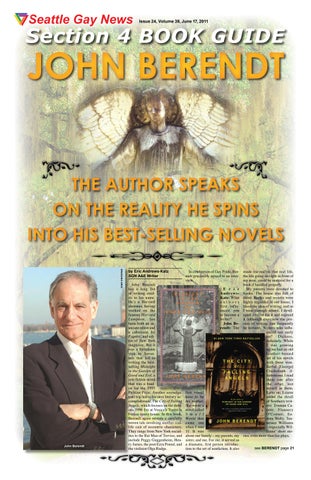
John Berendt The author speaks on the reality he spins into his best-selling novels Graziano Arici
John Berendt
by Eric Andrews-Katz SGN A&E Writer John Berendt has a long list of writing credits to his name. He’s a Harvard alumnus, having worked on the famous Harvard Lampoon, has been both an associate editor and a columnist for Esquire, and editor of New York magazine. But it was a fortuitous visit to Savannah that led to writing the bestselling Midnight in the Garden of Good and Evil, a non-fiction novel that was a finalist for the 1995 Pulitzer Prize. Another serendipitous trip led to his next literary accomplishment, The City of Falling Angels, which focuses on the dubious 1996 fire at Venice’s Teatro la Fenice opera house. In this book, Berendt again reveals a carefully woven tale involving another reallife cast of eccentric characters. They range from New York socialites to the Rat Man of Treviso, and include Peggy Guggenheim, Henry James, the poet Ezra Pound, and the violinist Olga Rudge.
In celebration of Gay Pride, Ber- made me realize that real life, endt graciously agreed to an inter- the life going on right in front of view. my nose, could be material for a book if handled properly. E r i c My parents were devoted to A nd rews - books. The house was full of Katz: What them. Books and writers were a u t h o r s highly regarded in our house. I first influ- liked the idea of writing, and as enced you I went through school, I develto become a oped a talent for it and enjoyed writer? it (although even now the proJohn Be- cess of writing can frequently rendt: The be torture). Writers who influenced me early on? Dickens, definitely. While I was growing up we had an old l e a t h e r- b o u n d set of his novels with those wonderful [George] Cruikshank illustrations. I read them one after the other, lost myself in them. first would Later on, I came have to be under the thrall my mother. of Southern writShe wrote a ers: Truman Canovel called pote, Flannery S m a l l O’Connor, EuWorld that dora Welty, Tencame out nessee Williams when I was – especially Wil11. It was liams’ short stoabout our family – my parents, my ries, even more than his plays. sister, and me. For me, it served as a dramatic, first person introducsee berendt page 21 tion to the art of nonfiction. It also
Gay Pride and the written word A message from Eric Andrews-Katz by Eric Andrews-Katz Guest Editor and SGN A&E Writer
erature. Our presence has changed from the subtleties of Oscar Wilde’s Picture of Dorian Gray, through the references in Tennessee Williams’ Cat on a Hot Tin Roof, up through the blatant explicitness of Larry Kramer’s Faggots. The written word has pushed the boundary of what society can handle, and just as often, has shown our community what we are ready for. This year, the Seattle Gay News is proud to express its Gay Pride with a celebration of Gay literature. The following interviews and reviews are only a small glimpse into the vast changes the Queer literary movement has made within our country’s history. Offered are various views and voices from those who not only influenced our community, but by those whose writing was influenced by us in return.
E.M. Forster once said, “What is wonderful about great literature is that it transforms the man who reads it towards the condition of the man who wrote it.” I can think of no better example of this than the history of the Gay literature movement. Written text with homosexual themes dates back to the times of Sappho’s poetry, or even to the drawings of the Kama Sutra. Whether it was reading between the lines of Victorian writings or celebrating the freedoms of the sexual revolution, our literature has forged a strong cultural connection; not only between ourselves, but between us and the world around us. The way we look at ourselves in the Queer community changes, often reflecting how the world sees us. As accepContact Eric Andrews-Katz at eric@ tance, tolerance, and social assimilation become the norm, it is reflected in our lit- sgn.org.
The way we look at ourselves in the Queer community changes, often reflecting how the world sees us.
ELECTRIC
BOAT Rentals On Lake Union, Seattle
ELECTRIC
BOAT Rentals On Lake Union, Seattle
Electric Boat Rentals ELECTRIC ELECTRIC ELECT On Lake Union, SeattleELECTRIC 206.223.7476
BOAT BOATBOAT BOA w w w. T h e E l e c t r i c B o a t C o . c o m
2
Seattle Gay News
206.223.7476
June 17, 2011
Celebrating 38 Years!
Visit us online www.sgn.org
June 17, 2011
Seattle Gay News
3
Graphic novelist Jon Macy discusses Wilde, paroxysms, and poodles
by Evan J. Peterson Special to the SGN The graphic novel Teleny & Camille is Jon Macy’s take on Oscar Wilde’s titillating Teleny, a classic of Victorian erotica. Macy sat down for an in-depth discussion analyzing Wilde’s original writings, his new work, and what the Gay comic author is working on next. Evan J. Peterson: What has been the most exciting thing about this project so far? Jon Macy: Beyond just my own involvement, it’s pretty cool to see so many Teleny fans excited about this. It really is, most likely, the closest they will ever come to a movie version of the story. It’s something I would want to read myself. I just hope it lives up to the source material. Peterson: I’m curious about how you perceive Teleny & Camille’s place in your body of work. Macy: It’s separate from all other work I’ve done. It’s not just because it’s my only adaptation, but [because of] the amount of research I did for it. I was so scared of getting it wrong, I mean I was trying to find the right doorknobs and hinges and images of little bits and bobs mentioned in the book that are spelled differently now and almost impossible to find. Do you know there are no pictures of Victorian pissoires anywhere? I guess it was not a priority when photography was beginning. Anyway, there was so much pressure to get it right and live up to the source material and people’s expectations of not just Teleny, but Oscar fucking Wilde. In a way I’m glad it’s over, but I will miss hunting around for some treasured bit of information that will most likely go unnoticed. I learned a lot more about the lavender generation than I ever intended to. Peterson: Like what? Macy: When I was ready to do the story of Wilde leaving the manuscript at the bookshop and all the writers coming in and picking it up, I was forced to decide who I thought those writers were. That led to trying to find pictures of them and reading all their biographies to give me clues to how they related to each other. I wish I had contacted the Oscholars [a group of critics of Irish fin-de-siècle literature and art] earlier, as I’m sure they could’ve helped me, but in the end the hunt was fun for its own sake. I was online looking for pictures of doorknobs and hinges. Costumes are pretty easy as they have been documented, but the artistic dress was harder to find – the corsetless dresses and the Pre-Raphaelite inspired clothing. Architecture was hard because most of the buildings named were blown up during WWII and rebuilt using the same names. [Eventually] I gave up being superaccurate and started inventing things of my
own. The morgue, for example, is all out of my head and can be considered more of a dream sequence. There are millions of absinthe spoons out there, you know. It was a lot of fun, actually, and I learned a lot about the Victorian taste in exotic foods. Peterson: Let’s dive into the content of the graphic novel. There are mysterious symbols, dream sequences, and psychic sex romps. How do you tell this story through images with such a reduced amount of words? Macy: The constellation is not a real one. I am not conscious of what I meant to say with that. It could be as simple as connecting the dots and trying to find meaning in a natural phenomenon or heavenly unknown or it could be a molecule that is bound together by universal forces. These characters know deep down that they are joined and that this force that joins them is irresistible. When I see heterosexual love represented it is always clothed by social trash that has been collected over the years and by biblical allegories. I feel that love is more an instinctual natural drive and I feel it in my body and my mind follows as best it can. One of the themes of the book is that our reason and our intellect would keep us from the messiness of love and that only the force of our animal attraction lets us overcome the chasm of fear that keeps people apart. Isn’t that funny that we think fear is overcome by reason, but really our courage comes from more practical concerns like physical safety and emotional security. I find great comfort in holding another person, much more than trying to connect verbally. After all, when we talk we are trying to touch each other. So I let many of the images speak and touch instead. Peterson: Was it difficult for you to decide what to leave out of your adaptation?
Macy: Leaving things out was my only tool, as I really could not add anything. Well, I did add to the scene where Camille wakes up in the morgue, but only by expanding it. I dragged it out because visually it was a lot of fun. I took text from all over the book, so it’s not a straight read-through. There were some great bits of language in boring scenes that fit just the feeling I thought
they were trying to convey, so I mixed it up. I grudgingly changed the archaic spelling of “shew” instead of “show” and trimmed down some of the “whilst”s. In the novel, Teleny powders his hair to appear blond and has a little moustache, and Camille is dark-haired. That change was purely selfish as I love curly black hair and I just wanted to draw it. I ended up drawing it a lot so I think it was a good choice. Peterson: What about the brand-new epilogue?
Broadway
Farmers Market 4
Seattle Gay News
June 17, 2011
Macy: Well, originally I was not going to do one, but once I got halfway through I became more and more uncomfortable about how the novel ends and what that says. After I finished chapter three of Teleny & Camille, I put the project away for many years. I quit comics actually, and four or five years later I decided that I couldn’t live with myself if I didn’t finish this thing, so I picked it up again. This new ending had to do with two things: the couple is not broken up by tragedy, and they had to find their own way of doing things in not trying to be a Gay version of a straight relationship. Peterson: What convinced you that all of the authors of Teleny were Gay men? Macy: Really, there is no proof. This is an anonymous novel, the manuscript is lost, and so it’s all conjecture and hearsay. I spent a lot of time hunting down possible suspects in Wilde’s orbit at that time, but after the Oscholars did their reevaluation of Teleny, it struck me that the straight sex is a commentary. I was naive at first, thinking that the hetero sex scenes with all their pink pouting lips and such were meant to be arousing. Now I feel they were mocking. I think they treated the non-Gay sex with just as much description and color, but none of those scenes would ever get a straight man or woman off. They are only there to show the horrors of heterosexual perversions. We may not think that is original now, but back then these guys were forming what we would call Gay identity and doing it all on their own. Peterson: What else would you like to say about the new project? Macy: After working on an adaptation for almost 13 years, it’s safe to say that I was a bit rusty in the writing department. There was a lot of wordplay and shuffling done for Teleny & Camille, but now I have to come up with a new story from scratch like I used to. I started working on a graphic novel called The Sebaceous Funk, which is a rather ambitious science fiction story about a cult of Charles Mingus that would involve tons of research into the history of jazz and magical theories based on sound and music. I got about 50 pages into it when Prop. 8 passed here in California and I suddenly felt I had to have highly visible, out Gay men in all my work. So I put it aside and started this Gay fantasy romance with druids and werewolves instead. It’s my first new series since Nefarismo, and I am still trying to make up for my past bad behavior by doing a sweet and sexy Gay romance – well, there is tentacle sex. I’m not completely reformed, but I’m trying. It’s funny that during Teleny, I felt so much pressure to show intense loving emotion, but now when I look back on it I always see more that I can do. Fearful Hunter is an experiment in showing a Gay romance that has sex but also very complex emotion that serves the romance. I could not be doing this work without having done Teleny first. Teleny challenged me. I feel like I have stronger skills, and I’m braver now when it comes to revealing myself. If there is a legacy left by the men who wrote Teleny, I cannot think of a better one than their act of defiance helping others find their own courage to do openly Gay work.
NEW LOCATION! B'way & E. Pine, at Seattle Central Community College Sundays, 11am - 3pm, May 8 - Dec 18. Celebrating 38 Years!
Jon Macy’s Teleny & Camille an elegant take on the erotic classic by Evan J. Peterson Special to the SGN Over 100 years ago, Oscar Wilde and friends co-wrote a slim little book titled Teleny. In this work of boldly Queer Victorian erotica, the title character, a traveling musician, has a troubled love affair with a narrator just discovering his own sexuality. This isn’t a cliché Gay book; it invented the familiar plotlines we now see as cliché. Now, underground comix hero Jon Macy has adapted this sex-saturated novella into a formidable graphic novel, Teleny & Camille, with emphasis on both “graphic” and “novel.” Images of bare bodies tumble through hallucinations, dreams, and then waking life. Characters desire and pleasure one another, but the sex scenes are just one aspect to love about this book. Macy has transformed the novel expertly, editing down the purple prose but retaining the beauty of the love story underlying it all. Camille, son of a middle-class British family with an absent father, attends a concert performed by the mysterious gypsy pianist Teleny. During the concert, the two men find a psychic bond. Soon, Teleny cannot play with inspiration unless Camille is present, and Camille can read Teleny’s mind quite explicitly. In Teleny’s fantasies, Camille finds landscapes of Rome, Sodom, and Egypt, ancient love affairs between Roman emperors and slaves, and an abundance of naked men. From the “symposium” (a delightful
orgy) to the brothel (a horrifying orgy) to the tender, private love sequences between Teleny and Camille, Macy leaves little – but just enough – to the imagination. He keeps things elegant, even the tragic or nasty parts of the original story. It’s not a stroke comic, but rather a gorgeous and heart-touching love story that includes a welcome, heaping portion of sex. The art itself is well stylized, a little more Erte than Aubrey Beardsley, combining art deco and art nouveau. Some images are very basic while others are painstakingly realized, creating variety and movement through the book. Like the original novel, there’s a balance between fantasy and reality as well as between the natural and the man-made. Macy has given interviews in which he describes the almost obsessive process of researching the crafts, architecture, plant life, etc. of the era. His obsessing has paid off in a richly detailed and distinct world. As the original novel had multiple authors, Macy contributes a new graphic artist’s statement/foreword, a prologue of historical background, and an alternate ending. The effect? Nothing less than bringing a classic Gay novel firmly into contemporary literature, a reminder to modern Gays (and everyone else) about the men from whom our literary heritage comes. Teleny broke ground in 1893, and Jon Macy’s Teleny & Camille continues to break ground in the 21st century.
SafeSchools Coalition stands with gender expansive children and LGBTQ youth. Crises: 1-877-SAFE-SAFE. Messages: 206-451-SAFE. Resources: www.SafeSchoolsCoalition.org Have you donated lately? Visit us online www.sgn.org
June 17, 2011
Seattle Gay News
5
Felice Picano is one of the premier forces of the American Gay literary movement. His voice is soft as he relates humble stories about wonderful people from his past and present. It is in his words that the famous, infamous, and those yet to be recognized find their common ground, transcending gaps of generation or location. The impish glint in his eyes match his easygoing smile and gentle tones. Eric Andrews-Katz: What authors influenced you to become a writer? Felice Picano: I read Balzac when I was very young so he was very influential. In college it was Thomas Mann and Henry James who got my attention. Believe it or not, aside from science fiction, I didn’t do popular reading until after college, and by then my course was set – even though I did nothing about it. I thought I was a painter, so I just read whatever I wanted. Andrews-Katz: The Violet Quill is considered to be a Gay urban version of the Bloomsbury Group. How did it get started? Picano: We were all friends and lovers – literally. Robert Ferro and Michael Grumley were partners since the University of Iowa writing school. Andrew Holleran was also at that school. Michael and Robert were together for years. I met Edmund White in Greenwich Village in 1976, and George Whitmore in ’77. Chris Cox was Edmund’s boyfriend; George and I were tempestuous boyfriends at the time, but he was instrumental in forming the group. Robert was also very socially active, so he and George pulled it together. Andrews-Katz: Do you find advantages with using a writer’s group? Picano: We did then because nobody was taking our writing seriously, and neither were our friends. No one would have anything to do with Gay literature. They all said, “There’s no such thing; there’s only porn.” We had to find each other, little by little, and then write and define what was both “Gay” and “literature” at the same time; something the mainstream media could review and that was prize-worthy, something that could be discussed in academia – yet be accessible and important to the Gay man on the street. Nobody believed it could be done. And we felt we had no choice but to do it ourselves. Andrews-Katz: What oppositions were presented when the Violet Quill first started to publish their works? Picano: Name it! First, nobody would publish us. We literally had to form a beneficent conspiracy, which we did, with other people who were starting Gay newspapers and magazines, and with the few bookstores that were around. Christopher Street magazine was crucial. A lot of local Gay papers, too. Three Lives & Company Bookstore, run by Lesbians, turned out to be very supportive. As other Gay and Lesbian bookstores opened around the country, we put together readings and events to publicize our stuff. The anthology I edited and published through my all-Gay SeaHorse Press, called A True Likeness (1981) had all of the Violet Quill plus other men and women in it; it had plays, poetry, and fiction. Many say that was a turning point for Gay literature. But before it, Holleran had published Dancer from the Dance (1978), and my book The Lure (1979) had come out, and they helped to swing weight with publishers. My novel was the first Gay-themed book offered by the Book of the Month Club. Before us there was [Patricia Nell Warren’s] The Front Runner (1974) and Gordon Merrick’s many
6
Seattle Gay News
novels, but they didn’t offer the same kind of “literary” writing that ours did. I got blurbs from Stephen King and from “academics.” We were hitting all the spots and those books (among others) had a big influence by selling many copies and making money for publishers and bookstores. Andrews-Katz: Whom in the Violet Quill did you admire the most, and why? Picano: Oh, I don’t know. I mean, Edmund White and Andrew Holleran are still close friends of mine. Andrew and I speak every week, Ed and I once a month. The fact that we’ve remained close all these years says a lot. Last year in New York, it had been 30 years since we three remaining members of the Violet Quill were all together. We were photographed as “the most influential people” for 2009 by Out magazine, and we did a reading together in Manhattan. Andrews-Katz: In your essay My Second-Childhood Friend, you talk about your “intense misery” and “sense of loss” as a result of AIDS. Do you still feel that way and how do you combat it? Picano: I was haunted on every street in NYC; there was loss everywhere I turned. So much death! After my partner and the last of my best friends died, I had to leave New York to get away from it, and I moved to L.A. in 1995. Now, when I go back, NYC is a different place. … I feel that all that illness and death ruined my personal life. Someone once said that I’m reaching for something I can never attain. The Golden Bowl by Henry James is a perfect metaphor for who I believe I’ve become: one is so distracted by its glitter and its apparent wholeness that you can’t see the hairline crack running through it. Sometimes I feel like that bowl. I think that all of us survivors may feel like that; you may not see the fatal damage, but it’s there all the same. Andrews-Katz: Of all the common, famous, or infamous people you have met, who stands out most in memory and what makes that person stand out? Picano: I don’t know if I can answer that, I meet famous people constantly. The first story [in True Stories] is about meeting the poet W.H. Auden, in a totally non-literary way. I got to know him personally first before I knew who he was. So, I’m going to say W.H. Auden, even though I only knew him for a few years before he moved back to Europe and died. Mostly because he showed me that great authors could be flawed and human and still be uncommon. Andrews-Katz: In your most recent memoir anthology, True Stories: Portraits From My Past, there are several stories about relatives. Have you always had a good relationship with your family? Picano: I had a terrible relationship with my father most of the time. Later on, my father had calmed down, and he was easier to be with when I wrote that story about us driving in True Stories. But we always had an adversarial relationship and as he was a powerful personality, that helped me grow up fast. Andrews-Katz: What do you think is the future for Gay/Lesbian authors and publishing? Picano: Based on what I’m seeing, I think it’s very good and going very strong. At NYC’s recent Rainbow Book Fair, where mostly GLBT independent publishers and groups are represented, it was packed with people from 10 a.m. to 5 p.m. And it was freezing outside. People were buying lots of books too. Based on that I think our literature is healthy. I think we’ve discovered that we don’t need the major publishing houses – which are in constant crisis right now, anyway. We can do a lot on our own – and let’s
June 17, 2011
Gro up
by Eric Andrews-Katz SGN A&E Writer
DRE AM Wa lke r
Felice Picano, literary pioneer
Felice Picano
recall that how Gay and Lesbian literature began in the 1970s in small presses. Andrews-Katz: Which of your many works would you like to represent you for future generations? Picano: I’d say True Stories represents me pretty well. It’s honest, serious, fun, admiring, and also critical of myself and of those who have influenced me. Andrews-Katz: Whom of the modern generation of Queer writers do you admire? Picano: There are so many, and I’m surprised at how much quality there is out there. Just talking about people who have new books out in the last couple of years, I’ve admired Jess Wells, Aaron Hamburger, Tom Mendicino, David Pratt, Trebor Healey, and Jeff Mann. I’m sure I’ve missed
some among the current crop. The person I admire the most in this group is Radclyffe; she’s a prize-winning author and a major indie publisher, and I think she is one of the most stupendous forces in GLBT literature today. Felice Picano has authored over 25 books of fiction, nonfiction, poetry, and plays, establishing him as one of the greats of GLBT literature. Nominated for four Lambda Literary Awards and a finalist for the PEN Foundation/Hemingway Award, Felice’s latest wins include the Syndicated Fiction/ PEN Award, the Ferro-Grumley Award, and Gay Times of England Award for best Gay novel and best short story.
Felice Picano’s True Stories by Eric Andrews-Katz SGN A&E Writer Felice Picano is perhaps one of the greatest American contributors to the world of Gay literature. His prolific writing career spans 30 years, and he has won many accolades and proved his talent several times over. As one of the original members of the famous writing group The Violet Quill, it is easy to credit him with being, at least in part, responsible for the revolution of the Queer literary movement. His latest contribution is True Stories: Portraits From My Past, which confirms his place among giants of Queer writing. Through a series of 15 essays, Picano gives an insight to the incredible variety of people who have come into his life. Whether it is stories of the truly famous – such as W.H. Auden or Tennessee Williams – or of the much lesser-known, such as his business partner Terry Helbing, or a ghostly visitor at a bar owned by Bob Lowe, these true tales spark a familiarity to people in our own lives, allowing us to feel a connection when reading about them in his. Even if the names of Robert Ferro, Michael Grumley, and Diana Vreeland are as unrecognized as Felice’s Grandpa Ralph, all of these essays transcend barriers of age and location to find some inner common ground with the reader. Since we are familiar with the brassy behaviors of the Divine Miss M, we can immediately relate to the man who discovered her, Jerry Blatt. While the story isn’t di-
rectly about her, through the outsider’s view in Mr. Broadway, we can see how much of Jerry’s direction went into the creation of a Bette Midler persona’s identity. Although the reader may not be a scholar in the works of W.H. Auden, we can still smile at the eccentricities and behavioral fussiness in The British Auntie. In Me & Tennessee, Felice recollects how, through a mutual friend, his distinctive name ended up as a character in a play by Williams. At a chance meeting years later, the two authors discuss it and the story behind the name’s usage unfolds. It is not only the stories of the famous to which the reader can relate. In Road Test Number Three, the details of a road trip taken with his father, becomes something more than a journey in a car. The recollection in The Taystee Bread Man describes the forming of a young man’s “type” before understanding the newly budding desires that draw him towards them. It is something that everyone identifies with, the blossoming sexual coming of age. The Bike Race pits the author against a childhood nemesis recreating a dispute between two boys, with all the tension of a 1950s roadster drag race. True Stories: Portraits From My Past covers a wide range of subjects, eras, types of people, and even locations. Not once does the reader become lost or confused, but rather is reminded of someone, something, or some other time period in our own lives. These essays of memory are something you can escape with at the beach, or slip into from the comfort of your couch. Either way, read them and enjoy.
Celebrating 38 Years!
Visit us online www.sgn.org
June 17, 2011
Seattle Gay News
7
8
Seattle Gay News
June 17, 2011
Celebrating 38 Years!
Seattle Gay and Lesbian Book Club unzips Gay lit by Scott Wittet Special to the SGN
a month. For busy people, four opportunities means not having to worry about missing out. And spreading the discussion over a month allows us to approach topical questions in depth, for readers to dive back into the text and explore thoughts different from their own. Wittet: How do you choose the books? ites, Andre Gide’s Nobel Prize-winning The DiMartino: The selections are usually Counterfeiters. paperback and they’re discounted for club Wittet: Which books have been your members at University Book Store. You often can find them used or at the library. The
One of my friends complains that his book club spends more time negotiating the next book than talking about the current one. Another jokes that her group is really “a drinking club with a book problem.” The Seattle Gay and Lesbian Book Club at Dunshee House differs. Nick DiMartino, creator and facilitator of the club, is a playwright, novelist, book reviewer, bookseller, and avid reader. He selects the books, which range from classic authors (Genet, Colette, Gide, Forster, Murdoch) to awardwinners (Patti Smith’s National Book Award-winning Just Kids) to the classics (the outrageously funny Satyricon) to graphic novels (Alison Bechdel’s Fun Home and Howard Cruse’s Stuck Rubber Baby). When I first saw SGN ads for Dunshee House’s group two years ago, I assumed DiMartino had a grant to build Gay and Lesbian community. Then I learned that he was doing all this without any support. I asked him about his efforts. book clubs’ favorites? DiMartino: I’d say we had our strongest Nick DiMartino: Books have been one response to A Fairly Honourable Defeat by of the greatest joys of my life. They’ve not Iris Murdoch, Booker Prize-winning The only given me hours of pleasure, but they’ve Line of Beauty by Alan Hollinghurst, The taught me compassion for people who are Last of the Wine by Mary Renault, and Fun different from me, and inspired me to dare Home by Alison Bechdel. to be myself. Wittet: It’s unusual for book groups to Scott Wittet: What are you reading for meet weekly. How does that work? June? DiMartino: Some members come evDiMartino: One of my all-time favor- ery Wednesday. Some come once or twice
discussion facilitator. DiMartino: I took the Dunshee House training, but I naturally love hearing people describe their reading experiences: what made them laugh or cry, what surprised them. These are fascinating glimpses into other readers’ minds and alternate opinions help me see my own reactions more clearly, often altering or changing them. I try to give every member a chance to talk because I genuinely want to know what they think. Wittet: What is the relationship between your book group and Dunshee House? DiMartino: When I became HIV-positive in 2007, I turned to Dunshee House and discovered a whole new world of support, as well as one of the best friends of my life. In payback, I took their facilitator training so I could offer back to the Gay community what I know best, a love of books. Wittet: Would you say books play a major role in your life? DiMartino: You could say so. I’ve worked at University Book Store for 40 years, where I promote a book-of-the-month called “Nick’s Pick,” and I am the book-buyer for the two campus branches. I’ve had three Seattle-based supernatural mysteries published, and review new international fiction for ShelfAwareness.com. I’m always reading, on lunch breaks, on the bus, perpetually looking for good new books to feature and promote. The club can be very satisfying, and people who have a positive club is free. experience reading come back to Wittet: You sometimes watch movie ad- read another book. Everyone wins. aptations of books the club reads. DiMartino: As often as we can! Seeing a The Seattle Gay and Lesbian Book Club great adaptation, like Fellini’s Satyricon or meets every Wednesday from 6 to 7:15 pm the Merchant-Ivory Maurice, only enriches at Dunshee House (303 17th Ave. E.) on the reading experience, especially when ev- Capitol Hill. Feel free to just show up. For eryone in the room has read the book. That more information, contact Nick at nickdicreates a very special, receptive audience. martin@earthlink.net. Wittet: In my opinion, you’re a master
Finally, A New Gay Bar in West Seattle! Coming Summer 2011 Visit us online www.sgn.org
www.outwestbar.com June 17, 2011
Seattle Gay News
9
When does dirt, scandal, and gossip become valued cultural history? Ask Darwin Porter or Danforth Prince of Blood Moon Productions. They’ve been spelunking in the darkest and dankest of Hollywood’s historical catacombs and bringing to light disturbing and fascinating relics of info on the iconic, the notorious, and the idolized for nearly a decade now. And a goodly number of these demigods and goddesses were [allegedly] friends of Dorothy and daughters of Sappho since before the “land” fell off the Hollywood sign.
Both acclaimed and vilified for their unvarnished, un-airbrushed approach to pre-’70s celebrity journalism, Porter and Prince have produced a jawdropping series of books with information that Louella Parsons or Perez Hilton would gladly sell a kidney to obtain.
The Blood Moon boys have far less to lose, which is precisely what makes their revelations valuable – they’re too unbelievable not to be believable. I was able to squeeze in an interview with Dan Prince while in NYC recently, in his book-crammed office on the top floor of the deceptively small – but labyrinthine – Staten Island Victorian that Blood Moon calls home. The house is a virtual museum/ curiosity shoppe filled with every book on film ever published, esoteric artworks, and memorabilia accumulated from Darwin Porter’s extensive travels, two large and lovable dogs, and two adversarial cats. Maggie Bloodstone: What made you decide that this was your calling? Danforth Prince: Darwin and I have been a functioning journalistic team for about 30 years now. I met Darwin in 1982, when he had just lost Stanley Hagert, who had been his collaborator for another 30 years – I think I have now outlasted Stanley in terms of longevity in Darwin’s support mechanism, if you like. Stanley had died of cancer in 1980, and I came upon Darwin, who had accumulated lots and lots of contracts to update annual editions of the Frommer travel guides. Darwin really developed the style that is now known as the Frommer travel guides – he was a contemporary of Arthur Frommer himself and he saw five different corporate ownerships of the Frommer guides, each with new styles and priorities and writing preferences. So we’ve proven ourselves very adroit within the politics of the publishing industry by adapting our style and always meeting our deadlines and never creating any legal problems, any embarrassments – we always gave them the copy on deadline, in style. The Blood Moon opus came into being because we talked
courtesy Blood Moon Productions
by Maggie Bloodstone SGN Contributing Writer
Danforth Prince
about movie stars, and Darwin talked about his friendships with these legendary movie stars, which he had always been in contact with – he was a close friend of Tennessee Williams and he was even a closer friend of Frankie Merlo, who was Tennessee’s longtime companion and lover. Great buddies, they were. Darwin was the bureau chief of The Miami Herald in Key West, Florida, during the era when Key West was sort of a raunchy fisher and shrimper’s town where every artist in the western world would go and screw around and talk about it over drinks. Sort of a gossipy, arts-oriented town – Richard Burton came there, Richard Burton’s father ended up living there, I think the sister of the Shah of Iran rented a house there one summer. Darwin made friends with Anne Baxter….
Bloodstone: And Tallulah Bankhead? Prince: Tallulah, absolutely! And Darwin actually was the man who introduced Eleanor Roosevelt to the University of Miami – he defined, in his role as the head of the student newspaper and head of the student body of the University of Miami, “Eleanor Roosevelt Day.” So Darwin maintained a dialog with Eleanor Roosevelt and accompanied her to many Democratic fundraising events. Darwin was a beachwalking companion of Harry Truman, when Harry maintained the White House in Key West. Darwin told me about how Truman took him for a walk on the beach, and said, “You better start improving your education.” So Darwin had these anecdotes, and I
was always rather surprised, because now that we’re recording these anecdotes as part of the repertoire of Blood Moon, I almost want to turn to Darwin and say, “My god, this story is fabulous, how come you never told me this during those long Tuesdays running through Belgium when I was wondering about what museum to write about?” Bloodstone: I think one person who had a lot to do with that is Hunter S. Thompson, the way he injected personal points of view…. Prince: Darling Hunter. Fabulous Hunter Thompson! Wouldn’t I have loved to have met Hunter. And we’re also reaching the era where the principals in the dramas we’re publishing are dead, and of course, the first comments our detractors say is, “Oh, they never would have dared to say that while the star was alive!” And there’s the relaxation in journalism, and the willingness of very prominent papers to define their allure as being mixed in with the tabloid coverage. Bloodstone: In that vein, have you ever had any legal hassles from any survivors, or keepers of estates, or anything? Prince: The book that Darwin wrote that I published that engendered the most fury and rage was the biography we did of Katharine Hepburn in 2007. We wrote Katharine the Great: Secrets of a Life Revealed. And the point I want to make is that if we had written a truthful biography of Lana Turner, I think everybody would have shrugged and said, “Oh, Lana screwed around and everybody knew that Lana screwed around, and Lana was Lana, and we love Lana, and we loved her because she screwed around,” and so if you say Lana screwed around, nobody cares. But if you say that about Katharine Hepburn, who is a Madonna, a goddess, the screams were very, very loud. Now what was in the Hepburn book was a sensitive acknowledgement of her role as a rather active Bisexual running around Hollywood, keeping the Lesbian aspect of her life under wraps and treating it with great style and great dignity and an exploration of the lengths that she went to keep this out of the press, and her real moral courage, and being a trailblazer in all kinds of sexual politics. Did you know that her mother was a prominent feminist? Bloodstone: Oh, yes. Prince: And at Katharine Hepburn’s table, as a dinner guest, came Emmeline Pankhurst, who was a friend of the family. So Katharine came from good, aristocratic Yankee intellectual stock. And her father
was a specialist in the treatment of venereal disease. Bloodstone: That I didn’t know. [Laughs.] Prince: But this biography elicited screams, particularly from her estate, and we did have a legal challenge, which we handled very adroitly out of court – they had absolutely not a leg to stand on. They wanted to see the manuscript prior to publication, we had serialized it with one of the large newspapers of Britain, The Daily Mail, and we were not allowed to pass out advance copies because of our contract, and consequently her family panicked. The statements Darwin made about Katharine Hepburn and her Bisexuality, though shocking in 2007, have now been adopted by every subsequent biographer of Ms. Hepburn since then, including Vanity Fair. So, that cost us some money, but that’s what you get when you’re the first to say it. Bloodstone: Have you had any problem with Michael Jackson’s people, after putting out Jacko? Because it’s much more recent, and people are still a little touchy-feely about the truth about him. Prince: That’s such a good question. We were very alert to his propensity for suing. Some facts about that book: We published a version of it when he was alive, and when he died, we tacked on a post-mortem chapter describing the circumstances of his death and the murk surrounding that and his estate. The riskier moment was when we did the version prior to his death, and of course, I read every word for potential litigation, and Darwin is very careful. But they could have sued anyway, and I think that they did not sue because I made a video describing our motivation and released it simultaneously with the book, and I believe that his family saw the video – I’m sure his camp saw the video – and the video was basically a book trailer describing the themes within the book, and I think that it was couched diplomatically and lovingly, with great respect for Michael as an artist. It is not a musicology of Michael’s life, it was an analysis of the way that the media treated Michael Jackson. It was a review of the tabloid treatment of Michael Jackson by the American media – by the world media – and the way it broke new ground in terms of personal venom. And when I explained that in our video, which is available on YouTube – you’ll see several versions of videos that I made which were always couched in the most loving, respectful language towards Michael. So I be-
Visit us online www.sgn.org
lieve that it was the personal appeal to those who loved Michael’s music and appreciated Michael as a human soul in need of some nurturing that kept us out of court on the Michael piece. Bloodstone: There’s something I noticed reading the Hollywood Babylon books and Brando Unzipped. Compared to the original Hollywood Babylon, I definitely get the impression that Darwin has more respect for his subjects, as opposed to [Hollywood Babylon author Kenneth] Anger, who is just … angry. Prince: We’ve talked a lot about that. We even got some mileage when Page Six – that’s the gossip column associated with the News or the Post in New York – did a story about how Kenneth Anger reacted when he learned that we had used the phrase “Hollywood Babylon.” Bloodstone: It’s part of the lexicon now. Prince: There you go. It is now terribly common, and you cannot copyright a title, by the way, according the copyright laws.
Bloodstone: There’s been TV Babylon, Rock and Roll Babylon…. Prince: Palm Springs Babylon … but despite that, Kenneth Anger, it was reported in the Post, put a curse on us. And by the way, he is one of the most prominent Satanists in America – he is prominent in the Church of Satan, his movies, film critics say, are really an acknowledgement of the entity defined as Satan. He has exhibited some very erratic behavior at Hollywood funerals lately. One story I heard was that he had disrupted the funeral of a literary competitor of his called … I believe his name was Chamberlain, and the man officiating was the actor who played Jimmy Olsen in the Superman series. [Laughs.] Bloodstone: How’s that for a Hollywood funeral? Prince: Kenneth Anger disturbed the funeral and messed up the toupee on the
June 17, 2011
Seattle Gay News 11
see prince page 22
No longer a secret An interview with Justin Spring, author of Secret Historian by Ron Anders SGN A&E Writer In his fascinating biography, Secret Historian: The Life and Times of Samuel Steward, Professor, Tattoo Artist and Sexual Renegade, author Justin Spring has unearthed and unabashedly presented a heretofore unknown life. A writer and professor, alternately known as Phil Andros (author of Gay pornography) and Phil Sparrow (tattoo artist extraordinaire), Sam Steward meticulously documented his own life – including vast numbers of sexual encounters. Spring honors Steward’s life by uncovering the prodigious archive of materials he left, which otherwise might have been lost forever. Sam emerges from the book’s pages as a multi-talented, courageous, and tenacious recorder of Gay life in his era. Capturing his story, tinged with eroticism and poignancy, is a major achievement. It may be the most enthralling biography I have ever read. Spring garnered a National Book Award nomination among many other richly deserved honors. The paperback edition of the book arrives in stores in mid-July. I recently spoke with the author, who lives in New York City. Ron Anders: Sam Steward’s story has an epic feel to it – a story of a life uncovered. Due to Sam’s documentation, the detail is amazing. Justin Spring: I was chatting with the film director James Ivory recently. He said it’s extraordinary that I could write a story so compelling about a man who was basically a nobody. It’s easy to take someone who lives a well-known, celebrated life, where the reader is captured from the start. With Sam, I had to make the case not only for the importance of his life story as social history, but his validity as a writer. That he lived a very exciting and dramatic life in the shadows also helped me in the project. Even so, selling it to a publisher was very hard because everyone said that biographies don’t sell, especially a biography of an unknown person. Anders: When I finished the book, I felt as if I’d read about a heroic life. Spring: I think Sam was enormously brave and stubborn. He insisted on adhering to his belief system – that he’s allowed to have a sex life – and that the discussion of sex is not only valid, but needed. That’s inspiring to someone who’s been struggling with issues of sexual identity. Anders: How did Sam come to your attention? Spring: I learned of him through many different avenues. When I was in my coming-out process, I bought the Phil Andros novels. They appealed to me not only as erotica, but because they were so well-written. While doing research on the artist Paul Cadmus, I kept coming across references to Sam, who had known many people in Cadmus’ circle and had a friendship with Gertrude Stein and Alice Toklas. Sam’s writing style was very funny and sexually candid. I learned that he had been a professor and literary novelist – and went on to be known as the tattoo artist Phil Sparrow and the erotic novelist Phil Andros. When I learned about all of Sam’s identities, I realized I had come across a major journalist of the homophile
said she didn’t want to handle the project anymore. I somehow managed to wrangle my way into Farrar, Straus & Giroux and got a small advance for the book, which took about 10 years to write. Anders: What do you make of Sam’s recordkeeping? Spring: It took me a while to figure out what to make of it. Some people take enormous pleasure in recording the daily examination of the self. It’s just an aspect of being human. Sexual recordkeeping is a highly specialized category because not all of us have such a varied or interesting sex life. Early on, Sam settled into a life that involved sex with a lot of people on a regular basis – and felt it merited keeping a record of. Even from his earliest days, Sam advocated for the frank and open discussion of sexuality in the classroom, academia, and in literature. Anders: My sense is that he felt that his
12 Seattle Gay News
June 17, 2011
Justin Spring
Spring: There remains an enormous hesitation in discussing my book in the way that other biographies are discussed very routinely. By the time I got to the National Book Awards, the other nominees had been covered extensively on television and radio. At the ceremony, it wasn’t just me that was being celebrated. I felt that the judges had reached out to celebrate Sam’s experience and his entry into the mainstream cultural dialogue. I was able to stand there with my partner and give him a kiss on camera. I was able to thank the people who had encouraged me to undertake the project. For 10 years, I was locked up in the basement writing this book and kept thinking “I’ve got to write it – but am I crazy to be writing it?” I think that readers may also be wondering if they’re crazy to be reading the book – wondering if Sam is a whack job or brilliant. So the validation of the National Book Award nomination was invaluable in legitimizing Sam’s story in many people’s minds. Anders: One reviewer compared the discovery of Sam’s trove to discovering Emily Dickinson’s poems – a very interesting comparison. Spring: It was so daring of him to say that because we think of Emily Dickinson being the purest of the pure – in her poetry and spirituality. To see spirituality in a man who is intensely sexual is, for many people, an extremely threatening or upsetting thing. Sam was a highly engaged person on a spiritual level, although he left the Methodism that he grew up in and was only briefly attracted to Catholicism. His daily examination of conscience – through the acts of journal writing, sexual recordkeeping, fiction writing – is actually a spiritual journey. Not many in our culture are willing to acknowledge that right now. Anders: How did you get the idea to publish Obscene Diary, the companion book to Secret Historian? Spring: I knew that my Secret Historian publisher was not going to let me include an extensive photo section. And Sam’s visual art was very important. I realized that if the materials went back to their sources, people might not have access to them. The solution was to make a book, albeit a small, expensive edition. It was really a labor of love, not a profit-making endeavor. It’s a limited edition of 1,000 copies. Anders: I hear that there is an upcoming exhibit of Sam’s materials at the Museum of Sex in New York City. Spring: Yes, we’re putting together a show of Sam’s archives. Many different kinds of things: sexual record keeping, his journals, drawings, photographs. It will be an exciting show, particularly for those who are intrigued by the biography. It will be a once-in-a-lifetime opportunity to actually see the raw materials from which the biography was crafted. It will open in July and will continue through January. Anders: I know that you were invited to talk at the commencement ceremonies at the school where Sam taught. What was that experience like? Spring: It was beautiful and very moving. DePaul University is now a very remarkable Catholic institution in that it has an active GLBTQ program. I was invited to be the keynote speaker at the awards ceremony. Along with giving a talk about Sam’s life – and his years at DePaul – I read from letters from his former students, written both to him and to me, talking about what an incredible teacher he had been and how profoundly important his mentoring had been. I teared up at the end of the talk, and I think a number of other people did as well. file pho to
record keeping legitimized his sex life. He could re-live it by looking back. Spring: Yes. In 1933, nobody around Sam allowed for a discussion of his sexual experiences. The denial of the validity of self and of individual experience was crushing. Sam refused to be written out of history. He was incredibly stubborn and would not be movement. Here was an important life, oth- silenced. He was almost insanely brave – erwise undiscovered. right on the verge of self-destruction. Anders: What was your reaction to findAnders: One gets the impression that ing the treasure trove of Sam’s material in Sam Steward would have found willing sexhis executor’s home? ual partners at the North Pole! Spring: His executor believed Spring: Yes! We don’t think of that the material – in a total of sixty boxes – needed to be preserved. He went through the material, but it remained in his attic for nine years. When he granted me access to Sam’s papers, I knew I had come across something quite extraordinary. The visual materials – he was a good artist and photographer – included enormous numbers of photographs of himself having sex. These Polaroids were disturbing to look at because the stark black-and-white flash photography made the sex acts themselves look kind of sinister. As a writer, I knew I was on to something truly amazing. I wondered if anyone would give me a publishing contract. The book was rejected at ten publishing houses. My agent
Ohio as a center of sexual activity. When Alfred Kinsey became interested in documenting Sam’s exploits, he was excited about the fact that Sam kept rigorous records. Back in the 1940s and 1950s, it was strictly illegal to have erotic materials in your home, even if you created them yourself. So what Sam was doing was rare. Anders: Have you thought about what Sam’s reaction would be to your book and its popularity? Spring: Sam was aware that he was locked up in his own narcissism. It was very hard to reach outside of himself, to be fully engaged with others. So I think he would be very pleased to see himself as the subject of a book and would be thrilled to see all of that hard work in documenting the self given respectful treatment. I don’t think he had that much respect from people during his life. He got it from Kinsey, which was very important to him. Anders: The book took me on an intense emotional journey. What was writing it like for you? Spring: I was an emotional wreck writing the book because of what I was experiencing through Sam. Sam grew up with a rejecting father and looked for mentors and father/ confessors who would love and accept him. Anders: What was the National Book Award experience like? Spring: It was wonderful to be included in the National Book Award proceedings. I’d been taking a nap when the phone call came. At first I thought they were going to ask me for money, because they called in the middle of the day and there are so many telemarketers. But it was actually the head of the National Book Foundation! He was congratulating me on being a finalist. The For more information on Secret Histobig gala night of the awards was fantastic. Anders: Did this recognition make a big rian, go to www.secrethistorian.com. For difference in how you and the book were ap- information on the exhibit of Steward’s archives, go to www.museumofsex.com. proached by the media?
Celebrating 38 Years!
ELECTRIC
BOAT Rentals On Lake Union, Seattle
ELECTRIC
BOAT Rentals On Lake Union, Seattle
Electric Boat Rentals ELECTRIC ELECTRIC ELECT On Lake Union, SeattleELECTRIC 206.223.7476
BOAT BOATBOAT BOA w w w. T h e E l e c t r i c B o a t C o . c o m
Visit us online www.sgn.org
206.223.7476
June 17, 2011
Seattle Gay News 13
The Empty Family is a marvelous, melancholy, and haunting collection of short stories by the celebrated Gay Irish writer Colm Tóibín. Perhaps best known for his novels The Master, about Henry James, and Brooklyn, this volume is Tóibín’s second collection of stories after Mothers and Sons in 2007. And fans of The Master will appreciate the inclusion of a story, Silence, that features Henry James as a supporting character. On the phone from San Francisco, where he is touring, the author explained – in his lilting Irish accent – why he is now writing more short stories now and fewer novels. “Part of the reason I didn’t do this before is that I didn’t have the confidence. I did try. Before I wrote any novels, I wrote short stories. But I didn’t think they were any good. So I left it.” Yet his life living in hotel rooms and being away from home prompted the author to take up the short literary form again. “I couldn’t write a chapter of a novel. There was a vulnerability that came to me. Images and rhythms made their way into the stories. I didn’t get that I was working at home.” His tales are achingly beautiful, with characters grappling with family displace-
ment, self-invention, secrecy, and silence. These themes echo and repeat throughout The Empty Family, producing a prism to investigate and evaluate different characters in different countries and circumstances. Tóibín admitted that this volume is “a bit more edgy than the previous stories. Three are told in first person, and in one of them – the title story – you can’t tell the character’s gender.” He divulged his reasoning for playing with narrative and identity. “I was interested how, in a book of poetry, you could find a really personal poem – you think, this must be very personal and it must have happened – and the next one could be about spring. It struck me as interesting that in a book of stories, you could do the same thing. Like poetry, it depends on the rhythm.” Tóibín wrote three highly personal, autobiographical pieces in this collection – a first for the author. Both the title story and One Minus One address issues of grief and
xiii 14 Seattle Gay News
June 17, 2011
ia
by Gary Kramer SGN Contributing Writer
lyn would have a right to be surprised,” he demurred about his Gay stories. Tóibín added a bon mot he learned about writing about sex. “Don’t put in any similes. Don’t use metaphorical language.” It is the author’s frank treatment of the Gay relationships that make these intimate stories so powerful. Perhaps the most celebrated tale in The Empty Family is The Street, about two Pakistani immigrants in Spain who fall in love. Tóibín crafted this story after a recent visit to Barcelona, where he walked down the “street” of the title. It was a place where Pakistani immigrants work in barbershops, specifically a place where the author got a shave. He recalled, “I was often in a line, the only non-Pakistani, with music playing, and watching them. I met someone from the community and I talked with him about details. I then used bits of my own life from being alone in Barcelona when I was 20.” The Street was always Tóibín’s choice for the last story in the collection. He disclosed that he built the whole book up to a particular sentence about family in this particular entry. The moment is emotionally explosive; a punch to the reader’s solar plexus. As various characters escape from, return to, and form their own families in the thematically linked entries, how does Tóibín consider the concept of family in this collection? He offered, “That idea – that once people move from where they belong, then they really have to invent themselves – is pretty interesting. All of these stories are about people living in exile – an exile as much spiritual as geographical. The state of limbo provided him with magical inspiration. “In the years before I wrote the book, I was traveling back and forth between the United States and home [Ireland]. The emotions of homecoming and wondering who you were in that indeterminate space were in my mind.” ca irn s med
Author Colm Tóibín offers insight on The Empty Family
caring for one’s parents – something people in their mid-50s, like the author, are coping with as they age. In contrast, Barcelona, 1975 has a completely different perspective. It concerns the
Colm Tóibín
20-year-old author’s sexual awakening abroad. “It was deep in me,” Tóibín said about writing about and revealing his past sexual experiences. “I saw no reason not to publish it. I couldn’t write a memoir, because I couldn’t connect the stories, but I was getting rhythms from them that were emotionally rich for me.” Nor is he apologetic about writing about his sexuality. “All of your life is going to get into your work in some way or another,” he acknowledged. “In a way you don’t understand yourself. I’m Gay, and that will obviously get into my work.” Another excellent entry, The Pearl Fisher, details the memory of erotic fumblings the narrator had as a teenager when he reunites with the object of his affection – an adult now married to a woman from the men’s past. Like Barcelona, 1975, this sexually tinged story may seem jarring for the author’s fans who are used to Tóibín’s genteel writing. “I did realize that readers who read Brook-
The Drag Queens Vs. The Dykes
© 2011 Gary M. Kramer
Hosted by GaysHa starr
Saturday, June 18th, 2011 Cal anderSon Park, BoBBy MorriS Ball Field GateS oPen at 4 PM GaMe FroM 5 to 9 PM
Celebrating 38 Years!
A Jewel among writers by Eric Andrews-Katz SGN A&E Writer Jewel Gomez appears as Mother Earth incarnate. She’s stout and exudes an inner peace that hints at the many things she’s witnessed. Her soothing voice lends itself to being a natural storyteller, and the gap between her front teeth transforms her easy smile into something playful and mischievous. She’s an activist for many causes, and because of her various mixed heritage, describes herself as a woman of color. Gomez is one of the most prominent Lesbian-American authors today. Eric Andrews-Katz: What authors influenced you to become a writer? Jewel Gomez: James Baldwin and Radclyffe Hall were the earliest writers that I read. James McCain was another – I always thought that Mildred Pierce and her sidekick should have been Lesbian lovers. Andrews-Katz: How did your family react when you came out to them? Gomez: My great-grandmother raised me. She passed by the time I came out. When I was about 23 years old, I came out to my mother and grandmother in the movie theater bathroom (Alien was playing). I’ll never forget it. They were very relaxed, in fact they already knew despite me having a boyfriend in college. They were all three independent women, and my grandmother had told me a story once about dancing with a “bulldagger” – her words – and how she saved her from boredom at a party, and since she was relaxed with that word, I thought that it was all right to be a Lesbian – even as a kid. It helped to save my life. Andrews-Katz: How did The Gilda Stories start, and when did you decide to make them a novel? Gomez: I started writing them because this guy harassed me on the street, and I was furious with that. I don’t know what it was about that incident (because it happens to women all the time) but I wrote the very first Gilda story about her walking in the night, and a guy harassing her, and her killing him because she was a vampire. People had such fun with it that I decided to write more. Then I started to think about my grandmother and how wonderful it would have been if she lived forever. I thought it was comforting to create the character, but
philosophically wondered how to do it best with her NOT being a vampire serial killer (my feminist influence). One story just kept coming after another. Sometimes I would pick a place and then write the story within a time period. I asked Audre Lorde to read them and she suggested that it become a novel. I rewrote for a year with Nancy Bereano, who reshaped it and then published it. Major presses turned it down even though there was a boom in Gay literature at the time. Andrews-Katz: What challenges did you face when trying to get books published about AfricanAmerican Lesbians? Gomez: Name it! I faced the same challenges in publishing that we [AfricanAmerican Lesbians] face in the world. People think that Lesbians of color are a mirage; nobody quite believes we exist, and if we do, that the subject can’t be of interest to anyone else but ourselves. I did get a rejection letter once saying, “We’ve already published our black women this year,” or “Your character is black, a Lesbian, and a vampire; it’s too confusing.” If you look at which African-American Lesbians are published in the mainstream, you can count them on one hand. I can’t name any black Lesbians published mainstream that were out. Not even Alice Walker with The Color Purple; she wasn’t out when the book was published. Andrews-Katz: Elyce Rae Helford said, “Each stage of Gilda’s personal voyage is also a study of life as part of multiple communities, all at the margins of mainstream white middle-class America.” How do you think that applies? Gomez: That’s interesting; I haven’t heard that before. I don’t think of Gilda as being
Visit us online www.sgn.org
on the margins of anything. I think Gilda is more at the center of her universe, whether she is with white or black people. In the first chapter, she is with a Native American, then with French men, and in many chapters she’s in the heart of the African-American
ways been the same. Lesbians of color were not then, and are not really now, accepted in mainstream presses. It hasn’t really changed. I think publishing houses have ditched a lot of male writers, as well; you’ll find the same old guys over and over, most of them older. In the ’50s and ’60s, if you weren’t writing about being homosexual, it was OK to be published. That’s the difference between then and the ’60’s and ’70s: you could be Gay, but you couldn’t write about it. Andrews-Katz: Vampire subjects seem to resurface in waves within public interest. Can you give any previews of the second Gilda novel? Gomez: I don’t know what it’s called yet, but it’s going to take place between the alternative decades of the first Gilda. It’s more about self-discovery. The first book was about her searching for Bird, one of her mothers. She escapes from slavery, and she’s trying to find something out there. This one is more about her internal discoveries. She’s still moving around the country, but each encounter tells her something about herself. She has a better sense of humor, but she’s going to have a “terrible tragedy.” Andrews-Katz: What contemporary writers influence you today? Gomez: Joanna Russ was one of my major influences. She just passed away this year, and I was heartbroken because that meant I’d never read a new piece by her. She’s political and funny and I just love her. Toni Morrison was a great influence, with her beautiful language. James Baldwin was one of my heroes. Cheryl Clarke and I were community. I see her in the center, actually lovers for seven years, and I not on the margins, even though black peo- always admired her work. ple do remain on the margins in general. Andrews-Katz: How do you think the Jewel Gomez wrote The Gilda Stories African-American Queer literature scene in 1991. The book is currently the only has changed over the years? Lesbian novel which has never gone out of Gomez: Lesbian/feminist books were print in 20 years. She’s the winner of several blossoming when I came of age. The femi- Lambda Literary Awards, is the author of nist press really nurtured my writing. When more than five books including three books the mainstream presses figured out there of poetry, and currently serves on the board were other Queer writers (aside from Gore of Horizons Foundation, the oldest LGBT Vidal), it never embraced Queers of color, foundation in the United States. and certainly not Lesbians. For us it has al-
June 17, 2011
Seattle Gay News 15
Michael Thomas Ford looks like the average guy from Middle America. His accomplishments are evident by the listings of his publications, ranging from humor essays to novels to a Gay men’s sex manual. His voice borders on baritone and his smile is contagious, which gives this writer a playful quirkiness that comes through in his writing. Eric Andrews-Katz: Who influenced your desire to become a writer? Michael Thomas Ford: As an adult, it was Shirley Jackson; I absolutely adore her work. Tove Jansson was the one who made me want to write. She wrote a series of children’s books (The Moomins) about trolls, and I discovered them when I was about 5 years old and read them over and over. When I got older, I wrote to her and said, “One character seemed Gay to me,” and she wrote back saying, “No one has ever picked that up before.” A lot of her books
were about being Gay and the feelings about that. Andrews-Katz: How did your career as a columnist get started? Ford: I don’t remember. I wrote some columns for a magazine called QW in New York, it was around less than a year, and they asked me to write. People thought I was funny, so I started writing the columns. An editor finally called me and said they wanted me to put my column into a book. Andrews-Katz: Your first book was a biography of Paula Abdul. Years later, are you still fascinated with her as a subject? Ford: No! I wasn’t in the first place and my one and only job before being a writer was as editor of library books for children and young adults [Y.A.]. We had a series called “Taking Part,” and it was supposed to be short bios about influential people. Paula was the big thing at the time, and I thought I
l tho mas for d
by Eric Andrews-Katz SGN A&E Writer
cou rte sy mic hae
Michael Thomas Ford bites back
Michael Thomas Ford
would write it myself because I knew about pop culture and music. Andrews-Katz: In 1992, your book 100 Questions & Answers About AIDS was published. It’s now considered to be the HIV educational tool for young people. Were you the first to write a book on the subject geared towards a Y.A. audience? Ford: There was a little paperback that had a Keith Haring picture on the bright pink cover, but it wasn’t about young people; it was just the only thing out there. Magic Johnson just announced he was HIV-positive. I suggested that Johnson should write a book to inform kids, and my boss said, “Why don’t you do it?” At the time, I didn’t have a computer, there was no email or internet, so that entire book had to be done by fax and mail. The information was out there, although conflicting and rudimentary. The book came out and it was a big deal because there were pictures about how to put on a condom and how to bleach a needle. Andrews-Katz: You have several books
and Teddy
more focused toward Y.A. readers. Do you feel an obligation to pass on information toward the next Gay generation? Ford: I didn’t do it out of obligation. I started editing [Y.A.] books and that is why I wrote for them. Gay and Lesbian people need to know where they come from. I was fortunate that I didn’t become sexually active until after AIDS. When I was younger I was at a Bible college and there was no sex. I went from upstate New York, to Bible college, to Greenwich Village. In 1989, people were still walking about with purple lesions from HIV. I could have been one of those people, so I did feel that I had something to say. I was also 21, so I wasn’t that far removed from the age group that was reading the books. In some ways, it wasn’t talking to my peers; I knew what they were afraid of, and I knew what they didn’t [know] yet. For so long we focused on the physical stuff (how to stop and prevent the virus), but we didn’t talk about the emotional behaviors that come with being infected. I wrote a
SafeSchools Coalition stands with gender expansive children and LGBTQ youth. Crises: 1-877-SAFE-SAFE. Messages: 206-451-SAFE. Resources: www.SafeSchoolsCoalition.org Have you donated lately? 16 Seattle Gay News
June 17, 2011
Celebrating 38 Years!
book about coming out for teenagers because people weren’t discussing these subjects with them. Andrews-Katz: Your shorter works include the various subjects of horror, essays on assassinating world leaders, sex and onenight-stands, and even zombies. Do you prefer any particular genre? Ford: I don’t. When I was writing the essay collections people asked, “When are you going to write a novel?” I didn’t write fiction; I found real life more fascinating. Then I wrote a novel and thought it was fun because you can make stuff up. With every new genre, I found something I enjoyed. They each have their own joys and difficulties and it’s nice to be able to switch between them. If I wrote the same thing over and over again, I’d get bored real fast. Andrews-Katz: What contrasts do you find in writing fiction versus nonfiction? Ford: I find it’s easier to discuss sensitive subjects in fiction. Getting people to examine their reasons for being here. If you start writing nonfiction, people think you’re preachy. People can relate easier to fiction because it’s happening to someone else – a character – and maybe they’ll see themselves without pointing fingers. Andrews-Katz: You’ve written two different books on spirituality. Do you think there is a strong connection between homosexuality and a spiritual path? Ford: That’s an interesting question. I remember a book called Wrestling With the Angel. It was the first book – a collection of essays – discussing Gay men and spirituality. It was somewhat controversial, being at the height of the AIDS crisis. Religions were not sympathetic, nor helpful with in dealing with Gay men and HIV, and people were upset and intrigued by the book because it was taboo in worlds both Gay and straight. Going (literally) overnight from Bible college
to Greenwich Village, I was sick of religion. I became more involved in the Pagan world. Andrews-Katz: You’ve been a switch-hitter several times. Do you find it easier to write a main female or male character? Ford: It never occurred to me that I shouldn’t write female characters. With She’s Come Undone, the whole world made this huge deal about a man writing a novel from the point of view of a woman. I thought, “You’re a writer! You’re supposed to put yourself into the head of your characters.” I’ve never been a drug addict, but I hope I could write about one. Andrews-Katz: How do you approach an adultthemed novel differently from a Y.A. one? Ford: I don’t. I figure out what it is I’m trying to say, and then I decide on what the best way to say it is, what kind of story do I want to say it with. Y.A. novels are slightly different because I’m more likely to think of a plot and base the novel around that, while with adult novels they are all about relationships and conversations, and aren’t as plot-heavy. Andrews-Katz: How did you come to envision writing Jane Austen as a vampire for your latest series? Ford: The exact mo-
LGBTQ Counseling
1812 E. Madison St #101 Seattle, WA 98122 www.jarredcounseling.com Visit us online www.sgn.org
ment it happened was when I was on the phone with my agent and discussing the state of publishing. He said, “The only things that are selling are Jane Austen and vampires.” I started to imagine Jane as a vampire and my agent wanted a proposal. Andrews-Katz: What modern authors do you admire and why? Ford: He’s not Gay, but I love all of Mark Helprin’s books, especially A Winter’s Tale, purely for the language and read it every year. Timothy Schaffert’s The Phantom Limbs of the Rollow Sisters is another. These books are just weird – no real story, but every page is so satisfying because of the language and humor behind it. I spent last year reading the classics – Faulkner, Fitzgerald, O’Connor – because I was curious about what people responded to. Michael Ford has written over 20 novels. His books Alec Baldwin Doesn’t Love Me and That’s Mr. Faggot to You won him the first of five Lambda Literary Awards, with 13 nominations.
“As your therapist, it is my priority to work with you through your pain, and bring empathy, knowledge, respect and hope to our time together.”
Jarred Lathrop-Weber MA, LMHCA, MHP 253-906-8738 June 17, 2011
Seattle Gay News 17
Radclyffe is a petite woman, but her work packs a hefty punch. With dark eyes that capture the light as easily as an idea, this trained surgeon/writer/publisher is one of contemporary Queer literature’s main contenders. With more than 20 books published under her name or her pseudonym L.L. Raand, Radclyffe achieves whatever she sets her mind on. Eric Andrews-Katz: What authors influenced you to become a writer? Radclyffe: While I enjoy many types of fiction, the greatest influence on my writing has come from romance writers (especially gothic romance writers). Before the emergence of Queer literature in quantity, I read straight romances – Jane Eyre is still a favorite, and I love everything by DuMaurier, especially Rebecca. I read Ann Bannon’s Beebo Brinker at the age of 12 and a new world opened for me. In the early 1970s, Naiad published their first romance, Sarah Aldridge’s The Latecomer and shortly thereafter Katherine V. Forrest’s revolutionary Curious Wine. Every one of those books and those that followed have become part of the “template” that has influenced my works. Andrews-Katz: What makes an associate professor of plastic surgery retire to become an author? Radclyffe: I never set out to be a writer
– I trained as a surgeon instead. I wrote all my life because I loved the process of telling stories, and I continue to write because I have never found any other experience that engages my heart and mind to equal extent – or that is as much fun in the process. I have always written for my own pleasure. I never thought to be a writer until I started publishing my books 10+ years ago. Then I realized how much of myself is in my writing, and I wanted to devote myself to that full-time. I published my first novel, Safe Harbor, in 2001 while I was still practicing surgery. In 2004, I began Bold Strokes Books, and in 2005 I retired from surgery to devote more time to BSB. Three full-time careers is more than anyone can handle! Andrews-Katz: Your birth name is Len Barot. Why the change to Radclyffe, and then why the use of pseudonym LL Raand? Radclyffe: I chose my pseudonym Radclyffe over a decade ago when I was posting a fair amount of fiction online and wanted to have a recognizably “Lesbian” identity. I think it’s a cool name and I relate to it very strongly – and of course, Marguerite Radclyffe-Hall is one of my literary heroes. I chose a new pseudonym for my paranormal romance series The Midnight Hunters, since paranormal romances are a bit of a departure from the kinds of books my readers have come to expect from me. I thought a new pseudonym was a good way to signal that shift in genre. I chose L.L. Raand because it sounds and looks edgy and it’s close enough to Radclyffe in the alphabet that my
pro duc tio ns
by Eric Andrews-Katz SGN A&E Writer
cou rte sy rad fic
Radclyffe: From surgeon to publisher
Radclyffe
books would get shelved together. Andrews-Katz: Why the preference of working with speech recognition software opposed to typing on a keyboard? Radclyffe: I use Dragon Systems speech recognition software because I can’t type very quickly. I wrote all my original manuscripts longhand and someone else typed them for me. When I started using the computer, I was doing my own typing but it was very slow and painful. I would imagine that people who are able to type many words per minute, as professional typists do, would not find this program necessary. They probably have no mind/hand barrier. Interestingly, as a surgeon, you operate best in a zone where you aren’t thinking about what your hands are doing, and that’s what I experienced in the operating room. But that’s something I could never accomplish with writing until I began using the dictation program. I think my first drafts are much better because of that, which allows me to increase my productivity. Andrews-Katz: How did Bold Strokes Books get started? Radclyffe: Bold Strokes Books grew out of my lifelong love of Gay and Lesbian literature and my desire to be part of the process that defines and supports so much of our lives. I think it’s important for LGBTQ people throughout the world to see our lives reflected in a positive and affirming manner in our literature. I also think it’s difficult for Queer authors to find a voice in “mainstream” publishing, so I started Bold Strokes Books. Our community is diverse, our voices are many, and I intend that Bold Strokes Books will continue to produce works that speak to everyone. Andrews-Katz: Which is more of a challenge, writing your own work or the process of publishing the works of others? Radclyffe: I find them both challenging and fulfilling, but in different ways. Writing is very personal for me. As soon as I start putting words on the screen, I become immersed in that universe and those characters, and that story becomes the only reality. Much like surgery, when I’m done with the story, now that I’m published, what I’ve created is visible for others to see. Publishing is another aspect of something that I love – an extension or another dimension of something that has always been important in my life. Publishing allows me to be part of the process of creating books in a different way than writing. I enjoy leading teams and organizing projects and facilitating the work of others. In a great many ways, this career is very similar to my previous one, if you just think about the dynamics of it. I’ve been asked many times if writing and publishing
are as satisfying as surgery, and the answer is absolutely yes. Andrews-Katz: At what point is it not necessary to segregate Queer literature in mainstream bookstores, or do you feel it should be kept separate? Radclyffe: In a perfect world our literature would be just part of the “body of literature” and shelved by primary genre: general, romance, mystery, etc. But the fact remains that our literature serves a critical role in our community in terms of providing validation and affirmation for individuals who may have no other support structure or connection to other Queers. We need to be sure our literature is visible and accessible, and I think separate shelving does that. I’d love to see double shelving – mysteries in the mystery section and in LGBTQ literature, but that seems beyond mainstream bookseller’s capabilities. Andrews-Katz: What changes have you seen in Queer publishing since your first book in 2001? Radclyffe: Our literature has diversified and evolved in step with changes in our community – more Trans, Bi, and Queer literature has emerged. As a publishing company, Bold Strokes Books has expanded and diversified as well, adding Gay, Queer, and young adult fiction to the Lesbian titles we publish. Andrews-Katz: What advice would you give the future generation of Queer writers? Radclyffe: The same thing I would tell any writer: tell your stories – others in the community want and need to hear them. Write smart – pay attention to the marketplace but create from the heart. Don’t give up. Andrews-Katz: What do you see the future holding for Queer publishing? Radclyffe: I believe there will always be a need for LGBTQ people to tell their stories, and while publishing models may change, Queer authors and Queer publishers are going to be working together for a long time to come. What we need not to forget is that we are all in this together, working for the same goal: to have our voices heard. Radclyffe published her first novel, Safe Harbor, in 2001. Since then she has published more than 37 novels with her latest, Blood Hunt, being released this year. She has won many awards including the Alice B. Readers Award (for her collected works) in both 2003 and 2004, and three Lambda Literary Awards. Under the guidance of Radclyffe as president, Bold Strokes Books has become one of the largest publishers of Queer literature.
Finally, A New Gay Bar in West Seattle! Coming Summer 2011 18 Seattle Gay News
www.outwestbar.com June 17, 2011
Celebrating 38 Years!
Visit us online www.sgn.org
June 17, 2011
Seattle Gay News 19
20 Seattle Gay News
June 17, 2011
Celebrating 38 Years!
berendt
continued from the cover Andrews-Katz: At what point did you realize that Jim Williams and the surrounding citizens of Savannah, Georgia, would make an appealing non-fiction novel? Berendt: I realized immediately, and the challenge was figuring out a way to tie them all together. There was, of course, the central story of the murder with a darkly amusing murder suspect at the center of it. Among the other compelling characters there was a hilarious black drag queen, a man with a bottle of poison that could kill everyone in Savannah if he’d poured it into the water system, an itinerant piano-playing lady who performs in bars and Sunday church, a man who walks an invisible dog up and down Bull Street. These other people had nothing to do with the murder story, but I was enchanted by them and couldn’t leave them out. Andrews-Katz: While working in Savannah, did you encounter any resistance from the people you were writing about, or were they forthcoming with information? Berendt: They were forthcoming for a number of reasons. Most of them had never met a writer before, and they were both curious and impressed. They knew I was writing an Esquire column at the time, but I’d also written for television interview shows with Dick Cavett and David Frost. I had also been the editor of New York magazine, so I had credentials. But I had never written a book before, so after five or six years, people in Savannah began to doubt that I was actually writing one. They thought I was more or less bluffing. So they talked to me freely, expecting that what they said would never make it to the printed page. But in the fall of 1993, Random House announced that they were going to publish my book about Savannah in January, and panic struck. People thought, “Oh my god! He was here so many times and I was drunk while I talked to him, and….” But when the book came out, they realized that it was essentially a love letter to Savannah, albeit a bizarre one, and most people in Savannah liked it very much – enough to give me the keys to the city. Twice. Andrews-Katz: When Clint Eastwood filmed the movie version of Midnight in the Garden of Good and Evil, were you involved at all, or does an author’s involvement end with the signed contract? Berendt: That depends on the writer and the contract. I was asked to write the movie script, but I didn’t want to because I knew I’d have to cut up and condense the story and leave out a lot of characters. I’d put so much work into the book that I didn’t want to tear it apart and rearrange it for a movie. And by letting someone else write it, I knew I’d have a win-win situation. If the movie was great, I’d get most of the credit for it. If it flopped, they’d get the blame. It was inevitable that the movie would not be the equivalent of the book – it would be based on the book, and I was content with that. Andrews-Katz: In your role as narrator of the book, you are an indistinct character with no sexual identity, though Gay in real life. In the film version, what was the reason they gave your character a heterosexual love interest? Berendt: I think it was a marketing decision, and it turned out to be a mistake, because the love interest was perfunctory and didn’t go anywhere. They shot some hot scenes in bed but then cut them out, so they were left with pretty tame footage. I was shown the script before shooting began and was asked to submit suggestions, which I did, but I didn’t comment on the love affair,
because I understood what they were doing. Andrews-Katz: The City of Falling Angels explores the city of Venice and the 1996 burning of Teatro La Fenice. You arrived two days after the fire. What brought you to Venice? Berendt: I was going there to look for a story. I’d been to Venice many times before and thought I’d poke around, ask questions, and see what stories I could find. I also liked the idea of setting a book in a place that would be a pleasure to live in for a year or two or three – or, as it turned out in this case, eight. I’d planned the trip a couple of months in advance, so the fire happening on the eve of my arrival was just a weird coincidence. At first it didn’t occur to me to focus on the fire, because I assumed the world’s press would give it exhaustive coverage. But after a day or two, the foreign press lost interest, and only the Italians – basically the Venetians – stayed with the story. So, it remained virgin territory, and I walked right into it. Andrews-Katz: Were the Venetians as willing to talk to you as the people in Savannah were? Berendt: In Venice there are two kinds of people: rich people and workers. The rich live in the great palaces and are very mediasavvy. They were very much on their guard with me, because they knew I’d already written a book and they assumed that whatever
Visit us online www.sgn.org
they might tell me would eventually see the light of day. Since I was actually living in Venice, however, they saw me in the streets, on the vaporettos, and in the shops, and they eventually got to know me and felt more comfortable talking. The workers were not as media-wary as the sophisticates, so they were kind of flattered to be approached and talked more freely. Andrews-Katz: Has anyone in your nonfiction novels complained about how they are represented? Berendt: Yes. People who come out notso-well are the ones who are likely to complain. That’s been true for both books. Andrews-Katz: You own the iconic statue from Midnight in the Garden of Good and Evil (called “Bird Girl”). Do you have a similar memento of Venice that represents The City of Falling Angels? Berendt: I don’t own the Midnight “Bird Girl” statue. Someone gave me a small replica of it, not the original. The original was moved from Bonaventure Cemetery to Savannah’s Telfair Museum for safekeeping. The museum was on the verge of bankruptcy, but ever since the statue arrived, visitors have lined up to see it and spent many hundreds of thousands of dollars in entrance fees. So the “Bird Girl” – and indirectly Midnight – now partly subsidizes the museum’s operations. As for Venice, I have
one of the dramatic vases that the master glassblower Archimede Seguso made after watching the fire destroy the Fenice Opera House from his bedroom window a few yards away. The series of glass bowls and vases commemorates both the opera house and the fire. His son Gino gave me one after his father died. Andrews-Katz: Any hints at where your next non-fiction novel will take place, or what event it will surround? Berendt: I’ve been spending a lot of time in New Orleans lately, so it’s possible that’s where I’ll set my next book. I’d say more, but it’s bad policy to reveal too much about a current project, because once word gets out the actual book has to follow pretty quickly, or people become impatient, then bored, then hostile. John Berendt graduated Harvard University in 1961. In order to pursue a journalistic career, he moved to New York City, eventually landing jobs at Esquire and New York magazines. His first book, Midnight in the Garden of Good and Evil, broke records by remaining on The New York Times bestseller list for over 200 weeks. His second book, The City of Falling Angels, was released in 2005, making its way to both the Amazon. com and The New York Times bestseller lists.
June 17, 2011
Seattle Gay News 21
prince
corpse and messed up the rouge, and everybody was very angry. But just a word about the different styles: Kenneth was a filmmaker who never managed to get funding for films which, indeed, were of a Satanist theme – in many cases very interesting art films – but that’s not the kind of blockbuster movie that a studio will really throw money at you for. The point that I’d like to make is that Kenneth Anger’s depiction of Babylon as shown in his Hollywood Babylons was bitter and dark, and ours – Darwin Porter, and by extension, mine – is happier, and more fun, and more puckish and more humorous, and more stressing the ironic, crazy
ditziness of the exhibitionist scene in Hollywood. Bloodstone: So what about the Vivien Leigh book you’re working on now? Prince: So nice of you to ask. This is the most exciting book that I have ever worked on with Blood Moon. Bloodstone: Really? That’s saying something. [Laughs.] Prince: I think, if there’s a book Darwin Porter will be remembered for, it’s this one. And why it was so complicated, because the Oliviers, Vivien and Larry, were obfuscationists – they were arch, they were oblique, they were hard to pin down, they were both very unstable and Quixotic. But there is something global – global for the world as it was defined at the time of their heyday, let’s assume, was the ’30s, ’40s, and ’50s. The world at the time really did revolve around
22 Seattle Gay News
June 17, 2011
continued from page 11
the arts world, the West of London and its theater world and Hollywood, and the New York intelligentsia. And these were worldly, savvy people who bopped around very quickly, and everybody had a story about the Oliviers. Dame Sybil Thorndike had stories and everybody in the royal family in Britain had a story, and everyone who gossiped around Hollywood had a story, and how they were at parties, and how they were at their country house at Notley Abbey. They did, indeed have one of the great romances of the 20th century, but then what do you do after the romance fades, and how do you keep up appearances, and how do you handle appearances when Vivien goes crazy on you and has a proven history of schizophrenia and bipolar disorder? Bloodstone: Was Olivier aware of his own orientation when he married Vivien, or
did that become obvious later? Prince: I’ll be developing a book release party in Palm Springs in early March for this, and we’re going to videotape it, and I invite all of you to be aware of this. I remember, when I was trying out in the theater in Hamilton College, New York, and Bethlehem, Pennsylvania, drama groups, there was always some older, faggy theater director making lewd comments about the boys, copping a feel when he could, and assuming the new world of budding actors were the same as they were in the West End in the 1930s. And there’s the interest of this book – the roiling underbelly of Gay life in London’s West End extended all the way to the monarchy and everyone understood it. And the grande dames Sybil Thorndike and Dame Edith Evans – we name several others – winked and indulged them … and women married them if they needed a wife, and [they were] very tied up with orgies and weekend house parties. Our co-author of this book is Roy Moseley, who was very much an active part of the demi-monde life of London’s West End. He was the dresser to Larry Olivier, he was the helpmate and the personal assistant to Vivien. He was at her deathbed when she died. So what we’ve got with this book is Darwin Porter, who was the author of the Frommer’s Guides to England since their inception, and who knows how to avoid an embarrassing – what’s the word – British error in word usage. You’ve got Roy, although he may not be up on the date of this or that film production the way Darwin is up on the rigorous intellectual discipline of what dates and times and theater openings. Darwin is the more cerebral member of the writing team. Roy is very clear, having lived in the milieu and can set the path straight if it deviates from what the norm was. Together, they have joined forces to make an overview of this really faggy world that managed to exist and cope with scandals, like with the royal family of Britain, and never get caught, and never get exposed, and never be written about in the press. So today we’re very clear on the fact that this is really newsworthy stuff, and does, indeed, change America’s understanding of its own cultural roots. It’s an amplification of America’s understanding of its own entertainment-related background.
Celebrating 38 Years!
With all the positive forces for Gay activism included in it – Gay people can stand taller and stand prouder that indeed their contribution to the arts was enormous back in the ’30s through the ’60s. But it’s awfully easier and more straightforward to deal with the Gay phenomenon today because people just don’t put up with that shit any more. But we’re recording it, we’re indexing it, we view it as capturing the zeitgeist of long ago history. Bloodstone: Oh, it’s definitely a part of Gay history. I’m sure you’ll come under fire from a lot of people about your sources. I’m sure a lot of people will look at your books and say, “Well, how do they know this?” Prince: That’s where, I think, the training of Darwin Porter, and me, to an extent, come in. Darwin Porter was a bureau chief for a very, very fine, respected paper, The Miami Herald, and I was trained at The New York Times at the Paris office. So, the point is, we, as journalists, don’t need to agree, or we don’t need to see a scene firsthand. We need to corroborate it from preferably three, and sometimes two sources. If three sources tell us, in agreement, that such and such happened, who are we to cast our moral filter upon this and deny it? Our job is to do what they do presently with journalistic copy and record it. We are applying – this is our slogan – the tabloid standards of today to the paparazzi scandals of yesteryear. And that’s a marketing game, but it’s also very true to what we’re doing. We think it’s important work. And the books are just fascinating. And Darwin knew everybody. Everybody. And of course, there’s an awful lot out there on the internet these days corroborating these things. So, when I go out on the road promoting Blood Moon books, I’m very clear about what I do and don’t do. What I don’t do is, I am not the entertainment industry minutiae guy – I do not sit down and gossip about the individual anecdotes, the individual affairs, blah blah. It’s just not my scene, I don’t do it. I do charge myself with the responsibility of telling librarians and film historians a greater overview. And then they read one of Darwin Porter’s books, which manage to be both brainy and salacious and piquant, and did I say brainy, all at the same time. We’re the only set of books that I can think of that are consistently reviewed by high-toned, intellectual literary journals and the raunchiest of the tabloids. And I’m sort of thrilled by that, that we’re hitting all the bases. And the moment we stop hitting the brainy, literary sources is the day that I start to get really, really worried and work harder to bring this to the attention of scholars. Bloodstone: Is there anything else you’d like to add? Prince: I would like to mention a new business venture that Blood Moon inaugurated two months ago; it’s called Blood Moon’s Dirty Laundry. We at Blood Moon feel that many, many of the gossip columnists – Page Six comes to mind, Cindy Adams comes to mind – are so fucking boring, and so full of nameless wannabe nobodies, that we really wonder how they even stay afloat. So we have inaugurated Blood Moon’s Dirty Laundry, which is a celebrity gossip column, which we issue every Tuesday, cha cha cha, like the wash – our grandmothers did the wash every Tuesday – and it is a new kind of celebrity gossip column put out on EForm. It’s free, you go to the home page (www.bloodmoonproductions.com) and you sign up for it, and for as long as we are breathing and alive, we will deliver Blood Moon’s Dirty Laundry to you every Tuesday. It is a gossip column based on the entertainment industry, and current events and politics written by Darwin Porter. I’m very proud of his ability to flex his muscles – no one else is writing like he is today. To look at back issues, they’re all posted on the website. You can go back and see every previous edition and we will be building this in the public consciousness, and thank all of you for subscribing and reading Dirty Laundry. Dirty Laundry makes washday fun!
Visit us online www.sgn.org
June 17, 2011
Seattle Gay News 23