RELIGIOUS SCHOOLS IN LAWSUIT
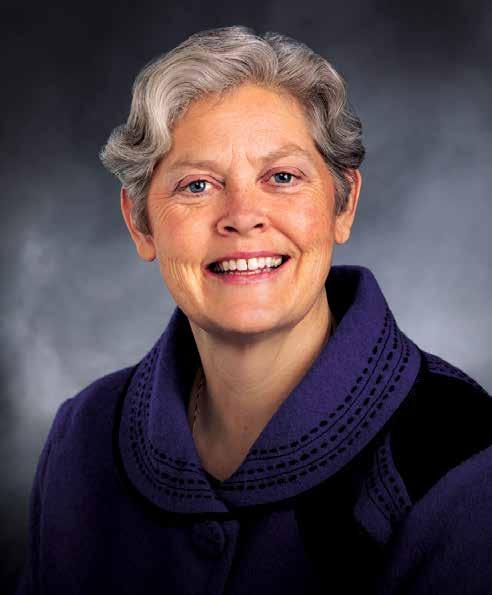
by Renee Raketty SGN Contributing Writer
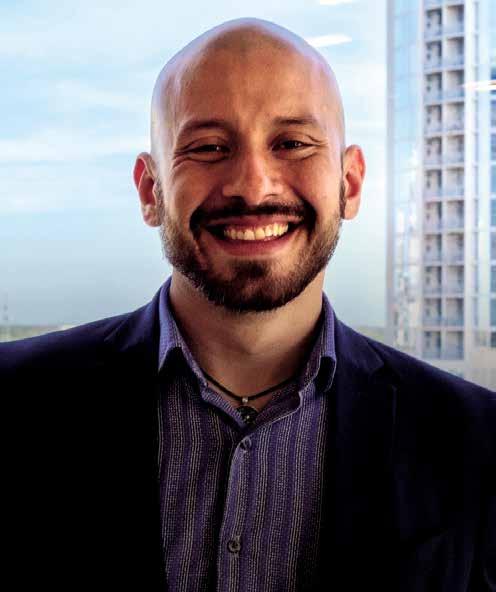
by Andres Acosta Community Relations Manager, Contigo Fund
by Mike Andrew SGN Staff Writer
Laurie Jinkins – Photo courtesy of WA House Democrats
Andres Acosta – Photo courtesy of Andres Acosta
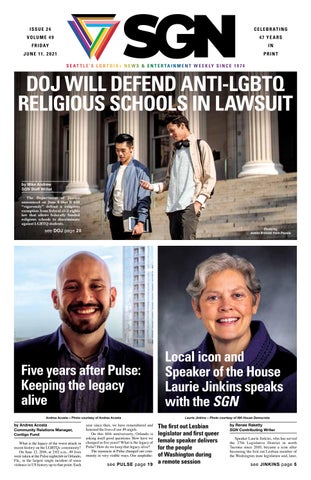
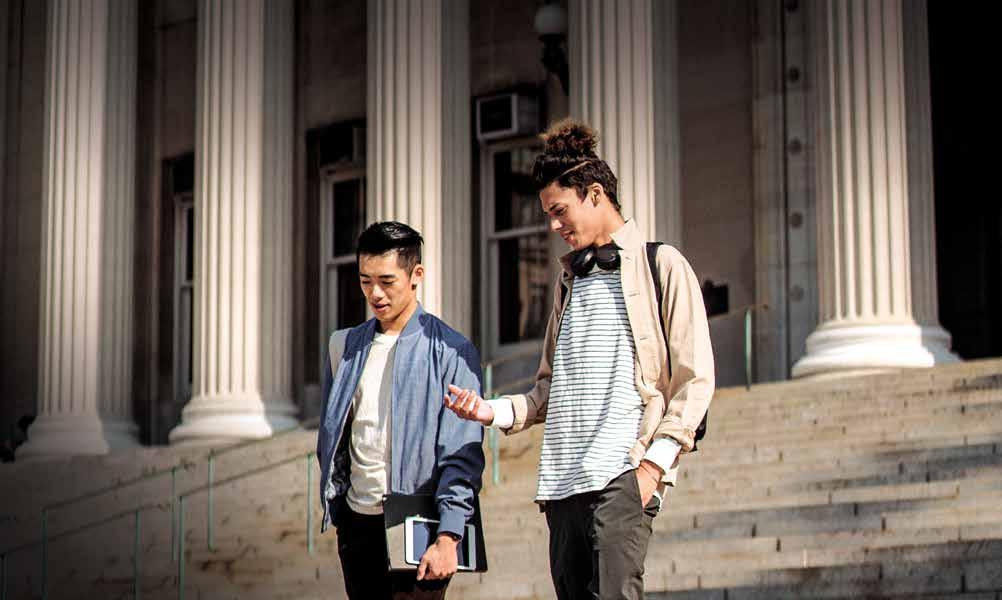
Photo by Armin Rimoldi from Pexels







The Pulse massacre
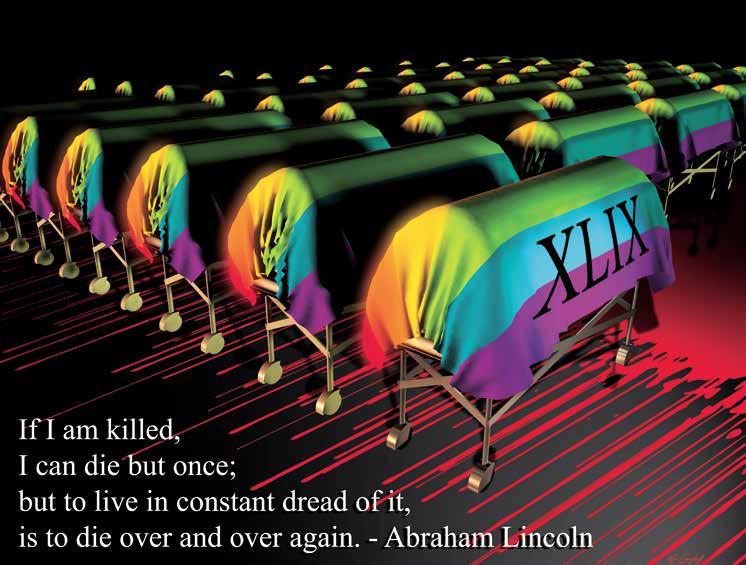
June 12 is the fifth anniversary of an event that brought sadness and anger to the LGBTQ community, the night when one man opened fire on the patrons of the Pulse Nightclub in Orlando, Fla. As SGN Associate Editor Shaun Knittel reported, “[FBI officials say that] in the early morning hours of Sunday, June 12, minutes past 2 a.m., Omar Mateen, 29, an American citizen born to parents who immigrated to the US from Afghanistan, committed the worst mass shooting in American history, leaving 49 people dead and 53 wounded, when he began to shoot people on the dance floor of Pulse, a popular Gay nightclub in Orlando, with bullets from an assault rifle and a handgun.
“Within the first few minutes of entering the club and firing at his targets, nearly all of the confirmed dead had been shot, although the horror was far from over. After engaging in a shootout with an Orlando police officer employed as security by the club and surviving another shooting match with police who responded immediately after the carnage began, Mateen held 30 hostages inside one of the nightclub’s bathrooms for the next three hours until, minutes after 5 a.m., fearing that he would kill the hostages, SWAT officers blasted and bored a hole into the exterior of the bathroom wall, freed the hostages, and shot Mateen dead.
“All over the world, including in Seattle, which saw one of the largest crowds of all (thousands of people filled Cal Anderson Park on Sunday night as Seattle Mayor Ed Murray, Washington Gov. Jay Inslee, and leaders from the local LGBTQ community spoke out to condemn the attack), candlelight vigils were held to mourn the dead and call for gun reform, specifically, a ban on semiautomatic rifles like the Sig Sauer MCX used by Mateen.”
A call for unity
On June 13, over 70 organizations signed a statement calling on the community to come together. The statement read, “We the undersigned organizations working on the front lines of the Lesbian, Gay, Bisexual, Transgender, and Queer (LGBTQ) movement share in the profound grief for those who were killed and many more who were wounded during Latin Night at the Pulse nightclub in Orlando, Fla. Their lives were lost or
forever altered in this devastating act of violence targeting LGBTQ people. Our hearts go out to all the family and friends touched by this horrific act. We know their lives will never be the same again.”
The statement concluded, “As LGBTQ people who lived through the AIDS crisis, we know what it looks like and feels like to be scapegoated and isolated in the midst of a crisis that actually requires solidarity, empathy, and collaboration from all quarters. We appeal to all in our movement and all who support us to band together in rejecting hatred and violence in all its shape-shifting forms. Let us stand united as a diverse LGBTQ community of many faiths, ethnicities, nationalities, and backgrounds.”
Copycat?
While there was attention on the tragedy in Orlando, another potential one was avoided on the opposite coast, as reported by Shaun Knittel: “A similar massacre was avoided in Santa Monica, Calif., where police found loaded assault rifles, rounds of ammunition, and 25 pounds of explosive chemicals in a white Acura sedan belonging to James Wesley Howell. Howell, a self-described sociopath, said he was on his way to LA Pride. Authorities say he also had a Taser, handcuffs, a buck knife, a canister of gasoline, a security badge, and a black hood.
“Questions about Howell’s sexual orientation, such as with Mateen, and how the two men dealt with it in their lives, are begging for answers. Just like the Orlando killer, Howell had samesex relations in his past. In fact, police say that last October, an ex-boyfriend accused Howell of pointing a rifle at him and threatening to pull the trigger — though no arrest was made. The following day he was accused of pointing a loaded handgun at a neighbor, although at that time, Howell was arrested. Police say he agreed to forfeit his weapons and plead guilty to a misdemeanor intimidation charge, and he was then free to go home.”
Seattle mourns Orlando
Then-Mayor Ed Murray delivered the following remarks on Sunday, June 12, during a vigil at Capitol Hill’s Cal Anderson Park in the aftermath of the Orlando mass shooting. According to the transcript, “We are gathered on this summer evening during the month we
2016 This Week in SGN History
celebrate Pride to share our grief and support each other as we absorb the news of the largest mass shooting in our nation’s history and the largest act of violence against the LGBTQ community in our nation’s history. We gather tonight in solidarity with those who lost their lives, and we offer our support to their families and to the people of the City of Orlando.
“We are also here this evening because the slaughter of our brothers and sisters was meant to spread fear throughout LGBTQ communities across this country. We will, as we have in the past, face this fear. We will not be intimidated. We will stand strong. We will stand together as a community. The mostly young people in that club were doing something very important: they were out, they were living their joyous lives, they were not afraid.
“We cannot be surprised, but still, we are shocked and shaken in our pain and anger and disbelief. And as we learn the stories of those who lost their lives and those who tried to help them, this pain will only grow deeper and the anger greater and the disbelief more profound in the days ahead. As difficult as all this is, we cannot give in to despair. The greatest way we can honor those whose lives were lost is to recommit ourselves to hope, to that promise that someday being LGBTQ and out at a club is not an act of bravery — because gone is the threat that it might end in slaughter because of who you are.
“To young people in particular, I urge you, despite this tragedy, not to give in to the sense that nothing can be done. Instead, I ask you to engage like never before. Our community looks to you, more than ever, to build on the gains that we’ve made and to offer a future of hope.
“Along with the Council, with Chief [Kathleen] O’Toole, and the men and women of the Seattle Police Department, I promise that this City will do all we can in a free society to prevent a tragedy like this from occurring in our community.
“As we leave here, the sun will set and night will fall. Some of us will pray, some will hold our loved ones closest, some will redouble their commitment to the movement, some will do all of these things. All of us will find ways to make sure those who were murdered in the early hours of this morning did not die in vain. We will live in hope and not fear; we will find ways to bridge what divides us.
by MK Scott SGN Contributing Writer
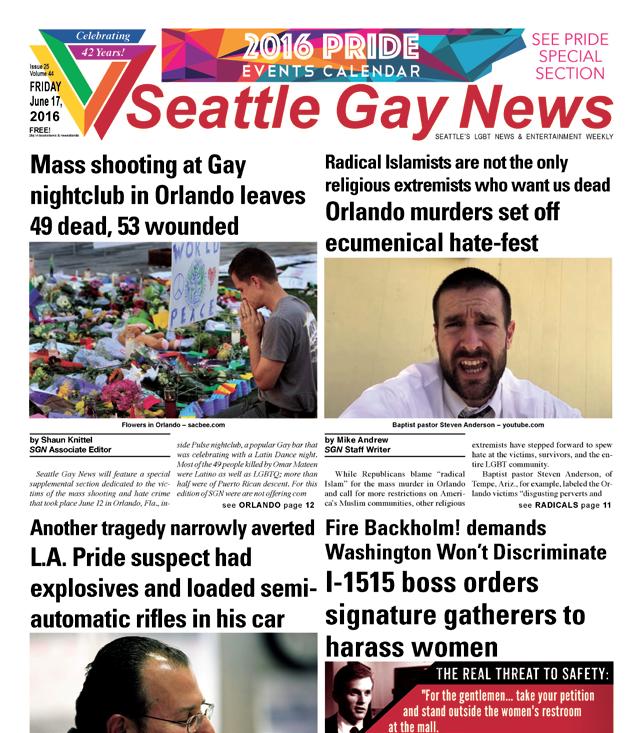
Over 47 years, the Seattle Gay News has covered thousands of stories that still resonate today. This week we look back at Vol. 44, Issue 25, published on June 17, 2016.
“Finally, when night falls and we think of those who lost their lives, think of the words I will now paraphrase from Shakespeare’s Romeo and Juliet: And when they shall die, Take them and cut them out in little stars,
And they will make the face of heaven so fine
That all the world will be in love with night
And pay no worship to the garish sun.”
Seahawks drama
When Seattle Seahawk punter Jon Ryan deleted all of his social media accounts, there was an uproar among fans. The move came after Ryan had a bitter exchange with a homophobic fan, according to SGN Associate Editor Shaun Knittel: “On Sunday, Ryan made a post on Instagram referring to the tragedy in Orlando, in which 49 people were killed at Pulse, a Gay nightclub. The post was a simple rainbow photo with the words ‘more love #orlando’. Among the responses, according to the Seattle Times, was one asking, ‘Where in the bible does it say it’s ok to be homosexual?’
“‘Please unfollow me,’ Ryan responded. ‘You’re a terrible human being... please stop cheering for the Seahawks. We don’t want a piece of [expletive] fans like you. Thanks.’
“Shortly after, Ryan says he deleted his accounts and maintains that the decision was his own.”
Queens for a cause
One bright spot this week was when Peaches Christ teamed up with Bianca Del Rio for their parody Whatever Happened to Bianca Del Rio? at the Egyptian Theatre on June 23. Fifty percent of the profits from the 9 p.m. show were donated to Equality Florida.
Updates: After the tragedy in Orlando, the community came together to form a new organization called One Orlando Alliance. The organization consists of representatives from numerous LGBT organizations. Look for a Seattle version to debut in 2022.
Hate and gun violence got worse in the past five years.
Jon Ryan rejoined Instagram in 2018.
Local News
broke barriers as the first Queer and female speaker of the house in January of 2020. However, her long and tireless advocacy for the state’s LGBTQIA+ community began long before.
She chaired the Tacoma Hate Crimes Task Force from 1990 until 1992. She also led the effort to approve Referendum 71, which affirmed Washington’s domestic partnership law, in 2009. Jinkins has also held important civic and public positions, where she was in a position to promote issues and policies of equality and justice. She served on the Tacoma Community College Board of Trustees. After a post as an assistant attorney general in Tacoma, she served as an assistant secretary in the Washington State Department of Health from 1995 until 2008. Currently, she holds the post of deputy director at the Tacoma–Pierce County Health Department.
During the 2021 regular session, Jinkins balanced her duties masterfully and got difficult legislation passed during a remote session. While the legislatures in Oregon and Idaho were forced to shut down, the speaker successfully ended the session without a single case of COVID-19 due to legislative work. As a result, she has received high praise from her peers and the media alike.
The Seattle Gay News had a virtual sitdown interview with Jinkins in May. She was eager to discuss the legislative session from the basement of her modest home. Like many families during the pandemic, she was jostling for space with her wife, Laura Wulf, who was also working from home, and her 21-year-old son, who was taking an online college theater course in her usual home office.
Jinkins discussed the bills, people, and moments that defined the Washington state legislature this year.
Renee Raketty: First of all… I wanted to check in with your family. How’s everything going there in Tacoma and, most importantly, has everyone been vaccinated?
Laurie Jinkins: Our almost 21-year-old son has been living with us. He’s going to college from here at home. All three of us got vaccinated together both times. Today he’s going to school from home. I’m working from home and my wife is also working from home....
It can be a little bit difficult with all three of us trying to get things done in a relatively small house, but we’re doing great. It’s been wonderful to be able to spend this much time with our son. I thank you for asking, and I hope you’re vaccinated and doing well too.
Raketty: As a lawmaker from Tacoma, how do you balance the needs of your constituents and the concerns of Washingtonians across the state, as speaker, and how does that role affect that dynamic?
Jinkins: I think I’m lucky that my district is very reflective of a lot of Washington state. So the two things are really quite aligned, but in the end, I’m always the representative from the 27th District and it’s my constituents who elect me. So, I try to really pay attention to the things that my constituents ask of me, to the issues that are going on here in Tacoma.
The other thing that I’ve kind of taken on as speaker is that my job is really to listen to the caucus and to bring the caucus together and to be led by their voices.
There have been quite a few times, for example, where I’m a public health person.... I am quite aware that I don’t sit in the middle of the caucus in terms of my beliefs around that. I won’t stop that legislation from moving forward if a vast majority of the caucus believes that it should, but I will vote “no.”
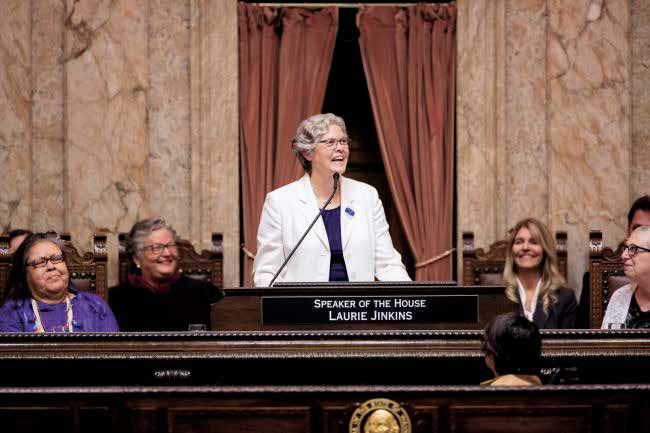
Speaker Laurie Jinkins, who has served the 27th Legislative District in north Tacoma since 2010, became a icon after becoming the first out Lesbian member of the Washington state legislature and, later, broke barriers as the first Queer female speaker of the house in January of 2020. However, her long and tireless advocacy for the state’s LGBTQIA+ community began long before.
I’m always trying to work and balance, but I’ve got a great district and I have a great caucus. So, mostly — about 99.9% of the time — those are all aligned.
Raketty: The legislature was the most diverse it’s ever been. Obviously, you welcome new members of color, women, and LGBTQIA people. How did the legislature achieve this success, is it sustainable, and what can be done to encourage continued diversity among lawmakers?
Jinkins: Having a diverse group of members is important, in and of itself, because it inspires other people to want to run. You know, obviously, when I ran and was the first out Lesbian elected to the legislature, the number of people who emailed me — I wasn’t expecting this — in the Queer community about it, inspiring them to run, was really heartening. Same thing when I was elected as the first woman speaker and the first, you know, Lesbian speaker. That’s important because it inspires other people.
The other thing that it did for us: lots of people have been lauding this last session as the most productive session in more than a generation of Washingtonians, just incredibly productive. That’s because we had diverse representation in our caucus. It meant that we were bringing many more diverse voices to the table.
One of the things I always find interesting is that it can make it harder to get to a resolution on how we’re going to handle something, because there’s more diversity, but the solution is always better. It always represents more people and the experiences of more people. So, it’s worth it to have to
do that work at the table where there are very divergent opinions, because our solution is better.
I’m excited. We have the most diverse leadership team that we’ve ever had, the most diverse caucus and the best session that we’ve had in more than a generation.
Raketty: For too long, Transgender individuals, such as myself, have had a hard time getting access to genderaffirming treatments. Often their insurance denies them coverage for these services. So how will the passage of Senate Bill 5313 change that?
Jinkins: That was probably one of our biggest victories for the LGBTQ community this year and especially our Trans community. We’ve done work over the past four or five years with the insurance commissioner: issuing rulings, talking about discriminatory treatment by insurance companies, and telling insurance companies that they need to be nondiscriminatory. What we continue to see, either because of a lack of understanding or also, probably, because of wanting to just save money, [is that] so much of the treatment that our Trans brothers and sisters need is denied in the insurance side...
What’s great is that this bill applies not just to people who have private insurance through their employer or who buy it on the exchange but folks who are Medicaid recipients. Some of our poorest Transgender people in Washington state, our Medicaid program, will also cover gender-affirming care.
All people really have to do is make sure that they’re seeing a healthcare provider who will say this is a medically necessary treatment for this person. If that’s
what their provider says, then their insurer is supposed to provide it to them. I think now what we’ll be watching is to make sure that insurers do provide it, that they don’t slow-roll it and things like that. Members will be paying special attention to that. That’s where we really do a lot of constituent work, because that’s not really about writing a new law if people are getting slow-rolled or things like that. That’s about members contacting the insurance commissioner’s office. It’s about members contacting insurers and saying, “Hey, this isn’t okay. You’re not following the law.” I shouldn’t project. Hopefully, it’ll all be fine and no one will have any trouble. I hope it’s one of the big final steps in terms of transformation of healthcare for our Trans community.
Raketty: HIV/AIDS continues to be a major concern for members of the LGBTQIA+ community. People of color and men who have sex with men and Transgender individuals are obviously at greater risk. What is being done to ensure that the funding for the HIV/AIDS testing, medical care, social services, and outreach continue to be a priority?
Jinkins: For us in the House, so much of what happens is about our internal advocacy. For example, having Nicole Macri who represents the 43rd District, who’s part of the LGBTQ caucus with me and has been there in the House and is very well respected, is now on our budget negotiating team. Having members of our community, to quote Hamilton, “in the room where it happens” is really important. I think we saw that this year with some of the funding on HIV/AIDS and making sure that we continued and increased some of that funding.
One of the other big challenges that we were having for folks who are living with HIV/AIDS is we were seeing a lot of requirements around failing on certain drugs first before they could move on to another drug. For many people, that would happen when they would end up changing insurance from one form of insurance to another. They already had been through a process where they had tried certain drugs that didn’t work. They know what worked, and requiring them to go through this to start over again and fail on maybe cheaper drugs was actually very detrimental to their healthcare. So, that was something that I started working on and Nicole picked up when I became speaker, and we’ve been able to
Photo courtesy of WA House Democrats
Local News
JINKINS
continued from page 5
address that, and that’s an issue that we’ll continue to move forward. So there’s a lot that we do in the healthcare area.
I would say both with the Trans community and folks who have HIV/AIDS, stigma and discrimination are still probably the most significant issues that we have to face. That is both about the law — at this point our laws are really good — [and] a lot more about community and education and support for folks who are out there traveling through the world.
Raketty: It’s been a year since the death of George Floyd. Thousands rose up and called for police accountability. I myself was subjected to pepper spray, flash bangs, and blast balls at the hands of Seattle police. How did the legislature address these concerns?
Jinkins: We had a great team in the House, and the Senate also had some great bills, but we passed almost a dozen bills on police accountability. What we were really guided by... was trying to... support members of law enforcement who are good actors and trying to do the right thing. What we’ve seen over time is that the relationship between our law enforcement community and the broader community has broken down and there is a real lack of trust. That’s in part due to a lack of transparency and a lack of accountability. So, we really wanted to make sure that we were starting to rebuild the relationship between our law enforcement community and our larger community.
I won’t remember all 12 of the bills, but you see bills that really limit and contain the tactics that law enforcement officers can use in terms of choke holds and use of tear gas and all sorts of other more militaristic kind of tools that our law enforcement has had access to, that they either won’t have access to anymore or they will be severely limited.
One of the things we also wanted to make sure that we did [was] not prohibit the use of some tools, [so] that what would happen in the end was firearms would be used more frequently, right? You don’t want to have these unintended consequences.
And our team was very lucky in the House, because we worked a lot with the families of individuals who’d been killed in police custody. We really followed the lead of those families. Then, we had an incredible team led primarily by Jesse Johnson from the 30th District, who really did an incredible job of working with everybody to kind of try and find the right paths forward. Deborah Entenman also had a tremendous bill to do independent investigations when we have someone, you know, for me in Tacoma, like Manny Ellis, who’s killed in police custody. Now the investigation of that will actually be independent of the law enforcement body where the person was killed. That was the second bill.
We have a bill from Jamie Pedersen from the 43rd, which is essentially about how you get licensed, basically, decertifying a police officer. I spent a bunch of my career licensing healthcare providers and, by gosh, if we can take away a healthcare provider’s license, we ought to be able to also take away the license of a police officer if they’re not behaving appropriately.
Then, we had a number of bills on auditing. Manka Dhingra had a really good bill that is a duty to intervene. When a law enforcement officer sees something that’s contrary to policy or law, they’re required to intervene.
I’m proud of the work we did this year in this area. This is the first year we’ve really done much of this at all. We did Initiative 940 [requiring law enforcement to receive violence de-escalation, mental health, and first-aid training, and to provide first aid; and changing standards for use of deadly force]. We’re by no means done — at all.
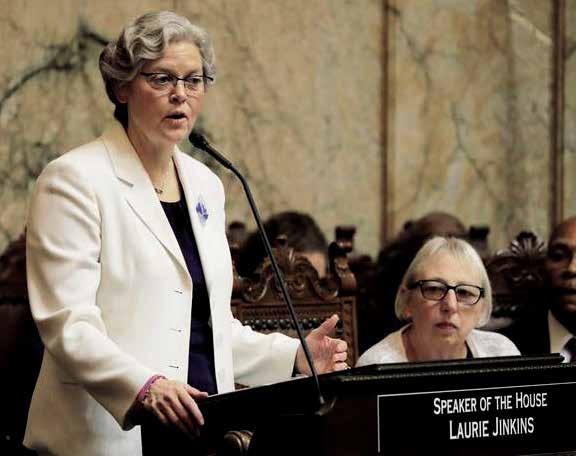
This is the beginning of a transformation... and I think we’ve really weighed in a very big way, but I wouldn’t want to say that this is a one and done year. It’s just a start.
Raketty: Washington has the third highest number of reported hate crimes in the nation, yet HB 1071, which would have tweaked Washington state’s hate crime statutes to give them a designation of “crime against persons” didn’t pass this year. What is the benefit of making this change, and will you push for it during the next legislative session?
Jinkins: Part of the feedback that we got on this bill — at least in my caucus — [was that] there’s a real sensitivity to the creation of criminal statutes and who those criminal statutes have been applied against.
So, I think one of the things that happened with the hate crimes bill this year is people wanted some more time to think about that. There’s no question that folks want to do better enforcement and better prevention around hate crimes, but we also don’t want to have unintended consequences. We’ve seen in the criminal justice system where there’s huge disproportionality in terms of who’s arrested and who’s charged with crimes. I should just [say] that they’re not all unintentional consequences. Some of them are very intentional in terms of the way that the law is set up.
I think Rep. [Javier] Valdez — he was the prime sponsor of the bill — I think he’s going to be working on the bill over the interim and working with community and folks directly impacted to make sure that there’s confidence that that the bill is getting at the right perpetrators and is not going to be used to create disproportionate impact, as so many of our criminal laws have been.
So, I think that’s the rub about that. There’s really no question about whether or not we should prohibit hate crimes and do a lot more work around that. We’ve seen this, particularly in the Asian community, the number of hate crimes. I think this is driven a lot by our former president and the language that’s been used by leadership in the other Washington, [which] has been very, very harmful. We want to make sure that we can do even more about that if we can.
Raketty: We have a regressive tax
code here in Washington, where lowincome earners pay disproportionately more in taxes than those who earn a higher income. How did lawmakers address this issue, and what could be done to further shrink this gap?
Jinkins: There are three things that we’ve done and are doing. The first one is we have a tax structure work group that’s led by Rep. Noel Frame from the 36th Legislative District. There is a reason that that’s a bipartisan, bicameral group that has all kinds of interested parties at the table working on this… because of the recognition of how regressive Washington’s tax structure is.
So, just to give your [readers] a sense about this: The poorest 20% of Washingtonians spend nearly 18 cents of every dollar they earn on taxes. The wealthiest 5% of Washingtonians spend less than 2.5 cents of every dollar they earn on taxes. That’s the definition of regressive. It’s actually the definition of unfair, basically. Just an unfair tax structure.
Part of the reason is because we realize so heavily on, for example, sales tax. For every bit of toilet paper that anybody buys, if you’re the poorest person, you pay the same amount of sales tax as the wealthiest person does, but the wealthiest person doesn’t need... a bunch more toilet paper than the poorest person, right? So, it becomes a much bigger part of the poor person’s income to pay those kinds of sales taxes.
That group started work last year. It will work through this year, and it’s going to come back with some suggestions for us in a very large sense about how we restructure our tax system to be much less regressive, hopefully.
This year, I’m really proud this session, we passed a capital gains excise tax. So for folks like me… I don’t know about you, Renee, but I’ve never paid a capital gains tax. That’s one of the things I’m hoping to do someday. I don’t know how I’ll ever get there…
If you have a stock that you bought for a $100 and you sell it for a $1,000, the tax is on the $900 difference — the $900 you make on that. It just applies to stocks and bonds. It’s a 7% tax. In Washington state, you’d have to earn more than $250,000 on the sale of those stocks and bonds before
you would ever have to pay a penny of taxation. It doesn’t apply to real estate or anything like that.
So, the estimate is with this $250,000 exemption and a 7% tax, less than 1% of Washingtonians — actually about 1,500 people — would pay this tax, yet it would bring in revenue of about half a billion dollars a year. That’s partly because we have the wealthiest people in the world that live in our state.
Doing that is really about rebalancing our tax code and making sure that this recovery, for example, that we’re in — this great, strong recovery — is not built on the backs of the poorest Washingtonians, and that everyone is paying their fair share.
Then, the final thing that we did is we adopted the working families tax credit, which will mean that the poorest families that I was talking about will, depending on their incomes, be able to get a tax credit of between $500 and $1,200 a year returned to them from taxes that they’ve paid.
Between the capital gains tax and the working families tax credit, that starts to bring a little bit more fairness to our tax structure. I’m not saying it fixes everything, but we start moving in the right direction.
Raketty: Drug possession will be treated as a misdemeanor in Washington, versus a felony. This law will expire in two years. Why the change, and how will this help to end the scourge of drug addiction that’s affecting our communities?
Jinkins: This is an issue that got thrown to us right in the middle of the session. The fact that we were able to figure out a way to address this I think is kind of extraordinary.
The Supreme Court, I think in February, issued an opinion that said that our statute that says… just possessing drugs is illegal and is criminal and that you’re presumed to be guilty of intentionally possessing drugs, the Supreme Court said “no.”
In fact, [in] the case that did this, the Blake case, a young woman had borrowed a pair of jeans from, I think, a friend. I might not remember this correctly, but there were some methamphetamines in one of the pockets, and she was not aware that there was methamphetamine in these borrowed jeans. She got arrested. The meth was found, and she was
Photo by Ted S. Warren / AP
www.gofundme.com/f/seattle-gay-news-needs-your-support-now
convicted of drug possession, even though she had no intention to possess it.
So, the Supreme Court said our statute was unconstitutional. We had to do work to figure out how we wanted to move forward. I think the biggest thing that we did is that we recognized that… our system… when it comes to drugs here in Washington and drug possession, is not working at all. It’s not satisfactory at all. People who are addicted to drugs need to have access to treatment. We did not have any way that we were providing people access to treatment. It doesn’t really matter who you are. If you’re someone who has an addiction, if you’re their family member, their friend, their neighbor — someone who sees them, you know, in their full-blown addiction out in the community — Washingtonians want that person to get treatment and to get better if they can.
The biggest thing that we did in our legislation was we invested real money in treatment. We also created a ramp away from the criminal justice system and putting people in jail. We created a ramp instead, like before even charging someone with a crime, [diverting] them into treatment if they want.
Eventually somebody could be found to have committed a misdemeanor, which is up to a year in jail if you’re convicted, but they’re required to [make] a couple of attempts at… treatment before that would ever happen. We’re really trying to switch this from a criminal justice approach, which we all recognize hasn’t worked and is the most expensive failed way to try and address somebody’s addiction.
The other thing that happens is if somebody comes out of jail — the problems that they have getting housing and getting a job because they have a criminal record — exacerbate the problem again, right? We’re trying to avoid all of that and really give people the option for treatment.
The reason that we set a two-year sunset is that some of this is a little bit experimental. We want to make sure that the diversion that we’re doing is actually working. We’ll be able to collect some data, see whether our approach is working, [and] what we need to do differently and maybe update it. Honestly, having that sunset date motivates all of us who are trying to figure out the right path forward. It’ll motivate all of us to really work hard to find that path rather than be... resistant and not do anything. It’ll make us do something.
Raketty: HB 5227 will require diversity equity inclusion, and antiracism training in higher education starting in 2024. How might this benefit our academic communities, and more broadly our society?
Jinkins: This is really part of recognizing that we have such diversity in the lived experiences in Washington state and making sure that both our students and our educators have the opportunity to explore that, to try and understand that better.
We’re the most trade-dependent state in the nation, which means that we are dealing with and working with nations all over the world at a level that other states just are not. Our ability to understand our own diversity [will create] a better and stronger business community for folks who are going through our higher education system. It will also help us recruit a more diverse workforce that can help provide better services to other Washingtonians [and] to all of our trade partners.
Folks may have seen that we had two bills that required equity and diversity education, both in higher ed and in our K-12 boards of education. On the boards-of-education bill, we had a pretty awful amendment that was offered by Jim Walsh, that basically would have restricted any real discussion about past harm that had been done or current harm that’s being done and all kinds of stuff. Usually, when you’re in the majority, it’s the minority that gets to decide how long they debate a topic. We let him know that we were really appalled by the amendment and, if he decided to offer it, then not only would it be voted down but there would be a lot of debate about it. He insisted on offering it, and 47 members of my caucus stood up and gave speeches
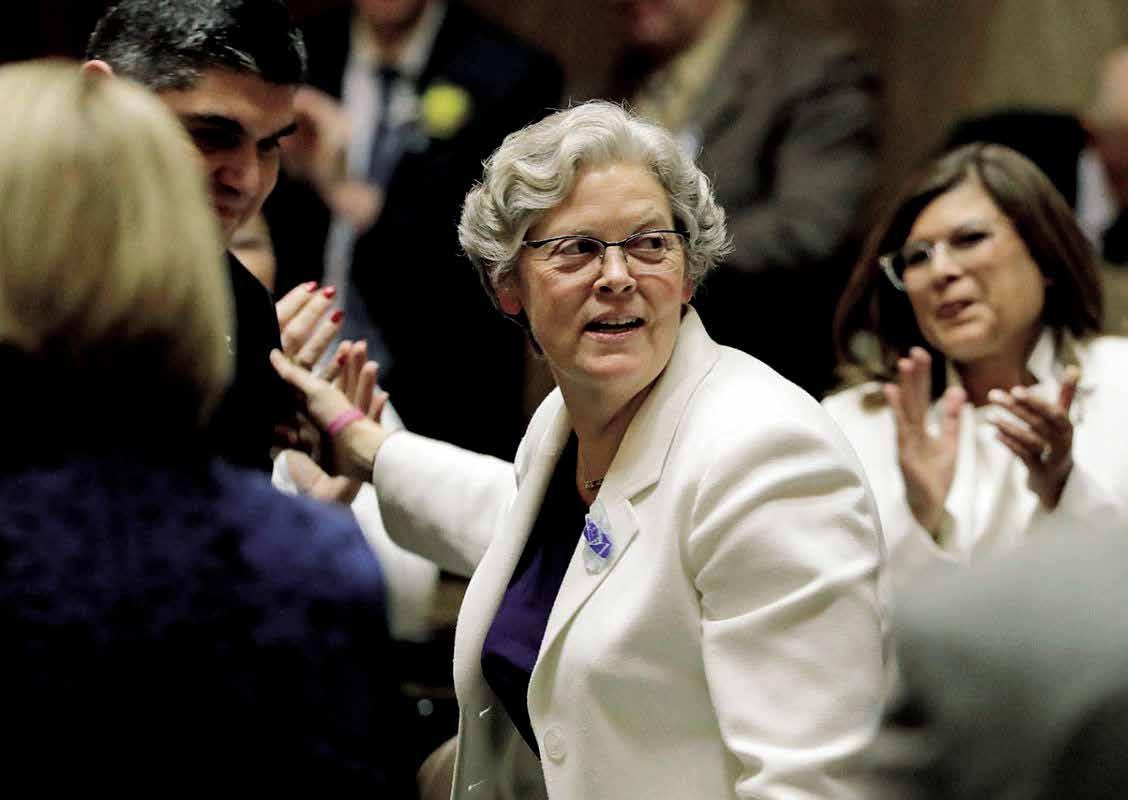
about why diversity was important, why equity and inclusion were important concepts to understand. Many of them talked about their own families. It was the first time ever since I’ve been in the legislature that the majority party said we are going to spend every minute that it takes for us to drive this point home. It felt good to represent our values on the floor like that.
Raketty: What can be done to make sure that undocumented workers in Washington are not being left behind when accessing COVID-19 relief?
Jinkins: I won’t be able to remember the budget amount right now, but I think on a per-capita basis, Washington state probably has invested more than any other state in the nation for our undocumented workers, because so many of our undocumented workers — a lot of them are farm workers — have not had access to any of the federal dollars that have come out to help many of the other poor members of our community. The federal government restricted any payments to those undocumented workers.
So we have a refugee and immigrant relief fund in Washington state, and we are using our own dollars to make sure that we can provide resources to those communities. We’re really doing it through nonprofits that already work with our immigrant communities, so that there is strong trust there in the resources that we’re providing.
We’ve also done a fair amount around the healthcare area. Honestly, the biggest step that needs to be taken can’t be taken here in this Washington. It has to be taken in the other Washington: it’s immigration reform.
We also provided some money to the Office of Civil Legal Aid to be able to help undocumented workers when they are having trouble with housing and credit issues and other things like that. They had been prohibited from using any of their resources in that way by the feds. So we invested some state dollars in that.
We also passed a bill on overtime workers for agricultural workers, which will certainly help provide many of our migrant farm workers with the incomes that they deserve because of all the overtime work that they’re engaged in.
We definitely made some advances, and we did a lot of work on immigration and naturalization services too and making sure that we’re investing more money in that, so that people can become naturalized citizens… here in Washington. Lots of great things are happening, but [there’s] probably still more work to do.
Raketty: As you know, we’re facing a housing crisis not only because of
COVID-19 but gentrification and rising housing costs. What is being done to provide relief to those individuals who are facing this crisis?
Jinkins: We invested a billion dollars... related to the eviction moratorium. There are a lot of people who’ve been without work for a long time, who have not been paying their rent because they have no money to do that. Once the eviction moratorium is no longer, all of those folks would be at risk of being evicted. So we’ve invested a billion dollars… to provide renters and their landlords.
One of the other challenges we have is we have a lot of mom-and-pop landlords who have also have not been getting any income over this time because of the moratorium, and they’re on a foreclosure cliff. Some of this money is to do foreclosure help, but a lot of it is to pay back rents from renters who haven’t been able to pay, so that the renters aren’t going to be evicted for failure to pay rent, because of the money that the state has invested.
I was just on a fundraiser this morning for the Pierce County dispute resolution center. We’ve gotten more funding to our dispute resolution centers statewide, because they are very helpful when an eviction starts to happen, to get the landlord and the tenant together. They’re… helping tenants be able to stay in their rental property or to negotiate with the landlord about how… and when the tenant leaves. So, they’re going to be getting funding to help with that.
We have other kinds of homeless-prevention dollars. A lot of what we’re doing around homelessness is both providing some funding through our capital budgets, so that local jurisdictions or housing authorities can, for example, buy hotels that are closed now and transition them into housing units.
What we also know is a lot of people who are moving from homelessness into a housed situation also need some supportive services wrapped around them in order to be successful. So, one of the big things that we’ve really started investing in in state government is not just the physical buildings or money for physical buildings but operating money for ongoing support, so that people have the wraparound services they need to stay stabilized in housing.
Raketty: As you know, climate change continues to be a major threat to our way of life here in Washington, not only the natural beauty but also our economy. Decisions we make will have an effect on businesses as well. There’s been a sort of a stagnancy when it’s come to addressing
some of these things. What do you think was different this year? How would that help moving forward?
Jinkins: I think a couple of things are different. I would say stagnant no more... Probably the two biggest climate bills that we passed — and put Washington now on the leading edge of addressing carbon — are the low-carbon fuel-standards bill and the Climate Commitment Act, which is like a cap-and-trade sort of bill.
I think there are a few things that are different this year. Going into this session, we did not know how a fully remote session would work out. We did not know what we would be able to do or not do. So I asked members of the House to file no more than seven bills each. What happened was members really focused on big issues.
Second thing for us is we had four priority areas… among the House Democrats. One was COVID response. The second was building on economic recovery. The third was racial equity, and the fourth was addressing the existential threat of climate change. So we knew that those were the four areas we really wanted to work on.
I think we had strong Senate partners both in leadership [and] in members. The Senate hasn’t always been as interested in these topics as the House has been. This year we found a great Venn diagram, where we were all very interested in it.
Finally, I just want to call out Joe Fitzgibbon, who represents the 34th Legislative District. He’s the chair of our Environment Committee. He worked overtime to address issues that people raised. I mean the Climate Commitment Act — we got that less than 10 days before the end of session.
We had members who had a lot of opinions about it, and Joe worked 24 hours a day, 10 days in a row, to be able to address members’ concerns so we [could] get it across the finish line.
We haven’t really addressed carbon very much in our transportation sector. The low-carbon fuel-standards bill was really our way to address it in our transportation sector. Then, the Climate Commitment Act basically sets up caps on how much carbon industry can produce. Then, you can buy somebody else’s carbon production if they’re producing less carbon than you, but, as time goes on, the ceiling of how much carbon can be produced in the state starts to ratchet down, so the cost of buying gets more and more expensive. That motivates businesses, especially petroleum companies, to decrease their carbon production,
see JINKINS page 8
Photo by Ted S. Warren / AP
Local News
SPU faculty, staff, students, and alumni continue their quest for equality
by Josephine Baird SGN Contributing Writer
It will come as a surprise to no one who has been paying attention that this school year has been a tough one for LGBTQ+ and allied faculty, staff, students, and alumni at Seattle Pacific University. Student and alumni groups have spent the better part of the end of the school year fighting to overturn two school policies and make SPU a safer place for members of the Queer community.
The first policy states, “We believe it is in the context of the covenant of marriage between a man and a woman that the full expression of sexuality is to be experienced and celebrated and that such a commitment is part of God’s plan for human flourishing. Within the teaching of our religious tradition, we affirm that sexual experience is intended between a man and a woman” (para. 5). It faced huge scrutiny this year due to a recent lawsuit filed by Jéaux Rinedahl, who was a Gay part-time professor who claims he was denied a full-time position in SPU’s nursing program last summer.
The second policy can be found on SPU’s list of “Employee Lifestyle Expectations,” which views sexual behavior that is not consistent with biblical standards as immoral.
The discrimination lawsuit filed by Rinedahl is not the only lawsuit SPU is currently dealing with. SPU alum Spencer Vigil has recently joined a nationwide classaction lawsuit by the Religious Exemption Accountability Project, which aims to hold accountable those religious institutions that receive federal funding but deny LGBTQ+ individuals Title IX rights.
To voice their frustration and anger, faculty, staff, students, and alumni have held multiple events. Some have been somber and heartfelt; others have been passionate and angry. The most recent event, GrAdvocacy, was demonstrative and celebratory.
JINKINS
continued from page 7
because it’s costing them money to continue producing carbon.
Raketty: The state suffers from a childcare shortage, as you know. What is being done to address this and alleviate some of these challenges? Not only for families but for childcare workers as well?
Jinkins: The Association of Washington Business did a study about a year and a half ago in which they found that businesses in Washington state were losing over $2 billion a year because of lack of access to affordable childcare. That’s because their workers couldn’t come to work because they didn’t have access to childcare, right? This is a crisis for individual families. It’s a crisis for our business community and, therefore, our whole economy.
We talked a little bit about the capital gains tax. A big chunk of the money raised through the capital gains tax is going to pay for childcare, is going to build out our childcare system.
The other thing that we passed this year was the Fair Start for Kids Act. Tana Senn from the 41st District, who’s chair of our
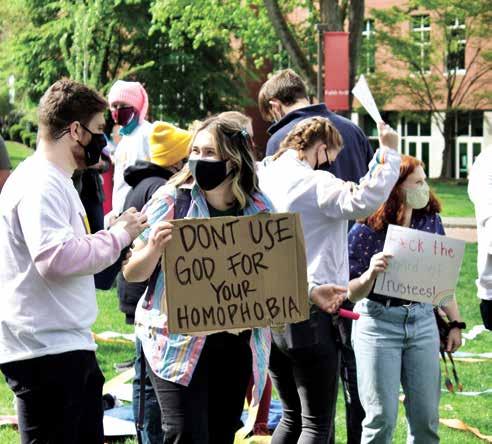
The purpose of the event, held on June 6 was to celebrate current LGBTQ+ graduates and to continue advocating for current and future Queer SPU students. Organizers hope it will help get alumni and young graduates involved.
The event was attended by people from the graduating class of 2021, the alumni class of 2020, and supportive SPU faculty and staff. To make it a reality, current student advocates teamed up with the Alumni Coalition, which provided rainbow tassels and stoles to graduates who reserved them.
Kat Wynn, Alumni Coalition coordi-
Children, Youth, and Families Committee, really led on the development of that piece of legislation, along with Claire Wilson from the 30th District. It really lays out how we will build out our childcare system.
The other thing that’s really important is to have a level of quality in our childcare system, so that kids get the social and emotional development that they need in order to be prepared to go to school and prepared for their future. That bill is really a mixture of subsidizing childcare, expanding the number of providers by providing better payment for providers.
You mentioned our provider community. Improving the payment structure for providers and making sure that we have that the childcare that’s being provided for families and kids is high quality [sic].
Raketty: I wanted to ask you, what were maybe two of your biggest personal successes and maybe one thing that you just wish had passed?
Jinkins: Two things that we haven’t talked about that I’ll mention are [that] our public health system has been underfunded for decades. I mean underfunded in huge, huge ways. The pandemic showed us how much we need a public health system that actually works and what can happen if
nator and 2017 SPU graduate said, “When I graduated from SPU, I became disconnected. I think this is an opportunity to say, ‘Here is a community if you want it.’” In a message to current students and graduates, Wynn said, “We want to support you.”
The event began with a peaceful demonstration at SPU’s Tiffany Loop, a location not new to demonstrations. At noon, there was a commissioning of the graduates, a blessing of the stoles by Queer clergy members, and a talk about a commitment to continued action. At 12:30, the event closed out with graduation photos and festivities in the Loop.
you have a local public health system that doesn’t have the funding to work.
So this year we invested in [an] ongoing way: $150 million per-year in our local health jurisdictions to really build the best working public health system that we can. Public health works in all those realms. I’m excited about that.
Then, the second big thing is we got through the session with not a single member of our staff nor a single member of the legislature, nor a single member of the public, getting ill with COVID as a result of legislative work.
Now, to the south in Oregon and to our east in Idaho, both of those legislatures had to close down because of outbreaks. We were able to work through and to have everyone be safe. That is in large part due to our commitment to public health. I thought a little bit about the fact that there was a new Speaker of the House elected in New Hampshire, and he had a big outdoor public election and kind of party. Two weeks later, he was dead.
It wasn’t just that we were able to have no one get COVID but we were perhaps more transparent than we’ve ever been. Members of the public could sit in their homes and testify on bills, which has never
Next steps
The Alumni Coalition had pressured the Board of Trustees to remove SPU’s Statement on Human Sexuality by May 1, but after the board’s decision to keep the statement, advocates have been planning their next move.
Originally, the Alumni Coalition was planning on encouraging alumni and community networks to withhold financial contributions to the university and to not recommend SPU to future students through a campaign to discourage enrollment. An Alumni Coalition coordinator, who would rather remain anonymous, said, “If we push for defunding, that could happen very quickly. We could make that happen in a week.”
But upon further reflection, the Alumni Coalition is not sure what steps to take next.
Wynn said, “We want to be heard, but we don’t want to harm.” Alumni advocates are afraid that working to deter enrollment might end up hurting students, instead of inspiring change from the board. They are worried that departments would lose money for program funding, which will inevitably hurt current faculty and students. Not only have alumni activists struggled to find a workable solution that will impact but not hurt the current SPU community but the lack of leadership stemming from the sudden resignation of SPU President Daniel J. Martin has made matters worse. President Martin announced his resignation on March 30, effective April 5. There has been speculation as to the motive for his sudden resignation, and activists wonder whether it might have something to do with a year full of tough decision-making.
At this point, alumni advocates might be unsure of their next move, but they are not losing steam. Said Wynn, “All of us think SPU can be better. It can be better if all voices are heard.”
happened before.
So our public engagement was different than it’s been historically, but I think there’s a lot we could definitely argue that it was more accessible to people than it had ever been.
We did a lot. We passed a lot this year. I think not every one of our police accountability bills got through. I think I really want us to think about that for next year. I also think that our work related to criminal justice reform, we need to work more in strengthening our transformation there.
The third thing is, even though I can argue that we were more transparent this session than ever before in history, I can’t wait for next session and to be back in person with people and be able to meet with members and members of the public in person. I expect that we’ll be able to do that next session. So those are all things I’m looking forward to.
Raketty: Thank you so much, Laurie, for your time. I really appreciate it. I know our [readers] appreciate it, and we all wish you continued success.
Jinkins: Thank you, Renee. It’s always great to see you and be a part of your casts and your interview.
Photo by Josephine Baird
Arts & Entertainment
Transforming the scene: Phi Le talks ceramics and community service
by Carter Hemion SGN Contributing Writer
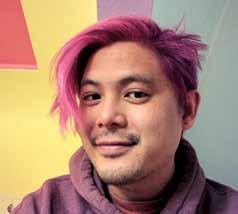
Ceramics instructor and potter Phi Le remodels Seattle’s pottery scene through unique creations and community-centered projects. They give every piece their all, and shape spaces to welcome all people who want to learn pottery.
In a conversation with Le, they shared their background and identities, experiences as a potter and instructor, and the desires found at the center of their work.
Artistic background
Almost entirely self-taught, Le started doing ceramics at age 18. Wanting to try out something new before graduating, they took their first ceramics class at the end of high school. Said Le, “It was the first art class I’d ever taken… But after [that], I decided I didn’t want to do anything else, and so here we are.”
Since then, Le has spent 14 years in Seattle teaching themself the art of pottery in “whatever small space [they] had.” Le’s business started in parts of their home and small studio spaces in Seattle, but in January 2020 they moved into a larger Tacoma studio.
Ceramics work
Le specializes in creating pots, since they enjoy working with ceramics to create functional art.
Le is most drawn to the intimacy of the art. They said that “every piece of clay that you touch takes on a little bit of you. And being a teacher for the past few years has shown me so many amazing things that can happen when everybody touches clay.”
With a warm smile, Le went on to say that “we always think about how [clay] moves through our hands and what kind of information we’re putting into the clay when we produce work.”
As they develop their career, Le spends
more time on each piece than when they first started. They said that their goal is not to produce more pieces faster but to craft each pot with more time and stories in it.
Le thinks of pottery as an art everyone should try at least once, and they want others to understand that people “have been working with [clay] since the beginning of humankind.”
Proud progress and future goals
Le said that the proudest part of their career is where they are today, and that they work to take steps forward with each new day. Their business empowers them to “get a little bit more refined in [their] technique and how [they] approach the world.”
As they take their current work and look to the future, they strive to “really ignite a community of people who want to rethink how they interact with the community.”
Le takes action on this by centering donations to the community in their business model. Every month, they sell all of their work at auction to raise money, then donate the profits to the Lavender Rights Project, an organization run by the Washington Black Trans Task Force, to support Black Trans people in the state. Le also supports the Black

Lives Matter movement, saying that its work is benefiting everyone in the community.
As Le said, “We don’t need to make money just for profit [and] just to go into a bank account. I want to use my business to create a direct flow into the community and not really keep any of it that isn’t absolutely necessary for running the business.”
They emphasize that in their business, they never want to be the one person making decisions about how money is used. Le prioritizes an intersectional approach to addressing community needs through art and uplifting minority voices.
Identities
Le brings their identities as a Vietnamese nonbinary person to their pottery work. They left Vietnam for America at 24 days old as a refugee with their parents and siblings, then spent eight years homeless, living in refugee camps in Hong Kong and the Philippines before settling in the Seattle area.
Public school gave them the opportunity to try ceramics for the first time, and it was a low-stakes, welcoming class. Otherwise, they say they “never really felt invited into ceramics spaces” and could not afford more classes then; as a result, they have mostly
taught themself the art of pottery.
More recently, Le has been embracing their identity as a nonbinary person. They began including pronouns in introductions at Saltstone Ceramics, and it helped them tune into a dissonance in how they identify themself. They say that, having reflected on it, “trying to move forward as a nonbinary human has been harder than [they] thought.” After finding that they can be nonbinary and use “they” pronouns, they say that they wonder: “Is this really my thought, and my feeling and my prejudice [sic], or is it something that is in the culture that I’ve absorbed and held on for too long?”
When Le works through anything in their life, they connect it to their art. They apply “the process of assessing and reworking, and then ultimately reclaiming” parts of their life in their studio through their pottery.
In their studio space and community, Le has found that the Tacoma art community has embraced them. The community, they say, does not “care where I come from, really; they just care about what I’m talking about and what I’m bringing forward and the artwork that I produce.” This sense of belonging helps them feel seen and understood as an artist, and they are proud of it.
Ceramics classes and art
Le is currently an instructor at their own studio in Tacoma, and they run classes while creating their own pots. They run free classes for BIPOC people four days per week to foster a safe and welcoming environment for people of all skill levels to learn pottery. They also teach group pottery classes in the evenings. Le also sells their art at auctions for charity, and they share their pieces and auction information online.
Keep up with Phi Le’s work on Instagram @phipottery, and register for a class with them online at phipottery.com.
APA Artist Relief Fund “UPLIFT” with Tia Ho continues at Wing Luke
by Kylin Brown SGN Contributing Writer
Over the last 15 months, a compulsory change of pace rocked Seattle’s creative community. Artists sustained major financial blows and created or practiced in isolation. The abrupt change brought inspiration to some creators while causing hardships for most.
Concurrently, intolerance intensified as both the virus and racialized rhetoric spread. Violence toward Asian Americans surged in the US, up about 150% from 2019, as reported by California State University, San Bernardino.
In King County, Native Hawaiians and Pacific Islanders faced disproportionately high COVID-19 infection rates as well. In November they were seven times higher than those of whites, according to the Washington State Department of Health.
In the face of such violence and heightened public health inequities, creatives in these communities today face compounded challenges to their arts practices. That is the realization that prompted Tia Ho, 26, to partner with artists of Asian American and Pasifika descent in an ongoing giveaway series called “UPLIFT,” which also provides them with emergency relief.
Ho is a first-generation Vietnamese American, born and raised in Seattle. She
works as KEXP’s social media and digital community analyst, recently spearheading the station’s first-ever Asian Pacific American Heritage Month celebration.
“Around last May, when we first started seeing racially motivated and COVID[influenced] violence, I was feeling frustrated, to say the least,” she said.
In an early conversation with prospective artist Kaleiʻokalani Matsui (she), Ho described her dreams of partnership with the Wing Luke Museum of the Asian Pacific American Experience. Little did she realize she was speaking not only with the founder of the Polynesian dance troupe Huraiti Mana but also the director of museum services at Wing Luke.
“It was such a serendipitous connection,” Ho explained. “Wing Luke is the only community-based museum elevating pan-Asian stories in the country.”
Matsui connected Ho with the museum and took part in the fifth week of the giveaway series, offering one lucky raffle winner six months of free dance classes and a Huraiti Mana hoodie, in total valuing $300.
Mutual benefits
Each week, a different artist or creative contributes to a giveaway that participants can win by donating money or posting an Instagram story. Proceeds are then used to benefit Asian American and Pacific Islander (AAPI) artists and creatives who are struggling.
Since the series began on April 12, Ho and Silva have been given feedback from participants and artists indicating a strong positive impact. So far, via just donations and social media marketing, $6,182 has been raised for the artists involved.
Alexis L. Silva (he/they), a first-generation Salvadoran American artist, is the assistant manager of visitor services and events at Wing Luke. They hold the title of project lead for UPLIFT and described Wing Luke’s response as “all hands on deck” from the beginning.
Thanks to this partnership, Ho and Silva have been able to reach and recruit Asian American, Native Hawaiian, and Pasifika artists who “continued to elevate the stories and experiences of [their] communities in the face of uncertainty and increasing anti-Asian
xenophobia and violence.”
Several participating artists have also brought their Queer identities and intersectional arts to the showcase. According to Ho, it was a priority to include diversity not only across ethnic heritages and art forms but also at every intersection possible.
“It is important to recognize intersectional exacerbation of the pandemic experience,” she said, “and important for us to celebrate the art that has come out of the struggle.”
At a minimum, UPLIFT brings exposure to voices facing elevated erasure and discrimination during the pandemic. Participants and followers are connecting with creators that are new to them, and artists are growing their followings.
In addition to capital relief, Silva added, “this series is being utilized by artists and creatives to network and make lasting community and relationships. Artists feel like they have been forgotten, and person-toperson interaction is so vital to continuing on in their work.”
From culinary artists to audio and visual artists, relationships across mediums might be making way for new creative developments, thanks to UPLIFT.
In the meantime, the giveaways continue through June. Find more details on the series or upcoming artists at https://digitalwingluke. org/uplift.
Photos courtesy of the artist
In the Heights a rhapsodic musical celebration of life well lived

by Sara Michelle Fetters
SGN Staff Writer
In New York City’s Washington Heights neighborhood, bodega owner Usnavi de la Vega (Anthony Ramos) dreams of starting a new life in the Dominican Republic. Nina (Leslie Grace), the daughter of successful taxi dispatch service owner Kevin Rosario (Jimmy Smits), has returned home after her first year at Stanford, deathly afraid to tell her father she doesn’t want to go back. Outgoing Benny (Corey Hawkins) is Usnavi’s best friend; he also used to date Nina before she left for college.
These are just four of the people who make the Heights a vibrant community overflowing in laughter and song. Usnavi sees it all, narrating a story of longing, regret, hope, and family — while at the same time openly stating he’s going to leave it all behind just as
soon as he can afford to do so.
His is a universal story, yet one that also speaks of cultural touchstones that are unique to his and his family’s heritage and background. It is a tale of life lived to the fullest, even if Usnavi doesn’t realize that to be the case, making all he experiences and sings about as American as that proverbial apple pie.
Adapted from the Tony Award–winning smash Broadway musical written and conceived by Lin-Manuel Miranda and Quiara Alegría Hudes, In the Heights is a joyously rhapsodic spectacle that deserves to be viewed on the largest screen available.
Directed by Jon M. Chu (Crazy Rich Asians) and with a screenplay written by Hudes, this is an epic celebration of humanity I’ll be thinking about for the remainder of 2021.
A lot of characters are allowed to take up residence in the spotlight, and not just
Dancing in the streets:
by Sara Michelle Fetters
SGN Staff Writer
The Broadway smash In the Heights is a joy-filled musical celebration set in New York City’s Washington Heights neighborhood and centered on a local bodega run by Usnavi de la Vega. Tired of the gentrification of his neighborhood and the hustle and bustle of the big city, Usnavi is a dreamer who longs to go to the Dominican Republic and rebuild his family’s old beachfront store.
Naturally, over the course of two-plus hours, he and several other residents of the Heights will learn a number of important lessons about community, family, and togetherness.
As written and conceived by Lin-Manuel Miranda and Quiara Alegría Hudes, it is a timeless story overflowing with music, dance, and authentic human emotions. The original theatre production earned 13 Tony
the ones I’ve already mentioned. Among the principals, we’ve also got Abuela Claudia (Olga Merediz), the community grandmother who treats everyone living in Washington Heights as if they were her biological children; 14-year-old Sonny (Gregory Diaz IV), a hyperactive firebrand working in Usnavi’s store; and Vanessa (Melissa Barrera), who works at the a salon while harboring aspirations of becoming a major fashion designer.
It’s a lot to keep track of, especially when there is also a surplus of secondary players who frequently take charge of the singing and dancing. But Chu keeps the focus on this disparate group, and Usnavi takes charge of telling all of their interconnected tales with lyrically poetic precision. This gives the film a rat-a-tat-tat urgency that allows all 143 minutes of it to fly by with rhythmically astonishing speed. I was never bored, and

even if the conclusion to all of this constant pitter-patter of feet was unavoidably obvious, that didn’t make watching the events transpire any less entertaining.
I do have a few issues, and they’re not entirely minor. While Chu handles a few of the many musical numbers splendidly, there are numerous instances where the director and his editor Myron Kerstein (Garden State) overcut to the point where things become something of a distracting visual blur. The dazzling choreography and the precise framing of these sequences by cinematographer Alice Brooks (Jem and the Holograms) are hopelessly distorted, and my overall satisfaction was somewhat hampered because of this.
There are exceptions, and they are notable. The first is a third-act stunner featuring Hawkins and Grace as they dance up and down the side of a brownstone apartment complex, vaulting over fire escapes as if they were both dueling Fred Astaires gliding across a ceiling à la Royal Wedding Both actors are spellbinding, while Chu’s direction and Brooks’s visual ingenuity are pretty much perfect.
But a moment near the midpoint is even more extraordinary. The fabled and ballyhooed “Alabanza” number, one of the Broadway production’s most celebrated moments, makes the transition from stage to screen brilliantly. Chu centralizes things squarely on Merediz, and the Tony-nominated actress rises to the occasion. The level of emotional complexity she conveys is out of this world, and by the time her song was over, I’d gone through four or five tissues mopping up a flood of tears.
This is where In the Heights excels. It gets under its characters’ skins. It allows them to pop off the screen and take up residence right at the center of our hearts. Chu gives them lives that go beyond these brief snapshots we’re so thankful and blessed to become a part of. He makes the Broadway musical blissfully cinematic yet retains that deeply affecting intimacy that’s often found watching a theatrical production.
I feel like I’ll be singing this adaptation’s praises for quite some time. I am equally certain I will be far from the only one doing so.
In the Heights – Photo courtesy of Warner Bros.
John Chu on the set of In the Heights – Photo courtesy of Warner Bros.
Director Jon M. Chu on adapting In the Heights to the big screen
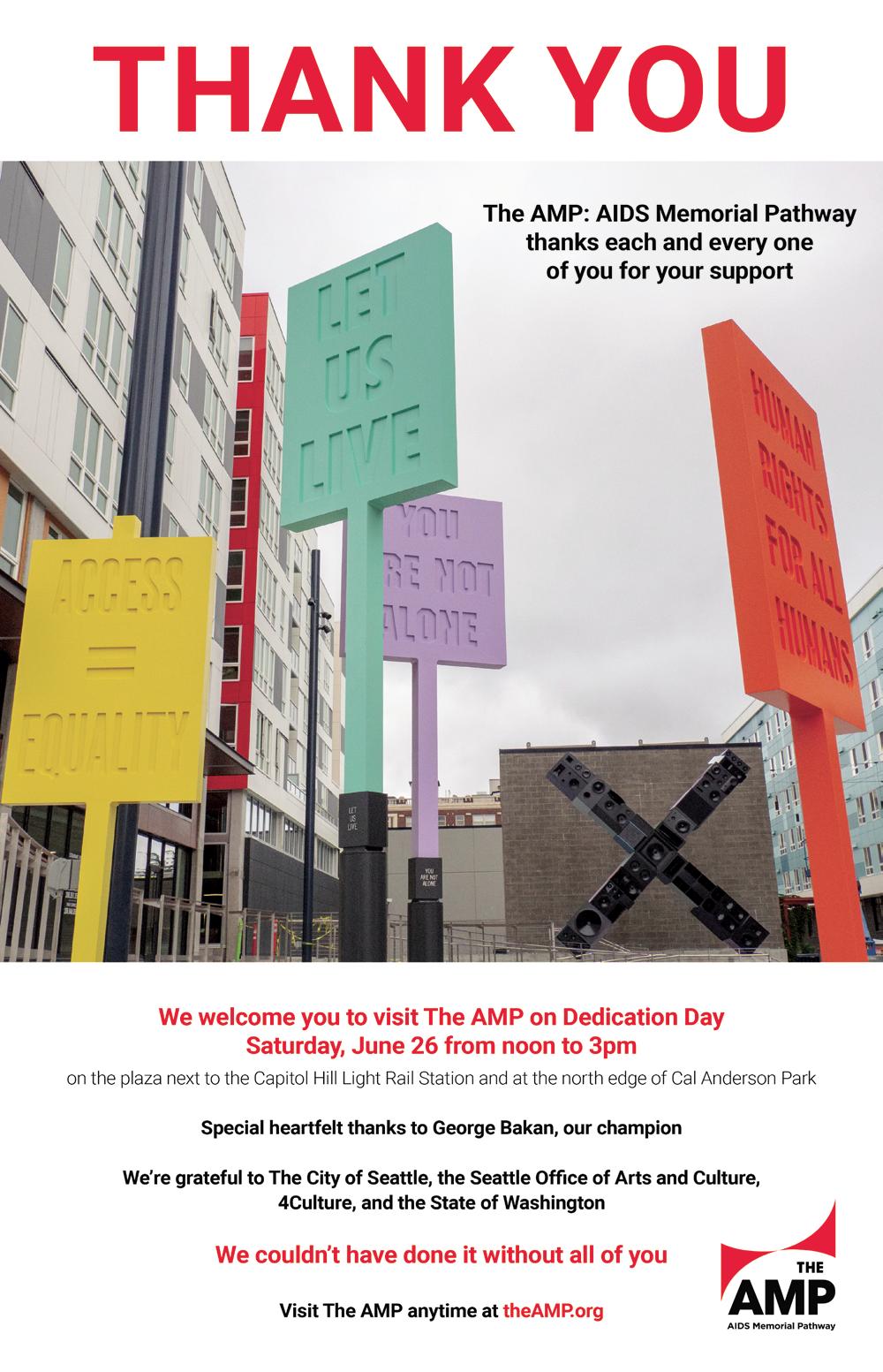







THIS AD SPACE HAS BEEN GENEROUSLY DONATED BY KRISTIN COSTELLO IN MEMORY OF SGN PUBLISHER GEORGE BAKAN
St. Patrick’s Catholic Church Welcomes LGBTQ Community Members!
St. Patrick’s Church is a welcoming, evolving Catholic Church located at the north end of Capitol Hill, 2702 Broadway E. We embrace all people as children of God and would like to invite LGBTQ community members to worship with us.
As a parish, we have a strong emphasis on social justice and inclusion.
This includes outreach to a women’s shelter, a supportive relationship with a faith community in El Salvador, weekly sign language interpreted Mass for the
and deaf-blind community, and welcoming developmentally disabled adults from the L’arche community.
Our choir and dance troupe are an integral part of our expression.





continued from page 10
Award nominations in 2008, winning four, including Best Musical.
Director Jon M. Chu’s new film adaptation is a rambunctious, high-energy treat that in some ways couldn’t be hitting cinemas at a more opportune time. Its story of hope and humanity is a cathartic shot in the arm, and it’s hard to imagine a more communally joyous experience for audiences than what this ends up proving to be.
I sat down with Chu over Skype to discuss In the Heights. Here are a few edited excerpts of what he had to say:
Sara Michelle Fetters: What was it about In the Heights that inspired you? What was it about this Broadway musical that made you want to make this film?
Jon M. Chu: I was shooting my first movie, Step Up 2: The Streets, so it was years ago. I’d never heard of this guy, LinManuel Miranda. But I went, not knowing what to expect.
It just rocked my foundation. I saw my family in it, even though I’m not from Washington Heights and I’m not Latino.
I’m an Asian dude from the Bay Area, from California, and I grew up in a Chinese restaurant. And yet, I knew who exactly who Abuela Claudia was in my life. I knew exactly what it felt like to have struggles, to have the dreams and the hopes of your family. I knew what it felt like to disagree with my brothers and sisters. I knew what it felt like to see things that my parents may not have seen and struggled with. It just said everything to me that I had never been able to express myself, even as a filmmaker.
So it stayed with me. When the opportunity came, when Mara Jacobs and Scott Sanders, the producers, came to me and I got to meet with Lin, I talked to them about this stuff, about the dreams and the hopes that I would have that were bigger than my bedroom wall or any restaurant could ever hold. I think we all saw the same.
SMF: There is something extraordinary in seeing these lives and these characters get their own showcase in a major motion picture. I think what you’re talking about only feeds into that. I mean, personally, watching films like A Fantastic Woman or Tangerine, I know how much seeing lives that even tangentially looked like mine meant to me.
I went back and I looked at your movies, and it seems as if you have made it a priority to assemble these extraordinarily diverse casts. More importantly, with varying degrees of success, it feels as if you manage to get into many of their stories in one way or another. Why has this been important to you? How does it make you feel to now be able to do this on an even larger scale with Crazy Rich Asians and now In the Heights?
JC: I think any artist from a marginalized community knows this is our reality. This isn’t something that we’re just making up along the way. These are our friends. This is our family. This is how we see the world.
I jumped into making studio movies. I didn’t do independent movies or other things before that. I went big into the studio system right away. In a weird way, you could say I was raised by that system. It only makes sense then that I’d put a little of myself and my own cultural journey into the stories I’ve been lucky enough to tell.
The greatest story we’re going to tell is the one we’re crafting for our children. What is America to them? What world are we creating for them? What does acceptance mean to them? That’s just become more of a priority for me over time. It’s like I woke up one morning and realized that were was nothing holding me back from telling stories with all those questions and more in mind.
SMF: What was that relationship like between you and Lin-Manuel during the

“In a way, the world in this past year has gone through the most isolating, difficult time imaginable. What better guides out of the darkness and back into the light than the people of Washington Heights? I want audiences to come out feeling healed. I want them to feel joyful. I want them to feel excited and curious. I want them to listen to more of that music. I want them dancing. I want them to want to know how to learn the dances that they see performed. I want people to want to meet and mingle and make new friends again.”
production? Did he offer input, or was he more hands-off and let you do your own thing?
JC: He was busy with Hamilton when we were developing the film. During development, me and Quiara Alegría Hudes were sort of two peas in a pod. Quiara is his proverbial neighbor, so she would check in with him about what we were doing and any changes we were making.
Lin was totally cool. Could not have asked for a better partner to understand that film is different and give us the freedom to do our own thing.
When we started casting, that’s when Lin started to see what we were doing and get involved. That was great. He has such insight.
When we were shooting, I didn’t know how much he would be around. But we were in his backyard. He came almost every day just to hang out. I think he enjoys people and he enjoyed our company. Lin is a great friend, and I couldn’t ask for a better example of how I want to be as a creative leader.
SMF: As you just mentioned, there is a difference between a Broadway production and film. There are some things that a Broadway production might do better than a film and vice versa. When you’re working on an adaptation like this, what do you leave out? What balance do you try to strike between keeping the vibe and the energy of the Broadway production and still making it cinematic?
JC: I kind of had to deconstruct the idea of translating and instead go back to the roots of the music and why a musical exists in the first place. Why is music more expressive? When words aren’t enough, for many things music can speak with a more powerful voice. A paragraph of dialogue transformed into a dance. I had done a lot of dance work before this, and I already knew how that could tell story, so that’s where I started.
SMF: In that vein — and you know this better than almost any director, through Step Up 2 and all the other dance movies and concert films you’ve done — there is a relationship between performance, cinematography and editing that is key to making a successful musical. It’s vital in every film, of course, but it seems that’s even more the case when making a motion picture like this one.
JC: You should have been there when Olga sang it for the first time in the audition. She came in and she wasn’t Olga. She came in as Abuela Claudia. I don’t think I’ve even met Olga. Even the day before shooting, when we had a dinner party, she was always Abuela Claudia. She is Abuela Claudia.
When she sang that song in rehearsal, everyone was in tears. We purposely made sure that number was not about the dancing. Everything needed to happen around her, close up. We wanted to make sure we were not taking attention away from Abuela Claudia. She is driving the whole damn thing during that number.
The thing is, if that scene were just her on the couch, it would be just as powerful. You would cry the same. For that scene, it was me getting out of the way in order to allow Olga to soar. She is just that much of a force.
SMF: What was the overall casting process like?
JC: I’ve learned a lot of lessons in my career, especially from Crazy Rich Asians When you take the time to task, when you search in the places that the Hollywood system has not allowed people of color to be in, you get pick of the litter, because there’s just that much untapped talent. It is not because there’s a lack of talent. It’s a lack of access. Thank God Warner Brothers understood that.
What input do you take from the cast? Or from your cinematographer, Alice Brooks, or your editor, Myron Kerstein? When you’re assembling all of these pieces, what is that relationship like with your collaborators that ensures you capture that energy on the screen, that you don’t lose any of it by overcutting or shooting at the wrong angle?
JC: We’re a family. It’s definitely a total team effort. I’ve worked with Alice since school. This is our first big musical together. But we’ve done tons of dance stuff. We’ve made a lot of mistakes in the past, which we’ve learned from. She’s a fellow storyteller.
I think that’s what I value most of my crew and my cast. They’re all storytellers, and they all paint in a different medium than I do. It’s our collaboration that counts. It’s our process that matters. I’m saying to Christopher Scott, our choreographer, that I’m trying to get the scene to be about a character’s isolation, and I want to know what movement communicates that. And he comes up with it. And the dancers execute it. It’s collaboration.
Same goes for other aspects of the production. I’d go to Nelson Coates, our production designer, and he creates a set that is as functionally busy as a real bodega but is as specific as a map on the wall made out of subway tiles, keys, and product labels from the bodega itself. I can’t tell him to do that. He just does it.
The cast would say, “This is not the sauce that we would have at a dinner,” and then someone would make their own homemade sauce. Someone else would add, “Food isn’t served like this” or “This dish would be on the side,” and we’d make sure the dinner is presented in that fashion. Someone even asked about that big old spoon every family always has, and someone went out and found a perfect one that we could utilize in the scene. We just made room for these conversations. We were all storytellers together.
SMF: How important was it to have Olga Merediz back from the Broadway production portraying Abuela Claudia? Also, are you planning on supplying theaters showing the movie with tissues for the “Alabanza” number? Because I died. I was dead. I was drowning in tears during that number. You killed me.
I mean, Anthony Ramos, he’s such a poet. And Leslie Grace, it’s her first movie. How is that possible? And Corey Hawkins. He’s a trooper. So versatile and willing to do anything. And then there’s little Gregory Diaz. He’s just 14 years old! And he just kills it! We put him into the mix and everyone just became so protective of him. It was great to see.
And, of course, there’s Melissa Barrera, who probably I saw grow the most. She came in and had to find the wounds of this character. She had to find Vanessa. Because Melissa is so bubbly and kind, and this role required so much of her. She had to search deep down while also having to learn how to dance. Melissa was fully vulnerable and exposed, but she just hit it out of the park. The whole cast did. Every member. I’m just so proud of all of them.
SMF: What do you hope audiences take away from this film? Now that we can see the light at the end of the tunnel, In the Heights is one of the first big films where people are going to have a chance to see it together in theaters, anywhere from 50 to 75% capacity, maybe more than that in some instances. What do you want them to take away from this experience? What do you hope that they’re talking about, and what does it mean to you that this film by all appearances seems to be opening just when it’s maybe needed the most?
JC: It’s interesting. When you see a community like Washington Heights, which has learned how to survive, how to pick one another up, that has been there for one another, you realize these are truthful, timeless ideas. The joy you have to exalt. The beauty you have to be able to see, beyond the struggles, which are right in front of you. These are assets and tools that communities have used throughout time to get through difficult situations.
In a way, the world in this past year has gone through the most isolating, difficult time imaginable. What better guides out of the darkness and back into the light than the people of Washington Heights? I want audiences to come out feeling healed. I want them to feel joyful. I want them to feel excited and curious. I want them to listen to more of that music. I want them dancing. I want them to want to know how to learn the dances that they see performed. I want people to want to meet and mingle and make new friends again.
I think people are ready, and our In The Heights greeting committee is ready and waiting for them. I want them to get our vaccine for the soul.
John Chu and Lin-Manuel Miranda on the set of In the Heights – Photo courtesy of Warner Bros
Allyship - an organization of LGBTQ individuals fighting for economic and social justice. www.LGBTQAllyship. org, allyship@yahoo.com, (206) 279-8169. American Veterans for Equal Rights - www.aver.us
Another Gay Social Club! - www.meetup.com/AnotherGay-Social-Club/ Bellingham/Whatcom County - www.theslowlane. com/guide.html
BiNet Seattle is a mixed gender, social group for Bisexuals, their partners & other Bi-friendly folks - www. binetseattle.org.
Bremerton/Kitsap County - www.outwestsound.org Capitol Hill Alano Club - www.chacseattle.org
Cascade Rainbow Community Center (Mount Vernon) - (360) 840-8499 and on Facebook. Central Washington University GALA Hotline: (509) 963-1994.
Channel Q 103.3 FM - LGBTQ+ Talk Radio NetworkNews and information, pop culture and music. radio.com COLAGE unites people with LGBTQ parents and caregivers into a network of peers and supports them as they nurture and empower each other to be skilled, self-confident, and just leaders in our collective communities - www.colage.org
DIFFA/Northwest (Design Industries Foundation Fighting AIDS). (206) 763-8885; www.diffanorthwest. org
DOMESTIC VIOLENCE & SEXUAL ASSAULT: Crisis Clinic, (206) 461-3222 (24 hour line); King County Sexual Assault Resource Center (KCSARC) - 24-hour crisis line for information, support, & medical & legal assistance: 1-888-99-VOICE; Northwest Networksupport & advocacy for Bisexual, Trans, Lesbian & Gay Survivors of Abuse & Dating Violence, (206) 568-7777 (voice), 517-9670 (tty), www.nwnetwork.org; Pierce County Domestic Violence Helpline: Teresa, (253) 798-4166; Seattle Counseling Service for Sexual Minorities - offers on-going support groups for men: 323-1768; Seattle Police Dept Domestic Violence Unit, (206) 684-0330; State Wide Domestic Violence Hot Line, 1-800-562-6025. In an emergency call 911 Report domestic violence and sexual assault. Equal Rights Washington - (206) 324-2570; www. equalrightswashington.org
Everett/Snohomish Cty - www.gaysnohomish.org
Freely Speaking Toastmasters - www.freelyspeaking.org
Gay City promotes wellness in LGBTQ communities by providing health services, connecting people to resources, fostering arts, and building community. Gay City Health Project’s Wellness Center provides anonymous & confidential HIV/STD testing. 517 E Pike St. More info or to schedule an appointment, (206) 860-6969. www.gaycity.org
Gay & Lesbian National Hotline (GLNH): 1-888-THEGLNH (1-888-843-4564). Non-profit, peer-counseling, information & local resources telephone hotline for GLBT people across the country.
Generations Aging With Pride empowers elder LGBTQ adults to live with pride and dignity by promoting, connecting, and developing innovative programs and services that enhance belonging and support, eliminate discrimination, and honor the lives of older members of our community - (206) 393-3400; info@gapseattle.org; gapseattle.org
GLSEN/WA - Gay, Lesbian, Straight Education Network - (206) 330-2099; www.glsenwa.org
Greater Seattle Business Association (GSBA) - (206) 363-9188; www.thegsba.org
HIV/AIDS Program, Seattle/King County Dept of Public Health, provides confidential/anonymous information about & testing for HIV/AIDS. (206) 205-7837. For a comprehensive list of HIV/AIDS service organizations see the GSBA Guide or visit www.thegsba.org or call Lifelong AIDS Alliance, (206) 328-8979.
Imperial Sovereign Court of Seattle & the Olympic & Rainier Empire - www.facebook.com/ISCSORE; www. imperialcourtofseattle.com
Lambert House - (206) 322-2515; www.lamberthouse. org
LGBT Library - 517 E Pike St. Open Mon-Fri 2-8pm; Sat 2-5pm. A wide range of fiction and non-fiction for the LGBT community and allies can be borrowed free of charge.
LGBT MS Connection - (425) 785-8593; lgbtmsconnections@comcast.net. Support group for LGBT persons with MS and their partners and their caregivers. Sponsored by the National Multiple Sclerosis Society. Lifelong AIDS Alliance - (206) 328-8979, www.lifelongaids alliance.org
Lion’s Main Art Collective - www.lionsmain.org
MEN: Gay City: (206) 860-6969, www.gaycity.org; Knights of Mantra: (206) 329-0886, www.jetchapterkofm.com; Mature Friends: Gay men & women 40 & over, www.maturefriends.org; Northwest Bears: www. nwbears.com; The Olympians: www.TheOlympians. net; POZSeattle: www.pozseattle.com; Q-Squared: www.qsquared.org; Rain City Jacks: www.raincityjacks. org; Seattle Gay Couples: www. seattlegaycouples.org; Seattle Men in Leather: www.seattlemeninleather. org; Seattle Prime Timers: Gay & Bi men 40 & over, www. seattle primetimers.org; Tacoma Older LGBT: www. tacomaolderlgbt.org. (See also listings under Bisexual, Parenthood, People of Color, Transgender.)
MUSIC: Diverse Harmony: www.diverseharmony. org; Rainbow City Band: 1-866-841-9139 ext 2126; rainbowcityband@onebox.com; www.rainbowcity band. com; Seattle Men’s Chorus and Seattle Women’s Chorus: (206) 388-1408, (206) 323-0750. www.seattlechoruses.org.
Northwest Lesbian & Gay History Museum Project - gayhistnw@aol.com
community resources
Northwest Rainbow Alliance for the Deaf - www. nwrad.org
Olympia/Thurston County - www.RainbowCenterOly. org
Out & Equal Workplace Advocates/Seattle Regional Affiliate supports the work of LGBT employees and the growing number of ERGs (Employee Resource Groups) making a difference within local companies, including Alaska Airlines, Amazon.com, Amgen, AT&T, Bank of America, Deloitte, Macy’s, Microsoft, Russell Investments, Safeco Insurance, Starbucks Coffee, Xerox. www.outandequal.org/affiliates/seattle
Out & Proud Grays Harbor Coalition - http://outandproudgh.org
PARENTHOOD: Families Like Ours provides a gateway for LGBT families interested in adoption & provides a network of safe placement agencies, training, support & resources: (206) 441-7602, www.familieslikeours. org; Family Works offers support, information & activities for LGBT families: (206) 694-6727, www.familyworksseattle. org; Gay Fathers’ Association of Seattle offers support groups & social activities: www.gfas. org; Proud & Loud Families - Northwest, www.meetup.com/proudand-loud-families-northwest, plfnorthwest@aol.com; Queer Parent Networking Dinners: (206) 568-7777, qpnd@nwnetwork.org, www.nwnetwork.org; Rainbow Families of Puget Sound: www.rainbowfamiliesps.org PFLAG is the national organization for parents, families, allies, and LGBTQ people united for equality with chapters in Seattle, Bellevue/Eastside, the Puget Sound region and across Washington state. PFLAG Seattle: (206) 325-7724, info@pflagseattle.org, and www.pflagseattle.org; PFLAG Bellevue/Eastside: (425) 483-6642, info@bellevue-pflag.org, http://community. pflag.org/PFLAGBellevue; PFLAG Pacific Northwest: www.pnwpflag.org; PFLAG Washington State Council: www.pflagwsc.org. Peer Seattle (formerly Seattle Area Support Groups) is a non-profit organization that builds community and cultivates powerful, healthy lives by providing emotional support and personal development services to those affected by HIV/AIDS, the Queer communities, and those who love them. Our work is done in a spirit of safety, trust, inclusiveness, and celebration of individual differences. (206) 322-2437; www.peerseattle.org
PEOPLE OF COLOR: AARTH (African American Reach & Teach Health Ministry), (206) 850-2070, www.aarth.org; Asian/Pacific Islander Queer Network Program at API Chaya, (206) 467-9976; Center for MultiCultural Health, (206) 461-6910, www.multiculturalhealth.org; Entre Hermanos, GLBT Latinos/as, (206) 322-7700, www.entrehermanos.org; Ile LaiLai, (206) 781-3565, iya@ilelailai.org; Men of All Colors & Cultures Together (MACCT), (206) 923-8313, macctseattle@yahoo.com, www.macctsea.org; Northwest Two Spirit Society, https://www.facebook.com/ groups/nw2spiritsociety/, Nubian Pride Productions, nubianpride@gmail.com; People of Color Against AIDS Network (POCAAN) offers rapid HIV testing, M-F, 10am-5pm, (206) 322-7061, www.pocaan.org and on Facebook; QBASS - Queer Black Alliance of the South Sound, (253) 256-1846, weareqbass@gmail. com; Sistah 2 Sistah, LBT women of African descent, (206) 322-7061, (206) 255-8951; Somos Seattle, somosseattle.org; Trikone-Northwest, GLBT South Asians, (425) 985-4376, www.trikonenw.org; Two-Spirit Honor Project, 1-866-685-0164; U.T.O.P.I.A. Seattle, www.utopiaseattlewa.org; VietQ Greater Seattle, vietqorganization@gmail.com
Pierce County AIDS Foundation - (253) 383-2565; www.piercecountyaids.org
Pride Foundation - (206) 323-3318; www.pridefoundation. org
Pride Lives - www.facebook.com/PrideLives/ Pride Radio 93.3 HD2
Project NEON is a program of Seattle Counseling Service providing FREE information & services to Gay & Bi men to reduce health risks associated with methamphetamine use. (206) 323-1768. www.crystalneon.org
Public Health-Seattle & King County Online Comprehensive Health Information for Sexual Minorities: www.kingcounty.gov/healthservices/health/personal/ glbt.aspx
Q Law: The GLBT Bar Association of WA - (206) 682-6711; www.q-law.org
Q Law GLBT Legal Clinic - (206) 235-7235. Queer Geek! - queergeekseattle.org
Rainbow Center - Resource Center for Tacoma/Pierce County LGBTIQA community. Through education, advocacy and celebration, the Rainbow Center expands resources, and safe space for the LGBTQIA community.
Sponsors Tacoma Pride Festival. (253) 383-2318, www. rainbowcntr.org
SEAMEC interviews, researches & rates candidates for public office on issues of concern to the LGBT community. www.voteseamec.org
Seattle Area Support Groups & Community Center (SASG) i- SEE LISTING for Peer Seattle. Seattle Bisexual Women’s Network - BiSeattle.wixsite. com/SBWN and on Facebook.
Seattle Counseling Service for Sexual Minorities is a community mental health service for GLBT persons & their families providing comprehensive mental health services on a sliding scale. (206) 323-1768.
Seattle LGBTQ Commission - (206) 684-4503. www/ seattle.gov/lgbtq
Seattle Out & Proud - (206) 322-9561; www.seattlepride.org
Seattle Police Department Sexual Minorities Community Advisory Council: kim.bogucki@seattle.gov
Seattle PrideFest - www.seattlepridefest.org
Servicemembers Legal Defense Network - (202) 328-3244; www.sldn.org
Sex Workers Outreach Project - https://seattle. swopusa.org
Sisters of Perpetual Indulgence, The Abbey of St. Joan - (206) 860-3666; www.theabbey.org Snohomish Health District HIV/AIDS Program provides free confidential/anonymous HIV counseling & testing 9am-5pm Monday-Friday, until 7pm Tuesdays. (425) 339-5298.
South Sound Q Calendar - LGBTQ events in Tacoma, Olympia & Sound Puget Sound area; www.SouthSoundQCal.com Spokane/Inland Northwest - www.outspokane.com; www.stonewallnews.net
SPORTS & RECREATION: Bent Car Guys: www. bentcarguys.org; Border Riders Motorcycle Club: www.borderriders.com; Bottom Dwellers Scuba Club: www.bottomdwellers.org; Capitol Hill Cyclers: join their Facebook group or email capitolhillcycling@ groups.facebook.com or jordan.l.simonson@gmail.com; Cascade Flag Football: www.cascadeflagfootball.org; Cascade Flyers: www.cascadeflyers.org; Emerald City Mudhen Rugby: www.mudhenrugby.com; Emerald City Softball Association: www.emeraldcitysoftball. org, www.eteamz.com/womensecsa; Ethyl Forever Car Club: ethylforever@hotmail.com; Festival of the Babes: www.festivalofthebabes.com; Olympic Yacht Club: www.oycnw.org; OutVentures: outdoor education & recreation activities, www.outventures.org; Pacific Northwest Gay Rodeo Association: www.pacificnwgra.org; Puddletown Squares: www.puddletownsquares.org; Rain City Soccer: www.raincitysoccer.org; Rain Country Dance Association: a country-western dance organization catering to the LGBTQ community but open to all, www.raincountrydance.org; Sea Dawgs: LGBT ice hockey - SkateSeaDawgs@gmail.com and on Facebook; Seattle Frontrunners: www.seattlefrontrunners.org; Seattle Gay Basketball Association: www. seattlegaybasketballassociation.com; Seattle Orca Swim Team: www.orcaswimteam.org; Seattle Otters Water Polo: www.otterpolo.com; Seattle Quake Rugby: www.quakerugby.com; Seattle Tennis Alliance: www. seattletennisalliance.org; Seattle Unified Bowling Association (SUBA): magee98106@aol.com, www. teamseattle.org/bowling.htm, www.theprideleague. com, Century 21 League; Seattle Volleyball Club: www.seattlevolleyballclub.com; Ski Buddies: www. skibuddies.org; Team Seattle Gay Sports Network is an umbrella organization for a wide range of local GLBT sports activities, (206) 367-4064, www.teamseattle.org (see website for comprehensive list of sports clubs); Triangle Recreation Camp at Bender Creek: recreational camping for GLBT folks. Must be 21; ID required. trc@ camptrc.org, www.camptrc.org, 1122 E Pike St #1069, Seattle 98122-3934. Strength Over Speed - www.strengthoverspeed.org Tacoma/Pierce County - Rainbow Center, 2215 Pacific Ave, Tacoma, a resource center for the LGBTIQA community of Pierce County, (253) 383-2318, www. rainbowcntr.org
Three Dollar Bill Cinema - TWIST: Seattle Queer Film Festival; Translations: Seattle Transgender Film Festival; Outdoor Cinema at Cal Anderson Park. www. threedollarbillcinema.org
TRANSGENDER: Emerald City Social Club: (425) 827-9494; Gender Alliance of the South Sound: www. SouthSoundGender.com; Gender Diversity: www. genderdiversity.org; Gender Justice League: www.genderjusticeleague.org; Gender Odyssey: www.genderodyssey.com; Hermanos Trans Latino & Foreign-Born
Support Group: (206) 322-7700; Ingersoll Gender Center: (206) 329-6651, www.ingersollcenter.org; Lion’s Main Art Collective: www.lionsmain.org; The New BoyZ Club: www.olympiaftmgroup.webs.com; Olympia Trans Discussion Group: www.facebook.com/pages/ Olympia-Trans-Discussion-Group/262449878114; [trans] ACTION: Trans* & Gender Non-Conforming Sex Workers’ Support Group - a safe, peer-led space. mail@utopiaseattle.org; TRANSform Washington: transformwashington.com; Trans Resource & Referral Guide: kctransguide.org; Trans Women of Color Solidarity Network: Funding the collective liberation of Trans women of color – https://m.facebook.com/ TWOCSolidarityNW/; Washington Gender Alliance: (360) 445-2411, www.washington genderalliance.com
WOMEN: Aging Ballard Lesbian Exchange (A.B.L.E.): We are Lesbians 60 years (generally) and up, living (mostly) in the north half of Seattle. The purpose of the group is to connect, socialize and support each other. ruthemilyvogel@gmail.com; Aging Lesbians in South Seattle (ALISS) - Lesbian Group at the Southeast Seattle Senior Center. This is a gathering primarily for Lesbians but all are welcome to attend. Kate, (206) 722-0317; www.sessc.org; BABES: support groups for HIV+ women. (206) 720-5566, 1-888-292-1912; Coming Out Women Support Group of Tacoma: www. comingoutwomen.org; Festival of the Babes: www. festivalofthebabes.com; Mature Friends: Gay men & women 40 & over, www.maturefriends.org; Puget Sound Old Lesbian Organizing for Change: http:// psoloc.org, (253) 777-3357; Older Lesbians Organizing for Change/WA State Chapter: gloria@oloc.org, mary@oloc.org, www.oloc.org; Pacific Northwest Lesbian Archives: www.pnwlesbianarchives.org; RainshadowWomen: RainshadowWomen@aol. com; Seattle Bisexual Women’s Network: BiSeattle. wixsite.com/SBWN; Seattle Girls of Leather: www. sgol.org; Tacoma Lesbian Concern (TLC): www.tacomalesbianconcern.org; Tacoma Older LGBT: www. tacomaolderlgbt.org; Women of West Seattle (WOWS): a fun, member-driven social group for Lesbians, http:// groups.yahoo.com/group/womenofwestseattle; YWCA Women’s Health Outreach: providing low or no-cost mammograms for income eligible 40+ LBTQ individuals. Follow us at http://lbtqhealth-ywca.blogspot.com, twitter.com/ingridWHO or email lbthealth@ywcaworks. org, (206) 461-4493. (See also listings under Bisexual, Parenthood, People of Color, Transgender.)
YOUTH: B-GLAD (Bisexual, Gay, Lesbian, Trans & Questioning Adolescent Drop-In Group): Youth Eastside Services offers many programs for GLBT youth, including B-GLAD, (425) 747-4937; Coyote Central: www.coyotecentral.org; Diverse Harmony: www.diverseharmony. org; GLSEN/Washington State (Gay, Lesbian, Straight Education Network) & Washington State GSA (Gay-Straight Alliance) Network: GLSEN works to create safe schools for LGBT students. WA GSA Network supports youth-led GSA’s to fight harassment & homophobia in Washington state schools. (206) 330-2099; www.glsenwa. org; www.wagsa.org. GLOBE (GLBTQ Loving Ourselves, Becoming Empowered): a support group & HIV/STD prevention program for GLBTQ youth, 14-20, in Everett, (425) 263-2908, www. globeyouth.org; It Gets Better Project: www.itgetsbetter.org; Lambert House: an activities & resource center for LGBT youth, 14-22, 1818 15th Ave @ E Denny Way, with additional support groups organized in smaller towns throughout King County, (206) 322-2515, www. lamberthouse.org; Lifelong HEYO (Health Education Youth Outreach): for LGBTQ youth, ages 16-24: (206) 957-1665; www.llaa.org/HEYO; www.MatthewsPlace. com ; The Mockingbird Society: (206) 323-KIDS (5437), www.mockingbirdsociety.org; New Horizons: social services and shelter for homeless youth, 2708 3rd Ave (in Belltown), (206) 374-0866, http://namin.org; Oasis Youth Center: for GLBTQ youth, ages 14-25, in Tacoma, (253) 671-2838, www.oasisyouthcenter. org; OKAY! LGBTQ+ Outreach for Kent Area Youth: (253) 859-0699 ext 3034. OKAY! is an open support group for youth ages 13-19 who identify as LGBTQ+. A program of Kent Youth & Family Services; OUT There Adventures: www.outthereadventures.org; Parents, Family & Friends of Lesbians & Gays (PFLAG)/ Puget Sound: (206) 325-7724, www.seattle-pflag.org; Pizza Klatch: weekly lunchtime support groups for LGBTQ youth in Thurston County, www.pizzaklatch. org; Prism: for LGBTQ youth, 14-21, in PuyallupCherise.Alexander@ multicare.org; www.facebook. com/PuyallupPrism; Proud Out Wonderful (POW!): for LGBTQ youth, 13-21, in South King County, (206) 326-9112, www.facebook.com/proudoutwonderful; Q Youth Resources: in Kitsap County - (360) 698-3335; www.kchaf.org; Roots Young Adult Shelter: 1415 NE 43rd St., (206) 632-1635; www.rootsinfo.org; Safe Schools Coalition: www.safeschoolscoalition.org; (206) 451-SAFE, (206) 451-7233 (non-emergency), 1-877-SAFE-SAFE (1-877-723-3723) (crisis line); Seattle Young People’s Project (Queer Youth Resource Board): (206) 860-9606, www.sypp.org; Street Youth Ministries (SYM): (206) 524-7301 ext 111; www. streetyouthministries.org; Teen Link: (206) 461-4922, 1-888-431-TEEN; The Trevor Project: 866-4-U-Trevor; www.thetrevorproject.org; True Colors - Connecting LGBTQ Teens: in Shoreline, (206) 362-7282 x 8018, lbagley@chs-nw.org; The Vera Project: fuels personal & community transformation through collaborative youthdriven engagement in music and art. (206) 956-8372; theveraproject.org; Vista Youth Center: for LGBTQ, questioning and allied youth, ages 14-21, in Kennewick, (509) 396-5198, www.vistayouthcenter.org; YouthCare/ Isis Program (Transitional Living Home for LGBTQ Young Adults, 18-22): (206) 522-8412; YouthCare/ Orion Center Young Adult Shelter: 1828 Yale Ave @ Stewart St. (206) 622-5555; Youth in Focus: (206) 723-1479; www.youthinfocus.org; Youth Suicide Prevention Program (OUTLoud-GLBTQ): (206) 297-5922, ext 116, 1-800-273-TALK, www.yspp.org
Fremont’s coziest shop: Ophelia’s Books
by Lindsey Anderson SGN Contributing Writer
Just blocks from the troll under the Fremont Bridge sits one of the area’s most precious secrets: Ophelia’s Books. Upon entering, one is instantly welcomed by the comforting smell of the old books that line the walls, stacked from floor to ceiling. In classic Seattle fashion, the store’s three floors make use of every inch of space.
I sat down on the main floor, on a cozy reading bench, to talk a little with owner Jill Levine. For the last twelve years, she has owned and managed Ophelia’s.
“Ophelia was our first cat,” Levine told me, recounting the story behind the store’s name. Twenty-six years ago Ophelia the cat supervised the grand opening, and her legacy continued on with the second bookstore cat, Claudia, who has just retired at the age of 18. “Eighteen years is a long time to work at one job,” Levine chuckled. Claudia now lives at home with Levine while she searches for the next feline supervisor.
Ophelia’s is the perfect place to grab a used book and forget about the world for a little while. “It’s comfortable,” Levine said, describing the store, overflowing with previously loved novels. “It’s not, obviously, the neatest, and it’s definitely got a lot of visual clutter, but what I hear from people is that it feels welcoming and comfortable.”
The place does indeed feel welcoming, as readers young and old are beckoned to head upstairs to a cute reading nook. “People love to go up there and sit and read,” Levine noted as customers climbed the old wooden stairs up to the loft.
However, what sets Ophelia’s Books apart is the neighborhood it has become such an important part of. “All bookstores take on the character of their neighborhood,” Levine noted, “and I feel like it is very much a Fremont kind of place. Like not everything being quite square or polished seems to fit in with the neighborhood. Not everything is perfect, and that’s what kind of stands out.”
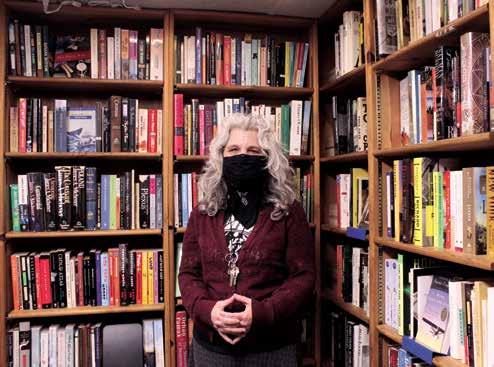
“I have noticed more activity in the neighborhood around Pride... which might explain why classic Queer authors, like Hemingway, seem to be flying off the shelves.”
Perhaps it is the quirks and refusal to fit into a bookend that attract Queer readers to Ophelia’s. For a community constantly fighting against society’s perfectionist tendencies, an imperfect shop such as this can feel just like home. “We’d like to have all the perfect books in perfect condition, but that’s kind of impossible in a world that isn’t perfect, so there’s a little serendipity in there: you can find something, but you just might not know what it will be.”
The store remains dedicated to shelving Queer stories whenever possible. On

Violet and Daisy : What a pair!
by Terri Schlichenmeyer
Special to the SGN
VIOLET AND DAISY: THE STORY OF VAUDEVILLE’S FAMOUS CONJOINED TWINS
SARAH MILLER
© 2021 Schwartz & Wade Books
$17.99 / $23.99 Canada
310 pages
Kate Skinner had plenty of reason to scream. She’d been in labor for hours, and the pain was excruciating. The midwife thought the baby was stuck, until she realized there were two babies. And then, with “a great deal of unusual twisting and turning,” twins were born — and Kate screamed again.
What a pair! Her newborn daughters were attached at the base of their little spines: the girls shared a rectum, tailbone, and anus, along with some muscles and skin but they were normal children otherwise.
Kate didn’t know that, though, and she refused to care for her babies, and so the

midwife, Mary Hilton, took them in and gave them her surname.
Outwardly, Hilton was a kindly woman who loved these English girls, named Violet and Daisy, but the truth, says author Sarah Miller in the new biography aptly titled Violet and Daisy, was that she abused them and put them on display for money. Later, Hilton’s son-in-law and daughter did the same, bouncing the growing girls from continent and manager to the next place and sideshow, ultimately landing in America.
Through the years, the Hilton sisters made their foster family and various managers they hired very wealthy, but in a thenscandalous, nationally followed court case when they were young adults, they learned that the money was largely gone.
To 21st-century eyes, what happens in Violet and Daisy may seem sadly, tabloidishly familiar. But keep reading: there’s more to this true story, and it’s quite compelling.
Miller captures readers’ interests by setting the stage at the beginning of her book, explaining why the sisters’ mother was so aghast at their birth, and showing the ease

the basement level, Levine keeps a shelf dedicated to all of the LGBTQ-related books they recieve. “We usually do a window [for Pride month],” Levine added, “I have noticed more activity in the neighborhood around Pride,” she said, which might explain why classic Queer authors, like Hemingway, seem to be flying off the shelves.
When asked for a Queer book recomendation, Levine could hardly name just one. “The one that popped into my head right away was The Amazing Adventures of Kavalier & Clay. It’s an amazing book on a lot of levels. A personal favorite is Jeanette Winterson’s The Lighthouse Keeper There’s also Nightwatch by Sarah Waters.” Levine ultimately decided to recommend The Lighthouse Keeper, describing it as a dreamy and beautiful novel that showcases some of the triumphs of the LGBTQ community.
Ophelia’s Books is also dedicated to environmental progress. By shelving only used books, it promotes reuse and prioritizes a love for the planet. Furthermore, a unique charm can be found in an all–used book store such as Ophelia’s. “The joy I have from this place is kind of… an adventure, and you just never know what you’re gonna find, and it can be so interesting,” said Levine.
If you’re interested in mystery, nostalgia, or perhaps soon meeting Seattle’s newest bookstore cat, make your way down past the troll, and check out Ophelia’s Books, Fremont’s coziest shop.
that Mary Hilton enjoyed by taking advantage of the entire situation for years. To know how and why both things occurred is a lesson in cultural history.
Miller’s account of the court case comes roughly in the middle of this book, and here it’s likewise beneficial if you can see the wider picture. America wasn’t very enlightened throughout most of Violet’s and Daisy’s lifetimes, as evidenced by the details of their lives and the touchy legalities of the normal existence they craved. Medicine was still, by modern standards, rather crude.
And yet, the court judgment and the Hiltons’ subsequently successful career demonstrate a nation hurtling through many advances that could only portend good.
But not entirely: how Daisy’s and Violet’s lives take a turn, and how they end, is the perfectly tragic period at the end of a heartbreaking sentence.
You might find this book in the YA section, but don’t let that deter you: it’s one you’ll want to savor. Violet and Daisy and a bookmark: what a pair!
Image courtesy of Schwartz & Wade
Photos by Lindsey Anderson



Search for the Soul of Seattle: The mountains are out
by A.V. Eichenbaum
SGN Associate Editor
Sun from 5 a.m. to 10 p.m. That’s what I love about summer in the Pacific Northwest. Tourists flock from all over the globe to cram Pike Place Market. The smell of sunscreen and salt and freshly cut grass floats out into the city. A sense of adventure spreads among Seattleites, who finally put those hiking shoes to good use on trips out to the surrounding mountains and woodlands.
Whatever exists of the much maligned “Seattle Freeze” melts away during the summer months, as if the problem is a citywide vitamin D deficiency instead of a ubiquitously accepted sour temperament.
I arrived here in August of 2017. Smoke covered the sky that week. Seattle had just been declared the most expensive city to live in. The sun, a heavy-lidded red eye, judged my poor, homeless, jobless ass through the thick haze.
My partner at the time and I crashed at my aunt’s place until we could get ourselves figured out. After a few weeks sweating at a deli in the Market, I made my way to Eastlake and the shipping industry.
My first real Seattle summer came after a long, cold, exhausting Seattle winter, and I’ve never taken the sun for granted since.

Photo by A.V. Eichenbaum
“The mountains are out!”
That’s how my coworker announced the death of winter in June of 2018.
She got up from behind the counter, ran outside, and pointed. “See?”
The wall of gray, which had been there that morning, had disappeared. In its place,
ater downtown is painted in the colors of the rainbow. Orlando City Hall flies the Progress Pride flag during the month of June. The Orlando City Soccer Stadium has 49 rainbow-colored seats. There are countless murals commemorating Pulse.
The Orlando community rallied around and embraced our LGBTQ+ community with open arms and open hearts. We became a shining beacon of acceptance in the US South.
For our Latinx and Black communities, Pulse had additional layers. The tragedy happened during Latin Night, so in the aftermath, our Latinx and Black communities were bombarded with images of 49 faces that looked like us. Our parents saw their children reflected on the TV and cried with the families that lost theirs, our people heard the term “LGBT” for the first time in our native language over and over, and our churches prayed for the lives lost.
Pulse forced our communities to see that our identities are intersectional, and for the first time those of us at the intersection felt a collective call to action, to mourn, to heal, and to create.
The legacy of Pulse is not tragedy; it’s resilience. It’s the story of often-invisibilized, marginalized people speaking up and taking action and building power.
When media attention came, love and support from around the country poured into our city. This love opened the eyes of our community to the gaps in resources and services to Pulse-affected communities, and most importantly, gaps in opportunities and representation. The Orlando United Assistance Centered opened its doors to help the families and victims, our LGBT Center became a safe haven for those looking for support, and our city government rose to action to help our community heal. Grassroots organizations like Qlatinx formed, and with them new spaces for us to be in community with one another, something that LGBTQ people of color were desperately lacking outside of the nightclubs.
Then came the Contigo Fund, which gave funding power to LGBTQ people of color in Central Florida and ensured that what we created would not be destroyed. From tragedy, a movement was born.
a crystal-clear blue sky and, yes — pristine and white, still glistening with the last snowfall, there stood a mountain. She didn’t notice, but I nearly cried.
My Californian sensibilities are not accustomed to this climate. They probably never will be, just as I will probably never
find a burrito as good as back home. What the hell is Taco Time, anyway?
So how do I ensure that I get the sun I need to thrive and power through until next year?
I walk. Everywhere.
You see a different part of the city in the slow lane. Admiring rose gardens, encountering other pedestrians, petting dogs. That’s the life.
Of course, there also used to be summer parties and backyard barbecues to look forward to before 2020, but nothing beats taking your time and soaking up the sun, even when things open back up later this year.
If you’re new to town, here’s my advice: Get outside while it’s nice.
Simple enough, but you’ll be surprised how quickly those long days run out.
If you’ve been here longer, though, I’d like to suggest getting a sun lamp. Bornand-raised Seattleites often deny that they get more irritable in winter, adopting an “it is what it is” mentality about the seasonal depression they’ve always known. If this sounds like you, get a sun lamp. I can’t swear by it enough.
Enjoy the weather now, of course, but for god’s sake, prepare for the rest of the time. Your life will improve, I promise.
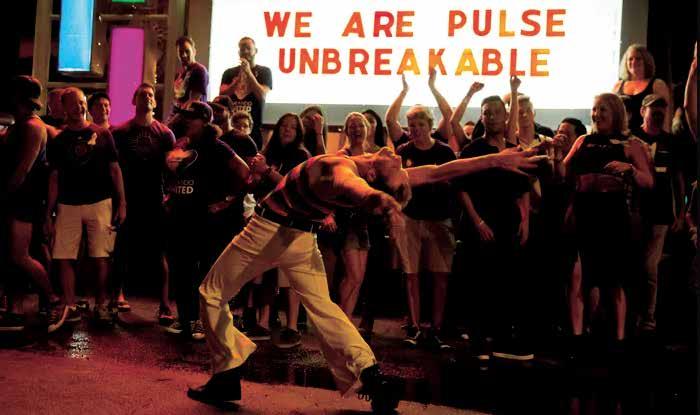
Every year we honor and remember Pulse, and every year this gets more complicated. Some families of the 49 have asked for their faces to stop being used, so that they may have their chance to heal. We move forward with plans for a memorial, with mixed reactions from Pulse survivors and our community.
The Orlando United Assistance Center, which still serves over 350 people in Pulseaffected communities, was forced to find a new home at the LGBT Center, in the middle of a global pandemic, and our own governor vetoed critical funding for them days away from the five-year anniversary of the tragedy. Organizations and funders that rushed to respond to Pulse lost interest and moved on, as if our communities no longer matter. The further away we get from Pulse, the easier it gets for us to be divided again.
My hope in writing this piece is to remind all of us that when tragedy strikes and we come together and pour love into communities affected, that love must come with a commitment to ask ourselves, “How can I honor this loss by changing our world for the better?”
This year, as we gather to continue our healing process, let’s remember that the legacy of Pulse is not in tragedy. The legacy is the Queer and Trans leaders of color who found their voice after Pulse and continue to affect the lives of thousands across Central Florida. The legacy is every Queer and Trans person that has found a safe haven in Orlando. It’s every young kid that grows up knowing they can be who they are, because we have changed to embrace all parts of their identity. It’s every family that gets support in times of crisis, because the systems we build to help one another are still there long after our wounds begin to heal.
So, as the five-year mark gets closer, it’s up to all of us to commit to supporting the people and organizations that still fight to keep the legacy alive. Let’s keep healing, let’s keep learning, let’s raise each other up, and above all, let’s stand united.
Andres Acosta is the community relations manager of the Contigo Fund, the first and only LGBTQ+ Latinx fund in the United States and largest LGBTQ+
My hope in writing this piece is to remind all of us that when tragedy strikes and we come together and pour love into communities affected, that love must come with a commitment to ask ourselves, “How can I honor this loss by changing our world for the better?”
participatory grantmaking organization distinctly supporting LGBTQ+ communities of color in the US South. Contigo was launched in response to the horrific June 2016 Pulse nightclub massacre in Orlando that occurred on Latin Night, targeting LGBTQ+ people of color.
Photo by David Goldman / AP
National News
by Daniel Lindsley
SGN Contributing Writer

West Virginia: Trans girl sues
LGBTQ Nation reported June 7 on a Transgender girl in West Virginia who is suing the state for banning her from girls’ cross-country. Eleven-year-old Becky PepperJackson was told in a meeting with the principal that she would have to join the boys’ team to compete, or not compete at all.
Jackson’s parents, with the support of the ACLU, have filed a complaint saying the ban is in violation of Title IX, which bans discrimination in education on the basis of sex. LGBTQ Nation pointed out that the Biden administration has stated that Title IX includes anti-LGBTQ discrimination as well. The complaint also cites lawmakers’ anti-Trans statements during the bill’s debates, with Gov. Jim Justice all but denying Transgender kids’ existence in the state.
Supreme Court cases
The Philadelphia Gay News reported June 1 about the final month of the US Supreme Court’s calendar. The Affordable Care Act (ACA), a Catholic foster care agency’s refusal to work with same-sex couples, and a Fourth-Amendment case about police warrants are on the line. The PGN stressed how the 5-4 conservative majority could affect the outcomes, especially in the case of the Catholic foster care agency, as previous cases on “religious freedom” have ruled in favor of businesses that refuse service to LGBT+ people.
The announcement surprised some LGBTQ advocates who said the wording went further than just an obligation to defend an existing law. In the filing, the Biden administration said it “shares the same ultimate objective” as the conservative Christian schools named in the case.
At issue is a lawsuit filed by the Religious Exemption Accountability Project, which filed a lawsuit in March on behalf of dozens of students and former students at religious colleges and universities.
The students are suing the Department of Education for providing federal funding to colleges and universities that have discriminatory policies.
The schools in the lawsuit (Hunter v. Department of Education) argue that they have the First Amendment right to promote their own religious beliefs on sexuality and gender.
The Council for Christian Colleges & Universities (CCCU), which counts many of the schools named in the lawsuit as members, said in May that it could not trust the Biden administration to fully defend them and pushed to get involved in the case.
However, the Justice Department — which is charged with upholding federal law — opposed such a move, saying in its filing Tuesday that it shares the same “ultimate objective” as the schools in the case “to uphold the Religious Exemption as it is currently applied.”
“What this means is that the government is now aligning itself with anti-
Spent $835,000 on gambling
by Mike Andrew SGN Staff Writer
Still trying to cope with charges of child abuse going back to the 1930s, the Roman Catholic Archdiocese of Los Angeles was rocked by a new scandal when the federal Department of Justice announced it was charging a nun with embezzlement.
According to federal investigators, Sister Mary Margaret Kreuper – now 79 and retired – stole $835,000 from a Catholic elementary school where she was principal. She was charged with one count of money laundering and one count of wire fraud, to which she pleaded guilty. The plea agreement was announced by the DOJ on June 8.
According to the DOJ, Kreuper diverted school funds into the St. James convent and savings accounts and then used the diverted funds “to pay for expenses that the order would not have approved, much less paid for, including large gambling expenses incurred at casinos and certain credit card charges.”
By her own admission, the embezzlement went on for a period of 10 years, ending in September 2018. She was principal of St. James Catholic School for 28 years, and therefore was responsible for money the school received to pay for tuition and fees, as well as for charitable donations.
Kreuper controlled accounts at a credit union, including a savings account for the school and one established to pay the living expenses of the nuns employed by the school.
In her plea agreement, Kreuper admitted that she had looted these accounts for her own benefit.
Kreuper further admitted in her plea agreement that she falsified monthly and annual reports to the school administration to cover up her fraudulent conduct and
by Daniel Lindsley SGN Contributing Writer

LGBTQ hate in order to vigorously defend an exemption that everyone knows causes severe harm to LGBTQ students using taxpayer money,” said Paul Carlos Southwick, director of the Religious Exemption Accountability Project.
“It will make our case harder if the federal government plans to vigorously defend it like they have indicated.”
CCCU president Shirley Hoogstra said Tuesday she was relieved by the DOJ saying that it wants to “defend religious exemptions,” the Washington Post reported.
The Biden administration has been seen as an ally of the LGBTQ community and has pushed for passage of the Equality Act, which would expand protections in education, employment, housing, and more to LGBT people.
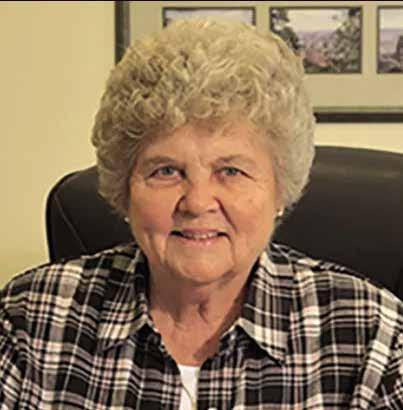
“lulled St. James School and the administration into believing that the school’s finances were being properly accounted for and its financial assets properly safeguarded, which, in turn, allowed defendant Kreuper to maintain her access and control of the school’s finances and accounts and, thus, continue operating the fraudulent scheme.”
The criminal information also alleges that Kreuper directed St. James school
Ghana: Activists detained
Reuters reported on June 4 that a court in Ghana has delayed bail on 21 LGBTQ+ activists, who were detained two weeks ago for “unlawful gathering,” a charge rights groups reportedly deny. Reuters added the context of Ghana’s laws against Gay sex, which is punishable by up to three years in prison. Promoting Gay rights in itself is not illegal in the West African country, which hasn’t prosecuted anyone for that in years, but human rights groups and researchers make it clear that LGBT people face blackmail and other abuse, while efforts to establish LBGT support centers are met with backlash from churches, lawmakers, and anti–Gay rights organizations.
employees to alter and destroy financial records during a school audit.
The Torrance, Calif., police department, the FBI, and the IRS’s Criminal Investigation conducted the investigation. The Archdiocese of Los Angeles declined to press charges, but federal investigators had sufficient evidence to charge Kreuper with violating federal interstate commerce laws.
A variety of firsts
NBC News is celebrating Pride this month with a digital wall of 30 stories of LGBTQ+ “firsts,” in the US and beyond. It covers a wide spectrum of professions, achievements, nationalities, and identities, such as Charmane McGuffey, Ohio’s first Lesbian sheriff; Gottmik, the first Transman drag queen; Sarah McBride, the first Transgender state senator in the US; and Nicholas Yatromanolakis, Greece’s first Gay minister. Each story focuses on the voice and experiences of its subject, with brief biographies and personal quotations.
Mary Margaret Kreuper – Photo courtesy of St. James Catholic School
Becky Pepper-Jackson – Photo courtesy of ACLU
Julia Selman Ayetey, lawyer for the 21 people (REUTERS, Francis Kokoroko)
Dr. Anthony Fauci: The man who caught every ball thrown at him
by Hannah Saunders SGN Contributing Writer
It has been well over a year since the SARS-CoV-2 virus entered the United States and began taking lives at a rapid rate. Today, it has merely been one week since Dr. Anthony Fauci’s personal emails from last spring — during the height of the pandemic — were released under the Freedom of Information Act (FOIA). Fauci’s emails included exchanges with doctors, colleagues, and the United States Army. Let us dive into them.
Who is Dr. Fauci?
In 1940, Anthony Fauci was brought into this world — into Brooklyn, to be exact — as the son of first-generation Italian parents. From a young age, he enjoyed playing team sports such as basketball and baseball.
From there, he went on to study at Cornell’s medical school, graduating in 1966. Two years later, he began working for the National Institute of Allergies and Infectious Diseases (NIAID). In 1984, he became the director of NIAID under President Reagan, where to this day, he continues to serve as acting director.
When the coronavirus hit the States in 2020, Fauci became the chief medical advisor to former President Trump, and he remains the medical advisor to President Biden.
What do the newly released emails say?
On June 2, 2021, Dr. Fauci’s emails from the early months of the pandemic were obtained by the Washington Post, Buzzfeed, and CNN via a FOIA request.
The Freedom of Information Act is a federal law, dating back to 1967, that allows any citizen to gain access to information within federal agencies, NIAID being one of them. Its purpose is to ensure that governmental leaders avoid corruption, and to ensure that democracy remains ingrained in society.
There are instances where federal information may not be released, due to certain exemptions. Fauci’s emails were not exempt, however.
The newly released emails demonstrate how members of the public looked to him during times of crisis, as well as the immense pressure he was placed under.
A huge inbox
In a recent interview with the Washington Post, Dr. Fauci described how he was receiving up to one thousand emails per day, from those in positions of power both nationally and internationally, from doctors and medical staff, and from everyday
citizens. As overwhelming as that sounds, Fauci ran with it, responding to as many as he possibly could, sometimes staying up until 2 a.m.
“I have a reputation that I respond to people when they ask for help, even if it takes a long time. It’s very time consuming, but I do,” said Fauci in the interview.
“I genuflect to no one but science.”
To many, Dr. Fauci has been the person to look and listen to, particularly when our federal government remained so inactive for so long. Former President Trump also attempted to minimize the gravity of the coronavirus (in addition to misinforming the public), which resulted in increased pressure on Dr. Fauci.
On March 8, 2020, Yale University epidemiologist and AIDS activist Gregg Gonsalves sent an email to Fauci describing how “there are thousands of people waiting for advice from our federal government on broader social distancing measures, in light of the fact that our failure in early testing and surveillance means the coronavirus is likely already spreading in our communities.” He added, “All we see is genuflection in word and deed from most of you to a White House that wants this all to magically go away.”
A couple of hours later, Fauci responded by saying, “Gregg: I am surprised that you included me in your note. I genuflect to no one but science and always, always speak my mind when it comes to public health. I have consistently corrected misstatements by others and will continue to do so.”
Fauci never outright denounced

Trump by saying something along the lines of “Our current president is lying to you all about the severity of this virus!” but he did continue to stand his ground and stick up for science: he repeatedly stressed the importance of mask wearing, hand washing, and physical distancing, and even advised Americans to engage in more outdoor activities.
No fan of stardom
When Fauci’s face began hitting the screen during White House press conferences, many Americans were quick to fawn over him. It got to the point where on March 31, 2020, a colleague sent Fauci an email with an article from the Washington Post with the headline: “Fauci socks, Fauci doughnuts, Fauci fan art: The coronavirus expert attracts a cult following.” Fauci responded to his colleague’s email, stating, “Truly surrealistic. Hopefully, this all stops soon.”
Trump’s mixed messaging even confused the Army
Back on April 14, 2020, a senior official in the Office of the Surgeon General of the US Army Medical Command, whose name has been redacted, sent Fauci an email saying, “You are the voice of reason for millions of concerned citizens. I have a few questions for you.” The individual went on to inquire about areas of concern, such as if COVID could be contracted from a corpse, if masks and gloves are truly effective, and finally, “What keeps you up at night, regarding COVID-19?”
Fauci responded to the email, saying,
“I have said in the past that what keeps me up at night is the possibility of a pandemic respiratory infection. We are in that now, and what keeps me up at night is the response, a major part of which is the development of an effective vaccine and treatments for COVID-19.”
A pioneer for the community
With the world changing so fast, it can be easy to forget all about the past, and simply focus on the present. The COVID19 pandemic shares several parallels with the beginning of the HIV/AIDS epidemic, which dates back to the 1980s. And guess what? Dr. Anthony Fauci was at the forefront of that effort too.
Forty years ago, Fauci was one of the first to develop an understanding of how HIV/AIDS attacked and destroyed the body. He was eventually able to gain the trust of activists, after again, another period of federal government inaction while people were dying.
Furthermore, Fauci was also able to increase funding for HIV research, which helped lead to astonishing medical treatments for those living with the virus today.
If there is anything that can be said about Dr. Fauci, it is that everything he does, he does for people. He has dedicated his entire life to science, fighting for American lives, no matter the circumstance. He has also always stuck up for what he believes in.
Finally, it is safe to say that Dr. Fauci filled the shoes of a hero, time and time again, when America desperately needed one the most.

Anthony S. Fauci, MD – Photo courtesy of NIAID
Image courtesy of WAPOST