







continued from cover
The message represents the feelings and requests of the following former Julia’s drag performers: Jacob Almanza aka Queen Andrew Scott, Dani Santiago aka Victoria Amore, Andrea Balderas aka Drea, Ian Hill aka Irene Dubois, Warren Ayers aka Sreya Nerraw, and Luis Luviano aka Arrietty. These entertainers have invested significant time into performances at Julia’s, ranging anywhere from three months to ten years.
They claim that at Julia’s, they were all “consistently underappreciated, underpromoted, overly controlled, and underpaid.”
They say that because of these mounting feelings, they had brought their questions, concerns, and requests to the owner, Eladio Preciado. To the performers, their requests were doable, but also mostly served as a jumping-off point for discussion.
Those requests were as follows: (1) for each queen to be paid $300 per show, per performer, including weekly rehearsals and performances; (2) suspension of the policy that prohibits them from performing at other venues; and (3) personal time off for the primaries, contingent on the performers providing coverage.
But, according to the performers, Preciado was not willing to discuss these terms with them, and instead opted to close the show down and fire them. This even led to Preciado sending performers pictures of their belongings in boxes, and letting them know that if they didn’t pick them up within 24 hours, they would be donated.
For the performers, the message was simple: Preciado’s way, or the highway.
Dubois, who had been performing at Julia’s for four years said, “The business relied on exploiting our passion for the craft… When [Preciado] realized that we no longer wanted to be exploited, that there was no half-way, and that we all [the performers] collectively agreed, it was clear that he had no intention of respecting his staff.”
Balderas, who has worked at Julia’s for five years said, “We are called the Julia’s family, but when it comes from the side of ownership, we didn’t feel that.”
For those feeling like the performers’ requests for pay might be unreasonable, not only do the performers believe their requests were fair because of the price of tickets, but because of the total revenue generated through tickets, food, and drinks. As Nerraw said, “The performers… are making less in one show than it costs for a single ticket.”
The tension had been building for some time and stemmed not only from money matters but from the workplace environment that Preciado had built. The performers recall hearing the owner say things such as “everyone is replaceable.”
Many performers have been too afraid to speak up until now. Almanza, who has been working at Julia’s for ten years, said, “It’s been a revolving door: when someone is tired, they leave. Then another queen gets pulled into the same culture.” While this has been a horrible process for the performers to observe, as Almanza said, “You see it happen, but you keep your head down.”
On July 10, Preciado took to Facebook to present some “facts about the story,” rebutting multiple claims, saying that the cast and crew can and does perform regularly at other places and venues, as well as that “$300 per show is not realistic” and that nobody would pay that rate.
Preciado might be right that nobody would pay that rate — and that might just be part of the problem. According to Nerraw, underpayment and underappreciation is an “industry issue,” which is something that the former Julia’s crew hopes their requests and the public’s reaction to them will shed light on. They hope this will “show the importance of this issue.”
After the unpredictable year that was
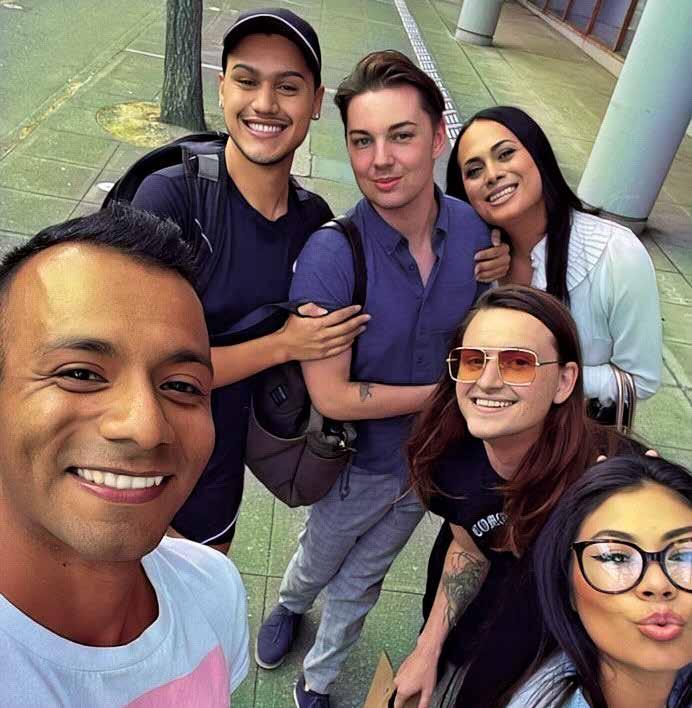
The drag performers claim that at Julia’s, they were all “consistently underappreciated, underpromoted, overly controlled, and underpaid.”
2020, the crew is upset about more than just losing their jobs right after reopening, though. As Almanza said, “We lost something. We loved the venue and our castmates, and we didn’t want this to happen.”
The former queens at Julia’s believe that the best way to solve this issue now is through solidarity. On their GoFundMe page, set up to benefit the former queens, they ask that “our fellow performers, including kings, queens, burlesque [performers], dancers, and live singers, join us in solidarity and not accept bookings at Julia’s on Broadway or Le Faux Productions.” They say, “We deserve to be well compensated and can no longer accept that establishments ‘do not make enough money’ to pay their performers.”
According to Julia’s on Broadway’s website, “Le Faux Productions will be down for a few weeks” and that “tickets are on sale now for August with an AMAZING new cast.”
While Julia’s looks to be reopening without its former queens, they still have regal attitude. As Almanza said, “Julia’s was just a stage — we brought the excitement.”

Glitter Gala is first up on August 5

by Carter Hemion
SGN Contributing Writer
On August 5, Can Can Culinary Cabaret, now located in Post Alley but featuring familiar talents, opens for the first time in months. Staff and guests are looking forward to the reopening, starting with the Glitter Gala.
Audience members can expect a larger theater, an open-air deck, and a bar with increased hours of operation. The bar, called The Dressing Room, will display “all sorts of relics from the Can Can’s past,” according to founder, owner, and creative director Chris Pink. These will include costumes and other items on the ceiling above guests. The bar will continue serving food and drinks outside performance days and hours.
Moving a block from its previous location in Pike Place Market was a choice made for the company’s survival during the pandemic. Pink said moving last May was “super sad for us, because we all had [put] endless blood, sweat, and tears into that space.” Relocating from the former venue of 15 years was particularly difficult for Pink, who “built it from scratch” with his parents.
Pink’s team is better able to implement safety measures in the new space, however. The location is larger, with better ventilation, outdoor seating, and more space for social distancing. It is also closer to parking and has 24-hour security on-site.
The new space is more conductive to some of the performers’ needs as well. The ceiling is now 10 feet higher, allowing space for upgraded audio and lighting technology, as well as more movement room for taller performers. With the larger venue, the crew has new production options for how to use the space, including new special effects. The new Can Can location also includes two catwalks for performers, which increases visibility for the audience.

Celebration and connection
The Glitter Gala show — “a two-month celebration of being back in action” — will bring back familiar faces, including Shadou Mintrone (also co-producer and production manager), Jonathan Betchtel (also co-producer), Richard Peacock, Jasmine Sim, Hannah Mooney, Isaiah Rashaad, Erica Johnson, and Christopher Lopez. Some performers are local, from the Cornish School of the Arts, while others are new. Fae Pink is the choreographer, and TJ Davis is the visual production designer. The soundtrack is by Pink & Pezzner.
Drawing on guest feedback, the team is also bringing back favorite performances to celebrate their return to the stage, such as “Zombie Cheerleaders from Hell,” “This Is Halloween,” and “Wonderland,” before new productions in the new year.
Pink is especially excited to welcome new audiences to the venue.
“That connection with our audiences is the most important thing in our lives,” he said.
In that same spirit, a portion of sales gets donated to organizations every quar-
On August 5, Can Can Culinary Cabaret, now located in Post Alley but featuring familiar talents, opens for the first time in months.
Staff and guests are looking forward to the reopening, starting with the Glitter Gala.
ter, but those are matched by the company through Can Can Cares.
Pink also hopes that with every show, the Can Can will “enrich people’s lives and give them an escape” and that attendees will “become better humans through our art.” Part of this is what Pink calls “conversions,” that is, when people who may be uncomfortable at the beginning of the show enjoy themselves and keep coming back, with a new understanding of different experiences that they may not have been exposed to before.
Pink is “excited that we can host people in a safe environment in a safe fashion and still be able to enjoy live performance and live connections.”
Learn more and buy tickets at thecancan.com.
by Sharon Cumberland SGN Contributing Writer
JULY 25, 2021
Pacific MusicWorks is known worldwide for its masterful performance of Early Music and Baroque masterworks, but this past Sunday, a group of PMW supporters were treated to an outdoor concert focused on the works of the Romantic-era composer Franz Schubert (1797–1828). Though Schubert was only 31 when died, he left so much cherished music behind that “Schubertiades” — concerts and gatherings devoted to his music — are celebrated around the world.
The original Schubertiades were intimate affairs held in people’s houses in Schubert’s hometown of Vienna, with Schubert himself at the piano and his friends crowded around, singing his songs and playing his sonatas. This same intimacy was achieved on Sunday as PMW’s friends sat on folding chairs and hay bales in a close circle around the musicians under the shade of towering pines. As a pair of miniature horses looked on, three great instrumentalists and one marvelous soprano brought Schubert’s music to a uniquely pastoral and romantic setting.
Violinist Tekla Cunningham and soprano Danielle Reutter-Harrah took turns center stage as they displayed Schubert’s mastery of emotional and yearning melodies. One fascinating piece was the haunting “Gretchen at the Spinning Wheel,” presented first as a violin and harp duet, then as the Schubert lied sung by Reutter-Harrah with all the sorrow and longing of a girl for her absent lover: “My peace is gone, My heart is heavy…When he’s not with me, Life’s like the grave.” The listener was given a chance to understand grief first through the violin’s melody — a song without words expressing universal sorrow — then through the specificity of a young girl’s loneliness.
Another compelling song about lost love, “C’en est fait” (It’s Over) by a Schubert contemporary, Zoé de la Rue, is about an unrepentant young man being sent away by a young woman for stealing a kiss. Search as I might, I couldn’t discover anything more about de la Rue than that she lived from 1770 to 1832, and that she was pretty (there’s one little pencil portrait of her online). Her music, however, was witty and multilayered, sad and defiant at the same time. PMW has often brought neglected composers to light, and we can be grateful to hear the work of a woman of the early Romantic period. I hope to hear more of it in the future.
Cunningham on the violin was masterful, elegant, and compelling. She is one of the finest violinists in the country, and as a Seattle native, artist-in-residence at UW, and founder of the Whidbey Island Music Festival, she has a tremendous impact on the quality of music in our area. Reutter-Harrah’s gorgeous, ringing soprano voice and subtle interpretation of lyrics told the story of languishing love with perfect taste and sympathy.
Founding director Stephen Stubbs on guitar and Maxine Eilander on the harp replaced the piano that normally attends Schubert’s “Sonata in D Major for Violin,” as well as the Schubert lieder. This gave a different tone to the accompaniments — lighter, brighter, less ominous — which is no mean feat for a harpist, whose feet must be as nimble on the pedals as her fingers are on the strings. Since the audience was sitting so close to the players, we could see Eilander’s agile use of her feet as well as her hands.

The original Schubertiades were intimate affairs held in people’s houses in Schubert’s hometown of Vienna, with Schubert himself at the piano and his friends crowded around, singing his songs and playing his sonatas.
Since I’m a poet who works with musicians on occasion, I always want to recognize the poets who inspire composers to write their best work. Schubert’s songs in this concert are based on poems by Ernst Schulze, Ludwig Christoph Heinrich Hölty, Franz von Schober, and Johann Wolfgang von Goethe. My favorite of these, which gave this wonderful event its name, is Schober’s “An die Musik” (To Music): “Beautiful Art, in how many a bleak hour, when I am enmeshed in life’s tumultuous round, have you kindled my heart to the warmth of love, and borne me away to a better world! …Beloved art, for this I thank you!” It rhymes in German, and has become a thank-you prayer for many musicians and music associations, as well as music lovers everywhere. If you’re not familiar with it, there are dozens of renditions on YouTube.
We can also thank Pacific MusicWorks for its steady flow of events covering many periods, its great scholarship in finding neglected works to revive, and its presentation of wonderful artists and singers. For this, I (and many others) thank them.
Pacific MusicWorks’ “An Die Musik: A Schubertiade” will be in virtual release in late August 2021, and the next in-person concert is Festa Italiana, October 23 and 24, 2021. Check out the website at pacificmusicworks.org.

by Sara Michelle Fetters SGN Staff Writer
For those expecting a massive Arthurian adventure, with clashing swords and thundering horses filling the screen, David Lowery’s The Green Knight will likely come as something of a major disappointment. The Ain’t Them Bodies Saints and Pete’s Dragon filmmaker is back mining similar ideas and thematic elements as he did with such beauteously infuriating grace with 2017’s A Ghost Story. This is an otherworldly tale told at a measured pace that doesn’t spoon-feed the viewer a single easy answer to any of its impenetrable psychoanalytical, moralistic queries.
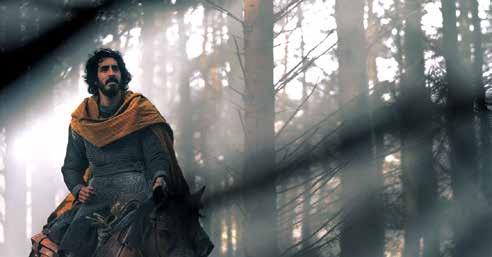
Based on the 14th-century epic poem Sir Gawain and the Green Knight, the story is simple enough: The handsome Gawain (Dev Patel), nephew to the king (Sean Harris), dreams of becoming a knight. On Christmas, a strange visitor comes calling to offer a challenge: to play a dangerous game with him, with unforeseen consequences. Gawain recklessly accepts, not fully understanding that by doing so, he sets himself on a path wherein myth becomes fact, the truth can be a lie, and love, honor, and friendship do not always happily coexist.
Nothing is certain as far as this journey into the unknowable is concerned. One of the hallmarks of the epic poem is its ambiguity, and that is a facet Lowery fearlessly maintains. Gawain’s quest is rich with symbolism, and there is never a moment where this wanderer doesn’t question his motivations for staying on the path he has set for himself to trudge upon, knowing that at the end it is likely death that awaits him.
Or does it? Life and death walk hand in hand in barren, battle-scarred landscapes, much as they do in lush forests abundant in color and activity, seemingly empty homes that have succumbed to the ravages of time, or giant castles rich in their opulence yet still lacking in ways that make them feel empty and inert. People become ghosts, aimlessly slogging from one day to the next, while actual phantoms showcase more robust vivacity than those lucky enough not to have had their heads cleaved from their bodies and callously thrown into a pond.
Lowery stays true to the original text, in that he steadfastly refuses to literalize anything that transpires for Gawain as he keeps moving toward his climactic encounter with the eponymous Green Knight. This does not mean he doesn’t still give random insights as to what he may want the audience to consider as they watch events methodically unfold.
At one point, Alicia Vikander goes into a dramatic monologue about the color
green. If viewers listen intently, they’ll gain valuable insight into not only what her particular character hopes Gawain will learn from her musings but also what Lowery was likely pondering as he fitted together the pieces of his elaborate screenplay. While her words could be considered a bit too on the nose, this expository aria is so beautifully delivered, so overflowing in conviction and emotional resonance, that its deliberate didacticism didn’t bother me.
Vikander, like other members of the talented ensemble, pops up in a pair of vital roles, neither of which I will spoil. Her performance is a titanic marvel, however, and no matter which character she is portraying, the actress brings a layer of ethereal consequence that’s extraordinary. The corners of her face come alive to astonishing effect, her almost effortless physicality as she glides from one scene to the next as impressive as it is destructively haunting.
In virtually every scene, Patel is simply marvelous. Gawain thinks he knows what
is happening and is certain he has a grasp on what life has in store for him. But as he inches closer to his destination, things become a murkily obtuse mirage, where nothing is real and everything is in illusion. Patel makes it all work, his darting eyes a window to Gawain’s inner travails, while his physically stoic permutations gradually give way, stripping the character of his confidence and leaving him contentedly naked as he readies himself to receive the Green Knight’s “gift.”
I should mention that the film is a technical stunner, and every facet of the production is superb. The camerawork by Andrew Droz Palermo (One & Two), the production design by Jade Healy (Marriage Story), the costumes by Malgosia Turzanska (Hell or High Water), the seamless visual effects, and the mind-blowing sound design — all of it is outstanding. Best of all might just be the lush, stunningly multilayered score by Daniel Hart (The Old Man & the Gun), which adds timelessness to the sonic landscape that borders on otherworldly.
The cycle of life is understood by all: We are born. We live. And, at some unknown point out in the distance, we will die. While we are the authors of our stories, after that final day comes, it is equally certain we will not be the ones to tell them after we’re gone. Tales of who we were are for the living to embellish, minimize, puff up, or, whether deserving or not, make legendary.
This is the ongoing lesson of The Green Knight. Much like with Gawain, while it is the journey that matters most, the final telling will undoubtedly be out of our hands, so we shouldn’t lose our heads worrying too much about it.
by Sara Michelle Fetters
SGN Staff Writer
At an exclusive tropical resort, Guy (Gael García Bernal) and Prisca Capa (Vicky Krieps) have come to the island with their 11-year-old daughter Maddox (Alexa Swinton) and six-year-old son Trent (Nolan River) to enjoy what may be their last vacation as a family. To help ease unspoken tensions he immediately takes note of, the resort’s friendly manager (Gustaf Hammarsten) suggests they spend the day at a secluded beach only a precious few are allowed to visit.
This is the rather simple setup to the unsettling new drama Old by writer-director M. Night Shyamalan (The Sixth Sense, Split), based on the graphic novel Sandcastle by Pierre-Oscar Lévy and Frederick Peeters. But this beach is not what it appears to be. Along with a small group of fellow vacationers, the Capa family finds they are trapped on this pristine sandy sanctuary with no way to leave. Worse, with every passing hour they all age roughly two years. If they don’t find an escape route soon, all of them, including the children, will die of old age.
It’s a chilling concept worthy of a classic Twilight Zone episode, and Shyamalan goes out of his way to make things as strange and as disquieting as possible. His dialogue is as stilted and as mannered as ever, characters speaking in halting, metronomic cadences that only make this aura of uncertainty all the more impenetrable. The

director also instructs gifted cinematographer Mike Gioulakis (It Follows) to shoot things in a muddy, hazily disjointed manner that’s hypnotically off-putting, a surrealistic touch I found fascinating.
Unsurprisingly, it’s likely Shyamalan’s latest will be the love-it-or-hate-it film of the summer. Once again, the idiosyncratic filmmaker steps up to the plate and takes several mighty swings. For my money, I find that he connects more often than he misses, and while Shyamalan doesn’t send any of the pitches out of the park, the steady diet of singles and doubles is more than enough to secure a lopsided win.
This meditation on life, family, mar-
riage, memory, parenthood, love and, yes, aging frequently goes for broke. It is harsh and uncaring. It is tender and intimate. It is timid and insecure. It is courageous and selfless. Each moment leads to a fresh realization for Guy and Prisca, the estranged couple reconnecting to one another in the face of something beyond rational comprehension, and doing so in such an intimately touching way that I couldn’t help but be moved while watching their Sisyphean ordeal reach its inevitable conclusion.
There are some wonderful supporting turns from Rufus Sewell, Nikki AmukaBird, Abbey Lee, Eliza Scanlen, and especially Ken Leung, but I’m not going to talk
about their characters, since learning who they are and why they are on the beach with the Capas is all part of the byzantine mystery. I will say that Scanlen is the focal point during one of the film’s most terrifying moments, which involves her and co-star Alex Wolff. It’s an unhinged, distastefully heartbreaking sequence, and I imagine as many viewers will turn away in disgust as those who decide they’re all in for whatever Shyamalan has up his sleeve. Jojo Rabbit and Leave No Trace star Thomasin McKenzie continues to impress. She portrays Maddox at roughly 16 or so years of age, even though she’s still the same 11-year-old child who stepped onto the beach with her parents. I loved the way she fidgets, how she shows such physical uncertainty as she attempts to navigate the passing hours in a body she no longer recognizes and that refuses to stop changing. McKenzie has this astonishing, virtually silent moment after Maddox learns a devastating truth about her parents, and seeing her mournfully wander out into the crashing surf to try and regain her composure is a thing of ethereally haunting beauty.
I do not know if Shyamalan earns his climax, though. I’m still trying to figure out if I feel like enough of the various pieces he uses to complete his puzzle fit together as nicely as I’m sure he intended them to. But Old says something about life that’s as profound as it is frightening, and the nebulous, beauteously unfathomable peculiarities a human life is born to navigate from first breath to last are ambitiously displayed in all their monstrous ambiguity.
by Sara Michelle Fetters
SGN Staff Writer
ESCAPE ROOM:
TOURNAMENT OF CHAMPIONS
Theaters
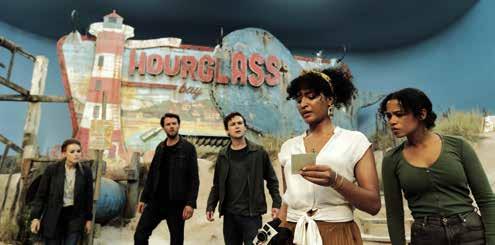
Determined to take down the Minos company after what its murderous escape room did to them, survivors Zoey Davis (Taylor Russell) and Ben Miller (Logan Miller) head to New York thinking they’ve discovered its secret headquarters. But this is only an elaborate ruse to get the pair on a not-so-run-of-the-mill subway car, and along with four strangers — each champions of a past Minos game themselves. Zoey and Ben realize they’re being forced to play for their lives one more time.
There’s not a lot more to Escape Room: Tournament of Champions, and anyone walking into the theater expecting otherwise will likely saunter out afterward disappointed. Picking things up pretty much right where its 2019 predecessor concluded, this sequel hits the ground running and subsequently refuses to slow down, even when its characters are taking a supposed breather.
It’s a full-speed descent into creatively lethal madness, and returning director Adam Robitel and his talented technical team come up with a variety of inventive
ways to “Ten Little Indians meets Saw ” their primary cast until only a precious few remain. But, as fun as all of this can be, there’s also little in the way of shocks or surprises, as the outcome of all this madness is fairly easy to predict no matter how inspired some of the escape rooms happily turn out to be.
This is mostly due to the fact that, unlike the first film, I never felt like a got to know the majority of the competitors this time around. The four contestants other than returnees Zoey and Ben make almost zero impression whatsoever. Considering one of
them (Thomas Cocquerel) is a former priest who’s dealing with a crisis of faith, and another is a hardened loner (Holland Roden) with an inability to feel physical pain, this feels like a major missed opportunity.
I wanted to have an emotional connection to these new players. I wanted it to matter whether or not they would live or die. Instead, they are just cogs in a larger mechanism, each filling a role that allowed things to progress to a preordained conclusion that I had figured out roughly within the first few minutes of the film.
If anything, I had this strange feeling that
there had to have been some behind-thescenes tinkering that Robitel had little to no control over, almost as if the powers that be ordained a final cut of less than 90 minutes, character development be damned.
Don’t get me wrong. It’s all still wickedly entertaining. One escape room set in a bank with a boobytrapped checkerboard floor — complete with lasers — that requires the entire group to work as a team in order to solve its deviously murderous puzzle is outstanding. Another on a rundown beach with a lighthouse and seafood shack slowly sinking into the sand is equally inspired. So many of the little visual touches sprinkled throughout these sets are ingeniously sublime.
I don’t know: I liked this sequel well enough, and even if the semi-cliffhanger teasing another installment is somewhat obnoxious, and although I wasn’t nearly as invested in the characters this time around, when the end credits began their crawl, a happy smile sat upon my face all the same.
Escape Room: Tournament of Champions isn’t exactly victorious, but it doesn’t lose the game, either. It’s something of a wash, a 1-1 draw that can only be decided by a penalty shootout whose outcome we’ll have to wait for in the inevitable sequel.
by Sara Michelle Fetters SGN Staff Writer
Theaters / Disney+
Jungle Cruise is an obvious attempt on the part of Walt Disney Pictures to recapture the magic that helped transform Pirates of the Caribbean: The Curse of the Black Pearl into a worldwide box office smash. It is also a semi-throwback to starstudded romantic adventures like The African Queen, Romancing the Stone, and the 1999 version of The Mummy
That the film comes as close as it does to achieving its entertainment goals is a testament to the combined charisma of leads Dwayne Johnson and Emily Blunt, the latter in particular. Their chemistry could power a small tropical island for at least a decade. The two actors are so effortlessly charming it’s like they’ve made a dozen pictures together and this wasn’t, in fact, their first on-screen pairing.
If only I found that to be enough. Director Jaume Collet-Serra (The Shallows) paces things lackadaisically, and I felt every second of the film’s laborious 127-minute running time. As for the slapdash and freewheeling screenplay, it often feels more like a riff on the 1985 version of King Solomon’s Mines crossed with Anacondas: The Hunt for the Blood Orchid than anything else. It plum tuckered me out, and while I’m certain many viewers will walk away moderately amused, sad to say that wasn’t my experience.
It is 1917. Dr. Lily Houghton (Blunt) has journeyed to South America with her foppish brother MacGregor (Jack Whitehall) to embark on an expedition down the Amazon River in search of a fabled tree whose enchanted petals can cure any illness. She enlists the services of Frank Wolff (Johnson), captain of the La Quila, a rickety old

boat that at first glance appears to be on the verge of splitting apart at the seams.
They are being chased by devious submarine commander Prince Joachim (Jesse Plemons). He, too, wants to find this tree, certain that it is the key to guaranteeing a German victory in the ongoing war ripping Europe to shreds. Aiding him in his pursuits are a quartet of undead Spanish conquistadors led by Lope de Aguirre (Edgar Ramírez), each cursed to live outside of time and forever tied to the Amazon River due to a murderous rampage hundreds of years prior.
For a tale born from the lore that helped create one of Disneyland’s most popular and enduring theme park rides, as scenarios go, this one isn’t terrible. Dr. Houghton and Captain Wolff are wonderfully crafted characters, each with rich backstories that help fuel their competing desires to find the lost tree and that will unsurprisingly lead to
mutual understanding, friendship, and trust as their trip nears its conclusion.
However, an issue that frequently tends to affect the majority of the entries in the studio’s Marvel Cinematic Universe rears its annoying head here as well: the villains are forgettable. This is a shame, because Plemons, doing his best Werner Herzog impersonation, is having a blast slipping on the shoes of a mustache-twirling baddie. As for Ramírez, while his casting as Aguirre is inspired, and although the Spanish conquistador has a suitably tragic reason for being in the Amazon, it’s equally clear the film has almost zero ideas on what to do with either him or his men.
Thankfully Collet-Serra has Johnson and Blunt around to make many of these missteps momentarily disappear. This sloppy wannabe Indiana Jones clone almost works thanks entirely to them. Johnson, no stranger
to this sort of material, courtesy of the farsuperior Jumanji: Welcome to the Jungle and Jumanji: The Next Level, is a largerthan-life dynamo. He throws punches and delivers one-liners with goofily pinpoint precision; his clownish daring-do is good for a barrel full of sizable chuckles.
But it is Blunt who steals the show. She’s delightful, and I’m tempted to recommend that potential viewers take a chance on this film because of her and her alone. The actress brings a zippy urgency to her cavalier theatrics that are a constant joy. There’s nothing she does that’s false. Not a step is out of place. Blunt doesn’t rise to the occasion — she vaults over it, with vibrant, gloriously confident gusto. Her ability to make this nonsense work as well as it does is simply remarkable.
I wish that were enough. Sadly, none of the narrative elements mesh particularly well, and the supernatural stuff was too vaguely laborious and boringly reminiscent of the Pirates of the Caribbean adventures to be as effective as was intended.
Additionally, the further the La Quila descends down the Amazon, the more the expensive visual effects begin to take over. And while some of these computer-generated VFX sequences are effective, others most decidedly — and unfortunately — are not. Kids will undoubtedly disagree with me on Jungle Cruise, and had I watched this one with eight-year-old eyes, it’s possible I’d think differently about all this cartoonish hooey. But as terrific as Johnson and Blunt are, and even if I’m all for romantic adventure throwbacks made in the matinee-serial style, à la the 1950 version of King Solomon’s Mines or Raiders of the Lost Ark, this one still left the kid in me stranded upriver without a paddle. I didn’t have fun, and there’s really not anything more to say.
by Lindsey Anderson SGN Contributing Writer
If you’re making a trip to the Phinney district and looking for something to do, odds are locals would point you in the direction of Phinney Books. The little neighborhood store has been a staple of the community for nearly two decades now.
Originally Santoro’s Books, it was bought by Tom Nissley seven years ago after the original owner retired. Thus Phinney Books was born.
Nissley has always been a self-described “book weirdo,” but it wasn’t until he opened up this store that he really discovered his roots. “I used to work for Amazon, for about ten years, so I was used to selling books to a lot of people who I didn’t know — and I so much prefer selling a few books to people I do know,” said Nissley with a laugh.
Working as a minion for Jeffery Bezos was unfulfilling for Nissley, who joked, “I have no desire to go to space, good lord!” He doesn’t envision himself going back to the corporate world.
In fact, in opening his own store, Nissley found himself connecting to his community in ways he had never imagined. “The thing I like the best is all these people I wouldn’t know otherwise,” he said. “I’ve lived in this neighborhood for almost 25 years or so, but I feel like, only in the last seven years do I really know [it], because I’m in the heart of it and talking to people all day.”
Like many independent bookstores around Seattle, it’s the neighborhood that really gives Phinney Books its charm. “It’s a neighborhood bookstore,” Nissley explained. “We try to have what people want. I try to listen to what people are asking for, and we try to cover as much as we can in a small space.”
Between Nissley’s personal taste, that of his staff, and the interests of the residents of the area, the bookstore has a bit of an eclectic collection. Some of the most popular titles circulating around the neighborhood right now can be found in the front window. One example: Braiding SweetGrass — part nature novel, part memoir, part Native American cultural history — has been flying off the shelves, according to Nissley. “It’s always been kind of popular, but about a year ago, everyone started asking about it. I love it when people keep telling other people they should read a book… I love when things like that happen,” Nissley said with a grin.
The foundation of Phinney Books is the relationships Nissley and other staff members have built with their community through literature. Nissley has become more than just the neighborhood bookseller — to many, he is a friend. As he said, “Standing behind the counter, people come in, and slowly I meet their kids, or we talk about what books we like, and it gets to other things, but all because we started talking about books. Yeah, it just feels really organic, and it just grows out of a mutual interest.”
As a friend, Nissley knows what books his neighbors are interested in, and he makes sure to stack the shelves high with novels tailored to their interests. “One of our staff members is kind of an anglophile… and she always has customers for whom she’ll go, ‘I know so-and-so is going to love this!’ What’s really unique is, you know, when I’m buying books for the season — even if it’s an obscure book or an intellectual history — I can often picture the exact person who might buy it, so I’ll buy one, and take a chance… So our uniqueness is really built on those relationships.”
Along with building relationships from inside the store, Phinney Books gives back to its community outside its brick-andmortar walls. The store organizes yearly book fairs for the grade schools in the area. “Other stores in town have stopped doing
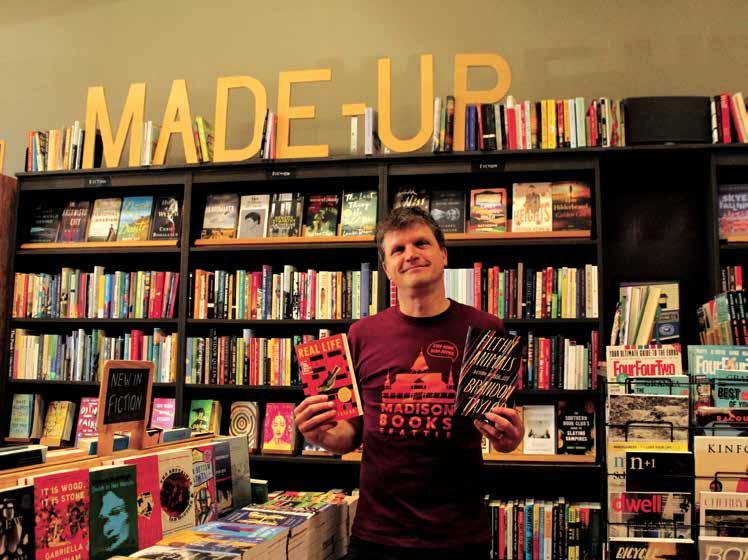
The foundation of Phinney Books is the relationships Nissley and other staff members have built with their community through literature.
that, because they’re a ton of work, but I really love doing them,” Nissley explained. His favorite part of the fairs is “just seeing the kids, just wide-eyed.”
Bringing new books to schools is a great way to encourage children to develop a love of reading from an early age. And a love for early readers is on full display at Phinney Books, which stocks a special children’s section, full of picture books and graphic novels, hoping to encourage young readers to keep coming back.
As far as competing with the retail giants, Nissley isn’t too concerned.
“People always ask, ‘How do you compete with Amazon?’ I think it might have helped to have been there, but I never feel I am competing with them, because what we do is so different, and people come to us for so many different reasons.”
So it’s the love for the community, and the personal relationships built around the book counter at Phinney Books that makes the store so special and personal to everyone who steps foot inside it. Customers and sellers have developed an organic relationship, becoming more than just cogs in a retail system. Here, there is a genuine interest shared between human beings, united by a love of books and community.
“Our personalities and our customers’ personalities really shape the store,” said Nissley. And he wouldn’t want it any other way.
Phinney Books is at 7405 Greenwood Ave. N. and online at www.phinneybooks.com.


Photos by Lindsey Anderson
by Hannah Saunders SGN Contributing Writer
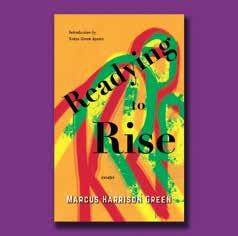
READYING TO RISE
MARCUS HARRISON GREEN (essayist); SONYA GREEN AYEARS (introduction)
© 2021 VertVolta Press
$15.99
191 pages
Available for preorder Sept. 21
Have you ever wondered what it is like to grow up in South Seattle as a person of color?
Could you imagine your 13-year-old self having a terrifying run-in with a police officer, and leaving the situation knowing nothing more than that your life is disposable?
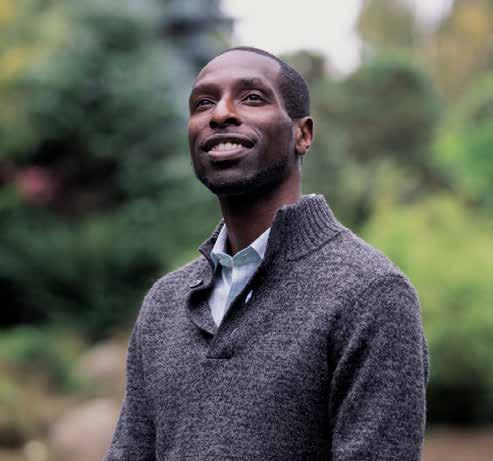
For my white self, that is not only something I frequently question but also something I felt that I needed to learn more about. Most importantly, I needed to further understand the impact of lived experiences that differ from my own. That’s why I read Readying to Rise, an upcoming book by Black Seattle journalist Marcus Harrison Green.
Readying to Rise is an essay collection that includes remembrances of firsthand encounters, articles from the Seattle Weekly and Crosscut (among other sources), and adaptations from speeches. Green’s collection stems from the desire to tell varied stories of South Seattle: living with mental illness, lessons from family members, tales of equity and loss, and how racism still plagues our society.
And indeed, whether or not we want to accept it, racism is still very much present in our community. As Green introduces the topic: “No, racism is not dead. What it is now is sophisticated. What it is now is systemic.” Some things have certainly improved over the last several decades, yet the situation remains far from great.
Throughout the essays, the author explains how people of color in Washington are disproportionately affected — as a
result of racism — when it comes to housing opportunities, life expectancy, police brutality, birth rates, and overall wellbeing. Green also delves into what it is like being a Black reporter in a white male–dominated industry.
Reading this compilation of essays will not only help you comprehend the challenges that arise from being a person of color in a liberal city — and the staggering statistics that come with it — but they will also pull at your heartstrings every step of the way. I felt my eyes water up when I read the chapter titled, “It Took Me Years to Believe That Black Lives Matter, Let Alone My Own.”
Green does an excellent job at creating imagery within each piece, making the reader feel like they are in the scene. One essay that stood out for me was about a Black Lives Matter protest in Seattle’s Central District back in 2014. As Green put it, “the overwhelming whiteness of the march “inspired in me a deep cynicism that poisoned the well of communal warmth.”
Do you recall the Black Lives Matter protests that have taken place over the past several years, and the swarm of white individuals in attendance? I certainly do, and sometimes, it appeared as though there were more white people than Black people marching.
Showing support for what one believes in is fantastic, but what if some white people in attendance were merely doing so for personal gain: to update pictures on their social media pages, to grow a bigger audience by appearing to care for a movement? I could name a few who stand up and attend Black Lives Matter protests yet sit down quietly for the remainder of the year.
Green recognizes this, too, and brings up how it led him to cease marching in and reporting on Black Lives Matter protests, although he does share the benefits of having white people in attendance.
Raw power and emotion flood through
each essay in Readying to Rise, which has assisted me with gaining a better understanding of where Seattle is truly at with inequality and racism. What is so breathtaking about these pieces is that no matter how difficult some of them are to read, and no matter how imperfect our city is, Green consistently leaves the reader with an everlasting sense of hope. We can always leave the world a better place than when we found it. So please, white reader to white reader: when Readying to Rise hits the bookstores in September, pick-up a copy — the least we can do is educate ourselves in order to grow as individuals, and to grow as a society.
The Natural Mother of the Parent a compelling memoir of nonbinary parenthood
by Terri Schlichenmeyer Special to the SGN
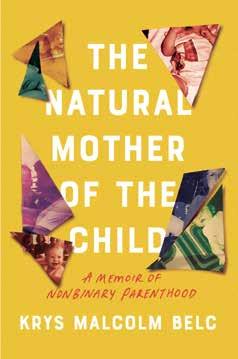
THE NATURAL MOTHER OF THE PARENT: A MEMOIR OF NONBINARY PARENTHOOD
KRYS MALCOLM BELC
© 2021 Counterpoint Press
$26.00 / higher in Canada
304 pages
Giving birth is so common that it’s done in the US nearly eleven thousand times a day, which means that it’s really not much of a big deal — unless it’s your baby. In that case, it’s a one-of-a-kind miracle. And in the new book The Natural Mother of the Child by Krys Malcolm Belc, it’s an answer, and a whole lot more questions.
When Krys Belc went to the birth clinic, visibly pregnant with Samson and toting five-month-old Sean, the child of his partner, Anna, women in the clinic’s waiting room stared. Or were they, like Belc’s neighbors, staring because he looked like a pregnant man?
Yes, Belc inherited his father’s looks. He feared that he might’ve inherited his
father’s temper, too; sometimes, Sean was too much and being neither his mother nor his father, Belc was often unable to comfort the boy.
Belc didn’t particularly enjoy being pregnant; in fact, it brought old memories and new notions to the surface. Absolutely, he grew up loved and maybe a little protected, but he wanted what his brothers had. He was sure his mother once harbored hopes of sharing a pregnancy with him, but not anymore.
And then it happened: seeing the newborn son he made, made Belc realize that he needed to become the person he always knew he was.
A few months after Samson was weaned, Belc began taking testosterone.
How does one say goodbye to breasts that fed a beloved son? Belc didn’t want his, but finding the right decision was unsettling.
How does a grown son reconcile himself to the idea that his father won’t hug him anymore? Sadly, Belc’s father was generally awkward around him since his transition.
How can nonbinary parents not get frustrated at the loads of paperwork needed to protect their rights? “Natural mother” indeed.
And how can anyone ever fully thank
those who helped make them parents?
If ever there was a book that turned itself in circles to get to the right ending, The Natural Mother of the Child is it — and that’s not unpleasant.
Nothing and everything in this book is black and white; it’s calm and turbulent, surefooted and not. Belc takes readers on a journey to fatherhood that started when he was a girl, envying his brothers without knowing exactly why, giving readers a distant, poignant sense of something wanting.
That feeling trails throughout Belc’s story, as we wait for what we know is coming. And it’s worth it: after his account of pregnancy and the self-consciousness of being mother-not-mother, his decision to transition solidifies like a ship through fog.
Look at The Natural Mother of the Child first as a parenting book, because that’s exactly what it is: the story of learning enough about one’s self to be a good parent.
As for the Trans part of this memoir, that’s icing on a cake that’s uncommonly good.












by Terri Schlichenmeyer Special to the SGN
DHONIELLE CLAYTON, TIFFANY D. JACKSON, NIC STONE, ANGIE THOMAS, ASHLEY WOODFOLK, AND NICOLA YOON
© 2021 Quill Tree Books / Harper Collins
$19.99 / $24.99 Canada
256 pages
Obviously, there was a mix-up. There was just one job opening at Apollo corporate headquarters in NYC, but two candidates were offered the position, and both were there for orientation. Oops.
Bad on the company. Worse for Tammi Wright, whose heart was shattered upon seeing Kareem Murphy walk into the lobby. He’d broken up with her a few weeks before, and she thought she was over him. Apparently not, but she wanted that job, so she’d stay and wait, even if she had to do it somewhere near his fine self.
And then the lights went out.
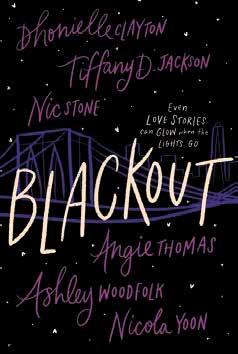
And so begins Blackout by Dhonielle Clayton, Tiffany D. Jackson, Nic Stone, Angie Thomas, Ashley Woodfolk, and Nicola Yoon.
It had been stiflingly hot that day, and Manhattan’s power grid couldn’t handle it. Without A/C, buildings were evacuated and people milled around, so Kareem suggested they start walking home to Brooklyn. Tammi thought he was out of his mind, but he had a do-or-die DJ gig that evening, and there was nothing else to do.
JJ Harding, Jr. was on the subway when the blackout hit, but he didn’t worry until he noticed Tremaine Wright a few seats away. Tremaine was claustrophobic, as JJ knew,
and he could see that he was almost freaking out. He didn’t want to intrude, though, if the claustrophobia was a sensitive secret. JJ knew all about secrets.
The residents at the Althea House were playing cards when the blackout started, and the most beautiful woman Nella had ever seen walked into the building.
Lana was trying to figure out how to tell her best friend Tristan that she liked him a whole lot more than just “like.”
Kayla Simmons was sitting on a tour bus, contemplating a love rectangle.
Grace was in heading for Brooklyn, and the party was about to start...
Okay, yes, it’s contrived and convenient. Yes, it’s a lot of meet-cute. It’s predictable, too, but reach a little deeper and Blackout is a pretty intriguing concept.

It is, in fact, the ultimate in collaboration: six authors, cooperating on one single story that arcs through six different couples on one dark night makes for an interesting tale, in part because each of the authors brings her own style to the table. The characters aren’t interchangeable, nor are the situations, which gives readers a strong sense that the people in these tales are multidimensional. You can feel the same heat

Photo by Terri Schlichenmeyer
by Terri Schlichenmeyer Special to the SGN
ADULT TRUE-CRIME BOOKS
(c) 2021 (various publishers)
$16.00 to $29.00 various page counts
If you can’t get enough of the chills inherent in real-life murder and mayhem, why not read some great new true-crime books?
Stepping back in time (because murder is nothing new), The Icepick Surgeon: Murder, Fraud, Sabotage, Piracy, and Other Dastardly Deeds Perpetrated in the Name of Science by Sam Kean (Little, Brown, $29.00) will give you plenty of fodder for fear. Read about the things done throughout history, supposedly for the sake of knowledge — things that resulted in a little learning, perhaps, but also a lot of horribleness. Shiver, shudder.
Also look for The Case of the Murderous Dr. Cream by Dean Jobb (Algonquin, $27.95), the story of the hunt for a serial killer, back before most of the best methods of crime-solving were ever invented. It’s got everything you want in a Victorianera tale — if you’re a Sherlock Holmes fan, take note.
Did you ever wonder what happens to a murderer if he’s found “not criminally responsible”? In Couple Found Slain: After a Family Murder by Mikita Brottman (Henry Holt, $27.99), you’ll read one man’s tale. Life in a maximum-security psychiatric facility is every bit as gritty as
they’re feeling. You believe that they’re heading for the same place, and that things are gonna get even more interesting.
Want to go, too?
Then check for Blackout in your local YA section. Despite its strong language (but no action past kissing), it’s great for gentle romantics ages 15-to-adult, so find it... and turn the reading light up.
prison, and there are just as many dangers, as you’ll see. This unique look at a different kind of lockdown is a must-read for anyone who particularly relishes true-crime books with a prison slant.
And while you’re getting that book, look for The Devil You Know: Stories of Human Cruelty and Compassion by Dr. Gwen Adshead and Eileen Horne (Scribner, $28.00). Dr. Adshead is a forensic psychiatrist who works with the incarcerated, and this book presents stories of crime and the ability of some criminals to change. It’s a hard book to read — many of the tales here are brutal — but it may ultimately change your personal definition of the word “evil.”
And finally, here’s a true-crime book that’s aimed at you: “I Have Nothing to Hide” by Heidi Boghosian (Beacon Press, $16.00). It should come as no surprise that you are being watched, maybe even right now. Your phone tattles on you, your computer is a snitch, even just having a credit card or owning a house — almost everything you do in today’s world — means information that’s up for grabs. But what, exactly, do you know about electronic surveillance, privacy, and who might be spying on you this very minute? If that’s a sobering question, you owe it to yourself to let this expert set you straight.
And, as always, if these brand-new truecrime books don’t quite fill the bill for you, be sure to ask your favorite bookseller or librarian for suggestions. There are a lot more such books out there, many of which you’ll click with.

by Hannah Saunders SGN Contributing Writer
On July 13, Pixar released the trailer for Turning Red, an upcoming animated fantasy film about a 13-year-old girl, Mei Lee, who transforms into a giant red panda whenever she becomes overstimulated.
Although the trailer was only about two minutes in length, it quickly circulated its way through the online diabetes community, due to a “don’t blink or you will miss it” moment.
At 0:34 of the trailer, a classmate of Mei Lee’s can be seen sporting a continuous glucose monitor (CGM) on her arm, as well as an insulin pump on her waistband — both of which are incredibly useful tools when it comes to managing diabetes. As a type 1 diabetic who wears both a CGM and an insulin pump, I was ecstatic to see my “robot parts” displayed in the upcoming film, especially during Disability Pride Month (July).
I was diagnosed with type 1 diabetes when I was four years old. I grew up overseas as an army brat, moving around every one to four years. No matter how many people I met during my moves or travels, none were diabetic. I was sixteen years old when I met my first diabetic “in the wild,” and we became good friends.
He opened my mind one night while we were bar-hopping in Brussels, Belgium. He gave himself insulin at the table and said, “I’m diabetic, and if people don’t like me for who I am, they can fuck off.”
Mind you, back then I was the kind of person who hid my disease. I’d go to the bathroom to test my blood sugar or give myself insulin in order to not offend anyone
(or feel ostracized due to stares).
Looking back, I understand why I hid my disease from others — even my friends. I did not want to be labeled as “different” or “weird” or even “that girl on shots.” I
I remember seeing Panic Room when I was about eight years old, and I asked my parents why Foster was giving Stewart insulin if her blood sugar was low, and questioned if I was treating my lows wrong by
As soon as I saw the still from the Turning Red trailer, that little diabetic girl inside of me burst with joy, and I’ll admit, I cried happy tears. It’s not every day you see representation of yourself in the media, let alone media that caters to a younger audience.
did not want others to see my disability as something that held me back.
And most importantly? All those years growing up diabetic, I felt like I was all alone. Not having opportunities to meet fellow diabetics and share experiences is one thing, but a lack of accurate representation in the media was yet another factor in my isolation.
Sure, there have been movies centered on diabetic characters in the past, but Hollywood has (mostly) found ways to funk them up, leaving viewers with negative opinions or false conceptions regarding the autoimmune disease. Do you remember the movie Panic Room, with Jodie Foster and Kristen Stewart? Stewart played the role of Foster’s diabetic daughter, and the two were stuck in a panic room. Stewart ended up having a low-bloodsugar episode, which can be life-threatening, and Foster sneaks around the house to obtain a lifesaving “insulin injection.”
not giving myself insulin. As all diabetics know, if you have low blood sugar, you need sugar to bring those levels back up. A shot of insulin, in that scenario, is actually a quicker way toward death. If the film team had done any research, they’d have referred to the lifesaving injection as “glucagon,” which is essentially an injection full of glucose.
Another popular film that gets me is Steel Magnolias, in which Julia Roberts plays a type 1 diabetic. Her mother and doctor tell her she should not get pregnant as a diabetic, but she does anyway, and tremendous strain is put on her body (specifically her kidneys) as a result. However, this is literally the worst-case scenario! In reality, the majority of diabetic mothers have complication-free and healthy births, not to mention, nondiabetic babies. This film really bothers me, because it caused viewers to think that diabetic women should not bear children.
I’m a firm believer that the lack of accu-
rate representation of diabetes in the media has negatively impacted not only individuals living with diabetes but also the perception of diabetes within the nondiabetic community.
As soon as I saw the still from the Turning Red trailer, that little diabetic girl inside of me burst with joy, and I’ll admit, I cried happy tears. It’s not every day you see representation of yourself in the media, let alone media that caters to a younger audience.
I imagined how, if I had seen this trailer as a child, if something like it existed at the time, then maybe I would’ve felt like less of an outcast, and perhaps would’ve become more accepting of my own disease at a much earlier age instead of trying to hide it, because it’s mine to keep, forever.
And oh, how this trailer has brought out that little diabetic girl inside of me, cheering on Pixar for its representation and saying, “Yes, diabetes is mostly a hidden disability, but we’re everywhere, and we’ve got this!”
Not only is seeing that representation incredibly meaningful to my now-24-yearold self, but I understand how beneficial it will be for all the diabetic kids out there that feel like they’re going at this disease alone.
Even so, there is some concern in the online diabetes community regarding the accurate portrayal of diabetes, and it’s still uncertain how big a role this classmate will play in the film — only time will tell.
But as if highlighting diabetes equipment wasn’t cool enough, Pixar also presented its first Sikh character as a friendly school security guard, and then took it three steps further with its first female POC director, Domee Shi.
Turning Red is set to be released on March 22, 2022, and I cannot wait
by Mike Andrew SGN Staff Writer
A federal appeals court has ruled against a web designer who sued to overturn Colorado’s anti-discrimination law on the grounds that it violated her First Amendment guarantees of freedom of speech and freedom of religion.
In a July 26 ruling, a three-judge panel of the 10th US Circuit Court of Appeals in Denver on Monday denied Lorie Smith’s appeal of a District Court ruling against her suit.
In Smith’s 2016 lawsuit, she claimed that Colorado’s law would compel her to create wedding websites for same-sex couples against the teaching of her Christian religion. She was represented in court by the anti-LGBTQ Alliance Defending Freedom.
“The government should never force creative professionals to promote a message or cause with which they disagree. That is quintessential free speech and artistic freedom,” the group’s senior counsel, John Bursch, said in a statement.
continued from cover
tolerance and the level of islatravir that remained in the patients’ bloodstream and for how long.
The participants took the drug once a month for six months. After this period, follow-ups were done to monitor how quickly the drug left their system.
The study found that eight weeks after taking their last tablet, those who took either 60mg or 120mg of islatravir still had enough of the medication in their bloodstream to prevent HIV infection. This fell, however, at the 12-week follow-up.
“The 24-week analysis of investigational, once-monthly oral islatravir not only builds upon the PK data we have already seen but also provides encouraging support for the safety and tolerability profile
continued from cover
On April 6, Gianforte signed SB 215, also known as the “Religious Freedom Restoration Act,” which gives rights to individuals and businesses to challenge laws they might see infringing on their constitutional freedom of religion. This law allows for privately owned businesses to discriminate against members of the LGBTQ community, echoing Master Cake Shop v. Colorado, in which the Supreme Court ruled it is within the religious freedom of the individual to discriminate or withhold service against same-sex couples.
Next to hit Gianforte’s desk was HB 112, otherwise known as the “Save Women’s Sports Act,” signed by Gianforte on April 30. The bill prevents Trans girls from competing in sports as girls, extending even to those in elementary school.
Conservative Fox commentator Tucker Carlson, who is neither Trans or a woman, has had a lot to say on the issue. Since the introduction of Montana’s anti-Trans athlete bill, he has aired 72 discussions about the “issue.” In a segment for Tucker Carlson Tonight, he whined, “Biological boys competing as females are entering the competition and dominating their opponents in many sports across the country, and the world, in fact.” Despite little to no evidence to back this claim, Carlson was able to put a voice to an issue that conservative states, like Montana, have been drumming up, which
Lambda Legal, a group that fights for the civil rights of LGBTQ people, had submitted a brief supporting the Colorado law.
“This really isn’t about cake or websites or flowers,” Lambda Legal senior counsel Jennifer C. Pizer said in a statement. “It’s about protecting LGBTQ people and their families from being subjected to slammed doors, service refusals, and public humiliation in countless places — from fertility clinics to funeral homes and everywhere in between.”
Colorado Solicitor General Eric Olson, arguing in favor of his state’s law, questioned whether Smith even had standing to sue, since she had not started offering wedding websites yet.
The 10th Circuit’s three-judge panel voted 2-1 that Colorado had a compelling interest in protecting the “dignity interests” of members of marginalized groups through the law.
Judge Mark Beck Briscoe wrote in the majority opinion that “we must also consider the grave harms caused when public accommodations discriminate on the basis
of this HIV-1 PrEP regimen,” said Dr. Joan Butterton, vice president, global clinical development, infectious diseases, Merck Research Laboratories, in a statement.
Merck is currently recruiting Gay men and Trans women for a similar Phase 3 trial to see if the results are the same for people at high risk of HIV. That study will begin later this year.
Matthew Hodson, chief executive of UK-based HIV information organization Aidsmap, said he welcomed the development of longer-acting PrEP.
“There are now a number of drugs that can be used as either HIV treatment or for PrEP that have a long life in the body. Monthly pill dosing is currently in trial, and dosing by injection or implant could soon be as infrequent as twice a year.”
Hodson said that PrEP is “extremely, almost totally, effective,” but that adherence to daily drug regimes was a problem.
has led many children and young adults who identify as Trans to feel further isolated in their communities.
While Gianforte has made it easier for Montana sports and businesses to discriminate against Trans people, SB 280, which was also passed on April 30, makes even identifying as Transgender on legal documents a near impossibility in the state. This bill, also referred to by the catchy name “Revise Vital Statistic Laws Regarding Sex Designation on Birth Certificate,” requires Trans people to provide proof that they have received genderreaffirming surgery before allowing them to identify with the gender of their choice on legal documents.
This law makes life even more dangerous for Transgender people in Montana, as it “outs” them anytime their ID is required. According to a 2013 report from the AntiViolence Project, Transgender people are seven times more likely to experience physical violence when interacting with police, and when outed by their ID during a routine traffic stop, violence can come with a higher risk. Requiring proof of gender-reaffirmation surgery also puts Trans people at an economic disadvantage, requiring them to pay for a costly and invasive surgery that is most often not covered by insurance agencies. For Trans people who simply cannot afford an operation, physically cannot undergo an operation, or choose not to, their gender identity is then chosen and controlled by the state and cannot be changed to reflect who they truly are.
of race, religion, sex, or sexual orientation. Combatting such discrimination is, like individual autonomy, ‘essential’ to our democratic ideals.”
The anti-discrimination law is the same one at issue in the case of Colorado baker Jack Phillips that was decided in 2018 by the US Supreme Court.
In that case, the high court decided the Colorado Civil Rights Commission had acted with anti-religious bias against Phillips after he refused to bake a cake for two men who were getting married. But the justices did not rule on the larger issue of whether a business can invoke religious objections to refuse service to LGBTQ people.
In 2019, a three-judge panel of the 8th Circuit Court of Appeals found – by a 2-1 vote – that two Christian filmmakers did not violate Minnesota’s anti-discrimination law when they refused to make a same-sex wedding video because videos are a form of speech protected by the First Amendment.
Longer-lasting medications promised to overcome this issue, “as well as being more discreet for people who may be stigmatized for their PrEP use, or for their HIV treatment,” Hodson said.
As a treatment for HIV, islatravir is being jointly studied as a combination treatment with Gilead’s doravirine, as a potential once-a-month HIV treatment pill. Again, trials to date have shown promising results. If successful, it could be another useful medication regimen for those showing resistance to other drugs.
In July, Gilead announced it had applied for FDA approval for a once-a-month injectable HIV treatment known as lenacapavir. While it will be marketed initially as an HIV treatment, that drug also has potential as a PrEP medication.
The community fights back
While Gianforte has been doubling down against Trans people, he may have picked a fight with the wrong community. From marriage inequality, overt transphobia, and threats of physical violence, members of the Trans community have gotten used to fighting for their basic human rights when oppression comes knocking, and in Montana, two brave fighters have answered the call and lead the way in fighting regressive anti-Trans laws across the country.
Amelia Marquez, a Trans woman, and an anonymous man going by the name “John Doe” are now suing the state of Montana, with the help of the American Civil Liberties Union. Marquez and Doe argue that SB 280 violates constitutional rights to privacy, equal protection of the law, and due process, by requiring the state to obtain knowledge of what is in someone’s pants.
If they are successful in overturning SB 280, they will help set a precedent that may inspire Trans activists from other states to challenge similar laws. If Montana’s courts refuse to rule in their favor, or Gianforte challenges them in a higher court, even bigger changes could be afoot. ACLU v Montana could be a landmark case headed to the Supreme Court in the coming months. Regardless of the outcome, even coming forward to fight Gianforte is progress toward remedying a massive human rights issue.
by Daniel Lindsley SGN Contributing

West Virginia:
Trans girl will run in girls’ cross-country LGBTQ Nation reported July 22 on a West Virginia judge’s order to allow a Transgender girl to join her school’s girls’ cross-country team. Sixth-grader Becky Pepper-Jackson, the girl in question, sued the state last month with the help of the ACLU, claiming the state’s new law barring her from participation violated her constitutional rights of equal protection under the law. The injunction issued by Judge Joseph R. Goodwin means that Pepper-Jackson will be able to participate in cross-country while her case runs its course.

Nashville:
First openly Gay NHL player
The NHL posted an article on July 19 showing support for Luke Prokop, a 19-year-old prospect for the Nashville Predators who is “making NHL history” by coming out as Gay. Prokop said, “I believe that living my authentic life will allow me to bring my whole self to the rink... I hope that in sharing who I am I can help other people see that gay people are welcome in the hockey community.” NHL Commissioner Bettman backed Prokop’s statements, emphasizing that everyone is welcome in “the family.”
by Daniel Lindsley SGN Contributing Writer

Budapest:
Pride march against homophobic laws
Reuters reported July 24 on a Budapest Pride march against a new law in Hungary that bans the subject of homosexuality in the country’s schools. Thousands turned up for the event, with one attendee calling the new law a “diversion that tries to tear this country apart” and a “provocation for elections.” A survey last month showed that 46% of Hungarians support same-sex marriage, and more than 40 embassies in Hungary backed Budapest Pride. The European Commission has continued to pursue legal action against Hungary for discriminating against LGBTQ people.

Tokyo:
Record numbers of LGBTQ Olympians
NBC reported on July 23 that a record number of over 160 out LGBTQ athletes will be competing in this year’s Tokyo Olympics, which is about triple the number that competed in the 2016 Rio Olympics. The Games will include the world’s first openly Transgender athletes, like New Zealand weightlifter Laurel Hubbard. Also for the first time, a Pride House has been officially recognized by the International Olympics Committee, with the intent of creating a lasting center for the LGBTQ community in Tokyo.


by Renee Raketty SGN Contributing Writer
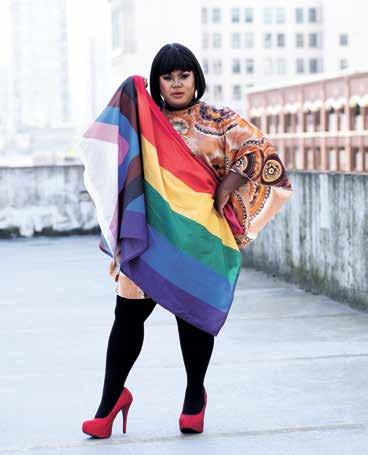
Vancouver Pride is here, and, if you’re anything like me, you’re probably sad you can’t be there in person. However, you don’t have to miss all the fun. This year’s hybrid festival includes over 60 events, including many online.
About the pandemic and upcoming event, Kaschelle Thiessen of the Vancouver Pride Society, the festival’s organizers, said, “We haven’t had an in-person event since the pandemic was declared in March 2020. We were all set for our annual Unicorn Ball on the second Saturday in March, and we had to cancel it two days before…
“Last year, the only in-person ‘event’ we had was our Pride Art Walk. It was a selfguided tour through our app to view art installations and murals through the downtown core and West End.”
“We have many virtual events happening


this week and weekend,” she added. “We have a wide array of programming available, like workshops, a Queer history panel, Symphonic Pride, the VanVogueJam Posh Ball, and more.”
“We know that for our community, isolation during the pandemic has been very difficult. Our theme this year is #ChooseYourPride.,” she added. “We wanted to provide a number of different virtual and smaller in-person events so that folks could choose an event that was meaningful or felt safe to attend.
“We encourage everyone to connect with their friends and community members this Pride season, because that’s what it’s all about.”
According to Thiessen, the Vancouver Pride Society is eager to welcome back Seattleites to its events, online or in person.
“We always welcome out-of-town visitors at our Pride celebrations, especially from our ‘sister city,’ Seattle. It will be great to welcome US visitors again in 2022,” she said.
While Stanley Park and the drag brunch
might be off the table, it’s still important to show up online for our neighbors to the north. On July 1, a rainbow crosswalk at the intersection of Davie and Bute was vandalized, proving that more work needs to be done to combat hate in both our countries.
“There have actually been several rainbow crosswalks in British Columbia that have been vandalized over the past year. It is always shocking and dismaying when this happens,” said Thiessen. “Rainbow crosswalks are a visible sign of our Queer community. When it happens in a small town, it really affects our LGBTQAI2S+ community members. We were lucky here in Vancouver. The paint was removed swiftly.”
Visit Vancouver Pride Society’s website, VancouverPride.ca, for a full list of activities. Livestreamed content will be available for viewing at vancouverpride.ca/live-stream.




by Janice Athill
SGN Contributing Writer
The 2020 Olympic Games are finally underway, and they have proven to be both groundbreaking and nail biting! The first gold medals have been won, history has been made several times over, and Olympic fans have been taken on quite a roller coaster ride in qualifiers and main events they have been dying to see.
With some of the most diverse teams to date, this year’s Olympics have also seen an increase in minorities representing the USA, as well as triple the number of LGBTQ athletes from around the globe that participated in 2016.
Stefanie Dolson, one of at least 168 out athletes competing, plays for the WNBA’s Chicago Sky. She helped Team USA dominate in the debut of 3x3 basketball over six games, until their first loss Tuesday to Japan (20-18). Their 6-1 record secured their spot in Wednesday’s final, though, in which Dolson and her team brought home the gold.
Tom Daley, an openly Gay diver for
Great Britain, won the men’s synchronized 10-meter diving competition with his partner Matty Lee, breaking China’s twentyone-year winning streak.
“I hope that any young LGBT person out there can see that no matter how alone you feel right now, you are not alone,” he said, while in the company of his Chinese and Russian competitors — a powerful moment for an Olympian who had previously avoided participating in Russian competitions out of fear for his safety as an openly Gay athlete. “You can achieve anything, and there is a whole lot of your chosen family out here, ready to support you.”
This was Daley’s third Olympic medal after winning bronze in 2012 and 2016,
Other firsts
History continued to be made when halfFilipina 27-year-old medical student Lee Kiefer became the first American to win a gold medal in individual foil fencing.
More history was made when weightlifter Hidilyn Diaz, in her fourth Olympics, became the Philippines’ first-ever gold
medalist, in the women’s 55kg category. She lifted a combined weight of 224 kg (about 493 lbs.), setting an Olympic record.
During the pandemic she had been forced to train with bamboo poles and large water bottles. Overwhelmed with pride and emotion, she broke out in tears to the sound of her country’s national anthem.
Women’s gymnastics
One of the most popular events — women’s artistic gymnastics — has been an unexpected ride for Team USA. With their leader Simone Biles having a hard time finding her rhythm in the qualifiers, members of the Russian Olympic Committee team were able to qualify ahead of the American team.
Later Biles withdrew from the team final after struggling with the stress of being the greatest gymnast in history, and the expectations placed on her. While removing herself must have been one of the hardest things she has had to do, it allowed her team to win the silver medal, cementing her GOAT (greatest of all time) status.
She is not sure if she will compete again at the Tokyo Games, but for many, she is already their champion.
A heartfelt sentiment Biles tweeted to her teammates after her withdrawal: “OLYMPIC SILVER MEDALISTS. I’m SO proud of these girls right here. You girls are incredibly brave & talented! I will forever be inspired by your determination to not give up and to fight through adversity! They stepped up when I could not. Thanks for being there for me and having my back! forever love y’all.”
The United States has the most medals so far, with 31 in total (as of Wednesday afternoon): 11 gold, 11 silver, and 9 bronzes. However, the games are far from over, with many events still to come, including Team USA’s legendary women’s basketball team, with five openly Gay women (Sue Bird of the Seattle Storm, Chelsea Gray of the Las Vegas Aces, Brittney Griner of the Phoenix Mercury, Breanna Stewart of the Seattle Storm (and WNBA MVP), and Diana Taurasi of the Phoenix Mercury), whose progress we are excited to watch!