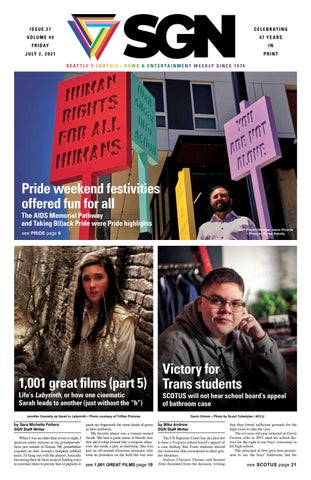
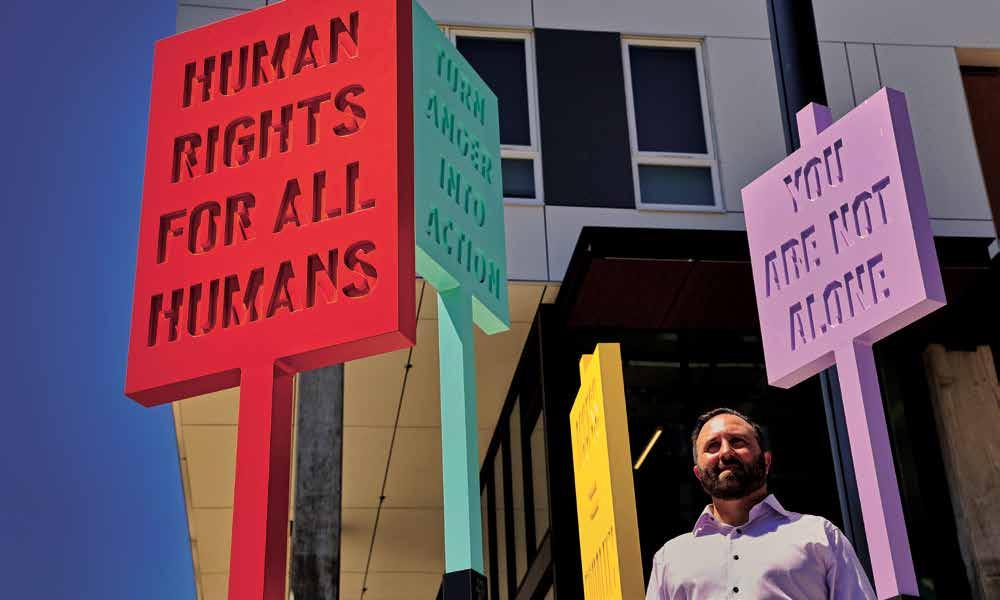
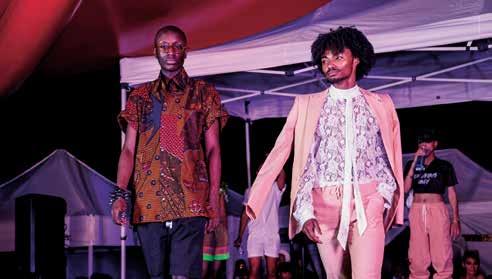
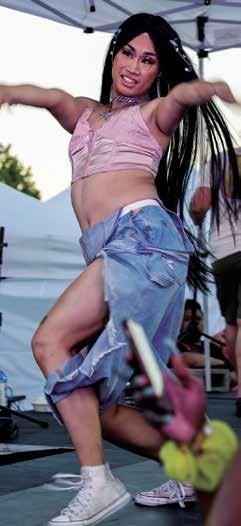
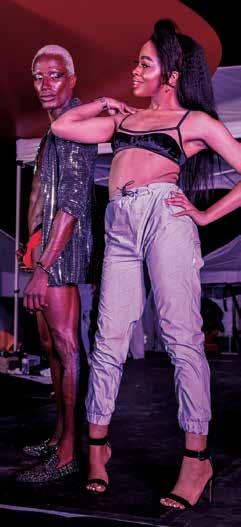
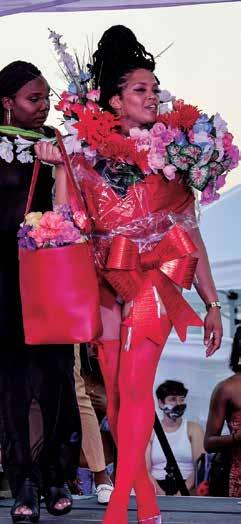
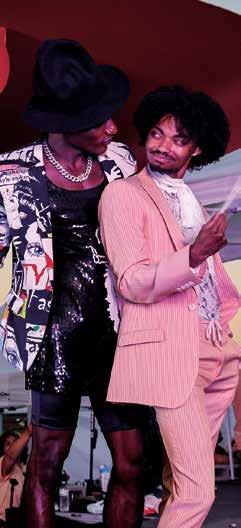
The AIDS Memorial Pathway and Taking B(l)ack Pride were Pride highlights see PRIDE page 6
1,001 great films (part 5)
Life’s Labyrinth , or how one cinematic Sarah leads to another (just without the “h”)
by Sara Michelle Fetters SGN Staff Writer
When I was no older than seven or eight, I spent an entire summer at my grandparents’ farm just outside of Tenino. My grandfather coached an elite women’s fastpitch softball team. I’d hang out with the players, basically becoming their de facto mascot, finding ways to convince them to put my hair in pigtails or
paint my fingernails the same shade of green as their uniforms. My favorite player was a woman named Sarah. She had a giant mane of blonde hair that she’d whip around like a weapon whenever she made a play at shortstop. She was just an all-around ferocious presence who took no prisoners on the field but was also
Victory for Trans students
SCOTUS will not hear school board’s appeal of bathroom case
by Mike Andrew SGN Staff Writer
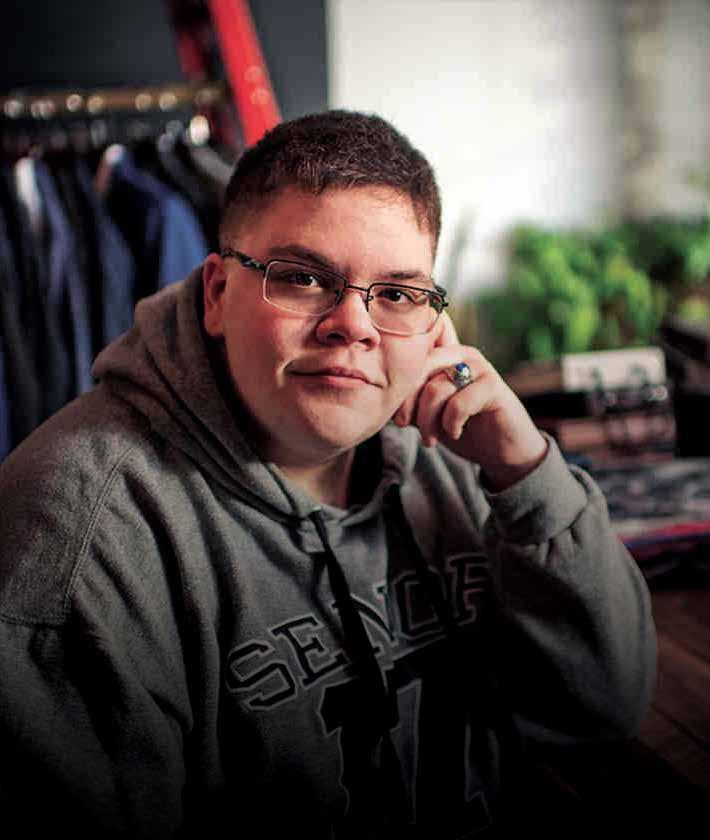
The US Supreme Court has decided not to hear a Virginia school board’s appeal of a case finding that Trans students should use restrooms that correspond to their gender identities.
that they found sufficient grounds for the high court to take the case.
The six-year-old case centered on Gavin Grimm, who in 2015 sued his school district for the right to use boys’ restrooms in his high school. The principal at first gave him permission to use the boys’ bathroom, but the see 1,001 GREAT FILMS page 10 see SCOTUS page 21
Justices Clarence Thomas and Samuel Alito dissented from the decision, writing
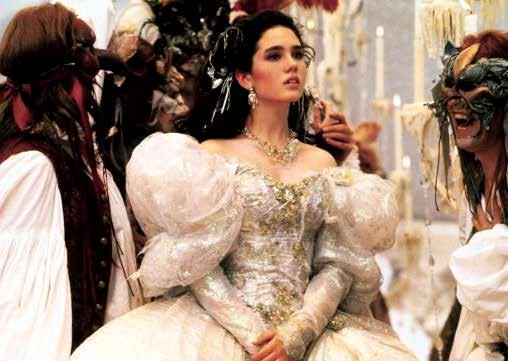
Jennifer Connelly as Sarah in Labyrinth – Photo courtesy of TriStar Pictures Gavin Grimm – Photo by Scout Tufankjian / ACLU
AMP Project Manager Jason Plourde – Photo by Renee Raketty
Photo by Renee Raketty
PrideFest flag stolen
Something mysterious happened at the 2011 Seattle Pridefest, when the giant flag disappeared, SGN Associate Editor Shaun Knittel reported.
The PrideFest flag measures 35 by 70 feet and weighs over 100 lbs. “It was rolled up like a big rainbow sausage,” said Egan [Orion]. “The flag is so big it would’ve taken two or three people to carry it away.” Egan told SGN that, at first, he thought it was all just a big misunderstanding. Someone obviously packed it up by accident. Surely no one would steal the flag, an emblem of the day’s success and the community’s pride.
But his summation soon turned to disappointment as, after making some calls and asking around, he realized the flag had, indeed, been taken. “The flag belongs to our community, not just one organization or person,” said Egan. “It’s powerful not for just one day but all year long.”
Update: When asked if the flag was ever recovered, Egan Orion said this past week, “Nope, never recovered. We have no idea who stole it. We never even heard a peep as to where it might’ve gone.” The mystery continues.
Gay couple busted
Years later, this kind of incident boggles the mind. What is so strange is this happened on Pride Sunday. As Knittel reported:
Aaron Smith and his boyfriend Benjamin White, both 23, arrived in Seattle on June 24 to experience their first Seattle Pride weekend. Smith and White were embracing while sitting down when a security officer approach them and told them [there was] no PDA.
Valor Security Corporation’s senior vice president released the following statement to the Seattle Gay News: “Our officers are trained to be respectful of all patrons when executing their responsibilities. Unfortunately, in this case, the officer’s use of discretion was not consistent with our policies for personal interactions. We apologize for the officer’s response. In addition, we are taking steps immediately to ensure that every member of our team clearly understands and enforces our policies while remaining sensitive to all who choose to visit, shop, and work at Westlake Center.”
Capitol Hill midnight rampage
Radicals vandalizing stores in Capitol Hill: sounds so 2020, but this was in 2011 on Pride Sunday, as Knittel reported:
In the early morning hours of Pride Sunday, June 26, several hundred selfdescribed anarchists swarmed through Capitol Hill, the city’s gayborhood, noisily vandalizing stores and smashing windows before dispersing into the night.
“Right before midnight last night, near everyone’s favorite gay bar, big groups of people began to assemble on the corner of 12th and Madison. Anxiety and excitement filled the air as everyone waited for the music to start,” the anarchists posted on their website, www.pugetsoundanarchists.org. “At the stroke of midnight, the music started, unfortunately quietly, but the energy in the crowd surpassed the need for music, and people jumped and cheered
This week in SGN history: 10 years ago
by MK Scott SGN Contributing Writer
Over 47 years, the Seattle Gay News has covered thousands of stories that still resonate today. This week we look back at Vol. 39, Issue 26, published on July 2, 2011
with their friends. The crowd began to move quickly, turning down a quiet street, which was occupied by one of the antiyouth ‘beer gardens.’”
People jumped on the fence, attempting to tear it down, as others ran around attacking two empty police cars on the street. A user going by the handle Pedal9 wrote on the website, “The worst thing about this incident is that a group of people was nothing less than coerced into attending a march when it had been promoted as a street dance party. It was NEVER divulged in the Facebook announcement nor on handbills as having anything to do with what you think is anarchism, or worse, activism. Instead, you tricked happy queers into supplying you with a large group in which to hide your cowardly masked and hooded selves. When the destruction of our neighborhood began, most people began bailing out. (And please please do not compare this to Stonewall. Ever. It is a shameful slap in the face.)”
“Shame on you all,” commented user Xaioyao3500. “You will never in a million years have the support of anyone but selfish, shortsighted punks who need to smash things to feel good about themselves. Trust me, when you grow up and become professionals, you will feel ashamed. In the meantime, maybe you should spend some more time analyzing your own racism, classism, and privilege, and less time shouting stupid slogans and smashing the windows of businesses and empty cop cars like a bunch of cowards.”
HRC store in DC vandalized
From one Washington to another, more vandalism, as reported by SGN Staff Writer Mike Andrew:
Washington, DC’s Dupont Circle HRC store was vandalized early in the morning of June 29 by a group of selfdescribed “Rowdy Queers” claiming to be paying homage to the Stonewall riots.
According to the Washington Blade, the damage was “mostly cosmetic” — pink paint splattered on the windows of the store, and the word “Stonewall” spray-painted on the sidewalk immediately in front.
“The arguments of the group behind the vandalism are not entirely off-base, but they are easily dismissed when combined with such unnecessary behavior,” Bilerico’s Adam Polaski wrote on June 29.
Even the San Diego LGBT Times, in condemning the vandalism, was more outraged by Bilerico’s lack of outrage than by the action itself. “It is this type of drivel in the blogosphere and beyond that causes these so-called activists to perform criminal acts against our community’s most politically influential organization,” the LGBT Times wrote in an editorial.
Cleve Jones speaks in Seattle, supports hospitality workers
Andrew also reported the following: Renowned activist Cleve Jones spoke in Seattle June 28 at an LGBT community forum sponsored by UNITE HERE Local 8, Allyship, Ingersoll Center, Pride At Work, and the SGN. In what Jones describes as “an amazing act of solidarity,” UNITE HERE members voted to postpone the strike until after the AIDS
conference. “We had members from every country,” Jones recalled. “There were Somalis, there were Indians, there were Pakistanis, there were Russians. They said, ‘We have AIDS in our own countries. We know this is important.’ Then [after the AIDS conference] we went on to win on every demand,” Jones grinned.
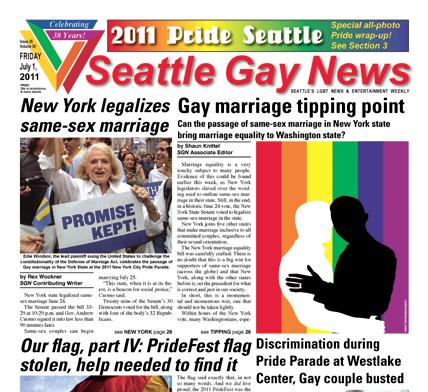
New York legalizes same-sex marriage: New York made history by becoming the fifth state to legalize same-sex marriage. SGN Contributor Rex Wockner reported:
New York state legalized same-sex marriage on June 24. The Senate passed the bill 33-29 at 10:29 p.m., and Gov. Andrew Cuomo signed it into law less than 90 minutes later. Same-sex couples can begin marrying on July 25.
“This state, when it is at its finest, is a beacon for social justice,” Cuomo said. “Now that we’ve made it here, we’ll make it everywhere,” said Freedom to Marry President Evan Wolfson, calling it an “epic win.”
Update: Marriages started July 24, and by July 30, Central Park was filled with pop-up chapels officiating free same-sex weddings. There were an estimated 24 weddings conducted on that day.
In A&E News:
Britney Spears lip-syncs for her life With the #FreeBritney movement in the news recently, we go back to her Femme Fatale performance at the Tacoma Dome on June 29, 2011. SGN Contributor Joshua Michael Rumley offered analysis: Britney did what has become her usual dance routine: two-step, hair toss, side hip roll, then point toward a random member in the audience, which is a far cry of the Britney of the “Slave 4 U” era of her career. I kept hoping for the moment where Britney would silence the naysayers and pull out the dance moves we know she is capable of. Sadly, she never did, and it actually appeared as if she wasn’t committing to all of her moves.
I understand Britney has had an intense couple of years with her mental breakdown, the birth of her two beautiful boys, and her short-lived marriage to the slimiest person outside of a downtown pawn shop, Kevin Federline. But Britney Spears is a pop star. She gets paid millions of dollars to be sexy, to dance, and sometimes to sing, so I can’t be faulted for having a certain expectation and standard of her as an artist. Plus her record company is charging upwards of $400 for some tickets.
Frenchie Davis’ diva moment
Even though Frenchie Davis didn’t make it all the way through American Idol in 2003 (remember the topless controversy?), she did become a semi-finalist on the first season of The Voice and was in demand.
SGN Associate Editor Shaun Knittel chatted with her before their upcoming appearance at Neighbours on July 2:
“I’ve had a kind of love affair with the Seattle’s Men’s Chorus,” Frenchie told the Seattle Gay News. “I have performed in Seattle a bunch of times, but never at Neighbours, so I’m really looking forward
2011 This Week in SGN History
to it.”
One of the reasons Frenchie says she’s happy about performing at Neighbours Seattle is because she loves her some Gays! “I owe the LGBT community a huge debt of gratitude,” she said. “While the rest of the world is just starting to catch on, the Gays have been believers since day one.”
Update: I remember what happened next because I attended that performance. After the show, Davis was hiding out in the lounge area with a long line. You only had a second with her for a photo (my photo came out too blurry) and she was too dismissive. I thought she was diva when she had no right to be. In October 2012, I met up with Davis again at the HRC dinner, and this time she was nicer, or had she changed her tone? Also in 2012, Davis came out as Bisexual.
Gaga fever
On the release of Gaga’s iconic Born This Way, SGN Contributor Chris Azzopardi had an exclusive interview with Gaga herself. On being a Gay icon, she said:
“That’s a really, really tall order and quite a description. I never set out to be a gay icon or become one or be revered as one, and I’m just really grateful to all the people who have believed in me and my music and my work.
“The most special thing of all has been that my sort of assimilation as a public figure has very organically stemmed out of who my natural friends were in high school. I had a lot of gay friends growing up, not even realizing they were gay. We didn’t really talk about it and I went to theater school and I did a lot of shows, so I guess it never really mattered to me if they were gay or straight — and we never really talked about it. We just loved talking about music and art and theater and fashion.
“So now it’s less about being a leader and more just about being a part of my generation and being part of the fight for equality that I feel is part of who I am and part of my childhood, and part of where I’m going.”
When asked about her legacy, she responded, “[…] It changes and grows. I would say that my wish is to be remembered as a cultural force, as someone who was fearless and unpredictable, who didn’t care what anyone thought about what I created but only cared that they thought about it.”
SMC’s annual Pride concert
Miryam Gordan reported:
Pride weekend included fun and a fun musical history lesson from Seattle Men’s Chorus as they performed an uncountable number of past and present hits. The unusual format was almost all medleys of hits from various musical genres spanning five decades of boy bands and male pop groups. Starting with the oldest songs, the audience cheered as a well-remembered line of music was sung, immediately followed by another, and then another, and then another. There was almost no time to recognize a cherished musical memory before the next one popped up.
Update: In 2016, Dennis Coleman, SMC’s artistic director, retired after 35 years.
Local News
by Paige McGlauflin SGN Contributing Writer
Despite Capitol Hill’s rich LGBTQ+ history, the neighborhood and its Queer community still have a ways to go.
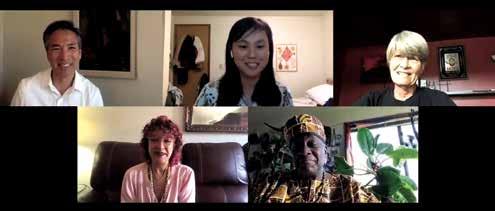
Four panelists from well-known LGBTQ+ establishments met on Thursday, June 24, for a virtual panel hosted by the SGN and The Evergrey. The panel focused on the rich history of the neighborhood and what the community there faces in the future.
“I often forget just how freeing walking around on Capitol Hill is, but I really remember when I go and visit other places and I’m a little bit more conscious of what I’m wearing, of my armpit hair, of my curly loudness,” said Alanna Francis, the development and community outreach manager of Three Dollar Bill Cinema.
“When I’m walking around on the Hill… I can just be me, because that is what I’ve either reclaimed, or many people around me have been really pushing, so that we’re able to continue walking around and feeling that sense of community.”
Jeff Sakuma and Dee Ireland Lewis recalled the original appeal of Capitol Hill during the blossoming of its LGBTQ+ community. Though Pioneer Square and Belltown also had sizeable Queer populations and considerable history, it was the
The past, present, and future of Capitol Hill: Panelists discuss neighborhood’s rich LGBTQ+ history Washington State History Museum exhibit highlights Transgender pioneers in the American West
by Josephine Baird SGN Contributing Writer
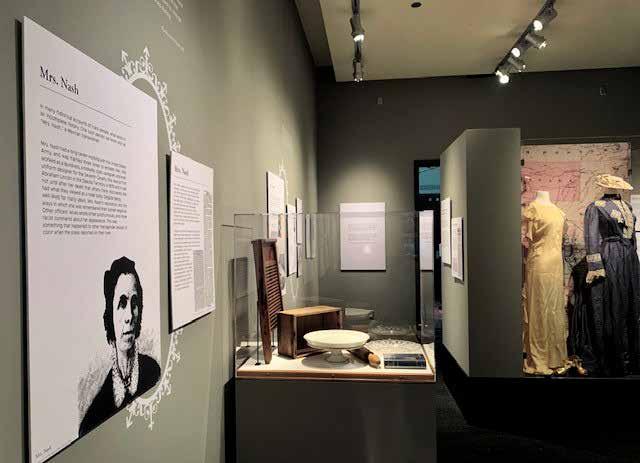
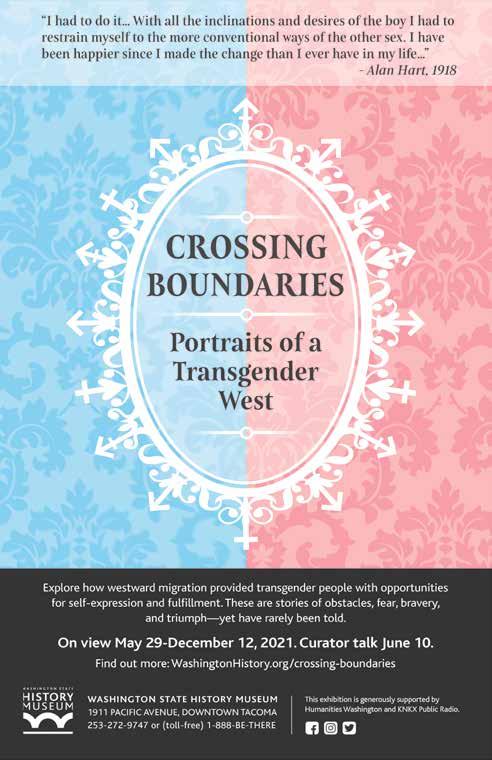
While Pride Month is a great time to celebrate, it is also an opportunity for reflection and education. That is why the Washington State History Museum in Tacoma opened its exhibit, Crossing Boundaries: Portraits of a Transgender West, about Transgender people living in the West from the 1660s to the 1940s, on May 29, the eve of Pride Month.
The exhibit was created in collaboration with Dr. Peter Boag, an author, historian, and educator at Washington State University in Vancouver. It highlights people who moved west to change the way they dressed and behaved in order to live a life more authentic to who they really were. The life stories of these pioneers illuminate the themes of the exhibit —identity, visibility, acceptance, and history — that remain central to the LGBTQ+ community today.
Through a collection of historic artifacts and newspaper clippings, the exhibit tells the story of how the difficult journey west provided these individuals and others with chances for fulfillment and self-expression.
Gwen Whiting, lead exhibitions curator at the museum said, “One of the things that appealed to me about this project is that LGBTQ+ folks have been a part of our history forever.” She believes that their history has been underrepresented in museums, which served as a motivator for her to “lay a base for this work.”
Recovering lost histories
The history of Transgender pioneers in the West is “an incomplete one, marked by sensational popular accounts and prejudice, and a lack of personal records,” according to a WSHM press release.
This exhibit seeks to put names and faces with these pioneers, such as Harry Allen, who was known as a “heartbreaker” and was
availability of apartments, nightlife, and other establishments that drew so many young Queer people to the Hill.
“At that time, it was a very affordable place with lots of apartments. It was just a good place, back in 1979, 1980, to find that affordable housing option with a group of friends, in a big old house that we rented on the Hill,” said Sakuma, a steering committee member for the AIDS Memorial Pathway Project. “Also, there were some very prominent and significant businesses that began up there that really catered to the queer community.”
The Hill was also reminiscent of San Francisco, another draw for those migrat-
ing from the “Gay mecca of the West Coast,” as Lewis, he founder of Seattle’s first chapter of Sisters of Perpetual Indulgence, put it. Lewis moved to Seattle from the Bay Area in 1985.
Despite the growing presence of friendly establishments over the decades, residents and patrons on Capitol Hill still experienced discrimination and prejudice. Lewis recalled a man from Mississippi confronting him on his sexuality after overhearing Lewis and his friend’s conversation at what was otherwise a friendly business Lewis frequented.
“Now, that was not a problem with the establishment itself, but this was a patron sitting near me within earshot of our con-
wanted by the law; Mrs. Nash, laundress to the Seventh Calvary and an officer’s wife; and Dr. Alan Hart, a Northwest novelist and medical doctor who requested that his personal documents and correspondence be burned after his death. As with any of these Manifest Destiny stories, life out West was full of tales of bravery, moments of fear and legends of triumph.
It was hard for Whiting to come to realization that many of the stories of people who transitioned in the West were largely lost, either intentionally by family members or communities, or because pioneers often left few personal accounts and belongings behind. “It’s hard to think about how many more people’s stories we weren’t able to find,” she said. “One of the things I learned very quickly was that this project would be emotionally difficult.”
Because written documentation is rare,
some assume that Transgender people did not exist before the modern era. As this exhibit shows, that just isn’t true. In fact, Transgender people have existed in the West for thousands of years. Many Native cultures have a history of recognizing three, four, or more genders.
“The everyday life is important to history”
Whiting said the reception of the exhibit has been excellent, with one of the main groups being parents bringing a child who identifies as Transgender. She said that the exhibit has served as a talking point for families. “These conversations have been happening in our gallery — and that’s really exciting.”
“It is an honor to be a part of the visionary inclusiveness of the Washington State Historical Society, bringing to attention
versation,” Lewis said, noting that this happened sometime within the last ten or so years. “That question — Why was I there? — I was offended by it, but that was just the mentality of where he had come from. I made it very clear that in Seattle, we really could drink where we want, and that shouldn’t be an issue.”
In light of a deadly pandemic, an economic crisis, and demands for racial justice both in the US and locally, the LGBTQ+ community of Capitol Hill stands at a pivotal moment. The recent attention to Capitol Hill Pride’s organizers’ letter of complaint to the city — alleging that Taking B(l)ack Pride’s reparations fee policy was reverse racism — highlights the need for growth.
“I think that the pandemic has given us a chance to change our way of dealing with each other. And I really hope that what can come out of this is more kindness, and more respect for each other,” said Shelley Brothers, co-owner of The Wildrose. “I think that’s what we just have to keep showing within our community so we can heal these problems we have. I don’t think they’re insurmountable. But they do require us to all sit down and take a good hard look and come up with solutions.”
varied peoples marginalized in and by our history,” said Boag in a press release. He believes that the exhibit shares stories that are important to the state and region but were once mostly ignored and in some cases, purposely misconstrued. “As such, what we share is not only affirming of the lives of the people we explore but also of fundamental interest to everyone,” he added.
While the exhibit opened on the cusp of Pride Month, it will be on view until December 12, 2021, at the Washington State History Museum.
Whiting hopes that teachers will bring their students to view it. She also hopes that through this research and exhibit, the museum will be able to build its collection as time goes on.
Whiting has also found that many people believe that their life isn’t important. “I find that most people who are living now don’t seem themselves as part of history,” she said. But, as she added, “You are more important than you realize. You don’t have to be the president or a celebrity — the everyday life is really important to history.”
And without the “everyday life” of Transgender pioneers in the West, exhibits like this wouldn’t exist.
For more information on “Crossing Boundaries: Portraits of a Transgender West,” go to washingtonhistory.org.
Exhibit hours: 10:00 a.m.–5:00 p.m. Tues.-Sun. (On the third Thursday of each month, it’s open 10:00 a.m.-8:00 p.m., with free admission from 3:00 to 8:00 p.m.)
Admission: Free for members. Adults: $14. Seniors (age 65+), students (age 6-17), and military (with ID): $11. Free for children 5 and under. Family rate: $40 (up to two adults and four children under age 18). Patrons with a Washington Quest card and licensed Washington Foster Parents can attend for $1 per person or $2 per family.
Image courtesy of WA State History Museum
Image courtesy of The Evergrey
Local News
by Renee Raketty SGN Contributing Writer
It takes more than a record-breaking heatwave to dampen Seattle’s Pride weekend festivities. There was something for everyone looking to take part in the annual LGBTQIA+ community tradition, which always falls around the anniversary of the Stonewall Riots in New York City in 1969.
Traditionally, the largest happening is the Pride Parade downtown on the last Sunday in June. However, organizers Seattle Out and Proud (SOAP) have taken Seattle Pride online since the start of the COVID-19 pandemic. For those seeking shelter from the sweltering sun, this year’s virtual celebration on Sunday was the perfect respite.
“Resilience” was the theme of the SOAP event, which included a full day of online programming. A ticketed, adults-only affair, dubbed “Pride After Dark,” was a new addition this year. The special streaming event featured “burlesque, humor, and sensuality,” according to SOAP. More than a hundred paid attendees took part and helped raise more than $10,000 to offset the non-profit’s expenses.
“We’d like to extend a huge thank-you to our event sponsors and other partners who have stood by us these past two years with their participation, encouragement, and financial support,” said Seattle Pride Executive Director Krystal Marx in a written statement. “This support has allowed us to bring our community together when we needed it most, and has enabled us to grow our year-round programming by 750%. For this, we will be forever grateful.”
Approximately, 2,500 people from 35 countries registered to participate this year. According to SOAP, individuals as far away as Australia, Nigeria, and Europe took part. A portion of the weekend’s programming will be made available on SOAP’s YouTube channel.
AIDS Memorial Pathway
For those looking to mingle in person, Capitol Hill had a lot to offer. In addition to Seattle’s popular LGBTQIA+ and friendly bars, restaurants, and retail shopping, events such as the AIDS Memorial Pathway dedication and Capitol Hill Pride were also options.
On Saturday, a large crowd gathered at the Capitol Hill Station plaza and pathway along the north edge of Cal Anderson for the dedication of the new AIDS Memorial Pathway. In addition to notable speakers, such as former Seattle City Councilmember Tom Rasmussen, state Sen. Jamie Pedersen, and Gay City Executive Director Fred Swanson, AMP artists were on hand to discuss their installations.
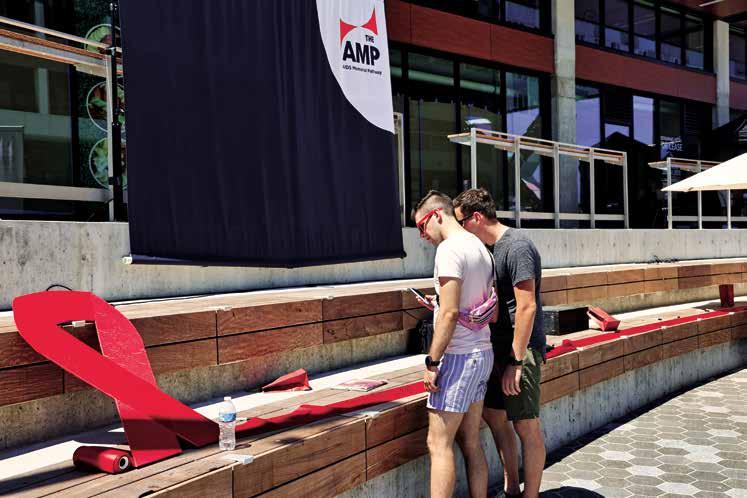
A large red ribbon that will become a part of the AIDS Memorial Quilt was available for attendees to write personal messages to friends and loved ones lost to AIDS.
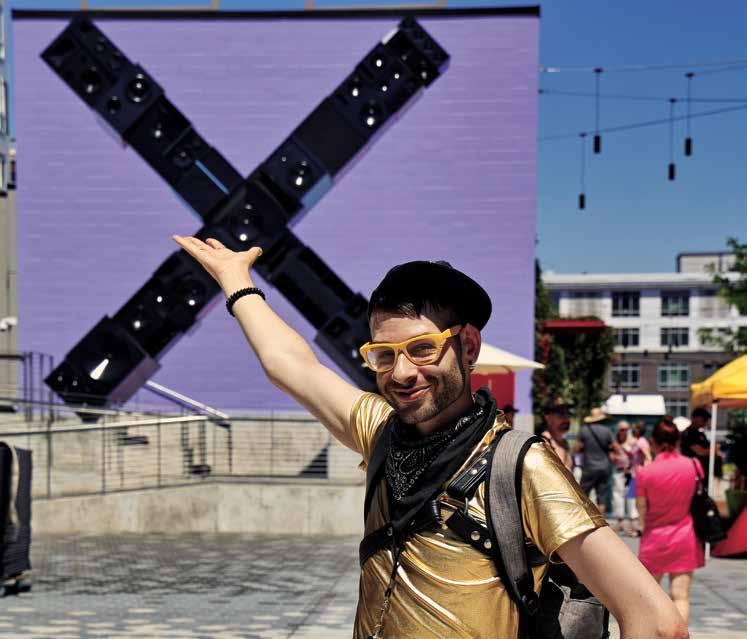
“It was wonderful to see so many supporters of The AMP being able to come together and appreciate this accomplishment,” said The AMP Project Manager Jason Plourde about the six-year effort. “I loved that each of the artists and other speakers spoke so personally, and managed to express important and diverse themes about the memorial.
The backdrop for Saturday’s dedication, a 20-foot-by-20-foot sculpture in the shape of an X, called andimgonnamisseverybody, is said to be a “a portal into the spaces of radical gathering, hospitality, celebration and care that Black, Brown, poor, Trans, Queer, and otherwise excluded communities have forged to take care of their own.”
The plaza and nearby Cal Anderson Park — named in honor of our state’s first openly Gay lawmaker who died in 1995 from complications related to AIDS —
include three tableaus that use protest signs and their accompanying messages to “evoke historic moments of public convergence” and “were sourced from actual demonstrations that took place throughout the region during the eighties and nineties” — the height of the AIDS epidemic in the United States. Collectively, the work is called We’re Already Here
“People really have appreciated the artworks, with their diverse ways of engagement and the explicit and symbolic messages they convey,” Plourde explained. “I know there was also grief and sadness from all we’ve lost, but some consolation came from sharing those feelings communally.”
He told the SGN this week that he was touched by the “enthusiastic responses of attendees to the artwork” and “knowing there will be thousands more” people who will have their own connections to The AMP in the coming years.
Other installations are coming soon: Ribbon of Light, three human-scale laminated glass sculptures placed along a landscaped pathway; and In This Way We Loved One Another, images and narratives of people touched by HIV/AIDS from communities of color globally, most specifically Black communities.
“I think just having a place that acknowledges the pain people have expe-
rienced is important and healing,” he said. “When the Ribbon of Light artworks are completed in the park, they will also help facilitate reflection and a feeling of peace.
“I heard people were also impressed by the app and the augmented reality Names Tree that sends a light toward the sky as the names of those we’ve lost are read at random. I hope that this feature helps people feel less alone in their loss, and brings back memories of friends and family.”
Plourde acknowledged that the heat put a damper on the dedication, because they needed to “comply with changing public health guidelines” due to the “building heatwave.”
Photos by Renee Raketty
“We needed to regulate and limit the event,” he said. “We would’ve loved to have everyone gathering close together at one time, but we managed to have a simple and meaningful program and have already made it available online for everyone to appreciate. Of course, now people can also go to the site and tour The AMP whenever they’d like.”
Capitol Hill Pride and controversy
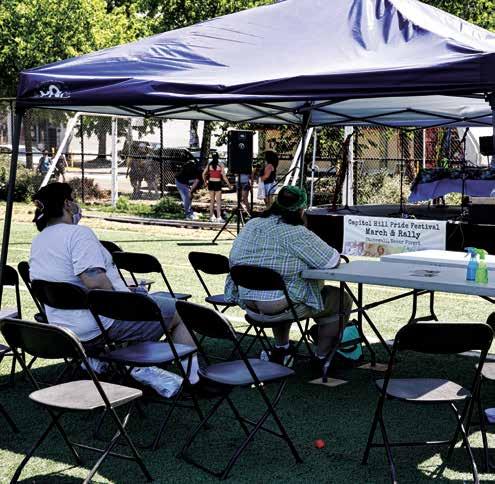
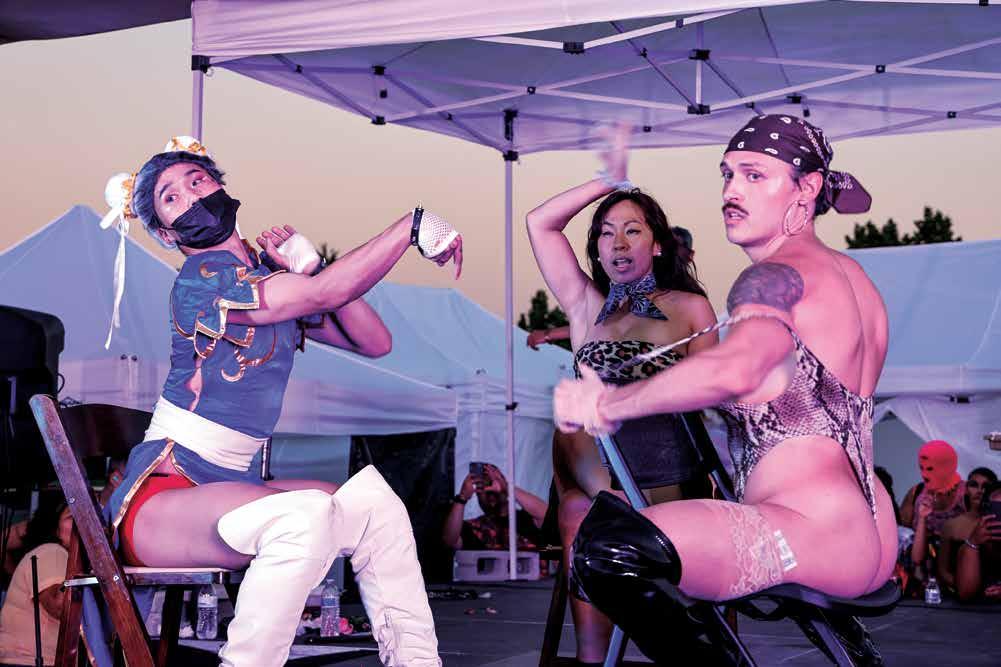
South of Cal Anderson Park and adjacent to E. Pine St. was Capitol Hill Pride. It was billed as “Seattle and the state of Washington’s largest in-person Pride event,” according to a press release from organizers Charlette LeFevre and Philip Lipson. However, it appeared sparsely attended on Saturday afternoon and again on Sunday, when this journalist visited.
Vendors and a modest stage were positioned around the outskirts of the Bobby Morris Playfield. A small tent with sheltered seating was placed in front of the stage. A crafts table and an inflatable bouncy-house intended for children were also present but devoid of children. Most of the people observed were tucked away under the shade of nearby trees — within earshot of recorded music but too far from the event to be considered active participants.
John Mitchell, a resident near Cal Anderson Park, told the SGN that about 200 people participated in a march organized by Capitol Hill Pride and that a sizable crowd gathered to hear the Marshall Law Band perform at the park on Saturday night.
It’s unclear if LeFevre’s criticism of Taking B(l)ack Pride, also being held on Saturday a few miles away, or the oppressive heat were contributing factors for the low attendance.
Capitol Hill Pride organizers had taken issue with Taking B(l)ack Pride’s decision to charge a “reparations” fee of $10 to $50 to white attendees to ensure the event remained free for its intended audience, the Black, Indigenous, and people of color (BIPOC) community.
Advocates seeking to address the intergenerational wealth gap — stemming from slavery, segregation, and racist practices, such as “red lining” — have suggested reparations as one way to right a historical wrong. However, LeFevre believed that Taking B(l)ack Pride may have been in violation of local, state, and federal laws for charging a fee, according to a letter it wrote to the Seattle Human Rights Commission. However, the commission, which operates under the UN Declaration of Human Rights, pushed back.
“We would like to recommend, if possible, that you educate yourself on the harm it may cause Seattle’s BIPOC community
in your pursuit of a free ticket to an event that is not expressly meant for you and your entertainment,” the letter reads.
Capitol Hill Pride doubled down on their stance a day later. “We will never charge admission over the color of a person’s skin,” read a June 18 press release. “Capitol Hill Pride continues to work with ground-level organizations to promote equality and social justice with community and stand proud in those values, and we should not be pressured, attacked, or defamed for our commitment.”
Responses from organizations and individuals
LGBTQIA+ organizations began to address the issue and joined sponsors, speakers, and entertainers who withdrew their participation from Capitol Hill Pride. Mayoral candidates Lorena González, Colleen Echohawk, and Andrew Grant Houston also cancelled.
“We are appalled to hear of the hateful, racist attacks on the organizers of Taking B(l)ack Pride,” read a statement from the GSBA, the LGBTQIA+ chamber of commerce. “As with many Pride events across our region, Taking B(l)ack Pride is organized to reflect the values, priorities, and the needs of the community. As an event by and for BIPOC LGBTQ+ people, they are entitled to arrange their own event as they see fit, including sliding-scale admission from certain attendees.
“Our LGBTQ+ community is big and diverse. There are many options to experience Pride. This should be celebrated and supported. Seeing the many ways of expressing Pride also provides us an opportunity to reflect on why certain LGBTQ+ people may not feel welcome, celebrated, or included at some events, and why some groups need to create community-specific events that better reflect their needs. Intentionally creating spaces for marginalized populations, including BIPOC LGBTQ+ people, is essential.
“Instead, we have seen Taking B(l)ack Pride targeted misleadingly in local and national media and subject to horrific racist, transphobic, and homophobic online attacks. This must stop.”
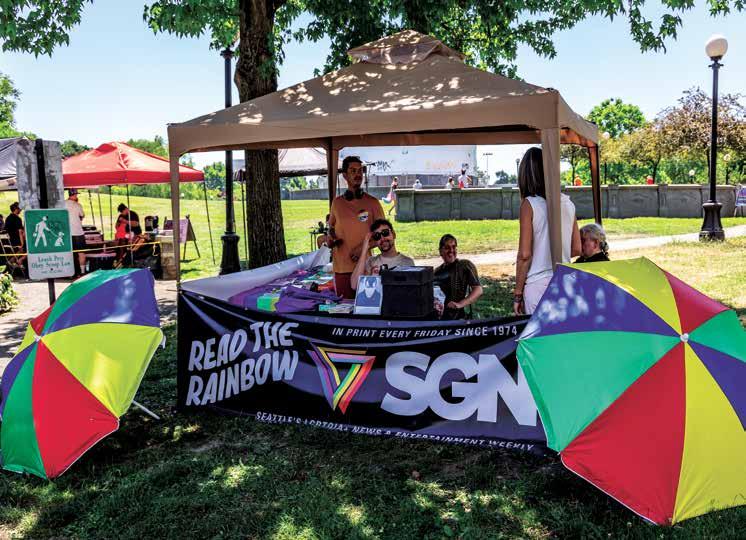
The SGN, United Seattle magazine, and Malcontent News issued a joint statement announcing they were “no longer supporting the event” and would be “moving their booth to the AIDS Memorial Pathway.”
This journalist, who was scheduled to speak on behalf of the SGN, also withdrew from Capitol Hill Pride.
When the SGN contacted Capitol Hill Pride for comment for this article, LeFevre sent the following email on Tuesday:
“Renee,
“You disrespect us for standing up against discrimination, you further slander our Pride event and Mark Anthony over facts, and you pressure the SGN to drop support, and you have the gall to ask us questions? Really?
“Charlette and Philip, Capitol Hill Pride”
Police activity
On Sunday, this journalist witnessed a police response to Cal Anderson Park, the site of Capitol Hill Pride. Four patrol cars blocking E. Pine St. could be observed, and officers were seen entering the park. This journalist livestreamed an arrest and conducted an interview with LeFevre and her sister, Carla Pitsinger. Mark Anthony, the president of CHOP Art, could be seen talking to Seattle Police Department officers. Witnesses offered conflicting reports of what happened. SPD Detective Michaud told the SGN that the matter had been “forwarded to the City Attorney’s Office” and “all questions are going to have to be answered by them.”
Dan Nolte, a spokesperson for the City Attorney’s Office, said they had “not file[d] charges in this instance,” because the “assigned detective found there wasn’t enough information to suggest bias was the motive for the alleged assault, which is why it was referred to our office.” Since race-based hate crimes are felonies in King County, the matter was also referred to the King County Prosecutor’s Office.
Capitol Hill Pride had announced it would not allow police at the event, but Pitsinger said that the SPD could respond to incidents at Capitol Hill Pride.
She also said she visited the East Precinct herself to complain about hecklers using a bullhorn who had driven by Cal Anderson Park late Saturday night “spewing hate.” She and LeFevre pointed to Nikkita Oliver, a candidate for Seattle City Council, who they believed to have been responsible.
“If they are bold enough to drive right in front of our booth at 11:30 at night on a bullhorn, what else could they do,” asked Pitsinger. “I told Charlette I know about abusive relationships, stalking, and that sort of stuff. You need to have it written down, a police report or something — even if it is not a crime, each little incident that causes mental distress, bullying and stuff. Especially because Nikkita Oliver is an attorney. That makes it worse.”
The SGN provided Oliver with clips from the livestream of the police response and resulting interview. They were adamant they were not involved. “I am gravely disturbed by these false accusations,” said Oliver. “I was nowhere near Cap Hill Pride. The accusations in this video are 100%
false.
“I was not there and I had nothing to do with the situation referenced by the speaker in this video.”
The SGN obtained and reviewed a video from inside the vehicle in question. The individuals appear to be laughing and mocking Capitol Hill Pride with a bullhorn as the vehicle quickly passes by. The remarks did not appear to be hateful or constitute bullying. One individual, who asked to remain anonymous, confirmed that “Nikkita definitely was not ever there nor were they associated with anyone who spoke on the bullhorn.” They added that they had been going to find food when they “realized we were next to their event” and it was “all spontaneous.”
This journalist has made the livestream private to avoid further spreading possible misinformation about the candidate.
Taking B(l)ack
Pride
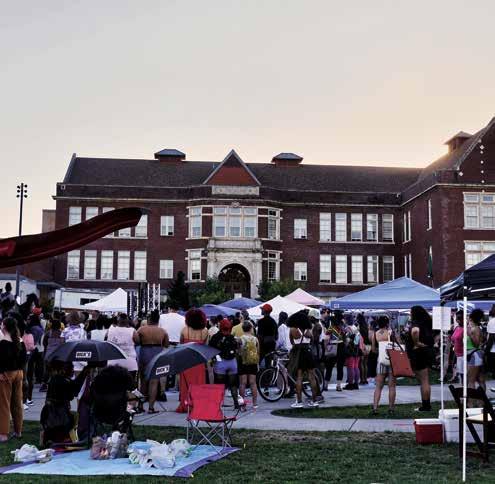
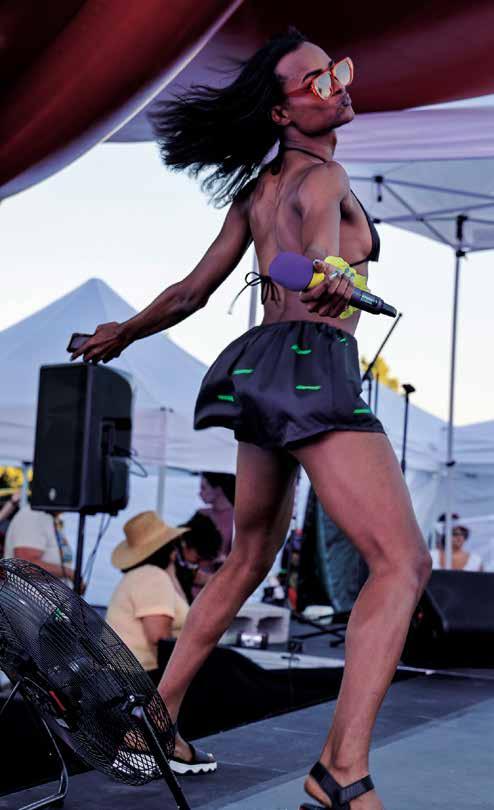
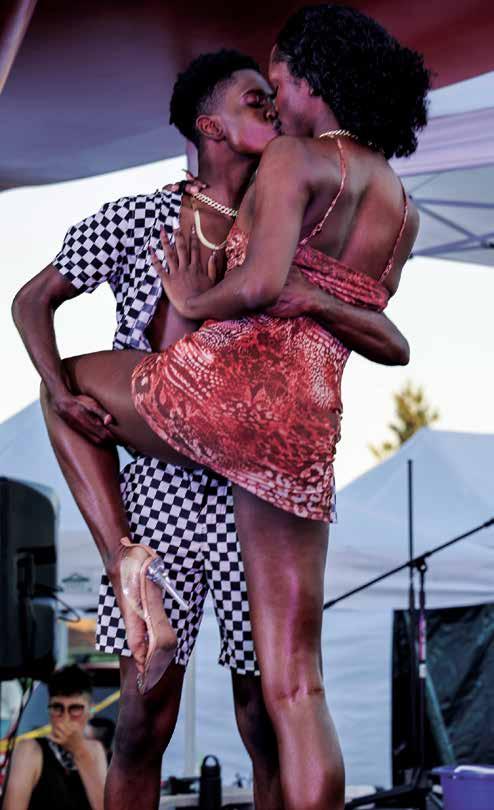
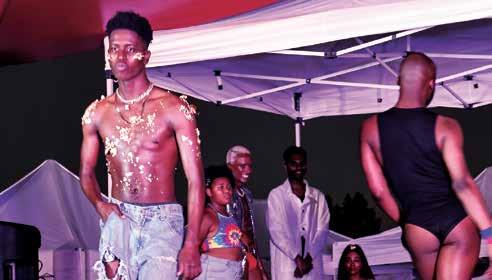
The controversy with Capitol Hill Pride wasn’t a common topic of discussion at the Taking B(l)ack Pride event, which was held in the shadow of the Northwest African American Museum at Jimi Hendrix Park. It was crowded with hundreds of participants. The vendors appeared to be busy with customers, and volunteers were wandering around offering water, condoms, and other freebies.
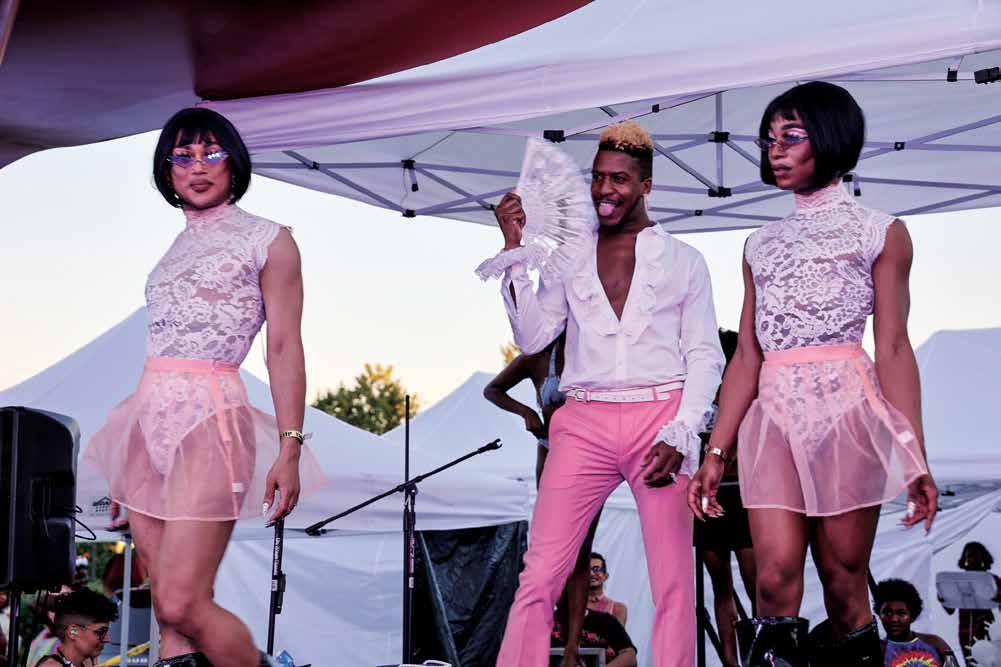
The stage was always busy with live entertainment and a DJ who spun beats between acts. There was a moment of silence for a member of the Trans Women Solidarity Network, one of the event sponsors, who had passed away. Finally, there was the Hoevid-19 Ball, the night’s main happening.
The heavy security was the only sign that Taking B(l)ack Pride, also organized by Queer the Land and the Alphabet Alliance of Color, had been the subject of unwanted national attention. Instead, everyone appeared to be having a good time.
Pride isn’t over
While we don’t need in-person events to celebrate LGBTQIA+ Pride all-year long, more in-person fun will continue this summer and into the fall.
PrideFest, the nonprofit organizer of the much-anticipated Seattle Center Pride festival, announced that they will be bringing it to Capitol Hill on Labor Day weekend, after canceling it the past two years due to COVID-19.
SOAP also announced they will hold an in-person event this fall titled “All Together Now.” It will be smaller than the typical Seattle Pride in the Park, but it will still mean lots of family-focused fun to start the school year.
Capitol Hill Pride – Photo by Renee Raketty
Taking B(l)ack Pride – Photo by Renee Raketty
Jimi Hendrix Park, Seattle
June 26, 2021
Photos by Renee Raketty
Photos by Renee Raketty
1,001 GREAT FILMS
one of the gentlest, most sincerely friendly people I’d ever encountered. She was someone I wanted so badly to mimic, even if I didn’t fully understand why that was, and I’m positive some of her rubbed off of me in regard to my own time as a competitive athlete in high school and college.
When I was around 12 or 13, I caught a documentary on PBS about a Transgender woman. It was an installment of a program with a different topic for each episode — I can’t remember the name — and my parents tuned in religiously each week, no matter the subject. The woman’s name was Sarah, and she’d mentioned during the broadcast that it meant “little angel” or “princess.” Needless to say, that stuck with me.
At 16, I got my first job working at a little Spokane mom-and-pop video store, Video, Etc. It’s long gone now, but the memory of those days has stuck with me something fierce. Being able to watch everything from Lawrence of Arabia and Galaxy of Terror to House of Games and In a Year with 13 Moons (the latter of which I’m positive the owners ordered by mistake) after stocking those shelves was mind-blowing, and as strong as my cinema education had been up to that point, it reached an entirely new level during my time working behind that counter.
In what must be starting to seem like a series of impossible coincidences, the store manager’s name when I first started was — wait for it — Sarah. She was tall, athletic, and fiercely opinionated. I only ever knew her through work, but I still felt her influence. Not only did Sarah open my eyes to films I’d never have thought to watch on my own but, from the way she dressed to how she talked to the manner in which she comported herself, I wanted to emulate her.
I’m sure you see where all this is going. Whether by happenstance or by some grand design I had no control of, there has also been a litany of fictional Sara(h)s in my life who have all made their mark: Sarah Connor (The Terminator), Sarah Jane Smith (Doctor Who), Sara Crewe (A Little Princess).
In June of 1986, Jim Henson’s Labyrinth was released in theaters. My Aunt Lana took my cousin and me to see it the weekend it opened. I was enthralled by the film. Every aspect overwhelmed my senses: The costumes. The songs. The wild creatures
House of Games (David Mamet) (1987) Howard’s End (James Ivory) (1992)
The Howling (Joe Dante) (1981)
Hud (Martin Ritt) (1963)
The Hunchback of Notre Dame (William Dieterle) (1939)
The Hunt for Red October (John McTiernan) (1990)
The Hurt Locker (Kathryn Bigelow) (2008)
The Hustler (Robert Rossen) (1961)
I Know Where I’m Going! (Michael Powell, Emeric Pressburger) (1945)
I Married a Witch (René Clair) (1942)
The Ice Storm (Ang Lee) (1997)
if… (Lindsay Anderson) (1968)
If Beale Street Could Talk (Barry Jenkins) (2018)
Ikiru (Akira Kurosawa) (1952)
In a Lonely Place (Nicholas Ray) (1950)
In a Year with 13 Moons (Rainer Werner Fassbinder) (1978)
In the Heat of the Night (Norman Jewison) (1967)
In the Loop (Armando Iannucci) (2009)
In the Mood for Love (Wong Kar-Wai) (2000)
The In-Laws (Arthur Hiller) (1979)
The Innocents (Jack Clayton) (1961)
The Innocents (Anne Fontaine) (2016)
Inside Llewyn Davis (Joel Coen, Ethan Coen) (2013)
Inside Out (Pete Docter, Ronnie Del Carmen) (2015)
The Insider (Michael Mann) (1999)
and incredible puppets. David Bowie’s big, gregariously larger-than-life performance as the Goblin King Jareth.
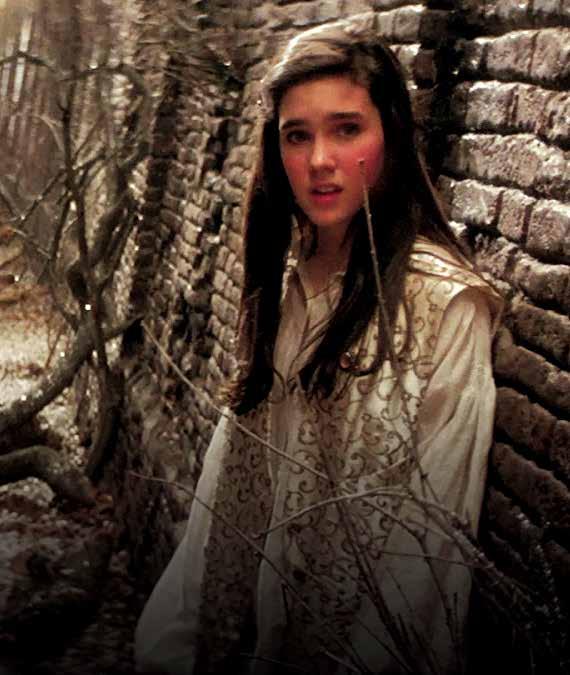
But the biggest revelation was teenager Jennifer Connelly’s turn as young heroine Sarah Williams. I couldn’t take my eyes off her. Selfish. Initially short-sighted. Wanting to live in a fantasy world instead of working to make herself a better person. I could relate to and understand all of that.
Yet Sarah also saw the best in people. She refused to let obstacles stand in her way. She used her brain to solve even the most difficult problems, and she was willing to admit her mistakes and do whatever it took to set things right. This was a heroine I could believe in, a young woman who embraced her femininity yet also refused to conform to societal norms about who she should be or how she should behave.
What’s the point? Nothing that sits outside the realm of the obvious. There are no rules as to how art influences us. There is nothing written in stone about which characters will speak the loudest and end up affecting one’s life in unforeseen ways. We do not know which people we encounter during our journeys, no matter how briefly, will make an indelible impact.
Everything I’ve mentioned here put me on the path to becoming who I am today. Each film. Each work of literature. Each friend of a family member. Each co-worker
Insomnia (Erik Skjoldbjærg) (1997)
Into the Night (John Landis) (1985)
Intolerance: Love’s Struggle Throughout the Ages (D.W. Griffith) (1916)
Invasion of the Body Snatchers (Don Siegel) (1956)
Invasion of the Body Snatchers (Philip Kaufman) (1978)
The Invisible Man (James Whale) (1933)
Irma Vep (Olivier Assayas) (1996)
The Iron Giant (Brad Bird) (1999)
Island of Lost Souls (Erle C. Kenton) (1932)
It Follows (David Robert Mitchell) (2014)
It Happened One Night (Frank Capra) (1934)
The Italian Job (Peter Collinson) (1969)
It’s a Wonderful Life (Frank Capra) (1946)
Jackie Brown (Quentin Tarantino) (1997)
Jason and the Argonauts (Don Chaffey) (1963)
Jaws (Steven Spielberg) (1975)
Jean de Florette (Claude Berri) (1986)
Jeanne Dielman, 23, Quai du Commerce
1080 Bruxelles (Chantal Akerman) (1975)
Jezebel (William Wyler) (1938)
Johnny Guitar (Nicholas Ray) (1954)
Jour de Fête (Jacques Tati) (1949)
Ju Dou (Zhang Yimou) (1990)
Jules and Jim (François Truffaut0 (1962)
Juliet of the Spirits (Federico Fellini) (1965)
Kagemusha (Akira Kurosawa) (1980)
Kes (Ken Loach) (1969)
or schoolmate or random individual I happened to come across during my travels. All of them have played a vital part, and more often than not, I never realized how big that was until many years after the fact.
This brings me back to Labyrinth. If there is any fictional character from a novel or from a motion picture I’ve ever wanted to transform into the most, it is Connelly’s Sarah. More than that, it was watching the film with my aunt that means so much to me. I never knew Lana as well as I would have liked. I never got as close to her as I should have. But I admired her strength. I was continually in awe of her confidence. She had a way of balancing so many things at one time, and no matter how stressful that was, she still displayed a positive outlook that blew my mind.
One time Lana caught me trying on my grandmother’s shoes. I was 10, and I thought everyone was outside doing various farm-related things while I was supposed to be inside tending to a stomachache. My aunt didn’t say anything. She didn’t laugh. She didn’t judge. She just let me know that my grandparents would be back soon, and I should probably get ready for dinner.
Lana and I never talked about that day. Even after I came out as Trans, this remained nothing more than a random moment lost in a sea of time.
I think that was the point. In the lim-
Key Largo (John Huston) (1948)
The Killer (John Woo) (1989)
Killer of Sheep (Charles Burnett) (1978)
The Killers (Robert Siodmak) (1946)
The Killing Fields (Roland Joffé) (1984)
The King and I (Walter Lang) (1956)
King Kong (Merian C. Cooper, Ernest B. Schoedsack) (1933)
The King of Comedy (Martin Scorsese) (1982)
Kiss Me Deadly (Robert Aldrich) (1955)
Kiss of Death (Henry Hathaway) (1947)
Kitty Foyle (Sam Wood) (1940)
Klute (Alan J. Pakula) (1971)
Knife in the Water (Roman Polanski) (1962)
Koyaanisqatsi (Godfrey Reggio) (1982)
Kuroneko (Kaneto Shindô) (1968)
Kwaidan (Masaki Kobayashi) (1964)
La Belle Noiseuse (Jacques Rivette) (1991)
La Ceremonie (Claude Chabrol) (1995)
L.A. Confidential (Curtis Hanson) (1997)
La Dolce Vita (Federico Fellini) (1960)
La Femme Nikita (Luc Besson) (1990)
La Strada (Federico Fellini) (1954)
Labyrinth (Jim Henson) (1986)
Lady and the Tramp (Clyde Geronimi, Wilfred Jackson, Hamilton Luske) (1955)
The Lady Eve (Preston Sturges) (1941)
The Lady from Shanghai (Orson Welles) (1947)
Lady Snowblood (Toshiya Fujita) (1973)
The Lady Vanishes (Alfred Hitchcock) (1938)
ited time we spent together throughout my life, I think she knew more about me than I did. Lana knew the best she could do was show love, support, and compassion, even if that meant staying silent about things I was so clearly struggling to keep hidden from the rest of the world. That meant a lot, and it breaks my heart I never got to tell her “thank you.”
So, considering all the Sarahs I’ve encountered and how much they’ve all meant to me, it’s not hard to do the math and figure out where my name came from when I finally revealed my truth to the world. I always wanted to be my mother’s “little angel.” I longed for someone to call me “princess.” The name fit. It is who I always was. It is who I am proud to be.
But the story I’ve never told is why the “h” got dropped: it’s my orthographic tribute to Aunt Lana.
We’re now at the halfway point in this project: 500 films out of a whopping 1,001. I didn’t know going in how I’d sustain this series for ten months. I had no idea what I’d be talking about. What I’ve discovered is that these personal stories, charting how my cinematic voyage has so clearly mirrored my nonfictional life, has been both cathartic and heartbreaking. It has opened my eyes in ways in which I’d never imagined.
Hopefully, those of you reading have enjoyed these random bits of craziness I’ve been jotting down each month. Maybe you’ve all expanded your horizons and ventured outside your comfort zones to explore films and stories you’d never dared to take a look at until now. That would be incredible. I’d love that.
The oldest film on the list this month is D.W. Griffith’s Intolerance: Love’s Struggle Throughout the Ages from 1916, which is undeniably a product of its time. While Griffith’s approach is heavy-handed, the flabbergasting spectacle fueling this production remains mind-blowing. I was lucky enough to watch this at a theater a few years back, and my appreciation for it was magnified considerably.
The most recent title is the spellbinding If Beale Street Could Talk, Barry Jenkins’ superlative adaptation of author James Baldwin’s novel. This 2018 release is quickly rising up my list of favorites from the past decade. It’s something special, and each watch reveals a fresh new layer I hadn’t noticed beforehand.
The Ladykillers (Alexander Mackendrick) (1955)
L’Argent (Robert Bresson) (1983)
The Last Days of Disco (Whit Stillman) (1998)
The Last Emperor (Bernardo Bertolucci) (1987)
The Last Metro (François Truffaut) (1980)
The Last of the Mohicans (Michael Mann) (1992)
The Last Picture Show (Peter Bogdanovich) (1971)
The Last Temptation of Christ (Martin Scorsese) (1988)
The Last Wave (Peter Weir) (1977)
Last Year in Marienbad (Alain Resnais) (1961)
Late Spring (Yasujirô Ozu) (1949)
Laura (Otto Preminger) (1944)
The Lavender Hill Mob (Charles Crichton) (1951)
L’Avventura (Michelangelo Antonioni) (1960)
Lawrence of Arabia (David Lean) (1962)
Le Cercle Rouge (Jean-Pierre Melville) (1970)
Le Samouraï (Jean-Pierre Melville) (1967)
A League of Their Own (Penny Marshall) (1992)
The Learning Tree (Gordon Parks) (1969)
L’Eclisse (Michelangelo Antonioni) (1962)
The Leopard (Luchino Visconti) (1963)
Jennifer Connelly as Sarah in Labyrinth – Photo courtesy of TriStar Pictures
THIS AD SPACE HAS BEEN GENEROUSLY DONATED BY KRISTIN COSTELLO IN MEMORY OF SGN PUBLISHER GEORGE BAKAN
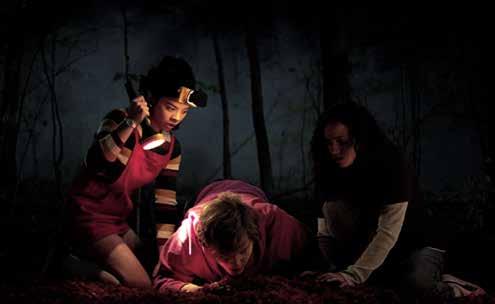
Ambitious Fear Street Part 1
by Sara Michelle Fetters
SGN Staff Writer
FEAR STREET PART 1: 1994
Netflix
Starting July with a triumphant explosion of laughter and gore, Netflix’s Fear Street Part 1: 1994 is a gruesome treat that kicks off the service’s ambitious horror trilogy. Inspired by the series of novels by Goosebumps author R.L. Stine, director Leigh Janiak (Honeymoon) hits this opening chapter out of the park, delivering a ballsy, take-no-prisoners supernatural slasher I instantly fell in love with.
The town of Shadyside is all doom and gloom. Residents feel they’re cursed, destined to live a life of hardship that at any moment could instantaneously transform into something even more catastrophically terminal. They’ve been left in Sunnyvale’s perpetually prosperous shadow, whose citizens are not above lording it over their downtrodden nextdoor neighbors at every opportunity.
Deena Johnson (Kiana Madeira) is in a bad mood. The love of her life, Sam Fraser (Olivia Scott Welch), has left Shadyside for Sunnyvale. Worse, she’s now dating a boy — a football player no less — and this has Deena beside herself in anger. If it wasn’t for the fact the two towns are getting together to pay their respects to the seven victims of a massacre at the local mall, she’d be silently screaming into a pillow, listening to her Pixies-GarbageCowboy Junkies-filled mixtape back at home, instead of being forced to stand in the general vicinity of her ex at Sunnyvale Stadium.
This is where things go bonkers. On the road dividing Shadyside from Sunnyvale a car careens into the woods and the remains of legendary witch Sarah Fier, burned at the
stake in 1666, are found entirely by chance. Sam bleeds on the bones and inadvertently unleashes a demonic force obsessed with slicing her, Deena, and everyone else who was at the scene of the crash to bits. A night of unimaginable bloodshed ensues.
I think what I adore about what Janiak and her team of co-writers have accomplished is that they refuse to judge any of their primary characters for any of their decisions, good or bad. She treats all of these youngsters as people facing a crisis far beyond the pale of rational thought, each of whom is forced to look inside themselves and decide what sort of person they want to be.
Even better is the way the filmmaker handles the relationship between the two teenagers. Again, there is no judging. Instead, they just get to be. It’s the 1990s, they’re both from a small town, and they
are understandably uncertain how the rest of the world, let alone members of their two close-knit communities, would react if they were open about their mutual affection.
This helps make their anger at how their friendship dissolved all the more powerfully authentic. Madeira and Welch play their scenes with intimate ferocity; the heat emanating off them is all the more powerful because of this. The two actors have earthshaking chemistry, and as the body count rose and things became increasingly perilous, my desire to see them survive the night and rekindle their fiery passions only magnified.
Not that Janiak skimps out on any of the nasty bits. Channeling her inner Wes Craven, when the knives (along with axes, straight razors, and assorted carving utensils) come out, the bloody aftermath is certainly not for the squeamish. While there’s a bit too much
CG augmentation, that does not make the gore and makeup effects any less impressive. These kills are suitably horrifying, the climactic act is particularly outstanding, and I’m happy to say it was an actual question mark as to who was going to make it out of the group’s supermarket showdown against Fier’s undead minions alive.
There are winning supporting turns from Benjamin Flores Jr. as Deena’s little brother Josh, Julia Rehwald as Shadyside’s truculent, drug-dealing cheerleader Kate Schmidt, and Fred Hechinger as goodnatured class clown Simon Kalivoda. Each actor gets multiple opportunities to shine, especially Flores. Janiak gives all of them three-dimensional characters who go way beyond the hormonal high school horror archetypes films like this are normally known for.
Can’t say I was a huge fan of the cliffhanger ending, though. I would have preferred a wee bit more closure as far as this opening tale is concerned. Some of the humor also falls a little flat, but I can also see how those bits may have worked better in a darkened theater with a raucous audience hooting and hollering than they did sitting on my couch by myself at home.
Who am I kidding? Fear Street Part 1: 1994 is an absolute blast. Janiak begins her trilogy with a bang, and I for one cannot wait to see how deep the roots of Sarah Fier’s evil runs underneath Shadyside. I’m equally excited to learn if our plucky team of surviving heroes has what it takes to end this witch’s three-century reign of terror for good.
Note: Fear Street Part 2: 1978, set in a summer camp, will open on July 9, and the concluding chapter Fear Street Part 3: 1666 will be released on July 16.
by Carter Hemion
SGN Contributing Writer
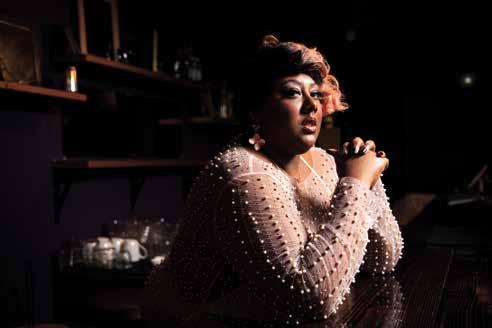
Mx. Pucks A’Plenty brings their burlesque talents to local venues as a performer, producer, and consultant, creating acts to share with Seattle audiences, and bringing new magic to the art. They are also the chair of the Seattle Burlesque and Cabaret Co-op, which will soon open a new venue in Ballard.
Introduction to burlesque
Pucks discovered burlesque almost 10 years ago, after having their son. While going through postpartum depression, they discovered the documentary A Wink and a Smile: The Art of Burlesque, in which they learned about the history of the art form and about a burlesque school in Seattle. They were then “bitten by the bug” — but not sure yet if they wanted to perform. They began going to a burlesque show as a treat every year for the next six years before eventually getting involved personally.
“I had the opportunity to produce a fundraiser” about five years ago, Pucks said. “We decided to do a cabaret show, and I met a bunch of Seattle burlesque performers [while] putting that show together. They encouraged
me to put together a little burlesque act for the fundraiser, and so I did.” Close to that time, they also had an opportunity to attend Miss Indigo Blue’s Academy of Burlesque, and they have been performing ever since.
Performing burlesque
Initially, Pucks was drawn to burlesque because it was a completely different world from their daily life. “You lose yourself as an individual sometimes when you have a child [and] suddenly you’re Mr. or Mrs. or
Mx. Somebody’s Mother,” they said. Burlesque was a break from parenthood, an opportunity to be in “the complete opposite world of the one I was currently living in.”
As they started performing and took the “Burlesque 101” course, they became more aware of burlesque’s political roots and who performs it. “Being Black, fat, Queer, nonbinary, disabled, all these different things, it’s very much so political statement [to be on stage],” they said, “because a lot of those lot of those identities, even by themselves, are discouraged from taking up space on stage.”
“Black, femme bodies especially aren’t particularly seen as graceful or elegant,” they added, “so it’s really fun to dive deep into blowing people’s expectations.”
Performing is one way that Pucks seeks to stand against oppression and express their creativity. When they perform, they said, “it’s the closest thing to magic I’ve ever felt.” They create acts for themselves and bring the energy that “you are lucky to see this thing that I’ve created for myself that I have decided to share with you” to a predominantly white audience, who they hope will stop to think about the space they take up and their privilege.
Arts & Entertainment
PUCKS continued from page 15
They say that supporting themselves through burlesque still feels like “a surreal thing.” The face of burlesque has long been thin, white women. They wonder, “Could the face of burlesque in Seattle look like a fat, Black, Queer, nonbinary femme with no formal dance education and no formal college education altogether, who has somehow figured out a way to support themselves? Is that a face that the arts community wants to see?”
Pucks noted that burlesque has often been swept to the side as a less recognized art form in Seattle’s scene. They said that Seattle was part of burlesque’s resurgence in the 1990, and that “before the pandemic, you could literally see burlesque in Seattle almost any night of the week.”
Pucks challenges everyone to go to a burlesque show. “I really believe there’s a burlesque show for everyone, [whether] nerd-lesque and classic and neo-burlesque and […] horror-lesque... there’s amazing legends in the making that live in our area. There’s a lot to be seen.”
Proud moments
Pucks performed at the Savannah Burlesque Festival in 2018 and 2019, and they were crowned Mx. Congeniality of the latter festival. In 2019, they founded What the Funk?!, the Pacific Northwest’s first all–people of color burlesque festival, which sold out all three nights.
Now, they are proud to be the chair of the Seattle Burlesque and Cabaret Co-op. The organization opens a new venue, the Give Inn, in Ballard this July.
“If you would have told me a year ago that me, as a Black, nonbinary, Queer per-
son with no college education [and a] single parent, that I was going to own a portion of a venue, I would have laughed,” they said. In light of the 12 other people working with them on the venue, they are proud of the support they have. “The way that society is throwing things at you, it makes you question so much about yourself. And so the fact that there are so many people in this community that have faith in the stuff that I do and they believe in it [is] pretty huge.”
Upcoming events
On July 11, the Give Inn’s first show will be the Bossa Nova Burlesque Brunch from noon to 2 p.m. Alongside Pucks, the performers will include Moscato Extatique, Miss Boozy Cheeks, Celia Lipshutz, Carmen Caliente, and Jacqueline Hyde. VIP tickets include a brunch pack from a Ballard bakery.
From August 19 to 21, What the Funk?!
A wonderful Tosca set in Seattle’s Rome
by Sharon Cumberland SGN Contributing Writer
SEATTLE OPERA
TOSCA BY GIACOMO PUCCINI STREAMING
JUNE 25-27, 2021
It’s every set designer’s dream to create the stage version of Puccini’s Tosca. All three acts take place in iconic Roman locations, beginning with the fabulous Sant’Andrea delle Valle church that appears in Act One. Built in 1650 and boasting one of the greatest domes in a city of domes, its baroque chapels and lavish ornaments rival those of the more famous St. Peter’s Basilica. Puccini chose this soaring space as the perfect frame for the passion and violence that tell the story of Tosca, an opera diva; and her artist lover, Cavaradossi, who are caught in the web of the evil police chief, Scarpia. As the drama moves from Sant’Andrea to the Palazzo Farnese in Act 2 and then to the prison of Castel Sant’Angelo in Act 3, the set designer gets to give the audience a mini-tour of Rome’s most iconic backdrops.
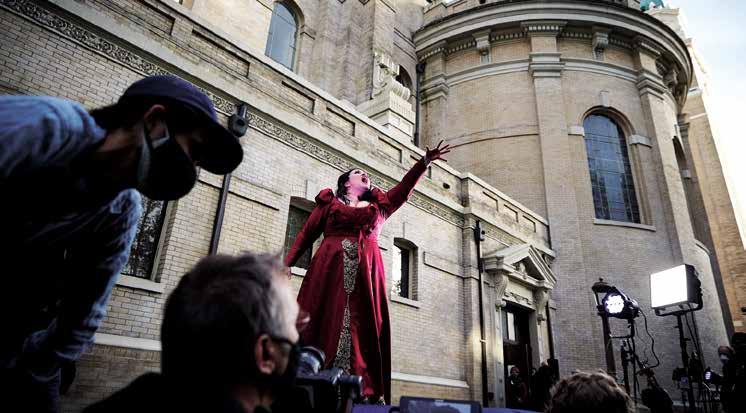
So how brilliant was it for General Director Christina Scheppelmann and her creative team to use a real cathedral for Seattle Opera’s streaming version of Tosca? Since audiences are still locked down (and out) of McCaw Hall until the upcoming season in October, it made wonderful sense to use the St. James Cathedral of on First Hill to act as the vaulted chapels of Sant’Andrea. Its gorgeous marble floors, alabaster arches, and beautiful icons offer rich interiors for both the church and the Palazzo, while its towering brick exterior creates an austere backdrop as Sant’Angelo’s prison and place of execution.
Many great choral and orchestral works have been produced in St. James Cathedral in the past, but a film with a full orchestra, chorus, and cast was too difficult to manage in a space needed for daily worship. So Conductor Kazem Abdullah guided Seattle Opera’s musical forces from McCaw Hall, with the orchestra on stage and the singers in the audience in individual booths, lip-synching with their film performances. What a challenge!
Abdullah did a wonderful job marrying the music with the images to make an intense, atmospheric, and nuanced whole. The chorus, in particular, sounded like an angel choir when their voices seeped quietly into the cathedral, swelling into a disembodied Te Deum while, in the film, baritone Michael Chiolde’s Scarpia rages in the foreground.
Even though the soloists were essentially alone as they performed in the cavernous arches of St. James, each singer — Alexandra Lobianco as Tosca, Dominick Chenes as the artist Cavaradossi, and Chi-
returns, this year at the Triple Door. The festival will feature Miss Briq House, Moscato Extatique, GiGi Holliday, Samson Night, Lola Coquette, Willy Nilly, Ava D’Jor, and Monday Blues. Pucks encourages everyone to attend What the Funk?!, saying that “there is something magical about Black and Brown joy, even if you are a non-POC person. There is something infectious about Black and Brown joy, and it’s healing, and honestly I challenge anyone to listen to funk music and not feel happy.”
See Mx. Pucks A’Plenty’s work at linktr. ee/Mx.PucksAPlenty. Buy tickets to What the Funk?! at tickets.thetripledoor.net/ eventperformances.asp?evt=1824 and tickets to Bossa Nova Burlesque Brunch at the-give-inn.ticketleap.com/bossa-novabrunch/.
olde as Scarpia — filled the space admirably with their powerful, nuanced voices. They were all in great form, despite the limitations of the filming, and the lack of an enthusiastic audience breathing, gasping, and applauding — signs that singers find inspiring in live performances.
The opening scene begins with bassbaritone Matthew Burns, a charming presence in his Seattle Opera debut as the Sacristan who lightens the tragedy with his comic meanderings. Another debutant in this production, Adam Lau, plays the rebel Angelotti, who triggers the tragedy with his haggard basso as he appeals to Cavaradossi for protection. Dominick Chenes’ dashing, intense Cavaradossi confidently navigates the complex opening scene — Angelotti’s politics, Tosca’s jealousy — all while painting a large (somewhat erotic) depiction of Mary Magdalene.
But it is Tosca, the diva of all divas, who drives the opera with her vocal pyrotechnics, her wild, over-the-top love for Cavaradossi, and her impassioned hatred for Scarpia. Alexandra LoBianco sings this killer role with all the grandeur and confidence required, especially in Tosca’s aria “Vissi d’Arte,” where she exposes her tender heart as one who lived for art and love and who “never did harm to a living soul.”
But this moment is atypical of the aggressive behavior that defines the character. Tosca is a full-on diva-dominatrix, meant to be played with a whip rather than a corsage. She’s the bossiest boss who was ever the boss — and LoBianco’s got the presence for it — but her acting performance is more flir-
tatious than controlling. I hope in the future LoBianco swaps her frilly fan for a riding crop. Without that mean streak in the title role, the drama lacks full support for the terrifying plot that follows.
One of the scenic devices that works beautifully in this production is an oldfashioned magic-lantern effect that suits the period as well as the setting. Director Dan Wallace Miller and production designer Christopher Mumaw use silhouettes projected onto the cathedral walls to simulate intimate actions that could not be staged during the pandemic. For instance, Act 1 ends with a Te Deum procession through the cathedral — a spectacular theatrical moment, usually staged with a full chorus and many supernumeraries. But since the chorus and actors couldn’t be gathered without violating social-distancing rules, the shadow-show effect uses a few individuals dressed as bishops, priests, and acolytes carrying the monstrance, crucifix, and censers in an endless circle projected onto the organ loft.
The effect is ghostly and ominous — as are later moments of intimacy and violence projected onto the cathedral walls in tints of green, gold and red. The inventive use of fixed properties, such as the baptismal font, the Mary Chapel, and the cathedral pews, is equally compelling. I’m so glad that the permanence of film — while lacking the immediacy of live performance — has preserved this imaginative staging.
Applause all around for a terrific production of Tosca, but also for the additional material provided on Seattle Opera’s web -
site. A fascinating discussion, “View from the Pit: Maestros on Race and Gender in Opera,” brings to light the problems for non-white, non-male conductors who struggle with limited expectations and opportunities. Kazem Abdullah, Judith Yan, and Viswa Subbaraman speak candidly on a topic that everyone knows about but that few discuss with the audiences who admire opera and orchestral music.
Likewise, the contextual material provided by dramaturg Jon Dean, as well as the chatty video talk between Seattle Opera scholar-in-residence Naomi André and Alexandra LoBianco, was informative and charming. These extras are an opera-lover’s delight and add a great deal to the audience’s ability to deepen their understanding of a complex and fascinating art.
One final note: Seeing Tosca performed in St. James Cathedral triggered a personal memory for me, and possibly for many of us who remember the Speight Jenkins era at Seattle Opera, and the long service of his education director, Perry Lorenzo, whose early death at age 51 and whose burial at the cathedral in 2009 came as a heartbreaking shock to us all. He was a tireless and enthusiastic promoter of opera to the young, the old, and everyone in between. How pleased he would have been — and is, for those of us who believe in the unseen world — to see this beautiful production of Tosca performed in the cathedral that he loved.
Seattle Opera will open McCaw Hall for the 2021–22 season on October 16, 2021, for another Puccini favorite, La Bohème, featuring a young, brilliant, multiracial cast.
Alexandra LoBianco on the set of Seattle Opera’s Tosca – Photo by Philip Newton
Books
Mercer Street Books: Queer as heck
by Lindsey Anderson SGN Contributing Writer
Just a few blocks from the shores of beautiful Lake Union sits another Seattle beauty: Mercer Street Books.
It is owned and managed by Jessica Hurst, a book lover who is trying to preserve the legacy of the store’s original owner, Debbie Sarow, who ran the store while also fighting a battle against cancer. “Debbie was a fantastic person with an artistic eye and a very specific idea of what she wanted for her bookstore. I’ve been doing my best to do justice to her original vision, although there are inevitable changes. She was truly irreplaceable,” said Hurst, who took over as manager three years ago and officially as owner in 2020.
Hurst truly has the spirit of a librarian, keeping all the books neatly in order. “There’s a place for everything and everything is in its place,” Hurst said of the store, which she describes as warm and welcoming yet formal.
Much of the charm of Mercer Street Books comes from its clever décor. Plants line the big window, which Hurst informed me stays open all summer to let in natural sunlight. An antique library card catalogue sits at the front, with old curiosities hidden in the drawers. “It almost feels more like a library than a bookshop,” jokes Hurst.
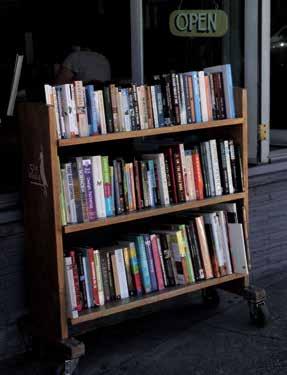
And there’s a little something for everyone on the neat shelves. There’s even a special cart out front stocked with books selling for fifty cents. “I call that the last good deal in Seattle,” Hurst said.
The store’s patrons come in all varieties, from those en route to catch an opera or ballet at nearby Seattle Center to local merchants and tourists.
Running a used-book store can be a challenge. “[It] assumes that people will come in and take their time, browse, explore,” said Hurst. “It assumes they’ll want to exchange books with their neighbors and intertwine their lives through this anonymous medium.”
Reflected on the ways community is integral to the store’s climate and success, she added, “A used-book store doesn’t get its books from a publisher the way a new-book store does but instead buys them from the same customers that are shopping there. The stock is a collaboration between the shop owner and the clientele, and so human
relationships are paramount. Isolation is not an option.”
Despite the challenges that come with running a used-book store, there are also many fun surprises. “New-book stores are wonderful, but you won’t find Leslie Feinberg’s Stone Butch Blues in one since it went out of print,” Hurst said. The appeal and fun of the used-book store is in the search for the hidden gems, the eclectic titles that can only be found in the treasure chests that are Seattle’s used-book stores.
Some of these gems include many titles in the romance section, which have been flying off the shelves. Hurst credits the newfound popularity of romance novels to the uproariously red-hot Bridgerton on Netflix, which premiered during the pandemic. Hurst says she would be over the
moon to add some Queer romance stories.
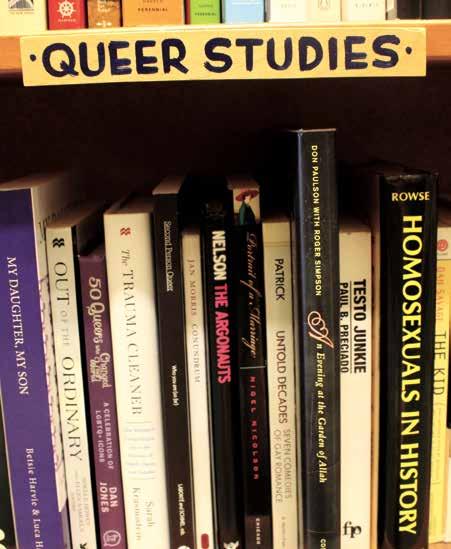
While Queer stories are featured on most shelves, Hurst also stocks an LGBTQ section she refers to as “small but mighty.”
This section has been very important to readers and workers at the store for many years. “Queerness has always been a part of Mercer Street,” Hurst explained. “Red Reddick, an elder in both Seattle’s LGBTQ+ community and its bookstore community, helped Debbie start the store in 2009. She only retired after Debbie’s passing. Red is a passionate activist and ensured that the store stocked books not just for the queer community but all potentially underrepresented communities.”
Mercer Street Books continues to be, as Hurst puts it, “understatedly queer as heck.”
While it isn’t a Queer book store per se, it is
entirely run by LGBTQ folks. “I identify as bisexual, with no gender preference, and my sole employee, Gina, identifies simply as queer, with no gender preference.”
So, if you’re looking to beat the heat this summer with a good novel, stop by, grab a fifty-cent bargain book, or check out the LGBTQ section! The store would also be very interested in purchasing any used books you may have.
Mercer Street Books is a treasure trove of unique finds — and it’s air conditioned, a perfect respite from these hot summer days!
Mercer Street books is located 7 Mercer St., just west of Seattle Center, and online at www.mercerstreetusedbooks.com.
by Terri Schlichenmeyer Special to the SGN
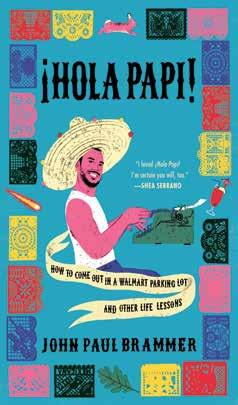
¡HOLA PAPI! HOW TO COME OUT IN A WALMART PARKING LOT AND OTHER LIFE LESSONS JOHN PAUL BRAMMER
You need advice and your best friend offers an answer, though it might not be the one you seek. You may get sound counsel but at the wrong time, or sentiments directly opposing what you were thinking. And yet, you have to be grateful. As in the new memoir ¡Hola Papi! by John Paul Brammer, the words come from the heart.
Growing up in the small Oklahoma town of Cache, Brammer knew nothing about being Gay. He had little relationship experience, in fact, and he didn’t learn about hookup apps until he was a junior in college. Once he found those apps, though, he was “instantly hooked.”
Much to his amusement, “some white guy” said “Hola papi” in greeting on an app
one day and Brammer, “a mixed-race Mexican American with noodle arms” never forgot it — because hey, wouldn’t that be a great name for an advice column?
He pitched it, landed a gig in conjunction with Grindr, and it was a landslide hit with users, even though Brammer felt like an imposter sometimes. Was he really qualified to do this? he wondered. Then he remembered what he’d want if he needed advice...
You know this: Dear Emmy and Dear Posey can always be relied upon to feature some poor schlub with drama worse than yours. You know they’ll offer snappy, sometimes snarky, maybe dismissive advice. But that’s not as applicable to what’s in ¡Hola Papi!
Agony Aunties don’t normally insert themselves into their answers quite like Brammer does. Nope, he makes his advice into a memoir that resonates. Each minichapter here begins with a question, followed by what feels like a personal answer written specifically to the forlorn, rather than to the world — in a story, really, but one that’s relatable. It’s fun to read, but more importantly, it wraps advice-seekers (and not just the writer!) in a comfortable
tale that might make them laugh but definitely makes them feel not alone.
When asked what one can do to let go of past hurts, Brammer answers with a tale of his middle-school years, of bullying, inadequacies, and teen angst, and of coming out, growing up, and not being defined by the worst of the past.
In other essays, he writes of puppy love with a girl when he was kinda sure he was attracted to boys, and how the experience wasn’t a waste. He remembers co-workers at a nearby taco stand who taught him to speak Spanish, to belong, and that lo siento isn’t always necessary. He tells readers about releasing the love he thought was “the one,” about the oh-so-awkward night a childhood bully approached him on a dating app, and how to let go of a dream, and a nightmare situation.
Another nice thing: this book is by a Gay man, but the advice he offers is for anyone, of any age. If you can remember that there are some eyebrow-raisers amid the laughs and sighs of ¡Hola Papi!, I’m sure you’ll have a high opinion of it.
Photos by Lindsey Anderson
Op-Ed
The United Gays of America
by Lindsey Anderson SGN Contributing Writer
In a country that protects free speech then seeks to ban critical race and ethnic studies, many Americans are starting to wonder just how accurate our history books have been. One in six Gen Z adults identify somewhere along the LGBTQ+ spectrum, compared to generations where it seemed Queer people didn’t exist at all.
The question remains: Is the water really making the frogs Gay, or have they been Gay all along? Most well-educated people would agree with the latter statement, that is to say, Queer people have always been a part of American history, but in past eras, they were never given the freedom to be out and proud of who they were and who they loved. When we look more closely at the lives of many American heroes, though, it becomes clear they were not as straight as the history books have led us to believe.
Founding Fathers
Is it really much of a surprise that men and women who believed in freedom and liberation would believe in freedom from oppressive gender regimes and expectations? No, they didn’t give women the right to vote, but maybe that’s because some of these men just really loved men?
So, let’s start with Alexander Hamilton.
The inspiration for modern Broadway hiphop culture may have actually been Bisexual. Historians have discovered love letters between Hamilton and another founding father, John Laurens, from their times at war. Laurens’s father, Henry, had written letters to friends when his son was young, worried that the boy might never find attraction to women. While Laurens did marry, it was a loveless union. There are few records of Laurens’s correspondence with his wife during his time at war, but he exchanged a myriad with Hamilton. In these letters, words of pure adoration were expressed: “I wish, dear Laruens, it might be in my power, by action rather than words, to convince you that I love you,” Hamilton wrote. Sadly, these star-crossed maybelovers were lost to history after both suffered young and untimely deaths.
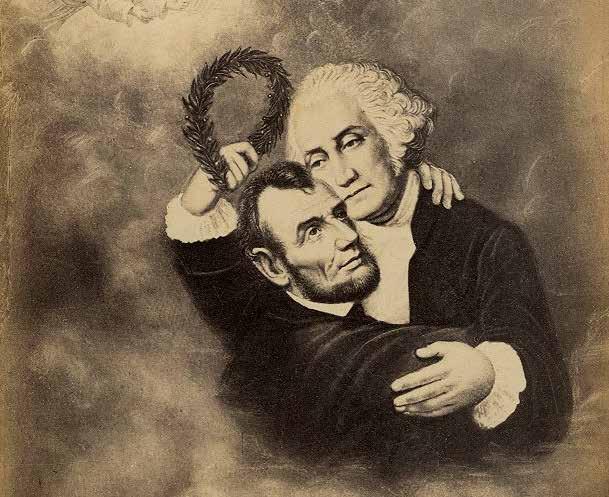
The founder of America, our hero, George Washington, may have also been a little fruity (although isn’t everybody, really?). Washington was a part of the Freemasons, an organization that encouraged sexual freedom and exploration. In fact, many Freemasons would use wooden spikes for pegging (thank God for the invention of silicone! Poor George!). While it can only be speculated that George enjoyed the use of a good wooden musket, we do know he was at least an ally, encouraging his righthand man, Alexander Hamilton, to share a bunk with John Laurens while at camp.
The next generation of patriots
John Adams, second president of the United States, proud Bostonian and star of his own PBS miniseries, was also a massive homophobe — and father to at least one member of the alphabet mafia.
Charles Adams, the black sheep of the presidential family, disappointed his father in many ways. A troubled child at Harvard who was sent home early from the family vacation to France, Charles finally found himself after gaining employment in the law office of America’s favorite Bisexual, Alexander Hamilton. It was here Charles met John W. Mulligan, son of famed revolutionary Hercules Mulligan. John and Charles became close under the tutelage of Hamilton, and after a few years, the two became “roommates,” much to the dismay of John Adams, who was a staunch homophobe. He was quite literally afraid of homosexuality: he saw it as a sign of moral decay, and was appalled at his son’s love.
Charles attempted to realign himself on the straight and narrow by marrying but later abandoned his wife and children under mysterious circumstances (which might have been the nickname he gave John Mulligan), leading his father to disown him, never to speak to or visit Charles again.
Queers in the White House
While on the campaign trail in 2020, Pete Buttigieg was asked how he would feel being the first Gay president of the United States. “I’m almost certain we’ve already had a Gay president,” he responded.
James Buchanan, the “bachelor president,” was very likely America’s first Gay commander in chief. He never took a wife, but he did live intimately with another man, Sen. William Rufus King (for whom King County was originally named) while both served in the US Senate. Buchanan and King shared a very close friendship, which many historians believe to have been something more. While, suspiciously, few letters survive from Buchanan to King, King’s letters to Buchanan were all kept by the former president, one of which expressed deep lonesomeness upon Buchanan’s trip abroad.
After Buchanan, Abraham Lincoln was sworn into office. The sixteenth president was likely Bisexual, but like so many other Bisexuals, this part of Lincoln’s life was overlooked due to the fact that he married a woman.
While most famous for the Emancipation Proclamation and a subpar experience with local theater, Lincoln also invented the “only one bed” trope. He is said to have had a love affair with Joshua Speed while they were living in Springfield, Illinois. The two shared a bed for four years before Speed left to marry a woman.
While many presidents are known to have affairs with younger women while in office (ahem, Bill Clinton), Lincoln’s presumed presidential affair was with his younger male bodyguard, David V. Derickson. Lincoln and Derickson would share a bed when traveling, and records even show Derickson wearing one of Lincoln’s shirts to bed!
The White House has also been home to Queer women. While many believe Buchanan to be the country’s unofficial first Gay president and Lincoln to be the unofficial first Bi president, Eleanor Roosevelt is widely considered to have loved women. Early on in her marriage to Franklin D. Roosevelt, she discovered love letters between FDR and her secretary and close friend, Lucy Mercer. Shortly after this romantic betrayal, karma caught Franklin, and he found himself paralyzed after a fight with polio.
While many, including his own mother, saw a revival of Franklin’s political career just as likely as his chances at winning a gold medal in the hurdles, Eleanor still believed in him and pushed him, physically and mentally, to pursue his dreams. Their marriage became more of a political partnership. After his election, Eleanor took on most of the travel duties of the president and held
her own press conferences specifically for female journalists. And when Franklin became incapacitated for several days, it was Eleanor who fulfilled the duties of president while also physically caring for her ailing husband.
Eleanor was an incredible First Lady with an incredible love story — but not the one you might think. In 1932 she met reporter Lorena Hickock, an openly Gay woman whom Eleanor affectionately referred to as “Hick.” Hick and Eleanor exchanged more than 3,300 letters, they spent holidays together, and Eleanor even invited Hick to live in the White House with her, an offer her husband was surprisingly cool with.
In 1933 Eleanor wrote to Hick, “I wish I could lie down beside you and take you in my arms,” to which Hick responded, “Funny how even the dearest face will fade away in time. Most clearly I remember your eyes, with a kind of teasing smile in them and that feeling of that soft spot, just north-east of the corner of your mouth against my lips.”
While these are just a few samples of some of the great Queer love stories in American history, there were thousands more who were unable to be with the ones they loved, Americans who had to hide who they were or pretend to be someone else. As we celebrate the Fourth of July, it is important to remember that freedom includes the freedom to love and exist just as we are. Queer people have been changing the world and running the show since the very beginning, even if American history books try to erase their existence.
The Apotheosis of Abraham Lincoln, greeted by George Washington in heaven, who is holding a laurel wreath (an 1860s work, post-assassination)
National & International News
school board later adopted a policy saying restrooms were “limited to the corresponding biological genders.”
Grimm went to court, relying on Obama-era policy stating that the Title IX protections against discrimination on the basis of sex applied to gender identity.
Grimm and his ACLU attorneys won a series of court victories, until the Trump administration reversed the previous rules and informed schools they need not protect Transgender students.
Grimm then refiled his lawsuit and again won a series of court victories, with the school board finally asking for review by the Supreme Court.
“For school officials, as for parents, the question how best to respond to a teenager who identifies with the opposite biological sex is often excruciatingly difficult,” lawyers for the school district told the Supreme Court.
But the “privacy rights” of students are at risk if their Transgender classmates are allowed to use bathrooms matching their gender identities, they claimed.
Lawyers from the American Civil Liberties Union, representing Grimm, told the court that treating him differently by requiring him to use separate single-stall bathrooms singled him out “and stigmatized him as unfit to use the same restroom as his peers.”
For Grimm, long out of high school, the high court’s decision not to review the case came as a welcome victory.
“Being forced to use the nurse’s room, a private bathroom, and the girl’s room was
Pope sends letter praising pro-LGBTQ Jesuit
by Mike Andrew SGN Staff Writer
Pope Francis sent a letter praising the work of Fr. James Martin, a Jesuit priest noted for outspoken support for LGBTQ Catholics.
“Thinking about your pastoral work, I see that you are continually seeking to imitate this style of God,” the Pope wrote.
The Pope was a member of the Jesuit order before his election to the papacy. He previously appointed Martin, editor of the Jesuit magazine America, as a consultant to the Vatican’s Secretariat for Communications, the Vatican press office.
Fr. Martin has been a target of antiLGBTQ Catholic conservatives, many of them gathering to picket his public appearances.
Martin has also been at odds with the conservative-leaning US Conference of Catholic Bishops (USCCB), a group that recently defied the Pope by voting to move ahead with a plan to deny Holy Communion to US politicians like Pres. Joe Biden, who support reproductive choice and marriage equality.
In 2019, Martin wrote in a tweet that denying Communion to politicians was a “bad idea” because in this case, one “must also deny it to those who support the death penalty” — in other words, almost all Republican Catholics.
Martin has had friendly relations with more liberal-minded US prelates, however, like Cardinal Joseph Tobin of Newark, who is also an ally of Pope Francis.
The Pope’s hand-written letter, dated June 21, was a response to an announcement by Martin’s Outreach LGBTQ Ministry Conference, hosted by Fordham University on Pride weekend.
humiliating for me, and having to go to outof-the-way bathrooms severely interfered with my education,” he said.
“Trans youth deserve to use the bathroom in peace without being humiliated and stigmatized by their own school boards and elected officials.”
By allowing lower court rulings in Grimm’s favor to stand, the high court has effectively ruled that Trans students may use facilities that correspond to their gender identities, and that their rights should be upheld by US federal courts.
The only downside in this case is that the court did not make an affirmative ruling, which means that future White House administrations do not have a legal mandate to enforce the rights of Trans students, and could reinstitute anti-Trans policies.
National news highlights
by Daniel Lindsley SGN Contributing Writer
“Pope Francis has sent a beautiful letter on the occasion of the Outreach LGBTQ Catholic Ministry Webinar, which happened yesterday, expressing his support for this ministry and encouraging us to imitate God’s ‘style’ of closeness, compassion, and tenderness,” Martin said on his twitter account.
“Initially I thought to share only the sections of the letter intended for yesterday’s conference, but I thought people might
wonder what was in the rest of the letter, so I am sharing the entire message, including the personal greetings at the beginning…”
“I was moved to receive his letter on the Feast of St. Aloysius Gonzaga, a Jesuit saint,” Martin continued, “and am happy to share it on the Feast of Our Lady of Perpetual Help. May St. Aloysius and Our Lady pray for all LGBTQ Catholics, their families, and all who minister to them in the church…”
International news highlights
Olympics:
First Trans athlete chosen
CNN reported June 21 on Laurel Hubbard, who is locked in to become the world’s first Transgender athlete chosen to compete at the Olympic Games. Hubbard was selected for New Zealand’s national weightlifting team, and will be competing in the women’s 87 kg team. Hubbard said she was “grateful and humbled” by the support of many of her fellow New Zealanders, especially in light of the arm injury she sustained in 2018.
Japan:
Soccer player comes out as Trans Reuters reported on June 22 that Japan’s Kumi Yokoyama, a player in the National Women’s Soccer League for Washington Spirit, has come out as Trans. Yokoyama said living in the United States and Germany showed them a greater acceptance of LGBTQ people, which influenced their coming out. They plan to go through gender-affirming procedures after retirement.
NFL: First out Gay player
The Philadelphia Gay News reported on June 25 that West Chester’s Carl Nassib came out as gay this week, making him the first openly Gay player in the NFL. Nassib made the announcement through a video posted on Instagram, which, the PGN noted, sidestepped the media onslaught of a press conference or other such fanfare. Responses to the news have been largely positive. Nassib’s jersey has become a top seller, and the NFL matched Nassib’s $100,000 donation to the Trevor Project, a suicide prevention program for LGBT youth.
Virginia:
Ruckus over pronouns
NBC News reported June 23 on a disruption at a Virginia school board meeting on a policy that would require school staff to address students by their preferred pronouns. Public comment was closed after a number of crowd members began chanting, holding signs like “Education not indoctrination” and “We the parents stand up.” One man refused to leave and was arrested, and one person was injured. School board chair Brenda Sheridan said in response, “Dog-whistle politics will not delay our work. We will not back down from fighting for the rights of our students and continuing our focus on equity.”
by Daniel Lindsley SGN Contributing Writer
EU:
Reaction to Hungary’s anti-LGBT laws
Reuters reported June 25 on the EU’s response to Hungarian Prime Minister Viktor Orban’s string of anti-LGBT laws. Several EU leaders have condemned Orban’s policies in a summit, with Dutch Prime Minister Mark Rutte demanding Hungary either respect LGBT rights or leave the EU entirely. The demand is backed by the EU’s highest court, in which Hungary may face a legal challenge that could cut EU funding to the country.
Pope Francis – Photo courtesy of Vatican Media
Photo courtesy of Carl Nassib / Instagram
Kumi Yokoyama – Photo by Gonzalo Fuentes / Reuters