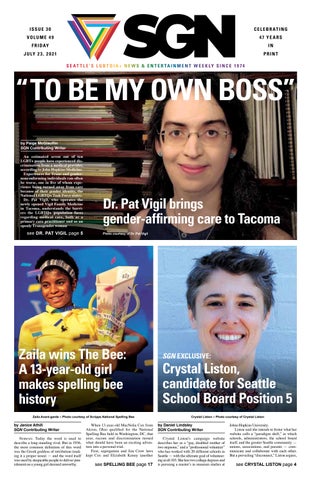
An estimated seven out of ten LGBT+ people have experienced discrimination from a medical provider, according to John Hopkins Medicine. Experiences for Trans and gendernonconforming individuals can often be worse, one in five of whom experience being turned away from care because of their gender identity, the National LGBTQ+ Task Force states.
Dr. Pat Vigil, who operates the newly opened Vigil Family Medicine in Tacoma, understands the barriers the LGBTQ+ population faces regarding medical care, both as a primary care practitioner and as an openly Transgender woman
see DR. PAT VIGIL page 5
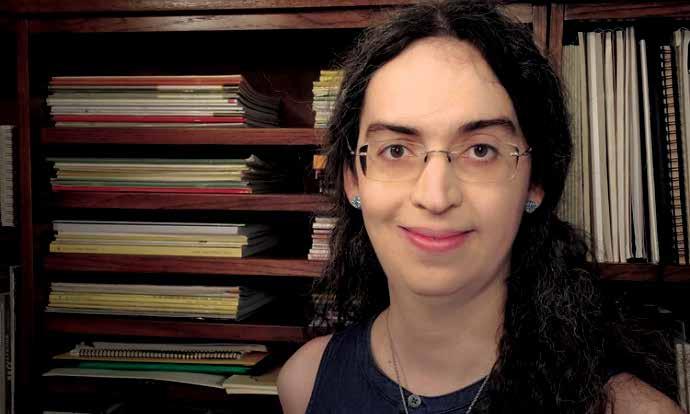
Dr. Pat Vigil brings gender-affirming care to Tacoma
by Janice Athill
SGN Contributing Writer
Nemesis. Today the word is used to describe a long-standing rival. But in 1936, the most common definition of this word was the Greek goddess of retribution (making it a proper noun) — and the word itself was used by despicable people to deliver punishment on a young girl deemed unworthy.
When 13-year-old MacNolia Cox from Akron, Ohio qualified for the National Spelling Bee held in Washington, DC, that year, racism and discrimination turned what should have been an exciting adventure into a personal trial.
First, segregation and Jim Crow laws kept Cox and Elizabeth Kenny (another
by Daniel Lindsley
SGN Contributing Writer
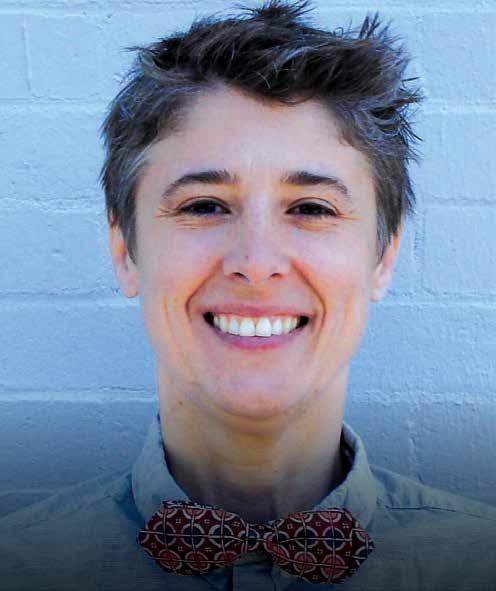
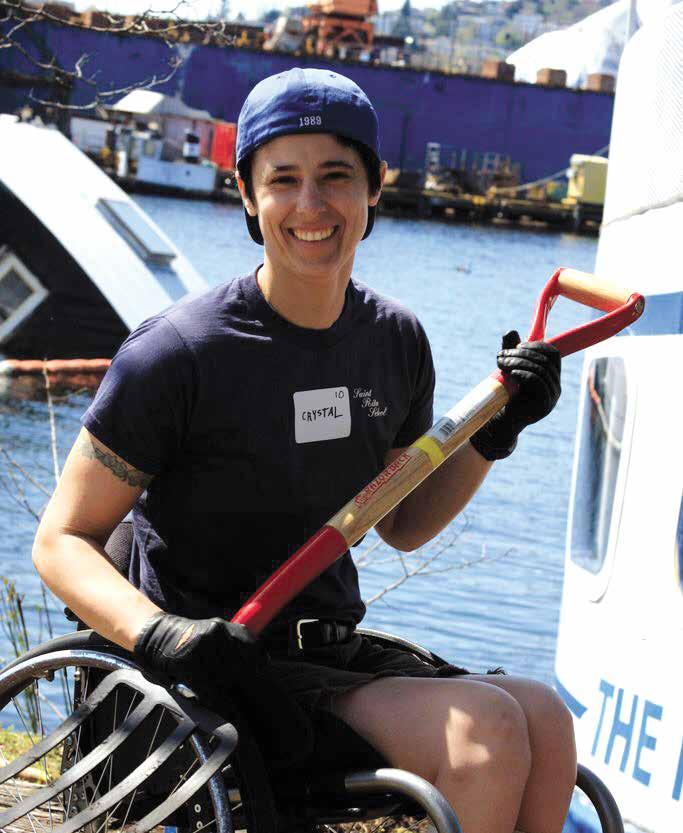
Crystal Liston’s campaign website describes her as a “gay, disabled mother of two stepsons,” and a “professional volunteer” who has worked with 20 different schools in Seattle — with the ultimate goal of volunteering at all 103. She has two college degrees and is pursuing a master’s in museum studies at
Johns Hopkins University. Liston said she intends to foster what her website calls a “paradigm shift,” in which schools, administrators, the school board itself, and the greater Seattle community — unions, associations, and parents — communicate and collaborate with each other. But a prevailing “disconnect,” Liston argues,
Zaila Avant-garde – Photo courtesy of Scripps National Spelling Bee
Crystal Liston – Photo courtesy of Crystal Liston
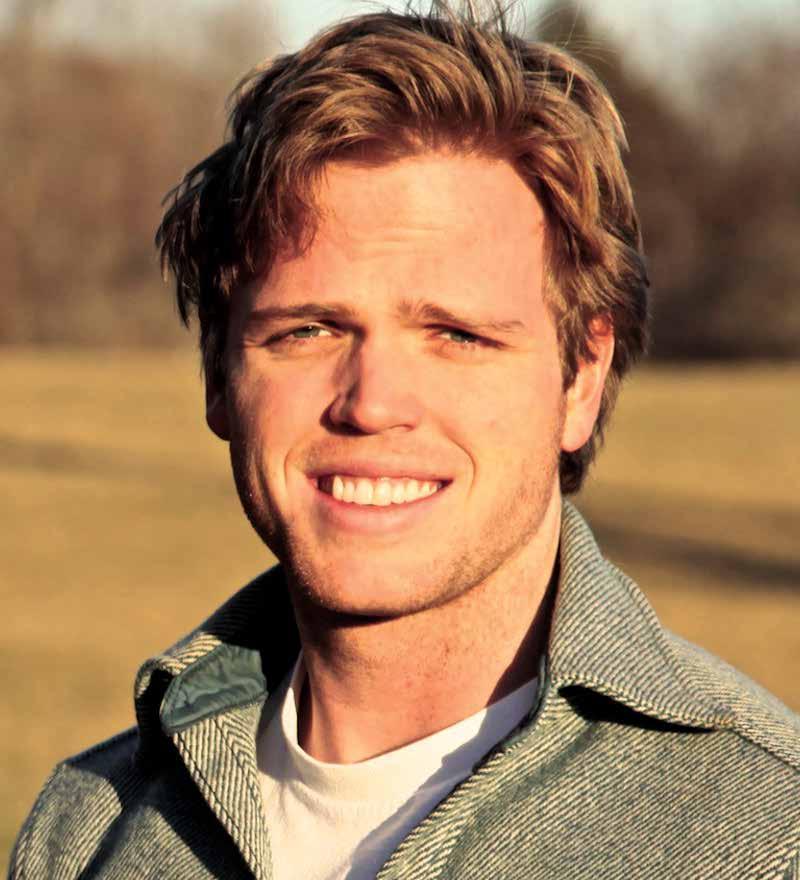
Photo courtesy of Dr. Pat Vigil
Local News
CRYSTAL LISTON
continued from cover
stands in the way of that. And it shows up during her volunteering in a few ways.
One is school rivalry. As Liston said in an interview with the SGN, “The parents, the faculty, and the staff feel like they’re pitted against each other for resources... which is really gross, in my mind. You know, one school is upset because they don’t have enough funding for a librarian. And they’re jealous that the school at the other end of town is getting a bunch of money. But that money is going to feed [the latter school’s] students, because they’re in a food desert.”
The disconnect also manifests in all the unmet and unheard requests, which create feelings and real instances of neglect.
“When I go to volunteer... I continuously hear from teachers [and other parents who volunteer], ‘I’ve never met a school board member. I don’t even know what they do....’ What’s happening there?”
Liston noted that time is a factor. “I don’t think it’s malice.... Most board members have a nine-to-five job. It’s an unpaid position. But schools are feeling neglected and unacknowledged.” Liston said it was a matter of priority, too.
“When people really wanna get something done,” she said, “they get it done.”
Liston admitted that solving systemic problems takes more than one person’s knowledge and efforts; she didn’t claim to have all the answers. She did, however, reiterate her promise to take an on-site approach to being a school board member.
“What I’m offering the community is... a board member that has been and will continue to ‘go in,’ and provide service that’s
“What I’m offering the community is... a board member that has been and will continue to ‘go in,’ and provide service that’s requested... [who] comes in and says, ‘I’m on the board. Give me your wish list!’
requested... [who] comes in and says, ‘I’m on the board. Give me your wish list!’” That acknowledgement and “recon” work, Liston argued, would be a step toward remedying the neglect, and the disconnect between schools and school board by extension.
As for connections between schools, Liston noted the reactions of awe and surprise when she volunteered at schools her stepsons didn’t attend. “Maybe people just need permission [to do that]” — to volunteer, attend interschool events, and the like.
Liston also showed an awareness of issues of racial inequity, which she called a “top issue” when asked. On this front, she expressed a policy of “leading by following,” knowing that BIPOC communities know what they need. “The fact that the district is having a conversation around race and equity is ‘doing it right...’ Talking about it starts the process. That can start the healing, and that can start the momentum for getting it done.”
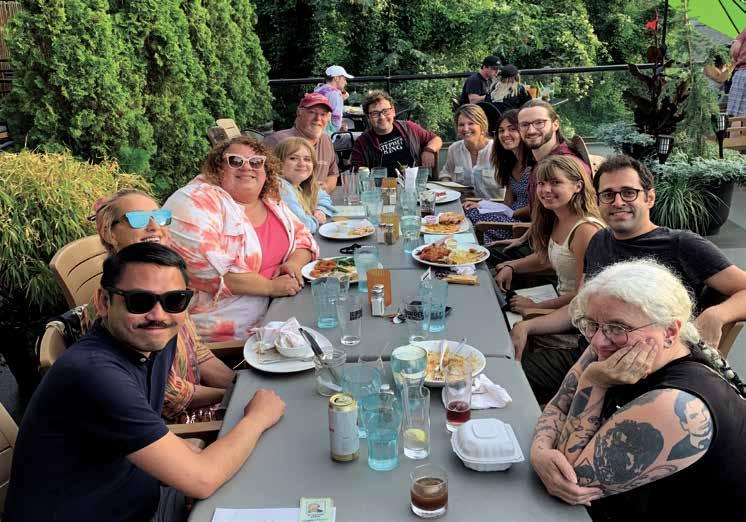
Liston volunteering in the community – Photo courtesy of Crystal Liston
“I saw what I would call the good, the bad, and the ugly of gender-affirming care,” Dr. Vigil said in conversation with the SGN
“Over the years, I saw everything from the older standards when I was working as a medical student all the way to much more modern, informed-consent models. So I’ve had the chance both professionally and personally to experience a little piece of that.”
Dr. Vigil, born and raised in Albuquerque, NM, received her MD and PhD in immunology and microbiology from the University of Michigan’s Medical School in Ann Arbor. While working in a lab studying urinary tract infections, she became fascinated with the clinical side of her studies. As she began her clinical rotations, she fell in love with primary care and ultimately focused on that as she completed her residency at the Central Washington Family Medicine Residency Program in Yakima.
“I thought that this was really where my heart was. It was about people, about connections, and about being able to apply that knowledge in a way that actually impacted people’s lives and made them feel better. It made them healthier,” Dr. Vigil said.
Dissatisfied with the treatment she and other LGBTQ+ people face in medical care, Dr. Vigil saw an opportunity when opening her own practice. From the beginning, she built inclusivity into her practice’s foundation.
“When I left my last job after a whole series of these sorts of episodes, I thought, ‘I have an opportunity to try to do something different,’ and that’s what led me to opening my own practice,” she said. “I tried to change it from the inside, and that obviously didn’t work. The only way really to change this was to be my own boss, to have my own practice. That eventually is what led me down the route to where I am now.”
Dr. Vigil has found she’s not alone, often reading stories of bad experiences shared in patient intake inquiries. In Tacoma, a city where the option for affirmative care might be more limited than Seattle, patients could also find an LGBTQ+-friendly doctor but still experience exclusionary behavior from other workers they might interact with, starting with the receptionist.
Dissatisfied with the treatment she and other LGBTQ+ people face in medical care, Dr. Vigil saw an opportunity when opening her own practice. From the beginning, she built inclusivity into her practice’s foundation.
“There’s a handful of options, but most of them come with a caveat of getting past the front office staff, or the nurse, or somebody else. If you get to this person, it’ll be fine. But it’s always getting to that person,” Dr. Vigil said.
As part of addressing this, Dr. Vigil is currently the only person working in her own practice, though she said she may hire someone to help with administrative work in the future. “I believe very strongly that a good primary care relationship is between you and your doctor and as few intermediaries as possible.”
In addition to focusing on LGBTQ+ inclusion, Dr. Vigil has also implemented ADA accessibility and healthcare inclusion. For the former, she’s added an ADAcompliant gender-neutral bathroom in her practice’s suite and accommodating exam tables and equipment. For the latter, Dr. Vigil opts for her practice to not accept insurance, operating on a direct primary care model instead.
Instead of requiring insurance and paying a copay after each visit, patients can pay a flat-rate fee based on their age group. Patients under 18 pay $35 per month, ages 18 through 64 pay $75 per month, and patients aged 65 and older pay $100 per month.
“It’s kind of like a gym membership,” Dr. Vigil said. The option allows those without insurance to seek primary care. Should someone need to use insurance for lab tests or medications, Dr. Vigil does offer that, but she also has contracted with a lab with lower pricing options to eliminate that need as much as possible.
“It eliminates a lot of the gatekeeping,” she said.
Patients interested in seeking care from Dr. Vigil can find an intake and other relevant information on her website (vigilmd. com). Visitors to her website will find paintings of snow leopards there, artwork that Dr. Vigil made herself and seeks to incorporate into her practice.
“I enjoy ink painting and interacting with artistically inclined people in my practice, as it keeps me grounded and in touch with a side of people that is often ignored in medicine,” Dr. Vigil told the SGN. “The ability of art of all forms to help heal is something I try to honor and encourage in my practice.”
Photos courtesy of Dr. Pat Vigil
DR. PAT VIGIL
Books Madison Books: Tiny but mighty
by Lindsey Anderson SGN Contributing Writer
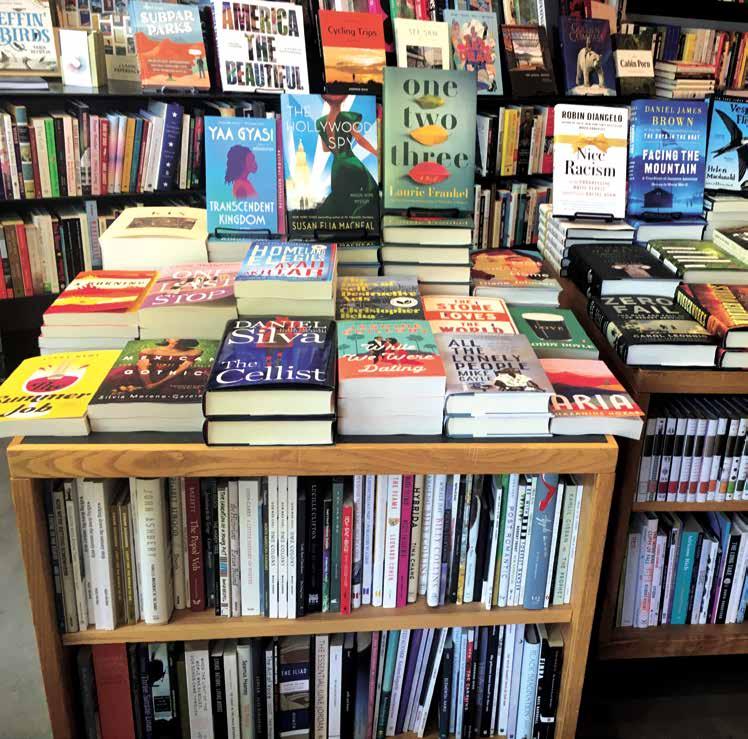
In a beautiful neighborhood with sprawling ivy, just a hop, skip, and a jump away from the waters of the Puget Sound, sits Madison Books. A self-described “micro bookstore,” it’s packed full of tidy rows of amazing texts and novels, from floor to ceiling.
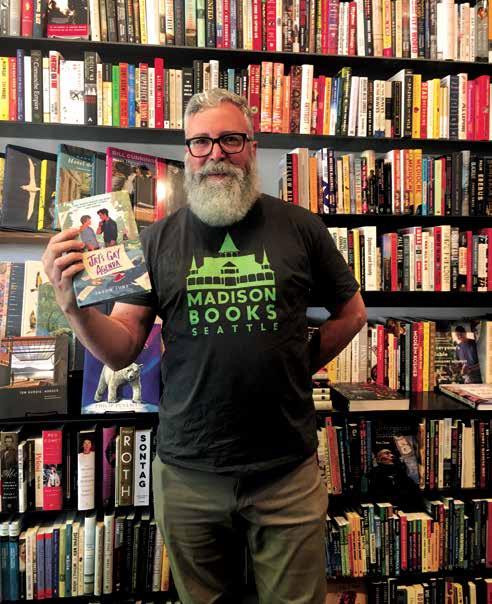
“We don’t have a lot of room here, so we don’t feature stuffed animals and toys and socks like other bookstores sell,” said James Crossley, who has been the general manager since the store first opened its doors a little over two years ago. “As you can see, we are very small, in terms of square footage, but we pack a lot in. We’re actually kind of a medium sized store stacked into a small one.”
“The shelves are neatly organized,” he added, “a satisfying sight for those who find moments of calm in a neat and organized environment.”
While it’s faced many challenges, having opened only a few months before a global pandemic, it’s now back and better than ever and ready to offer members of the community “an inviting atmosphere, and it’s silly to say, but it’s a bookish one,” as Crossley said. The book lovers who stock the shelves every day also contribute to the specialness of the place.
From shelves to table displays, Madison Books makes good use of its small square footage, and customers seem to find exactly what they are looking for each time they step foot in the charming little store. “We cater to the people in the neighborhood… It’s a place for readers of all types.”
According to Crossley, some of the most popular titles are creative novels from overseas, like an Irish prose memoir, A Ghost in the Throat, which combines breathtaking poetry with Irish history and culture. Another top seller and a personal favorite of Crossley is The Summer Book, a Swedish novel about a young girl and her grandmother spending the summer together on a small island.
While Madison Books doesn’t have a separate shelf for LGBTQ tomes, the store features books by LGBTQ writers on nearly all the shelves, even the children’s section! “In June, Pride Month, we featured [LGBTQ] writers in our front window, and I have to say I am very pleasantly surprised that we had a very good response. People bought out of the window, frequently,” Crossley told me.
The success of the window display was so significant that the store ended up ordering even more copies of some of its best Pride sellers, including Jay’s Gay Agenda, a young adult novel; Loving, a photo collection of LGBTQ love; and The Art of Drag, a nonfiction collection of stories and photography detailing the colorful history of drag in the United States. While Pride Month has officially come to an end, Crossley is still watching these books fly off the shelves.
The increasing LGBTQ sales at the bookstore brings Crossley a familiar feeling. “I used to work, many years ago, at Bailey Coy Books, and a little of that legacy can be found right here,” Crossley said, referring to one of Seattle most beloved LGBTQ bookstores, a place where all kinds of readers were welcome. “I want everyone’s voices to be here,” he said with a gleam in his eyes.
Madison Books stands as a small store with a mighty legacy, continuing to bring its Seattle neighborhood clever and worldly texts, and bringing in some of the welcoming spirit of its predecessors, like Bailey Coy. “We are an inviting place, to everyone,” Crossley said. With a welcoming store manager, a delightful window display, and books piled high, it certainly has something for all readers.
The increasing LGBTQ sales at the bookstore brings Crossley a familiar feeling.
“I used to work, many years ago, at Bailey Coy Books, and a little of that legacy can be found right here,” Crossley said, referring to one of Seattle most beloved LGBTQ bookstores, a place where all kinds of readers were welcome. “I want everyone’s voices to be here,” he said with a gleam in his eyes.
Madison Books is located at 4118 E. Madison St. or online at www.madisonbks. com.
Photos by Lindsey Anderson
Film Sparse Settlers is a thrilling sci-fi journey into the unknown
by Sara Michelle Fetters
SGN Staff Writer
SETTLERS
Theaters / PVOD
In a remote corner of Mars, colonists Reza (Johnny Lee Miller), Ilsa (Sofia Boutella), and their young daughter Remmy (Brooklynn Prince) diligently work their small farm. They are isolated and alone, so it comes as a surprise when they awaken to a threatening note scrawled across their kitchen window ordering them to leave.
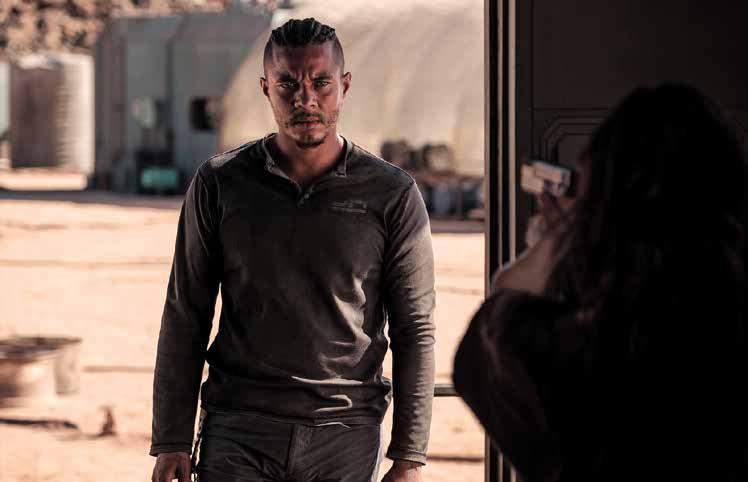
Jerry (Ismael Cruz Córdova) has traveled through a desolate wasteland to return to a homestead that once belonged to him. He can only assume the family now residing there took it by force from his parents. While Jerry would rather refrain from violence if he can, there’s nothing he will not do to reclaim ownership of this land.
A quiet, introspectively sparse sci-fi thriller, Settlers makes a lasting impression. Viewed almost entirely through the eyes of Remmy, first as a nine-year-old witnessing the conflict between her parents and Jerry, then roughly a decade later as a young woman (now portrayed by Servant star Nell Tiger Free) dealing with the cruel realities of her current situation, this is an intelligent, thought-provoking drama that kept me on my toes.
Writer-director Wyatt Rockefeller uses this setting to explore complex themes involving immigration, gender dynamics, and climate change, challenging the audience to mull a bevy of difficult questions while at the same time refusing to offer up any easy answers or simple solutions. There is a tragically evanescent ambiguity to the
A quiet, introspectively sparse sci-fi thriller, Settlers makes a lasting impression. Viewed almost entirely through the eyes of Remmy, first as a nine-year-old (Brooklynn Prince) witnessing the conflict between her parents and Jerry, then roughly a decade later as a young woman (now portrayed by Nell Tiger Free) dealing with the cruel realities of her current situation, this is an intelligent, thoughtprovoking drama that kept me on my toes.
narrative reminiscent of genre favorites like Silent Running or Phase IV, and Rockefeller steadfastly declines to take the easy way out as his narrative builds to its suitably open-ended conclusion.
Things primarily revolve around Ilsa, Remmy, and Jerry, as the trio is virtually forced to form an uneasy alliance. The two adults warily tiptoe around one another, each understanding that they need the other to survive — even though they’d like to achieve the upper hand if the opportunity were to arise. They also vie for Remmy’s attentions and affections, since Ilsa and Jerry understand she’s the key component who can give them an edge against the other.
All of which makes Settlers something of a major showcase for the shockingly talented Prince. As great as she was in The Florida Project, it’s been a blast watching
the child star grow and evolve at such a young age and in such a short period. Rockefeller asks a lot of Prince, the majority of the emotional heavy lifting falling almost entirely upon her shoulders.
The flashes of humor and levity? That’s on Remmy, and her burgeoning relationship with a robot farmhand (reminiscent of Huey, Dewey, and Louie from Silent Running) that she nicknames Steve is charmingly effective. Moments of darkness and tragedy? That’s mostly on her as well: the scenes where she learns a chilling truth about the farm and how it relates to the outside world are delivered with a hushed restraint that’s stunning.
Through it all, Prince imbues her performance with courageous resilience, showcasing a stoic gracefulness that Free picks up on and makes her own during the film’s climac-
tic third. These later portions twist and turn all that transpired during the first few acts. Remmy’s plans, her dreams and desires, they have all been bubbling underneath the surface of her skin, just waiting for the perfect moment to burst into the open, and in keeping with that, Free adds a layer of purposefully pointed, energetic bravado to the character that’s wonderful.
There are still elements I didn’t connect with. While Boutella is excellent, some of Ilsa’s choices still rubbed me the wrong way. Rockefeller has her walk along a knife’s edge in the shape of a corkscrew, and as such, the array of ups and downs she goes through are understandably extreme and not always believable.
As for Jerry, I’d love to get into discussions about his character with other viewers. His tale has so many tumultuous ups and downs that it would be fascinating to learn how many consider him to be the villain and how many instead see the young man as a conflicted lost soul who does a poor job of explaining the dire nature of their shared situation to Remmy or Ilsa. Cordova has to navigate an incredibly tight channel to bring all of this across, and while he isn’t entirely successful, watching him make the attempt is still frequently exhilarating.
There’s a lot to love about Settlers Rockefeller continually tests his audience. Not everything he does connects, some of the pieces do not fit together, and the final scenes are something of a foregone conclusion. But I was captivated with every step Remmy took, and it was thrilling to see her take charge of a situation she initially had zero control over. Give this one a look.
Settlers – Photo courtesy of IFC Midnight
Everything is relevant Settlers filmmaker Wyatt Rockefeller on crafting a character-driven sci-fi spectacle
by Sara Michelle Fetters SGN Staff Writer
Reza (Johnny Lee Miller), Ilsa (Sofia Boutella), and their nine-year-old daughter Remmy (Brooklynn Prince) are working a small, isolated farm on a desolate patch of land they’re thankful to call their own. They’re colonists who have come to Mars looking for a fresh start, and there’s nothing they won’t do to protect what they consider theirs.
The drama fueling writer-director Wyatt Rockefeller’s intense, quietly intimate science fiction thriller Settlers comes in the form of Jerry (Ismael Cruz Córdova), a lonely wanderer who insists the plantation where this family resides does not belong to them. This leads to a crisis of conscience for all involved, especially young Remmy, who must learn more about this world, the ways it can spring into sudden, savage violence, and some secret harsh truths kept from her by her parents.
I sat down with Rockefeller to talk about his ambitious feature-length debut. Here are some edited transcripts from our wideranging conversation:
Sara Michelle Fetters: I think the first question that jumps out at me is, how the heck does one go from working for President Obama and being a part of the Environmental Protection Agency to making an intimate indie sci-fi thriller about lonely people colonizing Mars?
Wyatt Rockefeller: [laughs] It’s a fair question. I’ll start out by saying I’ve actually wanted to make movies since I was 11 years old. At that point, it was just with dad’s camcorder and with whoever I could talk into doing it on the weekend.
I see the Star Wars poster behind you. My neighbor had a fog machine, and we got the spaceship shots using my toy Millennium Falcon. That was pure fun. I always try to remember what that felt like now, especially when it counts.
I graduated [college] in 2007, and I got swept up in the Obama campaign. I drove to LA to take an internship or job with a production company, and I ended up leaving it to go join the Obama campaign. I thought I was just going to work in New Hampshire. I ended up going through the election and then ended up working in the administration. I took a job with an energy startup thereafter.
While working in this context at this energy startup, which was based in Dar es Salaam, Tanzania, I was back at a more grassroots level, much like what I was doing during the campaign. Here I was doing something I was really loving, that I felt was important, but I was lying awake at night thinking about the movies I wanted to make and the stories I wanted to tell. I couldn’t sleep until I’d write down a bit of dialogue from the scene that was stuck in my head.
At some point you just have to realize, look, this is what you care most about, so you’re going to have to work hardest at this, and whatever impact you can have is going to be maximized through what you love. So I applied to film school. I decided hell or high water I was going to figure out a way to make [filmmaking] work.
SMF: You talk about how you were always coming up with ideas and jotting them down. Where did the specific inspiration for this story come from? I feel like some of it obviously came out of the experiences you were having, probably while you were working for Obama and at the EPA, considering some of the themes throughout the film.
WF: One of the great things about film,
SGN Staff Writer
Sara Michelle Fetters sits down with filmmaker Wyatt Rockefeller to talk about his ambitious feature-length debut, Settlers.
and storytelling in general, is that everything is relevant, right? I did not sit down to write a political movie. My wife actually pointed that out. She’s one of the producers and she said, “I know you didn’t mean to write a political movie, but you do need to realize you started writing this in the fall of 2016, right after the presidential election.”
This was when immigration was an especially hot topic, not only in the US but also in Europe, with the Syrian war and the refugee crisis that was unfolding there.
And she was right. Even though I didn’t mean to write a political movie, I somehow wrote a movie about the climate crisis, the
mass displacement of people as a result of that crisis, and about sexual power dynamics, which had also been in the news.
We’re all products of our times. Working in genre, working in sci-fi, is a great opportunity to do an end-run around a person’s bias. You can engage with these topics of the moment, but the places and the names are different, and so people are more open to [exploring them].
SMF: When you’re telling a story like this, and you have these complex themes, how do you balance how much information you give the audience and how many pieces to omit and leave it up to their imagination as to the final assembly?
WF: It’s a very good question. It’s one I’ve agonized over through all stages of the process.
I think it’s very important that when you’re creating a world, you need to have worked out the whole backstory. Also, because they’re in this remote location, everything that’s there has been transported along the way. Everything on set that you see on-screen needs to have a reason for being there. It needs to have its own backstory. So there is quite an elaborate backstory, but you have to decide, okay, this all informs the reality of the world, what do people need to understand to comprehend the stakes?
I think Alien does a very good job at
showing you very little, and because of that, you fill the whole universe with your imagination. I think the most vivid images are the ones that are off-screen, the ones that the film puts in your head, that you don’t actually see because they’re just going to be so much more vivid in your head.
SMF: I love that you bring that up, because Alien was one of the films that came to mind as a timeless sci-fi thriller that gives you all the pieces that you need to know about this world without actually explaining them to you. Some others that came to mind as I was watching were Phase IV, the ant movie, and Planet of the Apes, and then obviously Silent Running, especially as it involves Steve. You’ve got to talk to me about Steve. What was bringing Steve to life like for you, just as if you were still that kid that used to play with your Millennium Falcon while making home movies?
WR: It was a dream come true. I was huge into Star Wars, as well as a bunch of other things. I just remember I would pore over those books about Lucasfilm and Industrial Light & Magic and Weta Workshop, and just how they brought these things to life, the sets and the creatures. Seeing all the prototypes. I thought that was all so cool.
Wyatt Rockefeller – Photo courtesy of IFC Midnight
ROCKEFELLER
To be able to walk into Millennium Effects, which built the puppet that was Steve, and to see all the other things that they had got going on? There were a bunch of alien heads they were building for another movie. There was stuff everywhere. It was just like, oh my god. This is a fun day at work. [laughs] Steve is basically a mix of puppetry and VFX; the VFX were utilized for the more elaborate movements. We had to be very specific about when to deploy the VFX, because we were shooting on a budget. It was a great collaboration between the departments, and designing him really was something special. I wanted his form to follow his function, and together we figured out exactly what that would mean, what he does and how he should look as a result.
SMF: In regard to form following function, moving to the human actors: Brooklynn Prince. I wonder how much a child actor’s performance is really them, and how much is thanks to the direction. But now, after watching her and everything that I’ve seen from The Florida Project forward, she is stunning. She’s got it, whatever that “it” is.
For you, though, how much direction do you give an eight- or nine-year-old, and how much freedom do you allow her, especially as it relates to her co-stars, Sofia Boutella and Johnny Lee Miller, to make that family dynamic real and organic in such a limited amount of time?
WR: First of all, it helps that she is just wise beyond her years, I basically look up to her. Brooklynn is also the more experienced filmmaker. She’s directed a short film! She’s just very incredibly professional.
I’ve worked with kids before, and this didn’t feel like you’re working with a kid. Her dad was on set with us and is very involved in her process and helping her get into the role. Her mom wasn’t there on set but would still help her get her lines ready the night before. It was a team effort.
I think it’s especially important to incorporate the parents when you’re dealing with such sensitive material, material that is hard for a nine-year-old to wrap her head around,
Rockefeller on Prince:
“First of all, it helps that she is just wise beyond her years, I basically look up to her. Brooklynn is also the more experienced filmmaker. She’s directed a short film! She’s just very incredibly professional. I’ve worked with kids before, and this didn’t feel like you’re working with a kid.”
however mature she is. It was just great to be able to have them as collaborators.
SMF: Did she and Nell Tiger Free ever communicate or talk? Did they collaborate on the character, or did you have them do their own thing?
WR: They did [collaborate]. All the actors basically stayed in this lodge together. They all had their meals together. We were able to do a little bit of rehearsal with Johnny and Brooklynn, who had come [to the location] first. That was very helpful, I think, especially for Brooklynn. That relayed to the other actors as well, just understanding how Brooklynn works,
what she needed. I think it was good to have Brooklynn and Nell overlap. I think that they both picked up on right away who Remmy is. She’s this strong character, a determined inquisitive girl. We didn’t have to worry too much about getting mannerisms right, because they just got it naturally, I think. They fell into it. But there were some eerie overlaps, I will tell you, between the two of them.
SMF: How did you find Nell? She’s just wonderful. While she doesn’t have as much screen time as Brooklynn does, she’s still just lovely in the movie.
WR: We were incredibly lucky to find
her. Actually, Nell found us, really. Again, I was punching above my weight with all of them [the cast]. They’re all much more established than I am.
But we really hit it off. Nell looks like an older version of Remmy, but that was in some ways secondary, that was just checking a box. Like Brooklynn, Nell’s capable of really putting herself in the mind of the character and believing and living out what they are going through. If it’s in the movie, it is hard things that Nell put herself through. There was one scene in particular that was particularly harrowing for her. But that lived experience of going through that actually informed choices Nell made in subsequent scenes. We actually amended the script based on those choices, and I think this made the movie better and got closer to a lived truth, which makes it all worthwhile.
SMF: You do challenge the audience with some of the decision-making that happens with a few of your characters, especially as it pertains to Ilsa and Jerry. What were those discussions between you and Sofia and Ismael Cruz Córdova like as you ensured that these various character beats or motivational choices — whatever you want to call them — no matter how disquieting for the audience, still were organic and didn’t feel like contrivances just to get the plot where you needed it to be?
WR: I think the key is that [the actors] believe in what they’re doing. That they understand why their character does what they do. That was a process that started in the writing and continued through a lot of conversations with the cast, to make sure they were able to inhabit the character in a way that they believed what they were saying. If they couldn’t, if it didn’t make sense, we would change it. I can’t recall if we did any specific things, but there was some improvising going on. We were very controlled about what information is known [by the audience]. At those points, you do have to stick to the script. But I did want to give the actors as much freedom as possible to make choices within the character. Fortunately, Sofia and Ismael are both such good actors that I really trusted them to make those choices. Feeling that
Steve and Brooklynn Prince in Settlers – Photo courtesy of IFC Midnight
Brooklynn Prince in Settlers – Photo courtesy of IFC Midnight
ROCKEFELLER
continued from page 10
trust, they [could], in turn, be freer and bring something more real to the screen.
SMF: They are great actors. When we talk about Cordova, it’s like part of you wants Jerry to be a villain. You want him to just be the bad guy. But because of his performance and also the way that you’ve structured his arc — because of this combination — that can’t be the case.
When you’re discussing those power dynamics and gender dynamics, what do you want people to see there? What are you
hoping they’re thinking about as they are dealing with this complex character, who doesn’t always do or act the way we think we want him to?
WR: I’m trying to push these characters to a place where they are forced to perhaps reconsider what they’re willing to do or not willing to do. I want people to walk out and think, what would I have done in this situation?
With Jerry, I remember showing the script to folks at a pretty early stage, and a friend of mine, who is also a filmmaker, said, “You’ve got to make Jerry more likable, because you’re letting Remmy off the hook too easily.” I thought it was a very good point.
She was coming about it from the perspec-
tive of a woman. She was like, “I don’t know if you actually appreciate this scene you’ve written here. I can relate to this, because I feel like I’ve been in this scene. A place where I thought this was a business meeting and suddenly it has turned into something completely different.” Frankly, that is not an experience I’ve had. As a guy, it’s just not something I have to deal with in the same way.
To be able to have that outside perspective, that is so valuable. When you’re writing and directing, working with actors who are trying to put themselves in these characters, you are trying to walk in someone else’s shoes. I do think there is such value in that. It’s one of the great things about filmmak-
ing, right? In storytelling. You get to see the world through other people’s eyes.
SMF: For you personally, what do you take away from this experience? What do you want to use going forward, now that you’ve had this adventure making this movie?
WR: I think in each outing as a writer and as a director, with this and in past jobs — which were at a smaller scale but in some ways it’s still the same — I would say each time you’re learning about where not to compromise. Filmmaking is all compromise. It’s about trying to close the gap between what you have in your head and what you’re able to accomplish on the day, given the resources that you have and the time.
Time is everything. There were changes I had to make in the script in pre-production to accommodate the realities of shooting in a very remote location in South Africa. We just weren’t going to get some of what I’d written within the budget that we had. It falls on the writer to change it.
Well, those changes cause issues within the story, things I realized were issues while we were shooting, which is not a great feeling. So I did change some scenes while we were shooting, but I knew we were going to have to fix it in the edit. We really reworked the first act, the editor [Johnny Daukes] and I.
I think the film is probably better as a result, but it’s because of those places where I probably shouldn’t have compromised but I did that caused those problems. I hope to take those lessons with me going forward.
SMF: For audiences, what do you want them to be thinking about and experiencing as they either leave the theater or after they watch this on PVOD?
WR: Again, I want them to walk out wondering what they would have done in this situation. For me, for subsequent projects that I’m interested in, I am just fascinated by people who find themselves in situations where they really have to look into the mirror and think, what am I willing to do? How far am I willing to go? That’s what I find of interest, and I think that’s worth people’s time.
Sofia Boutella and Brooklynn Prince in Settlers – Photo courtesy of IFC Midnight
Ismael Cruz Córdova in Settlers – Photo courtesy of IFC Midnight
SPELLING
Black contestant) from traveling with the white contestants, as well as from staying at the same hotel. They had to use the back door to enter the location of the bee and were forced to sit at a separate table while inside.
Then, when Cox qualified as a top five finalist, the judges decided things had gone far enough. On Cox’s next turn, the judges abandoned the 100,000-word list given to every speller in the bee. Instead, they gave her an illegal word, the proper noun (which is not allowed in spelling bees) Nemesis
Cox was unable to spell the word, and her chances of being a champion were stolen, one of many such devastating circumstances littered throughout American history.
In 1908, Marie Bolden, a 14-year-old Black girl from Cleveland, was the first to have her title stolen from her. At the time, the National Education Association organized the spelling bee, which revolved around city teams, and the speller with the most words spelled correctly would be crowned the winner.
Despite the competing teams’ demands for her removal and the insensitive words she had to spell, Bolden earned a perfect score, the best on the first-place Cleveland team.
Sometime after, however, the written portion of the contest was put under a microscope, and it “revealed” that a proctor gave the wrong definition of the word “capitol.” After this review, two white Cleveland students emerged with perfect scores. Marie was stripped of her title but was allowed to keep her gold medal.
Now, over a hundred years later, Kristen Carrington, Na’amah Morbeth, Keona Thomas, Zahyir Stephens, Cana Gerald, and Zaila Avant-garde, all Black girls, were among more than five hundred others who met the requirements to compete in the 2021 Scripps National Spelling Bee (SNSB).
Although each of these brilliant girls gave their best, there could only be one winner. On July 8, 2021, Avant-garde beat 561 competitors by correctly spelling Murraya, and thus became the first Black American and second Black person to win the SNSB. (Jody-Anne Maxwell from Jamaica won in 1998.)
This talented girl now holds the National Spelling Bee title and the $50,000 prize, and received a parade in her honor in her hometown.
So, why haven’t we had more Black participants and winners when it comes to spelling bees? It correlates to America’s dark past of discrimination and the unfair advantages bestowed on the white community.
In her interview with Time, Avant-garde made it clear that the reality boils down to one thing: money. It is not that Black children do not want to spell, but they do not have access to the resources it takes to be competitive.
“I can’t even describe what not having
SpellPundit is like. Like having a book but no pages,” she said about the popular prep resource, which costs about $600 annually. Regarding a peer who couldn’t afford it, she added, “He said, ‘I didn’t have it because it was way too expensive.’ His family just could not afford it. I mean, [my family] had a little bit of trouble affording it.”
The history of our country would like to paint Black and Hispanic families as unable to achieve excellence in competitive academics, but in actuality, the tens of thou-
The
history of our country would like to paint Black and Hispanic families as unable to achieve excellence in competitive academics, but in actuality, the tens of thousands of dollars’ difference in their household income, compared to that of Asian and white families, puts their children at a disadvantage.
sands of dollars’ difference in their household income, compared to that of Asian and white families, puts their children at a disadvantage. Even for a speller to be coached by past competitors could cost as much as $200 an hour.
Avant-garde knows that her particular circumstances helped her to excel in competition. She is homeschooled and able to block out about seven hours each day to study; she also has three spelling tutors and the computer programs needed to prepare. She expressed to NPR her hope that her victory will inspire other Black and Hispanic girls to try competitive spelling. “It’s a really fun thing to do, and it’s really great for the mind, [including] just learning how to learn and also learning how to study for school.”
Despite the cost of competing, determination and perseverance are qualities that the Black and Hispanic communities are known for. Hopefully, this wonderful girl’s display of excellence will be the motivation needed by other brilliant girls just like her.
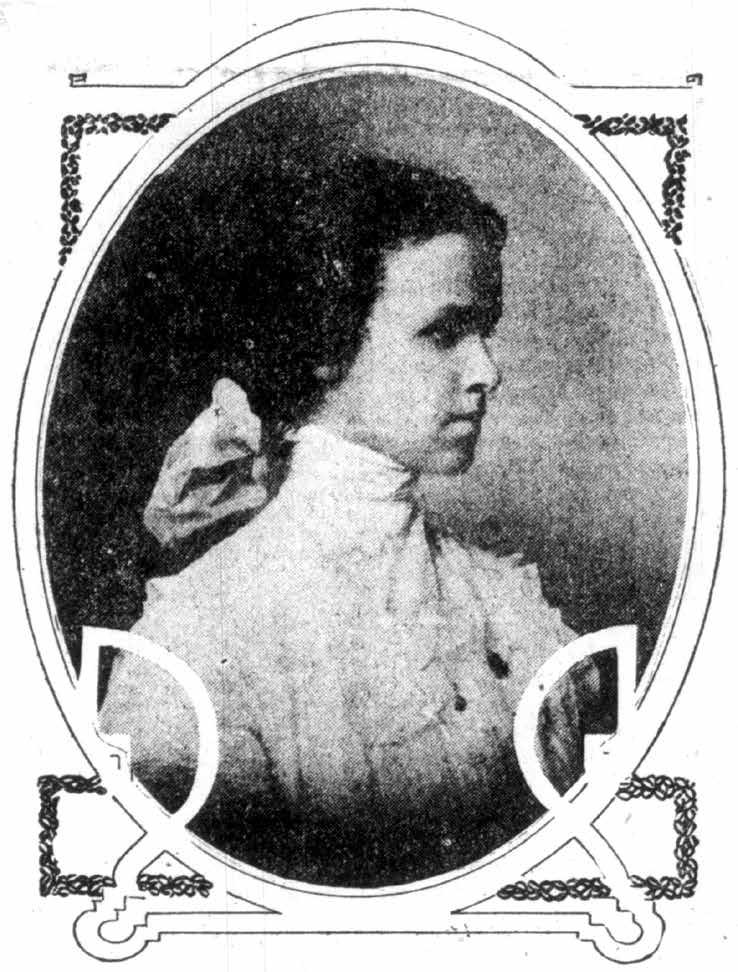
This image of Marie Bolden was published on the front page of the July 11, 1908 edition of the Cleveland Gazette.
Zaila Avant-garde – Photo by John Raoux / AP
BEE
continued from cover
Op-Ed
Opinion: Welcome to The Handmaid’s Tale
by Lindsey Anderson
SGN Contributing Writer
The planet is burning, disease has filled the streets, and, as if there weren’t enough reason to believe we have entered the dystopian future so many popular sci-fi books have warned us about, the American South is doubling down on attacks against women’s autonomy. Over the last four years of President Donald Trump’s conservative tyranny, hundreds of abortion laws were passed in rural counties and Southern states making access to abortion much more difficult for persons with uteruses. Although the reign of Trump has come to an end, these laws continue to sit on the books as a reminder of the supremacy men in power have over women’s bodies.
In the early days of the Trump administration, Act 45, which also goes by the cheery name “The Unborn Child Protection from Dismemberment Abortion Act,” was pushed through the Arkansas legislature in only two months; it gives to the husband of a woman seeking an abortion the right to veto the act. In fact, a woman who has filed a report of spousal rape against her husband can still be prevented from having an abortion if her husband opposes the procedure. Act 45 not only gives husbands legal power over their wives’ bodies but it also prevents all women, and people with uteruses, from receiving a dilation and evacuation procedure, a type of surgical abor-
tion praised by physicians for being the safest procedure for those who have hit the 14-week gestation period. Anyone found guilty of performing or receiving the procedure can be charged with a felony and fined up to $10,000.
no exceptions for instances of rape or incest and allows anyone to sue active participants in abortion — not just the individual seeking the procedure but doctors, family, and friends who may have provided money or a ride to the doctor, even therapists.
Over the last four years of President Donald Trump’s conservative tyranny, hundreds of abortion laws were passed in rural counties and Southern states making access to abortion much more difficult for persons with uteruses. Although the reign of Trump has come to an end, these laws continue to sit on the books as a reminder of the supremacy men in power have over women’s bodies.
Act 45 was signed into law back in 2017, and it is still on the books, inspiring other red states to pass similar legislation. In May 2021, Texas Gov. Abbott signed SB 8 into law, making it illegal for anyone to seek an abortion after six weeks. For most, an unforeseen pregnancy isn’t even detectable until the six-week mark. This legislation, known by many as the Heartbeat Bill, allows
In a report by the Washington Post, surveys showed that Black and Latinx people will be most affected by the bill, which will officially become law in September 2021, as nearly two-thirds of all abortions in Texas over the last five years have been performed on women of color. Furthermore, a bill introduced in Texas in July 2021 offers a bounty of $10,000 to
anyone who sues a woman seeking an abortion after just six weeks of gestation.
Southern states have been attacking abortion rights with new fervor, even after Donald Trump left office. In May 2021, Mississippi banned abortion procedures after 15 weeks of gestation; the Supreme Court has agreed to consider the legality of the law. The court, which now has a conservative majority, could very likely overturn the historic Roe v. Wade case if they rule in favor of Mississippi’s latest restrictive law. (Roe v. Wade ruled in 1973 that a woman’s right to choose an abortion procedure is protected under privacy laws and cannot be excessively restricted by the government.) If the court agrees to uphold Mississippi’s ban, it could pave the way for more conservative states to pass heavy restrictions and bounties on women who seek control over their own bodies.
Body autonomy is a hot issue across America, and especially in the LGBTQ community. Power, in its simplest form, is the ability to control one’s own body. The United States has worked to restrict the rights of all those who are not white, male, cis, able-bodied, and heterosexual when it comes to making decisions about their own bodies. Even with Trump out of the White House, his conservative cronies still continue to wage war on marginalized bodies, a war that could lead to many casualties and open the door to even more restrictions on the federal level.
Photo by cottonbro / Pexels
Search for the Soul of Seattle: Sports? Sure.
by A.V. Eichenbaum SGN Associate Editor
Seattle has the most pretentious NHL team and it’s been less than a week.
From their website: “In Seattle, we welcome voyagers. Our port city brings legends from all over the world. We cross boundless oceans and dense wilderness, finding beasts along the way. These legends are home to this rugged coastal wonderland with a name etched on Lord Stanley.”
Yeah, whatever, nerds.
On top of the nearly nonsensical literary prose of their marketing campaign, the Kraken will be playing in the Climate Pledge Arena, named by Amazon overlord and billionaire space cowboy Jeff Bezos to ensure we’ll be virtue signaling during every home game.
My home team, the San Jose Sharks, focus on the fans. They may not always make it to the playoffs, but damn if I’m not proud to slap a sticker saying “This is Sharks Territory” on whatever I own. Fan nights at the Shark Tank are always a good time, from Star Trek to Taco Night, and the fans remain loyal even after moving across the globe.
Will the Kraken’s fanbase be the same?
I doubt it. Seattle is full of fair-weather fans, no matter what the sport.
When I moved up here, I was ready to be a die-hard Seahawks fan, mostly to piss off my kid brother, a 49ers fan to the bitter end. That all changed when I witnessed an entire stadium empty out before halftime because the Seahawks were down two touchdowns in the second quarter. I was baffled. That’s not how you treat your team.
The same goes for baseball. Giants fans’ beef with the Dodgers is legendary, to the extent that people back home joke about not serving Dodgers fans. Hell, there’s a Giants bar right here in Seattle, and they’ll tell you the same thing. It’s all in good humor, but I can say for sure I’ve wrinkled my nose when a guy’s told me his team is the Dodgers. End of conversation, check please, thanks for playing.
Mariners fans only seem to have beef with themselves, blaming their lack of enthusiasm on their team’s losing streak.
The Giants were not always the multiple championship-winning team they are
Op-Ed National News
the SuperSonics is mostly to nostalgia, not the team itself.
Even Sounders fans seem to lose interest as soon as they’re not in the league’s top tier, and they’re a great team.
today, and they’re not the best team now, but fans stick with their team. We used to have ad spots run on local cable networks saying, “C’mon, Giants! Hang in there!”
That wouldn’t happen in Seattle. The most dedicated fans I’ve met here had their basketball team taken from them in 2008.
Based on conversations, their dedication to
The only teams I’ve seen with an active, engaged, and excited fanbase are The Reign and The Storm. The rest of this town can learn a thing or two by going to any of their games and soaking up the atmosphere as these athletes dominate again and again.
Maybe the Kraken will surprise me.
Maybe hockey is the sport Seattleites need to bring them all together. We’re pretty close to the Canadian border, after all, and those games in the bleak midwinter would give sports fans something to look forward to. But, by-and-large, Seattle’s sports fans seem more wrapped up in imagined prestige than in supporting a team no matter what. Maybe we should stick to tabletop RPGs.
Caitlyn Jenner pledges allegiance to Donald Trump
by Mike Andrew SGN Staff Writer
California gubernatorial candidate
Caitlyn Jenner pledged to support Donald Trump if the former president made another run for the White House in 2024.
In a July 17 interview on Fox’s Justice with Judge Jeanine, Jenner told the show’s host, Jeanine Pirro, “If I was governor of the state of California, obviously, I would support him.”
When Pirro asked if Jenner would support Trump even if she lost her bid for governor, Jenner responded, “Yes, I still would support him. I do not like what’s happening in this country right now.”
Jenner is running as a Republican candidate in the recall election aimed at unseating California’s Democratic governor, Gavin Newsom. The election is scheduled for September 14.
Jenner endorsed Trump for president in 2016 but since then has criticized some of Trump’s policies, especially his ban on Transgender people serving in the US military.
Jenner’s support for Trump has not been reciprocated by some of Trump’s most rabid supporters, however.
For example, Marjorie Taylor Greene, who is known for hateful anti-Trans rhetoric, rejected the notion of Jenner running
for governor as a Republican candidate.
“GOP support & consultants working to elect Jenner for Governor in CA are playing the left’s stupid identity politics game. A game that sells out our faith, family, and freedoms,” Greene tweeted on July
13. “Stop promoting this man in a dress & NEVER-Trumper. CA Patriots worked too hard & deserve better.”
Although Jenner has pledged allegiance to Trump, she says she will not ask Trump for an endorsement of her campaign.
At a press conference on July 10, Jenner was asked if she’d be seeking an endorsement from Trump.
“No,” she replied. “I am a private citizen of the state of California, I have every right in the world to be able to run for this office, and I am on the Republican side, obviously I’m on the Republican side. But don’t put me in this box, like if you’re in this box of ‘you’re a Republican, you have to think this way.’”
Trump has been coy when asked by reporters if he intends to run again in 2024 but has hinted he may.
“I do know my answer, but I can’t reveal it yet because that has to do with campaign financing and everything else,” Trump told Fox News on July 11.
“But I absolutely know my answer. We’re going to do very well, and people are going to be very happy.”
Caitlyn Jenner – Photo by Noah Berger / AP
Photo by Ted S. Warren / AP
National & International News
Florida judge may have to decide Roman Catholic doctrine
Suit alleges Catholic school is too “woke”
by Mike Andrew SGN Staff Writer
A Florida judge may have to decide what is true Roman Catholic doctrine in a lawsuit against a Catholic school in Tampa.
The suit charges that the defendant, the Academy of the Holy Names, has strayed from Roman Catholic doctrine by being “too woke,” and teaching diversity, equity, and inclusion.
The plaintiffs, Anthony and Barbara Scarpo, are parents of students at the school and major donors — to the tune of $1.35 million. They were also the public face of the school’s fundraising campaigns.
The Scarpos are asking for a refund of their past tuition fees, and donations, and demanding that the school stop claiming to be a Roman Catholic institution.
Among their complaints is the fact that the school put up a display on how to be an ally of the LGBTQ community.
Another complaint was that the school brought in a speaker to discuss white privilege, a topic that, the lawsuit alleges, made students feel guilty for being white.
Anthony Scarpo told the Tampa Bay Times that all he wants is for the school to return to Catholicism. After leading a school fundraising campaign, he said, he and his wife now wish to be the face of what he believes to be the “silent majority” of parents who are upset with the school’s teachings.
“Barbara and I are not interested in hurting an institution that we love,” he said.
“We want to make a point that the administration has gone too far. They have taken liberties with our children that are beyond the scope of education.”
He added that he understands the world is changing and that delicate conversations about inclusion should take place. But, he said, they need to be done with more input from parents and the church. He said he hopes the Diocese of St. Petersburg intervenes.
The school reports to the Sisters of the Holy Names and not to the diocese, however.
“When you begin to teach social justice without the umbrella of Catholicism and you leave God out of the discussion and leave anything that is Catholic out of the discussion, now all you have become is a social justice warrior,” Scarpo said.
“You create terrible confusion among these young ladies [the school’s students]. You create animosity between the students.”
In response to the lawsuit, some 450 former students of the school wrote an open letter defending the school administration.
“We stand behind teachings of diversity, equity, and inclusion,” the letter says. “We believe such teachings are not antithetical to the Catholic faith. On the contrary, we argue that these teachings are essential to development in the Catholic faith. The Catholic faith compels us to seek out practices that support and uplift all of our brothers and sisters.”
International news highlights
by Daniel Lindsley SGN Contributing Writer
Cameroon: Two Trans women released from prison
Reuters reported on July 17 that two Transgender women in Cameroon who were convicted of “attempted homosexuality” have been released from prison after five months. One of the women, Shakiro, said of the experience: “Prison is hell. It’s hellfire. Especially when they accuse you of homosexuality.” Shakiro also said that chains were put on her legs, and that she had to pay money to have them removed. In light of Cameroon’s growing criminalization of sexual minorities, human rights advocates have filed an appeal, which is expected to be heard in September.
Brussels: EU clashes with Poland and Hungary
Reuters reported July 15 on the European Union’s ongoing legal battle with Hungary and Poland over a number of the latter country’s municipalities declaring themselves “LGBT-ideology-free zones,” among more official anti-LGBT measures. The EU filed an infringement action related to Hungary’s ban on the use of materials that “promote homosexuality” in schools. Hungary and Poland now have two months to respond. If they don’t, the case will be referred to the EU Court of Justice, where critics of Poland and Hungary are suggesting that the EU target the countries’ post-pandemic recovery funds.
by Daniel Lindsley SGN Contributing Writer
Montana: ACLU sues state for birth certificate law
NBC News reported July 16 on the ACLU lawsuit against Montana for the state’s new law requiring medical confirmation of a surgical sex change when changing one’s listed sex on a Montana birth certificate. The two Montanans who filed the suit argue that the law violates their constitutional rights to privacy, equal protection of the law, and due process, since it would require them to reveal private medical information in a public court to change their birth certificate.
Tennessee: Judge blocks anti-Trans bathroom bill
The Philadelphia Gay News reported July 12 on a Tennessee judge’s decision to block a law that would require businesses that allow Transgender individuals to use restrooms consistent with their gender identity to post a sign warning customers of that fact. A suit against the law was filed in June by two business owners with Transfriendly bathroom policies. US District Judge Aleta A. Trauger, who was responsible for the injunction, framed it as a matter of businesses being a welcoming space for communities that include Transgender people.
Photo courtesy of the Academy of the Holy Names
Demonstrators at the Montana State Capitol – Photo by Thom Bridge / AP
Patricia and Shakiro – Photo by Josiane Kouagheu / Reuters