Fire at Gay bar found to be arson, possible hate crime
Lumber Yard Bar to be rebuilt ‘better, brighter and stronger’
Olympic-sized discrimination: What’s hair got to do with it?
by Janice Athill SGN Contributing Writer
The myth that Black people cannot swim or are not made to swim is a stereotype with dark origins rooted in racism. It has been said that Black people cannot swim because their bone density does not allow them to float — yes, something this ludicrous had to be disproved scientifically.
The truth is most Black people do not swim for two primary reasons: first, and most importantly, is that for decades, Black people were not allowed to practice swimming; and second, taking care of Black hair can be a full-time job.
When public pools became popular, Black swimmers were banned from using
by Renee Raketty SGN Contributing Writer
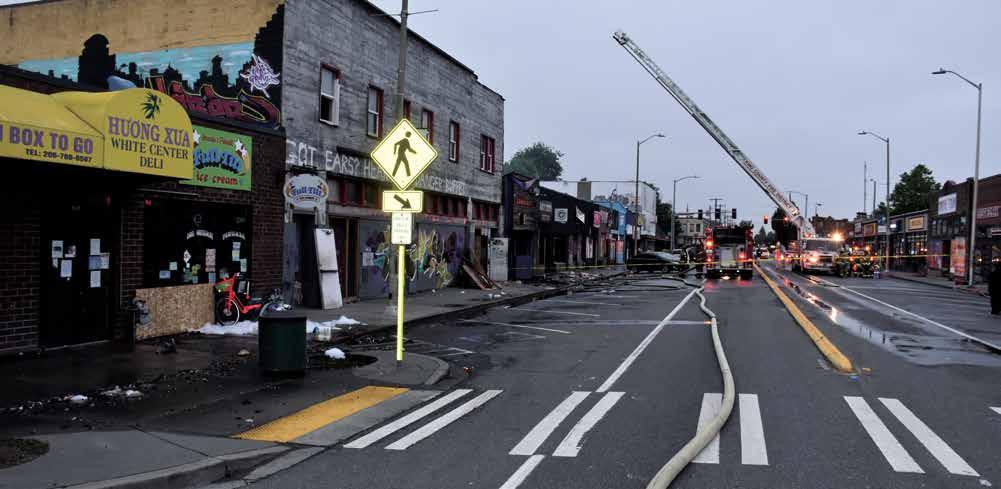
The SGN reported last week that a fire ripped through the Lumber Yard bar, near the intersection of 16th Ave. SW and Roxbury St. in White Center. The bar had been a popular gathering place for the LGBTQIA+ community since it opened in 2017.
see LUMBER YARD page 5
Boston Pride
dissolves
Group was accused of excluding POC and Trans people
by Mike Andrew SGN Staff Writer
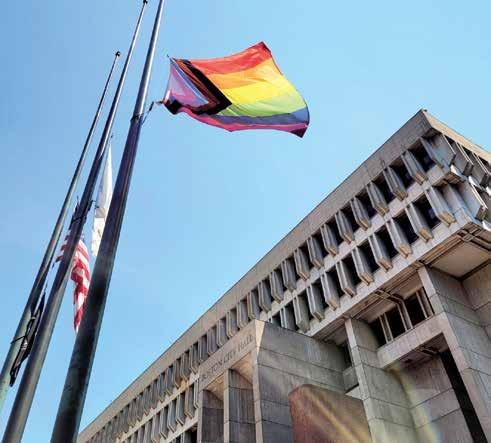
Boston Pride, the organization that organized the city’s annual Pride Parade, announced on July 9 that it will dissolve.
The decision comes only a month after the former board president, Linda DeMarco, submitted her resignation.
The group had been accused by many in
Boston’s LGBTQ community of excluding people of color and Transgender people.
In a statement posted on the Boston Pride website, the group denied it had deliberately excluded sections of the LGBTQ community.
“We strived to foster an environment of diversity and unity within our organization
see BOSTON PRIDE page 21
Photo by Luke Hutson Flynn
Photo courtesy of Boston Pride
Photo courtesy of the King County Sherriff’s Office
Local News
Unhoused in a heat wave: Addressing the deadly effects of Seattle’s most chronic illness
by Kylin Brown SGN Contributing Writer
On Monday, June 28, Seattle saw its highest recorded temperature ever: 108 degrees. For three consecutive days, temperatures had climbed into the triple digits, lingering there for up to eight hours at a time.
While hundreds of Seattle-area residents were still determined to attend the weekend’s highly anticipated in-person Pride events, aided by cold beverages and access to nearby indoor spaces, King County’s houseless communities faced severely limited opportunities to escape the heat.
Confounding variables
Seattle and King County declared homelessness a state of emergency six years ago — and the issue has only gotten worse since.
Ours is the urban area with the thirdlargest population of unhoused people in the nation. Records from early 2020 are the most recent data, and they indicate that 11,751 to 13,147 people experienced some form of homelessness in King County. LQBTQ+ and BIPOC individuals comprise a large percentage this number and are subject to greater risks to their safety while unhoused.
Efforts to combat chronic homelessness have largely fallen short, though hundreds of millions of dollars have been spent. Solutions are pitched in campaign speeches, and yet the number of unhoused only increases. Therefore, some have begun to refer to the issue as an “epidemic,” in the years prior to our newfound intimacy with the word “pandemic.”
While no data can prove it, many advocates for the unhoused agree that in the last year, the population has only continued to grow, and that most counting methods are inaccurate anyway. What the data do show about the past year is that Seattle and King County have allowed the pandemic to exacerbate the symptoms of this chronic condition, even as they reach for future solutions.
Of those experiencing homelessness in 2020, around 47% were without shelter. Since the pandemic limited shelter capacities, outdoor encampments multiplied across the county. Public safety measures aiming to keep infection rates low, such as the shut-off of all public tap water sources and fountains, overlooked the basic needs of thousands of those living outside.
“We are following CDC guidelines,” said Seattle Mayor Jenny Durkan regarding the protection of the homeless during the pandemic. CDC guidelines state: “If individual housing options are not available, allow people who are living unsheltered or in encampments to remain where they are.” Meanwhile, constant “sweeps” of public parks exposed a vicious cycle of migration forced upon the unhoused.
Among those able to remain sheltered, King County still saw three large COVID19 outbreaks by May 2020. So while several safety measures implemented paved a path for a great number of people to avoid coronavirus infection, the unhoused were sidelined. The dire safety concerns of this social epidemic within a viral pandemic were further intensified by the recent record-breaking heat wave. Research suggests that the risk of heat-related death for those experiencing homelessness is at least 100 to 200 times as high as the general population.
Community intervention
In a single hour in the early morning of
In a single hour in the early morning of June 26, 5,000 bottles of water, 500 sports drinks, dozens of sunscreen products, and a few hundred towels were assembled for the houseless.
June 26, 5,000 bottles of water, 500 sports drinks, dozens of sunscreen products, and a few hundred towels were assembled for the houseless. All it took was a small amount of outreach and foresight, according to organizer David Obelcz.
Obelcz is the chief content officer of Malcontent News and founder of the Badon Hill Group marketing firm. While leading at both companies might sound like enough for one person, Obelcz has also dedicated hundreds of hours to organizing and advocating for the unhoused.
For several years, starting in 2014, he and his wife put on a haunted house for their Kirkland neighbors, asking only for food donations in return. Since beginning this work, he has expanded to other forms of service and learned a great deal about chronic homelessness in the region.
“There is so much need under the surface
that people don’t see. What we need more of is job training, direct outreach with the unhomed… A lot of people know about the food bank, and they know about homelessness, but they only see the tip of the iceberg and nothing of what is going on beneath the surface,” said Obelcz.
Obelcz is a self-professed “weather nerd” who first founded Malcontent News as a weather blog. He was called to action upon noticing the abnormally high temperatures in the forecast that week.
“About a week before the heatwave, I thought, this can’t be possible,” said Obelcz. “Heat kills. Once you get to about 120, you’re getting onto the ragged edge of where humans can survive. We tickled these temperatures.”
Obelcz heard that local nonprofits Hopelink Friends of Youth and Teen Feed were asking for water and sports drinks, and so he recruited help through his media platforms.
“I reached out to people in my network when I realized that the logistics were going to be more than one or two people could handle,” he said.
Together, Obelcz and his crew spent all of Saturday making deliveries. They followed nonprofit allocations with direct drop-offs at Lake Washington Methodist’s “safe parking lot” and then various other encampments, from SoDo to Ballard. The team transported enough for hundreds of people’s heat wave needs, enough to give every person about 10-20 bottles of water.
Obelcz is a big-picture thinker as well and noted the systemic challenges for those trying to overcome homelessness, especially those of marginalized identities.
“There is a stunning number of people who are LGBTQ+ on the streets, and especially
more among youth. And within the transgender community, it’s hard to find work. There is so much discrimination, and a lot of people who can’t find work end up on the streets.” His experience over the years has given him an insightful perspective on large-scale solutions. He sees a major lack of political will to solve the issue at its root causes, and though the City of Seattle addresses these “roots of the crisis” on its website, it has yet to make moves to diminish them.
Obelcz added, “The number one thing is we have a one-size-fits-all approach, when that does not work for everyone. A family on the run from domestic violence and a drug-afflicted person do not need the same things. Many people who are unhomed are mentally ill, and Washington is one of the worst states in the country for mental health care.”
Seattle’s unhoused are pushed to the periphery in several ways. Policy has yet to make a sizable impact, and no one can quite trace where the money to combat the issue is going. Meanwhile, Obelcz’s quick thinking and the help of others to organize likely helped dozens survive in dire conditions.
The total number of heat-wave-related deaths in Seattle’s unhoused population is unknown, though over a dozen cases are documented. Now, as the area reportedly verges on a month without rain, public water sources remain shut off, and the unhoused population continues to bear the brunt of our political shortcomings.
Our climate is only becoming more volatile, and the crisis continues to grow. Perhaps our policies need to go to more extremes as well.
Photos courtesy of Malcontent News
LUMBER YARD
This week, the King County Sheriff’s office told the SGN that new evidence has prompted the Fire Investigation Team to reclassify the case from accidental to arson.
“What I can say is that there was new information that was identified,” said Sgt. Tim Meyer of the King County Sheriff’s Office. “Our detective with the... Fire Investigation Unit, based on that new development, looked at the case and then reclassified it as arson.
“It remains an open and active investigation. Therefore, I’m not able to discuss what the evidence is — only to say that we’re glad to have this opportunity to introduce some new things into our work. We appreciate how impactful it has been to the community, and [it] remains a very much an open and active case with our team.”
The Lumber Yard’s co-owners, Nathan Adams and Michale Farrar, who are also married, believe the second-alarm fire on July 5 was “most likely... a hate crime.” New evidence has been uncovered in the bar’s basement, which had initially been flooded due to the firefighting efforts of Skyway Fire and the Seattle Fire Department. According to Adams, a break-in had occurred one month prior to the fire, and anti-LGBTQIA+ graffiti had been marked on the establishment’s windows.
“We are horrified that someone did this and affected not only us but several other businesses,” said Adams. “We are a little shocked but also relieved, the relief being that it was not caused by us in any way, even if by accident.”
The fire also burned through several adjacent businesses. A Mexican grocery, a boba tea shop, an art studio, and a popular local eatery, Dottie’s Double Wide, were among those affected by the blaze.
Community help sought
Meyer added that law enforcement is appealing to the public for their help in solving the crime. “We’re going to be very thoughtful and deliberate in this work. We know through that work that a motive will be identified. We exclude nothing during this process,” he said. “I would also ask that the community continue to be vigilant. One of the things we really want to share in White Center is that absolutely every call counts... If [someone sees] something suspicious or anything like that, call the [King County] Sheriff’s Office. White Center is a very important community for us. We have multiple storefronts in that area.
“We certainly have a very active group of deputies there and, if it seems suspicious or
“There’s still a mind-set out there among people who aren’t in the LGBTQ community that events like Pride are really not necessary anymore, since ‘everyone’ is so accepting now. Not true. Until things like burning down a business because it is LGBTQ owned and…until hate crimes against us stop, we have to continue to be visible and let the world know we’re a part of every community — like it or not — and we’re not going away. We aren’t going to live in fear of being ourselves.”
something seems out of place, we hope that there will be a call so we can come-out and serve and be responsive to that community.”
Tips can be called into the King County Sheriff’s non-emergency line at 206-2963311 or reported anonymously to the Arson Alarm Foundation (AAF) at www.ArsonAlarm.org or by calling 1-800-55-ARSON. The AAF is offering a $10,000 reward for information leading to a conviction.
Arson shakes a community
The news that the fire was arson has shaken local residents and patrons of the Lumber Yard. Danny Perez, who lives just ten minutes from the establishment with his husband of five years, said the couple have been following the situation “very closely.”
“It was always nice to know they were there for us as a community; a place to go to and know we were always welcome and could have a fun time,” he said. “The fact that it was destroyed, much less destroyed out of hate, was like a punch in the gut to those of us who live nearby — at least in my circle of friends. We are all still talking about it… It makes me angry.”
Perez, a real estate broker with Coldwell Banker Bain, moved to West Seattle from Dallas in 2016 with his husband. The couple has been together for 28 years. He said he has seen the neighborhood become more welcoming of the LGBTQIA+ community over the years.
“The bar had more than its share of vandalism, but I think it is on par with other businesses in the area. Before COVID-19 hit, we were hearing of another LGBTQ venue that was being considered, which made me feel like good progress was being made,” he said. “This does feel like a setback for the community. However, I think it is important to show resilience and not cower to a-holes who do stuff like set a fire to try and scare us. Perhaps there needs to be a rally in White Center to show that we are not going away
and we won’t live in fear.
“There’s still a mind-set out there among people who aren’t in the LGBTQ community that events like Pride are really not necessary anymore, since ‘everyone’ is so accepting now. Not true. Until things like burning down a business because it is LGBTQ owned and… until hate crimes against us stop, we have to continue to be visible and let the world know we’re a part of every community — like it or not — and we’re not going away. We aren’t going to live in fear of being ourselves.”
Courtney, a Lumber Yard patron, said she was last there on June 30 before and after the nearby Pride Skate event. (She asked that the SGN not use her last name.) “It concerns me when any minority is targeted, but obviously, being a Lesbian, that hits home,” she said. “I believe that justice should be served. I also believe that the community should continue to work together to bring peace and equality.”
Fire gets attention
King County Sheriff Mitzi Johanknecht, who lives with her wife Maureen in West Seattle, is said to be following the case closely. “Sheriff Johanknecht was almost immediately involved in this and is actively monitoring it,” said Meyer. “From the sheriff on down, we are very mindful of how impactful this has been on the community, both the White Center community and the LGBTQ community... We want to make sure that we’re holding those responsible accountable.”
King County Executive Dow Constantine and Council Vice Chair Joe McDermott toured the site of the fire just hours after it had been extinguished. The pair talked to business owners and offered their support. McDermott has served the White Center community during a political career that includes seven years in the Washington House of Representatives, three in
the Washington state Senate and almost 11 years as a member of the King County Council. McDermott became the first openly Gay councilmember in 2010.
“This is a very big blow to the White Center community as a whole and the LGBTQIA community… It is a terrible tragedy,” McDermott told the SGN. “My heart goes out to Nathan and Michale and their team and to all the businesses that have been badly affected.
“The support we’ve seen for the LGBTQIA community, just in general, during Pride Month, is phenomenal. Just over the 20-plus years that I’ve been out, what we’ve seen every June has expanded exponentially. That’s not to be set back or deterred by what might be arson, or perhaps even a hate crime.”
Krystal Marx, the deputy mayor of Burien, which is just south of White Center, and executive director of Seattle Pride, said that the community must rise up and ensure that the Lumber Yard is built back “better, brighter, and stronger than before.”
“As an out Bisexual woman, it is a horrific idea to contemplate that the fire was set intentionally, but unfortunately, it isn’t hard to imagine,” she said. “LGBTQIA+ folks south of Seattle don’t enjoy all of the freedoms of expression and welcoming spaces that our community does in larger cities... What is also true, however, is that more of us — the LGBTQIA+ community and our straight allies — are moving to the suburbs, and with us, we bring our desire for visibility, inclusion, and support. If this was arson, we will not let this slide.”
A community responds
White Center Pride had set up a GoFundMe campaign webpage for the Lumber Yard. It reached its goal by raising $100,655 within days of the fire to assist with the bar’s recovery. A second GoFundMe campaign to help the bar’s coowners was also established by White Center Pride and had raised $11,496 toward its goal of $25,000 as of press time.
“We are in awe of the support that we have received,” said Adams. “We cannot thank the community and supporters enough for their generosity... We love you all.
“Insurance money only goes so far, and these extra funds will help so much in making sure the Lumber Yard opens again.”
Adams revealed that a new site has been found and the Lumber Yard will soon serve the White Center community once more. “Lumber Yard 2.0 is on its way,” he said. “Until then, stay safe and vigilant.”
Photo courtesy of the King County Sherriff’s Office
Local News
Councilmember Sawant signs her own recall petition
by Lindsey Anderson SGN Contributing Writer
Capitol Hill is currently embroiled in a political scandal, one that reflects bigger issues happening on the national scale. At the center stands City Councilmember Kshama Sawant, representative of Capitol Hill’s District 3, member of the Socialist Alternative Party, and Indian immigrant.
Sawant has made a name for herself in Seattle as an advocate for the people. She strongly supports the rights of renters, has fought for a new rent control policy, and has called on the City to implement rent control, free of corporate loopholes, and a massive expansion of publicly owned and affordable housing. Sawant was also vocal about her mission to tax Amazon in order to provide emergency COVID-19 relief and fund housing.
Sawant’s policies have been deemed “radical” by more conservative politicians, and now some are taking action. A campaign to recall Sawant has been circling Capitol Hill and will likely end up on the next ballot.
The recall campaign states that Sawant has misused City Council office resources and participated in electioneering, misused Sawant’s position as a city councilmember by admitting citizens into City Hall after hours, and that she used her elected position to lead a protest march to Mayor Jenny Durkan’s private residence.
If the recall movement receives enough signatures, these are the charges that will be presented on the ballot.
Signing the petition herself
Supporters of Sawant have opposed the recall, stating that Sawant has done nothing wrong, and all the accusations against her are really just retaliation for her progress in fulfilling her campaign promises.
However, a new twist was thrown into the conflict on the morning of Friday, July 9. On the steps of City Hall, Sawant spoke out to her supporters, and then did the unthinkable: she signed the petition in support of placing the recall on the November ballot.
I sat down with a member of Sawant’s team, Bryan Koulouris, to discuss the new twist in this ongoing political struggle. “It’s a very unique step for Kshama herself to sign the petition on whether or not there should be a vote for her to be recalled,” Koulouris explained. “The message we are trying to send is that people shouldn’t stand for voter suppression.”
The voter suppression Koulouris is referring to would be waiting to hold the recall vote for a special election in February, instead of getting it on the November ballot. Special elections see far less voter turnout, especially in the demographics of the working class, young folks, and people of color. This is the base Sawant appeals to for support. In fact, political scientists estimate a 2022 February special election would have nearly 50% less voter turnout than a November 2021 election.
After hearing from the recall campaign manager that the group was hoping for a special election as opposed to running the recall in November, Sawant’s campaign took a 180. “We’re here to take the recall campaign up on its appeal for help in gathering the last round of signatures needed to make the August 1 deadline to get the recall on the ballot in November,” Kshama Solidarity campaign manager Emily McArthur announced on Friday. “We believe the decision [regarding] the recall… of Kshama Sawant should be made by the largest possible District 3 electorate.”
The charges
Despite signing the petition, Sawant’s team still believes the campaign is using
On the steps of City Hall, Sawant spoke out to her supporters, and then did the unthinkable: she signed the petition in support of placing the recall on the November ballot.
false language to deceive voters who are unaware of the real charges made against Sawant. The charges that will appear on the ballot were approved by Superior Court Judge Jim Rogers. They declare Sawant guilty of “misuse of City of Seattle Council office resources to promote a ballot initiative or other electioneering,” “misuse of councilmember Sawant’s official position in admitting hundreds of individuals illegally into City Hall after hours,” and “using her official position as City Councilmember to lead a protest march to Mayor Jenny Durkan’s private residence, whose location is in the state confidential program.”
“The recall attack started in the courts, and we know the courts have been known to work against people who are oppressed,” McArthur stated in the Friday press conference. “They exist to uphold the status quo. The courts have upheld Jim Crow and sanctioned pushing Indigenous people off their lands.”
Koulouris broke down some of the charges. He explained that Sawant ran her campaign on a platform of enforcing taxes on Amazon, as well as providing rent control to Seattle’s tenants. The first charge claims Sawant used $2,000 in city resources to promote her ballot initiative for the Amazon tax. “The way that they say it is patently false. The ‘$2,000 of city resources’ was just her using her office to build a movement, not to build specific bal-
lot initiative language, because it hadn’t happened yet,” Koulouris said.
However, according to the Seattle Times, “In a [May 7] settlement agreement with the Seattle Ethics and Elections Commission, Sawant admitted to improperly using city money, employees, and other resources to support a proposed ballot measure. She also agreed to pay the city $3,516, about twice the amount of city funds she spent to advance the measure to create a payroll tax on big businesses like Amazon.”
The other two charges against Sawant stem from Black Lives Matter protests. During the summer of 2020, Sawant participated in a BLM protest that ended up at City Hall. Later in the summer, she participated in another march, one that would end up at Mayor Durkan’s residence. While the recall initiative phrases it to sound like Sawant led the march, Koulouris informed me that this was not the case. “The march was led by Indigenous elders and families of the victims of police violence, that’s who led the march.” He explained that the leaders of the march asked Sawant to speak and that “[Sawant] was not only not an organizer of the march, she didn’t know the
march was going to go to Jenny Durkan’s house, and to this day, [Sawant] does not know where Jenny Durkan lives.”
Koulouris and McArthur both believe it is crucial that the vote appears on the November ballot, in order to give Sawant the best chance to win the recall. A loss for Sawant, either in November or February, will be devastating to much of Seattle’s low-income population, a high percentage of which are LGBTQ.
“Kshama has a tremendous amount of support in the LGBTQ community, because a number of the policies that she has fought for disproportionately benefit young people, and LGBTQ people in particular, and that comes from some things, like housing, because there is a disproportionate [number] of houseless LGBTQ people,” Koulouris explained.
Sawant has run on the idea of giving a voice to the voiceless, and now she is calling on her supporters to use their voice to help her stay in office, so she can continue to fight for the rights of low income citizens in Seattle.
Photo by Lindsey Anderson
Seattle City Councilmember Kshama Sawant – Photo by Nate Gowdy
Arts & Entertainment
Love recovered in Heggie’s For a Look or a Touch
by Sharon Cumberland SGN Contributing Writer
MUSIC OF REMEMBRANCE FOR A LOOK OR A TOUCH (2007)
COMPOSER: JAKE HEGGIE; LIBRETTIST: GENE SHEER
Imagine living in a time when being Gay meant social ostracism, violent ridicule, humiliation, punishment, and possible death. You may think I’m describing the present, but I’m not. As bad as the present may be, living in Germany during the run-up to WWII was worse. Gay men who were caught having relations with or even expressing innocent affection for a person of the same sex could be arrested. If you were Jewish on top of being a “deviant,” you were in double trouble.
According to the Holocaust Memorial Day Trust, an estimated fifty thousand German men were convicted of deviance and sentenced to hard labor in police prisons during the war. Between ten and fifteen thousand Gay men died in concentration camps. Though Lesbians weren’t included in Paragraph 175 of the German penal code, which criminalized homosexuality, they too were ostracized, abused, and barred from public life.
For a Look or a Touch is the true story of two German men caught in the Nazi web of WWII: Manfred Lewin, who was murdered in Auschwitz, and his lover Gad Beck, condemned to live into the 21st century with his grief. Composer Jake Heggie and librettist Gene Sheer have created a brilliant chamber opera based on Lewin’s surviving poems. With minimal musical forces — one baritone and a quintet (violin, cello, flute. clarinet, and piano), along with a non-singing actor and a conductor — we see a tragedy of love lost reclaimed and recovered.
Gad (Curt Branom), the old survivor, is hunched on a sofa in pajamas and bathrobe when Manfred’s handsome young ghost (Jarrett Ott) appears from the unseen world to help his beloved remember their love and to overcome the amnesia of survivor’s guilt. He conquers Gad’s depression with jazzy memories of their early days in Berlin, dancing and singing until Gad jumps
For a Look or a Touch is the true story of two German men caught in the Nazi web of WWII: Manfred Lewin, who was murdered in Auschwitz, and his lover Gad Beck, condemned to live into the 21st century with his grief.
Composer Jake Heggie and librettist Gene Sheer have created a brilliant chamber opera based on Lewin’s surviving poems.
up and joins in, laughing with joy. The old, white-haired man is suddenly young and sexy again.
This ebullient scene is followed by the hard reality of “One Hundred Thousand Stars” — a memorial to the lives cut down — and Manfred’s account of the cruelties he and his fellow prisoners faced at Auschwitz. With simple, effective lighting, projections, and musical witnesses, both men recount their suffering, the memory of love buried deeply in their beings, and of lives lost and ruined.
Yet their willingness to hear each other’s stories and to recount the horrors of Nazi cruelties opens the gates of silence and denial. Gad clutches Manfred’s notebook of poems and mourns: “That sacred place where fears dissolve… the generous heart… your journal is so full of hope… and I feel hopeless.”
But Manfred answers with a love song: “Do you remember when night was for more than sleep? Oh my love, my love, we stayed awake so often.” As their memo -
ries become timeless, the two men dance together into the place where love never dies. We are left with a clear understanding that love conquers even the most vile crimes and heartbreaking memories.
Ott’s ringing baritone was equally effective in moments of joy, terror, compassion, and tenderness. He was the perfect foil for Curt Branom’s sad, reluctant, and ultimately trusting portrayal of Gad. What a brilliant stroke to have the actor from beyond singing and the actor mired in the distress of survival speaking. Nothing could have made the dramatic problem more clear.
The final moments, when Manfred and Gad dance together in an intimate embrace, as the stars come out and the lights go down, captures the complexities of hope and love facing down the worst the world has to offer.
Kudos all around for director Erich Parse, conductor Joseph Mechavich, and the quintet — with a special shout-out to clarinetist Laura DeLuca, whose jazzy, dancing solo conjured the happy tolerance of Berlin in the 1930s. Everything about
this production is a perfect interpretation of Heggie and Sheer’s very profound and important creation.
The greatest kudos, of course, go to the commissioning organization, Music of Remembrance, founded by Mina Miller to examine the Holocaust in terms of the lives and artistry that were lost to this almost unthinkable tragedy, and to use music and art to help the world remember both the worst and the best of human endeavor. MOR has commissioned over 30 works of music that tell these important, moving, and surprising stories.
It’s not too late to see this wonderful production. For a Look or a Touch is streaming until July 26, 2021, at www. musicofremembrance.org.
Also, on August 1, 2021, at the same website, you can stream a new performance of Heggie and Sheer’s Intonations: Songs from the Violins of Hope, six songs for voice and violin using restored string instruments that belonged to Jews who played them before and during the Holocaust, featuring violinist Mikhail Shmidt and mezzo soprano Laura Krumm.
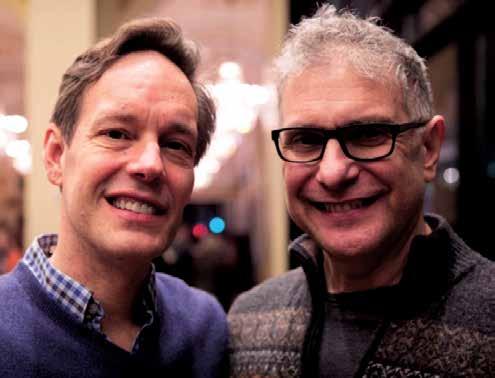
Jake Heggie and Gene Sheer – Photo courtesy of Music of Remembrance
Curt Branom and Jarrett Ott in For a Look or a Touch – Photo courtesy of Music of Remembrance
Arts & Entertainment
Give in to the
Give Inn’s alluring burlesque shows
Seattle Burlesque and Cabaret Co-op’s new venue is sure to entertain
by Carter Hemion SGN Contributing Writer
On the weekend of July 9, Seattle Burlesque and Cabaret Co-op (SeaBCC) saw its first guests at the Give Inn, and I had the pleasure to be among them. The new Ballard venue is making waves in the wider performing arts community as a theater space run by and for burlesque artists and producers. It is also Queer-managed and Queer-owned, and it aims to empower BIPOC and LGBTQIA+ artists.
Coming out of the pandemic strong, its performers are more than prepared for their new audiences. I had the chance to see performances by Effie DuBois, Perlita Picante, Hersera, and Boozy Cheeks in the evening. Each brought their own unique presence and skills to the space. DuBois conjured lush images of Greek mythology with the grace of a goddess. Picante embraced her Latin roots for a sexy homage in red. Hersera then illustrated a beautiful call from a crow to the moon, black feathers flying. Finally, Cheeks performed luxury and decadence at its most seductive.
After the performances, Moxie Blue, Mx. Pucks A’Plenty, and Scarlett Folds told me about the plans for the venue. The Give Inn
will offer its own events and performances, welcome artist residencies, and host burlesque classes and workshops for interested community members. It will also contribute to the community by providing space for local events. In addition to those mentioned above, the
13-member board is composed of Penny Banks, Whisper de Corvo, Luna DeLyte, Osa Wylde, Tout d’Lou, and Willy Nilly. They come from four burlesque artist groups from across Washington: Puckduction, Fat Bottom Productions, Devil’s Advocates, and Artisan Guild. Together, they are the Seattle
Burlesque and Cabaret Co-Op.
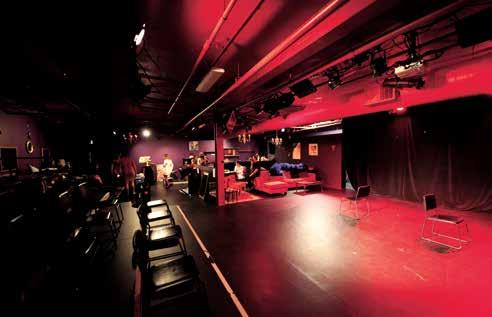
The venue itself is welcoming, with soft lighting and colors. The deep-red ceiling and dark walls gave the venue a warm and comfortable feeling and set the mood for a memorable evening. Outside of the general seating, there are booths, couches, and standing room, as well as a bar lounge. The Give Inn at full capacity can seat about 90 people, or 150 with standing room.
The venue partners with local businesses, including Bad Jimmy’s Brewing Co. for drinks. They are looking to partner with other local businesses for upcoming events. After the fun night I had at the Give Inn, I look forward to seeing upcoming productions. It was a pleasure to see a community of artists thriving and creating their own space, and especially enjoyable to know that the talented board is crafting a space by and for LGBTQIA+ and BIPOC burlesque artists.
Learn more about the Give Inn at thegiveinn.com, and follow Seattle Burlesque and Cabaret Co-op on Facebook and Instagram @sea.bcc, and Twitter @SeattleBCC.
The music festival you probably have never heard of
by Miryam Gordon SGN Contributing Writer
Music lovers, rejoice! Music festivals, especially outdoor ones, will very likely be back in the next couple of months. A few venues have posted their schedules, and life is starting to “sound” more familiar.
One influential festival that couldn’t be held last year is Hoodstock. For the twelfth year (minus last year), Hoodstock has been introducing Black music artists, especially up-and-coming ones, to a lot of other Black musicians and fans.
This year it will be on July 31, starting around 3:00 p.m. (There are other festivals with the same name, including one on Hood Canal. Those are not this.)
Organizer Selena Whitaker-Paquiet described the origins of the festival. “In 2007, I was in a band, NighTraiN, an allwoman-of-color rock band. We started out in the punk rock genre, but it was really hard to make money in the clubs. We wrote original music, and were also somewhat socially aware… and our music was commentary.”
She and a few friends wanted a place that new and innovative bands could play and get some recognition. “Our thoughts were, ‘Let’s have a party where the bands we know and like can come together and play, and people give some money that goes directly to the band. No 50% of the door or twodrink-minimum. And wouldn’t it be fun!’…
“We wanted to create an environment where people could make money and also be ‘seen.’ So we made Hoodstock! Our first year was NighTraiN and several other bands. One band, Bob and Dangerous Brothers — a punky, rocky space-age band that’s difficult to classify — had the lead singer (a male) wearing a ’50s woman’s dress suit, a little skirt with a jacket. It was hilarious. They made fun of themselves; their drummer wore an aluminum antenna on his head. They wanted to remind you of when you were a kid and nothing mattered and you dressed up and had fun.”
“It was $5 and you got a hot dog and a soda,” she continued. “It was about who wants to come play. Our first show lasted
One influential festival that couldn’t be held last year is Hoodstock. For the twelfth year (minus last year), Hoodstock has been introducing Black music artists, especially up-andcoming ones, to a lot of other Black musicians and fans.
about two hours. My daughter dealt with the hot dogs and a soda, and she was pregnant at that show. It’s been a family affair (ever since).”
“It was about good music,” she added. “A lot of times it ends up being people of color, because it’s hard [for them] to get recognized for their talent. They’re immediately labeled. Like, ‘Oh, they’re just going to be doing rap’ or ‘I don’t want to hear angry music.’ And it isn’t about anger. It’s about communication that everyone can relate to.”
A neighborhood launching pad
This is hardly a festival for thousands of people. It’s actually in Whitaker-Paquiet’s backyard! To make sure her neighbors weren’t bothered, she said, “we’d walk with my dogs and grandchildren and go door to door in a four-block radius and make flyers and knock on everyone’s door and [say] here’s your invitation (for free to the neighbors as a thank-you for the inconvenience for the noise and parking). Now, they’re like, ‘Oh! Is it Hoodstock? Thanks for the flyer!’ We’ve gotten to know so many neighbors that when we walk the ’hood, we find out who’s moved out, who’s moved in.
“People really want us not to stop doing this. I advertise it as being a family affair. We barbeque and offer food for donation. Suggested amounts go to the [various] band
members. We’re suggesting $15-20 and you’ll get to see ten-plus bands. We start at 3:00 p.m. and try to be done by 9:00 p.m.
“It’s a full-fledged concert. We build a stage, there are amps — we try not to be blaring, but the people immediately around definitely hear it.” Whitaker-Paquiet said that they have had as many as 200 people in attendance, and that means she has to hire security. New bands are found by getting recommendations from musician friends. As Whitaker-Paquiet said, “We listen to everybody. The committee now is me, Taryn Dorsey — who used to be the drummer for NighTraiN — and Tim Lennon, who is at Langston Hughes Performing Arts Center. It’s music that we like, and we want people to hear something new.”
“We love seeing bands become successful,” she added. “We’ve had some of Seattle’s favorite bands come out of Hoodstock: the Blacktones, Bear Ax, Tres Leches. They all had their style and talent, and people just needed to hear them.
“For many of the bands that came from early Hoodstock days, they’ve said it was a launching pad, getting better audiences, more audiences, better shows, like at The Comet, Crocodile, or Neumo’s, and hooking up with other bands and going on tour. The exposure was important to them. It was like a blossoming bud and branching out to different places.
“What’s always been important to us is bringing out new styles, new music. NighTraiN… started our own genre. We called ourselves punk funk. Hoodstock was encouraging people to do their own sound and not changing [themselves] to fit into some genre that wasn’t who they are. If this sounds like a festival you can’t miss, you have to be “in the know…” If you’re in the Central District and ask around about “the MLKy Way House,” you’ll find it. Maybe you’ll find a band you love and want to encourage, which sounds like the best part of being in the ’hood!
Photo courtesy of The Give Inn
Hoodstock 2019 – Photo by Kim Voynar
Film Bloody Fear Street a thrilling conclusion to an impeccably crafted horror trilogy
by Sara Michelle Fetters SGN Staff Writer
FEAR STREET PART 3: 1666
Netflix
Sarah Fier’s severed hand has been returned to her corpse, hidden just outside of Shadyside. A confident Deena (Kiana Madeira) is certain she has ended the curse that has afflicted the residents of her town for generations. Better, she has likely saved Sam’s (Olivia Scott Welch) immortal soul.
Not so fast. After Deena’s blood drips upon the bones, she is magically transported back to 1666 and Union, the small township on whose remains Shadyside is founded. She has become Sarah Fier and will see the final days of the young woman’s life through her own eyes. And the truth of what happened to the supposed witch will be far more heinous and awful than the terrifying fairy tale people have been led to believe for the past 300 years.
With Fear Street Part 3: 1666, one of the most ambitious motion picture horror trilogies I’ve ever seen comes to a thrilling conclusion. Inspired by the literary world created by author R.L. Stine, Director Leigh Janiak and her talented team of co-writers do a superb job of juggling all of the interconnected components of this massive three-part puzzle, all of the seemingly disjointed pieces fitting together with startling ease.
If the first story was an homage to Scream and late-1990s, early-aughts horror, and the second embraced 1980s summer-camp slasher aesthetics à la Friday the 13th, this climactic entry is a delicious throwback to both the Hammer gothic terrors and the Roger Corman/Vincent Price collaborations of the 1960s. Janiak boldly makes another titanic tonal shift that stays in place for the majority of this film’s running time, keeping that in place until events return to the original setting for a glorious final smackdown between good and evil, in
which the future of Shadyside and its residents hangs precariously in the balance.
This does mean that much of the core plot dynamics occurring in 1666 are not altogether surprising. For all of its time shifts, the heart and soul of Fear Street is the 1994 relationship between Deena and Sam. While it has been an ongoing question as to whether this romance would survive in the face of such monstrous and senseless depravity, I don’t think it will catch anyone off guard that Janiak focuses most of her creative energies on fate of these two teenagers.
This is not to say that the story of Sarah Fier is given short shrift. What happens
to her and the citizens of Union is of vital importance. Janiak has plenty on her mind, and while themes regarding everything from economic disparity and social inequity have been littered throughout both of the first two pictures, it is here where the director makes her nerviest statements. This tale cuts right to the heart of the puritanical hypocrisy at the root of this country’s founding. The systemic patriarchal oppression that bubbles underneath the surface of the political and social reality of living in the United States even today is nakedly projected onto a crystal-clear mirror for everyone to see.
A walk down Fear Street with writer Phil Graziadei
by Sara Michelle Fetters
SGN Staff Writer
FEAR STREET TRILOGY
With today’s release of Fear Street Part 3: 1666, Netflix’s horror trilogy inspired by the long-running series of books written by Goosebumps author R.L. Stine comes to a thrilling conclusion. Heroine Deena Johnson (Kiana Madeira), transported into the past to inhabit the body of supposed witch Sarah Fier, will discover the chilling origins of the terrifying curse that has affected the residents of Shadyside for almost three centuries.
Screenwriter Phil Graziadei has been a filmmaking partner of director Leigh Janiak for quite some time. The pair’s 2014 debut Honeymoon is a minimalist bodyhorror tale of love and death that puts its two main characters first and allows all of the insidious thrills and chills to be born directly from their relationship. It’s marvelous and worth the effort to seek out.
With Fear Street, the pair get to work their magic on a far bigger canvass. Throughout their ambitious trilogy, they,
It’s a lot to take in. Sarah Fier’s journey isn’t for the faint of heart, and while the true villain’s identity is honestly rather obvious, there is still plenty of heartrending power in how Janiak reveals what is going on and why it’s been allowed to fester and grow for centuries.
When things do come full circle, all of this only helps make the royal rumble at the Shadyside Mall all the more fantastic. Deena stands up, not just for herself, Sam, Ziggy (Gillian Jacobs), and her little brother Josh (Benjamin Flores Jr.) but also for all of those who have pointlessly lost their lives to a corrupt system that viewed the citizens of Shadyside as nothing more than chattel fit for slaughter and precious little more.
Janiak is still having fun, though — there is plenty of silliness to be found in this last installment. But while much of the humor still tickled my funny bone, I’m struck by how profoundly relevant many of the interior dramatic sentiments proved to be. There are moments I wanted to throw things at the screen, as it felt like the raw truths Janiak goes out of her way to expose hit incredibly close to home.
The stunt casting that allows pretty much everyone who appears in both Fear Street Part 1 and Fear Street Part 2 to reappear in Fear Street Part 3 is a tad obnoxious, but as this foray into the distant past is seen through Deena’s eyes, I’m not going to make too big a stink about it. Additionally, this does allow supporting players Welch, Ashley Zukerman, and McCabe Slye real opportunities to shine. While I won’t say a lot about their characters — to avoid any inadvertent spoilers — each excels at making a memorably potent impression that’s key to where all of this is headed and how it gets there. By now it’s pretty clear I’m in love with this series. Janiak has done something remarkable, and while I will say once again how sad I am that I didn’t get to watch these in a crowded theater with a screaming audience eager to eat up every second of the carnage, I’m still overjoyed by what the director has accomplished. Deena and Sam’s relationship is the stuff of romantic horror legend, and Fear Street Part 3: 1666 an almost perfect summation to an impeccably crafted trilogy I’m going to be treasuring for many years to come.
Benjamin Flores, Jr. and Kiana Madeira in Fear Street Part 3: 1666 – Photo courtesy of Netflix
Phil Graziadei – Photo courtesy of Netflix
GRAZIADEI
continued from page 10
But I could watch 1978 on repeat and never grow tired, even though it ends in a way we can’t really go into detail here.
PG: That’s a great review, as far as I’m concerned.
The films sort of toe this line between features and long-form television. So as much as I say that we wanted to close the chapter completely, you do really need to watch them all together to make sense of it all.
We want people to feel as satisfied as possible with each movie on its own. We didn’t want to feel like we were cheating people or trying to string them along. A thing that was helpful was to try to approach them from the characters’ perspectives at all times. We made sure that everything you learn about the history of Shadyside and what’s happening is tied to their perspectives, aside from a couple moments of foreshadowing or dramatic irony.
I think that helps. It helps people to experience this story along with the characters. It’s also why you care when they go through the bread slicer or whatever.
SMF: You know that moment is going to become like one of the biggest GIFs on the internet at some point, right?
PG: I’m for it. I’m all for it. [laughs]
SMF: This does lead me to something that I mentioned to a few people and in my review of 1994. It’s like with the bread slicer, it kills me that I was not watching that moment with a packed house in a theater. At the same time, I’m honest enough to realize that I don’t believe this trilogy exists in this form without Netflix. You made an unabashedly Queer horror trilogy that people are loving that wouldn’t exist if it didn’t have Netflix footing the bill.
Do you have any thoughts on that? I think we all want people to enjoy these films together, and there is sort of a communal aspect thanks to social media. But it isn’t quite the same, is it?
PG: Netflix has been incredible. From the second they had the chance to acquire these, they’ve been so supportive and great, which is a big deal.
But, yeah, I think any filmmaker sort of laments the sort of decline of the communal experience at the movie theater. But I also hope that people don’t feel like they have to watch everything on Netflix by themselves. I’ve gotten groups of friends together to screen these movies. It’s wonderful. I think people can do that with Netflix, too.
But you are right. Horror movies, there’s something that’s really fun about being in a theater with at least a few people who are maybe a little too demonstrative in their
Books
responses to what’s going on. That’s always a blast. It is sad to miss out on that.
But Netflix is a perfect home for these, and I hope people watch them together.
SMF: When you get to 1666, everything comes full circle in a profound way. You end up talking about the patriarchal foundation of America in some very surprising ways that, especially for young viewers, I feel could be important. Yet, it’s also still gory and silly and fun and nasty and has great character moments and some wonderful reveals. But it still seemed clear to me that you all are making some profound statements in a notso-subtle way. Am I reading too much into that?
PG: From the very beginning we conceived of the project as a sort of an allegory of systemic oppression. I think that’s clear, and some of the ways that come across, obviously, you’ve picked up on. It’s there in the intertextuality between the films and the sort of cyclical natures of this violence that we get to revisit through the eyes of certain characters later on in the series. It’s all deliberately structured.
I don’t want to ruin it for people. But, yeah, that was our approach from the beginning. We wanted to tell this story about outsiders struggling in this system that feels like it’s stacked against them, where the things that make them outsiders
are ultimately the things that allow them to fix their problems in that world.
SMF: For you personally, what has this experience meant to you? What do you hope you take from it moving forward?
PG: This should be an easy part, talking about me instead of the work. [laughs] Nothing could make me happier than being able to bring these Queer stories in a mainstream format to audiences all over the world at the same time because of Netflix’s distribution model. It’s so important. It’s so important that people see these stories, see Queer people who have a possibility for happiness in their lives, who aren’t just victims or villains or monsters. In general, people have been really supportive of that. I think one of the things that’s happened for me since these movies have started to come out is that I’ve had so many kids reaching out to me on social media, talking about how they’ve never felt like they’ve seen themselves presented on screen before.
It’s incredible. I don’t think any writer could hope for anything more than that. I hope that Hollywood will take a page out of Netflix’s book and take more of these kinds of risks of telling stories for broad audiences that center Queer characters. I’ll never get tired of hearing stories about kids who watch these movies and feel like they’re less alone.
The Guncle : Charming and snarky novel of unexpected parenting unfolds like an inflatable pool toy
The situation you’re facing isn’t one you wanted. In fact, it’s a hundred percent the opposite. Not your circus, not your monkeys, as they say. Usually, you’d follow your instincts and run — but this time, you surprise yourself by stepping up and taking ownership. Now it is your problem, but, as in the new novel The Guncle by Steven Rowley, that’s more than okay.
Patrick wasn’t exactly happy when his friend Sara married his brother Greg, but she managed to make it work and he loved her for it. In fact, he loved her first, and he never let her forget it.
But now she was gone forever, and Greg had asked the impossible: would no-responsibilities Patrick — a Gay man, former TV star, and Palm Springs fixture — take Greg and Sara’s kids, nine-year-old Maisie and six-year-old Grant, for the summer so Greg could go to rehab while grieving the death of his wife? Could the kids’ GUP (Gay Uncle Patrick) step up?
No. There was no way that Patrick was taking temporary custody of two kids — but then his older sister Clara copped an attitude, rolled her eyes, and told him he was “off the hook.”
Pfft. Right.
And so Greg headed to rehab after the funeral and the kids went home with Patrick to Palm Springs. It would be a long 90 days.
Grant was cute but full of questions; Patrick learned to make things up. Maisie was nobody’s fool; Patrick learned to hide his passwords. He gave them “Guncle” rules (Gay + uncle = guncle), life lessons, and stories about their mother. But
past that, what does a Gay man who never wanted kids do when he suddenly has two of them?
He takes them to the museum way too often, that’s what. He takes them to five-star restaurants and cringes when they order kid food. He lounges with them in the pool, gets them a dog, lets them put up a Christmas tree in July, hugs them, and throws a party.
And he loves them...
There are four words that best describe The Guncle: A. Dor. A. Ble.
That’s it. This novel is simply as charming as they come, and don’t be surprised if you can almost hear your favorite actors as any of the characters here. Don’t be surprised, either, if you spend your vacation racing to reach the ending you think’s coming and you’re wrong.
Indeed, author Steven Rowley offers the perfect mix of snorts and sobs here,
snarky fun one minute and pathos the next, but neither emotion is belabored or forced.
That gives readers room to enjoy the tale as it unfolds and grows like an inflating pool toy, and to watch the characters twisting wistfully in irresistible, concentric circles.
Your ticket’s in your hand, your suitcase is packed, your destination is close, but you need a book to get you there. If you’d love to immerse yourself inside a sweet novel like The Guncle, then step right up.
Image courtesy of Putnam
Steven Rowley – Photo by Byron Lane
Books Queen Anne Book Co. The welcoming heart of the neighborhood
by Lindsey Anderson SGN Contributing Writer
Community: it’s what many say makes Seattle so special. And nothing quite brings a community together like a neighborhood bookstore.
Affectionately referred to as “the heart of Queen Anne,” the Queen Anne Book Co. finds itself nestled literally right in the middle of the iconic Seattle neighborhood.
Wendee Wieking has been the manager there for one week, but she has had a long-standing connection to this neighborhood institution and has been witness to its unique history. Eight years ago, the original Queen Anne Book Co. closed down, leaving the neighborhood without its beloved bookstore, before its new incarnation opened.
“I’ve actually been here at the store for all of its eight years, since we opened in 2013,” she said, “and prior to that I worked for five years at the store that preceded this” as a bookseller and buyer.
Judy de Jonge was one of the original store’s best customers, coming nearly every day to read a book and sip her morning coffee. The neighborhood was not the same after the bookstore closed its doors, and Judy was determined to bring back the charm the community had lost. Along with her partner, Krijin, Judy bought the building and brought books back to Queen Anne.
After the de Jonges reopened the store, the previous curators, Wieking and Tegan, the resident buyer of children’s and young adult media, were able to return to the work they love. “We have kind of a unique place in this community,” Wieking explained. “There has been a store on the hill for more than 25 years. This store really is considered [its] heart and soul.”
There’s no question why the community loves Queen Anne Book Co. so much. The store knows its neighbors and tailors its collection to their interests. “The personality of the store reflects the personality of the community,” Wieking said. “We have our young families, our single people, and senior citizens living down at Bayview Manor.”
Many of the store’s patrons are children, so the store caters to their needs too. Nearly half the store is made up of children’s and young adult books, each specifically chosen by Tegan.
What makes the bookstore so unique is its emphasis on inclusivity. “Our philosophy at this store has always been broadly inclusive. Our adult buyer and our children’s and young adult buyer have put tremendous emphasis on inclusion… and what we want is when somebody walks through the door, they are going to feel they belong here, and they are going to find stories that reflect who they are.”
LGBTQ books can be found in every section of the store, and Tegan even set out a display of LGBTQ children’s books, complete with a book review from a young reader.
For Queen Anne Book Co., being an integral part of the community also means giving back to it. Each year the store helps provide books to local schools, ensuring that every child has a fair chance to develop a love of reading.
The store also gives to those who are incarcerated. “Over the last two or three years we have developed a very close relationship with ‘Books to Prisoners,’ a Washington state corrections facility program,” Wieking said. Over the years, they have developed such a deep relationship with the
What makes Queen Anne Book Co. so unique is its emphasis on inclusivity. “Our philosophy at this store has always been broadly inclusive… and what we want is when somebody walks through the door, they are going to feel they belong here, and they are going to find stories that reflect who they are.”
Washington state corrections library that the library has asked to the store to recommend books for the inmates.
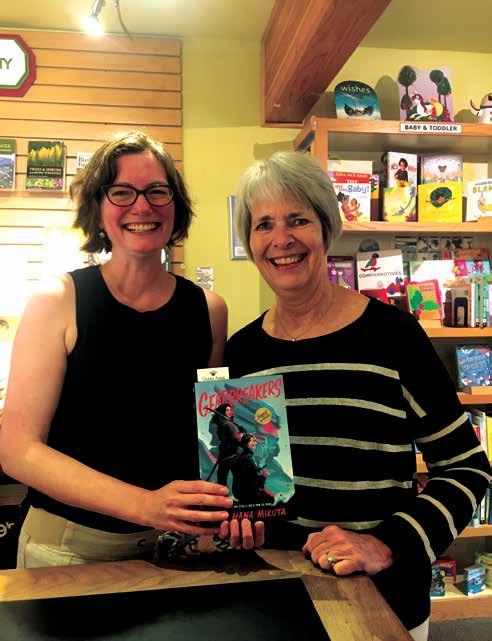
Recommending books is a unique talent of the sellers at Queen Anne Book Co. When I asked for a recommendation, three excited voices announced the same title in unison: Gearbreakers! Tegan gave a detailed synopsis of the amazing and groundbreaking first novel published by Seattle’s own Zoe Hana Mikuta, an undergrad student at the University of Washington. “It’s a lot of action, a lot of passion, and a lot of fun!” she said with excitement. The bookstore is one of the first in Seattle to feature Gearbreakers in hardcover, and it even promoted the novel with a visit and book signing by the author.
So for a delightful community institution, look no further than Queen Anne Book Co. Stop by to browse the selection, and don’t overlook the young readers’ area — your’re never too old to enjoy a good picture book!
(And don’t forget to pick up a signed copy
of Gearbreakers.) Queen Anne Book Co. is a wonderful and integral part of Seattle’s community, and a perfect place to feel welcome.
Queen Anne Book Co. is open 10 a.m. to
Queen Anne Ave. N. More information
Photos by Lindsey Anderson
them. Only white neighborhoods would get pools, and they would rather throw acid into them than swim alongside Blacks. This has contributed to the lack of representation of the Black community in professional swimming. That, and the other huge obstacle standing between the Black community and swimming: their hair.
Black hair is naturally drier than other hair types. It has fewer cell layers to protect it, and the tightness of the curls prevents the oils in the scalp from traveling down the hair shaft. The bleach used in swimming pools has an additional drying effect on Black hair, which leads to damage and breakage. This results in the need for oils and moisturizers (which tend to make standard swim caps slide) and the use of protective styles.
So, in this day and age, with the integration of public pools, the primary obstacle holding back Black swimmers has become the lack of diversity in equipment for them, particularly swim caps.
The texture and styling of Black hair — especially protective styles like locs, Afros, weaves, braids, and twists — do not mesh well with typical swim caps. These styles can take hours to complete and require specific types of care and upkeep. The texture
Without the proper equipment to make swimming appealing, Black swimmers are forced to choose between the health of their hair and swimming altogether.
and thickness of Black hair and hair styles prevents easy and proper application of the standard swim cap and usually results in more water entering the cap than intended.
It is suggested that swimmers wet their hair first, so that it can be slicked down to their scalp before attempting to put on a swim cap. However, that is not a helpful requirement for Black swimmers with natural hair. Even when wet, most natural Black hair does not lay flat to the scalp. So, without the proper equipment to make swimming appealing, Black swimmers are forced to choose between the health of their hair and swimming altogether.
The Black-owned British company Soul Cap saw this gap in swimmers’ needs and developed a cap that is designed to accommodate diverse hair types. This larger cap is made to fit over and protect the above-mentioned styles, as well as thick and curly hair.
This year, professional sports has seen an increase in swimmers from ethnic minority groups who have qualified for the Olympics, such as Simone Manuel (of the US) and Alice Dearing (the first Black British woman to swim for Team GB at the Olympics). Thus the barring of Soul Cap from the Tokyo games feels that much more unfortunate.
The international governing body for swimming rejected Soul Caps’ application to have its caps certified for use at competitions. FINA (the federation for international competitions in water sports) stated that the caps were barred because, to their “best knowledge, the athletes competing at the international events never used, [nor were] required to use, caps of such size and configuration.” FINA also said the caps are unsuitable because they do not follow “the natural form of the head.”
This directly discriminatory initial statement was clearly based in ignorance of Black hair and the inability to see the need for expanding the rules. It left the co-founders of Soul Cap (Toks Ahmed and Michael Champman) disappointed in what they told
The Guardian is the “failure to acknowledge the diversity of competitive swimmers.”
Because white swimmers have never needed a larger cap, the governing body could not see the need for it. If their members were more diverse, someone would have been able to inform them of the mistake they were about to make.
Amid the frenzied backlash, the founding member of the Black Swimming Association, Danielle Obe, told The Guardian that the ban has “created a sense of exclusion for members of the Black and minority ethnic community.”
FINA has since acknowledged the reactions to its decision on the use of Soul Cap in competition and has stated that it is committed to “ensuring that all aquatics athletes have access to appropriate swimwear.” It plans to “review the situation” with Soul Cap, as well as similar products, “understanding the importance of inclusivity and representation.”
Hopefully, FINA will reconsider, and the initial ruling will not discourage the Black community from tuning into the Tokyo games or children from aspiring to be Olympic swimmers. Simone Manuel and Alice Dearing are two inspirational young women and positive role models who deserve the support of every member of the countries they are representing.
Alice Dearing – Photo by Photo by Luke Hutson Flynn
National & International News
BOSTON PRIDE
and the community,” they wrote. “Over the past 50 years, Boston Pride has facilitated programs and events that have changed our society and promoted equality, but we know there is still work to be done.”
The group added that they had hired consultants Dorrington & Saunders and formed a “Transformation Advisory Committee comprised of members of the LGBTQIA+ community” in an attempt to respond to charges of exclusion.
Nevertheless, the group said, they now realize that they have failed to address community concerns.
“It is clear to us that our community needs and wants change without the involvement of Boston Pride,” they said. “We have heard the concerns of the QTBIPOC community and others. We care too much to stand in the way. Therefore, Boston Pride is dissolving. There will be no further events or programming planned, and the board is taking steps to close down the organization.
“We know many people care about Pride in Boston, and we encourage them to continue the work. By making the decision to close down, we hope new leaders will emerge from the community to lead the Pride movement in Boston.
“This decision was made with a heavy heart, out of love and hope for a better future.”
Boston Pride’s problems began in 2020, when 80% of their volunteers quit after the
board removed the hashtag #blacklivesmatter from their social media accounts, and heavily edited a statement by the group’s communications team condemning police violence.
The edited version was posted on the Boston Pride website without consulting
the city’s Black Pride or the group’s own communications team.
The city’s Black and Trans communities responded by organizing their own event — the Trans Resistance March and Vigil — timed to preempt the 50th anniversary celebration of Boston Pride.
Gilead applies for FDA approval for six-month HIV treatment
by Mike Andrew SGN Staff Writer
The pharmaceutical mega-corporation Gilead has applied for FDA approval for a new HIV treatment that only needs to be injected once every six months.
The drug, known as lenacapavir, works differently from currently available HIV meds. If approved, it would be the first socalled HIV capsid inhibitor on the market.
Gilead says it has been developed specifically for HIV-positive patients who have used other meds and have developed resistance to some or all of them.
In clinical trials, the vast majority of patients saw their viral load fall back to undetectable levels when treated with lenacapavir.
“Lenacapavir is an important breakthrough innovation with the potential to be transformative for people living with multidrug-resistant HIV who have very limited treatment options,” Gilead Chief Medical Officer Merdad Parsey, MD, PhD, said in a news release.
“The filing moves us one step closer to
providing an innovative treatment option that helps to address barriers to achieving viral suppression and meet the unmet needs of people living with multidrug-resistant HIV.”
In May 2019, the FDA granted breakthrough therapy designation for the development of lenacapavir for the treatment of HIV-1 infection “in heavily treatment-experienced patients with multidrug resistance in
combination with other antiretroviral drugs.”
Because the health of these patients was at risk and their treatment options were dwindling, the FDA gave Gilead permission to speed up the development and testing process. Subsequent clinical trials have been successful, and Gilead now wants full approval to begin marketing the drug.
Although lenacapavir was developed and is currently aimed at those with multidrug resistance, Gilead has indicated that it would look into marketing the drug to the general HIV-positive population.
In fact, Gilead said last year that it was considering trials using lenacapavir as a form of long-acting PrEP. Gilead already makes HIV and PrEP drugs Truvada and Descovy.
Earlier this year, the FDA granted approval to the first once-a-month injectable HIV treatment, Cabenuva, made by a Canadian firm. That drug is aimed at the general HIV population and is already being marketed, freeing some patients from having to adhere to a daily pill regimen.
International news highlights
by Daniel Lindsley SGN Contributing Writer
Budapest:
Teachers refuse to self-censor
Reuters brought forth the voices of Hungary’s teachers on July 8, after a law passed last month banning the subject of homosexuality from the country’s classrooms. Transgender chemistry teacher Flores FellegiBalta was lucky to have a supportive employer, although a private one, who told him — after he had pored through the new laws — that they were dedicated to “earning the trust of [their] parents and students” and would mount a defense if he were charged. Fellegi-Balta said he would refuse to self-censor, as a matter of scientific rigor. Secondary school teacher Eva Gadanecz shared that sentiment, and added the importance of acknowledgment and education for the health of LGBTQ students.
by Daniel Lindsley SGN Contributing Writer
Washington DC:
First out Gay ambassador
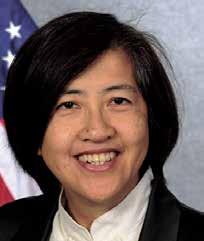
NBC News reported July 9 on the Biden administration’s nomination of Chantale Wong, who stands to be the first out Lesbian with the rank of ambassador. Wong promised, should the Senate confirm her appointment, to “serve with humility and [with] the purpose of advancing US interest[s]... on behalf of [her] fellow Americans.”
NBC noted Wong’s past work as a videographer for “congressional civil rights pilgrimages” in Alabama with the late Georgia Democrat Rep. John Lewis, whom Wong cited as an inspiration.
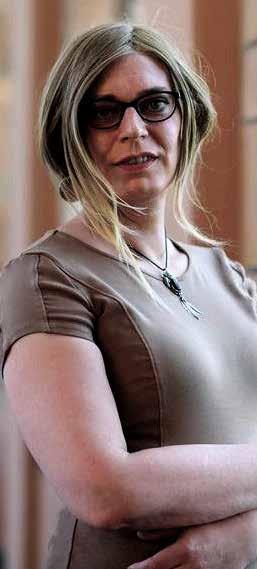
Berlin: First Trans candidate for the Bundestag Reuters reported July 7 on Bavarian parliament member Tessa Ganserer, the first Trans candidate for Germany’s Bundestag (parliament). Ganserer’s platform targets what she calls a “hypocritical show of tolerance” among the current leadership, which voted not to reform the “degrading transsexual law” of the Transgender Act of 1981. Ganserer plans first to make ratifying sex changes on documents easier, but also offer legislation allowing Lesbian mothers to adopt children and ending the ban on Gay men donating blood. Reuters added the context of a recent jump in anti-LGBT hate crimes, which rose 36% in Germany last year.
Photo courtesy of Gilead Sciences
Photo courtesy of Boston Pride
Chantale Wong – Photo courtesy of U.S. Govt.
Tessa Ganserer – Photo by Andreas Gebert / Reuters