ISSUE 28
C E L E B R AT I N G
VOLUME 50
48 YEARS
F R I D AY
IN
J U LY 1 5 , 2 0 2 2
PRINT S E AT T L E ’ S L G B T Q I A + N E W S & E N T E R TA I N M E N T W E E K LY S I N C E 19 74
STARBUCKS TO CLOSE FIVE SEATTLE STORES AMID UNIONIZATION EFFORTS SWU calls bullshit
by Mike Andrew SGN Staff Writer Starbucks announced on July 11 that it would close five Seattle stores on July 31. Two of those stores have unionized, and there is active union organizing going on the in remaining three. Starbucks says it needs to close the stores because neighborhood crime makes them unsafe for its employees. The employees say this is another one of the company’s union-busting tactics.
see STARBUCKS page 4
Starbucks East Olive Way – Photo courtesy of @starbuckseolive / Instagram
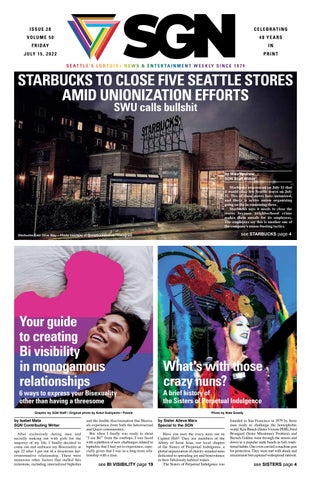
Your guide to creating Bi visibility in monogamous relationships
6 ways to express your Bisexuality other than having a threesome
What's with those crazy nuns? A brief history of the Sisters of Perpetual Indulgence
Graphic by SGN Staff / Original photo by Ketut Subiyanto / Pexels
by Isabel Mata SGN Contributing Writer After exclusively dating men and secretly making out with girls for the majority of my life, I finally decided to come out and embrace my Bisexuality at age 22 after I got out of a disastrous heteronormative relationship. There were numerous other factors that stalled this milestone, including internalized biphobia
and the double discrimination that Bisexuals experience from both the heterosexual and Queer communities. But when I finally was ready to shout “I am Bi!” from the rooftops, I was faced with a plethora of new challenges related to biphobia that I had yet to experience, especially given that I was in a long-term relationship with a man.
see BI VISIBILITY page 19
Photo by Nate Gowdy
by Sister Alleva Marx Special to the SGN Have you seen the crazy nuns out on Capitol Hill? They are members of the Abbey of Saint Joan, our local chapter of the Sisters of Perpetual Indulgence, a global organization of charity-minded nuns dedicated to spreading joy and benevolence in their fabulously habited wakes. The Sisters of Perpetual Indulgence was
founded in San Francisco in 1979 by three men ready to challenge the homophobic world. Ken Bunch (Sister Vicious PHB), Fred Brungard (Sister Missionary Position), and Baruch Golden went through the streets and down to a popular nude beach in full, traditional habits. One even carried a machine gun for protection. They were met with shock and amazement but captured widespread interest.
see SISTERS page 4
2
SGN
J U LY 1 5 , 2 0 2 2
C E L E B R AT I N G 4 8 Y E A R S!
ORIGINALLY SEATTLE GAY NEWS FOUNDED 1974 MEMBER 509 10th Ave E Seattle, WA 98102 (206) 324-4297 sgnpaper@gmail.com sgn.org
SUPPORT INDEPENDENT JOURNALISM
DONATE TO SGN TODAY!
Publisher Angela Cragin Managing Editor A.V. Eichenbaum Copy Editor SGN Staff • Richard Isaac Advertising Maggie Bloodstone, Advertising Manager National Advertising Rep. Rivendell Media (212) 242-6863 Staff Writers
SHOW YOUR PRIDE! seattlegaynews.redbubble.com
Mike Andrew • Sara Michelle Fetters Contributing Writers Lindsey Anderson • Alice Bloch Maggie Bloodstone Sharon Cumberland • Carter Hemion Eve Kucharski Daniel Lindsley • Paige McGlauflin Gaysha Starr
Merch Store!
Social Media Manager SGN Staff Photographers Nate Gowdy • SGN Staff Production Mike Pham SGN is published by Angela Cragin. © 2022. All Rights Reserved. Reprints by permission. Publication of names, photographs, or likeness of any person, organization, event or business in this publication cannot be taken as any indication of the sexual orientation of the person, organization, event or business. Opinions expressed in bylined articles, columns, and letters are those of the authors only and do not necessarily reflect the views of the staff or management of this paper. SGN welcomes unsolicited material, including letters to the editor, but reserves the right to edit or reject material. All rights revert to authors upon publication. We assume no liability for loss or damage of materials, solicited or not. We invite feedback, please write. And please play safe. It is our policy that no money shall be refunded if you choose to cancel your ad. Credit will be given for the balance owed. No exceptions.
In Loving Memory Of George Bakan
Scott Roger Alpert Cookie Andrews-Hunt James Arnold Ken Campbell Steve Foiles Shaun Knittel James Leland Moore Don Paulson Randy Peters Lee Richeson Shaun Shelton Jim Tully
Follow SGN
VISIT US ONLINE SGN.ORG
In this Issue
LOCAL NEWS 4 A&E 5 FILM • BOOKS 6 TRAVEL 14 OP-ED 19 NATIONAL/INTERNATIONAL NEWS 20 J U LY 1 5 , 2 0 2 2
SGN
3
Local News
STARBUCKS continued from cover
The already-unionized stores to be closed are at Union Station and 1600 E. Olive Way. The others are at 23rd Avenue and Jackson Street, 6417 Roosevelt Way NE, and the iconic Westlake Center store. Workers at the unionized stores were told that they may apply for employment at other Starbucks stores, and they would continue to be represented by the union only if they were hired at other union stores. Workers at the Union Station store posted notices stating in boldface, all-caps font, “Starbucks is lying. This is not goodfaith bargaining, this is union busting.” “We think it is disingenuous for Starbucks to claim they could not provide a safe experience for our workplace when we were routinely denied support offered to other stores with similar concerns,” the workers’ notice explained. “We think it is insulting to claim they care about our mental and physical health then threaten the financial safety of every single worker at this location.” Erin Bray, who works at Union Station, told the Seattle Times that she asked management for more security, but Starbucks never hired additional security officers. However, workers generally felt safe there and never thought they needed to close the store, she added. Now, “I just feel helpless,” Bray said. SEIU, the parent union of Starbucks Workers United, tweeted its support for its Seattle members on July 13. “At a time when corporations like @Starbucks engage in shameful tactics to intimidate workers seeking to unionize, working people are uniting & winning across the country to send a strong signal that those actions will not be tolerated! #UnionStrong #UnionsForAll,” the union said.
Howard Schultz – Photo by Ted S. Warren / AP
Starbucks has closed or announced plans to close stores in other parts of the country for reasons workers say are specious, and part of a concerted plan to fire union workers. In June, for example, Starbucks said it would close a unionized store in Ithaca, New York, “for business reasons.” Employ-
ees there said the store was always busy with customers from nearby Cornell University and Ithaca College, and they were sure the company was closing their store as retaliation for their vote to unionize. The National Labor Relations Act, a federal law passed in 1935, requires employers to bargain in good faith with
their workers’ union, and prohibits employers from intimidating or harassing workers who want to form a union. Starbucks Workers United has filed dozens of unfair labor practices complaints against Starbucks, charging the company with hundreds of individual violations of the National Labor Relations Act.
Photo by Nate Gowdy
Their next appearance was at a softball game, where their pompon routine all but stole the show. In the fall of 1979, two additional members, Edmund Garron (Sister Hysterectoria) and Bill Graham (Reverend Mother) appeared at the first international faerie gathering and encountered even more men ready to answer the call. Later that year, these four founders convened their friends, chose our name (The Sisters of Perpetual Indulgence), and composed a direct, dramatic mission statement:
to promulgate universal joy and expiate stigmatic guilt. The origin of the Sisters in San Francisco occurred at the start of the 1980s moral crusades and the HIV/AIDS epidemic. The Gay population in San Francisco was large enough at the time, however, to be a political force and push back against those who preached hellfire and damnation. But as the impact of HIV/AIDS increased and existing health services failed to keep up, the Sisters stepped in to help and began raising money and speaking out about sexual health. In 1982, the Sisters joined with area medical professionals to write and distribute “Play Fair!,” one of
4
J U LY 1 5 , 2 0 2 2
SISTERS
continued from cover
SGN
the first pamphlets to use plain language to explain and promote safer sex. As years passed and the treatment and prevention of HIV infections have changed, so have the Sisters. Now they spread awareness of viral suppression therapies and PrEP, in addition to condoms and other risk reduction practices. The Sisters have become a global phenomenon, with chapters in Europe, South America, and Australia. The Seattle chapter, the Abbey of Saint Joan, was founded in July 1996 by Sisters Naga Baba Ganesh, Madonna Supermodel of the World, Maria Caffeina Mocha Latté, Eva Destruction, and Carmina Piranha. Over the last 26 years,
they have raised and distributed hundreds of thousands of dollars in grants supporting Washington state LGBTQIA+ organizations, women’s causes, and homeless youth. This summer, the Abbey of Saint Joan is celebrating its 25th + 1 anniversary with “Inquisition!” Saturday July 16 at CC Seattle (1701 E. Olive Way) from 7:00 to 10:00 p.m. For a small donation, participants may confess their sins and receive their penance. Sisters will be available to administer flogging, spanking, paddling, and public humiliation. More information is available at www. theabbey.org.
C E L E B R AT I N G 4 8 Y E A R S!
Arts & Entertainment
Game to Grow helps youth delve into gender identity with Dungeons & Dragons
Photo courtesy of Game to Grow
by Daniel Lindsley SGN Contributing Writer Game to Grow (G2G), the Seattle-based nonprofit using the tabletop role-playing game Dungeons & Dragons (D&D) for therapeutic group fun, has announced the opening of two game groups specifically formed for Trans, Nonbinary, and genderquestioning youth. Leading one group each are “game masters” Arthur Guilford and Tor Warren, who are both Trans and have backgrounds working with youth and playing D&D. Director of Groups Services Michael More said Guilford and Warren led making the new groups a reality, and that he was “grateful and pleased and proud.” Guilford started the process of creating the groups after Texas passed Senate Bill 1646, which defined gender-affirming care for minors as child abuse. “That was a really hard week, day, month — we haven’t really finished that. It’s still hard,” he said. “Part of the way I handle communal grief like that is, ‘Let’s throw ourselves into a new project.’” From there, it was a matter of doing research, like consulting with Game to Grow’s mental health professionals, but in part because of Warren’s earlier work — the formation of the nonprofit’s first LGBTQ-specific games group — much of the foundation was already set. “Starting the LGBT+ group was a thing
VISIT US ONLINE SGN.ORG
Arthur Guilford – Photo courtesy of Game to Grow
Tor Warren – Photo courtesy of Game to Grow
of like, ‘That’s where I came from, that’s the type of community I can help the most and I know the best,’” Warren said. “And with these Trans groups, it’s going to be even more specific to that.” Some readers might wonder how a group with only Trans, Nonbinary, and genderquestioning participants might differ from an LGBT-only group. Warren said that aside from the participants’ identities, “I don’t really think there will be that many differences.” Warren recounted planning meetings, where he asked, “‘Okay, well, should we have different kinds of plots happening? Should we have different kinds of arcs that we’re looking for?’ Not really. We’re just trying to build a group of kids who are
questioning their gender, who feel comfortable to do that.” That doesn’t mean themes of gender exploration are off-limits, of course. D&D at its best, and as G2G runs it, is player driven, meaning that building a campaign’s setting, story, tone, and other elements is a collaborative process among everyone at the table. “It’s one thing if a player opts into that,” Guilford said, “and they’re like, ‘Hey, I made this character who is questioning their gender, and I want that to be a part of their arc and their story... That’s totally fine.” It’s that unique explorative quality of tabletop role-playing games that drew Guilford and Warren into the hobby in the first place. Both of them started playing in col-
J U LY 1 5 , 2 0 2 2
lege, and said that role-playing games — in addition to being fun — were a big part of learning social skills, building confidence, and discovering more about themselves. Before joining G2G, Guilford was a community manager for gaming-focused educational YouTube channel Extra Credits, which is popular among gaming youth. He first learned about G2G through Extra Credits’ spotlight video on the nonprofit, and he changed jobs to escape the stresses of constant social media exposure. “I hope to create that safe and secure place for people to explore their gender, in the same way that I was able to all the way back into college,” Guilford said of the new groups. Warren grew up in a large, half-Vietnamese family with a lot of younger siblings, and after having worked with youth in art camps, G2G presented the “perfect intersection” of his interests. “I’m just very excited to start these Trans groups,” Warren said. “We have a huge number of [interested people] already, and I hope the excitement stays strong.” Both group leaders also said they hoped for more facilitators with similar backgrounds, to better encapsulate the Trans femme and Nonbinary experiences as the programs expand. You can learn more about Game to Grow and its services for both youth and adults at https://gametogrow.org/.
SGN
5
Film
Overcoming obstacles
Making Where the Crawdads Sing with director Olivia Newman
Actor Daisy Edgar-Jones and director Olivia Newman on the set of Where the Crawdads Sing – Photo courtesy of Sony Pictures
by Sara Michelle Fetters SGN Staff Writer Based on the best-selling novel by Delia Owen, Where the Crawdads Sing is a courtroom thriller primarily set in the North Carolina marshlands of the 1950s and ’60s. The story follows Kya Clark (Daisy EdgarJones), a self-educated loner nicknamed “marsh girl” by the judgmental townsfolk who don’t understand how she could live by herself in dangerous isolation out among the wildlife. After she is arrested for murder, the young woman’s story is told in delicate flashback, starting with her abandonment by her family while still a youngster and going all the way through her romances with a pair of young men, the dashing Tate Walker (Taylor John Smith) and the cocksure Chase Andrews (Harris Dickinson). Kya’s friendship with riverside store owners Jumpin’ (Sterling Macer Jr.) and Mabel (Michael Hyatt) is chronicled, as the pair become de facto parental figures even though their help could put them in jeopardy with local authorities. The film is a melodrama in the Douglas Sirk school, crossed with the visual sensibilities of a Jane Campion effort in the vein of The Piano or Bright Star. Granted, while Where the Crawdads Sing never rises to those lofty heights, it is still a strong, character-driven delight that wears its emotional sensibilities on its sleeve. Kya’s journey is empathetically empowering, and while the outcome of her story is never in doubt, getting there remains something special all the same. I had the chance to speak with director Olivia Newman over the phone about her new film. The following are the edited transcripts of our all-too-brief conversation:
Daisy Edgar-Jones in Where the Crawdads Sing – Photo courtesy of Sony Pictures
Sara Michelle Fetters: What was it about Delia Owen’s novel and, in turn, what was it about Lucy Alibar’s script that captured your attention and made you want to make this film? Olivia Newman: The character of Kya was just fascinating to me. I’d never really read a character quite like her when I read the book. She sort of walks that line. She’s not com-
pletely wild, but she’s also not completely socialized. It’s somewhere in between, and I love that complexity about her. I also loved her really unique perspective. She’s sort of an outsider to this society that has rejected her. Through her, you’re able to look at this very specific time period through that outsider lens, experience what it is to be ostracized and overlooked and underestimated. I thought Delia did an amazing job of capturing this really unique experience in the book. When I read Lucy’s script, it felt like such a lyrical adaptation of a book that was already so poetic. Lucy is somebody who’s from the South and really understood the heart of this story so well. I had also
6
J U LY 1 5 , 2 0 2 2
SGN
loved Beasts of the Southern Wild, so I was excited to collaborate with her. SMF: What was the collaboration like between the two of you once you got your hands on the script and you started working together to get this film made? ON: We went through several drafts where we just sort of tried to crack what the structure for what the movie needed to be. Lucy had done such an amazing job of being so faithful to the book, but we knew that we needed to restructure it a bit for the film version. We worked on several drafts together and came up with this restructuring where we wanted to be with Kya as much as possible. That’s why we moved the arrest to the very [start], so that you’re with her in the courtroom through-
out the present storyline. Then, whenever we flash back, we’re still with Kya, as we’re watching her survival and her romances and the murder mystery all unfold in the past. SMF: Melodramas like this, they’re so hard to get right. You’re either going to go into Douglas Sirk territory — who is sort of the master at doing something like this and making it still feel real yet still having those big, broad emotions — or you’re going to go in the opposite direction, where the emotions are too broad and the audience is going to turn off on you. They’re going to feel like it’s all false. That it’s too facile.
see NEWMAN page 8
C E L E B R AT I N G 4 8 Y E A R S!
Lyrically tenacious Crawdads Sing is a worthy song
Daisy Edgar-Jones in Where the Crawdads Sing – Photo courtesy of Sony Pictures
by Sara Michelle Fetters SGN Staff Writer WHERE THE CRAWDADS SING Theaters Kya Clark (Daisy Edgar-Jones), known to the citizens of the small North Carolina community of Barkley Cove only as “Marsh Girl,” has been arrested for murder. The red fibers of a hand-knit stocking cap link her directly to the victim, though everything after that is only supposition and innuendo. Nevertheless, public sentiment is against the young woman, and it will take nothing short of a miracle for her to be acquitted. Retired defense attorney Tom Milton (David Strathairn) takes up the case. He knows Kya’s history, most notably how the supposed “good citizens” of Barkley Cove shunned and ostracized her, even when she
was a little girl, living alone deep inside the marshland after she was abandoned by her entire family. He knows that she’s selfeducated, having learned more about the local wildlife and plant species than even those who boast a college degree. He does not believe Kya is capable of murder. Even if she were, Milton is all but certain her actions would have likely been justified. Viewed almost entirely in flashback, Where the Crawdads Sing is an old-school Southern melodrama told in big, broad brushstrokes. It wears its emotional machinations proudly on its sleeve. Based on the best-selling novel by Delia Owens and using a screenplay written by Beasts of the Southern Wild Oscar nominee Lucy Alibar, the latest by director Olivia Newman (First Match) aims high, hitting more targets than it misses. It is an entertaining weepie where the outcome is never in doubt — but getting
there is the mesmerizing point. The plot builds to a heartrending conclusion that had me happily reaching for a handful of tissues on more than one occasion. Newcomer Edgar-Jones commands the screen. She is both forceful and coy as Kya. The actor conveys a jittery uncertainty that belies an inner resilience that grows in confidence and strength as the film progresses. It’s the type of star-making turn that could easily vault Edgar-Jones into becoming a household name among younger viewers. She’s spectacular, and I’m confident we’ll be seeing bigger and better things from her sooner rather than later. The bulk of the story concerns Kya’s two love affairs. The first is with Barkley Cove golden boy Tate Walker (Taylor John Smith); the second is with local rich kid Chase Andrews (Harris Dickinson). These dalliances play out pretty much as anticipated,
Taylor John Smith and Daisy Edgar-Jones in Where the Crawdads Sing – Photo courtesy of Sony Pictures
VISIT US ONLINE SGN.ORG
J U LY 1 5 , 2 0 2 2
and it’s safe to say that it turns out one of these two men isn’t who they pretend to be, while the other learns from their mistakes and becomes worthy of Kya’s affection. It’s readily apparent who is going to be who. Even so, I’m not going to chance spoiling things for those who are unfamiliar with Owens’ source material. Besides, as integral to the plot as Tate and Chase are, this motion picture isn’t about either of them. This is Kya’s tale, whose growth as a fiercely independent woman is the central element around which everything else revolves. The men are only a tiny, if still important, piece of her journey, and Kya would find a way to live a happy life without either of them if need be. Much like Jane Campion’s The Piano or Douglas Sirk’s Written on the Wind, time and place become characters in their own right throughout Newman’s adaptation. The North Carolina marshland of the 1960s breathes and evolves all on its own, its natural splendor concealing an eternal war between predator and prey in which one craftily becomes the other, thanks to the casual shifting of the tides or a random gust of wind. Cinematographer Polly Morgan (A Quiet Place Part II) allows her camera to take it all in with stunning specificity, lending the visual aesthetic she creates a windswept lyricism that’s frequently haunting. Not that I’d ever say Where the Crawdads Sing is as mind-blowing as those Campion or Sirk classics. As excellent as actors Michael Hyatt and Sterling Macer Jr. may be, the way their two helpful storeowners are depicted draws precariously close to magical racial tropes that should have been retired decades ago. Much of the stuff with Kya as a headstrong child (Jojo Regina) — notably the dissolution of her family, leading to her eventual abandonment — is a little rushed. As such, I had some difficulty believing she’d have been able to survive on her own as well as she does, and it’s only thanks to Regina’s beguiling tenacity that I didn’t tune out of the picture early on. I’m so glad I didn’t. There is an undeniable power to Kya’s ordeal that held me spellbound. Even though I had a good idea where things were headed, that does not mean I wanted to look away from the screen and focus on something else. Owens does a splendid job of bringing Where the Crawdads Sing to life, subtly dolling out clues to Kya’s guilt or innocence in the same way she deftly parallels the woman’s struggles with the ever-changing natural majesty of the marshland she so dearly loves.
SGN
7
Film
Taylor John Smith and Daisy Edgar-Jones in Where the Crawdads Sing – Photo courtesy of Sony Pictures
Where do you find the balance to maintain the emotional resonance that is inherent to a good melodrama, but without letting it drop into treacle and into oversentimentality? ON: Good question. I think for me it’s about staying truthful to what is happening emotionally. Daisy gives such a beautiful performance, and we were so specific about our compositions, lighting, and palette, how we wanted to support what was happening emotionally with our cinematography, that it’s really about not pushing something that doesn’t need to be pushed. The camera and the performance were already doing the work so, for me, it’s about believing that when I’m watching. Do I feel what Kya’s feeling? Am I experiencing it with her? That was always the goal. [Director of photography] Polly Morgan and I drew a lot of inspiration from Terrence Malick and from Jane Campion. I think those are both filmmakers who use the landscape to create emotionality and to create another character in their movies with the landscape. I believe every moment of emotion in their films. Those filmmakers were real touchstones for us. SMF: I love that you bring up Jane Campion, only because I could feel some similarities, visually and structurally, to The Piano, the way you so expressionistically portrayed the landscape and had it become a character that connected so intimately with Kya. How hard was it for you and Polly to do that? ON: Whenever we were picking locations, we always started from the place of what is happening emotionally in this moment. There are times where the marsh feels like a place that is safe and free for Kya. There are times where the marsh feels overwhelming and scary. When she gets lost as a young girl, a lot of thought went into how do we capture that feeling of being overwhelmed by this expanse? Then there’s times where she’s standing on
the edge of the water and looking out, and that wide shot suddenly feels incredibly lonely. We always went about shooting her against that landscape, always came from a place of what is happening emotionally and how do we get that on the screen through our framing and through our camera movement? How will that support the brilliant performances that we were getting? SMF: Speaking to those performances, you give Daisy a lot of support by surrounding her with folks like David Strathairn, Michael Hyatt, and Sterling Macer Jr. But were you at all trepidatious about trusting a youngster like this to just carry your film? Was there ever any worry on your part that no actor, let alone a relative newcomer like Daisy, was going to be able to rise to the challenge? ON: I was nervous about it before I had cast Daisy. Once I had Daisy, all the fear was gone. Not only is she an incredibly capable actress, in my mind there’s nothing Daisy can’t do. She’s kind of the ultimate collaborator. We were conversing and sharing material. I was sending her books and we were sending her music playlists. We put together research packets for her to be able to immerse herself in the time period. The collaboration began months before we were in Louisiana together. Once we were there, we worked with a movement coach to really capture Kya’s physicality. Daisy’s in this line of work because she loves the craft and she loves the work. I knew from our first meeting, before she even had auditioned, just from the type of questions that she was asking and the way that she was thinking about the character, that this was a very serious actor. Much wiser than her years. I like to say Daisy is an old soul, and I learned so much from working with her. It was truly an awe-inspiring collaboration. SMF: There were things going on in the world when you were shooting the movie that paralleled many of the themes that were happening in this story. But none of you could have foreseen where we would be in this moment. When you look at the film and what it’s about,
8
J U LY 1 5 , 2 0 2 2
NEWMAN
continued from page 6
SGN
Jojo Regina in Where the Crawdads Sing – Photo courtesy of Sony Pictures
look at Kya, what she goes through, and what she stands for, especially for young women, how important is her story right now? Especially with everything that’s just transpired in regards to the Supreme Court? ON: Oh my gosh! I think it is incredibly timely. I mean, one of the themes of the story is about women not having a place to turn for justice. The story is set during a time when there was absolutely no legal recourse for a woman who was the victim of domestic violence, and that is why Kya’s mother left and had a breakdown. There was nowhere for her to go for help. Subsequently, there’s nowhere for Kaya to turn, so she has to figure out a way to save herself. It’s heartbreaking to think that we are in this position, and that women are going to be finding ways to save themselves again. If the law isn’t there to protect us, then we’re going to do it ourselves. It’s a really sad moment. I think what I find inspiring about a character like Kya is that, in the face of so many challenges, this is a woman who gets
knocked down over and over again but who picks herself back up and figures out how to survive. She figures out how to save herself. That’s inspiring. Believe me, I knew three years ago that this was exactly where we were going to end up. It was not a surprise to me. I could see it the minute the elections happened in 2016, I knew where we were headed. SMF: With that in mind, while the book has been and continues to be massively popular, just by the nature of being a motion picture, more people are going to become acquainted with this story now than ever before. What do you hope audiences take away from Kya’s story? What do you hope they are thinking about when her journey comes to an end? ON: I think that we are literally living through a moment where we need hope. My wish is that people take away from this story some hope that there’s always a way to survive and that we are strong as a human species. We are more resilient than we know, especially when we’re faced with life’s greatest obstacles.
C E L E B R AT I N G 4 8 Y E A R S!
Books
Kirkland’s Book Tree wants every book to find its home
by Lindsey Anderson SGN Contributing Writer Nestled in the quaint suburb of Kirkland sits a charming store bursting at the seams with books new and old. Book Tree Kirkland is one of the only remaining bookstores in town, having survived the COVID-19 pandemic. The store is owned and operated by book lover, writer, and poet Chris Jarmick. “I am the owner, manager, chief bottle washer, buyer, you know,” he said with a laugh. While he can sometimes feel overwhelmed doing everything at the store, Jarmick prides himself on the cozy atmosphere and unique collection he has stocked. “The atmosphere of the store is very much dedicated to books, as you can tell. There’s a few little tchotchkes around, and then we do have art on the wall, which changes every eight weeks, [by] local artists, and you can purchase the art,” he said. “It’s more like an old-fashioned bookstore. People from the community [meet here]… use it as a meeting place, a lot of different uses … Even though it’s a medium-sized space, all these shelves are on wheels, so I [can] create this big event space, performing space, when necessary.” Events and book clubs Book Tree has become quite a community space for Kirkland. Aside from selling books and tchotchkes, Jarmick also hosts events. “We just started again, but we have some author events and [other] events that are not completely unique but unique enough to this store,” he said. “I have a writing workshop once a month [on the] first Saturdays of the month, and then I do several poetry meetings once a month and an open mic, because I myself am a writer and a poet.” Book Tree is excited to welcome readers back into the store for all the fun activities, and is even hosting another author event soon. “Robert Dugoni… is a mystery thriller writer. His… murder mystery thriller series [stars] Tracy Crosswhite, a Seattle homicide detective, and he will be here sometime in August when the next book in the series is released,” he said. The store is a prime hub for avid readers and book clubs, and Jarmick not only stocks titles local clubs are reading but keeps them all on a special shelf for his best customers. During the summer, the store tends to get less foot traffic, but he can always count on book club readers to stop by and share some of their recent titles. “Oh, during this time of the year, the summer, I am very cognizant of my cash flow, because it’s a very slow business time, so I don’t bring in a bunch of brand-new books hoping that they’ll sell,” Jarmick said. “I bring in a few that either I’m interested in reading or I’ve heard from customers that they’re good or I’ve heard that they’re about
VISIT US ONLINE SGN.ORG
Photos by Lindsey Anderson
to read them for their book club, and then I kind of wait to see what’s becoming more popular. At other times of the year, I’m actually always reading, reading, reading, reading, so there’s other books I’ll bring in and just start recommending over and over.” Not only does he welcome readers from some of the many book clubs in Kirkland, but Jarmick also runs his own out of the store. “We have… an in-store book club, and we will read a whole combination: fiction, non-fiction, new, old everything.” Jarmick’s picks Aside from reading and writing, one of Jarmick’s favorite activities is recommending titles to readers looking to try something new. This summer he’s found his recommendations keep flying off the shelves. “The ones that I’ve been recommending
tend to be pretty popular. …[One] of the more recent books that I’ve been recommending and have been pretty popular have been… Dictionary of Lost Words, which is a historical book about the founding of the dictionaries… I’m actually all out of that but expecting more copies in the next order that comes in,” he said. “I absolutely adored Cloud Cuckoo Land, which is a big, wacko novel by the author of All the Light You Cannot See, which is a beloved novel… Cloud Cuckoo Land is something completely different from him, although there are some structural similarities… I suggest people don’t read too much about the book, just plunge in, get swept away, and don’t worry, just trust the author and eventually it’s a wonderful journey. His writing is superb, and it’s a unique way to tell a story, because it deals with the ancient
J U LY 1 5 , 2 0 2 2
past, the present, and the future. …It’s not a fantasy or science fiction book, really …it’s just a fascinating way of telling a wonderful story that comes together beautifully in the end… I got goosebumps reading it, so I can’t recommend that enough.” Exploration While Jarmick adores fiction, the store also carries many nonfiction titles, which have become increasingly popular in recent years. “I always recommend for more curious readers a series of… nonfiction books. A lot of them have to do with race, and even though this is wonderful Kirkland, there is a lot of exploration into, whatever you want to call it, maybe ‘white liberal guilt’… a healthy exploration of race in various ways,” he said. see BOOK TREE page 10
SGN
9
Books
BOOK TREE
continued from page 9 “It’s a little less intense right now, but over the last couple of years it was very intense, and there’s [also] a little bit of Transgender interest, so I do have titles like All Boys Aren’t Blue,” Jarmick continued. While he will always stock books on antiracism, Jarmick admits there are some titles he refuses to provide real estate to on his shelves. “I decided a couple years ago that there are some books, even if they’re donated to me, that I will not have on my shelves. If people want to buy them, fine. I will order them for them, give them basically new, but I won’t carry them on my shelves if they’re too one-sided, if they’re too conservative, if they’re somebody that drives me nuts — no, not going to happen.” Book Tree is a haven for readers young and old, and one of Jarmick’s favorite parts of the store is his children’s section, tucked away in a cozy back room full of beanbag chairs and storybooks. “I’m very proud of the kids’ room. It’s like its own separate area, so that parents who have smaller kids, they can put the kids in there, let them jump around on the beanbags, or look at the books or read to them if they want to spend time with the kids. But then if they want to get away from the kids, they can say stay here and… browse the rest of the store or talk to me about books or whatever,” he said. Books in need of loving new homes Since the pandemic, Book Tree has experienced an increase in donations from the community. “A long time ago, pre-COVID, another lifetime ago, if you can remember that, everything was a little bit more pristine. You [now] see some piles of books, some in boxes. I never had this many piles…, but during COVID, a lot of people started cleaning their houses and wanted to donate books… I said, okay, I will make it a mission to find homes for books,” Jarmick recalled. Since 2020, his mission to “find homes for books” has expanded as he learned that many used ones eventually end up in landfills. “If I can’t sell them, I will donate them to senior
centers, Boys and Girls clubs, prisons, that sort of thing… It got so bad, I even had people strap on backpacks and we walked around …[and] put books in all the Free Libraries, because… I found out that sometimes places where people donate books are [already] full of books. They will recycle [them, but] not all recycling centers process books — they will sometimes reject them and put them into landfills. So you have decent books that deserve to be read that wind up in the garbage dump and don’t even get recycled.”
10
J U LY 1 5 , 2 0 2 2
SGN
Photos by Lindsey Anderson
“It sort of was a mission that… was clear to me — that I need to find homes for books. Hopefully I can sell them and keep the store open, but if I can’t, I can’t. I will donate them, I will make sure they have a chance,” Jarmick continued. So far, his mission to find loving homes for all the books that make their way into Book Tree has been successful, but there are always piles and collections in the store in need of readers. Jarmick hopes that as we move further
from the pandemic, more readers will feel safe coming back to the store and enjoy the cozy environment. And, of course, he can’t wait to recommend readers their next favorite tome. Book Tree Kirkland is located at 609 Market St. and online at http://www. booktreekirkland.com/.
C E L E B R AT I N G 4 8 Y E A R S!
Keep Pride going with these fabulous LGBTQ+ memoirs by Terri Schlichenmeyer Special to the SGN © 2022 various publishers $14.99–$27.99 various page counts Another Pride month is in the can. All that planning, preparation and execution of events is done, and now you find yourself with lots of time on your hands. So why not reach for one of these great memoirs? A little bit of memoir, a little bit of sympathy or advice, and several biographies are at the heart of Here and Queer: A Queer Girl’s Guide to Life by Rowan Ellis, illustrated by Jacky Sheridan (Quarto, $14.99). This book leans mostly on the serious-butlighter side, with plenty of colorful artwork and suggestions for teen girls on figuring out who they are and what it means. There are fun activities, quizzes, essays, and tips inside; readers will find plenty of one-liners to take away, a comprehensive timeline of LGBTQ history, and biographies that reflect women of many ages and races. That all makes this a book that even adult women and perhaps some questioning boys will appreciate. Speaking of lighthearted, try Start Without Me (I’ll Be There in a Minute) by Gary Janetti (Holt, $27.99). The TV producer, writer, social media star, and sometimes curmudgeon is annoyed in several essays here, but his aggravation is not meant to bring readers down. It’s meant to make you laugh and you will, with very funny, wry takes on finding the perfect tan and the perfect man, friendship with a nun, hotel rooms, mothers-in-law, The Wizard of Oz, vacations, weddings, and more. For something a little more somber, reach for Side Affects: On Being Trans and Feeling Bad by Hil Malatino (University of Minnesota Press, $21.95). Honesty is at the
VISIT US ONLINE SGN.ORG
Images courtesy of the publishers
root of this semibiographical look at being Trans. If you are Trans, says Malatino, you may struggle with several righteously negative feelings — disconnect, anger, fear, numbness, burnout, exhaustion — that exist, in part, because of the times in which we live and the transphobia that seems to be everywhere. Counteracting these feelings — or at least being able to survive and thrive despite them — may be as simple as some type of activism, and Malatino
explains the details as he shares his own story, as well as many case studies. And finally, if you love watching or participating in drag, then you’ll absolutely love How You Get Famous by Nicole Pasulka (Simon & Schuster, $27.99). This book tells the story of a coat-check boy who loved performing in drag and who talked her bar-owning boss into letting her host a drag show in Brooklyn. But this was no one-night stand, and soon, the event had a lot of fans —
J U LY 1 5 , 2 0 2 2
among them, dozens of “kids” who sneaked into the club to practice their acts next to experienced performers. But when you’re on the edge of what’s about to be a popular kind of entertainment, amateur status doesn’t last long enough — and neither does this upbeat, wonderful chronicle. And if these don’t fit the bill, be sure to ask your favorite booksellers or librarians for help. They’ve got your next best read in the can.
SGN
11
12
SGN
J U LY 1 5 , 2 0 2 2
C E L E B R AT I N G 4 8 Y E A R S!
VISIT US ONLINE SGN.ORG
J U LY 1 5 , 2 0 2 2
SGN
13
Travel
Czech yourself before you wreck yourself: A guide to Queer and alternative nightlife in Prague by Georgia Skerritt SGN Intern Since its tourism boom began in the late ’90s, Prague has become an increasingly international — and increasingly chaotic — hub of culture and nightlife. With a cost of living way below most US cities, especially Seattle, going out in Prague is not only safe and easy (thanks to amazing public transportation) but also relatively affordable. Even better, it boasts an alternative scene that’s simultaneously subtle and booming, a faint reminder of the heavy censorship that took place during the 41 years the Czech Republic spent as a communist state prior to 1989. Czech alternative culture didn’t fizzle out during that time — it just had to find better hiding spots. This means that travelers and locals alike are constantly stumbling across hidden gems of alternative and oftentimes Queer culture nestled in (or underneath) discrete corners of the city. Here is a small roster of some of the favorite Queer and alternative cultural spaces in Prague to check out at the end of the day:
Q Café
Q Café — Opatovická 166, Prague 1 I’ve always believed that a good night out begins with a good starting point, where you can “warm up” your social battery and enjoy the company you’re with. The Q Café is a great place to do that. Nestled in the city center (Prague 1) between the National Theater and the famous Dancing House Hotel, it offers good drinks in a bright and happily Queer atmosphere. Perhaps the most defining feature of Q Café, though, is its small but beautifully intimate library of Queer literature. Though it’s not huge, I and many others get easily lost in it. Plus, if you find a title you like, you can ask the staff if it’s available to take home for a bit! Open at 3 p.m. every day, Q Café is a great place for everyone, whether you’re looking to read with a cup of coffee or get a late-afternoon beer before venturing on. A beer on tap is 55 CZK ($2.50) and most cocktails are around 160 CZK ($7.00).
Friends
Ankali
Friends — Bartolomějská 11, Prague 1 A staple of Prague’s Queer nightlife scene, the Friends club sits smack in the middle of the city center, making it an easy next stop on a night out with friends (of course) if you’re looking to dance. Due to its location, the crowd tends to be more touristy than some other spots — not that this is a terrible thing. Meeting people is easy, and the venue offers many events (from techno to oldies to quiz nights) depending on the day of the week, so there’s something for everyone here. Friends is open every day from 8 p.m. to 6 a.m., making it a great option to stay through the night, if your heart desires. The cover charge is usually around 150 CZK ($6.50), and drinks range from 100 to 200 CZK ($4–8). Ankali — Lopuchová 58, Prague 10 If you’re looking for original music and dancing without the hassle of the city center’s tourist crowds and want to go for an adventure to Prague’s less well-known 10th District, I would tell you to head down to Ankali. Known for dim lighting, avant-garde music mixing, and diverse crowds, Ankali functions out of an old soap factory and hosts multiple events that highlight Prague’s artistic and creative spheres. Local DJs perform often, art installations are frequent, and it’s not uncommon to see people discarding clothes throughout the night with ease. A hub for alternative and fluid self-expression, Ankali is a haven for anyone craving an invigorating night off the beaten path. The cover charge is on the higher side, around 200–300 CZK ($8–12).
14
SGN
Bike Jesus Courtesy photos
Bike Jesus — ostrov Štvanice 1125, Prague 7 I’ve saved my favorite for the end: Bike Jesus. Situated on Štvanice Island north of the city center, Bike Jesus is as gritty as it is inconspicuous. The space gets its name from its multifunctionality: it began as a bike shop and now serves as a bar, nightclub, art studio, and community center of sorts. My friends are I are a bit more partial to
J U LY 1 5 , 2 0 2 2
quiet nights, so this became a preferred spot for a mellow drink after work or university, since an outdoor seating area (next to the Štvanice bike park) gives patrons a taste of Prague’s quiet side, complete with funky overhead lights and a huge mural on the building that reads “BLACK LIVES MATTER” and “ROMA LIVES MATTER.” If the evening storm catches up to you (as it often does in the summer), venture
inside to find a stage with live music and a bike workshop one room over. While this venue doesn’t offer a particularly loud or bustling atmosphere all the time, it’s a perfect mellow alternative to (or precursor for) Ankali and gives an equally satisfying taste of Prague’s alternative scene. A beer on tap is 40 CZK (about $1.60), and you can also grab a small bite for 70–140 CZK ($3–6).
C E L E B R AT I N G 4 8 Y E A R S!
Think locally, Queer globally The best (and worst) LGBTQ+ destinations worldwide by Lindsey Anderson SGN Contributing Writer In light of the overturning of Roe v. Wade, the refusal to pass more restrictive gun laws (and strengthen concealed-carry protections), and the threat to Queer and Trans rights, many are finally looking to leave the United States. Whether it’s a summer travel destination or a permanent new residency, LGBTQ+ people looking to go abroad must take extra precautions to ensure their safety. Luckily, the SGN is here to help, with an extensive guide to the best and worst locations for LGBTQ+ people around the world. Africa Africa is the world’s richest content, full of cultural and environmental diversity. For LGBTQ+ people looking to travel to the continent, experts recommend the de facto “Queer capital” of the continent: Cape Town, South Africa. While South Africa has its own history of racism, homophobia, and sexism, it has made strides toward becoming a much more liberal place for people of all kinds. In 1996, under the presidency of Nelson Mandela, it became the first country in the world to make discrimination based on sexual orientation illegal in its constitution. In 2006, South Africa became the fifth country in the world, and the only African one, to make same-sex marriage legal. In the LGBTQ+ Travel Safety Index of the world’s most LGBTQ+-friendly nations, it is slightly above the United States, because of the antidiscrimination protections for LGBTQ+ people. The country is also highly accepting of Transgender people, allowing anyone to change their name or sex on legal documents, including birth certificates. Despite South Africa’s acceptance of the LGBTQ+ community, travel experts suggest sticking to major cities like Cape Town. The country’s strong historical ties to colonialism mean that those in rural areas still hold onto religious and primarily Catholic views, which are not accepting of the LGBTQ community. In contrast to South Africa’s reputation, the continent as a whole is home to some of
VISIT US ONLINE SGN.ORG
Photo by Ketut Subiyanto / Pexels
the strictest anti-LGBTQ+ laws in the world. Known for being one of the worst countries for LGBTQ+ people, Nigeria should be avoided by Queer travelers at all costs. Twelve predominantly Muslim states in the north of
Nigeria use sharia (Islamic) law (although only Muslims are supposed to be subject to it), which offer harsh penalties for being Gay. In Nigeria, discussing LGBTQ+ rights is heavily criminalized. And if a person is
suspected of participating in homosexual behavior, they can receive up to 14 years in prison. While other parts of the world have begun to move towards acceptance, in 2013 Nigeria effectively made same-sex marriage illegal. The Same-Sex Marriage (Prohibition) Act led to an increase in violence and extortion against the LGBTQ+ community. Another hot destination for people looking to travel to Africa is Malawi, home to some of the last black rhinos. Unfortunately, Queer animal lovers should also steer clear, as its strict anti-LGBTQ laws criminalize Gay sex; convicted men can get up to 20 years in prison, and women can receive up to five. Anti-LGBTQ+ laws have not prevented some African countries from becoming tourist traps, but travelers should be warned: states like Egypt, Morocco, and Algeria take tourist traps very literally. While travelers flock to Egypt to see historic sites, Morocco for nightlife, and Algeria for the amazing architecture, experts warn LGBTQ+ people looking to go to the area to avoid public displays of affection and using gay dating apps like Grindr. Homosexuality is illegal in all three countries, and police often create fake accounts on dating apps to try and trap travelers, who can also face two years in prison for “possession of homosexual materials.” In Morocco, the penalty is even steeper, with guilty parties facing three years behind bars for Gay sex and two years for public indecency (which can include PDA). Some African countries are even more strict and will convict suspected LGBTQ+ people for breaking sodomy laws. In the Gambia, Gay sex will earn a person the same prison sentence as murder. In Sudan, a first and second conviction will get a person five years, but the third conviction means life in prison or the death penalty. In Uganda, penalties for homosexuality have increased; as of 2021, a conviction for homosexuality will lead to life in prison.
Cape Town, South Africa – Photo by Arthur Brognoli / Pexels
see DESTINATIONS page 16
J U LY 1 5 , 2 0 2 2
SGN
15
Travel
DESTINATIONS continued from page 15
Bangkok, Thailand – Photo by Suzukii Xingfu / Pexels
San Juan, Puerto Rico – Photo by Molly Champion / Pexels
Havana, Cuba – Photo by Alex Azabache / Pexels
Aruba – Photo by Howard Herdi / Pexels
16
SGN
J U LY 1 5 , 2 0 2 2
Asia For Queer travelers looking to explore Asia, there is no better destination than Bangkok, Thailand. While the LGBTQ+ Travel Safety Index rates Thailand, as a whole, several spots below the United States, Bangkok in particular is known to be a haven for LGBTQ+ people. Unlike other nations with long histories of European colonization, Thailand was never formally colonized, which means its culture has remained pretty intact compared to other countries influenced by strict European ideologies. As a result, Thailand, as a society, views LGBTQ+ people as natural. Its constitution also explicitly bans discrimination based on sexual orientation and gender identity. Despite Gay sex remaining legal, Thailand still does not recognize same-sex domestic partnerships, civil unions, or marriages, which is something to keep in mind for anyone considering a permanent move. However, Bangkok is a great destination for anyone looking to travel, especially for those on a budget, as it is one of the most affordable cities in the world. Like those looking for a destination in Africa, Queer travelers should be wary that many countries in Asia also criminalize homosexuality and should be avoided. The most dangerous one in the world for LGBTQ+ people, according to the LGBTQ+ Travel Safety Index, is Brunei, a small nation bordering the South China Sea. In 2019 Brunei passed the world’s strictest anti-LGBTQ+ laws, condemning men convicted of the crime of homosexuality to death by stoning. Women face a slightly better fate but are still sentenced to imprisonment and caning if found guilty. Capital punishment is the reality for LGBTQ+ people in other countries, such as Saudi Arabia, Qatar, the United Arab Emirates, and Iran, which are all ruled by sharia law to some extent. In Yemen, Gay men can face the death penalty if married. If single, they can face 100 lashes and a year in prison. Marriage status does not matter for Lesbians in Yemen; if found guilty, they can receive 11 lashes and up to three years in prison. In Afghanistan, LGBTQ+ people also face the death penalty. Community members are also encouraged to take part in “honor killings,” wherein they may legally murder their neighbors if they have proof of them participating in homosexuality. In Pakistan and Iraq, people convicted of having Gay sex can face life in prison. Iraqi people can also suffer steep fines and even a year behind bars if they broadcast proLGBTQ+ songs or statements. Other Asian countries, like Oman, Malaysia, and Myanmar, have also begun drafting laws to criminalize Transgender identities. In Oman, “imitating the opposite sex” is a crime punishable by prison time, and in Malaysia and Myanmar, different forms of gender expression are also criminalized. Even in popular travel destinations, LGBTQ+ people face severe penalties and discrimination. In Singapore, one of the world’s richest nations, laws still exist on the books against Gay sex. Punishments are severe and can include caning and up to two years in jail. However, these laws are rarely enforced. Singapore still does not grant any family rights, including marriage and adoption, to same-sex partners. The People’s Republic of China, like Singapore, does not recognize LGBTQ+ relationships and has laws on the books against homosexuality, although they are only enforced in more conservative areas of the country. China also has strict censorship laws, under which pro-LGBTQ organizations are subject to penalties. Another popular travel destination, the Philippines, is slightly more welcoming to LGBTQ+ people. While travelers are safe from laws that criminalize Gay sex and affection, citizens do not have legal rights
to marriage, adoption, or changing gender identity on legal documentation. Asian travel hubs like India, Japan, and South Korea have much better recognition of LGBTQ+ rights. In India, homosexuality has been legal since 2018, and Transgender people have a constitutional right to change their gender and even identify as Nonbinary. However, same-sex marriage is still not legal. In Japan, homosexuality has been legal since 1880, though no formal recognition of relationships or adoption exists. Japan also recognizes Transgender people and allows for a change of sex and name on documents, but only after a person undergoes both reassignment surgery and sterilization. South Korea currently has no protections against discrimination. The country also does not recognize Gay marriage or adoption as legal, and its military does not condone homosexuality, even though it is legal nationally. Military service is mandatory for all male citizens, which forces Gay and Bisexual men to serve under a policy similar to “don’t ask, don’t tell.” Caribbean One of the most popular travel regions in the world, the Caribbean boasts gorgeous turquoise waters, silky beaches, and a laidback island vibe. One thing that’s not chill about the Caribbean, however, is the many countries in the region that still criminalize homosexuality. While none currently rank above the United States in terms of safety, Puerto Rico, which is a territory of the United States, does grant all LGBTQ+ citizens the same benefits recognized by the federal government, including marriage equality and adoption. Puerto Rico also has several laws that protect Queer and Trans youth. Only slightly worse than Puerto Rico, Cuba is another relatively safe option for LGBTQ+ people looking to travel to the Caribbean. Homosexuality has been legal in Cuba since 1979, under then-President Fidel Castro. Cuba also allows people to change their gender and does not require proof of medical transition. The constitution protects LGBTQ+ people against discrimination, including gender-identity discrimination, but does not recognize samesex marriage or adoption. For anyone looking to find a cute beach boy, Aruba is another safe option. The country recognizes same-sex partnerships, and while same-sex marriage is illegal on the island, those performed elsewhere, such as in the Netherlands, are recognized and respected. In the island nations of Trinidad and Tobago, homosexuality has recently been decriminalized. In 2016 the prime minister said that “the State has a duty to not persecute citizens, regardless of whom they sleep with.” While this was progress, same-sex family rights, Transgender rights, and protections against discrimination have yet to be enacted. While the Bahamas is a popular honeymoon destination for many, don’t expect anyone there to recognize Gay marriage or adoptions, and no protections against discrimination exist. Reports of violence against LGBTQ+ tourists have also increased over the last ten years. Saint Lucia and Barbados are two locations that should be avoided by LGBTQ+ travelers looking to take an island vacation. In the former, colonial anti-buggery laws are still on the books and enforced, with the highest penalties going to anyone who participates in anal sex, a maximum of life in prison (the same penalty as in Barbados, where nonsexual Gay acts can get up to ten years). The worst country for LGBTQ+ people to visit in the Caribbean may come as a shock. Jamaica, as it turns out, is known not only for reggae but also for strict laws against Gay people. Those convicted of buggery can receive up to 10 years in prison and hard labor. Tourists have also reported high levels of homophobic violence in Jamaica, which Time magazine named “the most homophobic place on earth” in 2003.
C E L E B R AT I N G 4 8 Y E A R S!
Central America Glowing with culture and nightlife, Central America is rich in history, cuisine, and artwork. For LGBTQ+ travelers, the best location is Costa Rica. Not only were same-sex marriage and adoption legalized in 2020, but President Carlos Quesada publicly apologized to the LGBTQ+ community for past discrimination and persecution. Now, the country bans discrimination and even allows Transgender people to determine their names and genders on all documentation. While it’s not quite Costa Rica, the next best option for anyone looking to travel to Central America is Nicaragua, where homosexuality has been legal since 2008. It also bans sexual orientation and gender identity-based discrimination, which helped to lower the number of reported hate crimes. Nicaragua does not recognize same-sex marriage yet but has been active in the UN, calling on other nations to decriminalize homosexuality. Following in the footsteps of Nicaragua, Panama also decriminalized homosexuality in 2008. It also recognizes Transgender people, but only after they have undergone surgery. In alignment with the history of the local Guna people, the culture recognizes a third gender, omeggid. However, years of Spanish colonization have also created a stigma around homosexuality that has yet to dissipate. The country does not acknowledge same-sex marriage or adoption rights, but activists there have continued to challenge marriage laws, hoping they will soon change. The nations with the worst ratings in Central America according to the LGBTQ+ Travel Safety Index are Belize and Guatemala. While homosexuality is legal in both, that’s where the rights end. In Guatemala, homosexuality was a part of cultural and traditional practices before the Spanish conquest. Following the introduction of Christian laws, same-sex relations were punished by being burned at the stake. Neither Guatemala nor Belize allows Transgender people to change their gender on any legal documents, although in Guatemala, people are allowed to change their names. LGBTQ+ culture is very underground in both countries. In Guatemala, only one Gay bar was allowed to be open until 1999. In Belize, where the Catholic Church remains popular, citizens have rallied to ensure that same-sex marriage not be legalized following the decriminalization of homosexuality. Reports have also come out of Guatemala of a “social cleansing campaign” in which anti-LGBTQ+ groups targeted and killed suspected homosexuals to rid society of them. The government does not have any protection to prevent hate crimes and often refuses to investigate when the victim is known to be a sexual minority. South America South America has become a haven of LGBTQ+ tolerance, with Brazil scoring surprisingly high on the index, even though it is known for hate crimes against the community. Since 2013, marriage has been legal there, and vague protections against discrimination exist. Gender change is also legal in Brazil, and up until recently, LGBTQ+ men were allowed to donate blood. Travel experts advise LGBTQ+ people to stick to major cities when traveling to Brazil, but overall, the country is one of the safest and most fun for Queer people to visit. São Paulo hosts the largest Pride celebration on the planet. The city is very inclusive of LGBTQ+ people and even hosts a mustsee-stop for any Queer history enthusiasts: the Museu da Diversidade Sexual. Another South American gem is Argentina, ranked as one of the safest for LGBTQ+ people. In 2010, it was the first country on in South America to legalize same-sex marriage. Because it is so welcoming to LGBTQ+ travelers, Queer scenes can be found in just about any city, including major travel hubs like Buenos Aires and even in smaller cities like Mendoza. Buenos Aires is home to several Queer tango halls for travelers, as well as steakhouses, which have been hailed the best in the country. For travelers looking to soak up some Pride vibes, the ideal time to
VISIT US ONLINE SGN.ORG
Costa Rica – Photo by Jake Marsee / Pexels
Berlin, Germany – Photo by Annam W / Pexels
São Paulo, Brazil – Photo by Caio / Pexels
Barcelona, Spain – Photo by Aleksandar Pasaric / Pexels
Buenos Aires, Argentina – Photo by Juan Manuel Ferraro / Pexels
Amsterdam, The Netherlands – Photo by Chait Goli / Pexels
visit Buenos Aires is November, when the annual Pride parade is held. While there are many great South American nations where LGBTQ+ people can enjoy legal freedoms, some are still a bit behind the times. One of these is Peru, where homosexuality has been legal since 1924, but marriage and civil unions are illegal under the constitution. The country also refuses to acknowledge the validity of same-sex marriages from abroad, meaning that married couples cannot buy a property or adopt children together in Peru. One South American destination travel that experts warn should be avoided is Paraguay. One of the most conservative spots in South America, Paraguay, like Peru, includes a ban on Gay marriage in its constitution. It also refuses to acknowledge unions formed abroad and has strict laws preventing discussion of LGBTQ+ topics in schools. Religious fundamentalism is also on the rise in the country, where hate crimes against the LGBTQ+ community are not only common but often encouraged by influential members of the clergy. Europe Europe is home to many of the best places for LGBTQ+ people to live, based on safety and overall quality of life. The European city with the highest travel recommendations is Berlin, Germany, which has historically been known as a hub for sexual liberation. In the 1920s, it was the city with the most lively and advanced Gay subculture in Europe. Of course, abhorrent persecution by the Nazis followed shortly after this renaissance.
Today, however, Germany celebrates all types of sexualities, especially during July, when the city sees back-to-back LGBTQ+ events and parties, including Berlin Gay Pride, Propaganda, and the Lesbian & Gay City Festival. The most hopping Queer neighborhood is Nollendorfplatz, which many visitors swear is a must-see. Another top LGBTQ destination in Europe is Spain (particularly Barcelona), which legalized same-sex marriage in 2005. Since 2014 the state where Barcelona is located, Catalonia, has passed several anti-homophobia laws to protect and defend the rights of Queer and Trans people. Catalonia has some of the best protections for LGBTQ+ people in the world, including a law that fines those who physically or morally offend members of the LGBTQ+ community up to 140,000 euros. The best LGBTQ neighborhood in Spain, Eixample, is also located in Barcelona and is known as “Gayxample.” There, travelers can find some of the best Gay bars in Europe, including La Federica, Gingin Gay Bar, Punto BCN, Candy Darling, and Boys Bar. Another great LGBTQ+ destination in Spain is Madrid, home to the largest Queer community in the country: an estimated 500,000 within the city limits. The center of the community is Chueca, where the highest concentration of LGBTQ+ bars and clubs can be found. July is the best time to visit Madrid, as it is when the city holds Europe’s largest Pride parade, drawing a crowd of nearly two million people each year! Pride isn’t the only LGBTQ+ event in
J U LY 1 5 , 2 0 2 2
Madrid. Every first Saturday in July is “Gay Day,” when families, couples, and singles enjoy a free day at the city’s theme park. Madrid also hosts Mad Bear in December, a celebration of the Bear community and all those who cherish them. Another great spot for LGBTQ+ people looking to take a trip or even relocate is the gorgeous Netherlands, particularly, Amsterdam, where one of the city’s mottos, “Live and let live,” perfectly encapsulates the nations’s views on homosexuality, which has been legal there since 2001. The country was also the first in the world to allow civil marriages between same-sex couples. The Netherlands hosts many LGBTQ+ Pride festivals throughout the year, but none are quite as fantastical as the Canal Parade. For a week, from July 30 to August 7, boats sail along the Prinsengracht canal decorated in Pride paraphernalia to celebrate the diversity and resilience of the LGBTQ community. Another top European destination for anyone hoping to live out their Heartstopper fantasy is Brighton, in the United Kingdom. This town is known as one of the UK’s most Gay-friendly cities, as it’s been a haven for Gay people since the 19th century, and as a result, it is flourishing with beautiful and historic Queer-oriented buildings and bars. Many of the Gay bars there have been around and operating since the 1930s and can be found in the Gay Village, a delightful area nestled in the center of the Kemp Town district.
see DESTINATIONS page 18
SGN
17
Travel
DESTINATIONS continued from page 17
Another excellent destination for LGBTQ+ travelers looking for a taste of the UK is London. This historical and famous city is known for many tourist destinations, including Big Ben and the Great Wheel, but it is also home to Europe’s largest LGBTQ+ community. Each March, London hosts one of the largest LGBTQ+ film festivals, the Gay and Lesbian Film Festival, drawing in filmmakers from around the world. The LGBTQ+ epicenter of London is located in the neighborhood of Old Compton Street and the surrounding SoHo area, where one does not have to walk far to find a welcoming Gay bar or nightclub. If you’re looking to have a Call Me by Your Name type of summer, Italy is of course the destination. However, the country still has limited rights for LGBTQ+ people. Marriage is not legal in Italy, but civil unions and partnerships are recognized. Italy also does not allow same-sex couples to adopt children together unless they are stepchildren from a previous marriage. Despite lacking marriage equality, Italy has been pretty progressive in terms of Trans rights, allowing for documented transitions since 1982. On the other hand, reports from Italy have stated that LGBTQ+ couples are often mistreated and face homophobia if they attempt to live openly, and on occasion, they are targeted and even killed. The country remains one of the more religiously conservative and still holds strong ties to the Catholic Church. For LGBTQ+ people hoping to travel to Italy, experts recommend sticking to the major cities of Rome, Catania, and Naples. To no one’s surprise, there are, of course, places to avoid when traveling to Europe. The main one experts advise LGBTQ+ tourists to avoid is Russia, where Queer people are targeted by propaganda and home to the continent’s harshest antiLGBTQ+ laws. In recent years, intolerance of homosexuality has been on the rise there. As of 2015, 86% of Russians said that they believed homosexuality should not be accepted. Anti-Gay purges are also common in Russia: members of the police force will kidnap, detain, and often torture men suspected of homosexuality. At best, Russia is a country where LGBTQ+ people must stay quiet about their identities or face verbal and physical backlash, and at worst, where even the suspicion of being Gay is enough to earn one a horrible death. Oceania Two of the best countries in the world for LGBTQ+ people are Australia and New Zealand, where Gay marriage has been legal since 2017 and 2013, respectively. Australia is known for its chill parties and laid-back attitudes, but it is also home to some of the best Queer-oriented festivals in the world. For Australians, Pride begins in September, when Brisbane celebrates with a month-long festival. From the first day to the last, streets are full of parades, celebrations, and nonstop parties. Once the events die down in Brisbane, Perth’s PrideFest launches in October and November, commemorating the riots and protests that were essential to LGBTQ+ Australians winning marriage rights and overall acceptance in society. In January and February (summer Down Under), Melbourne hosts the Midsumma Festival, celebrating the arts and culture of the LGBTQ+ community. The best city for Queer people in Australia is Sydney, which hosts the yearly Gay and Lesbian Mardi Gras, attracting about 70,000 people each year. It also boasts some of Australia’s best Gay bars and clubs, including the Stonewall Hotel, which was inspired by the original historic site in New York City. Another top-tier destination for Queer people is New Zealand, ranked as one of the top countries for LGBTQ+ people and the first Oceanian nation to legalize same-
18
SGN
Brisbane, Australia – Photo by Valeriia Miller / Pexels
Auckland, New Zealand – Photo by Belle co / Pexels
Vancouver, Canada – Photo by Adi K / Pexels
Guadalajara, Mexico – Photo by Daryl Parada / Pexels
sex marriage in 2013. There are also strong anti-discrimination laws protecting both Queer and Trans identities. New Zealand is also one of the only nations in the world with protections against genital mutilation of Intersex people. A third X gender is available for Trans, Nonbinary, and Intersex people on all legal documents. The Māori culture in New Zealand has long accepted both homosexuality and Transgender identities. They even have words for Trans women (whakawahine) and Trans men (tangata ira tāne). In recent years the Māori people have also held Auckland Pride each February. While New Zealand is a much quieter country in terms of parties and nightlife, there are still some wonderful Pride events, such as “Winter Pride” in the cold Southern Hemisphere months of June and July. The biggest are held in Auckland, including drag queens on skis! North America While North America is home to the United States, where LGBTQ+ rights are being threatened more and more, the continent also has the country ranked as the most LGBTQ+ friendly in the world on the LGBTQ+ Travel Safety Index: Canada. Homosexuality has been legal there since
J U LY 1 5 , 2 0 2 2
1969, as has marriage equality since 2005. Federal protections against discrimination have been in place since 1996, and expanded protections for gender identity were added in 2017. Canada has also gone further than most other nations by banning conversion therapy nationwide in January 2022. Just a few hours’ drive from Seattle is one of the world’s most LGBTQ+-friendly cities: Vancouver, which hosts the country’s second-largest Pride parade each June, regularly attended by 650,000 people, including Prime Minister Justin Trudeau. The largest Pride parade in Canada can be found in Toronto, which is the nation’s Gay hub and home to its largest LGBTQ+ neighborhood, the “Gay Village,” in the Church-Wellesley district. Canada is known around the world for being a skier’s paradise, so every winter LGBTQ+ ski enthusiasts gather to hit the slopes together two weeks at the end of January at the Whistler Pride and Ski Festival, now the world’s largest LGBTQ+ ski gathering. For travelers looking to head south of the border instead, Mexico is another great destination. The country has become much more open to LGBTQ+ people in recent years, with many parts having legalized Gay marriage. Despite conservative regions
still not allowing legal same-sex marriages, the Mexican Supreme Court has declared that all must acknowledge LGBTQ+ marriages conducted elsewhere. It is interesting to note that Queer and Trans acceptance was already a part of Indigenous Mexican culture before colonization. Guadalajara has become so well known for its LGBTQ+-friendly environment that it has earned the nickname “the San Francisco of Mexico.” The Chapultepec neighborhood is the best place to find Gay spaces there, including several upscale night spots. Guadalajara also hosts one of the biggest Gay Pride parades in all of Latin America. Mexico City is considered a hub for Gay nightlife as well, with the central Zona Rosa neighborhood home to the Queer nightlife scene. All of Mexico’s major cities include several Gay bars, with other popular locations being Cancún and Puerto Vallarta. Whether you’re looking to leave the United States for a brief respite or permanently, there are many options for LGBTQ+friendly destinations in this wide world. However, choosing the wrong country to travel to can have serious consequences for Queer and Trans people, so members of the community should always do their research before traveling or moving abroad.
C E L E B R AT I N G 4 8 Y E A R S!
Op-Ed BI VISIBILITY continued from cover
“People particularly struggle to read people as Bisexual if they are in a long-term relationship with one person. This means that, in a sense, once people are married, the gender of their partner is indicative of their
‘real’ sexuality,” according to Julia Shaw, author of Bi: The Hidden Culture, History, and Science of Bisexuality.(1) This stereotype, paired with the rise in consensual nonmonogamy (romantic relationships in which all partners allow for sexual, romantic, and/ or emotional relationships with others), has created pressure for Bisexuals to “prove” their sexuality beyond just coming out.
I too have found myself wondering if I can still be Bisexual if my partner and I don’t regularly engage in threesomes with other women (something that is also a stereotype of Queer people). Thanks to lots of therapy and open dialogue with other Bisexuals, I know that my misconception is just that. The truth is, whether you have sex with tons of people of the same gender or not,
your Bisexuality is still just as valid, although it does create challenges for Bisexuals who are looking for ways to explore and express their sexuality without also challenging monogamy at the same time. This is crucial because, as Julia HartmanLinck, scholar, feminist activist, and author of “Keeping Bisexuality Alive: Maintaining Bisexual Visibility in Monogamous Relationships” (2) writes, “Being visible as a Bisexual woman was important not in terms of being recognized by potential sexual partners, but rather being recognized for who they ‘are,’ for their authentic selves.” Luckily, there are plenty of ways for Bisexuals to keep their sexuality alive when they aren’t behaviorally Bisexual. Here are a few ideas: • Expand your vocabulary to include “mixed-orientation relationships.” Using this type of terminology helps fight Bi erasure by allowing us to move beyond the terminology of “Gay” and “straight” relationships. • Create a “Bisexual display” in your space. Whether it’s pieces of art that feature naked women, or a shelf of books written exclusively by Queer authors, having a “Bisexual display” allows Bisexuals to remind themselves that their sexuality is still valid, despite being in a long-term relationship with someone of the opposite sex. • Watch Queer porn. If threesomes or an open relationship are out of the question, or you just aren’t ready to have that conversation yet, another alternative to embracing your Bisexuality is to watch ethical Queer porn with your partner. Some popular sites include The Indie Porn Revolution, Pink Label TV, and Good Dyke Porn. For more options, a quick Google of “ethical Queer porn for women” will do the trick. • Engage in Queer arts and entertainment. Nowadays there is plenty of Queer content at your disposal, even for Bisexuals. I mean, just look at Rosa Diaz on Brooklyn Nine-Nine! Some other shows with prominent Bisexual characters include Hacks, Orange Is the New Black, Schitt’s Creek, and Broad City, to name a few. • Own your Bisexual “look.” According to Hartman, some Bisexual people try to get around their invisibility by combining the style norms of straight people with those from the Gay or Lesbian community. “The result can be a unique, hybrid, bisexual style that takes a bit of each to create something new,” Shaw writes in her book on this research. For me, this resulted in chopping my hair, something I was always terrified to do out of fear that I would be misidentified as a Lesbian. But after making that change, I can safely say that I have never felt more Bisexual and beautiful in my life, despite my fears. • Get involved in the Bisexual community. If you are reading this story, then you are already on the right path to finding the Queer community of your dreams. But believe it or not, there are organizations in the United States, and even right here in Seattle, that cater exclusively to Bisexuals. For local events, check out the Seattle Pan Bi Alliance on Facebook. To find others online or in your community, check out https://biresource.org/find-a-bi-group/. Notes: 1. Shaw, J. (2022). Bi: The Hidden Culture, History, and Science of Bisexuality. Abrams Press. 2. Hartman-Linck, J. E. (2014). “Keeping Bisexuality Alive: Maintaining Bisexual Visibility in Monogamous Relationships.” Journal of Bisexuality 14(2), 177–93. https:// doi.org/10.1080/15299716.2014.903220 Isabel Mata is a full-time lifestyle and wellness writer whose work has been published in more than 50 outlets across the world. She is also the host of “Being Yourself Loudly,” a Queer podcast destigmatizing mental illness. Connect with Isabel on Instagram at https://www.instagram.com/ isabelcalkinsmata.
Graphic by SGN Staff / Original photo by Polina Tankilevitch / Pexels
VISIT US ONLINE SGN.ORG
J U LY 1 5 , 2 0 2 2
SGN
19
National & International News
Privatizing Medicare: A bipartisan stealth attack by Muffy Sunde Special to the SGN Capping five decades of battle by the labor movement for federal healthcare for elders, Medicare was signed into law in 1965 by President Lyndon Johnson. Funded by payroll taxes under Social Security, the new program provided comprehensive, low-cost care for retirees and the disabled. Medicare was part of the largest government domestic expansion since the Depression-era New Deal. Shaken by civil rights protests, labor strikes, and student antiVietnam war demonstrations, politicians responded with some valuable reforms. Medicare joined the Civil Rights and Voting Rights Acts, federal aid for education and housing, Head Start programs, and food stamp allotments as victories of the civil rights era. Medicare proved wildly popular. Most of organized labor and virtually all organizations of seniors supported it. Adults no longer faced bankruptcy to pay for medical care. (Medicaid covers those with limited resources no matter their age. Eligible young people and their children became able to access healthcare.) Most doctors became supporters after seeing their bills were being paid and that patients benefited. Privatization creeps in Traditional Medicare directly administered by the government is tremendously cost-effective, with an overhead of 2%. The other 98 cents on the dollar goes for patient care, reimbursing hospitals, clinics, doctors, and pharmacies. But Medicare has always had well-heeled opponents. Insurance companies, for-profit medical facilities, and the American Medical Association opposed it from the start, and put their campaign contributions and lobbyists to work. While many Republicans are open enemies of social safety nets, a long-term campaign to erode public healthcare has come from both of the twin parties of capitalism. By the 1990s, under Democrat Bill Clinton, the deregulation and privatization boom hit hard. From the North American Free Trade Agreement to eliminating “welfare as we know it,” Clinton and both major parties gifted themselves and their donors boatloads of profit.
Photo by Mike Blake / Reuters
In 1997, Congress created Medicare Advantage, a privatized alternative program. Funds are transferred from Medicare to HMOs and health insurance companies, which then determine what care their enrollees can receive. Costs skyrocketed. Medicare Advantage ate up 15% of every Medicare dollar. The remaining eighty-five cents was diluted by cutting care and denying services. At the same time, for-profit insurers selected healthier seniors to bump their profit margin. Obama’s Affordable Care Act did nothing to reverse Medicare’s downward course. He dumped his campaign promise of a single-payer system. Instead, his plan restricts coverage, leaves implementation to individual states, and secures the market for private insurance companies. Obamacare increased healthcare costs by $1.1 trillion over 10 years, hampered efforts to bring down drug prices, and led to an explosion of legal drug profiteering. Trump promotes privatization; Biden follows suit Trump ran on a promise to scrap Obamacare and replace it with “something great” — which never materialized. Trump doubled down on privatization by instituting direct contracting entities (DCEs). These intermediaries between patients, providers, and Medicare are given fixed payments based on their
number of clients and are allowed to keep what they don’t pay out for services. Like Medicare Advantage plans, DCEs cherry-pick customers to get maximum government money. Then they limit care to keep it. But unlike Medicare Advantage, whose profits are limited to 15%, DCEs can keep up to 40%. This lure of profits was designed to attract new pigs to the Medicare trough. Financial entities like hedge funds and private equity firms — with no history of or connection to healthcare — now compete with insurance companies and for-profit healthcare providers scrambling for Medicare enrollees. When given the facts, most people choose Traditional Medicare over Medicare Advantage or DCEs because they have more choice of providers and some power to manage their own care. But millions of seniors are inundated with mailings hyping supposedly expanded benefits, never disclosing that these insurers are incentivized to limit provider access, deny payments, and make out like bandits. Even worse, under Trump’s 2019 program, millions of elders were automatically enrolled in DCEs without a choice, and find it difficult or impossible to switch out. Under enormous pressure to get rid of DCEs, Biden announced he would eliminate them. The catch? He simply rebranded them as the REACH program. The same
National news highlights by Daniel Lindsley SGN Contributing Writer Florida trailer park charged with anti-Trans discrimination NBC News reported on July 8 that the Department of Housing and Urban Development (HUD) has charged Nathan Dykgraaf, the owner of the 21 Palms RV Resort, with discrimination after he demanded a Trans woman present as male or else be evicted from her mobile home. The resident has lived at 21 Palms with her child and fiancé for years, and came out as Trans in early 2021. Nine days after the resident began “wearing feminine-presenting clothing in public,” Dykgraaf allegedly sent the woman a handwritten notice: “I have been informed of your actions to have your sex changed to a female. I am told you have started taking the necessary medication and that after a period
20
SGN
Photo by Graeme Sloan / Sipa USA via AP
of time your change will be completed,” the note allegedly said. “To avoid problems you must: 1. Act as a man 2. Talk as a man 3. Dress as a man 4. Avoid tight clothing that is revealing of your sexual organs. If you follow the above steps, trouble will be avoided.” The resident filed a complaint a month later, citing the Fair Housing Act, which prohibits discrimination on the basis of race, sex, and gender identity. In response,
J U LY 1 5 , 2 0 2 2
Dykgraaf told the HUD that the resident is “not free to engage with other tenants about her clothing and transition,” and called her transition “disruptive to the community.” After years of struggle, young Trans activist leaves Texas NBC News reported on July 7 that 11-year-old Trans activist Kai Shappley has left Texas, after fighting against antiTrans bills there since she was 5.
swindlers still keep up to 40%, seniors are enrolled without their knowledge or consent, and restricting care for profit is greenlighted. The number of Medicare recipients in privatized programs is 39% and rising, even as the pandemic and economic adversity have a devastating impact on people’s health. Fight to save Medicare grows Unions, retiree organizations, and health advocates are making gains. Recently, the Seattle City Council voted unanimously to oppose privatization. Medicare needs not just to be saved but expanded to include everyone who lives and works here, with or without documents. Quality must improve, while providing all necessary medical and dental care. This battle could only grow stronger by expanding demands for a national, fully funded, not-for-profit health plan that serves everyone. Better yet, the entire healthcare system should be nationalized. No more insurance vultures, healthcare profiteers or über-wealthy pharmaceuticals that make billions at the expense of our lives. A version of this article was previously published in The Freedom Socialist. This article is reprinted by permission of the author. To get updates on the fight against privatization and to take action, see protectmedicare.net. Sign the petition to end the REACH program today. “My mom sold our home and everything that doesn’t fit in our car, because the state I was born in is not safe for Trans kids,” Kai said in a tweet with a photo of a garage sale sign. “Anyways... happy Independence Day to everyone who gets to celebrate that.” Kai’s mother, Kimberly Shappley, made the decision after Kai testified against a bill that would have made providing Trans minors with gender-affirming care a felony. The overturning of Roe v. Wade expedited those plans. “The damage is already being done,” Shappley said. “They don’t even have to take away my kids to cause them trauma. And by me staying here, I feel like I’m allowing them to continue to cause trauma to my family.” She added that she doesn’t have the money to move right away, so she and her family — Kai, Kaleb, three cats, and one dog — will be selling everything and camping out of their car until they find a new home. But when Kai’s tweet went viral, people convinced Shappley to open a GoFundMe fundraiser (https://www. gofundme.com/f/trans-kids-familysearching-for-sanctuary). Enough money came in for her to turn the move into a road trip in a motorhome.
C E L E B R AT I N G 4 8 Y E A R S!
What happens if SCOTUS overturns Obergefell?
International news highlights by Daniel Lindsley SGN Contributing Writer
Image courtesy of Goal / Yorkshire Terriers FC
UK: Inclusive football club decries FA’s “intrusive” policies The BBC reported on July 11 that the Yorkshire Terriers football club, which includes Trans players, has complained that Football Association policies have prevented it from joining a bigger league. The FA policy in question states that Trans players must have special approval to play in its leagues, which the FA argues ensures safety and fair play; the Terriers have called it “intrusive” and “exclusive, not inclusive.” Although the FA says that most applications are approved, Trans players still need to provide medical records that show that they hormone levels within certain limits, or that they have undergone gender reassignment surgery. Yorkshire Terriers spokesperson Sam Hill said, “For many Trans people, being asked to give their medical history will be deeply traumatic. These people will already have been through a lot. They don’t need to be asked to provide all this intrusive information.”
James Obergefell – Photo by Andrew Harnik / AP
by Mike Andrew SGN Staff Writer What happens if the US Supreme Court follows Clarence Thomas’s wishes and reverses its prior ruling in Obergefell vs. Hodges? There’s a short answer and a long answer. The short answer: legal chaos. The long answer: legal chaos on an unprecedented scale. What are the chances that the Supreme Court will actually cancel the right for same-sex couples to marry? In light of the high court’s reversal of Roe v. Wade — a 50-year-old precedent — one has to say anything is possible. In their decision in Dobbs, the majority of the court said that the right to an abortion is not enumerated in the Constitution and not supported by a long historical tradition in US law, and therefore it’s an issue that must be left to state legislatures. In his concurring opinion, Clarence Thomas noted that the same holds true for other rights: the right to same-sex marriage and the right to same-sex sexual relations, for example. These rights are based on the legal doctrine of “substantive due process,” which the high court’s right-wing justices oppose. “In future cases, we should reconsider all of this Court’s substantive due process precedents,” Thomas wrote, naming Obergefell v. Hodges and Lawrence v. Texas specifically. “The Supreme Court could say, ‘We can’t find this right in the Constitution,’ which is correct, it doesn’t exist as an enumerated right,” Kimberly Mutcherson, co-
VISIT US ONLINE SGN.ORG
dean and professor at Rutgers Law School, wrote in a recent law blog. “And it is absolutely not a right that is deeply rooted in the nation’s history and tradition. So they can say, ‘Let’s throw it back to the states.’” If the Supreme Court followed the logic of its abortion decision, it could well reverse Obergefell and leave marriage equality to the states. In Washington state, same-sex couples would remain legally married, because marriage equality is enshrined in state law. However, there are 35 states that still carry prohibitions on same-sex marriage on the books. Those prohibitions are not currently enforceable because of the Obergefell decision, but if Obergefell goes, then they would come back into force. Some of those prohibitions are statutory, and they could be repealed by their respective state legislatures. But 25 states — half the country — bar same-sex marriage in their state constitutions, which are much harder to change. So right off the bat, there would be some parts of the country where same-sex couples could marry legally and some where they could not. What happens to couples who were legally married while Obergefell was in force, but live in states where those marriages would not have been legal under state law? “I can’t give you an answer to that question as we have that conversation now,” said Jenny Pizer, law and policy director for Lambda Legal, who was co-counsel on the 2008 California case that secured marriage equality in that state. “I’ve been practicing law now for quite a while, and we have not had this situation of rights being taken away.”
One possibility is that some couple’s marriages could become invalid if Obergefell is overturned, though Mutcherson notes that this “would be an outrageous move to take procedurally,” given some of the legal changes that have taken place to recognize the legitimacy of these families. It seems grossly inequitable to dissolve marriages that were legal when they were performed and where the parties entered into them in good faith and in the expectation they’d remain legal. But it also seems grossly inequitable to prevent people who were actually in clinic waiting rooms awaiting abortions from having medical procedures they thought would be legal. Yet that’s what the Supreme Court did. There’s also another question. What happens when a couple that is legally married — in Washington, let’s say — moves or travels to a state where same-sex marriages are banned? The “full faith and credit” clause of the US Constitution requires states to recognize legal procedures carried out by other states, so it would seem that their marriages would have to be recognized wherever they travel. But what if Lawrence was overturned as well as Obergefell? Could our hypothetical couple remain legally married in a state that prohibited same-sex marriage but be legally barred from having sex? All these questions could — and probably will — give rise to litigation in both federal and state courts in the event the Supreme Court reverses Obergefell, so the net effect of such a ruling would be legal uncertainty on a nationwide scale.
J U LY 1 5 , 2 0 2 2
Georgian Pride leader reflects on 2021 attack, state of LGBTQ rights LGBTQ Nation reported July 11 on Tbilisi Pride, the main LGBTQ organization in Georgia, and its perseverance after an anti-LGBTQ terrorist attack during its 2021 March for Dignity event. Tbilisi Pride founder and director Giorgi Tabagari recalled, “[The anti-LGBTQ protestors] were making threats throughout the entire month prior to Pride week. We were having negotiations with the government and demanding preemptive measure from the police; however, the government did not act to avoid the violence from happening.” Tabagari went on to say that the government had used the Pride movement to undermine opposition parties. Prime Minister Irakli Gharibashvili has claimed that “95% of our population are against holding propagandistic” parades, and said that “the only parade I know that will be held in our country is that of our army.” Assessing the state of LGBTQ rights in the country, Tabagari said, “Legally the situation remains unchanged. We had some progress in the past years, and adopted certain pieces of legislation which improved things; however, the government is practically not doing anything to address widespread homophobia in society. They are fueling it, to a level that facilitates aggression towards the Queer community.”
SGN
21
22
SGN
J U LY 1 5 , 2 0 2 2
C E L E B R AT I N G 4 8 Y E A R S!
BI-WEEKLY! FIND US WHEREVER YOU LISTEN TO PODCASTS!
VISIT US ONLINE SGN.ORG
J U LY 1 5 , 2 0 2 2
SGN
23