A

A

by Mike Andrew SGN Staff Writer
After two less-than-definitive US Supreme Court cases centering on a supposed First Amendment right to discriminate against LGBT people, new cases claiming a religious right to deny services to LGBT customers are going forward in state courts.
In a case now before the Arizona Supreme Court, the Alliance Defending Freedom (ADF) is trying to convince the state’s high court that businesses have a constitutional right to refuse to sell their services and products to same-sex couples. The ADF also represented Masterpiece Cakeshop before the US Supreme Court earlier this year.
see RELIGION page 11
from the dangerous practice of “conversion therapy”
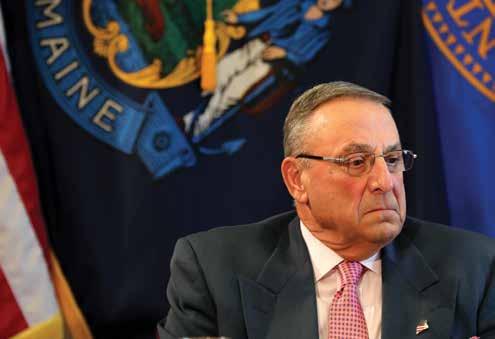
WASHINGTON, DC – [On July 6], the Human Rights Campaign (HRC), the nation’s largest lesbian, gay, bisexual, transgender, and queer (LGBTQ) civil rights organization, released the following state-
ment strongly condemning Maine Republican Gov. Paul LePage’s veto of legislation that would have protected LGBTQ youth in the state from the dangerous and discredited
a
nominee everyone can hate?

by Mike Andrew SGN Staff Writer
New US Supreme Court nominee Brett Kavanaugh has one friend and many enemies. Fortunately for his career, that one friend is the president, Donald Trump. But his nomination has brought together a host of critics from both sides of the political spectrum.
Kavanaugh’s main virtue in Trump’s eyes is no doubt his 2009 Minnesota Law Review article, in which he argues that US presidents should be exempt from “timeconsuming and distracting” lawsuits and investigations, which “would ill serve the public interest, especially in times of financial or national security crisis.”
see KAVANAUGH page 5
Sen. Murray announces opposition to
nominee Judge Brett Kavanaugh citing President Trump’s extreme ideological litmus test on Roe v. Wade , health care, and other rights and freedoms
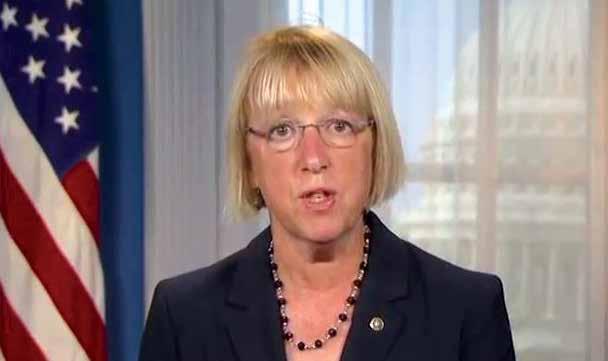
WASHINGTON, DC – [On July 10], US Sen. Patty Murray (D-WA), Assistant Democratic Leader and top Democrat on the Senate health committee, released the following statement opposing President
Trump’s nomination of Judge Brett Kavanaugh to the Supreme Court: “President Trump has been very clear about what he wants in a Supreme Court
see PATTY MURRAY page 5 see SHAMEFUL page 6






WASHINGTON, DC – Following
Senate Majority Leader Mitch McConnell’s decision to file cloture on the nominations of Ryan Bounds for the 9th Circuit Court of Appeals and Andrew Oldham for the 5th Circuit Court of appeals, AFJ President Nan Aron released the following statement:

“While the country is focused on the Supreme Court nomination of Brett Kavanaugh, Mitch McConnell is quietly pushing the Trump administration’s court-packing strategy for the lower courts. We shouldn’t be surprised that the nominations he is scheduling for votes next week are two of the most controversial. Ryan Bounds is strongly opposed by both Oregon senators because of a history of offensive writings. If confirmed, he will be the first circuit

court nominee in history to be seated over the objections of both home-state senators. Andrew Oldham worked closely with the disgraced Scott Pruitt to sue the EPA and fight protections for clean air and water, back when Pruitt was Oklahoma’s attorney general and before he became EPA head. If Mitch McConnell thinks no one is paying attention as he tries to slip these deeply troubling nominees onto the court of appeals, he is wrong.”
Read more about Bounds here: https:// www.afj.org/our-work/nominees/afj-snapshot-ryan-bounds
Read more about Oldham here: https:// www.afj.org/our-work/nominees/andrewoldham
The Alliance for Justice believes that all Americans have the right to secure justice in the courts and to have their voices heard when government makes decisions that affect their lives. It is a national association of over 120 organizations, representing a broad array of groups committed to progressive values and the creation of an equitable, just, and free society. Through its justice programs, it leads the progressive community in the fight for a fair judiciary, and through Bolder Advocacy, it helps nonprofits and foundations to realize their advocacy potential.
Courtesy of the Alliance for Justice
opposes Kavanaugh, Trump’s pick to undermine LGBTQ rights, reproductive rights, health care, and more
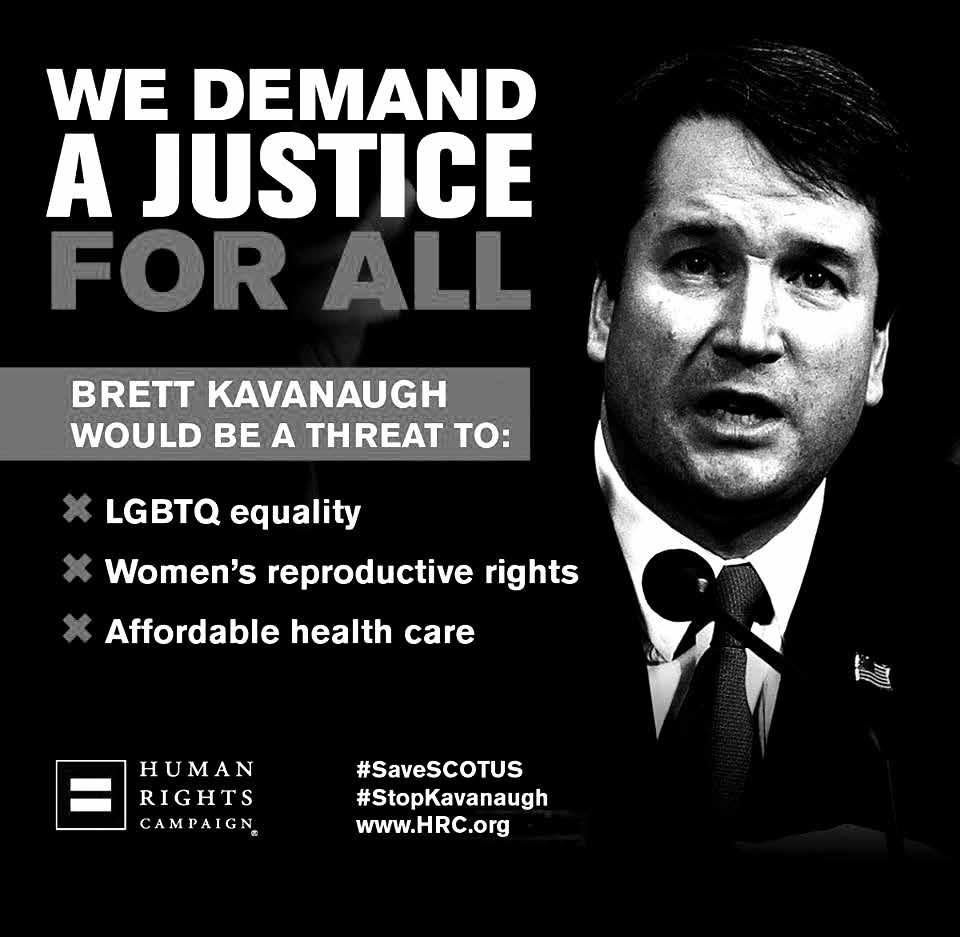
WASHINGTON, DC – [On July 9], the Human Rights Campaign (HRC), the nation’s largest lesbian, gay, bisexual, transgender, and queer (LGBTQ) civil rights organization, called on the Senate to reject Brett Kavanaugh, who was pre-cleared by anti-LGBTQ and anti-choice organizations and nominated by the Trump-Pence administration to the Supreme Court.
“In nominating Brett Kavanaugh, Donald Trump has followed through on his threat to nominate a justice who would undermine LGBTQ equality, women’s reproductive rights, and affordable health care,” said HRC President Chad Griffin. “Now, the Senate has a responsibility to fulfill its constitutional duty, serve as a check on this reckless president, and reject Brett Kavanaugh’s nomination.
“This nominee was hand-picked by anti-LGBTQ, anti-choice groups in an explicit effort to undermine equality – and the prospect of a Justice Kavanaugh threatens to erode our nation’s civil rights laws,
block transgender troops from bravely serving this nation, and allow a license to discriminate against LGBTQ people in every aspect of American life. The 2018 midterm elections just became the most consequential elections of our lifetime, and we must seize the opportunity to pull the emergency brake on this regime. We need to vote this November like our lives depend on it – because they do.”
The next Supreme Court justice will shape civil and constitutional rights jurisprudence in the country for decades to come. In the coming years the Supreme Court will be asked to decide critical issues for the LGBTQ community including:
Whether our nation’s nondiscrimination laws include protections for LGBTQ people – as many lower courts have already concluded. This would impact employment, housing, health care, and education civil rights statutes.
Whether individuals and organizations have a license to discriminate against
LGBTQ people when receiving taxpayer dollars to provide critical services.
Whether LGBTQ people and families can be turned away from businesses open to the general public, simply because of who they are or whom they love.
Whether qualified transgender people can be excluded from serving in the military, simply because of who they are.
Kavanaugh currently serves as a judge on the US Court of Appeals for the District of Columbia Circuit. During his tenure, he has clearly established a judicial philosophy that the personal beliefs of individuals should dictate the lives of others. Kavanaugh has ruled that an employer’s religious beliefs should be allowed to override their workers’ access to birth control. While refusing to answer whether he believed Roe was correctly decided during his confirmation hearing for the DC Circuit, once on the bench he wrote that his colleagues had “badly erred” by determining that an undocumented immigrant teen should have
access to an abortion. In dissenting against the Affordable Care Act, Kavanaugh claimed that “the President may decline to enforce a statute… when the President deems the statute unconstitutional, even if a court has held or would hold the statute constitutional.”
The Human Rights Campaign joins coalition partners in demanding the US Senate confirm a fair-minded constitutionalist to succeed Justice Kennedy.
The Human Rights Campaign is America’s largest civil rights organization working to achieve equality for lesbian, gay, bisexual, transgender, and queer people. The HRC envisions a world where LGBTQ people are embraced as full members of society at home, at work, and in every community.
Courtesy of the HRC

continued from cover
In the interest of avoiding the legal consequences of his many scandals – both personal and political – Trump is evidently willing to overlook Kavanaugh’s close ties to the “low-energy” Bush clan.
Others who don’t share Trump’s fixation on his own fortunes are less enthusiastic.
HRC President Chad Griffin warned that Kavanaugh was bad news for the LGBT community.
“In nominating Brett Kavanaugh, Donald Trump has followed through on his threat to nominate a justice who would undermine LGBTQ equality, women’s reproductive rights, and affordable health care,” Griffin said in a statement.
“Now, the Senate has a responsibility to fulfill its constitutional duty, serve as a check on this reckless president, and reject Brett Kavanaugh’s nomination.”
“This nominee was hand-picked by antiLGBTQ, anti-choice groups in an explicit effort to undermine equality – and the prospect of a Justice Kavanaugh threatens to erode our nation’s civil rights laws, block transgender troops from bravely serving this
continued from cover
nominee – he has stated it openly, publicly, and repeatedly.
“He has said that he wants a nominee who was fully committed to overturning Roe v. Wade, criminalizing abortions, and rolling back women’s ability to access contraception and other basic health care. On the campaign trail he promised that Roe v. Wade ‘can be changed’ and that he was going to be ‘putting pro-life justices on the court’ so that it would be overturned “’automatically.’
“He has said that he wants a nominee who would immediately declare health care reform unconstitutional and cut off access to care for people with pre-existing conditions. On the campaign trail he criticized
nation, and allow a license to discriminate against LGBTQ people in every aspect of American life,” Griffin added.
“The 2018 midterm elections just became the most consequential elections of our lifetime, and we must seize the opportunity to pull the emergency brake on this regime. We need to vote this November like our lives depend on it – because they do.”
On the other side of the country’s political divide, the furiously anti-LGBT American Family Association was supporting Christian cult member Amy Coney Barrett, and they denounced Kavanaugh in a press release:
“Judge Kavanaugh is simply the wrong nominee – even a bad nominee,” the group said.
“Based on his written opinions, Judge Kavanaugh has demonstrated a deficiency in a constitutional judicial philosophy of a limited judiciary. Some of his decisions may have been favorable, but several of his opinions about those decisions contain problematic language.
“Judge Kavanaugh’s reasoning on religious liberty, Obamacare, and issues concerning life [has] proven to be of major concern. For these reasons and more, urge your senators to firmly oppose the nomina-
Chief Justice Roberts because he ‘should have, frankly, ended Obamacare, and he didn’t’—and promised ‘a strong test’ for a ‘strong conservative’ who would be different than Roberts on health care.
“He has made it clear that he wants a nominee who would keep handing more power to massive corporations and the wealthiest Americans, and keep diluting the power of regular voters.
“He has made it clear that he wants a nominee who would eliminate protections that preserve the air we breathe and the water we drink.
“He has made it clear that he wants a nominee who would roll back the rights and freedoms for workers, for LGBTQ Americans, and for so many others.
“President Trump, more than any president I’ve seen, has been explicit about what he expects from a nominee.
tion of Brett Kavanaugh as a Justice on the United States Supreme Court.”
Christian radio host Jesse Lee Peterson even suggested that Kavanaugh was less than a “real man.”
“During his speech, it was all about his mama. He always loves his mama,” Peterson said on the air.
“It was all about the impact that his mother had on his life while he was growing up, how she influenced him, even though he was raised by his father too. He gave this big old long speech about his mother and then, right at the end, he said, ‘Oh yeah, I love my daddy too.’ So that concerns me. He is a mama’s boy. The other thing is he has no boys; he has only girls. Real men make boys first, and I notice that most men are not real men anymore and they are making girls.”
What about marriage equality?
On the right, only the National Organization for Marriage (NOM) seems happy with Trump’s pick, and only because it believes he will reverse the high court’s Obergefell decision, written by retiring Justice Anthony Kennedy.
“Judge Kavanaugh is a constitutionalist who believes that the Constitution means
“I voted against Judge Kavanaugh’s elevation to the Circuit Court, and based on his record as a judge and everything I know about him, he is exactly what President Trump is looking for and would swing the balance of the Supreme Court for a generation against women, workers, patients, and families.
“So I will I oppose this nomination, and I will strongly encourage my Senate colleagues to stand with me and with people across the country in rejecting him. And then I will urge President Trump to nominate someone who is clearly and strongly committed to not rolling back settled law when it comes to women’s health and patient protections – and to protecting the rights and freedoms that people across the country hold so dear.
“Finally, this is not a time for anyone to sit back and watch while the Supreme
what it says and must be interpreted according to what the framers intended when it was crafted,” NOM President Brian Brown said.
“This confirmation battle will be the most important work we can do. With this nomination, the balance of power on the Supreme Court could shift dramatically in our favor.
“For the first time since marriage was illegitimately redefined by the US Supreme Court in the 2015 Obergefell ruling, we have a clear path forward to restoring marriage to our nation’s laws.”
Many legal observers believe that outright reversal of the high court’s marriage equality decision is not in the cards, but the danger remains that the new majority on the court will put such limits on the scope of Obergefell that it becomes practically meaningless.
For example, the court could rule in a future case that Obergefell entitles samesex couples only the right to receive a marriage license with no attendant privileges. The court has already ruled that business owners may refuse to serve same-sex couples on religious grounds. It could, in the future, authorize the denial of spousal benefits to same-sex couples, contending that so long as they can marry, their rights have not been abridged.
Court and the future of our nation hangs in the balance. We just need a few Republicans in this Republican-majority Senate to stand up to President Trump and stand with Democrats and people across the country in rejecting this nominee. So I urge every American – in red states and blue states, big cities and small towns – to make their voice heard right now: call your senator, show up at rallies, organize online and in person. Make it clear to Senate Republicans that you care about your rights and freedoms and that you need them to stand with you and oppose this nominee who would move our country so far in the wrong direction.”
Video of an excerpt of Sen. Murray’s statement is available [at https://www. youtube.com/watch?v=-VXvb7hO2n0].
Courtesy of Sen. Patty Murray
MADISON, Wisc. – [On July 11], the Human Rights Campaign (HRC), the nation’s largest lesbian, gay, bisexual, transgender, and queer (LGBTQ) civil rights organization, praised the Madison City Council for passing a measure protecting LGBTQ youth in the city from the dangerous, abusive and discredited practice of so-called “conversion therapy.” Madison is the second city in Wisconsin to pass such a measure; Milwaukee passed similar protections for minors in March.
“No child should be subjected to abuse – and that’s exactly what this dangerous, discredited practice of so-called ‘conversion therapy’ really is,” said HRC Wisconsin State Director Wendy Strout. “That’s why this abusive practice has been condemned by every major medical and mental health organization, and why 14 states and Washington, DC, have taken action to protect minors from conversion therapy. We thank Alders Arvina Martin, Shiva Bidar, and Amanda Hall, as well as Austin Kieler, chair of the Democratic Party of Wisconsin’s LGBTQ Caucus, for their leadership on this issue, and hope it can help fuel the momentum we are seeing nationwide as lawmakers work to pass legislation protecting LGBTQ youth.”
So-called “conversion therapy,” sometimes referred to as “sexual orientation change efforts” or “reparative therapy,” encompasses a range of dangerous practices that seek to change an individual’s sexual orientation or gender identity or expression. These practices are based on the false premise that being LGBTQ is a mental illness that needs to be “cured” – a theory that has been rejected by every major medical and mental health organization.
The HRC recently released a video featuring the story of Alex Cooper, a teen in Utah who was subjected to “conversion therapy,” and [telling] the story of her abuse. Watch and share the video: https:// www.youtube.com/watch?v=i13JbzSnk94.
There is no credible evidence that conversion therapy can change a person’s sexual orientation or gender identity or expression. To the contrary, research has clearly shown that these practices pose devastating health risks for LGBTQ young people, such as depression, decreased selfesteem, substance abuse, homelessness, and even suicidal behavior. The harmful practice is condemned by every major medical and mental health organization, including the American Psychiatric Association, American Psychological Association, and American Medical Association.
practice of “conversion therapy.” LePage becomes the first governor in the nation to veto such critically important protections.
“Governor LePage’s shameful decision to veto this life-saving legislation leaves Maine’s LGBTQ youth at risk of being subjected to a practice that amounts to nothing less than child abuse,” said Marty Rouse, HRC National Field Director. “These crucial protections are supported by a bipartisan majority, and have been signed into law in a growing number of other states by both Democratic and Republican governors – including by the Republican governor in neighboring New Hampshire mere weeks ago. With this inexcusable decision, Gov. LePage has become the only governor in the nation to veto legislation protecting young people from this abuse, solidi-

In addition to Madison, a growing number of municipalities across the country, including cities and counties in Ohio, Pennsylvania, Washington, Florida, New York, Arizona, and Wisconsin, have enacted similar crucial protections. Connecticut, California, Nevada, New Jersey, the District of Columbia, Oregon, Illinois, Vermont, New York, New Mexico, Rhode Island, Washington, Maryland, Hawaii, and New Hampshire all now have laws or regulations protecting youth from this abusive practice, and similar legislation is currently awaiting gubernatorial action in Delaware.
fying his place in history’s hall of shame.
The HRC calls on the Maine legislature to override this veto and to demonstrate to the state’s LGBTQ youth that their lives and well-being are worth protecting.”
“Government’s greatest responsibility is to protect its most vulnerable citizens, especially minors who may not be able to protect themselves,” said Matt Moonen, executive director of EqualityMaine. “Gov. LePage had the opportunity, in one of his final acts as governor, to make Maine a safer place for LGBTQ youth. Unfortunately, he chose petty politics over protecting kids.”
There is no credible evidence that conversion therapy can change a person’s sexual orientation or gender identity or expression. To the contrary, research has clearly shown that these practices pose devastating health risks for LGBTQ young people such as depression, decreased selfesteem, substance abuse, homelessness, and even suicidal behavior. The harm-
According to a recent report [https:// williamsinstitute.law.ucla.edu/wp-content/ uploads/Conversion-Therapy-LGBT-YouthJan-2018.pdf] by the Williams Institute at UCLA School of Law, an estimated 20,000 LGBTQ minors in states without protections will be subjected to conversion therapy by a licensed health care professional if state lawmakers fail to act. The HRC has partnered with the National Center for Lesbian Rights (NCLR) and state equality groups across the nation to pass state legislation ending conversion therapy. More information on the lies and dangers of efforts to change sexual orientation or gender iden-
ful practice is condemned by every major medical and mental health organization, including the American Psychiatric Association, American Psychological Association, and American Medical Association.
Connecticut, California, Nevada, New Jersey, the District of Columbia, Oregon, Illinois, Vermont, New York, New Mexico, Rhode Island, Washington, Maryland, Hawaii, and New Hampshire all now have laws or regulations protecting youth from this abusive practice. Similar legislation is currently awaiting gubernatorial action in Delaware. A growing number of municipalities have also enacted similar protections, including cities and counties in Ohio, Pennsylvania, Washington, Florida, New York, Arizona, and Wisconsin.
According to a recent report by the Williams Institute at UCLA School of Law, an estimated 20,000 LGBTQ minors in states without protections will be subjected to conversion therapy by a licensed health care
tity can be found [at https://www.hrc.org/ resources/just-as-they-are].
The Human Rights Campaign is America’s largest civil rights organization working to achieve equality for lesbian, gay, bisexual, transgender, and queer people. The HRC envisions a world where LGBTQ people are embraced as full members of society at home, at work, and in every community.
Courtesy of the HRC
professional if state lawmakers fail to act.
The HRC has partnered with the National Center for Lesbian Rights (NCLR) and state equality groups across the nation to pass state legislation ending conversion therapy. In Maine, the HRC worked closely with the NCLR, GLBTQ Legal Advocates & Defenders (GLAD), and Equality Maine in the effort. More information on the lies and dangers of efforts to change sexual orientation or gender identity can be found [at https://www.hrc.org/ resources/just-as-they-are].
The Human Rights Campaign is America’s largest civil rights organization working to achieve equality for lesbian, gay, bisexual, transgender, and queer people. The HRC envisions a world where LGBTQ people are embraced as full members of society at home, at work, and in every community.
Courtesy of the HRC
Cannabis can impair alertness and reaction time.
Driving under the influence can increase the risk of crashing.




It’s illegal to use cannabis while riding as a passenger.














Leave cannabis in original,packaging.unopened


Keep cannabis where you reach—likecan’t the trunk.




105 deadly crashes in 2016 involved a driver who tested positive for cannabis. An increase from 91 fatal crashes in Washington state during the previous year.




When it comes to cannabis, safety is essential. That’s why driving under the in uence of cannabis is illegal. Whether you’re driving or just along for the ride, keep cannabis in its original, unopened package and out of reach. Because if you drive while under the in uence, you’re risking not only signi cant legal consequences, but also harming others and yourself. So, for your safety and the safety of others, it’s important not to drive after using.




In a new legal filing with the Arizona high court, ADF attorneys claim that the US Constitution affords individuals the right to speak and also a right to refrain from saying things they do not believe, even when the act of refraining involves denying services to LGBT people because of their sexual orientation.
The ADF is challenging the constitutionality of a Phoenix ordinance that – among other things – prohibits discrimination on the basis of sexual orientation. Their clients, Joanna Duka and Breanna Koski, owners of Brush & Nib Studio, refuse to design wedding invitations for same-sex marriages, in violation of the Phoenix ordinance.
According to the ADF, that violates the First Amendment religious rights of the “Christian artists.” The ADF is basing its argument on a 2012 ruling by the Arizona Supreme Court that allows tattoo artists to refuse to ink a message that offends their beliefs.
In Hawaii, however, the state Supreme
Court rejected a petition from a local bedand-breakfast seeking review of a lower court ruling that it had violated the state anti-discrimination statute when it denied a room to a Lesbian couple because of their sexual orientation.
Aloha Bed and Breakfast, whose owner says same-sex relationships “defile our land,” is also represented by the ADF, which again claimed a religious justification for anti-LGBT discrimination. In February, the Intermediate Court of Appeals affirmed the lower court ruling, and the Hawai‘i Supreme Court agreed on July 10.
“In letting the existing decision stand, Hawai‘i today joined a long line of states across the country that understand how pernicious and damaging a religious license to discriminate would be,” Lambda Legal Senior Attorney Peter Renn said.
“In fact, since the US Supreme Court’s narrow ruling in Masterpiece Cakeshop in early June, three state courts – in Arizona, Oregon and now Hawai‘i – have either ruled against or refused to review rulings against business owners who have claimed religious justifications to discriminate.”

LOS ANGELES – A new study finds that the mental and physical health of transgender veterans is similar to [that of] cisgender veterans. The only difference was that transgender veterans had higher odds of having at least one disability, such as a debility in vision, cognition, mobility, self-care, or independent living.
The study found demographic and economic differences between the two populations. Transgender veterans experienced higher rates of poverty and less education and were less likely to be married or partnered compared to cisgender veterans.
In addition to veterans, researchers examined the health and well-being of transgender and cisgender civilians and found that transgender civilians were less likely to have health insurance and be employed. They had a greater likelihood of not receiving primary care in the past year, delaying care because of cost, and having multiple chronic conditions and depression, compared to cisgender civilians.
“Disparities in education and poverty have been found to increase the risk of poor health,” said lead author Janelle Downing, assistant professor of health services policy and management at the University of South Carolina. “Those may be contributing to the poor health outcomes we observed in transgender civilians, but it was not true for transgender veterans. It is possible that the veterans represent a particularly resilient subset of transgender people.”
The study analyzed responses from 517,539 people living in 31 states and Guam, who participated in the 2014-2016 Behavioral Risk Factor Surveillance System, a nationally representative survey by the Centers for Disease Control and Prevention that collects state-level data on health, risk factors, and sociodemographic characteristics of adults in the US.
According to the study, there are an
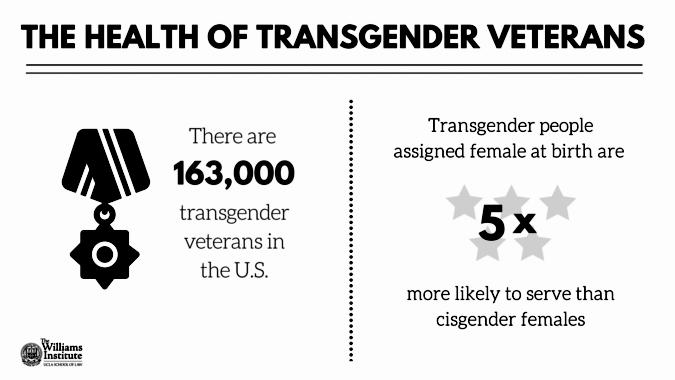
estimated 163,000 transgender veterans in the US. Researchers found that overall, transgender people (10.4%) have served at similar rates compared to cisgender people (10.1%). However, transgender people assigned male at birth were less likely to be veterans and those assigned female at birth were nearly five times more likely to be veterans compared to cisgender people.
In March 2018, the US Department of Defense issued a memorandum that states an intent to ban transgender people with gender dysphoria from joining the military. There are currently four federal court injunctions temporarily blocking the ban.
“Our study found no evidence to
support the current administration’s intent to ban transgender people from serving in the military,” said study author Jody L. Herman, a public policy scholar at the Williams Institute at UCLA School of Law.
“On the contrary, the positive and longterm health outcomes of transgender veterans illustrate how well the existing criteria work to determine who is fit for military service.”
The study, “Transgender and Cisgender US Veterans Have Few Health Differences,” was published in Health Affairs and co-authored by Janelle Downing, an assistant professor at the University of South Carolina; Kerith J. Conron, Blachford-Cooper Distinguished Scholar and
Research Director at the Williams Institute at UCLA School of Law; Jody L. Herman, scholar of public policy at the Williams Institute; and John R. Blosnich, research health scientist for the VA Pittsburgh Healthcare System.
The Williams Institute at UCLA School of Law, a think tank on sexual orientation and gender identity law and public policy, is dedicated to conducting rigorous, independent research with real-world relevance.
Courtesy of the Williams Institute
WASHINGTON – [On July 11], the Human Rights Campaign (HRC) Foundation, the educational arm of the nation’s largest lesbian, gay, bisexual, transgender, and queer (LGBTQ) civil rights organization, hosted its second Historically Black Colleges and Universities (HBCU) Diversity and Inclusion Leadership Briefing for university presidents and senior executives. This year’s daylong meeting was the largest-ever gathering of HBCU presidents discussing LGBTQ-inclusive practices and policies.
In total, 12 HBCUs were represented at Wednesday’s summit, including five HBCU presidents, the most ever for a discussion on LGBTQ equality. Michael Lomax, CEO and president of the United Negro College Fund (UNCF), also participated, along with HRC staff, representatives from major employers, and HBCU alumni who serve on the HRC’s Parents for Transgender Equality Council.
“Amidst efforts to roll back federal protections for LGBTQ college students, HBCUs are stepping up to expand inclusion and support for LGBTQ people on their campuses,” said Mary Beth Maxwell, Senior Vice President for Programs, Research, and Training for the HRC
Foundation. “From enhanced inclusive programming to institutional investment in support staff, the momentum for equality at America’s HBCUs has never been clearer.
The HRC is honored to host presidents and senior leadership from these 12 esteemed institutions to continue the critical work of ensuring that all LGBTQ students, staff, and faculty feel safe, supported, and protected – not just at these colleges and universities, but at every HBCU around the country.”
Since last July’s first-of-its-kind summit at HRC, many participating HBCUs have expanded support and programming for LGBTQ students. Among the important advancements: Dillard University assembled a presidential working group on LGBTQ issues and launched a week dedicated to topics discussing gender identity and sexual orientation; Virginia State University held a campus-wide training on LGBTQ inclusion; and Fayetteville State established an LGBTQ resource office with a dedicated staff member.
The 12 HBCUs represented at yesterday’s briefing [were] Howard University, Morgan State University, Virginia State University, North Carolina A&T University, Hampton University, Spelman College,
Dillard University, Kentucky State University, Savannah State University, Prairie View A&M University, Johnson C. Smith University, and Claflin University. Participants explored a range of topics, including HIV prevention, corporate diversity, and supporting the families of LGBTQ HBCU prospective and current students.
“The record number of HBCU presidents coming together to discuss and share best practices on LGBTQ inclusion demonstrates their growing commitment to addressing the ongoing challenges facing LGBTQ students, educators, and staff at our nation’s HBCUs,” said Leslie Hall, associate director of the HBCU Program.
“Leading the HRC’s HBCU Program, I see firsthand the urgent need for continued action in support of LGBTQ members of our HBCU campus communities. Building on the progress demonstrated by these HBCU leaders, we look forward to continuing to work with HBCU administrators and student activists to advance inclusion and equity on HBCU campuses.”
The Presidents’ Summit is part of a multipronged strategy to create high-level policy changes that will support and protect LGBTQ students and staff on college campuses around the country. The HRC’s
HBCU Program was founded to support LGBTQ students at HBCUs by providing resources and trainings to advance affirming and supportive college campuses.
For the last 13 years, the HBCU Program has hosted an annual HBCU Leadership Summit to train and prepare student leaders and administrators to advocate for LGBTQ inclusion and safety.
In conjunction with the summit, the HRC’s HBCU Program released a video detailing the important work it is doing and featuring many of the inspiring studentactivists moving equality forward on HBCU campuses around the nation.
To learn more about the HRC’s HBCU Program, visit http://www.hrc.org/blog/ topic/hbcu.
The Human Rights Campaign Foundation is the educational arm of America’s largest civil rights organization working to achieve equality for lesbian, gay, bisexual, transgender, and queer people. The HRC envisions a world where LGBTQ people are embraced as full members of society at home, at work, and in every community.
Courtesy of the HRC
of all time –transcends all nations, cultures, ideologies, classes
by Peter Tatchell Peter Tatchell Foundation
London’s celebration of LGBT+ Pride this weekend is one of thousands of Pride celebrations taking place over the summer months in nearly every country on earth. In less than five decades, what began in a handful of Western cities has become an unprecedented global phenomenon.
Today, the LGBT+ movement is the most unifying, ubiquitous, and universal worldwide movement of all time – and the most successful. It exists in over 160 countries, sometimes covertly, with a common agenda of LGBT+ liberation that transcends all borders, classes, ideologies, cultures, and ethnicities.
It has notched up some impressive achievements: the decriminalization of homosexuality in more than 120 countries, with 24 now legalizing same-sex marriage and more than 60 protecting LGBT+ people against discrimination. Some 86 states have national human rights institutions that defend sexual and gender minorities. Nine out of ten countries have become increasingly accepting of LGBT+s in the last two decades.
In many parts of the world, there is still severe persecution to be overcome. Nevertheless, it is still an extraordinary accomplishment that more than 2,000 years of homophobic, biphobic, and transphobic persecution has been significantly rolled back in many countries in less than half a century. All this progress is the result of daring, inventive, and unrelenting campaigning – against all odds – by national and international LGBT+ movements.
More evidence of success is the fact that our rainbow flag is now the most universal flag in the world. Flown in every country, often briefly or secretly in repressive states, no other flag has such international reach and appeal. Unlike national flags, it is cherished by LGBT+ people – and straight allies – in every nation. It is the symbol of our common LGBT+ humanity.
Pride is the celebration that unites hundreds of millions of diverse LGBT+ people all across the planet. I have witnessed, in my lifetime, the explosion of Pride events to the farthest corners of

the world. The annual celebrations are the visible manifestation of our queer culture and communities and our collective international demand for respect, dignity, and equal human rights.
The idea of Pride was conceived in the early 1970s as a riposte to the then dominant view – even among many LGBT+ people – that we should be ashamed of our sexual orientation and gender identity. Aged 20, together with other members of the Gay Liberation Front, I helped pioneer the UK’s first-ever Pride parade, in London in July 1972.
To give it broad appeal, we deliberately pitched it as a carnival parade with a LGBT+ liberation theme. Even so, it was tiny. Most LGBT+s were in the closet and had internalized homophobia. Only 700 people showed up. There were similar groundbreaking Pride events in major US cities at around the same time, but also with relatively small numbers.
Since then, there has been an exponential growth of Pride celebrations all across the planet. Madrid, Sao Paulo, Toronto, Paris, New York, and Berlin have each mobilized between one and two million people. No other political or social movement can match this scale, year [after] year.
At the other end of the Pride spectrum, in some countries the festivities number only hundreds of people and suffer severe state repression, as happened in Uganda last year, where government threats of violent attack forced Pride’s cancellation.
The previous year, 2016, Pride Uganda was marred by police arrests and brutality, without legal authority and with impunity.
But in many countries, Pride has had unparalleled success because it is a just cause, with an ethical purpose, a global resonance, and, very importantly, a happy, inclusive vibe. It speaks to LGBT+ people the world over. The unique blend of carnival-like celebration and political demands projects a serious
message in a fun way that is attractive to a wide audience, with a far broader appeal than traditional forms of protest.
This joyful, exuberant atmosphere is infectious. Everyone likes a party and everyone wants to join in. The uplifting nature of Pride, with its flamboyance and theatricality, comes out of gay culture. But for some of us, it is also a cunning ruse to disarm and subvert homophobia, in ways that po-faced [piously or hypocritically solemn], angry demonstrations can never hope to achieve.
This Saturday, I’ll enjoy the Pride celebration and party mood. But I’ll also be there with a serious message: to highlight and stand in solidarity with persecuted Russian and Chechen LGBT+s. It’s going to be politics with joy. That’s what Pride has always been and may it long remain.
Courtesy of the Peter Tatchell Foundation
by Mike Andrew SGN Staff Writer
While most of Europe observed Pride festivities with the usual exuberance and joy, neo-Nazi thugs disrupted Pride marches in Budapest, Hungary, and Czestochowa, Poland. Police intervened on the side of the LGBT marchers in Budapest but on the side of the Nazis in Czestochowa.
On July 9, more than 10,000 people attended the 23rd annual Pride event in the Hungarian capital, but they soon found their path blocked by a group of black-clad men holding banners.
The men, apparently members of the Betyársereg, or “Army of Outlaws,” a paramilitary group associated with the far-right political group Sixty-Four Counties Youth Movement. Its name refers to the fact that the pre–World War I Kingdom of Hungary had 64 counties and extended into modern Romania, Slovenia, Croatia, and Serbia.
People in the parade peacefully chanted at the men, while some played musical
instruments and waved rainbow flags. Riot police deployed between the Pride marchers and the neo-Nazis.
Some people on the ground reported feeling threatened by the police presence until they realized they were there to remove the neo-Nazi group, which they did without difficulty, accompanied by cheers from the Pride marchers.
Later, Eurovision winner Conchita Wurst performed at the Budapest Pride closing party. She congratulated the parade participants for showing courage during the incident.
“It is very important to me to be here today, the rights of the LGBTIQ community are not where they should be,” Wurst said to the crowd during her performance.
“The people who went to the Pride and were on the verge of being attacked by rightwing demonstrators showed great courage, and I want to highlight this situation.”
Despite the disruption, parade goers told Gay Star News that the day was “a great success” and “a fantastic event to be part of.”
In Poland, however, things went much differently.
About 1,000 people with rainbow flags and umbrellas marched on the Catholic Jasna Gora shrine in the city of Czestochowa, where the country’s notoriously antiLGBT prime minister was giving a speech.
A few dozen neo-Nazis blocked the route, carrying banners with homophobic messages. The neo-Nazis chanted “National Czestochowa.”
They were joined by police, who prevented the LGBT march from going forward.
After the march, Poland’s internal affairs minister instructed the police to prosecute the LGBT marchers, accusing them of “desecrating” the White Eagle, Poland’s national symbol, by placing it on a rainbow shield instead of the traditional red one.
Government Minister Joachim Brudziński also charged the LGBT marchers with provoking the neo-Nazis, whom he characterized as innocent pilgrims on their way to the Jasna Gora shrine.
“The policemen reacted and, in this case, charges will be pressed for contempt and desecration of the national symbols. That’s the Polish police is so trusted among Polish people [sic],” he wrote.
If the marchers are prosecuted for desecrating the national symbol, they face up to a year in prison. Recently, the frontman of Polish metal band Behemoth was formally charged by Polish authorities for desecrating the symbol in tour artwork and merchandise.
According to Rémy Bonny, a political scientist specializing in LGBT politics in post-communist countries, the threat of prosecution may have a partisan subtext.
“One of the biggest opposition leaders in Poland is openly gay and is especially popular amongst young people,” Bonny said. “A vibrant gay scene emerged in the bigger Polish cities as well in the last decade.”