
$10 MILLION SETTLEMENT
City of Seattle settles class-action lawsuit surrounding 2020 protests, Former SGN managing editor among plaintiffs

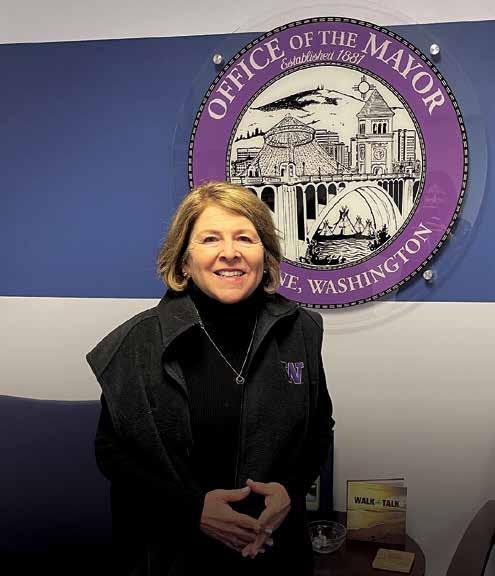
by Lindsey Anderson SGN Staff Writer
On Wednesday, December 27, Lisa Brown was sworn in as mayor of Spokane at the Central Library. She is the first Democrat to serve in this position since Mary Verner in 2007. She defeated incumbent mayor Nadine Woodward in a close and hotly contested election.
“I’m relieved to have the campaign over.
It got a little nasty,” Brown admitted in an interview with the SGN. “The city of Spokane has some big challenges, but we have a lot of great opportunities, too.
I’m hopeful that we can pull together after that divisive campaign and make progress.”
Brown’s campaign theme was “There’s a better way,” a nod to many of the issues the city faces when it comes
by Teddy MacQuarrie SGN Contributing Writer
First reported on sgn.org, King County Superior Court has approved a $10 million settlement in a lawsuit brought by 50 protesters and journalists over the Seattle Police Department’s use of excessive force in summer of 2020, in the aftermath of the police killing of George Floyd in Minneapolis.
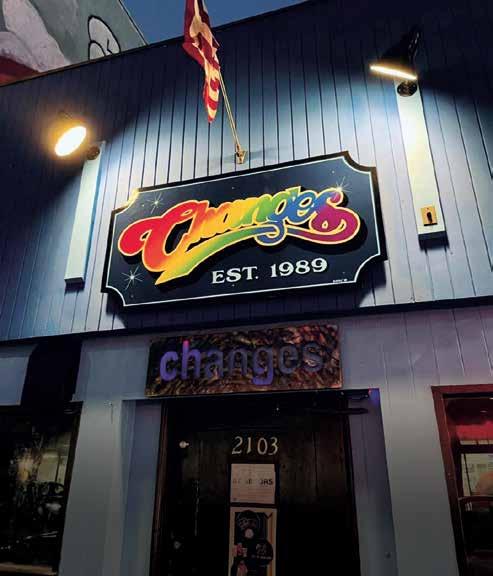
by Kali Herbst Minino SGN Contributing Writer
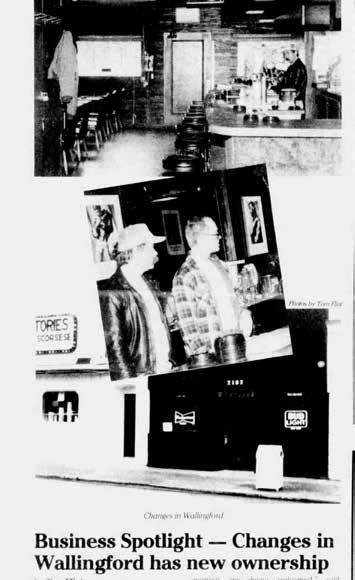
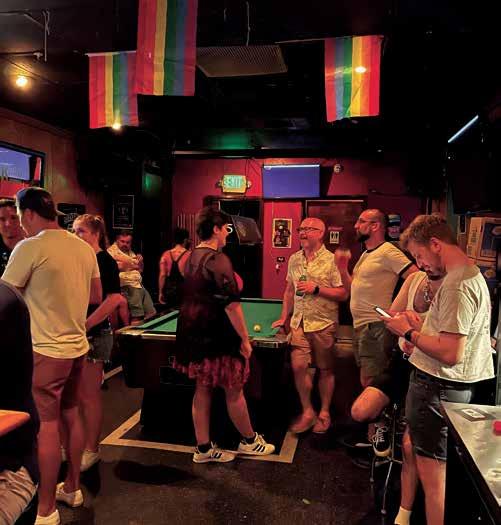
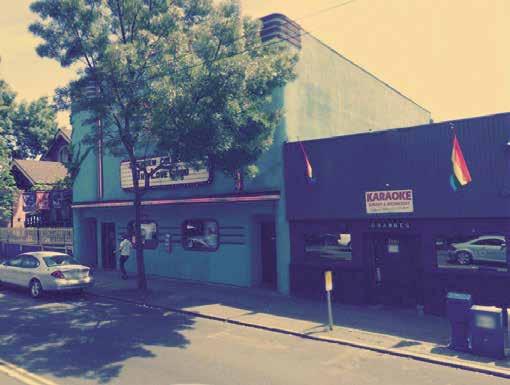
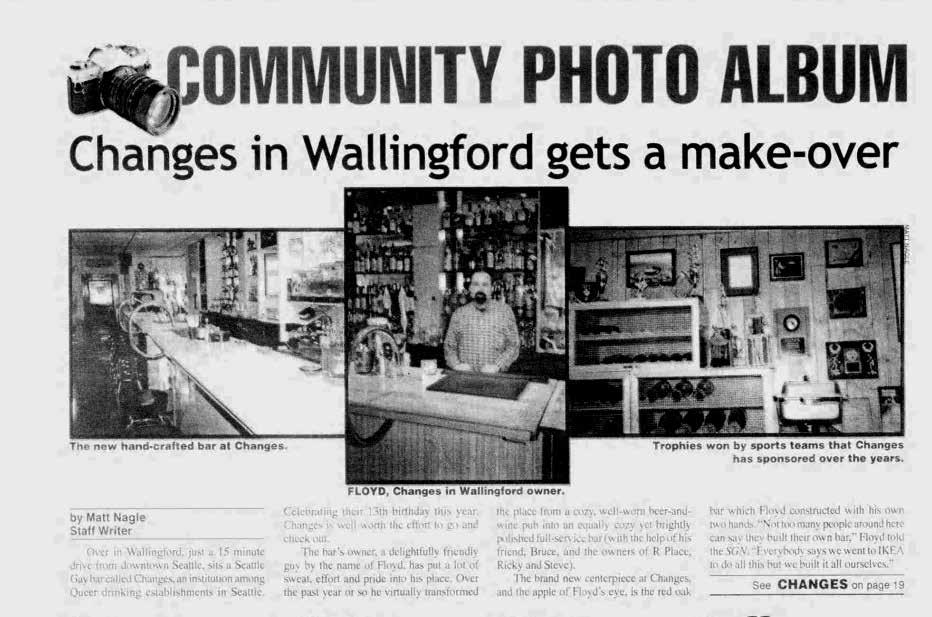
Seattle’s longest continuously ownedand-operated Gay bar will host karaoke on Jan. 31 to celebrate 35 years of business.
“It’s been an interesting ride, that’s for sure,” owner Floyd McIsaac said.
Before Changes, the space was owned by two women, who ran a bar called the Bus Stop. McIsaac would stop by after
his warehouse work shifts and eventually asked what it would take for them to leave the space.
“I didn’t mean that in a bad way. I just thought it had a lot more potential,” McIsaac said. ”I just thought, ‘Well, it’d be kind of fun to have a bar. It doesn’t have to make a lot of money, just to serve the community.’
PHOTO BY RENEE RAKETTY





IN THIS ISSUE


The March on Washington that dare not speak it’s name
National delegates clash over name, purpose, and structure
by Tom Flint
SEATTLE GAY NEWS
VOLUME 20, ISSUE 4
JANUARY 24, 1992
The headline above is courtesy of Miriam Ben-Shalom, and succinctly sums up the enormous debate for a name for the National March on Washington.
The MOW planning meeting was held in Los Angeles the weekend of January 18-19. About 75 delegates from the various regions of the country decided on an official name and elected a steering committee.



Reminiscent of Seattle’s own long Pride march moniker, the new name is the “1993 March on Washington for Lesbian/Gay/Bi Equal Rights and Liberation.” The activists spent hours in contentious deliberations trying to settle upon a name. The main point of debate was over the question of whether to include the word “Bisexual” in the title.
Bisexuals came to the meeting very organized to advocate for the name change. They had received dozens of endorsements from major national leaders and organizations in support.
The delegates at the Los Angeles meeting were deeply divided over the issue. One reason for opposition to the change of the march name was that it would change the identity of the movement and the delegates weren’t sure they had the right to do that.
Several people were opposed to the word “sexual,” saying that it defined people too narrowly by their sexuality. Others voiced objections saying the inclusion of “Bisexual” would be divisive and alienate Lesbians and Gays from Midwestern and
Southern regions. Still others felt that for the sake of continuity with the 1987 March on Washington for Lesbian and Gay Rights, and to simplify publicity sound bites, the name should stay the same.
The Bisexual contingent fought aggressively for their position. Rebecca Hensler, a self-described “Bisexual dyke” from San Francisco, was a leading proponent of the name change. “This is not a question of whether Lesbians and Gays are going to accept Bisexuals into their movement! We are in the movement. This room is not full of just lesbians and Gays.”
Several Seattle groups sent endorsements for the inclusion of Bisexuals in the title, including Lambert House, Queer Nation, Seattle Bisexual Men’s Union, Lesbian Mothers National Defense Fund, People of Color Against AIDS Network, American Friends Service Committee, Beyond the Closet Bookstore, University of Washington Lesbian and Gay Commission, Seattle Municipal Elections Committee, Puget Sound Gay, Lesbian, and Bisexual Veterans of America, and Seattle Bisexual Women’s Network.
To make all this debate even more interesting, the Seattle delegation led a discussion on the inclusion of transsexuals and transgenderal people in the title. Seattle has a large transgender community largely due to the presence of the Ingersol [sic] Institute. Two Seattle transgender activists were present at the Los Angeles meeting, Princess LaRouge and Kaz.
Seattle delegates felt if the name was going to be changed on the principle of ‘inclusion,’ transgender people should then be named as well.
Several people were opposed to the name including transgender on the grounds that it would play into the hands of opponents of the Gay and Lesbian community.
Several other discussions went on simultaneously. Queer Nationalists threw out the idea of a March on Washington for Queer Liberation. Most of the delegates recognized that “queer” was a word that many Gays, Lesbians, Bisexuals, and transgendered people are not able to identify with.
There was also a debate on “why we are marching.” Some of the suggestions were liberation, rights, human rights, civil rights, justice, unity, and freedom.
The word “liberation” harkens back to the Gay liberation movement and reflects that our liberation is more than a matter of passing laws, speakers said. One Black activist pointed out that Blacks have passed civil rights legislation but not yet achieved liberation.
Other activists gravitated toward the term “equal rights.” They said that opponents of Gay/Lesbian/Bi rights accuse the community of wanting “special rights,” and that using the words “equal rights” would emphasize the fact that the movement is seeking only what is guaranteed to citizens under the constitution.
The final result of all these discussions was transgendered people were not named in the title. The word Bi, as opposed to Bisexual, was included in the title. And both “equal rights” and “liberation” were included in the title.
This article was edited for length. To view the original article in full, visit Washington Digital Newspapers.
The Disabled List comedy festival returns to Seattle SEATTLE NEWS
by Lindsey Anderson SGN Staff Writer
On Thursday, January 25, the secondannual Disabled List Comedy Festival kicked off at the Northwest Film Forum. Running Friday and Saturday as well, it features a stellar line-up of comedians with disabilities, including a record number of openly LGBTQ+ ones. According to one of the show’s producers and founders, Kayla Brown, a third of all the performers at this year’s Disabled List are Queer, including Brown herself.
“We have some incredibly diverse and intersectional performers this year,” Brown said to the SGN. “I identify as Queer, as do Gretta Gimp, Crystal Liston, and [others]. There will be jokes and stories about their experiences, about not only disability but their Queer identities as well. This is a space to foster such discussions joyfully and safely.”
Brown’s co-producer and founder, Dan Hurwitz, echoed her sentiment: “I think it’s important to realize that comedy, and all art, benefits from representation and diversity. Kayla and I hope to create a show that represents the true diversity of comedy fans, which is to say the true diversity of people. And that includes people of color, people from the LGBTQ community, and people with disabilities.”
The festival not only provides a space where comedians with disabilities can actually access the stage but also where they can talk freely about their experiences, without worry that the room won’t understand.
“You’ll see comedy and hear jokes like never before, such as people with disabilities talking about sex, which is often thought of as an oxymoron because of stereotypes,” comedian Gretta Gimp said.
Inclusion and diversity
Hurwitz and Brown created The Disabled List in 2018 as a small comedy showcase for local comedians with disabilities who often struggle to access many of Seattle’s comedy venues. For a year, they produced bimonthly shows, which regularly sold out. Since then, the show has grown into a weekend-long festival, attracting the attention of comedians around the country.
“Dan and I created the Disabled List to create a space to celebrate the immensely talented comedians with disabilities, who are often excluded from the comedy community,” Brown said. “Whether it’s lack of physical accessibility or additional barriers, there are fewer opportunities for disabled comics. It’s a great way for the disabled community to come together, and also reach out to audience members who have never seen a show like this. It has been incredibly successful, and we are excited to put on our second festival.”
“It’s grown in ways we certainly didn’t anticipate,” Hurwitz added.
In 2020, with live comedy at a standstill, Hurwitz and Brown pivoted. They created a short film featuring comedians from all over the Pacific Northwest. “That allowed us to meet new people and use our comedy in a new medium,” Hurwitz said. “Even the fact that The Disabled List has an annual festival took Kayla and me by surprise — and that was our decision!”
The first festival was a success and sold out. It featured local and national comedians, including Gibran Saleem, who traveled all the way from New York City to participate. This year, it will feature even more traveling comedians.
“This festival will be different from last year in that it will have more shows, more venues, with more comedians, including … from outside the PNW,” Hurwitz said. “Kayla and I have been heartened by the response this has gotten, with comedians contacting us from other cities to be in the festival.”
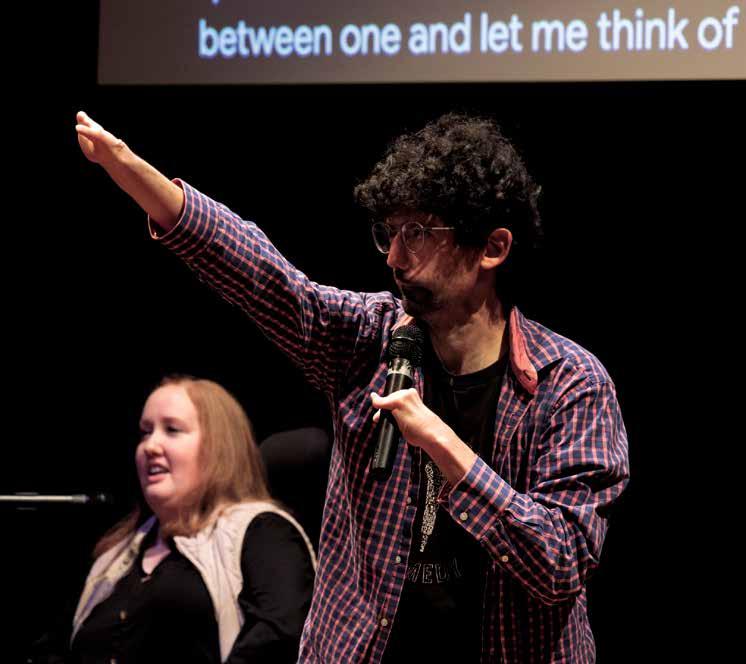
“It’s important to realize that comedy, and all art, benefits from representation and diversity… that includes people of color, people from the LGBTQ community, and people with disabilities.”
More comedians also means more diversity. “This year’s [event] will be even more diverse and inclusive than 2023,” Brown said. “We’ve expanded our line-up to include more comics from all over the country, including California and New York, so the audience will see disabled comics from outside the Northwest. By increasing the [number of] shows, we aim to reach a wider audience and foster a sense of community through laughter. Get ready for a fantastic blend of humor and representation!”
The Disabled List will run from Thursday, January 25 to Saturday, January 27. The first two nights will be in the fully accessible NWFF theater, where automatic closed caption equipment will be utilized for the hearing-impaired. The final night will be at the Theater Off Jackson on January 27. More details are at https://linktr.ee/disabledlist.
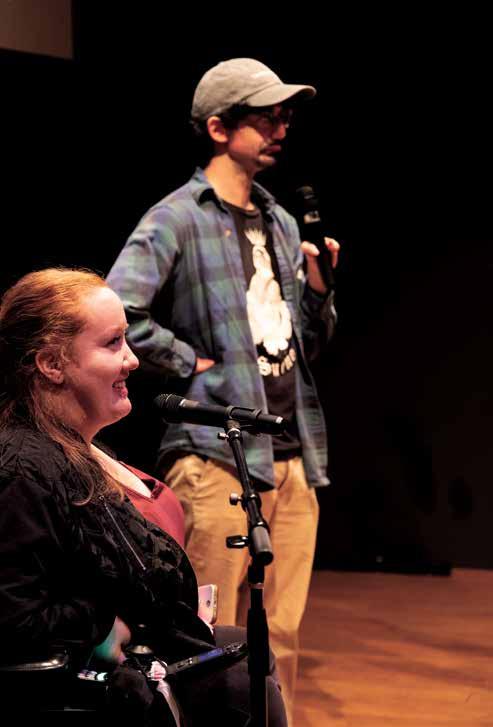
PHOTOS COURTESY OF DAN HURWITZ AND KAYLA BROWN
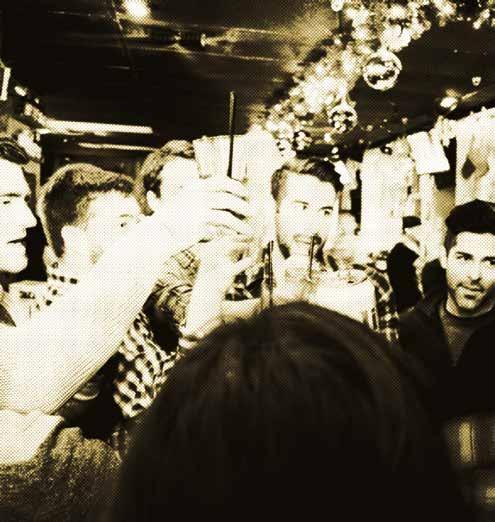
“When I first opened up this place, there were other bars that I would go to, and I could see what the pros and the cons were on how they ran their places,” McIsaac said. “I said to myself, ‘I’m not going to run mine that way.’”
The new bar became so busy, McIsaac was able to quit his other job, and Changes is now his retirement. He concentrates a lot of personal energy on it.
What’s changed?
Since opening, the bar has switched from mostly beer to mostly liquor and also serves food. The biggest change, though, is the clientele.
Back when it opened in 1989, the SGN called Changes “a place that is an alternative to high-pressure evenings on Capitol Hill.” McIsaac says that during the bar’s life, it has gradually shifted from primarily serving Gay customers to welcoming everyone.
“Things have changed out there to where a lot of the bars now are just very, very mixed, Gay and straight. We’re more a neighborhood bar,” McIsaac said. “There’s a lot of hipsters that have kind of taken over the neighborhood, who are very openminded.”
McIsaac attributes the shift to a liquor law that took effect in 2000. Before then, there was a separation between “taverns” and “cocktail bars.” Taverns could sell beer but not liquor, and cocktail bars had a liquor license.
“Prior to when I opened up here, you had two classes in our community,” McIsaac said. “You had the working people who after work would go out to a tavern, drink a few beers, and then go home. Then you had this other group of people who only drank liquor. The availability [of] liquor was not that much at that time. There were only a couple restaurants that had liquor available to our community.”
McIsaac knew his clientele would change as soon as the switch to liquor happened, which was in 2001. “I knew things were going to change a whole lot as far as our customer base went,” he said. “The younger people, as they started becoming of age, were going to be more inclined to drink liquor than they ever were to drink beer.”
But despite this development, the neighborhood feel of the bar has not been modified.
“We’re well accepted in this community to the point where the other businesspeople around here stick up for me if they have to,” McIsaac said. “I try to make sure we’re a part of the community here.”
For now, Changes isn’t going anywhere
When Changes first opened, four Capitol Hill bar owners told McIsaac that buying the spot would be a mistake. None of those bars are open anymore.
“We’re still here,” he said. “As long as my landlord will continue to renew our lease here.”
Right now, McIsaac calls himself “semiretired.” He comes into the bar every day, counts the money, and does the bookwork. He says he doesn’t see himself selling the place and moving away.
“This is kind of it for me. I’m happy with it. It gets stressful from time to time, but
I’ve been doing it for so long now it’s not as stressful as it could be,” he said.
Changes Bar & Grill is at 2103 N. 45th St., Seattle. It is open every day from noon to 2 a.m.
PHOTOS
SEATTLE NEWS
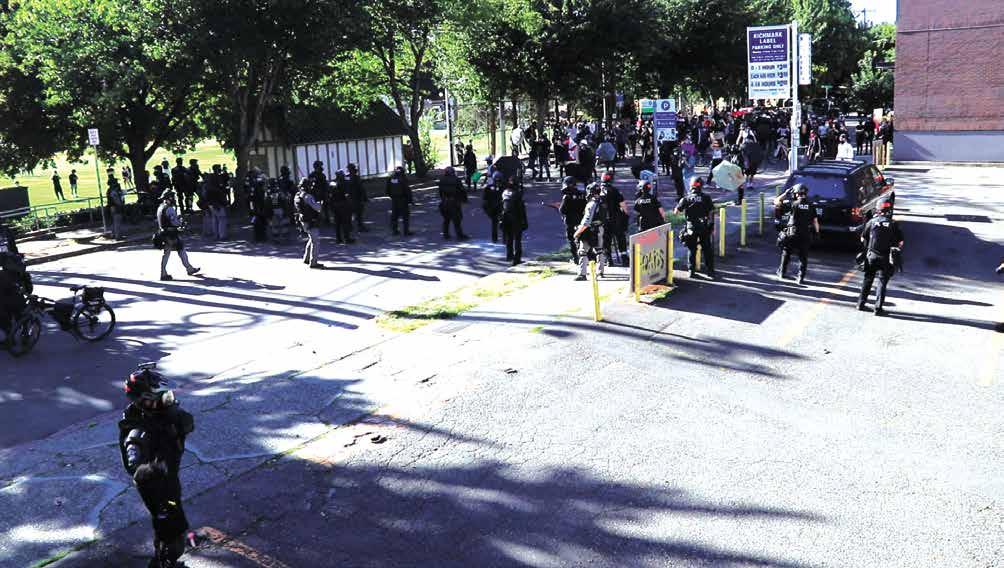
Among the plaintiffs was former SGN managing editor and current contributing writer Renee Raketty, who sustained serious injury, including permanent hearing loss in her right ear after an SPD officer threw a blast ball at her.
The announcement brings to a conclusion court proceedings that have been in progress for over three years.
Along with the monetary payouts, the plaintiffs asked the City for certain nonmonetary provisions aimed at restoring trust in Seattle’s leadership. These include ordering the City to make a full accounting of the changes that have occurred as a result of the protests.
“Our community will be enriched by knowing what changes have occurred through an itemized list, and we will ensure that the City provides documenting evidence of these changes,” said Raketty.
The plaintiffs originally aimed to reverse December’s removal of the BLM Garden at Cal Anderson Park. City attorneys agreed to the proposal Friday, but the garden’s restoration has since met with refusal on the part of City leaders. The revised settlement omits the language concerning the BLM Memorial Garden.
“We thought everybody was on board,” said Raketty. “It appears that the City of Seattle has gone back on its word and is now refusing the language in the settlement that would [have ensured] that the Black Lives Matter Memorial Garden [be] restored.”
Lack of communication and indiscriminate use of force
“Being a journalist, I was only interested in the aspects related to informing the citizenry about what was happening in our community,” said Raketty, who observed the events as a reporter, not as a participant.
“Originally these protests began downtown but quickly escalated to Capitol Hill,” she said. In the middle of this growing unrest, Raketty retreated to a fire escape on 11th Avenue and Pine Street after falling back into police lines, which is a standard practice for journalists.
Overwhelmed by the events as protesters and police clashed around 11th Avenue, she watched a bicycle officer park, approach her, and throw a blast ball in her direc-

tion. Raketty recorded the incident with her camera, with the recording giving out just prior to the blast as she braced for the explosion.
Raketty posted the video to her Facebook page and participated in the investigation of a complaint filed with the Office of Police Accountability. The OPA, when examining the video, found it to be inconclusive, as it could not tell what happened immediately prior to the recording.
Raketty argues that the video clearly shows the officer pulling the pin from the munition, counter to his testimony that he had to find a safe place to detonate it after the pin was already removed.
Raketty attributes the escalation to the SPD’s lack of communication with the protesters and its crowd-control methods: using chemical weapons and projectiles contrary to official policy and the recommendations of experts. “[The SPD’s] lack of communication and use of indiscriminate force compounded the problem,” she said.
“Even today police forces are looking at what happened in Seattle and changing their policies, because they don’t want similar things happening in their jurisdictions.”
Testimony during deposition for the lawsuit included an analysis by crowdcontrol expert Clifford Stott, PhD, who was previously hired by Seattle’s Office of
“Even today police forces are looking at what happened in Seattle and changing their policies, because they don’t want similar things happening in their jurisdictions.”
Inspector General in the early days of the George Floyd protests. Stott’s testimony faulted the SPD for failing to attempt to de-escalate, mischaracterizing a peaceful protest as a “riot,” being speedy in its use of force, using force indiscriminately against peaceful and nonpeaceful protesters alike, and the use of aggressive tactics that contributed to crowd violence.
The City’s attorneys successfully filed to have Stott’s testimony excluded from evidence during trial, but the video and court documents containing his sworn deposition
are available on the plaintiffs’ attorney’s website (https://www.stritmatter.com/results/ black-lives-matter-injured-protestors-lawsuit/ professor-clifford-stott-ph-d).
In the immediate aftermath of the July 25, 2020, unrest, the American Civil Liberties Union of Washington filed a motion in federal court to have the Seattle Police Department held in contempt for violating a June 2020 ruling forbidding it from using chemical weapons and projectiles. Raketty and other co-plaintiffs filed their classaction lawsuit later in the year.
PHOTO / IMAGE BY RENEE RAKETTY
The end of a difficult trial
The protests of 2020 represent a unique chapter in both local Seattle and national history, representing a flashpoint in the long-held tension between residents of Seattle and their local government over issues felt deeply nationwide.
“I feel like this will be a moment in Seattle’s history that we will all look back on,” said Raketty. “I hope that the story will be how we grew as a city through this whole ordeal, how changes have been made that result in a better functioning city government.
“This has been a long and traumatizing process for many of us who will never be the same, not only from the protest but also from the litigation and the extent the City went to defend [itself].”
Raketty expressed gratitude for the plaintiffs’ attorneys at the Stritmatter Firm, who represented some of the plaintiffs pro bono. She credits them for providing profound, compassionate support to the plaintiffs and providing excellent guidance.
In the end, Raketty regrets nothing of her time or work as a journalist. Taking clear pride in her role informing the Seattle community, she told the SGN, “It’s totally been an honor and a privilege to [serve] the Seattle community as a journalist, providing insight into what was happening at various levels and what was occurring in the streets.”

Denny-Blaine Park: A lack of transparency, questions left unanswered
by Teddy MacQuarrie SGN Contributing Writer
In the aftermath of the City of Seattle’s decision to cancel a proposed project to build a children’s play area at the historically clothing-optional Denny-Blaine Park, the SGN reached out to Seattle Parks and Recreation to better understand the process, procedures, and events that the department undertook regarding the doomed proposal.
What we found was that, behind the scenes, employees of SPR and the City expressed frustration, confusion, and doubt concerning the impacts and viability of the project, all while SPR and the City engaged in official silence surrounding its impact on the Queer community.
The SGN also asked, as an official public disclosure request, about the name and identity of the anonymous donor. To date, despite multiple such requests on behalf of several individuals and organizations, the City has not disclosed that information.
“An ‘exercise’ that will likely not reach fruition”
Transparency was lacking in the planning of the play area proposal from day one.
Though public visibility on the issue reached critical mass in October and November 2023, SPR was active on the project as early as July. Released emails from July 19 show project manager Andy Sheffer, who led the December 6 public information meeting, instructing an employee named Mike Schindweller to maintain a policy of confidentiality after accidentally mentioning the project at a managers’ meeting.
The emails quote him as saying, “Pls. don’t share any information on the potential Denny Blaine Play Area. If this gets out it will be very problematic. The topic is confidential at this point.” Later in the conversation, Sheffer explained, “This is an ‘exercise’ that will likely not reach fruition.”
It is not clear within these internal communications why Sheffer believed the proposal was an “exercise,” nor what that would mean. Nor is it clear what Sheffer understood to be “problematic” should the topic become public. The SGN sent an email to an SPR public information officer asking for clarification, and the response did not answer the question.
“Decisions are made because someone is waving a check”
This policy of con fidentiality reflects many of the issues concerning a lack of transparency in the project’s life.
The proposed project was funded almost entirely by an anonymous donor whose $550,000 contribution was made to the mayor’s office and not directly to SPR. This led to procedural confusion about how the planning was to unfold, with the project kept from SPR’s internal planning team and instead conducted by the Seattle Parks Foundation, a planning, advocacy, and fundraising nonprofit that, according to its website, “partners with the community to champion thriving and equitable parks and public places.”
By November, managers and employees at SPR saw the project as increasingly unlikely to come to fruition and accelerated the planning timeline. Employees discussed a November planning meeting in which Sheffer characterized the proposal as “horrifying,” adding, “once again planning is cut out and decisions are made because someone is waving a check.”
Nonetheless, around this time, SPR began to understand the project as being infeasible. According to project manager Jonathan Pagán in an email, “My understanding is a consultant was brought on by SPF to study a few concepts to present to the donor ... Several concepts were eliminated before the powers that be decided to have the project continue.”
The SGN reached out to a spokesman with SPR for clarification on why the project was deemed not feasible and if that had any bearing on the decision to cancel it. His response did not answer the question.
Botched public feedback channels
Along the way, SPR and the City of Seattle demonstrated numerous instances of poorly handled responses to public feedback and press inquiries, including the SGN ’s.
Communications indicate that SPR conducted a public information meeting sometime in October in which officials noted no pushback or opposition to the proposal. Neither the SGN nor the organizers the SGN has reached out to recall hearing about this meeting, yet the officials involved seemed to understand this perceived lack of opposition as a green light for the project.
In mid-November, SPR launched a public feedback email address to handle those who opposed the project. The link to the email address malfunctioned at launch, requiring the City’s IT department to repair it.
In another email, a public information officer expresses confusion about the number of petitions received from the Save Denny Blaine Action Network website, claiming they had not received as many emails as a Reddit threat had claimed.
Lack of engagement with the Queer community
Despite the concerns and frustrations of employees behind the scenes, SPR and the City neither publicly nor officially mentioned the existence of the impacted Queer community.
In a late November email, a City employee expressed deep concern around the apparent lack of public engagement, writing in an email to a colleague, “It feels like if they did engage with community, like most things, they only engaged with those who already are frequent users of our parks and recreation services and spaces and not those who we historically continue to not engage with when situations like this come up.”
The employee questioned whether the City had conducted an equity analysis, and in the same exchange, another employee, referencing the surrounding affluent neighborhood, said, “If I were a betting woman, I’d say the donor came from there.”
The SGN asked a city spokesperson through an email what the City had learned about dealing with the Queer community in this experience, and why the City had refused to acknowledge it in its official communications. The response did not answer the question.
Same response
Frustratingly, when presented with these findings and our questions, a spokesperson for SPR provided the same copy-paste response used since the decision to scrap the proposal.
In it, they said, “We understand the feedback that this particular park is not the best location, and we will evaluate other location alternatives” and “This is why we have a robust community engagement process, ensuring all people — including those who have been historically marginalized — have their voices heard and perspectives considered.”
In the response, SPR further claimed to be planning a meeting with leaders of the Queer community “to better understand the importance of this beach to the community and the hopes for future uses.”
The SGN has, to date, not heard any details about any such meeting.
The SGN has an open FOIA request filed with the City of Seattle. Further updates on Denny-Blaine Park may be forthcoming as these records become available.
PHOTO BY RENEE RAKETTY
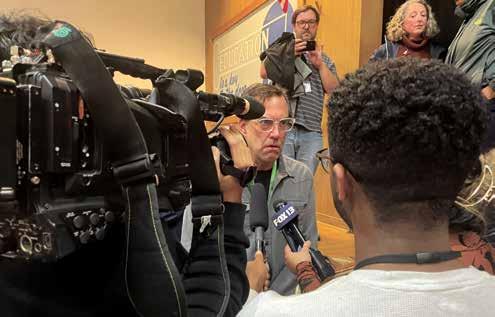
ANDY SHEFFER, PROJECT MANAGER WITH SEATTLE DEPARTMENT OF PARKS AND RECREATION, MEETS WITH LOCAL REPORTERS AFTER MEETING WITH COMMUNITY MEMBERS ON DEC. 6, 2023 – PHOTO BY TEDDY MACQUARRIE
SEATTLE NEWS
Every little thing you do is magic, Callie Little
by Kali Herbst Minino SGN Contributing Writer
Multidisciplinary artist and writer Callie Little is publishing a book and tarot deck titled Every Little Thing You Do Is Magic alongside their friend and author Moorea Seal. The tarot deck, illustrated by Little, which is focused around personal growth and mental health, is set to release on Aug. 6.
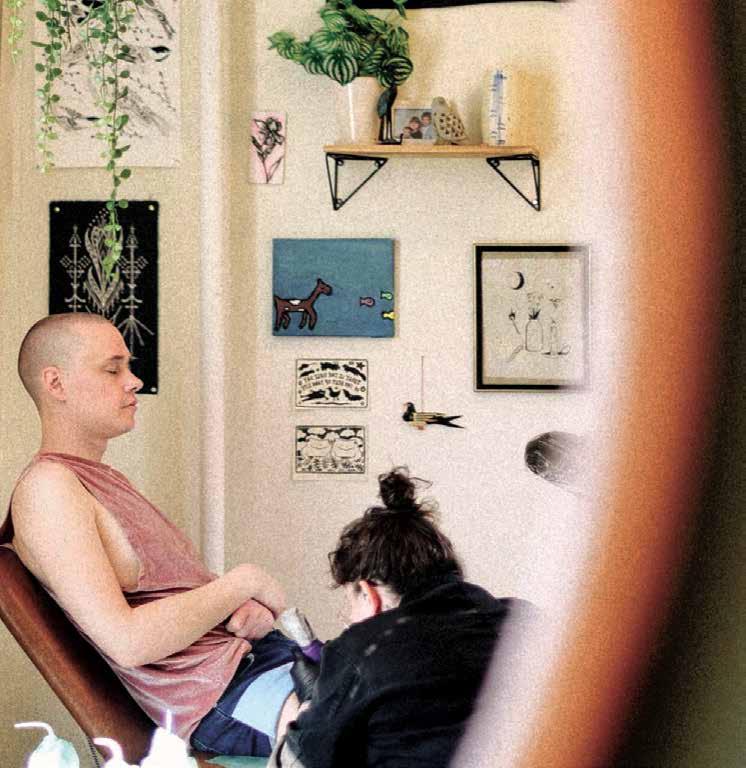
That’s the least interesting thing about Little, though. They work a day job as a tattoo artist; host a podcast on the intersection between mental health and spirituality; have done freelance work for a plethora of news sites, including NPR; and have background as a sex educator.
“Sometimes when people ask me what I do, I say, ‘I know it’s going to sound like I’m lying at some point,’” Little said.
Tattooing
In 2020, Little drew a self-portrait and asked their followers on Instagram if anyone would commission a portrait. The offer was well received. Then, while getting a tattoo from a close friend at Good Habits, the latter said it would be fun if Little tattooed them. The friend did all the sanitation and setup, and told Little how to tattoo.
“I said, ‘I feel like I’m really good at this,’ and I went home and I ordered sanitation supplies and got my bloodborne pathogen certificate that same night,” Little said. They work at that same tattoo shop now, where they emphasize a culture of safety. For people who have never gotten a tattoo before especially, Little walks them through the process and tells them what’s happening and why. That culture of safety, they say, is very Queer.
“The tattoo landscape is so varied. I think for so many of us who have a lot of tattoos, we’ve had the experience of going into a walk-in shop and having some guy unexcitedly accept our idea and then tattoo us like we’re a piece of meat and not treat us very kindly. Then we’re done, and we give them our money,” Little said. “When we’re offering our bodies and our pain and our money, that’s so many things to give someone.”
The clientele Little attracts seems to be looking for that type of community, too.
Creativity, spirituality, and Queer identity
Once someone has been comfortable with their identity for an extended period of time, it’s impossible not to see things through that lens, Little says. They personally view everything through a Queer lens.
“I think creativity and spirituality are the exact same thing,” Little said. “The spirit of creation is just inherent to being alive and to express oneself. That’s Queer as hell.”
They’ve noticed a resurgence of tarot and astrology, which a lot of people are starting to practice or have been practicing.
“I think the world of spirituality offers a lot of freedom of exploration and acceptance that so many folks who are Queer … struggle with,” Little said. “I always say you can’t be Queer in Seattle without knowing your full birth chart. You will get your Queer card revoked.”
A storytelling future
Little is working on different forms of storytelling. They’re already writing their second book, which they say is likely to be a memoir and graphic novel covering the topics of travel, sexual assault, and healing.
“I’ve been really slowly woking on that concept, because that is an incredible art form that I’ve loved for so long but I haven’t studied. I’m really working on those concepts as a storyteller,” Little said.
For now, they hope people get joy out of the tarot deck and book in August.
“I’m hoping that they love the wildly textural vibe that we’re bringing. There’s so much art,” Little said.
“I think creativity and spirituality are the exact same thing… The spirit of creation is just inherent to being alive and to express oneself. That’s Queer as hell.”
Their advice to those trying to start a creative endevor is to just give it a whirl.
“Being open to learning and trying something and letting it change you is what I think makes my life and career fun. Whenever people ask me, ‘How are you doing all these things?’ I [say I] can’t help but play around with stuff,” they said.
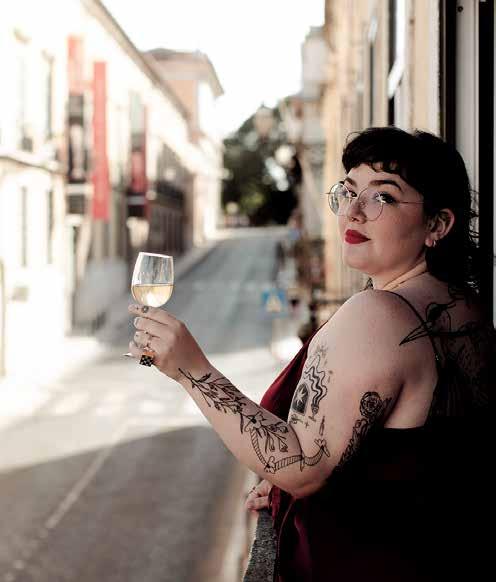
PHOTO BY ALANA MORGAN
PHOTO BY ISABELLA SOFIA PHOTOGRAPHY

REGIONAL NEWS
Foster parenting: How Queer adults can help kids in need
by Rhonda Brown SGN Contributing Writer
During Grays Harbor Pride in Aberdeen, Wash., last September, Mike Schultz and his husband were approached by Chisana White, a targeted recruitment specialist in the Partnership, Prevention, and Services Division of Washington State Department of Children Youth & Families (DCYF). They were promoting a local publication, Coastal Pride, and she was trying to recruit LGBTQA+ adults to consider fostering youth in the area.
For more than 30 years, Washington State has allowed persons over the age of 21 to become foster parents or kinship providers. I had the pleasure of speaking oneon-one with White and another DCYF representative regarding why they are actively seeking LGBTQ+ adults as foster parents, and what the process might look like for them and for the children they seek to place.
There are many misconceptions regarding foster parents and youth, often based on laws from outside Washington. For example, the DCYF is not strictly a state agency oriented toward removing children from their families via Child Protective Services; it is an “umbrella,” as White likes to refer to the approach. “We have the Department of Early Learning, Juvenile Rehabilitation, and the Child Welfare Division,” she said.
In fact, the DCYF is primarily in the business of keeping families together. The first goal is to give them the resources to be successful, healthy, and happy.
When a child is placed in a foster home, it can be jarring: new people, a new home, a new culture, and even a new town or school.

But advocating for LGBTQ+ adults to be foster parents is part of making the best of an often-traumatic situation for many children. Asking adults who might not have considered becoming the caregiver for a child is part of that strategy: matching a child in need with the best family or person has a greater rate of success overall.
However, White is not one to pretend that this is without difficulty: “It is very rewarding and an incredible way to contribute to your community, but there are a lot of challenges, and you invest your heart in it. It’s taking care of someone else’s child and hard work.”
For her, part one is flexibility; part two is humor. “There’s loss, grief, trauma... that’s what this is. That’s why foster care exists. And we’re doing everything we can to put families back together. To help
kids and families move through the trauma that they’ve experienced. [Lightheartedness] makes a big difference in adjusting,” she said.
Increasing diversity Washington is not only one of the few states that specifically advocates for people of varied backgrounds to become licensed but is also in the process of increasing supportive access to many of the resources not previously given to kinship providers.
To clarify, DCYF states on its website: “The term ‘kinship care’ refers to the fulltime care of a child by relatives or suitable others (unrelated kin).” Often the trauma caused by no longer being with immediate family can be lessened by being with those who are at least familiar and able to create a feeling of consistency.
Shearing alpacas and sharing
by Cameron Martinez SGN Contributing Writer
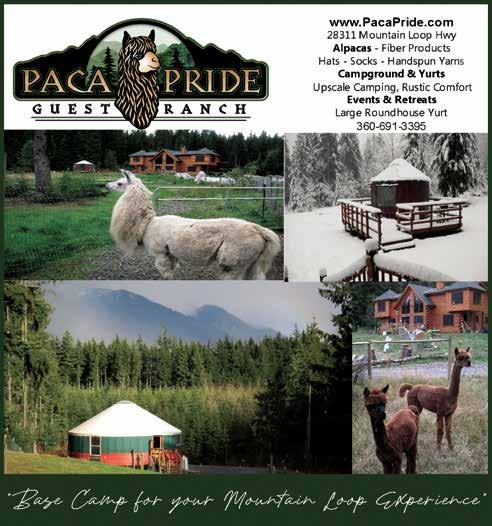
Nestled in the foothills of the Cascade Mountains, Paca Pride Guest Ranch in Granite Falls guarantees an inclusive stay for everyone. The property offers yurts, guest rooms, tent camping, RV spots, and tiny homes, with plans for future expansion — plus a whole pride of alpacas.
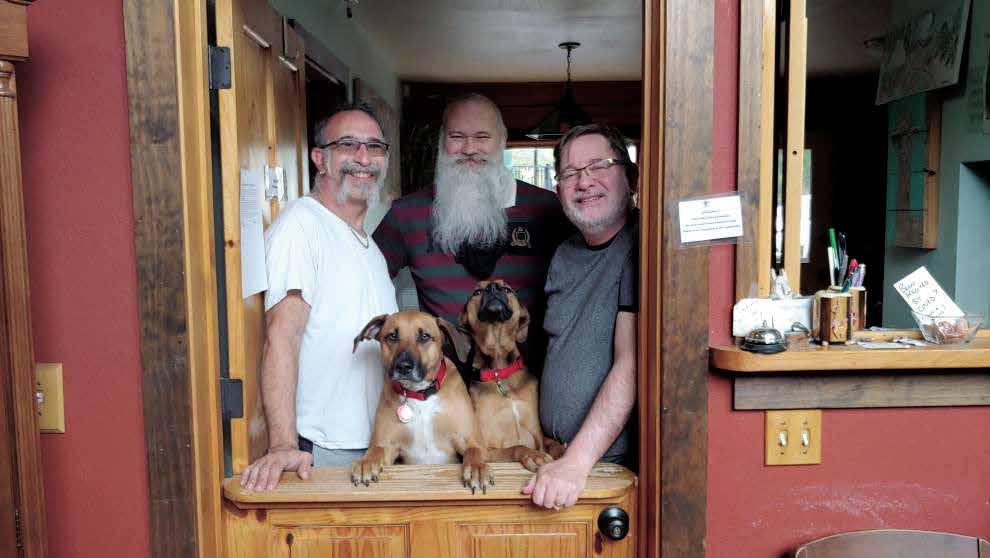
This Gay-owned business was started by David Capocci, his husband Glenn Pudlow, and Capocci’s business partner Tim Leingang when the trio wanted to move out of Seattle due to rapid urbanization.
“It was 2004: George Bush and wars and everybody … waiting for the economy to tank…” Capocci said. “We were just enjoying Capitol Hill, but we also saw the writing on the wall about where Seattle was going to go… It [was] ready to burst forth with a lot of growth… And we said, ‘How can we not live through the growing pains of such a thing happening?’”
It was also an election year, when many Democrats urged people to move out of their “blue bubbles” to make changes to areas considered “red.” Around the same time, Capocci and Leingang lost their jobs at a major insurance corporation.
“This was the universe saying, ‘Do something out of your bubble…’” Capocci said of his job loss. “Because, during all that time, we were coming up here already… The Mountain Loop Scenic Byway is known for its hiking trails and scenic attractions, and of course… about 14 miles further up the road from us, Triangle Recreation Campground…
“So, we started… going up there on the weekends during the summertime… It started our love of yurt camping, because that’s what we would put up from March through October, and it also started our love of the mountain… It was just hikers and campers that came out here, but it was a very underserved marketplace
Being licensed as a kinship provider does not automatically register anyone as a foster parent to all youth in the care system, but it does provide that caregiver with resources and support.
Being a foster parent or kinship provider is a major obligation, but the DCYF has been making a solid commitment in recent years to increase the diversity of the parents available to youth in our state. The greatest change to come about with the formation of this agency in 2017 was the emphasis on prevention, and creating successful reunification of families, when possible.
The population of children currently in foster care placement has been reduced by over 50% (approximately 5,500) since data was first collected in the 1980s, with a major drop in the past five years.
Even with the need seemingly reduced, the cultural and physical need still exists. LGBTQ+ adults are always needed as support for our youth, and even more urgently when they are in a position of vulnerability. People from all racial, ethnic, cultural, and religious backgrounds; renters and homeowners; people who identify as LGBTQ+; and those with any education level are welcome to apply to be a foster parent. You need to be 21 years old or older, or 18 if you are a kinship care provider, and must pass a criminal background check that includes FBI fingerprinting.
If you are interested in learning more about the various options for becoming a foster parent and how to support children and youth, please consider attending a virtual information session, calling the hotline 1-888-KIDS-414, or contacting Chisana.white@dcyf.wa.gov.
hospitality at Paca Pride
“Because of our representation [in Granite Falls] and the visibility we have, we have changed quite a few perceptions about the Gay community.”
in terms of different accommodation offerings.”
What followed the trio’s decision to move off Capitol Hill was the purchase of the acreage in 2005, the building of a log home in 2007, and finally opening to the public in 2010.
Alpacas
As the name states, the alpacas are the main attraction at Paca Pride.
The alpacas at the ranch are all male, because females are seen as more desirable to breeders, which leads to male alpacas not having as many options for homes.
The alpacas at the ranch are sheared during mid- to late June for their fibers and turned into a variety of products, ranging from socks to blankets.
So, if you’re not in the mood for a chaotic party-filled Pride, watch the boys get sheared at the ranch.
Changing perspectives
Moving from a “gayborhood” to the countryside is a big cultural adjustment, but the three men found a way to become a touchstone in the community.
“Imagine three Gay guys leave their Democratic blue bubble of Capitol Hill and come
PHOTO BY SCOTT GRIESSEL / CREATISTA
PHOTO COURTESY OF PACA PRIDE




REGIONAL NEWS
to homelessness and hate crimes against marginalized communities. “That’s what I want to start showing: that the better way starts here and now,” Brown said.
A victory following vandalism
Her election comes on the heels of several targeted attacks against Spokane’s LGBTQ + community. In October, the Odyssey Youth Center, a nonprofit program, was repeatedly vandalized. Rainbow sidewalks outside Odyssey, as well as in downtown’s Riverfront Park, were painted over, and Pride flags were defaced or stolen out of yards.
Following the vandalism, Woodward posted pictures online of her posing with an anti-Trans activist wearing a “Don’t Mess with Our Kids” shirt. The Spokane City Council also denounced her in September for her participation in a Christianextremist event that also hosted anti-Queer pastor Matt Shae.
“It was a unique time for us, as well, because we had some pretty direct and pretty scary vandalism and hate crimes against our building and similar spaces,” Odyssey director Ian Sullivan said. “I think it painted a decent picture of how the campaign was run and who these politicians were, based on these reactions.”
Brown believes the LGBTQ+ community in Spokane pushed her campaign to victory. She has been an advocate for Queer rights throughout her political career.
“I marched in the first Pride Parade in Spokane in 1992, and I think one thing that is important to realize is that Spokane has a positive history when it comes to LGBT rights,” Brown said.
While working at the state level (including eight years as the first Democratic female majority leader of the Washington State Senate), she used Spokane’s City Council as an example when advocating for antidiscrimination legislation, as the city passed it before the state did.
“I know there are often stereotypes about the political differences between the west side of the state and the east side of the state, but I want people to understand that
out here to the Mountain Loop Highway just outside Granite Falls in a very red, very rural, logging-truck and gravel-truck-driver land,” Capocci said. “They aren’t expecting that kind of thing. And so, we thought [about being] a change agent to bring forth and manifest the change we wanted to see in the world through hospitality.”
With their hospitable attitudes and caring attitude, the trio began to see the perspectives of their neighbors change.
“We saw a lot of tolerance, but we also really saw the town of Granite Falls come of age,” Capocci said. “Because of our representation here and the visibility we have, we have changed quite a few perceptions about the Gay community… So whenever on the Facebook group [for the city and county]…, somebody says something in response to a comment I left on an issue and [makes] some sort of slur toward Gay people, half the town [turns] out and [comments], ‘You got to ratchet yourself in here. We really value this community member.’”
Along with the lives of the locals, Paca Pride has also changed those of some of its guests.
“We’ve had experiences where families come out and stay and they go and we think they had a good time, but we [don’t] hear much about it,” Capocci said. “But then the family returns next year, maybe a year afterward. And the mom [comes] up to me… She comes through the door, and she starts crying. Like, ‘What’s going on Mom? Is everything okay?’
“She says, ‘I wanted to share with you the impact you had on us from our previous stay.’
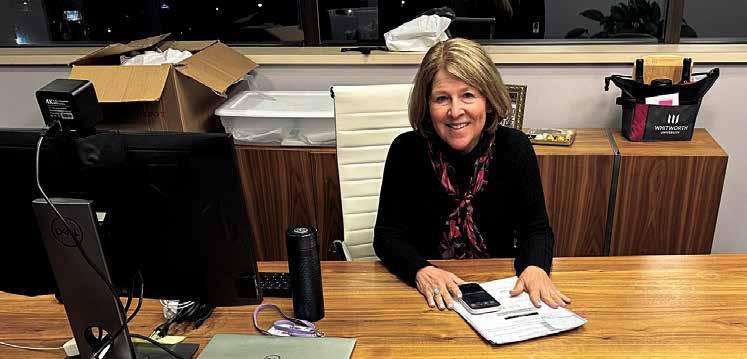
Spokane has this important [and] proud history of being there,” Brown said.
Plans for the future
Originally from Robinson, Illinois, Brown moved to Spokane in her early twenties, where she was inspired to plant roots. “This community is very rich in educational resources, outdoor activity, and [recreation],” she said. “It’s culturally a significant resource for the indigenous populations. It was a gathering place. It has a spirit about it.”
Brown’s plans for the city start with providing for those with nothing. “We have too many unhoused people sleeping outside in Spokane and not enough places for them to be,” she said. “So, coming together with nonprofits and big communities and the city administration and public safety departments, and figuring out what that plan is going to look like — or doing outreach and transitioning people into safety and security, and ultimately affordable housing — is going to be a top priority.”
She also recognizes that Spokane has the potential to influence some of its economic neighbors in northern Idaho,
“I marched in the first Pride Parade in Spokane in 1992, and I think one thing that is important to realize is that Spokane has a positive history when it comes to LGBT rights.”
which is becoming increasingly inhospitable for LGBTQ+ people.
“We’re more of an economic region with Cour ‘d’Alene and North Idaho, and yet our state policies, from a human rights or civil rights perspective, there are a lot of differences,” Brown said. “Being able to stand up proudly for the LGBTQ+ community, for women’s reproductive choice and reproductive freedom — those kinds of things are something I believe are a part of my success in this election. People wanted a leader who [would] be a voice, an advocate,
and a defender of those rights. That’s an issue that infuses everything we do.”
Spokane has always had a vibrant Queer community. With Brown at the helm of local government, voters like Sullivan are excited to see how it can thrive.
“There’s a Queer community here. There’s plenty to do. Don’t just write us off because we’re east of the mountains. A lot is going on east of the mountains and here in Spokane,” Sullivan said.
“It’s a great year to make a plan to visit Spokane,” Brown added.

And I was like, ‘Wait a second. What do you mean?’ [She says], ‘Because you’re just living authentically and representing who you are, you provided such a role model and positive example. My child had the courage to come out to us when they got home from that trip and let us know that they were either Gay or Lesbian or Transgender’...
“We’re just beside ourselves to see that… we could create that experience
and… that inspiration and make that courage happen among… kids who are looking for those positive role models that they may not see in real life.”
While the ranch is Gay-owned, Capocci stressed that it is a space for everyone no matter their sexuality, gender, religion, or race.
“Accessibility out here at the National Forest is rather white-bread,” Capocci said. “BIPOC folk maybe don’t come in as
much as they could. Because feeling safe and feeling welcome is a huge part of what we’re trying to do. [We want to] establish that sacred space and hold space for those folks with that dilemma.”
For more information on Paca Pride’s accommodations and farming practices, go to https://pacaprideguestranch.com.
SPOKANE MAYOR BROWN’S FIRST DAY IN THE OFFICE – PHOTO COURTESY OF CITY OF SPOKANE MAYOR’S OFFICE
PHOTO COURTESY OF PACA PRIDE
NATIONAL/INTERNATIONAL NEWS
National news highlights
by Teddy MacQuarrie SGN Contributing Writer
United Nations urged to investigate Texas’s anti-Queer legislation as “human rights crisis” Human rights groups, including the American Civil Liberties Union of Texas, Equality Texas, GLAAD, and the Human Rights Campaign, have submitted a comprehensive report to call attention to the deteriorating human rights situation for the Queer community in Texas, particularly in light of recent legislation. Texans are now struggling with some 140 new laws that eliminate medical freedom for Trans youth, censor school libraries, ban Trans athletes from participating in collegiate sports, end DEI practices at public universities, and threaten drag performances. In December 2023, the UN Human Rights Committee expressed concern in a report over increasing state legislation in the US that restricts the rights of individuals based on their sexual orientation or gender identity.
Toni Adkins announces bid to become first Queer California governor Longtime California legislator Toni Atkins, a Democrat, announced Friday that she will run for governor. She had said late last year that she was considering a run, but this makes it official. She joins a crowded field of candidates seeking to succeed Democratic Gov. Gavin Newsom when he leaves office due to term limits. If Atkins is elected, she would be not only

the first out Queer person in the post but the first woman. The race is expected to include at least two other women. Lt. Gov. Eleni Kounalakis has already announced she is running, and former comptroller Betty Yee plans to announce soon.
Florida GOP lawmakers move to ban Pride flags from schools
A bill advanced by Florida Republicans on Wednesday would ban teachers and other government employees from displaying a rainbow flag, but they could hang the full-size flag of any “recognized
nation” according to the bill’s sponsor. Flag displays that depict a “racial, sexual orientation and gender, or political ideology viewpoint” would be banned from any state or local government building, including public schools and universities, under the bill authored by GOP Rep. David Borrero. The bill, which would apply to all government entities and has one more House committee stop before being considered by the full chamber, is opposed by Democrats, who plan to hang Pride and BLM flags in their offices should the bill become law.
International news highlights
by Teddy MacQuarrie
SGN Contributing Writer
Mexico: Marches follow wave of Trans killings Authorities in Mexico said at least three Transgender people were killed in the first two weeks of 2024, and rights groups were investigating two additional such cases. The slayings marked a violent start to the year in a country where Queer people are often targeted. The latest death came on Sunday, January 14, when Transgender activist and politician Samantha Gómez Fonseca was shot multiple times and killed inside a car in the south of Mexico City, according to local prosecutors. The killings spurred outrage among members of the Queer community, who protested on Mexico City’s main throughway on Monday, January 15.
African bishops rebuke Pope’s directives on blessing same-sex couples
The Roman Catholic bishops of Africa and Madagascar issued a unified statement Thursday refusing to follow his declaration allowing priests to offer blessings to samesex couples and asserting that such unions are “contrary to the will of God.” The statement, signed by Congolese Cardinal Fridolin Ambongo on behalf of the symposium of African national bishops conferences, marked the closest thing to a continentwide dissent from the declaration Francis approved on December 18 allowing priests to offer such blessings. That declaration from the Dicastery for the Doctrine of the Faith has sent shock waves through the Catholic Church, thrilling Queer Catholics as a concrete sign of Francis’ message of welcome but alarming conservatives, who fear that core doctrines of the church are being ignored or violated.
Club Q shooter to plead guilty to federal hate crimes
The shooter who killed five people and endangered the lives of over 40 others at a Queer nightclub in Colorado Springs plans to plead guilty to new federal charges of hate crimes and firearm violations under an agreement that would allow him to avoid the death penalty, according to court documents made public Tuesday. Anderson Aldrich, 23, made a deal with prosecutors to plead guilty to 50 hate crime charges and 24 firearms violations, the documents show. Aldrich would get multiple life sentences in addition to a 190-year sentence under the proposed agreement, which needs a judge’s approval. Aldrich was sentenced to life in prison last June after pleading guilty to state charges of murder and 46 counts of attempted murder — one for each person at Club Q during the attack on Nov. 19, 2022.
Queer Olympic pole vaulter
Shawn Barber dies at 29 Shawn Barber, a world champion pole vaulter who came out as Gay in 2017, died Wednesday, January 17, at age 29. Barber passed away at his home in Kingwood, Texas. The stated cause of death was “medical complications,” according to an online post from the University of Akron, his alma mater.

Greek prime minister faces opposition to legalizing same-sex civil marriage
Greece’s center-right government will soon submit legislation allowing samesex civil marriages, despite reservations from its own lawmakers and the country’s influential Orthodox Church, Prime Minister Kyriakos Mitsotakis said. He stressed that the proposed law would not extend the right to parenthood through surrogate mothers to same-sex couples — an issue that has divided Greek society. Several lawmakers from the right wing of the governing New Democracy Party, along with the Greek Orthodox Church,
have expressed opposition to any overhaul of the country’s marriage and parenthood laws to include same-sex couples. Allowing same-sex civil marriage was a key campaign promise by Mitsotakis, who secured a second four-year term in a landslide election victory last year.
Human Rights Watch: UK government severely eroded human rights in 2023
The United Kingdom government’s policies and practices both severely eroded domestic human rights protections and undermined its efforts to promote human rights globally in 2023, the international
advocacy organization
Human Rights Watch said on January 11 in its World Report 2024. In the 740-page report, its 34th edition, Human Rights Watch documented how the UK government weakened basic freedoms, such as the right to protest, with new legislation. It focused on efforts of the Conservative government to curtail protections and rights for immigrants, Queer people, and other minorities, as well as the country’s failure to condemn alleged Israeli war crimes against Gazans and the increased reports of antisemitism and Islamophobic incidents.
SHAWN BARBER – PHOTO BY PHIL NOBLE / REUTERS
ARTS & ENTERTAINMENT
Marysville’s Red Curtain Foundation presents homoerotic Romeo and Juliet
by Cameron Martinez SGN Contributing Writer
While the works of Shakespeare are nothing new, the Red Curtain Foundation for the Arts in Marysville, Wash., is taking a different angle for its production of Romeo and Juliet. Its take, by Joe Calarco, tells a homoerotic story of forbidden love between men.
Shakespeare’s R&J follows four teenage boys attending an all-male parochial boarding school during the 1950s. Tired of their ridgid routines, they begin to read and perform Romeo and Juliet after school. While the boys initially take their roles less than seriously, they quickly become enveloped in the story, with those playing the leads seeming to take it to a whole new level.
“The script allowed me, the cast, and design team the opportunity… to revisit one of Shakespeare’s most well-known plays through an entirely new lens and explore what words mean, given this unfamiliar setting,” said Scott Randall in his letter from the director. “As recommended by the playwright, I first approached his script by rereading William Goldberg’s Lord of the Flies, a book that examines what might happen if a group of preteen boys were isolated from civilization and left to their own devices. Golding’s answer was that these boys would revert to their primal state.”
The result of the analysis of the two works led to the creation of the familiar
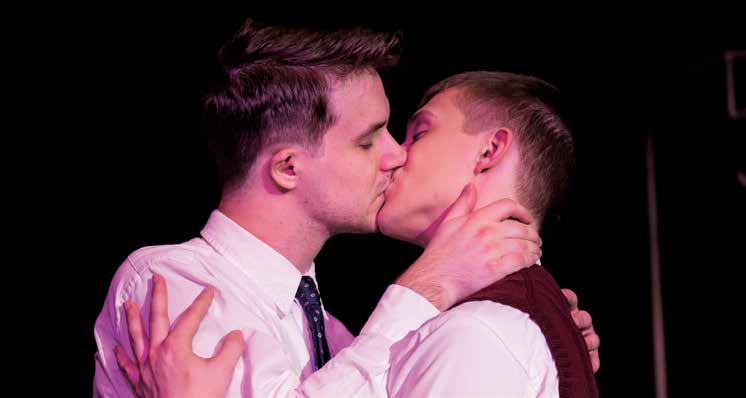
story of young love set in a time of postwar ideals and repressed ideation. With a minimum use of props and a simple three-story stage, the audience of the play is able to imagine the roles along with the boys.
Shakespeare’s R&J will run for two more weekends — Jan. 26 through Feb. 4 — with performances at 8:00 p.m. Fridays and Saturdays, and 2:00 p.m. on Sundays. Tickets are $25 for adults, $20 for seniors/ students/military. Buy tickets online at
https://redcurtainfoundation.org, over the phone at (360) 322-7402, or at the box office Tuesdays through Saturdays from 2:00 to 6:00 p.m.
Seattle Women’s Chorus combats book bans with Little Free Library, book drive
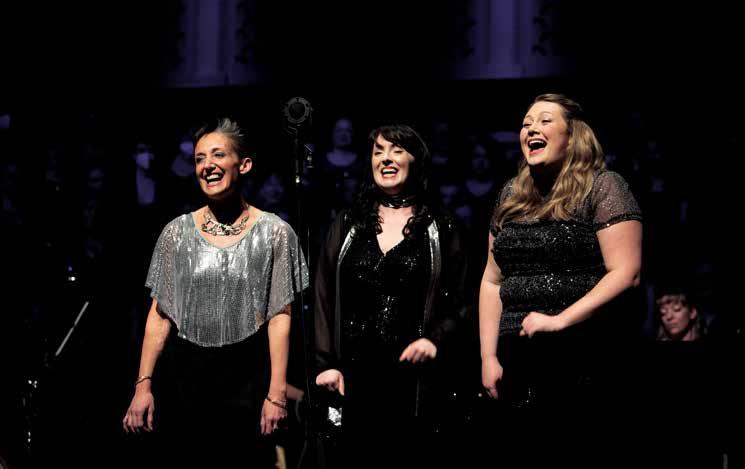
SEATTLE (January 20, 2024) – As books are being banned in the US at an unprecedented rate, Seattle Women’s Chorus is putting a spotlight on the issue by holding a banned-books book drive with Third Place Books and creating its very own Little Free Library.
Through Feb. 3, new and used banned books will be collected at any Third Place Books location to be distributed among Seattle-area Little Free Libraries — including Seattle’s newest, in front of the Seattle Men’s Chorus and Seattle Women’s Chorus office on First Hill (319 12th Ave.) beginning Jan. 27.
SWC members will place banned books in select Little Free Libraries on Saturday, Jan. 27 in Seattle. A few lucky readers will find a golden ticket in the books, redeemable for free tickets to the upcoming Seattle Women’s Chorus Banned & Beloved concert.
Banned titles include This Book Is Gay, Alice in Wonderland, Beloved, Heather Has Two Mommies, and Melissa — all of which inspired original songs that will be performed in the concert. For a list of commonly banned books, visit https://pen.org/ banned-book-list-2021-2022, compiled by PEN America.
Banning books is a nationwide issue. In just the first half of the 2022–23 school year, there were 1,477 instances of individual books banned, an increase of 28% from the second half of the prior school year, the vast majority of which are written by or about LGBTQIA+ people and people of color and centered on race, sexual orientation, and gender, according to PEN America.
While Washington State is often praised as a progressive safe haven for diverse voices and inclusion, books continue to be challenged — most notably over the past few years in the Kent, Mukilteo, and Walla Walla school districts. Overall, books challenged in Washington jumped from 10 to 42 between 2017 and 2021, according to the American Library Association.
“The primary role of reading is joy from encountering other worlds that are not your own,” said Nancy Pearl, beloved local librarian, author, and former executive director of the Washington Center for the Book at the Seattle Public Library. “It’s also important that kids and adults recognize and find themselves in the pages of the book. For kids especially, it’s important to see that they’re not alone, whatever their situation is.”
The book drive and Little Free Library installation were born out of the Seattle Women’s Chorus singing music that makes
a difference in Banned & Beloved. This new concert features custom-composed songs based on banned books, with performances at 1 p.m. and 5 p.m. on Saturday, Feb. 3 at Town Hall Seattle. Donations of banned books will also be accepted at each concert, with Third Place Books on-site selling copies of banned books.
Tickets for the Banned & Beloved concert — as well as livestream and on-demand tickets — are available for purchase ($29–59) at https://www.seattlechoruses.org/seattle-womens-chorus-current-season.
The internationally renowned Seattle Women’s Chorus (founded in 2002) and Seattle Men’s Chorus (founded in 1979) together make one of the largest community choral organizations in North America, and stand out among the largest LGBTQ-identified choruses in the world. Both choruses perform in Seattle’s most prestigious venues for an annual audience of more than 30,000 patrons across the Puget Sound region.
PHOTO BY KENNY RANDALL PHOTO COURTESY OF SWC
Navigating neurodivergence in the workplace
In today’s fast-paced, ever-changing work environment, diversity and inclusion have become crucial aspects of fostering a thriving workplace culture. One key element is providing accommodations for neurodivergent people.
While these can vary from flexible scheduling to noise-canceling headphones, it is important to note that they do not come easily. If you are a neurodivergent person, navigating the professional sphere comes with unique challenges, as you need to take initiative in order to get your needs met. To put it plainly, if you don’t ask for what you need, you won’t get it.
Here’s a guide to help you (as a neurodivergent person) navigate this process, whether you work in the office, remotely, or in a hybrid setting.
Self-reflection
Before initiating the conversation about accommodations, take some time to reflect on the specific challenges you face in the workplace due to your neurodivergence. Are there particular tasks, environments, or interactions that trigger stress or hinder your productivity?
Once you have figured out your challenges, brainstorm potential solutions. Some common accommodations for neurodivergent workers include: noise-canceling headphones or a quiet workspace, flexible scheduling or remote work options, written instructions or visual aids, those for sensory issues (such as a comfortable chair or special lighting), and extra time or breaks for tasks that may be more challenging.
Know your rights
Under the Americans with Disabilities Act (ADA), employers are required to provide reasonable accommodations for employees with neurodivergent conditions such as autism, ADHD, dyslexia, and anxiety disorders. Because of this, if you need an accommodation to perform your job duties, your employer must work with you to provide one. Having this knowledge will empower you during conversations about accommodations and ensure that you can advocate for yourself effectively.
Choose the right time and format
Timing is crucial when discussing accommodations. Ask your supervisor for a one-on-one meeting without distractions. But before you schedule that, consider whether an in-person, virtual, or written format would be most effective for your communication style. Once you have decided on the format, make sure that your supervisor or boss has your undivided attention to ensure clear communication.
by Isabel Mata SGN Staff Writer
Ask Izzy is an advice column about relationships, mental health, and sexuality. Written by Isabel Mata — a Seattle-based lifestyle writer, podcast host, and mental health advocate — Ask Izzy offers tangible expert advice so all readers can have stronger relationships, better sex, and healthier mindsets. Submit your question today by scanning the QR code below.

Here’s a guide to help you (as a neurodivergent person) navigate this process, whether you work in the office, remotely, or in a hybrid setting.
Be specific and solution-oriented
Once you have a meeting set, clearly articulate the accommodation(s) you are seeking. You want to be specific about how this will address the challenges you face. It is likely that your supervisor will need approval before implementation, so make their job easier by outlining the benefits. Emphasize how these accommodations will not only benefit you but also contribute to the overall productivity and success of your team. Framing the conversation in this way can help drive the point across in a way that aligns with the company’s values and goals.
Provide resources
Not everyone knows what neurodivergence means, and you might be the first
person in the office to ask for accommodation. Offer resources or information that can help your employer understand better, such as articles, videos, or professional organizations that specialize in workplace accommodations.
Collaborate on implementation
Having the conversation is just the first step. After the conversation, work collaboratively with your employer to implement the accommodation(s). This may involve talking with HR, relevant departments, or external consultants. Be open to finding solutions that work for both parties, and practice patience along the way.
Conclusion
BY
Requesting accommodations as a neurodivergent person can be a positive and empowering experience when approached strategically. By understanding your needs, advocating for your rights, and fostering open communication, you contribute not only to your own success but also to the creation of a more inclusive and supportive workplace.
Remember, you have a right to thrive in your professional journey, regardless of if your brain works differently than others. By seeking accommodations, you are taking a step toward creating a workplace that values diversity and ensures everyone’s success, regardless of neurodivergence.

PHOTO
COTTONBRO / PEXELS
FILM
Unsettlingly timely I.S.S. has the right stuff

by Sara Michelle Fetters
SGN Staff Writer
I.S.S.
Theaters
Not even two days into her tenure aboard the International Space Station (I.S.S.), astronaut Dr. Kira Foster (Ariana DeBose) peers out an observation deck window, looking toward the Earth, and sees a hellish spectacle. A series of gigantic explosions begin to ripple across the surface of the planet. It is as if the land itself is inexplicably bursting into flame. I.S.S. commanding officer Gordon Barrett (Chris Messina) immediately orders the six-person crew — split evenly between the United States and Russia — to look away, certain their respective governments will inform them of what is going on as soon as they can.
He’s right about that. Within seconds, both he and his Russian counterpart Nicholai Pulov (Costa Ronin) are contacted by their superiors. But before either can respond, communications are inexplicably cut off, and all they have to go on are the almost identical messages they’ve received: Take control of the I.S.S. by any means necessary.
That’s all there is to I.S.S., the unsettlingly timely new thriller from Blackfish and Our Friend filmmaker Gabriela Cowperthwaite. Newcomer Nick Shafir’s efficient script is a model of simplicity. There is little in the way of exposition. Nothing is overexplained. Instead, the filmmakers insist on letting the audience slip their way into the proceedings as a seventh protagonist, every viewer asked nothing more (and certainly nothing less) than how they believe they would act and react if they’d been thrust into a similar situation.
This all works best during the film’s sensational opening half. The introduction to the astronauts, a group that also includes John Gallagher Jr. as gregarious American scientist Christian Campbell and Pilou Asbæk and Masha Mashkova as Russian cosmonauts Alexey Pulov and Weronika Vetrov, is handled with pitch-perfect brevity. The initial tour of the I.S.S. that Commander Barrett gives Dr. Foster allows the viewer to get a firm grasp of the small space’s layout almost immediately. The first look at the Earth through the observation deck window is awe-inspiring.
Then there is the catastrophic event itself. Cowperthwaite returns to her observational documentarian roots with bravura authority. She strips out almost all of composer Anne Nikitin’s otherwise disquietingly sincere score. The film’s uncomfortable sound
design goes almost entirely silent. All that matters is the grotesque orange, red, and yellow horror slowly enveloping the Earth, and I felt as if Cowperthwaite was forcing me to take it all in without any unnecessary embellishment or didactic sermonizing on her end. It’s gloriously terrifying.
From there, things mostly play out as anticipated. The crew begins to wonder who they can trust. Each astronaut has to decide whether or not the orders they have received are valid. Tensions rise. Suspicions go into overdrive. Paranoia puts all of their lives in danger, and ultimately Dr. Foster — as the only newcomer to the group — is the one who has to make the pivotal life-or-death decisions that could decide not just the fate of the I.S.S. but the Earth itself, too.
Some of that gets a bit convoluted and nonsensical. There’s also a McGuffin regarding a “cure” for radiation poisoning that is the real reason both the United States and Russia want their astronauts to seize the I.S.S. Commander Barrett makes a bizarre decision early on to go on a potentially dangerous spacewalk solo that honestly does not make a ton of sense, and while there is dramatic resonance to this course of action, its overall lack of believability significantly dilutes that. As for the ending, it’s something of a foregone conclusion, and that’s something of a shame.
But none of this keeps the film from working. The ensemble is excellent across the board, especially DeBose and Asbæk, both of whom bring an internalized complexity to their characters that’s striking. Cowperthwaite stages a small handful of knockout sequences, not the least of which is a zerogravity fistfight that caught me by surprise and is chilling in its bloodcurdling minimalism. The film is also compellingly shot by cinematographer Nick Remy Matthews (Hotel Mumbai), his camera navigating all the compact and cramped ins and outs of the I.S.S. similarly to classic submarine dramas like Das Boot or Crimson Tide Ultimately, I.S.S. asks several troubling and unpleasant questions, and the film refuses to make things easy on the audience by smothering them in obvious answers.
This is a sci-fi procedural “what if” scenario straight out of The Twilight Zone or Black Mirror. While it isn’t quite out of this world, it does have the right stuff, and just like how Chuck Yeager breaking the sound barrier got everyone eager to discover what else was humanly possible, that’s more than enough for me to get excited about whatever it is that Cowperthwaite or Shafir decide to make next.

Preserving hope
Oscar winner Ariana DeBose and director Gabriela Cowperthwaite blur the lines between science fiction and science fact with the timely I.S.S.
by Sara Michelle Fetters SGN Staff Writer
I.S.S. is as timely a science fiction thriller as they come. Aboard the International Space Station (I.S.S.), six astronauts — three from the United States, three from Russia — look out the observation window and see an Earth bursting into flame. Seconds later, each trio’s commanding officers receive almost identical messages from their respective governments: take control of the I.S.S. by any means necessary. Fresh off of making West Side Story (but before she won an Academy Award for Best Supporting Actress for her scene-stealing performance as the fiery Anita), Ariana DeBose tackled the lead role of American astronaut Dr. Kira Foster. “I wanted to do something that was just so vastly different from anything I’d ever done,” she stated candidly. “I saw a little bit of myself [in the character], and I thought that the script was so compelling.
“These are a group of people united by their love of science and their reverence for the cosmos, and no matter their cultural differences, they still have that, and they do form this trust. But then the tables turn, and you have to [ask] the question: How far can you take this bond? What are the thresholds of trust? Where does it start? Where does it end? I thought that would be a really cool thing to explore.”
Award-winning Blackfish and Megan Leavey filmmaker Gabriela Cowperthwaite was attracted to the motion picture for many of the same reasons. “I loved the humanity of it,” she said, referring to writer Nick Shafir’s original screenplay. “It’s a human story [with] real people. It has that sort of authenticity that I wanted to bring to a genre … a lot of [which] has to do with completely suspending to your imagination, suspending reality and going somewhere else. I wanted to take reality and bring it somewhere cool.”
SEE INTERVIEW PAGE 20
ARIANA DEBOSE AND GABRIELA COWPERTHWAITE – IMAGE COURTESY OF COMINGSOON.NET / YOUTUBE
I.S.S. – PHOTO COURTESY OF BLEECKER STREET
Unforgettables: Cinematic milestones with Sara Michelle
Sleeping Beauty : Getting lost and making forever memories, once upon a dream

by Sara Michelle Fetters SGN Staff Writer
I saw Walt Disney’s 1959 classic Sleeping Beauty for the first time during its 1979 theatrical rerelease, and I was unsurprisingly blown away. This sweeping animated epic held me spellbound from its jubilant opening frame all the way to its thrillingly fiery conclusion. Like countless kids (and adults) before me, as soon as it was over, all I wanted to do was watch it again that second — and that’s exactly what my mother and I did.
But there’s more to this forever memory than watching an all-time great. My family had moved from one side of Washington State to the other a year prior, leaving the small coastal logging community of Aberdeen for the desolate urban wilds of Spokane. I was too young to understand how big a deal this was. I only saw it as an adventure, and it was one that, even as a quiet kindergartner, I was fully determined to make the most out of.
As part of that, and as we were still investigating the city, my mother purposefully
chose a theater miles away from home that we’d never been to before. To get there, we left well ahead of time and did a variation on a “penny walk”: at every red light, we flipped a coin to determine whether we’d go left or right and then see if we could figure out where we were without getting lost.
We were comically unsuccessful. We didn’t just get lost; we got so hopelessly turned around that my mother worried she’d have to find a pay phone to call my dad so he could help us figure out how to get back home.
Somehow, we stumbled into a lonely café that was nothing more than a proverbial hole-in-the-wall. It was run by a gigantic white-bearded man I was absolutely certain was a vacationing Santa Claus. With a hearty laugh (and a free bowl of vanilla ice cream smothered in chocolate sauce), not only did he give us pinpoint directions to the theater, but he also outlined on a city map the route we’d need to take to get back home. Why is this important? Sleeping Beauty is a masterpiece. In my opinion, it’s not just the best animated film to ever come out of Walt
Disney Studios, but it is also the finest animated motion picture I’ve ever seen, period. But as dazzling as it is, it is the memories I associate with seeing it that first time that elevates Sleeping Beauty to a level it may not have ascended to without them. The experience of traveling to watch it is just as important to me, and I do not think any of that can be taken for granted.
Don’t get me wrong. As I’ve gotten older and my viewing palate has expanded to tackle cinematic wonders from all over the globe and to eras going back over a century, I analyze this marvelous adaptation of the Charles Perrault fairy tale classic through far different eyes than the ones I utilized as a five-year-old. There’s so much to talk about — frankly too much for a short anniversary recollection piece such as this one.
I’m still going to give it my best shot. Sleeping Beauty was the most expensive animated film ever made at the time (a reported $6 million) and it took almost a decade to complete. Its impressionistic, pre-Renaissance style (heavily influenced by medieval tapestries that were on display
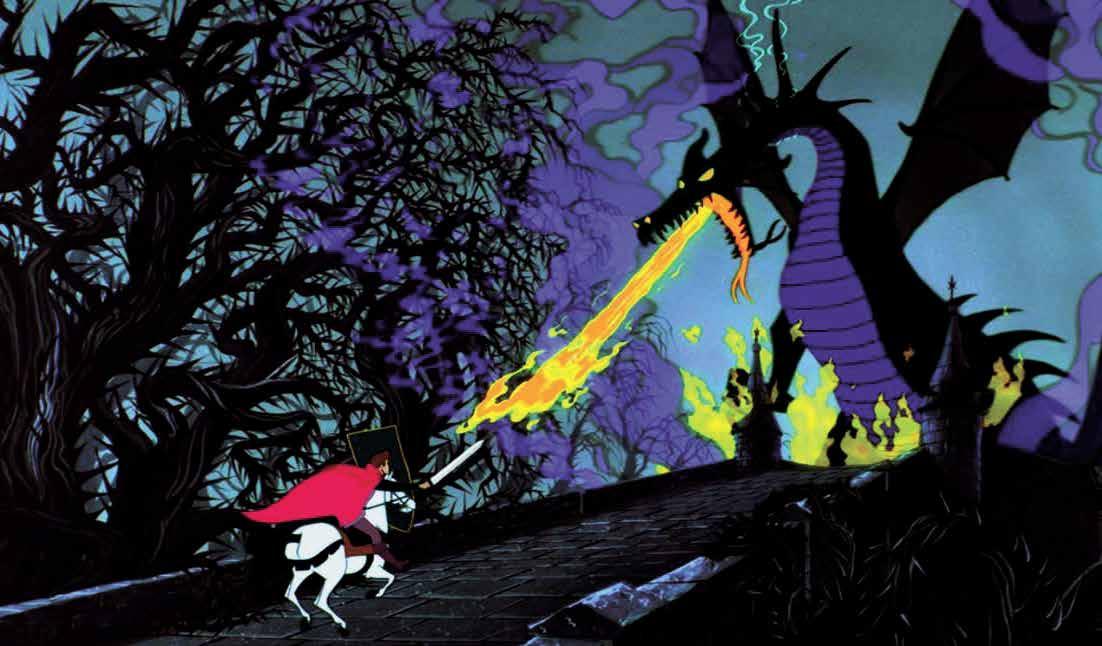
at the Metropolitan Museum of Art during the early 1950s) was unlike anything the animators at the studio had ever attempted. Legendary Disney animator Eyvind Earle supervised an artistic direction for the production, which remains one of the most imaginative and influential ever conceived. But there’s more. The confidently assured storytelling is brisk, creative, emotionally endearing, and — dare I say it? — downright magical. The comedy works on multiple levels, so viewers of all ages giggle as one. The eye-popping set pieces, most notably the sorceress Maleficent’s iconic transformation into a hellacious, fire-breathing dragon, are burned into the collective psyches of viewers going back over six decades. Using Pyotr Ilyich Tchaikovsky’s “Sleeping Beauty Ballet” as the fantasy adventure’s musical foundation was a bona fide stroke of genius.
Speaking of Maleficent, the evil fairy is the villain to end all Disney villains. As despicably wonderful as many of them have been, none compare to her. Brilliantly brought to life by actor Eleanor Audley (who also memorably voiced Lady Tremaine in Cinderella and was the woman behind Madame Leota in Disneyland’s Haunted Mansion attraction), this is as chilling a depiction of pure, unadulterated vengeful wickedness that has ever seen the light of day.
While all of this is noteworthy, it’s the bizarre trek my mother and I went on to see Sleeping Beauty way back in 1979 that brings a teary smile to my face. Even at that young age, I still saw pieces of myself in the film. I could even foresee snapshots of who I aspired to be at some vague, unknowable point in the future.
But that my mom and I were there together, my head tucked firmly against her shoulder, both of us oohing and ahhing in unison — I hold onto all of that. Art is more than its own thing disconnected from the experience of viewing, reading, or listening to it. What makes any of it stand the test of time are the individualized pieces of ourselves we almost unknowingly attach to it as we journey through life. That is what makes it timeless. That is what makes all of it unforgettable.
Celebrating its 65th anniversary, Sleeping Beauty is available on DVD and Blu-ray, and can be purchased digitally on multiple platforms. It is currently streaming on Disney+.
FILM

INTERVIEW
It was after principal photography had ended and during the editing process that Russia invaded Ukraine and the real world violently intruded on the director’s fictional one.
“We had a finished movie and were waiting on the visual effects when [the war in Ukraine] happened,” Cowperthwaite remarked. “I remember having a talk with my producer, Mickey Liddell, and he was like, ‘I don’t even know if we can put this out. How do we put this movie out right now? The world is so fraught. Are we saying the right things?’
“What I told Mickey — and I think is that it’s sort of like the heart and the soul of the piece — is that this is about the little people bearing the brunt of these big national decisions and these big international conflicts… and you’re seeing that distilled with these six astronauts. So, we went forward, but it was still a strange, existential parallel how that kind of unfolded.”
A new experience
For DeBose, working on I.S.S. was unlike any other on-set experience she’d had up to that point. “It was liberating and extremely challenging,” she said with a smile. “This character, she sort of lives and dies by her specificity. She’s very science-brain, which is not me. I’m like emotional-art, passion-art … brain, so I had to focus in on that.
“But there was a certain kind of physicality that she required as well, and that is a strength of mine. Figuring out how to operate in these harnesses [to simulate weightlessness], I was able to look at that aspect of the work like choreography. Ultimately, it was really, really fun.’
“I’m just now really realizing,” DeBose added after a brief chuckle, “[that] this was the first time that I was sort of spearheading a group of people. I hadn’t done that yet. It was a really good learning experience in … how to show up and be present for my cast in a slightly different way.”
As for the on-screen action, “A lot of what you see happening both physically, emotionally, and within the plot, you’re getting to know these characters through [Kira’s] eyes,” DeBose said.
“This was important. We were under
these claustrophobic-heavy circumstances, literally on top of one another. What was great about the harnesses is, at least for myself, I was able to take the feeling and the emotion, the sensation of being in it, and infuse that into the performance. It was very helpful.
“I do think working in such close quarters with all of these other elements that you have to balance at all times… brought us closer together.”
A human story
“This is a human story,” De Bose continued. “This is really about the people. And shooting during the pandemic, we [the cast] were forced to be a pod on set and also in this small, very accurate replica — or as close as we could get to accurate — of the I.S.S. We spent a lot of time together.
“I’ve learned so much from Costa Ronin and Masha Mashkova about what it is to be a part of Russian culture. They would share things with me things that made me con-
sider how I relate as Ariana to their culture, to the Russian people, that I had never had to consider before. That helped me ask bigger questions of myself, and of my character, about how I relate to culture in general.
“I think this was one of those art-imitating-life moments where you just couldn’t help but be that close to a person and love all their flaws. I was clinging, literally clinging, to the other actors in simulated zero gravity, right? They were all I had.”
Cowperthwaite hopes audiences ponder themes and ideas similar to those DeBose mentions as they exit the theater. “For me personally, my hopes, my fears, my children, everything I love is only preserved and cared for if I am also caring and preserving somebody else’s hopes, dreams, and families,” said the director with introspective resolve.
“It’s exactly what doesn’t happen in conflict stuff like this. It’s usually like, my security totally depends on you being insecure, and me having more means you
have less. It’s true [that] that’s sometimes how the world’s structured, and what we’re seeing right now is sadly a lot of that. But I feel like it should be the opposite. The long game is that I’m only as good and safe as I make you feel … good and safe. That’s what I hope happens, what audiences [talk] about. Or, at least hopefully kind of tracks a tiny bit with that.”
“I think it’s such a strong statement,” DeBose immediately added. “I think the film asks the viewer to consider some crazy circumstances, and the hope is that we don’t get to that moment. When I watched the film, I asked myself, ‘I just went on this ride. Now what can I do to keep us from getting to that moment?’ Whatever the answer, I wanted to go back into the world and try to do that, wanted to keep us from getting to that moment, if that makes sense. I hope audiences will think about doing something similar.”

BOOKS
City of Laughter gives readers permission to wonder

by Lindsey Anderson SGN Staff Writer
For debut author Temim Fruchter, writing is a love language. For years, she did stints in the various worlds of her short stories but never stayed long enough to produce a full-length novel. Then, in 2020, everything changed. Fruchter participated in a writing residency, where she had the time and space to focus on ideas and characters that demanded more attention than just ten pages.
“The idea of it scared me — of staying in a fictional world not just for ten pages but for ten chapters,” Fruchter said. “I love the pressure-cooker environment of a short story — it lends itself to good tension and characters I can visit with but not, you know, marry.”
She first started writing City of Laughter as individual sections for a possible linked collection, but as the story grew, she knew it could not be contained. “It pretty quickly demanded my attention, specifically as a novel. There was a lot to thread together, and a novel is the only form large and wide and capacious enough to hold it all,” she said.
Ancestors and folklore
City of Laughter is a beautiful multigenerational tale woven through the perspectives of an 18th-century jester and a modern Queer Jewish woman coping with heartbreak and grief.
“The obsessions central to the novel have been with me and showing up in my drafts and notes for many years,” Fruchter said. However, the story found its wings after she took a trip to Ropshitz (Ropczyce, Poland), once a shtetl where her greatgrandparents lived.
“I was standing there, in a place that was now just mostly trees and road, totally unlike the place it had once been, and I couldn’t decide if it felt riddled with ghosts and ancestral presence or if it simply felt empty and I was projecting,” she said. “I decided to write into this ambivalence — that a visit back to one’s ancestral place doesn’t necessarily yield anything clearly; sometimes, I think, the mystery gets richer.”
Thinking about her ancestors, Fruchter wondered if they experienced queerness similarly to herself. “In entertaining the playful folkloric space of this book, I gave myself permission to imagine: what if they had been [Queer]?” she said.
“Regardless, given the erasures and silencing of Queer and Trans stories across history, and the destruction of much of Eastern European Jewish life at that time, I would have no way of knowing, so I turned to fiction, and specifically to folklore.”
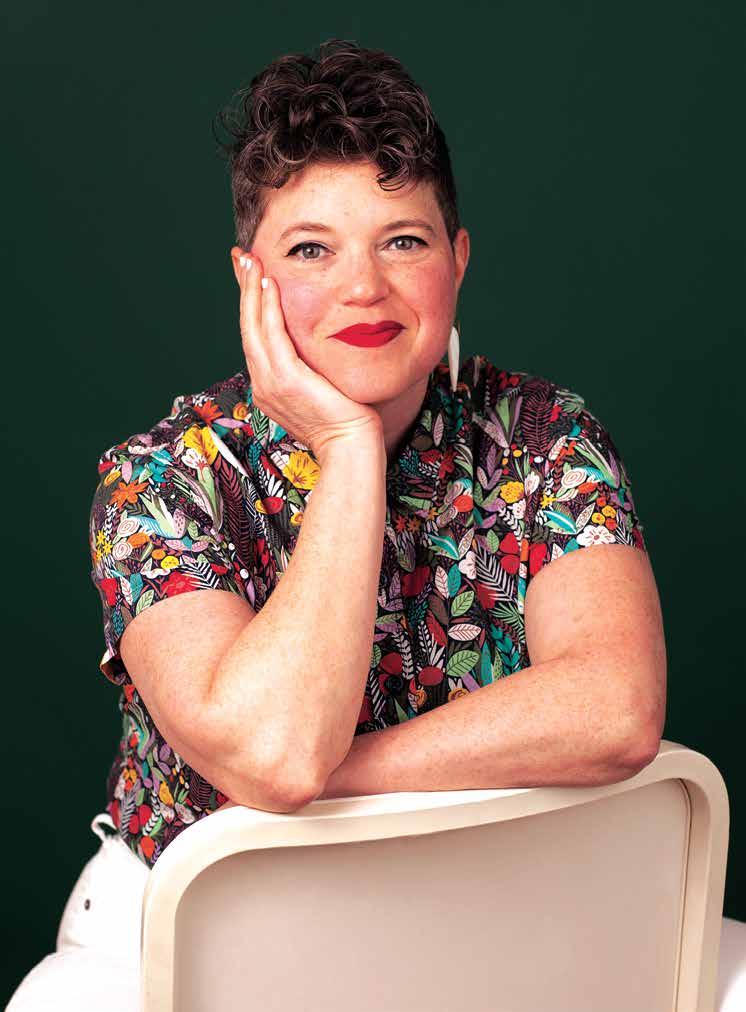
“Writing the book itself, for me, felt like a Queer project… The book’s temporal zigzags and the nonlinearity of the time and space felt Queer. The wondrous logic of the book and its insistence on possibility felt Queer. Its sense of humor felt Queer.”
Fruchter grew up on Jewish folklore and wove beloved stories from her childhood into her work. “The twin resources of Jewish folklore and Queer imagination allowed me to speculate, to weave a new story from my family’s roots,” she said.
Open to the haunting
The masterfully creative tale that unspooled from Fruchter’s imagination and cultural roots is one she describes as haunted, written in collaboration with the ghosts that have taken root in her soul.
“Even as a little kid, I felt haunted,” she said. “I don’t necessarily mean this in a bad way, though sometimes it did feel bad.
But in the sense that I feel like I can’t understand myself or the world I’m in unless I zoom my way out.”
Writing City of Laughter gave Fruchter the perspective to see her life and lineage temporally. “I needed to delve into generational thinking to write this book about how cumulative we all are in ways that are difficult to see without looking at not just the big picture but the very, very big picture. I needed to fully open myself to the haunting,” she added.
Fruchter sees the book’s playful approach to time and space as a delicate homage to queerness. “Writing the book itself, for me, felt like a Queer project,” she said.
“The book’s temporal zigzags and the nonlinearity of the time and space felt Queer. The wondrous logic of the book and its insistence on possibility felt Queer. Its sense of humor felt Queer.”
Of course, queerness is also explored through the desires of the characters. Ultimately, her exploration of LGBTQ+ ancestors led Fruchter to understand her identities with a new perspective. “It pushed me to imagine, as I never had, for example, what it would have been like to be a Queer person with transgressive desires or ways of being in a Polish shtetl in the 1920s, for example. Or elementally, Nonbinary identity and ways of being can mean, or allow.”
City of Laughter asks readers to give in to their curiosities and allow their minds to wander. “I wanted to write a story that reminds the reader that sometimes if you think it means something, it means something,” Fruchter said. “I hope the book is permissive and readers take this permission with them on their explorations.”
IMAGE COURTESY OF GROVE PRESS
TEMIM FRUCHTER – PHOTO BY LEAH JAMES
BOOKS
Cassandra at the Wedding : I do...not
Twincest on the ranch
by Clar Hart SGN Contributing Writer
CASSANDRA AT THE WEDDING
Dorothy Baker
© 1962, 2012 New York Review Books
$17.95
256 pages
Content warning: Suicide
If you have any friends who are part of the New York literati scene, you’ve most likely heard of Cassandra at the Wedding While not strictly a pulp novel, it has many of the same elements: suicide, forbidden doctor-patient relationships, dead moms, alcoholism, skimpy bikinis.
Books like Cassandra at the Wedding fall into the “literature” category mostly because their main characters are more intentionally unlikeable. And there’s anxiety. Lots of anxiety.
To briefly summarize, Cassandra is a Berkeley grad student living the grad-student life of endless grading, avoiding her dissertation, sleeping around, and drinking too much. She goes back east to attend the wedding of her twin sister, Judith, who has been living in New York.
Cassandra is extremely torn up about her sister’s nuptials, mostly because she hates that Judith is living her own life. Cassandra attempts suicide the night before the wedding. She is revived by her sister’s soon-to-be-husband.
The ceremony goes on. Cassandra then walks onto the bridge she’s been thinking

COURTESY OF NYRB CLASSICS
about driving off of since the beginning — and throws her sock off it instead. It’s a metaphor or something.
It’s easy to see why many New York snobs like this book. New Yorkers love a narcissist — and Cassandra is a narcissist par excellence. It also falls into the territory of the also very New York neurosesas-stand-in-for-intelligence. (I’m going to put this out there: being a dick doesn’t make you brilliant, no matter what yet

another Fox sitcom says. Go to therapy and learn some goddamn empathy.)
Possibly why this became such a pandemic must-read is that it deals with two pandemic-relevant issues: grief and the struggle of being stuck while the world around you moves on.
To wit, Cassandra and Judith’s mother, Jane, had recently passed. Cassandra dealt with the guilt of not wanting to live but having her whole life ahead of her, compared to her mother, who so desperately wanted to live but could not.
Judith, on the other hand, moved out of her and Cassandra’s shared apartment and went to New York, where she found a fiancé, created a life, and moved on.
So Cassandra is now stuck in their old apartment with a piano that was solely played by her sister, grappling with all the pieces of their shattered family. She finds herself unable to go forward or to pursue anything she truly wants, whether that’s to be a writer or to date women.
It’s the struggle of living in a society that hinges on the nuclear family. Women can only ever be half of a whole. Cassandra’s world doesn’t allow her the option of Gay coupledom. Instead, she feels that her only refuge from a heterosexual pairing is how society has trapped her before, as half of a twin set, which she’s now in danger of losing.
Many of my Queer friends and I have struggled with an extended adolescence like Cassandra’s. While our straight friends often settle down early (arguably, too early), we can be stuck in second puberty — and if you’re Trans, literally. This second coming
of age takes time: Time to discover, experiment, and sleep around. Time to shave my ahead in the bathroom sink while I get yet another beautifully calligraphed wedding invitation and question my choices.
Cassandra is only able to regain herself when her therapist, who she has a crush on, tells her she’s several times the girl her sister is. This is based on a single conversation her therapist has in the hallway with Judith. This second-wave feminist tactic plays to Cassandra’s narcissism — and works.
In the beginning, Cassandra looks into a bar mirror and is shocked by seeing her sister look back at her in the reflection. At the end, she sits with her sister at a bar, after the wedding, and sees them separately, even though they are dressed identically (another decision Cassandra made because she couldn’t stand the thought of an event without her at the center). The reason she’s able to make the distinction is by erasing her sister’s individuality. Her sister is no longer Judith; she’s a bride, a servant to conventional patriarchy, happy only because she doesn’t have Cassandra’s tortured genius. Great.
There’s one moment that serves as a beautiful synecdoche. After Cassandra attempts suicide, Judith’s husband revives her by performing mouth-to-mouth. Judith walks in and thinks at first that he is killing her sister, but then realizes he’s saving her. Both twins are afraid of what it would mean to sever their codependent connection. The end of this pairing is a type of death, but it’s also the only opportunity either of them have to really live.

IMAGE