

ATTACK ON GAY LOVE?
Couple assaulted, business set fire following hate crime vandalism

by Lindsey Anderson SGN Contributing Writer
Republican Sen. Ted Cruz is back in the news this week after his 13-year-old daughter, Caroline Cruz, posted a viral TikTok video exposing some of the family’s secrets.
“I got a lot of new followers because of my father,” said the young Cruz in the video, which has now been taken down from the site. “I was thinking I could like
pros and cons because some people are asking, I don’t know.”
She went on to discuss some of the highlights of her life as the daughter of one of the most important conservatives in the country. These included candy, gifts in the mail, and of course, trips.
Americans blasted Sen. Cruz last February after he took an impromptu family vacation
by Kylin Brown SGN Contributing Writer
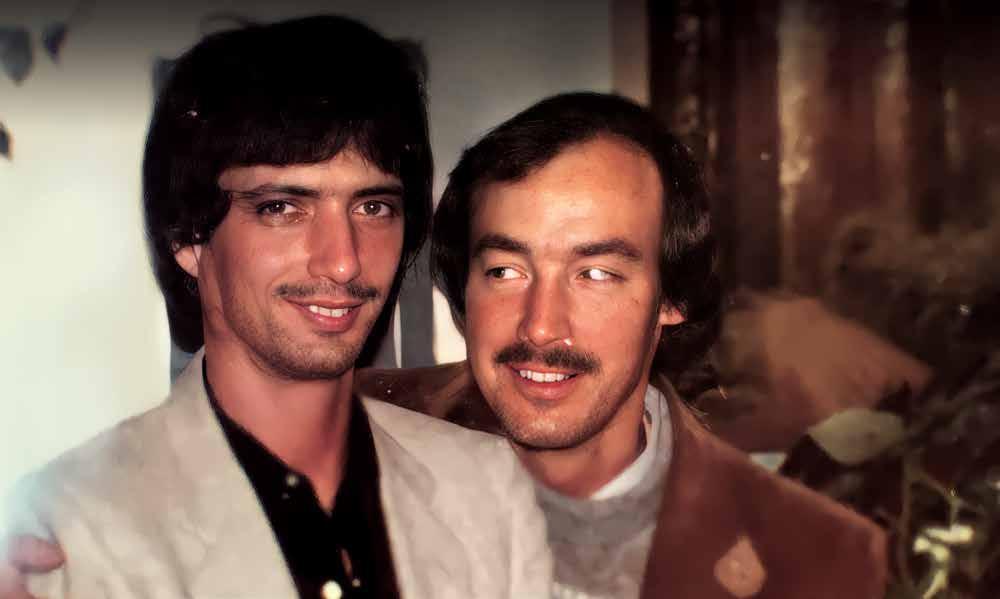
On New Year’s Day, the owners of Used Furniture on Summit Avenue East were dismayed to find their store vandalized for the fourth time. Last Friday, they were assaulted at their store, and neighbors reported a fire, which has not yet been confirmed as a related incident. What we do know is that at 1:43 p.m. Friday, Seattle Fire was dispatched to the 100 block of Summit Avenue East for an aid response. At 3:05 p.m., reports of two males fighting were logged by the SPD. Shortly after 3:30 p.m., I received a call from one of the owners, who are both named John and share a phone. In a rushed one-minute phone call, he reported the incident to update the SGN.
JOHN & JOHN page 5

by Paige McGlauflin SGN Contributing Writer
On Saturday, Jan. 22, Washington state will observe its first annual Local Quilt Shop Day.
Founded in 2011 by the Vancouver-based Fabric Shop Network, a trade association for independent quilt and fabric shops worldwide, Local Quilt Shop Day celebrates the history and tradition of quilting,
and the small businesses that not only provide supplies for this craft but also a place for quilters to gather as a community. How the day is observed varies from store to store, with some businesses offering special demos or sales, but all the Fabric Shop Network asks is that people show up for their favorite quilt shop, be it in person or online.
courtesy
Photo courtesy of Bigfoot Quilts
Photo courtesy of John Morrison










Local News

QUILT SHOP DAY
continued from cover
“Every shop is its own nexus of a community,” Deb Messina, a Local Quilt Shop Day coordinator with the Fabric Shop Network, told the SGN. “So they create projects, demos, sales, whatever that they think would appeal to quilters visiting their shop on Local Quilt Shop Day, things that they think people will have some fun with. It’s easy to participate: all you have to do is go to your local quilt shop, whether they’re a Fab Shop member or not.”
Currently, Local Quilt Shop Day is observed on the fourth Saturday of every year in at least 20 US states and Canadian provinces, including Washington and Oregon. Messina says the Fabric Shop Network is working with other state governments make the day official.
Quilting’s special
Quilting is an ancient tradition that has been used to document and pass down history from generation to generation. It is also a diverse practice that has played a prominent role in LGBTQ+ history and activism. For example, the NAMES Project AIDS Memorial Quilt is a quilting project memorializing those who died of AIDS. As of 2020 it is the largest piece of community folk art in the world. Currently, the AIDS Memorial Quilt has over 48,000 individual memorial panels and weighs an estimated 54 tons. The quilt is now housed in San Francisco, with some pieces housed in the American Folklife Center and the Library of Congress,

both located in Washington, DC. Panels of the quilt can be viewed at www.aidsmemorial.org/interactive-aids-quilt.
“Quilts have always been political,” Messina said. “They’ve always been utilitarian. But they’ve also been decorative. They’ve been celebratory.” For Messina, quilters like Ricky Tims (a Colorado musician) and Gee’s Bend (a group of African American women in Gee’s Bend, Ala.) also highlight the diversity that’s found in the quilting world.
Quilting is also an inclusive practice, for which required skills such as sewing and design can be taught to anyone and have been handed down from sewist to sewist for generations.
“I can say that as a shop owner, it’s true that statistically the largest share of people who frequent quilt shops or who are addicted to quilting look like me: they’re more in my age group, they’re female. But I can tell you that I had a significant portion of my customer base that was male, [or] that were immigrants to our area,” Messina said.
“As shop owners, our goal is to make everybody feel like they found their creative home.”
For those interested in visiting a participating store on the 22nd, Messina and the Fabric Shop Network recommend checking out these in Western Washington: Bigfoot Quilts – Auburn
Knotty Stitches – Castle Rock
The Quilting Fairy – Puyallup
Quilting Mayhem – Snohomish Quilted Treasures Studio – Vancouver
Photo courtesy of Bigfoot Quilts
Photo courtesy of American Made Brand
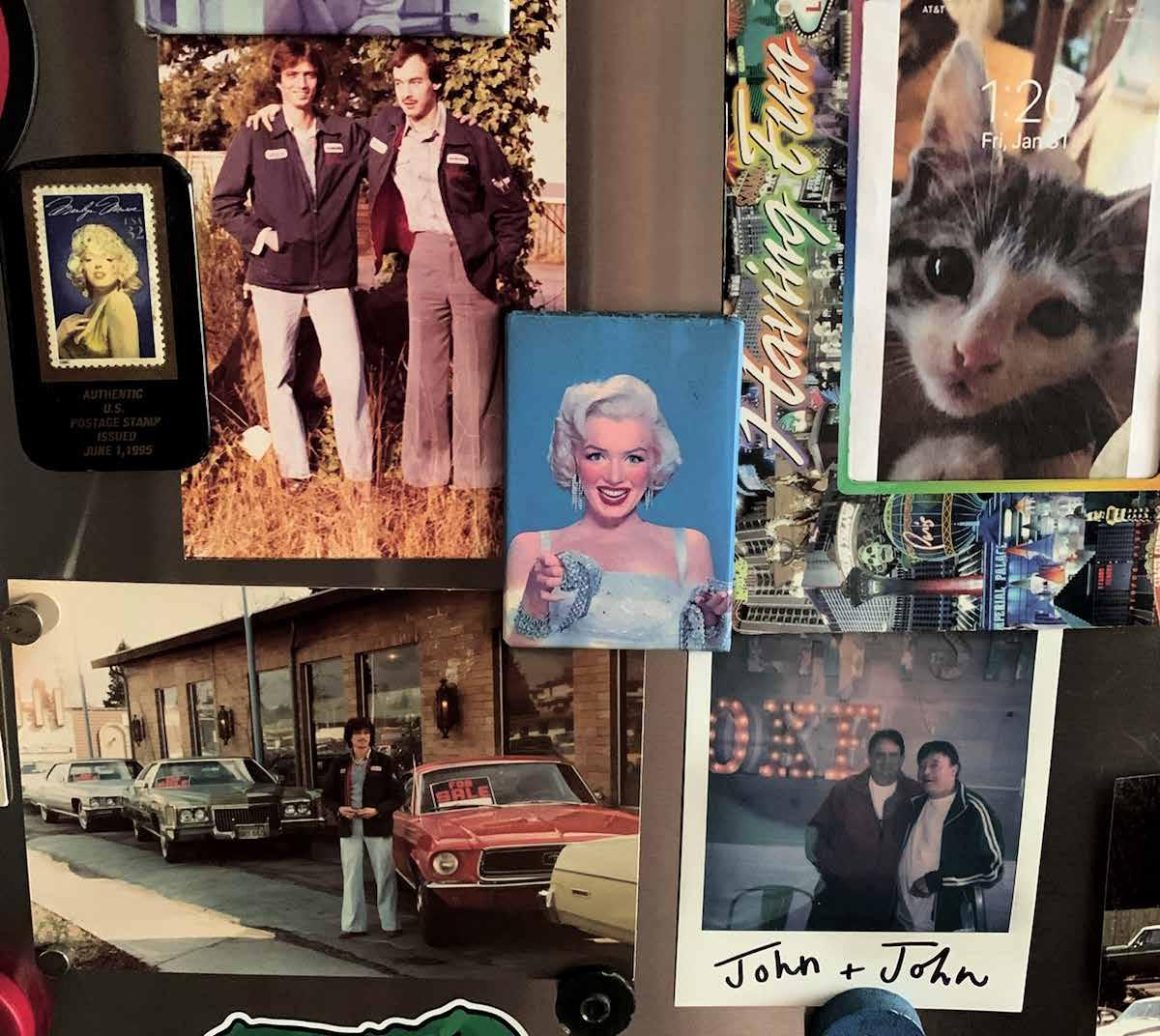
“Hi, this is John. I am with my husband and wanted to tell you that he just was attacked,” he said. He added that his husband had been pushed to the ground and that they were on their way to the hospital. Both men are in their seventies.
For months prior to New Year’s Eve, the couple believed the intermittent bursts of vandalism at their storefront to be random, a result of frequent crime amid the area’s ongoing homeless, opioid, and mental health crises.

Then, security camera footage from New Year’s Eve revealed a blurry figure yelling homophobic slurs at the business, just before the cameras were disabled and stolen. This is when the couple decided to take action with law enforcement.
During our last interview, the two men thought that the vandal or team of vandals, who have cost them thousands of dollars in damages, stolen security cameras, and now personal injury, may have targeted them because of their sexuality.
Since Friday, the couple has not been available for comment, and further details have yet to emerge about the same-day fire reports.
However, Morrison previously shared some of his and Evans’ love story. To meet the men and see the enduring love that is possibly fueling all of this hate, I’ll share a few highlights.
From the closet to the registry, together
John Evans first chased after John Morrison when they met at a barbecue in 1980. Morrison had just moved up from New Orleans and Evans lived in Aberdeen. Both men were closeted at the time, but Evans caught Morrison just before he drove away after the event, to exchange numbers.
Shortly after, the two met up. And Mt. St. Helens erupted. No, literally. They met for their second date that day, May 18, 1980. One week later, Morrison recalled, they moved in together in a small Seattle rental.
In February of 1981, they were married at Seattle’s “Holy Union MCC,” Morrison said. After first opening in Los Angeles in 1968, the Metropolitan Community Church began to emerge in cities nationwide for the ministry of LGBTQ+ people and per-
formed the first same-sex marriage ceremonies in the nation. Seattle’s MCC pastor, Reverend Wallace (“Wally”) Lanchester, married Morrison and Evans in his home.
Though their union was still illegal until 2012 (when Washington state enacted marriage equality), they consider this in-home ceremony to be the legitimate anniversary of their over-40-year union.
When Washington and California legalized same-sex marriage, the couple waited in lines in both Seattle and San Fransisco to get their certificates.
It was “like a grand tour,” Morrison said. San Francisco offered them new friends and large-scale celebrations. “When we got back to our hotel, the people we met there had the band play us a song, and we had champagne, chocolate-covered strawberries, and ‘Happy Honeymoon’ written across the bed.”
The couple proudly sent me pictures of all of their marriage certificates and cheeky photos from their wedding.
Shortly after getting married, they closed their business at the time, “Honest John’s Fine Used Cars,” and headed straight for the Rainbow State. They lived in Maui for about 30 years, during which they lost several close friends to AIDS.
Since being back in Seattle for the past ten years, they have been in business at Used Furniture. They feel that their escapades (and lots of hiding over the years) allowed them to live mostly free from discrimination and hate, until now.
More updates are expected to come on these events soon.
JOHN & JOHN continued from cover
Used Furniture storefront vandalism on New Year’s Eve — Photo courtesy of John Morrison
Photo courtesy of John Morrison
Intiman Theatre prepares for first production since the start of the pandemic Arts & Entertainment
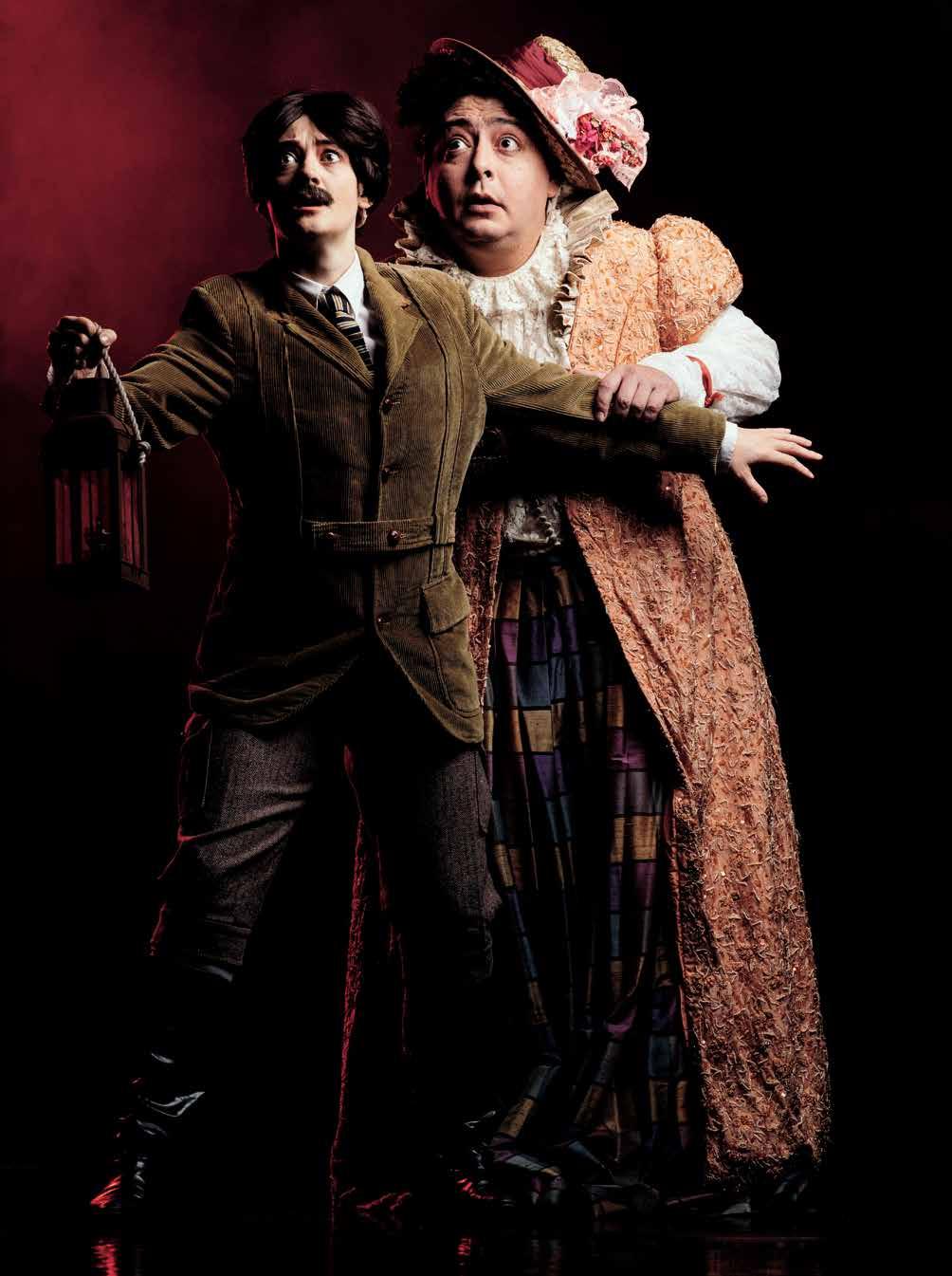
Helen Roundhouse and Jesse Calixto star in The Mystery of Irma Vep, A Penny Dreadful – Photo courtesy of Intiman
by Hannah Saunders SGN Contributing Writer
Intiman Theatre will soon host its first in-person production, The Mystery of Irma Vep, A Penny Dreadful, at its new location at Seattle Central College.
Intiman has not held any productions since the start of the COVID-19 pandemic, but it will reopen with Queer theatre icon Charles Ludlam’s most popular play.
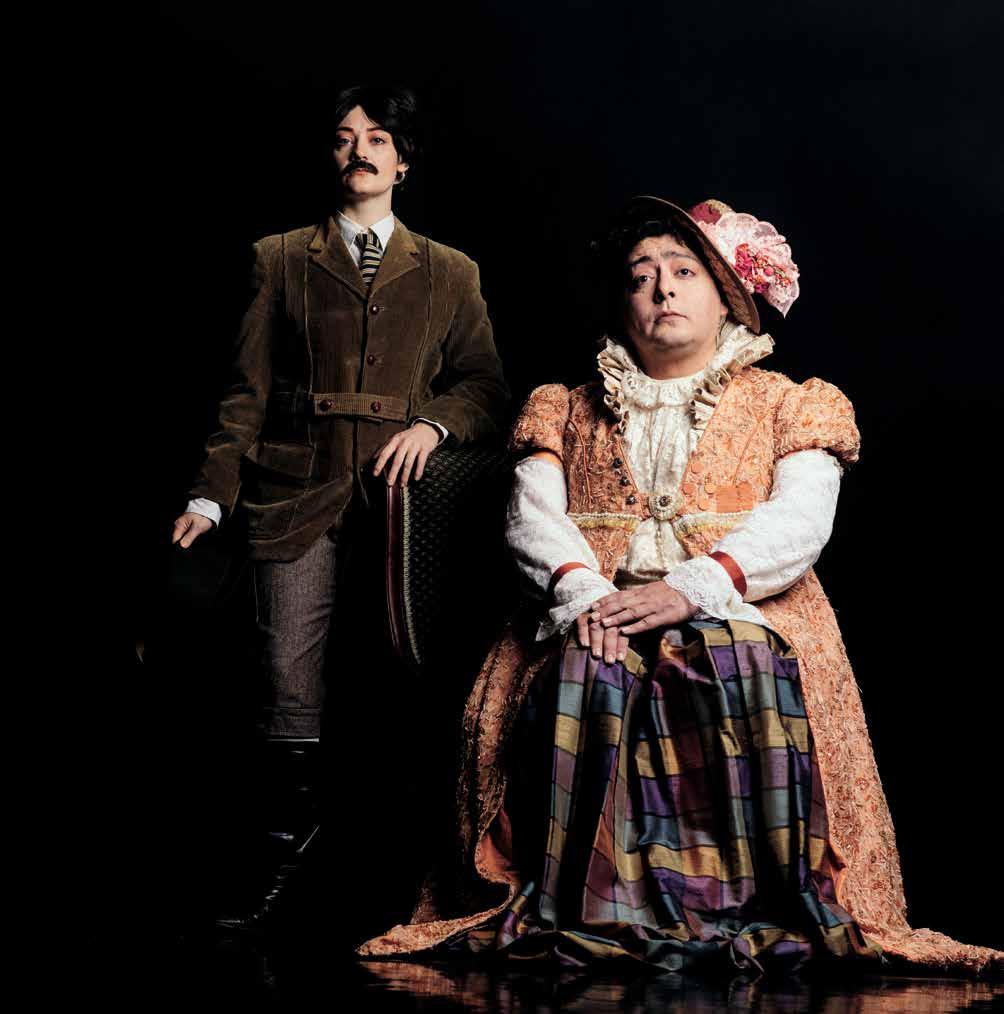
The plot focuses on an English estate which may (or may not) be haunted by a mistress who allegedly passed away. Mummies, werewolves, and mistaken identities will feature throughout the production. It will also incorporate dozens of wigs and 35 costume changes to create a robust group of characters, who will be played by Helen Roundhill and Jesse Calixto.
Production for the show began last summer. Joshua was approached with a script and was asked if they would have any interest in it, which they did.
“At my heart I love comedy, and I love broad comedy, and I love slapstick, and I love camp, and this show has it all,” said Joshua. “God, it has double entendres, it has quick changes, it has very basic penis jokes, it has gender play in it, which of course, I love.”
For casting last fall, open auditions were held. Joshua had worked with Calixto in the past and said that he blew them away during
the audition. In addition, “Helen [Roundhill] and I have been circling each other for a while, and… they have a multitude of drag and burlesque characters that they post videos about, and they’re a master chameleon of changes of different styles,” said Joshua. “Helen just seemed a perfect fit.”
Prior to rehearsing on stage, the actors spent a good amount of time reading the script and trying different things. Joshua’s goal was to create an environment where everyone felt safe to go too far.
“You have to feel that safety, that we as a room understand that experimentation is okay, and trust me and the stage management team,” said Joshua.
Joshua brought up how this was the first time where they, one of the actors, and the stage management team is nonbinary.
“It’s kind of nice. There’s really no explaining of anything,” said Joshua. “Especially for playing with gender and making fun of what society says a man is or what a woman is. It’s kind of the safest place to do that.”
Keeping it funny
Since the script was originally written in 1984, it contains jokes in Act II that “punch down” rather than “punch up.”
“It’s not a modern script, so with the lens of 2022 on it… there [are] a lot of jokes in there that [do] not pass muster with mod-
ern audiences,” said Jasmine Joshua, for whom this their first time directing a production for Intiman Theatre.
The production team questioned how they could continue to perform the show and highlight Ludlam’s work while not perpetuating harm.
“So, we spoke with the Charles Ludlam estate as well as the licensing house and said, ‘Hey, how can we update this?’” said Joshua.
The production team was granted permission to remove certain lines, but they could not add in any.
“We didn’t want to sanitize any of his work, because that is antithetical to what he was trying to do, but we also wanted to be mindful, because words and phrases that were used back then are not acceptable now, and certainly aren’t funny anymore,” said Joshua.
The crew will be in rehearsal for the next few weeks. The actors have been pumped up to perform on stage.
“I’m excited — assuming that everything goes well with all the COVID bullshit — for these two actors to have an audience, because there really is no feeling as an actor better than making an audience laugh,” said Joshua.
“It is fucking funny,” Joshua added, “and if you just want to come and laugh, my god, you could not ask for a better evening…
The medicine of laughter, here it is. Here’s your prescription.”
More information
The Mystery of Irma Vep, A Penny Dreadful will preview at the Erickson Theatre, located at 1524 Harvard Ave., on Feb. 8 and 9. Opening nights will take place on Feb. 10 and 11 at 7:30 p.m. The show runs through Feb. 26.
Ticket prices range from $5 to $65 per person, and Intiman will hold space for 20 free tickets on the day of the show, on a first-come, first-served basis. These tickets will be available at the box office 60 minutes prior to show time. Additionally, there will be an ASL interpreter.
Those wishing to attend are required to follow King County’s COVID-19 safety protocols. Audience members who are above the age of 12 will have to show proof of full vaccination against COVID-19 or show a negative PCR test result within the previous 72 hours. Furthermore, all guests must wear a mask during the entire performance, unless they are actively eating or drinking in the lobby.
To learn more and secure tickets for The Mystery of Irma Vep, A Penny Dreadful, visit www.intiman.org/irma-vep.
Helen Roundhouse and Jesse Calixto star in The Mystery of Irma Vep, A Penny Dreadful – Photo courtesy of Intiman
Goofy supernatural WWII horror yarn WarHunt fires blanks
by Sara Michelle Fetters SGN Staff Writer
WARHUNT Theaters / PVOD
After a US military cargo plane mysteriously crashes over airspace controlled by the Allies and subsequently crashes behind enemy lines deep within the German Black Forest, an elite combat unit led by the gruff Sgt. Brewer (Robert Knepper) is assigned the task of rescuing any survivors. Joining them is the quiet, calmly observational Walsh (Jackson Rathbone), an aid to the flamboyant Maj. Johnson (Mickey Rourke). He’s been ordered to accompany Brewer’s team whether the sergeant likes it or not. His mission is a top-secret recovery operation the less anyone knows the details of the better.
Playing out like a gothic WWII variation on Raiders of the Lost Ark, the actionhorror hybrid WarHunt has a couple of solid ideas and one moderately splendid performance from Twilight heartthrob Rathbone. Turns out, the unknown force that took down the aircraft containing Johnson’s precious cargo was nothing less than a trio of murderous witches, utilizing the blood of warriors to feed the fabled Tree of Life and bring themselves an eternity of youth and beauty.
As far as director and co-writer Mauro Borrelli’s scenario is concerned, there’s not a lot more to it than that. Brewer’s unit finds they’re battling not only Nazis but also their own sanity, as the witches play a variety of craven tricks against the men, picking them off one by one. Walsh, meanwhile, is looking for clues to the Tree’s hiding place, knowing that the Allies need to find and destroy it before Hitler can be informed of its location and produce an unkillable army that will swing the war back in Germany’s favor.
Got all of that? Suffice it to say, this is pretty silly stuff, and on more than one occasion did I giggle audibly even though I was watching the film all by myself. But the cast is solid, and for a good 50% of the story, I started to think that Borrelli and his team were going to pull off this goofy lunacy. There are some solid visual effects, the makeup work is suitably icky, and an opening encounter between Brewer’s unit and a small band of seemingly possessed Germans is handled with energetic flair.
After a certain point, however, the cracks
begin to show. For all of Borrelli’s technical ingenuity, it’s clear this is one case where a filmmaker’s ambition exceeded the production budget. The slipshod pacing, coupled with some unfortunate editing decisions, does a poor job of concealing the areas of the picture that come up lacking. Characters don’t get the chance to evolve. When some of them begin to psychologically crumble, there is no weight or meaning to their self-immolation. I was never emotionally attached to a single man, and I could have cared less if any of them succeeded in Walsh’s mission to stop the witches and keep Hitler from getting his hands on the Tree of Life’s powerful blossoms.
Which is a shame, because Knepper is perfectly cast as Brewer, and had the writing been sharper, I fully believe he’d have made this character a dynamic presence worth spending time with. There’s also some potentially interesting stuff happening to the makeup of the sergeant’s elite unit. Again, however, Borrelli never does anything unique or imaginative with the

opportunity these men’s casting afforded him; instead, he lets them all be rather basic WWII caricatures straight out of Battleground or Story of G.I. Joe
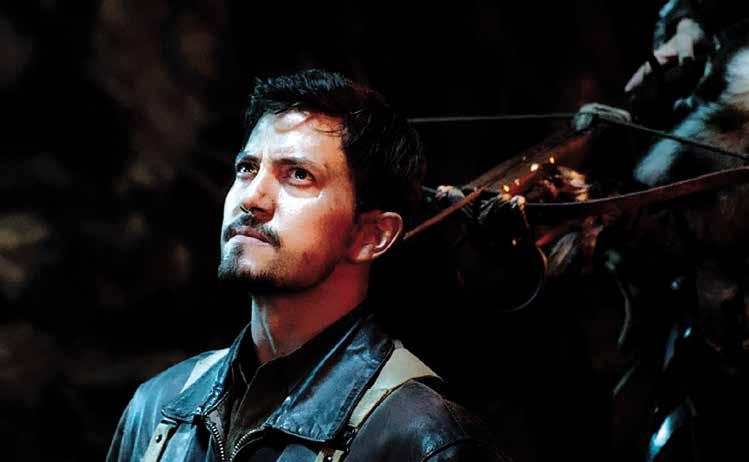
The exception is Rathbone. While Walsh is as thinly composed as anyone else in this tale, there’s something about his performance that won me over. There’s a devilishly clever charm lurking behind his eyes, and I like how this made the secretive soldier an ominous presence whose motivations aren’t as easy to determine as they initially appear. There’s a peculiar complexity to his heroics that’s beguiling, granting Rathbone’s daring-do during the climactic third of the picture a swashbuckling resonance I couldn’t help but become enamored with.
The witches? They’re evil, but not nearly as scary as I imagine they were supposed to be. When they do finally show their true colors, as already stated, the prosthetic work that transforms them into gnarly and grizzled creatures of death is rather splendid, but that doesn’t mean they’re terrifying. The trio come across more like big,
bad bosses from a second-rate fantasyadventure video game. Considering how well Borrelli sets them up during the first act, that they prove to be so unthreateningly forgettable can’t help but be somewhat disappointing.
Look. I’m all for more WWII-based horror. Julius Avery’s high-octane 2018 gem Overlord and Jaime Osorio Marquez’s insanely disquieting 2011 Colombian import The Squad are two recent examples I wholeheartedly urge viewers to seek out and watch right away. They’re both excellent. I cannot say the same about Borrelli’s WarHunt. There are some good ideas, and Rathbone is a dashing hero. But while some of the gore is effective, the plot gets more absurdly inconsequential as events progress. Couple that with a few noticeably sloppy technical aspects and a last act lacking in thrills or chills, and not even the cartoonishly flamboyant Rourke is enough to save the day. This film is firing blanks, and any magic it may have had vanishes at roughly the halfway mark, never to return.

Jackson Rathbone in WarHunt – Photo courtesy of Saban Films
Ticking-clock thriller Munich is a gripping tale of friendship and espionage

by Sara Michelle Fetters SGN Staff Writer
MUNICH: THE EDGE OF WAR Theaters / Netflix
It is September 1938. British Prime Minister Neville Chamberlain (Jeremy Irons) believes he has convinced German Chancellor Adolf Hitler (Ulrich Matthes) to forgo war in Europe and sit down to discuss his country’s desires for territory currently belonging to Czechoslovakia. There will be a conference in Munich, and Chamberlain is certain he and his team of diplomats can come to an agreement that will keep the peace.
Hugh Legat (George MacKay) is an aid to the prime minister whose star is on the rise. Still, he’s surprised to be brought into a secret meeting and told — even though he does not have the experience required to be a part of the delegation — that he is going to
join Chamberlain’s team in Munich. Why? Legat’s best friend from college, Paul von Hartman (Jannis Niewöhner), is also going to be at the conference, and even though the two parted on bad terms, according to British intelligence it is imperative they resume their relationship.
Based on the best-selling novel by Robert Harris, the pre-WWII what-if tale Munich: The Edge of War is a sturdy, meticulously crafted ticking-clock thriller I thoroughly enjoyed. While this drama by director Christian Schwochow (The German Lesson) doesn’t do anything unexpected, it’s so well made and so efficiently scripted by Ben Power (The Hollow Crown) that the fact it doesn’t rewrite the espionage rulebook isn’t a big deal. Throw in performances from Niewöhner and the great Sandra Hüller that are nothing less than extraordinary, and this becomes extremely easy to recommend.
It helps that Harris’ source material makes it feel like nonfiction, even though the majority of the plotting is the opposite of factual. But the relationship between Legat and von Hartman is genuine, as are the reasons fueling the angry dissolution of their friendship. Flashbacks to a trip by the former to visit the latter and the third leg of their college triumvirate, Lena (Liv Lisa Fries), on the eve of Hitler’s rise to power are refreshingly sparse. Schwochow refuses to grandstand. Instead, he allows the inherent horror of fascism’s vice-like grip upon the populace to speak for itself, and the rift between Legat and von Hartman is a natural development born from this hostility.
I’m not going to go into the whys behind von Hartman’s turn against Hitler, although it isn’t difficult to ascertain the catalyst that leads him to possibly pass secret information to the British. Even if the reasons for this turn of events are fairly obvious, Power’s

plotting of this material and Schwochow’s handling of the mechanics of the reveal are solid. Seeing Legat’s wide eyes as he views the truth for himself is a massive, somewhat disquieting punch to the gut, and I liked how the moment was handled with such brutally gripping sincerity.
Niewöhner is marvelous. He brings a crisp clarity to his performance that I couldn’t resist. The actor’s scenes with Hüller, who portrays a close co-worker of von Hartman’s who hands over information outlining Hitler’s intentions once he gets his way in Czechoslovakia, are mesmerizing. The two play off of one another with hushed eloquence, making even the moments between them when not a word is said out loud speak volumes.
Irons is terrific as Chamberlain. There’s a sly undercurrent of rapscallion wit to his turn as the British prime minister that’s intriguing. While the historical record about Chamberlain isn’t particularly kind, Irons still gives him an fascinating, understated complexity. There are hints that he knows far more about what’s about to happen and how his role in these events will be perceived that, while likely not altogether accurate, are still worthy of discussion.
The weak link, sadly, is MacKay, although I do not think this is entirely his fault. As structured, Legat is a mostly reactive character, forced by circumstance and design to spend the majority of the story continually being shocked, horrified, and/ or amazed at everything he is witnessing. Rarely does MacKay get to take charge of a situation, and so I found it difficult to engage with Legat as fully as I would have liked to. The actor does his best; in this case, I’m just not certain his best is enough. But that’s a minor issue. This is a handsome film, made with precision and care. Schwochow’s handling of the last act is superb, eliciting tension in waves as von Hartman and Legat race against time to reveal the truth to Chamberlain in hopes of stopping Hitler in his tracks before the unimaginable transpires. While history tells us what happens next, that doesn’t make Munich: The Edge of War any less absorbing. It’s worthy of a look.
Jeremy Irons and George MacKay in Munich: The Edge of War – Photo courtesy of Netflix
Jannis Niewöhner, Liv Lisa Fries, George MacKay in Munich: The Edge of War – Photo courtesy of Netflix




Episode 15:
Our guests this week are Zee Cohen-Sanchez and Amani Wells-Onyioha of political campaign company Sole Strategies! Hope you're ready to get goofy and get political because Ash and Lindsey are back for 2022 and ready to talk about capitalism, adulthood, Tupac, Seattle's mayoral updates, identities, civil war, the insurrection, Austin Powers and SO MUCH MORE!


Food & Nightlife
Ooh La La! is right!
New show’s Parisian glamor pairs perfectly with good eats

Photo by Vicente Trinidad Capala III
by Nick Rapp SGN Contributing Writer
Nestled in the middle of Post Alley, Can Can Culinary Cabaret may not be the first sight you see on a stroll near Pike Place Market. But don’t let its inconspicuous entrance fool you. Once inside the underground theatre, you’ll quickly forget the bustle of downtown amid a wash of red drapery, chandeliers, and candlelight.
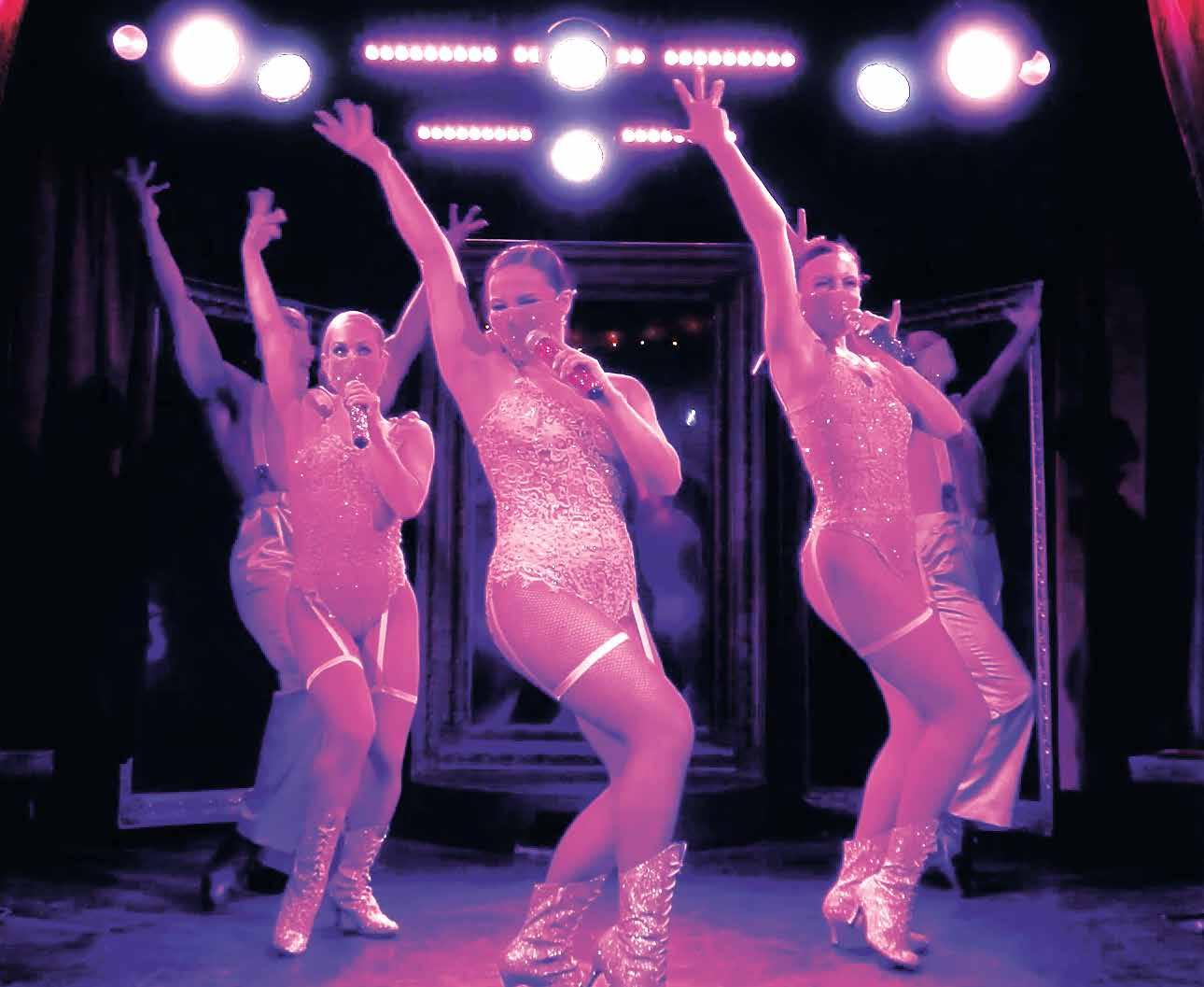
The performers at Can Can are kicking off the new year with their Paris-inspired show, Ooh La La!, a combination of burlesque, singing, dancing, and audienceintegrated fun.
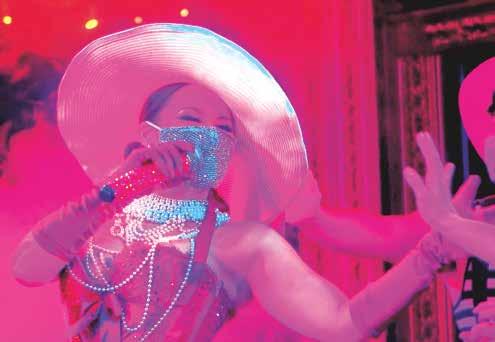
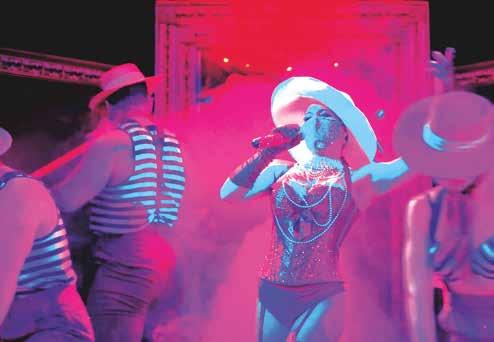
In a refreshing turn of events, the cast all don glamorous sequined masks; with Omicron ravaging Seattle, it is nice to see performers protected in the workplace. And the facial coverings do not stop them from singing loud and clear.
Every possible inch of the space is utilized in one way or another. The stage is V-shaped, with a rounded center stage that juts into the audience at catwalk width. The railings lining the stage are just thick enough to strut across in heels, long metal bars line the ceiling for acrobatic tricks, and servers and performers alike squeeze through the audience to incorporate every table into the show.
Ooh La La!, which clocks in at around 90 minutes, is split into three segments, interspersed with five-minute breaks to order food and drink. Can Can offers a full menu of Parisian-influenced Northwest starters, entrees, and desserts featuring ingredients from local farms and businesses, as well as drinks. The servers are very friendly and attentive.
Emcee Jonathan Betchtel kicks off the show with some rules and audience engagement. On the night I attended, he picked a lanky man from the crowd to be his “hype guy,” pulling him along the stage extensions for some endearingly awkward danc-
ing. If you raise your hand when asked, prepare to get involved!
The stunning cabaret performers alternated dance numbers in groups of “boys” and “girls,” often joining together for ensemble songs before the breaks. The girls wore shimmering costumes of less and less pink material, down to pasties. They had all the feathers and corsets expected of burlesque. The boys had their fair share of classic suspender looks and cheeky feminine accents.
Songs included “I Love Paris,” “Let’s Do It,” and a particularly beautiful cover of “La vie en rose.” Dance numbers were typically accompanied by electro-swing (think Baz Luhrmann’s The Great Gatsby). Performances escalated in complexity, leading up to finale numbers with Cirque du Soleil-esque bells and whistles. At one point, Betchtel spins, suspended from a bar, faster than you would think a human could.
The production was an artistic joy, reveling in the romanticism of Paris with a Gay flare. Host Betchtel’s racy commentary aimed to embarrass families that decided to brave a burlesque show together. Ooh La La! was equal parts sexual, sensual, and just plain fun. One audience member even got an ensemble lap dance of sorts to celebrate his birthday. It’s the perfect venue for a date night or small group.
So if you are on the hunt for over-thetop spectacle, lovely vocal performances, and dance moves of impressive physicality, look no further.
Ooh La La! can be seen Wednesdays through Sundays at 6:30 p.m.; Fridays and Saturdays have an additional 9:30 p.m. time slot. All shows are ages 21 and up. The show runs until May 1, 2022. Tickets range from $49 to $195; some secure just a seat, while others include meal options. Can Can is also hosting a special Valentine’s Day Week celebration February 11-14.
Photos by Vicente Trinidad Capala III
Books Explore Girl Haven with Lilah Sturges

by Lindsey Anderson
SGN Contributing Writer
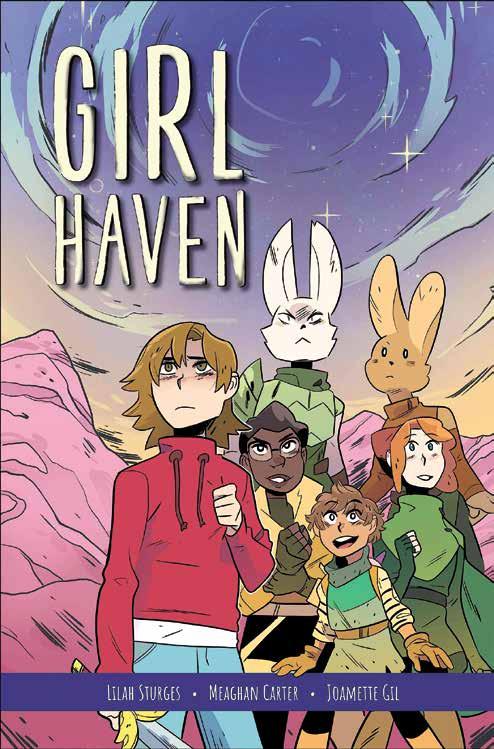
This week our book club picked up a copy of Girl Haven, a middle-grade fantasy graphic novel, and sat down to talk with author and creator, Lilah Sturges. An icon in the world of graphic novels, Lilah Sturges has worked on projects for DC comics, Marvel, and has become a regular contributor to the Lumberjanes series. Girl Haven is Sturges’ newest novel, and also her first originally created work.
“What that means is that I own the rights to it and it’s a graphic novel, a comic book basically. It’s a fancy word for comic book, but Girl Haven is the first one that was all mine, as Lilah, so it’s a big deal to me,” she said.
Girl Haven was a first for Sturges, who came out as Transgender after already building a successful career in the comic industry. Prior to her novel, she had helped create characters who explore identities and changes, but had been afraid to do so herself. After her transition in 2016, she
decided to start working on a newer, more personal project, which eventually turned into Girl Haven
“Girl Haven is a very special book to me because it’s one of the first things I’ve ever written that came from a place of total honesty and vulnerability,” she said. “I started working on it right after I transitioned in 2016, so a lot of feelings in there are very raw for me.” Sturges says she wanted to create a book that depicted the Trans experience in a way she felt other media just doesn’t seem to grasp.
“I think there’s a misconception that there is one overriding narrative in the media about Trans people, which is that we’re four years old, we’re praying to God to turn us into a girl, we’ve always known this all our lives, then one day we finally decide, okay I’m going to transition, then all at once you’re a new person, you get surgery then suddenly boom! You’re a woman. It’s not like that at all for everyone, some people don’t figure it out until much later, some people figure it out during puberty,
which is when Ash, our main character starts having questions, and one of the things that’s so important to me is understanding Transness for so many people is a process that takes a great deal of time and thought. It’s rare that Trans people wake up one day and go, “oh I’m Trans and I’m going to transition.’ It’s more a question of like, I’m having these feelings and I’m not sure what they mean and what is gender anyway, and am I like this, am I like that? What does it all mean?”
Including the process of questioning was important for Sturges. “A lot of the confusion and fear and frustration that the main character is experiencing are feelings I was processing at the time and that is something I have never really done before as a writer,” she says. Writing Ash’s character was a way for her to explore her own character.
Her understanding of gender was also shifting as Sturges worked on the book. “The initial script and the final printed form of the book have significant differences because I was learning how to under-
stand myself and I was learning how to understand gender as a whole, better,” she says. “There’s a passage at the end where one of the characters asks another character ‘what does it mean to be a girl?’ and I had to spend a long time thinking about what I think it means to be a girl, so that I could answer that question.”
All four of her main characters are based on different aspects of Sturges’ own personality and identity. “Eleanor is my desire to help and console and comfort. Chloe is my desire to be in charge and be protective. Junebug is my silliness, whereas Ash is just much closer to being my own self, my raw self, ego, whatever.”
After realizing she wanted to transition, Sturges knew she also wanted to create something that might help young people like her understand their feelings and experiences with gender. “Transitioning gave me the opportunity to really talk about myself in honest and vulnerable ways like I never could before, because I didn’t feel like I had to hide anything anymore,” she
Lilah Sturges – Photo courtesy of the author
says. “When I started thinking about what kind of book I wanted to write, the thing that struck me was I wished I would have had a book when I was in middle school that would have explained to me, given me some kind of model or path as to what I was feeling and what I was going through because I didn’t have any idea how to process those feelings and there was no support for me, even if I had understood them.”
Her work on Lumberjanes helped her understand the importance of language and feelings when it comes to communicating with middle grade readers. “It was important to me to use a lot of feeling language in [Girl Haven], that gives kids the ability to give names to their feelings. I learned that writing Lumberjanes, one of the things we talked about a lot was a process that was already put in place. When we tell a Lumberjanes story, we show readers that if they can learn how to say what they’re feeling then it helps us resolve our problems. So much of what we’re trying to do at that age is we’re feeling stuff and don’t know what it is but if we can attach language to it, that helps.”
She also wanted to make sure that the story was relatable to children on all parts of the gender identity spectrum. While, of course, Sturges wrote with her own experiences and perspectives in mind, she also brought in other Trans women to help make sure the story was universal.
“We hired a Trans sensitivity reader who did an amazing job and made the book so much better by reading through it all and giving her own perspective on the story and saying, ‘this thing here might be a little too specific, or a little too general, or maybe not everyone feels this way.’ I took all her suggestions so I should give her a writing credit,” she joked.
It takes many creative minds to produce a graphic novel, and each step in the process was overseen by Sturges. While she had no idea what she wanted the art style to look like, she did know she wanted to find someone who could convey the emotions of the characters through their work. “Girl Haven is drawn by Megan Carter who is a fantastic Canadian comic book illustrator,” she gushed. “I had no idea what I wanted [the book] to look like,
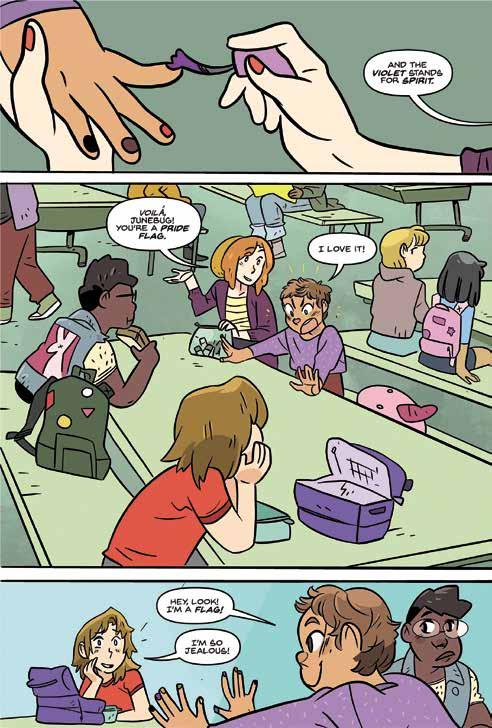
but I knew I didn’t want it to be too realistic because if things are too hyper realistic it can be a little too real, and that can be off-putting, and it can also be unrelatable.” Carter and Sturges eventually settled on a cartoonish style that allows the reader to fill in details from their experiences, making the books feel even more universal.
As the novel came together, Sturges reflected on her career, and the many steps it took for her to get to a place where she could publish such a raw and personal story. She admitted to me that she did not always plan on creating LGBTQ work. “When I first started writing comics, I was not even out to myself yet, let alone to the world, so I was doing, I think, very serviceable imitations of other creators at the beginning of my career. I knew I wanted to tell stories, but I didn’t know how to make those stories personal because I didn’t even know myself that well.”
The closest she came to telling her own story was in her 2008 book House of Mystery, a story that centered on a female protagonist. “If you read the book now in retrospect it’s clear there is a woman who is saying, ‘let me out!’ but I couldn’t really see that at the time,” she says.
When she finally finished the book in 2012, she realized she was Trans, but, even then, she found it difficult to talk about it.
“For several years I was too scared to admit it, talk about it, and certainly not to write about it.” When she finally got to a place where she was ready to talk about her identity and experiences, Sturges felt guilty. She says she could have contributed more, earlier on, to the cultural conversation that was starting to happen about LGBTQ rights.
“When I came out, I tried to make up for lost time by saying, let’s only do LGBTQ forever. My mission as a writer now is to create primarily books for LGBTQIA youth to help them feel accepted and loved and connected. That’s the primary goal, if I’m known for something, I’d like it to be that.”
Now, Sturges is working on her next novel, The Science of Ghosts, a thrilling mystery that centers a Trans woman, without making the story innately about out her transness. “The book that I have coming
out in February is called The Science of Ghosts and it’s an adult graphic novel – it’s not porn, it’s just like for adults – and it’s about a Trans women named Joy Ravenna who is a psychologist who specializes in forensic parapsychology, which means that she records the behavior of ghosts and then uses her training to analyze the behavior to understand what they’re trying to say and then she uses that to solve crimes.”
The story blends the paranormal with mystery, all while putting a Trans woman at the front of the scene. “One of the things I love about this story is it’s got a Trans woman protagonist who is in a healthy, happy relationship with another woman, and her Transness is not the focus of the story. It’s a ghost detective story, not a Trans story,” she says.
She also hopes to create a sci-fi novel down the line. “One of my other big loves is science fiction. I would love to create a big science fiction epic.”
She says her plans for this story, which are nowhere near finalized, are to center a pair of Trans Lesbian archeologists on a spaceship. “They are searching for the last remaining copy of the internet that is just on this old spaceship that crashed, and they want to find it because they have heard that Tumblr discourse contains some of the most entertaining stuff ever written,” she laughed. Aside from sci-fi and Tumblr discourse, Sturges also admitted her secret passion is Hallmark movies. “I absolutely love Hallmark Christmas movies. I can watch them all day long. They’re so formulaic,” she said. “They make no bones about it, they’re just like, this is how the world is, it’s straight and it’s white and people are wealthy and Black people are a fun friend, and it’s all put out there so there’s no guesswork about where people stand, and it’s just like, this is kind of racist, and kind of classist, and kind of sexist, and that’s what we’re doing here. If you can work past that, the formula of it is always the same and it feels really good because you always know how the story is going to end.”
Her favorite Hallmark actress is Lacey Chabert from Party of Five and Mean Girls fame. “There’s one where Lacey Chabert is
a baker and she enters into this big gingerbread competition that’s held in this small little town where she lives, and that’s her dream is to win this gingerbread contest, and I just love that that’s her dream, it’s not to do anything positive or make the world a better place, you know, she just wants to bake cookies and just be the best darn cookie baker there is. It’s not controversial, it’s just a sugar cookie, that’s what the movie is, it has no nutritional value but it’s delicious.”
Despite her love for “sugar cookie movies,” Sturges has a knack for creating feelgood media that also makes the world a better place. She hopes to someday transfer her talents from the page to the screen. “I’m sick of it always being straight people, for one thing,” she says of her guilty pleasure, Hallmark movies. “I’m sick of it always being white people, I’m sick of it always being cis people, as much as I like them, I’m very aware that these movies are pushing a very strong normative stance and I am not included in that stance. I don’t exist in the world of a Hallmark Christmas movie. I literally don’t exist. I could never be the heroine of one, and so that’s really despicable and I think there is so much space, and I keep threatening to write a Christmas romcom that is just super Queer, because someone needs to. It would have all the same sort of formulaic aesthetics but minus all the cis/het normativity. I think that would be a very magical thing to have,” she laughed. While the world waits for the Lilah Sturges Hallmark collaboration (starring Lacey Chabert, for sure) Girl Haven continues to reassure and inspire young kids (and plenty of Trans women in the 40s on Twitter, according to Sturges) that the world has enough space for all our feelings. Pick up a copy of Girl Haven from your local Seattle Book store and read along with us this week.
As always, our book club can be found on Instagram at @SGN_books.
Girl Haven can be found at Phoenix Comics and Games and The Elliot Bay Book Company.
Images courtesy of Oni Press
B.C. Peterschmidt on the “beautiful world between the binary” Books
by Daniel Lindsley SGN Contributing Writer
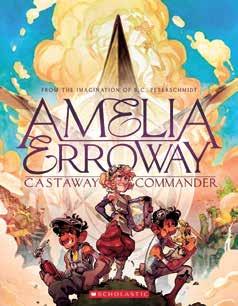
Even by the standards of the Artist’s Alley at last year’s Emerald City ComicCon, B.C. Peterschmidt’s booth was bustling. Copies of their debut graphic novel, Amelia Erroway: Castaway Commander, had sold out in the first 48 hours of the convention. Their commissions were full, and their prints were scarce.
Approaching the booth revealed why: Erroway is rendered in vivid watercolor, with a charming style and a depth of design and composition that might invite a reader to pause in their page-turning and daydream over the details of each panel.
According to Peterschmidt, their journey with Erroway began in the mid-’90s, when they visited the Smithsonian National Air and Space Museum in Washington, DC. “I can trace it back to that moment,” they said in a Zoom call; the planes and shuttles hanging from the ceiling got the gears of the project turning.
Growing up in a family of scientists was also a big factor in the creation of Erroway, Peterschmidt said, and in their growth as an artist. Family movie nights in their house featured the likes of Apollo 13, Contact, and the teachings of science educators Carl Sagan and Neil deGrasse Tyson.
Part of the magnetism of Erroway, then, might come from Peterschmidt’s attention to real engineering in designing the flying machines central to the graphic novel’s setting. “While I can’t say for sure that the Intrepyd Ray would be able to fly,” they wrote in their author’s note, “it’s fashioned on sound engineering principles, and I even built prototypes to make sure that what I conjured held some basis in reality.”
Unfortunately, part of reality also includes marketing. Peterschmidt said that it was tough keeping Erroway from being marketed toward just boys or just girls. “I wanted this story to appeal to everyone,” they said of the matter. And they had to “pull some teeth” to get the novel placed in the nongendered “children’s fantasy” category.

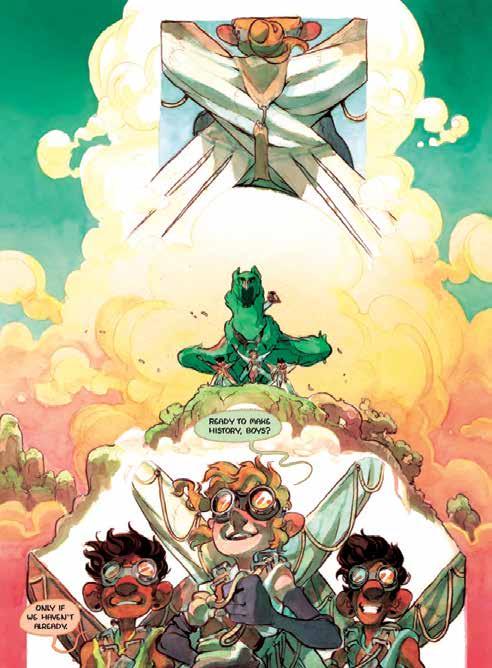
denote a dragon’s age. Dragons have deep roots in the fantasy genre, yet making their anatomy more “scientific” doesn’t take away from the wonder they often inspire.
The feathered dragons of Erroway’s setting exemplify this theme well. As the flying machines are based in engineering, Peterschmidt consulted a veterinary technician while designing the novel’s creatures, incorporating details like feather color to
A big theme of Erroway, after all, is the need to defy labels and expectations. “I wanted to kind of gracefully dance along this beautiful edge of the androgynousness between magic and science,” Peterschmidt said. “There’s this beautiful world that exists between the binary.”
Of their own view of storytelling, Peterschmidt compared it to “building a puzzle,” and this also comes through in the panels of Erroway. One readthrough isn’t enough to find all of its visual Easter eggs of meaning, which are made up of visual metaphors and background details, some placed among page-spanning schematics. As for future projects, Peterschmidt said they couldn’t mention specifics, but they insisted that the energy that had gone into Erroway for so much of their life was already finding other channels.
’Scuse me while I read this book: Song for Jimi isn't much of an experience for kids
by Terri Schlichenmeyer Special to the SGN
SONG FOR JIMI: THE STORY OF GUITAR LEGEND
JIMI HENDRIX
CHARLES R. SMITH JR., illustrated by EDEL RODRIGUEZ © 2021, Neal Porter Books, Holiday House
$22.99
56 pages
It was the fall of 1942, and Johnny Allen Hendrix had just made his debut. Johnny was his name at first, anyway, until his daddy changed it to James when the boy was three years old. By then, “Jimmy” was used to the way things were at home: his parents drank too much and fought even more. Jimmy kept to himself and rarely spoke. When his mother finally had enough of it, she left, and that was even worse.

“Jimmy lived the blues,” so he taught himself to strum an old broom like it was a real “git-tar.” Eventually, he found a “worn-out, beat-up” ukulele and though he
was “born lefty,” he learned to play it, lefthanded and right-handed. Finally, at age 16, Jimmy got his first real guitar, and it made him very happy! Still, it wasn’t enough: he wasn’t very good in school, and a teacher told him to “give up on his dream” and buckle down.
He didn’t listen; instead, he worked and practiced and worked harder, until local bands began to hire him and everybody knew his name.
They knew his sound, too. Jimmy’s guitar was loud, and it screamed with a sound like none other, a sound when he went into the army. He made his guitar speak “like a bird learning to tweet.”
And one day, after he’d changed his name again, Jimi Hendrix reached his dream: he was invited to play in a place called Monterey, where he “showed the world how to kiss the sky.”
Here’s a bit of advice: before you read aloud Song for Jimi, look it over first.
The story jangles with a kind of jerky beat that feels like a loose-limbed dude walking down a summer sidewalk. It’s a poem, but not quite; a song, but not entirely; a biography, but more. And it’s longer than your usual picture book, word-wise. These are all things that adults will enjoy because author Charles R. Smith Jr. tells a good story and artist Edel Rodriguez adds literal color to the tale.
But will kids like it?
Meh. The length is one issue; the relevance is another, since most picture-book audiences (in this case, 7-to-12-year-olds) are likely too young for Jimi Hendrix. In the end, any enjoyment may depend not on the tale itself, but how it’s read aloud. Give it a read once before you share it with your child. Done properly, Song for Jimi may make your child sing.
Image courtesy of Holiday House Publishing, Inc.
B.C. Peterschmidt – Photo courtesy of the author
Image courtesy of Graphix
A page from Erroway – Image courtesy of Graphix
National News
Strange bedfellows back right wing in Boston flag dispute

by Mike Andrew SGN Staff Writer
An odd coalition is backing a rightwing Christian in a case now before the US Supreme Court.
National news highlights
by Daniel Lindsley SGN Contributing Writer

Florida:
Gay rights activist found dead
Even some of the high court’s embattled liberal justices seemed to be ready to side with the Christian right.
The case involves Harold Shurtleff, a former John Birch Society organizer who runs the Camp Constitution website, and the City of Boston, which owns the flagpole Shurtleff
The Biden administration, the ACLU, the John Birch Society, and the Camp Constitution website all lined up against the City of Boston in a January 18 Supreme Court hearing.

wanted to use to fly the “Christian flag.”
While Christianity is a diverse religion and has no single, universally recognized flag, a white flag with a red cross in a blue canton is used by some Christian groups as a symbol of their faith.
The City of Boston owns three flagpoles outside Boston City Hall. One always displays the US flag, one the Massachusetts state flag, and the third usually displays the Boston city flag.
On occasion, however, the Boston city flag comes down and other flags take its place.
Shurtleff asked the city to fly the Christian flag, but city officials denied his request. He then sued, charging discrimination against his religious beliefs. His case has now come to the US Supreme Court for adjudication.
Shurtleff uses his Camp Constitution website to deny the January 6 insurrection at the US Capitol, allege that the 2020 presidential election was rigged, that COVID19 vaccines don’t work, and that the September 11 attack on the World Trade Center was carried out by US government agents.
Nevertheless, his lawsuit seems to have the backing of most — if not all — Supreme Court justices.
Conservative Justice Samuel Alito, for example, noted that Chinese and Cuban flags had flown outside City Hall. Why not Shurtleff’s Christian flag? he asked.
Douglas Hallward-Driemeier, representing Boston, said those flags were part of city policy that recognizes the heritage of Boston residents, not an endorsement of those regimes.
Justice Elena Kagan was among several justices who suggested the decision to refuse Shurtleff’s request was a simple mistake.
“Why is it that people have not been able to correct this mistake?” Kagan asked.
While it’s clear that the City of Boston owns the flagpole in question, it’s not clear what flying a flag on that pole means.
Boston says it can do whatever it wants with its own flagpole because flying flags there is an act of the city government. Shurtleff’s lawyers — along with the ACLU and the Biden administration — say that the pole is a free-speech zone that should be open to all flags.
Boston’s attorney, Hallward-Driemeier, conceded under questioning that if the flagpole is, indeed, a free-speech zone, then turning away some points of view and allowing others amounts to discrimination.
Boston has indicated it would change its policy if it loses the case to take more control of what flags can be flown.
NBC News reported on January 14 that Jorge Diaz-Johnston, a gay rights advocate with a key role in legalizing same-sex marriage in Florida, has been found dead at age 54. The Tallahassee Police Department says it is investigating Diaz-Johnston’s death as a homicide after his body was found in a landfill in Baker, Fla.
Diaz-Johnston entered the public eye in 2014, when he and his husband joined five other same-sex couples in a suit against the Miami-Dade county clerk’s office, after they were barred from getting married. In early 2015 a circuit court ruled in their favor, legalizing same-sex marriage in MiamiDade County. Diaz-Johnston and his husband were married soon after.
In light of the news, his brother, former Miami Mayor Manny Diaz wrote on Twitter: “I am profoundly appreciative of the outpouring of support shown to me, my brother-in-law Don, and my family after the loss of my brother, Jorge Diaz-Johnston. My brother was such a special gift to this world whose heart and legacy will continue to live on for generations to come.”
United States: VA adds gender identity to medical records
NBC News reported on January 14 that the Veterans Administration has added an option for veterans to include gender identity in their health records, “to help VA providers better understand and meet the health care needs of veterans,” the department said. The options now include “transgender male, transgender female, non-binary, other, and does not wish to disclose.”
Secretary of Veterans Affairs Denis McDonough made a statement about the decision: “All veterans, all people, have a basic right to be identified as they define themselves. This is essential for their general well-being and overall health.”
Trans veterans like Landon Marchant said they are “blown away” by the development, given how difficult it is to change VA medical records en masse. Others say its benefits include reducing accidental deadnaming and misgendering, which can discourage veterans from getting care. Wisconsin National Guard veteran Sheri Swowoski agrees, but said she worries that some branches of the VA may enact the change later than others.
Photo courtesy of Boston Pride
Don Johnston and Jorge Diaz after a court hearing on same-sex marriage in 2014 – Photo by J. Pat Carter / AP
Harold Shurtleff, a co-founder of Camp Constitution, and Pastor Earl Wallace of Liberty Christian Fellowship of New York
– Photo by Liberty Counsel
Nat’l & Int’l News
International news highlights
by Daniel Lindsley SGN Contributing Writer

–
Berlin:
Fanny Broderson / Reuters
New role for official LGBTQ+ advocate
Reuters reported on January 14 that Germany’s first LGBTQ+ commissioner, Sven Lehmann, says the country still has a long way to go to equality. The full title of Lehmann’s role is Commissioner for the Acceptance of Sexual and Gender Diversity, and it was created under the new Social Democrat-Green-Liberal coalition government’s plan for “cultural modernization.”
“Since marriage for all became law, since it has been possible for everyone to marry the partner they want, many have believed that now absolute equality has been achieved,” Lehmann said. “But it hasn’t.”
Reuters noted that Germany’s reputation as a sexually progressive country belies its relatively late arrival at marriage equality, and the discriminatory laws that remain. For example, in the case of two women having a child, only one of the women will count as a legal parent until the other spends a great deal of time and money going through an adoption process. The new government reportedly has plans to change such laws.
Warsaw: Parliament debates
“traditional” education
Reuters reported on January 12 that the Polish parliament is debating a bill put forth by the conservative nationalist Law and Justice (PiS) party, which would allow government-appointed school supervisors to block aspects of instruction that would be “a threat to the morality of children,” especially in the case of sexual education. The PiS says the bill is meant to protect children and defend traditional Christian values, while critics say it could easily block students from information on LGBT people and reproductive rights, as part of what they call a broader effort against liberal values in general.
“It will certainly have a freezing effect,” said Krzyszstof Baszczynski, deputy head of the Polish Teacher’s Union. “If you are running a school, taking decisions... and you know someone may not like them, then the autonomy of the school, of the principal, the parents’ and teachers’ autonomy become just fiction.”

CRUZ
continued from cover
to Cancún during the historic Texas winter storm. The senator apologized for the insensitivity and gross show of wealth by, in part, blaming his daughters for the vacation, stating, “With school canceled for the week, our girls asked to take a trip with friends. Wanting to be a good dad, I flew down with them last night and am flying back this afternoon.”
Now, one of his daughters is biting back, and shared with the public that she does not necessarily agree with her father’s sentiments. “A lot of people judge me based upon
him at first glance,” Caroline said, “but I really disagree with most of his views.” She went on to explain that she often feels stifled by the conservative patriarch, who has gone so far as to request his media team edit the top she wore for the family Christmas card to make it look more conservative.
“I literally have to have security following me everywhere, like if I want to go on a walk through the neighborhood or to a friend’s house, I have to have like two security guards behind me at all times,” she also said of her high-profile life.
However, one of the most notable parts of her brush with TikTok fame was her inclusion of pronouns, as well as the word “bi,”

in her profile bio. Sen. Cruz has been adamantly opposed to Transgender rights, going so far as to call inclusive bathrooms “PC nonsense that’s destroying America.” His daughter’s use of pronouns shows a solidarity with the Trans community and indicates that there’s hope for even the children of some of the most influential conservatives.
The tabloid Gaytimes.com noted the use of “bi” in Caroline’s bio as well, and mentioned comments made by fans of the video speculating around the teen’s sexuality. One commenter asked, “I see in ur bio ur bi — is that something he knows? (if ur comfortable talking ab it, I’m just curious)” [sic], to which she responded, “I haven’t told him yet, I’m kinda nervous to tbh but I don’t think he would be mad about it” [sic].
Conservatives are now weighing in on the video, as well as the comments of support from the LGBTQ community. “This is exploitation of a minor and disgusting ethical malpractice on the part of the media. Stop this. Leave her alone,” said Meghan McCain. Author J.D. Vance also weighed in, writing, “This is incredibly vile. Cruz daughter is 13 years old. Leave her and her family alone.”
TikTok users are also commenting on some of the controversy. Some, like @ Marcywantsmoreholidays, mentioned the hypocrisy of conservatives pushing blame on the LGBTQ community and saying Caroline is too young to come out as Bi, writing, “Straighties acting like Ted Cruz’s 13-year-old daughter being bi is absurd, like they didn’t 2-3 weeks ago ask their 7-year-old nephew/grandson if the girl from school he mentioned once is his girlfriend.” Others noted the difficulty that Caroline may face, as the daughter of an active opponent of LGBTQ progress. User @ SueRobins wrote, “Just remember, if you attack LGBTQ youth, you may find you are attacking your own kids. Our youth are listening!”
Another user, @Kilgoreclout, added, “Please also remember this child has spent her entire life hearing her father state publicly that he doesn’t think she should exist.”
Since the video went viral, Caroline’s TikTok account has gone private, and she has not made further public statements about herself, her father, or whether or not she is safe and accepted in her home. Her fans now hope her father — who once praised young Caroline on Twitter as precocious, writing, “The first sentence Caroline ever said was ‘I like butter’” — understands what bravery and intelligence it takes to tell the world she’s a member of the LGBTQ+ community.
Sven Lehmann, 42, Germany's first ever LGBTQ+ commissioner
Photo by
Caroline as a child, gives her dad bunny ears – Mike Stone / Reuters
Ted Cruz – Photo by Andrew Harnik / AP