DEMS REINTRODUCE
LGBTQ EQUALITY ACT

by Hannah Saunders SGN Contributing Writer
Today we remember radio personality Rush Limbaugh — not for his renowned achievements but for his platforms where misogynistic, racist, and anti-LGBTQ+ remarks flowed freely. On February 17, 2021, Limbaugh died at the age of 70 after a yearlong battle with lung cancer.
Limbaugh was born in Missouri on January 12, 1951, and had a passion for radio from a young age. He landed his first gig in high school at KGMO, a local station his father co-owned. Limbaugh would later be fired from radio stations in Pennsylvania and Missouri due to controversial comments.
by Mike Andrew SGN Staff Writer
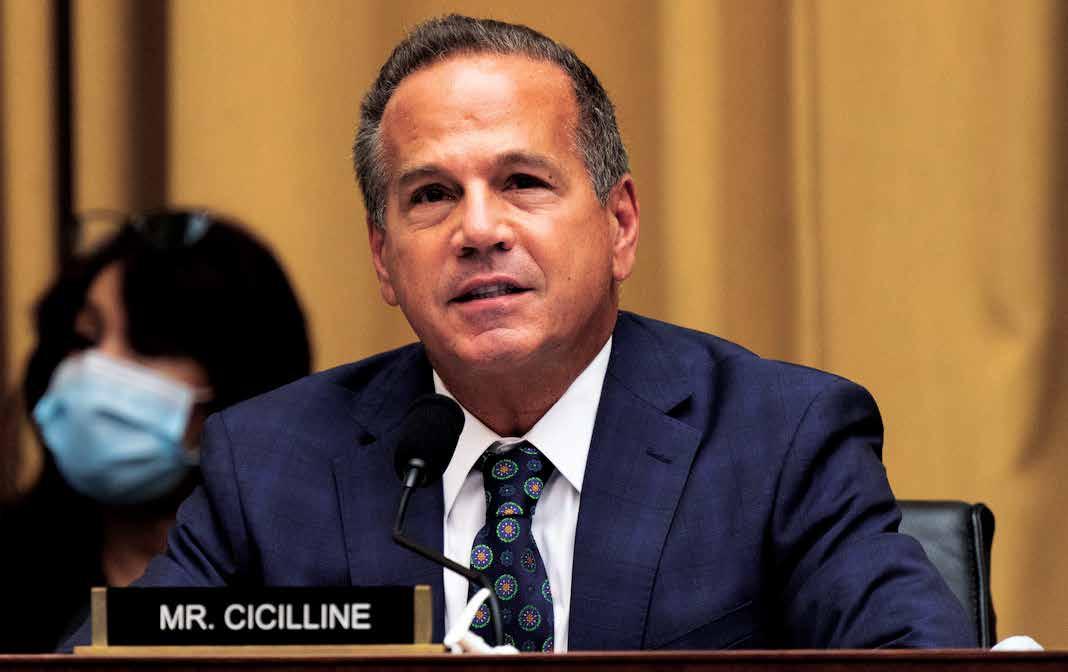
Congressional Democrats reintroduced the LGBTQ Equality Act on February 18. Openly Gay Rep. David Cicilline (D-RI) and Sen. Jeff Merkley (D-OR) were the primary sponsors in their respective chambers.
see LGBTQ EQUALITY ACT page 7
by Philip Van Slooten Washington Blade
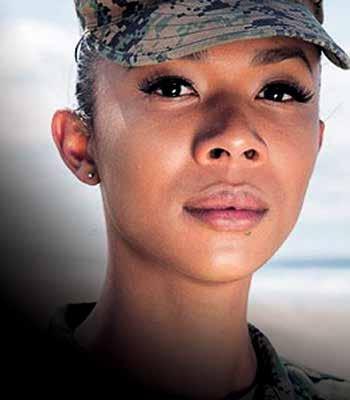
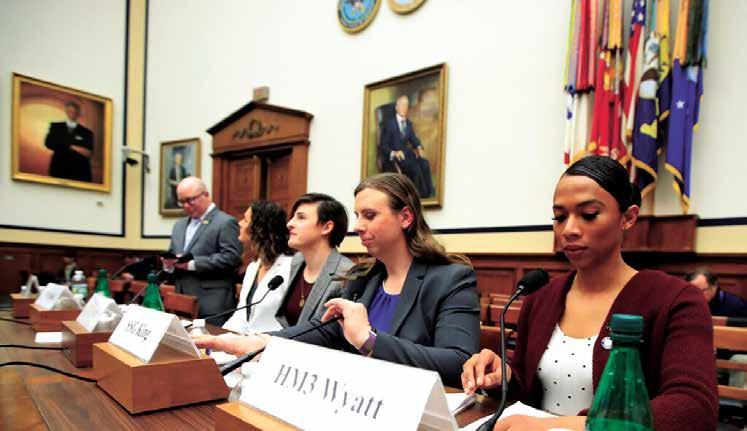
Transgender US Navy Corpsman Akira Wyatt rises at 6 a.m. at Camp Pendleton each day to see sailors and marines for sick calls, and today she does so a little easier. President Biden on Jan. 25 signed an executive order rescinding the Trump administration’s ban on trans individuals being able to
enlist or openly serve in the military. The ban was in response to former President Trump’s July 26, 2017, tweets prohibiting “transgender individuals to serve in any capacity in the US military.” But Wyatt and others who had transitioned prior to the ban going into effect in April 2019 continued to serve in silence while others
U.S. Navy Corpsman Akira Wyatt – Photo courtesy of Akira Wyatt Rush Limbaugh – Photo by Leah Millis / Reuters
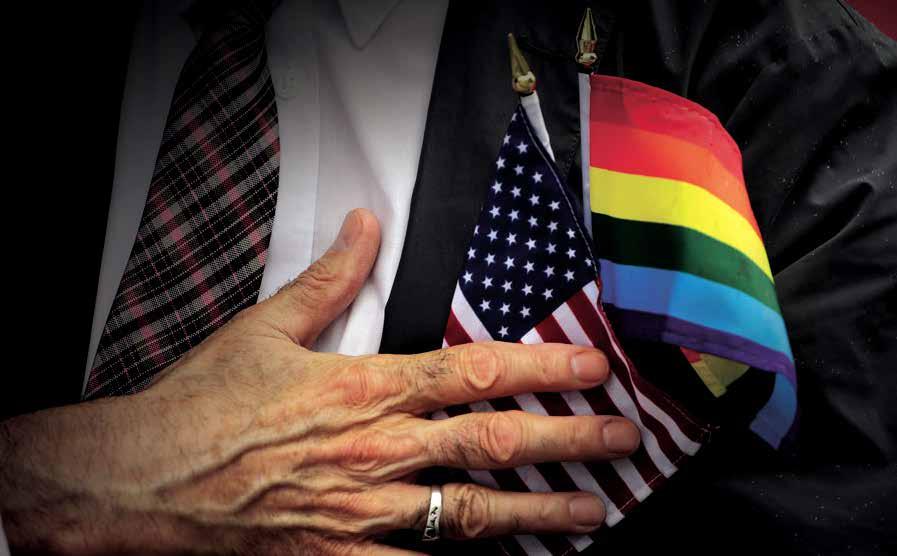
Photo by Matt Rourke / AP






Local News
Durkan Digest: prioritizing equitable vaccine distribution
by Mayor Jenny Durkan Special
to the SGN
2020 has brought several unpredictable challenges to Seattle. The impacts of the COVID-19 pandemic are still being felt in our city, region, and country.
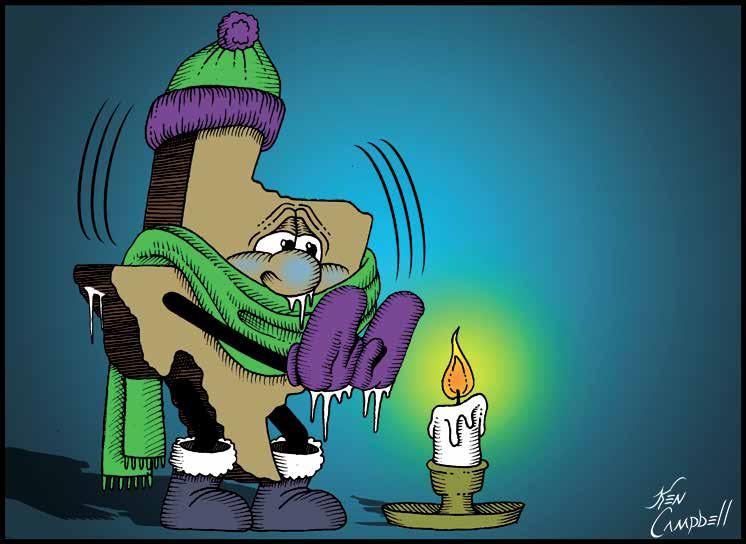
Seattle’s road to recovery starts with vaccinations, and while we have hundreds of employees working our vaccination efforts, we still have to deal with an unstable and unpredictable vaccine chain. This week, the City of Seattle and 90% of providers across the state faced delays in shipments because of winter weather across the country.
Fortunately, the Seattle Fire Department and our health care providers worked to limit the impacts to already scheduled appointments.
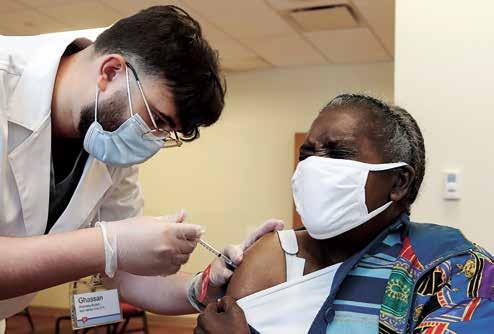
We are deeply committed to ensuring our BIPOC communities and immigrant and refugee communities have equitable access to the vaccine. The COVID-19 pandemic has taken a disproportionate and devastating toll on BIPOC and immigrant and refugee communities — we have to remedy that in our vaccine efforts. We’ve worked with Public Health - Seattle/King County to create strong principles for equitable distribution, including focusing on the highest risk and most impacted, partnering with community-based leaders, making registration easy, addressing transportation and mobility, ensuring language access, and providing vaccinations regardless of immigration status.
As we focus on equitable distribution, our Seattle Fire mobile teams are addressing disparities that we are seeing. Every day, we are evaluating the data to see inequities in distribution. It is clear that there is a gap in vaccinating Black and Latinx communities and communities in South Seattle and West Seattle. You can find vaccina-
tion data [at https://kingcounty.gov/depts/ health/covid-19/data/vaccination.aspx].
In King County, Latinx residents make up 24% of confirmed COVID-19 cases and nearly 18% of hospitalizations, yet they represent 10% of King County’s population. At 6.5% in King County, Latinx communities have a lower rate of vaccination than their share of the population.
Last week, West Seattle, South Seattle, Delridge, and Highline [had] the lowest vaccination rate of people 65 and older among all Seattle neighborhoods.
So this week, the City — with our limited doses — focused on vaccine efforts in South Seattle and West Seattle. We’re proud that to date, approximately 70% of the 5,000 residents that we’ve vaccinated identify as BIPOC.
While we’re prepared to scale our vaccine efforts to include mass sites and more
community pop-ups, doses continue to be extremely limited. We’ll continue our focus on serving eligible individuals in our most impacted areas and high-risk residents in adult family homes, senior affordable housing, and partnerships with strong community-based organizations such as El Comite, Villa Comunitaria, the Senior Center of West Seattle, the Eritrean Community in Seattle & Vicinity, the Filipino Community of Seattle, and the Central Area Senior Center (CASC).
The City’s efforts show that we can take an equity-focused approach to vaccine distribution — it just requires deliberate attention and effort.
For now, we all still need to follow public health guidance. This means masking up, physical distancing, and caring for our neighbors.
Photo by Kamil Krzaczynski / Reuters
A history of medical nightmares
by Janice Athill SGN Contributing Writer
It is 2021 and we are experiencing a health crisis. A pandemic has spread across our country and the world, affecting civilizations in a myriad ways. COVID-19 has spent over a year imposing new restrictions on the lives of millions.
Recently, vaccines have been created to defend against it. While this seems like a victory, studies show that they can only effectively produce “community immunity” if 70% of our country’s population agree to take the vaccines.
While 68% of whites are reported to be willing to receive vaccinations, 60% of blacks are said to want to refuse. Many may ask why the Black community is so against receiving these vaccines, but the answers are deeply rooted in American history.
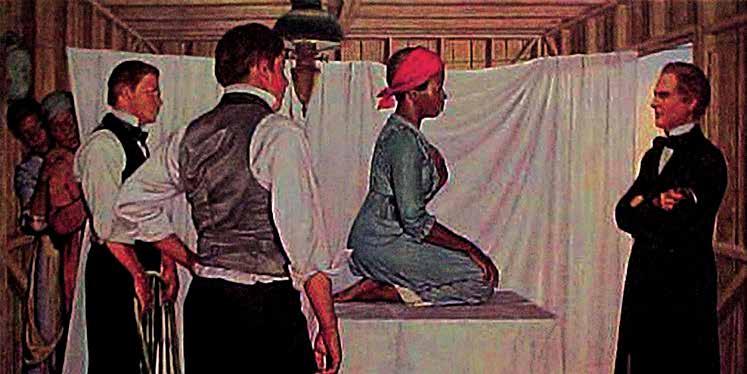
In 1875, surgeon James Marion Sims, MD, was elected president of the American Medical Association. Although this gynecologic surgeon is said to have cured many women of “insanity,” epilepsy, and “hysteria” by removing their ovaries or parts of their clitoris, his praises depend on the color of the women you ask — or the men who had them committed for surgery.
A Black woman named Betsey was just one of many slave women Dr. Sims intentionally addicted to morphine to enable the performance of these painful vaginal surgeries. Only after years of torturous experimentation did Sims venture into curing wealthy white women and win the acclaim he is famous for.
This, however, was far from the end of the brutal, inhumane medical injustices suffered by the Black community. In 1932, under the guise of free medical care, 600 Black men enrolled in a program run by the Tuskegee Institute and the Public Health Service. This unethical study was performed without informed consent. Researchers told the men they were being treated for “bad blood,” a local term that was used for a number of different ailments, including syphilis.
In actuality, none of the men received proper treatment for the disease more than half of them had contracted in an experiment officially named “the Tuskegee Study of Untreated Syphilis in the Negro Male,” even though penicillin could be used to cure the disease. It took 40 years for the experiment to be shut down for unethical practices, a tragedy that unnecessarily allowed these men to infect their Black wives and children with this curable yet life-threatening disease.
Then, in 1951 Henrietta Lacks, a young, Black mother of five, was diagnosed with cervical cancer by renowned gynecologist Dr. Howard Jones. The Johns Hopkins Hospital that she received her treatment at was one of very few that provided treatment to Blacks at the time, and they also allowed for a sample of her cells to be sent to Dr. George Gey’s nearby lab. It was Dr. Gey who realized that Henrietta’s cells were unlike any other the world had ever seen. Most cell samples died quickly at his lab, but Mrs. Lacks’ cells doubled every 20-24 hours.
These cells have since been used to study the effects of drugs, hormones, and viruses on cancer cells, as well as the effects of radiation and poisons on the human genome, without experimenting on humans. Mrs. Lacks’ immortal cells have played a crucial role in learning about cancer, viruses, and developing the vaccine for polio, all without the consent of her or her family after her death. To this day, none of the companies that profited from her cells have given any money back to her family. Unfortunately, the injustices in the medical system against the Black community
still do not end there. Death rates, generally speaking and in relation to a multitude of diseases, are disproportionate among Black people and can be attributed to inconsistencies in the care given to white patients versus that given to Blacks.
For instance, in 1980, Black women were considered to be at a lower risk for breast cancer than white women. It is documented that the risk of developing breast cancer was 10 in 100 for white women born that year while it was 7 in 100 for Black
women. Yet Black women still manage to have a higher mortality rate for this disease. Eighty-six percent of white women are still alive five years after being diagnosed with breast cancer, but only 71% of Black women survive that long, making them over twice as likely to die from it.
These numbers are reflected across many illnesses, including diabetes, heart disease, prostate and lung cancer, and HIV/AIDS. Blacks are at higher risk, not because of genetic susceptibility but because they are less likely to receive proper screenings, aggressive treatments, or necessary organ transplants.
Medical Apartheid: The Dark History of Medical Experimentation on Black Americans from Colonial Times to the Present by Harriet A. Washington brings awareness to the distorted quality of treatment for members of the Black community, as well as how the benefits of informed consent have been “only haphazardly met, if at all, when the subjects are African American.”
When you include the history of higher death rates for Black mothers and their infants compared to that of white counterparts, it is not hard to see where the distrust of the medical establishment comes from. American history has a trail of Black bodies attached to its medical advancements that will require acknowledgment and atonement before trust can be regained.
As a community, we all need to be able to trust that the care we are receiving is always in the best interests of each patient’s needs, and progress for the sake of progress does not excuse cruel and unusual practices.
Sources:
• Medical Apartheid : http://bit. ly/3pR3pkG
• www.cdc.gov/hiv/group/racialethnic/ africanamericans/index.html
• www.cdc.gov/tuskegee/timeline.htm
• www.google.com/amp/s/theconversation.com/amp/whats-not-being-said-aboutwhy-african-americans-need-to-take-thecovid-19-vaccine-152323
• www.hopkinsmedicine.org/henriettalacks/
• www.nature.com/articles/d41586-02002494-z
• www.ncbi.nlm.nih.gov/pmc/articles/ PMC4265931/
A painting of Dr. James Marion Sims, by American artist Robert Thom from the 1950s, is the only known representation of Lucy, Anarcha and Betsey, three enslaved women who Sims operated on, according to the American Historical Association. – Image courtesy of the American Historical Association
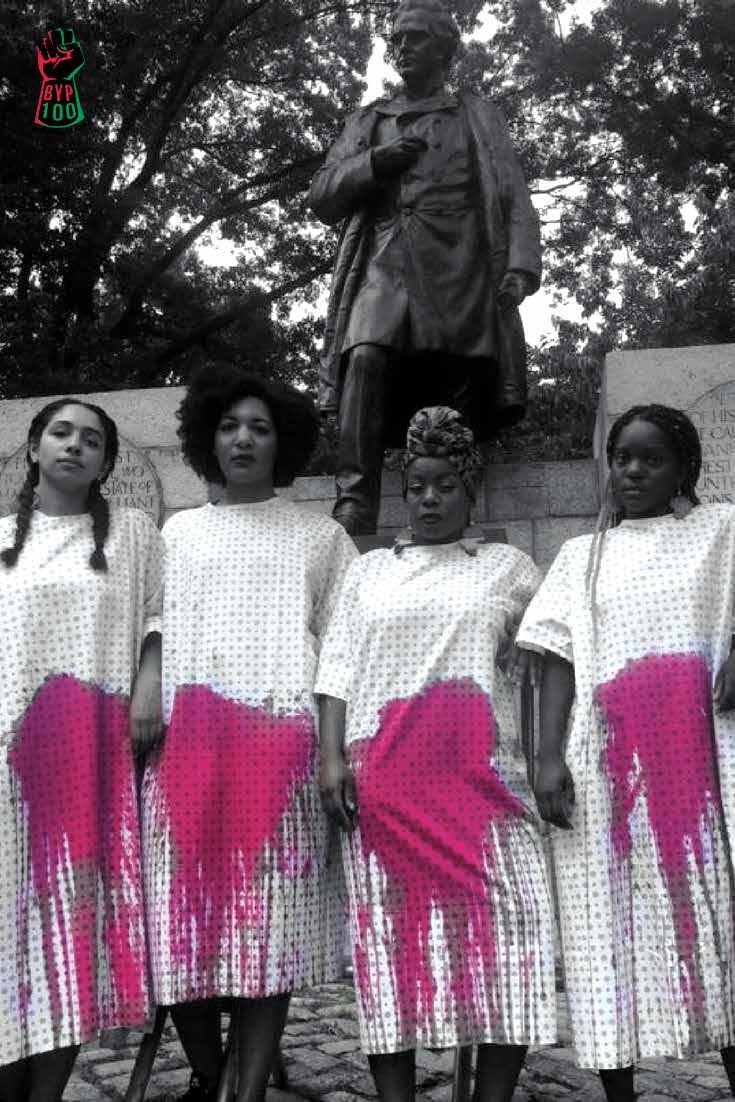
Protest organized by Black Youth Project 100 in front of a statue of Sims in Bryant Park on August 2017. The statue was moved to a cemetery in 2018. – Photo courtesy of BYP100
Local News
As nation marks sad 500,000-death milestone, a look at the COVID-19 numbers in Seattle and King County
by Justin Carder Capitol Hill Seattle
President Joe Biden has ordered flags to half staff this week as the nation marks 500,000 COVID-19 deaths — a milestone predicted by only the most pessimistic forecasts in the early weeks of the crisis. Meanwhile, Seattle and King County are approaching the one-year anniversary of what would quickly grow into a global pandemic: on February 28, 2020, the Washington State Department of Health made a Friday night announcement about the first “presumptive positive” case of COVID-19 in King County.
Here, the county reports 1,357 people have died including 16 across Capitol Hill and the Central District.
King County’s data and reports on deaths illustrate the painful truths of the pandemic: COVID-19 strikes at the weakest corners of society’s fabric.
Across Seattle and King County, more than 90% of those who have died here were age 60 or older. Nine out of ten had “underlying medical conditions such as heart disease, diabetes, chronic kidney disease, chronic lung disease, or immunosuppression.”
And illness and death has disproportionately struck communities of color. Most of those who have died of COVID-19 in King County have been white, but that is
Images courtesy of CHS
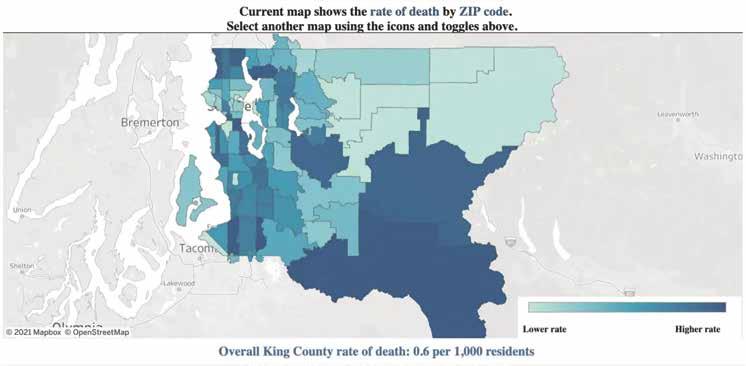
because white people are disproportionately represented in the county’s elderly population. When adjusting the rate of death for age, a stark divide emerges with communities, including Native Hawaiian/Pacific Islander and Hispanic/Latinx, hugely overrepresented in the sad totals.
In 2020, King County joined most of the rest of the world in becoming a deadlier place. Overall, the death rate here jumped 12%, according to this Public Health report.
But officials say factors like “isolation, economic recession, changes in access to care, and effects on mental and physical health” played a major role in addition to COVID-19 in driving the death rate higher
— and this, too, was felt disproportionately throughout communities: “The increase in deaths in King County residents in 2020 is not due solely to COVD-19, and the burden of increased deaths has not been borne equally across our communities. This unequal burden may reflect inequitable distribution of risk and protective factors, delayed medical care, economic hardship, or emotional distress. [Public Health - Seattle/King County] will continue to monitor the patterns in leading causes of death and outcomes potentially associated with COVID-19 mitigation measures and partner toward the improvement of outcomes and reduction of inequities.”
Closest to home, 16 people have died across the three ZIP codes covering most of Capitol Hill and the Central District. Northwestern Hill’s 98102 has seen only two deaths. Three people were reported to have died of COVID-19 in 98112. And eleven are dead so far in the southern area of 98122.
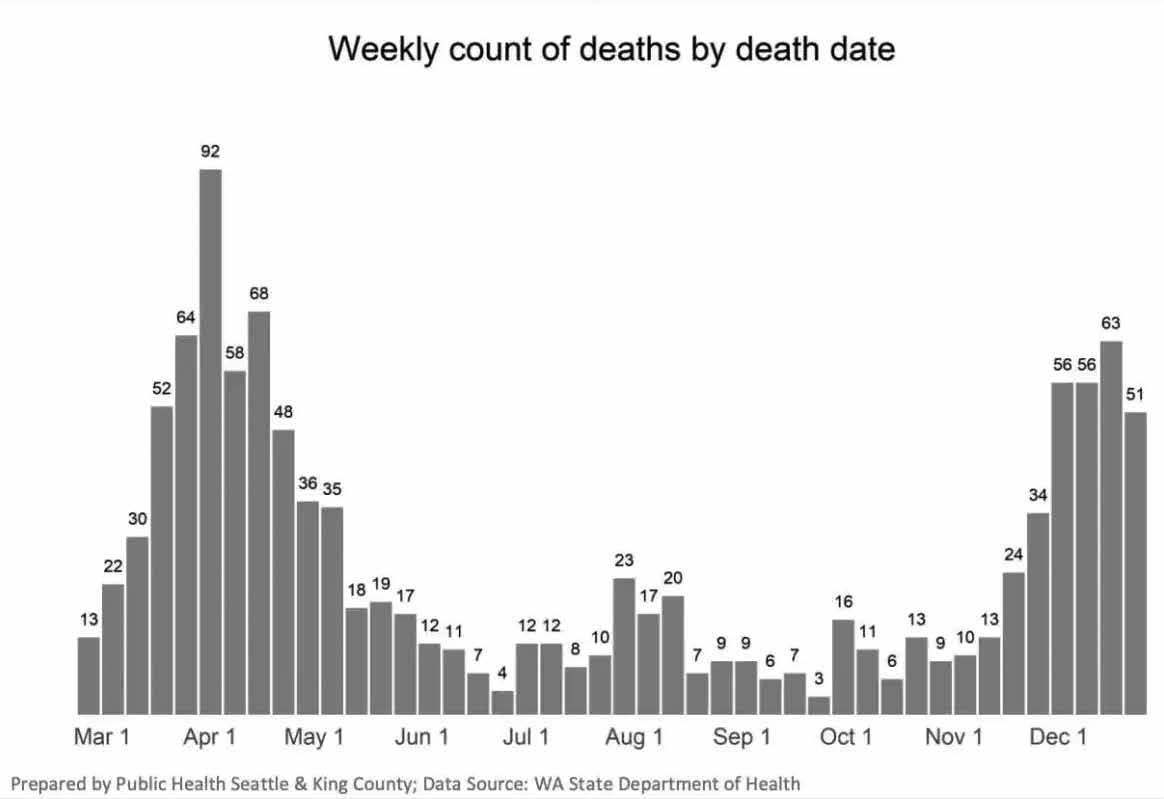
While the COVID-19 death toll continues to climb, there is hope we won’t again see the terrible totals of around 92 deaths per week that King County went through in early April, though we nearly hit the mark again from November into the New Year. Now, the pandemic has slowed to rates last seen in early fall, and officials say there
is progress reaching vulnerable communities in the first phase of the state’s vaccination plan. The massive challenge of the Washington’s “future phases” that will include a wider swath of the state’s population comes next.
The goal is for Seattle to reach a 70% vaccination level for its population that officials say will allow the area to successfully emerge from the crisis and, hopefully, put these sad milestones behind us while we, hopefully, work to address the inequities they laid bare.
Reprinted from the Capitol Hill Seattle blog
Local News
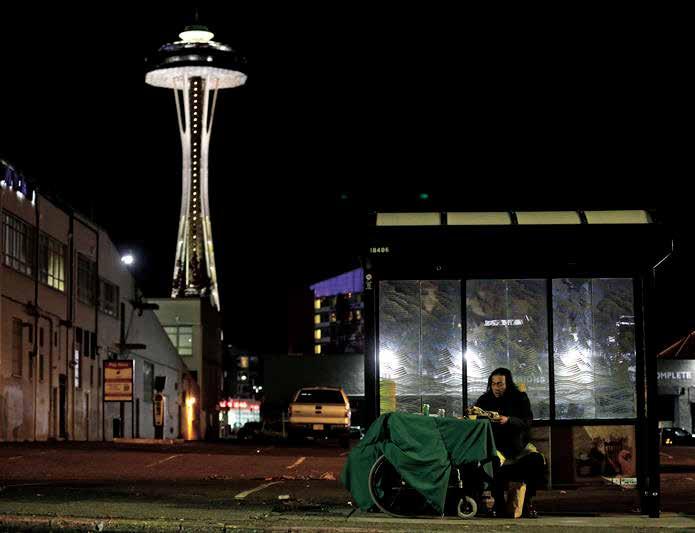
More than 350 new shelter beds coming online, including hotels, tiny house villages, and an enhanced shelter for women
SEATTLE (Feb. 23, 2021) — The City of Seattle [has] provided an update on details of more than 350 new spaces of enhanced shelter programs at hotels, tiny house villages, and a new women’s shelter, in addition to the new permanent housing resources for people experiencing homelessness and facing significant barriers to housing.
Since 2017, the City has invested significant resources toward 24/7 enhanced shelters and tiny home villages as the most effective programs to move individuals toward permanent housing. In 2021, these enhanced shelter resources will provide more capacity and safe shelter during COVID-19 and beyond. The hotel programs are temporary and, coupled with robust rapid rehousing and permanent supportive housing, will ensure that clients in the hotel shelters have direct access to housing.
“In 2020, the COVID-19 pandemic upended every aspect of our homelessness response. Yet in Seattle, we came together to craft a public health-driven response that limited outbreaks amongst our most vulnerable residents. During the pandemic, we took unprecedented steps — to deploy hygiene resources, stand up shelter, housing, and a new Regional Authority — and now we are taking additional actions to bring more people inside into safer places and transition more individuals to permanent housing,” said Mayor Jenny A. Durkan. “While I look forward to more federal resources to help cities address this humanitarian crisis, many of our partners are standing up resources at an immensely challenging time for organizations and staff.”
In late November, these efforts were approved by City Council. They build on the City’s yearlong work to deintensify shelters, create new enhanced shelter space, and stand up tiny house villages in response to the pandemic. The Mayor’s 2021 budget supported 2,300 existing spaces, of which 2,100 will be in enhanced shelters and tiny home villages. In 2017, the City had 964 basic shelter beds, 749 enhanced shelter spaces, and 255 spaces at sanctioned encampments.
New temporary hotel shelters
Two hotels — the Kings Inn in Belltown and the Executive Hotel Pacific downtown — will serve as temporary 24/7 enhanced shelters.
The Chief Seattle Club (CSC) will operate a 24/7 enhanced hotel shelter at the Kings Inn, providing 66 non-congregate hotel rooms with wraparound services on site. The CSC will provide case management and housing navigation services to help American Indian/Alaska Natives facing high barriers find housing. The CSC’s shelter operations will ramp up this month and will be ready for clients in March.
“The Chief Seattle Club is so grateful to the City of Seattle for our partnership on the new shelter hotel,” said Derrick Belgarde, deputy director of the CSC. “In King County, American Indians/Alaska Natives experience the most disproportionate rates of homelessness, with 28% of our community living outside, although we are less than 1% of the population. This hotel allows our homeless relatives living on the streets to move into safe and warm shelter during COVID-19, one of the most challenging time periods of our lifetime.”
The Executive Hotel Pacific, which has been previously utilized as a COVID19 recovery space for first responders, will also open as a 24/7 hotel-based enhanced
by Ted S. Warren / AP
shelter. The program is projected to utilize up to 155 non-congregate hotel rooms. It will include case management and housing navigation services designed to meet the needs of people facing barriers to housing, with an expected opening date in March, assuming the finalization of a contract with the Low Income Housing Institute (LIHI) as the shelter operator.
The hotels will be leased for up to 12 months, including a one-month set-up and ramp-down process. The City’s Department of Finance and Administrative Services (FAS) oversaw the procurement and licensing process, working with the Human Services Department (HSD) to identify key program needs. This includes hotel size and location, floor plans for rooms and common areas, cost, COVID-19 safety, speed of program activation, and facility maintenance. The hotel rooms will include microwaves for clients, and both programs will ramp up operations over time, reaching full program capacity in the spring.
The City continues to identify additional sheltering sites.
Rapid re-housing and permanent supportive housing
Both temporary hotel programs will be supported by robust rapid rehousing resources, which are projected to serve up to 230 households to exit individuals into permanent housing. In the second half of 2021, at least 600 new permanent supportive homes will open, supplementing the new rapid rehousing opportunities. In addition, the City will continue to work with the County on additional resources in Seattle with the County’s new 0.1% sales tax authority.
New tiny house villages
Three new tiny home villages were approved as part of the 2021 budget. A new tiny house village in the University District will be operated by LIHI and is expected to provide up to 40 tiny houses. The village is on Sound Transit property that the agency will later develop into transit-oriented development. The village will open as soon as April, pending finalizing a lease and service agreements.
“I share the concerns of my constituents that unsheltered homelessness in our streets, greenways, and parks has increased
during the COVID pandemic and we need action to help those in need and restore our public spaces for everyone,” said Alex Pedersen, Seattle Councilmember for District 4. “With social-distancing requiring alternate shelter solutions until vaccines are available to all, I believe that wellorganized tiny house villages can be a costeffective intervention when coupled with professional case management and performance-based contracts to ensure positive results. Rather than just talking about it, we did the legwork to find a suitable short-term location and funding for a tiny house village, and I’m pleased we are able to stand it up quickly thanks to Sound Transit, our City’s Human Services Department, and caring neighbors and small businesses.”
“Too many people are sleeping outside, leaving them especially vulnerable during the COVID 19 crisis,” said Sharon Lee, executive director of LIHI. “Tiny houses are heated and insulated, with locking doors, to keep people warm and safe. The village will shelter singles, couples, seniors, and people with pets who have few other options. We applaud Sound Transit and the City of Seattle for their bold steps to utilize public land and resources to provide for those experiencing homelessness. We want to thank the many advocates, donors, and volunteers who have been tirelessly working to build tiny houses.”
A second tiny house village location is planned for North Seattle. The program will host up to 40 tiny houses and will open this summer. Community engagement, program design, and provider service agreement will be completed prior to the village’s opening.
The City is continuing to seek additional locations for its third tiny home village that is fully funded in 2021.
New enhanced shelter
On February 12, a new shelter for women opened at the First Presbyterian Church, adding 60 new shelter beds. The City funds this shelter through Catholic Community Services, which subcontracts operations to Women’s Housing, Equality, and Enhancement League (WHEEL). The shelter began as an overnight shelter during February’s snowstorms but will become a 24/7 enhanced shelter for women experiencing homelessness in the coming weeks.
Case management and housing navigation services will be provided. The space includes showers, a dining area, nurse’s station, case manager’s office, and storage. Until recently, First Presbyterian Church hosted an enhanced shelter for a number of years until the program moved to a new site in Pioneer Square.
“WHEEL is thrilled and grateful to be able to expand our heart’s work by operating 60 additional loving, low-barrier shelter beds to the most vulnerable homeless women of Seattle,” said WHEEL leader Anitra Freeman. “We’ve operated a shelter in partnership with the City since 2000, and our mission has always been never to turn a woman away without a confirmed referral. That’s been beyond challenging during the pandemic, but with this great new resource we can do even more, even in these terrible times.”
Referrals
Referrals to these new shelter resources will be coordinated by the HSD’s Homelessness Outreach and Provider Ecosystem (HOPE) Team. The announcement of new shelter resources coincides with enhancements to the shelter referral process made in collaboration with the City’s contracted outreach and shelter service providers to improve the efficiency and accuracy of service connections. The HOPE Team will work closely with service providers to provide technical assistance to match persons currently living unsheltered to shelter and housing programs that best meet their needs. Last month, Mayor Durkan’s Innovation and Advisory Council announced a new project between Seattle IT, the HOPE Team, and Tableau to strengthen real-time data for outreach providers to make shelter referrals and build the path towards better service matching for individuals experiencing homelessness.
Funding
The HSD ran a competitive process to generate proposals to operate the new hotel shelter resources. Operators will be responsible for operating the shelter and programming within the hotels, with the goal of moving clients directly to housing before the end of the hoteling period. The majority of costs will be paid for by a one-time $26 million Emergency Solution Grant (ESG) from the US Department of Housing and Urban Development. The City continues to advocate the federal government for additional ESG award funds in the next COVID-19 relief package to meet the high level of need.
Next steps
The Department of Neighborhoods (DON) will work with the HSD and the Mayor’s Office to engage neighborhoods, businesses, and organizations near the hotels, villages, and new women’s shelter to offer program updates, answer questions, and establish ongoing communication. Residents and property managers are encouraged to contact CommunityUpdate@seattle.gov for more information. Shelter service providers will host community meetings leading up to program openings. The new tiny house villages will organize Community Advisory Committees (CACs), which allow members of the community, village residents, and shelter providers to meet and discuss the village on a regular basis.
Courtesy of the Office of the Mayor
Photo
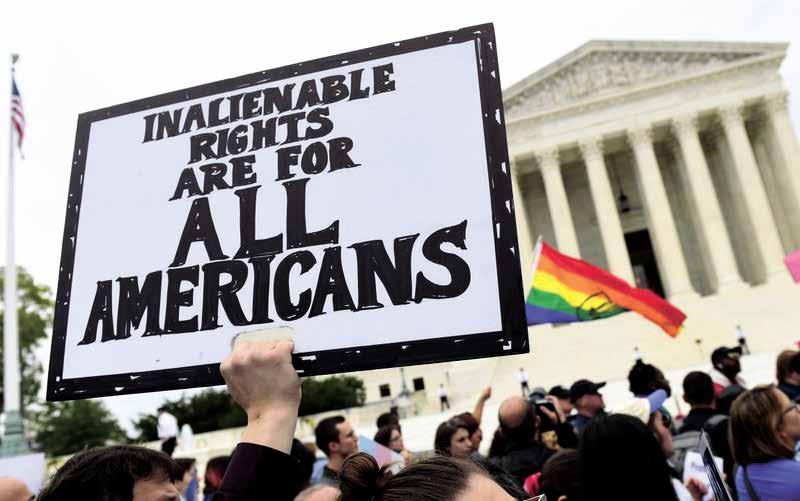
The bill would add sexual orientation and gender identity as protected classes under federal civil rights laws. The measure covers employment, housing, credit, education, and other areas, and explicitly extends sex discrimination protections to public accommodations and federally funded programs.
If the bill becomes law, LGBTQ individuals would be able to sue in federal courts to get relief from unlawful discrimination, and federal agencies like the FBI could launch civil rights investigations on behalf of LGBTQ plaintiffs.
Cicilline has introduced the bill in every
Congress since 2015. In 2019, the Equality Act passed the US House by a vote of 236 to 173, with all House Democrats and eight Republicans voting yes. It was not even scheduled for a hearing in what was then a Republican-controlled Senate.
Democrats retained their control of the House in the 2020 election, so it seems likely that the measure will once again pass there.
The Senate remains problematic, however. Even though Democrats now control that chamber as well, the vote stands at 50-50, with Vice President Kamala Harris being the tie-breaker.
Several Democrats from conservativeleaning states have declined to sponsor the bill in the past. Joe Manchin (D-WV) and John Tester (D-MT) remain in the Senate
and have not indicated whether they would vote for the bill if it came to the floor or not.
LGBTQ groups applaud LGBTQ rights groups applauded the bill’s reintroduction.
“Lambda Legal applauds the reintroduction of the Equality Act, long past-due federal legislation which provides clear, comprehensive, and explicit protections for LGBTQ people in federal law. Coupled with President Biden’s early action applying the US Supreme Court’s ruling in Bostock v. Clayton County to all federal laws currently prohibiting sex discrimination, we can see true equality on the horizon,” the group said in a statement.
“And it can’t happen soon enough: the
LGBTQ community has been asking Congress for protections since Reps. Bella Abzug and Ed Koch first introduced the Equality Act of 1974, 47 years ago, and nearly fifty years of waiting is long enough.”
PFLAG added that “we are calling on members of the House of Representatives and senators to pass the Equality Act.
“In 14 states right now, the rights of children to access healthcare or play school sports are in jeopardy because as transgender people, their right to protection from discrimination in health or education is not protected.
“In 21 states, a person who is LGBTQ+ can be denied service by a business, housing or food by a shelter, healthcare by a doctor, access to banking to buy a house or a car, and much more—simply for who they are.”
Christian-right groups are appalled
Predictably, Christian-right groups rushed to condemn the legislation.
“This proposed legislation punishes and marginalizes people who hold decent and honorable beliefs about marriage or dare to believe the scientific evidence regarding the physical differences between men and women,” the Alliance Defending Freedom said in a misleading press release.
“Many in our nation respectfully disagree on important matters such as marriage and human sexuality. Unfortunately, the Equality Act criminalizes these fundamental beliefs held by major faith groups since the dawn of time and, instead, demands absolute uniformity of thought.”
QAnon Rep. Marjorie Taylor Greene (R-GA) promptly declared war on the Equality Act, calling the effort to defend LGBT rights an attack on people of faith. The far right-wing lawmaker falsely said the bill would force Christians to approve abortions. She also asserted it uses LGBTQ rights as a smokescreen to prevent religious people from living according to their beliefs.
“It has everything to do with attacking God & believers,” Greene said. Greene called the bill “disgusting” and asserted it attacks women’s rights, without elaborating.
Photo by Susan Walsh / AP
U.S. Rep. David Cicilline (D-RI) – Photo by Michael Brochstein / AP
This Week in SGN History Navy lieutenant breaks silence to fight DADT
[Editor’s note: Over 47 years, the Seattle Gay News has covered thousands of stories that still resonate today. This week we look back at one from February 2010. We also offer updates on each story.]
by Shaun Knittel SGN Staff Writer
Everett Earl Morrow, a Gay former submariner who left the U.S. Navy in 2008 because of the military’s ‘Don’t Ask, Don’t Tell’ (DADT) policy, has had enough.
“The time has come to speak out against this immoral, outdated policy,” said Morrow, who recently participated in an off-camera interview for Out of Annapolis, a forthcoming documentary about LGBT alumni of the United States Naval Academy.
“DADT is a policy of discrimination which Gay and Lesbian servicemembers must suffer through if they want to serve their country,” Morrow told SGN during a phone interview from New York City.
“The premise of the policy is maintaining military readiness and unit cohesion, which couldn’t be further from reality. As someone who has served on a submarine in an all-male environment, my sexuality didn’t jeopardize our preparedness for battle or our overall solidarity. My crew was confident in my competence to get the job done. The only effect the policy did have, however, was that I couldn’t be open or honest enough to facilitate a true camaraderie with my shipmates.”
The Gay military ban DADT requires the Defense Department to separate from the armed services members who engage in or attempt to engage in homosexual acts; state they are homosexual or Bisexual; or marry or attempt to marry a person of the same biological sex. Nearly 14,000 otherwise qualified men and women have been discharged from the military under DADT, and many thousands more, like Morrow, have chosen to not re-enlist because of the policy. Enforcing and implementing the policy has cost U.S. taxpayers hundreds of millions of dollars.
It is estimated that 65,000 Gay and Lesbian people currently serve in the military.
Morrow says Army National Guard Lieutenant Dan Choi’s courageous coming out last year inspired him to break his silence. Choi, an Iraq war veteran and Arabic linguist who has been recommended for discharge under the military’s DADT policy, came out on the nationally televised MSNBC Rachael Maddow Show. Almost overnight, Choi’s bombshell confession thrust him into the mainstream media where he has used his position to become the poster boy for a DADT repeal, speaking at LGBT equality rallies around the country and recently returning to weekend drill exercises with his New York National Guard unit.
“As someone who has dutifully and willingly served my country, I can no longer stand quietly by as Gay and Lesbian servicemen and women continue to be at risk of losing their jobs because of their sexuality,” said Morrow.
Last month, President Obama pledged to end the discriminatory ban on Gays in the military during his State of the Union address. For Morrow, the president’s pledge has come too late; he left military service in 2008 for fear of losing his career to DADT. Still, Morrow told SGN that a repeal is indeed necessary - and inevitable, for that matter. The American public rightly believes that now - with the country engaged in two wars - is the time to repeal DADT and make military service contingent on skills and abilities, and not factors immaterial to the job at hand.
“How can a nation that prides itself on freedom and justice for all uphold such contradictory policies?” said Morrow. “Gays
and Lesbians can’t marry in most states, domestic partners are still denied many of the benefits that heterosexual couples enjoy, and we can’t serve openly in the military.”
“Tell me, exactly, what rights do we have?” he asks.
From Midshipman to Gay Navy Lieutenant
Morrow’s journey from a suburban Guilford, Connecticut high school jock to closeted Gay Naval officer is easy to trace, partly because it is the story of many a Gay boy who dreams of adventure on the high seas. With the promise of career, travel, and service to country beckoning him, Morrow says he filled out applications to all of the major service academies. The United States Naval Academy at Annapolis, Maryland answered.
Growing up in a relatively small town where everyone knows everyone, Morrow says, “I was not out at the time. I knew full well I was Gay. But at 17 years old, we don’t have a full appreciation for what we are getting ourselves into.” While it may be true that Uncle Sam is looking for “a few good men,” Morrow would soon learn that what Uncle Sam was really looking for were a few good straight men. “I remained in the closet through high school and the naval academy,” he said.
In 2003, Morrow was commissioned as a Navy officer and entered the submarine community where he spent the duration of his naval career. As a junior officer, Morrow spent a number of years aboard the Los Angeles class submarine USS Memphis (SSN-691), where he eventually qualified as a nuclear engineer in 2007. For all intents and purposes, he was the perfect sailor.
“My military career went great, as long as you put DADT aside,” he told SGN. “I excelled and did well overall. I was an above-average contributor to the team, and I received several awards. I really enjoyed my time in the service.”
Morrow says he doesn’t buy into the blanket argument that repealing DADT will make heterosexual servicemembers uncomfortable. In fact, he said that during his tour of duty he observed the open-mindedness of several of his fellow servicemembers with regards to homosexuality.
Currently, the U.S. service chiefs are in deep debate with Obama and Defense Secretary Robert Gates over whether or not a repeal would hurt the already stressed armed forces. Gates wants to move on a repeal slowly and has ordered a lengthy assessment on how to lift the ban without affecting troops and their families. Officials expect the study to be complete be the end of the year, but warn that it could be
several more years before the repeal is fully implemented.
Testimony by the service chiefs is considered crucial to the debate. As the top uniformed officials in each service, the chief is in charge of recruitment and preparing troops for deployments. If the policy on Gays is overturned, they would have to decided how to implement the changes. As it stands, a majority of the service chiefs are against lifting the ban.
“I do have serious concerns about the impact of a repeal of the law on a force that is fully engaged in two wars and has been at war for eight and a half years,” Army Chief of Staff General George Casey told Congress on February 24. “We just don’t know the impacts on readiness and military effectiveness.”
Servicemembers like Morrow and Choi, who’ve served under DADT, say that the fears of a mass exodus of straight troops in the event of a repeal are unfounded. In fact, they say that all you need do is look at foreign militaries who successfully lifted their anti-Gay service bans with little to no consequences.
A comprehensive new study on foreign militaries that have made transitions to allowing openly Gay service members concludes that a speedy implementation of the change is not disruptive. The finding is in direct opposition to the stated views of Pentagon leaders, who say repealing a ban on openly Gay men and women in the U.S. armed forces should take a year or more.
The study, “Gays in Foreign Militaries 2010: A Global Primer,” was released on February 24 by the Palm Center, a research group at the University of California, Santa Barbara.
The 151-page study, which updates existing studies on Gay service members in Britain, Canada, Australia, South Africa and other countries, offers the first broad look at the issue in foreign militaries since Gates and the chairman of the Joint Chiefs of Staff, Admiral Mike Mullen, called for an end to DADT earlier this month.
The report concludes that in foreign militaries, openly Gay servicemembers did not undermine morale, cause large resignations, or mass “coming out.” The report found that “there were no instance of increased harassment” as a result of lifting bans in any of the countries studied.
In addition, the report says that none of the countries studied installed separate facilities for Gay troops, and benefits for Gay partners were generally in accordance with a country’s existing benefits for Gay and Lesbian couples.
On implementation, the study said that most countries adopted the new policy
swiftly, within a matter of months, and with what it termed “little disruption” accepted Gays and Lesbians into their armed forces.
Morrow told SGN that DADT is a policy that may not affect heterosexual servicemembers, but undoubtedly has a large influence on Gays and Lesbians serving, primarily because of the lies and stress that go along with being in the closet. Even with a successful career and the seemingly perfect heterosexual life, Morrow could not take the deception any longer. While still on active duty, he met his current partner, came out to family and friends, and left military service, breaking free of the policy’s confines and becoming an outspoken advocate for repeal.
Coming Out of the Closet and the Uniform
“Three years ago, I came out. It was more stressful on me, I think. I just didn’t know what to expect. I wanted my friends and family to know the real me, the full me - not just a part of me,” Morrow said. “I haven’t had any negative response from my family, friends, or former military coworkers.”
Morrow says the decision to come out and leave military service was in direct relation with DADT. “My partner Michael and I had been dating for months and nobody knew about my relationship. It just became too stressful keeping my story straight about where I went that weekend and who I was seeing. It all begins to take its toll,” he said.
Morrow said he met his partner, Michael Knipp, in Baltimore, Maryland when he was on leave from military service. He was able to go to Gay bars and be around the community without having to keep looking over his shoulder, like he had to do at his duty station. Morrow and Knipp hit it off and began a long-distance relationship. Eventually, dating grew into love, and the two became inseparable. Still, Morrow says the stress of “being found out” was always present.
“When Michael would come visit me in Groton, Connecticut, we couldn’t hold hands, embrace or show any type of public display of affection,” he recalled. “Michael was great. He understood and recognized that I had to fulfill my military obligation and didn’t want to see me kicked out under DADT. So, we just did what we could to make it work.”
When it came time for Morrow to decide whether he wanted to stay in the Navy or get out, he says his newfound love was more important to him than living a lie.
see SGN HISTORY page 11
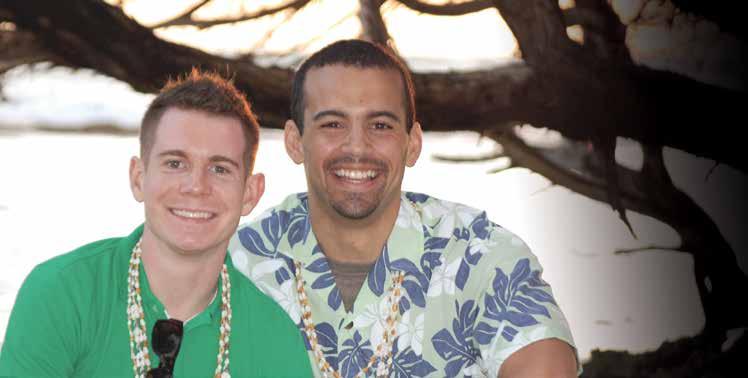
Michael Knipp (l) and Everett Earl Morrow – Photo courtesy of Michael Knipp
National News
like them were prevented from enlisting or receiving transitional care. And some, like Wyatt, also served in critical medical roles during the global coronavirus crisis.
When she heard the ban had been lifted, the 29-year-old Black Filipina woman said she felt “like when Mario hits the mushroom and goes up a level.”
“President Biden’s restoration of open service recognizes transgender service members as an integral part of our military and closes a dark chapter of history,” said Emma Shinn, a Marine Corps captain and president of SPART*A, an organization supporting trans service members, in a joint statement with the Modern Military Association of America. “I am elated that the approximately 15,000 transgender service members proudly serving across the globe can rest easier, knowing that their service to our nation is seen [and] valued and that they can continue to serve as their authentic selves.”
Wyatt told the Washington Blade she was also happy to see the US elect a Black woman of South Asian descent born to immigrants like herself. On that day, even before the ban had been lifted, she sat back with her cup of coffee and “felt like a boss.”
“I had my Keurig and I sipped it,” Wyatt laughed happily while recalling the moment she learned Kamala Harris had become the next vice president. “I shall embody her, I shall be her, and this morning shall be boss!”
Wyatt and Army Staff Sgts. Allyn Cropper and Keishaun Lowery are all activeduty service members who also identify as trans people of color. They each recalled feeling anxiety not only during the four years of the ban but also during last summer’s racial unrest and the US Capitol insurrection on Jan. 6 in which former service members and white supremacists were reported to have taken part.
But the election of the first Black vice president of Asian descent and the Senate confirmation of retired Army Gen. Lloyd Austin, III, as the first Black secretary of defense, made them feel hopeful again for the future.
Austin on Feb. 5 signed the Department of Defense Instruction 1325.06, “Handling Dissident and Protest Activities Among Members of the Armed Forces,” directing commanding officers and supervisors to discuss extremism in the ranks during a one-day “stand-down,” according to a Pentagon press release.
Wyatt’s unit responded on Feb. 11 by holding an open forum on race where she and her co-workers shared with peers what life was like for them. Wyatt said many women service members and service members of color were happy to have a new defense secretary and vice president who represents them, but she said others seemed to need justification for why diverse leaders “deserved to be there” in high positions. Wyatt said it seemed as if their leadership positions were unearned.
Still, she was glad for the opportunity and the discussion brought on by more inclusive senior leadership.
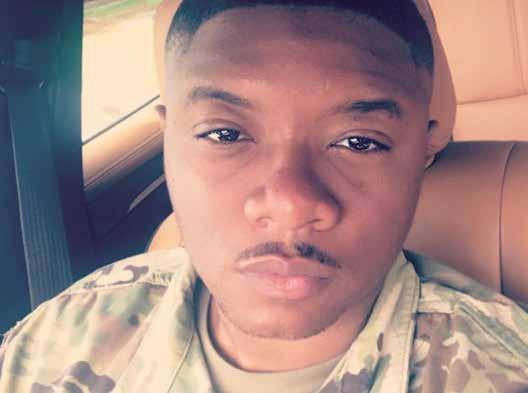
“I see this now as progress. We’re growing as a country,” said Cropper, who selfidentifies as a 32-year-old Black man of trans experience. “Now we have a leader who is choosing to see the needs of the people and he is addressing them. And I think that says a lot that it’s not even a hundred days (for him in office) yet.”
Cropper met Biden at the Democratic presidential debate on June 27, 2019, in Miami, where the future president shook his hand and said, “I see you.” He also met [new] Transportation Secretary Pete Buttigieg, who commended him on his military service as a prior service member himself.
While driving to a routine doctor’s
appointment on Feb. 11 and doing “just regular everyday life stuff,” Cropper told the Blade of the hope he feels now that Trump’s trans service member ban is now behind him.
“There’s always going to be something, I mean, I’m Black and I’m in the military,” Cropper said. “But this is now one less thing off my shoulders that I have to worry about.”
Instead, he can try to relax and just focus on caring for his partner, his l6-yearold cousin, his two miniature schnauzers Seoul and Carlito, and his Staffordshire terrier Siri.
“Reversing this ban is a victory for all Americans,” said SPART*A Vice President
Lowery, who also identifies as a Black trans-masculine service member, told the Blade that being able to serve openly also affects leadership skills.
“When leaders can be more authentic, they can be more honest,” he said. “In the world in general, we have a shortage of honest leaders. Anything we can do to have people be more honest and authentic in general is the right thing to do.”
Lowery currently lives with his wife, daughter, and two Great Danes, but he grew up “pretty poor” and joined the Army in search of a better life.
While Cropper came from a family of
Bree Fram, who is a lieutenant colonel in the US Air Force, in the Jan. 25 joint statement.
“President Biden has given the gift of opportunity to thousands of individuals who will use it to serve the country they love.”
Since first enlisting in 2008, Cropper had served under varying policies limiting how he expressed his LGBTQ identity, including the repealed “Don’t Ask, Don’t Tell” policy that banned openly lesbian, gay, and bisexual service members.
Despite these restrictions, he still earned several military awards and honors, including one for physical fitness.
“A lot of times the physical aspect of military service is brought up with trans service members,” Cropper said while pointing out he and others like him not only met the physical standards but exceeded them. “To be a master fitness trainer, you have to score in the 90th percentile in every event.”
professionals, including a mother who is a doctor of internal medicine, and wanted to prove that he could make it on his own, Lowery struggled with work, school and long bus commutes before finally signing up in 2007.
“We didn’t have Lyft in 2004,” he laughed. “It was the bus or mom, and mom wasn’t always happy to help you.”
Lowery also recalled being a “tomboy raised in a Pentecostal world” who wore basketball shorts for the “sheer comfort.” He didn’t know what being trans was in those days, but he knew being himself meant being masculine.
“It was a way of life,” he said, one that he couldn’t live openly under the ban. “Medical professionals didn’t have the resources to assist you.”
He also described troubles not with peers or subordinates but with senior leaders who didn’t know how to handle his
decision to transition.
While updating his military paperwork and taking Zoom college classes from home, Lowery told the Blade about a major under whom he served during the ban who told the team he led that they didn’t have to use his correct pronouns, that “the regulations don’t force us to.”
“You can call him whatever you want legally,” Lowery said, recalling the major’s words. “You’re not going to get into trouble.”
Currently, Lowery is taking classes so he can one day go to law school and help others who find their lives limited by discriminatory laws and policies like his was. He wants to study family and human rights law because “we need more people influencing policies who are actually impacted by them.”
Both Cropper and Lowery also spoke of their identities as Black men serving during the 2020 Black Lives Matter protests.
“I had emotions that overtook me when it came down to those protests,” Cropper said. “I felt every single part of my identity was under attack last year. I couldn’t be Black enough, I couldn’t be trans enough, and I couldn’t be valued as a soldier which I gave up over a decade of my life becoming.”
But he looked to the differences between Biden and Trump and saw a chance for growth and opportunity.
“The Armed Service now is more reflective of America,” Cropper said. “Now, we’re saying to more people, you are valued and you, too, can serve your country.”
Still, Lowery was a little more pragmatic. He questioned how even senior leaders with good intentions, but working all the way in DC, could really impact the lives of individual soldiers of color in isolated, rural areas like Kansas. He pointed out that sometimes well-meaning changes to improve troop morale were too superficial to help isolated Black, Latino, LGBTQ, or other soldiers from diverse backgrounds who were longing for community, family, and acceptance.
“Adding a Smoothie King on base won’t change things at an installation that is not diverse, but I still want it,” he laughed. “But it won’t change things.”
So for now, Lowery continues his prelaw studies, Cropper continues to work hard to advance his military career, and Wyatt continues to spend precious time with her new husband when not rising early for sick call duties.
“Me and my (trans) sisters have this saying,” Wyatt said. “That your courage is your crown, so wear it to the T.”
Reprinted from the Washington Blade
Among other trans military members, Wyatt (r) prepares for the House Armed Services Subcommittee on Military Personnel hearing on Capitol Hill in Washington on Feb. 27, 2019. – Photo by Manuel Balce Ceneta / AP
Army Staff Sgt. Allyn Cropper – Photo courtesy of Allyn Cropper
Limbaugh was best known for “The Rush Limbaugh Show,” which premiered on August 1, 1988, and focused heavily on politics, with a strong conservative voice. The show reeled in 27 million daily viewers. Limbaugh was also an author, a political commentator, and a TV show host.
He was inducted into the Radio Hall of Fame in 1993 and into the National Association of Broadcasters Hall of Fame in 1998.
In February 2020, Limbaugh announced his lung cancer diagnosis, and shortly thereafter, former President Trump awarded him the Presidential Medal of Freedom at the State of the Union.
Demeaning remarks toward women
“Feminism was established so as to allow unattractive women easier access to the mainstream of society.”
When speaking about female breast implants, Limbaugh said this on his show in 2009. The topic of discussion was that women — lawyers in particular — get implants simply to improve their appearance, which increases confidence in the work setting. Limbaugh rationalized that female breast implants are used by lawyers to help them land jobs in the male-dominated workforce.
The actual reasons women receive breast surgery vary: some may desire larger breasts (you get it, sis!), while others may bear children and are left with an breast shape different from what they’ve known their whole lives. Societal pressures can play a major role in how a woman perceives herself, and she may wish to alter her appearance. The list goes on. Regardless, women have every right to look and feel beautiful however they wish, and beauty simply cannot be defined — by Rush Limbaugh or anyone else.
that contraception be covered under the Affordable Care Act. Let’s jump into contraception for a minute: The reason for using contraception is dependent upon the individual woman, and she may take it for one or even numerous reasons. And contraception does so much for women: from preventing unwanted pregnancies (hey, maybe you want a baby down the road but cannot financially support one right now, and that’s okay!) to regulating menstrual cycles (and those godawful cramps that come with) to preventing the risk of ovarian cancer. Because of Fluke’s
blamed for slavery when they’ve done more to end it than any other race, and within the bounds of the Constitution, to boot.”
Northern whites and Northern African Americans who escaped slavery saw a common theme: they could both work together to achieve their individual goals.
Many African Americans viewed the Civil War as a way to free those who remained enslaved and to ensure that they would never become another person’s property.
To suggest that Caucasians should hold zero accountability could be considered
For decades, Limbaugh spewed demeaning remarks toward women. In 1988, he called Amy Carter “the most unattractive presidential daughter in the history of the country.” In the early 1990s, he referred to Chelsea Clinton as the “White House dog,” and in 2009 he went on to attack her mother, First Lady Hillary Clinton, by saying she was unable to become a United States Marine because “they didn’t have uniforms or boots big enough to fit that butt and those ankles.” A majority of his remarks about women are based upon appearance and superficialities, and he regularly implied that women he perceived as being less attractive were less valuable.
Fast-forward to 2012, when Georgetown law student Sandra Fluke (are you sensing a theme yet?) went before Congress to demand
actions, 63 million American women are now able to receive contraception without a copay, and patients are not denied coverage like they once were.
For doing this, Limbaugh called Fluke a “slut” and a “prostitute,” which prompted former President Obama to state that those remarks “don’t have any place in public [discussion].”
Demeaning remarks about race
“If any race of people should not have guilt about slavery, it’s Caucasians.”
Limbaugh made this statement on his radio show in 2013. He explained that forms of slavery continue to exist in modern-day society, as well as how all parts of the world have a history of slavery. However, he added that “it’s preposterous that Caucasians are
a preposterous statement in itself. White Americans sailed on ships for months to capture and bring enslaved humans back to North America, and this carried on until the 13th Amendment in 1865 abolished slavery. The actions of our ancestors still have negative implications today, contributing to fewer educational and occupational opportunities for African Americans, not to mention wage differences, stereotypes, and police brutality. In short, Blacks in America have not once stopped fighting for equal rights for hundreds of years — and it is still an ongoing battle.
Limbaugh’s racist comments took a toll on him in 2003 after he said that Philadelphia Eagles quarterback Donovan McNabb received undeserved praise because “the media has been very desirous that a Black
quarterback do well.” Fortunately, this stunt got Limbaugh fired from ESPN, but the racism didn’t end.
Starting in 2008, Limbaugh attacked the Obama family on a regular basis. A caller into one of his shows once said that her 12-year-old child thought Barack Obama looked like the cartoon monkey Curious George. Limbaugh laughed at the comment but later issued an apology after receiving backlash. During the Obama era, Limbaugh repeatedly referred to Michelle Obama as “Moochelle Obama” and “Michelle, my butt.”
Demeaning remarks about LGBTQ people
“When a Gay person turns his back on you, it’s anything but an insult; it’s an invitation.”
From the beginning, Rush Limbaugh was outspoken about his beliefs opposing the LGBTQ+ community. He routinely argued that LGBTQ+ rights are antiAmerican because, he believed, they go against America’s traditional values, and he blamed the Gay community for wanting to destroy traditions. Often, he referred to those in the Transgender community as having a “psychological disorder” (a factually incorrect statement) and claimed that Transgender lives are defined by “their anger and agitation at being victims.” In addition, he blamed Democrats for embracing and normalizing LGBTQ+ rights. (If openly accepting individuals from all backgrounds and all walks of life is wrong, please call me a Democrat.)
When Pete Buttigieg, a proud Gay man, ran as a Democratic presidential candidate, Limbaugh said that “America’s still not ready to elect a gay-guy-kissing-his-husband-on-the-debate-stage president.” Furthermore, Limbaugh continually referred to marriage equality as “perverted.”
Limbaugh hosted a recurring segment that ran for a few weeks in the 1990s called “AIDS Update.” During this segment, he cracked jokes about the AIDS epidemic and how it killed over 100,000 Americans in the 1980s. He often played songs such as “Looking for Love in All the Wrong Places,” “Kiss Him Goodbye,” “I Know I’ll Never Love This Way Again,” and “Back in the Saddle Again.” Limbaugh later expressed regret for filming these segments because it was “making fun of people who were dying long, painful, and excruciating deaths,” but the damage was already done.
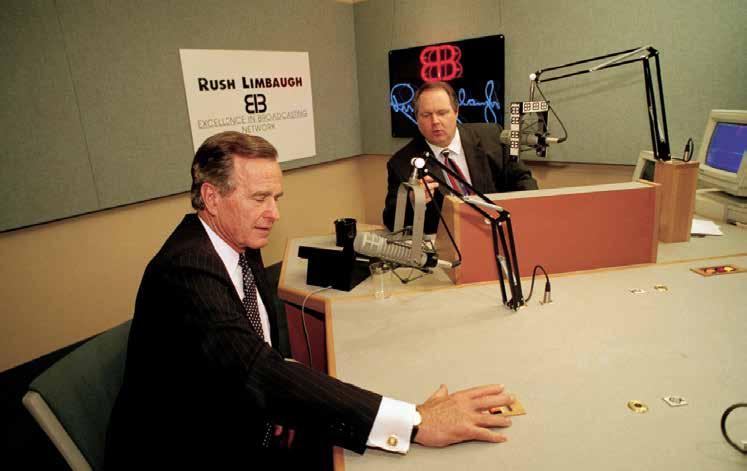
President George Bush talks with conservative radio host Rush Limbaugh at WABC studios in New York City in September 1992.
– Photo by J. Scott Applewhite / AP
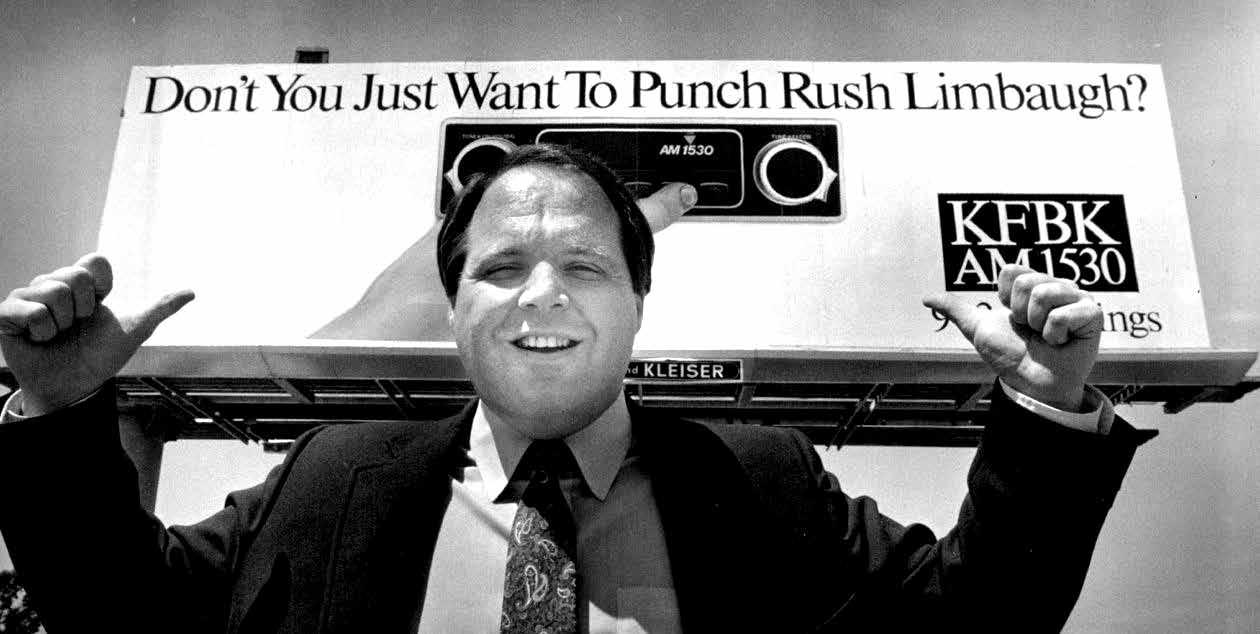
Photo by Mitch Toll / Zuma Press




This Week in SGN History
“Although DADT wasn’t the only reason I left, it certainly was the number one contributor,” he told SGN. “As much as I liked the job, I couldn’t go on living a double life.”
Morrow isn’t alone; poll after poll indicate that Americans are fed up with Gay and Lesbian servicemembers being forced to lie in order to keep their careers intact.
A new poll from the Center of American Progress (CAP) shows that a majority of American voters support a repeal of DADT. The poll is the most extensive of a number of recent surveys tracking public opinions on this issue, and undeniably shows that the American public has become increasingly supportive of open service.
CAP’s poll, fielded by Greenberg, Quinlan, Rosner Research, finds that 54% of those surveyed support repealing the current ban on open service, with just 35% opposed to repeal. These numbers demonstrate a massive change in public opinion on this issue since 1994, when polls showed that majorities of Americans opposed Gays and Lesbians serving in the military. The poll also shows that voters value skills over sexual orientation, a DADT repeal is not a politically polarizing issue, voters do not want to defer to the military on DADT, and that voters are becoming more accepting of Gays and Lesbians overall.
The Palm Center recently released eight key recommendations to the Pentagon Working Group on Gays in the military. These recommendations are intended as a first step in providing full support to the Working Group. The key recommendations include consulting existing literature as a roadmap, assessing the impact on unit cohesion properly, consulting troops for relevant information about implementing the change rather than asking their permis-
sion to reform, sending study teams to Britain, Israel, Australia, and Canada, using an appropriate standard for assessing the likely impact of change, consulting research on the timing of implementation, noting that leadership and consistency are more important than second-order effects, and correcting for biases introduced by DADT.
Sentiment has changed among the Reserve Officers Association (ROA), a 63,000-member professional association for all uniformed services of the United States. The organization voted on February 24 to rescind its previous call for complete exclusion of Gays and Lesbians serving in the U.S. military. The association also rejected by a two-thirds vote a proposal to endorse the current DADT law. Previously, ROA had urged Congress “to exclude homosexuals from induction, enlistment, commissioning, and continued service in the Armed Forces of the United States.”
This was U.S. government policy before DADT went into law in 1993.
For Morrow, DADT is flawed in many ways, but specifically because its implementation is subjective. In order for a repeal to work, he said, it would ultimately come down to leadership.
“The leadership has to be on-board with it,” he said. “I served under a Navy Captain who was a bigot more than anything else. From my own impression, if any of our crew had been openly Gay, he would have kicked them out. He made it very clear that he did not approve of homosexuality. Yet in other commands, this is certainly not the case. You even hear stories of sailors dating each other - so it varies drastically.”
“I certainly think that we’ve established a good start with Mullen calling for a repeal,” he said, “but leadership will have to change or a repeal will get left behind.”
From Naval Officer to Activist
These days, Morrow, 28, lives his life

a
as an openly Gay civilian with his partner Michael in Manhattan, New York. Morrow is on “Inactive Reserve Status,” meaning he could be recalled to duty if need be. Although he says a recall would be highly unlikely, it is not an impossibility.
“I am completely out at my current job,” he told SGN. “My co-workers are fully accepting, and I feel like a positive contributor to the work team. My life is 100 times less stressful, and my relationship with Michael is much better as a result.”
Although Morrow is convinced he made the right decision, he says his mind drifts back to those who are still serving in the military and being forced to live a double life. “There was a shift in my mind, and I become motivated about speaking out about DADT,” he said. “When the president said he would repeal the policy and I watched the recent Senate hearings regarding DADT, I promised myself I would do whatever I could to help put a face on the issue. DADT affects real people. Gays and Lesbians serving in the military aren’t just a number.”
Morrow says he became offended when he heard the things that those who oppose a repeal were saying about servicemembers. “A breakdown in unit cohesion and military readiness couldn’t be farther from the truth,” he said. “That cohesion isn’t just built on the battlefield. It happens at events outside the military environment. It’s those traditional ceremonies and unit get-togethers where people really get to know each other. For me, DADT acted as a catapult for stopping unit cohesion because, as a Gay sailor, I could not fully partake.”
Morrow says he had to isolate himself, couldn’t invite Michael to events, and people never really had the opportunity to really get to know him. “DADT breaks down unit cohesion,” he said, “and I am offended that anyone would think that my being Gay made my unit less ready for war.”
“Gay servicemembers need to speak up
There are so many dogs that need, and deserve, our help. 10,080 DOGS SAVED OUT OF DEATH ROW!!
Private adoptions! We have over 100 dogs from all over the world for you to meet!!! Click on www.gingerspetrescue.org and pick out your dog.
There are so many dogs that need, and deserve, our help. 10,080 DOGS SAVED OUT OF DEATH ROW!!

Check out our upcoming adoption events at: gingerspetrescue.org/events
US AT (206) 698-8800 or email us at ginger@gingerspetrescue.org
Check out our upcoming adoption events at: gingerspetrescue.org/events
and put a face on this. I am ready to do my part,” he told SGN Morrow said it is hard to break down stereotypes without putting a face on them. “If you ask some straight people about LGBT people, they may not know what to say,” he said. “But if you ask those same people, ‘What do you think about Earl?’ they will say they like him, and hopefully that helps them make the connection.”
Morrow says that most stereotypes don’t hold true when they are put to the test.
When DADT is repealed, he says that anti-Gay violence is “unlikely.”
“I don’t propose that there aren’t bigots in the military,” he explained. “But the military doesn’t tolerate racism or sexism. When those prejudices rear their ugly head, there are rules in place to properly deal with them. That is how it will be for antiGay slurs, threats, and violence.”
“I am open and available to speak when and where I can about repealing DADT,” he told SGN. “I feel like ultimately, when this issue is over, it wouldn’t be because just one of us tried to overturn it. This is a group effort and we have to keep going while we have the momentum. The realization needs to be made that this is the path that we should take.”
UPDATE: Don’t Ask, Don’t Tell officially ended on September 20, 2011, but then the Trump administration banned Trans people from serving in the military. After Biden entered the White House, the trans ban was reversed, and now we breathe a sigh of relief. Shaun Knittel (our late associate editor) was committed to the repeal and wrote several articles on the DADT policy. I reached out to Earl Morrow through Facebook; he didn’t have a comment per se but did state that his life is different 11 years later. Morrow lives in Connecticut and is currently planning his wedding. We wish him well.




THIS AD SPACE HAS BEEN GENEROUSLY DONATED BY KRISTIN COSTELLO IN MEMORY OF SGN PUBLISHER GEORGE BAKAN


National News
Merrick Garland says
“it is the job of the Justice Department to stop” violence against Trans women
by Bil Browning LGBTQ Nation
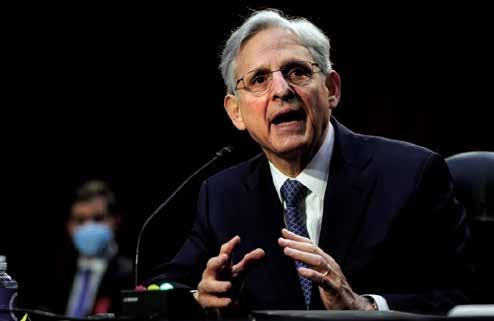
(Feb. 22, 2021) — President Joe Biden’s nominee for attorney general, Merrick Garland, answered questions today at his confirmation hearing, and a question from Sen. Joe Kennedy (R-La.) has raised some eyebrows. His response to a question from Sen. Cory Booker (D-N.J.), however, is winning praise.
Judge Garland, who would give up his seat on the DC Circuit Court of Appeals to accept the job, won bipartisan praise for his performance after promising to keep politics out of the decision-making process. Garland was nominated to the Supreme Court by former President Barack Obama, but Republicans refused to hold a hearing on the nomination.
Kennedy offensively called transgender girls “biological males” in his question on whether allowing transgender athletes to compete is a good policy decision.
Garland declined to comment, saying only, “I’ve not had the chance to consider these kinds of issues in my career so far, but I agree that it’s a difficult question.”
For the Biden administration, it’s not a
difficult question at all. The White House issued an executive order on Biden’s first day in office, which said, “All persons should receive equal treatment under the law, no matter their gender identity or sex-
ual orientation.”
The order told federal agencies to reexamine their anti-discrimination work in light of the Biden administration’s — and the Supreme Court’s — view that federal
Va. school seeks Supreme Court review in continued fight against Gavin Grimm
by Chris Johnson Washington Blade
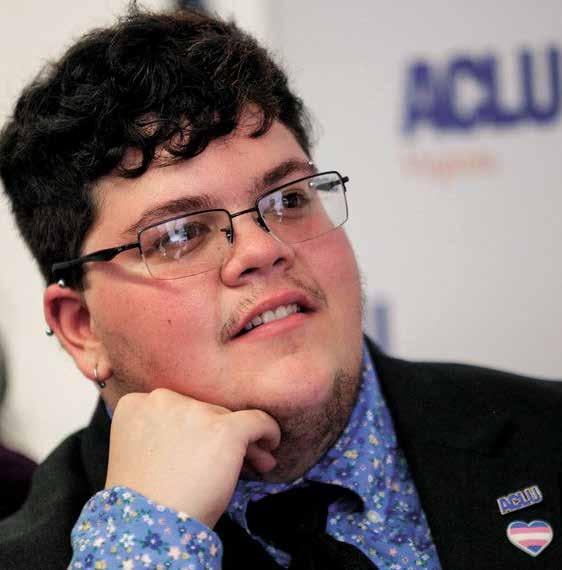
Gavin Grimm’s fight to get his Virginia high school to allow him to use the restroom consistent with his gender identity — even though he graduated four years ago — isn’t over: the Gloucester County School Board on Friday filed a petition asking the US Supreme Court to review the case.
The 37-page petition asserts the decision from the US 4th Circuit Court of Appeals, which ruled in favor of Grimm in August, was incorrect in determining the 14th Amendment and Title IX of the Education Amendments of 1972 require the school to grant him access to the boys’ bathroom.
“The overriding issue in this case is whether federal law — either Title IX or the Equal Protection Clause — mandates only one answer to the difficult question of how a school should respond to transgender students seeking to be treated consistent with their gender identities, while accommodating the compelling bodily privacy interests of their cisgender classmates,” the petition says. “Because both laws permit school boards to reach different answers to that question, the decision below was wrong.”
Although Grimm graduated from high school in 2017, the courts have kept his case alive on the basis he could return as a alum, such as a return trip for a football game, and may need to use the restroom facilities, and because the school refused to update his transcripts consistent with his gender identity.
Grimm said in a statement he’s disappointed the school would continue to challenge his access to the restroom.
“I graduated four years ago — it is upsetting and disappointing that Gloucester County continues to deny who I am,” Grimm said. “Trans students in Gloucester County schools today should have the respect and dignity that I was denied. Whether it’s using the right restroom or
having transcripts that reflect who we are, we all deserve to go to a school that’s free of harassment and discrimination.”
The question presented in the petition: Does Title IX or the Equal Protection Clause require schools to let transgender students use multiuser restrooms designated for the opposite biological sex, even when singleuser restrooms are available for all students regardless of gender identity?
It remains to be seen whether the court,
which has a 6-3 conservative majority in the aftermath of the Trump administration, will agree to take up the case, nor where it will come down in a potential ruling. It takes a vote of four justices to grant a writ of certiorari, or agree to take up a case.
If the Supreme Court accepts the case, it wouldn’t be the first time. In an earlier stage of the lawsuit, when Grimm was still in high school, Gloucester County School Board filed a petition and the Supreme
bans on discrimination “because of sex” prohibit anti-LGBTQ discrimination.
In the weeks since he signed that order, the right has been discussing transgender girls participating in school sports nonstop, partly due to their belief that this is the easiest wedge issue with which to attack LGBTQ equality. Republican strategists have been openly advocating for conservatives to talk more about transgender girls playing sports to win votes.
When Booker asked Garland about the epidemic of violent attacks on transgender people — trans women of color in particular — and the need to protect transgender children, Garland agreed it was an issue that needed to be addressed.
“It’s clear to me that this kind of hateful activity has to stop, and yes, we need to put resources into it,” Garland responded.
“These are hate crimes and it is the job of the Justice Department to stop this.”
Garland’s confirmation hearing will continue tomorrow. He is expected to be confirmed by the full Senate later this week.
Reprinted from LGBTQ Nation
Court agreed to hear it in 2016.
But the court took up review of the case to answer questions about Auer deference and Obama-era guidance instructing school to allow transgender kids to use the restroom consistent with their gender identity. Once the Trump administration rescinded that guidance in 2017, the Supreme Court scrapped consideration because the underlying issue became moot.
Representing the Gloucester County School Board is the Richmond, Va.-based law firm Harman, Claytor, Corrigan & Wellman and the DC-based Schaerr | Jaffe LLP. Schaerr didn’t immediately respond to the Washington Blade’s request to comment Friday on why the law firm thinks the Supreme Court will agree to take up the case now after having scrapped it four years ago.
The petition, however, says the “case remains an excellent vehicle” for the Supreme Court to adjudicate whether Title IX and the 14th Amendment require schools to allow transgender kids access to the restrooms consistent with their gender identity, citing a lack of jurisdictional issues and an opportunity to the review the case without having to address Auer deference and the Obama-era guidance.
“All concerned — including the thousands of schools and school boards that must wrestle with the questions presented here — will benefit from a timely and definitive resolution of those questions,” the petition says.
Josh Block, senior staff attorney for the ACLU LGBT & HIV Project, however, said continued adjudication of the case is unnecessary.
“It is disappointing that after six years of litigation, the Gloucester County School Board is still digging in its heels,” Block said. “Federal law is clear: Transgender students are protected from discrimination. Gloucester County schools are no exception.”
Reprinted from the Washington Blade
Merrick Garland – Photo by Drew Angerer / AP
Gavin Grimm – Photo by Kristen Zeis / AP
Biden “committed” to issuing gender-neutral passports
ACLU reveals talks with White House
by Mike Andrew SGN Staff Writer
Nonbinary Americans may soon be able to get gender-neutral passports, according to the ACLU.
The civil rights group said it has been in talks with the Biden administration about adding X as a gender marker, along with M and F, to allow nonbinary people to get federal IDs that match their gender identities.
Arli Christian, a campaign strategist at the ACLU, called on the administration to issue gender-neutral versions of all federal documents within Biden’s first hundred days.
“It cuts across so many areas of discrimination against trans people whether we’re talking about being respected in school, safety, employment, housing,” Christian told The 19th, a news website covering gender issues.
In response, White House spokesperson Matt Hill told The 19th that Biden remains committed to issuing gender-neutral IDs, which he promised to do during his presidential election campaign. Hill cautioned that there was no timeline on the rollout or further comment on how the policy might be implemented.
“President Biden remains committed to advancing state and federal efforts that

allow transgender and nonbinary Americans to update their identification documents to accurately reflect their gender identity, especially as transgender and nonbinary people continue to face harassment or are denied access to services because their identification documents don’t affirm their identity,” Hill said in a statement.
An ACLU petition for more inclusive federal IDs has reached almost 34,000 signatures. The campaign also called for selfattestation of gender markers on federal IDs, “meaning you can affirm your own
gender identity without needing medical verification,” the group said.
Currently, an applicant must submit a letter from a medical doctor attesting to appropriate clinical treatment for gender transition if they wish to update a gender marker on their federal IDs or records.
“Not only are such burdensome requirements costly, complicated, an invasion of privacy and entirely unnecessary but they prevent many trans and nonbinary people from getting an updated ID to move through the world,” the ACLU said.
International News
In 2020, a federal judge ordered the US State Department to issue a passport with a gender-neutral X marker to Intersex Colorado navy veteran Dana Alix Zzyym. Zzyym applied for a passport in 2014, but they were denied because they declined to identify as either male or female. Instead, they wrote “Intersex” as their gender.
The US Department of State initially said they could either list Zzyym’s gender as “female” or as “male” if a doctor issued a letter confirming Zzyym’s “new gender,” but not anything else.
Zzyym appealed the decision with two affidavits from physicians at a US Department of Veterans Affairs medical center affirming Zzyym is Intersex.
When the State Department still refused to issue the gender-neutral passport, sued, taking their case to federal court. An appeals court eventually ordered the State Department to reprocess Zzyym’s application, saying “We conclude that the State Department acted within its authority but exercised this authority in an arbitrary and capricious manner.”
However, Zzyym still has yet to receive their passport with an X gender marker despite the court order.
LGBTQ activists in Myanmar join protests against military coup
by Michael K. Lavers and Victor Maung Washington Blade
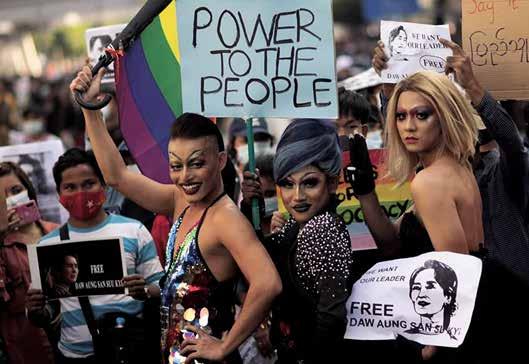
LGBTQ activists in Myanmar have joined the growing protest movement against the Feb. 1 coup that ousted Aung San Suu Kyi and her democratically elected government.
Min Khant Zin, a drag queen who works at a gay bar in Yangon, the country’s largest city, told the Washington Blade that he and his friends received a lot of media attention after they decided to participate in the protests while in drag. Khant Zin, who identifies as queer, added this decision was deliberate.
“Most of the openly gay people in Myanmar are makeup artists and crossdressers. They do not stand out in the crowds when they wear female costumes, but someone with drag costumes will,” said Khant Zin. “This is my intention.”
“We want people around the world to know about the LGBT community’s contributions for the fight for democracy,” added Khant Zin.
Saw Zin Maung Soe is an LGBTQ activist who founded CAN Myanmar, a civil rights organization that is based in Mandalay, the country’s second-largest city.
Maung Soe told the Blade that around 100 members — gay men and lesbians from different socioeconomic backgrounds, gender-queer people, straight allies, doctors, and engineers — participated in a protest that took place in Mandalay on Feb. 8. Maung Soe said some of them were part of a group of protesters against whom the police used water canons and rubber bullets.
“We have to be cautious because we look different and are easily noticeable,” Maung Soe told the Blade. “We are worried we might be targeted by the police forces and counter protesters.”
“We are all coming to the protests to support the greater cause,” added Maung Soe.
Khant Sithu, a Burmese college student in New York who identifies themselves as LGBTQ, is among those who have gathered in front of the UN to protest the coup.
“Regardless if you are gay or straight, we all vote for the political parties we like,” Sithu told the Blade. “People in Myanmar have overwhelmingly voted for Aung San Suu Kyi’s NLD party. Now, the military dislikes the situation and detain the civilian leaders.”
The coup toppled Suu Kyi and her government less than three months after her National League for Democracy party trounced the military’s Union Solidarity and Development Party in parliamentary elections.
Suu Kyi, who won the Nobel Peace Prize in 1991, was under house arrest for nearly 15 years until her release in 2010. Suu Kyi in 2016 became Myanmar’s state counselor, which is roughly equivalent to prime minister.
Suu Kyi, who has faced global criti-
cism over her response to the plight of the Rohingya, has been charged with illegally possessing walkie-talkies. The US is among the countries that have imposed sanctions against the Burmese military over the coup.
Consensual same-sex sexual relations remain criminalized in Myanmar under Section 377 of the country’s criminal code.
Activists said Suu Kyi’s government made an unofficial pledge to amend or repeal Article 377 and other anti-LGBTQ laws during its second term in office that would have ended in 2025.
Maung Sue told the Blade there was not “much progress for LGBT rights under Aung San Suu Kyi’s NLD government’s administration in the last five years.”
“We LGBT activists got invited to observe the parliamentary sessions, and we were asked to participate in policy dialogue,” said Maung Soe. “The issue of
LGBT rights was never a priority, even for the civilian government.”
A group of activists have nevertheless released a statement that criticizes the coup and demands the release of Suu Kyi and other civilian leaders who have been detained.
“We LGBTI people in Myanmar demand the release of elected civilian leaders in detention, the cancelation of the new Administration Council formed with military officials and pro-military persons, [and] the lifting of the military’s intervention against convening of the new Parliament with elected members of Parliament,” reads the statement.
“Since we, LGBTI people, have a history of active participation in past political activism, we want to announce that in this military coup, we will stand with the people and the government employees who are starting the civil disobedience campaigns,” it adds. Yuya, a transgender activist who spearheaded the letter, described it as a “statement by the LGBT people in Myanmar.”
“We are human beings and we are citizens,” Yuya told the Blade. “We have not been recognized because of the system, but we have tried to correct it. We do understand that we should not expect things to change 100% overnight, but we for sure do not want things to go back to ground zero and start again from scratch.”
“So, like others, we participate in civil disobedience movements and others … we have many things to contribute to it, because we are all concerned,” added Yuya. “Our leaders [referring to Suu Kyi] have fought for us. They were imprisoned for years in order for us to be here today. This is the time for us to contribute what we could for all of us again, so that generations may not suffer human rights abuses and this coup shall be the last one we experience.”
Reprinted from the Washington Blade
Photo by Benny Snyder / AP
Photo courtesy of WA Blade
Uncomfortable and challenging: Director Mike P. Nelson on taking a Wrong Turn into the horrifying unknown Film

by Sara Michelle Fetters
SGN Staff Writer
After a short theatrical engagement back in late January, director Mike P. Nelson’s reinvention of Wrong Turn makes its home debut this week on DVD, Blu-ray, and VOD. Written by Alan McElroy, the scribe behind the 2003 original, this horror offering has absolutely nothing to do with the inbred backwoods West Virginia cannibals of the previous franchise. Instead, it offers up an entirely new mythology with its own characters, quirks, and eccentricities, all of it filled with gory deaths and unexpected twists that help make this Appalachian Trail trek into madness worth embarking on.
Back in my original review, I called this remake/reboot a grisly smash that filled my horror-loving heart with glee. On subsequent rewatch, those feelings were only confirmed.
I had the pleasure to chat with Nelson about the making of Wrong Turn. Here are a few edited excerpts from our wide-ranging, and far too brief, conversation:
Sara Michelle Fetters: How in the world does a new Wrong Turn movie come your way, especially one from the writer of the original Wrong Turn, Alan McElroy?
Mike P. Nelson: Maybe a little bit of fate. Noah Rosen, who’s my manager, and who works with Alan quite a bit, sent this to me. He said, “Mike, you’ve got to read this script. It’s pretty crazy, I know it says Wrong Turn on it, but just give it a chance.”
I remember I didn’t read it right away. I was like, “Wrong Turn. What am I getting myself into?” That’s not a series I’d normally consider being a part of. But I did like the first one, so I thought, maybe this could be fun.
So, I read it. I remember getting to that pivotal moment in the [script] where everything changes and just thinking, what in the heck is going on here? It wasn’t what I was expecting.
I didn’t know how to feel in that moment. It was very strange. There was a lot of great buildup to that moment, and then we kind of take this turn into a completely different movie. It was almost like we were starting a whole other three-act structure right in the middle of the movie! I had to screw my head back on again after that and just throw out everything that I knew about how movies should be, or. At least, how I thought a Wrong Turn movie should be.
I remember finishing, just being like, if we can pull this off, that would be pretty awesome. I sat with it for a little bit, talked with Alan, and made some changes. Then I spoke with [producer Robert Kulzer] and pitched for the movie. The rest is history, as it all just fell together after that.
When you have a group of people like Alan and Robert, people like our DP Nick Junkersfeld, the entire crew, in fact, they understood the movie so clearly. They knew what we were doing. Nobody got cold feet about doing something super crazy, because you can’t go into something like this fearful. They were all all-in and willing to go for it. It was challenging, but also a really cool experience to be able to work with a group of people who believed in doing something so bold.
SMF: I almost don’t even know where to begin with everything you just said. I will say I had to go back and watch it a second time, because I was just so gobsmacked from anticipating what the movie was going to be and then having it be something completely different. There is an important visual clue that I think people potentially miss. You show early on that we’re in Virginia and not West Virginia. Was this a clever visual touch? Or a vital piece of information you hoped savvy viewers would clue in on?
MPN: There are a couple things with the Virginia/West Virginia thing. There was a point in the script where it was actually West Virginia. Alan wanted to start the
whole lore over again. He loved it being set in Harper’s Ferry, West Virginia. Then we started talking about it.
First of all, we couldn’t shoot in Harper’s Ferry. Next, I started to research, and most of the Appalachian Trail isn’t even in West Virginia; it’s actually in Virginia. Our characters are on the Appalachian Trail for a long time, and there’s only like four or five miles of the trail in West Virginia.
Then the lawyers came in and they were like, wait a second, can you actually say this is West Virginia? Because it’s a new Wrong Turn film, and the other one is from 20th Century Fox. Did we have the rights to use West Virginia as a location?
I think the clouds opened and God spoke to us that it couldn’t be West Virginia. It had to be Virginia. And this actually benefitted the movie. We were not in West Virginia with the cannibals. No, we are in Virginia. We’re with the Foundation.
So, yes, the sign thing was on purpose. Glad you picked up on that.
SMF: For me, that was such a nice twist, because it honors and recognizes the original series, which, let’s be honest, after the first two isn’t all that good, but still allows you to go your own way. You get to create your own mythology, your own group of characters, but still acknowledge that the other stories continue to exist in a very subtle way. Even better, by making this clean break, you get to tackle your own set of themes and issues, taking the viewer on a journey into the heart of American cultural mythology, which I think is pretty great.
MPN: Absolutely. What I love about where the film sort of goes and ends up is that our story has an antagonist. It’s maybe not the clearest antagonist, but it has one, and that, I think, is unexpected. But every single person in this movie does some Very Bad Things. And every single person in this movie has a point of view that we can actually respect
and relate to, maybe even admire. That’s an uncomfortable place to be. I think with films, stories are easier to digest when we can latch onto a clear villain and a clear good guy. We don’t give the viewer that.
What’s was hard about this group of young adults that go out into the woods is they go out with good intentions. They’re not there to cause trouble. But they still come with baggage. They come with stereotyping, judging baggage toward these people who reside in this area of the country.
That’s where it starts to get tricky. I think we all have a feeling or a prejudice toward certain people, possibly in red states. We’re like, I don’t know about these people, this place, I think we have to stay away because those people might be crazy.
Yet when you’re able to explore the differences of opinion, the differences of worlds where we actually come from and how those collide, then you start to realize that we’re all just people. We’re all making good and bad decisions. Unfortunately, that ends up getting a lot of people killed in this particular situation, otherwise we wouldn’t have a movie.
But there was still something uncomfortable and challenging for me going into telling a story like this one. I’m a child of Indiana Jones. I love those stories. They’re so quick and clear. It’s just boom, boom, boom. Start, middle, climax. The protagonist: a little rough around the edges but still does what’s right. Pretty much that simple. This wasn’t that. It was challenging. And I know that it’s challenging for audiences, too. It can all get a little bit gray. People who you feel are good actually end up being a little bit cruddy. The people who are kind of bad, or who we think were bad, we start to wonder if they kind of have a point. It just gets hard to tell good from bad, and I loved that about the script. I love that Alan challenged us in that way.
SMF: You have a pair of LGBTQ characters who, I must admit, I actually would
Adrian Favela, Charlotte Vega, and Adain Bradley in Wrong Turn – Photo courtesy of Saban Films
have liked a little bit more time with, so that they could have been developed just a little more, but who are still of a type we don’t typically see in a horror movie like this one. This also throws people off a little. We want to connect with these guys, and we’re so happy that they’re here, but then, maybe just moments later, it’s a lot like you say, sometimes good people make some really bad decisions.
MPN: A hundred percent. That was something that Alan and I talked about right from the get-go. I think so many movies are guilty of this, in creating an LGBTQ couple or characters and making them caricatures. It’s an easy thing to do.
When I was talking to Alan about this, he said, “You know what? Yes, they’re gay, but guess what? They’re people. Why can’t we just treat them like they’re people in the movie? They don’t need to be stereotypes.” It was so obvious, and it’s so upsetting that depictions like this in horror are considered radical. Why? Why do you have to draw so much attention to characters being gay? Why can’t you just let them act naturally and just be who they are?
They’re two men. They’re in love. They’re with their friends. That’s it. That’s what matters. To me, that’s what grounded that relationship, and it also grounds the whole friendship dynamic with the entire group. It set the tone for how they all interacted. That was super important.
SMF: We have to talk about Charlotte Vega. How did you know she was going to be able to anchor this film the way that she does?
MPN: I remember going through casting, and I had a handful of ideas of who I thought could do a really good job. Of course, there were the ginormous names that were put in front of me that would probably never do the film, but I was just kind of like, fine, if you guys want to go after them, that’s okay.
But I had a group of names that I was interested in, and Charlotte Vega was one
of them. I remember watching one of her movies, The Lodgers, and I was blown away by her character work. She has some chops. To have somebody of her caliber that would want to do our movie? I knew she could pull this character off.
I had this conversation with the studio, and I was like, we can audition anyone you want, but I’m telling you right now, we’ll be sorry if we don’t cast her. This was an amazing opportunity for us to have an incredible actor in our movie. I stated that I felt people were going to appreciate a better performance than just having the role portrayed by a face they may happen to know from Instagram.
A couple days later, they called me back. They had looked her up. They said, “If you
want Charlotte, we’ll go with Charlotte.”
That was such a relief. I was like, thank you. I felt so lucky. Not too long after, I was able to talk to her over Skype — she lives over in Barcelona — and I just knew she would be perfect. She just has this thing about her.
One thing that I love about casting people who are interesting is that they’re interesting in their real life. They’re not just actors. There are so many actors who I think, that’s all they are. That’s their everything. That doesn’t do anything for me.
With this cast, what was so cool is they all had these quirks, they all had these things outside of acting that they love. I always ask people what they love to do. Like even Emma Dumont, who plays Milla. She’s
going to school right now for robotic engineering. Isn’t that cool? Everybody had their thing that was strange, that was wonderful. Stuff you would have never expected. I feel like all that feeds into each character and makes them even more interesting.
SMF: We’re sadly out of time, and I don’t really know how to talk about him without spoiling parts of the movie but: Bill Sage. Holy freaking cow.
MPN: [laughs] Bill Sage is a frigging powerhouse. A powerhouse. He just ran with it. We were all floored when he came out and did what he did, especially with the ending. We’ll just leave things at that. But, yeah, oh my god. A powerhouse. And a joy to work with. I love him. Holy buckets.

Actor Matthew Modine and director Mike P. Nelson on the set of Wrong Turn – Photo courtesy of Saban Films
Disquieting Vigil a supernatural crises of faith Film

by Sara Michelle Fetters
SGN Staff Writer
THE VIGIL
Theaters / VOD
Yakov Ronen (Dave Davis) has returned to Brooklyn’s Hasidic Borough Park neighborhood to do a job. He is hardly as devout as he once was, his faith recently shattered by a traumatic event. But when former friend Reb Shulem (Menashe Lustig) offers him $400 to sit overnight as a “shomer” (the person who carries out the Jewish practice of watching over the body of a deceased community member) for the late husband of Mrs. Litvak (Lynn Cohen), he’s in no position to turn him down, as he’s in desperate need of the cash.
Maybe he shouldn’t have been so quick to accept the rabbi’s money. Mrs. Litvak does not want Yakov there. The previous shomer left under mysterious circumstances, and
she’s insistent he does the same before it is too late. Undaunted, Yakov puts the old woman to bed, promising he’ll look after her husband until the morning, certain nothing strange or unusual will take place during the night.
He’s wrong, of course, as The Vigil’s writer-director Keith Thomas unleashes a slow-burn descent into supernatural terror that will force Yakov to confront personal tragedies that have led him to leave the Hasidic fold. There was a demonic presence stalking Mrs. Litvak’s husband, and now it is looking for someone new to haunt. This leads to a fiery battle of wills with Yakov’s immortal soul on the line, and the young man must make peace with his grief while also reconnecting with his lapsed faith, the only weapon he has at his disposal in this fight.
One of the more interesting aspects of Thomas’s feature-length debut is how authentic it feels. While I’m not Jewish, this is one of the few horror movies utilizing that religion’s scriptural terrors that actu-

ally seems to involve a protagonist from the community itself. Moreover, most stories dealing with crises of faith tend to revolve around Catholics and other Christians. This helps make Yakov a fascinatingly unique character on multiple levels, and because of this, I was understandably intrigued to learn what he was going to do next.
The basic spooky-business involving the menace haunting this home isn’t anything spectacular. Once the outline of what is happening and why is made clear, the only question is whether or not Yakov can put enough pieces together and defeat this evil before he is doomed to live a life of demonic sorrow similar to Mrs. Litvak’s poor husband. There’s some rather standard misdirection at play, and one or two red herrings muddy the waters, but there aren’t a lot of surprises as to what this thing is and why it is drawn to the young man guarding its former prey.
Yet Thomas still manages a decent handful of solid scares. He sets the appropriate
mood, an aura of uncertainty permeating every frame of the lusciously disquieting camerawork of director of photography Zach Kuperstein (The Eyes of My Mother). He also gets a splendid performance out of Davis. Yakov’s multidimensional attempts to reconcile his own lapsed faith with all he sees and learns throughout the night is stunningly realized, and the actor’s emotional and physical dexterity in the role is superb.
I’m a little surprised how much The Vigil affected me. Thomas builds tension and suspense skillfully, especially during a spellbinding sequence near the climax, when Yakov finally learns what it is he’s up against and why it was originally drawn to Mrs. Litvak’s husband. There is a touching human dimension to this tale that brought tears to my eyes, the ghosts of past regrets and a refusal to allow grief-stricken wounds the time they need to heal being the real villain hungering to feast on damaged souls crying out in continuous pain.
Dave Davis in The Vigil – Photo courtesy of IFC Midnight
Lynn Cohen in The Vigil – Photo courtesy of IFC Midnight Dave Davis and Menashe Lustig in The Vigil – Photo courtesy of IFC Midnight
Gleefully amoral I Care a Lot a stellar showcase for Pike and Dinklage
by Sara Michelle Fetters SGN Staff Writer
I CARE A LOT Netflix
I Care a Lot might be the most amoral, pitch-black comedy-thriller I’ve seen this side of Joel and Ethan Coen’s Burn After Reading. Filmmaker J Blakeson rebounds from the young adult disaster of The 5th Wave and gets back into a form similar to his ferocious 2009 yarn The Disappearance of Alice Creed, and in the process gives stars Rosamund Pike, Peter Dinklage, Eiza González, and Dianne Wiest roles each actor devours with gluttonous relish.
As terrific as all that sounds — and it is pretty great — this topically upsetting descent into health care industry madness and judicial malfeasance is still difficult to fully embrace. For one thing, there is almost no one to root for. For another, Blakeson isn’t always successful balancing his social commentary with an entertaining story. Finally, everything builds to a conclusion that, while appropriate, still left a bad taste in my mouth, and I’m not altogether certain this angrily rambunctious, bleakly comedic diatribe hits its intended target.
Marla Grayson (Pike) is a professional court-appointed guardian. When a judge decides an elderly individual can no longer take care of themself and requires constant supervision, she steps in and takes control of every aspect of their life. Along with partner and girlfriend Fran (González), she moves the individual to a senior residence facility, selling off that person’s home or any valuables they might have to pay for their treatment, pocketing a substantial sum in the process.
Their latest mark, Jennifer Peterson (Wiest), is what they in their peculiar industry like to refer to as “a cherry”: Rich. No family. No close friends. Did we mention rich? With the aid of crooked physician, Dr. Amos (Alicia Witt), it doesn’t take long for Marla to get Jennifer ruled incompetent. With shocking speed and cunning efficiency, she and Fran whisk the understand-
ably shaken older woman from her beloved home and plant her into a coldly lifeless senior center before she has any clue as to what is going on. Only a few short days after that, the pair are already holding an estate sale while also preparing to put Jennifer’s home on the open market.
no one seems to know who he is or how he came to rule such a vast empire. The film becomes a battle of wills between this man and Marla, and when legal wrangling proves fruitless and initial attempts at bribery fall on deaf ears, things become increasingly violent from that point forward.
The kicker is that this woman is not who she appears to be. Her disappearance provokes the immediate interest of an initially nameless man portrayed by Dinklage, who wields lethal power over others even though
All four of the primary cast members are outstanding, especially Pike and Dinklage. Both are on fire throughout, bringing levels of dangerous, unscrupulous depth to their performances that held me spellbound. The
actors revel in their respective characters’ depravity with carnivorous aplomb as each does whatever it takes to gain some semblance of supremacy over the other.
But what makes Pike and Dinklage so marvelous is that each finds a way to bring a sense of tender selflessness to what they are doing that caught me entirely by surprise. Marla and Fran’s love for one another is wholly genuine. The same goes for Dinklage’s unnamed villain and Jennifer, although their connection is far more familial than it is romantic. Both actors tap into something gracefully human in their interactions with González and Wiest, and even though neither character earned my empathy, they still grabbed ahold of my affection, even though every fiber of my being boisterously yelped that neither of them merited it.
Blakeson raises some agonizingly uncomfortable talking points about the American health care system and how it so unsympathetically treats the elderly, and his scathing takedown of a legal system that allows callous disregard for a person’s well-being is hardly subtle. As solid as all of that might be, these aspects of the director’s script are also frequently unfocused. Blakeson has trouble connecting all the dots, which makes this story’s climax ring somewhat false. I never felt the ending to this suitably appalling craziness was earned. Deserved, yes. But earned? No. Not at all.
Still, the acting is universally stellar (including a handful of important supporting turns from Witt, Isiah Whitlock Jr., Nicholas Logan, Macon Blair, and especially a delightfully smarmy Chris Messina), and the whole thing is shot with an intimate, high-gloss, otherworldly glow by cinematographer Doug Emmett (Sorry to Bother You) that’s flawless. Blakeson’s confidence orchestrating all this vicious, unrepentantly debauched chaos is never in doubt, and while I wish I liked I Care a Lot a bit more, my unabashed enthusiasm for Pike’s and Dinklage’s performances goes a long way to erasing the majority any of the more obnoxious misgivings I might have had.
Peter Dinklage in I Care a Lot – Photo courtesy of Netflix
Rosamund Pike in I Care a Lot – Photo courtesy of Netflix
Allyship - an organization of LGBTQ individuals fighting for economic and social justice. www.LGBTQAllyship. org, allyship@yahoo.com, (206) 279-8169.
American Veterans for Equal Rights - www.aver.us
Another Gay Social Club! - www.meetup.com/AnotherGay-Social-Club/ Bellingham/Whatcom County - www.theslowlane. com/guide.html
BiNet Seattle is a mixed gender, social group for Bisexuals, their partners & other Bi-friendly folks - www. binetseattle.org.
Bremerton/Kitsap County - www.outwestsound.org Capitol Hill Alano Club - www.chacseattle.org
Cascade Rainbow Community Center (Mount Vernon) - (360) 840-8499 and on Facebook. Central Washington University GALA Hotline: (509) 963-1994.
Channel Q 103.3 FM - LGBTQ+ Talk Radio NetworkNews and information, pop culture and music. radio.com COLAGE unites people with LGBTQ parents and caregivers into a network of peers and supports them as they nurture and empower each other to be skilled, self-confident, and just leaders in our collective communities - www.colage.org
DIFFA/Northwest (Design Industries Foundation Fighting AIDS). (206) 763-8885; www.diffanorthwest. org
DOMESTIC VIOLENCE & SEXUAL ASSAULT: Crisis Clinic, (206) 461-3222 (24 hour line); King County Sexual Assault Resource Center (KCSARC) - 24-hour crisis line for information, support, & medical & legal assistance: 1-888-99-VOICE; Northwest Networksupport & advocacy for Bisexual, Trans, Lesbian & Gay Survivors of Abuse & Dating Violence, (206) 568-7777 (voice), 517-9670 (tty), www.nwnetwork.org; Pierce County Domestic Violence Helpline: Teresa, (253) 798-4166; Seattle Counseling Service for Sexual Minorities - offers on-going support groups for men: 323-1768; Seattle Police Dept Domestic Violence Unit, (206) 684-0330; State Wide Domestic Violence Hot Line, 1-800-562-6025. In an emergency call 911 Report domestic violence and sexual assault. Equal Rights Washington - (206) 324-2570; www. equalrightswashington.org
Everett/Snohomish Cty - www.gaysnohomish.org
Freely Speaking Toastmasters - www.freelyspeaking.org
Gay City promotes wellness in LGBTQ communities by providing health services, connecting people to resources, fostering arts, and building community. Gay City Health Project’s Wellness Center provides anonymous & confidential HIV/STD testing. 517 E Pike St. More info or to schedule an appointment, (206) 860-6969. www.gaycity.org
Gay & Lesbian National Hotline (GLNH): 1-888-THEGLNH (1-888-843-4564). Non-profit, peer-counseling, information & local resources telephone hotline for GLBT people across the country.
Generations Aging With Pride empowers elder LGBTQ adults to live with pride and dignity by promoting, connecting, and developing innovative programs and services that enhance belonging and support, eliminate discrimination, and honor the lives of older members of our community - (206) 393-3400; info@gapseattle.org; gapseattle.org
GLSEN/WA - Gay, Lesbian, Straight Education Network - (206) 330-2099; www.glsenwa.org
Greater Seattle Business Association (GSBA) - (206) 363-9188; www.thegsba.org
HIV/AIDS Program, Seattle/King County Dept of Public Health, provides confidential/anonymous information about & testing for HIV/AIDS. (206) 205-7837. For a comprehensive list of HIV/AIDS service organizations see the GSBA Guide or visit www.thegsba.org or call Lifelong AIDS Alliance, (206) 328-8979.
Imperial Sovereign Court of Seattle & the Olympic & Rainier Empire - www.facebook.com/ISCSORE; www. imperialcourtofseattle.com
Lambert House - (206) 322-2515; www.lamberthouse. org
LGBT Library - 517 E Pike St. Open Mon-Fri 2-8pm; Sat 2-5pm. A wide range of fiction and non-fiction for the LGBT community and allies can be borrowed free of charge.
LGBT MS Connection - (425) 785-8593; lgbtmsconnections@comcast.net. Support group for LGBT persons with MS and their partners and their caregivers. Sponsored by the National Multiple Sclerosis Society. Lifelong AIDS Alliance - (206) 328-8979, www.lifelongaids alliance.org Lion’s Main Art Collective - www.lionsmain.org
MEN: Gay City: (206) 860-6969, www.gaycity.org; Knights of Mantra: (206) 329-0886, www.jetchapterkofm.com; Mature Friends: Gay men & women 40 & over, www.maturefriends.org; Northwest Bears: www. nwbears.com; The Olympians: www.TheOlympians. net; POZSeattle: www.pozseattle.com; Q-Squared: www.qsquared.org; Rain City Jacks: www.raincityjacks. org; Seattle Gay Couples: www. seattlegaycouples.org; Seattle Men in Leather: www.seattlemeninleather. org; Seattle Prime Timers: Gay & Bi men 40 & over, www. seattle primetimers.org; Tacoma Older LGBT: www. tacomaolderlgbt.org. (See also listings under Bisexual, Parenthood, People of Color, Transgender.)
MUSIC: Diverse Harmony: www.diverseharmony. org; Rainbow City Band: 1-866-841-9139 ext 2126; rainbowcityband@onebox.com; www.rainbowcity band. com; Seattle Men’s Chorus and Seattle Women’s Chorus: (206) 388-1408, (206) 323-0750. www.seattlechoruses.org.
Northwest Lesbian & Gay History Museum Project - gayhistnw@aol.com
community resources
Northwest Rainbow Alliance for the Deaf - www. nwrad.org
Olympia/Thurston County - www.RainbowCenterOly. org
Out & Equal Workplace Advocates/Seattle Regional Affiliate supports the work of LGBT employees and the growing number of ERGs (Employee Resource Groups) making a difference within local companies, including Alaska Airlines, Amazon.com, Amgen, AT&T, Bank of America, Deloitte, Macy’s, Microsoft, Russell Investments, Safeco Insurance, Starbucks Coffee, Xerox. www.outandequal.org/affiliates/seattle
Out & Proud Grays Harbor Coalition - http://outandproudgh.org
PARENTHOOD: Families Like Ours provides a gateway for LGBT families interested in adoption & provides a network of safe placement agencies, training, support & resources: (206) 441-7602, www.familieslikeours. org; Family Works offers support, information & activities for LGBT families: (206) 694-6727, www.familyworksseattle. org; Gay Fathers’ Association of Seattle offers support groups & social activities: www.gfas. org; Proud & Loud Families - Northwest, www.meetup.com/proudand-loud-families-northwest, plfnorthwest@aol.com; Queer Parent Networking Dinners: (206) 568-7777, qpnd@nwnetwork.org, www.nwnetwork.org; Rainbow Families of Puget Sound: www.rainbowfamiliesps.org PFLAG is the national organization for parents, families, allies, and LGBTQ people united for equality with chapters in Seattle, Bellevue/Eastside, the Puget Sound region and across Washington state. PFLAG Seattle: (206) 325-7724, info@pflagseattle.org, and www.pflagseattle.org; PFLAG Bellevue/Eastside: (425) 483-6642, info@bellevue-pflag.org, http://community. pflag.org/PFLAGBellevue; PFLAG Pacific Northwest: www.pnwpflag.org; PFLAG Washington State Council: www.pflagwsc.org.
Peer Seattle (formerly Seattle Area Support Groups) is a non-profit organization that builds community and cultivates powerful, healthy lives by providing emotional support and personal development services to those affected by HIV/AIDS, the Queer communities, and those who love them. Our work is done in a spirit of safety, trust, inclusiveness, and celebration of individual differences. (206) 322-2437; www.peerseattle.org
PEOPLE OF COLOR: AARTH (African American Reach & Teach Health Ministry), (206) 850-2070, www.aarth.org; Asian/Pacific Islander Queer Network Program at API Chaya, (206) 467-9976; Center for MultiCultural Health, (206) 461-6910, www.multiculturalhealth.org; Entre Hermanos, GLBT Latinos/as, (206) 322-7700, www.entrehermanos.org; Ile LaiLai, (206) 781-3565, iya@ilelailai.org; Men of All Colors & Cultures Together (MACCT), (206) 923-8313, macctseattle@yahoo.com, www.macctsea.org; Northwest Two Spirit Society, https://www.facebook.com/ groups/nw2spiritsociety/, Nubian Pride Productions, nubianpride@gmail.com; People of Color Against AIDS Network (POCAAN) offers rapid HIV testing, M-F, 10am-5pm, (206) 322-7061, www.pocaan.org and on Facebook; QBASS - Queer Black Alliance of the South Sound, (253) 256-1846, weareqbass@gmail. com; Sistah 2 Sistah, LBT women of African descent, (206) 322-7061, (206) 255-8951; Somos Seattle, somosseattle.org; Trikone-Northwest, GLBT South Asians, (425) 985-4376, www.trikonenw.org; Two-Spirit Honor Project, 1-866-685-0164; U.T.O.P.I.A. Seattle, www.utopiaseattlewa.org; VietQ Greater Seattle, vietqorganization@gmail.com
Pierce County AIDS Foundation - (253) 383-2565; www.piercecountyaids.org
Pride Foundation - (206) 323-3318; www.pridefoundation. org
Pride Lives - www.facebook.com/PrideLives/ Pride Radio 93.3 HD2
Project NEON is a program of Seattle Counseling Service providing FREE information & services to Gay & Bi men to reduce health risks associated with methamphetamine use. (206) 323-1768. www.crystalneon.org
Public Health-Seattle & King County Online Comprehensive Health Information for Sexual Minorities: www.kingcounty.gov/healthservices/health/personal/ glbt.aspx
Q Law: The GLBT Bar Association of WA - (206) 682-6711; www.q-law.org
Q Law GLBT Legal Clinic - (206) 235-7235. Queer Geek! - queergeekseattle.org
Rainbow Center - Resource Center for Tacoma/Pierce County LGBTIQA community. Through education, advocacy and celebration, the Rainbow Center expands resources, and safe space for the LGBTQIA community.
Sponsors Tacoma Pride Festival. (253) 383-2318, www. rainbowcntr.org
SEAMEC interviews, researches & rates candidates for public office on issues of concern to the LGBT community. www.voteseamec.org
Seattle Area Support Groups & Community Center (SASG) i- SEE LISTING for Peer Seattle. Seattle Bisexual Women’s Network - BiSeattle.wixsite. com/SBWN and on Facebook.
Seattle Counseling Service for Sexual Minorities is a community mental health service for GLBT persons & their families providing comprehensive mental health services on a sliding scale. (206) 323-1768. Seattle LGBTQ Commission - (206) 684-4503. www/ seattle.gov/lgbtq
Seattle Out & Proud - (206) 322-9561; www.seattlepride.org
Seattle Police Department Sexual Minorities Community Advisory Council: kim.bogucki@seattle.gov
Seattle PrideFest - www.seattlepridefest.org
Servicemembers Legal Defense Network - (202) 328-3244; www.sldn.org
Sex Workers Outreach Project - https://seattle. swopusa.org
Sisters of Perpetual Indulgence, The Abbey of St. Joan - (206) 860-3666; www.theabbey.org Snohomish Health District HIV/AIDS Program provides free confidential/anonymous HIV counseling & testing 9am-5pm Monday-Friday, until 7pm Tuesdays. (425) 339-5298.
South Sound Q Calendar - LGBTQ events in Tacoma, Olympia & Sound Puget Sound area; www.SouthSoundQCal.com Spokane/Inland Northwest - www.outspokane.com; www.stonewallnews.net
SPORTS & RECREATION: Bent Car Guys: www. bentcarguys.org; Border Riders Motorcycle Club: www.borderriders.com; Bottom Dwellers Scuba Club: www.bottomdwellers.org; Capitol Hill Cyclers: join their Facebook group or email capitolhillcycling@ groups.facebook.com or jordan.l.simonson@gmail.com; Cascade Flag Football: www.cascadeflagfootball.org; Cascade Flyers: www.cascadeflyers.org; Emerald City Mudhen Rugby: www.mudhenrugby.com; Emerald City Softball Association: www.emeraldcitysoftball. org, www.eteamz.com/womensecsa; Ethyl Forever Car Club: ethylforever@hotmail.com; Festival of the Babes: www.festivalofthebabes.com; Olympic Yacht Club: www.oycnw.org; OutVentures: outdoor education & recreation activities, www.outventures.org; Pacific Northwest Gay Rodeo Association: www.pacificnwgra.org; Puddletown Squares: www.puddletownsquares.org; Rain City Soccer: www.raincitysoccer.org; Rain Country Dance Association: a country-western dance organization catering to the LGBTQ community but open to all, www.raincountrydance.org; Sea Dawgs: LGBT ice hockey - SkateSeaDawgs@gmail.com and on Facebook; Seattle Frontrunners: www.seattlefrontrunners.org; Seattle Gay Basketball Association: www. seattlegaybasketballassociation.com; Seattle Orca Swim Team: www.orcaswimteam.org; Seattle Otters Water Polo: www.otterpolo.com; Seattle Quake Rugby: www.quakerugby.com; Seattle Tennis Alliance: www. seattletennisalliance.org; Seattle Unified Bowling Association (SUBA): magee98106@aol.com, www. teamseattle.org/bowling.htm, www.theprideleague. com, Century 21 League; Seattle Volleyball Club: www.seattlevolleyballclub.com; Ski Buddies: www. skibuddies.org; Team Seattle Gay Sports Network is an umbrella organization for a wide range of local GLBT sports activities, (206) 367-4064, www.teamseattle.org (see website for comprehensive list of sports clubs); Triangle Recreation Camp at Bender Creek: recreational camping for GLBT folks. Must be 21; ID required. trc@ camptrc.org, www.camptrc.org, 1122 E Pike St #1069, Seattle 98122-3934. Strength Over Speed - www.strengthoverspeed.org Tacoma/Pierce County - Rainbow Center, 2215 Pacific Ave, Tacoma, a resource center for the LGBTIQA community of Pierce County, (253) 383-2318, www. rainbowcntr.org
Three Dollar Bill Cinema - TWIST: Seattle Queer Film Festival; Translations: Seattle Transgender Film Festival; Outdoor Cinema at Cal Anderson Park. www. threedollarbillcinema.org
TRANSGENDER: Emerald City Social Club: (425) 827-9494; Gender Alliance of the South Sound: www. SouthSoundGender.com; Gender Diversity: www. genderdiversity.org; Gender Justice League: www.genderjusticeleague.org; Gender Odyssey: www.genderodyssey.com; Hermanos Trans Latino & Foreign-Born
Support Group: (206) 322-7700; Ingersoll Gender Center: (206) 329-6651, www.ingersollcenter.org; Lion’s Main Art Collective: www.lionsmain.org; The New BoyZ Club: www.olympiaftmgroup.webs.com; Olympia Trans Discussion Group: www.facebook.com/pages/ Olympia-Trans-Discussion-Group/262449878114; [trans] ACTION: Trans* & Gender Non-Conforming Sex Workers’ Support Group - a safe, peer-led space. mail@utopiaseattle.org; TRANSform Washington: transformwashington.com; Trans Resource & Referral Guide: kctransguide.org; Trans Women of Color Solidarity Network: Funding the collective liberation of Trans women of color – https://m.facebook.com/ TWOCSolidarityNW/; Washington Gender Alliance: (360) 445-2411, www.washington genderalliance.com
WOMEN: Aging Ballard Lesbian Exchange (A.B.L.E.): We are Lesbians 60 years (generally) and up, living (mostly) in the north half of Seattle. The purpose of the group is to connect, socialize and support each other. ruthemilyvogel@gmail.com; Aging Lesbians in South Seattle (ALISS) - Lesbian Group at the Southeast Seattle Senior Center. This is a gathering primarily for Lesbians but all are welcome to attend. Kate, (206) 722-0317; www.sessc.org; BABES: support groups for HIV+ women. (206) 720-5566, 1-888-292-1912; Coming Out Women Support Group of Tacoma: www. comingoutwomen.org; Festival of the Babes: www. festivalofthebabes.com; Mature Friends: Gay men & women 40 & over, www.maturefriends.org; Puget Sound Old Lesbian Organizing for Change: http:// psoloc.org, (253) 777-3357; Older Lesbians Organizing for Change/WA State Chapter: gloria@oloc.org, mary@oloc.org, www.oloc.org; Pacific Northwest Lesbian Archives: www.pnwlesbianarchives.org; RainshadowWomen: RainshadowWomen@aol. com; Seattle Bisexual Women’s Network: BiSeattle. wixsite.com/SBWN; Seattle Girls of Leather: www. sgol.org; Tacoma Lesbian Concern (TLC): www.tacomalesbianconcern.org; Tacoma Older LGBT: www. tacomaolderlgbt.org; Women of West Seattle (WOWS): a fun, member-driven social group for Lesbians, http:// groups.yahoo.com/group/womenofwestseattle; YWCA Women’s Health Outreach: providing low or no-cost mammograms for income eligible 40+ LBTQ individuals. Follow us at http://lbtqhealth-ywca.blogspot.com, twitter.com/ingridWHO or email lbthealth@ywcaworks. org, (206) 461-4493. (See also listings under Bisexual, Parenthood, People of Color, Transgender.)
YOUTH: B-GLAD (Bisexual, Gay, Lesbian, Trans & Questioning Adolescent Drop-In Group): Youth Eastside Services offers many programs for GLBT youth, including B-GLAD, (425) 747-4937; Coyote Central: www.coyotecentral.org; Diverse Harmony: www.diverseharmony. org; GLSEN/Washington State (Gay, Lesbian, Straight Education Network) & Washington State GSA (Gay-Straight Alliance) Network: GLSEN works to create safe schools for LGBT students. WA GSA Network supports youth-led GSA’s to fight harassment & homophobia in Washington state schools. (206) 330-2099; www.glsenwa. org; www.wagsa.org. GLOBE (GLBTQ Loving Ourselves, Becoming Empowered): a support group & HIV/STD prevention program for GLBTQ youth, 14-20, in Everett, (425) 263-2908, www. globeyouth.org; It Gets Better Project: www.itgetsbetter.org; Lambert House: an activities & resource center for LGBT youth, 14-22, 1818 15th Ave @ E Denny Way, with additional support groups organized in smaller towns throughout King County, (206) 322-2515, www. lamberthouse.org; Lifelong HEYO (Health Education Youth Outreach): for LGBTQ youth, ages 16-24: (206) 957-1665; www.llaa.org/HEYO; www.MatthewsPlace. com ; The Mockingbird Society: (206) 323-KIDS (5437), www.mockingbirdsociety.org; New Horizons: social services and shelter for homeless youth, 2708 3rd Ave (in Belltown), (206) 374-0866, http://namin.org; Oasis Youth Center: for GLBTQ youth, ages 14-25, in Tacoma, (253) 671-2838, www.oasisyouthcenter. org; OKAY! LGBTQ+ Outreach for Kent Area Youth: (253) 859-0699 ext 3034. OKAY! is an open support group for youth ages 13-19 who identify as LGBTQ+. A program of Kent Youth & Family Services; OUT There Adventures: www.outthereadventures.org; Parents, Family & Friends of Lesbians & Gays (PFLAG)/ Puget Sound: (206) 325-7724, www.seattle-pflag.org; Pizza Klatch: weekly lunchtime support groups for LGBTQ youth in Thurston County, www.pizzaklatch. org; Prism: for LGBTQ youth, 14-21, in PuyallupCherise.Alexander@ multicare.org; www.facebook. com/PuyallupPrism; Proud Out Wonderful (POW!): for LGBTQ youth, 13-21, in South King County, (206) 326-9112, www.facebook.com/proudoutwonderful; Q Youth Resources: in Kitsap County - (360) 698-3335; www.kchaf.org; Roots Young Adult Shelter: 1415 NE 43rd St., (206) 632-1635; www.rootsinfo.org; Safe Schools Coalition: www.safeschoolscoalition.org; (206) 451-SAFE, (206) 451-7233 (non-emergency), 1-877-SAFE-SAFE (1-877-723-3723) (crisis line); Seattle Young People’s Project (Queer Youth Resource Board): (206) 860-9606, www.sypp.org; Street Youth Ministries (SYM): (206) 524-7301 ext 111; www. streetyouthministries.org; Teen Link: (206) 461-4922, 1-888-431-TEEN; The Trevor Project: 866-4-U-Trevor; www.thetrevorproject.org; True Colors - Connecting LGBTQ Teens: in Shoreline, (206) 362-7282 x 8018, lbagley@chs-nw.org; The Vera Project: fuels personal & community transformation through collaborative youthdriven engagement in music and art. (206) 956-8372; theveraproject.org; Vista Youth Center: for LGBTQ, questioning and allied youth, ages 14-21, in Kennewick, (509) 396-5198, www.vistayouthcenter.org; YouthCare/ Isis Program (Transitional Living Home for LGBTQ Young Adults, 18-22): (206) 522-8412; YouthCare/ Orion Center Young Adult Shelter: 1828 Yale Ave @ Stewart St. (206) 622-5555; Youth in Focus: (206) 723-1479; www.youthinfocus.org; Youth Suicide Prevention Program (OUTLoud-GLBTQ): (206) 297-5922, ext 116, 1-800-273-TALK, www.yspp.org
Arts
LGBTQ+ crime thriller Steven’s War released by New Degree Press

(Feb. 18, 2021) – Author and college student Donovan Russo today announced his first novel, Steven’s War, published by New Degree Press. The novel [is] sold through Amazon.com and other sellers and marks an LGBTQ+-inclusive spin on the superhero vigilante genre.
Russo has teamed up with nonprofits GLAAD and the NJ LGBT Chamber of Commerce as promotional partners for Steven’s War and as recipients of a portion of the novel’s sales.
Steven’s War tells the story of Steven Cahill, a closeted Marine serving in Bagram, Afghanistan, in 2009, during the “don’t ask, don’t tell” period of the military, when LGBTQ+ service members were barred from the military and risked being discharged for coming out. After enduring a tragic loss on the battlefield, Steven is sent back home to Salem City, a city grappling with crime and poverty. When Steven’s world further crumbles, he embarks on a vengeful quest to take down the man responsible for Salem’s corruption.
When discussing his goals for this book,
Russo said, “I grew up a huge fan of different comic book genres and characters but did not see enough LGBTQ+ vigilantes or these kinds of stories told. All readers deserve to see themselves represented, and I wanted to write Steven’s War because the LGBTQ+ community has been largely neglected within the media. Steven Cahill’s struggles with his identity provide some LGBTQ+ readers with a relatable narrative, but I also hope Steven helps redefine how the literary world approaches inclusion when it comes to vigilante novels.
“Truly, I wanted to help diversify this genre. I really hope that readers will look at Steven Cahill as someone who they could identify with and that this novel could help redefine how we look at vigilante characters. Because we all deserve to be heard and we all deserve to see ourselves in the stories we consume.”
Russo secured funding for Steven’s War via Indiegogo (www.indiegogo.com/projects/ steven-s war-by-donovan-russo#/)/.
Prior to publishing Steven’s War, Russo has been speaking out about LGBTQ+ inclu-
sion in crime dramas and the superhero genre, including in a New Degree Press video: www. youtube.com/watch?v=jbUuSjFweeg.
Speaking about Russo’s book, GLAAD Chief Communications Officer Rich Ferraro said, “This crime drama smartly fills a void in the genre by incorporating an unexpectedly humanizing and poignant account of a young man battling both internal and external demons. Russo weaves important discussions at the intersection of masculinity and sexual orientation in enlightening ways against a backdrop of a fast paced and gripping thriller.”
In addition to writing Steven’s War, Russo has been pursuing his MBA at Seton Hall University and has written for CNBC and Yahoo! Finance, covering an array of subjects, including comic book blockbusters and LGBTQ+ inequality.
For more information on author Donovan Russo or Steven’s War, go to https://donovanrusso.com.
of Donovan Russo\
US Holocaust Memorial Museum presents 2021 Western Region Virtual Event; annual program occurs online March 11
LOS ANGELES (February 24, 2021)
— At this historic time for reflection and action, members of the Western Region community supporting the efforts of the DC-based US Holocaust Memorial Museum (USHMM) will come together virtually on March 11 at 7 p.m. PT.
The COVID-19 pandemic rapidly changed much of how the USHMM does its work, but not why it’s done. Eric and Suzi Levine from Seattle will represent the Western Region Leadership Committee and join museum supporters from the ten western states (Alaska, Arizona, California, Hawaii, Montana, Nevada, New Mexico, Oregon, Utah, and Washington) to renew its pledge to ensure that the critical lessons of the Holocaust — lessons about the fragility of societies, the nature of hate, and the consequences of indifference — help shape our nation’s way forward.
The annual “What You Do Matters” Western Region Dinner normally held in Los Angeles and historically attracting up to 1,000 guests in person, including many Holocaust survivors, will this year feature the theme of “Survival, Hope, and Resilience”; special guests; compelling Holocaust testimonies from survivors and liberators told by celebrities Morgan Freeman, Jamie Lee Curtis, Camryn Manheim, and Tim Matheson, among others; inspiring specialty music; and important messages about the museum’s role in these challenging times.
Emmy Rossum will emcee the “2021 Western Region Virtual Event.” Rossum has been captivating audiences with her varied and exceptional talents for more than a decade. She was nominated for a Golden Globe Award for her performance as Christine in The Phantom of the Opera and starred in nine seasons of Showtime’s critically acclaimed dark comedy series Shameless. She has been an outspoken critic of antisemitism and bigotry in Hollywood. Taking part in a special segment will be Gerda Weissmann Klein, Holocaust survivor, acclaimed author, humanitarian, subject of the Academy Award winning docu-

mentary One Survivor Remembers, and 2011 recipient of the Presidential Medal of Freedom. One Survivor Remembers relates the harrowing story of Klein and her journey of survival and remembering both before and after the war. Home Box Office and the United States Holocaust Memorial Museum co-produced the documentary film, which was awarded both an Emmy and an Academy Award.
The US Holocaust Memorial Museum’s “2021 Western Region Virtual Event” comes at a pivotal moment for the nation and the world. The Holocaust is a harsh reminder of the consequences of unchecked hatred and the fragility of societies. Its lessons have never been more relevant. Today, with an alarming rise in antisemitism, racism, and neo-Nazism, the country and its citizens must recommit itself to learning those lessons. Derek Black, raised in a prominent white supremacist family, will talk about experiences that led him to renounce the white nationalist movement and inspire his current work of understand-
ing and teaching the origins of race, racist ideologies, and antisemitic beliefs.
In addition, conservatory students from The Ziering-Conlon Initiative for Recovered Voices at the Colburn School in Los Angeles will perform music from the museum’s collection, which is the world’s largest archive of Holocaust artifacts and materials.
“These challenging times compel us to present a program that initiates critical thinking, inspires self-reflection and motivates the community to create positive change,” said Marla Abraham, the museum’s director of the Western Regional Office. “We are grateful to have Emmy Rossum emcee our virtual event and recognize the significant work that the Western Region Leadership Committee put forth to make this nontraditional program deeply impactful. The event will be a memorable and powerful experience, with appearances by Gerda Weissmann Klein, Derek Black, and the musical performance by students from the Colburn School.”
The “2021 Western Region Virtual Event” is open to the public, but advance registration is required. Registrants will receive a link via email to access the program a day before the virtual event. Groups and individuals interested must register by March 10. Multilevel sponsorship opportunities are available and begin at $1,000. Sponsorships are being accepted now through March 1. For more information, contact the Museum’s Western Regional Office at 310.556.3222 or western@ushmm.org.
A living memorial to the Holocaust, the United States Holocaust Memorial Museum inspires citizens and leaders worldwide to confront hatred, prevent genocide, and promote human dignity. Its far-reaching educational programs and global impact are made possible by generous donors. For more information, visit www.ushmm.org.
of the United States Holocaust Memorial Museum
Courtesy
Emmy Rossum – Photo courtesy of the United States Holocaust Museum
Photo courtesy of the United States Holocaust Museum
Courtesy
Image courtesy of New Degree Press