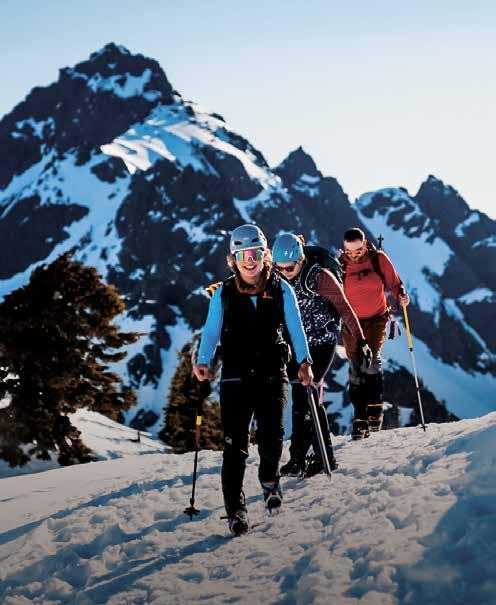
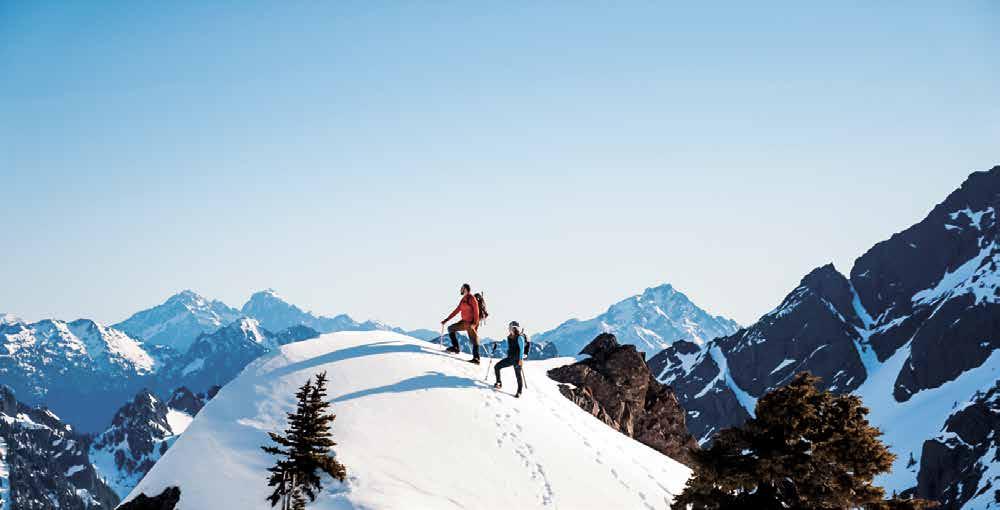
Queer Mountaineers climbers on Mt. Eleanor in the Olympic Mountain Range – Photo by Sarina Pizzala
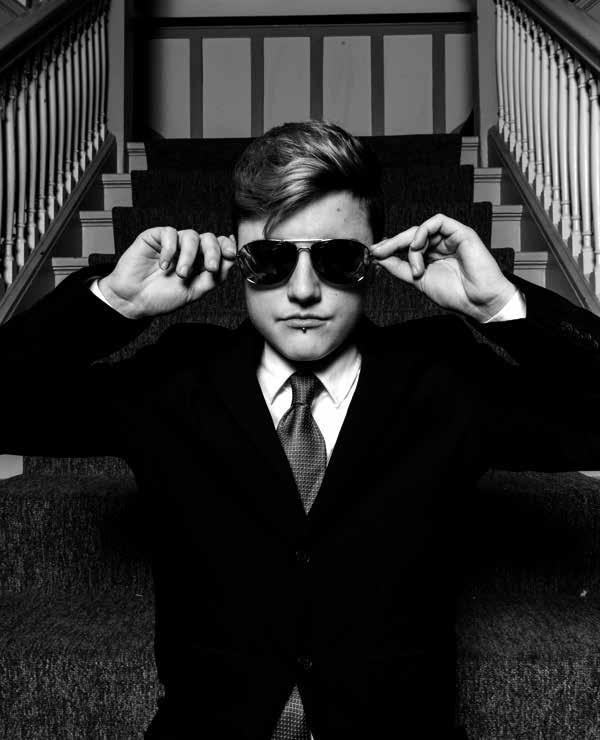
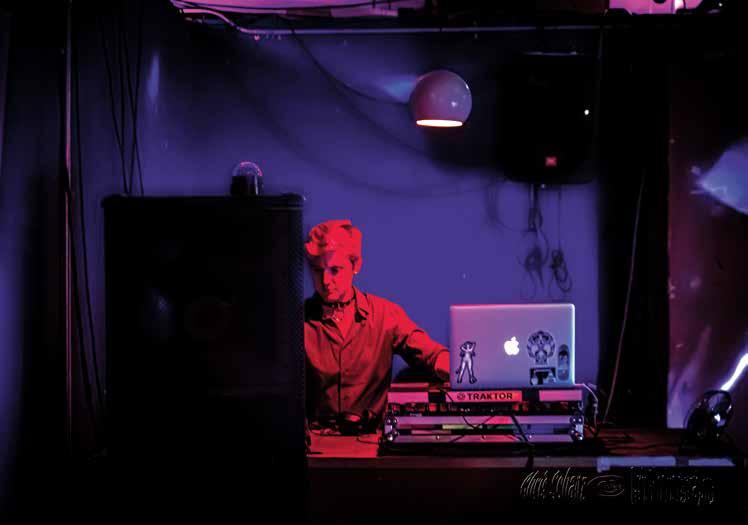
Photo courtesy of DJ Big Ugly
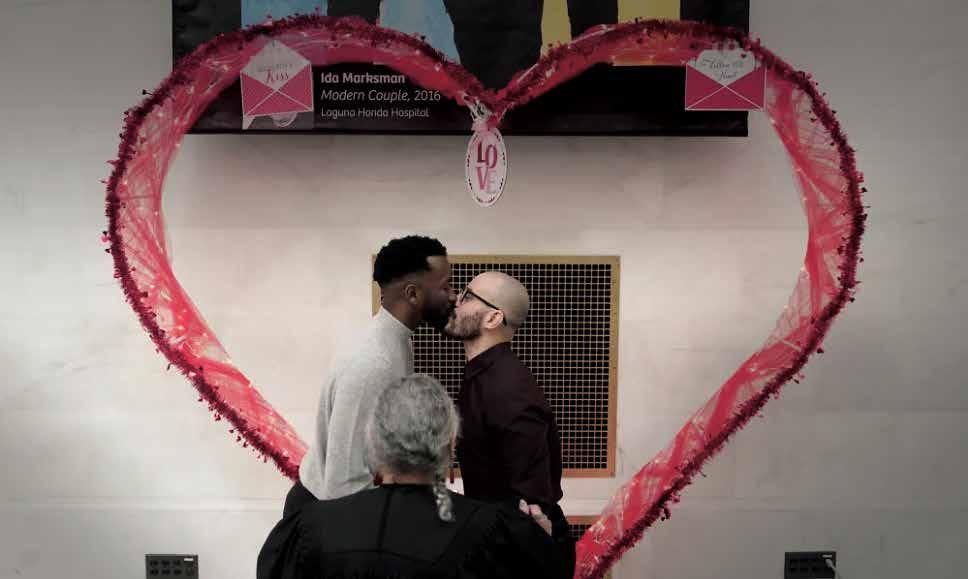
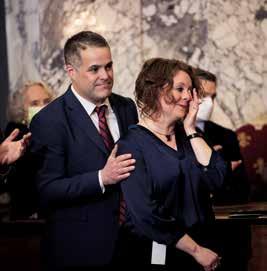
Jeremy Yancey (l) kisses Fabio de Andrade while getting married at City Hall in San Francisco, Tuesday, Feb. 14, 2023
– Photo by Jeff Chiu AP
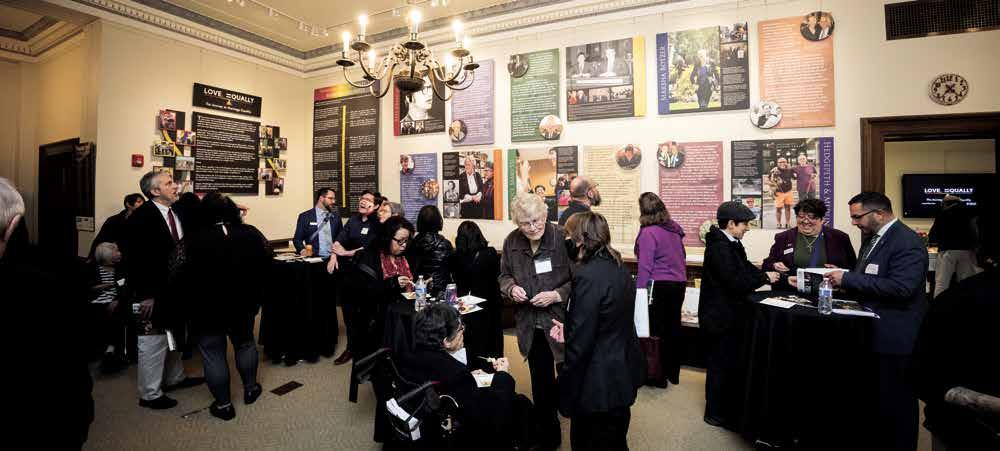
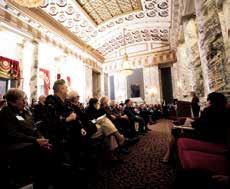
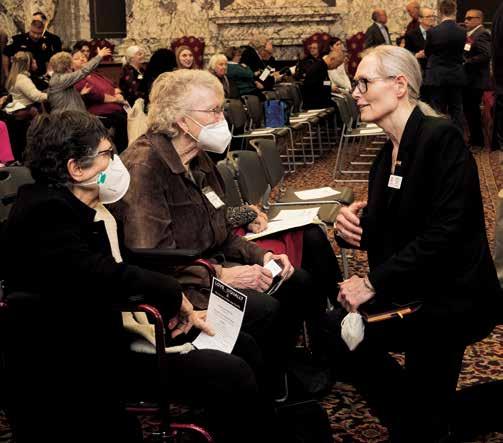
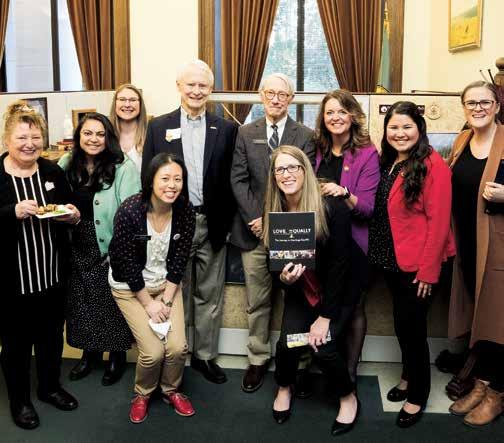
Office of the Secretary of State and Legacy Washington’s “Love, Equally” Exhibit Opening
Tuesday, February 14, 2023 at the Washington State Legislative Building in Olympia, Washington
Photographs by Shanna Paxton Photography
MOUNTAINEERS
continued from cover
“It started as a small, little hiking group that I created back in, I wanna say 2019,” said co-founder Jude Glenn, who goes by any pronouns. It was a casual thing, he said, where people could “throw in” plans and invite friends.
In a video conference, Glenn and cofounder Sarina Pizzala spoke about Queer Mountaineers’ beginnings, goals, and activities. Though they sat indoors, they were surrounded by the tumbling greenery of potted plants.
“And then 2020 just killed that group,” Glenn went on. “We couldn’t do any community things at that point.”
It was a trek down Mt. Eleanor last summer that brought about the idea to pursue something grander — a less insular space, open to more people in the Queer community.
They “decided it was gonna be a lot more organized this time,” Glenn said.
Pizzala explained further: “For context, in Seattle, and even across the country, there’s not really a group like this that exists, that focuses on getting Queer community outside, especially into technical places in the mountains.”
Climbers and hikers might disagree with the above, pointing out that there are Queer groups for climbing and hiking. But “mountaineering” involves a much broader range of skills than either of those activities on their own. The common term for terrain
that would demand a good portion of those skills is “technical.”
“That could be scrambling, back-country skiing... requiring ropes, crampons, [an] ice axe,” Pizzala explained. “So, often there’s extra gear needed, extra knowledge needed.”
“As far as the technical aspect, it felt like an empty space there that we were happy to help try and [fill],” she said.
Bringing the mountain to the Queers
Glenn got into mountaineering in 2019, “and being nonbinary, I felt like there just wasn’t this space for me in the mountaineering world,” he said.
“After 2020, I decided I wanted to push myself... I wanted to live, and just go all in on mountaineering.”
Glenn used the term “peak-bagger” for the mentality of the cisgender, heterosexual men he mountaineered with with at first; the men’s singular focus was to conquer one mountain and move on to the next, at the expense of actively sharing a “transformative experience,” as Pizzala called it.
“It wasn’t that community of, ‘Let’s nurture you and help drive you,’” Glenn said. Instead, it seemed commonplace to carry patriarchy up the slopes as well.
“Historically, mountain sports are very much overrun by white, cis, older men and the privilege that comes with it,” Pizzala said. “So there’s been a gap in accessibility for LGBTQIA+ folks to access these kinds of activities. So this group hopes to increase access.”
“Which makes Washington a pretty ideal place to have this kind of group,” she added, “because we have access to so much amazing technical terrain, and when you’re doing that, you want to feel safe and supported with your community.”
Queer Mountaineers’ two biggest priorities, then, are community and access.
To build community, the group meets in some of the usual places, like Optimism Brewing Company on Capitol Hill and Reuben’s Brews in Ballard, but a good portion of its events take place at climbing and bouldering gyms. According to Glenn, a few members have expressed gratitude for finally having a Queer space that isn’t centered around alcohol.
It’s unusual for a Queer space to be nonurban, too. The group gets together for day hikes, “ski and shred” meets, and other outdoor events, which ties into the subject of access, since the more experienced members run free clinics on mountaineering skills like snow camping, climbing, and the like.
“We’re comfortable teaching those skills,” Pizzala said. “[For] anything beyond that, we’d want a guide involved.”
More recently, Queer Mountaineers has been applying for grants. Money, Glenn emphasized, is one of the biggest barriers to entry for mountaineering, because starting out on your own requires training and equipment — both prohibitively expensive.
A six-week mountaineering course cost Glenn $1,000–2,000. With equipment and supplies for the first two peaks, the total
went up to $10,000. The right grants could help pay for equipment and training that could get Queer people who’d otherwise be stuck at sea level to a mountaintop and back.
Hiking and healing
Glenn and Pizzala aren’t just sharing skills and gear, though. They’re sharing access to hard-to-reach parts of the world that have great spiritual weight, and expand the boundaries of Queer safe spaces to the horizon. There, away from the stress of modern life, one might have room to think and heal. Glenn described mountaineering as a way to build confidence in a world that chips at it constantly.
“I wanted to prove to myself what I was capable of, because society has really torn down the Queer community over time, and kept us in our own little bubbles,” he said. “So getting out there and showing yourself what you can do, showing yourself what you’re capable of — especially in mountaineering, because you’re out there for hours on a mountain, and telling yourself, ‘one more step, one more step’ — becomes meditative.”
Pizzala hit similar notes, but her stakes in the hobby held a different weight and urgency.
“I feel like mountaineering was an escape for me in a previous abusive relationship, and as I built the skills within that world, I gained a lot of confidence and motivation to take that into my daily life,” she said. “I was able to leave that marriage.”
“I think it’s completely life-changing, and something that other people should be able to experience,” she added. “Now, seeing that light in people’s eyes is what really drives us to do what we’re doing with this group.”
In the wake of the lethal shooting at Club Q, Queer Mountaineers partnered with the Seattle Bouldering Project to raise money for the National Compassion Fund. Organizations like Outdoor Research, Eddie Bauer, and Nör Hex donated gear for giveaways. Between that, money donations, and merchandise sales, the group managed to raise $2,600 for the survivors and victims in one night.
“We are shook,” the group wrote on Instagram in response to the event’s turnout. “Everyone really came through to help make it happen.”
As for the group’s future, its members are “nothing if not dreamers,” Glenn said. A fundraiser is planned for March, and they’ve been in contact with Edgeworks Tacoma, gyms in Portland and Snoqualmie, and a group with a similar goal, OUT in the Wild, who are all “so stoked to work with us.”
To keep up with Queer Mountaineers’ events and clinics, follow it on Facebook or Instagram @queer.mountaineers.
Co-founders Jude Glenn and Phoebe Ngo on Mt. Eleanor in the Olympic Mountain Range – Photo by Sarina Pizzala
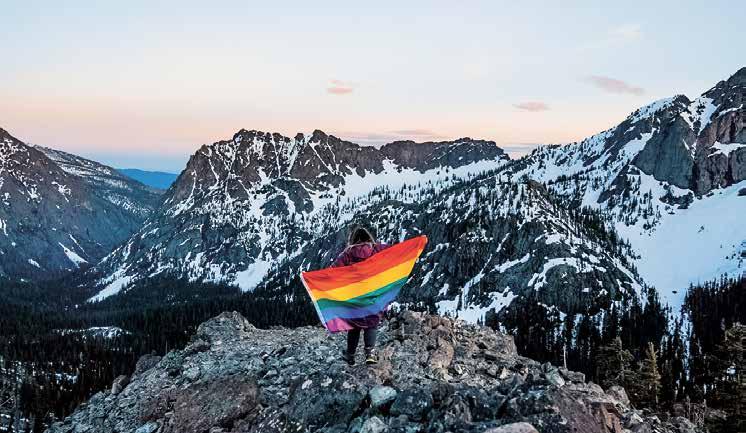
Co-founder Sarina Pizzala in the Central Cascade Mountains holding a Pride flag – Photo by Sarina Pizzala
Local News
Beastie Girls brings personalized pet care to Capitol Hill and beyond
by Georgia Skerritt
SGN Contributing Writer
When Jillian Anderson and Christina Youmans met as neighbors in a Northgate apartment complex over 17 years ago, they had no idea they would end up as partners in work and life. Today, the couple work together to run Beastie Girls, their private pet-sitting business based in Capitol Hill.
Of course, with a reputation as one of the most dog-friendly cities in the US, it’s no surprise that Seattle offered their business the right foundation to blossom into what it is today. With 1.9 dog parks per 100,000 residents, 351 dog-friendly restaurants, and four dog-friendly shopping centers (according to a SmartAsset study), the city is certainly a prime spot for these two animal lovers to work.
While both women adore their jobs and the animals they meet along the way, their paths toward pet-sitting looked a bit different. Having grown up in Utah with a family that loved animals, Anderson was fawning over cats and dogs from an early age. “My mom was just this huge animal rescuer. We had all kinds [of animals]: dogs, cats, ferrets, birds, even iguanas,” she recalled in a recent interview with the SGN
Though Anderson had always known about her fondness for animals, Youmans took more time to discover hers. Having grown up in an apartment in Los Angeles that didn’t allow any pets, her experience with animals was more limited in her early years. “It’s been interesting as an adult to sort of pivot to this job,” she said about her line of work.
“You’re so good with them — it’s like you’re the one who’s grown up with them,” Anderson quickly added, holding her partner’s hand and smiling. Upon meeting the duo, it’s easy to tell that they truly love one another and the work that they do together, which they’ve been focused on for about 15 years.
The first signs of what would eventually become Beastie Girls appeared around 2007, when Anderson was working as a nanny and studying to become an ASL interpreter. When families she nannied for started to ask if she was interested in petsitting, the overnight visits began. By 2015, the business was much more concrete, and the duo began networking with new clients via NextDoor and word of mouth.
Seven years later, the couple now juggles several clients a week and can see upwards of 30 visit/overnight requests on a single holiday weekend. Holidays like the Fourth of July, Christmas, and New Year’s bring a stressful boom in business for them; during the summer months, as families travel, there is also a general increase.
Over the years, Anderson and Youmans have worked to create a work-life balance that best suits them, and part of that equation means dividing up work between them. “We’re a good partnership — with everything. So I think it’s been really great,” Anderson said.
“We split up work easily too,” Youmans added. “If we go to a job together we’ll both do separate things: she’ll go chill with the animals, and I’ll do the housekeeping stuff.”
In addition, Anderson takes on communications and scheduling duties, while Youmans does design and advertising for the business.
Beyond a solid partnership and passion for the job, Beastie Girls sets itself apart from other pet-care options with its size and authenticity. When asked about expanding the business or hiring extra hands, both women explained that the pillar of their work is in the personal relationships they forge with clients and pets alike, so expansion doesn’t work so well with that kind of business model.
“We’ve tried to get a team like us to house-sit when we go out of town, but we can’t find anything. It’s all corporations or using apps, and you get someone new every time,” Anderson said. Nodding in agreement, Youmans added, “That’s why we
stay small. When you meet us, you’re meeting the people who will be with your pets. No one will ever be in your house but us.”
By maintaining a small, personal business, the couple is able to build up trust with animals over time, which is another draw of the small team model. Anderson explained that creating a comforting experience for the pets they visit frequently is extremely important to them, and part of that can only be possible if the same people
visit every time. “That consistency doesn’t exist around here anymore,” she concluded. Owned and operated by people who truly love what they do, Beastie Girls will continue to offer personalized, quality care for Seattle pet owners for years to come. Upon reflecting on the business, Youmans wrapped up on a tender note: “I just feel really grateful to work with my best friend doing something we love in a neighborhood we love. Who wouldn’t?”
If you or anyone you know is looking for reliable pet care in Seattle, whether it’s a weeklong business trip or a short weekend to a family getaway, Beastie Girls wants to help.
Beastie Girls is based in Capitol Hill and offers both overnight stays and daily care visits. For more details and contact information, visit https://beastiegirlspetsitting.com.
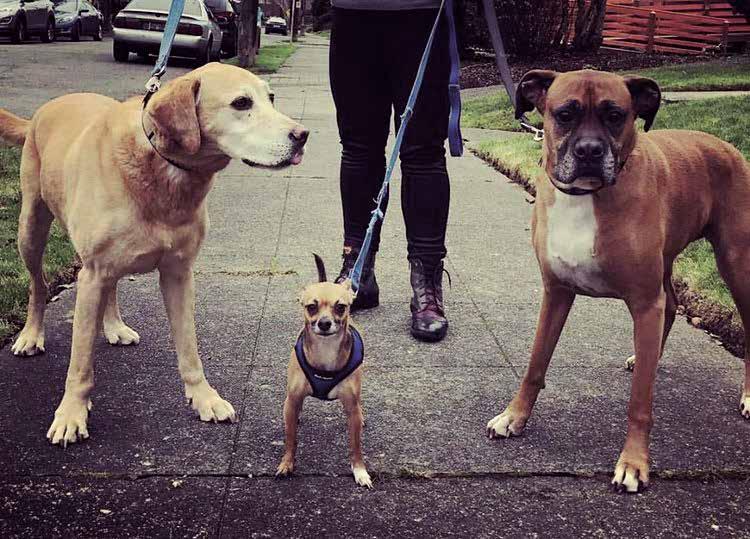
Dog pack – Photo courtesy of Beastie Girls
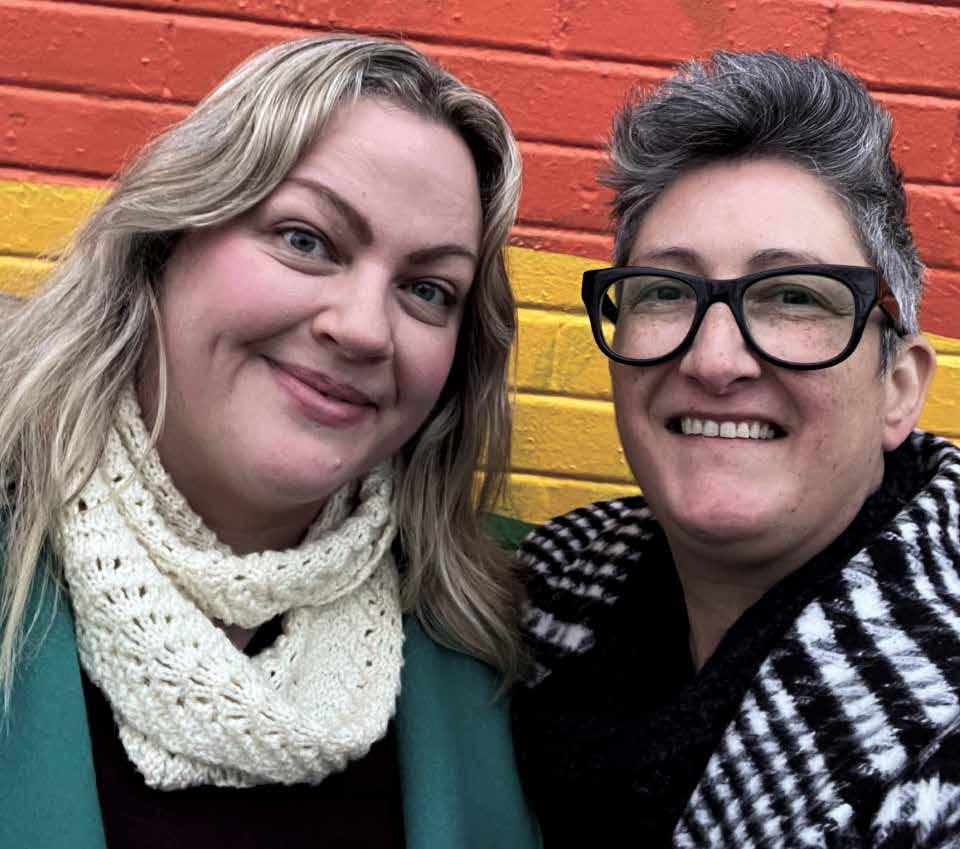
Photo courtesy of Beastie Girls
Arts & Entertainment
Redefining “ugly”
His stage name may sound silly, but he has a backstory.
“Big Ugly is just because everybody is like, ‘aka Little Cutie,’ and I’m like, ‘Yeah,’” he said with a laugh. “Sometimes I’ll sign my emails like that. I’m not big, and I don’t consider myself ugly. At the same time, I think seeing that on a headline and then seeing who I am gets my personality across.”
The name has also inspired one of his favorite events to host: Bump Uglies. “I love, as is the tradition of Re-bar and old Queer culture, just being tongue in cheek. ‘Bump uglies’… used to be an old, clean way to say ‘sex,’ but I also think it identifies the Queer experience,” he explained. “I think people specifically talk about gender and genitalia.
“When I think Bump Uglies, it is just like everybody’s dancing, people are looking for hookups, but we’re all out there.”
Like many in the Queer community, Big Ugly finds power in recontextualizing a word associated with negativity and shame. “I also want to retake the word ‘ugly’ as not being a bad thing,” he said. “It’s okay to be weird and ugly and have a good time.”
Every letter in the rainbow
For Queers on Capitol Hill, “ugly” is becoming synonymous with “good vibes,” thanks to Bump Uglies. “It is a Queer dance party. It’s for every letter in the rainbow,” Big Ugly said of his regular LGBTQ+focused event.
Although there are locations like Wildrose or the Cuff that appeal to specific identities and kinks, Big Ugly wanted to create a space where Trans people can feel welcome and safe. “I wouldn’t say there’s a lot of exclusionary vibes [in Seattle], but there’s not a place that can bring everyone together, specifically, as someone who identifies with the Trans experience. I want Bump Uglies to be a place where people can not only see Trans people but also dance and be free and comfortable in a space with other Queer people who aren’t TERFy.”
Not only does Bump Uglies center Trans people and experiences, but DJ Big Ugly has also worked hard to make sure it is a space that uplifts BIPOC people. “I also love highlighting people of color... I feel like a lot of ownership of venues is typically through cis white people, so I like to bring out big stars that I know in the POC and Queer communities.
“For me, it’s just for every letter of the LGBTQIA+ rainbow to feel comfortable and connect.”
Lo-Fi Performance Gallery usually hosts Bump Uglies. While the event has been on a hiatus, it will be back this week. “Bump Uglies is back on February 16, and I am excited about that,” Big Ugly said. “The lineup is just stacked.”
The performers will include T Reverie, Kween Kaysh, Justice Manslayer, Hyper Poppers, and, of course, DJ Big Ugly. “It’s just going to be a very fun night, good dancing for sure,” he said.
Access to the party is easy. “It’s a payat-the-door situation. I would just follow on Instagram @Bump.Uglies to find that information.”
Before Lo-Fi closes for good in the spring, DJ Big Ugly wants to plan on one more Bump Uglies for April. “I’m bringing it back, because Lo-Fi is closing in April, so I’m doing it there. Then I want to move it to a space that is completely Queer owned and operated if possible. I’ve been talking with a few places.”
When DJ Big Ugly isn’t planning Transcentered nightlife events, he can be found in some of Seattle’s most established Queer venues.
“I’ve been trying to ‘Make Neighbours Gay Again.’ I’ve been playing most Fridays at Neighbours. [We are] trying to bring that space back to its Queer roots more than it has been previously,” he explained. “Supporting Queer is still very important. We need to band together right now, because the canvas of Seattle is changing very rapidly. After Re-bar closed, it was heartbreaking for me. I think supporting original Seattle venues is so important, specifically Queer spaces and Queer folks. We’ve got to stick together.”
DJ Big Ugly’s favorite gigs are the ones where he is surrounded by members of the Queer community, regardless of the space.
“I did a beautiful wedding over the summer,” he said. “It was the first time I worked at a Jewish wedding. It was up in Leavenworth at a beautiful outdoor venue, and that was a highlight for sure. They found out about me through a friend, [not] through a
company I work with. That was rewarding. I still talk to the couple.”
Aside from classy wedding venues, he also loves performing at high-production parties. “I was a part of the two Voltex Halloween parties at the Ruins before that venue changed over. That was just so cool being a part of this whole experience. The whole thing was the coolest thing I’ve ever seen or done.”
As a DJ, he works at both big and small events. The most important part of the gig for him is connecting with other people through music.
“I love when you connect with somebody over a song, creating a mood and vibe,” he said. “I love curating a space. I sometimes don’t like playing in venues where it’s all about dancing. I like curating the experience... connecting with people over music and vibes, that moment when you go, ‘Oh, you know this song?’ ‘Yeah, I know this song.’ Stuff like that is great for me.”
Well-established Queer venues are the perfect places for forming these musical connections. “I love playing at The Rose, he said, “just because it has such family vibes. It’s a fun space. It’s very close and personal to my heart. Lo-Fi has been a very special place for me as well, not only for burlesque but also DJing. Re-bar was also a great spot. As somebody who goes out, I love the Kremwerk complex. I’ve also been getting to know Neighbours as well.
“I love places that are older but still have their roots, especially Queer culture in Seattle.”
Y2K forever
While he’s been DJing across Seattle for nearly two decades, there’s one genre of music Big Ugly says will never go out of style: “The early 2000s. Those hits will never die. Especially within my lifetime, the era of the music video, stuff like that.” The 2000s are meaningful to Big Ugly because of the emphasis on music videos at that time, which he likes to incorporate into his work when he can. “I’ve been doing more VJing lately,” he said. “When I play out, I like to play electronic house music and a little bit of throwback hip-hop as well. I’d say my style is the early 2000s and house. I like to play it all. …I’m a music librarian first and a DJ later.”
DJ Big Ugly is changing the scene while also working to preserve the heart of Capitol Hill’s Queer history. His talent is only matched by his versatility and ability to blend into different scenes while still staying true to himself and his identity. As Queer Seattle continues to change, his name will remain cemented in the beats of our culture.
Preserving Seattle’s unique Queer culture
Photos courtesy of DJ Big Ugly BIG
Heartfelt Of an Age is a moving melodrama of self-exploration
by Sara Michelle Fetters SGN Staff Writer
OF AN AGE Theaters
It is the summer of 1999, and 17-year-old Serbian immigrant Kol (Elias Anton) is not having a good morning. His best friend and dancing partner Ebony (Hattie Hook) went wild the prior evening and woke up on a beach over an hour outside of Melbourne without her purse, money, or any identification. Making matters worse, today are the Australian Dance Finals, and they are supposed to be performing. It’s an impossible situation, and Kol is frantically trying to come up with a solution to their seemingly insurmountable problem.
Ebony has an idea. Kol needs to find her older brother, Adam (Thom Green) and convince him to pick her up and then take them both to the dance finals. Even if he agrees, there’s still little chance they’ll make it. But at least they can say they tried, and that’s something.
Of an Age is writer-director Goran Stolevski’s striking, quietly personal follow-up to his masterful debut, You Won’t Be Alone. While that film was a passionately feminist thriller revolving around a shapeshifting witch who learns about humanity by taking on the skins of those she kills (both intentionally and accidentally), this new drama is an exceedingly grounded coming-of-age tale about a young man confronting his internalized homophobia.
Yet both motion pictures are intimately connected. They are each, at their core, about identity. They are about the search for self and have a shared fascination with what it means to be human. Stolevski asks penetrating questions and frequently lets the audience determine the answers on their own. How a person solves these impenetrable mysteries is personal to them and to them alone, and I cannot help but believe that is entirely by design.
Granted, Of an Age is a far more straightforward and comfortably conventional motion picture than its ethereally esoteric predecessor. Kol is a teenager living in a staid, conservative community who is afraid
to accept he is Gay and would rather live a lie than come out of the closet. This day, much of it spent in a car with Adam, transforms all of that. There’s not a lot more to it.
Don’t let this narrative simplicity fool you, though. Stolevski crafts multidimensional characters who are vibrantly alive, and Kol and Adam’s conversations have a concrete authenticity that’s irresistible. Almost the first third of the picture revolves around the two young men sitting in a car learning about one another. Hopes. Dreams. Plans for the future. Family lives. Relationships with parents. It’s all there. More importantly, it’s all real.
The kicker is the moment Adam casually reveals he’s Gay. In lesser hands, Kol’s reaction could be construed as melodramatically exploitive. In Stolevski’s, it is anything but. Kol’s sudden, violent bout of nausea is born from a place of deep uncertainty and a refusal to admit long-held truths he’s wanted
to keep concealed. But Adam inadvertently puts a mirror in front of his road-trip companion, and what happens next catches both by surprise. By the time they reach Ebony, it’s clear everything they thought they knew about their futures has irrevocably changed. Anton and Green are outstanding, and their chemistry is infectious. Good thing, too, because with so much of the film showcasing just the two of them in a confined space chatting and not a heck of a lot more than that, had either not been up to the challenge, Stolevski’s sophomore outing would have crumbled into teeny-tiny pieces. But the pair play off one another beautifully, and much like Ethan Hawke and Julie Delpy in Before Sunrise, the heat Anton and Green generate could power multiple stories, assuming the director wanted to see where Kol and Adam’s travels might take them as they get older.
Speaking of time jumps, the last third does move forward roughly a full decade
and is set at Ebony’s wedding. What’s happening with Kol and Adam, where they are at in their lives, and whether or not they’ve been conversing aren’t items I want to get into here. I will say this section of the film does not work nearly as well as the pieces before it do, and it took me a moment to embrace the differences in each character, as they were rather drastic.
But, like everything else in Stolevski’s drama, they are also honest, and this helped quiet my unease. This climactic section doesn’t necessarily resolve Of an Age as it opens up new avenues of exploration that captured my imagination and filled my heart with cathartic joy. Gay. Straight. Trans. Bi. Everyone walks down their own path, and Kol isn’t any different. He isn’t the same insecure, jittery, juvenile I met when the film began, and that’s exactly as it should be.
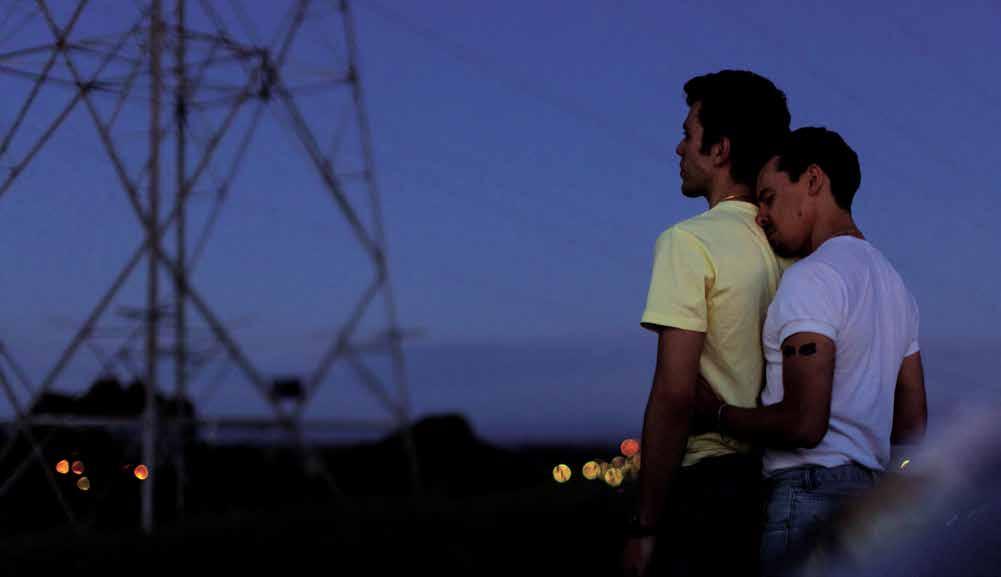
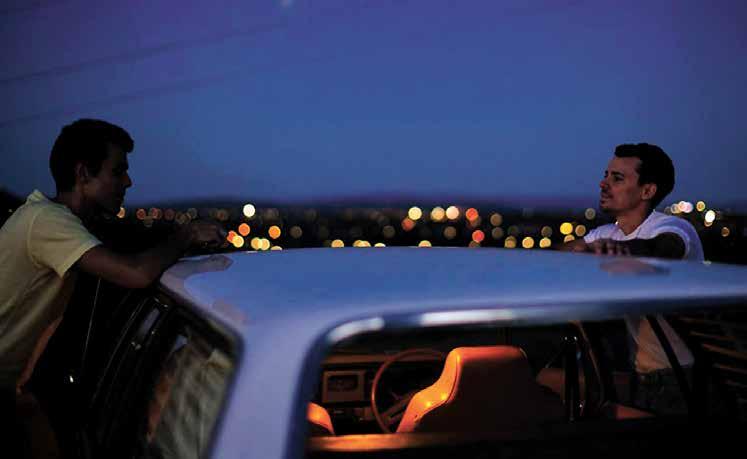
Elias Anton and Thom Green in Of an Age – Photo courtesy of Focus Features
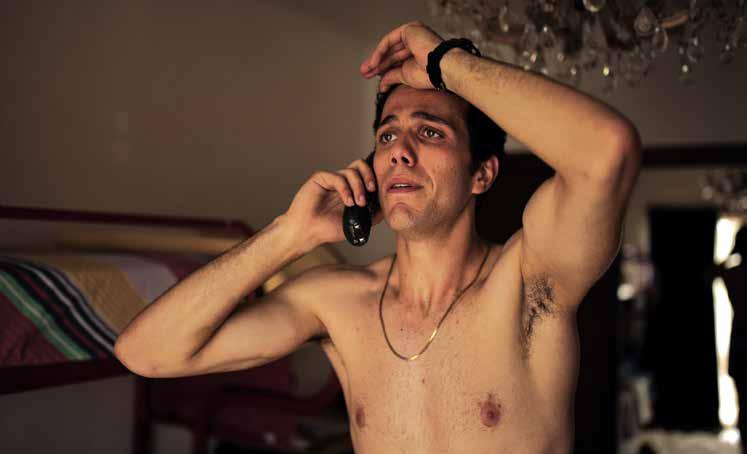
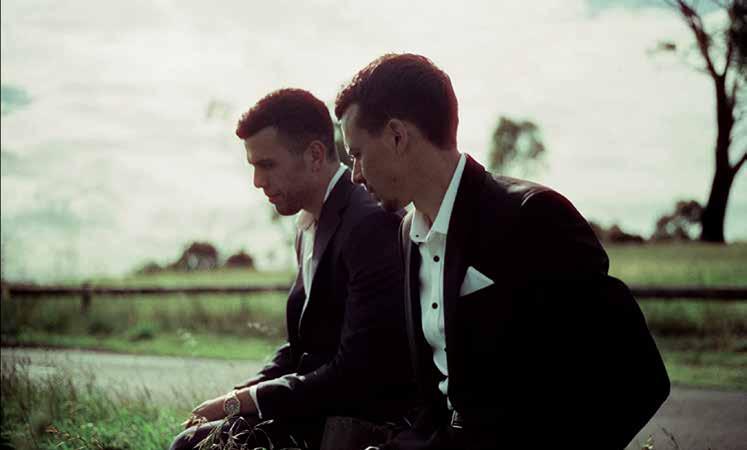
Elias Anton in Of an Age – Photo courtesy of Focus Features
Making a connection
Driving in cars with boys with Of an Age director Goran Stolevski
by Sara Michelle Fetters
SGN Staff Writer
Filmmaker Goran Stolevski has followed up his striking, ethereally haunting feminist debut You Won’t Be Alone with the male-driven coming-of-age character study Of an Age, and the pair fit together beautifully. Where the former is a suspenseful 19th-century journey through witchcraft, identity, and humanity, the latter is a coming-out tale of a young Aussie immigrant grappling with his sexuality after a chance encounter with the Gay older brother of his best friend, circa 1999.
Both films are fascinated with self-exploration. Their main characters are learning who they are and figuring out who they want to be, with various individuals coming in and out of their lives and influencing their steps along the way. While fundamentally different in tone and execution, each still showcases Stolevski’s exquisite directorial confidence. This makes him a singular talent worth keeping an eye on. Of an Age is split into two pieces. The first two-thirds takes place over the course of a day or so during the summer of 1999. After receiving a frantic call from best friend and dancing partner Ebony (Hattie Hook), 17-year-old Kol (Elias Anton) finds himself begging the girl’s older brother Adam (Thom Green) to give him a ride so they can rescue her from a beachside phone booth an hour outside Melbourne. Along the way, the pair make an instant connection, and this forces Kol to realize truths about himself he’s desperately been trying to suppress for far too long.
The remainder takes place roughly a decade later, but the less said about it, the better, as this final third should be experienced without any spoilers.
I sat down with Stolevski over Zoom to discuss Of an Age and how it compares to You Won’t Be Alone, and while we tried to avoid conversing about anything that should be left a mystery, there are a couple of instances where we do touch on a few key plot revelations. Keep that in mind before proceeding.
The following is the edited transcript of our brief conversation:
Sara Michelle Fetters: What I loved about You Won’t Be Alone and Of an Age is that they really do play very well together. They are these journeys of self: who we are, what we are, where we’re going. I’m imagining that this is a theme that’s important to you, this discovery of self.
Goran Stolevski: Yeah. In certain circumstances where you’re the outsider, where you can’t really quite fit into a community but you desperately want to connect. I keep pointing out: you could call this film You Won’t Be Alone as well, but that title’s taken. Loneliness and connection is sort of what I feel was the key crux of You Won’t Be Alone People thought it was about claws. [laughs] But no. I feel it’s about belonging. With this one, I think a more interesting connection is what it’s really about as well.
I don’t insist on wanting to make films that are thematically related. I don’t have an ambition to be a classic auteur or whatever. I kind of go with what makes the chest bump most intensely. But [as for] both of these films, the previous one was my personality split in half between two women who happen to be witches in the 19th-century mountains, whereas this is clearly my personalities playing between these two kids in 1999.
SMF: With this one, you take a storytelling and creative leap of faith, in that you spend at least the first third, probably more than that, with two characters talking in a car.
GS: Yep.
SMF: From a directorial standpoint, that had to be challenging. From an acting standpoint, that had to be challenging. From a visual standpoint, that had to be challenging. And I’m sitting there watching the film, mesmerized. I can’t take my eyes off of it. How did you meet all of those challenges?
GS: If only I knew. [laughs] That was one of the main things going in. The two main challenges or obstacles that I thought I would have, even before we cast it, [were] how you find a way to either have one person play 17 and 28 believably or find two people who can match the energy without interrupting that flow for an audience, and the other issue, for the first 16 or so minutes, it’s a certain kind of story, because it’s taking place from a certain kind of emotional reality and state of mind. But then there’s a shift. The shift comes from a certain place, because, to me, the first minutes [are] how day-to-day life feels for this kid, and that’s how adolescence felt for me. There’s that tearing of the universe, where that day-to-day is just kind of suspended, and [then] there’s this thing, this event that just changes you, and you don’t
even realize it’s changing you in real time. That’s all lovely to talk about theoretically and directorially, but having an audience get used to this kind of pacing and energy, only to suddenly shift and you’re driving slowly and talking slowly,… [is] a really strange thing. I mean, “leap of faith” describes it. When we were shooting, we had two cameras running, and we were watching. The first proper take we did of that scene was 32 minutes. They were driving in a loop. I’m lying back in the back seat so that I’m not visible with the double monitor, and the two guys are in the car. The three of us are kind of alone, and then there’s no other cars around us for safety.
We just forgot that the world existed, that time existed. For 32 minutes, [Elias and Thom] would look back and forth, improvise, do the lines as written, whatever they felt. There wasn’t a cut. I would maybe chip in if there was a silence to make a suggestion, but that was it. The only way we know it was 32 minutes is because the battery [in the camera] ran out, and we had made the full loop. [laughs]
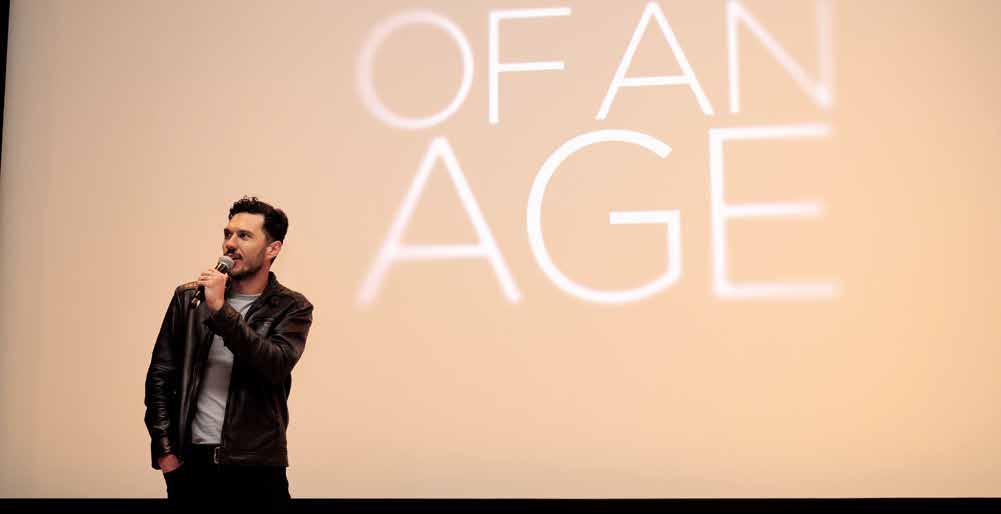
Director Goran Stolevski – Photo courtesy of Focus Features
Elias Anton and Thom Green in Of an Age – Photo courtesy of Focus Features
STOLEVSKI
continued from page 9
But to us, it felt like three minutes. You forgot that it wasn’t reality.
SMF: When did you know that Thom and Elias could pull this off?
GS: I was very confident, partly based on the options I had. There was no backup. [laughs] There were a couple of other interesting kids whose acting I liked that I will definitely work with on a different film. But in terms of people who fit these roles and could believably have chemistry with each other, I was confident this was as good as it was going to get. I thought, if it doesn’t work with [Elias and Thom], maybe the problem was me, maybe it was the writing. Something is there or it isn’t there. But if there isn’t something there, it’s not the fault of the actors.
We didn’t do rehearsals beforehand, but we spent a lot of time together just connecting. I would talk through the script, so they knew what my intention in writing every single line was. They were aware of where it came from, so that if they changed anything — and they had the freedom to change it or delete it — they knew where it was coming from.
The first day, we did a test scene together, and it was already electric. The first scene we shot was the first time before Kol vomits. It’s a different energy, and it played out very different to what I thought it would in terms of how I wrote it. But from those first takes, it still felt like, yeah, this is a movie. This is the movie I wanted. I wanted to watch more. These actors were the best possible gift you could have as a filmmaker.
SMF: I love that you talk about that moment with the vomit. I mean, it is icky, I’m not going to lie. It’s vomit. It’s gross.
GS: Right. I’m also extremely squeamish. No one believes me, but I am. [laughs]
SMF: Wow. After your last movie?
GS: Yep.
SMF: I’d never have guessed, based on that one. Anyhow, the reason that I like that scene is that that moment is there is because of what Kol is dealing with. It’s hinted at, and it’s not difficult to put one and one together as far as what his journey is and what he’s going through. But to be in that moment where somebody tells you something and you realize it’s your truth at the same time? I mean, he’s not making a judgment. He’s realizing something about himself and it’s difficult. Or, at least, that’s how I took it.
GS: I’m honestly not sure. I think there’s the unconscious realization. That’s the
panic of it. In my case, I didn’t meet a Gay person in real life until after I was openly Gay. I was the only Gay in the village.
Even after I came out, no boy told me any secrets. I lived in the studious, most boring part of Melbourne. I think it’s like, if you are a Gay human being, you just spontaneously combust rather than live there by choice. Anyway, I somehow got stuck there in Melbourne. The closest I can think of in my own life in terms of seeing a Gay character, it was in a film. I grew up in a lot of art house cinemas, so just an attractive man taking his shirt off? I’d be like, why am I having these feelings? They would make me angry. I was still in denial.
There is a panic that comes across in those moments. And how dare someone even imply it, right? There’s a semiconscious thing where you know, but there’s also an active denial. I think, in that moment when he finds out for sure, it’s that part — the active denial — taking hold. But it’s immediately followed by an element of trying to be totally cool with this. There’s a gradual reset in the story, where it starts all over again, and, as an audience, you’re processing these feelings in real time.
I think that moment came from me imagining “what if.” Not when I was 17 — I was already militant. But at 13? At 14, when I was just as Gay but in deep denial and had
grown up with homophobia, not as a type of prejudice but as the only reality that exists?
How would I have coped? That moment felt natural.
It took me ages to realize how much of my brain was really stuck in a binary system, quite female, and how much of that I had to suppress later on. When I was five, I used to play with dolls and that didn’t get in my way. But at some point, I learned we don’t want to get beaten up playing with dolls. And so on and so forth. That instinct takes over.
But I wasn’t interested in dwelling on the negative. I think anyone who would watch this film is already educated about how oppression existed for Queers in 1999. I’m not going to teach anything in that sense. But let’s start over. There’s a special kind of loneliness for a Queer kid, even to this day, but even more so in the analog era, where you couldn’t use your phone to connect with a stranger somewhere far away. The flip side of that is that if you found that someone else who’s Queer, there’s an electricity that is irreplaceable. There’s a point of you being the only two people in a room who have this secret. It’s super fucking sexy but also super poignant. You get to experience that as a Queer person.
I didn’t experience it in that way when I was younger, but later on, there were moments of that, where I felt circumstances
were forcing me to not be open with my then boyfriend, now husband, in terms of our connection. I was like, we have something and there’s an electricity in knowing that. The fact that I have something that only he and I know about, it’s hot and it’s joyous. When you know real loneliness, overcoming it is so much more poignant. With this story, I was trying to kind of find that romantically transporting, fulfilling element. I wanted these characters to make the most of their moment.
SMF: Before we go, what do you want audiences to take away from watching the film? What do you hope that they’re talking about afterward?
GS: People come up to me and go, “How did you know my life?” And a lot of them are men, but a lot of them are straight women too. I love that I can connect with people who are so fucking different from me through this story. I wrote it not assuming anyone would ever be interested. My husband read it and he cried, but he knows me. Then my producer read it, and she cried. I was like, she knows me, too, but she’s also a straight woman.
I just want these feelings I write about to keep connecting with someone, anyone else. That’s all I could ever ask for in life.
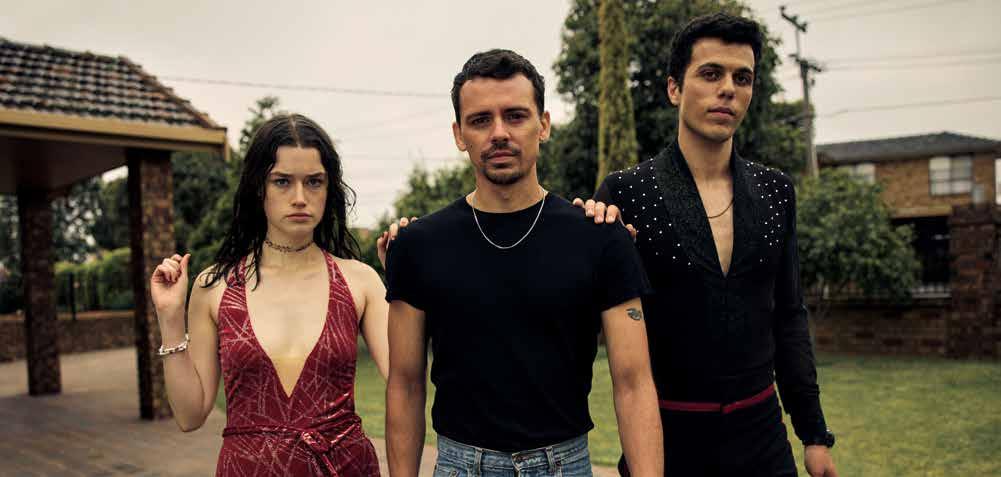
Hattie Hook, Thom Green, and Elias Anton in Of an Age – Photo courtesy of Focus Features
Elias Anton and Thom Green in Of an Age – Photo courtesy of Focus Features
Film Majors shines even as Quantumania shrinks into the multiversal void
by Sara Michelle Fetters SGN Staff Writer
ANT-MAN AND THE WASP: QUANTUMANIA
Theaters
As a surprise for her father Scott Lang (Paul Rudd) and for Janet Van Dyne (Michelle Pfieffer), inquisitive teenager Cassie (Kathryn Newton) has been working on a device with Dr. Hank Pym (Michael Douglas) and Hope Van Dyne (Evangeline Lilly) that can map the Quantum Realm. But Janet’s reaction is far from enthusiastic. She wants the device turned off and destroyed.
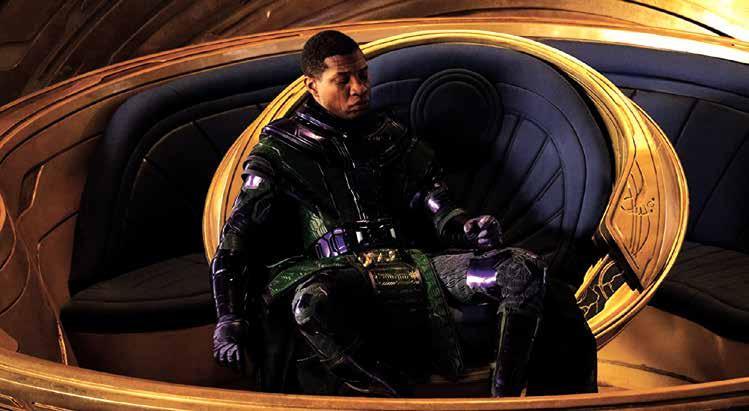
Seconds after Janet’s warnings, a strange energy wave pulls all five into the heart of the Quantum Realm. What they discover there is a world beyond imagining, filled with strange creatures and unique civilizations. Scott and Cassie are immediately separated from Hope, Hank, and Janet, and before they can rejoin their family, the two are taken prisoner by a giant mechanical head named M.O.D.O.K. and presented to the ruler of this bewildering land, the allpowerful tyrant and self-proclaimed conqueror Kang (Jonathan Majors).
So begins the latest installment in the Marvel Cinematic Universe (MCU), AntMan and the Wasp: Quantumania, focusing on the characters first introduced in 2015’s Ant-Man and further developed in 2018’s Ant-Man and the Wasp. Set not too far after the events of Avengers: Endgame, not only does this film work overtime to tell a self-contained adventure of family and togetherness, but it also has the unenviable task of setting up the “big bad” for the next few phases of the MCU.
That’s a lot to ask of a character whose best individual moment remains a fight on a miniature Thomas the Tank Engine train track against a pint-sized villain in a mechanical suit that made them look like a weaponized bumblebee. But thanks to returning director Peyton Reed and screenwriter Jeff Loveness’ credit, this sequel comes close to pulling off both tasks. There are a handful of undeniably strong moments, most of them involving Majors, Pfieffer, or both in the same scene playing off one another.
But the foundation this multidimensional craziness is built upon isn’t sturdy enough to support all the time-bending, multiversal nonsense. It collapses into visual chaos and audio overload during the final act. There’s no sense of wonder. Any semblance of awe is strangely absent. The humor is forced, and most of the dramatic elements are unnoteworthy. Other than a nice, pleasantly quiet moment between father and daughter amid all the carnage, precious little toward the end provoked an emotional response from me.
On the plus side, the great stuff is legitimately fantastic. The first half spends a ton of time on Janet, during which Pfieffer unsurprisingly dominates. Her performance is stirringly balanced, and the way she evokes fear, resilience, anger, and love with such mesmeric ease is astonishing. Janet has been hiding what happened to her during her 30 years in the Quantum Realm for good reason, and watching Pfieffer work her magic as she travels through so many emotional permutations is something special to behold.
This is nothing compared to what Majors accomplishes, however. As Kang and his
variant selves will likely be the major threat confronting the Avengers from here on in, his entry into the MCU had to be something memorable, and dang, is that ever the case. Majors knows when to speak softly, understands exactly when to twist the volume dial up to 11, and showcases a menacing physicality that’s terrifying. His Kang is a force of determined nature that cannot be easily stopped, and I cannot wait to see what else the actor does with the character moving forward.
“Moving forward.” Those two words. That’s the biggest problem that Ant-Man and the Wasp: Quantumania has working against it. As Marvel announces all of its films so far in advance, even if Scott, Hope, and Cassie end up victorious over Kang, there’s never a doubt that the villain is bound to return sooner rather than later. This makes the final confrontation an unfortunate letdown, for no matter how much effort Majors and Rudd put into their face-off, the idea that anything their characters do to one another has any weight is pretty much zip — and that’s frustrating.
I have plenty of additional quibbles, but most of those have to do with the MCU as a whole (the constant quipping, the overreliance on digital sets, climactic action sequences that look like video game cutscenes, etc.) more than it does this specific escapade. There are some inventive visual touches, and while I understand that this depiction of M.O.D.O.K. is not comicaccurate, I actually liked the way the filmmakers connected the cybernetic creature back to the first Ant-Man Look, even with all my reservations, I did enjoy enough of Ant-Man and the Wasp: Quantumania to be happy I took the time to watch it. Those who love everything Marvel does will likely have a blast, and anyone who enjoyed the main character’s first two solo efforts arguably even more so. But for the rest of us, Ant-Man’s return is notable for the villain and not a lot more, meaning this sequel shrinks into the back of the memory rather quickly, disappearing into the multiversal content void almost as if it never existed in the first place.
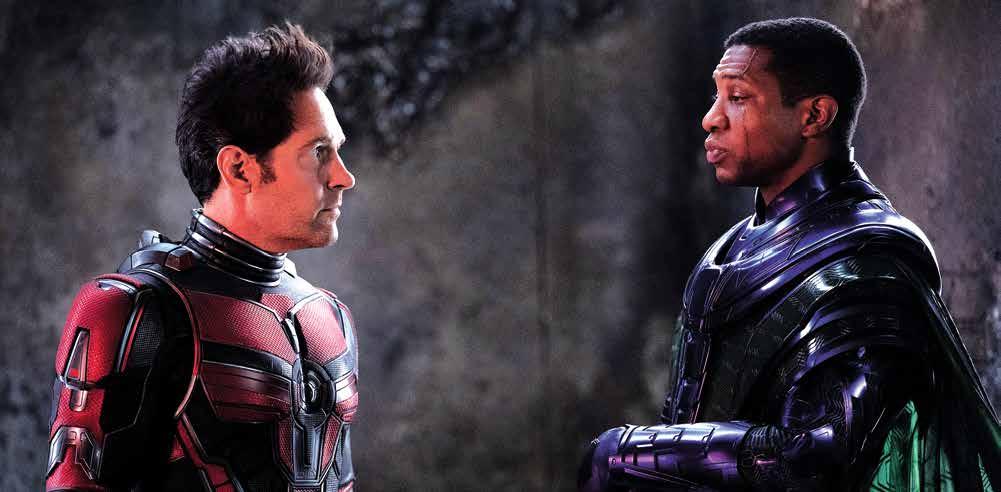
Paul Rudd and Jonathan Majors in Ant-Man and the Wasp: Quantumania – Photo courtesy of Marvel
Jonathan Majors in Ant-Man and the Wasp: Quantumania – Photo courtesy of Marvel
Books
Discover the secrets of the universe with Benjamin Saenz
by Lindsey Anderson SGN Staff Writer
When he started his career in writing and came to terms with his identity as a Gay man in the 1990s, author Benjamin Saenz was already well into his adult life and had had many experiences as a professor and Catholic priest.
“It was a different world. It was almost as if it was the beginning of a transition into what we have today,” Saenz said, reflecting on those times.
While the culture seemed to be at the precipice of change, novels about experiences other than white, cis, heterosexual characters were still exotic. “They were trying what they called ‘multicultural literature’ — that was the category they put us in,” he said.
Despite having his early work categorized as “multicultural,” Saenz saw hope in the way both the literature and education spheres were trying to prioritize authors of color, though there was still a long way to go. “I’m not sure if they would [have included] the LGBTQ+ community as much as they would now,” he said.
“It was an odd place to begin writing in that era. I was publishing with small presses,” he said. Saenz persevered and continued to develop and learn, not only about the craft of writing but about his worldview. His presence in the writing community in the early ’90s paved the way for him to become an even more influential figure as society continued to shift and demand more stories about BIPOC and LGBTQ+ experiences.
“Because of [Flowers for the Broken, a 1992 short story collection], I was able to get an agent who could sell my first novel, Carry Me like Water, which launched my career.”
Embracing his sexuality at 50 Saenz’s life changed in his fifties. Not only did he begin to write, but he also began to accept himself and embrace all his identities.
“Until my early fifties, I hadn’t ‘come out,’” he said.
His journey to self-acceptance was difficult. He had both process societal prejudices and work through past trauma.
“I had been abused as a boy,” he said. “The thought of letting a man touch me was not very appealing. It took me a long time to come to terms with that, but once I did, I wanted to write something Gay.”
When he finally sat down to write “something Gay,” Saenz realized he was not capable of writing a Gay story. His stories are not about identities but about humanity. Instead, he wrote a text about a full human who possessed many identities and was made complete by all of them.
“I don’t know what a Gay novel is,” he explained, “but I do know what it is to write a novel with Gay characters in it. It’s not about being Gay, it’s about being human.”
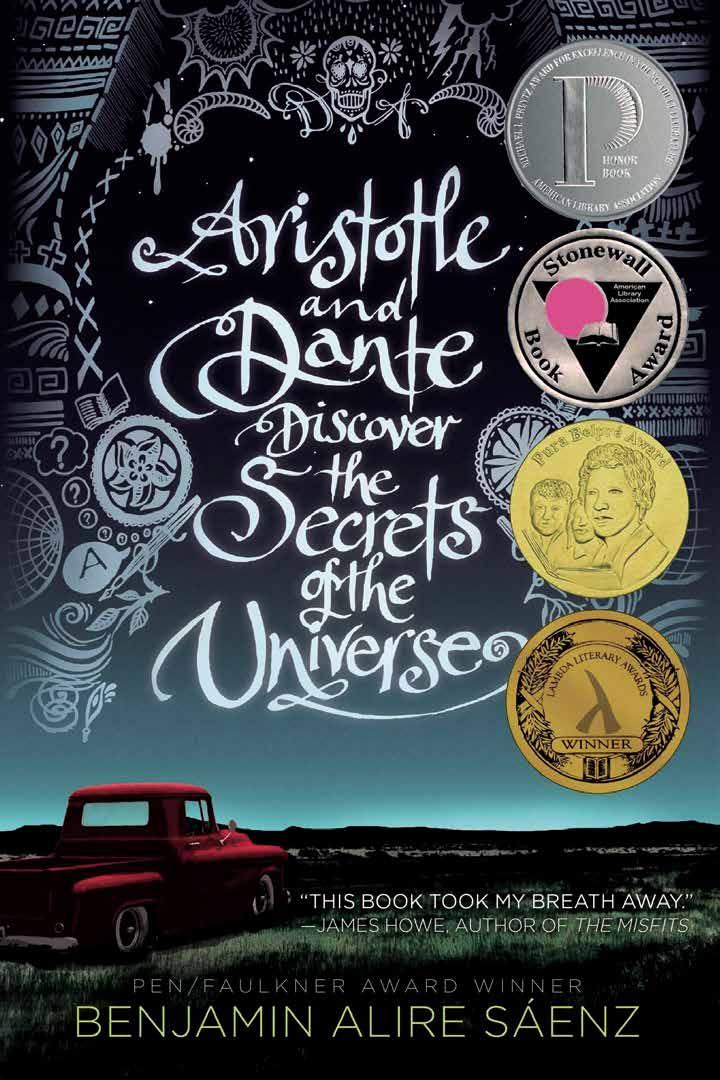
Eventually, self-acceptance led him to write his most popular novel, Aristotle and Dante Discover the Secrets of the Universe. Through Ari and Dante, Saenz was able to explore his identity. Writing their coming-ofage stories gave him the opportunity to live his own and create the world he wished he’d grown up in.
“In that novel, being Gay, discovering one is Gay, is normal. It’s not a big thing. And being Latino is normal. I normalized those experiences.”
Writing those identities into his characters allowed Saenz to stay true to himself.
“I don’t perform my ethnicity on the page,” he said. “I refuse to do that. I’m not a zoo. I don’t perform my sexuality on the page. It’s not a performance. It’s just these characters that happen to be Gay and happen to be Latino. Not that that isn’t important, because it is, but they’re human beings. We experience them as human beings…
“What do you know about someone if [they tell you] ‘I’m Gay’? People think they know something about them if they say ‘I’m Gay’ …but they don’t know shit about me. If
they tell me, ‘Oh, I’m a heterosexual,’ what do I know about them? Not a damn thing. It’s funny how we think we know something about someone because we know they’re Gay. We don’t do that to straight people. We don’t know anything about people by knowing those things. I’m not saying those things aren’t important; I’m just saying that we don’t know or understand anything by saying that.”
History of pain
Living through some of the most painful parts of LGBTQ+ history made coming out even harder for Saenz.
“Back then, they did not like Gay men,” he said. “In particular Gay men, because of AIDS, people were afraid of them. There was a second reason they hated Gay men, and the LGBTQ community in general. When they hit the streets, people said, ‘Oh my God, there are so many of them!’ Yeah, there are a lot of us. Guess what? We are your sons and daughters. Straight people freaked out… they couldn’t handle all of that. I thought that the Gay community was very brave.”
While acceptance may be more common for young people today, he feels that there is still a uniting factor of self-doubt that all Queer people experience on some level.
“In terms of accepting my Gay identity, I struggled so hard with that. I think we all do in some ways. The LGBTQ+ community carries this weight inside us. We don’t even know it, because we’ve become used to always adjusting in society,” he said.
Despite the history of pain the Queer community carries, Saenz is proud of its endurance and strength as well.
He also embraces his identity. “I struggled so a long to accept my sexuality, even though our sexual orientations are not a choice,” he said.
“Right now, if someone were to tell me,
“I hope that when people see us, they see us differently. That they see us as fellow human beings and realize that Aristotle and Dante are our children, our sons. They belong to all of us.”
even after this long struggle to embrace myself, …‘You know what? We’ve discovered this pill, and you can take it every day, and you’ll be straight,’ I would say, ‘Fuck you, keep it.’ I like who I am, finally. I don’t need to adjust to the dominant white culture or the dominant straight culture. I don’t need to do that. I’m Ben, and at 68, I finally have arrived at that, and I finally know who I am.”
Seeing the world without judgment
His identity has informed Saenz’s philosophy on compassion. Instead of focusing time and energy on the identities people cannot change, such as their race or sexuality, he believes they should be spent shaping the parts of us that are malleable.
“That’s our job in this life, to at least know who you are,” he said, “to be honest with who you are and say to yourself, ‘I do get to decide what kind of person I want to be.’ That is a decision. It’s not just that I am like this. No. Do you want to be a good person? Then be a good person. Do you want to be a decent person? Then you can be a decent person. Do you want to be a generous person? Then you can be a generous person. We can do this by intent.”
In 2012 Aristotle and Dante Discover the Secrets of the Universe first hit the shelves. It became an instant classic, one of the earliest Queer YA novels to show acceptance and love those often forgotten. Ari and Dante helped many Queer kids to accept their identities and see themselves as worthy of love.
The book was also a milestone for Saenz. The characters were a way of finally letting go of his fears. “I spent my life too much in fear. When you let go of your fears and you become fearless, your world changes immensely. You feel incredibly powerful.”
“Aristotle and Dante is an important book for me… because it’s the first time I’ve written about Gay characters. I outed myself,” he added.
“I wrote this so I could say, ‘I’m one of you, I’m a member of our community.’ As a writer, I have a responsibility, whether I like it or not, to be a spokesperson for that community, because I represent [it] on the page.
“…I can’t just say, ‘Oh, I represent this entire community completely.’ That’s crazy. But I do have to contribute so people can see us. I can’t avoid that.
“I hope that when people see us, they see us differently. That they see us as fellow human beings and realize that Aristotle and Dante are our children, our sons. They belong to all of us.”
Blending styles and coming alive
While the characters alone are endearing enough to make Aristotle and Dante a classic, Saenz’s writing style is what gives the novel life. Using both the classic lyrical nature of Faulkner and the directness of Hemingway, Saenz’s way of writing has kept readers hooked for nearly a decade.
SAENZ page 14
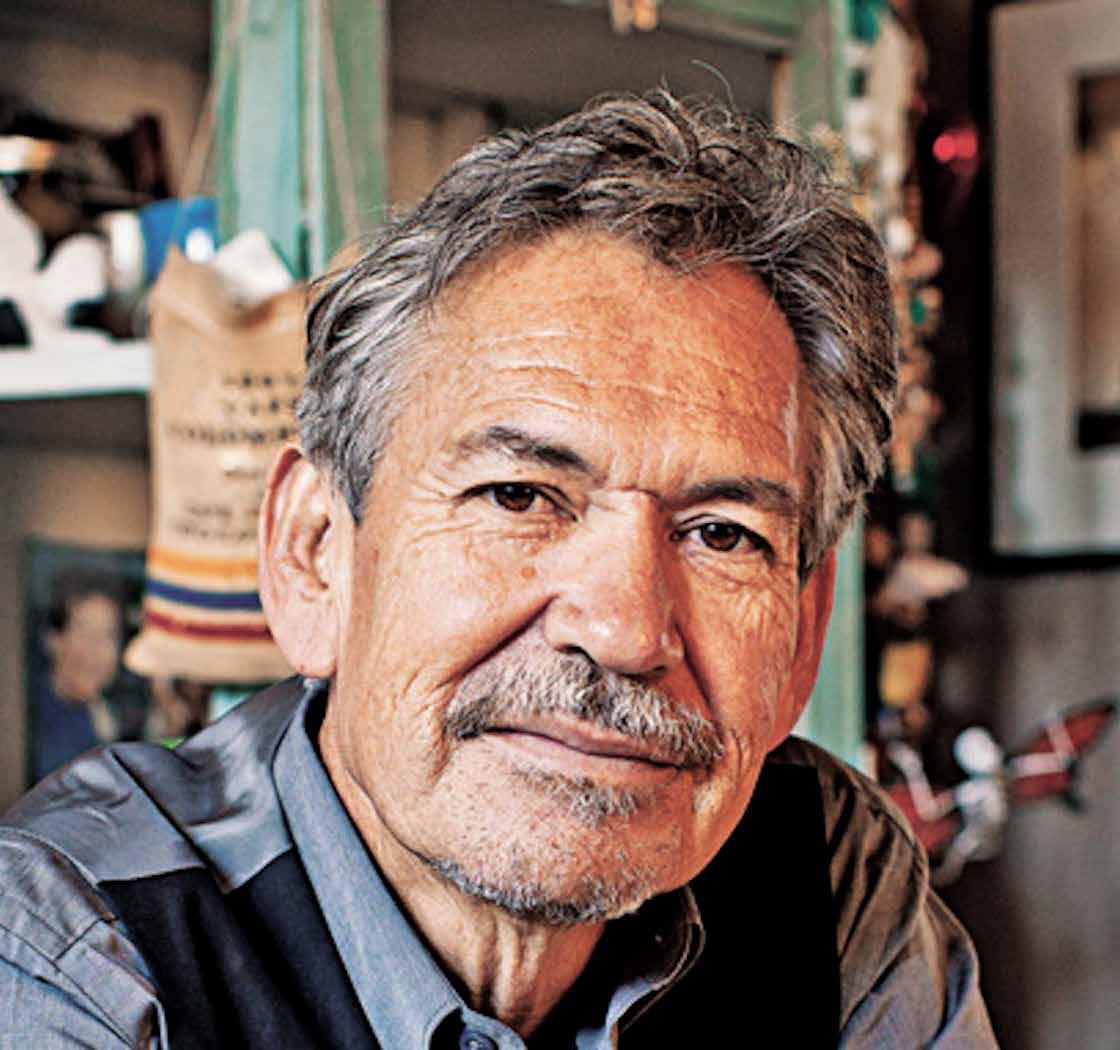
Benjamin Saenz – Photo by Jennifer Boomer
Books
SAENZ
continued from page 13
“I had this idea that to be a lyrical writer, you had to write more like Faulkner, or you had to write more like Gabriel García Márquez, to have more sentences that were rich and this music to it,” he said. “I think I went more in the way of Hemingway, who lacked music in his writing but had a direct style that was more interesting to me. So, I’ve tried to combine the two.”
Saenz likes to listen to his writing out loud, to connect with the rhythm of the English language. “It has inherent music. English is inherently iambic, so you can write a perfect iambic pentameter line. You internalize that as you read. I try to do that, really be careful with the words that I use.
“The only way that you experience a book is through writing. All I have is words as my tool, and I think I’m more careful. I was always careful, but I’ve become more careful. The writing matters. The story matters, but you only get the story through the writing. So, I think that’s what I pay attention to now.”
Saenz was born to write, it seems. The skill comes as naturally to him as speaking. “I’ve always been a good writer, ever since I started school,” he said. “Writing is very difficult for a lot of people, but it never really was for me. But then when you become an artist at it, it is difficult. It’s difficult because you have to figure things out, and my process is very difficult to describe because of this. I don’t know what will happen.”
A once-dormant part of Saenz comes alive when he puts pen to paper, he says. “It just happens. I feel so incredibly alive when I’m writing. It’s unbelievable. It’s like a drug; I get endorphins. It’s wonderful. My process hasn’t changed. Some people need to be inspired, I don’t. When it’s time to write, I sit down and write. It happens.”
Writing humans and withholding judgment
The most important part of Saenz’s writing is building characters. He has never written a one-dimensional character, because he understands that each human being exists in a multitude of complexities.
“One thing that I think has strengthened my writing is that I like people,” he said. “I like my characters, even if they’re all fucked up. And some of my characters can be fucked up, but I don’t judge them either. I can be fucked up — I’ve had issues, like everybody else. I don’t want to judge them.”
Before becoming an author, Saenz spent his life as a priest working with some of the most impoverished people in London. This experience shaped his willingness to look beyond appearances.
Saenz has also been a teacher and a professor. If he has taught nothing else, he hopes that he has influenced both his readers and his students to not be quick to judge.
“I’m not afraid of poverty. I’m not afraid of people who are down and out of their luck. I think that culture teaches us to get away. We want to help people, but not the guy who’s begging for a nickel outside of Circle K. But we got to see the beauty in that guy somehow,” he said.
“We look at something and we immediately make a judgment of it. I see that in books. You shouldn’t judge a book until you finish it. From the very beginning, people are making assessments of it, we’re judging it, instead of reading and experiencing it. We don’t open ourselves up to the text, which is what we should do with people.”
Saenz’s philosophy on reading — to withhold judgment — mirrors his philosophy on life. “I want people to experience books how they experience life. That’s what I write about. As Faulkner would have it, ‘The struggle of the human heart against itself.’ It’s how we can be our worst enemies and sabotage ourselves, but we have to love ourselves, and it’s so difficult. That’s really what I want to write about.
“So for me, I think one of the most important parts of my writing is that I don’t judge
my characters, even the ones who are not nice people. I just want to see them.”
Saenz embeds this philosophy in all of his work. It can be seen in the growth of some of his most beloved characters, like Ari.
“It’s about how Ari embraced his humanity by accepting his love for Dante. He not only fell in love with Dante, but he fell in love with his parents and their love for him. I wanted to write a novel that had Gay characters in it, but I didn’t know how to do that, but I can write characters. I wanted to normalize it.”
Diving into the Waters of the World
Nearly ten years after the Stonewall Book Award–winning novel first hit shelves, Saenz returned with a sequel. For some, Aristotle and Dante Dive into the Waters of the World betrayed the intimacy of the first book, but for Sanez, opening the story up to include the greater context of life as a young Gay person in the ’80s was essential to the story.
“In Ari and Dante, their community in the
first book was so small, but it gets a lot bigger in the second one,” he said. “One thing I did not like about the first book was that I didn’t represent what was happening in that era with AIDS.”
It’s a time Saenz remembers all too well, a time of tragedy he felt a duty to represent.
“I lost my mentor, my brother, and one of my best friends. I wanted to include the world that they lived in — the context — in the second novel, and that was important to me,” he said.
Saenz also used the backdrop of the 1980s to explore new characters and pay homage to the unity of the LGBTQ+ community during the epidemic.
“I especially think that a lot of the heroes from that era were in the Lesbian community. They joined in that fight. They weren’t getting AIDS, but they joined that fight. A lot of Gay men ignored the Lesbian community, but [the women] didn’t care. They said, ‘This is our fight, too.’ They were such fierce warriors in that era.
“Now I look back and I think we should bow down and thank the women …for fighting for us, because they were wonderful, they were so great and brave. I wrote the second novel because it included that, which was so important for me.”
Expanding the context of the novel was also Saenz’s way of showing Ari and Dante maturing. “When we grow up, our worlds are smaller and intimate, but as we grow up, we realize there is a bigger world out there that helps define us,” he said.
In the end, Aristotle and Dante is not about being Gay or Latino, it’s about being human.
“Ari and Dante are Gay, but how do we experience them? We experience them as boys. They’re boys, and they’re beautiful, and that matters,” Saenz said.
“If you think that Ari and Dante are beautiful, it’s because you are beautiful. It’s because you see yourself in them, and you are sensing your beauty. Embrace it. Don’t be afraid of it.”
Image courtesy of Simon & Schuster
Tres amigas enchanted by Costa Rica: A moms’ adventure
by Angela Cragin Special to the SGN
When Christopher Columbus made his fourth trip across the Atlantic, it brought him to what is now the small country of Costa Rica. While refitting his ship there, the Indigenous people presented him with gifts. Among them was gold, hence the name (meaning “rich coast”) was born. Not surprisingly, Costa Rica lives up to the name still today, as one of the most biodiverse countries in the world. It is home to more than 500,000 plant, animal, and insect species, representing 4% of the world’s flora and fauna.
An opportunity
A friend of mine had purchased a condominium in the northwestern Guanacaste region, so she benevolently invited me and another mom to accompany her on a trip there. We excitedly booked our tickets and jetted off, sans family! Alaska Air flew us directly from Los Angeles to Liberia, Costa Rica, in just over five hours.
Hiking
Costa Rica offers many hiking opportunities. We chose a six-mile-round-trip, intermediate hike in the Rincón de la Vieja National Park. Our destination was Catarata La Cangreja, a tall and stately waterfall with a crystal aqua pool at its base that welcomed us. We encountered nature’s mix of huge boulders, natural rock steps, and buttress tree roots reminiscent of the artificial terrain at a Disney park. Breathing the wet, earthy air felt like the cleanest oxygen on earth.
When we were heading out, it occurred to us that the only thing missing from our hike was a monkey sighting. We were told by other hikers that there was a group of 50 monkeys, but we had seen no sign of them. But Rincón de la Vieja did not disappoint! The trees started shaking, and we spied flashes of black movement. It was a family of capuchin monkeys! These little, white-faced monkeys, often seen in movies wearing red button-up jackets and wreaking havoc, noticed us too. Green nuts and small branches began dropping close to our heads. Were they sending us a message? Yes: they are extremely territorial. This was a riveting performance, but their quick movements evaded our cameras.
Beaches
Bordered by oceans on both coasts, Costa Rica offers a large variety of beaches. Within the small region we visited, we were able to visit a number of them.
Playa Conchal (Shell Beach) warmly received us. This one is unique because the sand is made from crushed shells (thus the name). The waves were in rare form on this
day, sneaking up and trying to roll us. In the end, the slope of the beach and power of the waves were too much. In our struggle to stay standing up, we provided some comedic entertainment for the onlooking beachgoers!
Playa Grande (Big Beach) is worldrenowned for its leatherback turtle nesting sites. From January through the end of February, the hatchlings break out of their shells and scurry down the beach under the cloak of darkness. To protect this endangered species, their nests are marked by signs and patrolled by the park rangers, and buildings lining the beach are not allowed to turn on lighting on the ocean side of their property (if the hatchlings see light, they move toward it and will not make it to the sea). We also encountered a “do not feed the crocodiles” sign, as crocs inhabit the estuary near Playa Grande. Fortunately, we did not spot one on this trip.
Playa Avellana is a great spot for surfing and boogie boarding. We tried our hand at some rookie boarding. The waves were perfect — until a strong one washed away two pairs of sunglasses and poured sand into our bathing suits. Nothing brings you back your childhood like being mishandled by the ocean through body surfing and boogie boarding.
Excursions
We booked two excursions through Natives Way tour company (https://www. nativeswaycostarica.com), which was recommended by our hostess, who has tried many of its offerings.
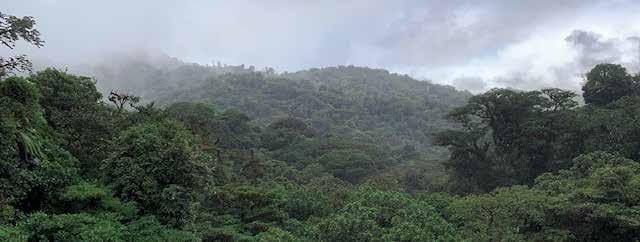
Our first adventure was a walk in the clouds in Monteverde Cloud Park, which began by crossing eight hanging bridges above the forest. Jaw-dropping beauty akin to something you’d see in movies created a feast for the eyes. Bromeliads, which we know as indoor plants, were prolific, providing a rain catch for the frogs to lay their eggs in. Many nature documentaries are filmed here, not surprisingly.
Off to visit the true celebrities of CR: the sloths. The sanctuary at Monteverde has taken in 17 two-fingered sloths, originally rescued as babies that fell from trees and would not have survived if left to their own devices. Did you realize they can actually move fast? When a female is in heat, the male gets his hustle on. Once he’s reached her, they participate in a 35-second interlude, and baby is on the way!
Next, we viewed the reptile display, which exhibited primarily snakes, a few frogs, and the Jesus Christ lizard, so named because it walks on water. Costa Rica boasts 35 species of poisonous snakes, not to mention those vividly colored, teeny-tiny poison dart frogs. A day at Monteverde is well spent!
For our second full-day excursion, we visited Guachipelin Adventure Park. We began
our tour by rafting down five kilometers of the Negro River. As fortune had it, there was a large crew of assistants waiting on the boulders ready to push, veer, and direct us through the rough parts. This hour-and-ahalf journey conjured terrifying and exhilarating feelings simultaneously.
Zip-lining over the dry forest and impressive slot canyons was our next activity. Apparently, there were eight different zip lines, but truthfully, I lost count after the Tarzan swing, which was traumatic.
The horseback riding portion was as expected. We were a tourist parade on mellow horses, who knew the route and fought for placement. However, we did spy a green iguana in the brush!
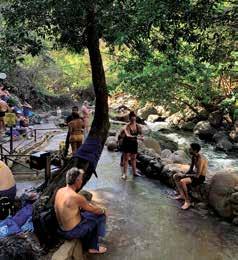
Ending the day (yes, that was one day) at the 10 natural hot springs pools — which ranged from 36 to 40 degrees Celsius — was rewarding. Before dipping into them, we enjoyed a volcanic clay mud bath. Ahhhh, what a way to end the day!
Food
For dinner with sunset, Coco Loco at the south end of Playa Flamingo is the place. The drink of the same name is served in a young coconut, with a straw, like on Gilligan’s Island. For dinner, the parrotfish ceviche with lime, corn, and avocado was a fresh, healthy, and satisfying entree. Ending the meal perfectly with coconut ice cream in a half coconut shell embedded with lush fresh coconut brought a smile.
Patagonia del Mar near Playa Brasilito has a menu that will please everyone. The atmosphere is dreamy, and the pool on the property means you can take a swim while you wait for your food. I ordered the tuna poke bowl, which was seriously divine!
Pots and Bowls near Playa Grande is a quaint, casual open-air café. It offered coconut pancakes, poke, vegetarian options, and baked goods. Everything on the menu looked enticing!
If you are looking for an authentic experience, frequenting a soda is a must. These are small, family-owned-and-run restaurants patronized by locals. You will find the comida típica (typical dish) of casado served at these establishments — it features white rice, beans, meat (such as chicken, beef, or fish), and a salad, typically served with fresh pico de gallo and plantains.
The Costa Rican people are proud of their biodiverse country, and they are dedicated to the protection of their fragile and rich environment. If you visit here, you’ll see why. Life there is simple and pure — as the ticos (native Costa Ricans) say, “¡Pura vida!”
For more information on tours in Costa Rica, visit https://www. nativewayscostarica.com.
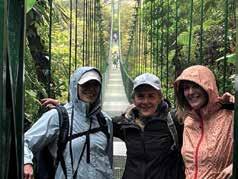
Walk in the clouds at Monteverde
Tres amigas crossing at Monteverde
Eating lunch at Monteverde sloth sanctuary
Ficus tree buttress roots at Rincon de Vieja
Natural hot springs at Rio Negro
– All Photos courtesy of Angela Cragin
How to survive Seattle until spring
by Jack Hilovsky SGN Contributing Writer
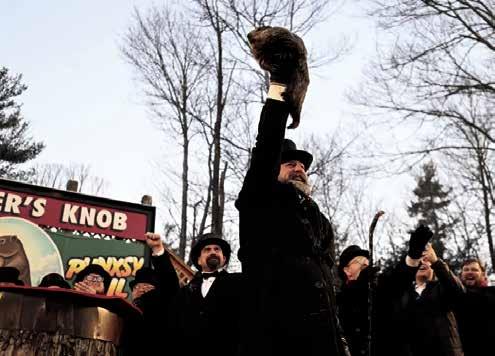
Every year in early February, an odd cultural happening takes place in a rural outpost in Pennsylvania. Over the years, it has turned into a big media event. News cameras and people far and wide gather to see whether a groundhog named Phil will see his shadow or not. If Phil sees his shadow, the US can supposedly count on six more weeks of winter. If Phil does not cast a shadow, an early spring is all but assured. It’s become an annual tradition, and whether Phil is an accurate prognosticator is beyond me to say. But it’s fun and sweet to observe the show the people of Punxsutawney, PA, put on.
This year Phil saw his shadow on February 2. Sure enough, an Arctic blast hit the East Coast soon after. And Seattle has been enduring cooler and wetter weather than typical. Not to mention the ice storm and snow that hit our region at the end of the year before Phil even emerged from his hole! So, what can we all do in Seattle to survive and stay positive until March 20, the first day of Spring? Here are some ideas from my bag of tricks.
Do you remember what it was like to be a kid and go roller skating? Well, every Wednesday evening at Southgate Roller Rink in White Center is Pride Skate night (for those 21+). It starts at 8:30 p.m. and runs until 11 p.m. I went once or twice during the pandemic and had a ball skating round and round the rink, managing to get my groove to the music, from KC & the Sunshine Band to Beyoncé. I only fell twice this last time! Last month the rink was more crowded, and the guys and gals decked out in costumey outfits reminded me of extras in the otherworldly flick Xanadu. Take a catnap and venture out some Wednesday.
If you aren’t hep about dancing on roller skates, how about just plain dancing on your feet? Capitol Hill’s Century Ballroom hosts LGBTQ+ OutDancing every third Friday of the month from 8:30 to 11:30 p.m. (the next one is February 17!). You can boogie to the disco faves of your youth on elegant wood floors in a room overlooking the city lights. Dress up and make a night of it. Or try the Tea Dance every Sunday afternoon at the recently arrived LGBTQ+ club The Comeback in the SoDo neighborhood. I’ve not been but am chomping on the bit to escape my Capitol Hill digs and venture down there. It’s a 15-minute walk from either the Stadium or SoDo light rail stations, not convenient if you are without a car, so gather some homies and identify a designated driver if you plan to knock down a few and boogie.
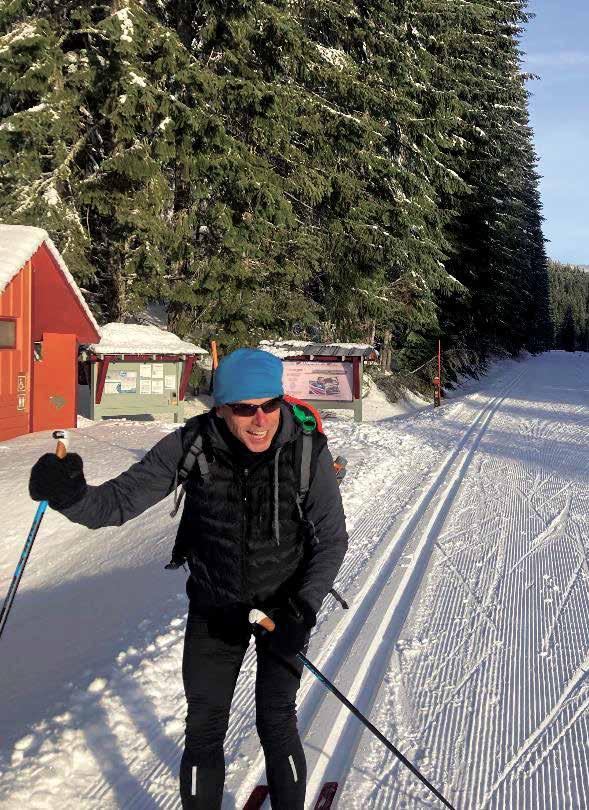
If you’d like to avoid the crowd and enjoy the great outdoors, why not hit the mountains and try a cross-country ski outing? I got my first pair of Nordic skis soon after I turned 16. Growing up in the pancake-flat Midwest, I didn’t learn how to downhill until I was 21. But I much prefer the cheaper and more solitary form of skiing that allows me to set my own pace on groomed trails. Plus there’s a greater likelihood you’ll catch some sun in the mountains, compared with the perennial gray of the Seattle lowlands. Try out Hyak Lake or Cabin Creek for easyto-access trails, only a 45-50-minute drive on I-90 from downtown Seattle. You’ll need to purchase a seasonal snow park permit or day pass to use the groomed trails. Get an early-morning start for better parking.
If you aren’t the active type and want a more sedentary escape while preserving your sanity during the dreary Seattle winter, why not treat yourself to some new music or a film that will take you somewhere unex-
pected and different? The famed composer and songwriter Burt Bacharach, who died this month, has collaborated for more than 25 years with Elvis Costello, another music legend. On March 3, a boxed set called The Songs of Bacharach and Costello, a compilation of their remastered work, will be released. I’m a jazz fan and from an early age fell in love with Bacharach’s classic hits. Romantic, sophisticated, and conveying emotional depth, his music is like a balm on a cloudy day. Paired with Costello, he expanded his reach into the next generation of music afficionados.
And in theaters this week comes a new Belgian film, Close, about the intense friendship between two 13-year-old boys. Lush and fervent, it was the winner of the Grand Prix at the 2022 Cannes Film Festival and is nominated for Best International Feature Film at the 95th Annual Academy Awards. At press time, it was scheduled to play at SIFF Cinema Uptown through at least February 16.
And speaking of the Academy Awards, I cannot think of a better excuse to gather with a gaggle of Gay friends, with a few straight ones thrown in for good measure, to plop down in front of the tube. Like the Superbowl, whether you love the teams or the films, it’s just plain fun to be part of the superficial procession of stars and awards. As far back as grad school, I’d invite my chums over for a theme party amid the winter gloom, since the Oscars always presage springtime. Mark your calendar for March 12 and celebrate a great excuse to stargaze!
Jack Hilovsky is an author, actor, dancer, and blogger who has made his home in Seattle since 1986. His first book, RJ, Farrah and Me: A Young Man’s Gay Odyssey from the Inside Out was published in June 2022. It can be found at Madison Books, Nook & Cranny, University Bookstore, and Third Place Books (Seward Park), among other local booksellers.
Groundhog Club handler A.J. Dereume holds Punxsutawney Phil, the weather prognosticating groundhog, during the 137th celebration of Groundhog Day on Gobbler's Knob in Punxsutawney, Pa., Thursday, Feb. 2, 2023 – Photo by Barry Reeger / AP
Hyak Lake – Photo courtesy of Jack Hilovsky
PROP 8
If their bill passes the state legislature by a two-thirds vote, it would then go before California voters in the form of a referendum. If voters approve, the ban on samesex marriage would be stricken from the state constitution.
Prop 8 was rendered unenforceable by the US Supreme Court decision in Obergefell v. Hodges, in which the high court found that barring same-sex couples from marriage was a violation of their due process and equal protection rights.
However, the Supreme Court now has an ultra-rightwing majority, and at least two members of the court — Justices Thomas and Alito — have suggested revisiting the Obergefell decision. If the court decided that that the prior Obergefell ruling was wrong and reversed it, Prop 8 would then become enforceable again.
Weiner and Low hope to protect California’s same-sex couples from that eventuality by taking Prop 8 off the books for good.
“It’s absolute poison, it is so destructive, and it’s humiliating that this is in our constitution,” Wiener told the Associated Press. If the bill passes and the constitutional change is approved by voters, California could follow in the footsteps of Nevada, which in 2020 became the first state to amend its constitution to ensure the right to same-sex marriage.
While California is home to many LGBTQ people, and while it has a national reputation as a left-leaning state, the path to marriage equality there was tortuous. In 2000, voters approved a statute that banned the recognition of same-sex marriages.
That law was then overturned by California courts. In 2004, San Franscisco’s mayor, Gavin Newsom — now the governor — began issuing marriage licenses to same-sex couples. The next year, the state legislature passed a bill legalizing same-sex marriage, but Republican Gov. Arnold Schwarzenegger vetoed it. Prop 8 followed in 2008.
National news highlights
by Daniel Lindsley SGN Staff Writer
Montana law only prevents deadnaming as bullying
After critics argued that a Montana bill would prevent schools from protecting Trans students from being misgendered and deadnamed, lawmakers amended the legislation, adding that schools would be allowed to discipline offenders when such behavior rises to the level of bullying.
Trans advocates argued during hearings that the change wasn’t enough, since the modified bill depends on the state’s legal definition of bullying. Also, the bill declares that misgendering and deadnaming Trans students by their classmates is not illegal discrimination.
Montana Pride President Kevin Hamm said, “Putting something in there that says, ‘Oh, I can’t get in trouble for using your deadname or misgendering you because it’s on your legal paperwork’ is still an attack on Trans people and will be used as an attack on Trans people.”
Meanwhile the bill’s sponsor, Rep. Brandon Ler, implied that he was defending children from having to “call somebody something they’re not.”
polling shows overwhelming support for marriage equality. Even former opponents like the Mormon Church support the concept, even if they will not perform such marriages themselves.
Tony Hoang, executive director of Equality
California, told the AP that his group is ready for a statewide campaign to repeal Prop 8 if and when the bill passes the legislature.
“I know this will be a bipartisan campaign,” he said.
Same-sex couples in Washington state
have fewer legal complications to worry about, even if the Supreme Court should reverse Obergefell. In this state, the legislature passed a marriage equality law in 2012, and voters soundly rejected an attempt to repeal it through a referendum.
New York Times faces accusations of biased anti-Trans coverage
Over 180 New York Times contributors joined more than a hundred organizations and celebrities in calling out the world-renowned newspaper’s prejudiced coverage of Trans issues on February 15.
The HRC, GLAAD, PFLAG, and the Transgender Legal Defense & Education Fund were among those that signed the letter, which included three key demands:
• Listening to Trans people (holding a meeting with Trans community leaders
within two months)
• Hiring at least four Trans writers and editors within three months
“From the front page to the opinion page, readers are too often getting an inaccurate view of transgender people, with poor reporting that elevates harmful opinions from known anti-trans voices and so-called ‘concerns’ over the fact that every leading medical organization affirms healthcare for trans youth as safe and necessary,” said Sarah Kate Ellis, president and CEO of GLAAD, in a press statement. “And even more dangerous, politicians are using biased Times articles to justify support for anti-trans legislation.”
The Times responded publicly: “The very news stories criticized by GLAAD in their letter reported deeply and empathetically on issues of care and well-being for trans teens and adults. Our journalism strives to explore, interrogate, and reflect the experiences, ideas, and debates in society — to help readers understand them. Our reporting did exactly that, and we’re proud of it.”
On Thursday, February 16, the New York Times published an op-ed titled “In Support of JK Rowling.” Many have called Rowling’s views on gender transphobic.
Photo by Lucas Jackson / Reuters
Today,
Protesters gather on the west steps of the state Capitol in Sacramento, Calif., on Nov. 22, 2008, opposing the passage of Proposition 8.
– Photo by Robert Durell / AP
National/International News
Mike Pence hopes attacking the Trans community will help him win the presidency
by Mike Andrew SGN Staff Writer
Although he has not yet announced his candidacy, former Vice President Mike Pence is clearly running for president, and he hopes that attacks on the Transgender community will advance his campaign.
The so-called Advancing American Freedom (AAF) PAC — founded by Pence — has announced a huge ad buy in Iowa targeting Trans youth and their families. According to the Huffington Post, AAF will spend more than $1 million for several months’ worth of TV and online ads.
The Linn-Mar school district in Iowa recently decided to offer its students the ability to socially transition at school, without their parents’ consent. Pence hopes to use this as a wedge issue to cement support for his presidential run.
“The strength of our nation is tied to the strength of our families, and we cannot stand idly by as the Radical Left attempts to indoctrinate our children behind parents’ backs,” Pence said in a statement released by AAF.
“Advancing American Freedom will not rest until parental rights are restored in Iowa and across the nation.”
The AAF press release went to say that its “grassroots campaign will consist of educating Iowans on the ongoing efforts by the radical left to strip parents of their rights to guide and protect their children, to indoctrinate children, and to advance their divisive woke agenda.
“Additionally, AAF will advocate for policies that restore parental rights and protect Iowa’s children through digital ads, rallies and events, and volunteer advocacy efforts.”
International news highlights
by Daniel Lindsley SGN Staff Writer
Top Hong Kong court favors self-ID laws
Hong Kong’s Court of Final Appeal, its top court, ruled unanimously on Monday that the region’s policy of barring Trans people from changing the gender on their ID cards without a full sex reassignment surgery is unconstitutional.
“The policy’s consequence is to place persons like the appellants in the dilemma of having to choose whether to suffer regular violations of their privacy rights or to undergo highly invasive and medically unnecessary surgery, infringing their right to bodily integrity,” the judges wrote.
“Clearly this does not reflect a reasonable balance. The Policy imposes an unacceptably harsh burden on the individuals concerned.”
Trans activists Henry Tse and an unnamed person who went by “Q” were the appellants in question. They both underwent extensive medical and surgical treatments to meet the policy’s requirements, but the Commissioner of Registration only asked for more before refusing their applications.
“Today’s result is delayed justice, a Pyrrhic victory,” Tse said in a statement. “This very case should never have happened.”
Some parents are already suing the LinnMar Community School District to prevent it from implementing gender-affirming policies. AAF joined 20 other right-wing organizations in a November 2022 amicus brief filed with the trial court.
Pence appeared at a campaign rally in Cedar Rapids, Iowa, on February 15.
Nikki Haley, Former South Carolina governor and UN ambassador for the Trump administration — another GOP presidential hopeful — is planning to campaign across Iowa also, while South Carolina Sen. Tim Scott and former Arkansas Gov. Asa Hutchinson are expected to visit Iowa later in the month.
Pence has described himself as “a Christian, a conservative, and a Republican, in that order.” He is a consistent enemy of LGBTQ rights, dating as far back as 2006, when he pushed a proposed constitutional amendment banning same-sex marriages nationally.
“I will continue to work hard to plant the seeds for the Transgender rights movement with my partners at Transgender Equality Hong Kong,” Tse added. “I believe that one day, we shall succeed and welcome the rainbow with open arms.”
Russia to roll out censorship bot Russian officials announced on Monday last week that their new “Oculus” system will be able to scan the internet for illegal content, such as unsanctioned protests, dissent, and “LGBT propaganda,” analyzing
more than 200,000 images per day to do so.
Oculus “automatically detects offenses such as extremist content, calls for illegal mass gatherings or suicide, pro-drug content, LGBTQ propaganda, and so on,” the Interfax news agency reported.
It went on to say that “‘fakes’ have proliferated and spread at an unprecedented rate, aiming to replace real facts with a specially constructed reality” since Russia began its invasion of Ukraine. It should be noted that over three billion images are shared on the internet each day, to
say nothing of videos and text. According to the Russian business and technology magazine Kommersant, experts in the field of machine learning say that Oculus may have only had four months to train its algorithm. Critics say this will mean a lot of false flags early on. They have also pointed to the massive spike in VPN demand in Russia, an increase of 2,692% between February and March last year, according to Top10VPN.
Photo by Anton Vaganov / Reuters
Photo by Charles Krupa / AP
Episode 49: Isabel Mata
It's the Queer Love Issue and Lindsey and Ash are ready to chat about romance! And... Harry Potter's problematic premise! And other things! Special guest Isabel Mata dives into Queer and straight-passing relationships, learning about one's own queerness, coming out, and what it's like being the Straightest Person Ever. She even gets Ash to open up a little. Find her at www.isabelmata.com and listen to Being Yourself Loudly wherever you get podcasts!
NEW EPISODES WEEKLY! FIND RADIO SGN WHEREVER YOU LISTEN TO PODCASTS!