ISSUE 49
C E L E B R AT I N G
VOLUME 49
47 YEARS
F R I D AY
IN
DECEMBER 3, 2021
PRINT S E AT T L E ’ S L G B T Q I A + N E W S & E N T E R TA I N M E N T W E E K LY S I N C E 19 74
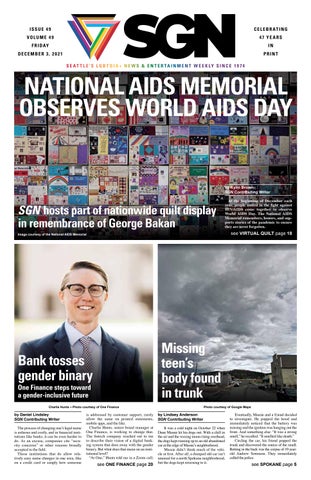
NATIONAL AIDS MEMORIAL OBSERVES WORLD AIDS DAY
by Kylin Brown SGN Contributing Writer
SGN hosts part of nationwide quilt display in remembrance of George Bakan
At the beginning of December each year, people united in the fight against HIV/AIDS come together to observe World AIDS Day. The National AIDS Memorial remembers, honors, and supports stories of the pandemic to ensure they are never forgotten.
see VIRTUAL QUILT page 18
Image courtesy of the National AIDS Memorial
Missing teen’s body found in trunk
Bank tosses gender binary One Finance steps toward a gender-inclusive future
Charlie Hunts – Photo courtesy of One Finance
by Daniel Lindsley SGN Contributing Writer The process of changing one’s legal name is arduous and costly, and in financial institutions like banks, it can be even harder to do. As an excuse, companies cite “security concerns” or other reasons broadly accepted in the field. Those institutions that do allow relatively easy name changes in one area, like on a credit card or simply how someone
is addressed by customer support, rarely allow the same on printed statements, mobile apps, and the like. Charlie Hunts, senior brand manager at One Finance, is working to change that. The fintech company reached out to me to describe their vision of a digital banking system that does away with the gender binary. But what does that mean on an institutional level? “At One,” Hunts told me in a Zoom call,
see ONE FINANCE page 20
Photo courtesy of Google Maps
by Lindsey Anderson SGN Contributing Writer It was a cold night on October 22 when Dane Massie let his dogs out. With a chill in the air and the waxing moon rising overhead, the dogs kept running up to an old abandoned car at the edge of Massie’s neighborhood. Massie didn’t think much of the vehicle at first. After all, a dumped old car isn’t unusual for a north Spokane neighborhood, but the dogs kept returning to it.
Eventually, Massie and a friend decided to investigate. He popped the hood and immediately noticed that the battery was missing and the ignition was hanging out the front. And something else: “It was a strong smell,” he recalled. “It smelled like death.” Circling the car, his friend popped the trunk and discovered the source of the smell. Rotting in the back was the corpse of 19-yearold Andrew Sorenson. They immediately called the police.
see SPOKANE page 5
GREEN CARDS • VISAS • ASYLUM • CITIZENSHIP 1836 Westlake Ave N, Suite 302 Seattle, WA 98109
(206) 724-1940 olivielaw.com
THIS AD SPACE HAS BEEN GENEROUSLY DONATED BY KRISTIN COSTELLO IN MEMORY OF SGN PUBLISHER GEORGE BAKAN
2
SGN
DECEMBER 3, 2021
C E L E B R AT I N G 4 7 Y E A R S!
ORIGINALLY SEATTLE GAY NEWS FOUNDED 1974 MEMBER
509 10th Ave E Seattle, WA 98102 (206) 324-4297 sgnpaper@gmail.com sgn.org
2021
Deadlines Calendar | Tuesday at 6pm Display Ads Space Reservation | Monday at 5pm Ad Copy (non-camera ready) | Tuesday at 5pm Ad Copy (camera-ready) | Wednesday at 5pm Letters to the Editor | Tuesday at 5pm Obituaries | Call the SGN office All others | Tuesday at 5pm
Publisher Angela Cragin Managing Editor A.V. Eichenbaum Copy Editor SGN Staff • Richard Isaac Advertising Maggie Bloodstone, Advertising Manager National Advertising Rep. Rivendell Media (212) 242-6863 Staff Writers Mike Andrew • Sara Michelle Fetters Contributing Writers Lindsey Anderson • Janice Athill Josephine Baird • Alice Bloch Maggie Bloodstone Kylin Brown • Sharon Cumberland Carter Hemion • Daniel Lindsley Paige McGlauflin • Tim Peter Jessica Price • Renee Raketty • Nick Rapp Hannah Saunders • Gaysha Starr Sarah Toce • Ed Walsh Social Media Manager SGN Staff Cartoonist Ken Campbell Photographers Nate Gowdy • Renee Raketty Production Mike Pham SGN is published by Angela Cragin. © 2021. All Rights Reserved. Reprints by permission. Publication of names, photographs, or likeness of any person, organization, event or business in this publication cannot be taken as any indication of the sexual orientation of the person, organization, event or business. Opinions expressed in bylined articles, columns, and letters are those of the authors only and do not necessarily reflect the views of the staff or management of this paper. SGN welcomes unsolicited material, including letters to the editor, but reserves the right to edit or reject material. All rights revert to authors upon publication. We assume no liability for loss or damage of materials, solicited or not. We invite feedback, please write. And please play safe. It is our policy that no money shall be refunded if you choose to cancel your ad. Credit will be given for the balance owed. No exceptions.
In Loving Memory Of George Bakan
Scott Roger Alpert Cookie Andrews-Hunt James Arnold Steve Foiles Shaun Knittel James Leland Moore Don Paulson Randy Peters Lee Richeson Shaun Shelton Jim Tully
Follow SGN
VISIT US ONLINE SGN.ORG
In this Issue
LOCAL NEWS 4 A&E • BOOKS 6 FILM 10 OP-ED 17 NATIONAL NEWS 18 INTERNATIONAL NEWS 21 DECEMBER 3, 2021
SGN
3
Local News
“Soul Pole” slated for early 2022 return to the CD
by Nick Rapp SGN Contributing Writer Public art installations have the power to tell the stories of neighborhoods. They shape local understandings of history and bring much more than mere aesthetic appeal to public spaces. Seattle’s public library branches are full of — and surrounded by — unique art installations. One of the most notable is the “Soul Pole,” a 21-foot wooden sculpture that was deinstalled in April of this year from the lawn of the Douglass-Truth Branch for some necessary conservation efforts. The pole is iconic for its stature and intricate carvings of four distinct figures. It was given to the Douglass-Truth Branch in 1972 by the Seattle Rotary Boys Club, where it “was carved by six young community artists in the late 1960s to honor 400 years of African American history and the struggle for justice in the United States,” according to Seattle Public Library. When the pole was deinstalled, Stephanie Johnson-Toliver, president of the Black Heritage Society of Washington State, told the SPL that “the Soul Pole represents a beacon of pride that anchors the history of Black people to Seattle’s Central District... As assets are razed and vanishing from the Central District, with some recognized as historic footprints, it is our combined responsibility to act as good stewards of the art and culture that define our community.” And the stewardship of the Soul Pole has been very involved. After its deinstallation, it
was fumigated and fully dried indoors. The art was tested for cracks and areas of soft wood using special equipment by Artech, an organization that specializes in art restoration. Damaged areas were filled in with epoxy and cedar shims, depending on the severity. The SPL contends that this is technically a conservation project, not restoration, that is, the project’s focus is “on preserving the Soul Pole in as close to its current form as possible for generations to come.” The conservation plan was reviewed by the Seattle
4
DECEMBER 3, 2021
SGN
Photos courtesy of SPL
Landmarks Preservation Board. The Soul Pole lasted almost 50 years in rough Seattle weather before its removal, so the hope of the project is to help it withstand several more decades of the same. The pole is supposed to return to its home in the first quarter of 2022 without many noticeable changes. The only visible difference will be a zinc cap, placed atop the sculpture to protect it from rainfall. The other fill-ins and treatments will be painted over to match the original coloring.
Additionally, the SPL plans on putting a new plaque alongside the old one at the base of the sculpture, outlining the history of the Soul Pole and the conservation efforts of this past year. The library (depending on public health guidelines) “is looking forward to planning a celebration of the Soul Pole’s return to Douglass-Truth in 2022, during which we hope to celebrate [its] history, including honoring the sculptors… as well as others with connections to the sculpture.” The SPL claims that the reinstallation will look much like a reverse of the deinstallation: “Artech will be delivering the Pole back to the library using a flatbed truck, with the pole stabilized on pallets. At the site, they will use an outreach forklift to rig the pole and remove it from the flatbed, bring it upright, and secure to the mount.” The reinstallation stands as a testament to the value of historical community art; it brings people together and tells vital stories of the past. Many residents of the CD have been used to seeing the Soul Pole on their daily routines. It has been a marker of neighborhood pride. Thankfully, its return is just around the corner. The SPL is asking the public for information on the installation’s background and sculptors. Any information you may have can be sent to the library’s digital communications strategist Elisa Murray at elisa.murray@spl.org.
C E L E B R AT I N G 4 7 Y E A R S!
Have a jolly union holiday! Pride At Work Special to the SGN As you search for the perfect holiday gifts for your loved ones, remember to look for the union label so that your presents also give the gift of good jobs. If you’re traveling, or if your friends and family are coming to visit you, be sure to book a union hotel. You’ll sleep comfortably at night knowing the hotel staff can afford gifts and special meals for their families. And remember, the unions that represent retail, hotel, food service, and other workers have led the way in fighting for LGBTQ rights in their contracts and in legislation, like Washington state’s marriage equality law. The Washington State Labor Council’s Union Goods and Services Committee has an online resource you can use to identify union-made goods and services. Just go to wslc.org/buy-union-washington for the information. While you’re there, click on “Why Union?” to see the advantages of being a union worker. Another great resource is Labor 411, which regularly updates lists of union-made food, beverages, and gifts for special occasions (labor411.org/category/product-spotlight). For example, you can look for shopping lists for union-made holiday gifts, gifts for her, gifts for him, and gifts for kids.
To be sure you shop at union grocery stores and retailers, you can go to UFCW 21’s website and check the list of outlets their union represents (www.ufcw21.org/shopunion). Many union grocery stores also have bakeries for your holiday cakes and cookies, and florists for your decorations. Traveling to Eastern Washington? UFCW 1439 also has a list of union stores in that part of the state: www.ufcw1439.org/ who-we-represent. If you’re looking for accommodations for yourself or friends and family, visit UNITE HERE 8’s website for a list of union hotels (www.fairhotel.org). Be sure to check its boycott list too, so you don’t accidently book a stay at a greedy antiworker venue. UNITE HERE also represents many concessions at Sea-Tac Airport. Check their list to see who to patronize if you need a snack – or a drink – when you travel (www.unitehere8.org/seatac-internationalairport). Have a wonderful holiday and help spread the cheer to skilled workers who do a good job and get fair pay and benefits in return! Pride At Work is an LGBTQ labor organization affiliated with the AFLCIO. You can find out about its work at prideatwork.org.
Photo courtesy of The Edgewater
SPOKANE
continued from cover The investigation led to the quick arrest of 60-year-old John Eisenman, who admitted to police on his arrest that he killed Sorenson. Eisenman was booked and held, with his bail set at $1 million. Eisenman claimed that Sorenson sold his daughter into a sex-trafficking ring in Seattle and that he and his fiancée rescued her last year. Police have no confirmation that this is true. Murder In November 2020, Eisenman learned that Sorenson was at a trailer park in Airway Heights. He abducted the young man, zip-tied his arms and legs, and stuck him in the trunk of his fiancée’s car. He then bludgeoned him with a cement brick and stabbed him multiple times. A man who works for the Spokane Medical Examiner’s office and prefers to remain anonymous described the body, saying it was “very decomposed. [The] head was not attached to the body when we found it. It could’ve been post-mortem [decomposition] or from the murder itself. It had been sitting in the trunk [of an] early ’90s Honda Del Sol. Multiple stab wounds throughout the abdomen and neck.” On Tuesday, November 29, 2021, an official affidavit was released by Spokane County citing that “the victim’s ankles had been bound together with zip ties. The victim’s hands were bound behind his back with zip ties.” The investigation also found that the car was registered to Brenda Kross, Eisenman’s fiancée. Kross did answer the phone when contacted about the car, and when police arrived at her residence, Eisenman told them the car had been stolen. Eisenman remained adamant when questioned by police that Sorenson had sold his daughter into a Seattle-based sex trafficing ring for $1,000. While Eisenman’s claims that Sorenson sold his daughter into a Seattle sex-trafficking ring have led many in Eastern Washington to defend the Eisenman, friends and family of Sorenson say that just wasn’t him. The affidavit also concurs that there was no sex trafficking.
therapy. Eventually, he was able to walk and attend school just as any other child. As he got older, his family began to notice their son was a bit different from other kids. Social interaction was hard for him, and teachers had to explain physical space and boundaries. Eventually, he was diagnosed with uutism. Sorenson struggled to fit in at school with other teens but found his community among Spokane’s street youth. “With his autism, he just felt like he could fit in,” his mother told The Spokesman-Review. “And he just, I don’t know, made friends.” While only 1% of the general population is homeless, 12.9% of the autistic population is. Had he not had such an involved family, Sorenson could have found himself living on the streets like his friends. He knew he was privileged, and he wanted to help those he cared about. He would invite the homeless teens to stay with his family. “Every single one of the kids that came here knew they were cared about, they were respected, and they were encouraged,” his mother said. The Sorensons helped these kids get on food stamps, enroll in GED classes, and get Medicaid cards.
Andrew Sorenson Andrew Sorenson was adopted as a baby. When he was diagnosed with cerebral palsy, his family did everything they could to get him into speech classes and occupational
The Eisenmans One day Sorenson brought home a girl, the step-daughter of John Eisenman. His family helped her out just as they did with the others, until, one day, everything changed.
VISIT US ONLINE SGN.ORG
Andrew Sorenson with his parents – Photo courtesy of The Sorenson Family
The girl received a $22,000 settlement from a car accident. For a homeless teen, the money could have meant a new life, a new future. Instead, her friends encouraged her to buy a new car, new clothes, and drugs, and take a trip to Seattle. The trip went south quickly. According to Sorenson’s parents, their son drove the teens to Seattle, dropped them off, then took the car to pick up some acquaintances across town. In the official affidavit, it is confirmed the teens ended up in Renton when Sorenson left them at a 7-11 gas station. All those involved were under the influence of methamphetamine. The car was stolen, with Sorenson’s phone inside. He waited in Seattle for a few days until his uncle could pick him up and bring him home. Meanwhile, Eisenman and his fiancée made their way to Seattle to pick up the girl. Records show she was involuntarily admitted to Providence Sacred Heart Medical Center. Police were called and informed during her stay that she had threatened to kill Sorenson and her parents. Disappearance A week later, Sorenson went missing. He had packed a small overnight bag to visit a friend and assured his mom he would be back soon. She never saw her son again. Over the last year, Sorenson’s family filed a missing-person report and continued to hold out hope that he would return.
DECEMBER 3, 2021
His parents thought maybe he was living on the streets somewhere, doing drugs, but his sudden disappearance without any contact was unusual. “Him not being on social media at all, just cut off Nov. 1st was, you know… A lot of families think that something really bad had happened,” his mother said, “but I just had so much hope we could find him and that we could get him help.” Sorenson’s family was heartbroken to hear that their son had been dead the whole time, and his body had been so close to home. Eisenman stole their son’s future, and even more heartbreaking, slandered his memory. Allegations The sex-trafficking allegations quickly went viral on Facebook, with strangers on the internet condemning a dead autistic teen for a crime with no backing, as alledged by his murderer. As of November 1, 2021, the Christian crowdfunding site “Give Send Go” had already raised $61,000 for Eisenman’s bail. In the official affidavit, investigators dispute the claim that Eisenman’s daughter was “passed around Seattle for three weeks” and note that the girl was only there for a couple of days. Furthermore, Eisenman admits he, Kross, and the daughter “went on rides in downtown Seattle and did stupid stuff and wasted all day before heading back to Spokane.” While under investigation, Eisenman admitted he was likely under the influence of methamphetamine at the time of the murder, and that he was using the substance on a daily basis. Disputes over what led to Sorenson’s death continue to circulate, and his mother has her suspicions. “There were probably plans made behind this money,” she says of the settlement her son encouraged Eisenman’s stepdaughter to spend. As for the step-daughter, her mother, Brenda Kross, confirms that she has been homeless in Arizona for the last year. “Every single day, she’s on the streets as a homeless girl at 19. If they’re so worried about her getting sex-trafficked, why don’t they go get her?” said Sorenson’s mother. The investigation into the murder is ongoing, and many are left wondering what drove Eisenman to kill, what will justice look like, and how a dead body could sit in a Spokane neighborhood for nearly a year before being discovered. As of November 29, 2021, Eisenman remains in jail with a $1 million bond.
SGN
5
Arts & Entertainment
Gen Z’s Gay icon gets 5 Grammy nominations
Photo by Mario Anzuoni / AP
by Lindsey Anderson SGN Contributing Writer 2021 has undoubtedly been the year of Lil Nas X. He released his first album, which has now gone platinum, stunned us all at the Met Gala, and topped the charts with the self-titled song “Montero,” all while giving a pointed middle finger to the haters. Now, he is taking the 2022 Grammys by storm. Lil Nas X has secured five nominations, three of which are for his song “Montero (Call Me By Your Name).” His nomination for record of the year pits him against music veterans ABBA, Lady Gaga and Tony Bennett, and Justin Beiber, as well as fellow newcomers Doja Cat and Oliva Rodrigo. He is also up for music video of the year for “Montero,” which won him the Video Music Award for best direction and visual effects and sparked conversations across social media when it first came out in March. The record received hate from evangelists and Fox correspondents, including Laura Ingraham, who accused the artist of releasing the record as an attack on Christians just before Holy Week. However, the spiritual symbolism in the music video was not intended to tick off conservatives but rather symbolize the peace Nas has made with himself and his sexuality. People said he was going to hell, and he showed them how glamorous that could be. “Montero” was also nominated for song of the year, competing with Oliva Rodrigo’s smash break-up hit “driver’s license,” Justin Beiber’s summer bop “Peaches,” and Doja Cat’s sexy collaboration with Sza, “Kiss Me More.” Lil Nas X collaborated with many talented vocalists on his debut album, but nothing caught fire quite as much as his hit track “Industry Baby,” which features Jack Harlow. The two are up for best melodic rap performance for the combination of Nas’ vocals and both his and Harlow’s raps. In this category, industry babies Nas and Harlow are up against legends Ye West and Tyler, the Creator.
6
SGN
Other artists may have more nominations, but for Lil Nas X, these nods come with a lot of meaning. His album dives into the personal struggles he faced with mental health and identity, especially following his public outing after his hit single “Old Town Road.” Nas has faced racism and homophobia at nearly every turn in his career, from country stations refusing to credit him to
Da Baby publicly dissing him for his sexuality. Despite it all, he has secured his spot as a voice for a generation. Lil Nas X plays his haters like a Game Boy. As one of the most active Grammy nominees on Twitter, fans have come to love him for his quick quips and clever memes. After Fox News pundits slammed him for his “Satan shoes” and the forth-
coming Nike lawsuit, he clapped back with his signature humor. Congrats to Lil Nas X on all his nominations and the recognition of his hard work. All eyes will be on Gen Z’s Gay icon as he takes the stage and hopefully brings home the gold.
Photo by Chris Pizzello / AP
DECEMBER 3, 2021
C E L E B R AT I N G 4 7 Y E A R S!
93 Queer, Jewish self-portraits: Keli Lucas visits Seattle
by Kylin Brown SGN Contributing Writer Art exhibits need not be removed from the art of exhibition. Until Thursday, Dec. 18, visitors to the City of Light gallery are welcome to view “Portrait of an Emotion,” the latest soul-baring exhibit from Brooklyn expressionist Keli Lucas. In the exhibit, ink is mingled with metallic spray paints, charcoal mixes with acrylic, and canvases interact with projected media images that overlay them. Through this mixed-media approach, the artist’s emotions come to life, showing just how multidimensional the human experience tends to be.
Identity and art Lucas’ work as a portrait artist typically fixates on delineating the “soul” of another subject, but this time, she looked inward. Consisting of a whirlwind 93 self-portraits, the exhibit is informed entirely by Lucas’ lived experience. Confronted by emotions most would typically aim to avoid, viewers are forced to explore themselves and their own relationship to each piece. On opening night, Nov. 18, I met the onsite art agent, Ramona Lee, who said, “The pieces bring out a face that we all know, even before we’ve ever met Keli Lucas.” According to the artist, who spoke with
the SGN before opening night, each piece captures a specific moment in time for her. She stated that her decision to display the works for the first time felt both extremely vulnerable and necessary. As a Queer woman, Lucas said she sees people “for who they, rather than what they are.” She holds the belief that connection lies in the soul. This has a definite influence on her art, she said, and allows her portraiture to transcend binaries and other physical limitations in traditional ideas of self. “Questioning is a part of life, and we should all be celebrated for questioning. When we are questioning something, that means we are engaging with it,” she said.
City of Light gallerist and founder Jewel Wesley said he has known Lucas for several years. “I know for a fact that there has never been a point in her career that queerness hasn’t had to be something that has had to be navigated,” said Wesley. Growing up Jewish, Lucas initially hid her sexuality from her community. She said she never came out to her family on purpose — her mother found out about her first girlfriend on an Instagram post. Isolation in religious institutions is a common experience in the LGBTQ+ community, but for Lucas, Judaism has remained of great importance nevertheless. She said she is able to laugh about her accidental coming out story with her mom today, and shared that she now practices daily prayer. The artist hopes to someday find or make more space for the feminine and the Queer in Judaism, and said her art demonstrates her still-deepening connection to source. “Each piece is its own spiritual practice,” she said. “The more I learn, the more religious I become. Maybe one day we will reopen the Torah.” From portrait to portrait, viewers of Lucas’ new exhibit cannot escape the plurality of the subject or themselves, including our dark sides. “Sometimes we all need to confront our darkness and go further inwards,” said Lucas. On opening night, City of Light welcomed dozens of contemplative admirers, not to mention the artist herself, and nobody left without a memory or a feeling to take home. “As a gallerist, I want people to feel this art and to take something home that speaks to them spiritually,” said Wesley. “Artists like Keli create invincible moments, which we should all seek out as often as possible.” City of Light will host “Portrait of an Emotion” until December 18. Find more information about Keli Lucas at www.kelilucas.com, and more about City of Light at www.cityoflight.gallery.
Installation views – Photos by Kylin Brown
VISIT US ONLINE SGN.ORG
DECEMBER 3, 2021
SGN
7
Books
Fashion, fame, fortune: The story of Capote’s unpublished swan song
Photo by Truman Capote and Lee Radziwill, ca. 1967 – Photo by Globe Photos / MediaPunch / IPX
by Terri Schlichenmeyer Special to the SGN CAPOTE’S WOMEN: A TRUE STORY OF LOVE, BETRAYAL, AND A SWAN SONG FOR AN ERA LAURENCE LEAMER © 2021 Putnam $28.00 / $37.00 Canada 356 pages For months, Truman Capote had been promising a blockbuster. Following his success with Breakfast at Tiffany’s and In Cold Blood, he was “one of the most famous authors in the world” — but he needed a career-booster. The novel he was writing, he teased, would be about “his swans,” seven wealthy, fashionable women who quite personified “beauty, taste, and manners.” His first swan was Barbara “Babe” Paley, whom he’d met on a trip with the David Selznicks to Jamaica. For Capote, “Babe was the epitome of class,” simply “perfect” in every way. It helped that the famously Gay writer was no threat to Paley’s “madly jealous” husband. Babe’s “dearest friend” was Nancy “Slim” Keith, who quickly learned that if a lady wanted her confidences kept, she didn’t tell Capote anything. She shouldn’t have trusted
Image courtesy of Putnam
Laurence Leamer – Photo by Michael I. Price
Babe, either: when Slim left for a European trip, Babe asked if Slim’s husband could accompany Babe’s friend, Pamela Hayward, to a play. Slim was aware of Pamela’s predatory reputation, but what could she say? Of course, Pamela, another of Truman’s
swans, stole Slim’s man, a scandal that Capote loved. Gloria Guinness was highly intelligent, possibly enough to be a spy in Nazi Germany. Lucy “C.Z.” Guest was an upper-crust “elitist” with a “magical aura.”
8
DECEMBER 3, 2021
SGN
Marella Agnelli “was born an Italian princess.” Lee Radziwill, of course, was Jacqueline Kennedy’s sister. Through the late 1960s, Capote claimed to be writing his masterpiece, a tour de force based on his swans. He was sure Answered Prayers “would turn him once again into the most talked-about author in America.” Instead, when an excerpt was published, his swans got very ruffled feathers. Cultivating such drama was infinitely fun, according to the new nonfiction book Capote’s Women by author Laurence Leamer. Happily, though, Leamer doesn’t embellish or disrespect these women or Capote; he tells their tales in order, gently allowing readers’ heads to spin with the wild, globehopping goings-on but not to the point that it’s overdone. While most of this book is about these seven beautiful, wealthy, and serially married women — the Kardashians of their time, if you will — Capote is Leamer’s glue, and Truman gets his due as well. Readers who devour this book will be sure that the writer would’ve been very happy about that. Capote’s Women should be like catnip to celeb-watchers of a certain age, but even if you’re not, if you’re a Hollywood fan, you’ll want to get your claws into it.
C E L E B R AT I N G 4 7 Y E A R S!
“More vibes, less plot”
Cat Sebastian talks Queer romance, historical fiction, and allyship by Lindsey Anderson SGN Contributing Writer For our next winter book club read, Cat Sebastian takes us back in time to a story set in a cozy 18th-century coffeehouse. The Queer Principles of Kitt Webb tells the love story of Kitt, a retired and cranky highwayman with a permanent disability due to his dangerous past, and Percy, the scorned son of a nobleman looking for revenge after the untimely death of his mother and hoping to save a dear childhood friend from a similar fate. Using his charm and good looks, Percy attempts to get Kitt to aid him in one final robbery, but soon the two find their hearts stolen by each other. Sebastian sat down to talk with me about her book and the unique challenges of being an author of Queer historical fiction. If you’re a fan of the genre, no doubt you’ve encountered Sebastian’s work — The Queer Principles is her 14th published novel. Despite her successful writing career, Sebastian never set out to become one of the world’s leading authors of Queer historical fiction. “I didn’t write anything until I was in my mid-thirties,” Sebastian said. “I had been reading a lot of historical romance novels, and I was kind of annoyed. After like, the hundredth one, you start to notice that there are no Queer people, no Brown people, no disabled people. So it started to get on my nerves. And this is back in 2013ish, and I didn’t have the social media connections that make it easy to get book recommendations as soon as you have an idea in your head for a book you want to read. So, I was like, I guess I’m just gonna have to write this book. “I had never written a book. I had never written anything longer than an email, and so I just sat down and wrote a Queer historical romance novel.” Her first book, The Soldier’s Scoundrel, hit the shelves in early 2016 and was a success. Sebastian never looked back, and for the last five years has generated novel after novel of Queer historical fiction. “I think the appeal of historical fiction is that it’s at a remove from your usual daily life,” she said. “I know that’s what it was for me when I was reading. It’s because I cannot relate at all. I can read that, and it’s like good escapism. I’m sure it’s the same vibes as someone who wants to read about aliens or whatever.” Doing the research Despite her love for the genre, Sebastian received pushback when she first decided to write Queer historical fiction, mainly from people who didn’t think Queer people existed in historical periods. “When it comes to Queer historical fiction, we have this tendency in culture to be like ‘Queer people must not have existed because we don’t see them in the historical record.’ [But we] do see them in historical records, and when we don’t, there are many good reasons for this. Queer people have been systematically erased from so many narratives that putting them back in, especially putting us back into settings where we have been deliberately kept absent from, is satisfying to me as a writer.” Writing historical fiction means having a deep love and understanding of history. Before she began writing The Queer Principles, she first had to research the time she planned to set the story in. “My first research was reading books that were written at the time and finding images of what taverns looked like, what coffeehouses looked like, what people’s clothing looked like.” The next part was more difficult. She had to understand the lives of LGBTQ+ people in a time when any documentation could be evidence of a crime. “My main challenge is writing Queer characters in historical settings when homosexuality [was] illegal… and the idea of being severely punished for this [was] always going to be on the mind, especially
VISIT US ONLINE SGN.ORG
Image courtesy of Avon
for Queer men,” she said. “Even among people who [were] too powerful to have to worry about persecution, being ostracized [was] still a real possibility. “I wanted to make sure that I was not making that candy-coated, but at the same time, I wanted to write a book where Queer people could read it and not be traumatized or triggered. I wanted it to be a safe, cozy, warm novel. So I want to make sure that those thoughts — those ‘we have to be secret, we have to be safe’ [thoughts] — are always back there in the characters’ minds, but they’re never actually in danger of being outed.” Allies throughout the ages To create this warm and cozy yet realistic world, Sebastian like to use allies in her books. “I try to make it that they’re out to friends, that they all have somebody — besides their love interest — that they can be out to,” she said, referring to Percy and Kitt being out to characters like Betty and Marian. “That’s a real stage of outness that most Queer people go through.” Despite a lack of primary-source evidence about Queer people and their relationships in 18th-century Europe, Sebastian wants readers to understand that their lives were not always sad and lonely. As long as Queer people have existed, so too have allies. “I think that especially straight people look back to the times when people couldn’t be out to the world and think, well, the alternative must mean being closeted — like even your sister won’t know, your roommate won’t know. “In reality, we have letters. We know that for some people, their close family members were supportive. That’s how humans work. Even if a person’s sister, for example, may not have any word for it — obviously there’s no such thing as Gay rights — she may love her brother, so she’s just not going to think about any of the rest of it, and she’s going to support her brother, and that’s the end of it. At a minimum, that’s what I want all my characters to have.” While The Queer Principles follows many of the precedents Sebastian has set in her previous novels — strong allies, secret lovers, and historical accuracy — the novel was also her chance to break away from her tropes. “Kitt Webb is my first book set that long ago. Most of my other ones are set in the Regency era, that 1810–1820 period, with a couple set in the 20th century. [So this is] the furthest back I’ve gone, which feels different,” she said. “When you don’t have roads you can go fast on, it makes it much harder to get from one place to another,” she added. “It makes highwaymen much more feasible. I think that the other difference is that this is a slightly plottier novel than most of mine. I usually go for more vibes, less plot. This one does have, at least, a nominal plot.”
Cat Sebastian – Photo courtesy of the author
Other perspectives Like most of her books, The Queer Principles centers around a cis male couple. However, Sebastian has branched out in the past to include women-loving women, Bi M/F couples, and even a romance with a nonbinary protagonist. “That Trans people existed throughout history like this is amply documented,” she said about her nonbinary romance novel Unmasked by the Marquess. “We have all these historical romance novels where a girl dresses up as a boy, and at the end of the day, she goes back to being a girl. What would happen if that experience of disguising yourself as a boy wound up being a transformative life experience?” she said of her 2018 novel. Because Sebastian is cis, she says she does not think she would write another book from a Trans perspective, as that is not her own. However, she started this novel in 2015, when conversations about “own voices” hadn’t circulated through the literature world quite as much. “I’m not sure if 2021 me would feel like it’s my job to write about the nonbinary experience. [Back then] I made sure I [talked] with my nonbinary friends and other Trans friends and [made] sure enough Trans people got their eyes on it to make sure I wasn’t doing any harm.” Despite her modern hindsight, the book was well received by all audiences. Fans especially enjoyed the way Sebastian took a common trope and flipped it on its head. When it comes to tropes, Sebastian can’t get enough. “My favorite is forced proximity, and I love friends to lovers. Those are such soft tropes. Almost all of my books have one of those two tropes in them,” she laughed. As for Queer tropes, nothing can stop “and then they were roommates.” “The Queer potential in that is just fantastic,” Sebastian said.
DECEMBER 3, 2021
What’s next Sebastian is very excited for the release of her next two books. “In January, I have a mystery romance coming out. It’s set in postwar England; it’s very much Gay Agatha Christie energy, and it’s the second in a series that I have going on, with a spy and a doctor who get together and solve crimes and fall in love.” SGN Book Clubbers will also be excited to know that the companion novel to The Queer Principles will also be coming out in 2022. “In June I have the companion book coming out, about two side characters who do crimes, and they’re disasters.” In the meantime, Sebastian plans on celebrating Christmas and awaiting the release of her next book with her family. She laughed as she told me her plans for the holiday: “We make a structurally unsound gingerbread house every year, and every year it collapses, and it’s my fault, without a doubt.” She has a new strategy for the house this year: “I’m leaving it up to my kids. I have a teenage boy and a 12-year-old, and I think between the two of them, they can engineer something that lasts longer than 20 minutes.” Sebastian also loves to show off her creative side to her family around the holidays. “We have an Advent calendar I made in a fit of lunacy when all my kids were tiny and in diapers. So this thing I take out every year and make everyone compliment me. That’s it, that’s the tradition,” she laughed. If you’re wanting to cuddle up with a loved one and read a timeless Queer story, look no further than one of Sebastian’s masterpieces. The Queer Principles of Kitt Webb will be featured on our Instagram book club this week, and all of Sebastian’s novels can be found at the Seattle Public Library. The Missing Page will be out in January 2022 and The Perfect Crimes of Marian Hayes, the companion novel to Kitt Webb, will be out in June 2022. You can always find our book club on Instagram at @sgn_books.
SGN
9
Film
1,001 great films (part 10)
Ending at the beginning and the beginning of the end
The Truman Show – Photo courtesy of Paramount Pictures
Normally I don’t know where to begin. This time I haven’t the first clue where to end. The problem is that there isn’t one. I began this series with certain ground rules, the most ironclad being that my cutoff would be my favorite film of 2020 — Nomadland — and I would not consider anything released from that point forward. It was the only way I could get this to work, as I didn’t want to be so taken with the “now” that I would forget to keep giving the “then” its due. But almost a full year has passed since I started this endeavor, and goodness knows there are a small handful of films — like Shaka King’s Judas and the Black Messiah, Eliza Hittman’s Never Rarely Sometimes Always, Regina King’s One Night in Miami…, Michael Sarnoski’s Pig, Emma Seligam’s Shiva Baby, and Julia Ducournau’s Titane — that I’d strongly consider adding to the list right this second. Time marches on, and new features are released each week. It’s a never-ending cycle, all of which makes finding a conclusion impossible. My journey through over a century of film has also been a reexamination of my own four-plus decades of life. It has been a story filled with intimate remembrances, many of which I’ve never told to anyone
before. Truth is, my obsessive love affair with cinema is tied to my self-acceptance of the adult I am today. They are forever linked, and that’s exactly how it should be. So many flashbacks overwhelm my memories. They collide into one another, creating a mishmash of thoughts and feelings that are as extraordinary as they are jarring: Standing in line for eight hours to see The Empire Strikes Back with my parents. My dad convincing the usher at a small Spokane theater to let us stay for the next showing of Disney’s The Jungle Book by promising we’d buy another bucket of popcorn. Going to watch Hoosiers by myself four times over the course of a single weekend. My best friend Scott and me buying tickets to some random kiddie movie, only to sneak into a double feature of Die Hard and Alien Nation. Recently seeing Ran for the first time in a theater, sitting on the edge of my seat and grinning in wide-eyed glee. That last one reminds me of something else. Out of all 1,001 motion pictures included here, it’s safe to say I’ve watched roughly half of them at home. While nothing can replicate the theatrical experience, a great film is a great film no matter how it is viewed. With the rise of streaming and any number of other ways people are now consuming visual media, this point remains true. Greatness will always rise to the occa-
10
DECEMBER 3, 2021
by Sara Michelle Fetters SGN Staff Writer
SGN
sion, and there is something magical in the discovery of a new favorite, no matter how it is viewed that first time. Yet there is something about being in that auditorium, waiting for the lights to go out, sitting in excited anticipation of being wowed. This still happens for me each time I enter the theater. No matter what the occasion, no matter what the film, I will always climb into my seat, hoping for something magnificent. I want to be wowed. I long to be blown away. Then there is the communal aspect. I remember watching Who Framed Roger Rabbit and the entire audience breaking out in spontaneous applause when Donald and Daffy Duck inexplicably took the screen together at dueling grand pianos. I still smile when I think about experiencing the Wizard of Oz during the Magic Lantern Theater’s annual summertime family film festival and listening to the adults happily singing along to “Follow the Yellow Brick Road.” I get happy shivers recollecting watching You’re Next with a raucous promo audience — the giant cheer that went up when a befuddled character looked at the woman he supposedly loved and stated, “Who knew you were so good at killing people?” is imprinted in my memory forever. Not every communal experience is a good one, though. Cell phones ring. The new fancy seats recline and get adjusted
almost as if the occupants are playing their own version of musical chairs. People act like they’re sitting in their living rooms on a couch folding laundry and not in a room with a cadre of strangers. Films are projected underlit. The sound is sometimes either set too loud or without all of the channels activated properly. But those good experiences? They live forever. There’s a reason people love to watch those audience-reaction videos of Captain American lifting Mjölnir in Avengers: Endgame — and it’s also why tens of thousands cram into various sports stadiums to collectively cheer on their favorite teams. Humans like feeling things together. While we often hide who we are from the world, something is released during these moments, and as strong as the home viewing experience can be, this is still a thing that can never — will never — be replicated. I feel like the finale of Peter Weir’s magnificent, ahead-of-its-time masterwork The Truman Show sums up this series much better than I ever could. From the time of his conception, Truman Burbank (Jim Carrey, in a career-best performance) has lived his life in front of billions of television viewers. Unbeknownst to him, his “god” is Christof (Ed Harris), the creator of his program, a mad storytelling magician who has designed a thriving faux coastal California community for his oblivious star to grow up in.
C E L E B R AT I N G 4 7 Y E A R S!
The crux of Andrew Niccol’s superlative script is Truman’s sudden awakening to the fiction his life has been constructed upon. He’s bursting at the seams, trying to buck the conventionality that’s been thrust on his shoulders. His wife Meryl (Laura Linney) doesn’t love him. His best friend Marlon (Noah Emmerich) keeps steering him toward unadventurous pursuits. His mother (Holland Taylor) keeps trying to convince him to lower his expectations and not aspire to be greater than he is. Whether intentional or not, Weir and Niccol have fashioned the ultimate Trans allegory. While Truman does not aspire to change his gender, by the sheer weight of community norms, he’s still forced to keep his true self hidden. He must fight to break through that crippling façade. Even when Christof warns him that there will be heartbreak and that untold hardship will come his way if he exits the world that’s been meticulously crafted for him, Truman still opens the door to an indefinite tomorrow. It’s the only way he can survive. My trek to being my authentic self has walked hand in hand with my love of cinema. I’m drawn to stories of identity, of individuals becoming their true selves by
overcoming — and sometimes failing to overcome — obstacles that are frequently difficult to define. Art puts up a mirror to the reality we hold dear, offering up a window to see and analyze things in ways we otherwise might not have considered. This list reveals more about me and my personality than it does anything else. I do not claim these 1,001 motion pictures are among the greatest ever made. I do contend that these are some of the best ones I have ever seen, and I’m thankful I’ve taken the time to watch every single one of them. Each film on this list has helped shape who I am today and has put me in touch with the person I still aspire to become tomorrow. Like Truman Burbank, this list is a doorway. Going through it, newcomers will find ineffable wonders, some of which will be excruciating, others perplexing, and more than a few a little bit mystifying. But there will also be love. There will be excitement. There will be adventure and suspense and terror. There will be laughter and there will be tears. Each experience will be different, and no two opinions will ever be 100% the same. At the conclusion of The Truman Show, Truman asks wistfully, “Was any of it real?” The answer? As Christof states, Tru-
Victor / Victoria – Photo courtesy of MGM
The Train (John Frankenheimer) (1964) Trainspotting (Danny Boyle) (1996) Treasure Island (Victor Fleming) (1934) The Treasure of the Sierra Madre (John Huston) (1948) The Tree of Life (Terrence Malick) (2011) The Tree of Wooden Clogs (Ermanno Olmi) (1978) Tremors (Ron Underwood) (1990) A Trip to the Moon (Georges Méliès) (1902) The Triplets of Belleville (Sylvain Chomet) (2003) True Stories (David Byrne) (1986) The Truman Show (Peter Weir) (1998) Tucker: The Man and His Dream (Francis Ford Coppola) (1988) Two for the Road (Stanley Donen) (1967) Two Women (Vittorio De Sica) (1960) Ugetsu (Kenji Mizoguchi) (1953) The Umbrellas of Cherbourg (Jacques Demy (1964) Under the Skin (Jonathan Glazer) (2013) Underground (Emir Kusturica) (1995) Underworld U.S.A. (Samuel Fuller) (1961) Unforgiven (Clint Eastwood) (1992) The Uninvited (Lewis Allen) (1944) United 93 (Paul Greengrass) (2006) An Unmarried Woman (Paul Mazursky) (1978) The Untouchables (Brian De Palma) (1987) Used Cars (Robert Zemeckis) (1980) Vagabond (Agnès Varda) (1985) Valerie and Her Week of Wonders (Jaromil Jires) (1970) Vampyr (Carl Theodor Dreyer) (1932) The Vanishing (George Sluizer) (1988) Veronika Voss (Rainer Werner Fassbinder) (1982) Vertigo (Alfred Hitchcock) (1958) Victor/Victoria (Blake Edwards) (1982) Village of the Damned (Wolf Rilla) (1960) The Virgin Spring (Ingmar Bergman) (1960)
VISIT US ONLINE SGN.ORG
man was real, and that’s why people wanted to watch. That is art. It is also life. Reality is what we make it, and we find inspiration in the microcosms that make up each second of every hour of each day. There is no end to this list, as it will continue to evolve with every new film I watch. I wouldn’t have it any other way. The oldest film on the list this month is Georges Méliès’ groundbreaking, otherworldly 1902 classic A Trip to the Moon. The most recent is Studio Ghibli’s When Marnie Was There from 2014, directed by James Simone and Hiromasa Yonebayashi. Both play with time and perception in fascinating ways, and I’m continually amazed by their almost effortless storytelling originality. A few statistics: Alfred Hitchcock has the most films on the list with 11, followed closely by John Ford with 10. Six other directors — Akira Kurosawa, Billy Wilder, Howard Hawks, Ingmar Bergman, John Huston, and Peter Weir— have nine. Kathryn Bigelow is the female filmmaker with the most titles, with four. A total of 61 women directed or co-directed at least one entry on the complete list. Satyajit Ray’s “The Apu Trilogy” (Pather
Panchali, Aparajito, The World of Apu) is the only trilogy where every title makes the cut. I’d stated upfront this list likely skewed a little toward the 1980s, and this is borne out: 1988 has the most entries, with 25 titles, followed closely by 1982 with 23 and both 1985 and 1987 with 22 each. Other notable years include 1974 and 1999, both with 19 titles, 1959 with 17, and 1969 with 16. Widely considered to be the greatest year in cinema history, 1939 came in with only 15 titles on my list, which surprised me. The decades with the most representatives are the 1970s, with 132 total entries, the 1980s, with a whopping 183, and the 1990s with 143. There are only 17 silent films on the list, making this a rather large blind spot I need to start to address. The titles I’ve watched the most times on the list: 2001: A Space Odyssey, Casablanca, Dragonslayer, Halloween, His Girl Friday, Hoosiers, Jaws, Star Wars, The Thing, and Working Girl. Can’t tell you precisely how many times I’ve watched all of those, but I know it’s enough that I can pretty much recite each film’s dialogue word for word.
The Women – Photo courtesy of MGM
The Virgin Suicides (Sofia Coppola) (1999) Viva Maria! (Louis Malle) (1965) Volver (Pedro Almodóvar) (2006) The Wages of Fear (Henri-Georges Clouzot) (1953) Walkabout (Peter Weir) (1971) Wall-E (Andrew Stanton) (2008) Wanda (Barbara Loden) (1970) The War of the Roses (Danny DeVito) (1989) The War of the Worlds (Byron Haskin) (1953) Watership Down (Martin Rosen) (1978) The Wedding Banquet (Ang Lee) (1993) Wendy and Lucy (Kelly Reichardt) (2008) Westworld (Michael Crichton) (1973) Whale Rider (Nikki Caro) (2002) What Ever Happened to Baby Jane? (Robert Aldrich) (1962) What’s Eating Gilbert Grape (Lasse Hallström) (1993) Wheels on Meals (Samo Hung) (1984) When Harry Met Sally… (Rob Reiner) (1989) When Marnie Was There (James Simone, Hiromasa Yonebayashi) (2014) White Heat (Raoul Walsh) (1949) The White Ribbon (Michael Haneke) (2009) Who Framed Roger Rabbit (Robert Zemeckis) (1988) Who’s Afraid of Virginia Woolf? (Mike Nichols) (1966) The Wicker Man (Robin Hardy) (1973) The Wild Bunch (Sam Peckinpah) (1969) Wild Strawberries (Ingmar Bergman) (1957) Willy Wonka & the Chocolate Factory (Mel Stuart) (1971) Winchester ‘73 (Anthony Mann) (1950) The Wind (Victor Sjöström) (1928) The Wind Will Carry Us (Abbas Kiarostami) (1999) Wings (William A. Wellman) (1927) Wings of Desire (Wim Wenders) (1987) Winter’s Bone (Debra Granik) (2010)
The Witches (Nicolas Roeg) (1990) Witness (Peter Weir) (1985) Witness for the Prosecution (Billy Wilder) (1957) The Wizard of Oz (Victor Fleming) (1939) The Wolf Man (George Waggner) (1941) Woman in the Dunes (Hiroshi Teshigahara) (1964) A Woman Under the Influence (John Cassavetes) (1974) The Women (George Cukor) (1939) Women in Love (Ken Russell) (1969) Women on the Verge of a Nervous Breakdown (Pedro Almodóvar) (1988) Wonder Boys (Curtis Hanson) (2000) Woodstock (Michael Wadleigh) (1970) Working Girl (Mike Nichols) (1988) The World of Apu (Satyajit Ray) (1959) Written on the Wind (Douglas Sirk) (1956) Wuthering Heights (William Wyler) (1939) Wuthering Heights (Andrea Arnold (2011) Y Tu Mamá También (Alfonso Cuarón) (2001) Yankee Doodle Dandy (Michael Curtiz) (1942) The Year of Living Dangerously (Peter Weir) (1982) Yi (Edward Yang) (2000) Yojimbo (Akira Kurosawa) (1961) You Can’t Take It with You (Frank Capra) (1938) Young Frankenstein (Mel Brooks) (1974) The Young Girls of Rochefort (Jacques Demy) (1967) Young Mr. Lincoln (John Ford) (1939) You’re Next (Adam Wingard) (2011) Z (Costa-Gavras) (1969) Zabriskie Point (Michelangelo Antonioni) (1970) Zazie dans le Métro (Louis Malle) (1960) Zero Dark Thirty (Kathryn Bigelow) (2012) Zodiac (David Fincher) (2007) Zombie Flesh Eaters (Lucio Fulci) (1979) Zulu (Cy Endfield) (1964)
DECEMBER 3, 2021
SGN
11
12
SGN
DECEMBER 3, 2021
C E L E B R AT I N G 4 7 Y E A R S!
VISIT US ONLINE SGN.ORG
DECEMBER 3, 2021
SGN
13
Happy Holidays!
14
SGN
DECEMBER 3, 2021
C E L E B R AT I N G 4 7 Y E A R S!
Film
Charming Castle for Christmas is a romantic gift worth unwrapping
by Sara Michelle Fetters SGN Staff Writer A CASTLE FOR CHRISTMAS Netflix After killing off a popular character in her most recent novel, best-selling author Sophie Brown (Brooke Shields) heads to Scotland to escape the increasingly obnoxious angry blowback from her most ardent fans. She’s looking to visit the castle one of her late relatives used to fondly speak of — even though they were there for just a brief period, they still talked about it with such reverential fondness that Sophie is excited to discover what all the fuss was about. Shocked to learn the castle is for sale, the author makes a snap decision to buy it. But the owner, Duke Myles (Cary Elwes), is reticent to let his ancestral home go, especially to an American. Certain that Sophie will never want to stay once she learns how onerous owning a castle and an estate can be, he makes a deal with her that will revert the deed — along with the large down payment — to his hands if she fails to maintain residence to the start of the new calendar year. It also stipulates that he gets to live in the castle with her until that time has passed. It’s no spoiler to say that love ends up being in the air in the romantic comedy A Castle for Christmas. Sophie is lonely and heartbroken, coming off the dissolution of her marriage and the fan backlash against her latest book. Myles is cranky and standoffish, annoyed that he may be losing all connection to his familial history through no fault of his own, while also nursing secretive tragic sorrows.
VISIT US ONLINE SGN.ORG
A Castle for Christmas – Photo courtesy of Netflix
Veteran filmmaker Mary Lambert, best known for her 1989 cult-favorite adaptation of Stephen King’s Pet Sematary and its loopy, anything-goes 1992 sequel, shows a deft touch for this sort of nonsense. She manages to make something moderately miraculous out of Ally Carter and Kim Beyer-Johnson’s undercooked screenplay, allowing Shields and Elwes ample freedom to make the material their own. It’s all quite charming, and while there are no surprises whatsoever, nonetheless this romantic trifle still filled my heart with joy and even brought a tear or two to my eyes with unexpected ease.
While I know her 1990s television series Suddenly Susan had its fans, I’m not sure Shields has ever gotten a fair shake as an actor. She’s a talented comedian who knows when to underplay her scenes and how to utilize her expressive physicality to its best advantage. Shields also knows how to get serious in ways that often catch the viewer off-guard: her bone-chilling role in The Midnight Meat Train and her brief stint on Law & Order: Special Victims Unit are proof enough of that. She’s nothing less than delightful here. Shields exudes a warmly intoxicating authenticity that won me over. She’s
DECEMBER 3, 2021
in complete control start to finish, playing things close enough to the vest that, when the big moments come, they hit with a powerful intimacy I did not anticipate. Even the dumb bits — most notably the opening stuff concerning the reaction to Sophie’s book and a disastrously underwhelming scene featuring Drew Barrymore in a laborious cameo — don’t stop the actor from shining. Shields is terrific, and that’s all there is to say. Elwes is even better. The veteran character actor hasn’t been this sexy since his Princess Bride and Days of Thunder heyday. He oozes confidence, navigating his way through this story with such forthright, magnetic ease that I found myself swooning every time Myles sauntered onto the screen. Elwes knows exactly what he is doing and makes the most of every second. His scenes with Shields have an electrifying vivacity that held me spellbound, and as silly as things get, thanks to the pair’s chemistry, that’s not nearly as problematic as it might have been. Lambert brings a fitting old-school craftsmanship to the proceedings, channeling her inner Peter Godfrey (Christmas in Connecticut) or Don Hartman (Holiday Affair) as she attempts to give believably human resonance to Carter and BeyerJohnson’s scenario. While never rising to the classic levels of those two holiday favorites, that does not make what she does with the material any less impressive. A Castle for Christmas may be slight, but that doesn’t make it minor, and as yuletide presents go, this is one gift I’m happy I took the time to unwrap.
SGN
15
Film
Latest Resident Evil is game over for the long-running franchise
by Sara Michelle Fetters SGN Staff Writer RESIDENT EVIL: WELCOME TO RACCOON CITY Theaters Eschewing the action-heavy aesthetics of the successful six-film series — beginning with 2002’s Resident Evil and culminating with 2016’s Resident Evil: The Final Chapter, all starring Milla Jovovich as kick-butt heroine Alice tasked with saving the world from the zombie apocalypse — Resident Evil: Welcome to Raccoon City attempts to take the property back to its horror video-game roots. I’m not certain that was a good idea. Written and directed by Johannes Roberts, this reboot goes heavy on the atmosphere and jump scares, while at the same time doing precious little to craft characters worth caring about or to deliver a plot that justifies a 107-minute running time. While individual moments do impress, overall this is a mind-numbing jumble of genre clichés presented with all the imaginative flair of an animated critter slipping on a banana peel and falling splat on its face. Claire Redfield (Kaya Scodelario) has returned home to the dying Midwestern town of Raccoon City to warn her estranged brother Chris (Robbie Amell), a respected police detective, that something horrible is about to happen. While she doesn’t know what that is, the young woman is still certain the Umbrella Corporation is up to no good. It’s secretly run Raccoon City for decades, and according to Claire’s sources, whatever it’s been creating in its underground laboratories has broken free and is no longer under its control.
As fans of both the first two video games created by Shinji Mikami and Tokuro Fujiwara (or that aforementioned sextet of previous cinematic adaptations) already know, that “something” Umbrella has been working on is a weapon known as the T-virus. It transforms its victims into highly infectious, zombified killing machines. It can also cause monstrous mutations, creating bloodthirsty creatures capable of unimaginable carnage. Popular characters from the games make appearances, including Jill Valentine (Hannah John-Kamen) and Albert Wesker (Tom Hopper). The primary settings for most of the action from those first two entries in the long-running series — the spooky Spencer mansion and the dilapidated Raccoon City police station — are
16
DECEMBER 3, 2021
SGN
Resident Evil: Welcome to Raccoon City – Photo courtesy of Screen Gems
also brought to vividly breathtaking life by production designer Jennifer Spence (The Forever Purge), and I admit to being suitably impressed by both locations. But Roberts’ scenario could easily be labeled Exhibit A as to why so few video game adaptations choose to follow the “plots” of their source material. What works from a first-person, investigative horror shooter perspective doesn’t exactly translate to narrative fiction. It all plays like you’re lazily sitting on the couch, watching someone else utilizing the PlayStation controller and wishing it was your turn to try and survive the carnage and figure out the complex puzzles. There is no emotive weight, so staying invested in whether or not Claire and Chris will put their differences aside and
find a way to survive this zombie-filled night from hell is next to impossible. The initial appearance of Lisa Trevor — one of the game’s spookiest and most tragic characters — is outstanding, and the creature designs are suitably gnarly. There’s an awesome transformation sequence involving a nefarious Umbrella scientist that had me squirming in my seat. And there’s a terrific pitch-black scene in the Spencer mansion featuring Chris trying to evade a gaggle of flesh-eating monstrosities. Also, while she never achieves the dynamic, larger-than-life screen presence Jovovich brought to her films, Scodelario is pretty dang wonderful as Claire, and if this reboot does garner a sequel, I’m intrigued to see where she’ll take the character next. Look, I’m no superfan of the first series of films (although I did somewhat enjoy the first, third, and sixth entries), and I cannot say I was someone who at any point addictively played any of the games. But that does not mean I wasn’t still curious what a more horror-centric adaptation would look like, and as someone partial to three of Roberts’ past efforts — Storage 24, 47 Meters Down, and The Strangers: Prey at Night — I didn’t see any reason why he wouldn’t have the chops to pull this reboot off. It does me no pleasure to say that simply is not the case. While Resident Evil: Welcome to Raccoon City has its moments, it doesn’t have enough of them to make watching the movie in its entirety worthwhile. In other words, it’s game over for the franchise, and if that’s not a disappointing turn of events, I’m not sure what else would be.
C E L E B R AT I N G 4 7 Y E A R S!
Op-Ed
Murders found guilty: A rare occurrence of justice
Families react to the verdict – Photo by Marco Bello / Reuters
by Janice Athill SGN Contributing Writer The verdict is in, and all three men on trial for the murder of Ahmaud Arbery in February 2020 have been found guilty of most of the charges against them. The jury — 11 white people and one Black person — deliberated for more than ten hours over a two-day period. Travis McMichael, who shot Arbery, was convicted on all charges: malice murder, four counts of felony murder, two counts of aggravated assault, false imprisonment and criminal attempt to commit a felony. His father Gregory McMichael, who was armed in the back of the pickup truck his son drove to hunt Arbery down, was found not guilty of malice murder but guilty of four counts of felony murder and four other felony charges. William “Roddie” Bryan Jr., the neighbor who joined the hunt and filmed what he believed to be a justifiable pursuit that resulted in Arbery’s final moments, was found guilty of three counts of felony murder, one count of aggravated assault, false imprisonment, and criminal attempt to commit a felony. He was cleared on another count of malice murder, felony murder involving aggravated assault with a firearm, and aggravated assault with a firearm. This was an intense case, watched closely across America. While justice was served, it’s not as satisfying as it should be. The excitement most are feeling stems from how rarely Black victims receive justice in our country. While celebrating this win, which will hopefully establish a trend of justice for Black victims, let’s also remember to thank the person who made this verdict possible: William “Roddie” Bryan Jr. Had Bryan not been confident in his white privilege and that of the McMichaels, he would not have filmed what he believed to be a right and justified action. Without this crucial piece of evidence, there would not have been a case or trial at all. The Brunswick County district attorney had decided not to bring charges against the
VISIT US ONLINE SGN.ORG
While we can be thankful for the justice Arbery’s family has gotten, let’s also be thankful for this rare moment of white privilege being the downfall of three criminals. men responsible for Arbery’s death. Their privilege and claims of self-defense held strong — until Bryan’s video was leaked. It was posted by a local Brunswick radio station after an anonymous submission. Who leaked it? It was later confirmed to be criminal defense lawyer Alan Tucker, who submitted the video after informally consulting with the suspects. Tucker claims he leaked the footage to “dispel rumors” of two men with a Confederate flag in the back
of a truck shooting a jogger in the back. What did he prove? That three white men were confident enough to hunt down a Black man they assumed deserved it — and record it. Without this video, Arbery’s murder would most likely have been ruled justified by the self-defense claim and never made it to trial. He would have been another innocent face in the sea of Black victims our country collects.
While we can be thankful for the justice Arbery’s family has gotten, let’s also be thankful for this rare moment of white privilege being the downfall of three criminals. Now, our country awaits the sentencing of these men. Judge Timothy Walmsley said he would like to arrange for the sentencing hearing in the next couple of weeks to allow adequate time to prepare. In such sentencing hearing, attorneys are able to present evidence and call witnesses to argue why a person should spend more or less time in prison. However, the minimum sentence in Georgia for felony murder charges (of which all three men have been found guilty) is life in prison. With each defendant being guilty of several murder charges, multiple life sentences should be in their near future — exactly what they deserve.
Travis McMichael, Gregory McMichael, William Bryan, Jr. – Photos by Octavio Jones / Reuters
DECEMBER 3, 2021
SGN
17
National News
Block 2208 – Image courtesy of the National AIDS Memorial
VIRTUAL QUILT continued from cover
On Tuesday and Wednesday this week, the memorial hosted events in San Francisco and online to “offer inspiration, hope, remembrance, and reflection,” as 2021 marks the 40th year of the HIV/AIDS pandemic in the US, with over 700,000 lives lost in the past four decades. “Today, while much progress has been made, HIV rates continue to rise in the US, with 1.2 million people living with HIV today, particularly impacting young people and communities of color,” reads the website. World AIDS Day Tuesday’s programming included the memorial’s “30th Anniversary Light in the Grove Fundraising Gala,” which returned as an in-person, outdoor event. Ticket sales went directly to memorial programs. Wednesday’s National AIDS Memorial Virtual World AIDS Day Observance brought together national leaders such as House Speaker Nancy Pelosi, Dr. Anthony Fauci, and Admiral Rachel L. Levine, among others, in recognition of World AIDS Day. The event also featured appearances by Billy Porter, Steven Canals, and Our Lady J to honor the achievements and future legacy of their television series Pose! with a National Leadership Recognition Award. Both nights were host to a public display of lights and reading-of-names ceremony in remembrance of those who lost their lives
18
SGN
to AIDS this year. Live poetry and musical performances illuminated the ten-acre memorial like never before. More information, including media from these events, is available online now at www.aidsmemorial.org. The AIDS Memorial Quilt displayed virtually at the SGN Throughout the country, the National AIDS Memorial is hosting in-person and virtual display sites for the AIDS Memorial Quilt. It has partnered with HIV/AIDS service organizations, churches, and nonprofits to bring over 400 sections of the Quilt — the largest community arts project in the world — to communities across the US. In remembrance of our former managing editor and publisher, George Bakan, who passed away June 7, 2020, one of these display sites is the SGN. Bakan worked tirelessly for the LGBTQ+ community for over 45 years of his life, and fought against misinformation and stigma surrounding AIDS early on in the epidemic. In addition to the SGN, the AIDS Memorial Pathway (AMP) is a participating host for sections of the Quilt. Both SGN and the AMP have eight blocks, totaling 16 blocks being hosted virtually in Seattle. More details and information about all of the above programs are available at www.aidsmemorial.org. Read about Washington’s AIDS Memorial Quilt hosts at www.aidsmemorial.org/virtual-quilt/wa.
DECEMBER 3, 2021
Block 0003 – Image courtesy of the National AIDS Memorial
C E L E B R AT I N G 4 7 Y E A R S!
Block 0728 – Image courtesy of the National AIDS Memorial
Block 2505 – Image courtesy of the National AIDS Memorial
Block 4208 – Image courtesy of the National AIDS Memorial
Block 4854 – Image courtesy of the National AIDS Memorial
Block 5053 – Image courtesy of the National AIDS Memorial
Block 5338 – Image courtesy of the National AIDS Memorial
VISIT US ONLINE SGN.ORG
DECEMBER 3, 2021
SGN
19
National News
WhatsApp vulnerable to law enforcement searches by Mike Andrew SGN Staff Writer The popular WhatsApp messaging system is especially vulnerable to searches by law enforcement agencies, according to an FBI document obtained by Rolling Stone and published on November 30. The document, dated January 7, 2021, is reportedly an internal FBI memo on what kinds of data state and federal law enforcement agencies can request from popular messaging apps. Entitled “Lawful Access,” the document was prepared by the FBI’s Science and Technology Branch and Operational Technology Division. According to Rolling Stone, legal experts who reviewed the document said that it’s unusual to get such a detailed look into the government’s plans for surveillance of messaging services. “I follow this stuff fairly closely and work on these issues,” Andrew Crocker, a senior staff attorney on the Electronic Frontier Foundation’s civil liberties team, told the magazine. “I don’t think I’ve seen this information laid out quite this way, certainly not from the law enforcement perspective.” Ordinary hackers will still be defeated by the app’s encryption, the FBI document says, but law enforcement agencies have multiple
Photo courtesy of WhatsApp
legal pathways to obtain user information. Although WhatsApp is encrypted, “the most popular encrypted messaging apps iMessage and WhatsApp are also the most permissive,” according to Mallory Knodel, the chief technology officer at the Center for Democracy and Technology. According to the document, the FBI sees WhatsApp is a wellspring of private user data. The agency believes that WhatsApp will provide more real-time information about a user and their activities than nearly
every other major secure messaging tool. A subpoena will yield only basic subscriber information, the FBI document says. Presented with a search warrant, WhatsApp will turn over address-book contacts for a targeted user as well as other WhatsApp users who have the targeted individual in their contacts, according to the FBI. WhatsApp is unique in how quickly it can produce data to law-enforcement agencies in response to a so-called “pen register” — a surveillance request that captures
the source and destination of each message for a targeted individual. WhatsApp will produce certain user metadata, though not actual message content, every 15 minutes in response to a pen register, the FBI says. Most messaging services do not or cannot do this, the FBI document explains. “Return data provided by the companies listed below, with the exception of WhatsApp, are actually logs of latent data that are provided to law enforcement in a non-realtime manner and may impact investigations due to delivery delays,” the document says. A WhatsApp spokesperson confirmed the company’s near-real-time responses to a pen register. But the spokesperson added that the FBI document omits important context. For example, pen registers for WhatsApp do not yield actual message content, the spokesperson said, because the company uses end-to-end encryption for the content of users’ messages. “We carefully review, validate, and respond to law enforcement requests based on applicable law, and are clear about this on our website and in regular transparency reports,” the spokesperson said. The FBI document, they added, “illustrates what we’ve been saying — that law enforcement doesn’t need to break end-to-end encryption to successfully investigate crimes.”
ONE FINANCE continued from cover
“we don’t actually collect any gender markers. That’s step one, right? When you see a name, you tend to make assumptions. So we have a concerted effort to remove that from the way we speak to our customers. Whether that’s internally, just amongst ourselves... or whether that’s to the customer, we’re going to try to use gender-neutral or no pronouns at all.” This effort includes the My Name program, which allows customers to easily change their first name across all their cards, statements, and “in-app experiences.” One Finance also allows joint accounts to be held by more than one person, regardless of marital status or other relationships, which Hunts says will open up financial freedom for nonheteronormative types. Part of what allowed such a change is One’s status as a fairly young company, albeit one backed by the older Coastal Community Bank. Hunts added, “I think the beauty of a startup, the beauty of this new wave of fintech, is that we kind of don’t need to subscribe to the same historic norms that were seen before us.” In this case, there aren’t decades of documents, old software, ossified bureaucracy, or institutionalized bias in the way. Hunts said that being Trans himself made the issue personal, too. He described some of the “mental gymnastics” his old bank’s customer service did before he had changed
Image courtesy of One Finance
his legal name: “They would call me both gender pronouns in the same conversation, just flipping without even realizing they were doing it. Or they were worried for security reasons that I was not who I said I was. I’d try to bring up my voice. I’d even have my wife pretend to be me — which is even worse for security — just so that we wouldn’t have to go through this.” This isn’t the first time Hunts has been
National news highlights by Daniel Lindsley SGN Contributing Writer
Kataluna Enriquez competes at the 2021 Miss USA Pageant – Photo by Felipe Espinal / Miss USA
20
SGN
DECEMBER 3, 2021
an advocate for this kind of change. He worked in marketing for the Oakland A’s and the Lawrence Livermore National Laboratory, and at both, he started movements for LGBTQ education and inclusion, such as planning the A’s first Pride Night. I asked Hunt if there were any growing pains doing the same at One. “To be honest, y’know, sometimes the Trans person or the marginalized community is the one who
has to do all the emotional labor when it comes to education, or idea generation and building,” he said. “But I’m really happy to tell you with a clean conscience that that was not the case here.” “Not every initiative was smooth in my career, but each made a tangible difference for customers or employees,” Hunts said. “Because we’re out here!”
Nevada: Enriquez eliminated, still a champion NBC reported on November 29 that Kataluna Enriquez, the first openly Trans contestant in the Miss USA pageant, has been eliminated before the round of 16 of the competition. Enriquez’s fans were dismayed at the development, but her home state of Nevada is reportedly celebrating her as a champion. Nevada Gov. Steve Sisolak tweeted, “Kataluna represents the best of our community and our state, and when she takes the stage, she’ll make history!” Sen. Jacky Rosen (D-Nev.) said Enriquez was already making history, and “I couldn’t think of anyone better to represent the Silver State.”
United States: US-linked conversion therapists exposed LGBTQ Nation reported November 29 on a group of investigative journalists who exposed a two therapists’ practice of conversion therapy by posing as Gay and Lesbian people. The therapists were based in Costa Rica, but they were reportedly “linked” to two US organizations: Focus on the Family and the Exodus Global Alliance. Focus on the Family was founded in 1977 by conservative psychologist and Mike Pence idol James Dobson. The Exodus Global Alliance is the international wing of the American ex-Gay group Exodus International. Both therapists were certified under typical Costa Rican law.
C E L E B R AT I N G 4 7 Y E A R S!
International News
New COVID-19 variant trickling into countries across the globe
International news highlights by Daniel Lindsley SGN Contributing Writer
Annual Gay Pride parade in Santiago, Chile in 2019 – Photo by Rodrigo Garrido / Reuters
Photo by Alberto Pezzali / AP
by Hannah Saunders SGN Contributing Writer The Republic of South Africa informed the World Health Organization (WHO) of a new COVID-19 variant (B.1.1.529, also known as Omicron) on Nov. 24, which has since made its way into at least 15 countries across the globe. On that day, the WHO announced that Omicron was a “variant of concern,” meaning its transmission is higher, or it has a more detrimental effect on COVID epidemiology in comparison to other variants, or it has greater virulence or impact on clinical disease presentation, or it decreases the effectiveness of public health measure or vaccines, treatments, and available diagnostics. That same day, President Biden issued travel bans on specific countries in Africa. Preliminary evidence implies that the Omicron variant allows for a greater risk of reinfection in comparison to other variants, according to the WHO, which also reported that the number of Omicron cases has increased in the majority of provinces in South Africa. Biden’s proclamation stated that the US government, including the Centers for Disease Control and Prevention (CDC), has “reexamined its policies on international travel and concluded that further measures are required to protect the public health from travelers entering the United States from…” the following countries: South Africa, Botswana, Malawi, Mozambique, Zimbabwe, Namibia, Lesotho, and Eswatini. On Nov. 30, the Dutch National Institute for Public Health and the Environment (RIVM) announced that Omicron was in the Netherlands one week prior to when South Africa reported it to the WHO, but it’s still uncertain where it originated. On Dec. 1, Omicron was first detected in the United States. San Francisco public health officials confirmed the case, though it is uncertain where the person got infected. Travel restriction specifics President Biden believes it is in the nation’s best interest to limit entry into the US for noncitizen immigrants and nonimmigrants who were physically present in any of the listed locations. The CDC will work closely with the Department of
VISIT US ONLINE SGN.ORG
Homeland Security to implement any further measures for travelers from the countries listed, if needed. The proclamation doesn’t apply to US citizens, lawful permanent US residents, noncitizen nationals of the US, noncitizens spouses of US citizens or lawful permanent residents, or noncitizens who are parental or legal guardians of a US citizen or a lawful permanent resident who is under the age of 21 and unmarried. WHO Omicron update The WHO released its first Omicron statement on Nov. 26, followed by a press release with further updates two days later. According to the WHO, researchers across the globe, including in South Africa, are conducting studies to better understand the new coronavirus variant. The statement mentioned how it is not known whether Omicron is more transmissible than previous COVID-19 variants; however, the number of people in South Africa who are testing positive has risen. What also remains unclear is whether the new variant causes greater COVID-19-related illness in comparison to previous strains. What the WHO knows about Omicron is that there is no information that suggests that symptoms differ from previous variants. The data suggest that rates of hospitalization in South Africa are increasing, which may be because more people are getting infected, rather than the outcome of one person’s infection spreading to others. The first Omicron infections occurred in university students, and it will take several weeks before the WHO and researchers have a better understanding of the variant. Regarding vaccine effectiveness, the WHO believes it remains a critical tool in combating the virus, and it is working with technical partners to learn about the potential impact of the variant on existing protection measures, including vaccine effectiveness. Studies underway are assessing the following: transmissibility, symptoms and the severity of infection, the effectiveness of treatment, and the performance of diagnostic tests and vaccines. The WHO advises the continued use of COVID-19 treatments such as corticosteroids and IL-6 receptor blockers. “In addition, it is vitally important that inequities in access to COVID-19 vac-
cines are urgently addressed to ensure that vulnerable groups everywhere, including health workers and older persons, receive their first and second doses, alongside equitable access to treatment and diagnostics,” the WHO stated. What’s happening globally? As of Nov. 29, the Omicron variant has been identified in 16 countries: Australia, Austria, Belgium, Botswana, Canada, Czech Republic, Denmark, Germany, Hong Kong, Israel, Italy, Netherlands, Portugal, South Africa, Spain, and the United Kingdom. The African Vaccine Acquisition Trust (AVAT) and Africa Centers for Disease Control and Prevention (Africa CDC) have been focusing on speeding up the rollout of and access to vaccines in Africa. As of Nov. 19, over 90 million doses have been donated to Africa through AVAT and COVID-19 Vaccines Global Access (COVAX). Most of those donations were only sent out when necessary, with short notice and short shelf lives. COVAX and AVAT are calling on other nations to send large donations to create a predictable supply and to reduce overall costs. In addition, by the time donations arrive in Africa, they should have a minimum of 10 weeks’ shelf life (with limited exceptions) and provide recipient nations a minimum notice of four weeks regarding shipments. Preparing for Omicron stateside The CDC is continuously overseeing variants in the US and expects to identify Omicron rapidly once it enters the country. As of Nov. 29, neither Gov. Inslee nor Mayor Durkan nor the Washington Department of Health has released any statements regarding the emerging variant. Public Health – Seattle & King County reported that 73% of all King County residents are fully vaccinated as of Nov. 23, and 80.2% have received at least one dose. Everyone who’s fully vaccinated and 18 years or older is eligible to receive a booster shot. For Johnson & Johnson recipients, it is recommended to receive a booster at least two months following the single dose, and Moderna and Pfizer recipients can receive a booster six months following the second dose in the series. Vaccine booster doses provide continuous protection against the coronavirus. They
DECEMBER 3, 2021
Santiago: Promising Gay marriage bill Reuters reported on November 23 that Chile’s lower house has a approved a bill that would legalize same-sex marriage. The upper house will review the changes made by the lower house (such as replacing “husband” and “wife” with “spouse”), and if the bill is reapproved, it will likely be signed into law by President Sebastian Pinera, who has openly supported the measure. Reuters noted that, despite Chile’s conservative reputation, a strong majority of Chileans support same-sex marriage. The country has permitted samesex civil unions with many of the same benefits as marriage since 2015, but with this measure, same-sex couples would have equality with others under the law.
Russia: Netflix investigated for “gay propaganda” Engadget reported on November 26 that Russian officials are investigating Netflix for allegedly violating a “gay propaganda” law, after complaints were issued against the video streaming service for rating content with LGBTQ themes as suitable for age 16 and up. Russian law doesn’t allow the distribution of “propaganda on nontraditional sexual relations” among those under 18. Netflix has denied wrongdoing, saying it didn’t find any such content rated 16+ during a recent content review. The Interior Ministry could fine Netflix of up to a million rubles ($13,390) and temporarily suspend the service in the country if they find it has broken the law. were originally authorized for those who are high risk, but researchers found they also benefit those who are not at an increased risk for serious COVID-19-related illness. In the United States, the Delta variant remains the dominant strain. Hospitalization rates are 10–22 times greater in unvaccinated adults, and long-haul COVID symptoms are reported by up to 50% of those who contract the virus. According to the presidential proclamation, as of Nov. 26, there have been more than 47 million confirmed COVID-19 cases within the United States and more than 773,000 deaths. Washington’s Department of Health continues to encourage those who are eligible to become fully vaccinated. Many vaccination sites are accepting patients by appointment only. To schedule your COVID vaccination, visit www.vaccinelocator.doh.wa.gov.
SGN
21
22
SGN
DECEMBER 3, 2021
C E L E B R AT I N G 4 7 Y E A R S!
Episode 13: James & Jamesy In this episode, Lindsey and Ash browse our very special Holiday issue! We also talk about Kyle Rittenhouse and Milo Yiannopoulos, Jesus, existential ennui, and sex shops. Our special guests this episode are Aaron Malkin and Alistair Knowles, the creative & comedic masterminds behind James & Jamesy, whose annual Christmas show O Christmas Tea hits the Neptune theater on Nov. 30!
BI-WEEKLY! FIND US WHEREVER YOU LISTEN TO PODCASTS! VISIT US ONLINE SGN.ORG
DECEMBER 3, 2021
SGN
23