ISSUE 5 3
C E L E B R AT I N G
VOLUME 49
47 YEARS
F R I D AY
IN
D E C E M B E R 3 1, 2 0 2 1
PRINT S E AT T L E ’ S L G B T Q I A + N E W S & E N T E R TA I N M E N T W E E K LY S I N C E 19 74
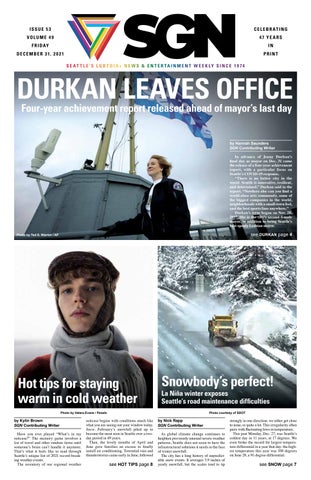
DURKAN LEAVES OFFICE Four-year achievement report released ahead of mayor’s last day by Hannah Saunders SGN Contributing Writer In advance of Jenny Durkan’s final day as mayor on Dec. 31 came the release of a four-year achievement report, with a particular focus on Seattle’s COVID-19 response. “There is no better city in the world. Seattle is innovative, resilient, and determined,” Durkan said in the report. “Nowhere else can you find a world-class arts community, some of the biggest companies in the world, neighborhoods with a small-town feel, and the best sports fans anywhere.” Durkan’s term began on Nov. 28, 2017. She is the city’s second female mayor, in addition to being Seattle’s first openly Lesbian mayor.
see DURKAN page 4
Photo by Ted S. Warren / AP
Hot tips for staying warm in cold weather
Snowbody’s perfect! La Niña winter exposes Seattle’s road maintenance difficulties
Photo by Valera Evane / Pexels
by Kylin Brown SGN Contributing Writer Have you ever played “What’s in my suitcase?” The memory game involves a list of travel and other random items until someone’s brain can’t handle it anymore. That’s what it feels like to read through Seattle’s unique list of 2021 record-breaking weather events. The inventory of our regional weather
Photo courtesy of SDOT
suitcase begins with conditions much like what you are seeing out your window today. Snow. February’s snowfall piled up to become the most seen in Seattle over a twoday period in 49 years. Then, the lovely months of April and June gave families an excuse to finally install air conditioning. Torrential rain and thunderstorms came early in June, followed
see HOT TIPS page 8
by Nick Rapp SGN Contributing Writer As global climate change continues to heighten previously unusual severe weather patterns, Seattle does not seem to have the infrastructural solutions it needs in the face of winter snowfall. The city has a long history of unpredictable snow events. It averages 5.9 inches of yearly snowfall, but the scales tend to tip
strongly in one direction: we either get close to none, or quite a lot. This irregularity often pairs with fluctuating lows in temperature. This past Monday, Dec. 27, was Seattle’s coldest day in 11 years, at 17 degrees. We even broke the record for largest temperature differential in a year that day: the highest temperature this year was 108 degrees on June 28, a 91-degree differential.
see SNOW page 7
GREEN CARDS • VISAS • ASYLUM • CITIZENSHIP 1836 Westlake Ave N, Suite 302 Seattle, WA 98109
(206) 724-1940 olivielaw.com
THIS AD SPACE HAS BEEN GENEROUSLY DONATED BY KRISTIN COSTELLO IN MEMORY OF SGN PUBLISHER GEORGE BAKAN
2
SGN
D E C E M B E R 3 1, 2 0 2 1
C E L E B R AT I N G 4 7 Y E A R S!
ORIGINALLY SEATTLE GAY NEWS FOUNDED 1974 MEMBER
509 10th Ave E Seattle, WA 98102 (206) 324-4297 sgnpaper@gmail.com sgn.org
2021
Deadlines Calendar | Tuesday at 6pm Display Ads Space Reservation | Monday at 5pm Ad Copy (non-camera ready) | Tuesday at 5pm Ad Copy (camera-ready) | Wednesday at 5pm Letters to the Editor | Tuesday at 5pm Obituaries | Call the SGN office All others | Tuesday at 5pm
Publisher Angela Cragin Managing Editor A.V. Eichenbaum Copy Editor SGN Staff • Richard Isaac Advertising Maggie Bloodstone, Advertising Manager National Advertising Rep. Rivendell Media (212) 242-6863 Staff Writers Mike Andrew • Sara Michelle Fetters Contributing Writers Lindsey Anderson • Janice Athill Josephine Baird • Alice Bloch Maggie Bloodstone Kylin Brown • Sharon Cumberland Carter Hemion • Daniel Lindsley Paige McGlauflin • Tim Peter Jessica Price • Renee Raketty • Nick Rapp Hannah Saunders • Gaysha Starr Sarah Toce • Ed Walsh Social Media Manager SGN Staff Photographers Nate Gowdy • Renee Raketty Production Mike Pham SGN is published by Angela Cragin. © 2021. All Rights Reserved. Reprints by permission. Publication of names, photographs, or likeness of any person, organization, event or business in this publication cannot be taken as any indication of the sexual orientation of the person, organization, event or business. Opinions expressed in bylined articles, columns, and letters are those of the authors only and do not necessarily reflect the views of the staff or management of this paper. SGN welcomes unsolicited material, including letters to the editor, but reserves the right to edit or reject material. All rights revert to authors upon publication. We assume no liability for loss or damage of materials, solicited or not. We invite feedback, please write. And please play safe. It is our policy that no money shall be refunded if you choose to cancel your ad. Credit will be given for the balance owed. No exceptions.
In Loving Memory Of George Bakan
Scott Roger Alpert Cookie Andrews-Hunt James Arnold Ken Campbell Steve Foiles Shaun Knittel James Leland Moore Don Paulson Randy Peters Lee Richeson Shaun Shelton Jim Tully
Follow SGN
VISIT US ONLINE SGN.ORG
In this Issue
LOCAL NEWS 4 FILM 9 A&E • BOOKS 17 OP-ED 18 NATIONAL NEWS 21 INTERNATIONAL NEWS 21 D E C E M B E R 3 1, 2 0 2 1
SGN
3
Local News
Photo by Ted S. Warren / AP
DURKAN
continued from cover COVID-19 The City of Seattle’s response to the pandemic will most likely be Durkan’s defining legacy. Seattle was the first American city to be struck by the coronavirus in early 2020. According to the report, Seattle led the COVID-19 public health response throughout the country by coming up with protocols and making decisions based on scientific evidence. Back in early 2020, when there were limited supplies, Durkan purchased testing kits from South Korea to allow for mass testing of Seattle residents. Seattle Fire — one of the first groups to administer vaccines in the country — created five mobile units for the purpose of testing vulnerable populations and those living at long-term care facilities. When Seattle’s restaurants and small businesses took a financial hit from the pandemic, the City created café street programs that allowed for safer outdoor dining. New programs were also put in place, including one of the first eviction moratoriums in the nation and small business grants, among others. The expansion of existing programs during the pandemic consisted of an increase in food and rental assistance, and utility assistance to prevent residents from losing electricity. Under Durkan, a total of $50 million in rental assistance, $33 million in cash assistance for vulnerable residents, $17 million in small business grants, and 233 safe street café permits were provided, according to the report. The report takes pride in the city’s vaccination efforts. Lumen Field became the largest civilian-led vaccination site in the United States, and as of June 2021, Seattle became the first American city where 70% of residents were fully vaccinated. “We have the lowest cases, hospitalizations, and mortality rate of [any] major city in America. The work we did together saved thousands of lives,” Durkan said.
4
SGN
According to the report, over 1.3 million COVID-19 tests have been administered to Seattle residents, and in the fall of 2021, new sites were established in West Seattle, Rainier Beach, and Downtown in order to provide thousands of booster doses of the vaccine. Increased opportunities On her third day in office, Durkan created the Small Business Advisory Committee to recognize the voices and needs of smaller businesses. In 2018, the Families, Education, Preschool and Promise levy was passed with 80% of the vote. It created 2,000 preschool program placements for Seattle children. It
also guaranteed two free years of college for all Seattle public high school students. In 2019, the Libraries for All levy passed with 76% of the vote, which opened Seattle Public Libraries to more than 51,000 residents and got rid of $2.6 million in outstanding overdue fines. Uber and Lyft drivers were also able to receive equal pay when a 2020 law was passed that required drivers to be paid at least minimum wage. Affordable housing “While much of my term was focused on our crisis response, we never stopped focusing on the key issues of our time: housing
and homelessness, and building opportunity for the next generation,” Durkan said. With rental increases in addition to the challenges of COVID-19, a number of people are experiencing homelessness across Seattle. On Sept. 4, 2019, Durkan and Executive Dow Constantine established the King County Regional Homelessness Authority (KCRAH), which will seek to address the city’s response to homelessness in early 2022. In 2019, the Mandatory Housing Affordability was established, which allowed Durkan to increase affordable housing investments and the number of affordable housing units.
Photo courtesy of the Office of the Mayor
D E C E M B E R 3 1, 2 0 2 1
C E L E B R AT I N G 4 7 Y E A R S!
Photo by Ted S. Warren / AP
According to the report, about “one-third of the affordable housing since the first Housing Levy in 1981” is being created during Durkan’s term. This equates to $2.5 billion in investments to build and preserve units. Accessory dwelling unit (ADU) and detached accessory dwelling unit (DADU) legislation also allowed for more backyard living facilities. The report claims that under Durkan, an improvement in shelter spaces has enabled a greater number of people to get off the streets and into safer living quarters. The report also claims that Seattle has approximately 3,000 shelters, hotels, or backyard living facilities, in comparison to 1,700 in 2017. Although she has emphasized the importance of affordable housing and safe spaces for both residents and the homeless population, Durkan has continued sweeping homeless encampments throughout the pandemic, which forces people to leave their campsites and search for new locations. During a 2020 interview with KUOW’s Bill Radke, she stated, “Unfortunately, some of [these encampments have been] the site of shootings, human trafficking, and other violent crimes.” Climate During Durkan’s term, Seattle has experienced extreme weather conditions: snowstorms, extreme heat, hazardous air conditions from wildfire smoke, and rapid rainfall. The report states that incorporating climate resilience into Seattle’s infrastructure was a key focus of the Durkan administration. It also states that one year, over 1,200 miles were plowed during a snowstorm. On Feb. 1, 2021, one of the strictest energy codes in the United States was passed, the natural gas ban. This ban prohibits the construction of natural gas in new buildings and requires electric vehicle-charging stations in multifamily constructions. The report mentions that 3,500 free transportation passes were provided to seniors and workers, in addition to 18,000 ORCA cards for students. Additionally, 800 homes were converted from oil to electric,
VISIT US ONLINE SGN.ORG
Photo by Elaine Thompson / AP
and 10% of emissions were reduced due to energy code updates. Community safety and response Throughout her term, Durkan invested in several pilot projects, including the King County Regional Peacekeepers Collective, to address the rise of gun violence within Seattle. Additionally, Health One, which is the Seattle Fire Department’s mobile integrated health response unit, allowed medics, instead of police officers, to be sent to assist people experiencing distress. Furthermore, the report mentions a reduction in 911 calls at the highest-volume shelters, by placing nurses in shelters. Community service officers, who are unarmed civilians, were also sent into the field to respond to nonemergency 911 calls.
2020 protests What is not mentioned in the report are the 2020 protests, for which Durkan received great criticism. Following the murder of George Floyd, Seattle residents protested police brutality, and the Seattle Police Department used tear gas, blast balls, and pepper spray, among other crowd-control measures. Durkan was met with criticism for neglecting to address and soften the police response. Within weeks of Floyd’s murder came calls for her resignation, including from Seattle City Councilmembers Kshama Sawant, Tammy Morales, and Teresa Mosqueda. A 30-day ban on tear gas at protests was instituted, except for the SPD’s SWAT unit, who were allowed to use tear gas to end standoff situations and to protect life. Two days after the ban, Capitol Hill was subjected to tear gas.
D E C E M B E R 3 1, 2 0 2 1
Text messages dating from Aug. 28, 2019, to June 25, 2020, were excluded from public records requests, which violates the state’s Public Records Act. Communications between Durkan and Seattle Fire Department Chief Harold Scoggins and former police chief Carmen Best (who resigned in Aug. 2020) are missing. This prevents the public from examining decisions to use tear gas on residents and protestors in Capitol Hill. A lawsuit against the City of Seattle was filed by the Seattle Times Durkan’s office claimed the missing text messages were the result of an “unknown technology issue,” although her staff members knew for months that Durkan’s text messages were programmed to delete automatically. After four years in office, Durkan will be replaced by Bruce Harrell on January 1, 2022.
SGN
5
Local News
Mayor-elect Harrell signals police reform commitment with new appointment Sister of Che Taylor to be gun violence prevention liaison by Mike Andrew SGN Staff Writer Seattle’s mayor-elect, Bruce Harrell, sent a major signal to both police and BIPOC communities by appointing DeVitta Briscoe as his new gun violence prevention liaison. Briscoe is a sister of Che Taylor, who was fatally shot by Seattle police in 2016. Prosecutors declined to file charges against the officers involved in the shooting, saying they believed that the officers acted in good faith when they shot Taylor. The City of Seattle later paid Taylor’s family $1.5 million to settle a wrongfuldeath lawsuit. The Taylor shooting and subsequent community demands for accountability were one of the factors in passing I-941, which removed the “good faith” justification for use of deadly force by police from Washington state law. In addition to her brother, Briscoe also lost a son, Donald McCaney, to gun violence in 2010. Since then, “Briscoe has worked toward intervention and frontline support for youth of color to reduce gun violence, ensure police accountability, and empower grieving families,” according to Harrell’s press statement. It continued, “Briscoe launched the Black Women’s Coalition to End Violence to address root causes of urban gun violence and center Black women’s leadership, and is trained to facilitate Restorative Jus-
tice-based healing circles, and the Alive & Free™ violence prevention methodology.” Briscoe is a graduate of the Evergreen State College. In addition to Briscoe, Harrell announced the appointment of Derrick Wheeler-Smith, currently King County’s director of Zero Youth Detention, to serve as interim director of the Seattle Office for Civil Rights. Wheeler-Smith will focus on implementing the mayor-elect’s equity and justice priorities, including the Race and Social Justice Initiative, expanding housing and workforce opportunities, and delivering youth support and mentorship. Harrell has hired Kendee Yamaguchi to serve as deputy mayor of external affairs. Yamaguchi is a former City of Seattle employee and current executive director for Snohomish County. According to Harrell’s statement, she will be tasked with “fostering strong and collaborative relationships between the City of Seattle and community groups, nonprofit organizations, and local businesses.” Harrell will appoint former state legislator and Port Commissioner Gael Tarleton as interim director of the Office of Intergovernmental Relations, charged with facilitating collaboration with state and federal agencies and procuring federal and state investments. Also joining the Harrell administration will be Matt Chan, who will serve as special advisor for public engagement, Jennifer Samuels as chief of staff, and Jeremy Racca as legal counsel.
Photo courtesy of Bruce for Seattle
Mayor Durkan vetoes bill to repeal grocery worker hazard pay by Kylin Brown SGN Contributing Writer In face of the Omicron variant and record-breaking coronavirus infections across King County, Mayor Durkan has extended grocery workers’ hazard pay in a swift veto of Council Bill 120119. The legislation would have rolled back hazard pay benefits for grocery store workers, halting it entirely at the start of the new year. Originally passed December 14, the bill’s summary recognized “considerable progress made toward supporting the health and safety of frontline workers and the community through high rates of vaccinations and reduced numbers of COVID-19 cases and hospitalizations.” Unfortunately, current data projections indicate otherwise. In the past two weeks, King County’s COVID-19 dashboard has demonstrated record highs in daily infections, averaging 1,586 new infections per day. Public Health – Seattle & King County announced Dec. 17 that the number of Omicron cases is rising rapidly locally. It predicted that these increased case numbers will last well into January. Taking these ongoing increases into account, Durkan struck the bill down with her veto, officially submitted Monday. “Now is not the time to roll back the pay for these critical frontline workers,” she said. “In a time that there are no good choices, there are decisions we can make to protect the health, safety, and well-being of our residents, and hazard pay is one of the key city policies that have supported workers who have supported all of us.” Durkan first signed the hazard pay ordinance, co-authored by the UFCW21, into
law on Feb. 3. It applies only to stores within city limits with at least 500 employees, and provides grocery store employees, who are exposed to crowds of people every day, compensation for their risks of exposure. Although helpful for employee safety and retention, the law has been contested in the
6
D E C E M B E R 3 1, 2 0 2 1
SGN
Photo by Kevin Lamarque / Reuters
grocery industry at large. Upon announcement of the Seattle ordinance, which followed several other West Coast cities, Trader Joe’s gave temporary raises to every employee nationwide, while canceling its typical mid-year raises. QFC, which is owned by grocery giant
Kroger, explained two store closures as consequence of the hazard pay requirement. These stores are not set to reopen. This veto will serve as one of Durkan’s final mayoral actions. Bruce Harrell begins his term as mayor on January 1, the same day that hazard pay would have been cut off.
C E L E B R AT I N G 4 7 Y E A R S!
Photo courtesy of City of Seattle
environmentally friendly (and creative) solutions to salt, such as cheese brine, beet molasses, and even coffee grounds. But, for obvious reasons, many of these alternatives are more feasible on a personal level (i.e., for use around sidewalks and driveways). Other posited solutions hinge on developments in snowplow technology and building streets and sidewalks with smarter materials. All of these are big-picture solutions that cannot be implemented overnight.
SNOW
continued from cover The intensity of this year’s winter — including impressive rainfall statistics and chilly low temperatures — stems from a continuing La Niña weather pattern. La Niña events bring stronger trade winds than average, causing upwelling on the West Coast that brings cold surface waters and a more northern polar jet stream, which cause the severe rain and cold temperatures we are experiencing this year and is undoubtedly a cause of atypical winter storm conditions of late. Why isn’t Seattle prepared? Considering the consistent evidence of Seattle’s susceptibility to dangerous winter conditions for pedestrians, cars, and public transit, why is the city never prepared when snow arrives? Entire streets remain unplowed for days in the event of major snowfall. Bus lines that run through residential areas get suspended, with priority falling to 60 major lines that mostly provide service to downtown under King County Metro’s “Emergency Snow Network.” Our main line of defense is salt, which corrodes vehicles and leeches into local water systems. Additionally, we do not have any dedicated snowplows; according to the City of Seattle’s website, “trucks have to [be] outfitted with snow removal equipment when snow threatens,” and “there are not enough of these trucks to plow every street in the city.” So why would the Seattle Department of Transportation not equip the city with enough plows to clear all of Seattle’s roads? In 2019, deputy director of maintenance operations for SDOT Rodney Maxie told KING-TV that the city would need hundreds more plows to effectively clear everything beyond arterial roads, and more plows
VISIT US ONLINE SGN.ORG
Photo courtesy of SDOT
“wouldn’t be cost effective for taxpayers.” The hills of Seattle are an additional hurdle — some are too steep to be plowed. It seems there are not any economically feasible and environmentally friendly solutions to large snow events in the Seattle
area. Between massive fuel consumption by snowplows and toxic zinc and sodium buildup in freshwater systems from salting, maintaining Seattle’s roads has reached a bit of a stalemate. Possible future solutions include more
D E C E M B E R 3 1, 2 0 2 1
Resources In the meantime, in Seattle, residents have some options to plan their commutes (or lack thereof) when the city is covered in snow. “WSDOT Traffic” posts live updates on its Twitter account that document road closures, blockages, and accidents across the state. WSDOT also has a real-time travel data search tool at wsdot.com/travel/realtime/, where residents can search specific areas and roads to access live cams and information about road closures. King County Metro’s Emergency Snow Network is available online at kingcounty. gov, showing closures and route changes due to snowfall. Seattle residents are encouraged to call (206) 386-1800 in the event of sewage backups, flooding, water issues, and leaking hydrants. A map of warming shelters is available at https://seattlecitygis.maps.arcgis.com/ home/index.html, showing specific spots to take refuge in during inclement weather. In the coming years, we may experience continuing unprecedented snowfalls. But with a lack of funding and other logistical obstacles, the city does not have the capacity to clear the roads in less than a few days’ time. The best we can do for the time being is plan ahead and prepare accordingly.
SGN
7
Local News
HOT TIPS
continued from cover by a record temperature of 108 degrees at the end of the month. August saw the end of 51 days without rainfall, plus wildfire smoke. In an apparent attempt to make up for that, it poured in September. Somehow, 2021 still found room to fit in a deep freeze. As Seattle currently witnesses record-breaking low temperatures lasting into the new year, prepare yourself to stay warm during this year’s weather chaos finale. 1. Stay inside! I know, it’s all of our favorite advice. But how could we start an Omicron-era list any other way? In below-freezing temps, having a roof and four walls around you is a privilege many people take for granted. If you have a multistory home or lots of rooms, try gathering the family for a game night and focusing heat into a communal area by closing doors. This is especially helpful if you have a sleeper sofa or kids or roommates who are willing to camp in the living room. If you do not have a home or know someone in need of shelter, the City of Seattle has opened four additional severe-weather shelters, totaling six as of this week [bit. ly/3FIRvlO]. Outreach by the city’s HOPE team and grassroots organizers is ongoing at encampments across the city. Seattle City Hall is also open for shelter 24 hours a day, space permitting. If you are in need of shelter, call 211 or 1-877-211-9274 for assistance. Help is also available for those with a child 18 years old or younger at the Coordinated Family Intake Line, 206-245-1026 (8 a.m. to 11:30 p.m.).
Photo by Yan Krukov / Pexels
2. Do moderate physical activity Do I sound like a physician yet? (I’m actually just a writer with poor circulation.) While sweat could make your inner layers of clothing moist and end up making you cold, a brisk walk or light yoga workout could increase body heat just enough to feel warm inside. 3. Layers, layers, layers Not only is the art of layering clothes increasingly important to online influencers at the moment, it is a necessary measure when navigating life outside in cold weather. From long sleeves and gloves to tights under pants, winter fashion offers a multitude of looks. Layer up with whatever you’ve got and tell your admirers that you saw it in Vogue. 4. Soup Anyone exposed to TikTok or Instagram reels in the last month might know that “gorgeous, gorgeous girls love soup.” According to the internet, to become a gorgeous, gorgeous girl (which is, in fact, a genderless application of the word) who stays warm during a deep freeze, soup is your ticket. Throw some vegetables and water on the stove or stop by your favorite soup kitchen to light a fire in your heart. Pose with it and tag us @seattlegaynews on Instagram for bonus points.
Photo by Mikhail Nilov / Pexels
Photo by LoveFood Art / Pexels
Photo by Arina Krasnikova / Pexels
Photo by Jasmin Chew / Pexels
5. Cuddle time I know you and your roommates have gotten to know each other all too well this year, but at least one of them should be good at cuddling. Without access to soup or motivation for exercise, cuddling is a resourceful way to take the body heat right off of someone else! Cozy up under a blanket with anyone, even your dog if it’s all you have, and you’ll be warmer than a Patagonia fleece in no time. 6. Share warmth in other ways If you are reading this from an indoor space with adequate heating, consider all of the ways you might be able to share some of your warmth with others. For example, Homies Helping Homies Seattle is providing tents and warming kits through donations and mutual aid. If you know of similar resources, share them with those in need.
8
SGN
D E C E M B E R 3 1, 2 0 2 1
C E L E B R AT I N G 4 7 Y E A R S!
Film
2021 recap:
The ten best films of the year, the continued rise of streaming, and the future of the theatrical experience
Photo by Mario Anzuoni / AP
by Sara Michelle Fetters SGN Staff Writer The craziest thing about watching new films in 2021 was how much it resembled 2020. While theaters slowly reopened, thanks to COVID, they never did spring back to life completely. Yes, this month’s release of Spider-Man: No Way Home showed that a billion dollars in worldwide receipts was still possible (in a little under two weeks, no less), but that sort of success was the exception, not the rule. While there were other success stories, most were few and far between, and almost all came from a single studio (Disney) or were massive franchise entries with large, mostly young fan bases. But mostly we all watched new releases from the comfort of our own homes. Warner Bros. took the unprecedented step of releasing its slate of films in theaters and on HBO Max at the same time. Disney did the same for much of the year, shuffling some titles like Luca to Disney+ exclusively, while others like Marvel’s Black Widow, Jungle Cruise, and Cruella could be viewed theatrically or watched on the streaming service for an extra $30. Universal and Paramount followed a similar path with a few of their titles, the former utilizing its Peacock platform while the latter finally opened the curtain on Paramount+. It was a banner year for Netflix and Amazon Prime, as the two stalwarts in the streaming game went to town with a variety
VISIT US ONLINE SGN.ORG
of self-financed releases, while also paying top dollar for pictures from the traditional Hollywood studios that they could debut on their platforms instead. Other, smaller outlets, like Shudder and Mubi, also increased their new-release output significantly in 2021; the former was particularly gung-ho about debuting three or four new features each month. Not that theaters are throwing in the towel. AMC and Regal went all out trying to lure back patrons. AMC went so far as to offer up full theater rentals during the first half of the year for a relatively meager $99. That’s gone up significantly since (it’s now $469 at most venues, and the selection is limited to new releases), but it is still a slick way to drum up business while also creating a feeling of relative safety. Still, as mentioned and with rare exception, the films that did the best theatrically were giant franchise tentpoles like Godzilla vs. Kong, F9, Shang-Chi and the Legend of the Ten Rings, Halloween Kills, and Venom: Let There Be Carnage. The only original title to massively break through commercially was Free Guy, a holdover from Disney’s purchase of 20th Century Fox (now 20th Century Studios), which also happened to have direct tie-ins to the studio’s Marvel and LucasFilm properties. Another somewhat surprising success story was an adaptation of the first half of Frank Herbert’s Dune by Warner Bros., a hugely expensive gamble directed by
Denis Villeneuve sold on the promise that it would deliver sights and sounds that could only be fully enjoyed on the biggest screen available. The gamble paid off and a sequel was quickly greenlit. Otherwise, everything skewing to an even moderately older viewership failed rather miserably, including a string of high-profile musicals (In the Heights, Dear Evan Hansen, West Side Story) that in pre-COVID times likely would have done gangbuster business no matter the critical reception. Other films that failed to make a significant dent at the box office included Clint Eastwood’s Cry Macho, Wes Anderson’s The French Dispatch, James Wan’s Malignant, Guillermo del Toro’s Nightmare Alley, and Kenneth Branagh’s Belfast, all of which I suspect would have been minor to significant hits pre-2020. How will things change in the future? I can’t say I know. Streaming is here to stay, I think we all agree, but I’m equally terrified to imagine a world where only giant tentpoles like the next films featuring SpiderMan or Batman are the only titles playing at the local multiplex. There has to be a way to maintain variety, a method for venues to successfully showcase a broad selection of titles and not just the latest $200-millionbudgeted entry in a long-running franchise. All that depressing stuff aside, there was plenty I still managed to get excited about in 2021. I dropped my 1,001 Great Films
D E C E M B E R 3 1, 2 0 2 1
series this year, a painstaking 10-month journey through over a century of film that was arguably the most exhaustively personal set of features I’ve ever written. I’m understandably very proud of it. As for this year’s new releases, there were numerous pleasures to be had, with so many filmmakers taking me on journeys I’d never have thought to venture on had they not confidently led the way. A few notes on my top ten: I’ve purposefully kept a couple of notable titles that were technically 2020 releases — Shaka King’s Judas and the Black Messiah, Harry Macqueen’s Supernova, Josh Greenbaum’s Barb & Star Go to Vista Del Mar — out of consideration. They were released in January and February to try and take advantage of an elongated eligibility period to qualify for last year’s Academy Awards. I’ve also once again separated out my favorite documentaries, mainly because I want to showcase each title in hopes that more people might take the time to give them a look. Finally, I’ve also included a list of ten new-to-me discoveries I made during the past year. Cinema isn’t just about the here and now. It is also about investigating where we’ve come from and seeing how the medium has continued to evolve over the past 120 years, so I can’t help but wish that at least a few people will be curious enough to seek out some of those titles for themselves.
see BEST FILMS page 10
SGN
9
Film
Shiva Baby – Photo courtesy of Utopia
Pig – Photo courtesy of Neon
Titane – Photo courtesy of Neon
10
SGN
D E C E M B E R 3 1, 2 0 2 1
C E L E B R AT I N G 4 7 Y E A R S!
Bergman Island – Photo courtesy of IFC Films
The Mitchells vs The Machines – Photo courtesy of Netflix
Without further ado, here are my picks for my ten favorite films of 2021: TOP TEN Shiva Baby (Dir.: Emma Seligman) I don’t think any 2021 film made me feel more anxious than writer-director Emma Seligman’s audacious Shiva Baby. In this a cringe comedy and astute social commentary rolled into an excruciatingly tense 87 minutes, mixed-up college student Danielle (a sensational Rachel Sennott) butts heads with her parents while also running into her married sugar daddy and her former childhood best friend — and semi-secret ex-girlfriend — Maya (an equally outstanding Molly Gordon) at a Jewish wake. Seligman structures her high-wire familial farce — also sex-positive in a way few films dare — as if it were a horror movie, and by doing so crafts one of the more innovative and original debuts I’ve seen in ages. Pig (Dir.: Michael Sarnoski) Pig is a quietly spellbinding, introspective gem that grows in grace and power as it goes along. What could have been a culinary curiosity about a award-winning former chef now living in seclusion as a bearded outcast and truffle farmer going all “John Wick” on Portland’s culinary elite while searching for his beloved pig instead becomes something chillingly haunting and emotionally pure. Sarnoski wisely centers things on star Nicolas Cage, who delivers one of the finest, most bone-chillingly authentic performances of his long and varied career. Titane (Dir.: Julia Ducournau) I can’t stop thinking about Julia Ducournau’s sophomore stunner, Titane. This masterfully forceful genre mash-up is a madcap deconstruction of gender, sexuality, and parenthood, and just when I thought I had a firm grasp on where the filmmaker was taking things, she quickly made a quick left turn into shatteringly unexpected unknowns that sent my head spinning. A mesmerizing Vincent Lindon anchors the second half with a spectacular supporting performance, while star Agathe Rousselle boldly and proactively announces herself as a major talent worth keeping an eye on.
VISIT US ONLINE SGN.ORG
Parallel Mothers – Photo courtesy of Sony Pictures Classics
Bergman Island (Dir.: Mia Hansen-Løve) Few films moved me to tears as quickly as Mia Hansen-Løve’s poetically luminous Bergman Island. Vicky Krieps and Tim Roth are wonderful as a pair of married filmmakers who have journeyed to the Swedish island of Fårö looking for inspiration as they work on their latest projects. Their relationship is juxtaposed with a fictional one acted out to perfection by Mia Wasikowska and Anders Danielsen Lie, and Hansen-Løve layers these subplots with confident dexterity. The film is a delicate little dance that analyzes the dizzying complexities of artistic creation with mesmeric glee, with everything building to an emotional bombshell of a climax that filled my heart with joy. The Mitchells vs the Machines (Dir.: Michael Rianda, Jeff Rowe) The Mitchells vs the Machines is a thunderbolt of exuberant imagination overflowing in sights and sounds so blissfully luminous that just thinking about them is enough to bring a smile to my face. It is also a devastatingly insightful satire on corporate culture, technological excesses, and societal dehumanization, all sitting rhapsodically inside a story of a dysfunctional family that has to relearn how to work together to save the world from robotic overlords straight out of an Isaac Asimov novel. I should also say that Katy Mitchell is, without question, my favorite character of 2021. Hands down. No contest. Parallel Mothers (Dir.: Pedro Almodóvar) Pedro Almodóvar does it again. This ferociously sentimental melodrama cuts deep and refuses to take shortcuts. Ostensibly the relatively simple story of two mothers who give birth on the same day, the film becomes a wildly impressionistic marvel of storytelling legerdemain, where nothing is exactly as it seems yet everything sparkles into reality exactly as it needs to in order to make a suitably dramatic impact. Frequent Almodóvar collaborator Penélope Cruz gives a titanic performance that’s one of the finest of her Academy Award–winning career.
see BEST FILMS page 14
D E C E M B E R 3 1, 2 0 2 1
SGN
11
Episode 15: Olivia Sterne Activist and generally interesting person Olivia Sterne is our guest this week! Also in this episode, Ash & Lindsey go over the week's events, talk their top picks for 2021, and set intentions for the new year! IT. IS. A. HOOT.
BI-WEEKLY! FIND US WHEREVER YOU LISTEN TO PODCASTS! 12
SGN
D E C E M B E R 3 1, 2 0 2 1
C E L E B R AT I N G 4 7 Y E A R S!
VISIT US ONLINE SGN.ORG
D E C E M B E R 3 1, 2 0 2 1
SGN
13
Film
The Matrix Resurrections – Photo courtesy of Warner Bros.
Drive My Car – Photo courtesy of Janus Films
Werewolves Within – Photo courtesy of IFC Films
The Power of the Dog – Photo courtesy of Netflix
TOP TEN (CONTINUED) The Matrix Resurrections (Dir.: Lana Wachowski) Lana Wachowski doesn’t so much resurrect The Matrix as she takes a sledgehammer to Hollywood’s current obsession with nostalgia-laden franchise filmmaking, while at the same time crafting an unapologetically heartfelt love story that is perfectly faithful to her and her sister Lily Wachowski’s groundbreaking original trilogy. It’s a glorious, spellbinding continuation of the story that tackles questions of gender, self-perception, sexism, misogyny, capitalism, and corporate overreach with angrily messy determination, with love conquering all, as Neo and Trinity soar back into one another’s arms. Drive My Car (Dir.: Ryûsuke Hamaguchi) Nothing happens in Ryûsuke Hamaguchi’s Drive My Car. Also, everything happens in Ryûsuke Hamaguchi’s Drive My Car. A quiet miracle, this three-hour tour de force is a ride into the unknown that subtly grows in powerful resonance as it motors to its suitably ephemeral conclusion. Hamaguchi weaves a tale involving grief, artistic expression, community, friendship, and so much more with mesmeric authority. The subtle depths of human discourse being examined are as pure as they are profound.
14
SGN
D E C E M B E R 3 1, 2 0 2 1
The Power of the Dog (Dir.: Jane Campion) Jane Campion returns with The Power of the Dog, her first feature film since 2009’s Bright Star. Her astutely minimalist adaptation of Thomas Savage’s revered novel is a flabbergasting visual and emotional juggernaut that left me speechless. Benedict Cumberbatch’s tremendous performance as uncompromising rancher Phil Burbank is something special, as are magnificent supporting turns from Kirsten Dunst, Kodi Smit-McPhee, and Jesse Plemons. But it is the unnervingly stark gaze into the masculine ego that is most impressive, as Campion takes Savage’s prose to a place of beauteous devastation that chilled me to the bone. Werewolves Within (Dir.: Josh Ruben) As the year’s best Agatha Christie-meets-Clue-meets-Knives Out-meets-Arachnophobia-meets-The Beast Must Die mash-up (and also the only one), Josh Ruben’s deliciously amusing horror-comedy whodunit is the most fun I had watching a movie for the first time in all of 2021. A pitch-perfect ensemble, led by Sam Richardson and Milana Vayntrub, gamely go for broke every second of this quickly-paced 97-minute mystery, while Mishna Wolff’s virtuoso script jubilantly toys with the audience in a variety of ingenious ways. An absolute triumph worthy of multiple viewings.
C E L E B R AT I N G 4 7 Y E A R S!
Belfast (Focus Features)
Jakob's Wife (RLJE Films)
King Richard (Warner Bros.)
Limbo (Focus Features)
Lucky (Shudder)
C'mon C'mon (A24)
Candyman (Universal Pictures)
Fear Street Trilogy (Netflix)
The Green Knight (A24)
I'm Your Man (Bleecker Street)
Passing (Netflix)
Never Gonna Snow Again (Kino Lorber)
Raging Fire (Well Go USA)
The Night House (Searchlight Pictures)
West Side Story (20th Century Studios)
The Tragedy of Macbeth (A24)
Wife of a Spy (Kino Lorber)
A SECOND SEVENTEEN (because I can) Belfast (Dir.: Kenneth Branagh), C’mon C’mon (Dir.: Mike Mills), Candyman (Dir.: Nia DaCosta), the Fear Street trilogy (Dir.: Leigh Janiak), The Green Knight (Dir.: David Lowery), I’m Your Man (Dir.: Maria Schrader), Jakob’s Wife (Dir.: Travis Stevens), King Richard (Dir.: Reinaldo Marcus Green), Limbo (Dir.: Ben Sharrock), Lucky (Dir.: Natasha Kermani), Never Gonna Snow Again (Dir.: Malgorzata Szumowska, Michal Englert), The Night House (Dir.: David Bruckner), Passing (Dir.: Rebecca Hall), Raging Fire (Dir.: Benny Chan), The Tragedy of Macbeth (Dir.: Joel Coen), West Side Story (Dir.: Steven Spielberg), Wife of a Spy (Dir.: Kiyoshi Kurosawa)
see BEST FILMS page 16
VISIT US ONLINE SGN.ORG
D E C E M B E R 3 1, 2 0 2 1
SGN
15
Film
Flee (Neon / Participant)
The Rescue (Greenwich Entertainment)
Rita Moreno Just a Girl Who Decided to Go For It (Roadside Attractions)
The Sparks Brothers (Focus Features)
Summer of Soul (…or, When the Revolution Could Not Be Televised) (Searchlight Pictures)
FIVE FAVORITE DOCUMENTARIES Flee (Dir.: Jonas Poher Rasmussen), The Rescue (Dir.: Elizabeth Chai Vasarhelyi, Jimmy Chin), Rita Moreno: Just a Girl Who Decided to Go for It (Dir.: Mariem Pérez Riera), The Sparks Brothers (Dir.: Edgar Wright), Summer of Soul (…or, When the Revolution Could Not Be Televised) (Dir.: Ahmir-Khalib Thompson) Cast a Dark Shadow (DCA)
Badlanders (MGM)
Johnny O'Clock (Columbia Pictures)
Merrily We Go to Hell (Paramount)
Next of Kin (Tubi TV) Last Train from Gun Hill (Paramount) Visions of Eight (Cinema 5)
Scare Me (Shudder)
The Tall T (Columbia Pictures)
The Lusty Men (RKO)
TEN FAVORITE NEW-TO-ME PRE-2021 RELEASES The Badlanders (1958) (Dir.: Delmer Daves), Cast a Dark Shadow (1955) (Dir.: Lewis Gilbert), Johnny O’Clock (1947) (Dir.: Robert Rossen), Last Train from Gun Hill (1959) (Dir.: John Sturges), The Lusty Men (1952) (Dir.: Nicholas Ray), Merrily We Go to Hell (1932) (Dir.: Dorothy Arzner), Next of Kin (1982) (Dir.: Tony Williams), Scare Me (2020) (Dir.: Josh Ruben), The Tall T (1957) (Dir.: Budd Boetticher), Visions of Eight (1973) (Miloš Forman, Arthur Penn, Claude Lelouch, John Schlesinger, Mai Zetterling, Kon Ichikawa, Yuri Ozerov, Michael Pfleghar)
16
SGN
D E C E M B E R 3 1, 2 0 2 1
C E L E B R AT I N G 4 7 Y E A R S!
Arts & Entertainment
A warm memoir of love and entrepreneurship in NYC by Terri Schlichenmeyer Special to the SGN THE AUDACITY OF A KISS: A MEMOIR LESLIE COHEN © 2021 Rutgers University Press $24.95 / higher in Canada 235 pages Behind every statue is a story, and the one behind those representing four people in Christopher Park in New York’s Greenwich Village is no different. But to explain how this monument came about means also telling a long love story and a tale about a nightclub. Author Leslie Cohen’s mother was her very best friend, although there were misunderstandings in the relationship. Seven-year-old Leslie couldn’t see why she received pink, girly things for her birthday. In later years, she couldn’t understand why her mother deferred to Leslie’s father and endured his abuse.
Image courtesy of Rutgers University Press
The one thing she did understand was that once puberty hit, the boys in her neighborhood were no longer pals to roughhouse with. She was supposed to want to date them. It didn’t entirely make sense, but Cohen went along with it even after she left home for college. She went out with boys and lost her virginity to one, but meeting Beth was the most remarkable thing about higher learning. She was sure she was in love with her, but Beth was obsessed with a boy and so Cohen moved on. She moved on to other men and then women, at a time between when women loving women was unthinkable. Cohen embraced her lesbianism, fell in and out of love, and went into a partnership with three other women in 1976 to open New York’s first nightclub where Lesbians and straight feminists were welcome to dance and drink, and it played host to many a luminary. To be sure, it was a heady time. Cohen worked nonstop, gained confidence, and learned to run a bar business. She was busy, but happy.
And then Beth came back into her life... for fifty years. This enduring couple became the models for the two women in the famous statue in Christopher Park, across from the Stonewall Inn. Let’s face it: Cohen’s life story is basically like that of a lot of Lesbians born at the beginning of the Baby Boom. A solid childhood, confusion, self-awareness, entrepreneurship all make a somewhat familiar story, set apart by one abundant thing: warmth. Indeed, The Audacity of a Kiss is an easy tale. It’s comfortable, like a cushy sofa with a glass of wine and a crackling fireplace. There are accomplishments here, told so that you really share the pride in them. Readers are shown the struggles that Cohen experienced too, but they are well framed by explanations of the times in which they occurred, with nothing overly dramatic — just the unabashed truth, and more warmth. Younger Lesbians will get a lot from this book, but anyone who’s been there will relish it.
Tender Bar is too nice for its own good
Daniel Ranieri and Ben Affleck in The Tender Bar – Photo courtesy of Amazon Studios
by Sara Michelle Fetters SGN Staff Writer THE TENDER BAR Now in Theaters / Amazon Prime (Jan. 7, 2022) The Tender Bar is a “nice” movie. Director George Clooney and screenwriter William Monahan’s adaptation of J.R. Moehringer’s best-selling memoir doesn’t have an enraged or cantankerous bone in its body. It exudes kindness. It wears its heart on its sleeve. Even the ups and downs experienced by protagonist J.R. Maguire — both as a wide-eyed nine-year-old and later as a questioning college student trying to find his place in the world — never feel weighty or dire. It’s nice, and I can’t find another word that describes this heartwarming comingof-age dramedy better than that. This also makes Clooney’s latest moderately boring and almost immediately forgettable. The director is a long way from the monumental glories of Good Night, and Good Luck, that’s for sure, and I can’t say Monahan’s script is on the same level as The Departed or even Kingdom of Heaven
VISIT US ONLINE SGN.ORG
either. It’s like they’re both on autopilot, content to maintain a relaxed, pleasantly nonthreatening vibe while never pushing the envelope in any way. Not that there’s anything wrong with this approach. Seeing a youngster come into their own as they grow into an adult, urged on by the heartfelt tutelage of their loved ones, is a timeless scenario that’s been part of the narrative canon going back centuries. When well executed, a story like this can gently tug at the heartstrings and manufacture a handful of well-deserved tears. I love that. So it’s no surprise that I adored roughly the first hour of The Tender Bar. When focusing on the pint-sized version of J.R. (Daniel Ranieri), and more specifically his relationship with his bartender uncle Charlie (Ben Affleck), Clooney and Monahan’s streamlined adaptation hits on all cylinders. The pair’s chemistry is off the charts, and I thrilled every time the duo sat down for a conversation. Affleck is especially terrific, giving such a relaxed, unassumingly sincere performance that his magnetic charm dripped right off the screen. Pity the second half didn’t generate that same energetic spark. Once a teenage J.R.
(Tye Sheridan) heads off to Yale to pursue his dreams of becoming a writer, things become far less interesting. Over the next few years, he has an on-again, off-again relationship with Sidney (Briana Middleton), which isn’t badly staged — they make a cute couple — so much as it is absent any tension. There is no drama as to the outcome of their dalliance, and I never cared if they were going to end up together. This would be unfortunate on its own, but I was equally indifferent to J.R.’s various travails in his quest to become a professional journalist. Sheridan gives it a good go and all, and it’s not like things are ineptly presented or poorly put together. They just don’t have any weight. There’s no emotional heft. I had zero personal investment in how things were going to work out for J.R., and considering how much I cared for his nine-year-old incarnation, this turn of events wasn’t just disappointing, it was borderline unforgivable. But gosh, that initial half is pretty darn adorable. There’s a magical moment where J.R. goes to a father-son breakfast at his elementary school with his cantankerous grandfather, marvelously portrayed by an
D E C E M B E R 3 1, 2 0 2 1
understatedly gruff Christopher Lloyd. There are also a small handful of others between the boy and his loving, if perpetually exhausted, mother (an excellent Lily Rabe) that overflow in quiet delights. Yet it’s all of the scenes between J.R. and Charlie that brought a perpetual smile to my face. The latter is a self-educated neighborhood stalwart who lives by a handful of simple rules, all of which he attempts to pass on to his wide-eyed nephew. There’s a great bit where the bartender introduces J.R. to a giant closet that’s being utilized as a de facto library, while another, in which he explains in minute detail everything that needs to be in a man’s wallet at all times, is quirkily endearing. So, yeah, The Tender Bar is nice. There’s nothing provocative about it. Even the bits that fell flat didn’t do so in a way that was so egregious that I could get angry about them. I just wish that Clooney and Monahan had brought more to the production than just a generally easygoing vibe that refuses to challenge and goes out of its way to not offend. Nice is fine and all, but in this case, I’m not sure nice is good enough to warrant a recommendation.
SGN
17
Op-Ed
We should celebrate Taylor Swift’s feminist anthem against the exploitation of young women
Taylor Swift – Photo by Wade Payne / AP
by Lindsey Anderson SGN Contributing Writer Editor’s note: The author of this piece has requested that it be accompanied by a content warning. Be advised that this op-ed contains discussion of sexual assault. Reader discretion is advised. -A.V. Eichenbaum, SGN Managing Editor “Girls mature faster than boys.” It’s an adage we’ve all heard, whether we grew up getting off the hook because of it, or were expected to know everything before we turned double digits. It’s why 18-year-old males are still boys, but 16-year-old females are considered women. Due to the wide acceptance of ageist sexism, most girls who fall victim to it normalize it and view related experiences as “coming of age” challenges unique to the female experience. However, as feminist conversations continue to evolve, some are now bringing the discrepancy into the spotlight. For women in the public eye, ageism waits around the corner like an expiration date. In a capitalist system built by men, industries love to take all they can from the young, impressionable, and pure, and once they see no use for these women, they discard them like last year’s Christmas tree. For Taylor Swift, once the music industry’s darling, this experience has happened time and time again. Her naivety has been taken advantage of by the men she has worked with, slept with, and trusted the most. Now, she’s speaking out about it the only way she knows how: through song. Double standards At 18, we decide that children of all genders magically turn into adults, but for girls and those assigned female at birth, the experience is drastically different than it is for boys. We’ve all seen it in popular media: pervy older men just counting down the
18
SGN
days until a girl turns 18 and magically becomes fuckable. Why is it that after a girl’s 18th birthday that she becomes a woman? What experience takes place overnight that transforms an innocent child into a fully consenting adult? And why don’t we see men of the same age treated this way? There is no scientific evidence that girls undergo a metamorphosis into womanhood upon their 18th birthday. Yet, for centuries men have used this date as an excuse to legally prey on young women, while all 18-year-old men encounter is newfound respect from society. It is disgusting, unforgivable, and considered rape if an adult man sleeps with a teenage girl — unless she is 18 or 19 (or in some cases a bit younger). We identify coercion when it occurs with “girls.” However, as long as “young women” are old enough to vote, we don’t bat an eye when they enter into relationships with massive age gaps or find themselves questioning whether or not last night’s activities were fully consensual. Why is this? We allow men to stay children far past the age of 18. Kyle Rittenhouse murdered three people with no consequences, because the jury saw the 18-year-old as a “kid” and didn’t want to throw away his future. Yet, 18-year-old girls get raped every day, and the legal system fails to protect them because they are adults in the eyes of the law. We expect victims to know better when they’re women. Brett Kavanaugh was able to intoxicate and rape a young woman when he was in college. His defenders argue that holding him accountable would ruin his future. They fail to acknowledge how his actions had already cost a woman his same age hers. Taylor Swift examines this double standard women face in her newly re-released album Red (Taylor’s version), finding common ground with many other women who experienced the injustice of a world that expects them to grow up while allowing the men in their lives to remain in Neverland.
D E C E M B E R 3 1, 2 0 2 1
The normalization of toxic age gaps In her ten-minute version of “All Too Well,” Swift analyzes a relationship she had with Jake Gyllenhaal, who is eight years older than her. The song documents the loss of innocence and the heartbreak Swift felt, as she was still young and naive and thought the relationship meant more than it did to Gyllenhaal. Swift was 20 when the relationship started, and nobody saw the age gap as a red flag. Instead, they figured she was old enough and smart enough to know what she was getting into. A relationship between a woman in her early twenties and a man nearing 30 could not possibly be coercive, right? But Gyllenhaal, like all men on the inside of these relationships, knew the truth. He understood the innocence he was taking advantage of, entering into a relationship with a young and inexperienced woman. After hearing Swift’s version in the song, men and women alike were still fast to demonize her, criticizing her for bringing up past drama and saying she should have known better at 20. But the fact is we never tell 20-year-old men they should have known better, even when they sometimes do. Men aren’t dumb. Our patriarchy gives them power over women — and immense power over young and naive women. The imbalance of a relationship between a young and inexperienced woman and an older man who has been able to play the field, learn from his own mistakes, and figure himself out, is dangerous. Especially when the world expects the younger woman to be the mature one. The commodification of women in the industry Swift evokes the same sentiments of feminist theorist Luce Irigaray, who came up with “phallocentrism” (the idea that women only exist in patriarchies as marketable commodities). In her song “Nothing New,” Swift notes that women’s ages deter-
mine their value, not only in Hollywood but in relationships, and all other institutions. Swift asks, “What will happen to me once I lose my novelty?,” hinting that youth is the only power women can hold. A young woman is desirable because she doesn’t yet know better; she can be taken advantage of. She’s a fresh canvas, blank and ready to be whatever the rest of the world wants her to be. That’s who Swift was to Gyllenhaal: a young novelty. That’s why women in their early twenties feel so much pressure to achieve, to climb the ladder, to find the guy, to do it all. Once we’re old, we’re old news. Novelty is where our power and desirability come from, and once we become self-aware, we lose it. Then the world moves on to a younger girl to prey on, one who hasn’t yet learned she’s being taken advantage of. In “Nothing New,” Swift also asks, “How can a person know everything at 18 and nothing at 22?” Again, she references the fact that young girls are praised for their maturity. It is impressive for an 18-year-old to enter the industry, to achieve, to date a twentysomething man. We don’t acknowledge what everyone already knows: that this 18-year-old is not as mature as we tell her she is and expect her to be. This 18-year-old is a teenager who still needs to learn her lessons, have some guidance, and figure herself out. But when the world is telling you who you are and praising you for what they’re trying to mold you into, you think you know everything. It’s easy to mistake the appeal of novelty for the gratification of a prodigy. The patriarchy tells us we’re special, because it knows how to take advantage of us, and we believe it because we are still too immature to understand any better. This is how teenage girls end up in coercive relationships with the Jake Gyllenhaals of the world. We normalize girls who have just passed this “age of consent” spending time with adult men who have seen the world because, for whatever rea-
C E L E B R AT I N G 4 7 Y E A R S!
Taylor Swift attends the "All Too Well" short film premiere on November 12, 2021, in New York City – Photo by Evan Agostini / AP
son, we discredit the extra years those men have. “Men mature slower,” which means that all the women he’s slept with, all the jobs he’s worked, all the places he’s been add up to the same as that young girl who just graduated high school. Women engulfed in patriarchy: victims blaming victims When we do nothing to change the system, we enable it. Normalizing the “men mature slower” narrative allows women to be commodified. We normalize the abuse we receive and, in turn, watch our daughters, sisters, and friends receive the same treatment, taken in by the appeal of a system that tells them they’re special, only to drain them of their innocence and leave them the shell of a once-promising young woman.
Swift again references this cycle and acknowledges how the system will continue to lead to the downfall of more young women: “I know someday I’m gonna meet her / it’s a fever dream / the kind of radiance you only have at 17 / She’ll know the way and say she got the map from me / I’ll say I’m happy for her, then I’ll cry myself to sleep.” She acknowledges that by not speaking out sooner, she has contributed to this system. Once the golden girl, the innocent one, the musical prodigy, she inspired other girls to seek out what she had, and now they too will fall into the trap of industries and men who seek to prey on and take advantage of their naivety. She is also aware that age is a way to commodify women in all areas of life. At 18, a girl is fresh and new. Like a brand new
car, her worth is immediately diminished once she’s driven off the lot. At 22, she starts to realize that her worth, to this society, is diminishing with each passing year and each passing man. Men remain influential and important regardless of their age. Just look at Keanu Reeves, 57, starring in another Matrix movie this year. Bill Murray is 71 and evoked cheers when he returned to the Ghostbusters screen. For a woman over 35, such a spotlight is nearly unthinkable. Yeah, there’s Meryl Streep, but even her career is nothing compared to the men of the same age. Women, historically, were never allowed to be heroes of their own stories. We can only exist as love interests, mothers, and innocent creatures. The former two
Jake Gyllenhaal – Photo by Mark Blinch / Reuters
VISIT US ONLINE SGN.ORG
D E C E M B E R 3 1, 2 0 2 1
give women the chance to gain power only when a man is willing to give it to them. Eventually, age makes this type of novelty hard to come by. Pure innocence is the most alluring, but only effective until once again the world has taken advantage of and drained it from them. Lessons So, what can we learn from Taylor Swift? She’s spinning the narrative, showing that there are people out there who not only want to listen to but can relate to her music. That 18, 19, and 20 don’t mean a girl is magically able to understand the world around her and handle herself, especially when taken under the oppressive wing of an older man seeking to gain something from her. She is giving a warning, not to the young girls who think they’re special but to the older ones who know the truth, who have had the innocence beaten out of them, and who refuse to look out for the next generation of “prodigies.” Swift is calling on other victims of the system to protect the young girls. She doesn’t want to let the world tell them they’re older than they are, expect more from them than they would from men of the same age. She doesn’t want us to let them buy into the narrative that their worth is determined by their novelty and their importance to men. We need to call the Jake Gyllenhaals of the world what they are: predators. It doesn’t matter if the girl they’re preying on is 15 or 22; taking advantage of someone’s innocence doesn’t become okay just because they pass the magical threshold of 18. The message to all women is: We need to separate our worth from what the patriarchy tells us it is. We need to acknowledge that the patriarchy has a hold on us. It has ever since the first time we were victims to the system that values us based on our worth to men, and we need to separate it from the way we treat ourselves and others. Swift’s re-released album is a message of sisterhood. It’s about reclaiming one’s narrative and using it to amplify and lift the next generation of women. She is calling on us to look out for each other, and start holding men accountable.
SGN
19
Op-Ed
2022 New Year’s resolutions stumping you? Consider these alternative approaches instead
Photo by cottonbro / Pexels
by Paige McGlauflin SGN Contributing Writer The impact of living through one major historic event after another these last two years has certainly tested the limits of our collective optimism and left many jaded about what 2022 will bring. But the yearend’s approach still often prompts thoughts of New Year’s resolutions. And if our affinity for tradition says anything, it’s certain some folks will nonetheless be inspired to set new goals over the next few weeks. “I think the pandemic has really clarified a lot of people’s boundaries and values in a way that is really valuable, and really an opportunity,” Jack MacCarthy, a Los Angeles–based artist, writer, performer, and life coach who owns and operates the Feminist Life Coach, told the SGN. “I have seen multiple people realize: ‘You know what, I’m not going to put up with this treatment from my family of origin anymore’ or ‘You know what, it’s time for me to start hormones or change my name, or make these other changes that I wasn’t sure about before.’” However, MacCarthy finds that traditional advice about New Year’s resolutions has not served him well, and thus aims to share advice that can be more tangible and useful for his clients. “I see the same exact advice every year, and me and my neurodivergent brain… do not fit into most of that advice… but that doesn’t mean I can’t be generative and fruitful and commit to things that are going to serve me,” MacCarthy said. “It’s really important to me to put advice out there that is going to serve other people who may not feel as served by most of the traditional New Year’s resolution advice.”
20
SGN
Below are some of MacCarthy’s alternative approaches for those feeling inspired to create change in 2022: Identify your values and create goals that align with them “I really encourage people to ask themselves: is this really in alignment with my values, and with what I have capacity for right now? And it’s okay if you don’t know, it’s okay to try things on and see how it feels, and see whether it feels sustainable, and whether it feels aligned,” MacCarthy said. “There’s a lot of beating ourselves up, or thinking that we’re not good enough or the ways we’re living our lives are not good enough, wrapped up in the whole concept of New Year’s resolutions. What I would encourage is, assuming you have limited capacity, what would you spend your limited time and energy and attention on? Start with that, to get a sense of what’s most important to you right now.” Consider setting intentions or cultivating a feeling over creating resolutions It may serve one better to focus on something more abstract rather than setting concrete goals. “Cultivating what you want in 2022 does not have to come in the form of a resolution… it can be a feeling, and that you are going to just do whatever in your life you think will create more of that feeling, or it can be a specific fictional character that you’re trying to channel this year,” MacCarthy said. “There are ways of intention setting and changing things for yourself for the better that don’t have to look like a New Year’s resolution.”
D E C E M B E R 3 1, 2 0 2 1
Reassess your energy levels as time goes on Though it’s always been common to experience varying energy levels throughout the year, MacCarthy notes that the various states of emergency brought on by the pandemic have put in flux how many of us work toward long-term goals. For instance, one may set a goal to work on writing one’s novel every day, but some weeks one might struggle to even get out of bed. “It’s okay to take the time to just focus on meeting your basic needs,” MacCarthy said. “And then when you feel a little more resourced, check in with the goal again. Is it still the right goal for right now?” Focus on achieving “non-zero” amounts of your goal MacCarthy encourages clients to do “non-zero” amounts of work toward their goal. For instance, if someone sets a goal to practice journaling daily but isn’t doing the amount they want or isn’t journaling at all, MacCarthy encourages that person to work on any amount of journaling, even if it’s the “bare minimum.” “It’s not about a specific amount, it’s about doing the thing at all,” MacCarthy said. “Sometimes they open it up, and it’s like, I’m going to literally write one sentence, but then they get inspired and they write three pages. Taking that pressure off can be really useful.” It can also be valuable to assess our selfimposed rules and structures. MacCarthy mentioned Kate Scott’s Medium post “Run the Dishwasher Twice,” in which Scott’s therapist suggested she reassess that rule she’d set with herself for getting her dishes washed, which Scott found helpful for over-
coming that self-imposed mental barrier. “A really common rule that I see people setting is: if you fall off the horse, you’re off the horse forever,” MacCarthy said. “I think having ADHD has forced me to be really generous with myself and encourage the people I work with to be very generous with themselves, and to not think of things in very strict, structured ways. If I intend to have a daily habit, I can still come back to it, [even] if I miss a day, a week, or a month.” Use this free online quiz to identify your motivators MacCarthy has found Gretchen Rubin’s online Four Tendencies quiz to be useful for identifying how one responds to inner expectations versus outer expectations. “I think it’s useful for thinking about [if you’re] more influenced by inner expectations or outer expectations, because if outer expectations are more motivating for you, then think about ways you can create a structure in your life that will support that,” MacCarthy said. “Sometimes people feel like, “Oh, I should be able to do this entirely on my own, I should be doing this for me, not because someone else expects this of me,” but if it’s something you want to do, and it’s something that’s aligned for you, there’s nothing wrong with the fact that you might find it easier to do in the context of a class or an accountability buddy.” The Four Tendencies quiz can be found at quiz.gretchenrubin.com/four-tendenciesquiz. MacCarthy can be found online at feministlifecoach.com and jackmaccarthy. com.
C E L E B R AT I N G 4 7 Y E A R S!
Nat’l & Int’l News
National news Pioneer Trans model April Ashley dies at 86 highlights by Mike Andrew SGN Staff Writer
Transgender model April Ashley — who started her life in a working class Liverpool neighborhood and ended up receiving the Order of the British Empire from Queen Elizabeth II — died on December 27. She was 86. Ashley was not only one of the first Trans models but also one of the first Britons to have gender-affirmation surgery. She was born in 1935 in Liverpool, a gritty port town in northwest England, which she remembered as “a very tough place [that] gave me enormous strength, and most of all gives one an extraordinary sense of humor.” In 1950, at the age of just 15 years, she joined the merchant navy but was discharged after she attempted to take her own life. She was then admitted to a psychiatric hospital. After her discharge, she moved to London and then Paris, where she performed in a drag cabaret show. In 1960, when she was 25, she became one of the first British people to undergo affirmation surgery in Casablanca, Morocco. The operation was a success. Back in the UK, Ashley obtained a passport and driver’s license with a female gender marker. She opted for a career in modeling, where she was quite successful, and was photographed by David Bailey for Vogue. In 1961, however, her modeling career crashed and burned, after the tabloid Sunday People published an article headlined “‘Her’ secret is out,” outing her as Trans. In 1963, she married aristocrat Arthur Cameron Corbett, but their marriage ended in divorce in 1970. The landmark divorce case, Corbett v. Corbett, created for the first time the concept of “legal sex” and ended with the court annulling the marriage on the grounds that Ashley was legally a “man.” The precedent led to legal hurdles for the recognition of Trans people that still exist to this day. Ashley then moved to the US, not returning to Britain until 2005, after Parliament passed the Gender Recognition Act, which finally allowed her to be legally recognized as a woman. She spent the remaining years of her life as an activist for Trans rights. She was honored for her work with an MBE (Member of the Order of the British Empire) in 2012. When he learned of her death, British LGBTQ activist Peter Tatchell tweeted, “She was the GREAT trans trailblazer for decades. I was so honoured to know & support her in a past era when she was reviled after being outed as trans. Hero! Rest in power!”
by Daniel Lindsley SGN Contributing Writer
Jeff T. Green – Photo courtesy of The Trade Desk
April Ashley in 1964 – Photo by Vic Singh / Rex Pictures
Clipping originally collected by Richard Ekins (from The University of Ulster Trans-Gender Archives/Richard Ekins collection at the Transgender Archives, University of Victoria
International news highlights by Daniel Lindsley SGN Contributing Writer Photo by Denis Balibouse / Reuters
Zurich: Easy name, gender change in civil code Reuters reported on December 26 that people in Switzerland will be able to easily change their legal gender starting January 1, 2022, with a quick visit to the civil registry office. This makes Switzerland the latest of now five countries in Europe (the others are Ireland, Belgium, Portugal, and Norway) that allow a change of legal gender without hormone therapy, medical evaluations, or other hurdles. The option is
VISIT US ONLINE SGN.ORG
restricted to those over 16 years of age and not under legal guardianship, and some semiautonomous regions in the country still require hormone treatment or “anatomical transition” for a legal change of gender. Some also require that a new name be in unofficial use for several years. London: Ministers say gender change laws “outdated” The BBC reported on December 21 that British MPs on the Women and Equalities
Committee called the United Kingdom’s gender change laws outdated, referring to the requirements that Transgender people receive a two medical diagnoses of gender dysphoria, pay a hefty fee of £140, and live in their “acquired gender” for two years before getting legal recognition. These calls for change come just over a year after ministers rejected changes to gender recognition laws in England and Wales.
D E C E M B E R 3 1, 2 0 2 1
Utah: Ex-Mormon billionaire boosts Equality Utah NBC News reported on December 21 that Utah billionaire Jeff Green has left the Mormon church and will donate $600,000 to the LGBTQ advocacy group Equality Utah. Green said that despite his belief that the church’s members are “good people trying to do right,” he believes “the church is actively and currently doing harm in the world.” He went on, “The church leadership is not honest about its history, its finances, and its advocacy.” Almost half of Green’s donation will go to LGBTQ scholarship programs in the state. Equality Utah Executive Director Troy Williams said the organization is “incredibly grateful for Jeff’s generosity and support.” NBC added that Equality Utah has been successful in passing historic LGBTQ rights legislation in the conservative state by working with church leaders and the state legistature. Pennsyvlania: School district bans books on gender idenity LGBTQ Nation reported on December 27 that the Pennridge School District in Bucks County has announced plans to remove “content regarding gender identity” from its elementary school libraries, so that only school counselors and administrators would have easy access. The order came via email from the Anthony Rybarczek, the district’s assistant superintendent of elementary education, and framed the act as a matter of protecting students. The publication described the reaction of some school district members as “enraged,” with one Gay parent, Erin Eagles, saying “We wll not send our child to the school district. I’m terrified of [my child] feeling shamed or like she can’t just talk about the most normal things, like her immediate family.” Seventeen-year-old Trans student James Peuplie said that, unfortunately, the development was par for the course in Pennridge. ACLU Pennsylania legal director Witold Walczak worried that shutting kids out from key resources and support could mean “some of these kids could get really hurt.”
SGN
21
22
SGN
D E C E M B E R 3 1, 2 0 2 1
C E L E B R AT I N G 4 7 Y E A R S!
VISIT US ONLINE SGN.ORG
D E C E M B E R 3 1, 2 0 2 1
SGN
23