ISSUE 51
C E L E B R AT I N G
VOLUME 49
47 YEARS
F R I D AY
IN
D E C E M B E R 17, 2 0 2 1
PRINT S E AT T L E ’ S L G B T Q I A + N E W S & E N T E R TA I N M E N T W E E K LY S I N C E 19 74
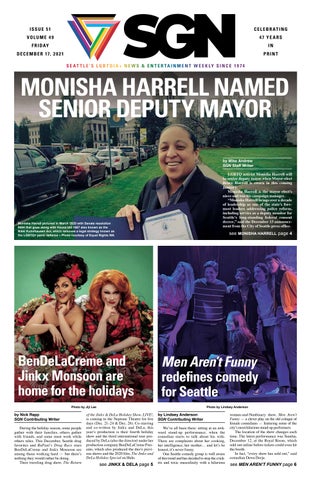
MONISHA HARRELL NAMED SENIOR DEPUTY MAYOR by Mike Andrew SGN Staff Writer LGBTQ activist Monisha Harrell will be senior deputy mayor when Mayor-elect Bruce Harrell is sworn in this coming January. Monisha Harrell is the mayor-elect’s niece and was his campaign manager. “Monisha Harrell brings over a decade of leadership as one of the state’s foremost leaders addressing police reform, including service as a deputy monitor for Seattle’s long-standing federal consent decree,” said the December 13 announcement from the City of Seattle press office.
Monisha Harrell pictured in March 2020 with Senate resolution 8694 that goes along with House bill 1687 also known as the Nikki Kuhnhausen Act, which removes a legal strategy known as the LGBTQ+ panic defense – Photo courtesy of Equal Rights WA
BenDeLaCreme and Jinkx Monsoon are home for the holidays
see MONISHA HARRELL page 4
Men Aren’t Funny redefines comedy for Seattle
Photo by Jiji Lee
by Nick Rapp SGN Contributing Writer During the holiday season, some people gather with their families, others gather with friends, and some must work while others relax. This December, Seattle drag favorites and RuPaul’s Drag Race stars BenDeLaCreme and Jinkx Monsoon are among those working hard — but there’s nothing they would rather be doing. Their traveling drag show, The Return
Photo by Lindsey Anderson
of the Jinkx & DeLa Holiday Show, LIVE!, is coming to the Neptune Theatre for five days (Dec. 21–24 & Dec. 26). Co-starring and co-written by Jinkx and DeLa, this year’s production is their fourth holiday show and the third international tour produced by DeLa (also the director) under her production company BenDeLaCreme Presents, which also produced the duo’s previous shows and the 2020 film, The Jinkx and DeLa Holiday Special on Hulu.
see JINKX & DELA page 5
by Lindsey Anderson SGN Contributing Writer We’ve all been there: sitting at an awkward stand-up performance, when the comedian starts to talk about his wife. There are complaints about her cooking, her intelligence, her mother… and let’s be honest, it’s never funny. One Seattle comedy group is well aware of this trend and has decided to stop the crickets and toxic masculinity with a hilarious
women-and-Nonbinary show, Men Aren’t Funny — a clever play on the old critique of female comedians — featuring some of the city’s most hilarious stand-up performers. The location of the show changes each time. The latest performance was Sunday, December 12, at the Royal Room, which sold out online before tickets could even hit the booth. In fact, “every show has sold out,” said comedian Dewa Dorje.
see MEN AREN’T FUNNY page 6
GREEN CARDS • VISAS • ASYLUM • CITIZENSHIP 1836 Westlake Ave N, Suite 302 Seattle, WA 98109
(206) 724-1940 olivielaw.com
THIS AD SPACE HAS BEEN GENEROUSLY DONATED BY KRISTIN COSTELLO IN MEMORY OF SGN PUBLISHER GEORGE BAKAN
2
SGN
D E C E M B E R 17, 2 0 2 1
C E L E B R AT I N G 4 7 Y E A R S!
ORIGINALLY SEATTLE GAY NEWS FOUNDED 1974 MEMBER
509 10th Ave E Seattle, WA 98102 (206) 324-4297 sgnpaper@gmail.com sgn.org
2021
Deadlines Calendar | Tuesday at 6pm Display Ads Space Reservation | Monday at 5pm Ad Copy (non-camera ready) | Tuesday at 5pm Ad Copy (camera-ready) | Wednesday at 5pm Letters to the Editor | Tuesday at 5pm Obituaries | Call the SGN office All others | Tuesday at 5pm
Publisher Angela Cragin Managing Editor A.V. Eichenbaum Copy Editor SGN Staff • Richard Isaac Advertising Maggie Bloodstone, Advertising Manager National Advertising Rep. Rivendell Media (212) 242-6863 Staff Writers Mike Andrew • Sara Michelle Fetters Contributing Writers Lindsey Anderson • Janice Athill Josephine Baird • Alice Bloch Maggie Bloodstone Kylin Brown • Sharon Cumberland Carter Hemion • Daniel Lindsley Paige McGlauflin • Tim Peter Jessica Price • Renee Raketty • Nick Rapp Hannah Saunders • Gaysha Starr Sarah Toce • Ed Walsh
In Memoriam
Remembering Ken Campbell A member of our SGN team has passed away. This week, the SGN pays tribute to Ken Campbell. He was 50 years old. Ken was an artistic soul, channeling his creative talents in a variety of different media: illustration, graphic design, sculpture, jewelry design, and poetry. Ken was the resident cartoonist at the paper for many years, starting in 2013. He provided the paper with original weekly comics in collaboration with longtime Editor-inChief George Bakan. On many late nights while the SGN team was scrambling to get to print, Ken would deliver a fresh pizza from Hot Mama’s to feed them (half mushroom & onion, half pineapple, extra cheese) and George and Ken would pitch ideas for the week’s comic focus. George was keenly proud of Ken’s tribute to the Orlando nightclub massacre in 2016, which was a shocking double-truck centerfold, illustrated with 49 coffins representing the lives lost — each draped in a rainbow Pride flag — upon streams of the blood that was shed that night. The dark poeticism and powerful in-your-face imagery was in the spirit of the paper to never let LGBTQ+ issues go unnoticed and to give voice to a community that so often is not heard. It was his most lasting work for the paper, and has been reprinted every year since. We will never forget him. We take comfort in knowing that Ken’s contributions to the SGN will live on forever in our archives. May he rest in peace.
Social Media Manager SGN Staff Cartoonist Ken Campbell Photographers Nate Gowdy • Renee Raketty Production Mike Pham SGN is published by Angela Cragin. © 2021. All Rights Reserved. Reprints by permission. Publication of names, photographs, or likeness of any person, organization, event or business in this publication cannot be taken as any indication of the sexual orientation of the person, organization, event or business. Opinions expressed in bylined articles, columns, and letters are those of the authors only and do not necessarily reflect the views of the staff or management of this paper. SGN welcomes unsolicited material, including letters to the editor, but reserves the right to edit or reject material. All rights revert to authors upon publication. We assume no liability for loss or damage of materials, solicited or not. We invite feedback, please write. And please play safe. It is our policy that no money shall be refunded if you choose to cancel your ad. Credit will be given for the balance owed. No exceptions.
In Loving Memory Of George Bakan
Scott Roger Alpert Cookie Andrews-Hunt James Arnold Steve Foiles Shaun Knittel James Leland Moore Don Paulson Randy Peters Lee Richeson Shaun Shelton Jim Tully
Follow SGN
VISIT US ONLINE SGN.ORG
In this Issue
LOCAL NEWS 4 A&E • FILM • BOOKS 5 FOOD & NIGHTLIFE 16 NATIONAL NEWS 20 INTERNATIONAL NEWS 21 D E C E M B E R 17, 2 0 2 1
SGN
3
Local News
Monisha Harrell (l) pictured in March 2018 next to former HRC President Chad Griffin as WA Governor Jay Inslee signs a ban on conversion practices in the state. – Photo courtesy of HRC
MONISHA HARRELL continued from cover
Monisha Harrell is perhaps best known as the Chair of Equal Rights Washington. She is also a member of the National LGBTQ Task Force Action Fund. Previously, she served as a fellow for Lifelong AIDS Alliance and co-chair of the Capitol Hill LGBTQ Public Safety Task Force. In 2017, she was appointed to the City of Seattle’s search committee for the director of police accountability, and in 2018 she co-chaired the De-Escalate Washington campaign committee for I-940, requiring de-escalation training for all law enforcement officers in Washington state. The governor and attorney general have appointed Harrell to serve on task forces and working groups addressing police accountability, independent investigations involving police use of force, and hate crimes. Joining her as a deputy mayor will be Tiffany Washington, who will be in charge of housing and homelessness policies. She has served as division director of homelessness in the Seattle Department of Human Services and as deputy director at the Department of Education and Early Learning. “Our announcement today makes clear that my administration will be centered on competency and urgency,” said the mayorelect. “My administration will combine ambitious vision and bold, progress-driving ideas with the experienced leadership needed to take action and hit the ground running. I’m proud of the team we’re building, united around the common purpose of making Seattle a bright, prosperous, and thriving city for all. Our team will set a new tone and deliver positive change through new energy and proven decisiveness rooted in community relationships and values.” A third deputy mayor — in charge of external relations — has yet to be announced. “I want that deputy mayor position to focus on what the residents and small businesses demanded from the City when they elected me,” said Mayor-elect Harrell. “The deputy mayor of external relations will help build the external partnerships needed to deliver results in measurable terms.”
Another key appointment is former City Councilmember and interim Mayor Tim Burgess, who will serve as director of strategic initiatives, overseeing projects designated by Mayor-elect Harrell as key priorities. Current City Council Central Staff Deputy Director Dan Eder will serve as direc-
4
D E C E M B E R 17, 2 0 2 1
SGN
Monisha Harrell with Bruce Harrell pictured at Seattle Pride 2015 – Photo courtesy of Equal Rights WA
tor of policy, ensuring that the Mayor’s Office is “a driving force behind innovative policy development for the City,” Harrell’s statement said. SDOT Transportation Operations Division Director Adiam Emery will join the Mayor’s Office in a new role of chief equity
officer, charged with ensuring equity across City departments and programs. NAACP Regional President Gerald Hankerson will join the Harrell administration as external affairs liaison, and construction industry lobbyist Marco Lowe will become chief operations officer.
C E L E B R AT I N G 4 7 Y E A R S!
Arts & Entertainment
JINKX & DELA continued from cover
DeLa’s demeanor is undeniably saccharine, and she uses this up-front sweetness to blindside with cutting punchlines and quick wit. She is gorgeous, endearing, and full of surprises. In addition to setting challenge win records on Drag Race, DeLa boasts an impressive portfolio of four successful solo shows off-Broadway and too many variety shows to keep track of. Jinkx has her own singular and endearing sensibility, always sporting her iconic ginger locks and making audiences laugh at her off-kilter style. She took the crown in season 5 of Drag Race and also has an acting, singing, and cabaret career too long to keep track of. Highlights include her critically acclaimed show The Vaudevillians with musical partner Major Scales;
two albums, The Inevitable Album and The Ginger Snapped; voice acting for various animated TV shows; and the web show Cool Mom on WOW Presents Plus. Together, Jinkx and DeLa make up a powerful and glamorous comedic force. This year’s show centers around friendly rivalry between Jinkx and DeLa, in which “you can sense the love between them, but there’s always conflict both around their relationship to the holiday and between themselves,” said DeLa. Each performer has their own history regarding celebrating Christmas. As Jinkx explained, “I definitely play the one who is anti-Christmas, but I did actually have really wonderful Christmases growing up.” She says that now, she looks back and realizes “how tense everyone was, and how stressful it was for all the adults and how everyone was kind of, like, putting on the show of happy family at Christmastime.”
In a similar vein, DeLa comes “from an old New England family where we would meet up at the farmhouse and literally sing carols around the fire and all that craziness… I just hated it because the family didn’t actually like each other.” In a classic Queer fashion, she continued, “it wasn’t until I started doing Christmas shows back in 2007 — specifically so I would have an excuse not to go home — that I started loving Christmas, because I was doing it on my own terms.” The duo’s attachment to Christmas shows stems from their first days working together. When living in Seattle, DeLa caught word of “this kid [Jinkx]” and heard she “was doing a show at four in the afternoon at a Starbucks for free.” Jinkx “walked out of the toilet, where she was changing, and proceeded to perform one of the best shows I [DeLa] had ever seen.” Soon after, DeLa cast Jinkx in her Christmas show in order to join forces and avoid
becoming “absolute rivals.” They have continued to connect over Christmas since. This year’s show features “a joke a second,” and “a lot of show and spectacle,” according to DeLa. Audience members are promised much new material, original music, parody music, and spoken comedy, but also lots of heart: “We want to tell a story but we also want to give people everything that variety gives,” explained DeLa. The Return of the Jinkx and DeLa Holiday Show is sure to entertain even the most holiday-averse audience members. It will undoubtedly be funny, irreverent, and memorable. For more information on the show, visit jinkxanddela.com. Tickets can be found at www.stgpresents.org/calendar/6945/ bendelacreme-jinkx-monsoon. You may want to act fast — the shows end to sell out in Seattle.
Photos by Jiji Lee
VISIT US ONLINE SGN.ORG
D E C E M B E R 17, 2 0 2 1
SGN
5
Arts & Entertainment
Photos by Lindsey Anderson
MEN AREN'T FUNNY continued from cover
Live from Seattle, it’s Stephanie Nam Nam Nam Productions was founded by comedian Stephanie Nam, a Queer KoreanAmerican performer who aims to create community through comedy. Nam uses the company to make space for underrepresented and marginalized people to flex their funny bones without fear of racism, sexism, homophobia, classism, transphobia, ableism, colorism, fatphobia, or xenophobia. “I created Men Aren’t Funny [in 2019] because there is still a lot of misogyny and sexism in comedy,” said Nam, “not just within the community but also in a lot of ‘mainstream’ comics’ material. I wanted to create a space to celebrate and support other women and Nonbinary comics in an industry in which we are underrepresented and often told that we aren’t funny or that talking about our gender identity isn’t relatable or funny. “I have it monthly at either the Rendezvous in Belltown or the Royal Room in Columbia City. I am the sole producer and perform in each show, along with other local comedians.” Sunday’s performance introduced a stellar lineup, including host Tambre Massman and comedians Jaleesa Johnson, Lee Nacozy, Nina Tarr, Arijana Ramic, and Val St. Claire, as well as Nam. From start to finish, these funny folks had the audience in stitches with bits about Gay sex, unruly male cats, and the plausibility of Jeff Bezos aiming to become a real-life supervillain. Closing out the night was the brilliant Nam, who engaged in excellent crowd work and satire. She concluded the evening with a reading of “quotes from men at open-mic nights,” reminding all, once again, why men aren’t funny.
New voices are standing up The success of Men Aren’t Funny shows that there is an audience of people eager to hear jokes about Queer and Trans themes told from non-male perspectives. Aside from creating a safe space where women and Nonbinary performers can shine, Nam was also determined to elevate the voices of BIPOC comedians in Seattle. She makes sure that all the performers understand what material is appropriate to use. When
6
D E C E M B E R 17, 2 0 2 1
SGN
Image courtesy of Nam Nam Productions
comedians make jokes about identities, it should be only from the perspective of their lived experiences and not shame or trigger any audience members. “I also wanted to create a space where those from marginalized identities can come and enjoy comedy in a love format, to enjoy laughing without worrying about being triggered or offended. My shows have agreements performers agree to that ask them to refrain from any sexist, racist,
homophobic, classist, fatphobic, transphobic, etc., material.” Men Aren’t Funny shows not only that is there a wide audience interested in Queer, female, and Nonbinary humor, but that jokes don’t have to be offensive to make people laugh. “Female, Nonbinary, and LGBTQ+ representation are important in comedy, as it is an art form that encourages expression and speaking from your perspective,” said Nam. “Those with marginalized and underrepresented identities can share new, important perspectives with the world. I also feel that those with marginalized identities often have fresher perspectives that are in turn more interesting and funnier, as being unexpected and new is a big part of what makes something funny.” Making room on the stage for marginalized voices also enables future comedians to see themselves in the spotlight. Shows like Men Aren’t Funny that center new voices enable conversations to flow. While racist, sexist, and homophobic jokes are not made at the show, plenty of racy material is shared. Women talk freely about their sexuality, and Queer people share hilarious and intimate details of their lives. Taboo topics become relatable, and audience members leave feeling seen and more prepared to speak up for themselves. If you’re looking for a good laugh in Seattle — and an unconventional ab workout — pick up your tickets for the next show. You won’t be disappointed. The next show is on January 21, 2021, at the Royal Room. Tickets are now available at www.strangertickets.com — get them before they’re sold out! Guests must show proof of vaccination upon arrival, and masks must be worn at all times unless actively eating or drinking.
C E L E B R AT I N G 4 7 Y E A R S!
Film
Drive My Car hits the road to cathartic enlightenment
Drive My Car – Photos courtesy of Janus Films
by Sara Michelle Fetters SGN Staff Writer DRIVE MY CAR Theaters Revered actor and director Yûsuke Kafuku (Hidetoshi Nishijima) has been hired to headline a production of Uncle Vanya at a theater festival in Hiroshima. It has been two years since the unexpected death of his wife Oto (Reika Kirishima), and it is her adaptation of Anton Chekhov’s text he will be handling. It will be the first time he does not act the part of Vanya himself, having chosen only to direct the production. While in Hiroshima, the festival programmers won’t allow him to drive. Initially upset, Yûsuke surprisingly finds himself drawn to his quietly unassuming chauffeur Misaki Watari (Toko Miura). It is as if the pair experience an unspoken bond, and as the weeks pass and the hours inch closer to opening night, the moments they share driving back and forth from the hotel to the theater begin to take on a life of their own. Based on the short story by Haruki Murakami, the devastatingly honest Drive My Car from director Ryûsuke Hamaguchi (Happy Hour) is one of 2021’s best films. It is
VISIT US ONLINE SGN.ORG
a drama that rewards patience, moving at its own leisurely pace and going off in seemingly pointless tangents — only to seamlessly bring all of its subplots together in a storytelling miracle so authentically pure it’s breathtaking. What’s crazy is that, even at three hours in length, the narrative isn’t any more complex than what I’ve outlined in that brief synopsis. It is what happens between the moments that Yûsuke and Misaki climb inside the vehicle where the fireworks are lit, and even they are metaphorical, that does not make them less explosive. The characters inhabiting this potpourri of human existence all have their own livelihoods, their connections to one another blossoming into a garden of mutual understanding overflowing in texture, color, and life. I find it interesting how mundane all of this initially appears. Yûsuke runs the auditions for the production of Uncle Vanya in total silence, watching potential cast members perform as if he is analyzing every facet of their makeup, down to their DNA. Folks like popular television star Koshi Takatsuki (Masaki Okada) — with whom he shares an uncomfortable history — and mute actress Lee Yoon-a (Park Yoo-rim) end up as part of the production, with Yûsuke figuring out how to utilize each of them to achieve his and Oto’s vision Chekhov’s play.
There is more at work here than a simple examination of an artist doing what they love and assisting others to do the same. Yûsuke is still deeply wounded by Oto’s passing, and for reasons I will not disclose, he feels responsible for her death. His interactions with the cast members navigating the complexities of the play are one aspect of the purging of hidden demons he hopes to accomplish in Hiroshima, and in the process, he learns things about each of them as they become one with their roles. These discoveries, as mundane as they may appear, are shattering when taken in concert with everything else that’s been happening. When Misaki sits behind the wheel, she sees what Yûsuke is going through, even if he won’t admit it to anyone, let alone to himself. He in turn notices that Misaki has her own psychological scars, deep wounds she rarely acknowledges while also deluding herself into believing they healed ages ago. Their tragedies are not the same. While unexpected death haunts them both, the circumstances surrounding the loss of their loved ones couldn’t be more different. Yet grief remains universal. Loss binds them, the feeling that they are personally responsible a noose they’ve gone out of their way
D E C E M B E R 17, 2 0 2 1
to snuggly wrap around their own necks, consequences be damned. A series of events will force Yûsuke and Misaki to reexamine things in a new way. They make a connection, one that could allow them to finally move forward with their lives in a new way or force them to backtrack emotionally to the point they decide going forward isn’t worth the effort. Chekhov’s writing becomes a part of all of this, as do the actors appearing in Yûsuke’s production. But mostly it is these two individuals steering not so blindly through their conjoined pain where healing is likely to be found. Whether this statement is true or not, that is the primary mystery Drive My Car takes as much time as it needs to answer. Hamaguchi understands that it is in the tranquil stillness of catharsis and the powerful internalized embrace of selfless acceptance where truth materializes into something tactile. When answers remain ephemeral, this sort of understanding takes on an even deeper meaning: the ability to recognize fact when it has been cleverly concealed in a fiction of one’s own composition, in a book worth reading all the way to the end.
SGN
7
Film
Visually impressive Nightmare Alley is a shot of poisoned adrenaline
Bradley Cooper in Nightmare Alley – Photo courtesy of Searchlight Pictures
by Sara Michelle Fetters SGN Staff Writer NIGHTMARE ALLEY Theaters Guillermo del Toro’s ambitious adaptation of William Lindsay Gresham’s 1946 novel Nightmare Alley might be the most visually stunning motion picture I’ve seen this year. Tamara Deverell’s magnificent production design is exquisitely realized down to the last detail, popping with texture and color. Dan Laustsen’s superb camerawork is a master class of utilizing shadow and light to their best, most unsettling advantage, as the Oscar-nominated cinematographer crafts an eerily discombobulating ambiance that never dissipates. The eye-popping costumes by Luis Sequeira have a lived-in vitality that’s remarkable. If only I felt the same about the film’s emotional components. While it is obvious this is a passion project for the Pan’s Labyrinth and The Shape of Water filmmaker, I found this to be more of a technical marvel than a character-driven one. Images leap off the screen even as central protagonist Stanton Carlisle (Bradley Cooper) frustratingly fades into the background. He’s frequently upstaged by the supporting players, most notably Molly Cahill (Rooney Mara) and Dr. Lilith Ritter (Cate Blanchett), two women who will unknowingly battle it out for possession of Stanton’s soul: one striving for his salvation, the other eager to damn him to eternal hellfire. Stanton is a drifter escaping from a fiery past. He stumbles upon a dingy carnival prepping to break down and move to a new location. One of the more colorful carneys, Clem Hoatley (Willem Dafoe), offers Stanton a job. Warming to the hardworking young man, he even begins to show him the ropes by revealing a few trade secrets and giving him some insights into how to successfully run a carnival, even one as rundown as this. Quick to learn, Stanton has no intention of settling for the comfortable, if still meager, peanuts the life Clem is offering prom-
ises. Instead, he picks the brains of alcoholic former mentalist Pete (David Strathairn) and his clairvoyant wife Zeena (Toni Collette) for a new act that could potentially make him a success on the legitimate stage and in the swanky nightclubs frequented by the rich and powerful. Stanton brings the beautiful Molly along for the ride, whereupon the two fall in love and marry, much to the disgust of carnival strongman Bruno (Ron Perlman) and his diminutive pratfalling sidekick The Major (Mark Povinelli). It takes roughly a little over an hour for all of this to happen, with del Toro taking his time in order to show every side of Stanton’s psychological makeup. Is he evil? Or is there goodness residing somewhere under his skin? Is his love for Molly genuine? Or is he using her to give his act zing? Does he hold affection for Zeena and Pete? Or is he feigning friendship to learn all of their tricks so he can become one of the greatest mentalists the world has ever known? These questions all ache to be answered
8
D E C E M B E R 17, 2 0 2 1
SGN
Cate Blanchett and Bradley Cooper in Nightmare Alley – Photo courtesy of Searchlight Pictures
— not just during this opening section of the film but throughout all 150 meticulously paced minutes. Once Stanton makes a name for himself, Molly is still there, pushing her beloved to stay connected to the selfless decency she sees within him. In the same breath, the mentalist is teased and toyed with by the seductive Dr. Ritter. The devious psychotherapist opens doors to a financial windfall that could set Stanton and Molly up for life, even if the ethics of what they’re being asked to do are decidedly shady. With gothic horror gems like Cronos and Crimson Peak on his résumé, it isn’t a surprise that del Toro would slip into the morally ambiguous waters of film noir with roguish ease. The director is having a blast showcasing someone like Dr. Ritter in all her crimson-lipped, seductive glory. What’s more, Blanchett knows it, the acclaimed actor reveling in every twist of phrase, flip of the hair, and gently violent flick of the wrist as she stubs out a cigarette. She’s unforgettable.
But del Toro is equally in awe of Molly. She is the angel sitting on Stanton’s shoulder and the one who understands the hole he is unintentionally digging for himself, never losing hope she can get him to start filling it back in before it becomes his grave. Mara is mesmerizing, her quiet demeanor loudly shouting eternal truths that are as raw as they are authentic. She adds a layer of sentimental honesty that hits hard and fast and yet never becomes schmaltzy or melodramatic. Which makes it strange that Stanton keeps disappearing inside a story he’s at the heart of. Cooper does his best, giving a fiercely determined performance that digs into the nastier side of the human condition with zero restraint and even less of a care if doing so engenders the audience’s affinity. The problem is that del Toro seems much too eager to let everyone else stand in the spotlight in his place. Blanchett, Mara, Dafoe, Strathairn, Collette, even the latearriving Richard Jenkins — all of their characters are more interesting than Cooper’s Stanton, and that’s a giant issue the director doesn’t seem to be interested in doing a dang thing about. The saving grace is that del Toro stages a final 20 minutes that are nothing less than extraordinary. I can’t go into what happens in any detail — although fans of Gresham’s source material or the classic 1947 version starring Tyrone Power won’t be shocked — but rest assured that Stanton’s fate is not for the faint of heart. The climax of Nightmare Alley packs a jubilantly vile wallop, with del Toro going right for the jugular with the bold exuberance of a carney barker mainlining methamphetamine. For some, that will likely be a shot of poisoned adrenaline worth rolling up one’s sleeve and injecting without hesitation. For me, I wanted to feel a bit more and not just be wowed by all the technical virtuosity. The high wasn’t worth the withdrawal, and I’m not sure I’ll go back anytime soon for a second hit to see if I’d change my mind.
C E L E B R AT I N G 4 7 Y E A R S!
Shattering the multiverse helps return Spider-Man to his comic book roots
Tom Holland in Spider-Man: No Way Home – Photo courtesy of Columbia Pictures
by Sara Michelle Fetters SGN Staff Writer SPIDER-MAN: NO WAY HOME Theaters After toying around and hinting at the multiverse in Avengers: Endgame, WandaVision, and most blatantly at the tail end of Venom: Let There Be Carnage, the Marvel Cinematic Universe dives headfirst into its messy complexities with Spider-Man: No Way Home. Bringing together characters from the MCU, the Sam Raimi–directed films of the 2000s, and the two The Amazing Spider-Man adventures from 2012 and 2014, this third solo adventure for Tom Holland’s iteration of Peter Parker and his web-slinging alter ego is nothing if not ambitious. It’s also a lot of fun. Even better, it is the first story featuring the MCU’s version of Spider-Man that makes him the primary star of his own motion picture. Even with Doctor Steven Strange (Benedict Cumberbatch) occupying a key role in all the realmbending shenanigans, Peter is freed from the baggage of trying to play in the shadow of the Avengers, and that could not be said about either Spider-Man: Homecoming or Spider-Man: Far From Home. Gone are the Tony Stark/Quentin Beck mentor issues. In their place is a story of Peter trying to navigate a world that suddenly knows his secret identity and blames SpiderMan for the devastating events in Europe during his summertime class trip. While the toll on him has been substantial, the youngster is more worried about his Aunt May (Marisa Tomei), best friend Ned Leeds (Jacob Batalon), and new girlfriend MJ (Zendaya). They’re getting hammered in the media and by other outside forces, with both Ned and MJ not even getting into college because of their close ties to Spider-Man. That’s when Peter hits on an idea. What if the world forgets he’s Spider-Man? Doctor Strange, the former Sorcerer Supreme, is willing to cast a spell that will do just that, but Peter doesn’t realize this requires everyone, everywhere to forget who he is — and
VISIT US ONLINE SGN.ORG
Zendaya and Tom Holland in Spider-Man: No Way Home – Photo courtesy of Columbia Pictures
that includes Aunt May, Ned, and MJ. He will no longer be an Avenger. He won’t have any place to call home. He’ll be on his own. Peter didn’t think this through very well, and now that Doctor Strange is casting the spell, he’d rather call the whole thing off. This sudden stoppage leads to disaster, of course, and thus the door is open to villains from those previous Spider-Man motion pictures to return. Willem Dafoe (Harry Osborne/The Green Goblin), Alfred Molina (Dr. Otto Octavius/Doc Ock), Jamie Foxx (Max Dillon/Electro), Thomas Haden Church (Flint Marko/Sandman), and Rhys Ifans (Dr. Curt Connors/ The Lizard) are all back — although the latter two are strangely uncredited — and it’s likely that audiences will loudly cheer when each makes their initial appearance. The opening half setting all of this up is something of a moderate slog. Picking things up where Spider-Man: Far From Home concluded, it takes a little while for director Jon Watts and screenwriters Chris McKenna and Erik Sommers to hit their col-
lective stride. Visually herky-jerky, things move in laborious fits and starts, with only a handful of relatively quiet moments that resonate: Peter, MJ, and Ned ruminating on their high school’s rooftop, a family meeting with Peter’s blind attorney where he assures them everything will be all right, another bit with the core trio learning whether or not they’ve gotten into college.. Things pick up when Peter heads off to see Doctor Strange, but as good as Holland and Cumberbatch are together, the constant quippiness of their interactions does grow tiresome. But this moderates as things move forward, allowing for more nuanced conversations between the pair. The reintroduction of the villains from the previous franchises is also handled surprisingly well, especially as it pertains to Harry Osborne, Max Dillon, and Flint Marko. Unsurprisingly, it is Molina as Dr. Octavius who makes the biggest, most memorable impression, and I really liked the journey McKenna and Sommers took the character on for his return engagement.
D E C E M B E R 17, 2 0 2 1
Where the worm turns is the moment Peter realizes that all of these supposed “bad guys” died fighting Spider-Man in their universes, and if Doctor Strange sends them back to where they came from they’re guaranteed to perish. Peter does not believe he can allow this to happen, feeling that if he can find cures for their various afflictions, it will change what will transpire when they head home to their own timelines. There are some basic paradoxes in all that craziness, and McKenna and Sommers don’t do the greatest job covering them up. However, what the screenwriters do accomplish is to finally have Peter sit down and come to grips with what being a hero is all about. He is forced to weigh things in ways he never has before, centering the character back into his own story and allowing him to finally — and hopefully — become the friendly neighborhood Spider-Man readers and audiences have adored since Stan Lee and Steve Ditko first created him in 1962. The last third of Spider-Man: No Way Home is excellent. There is some wonderful closure for a few characters who never got any in their previous appearances, while this version of Peter Parker gets some agency largely disconnected from the rest of Earth’s mightiest heroes. The climactic battle royale is also stunningly well realized and orchestrated by Watts. Without question, it is the single best action sequence in any of the three Spider-Man films he’s directed. The Raimi trilogy remains the gold standard as far as this character is concerned. But Watts and company finally stake a claim to making Spider-Man their own, and Holland has never looked more comfortable donning the red and blue spandex. If he can have more solo adventures as good as this one, I admit I’m finally curious to see where this version of the wallcrawler goes next. Here’s hoping he can stay out of the larger MCU for a while so that wish can maybe become a reality.
SGN
9
Books
Dominican romance author Adriana Herrera heats up the holiday season
Adriana Herrera – Photo courtesy of the author
by Lindsey Anderson SGN Contributing Writer
in literary fiction... This year I’ll have two books come out, and I’ll have a couple of shorts, a novella, and an anthology. My next full-length novel will come out in March, and that will be my ninth book since I started getting published in 2019.”
What’s a better holiday tradition than baking with friends and family? For author Adriana Herrera, cooking and the holidays go hand in hand. Recently I sat down with her to talk about her food-inspired romance novel, Mangos and Mistletoe, her illustrious writing career, and all things Christmas. “I just wanted to write a story set in the British Bake-Off world, because I love that show,” Herrera laughed, referring to the inspiration behind her sapphic romance novel. “I set it in Scotland, because I had just been to Scotland the year before. My partner and I had been there two weeks before Christmas. It was so beautiful, and I thought that would be a good setting for a Christmas story.” Mangos and Mistletoe follow the adventures of two Dominican cooks forced to compete together in a Scottish baking contest. The novel is full of steamy scenes and mouth-watering recipes. Despite having only started her career in 2019, she has already released nine books. “In romance, we tend to publish more than
Bringing sexy back While she has penned several Queer romances, Mangos and Mistletoe is her only F/F story so far. Writing a story about women felt different to Herrera, and she admits that the genre seems to be lacking in some of her favorite M/M elements, particularly steamy scenes. “You don’t see a lot of F/F out there that is super high heat. M/M can be as sexy as possible, but for some reason, our sapphic stories out here are just not hot. To me, that’s a mission. I’m writing these books as hot as possible. I like reading super sexy stories.” Writing sexy stories about women of color is empowering for Herrera and those who read her work. By defining her sexuality on her terms, she is reclaiming her body and showing the joy and beauty of it. “People whose bodies in the past were commodified, oversexualized, objectified can be rendered differently in books. Like
10
D E C E M B E R 17, 2 0 2 1
SGN
they have a partner who cherishes their body and wants to give them pleasure. They’re understanding their pleasure. They get to have all that without being objectified or having that trauma come into it, to a degree.” Intersectionality in novels Another ceiling she is trying to break through is normalizing romances starring women of color. “You don’t often see sapphic books where both leads are women of color,” she says. “With Mangos and Mistletoe, they’re both Dominican, but they have very different stories: one is born in the US, the other… in the Dominican Republic, so their approach to their culture, how they see themselves is very different. I love exploring those.” Writing stories that represent her experiences and culture is essential for Herrera. “I think, for me, representation, in general, is important. The reason why I started writing romance was that, as a person of color, who is a Bisexual person, who is an immigrant, I found that I could only find, like, one side of myself in stories,” she said of the lack of intersectionality in the romance genre. “I could find a Queer romance, but it was a cis white protagonist. I could find a story about
immigrants, but it wasn’t a Queer protagonist. I could find a Latin story, but it wasn’t a Black Latina.” Eventually, she stopped looking for herself in the pages of books that continued to only represent a fragment of who she was. “I could only find snippets of myself in romance, and I’ve been reading romance for a long time. I’ve been reading Queer romance for a long time, and that was really like the impetus for me to decide to… try to become a published author. I wanted to see a full representation of who I am in books, and I didn’t quite have it. LGBTQ representation, specifically in Latin characters, was important to me.” Now she writes her own romances, all of which include BIPOC and LGBTQ+ main characters. “Even when the characters present in a straight way, I think I’m writing Queer stories,” she says. “One of the protagonists is Bi or pan, or the found family they have is fully Queer. Communities are fully represented in [my books]. I want to be mindful, and I want to write about my world. There are going to be people of all kinds of sexuality, desire, gender identity.”
see HERRERA page 15
C E L E B R AT I N G 4 7 Y E A R S!
VISIT US ONLINE SGN.ORG
D E C E M B E R 17, 2 0 2 1
SGN
11
12
SGN
D E C E M B E R 17, 2 0 2 1
C E L E B R AT I N G 4 7 Y E A R S!
VISIT US ONLINE SGN.ORG
D E C E M B E R 17, 2 0 2 1
SGN
13
All are Welcome. We Don’t Just Say It. We Live it. St. Patrick’s Church is a welcoming, evolving Catholic Church located at the north end of Capitol Hill, 2702 Broadway E. We embrace all people as children of God and would like to invite LGBTQ community members to worship with us. As a parish, we have a strong emphasis on social justice and inclusion. This includes outreach to a women’s shelter, a supportive relationship with a faith community in El Salvador, weekly sign language interpreted Mass for the deaf and deaf-blind community, and welcoming developmentally disabled adults from the L’arche community. Our choir and dance troupe are an integral part of our expression.
2702 Broadway E. Seattle, WA 98102 · www.stpatrickseattle.org
This notice was paid by the St. Patrick LGBTQ+ Engagement and Accompaniment Circle of Parishioners, and several other Parishioners, who invite LGBTQ returning Catholics and others to join us in person or online. For more information about St. Patrick’s LGBTQ Circle of Parishioners contact John Dunn – dunn570@aol.com
14
SGN
D E C E M B E R 17, 2 0 2 1
C E L E B R AT I N G 4 7 Y E A R S!
Books
Runner’s High: Taking exercise to a higher level by Terri Schlichenmeyer Special to the SGN RUNNER’S HIGH: HOW A MOVEMENT OF CANNABIS-FUELED ATHLETES IS CHANGING THE SCIENCE OF SPORTS BY JOSIAH HESSE © 2021 Putnam $28.00 / $37.00 Canada 308 pages For most of his life, Josiah Hesse looked at exercise as something like punishment. He hated the very idea of competition, and any kind of physical effort reminded him of high school “locker rooms” and “homophobic meatheads who threatened my safety.” Having eventually worked through those feelings, he was waiting for the start of a marathon in 2015 when he noticed discarded edibles wrappers in a garbage can. He’d brought some along too, to “discreetly consume” them during the race. By the end, he was joyful and “giddy,” having discovered something he believes is underreported. He had thought he was alone in his enjoyment of running while high, but Hesse was surprised to find that many athletes — particularly distance runners, he says — use CBD, THC, and marijuana to enhance their performance. It’s quietly common in amateur sports and, he avers, though most organizations ban or discourage it, marijuana use is also well known in pro sports. Science, he says, has proven in many ways that marijuana and its derivatives can actually help athletes. The human body contains cannabinoid receptors, and it’s well known that marijuana works to eliminate pain and induce relaxation, and can decrease anxiety. Hesse noticed that “ripping a bong” before he ran made running more like “play.” If couch potatoes could tap into that feeling, then maybe, Hesse posited, they wouldn’t be so sedentary. Getting any useful information out of Hesse’s nonfiction book Runner’s High, though, is very clearly going to depend on your stance on the use of marijuana.
Image courtesy of Putnam
If you’re steadfastly negative, you can stop here. If you lean positive, though, Hesse still won’t make things easy for you. Readers will quickly notice, for example, that several iterations of the word “play” show up in this book really often, which is generally distracting and doesn’t, until toward the end, leave much room for serious discussion on what he’s found. While there is a good amount of science and businesslike dialogue here, the antsy insistence on “play” overshadows it. Others, particularly those who are specific in their usage, may find deep offense in labels like “stoner,” “pothead runners,” and “dirtbag.” The casual use of user slang also changes the tone of this book, from investigative to impudent. For athletes who want to make their daily run fun, or for “couch monsters” who need impetus to get up and go, there’s a lot of solid science to be had in Runner’s High. If you aren’t anywhere convinced, though, this book could be a mountain of controversy.
ple of color that are not about our trauma. Like, it was important, specifically for Queer Latin people, it was important for me to write about us being in joy, finding it, and getting to have a ‘happily ever after’ without needing to be broken in the process. Just getting a ‘happily ever after’ that everyone else gets to have without giving up their humanity in the process. “I appreciate the books that are out there giving people an understanding of larger and historical things. I also think that we deserve books that are not the learning books, the lesson books, the education books. We should be able to have books that are fun, frothy, escapist books, that are about our lives and joy.”
HERRERA
continued from page 10 Speaking for herself Herrera also believes that own voices are important when writing. That’s why she puts pieces of herself and her identities at the core of all the characters she writes. All her main characters are Black or Latinx, two identities she holds. When she does write interracial relationships, she admits it’s a challenge, but one she feels equipped to tackle since she is also in an interracial relationship. However, she admits, it is difficult writing from the perspective of a white man. “I try not to be in the headspace of a white cis man as much as I possibly can,” she joked. Diversity in literature is very important, and Herrera is glad to see genres shifting to include different kinds of people. “I think there’s been an ongoing conversation for a while now about the importance of having people of color, marginalized people, people who are neurodivergent, differently abled people, immigrants… I think it’s allimportant to establish that there is a value to their voices out there. “One of the things I like to think I’m doing with my books is I’m from a different gaze. A book about a Latin person written by a Latin person, they’re going to have a world view and a perspective for any reader that is going to impact them differently than if it was a story about a Latin person written by a white person.” Bringing her experiences to the page is beneficial, not only to other Dominican
VISIT US ONLINE SGN.ORG
Josiah Hesse – Photo by Glenn Ross
Image courtesy of the author
readers but to readers from all backgrounds, who now get a taste of what Dominican culture is like. “To me, gaze, and what we can do by bringing stories from our perspective and our world view, I think is valuable. There’s an empathy-building piece of it that we need in the world.” She also notes that writing BIPOC stories about joy and love are vital, to share that marginalized experiences can be beautiful and triumphant. “It was also really important for me to write books about peo-
Christmas traditions in the Dominican Republic For Herrera, romance novels are a fun way to escape the mundane. Another fun way is with Christmastime celebrations. Herrera likes to celebrate the holiday with her partner and friends, but nothing beats her traditional celebrations with her family back in “the DR.” “I’m Dominican, so we usually do Nochebuena, which is Christmas Eve. It’s a great meal, and then if I’m home, which I will be this year, it’s not cold, it’s nice and mild weather, and you have a ton of food. Everybody gets together, and it’s just a nice family holiday.” Living in a Latinx family also means lots of delicious food around the holidays. “A lot of my favorite traditions revolve around food. Every Latin country has its kind of tamale, and we have one called pas-
D E C E M B E R 17, 2 0 2 1
teles, which is a tamale, but the masa, the batter we use, is made out of plantains. We fill it with ground beef or ground chicken. Usually, like a week before the holidays, we get together with family and make a ton of them. So usually it’s like, you know, your aunts come over, your family comes over, and you make this big huge batch of batter, and everyone makes a ton of pasteles, and then we all take our pasteles for our dinners. That’s always a nice tradition.” Herrera is excited to go home and visit with her family this holiday. One of her favorite Christmas activities in the DR is going to the beach. “It’s always fun to go to the beach in the middle of the winter… From November to February is not as hot, and there are no mosquitos and humidity, so it’s just the best weather.” But she has one special holiday wish before she leaves. Her ideal date would be a trip to the big city to see all the cold Christmas sights before heading home to the Dominican Republic for a relaxing day in the sun. “I live in New York City, so going to Rockefeller Center and seeing the tree and [the] nice Christmas market in Union Square is fun, on a day that it’s not super cold.” If you’re looking for a fun way to escape the cold, dreary Seattle weather, warm up with a steamy copy of Herrera’s Mangos and Mistletoe and read along with us in the SGN Book Club this week! As always, our book club can be found on Instagram @sgn_books.
SGN
15
Food & Nightlife
Queer Eats: La Josie’s offers heat and allyship on a cold December night
by Kylin Brown SGN Contributing Writer Tucked between Summit and Belmont Avenues on E. Pike is La Josie’s, the baby sibling of beloved E. Pine Mexican restaurant Fogón. Since it opened in July 2020, the venue, featuring an intersectional Pride flag and pink neon signage, has piqued my interest time and time again. On a recent internet dive, I found the cantina listed on business review sites like EverOut, Intentionalist, and Seattle Refined as “LGBTQ-owned.” I had previously heard that it was owned by a Mexican-American family. Both could certainly be true, but this info led me to finally make some happy hour plans and scope it out. The family owners Just after a four o’clock sunset, I sat down for a happy hour drink and a small bite at the well-decorated bar, under a Día de los Muertos mural by artist and activist Son Doung, aka Son of a Gun (@son_of_a_gun1969) on Instagram. The menu offered a plethora of food and drink options, so I asked a brighteyed server, Alejandro, to give me the lowdown. “Depending on if you like spicy food, we have so many things. Pretty much, I say if you get food from [La Josie’s], it’s going to be very good,” he said. Owners Noel Cortez and Amparo Ambriz have their origins in Michoacán, Mexico. Their family’s work at Fogón over the years has brought the piquant and earthy flavors of that agricultural state, known as the avocado capital of the world, directly to Seattle through Mexican comfort food dishes and cocktails. Prior to the pandemic, Alejandro remembered, Fogón customers would often see long wait times due to its popularity and just-north-of-down-home feeling. “Sometimes people just want to have a snack and a drink” though, Cortez told Capitol Hill Seattle blog last year upon La Josie’s opening. Though that was a major reason for opening this second venue, specializing in “small bites and big margaritas,” Cortez also dedicated the cantina to his late nephew and business partner, José Ambriz, who passed away in 2019
16
SGN
Photos courtesy of La Josie's
Ambriz, known familiarly as “La Josie,” helped establish and popularize Fogón alongside his uncle, with the two serving as co-owners. As it turns out, La Josie’s is operated by Cortez and Amparo Ambriz, José’s sister. The uncle-niece duo have been successful, even during the pandemic, due to their dedication, serving drinks that José himself once loved to craft. Allyship So it seems that “LGBTQ-owned” tags are not always entirely well informed. However the allyship demonstrated by this family-owned business is noteworthy. Alejandro told me that the bar recently hosted drag with Queen Maritza Baez, and the event was a hit. They hope to continue hosting shows with more Latin queens if they can continue them safely. Additionally, like Fogón, La Josie’s is
D E C E M B E R 17, 2 0 2 1
now a yearly participant in Dining Out for Life, a September campaign benefiting HIV/AIDS services across the country. As gold-level Seattle participants, the two venues each pledge 50% of their net sales to Lifelong on the day of the event each year. In an article in the Seattle Times, Cortez noted that the event was so successful the first year at Fogón that they’ve just kept with it. “It’s a good cause,” he said. From hosting events like these to displaying Pride flags year-round and working to keep their space — in person and on social media — as inclusive and safe as possible since their pandemic opening, La Josie’s has proven to be Gay friendly, if not Gay owned. It emits a warm, familial vibe on Pike Street’s nightlife scene and brings people together to celebrate in the memory of a dear community member. And not to mention, the fare is thoroughly fantastic.
The food and drink On Alejandro’s suggestion, I opted for spice. The camarones a la diabla brought me thick prawns bathed in the house’s fiery “diabla” (devil) salsa, accompanied by a tongue-cooling combo of avocado slices, lime wedges, and rice. Happy hour would not be complete without the presence of some chosen family. Together, a couple of friends and I tried a toothsome sample of Mexican favorites. The sopitos con pollo did not disappoint, with shredded spicy chicken floating atop crispy half-inch-thick masa boats and refried beans. Alejandro eagerly offered us a Mexican hot sauce, called “El Yucateca,” in three different colors to join the chicken. It seemed our chef was detail-oriented, decorating the dish with just enough sour cream and feta. Though the ceviche was mouthwateringly fresh and light, it lacked the same punch as the other two dishes, especially when contrasted by the devilish camarones. On a cold December evening, their gustatory rhinitis–inducing heat was exactly what I needed. To drink, we chose a habanero-infused tequila “Ultimate Margarita” and the tamarind margarita with mezcal (another Alejandro tip). I have been a twentysomething on Capitol Hill for a few years now and have yet to have such a flavorful happy hour experience. In addition to their famed margaritas and tasty foods, La Josie’s offers cycling seasonal drinks and house-infused tequilas, like hibiscus, strawberry, and watermelon, in the summertime. Served with obvious smiles behind masks, the fare is most definitely made with love and care. Located at 514 E. Pike St., La Josie’s is open Monday through Wednesday 4–11 p.m., Thursdays and Fridays 4 p.m. to midnight, Saturdays 1 p.m. to midnight, and Sundays 1–11 p.m. They are fully open, with indoor and outdoor dining, takeout, and delivery via UberEats as well.
C E L E B R AT I N G 4 7 Y E A R S!
VISIT US ONLINE SGN.ORG
D E C E M B E R 17, 2 0 2 1
SGN
17
Food & Nightlife
4 p.m. is the new 8 p.m. Queer happy hours to enjoy in the dark
by Nick Rapp SGN Contributing Writer This past fall has been Seattle’s wettest on record: almost 19 inches of rain from September through November. It’s dark by the time you get off work, and it’s cold. Now, more than ever, we need places where we can take refuge and ride out the dreariness. Luckily, winter solstice is December 21, so the days will start getting longer soon! In the meantime, the Queer bars of Seattle are offering myriad early-evening deals on drinks and activities. Discount billiards, cheap drafts, and free snacks are among many of the options you can enjoy at local happy hours. Let SGN’s list of Queer happy hours—curated, if not comprehensive— help you find a new spot to explore (or a new deal in your favorite old spot). Pony While gas prices are skyrocketing, this gas-station-turned-gay-bar offers some pretty generous happy hour deals. An intimate dance floor with eclectic music and a covered outdoor patio are Pony’s strong suits. Come for the drinks, stay for the paper-mache penises hanging from the ceiling. Happy hour—with $5 well drinks and $2 off drafts—runs from opening time until 8 p.m. every night, and all night long on Wednesdays. 1221 E. Madison St., Seattle, WA 98122 Photos courtesy of Pony
18
SGN
D E C E M B E R 17, 2 0 2 1
C E L E B R AT I N G 4 7 Y E A R S!
Diesel The Hill’s bear bar is home to strong drinks and satisfying pub fare: think mozzarella sticks and pints of Manny’s. With all the motorcycles parked out front, Diesel can look like a rural bar you’d drive past, but it happens to be Gay. Thank God! Diesel hosts weekly Taco Tuesdays, with $2 tacos. Happy hour runs 4 p.m. to 6 p.m., Monday to Friday, and includes $5 double wells, $2 off call spirits, and $1 off draft beers. 1413 14th Ave., Seattle, WA 98122 Madison Pub Divey neighborhood favorite Madison Pub marries the best traits of Gay bars and sports bars. Cute, kind bartenders pour the drinks, the darts and billiards games are cutthroat, and a random assortment shows and sports play on the bar’s many TV screens. A recent visit featured simultaneous screenings of Family Guy, a hockey game, and It’s Always Sunny in Philadelphia. Happy hour runs from 5 p.m. to 7 p.m., Monday to Saturday, with $1 off drafts and well drinks and alternating weekly beer and cocktail specials. On Sundays, the pub offers $1 off pitchers of Bud Light and Rolling Rock, free billiards, and free peanuts. Photo courtesy of Diesel
Photo courtesy of Madison Pub
1315 E. Madison St., Seattle, WA 98122 Union Lively and conveniently located, Union is great for grabbing an early drink with a friend or staying for some late-night fun. Their large screen plays music videos and is bound to remind you of some iconic pop moment of your youth that you haven’t thought about in years. Union’s happy hour is from 4 p.m. to 6 p.m., Monday to Friday, and features $4 Truly Hard seltzers, $5 Stella Artois drafts, $6 Absolut cocktails, and $16 bottles of wine. Union also hosts Wing Wednesdays from 4 to10 p.m., offering ten wings for $5. 1009 E. Union St. Suite C, Seattle, WA 98122
Photo courtesy of Union
Photo courtesy of The Crescent Lounge
The Crescent Lounge If you walk past the Crescent Lounge, the oldest Queer dive bar in Seattle, you probably won’t be able to resist the urge to peek inside. Its bright pink exterior draws bargoers into an even more stimulating interior. And on weekends they host karaoke! The space is small and the spirit is fun. Happy hour is every day from noon to 6:30 p.m., and karaoke usually crosses over into happy hour at 4 or 5 p.m. on Fridays and Saturdays. Deals include well and domestic specials and depend on who is mixing drinks—different bartenders offer their own specialties, especially around the holidays. 1413 E. Olive Way, Seattle, WA 98122 Changes Wallingford’s only Queer bar has good drinks, good food, and bar games, all in a cozy, laid-back setting, and its friendly bartenders serve up a wide variety of drinks. Happy hour typically runs from noon until 7 p.m., except on Sunday and Tuesday, when it’s all day and all night. The $3 single wells and $5 double wells are a great deal, and on Tuesdays the bar offers $1.25 bottles of domestic beer. 2103 N. 45th St., Seattle, WA 98103 The Cuff Complex This gigantic leather bar and dance club boasts three bars and a huge patio, making the Cuff more of a nightclub than a mere bar. The happy hour specials ensure you’ll stay long past the early evening. The Cuff Complex runs Taco Tuesdays and Thursdays, selling $2 tacos and $5 margaritas until 10 p.m. A tempting offer.
Photo courtesy of Changes
VISIT US ONLINE SGN.ORG
Photo courtesy of The Cuff Complex
D E C E M B E R 17, 2 0 2 1
1533 13th Ave., Seattle, WA 98122
SGN
19
National & International News
Report shows insulin price-gouging nationwide Build Back Better could change that
Photo by Reed Saxon / AP
by Hannah Saunders SGN Contributing Writer On Dec. 10, the US House Committee on Oversight and Reform released its final report after a three-year investigation into pharmaceutical pricing and business practices in the United States, with a focus on the three insulin manufacturers that control 90% of the global market. The report comes at a time at which insulin advocates and state leaders have worked to cap the co-payment for insulin for those with insurance under the Build Back Better Act. In the United States, 32.4 million Americans have diabetes, and one in four diabetics report rationing insulin due to affordability issues. Eli Lilly, Novo Nordisk, and Sanofi have drastically increased the list price of insulin over the past two decades, but have made no change in their formulas. Big Pharma report Twelve drugs and ten companies in total were investigated, and it was found that these companies raised prices on those twelve drugs over 250 times, to a cost that was about 500% greater than when they were initially introduced to the market. It was found that drug companies “aggressively” raised prices to meet revenue goals, while executive compensation arrangements created motivations to raise prices. “The Committee’s analysis found that taxpayers could have saved more than $25 billion over a five-year period for just seven of the drugs investigated — Humira, Imbruvica, Sensipar, Enbrel, Lantus, NovoLog, and Lyrica — if private Medicare Part D plans had obtained the same discounts as other federal health programs that are empowered to negotiate,” read the report. According to the report, drug companies target the US market for higher prices while using the Medicare program to increase revenue, all while maintaining or reducing prices across the rest of the globe. Those who are under Medicare Part D plan have no option to negotiate drug pricing. The report mentions that Medicare Part D plans have significantly smaller rebates when compared to other federal health care programs, and that if those plans had obtained the same discounts as other federal programs for the three most used insu-
20
SGN
lins (Lantus, Humalog, and NovoLog), then Medicare could have saved over $16.7 billion from 2011 to 2017. The report stated that Medicare accounted for over 41% of insulin sales from Novo Nordisk in 2014. An internal Novo Nordisk presentation slide in Oct. 2013 said, “Part D is the most profitable market for the Novo Nordisk insulin portfolio.” Novo Nordisk, Sanofi, and Eli Lilly have engaged in strategies that suppress competition to maintain monopolies over the market, according to the report. Strategies include aggressively marketing to patients and physicians, forcing patients to producthop or switch medications, and contracting with pharmaceutical benefit managers (PBMs) and insurance agents, which prevents competitor products from receiving rebates and discounts. “The three insulin companies have engaged in strategies to maintain monopoly pricing and defend against competition from biosimilars,” read the report. In addition to forcing patients to switch medications, the three insulin manufacturers have engaged in shadow pricing, which is raising drug prices in synch with competitors, or, each other. According to the report, senior executives at all three manufacturers have encouraged shadow pricing. “In a discussion among Novo Nordisk employees about an Eli Lilly price increase for a different diabetes product on December 24, 2015, a Novo Nordisk pricing analyst remarked, ‘maybe Sanofi will wait until tomorrow morning to announce their price increase… that’s all I want for Christmas.’” Insulin price hikes The United States accounts for 50% of global insulin revenue, even though it only accounts for about 15% of the global market. In 1996 the price of Eli Lilly’s Humalog was $20.82 per vial, but it’s currently priced at $274.70, according to the report. From 1996 until 2017, the price of Humalog increased over 1,200%, and in 2019, Humalog generated $1.67 billion in net revenue in the US. In 2001 Novo Nordisk’s NovoLog cost $39.75 per vial, but it now costs $289.36 for the exact same vial. Since 2001 Novo Nordisk has increased the price of Novolog 28 times, resulting in a cumulative price increase of 628%, and in 2019, the company generated
D E C E M B E R 17, 2 0 2 1
$1.18 billion in net revenue in the US. Sanofi’s Lantus, a long-acting form of insulin, was priced at $34.81 per vial in 2001; however it is now priced at $283.56. In 2019 Sanofi generated $1.14 billion in net revenue in the US from this medication. Investigation recommendations “The Committee’s investigation shows that uninhibited price increases have fueled corporate profits and executive compensation and that drug companies raise prices in order to meet revenue targets. Data obtained by the Committee undermines claims by the pharmaceutical industry that rebates provided to PBMs are the primary driver of price increases,” read the report. The report also indicated support for both Medicare negotiation and an inflation penalty, which would be applied when a manufacturer raises drug prices faster than the rate of inflation. Both recommendations are present in the Build Back Better plan. Insulin4All Washington’s Insulin4All chapter advocate Kevin Wren met with Sen. Patty Murray (WA), Sen. Tina Smith (MN), and Rep. Anna Eshoo (CA) on Dec. 7 to discuss Build Back Better. Wren was diagnosed with type 1 Diabetes in 2001 at the age of 15. “I first rationed insulin in 2009. I was underinsured and I was working two jobs just out of college,” Wren said. “The price for my insulin was over $1,000 for one month’s supply, and that’s well beyond my means. I kind of gambled with my life as many diabetics have done, and rationing insulin is a living nightmare. “Food is poison and your blood turns to acid. It only takes a few days before you succumb to ketoacidosis. So many have. I’ve been hospitalized for days with it. It’s painful and it’s awful. I was fortunate to survive because I was able to access my dad’s insulin. I was fortunate to have a parent with diabetes.” Sen. Murray mentioned that too many diabetics are torn between paying for their essential needs or paying for their life-saving medication. “I’ve heard from people in my state who have insurance, who worked their whole lives, who saved their money, but still had to work an extra job and move in with their family so
they could afford their insulin,” Murray said. “I know of college students who have rationed their insulin and put their own life at risk just to try and make ends meet.” She brought up how COVID-19 has been a critical reminder to how crucial affordable healthcare is. “People need insulin to live,” Murray said. “No one should have to choose between their insulin and necessities like food, or housing, or childcare, or anything else. People fighting diabetes have enough to worry about without constantly dreading the question: How in the world am I going to pay for this?” Sen. Smith also brought up how every day she hears of Minnesotans who are struggling to pay the price for their prescribed medications and acknowledged how Americans are forced to pay three times more for their medication than people in other countries. “Drug companies raise the price of drugs like insulin year after year, with no other reason than that they can,” Smith said. “Even during this pandemic, drug companies raised the price of prescription medicines, more than one thousand prescription medicines. The Build Back Better Act will finally give Medicare the authority, the mandate, and the tools to negotiate for lower prices for certain medications, including insulin.” The Build Back Better Act would reduce the cost of prescription drugs by allowing Medicare the option to negotiate drug prices. In addition, it would place a co-pay cap on insulin at $35 per month for those with private and public insurance. “It’s dehumanizing not being able to afford insulin,” Wren said. “Our desire to live is exploited and extorted by pharmaceutical manufacturers Eli Lilly, Novo Nordisk, and Sanofi. I think Build Back Better will make great strides in holding them accountable for the price increases that have incurred over the years.” Democrats are hoping to pass the Build Back Better Act by Christmas.
C E L E B R AT I N G 4 7 Y E A R S!
Counting the community: There are at least 20 million of us
International news highlights by Daniel Lindsley SGN Contributing Writer
Photo by Pavel Danilyuk / Pexels
by Mike Andrew SGN Staff Writer Some 20 million US adults identify as LGBT, according to a new Human Rights Campaign analysis of government data. That figure represents nearly 8% of the total adult population of the country, and is two times higher than previous statistical estimates. The HRC added that millions more may identify as something “more expansive,” like pansexual. For this estimate, the HRC took data from the US Census Bureau’s Household Pulse Survey, an experimental household probability survey released in biweekly phases during the pandemic. The HRC said that previous attempts to document the size and demographics of America’s LGBTQ+ population have faced significant roadblocks related to sampling and bias. In 2020, the Williams Institute estimated the LGBT population of the US at 4.5%, based on Gallup’s Daily Tracking Survey.
In one of the most comprehensive studies of the LGBTQ+ community, the Public Religious Research Institute’s American Values Atlas estimated 4.4% of Americans identified as LGBT. That was followed by a Gallup poll published earlier this year, which saw the percentage of LGBT Americans estimated at 5.6% of the total adult population. While the HRC’s estimate nearly doubles those figures, it may still underestimate the LGBTQ+ community’s size, the HRC said. “This data shows what we’ve suspected: our community is larger and more widespread than we could have known up to this point,” Interim President Joni Madison said in a statement. “We’re proud to bring this data to light and set the stage for a future where all the millions of LGBTQ+ people in America enjoy full legal and lived equality. I commend the Biden administration and the US Census Bureau for finally allowing researchers to count us, and look forward to seeing the LGBTQ+ community counted in further studies,” she said.
According to the HRC analysis, the largest category of LGBT folks is Bisexual. They may represent up to 4% of the US adult population — perhaps 10 million people. The Lesbian and Gay communities make up about 3% of the population, according to the HRC. The HRC analysis suggests that some 2 million adults identify as Transgender. In 2016, the Williams Institute estimated the Trans population at 1.4 million. An additional 2% of survey respondents said they did not use the terms “cisgender male,” “cisgender female,” or “Transgender” to describe their gender, suggesting they may identify as Nonbinary, Genderqueer, or Gender Fluid, according to the HRC report. California and Texas had the largest LGBTQ+ populations based on the census data, but LGBTQ people are found in “every community across every state,” the report found. California and Texas also led the pack in the 2020 Williams survey.
International news highlights by Daniel Lindsley SGN Contributing Writer Senegal: Harsh laws may get harsher Reuters reported on December 13 that lawmakers in Senegal have drafted laws against same-sex relations that would lengthen jail time for those convicted of “LGBT+ activities.” A 2020 review by the International Lesbian, Gay, Bisexual, Trans and Intersex Association reported that arrests and prosecutions for Gay sex have risen sharply in the country, where such activity already carries a prison sentence of five years. Senegalese LGBT+ activist Djamil Bangoura told Reuters,
VISIT US ONLINE SGN.ORG
Chile's government palace in Santiago on December 7 – Photo by Alex Ibanez / Chilean Presidency / Handout via Reuters
“When individual freedoms, in particular the most sacred — privacy between consenting adults — are attacked, then there is little time left to realize that democracy is in danger.” According to Reuters, how much support the bill will win in Parliament is unclear. Chile: Same-sex marriage made official Reuters reported on December 9 that Chilean President Sebastián Piñera has signed a law legalizing same-sex marriage. The law was approved by Congress
just days before. Reuters noted Chile’s reputation as a conservative nation, even relative to other Roman Catholic Latin American countries, adding that most Chileans now support same-sex marriage and seem to be on the way to becoming more socially and culturally liberal. Pres. Piñera said at a ceremony with LGBT activists, “All couples who so wish, regardless of their sexual orientation, will be able to live love, marry, and form a family with all the dignity and legal protection they need and deserve.”
D E C E M B E R 17, 2 0 2 1
Maddy Morphosis – Photo courtesy of VH1
US: Debate over cis, straight man in Drag Race NBC reported on December 9 that the casting of Maddy Morphosis, a cisgender straight man, in RuPaul’s Drag Race has sparked controversy among fans of the show. Some argued that the show was inherently Queer-centric, that the casting was an invasion of a safe Queer space, or that Morphosis was taking a spot away from Gay or Trans drag queens. NBC added that the show has redefined who can be a drag queen several times, such as when a Bisexual contestant competed in Drag Race UK, or a cisgender Lesbian competed in Drag Race season 3. Former contestant Gottmik, the show’s first Trans male contestant, weighed in on the issue in an interview with Variety: “When I first got announced on the show, I was flooded with people who did not think I should be on the show or I shouldn’t be doing drag. I feel like she’s going through the exact same thing right now.” Worcester: Ministry houses Gay asylum seekers NBC reported December 13 on the Massachusetts church group that recently opened an apartment building for LGBTQ+ asylum seekers. A task force assembled by Hadwen Park Congregational Church in Worcester, MA, raised more than $500,000 to purchase and renovate the building, which director Al Green says is the biggest investment but hardly the first of the group’s ongoing efforts to help LGBTQ+ immigrants. The first three residents of the home, all Gay men, moved in over Thanksgiving weekend. Alain Spyke, 26, who fled harassment and persecution in Jamaica, told NBC News, “I don’t even have words. To come into this country and have a safe space to escape all the hardships and trauma? Not everyone has that opportunity.”
SGN
21
22
SGN
D E C E M B E R 17, 2 0 2 1
C E L E B R AT I N G 4 7 Y E A R S!
Episode 14: Kenna Lindsay In this episode, Ash & Lindsey approach New Year's Resolutions, a cat causes trouble, and we talk about the bank! Our special guest this week is Santa Cruz-based body positive artist Kenna Lindsay.
BI-WEEKLY! FIND US WHEREVER YOU LISTEN TO PODCASTS!
VISIT US ONLINE SGN.ORG
D E C E M B E R 17, 2 0 2 1
SGN
23